WO2020158851A1 - 封止用樹脂組成物、電子部品装置及び電子部品装置の製造方法 - Google Patents
封止用樹脂組成物、電子部品装置及び電子部品装置の製造方法 Download PDFInfo
- Publication number
- WO2020158851A1 WO2020158851A1 PCT/JP2020/003381 JP2020003381W WO2020158851A1 WO 2020158851 A1 WO2020158851 A1 WO 2020158851A1 JP 2020003381 W JP2020003381 W JP 2020003381W WO 2020158851 A1 WO2020158851 A1 WO 2020158851A1
- Authority
- WO
- WIPO (PCT)
- Prior art keywords
- group
- resin composition
- mass
- epoxy resin
- electronic component
- Prior art date
- Legal status (The legal status is an assumption and is not a legal conclusion. Google has not performed a legal analysis and makes no representation as to the accuracy of the status listed.)
- Ceased
Links
Classifications
-
- C—CHEMISTRY; METALLURGY
- C08—ORGANIC MACROMOLECULAR COMPOUNDS; THEIR PREPARATION OR CHEMICAL WORKING-UP; COMPOSITIONS BASED THEREON
- C08G—MACROMOLECULAR COMPOUNDS OBTAINED OTHERWISE THAN BY REACTIONS ONLY INVOLVING UNSATURATED CARBON-TO-CARBON BONDS
- C08G59/00—Polycondensates containing more than one epoxy group per molecule; Macromolecules obtained by polymerising compounds containing more than one epoxy group per molecule using curing agents or catalysts which react with the epoxy groups
- C08G59/18—Macromolecules obtained by polymerising compounds containing more than one epoxy group per molecule using curing agents or catalysts which react with the epoxy groups ; e.g. general methods of curing
- C08G59/40—Macromolecules obtained by polymerising compounds containing more than one epoxy group per molecule using curing agents or catalysts which react with the epoxy groups ; e.g. general methods of curing characterised by the curing agents used
- C08G59/42—Polycarboxylic acids; Anhydrides, halides or low molecular weight esters thereof
-
- C—CHEMISTRY; METALLURGY
- C08—ORGANIC MACROMOLECULAR COMPOUNDS; THEIR PREPARATION OR CHEMICAL WORKING-UP; COMPOSITIONS BASED THEREON
- C08K—Use of inorganic or non-macromolecular organic substances as compounding ingredients
- C08K5/00—Use of organic ingredients
- C08K5/04—Oxygen-containing compounds
- C08K5/10—Esters; Ether-esters
- C08K5/101—Esters; Ether-esters of monocarboxylic acids
- C08K5/105—Esters; Ether-esters of monocarboxylic acids with phenols
-
- C—CHEMISTRY; METALLURGY
- C08—ORGANIC MACROMOLECULAR COMPOUNDS; THEIR PREPARATION OR CHEMICAL WORKING-UP; COMPOSITIONS BASED THEREON
- C08L—COMPOSITIONS OF MACROMOLECULAR COMPOUNDS
- C08L63/00—Compositions of epoxy resins; Compositions of derivatives of epoxy resins
-
- C—CHEMISTRY; METALLURGY
- C08—ORGANIC MACROMOLECULAR COMPOUNDS; THEIR PREPARATION OR CHEMICAL WORKING-UP; COMPOSITIONS BASED THEREON
- C08L—COMPOSITIONS OF MACROMOLECULAR COMPOUNDS
- C08L83/00—Compositions of macromolecular compounds obtained by reactions forming in the main chain of the macromolecule a linkage containing silicon with or without sulfur, nitrogen, oxygen or carbon only; Compositions of derivatives of such polymers
- C08L83/04—Polysiloxanes
- C08L83/06—Polysiloxanes containing silicon bound to oxygen-containing groups
-
- H—ELECTRICITY
- H10—SEMICONDUCTOR DEVICES; ELECTRIC SOLID-STATE DEVICES NOT OTHERWISE PROVIDED FOR
- H10W—GENERIC PACKAGES, INTERCONNECTIONS, CONNECTORS OR OTHER CONSTRUCTIONAL DETAILS OF DEVICES COVERED BY CLASS H10
- H10W74/00—Encapsulations, e.g. protective coatings
- H10W74/10—Encapsulations, e.g. protective coatings characterised by their shape or disposition
-
- H—ELECTRICITY
- H10—SEMICONDUCTOR DEVICES; ELECTRIC SOLID-STATE DEVICES NOT OTHERWISE PROVIDED FOR
- H10W—GENERIC PACKAGES, INTERCONNECTIONS, CONNECTORS OR OTHER CONSTRUCTIONAL DETAILS OF DEVICES COVERED BY CLASS H10
- H10W74/00—Encapsulations, e.g. protective coatings
- H10W74/40—Encapsulations, e.g. protective coatings characterised by their materials
Definitions
- the present invention relates to a sealing resin composition, an electronic component device, and a method for manufacturing an electronic component device.
- the amount of transmission loss that occurs when a radio wave emitted for communication is thermally converted in a dielectric is expressed as the product of the frequency, the square root of the relative permittivity, and the dielectric loss tangent. That is, since the transmission signal is apt to change into heat in proportion to the frequency, the material of the communication member is required to have a low dielectric property in the higher frequency band to suppress the transmission loss.
- Patent Documents 1 and 2 disclose thermosetting resin compositions containing an active ester resin as a curing agent for epoxy resins, and it is said that the dielectric loss tangent of the cured product can be suppressed to a low level.
- the frequency of radio waves is increasing as the number of channels increases and the amount of information transmitted increases.
- studies on the fifth-generation mobile communication system are being conducted worldwide, and some of the range of about 30 GHz to 70 GHz are mentioned as candidates for the frequency band to be used.
- the mainstream of wireless communication will be communication in such a high frequency band, further low dielectric loss tangent is required for the material of the communication member.
- the present disclosure provides a resin composition for encapsulation having a low dielectric loss tangent of a cured product, an electronic component device encapsulated using the same, and a method for manufacturing an electronic component device encapsulated using the same.
- thermosetting silicone contains an epoxy group.
- thermosetting silicone has a structure in which a siloxane chain is branched.
- An electronic component device comprising: ⁇ 5>
- An electronic component device including: a step of disposing the element on a support member; and a step of encapsulating the element with the encapsulating resin composition according to any one of ⁇ 1> to ⁇ 4>. Manufacturing method.
- a sealing resin composition having a low dielectric loss tangent of a cured product an electronic component device sealed using the same, and a method for manufacturing an electronic component device sealed using the same. ..
- the term “process” includes not only a process independent from other processes but also the process if the purpose of the process is achieved even when the process cannot be clearly distinguished from the other process. ..
- the numerical range indicated by using “to” includes the numerical values before and after "to” as the minimum value and the maximum value, respectively.
- the upper limit value or the lower limit value described in one numerical range may be replaced with the upper limit value or the lower limit value of the numerical range described in other stages. ..
- the upper limit value or the lower limit value of the numerical range may be replaced with the value shown in the examples.
- each component may include a plurality of types of corresponding substances.
- the content rate or content of each component is the total content rate or content of the multiple types of substances present in the composition unless otherwise specified.
- a plurality of types of particles corresponding to each component may be included.
- the particle size of each component means a value for a mixture of the plurality of types of particles present in the composition, unless otherwise specified.
- the encapsulating resin composition of the present disclosure is an encapsulating resin composition containing an epoxy resin, a curing agent containing an active ester compound, and thermosetting silicone.
- a cured product obtained by curing the encapsulating resin composition having the above-mentioned configuration is more than a cured product of the encapsulating resin composition using a conventional epoxy resin and a curing agent. It was found that the dielectric loss tangent was low. The reason is not always clear, but it is considered as follows.
- the encapsulating resin composition of the present disclosure contains an active ester compound as a curing agent.
- Phenol curing agents, amine curing agents and the like which are generally used as curing agents for epoxy resins, generate secondary hydroxyl groups in the reaction with epoxy resins.
- an ester group is generated instead of the secondary hydroxyl group. Since the ester group has lower polarity than the secondary hydroxyl group, the encapsulating resin composition of the present disclosure has, as compared with the encapsulating resin composition containing only a curing agent that generates a secondary hydroxyl group as a curing agent, The dielectric loss tangent of the cured product can be suppressed low.
- the active ester compound in the present disclosure refers to a compound having one or more ester groups that react with an epoxy group in one molecule and having a curing action on an epoxy resin.
- the encapsulating resin composition of the present disclosure contains thermosetting silicone.
- the cured product obtained by curing the encapsulating resin composition containing the thermosetting silicone has fine voids formed therein, which is considered to contribute to the further reduction of the dielectric loss tangent.
- thermosetting silicone reacting with the epoxy resin or the curing agent in the encapsulating resin composition whose volume has expanded, a state where voids are likely to occur in the cured product when cooled and the volume contracts Is possible.
- thermosetting silicone The type of thermosetting silicone contained in the encapsulating resin composition of the present disclosure is not particularly limited. From the viewpoint of forming fine voids in the cured product, the thermosetting silicone preferably contains a functional group capable of reacting with the epoxy resin or the curing agent. Examples of the functional group include an epoxy group, an amino group, a hydroxyl group, a cyano group and the like, among which an epoxy group is preferable.
- the position of the functional group in the thermosetting silicone is not particularly limited. For example, it may be located at the end (one end or both ends) of the siloxane chain, or may be located at the side chain.
- thermosetting silicone preferably has a structure in which the siloxane chain is branched.
- thermosetting silicone may be a silicone having the following bonds (a), (b) and (c).
- R 1's each independently represent a substituted or unsubstituted monovalent hydrocarbon group having 1 to 12 carbon atoms
- X represents an epoxy resin or a curing agent. It is a monovalent group containing a functional group.
- the silicone having the bonds (a), (b), and (c) has a functional group capable of reacting with an epoxy resin or a curing agent, and has a structure in which a siloxane chain is branched, and thus is a sealing resin. It is possible to effectively form fine voids in the cured product of the composition.
- the substituted or unsubstituted monovalent hydrocarbon group having 1 to 12 carbon atoms represented by R 1 is a methyl group, an ethyl group, a propyl group or a butyl group.
- R 1 is a methyl group, an ethyl group, a propyl group or a butyl group.
- Examples thereof include an alkenyl group, a phenyl group, a tolyl group, a xylyl group, a naphthyl group, an aryl group such as a biphenyl group, and an aralkyl group such as a benzyl group and a phenethyl group. Among them, a methyl group or a phenyl group is preferable.
- the monovalent group containing a functional group capable of reacting with the epoxy resin or the curing agent represented by X includes a monovalent group containing an epoxy group, an amino group or a hydroxyl group.
- a monovalent group containing an epoxy group, an amino group or a hydroxyl group 2,3-epoxypropyl group, 3,4-epoxybutyl group, 4,5-epoxypentyl group, 2-glycidoxyethyl group, 3-glycidoxypropyl group, 4-glycidoxy group
- Examples thereof include a butyl group, a 2-(3,4-epoxycyclohexyl)ethyl group and a 3-(3,4-epoxycyclohexyl)propyl group, and among them, a 3-glycidoxypropyl group is preferable.
- the bonds (a), (b) and (c) may be arranged randomly or in a block form, but randomly. It is preferably arranged.
- the terminal structure of the siloxane chain is not particularly limited, but a substituted or unsubstituted monovalent hydrocarbon group having 1 to 12 carbon atoms, a hydroxyl group or an alkoxy group. It is preferably a group.
- the silicone having the bonds (a), (b) and (c) may be commercially available or may be synthesized.
- thermosetting silicone epoxy equivalent in the case of an epoxy group
- the functional group equivalent of the thermosetting silicone is preferably 500 to 4000 from the viewpoint of fluidity of the encapsulating resin composition and suppression of exudation after curing, and 1000 More preferably, it is 2,500.
- the weight average molecular weight (Mw) of the thermosetting silicone is preferably 1,000 to 30,000, more preferably 2,000 to 20,000, and even more preferably 3,000 to 10,000.
- the weight average molecular weight (Mw) of the thermosetting silicone is a value measured by gel permeation chromatography (GPC) and converted using a standard polystyrene calibration curve.
- the content of the thermosetting silicone in the encapsulating resin composition is 3 parts by mass to 50 parts by mass with respect to 100 parts by mass of the epoxy resin component, from the viewpoint of the effect of reducing the dielectric loss tangent and the balance with other components. It is preferable that the amount is 5 to 30 parts by weight.
- epoxy resin The type of epoxy resin contained in the encapsulating resin composition of the present disclosure is not particularly limited.
- the epoxy resin is at least one selected from the group consisting of phenol compounds such as phenol, cresol, xylenol, resorcin, catechol, bisphenol A and bisphenol F, and naphthol compounds such as ⁇ -naphthol, ⁇ -naphthol and dihydroxynaphthalene.
- Novolak type epoxy resin (phenol novolak type epoxy resin, which is obtained by epoxidizing a novolac resin obtained by condensing or co-condensing a certain phenolic compound and an aliphatic aldehyde compound such as formaldehyde, acetaldehyde, and propionaldehyde under an acidic catalyst.
- Epoxy resin, orthocresol novolac type epoxy resin, etc. Epoxy triphenylmethane type phenol resin obtained by condensing or co-condensing the above phenolic compound with an aromatic aldehyde compound such as benzaldehyde, salicylaldehyde under an acidic catalyst.
- Triphenylmethane type epoxy resin which is a epoxidized compound
- Copolymer type epoxy resin which is an epoxidized novolak resin obtained by co-condensing the above phenol compound and naphthol compound with an aldehyde compound under an acidic catalyst
- Bisphenol A a diphenylmethane type epoxy resin which is a diglycidyl ether such as bisphenol F
- a biphenyl type epoxy resin which is a diglycidyl ether of an alkyl-substituted or unsubstituted biphenol
- a stilbene type epoxy resin which is a diglycidyl ether of a stilbene-based phenol compound
- bisphenol Sulfur atom-containing epoxy resin which is a diglycidyl ether such as S
- Epoxy resin which is a glycidyl ether of alcohols such as butanediol, polyethylene glycol and polypropylene glycol
- the epoxy equivalent (molecular weight/number of epoxy groups) of the epoxy resin is not particularly limited. From the viewpoint of various property balances such as moldability, reflow resistance, and electrical reliability, it is preferably 100 g/eq to 1000 g/eq, and more preferably 150 g/eq to 500 g/eq.
- the epoxy equivalent of the epoxy resin is the value measured by the method according to JIS K 7236:2009.
- the epoxy resin When the epoxy resin is solid, its softening point or melting point is not particularly limited. From the viewpoint of moldability and reflow resistance, it is preferably 40°C to 180°C, and more preferably 50°C to 130°C from the viewpoint of handleability during preparation of the encapsulating resin composition.
- the melting point or softening point of the epoxy resin shall be the value measured by differential scanning calorimetry (DSC) or the method (ring and ball method) according to JIS K 7234:1986.
- the content of the epoxy resin in the encapsulating resin composition is preferably 0.5% by mass to 50% by mass, from the viewpoint of strength, fluidity, heat resistance, moldability, etc., and 2% by mass to 30% by mass. % Is more preferable.
- the encapsulating resin composition of the present disclosure contains at least an active ester compound as a curing agent.
- the encapsulating resin composition of the present disclosure may include a curing agent other than the active ester compound.
- the encapsulating resin composition of the present disclosure can suppress the dielectric loss tangent of a cured product to a low level by using an active ester compound as a curing agent. Further, when the polar group in the cured product enhances the water absorption of the cured product, the polar group concentration of the cured product can be suppressed by using an active ester compound as a curing agent, and the water absorption of the cured product can be suppressed. it can. Then, by suppressing the water absorption of the cured product, that is, by suppressing the content of H 2 O which is a polar molecule, the dielectric loss tangent of the cured product can be further suppressed.
- the water absorption of the cured product is preferably 0% to 0.35%, more preferably 0% to 0.30%, and further preferably 0% to 0.25%.
- the water absorption of the cured product is the rate of mass increase obtained by the pressure cooker test (121° C., 2.1 atmospheric pressure, 24 hours).
- the type of the active ester compound is not particularly limited as long as it is a compound having at least one ester group that reacts with an epoxy group in the molecule.
- active ester compounds examples include phenol ester compounds, thiophenol ester compounds, N-hydroxyamine ester compounds, and esterified products of heterocyclic hydroxy compounds.
- Examples of the active ester compound include ester compounds obtained from at least one kind of aliphatic carboxylic acid and aromatic carboxylic acid and at least one kind of aliphatic hydroxy compound and aromatic hydroxy compound.
- An ester compound containing an aliphatic compound as a polycondensation component tends to have excellent compatibility with an epoxy resin because it has an aliphatic chain.
- An ester compound containing an aromatic compound as a polycondensation component tends to have excellent heat resistance because it has an aromatic ring.
- active ester compounds include aromatic esters obtained by the condensation reaction of aromatic carboxylic acids and phenolic hydroxyl groups.
- aromatic carboxylic acid component in which 2 to 4 hydrogen atoms of an aromatic ring such as benzene, naphthalene, biphenyl, diphenylpropane, diphenylmethane, diphenyl ether, and diphenyl sulfonic acid are substituted with a carboxy group, and the hydrogen atom of the aromatic ring described above.
- Aromatic esters obtained by condensation reaction are preferred. That is, an aromatic ester having a structural unit derived from the aromatic carboxylic acid component, a structural unit derived from the monohydric phenol, and a structural unit derived from the polyhydric phenol is preferable.
- the active ester compound examples include a phenolic resin having a molecular structure in which a phenolic compound is knotted via an aliphatic cyclic hydrocarbon group described in JP 2012-246367 A, an aromatic dicarboxylic acid or Examples thereof include active ester resins having a structure obtained by reacting the halide with an aromatic monohydroxy compound.
- the active ester resin a compound represented by the following structural formula (1) is preferable.
- R 1 is an alkyl group having 1 to 4 carbon atoms
- X is a benzene ring, a naphthalene ring, a benzene ring or a naphthalene ring substituted with an alkyl group having 1 to 4 carbon atoms, or a biphenyl group.
- Y is a benzene ring, a naphthalene ring, or a benzene ring or a naphthalene ring substituted with an alkyl group having 1 to 4 carbon atoms
- k is 0 or 1
- n represents the average of the number of repetitions. It is 25 to 1.5.
- T-Bu in the structural formula is a tert-butyl group.
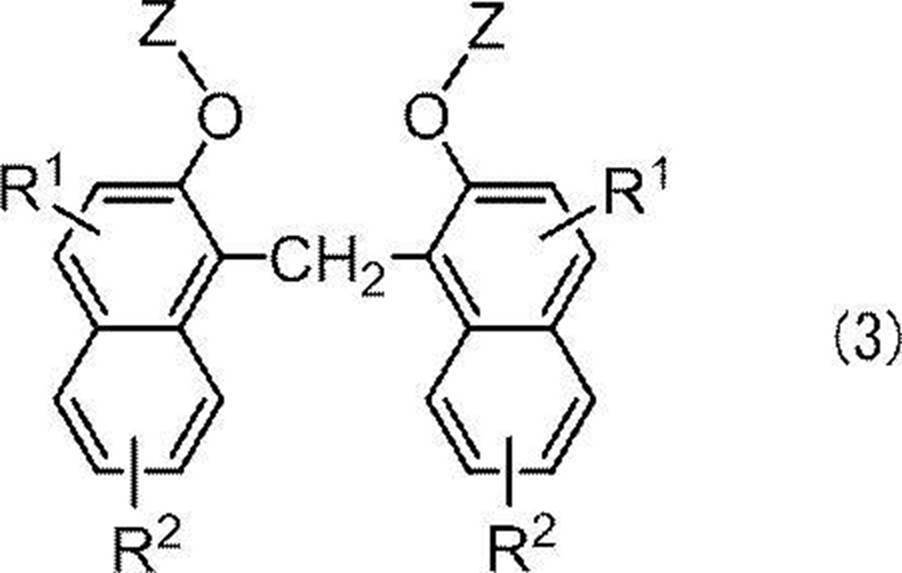
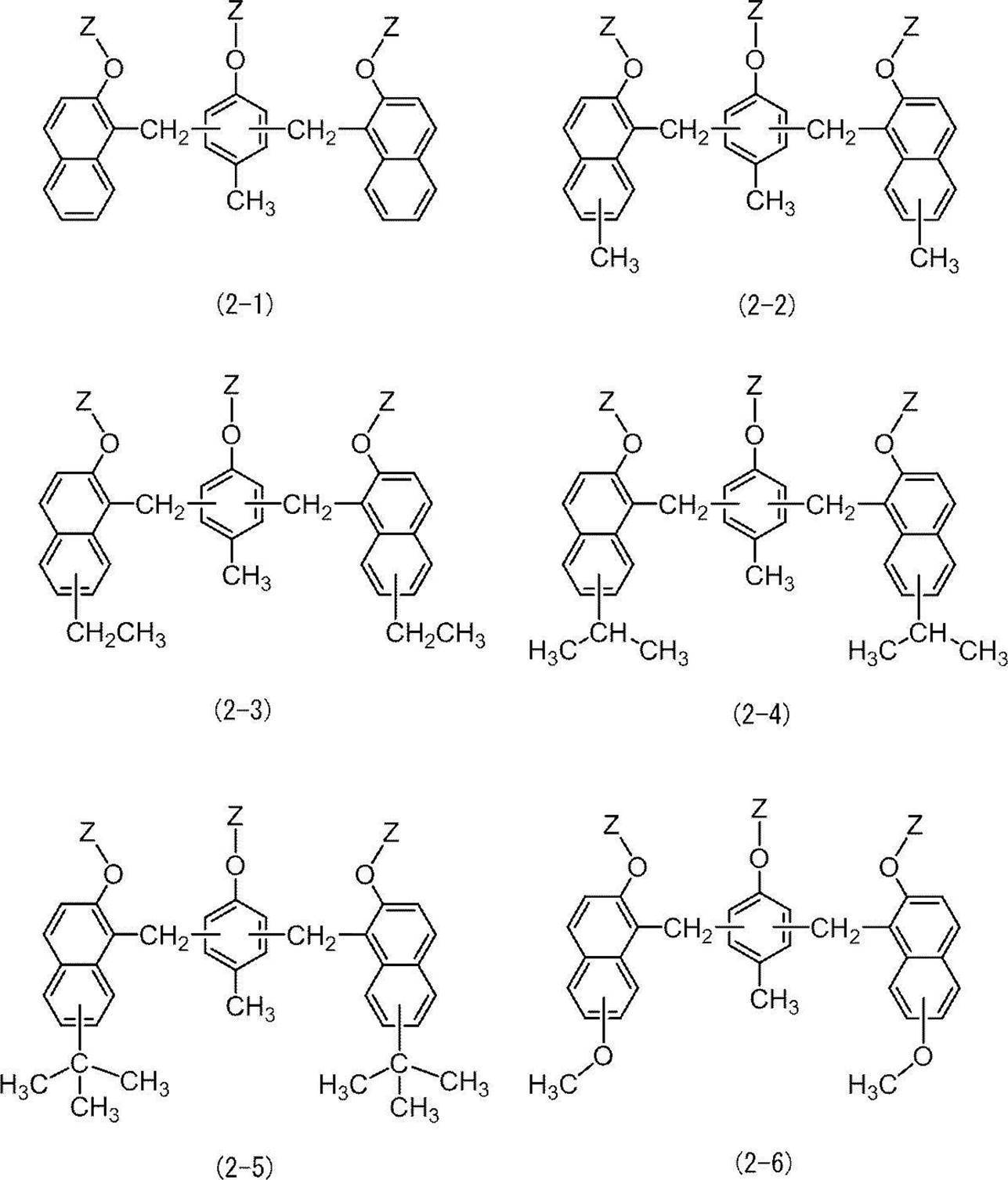
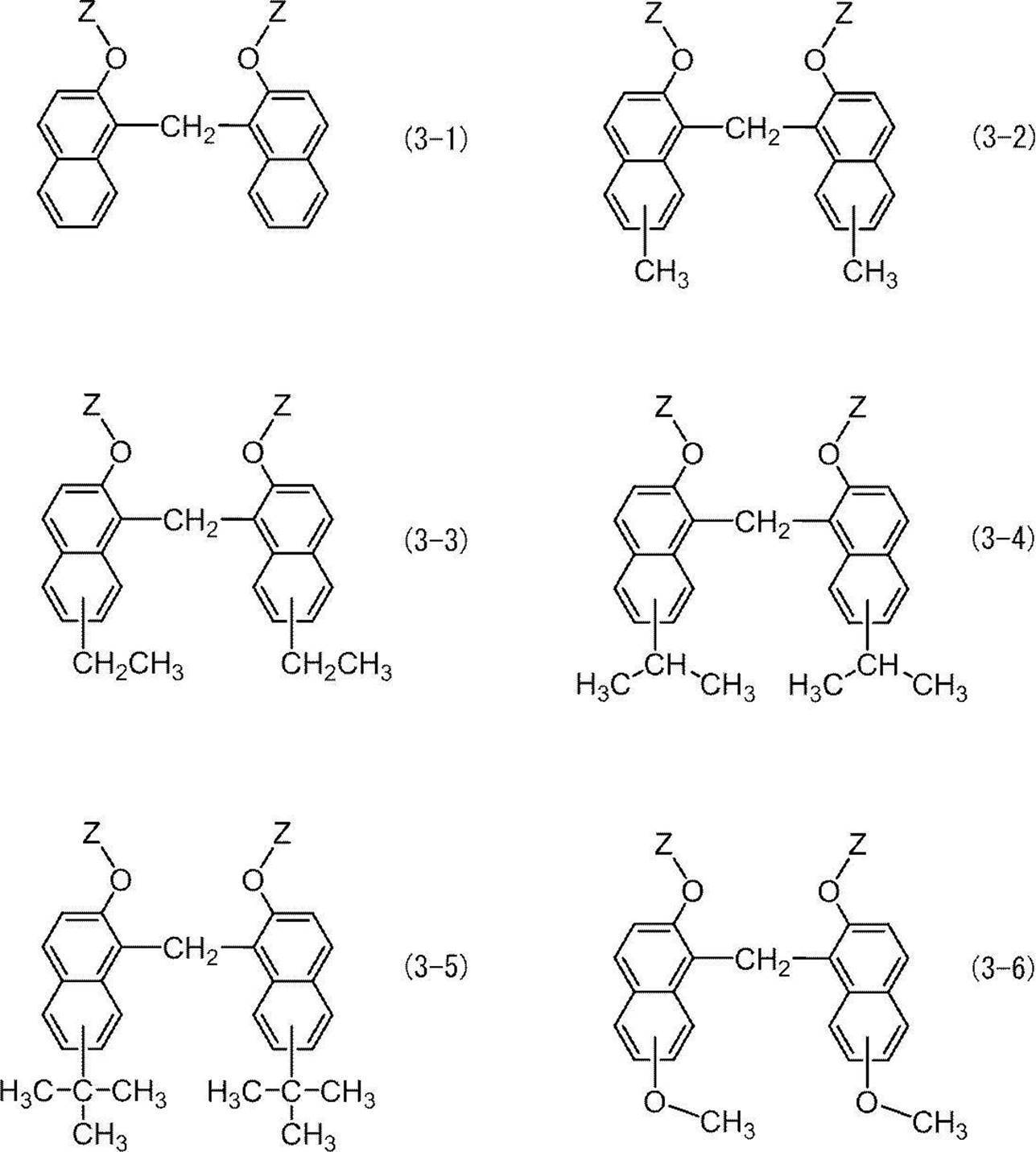
- active ester compound is a compound represented by the following structural formula (2) and a compound represented by the following structural formula (3), which are described in JP-A-2014-114352. Can be mentioned.
- R 1 and R 2 are each independently a hydrogen atom, an alkyl group having 1 to 4 carbon atoms, or an alkoxy group having 1 to 4 carbon atoms
- Z is a benzoyl group, a naphthoyl group, or a carbon atom.
- R 1 and R 2 are each independently a hydrogen atom, an alkyl group having 1 to 4 carbon atoms, or an alkoxy group having 1 to 4 carbon atoms
- Z is a benzoyl group, a naphthoyl group, a carbon group.
- Specific examples of the compound represented by the structural formula (2) include the following exemplified compounds (2-1) to (2-6).
- Specific examples of the compound represented by the structural formula (3) include the following exemplified compounds (3-1) to (3-6).
- a commercially available product may be used as the active ester compound.
- Commercially available active ester compounds include "EXB9451”, “EXB9460”, “EXB9460S”, “HPC-8000-65T” (manufactured by DIC Corporation) as aromatic ester compounds containing a dicyclopentadiene type diphenol structure; "EXB9416-70BK”, “EXB-8”, “EXB-9425” (manufactured by DIC Corporation) as an active ester compound containing a structure; "DC808” (Mitsubishi Chemical Corporation) as an active ester compound containing an acetylated product of phenol novolac.
- "YLH1026” manufactured by Mitsubishi Chemical Co., Ltd.
- the like can be mentioned as an active ester compound containing a benzoylated product of phenol novolac.
- the active ester compounds may be used alone or in combination of two or more.
- the ester equivalent of the active ester compound is not particularly limited. From the viewpoint of various characteristics balance such as moldability, reflow resistance, and electrical reliability, 150 g/eq to 400 g/eq is preferable, 170 g/eq to 300 g/eq is more preferable, and 200 g/eq to 250 g/eq is preferable. More preferable.
- the ester equivalent of the active ester compound shall be the value measured by the method according to JIS K 0070:1992.
- the equivalent ratio of the epoxy resin and the active ester compound (ester group/epoxy group) is preferably 0.9 or more, more preferably 0.95 or more, and 0.97 or more from the viewpoint of suppressing the dielectric loss tangent of the cured product to be low. Is more preferable.
- the equivalent ratio of the epoxy resin and the active ester compound (ester group/epoxy group) is preferably 1.1 or less, more preferably 1.05 or less, from the viewpoint of suppressing the unreacted content of the active ester compound. It is more preferably 03 or less.
- the curing agent may include other curing agents other than the active ester compound.
- the type of the other curing agent is not particularly limited and can be selected according to the desired characteristics of the encapsulating resin composition.
- examples of other curing agents include phenol curing agents, amine curing agents, acid anhydride curing agents, polymercaptan curing agents, polyaminoamide curing agents, isocyanate curing agents, blocked isocyanate curing agents, and the like.
- phenol curing agent examples include polyhydric phenol compounds such as resorcinol, catechol, bisphenol A, bisphenol F, and substituted or unsubstituted biphenol; phenol, cresol, xylenol, resorcinol, catechol, bisphenol A, bisphenol F, phenylphenol.
- phenol compounds such as aminophenol and ⁇ -naphthol, ⁇ -naphthol, dihydroxynaphthalene and aldehyde compounds such as formaldehyde, acetaldehyde and propionaldehyde
- Novolak type phenol resin obtained by condensation or co-condensation under the following
- Paraxylylene modified phenolic resin metaxylylene modified phenolic resin, melamine modified phenolic resin, terpene modified phenolic resin, dicyclopentadiene type phenolic resin and dicyclopentadiene type naphthol synthesized by copolymerization from the above phenolic compound and dicyclopentadiene Resin: cyclopentadiene modified phenol resin; polycyclic aromatic ring modified phenol resin; biphenyl type phenol resin; obtained by condensing or co-condensing the above phenolic compound with an aromatic aldehyde compound such as benzaldehyde and salicylaldehyde under an acidic catalyst. Triphenylmethane type phenolic resin obtained; a phenolic resin obtained by copolymerizing two or more of these, and the like. These phenol curing agents may be used alone or in combination of two or more.
- the functional group equivalents of other curing agents are not particularly limited. From the viewpoint of various characteristics balance such as moldability, reflow resistance, electrical reliability, etc., it is preferably 70 g/eq to 1000 g/eq, more preferably 80 g/eq to 500 g/eq.
- the functional group equivalents of other curing agents shall be values measured by the method according to JIS K 0070:1992.
- the curing agent When the curing agent is solid, its softening point or melting point is not particularly limited. From the viewpoint of moldability and reflow resistance, it is preferably 40° C. to 180° C., and from the viewpoint of handleability during production of the encapsulating resin composition, it is more preferably 50° C. to 130° C. ..
- the melting point or softening point of the curing agent shall be the value measured in the same way as the melting point or softening point of the epoxy resin.
- Equivalent ratio of the epoxy resin to all curing agents ie the ratio of the number of functional groups in the curing agent to the number of functional groups in the epoxy resin (number of functional groups in curing agent/ The number of functional groups) is not particularly limited. From the viewpoint of suppressing the amount of each unreacted component, it is preferably set in the range of 0.5 to 2.0, and more preferably set in the range of 0.6 to 1.3. From the viewpoint of moldability and reflow resistance, it is more preferable to set it in the range of 0.8 to 1.2.
- the content of the active ester compound with respect to the total mass of the active ester compound and the other curing agent is preferably 80% by mass or more, and more preferably 85% by mass or more, from the viewpoint of suppressing the dielectric loss tangent of the cured product. It is preferably 90% by mass or more, and more preferably 90% by mass or more.
- the total content of the epoxy resin and the active ester compound relative to the total mass of the epoxy resin, the active ester compound and the other curing agent is preferably 80% by mass or more from the viewpoint of suppressing the dielectric loss tangent of the cured product to be 85% by mass or more. % Or more, and more preferably 90% by mass or more.
- the encapsulating resin composition may include a curing accelerator.
- the type of curing accelerator is not particularly limited, and can be selected according to the type of epoxy resin or curing agent, desired properties of the encapsulating resin composition, and the like.
- curing accelerator examples include diazabicycloalkenes such as 1,5-diazabicyclo[4.3.0]nonene-5(DBN) and 1,8-diazabicyclo[5.4.0]undecene-7(DBU).
- Cyclic amidine compounds such as 2-methylimidazole, 2-phenylimidazole, 2-phenyl-4-methylimidazole, 2-heptadecylimidazole; Derivatives of the cyclic amidine compounds; Phenolic novolac salts of the cyclic amidine compounds or their derivatives; Compound of maleic anhydride, 1,4-benzoquinone, 2,5-toluquinone, 1,4-naphthoquinone, 2,3-dimethylbenzoquinone, 2,6-dimethylbenzoquinone, 2,3-dimethoxy-5-methyl-1 Quinone compounds such as 1,4-benzoquinone, 2,3-dimethoxy-1,4-benzoquinone and phenyl-1,4-benzoquinone, and an intramolecular polarization formed by adding a compound having a ⁇ bond such as diazophenylmethane
- Cyclic amidinium compounds such as tetraphenyl
- the amount thereof is preferably 0.1 parts by mass to 30 parts by mass with respect to 100 parts by mass of the resin component (the total amount of the epoxy resin and the curing agent). It is more preferably 1 part by mass to 15 parts by mass.
- the amount of the curing accelerator is 0.1 parts by mass or more with respect to 100 parts by mass of the resin component, there is a tendency that the composition is cured favorably in a short time. If the amount of the curing accelerator is 30 parts by mass or less with respect to 100 parts by mass of the resin component, the curing speed will not be too fast, and a good molded article will tend to be obtained.
- the encapsulating resin composition of the present disclosure may contain an inorganic filler.
- the type of inorganic filler is not particularly limited. Specific examples include inorganic materials such as fused silica, crystalline silica, glass, alumina, talc, clay, mica, boron nitride, and aluminum nitride. You may use the inorganic filler which has a flame retardant effect. Examples of the inorganic filler having a flame retardant effect include aluminum hydroxide, magnesium hydroxide, magnesium oxide, complex metal hydroxide such as complex hydroxide of magnesium and zinc, zinc borate and the like.
- silica such as fused silica is preferable from the viewpoint of reducing the linear expansion coefficient
- alumina is preferable from the viewpoint of high thermal conductivity.
- the inorganic fillers may be used alone or in combination of two or more. Examples of the form of the inorganic filler include non-powder, spherical beads, fibers and the like.
- the average particle size is not particularly limited.
- the average particle size is preferably 0.2 ⁇ m to 100 ⁇ m, more preferably 0.5 ⁇ m to 50 ⁇ m.
- the average particle size is 0.2 ⁇ m or more, increase in viscosity of the encapsulating resin composition tends to be further suppressed.
- the average particle size is 100 ⁇ m or less, the filling property tends to be further improved.
- the average particle size of the inorganic filler is determined as a volume average particle size (D50) by a laser scattering diffraction particle size distribution measuring device.
- the content of the inorganic filler contained in the encapsulating resin composition is not particularly limited. From the viewpoint of fluidity and strength, 30% by volume to 90% by volume of the entire encapsulating resin composition is preferable, 35% by volume to 80% by volume is more preferable, and 40% by volume to 70% by volume. % Is more preferable.
- the content of the inorganic filler is 30% by volume or more of the whole encapsulating resin composition, the properties of the cured product such as thermal expansion coefficient, thermal conductivity and elastic modulus tend to be further improved.
- the content of the inorganic filler is 90% by volume or less of the entire encapsulating resin composition
- the increase in viscosity of the encapsulating resin composition is suppressed, the fluidity is further improved, and the moldability is better. Tends to become.
- the encapsulating resin composition may contain various additives such as a coupling agent, an ion exchanger, a release agent, a flame retardant, and a coloring agent, which are exemplified below, in addition to the above components.
- the encapsulating resin composition may contain various additives well known in the art, if necessary, in addition to the additives exemplified below.
- the sealing resin composition may include a coupling agent.
- the encapsulating resin composition preferably contains a coupling agent.
- the coupling agent include known coupling agents such as silane compounds such as epoxysilane, mercaptosilane, aminosilane, alkylsilane, ureidosilane, vinylsilane, titanium compounds, aluminum chelate compounds, and aluminum/zirconium compounds. ..
- the amount of the coupling agent is preferably 0.05 parts by mass to 10 parts by mass, and 0.1 parts by mass with respect to 100 parts by mass of the inorganic filler. It is more preferably about 5 parts by mass.
- the amount of the coupling agent is 0.05 parts by mass or more with respect to 100 parts by mass of the inorganic filler, the adhesiveness with the frame tends to be further improved.
- the amount of the coupling agent is 10 parts by mass or less with respect to 100 parts by mass of the inorganic filler, the moldability of the package tends to be further improved.
- the encapsulating resin composition may include an ion exchanger.
- the encapsulating resin composition preferably contains an ion exchanger from the viewpoint of improving the moisture resistance and the high-temperature storage property of the electronic component device including the element to be encapsulated.
- the ion exchanger is not particularly limited, and conventionally known ones can be used. Specific examples thereof include hydrotalcite compounds and hydrous oxides of at least one element selected from the group consisting of magnesium, aluminum, titanium, zirconium, and bismuth.
- the ion exchangers may be used alone or in combination of two or more. Among them, hydrotalcite represented by the following general formula (A) is preferable.
- the content thereof is not particularly limited as long as it is an amount sufficient to trap ions such as halogen ions.
- it is preferably 0.1 parts by mass to 30 parts by mass, and more preferably 1 part by mass to 10 parts by mass with respect to 100 parts by mass of the resin component (the total amount of the epoxy resin and the curing agent).
- the encapsulating resin composition may include a release agent from the viewpoint of obtaining good releasability from the mold during molding.
- the release agent is not particularly limited, and conventionally known ones can be used. Specific examples include carnauba wax, higher fatty acids such as montanic acid and stearic acid, higher fatty acid metal salts, ester waxes such as montanic acid esters, and polyolefin waxes such as oxidized polyethylene and non-oxidized polyethylene.
- the release agent may be used alone or in combination of two or more.
- the amount thereof is preferably 0.01 parts by mass to 10 parts by mass with respect to 100 parts by mass of the resin component (the total amount of the epoxy resin and the curing agent), More preferably from 5 parts by mass to 5 parts by mass.
- the amount of the releasing agent is 0.01 parts by mass or more with respect to 100 parts by mass of the resin component, the releasing property tends to be sufficiently obtained.
- it is 10 parts by mass or less, better adhesiveness tends to be obtained.
- the encapsulating resin composition may include a flame retardant.
- the flame retardant is not particularly limited, and conventionally known ones can be used. Specific examples include organic or inorganic compounds containing halogen atoms, antimony atoms, nitrogen atoms or phosphorus atoms, metal hydroxides and the like.
- the flame retardants may be used alone or in combination of two or more.
- the amount thereof is not particularly limited as long as it is an amount sufficient to obtain a desired flame retardant effect.
- it is preferably 1 part by mass to 30 parts by mass, and more preferably 2 parts by mass to 20 parts by mass with respect to 100 parts by mass of the resin component (the total amount of the epoxy resin and the curing agent).
- the encapsulating resin composition may include a colorant.
- the colorant include known colorants such as carbon black, organic dyes, organic pigments, titanium oxide, red lead and red iron oxide.
- the content of the colorant can be appropriately selected according to the purpose and the like.
- the colorants may be used alone or in combination of two or more.
- the method for preparing the encapsulating resin composition is not particularly limited.
- a general method there can be mentioned a method in which predetermined components are sufficiently mixed with a mixer or the like, and then melt-kneaded with a mixing roll, an extruder or the like, cooled, and pulverized. More specifically, for example, a method of uniformly stirring and mixing predetermined amounts of the above-mentioned components, kneading with a kneader, roll, extruder or the like preheated to 70°C to 140°C, cooling, and pulverizing. Can be mentioned.
- the encapsulating resin composition is preferably solid at room temperature and atmospheric pressure (for example, 25° C. and atmospheric pressure).
- the shape of the encapsulating resin composition when it is solid is not particularly limited, and examples thereof include powder, granules, and tablets. From the viewpoint of handleability, it is preferable that the size and mass of the encapsulating resin composition in the form of a tablet be such that it meets the molding conditions of the package.
- An electronic component device includes an element and a cured product of the encapsulating resin composition of the present disclosure, which encapsulates the element.
- a support member such as a lead frame, a pre-wired tape carrier, a wiring board, glass, a silicon wafer, an organic substrate, an element (semiconductor chip, transistor, diode, active element such as thyristor, capacitor, resistor) , A passive element such as a coil) and an element part obtained by mounting the element part with a resin composition for encapsulation. More specifically, the element is fixed on a lead frame, the terminal portion of the element such as a bonding pad and the lead portion are connected by wire bonding, bumps or the like, and then transfer molding or the like using a resin composition for sealing.
- DIP Device Inline Package
- PLCC Physical Leaded Chip Carrier
- QFP Quad Flat Package
- SOP Small Outline TS
- SOJ Small Outlet Plug-in Package
- General resin encapsulation type ICs such as Outlook Package) and TQFP (Thin Quad Flat Package); TCP (Tape Carrier Package) having a structure in which elements connected to a tape carrier by bumps are encapsulated with an encapsulating resin composition.
- a COB Chip On Board
- hybrid IC a multi-chip having a structure in which an element connected to the wiring formed on the support member by wire bonding, flip chip bonding, solder, etc.
- a sealing resin composition Chip module or the like is sealed with a sealing resin composition Chip module or the like; an element is mounted on the surface of a supporting member having terminals for connecting a wiring board formed on the back surface, and after connecting the element to the wiring formed on the supporting member by bump or wire bonding, a resin composition for sealing Examples include BGA (Ball Grid Array), CSP (Chip Size Package), and MCP (Multi Chip Package), which have a structure in which an element is sealed with an object. Further, the resin composition for encapsulation can be preferably used also in a printed wiring board.
- the method for manufacturing an electronic component device of the present disclosure includes a step of disposing an element on a support member and a step of sealing the element with the sealing resin composition of the present disclosure.
- the method of implementing each of the above steps is not particularly limited, and can be performed by a general method. Further, the types of the supporting member and the element used for manufacturing the electronic component device are not particularly limited, and the supporting member and the element generally used for manufacturing the electronic component device can be used.
- a low pressure transfer molding method As a method of sealing an element using the sealing resin composition of the present disclosure, a low pressure transfer molding method, an injection molding method, a compression molding method and the like can be mentioned. Among these, the low pressure transfer molding method is general.
- Epoxy resin 1 biphenylene aralkyl type epoxy resin, epoxy equivalent 275 g/eq (Nippon Kayaku Co., Ltd., product name "NC-3000”)
- Epoxy resin 2 biphenyl type epoxy resin, epoxy equivalent 192 g/eq (Mitsubishi Chemical Corporation, product name "YX-4000”)
- Thermosetting silicone epoxy-modified silicone having the above-mentioned bonds (a), (b) and (c) (Toray Dow Corning Silicone Co., Ltd.)
- -Coupling agent 1 N-phenyl-3-aminopropyltrimethoxysilane (Shin-Etsu Chemical Co., Ltd., product name "KBM-573")
- Coupling agent 2 3-mercaptopropyltrimethoxysilane (Shin-Etsu Chemical Co., Ltd., product name "KBM-803")
- -Release agent montanic acid ester wax (Clariant Japan KK, product name "HW-E”)
- ⁇ Colorant Carbon black (Mitsubishi Chemical Corporation, product name "MA600”)
- the resin composition for encapsulation was placed in a transfer molding machine and molded under the conditions of a mold temperature of 175° C., a molding pressure of 75 tons and 120 seconds, and post-curing was performed at 175° C. for 6 hours to obtain a plate-shaped cured product (longitudinal 130 mm, width 13 mm, thickness 0.8 mm) was obtained. Further, the plate-shaped cured product was cut to obtain a prism having a size of 0.8 mm square and a length of 80 mm. Using this prism as a test piece, the relative permittivity and the dielectric loss tangent at a temperature of 25 ⁇ 3° C. and 20 GHz were measured using a permittivity measuring device (Agilent, product name “Network Analyzer N5227A”).
- the resin composition for encapsulation was placed in a transfer molding machine and molded under the conditions of a mold temperature of 180° C., a molding pressure of 6.9 MPa, and a curing time of 90 seconds to obtain a disk-shaped molded product (diameter 40 mm, thickness 5 mm). Obtained.
- the Shore D hardness within 10 seconds after releasing the mold was measured using a Shore D hardness meter.
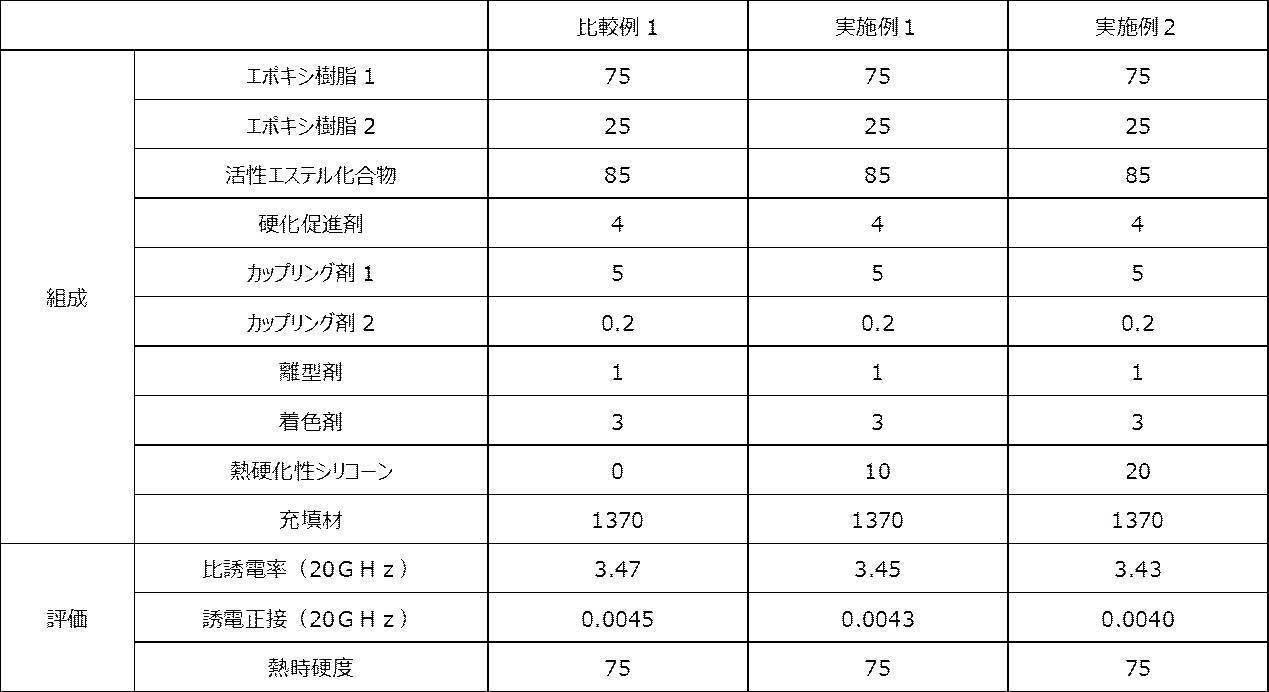
- the encapsulating resin composition of Example containing the active ester compound as the curing agent and containing the thermosetting silicone contained the active ester compound as the curing agent but did not contain the thermosetting silicone.
- the value of the dielectric loss tangent of the cured product was lower than that of the encapsulating resin composition of Comparative Example.
Landscapes
- Chemical & Material Sciences (AREA)
- Health & Medical Sciences (AREA)
- Chemical Kinetics & Catalysis (AREA)
- Medicinal Chemistry (AREA)
- Polymers & Plastics (AREA)
- Organic Chemistry (AREA)
- Structures Or Materials For Encapsulating Or Coating Semiconductor Devices Or Solid State Devices (AREA)
- Epoxy Resins (AREA)
- Compositions Of Macromolecular Compounds (AREA)
Abstract
Description
<2>前記熱硬化性シリコーンはエポキシ基を含有する、<1>に記載の封止用樹脂組成物。
<3>前記熱硬化性シリコーンはシロキサン鎖が分岐した構造を有する、<1>又は<2>に記載の封止用樹脂組成物。
<4>支持部材と、前記支持部材上に配置された素子と、前記素子を封止している<1>~<3>のいずれか1項に記載の封止用樹脂組成物の硬化物と、を備える電子部品装置。
<5>素子を支持部材上に配置する工程と、前記素子を<1>~<4>のいずれか1項に記載の封止用樹脂組成物で封止する工程と、を含む電子部品装置の製造方法。
本開示において「~」を用いて示された数値範囲には、「~」の前後に記載される数値がそれぞれ最小値及び最大値として含まれる。
本開示中に段階的に記載されている数値範囲において、一つの数値範囲で記載された上限値又は下限値は、他の段階的な記載の数値範囲の上限値又は下限値に置き換えてもよい。また、本開示中に記載されている数値範囲において、その数値範囲の上限値又は下限値は、実施例に示されている値に置き換えてもよい。
本開示において各成分は該当する物質を複数種含んでいてもよい。組成物中に各成分に該当する物質が複数種存在する場合、各成分の含有率又は含有量は、特に断らない限り、組成物中に存在する当該複数種の物質の合計の含有率又は含有量を意味する。
本開示において各成分に該当する粒子は複数種含んでいてもよい。組成物中に各成分に該当する粒子が複数種存在する場合、各成分の粒子径は、特に断らない限り、組成物中に存在する当該複数種の粒子の混合物についての値を意味する。
本開示の封止用樹脂組成物は、エポキシ樹脂と、活性エステル化合物を含む硬化剤と、熱硬化性シリコーンとを含有する封止用樹脂組成物である。
本開示の封止用樹脂組成物に含まれる熱硬化性シリコーンの種類は、特に制限されない。硬化物中に微細な空隙を形成する観点からは、熱硬化性シリコーンはエポキシ樹脂又は硬化剤と反応しうる官能基を含有することが好ましい。官能基としてはエポキシ基、アミノ基、水酸基、シアノ基等が挙げられ、中でもエポキシ基が好ましい。熱硬化性シリコーンにおける官能基の位置は特に制限されない。例えば、シロキサン鎖の末端(片末端又は両末端)に位置していてもよく、側鎖に位置していてもよい。

本開示の封止用樹脂組成物に含まれるエポキシ樹脂の種類は特に制限されない。
エポキシ樹脂として具体的には、フェノール、クレゾール、キシレノール、レゾルシン、カテコール、ビスフェノールA、ビスフェノールF等のフェノール化合物及びα-ナフトール、β-ナフトール、ジヒドロキシナフタレン等のナフトール化合物からなる群より選ばれる少なくとも1種のフェノール性化合物と、ホルムアルデヒド、アセトアルデヒド、プロピオンアルデヒド等の脂肪族アルデヒド化合物とを酸性触媒下で縮合又は共縮合させて得られるノボラック樹脂をエポキシ化したものであるノボラック型エポキシ樹脂(フェノールノボラック型エポキシ樹脂、オルソクレゾールノボラック型エポキシ樹脂等);上記フェノール性化合物と、ベンズアルデヒド、サリチルアルデヒド等の芳香族アルデヒド化合物とを酸性触媒下で縮合又は共縮合させて得られるトリフェニルメタン型フェノール樹脂をエポキシ化したものであるトリフェニルメタン型エポキシ樹脂;上記フェノール化合物及びナフトール化合物と、アルデヒド化合物とを酸性触媒下で共縮合させて得られるノボラック樹脂をエポキシ化したものである共重合型エポキシ樹脂;ビスフェノールA、ビスフェノールF等のジグリシジルエーテルであるジフェニルメタン型エポキシ樹脂;アルキル置換又は非置換のビフェノールのジグリシジルエーテルであるビフェニル型エポキシ樹脂;スチルベン系フェノール化合物のジグリシジルエーテルであるスチルベン型エポキシ樹脂;ビスフェノールS等のジグリシジルエーテルである硫黄原子含有エポキシ樹脂;ブタンジオール、ポリエチレングリコール、ポリプロピレングリコール等のアルコール類のグリシジルエーテルであるエポキシ樹脂;フタル酸、イソフタル酸、テトラヒドロフタル酸等の多価カルボン酸化合物のグリシジルエステルであるグリシジルエステル型エポキシ樹脂;アニリン、ジアミノジフェニルメタン、イソシアヌル酸等の窒素原子に結合した活性水素をグリシジル基で置換したものであるグリシジルアミン型エポキシ樹脂;ジシクロペンタジエンとフェノール化合物の共縮合樹脂をエポキシ化したものであるジシクロペンタジエン型エポキシ樹脂;分子内のオレフィン結合をエポキシ化したものであるビニルシクロヘキセンジエポキシド、3,4-エポキシシクロヘキシルメチル-3,4-エポキシシクロヘキサンカルボキシレート、2-(3,4-エポキシ)シクロヘキシル-5,5-スピロ(3,4-エポキシ)シクロヘキサン-m-ジオキサン等の脂環型エポキシ樹脂;パラキシリレン変性フェノール樹脂のグリシジルエーテルであるパラキシリレン変性エポキシ樹脂;メタキシリレン変性フェノール樹脂のグリシジルエーテルであるメタキシリレン変性エポキシ樹脂;テルペン変性フェノール樹脂のグリシジルエーテルであるテルペン変性エポキシ樹脂;ジシクロペンタジエン変性フェノール樹脂のグリシジルエーテルであるジシクロペンタジエン変性エポキシ樹脂;シクロペンタジエン変性フェノール樹脂のグリシジルエーテルであるシクロペンタジエン変性エポキシ樹脂;多環芳香環変性フェノール樹脂のグリシジルエーテルである多環芳香環変性エポキシ樹脂;ナフタレン環含有フェノール樹脂のグリシジルエーテルであるナフタレン型エポキシ樹脂;ハロゲン化フェノールノボラック型エポキシ樹脂;ハイドロキノン型エポキシ樹脂;トリメチロールプロパン型エポキシ樹脂;オレフィン結合を過酢酸等の過酸で酸化して得られる線状脂肪族エポキシ樹脂;フェノールアラルキル樹脂、ナフトールアラルキル樹脂等のアラルキル型フェノール樹脂をエポキシ化したものであるアラルキル型エポキシ樹脂;などが挙げられる。さらにはアクリル樹脂のエポキシ化物等もエポキシ樹脂として挙げられる。これらのエポキシ樹脂は、1種を単独で用いても2種以上を組み合わせて用いてもよい。
本開示の封止用樹脂組成物は、硬化剤として少なくとも活性エステル化合物を含む。本開示の封止用樹脂組成物は、活性エステル化合物以外の硬化剤を含んでもよい。
また、硬化物中の極性基は硬化物の吸水性を高めるところ、硬化剤として活性エステル化合物を用いることによって硬化物の極性基濃度を抑えることができ、硬化物の吸水性を抑制することができる。そして、硬化物の吸水性を抑制すること、つまりは極性分子であるH2Oの含有量を抑制することにより、硬化物の誘電正接をさらに低く抑えることができる。硬化物の吸水率は、0%~0.35%が好ましく、0%~0.30%がより好ましく、0%~0.25%がさらに好ましい。ここで硬化物の吸水率は、プレッシャークッカー試験(121℃、2.1気圧、24時間)によって求める質量増加率である。



エポキシ樹脂と活性エステル化合物との当量比(エステル基/エポキシ基)は、活性エステル化合物の未反応分を少なく抑える観点からは、1.1以下が好ましく、1.05以下がより好ましく、1.03以下がさらに好ましい。
封止用樹脂組成物は、硬化促進剤を含んでもよい。硬化促進剤の種類は特に制限されず、エポキシ樹脂又は硬化剤の種類、封止用樹脂組成物の所望の特性等に応じて選択できる。
本開示の封止用樹脂組成物は、無機充填材を含有してもよい。無機充填材の種類は、特に制限されない。具体的には、溶融シリカ、結晶シリカ、ガラス、アルミナ、タルク、クレー、マイカ、窒化ホウ素、窒化アルミニウム等の無機材料が挙げられる。難燃効果を有する無機充填材を用いてもよい。難燃効果を有する無機充填材としては、水酸化アルミニウム、水酸化マグネシウム、酸化マグネシウム、マグネシウムと亜鉛の複合水酸化物等の複合金属水酸化物、硼酸亜鉛などが挙げられる。
封止用樹脂組成物は、上述の成分に加えて、以下に例示するカップリング剤、イオン交換体、離型剤、難燃剤、着色剤等の各種添加剤を含んでもよい。封止用樹脂組成物は、以下に例示する添加剤以外にも必要に応じて当技術分野で周知の各種添加剤を含んでもよい。
封止用樹脂組成物は、カップリング剤を含んでもよい。樹脂成分と無機充填材との接着性を高める観点からは、封止用樹脂組成物はカップリング剤を含むことが好ましい。カップリング剤としては、エポキシシラン、メルカプトシラン、アミノシラン、アルキルシラン、ウレイドシラン、ビニルシラン等のシラン系化合物、チタン系化合物、アルミニウムキレート化合物、アルミニウム/ジルコニウム系化合物などの公知のカップリング剤が挙げられる。
封止用樹脂組成物は、イオン交換体を含んでもよい。封止用樹脂組成物は、封止される素子を備える電子部品装置の耐湿性及び高温放置特性を向上させる観点から、イオン交換体を含むことが好ましい。イオン交換体は特に制限されず、従来公知のものを用いることができる。具体的には、ハイドロタルサイト化合物、並びにマグネシウム、アルミニウム、チタン、ジルコニウム及びビスマスからなる群より選ばれる少なくとも1種の元素の含水酸化物等が挙げられる。イオン交換体は、1種を単独で用いても2種以上を組み合わせて用いてもよい。中でも、下記一般式(A)で表されるハイドロタルサイトが好ましい。
(0<X≦0.5、mは正の数)
封止用樹脂組成物は、成形時における金型との良好な離型性を得る観点から、離型剤を含んでもよい。離型剤は特に制限されず、従来公知のものを用いることができる。具体的には、カルナバワックス、モンタン酸、ステアリン酸等の高級脂肪酸、高級脂肪酸金属塩、モンタン酸エステル等のエステル系ワックス、酸化ポリエチレン、非酸化ポリエチレン等のポリオレフィン系ワックスなどが挙げられる。離型剤は、1種を単独で用いても2種以上を組み合わせて用いてもよい。
封止用樹脂組成物は、難燃剤を含んでもよい。難燃剤は特に制限されず、従来公知のものを用いることができる。具体的には、ハロゲン原子、アンチモン原子、窒素原子又はリン原子を含む有機又は無機の化合物、金属水酸化物等が挙げられる。難燃剤は、1種を単独で用いても2種以上を組み合わせて用いてもよい。
封止用樹脂組成物は、着色剤を含んでもよい。着色剤としてはカーボンブラック、有機染料、有機顔料、酸化チタン、鉛丹、ベンガラ等の公知の着色剤を挙げることができる。着色剤の含有量は目的等に応じて適宜選択できる。着色剤は、1種を単独で用いても2種以上を組み合わせて用いてもよい。
封止用樹脂組成物の調製方法は、特に制限されない。一般的な手法としては、所定の配合量の成分をミキサー等によって十分混合した後、ミキシングロール、押出機等によって溶融混練し、冷却し、粉砕する方法を挙げることができる。より具体的には、例えば、上述した成分の所定量を均一に攪拌及び混合し、予め70℃~140℃に加熱してあるニーダー、ロール、エクストルーダー等で混練し、冷却し、粉砕する方法を挙げることができる。
本開示の一実施形態である電子部品装置は、素子と、前記素子を封止している本開示の封止用樹脂組成物の硬化物と、を備える。
より具体的には、リードフレーム上に素子を固定し、ボンディングパッド等の素子の端子部とリード部とをワイヤボンディング、バンプ等で接続した後、封止用樹脂組成物を用いてトランスファ成形等によって封止した構造を有するDIP(Dual Inline Package)、PLCC(Plastic Leaded Chip Carrier)、QFP(Quad Flat Package)、SOP(Small Outline Package)、SOJ(Small Outline J-lead package)、TSOP(Thin Small Outline Package)、TQFP(Thin Quad Flat Package)等の一般的な樹脂封止型IC;テープキャリアにバンプで接続した素子を封止用樹脂組成物で封止した構造を有するTCP(Tape Carrier Package);支持部材上に形成した配線に、ワイヤボンディング、フリップチップボンディング、はんだ等で接続した素子を、封止用樹脂組成物で封止した構造を有するCOB(Chip On Board)モジュール、ハイブリッドIC、マルチチップモジュール等;裏面に配線板接続用の端子を形成した支持部材の表面に素子を搭載し、バンプ又はワイヤボンディングにより素子と支持部材に形成された配線とを接続した後、封止用樹脂組成物で素子を封止した構造を有するBGA(Ball Grid Array)、CSP(Chip Size Package)、MCP(Multi Chip Package)などが挙げられる。また、プリント配線板においても封止用樹脂組成物を好適に使用することができる。
本開示の電子部品装置の製造方法は、素子を支持部材上に配置する工程と、前記素子を本開示の封止用樹脂組成物で封止する工程と、を含む。
下記に示す成分を表1に示す配合割合(質量部)で混合し、実施例と比較例の封止用樹脂組成物を調製した。
・エポキシ樹脂2:ビフェニル型エポキシ樹脂、エポキシ当量192g/eq(三菱ケミカル株式会社、品名「YX-4000」)
・カップリング剤2:3-メルカプトプロピルトリメトキシシラン(信越化学工業株式会社、品名「KBM-803」)
・離型剤:モンタン酸エステルワックス(クラリアントジャパン株式会社、品名「HW-E」)
・着色剤:カーボンブラック(三菱ケミカル株式会社、品名「MA600」)
封止用樹脂組成物をトランスファ成型機に仕込み、金型温度175℃、成型圧力75トン、120秒の条件で成型したのち、後硬化を175℃で6時間行い、板状の硬化物(縦130mm、横13mm、厚さ0.8mm)を得た。さらに板状の硬化物を裁断し、0.8mm角、長さ80mmの角柱を得た。この角柱を試験片として、誘電率測定装置(Agilent社、品名「ネットワークアナライザN5227A」)を用いて、温度25±3℃、20GHzでの比誘電率と誘電正接を測定した。
封止用樹脂組成物をトランスファ成形機に仕込み、金型温度180℃、成形圧力6.9MPa、硬化時間90秒の条件で成形し、円板状の成形物(直径40mm、厚さ5mm)を得た。金型解放後10秒以内のショアD硬度を、ショアD硬度計を用いて測定した。
Claims (5)
- エポキシ樹脂と、活性エステル化合物を含む硬化剤と、熱硬化性シリコーンとを含有する封止用樹脂組成物。
- 前記熱硬化性シリコーンはエポキシ基を含有する、請求項1に記載の封止用樹脂組成物。
- 前記熱硬化性シリコーンはシロキサン鎖が分岐した構造を有する、請求項1又は請求項2に記載の封止用樹脂組成物。
- 支持部材と、
前記支持部材上に配置された素子と、
前記素子を封止している請求項1~請求項3のいずれか1項に記載の封止用樹脂組成物の硬化物と、
を備える電子部品装置。 - 素子を支持部材上に配置する工程と、
前記素子を請求項1~請求項4のいずれか1項に記載の封止用樹脂組成物で封止する工程と、
を含む電子部品装置の製造方法。
Priority Applications (2)
| Application Number | Priority Date | Filing Date | Title |
|---|---|---|---|
| CN202080007401.3A CN113260651A (zh) | 2019-01-30 | 2020-01-30 | 密封用树脂组合物、电子零件装置及电子零件装置的制造方法 |
| JP2020569716A JP7491223B2 (ja) | 2019-01-30 | 2020-01-30 | 封止用樹脂組成物、電子部品装置及び電子部品装置の製造方法 |
Applications Claiming Priority (2)
| Application Number | Priority Date | Filing Date | Title |
|---|---|---|---|
| JP2019014340 | 2019-01-30 | ||
| JP2019-014340 | 2019-01-30 |
Publications (1)
| Publication Number | Publication Date |
|---|---|
| WO2020158851A1 true WO2020158851A1 (ja) | 2020-08-06 |
Family
ID=71841837
Family Applications (1)
| Application Number | Title | Priority Date | Filing Date |
|---|---|---|---|
| PCT/JP2020/003381 Ceased WO2020158851A1 (ja) | 2019-01-30 | 2020-01-30 | 封止用樹脂組成物、電子部品装置及び電子部品装置の製造方法 |
Country Status (4)
| Country | Link |
|---|---|
| JP (1) | JP7491223B2 (ja) |
| CN (1) | CN113260651A (ja) |
| TW (1) | TW202037667A (ja) |
| WO (1) | WO2020158851A1 (ja) |
Cited By (1)
| Publication number | Priority date | Publication date | Assignee | Title |
|---|---|---|---|---|
| US20220162396A1 (en) * | 2020-11-26 | 2022-05-26 | Shin-Etsu Chemical Co., Ltd. | Dielectric property-lowering agent, low-dielectric resin composition containing same and method for lowering dielectric properties of resin |
Citations (4)
| Publication number | Priority date | Publication date | Assignee | Title |
|---|---|---|---|---|
| JP2011063686A (ja) * | 2009-09-16 | 2011-03-31 | Shin-Etsu Chemical Co Ltd | 光半導体素子封止用組成物 |
| WO2012091000A1 (ja) * | 2010-12-27 | 2012-07-05 | 東レ・ダウコーニング株式会社 | 硬化性エポキシ樹脂組成物 |
| WO2012165012A1 (ja) * | 2011-05-27 | 2012-12-06 | 味の素株式会社 | 樹脂組成物 |
| JP2016008279A (ja) * | 2014-06-25 | 2016-01-18 | 味の素株式会社 | 樹脂組成物 |
Family Cites Families (1)
| Publication number | Priority date | Publication date | Assignee | Title |
|---|---|---|---|---|
| JP6874350B2 (ja) * | 2016-12-06 | 2021-05-19 | 住友ベークライト株式会社 | 樹脂シート |
-
2020
- 2020-01-30 TW TW109102747A patent/TW202037667A/zh unknown
- 2020-01-30 WO PCT/JP2020/003381 patent/WO2020158851A1/ja not_active Ceased
- 2020-01-30 JP JP2020569716A patent/JP7491223B2/ja active Active
- 2020-01-30 CN CN202080007401.3A patent/CN113260651A/zh active Pending
Patent Citations (4)
| Publication number | Priority date | Publication date | Assignee | Title |
|---|---|---|---|---|
| JP2011063686A (ja) * | 2009-09-16 | 2011-03-31 | Shin-Etsu Chemical Co Ltd | 光半導体素子封止用組成物 |
| WO2012091000A1 (ja) * | 2010-12-27 | 2012-07-05 | 東レ・ダウコーニング株式会社 | 硬化性エポキシ樹脂組成物 |
| WO2012165012A1 (ja) * | 2011-05-27 | 2012-12-06 | 味の素株式会社 | 樹脂組成物 |
| JP2016008279A (ja) * | 2014-06-25 | 2016-01-18 | 味の素株式会社 | 樹脂組成物 |
Cited By (5)
| Publication number | Priority date | Publication date | Assignee | Title |
|---|---|---|---|---|
| US20220162396A1 (en) * | 2020-11-26 | 2022-05-26 | Shin-Etsu Chemical Co., Ltd. | Dielectric property-lowering agent, low-dielectric resin composition containing same and method for lowering dielectric properties of resin |
| JP2022084508A (ja) * | 2020-11-26 | 2022-06-07 | 信越化学工業株式会社 | 低誘電化剤、これを含む低誘電性樹脂組成物および樹脂の低誘電化方法、並びに低誘電化剤としての使用 |
| JP7533331B2 (ja) | 2020-11-26 | 2024-08-14 | 信越化学工業株式会社 | 低誘電化剤、これを含む低誘電性樹脂組成物および樹脂の低誘電化方法、並びに低誘電化剤としての使用 |
| JP2024153747A (ja) * | 2020-11-26 | 2024-10-29 | 信越化学工業株式会社 | 低誘電性樹脂組成物およびその硬化物 |
| JP7750345B2 (ja) | 2020-11-26 | 2025-10-07 | 信越化学工業株式会社 | 低誘電性樹脂組成物およびその硬化物 |
Also Published As
| Publication number | Publication date |
|---|---|
| JP7491223B2 (ja) | 2024-05-28 |
| TW202037667A (zh) | 2020-10-16 |
| CN113260651A (zh) | 2021-08-13 |
| JPWO2020158851A1 (ja) | 2021-11-25 |
Similar Documents
| Publication | Publication Date | Title |
|---|---|---|
| JP7388160B2 (ja) | 封止用樹脂組成物、電子部品装置及び電子部品装置の製造方法 | |
| JP7805706B2 (ja) | 封止用樹脂組成物、電子部品装置及び電子部品装置の製造方法 | |
| JP7827100B2 (ja) | 封止用樹脂組成物、電子部品装置及び電子部品装置の製造方法 | |
| JP2024091744A (ja) | 封止用樹脂組成物、電子部品装置及び電子部品装置の製造方法 | |
| JP7452028B2 (ja) | 封止用樹脂組成物、電子部品装置、及び電子部品装置の製造方法 | |
| JP7635709B2 (ja) | 封止用樹脂組成物、電子部品装置及び電子部品装置の製造方法 | |
| JP2020122071A (ja) | 封止用樹脂組成物、電子部品装置及び電子部品装置の製造方法 | |
| JP7491223B2 (ja) | 封止用樹脂組成物、電子部品装置及び電子部品装置の製造方法 | |
| JP2020152825A (ja) | 封止用樹脂組成物、電子部品装置及び電子部品装置の製造方法 | |
| JP7443778B2 (ja) | 封止用樹脂組成物、電子部品装置、及び電子部品装置の製造方法 | |
| JP7396290B2 (ja) | 封止用樹脂組成物、電子部品装置及び電子部品装置の製造方法 | |
| WO2023038035A1 (ja) | 封止用樹脂組成物、電子部品装置及び電子部品装置の製造方法 | |
| JP2022011184A (ja) | 封止用樹脂組成物及び電子部品装置 | |
| JP7487596B2 (ja) | 封止用樹脂組成物、電子部品装置及び電子部品装置の製造方法 | |
| JP2021084980A (ja) | 封止用樹脂組成物、電子部品装置及び電子部品装置の製造方法 | |
| JP2024081462A (ja) | 封止用樹脂組成物、電子部品装置及び電子部品装置の製造方法 | |
| JP2024015914A (ja) | 封止用樹脂組成物、電子部品装置及び電子部品装置の製造方法 | |
| JP2022021901A (ja) | 封止用樹脂組成物、電子部品装置及び電子部品装置の製造方法 | |
| JP2024081461A (ja) | 封止用樹脂組成物、電子部品装置及び電子部品装置の製造方法 | |
| JP2024081463A (ja) | 封止用樹脂組成物、電子部品装置及び電子部品装置の製造方法 | |
| WO2020189309A1 (ja) | 封止用樹脂組成物、電子部品装置及び電子部品装置の製造方法 |
Legal Events
| Date | Code | Title | Description |
|---|---|---|---|
| 121 | Ep: the epo has been informed by wipo that ep was designated in this application |
Ref document number: 20749004 Country of ref document: EP Kind code of ref document: A1 |
|
| ENP | Entry into the national phase |
Ref document number: 2020569716 Country of ref document: JP Kind code of ref document: A |
|
| NENP | Non-entry into the national phase |
Ref country code: DE |
|
| 32PN | Ep: public notification in the ep bulletin as address of the adressee cannot be established |
Free format text: NOTING OF LOSS OF RIGHTS PURSUANT TO RULE 112(1) EPC (EPO FORM 1205 DATED 20/10/2021) |
|
| 122 | Ep: pct application non-entry in european phase |
Ref document number: 20749004 Country of ref document: EP Kind code of ref document: A1 |