WO2020145188A1 - 粘着シート - Google Patents
粘着シート Download PDFInfo
- Publication number
- WO2020145188A1 WO2020145188A1 PCT/JP2019/051267 JP2019051267W WO2020145188A1 WO 2020145188 A1 WO2020145188 A1 WO 2020145188A1 JP 2019051267 W JP2019051267 W JP 2019051267W WO 2020145188 A1 WO2020145188 A1 WO 2020145188A1
- Authority
- WO
- WIPO (PCT)
- Prior art keywords
- pressure
- sensitive adhesive
- monomer
- polymer
- meth
- Prior art date
- Legal status (The legal status is an assumption and is not a legal conclusion. Google has not performed a legal analysis and makes no representation as to the accuracy of the status listed.)
- Ceased
Links
Images

Classifications
-
- C—CHEMISTRY; METALLURGY
- C09—DYES; PAINTS; POLISHES; NATURAL RESINS; ADHESIVES; COMPOSITIONS NOT OTHERWISE PROVIDED FOR; APPLICATIONS OF MATERIALS NOT OTHERWISE PROVIDED FOR
- C09J—ADHESIVES; NON-MECHANICAL ASPECTS OF ADHESIVE PROCESSES IN GENERAL; ADHESIVE PROCESSES NOT PROVIDED FOR ELSEWHERE; USE OF MATERIALS AS ADHESIVES
- C09J133/00—Adhesives based on homopolymers or copolymers of compounds having one or more unsaturated aliphatic radicals, each having only one carbon-to-carbon double bond, and at least one being terminated by only one carboxyl radical, or of salts, anhydrides, esters, amides, imides, or nitriles thereof; Adhesives based on derivatives of such polymers
-
- B—PERFORMING OPERATIONS; TRANSPORTING
- B32—LAYERED PRODUCTS
- B32B—LAYERED PRODUCTS, i.e. PRODUCTS BUILT-UP OF STRATA OF FLAT OR NON-FLAT, e.g. CELLULAR OR HONEYCOMB, FORM
- B32B27/00—Layered products comprising a layer of synthetic resin
-
- C—CHEMISTRY; METALLURGY
- C09—DYES; PAINTS; POLISHES; NATURAL RESINS; ADHESIVES; COMPOSITIONS NOT OTHERWISE PROVIDED FOR; APPLICATIONS OF MATERIALS NOT OTHERWISE PROVIDED FOR
- C09J—ADHESIVES; NON-MECHANICAL ASPECTS OF ADHESIVE PROCESSES IN GENERAL; ADHESIVE PROCESSES NOT PROVIDED FOR ELSEWHERE; USE OF MATERIALS AS ADHESIVES
- C09J201/00—Adhesives based on unspecified macromolecular compounds
-
- C—CHEMISTRY; METALLURGY
- C09—DYES; PAINTS; POLISHES; NATURAL RESINS; ADHESIVES; COMPOSITIONS NOT OTHERWISE PROVIDED FOR; APPLICATIONS OF MATERIALS NOT OTHERWISE PROVIDED FOR
- C09J—ADHESIVES; NON-MECHANICAL ASPECTS OF ADHESIVE PROCESSES IN GENERAL; ADHESIVE PROCESSES NOT PROVIDED FOR ELSEWHERE; USE OF MATERIALS AS ADHESIVES
- C09J7/00—Adhesives in the form of films or foils
- C09J7/20—Adhesives in the form of films or foils characterised by their carriers
-
- C—CHEMISTRY; METALLURGY
- C09—DYES; PAINTS; POLISHES; NATURAL RESINS; ADHESIVES; COMPOSITIONS NOT OTHERWISE PROVIDED FOR; APPLICATIONS OF MATERIALS NOT OTHERWISE PROVIDED FOR
- C09J—ADHESIVES; NON-MECHANICAL ASPECTS OF ADHESIVE PROCESSES IN GENERAL; ADHESIVE PROCESSES NOT PROVIDED FOR ELSEWHERE; USE OF MATERIALS AS ADHESIVES
- C09J7/00—Adhesives in the form of films or foils
- C09J7/30—Adhesives in the form of films or foils characterised by the adhesive composition
- C09J7/38—Pressure-sensitive adhesives [PSA]
-
- C—CHEMISTRY; METALLURGY
- C09—DYES; PAINTS; POLISHES; NATURAL RESINS; ADHESIVES; COMPOSITIONS NOT OTHERWISE PROVIDED FOR; APPLICATIONS OF MATERIALS NOT OTHERWISE PROVIDED FOR
- C09J—ADHESIVES; NON-MECHANICAL ASPECTS OF ADHESIVE PROCESSES IN GENERAL; ADHESIVE PROCESSES NOT PROVIDED FOR ELSEWHERE; USE OF MATERIALS AS ADHESIVES
- C09J2301/00—Additional features of adhesives in the form of films or foils
- C09J2301/30—Additional features of adhesives in the form of films or foils characterized by the chemical, physicochemical or physical properties of the adhesive or the carrier
- C09J2301/312—Additional features of adhesives in the form of films or foils characterized by the chemical, physicochemical or physical properties of the adhesive or the carrier parameters being the characterizing feature
-
- C—CHEMISTRY; METALLURGY
- C09—DYES; PAINTS; POLISHES; NATURAL RESINS; ADHESIVES; COMPOSITIONS NOT OTHERWISE PROVIDED FOR; APPLICATIONS OF MATERIALS NOT OTHERWISE PROVIDED FOR
- C09J—ADHESIVES; NON-MECHANICAL ASPECTS OF ADHESIVE PROCESSES IN GENERAL; ADHESIVE PROCESSES NOT PROVIDED FOR ELSEWHERE; USE OF MATERIALS AS ADHESIVES
- C09J2483/00—Presence of polysiloxane
Definitions
- the present invention relates to an adhesive sheet.
- This application claims priority based on Japanese Patent Application No. 2019-001349 filed on January 8, 2019, the entire content of which is incorporated herein by reference.
- the adhesive sheet By firmly adhering to the adherend, the adhesive sheet is used for the purpose of adhering the adherends to each other, fixing the article to the adherend, reinforcing the adherend, and the like.
- an adhesive sheet that exhibits high adhesive strength has been used for such purpose from the initial stage of application.
- Patent Documents 1 to 3 there have been proposed pressure-sensitive adhesive sheets that exhibit a low adhesive force in the initial stage of attachment to an adherend and then can significantly increase the adhesive force. According to the pressure-sensitive adhesive sheet having such characteristics, before the increase of the pressure-sensitive adhesive force, the pressure-sensitive adhesive sheet exhibits re-bondability (reworkability) useful for suppressing a decrease in yield due to a sticking error or a sticking failure of the pressure-sensitive adhesive sheet. After rising, the adhesive sheet can exhibit strong adhesiveness suitable for the intended purpose of use.
- the pressure-sensitive adhesive sheets described in the above-mentioned prior art documents show low pressure-sensitive adhesive strength in the initial stage of application, and the adhesive strength is increased to a predetermined value or more by exposing the adhesive sheet to a high temperature of around 80° C. or by taking about 2 days. Is configured to. This reliably controls the increase in adhesive strength.
- the usage mode of this type of pressure-sensitive adhesive sheet includes use in the manufacturing process of products, and in such applications, from the viewpoint of improving the efficiency (production efficiency) in the manufacturing process, a simpler treatment is possible. It may be advantageous to increase the adhesive strength at.
- the adhesive strength increasing process can be performed efficiently and evenly and reliably. It can be advantageous in terms of efficiency improvement. Since the pressure-sensitive adhesive sheet having such characteristics can be applied to an adherend which is not desired to be exposed to a high temperature state, new application development can be expected. Therefore, the present invention can exhibit good reworkability in the initial stage of being adhered to an adherend, and thereafter, the adhesive strength can be greatly increased in a short time by mild heating at about 50°C. It is intended to provide a novel adhesive sheet.
- a pressure-sensitive adhesive sheet including a pressure-sensitive adhesive layer is provided.
- the pressure-sensitive adhesive layer contains a polymer A and a polymer B which is a copolymer of a monomer having a polyorganosiloxane skeleton and a (meth)acrylic monomer.
- This adhesive sheet exhibits an adhesive force N 50 of 5 N/25 mm or more.
- the adhesive force N 50 means an adhesive force measured at 23° C. after being bonded to a stainless steel plate and kept at 50° C. for 15 minutes.
- the pressure-sensitive adhesive sheet having the above structure can exhibit good reworkability due to the action of the polymer B having a polyorganosiloxane skeleton in the initial stage of application. After that, the adhesive strength can be increased to a predetermined value or more by mild heating at about 50°C.
- the pressure-sensitive adhesive sheet has an adhesive force N 23 of 3 N/25 mm or less measured after being bonded to a stainless steel plate and held at 23° C. for 30 minutes.
- a pressure-sensitive adhesive sheet satisfying these characteristics has a low adhesive strength at the initial stage of application, and thus exhibits good reworkability. That is, the initial light peelability (reworkability) and the increase in the adhesive force after mild heating can be preferably achieved at the same time.
- the pressure-sensitive adhesive force N 50 is 5 times or more the pressure-sensitive adhesive force N 23 measured after being bonded to a stainless steel plate and held at 23° C. for 30 minutes.
- the pressure-sensitive adhesive sheet in which the pressure-sensitive adhesive force N 50 is 5 times or more (N 50 /N 23 ⁇ 5) with respect to the pressure-sensitive adhesive force N 23 good reworkability is exhibited in the initial stage of application, and after that, The adhesive strength can be greatly increased by heating or the like.
- the pressure-sensitive adhesive sheet has a pressure-sensitive adhesive force N 80 measured at 23° C. after being bonded to a stainless steel plate and kept at 80° C. for 5 minutes to be 2 times or less the pressure-sensitive adhesive force N 50 (that is, N 80 ). /N 50 ⁇ 2).
- a pressure-sensitive adhesive sheet satisfying this property has a sufficiently high pressure-sensitive adhesive strength by mild heating at about 50° C., so it is necessary to expose it to higher temperatures (specifically, heating at about 80° C.) in order to obtain strong adhesive strength. Absent.
- a pressure-sensitive adhesive sheet that satisfies this characteristic can increase the adhesive force to a desired level more efficiently than before.
- the storage elastic modulus G′ (150° C.) of the pressure-sensitive adhesive layer at 150° C. is preferably 10,000 Pa or more and 90,000 Pa or less.
- the pressure-sensitive adhesive layer satisfying the above 150° C. storage elastic modulus is likely to exhibit good pressure-sensitive adhesive properties, and the polymer B easily moves in the pressure-sensitive adhesive layer.
- the rise can be preferably realized.
- the polymer A contained in the pressure-sensitive adhesive layer is typically chemically crosslinked.
- the pressure-sensitive adhesive sheet can exhibit good pressure-sensitive adhesive properties.
- the adhesive force after mild heating is based on the mobility of the polymer B in the adhesive layer.
- the rise can be preferably realized.
- the pressure-sensitive adhesive layer may include more than 0 parts by weight and 10 parts by weight or less of a crosslinking agent with respect to 100 parts by weight of the polymer A.
- a cross-linking agent chemical cross-linking satisfying the desired properties is preferably realized, and a storage elastic modulus G′ (150° C.) within a predetermined range can be preferably realized.
- the weight average molecular weight of polymer B can be 100,000 or more. Even in the mode in which the polymer B having a Mw of a predetermined value or more is used, the effects of the technique disclosed herein can be preferably realized.
- the weight average molecular weight of Polymer B can be less than 80,000.
- the polymer B having Mw less than the predetermined value it is possible to preferably realize the increase in the adhesive strength after mild heating.
- the content of the polymer B in the pressure-sensitive adhesive layer can be in the range of, for example, 0.5 parts by weight or more and 50 parts by weight or less with respect to 100 parts by weight of the polymer A.
- the content is within the above range, an increase in adhesive strength after mild heating can be preferably realized.
- the polymer A is preferably an acrylic polymer.
- the pressure-sensitive adhesive layer containing the polymer A which is an acrylic polymer and the polymer B which is a copolymer of a monomer having a polyorganosiloxane skeleton and a (meth)acrylic monomer an increase in the adhesive force after mild heating is preferable. Can be realized.
- the acrylic polymer preferably contains a monomer having a nitrogen atom-containing ring as its monomer unit.
- the monomer component for preparing the polymer B comprises, as the (meth)acrylic monomer (monomer M2), 60% by weight or less of a homopolymer having a glass transition temperature of 50° C. or higher. Include as a percentage.
- the copolymerization ratio of the monomer M2 having a Tg of 50° C. or higher is limited to a predetermined value or less, so that an increase in the adhesive strength after mild heating is preferably realized based on the mobility of the polymer B near 50° C. be able to.
- a (meth)acrylic acid alkyl ester that is, alkyl (meth)acrylate
- a homopolymer Tg of 50° C. or higher can be preferably used.
- the pressure-sensitive adhesive sheet disclosed herein comprises a supporting base material having a first surface and a second surface, and the pressure-sensitive adhesive layer is laminated on at least the first surface of the supporting base material, that is, with a base material. It may be implemented in the form of a pressure-sensitive adhesive sheet. Such a pressure-sensitive adhesive sheet with a substrate can have good handleability and processability.
- a resin film having a thickness of 30 ⁇ m or more can be preferably adopted.
- a pressure-sensitive adhesive sheet including a pressure-sensitive adhesive layer contains a polymer A and a polymer B which is a copolymer of a monomer having a polyorganosiloxane skeleton and a (meth)acrylic monomer.
- the storage elastic modulus G′ (150° C.) of the pressure-sensitive adhesive layer at 150° C. is 10,000 Pa or more and 90,000 Pa or less. According to the pressure-sensitive adhesive sheet including the pressure-sensitive adhesive layer satisfying the storage elastic modulus of 150° C. described above, good reworkability can be exhibited based on the action of the polymer B, and thereafter, by mild heating at about 50° C. The adhesive strength can be increased.
- acrylic polymer refers to a polymer containing a monomer unit derived from a (meth)acrylic monomer in its polymer structure, and typically a monomer derived from a (meth)acrylic monomer. It refers to a polymer containing units in a proportion of more than 50% by weight.
- the (meth)acrylic monomer means a monomer having at least one (meth)acryloyl group in one molecule.
- (meth)acryloyl group means a generic term for an acryloyl group and a methacryloyl group.
- the concept of the (meth)acrylic monomer here may include both a monomer having an acryloyl group (acrylic monomer) and a monomer having a methacryloyl group (methacrylic monomer).
- (meth)acrylic acid is a generic term for acrylic acid and methacrylic acid
- (meth)acrylate is a generic term for acrylate and methacrylate.
- the pressure-sensitive adhesive sheet disclosed herein is configured to include a pressure-sensitive adhesive layer.
- the pressure-sensitive adhesive sheet disclosed herein may be in the form of a pressure-sensitive adhesive sheet with a substrate in which the pressure-sensitive adhesive layer is laminated on one side or both sides of a supporting substrate, and a substrate-less pressure-sensitive adhesive sheet having no supporting substrate. It may be in the form.
- the supporting base material may be simply referred to as “base material”.
- the pressure-sensitive adhesive sheet 1 is a single-sided pressure-sensitive adhesive sheet with a substrate including a sheet-shaped support substrate 10 having a first surface 10A and a second surface 10B, and a pressure-sensitive adhesive layer 21 provided on the first surface 10A side. It is configured.
- the pressure-sensitive adhesive layer 21 is fixed to the first surface 10A side of the supporting base material 10.
- the adhesive sheet 1 is used by attaching the adhesive layer 21 to an adherend. As shown in FIG.
- the pressure-sensitive adhesive sheet 1 before use (that is, before being adhered to an adherend) has a surface (adhesive surface) 21A of the pressure-sensitive adhesive layer 21 that is peelable at least on the side facing the pressure-sensitive adhesive layer 21. It may be a constituent element of the pressure-sensitive adhesive sheet 100 with a release liner in the form of being in contact with the release liner 31 that is the surface (release surface).
- a release liner having a release layer formed by providing a release treatment agent on one surface of a sheet-shaped base material (liner base material) can be preferably used.
- the release liner 31 is omitted, and the support substrate 10 having the second surface 10B as a release surface is used, and the adhesive sheet 21 is wound to form the adhesive surface 21A on the second surface 10B of the support substrate 10. It may be in a contacted form (roll form).
- the release liner 31 or the second surface 10B of the support substrate 10 is peeled off from the pressure-sensitive adhesive surface 21A, and the exposed pressure-sensitive adhesive surface 21A is pressure-bonded to the adherend.
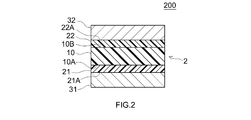
- the structure of the adhesive sheet according to another embodiment is schematically shown in FIG.
- the pressure-sensitive adhesive sheet 2 is provided on the sheet-shaped support substrate 10 having a first surface 10A and a second surface 10B, a pressure-sensitive adhesive layer 21 provided on the first surface 10A side, and a second surface 10B side. And a pressure-sensitive adhesive layer 22.
- the pressure-sensitive adhesive layer (first pressure-sensitive adhesive layer) 21 is fixed to the first surface 10A of the supporting base material 10
- the pressure-sensitive adhesive layer (second pressure-sensitive adhesive layer) 22 is fixed to the second surface 10B of the supporting base material 10, respectively. There is.
- the pressure-sensitive adhesive sheet 2 is used by sticking the pressure-sensitive adhesive layers 21 and 22 to different portions of the adherend.
- the places where the pressure-sensitive adhesive layers 21 and 22 are attached may be different places in different members or different places in a single member.
- the surface (first pressure-sensitive adhesive surface) 21A of the pressure-sensitive adhesive layer 21 and the surface (second pressure-sensitive adhesive surface) 22A of the pressure-sensitive adhesive layer 22 are at least the pressure-sensitive adhesive layer 21, It may be a constituent element of the release liner-attached pressure-sensitive adhesive sheet 200 in the form of being in contact with the release liners 31, 32 whose sides facing the surface 22 are release surfaces.
- release liners 31 and 32 for example, preferably used is a sheet-shaped base material (liner base material) having a release layer provided with a release treatment agent on one surface so that the one surface serves as a release surface. obtain.
- the release liner 32 is omitted, and the release liner 31 having both surfaces as release surfaces is used, and the adhesive sheet 2 and the adhesive liner 2 are overlapped and wound in a spiral shape so that the second adhesive surface 22A becomes the release liner 31.
- You may comprise the adhesive liner with a release liner of the form (roll form) which contact
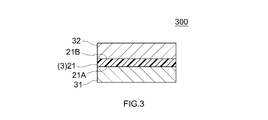
- the structure of the adhesive sheet according to another embodiment is schematically shown in FIG.
- the pressure-sensitive adhesive sheet 3 is configured as a double-sided pressure-sensitive adhesive sheet made of the pressure-sensitive adhesive layer 21 and having no base material.
- the pressure-sensitive adhesive sheet 3 includes a first pressure-sensitive adhesive surface 21A configured by one surface (first surface) of the pressure-sensitive adhesive layer 21 and a second pressure-sensitive adhesive surface configured by the other surface (second surface) of the pressure-sensitive adhesive layer 21. 21B is used by being attached to a different portion of the adherend.
- the pressure-sensitive adhesive sheet 3 before use has a release liner 31, 32 in which the first pressure-sensitive adhesive surface 21A and the second pressure-sensitive adhesive surface 21B are at least the sides facing the pressure-sensitive adhesive layer 21 are the release surfaces.
- the release liner 32 is omitted, and the release liner 31 having both sides as release surfaces is used, and the adhesive liner 3 is superposed on the release liner 31 and wound in a spiral shape so that the second adhesive surface 21B becomes the release liner 31.
- the concept of the pressure-sensitive adhesive sheet here may include what is called a pressure-sensitive adhesive tape, a pressure-sensitive adhesive film, a pressure-sensitive adhesive label, or the like.
- the pressure-sensitive adhesive sheet may be in a roll form, a single-wafer form, or may be cut or punched into an appropriate shape according to the application or the mode of use.
- the pressure-sensitive adhesive layer in the technology disclosed herein is typically formed continuously, but is not limited to this, and may be formed in a regular or random pattern such as dots or stripes. Good.
- the pressure-sensitive adhesive sheet disclosed herein includes a pressure-sensitive adhesive layer containing a polymer A and a polymer B which is a copolymer of a monomer having a polyorganosiloxane skeleton and a (meth)acrylic monomer.
- a pressure-sensitive adhesive layer may be formed from a pressure-sensitive adhesive composition containing a polymer A, which is a completely polymerized or partially polymerized product of the monomer raw material A, and a polymer B.
- the form of the pressure-sensitive adhesive composition is not particularly limited, and may be various forms such as a solvent type, a water dispersion type, a hot melt type, and an active energy ray curable type (for example, a photocurable type).
- polymer A examples include acrylic polymers, rubber polymers, polyester polymers, urethane polymers, polyether polymers, silicone polymers, polyamide polymers, fluorine polymers, etc., which are known in the adhesive field, at room temperature.
- the polymer A is a main component of the polymer component typically contained in the pressure-sensitive adhesive layer, that is, a component occupying more than 50% by weight, and for example, 75% by weight or more of the above-mentioned polymer components. Can be a component that occupies.
- the polymer A is a component that accounts for more than 50% by weight of the entire pressure-sensitive adhesive layer, and may be a component that accounts for 70% by weight or more.
- Glass transition temperature T A of the polymer A may be not particularly limited, the preferred characteristics in the PSA sheet disclosed herein is selected to obtain.
- polymer A having T A of less than 0° C. may be preferably used. Since the pressure-sensitive adhesive containing such a polymer A exhibits appropriate fluidity (for example, the mobility of the polymer chain contained in the pressure-sensitive adhesive), the pressure-sensitive adhesive sheet has an adhesive force increased to a predetermined value or more by mild heating. Suitable for realization of.
- the pressure-sensitive adhesive sheet disclosed herein can be preferably carried out by using the polymer A having T A of less than ⁇ 10° C., less than ⁇ 20° C., less than ⁇ 30° C. or less than ⁇ 35° C.
- T A may be less than ⁇ 40° C. and less than ⁇ 50° C.
- the lower limit of T A is not particularly limited. From the viewpoint of material availability improve cohesion ease and pressure-sensitive adhesive layer, usually, T A is -80 ° C. or higher, can be preferably used a -70 ° C. or higher, or -65 ° C. or more polymers A. In some embodiments, T A may be, for example, ⁇ 63° C. or higher, ⁇ 55° C. or higher, ⁇ 50° C. or higher, ⁇ 45° C. or higher.
- the glass transition temperature (Tg) of a polymer is the nominal value described in literatures or catalogs, or according to the Fox equation based on the composition of a monomer raw material used for the preparation of the polymer. Refers to the required Tg.
- the Fox equation is a relational expression between the Tg of the copolymer and the glass transition temperature Tgi of a homopolymer obtained by homopolymerizing each of the monomers constituting the copolymer, as shown below.
- Tg is the glass transition temperature (unit: K) of the copolymer
- Wi is the weight fraction of the monomer i in the copolymer (copolymerization ratio on a weight basis)
- Tgi is a homopolymer of the monomer i. Represents the glass transition temperature (unit: K) of.
- the glass transition temperature of the homopolymer used to calculate Tg the value described in publicly known data shall be used. Specifically, the figures are listed in the "Polymer Handbook” (3rd edition, John Wiley & Sons, Inc., 1989). For monomers for which multiple types of values are listed in the above Polymer Handbook, the highest value is used.
- the glass transition temperature of a homopolymer of a monomer not described in the above Polymer Handbook the value obtained by the following measuring method shall be used. Specifically, in a reactor equipped with a thermometer, a stirrer, a nitrogen introducing tube and a reflux cooling tube, 100 parts by weight of a monomer, 0.2 parts by weight of 2,2′-azobisisobutyronitrile and acetic acid as a polymerization solvent were used. 200 parts by weight of ethyl is added, and the mixture is stirred for 1 hour while circulating nitrogen gas. After removing oxygen in the polymerization system in this way, the temperature is raised to 63° C. and the reaction is performed for 10 hours.
- a homopolymer solution having a solid content concentration of 33% by weight.
- this homopolymer solution is cast-coated on a release liner and dried to prepare a test sample (sheet-shaped homopolymer) having a thickness of about 2 mm.
- This test sample was punched into a disk shape with a diameter of 7.9 mm, sandwiched by parallel plates, and a shear strain with a frequency of 1 Hz was measured using a viscoelasticity tester (TA Instruments Japan, model name "ARES"). The viscosity is measured in shear mode at a temperature rising rate of ⁇ 70° C. to 150° C., 5° C./min., and the temperature corresponding to the peak top temperature of tan ⁇ is defined as the Tg of the homopolymer.
- the weight average molecular weight (Mw) of the polymer A is usually about 20 ⁇ 10 4 or more. According to the polymer A having such Mw, a pressure-sensitive adhesive exhibiting good cohesiveness can be easily obtained. From the viewpoint of obtaining higher cohesive force, in some embodiments, the Mw of the polymer A may be, for example, 30 ⁇ 10 4 or more, 40 ⁇ 10 4 or more, 50 ⁇ 10 4 or more, 60 ⁇ . may be 10 4 or more, it may be 80 ⁇ 10 4 or more. Further, the Mw of the polymer A is usually suitable to be about 500 ⁇ 10 4 or less.
- the polymer A having such Mw easily forms an adhesive having appropriate fluidity (movement of polymer chain), an adhesive sheet having low adhesive strength at the initial application and high adhesive strength after mild heating is realized. Suitable for It is also preferable that the Mw of the polymer A is not too high from the viewpoint of improving the compatibility with the polymer B. In some embodiments, the Mw of Polymer A can be, for example, 250 ⁇ 10 4 or less, 200 ⁇ 10 4 or less, and 150 ⁇ 10 4 or less.
- the Mw of the polymer A and the polymer B described later can be calculated in terms of polystyrene by gel permeation chromatography (GPC). More specifically, the Mw can be measured according to the methods and conditions described in the examples below.
- an acrylic polymer can be preferably adopted.
- an acrylic polymer used as the polymer A, good compatibility with the polymer B tends to be easily obtained. It is preferable that the compatibility between the polymer A and the polymer B is good because it can contribute to the reduction of the initial adhesive force and the improvement of the adhesive force after heating through the improvement of the mobility of the polymer B in the adhesive layer.
- the acrylic polymer is, for example, a polymer containing 50% by weight or more of a monomer unit derived from a (meth)acrylic acid alkyl ester, that is, 50% of the total amount of a monomer component (monomer raw material A) for preparing the acrylic polymer. It may be a polymer in which more than or equal to wt% is a (meth)acrylic acid alkyl ester.
- a (meth)acrylic acid alkyl ester having a linear or branched alkyl group having 1 to 20 carbon atoms (that is, C 1-20 ) can be preferably used.
- the ratio of the (meth)acrylic acid C 1-20 alkyl ester in the monomer raw material A may be, for example, 50% by weight or more, 60% by weight or more, or 70% by weight or more, because the characteristics are easily balanced. But it's okay. For the same reason, the ratio of the (meth)acrylic acid C 1-20 alkyl ester in the monomer raw material A may be, for example, 99.9% by weight or less, 98% by weight or less, or 95% by weight or less. .. In some embodiments, the proportion of the (meth)acrylic acid C 1-20 alkyl ester in the monomer raw material A may be, for example, 90 wt% or less, 85 wt% or less, and 80 wt% or less.
- Non-limiting specific examples of the (meth)acrylic acid C 1-20 alkyl ester include methyl (meth)acrylate, ethyl (meth)acrylate, propyl (meth)acrylate, isopropyl (meth)acrylate, ( N-butyl (meth)acrylate, isobutyl (meth)acrylate, s-butyl (meth)acrylate, t-butyl (meth)acrylate, pentyl (meth)acrylate, isopentyl (meth)acrylate, (meth) Hexyl acrylate, heptyl (meth)acrylate, octyl (meth)acrylate, 2-ethylhexyl (meth)acrylate, isooctyl (meth)acrylate, nonyl (meth)acrylate, isononyl (meth)acrylate, (meth ) Decyl acrylate, isodecyl (meth)acrylate,
- the acrylic polymer is at least one selected from (meth)acrylic acid C 4-12 alkyl esters (preferably acrylic acid C 4-10 alkyl esters, such as acrylic acid C 6-10 alkyl esters). May be included as a monomer unit.
- an acrylic polymer containing one or both of n-butyl acrylate (BA) and 2-ethylhexyl acrylate (2EHA) is preferable, and an acrylic polymer containing at least 2EHA is particularly preferable.
- Examples of other (meth)acrylic acid C 1-18 alkyl ester that can be preferably used include methyl acrylate, methyl methacrylate (MMA), n-butyl methacrylate (BMA), and 2-ethylhexyl methacrylate (2EHMA). , Isostearyl acrylate (ISTA) and the like.
- the monomer raw material A may contain (meth)acrylic acid alkyl ester as a main component and, if necessary, other monomer (copolymerizable monomer) copolymerizable with the (meth)acrylic acid alkyl ester. ..
- a monomer having a polar group for example, a carboxy group, a hydroxyl group, a nitrogen atom-containing ring, etc.
- the monomer having a polar group can be useful for introducing a cross-linking point in the acrylic polymer and for enhancing the cohesive force of the acrylic polymer.
- the copolymerizable monomer may be used alone or in combination of two or more.
- Non-limiting specific examples of the copolymerizable monomer include the following. Hydroxyl group-containing monomer: for example, 2-hydroxyethyl (meth)acrylate, 2-hydroxypropyl (meth)acrylate, 2-hydroxybutyl (meth)acrylate, 3-hydroxypropyl (meth)acrylate, (meth)acrylic Acid 4-hydroxybutyl, (meth)acrylic acid 6-hydroxyhexyl, (meth)acrylic acid 8-hydroxyoctyl, (meth)acrylic acid 10-hydroxydecyl, (meth)acrylic acid 12-hydroxylauryl, (4-hydroxy) Hydroxyalkyl (meth)acrylates such as methylcyclohexyl)methyl (meth)acrylate.
- Hydroxyl group-containing monomer for example, 2-hydroxyethyl (meth)acrylate, 2-hydroxypropyl (meth)acrylate, 2-hydroxybutyl (meth)acrylate, 3-hydroxypropyl (meth)acrylate, (meth)acrylic Acid 4-
- N-vinyl-2-pyrrolidone N-methylvinylpyrrolidone, N-vinylpyridine, N-vinylpiperidone, N-vinylpyrimidine, N-vinylpiperazine, N-vinylpyrazine, N- Vinylpyrrole, N-vinylimidazole, N-vinyloxazole, N-(meth)acryloyl-2-pyrrolidone, N-(meth)acryloylpiperidine, N-(meth)acryloylpyrrolidine, N-vinylmorpholine, N-vinyl-3 -Morpholinone, N-vinyl-2-caprolactam, N-vinyl-1,3-oxazin-2-one, N-vinyl-3,5-morpholinedione, N-vinylpyrazole, N-vinylisoxazole, N-vinyl Thiazole, N-
- Carboxy group-containing monomer For example, acrylic acid, methacrylic acid, carboxyethyl acrylate, carboxypentyl acrylate, itaconic acid, maleic acid, fumaric acid, crotonic acid, isocrotonic acid and the like.
- Acid anhydride group-containing monomer For example, maleic anhydride, itaconic anhydride.
- Epoxy group-containing monomer For example, epoxy group-containing acrylate such as (meth)acrylic acid glycidyl or (meth)acrylic acid-2-ethylglycidyl ether, allyl glycidyl ether, (meth)acrylic acid glycidyl ether and the like.
- Cyano group-containing monomer For example, acrylonitrile, methacrylonitrile and the like.
- Isocyanate group-containing monomer For example, 2-isocyanatoethyl (meth)acrylate.
- Amide group-containing monomer for example, (meth)acrylamide; N,N-dimethyl(meth)acrylamide, N,N-diethyl(meth)acrylamide, N,N-dipropyl(meth)acrylamide, N,N-diisopropyl(meth) N,N-dialkyl(meth)acrylamides such as acrylamide, N,N-di(n-butyl)(meth)acrylamide, N,N-di(t-butyl)(meth)acrylamide; N-ethyl(meth) N-alkyl(meth)acrylamides such as acrylamide, N-isopropyl(meth)acrylamide, N-butyl(meth)acrylamide, Nn
- Aminoalkyl (meth)acrylates For example, aminoethyl (meth)acrylate, N,N-dimethylaminoethyl (meth)acrylate, N,N-diethylaminoethyl (meth)acrylate, t (meth)acrylate -Butylaminoethyl.
- Alkoxy group-containing monomer for example, 2-methoxyethyl (meth)acrylate, 3-methoxypropyl (meth)acrylate, 2-ethoxyethyl (meth)acrylate, propoxyethyl (meth)acrylate, (meth)acrylic acid
- Alkoxyalkyl (meth)acrylates such as butoxyethyl and ethoxypropyl (meth)acrylate
- Alkoxyalkylene glycol (meth)acrylates such as methoxyethylene glycol (meth)acrylate and methoxypolypropylene glycol (meth)acrylatekind.
- Monomers containing sulfonic acid group or phosphoric acid group For example, styrenesulfonic acid, allylsulfonic acid, sodium vinylsulfonate, 2-(meth)acrylamido-2-methylpropanesulfonic acid, (meth)acrylamidopropanesulfonic acid, sulfo.
- styrenesulfonic acid allylsulfonic acid, sodium vinylsulfonate
- 2-(meth)acrylamido-2-methylpropanesulfonic acid 2-(meth)acrylamidopropanesulfonic acid, sulfo.
- (Meth)acrylic acid ester having an alicyclic hydrocarbon group for example, cyclopentyl (meth)acrylate, cyclohexyl (meth)acrylate, isobornyl (meth)acrylate, dicyclopentanyl (meth)acrylate and the like.
- (Meth)acrylic acid ester having an aromatic hydrocarbon group for example, phenyl (meth)acrylate, phenoxyethyl (meth)acrylate, benzyl (meth)acrylate and the like.
- Vinyl ethers For example, vinyl alkyl ethers such as methyl vinyl ether and ethyl vinyl ether.
- Vinyl esters For example, vinyl acetate, vinyl propionate and the like.
- Aromatic vinyl compound For example, styrene, ⁇ -methylstyrene, vinyltoluene and the like.
- Olefins For example, ethylene, butadiene, isoprene, isobutylene and the like.
- heterocyclic ring-containing (meth)acrylates such as (meth)acrylic acid tetrahydrofurfuryl, halogen atom-containing (meth)acrylates such as vinyl chloride and fluorine atom-containing (meth)acrylate, silicon atom-containing such as silicone (meth)acrylate (Meth)acrylate, (meth)acrylate obtained from terpene compound derivative alcohol, and the like.
- the amount thereof is not particularly limited, but it is usually suitable to be 0.01% by weight or more of the monomer raw material A.
- the amount of the copolymerizable monomer used may be 0.1% by weight or more of the monomer raw material A, or 1% by weight or more.
- the amount of the copolymerizable monomer used can be 50% by weight or less of the monomer raw material A, and is preferably 45% by weight or less. This can prevent the cohesive force of the pressure-sensitive adhesive from becoming too high, and improve the tackiness at room temperature (25° C.).
- the amount of the copolymerizable monomer used may be 40% by weight or less and 35% by weight or less of the monomer raw material A.
- the monomer raw material A may include a monomer having a nitrogen atom-containing ring.
- a monomer having a nitrogen atom-containing ring By using a monomer having a nitrogen atom-containing ring, the cohesive force and polarity of the pressure-sensitive adhesive can be adjusted, and the pressure-sensitive adhesive force after mild heating can be suitably improved.
- the compatibility between the polymer A formed from the monomer raw material A and the polymer B tends to be improved. This makes it easier to obtain a pressure-sensitive adhesive sheet whose adhesive strength can be greatly increased by mild heating.
- the monomer having a nitrogen atom-containing ring can be used alone or in combination of two or more, for example, appropriately selected from the above examples.
- the monomer raw material A contains, as a monomer having a nitrogen atom-containing ring, at least one monomer selected from the group consisting of N-vinyl cyclic amides represented by the following general formula (M1). preferable.
- the monomer raw material A may contain only one or more such N-vinyl cyclic amides as a monomer having a nitrogen atom-containing ring.
- R 1 in the general formula (M1) is a divalent organic group.
- N-vinyl cyclic amide examples include N-vinyl-2-pyrrolidone, N-vinyl-2-piperidone, N-vinyl-3-morpholinone, N-vinyl-2-caprolactam and N-vinyl-1,3. -Oxazin-2-one, N-vinyl-3,5-morpholinedione and the like can be mentioned. Particularly preferred are N-vinyl-2-pyrrolidone and N-vinyl-2-caprolactam.
- the amount of the monomer having a nitrogen atom-containing ring is not particularly limited and is usually 0.01% by weight or more (preferably 0.1% by weight or more, for example 0.5% by weight or more) of the monomer raw material A. Is appropriate.
- the amount of the monomer having a nitrogen atom-containing ring used may be 1% by weight or more of the monomer raw material A, 5% by weight or more, 10% by weight or more, and 12% by weight or more. May be From the viewpoint of improving the tackiness at room temperature (25° C.) and the flexibility at low temperature, the amount of the monomer having a nitrogen atom-containing ring is usually 40% by weight or less of the monomer raw material A. Yes, it may be 30% by weight or less, 20% by weight or less, or 18% by weight or less.
- the monomer raw material A contains a hydroxyl group-containing monomer.
- the hydroxyl group-containing monomer provides a reaction point with a crosslinking agent (for example, an isocyanate-based crosslinking agent) described later, and can increase the cohesive force of the pressure-sensitive adhesive by the crosslinking reaction.
- hydroxyl group-containing monomer examples include 2-hydroxyethyl (meth)acrylate, 4-hydroxybutyl (meth)acrylate, 6-hydroxyhexyl (meth)acrylate, and N-(2-hydroxyethyl)(meth)acrylamide. It can be used preferably. Of these, preferable examples include 2-hydroxyethyl acrylate (HEA), 4-hydroxybutyl acrylate (4HBA), and N-(2-hydroxyethyl)acrylamide (HEAA).
- HOA 2-hydroxyethyl acrylate
- 4HBA 4-hydroxybutyl acrylate
- HEAA N-(2-hydroxyethyl)acrylamide
- the amount of the hydroxyl group-containing monomer used is not particularly limited and is usually 0.01% by weight or more (preferably 0.1% by weight or more, for example 0.5% by weight or more) of the monomer raw material A. .. In some embodiments, the amount of the hydroxyl group-containing monomer used may be 1% by weight or more of the monomer raw material A, 5% by weight or more, or 10% by weight or more. Further, from the viewpoint of the mobility of the polymer B in the pressure-sensitive adhesive layer, the improvement of tackiness at room temperature (25° C.), and the improvement of flexibility at low temperature, the amount of the hydroxyl group-containing monomer used is usually 40% of that of the monomer raw material A. It is suitable to be not more than 30% by weight, preferably not more than 30% by weight, not more than 20% by weight, not more than 10% by weight or not more than 5% by weight.
- a monomer having a nitrogen atom-containing ring eg, N-vinyl cyclic amide
- a hydroxyl group-containing monomer can be used in combination as the copolymerizable monomer.
- the total amount of the monomer having a nitrogen atom-containing ring and the hydroxyl group-containing monomer may be, for example, 0.1% by weight or more of the monomer raw material A, and may be 1% by weight or more and 5% by weight or more. , 10 wt% or more, 15 wt% or more, 20 wt% or more, 25 wt% or more.
- the total amount of the monomer having a nitrogen atom-containing ring and the hydroxyl group-containing monomer can be, for example, 50% by weight or less of the monomer raw material A, and is preferably 40% by weight or less.
- the content (W N ) of the monomer having a nitrogen atom-containing ring and the content of the hydroxyl group-containing monomer in the monomer raw material A is not particularly limited.
- W N /W OH may be, for example, 0.01 or more, usually 0.05 or more is suitable, 0.1 or more, 0.2 or more, 0.5 or more, 0 It may be 7 or more. Further, W N /W OH may be, for example, 100 or less, usually 20 or less is appropriate, 10 or less, 5 or less, 2 or less, or 1.5 or less.
- the monomer raw material A does not include a monomer (monomer S1) having a polyorganosiloxane skeleton, which is preferably used as a constituent of the monomer raw material B described later, or the content of the monomer is in the monomer raw material A. Is preferably less than 10% by weight (more preferably less than 5% by weight, for example less than 2% by weight). According to the monomer raw material A having such a composition, it is possible to preferably realize a pressure-sensitive adhesive sheet that suitably balances the initial reworkability and the strong adhesiveness after the increase in the adhesive strength.
- the monomer raw material A does not contain the monomer S1, or, if it contains the monomer S1, its content (on a weight basis) is lower than the content of the monomer S1 in the monomer raw material B. It is preferably low.
- the method for obtaining the polymer A is not particularly limited, and various polymerization methods such as a solution polymerization method, an emulsion polymerization method, a bulk polymerization method, a suspension polymerization method, and a photopolymerization method can be appropriately adopted.
- the solution polymerization method may be preferably adopted.
- the polymerization temperature during solution polymerization can be appropriately selected according to the types of monomers and solvents used, the types of polymerization initiators, etc., and is, for example, about 20°C to 170°C (typically 40°C to 140°C). C.).
- the initiator used for the polymerization can be appropriately selected from conventionally known thermal polymerization initiators, photopolymerization initiators, etc. according to the polymerization method.
- the polymerization initiators may be used alone or in combination of two or more.
- thermal polymerization initiator examples include azo-based polymerization initiators (eg, 2,2′-azobisisobutyronitrile, 2,2′-azobis-2-methylbutyronitrile, 2,2′-azobis( 2-methylpropionic acid)dimethyl, 4,4′-azobis-4-cyanovaleric acid, azobisisovaleronitrile, 2,2′-azobis(2-amidinopropane)dihydrochloride, 2,2′-azobis[2 -(5-Methyl-2-imidazolin-2-yl)propane]dihydrochloride, 2,2'-azobis(2-methylpropionamidine)disulfate, 2,2'-azobis(N,N'-dimethylene Isobutylamidine) dihydrochloride, etc.); Persulfate such as potassium persulfate; Peroxide type polymerization initiator (eg, dibenzoyl peroxide, t-butyl permaleate,
- the amount of the thermal polymerization initiator used is not particularly limited, but for example, 0.01 part by weight to 5 parts by weight, preferably 0 part by weight, relative to 100 parts by weight of the monomer component (monomer raw material A) used for preparing the acrylic polymer.
- the amount can be in the range of 0.05 parts by weight to 3 parts by weight.
- the photopolymerization initiator is not particularly limited, and examples thereof include benzoin ether photopolymerization initiators, acetophenone photopolymerization initiators, ⁇ -ketol photopolymerization initiators, aromatic sulfonyl chloride photopolymerization initiators, and photoactivators.
- Oxime photopolymerization initiator, benzoin photopolymerization initiator, benzyl photopolymerization initiator, benzophenone photopolymerization initiator, ketal photopolymerization initiator, thioxanthone photopolymerization initiator, acylphosphine oxide photopolymerization initiator Agents and the like can be used.
- the amount of the photopolymerization initiator used is not particularly limited, but is, for example, 0.01 part by weight to 5 parts by weight, preferably 0.05 part by weight to 3 parts by weight, relative to 100 parts by weight of the monomer raw material A. Can benzoin ether photopolymerization initiators,
- the polymer A is a partially polymerized product (polymer syrup) obtained by irradiating a mixture of the above-mentioned monomer raw material A with a polymerization initiator with ultraviolet rays (UV) to polymerize a part of the monomer component. )
- it can be contained in the adhesive composition for forming an adhesive layer.
- a pressure-sensitive adhesive composition containing such a polymer syrup can be applied to a predetermined object to be coated and irradiated with ultraviolet rays to complete the polymerization. That is, the polymer syrup can be understood as a precursor of the polymer A.
- the pressure-sensitive adhesive layer disclosed herein can be formed using, for example, a pressure-sensitive adhesive composition containing the polymer syrup and the polymer B.
- the polymer B in the technology disclosed herein is a copolymer of a monomer having a polyorganosiloxane skeleton (hereinafter, also referred to as “monomer S1”) and a (meth)acrylic monomer.
- the polymer B suppresses the adhesive force in the initial stage of application to the adherend due to the low polarity and motility of the polyorganosiloxane structure derived from the monomer S1 and also increases the adhesive force to the adherend by heating. It can function as a rise retarder.
- the monomer S1 is not particularly limited, and any monomer containing a polyorganosiloxane skeleton can be used.
- the monomer S1 promotes uneven distribution of the polymer B on the surface of the pressure-sensitive adhesive layer in the pressure-sensitive adhesive sheet before use (before sticking to an adherend) due to the low polarity derived from its structure, and causes light peeling at the initial stage of bonding. Develops the property (low tackiness).
- the monomer S1 those having a structure having a polymerizable reactive group at one end can be preferably used. By copolymerization of such a monomer S1 and a (meth)acrylic monomer, a polymer B having a polyorganosiloxane skeleton in its side chain is formed.
- the polymer B having such a structure tends to have a low initial adhesive force and a high adhesive force after mild heating due to the mobility and easiness of movement of side chains.
- a monomer having a polymerizable reactive group at one end and not having a functional group that causes a crosslinking reaction with the polymer A at the other end can be preferably used as the monomer S1.
- the polymer B in which the monomer S1 having such a structure is copolymerized tends to have low initial adhesive strength and high adhesive strength after heating due to the mobility of the polyorganosiloxane structure derived from the monomer S1.
- a compound represented by the following general formula (1) or (2) can be used. More specifically, examples of one-end reactive silicone oil manufactured by Shin-Etsu Chemical Co., Ltd. include X-22-174ASX, X-22-2426, X-22-2475, and KF-2012. As the monomer S1, one kind may be used alone, or two or more kinds may be used in combination.
- R 3 in the general formulas (1) and (2) is hydrogen or methyl
- R 4 is a methyl group or a monovalent organic group
- m and n are integers of 0 or more.
- the functional group equivalent of the monomer S1 an appropriate value can be adopted within a range in which the desired effect is exhibited by using the monomer S1, and is not limited to a specific range.
- the functional group equivalent is, for example, 100 g/mol or more, 200 g/mol or more, and is preferably 300 g/mol or more (eg 500 g/mol or more), 700 g /Mol or more, preferably 800 g/mol or more, more preferably 850 g/mol or more, particularly preferably 1500 g/mol or more.
- the functional group equivalent may be 3000 g/mol or more, 4500 g/mol or more, and 6000 g/from the viewpoint of achieving both low tackiness at the initial stage of application and increase in tackiness after mild heating. It may be mol or more, 9000 g/mol or more, 12000 g/mol or more, or 15000 g/mol or more (for example, 16000 g/mol or more).
- the functional group equivalent of the monomer S1 may be, for example, 50,000 g/mol or less. From the viewpoint of sufficiently increasing the adhesive strength, the functional group equivalent weight is, for example, preferably 30,000 g/mol or less, and more preferably 20,000 g/mol or less.
- the functional group equivalent weight of monomer S1 may be less than 18,000 g/mol, less than 15,000 g/mol, less than 10,000 g/mol, less than 6000 g/mol, less than 5000 g/mol. ..
- the functional group equivalent of the monomer S1 is within the above range, it is easy to adjust the compatibility (for example, the compatibility with the base polymer) and the mobility in the pressure-sensitive adhesive layer within an appropriate range, and the initial low tackiness and mildness are obtained. It becomes easy to realize a pressure-sensitive adhesive layer that is compatible with an increase in adhesive strength after heating.
- Non-limiting examples of the suitable range of the functional group equivalent of the monomer S1 include 700 g/mol or more and 50000 g/mol or less, 700 g/mol or more and 30000 g/mol or less, 700 g/mol or more and 20000 g/mol or less, 700 g/mol or more and 18000 g. /Mol or more, 700 g/mol or more and less than 15000 g/mol, 800 g/mol or more and less than 10000 g/mol, 850 g/mol or more and less than 6000 g/mol, 1500 g/mol or more and less than 5000 g/mol.
- the suitable range of the functional group equivalent of the monomer S1 is 3000 g/mol or more and 50000 g/mol or less, 6000 g/mol or more and 50000 g/mol or less, 12000 g/mol or more and 50000 g/mol or less, 15000 g/mol or more and 50000 g/mol or less. It can be less than or equal to mol.
- the “functional group equivalent” means the weight of the main skeleton (for example, polydimethylsiloxane) bonded to each functional group.
- the unit of g/mol is converted to 1 mol of the functional group.
- the functional group equivalent of the monomer S1 can be calculated, for example, from the spectrum intensity of 1 H-NMR (proton NMR) based on nuclear magnetic resonance (NMR). Calculation of the functional group equivalent (g/mol) of the monomer S1 based on the 1 H-NMR spectrum intensity is based on a general structural analysis method related to 1 H-NMR spectrum analysis, and if necessary Japanese Patent No. It can be performed with reference to the description of Japanese Patent No. 5951153.
- the functional group equivalent of the monomer S1 composed of n kinds of monomers (monomer S1 1 , monomer S1 2 ... Monomer S1 n ) having different functional group equivalents can be calculated by the following formula.
- Functional group equivalent of the monomer S1 (g / mol) (monomer S1 1 functional group equivalent ⁇ monomer S1 1 of the amount + monomer S1 2 functional group equivalent ⁇ monomer S1 2 of the amount + ... + monomer S1 n
- Functional group equivalent ⁇ monomer S1 n blending amount (monomer S1 1 blending amount+monomer S1 2 blending amount+...+monomer S1 n blending amount)
- the content of the monomer S1 can be an appropriate value within the range in which the desired effect is exhibited by using the monomer S1, and is not limited to a specific range.
- the amount may be, for example, 5% by weight or more based on the total amount of the monomer component (monomer raw material B) for preparing the polymer B, and from the viewpoint of better exerting the effect as the adhesive force increase retarder. It is preferably 10% by weight or more, 15% by weight or more, and 20% by weight or more.
- the content of the monomer S1 in the monomer raw material B may be, for example, 80% by mass or less from the viewpoint of polymerization reactivity and compatibility, and is appropriately 60% by weight or less, and 50% by weight or less.
- It may be 40% by weight or less, or 30% by weight or less.
- the content of the monomer S1 is less than 5% by weight, the initial adhesive force may not be sufficiently suppressed.
- the content of the monomer S1 is more than 60% by weight, the increase in adhesive strength may be insufficient.
- the monomer raw material B contains, in addition to the monomer S1, a (meth)acrylic monomer copolymerizable with the monomer S1.
- a (meth)acrylic monomer copolymerizable with the monomer S1 By copolymerizing one or more kinds of (meth)acrylic monomers with the monomer S1, the mobility of the polymer B in the pressure-sensitive adhesive layer can be suitably adjusted. Copolymerizing the monomer S1 and the (meth)acrylic monomer can also help improve the compatibility between the polymer B and the polymer A (for example, an acrylic polymer).
- Examples of the (meth)acrylic monomer that can be used for the monomer raw material B include (meth)acrylic acid alkyl ester.
- the monomer feedstock B is (meth)acrylic acid C 4-12 alkyl ester (preferably (meth)acrylic acid C 4-10 alkyl ester, eg (meth)acrylic acid C 6-10 alkyl ester). Can be included.
- the monomer feedstock B may contain at least one of a methacrylic acid C 1-18 alkyl ester, preferably a methacrylic acid C 1-14 alkyl ester, such as a methacrylic acid C 1-10 alkyl ester. ..
- the monomer raw material B may contain, as the (meth)acrylic monomer, for example, one kind or two or more kinds selected from MMA, BMA and 2EHMA.
- the (meth)acrylic monomer is a (meth)acrylic acid ester having an alicyclic hydrocarbon group.
- cyclopentyl (meth)acrylate, cyclohexyl (meth)acrylate, isobornyl (meth)acrylate, dicyclopentanyl (meth)acrylate, 1-adamantyl (meth)acrylate and the like can be used.
- the monomer raw material B may contain at least one selected from dicyclopentanyl methacrylate, isobornyl methacrylate, and cyclohexyl methacrylate as the (meth)acrylic monomer.
- the content of the (meth)acrylic acid alkyl ester and the alicyclic hydrocarbon group-containing (meth)acrylic acid ester in the monomer raw material B may be, for example, 10% by weight or more and 95% by weight or less, and 20% by weight. Or more and 95 wt% or less, 30 wt% or more and 90 wt% or less, 40 wt% or more and 90 wt% or less, 50 wt% or more and 85 wt% or less Good.
- the use of alkyl (meth)acrylate may be advantageous from the viewpoint of easy increase in adhesive strength due to mild heating.
- the content of the (meth)acrylic acid ester having an alicyclic hydrocarbon group may be less than 50% by weight of the monomer raw material B, less than 30% by weight, or less than 15% by weight. It may be less than 10% by weight or less than 5% by weight.
- the (meth)acrylic acid ester having an alicyclic hydrocarbon group may not be used.
- the (meth)acrylic monomer which is a constituent of the monomer raw material B, may include a monomer M2 having a homopolymer Tg of 50° C. or higher.
- a monomer M2 having a homopolymer Tg of 50° C. or higher By copolymerizing the monomer S1 and the monomer M2 in the polymer B, the motility and mobility of the polyorganosiloxane structural part with temperature rise are suitably controlled, and the initial light peelability (reworkability) and after mild heating It is easy to achieve compatibility with the increase in adhesive strength.
- the homopolymer of monomer M2 has a Tg of 60° C. or higher, 70° C. or higher, 80° C. or higher, 90° C. or higher.
- the upper limit of Tg of the homopolymer of the monomer M2 is not particularly limited, but from the viewpoint of easiness of synthesizing the polymer B and the like, it is usually suitable to be 200° C. or lower.
- the Tg of a homopolymer of monomer M2 may be, for example, 180° C. or lower, 150° C. or lower, 120° C. or lower.
- the monomer M2 for example, among the (meth)acrylic monomers exemplified above, those having a Tg of the homopolymer satisfying the condition can be used.
- one or more monomers selected from the group consisting of (meth)acrylic acid alkyl ester and (meth)acrylic acid ester having an alicyclic hydrocarbon group can be used.
- the (meth)acrylic acid alkyl ester a methacrylic acid alkyl ester having an alkyl group with 1 to 4 carbon atoms can be preferably used.
- the content of the monomer M2 is, for example, 5% by weight or more of the monomer raw material B, 10% by weight or more, 15% by weight or more, 20% by weight or more. , May be 25% by weight or more, and may be 30% by weight or more. In some embodiments, the content of the monomer M2 may be 35 wt% or more of the monomer raw material B, 40 wt% or more, 45 wt% or more, 50 wt% or more, 55 wt% or more. But it's okay.
- the content of the monomer M2 may be, for example, 90% by weight or less, usually 80% by weight or less, preferably 75% by weight or less, 70% by weight or less, and 65% by weight. It may be less than or equal to %. In some preferred embodiments, the content of monomer M2 is 60 wt% or less (eg, 50 wt% or less, typically 42 wt% or less).
- the copolymerization ratio of the monomer M2 having a Tg of 50° C. or higher is limited to a predetermined value or less, so that an increase in the adhesive strength after mild heating is preferably realized based on the mobility of the polymer B near 50° C. be able to. From the same viewpoint, the content of the monomer M2 in the monomer raw material B may be 35% by weight or less, 25% by weight or less, or 15% by weight or less (for example, 5% by weight or less).
- the content of the monomer M2 is, for example, one or more monomers selected from the group consisting of a (meth)acrylic acid alkyl ester and a (meth)acrylic acid ester having an alicyclic hydrocarbon group as the monomer M2.
- the monomer M2 is composed of one or more monomers selected from (meth)acrylic acid alkyl esters (for example, methacrylic acid alkyl esters).
- a preferred example of such an aspect is an aspect in which the monomer M2 is MMA.
- the (meth)acrylic-based monomer may include a monomer M3 having a homopolymer Tg of less than 50° C. (typically ⁇ 20° C. or more and less than 50° C.).
- Tg a homopolymer Tg of less than 50° C.
- the use of the monomer M3 makes it easy to obtain a pressure-sensitive adhesive sheet that balances the pressure-sensitive adhesive force and the cohesive force in a well-balanced manner. From the viewpoint of facilitating such effects, it is preferable to use the monomer M3 in combination with the monomer M2.
- the monomer M3 for example, among the (meth)acrylic monomers exemplified above, those having a homopolymer Tg satisfying the condition can be used.
- one or more monomers selected from the group consisting of (meth)acrylic acid alkyl ester can be used.
- the content of the monomer M3 may be, for example, 5% by weight or more of the monomer raw material B, 10% by weight or more, 15% by weight or more, and 20% by weight or more. It may be 25% by weight or more, 30% by weight or more, and 35% by weight or more. Further, the content of the monomer M3 is usually appropriate to be 70% by weight or less of the monomer raw material B, and may be 60% by weight or less or 50% by weight or less.
- the content of the monomer M3 can be preferably applied, for example, in an embodiment in which the monomer M3 is composed of one or more kinds of monomers selected from (meth)acrylic acid alkyl esters (for example, methacrylic acid alkyl esters).
- the monomer raw material B preferably has a content of a monomer having a homopolymer Tg of higher than 170° C. of 30% by weight or less.
- the content of the monomer being X% by weight or less includes a mode in which the content of the monomer is 0% by weight, that is, a mode in which the monomer is not substantially contained, unless otherwise specified. It is a concept.
- “not substantially containing” means that the above-mentioned monomer is not used at least intentionally.
- the monomer raw material B preferably contains at least MMA as the (meth)acrylic monomer. According to the polymer B copolymerized with MMA, a pressure-sensitive adhesive sheet having a large N 50 can be easily obtained.
- the proportion of MMA in the total amount of (meth)acrylic monomers contained in the monomer raw material B may be, for example, 5% by weight or more, 10% by weight or more, 20% by weight or more, and 30% by weight or more. However, it may be 40% by weight or more. In some embodiments, the proportion of MMA in the total amount of the (meth)acrylic monomer may be, for example, more than 50% by weight, more than 55% by weight, more than 60% by weight, or 65% by weight.
- the proportion of MMA in the total amount of the (meth)acrylic monomers is usually 95% by weight or less, 90% by weight or less, or 85% by weight or less. In some preferred embodiments, the proportion of MMA in the total amount of the (meth)acrylic monomer is 75 wt% or less, or 65 wt% or less, from the viewpoint of increasing the adhesive strength after mild heating, 60 It may be less than or equal to 50% by weight, or less than or equal to 55% by weight (eg less than or equal to 50% by weight).
- a carboxyl group-containing monomer and an acid anhydride group-containing monomer exemplified above as the monomer that can be used when the polymer A is an acrylic polymer are included.
- Polyoxyalkylene ether having (eg, ether); methoxyethyl (meth)acrylate, ethoxyethyl (meth)acrylate, propoxyethyl (meth)acrylate, butoxyethyl (meth)acrylate, ethoxy (meth)acrylate Alkoxyalkyl (meth)acrylates such as propyl; Salts such as alkali metal salts of (meth)acrylic acid; Polyvalent (meth)acrylates such as trimethylolpropane tri(meth)acrylic acid ester: vinylidene chloride, (meth)acrylic acid Halogenated vinyl compounds such as 2-chloroethyl; 2-vinyl-2-oxazoline, 2-vinyl-5-methyl-2-oxazoline, 2-isopropenyl-2-oxazoline and other oxazoline group-containing monomers; (meth)acryloyl Aziridine group-containing monomers such as aziridine and 2-aziridin
- the polymer B those having no functional group that causes a crosslinking reaction with the polymer A can be preferably adopted.
- the polymer B is preferably contained in the pressure-sensitive adhesive layer in a form not chemically bonded to the polymer A.
- the pressure-sensitive adhesive layer containing the polymer B in such a form has good mobility of the polymer B at the time of heating, and is suitable for improving the adhesive force increase ratio.
- the functional group that causes a cross-linking reaction with the polymer A may differ depending on the type of the functional group that the polymer A has, but may be, for example, an epoxy group, an isocyanate group, a carboxy group, an alkoxysilyl group, an amino group, or the like.
- the Mw of polymer B is not particularly limited.
- the Mw of the polymer B may be, for example, 1000 or more, and may be 5000 or more.
- the Mw of the polymer B may be, for example, 10,000 or more, 12,000 or more, 15,000 or more, or 20,000 or more, from the viewpoint of suitably exhibiting an increase in adhesive strength after mild heating.
- the Mw of Polymer B may be 50,000 or more, 80,000 or more, 100,000 or more, 120,000 or more (eg, 150,000 or more).
- the upper limit of Mw of the polymer B is, for example, 500,000 or less, 350,000 or less, 350,000 or less, or less than 100,000.
- the Mw of the polymer B may be less than 80,000 or less than 70,000. It may be less than 50,000, less than 40,000, less than 20,000, or even less than 10,000.
- the Mw of polymer B is preferably lower than the Mw of polymer A. This makes it easy to realize a pressure-sensitive adhesive sheet that achieves both good reworkability at the initial stage of application and increased adhesive strength after mild heating.
- the Mw of the polymer B may be, for example, 0.8 times or less, 0.75 times or less, 0.5 times or less, 0.3 times or less, 0.1 times or less than that of the polymer A. It may be less than or equal to double, may be less than or equal to 0.05, and may be less than or equal to 0.03 (for example, less than or equal to 0.02).
- the polymer B can be produced, for example, by polymerizing the above-mentioned monomer by a known method such as a solution polymerization method, an emulsion polymerization method, a bulk polymerization method, a suspension polymerization method, or a photopolymerization method.
- a chain transfer agent may be used as necessary to adjust the molecular weight of the polymer B.
- the chain transfer agent used include octyl mercaptan, lauryl mercaptan, t-nonyl mercaptan, t-dodecyl mercaptan, mercaptoethanol, ⁇ -thioglycerol, and other compounds having a mercapto group; thioglycolic acid, methyl thioglycolate, Ethyl thioglycolate, propyl thioglycolate, butyl thioglycolate, t-butyl thioglycolate, 2-ethylhexyl thioglycolate, octyl thioglycolate, isooctyl thioglycolate, decyl thioglycolate, dodecyl thioglycolate, ethylene Thioglycolic acid
- the amount of the chain transfer agent used is not particularly limited, but is usually 0.05 to 20 parts by weight, preferably 0.1 to 15 parts by weight with respect to 100 parts by weight of the monomer. And more preferably 0.2 to 10 parts by weight. By adjusting the addition amount of the chain transfer agent in this manner, the polymer B having a suitable molecular weight can be obtained.
- the chain transfer agents may be used alone or in combination of two or more.
- various conventionally known means including the use of the above chain transfer agent can be used alone or in combination.
- Non-limiting examples of such means include selection of polymerization method, selection of type and amount of polymerization initiator, selection of polymerization temperature, selection of type and amount of polymerization solvent in solution polymerization method, light weight. Selection of light irradiation intensity in legality, etc. are included.
- Those skilled in the art can understand how to obtain a polymer having a desired molecular weight based on the description of the present specification including the specific examples described below and the common general knowledge as of the filing of the present application.
- the amount of the polymer B used with respect to 100 parts by weight of the polymer A can be, for example, 0.1 parts by weight or more, and 0.5 parts by weight from the viewpoint of obtaining a higher effect.
- the amount may be the above, 1 part by weight or more, or 2 parts by weight or more.
- the amount of the polymer B used may be, for example, 3 parts by weight or more, may be 4 parts by weight or more, or may be 5 parts by weight or more from the viewpoint of improving reworkability.
- the amount of the polymer B used with respect to 100 parts by weight of the polymer A may be, for example, 75 parts by weight or less, 60 parts by weight or less, or 50 parts by weight or less.
- the amount of the polymer B used can be, for example, 40 parts by weight or less, and 35 parts by weight or less with respect to 100 parts by weight of the polymer A. , 30 parts by weight or less, or 25 parts by weight or less. From the viewpoint of obtaining a higher adhesive strength after heating, in some embodiments, the amount of the polymer B used may be 20 parts by weight or less, 17 parts by weight or less, 15 parts by weight or less, and 12 parts by weight.
- the amount may be not more than 10 parts by weight, may be not more than 10 parts by weight, may be not more than 8 parts by weight, may be not more than 6 parts by weight, and may be not more than 4 parts by weight (for example, not more than 3 parts by weight).
- the pressure-sensitive adhesive layer may contain a polymer (arbitrary polymer) other than the polymer A and the polymer B as needed, as long as the performance of the pressure-sensitive adhesive sheet disclosed herein is not significantly impaired.
- the appropriate amount of such an optional polymer is usually 20% by weight or less, preferably 15% by weight or less, or 10% by weight or less based on the total amount of the polymer components contained in the pressure-sensitive adhesive layer. In some embodiments, the amount of the optional polymer used may be 5% by weight or less, 3% by weight or less, or 1% by weight or less based on the entire polymer components.
- the pressure-sensitive adhesive layer may contain substantially no polymer other than the polymer A and the polymer B.
- a cross-linking agent may be used in the pressure-sensitive adhesive layer, if necessary, for the purpose of adjusting cohesive force and the like.
- the cross-linking agent it is possible to use a cross-linking agent known in the field of pressure-sensitive adhesives, for example, epoxy-based cross-linking agent, isocyanate-based cross-linking agent, silicone-based cross-linking agent, oxazoline-based cross-linking agent, aziridine-based cross-linking agent, silane-based cross-linking agent. Examples thereof include a crosslinking agent, an alkyl etherified melamine-based crosslinking agent, and a metal chelate-based crosslinking agent.
- an isocyanate crosslinking agent, an epoxy crosslinking agent, and a metal chelate crosslinking agent can be preferably used.
- the cross-linking agents may be used alone or in combination of two or more.
- examples of the isocyanate cross-linking agent include tolylene diisocyanate, hexamethylene diisocyanate, isophorone diisocyanate, xylylene diisocyanate, hydrogenated xylylene diisocyanate, diphenylmethane diisocyanate, hydrogenated diphenylmethane diisocyanate, tetramethylxylylene diisocyanate, naphthalene.
- examples thereof include diisocyanate, triphenylmethane triisocyanate, polymethylene polyphenyl isocyanate, and adducts of these with polyols such as trimethylolpropane.
- a compound having at least one or more isocyanate group and one or more unsaturated bond in one molecule should also be used as an isocyanate cross-linking agent. You can These can be used alone or in combination of two or more.
- Epoxy crosslinking agents include bisphenol A, epichlorohydrin type epoxy resin, ethylene glycidyl ether, polyethylene glycol diglycidyl ether, glycerin diglycidyl ether, glycerin triglycidyl ether, 1,6-hexanediol glycidyl ether, trimethylolpropane tri Glycidyl ether, diglycidyl aniline, diamine glycidyl amine, N,N,N',N'-tetraglycidyl-m-xylylenediamine and 1,3-bis(N,N-diglycidylaminomethyl)cyclohexane You can These can be used alone or in combination of two or more.
- metal chelate compound examples include aluminum, iron, tin, titanium and nickel as metal components, and acetylene, methyl acetoacetate and ethyl lactate as chelate components. These can be used alone or in combination of two or more.
- the amount of the crosslinking agent used is not particularly limited, and may be, for example, an amount exceeding 0 part by weight with respect to 100 parts by weight of the polymer A.
- the amount of the crosslinking agent used can be, for example, 0.01 part by weight or more, and preferably 0.05 part by weight or more, based on 100 parts by weight of the polymer A.
- the increase in the amount of the cross-linking agent tends to suppress the adhesive force in the initial stage of application and improve the reworkability.
- the amount of cross-linking agent used relative to 100 parts by weight of polymer A may be 0.1 parts by weight or more, 0.5 parts by weight or more, and 0.8 parts by weight or more. May be.
- the amount of the cross-linking agent used relative to 100 parts by weight of the polymer A is usually appropriate to be 15 parts by weight or less.
- the amount may be 10 parts by weight or less, or 5 parts by weight or less.
- the technique disclosed herein can be preferably carried out in a mode in which at least an isocyanate cross-linking agent is used as the cross-linking agent.
- the amount of the isocyanate cross-linking agent used relative to 100 parts by weight of the polymer A is, for example, 0.01 part by weight or more.
- the amount may be 0.05 parts by weight or more, 0.1 parts by weight or more, 0.2 parts by weight or more (eg 0.3 parts by weight or more), and 5 parts by weight or less, for example.
- the amount may be 3 parts by weight or less, 1.5 parts by weight or less, 1.2 parts by weight or less, and 0.8 parts by weight or less (eg, 0.6 parts by weight or less). Good.
- the amount W OH of the hydroxyl-group-containing monomer relative to the amount W NCO of the isocyanate-based cross-linking agent is:
- the amount can be such that W OH /W NCO is 2 or more on a weight basis.
- W OH /W NCO may be 3 or higher, 5 or higher, 10 or higher, 20 or higher, 30 or higher. Well, it may be 50 or more.
- the upper limit of W OH /W NCO is not particularly limited, and from the viewpoint of a degree of crosslinking that allows the polymer B to moderately move by mild heating, W OH /W NCO may be, for example, 500 or less, and 200 or less. It may be present, may be 100 or less, and may be 50 or less.
- a cross-linking catalyst may be used in order to more effectively promote any of the above-mentioned cross-linking reactions.
- a crosslinking catalyst for example, a tin-based catalyst (particularly dioctyltin dilaurate) can be preferably used.
- the amount of the crosslinking catalyst used is not particularly limited, but can be, for example, approximately 0.0001 parts by weight to 1 part by weight with respect to 100 parts by weight of the polymer A.
- a polyfunctional monomer may be used in the pressure-sensitive adhesive layer, if necessary.
- the polyfunctional monomer can be used for the purpose of adjusting cohesive force or the like by using the polyfunctional monomer instead of or in combination with the above-mentioned crosslinking agent.
- a polyfunctional monomer can be preferably used in the pressure-sensitive adhesive layer formed from the photocurable pressure-sensitive adhesive composition.
- polyfunctional monomer examples include ethylene glycol di(meth)acrylate, propylene glycol di(meth)acrylate, polyethylene glycol di(meth)acrylate, polypropylene glycol di(meth)acrylate, neopentyl glycol di(meth)acrylate, Pentaerythritol di(meth)acrylate, pentaerythritol tri(meth)acrylate, dipentaerythritol hexa(meth)acrylate, ethylene glycol di(meth)acrylate, 1,6-hexanediol di(meth)acrylate, 1,12-dodecane Diol di(meth)acrylate, trimethylolpropane tri(meth)acrylate, tetramethylolmethane tri(meth)acrylate, allyl(meth)acrylate, vinyl(meth)acrylate, divinylbenzene, epoxy acrylate, polyester acrylate, urethane acrylate,
- trimethylolpropane tri(meth)acrylate, 1,6-hexanediol di(meth)acrylate, and dipentaerythritol hexa(meth)acrylate can be preferably used.
- the polyfunctional monomers may be used alone or in combination of two or more.
- the amount of the polyfunctional monomer used varies depending on its molecular weight, the number of functional groups, etc., but normally it is suitable to be in the range of about 0.01 to 3.0 parts by weight with respect to 100 parts by weight of the polymer A. .. In some embodiments, the amount of the polyfunctional monomer used may be, for example, 0.02 parts by weight or more, and may be 0.03 parts by weight or more based on 100 parts by weight of the polymer A. The increase in the amount of the polyfunctional monomer used tends to suppress the adhesive force in the initial stage of application and improve the reworkability.
- the amount of the polyfunctional monomer used is 100 parts by weight of the polymer A.
- the amount may be 2.0 parts by weight or less, 1.0 part by weight or less, and 0.5 parts by weight or less.
- the pressure-sensitive adhesive layer may contain a tackifying resin, if necessary.
- the tackifier resin is not particularly limited, for example, rosin tackifier resin, terpene tackifier resin, phenol tackifier resin, hydrocarbon tackifier resin, ketone tackifier resin, polyamide tackifier resin, Epoxy-based tackifying resins, elastomer-based tackifying resins and the like can be mentioned.
- the tackifier resins may be used alone or in combination of two or more.
- rosin-based tackifying resin examples include unmodified rosins such as gum rosin, wood rosin, and tall oil rosin (raw rosin), and modified rosins modified by polymerization, disproportionation, hydrogenation or the like of these unmodified rosins ( Polymerized rosin, stabilized rosin, disproportionated rosin, fully hydrogenated rosin, partially hydrogenated rosin, and other chemically modified rosins), as well as various rosin derivatives.
- unmodified rosins such as gum rosin, wood rosin, and tall oil rosin (raw rosin)
- modified rosins modified by polymerization, disproportionation, hydrogenation or the like of these unmodified rosins Polymerized rosin, stabilized rosin, disproportionated rosin, fully hydrogenated rosin, partially hydrogenated rosin, and other chemically modified rosins
- rosin derivative examples include: Rosin-phenolic resin obtained by adding phenol to rosin (unmodified rosin, modified rosin, various rosin derivatives, etc.) with an acid catalyst to carry out thermal polymerization; Ester compounds of rosin obtained by esterifying unmodified rosin with alcohol (unmodified rosin ester), and modified rosins such as polymerized rosin, stabilized rosin, disproportionated rosin, fully hydrogenated rosin, and partially hydrogenated rosin as alcohols Rosin ester resins such as ester compounds of modified rosin esterified by (polymerized rosin ester, stabilized rosin ester, disproportionated rosin ester, fully hydrogenated rosin ester, partially hydrogenated rosin ester, etc.); Unsaturated fatty acid-modified rosin resin obtained by modifying unmodified rosin or modified rosin (polymerized rosin, stabilized rosin, disproportionated rosin, fully
- terpene-based tackifying resin examples include terpene-based resins such as ⁇ -pinene polymer, ⁇ -pinene polymer, and dipentene polymer, and modifications of these terpene-based resins (phenol modification, aromatic modification, hydrogenation modification). , Hydrocarbon modified etc.) (for example, terpene phenolic resin, styrene modified terpene resin, aromatic modified terpene resin, hydrogenated terpene resin, etc.) and the like.
- terpene-based resins such as ⁇ -pinene polymer, ⁇ -pinene polymer, and dipentene polymer
- modifications of these terpene-based resins phenol modification, aromatic modification, hydrogenation modification).
- Hydrocarbon modified etc. for example, terpene phenolic resin, styrene modified terpene resin, aromatic modified terpene resin, hydrogenated terpene resin, etc.
- phenol-based tackifying resin examples include condensates of various phenols (eg, phenol, m-cresol, 3,5-xylenol, p-alkylphenol, resorcin, etc.) and formaldehyde (eg, alkylphenol-based resin, xylene formaldehyde). Resins and the like), resoles obtained by addition reaction of the above phenols and formaldehyde with an alkali catalyst, and novolaks obtained by subjecting the above phenols and formaldehyde to a condensation reaction with an acid catalyst.
- phenols eg, phenol, m-cresol, 3,5-xylenol, p-alkylphenol, resorcin, etc.
- formaldehyde eg, alkylphenol-based resin, xylene formaldehyde
- hydrocarbon-based tackifying resin examples include an aliphatic hydrocarbon resin, an aromatic hydrocarbon resin, an aliphatic cyclic hydrocarbon resin, an aliphatic/aromatic petroleum resin (styrene-olefin copolymer, etc. ), aliphatic/alicyclic petroleum resins, hydrogenated hydrocarbon resins, coumarone-based resins, coumarone-indene-based resins, and various other hydrocarbon-based resins.
- terpene phenolic resins that can be preferably used are trade names “YS Polystar S-145”, “YS Polystar G-125”, “YS Polystar N125” and “YS Polystar U-115” manufactured by Yasuhara Chemical Co., Ltd. Examples thereof include, but are not limited to, trade names “Tamanor 803L” and “Tamanor 901” manufactured by Arakawa Chemical Industry Co., Ltd., and trade name “Sumilite Resin PR-12603” manufactured by Sumitomo Bakelite Co., Ltd.
- the content of the tackifying resin is not particularly limited, and can be set so that appropriate tacking performance can be exhibited depending on the purpose and application.
- the content of the tackifying resin with respect to 100 parts by weight of the polymer A (when two or more tackifying resins are included, the total amount thereof) can be set to, for example, about 5 to 500 parts by weight.
- the tackifying resin one having a softening point (softening temperature) of about 80° C. or higher (preferably about 100° C. or higher, for example, about 120° C. or higher) can be preferably used. According to the tackifying resin having a softening point equal to or higher than the lower limit value described above, it is easy to obtain a pressure-sensitive adhesive sheet having a high adhesive force after heating.
- the upper limit of the softening point is not particularly limited and may be, for example, about 200° C. or lower (typically 180° C. or lower).
- the softening point of the tackifying resin can be measured based on the softening point test method (ring and ball method) specified in JIS K2207.
- the pressure-sensitive adhesive layer in the technology disclosed herein is a leveling agent, a plasticizer, a softening agent, a coloring agent (dye, pigment, etc.), a filler, an antistatic agent, as long as the effects of the present invention are not significantly impaired.
- known additives such as an antiaging agent, an ultraviolet absorber, an antioxidant, a light stabilizer, and a preservative that can be used in the pressure-sensitive adhesive may be contained.
- the pressure-sensitive adhesive layer constituting the pressure-sensitive adhesive sheet disclosed herein may be a cured layer of the pressure-sensitive adhesive composition. That is, the pressure-sensitive adhesive layer is formed by applying (for example, coating) a water-dispersion-type, solvent-type, photocurable-type, or hot-melt-type pressure-sensitive adhesive composition to an appropriate surface, and then appropriately performing a curing treatment. obtain. When two or more curing treatments (drying, crosslinking, polymerization, cooling, etc.) are performed, these can be performed simultaneously or in multiple steps. In a pressure-sensitive adhesive composition using a partially polymerized product (polymer syrup) of a monomer raw material, a final copolymerization reaction is typically performed as the curing treatment.
- the partially polymerized product is subjected to a further copolymerization reaction to form a fully polymerized product.
- a further copolymerization reaction for example, in the case of a photocurable pressure-sensitive adhesive composition, light irradiation is carried out.
- curing treatment such as crosslinking and drying may be performed.
- photocuring may be performed after drying.
- treatments such as drying (heating and drying) and crosslinking are carried out as necessary.
- the application of the pressure-sensitive adhesive composition can be carried out using a conventional coater such as a gravure roll coater, a reverse roll coater, a kiss roll coater, a dip roll coater, a bar coater, a knife coater, and a spray coater.
- a conventional coater such as a gravure roll coater, a reverse roll coater, a kiss roll coater, a dip roll coater, a bar coater, a knife coater, and a spray coater.
- the thickness of the pressure-sensitive adhesive layer is not particularly limited, and can be, for example, 1 ⁇ m or more. In some embodiments, the thickness of the adhesive layer may be, for example, 3 ⁇ m or more, 5 ⁇ m or more, 8 ⁇ m or more, 10 ⁇ m or more, 15 ⁇ m or more, 20 ⁇ m or more, or more than 20 ⁇ m. An increase in the thickness of the pressure-sensitive adhesive layer tends to increase the adhesive force after heating. In some embodiments, the thickness of the pressure-sensitive adhesive layer may be, for example, 300 ⁇ m or less, 200 ⁇ m or less, 150 ⁇ m or less, 100 ⁇ m or less, 70 ⁇ m or less, 50 ⁇ m or less, 40 ⁇ m. It may be the following.
- the thickness of the pressure-sensitive adhesive layer is not too large, it may be advantageous from the viewpoint of reducing the thickness of the pressure-sensitive adhesive sheet and preventing cohesive failure of the pressure-sensitive adhesive layer.
- the thickness of the pressure-sensitive adhesive layer described above is at least the thickness of the first pressure-sensitive adhesive layer. Can be applied to.
- the thickness of the second adhesive layer can be selected from the similar range. Further, in the case of a substrate-less pressure-sensitive adhesive sheet, the thickness of the pressure-sensitive adhesive sheet matches the thickness of the pressure-sensitive adhesive layer.
- the storage elastic modulus G′ (150° C.) of the pressure-sensitive adhesive layer at 150° C. is appropriately set within a range in which the adhesive force increases to a predetermined value or more after mild heating, and is not limited to a specific range.
- the storage elastic modulus G′ (150° C.) of the pressure-sensitive adhesive layer can be 5000 Pa or more, and preferably 10,000 Pa from the viewpoint of obtaining good pressure-sensitive adhesive properties such as low adhesive strength at the initial stage of application. As described above, more preferably 15,000 Pa or more, further preferably 20,000 Pa or more (for example, 25,000 Pa or more), 30,000 Pa or more, 40,000 Pa or more, or 50,000 Pa or more.
- the storage elastic modulus G′ (150° C.) can be, for example, 300,000 Pa or less, 200,000 Pa or less, 150,000 Pa or less, or 100,000 Pa or less.
- the storage elastic modulus G′ (150° C.) is a degree of crosslinking that allows the polymer B to moderately move within the pressure-sensitive adhesive layer, from the viewpoint of suitably increasing the pressure-sensitive adhesive force after mild heating. , 90,000 Pa or less, 70,000 Pa or less, 50,000 Pa or less, 40,000 Pa or less, or 30,000 Pa or less.
- the storage elastic modulus G′ (150° C.) of the pressure-sensitive adhesive layer can be adjusted by the type and amount of the cross-linking agent, the molecular weight of the polymer A, the molecular structure and the like.
- the storage elastic modulus G′ (150° C.) of the pressure-sensitive adhesive layer is measured by the method described in Examples below.
- the gel fraction of the pressure-sensitive adhesive constituting the pressure-sensitive adhesive layer is usually appropriate in the range of 20.0% to 99.0%, and 30.0% to 90. It is desirable to be in the range of 0%. By setting the gel fraction within the above range, it is possible to preferably realize an increase in adhesive strength after mild heating.
- the gel fraction is measured by the following method.
- the package is immersed in 50 mL of ethyl acetate and kept at room temperature (typically 23° C.) for 7 days to elute the sol content (ethyl acetate-soluble content) in the adhesive out of the membrane. Then, the package is taken out, the ethyl acetate adhering to the outer surface is wiped off, the package is dried at 130° C. for 2 hours, and the weight (Wg 4 ) of the package is measured.
- the pressure-sensitive adhesive sheet may be in the form of a pressure-sensitive adhesive sheet with a substrate including a pressure-sensitive adhesive layer on one side or both sides of a supporting substrate.
- the material of the supporting base material is not particularly limited, and can be appropriately selected depending on the purpose of use and the mode of use of the pressure-sensitive adhesive sheet.
- Non-limiting examples of the base material that can be used include a polyolefin film containing polyolefin such as polypropylene or ethylene-propylene copolymer as a main component, a polyester film containing polyester such as polyethylene terephthalate or polybutylene terephthalate as a main component, Plastic films such as polyvinyl chloride films containing polyvinyl chloride as a main component; foam sheets made of foam such as polyurethane foam, polyethylene foam, polychloroprene foam; various fibrous substances (natural fibers such as hemp and cotton, It may be a synthetic fiber such as polyester or vinylon, a semi-synthetic fiber such as acetate, etc.) or a woven or non-woven fabric made by a single or mixed spinning; paper such as Japanese paper, high quality paper, kraft paper or crepe paper; aluminum foil, Metal foil such as copper foil; and the like.
- a polyolefin film containing polyolefin such as polypropylene
- a base material having a composite of these may be used.
- a composite base material include, for example, a base material having a structure in which a metal foil and the plastic film are laminated, a plastic base material reinforced with an inorganic fiber such as glass cloth, and the like.
- the film substrate may be a porous substrate such as a foam film or a non-woven sheet, or may be a non-porous substrate, and a porous layer and a non-porous layer. It may be a base material having a laminated structure.
- a material including a base film of an independently shape-maintainable (self-supporting or independent) resin film can be preferably used as the above-mentioned film base material.
- the term "resin film” means a resin film (voidless) that has a non-porous structure and is typically substantially free of bubbles.
- the resin film is a concept that is distinguished from a foam film and a nonwoven fabric.
- a film that can maintain its shape independently (independent or independent) can be preferably used.
- the resin film may have a single-layer structure or a multilayer structure of two or more layers (for example, a three-layer structure).
- the resin material forming the resin film examples include polyester, polyolefin, nylon 6, nylon 66, polyamide (PA) such as partially aromatic polyamide, polyimide (PI), polyamide imide (PAI), polyether ether ketone (PEEK). ), polyethersulfone (PES), polyphenylene sulfide (PPS), polycarbonate (PC), polyurethane (PU), ethylene-vinyl acetate copolymer (EVA), polytetrafluoroethylene (PTFE), and other fluororesins, acrylic resins Resins such as polyacrylate, polystyrene, polyvinyl chloride, and polyvinylidene chloride can be used.
- the resin film may be formed using a resin material containing one kind of such resin alone, or may be formed using a resin material in which two or more kinds are blended. Good.
- the resin film may be unstretched or stretched (for example, uniaxially stretched or biaxially stretched).
- the resin material constituting the resin film include polyester resin, PPS resin and polyolefin resin.
- the polyester-based resin means a resin containing polyester in a proportion of more than 50% by weight.
- the PPS resin refers to a resin containing PPS in an amount exceeding 50% by weight
- the polyolefin-based resin refers to a resin containing polyolefin in an amount exceeding 50% by weight.
- polyester resin a polyester resin containing a polyester obtained by polycondensing a dicarboxylic acid and a diol as a main component is typically used.
- dicarboxylic acid forming the polyester examples include phthalic acid, isophthalic acid, terephthalic acid, 2-methylterephthalic acid, 5-sulfoisophthalic acid, 4,4′-diphenyldicarboxylic acid, 4,4′-diphenyletherdicarboxylic acid.
- Aromatic dicarboxylic acids such as 6-naphthalenedicarboxylic acid and 2,7-naphthalenedicarboxylic acid; Alicyclic dicarboxylic acids such as 1,2-cyclohexanedicarboxylic acid, 1,3-cyclohexanedicarboxylic acid and 1,4-cyclohexanedicarboxylic acid Aliphatic dicarboxylic acids such as malonic acid, succinic acid, glutaric acid, adipic acid, pimelic acid, suberic acid, azelaic acid, sebacic acid and dodecanoic acid; unsaturated dicarboxylic acids such as maleic acid, maleic anhydride and
- Aromatic dicarboxylic acids are preferred from the viewpoint of strength and the like.
- terephthalic acid and 2,6-naphthalenedicarboxylic acid are preferred as the dicarboxylic acid.
- 50% by weight or more (for example, 80% by weight or more, typically 95% by weight or more) of the dicarboxylic acid constituting the polyester is terephthalic acid, 2,6-naphthalenedicarboxylic acid or a combination thereof.
- the dicarboxylic acid may consist essentially of terephthalic acid, substantially 2,6-naphthalenedicarboxylic acid, or substantially terephthalic acid and 2,6-naphthalenedicarboxylic acid.
- diol constituting the polyester examples include ethylene glycol, diethylene glycol, polyethylene glycol, propylene glycol, polypropylene glycol, 1,3-propanediol, 1,5-pentanediol, neopentyl glycol, 1,4-butanediol, Aliphatic diols such as 1,6-hexanediol, 1,8-octanediol and polyoxytetramethylene glycol; 1,2-cyclohexanediol, 1,4-cyclohexanediol, 1,1-cyclohexanedimethylol, 1,4 -Alicyclic diols such as cyclohexane dimethylol, aromatic diols such as xylylene glycol, 4,4'-dihydroxybiphenyl, 2,2-bis(4'-hydroxyphenyl)propane and bis(4-hydroxyphenyl)sulfone And the like
- aliphatic diols are preferable and ethylene glycol is particularly preferable from the viewpoint of transparency and the like.
- the proportion of the aliphatic diol (preferably ethylene glycol) in the diol constituting the polyester is preferably 50% by weight or more (eg 80% by weight or more, typically 95% by weight or more).
- the diol may be composed essentially of ethylene glycol.
- polyester resins include polyethylene terephthalate (PET), polybutylene terephthalate (PBT), polyethylene naphthalate (PEN), polybutylene naphthalate, and the like.
- polyolefin resin one kind of polyolefin can be used alone, or two or more kinds of polyolefin can be used in combination.
- the polyolefin may be, for example, a homopolymer of ⁇ -olefin, a copolymer of two or more ⁇ -olefins, a copolymer of one or more ⁇ -olefins with another vinyl monomer, and the like.
- PE polyethylene
- PP polypropylene
- PP poly-1-butene
- EPR ethylene propylene rubber
- ethylene-propylene- Examples thereof include butene copolymers, ethylene-butene copolymers, ethylene-vinyl alcohol copolymers, ethylene-ethyl acrylate copolymers. Both low density (LD) and high density (HD) polyolefins can be used.
- polyolefin resin film examples include unstretched polypropylene (CPP) film, biaxially oriented polypropylene (OPP) film, low density polyethylene (LDPE) film, linear low density polyethylene (LLDPE) film, and medium density polyethylene (MDPE).
- CPP unstretched polypropylene
- OPP biaxially oriented polypropylene
- LDPE low density polyethylene
- LLDPE linear low density polyethylene
- MDPE medium density polyethylene
- examples thereof include a film, a high-density polyethylene (HDPE) film, a polyethylene (PE) film in which two or more kinds of polyethylene (PE) are blended, a PP/PE blend film in which polypropylene (PP) and polyethylene (PE) are blended, and the like.
- the resin film which can be preferably used as the base film of the pressure-sensitive adhesive sheet disclosed herein include PET film, PEN film, PPS film, PEEK film, CPP film and OPP film.
- preferable base films from the viewpoint of strength and dimensional stability include PET films, PEN films, PPS films and PEEK films. From the viewpoint of easy availability of the base material, the PET film and the PPS film are particularly preferable, and the PET film is particularly preferable.
- a known material such as a light stabilizer, an antioxidant, an antistatic agent, a colorant (dye, pigment, etc.), a filler, a slip agent, an antiblocking agent, etc. is used within a range in which the effects of the present invention are not significantly impaired.
- the additive can be blended as needed.
- the amount of the additive compounded is not particularly limited and can be appropriately set depending on the application of the pressure-sensitive adhesive sheet and the like.
- the method of manufacturing the resin film is not particularly limited.
- a conventionally known general resin film molding method such as extrusion molding, inflation molding, T die cast molding, and calendar roll molding can be appropriately adopted.
- the above-mentioned base material may be substantially composed of such a base film.
- the base material may include an auxiliary layer in addition to the base film.
- the auxiliary layer include an optical property adjusting layer (for example, a coloring layer, an antireflection layer), a printing layer or a laminating layer for imparting a desired appearance to a substrate, an antistatic layer, an undercoat layer, a release layer. And the like.
- the thickness of the base material is not particularly limited, and can be selected according to the purpose of use and the mode of use of the pressure-sensitive adhesive sheet.
- the thickness of the substrate can be, for example, 1000 ⁇ m or less.
- the thickness of the base material may be, for example, 500 ⁇ m or less, 300 ⁇ m or less, 250 ⁇ m or less, and 200 ⁇ m from the viewpoint of handleability and processability of the pressure-sensitive adhesive sheet. It may be the following.
- the thickness of the base material may be 160 ⁇ m or less, may be 130 ⁇ m or less, and may be 100 ⁇ m or less from the viewpoint of downsizing and weight reduction of the product to which the adhesive sheet is applied.
- the thickness of the substrate may be 90 ⁇ m or less, 80 ⁇ m or less, 60 ⁇ m or less, 50 ⁇ m or less, 25 ⁇ m or less, 10 ⁇ m or less, or 5 ⁇ m or less.
- the thickness of the substrate may be, for example, 2 ⁇ m or more, 5 ⁇ m or more, 10 ⁇ m or more, 20 ⁇ m or more, 25 ⁇ m or more, or more than 25 ⁇ m.
- the thickness of the substrate may be, for example, 30 ⁇ m or more, 35 ⁇ m or more, 55 ⁇ m or more, 70 ⁇ m or more, 75 ⁇ m or more, 90 ⁇ m or more, 120 ⁇ m or more. ..
- a substrate having a thickness of 30 ⁇ m or more can be preferably used.
- the first surface of the substrate has a conventionally known surface such as corona discharge treatment, plasma treatment, ultraviolet irradiation treatment, acid treatment, alkali treatment, and formation of an undercoat layer by applying an undercoat agent (primer). It may be treated.
- Such surface treatment may be a treatment for improving the anchoring property of the pressure-sensitive adhesive layer to the substrate.
- a pressure-sensitive adhesive sheet including a base material including a resin film as a base film a base material that has been subjected to such an anchoring property improving treatment can be preferably adopted.
- the above surface treatments can be applied alone or in combination.
- the composition of the primer used for forming the undercoat layer is not particularly limited and can be appropriately selected from known ones.
- the thickness of the undercoat layer is not particularly limited, but is usually about 0.01 ⁇ m to 1 ⁇ m, preferably about 0.1 ⁇ m to 1 ⁇ m.
- Other treatments that can be applied to the first surface of the base material as required include antistatic layer forming treatment, colored layer forming treatment, and printing treatment.
- the second surface of the base material may, if necessary, have a peeling treatment or an antistatic treatment.
- Conventionally known surface treatment such as the above may be applied.
- a release treatment agent typically, by providing a release layer with the release treatment agent
- the rewinding force of the pressure-sensitive adhesive sheet in the form of a roll can be improved. Can be lightened.
- a silicone release agent a long-chain alkyl release agent, an olefin release agent, a fluorine release agent, a fatty acid amide release agent, molybdenum sulfide, silica powder, or the like can be used. ..
- the second surface of the base material is subjected to treatments such as corona discharge treatment, plasma treatment, ultraviolet irradiation treatment, acid treatment and alkali treatment. It may have been done.
- the second surface of the base material is, if necessary, subjected to the same surface treatment as those exemplified above as the surface treatment that may be applied to the first surface of the base material. Good.
- the surface treatment applied to the first surface and the surface treatment applied to the second surface of the substrate may be the same or different.
- the pressure-sensitive adhesive sheet disclosed herein may have a pressure-sensitive adhesive force N 50 of 5 N/25 mm or more, that is, a pressure-sensitive adhesive force measured at 23° C. after being bonded to a stainless steel plate and kept at 50° C. for 15 minutes.
- a pressure-sensitive adhesive sheet satisfying this property has a pressure-sensitive adhesive force increased to a predetermined value or more after being attached to an adherend and then mildly heated at about 50°C.
- the adhesive force N 50 can be 7 N/25 mm or more, for example, 10 N/25 mm or more, and further 13 N.
- the upper limit of the adhesive strength N 50 is not particularly limited.
- the adhesive force N 50 may be, for example, 70 N/25 mm or less, 50 N/25 mm or less, and 40 N/25 mm or less from the viewpoint of the ease of manufacturing and the economical efficiency of the pressure-sensitive adhesive sheet.
- the adhesive force N 23 measured after being attached to a stainless steel plate and held at 23° C. for 30 minutes is not particularly limited, and in some aspects, the adhesive force N 23 may be, for example, 3 N/25 mm or less, It is preferably 2.5 N/25 mm or less, more preferably less than 2 N/25 mm, 1.5 N/25 mm or less, 1.2 N/25 mm or less, or 1 N/25 mm or less.
- a low adhesive force N 23 is preferable from the viewpoint of reworkability.
- the lower limit of the adhesive strength N 23 is not particularly limited, and for example,. It may be 0.01 N/25 mm or more.
- the adhesive force N 23 is usually appropriate to be 0.1 N/25 mm or more. From the viewpoint of improving the adhesive strength after heating, etc., in some embodiments, the adhesive strength N 23 may be, for example, 0.2 N/25 mm or more, may be 0.5 N/25 mm or more, and may be 0.8 N/25 mm or more. Alternatively, it may be 1.0 N/25 mm or more (for example, 1.5 N/25 mm or more).
- the adhesive force N 80 measured at 23° C. after being bonded to a stainless steel plate and kept at 80° C. for 5 minutes is not particularly limited, and in some embodiments, the adhesive force N 80 is, for example, 5 N/25 mm or more. 7N/25mm or more, 10N/25mm or more, 13N/25mm or more, 15N/25mm or more, 17N/25mm or more, 20N/25mm or more, 25N/25mm or more It may be 30 N/25 mm or more (for example, 35 N/25 mm or more).
- the pressure-sensitive adhesive force N 80 may be, for example, 70 N/25 mm or less, 50 N/25 mm or less, or 40 N/25 mm or less. ..
- the ratio of the adhesive force N 50 [N/25 mm] to the adhesive force N 23 [N/25 mm], that is, the adhesive force increase ratio N 50 /N 23 is not particularly limited, and in some embodiments, N 50 /N 23. Is suitably 2 or more (eg 3 or more), preferably 5 or more, more preferably 8 or more, 10 or more, 12 or more, 15 or more, 18 or more. , 20 or more. According to the pressure-sensitive adhesive sheet having a large N 50 /N 23 , good reworkability is exhibited at the initial stage of attachment, and the adhesive force can be greatly increased by subsequent heating or the like.
- N 50 /N 23 is not particularly limited and is usually 100 or less, may be 80 or less, may be 60 or less, or may be 50 or less, and is typical from the viewpoint of ease of production of the pressure-sensitive adhesive sheet and economical efficiency. Is 30 or less, and may be 20 or less. In some embodiments, N 50 /N 23 can be, for example, 18 or less, 15 or less, 12 or less.
- the ratio of the adhesive strength N 80 [N / 25mm] for adhesion N 50 [N / 25mm], i.e. the adhesive force increase ratio N 80 / N 50 is not particularly limited, in some embodiments, N 80 / N 50 Is suitably 3 or less, preferably 2 or less, for example 1.8 or less, and 1.5 or less (eg 1.3 or less).
- a pressure-sensitive adhesive sheet satisfying these characteristics can sufficiently increase the pressure-sensitive adhesive strength by mild heating at about 50°C, and further high temperature (specifically, heating at about 80°C) to obtain the desired pressure-sensitive adhesive strength. Need not be exposed to.
- the lower limit of N 80 /N 50 is not particularly limited, and in some aspects, for example, may be 1 or more, 1.2 or more, and 1.4 or more from the viewpoint of the ease of manufacturing and the economical efficiency of the pressure-sensitive adhesive sheet. It may be 1.6 or more.
- the adhesive force N 23 [N/25 mm] was measured by pressure-bonding to a stainless steel (SUS) plate as an adherend and leaving it in an environment of 23° C. and 50% RH for 30 minutes, and then in the same environment (that is, (At 23° C.), a peeling angle of 180°, and a peeling speed of 300 mm/min.
- Adhesive force N 50 [N/25 mm] was applied to a SUS plate as an adherend by pressure bonding, held in an environment of 50° C. for 15 minutes, and then left in an environment of 23° C. and 50% RH for 30 minutes, and then the same environment was applied.
- the peeling angle is 180° and the pulling speed is 300 mm/min.
- Adhesive strength N 80 [N/25 mm] was obtained by pressure-bonding to a SUS plate as an adherend, heating at 80° C. for 5 minutes, and then leaving it in an environment of 23° C. and 50% RH for 30 minutes. The peeling angle is 180°, and the pulling speed is 300 mm/min.
- a SUS304BA plate is used in any of the measurements of the adhesive forces N 23 , N 50 , and N 80 .
- an appropriate backing material for example, a PET film having a thickness of about 25 ⁇ m
- the adhesive strengths N 23 , N 50 , and N 80 can be more specifically measured according to the method described in Examples described later.
- the pressure-sensitive adhesive strength of the pressure-sensitive adhesive sheet disclosed herein represents one characteristic of the pressure-sensitive adhesive sheet, and does not limit the usage mode of the pressure-sensitive adhesive sheet.
- the usage mode of the pressure-sensitive adhesive sheet disclosed herein is not limited to the mode in which heating is performed at 50° C. for 15 minutes, and for example, in a room temperature range (usually 20° C. to 30° C., typically 23° C. to 25° C.). It can also be used in a mode in which the treatment of heating above (° C.) is not particularly performed. Even in such a usage mode, the adhesive strength is increased over a long period of time, and a strong bond can be realized.
- the pressure-sensitive adhesive sheet disclosed herein can promote an increase in pressure-sensitive adhesive force by performing a heat treatment at a temperature higher than 30° C. (for example, 50° C.) or higher than 50° C. at any timing after sticking.
- the heating temperature in such heat treatment is not particularly limited, and can be set in consideration of workability, economy, heat resistance of the base material of the pressure-sensitive adhesive sheet, the adherend, and the like.
- the heating temperature may be, for example, less than 150°C, 120°C or less, 100°C or less, 80°C or less, or 70°C or less.
- the heating temperature may be, for example, 40° C. or higher, 45° C. or higher, 50° C. or higher, 55° C. or higher, 60° C.
- the heating time is not particularly limited, and may be, for example, 1 hour or less, 30 minutes or less, 10 minutes or less, or 5 minutes or less.
- the heating time may be, for example, 1 minute or longer, 3 minutes or longer, 7 minutes or longer, and 15 minutes or longer.
- the heat treatment may be performed for a longer period of time as long as the adhesive sheet or the adherend is not significantly deteriorated by heat. Note that the heat treatment may be performed once or may be performed plural times.
- the thickness of the pressure-sensitive adhesive sheet may be, for example, 1000 ⁇ m or less, 600 ⁇ m or less, 350 ⁇ m or less, 250 ⁇ m or less. But it's okay. From the viewpoint of miniaturization, weight reduction, thinning, etc. of the product to which the pressure-sensitive adhesive sheet is applied, in some embodiments, the thickness of the pressure-sensitive adhesive sheet may be, for example, 200 ⁇ m or less, or may be 175 ⁇ m or less, It may be 140 ⁇ m or less, 120 ⁇ m or less, or 100 ⁇ m or less (for example, less than 100 ⁇ m).
- the thickness of the pressure-sensitive adhesive sheet may be, for example, 5 ⁇ m or more, 10 ⁇ m or more, 15 ⁇ m or more, 20 ⁇ m or more, 25 ⁇ m or more, 30 ⁇ m or more from the viewpoint of handleability and the like. In some embodiments, the thickness of the pressure-sensitive adhesive sheet may be, for example, 50 ⁇ m or more, 60 ⁇ m or more, 80 ⁇ m or more, 100 ⁇ m or more, and 120 ⁇ m or more. The upper limit of the thickness of the adhesive sheet is not particularly limited. The thickness of the pressure-sensitive adhesive sheet refers to the thickness of the portion attached to the adherend. For example, in the pressure-sensitive adhesive sheet 1 having the configuration shown in FIG. 1, it indicates the thickness from the pressure-sensitive adhesive surface 21A of the pressure-sensitive adhesive sheet 1 to the second surface 10B of the base material 10, and does not include the thickness of the release liner 31.
- the pressure-sensitive adhesive sheet disclosed herein can be preferably implemented, for example, in a mode in which the thickness Ts of the supporting substrate is larger than the thickness Ta of the pressure-sensitive adhesive layer, that is, Ts/Ta is larger than 1.
- Ts/Ta may be 1.1 or more, 1.2 or more, 1.5 or more, or 1.7 or more, for example. Good.
- a favorable effect tends to be easily exhibited even if the pressure-sensitive adhesive sheet is made thin.
- Ts/Ta can be 2 or greater (eg, greater than 2), 2.5 or greater, or 2.8 or greater. Further, Ts/Ta may be, for example, 50 or less, and may be 20 or less. From the viewpoint of easily exhibiting a high adhesive force after heating even if the pressure-sensitive adhesive sheet is made thin, Ts/Ta may be, for example, 10 or less, 8 or less, or 5 or less.
- the above adhesive layer is preferably fixed to a supporting base material.
- fixing means that, in a pressure-sensitive adhesive sheet having an increased adhesive strength after being attached to an adherend, peeling does not occur at the interface between the pressure-sensitive adhesive layer and the supporting substrate when the pressure-sensitive adhesive sheet is peeled from the adherend. In addition, it means that the pressure-sensitive adhesive layer exhibits sufficient anchoring property to the supporting substrate. According to the base material-attached pressure-sensitive adhesive sheet in which the pressure-sensitive adhesive layer is fixed to the supporting base material, the adherend and the supporting base material can be firmly integrated.
- the pressure-sensitive adhesive sheet in which the pressure-sensitive adhesive layer is adhered to the substrate does not cause peeling (anchor destruction) between the pressure-sensitive adhesive layer and the supporting substrate when measuring the adhesive force after heating.
- a sheet is included.
- a preferable example of a pressure-sensitive adhesive sheet having an adhesive strength after heating of 15 N/25 mm or more and which does not cause anchor failure during measurement of the adhesive strength after heating corresponds to an adhesive sheet having an adhesive layer fixed to a substrate. Is.
- the pressure-sensitive adhesive sheet disclosed herein comprises, for example, bringing a liquid pressure-sensitive adhesive composition into contact with the first surface of a substrate, and curing the pressure-sensitive adhesive composition on the first surface to form a pressure-sensitive adhesive layer. It can be preferably manufactured by a method including Curing of the pressure-sensitive adhesive composition may involve one or more of drying, crosslinking, polymerization, cooling, etc. of the pressure-sensitive adhesive composition. According to the method of forming the pressure-sensitive adhesive layer by curing the liquid pressure-sensitive adhesive composition on the first surface of the substrate in this manner, the pressure-sensitive adhesive layer after curing can be adhered to the first surface of the substrate.
- the anchoring property of the pressure-sensitive adhesive layer to the substrate can be improved.
- the pressure-sensitive adhesive sheet having the pressure-sensitive adhesive layer fixed to the base material can be suitably manufactured.
- a method of directly applying the pressure-sensitive adhesive composition to the first surface of the base material can be adopted.
- the second surface of the pressure-sensitive adhesive layer is fixed to the first surface of the base material by bringing the first surface (adhesive surface) of the pressure-sensitive adhesive layer cured on the first surface of the base material into contact with the release surface.
- the release surface the surface of a release liner, the back surface of a release-treated substrate, or the like can be used.
- the applied pressure-sensitive adhesive composition is brought into contact with the first surface of the base material by covering the first surface of the base material with the uncured adhesive composition, and in that state, it is sandwiched between the first surface and the release surface of the base material.
- the pressure-sensitive adhesive layer may be formed by irradiating the pressure-sensitive adhesive composition with light to cure it.
- an appropriate method capable of fixing the pressure-sensitive adhesive layer to the first surface of the substrate may be used alone or in combination of two or more. Examples of such a method include a method of forming a pressure-sensitive adhesive layer by curing the liquid pressure-sensitive adhesive composition on the first surface of the substrate as described above, and a pressure-sensitive adhesive layer on the first surface of the substrate.
- the anchoring property of the pressure-sensitive adhesive layer to the base material can be sufficiently improved by a method such as providing an undercoat layer on the first surface of the base material, the pressure-sensitive adhesive layer after curing is applied to the first surface of the base material. You may manufacture an adhesive sheet by the method of sticking to.
- the anchoring property of the pressure-sensitive adhesive layer to the substrate can be improved by selecting the material of the substrate and the composition of the adhesive. Further, by applying a temperature higher than room temperature to the pressure-sensitive adhesive sheet having the pressure-sensitive adhesive layer on the first surface of the base material, the anchoring property of the pressure-sensitive adhesive layer to the base material can be enhanced.
- the temperature applied to enhance the anchoring property may be, for example, about 35°C to 80°C, about 40°C to 70°C or more, and about 45°C to 60°C.
- the pressure-sensitive adhesive sheet disclosed herein is a pressure-sensitive adhesive sheet having a first pressure-sensitive adhesive layer provided on the first surface of a substrate and a second pressure-sensitive adhesive layer provided on the second surface of the substrate (that is, double-sided).
- the first pressure-sensitive adhesive layer and the second pressure-sensitive adhesive layer may have the same structure or different structures.
- the difference may be, for example, a difference in composition or a structure (thickness, surface roughness, formation range, formation pattern, etc.).
- the second adhesive layer may be an adhesive layer containing no polymer B.
- the surface (second adhesive surface) of the second adhesive layer may have an adhesive force N 50 of less than 5 N/25 mm, less than 3 N/25 mm, less than 1.5 N/25 mm, or 1 N/ It may be less than 25 mm.
- the pressure-sensitive adhesive sheet disclosed herein can take the form of a pressure-sensitive adhesive product in which the surface (adhesive surface) of the pressure-sensitive adhesive layer is brought into contact with the release surface of the release liner. Therefore, the present specification provides a pressure-sensitive adhesive sheet with a release liner (adhesive product) including any of the pressure-sensitive adhesive sheets disclosed herein and a release liner having a release surface that abuts the pressure-sensitive adhesive surface of the pressure-sensitive adhesive sheet. obtain.
- the thickness of the release liner is not particularly limited, but usually about 5 ⁇ m to 200 ⁇ m is suitable. When the thickness of the release liner is within the above range, the workability of attaching to the pressure-sensitive adhesive layer and the workability of peeling from the pressure-sensitive adhesive layer are excellent, which is preferable. In some embodiments, the thickness of the release liner may be, for example, 10 ⁇ m or more, 20 ⁇ m or more, 30 ⁇ m or more, and 40 ⁇ m or more. Further, the thickness of the release liner may be, for example, 100 ⁇ m or less, and may be 80 ⁇ m or less, from the viewpoint of facilitating the release from the pressure-sensitive adhesive layer. The release liner may be subjected to a known antistatic treatment such as a coating type, a kneading type and a vapor deposition type, if necessary.
- a known antistatic treatment such as a coating type, a kneading type and a vapor deposition type, if necessary
- the release liner is not particularly limited, and examples thereof include a release liner having a release layer on the surface of a liner substrate such as a resin film or paper (which may be paper laminated with a resin such as polyethylene), or a fluoropolymer.
- a release liner made of a resin film formed of a low adhesive material such as (polytetrafluoroethylene or the like) or polyolefin resin (polyethylene, polypropylene or the like) can be used.
- a release liner having a release layer on the surface of a resin film as a liner base material or a release liner made of a resin film formed of a low-adhesive material can be preferably used because of its excellent surface smoothness.
- the resin film is not particularly limited as long as it can protect the pressure-sensitive adhesive layer, and examples thereof include polyethylene film, polypropylene film, polybutene film, polybutadiene film, polymethylpentene film, polyvinyl chloride film, vinyl chloride copolymer. Examples thereof include films, polyester films (PET films, PBT films, etc.), polyurethane films, ethylene-vinyl acetate copolymer films and the like.
- a silicone release treatment agent for example, a silicone release treatment agent, a long-chain alkyl release treatment agent, an olefin release treatment agent, a fluorine release treatment agent, a fatty acid amide release treatment agent, molybdenum sulfide, silica powder, etc.
- a known release treatment agent can be used. The use of silicone release treatments is especially preferred.
- the thickness of the peeling layer is not particularly limited, but normally about 0.01 ⁇ m to 1 ⁇ m is suitable, and about 0.1 ⁇ m to 1 ⁇ m is preferable.
- the method for forming the release layer is not particularly limited, and a known method depending on the type of the release treatment agent used and the like can be appropriately adopted.
- the pressure-sensitive adhesive sheet provided by this specification can exhibit good reworkability in the initial stage of being adhered to an adherend, and thus suppresses a decrease in yield and improves the quality of products including the pressure-sensitive adhesive sheet. Can contribute to. Then, the pressure-sensitive adhesive sheet can greatly increase the pressure-sensitive adhesive strength by aging (mild heating at around 50° C., aging, a combination thereof, etc.). For example, the pressure-sensitive adhesive sheet can be firmly adhered to the adherend by heating at a desired timing. Taking advantage of such characteristics, the pressure-sensitive adhesive sheet disclosed herein is preferably used in various fields for the purpose of fixing, joining, molding, decorating, protecting, reinforcing, supporting, and shock-absorbing members included in various products. Can be used.
- the pressure-sensitive adhesive sheet disclosed herein is, for example, in the form of a pressure-sensitive adhesive sheet with a base material in which a pressure-sensitive adhesive layer is provided on at least the first surface of a film-shaped base material having a first surface and a second surface. It can be preferably used as a reinforcing film that is attached to reinforce the adherend.
- a reinforcing film as the film base material, a material including a resin film as a base film can be preferably used. Further, from the viewpoint of enhancing the reinforcing performance, it is preferable that the pressure-sensitive adhesive layer is fixed to the first surface of the film-shaped substrate.
- optical members used for optical products and electronic members used for electronic products are being highly integrated, reduced in size and weight, and made thinner, and a plurality of thin optical members having different linear expansion coefficients and thicknesses/ Electronic components can be stacked.
- the reinforcing film as described above By attaching the reinforcing film as described above to such a member, appropriate rigidity can be imparted to the optical member/electronic member. Thereby, in the manufacturing process and/or the manufactured product, it is possible to suppress curling and bending due to the stress that may occur between the members having different linear expansion coefficients and different thicknesses.
- processing is performed by attaching a reinforcing film to the member and processing. It is possible to alleviate the local stress concentration on the optical member/electronic member due to the above, and reduce the risk of cracks, breaks, peeling of the laminated member, and the like. Affixing a reinforcing member to an optical member/electronic member can reduce local stress concentration during transportation, stacking, rotation, etc. of the member, and suppress bending and bending of the member due to its own weight. Can be useful.
- devices such as optical products and electronic products including the above-mentioned reinforcing film collide with flying objects when they are dropped, placed under a heavy object, at the stage of being used by consumers in the market. Even in the case where unintentional stress is applied, the stress applied to the device can be relieved by including the reinforcing film in the device. Therefore, the inclusion of the reinforcing film in the device can improve the durability of the device.
- the pressure-sensitive adhesive sheet disclosed herein can be preferably used, for example, in a mode in which it is attached to a member constituting various portable devices (portable devices).
- portable devices means that it is not enough to simply carry it, and that an individual (standard adult) has a level of portability that is relatively easy to carry. To do.
- examples of the portable device mentioned here include a mobile phone, a smartphone, a tablet computer, a notebook computer, various wearable devices, a digital camera, a digital video camera, an audio device (a portable music player, an IC recorder, etc.), a calculator ( Calculators, portable game devices, electronic dictionaries, electronic organizers, electronic books, in-vehicle information devices, portable radios, portable TVs, portable printers, portable scanners, portable modems, and other portable electronic devices, as well as mechanical watches and pockets.
- a clock, flashlight, hand mirror, etc. may be included.
- Examples of the members forming the portable electronic device may include an optical film and a display panel used in an image display device such as a thin-layer display such as a liquid crystal display or a film type display.
- the pressure-sensitive adhesive sheet disclosed herein can also be preferably used in an aspect in which it is attached to various members such as automobiles and home electric appliances.
- Polyorganosiloxane skeleton-containing methacrylate monomer (trade name: X-22-174ASX, manufactured by Shin-Etsu Chemical Co., Ltd.) 8.7 parts, functional group equivalent 4600 g/mol of polyorganosiloxane skeleton-containing methacrylate monomer (trade name: KF -2012, manufactured by Shin-Etsu Chemical Co., Ltd.), 11.3 parts, 100 parts of ethyl acetate, and 0.5 parts of thioglycerol as a chain transfer agent were added, and the mixture was stirred at 70° C. under a nitrogen atmosphere for 1 hour and then heated. After 0.2 part of AIBN was added as a polymerization initiator and reacted at 70° C.
- the weight average molecular weight of each polymer described above was measured by using a GPC device (manufactured by Tosoh Corporation, HLC-8220GPC) under the following conditions, and was calculated in terms of polystyrene.
- GPC conditions -Sample concentration: 0.2 wt% (tetrahydrofuran (THF) solution) ⁇ Sample injection volume: 10 ⁇ L ⁇ Eluent: THF ⁇ Flow rate: 0.6 mL/min ⁇ Measurement temperature: 40°C ⁇ column: Sample column; TSKguardcolumn SuperHZ-H (1) + TSKgel SuperHZM-H (2) Reference column; TSKgel SuperH-RC (1) ⁇ Detector: Differential refractometer (RI)
- Example 1 ⁇ Preparation of adhesive sheet> (Example 1)
- an isocyanate-based crosslinking agent trade name: Takenate D110N, trimethylolpropane xylylene diisocyanate, manufactured by Mitsui Chemicals, Inc.
- 5 parts were added and uniformly mixed to prepare an adhesive composition C1.
- a pressure-sensitive adhesive composition C1 is directly applied to the first surface of a 75 ⁇ m-thick polyethylene terephthalate (PET) film (manufactured by Toray Industries, Inc., trade name “Lumirror”) as a supporting substrate, and dried by heating at 110° C.
- PET polyethylene terephthalate
- a pressure-sensitive adhesive layer having a thickness of 15 ⁇ m was formed.
- the release surface of the release liner was attached to the surface (adhesive surface) of this adhesive layer.
- MRQ25T100 release liner having a release layer with a silicone-based release treatment agent on one surface of a polyester film, thickness 25 ⁇ m
- the pressure-sensitive adhesive sheet according to Example 1 was obtained in the form of a pressure-sensitive adhesive sheet with a release liner in which the release surface of the release liner was in contact with the pressure-sensitive adhesive surface.
- Example 2 to 4 Pressure-sensitive adhesive compositions C2 to C4 were prepared in the same manner as in the pressure-sensitive adhesive composition C1 except that the kind of the polymer B or the amount of the crosslinking agent used was changed as shown in Table 1.
- the pressure-sensitive adhesive sheets according to Examples 2 to 4 were prepared in the same manner as in the production of the pressure-sensitive adhesive sheets according to Example 1 except that these pressure-sensitive adhesive compositions C2 to C4 were used. It was obtained in the form of a pressure sensitive adhesive sheet with a release liner.
- the storage elastic modulus G′ (150° C.) of the pressure-sensitive adhesive layer was determined by dynamic viscoelasticity measurement. Specifically, except that the pressure-sensitive adhesive layer was formed on the release surface of the release liner instead of the PET film, the pressure-sensitive adhesive layer was formed under basically the same conditions as each example, and the pressure-sensitive adhesive layer was formed by stacking a plurality of pressure-sensitive adhesive layers. A pressure-sensitive adhesive layer having a thickness of about 2 mm was formed. The obtained pressure-sensitive adhesive layer was punched into a disk shape with a diameter of 7.9 mm, fixed by sandwiching it with parallel plates, and using a viscoelasticity tester (for example, "ARES" manufactured by TA Instruments).
- a viscoelasticity tester for example, "ARES" manufactured by TA Instruments.
- the storage elastic modulus G′ (150° C.) was determined by performing dynamic viscoelasticity measurement under the following conditions.
- the pressure-sensitive adhesive layer to be measured may be formed by applying the corresponding pressure-sensitive adhesive composition in layers on the release surface of the release liner and drying or curing.
- ⁇ Measurement mode Shear mode
- ⁇ Measurement frequency 1 Hz
- a universal tensile compression tester (device name "tensile compression tester, TCM-1kNB” manufactured by Minebea) was used.
- TCM-1kNB tensile compression tester
- the 180° peeling adhesive strength was measured under the conditions of a peeling angle of 180° and a pulling speed of 300 mm/min. The measurement was performed 3 times, and the average value thereof is shown in Table 1 as the adhesive force N 23 [N/25 mm]. (Measurement of adhesive strength N 50 )
- the test piece pressed to the adherend was kept in an environment of 50° C.
- the pressure-sensitive adhesive sheets according to Examples 1 to 4 include a pressure-sensitive adhesive containing a polymer A and a polymer B which is a copolymer of a monomer having a polyorganosiloxane skeleton and a (meth)acrylic monomer. Each of them had a layer, and each showed an adhesive force N 50 of 5 N/25 mm or more. It can be seen that these pressure-sensitive adhesive sheets can exhibit good reworkability at the initial stage of application, and then the pressure-sensitive adhesive strength can be increased to a predetermined value or more by mild heating at about 50°C.
- adhesive sheet 10 supporting substrate 10A first surface 10B second surface 21 adhesive layer (first adhesive layer) 21A Adhesive surface (first adhesive surface) 21B Adhesive surface (second adhesive surface) 22 Adhesive layer (second adhesive layer) 22A Adhesive surface (second adhesive surface) Release liner 100, 200, 300 Adhesive sheet with release liner (adhesive product)
Landscapes
- Chemical & Material Sciences (AREA)
- Organic Chemistry (AREA)
- Adhesive Tapes (AREA)
- Adhesives Or Adhesive Processes (AREA)
Abstract
Description
本出願は、2019年1月8日に出願された日本国特許出願2019-001349号に基づく優先権を主張しており、その出願の全内容は本明細書中に参照として組み入れられている。
なお、以下の図面において、同じ作用を奏する部材・部位には同じ符号を付して説明することがあり、重複する説明は省略または簡略化することがある。また、図面に記載の実施形態は、本発明を明瞭に説明するために模式化されており、実際に提供される製品のサイズや縮尺を必ずしも正確に表したものではない。
ここに開示される粘着シートは、粘着剤層を含んで構成されている。ここに開示される粘着シートは、上記粘着剤層が支持基材の片面または両面に積層された基材付き粘着シートの形態であってもよく、支持基材を有しない基材レス粘着シートの形態であってもよい。以下、支持基材を単に「基材」ということもある。
ここに開示される粘着シートは、ポリマーAと、ポリオルガノシロキサン骨格を有するモノマーと(メタ)アクリル系モノマーとの共重合体であるポリマーBと、を含む粘着剤層を備える。このような粘着剤層は、モノマー原料Aの完全重合物または部分重合物であるポリマーAと、ポリマーBと、を含有する粘着剤組成物から形成されたものであり得る。粘着剤組成物の形態は特に制限されず、例えば溶剤型、水分散型、ホットメルト型、活性エネルギー線硬化型(例えば光硬化型)等の、各種の形態であり得る。
ポリマーAとしては、粘着剤の分野において公知のアクリル系ポリマー、ゴム系ポリマー、ポリエステル系ポリマー、ウレタン系ポリマー、ポリエーテル系ポリマー、シリコーン系ポリマー、ポリアミド系ポリマー、フッ素系ポリマー等の、室温域においてゴム弾性を示す各種のポリマーの一種または二種以上を用いることができる。ここに開示される粘着シートにおいて、ポリマーAは、典型的には粘着剤層に含まれるポリマー成分の主成分、すなわち50重量%超を占める成分であり、例えば上記ポリマー成分のうち75重量%以上を占める成分であり得る。いくつかの態様において、上記ポリマーAは、粘着剤層全体の50重量%超を占める成分であり、70重量%以上を占める成分であってもよい。
1/Tg=Σ(Wi/Tgi)
上記Foxの式において、Tgは共重合体のガラス転移温度(単位:K)、Wiは該共重合体におけるモノマーiの重量分率(重量基準の共重合割合)、Tgiはモノマーiのホモポリマーのガラス転移温度(単位:K)を表す。Tgの特定に係る対象のポリマーがホモポリマーである場合、該ホモポリマーのTgと対象のポリマーのTgとは一致する。
具体的には、温度計、攪拌機、窒素導入管および還流冷却管を備えた反応器に、モノマー100重量部、2,2’-アゾビスイソブチロニトリル0.2重量部および重合溶媒として酢酸エチル200重量部を投入し、窒素ガスを流通させながら1時間攪拌する。このようにして重合系内の酸素を除去した後、63℃に昇温し10時間反応させる。次いで、室温まで冷却し、固形分濃度33重量%のホモポリマー溶液を得る。次いで、このホモポリマー溶液を剥離ライナー上に流延塗布し、乾燥して厚さ約2mmの試験サンプル(シート状のホモポリマー)を作製する。この試験サンプルを直径7.9mmの円盤状に打ち抜き、パラレルプレートで挟み込み、粘弾性試験機(ティー・エイ・インスツルメント・ジャパン社製、機種名「ARES」)を用いて周波数1Hzのせん断歪みを与えながら、温度領域-70℃~150℃、5℃/分の昇温速度でせん断モードにより粘弾性を測定し、tanδのピークトップ温度に相当する温度をホモポリマーのTgとする。
水酸基含有モノマー:例えば、(メタ)アクリル酸2-ヒドロキシエチル、(メタ)アクリル酸2-ヒドロキシプロピル、(メタ)アクリル酸2-ヒドロキシブチル、(メタ)アクリル酸3-ヒドロキシプロピル、(メタ)アクリル酸4-ヒドロキシブチル、(メタ)アクリル酸6-ヒドロキシヘキシル、(メタ)アクリル酸8-ヒドロキシオクチル、(メタ)アクリル酸10-ヒドロキシデシル、(メタ)アクリル酸12-ヒドロキシラウリル、(4-ヒドロキシメチルシクロへキシル)メチル(メタ)アクリレート等の(メタ)アクリル酸ヒドロキシアルキル等。
窒素原子含有環を有するモノマー:例えば、N-ビニル-2-ピロリドン、N-メチルビニルピロリドン、N-ビニルピリジン、N-ビニルピペリドン、N-ビニルピリミジン、N-ビニルピペラジン、N-ビニルピラジン、N-ビニルピロール、N-ビニルイミダゾール、N-ビニルオキサゾール、N-(メタ)アクリロイル-2-ピロリドン、N-(メタ)アクリロイルピペリジン、N-(メタ)アクリロイルピロリジン、N-ビニルモルホリン、N-ビニル-3-モルホリノン、N-ビニル-2-カプロラクタム、N-ビニル-1,3-オキサジン-2-オン、N-ビニル-3,5-モルホリンジオン、N-ビニルピラゾール、N-ビニルイソオキサゾール、N-ビニルチアゾール、N-ビニルイソチアゾール、N-ビニルピリダジン等;
例えば、N-(メタ)アクリロイルオキシメチレンスクシンイミド、N-(メタ)アクリロイル-6-オキシヘキサメチレンスクシンイミド、N-(メタ)アクリロイル-8-オキシヘキサメチレンスクシンイミド等の、スクシンイミド骨格を有するモノマー;
例えば、N-シクロヘキシルマレイミド、N-イソプロピルマレイミド、N-ラウリルマレイミド、N-フェニルマレイミド等の、マレイミド類;および、
例えば、N-メチルイタコンイミド、N-エチルイタコンイミド、N-ブチルイタコンイミド、N-オクチルイタコンイミド、N-2-エチルへキシルイタコンイミド、N-シクロへキシルイタコンイミド、N-ラウリルイタコンイミド等の、イタコンイミド類。
カルボキシ基含有モノマー:例えば、アクリル酸、メタクリル酸、カルボキシエチルアクリレート、カルボキシペンチルアクリレート、イタコン酸、マレイン酸、フマル酸、クロトン酸、イソクロトン酸等。
酸無水物基含有モノマー:例えば、無水マレイン酸、無水イタコン酸。
エポキシ基含有モノマー:例えば、(メタ)アクリル酸グリシジルや(メタ)アクリル酸-2-エチルグリシジルエーテル等のエポキシ基含有アクリレート、アリルグリシジルエーテル、(メタ)アクリル酸グリシジルエーテル等。
シアノ基含有モノマー:例えば、アクリロニトリル、メタクリロニトリル等。
イソシアネート基含有モノマー:例えば、2-イソシアナートエチル(メタ)アクリレート等。
アミド基含有モノマー:例えば、(メタ)アクリルアミド;N,N-ジメチル(メタ)アクリルアミド、N,N-ジエチル(メタ)アクリルアミド、N,N-ジプロピル(メタ)アクリルアミド、N,N-ジイソプロピル(メタ)アクリルアミド、N,N-ジ(n-ブチル)(メタ)アクリルアミド、N,N-ジ(t-ブチル)(メタ)アクリルアミド等の、N,N-ジアルキル(メタ)アクリルアミド;N-エチル(メタ)アクリルアミド、N-イソプロピル(メタ)アクリルアミド、N-ブチル(メタ)アクリルアミド、N-n-ブチル(メタ)アクリルアミド等の、N-アルキル(メタ)アクリルアミド;N-ビニルアセトアミド等のN-ビニルカルボン酸アミド類;水酸基とアミド基とを有するモノマー、例えば、N-(2-ヒドロキシエチル)(メタ)アクリルアミド、N-(2-ヒドロキシプロピル)(メタ)アクリルアミド、N-(1-ヒドロキシプロピル)(メタ)アクリルアミド、N-(3-ヒドロキシプロピル)(メタ)アクリルアミド、N-(2-ヒドロキシブチル)(メタ)アクリルアミド、N-(3-ヒドロキシブチル)(メタ)アクリルアミド、N-(4-ヒドロキシブチル)(メタ)アクリルアミド等の、N-ヒドロキシアルキル(メタ)アクリルアミド;アルコキシ基とアミド基とを有するモノマー、例えば、N-メトキシメチル(メタ)アクリルアミド、N-メトキシエチル(メタ)アクリルアミド、N-ブトキシメチル(メタ)アクリルアミド等の、N-アルコキシアルキル(メタ)アクリルアミド;その他、N,N-ジメチルアミノプロピル(メタ)アクリルアミド、N-(メタ)アクリロイルモルホリン等。
(メタ)アクリル酸アミノアルキル類:例えば、(メタ)アクリル酸アミノエチル、(メタ)アクリル酸N,N-ジメチルアミノエチル、(メタ)アクリル酸N,N-ジエチルアミノエチル、(メタ)アクリル酸t-ブチルアミノエチル。
アルコキシ基含有モノマー:例えば、(メタ)アクリル酸2-メトキシエチル、(メタ)アクリル酸3-メトキシプロピル、(メタ)アクリル酸2-エトキシエチル、(メタ)アクリル酸プロポキシエチル、(メタ)アクリル酸ブトキシエチル、(メタ)アクリル酸エトキシプロピル等の、(メタ)アクリル酸アルコキシアルキル類;(メタ)アクリル酸メトキシエチレングリコール、(メタ)アクリル酸メトキシポリプロピレングリコール等の、(メタ)アクリル酸アルコキシアルキレングリコール類。
スルホン酸基またはリン酸基を含有するモノマー:例えば、スチレンスルホン酸、アリルスルホン酸、ビニルスルホン酸ナトリウム、2-(メタ)アクリルアミド-2-メチルプロパンスルホン酸、(メタ)アクリルアミドプロパンスルホン酸、スルホプロピル(メタ)アクリレート、(メタ)アクリロイルオキシナフタレンスルホン酸、2-ヒドロキシエチルアクリロイルホスフェート等。
脂環式炭化水素基を有する(メタ)アクリル酸エステル:例えば、シクロペンチル(メタ)アクリレート、シクロヘキシル(メタ)アクリレート、イソボルニル(メタ)アクリレート、ジシクロペンタニル(メタ)アクリレート等。
芳香族炭化水素基を有する(メタ)アクリル酸エステル:例えば、フェニル(メタ)アクリレート、フェノキシエチル(メタ)アクリレート、ベンジル(メタ)アクリレート等。
ビニルエーテル類:例えば、メチルビニルエーテルやエチルビニルエーテル等のビニルアルキルエーテル。
ビニルエステル類:例えば、酢酸ビニル、プロピオン酸ビニル等。
芳香族ビニル化合物:例えば、スチレン、α-メチルスチレン、ビニルトルエン等。
オレフィン類:例えば、エチレン、ブタジエン、イソプレン、イソブチレン等。
その他、(メタ)アクリル酸テトラヒドロフルフリル等の複素環含有(メタ)アクリレート、塩化ビニルやフッ素原子含有(メタ)アクリレート等のハロゲン原子含有(メタ)アクリレート、シリコーン(メタ)アクリレート等のケイ素原子含有(メタ)アクリレート、テルペン化合物誘導体アルコールから得られる(メタ)アクリル酸エステル等。

ここに開示される技術におけるポリマーBは、ポリオルガノシロキサン骨格を有するモノマー(以下、「モノマーS1」ともいう。)と(メタ)アクリル系モノマーとの共重合体である。ポリマーBは、モノマーS1に由来するポリオルガノシロキサン構造の低極性および運動性によって、被着体への貼付け初期の粘着力を抑制し、かつ、加熱によって被着体に対する粘着力を上昇させる粘着力上昇遅延剤として機能し得る。モノマーS1としては、特に限定されず、ポリオルガノシロキサン骨格を含有する任意のモノマーを用いることができる。モノマーS1は、その構造に由来する極性の低さにより、使用前(被着体への貼付け前)の粘着シートにおいてポリマーBの粘着剤層表面への偏在を促進し、貼り合わせ初期の軽剥離性(低粘着性)を発現する。モノマーS1としては、片末端に重合性反応基を有する構造のものを好ましく用いることができる。このようなモノマーS1と(メタ)アクリル系モノマーとの共重合によると、側鎖にポリオルガノシロキサン骨格を有するポリマーBが形成される。かかる構造のポリマーBは、側鎖の運動性および移動容易性により、初期粘着力が低く、かつマイルド加熱後粘着力の高いものとなりやすい。また、いくつかの態様において、モノマーS1としては、片末端に重合性反応基を有し、かつ他の末端にポリマーAと架橋反応を生じる官能基を有しないものを好ましく採用し得る。このような構造のモノマーS1が共重合されたポリマーBは、モノマーS1に由来するポリオルガノシロキサン構造の運動性により、初期粘着力が低く、かつ加熱後粘着力の高いものとなりやすい。


モノマーS1の官能基当量(g/mol)=(モノマーS11の官能基当量×モノマーS11の配合量+モノマーS12の官能基当量×モノマーS12の配合量+・・・+モノマーS1nの官能基当量×モノマーS1nの配合量)/(モノマーS11の配合量+モノマーS12の配合量+・・・+モノマーS1nの配合量)
粘着剤層には、凝集力の調整等の目的で、必要に応じて架橋剤が用いられ得る。架橋剤としては、粘着剤の分野において公知の架橋剤を使用することができ、例えば、エポキシ系架橋剤、イソシアネート系架橋剤、シリコーン系架橋剤、オキサゾリン系架橋剤、アジリジン系架橋剤、シラン系架橋剤、アルキルエーテル化メラミン系架橋剤、金属キレート系架橋剤等を挙げることができる。特に、イソシアネート系架橋剤、エポキシ系架橋剤、金属キレート系架橋剤を好適に使用することができる。架橋剤は、一種を単独でまたは二種以上を組み合わせて用いることができる。
多官能性モノマーとしては、例えば、エチレングリコールジ(メタ)アクリレート、プロピレングリコールジ(メタ)アクリレート、ポリエチレングリコールジ(メタ)アクリレート、ポリプロピレングリコールジ(メタ)アクリレート、ネオペンチルグリコールジ(メタ)アクリレート、ペンタエリスリトールジ(メタ)アクリレート、ペンタエリスリトールトリ(メタ)アクリレート、ジペンタエリスリトールヘキサ(メタ)アクリレート、エチレングリコールジ(メタ)アクリレート、1,6-ヘキサンジオールジ(メタ)アクリレート、1,12-ドデカンジオールジ(メタ)アクリレート、トリメチロールプロパントリ(メタ)アクリレート、テトラメチロールメタントリ(メタ)アクリレート、アリル(メタ)アクリレート、ビニル(メタ)アクリレート、ジビニルベンゼン、エポキシアクリレート、ポリエステルアクリレート、ウレタンアクリレート、ブチルジオール(メタ)アクリレート、ヘキシルジオールジ(メタ)アクリレート等が挙げられる。なかでも、トリメチロールプロパントリ(メタ)アクリレート、1,6-ヘキサンジオールジ(メタ)アクリレート、ジペンタエリスリトールヘキサ(メタ)アクリレートを好適に使用することができる。多官能性モノマーは、一種を単独でまたは二種以上を組み合わせて使用することができる。
粘着剤層には、必要に応じて粘着付与樹脂を含ませることができる。粘着付与樹脂としては、特に制限されないが、例えば、ロジン系粘着付与樹脂、テルペン系粘着付与樹脂、フェノール系粘着付与樹脂、炭化水素系粘着付与樹脂、ケトン系粘着付与樹脂、ポリアミド系粘着付与樹脂、エポキシ系粘着付与樹脂、エラストマー系粘着付与樹脂等が挙げられる。粘着付与樹脂は、一種を単独でまたは二種以上を組み合わせて用いることができる。
上記ロジン誘導体としては、例えば、
ロジン類(未変性ロジン、変性ロジンや、各種ロジン誘導体など)にフェノールを酸触媒で付加させ熱重合することにより得られるロジンフェノール系樹脂;
未変性ロジンをアルコール類によりエステル化したロジンのエステル化合物(未変性ロジンエステル)や、重合ロジン、安定化ロジン、不均化ロジン、完全水添ロジン、部分水添ロジンなどの変性ロジンをアルコール類によりエステル化した変性ロジンのエステル化合物(重合ロジンエステル、安定化ロジンエステル、不均化ロジンエステル、完全水添ロジンエステル、部分水添ロジンエステルなど)などのロジンエステル系樹脂;
未変性ロジンや変性ロジン(重合ロジン、安定化ロジン、不均化ロジン、完全水添ロジン、部分水添ロジンなど)を不飽和脂肪酸で変性した不飽和脂肪酸変性ロジン系樹脂;
ロジンエステル系樹脂を不飽和脂肪酸で変性した不飽和脂肪酸変性ロジンエステル系樹脂;
未変性ロジン、変性ロジン(重合ロジン、安定化ロジン、不均化ロジン、完全水添ロジン、部分水添ロジンなど)、不飽和脂肪酸変性ロジン系樹脂や不飽和脂肪酸変性ロジンエステル系樹脂におけるカルボキシル基を還元処理したロジンアルコール系樹脂;
未変性ロジン、変性ロジンや、各種ロジン誘導体等のロジン系樹脂(特に、ロジンエステル系樹脂)の金属塩などが挙げられる。
約0.1gの粘着剤サンプル(重量Wg1)を平均孔径0.2μmの多孔質ポリテトラフルオロエチレン膜(重量Wg2)で巾着状に包み、口をタコ糸(重量Wg3)で縛る。上記多孔質ポリテトラフルオロエチレン膜としては、商品名「ニトフロン(登録商標)NTF1122」(日東電工株式会社、平均孔径0.2μm、気孔率75%、厚さ85μm)またはその相当品を使用する。この包みを酢酸エチル50mLに浸し、室温(典型的には23℃)で7日間保持して粘着剤中のゾル分(酢酸エチル可溶分)を上記膜外に溶出させる。次いで、上記包みを取り出し、外表面に付着している酢酸エチルを拭き取った後、該包みを130℃で2時間乾燥させ、該包みの重量(Wg4)を測定する。各値を以下の式に代入することにより、粘着剤のゲル分率GCを算出することができる。
ゲル分率GC(%)=[(Wg4-Wg2-Wg3)/Wg1]×100
いくつかの態様に係る粘着シートは、支持基材の片面または両面に粘着剤層を備える基材付き粘着シートの形態であり得る。支持基材の材質は特に限定されず、粘着シートの使用目的や使用態様等に応じて適宜選択することができる。使用し得る基材の非限定的な例としては、ポリプロピレンやエチレン-プロピレン共重合体等のポリオレフィンを主成分とするポリオレフィンフィルム、ポリエチレンテレフタレートやポリブチレンテレフタレート等のポリエステルを主成分とするポリエステルフィルム、ポリ塩化ビニルを主成分とするポリ塩化ビニルフィルム等のプラスチックフィルム;ポリウレタンフォーム、ポリエチレンフォーム、ポリクロロプレンフォーム等の発泡体からなる発泡体シート;各種の繊維状物質(麻、綿等の天然繊維、ポリエステル、ビニロン等の合成繊維、アセテート等の半合成繊維、等であり得る。)の単独または混紡等による織布および不織布;和紙、上質紙、クラフト紙、クレープ紙等の紙類;アルミニウム箔、銅箔等の金属箔;等が挙げられる。これらを複合した構成の基材であってもよい。このような複合基材の例として、例えば、金属箔と上記プラスチックフィルムとが積層した構造の基材、ガラスクロス等の無機繊維で強化されたプラスチック基材等が挙げられる。
(粘着シートの特性等)
ここに開示される粘着シートは、5N/25mm以上の粘着力N50、すなわちステンレス鋼板に貼り合わせて50℃に15分間保持した後に23℃において測定される粘着力、を示すものであり得る。この特性を満足する粘着シートは、被着体に貼り付けた後、50℃程度のマイルドな加熱で粘着力が所定値以上に上昇する。ここに開示される技術によると、マイルドな加熱で強粘着力を得ることが可能であるので、粘着力N50を、7N/25mm以上とすることができ、例えば10N/25mm以上、さらには13N/25mm以上、15N/25mm以上、17N/25mm以上、19N/25mm以上、21N/25mm以上、23N/25mm以上(例えば25N/25mm以上)とすることができる。粘着力N50の上限は特に制限されない。粘着シートの製造容易性や経済性の観点から、いくつかの態様において、粘着力N50は、例えば70N/25mm以下であってよく、50N/25mm以下でもよく、40N/25mm以下でもよい。
粘着力N50[N/25mm]は、被着体としてのSUS板に圧着して50℃の環境に15分間保持し、次いで23℃、50%RHの環境に30分間放置した後に、同環境において、剥離角度180度、引張速度300mm/分の条件で180°引きはがし粘着力を測定することにより把握される。
粘着力N80[N/25mm]は、被着体としてのSUS板に圧着して80℃で5分間加熱し、次いで23℃、50%RHの環境に30分間放置した後に、同環境において、剥離角度180度、引張速度300mm/分の条件で180°引きはがし粘着力を測定することにより把握される。
被着体としては、粘着力N23,N50,N80のいずれの測定においても、SUS304BA板が用いられる。測定にあたっては、必要に応じて、測定対象の粘着シートに適切な裏打ち材(例えば、厚さ25μm程度のPETフィルム)を貼り付けて補強することができる。粘着力N23,N50,N80は、より具体的には、後述する実施例に記載の方法に準じて測定することができる。
ここに開示される粘着シートが基材付き粘着シートの形態である場合、該粘着シートの厚さは、例えば1000μm以下であってよく、600μm以下であってもよく、350μm以下でもよく、250μm以下でもよい。粘着シートが適用される製品の小型化、軽量化、薄型化等の観点から、いくつかの態様において、粘着シートの厚さは、例えば200μm以下であってよく、175μm以下であってもよく、140μm以下でもよく、120μm以下でもよく、100μm以下(例えば100μm未満)でもよい。また、粘着シートの厚さは、取扱い性等の観点から、例えば5μm以上であってよく、10μm以上でもよく、15μm以上でもよく、20μm以上でもよく、25μm以上でもよく、30μm以上でもよい。いくつかの態様において、粘着シートの厚さは、例えば50μm以上であってよく、60μm以上でもよく、80μm以上でもよく、100μm以上でもよく、120μm以上でもよい。粘着シートの厚さの上限は特に限定されない。
なお、粘着シートの厚さとは、被着体に貼り付けられる部分の厚さをいう。例えば図1に示す構成の粘着シート1では、粘着シート1の粘着面21Aから基材10の第二面10Bまでの厚さを指し、剥離ライナー31の厚さは含まない。
ここに開示される粘着シートは、粘着剤層の表面(粘着面)を剥離ライナーの剥離面に当接させた粘着製品の形態をとり得る。したがって、この明細書により、ここに開示されるいずれかの粘着シートと、該粘着シートの粘着面に当接する剥離面を有する剥離ライナーと、を含む剥離ライナー付き粘着シート(粘着製品)が提供され得る。
この明細書により提供される粘着シートは、例えば、被着体に貼り合わせた初期においては良好なリワーク性を発揮することが可能なので、歩留り低下の抑制や該粘着シートを含む製品の高品質化に貢献し得る。そして、上記粘着シートは、エージング(50℃付近のマイルドな加熱、経時、これらの組合せ等であり得る。)により粘着力を大きく上昇させることができる。例えば、所望のタイミングで加熱することにより、粘着シートを被着体に強固に接着させることができる。このような特徴を活かして、ここに開示される粘着シートは、種々の分野において、各種製品に含まれる部材の固定、接合、成形、装飾、保護、補強、支持、衝撃緩和等の目的で好ましく用いられ得る。
例えば、光学製品に用いられる光学部材や、電子製品に用いられる電子部材では、高度な集積化、小型軽量化、薄型化が進行しており、線膨張係数や厚みの異なる複数の薄い光学部材/電子部材が積層され得る。このような部材に上記のような補強フィルムを貼り付けることにより、上記光学部材/電子部材に適度な剛性を付与することができる。これにより、製造プロセスおよび/または製造後の製品において、上記線膨張係数や厚みの異なる複数の部材間に発生し得る応力に起因するカールや湾曲を抑制することができる。
また、光学製品/電子製品の製造プロセスにおいて、上述のように薄い光学部材/電子部材に切断加工等の形状加工処理を行う局面において、該部材に補強フィルムを貼り付けて処理することにより、加工に伴う光学部材/電子部材への局所的な応力集中を緩和し、クラック、割れ、積層部材の剥がれなどのリスクを低減することができる。光学部材/電子部材に補強部材を貼り付けて取り扱うことは、該部材の搬送、積層、回転等の際における局所的な応力集中の緩和や、該部材の自重による折れや湾曲の抑制等にも役立ち得る。
さらに、上記補強フィルムを含む光学製品や電子製品等のデバイスは、市場において消費者に使用される段階において、該デバイスが落下した場合、重量物の下に置かれた場合、飛来物が衝突した場合等、非意図的な応力が付与された場合にも、該デバイスに補強フィルムが含まれていることにより、デバイスにかかるストレスを緩和することができる。したがって、上記デバイスに補強フィルムが含まれることにより、該デバイスの耐久性を向上させ得る。
撹拌羽根、温度計、窒素ガス導入管および冷却器を備えた反応容器に、2-エチルヘキシルアクリレート(2EHA)60部、N-ビニル-2-ピロリドン(NVP)15部、メチルメタクリレート(MMA)10部、2-ヒドロキシエチルアクリレート(HEA)15部、および重合溶媒として酢酸エチル200部を仕込み、60℃にて窒素雰囲気下で2時間撹拌した後、熱重合開始剤として2,2’-アゾビスイソブチロニトリル(AIBN)0.2部を投入し、60℃で6時間反応を行って、ポリマーA1の溶液を得た。このポリマーA1のMwは110万であった。
撹拌羽根、温度計、窒素ガス導入管および冷却器を備えた反応容器に、MMA40部、n-ブチルメタクリレート(BMA)20部、2-エチルヘキシルメタクリレート(2EHMA)20部、官能基当量が900g/molのポリオルガノシロキサン骨格含有メタクリレートモノマー(商品名:X-22-174ASX、信越化学工業株式会社製)8.7部、官能基当量が4600g/molのポリオルガノシロキサン骨格含有メタクリレートモノマー(商品名:KF-2012、信越化学工業株式会社製)11.3部、酢酸エチル100部、および連鎖移動剤としてチオグリセロール0.5部を投入し、70℃にて窒素雰囲気下で1時間撹拌した後、熱重合開始剤としてAIBN0.2部を投入し、70℃で2時間反応させた後に、熱重合開始剤としてAIBN0.1重量部を投入し、続いて80℃で5時間反応させた。このようにしてポリマーB1の溶液を得た。このポリマーB1のMwは2.2×104であった。
チオグリセロールを使用しない他はポリマーB1の調製と同様にして、Mwが16.5×10⁴のポリマーB2の溶液を得た。
[GPC条件]
・サンプル濃度:0.2wt%(テトラヒドロフラン(THF)溶液)
・サンプル注入量:10μL
・溶離液:THF・流速:0.6mL/min
・測定温度:40℃
・カラム:
サンプルカラム;TSKguardcolumn SuperHZ-H(1本)+TSKgel SuperHZM-H(2本)
リファレンスカラム;TSKgel SuperH-RC(1本)
・検出器:示差屈折計(RI)
(例1)
ポリマーA1の溶液に、該溶液に含まれるポリマーA1の100部当たり、ポリマーB1を2部、イソシアネート系架橋剤(商品名:タケネートD110N、トリメチロールプロパンキシリレンジイソシアネート、三井化学社製)を0.5部添加し、均一に混合して粘着剤組成物C1を調製した。
支持基材としての厚さ75μmのポリエチレンテレフタレート(PET)フィルム(東レ社製、商品名「ルミラー」)の第一面に粘着剤組成物C1を直接塗布し、110℃で2分間加熱して乾燥させることにより、厚さ15μmの粘着剤層を形成した。この粘着剤層の表面(粘着面)に剥離ライナーの剥離面を貼り合わせた。剥離ライナーとしては、三菱ケミカル社製のMRQ25T100(ポリエステルフィルムの片面にシリコーン系剥離処理剤による剥離層を有する剥離ライナー、厚さ25μm)を使用した。このようにして、例1に係る粘着シートを、その粘着面に剥離ライナーの剥離面が当接した剥離ライナー付き粘着シートの形態で得た。
ポリマーBの種類または架橋剤の使用量を表1に示すように変更した他は粘着剤組成物C1の調製と同様にして、粘着剤組成物C2~C4を調製した。これらの粘着剤組成物C2~C4をそれぞれ使用した他は例1に係る粘着シートの作製と同様にして、例2~例4に係る粘着シートを、その粘着面に剥離ライナーの剥離面が当接した剥離ライナー付き粘着シートの形態で得た。
粘着剤層の貯蔵弾性率G´(150℃)は、動的粘弾性測定により求めた。具体的には、PETフィルムではなく剥離ライナーの剥離面に粘着剤層を形成した他は、各例と基本的に同じ条件で粘着剤層を形成し、その粘着剤層を複数重ねることにより厚さ約2mmの粘着剤層を形成した。得られた粘着剤層を直径7.9mmの円盤状に打ち抜いた試料をパラレルプレートで挟み込んで固定し、粘弾性試験機(例えば、ティー・エー・インスツルメント社製「ARES」 その相当品であってもよい。)により以下の条件で動的粘弾性測定を行い、貯蔵弾性率G´(150℃)を求めた。なお、測定対象である粘着剤層は、対応する粘着剤組成物を剥離ライナーの剥離面等に層状に塗布し、乾燥または硬化することにより形成してもよい。
・測定モード:せん断モード
・温度範囲 :-50℃~200℃
・昇温速度 :5℃/min
・測定周波数:1Hz
各例に係る粘着シートを剥離ライナーごと25mm幅に裁断したものを試験片とし、トルエンで清浄化したSUS板(SUS304BA板)を被着体として、以下の手順で粘着力N23、粘着力N50および粘着力N80を測定した。
(粘着力N23の測定)
23℃、50%RHの標準環境下にて、各試験片の粘着面を覆う剥離ライナーを剥がし、露出した粘着面を被着体に、2kgのローラを1往復させて圧着した。このようにして被着体に圧着した試験片を上記標準環境下に30分間放置した後、万能引張圧縮試験機(装置名「引張圧縮試験機、TCM-1kNB」ミネベア社製)を使用して、JIS Z0237に準じて、剥離角度180度、引張速度300mm/分の条件で、180°引きはがし粘着力(上記引張りに対する抵抗力)を測定した。測定は3回行い、それらの平均値を粘着力N23[N/25mm]として表1に示した。
(粘着力N50の測定)
上記粘着力23の測定と同様にして被着体に圧着した試験片を、50℃の環境に15分間保持し、次いで上記標準環境下に30分間放置した後に、同様に180°引きはがし粘着力を測定した。測定は3回行い、それらの平均値を粘着力N50[N/25mm]として表1に示した。
(粘着力N80の測定)
上記粘着力23の測定と同様にして被着体に圧着した試験片を、80℃で5分間加熱し、次いで上記標準環境下に30分間放置した後に、同様に180°引きはがし粘着力を測定した。測定は3回行い、それらの平均値を粘着力N80[N/25mm]として表1に示した。なお、例1~4に係る粘着シートは、いずれも、粘着力N80の測定時に投錨破壊を起こさないことが確認された。
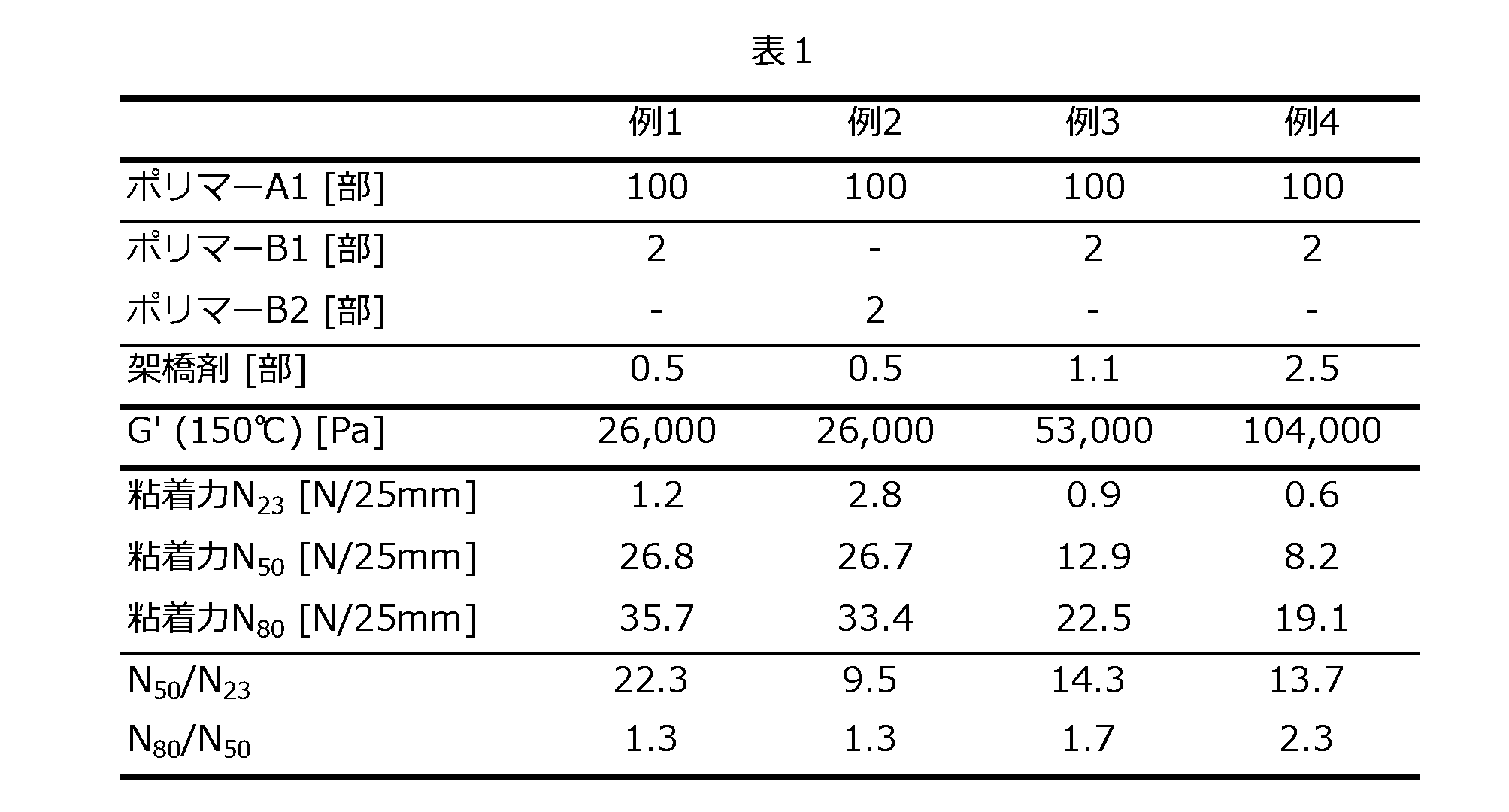
10 支持基材
10A 第一面
10B 第二面
21 粘着剤層(第一粘着剤層)
21A 粘着面(第一粘着面)
21B 粘着面(第二粘着面)
22 粘着剤層(第二粘着剤層)
22A 粘着面(第二粘着面)
31,32 剥離ライナー
100,200,300 剥離ライナー付き粘着シート(粘着製品)
Claims (14)
- 粘着剤層を含む粘着シートであって、
前記粘着剤層は、ポリマーAと、ポリオルガノシロキサン骨格を有するモノマーと(メタ)アクリル系モノマーとの共重合体であるポリマーBと、を含み、
ステンレス鋼板に貼り合わせて50℃に15分間保持した後に23℃において測定される粘着力N50が5N/25mm以上である、粘着シート。 - ステンレス鋼板に貼り合わせて23℃に30分間保持した後に測定される粘着力N23が3N/25mm以下である、請求項1に記載の粘着シート。
- 前記粘着力N50が、ステンレス鋼板に貼り合わせて23℃に30分間保持した後に測定される粘着力N23の5倍以上である、請求項1または2に記載の粘着シート。
- ステンレス鋼板に貼り合わせて80℃に5分間保持した後に23℃において測定される粘着力N80が、前記粘着力N50の2倍以下である、請求項1~3のいずれか一項に記載の粘着シート。
- 前記粘着剤層の150℃における貯蔵弾性率G´(150℃)は10,000Pa以上90,000Pa以下である、請求項1~4のいずれか一項に記載の粘着シート。
- 前記粘着剤層に含まれる前記ポリマーAは化学的に架橋されている、請求項1~5のいずれか一項に記載の粘着シート。
- 前記ポリマーBの重量平均分子量は100,000以上である、請求項1~6のいずれか一項に記載の粘着シート。
- 前記ポリマーBの重量平均分子量は80,000未満である、請求項1~6のいずれか一項に記載の粘着シート。
- 前記粘着剤層における前記ポリマーBの含有量は、前記ポリマーA100重量部に対して0.5重量部以上50重量部以下である、請求項1~8のいずれか一項に記載の粘着シート。
- 前記ポリマーAはアクリル系ポリマーである、請求項1~9のいずれか一項に記載の粘着シート。
- 前記アクリル系ポリマーは、そのモノマー単位として窒素原子含有環を有するモノマーを含む、請求項10に記載の粘着シート。
- 前記ポリマーBを調製するためのモノマー成分は、前記(メタ)アクリル系モノマーとして、ホモポリマーのガラス転移温度が50℃以上のモノマーを60重量%以下の割合で含む、請求項1~11のいずれか一項に記載の粘着シート。
- 第一面および第二面を有する支持基材を備え、該支持基材の少なくとも前記第一面に前記粘着剤層が積層されている、請求項1~12のいずれか一項に記載の粘着シート。
- 粘着剤層を含む粘着シートであって、
前記粘着剤層は、ポリマーAと、ポリオルガノシロキサン骨格を有するモノマーと(メタ)アクリル系モノマーとの共重合体であるポリマーBと、を含み、
前記粘着剤層の150℃における貯蔵弾性率G´(150℃)は10,000Pa以上90,000Pa以下である、粘着シート。
Priority Applications (3)
| Application Number | Priority Date | Filing Date | Title |
|---|---|---|---|
| KR1020217024639A KR102799218B1 (ko) | 2019-01-08 | 2019-12-26 | 점착 시트 |
| CN201980088358.5A CN113286702B (zh) | 2019-01-08 | 2019-12-26 | 粘合片 |
| JP2020565715A JP7555271B2 (ja) | 2019-01-08 | 2019-12-26 | 粘着シート |
Applications Claiming Priority (2)
| Application Number | Priority Date | Filing Date | Title |
|---|---|---|---|
| JP2019001349 | 2019-01-08 | ||
| JP2019-001349 | 2019-01-08 |
Publications (1)
| Publication Number | Publication Date |
|---|---|
| WO2020145188A1 true WO2020145188A1 (ja) | 2020-07-16 |
Family
ID=71521244
Family Applications (1)
| Application Number | Title | Priority Date | Filing Date |
|---|---|---|---|
| PCT/JP2019/051267 Ceased WO2020145188A1 (ja) | 2019-01-08 | 2019-12-26 | 粘着シート |
Country Status (5)
| Country | Link |
|---|---|
| JP (1) | JP7555271B2 (ja) |
| KR (1) | KR102799218B1 (ja) |
| CN (1) | CN113286702B (ja) |
| TW (1) | TWI843788B (ja) |
| WO (1) | WO2020145188A1 (ja) |
Cited By (7)
| Publication number | Priority date | Publication date | Assignee | Title |
|---|---|---|---|---|
| WO2022163707A1 (ja) * | 2021-01-29 | 2022-08-04 | 日東電工株式会社 | 光学用粘着テープ |
| WO2022163703A1 (ja) * | 2021-01-29 | 2022-08-04 | 日東電工株式会社 | 光学用粘着テープ |
| WO2022163705A1 (ja) * | 2021-01-29 | 2022-08-04 | 日東電工株式会社 | 光学用粘着テープ |
| WO2022163700A1 (ja) * | 2021-01-29 | 2022-08-04 | 日東電工株式会社 | 光学用粘着テープ |
| CN116075426A (zh) * | 2020-08-06 | 2023-05-05 | 日东电工株式会社 | 加强用薄膜、光学构件及电子构件 |
| CN116806246A (zh) * | 2021-01-29 | 2023-09-26 | 日东电工株式会社 | 光学用粘合带 |
| KR102930481B1 (ko) | 2020-12-23 | 2026-02-26 | 쓰리엠 이노베이티브 프로퍼티즈 캄파니 | 광경화성 접착 필름 및 이의 제조 방법 |
Families Citing this family (1)
| Publication number | Priority date | Publication date | Assignee | Title |
|---|---|---|---|---|
| JP7733976B2 (ja) * | 2020-08-06 | 2025-09-04 | 日東電工株式会社 | 補強用フィルム、光学部材および電子部材 |
Citations (3)
| Publication number | Priority date | Publication date | Assignee | Title |
|---|---|---|---|---|
| WO2018092905A1 (ja) * | 2016-11-21 | 2018-05-24 | 日東電工株式会社 | 粘着シート |
| WO2018092904A1 (ja) * | 2016-11-21 | 2018-05-24 | 日東電工株式会社 | 粘着シート |
| JP2019094385A (ja) * | 2017-11-20 | 2019-06-20 | 日東電工株式会社 | 粘着シート |
Family Cites Families (3)
| Publication number | Priority date | Publication date | Assignee | Title |
|---|---|---|---|---|
| JP6223836B2 (ja) | 2013-04-15 | 2017-11-01 | 日東電工株式会社 | 粘着剤組成物および粘着シート |
| WO2015163115A1 (ja) | 2014-04-22 | 2015-10-29 | 日東電工株式会社 | 粘着シート |
| KR20170021912A (ko) | 2014-06-11 | 2017-02-28 | 닛토덴코 가부시키가이샤 | 점착 시트 |
-
2019
- 2019-12-26 KR KR1020217024639A patent/KR102799218B1/ko active Active
- 2019-12-26 WO PCT/JP2019/051267 patent/WO2020145188A1/ja not_active Ceased
- 2019-12-26 CN CN201980088358.5A patent/CN113286702B/zh active Active
- 2019-12-26 JP JP2020565715A patent/JP7555271B2/ja active Active
-
2020
- 2020-01-07 TW TW109100462A patent/TWI843788B/zh active
Patent Citations (3)
| Publication number | Priority date | Publication date | Assignee | Title |
|---|---|---|---|---|
| WO2018092905A1 (ja) * | 2016-11-21 | 2018-05-24 | 日東電工株式会社 | 粘着シート |
| WO2018092904A1 (ja) * | 2016-11-21 | 2018-05-24 | 日東電工株式会社 | 粘着シート |
| JP2019094385A (ja) * | 2017-11-20 | 2019-06-20 | 日東電工株式会社 | 粘着シート |
Cited By (8)
| Publication number | Priority date | Publication date | Assignee | Title |
|---|---|---|---|---|
| CN116075426A (zh) * | 2020-08-06 | 2023-05-05 | 日东电工株式会社 | 加强用薄膜、光学构件及电子构件 |
| KR102930481B1 (ko) | 2020-12-23 | 2026-02-26 | 쓰리엠 이노베이티브 프로퍼티즈 캄파니 | 광경화성 접착 필름 및 이의 제조 방법 |
| WO2022163707A1 (ja) * | 2021-01-29 | 2022-08-04 | 日東電工株式会社 | 光学用粘着テープ |
| WO2022163703A1 (ja) * | 2021-01-29 | 2022-08-04 | 日東電工株式会社 | 光学用粘着テープ |
| WO2022163705A1 (ja) * | 2021-01-29 | 2022-08-04 | 日東電工株式会社 | 光学用粘着テープ |
| WO2022163700A1 (ja) * | 2021-01-29 | 2022-08-04 | 日東電工株式会社 | 光学用粘着テープ |
| CN116761864A (zh) * | 2021-01-29 | 2023-09-15 | 日东电工株式会社 | 光学用粘合带 |
| CN116806246A (zh) * | 2021-01-29 | 2023-09-26 | 日东电工株式会社 | 光学用粘合带 |
Also Published As
| Publication number | Publication date |
|---|---|
| KR102799218B1 (ko) | 2025-04-23 |
| CN113286702A (zh) | 2021-08-20 |
| TW202035606A (zh) | 2020-10-01 |
| JPWO2020145188A1 (ja) | 2021-11-18 |
| TWI843788B (zh) | 2024-06-01 |
| KR20210112348A (ko) | 2021-09-14 |
| CN113286702B (zh) | 2024-03-22 |
| JP7555271B2 (ja) | 2024-09-24 |
Similar Documents
| Publication | Publication Date | Title |
|---|---|---|
| JP6355874B1 (ja) | 粘着シート | |
| JP7171473B2 (ja) | 補強フィルム | |
| JP6371931B1 (ja) | 粘着シート | |
| JP6605562B2 (ja) | 粘着シート | |
| JP7555271B2 (ja) | 粘着シート | |
| JP7262484B2 (ja) | 粘着シート | |
| JP7319766B2 (ja) | 粘着シート |
Legal Events
| Date | Code | Title | Description |
|---|---|---|---|
| 121 | Ep: the epo has been informed by wipo that ep was designated in this application |
Ref document number: 19908559 Country of ref document: EP Kind code of ref document: A1 |
|
| ENP | Entry into the national phase |
Ref document number: 2020565715 Country of ref document: JP Kind code of ref document: A |
|
| NENP | Non-entry into the national phase |
Ref country code: DE |
|
| ENP | Entry into the national phase |
Ref document number: 20217024639 Country of ref document: KR Kind code of ref document: A |
|
| 122 | Ep: pct application non-entry in european phase |
Ref document number: 19908559 Country of ref document: EP Kind code of ref document: A1 |