WO2020138449A1 - コーヒーチェリー果肉果皮抽出発酵組成物およびその製造方法 - Google Patents
コーヒーチェリー果肉果皮抽出発酵組成物およびその製造方法 Download PDFInfo
- Publication number
- WO2020138449A1 WO2020138449A1 PCT/JP2019/051500 JP2019051500W WO2020138449A1 WO 2020138449 A1 WO2020138449 A1 WO 2020138449A1 JP 2019051500 W JP2019051500 W JP 2019051500W WO 2020138449 A1 WO2020138449 A1 WO 2020138449A1
- Authority
- WO
- WIPO (PCT)
- Prior art keywords
- coffee cherry
- extract
- lactic acid
- fermentation
- cherry pulp
- Prior art date
- Legal status (The legal status is an assumption and is not a legal conclusion. Google has not performed a legal analysis and makes no representation as to the accuracy of the status listed.)
- Ceased
Links
Classifications
-
- A—HUMAN NECESSITIES
- A23—FOODS OR FOODSTUFFS; TREATMENT THEREOF, NOT COVERED BY OTHER CLASSES
- A23L—FOODS, FOODSTUFFS OR NON-ALCOHOLIC BEVERAGES, NOT OTHERWISE PROVIDED FOR; PREPARATION OR TREATMENT THEREOF
- A23L19/00—Products from fruits or vegetables; Preparation or treatment thereof
- A23L19/09—Mashed or comminuted products, e.g. pulp, purée, sauce, or products made therefrom, e.g. snacks
-
- A—HUMAN NECESSITIES
- A23—FOODS OR FOODSTUFFS; TREATMENT THEREOF, NOT COVERED BY OTHER CLASSES
- A23L—FOODS, FOODSTUFFS OR NON-ALCOHOLIC BEVERAGES, NOT OTHERWISE PROVIDED FOR; PREPARATION OR TREATMENT THEREOF
- A23L2/00—Non-alcoholic beverages; Dry compositions or concentrates therefor; Preparation or treatment thereof
- A23L2/52—Adding ingredients
- A23L2/56—Flavouring or bittering agents
-
- A—HUMAN NECESSITIES
- A23—FOODS OR FOODSTUFFS; TREATMENT THEREOF, NOT COVERED BY OTHER CLASSES
- A23L—FOODS, FOODSTUFFS OR NON-ALCOHOLIC BEVERAGES, NOT OTHERWISE PROVIDED FOR; PREPARATION OR TREATMENT THEREOF
- A23L19/00—Products from fruits or vegetables; Preparation or treatment thereof
- A23L19/03—Products from fruits or vegetables; Preparation or treatment thereof consisting of whole pieces or fragments without mashing the original pieces
- A23L19/07—Fruit waste products, e.g. from citrus peel or seeds
-
- A—HUMAN NECESSITIES
- A23—FOODS OR FOODSTUFFS; TREATMENT THEREOF, NOT COVERED BY OTHER CLASSES
- A23L—FOODS, FOODSTUFFS OR NON-ALCOHOLIC BEVERAGES, NOT OTHERWISE PROVIDED FOR; PREPARATION OR TREATMENT THEREOF
- A23L2/00—Non-alcoholic beverages; Dry compositions or concentrates therefor; Preparation or treatment thereof
- A23L2/02—Non-alcoholic beverages; Dry compositions or concentrates therefor; Preparation or treatment thereof containing fruit or vegetable juices
-
- A—HUMAN NECESSITIES
- A23—FOODS OR FOODSTUFFS; TREATMENT THEREOF, NOT COVERED BY OTHER CLASSES
- A23L—FOODS, FOODSTUFFS OR NON-ALCOHOLIC BEVERAGES, NOT OTHERWISE PROVIDED FOR; PREPARATION OR TREATMENT THEREOF
- A23L2/00—Non-alcoholic beverages; Dry compositions or concentrates therefor; Preparation or treatment thereof
- A23L2/38—Other non-alcoholic beverages
- A23L2/382—Other non-alcoholic beverages fermented
-
- A—HUMAN NECESSITIES
- A23—FOODS OR FOODSTUFFS; TREATMENT THEREOF, NOT COVERED BY OTHER CLASSES
- A23L—FOODS, FOODSTUFFS OR NON-ALCOHOLIC BEVERAGES, NOT OTHERWISE PROVIDED FOR; PREPARATION OR TREATMENT THEREOF
- A23L33/00—Modifying nutritive qualities of foods; Dietetic products; Preparation or treatment thereof
- A23L33/10—Modifying nutritive qualities of foods; Dietetic products; Preparation or treatment thereof using additives
- A23L33/105—Plant extracts, their artificial duplicates or their derivatives
-
- A—HUMAN NECESSITIES
- A23—FOODS OR FOODSTUFFS; TREATMENT THEREOF, NOT COVERED BY OTHER CLASSES
- A23L—FOODS, FOODSTUFFS OR NON-ALCOHOLIC BEVERAGES, NOT OTHERWISE PROVIDED FOR; PREPARATION OR TREATMENT THEREOF
- A23L5/00—Preparation or treatment of foods or foodstuffs, in general; Food or foodstuffs obtained thereby; Materials therefor
- A23L5/20—Removal of unwanted matter, e.g. deodorisation or detoxification
- A23L5/28—Removal of unwanted matter, e.g. deodorisation or detoxification using microorganisms
-
- C—CHEMISTRY; METALLURGY
- C12—BIOCHEMISTRY; BEER; SPIRITS; WINE; VINEGAR; MICROBIOLOGY; ENZYMOLOGY; MUTATION OR GENETIC ENGINEERING
- C12P—FERMENTATION OR ENZYME-USING PROCESSES TO SYNTHESISE A DESIRED CHEMICAL COMPOUND OR COMPOSITION OR TO SEPARATE OPTICAL ISOMERS FROM A RACEMIC MIXTURE
- C12P7/00—Preparation of oxygen-containing organic compounds
- C12P7/24—Preparation of oxygen-containing organic compounds containing a carbonyl group
- C12P7/26—Ketones
Definitions
- the present invention relates to a composition for extracting and extracting coffee cherry pulp, and more particularly to a composition for extracting and extracting coffee cherry pulp from which the content of ⁇ -damasenone is increased, and a method for manufacturing the same.
- Coffee is a broadleaf shrub that belongs to the genus Rubiaceae, Coffee genus.
- Coffee fruit is an oval fruit attached to a coffee tree, and is initially green and magenta when ripe. Some varieties rarely have yellow fruits.
- Coffee fruits are also called coffee cherries.
- Two seeds are placed in the coffee cherry in a form of facing each other, and the portion of the two seeds is called coffee beans.
- coffee cherry has a structure of outer skin, pulp, inner skin (parchment), silver skin (silver skin), and seeds (coffee beans) from the outside.
- Coffee beans are the only raw material for obtaining coffee drinks. Therefore, a lot of pulp and skin is generated during the refining process of extracting coffee beans from coffee cherry. At present, there is almost no use method and it is discarded, and a new use method is desired.
- Patent Document 1 describes green coffee beans having a ⁇ -damascenone content of 5 ppb.
- the present inventors as a result of investigating a coffee cherry pulp peel extract fermentation composition, have found that ⁇ -damasenone is contained at a high content as a component thereof. Furthermore, it has been found that the ⁇ -damasenone content is increased by including a fermentation step with lactic acid bacteria as a method for producing a fermented composition for extracting the extract of coffee cherry pulp.
- the present invention is based on such findings.
- an object of the present invention is to provide a coffee cherry pulp peel extract fermented composition containing a high content of ⁇ -damasenone and a method for producing the same.
- a coffee cherry pulp extract extract fermentation composition comprising ⁇ -damasenone in an amount of 9.6 ppb or more.
- the coffee cherry pulp extract extraction fermented composition according to (1) containing 50 times or more ⁇ -damasenone as compared to the unfermented coffee cherry pulp extract.
- a method for producing a fermented composition for extracting and extracting coffee cherry fruit pulp which comprises subjecting the pulp and fruit skin of coffee cherry to extraction treatment and lactic acid fermentation treatment.
- the production method according to (3) which comprises a step of fermenting the coffee cherry pulp extract with lactic acid bacteria.
- Manufacturing method described in 1. (10) The production method according to any one of (3) to (9), which further comprises a concentration treatment. (11) The method according to any one of (3) to (10), further comprising a step of concentrating the coffee cherry pulp extract solution before the step of fermenting the coffee cherry pulp extract solution with lactic acid bacteria. A method for producing a composition. (12) A coffee cherry pulp peel extract fermentation composition obtained by the method according to any one of (3) to (11). (13) A beverage comprising the coffee cherry pulp extract extract fermentation composition according to any one of (1), (2) and (12). (14) The beverage according to (13), which is a packaged beverage.
- a method for increasing the ⁇ -damasenone content in an extract fermentation composition of coffee cherry pulp and peeling which comprises subjecting the pulp and skin of coffee cherry to extraction and lactic acid fermentation.
- the method according to (15), comprising a step of fermenting the coffee cherry pulp extract with lactic acid bacteria.
- the ⁇ -damasenone content can be increased by including a fermentation step with lactic acid bacteria in the method for producing a fermented composition for extracting a coffee cherry pulp.
- the coffee cherry pulp extract extract fermentation composition of the present invention contains ⁇ -damasenone in a high content.
- “coffee cherry pulp extract extraction and fermentation composition” refers to a composition obtained by fermenting an extract of coffee cherry pulp and peel or an extract of coffee cherry pulp and peel after fermentation ( Hereinafter, it is also referred to as “extracted fermentation composition” or “composition of the present invention”.
- the method for producing the composition of the present invention comprises increasing the content of ⁇ -damasenone in the composition by including a step of fermenting the coffee cherry pulp extract or the coffee cherry pulp with lactic acid bacteria. You can
- the extract composition for extracting and extracting coffee cherry pulp of the present invention contains ⁇ -damasenone in a high content in the composition.
- ⁇ -Damasenone is also referred to as (E)-1-(2,6,6-trimethyl-1,3-cyclohexadien-1-yl)-2-buten-1-one and is one of the aroma components of coffee. And has a sweet scent like honey.
- the ⁇ -damascenone content in the composition of the present invention is, for example, 9.6 ppb or more, preferably 12 ppb or more, more preferably 14.4 ppb or more.
- ppb indicates a percentage
- 1 ppb corresponds to 1 ⁇ g/L.
- a preferred lower limit value for the ⁇ -damasenone content in the composition of the present invention is 9.6 ppb, preferably 12 ppb, more preferably 14.4 ppb, and a preferred upper limit value is 120 ppb, more preferably 60 ppb.
- the ⁇ -damascenone content in the composition is measured by gas chromatograph mass spectrometry (GC-MS). Such measurement can be easily performed by using a commercially available device and column (for example, BP-20 (manufactured by SGE Analytical Science)). The above measurement can be performed, for example, under the following conditions.
- Apparatus 7890B (manufactured by Agilent Technology), JMS-Q1500 (manufactured by JEOL Ltd.), column: BP-20 (manufactured by SGE Analytical Science), GC measurement conditions: oven temperature (initial: 60° C. hold, 3 minutes, temperature rise) : 3° C./min 170° C. hold 3 min, 10° C./min 245° C.
- the coffee cherry pulp extract extract fermented composition of the present invention may contain 50 times or more, preferably 80 times or more, and more preferably 100 times as much ⁇ -damasenone as compared with the unfermented coffee cherry pulp extract solution. Including more than twice.
- the upper limit is 700 times, and preferably 400 times.
- the flesh and skin in the present invention include the rind and the flesh, and preferably consist only of the rind and the flesh and do not contain seeds (coffee beans).
- Such pulp and peel may be raw, frozen, or dried, and from the economical or industrial viewpoint, a large amount of raw pulp and peel produced as a by-product in the wet treatment described below in the separation of coffee beans. Can also be used.
- the method for producing a coffee cherry pulp extract fermentation composition of the present invention comprises performing extraction treatment and lactic acid fermentation treatment on the pulp and peel of coffee cherry.
- the extraction process of the pulp and the skin of coffee cherry is performed, and the lactic acid bacterium fermentation process of the obtained coffee cherry pulp skin extract is performed, and then, if desired, the lactic acid bacteria fermentation liquid of the coffee cherry pulp skin extract.
- the case of carrying out the yeast fermentation treatment of is mainly described.
- those skilled in the art can understand that the coffee cherry pulp extract extract fermented composition can be produced even if the order of the above-mentioned treatments is changed.
- the production method of the present invention is a method for producing a coffee cherry pulp extract extract fermented composition comprising a step of fermenting a coffee cherry pulp extract solution with a lactic acid bacterium.
- the method for producing the composition of the present invention is preferably a method for producing the composition containing ⁇ -damasenone in a high content.
- the content of ⁇ -damasenone in the composition of the present invention can be increased by fermenting the coffee cherry pulp extract with lactic acid bacteria.
- the process for producing the coffee cherry pulp extract is not particularly limited, but the pulp and the peel from which coffee beans have been separated and removed are mixed with a solvent, and the mixture is allowed to stand to remove the components in the pulp and the peel.
- the step of extracting can be mentioned.
- the process for producing the coffee cherry pulp extract the pulp and peel from which coffee beans have been separated and removed are squeezed in the absence of a solvent (for example, squeezed by pressing).
- a solvent for example, squeezed by pressing.
- the coffee cherry pulp extract of the present invention also includes juice of pulp and skin.
- the method for separating coffee beans is not particularly limited, but usually includes dry treatment and wet treatment.
- dry treatment after harvesting, the coffee cherry is first dried to a water content of about 10 to 11% by weight.
- a dehulling machine is then used to separate the coffee beans from the material that coats the coffee beans (eg, hull, pulp, endocarp, and silver skin).
- wet processing does not require drying of coffee cherries.
- the hull and pulp are mechanically separated and the beans are fermented to remove the layer of pulp material remaining on the beans. After fermentation, the coffee beans are dried to a water content of about 12% by weight, dehulled and the endocarp separated.
- the pulp of coffee cherry can be obtained.
- the extraction time varies depending on the condition of the flesh and skin, for example, the degree of drying, particle size and the like, the extraction temperature and the like, and is not particularly limited, but is, for example, 5 minutes to 24 hours, preferably 15 minutes to It is 6 hours, preferably 30 minutes to 2 hours.
- the temperature in the extraction depends on the condition of the flesh and skin, such as the degree of drying, the particle size, the extraction time, etc., and is not particularly limited, but is, for example, 20 to 90° C., preferably 40 to 80. C., preferably 50 to 70.degree.
- the solvent used for extraction is not particularly limited, but solvents such as water, alcohols, ethers and esters, or a mixed solvent thereof can be used, and water is preferable.
- the ratio of the flesh and skin to the above solvent at the time of extraction is not particularly limited, but from the viewpoint of practical convenience, it is, for example, 100 to 2000 g of raw material, preferably 300 to 1600 g, and more preferably 600 to 1300 g per liter of solvent. ..
- the extraction concentration is set to 100 g/L or more, a concentrated extract can be obtained, which is advantageous in that a large amount of energy and equipment are not required in the subsequent concentration process.
- the amount of 2000 g/L or less is advantageous in that the extraction operation becomes simpler and the recovery amount of the extraction liquid increases.
- the separation method is not particularly limited, but it can be separated using a juicer, a centrifuge, or a filter, and it is preferable to squeeze the juice with a juicer.
- the method for producing a coffee cherry pulp extract extract fermented composition of the present invention preferably includes performing a lactic acid bacterium fermentation treatment.
- a lactic acid bacterium fermentation treatment the step of fermenting the coffee cherry pulp skin extract with a lactic acid bacterium will be described.
- the pulp and the skin of the coffee cherry may be fermented with a lactic acid bacterium before the pulp flesh skin extraction treatment.
- the coffee cherry pulp extract extract fermented composition can be produced even if the order of each treatment is changed.
- the step of fermenting the coffee cherry pulp extract with lactic acid bacteria is not particularly limited, but the coffee cherry pulp extract and lactic acid bacteria are mixed, and the extract is mixed.
- a method of performing fermentation with lactic acid bacteria by culturing the lactic acid bacteria in the medium can be mentioned.
- the step of fermenting the coffee cherry pulp extract with lactic acid bacteria may be carried out by directly fermenting the coffee cherry pulp extract obtained above, or treating the coffee cherry pulp extract with a filter aid. It may be performed after the step and/or the step of concentrating the coffee cherry pulp extract.
- the lactic acid bacterium used for fermentation is not particularly limited as long as it does not impair the effects of the present invention, and includes Lactobacillus, Oenococcus, Pediococcus, Lactococcus, and the like, or a combination thereof. And preferably Lactobacillus, Oenococcus, Lactococcus or a combination thereof.
- Examples of the lactic acid bacteria belonging to the genus Lactobacillus include Lactobacillus plantarum, Lactobacillus rhamnosus, Lactobacillus parabacillus, and Lactobacillus parabacillus Lactobacillus lactobacillus.
- Lactobacillus casei (Lactobacillus casei), Lactobacillus reuteri (Lactobacillus reuteri), Lactobacillus acidophilus (Lactobacillus acidophilus), Lactobacillus crispatus (Lactobacillus crispatus), Lactobacillus Garinaramu (Lactobacillus gallinarum), Lactobacillus brevis (Lactobacillus brevis), Lactobacillus Fermentum (Lactobacillus fermentum), Lactobacillus johnsonii, etc. are preferred, Lactobacillus plantarum is more preferred, and Lactobacillus plantarum Vinifora strain (Nova) is more preferred.
- the lactic acid bacterium belonging to the genus Oenococcus is preferably Oenococcus oeni, and more preferably Oenococcus oeni PN4 strain.
- Examples of lactic acid bacteria belonging to the genus Pediococcus include Pediococcus damnosus and Pediococcus pencesaceus.
- Examples of lactic acid bacteria belonging to the genus Lactococcus include, for example, Lactococcus lactis, Lactococcus lactis subsp. cremoris) and Lactococcus lactis subspecies Holdniae (Lactococcus lactis subsp. hornniae).
- Examples of the combination of lactic acid bacteria belonging to the genus Lactobacillus and lactic acid bacteria belonging to the genus Oenococcus include a combination of Lactobacillus plantarum and Oenococcus oeni, preferably Lactobacillus plantarum 030701 strain (THT) and CO-INOCULANT BACTERIA (Anchor). ) (Lactobacillus plantarum and Oenococcus oeni).
- the amount of lactic acid bacteria added is, for example, 0.0001 to 1 w/v% with respect to the coffee cherry pulp extract, and preferably 0.001 to 0.1 w/v%.
- the addition amount is as follows.
- the lactic acid bacterium is dried, it is possible to condense it according to a suitable method.
- Fermentation conditions of lactic acid bacteria are not particularly limited as long as fermentation can be carried out, and if necessary, conditions suitable for fermentation (for example, the type of lactic acid bacteria used or the amount thereof (initial amount), coffee cherry)
- the amount (concentration) of pulp extract, temperature, pH, oxygen or carbon dioxide concentration, fermentation time, etc.) can be appropriately set.
- the fermentation temperature is, for example, 10 to 40° C., preferably 20 to 30° C.
- the fermentation time is not particularly limited, and may be appropriately selected depending on the quality of the coffee cherry pulp extract used, or the type or amount of lactic acid bacteria.
- the fermentation process may be terminated based on the exhaustion of the extract.
- the fermentation time is, for example, 1 to 10 days, and preferably 2 to 8 days.
- the above fermentation conditions for example, the type of lactic acid bacterium used and the amount thereof (initial amount), the amount of coffee cherry pulp extract (concentration), temperature, pH, oxygen
- the fermentation step can be carried out by an equipment/device (for example, a constant temperature tank, a tank, a storage, etc.) capable of automatically and/or manually controlling the carbon dioxide concentration, the fermentation time, etc.
- the method for producing a coffee cherry pulp extract fermented composition of the present invention may further include yeast fermentation treatment.
- yeast fermentation treatment the step of fermenting the coffee cherry pulp extract with yeast will be described, but as the yeast fermentation treatment, the pulp and peel of the coffee cherry may be fermented with yeast before the pulp extraction treatment, and those skilled in the art Thus, it can be understood that the coffee cherry pulp extract extract fermented composition can be produced even if the order of each treatment is changed.
- the step of fermenting the coffee cherry pulp extract with yeast is not particularly limited, but the coffee cherry pulp extract and yeast are mixed to obtain the extract.
- a method of performing fermentation by yeast by culturing yeast in the medium can be mentioned.
- the step of fermenting the coffee cherry pulp extract with yeast is preferably after the fermentation step with lactic acid bacteria.
- the coffee-cherry pulp peel extract that is fermented with yeast is a lactic acid bacterium fermentation liquid of the coffee-cherry pulp extract.
- the yeast used for fermentation is not particularly limited as long as the effect of the present invention is not impaired, but Saccharomyces yeast, Kluyveromyces yeast, Torula spora yeast (Tolulaspora) yeast is used alone or in combination. May be.
- a preferred yeast is Saccharomyces yeast.
- yeasts belonging to the genus Saccharomyces include Saccharomyces cerevisiae and the like, and more preferably, the Saccharomyces cerevisiae strain VIN13.
- yeasts belonging to the genus Kluyveromyces include Kluyveromyces thermotolerans.
- Examples of the yeast of the genus Torluspora include Torulaspora delbrückii and the like.
- the amount of yeast added is, for example, 0.0001 to 1 w/v% with respect to the coffee cherry pulp extract, and preferably 0.001 to 0.1 w/v%.
- the addition amount is as follows.
- yeast is dried, it can be reconstituted according to a suitable method.
- Fermentation conditions of yeast are not particularly limited as long as fermentation can be carried out, and if necessary, conditions suitable for fermentation (for example, the type of yeast used and the amount of bacteria (initial amount of bacteria), coffee cherry).
- the amount (concentration) of pulp extract, the presence or absence of fermentation of the extract, temperature, pH, oxygen or carbon dioxide concentration, fermentation time, etc.) can be appropriately set.
- the fermentation temperature is, for example, 5 to 35° C., preferably 15 to 25° C.
- the fermentation time is not particularly limited, and may be appropriately selected depending on the quality of the coffee cherry pulp extract used (for example, presence or absence of fermentation), or the type and amount of yeast.
- the fermentation process may be terminated based on the exhaustion of the extract.
- the fermentation time is, for example, 1 to 10 days, and preferably 2 to 8 days.
- the fermentation conditions described above for example, the type of yeast to be used and the amount thereof (initial amount), the amount of coffee cherry pulp extract (concentration), temperature, pH, oxygen.
- the fermentation step can be carried out by an equipment/device (for example, a constant temperature tank, a tank, a storage, etc.) capable of automatically and/or manually controlling the carbon dioxide concentration, the fermentation time, etc. ..
- the method for producing a coffee cherry pulp peel extract fermentation composition of the present invention may further include treatment with a filter aid.
- a filter aid the process of treating the coffee cherry pulp extract with a filter aid will be described, but as the treatment with the filter aid, the coffee cherry pulp extract after fermentation may be treated with a filter aid, Those skilled in the art can understand that the coffee cherry pulp peel extract fermented composition can be produced even if the order of each treatment is changed.
- the step of treating the coffee cherry pulp extract with a filter aid is not particularly limited, for example, a step of mixing the coffee cherry pulp extract and the filter aid by stirring or the like, This step is advantageous in that components such as polyphenols in the coffee cherry pulp extract can be reduced. Furthermore, it is advantageous in that the content of ⁇ -damasenone in the fermented composition for extracting the pulp of coffee cherry pulp obtained by fermentation with lactic acid bacteria and/or yeast is increased by reducing the components such as polyphenol.
- the step of treating the coffee cherry pulp extract with a filter aid is preferably before the fermentation step from the viewpoint of increasing the ⁇ -damasenone content in the coffee cherry pulp extract fermentation composition.
- Such a filter aid is not particularly limited as long as it does not impair the effects of the present invention, but those capable of reducing components such as polyphenols are preferable, and specifically, polyvinylpolypyrrolidone (PVPP), diatomaceous earth and the like. Among them, PVPP is more preferable from the viewpoint of removing polyphenol.
- the treatment conditions with the filter aid can appropriately set the conditions according to the purpose.
- Such conditions are not particularly limited, but conditions that can reduce components such as polyphenols in the coffee cherry pulp extract are preferable, and conditions suitable for treatment as necessary (for example, the type of filter aid to be used or The amount thereof, the amount (concentration) of the coffee cherry pulp extract, the temperature, the pH, the processing time, etc.) can be appropriately set.
- the amount of the filter aid is, for example, 0.1 to 10 w/v%, preferably 0.5 to 5 w/v%.
- the treatment time is, for example, 10 minutes to 5 hours, preferably 30 minutes to 2 hours.
- the method for producing a coffee cherry pulp extract extraction fermented composition of the present invention may further include a concentration treatment.
- concentration process the coffee cherry pulp extract solution after fermentation may be concentrated, and those skilled in the art can order each process. It can be understood that the coffee cherry pulp peel extract fermented composition can be produced even if it changes.
- the process of concentrating the coffee cherry pulp extract is not particularly limited, but membrane concentration (eg, ultrafiltration, reverse osmosis method), evaporative concentration (eg, vacuum concentration, vacuum concentration), centrifugal concentration Well-known methods such as cooling concentration and the like can be mentioned, and evaporation concentration is preferable. It can be concentrated so that the liquid amount (mass) is, for example, 1/2 to 1/10, preferably 1/4 to 1/6.
- the step of concentrating the coffee cherry pulp extract is preferably performed before the step of fermenting the coffee cherry pulp extract with lactic acid bacteria.
- the concentration step may be before or after the step of treating the coffee cherry pulp extract with a filter aid, but is preferably after the step of treatment with the filter aid from the viewpoint of the concentration step load.
- the steps are performed in the following order.
- a step of producing a coffee cherry pulp extract (2) A step of treating the coffee cherry pulp extract with a filter aid, if desired (3) A step of concentrating the coffee cherry pulp extract, if desired ( 4) Fermenting the coffee cherry pulp extract with lactic acid bacteria (5) Fermenting the lactic acid fermentation liquid of the coffee cherry pulp extract with yeast, if desired
- the steps are performed in the following order.
- a step of fermenting the pulp and peel of coffee cherry with lactic acid bacteria (2)
- a step of producing an extract of coffee cherry pulp peel after fermentation (3)
- a filter aid of the extract of coffee cherry pulp peel after fermentation if desired
- Step (4) if desired, step of concentrating the fermented coffee cherry pulp extract after fermentation (5)
- the steps are performed in the following order.
- a step of fermenting the pulp and the peel of coffee cherry with lactic acid bacteria (2)
- a step of fermenting the coffee cherry pulp peel after fermentation with lactic acid bacteria by yeast (3)
- a coffee cherry pulp extract after fermentation is produced Step (4) If desired, a step of treating the coffee cherry pulp extract after fermentation with a filter aid (5) If desired, a step of concentrating the coffee cherry pulp extract after fermentation
- the steps are performed in the following order.
- a step of fermenting the pulp and peel of coffee cherry with yeast (2)
- a step of fermenting the pulp and peel of coffee cherry after fermentation with lactic acid bacteria (3)
- a step of producing a coffee cherry pulp extract after fermentation ( 4) optionally treating the fermented coffee cherry pulp extract with a filter aid (5) optionally concentrating the fermented coffee cherry pulp extract
- the present invention also includes a fermented composition of coffee cherry pulp peel obtained by the production method of the present invention.
- the food and drink of the present invention may be prepared by directly preparing the composition of the present invention as a food or drink, and further mixed with various proteins, sugars, fats, trace elements, vitamins or the like, or general food or drink. It may be added to. Since the composition of the present invention has a sweet scent like honey, it is advantageous in that it can be a food or drink to which such a scent is imparted.
- the content of the composition of the present invention in the food or drink is not particularly limited, but can be, for example, 0.001 to 100% by mass, preferably 0.1 to 10% by mass in the food and drink.
- Such food and drink include, for example, alcoholic beverages, non-alcoholic beverages and other beverages; rice, noodles, breads and pasta and other carbohydrate-containing foods and beverages; Western confectionery such as cookies and cakes, Japanese confectionery such as buns and yokan,
- dairy desserts such as yogurt and pudding, frozen desserts, processed products using eggs, seafood (squid, octopus, shellfish, eels, etc.) and meat (including offal such as liver)
- Processed products including delicacies
- alcoholic beverages include whiskey, bourbon, spirits, liqueur, wine, fruit liquor, sake, Chinese liquor, shochu, beer, non-alcoholic beer with an alcohol content of 1% or less, non-alcoholic liquor high, non Examples include alcoholic wine, low-malt beer, miscellaneous sake, and shochu.
- non-alcoholic beverages fruit juice-containing beverages, vegetable juice-containing beverages, fruit juice and vegetable juice-containing beverages, cider, ramune beverages, carbonated beverages such as cola beverages, soft drinks, milk, soy milk, milk beverages, drink-type Examples include yogurt, drink-type jelly, coffee, cocoa, tea drinks, nutritional drinks, sports drinks, mineral water, beer taste drinks, alcohol taste drinks, and the like.
- beverages such as alcoholic beverages and non-alcoholic beverages, and more preferred are wines, soju hai and carbonated beverages.
- the beverage of the present invention may be a beverage other than a coffee beverage (a beverage made from green coffee beans).
- ⁇ Method for Increasing ⁇ -Damasenone Content in Extract Extract Fermented Composition of Coffee Cherry Pulp> comprising comprising subjecting the pulp and pericarp of coffee cherry to an extraction treatment and a lactic acid bacterium fermentation treatment, and preferably comprising the step of fermenting the coffee cherry pulp pericarp extract with lactic acid bacteria, ⁇ -Damasenone content is increased. Therefore, according to another aspect of the present invention, there is provided a method for increasing the ⁇ -damasenone content in a coffee cherry pulp extract extract fermented composition, the method comprising extracting the pulp and the peel of coffee cherry with lactic acid bacteria. Comprising performing a fermentation process.
- a method for increasing the ⁇ -damasenone content in a coffee cherry pulp extract extract fermented composition comprising the step of fermenting a coffee cherry pulp extract with lactic acid bacteria.
- the method comprising the step of fermenting a coffee cherry pulp extract with lactic acid bacteria.
- GC-MS gas chromatography mass spectrometry
- a standard curve preparation sample was prepared as follows using the standard material solution and the internal standard material solution which were serially diluted with the base sample.
- the base sample used was one in which about 3 g of tartaric acid was weighed, dissolved in 120 mL of ethanol and 880 mL of distilled water, and adjusted to pH 3.2.
- Test Example 1-1 (Examples 1 and 2 and Comparative Examples 1 and 2): Investigation of effects of lactic acid bacteria and yeast in fermentation of coffee cherry pulp extract (1) Coffee after removal of coffee beans (coffee seeds) 2250 mL of water was added to 1500 g of the skin and flesh of a cherry (Arabica species, Okinawan), and the mixture was allowed to stand at 60° C. for 1 hour. Then, it was squeezed with a juicer to separate the extract and the fruit, and a coffee cherry pulp extract was obtained. As the skin and the flesh, only the outer skin and the flesh were used.
- Oenococcus oeni PN4 strain TAT
- Lactobacillus plantarum Viniflora strain Nova
- Comparative Examples 1 and 2 lactic acid bacteria were not added.
- Table 1 shows the test results of Test Example 1-1 (Examples 1, 2 and Comparative Examples 1, 2).
- Test Example 1-2 (Example 3): Examination of Effect of PVPP on Fermentation of Coffee Cherry Flesh Peel Extract (1) The same treatment as in (1) of Test Example 1-1 was performed to extract coffee cherry pulp peel liquid. Got
- PVPP polyvinylpolypyrrolidone
- Example 3 The supernatant obtained in (2) was treated in the same manner as in (2) of Test Example 1-1 to obtain a fermentation liquid of lactic acid bacteria.
- Lactobacillus plantarum Viniflora strain (Nova) was used as the lactic acid bacterium.
- Table 1 shows the test results of Test Example 1-2 (Example 3).
- Test Example 1-3 (Examples 4 and 5): Examination of Effect of Yeast on Fermentation of Extract of Coffee Cherry Flesh Peel (1) The same treatment as in (1) of Test Example 1-1 was performed to remove coffee cherry pulp An extract was obtained.
- Example 4 the process (2) of Test Example 1-2 was not performed. In Example 5, the same treatment as (2) of Test Example 1-2 was performed.
- Table 1 shows the test results of Test Examples 1-3 (Examples 4 and 5).
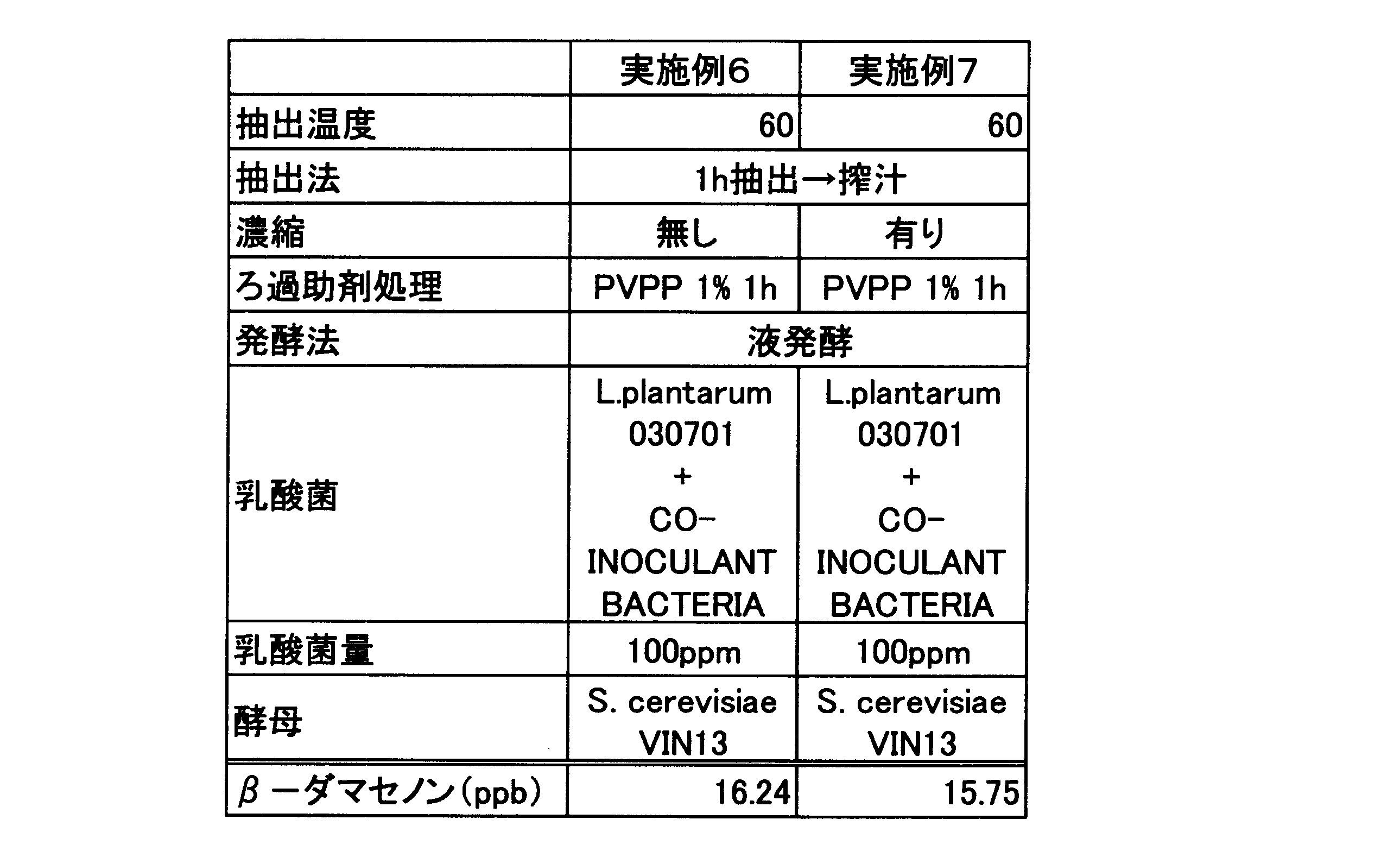
- Test Example 2 (Examples 6 and 7): Examination of Concentration Effect on Fermentation of Coffee Cherry Flesh Peel Extract (1) The same treatment as in Test Example 1-1 (1) was performed to extract coffee cherry pulp peel liquid. Got
- Example 7 the supernatant of the PVPP-treated coffee cherry pulp extract obtained in (2) was concentrated. Specifically, 500 g of the supernatant of the coffee cherry pulp extract after PVPP treatment was concentrated under reduced pressure at 70° C. using an evaporator until the concentration side became 100 g. In Example 6, no concentration was performed.
- Table 2 shows the test results of Test Example 2 (Examples 6 and 7).
Landscapes
- Life Sciences & Earth Sciences (AREA)
- Chemical & Material Sciences (AREA)
- Engineering & Computer Science (AREA)
- Health & Medical Sciences (AREA)
- Nutrition Science (AREA)
- Food Science & Technology (AREA)
- Polymers & Plastics (AREA)
- Organic Chemistry (AREA)
- Microbiology (AREA)
- Wood Science & Technology (AREA)
- Zoology (AREA)
- General Engineering & Computer Science (AREA)
- Genetics & Genomics (AREA)
- Mycology (AREA)
- Botany (AREA)
- Chemical Kinetics & Catalysis (AREA)
- Biochemistry (AREA)
- Bioinformatics & Cheminformatics (AREA)
- Biotechnology (AREA)
- General Chemical & Material Sciences (AREA)
- General Health & Medical Sciences (AREA)
- Preparation Of Compounds By Using Micro-Organisms (AREA)
- Tea And Coffee (AREA)
- Micro-Organisms Or Cultivation Processes Thereof (AREA)
- Cosmetics (AREA)
- Preparation Of Fruits And Vegetables (AREA)
- Seasonings (AREA)
- Non-Alcoholic Beverages (AREA)
Abstract
Description
(1) β-ダマセノンを9.6ppb以上含んでなる、コーヒーチェリー果肉果皮抽出発酵組成物。
(2) 発酵していないコーヒーチェリー果肉果皮抽出液に比べて、β-ダマセノンを50倍以上含む、(1)に記載のコーヒーチェリー果肉果皮抽出発酵組成物。
(3) コーヒーチェリーの果肉および果皮に対し、抽出処理および乳酸菌発酵処理を行うことを含んでなる、コーヒーチェリー果肉果皮抽出発酵組成物の製造方法。
(4) コーヒーチェリー果肉果皮抽出液を乳酸菌により発酵させる工程を含んでなる、(3)に記載の製造方法。
(5) 乳酸菌がラクトバシラス属、オエノコッカス属、ペディオコッカス属、およびラクトコッカス属からなる群から選択される少なくとも一つである、(3)または(4)に記載の製造方法。
(6) 酵母発酵処理をさらに含んでなる、(3)~(5)のいずれか一つに記載の製造方法。
(7) コーヒーチェリー果肉果皮抽出液を乳酸菌により発酵させる工程の後に、酵母により発酵させる工程を含んでなる、(3)~(6)のいずれか一つに記載の製造方法。
(8) ろ過助剤での処理をさらに含んでなる、(3)~(7)のいずれか一つに記載の製造方法。
(9) コーヒーチェリー果肉果皮抽出液を乳酸菌により発酵させる工程の前に、コーヒーチェリー果肉果皮抽出液をろ過助剤で処理する工程をさらに含んでなる、(3)~(8)のいずれか一つに記載の製造方法。
(10) 濃縮処理をさらに含んでなる、(3)~(9)のいずれか一つに記載の製造方法。
(11) コーヒーチェリー果肉果皮抽出液を乳酸菌により発酵させる工程の前に、コーヒーチェリー果肉果皮抽出液を濃縮する工程をさらに含んでなる、(3)~(10)のいずれか一つに記載の組成物の製造方法。
(12) (3)~(11)のいずれか一つに記載の製造方法により得られる、コーヒーチェリー果肉果皮抽出発酵組成物。
(13) (1)、(2)および(12)のいずれか一つに記載のコーヒーチェリー果肉果皮抽出発酵組成物を含んでなる、飲料。
(14) 容器詰飲料である、(13)に記載の飲料。
(15) コーヒーチェリー果肉果皮抽出発酵組成物におけるβ-ダマセノン含有量を増加させる方法であって、コーヒーチェリーの果肉および果皮に対し抽出処理および乳酸菌発酵処理を行うことを含んでなる、方法。
(16) コーヒーチェリー果肉果皮抽出液を乳酸菌で発酵させる工程を含んでなる、(15)に記載の方法。
本発明のコーヒーチェリー果肉果皮抽出発酵組成物は、該組成物中にβ-ダマセノンを高含有量で含む。β-ダマセノンは、(E)-1-(2,6,6-トリメチル-1,3-シクロヘキサジエン-1-イル)-2-ブテン-1-オンとも表記され、コーヒーの香気成分の1つであり、蜂蜜のような甘い香りを有する。本発明の組成物中のβ-ダマセノン含有量は、例えば、9.6ppb以上、好ましくは12ppb以上、より好ましくは14.4ppb以上とされる。ここで、「ppb」とは、十億分率を示し、1ppbは1μg/Lに相当する。本発明の組成物におけるβ-ダマセノンの含有量の好ましい下限値は、9.6ppb、好ましくは12ppb、より好ましくは14.4ppbであり、好ましい上限値は、120ppb、より好ましくは60ppbである。組成物中のβ-ダマセノン含有量は、ガスクロマトグラフ質量分析(GC-MS)により測定される。このような測定は、市販の装置およびカラム(例えば、BP-20(SGE Analytical Science社製))を用いることにより、簡便に行うことができる。上記測定としては、例えば、以下の条件により行うことができる。装置:7890B(Agilent Technology社製)、JMS-Q1500(日本電子株式会社製)、カラム:BP-20(SGE Analytical Science社製)、GC測定条件:オーブン温度(初期:60℃ ホールド 3分 昇温:3℃/分 170℃ ホールド 3分、10℃/分 245℃ ホールド 10分)、注入口設定(注入量:2μL、モード:スプリットレス10:1、温度:250℃、圧力:162.35kPa)、トータルフロー:1mL/分、セプタムパージ流量:3mL/分、Aux 温度:240℃、MS測定条件(SIM/スキャン):SIM ターゲットイオン:190(β-Damascenone)、スレッショルド:10、MSゾーン温度(イオン源温度:230℃、四重極温度:100℃)。
本発明のコーヒーチェリー果肉果皮抽出発酵組成物の製造方法は、コーヒーチェリーの果肉および果皮に対し、抽出処理および乳酸菌発酵処理を行うことを含むことを一つの特徴とする。以下、上記製造方法として、コーヒーチェリーの果肉および果皮の抽出処理を行い、得られたコーヒーチェリー果肉果皮抽出液の乳酸菌発酵処理を行い、その後、所望により、コーヒーチェリー果肉果皮抽出液の乳酸菌発酵液の酵母発酵処理を行う場合を主に記載する。しかしながら、当業者であれば、上記の各処理の順序が変わってもコーヒーチェリー果肉果皮抽出発酵組成物を製造できることを理解できる。
コーヒーチェリー果肉果皮抽出液の製造工程としては、特に限定されるものではないが、コーヒー豆を分離除去した果肉および果皮を溶媒と混合し、静置等することにより、果肉および果皮中の成分を抽出する工程が挙げられる。
本発明のコーヒーチェリー果肉果皮抽出発酵組成物の製造方法は、乳酸菌発酵処理を行うことを含むことが好ましい。以下、コーヒーチェリー果肉果皮抽出液を乳酸菌により発酵させる工程を説明するが、乳酸菌発酵処理としては、果肉果皮抽出処理の前に、コーヒーチェリーの果肉および果皮を乳酸菌により発酵させてもよく、当業者であれば、各処理の順序が変わってもコーヒーチェリー果肉果皮抽出発酵組成物を製造できることを理解できる。
本発明のコーヒーチェリー果肉果皮抽出発酵組成物の製造方法は、酵母発酵処理をさらに含んでもよい。以下、コーヒーチェリー果肉果皮抽出液を酵母により発酵させる工程を説明するが、酵母発酵処理としては、果肉果皮抽出処理の前に、コーヒーチェリーの果肉および果皮を酵母により発酵させてもよく、当業者であれば、各処理の順序が変わってもコーヒーチェリー果肉果皮抽出発酵組成物を製造できることを理解できる。
本発明のコーヒーチェリー果肉果皮抽出発酵組成物の製造方法は、ろ過助剤での処理をさらに含んでもよい。以下、コーヒーチェリー果肉果皮抽出液をろ過助剤で処理する工程を説明するが、ろ過助剤での処理としては、発酵後のコーヒーチェリー果肉果皮抽出液をろ過助剤で処理してもよく、当業者であれば、各処理の順序が変わってもコーヒーチェリー果肉果皮抽出発酵組成物を製造できることを理解できる。
本発明のコーヒーチェリー果肉果皮抽出発酵組成物の製造方法は、濃縮処理をさらに含んでもよい。以下、コーヒーチェリー果肉果皮抽出液を濃縮する工程を説明するが、濃縮処理としては、発酵後のコーヒーチェリー果肉果皮抽出液を濃縮処理してもよく、当業者であれば、各処理の順序が変わってもコーヒーチェリー果肉果皮抽出発酵組成物を製造できることを理解できる。
(1)コーヒーチェリー果肉果皮抽出液を製造する工程
(2)所望により、コーヒーチェリー果肉果皮抽出液をろ過助剤で処理する工程
(3)所望により、コーヒーチェリー果肉果皮抽出液を濃縮する工程
(4)コーヒーチェリー果肉果皮抽出液を乳酸菌により発酵させる工程
(5)所望により、コーヒーチェリー果肉果皮抽出液の乳酸菌発酵液を酵母により発酵させる工程
(1)コーヒーチェリーの果肉および果皮を乳酸菌により発酵させる工程
(2)発酵後のコーヒーチェリー果肉果皮の抽出液を製造する工程
(3)所望により、発酵後のコーヒーチェリー果肉果皮抽出液をろ過助剤で処理する工程
(4)所望により、発酵後のコーヒーチェリー果肉果皮抽出液を濃縮する工程
(5)所望により、発酵後のコーヒーチェリー果肉果皮抽出液を酵母により発酵させる工程
(1)コーヒーチェリーの果肉および果皮を乳酸菌により発酵させる工程
(2)所望により、乳酸菌発酵後のコーヒーチェリー果肉果皮を酵母により発酵させる工程
(3)発酵後のコーヒーチェリー果肉果皮抽出液を製造する工程
(4)所望により、発酵後のコーヒーチェリー果肉果皮抽出液をろ過助剤で処理する工程
(5)所望により、発酵後のコーヒーチェリー果肉果皮抽出液を濃縮する工程
(1)コーヒーチェリーの果肉および果皮を酵母により発酵させる工程
(2)発酵後のコーヒーチェリーの果肉および果皮を乳酸菌により発酵させる工程
(3)発酵後のコーヒーチェリー果肉果皮抽出液を製造する工程
(4)所望により、発酵後のコーヒーチェリー果肉果皮抽出液をろ過助剤で処理する工程
(5)所望により、発酵後のコーヒーチェリー果肉果皮抽出液を濃縮する工程
本発明の飲食品は、本発明の組成物をそのまま飲食品として調製したもの、各種タンパク質、糖類、脂肪、微量元素、ビタミン類等を更に配合したものであってよく、または、一般の飲食品へ添加したものであってもよい。本発明の組成物は、蜂蜜のような甘い香りを有することから、かかる香りが付与される飲食品にできる点で有利である。
本発明では、コーヒーチェリーの果肉および果皮に対し抽出処理および乳酸菌発酵処理を行うことを含んでなること、好ましくは、コーヒーチェリー果肉果皮抽出液を乳酸菌で発酵させる工程を含んでなることにより、β-ダマセノン含有量が増加される。したがって、本発明の別の態様によれば、コーヒーチェリー果肉果皮抽出発酵組成物におけるβ-ダマセノン含有量を増加させる方法であって、該方法は、コーヒーチェリーの果肉および果皮に対し抽出処理および乳酸菌発酵処理を行うことを含んでなる。本発明の好ましい別の態様によれば、コーヒーチェリー果肉果皮抽出発酵組成物におけるβ-ダマセノン含有量を増加させる方法が提供され、該方法は、コーヒーチェリー果肉果皮抽出液を乳酸菌で発酵させる工程を含んでなる。
液体中のβ-ダマセノン量を定量するために、前処理した後にガスクロマトグラフィー質量分析(GC-MS)にて測定を行った。
(1)検量線の作成
測定は内部標準法により行い、内部標準物質として4-nonanolを用いた。既知量の4-nonanolを50%(v/v)エタノールを用いて調製し、内部標準物質溶液とした。標準物質としてβ-ダマセノンを用いた。既知量のβ-ダマセノンを50%(v/v)エタノールを用いて調製し、標準物質溶液とした。ベースサンプルにより段階的に希釈された標準物質溶液と内部標準物質溶液とを用いて以下の様に検量線作成用試料を作成した。ここで、ベースサンプルは、酒石酸約3gを秤り、エタノール120mLと蒸留水880mLとで溶解し、pH3.2に調整したものを用いた。
(i) ガラス試験管に、ベースサンプルにより段階的に希釈された標準物質溶液5.0mLを分取し、内部標準物質溶液50μLを添加し、検量線作成用試料を作成した。
(ii) (i)で調製した検量線作成用試料にジクロロメタン1.5mLを添加しボルテックスミキサーを2分間かけた。
(iii) (ii)の試料を3000rpm、4℃、5分間遠心した。
(iv) (iii)の下層(ジクロロメタン層)をパスツールピペットでエッペンチューブ(2.0mL容)に分取した。
(v) (iv)の試料を無水硫酸ナトリウムで脱水した。脱水は2回行った。
(vi) 脱水終了後の試料をGC-MS測定用バイアルに入れ、GC-MS測定に供した。
(vii) 得られたGC-MS測定結果に基づき、検量線を作成した。
(2)試料の前処理
(i) ガラス試験管に試料(上記液体)5.0mLを分取し、内部標準物質溶液50μLを添加した。
(ii) (i)で調製した試料にジクロロメタン1.5mLを添加しボルテックスミキサーを2分間かけた。
(iii) (ii)の試料を3000rpm、4℃、5分間遠心した。
(iv) (iii)の下層(ジクロロメタン層)をパスツールピペットでエッペンチューブ(2.0mL容)に分取した。
(v) (iv)の試料を無水硫酸ナトリウムで脱水した。脱水は2回行った。
(vi) 脱水終了後の試料をGC-MS測定用バイアルに入れ、GC-MS測定に供した。
<装置>
7890B(Agilent Technology社製)
JMS-Q1500(日本電子株式会社製)
<カラム>
BP-20(SGE Analytical Science社製)
<GC測定条件>
オーブン温度
初期 :60℃ ホールド 3分
昇温 :3℃/分 170℃ ホールド 3分、
10℃/分 245℃ ホールド 10分
注入口設定
注入量 :2μL
モード :スプリットレス10:1
温度 :250℃
圧力 :162.35kPa
トータルフロー :1mL/分
セプタムパージ流量:3mL/分
Aux 温度 :240℃
<MS測定条件(SIM/スキャン)>
SIM ターゲットイオン:190(β-Damascenone)
スレッショルド :10
MSゾーン温度
イオン源温度 :230℃
四重極温度 :100℃
(1) コーヒー豆(コーヒー種子)を取り除いた後のコーヒーチェリー(アラビカ種、沖縄産)の果皮および果肉1500gに2250mLの水を加え、60℃で1時間静置した。その後、ジューサーで搾汁して抽出液と果実を分離し、コーヒーチェリー果肉果皮抽出液を得た。なお、果皮および果肉としては、外皮および果肉のみを用いた。

(1) 試験例1-1の(1)と同様の処理を行い、コーヒーチェリー果肉果皮抽出液を得た。
(1) 試験例1-1の(1)と同様の処理を行い、コーヒーチェリー果肉果皮抽出液を得た。
(1) 試験例1-1の(1)と同様の処理を行い、コーヒーチェリー果肉果皮抽出液を得た。
Claims (16)
- β-ダマセノンを9.6ppb以上含んでなる、コーヒーチェリー果肉果皮抽出発酵組成物。
- 発酵していないコーヒーチェリー果肉果皮抽出液に比べて、β-ダマセノンを50倍以上含む、請求項1に記載のコーヒーチェリー果肉果皮抽出発酵組成物。
- コーヒーチェリーの果肉および果皮に対し、抽出処理および乳酸菌発酵処理を行うことを含んでなる、コーヒーチェリー果肉果皮抽出発酵組成物の製造方法。
- コーヒーチェリー果肉果皮抽出液を乳酸菌により発酵させる工程を含んでなる、請求項3に記載の製造方法。
- 乳酸菌がラクトバシラス属、オエノコッカス属、ペディオコッカス属、およびラクトコッカス属からなる群から選択される少なくとも一つである、請求項3または4に記載の製造方法。
- 酵母発酵処理をさらに含んでなる、請求項3~5のいずれか一項に記載の製造方法。
- コーヒーチェリー果肉果皮抽出液を乳酸菌により発酵させる工程の後に、酵母により発酵させる工程を含んでなる、請求項3~6のいずれか一項に記載の製造方法。
- ろ過助剤での処理をさらに含んでなる、請求項3~7のいずれか一項に記載の製造方法。
- コーヒーチェリー果肉果皮抽出液を乳酸菌により発酵させる工程の前に、コーヒーチェリー果肉果皮抽出液をろ過助剤で処理する工程をさらに含んでなる、請求項3~8のいずれか一項に記載の製造方法。
- 濃縮処理をさらに含んでなる、請求項3~9のいずれか一項に記載の製造方法。
- コーヒーチェリー果肉果皮抽出液を乳酸菌により発酵させる工程の前に、コーヒーチェリー果肉果皮抽出液を濃縮する工程をさらに含んでなる、請求項3~10のいずれか一項に記載の組成物の製造方法。
- 請求項3~11のいずれか一項に記載の製造方法により得られる、コーヒーチェリー果肉果皮抽出発酵組成物。
- 請求項1、2および12のいずれか一項に記載のコーヒーチェリー果肉果皮抽出発酵組成物を含んでなる、飲料。
- 容器詰飲料である、請求項13に記載の飲料。
- コーヒーチェリー果肉果皮抽出発酵組成物におけるβ-ダマセノン含有量を増加させる方法であって、コーヒーチェリーの果肉および果皮に対し抽出処理および乳酸菌発酵処理を行うことを含んでなる、方法。
- コーヒーチェリー果肉果皮抽出液を乳酸菌で発酵させる工程を含んでなる、請求項15に記載の方法。
Priority Applications (4)
| Application Number | Priority Date | Filing Date | Title |
|---|---|---|---|
| AU2019415387A AU2019415387B2 (en) | 2018-12-28 | 2019-12-27 | Fermented composition of coffee cherry flesh and pericarp extract and method for producing same |
| CN201980086419.4A CN113260707B (zh) | 2018-12-28 | 2019-12-27 | 咖啡樱桃果肉果皮提取发酵组合物及其制造方法 |
| JP2020562519A JP7612416B2 (ja) | 2018-12-28 | 2019-12-27 | コーヒーチェリー果肉果皮抽出発酵組成物およびその製造方法 |
| US17/418,658 US20220071249A1 (en) | 2018-12-28 | 2019-12-27 | Extracted and fermented composition of coffee cherry pulp and skin and method for producing same |
Applications Claiming Priority (4)
| Application Number | Priority Date | Filing Date | Title |
|---|---|---|---|
| JP2018247991 | 2018-12-28 | ||
| JP2018-247991 | 2018-12-28 | ||
| JP2019-033224 | 2019-02-26 | ||
| JP2019033224 | 2019-02-26 |
Publications (1)
| Publication Number | Publication Date |
|---|---|
| WO2020138449A1 true WO2020138449A1 (ja) | 2020-07-02 |
Family
ID=71128000
Family Applications (1)
| Application Number | Title | Priority Date | Filing Date |
|---|---|---|---|
| PCT/JP2019/051500 Ceased WO2020138449A1 (ja) | 2018-12-28 | 2019-12-27 | コーヒーチェリー果肉果皮抽出発酵組成物およびその製造方法 |
Country Status (5)
| Country | Link |
|---|---|
| US (1) | US20220071249A1 (ja) |
| JP (1) | JP7612416B2 (ja) |
| CN (1) | CN113260707B (ja) |
| AU (1) | AU2019415387B2 (ja) |
| WO (1) | WO2020138449A1 (ja) |
Cited By (3)
| Publication number | Priority date | Publication date | Assignee | Title |
|---|---|---|---|---|
| WO2021259891A1 (en) * | 2020-06-24 | 2021-12-30 | Société des Produits Nestlé S.A. | Fermented beverage composition |
| JP2023098453A (ja) * | 2021-12-28 | 2023-07-10 | キリンホールディングス株式会社 | コーヒーチェリー果肉果皮液体組成物を含有する乳含有飲料の香味改良剤 |
| KR102892655B1 (ko) | 2021-09-10 | 2025-11-28 | 광주여자대학교산학협력단 | 항산화, 항균 효능을 갖는 커피 은피 추출물을 유효성분으로 함유하는 식품 조성물 및 이를 포함하는 와인 |
Families Citing this family (5)
| Publication number | Priority date | Publication date | Assignee | Title |
|---|---|---|---|---|
| JP2021159085A (ja) * | 2020-03-31 | 2021-10-11 | キリンホールディングス株式会社 | コーヒーチェリー果肉果皮発酵組成物を含有する果実感・コク増強剤 |
| JP2021159084A (ja) * | 2020-03-31 | 2021-10-11 | キリンホールディングス株式会社 | コーヒーチェリー果肉果皮発酵組成物を含有する酔い感・発酵感・アルコール感増強剤 |
| CN115337238B (zh) * | 2022-08-24 | 2023-09-05 | 广州环亚化妆品科技股份有限公司 | 一种咖啡发酵物的制备方法和应用 |
| CN117414323B (zh) * | 2023-11-17 | 2026-04-07 | 广州丽彦妆生物科技有限公司 | 一种具有保湿舒缓功效的发酵产物及其制备方法和应用 |
| CN117546928A (zh) * | 2023-12-22 | 2024-02-13 | 昆明理工大学 | 一种发酵咖啡果皮茶及其制备方法 |
Citations (2)
| Publication number | Priority date | Publication date | Assignee | Title |
|---|---|---|---|---|
| JP2003333990A (ja) * | 2002-05-17 | 2003-11-25 | Ito En Ltd | 甘い花香を有するγ−アミノ酪酸高含有物の製造方法、および該方法により得られる、甘い花香を有するγ−アミノ酪酸高含有物 |
| US20160237387A1 (en) * | 2015-02-13 | 2016-08-18 | Jerl Leutz | Caffeinated alcoholic coffee fruit beverage |
Family Cites Families (21)
| Publication number | Priority date | Publication date | Assignee | Title |
|---|---|---|---|---|
| US2027801A (en) * | 1933-12-14 | 1936-01-14 | Kellog Co | Process of treating coffee |
| US2321148A (en) * | 1940-11-22 | 1943-06-08 | Standard Brands Inc | Coffee processing |
| US2526873A (en) * | 1949-06-07 | 1950-10-24 | Standard Brands Inc | Preparation of green coffee |
| US2607690A (en) * | 1951-01-24 | 1952-08-19 | Standard Brands Inc | Preparation of green coffee |
| US4867992A (en) * | 1987-03-16 | 1989-09-19 | General Foods Corporation | Natural coffee flavor by fermentation |
| US6572915B1 (en) * | 2000-06-27 | 2003-06-03 | Vdf Futurceuticals | Process for enriching foods and beverages |
| WO2004098320A1 (en) * | 2003-04-16 | 2004-11-18 | Vdf Futureceuticals | Methods for coffee cherry products |
| EP1695631A4 (en) * | 2003-09-25 | 2011-09-07 | Suntory Holdings Ltd | PROCESS FOR PREPARING GREEN COFFEE BEANS |
| TW200719833A (en) * | 2005-03-24 | 2007-06-01 | Suntory Ltd | Novel microorganism and method of processing fresh coffee beans by using the same |
| CN101040653B (zh) * | 2005-03-24 | 2011-11-23 | 三得利控股株式会社 | 使用表面加工咖啡果实的生咖啡豆的处理方法 |
| JP4871865B2 (ja) * | 2005-05-25 | 2012-02-08 | サントリーホールディングス株式会社 | 熱水を用いるコーヒー果実の処理方法 |
| CN101588725A (zh) * | 2006-11-20 | 2009-11-25 | 三得利控股株式会社 | 处理咖啡果实的方法、生咖啡豆、烘焙咖啡豆以及咖啡饮料 |
| US20090041893A1 (en) * | 2007-08-08 | 2009-02-12 | Vanderhoven Richard J | Coffee substitute and method of manufacture |
| EP2108692A1 (fr) * | 2008-04-11 | 2009-10-14 | Brasseries Kronenbourg | Procédé d'obtention d'extraits concentrés en polyphénols issus du procédé de brassage |
| CN102242072B (zh) * | 2011-05-12 | 2013-02-27 | 江南大学 | 利用风味定向技术筛选中国白酒酿造中的β-大马酮产生菌株及其应用 |
| EP2792245B1 (en) * | 2011-12-14 | 2018-12-05 | Ramirez Velez, Andres | Method for obtaining coffee honey from the pulp or husks and the mucilage of the coffee bean |
| US20160058028A1 (en) * | 2013-05-03 | 2016-03-03 | Chr. Hansen A/S | Enhancement of coffee quality and flavor by using pichia kluyveri yeast starter culture for coffee fermentation |
| US20160120201A9 (en) * | 2014-03-15 | 2016-05-05 | Mycotechnology, Inc. | Myceliated Coffee Products and Methods for Making Myceliated Coffee Products |
| KR20180054660A (ko) * | 2015-09-04 | 2018-05-24 | 코페 푸르트 피티이. 엘티디. | 커피 열매 추출물 및 분말의 제조 |
| JP7164290B2 (ja) * | 2016-09-30 | 2022-11-01 | サントリーホールディングス株式会社 | 酸及び高温高圧水蒸気で処理したコーヒー豆並びにコーヒー飲料 |
| CN109007148A (zh) * | 2018-08-27 | 2018-12-18 | 新希望乳业股份有限公司 | 一种红茶菌发酵茶饮料及其制备方法 |
-
2019
- 2019-12-27 AU AU2019415387A patent/AU2019415387B2/en active Active
- 2019-12-27 JP JP2020562519A patent/JP7612416B2/ja active Active
- 2019-12-27 CN CN201980086419.4A patent/CN113260707B/zh active Active
- 2019-12-27 WO PCT/JP2019/051500 patent/WO2020138449A1/ja not_active Ceased
- 2019-12-27 US US17/418,658 patent/US20220071249A1/en not_active Abandoned
Patent Citations (2)
| Publication number | Priority date | Publication date | Assignee | Title |
|---|---|---|---|---|
| JP2003333990A (ja) * | 2002-05-17 | 2003-11-25 | Ito En Ltd | 甘い花香を有するγ−アミノ酪酸高含有物の製造方法、および該方法により得られる、甘い花香を有するγ−アミノ酪酸高含有物 |
| US20160237387A1 (en) * | 2015-02-13 | 2016-08-18 | Jerl Leutz | Caffeinated alcoholic coffee fruit beverage |
Non-Patent Citations (5)
| Title |
|---|
| CALZADA, J. F. ET AL.: "Biogas Production from Coffee Pulp Juice: One- and Two-Phase Systems", AGRICULTURAL WASTES, vol. 9, 1984, pages 217 - 230, XP055721956 * |
| COLOMBAN, S. ET AL.: "Chemical Charachterization of Coffea Arabica L. Cherries", RESEARCHGATE, 7 December 2016 (2016-12-07), Retrieved from the Internet <URL:https://www.researchgate.net/publication/311455723> [retrieved on 20200306] * |
| LEONG, K. ET AL.: "Diversity of Lactic Acid Bacteria Associated with Fresh Coffee Cherries in Taiwan", CURRENT MICROBIOLOGY, vol. 68, 1 December 2013 (2013-12-01), pages 440 - 447 * |
| PLEISSNER, D. ET AL.: "Fermentative lactic acid production from coffee pulp hydrolysate using Bacillus coagulans at laboratory and pilot scales", BIORESOURCE TECHNOLOGY, vol. 218, 21 June 2016 (2016-06-21), pages 167 - 173, XP029686484 * |
| ROLZ, C. ET AL.: "Biotechnology in Washed Coffee Processing", PROCESS BIOCHEMISTRY, vol. 17, 1982, pages 8 - 10 , 22 * |
Cited By (5)
| Publication number | Priority date | Publication date | Assignee | Title |
|---|---|---|---|---|
| WO2021259891A1 (en) * | 2020-06-24 | 2021-12-30 | Société des Produits Nestlé S.A. | Fermented beverage composition |
| JP2023530993A (ja) * | 2020-06-24 | 2023-07-20 | ソシエテ・デ・プロデュイ・ネスレ・エス・アー | 発酵飲料組成物 |
| JP7777552B2 (ja) | 2020-06-24 | 2025-11-28 | ソシエテ・デ・プロデュイ・ネスレ・エス・アー | 発酵飲料組成物 |
| KR102892655B1 (ko) | 2021-09-10 | 2025-11-28 | 광주여자대학교산학협력단 | 항산화, 항균 효능을 갖는 커피 은피 추출물을 유효성분으로 함유하는 식품 조성물 및 이를 포함하는 와인 |
| JP2023098453A (ja) * | 2021-12-28 | 2023-07-10 | キリンホールディングス株式会社 | コーヒーチェリー果肉果皮液体組成物を含有する乳含有飲料の香味改良剤 |
Also Published As
| Publication number | Publication date |
|---|---|
| AU2019415387A1 (en) | 2021-07-15 |
| CN113260707B (zh) | 2025-03-18 |
| JP7612416B2 (ja) | 2025-01-14 |
| US20220071249A1 (en) | 2022-03-10 |
| JPWO2020138449A1 (ja) | 2021-11-04 |
| CN113260707A (zh) | 2021-08-13 |
| AU2019415387B2 (en) | 2025-07-10 |
Similar Documents
| Publication | Publication Date | Title |
|---|---|---|
| JP7612416B2 (ja) | コーヒーチェリー果肉果皮抽出発酵組成物およびその製造方法 | |
| JP4746430B2 (ja) | コーヒー果実の処理方法 | |
| CN104284603B (zh) | 含有余甘子来源的组分的基于水果的食品和饮料 | |
| EP1875807B1 (en) | Method of processing green coffee beans by using surface-treated coffee cherries | |
| JP2025170155A (ja) | コーヒーチェリー果肉果皮発酵組成物を含有する酔い感・発酵感・アルコール感増強剤 | |
| Ribeiro et al. | Fermented sugarcane and pineapple beverage produced using Saccharomyces cerevisiae and non‐Saccharomyces yeast | |
| JP6211268B2 (ja) | ホップ香気付与剤およびその製造方法 | |
| JP2023530993A (ja) | 発酵飲料組成物 | |
| WO2015147074A1 (ja) | 香味豊かな濃縮ブドウ果汁およびその製造方法 | |
| JP2025170156A (ja) | コーヒーチェリー果肉果皮発酵組成物を含有する果実感・コク増強剤 | |
| JP2022554235A (ja) | 醸造粕の液状画分を含む液状食品 | |
| JP2023098460A (ja) | コーヒーチェリー果肉果皮液体組成物を含有する緑茶香味改良剤 | |
| CN111196981A (zh) | 一种以亚热带水果为原料制备的果酒及其制备方法 | |
| Harder et al. | Mead of natural fermentation | |
| JP7518643B2 (ja) | 果実酒及び果実酒の製造方法 | |
| JP2023098450A (ja) | コーヒーチェリー果肉果皮液体組成物を含有する香味劣化抑制剤 | |
| JP2017131255A (ja) | ホップ香気付与剤およびその製造方法 | |
| Todhanakasem et al. | The Relationship Between Microbial Communities in Coffee Fermentation and Sense and Metabolite Profiles of Finished Products | |
| JP2023042085A (ja) | コーヒー豆およびコーヒー豆の製造方法 | |
| JP6444632B2 (ja) | ビールライクテイストの梨由来果実酒およびその製造方法 | |
| CN119709424B (zh) | 一种提高咖啡果酸风味的微生物发酵工艺 | |
| JP2023098453A (ja) | コーヒーチェリー果肉果皮液体組成物を含有する乳含有飲料の香味改良剤 | |
| Wenxin et al. | Progress on Sensory Quality and Chemical Composition of Kombucha | |
| Carvalho Neto | Potential of lactic acid bacteria to improve the fermentation and quality of coffee during on-farm processing | |
| Benetole¹ et al. | MEAD OF NATURAL FERMENTATION |
Legal Events
| Date | Code | Title | Description |
|---|---|---|---|
| 121 | Ep: the epo has been informed by wipo that ep was designated in this application |
Ref document number: 19902167 Country of ref document: EP Kind code of ref document: A1 |
|
| ENP | Entry into the national phase |
Ref document number: 2020562519 Country of ref document: JP Kind code of ref document: A |
|
| NENP | Non-entry into the national phase |
Ref country code: DE |
|
| ENP | Entry into the national phase |
Ref document number: 2019415387 Country of ref document: AU Date of ref document: 20191227 Kind code of ref document: A |
|
| 122 | Ep: pct application non-entry in european phase |
Ref document number: 19902167 Country of ref document: EP Kind code of ref document: A1 |
|
| WWG | Wipo information: grant in national office |
Ref document number: 201980086419.4 Country of ref document: CN |