WO2020137339A1 - 樹脂組成物および金属ベース銅張積層板 - Google Patents
樹脂組成物および金属ベース銅張積層板 Download PDFInfo
- Publication number
- WO2020137339A1 WO2020137339A1 PCT/JP2019/046564 JP2019046564W WO2020137339A1 WO 2020137339 A1 WO2020137339 A1 WO 2020137339A1 JP 2019046564 W JP2019046564 W JP 2019046564W WO 2020137339 A1 WO2020137339 A1 WO 2020137339A1
- Authority
- WO
- WIPO (PCT)
- Prior art keywords
- resin composition
- resin
- metal
- clad laminate
- composition according
- Prior art date
- Legal status (The legal status is an assumption and is not a legal conclusion. Google has not performed a legal analysis and makes no representation as to the accuracy of the status listed.)
- Ceased
Links
Images
Classifications
-
- B—PERFORMING OPERATIONS; TRANSPORTING
- B32—LAYERED PRODUCTS
- B32B—LAYERED PRODUCTS, i.e. PRODUCTS BUILT-UP OF STRATA OF FLAT OR NON-FLAT, e.g. CELLULAR OR HONEYCOMB, FORM
- B32B15/00—Layered products comprising a layer of metal
- B32B15/04—Layered products comprising a layer of metal comprising metal as the main or only constituent of a layer, which is next to another layer of the same or of a different material
- B32B15/08—Layered products comprising a layer of metal comprising metal as the main or only constituent of a layer, which is next to another layer of the same or of a different material of synthetic resin
- B32B15/092—Layered products comprising a layer of metal comprising metal as the main or only constituent of a layer, which is next to another layer of the same or of a different material of synthetic resin comprising epoxy resins
-
- B—PERFORMING OPERATIONS; TRANSPORTING
- B32—LAYERED PRODUCTS
- B32B—LAYERED PRODUCTS, i.e. PRODUCTS BUILT-UP OF STRATA OF FLAT OR NON-FLAT, e.g. CELLULAR OR HONEYCOMB, FORM
- B32B15/00—Layered products comprising a layer of metal
- B32B15/04—Layered products comprising a layer of metal comprising metal as the main or only constituent of a layer, which is next to another layer of the same or of a different material
- B32B15/08—Layered products comprising a layer of metal comprising metal as the main or only constituent of a layer, which is next to another layer of the same or of a different material of synthetic resin
- B32B15/09—Layered products comprising a layer of metal comprising metal as the main or only constituent of a layer, which is next to another layer of the same or of a different material of synthetic resin comprising polyesters
-
- B—PERFORMING OPERATIONS; TRANSPORTING
- B32—LAYERED PRODUCTS
- B32B—LAYERED PRODUCTS, i.e. PRODUCTS BUILT-UP OF STRATA OF FLAT OR NON-FLAT, e.g. CELLULAR OR HONEYCOMB, FORM
- B32B15/00—Layered products comprising a layer of metal
- B32B15/20—Layered products comprising a layer of metal comprising aluminium or copper
-
- C—CHEMISTRY; METALLURGY
- C08—ORGANIC MACROMOLECULAR COMPOUNDS; THEIR PREPARATION OR CHEMICAL WORKING-UP; COMPOSITIONS BASED THEREON
- C08G—MACROMOLECULAR COMPOUNDS OBTAINED OTHERWISE THAN BY REACTIONS ONLY INVOLVING UNSATURATED CARBON-TO-CARBON BONDS
- C08G59/00—Polycondensates containing more than one epoxy group per molecule; Macromolecules obtained by polymerising compounds containing more than one epoxy group per molecule using curing agents or catalysts which react with the epoxy groups
- C08G59/02—Polycondensates containing more than one epoxy group per molecule
- C08G59/04—Polycondensates containing more than one epoxy group per molecule of polyhydroxy compounds with epihalohydrins or precursors thereof
- C08G59/06—Polycondensates containing more than one epoxy group per molecule of polyhydroxy compounds with epihalohydrins or precursors thereof of polyhydric phenols
- C08G59/066—Polycondensates containing more than one epoxy group per molecule of polyhydroxy compounds with epihalohydrins or precursors thereof of polyhydric phenols with chain extension or advancing agents
-
- C—CHEMISTRY; METALLURGY
- C08—ORGANIC MACROMOLECULAR COMPOUNDS; THEIR PREPARATION OR CHEMICAL WORKING-UP; COMPOSITIONS BASED THEREON
- C08G—MACROMOLECULAR COMPOUNDS OBTAINED OTHERWISE THAN BY REACTIONS ONLY INVOLVING UNSATURATED CARBON-TO-CARBON BONDS
- C08G59/00—Polycondensates containing more than one epoxy group per molecule; Macromolecules obtained by polymerising compounds containing more than one epoxy group per molecule using curing agents or catalysts which react with the epoxy groups
- C08G59/18—Macromolecules obtained by polymerising compounds containing more than one epoxy group per molecule using curing agents or catalysts which react with the epoxy groups ; e.g. general methods of curing
- C08G59/20—Macromolecules obtained by polymerising compounds containing more than one epoxy group per molecule using curing agents or catalysts which react with the epoxy groups ; e.g. general methods of curing characterised by the epoxy compounds used
- C08G59/22—Di-epoxy compounds
- C08G59/24—Di-epoxy compounds carbocyclic
- C08G59/245—Di-epoxy compounds carbocyclic aromatic
-
- C—CHEMISTRY; METALLURGY
- C08—ORGANIC MACROMOLECULAR COMPOUNDS; THEIR PREPARATION OR CHEMICAL WORKING-UP; COMPOSITIONS BASED THEREON
- C08G—MACROMOLECULAR COMPOUNDS OBTAINED OTHERWISE THAN BY REACTIONS ONLY INVOLVING UNSATURATED CARBON-TO-CARBON BONDS
- C08G59/00—Polycondensates containing more than one epoxy group per molecule; Macromolecules obtained by polymerising compounds containing more than one epoxy group per molecule using curing agents or catalysts which react with the epoxy groups
- C08G59/18—Macromolecules obtained by polymerising compounds containing more than one epoxy group per molecule using curing agents or catalysts which react with the epoxy groups ; e.g. general methods of curing
- C08G59/40—Macromolecules obtained by polymerising compounds containing more than one epoxy group per molecule using curing agents or catalysts which react with the epoxy groups ; e.g. general methods of curing characterised by the curing agents used
- C08G59/4007—Curing agents not provided for by the groups C08G59/42 - C08G59/66
- C08G59/4014—Nitrogen containing compounds
- C08G59/4021—Ureas; Thioureas; Guanidines; Dicyandiamides
-
- C—CHEMISTRY; METALLURGY
- C08—ORGANIC MACROMOLECULAR COMPOUNDS; THEIR PREPARATION OR CHEMICAL WORKING-UP; COMPOSITIONS BASED THEREON
- C08G—MACROMOLECULAR COMPOUNDS OBTAINED OTHERWISE THAN BY REACTIONS ONLY INVOLVING UNSATURATED CARBON-TO-CARBON BONDS
- C08G59/00—Polycondensates containing more than one epoxy group per molecule; Macromolecules obtained by polymerising compounds containing more than one epoxy group per molecule using curing agents or catalysts which react with the epoxy groups
- C08G59/18—Macromolecules obtained by polymerising compounds containing more than one epoxy group per molecule using curing agents or catalysts which react with the epoxy groups ; e.g. general methods of curing
- C08G59/40—Macromolecules obtained by polymerising compounds containing more than one epoxy group per molecule using curing agents or catalysts which react with the epoxy groups ; e.g. general methods of curing characterised by the curing agents used
- C08G59/62—Alcohols or phenols
- C08G59/621—Phenols
-
- C—CHEMISTRY; METALLURGY
- C08—ORGANIC MACROMOLECULAR COMPOUNDS; THEIR PREPARATION OR CHEMICAL WORKING-UP; COMPOSITIONS BASED THEREON
- C08G—MACROMOLECULAR COMPOUNDS OBTAINED OTHERWISE THAN BY REACTIONS ONLY INVOLVING UNSATURATED CARBON-TO-CARBON BONDS
- C08G65/00—Macromolecular compounds obtained by reactions forming an ether link in the main chain of the macromolecule
- C08G65/02—Macromolecular compounds obtained by reactions forming an ether link in the main chain of the macromolecule from cyclic ethers by opening of the heterocyclic ring
- C08G65/26—Macromolecular compounds obtained by reactions forming an ether link in the main chain of the macromolecule from cyclic ethers by opening of the heterocyclic ring from cyclic ethers and other compounds
- C08G65/2603—Macromolecular compounds obtained by reactions forming an ether link in the main chain of the macromolecule from cyclic ethers by opening of the heterocyclic ring from cyclic ethers and other compounds the other compounds containing oxygen
- C08G65/2606—Macromolecular compounds obtained by reactions forming an ether link in the main chain of the macromolecule from cyclic ethers by opening of the heterocyclic ring from cyclic ethers and other compounds the other compounds containing oxygen containing hydroxyl groups
- C08G65/2612—Macromolecular compounds obtained by reactions forming an ether link in the main chain of the macromolecule from cyclic ethers by opening of the heterocyclic ring from cyclic ethers and other compounds the other compounds containing oxygen containing hydroxyl groups containing aromatic or arylaliphatic hydroxyl groups
-
- C—CHEMISTRY; METALLURGY
- C08—ORGANIC MACROMOLECULAR COMPOUNDS; THEIR PREPARATION OR CHEMICAL WORKING-UP; COMPOSITIONS BASED THEREON
- C08G—MACROMOLECULAR COMPOUNDS OBTAINED OTHERWISE THAN BY REACTIONS ONLY INVOLVING UNSATURATED CARBON-TO-CARBON BONDS
- C08G65/00—Macromolecular compounds obtained by reactions forming an ether link in the main chain of the macromolecule
- C08G65/02—Macromolecular compounds obtained by reactions forming an ether link in the main chain of the macromolecule from cyclic ethers by opening of the heterocyclic ring
- C08G65/32—Polymers modified by chemical after-treatment
- C08G65/329—Polymers modified by chemical after-treatment with organic compounds
- C08G65/337—Polymers modified by chemical after-treatment with organic compounds containing other elements
-
- C—CHEMISTRY; METALLURGY
- C08—ORGANIC MACROMOLECULAR COMPOUNDS; THEIR PREPARATION OR CHEMICAL WORKING-UP; COMPOSITIONS BASED THEREON
- C08K—Use of inorganic or non-macromolecular organic substances as compounding ingredients
- C08K3/00—Use of inorganic substances as compounding ingredients
- C08K3/01—Use of inorganic substances as compounding ingredients characterized by their specific function
- C08K3/013—Fillers, pigments or reinforcing additives
-
- C—CHEMISTRY; METALLURGY
- C08—ORGANIC MACROMOLECULAR COMPOUNDS; THEIR PREPARATION OR CHEMICAL WORKING-UP; COMPOSITIONS BASED THEREON
- C08K—Use of inorganic or non-macromolecular organic substances as compounding ingredients
- C08K3/00—Use of inorganic substances as compounding ingredients
- C08K3/18—Oxygen-containing compounds, e.g. metal carbonyls
- C08K3/20—Oxides; Hydroxides
- C08K3/22—Oxides; Hydroxides of metals
-
- C—CHEMISTRY; METALLURGY
- C08—ORGANIC MACROMOLECULAR COMPOUNDS; THEIR PREPARATION OR CHEMICAL WORKING-UP; COMPOSITIONS BASED THEREON
- C08K—Use of inorganic or non-macromolecular organic substances as compounding ingredients
- C08K5/00—Use of organic ingredients
- C08K5/16—Nitrogen-containing compounds
- C08K5/34—Heterocyclic compounds having nitrogen in the ring
- C08K5/3442—Heterocyclic compounds having nitrogen in the ring having two nitrogen atoms in the ring
- C08K5/3445—Five-membered rings
-
- C—CHEMISTRY; METALLURGY
- C08—ORGANIC MACROMOLECULAR COMPOUNDS; THEIR PREPARATION OR CHEMICAL WORKING-UP; COMPOSITIONS BASED THEREON
- C08L—COMPOSITIONS OF MACROMOLECULAR COMPOUNDS
- C08L63/00—Compositions of epoxy resins; Compositions of derivatives of epoxy resins
-
- C—CHEMISTRY; METALLURGY
- C08—ORGANIC MACROMOLECULAR COMPOUNDS; THEIR PREPARATION OR CHEMICAL WORKING-UP; COMPOSITIONS BASED THEREON
- C08L—COMPOSITIONS OF MACROMOLECULAR COMPOUNDS
- C08L71/00—Compositions of polyethers obtained by reactions forming an ether link in the main chain; Compositions of derivatives of such polymers
- C08L71/08—Polyethers derived from hydroxy compounds or from their metallic derivatives
- C08L71/10—Polyethers derived from hydroxy compounds or from their metallic derivatives from phenols
-
- C—CHEMISTRY; METALLURGY
- C09—DYES; PAINTS; POLISHES; NATURAL RESINS; ADHESIVES; COMPOSITIONS NOT OTHERWISE PROVIDED FOR; APPLICATIONS OF MATERIALS NOT OTHERWISE PROVIDED FOR
- C09K—MATERIALS FOR MISCELLANEOUS APPLICATIONS, NOT PROVIDED FOR ELSEWHERE
- C09K5/00—Heat-transfer, heat-exchange or heat-storage materials, e.g. refrigerants; Materials for the production of heat or cold by chemical reactions other than by combustion
- C09K5/08—Materials not undergoing a change of physical state when used
- C09K5/14—Solid materials, e.g. powdery or granular
-
- H—ELECTRICITY
- H05—ELECTRIC TECHNIQUES NOT OTHERWISE PROVIDED FOR
- H05K—PRINTED CIRCUITS; CASINGS OR CONSTRUCTIONAL DETAILS OF ELECTRIC APPARATUS; MANUFACTURE OF ASSEMBLAGES OF ELECTRICAL COMPONENTS
- H05K1/00—Printed circuits
- H05K1/02—Details
- H05K1/0271—Arrangements for reducing stress or warp in rigid printed circuit boards, e.g. caused by loads, vibrations or differences in thermal expansion
-
- B—PERFORMING OPERATIONS; TRANSPORTING
- B32—LAYERED PRODUCTS
- B32B—LAYERED PRODUCTS, i.e. PRODUCTS BUILT-UP OF STRATA OF FLAT OR NON-FLAT, e.g. CELLULAR OR HONEYCOMB, FORM
- B32B2307/00—Properties of the layers or laminate
- B32B2307/30—Properties of the layers or laminate having particular thermal properties
- B32B2307/302—Conductive
-
- B—PERFORMING OPERATIONS; TRANSPORTING
- B32—LAYERED PRODUCTS
- B32B—LAYERED PRODUCTS, i.e. PRODUCTS BUILT-UP OF STRATA OF FLAT OR NON-FLAT, e.g. CELLULAR OR HONEYCOMB, FORM
- B32B2307/00—Properties of the layers or laminate
- B32B2307/50—Properties of the layers or laminate having particular mechanical properties
- B32B2307/546—Flexural strength; Flexion stiffness
-
- B—PERFORMING OPERATIONS; TRANSPORTING
- B32—LAYERED PRODUCTS
- B32B—LAYERED PRODUCTS, i.e. PRODUCTS BUILT-UP OF STRATA OF FLAT OR NON-FLAT, e.g. CELLULAR OR HONEYCOMB, FORM
- B32B2457/00—Electrical equipment
- B32B2457/14—Semiconductor wafers
-
- C—CHEMISTRY; METALLURGY
- C08—ORGANIC MACROMOLECULAR COMPOUNDS; THEIR PREPARATION OR CHEMICAL WORKING-UP; COMPOSITIONS BASED THEREON
- C08K—Use of inorganic or non-macromolecular organic substances as compounding ingredients
- C08K3/00—Use of inorganic substances as compounding ingredients
- C08K3/18—Oxygen-containing compounds, e.g. metal carbonyls
- C08K3/20—Oxides; Hydroxides
- C08K3/22—Oxides; Hydroxides of metals
- C08K2003/2227—Oxides; Hydroxides of metals of aluminium
-
- C—CHEMISTRY; METALLURGY
- C08—ORGANIC MACROMOLECULAR COMPOUNDS; THEIR PREPARATION OR CHEMICAL WORKING-UP; COMPOSITIONS BASED THEREON
- C08K—Use of inorganic or non-macromolecular organic substances as compounding ingredients
- C08K2201/00—Specific properties of additives
- C08K2201/001—Conductive additives
-
- C—CHEMISTRY; METALLURGY
- C08—ORGANIC MACROMOLECULAR COMPOUNDS; THEIR PREPARATION OR CHEMICAL WORKING-UP; COMPOSITIONS BASED THEREON
- C08K—Use of inorganic or non-macromolecular organic substances as compounding ingredients
- C08K2201/00—Specific properties of additives
- C08K2201/002—Physical properties
- C08K2201/005—Additives being defined by their particle size in general
-
- C—CHEMISTRY; METALLURGY
- C08—ORGANIC MACROMOLECULAR COMPOUNDS; THEIR PREPARATION OR CHEMICAL WORKING-UP; COMPOSITIONS BASED THEREON
- C08K—Use of inorganic or non-macromolecular organic substances as compounding ingredients
- C08K2201/00—Specific properties of additives
- C08K2201/014—Additives containing two or more different additives of the same subgroup in C08K
-
- H—ELECTRICITY
- H05—ELECTRIC TECHNIQUES NOT OTHERWISE PROVIDED FOR
- H05K—PRINTED CIRCUITS; CASINGS OR CONSTRUCTIONAL DETAILS OF ELECTRIC APPARATUS; MANUFACTURE OF ASSEMBLAGES OF ELECTRICAL COMPONENTS
- H05K2201/00—Indexing scheme relating to printed circuits covered by H05K1/00
- H05K2201/06—Thermal details
- H05K2201/068—Thermal details wherein the coefficient of thermal expansion is important
-
- H—ELECTRICITY
- H10—SEMICONDUCTOR DEVICES; ELECTRIC SOLID-STATE DEVICES NOT OTHERWISE PROVIDED FOR
- H10W—GENERIC PACKAGES, INTERCONNECTIONS, CONNECTORS OR OTHER CONSTRUCTIONAL DETAILS OF DEVICES COVERED BY CLASS H10
- H10W40/00—Arrangements for thermal protection or thermal control
- H10W40/10—Arrangements for heating
-
- H—ELECTRICITY
- H10—SEMICONDUCTOR DEVICES; ELECTRIC SOLID-STATE DEVICES NOT OTHERWISE PROVIDED FOR
- H10W—GENERIC PACKAGES, INTERCONNECTIONS, CONNECTORS OR OTHER CONSTRUCTIONAL DETAILS OF DEVICES COVERED BY CLASS H10
- H10W40/00—Arrangements for thermal protection or thermal control
- H10W40/20—Arrangements for cooling
- H10W40/25—Arrangements for cooling characterised by their materials
- H10W40/251—Organics
Definitions
- the present invention relates to a resin composition and a metal-based copper clad laminate.
- Patent Document 1 describes a high heat dissipation lead frame substrate in which a metal plate (copper), an insulating material (including a thermosetting resin and a high heat dissipation filler), and a lead frame material (copper) are laminated in this order. (Claim of Patent Document 1, FIG. 1).
- the present inventor has further studied, and by using an epoxy resin having a polyether structure together with a phenoxy resin, a cured product of a resin composition containing them is a stress relaxation layer arranged between a metal plate and a copper foil. It has been found that it has characteristics that can be suitably used. Further intensive research based on such knowledge revealed that a metal plate, a stress relaxation layer, and a copper foil are laminated in this order by appropriately controlling the elastic modulus of a cured product of the resin composition. In the metal-based copper clad laminate, it was found that the solder crack resistance and the peel strength can be improved, and the present invention has been completed.
- a metal plate, a stress relaxation layer, and a resin composition used for forming the stress relaxation layer of a metal-based copper-clad laminate constituted by laminating copper foil in this order An epoxy resin having a polyether structure, With phenoxy resin, Heat dissipation filler, Including, A sample obtained by heat-treating the resin composition at 80° C. for 30 minutes and 180° C. for 60 minutes was measured with a dynamic viscoelasticity measuring device at a temperature of ⁇ 50° C. to 200° C. and a rate of temperature increase: 5 C./min., frequency: 1 Hz, storage modulus at 25° C. measured under tensile mode conditions is 0.01 GPa or more and 1.6 GPa or less, A resin composition is provided.
- a resin composition excellent in solder crack resistance and peel strength and a metal-based copper-clad laminate using the same are provided.
- the resin composition of the present embodiment contains an epoxy resin having a polyether structure, a phenoxy resin, and a heat-releasing filler, and a metal plate, a stress relaxation layer, and a copper foil laminated in this order. It is used to form the stress relaxation layer of the base copper clad laminate.
- this resin composition was subjected to a heat treatment at 80° C. for 30 minutes and 180° C. for 60 minutes with respect to a sample subjected to heat treatment, using a dynamic viscoelasticity measuring device.
- the storage elastic modulus at 25° C. measured under the conditions of 200° C., temperature rising rate: 5° C./min, frequency: 1 Hz, and tensile mode has a characteristic of 0.01 GPa or more and 1.6 GPa or less.
- a cured product of a resin composition containing them is a stress relaxation layer arranged between a metal plate and a copper foil. It has been found that it has characteristics that can be suitably used for. Then, by appropriately controlling the elastic modulus in the cured product of the resin composition to be equal to or less than the above upper limit, a metal base composed of a metal plate, a stress relaxation layer, and a copper foil laminated in this order. It becomes possible to improve the solder crack resistance in the copper clad laminate.
- the upper limit value of the storage elastic modulus at 25° C. is, for example, 1.6 GPa or less, preferably 1.5 GPa or less, and more preferably 1.0 GPa or less.
- solder crack resistance and peel strength can be improved.
- the lower limit of the storage elastic modulus at 25° C. is not particularly limited, but may be, for example, 0.01 GPa or more, preferably 0.05 GPa or more, more preferably 0.10 GPa or more.
- An appropriate storage elastic modulus may be selected depending on the linear expansion coefficient of the metal plate in the metal-based copper clad laminate.
- the storage elastic modulus can be controlled by appropriately selecting the type and amount of each component contained in the resin composition, the method for preparing the resin composition, and the like.
- the epoxy resin having a polyether structure the use of a phenoxy resin, the proper selection of the type of curing agent and heat dissipation filler, adjusting the content of these components, etc.
- the storage elastic modulus It is mentioned as an element for setting a desired numerical range.
- the above resin composition contains, as an epoxy resin, an epoxy resin having a polyether structure. Thereby, the elastic modulus of the cured product of the resin composition can be reduced and the peel strength can be increased.
- the epoxy resin having a polyether structure may include a compound represented by the following general formula (I).
- the compound represented by the following general formula (I) has a polyether structure having an appropriate length, so that the cured product can have a low elasticity, and it has a reactive functional group (eg, epoxy group) at both ends. It is possible to improve the property and the peel strength.
- R 1 and R 2 each independently represent a hydrogen atom or a methyl group
- G represents a glycidyl group
- m and n are each independently an integer of 1 or more, and satisfy the relationship represented by 3 ⁇ (m+n) ⁇ 20.
- the stress relaxation force of the metal-based copper-clad laminate can be improved.
- defects such as cracks may occur at or near the solder joint where the electronic component and the metal-based copper clad laminate are joined, even under a rapid heating/cooling environment. Will be suppressed.
- the heat cycle characteristics of the metal-based copper clad laminate can be improved.
- the above resin composition may contain, as an epoxy resin, other epoxy resin (A) in addition to the epoxy resin having a polyether structure.
- the epoxy resin (A) may include an epoxy resin (A1) having at least one of an aromatic ring structure and an alicyclic structure (alicyclic carbon ring structure). By using such an epoxy resin (A1), it is possible to increase the glass transition temperature and improve the thermal conductivity of the resin layer 102.
- Examples of the epoxy resin (A1) having an aromatic ring or an alicyclic structure include bisphenol A type epoxy resin, bisphenol F type epoxy resin, bisphenol S type epoxy resin, bisphenol E type epoxy resin, bisphenol M type epoxy resin, bisphenol P.
- Type epoxy resin bisphenol type epoxy resin such as bisphenol Z type epoxy resin, phenol novolac type epoxy resin, cresol novolac type epoxy resin, novolac type epoxy resin such as tetraphenol group ethane type novolac type epoxy resin, biphenyl type epoxy resin, biphenylene
- Examples thereof include aryl alkylene type epoxy resins such as phenol aralkyl type epoxy resins having a skeleton, and epoxy resins such as naphthalene type epoxy resins. One of these may be used alone, or two or more may be used in combination.
- the resin composition may include a liquid epoxy resin as the epoxy resin.
- the liquid epoxy resin can exhibit the flexibility of the sheet when the resin composition is B-staged.
- liquid epoxy resin an epoxy compound having two or more epoxy groups and being liquid at room temperature of 25° C. can be used.
- the liquid epoxy resin may include, for example, one or more selected from the group consisting of bisphenol A diglycidyl ether, bisphenol F diglycidyl ether, alkyl diglycidyl ether, and alicyclic epoxy. Moreover, you may use the epoxy resin which has the said polyether structure as the said liquid epoxy resin. These may be used alone or in combination of two or more.
- the lower limit of the epoxy equivalent of the liquid epoxy resin is, for example, 200 g or more, preferably 300 g/eq or more, and more preferably 350 g/eq or more.
- the upper limit of the epoxy equivalent of the liquid epoxy resin is not particularly limited, but may be, for example, 700 g/eq or less.
- the content of the epoxy resin having the polyether structure is, for example, 5% by mass to 50% by mass, preferably 10% by mass to 45% by mass, based on 100% by mass of the total solid content of the resin composition excluding the heat dissipation filler. , And more preferably 15% by mass to 40% by mass.
- the content of the epoxy resin is, for example, 20% by mass to 65% by mass, preferably 25% by mass to 60% by mass, more preferably 30% by mass based on 100% by mass of the total solid content of the resin composition excluding the heat dissipation filler. It is from 60% by mass to 60% by mass.
- the resin composition may include an epoxy resin having a polyether structure and a liquid epoxy resin as the epoxy resin.
- the content of the epoxy resin having a polyether structure/the content of the liquid epoxy resin is 0.8 to 4.0, preferably 0.9 to 3.5, and more preferably 1 It is from 0.0 to 3.0. Within such a range, the coatability of the resin composition and the low elasticity as a film can be balanced.
- the solid content of the resin composition refers to the non-volatile content in the resin composition, and refers to the balance excluding volatile components such as water and solvent.
- the content of the resin composition based on the entire solid content refers to the content of the resin composition based on the entire solid content (100% by mass) of the resin composition excluding the solvent.
- the above resin composition contains a heat dissipation filler. This can improve the thermal conductivity of the cured product.
- a known filler having excellent thermal conductivity can be used as the heat-releasing filler, and examples thereof include alumina. These may be used alone or in combination of two or more.
- Alumina may have two or more components having different average particle sizes.
- alumina is a mixed system of three components having different average particle sizes (large particle size, medium particle size, small particle size), the large particle size component is spherical, and the medium particle size component and the small particle size component are polyhedral. It may be a letter.
- Alumina belongs to the first particle size range of 5.0 ⁇ m or more and 50 ⁇ m or less, preferably 5.0 ⁇ m or more and 25 ⁇ m or less, and has a circularity of 0.80 or more and 1.0 or less, preferably 0.85. You may include the large particle diameter alumina which is above 0.95.
- Alumina belongs to the second particle diameter range of 1.0 ⁇ m or more and less than 5.0 ⁇ m and has a circularity of 0.50 or more and 0.90 or less, preferably 0.70 or more and 0.80 or less.
- the medium particle size alumina may be included.
- Alumina belongs to the third particle size range of 0.1 ⁇ m or more and less than 1.0 ⁇ m and has a circularity of 0.50 or more and 0.90 or less, preferably 0.70 or more and 0.80 or less. Some small particle size alumina may be included.
- the particle size can be measured by dispersing the alumina in water by ultrasonication for 1 minute using a laser diffraction particle size distribution analyzer SALD-7000.
- the filling property of alumina can be improved and the contact area between alumina particles can be made larger.
- the thermal conductivity of the cured product can be further improved.
- the solder heat resistance, bending resistance, and insulation of the cured product can be further improved.
- the adhesion between the stress resin layer and the metal plate can be further improved. Due to these synergistic effects, the insulation reliability of the metal-based copper-clad laminate can be further enhanced.
- the content of the heat radiation filler is, for example, 40% by volume or more and 85% by volume or less, preferably 45% by volume or more and 80% by volume or less, and more preferably 55% by volume with respect to 100% by volume of the resin composition. It is not less than 75% by volume and not more than 75% by volume.
- the above resin composition contains a phenoxy resin.
- a phenoxy resin By including the phenoxy resin, it is possible to improve the flex resistance of the cured product, and thus it is possible to suppress deterioration of the handling property due to high loading of alumina.
- phenoxy resin examples include a phenoxy resin having a bisphenol skeleton, a phenoxy resin having a naphthalene skeleton, a phenoxy resin having an anthracene skeleton, and a phenoxy resin having a biphenyl skeleton.
- a phenoxy resin having a structure having a plurality of these skeletons can also be used.
- bisphenol A type or bisphenol F type phenoxy resin it is preferable to use bisphenol A type or bisphenol F type phenoxy resin.
- a phenoxy resin having both a bisphenol A skeleton and a bisphenol F skeleton may be used.
- the weight average molecular weight of the phenoxy resin is not particularly limited, but is preferably 4.0 ⁇ 10 4 or more and 8.0 ⁇ 10 4 or less.
- the weight average molecular weight of the phenoxy resin is a value in terms of polystyrene measured by gel permeation chromatography (GPC).
- the content of the phenoxy resin is, for example, 15% by mass to 60% by mass, preferably 18% by mass to 55% by mass, and more preferably 100% by mass of the total solid content of the resin composition excluding the heat dissipation filler. Is 20% by mass to 50% by mass.
- the content of the epoxy resin having a polyether structure/the content of the phenoxy resin is 0.7 to 4.0, preferably 0.8 to 3.0, more preferably 0.9 to 2 .5.
- the stress relaxation force of the film made of the resin composition can be made appropriate, and the solder crack resistance, peel strength, and insulation reliability can be improved.
- the resin composition may include a curing agent.
- the curing agent (curing catalyst) include organic metal salts such as zinc naphthenate, cobalt naphthenate, tin octylate, cobalt octylate, bisacetylacetonato cobalt (II), and trisacetylacetonato cobalt (III); Dicyandiamide, diethylenetriamine, triethylenetetramine, metaxylylenediamine, diaminodiphenylmethane, diaminodiethyldiphenylmethane, metaphenylenediamine, diaminodiphenylsulfone, isophoronediamine, norbornenediamine, triethylamine, tributylamine, diazabicyclo[2,2,2]octane, etc.
- organic metal salts such as zinc naphthenate, cobalt naphthenate, tin octylate, co
- Amine-based curing agent 2-phenyl-imidazole, 2-phenyl-4-methylimidazole, 2-ethyl-4-methylimidazole, 2-ethyl-4-ethylimidazole, 2-phenyl-4-methyl-5-hydroxy Imidazole-based curing agents such as imidazole and 2-phenyl-4,5-dihydroxyimidazole; triphenylphosphine, tri-p-tolylphosphine, tetraphenylphosphonium tetraphenylborate, triphenylphosphine triphenylborane, 1,2- Examples thereof include organic phosphorus compounds such as bis-(diphenylphosphino)ethane; phenol compounds such as phenol, bisphenol A and nonylphenol; organic acids such as acetic acid, benzoic acid, salicylic acid, paratoluenesulfonic acid, and the like, or a mixture thereof.
- the curing agent one kind may be used alone
- an amine-based curing agent and an imidazole-based curing agent are preferable because they have excellent adhesiveness and react at a relatively low temperature, and a cured product having excellent heat resistance can be obtained. From the viewpoint of low elasticity, imidazole is preferable. More preferred are hardeners.
- the content of the curing catalyst is not particularly limited, but is, for example, 0.05% by mass or more and 3.0% by mass or less based on 100% by mass of the total solid content of the resin composition.
- the above resin composition may include a coupling agent.
- the coupling agent can improve the wettability of the interface between the epoxy resin and alumina.
- any of those usually used can be used, but specifically, epoxy silane coupling agents, cationic silane coupling agents, amino silane coupling agents, titanate coupling agents and silicone oil type couplings. It is preferable to use one or more coupling agents selected from the agents.
- the addition amount of the coupling agent depends on the specific surface area of alumina and is not particularly limited, but is preferably 0.05 parts by mass or more and 3 parts by mass or less, particularly 0.1 parts by mass or more and 2 parts by mass with respect to 100 parts by mass of alumina. It is preferably less than or equal to parts by mass.
- the above resin composition may contain other components as long as the effects of the present invention are not impaired.
- Other components include antioxidants and leveling agents.
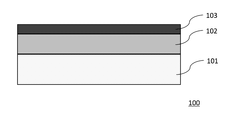
- FIG. 1 is a sectional view schematically showing an example of a metal-based copper-clad laminate 100.
- the metal-based copper-clad laminate 100 of FIG. 1 has a metal plate 101, a resin layer 102, and a metal layer 103.
- the metal plate 101, the resin layer 102, and the metal layer 103 form a laminated structure in which they are laminated in this order.
- the metal plate 101 functions as a heat dissipation member.
- the resin layer 102 becomes a stress relaxation layer.
- the metal layer 103 is used to form a circuit formation.
- the metal plate 101 is a plate-shaped member made of a metal material containing Ag or Cu as a main component.
- the main component means that the content ratio in the metal material is, for example, 80% by mass or more, and more preferably 85% by mass or more.
- the metal plate 101 may be a plate-shaped substrate made of a metal or a plate-shaped substrate made of an alloy containing another semiconductor element or a metal element.
- another semiconductor element or metal element for example, Si, Fe, Cu, Mn, Mg, Cr, Zn, or Ti may be included. These may be used alone or in combination of two or more.
- the metal plate 101 can be an aluminum plate or an alloy aluminum plate from the viewpoints of light weight and low cost as compared with the copper substrate.
- the thickness of the metal plate 101 may be such that it functions as a supporting member as a substrate, and is, for example, 0.5 mm to 3.0 mm, more preferably 1.0 mm to 2.0 mm.
- the metal plate 101 may be composed of a single layer or a laminated body of a plurality of layers.
- the resin layer 102 is composed of a resin layer made of the above resin composition. Specifically, the resin layer 102 is composed of a cured product of the above resin composition.
- the thickness of the resin layer 102 can be appropriately selected, but is, for example, 30 ⁇ m to 300 ⁇ m, preferably 30 ⁇ m to 200 ⁇ m, and more preferably 50 ⁇ m to 120 ⁇ m.
- the metal layer 103 is composed of a copper foil, more preferably a thick film copper foil.
- the metal layer 103 may be made of a metal material containing Cu as a main component, and may have other metal elements such as Al, Ni, Fe, and Sn. These may be used alone or in combination of two or more.
- the thickness of the metal layer 103 is, for example, 10 ⁇ m to 80 ⁇ m, preferably 15 ⁇ m to 70 ⁇ m. Since the resistance can be reduced by increasing the thickness of the metal layer 103, the metal-based copper-clad laminate 100 applicable to a large current can be realized.
- a B-stage resin layer made of a resin composition is formed on the prepared metal plate 101.
- a method of forming the resin layer a method of applying the resin composition to the metal layer 103 and drying it, or a method of laminating a film-shaped resin layer may be used.
- the metal plate 101 is formed on the surface of the resin layer.
- a method of forming the metal plate 101 a method of pressurizing and heating the resin layer and the metal plate 101 using a press or the like may be used. During the pressure/heat treatment, if the resin layer is in the B stage state, the resin layer may be cured. As described above, the metal-based copper-clad laminate 100 is obtained.
- the metal circuit layer 105 may be formed by etching the metal layer 103 into a predetermined pattern or the like.
- the metal-based copper-clad laminate 100 having the metal plate 101, the resin layer 102, and the metal circuit layer 105 is obtained.
- the metal-based copper-clad laminate 100 may have a multilayer structure in which a plurality of unit structures of the metal plate 101, the resin layer 102 and the metal circuit layer 105 are laminated. Further, the metal-based copper-clad laminate 100 may have a solder resist layer as the outermost layer. The solder resist layer may have an opening that exposes an electrode portion that can be connected to an electronic component described later.
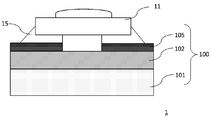
- FIG. 2 is a sectional view schematically showing an example of the electronic device 1.
- the electronic device 1 of FIG. 2 includes a metal base copper-clad laminate 100, an electronic component 11 provided on the metal base copper-clad laminate 100, and a connecting portion (solder 15) connecting these components.
- the electronic device 1 may include other known members not shown in FIG.
- the electronic device 1 may include a sealing member that seals the electronic component 11.
- the electronic components 11 are semiconductor elements such as transistors and light emitting diodes (LEDs), and various heat generating elements such as resistors and capacitors. These may be used alone or in combination of two or more.
- the electronic device 1 is an electronic base device used for mounting on a vehicle such as a hybrid vehicle, a fuel cell car and an electric vehicle, a vehicle such as an airplane, a rocket, and for mounting in a narrow space such as inside a mobile device. ..
- the electronic device 1 is, for example, a semiconductor device such as a power semiconductor device, LED lighting, and an inverter device.
- the electronic device 1 even if the electronic device 1 is placed in an environment where the temperature changes drastically for a long time or repeatedly, it is caused by the difference in thermal expansion coefficient between the metal-based copper-clad laminate 100 and the electronic component 11.
- the resin layer 102 which is a stress relaxation layer, can stably reduce the generated stress.
- the metal plate 101 of the metal-based copper-clad laminate 100 is composed of an aluminum plate or an alloy aluminum plate, aluminum is lightweight but has the property of expanding and contracting greatly according to the environmental temperature. The difference in the coefficient of thermal expansion between the plate 101 and the electronic component 11 becomes large.
- the study by the present inventor has revealed that the resin layer 102 is required to have higher stress relaxation characteristics than the case where a copper plate is used.
- the resin layer 102 has a low elastic modulus, by using a cured product of a resin composition having excellent stress relaxation characteristics, a difference in thermal expansion coefficient (mismatch) is caused. It is possible to suppress the occurrence of cracks in the solder 15.
- the resin layer 102 composed of a cured product of the above resin composition can have excellent properties such as peel strength, thermal conductivity, and insulation.
- the metal-based copper-clad laminate 100 can be suitably used as a heat dissipation circuit board for mounting an electronic component 11 such as an LED.
- the electronic device 1 since the electronic device 1 has a structure in which the electronic component 11 is mounted on the metal-based copper-clad laminate 100, it has excellent solder crack resistance, and changes from a low temperature environment to a high temperature environment or between them. Excellent connection reliability even under severe environment.
- Epoxy resin 1 bisphenol F type epoxy resin (manufactured by DIC, 830S, liquid epoxy resin, epoxy equivalent: 170 g/eq)
- Epoxy resin 2 polyether type epoxy resin (EP-4005, made by ADEKA, liquid at 25° C., viscosity 0.8 Pa ⁇ s, epoxy equivalent 510 g/eq)
- Epoxy resin 3 acrylic resin having an all-acrylic structure (Toa Gosei Co., Ltd., ARUFON UG-4010, weight average molecular weight: 2,900)
- Epoxy resin 4 epoxidized polybutadiene containing a polybutadiene skeleton (manufactured by Daicel, PB3600, weight average molecular weight: 5,900)
- (Curing agent) -Curing agent 1 Imidazole (manufactured by Shikoku Kasei, brand name: 2P4MZ) ⁇ Curing agent 2: Dicyandiamide (manufactured by Degussa) -Curing agent 3: Novolac-type phenol resin (Sumitomo Bakelite, trade name: PR-51470)
- Heat dissipation filler ⁇ Heat dissipation filler 1: Spherical alumina (Average particle size: 22 ⁇ m, Circularity: 0.91, Nippon Steel & Sumikin Materials Co., AX-25) ⁇ Heat dissipation filler 2: Polyhedral alumina (average particle diameter: 4 ⁇ m, circularity: 0.75, manufactured by Nippon Light Metal Co., Ltd., LS-210) ⁇ Heat dissipation filler 3: Polyhedral alumina (average particle diameter: 0.7 ⁇ m, circularity: 0.71, manufactured by Nippon Light Metal Co., Ltd., LS-250)
- ⁇ Creation of metal-based copper-clad laminate As the metal foil, a copper foil having a thickness of 18 ⁇ m (FTS, manufactured by Furukawa Circuit Foil, GTSMP) was used. A varnish-shaped resin composition was applied to the roughened surface of the copper foil with a comma coater and dried by heating at 100° C. for 3 minutes and 150° C. for 3 minutes to obtain a resin-coated copper foil having a resin thickness of 80 ⁇ m. The obtained resin-coated copper foil and a 1.5 mm-thick aluminum plate (#4045) were laminated, and pressed with a vacuum press at a pressing pressure of 100 kg/cm 2 at 80° C., 30 minutes, 180° C., 60 minutes. A metal base copper clad laminate (insulating resin layer thickness: 80 ⁇ m) was obtained.
- FTS Furukawa Circuit Foil
- the copper foil and the aluminum plate were peeled off from the metal-based copper-clad laminate to obtain an insulating resin layer. Then, the insulating resin layer was cut to obtain a test piece of 8 ⁇ 20 mm. Using a dynamic viscoelasticity measuring device, measurement was performed in a temperature range of ⁇ 50° C. to 200° C. in a tensile mode, a frequency of 1 Hz, and a heating rate of 5° C./min. And the storage elastic modulus (GPa) of 25 degreeC was obtained.
- the dielectric breakdown voltage After cutting the metal-based copper-clad laminate to 100 mm ⁇ 100 mm with a grinder saw, the copper foil was removed by etching to prepare a sample. Using a withstand voltage tester (MODEL7473, manufactured by EXTECH Electronics), the electrodes are brought into contact with the insulating resin layer and the aluminum plate, and an alternating voltage is applied to both electrodes so that the voltage rises at a rate of 0.5 kV/sec. Applied. The voltage at which the insulating resin layer of the metal-based copper-clad laminate was destroyed was defined as the dielectric breakdown voltage (kV).
- kV dielectric breakdown voltage
- the resin compositions of Examples 1 to 3 have high thermal conductivity, can be made to have lower elasticity than Comparative Examples 1 to 3, and have high peel strength as compared with Comparative Examples 1 to 3, and Comparative Example 2, It was found that a metal-based copper clad laminate excellent in solder crack resistance and insulation reliability as compared with No. 3 can be realized. Such a metal-based copper-clad laminate can be suitably used as a heat dissipation circuit board for mounting electronic components such as LEDs.
Landscapes
- Chemical & Material Sciences (AREA)
- Organic Chemistry (AREA)
- Chemical Kinetics & Catalysis (AREA)
- Polymers & Plastics (AREA)
- Medicinal Chemistry (AREA)
- Health & Medical Sciences (AREA)
- Engineering & Computer Science (AREA)
- Combustion & Propulsion (AREA)
- Materials Engineering (AREA)
- Thermal Sciences (AREA)
- Physics & Mathematics (AREA)
- Microelectronics & Electronic Packaging (AREA)
- General Chemical & Material Sciences (AREA)
- Laminated Bodies (AREA)
- Insulated Metal Substrates For Printed Circuits (AREA)
- Compositions Of Macromolecular Compounds (AREA)
Abstract
本発明の樹脂組成物は、金属板(101)、応力緩和層(102)、および銅箔(103)がこの順で積層して構成される金属ベース銅張積層板(100)の応力緩和層(102)を形成するために用いる樹脂組成物であって、ポリエーテル構造を有するエポキシ樹脂と、フェノキシ樹脂と、放熱性フィラーと、を含み、25℃における貯蔵弾性率が、0.01GPa以上1.6GPa以下という特性を満たすものである。
Description
本発明は、樹脂組成物および金属ベース銅張積層板に関する。
これまで金属ベース銅張積層板において様々な開発がなされてきた。この種の技術として、例えば、特許文献1に記載の技術が知られている。特許文献1には、金属板(銅)、絶縁材(熱硬化性樹脂と高放熱性フィラーを含む)、リードフレーム材(銅)がこの順で積層した高放熱用リードフレーム基板が記載されている(特許文献1の請求項、図1)。
しかしながら、本発明者が検討した結果、上記特許文献1に記載の金属ベース銅張積層板において、耐半田クラック性およびピール強度の点で改善の余地があることが判明した。
本発明者はさらに検討したところ、フェノキシ樹脂とともにポリエーテル構造を有するエポキシ樹脂を併用することにより、これらを含む樹脂組成物の硬化物が、金属板と銅箔との間に配置する応力緩和層に好適に用いることができる特性を有することを見出した。このような知見に基づきさらに鋭意研究したところ、当該樹脂組成物の硬化物における弾性率を適切に制御することで、金属板、応力緩和層、および銅箔がこの順で積層して構成される金属ベース銅張積層板において、耐半田クラック性およびピール強度を向上できることを見出し、本発明を完成するに至った。
本発明によれば、
金属板、応力緩和層、および銅箔がこの順で積層して構成される金属ベース銅張積層板の前記応力緩和層を形成するために用いる樹脂組成物であって、
ポリエーテル構造を有するエポキシ樹脂と、
フェノキシ樹脂と、
放熱性フィラーと、
を含み、
当該樹脂組成物を、80℃で30分、180℃で60分加熱処理したサンプルに対して、動的粘弾性測定機を用いて、測定温度:-50℃~200℃、昇温速度:5℃/分、周波数:1Hz、引っ張りモードの条件で測定した、25℃における貯蔵弾性率が、0.01GPa以上1.6GPa以下である、
樹脂組成物が提供される。
金属板、応力緩和層、および銅箔がこの順で積層して構成される金属ベース銅張積層板の前記応力緩和層を形成するために用いる樹脂組成物であって、
ポリエーテル構造を有するエポキシ樹脂と、
フェノキシ樹脂と、
放熱性フィラーと、
を含み、
当該樹脂組成物を、80℃で30分、180℃で60分加熱処理したサンプルに対して、動的粘弾性測定機を用いて、測定温度:-50℃~200℃、昇温速度:5℃/分、周波数:1Hz、引っ張りモードの条件で測定した、25℃における貯蔵弾性率が、0.01GPa以上1.6GPa以下である、
樹脂組成物が提供される。
また本発明によれば、
放熱部材として機能する金属板と、
前記金属板上に設けられた応力緩和層と、
前記応力緩和層上に設けられた回路形成用の厚膜銅箔と、
を備える金属ベース銅張積層板であって、
前記応力緩和層が、上記の樹脂組成物からなる樹脂層で構成される、金属ベース銅張積層板が提供される。
放熱部材として機能する金属板と、
前記金属板上に設けられた応力緩和層と、
前記応力緩和層上に設けられた回路形成用の厚膜銅箔と、
を備える金属ベース銅張積層板であって、
前記応力緩和層が、上記の樹脂組成物からなる樹脂層で構成される、金属ベース銅張積層板が提供される。
本発明によれば、耐半田クラック性およびピール強度に優れた樹脂組成物およびそれを用いた金属ベース銅張積層板が提供される。
上述した目的、およびその他の目的、特徴および利点は、以下に述べる好適な実施の形態、およびそれに付随する以下の図面によってさらに明らかになる。
以下、本発明の実施の形態について、図面を用いて説明する。尚、すべての図面において、同様な構成要素には同様の符号を付し、適宜説明を省略する。また、図は概略図であり、実際の寸法比率とは一致していない。
本実施形態の樹脂組成物の概要を説明する。
本実施形態の樹脂組成物は、ポリエーテル構造を有するエポキシ樹脂と、フェノキシ樹脂と、放熱性フィラーとを含み、金属板、応力緩和層、および銅箔がこの順で積層して構成される金属ベース銅張積層板の応力緩和層を形成するために用いるものである。
本実施形態の樹脂組成物は、ポリエーテル構造を有するエポキシ樹脂と、フェノキシ樹脂と、放熱性フィラーとを含み、金属板、応力緩和層、および銅箔がこの順で積層して構成される金属ベース銅張積層板の応力緩和層を形成するために用いるものである。
また、この樹脂組成物は、当該樹脂組成物を、80℃で30分、180℃で60分加熱処理したサンプルに対して、動的粘弾性測定機を用いて、測定温度:-50℃~200℃、昇温速度:5℃/分、周波数:1Hz、引っ張りモードの条件で測定した、25℃における貯蔵弾性率が、0.01GPa以上1.6GPa以下という特性を有する。
本発明者の知見によれば、フェノキシ樹脂とともにポリエーテル構造を有するエポキシ樹脂を併用することにより、これらを含む樹脂組成物の硬化物が、金属板と銅箔との間に配置する応力緩和層に好適に用いることができる特性を有することが見出された。
そして、当該樹脂組成物の硬化物における弾性率を上記上限値以下となるように適切に制御することで、金属板、応力緩和層、および銅箔がこの順で積層して構成される金属ベース銅張積層板において、耐半田クラック性を向上できることが可能になる。
そして、当該樹脂組成物の硬化物における弾性率を上記上限値以下となるように適切に制御することで、金属板、応力緩和層、および銅箔がこの順で積層して構成される金属ベース銅張積層板において、耐半田クラック性を向上できることが可能になる。
本実施形態において、上記25℃における貯蔵弾性率の上限値は、例えば、1.6GPa以下、好ましくは1.5GPa以下、より好ましくは1.0GPa以下である。これにより、耐半田クラック性およびピール強度を向上できる。一方、上記25℃における貯蔵弾性率の下限値は、特に限定されないが、例えば、0.01GPa以上、好ましくは0.05GPa以上、より好ましくは0.10GPa以上でもよい。金属ベース銅張積層板中の金属板の線膨張係数に応じて、適切な貯蔵弾性率を選択してもよい。
本実施形態では、たとえば樹脂組成物中に含まれる各成分の種類や配合量、樹脂組成物の調製方法等を適切に選択することにより、上記貯蔵弾性率を制御することが可能である。これらの中でも、たとえば、ポリエーテル構造を有するエポキシ樹脂、フェノキシ樹脂の使用、硬化剤や放熱性フィラーの種類の適切な選択、これらの成分の含有量を調整すること等が、上記貯蔵弾性率を所望の数値範囲とするための要素として挙げられる。
本実施形態によれば、金属ベース銅張積層板に搭載された電子部品を備える電子装置において、接続信頼性に優れた構造を提供できる。
以下、本実施形態の樹脂組成物について詳述する。
上記樹脂組成物は、エポキシ樹脂として、ポリエーテル構造を有するエポキシ樹脂を含む。これにより、樹脂組成物の硬化物の弾性率を低減でき、ピール強度を高めることができる。
上記ポリエーテル構造を有するエポキシ樹脂は、下記一般式(I)で表される化合物を含むことができる。下記一般式(I)で表される化合物は、適度な長さのポリエーテル構造を備えるため、硬化物を低弾性化でき、両末端に反応性官能基(例えばエポキシ基)を備えるため、反応性を高め、ピール強度を向上させることができる。

上記一般式(I)中、R1およびR2は、それぞれ独立して、水素原子またはメチル基を、Gはグリシジル基を表す。mおよびnは、それぞれ独立して、1以上の整数であり、3≦(m+n)≦20で表される関係を満たす。
また、ポリエーテル構造を有するエポキシ樹脂を含むことにより、金属ベース銅張積層板の応力緩和力を向上させることができる。例えば、電子装置を製造した場合、急激な加熱/冷却の環境下においても、電子部品と金属ベース銅張積層板を接合する半田接合部、またはその近傍で、クラック等の不良が発生することが抑制されることになる。このように金属ベース銅張積層板のヒートサイクル特性を向上させることができる。
上記樹脂組成物は、エポキシ樹脂として、ポリエーテル構造を有するエポキシ樹脂以外に、他のエポキシ樹脂(A)を含んでもよい。
上記エポキシ樹脂(A)は、芳香環構造および脂環構造(脂環式の炭素環構造)の少なくともいずれか一方を有するエポキシ樹脂(A1)を含むことができる。このようなエポキシ樹脂(A1)を使用することで、ガラス転移温度を高くするとともに、樹脂層102の熱伝導性を向上させることができる。
芳香環あるいは脂肪環構造を有するエポキシ樹脂(A1)としては、例えば、ビスフェノールA型エポキシ樹脂、ビスフェノールF型エポキシ樹脂、ビスフェノールS型エポキシ樹脂、ビスフェノールE型エポキシ樹脂、ビスフェノールM型エポキシ樹脂、ビスフェノールP型エポキシ樹脂、ビスフェノールZ型エポキシ樹脂等のビスフェノール型エポキシ樹脂、フェノールノボラック型エポキシ樹脂、クレゾールノボラック型エポキシ樹脂、テトラフェノール基エタン型ノボラック型エポキシ樹脂等のノボラック型エポキシ樹脂、ビフェニル型エポキシ樹脂、ビフェニレン骨格を有するフェノールアラルキル型エポキシ樹脂等のアリールアルキレン型エポキシ樹脂、ナフタレン型エポキシ樹脂等のエポキシ樹脂等が挙げられる。これらの中の1種類を単独で用いることもできるし、2種類以上を併用したりすることもできる。
また、上記樹脂組成物は、エポキシ樹脂として、液状エポキシ樹脂を含むことができる。
上記液状エポキシ樹脂は、樹脂組成物をBステージ化した際のシートの可とう性を発現できる。
上記液状エポキシ樹脂は、樹脂組成物をBステージ化した際のシートの可とう性を発現できる。
上記液状エポキシ樹脂としては、2個以上のエポキシ基を有しており、室温25℃において液状であるエポキシ化合物を用いることができる。
上記液状エポキシ樹脂としては、例えば、ビスフェノールAジグリシジルエーテル、ビスフェノールFジグリシジルエーテル、アルキルジグリシジルエーテルおよび脂環式エポキシからなる群から選択される一種以上を含むことができる。また、上記液状エポキシ樹脂として、上記ポリエーテル構造を有するエポキシ樹脂を用いてもよい。これらを単独で用いても2種以上を組み合わせて用いてもよい。
上記液状エポキシ樹脂のエポキシ当量の下限値は、例えば、200g以上であり、好ましくは300g/eq以上、さらに好ましくは350g/eq以上である。上記液状エポキシ樹脂のエポキシ当量の上限値は、特に限定されないが、例えば、700g/eq以下でもよい。
上記ポリエーテル構造を有するエポキシ樹脂の含有量は、放熱性フィラーを除く樹脂組成物の全固形分100質量%に対し、例えば、5質量%~50質量%、好ましくは10質量%~45質量%、より好ましくは15質量%~40質量%である。上記ポリエーテル構造を有するエポキシ樹脂の含有量を上記下限値以上とすることで、硬化物の弾性率を低減しつつ、ピール強度を向上できる。また、上記ポリエーテル構造を有するエポキシ樹脂の含有量を上記上限値以下とすることで、他の特性とのバランスを図ることができる。
上記エポキシ樹脂の含有量は、放熱性フィラーを除く樹脂組成物の全固形分100質量%に対し、例えば、20質量%~65質量%、好ましくは25質量%~60質量%、より好ましくは30質量%~60質量%である。
樹脂組成物は、エポキシ樹脂としてポリエーテル構造を有するエポキシ樹脂および液状エポキシ樹脂を含んでもよい。このとき、樹脂組成物中、ポリエーテル構造を有するエポキシ樹脂の含有量/液状エポキシ樹脂の含有量は、0.8~4.0、好ましくは、0.9~3.5、より好ましくは1.0~3.0である。このような範囲内とすることによって、樹脂組成物の塗工性や、フィルムとしての低弾性とのバランス図ることができる。
本実施形態において、樹脂組成物の固形分とは、樹脂組成物中における不揮発分を指し、水や溶媒等の揮発成分を除いた残部を指す。樹脂組成物の固形分全体に対する含有量とは、溶媒を含む場合には、樹脂組成物のうちの溶媒を除く固形分全体(100質量%)に対する含有量を指す。
上記樹脂組成物は、放熱性フィラーを含む。これにより、硬化物の熱伝導性を向上できる。
上記放熱性フィラーとして、公知の熱伝導性に優れたフィラーを用いることができるが、例えば、アルミナが挙げられる。これらを単独で用いても2種以上を組み合わせて用いてもよい。
アルミナは、平均粒子径が異なる2以上の成分を有してもよい。例えば、アルミナは、平均粒子径が異なる3成分(大粒径、中粒径、小粒径)の混合系で、大粒径成分が球状であり、中粒径成分および小粒径成分が多面体状でもよい。
アルミナは、平均粒子径が5.0μm以上50μm以下、好ましくは5.0μm以上25μm以下の第1粒径範囲に属し、かつ、円形度が0.80以上1.0以下、好ましくは0.85以上0.95以下である大粒径アルミナを含んでもよい。
また、アルミナは、平均粒子径が1.0μm以上5.0μm未満の第2粒径範囲に属し、かつ、円形度が0.50以上0.90以下、好ましくは0.70以上0.80以下である中粒径アルミナを含んでもよい。
また、アルミナは、平均粒子径が0.1μm以上1.0μm未満の第3粒径範囲に属し、かつ、円形度が0.50以上0.90以下、好ましくは0.70以上0.80以下ある小粒径アルミナを含んでもよい。
ここで、粒子径は、レーザー回折式粒度分布測定装置SALD-7000を用いて、水中にアルミナを1分間超音波処理することにより分散させ、測定することができる。
適当な粒径を備えるアルミナを用いることで、アルミナの充填性が高められ、アルミナ粒子同士の接触面積をより大きくすることができる。その結果、硬化物の熱伝導性をより一層向上できる。さらに、硬化物の半田耐熱性、耐屈曲性、絶縁性をより一層向上できる。また、このようなアルミナを用いることにより、応力樹脂層と金属板との密着性をより一層向上できる。これらの相乗効果により、金属ベース銅張積層板の絶縁信頼性をより一層高めることができる。
上記放熱性フィラー(またはアルミナ)の含有量は、当該樹脂組成物100体積%に対して、例えば、40体積%以上85体積%以下、好ましくは45体積%以上80体積%以下、より好ましくは55体積%以上75体積%以下である。上記放熱性フィラーの含有量を上記下限値以上とすることで、硬化物の熱伝導性を高め、放熱性に優れた電子装置を実現できる。一方、上記放熱性フィラーの含有量を上記上限値以下とすることで、その他の特性とのバランスを図ることができる。また、製造安定性を向上させることができる。
上記樹脂組成物は、フェノキシ樹脂を含む。フェノキシ樹脂を含むことにより、硬化物の耐屈曲性を向上できるため、アルミナを高充填することによるハンドリング性の低下を抑制することができる。
上記フェノキシ樹脂としては、例えば、ビスフェノール骨格を有するフェノキシ樹脂、ナフタレン骨格を有するフェノキシ樹脂、アントラセン骨格を有するフェノキシ樹脂、ビフェニル骨格を有するフェノキシ樹脂等が挙げられる。また、これらの骨格を複数種有した構造のフェノキシ樹脂を用いることもできる。
これらの中でも、ビスフェノールA型またはビスフェノールF型のフェノキシ樹脂を用いるのが好ましい。ビスフェノールA骨格とビスフェノールF骨格を両方有するフェノキシ樹脂を用いても良い。
上記フェノキシ樹脂の重量平均分子量は、とくに限定されないが、4.0×10⁴以上8.0×10⁴以下が好ましい。
なお、フェノキシ樹脂の重量平均分子量は、ゲルパーミエーションクロマトグラフィー(GPC)で測定したポリスチレン換算の値である。
なお、フェノキシ樹脂の重量平均分子量は、ゲルパーミエーションクロマトグラフィー(GPC)で測定したポリスチレン換算の値である。
上記フェノキシ樹脂の含有量は、例えば、放熱性フィラーを除く樹脂組成物の全固形分100質量%に対し、例えば、15質量%~60質量%、好ましくは18質量%~55質量%、より好ましくは20質量%~50質量%である。
樹脂組成物中、ポリエーテル構造を有するエポキシ樹脂の含有量/フェノキシ樹脂の含有量は、0.7~4.0、好ましくは、0.8~3.0、より好ましくは0.9~2.5である。このような範囲内とすることによって、樹脂組成物からなるフィルムの応力緩和力を適当なものとすることができ、耐半田クラック性、ピール強度、絶縁信頼性を高められる。
上記樹脂組成物は、硬化剤を含むことができる。
上記硬化剤(硬化触媒)としては、例えばナフテン酸亜鉛、ナフテン酸コバルト、オクチル酸スズ、オクチル酸コバルト、ビスアセチルアセトナートコバルト(II)、トリスアセチルアセトナートコバルト(III)等の有機金属塩;ジシアンジアミド、ジエチレントリアミン、トリエチレンテトラミン、メタキシリレンジアミン、ジアミノジフェニルメタン、ジアミノジエチルジフェニルメタン、メタフェニレンジアミン、ジアミノジフェニルスルホン、イソフォロンジアミン、ノルボルネンジアミン、トリエチルアミン、トリブチルアミン、ジアザビシクロ[2,2,2]オクタン等のアミン系硬化剤;2-フェニル-イミダゾール、2-フェニル-4-メチルイミダゾール、2-エチル-4-メチルイミダゾール、2-エチル-4-エチルイミダゾール、2-フェニル-4-メチル-5-ヒドロキシイミダゾール、2-フェニル-4,5-ジヒドロキシイミダゾール等のイミダゾール系硬化剤;トリフェニルホスフィン、トリ-p-トリルホスフィン、テトラフェニルホスホニウム・テトラフェニルボレート、トリフェニルホスフィン・トリフェニルボラン、1,2-ビス-(ジフェニルホスフィノ)エタン等の有機リン化合物;フェノール、ビスフェノールA、ノニルフェノール等のフェノール化合物;酢酸、安息香酸、サリチル酸、パラトルエンスルホン酸等の有機酸等、またはこの混合物が挙げられる。硬化剤として、これらの中の誘導体も含めて1種類を単独で用いることもできるし、これらの誘導体も含めて2種類以上を併用したりすることもできる。
上記硬化剤(硬化触媒)としては、例えばナフテン酸亜鉛、ナフテン酸コバルト、オクチル酸スズ、オクチル酸コバルト、ビスアセチルアセトナートコバルト(II)、トリスアセチルアセトナートコバルト(III)等の有機金属塩;ジシアンジアミド、ジエチレントリアミン、トリエチレンテトラミン、メタキシリレンジアミン、ジアミノジフェニルメタン、ジアミノジエチルジフェニルメタン、メタフェニレンジアミン、ジアミノジフェニルスルホン、イソフォロンジアミン、ノルボルネンジアミン、トリエチルアミン、トリブチルアミン、ジアザビシクロ[2,2,2]オクタン等のアミン系硬化剤;2-フェニル-イミダゾール、2-フェニル-4-メチルイミダゾール、2-エチル-4-メチルイミダゾール、2-エチル-4-エチルイミダゾール、2-フェニル-4-メチル-5-ヒドロキシイミダゾール、2-フェニル-4,5-ジヒドロキシイミダゾール等のイミダゾール系硬化剤;トリフェニルホスフィン、トリ-p-トリルホスフィン、テトラフェニルホスホニウム・テトラフェニルボレート、トリフェニルホスフィン・トリフェニルボラン、1,2-ビス-(ジフェニルホスフィノ)エタン等の有機リン化合物;フェノール、ビスフェノールA、ノニルフェノール等のフェノール化合物;酢酸、安息香酸、サリチル酸、パラトルエンスルホン酸等の有機酸等、またはこの混合物が挙げられる。硬化剤として、これらの中の誘導体も含めて1種類を単独で用いることもできるし、これらの誘導体も含めて2種類以上を併用したりすることもできる。
これらの中でも、接着性に優れ、かつ比較的低温で反応し、耐熱性が優れた硬化物が得られる点で、アミン系硬化剤、イミダゾール系硬化剤が好ましく、低弾性化の観点から、イミダゾール系硬化剤が更に好ましい。
硬化触媒の含有量は、とくに限定されないが、樹脂組成物の全固形分100質量%に対し、例えば、0.05質量%以上3.0質量%以下である。
上記樹脂組成物は、カップリング剤を含んでもよい。カップリング剤は、エポキシ樹脂とアルミナとの界面の濡れ性を向上させることができる。
上記カップリング剤としては、通常用いられるものなら何でも使用できるが、具体的にはエポキシシランカップリング剤、カチオニックシランカップリング剤、アミノシランカップリング剤、チタネート系カップリング剤およびシリコーンオイル型カップリング剤の中から選ばれる1種以上のカップリング剤を使用することが好ましい。
上記カップリング剤の添加量はアルミナの比表面積に依存するので、とくに限定されないが、アルミナ100質量部に対して0.05質量部以上3質量部以下が好ましく、とくに0.1質量部以上2質量部以下が好ましい。
上記樹脂組成物は、本発明の効果を損なわない範囲で、他の成分を含んでもよい。他の成分として、酸化防止剤、レベリング剤等が挙げられる。
次に金属ベース銅張積層板100について説明する。
図1は、金属ベース銅張積層板100の一例を模式的に示す断面図である。
図1は、金属ベース銅張積層板100の一例を模式的に示す断面図である。
図1の金属ベース銅張積層板100は、金属板101、樹脂層102、および金属層103を有する。金属板101、樹脂層102および金属層103は、この順番で積層した積層構造を構成する。金属板101は、放熱部材として機能する。樹脂層102は、応力緩和層となる。金属層103は、回路形成を形成するために用いられる。
金属板101は、AgまたはCuを主成分に含む金属材料の板状部材である。主成分とは、金属材料中の含有比率が、例えば、80質量%以上、より好ましくは85質量%以上であることを意味する。金属板101は、金属からなる板状基板でもよく、他の半導体元素または金属元素を含む合金からなる板状基板でもよい。他の半導体元素または金属元素として、例えば、Si、Fe、Cu、Mn、Mg、Cr、Zn、Ti等を含んでもよい。これらを単独で用いても2種以上を組み合わせて用いてもよい。
この中でも、金属板101は、銅基板と比較して、軽量であり、低コストの観点から、アルミニウム板または合金アルミニウム板を用いることができる。
金属板101の厚みは、基板としての支持部材として機能する程度の厚みとしてもよく、例えば、0.5mm~3.0mm、より好ましくは1.0mm~2.0mmである。金属板101は、単層または複数層の積層体で構成されてもよい。
樹脂層102は、上述の樹脂組成物からなる樹脂層で構成される。具体的には、樹脂層102は、上記樹脂組成物の硬化物で構成される。
樹脂層102の厚みは、適宜選択可能だが、例えば、30μm~300μm、好ましくは30μm~200μm、より好ましくは50μm~120μmである。
金属層103は、銅箔、より好ましくは厚膜銅箔で構成される。金属層103は、Cuが主成分である金属材料で構成されていればよく、その他のAl、Ni、Fe、Sn等の金属元素を有していてもよい。これらを単独で用いても2種以上を組み合わせて用いてもよい。
金属層103の厚みは、例えば、10μm~80μm、好ましくは15μm~70μmである。金属層103を厚膜化することで、低抵抗化できるため、大電流に適用可能な金属ベース銅張積層板100を実現できる。
次に、金属ベース銅張積層板100の製造方法について説明する。
準備した金属板101上に、樹脂組成物からなるBステージ状態の樹脂層を形成する。
樹脂層を形成する方法は、上述の樹脂組成物を金属層103に塗布、乾燥する方法や、フィルム状の樹脂層を積層する方法を用いてもよい。
続いて、樹脂層の表面に金属板101を形成する。金属板101を形成する方法は、樹脂層と金属板101とを、プレス等を用いて加圧・加熱処理する方法を用いてもよい。この加圧・加熱処理時において、樹脂層がBステージ状態である場合、その樹脂層を硬化させてもよい。
以上により、金属ベース銅張積層板100が得られる。
樹脂層を形成する方法は、上述の樹脂組成物を金属層103に塗布、乾燥する方法や、フィルム状の樹脂層を積層する方法を用いてもよい。
続いて、樹脂層の表面に金属板101を形成する。金属板101を形成する方法は、樹脂層と金属板101とを、プレス等を用いて加圧・加熱処理する方法を用いてもよい。この加圧・加熱処理時において、樹脂層がBステージ状態である場合、その樹脂層を硬化させてもよい。
以上により、金属ベース銅張積層板100が得られる。
その後、必要に応じて、金属層103を所定のパターンにエッチング等することにより、金属回路層105を形成してもよい。これにより、金属板101、樹脂層102および金属回路層105を有する金属ベース銅張積層板100が得られる。
なお、金属ベース銅張積層板100は、金属板101、樹脂層102および金属回路層105の単位構造が複数積層した、多層構造を有してもよい。
また、金属ベース銅張積層板100は、最外層にソルダーレジスト層を有していてもよい。ソルダーレジスト層は、後述の電子部品と接続可能な電極部を露出させる開口を有してもよい。
また、金属ベース銅張積層板100は、最外層にソルダーレジスト層を有していてもよい。ソルダーレジスト層は、後述の電子部品と接続可能な電極部を露出させる開口を有してもよい。
次に、本実施形態の電子装置1について説明する。
図2は、電子装置1の一例を模式的に示す断面図である。
図2は、電子装置1の一例を模式的に示す断面図である。
図2の電子装置1は、金属ベース銅張積層板100と、金属ベース銅張積層板100上に設けられた電子部品11と、これらを接続する接続部(半田15)とを備える。この電子装置1は、図2に示されていない、公知の他部材を備えてもよい。例えば、電子装置1は、電子部品11を封止する封止部材を有してもよい。
電子部品11は、トランジスタ、発光ダイオード(LED)等の半導体素子、抵抗、コンデンサ等の各種発熱素子である。これらを単独で用いても2種以上を組み合わせて用いてもよい。
電子装置1は、ハイブリッド車、燃料電池車および電気自動車などの自動車や飛行機、ロケット等の乗り物に搭載する用途、モバイル機器の内部のような狭い空間に搭載する用途等に用いる電子基機器である。電子装置1は、例えば、パワー半導体装置、LED照明、インバーター装置等の半導体装置となる。
本実施形態によれば、電子装置1が温度変化の激しい環境下に長時間、あるいは繰り返し置かれても、金属ベース銅張積層板100と電子部品11との間で生じる熱膨張係数差に起因して発生する応力を、応力緩和層である樹脂層102が安定的に低減できる。
金属ベース銅張積層板100の金属板101がアルミニウム板または合金アルミニウム板で構成される場合、アルミニウムは軽量だが環境温度に応じて大きく伸縮する特性を有するため、アルミベース銅張積層板中の金属板101と電子部品11との熱膨張係数の乖離が大きくなる。
本発明者の検討により、銅板を用いた場合と比べて樹脂層102には高い応力緩和特性が要求されることが判明した。
これに対して、樹脂層102として、低弾性率化されているため、応力緩和特性に優れた樹脂組成物の硬化物を用いることにより、これらの熱膨張係数の乖離(ミスマッチ)に起因して半田15にクラックが発生することを抑制できる。
本発明者の検討により、銅板を用いた場合と比べて樹脂層102には高い応力緩和特性が要求されることが判明した。
これに対して、樹脂層102として、低弾性率化されているため、応力緩和特性に優れた樹脂組成物の硬化物を用いることにより、これらの熱膨張係数の乖離(ミスマッチ)に起因して半田15にクラックが発生することを抑制できる。
また、上記の樹脂組成物の硬化物で構成される樹脂層102は、ピール強度、熱伝導率、絶縁性などにも優れた特性を有することができる。
したがって、金属ベース銅張積層板100は、LED等の電子部品11を搭載するための放熱回路基板として好適に用いることが可能である。
また、電子装置1は、金属ベース銅張積層板100上に電子部品11が搭載された構造を有するため、耐半田クラック性に優れており、低温環境から高温環境まで、またはこれらの間で変動するような過酷な環境下においても、接続信頼性に優れる。
以上、本発明の実施形態について述べたが、これらは本発明の例示であり、上記以外の様々な構成を採用することができる。また、本発明は上述の実施形態に限定されるものではなく、本発明の目的を達成できる範囲での変形、改良等は本発明に含まれる。
以下、本発明について実施例を参照して詳細に説明するが、本発明は、これらの実施例の記載に何ら限定されるものではない。
表1に示す原材成分の情報は以下の通り。
(フェノキシ樹脂)
・フェノキシ樹脂1:ビスフェノールF骨格とビスフェノールA骨格を有するフェノキシ樹脂(三菱化学社製、4275、重量平均分子量6.0×10⁴、ビスフェノールF骨格とビスフェノールA骨格の比率=75:25)
(フェノキシ樹脂)
・フェノキシ樹脂1:ビスフェノールF骨格とビスフェノールA骨格を有するフェノキシ樹脂(三菱化学社製、4275、重量平均分子量6.0×10⁴、ビスフェノールF骨格とビスフェノールA骨格の比率=75:25)
(エポキシ樹脂)
・エポキシ樹脂1:ビスフェノールF型エポキシ樹脂(DIC社製、830S、液状エポキシ樹脂、エポキシ当量:170g/eq)
・エポキシ樹脂2:ポリエーテル型エポキシ樹脂(EP-4005、ADEKA製、25℃で液体、粘度0.8Pa・s、エポキシ当量510g/eq)
・エポキシ樹脂3:オールアクリル構造のアクリル樹脂(東亜合成社製、ARUFON UG-4010、重量平均分子量:2,900)
・エポキシ樹脂4:ポリブタジエン骨格を含むエポキシ化ポリブダジエン(ダイセル社製、PB3600、重量平均分子量:5,900)
・エポキシ樹脂1:ビスフェノールF型エポキシ樹脂(DIC社製、830S、液状エポキシ樹脂、エポキシ当量:170g/eq)
・エポキシ樹脂2:ポリエーテル型エポキシ樹脂(EP-4005、ADEKA製、25℃で液体、粘度0.8Pa・s、エポキシ当量510g/eq)
・エポキシ樹脂3:オールアクリル構造のアクリル樹脂(東亜合成社製、ARUFON UG-4010、重量平均分子量:2,900)
・エポキシ樹脂4:ポリブタジエン骨格を含むエポキシ化ポリブダジエン(ダイセル社製、PB3600、重量平均分子量:5,900)
(硬化剤)
・硬化剤1:イミダゾール(四国化成社製、商品名:2P4MZ)
・硬化剤2:ジシアンジアミド(デグサ製)
・硬化剤3:ノボラック型フェノール樹脂(住友ベークライト製、商品名:PR-51470)
・硬化剤1:イミダゾール(四国化成社製、商品名:2P4MZ)
・硬化剤2:ジシアンジアミド(デグサ製)
・硬化剤3:ノボラック型フェノール樹脂(住友ベークライト製、商品名:PR-51470)
(カップリング剤)
・シランカップリング剤1:γ―グリシドキシプロピルトリメトキシシラン(信越シリコーン社製、KBM-403)
・シランカップリング剤1:γ―グリシドキシプロピルトリメトキシシラン(信越シリコーン社製、KBM-403)
(放熱性フィラー)
・放熱性フィラー1:球状アルミナ(平均粒子径:22μm、円形度:0.91、新日鉄住金マテリアルズ社製、AX-25)
・放熱性フィラー2:多面体状アルミナ(平均粒子径:4μm、円形度:0.75、日本軽金属社製、LS-210)
・放熱性フィラー3:多面体状アルミナ(平均粒子径:0.7μm、円形度:0.71、日本軽金属社製、LS-250)
・放熱性フィラー1:球状アルミナ(平均粒子径:22μm、円形度:0.91、新日鉄住金マテリアルズ社製、AX-25)
・放熱性フィラー2:多面体状アルミナ(平均粒子径:4μm、円形度:0.75、日本軽金属社製、LS-210)
・放熱性フィラー3:多面体状アルミナ(平均粒子径:0.7μm、円形度:0.71、日本軽金属社製、LS-250)

<樹脂組成物の調製>
表1に示す配合比率に従い、各成分をシクロヘキサノンに溶解・混合させ、高速撹拌装置を用い撹拌して、固形分基準で80質量%のワニス状の樹脂組成物を得た。
表1に示す配合比率に従い、各成分をシクロヘキサノンに溶解・混合させ、高速撹拌装置を用い撹拌して、固形分基準で80質量%のワニス状の樹脂組成物を得た。
<金属ベース銅張積層板の作成>
金属箔として、厚さ18μmの銅箔(古河サーキットホイル社製、GTSMP)を用いた。銅箔の粗化面に、ワニス状の樹脂組成物をコンマコーターにて塗布し、100℃で3分、150℃で3分加熱乾燥し、樹脂厚80μmの樹脂付き銅箔を得た。
得られた樹脂付き銅箔と1.5mm厚のアルミニウム板(#4045)を張り合わせ、真空プレスで、プレス圧100kg/cm2で80℃、30分、180℃、60分の条件下でプレスし、金属ベース銅張積層板(絶縁樹脂層の厚み:80μm)を得た。
金属箔として、厚さ18μmの銅箔(古河サーキットホイル社製、GTSMP)を用いた。銅箔の粗化面に、ワニス状の樹脂組成物をコンマコーターにて塗布し、100℃で3分、150℃で3分加熱乾燥し、樹脂厚80μmの樹脂付き銅箔を得た。
得られた樹脂付き銅箔と1.5mm厚のアルミニウム板(#4045)を張り合わせ、真空プレスで、プレス圧100kg/cm2で80℃、30分、180℃、60分の条件下でプレスし、金属ベース銅張積層板(絶縁樹脂層の厚み:80μm)を得た。
(熱伝導率)
金属ベース銅張積層板から、銅箔およびアルミニウム板を剥離して、絶縁樹脂層を得た。そして絶縁樹脂層の厚み方向の熱伝導率を計測した。具体的には、レーザーフラッシュ法(ハーフタイム法)にて測定した熱拡散係数(α)、DSC法により測定した比熱(Cp)、JIS-K-6911に準拠して測定した密度(ρ)より次式を用いて熱伝導率を算出した。熱伝導率の単位はW/m・Kである。熱伝導率[W/m・K]=α[m2/s]×Cp[J/kg・K]×ρ[g/cm3]
金属ベース銅張積層板から、銅箔およびアルミニウム板を剥離して、絶縁樹脂層を得た。そして絶縁樹脂層の厚み方向の熱伝導率を計測した。具体的には、レーザーフラッシュ法(ハーフタイム法)にて測定した熱拡散係数(α)、DSC法により測定した比熱(Cp)、JIS-K-6911に準拠して測定した密度(ρ)より次式を用いて熱伝導率を算出した。熱伝導率の単位はW/m・Kである。熱伝導率[W/m・K]=α[m2/s]×Cp[J/kg・K]×ρ[g/cm3]
(貯蔵弾性率(E’))
金属ベース銅張積層板から、銅箔およびアルミニウム板を剥離して、絶縁樹脂層を得た。そして、絶縁樹脂層を切削して、8×20mmの試験片を得た。動的粘弾性測定装置により、引っ張りモード、周波数1Hz、昇温速度5℃/分として、-50℃~200℃の温度範囲で測定を行った。そして、25℃の貯蔵弾性率(GPa)を得た。
金属ベース銅張積層板から、銅箔およびアルミニウム板を剥離して、絶縁樹脂層を得た。そして、絶縁樹脂層を切削して、8×20mmの試験片を得た。動的粘弾性測定装置により、引っ張りモード、周波数1Hz、昇温速度5℃/分として、-50℃~200℃の温度範囲で測定を行った。そして、25℃の貯蔵弾性率(GPa)を得た。
(絶縁破壊電圧)
金属ベース銅張積層板を100mm×100mmにグラインダーソーでカットした後、銅箔をエッチングにより除去し、試料を作成した。耐電圧試験器(MODEL7473、EXTECH Electronics社製)を用いて、絶縁樹脂層とアルミニウム板に電極を接触せしめて、両電極に0.5kV/秒の速度で電圧が上昇するように、交流電圧を印加した。金属ベース銅張積層板の絶縁樹脂層が破壊した電圧を、絶縁破壊電圧(kV)とした。
金属ベース銅張積層板を100mm×100mmにグラインダーソーでカットした後、銅箔をエッチングにより除去し、試料を作成した。耐電圧試験器(MODEL7473、EXTECH Electronics社製)を用いて、絶縁樹脂層とアルミニウム板に電極を接触せしめて、両電極に0.5kV/秒の速度で電圧が上昇するように、交流電圧を印加した。金属ベース銅張積層板の絶縁樹脂層が破壊した電圧を、絶縁破壊電圧(kV)とした。
(ピール強度)
金属ベース銅張積層板を100mm×25mmにグラインダーソーでカットした後、エッチングにより中央に銅箔を100mm×10mmだけ残した試料を作製し、23℃における銅箔と絶縁樹脂層とのピール強度(kN/m)を測定した。なお、ピール強度測定は、JIS C 6481に準拠して行った。
金属ベース銅張積層板を100mm×25mmにグラインダーソーでカットした後、エッチングにより中央に銅箔を100mm×10mmだけ残した試料を作製し、23℃における銅箔と絶縁樹脂層とのピール強度(kN/m)を測定した。なお、ピール強度測定は、JIS C 6481に準拠して行った。
(半田耐熱性)
金属ベース銅張積層板を50mm×50mmにグラインダーソーでカットした後、エッチングにより銅箔を1/2だけ残した試料を作製し、JIS C 6481に準拠して評価した。評価は、260℃の半田槽に30秒間浸漬した後で外観の異常の有無を調べた。
評価基準○:異常なし
×:異常あり(全体的に膨れの箇所がある)
金属ベース銅張積層板を50mm×50mmにグラインダーソーでカットした後、エッチングにより銅箔を1/2だけ残した試料を作製し、JIS C 6481に準拠して評価した。評価は、260℃の半田槽に30秒間浸漬した後で外観の異常の有無を調べた。
評価基準○:異常なし
×:異常あり(全体的に膨れの箇所がある)
実施例1~3の樹脂組成物は、熱伝導率が高く、比較例1~3と比べて低弾性化することができ、比較例1~3と比べてピール強度が高く、比較例2、3と比べて耐半田クラック性、絶縁信頼性に優れた金属ベース銅張積層板を実現できることが分かった。このような金属ベース銅張積層板は、LED等の電子部品を搭載するための放熱回路基板として好適に用いることが可能である。
この出願は、2018年12月26日に出願された日本出願特願2018-243315号を基礎とする優先権を主張し、その開示の全てをここに取り込む。
Claims (10)
- 金属板、応力緩和層、および銅箔がこの順で積層して構成される金属ベース銅張積層板の前記応力緩和層を形成するために用いる樹脂組成物であって、
ポリエーテル構造を有するエポキシ樹脂と、
フェノキシ樹脂と、
放熱性フィラーと、
を含み、
当該樹脂組成物を、80℃で30分、180℃で60分加熱処理したサンプルに対して、動的粘弾性測定機を用いて、測定温度:-50℃~200℃、昇温速度:5℃/分、周波数:1Hz、引っ張りモードの条件で測定した、25℃における貯蔵弾性率が、0.01GPa以上1.6GPa以下である、
樹脂組成物。 - 請求項1に記載の樹脂組成物であって、
前記ポリエーテル構造を有するエポキシ樹脂が、下記一般式(I)で表される化合物を含む、樹脂組成物。

- 請求項1または2に記載の樹脂組成物であって、
硬化剤を含む、樹脂組成物。 - 請求項3に記載の樹脂組成物であって、
前記硬化剤が、イミダゾール系硬化剤を含む、樹脂組成物。 - 請求項1~4のいずれか一項に記載の樹脂組成物であって、
前記放熱性フィラーがアルミナを含む、樹脂組成物。 - 請求項5に記載の樹脂組成物であって、
前記アルミナが、平均粒子径が異なる2種以上を含む、樹脂組成物。 - 請求項1~6のいずれか一項に記載の樹脂組成物であって、
前記放熱性フィラーの含有量が、当該樹脂組成物100体積%に対して、40体積%以上85体積%以下である、樹脂組成物。 - 請求項1~7のいずれか一項に記載の樹脂組成物であって、
液状エポキシ樹脂を含む、樹脂組成物。 - 請求項1~8のいずれか一項に記載の樹脂組成物であって、
前記金属板がアルミニウム基板である、樹脂組成物。 - 放熱部材として機能する金属板と、
前記金属板上に設けられた応力緩和層と、
前記応力緩和層上に設けられた回路形成用の厚膜銅箔と、
を備える金属ベース銅張積層板であって、
前記応力緩和層が、請求項1~9のいずれか一項に記載の樹脂組成物からなる樹脂層で構成される、金属ベース銅張積層板。
Priority Applications (3)
| Application Number | Priority Date | Filing Date | Title |
|---|---|---|---|
| JP2020533310A JP6769586B1 (ja) | 2018-12-26 | 2019-11-28 | 樹脂組成物および金属ベース銅張積層板 |
| CN201980085971.1A CN113272355A (zh) | 2018-12-26 | 2019-11-28 | 树脂组合物和金属基覆铜层叠板 |
| US17/417,228 US20220055344A1 (en) | 2018-12-26 | 2019-11-28 | Resin composition and metal base copper-clad laminate |
Applications Claiming Priority (2)
| Application Number | Priority Date | Filing Date | Title |
|---|---|---|---|
| JP2018-243315 | 2018-12-26 | ||
| JP2018243315 | 2018-12-26 |
Publications (1)
| Publication Number | Publication Date |
|---|---|
| WO2020137339A1 true WO2020137339A1 (ja) | 2020-07-02 |
Family
ID=71127839
Family Applications (1)
| Application Number | Title | Priority Date | Filing Date |
|---|---|---|---|
| PCT/JP2019/046564 Ceased WO2020137339A1 (ja) | 2018-12-26 | 2019-11-28 | 樹脂組成物および金属ベース銅張積層板 |
Country Status (4)
| Country | Link |
|---|---|
| US (1) | US20220055344A1 (ja) |
| JP (1) | JP6769586B1 (ja) |
| CN (1) | CN113272355A (ja) |
| WO (1) | WO2020137339A1 (ja) |
Cited By (3)
| Publication number | Priority date | Publication date | Assignee | Title |
|---|---|---|---|---|
| WO2022113941A1 (ja) * | 2020-11-30 | 2022-06-02 | 株式会社トクヤマ | 樹脂組成物 |
| JP2022085976A (ja) * | 2020-11-30 | 2022-06-09 | 日本精機株式会社 | 車両用回路基板及び車両用ヘッドアップディスプレイ装置 |
| WO2023058667A1 (ja) * | 2021-10-05 | 2023-04-13 | 三菱マテリアル株式会社 | 金属ベース基板 |
Families Citing this family (1)
| Publication number | Priority date | Publication date | Assignee | Title |
|---|---|---|---|---|
| CN119172923A (zh) * | 2024-11-18 | 2024-12-20 | 陕西西部新材科技有限公司 | 基于热稳定特性的铜锡合金铜箔、方法、电路板及装置 |
Citations (5)
| Publication number | Priority date | Publication date | Assignee | Title |
|---|---|---|---|---|
| JP2012174533A (ja) * | 2011-02-22 | 2012-09-10 | Sekisui Chem Co Ltd | 絶縁材料及び積層構造体 |
| JP2015010098A (ja) * | 2013-06-26 | 2015-01-19 | Dic株式会社 | 熱接着シート及び物品 |
| JP2015091957A (ja) * | 2009-11-17 | 2015-05-14 | 日立化成株式会社 | 回路接続材料、それを用いた接続構造体及び仮圧着方法 |
| WO2017191801A1 (ja) * | 2016-05-06 | 2017-11-09 | Dic株式会社 | 樹脂組成物、成形体、積層体及び接着剤 |
| JP2018184525A (ja) * | 2017-04-26 | 2018-11-22 | 信越化学工業株式会社 | 低温硬化型液状エポキシ樹脂組成物 |
Family Cites Families (4)
| Publication number | Priority date | Publication date | Assignee | Title |
|---|---|---|---|---|
| JP4495768B2 (ja) * | 2008-08-18 | 2010-07-07 | 積水化学工業株式会社 | 絶縁シート及び積層構造体 |
| JP5913884B2 (ja) * | 2011-09-27 | 2016-04-27 | 積水化学工業株式会社 | 絶縁材料及び積層構造体 |
| US20160362582A1 (en) * | 2015-06-13 | 2016-12-15 | Mitsubishi Plastics, Inc. | Adhesive film |
| JP6829200B2 (ja) * | 2015-08-25 | 2021-02-10 | 三井金属鉱業株式会社 | 樹脂層付金属箔、金属張積層板、及びプリント配線板の製造方法 |
-
2019
- 2019-11-28 JP JP2020533310A patent/JP6769586B1/ja active Active
- 2019-11-28 CN CN201980085971.1A patent/CN113272355A/zh active Pending
- 2019-11-28 US US17/417,228 patent/US20220055344A1/en not_active Abandoned
- 2019-11-28 WO PCT/JP2019/046564 patent/WO2020137339A1/ja not_active Ceased
Patent Citations (5)
| Publication number | Priority date | Publication date | Assignee | Title |
|---|---|---|---|---|
| JP2015091957A (ja) * | 2009-11-17 | 2015-05-14 | 日立化成株式会社 | 回路接続材料、それを用いた接続構造体及び仮圧着方法 |
| JP2012174533A (ja) * | 2011-02-22 | 2012-09-10 | Sekisui Chem Co Ltd | 絶縁材料及び積層構造体 |
| JP2015010098A (ja) * | 2013-06-26 | 2015-01-19 | Dic株式会社 | 熱接着シート及び物品 |
| WO2017191801A1 (ja) * | 2016-05-06 | 2017-11-09 | Dic株式会社 | 樹脂組成物、成形体、積層体及び接着剤 |
| JP2018184525A (ja) * | 2017-04-26 | 2018-11-22 | 信越化学工業株式会社 | 低温硬化型液状エポキシ樹脂組成物 |
Cited By (9)
| Publication number | Priority date | Publication date | Assignee | Title |
|---|---|---|---|---|
| WO2022113941A1 (ja) * | 2020-11-30 | 2022-06-02 | 株式会社トクヤマ | 樹脂組成物 |
| JPWO2022113941A1 (ja) * | 2020-11-30 | 2022-06-02 | ||
| JP2022085976A (ja) * | 2020-11-30 | 2022-06-09 | 日本精機株式会社 | 車両用回路基板及び車両用ヘッドアップディスプレイ装置 |
| CN115803394A (zh) * | 2020-11-30 | 2023-03-14 | 株式会社德山 | 树脂组合物 |
| CN115803394B (zh) * | 2020-11-30 | 2024-03-26 | 株式会社德山 | 树脂组合物 |
| JP7828291B2 (ja) | 2020-11-30 | 2026-03-11 | 株式会社トクヤマ | 樹脂組成物 |
| WO2023058667A1 (ja) * | 2021-10-05 | 2023-04-13 | 三菱マテリアル株式会社 | 金属ベース基板 |
| JP2023055139A (ja) * | 2021-10-05 | 2023-04-17 | 三菱マテリアル株式会社 | 金属ベース基板 |
| JP7729158B2 (ja) | 2021-10-05 | 2025-08-26 | 三菱マテリアル株式会社 | 金属ベース基板 |
Also Published As
| Publication number | Publication date |
|---|---|
| CN113272355A (zh) | 2021-08-17 |
| US20220055344A1 (en) | 2022-02-24 |
| JP6769586B1 (ja) | 2020-10-14 |
| JPWO2020137339A1 (ja) | 2021-02-18 |
Similar Documents
| Publication | Publication Date | Title |
|---|---|---|
| JP6477483B2 (ja) | エポキシ樹脂組成物、樹脂層付きキャリア材料、金属ベース回路基板および電子装置 | |
| JP6769586B1 (ja) | 樹脂組成物および金属ベース銅張積層板 | |
| CN103183926A (zh) | 树脂组合物及其片材和片材制法、布线板材料、布线板、光源部件及半导体装置 | |
| TWI455657B (zh) | 多層樹脂薄片及樹脂薄片層合體 | |
| JP2009049062A (ja) | 金属ベース回路用基板の製造方法及び金属ベース回路用基板 | |
| JP2007305963A (ja) | 応力緩和層付半導体素子搭載用基板並びにその製造方法 | |
| JP2008297429A (ja) | 接着剤組成物、接着剤シートおよび接着剤つき銅箔 | |
| WO2015163054A1 (ja) | 金属ベース基板、金属ベース基板の製造方法、金属ベース回路基板および電子装置 | |
| CN105323957A (zh) | 覆金属箔基板、电路基板和电子部件搭载基板 | |
| JP7200674B2 (ja) | 放熱構造体の製造方法 | |
| JP5030103B2 (ja) | 発光素子用金属ベース回路用基板の製造方法及び発光素子用金属ベース回路用基板 | |
| JP2001081282A (ja) | エポキシ樹脂組成物及びそれを用いたフレキシブル印刷配線板材料 | |
| WO2022176448A1 (ja) | 熱硬化性樹脂組成物、パワーモジュール用基板およびパワーモジュール | |
| JP5682554B2 (ja) | 金属支持フレキシブル基板ならびにそれを用いたテープオートメーテッドボンディング用金属支持キャリアテープ、led実装用金属支持フレキシブル回路基板および回路形成用銅箔積層済み金属支持フレキシブル回路基板 | |
| JP2001031784A (ja) | プリプレグ及びプリント配線基板の製造方法 | |
| JP2015098504A (ja) | 樹脂組成物及び放熱性絶縁硬化物 | |
| JP2002187937A (ja) | エポキシ樹脂組成物、プリプレグ及び金属箔張り積層板 | |
| JP6909699B2 (ja) | 硬化物形成用添加剤、樹脂組成物及び硬化物 | |
| US6265469B1 (en) | Epoxy resin adhesive for flexible printed circuits | |
| WO2015163055A1 (ja) | 金属ベース基板、金属ベース基板の製造方法、金属ベース回路基板および電子装置 | |
| JP2025076593A (ja) | 樹脂組成物および金属ベース銅張積層板 | |
| JP2014192181A (ja) | 金属支持フレキシブル基板ならびにそれを用いたテープオートメーテッドボンディング用金属支持キャリアテープ、led実装用金属支持フレキシブル回路基板、放熱性金属支持フレキシブル回路基板および回路形成用銅箔積層済み金属支持フレキシブル回路基板 | |
| JP2001139775A (ja) | エポキシ樹脂組成物及びそれを用いたフレキシブル印刷配線板材料 | |
| JP5768496B2 (ja) | 絶縁層形成用組成物、絶縁層形成用フィルムおよび基板 | |
| JP2015207669A (ja) | 金属ベース基板、金属ベース回路基板および電子装置 |
Legal Events
| Date | Code | Title | Description |
|---|---|---|---|
| ENP | Entry into the national phase |
Ref document number: 2020533310 Country of ref document: JP Kind code of ref document: A |
|
| 121 | Ep: the epo has been informed by wipo that ep was designated in this application |
Ref document number: 19901600 Country of ref document: EP Kind code of ref document: A1 |
|
| NENP | Non-entry into the national phase |
Ref country code: DE |
|
| 122 | Ep: pct application non-entry in european phase |
Ref document number: 19901600 Country of ref document: EP Kind code of ref document: A1 |