WO2020136870A1 - 生体情報分析装置、生体情報分析方法、及び、生体情報分析システム - Google Patents
生体情報分析装置、生体情報分析方法、及び、生体情報分析システム Download PDFInfo
- Publication number
- WO2020136870A1 WO2020136870A1 PCT/JP2018/048457 JP2018048457W WO2020136870A1 WO 2020136870 A1 WO2020136870 A1 WO 2020136870A1 JP 2018048457 W JP2018048457 W JP 2018048457W WO 2020136870 A1 WO2020136870 A1 WO 2020136870A1
- Authority
- WO
- WIPO (PCT)
- Prior art keywords
- swallowing
- information
- swallowing motion
- sound
- distance
- Prior art date
- Legal status (The legal status is an assumption and is not a legal conclusion. Google has not performed a legal analysis and makes no representation as to the accuracy of the status listed.)
- Ceased
Links
Images








Classifications
-
- A—HUMAN NECESSITIES
- A61—MEDICAL OR VETERINARY SCIENCE; HYGIENE
- A61B—DIAGNOSIS; SURGERY; IDENTIFICATION
- A61B5/00—Measuring for diagnostic purposes; Identification of persons
- A61B5/103—Measuring devices for testing the shape, pattern, colour, size or movement of the body or parts thereof, for diagnostic purposes
- A61B5/11—Measuring movement of the entire body or parts thereof, e.g. head or hand tremor or mobility of a limb
- A61B5/1107—Measuring contraction of parts of the body, e.g. organ or muscle
-
- A—HUMAN NECESSITIES
- A61—MEDICAL OR VETERINARY SCIENCE; HYGIENE
- A61B—DIAGNOSIS; SURGERY; IDENTIFICATION
- A61B5/00—Measuring for diagnostic purposes; Identification of persons
- A61B5/42—Detecting, measuring or recording for evaluating the gastrointestinal, the endocrine or the exocrine systems
- A61B5/4205—Evaluating swallowing
-
- A—HUMAN NECESSITIES
- A61—MEDICAL OR VETERINARY SCIENCE; HYGIENE
- A61B—DIAGNOSIS; SURGERY; IDENTIFICATION
- A61B5/00—Measuring for diagnostic purposes; Identification of persons
- A61B5/68—Arrangements of detecting, measuring or recording means, e.g. sensors, in relation to patient
- A61B5/6801—Arrangements of detecting, measuring or recording means, e.g. sensors, in relation to patient specially adapted to be attached to or worn on the body surface
- A61B5/6813—Specially adapted to be attached to a specific body part
- A61B5/6822—Neck
-
- A—HUMAN NECESSITIES
- A61—MEDICAL OR VETERINARY SCIENCE; HYGIENE
- A61B—DIAGNOSIS; SURGERY; IDENTIFICATION
- A61B5/00—Measuring for diagnostic purposes; Identification of persons
- A61B5/72—Signal processing specially adapted for physiological signals or for diagnostic purposes
- A61B5/7235—Details of waveform analysis
- A61B5/7253—Details of waveform analysis characterised by using transforms
- A61B5/7257—Details of waveform analysis characterised by using transforms using Fourier transforms
-
- A—HUMAN NECESSITIES
- A61—MEDICAL OR VETERINARY SCIENCE; HYGIENE
- A61B—DIAGNOSIS; SURGERY; IDENTIFICATION
- A61B5/00—Measuring for diagnostic purposes; Identification of persons
- A61B5/74—Details of notification to user or communication with user or patient; User input means
- A61B5/742—Details of notification to user or communication with user or patient; User input means using visual displays
Definitions
- the present invention relates to a biometric information analysis device, a biometric information analysis method, and a biometric information analysis system.
- Defective swallowing function which is the function of feeding the food bolus to be swallowed from the oral cavity to the stomach, is caused by deterioration of motor function due to aging and brain diseases.
- dysphagia occurs, food lumps may be mixed into the bronchus and lungs, causing pneumonia and the like to develop high fever, and many elderly people with weak physical fitness are at risk of life. ..
- Swallowing angiography Video fluoroscopic Examination of Swallowing: VF
- VF is the most commonly used method to accurately evaluate and understand dysphagia.
- VF is a test that may cause aspiration, suffocation, etc., and caution is required.
- a large-scale X-ray fluoroscope is required, there are problems such as exposure to radiation, time constraints, and costs.
- VE Video endoscopic Examination of Swallowing: VE
- VE is easier than VF, but the subject has a feeling of discomfort such as inserting a fiber from the nasal cavity, and since a fiberscope device is required, it is not easy to measure and is sufficiently popularized.
- the food bolus enters the pharynx and reaches the peak of swallowing, the pharyngeal wall closes and the space in the pharynx collapses, the view of the endoscope becomes unclear, and the swallowing organ moves most in a short time. There is also the problem that it cannot be observed.
- Patent Document 1 aims to provide a biopsy device for easily inspecting a dysphagia and displaying the result.
- the biopsy device is a lateral displacement of the subject's larynx at two locations. 2) of the laryngeal displacement generated based on the information obtained from the laryngeal displacement detecting means, the display means, and the laryngeal displacement detecting means for detecting the swallowing sound when the subject swallows.
- a flexible holding tool for a biopsy device comprising: a waveform relating to displacement of a location; and processing means for instructing the display means to display the waveform relating to swallowing sound generated based on information obtained from the swallowing sound detecting means.
- the sensor fixing part and the neck mounting part are independent of each other, and both of them are connected at one end and the other end is opened respectively.
- Patent Document 1 distance information and sound information are combined to evaluate the presence or absence of dysphagia, which indicates whether the swallowing motion is normal or abnormal.
- similar motions other than the swallowing motion are included. Therefore, the point of extracting the swallowing motion itself from the similar motion was not considered.
- the present invention is a biological information analysis apparatus, which includes a swallowing motion estimation unit that analyzes distance information and sound information obtained by measuring movement and sound of the pharynx and estimates a user's motion, and a display. And a swallowing motion estimating unit outputs a first swallowing motion position estimated by analyzing distance information and a second swallowing motion position estimated by analyzing sound information, and the display unit: The distance information, the sound information, and the first swallowing motion position and the second swallowing motion position output by the swallowing motion estimation unit are displayed.
- swallowing motion determination can be performed more accurately.
- FIG. 2B is a perspective view of FIG. 2A.
- FIG. 2B is a perspective view of FIG. 2A.
- FIG. 1 is a functional block diagram of the biological information analysis system in this embodiment.
- the biometric information analysis system includes a measurement unit 1 and a biometric information analysis apparatus 2.
- the measuring unit 1 includes a flexible holding tool worn by a user for measurement, including a transmitting coil (larynx displacement detecting means) 101, a receiving coil (larynx displacement detecting means) 102, and a microphone 103.
- the coil 101 and the receiving coil 102 function as a pair as a distance information acquisition unit that measures distance information of the laryngeal displacement, which is the movement of the laryngeal part associated with swallowing.
- the transmitting coil 101 and the receiving coil 102 are connected to the inter-coil voltage detection unit 104, and the output voltage of the inter-coil voltage detection unit 104 is input to the measurement control unit 107.
- the microphone 103 functions as a sound information acquisition unit that acquires sound information about the displacement of the larynx associated with swallowing. For example, in the case of a microphone using a piezo element (piezoelectric element), ambient sounds other than swallowing However, a condenser microphone may be used.
- the microphone 103 is connected to the swallowing sound detection unit 105, receives power supply, and operates as a microphone.
- the swallowing sound detection unit 105 outputs the swallowing sound as a voltage, and the output voltage is input to the measurement control unit 107.
- the memory 106 is a non-volatile memory that records and holds information required by the measurement control unit 107, such as characteristic values unique to the measurement processing program and the hardware used in the measurement unit 1. For example, when the measurement unit 1 is powered on, it is used to load the measurement processing program from the memory 106 into the measurement control unit 107, and the function can be modified or added to the measurement unit 1 by rewriting the measurement processing program. Is.
- the measurement control unit 107 includes, for example, an arithmetic processing device such as a CPU (Central Processing Unit) and a volatile memory, receives a signal from the operation unit 109 or a control signal from the biological information analyzer 2, and starts/stops the measurement. Or converting the voltage value input from the coil-to-coil voltage detection unit 104 and the voltage value input from the swallowing sound detection unit 105 into digital data, each of which is recorded once in the memory and read at a predetermined cycle, The data is formatted into a communication data format and output to the input/output unit 108.
- the communication data format may be, for example, a unique packet format.
- the input/output unit 108 is a communication interface that transmits and receives data to and from the biological information analyzer 2.
- the communication method may be based on a general-purpose communication method. For example, a USB (Universal Serial Bus) cable is used, a TCP (Transmission Control Protocol)/IP (Internet Protocol) communication format using a network cable, or Bluetooth (registered trademark) is used.
- the used wireless communication system or the like may be used.
- the operation unit 109 is a user operation interface provided in the main body of the measurement unit 1, and buttons suitable for simple operations such as turning the power on/off and starting/stopping the measurement are appropriately arranged.
- the inter-coil voltage detection unit 104, the swallowing sound detection unit 105, the memory 106, the measurement control unit 107, the input/output unit 108, and the operation unit 109 are provided in a measurement unit control unit that is separate from the flexible holder. ..
- FIG. 2A and 2B are external views showing details of the flexible holder in this embodiment.
- FIG. 2A is a front view
- FIG. 2B is a perspective view.
- the flexible holder is a structure in which the pair of sensor holding members 3a and 3b and the neck mounting member 5 are independent, and the neck mounting member 5 is the other end of the pair of sensor holding members 3a and 3b.
- the neck mounting member 5 is the other end of the pair of sensor holding members 3a and 3b.
- Sensor parts 4a and 4b are arranged at one ends of the pair of sensor holding members 3a and 3b, and the laryngeal displacement detecting means (for example, the transmitting coil 101 or the receiving coil 102) is arranged inside the sensor parts 4a and 4b.
- the swallowing sound detecting means for example, the microphone 103
- the pair of sensor holding members 3a and 3b are arranged inside the neck mounting member 5, and both ends of the neck mounting member and the other end of the sensor holding member are integrally coupled.
- the sensor holding members 3a and 3b can be mounted without contacting the neck, and can follow the swallowing movement independently of the neck mounting member 5. Further, a transmitting coil 101 or a receiving coil 102 and a microphone 103 are arranged at one end of the pair of sensor holding members 3a and 3b.
- the transmitting coil 101 and the receiving coil 102 have two coils. Are attached to one end of the pair of sensor holding members 3a and 3b so as to be arranged so as to easily face each other (close to the vertical direction of the neck surface), and the signal-to-noise (SN) ratio is high and detection is possible. ing. Therefore, the microphone 103 and the transmitting coil 101 or the receiving coil 102 can be arranged at positions substantially orthogonal to each other, and magnetic field noise generated from the microphone 103 is reduced from being mixed into the transmitting and/or receiving coil. be able to.
- the corresponding positions of the transmitting coil and the receiving coil and the positions orthogonal to the microphones are not limited to the positions described, and may be positions where the SN ratio is sufficiently well detected.
- neck pressing portions 10a and 10b are formed in a cylindrical or spherical shape.
- the two holding portions and the two sensor portions provided at one end of the sensor holding member hold a total of four places to facilitate mounting regardless of the size of the neck.
- the sensors incorporated in the sensor units 4a and 4b are connected to the inter-coil voltage detection unit 104 and the swallowing sound detection unit 105 shown in FIG. 1 of the measurement unit control unit (not shown) by wires 301a and 301b, respectively.
- the measuring unit 1 repeatedly acquires and transfers the inter-coil voltage value and the swallowing sound voltage value at a predetermined sampling rate sufficient for detecting the swallowing operation from the start to the end of the measurement. For example, when the distance information is acquired at 100 Hz and the sound information is acquired at 4000 Hz, the measurement control unit 107 does not have one measurement result of the distance information and one measurement result of the sound information, for example, once every 1/100 second. Then, the packet data is aggregated and transmitted.
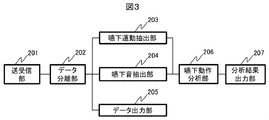
- the biometric information analysis device 2 may be an electronic device including an arithmetic processing unit and a memory, such as a general personal computer, a tablet, or a smartphone, and FIG. 3 illustrates functional blocks necessary for detecting the swallowing motion of the biometric information analysis device 2. An example is shown. Each functional block repeatedly executes the following processing during measurement execution.
- the transmission/reception unit 201 transmits/receives information (measurement data reception, control command transmission) to/from the measurement unit 1 in a data communication method/data format defined in advance.
- the received measurement data is sent to the data separation unit 202.
- the data separating unit 202 separates the inter-coil voltage information and the sound voltage information from the received data, converts the inter-coil voltage information into distance data, and sends the sound voltage information to the swallowing motion extracting unit 203 and the sound voltage information to the swallowing sound extracting unit 204. Send. Further, the separated distance data and sound voltage information are output to the data output unit 205.
- the conversion from the voltage information between the coils to the distance data may be obtained from, for example, a general relational expression between the magnetic force and the distance in which the magnetic amount of the coil used is applied. The value and the voltage value at a predetermined distance may be recorded and corrected, which has the effect of enabling accurate distance data calculation.
- the data transmission format from the measurement unit 1 to the biometric information analysis device 2 may be, for example, the inter-coil voltage information and the sound voltage information transmitted separately. If it is information, it is converted to distance information and output to the swallowing motion extraction unit 203. If the received data is sound voltage information, it is output to the swallowing sound extraction unit 204 as it is, and any data is output to the data output unit 205. It becomes processing to do.
- the swallowing motion extracting unit 203 and the swallowing sound extracting unit 204 are swallowing motion estimating units that analyze the distance information and the sound information to estimate the user's motion. Hereinafter, each will be described in detail.
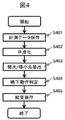
- the swallowing motion extraction unit 203 performs estimation processing of whether or not to perform swallowing motion from the distance data illustrated in FIG. 4 during measurement, and outputs swallowing motion information to the swallowing motion analysis unit 206 when the swallowing motion position is detected. ..
- the swallowing motion estimation process will be described with reference to FIGS. 4 and 5.
- FIG. 5 shows an example of changes in the distance information during the swallowing operation.
- the distance during swallowing movements shows movements according to the three phases of oral, pharyngeal, and esophageal movements, and the distance from the fixed position decreases, increases and decreases, and increases to return to the fixed position. , Behavior occurs. Therefore, it is necessary to detect the "W" shape from the obtained distance data.
- step (hereinafter abbreviated as S) 401 the swallowing motion extracting unit 203 saves the input distance data in a temporary memory (not shown in the figure) and transitions to S402.
- step (hereinafter abbreviated as S) 401 the swallowing motion extracting unit 203 saves the input distance data in a temporary memory (not shown in the figure) and transitions to S402.
- the swallowing motion extracting unit 203 The partial data recorded in the memory in S401 is acquired, the smoothing process (noise removal) is performed, the result is recorded in the memory again, and the process proceeds to S403.
- an average value of the latest measurement data for a predetermined number of times such as five times is calculated.
- the swallowing motion extraction unit 203 investigates whether the smoothed data calculated in S402 has a maximum point or a minimum point, and transitions to S404. For example, when the latest 5 smoothed data are read and arranged in order from the most recent value, D[i]( 1 ⁇ i ⁇ 5) is expressed, D[3] is the maximum value and D[1 ] ⁇ D[2] ⁇ D[3] and D[3] ⁇ D[4]>D[5], D[3] is set as a maximum point and D[3] Is a minimum value, and if D[1]>D[2] ⁇ D[3] and D[3] ⁇ D[4] ⁇ D[5], then D[3] is regarded as a minimum point. To do.
- the time and distance are recorded in the memory. Further, since the inflection point can be acquired from the increase/decrease of the first-order differential and second-order differential values of the smoothed data, the time and distance may be recorded in the memory.
- the swallowing motion extraction unit 203 determines the swallowing motion based on the information on the maximum point, the minimum point, the inflection point, and the distance information at the start of measurement, which are obtained in S403, and transitions to S405. As illustrated in FIG.
- the local maximum point and the minimum point existing within the above-mentioned defined range are characterized by the swallowing movement. You may choose as a point.
- the swallowing motion extraction unit 203 records the feature amount of the swallowing motion in the memory when it is determined in S404 that the swallowing motion is present, and ends the process.
- the feature amount is, for example, information on the time difference between the points, the time difference between T 1 and T 3 , the distance difference, and the like.
- the time information of the swallowing motion the starting point and the ending point of the operation ((T 0 , D 0 ), (T 4 , D 4 ) in FIG. 5), and the time difference (difference between T 0 and T 1 in FIG. 5)
- the difference between T 3 and T 4 ) and the distance difference may be included in the feature amount.
- the minimum points are discriminated as (T 1 , D 1 ), (T 3 , D 3 ), but the former is a decreasing tendency or an inflection point that changes from horizontal to rising, and the latter is a decreasing tendency to increasing.
- processing may be performed by detecting an inflection point that horizontally shifts.
- the judgment value of the time difference or the distance difference described above may be recorded in advance in the memory by an individual.
- a typical swallowing waveform (reference waveform) of an individual is recorded in advance, and the similarity with the reference waveform with respect to subsequent measurement results is evaluated by, for example, the similarity of general time series data such as a cross-correlation function.
- a method of estimating the swallowing position by examining the detection algorithm may be used.
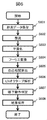
- the swallowing sound extraction unit 204 performs the process illustrated in FIG. 6 on the input swallowing sound data, estimates whether or not the swallowing operation is performed, and outputs swallowing sound information when the swallowing operation is detected. (Record to memory) An example of the estimation process will be described below based on the sequence diagram shown in FIG.
- the swallowing sound extraction unit 204 saves the input sound data in a temporary memory (not shown in the figure) and transitions to S602.
- the swallowing sound extraction unit 204 acquires the data recorded in S601, performs the rectification process, saves the processing result in the memory, and transitions to S603.
- the rectification process converts a negative value into a positive value.
- the swallowing sound extraction unit 204 acquires the partial data recorded in the memory in S602, performs the smoothing process, records the processing result in the memory, and transitions to S604.
- the smoothing process of the sound data the average value of the latest measurement data for a predetermined number of times such as 10 times is calculated. Increasing the amount of data to be smoothed has the effect of reducing the effect of minute noise, but at the same time it may reduce significant acoustic characteristics, so set an appropriate value according to the characteristics of the recording device. Just select it.
- the swallowing sound extraction unit 204 acquires the partial data recorded in S601, performs a Fourier transform process, and saves the processing result in the memory. Further, the frequency value indicating the highest peak excluding the orthogonal component from the Fourier transform result is recorded in the memory and the process proceeds to S605.
- the Fourier transform process may be performed on a predetermined latest recording data by a general method such as DFT (Discrete Fourier Transform) or FFT (Fast Fourier Transform).
- the amount of data to be processed can be short and long, such as 100 milliseconds (100 samples when recording at 1000 Hz) and 500 milliseconds (500 samples when recording at 1000 Hz). By performing both, it is possible to obtain parameters with different characteristics.
- the swallowing sound extraction unit 204 calculates autocorrelation information for the Fourier transform processing result recorded in S604, records the processing result in the memory, and transitions to S606.
- the autocorrelation is a method generally used in data analysis of a time domain signal or the like in signal processing, but in this method, it is used for a Fourier transform processing result (discrete signal Xn).
- the autocorrelation information includes, for example, lag values that take all the maximum points of the calculated autocorrelation value.
- the swallowing sound extraction unit 204 performs 1/n octave analysis on the Fourier transform result obtained in S604, records the result in the memory, and transitions to S607.
- the 1/n octave analysis is a general analysis method for acoustic data, and the data is divided into n frequency bands at a fixed ratio with 1 kHz as a reference, and the total value of the components included in each band is obtained.
- n is increased, a narrower feature amount for each bandwidth can be obtained.
- the sound data input to the swallowing sound extraction unit 204 has a sampling rate of 1000 Hz
- the swallowing sound extraction unit 204 calculates the swallowing sound information, determines the operation from the feature amount included in the swallowing sound information, records the result in the memory, and transitions to S608.
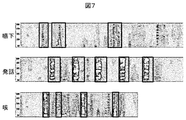
- FIG. 7 shows the result of Fourier transform of the sound information at the swallowing motion, the utterance motion, and the cough motion acquired at the sampling rate of 1000 Hz according to the time axis (horizontal axis) for each frequency band (vertical axis ) Shows a spectrumgram in which the intensities of) are continuously displayed. The intensity is highest in white, followed by black and gray. In each case, the part surrounded by a square frame is the time zone in which each operation is performed.
- the swallowing movement tends to have a relatively high intensity in the low frequency region, and the speech movement tends to show periodical strength and weakness in the frequency direction, and the coughing movement is strong in a wide band from a low frequency to a high frequency in a short time. Shows a tendency for peaks to occur.
- FIG. 8 shows a spectrumgram of sound information at the time of swallowing action, speech action, and coughing action acquired at a sampling rate of 4000 Hz, and a frame of implementation time zone of each action.
- the higher the sampling rate the easier the swallowing action can be separated into the oral phase, the pharyngeal phase, and the esophageal phase (corresponding to the early, intermediate, and late stages in the frame). That is, as shown in FIG. 8, in the swallowing motion, the intensity of the low frequency region is high in the intermediate period corresponding to the pharyngeal period, and the relative proportion of high frequency components (for example, 1 kHz to 2 kHz) is the oral period and the esophageal period.
- the coughing motion has a strong peak in a wide band up to about 500 Hz.
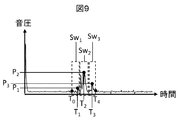
- FIG. 9 shows an example of changes in sound pressure during swallowing.
- the result of performing the rectification process on the input sound data is shown, in which the horizontal axis represents time and the vertical axis represents sound pressure.
- the sound pressure during the swallowing motion is separated into three sound sections that apply to the three phases of the swallowing motion, the oral phase, the pharyngeal phase, and the esophageal phase.
- the time zones Sw 1 , Sw 2 , and Sw 3 surrounded by the dotted lines in FIG. 9 respectively correspond to them, and there is a very short silent section between them. Therefore, when viewed as a time series, it is determined that the voiced sections sandwiching a short silent section are sounds generated from a series of operations. However, it is not always divided into three sections due to, for example, the influence of noise noise and the variety of swallowing motions. An example of a method of discriminating an operation based on these characteristics is shown below.
- the smoothed sound pressure value obtained in S603 of FIG. 6 is smaller than a predetermined value, it is determined that no operation has been performed in this section.
- the sound pressure value is larger than the predetermined value, it is considered that some operation is in progress, and the operation is discriminated using the feature amount obtained by the series of processes from S602 to S606.
- the autocorrelation information includes lag information in a predetermined frequency range (for example, 80 to 200 Hz), and a certain lag value and another lag value have a nearly double relationship, the utterance operation is performed. Determine.
- the autocorrelation information does not have such a relationship
- the sound pressure value is larger than a predetermined value
- the ratio of the data amount in the specific frequency region to the total data amount is higher than the predetermined value. If it is high, it is determined to be swallowing motion.
- the total value of the calculation results in the low frequency region for example, 11 to 22 Hz, 22 to 44 Hz, 44 to 88 Hz
- the determination may be made based on the ratio of the amount of data in the specific frequency band of the octave analysis result, and the method may be determined according to the sampling rate of the sound data to be recorded and the amount of data used for Fourier transform.
- the series of operations is determined. Since the time-series data of the motion discrimination result is obtained by the above-described processing, for example, the motion having the largest number of discrimination times is set as the estimation result of the series of motions.
- the estimation result may be the swallowing motion when the number of times that the swallowing motion is discriminated in the sequence of the motion discrimination results is included in a certain ratio or more and the data ratio in the high frequency region has a V-shaped tendency.
- a short silent section considered in the swallowing operation as a series, and when the short silent section occurs three or more times, the time May be regarded as a series of operation completion.
- the swallowing sound information includes, for example, the start time (T 0 in FIG. 9), the end time (T 4 in FIG. 9), the time at which the maximum peak occurs (T 2 in FIG. 9) and the peak value thereof (see FIG. 9). 9 P 2) or, (time and peak value of Sw 1) and the third section (Sw 3) ((T 1 in FIG. 9, P 1) a first section, (T 3, P 3) ) , etc. including. Further, a time difference (difference between T 0 and T 1 in FIG. 9, difference between T 1 and T 2 , difference between T 2 and T 3 , difference between T 3 and T 4 ) may be included in the feature amount. ..
- the data output unit 205 plots both the distance data and the sound data in the form of a waveform on a display as a waveform and visually presents the measured data value during the measurement, or controls an audio output device such as a speaker to output the sound data. Is output without processing and is presented aurally. As a result, it is possible to obtain the effect of allowing the user wearing the device and a person (for example, a medical worker or a caregiver) near the user to grasp the progress of the measurement.
- FIG. 10 shows an example of a screen display during the swallowing operation measurement by the data output unit 205.
- this display example both the distance data and the sound data are displayed on one screen. By displaying in this way, it is possible to intuitively confirm the simultaneity of the distance and the sound.
- the distance data is used as a reference scale (for example, “do”) for the distance value at the start of measurement
- sounds of different scales when movement occurs For example, if the distance is reduced, the scale is lowered, and if the distance is extended, the scale is raised. According to this, it is possible to obtain the effect that the user or a person in the vicinity can detect the possibility that there is an abnormality due to the fact that the user has swallowed and hears a tone color different from usual, by relying only on auditory information. ..
- the swallowing motion analysis unit 206 estimates the position of the swallowing motion from the swallowing motion information obtained from the swallowing motion extracting unit 203 and the swallowing sound information obtained from the swallowing sound extracting unit 204.
- an estimation method for example, the case where the start/end time of the swallowing motion information and the start/end time of the swallowing sound information overlap each other is estimated as the swallowing position. If there is no swallowing motion information at a time when swallowing sound information is present, it may be estimated as a swallowing position even if it cannot be determined as a reliable swallowing position. On the contrary, when there is no swallowing sound information at the time when the swallowing motion information is present, it is not necessary to determine the swallowing position. This estimation method may be determined according to the accuracy of each determination of motion information and sound information.
- the analysis result output unit 207 is instructed to output the result.
- the analysis result output unit 207 displays the analysis result on a display unit which is a display device such as a display or a display screen of a tablet.
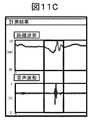
- a display method for example, the estimation result of the swallowing motion position is displayed on the waveform information as shown in FIG. 11A, B, and C are diagrams showing an example of the swallowing motion position estimation result display screen in the present embodiment.
- FIG. 11A is a display example in which a rectangle is superimposed on the distance waveform according to the start time/end time of the swallowing motion information, and a rectangle is superimposed on the voice waveform according to the start time/end time of the swallowing sound information. is there.
- FIG. 11A is a display example in which a rectangle is superimposed on the distance waveform according to the start time/end time of the swallowing motion information, and a rectangle is superimposed on the voice waveform according to the start time/end time of the swallowing sound information. is there.
- FIG. 11A is a display example in which a rectangle is superimposed on the
- FIG. 11B is a display example in which rectangles spanning the distance waveform and the voice waveform are superimposed according to the start time and end time of the swallowing sound information.
- FIG. 11C shows that the start time of the swallowing motion information and the start time of the swallowing sound information are earlier (the start time of the swallowing motion information in this example), the end time of the swallowing motion information and the end time of the swallowing sound information are later ( In the case of this example, it is a display example in which a rectangle extending over the distance waveform and the voice waveform is superimposed in accordance with the ending time of the swallowing sound information. In any of the display examples, there is an effect that it is possible to intuitively grasp the place of interest. In the case of FIG. 11A, the abnormality can be intuitively recognized from the degree of positional deviation between the rectangular position on the distance waveform and the rectangular position on the voice waveform.
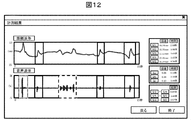
- the result display as shown in FIG. 12 is displayed.
- the operation determination result is displayed together with the waveform information.
- the solid line frame corresponds to the position corresponding to the swallowing motion and the swallowing sound
- the broken line frame corresponds to the position corresponding to the utterance sound
- the dotted line frame corresponds to the position corresponding to the cough sound.
- the characteristic amount of the swallowing motion obtained by the processing shown in FIGS. 4 and 6 is displayed as a numerical value.
- information on the start point M1, the first minimum point M2, the maximum point M3, the second minimum point M4, and the end point M5 of the swallowing motion (from (T 0 , D 0 in FIG. 5) to (T 4 , D 4 ) and the information of the first peak Ss, the second peak Sm, and the third peak Se of the swallowing sound information next to the voice waveform ((T 1 in FIG. 9, Information on distance and time corresponding to (T 3 , P 3 ) from P 1 ) is displayed.
- each feature amount of the swallowing motion detected first is displayed when the result screen is displayed.
- a different swallowing action position on the screen for example, clicking action with a mouse on a PC or tapping action on a tablet terminal
- it can be displayed by switching to each feature amount of the corresponding swallowing action.
- the user can check the characteristic quantities of all swallowing movements as necessary.
- the average value of the characteristic quantities of the swallowing motions of a plurality of times may be displayed, which has an effect of representing the overall swallowing result of the user.
- the time M3 (T 2 in FIG. 5) of the maximum value of the distance waveform of the swallowing motion information and the second peak Sm of the sound waveform are displayed.
- Value (M3-Sm) with respect to the time (T 2 in FIG. 9) the time from the start to the end of the swallowing movement (M5-M1) (difference between T 4 and T 0 in FIG. 5), the first minimum The time (M4 ⁇ M2) from the value to the second minimum value (difference between T 3 and T 1 in FIG. 5) is also displayed.
- the calculated values deviate from the previously stored healthy values by a predetermined value or more, the calculated values may be colored and displayed (for example, a red character string). This has the effect of making it possible to intuitively grasp the data to be noted.
- the present embodiment it is possible to accurately detect the swallowing motion and perform a real-time quantitative evaluation by the user of this device or a person in the vicinity (for example, a medical staff or a caregiver). The effect is obtained.
- the discrimination process of the swallowing action in the swallowing sound extraction unit 204 may be a method of extracting the parameters of the voice feature amount and then discriminating and analyzing the actions such as coughing, swallowing, utterance, and chewing.
- each operation such as coughing and swallowing using learning data and each parameter (smoothed sound pressure value, peak frequency of Fourier transform processing data, data amount of each band of octave analysis result, 1/n octave)
- the correlation coefficient with the ratio of the amount of data in each frequency region after analysis) is calculated in advance, and the probability (probability) of each operation is calculated from the calculation result of each parameter by periodic processing during measurement, and the This is a method of estimating that a highly probable operation should have been performed.
- the analysis of the swallowing sound shown in FIG. 6 does not necessarily have to be performed in this order.
- frequency analysis Frier transform, autocorrelation calculation, 1/n octave analysis
- sound pressure analysis rectification and smoothing
- the sound pressure analysis may be performed after the frequency analysis is performed first.
- the processing may be terminated without performing the frequency analysis, which has the effect of reducing the calculation time and the amount of calculation. ..
- swallowing motion determination can be performed more accurately.
- the swallowing operation analysis unit 206 may calculate information for assisting the determination of the presence/absence of the swallowing disorder and output the result to the analysis result output unit 207.
- FIG. 13 shows an example of a guideline that serves as a criterion for discriminating the degree of dysphagia. It is classified into 4 stages, including the normal state, and 10 stages in detail. Although such a degree judgment is performed by the doctor, it is possible to assist the judgment based on the quantitative data with the characteristic amounts of the swallowing motion information and the swallowing sound information calculated according to this embodiment and the calculation results using them. For example, the difference value between the maximum peak time (T 3 in FIG. 5) of the swallowing motion information, which is the detection result of the same swallowing motion, and the second peak time (T 3 in FIG.
- the swallowing sound information is a predetermined healthy judgment value.
- the possibility that the swallowing function is normal if it is smaller than a predetermined healthy judgment value, mild if it is smaller than a mild judgment value, and moderate if it is a mild judgment value or more is also shown on the screen.
- the judgment may be made based on the number of values exceeding the normal judgment value among a plurality of calculation results. For example, the difference value between the maximum peak times and the time from the start to the end of the swallowing movement (of T 4 and T 0 in FIG. 5). Difference), and a time from the first minimum value to the second minimum value (difference between T 3 and T 1 in FIG. 5), it is determined whether or not each of the three values falls within a predetermined healthy judgment value.
- a control signal is output from the analysis result output unit 207 to the measurement unit 1 via the transmission/reception unit 201.
- the measurement state may be indicated. For example, it emits blue light during measurement, and when it detects a swallowing movement, depending on the result of the determination of the degree of abnormality in the swallowing movement (green for normal, yellow for mild, orange for moderate, orange for severe) (Red) emit light.
- the degree of abnormality in the swallowing movement green for normal, yellow for mild, orange for moderate, orange for severe
- the biological information analyzer 2 may have a recording function, for example,
- the data received by the transmission/reception unit 201 is recorded in the recording medium in association with the information of the user and the information of the date and time when the measurement is performed.
- the recording medium may be a non-volatile medium such as HDD (Hard Disc Drive) or SSD (Solid State Drive).
- the biological information detecting device and the biological information detecting method described in the present embodiment are used for screening of a swallowing function
- how many times the swallowing operation can be performed within a predetermined measurement time for example, 30 seconds.
- a predetermined measurement time for example, 30 seconds.
- the position estimation result of the swallowing motion and the evaluation result of the number of swallowing motions and normal/abnormal swallowing function may be displayed.
- Whether or not the swallowing function is normal may be determined based on whether the swallowing operation has been performed a predetermined number of times (for example, 3 times) or more.
- an average value of all swallowing motion times may be displayed, or any of the parameters included in the swallowing motion information and the swallowing sound information may be calculated and displayed as an average value or a variance value.
- the dysphagia can be easily detected and the result can be displayed.
- the present invention is not limited to the above-described embodiments, but includes various modifications.
- the above-described embodiments have been described in detail in order to explain the present invention in an easy-to-understand manner, and are not necessarily limited to those having all the described configurations.
- each of the above-mentioned configurations, functions, processing units, processing means, etc. may be realized in hardware by designing a part or all of them with, for example, an integrated circuit. It can also be realized by software that realizes those functions.
- the program code is stored in a storage means such as a hard disk or a memory of a computer or a storage medium such as a CD-RW or a CD-R.
- a processor included in the computer may read and execute the program code stored in the storage unit or the storage medium.
Landscapes
- Health & Medical Sciences (AREA)
- Life Sciences & Earth Sciences (AREA)
- Physics & Mathematics (AREA)
- Engineering & Computer Science (AREA)
- Molecular Biology (AREA)
- General Health & Medical Sciences (AREA)
- Biophysics (AREA)
- Pathology (AREA)
- Veterinary Medicine (AREA)
- Biomedical Technology (AREA)
- Heart & Thoracic Surgery (AREA)
- Medical Informatics (AREA)
- Public Health (AREA)
- Surgery (AREA)
- Animal Behavior & Ethology (AREA)
- Physiology (AREA)
- Endocrinology (AREA)
- Gastroenterology & Hepatology (AREA)
- Dentistry (AREA)
- Oral & Maxillofacial Surgery (AREA)
- Mathematical Physics (AREA)
- Artificial Intelligence (AREA)
- Computer Vision & Pattern Recognition (AREA)
- Psychiatry (AREA)
- Signal Processing (AREA)
- Measurement Of The Respiration, Hearing Ability, Form, And Blood Characteristics Of Living Organisms (AREA)
Abstract
Description
Claims (15)
- 咽頭部の動きと音を計測した距離情報と音情報を分析してユーザの動作を推定する嚥下動作推定部と、
表示部を有し、
前記嚥下動作推定部は、前記距離情報を分析して推定した第1の嚥下動作位置と、前記音情報を分析して推定した第2の嚥下動作位置とを出力し、
前記表示部は、前記距離情報と、前記音情報と、前記嚥下動作推定部の出力する前記第1の嚥下動作位置と前記第2の嚥下動作位置を表示することを特徴とする生体情報分析装置。 - 請求項1に記載の生体情報分析装置であって、
前記嚥下動作推定部は、前記第1の嚥下動作位置と前記第2の嚥下動作位置との時間情報が重複する位置を嚥下動作位置と推定し、
前記表示部は、前記距離情報と、前記音情報と、前記推定した嚥下動作位置を表示することを特徴とする生体情報分析装置。 - 請求項1に記載の生体情報分析装置であって、
前記嚥下動作推定部は、前記距離情報の中から少なくとも所定の時間内に所定の量以上の距離の増加と減少の両方の事象が含まれている点を前記第1の嚥下動作位置と推定することを特徴とする生体情報分析装置。 - 請求項1に記載の生体情報分析装置であって、
前記嚥下動作推定部は、前記音情報の中から少なくとも周波数情報が所定の低周波領域のデータ量が一定割合以上である時間帯と、その前後に所定の高周波領域のデータ量が一定割合以上である時間帯とが含まれる点を前記第2の嚥下動作位置と推定することを特徴とする生体情報分析装置。 - 請求項1に記載の生体情報分析装置であって、
前記距離情報の嚥下動作時間内の変位量のピークと前記音情報の音圧変化量のピークの時間の一致度によって正しく嚥下が行われたことを判定し、前記表示部に判定結果を表示することを特徴とする生体情報分析装置。 - 咽頭部の動きと音を計測した距離情報と音情報を分析してユーザの動作を推定する嚥下動作推定ステップと、
表示ステップを有し、
前記嚥下動作推定ステップは、前記距離情報を分析して推定した第1の嚥下動作位置と、前記音情報を分析して推定した第2の嚥下動作位置とを出力し、
前記表示ステップは、前記距離情報と、前記音情報と、前記嚥下動作推定ステップで出力した前記第1の嚥下動作位置と前記第2の嚥下動作位置を表示することを特徴とする生体情報分析方法。 - 請求項6に記載の生体情報分析方法であって、
前記嚥下動作推定ステップは、前記第1の嚥下動作位置と前記第2の嚥下動作位置との時間情報が重複する位置を嚥下動作位置と推定するステップを有し、
前記表示ステップは、前記距離情報と、前記音情報と、前記推定した嚥下動作位置を表示することを特徴とする生体情報分析方法。 - 請求項6に記載の生体情報分析方法であって、
前記嚥下動作推定ステップは、前記距離情報の中から少なくとも所定の時間内に所定の量以上の距離の増加と減少の両方の事象が含まれている点を前記第1の嚥下動作位置と推定することを特徴とする生体情報分析方法。 - 請求項6に記載の生体情報分析方法であって、
前記嚥下動作推定ステップは、前記音情報の中から少なくとも周波数情報が所定の低周波領域のデータ量が一定割合以上である時間帯と、その前後に所定の高周波領域のデータ量が一定割合以上である時間帯とが含まれる点を前記第2の嚥下動作位置と推定することを特徴とする生体情報分析方法。 - 請求項6に記載の生体情報分析方法であって、
前記距離情報の嚥下動作時間内の変位量のピークと前期音情報の音圧変化量のピークの時間の一致度によって正しく嚥下が行われたことを判定するステップと、
前記表示ステップは、前記判定の結果を表示することを特徴とする生体情報分析方法。 - 計測部と生体情報分析装置を有する生体情報分析システムであって、
前記計測部は、咽頭部の動きを計測し距離情報を取得する距離情報取得部と、咽頭部の動きに対応する音を計測し音情報を取得する音情報取得部とを有し、
前記生体情報分析装置は、前記計測部の距離情報取得部と音情報取得部から得られた前記距離情報と前記音情報を分析してユーザの動作を推定する嚥下動作推定部と、表示部を有し、
前記嚥下動作推定部は、前記距離情報を分析して推定した第1の嚥下動作位置と、前記音情報を分析して推定した第2の嚥下動作位置とを出力し、
前記表示部は、前記距離情報と、前記音情報と、前記嚥下動作推定部の出力する前記第1の嚥下動作位置と前記第2の嚥下動作位置を表示することを特徴とする生体情報分析システム。 - 請求項11に記載の生体情報分析システムであって、
前記嚥下動作推定部は、前記第1の嚥下動作位置と前記第2の嚥下動作位置との時間情報が重複する位置を嚥下動作位置と推定し、
前記表示部は、前記距離情報と、前記音情報と、前記推定した嚥下動作位置を表示することを特徴とする生体情報分析システム。 - 請求項11に記載の生体情報分析システムであって、
前記嚥下動作推定部は、前記距離情報の中から少なくとも所定の時間内に所定の量以上の距離の増加と減少の両方の事象が含まれている点を前記第1の嚥下動作位置と推定することを特徴とする生体情報分析システム。 - 請求項11に記載の生体情報分析システムであって、
前記嚥下動作推定部は、前記音情報の中から少なくとも周波数情報が所定の低周波領域のデータ量が一定割合以上である時間帯と、その前後に所定の高周波領域のデータ量が一定割合以上である時間帯とが含まれる点を前記第2の嚥下動作位置と推定することを特徴とする生体情報分析システム。 - 請求項11に記載の生体情報分析システムであって、
前記距離情報の嚥下動作時間内の変位量のピークと前期音情報の音圧変化量のピークの時間の一致度によって正しく嚥下が行われたことを判定し、前記表示部に判定結果を表示することを特徴とする生体情報分析システム。
Priority Applications (5)
| Application Number | Priority Date | Filing Date | Title |
|---|---|---|---|
| JP2020562269A JP7165209B2 (ja) | 2018-12-28 | 2018-12-28 | 生体情報分析装置、生体情報分析方法、及び、生体情報分析システム |
| US17/418,153 US12478315B2 (en) | 2018-12-28 | 2018-12-28 | Biological information analysis device, biological information analysis method, and biological information analysis system |
| PCT/JP2018/048457 WO2020136870A1 (ja) | 2018-12-28 | 2018-12-28 | 生体情報分析装置、生体情報分析方法、及び、生体情報分析システム |
| CN202410524592.0A CN118340517A (zh) | 2018-12-28 | 2018-12-28 | 生物体信息分析装置、生物体信息分析方法、以及生物体信息分析系统 |
| CN201880100497.0A CN113226173B (zh) | 2018-12-28 | 2018-12-28 | 生物体信息分析装置、生物体信息分析方法、以及生物体信息分析系统 |
Applications Claiming Priority (1)
| Application Number | Priority Date | Filing Date | Title |
|---|---|---|---|
| PCT/JP2018/048457 WO2020136870A1 (ja) | 2018-12-28 | 2018-12-28 | 生体情報分析装置、生体情報分析方法、及び、生体情報分析システム |
Publications (1)
| Publication Number | Publication Date |
|---|---|
| WO2020136870A1 true WO2020136870A1 (ja) | 2020-07-02 |
Family
ID=71127837
Family Applications (1)
| Application Number | Title | Priority Date | Filing Date |
|---|---|---|---|
| PCT/JP2018/048457 Ceased WO2020136870A1 (ja) | 2018-12-28 | 2018-12-28 | 生体情報分析装置、生体情報分析方法、及び、生体情報分析システム |
Country Status (4)
| Country | Link |
|---|---|
| US (1) | US12478315B2 (ja) |
| JP (1) | JP7165209B2 (ja) |
| CN (2) | CN113226173B (ja) |
| WO (1) | WO2020136870A1 (ja) |
Families Citing this family (4)
| Publication number | Priority date | Publication date | Assignee | Title |
|---|---|---|---|---|
| JP1662391S (ja) * | 2019-11-21 | 2020-06-29 | ||
| JP7709413B2 (ja) * | 2022-07-14 | 2025-07-16 | パラマウントベッド株式会社 | データ処理装置、介護支援システム、及び、データ処理方法 |
| CN119576139B (zh) * | 2025-02-08 | 2025-07-15 | 荣耀终端股份有限公司 | 热量摄入信息的检测方法、电子设备及系统 |
| CN120713764A (zh) * | 2025-08-15 | 2025-09-30 | 温州医科大学附属第一医院 | 一种用于放射性口腔黏膜炎的温控注食器及相关方法 |
Citations (7)
| Publication number | Priority date | Publication date | Assignee | Title |
|---|---|---|---|---|
| JP2008301895A (ja) * | 2007-06-05 | 2008-12-18 | Hitachi Ltd | 生体検査装置 |
| JP2009213592A (ja) * | 2008-03-10 | 2009-09-24 | Hitachi Computer Peripherals Co Ltd | 生体検査装置 |
| JP2012200300A (ja) * | 2011-03-24 | 2012-10-22 | Mie Prefecture | 嚥下運動測定システム |
| JP2016185209A (ja) * | 2015-03-27 | 2016-10-27 | Necソリューションイノベータ株式会社 | 嚥下検出装置、嚥下検出方法およびプログラム |
| JP2017038840A (ja) * | 2015-08-21 | 2017-02-23 | 住友電気工業株式会社 | 嚥下運動モニタリングセンサ |
| WO2017033228A1 (ja) * | 2015-08-21 | 2017-03-02 | 住友電気工業株式会社 | 嚥下運動モニタリングセンサ |
| JP2018130199A (ja) * | 2017-02-14 | 2018-08-23 | 学校法人昭和大学 | 嚥下検出装置 |
Family Cites Families (8)
| Publication number | Priority date | Publication date | Assignee | Title |
|---|---|---|---|---|
| JP4727253B2 (ja) * | 2004-08-05 | 2011-07-20 | サッポロビール株式会社 | 連続嚥下運動測定装置及び連続嚥下運動測定方法 |
| JP4011071B2 (ja) | 2005-03-25 | 2007-11-21 | 中央電子株式会社 | 嚥下音解析システム |
| JP5489846B2 (ja) | 2010-04-30 | 2014-05-14 | 三栄源エフ・エフ・アイ株式会社 | 易嚥下性組成物の評価または選別方法 |
| JP5952536B2 (ja) | 2011-07-12 | 2016-07-13 | 国立大学法人 筑波大学 | 嚥下機能データ測定装置及び嚥下機能データ測定システム及び嚥下機能データ測定方法 |
| TW201408261A (zh) * | 2012-08-31 | 2014-03-01 | Jian-Zhang Xu | 肌無力症吞嚥困難鑑別裝置 |
| EP3284407B1 (en) * | 2013-08-26 | 2018-12-05 | Hyogo College Of Medicine | Swallowing estimation device, information terminal device, and program |
| WO2017002901A1 (ja) * | 2015-06-30 | 2017-01-05 | 学校法人兵庫医科大学 | 嚥下障害検査装置、嚥下障害検査方法、嚥下障害治療装置および刺激電流設定方法 |
| WO2018180778A1 (ja) | 2017-03-29 | 2018-10-04 | 株式会社村田製作所 | 嚥下センサ |
-
2018
- 2018-12-28 US US17/418,153 patent/US12478315B2/en active Active
- 2018-12-28 CN CN201880100497.0A patent/CN113226173B/zh active Active
- 2018-12-28 CN CN202410524592.0A patent/CN118340517A/zh active Pending
- 2018-12-28 WO PCT/JP2018/048457 patent/WO2020136870A1/ja not_active Ceased
- 2018-12-28 JP JP2020562269A patent/JP7165209B2/ja active Active
Patent Citations (7)
| Publication number | Priority date | Publication date | Assignee | Title |
|---|---|---|---|---|
| JP2008301895A (ja) * | 2007-06-05 | 2008-12-18 | Hitachi Ltd | 生体検査装置 |
| JP2009213592A (ja) * | 2008-03-10 | 2009-09-24 | Hitachi Computer Peripherals Co Ltd | 生体検査装置 |
| JP2012200300A (ja) * | 2011-03-24 | 2012-10-22 | Mie Prefecture | 嚥下運動測定システム |
| JP2016185209A (ja) * | 2015-03-27 | 2016-10-27 | Necソリューションイノベータ株式会社 | 嚥下検出装置、嚥下検出方法およびプログラム |
| JP2017038840A (ja) * | 2015-08-21 | 2017-02-23 | 住友電気工業株式会社 | 嚥下運動モニタリングセンサ |
| WO2017033228A1 (ja) * | 2015-08-21 | 2017-03-02 | 住友電気工業株式会社 | 嚥下運動モニタリングセンサ |
| JP2018130199A (ja) * | 2017-02-14 | 2018-08-23 | 学校法人昭和大学 | 嚥下検出装置 |
Also Published As
| Publication number | Publication date |
|---|---|
| JPWO2020136870A1 (ja) | 2021-10-14 |
| CN113226173A (zh) | 2021-08-06 |
| JP7165209B2 (ja) | 2022-11-02 |
| CN113226173B (zh) | 2024-05-14 |
| US20220054078A1 (en) | 2022-02-24 |
| US12478315B2 (en) | 2025-11-25 |
| CN118340517A (zh) | 2024-07-16 |
Similar Documents
| Publication | Publication Date | Title |
|---|---|---|
| US20260069161A1 (en) | Managing respiratory conditions based on sounds of the respiratory system | |
| JP5952536B2 (ja) | 嚥下機能データ測定装置及び嚥下機能データ測定システム及び嚥下機能データ測定方法 | |
| JP5055502B2 (ja) | 生体検査装置 | |
| JP5977255B2 (ja) | 嚥下障害検出装置及びその作動方法 | |
| CN109273085B (zh) | 病理呼吸音库的建立方法、呼吸疾病的检测系统及处理呼吸音的方法 | |
| JP5093537B2 (ja) | 音情報判定支援方法、音情報判定方法、音情報判定支援装置、音情報判定装置、音情報判定支援システム及びプログラム | |
| TWI533843B (zh) | 吞嚥推定裝置 | |
| JP7165209B2 (ja) | 生体情報分析装置、生体情報分析方法、及び、生体情報分析システム | |
| JP4011071B2 (ja) | 嚥下音解析システム | |
| JPWO2010044162A1 (ja) | 無呼吸検出プログラムおよび無呼吸検出装置 | |
| CN113329683A (zh) | 用于筛查吞咽受损的方法和装置 | |
| JP6742620B2 (ja) | 嚥下診断装置およびプログラム | |
| Ang et al. | Characterization and cross-comparison of digital stethoscopes for telehealth remote patient auscultation | |
| JP2019051129A (ja) | 嚥下機能解析システム及びプログラム | |
| JP2012205693A (ja) | 呼吸音解析装置、呼吸音解析方法、および呼吸音解析プログラム | |
| JP2020529234A (ja) | 嚥下障害分類モデルの信号品質を判定するための方法及びデバイス | |
| JP6727595B1 (ja) | 嚥下能力評価システム、嚥下能力評価方法及び嚥下能力評価プログラム | |
| KR101144948B1 (ko) | Egg를 이용한 음정교정장치 | |
| Jayatilake et al. | Swallowscope: A smartphone based device for the assessment of swallowing ability | |
| US20240099685A1 (en) | Detection of diseases and viruses by ultrasonic frequency | |
| CN121015220A (zh) | 一种穿戴式肠鸣音监测系统 | |
| CN114828742A (zh) | 控制装置、控制系统以及控制方法 |
Legal Events
| Date | Code | Title | Description |
|---|---|---|---|
| 121 | Ep: the epo has been informed by wipo that ep was designated in this application |
Ref document number: 18944563 Country of ref document: EP Kind code of ref document: A1 |
|
| ENP | Entry into the national phase |
Ref document number: 2020562269 Country of ref document: JP Kind code of ref document: A |
|
| NENP | Non-entry into the national phase |
Ref country code: DE |
|
| 122 | Ep: pct application non-entry in european phase |
Ref document number: 18944563 Country of ref document: EP Kind code of ref document: A1 |
|
| WWG | Wipo information: grant in national office |
Ref document number: 17418153 Country of ref document: US |