WO2020130056A1 - 直鎖モノオレフィンの製造方法及び化合物の製造方法 - Google Patents
直鎖モノオレフィンの製造方法及び化合物の製造方法 Download PDFInfo
- Publication number
- WO2020130056A1 WO2020130056A1 PCT/JP2019/049702 JP2019049702W WO2020130056A1 WO 2020130056 A1 WO2020130056 A1 WO 2020130056A1 JP 2019049702 W JP2019049702 W JP 2019049702W WO 2020130056 A1 WO2020130056 A1 WO 2020130056A1
- Authority
- WO
- WIPO (PCT)
- Prior art keywords
- catalyst
- reaction
- isomerization
- linear monoolefin
- linear
- Prior art date
- Legal status (The legal status is an assumption and is not a legal conclusion. Google has not performed a legal analysis and makes no representation as to the accuracy of the status listed.)
- Ceased
Links
Classifications
-
- C—CHEMISTRY; METALLURGY
- C07—ORGANIC CHEMISTRY
- C07C—ACYCLIC OR CARBOCYCLIC COMPOUNDS
- C07C45/00—Preparation of compounds having >C = O groups bound only to carbon or hydrogen atoms; Preparation of chelates of such compounds
- C07C45/49—Preparation of compounds having >C = O groups bound only to carbon or hydrogen atoms; Preparation of chelates of such compounds by reaction with carbon monoxide
- C07C45/50—Preparation of compounds having >C = O groups bound only to carbon or hydrogen atoms; Preparation of chelates of such compounds by reaction with carbon monoxide by oxo-reactions
-
- B—PERFORMING OPERATIONS; TRANSPORTING
- B01—PHYSICAL OR CHEMICAL PROCESSES OR APPARATUS IN GENERAL
- B01J—CHEMICAL OR PHYSICAL PROCESSES, e.g. CATALYSIS OR COLLOID CHEMISTRY; THEIR RELEVANT APPARATUS
- B01J29/00—Catalysts comprising molecular sieves
- B01J29/04—Catalysts comprising molecular sieves having base-exchange properties, e.g. crystalline zeolites
- B01J29/06—Crystalline aluminosilicate zeolites; Isomorphous compounds thereof
- B01J29/40—Crystalline aluminosilicate zeolites; Isomorphous compounds thereof of the pentasil type, e.g. types ZSM-5, ZSM-8 or ZSM-11, as exemplified by patent documents US3702886, GB1334243 and US3709979, respectively
-
- C—CHEMISTRY; METALLURGY
- C07—ORGANIC CHEMISTRY
- C07B—GENERAL METHODS OF ORGANIC CHEMISTRY; APPARATUS THEREFOR
- C07B61/00—Other general methods
-
- C—CHEMISTRY; METALLURGY
- C07—ORGANIC CHEMISTRY
- C07C—ACYCLIC OR CARBOCYCLIC COMPOUNDS
- C07C5/00—Preparation of hydrocarbons from hydrocarbons containing the same number of carbon atoms
- C07C5/22—Preparation of hydrocarbons from hydrocarbons containing the same number of carbon atoms by isomerisation
- C07C5/23—Rearrangement of carbon-to-carbon unsaturated bonds
- C07C5/25—Migration of carbon-to-carbon double bonds
- C07C5/2506—Catalytic processes
- C07C5/2518—Catalytic processes with crystalline alumino-silicates, e.g. molecular sieves
-
- C—CHEMISTRY; METALLURGY
- C07—ORGANIC CHEMISTRY
- C07C—ACYCLIC OR CARBOCYCLIC COMPOUNDS
- C07C5/00—Preparation of hydrocarbons from hydrocarbons containing the same number of carbon atoms
- C07C5/32—Preparation of hydrocarbons from hydrocarbons containing the same number of carbon atoms by dehydrogenation with formation of free hydrogen
- C07C5/327—Formation of non-aromatic carbon-to-carbon double bonds only
- C07C5/333—Catalytic processes
-
- C—CHEMISTRY; METALLURGY
- C07—ORGANIC CHEMISTRY
- C07C—ACYCLIC OR CARBOCYCLIC COMPOUNDS
- C07C5/00—Preparation of hydrocarbons from hydrocarbons containing the same number of carbon atoms
- C07C5/42—Preparation of hydrocarbons from hydrocarbons containing the same number of carbon atoms by dehydrogenation with a hydrogen acceptor
- C07C5/48—Preparation of hydrocarbons from hydrocarbons containing the same number of carbon atoms by dehydrogenation with a hydrogen acceptor with oxygen as an acceptor
-
- C—CHEMISTRY; METALLURGY
- C07—ORGANIC CHEMISTRY
- C07C—ACYCLIC OR CARBOCYCLIC COMPOUNDS
- C07C2529/00—Catalysts comprising molecular sieves
- C07C2529/04—Catalysts comprising molecular sieves having base-exchange properties, e.g. crystalline zeolites, pillared clays
- C07C2529/06—Crystalline aluminosilicate zeolites; Isomorphous compounds thereof
- C07C2529/40—Crystalline aluminosilicate zeolites; Isomorphous compounds thereof of the pentasil type, e.g. types ZSM-5, ZSM-8 or ZSM-11
Definitions
- the present invention relates to a method for producing a linear monoolefin.
- the invention also relates to a process for producing compounds derived from linear monoolefins.
- Linear monoolefins having one double bond in the molecule are useful as basic chemical raw materials in the petrochemical industry, but their use depends on the position of the double bond in the molecule.
- the internal olefin having a double bond inside is used, for example, as a reaction raw material for hydrogenation, alkylation and the like.
- the terminal olefin having a double bond at the terminal is used for reactions such as dehydrogenation, hydroformylation and oligomerization.
- C4 to C8 terminal olefins eg, 1-butene, 1-hexene and 1-octane
- LLDPE linear low density polyethylene
- 1-butene is also used for the production of butadiene, 1-polybutene, butene oxide.
- a straight chain olefin having a double bond at the end (eg, 1-butene) is produced, for example, by catalytically isomerizing a corresponding straight chain olefin having a double bond at the end (eg, 2-butene). be able to.
- Patent Documents 1 to 5 disclose a catalytic reaction for isomerizing a linear olefin having an internal double bond to a linear olefin having a terminal double bond.
- the conventional olefin position isomerization method using an isomerization catalyst is such that the product purity is lowered due to the progress of side reactions or the yield is insufficient in an environment where oxygen or water is substantially present.
- drawbacks such as the presence of a catalyst and the catalyst being significantly deteriorated, which makes it difficult to use industrially.
- One aspect of the present invention is to provide a raw material composition containing a first linear monoolefin having 4 to 8 carbon atoms in the presence of molecular oxygen in an amount of 20 ppm by volume or more and/or water in an amount of 20 ppm by volume or more.
- Performing a isomerization reaction by contacting with an isomerization catalyst at ⁇ 390° C. to isomerize at least a part of the first linear monoolefin to a second linear monoolefin having a different double bond position.
- the present invention relates to a method for producing a linear monoolefin.
- the catalyst contains zeolite.
- the CO 2 selectivity in the isomerization reaction may be 0.001% or more and 0.09% or less.
- the first linear monoolefin and the second linear monoolefin may have 4 carbon atoms.
- the isomerization reaction may be a gas-solid catalytic reaction.
- Another aspect of the present invention is to provide a first raw material composition containing a first linear monoolefin having 4 to 8 carbon atoms with 20 volume ppm or more of molecular oxygen and/or 20 volume ppm or more of water.
- the isomerization reaction is carried out by contacting an isomerization catalyst at 250 to 390° C., and at least a part of the first linear monoolefin is converted into a second linear monoolefin having a different double bond position.
- the catalyst contains zeolite.
- the CO 2 selectivity in the isomerization reaction may be 0.001% or more and 0.09% or less.
- the second step may be a step of contacting the second raw material composition with a dehydrogenation catalyst to obtain a conjugated diene by a dehydrogenation reaction of the second linear monoolefin.
- the second step may be a step of contacting the second raw material composition with a hydroformylation catalyst to obtain an aldehyde by the hydroformylation reaction of the second linear monoolefin.
- Still another aspect of the present invention is to provide a raw material composition containing a first linear monoolefin having 4 to 8 carbon atoms with 20 ppm by volume or more of molecular oxygen and/or 20 ppm by volume or more of water.
- the present invention relates to a method for producing a compound, which comprises a step of contacting with a catalyst group containing an isomerization catalyst at 250 to 390° C. to obtain a compound derived from the isomerized product of the first linear monoolefin.
- the catalyst contains zeolite.
- the catalyst group may further include a dehydrogenation catalyst and the compound may be a conjugated diene.
- the catalyst group may further include a hydroformylation catalyst and the compound may be an aldehyde.
- a manufacturing method is provided. Further, according to the present invention, there is provided a method for producing a compound, which comprises reacting a linear monoolefin after isomerization to obtain a compound derived from the linear monoolefin.
- a raw material composition containing a first linear monoolefin having 4 to 8 carbon atoms is used, and 20 ppm by volume or more of molecular oxygen (O 2 ) and/or
- the isomerization reaction is carried out by contacting the isomerization catalyst at 250 to 390° C. in the presence of 20 vol ppm or more of water (steam), and at least a part of the first linear monoolefin is different in double bond position
- a step of isomerizing to a second linear monoolefin is provided.
- the catalyst comprises zeolite.
- isomerization of linear monoolefins for example, the isomerization of 2-butene to 1-butene is limited by the thermodynamic equilibrium of the n-butene isomers. It is known that the maximum achievable concentration of 1-butene in n-butene is about 22% at 400°C and about 30% at 500°C due to thermodynamic equilibrium in a single reactor pass. (For example, Japanese Patent Laid-Open No. 8-224470).
- isomerization can be achieved at a level close to the theoretical value (for example, 70% or more of the theoretical value) even in the presence of oxygen and water, Further, the catalytic activity is maintained for a long period of time.
- the method for producing a linear monoolefin according to this embodiment is carried out in the presence of oxygen and/or water.
- the isomerization reaction using a conventional isomerization catalyst it is usually carried out in an environment where oxygen and water do not exist (in particular, oxygen does not exist), and when oxygen exists, a complete oxidation reaction, etc. Many side reactions occur and it is difficult to selectively proceed the isomerization of olefins.
- the method for producing a linear monoolefin according to the present embodiment since the side reaction is sufficiently suppressed, it is possible to efficiently proceed the olefin isomerization reaction, and since the catalyst has excellent durability, The isomerization reaction can be carried out for a long period of time.
- the olefin isomerization reaction proceeds efficiently even in the presence of oxygen and/or water.
- the raw material can be supplied without removing water and is extremely advantageous in the process.
- the method for producing a linear monoolefin according to this embodiment can be performed in parallel with another reaction that consumes the second linear olefin after isomerization.
- the isomerization catalyst used in the production method according to the present embodiment can efficiently proceed the isomerization reaction even in the presence of oxygen and/or water
- the other reaction described above is Alternatively, a reaction that proceeds in the presence of water can be selected.
- oxidative dehydrogenation of olefins, hydroformylation of olefins, and the like can be selected as the other reactions described above.
- the isomerization catalyst and the other reaction catalyst may be mixed to carry out the isomerization reaction and the other reaction at the same time.
- the second linear monoolefin is consumed by another reaction, and the second linear monoolefin is produced by the isomerization reaction in accordance with the thermodynamic equilibrium. The reactivity can be improved.
- the number of carbon atoms of the first linear monoolefin may be 4 to 8 or may be 4.
- the first linear monoolefin may be an internal olefin or a terminal olefin.
- the first linear monoolefin is, for example, 1-butene, trans-2-butene, cis-2-butene, 1-pentene, 2-pentene, 1-hexene, 2-hexene, 3-hexene, 1-octene. It may be a linear monoolefin selected from the group consisting of, 2-octene, 3-octene and 4-octene. As the first linear monoolefin, one kind may be used alone, or two or more kinds may be used in combination.
- the first linear monoolefin may have a substituent containing a hetero atom such as oxygen, nitrogen, halogen or sulfur.
- substituents include, for example, halogen atoms (-F, -Cl, -Br, -I), hydroxyl groups (-OH), alkoxy groups (-OR), carboxyl groups (-COOH), ester groups (-COOR). ), an aldehyde group (—CHO) and an acyl group (—C( ⁇ O)R).
- the raw material containing the linear monoolefin having a substituent may be, for example, an alcohol, an ether, or a biofuel.
- the first linear monoolefin it is not necessary to use the isolated linear monoolefin itself, and it can be used in the form of an arbitrary mixture as needed.
- the raw material composition may be a C4 fraction obtained by fluid catalytic cracking of a heavy oil fraction, and a C4 fraction obtained by thermal cracking of naphtha. Good.
- the raw material composition may contain components other than the first linear monoolefin.
- the other component may be, for example, an isomerized product of the first linear monoolefin (which may include the second linear monoolefin), a saturated hydrocarbon compound, or a diene.
- the saturated hydrocarbon compound and the diene may have, for example, the same carbon number as the first linear monoolefin.
- the saturated hydrocarbon compound may be, for example, n-butane or cyclobutane.
- the diene may be, for example, butadiene.
- the raw material composition containing the first linear monoolefin may contain impurities such as hydrogen, nitrogen, carbon monoxide, carbon dioxide, and methane as long as the effects of the present invention are not impaired.
- impurities such as hydrogen, nitrogen, carbon monoxide, carbon dioxide, and methane as long as the effects of the present invention are not impaired.
- a raw material composed only of linear monoolefin may be used.
- the concentration of the first linear monoolefin in the raw material composition is not particularly limited, but the higher the concentration of the first linear monoolefin in the raw material composition, the better the economic efficiency. ..
- the second linear monoolefin has an isomer relationship in which the double bond position is different from that of the first linear monoolefin.
- Examples of the second linear monoolefin include the compounds exemplified as the first linear monoolefin.
- the second linear monoolefin may be an internal olefin and may be a terminal olefin.
- the first linear monoolefin may be an internal olefin and the second linear monoolefin may be a terminal olefin.
- the first linear monoolefin may be 2-butene and the second linear monoolefin may be 1-butene.
- the isomerization catalyst according to this embodiment will be described in detail below.
- the isomerization catalyst is a solid catalyst that catalyzes the isomerization reaction of linear monoolefins (positional isomerization of olefins) and includes zeolite.
- the crystalline aluminosilicate which is generically called zeolite, has a micro space (nano space) of molecular size in one crystal.
- zeolites classified according to their crystal structures such as LTA (A type), MFI (ZSM-5 type), MOR, BEA, FER, FAU (X type, Y type), SAPO, and ALPO. ..
- the isomerization catalyst may contain any one kind of these zeolites, and may contain two or more kinds of zeolites.
- the molar ratio of Si to Al may be 5 or more, 100 or more, and 200 or more. Further, the molar ratio (Si/Al) may be 10,000 or less, 3000 or less, or 2000 or less.
- the isomerization catalyst having such a ratio tends to more significantly suppress the catalyst deterioration in the presence of oxygen and/or water.
- the isomerization catalyst may be zeolite carrying a metal element.
- the supported metal element (hereinafter, also referred to as a supported metal element) is not particularly limited, and may be, for example, an alkali metal, an alkaline earth metal, or a transition metal.
- the method of supporting the supported metal element is not particularly limited, and may be, for example, an impregnation method, a deposition method, a coprecipitation method, a kneading method, an ion exchange method, or a pore filling method.
- the source of the supported metal element may be, for example, an oxide, a nitrate, a carbonate, an ammonium salt, a hydroxide, a carboxylate, a carboxylate ammonium salt, an ammonium halide salt, a hydrogen acid (eg, chloroplatinic acid (H 2 It may be at least one selected from the group consisting of PtCl 6 )), acetylacetonate and alkoxide.
- a hydrogen acid eg, chloroplatinic acid (H 2 It may be at least one selected from the group consisting of PtCl 6 )
- the content of the supported metal element in the isomerization catalyst is not particularly limited, and may be, for example, 0.01 to 100 parts by mass, or 0.1 to 50 parts by mass with respect to 100 parts by mass of the inorganic oxide. Good.
- the content of the supported metal element can be determined by the inductively coupled plasma emission spectroscopy (ICP emission spectroscopy).
- ammonia-temperature programmed desorption method (ammonia TPD, NH 3 -TPD, Ammonium Temperature Programmed Desorption) is widely known.
- ammonia TPD ammonia TPD
- NH 3 -TPD Ammonium Temperature Programmed Desorption
- the ammonia TPD method is to adsorb ammonia, which is a base probe molecule, on a solid of a sample, and to simultaneously measure the amount and temperature of desorbed ammonia by continuously increasing the temperature.
- Ammonia adsorbed at weak acid sites is desorbed at low temperature (corresponding to desorption in the low adsorption heat range), and ammonia adsorbed at strong acid sites is desorbed at high temperature (in the high adsorption heat range). Equivalent to the detachment of).
- the acid strength is indicated by the temperature and the heat of adsorption and the color reaction is not used, so the solid acid strength and the solid acid amount are more accurate values, and the isomerization catalyst Characteristic evaluation can be appropriately performed.
- the amount of acid points (acid amount) of the isomerization catalyst can be determined by the ammonia TPD method, which measures the adsorption amount of ammonia with the device and the measurement conditions described in "Niwa; Zeolite, 10,175 (1993)". ..
- the amount of total acid points (total acid amount) A 1 of the isomerization catalyst may be 0.11 mmol/g or less, may be 0.09 mmol/g or less, and may be 0.03 mmol/g or less. , 0.015 mmol/g or less, and may be 0.010 mmol/g or less.
- the total acid amount A 1 of the isomerization catalyst may be 0.001 mmol/g or more, and may be 0.003 mmol/g or more.
- the ratio A 2 / A 1 of the quantity A 2 of acid sites measured in the temperature range of above 600 ° C. may be 0.03 or more, 0.05 or more , May be 0.08 or more, may be 0.1 or more, and may be 0.15 or more.
- the ratio A 2 /A 1 is in the above range, skeletal isomerization, side reactions such as CO 2 production, and catalyst deterioration due to coke precipitation tend to be suppressed.
- the ratio A 2 /A 1 may be 1 or less, and may be 0.7 or less.
- the isomerization catalyst may be calcined if necessary.
- the firing may be performed in one step or in multiple steps of two or more steps.
- the firing temperature is not particularly limited. When firing is performed in one step, the firing temperature may be, for example, 200 to 600°C.
- the firing time may be 1-10 hours. Firing may be normally performed under the flow of air, but the atmosphere during firing is not particularly limited.
- the isomerization catalyst may contain a molding aid as long as the physical properties and catalyst performance of the catalyst are not impaired.
- the molding aid may be, for example, at least one selected from the group consisting of thickeners, surfactants, water retention agents, plasticizers, and binder raw materials.
- the isomerization catalyst may be molded by a method such as an extrusion molding method or a tablet molding method.
- the molding process may be performed at an appropriate stage of the process for producing the isomerization catalyst in consideration of the reactivity of the molding aid.
- the shape of the isomerization catalyst is not particularly limited and can be appropriately selected depending on the form in which the catalyst is used.
- the shape of the isomerization catalyst may be pellet, granule, honeycomb, sponge, or the like.
- the raw material composition containing the first linear monoolefin is used as an isomerization catalyst at 250 to 390° C. in the presence of 20 vol ppm or more of oxygen and/or 20 vol ppm or more of water (steam).
- the isomerization reaction of the first linear monoolefin is performed.
- this isomerization reaction at least a part of the first linear monoolefin is isomerized to the second linear monoolefin.
- the temperature at which the raw material composition is brought into contact with the isomerization catalyst can also be referred to as the reaction temperature of the isomerization reaction.
- the reaction temperature of the isomerization reaction is preferably 250 to 390°C, more preferably 300 to 390°C, and further preferably 320 to 390°C.
- the amount of oxygen in the reaction system may be 20 volume ppm or more, 0.01 volume% or more, 0.1 volume% or more, and 0.5 volume% or more.
- the amount of oxygen may be 50% by volume or less, 30% by volume or less, and 20% by volume or less.
- the amount of water in the reaction system may be 20 volume ppm or more, 0.01 volume% or more, 0.1 volume% or more, and 0.5 volume% or more.
- the amount of water may be 50% by volume or less, 30% by volume or less, and 20% by volume or less.
- the isomerization reaction may be carried out in an environment where components other than the raw material composition, oxygen and water are further present.
- the other component may be, for example, methane, hydrogen, nitrogen, carbon dioxide, carbon monoxide, or the like.
- the isomerization reaction may be a gas-solid catalytic reaction or a liquid-solid catalytic reaction, but is preferably a gas-solid catalytic reaction.
- the gas-solid catalytic reaction refers to a reaction carried out by bringing a gas-phase raw material and a solid-phase isomerization catalyst into contact with each other, and a liquid-solid catalytic reaction brings a liquid-phase raw material and a solid-phase isomerization catalyst into contact with each other. Shows the reaction performed.
- the isomerization reaction may be carried out, for example, by passing the raw material composition through a reactor filled with an isomerization catalyst.
- oxygen and water existing in the reaction system may be those supplied to the reactor together with the raw material composition. That is, in the isomerization reaction, the isomerization catalyst is filled with the raw material gas containing the raw material composition containing the first linear monoolefin and 20 volume ppm or more of oxygen and/or 20 volume ppm or more of water. It may be carried out by circulating it in a different reactor.
- the amount of oxygen in the source gas may be 20 volume ppm or more, 0.01 volume% or more, 0.1 volume% or more, and 0.5 volume% or more. ..
- the amount of oxygen in the source gas may be 50% by volume or less, 30% by volume or less, and 20% by volume or less.
- the amount of water in the raw material gas may be 20 vol ppm or more, 0.01 vol% or more, 0.1 vol% or more, and 0.5 vol% or more. ..
- the amount of water in the source gas may be 50% by volume or less, 30% by volume or less, and 20% by volume or less.
- the raw material gas may contain any impurities as long as the effects of the invention are not impaired.
- impurities may be, for example, nitrogen, argon, neon, helium, carbon monoxide, or carbon dioxide.
- the CO 2 selectivity in the isomerization reaction is preferably 0.001% or more.
- the CO 2 selectivity is preferably 0.09% or less, more preferably 0.07% or less.
- the second linear monoolefin produced in the isomerization reaction may be subjected to another reaction to produce a compound derived from the second linear monoolefin.
- the first raw material compound containing the first linear monoolefin is added in the presence of 20 volume ppm or more of molecular oxygen and/or 20 volume ppm or more of water.
- a first step of contacting with an isomerization catalyst to isomerize at least a part of the first linear monoolefin into a second linear monoolefin having a different double bond position; and a second linear monoolefin And a second step of obtaining a compound derived from the second linear monoolefin by reacting a second raw material composition containing
- the first step may be carried out according to the preferred mode of the isomerization reaction described above.
- Various reactions for reacting the second linear monoolefin can be applied to the second step, and known reaction conditions may be applied to the reaction conditions.
- the second step may be carried out, for example, by flowing a raw material gas containing the second raw material composition into a reactor filled with a reaction catalyst.
- the product gas after the isomerization reaction in the first step may be used as the second raw material composition.
- a raw material gas containing the first raw material composition is passed through a first reactor filled with an isomerization catalyst to obtain a product gas containing a second linear monoolefin.
- the second step may be a step, in which the product gas obtained in the first step is passed through a second reactor filled with a reaction catalyst to react a second linear monoolefin. It may be a process.
- the second step may be a step of obtaining a target compound derived from the second linear monoolefin and a composition containing the first linear monoolefin.
- the first linear monoolefin in the composition was, for example, the first linear monoolefin contained in the second raw material composition (for example, the product gas of the first step) subjected to the second step. May be the linear monoolefin of the above, or the first linear monoolefin produced in the reaction of the second step.
- the composition containing the first linear monoolefin When the composition containing the first linear monoolefin is obtained in the second step, the composition may be reused as a part or all of the first raw material composition in the first step.
- the olefin isomerization reaction proceeds efficiently even in the presence of oxygen and water, it is not necessary to remove oxygen and water during such reuse, and the efficiency of the entire process is improved. Excellent in
- the second step may be a step of producing a conjugated diene by the oxidative dehydrogenation reaction of the second linear monoolefin.
- the second step may be a step of contacting the second raw material composition with a dehydrogenation catalyst to obtain a conjugated diene.
- reaction conditions for the oxidative dehydrogenation reaction are not particularly limited, and various known reaction conditions may be applied.
- the reaction conditions may be 400° C. and 0.1 MPaG.
- the dehydrogenation catalyst a known catalyst for dehydrogenation reaction can be used.
- the dehydrogenation catalyst include a multi-component molybdenum-bismuth catalyst, a ferrite catalyst, a vanadium-magnesium catalyst and a cobalt-molybdenum catalyst.
- the second step may be a step of producing an aldehyde by the hydroformylation reaction of the second linear monoolefin.
- the second step may be a step of contacting the second raw material composition with a hydroformylation catalyst to obtain an aldehyde.
- the reaction conditions for the hydroformylation reaction are not particularly limited, and various known reaction conditions may be applied.
- the reaction conditions may be 150° C. and 1.5 MPa.
- hydroformylation catalyst a known hydroformylation reaction catalyst can be used.
- hydroformylation catalysts include rhodium catalysts and cobalt catalysts.
- another reaction that consumes the second linear monoolefin after isomerization may be performed simultaneously with the isomerization reaction.
- the isomerization catalyst can efficiently proceed the olefin isomerization reaction even in the presence of oxygen and/or water
- a reaction that proceeds in the presence of oxygen or water is selected as the above-mentioned other reaction. can do.
- oxidative dehydrogenation of olefins, hydroformylation of olefins, and the like can be selected as the other reactions described above.
- the isomerization catalyst and another reaction catalyst may be mixed to carry out the isomerization reaction and the other reaction at the same time.
- the second linear monoolefin is consumed by another reaction, and the second linear monoolefin is produced by the isomerization reaction in accordance with the thermodynamic equilibrium. The reactivity can be improved.
- the raw material composition containing the first linear monoolefin is isomerized in the presence of 20 ppm by volume or more of molecular oxygen and/or 20% by volume or more of water. It may comprise a step of contacting a catalyst group containing a catalyst to obtain a compound derived from the isomerized product of the first linear monoolefin.
- the isomerized product of the first linear monoolefin may be the above-mentioned second linear monoolefin.
- the catalyst group includes catalysts other than isomerization catalysts.
- the other reaction described above may be an oxidative dehydrogenation reaction, wherein the catalyst group may include an isomerization catalyst and a dehydrogenation catalyst.
- the above-mentioned other reaction may be a hydroformylation reaction, and the catalyst group may include an isomerization catalyst and a hydroformylation catalyst.
- the dehydrogenation catalyst and the hydroformylation catalyst the same ones as described above can be exemplified.
- the above step may be carried out by flowing a raw material gas containing the raw material composition into a reactor filled with a catalyst group.
- the above step may be a step of obtaining a target compound derived from an isomerized product of the first linear monoolefin and an unreacted product containing the first linear monoolefin.
- the unreacted material may be reused as a part or all of the raw material composition in the above step.
- the olefin isomerization reaction proceeds efficiently even in the presence of oxygen and water, so that it is not necessary to remove oxygen and water during such reuse, and the overall process efficiency is excellent. ..
- WHSV (h -1) mass space velocity of linear butenes
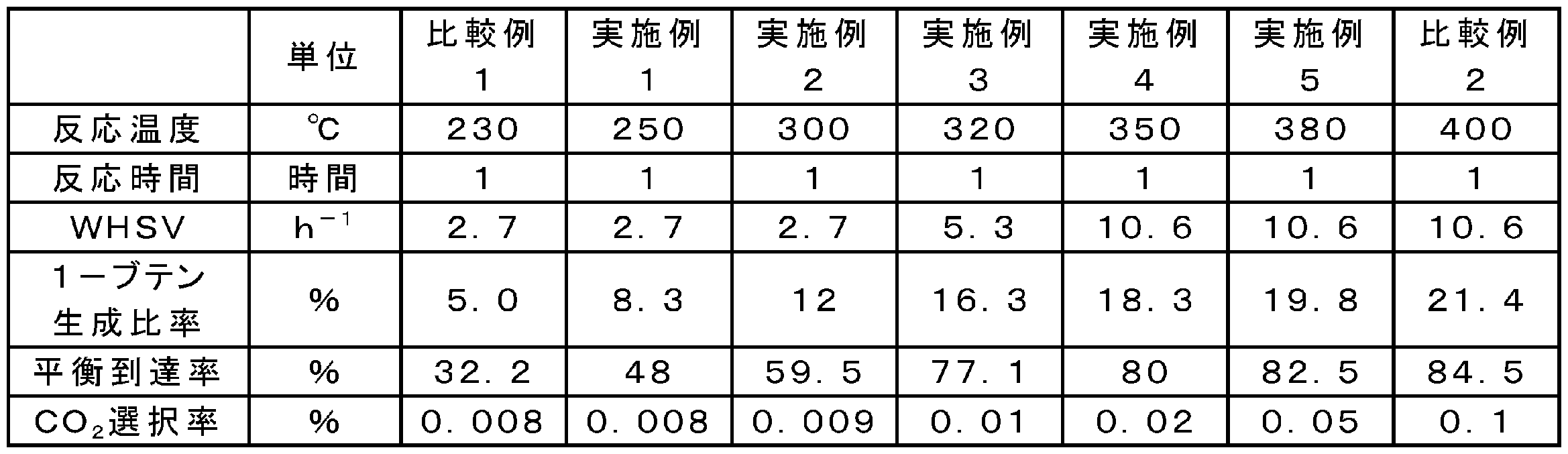
- Table 1 shows the 1-butene production ratio, the equilibrium arrival ratio, and the CO 2 selectivity 1 hour after the start of the reaction.
- the 1-butene production ratio indicates the proportion of 1-butene in the linear butene in the produced gas.
- the equilibrium arrival rate indicates the arrival rate with respect to the theoretical value (17.3%) of the 1-butene ratio by thermodynamic equilibrium at the reaction temperature (250°C).
- Example 2 The isomerization reaction was carried out in the same manner as in Example 1 except that the reaction temperature of the isomerization reaction was changed to 300°C.
- Table 1 shows the 1-butene production ratio 1 hour after the start of the reaction, the equilibrium arrival rate, and the CO 2 selectivity.
- the equilibrium arrival rate indicates the arrival rate to the theoretical value (20.2%) of the 1-butene ratio by thermodynamic equilibrium at the reaction temperature (300° C.).
- Example 3 The isomerization reaction was performed in the same manner as in Example 1 except that the reaction temperature of the isomerization reaction was changed to 320° C. and the WHSV was changed to 5.3 h ⁇ 1 .
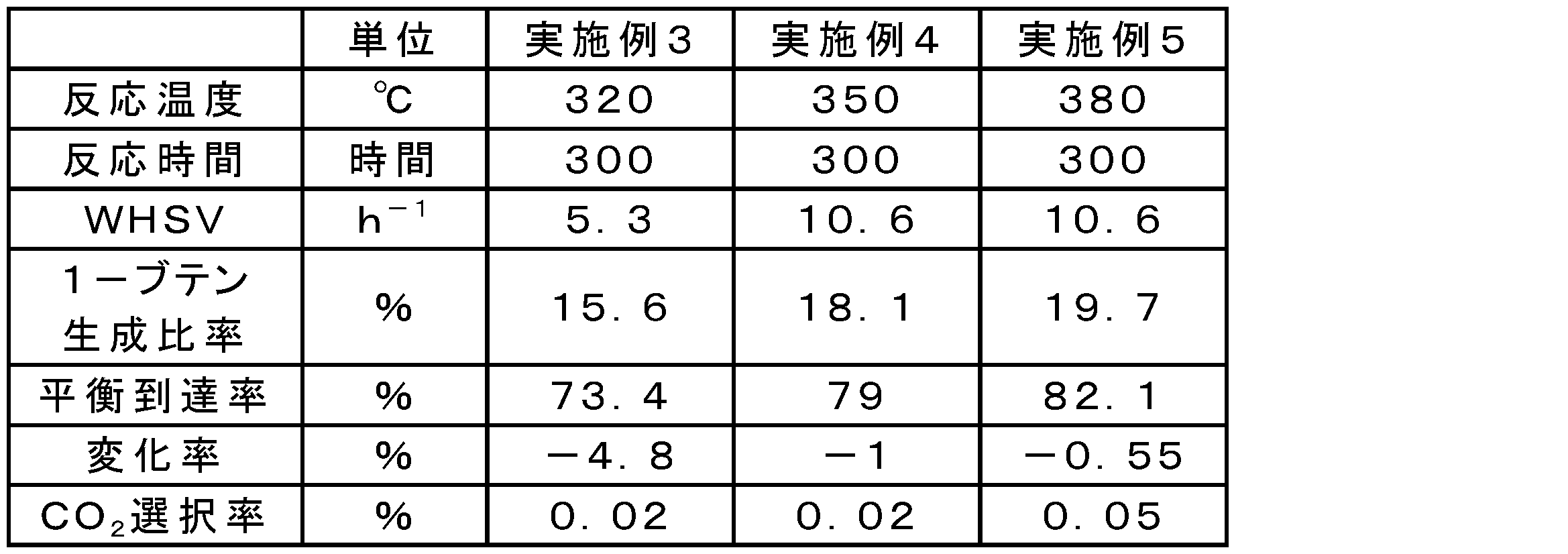
- the 1-butene production ratio, the equilibrium arrival rate, the change rate of the equilibrium arrival rate, and the CO 2 selectivity after 1 hour and 300 hours from the reaction start are shown in Tables 2 and 3.
- the equilibrium arrival rate indicates the arrival rate with respect to the theoretical value (21.2%) of the 1-butene ratio by thermodynamic equilibrium at the reaction temperature (320° C.).
- Example 4 The isomerization reaction was performed in the same manner as in Example 1 except that the reaction temperature of the isomerization reaction was changed to 350° C. and the WHSV was changed to 10.6 h ⁇ 1 .
- the 1-butene production ratio, the equilibrium arrival rate, the change rate of the equilibrium arrival rate, and the CO 2 selectivity after 1 hour and 300 hours from the reaction start are shown in Tables 2 and 3.
- the equilibrium arrival rate indicates the arrival rate with respect to the theoretical value (22.9%) of the 1-butene ratio by thermodynamic equilibrium at the reaction temperature (350° C.).
- Example 5 The isomerization reaction was performed in the same manner as in Example 1 except that the reaction temperature of the isomerization reaction was changed to 380° C. and the WHSV was changed to 10.6 h ⁇ 1 .
- the 1-butene production ratio, the equilibrium arrival rate, the change rate of the equilibrium arrival rate, and the CO 2 selectivity after 1 hour and 300 hours from the reaction start are shown in Tables 2 and 3.
- the equilibrium arrival rate indicates the arrival rate with respect to the theoretical value (24.0%) of the 1-butene ratio by thermodynamic equilibrium at the reaction temperature (380° C.).
- Example 1 The isomerization reaction was performed in the same manner as in Example 1 except that the reaction temperature of the isomerization reaction was changed to 230°C.
- Table 1 shows the 1-butene production ratio, the equilibrium arrival ratio, and the CO 2 selectivity 1 hour after the start of the reaction.
- the equilibrium arrival rate indicates the arrival rate with respect to the theoretical value (15.5%) of the 1-butene ratio by thermodynamic equilibrium at the reaction temperature (230° C.).
- Example 2 The isomerization reaction was performed in the same manner as in Example 1 except that the reaction temperature of the isomerization reaction was changed to 400° C. and the WHSV was changed to 10.6 h ⁇ 1 .
- Table 1 shows the 1-butene production ratio 1 hour after the start of the reaction, the equilibrium arrival rate, and the CO 2 selectivity.
- the equilibrium arrival rate indicates the arrival rate with respect to the theoretical value (25.3%) of the 1-butene ratio by thermodynamic equilibrium at the reaction temperature (400° C.).
Landscapes
- Chemical & Material Sciences (AREA)
- Organic Chemistry (AREA)
- Chemical Kinetics & Catalysis (AREA)
- Crystallography & Structural Chemistry (AREA)
- Engineering & Computer Science (AREA)
- Materials Engineering (AREA)
- Organic Low-Molecular-Weight Compounds And Preparation Thereof (AREA)
- Low-Molecular Organic Synthesis Reactions Using Catalysts (AREA)
- Catalysts (AREA)
Abstract
炭素原子数4~8の第一の直鎖モノオレフィンを含む原料組成物を、20容量ppm以上の分子状酸素及び/又は20容量ppm以上の水の存在下、250~390℃で異性化触媒に接触させて異性化反応を行い、第一の直鎖モノオレフィンの少なくとも一部を、二重結合位置の異なる第二の直鎖モノオレフィンに異性化する工程を備え、触媒がゼオライトを含む、直鎖モノオレフィンの製造方法。
Description
本発明は、直鎖モノオレフィンの製造方法に関する。また、本発明は、直鎖モノオレフィンから誘導される化合物の製造方法に関する。
分子内に二重結合を1つ有する直鎖モノオレフィンは、石油化学工業における基礎化学原料として有用であるが、その用途は分子内の二重結合の位置によって異なる。二重結合を内部に有する内部オレフィンは、例えば、水素化、アルキル化などの反応原料として利用される。一方、二重結合を末端に有する末端オレフィンは、例えば、脱水素、ヒドロホルミル化、オリゴマー化などの反応に利用される。また、末端オレフィンのうち、コモノマーとして、エチレンと共に線状低密度ポリエチレン(LLDPE)の製造の際に使用されるC4~C8の末端オレフィン(例えば、1-ブテン、1-ヘキセン及び1-オクタン)は、特に経済的に重要である。更に、1-ブテンは、ブタジエン、1-ポリブテン、ブテンオキシドの製造のためにも使用される。
二重結合を末端に有する直鎖オレフィン(例えば、1-ブテン)は、例えば、二重結合を内部に有する相応する直鎖オレフィン(例えば、2-ブテン)を触媒により異性化することによって製造することができる。
例えば、特許文献1~5には、内部位二重結合を有する直鎖オレフィンを、末端位二重結合を有する直鎖オレフィンに異性化する触媒反応が開示されている。
しかしながら、従来の異性化触媒を用いたオレフィンの位置異性化方法は、実質的に酸素又は水が存在する環境下で、副反応の進行により生成物純度が低下したり、収率が不十分であったり、触媒が著しく劣化する等の欠点があり、工業的に使用することが困難であった。
本発明の目的の一つは、実質的に酸素又は水が存在する環境下であっても、触媒劣化が十分に抑制され、効率良くオレフィンの異性化反応を実施することが可能な、直鎖モノオレフィンの製造方法を提供することにある。また、本発明の目的の一つは、異性化後の直鎖モノオレフィンを反応させて該直鎖モノオレフィンに由来する化合物を得る、化合物の製造方法を提供することにある。
本発明の一側面は、炭素原子数4~8の第一の直鎖モノオレフィンを含む原料組成物を、20容量ppm以上の分子状酸素及び/又は20容量ppm以上の水の存在下、250~390℃で異性化触媒に接触させて異性化反応を行い、上記第一の直鎖モノオレフィンの少なくとも一部を、二重結合位置の異なる第二の直鎖モノオレフィンに異性化する工程を備える、直鎖モノオレフィンの製造方法に関する。ここで、上記触媒は、ゼオライトを含む。
一態様に係る製造方法では、上記異性化反応におけるCO2選択率が、0.001%以上0.09%以下であってよい。
一態様において、上記第一の直鎖モノオレフィン及び上記第二の直鎖モノオレフィンの炭素原子数は4であってよい。
一態様において、上記異性化反応は、気固触媒反応であってよい。
本発明の他の一側面は、炭素原子数4~8の第一の直鎖モノオレフィンを含む第一の原料組成物を、20容量ppm以上の分子状酸素及び/又は20容量ppm以上の水の存在下、250~390℃で異性化触媒に接触させて異性化反応を行い、上記第一の直鎖モノオレフィンの少なくとも一部を、二重結合位置の異なる第二の直鎖モノオレフィンに異性化する第一の工程と、上記第二の直鎖モノオレフィンを含む第二の原料組成物を反応させて、上記第二の直鎖モノオレフィンに由来する化合物を得る第二の工程と、を備える、化合物の製造方法に関する。ここで、上記触媒はゼオライトを含む。
一態様に係る製造方法では、上記異性化反応におけるCO2選択率が、0.001%以上0.09%以下であってよい。
一態様において、上記第二の工程は、上記第二の原料組成物を脱水素触媒と接触させて、上記第二の直鎖モノオレフィンの脱水素反応により共役ジエンを得る工程であってよい。
一態様において、上記第二の工程は、上記第二の原料組成物をヒドロホルミル化触媒と接触させて、上記第二の直鎖モノオレフィンのヒドロホルミル化反応によりアルデヒドを得る工程であってよい。
本発明の更に他の一側面は、炭素原子数4~8の第一の直鎖モノオレフィンを含む原料組成物を、20容量ppm以上の分子状酸素及び/又は20容量ppm以上の水の存在下、250~390℃で、異性化触媒を含む触媒群に接触させて、上記第一の直鎖モノオレフィンの異性化物に由来する化合物を得る工程を備える、化合物の製造方法に関する。ここで、上記触媒はゼオライトを含む。
一態様において、上記触媒群は脱水素触媒を更に含んでいてよく、上記化合物は共役ジエンであってよい。
一態様において、上記触媒群はヒドロホルミル化触媒を更に含んでいてよく、上記化合物はアルデヒドであってよい。
本発明によれば、実質的に酸素又は水が存在する環境下であっても、触媒劣化が十分に抑制され、効率良くオレフィンの異性化反応を実施することが可能な、直鎖モノオレフィンの製造方法が提供される。また、本発明によれば、異性化後の直鎖モノオレフィンを反応させて該直鎖モノオレフィンに由来する化合物を得る、化合物の製造方法が提供される。
以下、本発明の好適な一実施形態について説明する。但し、本発明は下記の実施形態に何ら限定されるものではない。
本実施形態に係る直鎖モノオレフィンの製造方法は、炭素原子数4~8の第一の直鎖モノオレフィンを含む原料組成物を、20容量ppm以上の分子状酸素(O2)及び/又は20容量ppm以上の水(水蒸気)の存在下、250~390℃で異性化触媒に接触させて異性化反応を行い、第一の直鎖モノオレフィンの少なくとも一部を、二重結合位置の異なる第二の直鎖モノオレフィンに異性化する工程を備える。本実施形態において、触媒はゼオライトを含む。
本実施形態に係る製造方法によれば、反応系に20容量ppm以上の分子状酸素(以下、単に酸素ともいう。)及び/又は20容量ppm以上の水が存在している場合でも、触媒劣化が十分に抑制され、効率良くオレフィンの異性化反応を実施することができる。
直鎖モノオレフィンの異性化に関し、例えば、2-ブテンの1-ブテンへの異性化は、n-ブテン異性体の熱力学的平衡により限定される。n-ブテン中の1-ブテンの達成可能な最大濃度は、一度の反応器通過の場合には、熱力学的平衡によって、400℃では約22%、500℃では約30%であることが知られている(例えば、特開平8-224470号公報)。本実施形態に係る直鎖モノオレフィンの製造方法では、酸素及び水の存在下であっても、理論値に近い水準(例えば、理論値の70%以上)で異性化を達成することができ、また、長期間にわたって触媒活性が維持される。
本実施形態に係る直鎖モノオレフィンの製造方法では、酸素及び/又は水の存在下で実施される。従来の異性化触媒を用いた異性化反応では、酸素及び水が存在しない(特に、酸素が存在しない)環境で実施されることが通常であり、酸素が存在する場合は、完全酸化反応等の多くの副反応が生じてオレフィンの異性化を選択的に進行させることが困難である。一方、本実施形態に係る直鎖モノオレフィンの製造方法では、副反応が十分に抑制されるため、効率良くオレフィンの異性化反応を進行させることができ、また、触媒の耐久性に優れるため、長期間に亘って異性化反応を実施することができる。
本実施形態に係る直鎖モノオレフィンの製造方法では、上述のとおり、酸素及び/又は水の存在下であっても効率良くオレフィンの異性化反応が進行するため、例えば、前段の反応から、酸素及び水の除去をすることなく原料を供給することができ、プロセス上極めて有利である。
また、本実施形態に係る直鎖モノオレフィンの製造方法は、異性化後の第二の直鎖オレフィンを消費する他の反応と並行して行うことができる。ここで、本実施形態に係る製造方法で用いられる異性化触媒は、酸素及び/水の存在下であっても効率良く異性化反応を進行させることができるため、上記の他の反応として、酸素又は水の存在下に進行する反応を選択することができる。例えば、上記の他の反応として、オレフィンの酸化的脱水素反応、オレフィンのヒドロホルミル化反応等を選択することができる。
本実施形態では、異性化触媒と上記の他の反応の触媒(例えば、脱水素触媒、ヒドロホルミル化触媒)とを混合して、異性化反応と他の反応とを同時に実施してもよい。この場合、他の反応により第二の直鎖モノオレフィンが消費されるとともに、熱力学的平衡に応じて異性化反応により第二の直鎖モノオレフィンが生成するため、見かけ上の異性化反応の反応性を向上させることができる。
本実施形態において、第一の直鎖モノオレフィンの炭素原子数は、4~8であってよく、4であってもよい。
第一の直鎖モノオレフィンは、内部オレフィンであってよく、末端オレフィンであってよい。
第一の直鎖モノオレフィンは、例えば、1-ブテン、トランス-2-ブテン、シス-2-ブテン、1-ペンテン、2-ペンテン、1-ヘキセン、2-ヘキセン、3-ヘキセン、1-オクテン、2-オクテン、3-オクテン及び4-オクテンからなる群より選択される直鎖モノオレフィンであってよい。また、第一の直鎖モノオレフィンとしては、一種を単独で用いてもよく、また、二種以上を組み合せて用いてもよい。
第一の直鎖モノオレフィンは、酸素、窒素、ハロゲン、硫黄等のヘテロ原子を含む置換基を有していてよい。このような置換基は、例えば、ハロゲン原子(-F、-Cl、-Br、-I)、水酸基(-OH)、アルコキシ基(-OR)、カルボキシル基(-COOH)、エステル基(-COOR)、アルデヒド基(-CHO)及びアシル基(-C(=O)R)からなる群より選択される少なくとも一種であってよい。置換基を有する直鎖モノオレフィンを含む原料は、例えば、アルコール類であってよく、エーテル類であってよく、バイオ燃料であってよい。
第一の直鎖モノオレフィンは、単離した直鎖モノオレフィンそのものを使用する必要はなく、必要に応じて任意の混合物の形で用いることができる。第一の直鎖モノオレフィンがブテンの場合、例えば、原料組成物は、重油留分の流動接触分解により得られるC4留分であってよく、ナフサの熱分解により得られるC4留分であってもよい。
本実施形態においては、原料組成物が、第一の直鎖モノオレフィン以外の他の成分を含んでいてもよい。他の成分は、例えば、第一の直鎖モノオレフィンの異性化物(第二の直鎖モノオレフィンを含んでいてもよい)、飽和炭化水素化合物、又はジエンであってよい。飽和炭化水素化合物及びジエンは、例えば、第一の直鎖モノオレフィンと同じ炭素数のものであってよい。飽和炭化水素化合物は、例えば、n-ブタン又はシクロブタンであってよい。ジエンは、例えば、ブタジエンであってよい。第一の直鎖モノオレフィンを含む原料組成物は、本発明の効果を阻害しない範囲で、水素、窒素、一酸化炭素、炭酸ガス、メタン等の不純物を含んでいてよい。なお、原料組成物としては、直鎖モノオレフィンのみからなる原料を用いてもよい。
本実施形態において、原料組成物中の第一の直鎖モノオレフィンの濃度は特に制限されないが、原料組成物中の第一の直鎖モノオレフィンの濃度が高いほど経済性が良くなる傾向がある。
第二の直鎖モノオレフィンは、第一の直鎖モノオレフィンとは二重結合位置が異なる異性体の関係にある。第二の直鎖モノオレフィンとしては、例えば、第一の直鎖モノオレフィンとして例示した化合物が挙げられる。第二の直鎖モノオレフィンは、内部オレフィンであってよく、末端オレフィンであってよい。
好適な一態様において、例えば、第一の直鎖モノオレフィンは内部オレフィンであってよく、第二の直鎖モノオレフィンは末端オレフィンであってよい。また、第一の直鎖モノオレフィンは、2-ブテンであってよく、第二の直鎖モノオレフィンは1-ブテンであってよい。
以下に、本実施形態における異性化触媒について詳述する。
異性化触媒は、直鎖モノオレフィンの異性化反応(オレフィンの位置異性化)を触媒する固体触媒であって、ゼオライトを含む。
ゼオライトと総称される結晶性アルミノケイ酸塩は、一つの結晶内に分子サイズの微空間(ナノスペース)を有している。また、その結晶構造により分類され、LTA(A型)、MFI(ZSM-5型)、MOR、BEA、FER、FAU(X型、Y型)、SAPO、ALPOといった数多くの種類のゼオライトが存在する。異性化触媒はこれらのうちいずれか一種のゼオライトを含むものであってよく、二種以上のゼオライトを含むものであってよい。
異性化触媒において、Alに対するSiのモル比(Si/Al)は、5以上であってよく、100以上であってよく、200以上であってよい。また、上記モル比(Si/Al)は、10000以下であってよく、3000以下であってよく、2000以下であってよい。このような比を有する異性化触媒は、酸素及び/又は水の存在下における触媒劣化がより顕著に抑制される傾向がある。
異性化触媒は、ゼオライトに金属元素を担持したものであってよい。担持される金属元素(以下、担持金属元素ともいう。)は、特に限定されず、例えば、アルカリ金属、アルカリ土類金属、又は遷移金属であってよい。
担持金属元素の担持方法は、特に限定されず、例えば、含浸法、沈着法、共沈法、混練法、イオン交換法、又はポアフィリング法であってよい。
担持金属元素の供給源は、例えば、酸化物、硝酸塩、炭酸塩、アンモニウム塩、水酸化物、カルボン酸塩、カルボン酸アンモニウム塩、ハロゲン化アンモニウム塩、水素酸(例えば、塩化白金酸(H2PtCl6))、アセチルアセトナート及びアルコキシドからなる群より選択される少なくとも一種であってよい。
異性化触媒における担持金属元素の含有量は、特に限定されず、例えば、無機酸化物100質量部に対して0.01~100質量部であってよく、0.1~50質量部であってよい。なお、担持金属元素の含有量は、誘導結合プラズマ発光分光分析法(ICP発光分光分析法)により求めることができる。
触媒の酸性をキャラクタリゼーションする有効な方法として、アンモニア-昇温脱離法(アンモニアTPD、NH3-TPD、Ammonia Temperature Programmed Desorption)が広く知られている。例えば、C. V. Hidalgoら、Journal of Catalysis、85巻、362-369頁(1984年)は、アンモニアTPD法によって、ブレンステッド酸点の量やブレンステッド酸点の酸強度の分布を測定することができることを示している。
アンモニアTPD法は、塩基プローブ分子であるアンモニアを試料の固体に吸着させ、温度を連続的に上昇させることによって脱離するアンモニアの量及び温度を同時測定するというものである。弱い酸点に吸着しているアンモニアが低温で脱離し(吸着熱が低い範囲での脱離に相当)、強い酸点に吸着しているアンモニアが高温で脱離する(吸着熱が高い範囲での脱離に相当)こととなる。このようなアンモニアTPD法では、酸強度が温度や吸着熱量により示され、呈色反応を利用していないため、固体酸強度および固体酸量がより正確な値となっており、異性化触媒の特性評価を適切に行うことができる。
異性化触媒の酸点の量(酸量)は、「丹羽;ゼオライト,10,175(1993)」に記載の装置及び測定条件でアンモニアの吸着量を測定する、アンモニアTPD法により求めることができる。
異性化触媒の全酸点の量(全酸量)A1は、0.11mmol/g以下であってよく、0.09mmol/g以下であってよく、0.03mmol/g以下であってよく、0.015mmol/g以下であってよく、0.010mmol/g以下であってよい。全酸量が上記範囲であると、骨格異性化、CO2生成等の副反応、コーク析出による触媒の劣化などが抑制される傾向がある。また、異性化触媒の全酸量A1は、0.001mmol/g以上であってよく、0.003mmol/g以上であってよい。
異性化触媒において、全酸量A1に対する、600℃以上の温度範囲で測定される酸点の量A2の比A2/A1は、0.03以上であってよく、0.05以上であってよく、0.08以上であってよく、0.1以上であってよく、0.15以上であってよい。比A2/A1が上記範囲であると、骨格異性化、CO2生成等の副反応、コーク析出による触媒の劣化などが抑制される傾向がある。また、比A2/A1は、1以下であってよく、0.7以下であってよい。
異性化触媒は、必要に応じて焼成されたものであってよい。焼成は、一段階で行ってもよく、二段階以上の多段階で行ってもよい。焼成温度は、特に限定されない。一段階で焼成を行う場合、焼成温度は、例えば、200~600℃であってよい。焼成時間は1~10時間であってよい。焼成は、通常、空気の流通下で行えばよいが、焼成時の雰囲気は特に制限されない。
異性化触媒は、成形性を向上させる観点から、触媒の物性及び触媒性能を損なわない範囲において、成形助剤を含有してよい。成形助剤は、例えば、増粘剤、界面活性剤、保水剤、可塑剤及びバインダー原料からなる群より選択される少なくとも一種であってよい。
異性化触媒は、押出成形法、打錠成型法等の方法によって成形されていてよい。成形工程は、成形助剤の反応性等を考慮して、異性化触媒の製造工程の適切な段階で行ってよい。
異性化触媒の形状は、特に限定されるものではなく、触媒を使用する形態により適宜選択することができる。例えば、異性化触媒の形状は、ペレット状、顆粒状、ハニカム状、スポンジ状等の形状であってよい。
次に、本実施形態における異性化反応及び他の反応について詳述する。
本実施形態では、第一の直鎖モノオレフィンを含む原料組成物を、20容量ppm以上の酸素及び/又は20容量ppm以上の水(水蒸気)の存在下、250~390℃で異性化触媒に接触させることで、第一の直鎖モノオレフィンの異性化反応を行う。この異性化反応によって、第一の直鎖モノオレフィンの少なくとも一部が、第二の直鎖モノオレフィンに異性化される。
原料組成物を異性化触媒に接触させる際の温度は、異性化反応の反応温度ということもできる。
異性化反応の反応温度は、好ましくは250~390℃、より好ましくは300~390℃、さらに好ましくは320~390℃である。
反応系における酸素の量は、20容量ppm以上であってよく、0.01容量%以上であってよく、0.1容量%以上であってよく、0.5容量%以上であってよい。また、酸素の量は、50容量%以下であってよく、30容量%以下であってよく、20容量%以下であってよい。
反応系における水の量は、20容量ppm以上であってよく、0.01容量%以上であってよく、0.1容量%以上であってよく、0.5容量%以上であってよい。また、水の量は、50容量%以下であってよく、30容量%以下であってよく、20容量%以下であってよい。
異性化反応は、原料組成物、酸素及び水以外の他の成分がさらに存在する環境下に実施してもよい。ここで他の成分は、例えば、メタン、水素、窒素、二酸化炭素、一酸化炭素等であってよい。
異性化反応は、気固触媒反応であってよく、液固触媒反応であってもよいが、気固触媒反応であることが好ましい。なお、気固触媒反応は、気相の原料と固相の異性化触媒とを接触させて行う反応を示し、液固触媒反応は、液相の原料と固相の異性化触媒とを接触させて行う反応を示す。
異性化反応は、例えば、異性化触媒が充填された反応器に原料組成物を流通させることで実施してよい。
異性化反応において、反応系に存在する酸素及び水は、原料組成物と共に反応器に供給されたものであってよい。すなわち、異性化反応は、第一の直鎖モノオレフィンを含む原料組成物と、20容量ppm以上の酸素及び/又は20容量ppm以上の水と、を含む原料ガスを、異性化触媒が充填された反応器に流通させて行うものであってもよい。
原料ガス中の酸素の量は、20容量ppm以上であってよく、0.01容量%以上であってよく、0.1容量%以上であってよく、0.5容量%以上であってよい。また、原料ガス中の酸素の量は、50容量%以下であってよく、30容量%以下であってよく、20容量%以下であってよい。
原料ガス中の水の量は、20容量ppm以上であってよく、0.01容量%以上であってよく、0.1容量%以上であってよく、0.5容量%以上であってよい。また、原料ガス中の水の量は、50容量%以下であってよく、30容量%以下であってよく、20容量%以下であってよい。
原料ガスは、発明の効果を阻害しない範囲で、任意の不純物を含んでいてよい。このような不純物は、例えば、窒素、アルゴン、ネオン、ヘリウム、一酸化炭素、又は二酸化炭素であってよい。
本実施形態において、上記異性化反応におけるCO2選択率は、0.001%以上であることが好ましい。このようなCO2選択率となるように異性化反応の反応条件等を調整することで、触媒劣化の抑制及び異性化効率の向上を図ることができる。上記CO2選択率は、反応収率を向上させる観点からは、0.09%以下が好ましく、0.07%以下がより好ましい。なお、異性化反応におけるCO2選択率は、反応生成物のガスクロマトグラフィーによる分析結果から、以下の計算式で求めることができる。CO2の量と各成分の合計量は、ガスクロマトグラフィーで測定される各成分のピーク面積に検量線で得られたファクターを掛けて計算される。
CO2選択率=CO2の量(mol)/反応生成物中の各成分の合計量(mol)
CO2選択率=CO2の量(mol)/反応生成物中の各成分の合計量(mol)
本実施形態においては、異性化反応で生成した第二の直鎖モノオレフィンを、他の反応に供して、第二の直鎖モノオレフィンに由来する化合物を製造してもよい。
すなわち、本実施形態に係る化合物の製造方法は、第一の直鎖モノオレフィンを含む第一の原料化合物を、20容量ppm以上の分子状酸素及び/又は20容量ppm以上の水の存在下で異性化触媒に接触させて、第一の直鎖モノオレフィンの少なくとも一部を二重結合位置の異なる第二の直鎖モノオレフィンに異性化する第一の工程と、第二の直鎖モノオレフィンを含む第二の原料組成物を反応させて、第二の直鎖モノオレフィンに由来する化合物を得る第二の工程と、を備えるものであってよい。
第一の工程は、上述の異性化反応の好適な態様に従って実施してよい。第二の工程には、第二の直鎖モノオレフィンを反応させる種々の反応を適用でき、その反応条件には、公知の反応条件を適用してよい。
第二の工程は、例えば、第二の原料組成物を含む原料ガスを、反応触媒が充填された反応器に流通させて実施してよい。
第二の工程では、第二の原料組成物として、第一の工程の異性化反応後の生成ガスを用いてよい。例えば、第一の工程は、第一の原料組成物を含む原料ガスを、異性化触媒が充填された第一の反応器に流通させて、第二の直鎖モノオレフィンを含む生成ガスを得る工程であってよく、第二の工程は、第一の工程で得られた生成ガスを、反応触媒が充填された第二の反応器に流通させて、第二の直鎖モノオレフィンを反応させる工程であってよい。
第二の工程は、第二の直鎖モノオレフィンに由来する目的化合物と、第一の直鎖モノオレフィンを含む組成物とを得る工程であってよい。ここで、組成物中の第一の直鎖モノオレフィンは、例えば、第二の工程に供された第二の原料組成物(例えば、第一の工程の生成ガス)に含まれていた第一の直鎖モノオレフィンであってもよく、第二の工程の反応で生成した第一の直鎖モノオレフィンであってもよい。
第二の工程で、第一の直鎖モノオレフィンを含む組成物が得られるとき、当該組成物は、第一の工程の第一の原料組成物の一部又は全部として再利用してよい。第一の工程では、酸素及び水の存在下であってもオレフィンの異性化反応が効率良く進行するため、このような再利用に際して、酸素及び水の除去を行う必要が無く、プロセス全体の効率に優れる。
第二の工程は、第二の直鎖モノオレフィンの酸化的脱水素反応により、共役ジエンを生成する工程であってよい。このとき、第二の工程は、第二の原料組成物を脱水素触媒と接触させて共役ジエンを得る工程であってよい。
酸化的脱水素反応の反応条件は、特に限定されず、公知の種々の反応条件を適用してよい。例えば、反応条件は、400℃、0.1MPaGであってよい。
脱水素触媒としては、公知の脱水素反応用触媒を用いることができる。脱水素触媒としては、例えば、多成分モリブデン-ビスマス系触媒、フェライト触媒、バナジウム・マグネシウム系触媒およびコバルト・モリブデン系触媒が挙げられる。
第二の工程は、第二の直鎖モノオレフィンのヒドロホルミル化反応により、アルデヒドを生成する工程であってよい。このとき、第二の工程は、第二の原料組成物をヒドロホルミル化触媒と接触させてアルデヒドを得る工程であってよい。
ヒドロホルミル化反応の反応条件は、特に限定されず、公知の種々の反応条件を適用してよい。例えば、反応条件は、150℃、1.5MPaであってよい。
ヒドロホルミル化触媒としては、公知のヒドロホルミル化反応用触媒を用いることができる。ヒドロホルミル化触媒としては、例えば、ロジウム触媒、コバルト触媒が挙げられる。
本実施形態においては、異性化後の第二の直鎖モノオレフィンを消費する他の反応を、異性化反応と同時に実施してもよい。
異性化触媒は、酸素及び/水の存在下であっても効率良くオレフィンの異性化反応を進行させることができるため、上記の他の反応として、酸素又は水の存在下に進行する反応を選択することができる。例えば、上記の他の反応として、オレフィンの酸化的脱水素反応、オレフィンのヒドロホルミル化反応等を選択することができる。
本実施形態では、異性化触媒と上記の他の反応の触媒(例えば、脱水素触媒、ヒドロホルミル化触媒)とを混合して、異性化反応と他の反応とを同時に実施してよい。この場合、他の反応により第二の直鎖モノオレフィンが消費されるとともに、熱力学的平衡に応じて異性化反応により第二の直鎖モノオレフィンが生成するため、見かけ上の異性化反応の反応性を向上させることができる。
すなわち、本実施形態に化合物の製造方法は、第一の直鎖モノオレフィンを含む原料組成物を、20容量ppm以上の分子状酸素及び/又は20容量ppm以上の水の存在下で、異性化触媒を含む触媒群に接触させて、第一の直鎖モノオレフィンの異性化物に由来する化合物を得る工程を備えるものであってよい。ここで、第一の直鎖モノオレフィンの異性化物は、上述の第二の直鎖モノオレフィンであってよい。
所期の反応に応じて、触媒群は、異性化触媒以外の触媒を含む。例えば、上記の他の反応は、酸化的脱水素反応であってよく、このとき触媒群は、異性化触媒及び脱水素触媒を含むものであってよい。また、上記の他の反応は、ヒドロホルミル化反応であってよく、このとき触媒群は、異性化触媒及びヒドロホルミル化触媒を含むものであってよい。脱水素触媒及びヒドロホルミル化触媒としては、上記と同様のものが例示できる。
この態様において、上記工程は、原料組成物を含む原料ガスを、触媒群が充填された反応器に流通して実施してよい。
上記工程は、第一の直鎖モノオレフィンの異性化物に由来する目的化合物と、第一の直鎖モノオレフィンを含む未反応物と、を得る工程であってよい。このとき、当該未反応物は、上記工程の原料組成物の一部又は全部として再利用してよい。上記工程では、酸素及び水の存在下であってもオレフィンの異性化反応が効率良く進行するため、このような再利用に際して、酸素及び水の除去を行う必要が無く、プロセス全体の効率に優れる。
以上、本発明の好適な実施形態について説明したが、本発明は上記実施形態に限定されるものではない。
以下に実施例を示して本発明をより詳細に説明するが、本発明はこれら実施例に限定されるものではない。
(実施例1)
H型-ZSM-5ゼオライト触媒(東ソー社製、SiO2/Al2O3=1900(mol/mol))1.5gを充填した内径10.9mm、長さ300mmのステンレス製反応管に、表1に示す組成の原料を、原料ガス中の直鎖状ブテン:窒素:酸素:水蒸気=1:13.5:1.5:1.2の比率となるように混合し、触媒に対する原料中の直鎖状ブテンの質量空間速度(WHSV(h-1))が2.7h-1となる様に、予め250℃まで昇温した反応器に供給し、異性化反応を行った。
H型-ZSM-5ゼオライト触媒(東ソー社製、SiO2/Al2O3=1900(mol/mol))1.5gを充填した内径10.9mm、長さ300mmのステンレス製反応管に、表1に示す組成の原料を、原料ガス中の直鎖状ブテン:窒素:酸素:水蒸気=1:13.5:1.5:1.2の比率となるように混合し、触媒に対する原料中の直鎖状ブテンの質量空間速度(WHSV(h-1))が2.7h-1となる様に、予め250℃まで昇温した反応器に供給し、異性化反応を行った。

反応開始1時間後の1-ブテン生成比率、平衡到達率、及びCO2選択率は表2の通りとなった。なお、1-ブテン生成比率は、生成ガス中の直鎖状ブテンに占める1-ブテンの割合を示す。また、平衡到達率は、反応温度(250℃)における熱力学的平衡による1-ブテン比率の理論値(17.3%)に対する到達率を示す。
(実施例2)
異性化反応の反応温度を300℃に変更したこと以外は、実施例1と同様にして異性化反応を行った。その結果、反応開始1時間後の1-ブテン生成比率、平衡到達率、及びCO2の選択率は表2の通りとなった。平衡到達率は、反応温度(300℃)における熱力学的平衡による1-ブテン比率の理論値(20.2%)に対する到達率を示す。
異性化反応の反応温度を300℃に変更したこと以外は、実施例1と同様にして異性化反応を行った。その結果、反応開始1時間後の1-ブテン生成比率、平衡到達率、及びCO2の選択率は表2の通りとなった。平衡到達率は、反応温度(300℃)における熱力学的平衡による1-ブテン比率の理論値(20.2%)に対する到達率を示す。
(実施例3)
異性化反応の反応温度を320℃に変更し、WHSVを5.3h-1に変更したこと以外は、実施例1と同様にして異性化反応を行った。その結果、反応開始1時間後及び300時間後の1-ブテン生成比率、平衡到達率、平衡到達率の変化率及びCO2選択率は表2、表3の通りとなった。平衡到達率は、反応温度(320℃)における熱力学的平衡による1-ブテン比率の理論値(21.2%)に対する到達率を示す。
異性化反応の反応温度を320℃に変更し、WHSVを5.3h-1に変更したこと以外は、実施例1と同様にして異性化反応を行った。その結果、反応開始1時間後及び300時間後の1-ブテン生成比率、平衡到達率、平衡到達率の変化率及びCO2選択率は表2、表3の通りとなった。平衡到達率は、反応温度(320℃)における熱力学的平衡による1-ブテン比率の理論値(21.2%)に対する到達率を示す。
(実施例4)
異性化反応の反応温度を350℃に変更し、WHSVを10.6h-1に変更したこと以外は、実施例1と同様にして異性化反応を行った。その結果、反応開始1時間後及び300時間後の1-ブテン生成比率、平衡到達率、平衡到達率の変化率及びCO2選択率は表2、表3の通りとなった。平衡到達率は、反応温度(350℃)における熱力学的平衡による1-ブテン比率の理論値(22.9%)に対する到達率を示す。
異性化反応の反応温度を350℃に変更し、WHSVを10.6h-1に変更したこと以外は、実施例1と同様にして異性化反応を行った。その結果、反応開始1時間後及び300時間後の1-ブテン生成比率、平衡到達率、平衡到達率の変化率及びCO2選択率は表2、表3の通りとなった。平衡到達率は、反応温度(350℃)における熱力学的平衡による1-ブテン比率の理論値(22.9%)に対する到達率を示す。
(実施例5)
異性化反応の反応温度を380℃に変更し、WHSVを10.6h-1に変更したこと以外は、実施例1と同様にして異性化反応を行った。その結果、反応開始1時間後及び300時間後の1-ブテン生成比率、平衡到達率、平衡到達率の変化率及びCO2選択率は表2、表3の通りとなった。平衡到達率は、反応温度(380℃)における熱力学的平衡による1-ブテン比率の理論値(24.0%)に対する到達率を示す。
異性化反応の反応温度を380℃に変更し、WHSVを10.6h-1に変更したこと以外は、実施例1と同様にして異性化反応を行った。その結果、反応開始1時間後及び300時間後の1-ブテン生成比率、平衡到達率、平衡到達率の変化率及びCO2選択率は表2、表3の通りとなった。平衡到達率は、反応温度(380℃)における熱力学的平衡による1-ブテン比率の理論値(24.0%)に対する到達率を示す。
(比較例1)
異性化反応の反応温度を230℃に変更したこと以外は、実施例1と同様にして異性化反応を行った。その結果、反応開始1時間後の1-ブテン生成比率、平衡到達率及びCO2選択率は表2の通りとなった。平衡到達率は、反応温度(230℃)における熱力学的平衡による1-ブテン比率の理論値(15.5%)に対する到達率を示す。
異性化反応の反応温度を230℃に変更したこと以外は、実施例1と同様にして異性化反応を行った。その結果、反応開始1時間後の1-ブテン生成比率、平衡到達率及びCO2選択率は表2の通りとなった。平衡到達率は、反応温度(230℃)における熱力学的平衡による1-ブテン比率の理論値(15.5%)に対する到達率を示す。
(比較例2)
異性化反応の反応温度を400℃に変更し、WHSVを10.6h-1に変更したこと以外は、実施例1と同様にして異性化反応を行った。その結果、反応開始1時間後の1-ブテン生成比率、平衡到達率、及びCO2の選択率は表2の通りとなった。平衡到達率は、反応温度(400℃)における熱力学的平衡による1-ブテン比率の理論値(25.3%)に対する到達率を示す。
異性化反応の反応温度を400℃に変更し、WHSVを10.6h-1に変更したこと以外は、実施例1と同様にして異性化反応を行った。その結果、反応開始1時間後の1-ブテン生成比率、平衡到達率、及びCO2の選択率は表2の通りとなった。平衡到達率は、反応温度(400℃)における熱力学的平衡による1-ブテン比率の理論値(25.3%)に対する到達率を示す。
Claims (11)
- 炭素原子数4~8の第一の直鎖モノオレフィンを含む原料組成物を、20容量ppm以上の分子状酸素及び/又は20容量ppm以上の水の存在下、250~390℃で異性化触媒に接触させて異性化反応を行い、前記第一の直鎖モノオレフィンの少なくとも一部を、二重結合位置の異なる第二の直鎖モノオレフィンに異性化する工程を備え、
前記触媒がゼオライトを含む、直鎖モノオレフィンの製造方法。 - 前記異性化反応におけるCO2選択率が、0.001%以上0.09%以下である、請求項1に記載の製造方法。
- 前記第一の直鎖モノオレフィン及び前記第二の直鎖モノオレフィンの炭素原子数が4である、請求項1又は2に記載の製造方法。
- 前記異性化反応が、気固触媒反応である、請求項1~3のいずれか一項に記載の製造方法。
- 炭素原子数4~8の第一の直鎖モノオレフィンを含む第一の原料組成物を、20容量ppm以上の分子状酸素及び/又は20容量ppm以上の水の存在下、250~390℃で異性化触媒に接触させて異性化反応を行い、前記第一の直鎖モノオレフィンの少なくとも一部を、二重結合位置の異なる第二の直鎖モノオレフィンに異性化する第一の工程と、
前記第二の直鎖モノオレフィンを含む第二の原料組成物を反応させて、前記第二の直鎖モノオレフィンに由来する化合物を得る第二の工程と、
を備え、
前記触媒がゼオライトを含む、化合物の製造方法。 - 前記異性化反応におけるCO2選択率が、0.001%以上0.09%以下である、請求項5に記載の製造方法。
- 前記第二の工程が、前記第二の原料組成物を脱水素触媒と接触させて、前記第二の直鎖モノオレフィンの脱水素反応により共役ジエンを得る工程である、請求項5又は6に記載の製造方法。
- 前記第二の工程が、前記第二の原料組成物をヒドロホルミル化触媒と接触させて、前記第二の直鎖モノオレフィンのヒドロホルミル化反応によりアルデヒドを得る工程である、請求項5又は6に記載の製造方法。
- 炭素原子数4~8の第一の直鎖モノオレフィンを含む原料組成物を、20容量ppm以上の分子状酸素及び/又は20容量ppm以上の水の存在下、250~390℃で、異性化触媒を含む触媒群に接触させて、前記第一の直鎖モノオレフィンの異性化物に由来する化合物を得る工程を備え、
前記触媒がゼオライトを含む、化合物の製造方法。 - 前記触媒群が、脱水素触媒を更に含み、
前記化合物が、共役ジエンである、請求項9に記載の製造方法。 - 前記触媒群が、ヒドロホルミル化触媒を更に含み、
前記化合物が、アルデヒドである、請求項9に記載の製造方法。
Priority Applications (1)
| Application Number | Priority Date | Filing Date | Title |
|---|---|---|---|
| US17/414,147 US20220064085A1 (en) | 2018-12-18 | 2019-12-18 | Linear-monoolefin manufacturing method and compound manufacturing method |
Applications Claiming Priority (2)
| Application Number | Priority Date | Filing Date | Title |
|---|---|---|---|
| JP2018-236413 | 2018-12-18 | ||
| JP2018236413A JP2020097544A (ja) | 2018-12-18 | 2018-12-18 | 直鎖モノオレフィンの製造方法及び化合物の製造方法 |
Publications (1)
| Publication Number | Publication Date |
|---|---|
| WO2020130056A1 true WO2020130056A1 (ja) | 2020-06-25 |
Family
ID=71101837
Family Applications (1)
| Application Number | Title | Priority Date | Filing Date |
|---|---|---|---|
| PCT/JP2019/049702 Ceased WO2020130056A1 (ja) | 2018-12-18 | 2019-12-18 | 直鎖モノオレフィンの製造方法及び化合物の製造方法 |
Country Status (3)
| Country | Link |
|---|---|
| US (1) | US20220064085A1 (ja) |
| JP (1) | JP2020097544A (ja) |
| WO (1) | WO2020130056A1 (ja) |
Families Citing this family (1)
| Publication number | Priority date | Publication date | Assignee | Title |
|---|---|---|---|---|
| EP4378918A4 (en) * | 2021-07-27 | 2025-07-30 | Kao Corp | METHOD FOR PRODUCING INTERNAL OLEFIN, METHOD FOR PRODUCING INTERNAL OLEFIN SULFONATE, AND LOW-TEMPERATURE STABILIZATION METHOD |
Citations (5)
| Publication number | Priority date | Publication date | Assignee | Title |
|---|---|---|---|---|
| US4289919A (en) * | 1979-05-23 | 1981-09-15 | Phillips Petroleum Company | Catalytic isomerization of an internal double bond aliphatic mono-olefin to produce terminal bond olefin |
| JPS58219128A (ja) * | 1982-05-27 | 1983-12-20 | スナムプロゲツチ・エス・ペ−・ア− | オレフインの異性化法 |
| JPH10167992A (ja) * | 1996-12-06 | 1998-06-23 | Nippon Shokubai Co Ltd | オレフィンの異性化方法およびそれに用いる触媒 |
| WO2016194822A1 (ja) * | 2015-05-29 | 2016-12-08 | Jxエネルギー株式会社 | 異性化触媒、直鎖オレフィンの製造方法及び化合物の製造方法 |
| WO2017077863A1 (ja) * | 2015-11-05 | 2017-05-11 | Jxエネルギー株式会社 | 異性化触媒、直鎖オレフィンの製造方法及び化合物の製造方法 |
-
2018
- 2018-12-18 JP JP2018236413A patent/JP2020097544A/ja active Pending
-
2019
- 2019-12-18 WO PCT/JP2019/049702 patent/WO2020130056A1/ja not_active Ceased
- 2019-12-18 US US17/414,147 patent/US20220064085A1/en not_active Abandoned
Patent Citations (5)
| Publication number | Priority date | Publication date | Assignee | Title |
|---|---|---|---|---|
| US4289919A (en) * | 1979-05-23 | 1981-09-15 | Phillips Petroleum Company | Catalytic isomerization of an internal double bond aliphatic mono-olefin to produce terminal bond olefin |
| JPS58219128A (ja) * | 1982-05-27 | 1983-12-20 | スナムプロゲツチ・エス・ペ−・ア− | オレフインの異性化法 |
| JPH10167992A (ja) * | 1996-12-06 | 1998-06-23 | Nippon Shokubai Co Ltd | オレフィンの異性化方法およびそれに用いる触媒 |
| WO2016194822A1 (ja) * | 2015-05-29 | 2016-12-08 | Jxエネルギー株式会社 | 異性化触媒、直鎖オレフィンの製造方法及び化合物の製造方法 |
| WO2017077863A1 (ja) * | 2015-11-05 | 2017-05-11 | Jxエネルギー株式会社 | 異性化触媒、直鎖オレフィンの製造方法及び化合物の製造方法 |
Also Published As
| Publication number | Publication date |
|---|---|
| JP2020097544A (ja) | 2020-06-25 |
| US20220064085A1 (en) | 2022-03-03 |
Similar Documents
| Publication | Publication Date | Title |
|---|---|---|
| EP3571178B1 (en) | Multiple-stage catalyst system for self-metathesis with controlled isomerization and cracking | |
| US8586813B2 (en) | Catalyst for metathesis of ethylene and 2-butene and/or double bond isomerization | |
| Ren et al. | Ga2O3/HZSM-48 for dehydrogenation of propane: Effect of acidity and pore geometry of support | |
| KR20100075997A (ko) | 올레핀의 이성질화 방법 | |
| CN107428635B (zh) | 二烯的制造方法 | |
| US10407362B2 (en) | Diene production method | |
| US9346720B2 (en) | Isomerization of light alpha-olefins to light internal olefins | |
| CN107107041A (zh) | 混合的金属氧化物‑沸石载体上的复分解催化剂及其使用方法 | |
| US20090187056A1 (en) | Process for the preparation of an olefin | |
| CN105642342B (zh) | Sapo-5/sapo-34复合分子筛,及其制备方法,及其应用 | |
| WO2020130056A1 (ja) | 直鎖モノオレフィンの製造方法及び化合物の製造方法 | |
| CN107530692B (zh) | 异构化催化剂、直链烯烃的制造方法和化合物的制造方法 | |
| JP6736017B2 (ja) | 異性化触媒、直鎖オレフィンの製造方法及び化合物の製造方法 | |
| WO2016152324A1 (ja) | ジエンの製造方法 | |
| US11174207B2 (en) | Process for the isomerization of olefins | |
| KR102025063B1 (ko) | 이성질화 촉매 제조 방법 | |
| JP7680482B2 (ja) | イソブテンの生成方法、イソブテン生成用触媒、及びイソブテン生成システム | |
| US20260078072A1 (en) | Method for isomerizing olefins | |
| CN112805087A (zh) | 包括用于产生丙烯的金属氧化物助催化剂的催化剂 | |
| CN111013639A (zh) | 丁烯双键异构化催化剂及其用途 | |
| JP2003277298A (ja) | イソブテンの製造方法 |
Legal Events
| Date | Code | Title | Description |
|---|---|---|---|
| 121 | Ep: the epo has been informed by wipo that ep was designated in this application |
Ref document number: 19900584 Country of ref document: EP Kind code of ref document: A1 |
|
| NENP | Non-entry into the national phase |
Ref country code: DE |
|
| 122 | Ep: pct application non-entry in european phase |
Ref document number: 19900584 Country of ref document: EP Kind code of ref document: A1 |