WO2020121949A1 - ポリイミド樹脂組成物及びポリイミドフィルム - Google Patents
ポリイミド樹脂組成物及びポリイミドフィルム Download PDFInfo
- Publication number
- WO2020121949A1 WO2020121949A1 PCT/JP2019/047728 JP2019047728W WO2020121949A1 WO 2020121949 A1 WO2020121949 A1 WO 2020121949A1 JP 2019047728 W JP2019047728 W JP 2019047728W WO 2020121949 A1 WO2020121949 A1 WO 2020121949A1
- Authority
- WO
- WIPO (PCT)
- Prior art keywords
- structural unit
- polyimide resin
- mol
- polyimide
- resin composition
- Prior art date
- Legal status (The legal status is an assumption and is not a legal conclusion. Google has not performed a legal analysis and makes no representation as to the accuracy of the status listed.)
- Ceased
Links
Classifications
-
- C—CHEMISTRY; METALLURGY
- C08—ORGANIC MACROMOLECULAR COMPOUNDS; THEIR PREPARATION OR CHEMICAL WORKING-UP; COMPOSITIONS BASED THEREON
- C08K—Use of inorganic or non-macromolecular organic substances as compounding ingredients
- C08K5/00—Use of organic ingredients
- C08K5/16—Nitrogen-containing compounds
- C08K5/34—Heterocyclic compounds having nitrogen in the ring
- C08K5/35—Heterocyclic compounds having nitrogen in the ring having also oxygen in the ring
- C08K5/353—Five-membered rings
-
- C—CHEMISTRY; METALLURGY
- C08—ORGANIC MACROMOLECULAR COMPOUNDS; THEIR PREPARATION OR CHEMICAL WORKING-UP; COMPOSITIONS BASED THEREON
- C08G—MACROMOLECULAR COMPOUNDS OBTAINED OTHERWISE THAN BY REACTIONS ONLY INVOLVING UNSATURATED CARBON-TO-CARBON BONDS
- C08G73/00—Macromolecular compounds obtained by reactions forming a linkage containing nitrogen with or without oxygen or carbon in the main chain of the macromolecule, not provided for in groups C08G12/00 - C08G71/00
- C08G73/06—Polycondensates having nitrogen-containing heterocyclic rings in the main chain of the macromolecule
- C08G73/10—Polyimides; Polyester-imides; Polyamide-imides; Polyamide acids or similar polyimide precursors
-
- C—CHEMISTRY; METALLURGY
- C08—ORGANIC MACROMOLECULAR COMPOUNDS; THEIR PREPARATION OR CHEMICAL WORKING-UP; COMPOSITIONS BASED THEREON
- C08G—MACROMOLECULAR COMPOUNDS OBTAINED OTHERWISE THAN BY REACTIONS ONLY INVOLVING UNSATURATED CARBON-TO-CARBON BONDS
- C08G73/00—Macromolecular compounds obtained by reactions forming a linkage containing nitrogen with or without oxygen or carbon in the main chain of the macromolecule, not provided for in groups C08G12/00 - C08G71/00
- C08G73/06—Polycondensates having nitrogen-containing heterocyclic rings in the main chain of the macromolecule
- C08G73/10—Polyimides; Polyester-imides; Polyamide-imides; Polyamide acids or similar polyimide precursors
- C08G73/1039—Polyimides; Polyester-imides; Polyamide-imides; Polyamide acids or similar polyimide precursors comprising halogen-containing substituents
-
- C—CHEMISTRY; METALLURGY
- C08—ORGANIC MACROMOLECULAR COMPOUNDS; THEIR PREPARATION OR CHEMICAL WORKING-UP; COMPOSITIONS BASED THEREON
- C08G—MACROMOLECULAR COMPOUNDS OBTAINED OTHERWISE THAN BY REACTIONS ONLY INVOLVING UNSATURATED CARBON-TO-CARBON BONDS
- C08G73/00—Macromolecular compounds obtained by reactions forming a linkage containing nitrogen with or without oxygen or carbon in the main chain of the macromolecule, not provided for in groups C08G12/00 - C08G71/00
- C08G73/06—Polycondensates having nitrogen-containing heterocyclic rings in the main chain of the macromolecule
- C08G73/10—Polyimides; Polyester-imides; Polyamide-imides; Polyamide acids or similar polyimide precursors
- C08G73/1042—Copolyimides derived from at least two different tetracarboxylic compounds or two different diamino compounds
-
- C—CHEMISTRY; METALLURGY
- C08—ORGANIC MACROMOLECULAR COMPOUNDS; THEIR PREPARATION OR CHEMICAL WORKING-UP; COMPOSITIONS BASED THEREON
- C08G—MACROMOLECULAR COMPOUNDS OBTAINED OTHERWISE THAN BY REACTIONS ONLY INVOLVING UNSATURATED CARBON-TO-CARBON BONDS
- C08G73/00—Macromolecular compounds obtained by reactions forming a linkage containing nitrogen with or without oxygen or carbon in the main chain of the macromolecule, not provided for in groups C08G12/00 - C08G71/00
- C08G73/06—Polycondensates having nitrogen-containing heterocyclic rings in the main chain of the macromolecule
- C08G73/10—Polyimides; Polyester-imides; Polyamide-imides; Polyamide acids or similar polyimide precursors
- C08G73/1046—Polyimides containing oxygen in the form of ether bonds in the main chain
-
- C—CHEMISTRY; METALLURGY
- C08—ORGANIC MACROMOLECULAR COMPOUNDS; THEIR PREPARATION OR CHEMICAL WORKING-UP; COMPOSITIONS BASED THEREON
- C08G—MACROMOLECULAR COMPOUNDS OBTAINED OTHERWISE THAN BY REACTIONS ONLY INVOLVING UNSATURATED CARBON-TO-CARBON BONDS
- C08G73/00—Macromolecular compounds obtained by reactions forming a linkage containing nitrogen with or without oxygen or carbon in the main chain of the macromolecule, not provided for in groups C08G12/00 - C08G71/00
- C08G73/06—Polycondensates having nitrogen-containing heterocyclic rings in the main chain of the macromolecule
- C08G73/10—Polyimides; Polyester-imides; Polyamide-imides; Polyamide acids or similar polyimide precursors
- C08G73/1057—Polyimides containing other atoms than carbon, hydrogen, nitrogen or oxygen in the main chain
- C08G73/106—Polyimides containing other atoms than carbon, hydrogen, nitrogen or oxygen in the main chain containing silicon
-
- C—CHEMISTRY; METALLURGY
- C08—ORGANIC MACROMOLECULAR COMPOUNDS; THEIR PREPARATION OR CHEMICAL WORKING-UP; COMPOSITIONS BASED THEREON
- C08J—WORKING-UP; GENERAL PROCESSES OF COMPOUNDING; AFTER-TREATMENT NOT COVERED BY SUBCLASSES C08B, C08C, C08F, C08G or C08H
- C08J5/00—Manufacture of articles or shaped materials containing macromolecular substances
- C08J5/18—Manufacture of films or sheets
-
- C—CHEMISTRY; METALLURGY
- C08—ORGANIC MACROMOLECULAR COMPOUNDS; THEIR PREPARATION OR CHEMICAL WORKING-UP; COMPOSITIONS BASED THEREON
- C08L—COMPOSITIONS OF MACROMOLECULAR COMPOUNDS
- C08L79/00—Compositions of macromolecular compounds obtained by reactions forming in the main chain of the macromolecule a linkage containing nitrogen with or without oxygen or carbon only, not provided for in groups C08L61/00 - C08L77/00
- C08L79/04—Polycondensates having nitrogen-containing heterocyclic rings in the main chain; Polyhydrazides; Polyamide acids or similar polyimide precursors
- C08L79/08—Polyimides; Polyester-imides; Polyamide-imides; Polyamide acids or similar polyimide precursors
-
- C—CHEMISTRY; METALLURGY
- C09—DYES; PAINTS; POLISHES; NATURAL RESINS; ADHESIVES; COMPOSITIONS NOT OTHERWISE PROVIDED FOR; APPLICATIONS OF MATERIALS NOT OTHERWISE PROVIDED FOR
- C09D—COATING COMPOSITIONS, e.g. PAINTS, VARNISHES OR LACQUERS; FILLING PASTES; CHEMICAL PAINT OR INK REMOVERS; INKS; CORRECTING FLUIDS; WOODSTAINS; PASTES OR SOLIDS FOR COLOURING OR PRINTING; USE OF MATERIALS THEREFOR
- C09D179/00—Coating compositions based on macromolecular compounds obtained by reactions forming in the main chain of the macromolecule a linkage containing nitrogen, with or without oxygen, or carbon only, not provided for in groups C09D161/00 - C09D177/00
- C09D179/04—Polycondensates having nitrogen-containing heterocyclic rings in the main chain; Polyhydrazides; Polyamide acids or similar polyimide precursors
- C09D179/08—Polyimides; Polyester-imides; Polyamide-imides; Polyamide acids or similar polyimide precursors
-
- C—CHEMISTRY; METALLURGY
- C08—ORGANIC MACROMOLECULAR COMPOUNDS; THEIR PREPARATION OR CHEMICAL WORKING-UP; COMPOSITIONS BASED THEREON
- C08J—WORKING-UP; GENERAL PROCESSES OF COMPOUNDING; AFTER-TREATMENT NOT COVERED BY SUBCLASSES C08B, C08C, C08F, C08G or C08H
- C08J2379/00—Characterised by the use of macromolecular compounds obtained by reactions forming in the main chain of the macromolecule a linkage containing nitrogen with or without oxygen, or carbon only, not provided for in groups C08J2361/00 - C08J2377/00
- C08J2379/04—Polycondensates having nitrogen-containing heterocyclic rings in the main chain; Polyhydrazides; Polyamide acids or similar polyimide precursors
- C08J2379/08—Polyimides; Polyester-imides; Polyamide-imides; Polyamide acids or similar polyimide precursors
Definitions
- the present invention relates to a polyimide resin composition and a polyimide film.
- polyimide resin Since polyimide resin has excellent mechanical properties and heat resistance, various uses are being considered in the fields of electric and electronic parts. For example, it is desired to replace a glass substrate used for an image display device such as a liquid crystal display or an OLED display with a plastic substrate for the purpose of reducing the weight and flexibility of the device. Research is in progress.
- the polyimide film for such applications is required to be colorless and transparent.
- Patent Document 1 discloses a polyimide resin composition containing a polyimide resin having a carboxyl group and a cross-linking agent having at least two oxazolyl groups, and a film having good transparency and high hardness by the polyimide resin composition. Is described as being possible.
- Patent Document 1 does not describe any optical isotropy.
- chemical resistance is also required for the polyimide film to be suitable as a substrate.
- a varnish for forming the resin layer is applied to the polyimide film to form another resin layer (for example, a color filter or a resist) on the polyimide film
- the polyimide film contains a solvent contained in the varnish. Resistance is required. If the solvent resistance of the polyimide film is insufficient, the film may be meaningless as a substrate due to dissolution or swelling of the film.
- the polyimide film is required to have resistance to the acid used for etching the ITO film. If the acid resistance of the polyimide film is insufficient, the film may turn yellow and impair the colorless transparency.
- resistance to a solvent N,N-dimethylacetamide
- the polyimide resin composition containing a polyimide resin and a cross-linking agent depending on the combination of the polyimide resin and the cross-linking agent, gelation due to cross-linking may proceed even at room temperature, in which case, for long-term storage. Not suitable.
- the polyimide resin composition is also required to have solubility in a cleaning liquid used in the pipes and devices used for coating the polyimide resin composition (for example, “OK73 thinner” manufactured by Tokyo Ohka Kogyo Co., Ltd.). If the solubility in the cleaning liquid is low, the cleaning liquid may cause insufficient cleaning of pipes and devices.
- Patent Document 1 makes no mention of the storage stability and detergency of the polyimide resin composition.
- the present invention has been made in view of the above circumstances, and an object of the present invention is to form a film excellent in colorless transparency, optical isotropy, and chemical resistance (solvent resistance and acid resistance). That is, it is to provide a polyimide resin composition having excellent storage stability and cleanability, and to provide a polyimide film obtained by crosslinking the polyimide resin in the polyimide resin composition with a crosslinking agent.
- the present inventors have found that a polyimide resin composition containing a polyimide resin containing a combination of specific structural units and a specific cross-linking agent can solve the above problems, and completed the invention.
- a polyimide resin composition comprising a polyimide resin and a crosslinking agent having at least two oxazolyl groups,
- the polyimide resin has a structural unit A derived from tetracarboxylic dianhydride and a structural unit B derived from a diamine,
- the structural unit A contains a structural unit (A-1) derived from a compound represented by the following formula (a-1),
- the structural unit B is a structural unit (B-1) derived from a compound represented by the following formula (b-1) and a structural unit (B-2) derived from a compound represented by the following formula (b-2).
- X is a single bond, a substituted or unsubstituted alkylene group, a carbonyl group, an ether group, a group represented by the following formula (b-1-i), or a group represented by the following formula (b-1-ii).
- p is an integer of 0 to 2
- m1 is an integer of 0 to 4
- m2 is an integer of 0 to 4.
- m3 is an integer of 0 to 5
- m4 is an integer of 0 to 5.
- m1+m2+m3+m4 is 1 or more, When p is 0, m1 is an integer of 1 to 4, When p is 2, each of the two X's and the two m2 to m4 is independently selected;
- R 1 to R 4 are each independently a monovalent aliphatic group or a monovalent aromatic group, Z 1 and Z 2 are each independently a divalent aliphatic group or a divalent aromatic group, r is a positive integer.
- the polyimide resin composition of the present invention is excellent in storage stability and detergency, and can form a film excellent in colorless transparency, optical isotropy, and chemical resistance (solvent resistance and acid resistance). ..
- the polyimide resin composition of the present invention contains a polyimide resin and a crosslinking agent.
- a polyimide resin and a crosslinking agent in the present invention will be described.
- the polyimide resin has a structural unit A derived from tetracarboxylic dianhydride and a structural unit B derived from a diamine, and the structural unit A is derived from a compound represented by the following formula (a-1).
- a structural unit (B-3) derived from a compound represented by the following formula (b-3).
- X is a single bond, a substituted or unsubstituted alkylene group, a carbonyl group, an ether group, a group represented by the following formula (b-1-i), or a group represented by the following formula (b-1-ii).
- p is an integer of 0 to 2
- m1 is an integer of 0 to 4
- m2 is an integer of 0 to 4.
- m3 is an integer of 0 to 5
- m4 is an integer of 0 to 5.
- m1+m2+m3+m4 is 1 or more
- p is 0, m1 is an integer of 1 to 4,
- p is 2, each of the two X and the two m2 to m4 is independently selected.
- R 1 to R 4 are each independently a monovalent aliphatic group or a monovalent aromatic group
- Z 1 and Z 2 are each independently a divalent aliphatic group or a divalent aromatic group
- r is a positive integer.
- the structural unit A is a structural unit derived from the tetracarboxylic dianhydride in the polyimide resin, and includes the structural unit (A-1) derived from the compound represented by the following formula (a-1).
- the compound represented by the formula (a-1) is 1,2,4,5-cyclohexanetetracarboxylic dianhydride.
- the structural unit A contains the structural unit (A-1)
- the colorless transparency and optical isotropy of the film can be improved.
- the ratio of the structural unit (A-1) in the structural unit A is preferably 50 mol% or more, more preferably 70 mol% or more, still more preferably 85 mol% or more.
- the upper limit of the ratio of the structural unit (A-1) is not particularly limited, that is, 100 mol%.
- the structural unit A may consist of the structural unit (A-1) only.
- the structural unit A may include a structural unit other than the structural unit (A-1).
- the tetracarboxylic acid dianhydride that gives such a constitutional unit is not particularly limited, but pyromellitic dianhydride, 3,3′,4,4′-biphenyltetracarboxylic dianhydride, 9,9′ -Bis(3,4-dicarboxyphenyl)fluorene dianhydride, and aromatic tetracarboxylic dianhydrides such as 4,4'-(hexafluoroisopropylidene)diphthalic anhydride; 1,2,3,4 -Cyclobutanetetracarboxylic dianhydride and norbornane-2-spiro- ⁇ -cyclopentanone- ⁇ '-spiro-2''-norbornane-5,5'',6,6''-tetracarboxylic dianhydride And alicyclic tetracarboxylic dianhydrides (excluding the compound represented
- the aromatic tetracarboxylic dianhydride means a tetracarboxylic dianhydride containing one or more aromatic rings
- the alicyclic tetracarboxylic dianhydride has one alicyclic ring.
- the above means a tetracarboxylic dianhydride containing no aromatic ring
- the aliphatic tetracarboxylic dianhydride means a tetracarboxylic dianhydride containing neither an aromatic ring nor an alicyclic ring.
- the constitutional unit arbitrarily contained in the constitutional unit A (that is, the constitutional unit other than the constitutional unit (A-1)) may be one kind or two or more kinds.
- the structural unit A of the polyimide resin further contains a structural unit (A-2) derived from a compound represented by the following formula (a-2).
- the optical isotropy of the film can be further improved.
- the ratio of the structural unit (A-1) in the structural unit A is preferably 50 to 99 mol %, and It is preferably 50 to 95 mol %, more preferably 70 to 95 mol %, particularly preferably 85 to 95 mol %, and the ratio of the structural unit (A-2) in the structural unit A is preferably It is 1 to 50 mol %, more preferably 5 to 50 mol %, further preferably 5 to 30 mol %, and particularly preferably 5 to 15 mol %.
- the total ratio of the structural unit (A-1) and the structural unit (A-2) in the structural unit A is preferably 50 mol% or more, more preferably 70 mol% or more, and further preferably 90 mol%. % Or more, particularly preferably 99 mol% or more.
- the upper limit of the ratio of the total of the structural unit (A-1) and the structural unit (A-2) is not particularly limited, that is, 100 mol%.
- the structural unit A may consist of the structural unit (A-1) and the structural unit (A-2) only.
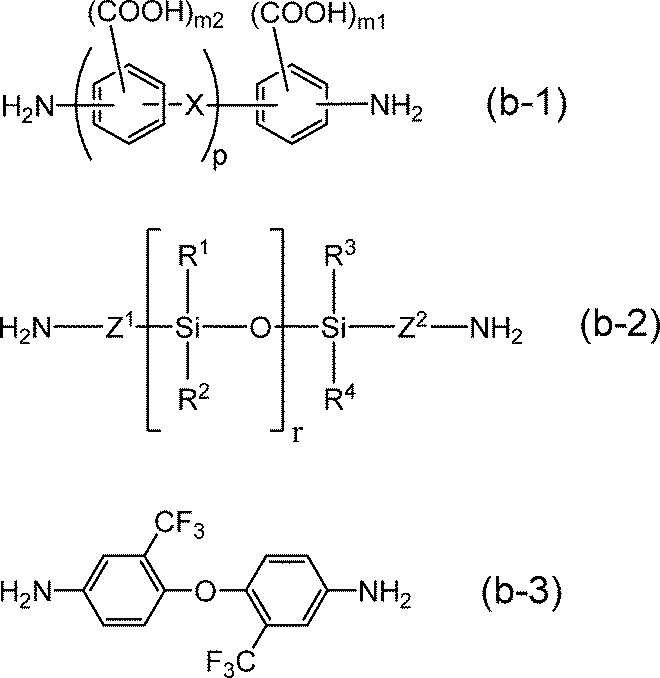
- the structural unit B is a structural unit derived from the diamine in the polyimide resin and includes a structural unit (B-1) derived from the compound represented by the following formula (b-1) and the following structural formula (b-2).
- the structural unit (B-2) derived from the compound represented by the formula (B-2) and the structural unit (B-3) derived from the compound represented by the following formula (b-3) are included.
- X is a single bond, a substituted or unsubstituted alkylene group, a carbonyl group, an ether group, a group represented by the following formula (b-1-i), or a group represented by the following formula (b-1-ii).
- p is an integer of 0 to 2
- m1 is an integer of 0 to 4
- m2 is an integer of 0 to 4.
- m3 is an integer of 0 to 5
- m4 is an integer of 0 to 5.
- m1+m2+m3+m4 is 1 or more
- p is 0, m1 is an integer of 1 to 4,
- p is 2, each of the two X and the two m2 to m4 is independently selected.
- R 1 to R 4 are each independently a monovalent aliphatic group or a monovalent aromatic group
- Z 1 and Z 2 are each independently a divalent aliphatic group or a divalent aromatic group
- r is a positive integer.
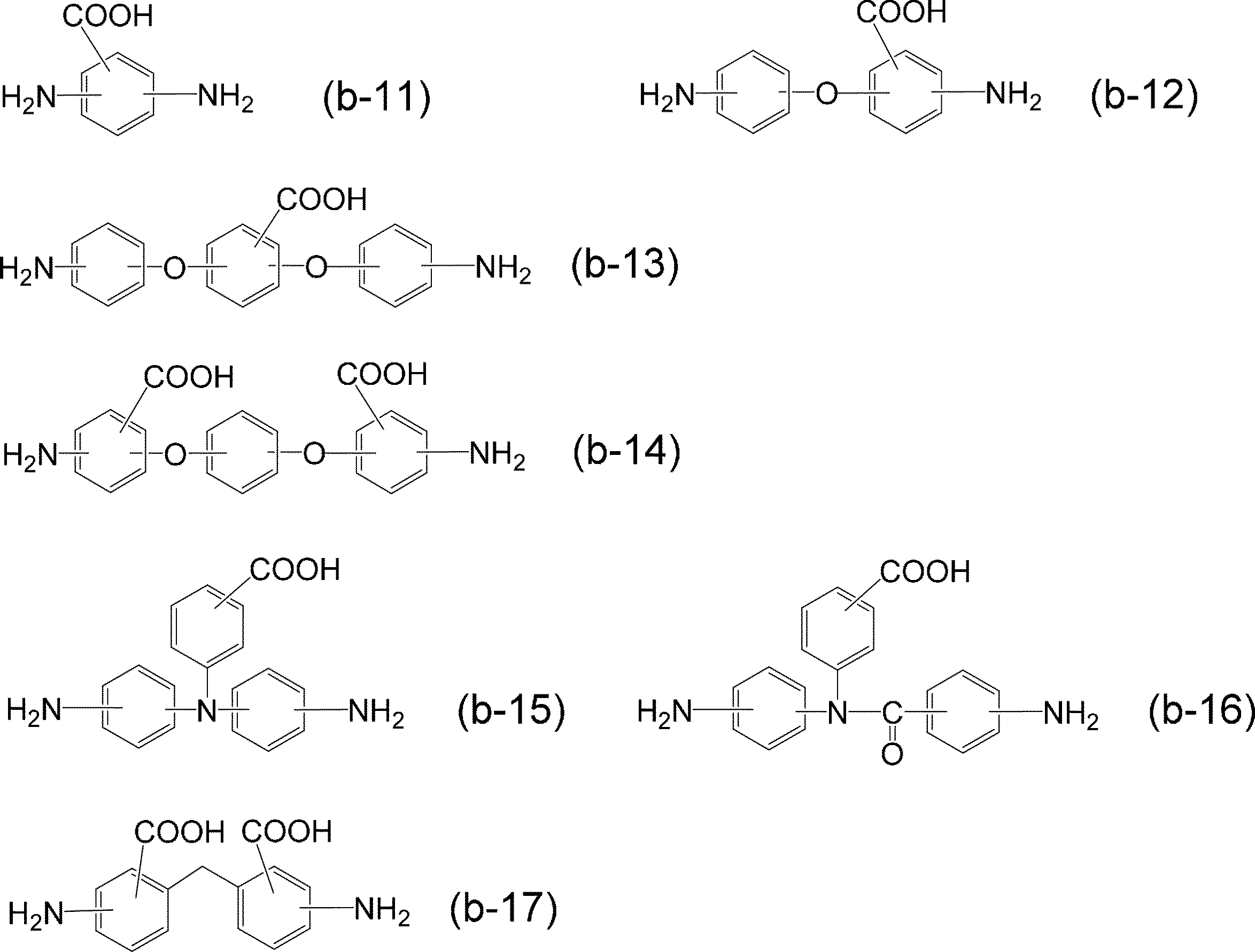
- Specific examples of the compound represented by the formula (b-1) include compounds represented by the following formulas (b-11) to (b-17).
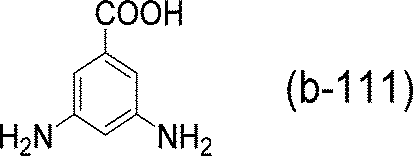
- the compound represented by the formula (b-11) is preferable, and the compound represented by the following formula (b-111), that is, 3,5-diaminobenzoic acid is more preferable.
- the structural unit (B-1) is a structural unit that gives a carboxyl group to the polyimide resin.
- the polyimide resin has a carboxyl group
- the polyimide resins can be crosslinked with each other via a crosslinking agent described later.
- the structural unit B contains the structural unit (B-1), the chemical resistance of the film can be improved.
- R 1 , R 2 , R 3 and R 4 in formula (b-2) each independently represent a monovalent aliphatic group or a monovalent aromatic group, which may be substituted with a fluorine atom. ..
- Examples of the monovalent aliphatic group include a monovalent saturated hydrocarbon group and a monovalent unsaturated hydrocarbon group.
- Examples of the monovalent saturated hydrocarbon group include an alkyl group having 1 to 22 carbon atoms, and examples thereof include a methyl group, an ethyl group and a propyl group.
- Examples of the monovalent unsaturated hydrocarbon group include an alkenyl group having 2 to 22 carbon atoms, and examples thereof include a vinyl group and a propenyl group.
- Examples of the monovalent aromatic group include aryl groups having 6 to 24 carbon atoms and aralkyl groups.
- R 1 , R 2 , R 3 and R 4 a methyl group or a phenyl group is particularly preferable.
- Z 1 and Z 2 each independently represent a divalent aliphatic group or a divalent aromatic group, and these groups may be substituted with a fluorine atom or may contain an oxygen atom. .. When it contains an oxygen atom as an ether bond, the carbon number shown below means all the carbon numbers contained in an aliphatic group or an aromatic group.
- Examples of the divalent aliphatic group include a divalent saturated hydrocarbon group and a divalent unsaturated hydrocarbon group.
- Examples of the divalent saturated hydrocarbon group include an alkylene group having 1 to 22 carbon atoms, an alkyleneoxy group and a saturated hydrocarbon group having an ether bond.
- Examples of the alkylene group include a methylene group, an ethylene group and a propylene group.
- Examples of the alkyleneoxy group include a propyleneoxy group and a trimethyleneoxy group.
- Examples of the divalent unsaturated hydrocarbon group include an unsaturated hydrocarbon group having 2 to 22 carbon atoms, and examples thereof include a vinylene group, a propenylene group, and an alkylene group having an unsaturated double bond at the end.
- divalent aromatic group examples include a phenylene group having 6 to 24 carbon atoms, a phenylene group substituted with an alkyl group, and an aralkylene group.
- Z 1 and Z 2 a propylene group, a phenylene group and an aralkylene group are particularly preferable.
- r represents a positive integer, and is preferably an integer of 10 to 10,000.
- the compound represented by the following formula (b-21) is preferable.
- n and n each independently represent an integer of 1 or more, and the sum of m and n is an integer of 10 to 10,000.
- the sum of m and n (m+n) is preferably 10 to 1,000, more preferably 10 to 500, more preferably 10 to 100, still more preferably 10 to 50.
- the ratio of m/n is preferably 5/95 to 50/50, more preferably 10/90 to 40/60, and further preferably 20/80 to 30/70.
- Examples of the compound represented by the formula (b-2) include 1,3-bis(3-aminopropyl)-1,1,2,2-tetramethyldisiloxane and 1,3-bis(3-aminobutyl). -1,1,2,2-tetramethyldisiloxane, bis(4-aminophenoxy)dimethylsilane, 1,3-bis(4-aminophenoxy)tetramethyldisiloxane, 1,1,3,3-tetramethyl -1,3-bis(4-aminophenyl)disiloxane, 1,1,3,3-tetraphenoxy-1,3-bis(2-aminoethyl)disiloxane, 1,1,3,3-tetraphenyl -1,3-bis(2-aminoethyl)disiloxane, 1,1,3,3-tetraphenyl-1,3-bis(2-aminoethyl)disiloxane, 1,1,3,3-tetra
- the above compounds may be used alone or in combination of two or more.
- the commercially available products of the compound represented by the formula (b-2) include "X-22-9409”, “X-22-1660B” and “X-22-161A” manufactured by Shin-Etsu Chemical Co., Ltd. ,” “X-22-161B” and the like.
- the structural unit (B-2) By including the structural unit (B-2) in the structural unit B, it is possible to improve the colorless transparency and optical isotropy of the film and the cleanability of the polyimide resin composition.
- the compound represented by the formula (b-3) is 4,4′-diamino-2,2′-bistrifluoromethyldiphenyl ether.
- the ratio of the structural unit (B-1) in the structural unit B is preferably 20 to 75 mol%, more preferably 25 to 70 mol%, and further preferably 30 to 60 mol%.
- the ratio of the structural unit (B-2) in the structural unit B is preferably 1 to 25 mol%, more preferably 2 to 20 mol%, and further preferably 3 to 15 mol%.
- the ratio of the structural unit (B-3) in the structural unit B is preferably 20 to 75 mol %, more preferably 25 to 70 mol %, and further preferably 30 to 60 mol %.
- the total ratio of the structural units (B-1) to (B-3) in the structural unit B is preferably 50 mol% or more, more preferably 70 mol% or more, further preferably 90 mol% or more.
- the upper limit of the total ratio of the structural units (B-1) to (B-3) is not particularly limited, that is, 100 mol%.
- the structural unit B may consist of the structural unit (B-1), the structural unit (B-2), and the structural unit (B-3) only.
- the structural unit B may include a structural unit other than the structural units (B-1) to (B-3).
- the diamine which gives such a constitutional unit is not particularly limited, but 1,4-phenylenediamine, p-xylylenediamine, 1,5-diaminonaphthalene, 2,2′-dimethylbiphenyl-4,4′-diamine , 2,2'-bis(trifluoromethyl)benzidine, 4,4'-diaminodiphenyl ether, 4,4'-diaminodiphenylmethane, 2,2-bis(4-aminophenyl)hexafluoropropane, 4,4'- Diaminodiphenyl sulfone, 4,4'-diaminobenzanilide, 1-(4-aminophenyl)-2,3-dihydro-1,3,3-trimethyl-1H-inden-5-amine, ⁇ , ⁇ '-bis (4-aminophenyl)-1,4-
- the aromatic diamine means a diamine containing at least one aromatic ring
- the alicyclic diamine means a diamine containing at least one alicyclic ring and containing no aromatic ring
- a fat Group diamine means a diamine containing neither an aromatic ring nor an alicyclic ring.
- the constitutional units arbitrarily contained in the constitutional unit B may be one kind or two or more kinds.
- the number average molecular weight of the polyimide resin is preferably 5,000 to 100,000 from the viewpoint of mechanical strength of the obtained polyimide film.
- the number average molecular weight of the polyimide resin can be determined, for example, from a standard polymethylmethacrylate (PMMA) conversion value measured by gel filtration chromatography.
- the polyimide resin is a tetracarboxylic acid component containing a compound giving the above-mentioned structural unit (A-1), a compound giving the above-mentioned structural unit (B-1), and the above-mentioned structural unit (B-2). It can be produced by reacting a compound which gives the compound (1) with a diamine component containing the compound which gives the structural unit (B-3).
- Examples of the compound that provides the structural unit (A-1) include compounds represented by the formula (a-1), but the compound is not limited thereto, and a derivative thereof may be used as long as the same structural unit is provided.
- Examples of the derivative include a tetracarboxylic acid corresponding to the tetracarboxylic dianhydride represented by the formula (a-1) (that is, 1,2,4,5-cyclohexanetetracarboxylic acid), and a tetracarboxylic acid of the tetracarboxylic acid.
- An alkyl ester is mentioned.
- the tetracarboxylic acid component preferably contains the compound giving the structural unit (A-1) in an amount of 50 mol% or more, more preferably 70 mol% or more, and further preferably 85 mol% or more.
- the upper limit of the content ratio of the compound providing the structural unit (A-1) is not particularly limited, that is, 100 mol%.
- the tetracarboxylic acid component may consist of only the compound which gives the structural unit (A-1).
- the tetracarboxylic acid component may include a compound other than the compound providing the structural unit (A-1), and examples of the compound include the above-mentioned aromatic tetracarboxylic dianhydride, alicyclic tetracarboxylic dianhydride, And aliphatic tetracarboxylic acid dianhydride, and derivatives thereof (tetracarboxylic acid, alkyl ester of tetracarboxylic acid, etc.).
- the compound optionally contained in the tetracarboxylic acid component may be one type or two or more types.
- a compound giving the structural unit (A-2) is preferable.
- the compound that provides the structural unit (A-2) include compounds represented by the formula (a-2), but the compound is not limited thereto, and a derivative thereof may be used as long as the same structural unit is provided.
- the derivative include a tetracarboxylic acid corresponding to the tetracarboxylic dianhydride represented by the formula (a-2), and an alkyl ester of the tetracarboxylic acid.
- the compound represented by the formula (a-2) ie, dianhydride
- the tetracarboxylic acid component includes a compound which gives the structural unit (A-1) and a compound which gives the structural unit (A-2)
- the tetracarboxylic acid component is preferably a compound which gives the structural unit (A-1), preferably 50 To 99 mol %, more preferably 50 to 95 mol %, further preferably 70 to 95 mol %, particularly preferably 85 to 95 mol %, preferably a compound providing the structural unit (A-2), 1 to 50 mol %, more preferably 5 to 50 mol %, further preferably 5 to 30 mol %, particularly preferably 5 to 15 mol %.
- the tetracarboxylic acid component in total, preferably contains 50 mol% or more, more preferably 70 mol% or more, and even more preferably a compound giving the structural unit (A-1) and a compound giving the structural unit (A-2). Is 90 mol% or more, particularly preferably 99 mol% or more.
- the upper limit of the total content ratio of the compound giving the structural unit (A-1) and the compound giving the structural unit (A-2) is not particularly limited, that is, 100 mol%.
- the tetracarboxylic acid component may consist of only the compound which gives the structural unit (A-1) and the compound which gives the structural unit (A-2).
- examples thereof include the compound represented by (b-2) and the compound represented by the formula (b-3), but the compounds are not limited thereto, and derivatives thereof may be used as long as they provide the same constitutional unit.
- examples of the derivative include diisocyanates corresponding to the diamines represented by the formulas (b-1) to (b-3).
- the compound that provides the structural unit (B-1), the compound that provides the structural unit (B-2), and the compound that provides the structural unit (B-3) are each represented by the formula (b-1) (ie, , Diamine), the compound represented by the formula (b-2) (ie, diamine), and the compound represented by the formula (b-3) (ie, diamine) are preferable.
- the diamine component preferably contains 20 to 75 mol% of the compound giving the structural unit (B-1), more preferably 25 to 70 mol%, and further preferably 30 to 60 mol%.
- the diamine component preferably contains 1 to 25 mol% of the compound providing the structural unit (B-2), more preferably 2 to 20 mol%, and further preferably 3 to 15 mol%.
- the diamine component preferably contains 20 to 75 mol% of the compound that provides the structural unit (B-3), more preferably 25 to 70 mol%, and further preferably 30 to 60 mol%.
- the diamine component contains a compound giving the structural unit (B-1), a compound giving the structural unit (B-2), and a compound giving the structural unit (B-3) in a total amount of preferably 50 mol% or more,
- the content is preferably 70 mol% or more, more preferably 90 mol% or more, and particularly preferably 99 mol% or more.
- the upper limit of the total content ratio of the compound giving the structural unit (B-1), the compound giving the structural unit (B-2), and the compound giving the structural unit (B-3) is not particularly limited, that is, 100. Mol %.
- the diamine component may be composed of only the compound giving the structural unit (B-1), the compound giving the structural unit (B-2) and the compound giving the structural unit (B-3).
- the diamine component may include a compound other than the compound which gives the structural unit (B-1), the compound which gives the structural unit (B-2) and the compound which gives the structural unit (B-3).
- a compound which gives the structural unit (B-1), the compound which gives the structural unit (B-2) and the compound which gives the structural unit (B-3).
- the compound optionally contained in the diamine component is It may be one type or two or more types.
- the charge ratio of the tetracarboxylic acid component and the diamine component used for producing the polyimide resin is preferably 0.9 to 1.1 mol of the diamine component with respect to 1 mol of the tetracarboxylic acid component.
- an endcapping agent may be used in the production of the polyimide resin.
- the terminal blocking agent monoamines or dicarboxylic acids are preferable.
- the amount of the terminal blocking agent introduced is preferably 0.0001 to 0.1 mol, and particularly preferably 0.001 to 0.06 mol, per 1 mol of the tetracarboxylic acid component.
- Examples of monoamine endcapping agents include methylamine, ethylamine, propylamine, butylamine, benzylamine, 4-methylbenzylamine, 4-ethylbenzylamine, 4-dodecylbenzylamine, 3-methylbenzylamine, 3- Ethylbenzylamine, aniline, 3-methylaniline, 4-methylaniline and the like are recommended. Of these, benzylamine and aniline can be preferably used.
- dicarboxylic acid end capping agent dicarboxylic acids are preferable, and a part thereof may be ring-closed.
- phthalic acid, phthalic anhydride, 4-chlorophthalic acid, tetrafluorophthalic acid, 2,3-benzophenone dicarboxylic acid, 3,4-benzophenone dicarboxylic acid, cyclohexane-1,2-dicarboxylic acid, cyclopentane-1,2. -Dicarboxylic acid, 4-cyclohexene-1,2-dicarboxylic acid and the like are recommended.
- phthalic acid and phthalic anhydride can be preferably used.
- the method for reacting the above-mentioned tetracarboxylic acid component and diamine component is not particularly limited, and a known method can be used.
- a specific reaction method (1) a tetracarboxylic acid component, a diamine component, and a reaction solvent are charged in a reactor, stirred at room temperature (about 20° C.) to 80° C. for 0.5 to 30 hours, and then heated.
- a method of stirring for 0.5 to 30 hours and then raising the temperature to perform an imidization reaction (3) charging a tetracarboxylic acid component, a diamine component, and a reaction solvent into a reactor and immediately raising the temperature to perform the imidization reaction. And the like.
- the reaction solvent used for producing the polyimide resin may be any solvent that does not inhibit the imidization reaction and that can dissolve the generated polyimide.
- an aprotic solvent, a phenol solvent, an ether solvent, a carbonate solvent, etc. are mentioned.
- aprotic solvent examples include N,N-dimethylformamide, N,N-dimethylacetamide, N-methyl-2-pyrrolidone, N-methylcaprolactam, 1,3-dimethylimidazolidinone and tetramethylurea.
- examples thereof include system solvents, ketone solvents such as acetone, cyclohexanone and methylcyclohexanone, amine solvents such as picoline and pyridine, ester solvents such as acetic acid (2-methoxy-1-methylethyl).
- phenolic solvent examples include phenol, o-cresol, m-cresol, p-cresol, 2,3-xylenol, 2,4-xylenol, 2,5-xylenol, 2,6-xylenol, 3,4. -Xylenol, 3,5-xylenol and the like can be mentioned.
- ether solvents include 1,2-dimethoxyethane, bis(2-methoxyethyl)ether, 1,2-bis(2-methoxyethoxy)ethane, bis[2-(2-methoxyethoxy)ethyl].
- Ether, tetrahydrofuran, 1,4-dioxane and the like can be mentioned.
- carbonate-based solvent examples include diethyl carbonate, methyl ethyl carbonate, ethylene carbonate, propylene carbonate and the like.
- amide solvents or lactone solvents are preferable.
- the imidization reaction it is preferable to use a Dean-Stark apparatus or the like to carry out the reaction while removing water produced during production. By performing such an operation, the degree of polymerization and the imidization ratio can be further increased.
- a known imidization catalyst can be used.
- the imidization catalyst include a base catalyst and an acid catalyst.
- the base catalyst pyridine, quinoline, isoquinoline, ⁇ -picoline, ⁇ -picoline, 2,4-lutidine, 2,6-lutidine, trimethylamine, triethylamine, tripropylamine, tributylamine, triethylenediamine, imidazole, N,N
- examples include organic base catalysts such as dimethylaniline and N,N-diethylaniline, and inorganic base catalysts such as potassium hydroxide, sodium hydroxide, potassium carbonate, sodium carbonate, potassium hydrogen carbonate, and sodium hydrogen carbonate.
- the acid catalyst crotonic acid, acrylic acid, trans-3-hexenoic acid, cinnamic acid, benzoic acid, methylbenzoic acid, oxybenzoic acid, terephthalic acid, benzenesulfonic acid, paratoluenesulfonic acid, naphthalenesulfonic acid, etc.
- the above imidization catalysts may be used alone or in combination of two or more.
- a base catalyst more preferable to use an organic base catalyst, further preferable to use triethylamine, and particularly preferable to use triethylamine and triethylenediamine in combination.
- the temperature of the imidization reaction is preferably 120 to 250° C., more preferably 160 to 200° C., from the viewpoint of reaction rate and suppression of gelation and the like.
- the reaction time is preferably 0.5 to 10 hours after the start of distillation of the produced water.
- the crosslinker has at least two oxazolyl groups. That is, the crosslinking agent in the present invention is a polyfunctional oxazoline compound having two or more oxazolyl groups (oxazoline rings) in the molecule.
- the oxazolyl group has reactivity with a carboxyl group, and when the carboxyl group and the oxazolyl group react with each other, an amide ester bond is formed as shown below. This reaction is particularly likely to proceed when heated to 80° C. or higher.
- the polyimide resin contained in the polyimide resin composition of the present invention has a carboxyl group, when the polyimide resin composition of the present invention is heated, the polyimide resins are crosslinked with each other via a crosslinking agent to form a crosslinked polyimide resin. It For this reason, the chemical resistance of the film is improved.
- the cross-linking agent is not particularly limited as long as it is a polyfunctional oxazoline compound having two or more oxazolyl groups in the molecule, and specific examples thereof include 1,3-bis(4,5-dihydro-2-oxazolyl)benzene, 1,4-bis(4,5-dihydro-2-oxazolyl)benzene, 2,2′-bis(2-oxazoline), K-2010E, K-2020E, K-2030E, 2, manufactured by Nippon Shokubai Co., Ltd.
- the cross-linking agent is preferably a compound containing an aromatic ring or an aromatic heterocycle having at least two oxazolyl groups bonded, more preferably a compound having a benzene ring or a pyridine ring having at least two oxazolyl groups bonded, A compound containing a benzene ring to which at least two oxazolyl groups are bonded is preferable, and 1,3-bis(4,5-dihydro-2-oxazolyl)benzene is particularly preferable.
- the crosslinking agent may be used alone or in combination of two or more kinds.
- the molar ratio of the oxazolyl group in the crosslinking agent to the carboxyl group in the polyimide resin is in the range of 1/4 to 1/0.5. Therefore, it is preferable to include a polyimide resin and a crosslinking agent.
- the molar ratio is more preferably 1/4 to 1/1, still more preferably 1/2 to 1/1, even more preferably 1/2 to 1/1.5, even more preferably Is 1/2 to 1/1.7.
- the above molar ratio means the molar ratio of the oxazolyl group contained in the cross-linking agent to the carboxyl group contained in the compound that gives the structural unit (B-1) used in the production of the polyimide resin. It is calculated based on the amount and the added amount of the compound that gives the structural unit (B-1).
- the polyimide resin composition of the present invention is an inorganic filler, an adhesion promoter, a release agent, a flame retardant, an ultraviolet stabilizer, a surfactant, a leveling agent, an antifoaming agent, within a range that does not impair the required properties of the polyimide film. It may contain various additives such as a fluorescent whitening agent, a cross-linking agent, a polymerization initiator and a photosensitizer.
- the method for producing the polyimide resin composition of the present invention is not particularly limited, and known methods can be applied.
- the polyimide resin composition of the present invention can form a film excellent in colorless transparency, optical isotropy, and chemical resistance.
- the preferred physical properties of the film that can be formed using the polyimide resin composition of the present invention are as follows.
- the total light transmittance is preferably 88% or more, more preferably 90% or more, still more preferably 91% or more when a film having a thickness of 10 ⁇ m is formed.
- the yellow index (YI) is preferably 2.5 or less, more preferably 2.3 or less, still more preferably 2.0 or less when the film has a thickness of 10 ⁇ m.
- b * is preferably 1.5 or less, more preferably 1.2 or less, and further preferably 1.0 or less when a film having a thickness of 10 ⁇ m is formed.
- the haze is preferably 2.0% or less, more preferably 1.0% or less, still more preferably 0.6% or less when a film having a thickness of 10 ⁇ m is formed.
- the absolute value of the thickness retardation (Rth) is preferably 100 nm or less, more preferably 90 nm or less, still more preferably 60 nm or less when a film having a thickness of 10 ⁇ m is formed.
- the mixed acid ⁇ YI is preferably 1.5 or less, more preferably 1.3 or less, and still more preferably 1.2 or less when a film having a thickness of 10 ⁇ m is formed.
- the mixed acid ⁇ YI means the difference in YI before and after the immersion of the polyimide film in a mixture of phosphoric acid, nitric acid and acetic acid, and specifically, it should be measured by the method described in Examples. You can The smaller ⁇ YI means the better acid resistance.
- a film having excellent chemical resistance can be formed and excellent resistance to acid is also exhibited.
- a mixed solution of mixed acids for example, 50 to 97% by mass of phosphoric acid, 1 to 20% by mass of nitric acid, 1 to 10% by mass of acetic acid, and 1 to 20% by mass of water, preferably 63 to 87% of phosphoric acid).
- the film that can be formed using the polyimide resin composition of the present invention has good mechanical properties and heat resistance, and has the following suitable physical property values.
- the tensile elastic modulus is preferably 2.0 GPa or more, more preferably 2.5 GPa or more, and further preferably 2.7 GPa or more.
- the tensile strength is preferably 60 MPa or more, more preferably 70 MPa or more, and further preferably 80 MPa or more.
- the tensile elongation at break is preferably 5.0% or more, more preferably 6.0% or more, still more preferably 7.5% or more.
- the glass transition temperature (Tg) is preferably 230° C. or higher, more preferably 250° C. or higher, and further preferably 290° C. or higher.
- the above-mentioned physical property values in the present invention can be specifically measured by the methods described in Examples.
- polyimide varnish As a preferred embodiment of the polyimide resin composition of the present invention, in addition to the above-mentioned polyimide resin and the above-mentioned cross-linking agent, further containing an organic solvent, the polyimide resin composition in which the polyimide resin is dissolved in the organic solvent ( Hereinafter, it is also referred to as "polyimide varnish"). That is, the polyimide varnish of the present invention contains a polyimide resin composition and an organic solvent.
- the organic solvent is not particularly limited as long as it can dissolve the polyimide resin, but it is preferable to use the compounds described above as the reaction solvent used in the production of the polyimide resin, alone or in combination of two or more kinds.
- the organic solvent include aprotic solvents, phenolic solvents, ether solvents, carbonate solvents and the like.
- aprotic solvent examples include N,N-dimethylformamide, N,N-dimethylacetamide, N-methyl-2-pyrrolidone, N-methylcaprolactam, 1,3-dimethylimidazolidinone and tetramethylurea.
- examples thereof include system solvents, ketone solvents such as acetone, cyclohexanone and methylcyclohexanone, amine solvents such as picoline and pyridine, ester solvents such as acetic acid (2-methoxy-1-methylethyl).
- phenolic solvent examples include phenol, o-cresol, m-cresol, p-cresol, 2,3-xylenol, 2,4-xylenol, 2,5-xylenol, 2,6-xylenol, 3,4. -Xylenol, 3,5-xylenol and the like can be mentioned.
- ether solvents include 1,2-dimethoxyethane, bis(2-methoxyethyl)ether, 1,2-bis(2-methoxyethoxy)ethane, bis[2-(2-methoxyethoxy)ethyl].
- Ether, tetrahydrofuran, 1,4-dioxane and the like can be mentioned.
- carbonate-based solvent examples include diethyl carbonate, methyl ethyl carbonate, ethylene carbonate, propylene carbonate and the like.
- organic solvents amide solvents or lactone solvents are preferable, and lactone solvents are more preferable from the viewpoint of detergency.
- lactone solvents ⁇ -butyrolactone and ⁇ -valerolactone are preferable, and ⁇ -butyrolactone is more preferable.
- the proportion of the lactone-based solvent in the organic solvent contained in the polyimide varnish is preferably 70 to 100% by mass, more preferably 80 to 100% by mass, and further preferably 90 to 100% by mass.
- it may consist of only a lactone solvent. Since the lactone-based solvent has a low moisture absorption rate, the varnish does not absorb moisture in the environment at the time of coating the film, and whitening and roughening of the film surface due to precipitation of polyimide are less likely to occur, which is preferable.
- the polyimide varnish may be a solution obtained by adding a crosslinking agent to the solution itself in which the polyimide resin obtained by the polymerization method is dissolved in a reaction solvent, or a solution obtained by adding a diluting solvent and a crosslinking agent to the solution. May be
- the above-mentioned polyimide resin has solvent solubility, and the crosslinking reaction with the crosslinking agent hardly progresses at room temperature. Therefore, a polyimide varnish that is stable at room temperature can be obtained.
- the polyimide varnish preferably contains 1 to 40% by mass of the polyimide resin, and more preferably 2 to 40% by mass. Above all, from the viewpoints of stable and high-concentration storage and good film formation, it is more preferably 5 to 40% by mass, further preferably 10 to 30% by mass, and 15 to 25% by mass. Even more preferable.
- the viscosity of the polyimide varnish is preferably 1 to 200 Pa ⁇ s, more preferably 2 to 100 Pa ⁇ s.
- the viscosity of the polyimide varnish is a value measured at 25° C. using an E-type viscometer.
- the polyimide varnish used for film coating preferably contains 1 to 10% by mass of the polyimide resin, more preferably 2 to 8% by mass, and further preferably 4 to 7% by mass. It is even more preferable.
- the viscosity at that time is preferably 0.1 to 15 Pa ⁇ s, more preferably 1 to 10 Pa ⁇ s, further preferably 2 to 5 Pa ⁇ s.
- the polyimide film of the present invention is obtained by crosslinking the above-mentioned polyimide resin contained in the polyimide resin composition of the present invention with the above-mentioned crosslinking agent. That is, the polyimide film of the present invention contains a crosslinked polyimide resin which is a crosslinked product of polyimide resins via a crosslinking agent. Therefore, the polyimide film of the present invention is excellent in colorless transparency, optical isotropy, and chemical resistance. Suitable physical properties of the polyimide film of the present invention are as described above. In the method for producing a polyimide film of the present invention, a step of heating at a temperature (preferably 80° C. or higher, more preferably 100° C.
- the coating method examples include known coating methods such as spin coating, slit coating, and blade coating.
- the organic solvent may be evaporated at a temperature of 60 to 150° C. to be tack-free, and then dried at a temperature not lower than the boiling point of the organic solvent used (not particularly limited, but preferably 200 to 500° C.). preferable. Further, it is preferable to dry under an air atmosphere or a nitrogen atmosphere. The pressure of the dry atmosphere may be any of reduced pressure, normal pressure and increased pressure.
- the method of peeling the polyimide film formed on the support from the support is not particularly limited, but a laser lift-off method or a method of using a sacrificial layer for peeling (a release agent is applied to the surface of the support in advance. Method).
- the thickness of the polyimide film of the present invention can be appropriately selected depending on the application etc., but is preferably in the range of 1 to 250 ⁇ m, more preferably 5 to 100 ⁇ m, and further preferably 10 to 80 ⁇ m. A thickness of 1 to 250 ⁇ m enables practical use as a self-supporting film.
- the thickness of the polyimide film can be easily controlled by adjusting the solid content concentration and viscosity of the polyimide varnish.
- the polyimide film of the present invention is preferably used as a film for various members such as color filters, flexible displays, semiconductor parts and optical members.
- the polyimide film of the present invention is particularly preferably used as a substrate for image display devices such as liquid crystal displays and OLED displays.
- each physical property was measured by the methods described below.
- (1) Solid Content Concentration The solid content concentration of the polyimide resin solution and the polyimide varnish was measured by heating the sample at 320° C. ⁇ 120 min with a small electric furnace “MMF-1” manufactured by As One Co., Ltd., and the mass of the sample before and after heating. Calculated from the difference.
- (2) Film thickness The film thickness was measured using a micrometer manufactured by Mitutoyo Corporation.
- Thickness phase difference The thickness retardation (Rth) was measured using an ellipsometer “M-220” manufactured by JASCO Corporation. The value of the thickness retardation at a measurement wavelength of 590 nm was measured. Note that Rth is represented by the following formula when the maximum in-plane refractive index of the polyimide film is nx, the minimum is ny, the thickness direction refractive index is nz, and the film thickness is d. It is something.
- Rth [ ⁇ (nx+ny)/2 ⁇ -nz] ⁇ d (7)
- Solvent resistance A solvent was dropped at room temperature on a polyimide film formed on a glass plate, and it was confirmed whether the film surface was changed. In addition, propylene glycol monomethyl ether acetate (PGMEA) was used as a solvent. The evaluation criteria for solvent resistance were as follows. A: There was no change on the film surface. B: The surface of the film was slightly cracked. C: The film surface was cracked or the film surface was dissolved.
- PGMEA propylene glycol monomethyl ether acetate
- X-22-9409 Amino-terminal modified silicone oil "X-22-9409" (manufactured by Shin-Etsu Chemical Co., Ltd.; compound represented by formula (b-2)) 6FODA
- Example 1 In a 1 L 5-neck round bottom flask equipped with a stainless steel half-moon stirring blade, a Dean Stark equipped with a nitrogen introduction tube, a cooling tube, a thermometer, and a glass end cap, 8.518 g (0 0.056 mol), 13.22 g (0.010 mol) of X-22-9409, 18.833 g (0.056 mol) of 6FODA, and 66.873 g of ⁇ -butyrolactone (manufactured by Mitsubishi Chemical Corporation). The solution was charged and stirred at a system temperature of 70° C. and a nitrogen atmosphere at a rotation speed of 200 rpm to obtain a solution.
- the oxazolyl group/carboxyl group molar ratio calculated based on the amount of 1,3-PBO added and the amount of 3,5-DABA added was 1/2.
- the obtained polyimide varnish was applied onto a glass plate by spin coating, held at 80° C. for 20 minutes on a hot plate, and then heated at 260° C. for 30 minutes in a hot air dryer in an air atmosphere to remove the solvent. Evaporation gave a film.
- Table 1 The results are shown in Table 1.
- Example 2 In a 1 L 5-neck round bottom flask equipped with a stainless steel half-moon stirring blade, a Dean Stark equipped with a nitrogen introducing tube, a cooling tube, a thermometer, and a glass end cap, 8.173 g (0 0.054 mol), X-22-9409 13.155 g (0.010 mol), 6FODA 18.071 g (0.054 mol), and ⁇ -butyrolactone (manufactured by Mitsubishi Chemical Corporation) 66.699 g. The solution was charged and stirred at a system temperature of 70° C. and a nitrogen atmosphere at a rotation speed of 200 rpm to obtain a solution.
- the components to be distilled off were collected, and the temperature in the reaction system was maintained at 190° C. and refluxed for about 5 hours while adjusting the number of rotations according to the increase in viscosity. Thereafter, 172.626 g of ⁇ -butyrolactone (manufactured by Mitsubishi Chemical Co., Ltd.) was added, the temperature in the reaction system was cooled to 120° C., and the mixture was further stirred for about 3 hours to homogenize, and the solid content concentration was 20.0 mass. % Polyimide resin solution (2) was obtained.
- a polyimide resin solution (4) was obtained.
- the polyimide resin solution (4) was used as it was as a polyimide varnish without adding the crosslinking agent 1,3-PBO. That is, the obtained polyimide varnish (polyimide resin solution (4)) was applied onto a glass plate by spin coating and kept at 80° C. for 20 minutes on a hot plate, and then at 260° C. in a hot air dryer under an air atmosphere. The mixture was heated for 30 minutes and the solvent was evaporated to obtain a film. The results are shown in Table 1.
- the oxazolyl group/carboxyl group molar ratio calculated based on the amount of 1,3-PBO added and the amount of 3,5-DABA added was 1/2.
- the obtained polyimide varnish was applied onto a glass plate by spin coating, held at 80° C. for 20 minutes on a hot plate, and then heated at 260° C. for 30 minutes in a hot air dryer in an air atmosphere to remove the solvent. Evaporation gave a film.
- Table 1 The results are shown in Table 1.
- the oxazolyl group/carboxyl group molar ratio calculated based on the amount of 1,3-PBO added and the amount of 3,5-DABA added was 1/2.
- the obtained polyimide varnish was applied onto a glass plate by spin coating, held at 80° C. for 20 minutes on a hot plate, and then heated at 260° C. for 30 minutes in a hot air dryer in an air atmosphere to remove the solvent. Evaporation gave a film.
- Table 1 The results are shown in Table 1.
- the oxazolyl group/carboxyl group molar ratio calculated based on the amount of 1,3-PBO added and the amount of 3,5-DABA added was 1/2.
- the obtained polyimide varnish was applied onto a glass plate by spin coating, held at 80° C. for 20 minutes on a hot plate, and then heated at 260° C. for 30 minutes in a hot air dryer in an air atmosphere to remove the solvent. Evaporation gave a film.
- Table 1 The results are shown in Table 1.
- the components to be distilled off were collected, and the temperature in the reaction system was maintained at 190° C. and refluxed for about 5 hours while adjusting the number of rotations according to the increase in viscosity. Thereafter, 172.598 g of ⁇ -butyrolactone (manufactured by Mitsubishi Chemical Co., Ltd.) was added, the temperature in the reaction system was cooled to 120° C., and the mixture was further stirred for about 3 hours to homogenize the mixture to obtain a solid content concentration of 20% by mass. A polyimide resin solution (9) was obtained.
- the polyimide films of Examples 1 and 2 are excellent in colorless transparency, optical isotropy, and chemical resistance (solvent resistance and acid resistance).
- the polyimide varnishes of Nos. 2 and 2 were excellent in storage stability and detergency.
- Comparative Example 1 a polyimide varnish was obtained by adding a cross-linking agent to the polyimide resin solution and stirring for 1 hour. After that, when the polyimide varnish was allowed to stand at room temperature, white precipitates in the polyimide varnish were obtained. Occurred and the fluidity of the polyimide varnish disappeared. That is, the polyimide varnish of Comparative Example 1 was inferior in storage stability and washability.
- the polyimide film of Comparative Example 2 was inferior in solvent resistance.
- the value of the mixed acid ⁇ YI was as large as 1.57, and the acid resistance was poor.
- the polyimide film of Comparative Example 3 was inferior in optical isotropy. Further, the polyimide varnish of Comparative Example 3 was inferior in cleanability.
- the polyimide varnish of Comparative Example 4 was inferior in cleanability.
- the polyimide film of Comparative Example 5 was not good in solvent resistance. Further, the polyimide varnish of Comparative Example 5 was inferior in cleanability.
- the polyimide varnish of Comparative Example 6 was inferior in storage stability and washability.
- the polyimide varnish of Comparative Example 7 was inferior in cleanability.
Landscapes
- Chemical & Material Sciences (AREA)
- Chemical Kinetics & Catalysis (AREA)
- Organic Chemistry (AREA)
- Health & Medical Sciences (AREA)
- Medicinal Chemistry (AREA)
- Polymers & Plastics (AREA)
- Engineering & Computer Science (AREA)
- Manufacturing & Machinery (AREA)
- Materials Engineering (AREA)
- Life Sciences & Earth Sciences (AREA)
- Wood Science & Technology (AREA)
- Macromolecular Compounds Obtained By Forming Nitrogen-Containing Linkages In General (AREA)
- Compositions Of Macromolecular Compounds (AREA)
Abstract
Description
また、ポリイミドフィルムをITO(Indium Tin Oxide)膜形成用の基板として用いた場合、ポリイミドフィルムにはITO膜のエッチングに用いられる酸に対する耐性が求められる。ポリイミドフィルムの耐酸性が不十分であると、フィルムが黄変して無色透明性が損なわれるおそれがある。
特許文献1では、溶剤(N,N-ジメチルアセトアミド)に対する耐性は評価されているが、耐酸性は評価されていない。
さらに、ポリイミド樹脂組成物は、ポリイミド樹脂組成物の塗布等に使用した配管や装置に使用する洗浄液(例えば、東京応化工業株式会社製の「OK73シンナー」等)に対する溶解性も求められる。洗浄液に対する溶解性が低いと、洗浄液による配管や装置の洗浄が不十分になるおそれがある。
特許文献1には、ポリイミド樹脂組成物の保存安定性や洗浄性について何ら記載されていない。
[1]
ポリイミド樹脂と、少なくとも2つのオキサゾリル基を有する架橋剤とを含むポリイミド樹脂組成物であって、
前記ポリイミド樹脂が、テトラカルボン酸二無水物に由来する構成単位A及びジアミンに由来する構成単位Bを有し、
構成単位Aが、下記式(a-1)で表される化合物に由来する構成単位(A-1)を含み、
構成単位Bが、下記式(b-1)で表される化合物に由来する構成単位(B-1)と、下記式(b-2)で表される化合物に由来する構成単位(B-2)と、下記式(b-3)で表される化合物に由来する構成単位(B-3)とを含む、ポリイミド樹脂組成物。

(式(b-1)中、
Xは単結合、置換若しくは無置換のアルキレン基、カルボニル基、エーテル基、下記式(b-1-i)で表される基、又は下記式(b-1-ii)で表される基であり、
pは0~2の整数であり、
m1は0~4の整数であり、
m2は0~4の整数である。
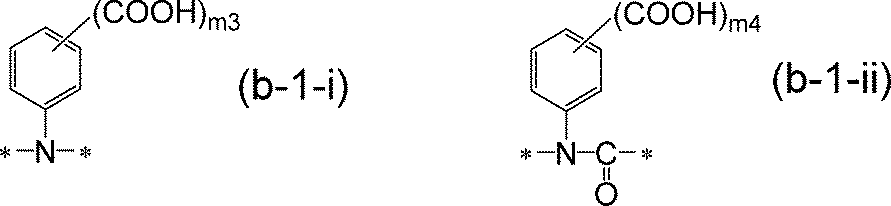
[式(b-1-i)中、m3は0~5の整数であり、式(b-1-ii)中、m4は0~5の整数である。]
ただし、
m1+m2+m3+m4は1以上であり、
pが0の場合、m1は1~4の整数であり、
pが2の場合、2つのX及び2つのm2~m4のそれぞれは独立して選択される;
式(b-2)中、
R1~R4は、それぞれ独立して、一価の脂肪族基又は一価の芳香族基であり、
Z1及びZ2は、それぞれ独立して、二価の脂肪族基又は二価の芳香族基であり、
rは正の整数である。)
構成単位(B-1)が、下記式(b-11)で表される化合物に由来する構成単位(B-11)である、上記[1]に記載のポリイミド樹脂組成物。

[3]
前記架橋剤が、少なくとも2つのオキサゾリル基が結合した芳香環又は芳香族複素環を含む化合物である、上記[1]又は[2]に記載のポリイミド樹脂組成物。
[4]
前記架橋剤が、少なくとも2つのオキサゾリル基が結合したベンゼン環を含む化合物である、上記[3]に記載のポリイミド樹脂組成物。
[5]
前記架橋剤が、1,3-ビス(4,5-ジヒドロ-2-オキサゾリル)ベンゼンである、上記[4]に記載のポリイミド樹脂組成物。
[6]
構成単位A中における構成単位(A-1)の比率が50モル%以上である、上記[1]~[5]のいずれかに記載のポリイミド樹脂組成物。
[7]
構成単位B中における構成単位(B-1)の比率が20~75モル%であり、
構成単位B中における構成単位(B-2)の比率が1~25モル%であり、
構成単位B中における構成単位(B-3)の比率が20~75モル%である、上記[1]~[6]のいずれかに記載のポリイミド樹脂組成物。
[8]
構成単位Aが、下記式(a-2)で表される化合物に由来する構成単位(A-2)を更に含む、上記[1]~[7]のいずれかに記載のポリイミド樹脂組成物。

[9]
構成単位A中における構成単位(A-1)の比率が50~99モル%であり、
構成単位A中における構成単位(A-2)の比率が1~50モル%である、上記[8]に記載のポリイミド樹脂組成物。
[10]
上記[1]~[9]のいずれかに記載のポリイミド樹脂組成物及び有機溶媒を含むポリアミドワニス。
[11]
上記[1]~[9]のいずれかに記載のポリイミド樹脂組成物中の前記ポリイミド樹脂が前記架橋剤により架橋されてなるポリイミドフィルム。
本発明のポリイミド樹脂組成物はポリイミド樹脂と架橋剤とを含む。以下、本発明におけるポリイミド樹脂及び架橋剤について説明する。
本発明において、ポリイミド樹脂はテトラカルボン酸二無水物に由来する構成単位A及びジアミンに由来する構成単位Bを有し、構成単位Aが下記式(a-1)で表される化合物に由来する構成単位(A-1)を含み、構成単位Bが下記式(b-1)で表される化合物に由来する構成単位(B-1)と、下記式(b-2)で表される化合物に由来する構成単位(B-2)と、下記式(b-3)で表される化合物に由来する構成単位(B-3)とを含む。
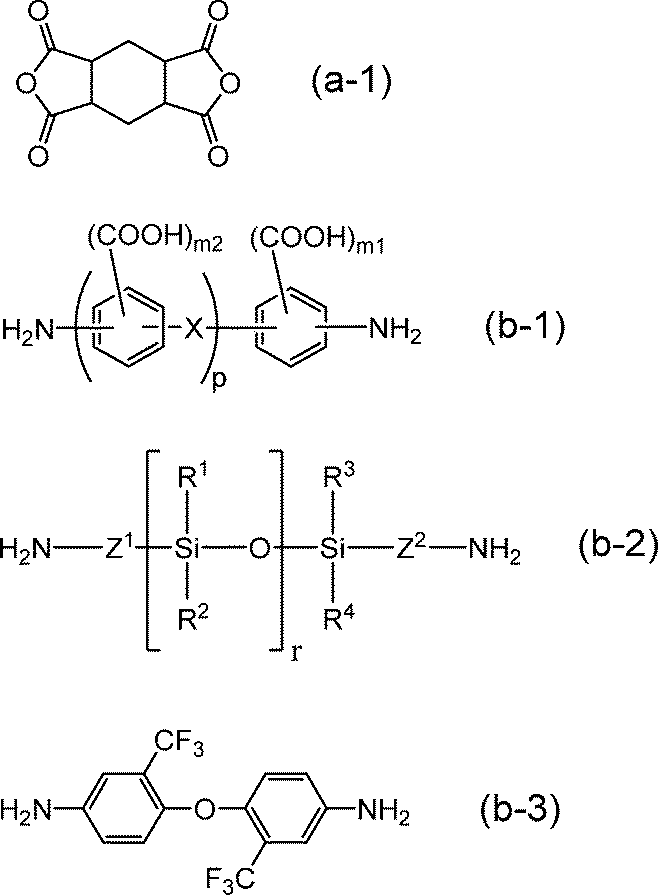
Xは単結合、置換若しくは無置換のアルキレン基、カルボニル基、エーテル基、下記式(b-1-i)で表される基、又は下記式(b-1-ii)で表される基であり、
pは0~2の整数であり、
m1は0~4の整数であり、
m2は0~4の整数である。

(式(b-1-i)中、m3は0~5の整数であり、式(b-1-ii)中、m4は0~5の整数である。)
ただし、
m1+m2+m3+m4は1以上であり、
pが0の場合、m1は1~4の整数であり、
pが2の場合、2つのX及び2つのm2~m4のそれぞれは独立して選択される。
R1~R4は、それぞれ独立して、一価の脂肪族基又は一価の芳香族基であり、
Z1及びZ2は、それぞれ独立して、二価の脂肪族基又は二価の芳香族基であり、
rは正の整数である。
構成単位Aは、ポリイミド樹脂に占めるテトラカルボン酸二無水物に由来する構成単位であって、下記式(a-1)で表される化合物に由来する構成単位(A-1)を含む。
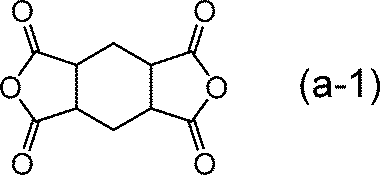
構成単位Aが構成単位(A-1)を含むことによって、フィルムの無色透明性及び光学的等方性を向上させることができる。
なお、本明細書において、芳香族テトラカルボン酸二無水物とは芳香環を1つ以上含むテトラカルボン酸二無水物を意味し、脂環式テトラカルボン酸二無水物とは脂環を1つ以上含み、かつ芳香環を含まないテトラカルボン酸二無水物を意味し、脂肪族テトラカルボン酸二無水物とは芳香環も脂環も含まないテトラカルボン酸二無水物を意味する。
構成単位Aに任意に含まれる構成単位(即ち、構成単位(A-1)以外の構成単位)は、1種でもよいし、2種以上であってもよい。

構成単位A中における構成単位(A-1)と構成単位(A-2)の合計の比率は、好ましくは50モル%以上であり、より好ましくは70モル%以上であり、更に好ましくは90モル%以上であり、特に好ましくは99モル%以上である。構成単位(A-1)と構成単位(A-2)の合計の比率の上限値は特に限定されず、即ち、100モル%である。構成単位Aは構成単位(A-1)と構成単位(A-2)とのみからなっていてもよい。
構成単位Bは、ポリイミド樹脂に占めるジアミンに由来する構成単位であって、下記式(b-1)で表される化合物に由来する構成単位(B-1)と、下記式(b-2)で表される化合物に由来する構成単位(B-2)と、下記式(b-3)で表される化合物に由来する構成単位(B-3)とを含む。
Xは単結合、置換若しくは無置換のアルキレン基、カルボニル基、エーテル基、下記式(b-1-i)で表される基、又は下記式(b-1-ii)で表される基であり、
pは0~2の整数であり、
m1は0~4の整数であり、
m2は0~4の整数である。

(式(b-1-i)中、m3は0~5の整数であり、式(b-1-ii)中、m4は0~5の整数である。)
ただし、
m1+m2+m3+m4は1以上であり、
pが0の場合、m1は1~4の整数であり、
pが2の場合、2つのX及び2つのm2~m4のそれぞれは独立して選択される。
R1~R4は、それぞれ独立して、一価の脂肪族基又は一価の芳香族基であり、
Z1及びZ2は、それぞれ独立して、二価の脂肪族基又は二価の芳香族基であり、
rは正の整数である。
また、Z1及びZ2は、それぞれ独立に二価の脂肪族基又は二価の芳香族基を示し、これらの基はフッ素原子で置換されていてもよく、酸素原子を含んでいてもよい。エーテル結合として酸素原子を含んでいる場合、以下に示す炭素数は、脂肪族基又は芳香族基に含まれる全ての炭素数のことをいう。二価の脂肪族基としては、二価の飽和炭化水素基又は二価の不飽和炭化水素基が挙げられる。二価の飽和炭化水素基としては炭素数1~22のアルキレン基、アルキレンオキシ基、エーテル結合を有する飽和炭化水素基が挙げられ、アルキレン基としては、例えば、メチレン基、エチレン基、プロピレン基が例示でき、アルキレンオキシ基としては、例えば、プロピレンオキシ基、トリメチレンオキシ基等が例示できる。二価の不飽和炭化水素基としては、炭素数2~22の不飽和炭素水素基が挙げられ、例えば、ビニレン基、プロペニレン基、末端に不飽和二重結合を有するアルキレン基が例示できる。二価の芳香族基としては炭素数6~24のフェニレン基、アルキル基で置換されたフェニレン基、アラルキレン基等が例示できる。Z1及びZ2としては、特に、プロピレン基、フェニレン基、アラルキレン基が好ましい。
また、rは正の整数を示し、10~10,000の整数であることが好ましい。

(式(b-21)中、m及びnはそれぞれ独立に1以上の整数を示し、mとnとの和は10~10,000の整数である。)
m/nの比は、好ましくは5/95~50/50、より好ましくは10/90~40/60、更に好ましくは20/80~30/70である。
式(b-2)で表される化合物の市販品として入手できるものとしては、信越化学工業株式会社製の「X-22-9409」、「X-22-1660B」、「X-22-161A」、「X-22-161B」等が挙げられる。
構成単位Bが構成単位(B-3)を含むことによって、フィルムの光学的等方性、並びにポリイミド樹脂組成物の保存安定性及び洗浄性を向上させることができる。
構成単位B中における構成単位(B-2)の比率は、好ましくは1~25モル%であり、より好ましくは2~20モル%であり、更に好ましくは3~15モル%である。
構成単位B中における構成単位(B-3)の比率は、好ましくは20~75モル%であり、より好ましくは25~70モル%であり、更に好ましくは30~60モル%である。
構成単位B中における構成単位(B-1)~(B-3)の合計の比率は、好ましくは50モル%以上であり、より好ましくは70モル%以上であり、更に好ましくは90モル%以上であり、特に好ましくは99モル%以上である。構成単位(B-1)~(B-3)の合計の比率の上限値は特に限定されず、即ち、100モル%である。構成単位Bは構成単位(B-1)と構成単位(B-2)と構成単位(B-3)とのみからなっていてもよい。
なお、本明細書において、芳香族ジアミンとは芳香環を1つ以上含むジアミンを意味し、脂環式ジアミンとは脂環を1つ以上含み、かつ芳香環を含まないジアミンを意味し、脂肪族ジアミンとは芳香環も脂環も含まないジアミンを意味する。
構成単位Bに任意に含まれる構成単位(即ち、構成単位(B-1)~(B-3)以外の構成単位)は、1種でもよいし、2種以上であってもよい。
本発明において、ポリイミド樹脂は、上述の構成単位(A-1)を与える化合物を含むテトラカルボン酸成分と、上述の構成単位(B-1)を与える化合物、上述の構成単位(B-2)を与える化合物、及び上述の構成単位(B-3)を与える化合物を含むジアミン成分とを反応させることにより製造することができる。
テトラカルボン酸成分に任意に含まれる化合物(即ち、構成単位(A-1)を与える化合物以外の化合物)は、1種でもよいし、2種以上であってもよい。
構成単位(A-2)を与える化合物としては、式(a-2)で表される化合物が挙げられるが、それに限られず、同じ構成単位を与える範囲でその誘導体であってもよい。当該誘導体としては、式(a-2)で表されるテトラカルボン酸二無水物に対応するテトラカルボン酸、及び当該テトラカルボン酸のアルキルエステルが挙げられる。構成単位(A-2)を与える化合物としては、式(a-2)で表される化合物(即ち、二無水物)が好ましい。
テトラカルボン酸成分は、構成単位(A-1)を与える化合物と構成単位(A-2)を与える化合物を合計で、好ましくは50モル%以上含み、より好ましくは70モル%以上含み、更に好ましくは90モル%以上含み、特に好ましくは99モル%以上含む。構成単位(A-1)を与える化合物と構成単位(A-2)を与える化合物の合計の含有比率の上限値は特に限定されず、即ち、100モル%である。テトラカルボン酸成分は構成単位(A-1)を与える化合物と構成単位(A-2)を与える化合物とのみからなっていてもよい。
構成単位(B-1)を与える化合物、構成単位(B-2)を与える化合物、及び構成単位(B-3)を与える化合物としては、それぞれ式(b-1)で表される化合物(即ち、ジアミン)、式(b-2)で表される化合物(即ち、ジアミン)、及び式(b-3)で表される化合物(即ち、ジアミン)が好ましい。
ジアミン成分は、構成単位(B-2)を与える化合物を、好ましくは1~25モル%含み、より好ましくは2~20モル%含み、更に好ましくは3~15モル%含む。
ジアミン成分は、構成単位(B-3)を与える化合物を、好ましくは20~75モル%含み、より好ましくは25~70モル%含み、更に好ましくは30~60モル%含む。
ジアミン成分は、構成単位(B-1)を与える化合物、構成単位(B-2)を与える化合物、及び構成単位(B-3)を与える化合物を合計で、好ましくは50モル%以上含み、より好ましくは70モル%以上含み、更に好ましくは90モル%以上含み、特に好ましくは99モル%以上含む。構成単位(B-1)を与える化合物、構成単位(B-2)を与える化合物、及び構成単位(B-3)を与える化合物の合計の含有比率の上限値は特に限定されず、即ち、100モル%である。ジアミン成分は構成単位(B-1)を与える化合物と構成単位(B-2)を与える化合物と構成単位(B-3)を与える化合物とのみからなっていてもよい。
ジアミン成分に任意に含まれる化合物(即ち、構成単位(B-1)を与える化合物、構成単位(B-2)を与える化合物、及び構成単位(B-3)を与える化合物以外の化合物)は、1種でもよいし、2種以上であってもよい。
具体的な反応方法としては、(1)テトラカルボン酸成分、ジアミン成分、及び反応溶剤を反応器に仕込み、室温(約20℃)~80℃で0.5~30時間撹拌し、その後に昇温してイミド化反応を行う方法、(2)ジアミン成分及び反応溶剤を反応器に仕込んで溶解させた後、テトラカルボン酸成分を仕込み、必要に応じて室温(約20℃)~80℃で0.5~30時間撹拌し、その後に昇温してイミド化反応を行う方法、(3)テトラカルボン酸成分、ジアミン成分、及び反応溶剤を反応器に仕込み、直ちに昇温してイミド化反応を行う方法等が挙げられる。
エーテル系溶剤の具体例としては、1,2-ジメトキシエタン、ビス(2-メトキシエチル)エーテル、1,2-ビス(2-メトキシエトキシ)エタン、ビス〔2-(2-メトキシエトキシ)エチル〕エーテル、テトラヒドロフラン、1,4-ジオキサン等が挙げられる。
また、カーボネート系溶剤の具体的な例としては、ジエチルカーボネート、メチルエチルカーボネート、エチレンカーボネート、プロピレンカーボネート等が挙げられる。
上記反応溶剤の中でも、アミド系溶剤又はラクトン系溶剤が好ましい。また、上記の反応溶剤は単独で又は2種以上混合して用いてもよい。
塩基触媒としては、ピリジン、キノリン、イソキノリン、α-ピコリン、β-ピコリン、2,4-ルチジン、2,6-ルチジン、トリメチルアミン、トリエチルアミン、トリプロピルアミン、トリブチルアミン、トリエチレンジアミン、イミダゾール、N,N-ジメチルアニリン、N,N-ジエチルアニリン等の有機塩基触媒、水酸化カリウムや水酸化ナトリウム、炭酸カリウム、炭酸ナトリウム、炭酸水素カリウム、炭酸水素ナトリウム等の無機塩基触媒が挙げられる。
また、酸触媒としては、クロトン酸、アクリル酸、トランス-3-ヘキセノイック酸、桂皮酸、安息香酸、メチル安息香酸、オキシ安息香酸、テレフタル酸、ベンゼンスルホン酸、パラトルエンスルホン酸、ナフタレンスルホン酸等が挙げられる。上記のイミド化触媒は単独で又は2種以上を組み合わせて用いてもよい。
上記のうち、取り扱い性の観点から、塩基触媒を用いることが好ましく、有機塩基触媒を用いることがより好ましく、トリエチルアミンを用いることが更に好ましく、トリエチルアミンとトリエチレンジアミンを組み合わせて用いること特に好ましい。
本発明において、架橋剤は少なくとも2つのオキサゾリル基を有する。即ち、本発明における架橋剤は、分子内に2以上のオキサゾリル基(オキサゾリン環)を有する多官能オキサゾリン化合物である。
オキサゾリル基はカルボキシル基との反応性を有しており、カルボキシル基とオキサゾリル基とが反応すると、以下に示すようにアミドエステル結合が形成される。この反応は、80℃以上に加熱すると特に進行しやすい。

架橋剤は、好ましくは少なくとも2つのオキサゾリル基が結合した芳香環又は芳香族複素環を含む化合物であり、より好ましくは少なくとも2つのオキサゾリル基が結合したベンゼン環又はピリジン環を含む化合物であり、更に好ましくは少なくとも2つのオキサゾリル基が結合したベンゼン環を含む化合物であり、特に好ましくは1,3-ビス(4,5-ジヒドロ-2-オキサゾリル)ベンゼンである。
架橋剤は、単独で用いてもよいし、2種類以上を組み合わせて用いてもよい。
なお、上記のモル比は、架橋剤に含まれるオキサゾリル基と、ポリイミド樹脂の製造に用いる構成単位(B-1)を与える化合物に含まれるカルボキシル基とのモル比を意味し、架橋剤の添加量と構成単位(B-1)を与える化合物の添加量に基づいて計算される。
本発明のポリイミド樹脂組成物の製造方法は特に限定されず、公知の方法を適用することができる。
全光線透過率は、厚さ10μmのフィルムとした際に、好ましくは88%以上であり、より好ましくは90%以上であり、更に好ましくは91%以上である。
イエローインデックス(YI)は、厚さ10μmのフィルムとした際に、好ましくは2.5以下であり、より好ましくは2.3以下であり、更に好ましくは2.0以下である。
b*は、厚さ10μmのフィルムとした際に、好ましくは1.5以下であり、より好ましくは1.2以下であり、更に好ましくは1.0以下である。
ヘイズは、厚さ10μmのフィルムとした際に、好ましくは2.0%以下であり、より好ましくは1.0%以下であり、更に好ましくは0.6%以下である。
厚み位相差(Rth)の絶対値は、厚さ10μmのフィルムとした際に、好ましくは100nm以下であり、より好ましくは90nm以下であり、更に好ましく60nm以下である。
混酸ΔYIは、厚さ10μmのフィルムとした際に、好ましくは1.5以下であり、より好ましくは1.3以下であり、更に好ましくは1.2以下である。
なお、混酸ΔYIは、それぞれ、リン酸、硝酸及び酢酸の混合物にポリイミドフィルムを浸漬した際の、浸漬前後でのYIの差を意味し、具体的には実施例に記載の方法で測定することができる。ΔYIが小さいほど、耐酸性に優れることを意味する。本発明のポリイミド樹脂組成物を用いることで、耐薬品性に優れるフィルムを形成することができ、酸に対しても優れた耐性を示す。特に混酸(例えば、リン酸を50~97質量%、硝酸を1~20質量%、酢酸を1~10質量%、及び水を1~20質量%の混合溶液、好ましくはリン酸を63~87質量%、硝酸を5~15質量%、酢酸を3~7質量%、及び水を5~15質量%の混合溶液)に対して優れた耐性を示す。
引張弾性率は、好ましくは2.0GPa以上であり、より好ましくは2.5GPa以上であり、更に好ましくは2.7GPa以上である。
引張強度は、好ましくは60MPa以上であり、より好ましくは70MPa以上であり、更に好ましくは80MPa以上である。
引張破断伸び率は、好ましくは5.0%以上であり、より好ましくは6.0%以上であり、更に好ましくは7.5%以上である。
ガラス転移温度(Tg)は、好ましくは230℃以上であり、より好ましくは250℃以上であり、更に好ましくは290℃以上である。
なお、本発明における上述の物性値は、具体的には実施例に記載の方法で測定することができる。
本発明のポリイミド樹脂組成物の好適な一態様として、上述のポリイミド樹脂及び上述の架橋剤に加えて、有機溶媒を更に含み、当該ポリイミド樹脂が当該有機溶媒に溶解しているポリイミド樹脂組成物(以後、“ポリイミドワニス”とも呼称する)が挙げられる。
すなわち、本発明のポリイミドワニスは、ポリイミド樹脂組成物及び有機溶媒を含む。
有機溶媒としては、例えば、非プロトン性溶剤、フェノール系溶剤、エーテル系溶剤、カーボネート系溶剤等が挙げられる。
エーテル系溶剤の具体例としては、1,2-ジメトキシエタン、ビス(2-メトキシエチル)エーテル、1,2-ビス(2-メトキシエトキシ)エタン、ビス〔2-(2-メトキシエトキシ)エチル〕エーテル、テトラヒドロフラン、1,4-ジオキサン等が挙げられる。
また、カーボネート系溶剤の具体的な例としては、ジエチルカーボネート、メチルエチルカーボネート、エチレンカーボネート、プロピレンカーボネート等が挙げられる。
上記有機溶媒の中でも、アミド系溶剤又はラクトン系溶剤が好ましく、洗浄性の観点から、ラクトン系溶剤がより好ましい。ラクトン系溶剤のなかでもγ-ブチロラクトン、γ-バレロラクトンが好ましく、γ-ブチロラクトンがより好ましい。
ラクトン系溶剤は吸湿率が低いため、フィルム塗布時にワニスが環境中の水分を吸湿することなく、ポリイミドの析出による白化や膜面表面の荒れが起こりにくく、好ましい。また、環境中の湿度のコントロールが不要となるなど、プロセス性を良好にすることができるため、好ましい。
なお、上記の有機溶媒は単独で又は2種以上混合して用いてもよい。
なかでも安定かつ高濃度で保存でき、フィルム形成も良好である点から、5~40質量%含むことが更に好ましく、10~30質量%含むことがより更に好ましく、15~25質量%含むことがより更に好ましい。ポリイミドワニスの粘度は1~200Pa・sが好ましく、2~100Pa・sがより好ましい。ポリイミドワニスの粘度は、E型粘度計を用いて25℃で測定された値である。
本発明のポリイミドフィルムは、本発明のポリイミド樹脂組成物中に含まれる上述のポリイミド樹脂が上述の架橋剤により架橋されてなる。即ち、本発明のポリイミドフィルムは、架橋剤を介したポリイミド樹脂同士の架橋物である架橋ポリイミド樹脂を含む。したがって、本発明のポリイミドフィルムは、無色透明性、光学的等方性、及び耐薬品性に優れる。本発明のポリイミドフィルムが有する好適な物性値は上述の通りである。
本発明のポリイミドフィルムの製造方法には、ポリイミド樹脂と架橋剤との架橋反応が進行する温度(好ましくは80℃以上、より好ましくは100℃以上、更に好ましくは150℃以上)で加熱する工程を含めば、特に制限はない。例えば、上述のポリイミドワニスを、ガラス板、金属板、プラスチックなどの平滑な支持体上に塗布、又はフィルム状に成形した後、加熱する方法が挙げられる。この加熱処理により、ポリイミドワニス中のポリイミド樹脂と架橋剤との架橋反応を進行させながら、ポリイミドワニス中に含まれる反応溶剤や希釈溶剤等の有機溶媒を除去することができる。
加熱処理としては、60~150℃の温度で有機溶媒を蒸発させタックフリーにした後、用いた有機溶媒の沸点以上の温度(特に限定されないが、好ましくは200~500℃)で乾燥することが好ましい。また、空気雰囲気下又は窒素雰囲気下で乾燥することが好ましい。乾燥雰囲気の圧力は、減圧、常圧、加圧のいずれでもよい。
支持体上に製膜されたポリイミドフィルムを支持体から剥離する方法は特に限定されないが、レーザーリフトオフ法や、剥離用犠牲層を使用する方法(支持体の表面に予め離形剤を塗布しておく方法)が挙げられる。
ポリイミドフィルムの厚みは、ポリイミドワニスの固形分濃度や粘度を調整することにより、容易に制御することができる。
(1)固形分濃度
ポリイミド樹脂溶液及びポリイミドワニスの固形分濃度の測定は、アズワン株式会社製の小型電気炉「MMF-1」で試料を320℃×120minで加熱し、加熱前後の試料の質量差から算出した。
(2)フィルム厚さ
フィルム厚さは、株式会社ミツトヨ製のマイクロメーターを用いて測定した。
(3)引張強度、引張弾性率、引張破断伸び率
引張強度、引張弾性率、及び引張破断伸び率は、JIS K7127:1999に準拠し、東洋精機株式会社製の引張試験機「ストログラフVG-1E」を用いて測定した。チャック間距離は50mm、試験片サイズは10mm×70mm、試験速度は20mm/minとした。
(4)ガラス転移温度(Tg)
株式会社日立ハイテクサイエンス製の熱機械的分析装置「TMA/SS6100」を用いて、引張モードで試料サイズ2mm×20mm、荷重0.1N、昇温速度10℃/minの条件で、残留応力を取り除くのに十分な温度まで昇温して残留応力を取り除き、その後室温まで冷却した。その後、前記残留応力を取り除くための処理と同じ条件で試験片伸びの測定の測定を行い、伸びの変曲点が見られたところをガラス転移温度として求めた。
(5)全光線透過率、イエローインデックス(YI)、b*、ヘイズ
全光線透過率、YI、b*、及びヘイズはJIS K7105:1981に準拠し、日本電色工業株式会社製の色彩・濁度同時測定器「COH400」を用いて測定した。
(6)厚み位相差(Rth)
厚み位相差(Rth)は、日本分光株式会社製のエリプソメーター「M-220」を用いて測定した。測定波長590nmにおける、厚み位相差の値を測定した。なおRthは、ポリイミドフィルムの面内の屈折率のうち最大のものをnx、最小のものをnyとし、厚み方向の屈折率をnzとし、フィルムの厚みをdとしたとき、下記式によって表されるものである。
Rth=[{(nx+ny)/2}-nz]×d
(7)耐溶剤性
ガラス板上に製膜したポリイミドフィルムに、室温で溶剤を滴下し、フィルム表面に変化がないかを確認した。なお、溶剤としては、プロピレングリコールモノメチルエーテルアセテート(PGMEA)を使用した。
耐溶剤性の評価基準は、以下の通りとした。
A:フィルム表面に変化がなかった。
B:フィルム表面にわずかにクラックが入った。
C:フィルム表面にクラックが入った、又はフィルム表面が溶解した。
(8)耐酸性(混酸ΔYI)
ガラス板上に製膜したポリイミドフィルムを40℃に温めた混酸(H3PO4(70質量%)+HNO3(10質量%)+CH3COOH(5質量%)+H2O(15質量%)の混合溶液)に4分間浸漬した後、水洗した。水洗後、水分をふき取り、ホットプレートにて240℃で50分加熱して、乾燥した。試験前後でYIを測定し、その変化(ΔYI)を求めた。なお、ここでのYI測定は、ガラス板にポリイミドフィルムを製膜した状態(ガラス板+ポリイミドフィルムの状態)で行った。
(9)保存安定性
ポリイミドワニスを室温(23℃)で1週間保管し、ワニスにHazeが出てくるかどうかを目視で確認した。1週間保管した後、Hazeが出なかったものをA、Hazeが出てきたものをCと評価した。具体的には、(5)ヘイズと同様の評価方法で5%未満となったものをHazeが出なかったものとしてA、(5)ヘイズと同様の評価方法で5%以上となったものをHazeが出てきたものとしてCとした。
(10)洗浄性
プロピレングリコールモノメチルエーテル(PGME)とプロピレングリコールモノメチルエーテルアセテート(PGMEA)とを、PGME/PGMEAの質量比が7/3の混合比となるように混合して、PGME/PGMEA混合液を調製した。ポリイミドワニスを前記PGME/PGMEA混合液と混合し、室温で均一に混ざるかどうかを確認した。均一に混ざらない場合、析出物が生じて混合液が白濁するため、(5)ヘイズと同様の評価方法で混合液のHazeを測定することで洗浄性を評価した。
洗浄性の評価基準は、以下の通りとした。
A:ポリイミドワニスとPGME/PGMEA混合液が均一に混合した。Hazeが1%以下であった。
C:ポリイミドワニスとPGME/PGMEA混合液が均一に混合せず、析出物が生じた。Hazeが1%より大きいものであった。
<テトラカルボン酸成分>
HPMDA:1,2,4,5-シクロヘキサンテトラカルボン酸二無水物(三菱ガス化学株式会社製;式(a-1)で表される化合物)
6FDA:4,4’-(ヘキサフルオロイソプロピリデン)ジフタル酸無水物(ダイキン工業株式会社製;式(a-2)で表される化合物)
<ジアミン成分>
3,5-DABA:3,5-ジアミノ安息香酸(日本純良薬品株式会社製;式(b-1)で表される化合物)
X-22-9409:両末端アミノ変性シリコーンオイル「X-22-9409」(信越化学工業株式会社製;式(b-2)で表される化合物)
6FODA:4,4’-ジアミノ-2,2’-ビストリフルオロメチルジフェニルエーテル(ChinaTech Chemical (Tianjin) Co., Ltd.製;式(b-3)で表される化合物)
HFBAPP:2,2-ビス(4-(4-アミノフェノキシ)フェニル)ヘキサフルオロプロパン(セイカ株式会社製)
TFMB:2,2’-ビス(トリフルオロメチル)ベンジジン(セイカ株式会社製)
<架橋剤>
1,3-PBO:1,3-ビス(4,5-ジヒドロ-2-オキサゾリル)ベンゼン(三國製薬工業株式会社製)
ステンレス製半月型撹拌翼、窒素導入管、冷却管を取り付けたディーンスターク、温度計、ガラス製エンドキャップを備えた1Lの5つ口丸底フラスコに、3,5-DABAを8.518g(0.056モル)と、X-22-9409を13.709g(0.010モル)と、6FODAを18.833g(0.056モル)と、γ-ブチロラクトン(三菱化学株式会社製)を66.873g投入し、系内温度70℃、窒素雰囲気下、回転数200rpmで撹拌して溶液を得た。
この溶液に、HPMDAを27.333g(0.122モル)と、γ-ブチロラクトン(三菱化学株式会社製)を16.718gとを一括で添加した後、イミド化触媒としてトリエチルアミン(関東化学株式会社製)を0.617g投入し、マントルヒーターで加熱し、約20分かけて反応系内温度を190℃まで上げた。留去される成分を捕集し、回転数を粘度上昇に合わせて調整しつつ、反応系内温度を190℃に保持して約5時間還流した。
その後、γ-ブチロラクトン(三菱化学株式会社製)を172.409g添加して、反応系内温度を120℃まで冷却した後、更に約3時間撹拌して均一化して、固形分濃度20質量%のポリイミド樹脂溶液(1)を得た。
続いて、ポリイミド樹脂溶液(1)を200g中に、架橋剤として1,3-PBOを3.784g(0.0175モル)添加し、室温で1時間撹拌後、架橋剤とポリイミド樹脂とを含む固形分濃度19.6質量%のポリイミドワニスを得た。なお、1,3-PBOの添加量と3,5-DABAの添加量に基づいて計算されるオキサゾリル基/カルボキシル基のモル比は、1/2である。
続いて、ガラス板上へ、得られたポリイミドワニスをスピンコートにより塗布し、ホットプレートで80℃、20分間保持し、その後、空気雰囲気下、熱風乾燥機中260℃で30分加熱し溶媒を蒸発させ、フィルムを得た。結果を表1に示す。
ステンレス製半月型撹拌翼、窒素導入管、冷却管を取り付けたディーンスターク、温度計、ガラス製エンドキャップを備えた1Lの5つ口丸底フラスコに、3,5-DABAを8.173g(0.054モル)と、X-22-9409を13.155g(0.010モル)と、6FODAを18.071g(0.054モル)と、γ-ブチロラクトン(三菱化学株式会社製)を66.699g投入し、系内温度70℃、窒素雰囲気下、回転数200rpmで撹拌して溶液を得た。
この溶液に、HPMDAを23.605g(0.105モル)と、γ-ブチロラクトン(三菱化学株式会社製)を8.338gとを一括で添加した後、10分間撹拌を続けた後、6FDAを5.211g(0.012モル)と、γ-ブチロラクトン(三菱化学株式会社製)を8.338gとを一括で添加した後、イミド化触媒としてトリエチルアミン(関東化学株式会社製)を0.617g投入し、マントルヒーターで加熱し、約20分かけて反応系内温度を190℃まで上げた。留去される成分を捕集し、回転数を粘度上昇に合わせて調整しつつ、反応系内温度を190℃に保持して約5時間還流した。
その後、γ-ブチロラクトン(三菱化学株式会社製)を172.626g添加して、反応系内温度を120℃まで冷却した後、更に約3時間撹拌して均一化して、固形分濃度20.0質量%のポリイミド樹脂溶液(2)を得た。
続いて、ポリイミド樹脂溶液(2)を200g中に、架橋剤として1,3-PBOを3.655g(0.0169モル)添加し、室温で1時間撹拌後、架橋剤とポリイミド樹脂とを含む固形分濃度19.6質量%のポリイミドワニスを得た。なお、1,3-PBOの添加量と3,5-DABAの添加量に基づいて計算されるオキサゾリル基/カルボキシル基のモル比は、1/2である。
続いて、ガラス板上へ、得られたポリイミドワニスをスピンコートにより塗布し、ホットプレートで80℃、20分間保持し、その後、空気雰囲気下、熱風乾燥機中260℃で30分加熱し溶媒を蒸発させ、フィルムを得た。結果を表1に示す。
ステンレス製半月型撹拌翼、窒素導入管、冷却管を取り付けたディーンスターク、温度計、ガラス製エンドキャップを備えた1Lの5つ口丸底フラスコに、3,5-DABAを28.625g(0.188モル)と、γ-ブチロラクトン(三菱化学株式会社製)を84.928g投入し、系内温度70℃、窒素雰囲気下、回転数200rpmで撹拌して溶液を得た。
この溶液に、HPMDAを42.149g(0.188モル)と、γ-ブチロラクトン(三菱化学株式会社製)を21.232gとを一括で添加した後、イミド化触媒としてトリエチルアミン(関東化学株式会社製)を0.951g投入し、マントルヒーターで加熱し、約20分かけて反応系内温度を190℃まで上げた。留去される成分を捕集し、回転数を粘度上昇に合わせて調整しつつ、反応系内温度を190℃に保持して約5時間還流した。
その後、γ-ブチロラクトン(三菱化学株式会社製)を149.840g添加して、反応系内温度を120℃まで冷却した後、更に約3時間撹拌して均一化して、固形分濃度20質量%のポリイミド樹脂溶液(3)を得た。
続いて、ポリイミド樹脂溶液(3)を200g中に、架橋剤として1,3-PBOを12.704g(0.059モル)添加し、室温で1時間撹拌後、架橋剤とポリイミド樹脂とを含む固形分濃度19.6質量%のポリイミドワニスを得た。その後、ポリイミドワニスを室温静置したところ、ポリイミドワニス中に白色の析出物が生じ、ポリイミドワニスの流動性がなくなった。そのため、フィルム化が困難であった。なお、1,3-PBOの添加量と3,5-DABAの添加量に基づいて計算されるオキサゾリル基/カルボキシル基のモル比は、1/2である。
ステンレス製半月型撹拌翼、窒素導入管、冷却管を取り付けたディーンスターク、温度計、ガラス製エンドキャップを備えた1Lの5つ口丸底フラスコに、6FODAを41.034g(0.122モル)と、γ-ブチロラクトン(三菱化学株式会社製)を82.073g投入し、系内温度70℃、窒素雰囲気下、回転数200rpmで撹拌して溶液を得た。
この溶液に、HPMDAを27.361g(0.122モル)と、γ-ブチロラクトン(三菱化学株式会社製)を20.518gとを一括で添加した後、イミド化触媒としてトリエチルアミン(関東化学株式会社製)を0.617g投入し、マントルヒーターで加熱し、約20分かけて反応系内温度を190℃まで上げた。留去される成分を捕集し、回転数を粘度上昇に合わせて調整しつつ、反応系内温度を190℃に保持して約5時間還流した。
その後、γ-ブチロラクトン(三菱化学株式会社製)を153.408g添加して、反応系内温度を120℃まで冷却した後、更に約3時間撹拌して均一化して、固形分濃度20質量%のポリイミド樹脂溶液(4)を得た。
このポリイミド樹脂溶液(4)に架橋剤1,3-PBOを添加せず、そのままポリイミドワニスとして用いた。即ち、ガラス板上へ、得られたポリイミドワニス(ポリイミド樹脂溶液(4))をスピンコートにより塗布し、ホットプレートで80℃、20分間保持し、その後、空気雰囲気下、熱風乾燥機中260℃で30分加熱し溶媒を蒸発させ、フィルムを得た。結果を表1に示す。
ステンレス製半月型撹拌翼、窒素導入管、冷却管を取り付けたディーンスターク、温度計、ガラス製エンドキャップを備えた1Lの5つ口丸底フラスコに、TFMBを24.160g(0.075モル)と、3,5-DABAを11.478g(0.075モル)と、γ-ブチロラクトン(三菱化学株式会社製)を83.318g投入し、系内温度70℃、窒素雰囲気下、回転数200rpmで撹拌して溶液を得た。
この溶液に、HPMDAを33.794g(0.151モル)と、γ-ブチロラクトン(三菱化学株式会社製)を20.830gとを一括で添加した後、イミド化触媒としてトリエチルアミン(関東化学株式会社製)を0.763g投入し、マントルヒーターで加熱し、約20分かけて反応系内温度を190℃まで上げた。留去される成分を捕集し、回転数を粘度上昇に合わせて調整しつつ、反応系内温度を190℃に保持して約5時間還流した。
その後、γ-ブチロラクトン(三菱化学株式会社製)を151.852g添加して、反応系内温度を120℃まで冷却した後、更に約3時間撹拌して均一化して、固形分濃度20質量%のポリイミド樹脂溶液(5)を得た。
続いて、ポリイミド樹脂溶液(5)を200g中に、架橋剤として1,3-PBOを5.069g(0.023モル)添加し、室温で1時間撹拌後、架橋剤とポリイミド樹脂とを含む固形分濃度19.5質量%のポリイミドワニスを得た。なお、1,3-PBOの添加量と3,5-DABAの添加量に基づいて計算されるオキサゾリル基/カルボキシル基のモル比は、1/2である。
続いて、ガラス板上へ、得られたポリイミドワニスをスピンコートにより塗布し、ホットプレートで80℃、20分間保持し、その後、空気雰囲気下、熱風乾燥機中260℃で30分加熱し溶媒を蒸発させ、フィルムを得た。結果を表1に示す。
ステンレス製半月型撹拌翼、窒素導入管、冷却管を取り付けたディーンスターク、温度計、ガラス製エンドキャップを備えた1Lの5つ口丸底フラスコに、6FODAを24.894g(0.074モル)と、3,5-DABAを11.266g(0.074モル)と、γ-ブチロラクトン(三菱化学株式会社製)を83.198g投入し、系内温度70℃、窒素雰囲気下、回転数200rpmで撹拌して溶液を得た。
この溶液に、HPMDAを33.172g(0.148モル)と、γ-ブチロラクトン(三菱化学株式会社製)を20.800gとを一括で添加した後、イミド化触媒としてトリエチルアミン(関東化学株式会社製)を0.749g投入し、マントルヒーターで加熱し、約20分かけて反応系内温度を190℃まで上げた。留去される成分を捕集し、回転数を粘度上昇に合わせて調整しつつ、反応系内温度を190℃に保持して約5時間還流した。
その後、γ-ブチロラクトン(三菱化学株式会社製)を152.002g添加して、反応系内温度を120℃まで冷却した後、更に約3時間撹拌して均一化して、固形分濃度20質量%のポリイミド樹脂溶液(6)を得た。
続いて、ポリイミド樹脂溶液(6)を200g中に、架橋剤として1,3-PBOを5.000g(0.023モル)添加し、室温で1時間撹拌後、架橋剤とポリイミド樹脂とを含む固形分濃度19.5質量%のポリイミドワニスを得た。なお、1,3-PBOの添加量と3,5-DABAの添加量に基づいて計算されるオキサゾリル基/カルボキシル基のモル比は、1/2である。
続いて、ガラス板上へ、得られたポリイミドワニスをスピンコートにより塗布し、ホットプレートで80℃、20分間保持し、その後、空気雰囲気下、熱風乾燥機中260℃で30分加熱し溶媒を蒸発させ、フィルムを得た。結果を表1に示す。
ステンレス製半月型撹拌翼、窒素導入管、冷却管を取り付けたディーンスターク、温度計、ガラス製エンドキャップを備えた1Lの5つ口丸底フラスコに、3,5-DABAを6.994g(0.046モル)と、X-22-9409を13.688g(0.010モル)と、HFBAPPを23.951g(0.046モル)と、γ-ブチロラクトン(三菱化学株式会社製)を65.994g投入し、系内温度70℃、窒素雰囲気下、回転数200rpmで撹拌して溶液を得た。
この溶液に、HPMDAを22.861g(0.102モル)と、γ-ブチロラクトン(三菱化学株式会社製)を16.498gとを一括で添加した後、イミド化触媒としてトリエチルアミン(関東化学株式会社製)を0.516gと、テトラエチレンジアミン(東京化成工業株式会社製)を0.057g投入し、マントルヒーターで加熱し、約20分かけて反応系内温度を190℃まで上げた。留去される成分を捕集し、回転数を粘度上昇に合わせて調整しつつ、反応系内温度を190℃に保持して約5時間還流した。
その後、γ-ブチロラクトン(三菱化学株式会社製)を173.51g添加して、反応系内温度を120℃まで冷却した後、更に約3時間撹拌して均一化して、固形分濃度20質量%のポリイミド樹脂溶液(7)を得た。
続いて、ポリイミド樹脂溶液(7)を200g中に、架橋剤として1,3-PBOを3.784g(0.0175モル)添加し、室温で1時間撹拌後、架橋剤とポリイミド樹脂とを含む固形分濃度19.6質量%のポリイミドワニスを得た。なお、1,3-PBOの添加量と3,5-DABAの添加量に基づいて計算されるオキサゾリル基/カルボキシル基のモル比は、1/2である。
続いて、ガラス板上へ、得られたポリイミドワニスをスピンコートにより塗布し、ホットプレートで80℃、20分間保持し、その後、空気雰囲気下、熱風乾燥機中260℃で30分加熱し溶媒を蒸発させ、フィルムを得た。結果を表1に示す。
ステンレス製半月型撹拌翼、窒素導入管、冷却管を取り付けたディーンスターク、温度計、ガラス製エンドキャップを備えた1Lの5つ口丸底フラスコに、3,5-DABAを8.640g(0.057モル)と、X-22-9409を13.906g(0.010モル)と、TFMBを18.861g(0.056モル)と、γ-ブチロラクトン(三菱化学株式会社製)を66.934g投入し、系内温度70℃、窒素雰囲気下、回転数200rpmで撹拌して溶液を得た。
この溶液に、HPMDAを27.724g(0.124モル)と、γ-ブチロラクトン(三菱化学株式会社製)を16.734gとを一括で添加した後、イミド化触媒としてトリエチルアミン(関東化学株式会社製)を0.625g投入し、マントルヒーターで加熱し、約20分かけて反応系内温度を190℃まで上げた。留去される成分を捕集し、回転数を粘度上昇に合わせて調整しつつ、反応系内温度を190℃に保持して約5時間還流した。
その後、γ-ブチロラクトン(三菱化学株式会社製)を172.332g添加して、反応系内温度を120℃まで冷却した後、更に約3時間撹拌して均一化して、固形分濃度20質量%のポリイミド樹脂溶液(8)を得た。
続いて、ポリイミド樹脂溶液(8)を200g中に、架橋剤として1,3-PBOを3.853g(0.0178モル)添加し、室温で1時間撹拌後、架橋剤とポリイミド樹脂とを含む固形分濃度19.6質量%のポリイミドワニスを得た。なお、1,3-PBOの添加量と3,5-DABAの添加量に基づいて計算されるオキサゾリル基/カルボキシル基のモル比は、1/2である。
続いて、ガラス板上へ、得られたポリイミドワニスをスピンコートにより塗布し、ホットプレートで80℃、20分間保持し、その後、空気雰囲気下、熱風乾燥機中260℃で30分加熱し溶媒を蒸発させ、フィルムを得た。結果を表1に示す。
ステンレス製半月型撹拌翼、窒素導入管、冷却管を取り付けたディーンスターク、温度計、ガラス製エンドキャップを備えた1Lの5つ口丸底フラスコに、3,5-DABAを8.183g(0.054モル)と、X-22-9409を13.859g(0.010モル)と、TFMBを17.224g(0.054モル)と、γ-ブチロラクトン(三菱化学株式会社製)を66.721g投入し、系内温度70℃、窒素雰囲気下、回転数200rpmで撹拌して溶液を得た。
この溶液に、HPMDAを23.733g(0.106モル)と、γ-ブチロラクトン(三菱化学株式会社製)を8.340gとを一括で添加した後、10分間撹拌を続けた後、6FDAを5.239g(0.012モル)と、γ-ブチロラクトン(三菱化学株式会社製)を8.340gとを一括で添加した後、イミド化触媒としてトリエチルアミン(関東化学株式会社製)を0.595g投入し、マントルヒーターで加熱し、約20分かけて反応系内温度を190℃まで上げた。留去される成分を捕集し、回転数を粘度上昇に合わせて調整しつつ、反応系内温度を190℃に保持して約5時間還流した。
その後、γ-ブチロラクトン(三菱化学株式会社製)を172.598g添加して、反応系内温度を120℃まで冷却した後、更に約3時間撹拌して均一化して、固形分濃度20質量%のポリイミド樹脂溶液(9)を得た。
続いて、ポリイミド樹脂溶液(9)を200g中に、架橋剤として1,3-PBOを3.650g(0.0169モル)添加し、室温で1時間撹拌後、架橋剤とポリイミド樹脂とを含む固形分濃度19.6質量%のポリイミドワニスを得た。なお、1,3-PBOの添加量と3,5-DABAの添加量に基づいて計算されるオキサゾリル基/カルボキシル基のモル比は、1/2である。
続いて、ガラス板上へ、得られたポリイミドワニスをスピンコートにより塗布し、ホットプレートで80℃、20分間保持し、その後、空気雰囲気下、熱風乾燥機中260℃で30分加熱し溶媒を蒸発させ、フィルムを得た。結果を表1に示す。
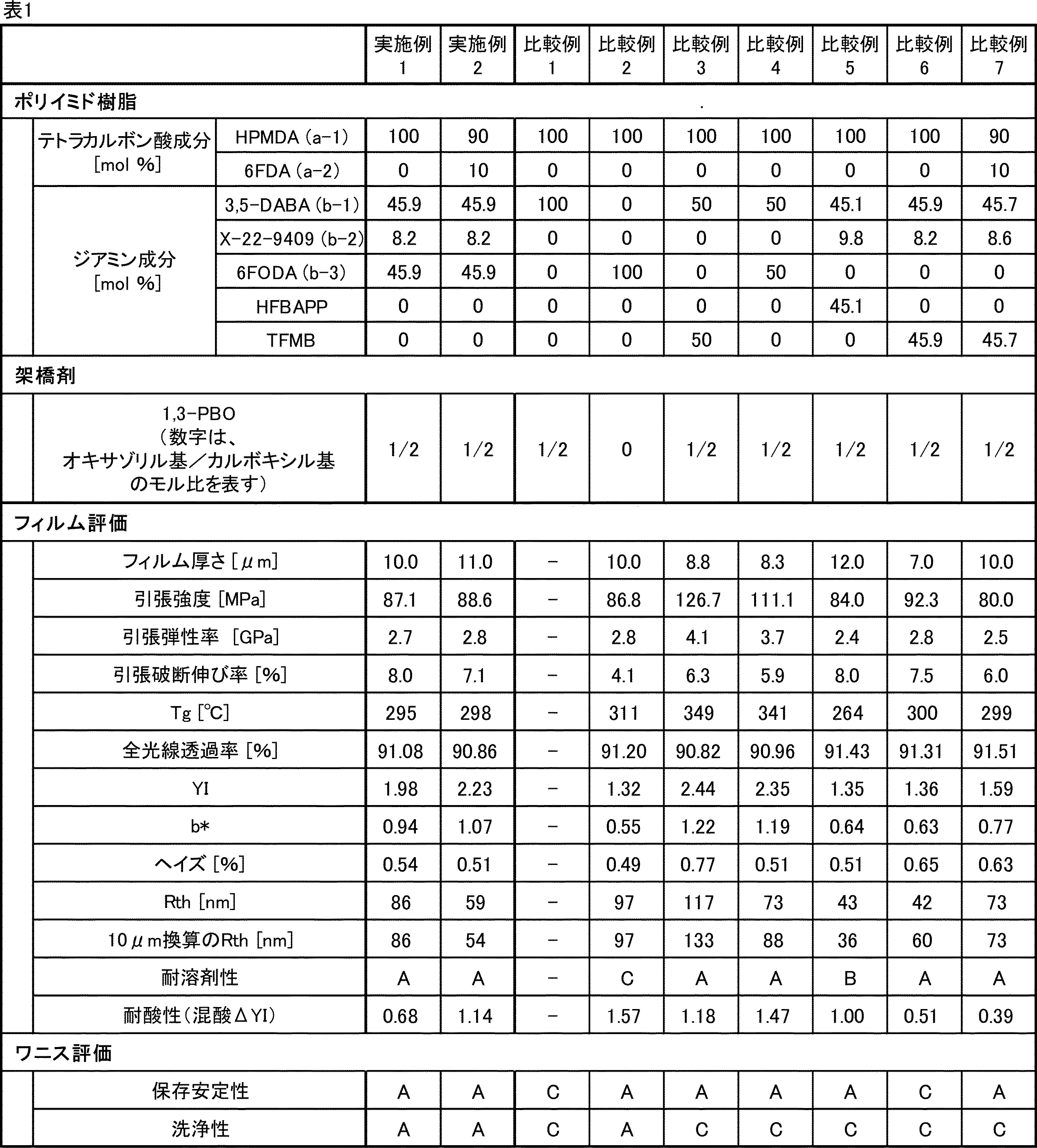
一方、比較例1では、ポリイミド樹脂溶液に架橋剤を添加して1時間撹拌することでポリイミドワニスを得たが、その後、当該ポリイミドワニスを室温静置したところ、ポリイミドワニス中に白色の析出物が生じ、ポリイミドワニスの流動性がなくなった。つまり、比較例1のポリイミドワニスは保存安定性及び洗浄性に劣っていた。
比較例2のポリイミドフィルムは、耐溶剤性に劣っていた。また、混酸ΔYIの値が1.57と大きく、耐酸性にも劣っていた。
比較例3のポリイミドフィルムは、光学的等方性に劣っていた。また、比較例3のポリイミドワニスは洗浄性に劣っていた。
比較例4のポリイミドワニスは洗浄性に劣っていた。
比較例5のポリイミドフィルムは、耐溶剤性が良好でなかった。また、比較例5のポリイミドワニスは洗浄性に劣っていた。
比較例6のポリイミドワニスは、保存安定性及び洗浄性に劣っていた。
比較例7のポリイミドワニスは、洗浄性に劣っていた。
Claims (11)
- ポリイミド樹脂と、少なくとも2つのオキサゾリル基を有する架橋剤とを含むポリイミド樹脂組成物であって、
前記ポリイミド樹脂が、テトラカルボン酸二無水物に由来する構成単位A及びジアミンに由来する構成単位Bを有し、
構成単位Aが、下記式(a-1)で表される化合物に由来する構成単位(A-1)を含み、
構成単位Bが、下記式(b-1)で表される化合物に由来する構成単位(B-1)と、下記式(b-2)で表される化合物に由来する構成単位(B-2)と、下記式(b-3)で表される化合物に由来する構成単位(B-3)とを含む、ポリイミド樹脂組成物。

(式(b-1)中、
Xは単結合、置換若しくは無置換のアルキレン基、カルボニル基、エーテル基、下記式(b-1-i)で表される基、又は下記式(b-1-ii)で表される基であり、
pは0~2の整数であり、
m1は0~4の整数であり、
m2は0~4の整数である。
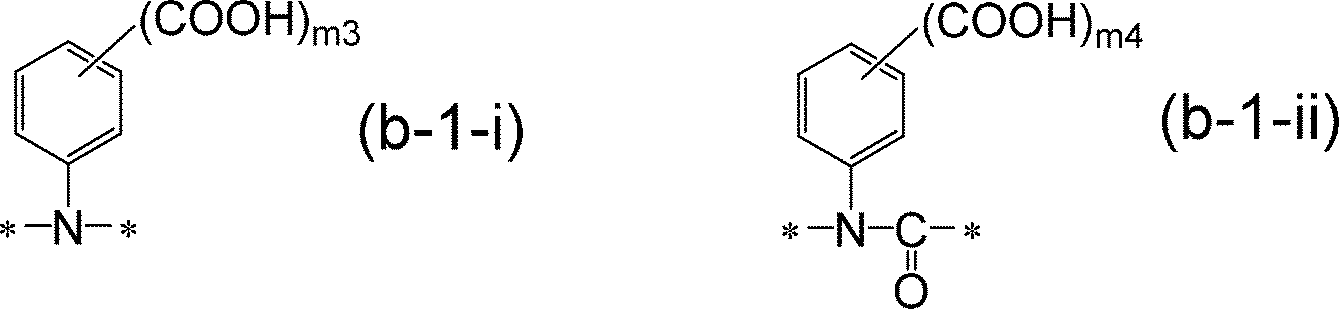
[式(b-1-i)中、m3は0~5の整数であり、式(b-1-ii)中、m4は0~5の整数である。]
ただし、
m1+m2+m3+m4は1以上であり、
pが0の場合、m1は1~4の整数であり、
pが2の場合、2つのX及び2つのm2~m4のそれぞれは独立して選択される;
式(b-2)中、
R1~R4は、それぞれ独立して、一価の脂肪族基又は一価の芳香族基であり、
Z1及びZ2は、それぞれ独立して、二価の脂肪族基又は二価の芳香族基であり、
rは正の整数である。) - 構成単位(B-1)が、下記式(b-11)で表される化合物に由来する構成単位(B-11)である、請求項1に記載のポリイミド樹脂組成物。

- 前記架橋剤が、少なくとも2つのオキサゾリル基が結合した芳香環又は芳香族複素環を含む化合物である、請求項1又は2に記載のポリイミド樹脂組成物。
- 前記架橋剤が、少なくとも2つのオキサゾリル基が結合したベンゼン環を含む化合物である、請求項3に記載のポリイミド樹脂組成物。
- 前記架橋剤が、1,3-ビス(4,5-ジヒドロ-2-オキサゾリル)ベンゼンである、請求項4に記載のポリイミド樹脂組成物。
- 構成単位A中における構成単位(A-1)の比率が50モル%以上である、請求項1~5のいずれかに記載のポリイミド樹脂組成物。
- 構成単位B中における構成単位(B-1)の比率が20~75モル%であり、
構成単位B中における構成単位(B-2)の比率が1~25モル%であり、
構成単位B中における構成単位(B-3)の比率が20~75モル%である、請求項1~6のいずれかに記載のポリイミド樹脂組成物。 - 構成単位Aが、下記式(a-2)で表される化合物に由来する構成単位(A-2)を更に含む、請求項1~7のいずれかに記載のポリイミド樹脂組成物。
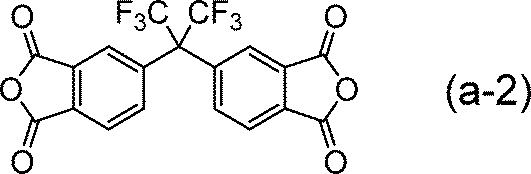
- 構成単位A中における構成単位(A-1)の比率が50~99モル%であり、
構成単位A中における構成単位(A-2)の比率が1~50モル%である、請求項8に記載のポリイミド樹脂組成物。 - 請求項1~9のいずれかに記載のポリイミド樹脂組成物及び有機溶媒を含むポリアミドワニス。
- 請求項1~9のいずれかに記載のポリイミド樹脂組成物中の前記ポリイミド樹脂が前記架橋剤により架橋されてなるポリイミドフィルム。
Priority Applications (3)
| Application Number | Priority Date | Filing Date | Title |
|---|---|---|---|
| CN201980080632.4A CN113166413B (zh) | 2018-12-13 | 2019-12-06 | 聚酰亚胺树脂组合物和聚酰亚胺薄膜 |
| KR1020217015895A KR102882531B1 (ko) | 2018-12-13 | 2019-12-06 | 폴리이미드 수지 조성물 및 폴리이미드 필름 |
| JP2020560034A JP7392657B2 (ja) | 2018-12-13 | 2019-12-06 | ポリイミド樹脂組成物及びポリイミドフィルム |
Applications Claiming Priority (2)
| Application Number | Priority Date | Filing Date | Title |
|---|---|---|---|
| JP2018233831 | 2018-12-13 | ||
| JP2018-233831 | 2018-12-13 |
Publications (1)
| Publication Number | Publication Date |
|---|---|
| WO2020121949A1 true WO2020121949A1 (ja) | 2020-06-18 |
Family
ID=71075321
Family Applications (1)
| Application Number | Title | Priority Date | Filing Date |
|---|---|---|---|
| PCT/JP2019/047728 Ceased WO2020121949A1 (ja) | 2018-12-13 | 2019-12-06 | ポリイミド樹脂組成物及びポリイミドフィルム |
Country Status (5)
| Country | Link |
|---|---|
| JP (1) | JP7392657B2 (ja) |
| KR (1) | KR102882531B1 (ja) |
| CN (1) | CN113166413B (ja) |
| TW (1) | TWI844593B (ja) |
| WO (1) | WO2020121949A1 (ja) |
Cited By (4)
| Publication number | Priority date | Publication date | Assignee | Title |
|---|---|---|---|---|
| CN112724434A (zh) * | 2020-12-23 | 2021-04-30 | 宁波长阳科技股份有限公司 | 一种透明聚酰亚胺膜及其制备方法和应用 |
| JPWO2022014667A1 (ja) * | 2020-07-16 | 2022-01-20 | ||
| CN116057109A (zh) * | 2020-09-10 | 2023-05-02 | 三菱瓦斯化学株式会社 | 聚合物组合物、清漆、和聚酰亚胺薄膜 |
| KR20250076526A (ko) | 2022-09-27 | 2025-05-29 | 도레이 카부시키가이샤 | 수지 조성물, 경화물 및 유기 el 표시 장치 |
Citations (4)
| Publication number | Priority date | Publication date | Assignee | Title |
|---|---|---|---|---|
| JP2010209309A (ja) * | 2008-06-26 | 2010-09-24 | Sanwa Kagaku Kogyo Kk | 感光性ポリイミド、感光性ポリイミドインク組成物及び絶縁膜 |
| JP2014524512A (ja) * | 2011-08-19 | 2014-09-22 | アクロン ポリマー システムズ,インコーポレイテッド | 耐熱性低複屈折ポリイミド共重合体膜 |
| JP2016222797A (ja) * | 2015-05-29 | 2016-12-28 | 三菱瓦斯化学株式会社 | ポリイミド樹脂組成物 |
| KR20180106212A (ko) * | 2017-03-17 | 2018-10-01 | 코오롱인더스트리 주식회사 | 폴리이미드 수지, 폴리이미드 필름 및 이를 포함하는 영상표시 소자 |
Family Cites Families (1)
| Publication number | Priority date | Publication date | Assignee | Title |
|---|---|---|---|---|
| KR20190082281A (ko) * | 2016-11-11 | 2019-07-09 | 우베 고산 가부시키가이샤 | 폴리이미드 필름과 하드 코트층을 포함하는 적층체 |
-
2019
- 2019-12-06 WO PCT/JP2019/047728 patent/WO2020121949A1/ja not_active Ceased
- 2019-12-06 KR KR1020217015895A patent/KR102882531B1/ko active Active
- 2019-12-06 CN CN201980080632.4A patent/CN113166413B/zh active Active
- 2019-12-06 JP JP2020560034A patent/JP7392657B2/ja active Active
- 2019-12-09 TW TW108144944A patent/TWI844593B/zh active
Patent Citations (4)
| Publication number | Priority date | Publication date | Assignee | Title |
|---|---|---|---|---|
| JP2010209309A (ja) * | 2008-06-26 | 2010-09-24 | Sanwa Kagaku Kogyo Kk | 感光性ポリイミド、感光性ポリイミドインク組成物及び絶縁膜 |
| JP2014524512A (ja) * | 2011-08-19 | 2014-09-22 | アクロン ポリマー システムズ,インコーポレイテッド | 耐熱性低複屈折ポリイミド共重合体膜 |
| JP2016222797A (ja) * | 2015-05-29 | 2016-12-28 | 三菱瓦斯化学株式会社 | ポリイミド樹脂組成物 |
| KR20180106212A (ko) * | 2017-03-17 | 2018-10-01 | 코오롱인더스트리 주식회사 | 폴리이미드 수지, 폴리이미드 필름 및 이를 포함하는 영상표시 소자 |
Cited By (7)
| Publication number | Priority date | Publication date | Assignee | Title |
|---|---|---|---|---|
| JPWO2022014667A1 (ja) * | 2020-07-16 | 2022-01-20 | ||
| WO2022014667A1 (ja) * | 2020-07-16 | 2022-01-20 | 三菱瓦斯化学株式会社 | 積層体 |
| JP7764856B2 (ja) | 2020-07-16 | 2025-11-06 | 三菱瓦斯化学株式会社 | 積層体 |
| CN116057109A (zh) * | 2020-09-10 | 2023-05-02 | 三菱瓦斯化学株式会社 | 聚合物组合物、清漆、和聚酰亚胺薄膜 |
| CN116057109B (zh) * | 2020-09-10 | 2024-05-14 | 三菱瓦斯化学株式会社 | 聚合物组合物、清漆、和聚酰亚胺薄膜 |
| CN112724434A (zh) * | 2020-12-23 | 2021-04-30 | 宁波长阳科技股份有限公司 | 一种透明聚酰亚胺膜及其制备方法和应用 |
| KR20250076526A (ko) | 2022-09-27 | 2025-05-29 | 도레이 카부시키가이샤 | 수지 조성물, 경화물 및 유기 el 표시 장치 |
Also Published As
| Publication number | Publication date |
|---|---|
| JPWO2020121949A1 (ja) | 2021-11-11 |
| CN113166413B (zh) | 2024-02-09 |
| TW202031728A (zh) | 2020-09-01 |
| CN113166413A (zh) | 2021-07-23 |
| TWI844593B (zh) | 2024-06-11 |
| JP7392657B2 (ja) | 2023-12-06 |
| KR102882531B1 (ko) | 2025-11-06 |
| KR20210102216A (ko) | 2021-08-19 |
Similar Documents
| Publication | Publication Date | Title |
|---|---|---|
| JP6996609B2 (ja) | ポリイミド樹脂、ポリイミドワニス及びポリイミドフィルム | |
| US12163048B2 (en) | Polyimide resin, varnish, and polyimide film | |
| JP7180617B2 (ja) | ポリイミド樹脂組成物及びポリイミドフィルム | |
| JP7215428B2 (ja) | ポリイミド樹脂、ポリイミドワニス及びポリイミドフィルム | |
| WO2020138360A1 (ja) | イミド-アミド酸共重合体及びその製造方法、ワニス、並びにポリイミドフィルム | |
| JP7367699B2 (ja) | ポリイミド樹脂、ポリイミドワニス及びポリイミドフィルム | |
| JP7384170B2 (ja) | ポリイミド樹脂、ポリイミドワニス及びポリイミドフィルム | |
| JP7205491B2 (ja) | ポリイミド樹脂、ポリイミドワニス及びポリイミドフィルム | |
| JP7392657B2 (ja) | ポリイミド樹脂組成物及びポリイミドフィルム | |
| JP7647567B2 (ja) | ポリイミド樹脂、ポリイミドワニス及びポリイミドフィルム | |
| JP7593325B2 (ja) | ポリイミド樹脂組成物、ポリイミドワニス及びポリイミドフィルム | |
| CN111741996B (zh) | 聚酰亚胺树脂、聚酰亚胺清漆及聚酰亚胺薄膜 | |
| WO2021132196A1 (ja) | ポリイミド樹脂、ポリイミドワニス及びポリイミドフィルム | |
| JP7255489B2 (ja) | ポリイミド樹脂、ポリイミドワニス及びポリイミドフィルム | |
| WO2022019226A1 (ja) | ポリイミド樹脂、ポリイミドワニス及びポリイミドフィルム | |
| JP7517342B2 (ja) | ポリイミド樹脂組成物、ポリイミドワニス及びポリイミドフィルム |
Legal Events
| Date | Code | Title | Description |
|---|---|---|---|
| 121 | Ep: the epo has been informed by wipo that ep was designated in this application |
Ref document number: 19896597 Country of ref document: EP Kind code of ref document: A1 |
|
| ENP | Entry into the national phase |
Ref document number: 2020560034 Country of ref document: JP Kind code of ref document: A |
|
| ENP | Entry into the national phase |
Ref document number: 20217015895 Country of ref document: KR Kind code of ref document: A |
|
| NENP | Non-entry into the national phase |
Ref country code: DE |
|
| 122 | Ep: pct application non-entry in european phase |
Ref document number: 19896597 Country of ref document: EP Kind code of ref document: A1 |