WO2020115949A1 - 増粘組成物およびその製造方法 - Google Patents
増粘組成物およびその製造方法 Download PDFInfo
- Publication number
- WO2020115949A1 WO2020115949A1 PCT/JP2019/031280 JP2019031280W WO2020115949A1 WO 2020115949 A1 WO2020115949 A1 WO 2020115949A1 JP 2019031280 W JP2019031280 W JP 2019031280W WO 2020115949 A1 WO2020115949 A1 WO 2020115949A1
- Authority
- WO
- WIPO (PCT)
- Prior art keywords
- polyisoprene
- trans
- mixed solution
- thickening composition
- colloidal solution
- Prior art date
- Legal status (The legal status is an assumption and is not a legal conclusion. Google has not performed a legal analysis and makes no representation as to the accuracy of the status listed.)
- Ceased
Links
Images

Classifications
-
- A—HUMAN NECESSITIES
- A61—MEDICAL OR VETERINARY SCIENCE; HYGIENE
- A61K—PREPARATIONS FOR MEDICAL, DENTAL OR TOILETRY PURPOSES
- A61K8/00—Cosmetics or similar toiletry preparations
- A61K8/18—Cosmetics or similar toiletry preparations characterised by the composition
- A61K8/72—Cosmetics or similar toiletry preparations characterised by the composition containing organic macromolecular compounds
- A61K8/81—Cosmetics or similar toiletry preparations characterised by the composition containing organic macromolecular compounds obtained by reactions involving only carbon-to-carbon unsaturated bonds
-
- A—HUMAN NECESSITIES
- A61—MEDICAL OR VETERINARY SCIENCE; HYGIENE
- A61Q—SPECIFIC USE OF COSMETICS OR SIMILAR TOILETRY PREPARATIONS
- A61Q19/00—Preparations for care of the skin
-
- C—CHEMISTRY; METALLURGY
- C08—ORGANIC MACROMOLECULAR COMPOUNDS; THEIR PREPARATION OR CHEMICAL WORKING-UP; COMPOSITIONS BASED THEREON
- C08L—COMPOSITIONS OF MACROMOLECULAR COMPOUNDS
- C08L21/00—Compositions of unspecified rubbers
-
- C—CHEMISTRY; METALLURGY
- C08—ORGANIC MACROMOLECULAR COMPOUNDS; THEIR PREPARATION OR CHEMICAL WORKING-UP; COMPOSITIONS BASED THEREON
- C08L—COMPOSITIONS OF MACROMOLECULAR COMPOUNDS
- C08L9/00—Compositions of homopolymers or copolymers of conjugated diene hydrocarbons
-
- C—CHEMISTRY; METALLURGY
- C09—DYES; PAINTS; POLISHES; NATURAL RESINS; ADHESIVES; COMPOSITIONS NOT OTHERWISE PROVIDED FOR; APPLICATIONS OF MATERIALS NOT OTHERWISE PROVIDED FOR
- C09K—MATERIALS FOR MISCELLANEOUS APPLICATIONS, NOT PROVIDED FOR ELSEWHERE
- C09K3/00—Materials not provided for elsewhere
Definitions
- the present invention relates to a thickening composition and a method for producing the same, and more particularly to a thickening composition and a method for producing the same that can impart appropriate thickening to cosmetics and external preparations for skin.
- Cream-like cosmetics and extra-skin solvents are often used by spreading them on the skin with fingers, and have suitable properties such as viscosity, fluidity, and texture for skin. Required to be present.
- these products generally have a colloidal form in which water-based components and oil-based components are mixed, and their production is performed by adding an appropriate viscosity to the water-based and oil-based components. A sticky agent is needed.
- Non-Patent Document 1 As a thickener suitable for an aqueous component, many kinds of thickeners that give a thickening effect to an aqueous solution of a polysaccharide or the like are known (Non-Patent Document 1).
- the thickeners suitable for oil-based components are overwhelmingly less than those suitable for the above water-based components.
- essential oils such as squalane and squalene, and plant-derived fats and oils are often used as base materials. The adjustment of the viscosity of such oils and fats is often performed by changing the refining conditions.
- silicone oils and higher ester oils are sometimes used as oil-based thickeners.
- general silicone oil has a poor affinity with oils and fats such as squalane, and its use is limited. Further, these products are required to have high safety for human body.
- the thickener is required to have a scientific basis for its safety, and is desired to be composed of a material derived from a natural product from the viewpoint of consumer psychology. Neither silicone oils nor higher ester oils are suitable in these respects.
- rubber elastomers such as polyisoprene and polyisobutylene are hydrophobic polymers that are compatible with squalane and fats and oils.
- the addition of this to the oil-based component can be emulsified and mixed with the water-based component (Patent Document 1).
- polyisoprene is a natural polymer produced by plants and is a material that stands out from chemically synthesized products.
- the polyisoprene included in such a rubber elastomer is difficult to apply to, for example, a person having a latex allergy.
- the present invention is intended to solve the above problems, and its object is to have a good affinity for oils and fats such as squalane, to be composed of a material derived from natural products, and
- the present invention provides a thickening composition and a method for producing the same, which is improved in safety.
- the present invention is a thickening composition containing as an active ingredient a colloidal solution of trans-polyisoprene having a weight average molecular weight of 400,000 to 3,000,000.
- the colloidal solution contains the trans-polyisoprene and a hydrophobic medium having a property of not dissolving the trans-polyisoprene at room temperature, but dissolving when heated from the room temperature.
- the hydrophobic medium is squalane.
- the trans polyisoprene is contained in a ratio of 0.05% to 5% by weight based on the weight of the colloidal solution.
- the present invention also provides a method for producing a thickening composition, (A) A trans-polyisoprene having a weight average molecular weight of 400,000 to 3,000,000 is added to a hydrophobic medium having a property of not dissolving the trans-polyisoprene at room temperature, but dissolving when heated from the room temperature to prepare a mixed solution.
- the hydrophobic medium is squalane.
- the dissolution of the trans polyisoprene in the mixed liquid in the step (b) is performed at a temperature of 50°C to 150°C.
- the rapid cooling in the step (c) is performed by ice-cooling the heated mixed solution or exposing it to an environment of 20° C. or lower.
- the invention also provides a method of making a colloidal solution, comprising: (A) A trans-polyisoprene having a weight average molecular weight of 400,000 to 3,000,000 is added to a hydrophobic medium having a property of not dissolving the trans-polyisoprene at room temperature, but dissolving when heated from the room temperature to prepare a mixed solution.
- the hydrophobic medium is squalane.
- the dissolution of the trans polyisoprene in the mixed liquid in the step (b) is performed at a temperature of 50°C to 150°C.
- the rapid cooling in the step (c) is performed by ice-cooling the heated mixed solution or exposing it to an environment of 20° C. or lower.
- the present invention is also a cosmetic containing the above thickening composition.
- the present invention is also a skin external preparation containing the above thickening composition.
- trans-polyisoprene contained in the thickening composition of the present invention is a component contained in a natural product, it can be appealed to consumers who desire a product composed of a material derived from a natural product. ..
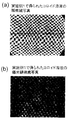
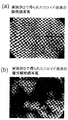
- Example 1 It is a photograph of the colloidal solution obtained in Example 1, (a) is a microscope photograph of the colloidal solution, and (b) is a polarization microscope photograph of the colloidal solution. It is a photograph of the colloidal solution obtained in Example 2, (a) is a microscope photograph of the colloidal solution, and (b) is a polarization microscope photograph of the colloidal solution. 5 is a photograph showing the results of the stability test of the trans-polyisoprene colloidal solutions obtained in Examples 1 to 4.
- the thickening composition of the present invention contains a trans-polyisoprene colloidal solution as an active ingredient.
- Trans polyisoprene which constitutes the colloidal solution, is a type of diene thermoplastic elastomer.
- the trans polyisoprene constituting the thickening composition of the present invention has a weight average molecular weight of 400,000 to 3,000,000, preferably 500,000 to 1.5 million. It is known that such trans polyisoprene has a high content of trans 1,4-bond units and a low content of bond isomer units in its structure.
- trans-polyisoprene When trans-polyisoprene is dissolved in the dispersion medium described below or dispersed as fine particles, it provides a high viscosity and can impart a high thickening effect to the colloid solution described below.
- trans polyisoprene is clearly distinguished as a substance having completely different physical properties from the rubber elastomer (for example, cis polyisoprene) described in Patent Document 1.
- Cis polyisoprene and trans polyisoprene are common in that both are included in 1,4-polyisoprene. However, strictly speaking, they are in a stereoisomeric relationship with each other, and the former is a non-crystalline substance excellent in rubber elasticity which is conventionally used as a material for rubber products, whereas the latter is Both are clearly recognized as different substances in the technical field because they are crystalline substances having excellent toughness such as tear strength.
- cis-polyisoprene is a main component of natural latex rubber obtained from rubber tree sap (latex), and trace amounts of fatty acids and/or proteins (biological defense proteins) may be bonded to the ends of polyisoprene chains. is there.
- fatty acids and proteins are considered as allergen components that cause latex allergy, and produce IgE antibody mainly by transdermal sensitization, and for example, contact urticaria at the contact site, urticaria that spreads systemically, It has been reported to cause symptoms such as anaphylaxis, anaphylactic shock, asthma attacks, conjunctivitis, and rhinitis symptoms.
- trans polyisoprene is a safer substance without the concern of latex allergy like cis polyisoprene.
- trans-type polyisoprene can ensure safety not only for the allergic patient but also for a wider range of people.
- the above-mentioned trans polyisoprene can be obtained, for example, from Eucommia ulmoides O., which is a woody buckwheat tree belonging to the Eucommia family Eucommia family.
- Trans polyisoprene is particularly abundant in specific parts of the eucommia pericarp, bark, seed coat, roots, and leaves. Therefore, in the present invention, the trans polyisoprene is preferably obtained from any of the pericarp, bark, seed coat, root, and leaf of Eucommia ulmoides, and combinations thereof. More preferably, it is obtained from the skin of Eucommia ulmoides.
- a colloidal solution of trans-polyisoprene means one that is present in the dispersion medium as the above-mentioned trans-polyisoprene as colloidal particles (dispersed phase) and one that is in a sol-gel state.
- the dispersion medium constituting the colloidal solution of trans polyisoprene is preferably a hydrophobic medium. It is preferable that the hydrophobic medium also has a property of not dissolving the trans-polyisoprene and the trans-polyisoprene at room temperature (for example, 25° C.), but dissolving it when heated from the room temperature.
- hydrophobic medium that constitutes the trans-polyisoprene colloidal solution examples include squalane, oils and fats, ester oils, and higher fatty acids.
- squalane include those of animal origin (such as those obtained from shark liver oils), those of plant origin and those which are fermented and produced, and combinations thereof.
- oils and fats that can make up the hydrophobic medium include olive oil, jojoba oil, argan oil, macadamia nut oil, almond oil, and sunflower seed oil, and combinations thereof.
- oils and fats that can constitute the hydrophobic medium are tri(caprylic acid/capric acid) glyceryl, polyglyceryl triisostearate-2, ethylhexyl palmitate, triethylhexanoin, isopropyl myristate, octyldodecyl myristate, And isotridecyl isononanoate, and combinations thereof.
- trans-polyisoprene and trans-polyisoprene do not dissolve at room temperature (for example, 25° C.), but have the property of dissolving when heated from the room temperature, and are easily available industrially. For this reason, squalane is preferred.
- the content of trans-polyisoprene contained in the colloidal solution is preferably 0.05% by weight to 5% by weight, more preferably 0.1% by weight to 1% by weight, based on the weight of the colloidal solution. Is.
- the content of trans polyisoprene contained in the colloidal solution is less than 0.05% by weight, it may be difficult to obtain a thickening composition having a desired viscosity.
- the content of trans-polyisoprene contained in the colloidal solution exceeds 5% by weight, it may be difficult to obtain a colloidal solution having good dispersibility.
- the above colloidal solution preferably has a viscosity suitable for use as a thickening composition, particularly as a thickening agent to be added to cosmetics and external preparations for skin described later.
- the viscosity of the colloidal solution that can be used for such an application is preferably 40 cP to 3000 cP, more preferably 200 cP to 2500 cP.
- the thickening composition of the present invention may contain other additives in addition to the above colloidal solution.
- Other additives include, but are not necessarily limited to, aqueous thickeners, drug components, oils, solubility enhancers, stabilizers, antioxidants, and combinations thereof.
- examples of the water-based thickener include guar gum, starch, carrageenan, xanthan gum, ethyl cellulose, methylhydroxypropyl starch, carboxymethyl cellulose, carboxyvinyl polymer, bentonite, hectorite, agar, curdlan, and gelatin, and combinations thereof. Can be mentioned.
- oil agents are camellia oil, corn oil, olive oil, rapeseed oil, coconut oil, palm oil, hydrogenated castor oil, beeswax, liquid lanolin, liquid paraffin, petrolatum, chain polysiloxane (for example, dimethylpolysiloxane), cyclic poly Siloxane (eg octamethylcyclotetrasiloxane), and amino modified silicone oils, and combinations thereof.
- Examples of the drug component include vitamin B, vitamin P, water-soluble vitamin A, water-soluble vitamin D, pantotenyl ethyl ether, calcium pantothenate, glycyrrhizin, glycyrrhizinate, glycyrrhetin, glycyrrhetinate, royal jelly, polyphenol, nicotine.
- Acids and their derivatives eg nicotinic acid amide), resorcin and its derivatives, sulfur, salicylic acid and its derivatives, alkoxysalicylic acid and its salts, L-ascorbic acid and its derivatives, tranexamic acid and its derivatives glucoside, urea, xylitol, trehalose, And caffeine, and combinations thereof.
- solubilizer include higher fatty acids such as stearic acid and isostearic acid; aliphatic hydrocarbons such as decane and undecane; ethers and higher ester oils, and combinations thereof.
- the stabilizer examples include surfactants (eg, alkyl sulfates, alkyl ether sulfates, fatty acid salts, sulfosuccinates, ⁇ -olefin sulfonates, N-acyl sarcosine salts, N-acyl methyl taurine salts, alkyl ether carboxyls. Acid salts, and phosphate ester salts, and combinations thereof).
- Antioxidants include, for example, tocotrierol, tocophenol, hindered phenolic antioxidants (eg, dibutyl hydroxytoluene), and hindered amine antioxidants, and combinations thereof.
- other additives may be appropriately set by those skilled in the art to the extent that they do not impair the effects obtained by the colloidal solution of trans-polyisoprene.
- the thickening composition of the present invention can be produced, for example, by preparing a colloidal solution of trans polyisoprene as follows.
- trans-polyisoprene is first added to a hydrophobic medium to prepare a mixed solution.
- trans-polyisoprene to the hydrophobic medium is performed at room temperature, for example.
- a medium having a property of not dissolving the trans-polyisoprene at room temperature but capable of dissolving when heated from room temperature for example, squalene
- trans-polyisoprene can be dissolved in the hydrophobic medium only by this addition. It exists in the state of a heterogeneous liquid mixture.
- the heating of the mixed solution is preferably performed at a temperature of 50°C to 150°C, more preferably 70°C to 80°C.
- the heating time of the mixed solution is not particularly limited and is preferably a time until trans-polyisoprene is sufficiently dissolved in the hydrophobic medium.
- the heating of the mixed liquid may be performed in a static state, or may be performed with stirring using a known means.
- the heated mixed liquid be rapidly cooled.
- the heated mixed solution may be rapidly cooled by using a known means, for example, ice-cooling or exposing the mixed solution to an environment of 20° C. or lower (preferably 0° C. or lower). ..
- exposing the mixed solution to an environment of 20° C. or lower means bringing the mixed solution into contact with a refrigerant of 20° C. or lower directly or indirectly through a container or the like, thereby It is meant to include lowering the temperature.
- cooling the mixed solution with a refrigerant such as water, ethanol, or an aqueous ethanol solution at 20° C. or lower
- a refrigerant such as water, ethanol, or an aqueous ethanol solution at 20° C. or lower
- cooling the mixed solution with liquid nitrogen Placing the mixture in a space having an ambient temperature of 20° C. or lower (eg, a refrigerator or a freezer); and cooling the mixture using a cooling device such as a thermoelectric element (eg, Peltier element); and A combination thereof.
- a refrigerant such as water, ethanol, or an aqueous ethanol solution at 20° C. or lower
- a cooling device such as a thermoelectric element (eg, Peltier element); and A combination thereof.
- the time required for the rapid cooling is not necessarily limited, but it is preferable to continue the rapid cooling until the time when no precipitation of colloid particles is observed.
- the obtained trans-polyisoprene colloidal solution is composed of many relatively small and swollen colloidal particles, and the colloidal solution itself has an appropriate viscosity as described above.
- the above-mentioned other additives may be added to the trans-polyisoprene colloidal solution, if necessary.
- the thickening composition of the present invention can be manufactured.
- the hydrophobic medium constituting the colloidal solution has good affinity with oils and fats (eg squalane) used in cosmetics and external preparations for the skin, and is safe for the skin.
- oils and fats eg squalane
- the trans-polyisoprene contained in the colloidal solution can be a material derived from a natural product, and is also released from concerns such as latex allergy. Therefore, the thickening composition of the present invention is further enhanced in safety for the human body.
- the thickening composition of the present invention can be suitably used, for example, as a thickening agent (especially for oil-based components) for constituting cosmetics and external preparations for skin.
- cosmetics and external preparations for skin include cleansing cosmetics such as toilet soap, face wash, shampoo, hair treatment agents, hair oil, set lotion, curler lotion, pomade, tics, bottle oil, hair spray, hair mist, Hair liquids, hair foams, hair gels and water greases, cleansing creams, cold creams, vanishing creams, hand creams, aftershaving creams, shaving creams, lotions (eg hand lotions and general lotions), lotions, basic cosmetics ( Packs, foundations, makeup cosmetics, perfumes, suntan/sunscreen creams, suntan/sunblock lotions, suntan/sunblock oils, nail cream, enamel, enamel remover, eyeliner cosmetics, lipsticks, lip balms, toothpaste Examples include paste, bath salt, bath oil, and the like.
- each main component for example, powder component, liquid oil, solid oil, wax, hydrocarbon oil, higher fatty acid, higher alcohol, ester oil, silicone oil, anionic interface.
- Example 1 Preparation of 1.0% (W/W) colloidal solution (E1)
- An appropriate amount of trans-polyisoprene powder manufactured by Hitachi Zosen Co., Ltd.; derived from dried pericarp of Eucommia ulmoides O.; weight-average molecular weight 1.14 million
- the viscosity of the obtained colloidal solution (E1) was kept at a temperature of 25° C. for 1 hour and then rotated at 100 rpm for every minute using a rheometer (manufactured by Brookfield) equipped with a spindle SC4-29. It was measured. As a control, the viscosity of squalane alone (containing no trans polyisoprene (0% (W/W))) was measured, and the obtained results are shown in Table 1.
- the colloidal solution prepared above was placed in a 30 mL sample bottle and left still in a horizontal state at 4° C. for 6 months in the dark. Then, it was observed whether or not the solid phase and the liquid phase were separated. A photograph of the sample bottle taken during the observation is shown in FIG.
- Example 2 Preparation of 1.0% (W/W) colloidal solution (CE1)) After heating the glass container containing the mixed solution of trans-polyisoprene and squalane in the same manner as in Example 1 and confirming that the mixed solution became transparent, the glass container was cooled without rapid cooling.
- the colloidal solution (CE1) was obtained by taking out from the hot water bath, placing it on a laboratory bench at room temperature of 25° C. as it was, and letting it stand for 24 hours.
- Example 1 The obtained colloidal solution (CE1) was observed with a monocular polarization microscope in the same manner as in Example 1, the viscosity was measured, and the stability test was performed. The results obtained for each are shown in FIG. 2, Table 1 and FIG.
- Example 3 Preparation of 0.5% (W/W) colloidal solution (E2)
- a colloidal solution (E2) was obtained in the same manner as in Example 1 except that squalane was dispensed to obtain a mixed solution so that the concentration of trans-polyisoprene was 0.5% (W/W).
- the obtained colloidal solution (E2) was tested for stability in the same manner as in Example 1. The obtained results are shown in FIG.
- Example 4 Preparation of 0.5% (W/W) colloidal solution (CE2)
- Squalane was dispensed so that the concentration of trans-polyisoprene was 0.5% (W/W) to obtain a mixed solution, and a glass container containing the mixed solution of trans-polyisoprene and squalane in the same manner as in Example 1.
- a glass container containing the mixed solution of trans-polyisoprene and squalane in the same manner as in Example 1. was heated. After confirming that the mixed solution became transparent, the colloid solution was obtained by removing the glass container from the hot water bath without quenching, placing it on a laboratory table at room temperature of 25° C., and letting it stand for 24 hours. (CE2) was obtained.
- each of the colloidal solutions (E1) and (CE1) obtained in Examples 1 and 2 had a higher viscosity than the control medium composed of squalane alone. ..
- the colloid (E1) of Example 1 prepared by quenching the mixed solution had a viscosity increased by about 1.5 times as compared with the colloidal solution (CE1) of Example 2 which was left to cool at room temperature without quenching. Therefore, it can be seen that it is more excellent as a thickener.
- the colloidal solution (E1) prepared in Example 1 was prepared in Example 2. Compared with the prepared colloidal solution (CE1), the colloidal particles contained in the colloidal solution are small and swollen. On the other hand, it can be seen that the colloidal particles contained in the colloidal solution of Example 2 were large, and the separation of the solid phase and the liquid layer was somewhat clear.
- Example 5 Preparation of cosmetics
- the following ingredients are uniformly mixed in the following proportions to prepare a cosmetic emulsion.
- Example 6 Preparation of external preparation for skin
- the following ingredients are uniformly mixed in the following proportions to prepare a hand cream.
- Example 7 24-hour occlusion human patch test
- the colloidal solution (E1) obtained in Example 1 was used as a sample, and an appropriate amount of the colloidal solution (E1) was applied to the patch portion of a patch test unit (Finn Chamber on Scanpor Tape manufactured by EPITEST Co., Ltd.). It was applied to the paravertebral region of the subject and peeled off 24 hours after the application, and the application site of each subject was judged according to the following criteria. Furthermore, the patch site of each subject 48 hours after the patch application (24 hours after the removal) was also evaluated according to the following criteria.
- a patch test unit Fen Chamber on Scanpor Tape manufactured by EPITEST Co., Ltd.
- the skin irritation index of the sample used in this example was 2.0. From this, it can be seen from the classification shown in Table 5 that the sample belongs to the safe product in the human patch test. Instead of the colloidal solution, physiological saline (manufactured by Otsuka Pharmaceutical Factory Co., Ltd.), water for injection (manufactured by Otsuka Pharmaceutical Factory Co., Ltd.) and white petrolatum (manufactured by Nikko Jamaica Co., Ltd.) were used as samples as controls. The skin irritation index in this case was 0.0. Considering this point, it can be seen that the colloidal solution had substantially the same safety for human skin as these physiological saline solutions.
- the present invention it is possible to provide a thickener having a high viscosity and excellent affinity with oil-based components such as squalane and fats and oils, using a material derived from a natural product.
- oil-based components such as squalane and fats and oils
- This makes it possible to avoid the use of petroleum-based chemically synthesized products, and it is also possible to provide cosmetics and external preparations for skin that match the consumer sentiment, in which products derived from natural products are desired.
- the thickening composition of the present invention is useful in a wide range of technical fields such as cosmetics and self-care products.
Landscapes
- Health & Medical Sciences (AREA)
- Chemical & Material Sciences (AREA)
- Life Sciences & Earth Sciences (AREA)
- Organic Chemistry (AREA)
- Public Health (AREA)
- Chemical Kinetics & Catalysis (AREA)
- Medicinal Chemistry (AREA)
- Polymers & Plastics (AREA)
- Animal Behavior & Ethology (AREA)
- General Health & Medical Sciences (AREA)
- Veterinary Medicine (AREA)
- Dermatology (AREA)
- Materials Engineering (AREA)
- Engineering & Computer Science (AREA)
- Birds (AREA)
- Epidemiology (AREA)
- Cosmetics (AREA)
Abstract
本発明の増粘組成物は、40万~300万の重量平均分子量を有するトランスポリイソプレンのコロイド溶液を有効成分として含有する。このような増粘組成物は、例えば、40万~300万の重量平均分子量を有するトランスポリイソプレンと、室温ではトランスポリイソプレンを溶解しないが室温から加温すると溶解する性質を有する疎水性媒体との混合液を得、混合液を加熱してトランスポリイソプレンを溶解し、そして加熱した混合液を急冷することにより製造することができる。
Description
本発明は、増粘組成物およびその製造方法に関し、より詳細には化粧料や皮膚外用剤において適切な増粘性を付与し得る、増粘組成物およびその製造方法に関する。
クリーム状の化粧料や皮膚外溶剤は、肌に対して指で塗り広げることにより使用されることが多く、付与に対して適切な、粘性、流動性、肌に対する質感等の性能を有していることが求められる。これらの製品では、一般に水系の成分と油系の成分とが混合したコロイドの形態を有している場合が多く、その製造には、水系および油系の成分に対して適度な粘度を与える増粘剤が必要とされる。
例えば、水系の成分に対して適切な増粘剤としては、多糖類などの水溶液に対して増粘効果を与える多くの種類が知られている(非特許文献1)。
これに対し、油系の成分に適切な増粘剤(特に化粧料や皮膚外用剤に適したもの)は、上記水系の成分に適切なものと比較して圧倒的に少ない。油系の成分には、ベース材料として、スクワラン、スクワレンなどの精油や植物由来の油脂類がよく使用されている。こうした油脂類等の粘度の調整は、その精製条件を変更して行うことが多い。
また、化粧品、シャンプー等のヘアケア製品、その他セルフケア製品の分野では、油系の増粘剤として、シリコンオイルや高級エステル油が用いられることがある。しかし、一般的なシリコンオイルは、スクワランなどの油脂類との親和性が悪く用途が制限されている。さらに、これらの製品には人体に対する高い安全性が求められている。この点で、増粘剤には、当該安全性に関する科学的な根拠が必要とされるとともに、消費者心理の観点から、天然物由来の材料で構成されていることが所望されている。シリコンオイルおよび高級エステル油はいずれもこれらの観点において適切とは言えない。
一方、ポリイソプレン、ポリイソブチレン等のゴムエラストマーは、スクワラン、油脂との相性の良い疎水性ポリマーである。これを油系成分に添加したものは、水系成分との乳化混合が可能である(特許文献1)。特に、ポリイソプレンは植物が産する天然ポリマーであり、化学合成品とは一線を画する材料である。しかし、このようなゴムエラストマーに包含されるポリイソプレンは、例えば、ラテックスアレルギーを有する人には適用が困難である。
オレオサイエンス,2011年,第11巻,第8号,p.269-275
本発明は、上記問題の解決を課題とするものであり、その目的とするところは、スクワランなどの油脂類との親和性が良好であり、天然物由来の材料で構成されており、かつ人体に対する安全性が高められた、増粘組成物およびその製造方法を提供することにある。
本発明は、40万~300万の重量平均分子量を有するトランスポリイソプレンのコロイド溶液を有効成分として含有する、増粘組成物である。
1つの実施形態では、上記コロイド溶液は、上記トランスポリイソプレンと、室温では該トランスポリイソプレンを溶解しないが該室温から加温すると溶解する性質を有する疎水性媒体とを含有する。
さらなる実施形態では、上記疎水性媒体はスクワランである。
1つの実施形態では、上記トランスポリイソプレンは、上記コロイド溶液の重量に対して0.05重量%~5重量%の割合で含有されている。
本発明はまた、増粘組成物の製造方法であって、
(a)40万~300万の重量平均分子量を有するトランスポリイソプレンを、室温では該トランスポリイソプレンを溶解しないが該室温から加温すると溶解する性質を有する疎水性媒体に添加して混合液を得る工程、
(b)該混合液を加熱して該トランスポリイソプレンを溶解する工程、および
(c)該加熱した混合液を急冷する工程、
を包含する、方法である。
(a)40万~300万の重量平均分子量を有するトランスポリイソプレンを、室温では該トランスポリイソプレンを溶解しないが該室温から加温すると溶解する性質を有する疎水性媒体に添加して混合液を得る工程、
(b)該混合液を加熱して該トランスポリイソプレンを溶解する工程、および
(c)該加熱した混合液を急冷する工程、
を包含する、方法である。
1つの実施形態では、上記疎水性媒体はスクワランである。
1つの実施形態では、上記工程(b)における上記トランスポリイソプレンの上記混合液への溶解は50℃~150℃の温度で行われる。
1つの実施形態では、上記工程(c)における急冷は、上記加熱した混合液を氷冷するか、または20℃以下の環境下に曝すことにより行われる。
本発明はまた、コロイド溶液の作製方法であって、
(a)40万~300万の重量平均分子量を有するトランスポリイソプレンを、室温では該トランスポリイソプレンを溶解しないが該室温から加温すると溶解する性質を有する疎水性媒体に添加して混合液を得る工程、
(b)該混合液を加熱して該トランスポリイソプレンを溶解する工程、および
(c)該加熱した混合液を急冷する工程、
を包含する、方法である。
(a)40万~300万の重量平均分子量を有するトランスポリイソプレンを、室温では該トランスポリイソプレンを溶解しないが該室温から加温すると溶解する性質を有する疎水性媒体に添加して混合液を得る工程、
(b)該混合液を加熱して該トランスポリイソプレンを溶解する工程、および
(c)該加熱した混合液を急冷する工程、
を包含する、方法である。
1つの実施形態では、上記疎水性媒体はスクワランである。
1つの実施形態では、上記工程(b)における上記トランスポリイソプレンの上記混合液への溶解は50℃~150℃の温度で行われる。
1つの実施形態では、上記工程(c)における急冷は、上記加熱した混合液を氷冷するか、または20℃以下の環境下に曝すことにより行われる。
本発明はまた、上記増粘組成物を含有する、化粧料である。
本発明はまた、上記増粘組成物を含有する、皮膚外用剤である。
本発明によれば、人体への安全性を高めて、かつ油脂類等の精製条件を変更することなく、所望の粘度に調整された化粧料および皮膚外用剤を簡便に製造することができる。さらに、本発明の増粘組成物に含まれるトランスポリイソプレンは天然物に含有される成分であることから、天然物由来の材料で構成される製品を所望する消費者への訴求も可能である。
以下、本発明について詳述する。
(増粘組成物)
本発明の増粘組成物は、トランスポリイソプレンのコロイド溶液を有効成分として含有する。
本発明の増粘組成物は、トランスポリイソプレンのコロイド溶液を有効成分として含有する。
コロイド溶液を構成するトランスポリイソプレンは、ジエン系熱可塑性エラストマーの1種である。本発明の増粘組成物を構成するトランスポリイソプレンは、40万~300万、好ましくは50万~150万の重量平均分子量を有する。このようなトランスポリイソプレンは、その構造中に、トランス1,4-結合単位の含有率が高くかつ結合異性単位の含有率が低いことが知られている。トランスポリイソプレンはまた、後述の分散媒中に溶解もしくは微小粒子として分散させた場合、高い粘度を供し、後述するコロイド溶液に対し高い増粘効果を付与することができる。
ここで、トランスポリイソプレンは、特許文献1に記載されるようなゴムエラストマー(例えば、シスポリイソプレン)とは全く異なる物性を有する物質として明確に区別されている。
シスポリイソプレンおよびトランスポリイソプレンは、いずれも1,4-ポリイソプレンに包含されるという点で共通する。しかし、厳密には、それらは互いに立体異性体の関係にあり、前者は、従来よりゴム製品の材料として使用されるゴム弾性に優れる非結晶性の物質であるのに対し、後者は引っ張り強さや引裂強さなどの強靭性に優れる結晶性の物質である点で、当該技術分野では、両者は明確に異なる物質として認識されている。
さらに、シスポリイソプレンは、ゴムノキの樹液(ラテックス)から得られる天然ラテックスゴムの主成分であり、微量な脂肪酸および/またはタンパク質(生体防御タンパク質)がポリイソプレン鎖の末端に結合している場合がある。このような脂肪酸およびタンパク質は、ラテックスアレルギーを引き起こすアレルゲンコンポーネントと考えられており、主に経皮感作でIgE抗体を産生し、例えば、接触部位の接触蕁麻疹、全身性に拡大する蕁麻疹、アナフィラキシー、アナフィラキシーショック、喘息発作、結膜炎、鼻炎症状などの症状を引き起こすことが報告されている。
これに対し、トランスポリイソプレンでは、上記シスポリイソプレンのようなラテックスアレルギーの懸念のないより安全な物質である。この点で、トランス型ポリイソプレンは、当該アレルギー患者だけでなく、より広範な人に対する安全性を確保することができる。
上記トランスポリイソプレンは、例えば、トチュウ目トチュウ科に属する木本性の蕎木であるトチュウ(Eucommia ulmoides O.)から得ることができる。
トランスポリイソプレンは、当該トチュウの果皮、樹皮、種皮、根、および葉などの特定の部位に特に豊富に含有されている。このため、本発明において、上記トランスポリイソプレンは、トチュウの果皮、樹皮、種皮、根、および葉、ならびにそれらの組み合わせのいずれかから得られたものであることが好ましい。トチュウの果皮から得られたものであることがさらに好ましい。
本発明において、トランスポリイソプレンのコロイド溶液は、上記トランスポリイソプレンをコロイド粒子(分散相)として分散媒中に存在するもの、およびゾルゲル状態にあるものをいう。
トランスポリイソプレンのコロイド溶液を構成する分散媒は、好ましくは疎水性媒体である。当該疎水性媒体はまた、トランスポリイソプレンと、室温(例えば、25℃)ではトランスポリイソプレンを溶解しないが当該室温から加温すると溶解する性質を有するものであることが好ましい。
トランスポリイソプレンのコロイド溶液を構成する疎水性媒体としては、例えば、スクワラン、油脂類、エステル油、高級脂肪酸が挙げられる。スクワランの例としは、動物由来のもの(例えばサメの肝油から得られたもの)、植物由来のもの、および発酵生産されたもの、ならびにそれらの組み合わせが挙げられる。疎水性媒体を構成し得る油脂類の例としては、オリーブ油、ホホバ油、アルガン油、マカダミアナッツ油、アーモンド油、およびヒマワリ種子油、ならびにそれらの組み合わせが挙げられる。疎水性媒体を構成し得る油脂類の例としては、トリ(カプリル酸/カプリン酸)グリセリル、トリイソステアリン酸ポリグリセリル-2、パルミチン酸エチルへキシル、トリエチルヘキサノイン、ミリスチン酸イソプロピル、ミリスチン酸オクチルドデシル、およびイソノナン酸イソトリデシル、ならびにそれらの組み合わせが挙げられる。本発明においては、トランスポリイソプレンと、室温(例えば、25℃)ではトランスポリイソプレンを溶解しないが当該室温から加温すると溶解するという性質を有しており、かつ工業的に入手がし易いとの理由から、スクワランが好ましい。
本発明において、コロイド溶液に含まれるトランスポリイソプレンの含有量は、当該コロイド溶液の重量に対して、好ましくは0.05重量%~5重量%、より好ましくは0.1重量%~1重量%である。コロイド溶液に含まれるトランスポリイソプレンの含有量が0.05重量%を下回ると、所望の粘性を有する増粘組成物を得ることが困難となることがある。コロイド溶液に含まれるトランスポリイソプレンの含有量が5重量%を上回ると、良好な分散性を所持するコロイド溶液となることが困難となることがある。
上記コロイド溶液は、増粘組成物、特に後述する化粧料や皮膚外用剤に添加するための増粘剤として使用するために適切な粘度を有していることが好ましい。このような用途に使用可能なコロイド溶液の粘度は、好ましくは40cP~3000cPであり、より好ましくは200cP~2500cPである。
本発明の増粘組成物は、上記コロイド溶液以外に他の添加剤を含有していてもよい。他の添加剤としては、必ずしも限定されないが、例えば水系の増粘剤、薬剤成分、油剤、可溶促進剤、安定剤、酸化防止剤、ならびにそれらの組み合わせが挙げられる。水系の増粘剤としては、例えば、グアーガム、デンプン、カラギーナン、キサンタンガム、エチルセルロース、メチルヒドロキシプロピルデンプン、カルボキシメチルセルロース、カルボキシビニルポリマー、ベントナイト、ヘクトライト、寒天、カードラン、およびゼラチン、ならびにそれらの組み合わせが挙げられる。油剤の例としては、ツバキ油、トウモロコシ油、オリーブ油、ナタネ油、ヤシ油、パーム油、硬化ヒマシ油、ミツロウ、液状ラノリン、流動パラフィン、ワセリン、鎖状ポリシロキサン(例えばジメチルポリシロキサン)、環状ポリシロキサン(例えばオクタメチルシクロテトラシロキサン)、およびアミノ変性シリコーン油、ならびにそれらの組み合わせが挙げられる。薬剤成分の例としては、ビタミンB、ビタミンP、水溶性ビタミンA、水溶性ビタミンD、パントテニールエチルエーテル、カルシウムパントテネート、グリチルリチン、グリチルリチン酸塩、グリチルレチン、グリチルレチン酸塩、ローヤルゼリー、ポリフェノール、ニコチン酸およびその誘導体(例えばニコチン酸アミド)、レゾルシンおよびその誘導体、イオウ、サリチル酸およびその誘導体、アルコキシサリチル酸およびその塩、L-アスコルビン酸およびその誘導体、トラネキサム酸およびその誘導体グルコシド、尿素、キシリトール、トレハロース、およびカフェイン、ならびにそれらの組み合わせが挙げられる。可溶促進剤としては、例えばステアリン酸、イソステアリン酸等の高級脂肪酸;デカン、ウンデカン等の脂肪族炭化水素;エーテル類、および高級エステル油、ならびにそれらの組み合わせが挙げられる。安定剤としては界面活性剤(例えば、アルキル硫酸塩、アルキルエーテル硫酸エステル塩、脂肪酸塩、スルホコハク酸塩、α-オレフィンスルホン酸塩、N-アシルサルコシン塩、N-アシルメチルタウリン塩、アルキルエーテルカルボン酸塩、およびリン酸エステル塩、ならびにそれらの組み合わせ)が挙げられる。酸化防止剤としては、例えばトコトリエロール、トコフェノール、ヒンダードフェノール系酸化防止剤(例えばジブチルヒドロキシトルエン)、およびヒンダードアミン系酸化防止剤、ならびにそれらの組み合わせが挙げられる。本発明の増粘組成物において、他の添加剤は、上記トランスポリイソプレンのコロイド溶液によって得られる効果を阻害しない程度において適切な量が当業者によって設定され得る。
(増粘組成物の製造方法)
本発明の増粘組成物は、例えば、以下のようにしてトランスポリイソプレンのコロイド溶液を作製することによって製造され得る。
本発明の増粘組成物は、例えば、以下のようにしてトランスポリイソプレンのコロイド溶液を作製することによって製造され得る。
本発明においては、まずトランスポリイソプレンが疎水性媒体に添加され混合液が作製される。
疎水性媒体へのトランスポリイソプレンの添加は例えば室温下で行われる。疎水性媒体として、上記室温では該トランスポリイソプレンを溶解しないが室温から加温すると溶解する性質を有する媒体(例えば、スクワレン)を用いる場合、この添加のみではトランスポリイソプレンは疎水性媒体には溶解せず、不均一な混合液の状態で存在する。
次いで、この混合液が加熱されトランスポリイソプレンが溶解される。
混合液の加熱は、好ましくは、50℃~150℃、より好ましくは70℃~80℃の温度で行われる。混合液の加熱時間は、特に限定されず、疎水性媒体にトランスポリイソプレンが十分に溶解するまでの時間であることが好ましい。なお、この混合液の加熱は、静置した状態で行われてもよく、あるいは公知の手段を用いて撹拌下で行われてもよい。
その後、加熱した混合液が急冷されることが好ましい。
この急冷は、上記加熱した混合液の温度を急速に低下させる目的で行われる。この点において、急冷は、上記混合液の加熱後、可能な限り直ちに行うことが好ましい。加熱した混合液の急冷は、公知の手段を用いてもよく、例えば、氷冷するか、または混合液を20℃以下(好ましくは0℃以下)の環境下に曝すことにより行われてもよい。ここで、「混合液を20℃以下の環境下に曝す」とは、混合液を、20℃以下の冷媒と直接または容器等を通じて間接的に接触させることにより、当該冷媒の温度で混合液の温度を低下させることを包含していう。「混合液を20℃以下の環境下に曝す」方法としては、例えば、混合液を20℃以下の水、エタノール、エタノール水溶液等の冷媒で冷却すること;混合液を液体窒素で冷却すること;混合液を20℃以下の周囲温度を有する空間(例えば、冷蔵庫や冷凍庫)内に配置すること;および熱電素子(例えば、ペルチェ素子)のような冷却デバイスを用いて混合液を冷却すること;ならびにそれらの組み合わせ;が挙げられる。
急冷に要する時間もまた、必ずしも限定されないが、例えばコロイド粒子の析出が見られなくなる時間まで急冷が継続されることが好ましい。
上記急冷によって、トランスポリイソプレンのコロイド溶液を得ることができる。
得られたトランスポリイソプレンのコロイド溶液は、比較的小さくかつ膨潤した多くのコロイド粒子で構成され、当該コロイド溶液自体が上述したような適切な粘度を有する。
その後、このトランスポリイソプレンのコロイド溶液に、必要に応じて上記他の添加剤が添加されてもよい。
このようにして、本発明の増粘組成物を製造することができる。
本発明の増粘組成物において、コロイド溶液を構成する疎水性媒体は、化粧料や皮膚外用剤に使用される油脂類(例えばスクワラン)との親和性が良好であり、かつ皮膚に対する安全性に優れる。また、コロイド溶液に含まれるトランスポリイソプレンは、天然物由来の材料とすることができるとともに、ラテックスアレルギー等の懸念からも解放されている。このため、本発明の増粘組成物では、人体に対する安全性が一層高められている。
(化粧料および皮膚外用剤)
本発明の増粘組成物は、例えば化粧料および皮膚外用剤を構成するための増粘剤(特に油系の成分に対する増粘剤)として好適に使用され得る。化粧料および皮膚外用剤の例としては、化粧石鹸、洗顔料、シャンプーなどの清浄用化粧品、ヘアトリートメント剤、髪油、セットローション、カーラーローション、ポマード、チック、びんつけ油、ヘアスプレー、ヘアミスト、ヘアリキッド、ヘアフォーム、ヘアジェル、およびウォーターグリース、クレンジングクリーム、コールドクリーム、バニシングクリーム、ハンドクリーム、アフターシェービングクリーム、シェービングクリーム、化粧水(例えば、ハンドローションおよび一般化粧水)、化粧油、基礎化粧品(例えばパック)、ファンデーション、メークアップ化粧品、香水類、日焼け・日焼け止めクリーム、日焼け・日焼け止めローション、日焼け・日焼け止めオイル、爪クリーム、エナメル、エナメル除去液、アイライナー化粧品、口紅、リップクリーム、歯磨きペースト、バスソルト、バスオイルなどが挙げられる。
本発明の増粘組成物は、例えば化粧料および皮膚外用剤を構成するための増粘剤(特に油系の成分に対する増粘剤)として好適に使用され得る。化粧料および皮膚外用剤の例としては、化粧石鹸、洗顔料、シャンプーなどの清浄用化粧品、ヘアトリートメント剤、髪油、セットローション、カーラーローション、ポマード、チック、びんつけ油、ヘアスプレー、ヘアミスト、ヘアリキッド、ヘアフォーム、ヘアジェル、およびウォーターグリース、クレンジングクリーム、コールドクリーム、バニシングクリーム、ハンドクリーム、アフターシェービングクリーム、シェービングクリーム、化粧水(例えば、ハンドローションおよび一般化粧水)、化粧油、基礎化粧品(例えばパック)、ファンデーション、メークアップ化粧品、香水類、日焼け・日焼け止めクリーム、日焼け・日焼け止めローション、日焼け・日焼け止めオイル、爪クリーム、エナメル、エナメル除去液、アイライナー化粧品、口紅、リップクリーム、歯磨きペースト、バスソルト、バスオイルなどが挙げられる。
化粧料および皮膚外用剤は、上記増粘組成物とともに、各主成分(例えば、粉末成分、液体油脂、固体油脂、ロウ、炭化水素油、高級脂肪酸、高級アルコール、エステル油、シリコーン油、アニオン界面活性剤、カチオン界面活性剤、両性界面活性剤、非イオン界面活性剤、保湿剤、水溶性高分子、皮膜剤、紫外線吸収剤、金属イオン封鎖剤、低級アルコール、多価アルコール、糖、アミノ酸、有機アミン、高分子エマルジョン、pH調整剤、皮膚栄養剤、ビタミン、酸化防止剤、酸化防止助剤、香料)を必要に応じて適宜含有する。
以下、実施例により本発明をより具体的に説明する。しかし、本発明はこれらの実施例により限定されるものではない。
(実施例1:1.0%(W/W)のコロイド溶液(E1)の作製)
適量のトランスポリイソプレン粉末(日立造船株式会社製;トチュウ(Eucommia ulmoides O.;重量平均分子量114万)の乾燥果皮由来)を秤量し、別途、蓋つきのガラス容器に移したのち、トランスポリイソプレンの濃度が1.0%(W/W)になるようスクワランを分注して混合液を得た。
適量のトランスポリイソプレン粉末(日立造船株式会社製;トチュウ(Eucommia ulmoides O.;重量平均分子量114万)の乾燥果皮由来)を秤量し、別途、蓋つきのガラス容器に移したのち、トランスポリイソプレンの濃度が1.0%(W/W)になるようスクワランを分注して混合液を得た。
上記混合液にスターラーバーを入れ、ガラス容器の蓋を閉めた後、湯浴に浸し、マグネチックスターラーで撹拌しながら、80℃まで加温してそのまま保温し、その後、目視にて混合液が透明になりガラス容器内のトランスポリイソプレンの粉末を確認することができなくなるまで撹拌を継続した。
混合液が透明になったことを確認した後、直ちにガラス容器を、細く砕いた氷を入れた氷水の中に移し、内容物を氷冷(急冷)した。その後、氷中で1時間保持した。ガラス容器内の内容物は、溶解していたトランスポリイソプレンが析出して白濁を呈していた。これにより、微小なトランスポリイソプレンのコロイド粒子がスクワラン中に分散したコロイド溶液(E1)を得た。
得られたコロイド溶液(E1)の適量をシャーレ上に配置し、単眼偏光顕微鏡(アズワン株式会社(PL-8510))で倍率400倍にて配置された溶液表面を観察した。この単眼偏光顕微鏡を用いて得られた顕微鏡写真および偏向顕微鏡写真を図1の(a)および(b)にそれぞれ示す。
次いで、得られたコロイド溶液(E1)の粘度を、25℃のチャンバーで1時間保温した後、スピンドルSC4-29を備えるレオメーター(Brookfield社製)を用い、毎分100rpmで回転させることにより、測定した。なお、コントロールとして、(トランスポリイソプレンを含有しない(0%(W/W)))スクワラン単独の粘度についても測定した得られた結果を表1に示す。
さらに、得られたコロイド溶液(E1)の安定性を試験するために、上記で作製したコロイド溶液を30mLのサンプル瓶に入れ、4℃にて暗所で6ヶ月間水平状態のまま静置し、その後固相と液相との分離の有無を観察した。観察の際に撮影したサンプル瓶の写真を図3に示す。
(実施例2:1.0%(W/W)のコロイド溶液(CE1)の作製)
実施例1と同様にしてトランスポリイソプレンとスクワランとの混合液が入ったガラス容器を加温し、当該混合液が透明になったことを確認した後に、急冷を行うことなく、当該ガラス容器を湯浴から取り出してそのまま室温25℃の実験台の上に置き、24時間静置することによりコロイド溶液(CE1)を得た。
実施例1と同様にしてトランスポリイソプレンとスクワランとの混合液が入ったガラス容器を加温し、当該混合液が透明になったことを確認した後に、急冷を行うことなく、当該ガラス容器を湯浴から取り出してそのまま室温25℃の実験台の上に置き、24時間静置することによりコロイド溶液(CE1)を得た。
得られたコロイド溶液(CE1)について、実施例1と同様にして単眼偏向顕微鏡で観察し、粘度を測定し、そして安定性の試験を行った。それぞれについて得られた結果を図2、表1および図3に示す。
(実施例3:0.5%(W/W)のコロイド溶液(E2)の作製)
トランスポリイソプレンの濃度が0.5%(W/W)になるようスクワランを分注して混合液を得たこと以外は実施例1と同様にしてコロイド溶液(E2)を得た。得られたコロイド溶液(E2)について、実施例1と同様にして安定性の試験を行った。得られた結果を図3に示す。
トランスポリイソプレンの濃度が0.5%(W/W)になるようスクワランを分注して混合液を得たこと以外は実施例1と同様にしてコロイド溶液(E2)を得た。得られたコロイド溶液(E2)について、実施例1と同様にして安定性の試験を行った。得られた結果を図3に示す。
(実施例4:0.5%(W/W)のコロイド溶液(CE2)の作製)
トランスポリイソプレンの濃度が0.5%(W/W)になるようスクワランを分注して混合液を得、実施例1と同様にしてトランスポリイソプレンとスクワランとの混合液が入ったガラス容器を加温した。当該混合液が透明になったことを確認した後、急冷を行うことなく、当該ガラス容器を湯浴から取り出してそのまま室温25℃の実験台の上に置き、24時間静置することによりコロイド溶液(CE2)を得た。
トランスポリイソプレンの濃度が0.5%(W/W)になるようスクワランを分注して混合液を得、実施例1と同様にしてトランスポリイソプレンとスクワランとの混合液が入ったガラス容器を加温した。当該混合液が透明になったことを確認した後、急冷を行うことなく、当該ガラス容器を湯浴から取り出してそのまま室温25℃の実験台の上に置き、24時間静置することによりコロイド溶液(CE2)を得た。
得られたコロイド溶液(CE2)について、実施例1と同様にして安定性の試験を行った。得られた結果を図3に示す。

表1に示すように、実施例1および2で得られたコロイド溶液(E1)および(CE1)はいずれも、スクワラン単独で構成されるコントロールの媒体と比較して、高粘度を有していた。特に、混合液を急冷して作製した実施例1のコロイド(E1)は、急冷を行わず室温で放冷した実施例2のコロイド溶液(CE1)と比較して粘度が約1.5倍上昇しており、増粘剤として一層優れていることがわかる。
図1の(a)および(b)と、図2の(a)および(b)とをそれぞれ対比して参照すると、実施例1で作製されたコロイド溶液(E1)は、実施例2で作製されたコロイド溶液(CE1)と比較して、コロイド溶液内に含まれるコロイド粒子が小さくかつ膨潤している。一方、実施例2のコロイド溶液に含まれるコロイド粒子は大きく、固相および液体層の分離が幾分明確であったことがわかる。
そして、図3を参照すると、実施例1~4で作製されたコロイド溶液には、6ヶ月間の保管期間を通じて固相と液相との分離が幾分進行するものを確認することができた。このうち、トランスポリイソプレンを1.0%(W/W)の濃度で含有し、混合液の急冷を行った実施例1およびトランスポリイソプレンを0.5%(W/W)の濃度で含有し、混合液の急冷を行った実施例3のコロイド溶液(E1)および(E2)では、急冷を行わなかった実施例2および実施例4のコロイド溶液(CE1)および(CE2)と比較して、当該分離がほとんど観察されず、安定性がより優れていたことがわかる。
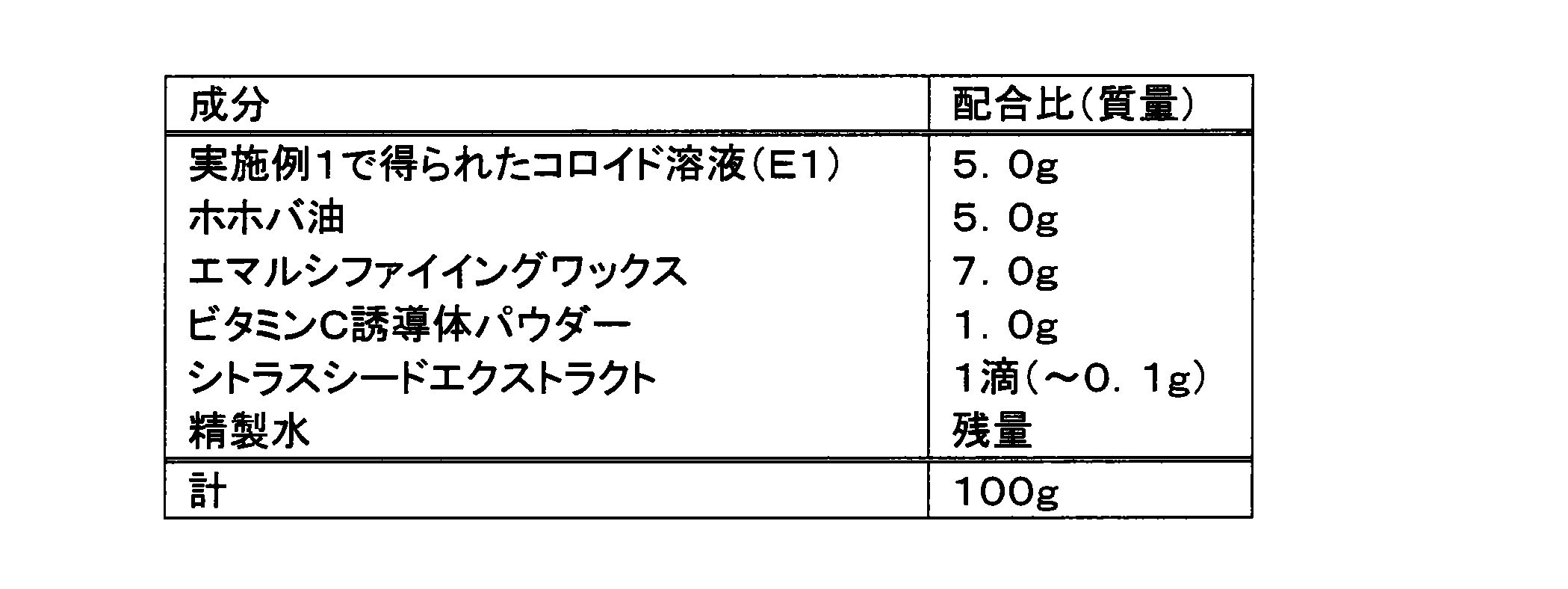
(実施例5:化粧料の作製)
以下の成分を以下の割合で均一に混合して化粧用乳液を作製する。
以下の成分を以下の割合で均一に混合して化粧用乳液を作製する。
(実施例6:皮膚外用剤の作製)
以下の成分を以下の割合で均一に混合してハンドクリームを作製する。
以下の成分を以下の割合で均一に混合してハンドクリームを作製する。

(実施例7:24時間閉塞ヒトパッチ試験)
実施例1で得られたコロイド溶液(E1)をサンプルとして用い、これをパッチテストユニット(EPITEST社製Finn Chamber on Scanpor Tape)の貼布部分に適量を塗布し、次いで、このパッチを25名の被験体の傍脊椎部に貼布し、貼布後24時間で剥がし、各被験体の貼布部位を以下の基準にしたがって判定した。さらに、貼布後48時間(除去後24時間後)の各被験体の貼布部位についても以下の基準にしたがって判定した。
実施例1で得られたコロイド溶液(E1)をサンプルとして用い、これをパッチテストユニット(EPITEST社製Finn Chamber on Scanpor Tape)の貼布部分に適量を塗布し、次いで、このパッチを25名の被験体の傍脊椎部に貼布し、貼布後24時間で剥がし、各被験体の貼布部位を以下の基準にしたがって判定した。さらに、貼布後48時間(除去後24時間後)の各被験体の貼布部位についても以下の基準にしたがって判定した。
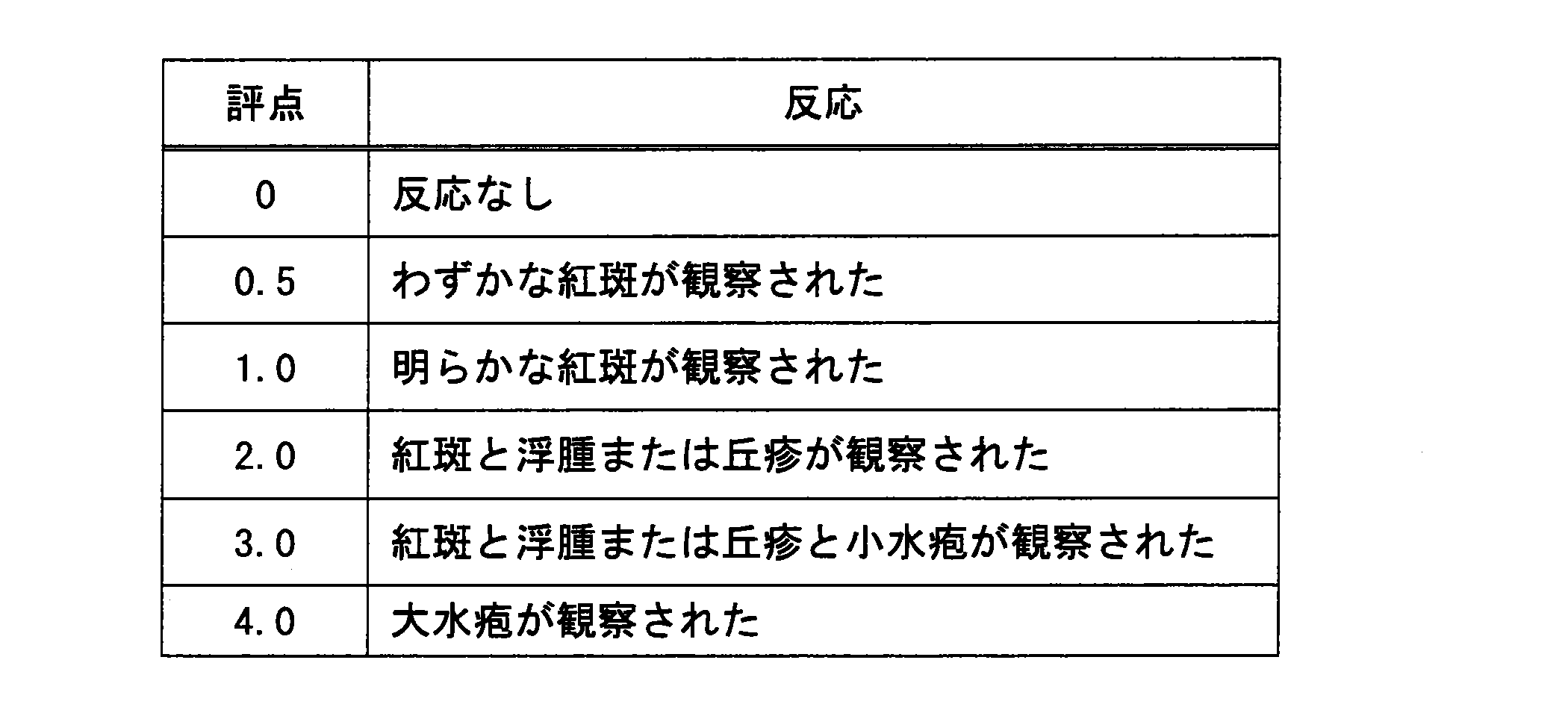
24時間後と48時間後との判定において、各被験体が反応の強い方に評点を与え、皮膚刺激指数を、被験体全員から得られた評点の総和を被験体数で除した値を百分率(次式):
皮膚刺激指数=評点総和/被験体数×100
したがって算出した。さらに、須貝ら、香粧品科学,1995年,第19号,臨時増刊,pp.49-56による以下の分類にしたがって、サンプルの安全性を評価した。
皮膚刺激指数=評点総和/被験体数×100
したがって算出した。さらに、須貝ら、香粧品科学,1995年,第19号,臨時増刊,pp.49-56による以下の分類にしたがって、サンプルの安全性を評価した。
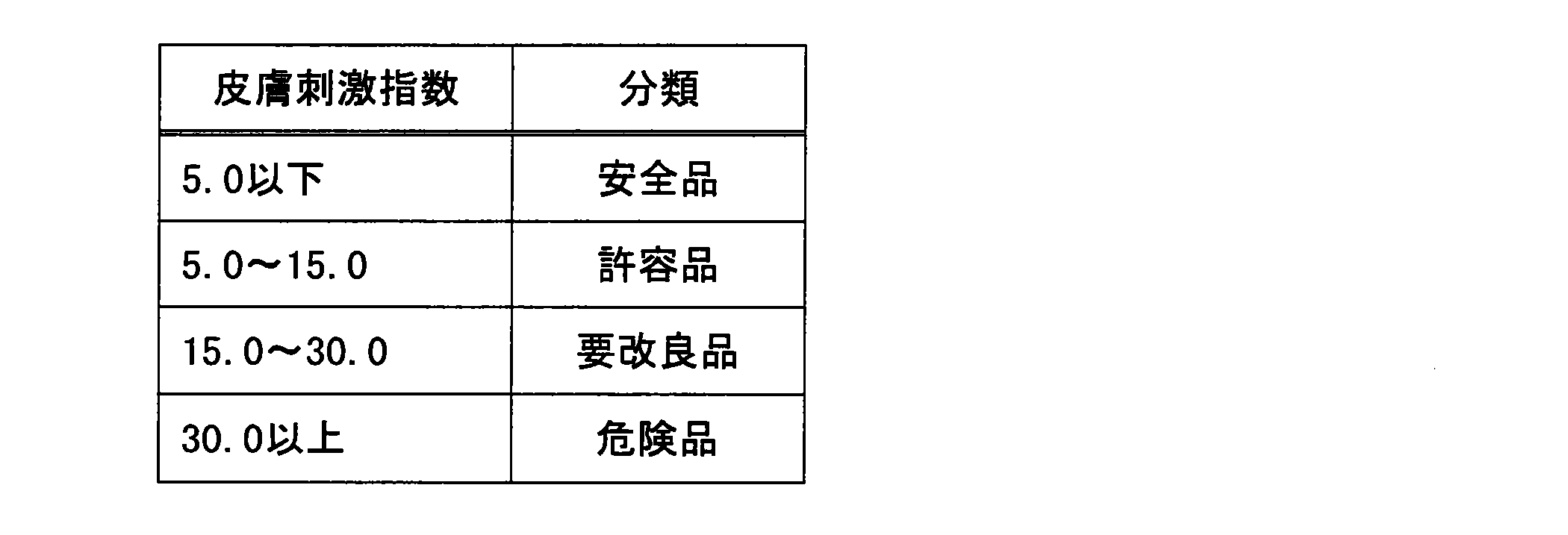
本実施例で使用したサンプルの皮膚刺激指数は2.0であった。これにより、表5に示す分類から、当該サンプルは上記ヒトパッチ試験において安全品に属するものであったことがわかる。なお、上記コロイド溶液の代わりに、対照として生理食塩水(株式会社大塚製薬工場製)、注射用水(株式会社大塚製薬工場製)および白色ワセリン(日興リカ株式会社製)のそれぞれをサンプルに用いた場合の上記皮膚刺激指数は0.0であった。この点を考慮しても、上記コロイド溶液は、ヒトの皮膚に対して、これら生理食塩水等と略同様の安全性を有していたことがわかる。
本発明によれば、スクワラン、油脂等の油系成分との親和性に優れ、かつ高い粘度を有する増粘剤を、天然物由来の材料を用いて提供することができる。これにより、石油系の化学合成品の使用が回避可能となり、天然物由来の製品を所望する消費者心理に即した化粧料および皮膚外用剤を提供することも可能である。本発明の増粘組成物は、化粧品分野、セルフケア製品分野などの幅広い技術分野において有用である。
Claims (14)
- 40万~300万の重量平均分子量を有するトランスポリイソプレンのコロイド溶液を有効成分として含有する、増粘組成物。
- 前記コロイド溶液が、前記トランスポリイソプレンと、室温では該トランスポリイソプレンを溶解しないが該室温から加温すると溶解する性質を有する疎水性媒体とを含有する、請求項1に記載の増粘組成物。
- 前記疎水性媒体がスクワランである、請求項2に記載の増粘組成物。
- 前記トランスポリイソプレンが、前記コロイド溶液の重量に対して0.05重量%~5重量%の割合で含有されている、請求項1から3のいずれかに記載の増粘組成物。
- 増粘組成物の製造方法であって、
(a)40万~300万の重量平均分子量を有するトランスポリイソプレンを、室温では該トランスポリイソプレンを溶解しないが該室温から加温すると溶解する性質を有する疎水性媒体に添加して混合液を得る工程、
(b)該混合液を加熱して該トランスポリイソプレンを溶解する工程、および
(c)該加熱した混合液を急冷する工程、
を包含する、方法。 - 前記疎水性媒体がスクワランである、請求項5に記載の方法。
- 前記工程(b)における前記トランスポリイソプレンの前記混合液への溶解が50℃~150℃の温度で行われる、請求項5または6に記載の方法。
- 前記工程(c)における急冷が、前記加熱した混合液を氷冷するか、または20℃以下の環境下に曝すことにより行われる、請求項5から7のいずれかに記載の方法。
- コロイド溶液の作製方法であって、
(a)40万~300万の重量平均分子量を有するトランスポリイソプレンを、室温では該トランスポリイソプレンを溶解しないが該室温から加温すると溶解する性質を有する疎水性媒体に添加して混合液を得る工程、
(b)該混合液を加熱して該トランスポリイソプレンを溶解する工程、および
(c)該加熱した混合液を急冷する工程、
を包含する、方法。 - 前記疎水性媒体がスクワランである、請求項9に記載の方法。
- 前記工程(b)における前記トランスポリイソプレンの前記混合液への溶解が50℃~150℃の温度で行われる、請求項9または10に記載の方法。
- 前記工程(c)における急冷が、前記加熱した混合液を氷冷するか、または20℃以下の環境下に曝すことにより行われる、請求項9から11のいずれかに記載の方法。
- 請求項1から4のいずれかに記載の増粘組成物を含有する、化粧料。
- 請求項1から4のいずれかに記載の増粘組成物を含有する、皮膚外用剤。
Applications Claiming Priority (2)
| Application Number | Priority Date | Filing Date | Title |
|---|---|---|---|
| JP2018-227039 | 2018-12-04 | ||
| JP2018227039A JP2020090444A (ja) | 2018-12-04 | 2018-12-04 | 増粘組成物およびその製造方法 |
Publications (1)
| Publication Number | Publication Date |
|---|---|
| WO2020115949A1 true WO2020115949A1 (ja) | 2020-06-11 |
Family
ID=70974525
Family Applications (1)
| Application Number | Title | Priority Date | Filing Date |
|---|---|---|---|
| PCT/JP2019/031280 Ceased WO2020115949A1 (ja) | 2018-12-04 | 2019-08-07 | 増粘組成物およびその製造方法 |
Country Status (2)
| Country | Link |
|---|---|
| JP (1) | JP2020090444A (ja) |
| WO (1) | WO2020115949A1 (ja) |
Families Citing this family (1)
| Publication number | Priority date | Publication date | Assignee | Title |
|---|---|---|---|---|
| JP7690310B2 (ja) * | 2021-03-31 | 2025-06-10 | 日揮触媒化成株式会社 | ポリイソプレン粒子とその製造方法、および化粧料 |
Citations (5)
| Publication number | Priority date | Publication date | Assignee | Title |
|---|---|---|---|---|
| JPH01261318A (ja) * | 1988-04-12 | 1989-10-18 | Iwase Kosufua Kk | パック化粧料 |
| JPH0236112A (ja) * | 1988-07-26 | 1990-02-06 | Kuraray Co Ltd | パック被覆材 |
| JPH02187438A (ja) * | 1989-01-16 | 1990-07-23 | Kuraray Co Ltd | トランスポリイソプレン樹脂組成物 |
| EP1454621A2 (en) * | 2003-03-04 | 2004-09-08 | Intercos S.p.A. | Cosmetic composition containing polyisoprene |
| WO2017047191A1 (ja) * | 2015-09-17 | 2017-03-23 | 日立造船株式会社 | ポリイソプレンの製造方法 |
-
2018
- 2018-12-04 JP JP2018227039A patent/JP2020090444A/ja active Pending
-
2019
- 2019-08-07 WO PCT/JP2019/031280 patent/WO2020115949A1/ja not_active Ceased
Patent Citations (5)
| Publication number | Priority date | Publication date | Assignee | Title |
|---|---|---|---|---|
| JPH01261318A (ja) * | 1988-04-12 | 1989-10-18 | Iwase Kosufua Kk | パック化粧料 |
| JPH0236112A (ja) * | 1988-07-26 | 1990-02-06 | Kuraray Co Ltd | パック被覆材 |
| JPH02187438A (ja) * | 1989-01-16 | 1990-07-23 | Kuraray Co Ltd | トランスポリイソプレン樹脂組成物 |
| EP1454621A2 (en) * | 2003-03-04 | 2004-09-08 | Intercos S.p.A. | Cosmetic composition containing polyisoprene |
| WO2017047191A1 (ja) * | 2015-09-17 | 2017-03-23 | 日立造船株式会社 | ポリイソプレンの製造方法 |
Also Published As
| Publication number | Publication date |
|---|---|
| JP2020090444A (ja) | 2020-06-11 |
Similar Documents
| Publication | Publication Date | Title |
|---|---|---|
| TWI417112B (zh) | 乳化組成物 | |
| CN108498368B (zh) | 用于增强皮肤状况改善物质的皮肤渗透性的化妆品组合物 | |
| WO2013129482A1 (ja) | 経時安定性を有するw/o/w型エマルションおよびその製造方法 | |
| TW201601772A (zh) | 組合物 | |
| JP6898622B2 (ja) | 皮膚又は粘膜の外用剤及びその製造方法、並びに皮膚又は粘膜の外用剤の基剤 | |
| JP2019077675A (ja) | ジェル状皮膚外用剤又は皮膚化粧料 | |
| CN109966184A (zh) | 一种悬浮油珠卸妆水及其制备方法 | |
| BG1687U1 (bg) | Козметичен състав | |
| WO2019013670A1 (ru) | Косметическая маска для нанесения на кожу и способ ее нанесения | |
| TWI671080B (zh) | 摻混神經醯胺之外用劑組成物 | |
| CN104940082B (zh) | 纯天然眼部护理油 | |
| JP2012531395A (ja) | ワックス状材料及びオルガノポリシロキサンを含むパーソナルケアエマルジョン | |
| WO2020115949A1 (ja) | 増粘組成物およびその製造方法 | |
| CN106726742A (zh) | 一种不含乳化剂的两相头皮护理组合物 | |
| TWI888775B (zh) | 包含棕櫚醯乙醇醯胺的皮膚鎮定用化妝料組合物 | |
| CN106714776A (zh) | 化妆用的、皮肤病学的和/或药物的组合物、其制备方法及其用途 | |
| KR20250010055A (ko) | 국소 피부 케어 조성물 | |
| JP5159241B2 (ja) | 靭帯細胞賦活剤 | |
| Mohamad et al. | Inulin as a natural ingredient in cosmetics and personal care products | |
| CN105250183B (zh) | 一种含有白刺提取物的爽肤水 | |
| CN107582454A (zh) | 一种不含防腐剂的无硅油透明洗头水及其制备方法 | |
| HK40072301B (zh) | 包含共晶混合物的化妆料组合物 | |
| HK40118258A (zh) | 局部用护肤组合物 | |
| EP4373460A1 (fr) | Nouvelles compositions cosmetiques comprenant du jus d'aloe vera | |
| CN113679633A (zh) | 龙须菜不饱和脂肪酸保湿护肤品及其制备方法 |
Legal Events
| Date | Code | Title | Description |
|---|---|---|---|
| 121 | Ep: the epo has been informed by wipo that ep was designated in this application |
Ref document number: 19893887 Country of ref document: EP Kind code of ref document: A1 |
|
| NENP | Non-entry into the national phase |
Ref country code: DE |
|
| 122 | Ep: pct application non-entry in european phase |
Ref document number: 19893887 Country of ref document: EP Kind code of ref document: A1 |