WO2020105340A1 - ベベル部処理剤組成物およびウェハの製造方法 - Google Patents
ベベル部処理剤組成物およびウェハの製造方法Info
- Publication number
- WO2020105340A1 WO2020105340A1 PCT/JP2019/041349 JP2019041349W WO2020105340A1 WO 2020105340 A1 WO2020105340 A1 WO 2020105340A1 JP 2019041349 W JP2019041349 W JP 2019041349W WO 2020105340 A1 WO2020105340 A1 WO 2020105340A1
- Authority
- WO
- WIPO (PCT)
- Prior art keywords
- group
- agent composition
- elements
- general formula
- treating agent
- Prior art date
- Legal status (The legal status is an assumption and is not a legal conclusion. Google has not performed a legal analysis and makes no representation as to the accuracy of the status listed.)
- Ceased
Links
Images





Classifications
-
- C—CHEMISTRY; METALLURGY
- C11—ANIMAL OR VEGETABLE OILS, FATS, FATTY SUBSTANCES OR WAXES; FATTY ACIDS THEREFROM; DETERGENTS; CANDLES
- C11D—DETERGENT COMPOSITIONS; USE OF SINGLE SUBSTANCES AS DETERGENTS; SOAP OR SOAP-MAKING; RESIN SOAPS; RECOVERY OF GLYCEROL
- C11D7/00—Compositions of detergents based essentially on non-surface-active compounds
- C11D7/22—Organic compounds
- C11D7/28—Organic compounds containing halogen
-
- C—CHEMISTRY; METALLURGY
- C11—ANIMAL OR VEGETABLE OILS, FATS, FATTY SUBSTANCES OR WAXES; FATTY ACIDS THEREFROM; DETERGENTS; CANDLES
- C11D—DETERGENT COMPOSITIONS; USE OF SINGLE SUBSTANCES AS DETERGENTS; SOAP OR SOAP-MAKING; RESIN SOAPS; RECOVERY OF GLYCEROL
- C11D7/00—Compositions of detergents based essentially on non-surface-active compounds
- C11D7/02—Inorganic compounds
- C11D7/04—Water-soluble compounds
- C11D7/08—Acids
-
- C—CHEMISTRY; METALLURGY
- C07—ORGANIC CHEMISTRY
- C07F—ACYCLIC, CARBOCYCLIC OR HETEROCYCLIC COMPOUNDS CONTAINING ELEMENTS OTHER THAN CARBON, HYDROGEN, HALOGEN, OXYGEN, NITROGEN, SULFUR, SELENIUM OR TELLURIUM
- C07F7/00—Compounds containing elements of Groups 4 or 14 of the Periodic Table
- C07F7/02—Silicon compounds
- C07F7/08—Compounds having one or more C—Si linkages
- C07F7/0803—Compounds with Si-C or Si-Si linkages
- C07F7/081—Compounds with Si-C or Si-Si linkages comprising at least one atom selected from the elements N, O, halogen, S, Se or Te
- C07F7/0812—Compounds with Si-C or Si-Si linkages comprising at least one atom selected from the elements N, O, halogen, S, Se or Te comprising a heterocyclic ring
-
- C—CHEMISTRY; METALLURGY
- C07—ORGANIC CHEMISTRY
- C07F—ACYCLIC, CARBOCYCLIC OR HETEROCYCLIC COMPOUNDS CONTAINING ELEMENTS OTHER THAN CARBON, HYDROGEN, HALOGEN, OXYGEN, NITROGEN, SULFUR, SELENIUM OR TELLURIUM
- C07F7/00—Compounds containing elements of Groups 4 or 14 of the Periodic Table
- C07F7/02—Silicon compounds
- C07F7/08—Compounds having one or more C—Si linkages
- C07F7/18—Compounds having one or more C—Si linkages as well as one or more C—O—Si linkages
- C07F7/1804—Compounds having Si-O-C linkages
- C07F7/1872—Preparation; Treatments not provided for in C07F7/20
- C07F7/188—Preparation; Treatments not provided for in C07F7/20 by reactions involving the formation of Si-O linkages
-
- C—CHEMISTRY; METALLURGY
- C11—ANIMAL OR VEGETABLE OILS, FATS, FATTY SUBSTANCES OR WAXES; FATTY ACIDS THEREFROM; DETERGENTS; CANDLES
- C11D—DETERGENT COMPOSITIONS; USE OF SINGLE SUBSTANCES AS DETERGENTS; SOAP OR SOAP-MAKING; RESIN SOAPS; RECOVERY OF GLYCEROL
- C11D7/00—Compositions of detergents based essentially on non-surface-active compounds
- C11D7/22—Organic compounds
-
- C—CHEMISTRY; METALLURGY
- C11—ANIMAL OR VEGETABLE OILS, FATS, FATTY SUBSTANCES OR WAXES; FATTY ACIDS THEREFROM; DETERGENTS; CANDLES
- C11D—DETERGENT COMPOSITIONS; USE OF SINGLE SUBSTANCES AS DETERGENTS; SOAP OR SOAP-MAKING; RESIN SOAPS; RECOVERY OF GLYCEROL
- C11D7/00—Compositions of detergents based essentially on non-surface-active compounds
- C11D7/22—Organic compounds
- C11D7/26—Organic compounds containing oxygen
- C11D7/261—Alcohols; Phenols
-
- C—CHEMISTRY; METALLURGY
- C11—ANIMAL OR VEGETABLE OILS, FATS, FATTY SUBSTANCES OR WAXES; FATTY ACIDS THEREFROM; DETERGENTS; CANDLES
- C11D—DETERGENT COMPOSITIONS; USE OF SINGLE SUBSTANCES AS DETERGENTS; SOAP OR SOAP-MAKING; RESIN SOAPS; RECOVERY OF GLYCEROL
- C11D7/00—Compositions of detergents based essentially on non-surface-active compounds
- C11D7/22—Organic compounds
- C11D7/32—Organic compounds containing nitrogen
-
- C—CHEMISTRY; METALLURGY
- C11—ANIMAL OR VEGETABLE OILS, FATS, FATTY SUBSTANCES OR WAXES; FATTY ACIDS THEREFROM; DETERGENTS; CANDLES
- C11D—DETERGENT COMPOSITIONS; USE OF SINGLE SUBSTANCES AS DETERGENTS; SOAP OR SOAP-MAKING; RESIN SOAPS; RECOVERY OF GLYCEROL
- C11D7/00—Compositions of detergents based essentially on non-surface-active compounds
- C11D7/22—Organic compounds
- C11D7/34—Organic compounds containing sulfur
-
- H—ELECTRICITY
- H10—SEMICONDUCTOR DEVICES; ELECTRIC SOLID-STATE DEVICES NOT OTHERWISE PROVIDED FOR
- H10P—GENERIC PROCESSES OR APPARATUS FOR THE MANUFACTURE OR TREATMENT OF DEVICES COVERED BY CLASS H10
- H10P14/00—Formation of materials, e.g. in the shape of layers or pillars
- H10P14/60—Formation of materials, e.g. in the shape of layers or pillars of insulating materials
- H10P14/65—Formation of materials, e.g. in the shape of layers or pillars of insulating materials characterised by treatments performed before or after the formation of the materials
- H10P14/6516—Formation of materials, e.g. in the shape of layers or pillars of insulating materials characterised by treatments performed before or after the formation of the materials of treatments performed after formation of the materials
- H10P14/6528—In-situ cleaning after layer formation, e.g. removing process residues
-
- H—ELECTRICITY
- H10—SEMICONDUCTOR DEVICES; ELECTRIC SOLID-STATE DEVICES NOT OTHERWISE PROVIDED FOR
- H10P—GENERIC PROCESSES OR APPARATUS FOR THE MANUFACTURE OR TREATMENT OF DEVICES COVERED BY CLASS H10
- H10P70/00—Cleaning of wafers, substrates or parts of devices
- H10P70/20—Cleaning during device manufacture
-
- H—ELECTRICITY
- H10—SEMICONDUCTOR DEVICES; ELECTRIC SOLID-STATE DEVICES NOT OTHERWISE PROVIDED FOR
- H10P—GENERIC PROCESSES OR APPARATUS FOR THE MANUFACTURE OR TREATMENT OF DEVICES COVERED BY CLASS H10
- H10P70/00—Cleaning of wafers, substrates or parts of devices
- H10P70/20—Cleaning during device manufacture
- H10P70/27—Cleaning during device manufacture during, before or after processing of conductive materials, e.g. polysilicon or amorphous silicon layers
-
- H—ELECTRICITY
- H10—SEMICONDUCTOR DEVICES; ELECTRIC SOLID-STATE DEVICES NOT OTHERWISE PROVIDED FOR
- H10P—GENERIC PROCESSES OR APPARATUS FOR THE MANUFACTURE OR TREATMENT OF DEVICES COVERED BY CLASS H10
- H10P70/00—Cleaning of wafers, substrates or parts of devices
- H10P70/50—Cleaning of wafers, substrates or parts of devices characterised by the part to be cleaned
- H10P70/54—Cleaning of wafer edges
-
- C—CHEMISTRY; METALLURGY
- C11—ANIMAL OR VEGETABLE OILS, FATS, FATTY SUBSTANCES OR WAXES; FATTY ACIDS THEREFROM; DETERGENTS; CANDLES
- C11D—DETERGENT COMPOSITIONS; USE OF SINGLE SUBSTANCES AS DETERGENTS; SOAP OR SOAP-MAKING; RESIN SOAPS; RECOVERY OF GLYCEROL
- C11D2111/00—Cleaning compositions characterised by the objects to be cleaned; Cleaning compositions characterised by non-standard cleaning or washing processes
- C11D2111/10—Objects to be cleaned
- C11D2111/14—Hard surfaces
- C11D2111/22—Electronic devices, e.g. PCBs or semiconductors
-
- C—CHEMISTRY; METALLURGY
- C11—ANIMAL OR VEGETABLE OILS, FATS, FATTY SUBSTANCES OR WAXES; FATTY ACIDS THEREFROM; DETERGENTS; CANDLES
- C11D—DETERGENT COMPOSITIONS; USE OF SINGLE SUBSTANCES AS DETERGENTS; SOAP OR SOAP-MAKING; RESIN SOAPS; RECOVERY OF GLYCEROL
- C11D2111/00—Cleaning compositions characterised by the objects to be cleaned; Cleaning compositions characterised by non-standard cleaning or washing processes
- C11D2111/40—Specific cleaning or washing processes
- C11D2111/44—Multi-step processes
Definitions
- the present invention relates to a bevel processing agent composition and a wafer manufacturing method.
- Patent Document 1 describes a method of cleaning the surface of the bevel portion by discharging the chemical liquid from the chemical liquid nozzle onto the surface of the semiconductor wafer and spreading the cleaning chemical liquid to the outside of the bevel portion by the centrifugal force of rotation.
- Patent Document 1 paragraph 0025, FIG. 3
- metal contamination or the like occurs on the back surface of the wafer, which is a portion other than the device surface of the semiconductor wafer, and the surface of the bevel portion (wafer edge portion and peripheral portion) (Patent Document 2). Paragraph 0004).
- Patent Document 1 As a result of a study conducted by the present inventor, it was found that the chemical solution described in Patent Document 1 has room for improvement in terms of preventing foreign matter from adhering.
- the present inventor believes that it is possible to control the adhesion of foreign matter by modifying the bevel surface, and pays attention to the modifying process on the bevel surface, and a chemical solution suitable for such modifying process, that is, the bevel part.
- the adhesion of foreign matter on the surface of the bevel portion can be appropriately controlled by using the critical surface tension after treatment with the bevel portion treating agent composition as a guide.
- a plurality of types of insulating films such as a silicon oxide film and a silicon nitride film are laminated on the surface of the bevel portion, and it is known that a film in which different materials are mixed is exposed. ing.
- the foreign matter adhesion on the surface of the bevel portion can be stably evaluated by using the two critical surface tensions for films of different materials as a guide.
- a bevel part treating agent composition containing a silylating agent, which is used for treating a bevel part of a wafer The surface modification index Y and the surface modification index Z measured in the following procedures (1) to (4) are 0.5 ⁇ Y / Z ⁇ 1.0
- a bevel part treating agent composition satisfying the above is provided. (procedure) (1) A substrate having a silicon oxide film (SiO 2 film) having a thickness of 1 ⁇ m on the surface is treated with the bevel portion treating agent composition.
- the treatment conditions are as follows: the substrate is immersed in a 1% by mass hydrofluoric acid aqueous solution for 10 minutes at room temperature, then in pure water for 1 minute and in 2-propanol (iPA) for 1 minute, and then the bevel treatment agent. Immerse the composition for 1 minute at 25 ° C., then for 1 minute in iPA, and finally remove the substrate from iPA and blow it with air to remove the iPA on the surface of the substrate.
- the critical surface tension of the treated silicon oxide film is determined by the Zisman plot method using a plurality of measurement liquids having different mixing ratios of water and iPA. The value (mN / m) of the obtained critical surface tension is defined as "surface modification index Y".
- a substrate having a silicon nitride film (SiN film) with a thickness of 50 nm on the surface is treated with the bevel portion treating agent composition.
- the treatment conditions are as follows: the substrate is immersed in a 1% by mass hydrofluoric acid aqueous solution for 10 minutes at room temperature, then in pure water for 1 minute and in iPA for 1 minute, and then at 25 ° C. in the bevel portion treating agent composition. 1 minute, then 1 minute in iPA, and finally the substrate is removed from the iPA and blown with air to remove the iPA on the surface of the substrate.
- the critical surface tension of the treated silicon nitride film is determined by the Zisman plot method using a plurality of measurement liquids having different mixing ratios of water and iPA.
- the value (mN / m) of the obtained critical surface tension is defined as "surface modification index Z".
- Wafer surface modification process A wafer manufacturing method, comprising: In the surface modification step, there is provided a method for manufacturing a wafer, which uses the above bevel portion treating agent composition.
- a bevel part treatment agent composition having excellent foreign matter adhesion prevention properties, and a wafer manufacturing method using the same.
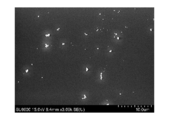
- FIG. 3 is a diagram showing an SEM image of Example 1.
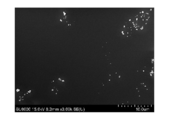
- 5 is a diagram showing an SEM image of Example 2.
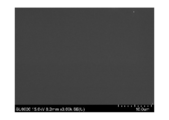
- FIG. 5 is a diagram showing an SEM image of Comparative Example 1.
- FIG. 9 is a diagram showing an SEM image of Comparative Example 2.
- FIG. 3 is a diagram showing an SEM image of Example 1.
- 5 is a diagram showing an SEM image of Example 2.
- FIG. 5 is a diagram showing an SEM image of Comparative Example 1.
- FIG. 9 is a diagram showing an SEM image of Comparative Example 2.
- FIG. 3 is a diagram showing an SEM image of Example 1.
- 5 is a diagram showing an SEM image of Example 2.
- FIG. 5 is a diagram showing an SEM image of Comparative Example 1.
- FIG. 9 is a diagram showing an SEM image of Comparative Example 2.
- FIG. 3 is a diagram showing an SEM image of Example 1.
- the bevel portion treating agent composition of the present embodiment is a surface modifier used for treating the bevel portion of a wafer.
- the bevel portion treating agent composition contains a silylating agent, and is represented by a surface modification index Y and a surface modification index Z measured in the following procedures (1) to (4).
- Y / Z has the property of satisfying the following formula (I). 0.5 ⁇ Y / Z ⁇ 1.0 (I)
- a substrate having a silicon oxide film (thermal oxide film) having a thickness of 1 ⁇ m on the surface is treated with the bevel portion treating agent composition.
- the treatment conditions are as follows: the substrate is immersed in a 1% by mass hydrofluoric acid aqueous solution for 10 minutes at room temperature, then in pure water for 1 minute and in 2-propanol (iPA) for 1 minute, and then the bevel treatment agent. Immerse the composition for 1 minute at 25 ° C., then for 1 minute in iPA, and finally remove the substrate from iPA and blow it with air to remove the iPA on the surface of the substrate.
- iPA 2-propanol
- the critical surface tension of the treated silicon oxide film is determined by the Zisman plot method using a plurality of measurement liquids having different mixing ratios of water and iPA.
- the value (mN / m) of the obtained critical surface tension is defined as "surface modification index Y”.
- a substrate having a silicon nitride film (LP-CVD film) with a thickness of 50 nm on the surface is treated with the bevel portion treating agent composition.
- the treatment conditions are as follows: the substrate is immersed in a 1% by mass hydrofluoric acid aqueous solution for 10 minutes at room temperature, then in pure water for 1 minute and in iPA for 1 minute, and then at 25 ° C. in the bevel portion treating agent composition.
- the critical surface tension of the treated silicon nitride film is determined by the Zisman plot method using a plurality of measurement liquids having different mixing ratios of water and iPA.
- the value (mN / m) of the obtained critical surface tension is defined as "surface modification index Z".
- FIG. 1 is a sectional view schematically showing the configuration of the bevel portion 30 of the wafer 100.
- An example of the wafer 100 of this embodiment may have the bevel portion 30 formed outside the element formation region 10.
- the bevel portion 30 has an upper bevel portion 40 and a lower bevel portion 60 each having an inclined surface, and an edge portion 50 having an edge end surface.
- a silicon oxide film or a silicon nitride film is formed on the surface of the upper bevel portion 40 of the bevel portion 30 or the surface of the edge portion 50 in the process of forming a film forming a semiconductor element in the element formation region 10.
- An insulating film 110 such as a film may be formed.
- the insulating film 110 is a heterogeneous film exposed on the surface of the bevel portion 30 in a state where a plurality of different materials are mixed. Then, foreign matter (particles) such as metal particles and inorganic particles may adhere to the insulating film 110 in the bevel portion 30 in various steps of the wafer 100.
- the adhesion of foreign matter on the surface of the bevel portion 30 can be appropriately controlled by using the critical surface tension after treatment with the bevel portion treatment composition as a guide. Furthermore, by using the ratio of the critical surface tension for each of the silicon oxide film and the silicon nitride film, which is a typical example of the different type film exposed on the surface of the bevel portion 30, as a guideline, the foreign matter adhesion property in the bevel portion 30 can be improved. It turned out that it can be evaluated stably.
- the present inventor proceeded with a study on a method for measuring the critical surface tension using the Zisman plot method.
- the critical surface tensions in the silicon oxide film and the silicon nitride film can be appropriately evaluated by using a plurality of liquids having different mixing ratios of water and iPA as the measuring liquid under the conditions of the Zisman plot method. did.
- the mixing ratio of water and iPA is 100: 0, 99: 1, 95: 5, 87:13, 80:20, 66:34, 60:40, 50:50 in terms of mass ratio. , 40:60, 30:70, 20:80, 10:90, 5:95, 3:97, and 0: 100. It was found that it is possible to calculate the critical surface tension from the Zisman plot by appropriately selecting two or more kinds of measurement liquids.
- the critical surface tension for the silicon oxide film obtained by the Zisman plotting method was defined as "surface modification index Y", and the critical surface tension for the silicon nitride film obtained by the Zisman plotting method was determined.
- surface modification index Z is adopted, "Y / Z” is adopted as an index, and the surface of the bevel part 30 is modified using a bevel part treating agent composition in which such index is controlled within an appropriate numerical range. It was found that by doing so, the ability to prevent the adhesion of foreign matter is improved.
- the materials such as the insulating film 110 formed on the surface of the bevel portion 30 are dispersed. Even in this case, since it is possible to stably exhibit the surface modifying ability with respect to these heterogeneous mixed films, it is considered that the foreign matter adhesion prevention property in the bevel portion 30 can be enhanced.
- the bevel part treating agent composition of the present embodiment can suppress the adhesion of foreign matter on the surface of the bevel part 30, it can be suitably used for the modification step on the surface of the bevel part 30.
- the bevel portion treatment agent composition of the present embodiment it is possible to suppress contamination due to foreign matter derived from the bevel portion in the semiconductor manufacturing process, thus improving the manufacturing stability and manufacturing yield of the semiconductor element. It is possible to Moreover, a semiconductor element having excellent device characteristics can be realized.
- Y / Z represented by the surface modification index Y and the surface modification index Z measured in steps (1) to (4) has the following formula (I). It has the property of satisfying. 0.5 ⁇ Y / Z ⁇ 1.0 (I)
- the lower limit of Y / Z is, for example, 0.50 or more, preferably 0.60 or more, and more preferably 0.70 or more. Thereby, the surface modification ability can be stably exhibited.
- the upper limit of Y / Z is, for example, 1.00 or less, preferably 9.98 or less, and more preferably 9.95 or less. As a result, the ability to prevent foreign matter from adhering can be enhanced.
- the bevel portion treating agent composition may have a property of satisfying 15 mN / m ⁇ Y ⁇ 26 mN / m.
- the surface modification index Y is, for example, 15 mN / m to 26 mN / m, preferably 20 mN / m to 25 mN / m, and more preferably 20 mN / m to 24 mN / m.
- the above Y / Z and Y are controlled by appropriately selecting the type and amount of each component contained in the bevel part treatment agent composition, the method for preparing the bevel part treatment agent composition, and the like. It is possible to Among these, for example, the raw materials are mixed to prepare a bevel part treating agent composition, and then the composition is immediately used, and the concentration and liquid temperature of the silylating agent in the bevel part treating agent composition are appropriately adjusted. Doing and the like are mentioned as the factors for setting the above Y / Z and Y in the desired numerical range.
- the wafer manufacturing method of the present embodiment includes a wafer surface modification step and a wafer processing step. And in the said surface modification process, the bevel part treating agent composition of this embodiment is used.
- the bevel portion treating agent composition of the present embodiment can enhance the ability to prevent foreign matter from adhering to the surface of the bevel portion 30 of the wafer 100.
- the bevel portion 30 By modifying the surface of the bevel portion 30 in this manner, it is possible to suppress foreign matter contamination of the bevel portion 30 in the semiconductor manufacturing process and to suppress secondary contamination caused by the foreign matter attached to the bevel portion 30. Therefore, it is possible to improve the manufacturing stability and the manufacturing yield of the semiconductor element.
- Examples of the wafer 100 include a silicon wafer, a SiC wafer, a sapphire wafer, a compound semiconductor wafer, and the like.
- the wafer 100 includes an element forming region 10 in which semiconductor elements are formed, a peripheral cutting region 20 for dicing provided outside the element forming region 10, and a bevel portion 30 provided outside the peripheral cutting region 20. , Can have.
- the processing steps of the wafer 100 include a step of forming a fine pattern having an uneven shape in the element formation region 10, a step of dicing or grinding the wafer 100, a step of forming various films such as the insulating film 110 and the metal film 120, and a wafer.
- Various semiconductor element forming processes such as the cleaning process of 100 may be mentioned.
- the coating method is not particularly limited as long as the bevel portion treating agent composition of the present embodiment can be applied to the bevel portion 30 in the surface modification step of the wafer 100.
- the surface modification step of the wafer 100 may be performed before and after the processing step, or between a plurality of steps during the processing step.
- the surface modification step may be performed once or more than once. Among these, it is expected that by performing the surface modification step between processing steps, it is possible to suppress contamination of the bevel portion 30 and secondary contamination from the bevel portion 30 in the subsequent processing steps.
- the bevel part treating agent composition of the present embodiment contains a silylating agent.
- a silylating agent a known silylating agent can be used.
- a silicon compound represented by the following general formula [1] is used. These may be used alone or in combination of two or more.
- R 1 is each independently an organic group containing a hydrocarbon group having 1 to 18 carbon atoms in which some or all of hydrogen elements may be replaced by fluorine elements.
- X is, independently of each other, a monovalent organic group in which the element bonded to the Si element is nitrogen, oxygen, carbon, or halogen, a is an integer of 1 to 3, and b is 0 to 2 It is an integer, and the sum of a and b is 1 to 3.
- R 1 in the above general formula [1] may contain not only hydrogen, carbon, nitrogen, oxygen and fluorine elements but also silicon, sulfur, halogen elements (other than fluorine) and the like.
- R 1 in the above general formula [1] contains a silicon element, it may have the structure of the following general formula [1-1].
- R 1 (but this R contains no silicon element is in 1) and X are the same as the above-mentioned general formula [1]
- m is an integer of 1 to 2
- N is an integer of 0 to 1
- the sum of m and n is 1 to 2
- p is an integer of 1 to 18, and the methylene chain represented by — (CH 2 ) p — is halogen-substituted. May be.
- the monovalent organic group in which the element bonded to the Si element is nitrogen, oxygen or carbon includes not only hydrogen, carbon, nitrogen and oxygen elements but also silicon, sulfur and halogen elements. Etc. may be included.
- R 5 are each independently a divalent hydrocarbon having 1 to 8 carbon atoms in which some or all of the hydrogen elements may be replaced by fluorine elements.
- -N C (NR 6 2 ) 2
- -N C (NR 6 2 ) R 6
- R 6 are each independently a hydrogen group, a -C ⁇ N group. , —NO 2 group, and a hydrocarbon group in which some or all of the hydrogen elements may be replaced by elemental fluorine, and the hydrocarbon group may have an oxygen atom and / or a nitrogen atom.
- R a1 represents a hydrogen atom or a saturated or unsaturated alkyl group
- R a2 represents a saturated or unsaturated alkyl group, a saturated or unsaturated cycloalkyl group
- R a1 and R a2 may be bonded to each other to form a saturated or unsaturated heterocycloalkyl group having a nitrogen atom.), —N (R a3 ).
- R a4 Si (R a4 ) (R a5 ) (R a6 ) (wherein the above R a3 represents a hydrogen atom, a methyl group, a trimethylsilyl group or a dimethylsilyl group, and the above R a4 , R a5 and R a6 are independent of each other.
- R a7 represents a hydrogen atom, a methyl group, a trimethylsilyl group, or a dimethylsilyl group
- R a8 represents a hydrogen atom, a saturated or unsaturated alkyl group, a fluorine-containing alkyl group, or a trialkylsilylamino group. , Etc.) and so on.
- Examples of the silylating agent in which X in the general formula [1] is a monovalent organic group in which the element bonded to the Si element is nitrogen are, for example, CH 3 Si (NH 2 ) 3 and C 2 H 5 Si.
- R 3 is a monovalent hydrocarbon group having 1 to 18 carbon atoms in which a part or all of hydrogen may be replaced by fluorine, g is 1 or 2, and h is 0 to 2
- An integer for example, tris (dimethylsilyl) amine, tris (trimethylsilyl) amine, etc.), —N (S ( ⁇ O) 2 R 4 ) 2 (wherein R 4 are each independently a part or part of The number of carbon atoms in which all hydrogen elements may be replaced by fluorine elements is 1
- N- (trimethylsilyl) bis (trifluoromethanesulfonyl) imide, etc., and a substituent having the structure of the following general formula [1-2] (In the general formula [1-2], R 5 are each independently a divalent hydrocarbon having 1 to 8 carbon atoms in which some or all of the hydrogen elements may be replaced by fluorine elements.
- Selected from a hydrogen group, and the hydrocarbon group may have an oxygen atom and / or a nitrogen atom, for example, 2-trimethylsilyl-1,1,3,3-tetramethylguanidine), —N (R a1 ) R a2 (wherein R a1 represents a hydrogen atom or a saturated or unsaturated alkyl group, and R a2 represents a saturated or unsaturated alkyl group, a saturated or unsaturated cycloalkyl group, or a saturated or unsaturated heterocyclo).
- R a1 represents a hydrogen atom or a saturated or unsaturated alkyl group
- R a2 represents a saturated or unsaturated alkyl group, a saturated or unsaturated cycloalkyl group, or a saturated or unsaturated heterocyclo
- R a1 and R a2 may be bonded to each other to form a saturated or unsaturated heterocycloalkyl group having a nitrogen atom), —N (R a3 ) —Si (R a4 ) (R a5 ) (R a6 ) (wherein R a3 represents a hydrogen atom, a methyl group, a trimethylsilyl group, or a dimethylsilyl group, and R a4 , R a5, and R a6 each independently represent a hydrogen atom or an organic group. , R a4 , R a5 and R a6 have a total number of carbon atoms of at least 1.
- hexamethyldisilazane N-methylhexamethyldisilazane, 1,1,3,3-tetramethyl Disilazane, 1,3-dimethyldisilazane, 1,2-di-N-octyltetramethyldisilazane, 1,2-divinyltetramethyldisilazane, heptamethyldisilazane, nonamethyltrisilazane, pentamethylethyldisilazane , Pentamethylvinyldisilazane, pentamethylpropyldisilazane, pentamethylethyldisilazane, pentamethyl-t-butyldisilazane, pentamethylphenyldisilazane, trimethyltriethyldisilazane, etc.), -N (R a7 ) -C ( ⁇ O) R a8 (wherein R a7
- An alkyl group, or a trialkylsilyl group for example, trimethylsilyl acetate, dimethylsilyl acetate, monomethylsilyl acetate, trimethylsilyltrifluoroacetate, dimethylsilyltrifluoroacetate, monomethylsilyltrifluoroacetate, trimethylsilylpropionate, trimethylsilylbutyrate.
- R a13 represents a hydrogen atom, an alkyl group, or a trialkylsilyl group.
- —O—C (R a14 ) ⁇ CH —C ( ⁇ O) R a15 (wherein the above R a14 and R a15 are, respectively, Each independently represents a hydrogen atom or an organic group, for example, trimethylsilyloxy-3-penten-2-one, 2-trimethylsiloxypent-2-en-4-one, etc.), —OR a16 (wherein R a16 described above).
- Examples of the silylating agent in which X in the general formula [1] is a monovalent organic group in which the element bonded to the Si element is carbon are, for example, the amino group (—NH 2 group) of aminosilane described above, —C (S ( ⁇ O) 2 R 7 ) 3 (wherein, R 7 is, independently of each other, a carbon number of 1 to 8 in which some or all of hydrogen elements may be replaced by fluorine elements).
- Examples of the silylating agent in which X in the above general formula [1] is a monovalent organic group in which the element bonding to the Si element is halogen are, for example, the amino group (—NH 2 group) of the above aminosilane.
- Those in which is replaced with a chloro group, a bromo group, or an iodo group (for example, chlorotrimethylsilane, bromotrimethylsilane, etc.) and the like can be mentioned.
- a cyclic silazane compound may be included as the silylating agent.
- examples of the cyclic silazane compound include 2,2,5,5-tetramethyl-2,5-disila-1-azacyclopentane and 2,2,6,6-tetramethyl-2,6-disila-1-aza.
- Cyclic disilazane compounds such as cyclohexane; Cyclic trisilazane compounds such as 2,2,4,4,6,6-hexamethylcyclotrisilazane and 2,4,6-trimethyl-2,4,6-trivinylcyclotrisilazane; Cyclic tetrasilazane compounds such as 2,2,4,4,6,6,8,8-octamethylcyclotetrasilazane; and the like.
- the bevel portion treating agent composition further comprises a compound A, an acid imidized compound, a nitrogen-containing compound, a nitrogen-containing heterocyclic compound, and a silylation agent, which will be described later, as an accelerator (catalyst) for the silylating agent. It may include one or more selected from the group consisting of heterocyclic compounds.
- the concentration of the accelerator may be, for example, 0.01 to 50% by mass, or 0.05 to 25% by mass, based on 100% by mass of the total silylating agent.
- the bevel treating agent composition may further include compound A as an accelerator.
- compound A include, for example, trimethylsilyltrifluoroacetate, trimethylsilyltrifluoromethanesulfonate, dimethylsilyltrifluoroacetate, dimethylsilyltrifluoromethanesulfonate, butyldimethylsilyltrifluoroacetate, butyldimethylsilyltrifluoromethanesulfonate, hexyldimethylsilyl.
- Trifluoroacetate, hexyldimethylsilyltrifluoromethanesulfonate, octyldimethylsilyltrifluoroacetate, octyldimethylsilyltrifluoromethanesulfonate, decyldimethylsilyltrifluoroacetate, and decyldimethylsilyltrifluoromethanesulfonate are mentioned and selected from among them. It may contain one or more. These may be used alone or in combination of two or more.
- the compound A may correspond to the above-mentioned silylating agent, but when it is used as an accelerator, it means to be used in combination with other silylating agent other than the compound A.
- the compound A as the accelerator is one selected from the group consisting of a silicon compound represented by the following general formula [2], trifluoroacetic acid, trifluoroacetic anhydride, trifluoromethanesulfonic acid, and trifluoromethanesulfonic anhydride. It may be obtained by reacting the above acetic acid or sulfonic acid.
- the surplus silicon compound represented by the following general formula [2] that is not consumed in this reaction can be used as the silylating agent together with the compound A obtained in the reaction.
- the silicon compound represented by the following general formula [2] is, for example, in a molar ratio of 0.2 to 100,000 mol times, preferably 0.5 to 50,000 mol times, and more preferably 1 mol with respect to the acetic acid or sulfonic acid.
- the reaction may be carried out at about 10000 mol times.
- R 2 c (H) d Si- includes (CH 3 ) 3 Si-, (CH 3 ) 2 (H) Si-, and (C 4 H 9 ) (CH 3 ) 2 Si -, (C 6 H 13 ) (CH 3) 2 Si -, (C 8 H 17) (CH 3) 2 Si -, 2 Si- , and the like (C 10 H 21) (CH 3).
- X is the same as in the above general formula [1].
- the compound A as the accelerator is a sulfonic acid represented by the following general formula [3], an anhydride of the sulfonic acid, a salt of the sulfonic acid, or a sulfonic acid represented by the following general formula [4]. At least one selected from the group consisting of derivatives may be used.
- R 8 -S ( O) 2 OH [3]
- R 8 is a group consisting of a monovalent hydrocarbon group having 1 to 8 carbon atoms in which some or all of the hydrogen elements may be replaced by fluorine elements, and a hydroxyl group. Is a group selected from.
- R 8 -S ( O) 2 O-Si (H) 3-r (R 9 ) r [4]
- R 8 is a monovalent hydrocarbon group having 1 to 8 carbon atoms in which some or all of the hydrogen elements may be replaced by fluorine elements
- R 9 is Independently of each other, at least one group selected from monovalent hydrocarbon groups having 1 to 18 carbon atoms in which some or all of hydrogen elements may be replaced by fluorine elements
- r is 1 It is an integer of ⁇ 3.
- the compound A as the above-mentioned accelerator is a sulfonic acid ester represented by the following general formula [5], a sulfonimide represented by the following general formulas [6] and [7], and the following general formulas [8] and [8]. 9], at least one selected from the group consisting of a sulfonimide derivative represented by the following general formula [10], and a sulfonmethide derivative represented by the following general formula [11].
- R 11 is a group selected from the group, and R 11 is a monovalent alkyl group having 1 to 18 carbon atoms.
- R 12 -S ( O) 2 ) 2 NH
- R 12 are each independently a monovalent hydrocarbon group having 1 to 8 carbon atoms in which some or all of the hydrogen elements may be replaced by fluorine elements, And a group selected from the group consisting of elemental fluorine.
- R 13 is a divalent hydrocarbon group having 1 to 8 carbon atoms in which some or all of the hydrogen elements may be replaced by fluorine elements.
- R 14's each independently represent a monovalent hydrocarbon group having 1 to 8 carbon atoms in which some or all of the hydrogen elements may be replaced by fluorine elements.
- R 15 is a group selected from the group consisting of elemental fluorine, and R 15's each independently represent a monovalent group having 1 to 18 carbon atoms in which a part or all of hydrogen elements may be replaced by elemental fluorine.
- R 16 are each independently a divalent hydrocarbon group having 1 to 8 carbon atoms in which some or all of the hydrogen elements may be replaced by fluorine elements.
- R 17 are each independently a monovalent hydrocarbon group having 1 to 18 carbon atoms in which some or all of hydrogen elements may be replaced by fluorine elements, and u is 1 to An integer of 3 and v is an integer of 0 to 2, and the sum of u and v is 3 or less.
- R 18 are each independently a monovalent hydrocarbon group having 1 to 8 carbon atoms in which some or all of the hydrogen elements may be replaced by fluorine elements, And a group selected from the group consisting of elemental fluorine.
- R 19's each independently represent a monovalent hydrocarbon group having 1 to 8 carbon atoms in which some or all of hydrogen elements may be replaced by fluorine elements
- R 20 is a group selected from the group consisting of elemental fluorine
- each R 20 is, independently of each other, a monovalent group having 1 to 18 carbon atoms in which part or all of the hydrogen elements may be replaced by elemental fluorine.
- the bevel portion treating agent composition may further include an acid imide compound such as a carboxylic acid imidized compound or a phosphoric acid imidized compound, if necessary.
- an acid imide compound such as a carboxylic acid imidized compound or a phosphoric acid imidized compound, if necessary.
- the acid imidized compound include compounds having a chemical structure in which an acid such as carboxylic acid or phosphoric acid is imidized.
- the bevel portion treating agent composition may further contain at least one nitrogen-containing compound selected from the compounds represented by the following general formulas [12] and [13], if necessary.
- R 21 -N C (NR 22 2 ) 2 [12]
- R 21 -N C (NR 22 2 ) R 22 [13]
- R 21 is a hydrogen group, a —C ⁇ N group, a —NO 2 group, an alkylsilyl group, and some or all of the hydrogen elements are replaced by fluorine elements.
- the hydrocarbon group may have an oxygen atom and / or a nitrogen atom, but when it contains a nitrogen atom, it has an acyclic structure.
- R 22 s are each independently selected from a hydrogen group, a —C ⁇ N group, a —NO 2 group, and a hydrocarbon group in which some or all of the hydrogen elements may be replaced by elemental fluorine.
- the hydrocarbon group may have an oxygen atom and / or a nitrogen atom, but when it contains a nitrogen atom, it has an acyclic structure.
- Examples of the nitrogen-containing compound include guanidine, 1,1,3,3-tetramethylguanidine, 2-tert-butyl-1,1,3,3-tetramethylguanidine, 1,3-diphenylguanidine, 1, 2,3-triphenylguanidine, N, N′-diphenylformamidine, 2,2,3,3,3-pentafluoropropylamidine and the like can be mentioned.
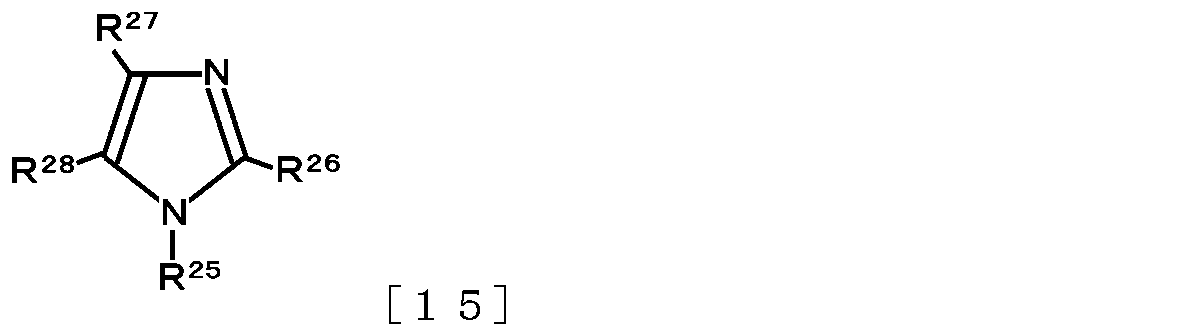
- the bevel portion treating agent composition may further include at least one nitrogen-containing compound selected from the compounds represented by the following general formulas [14] and [15], if necessary.
- R 23 and R 24 are each independently a divalent organic group consisting of a carbon element and / or a nitrogen element and a hydrogen element, and the total number of carbon atoms and nitrogen atoms is It is 1 to 9, and when it is 2 or more, a carbon element that does not form a ring may be present.
- R 25 is an alkyl group having 1 to 6 carbon atoms in which some or all of the hydrogen elements may be replaced by fluorine elements, and some or all of the hydrogen elements are fluorine elements.
- Alkylamino group having 1 to 6 alkyl groups, part or all of hydrogen elements may be replaced by fluorine elements, Dialkylamino group having 1 to 6 carbon atoms, part or all of hydrogen
- the element is an aminoalkyl group having 1 to 6 carbon atoms, which may be replaced by elemental fluorine, a nitro group, a cyano group, a phenyl group, a benzyl group, or a halogen group, and R 26 , R 27 and R 28 are Independently of each other, a hydrogen atom is an alkyl group having 1 to 6 carbon atoms in which some or all of the hydrogen elements may be replaced by elemental fluorine. ]
- the bevel portion treating agent composition may further include a nitrogen-containing heterocyclic compound containing no silicon atom, if necessary.
- the nitrogen-containing heterocyclic compound may contain a hetero atom other than a nitrogen atom such as an oxygen atom or a sulfur atom in the ring, may have aromaticity, and two or more rings may be a single bond, or It may be a compound bound by a divalent or higher polyvalent linking group.
- nitrogen-containing heterocyclic compound examples include pyridine, pyridazine, pyrazine, pyrimidine, triazine, tetrazine, pyrrole, pyrazole, imidazole, methylimidazole, triazole, tetrazole, oxazole, isoxazole, thiazole, isothiazole, oxadiazole, Thiadiazole, quinoline, isoquinoline, cinnoline, phthalazine, quinoxaline, quinazoline, indole, indazole, benzimidazole, benzotriazole, benzoxazole, benzisoxazole, benzothiazole, benzisothiazole, benzooxadiazole, benzothiadiazole, saccharin, pyrrolidine, And piperidine and the like.
- the nitrogen-containing heterocyclic compound may have a substituent.
- the bevel part treating agent composition may further contain a silylated heterocyclic compound, if necessary.
- the silylated heterocyclic compound include silylated imidazole compounds and silylated triazole compounds.
- Examples of silylated heterocyclic compounds include monomethylsilylimidazole, dimethylsilylimidazole, trimethylsilylimidazole, monomethylsilyltriazole, dimethylsilyltriazole, trimethylsilyltriazole, and the like.
- the bevel portion treating agent composition may include a solvent.
- the solvent is not particularly limited as long as it dissolves the silylating agent.
- examples of the solvent include hydrocarbons, esters, ethers, ketones, halogen-containing solvents, sulfoxide-based solvents, alcohols, carbonate-based solvents, polyhydric alcohol derivatives, nitrogen-containing solvents, silicone solvents, thiols.
- An organic solvent such as a class is used.
- hydrocarbons, esters, ethers, halogen element-containing solvents, sulfoxide-based solvents, and polyhydric alcohol derivatives that do not have an OH group are preferable. These may be used alone or in combination of two or more.
- hydrocarbons examples include n-hexane, n-heptane, n-octane, n-nonane, n-decane, n-undecane, n-dodecane, n-tetradecane, n-hexadecane, n-octadecane, n.
- -Aicosane and branched hydrocarbons corresponding to their carbon number eg isododecane, isocetane etc.
- cyclohexane methylcyclohexane
- decalin benzene, toluene, xylene, (ortho-, meta- or para-) diethylbenzene. , 1,3,5-trimethylbenzene, naphthalene, etc.
- hydrocarbon-based non-polar solvent such as a linear, branched, or cyclic hydrocarbon-based solvent, an aromatic hydrocarbon-based solvent, or a terpene-based solvent.
- a solvent may be used.
- a linear or branched hydrocarbon solvent having 6 to 12 carbon atoms or a terpene solvent is preferable.
- the terpene-based solvent include p-menthane, diphenylmenthane, limonene, terpinene, bornane, norbornane, pinane and the like.
- esters examples include ethyl acetate, n-propyl acetate, i-propyl acetate, n-butyl acetate, i-butyl acetate, n-pentyl acetate, i-pentyl acetate, n-hexyl acetate, n-heptyl acetate.
- cyclic esters such as lactone compounds may be used.
- lactone compounds include ⁇ -propiolactone, ⁇ -butyrolactone, ⁇ -valerolactone, ⁇ -hexanolactone, ⁇ -heptanolactone, ⁇ -octanolactone, ⁇ -nonanolactone, ⁇ -decanolactone, ⁇ - Undecanolactone, ⁇ -dodecanolactone, ⁇ -valerolactone, ⁇ -hexanolactone, ⁇ -octanolactone, ⁇ -nonanolactone, ⁇ -decanolactone, ⁇ -undecanolactone, ⁇ -dodecanolactone, ⁇ -hexa No lactone etc.
- ethers examples include di-n-propyl ether, ethyl-n-butyl ether, di-n-butyl ether, ethyl-n-amyl ether, di-n-amyl ether, ethyl-n-hexyl ether, di- Ethers having a branched hydrocarbon group such as n-hexyl ether, di-n-octyl ether, and diisopropyl ether and diisoamyl ether corresponding to their carbon number, dimethyl ether, diethyl ether, methyl ethyl ether, methyl cyclopentyl ether , Diphenyl ether, tetrahydrofuran, dioxane and the like.
- ketones examples include acetone, acetylacetone, methyl ethyl ketone, methyl propyl ketone, methyl butyl ketone, 2-heptanone, 3-heptanone, cyclohexanenone, isophorone and the like.
- halogen element-containing solvent examples include perfluorocarbons such as perfluorooctane, perfluorononane, perfluorocyclopentane, perfluorocyclohexane and hexafluorobenzene, 1,1,1,3,3-pentafluorobutane and octa.
- hydrofluorocarbons such as Zeolora H (manufactured by Zeon Corporation), methyl perfluoropropyl ether, methyl perfluorois
- Chlorocarbons such as tetrachloromethane, hydrochlorocarbons such as chloroform, chlorofluorocarbons such as dichlorodifluoromethane, 1,1-dichloro-2,2,3,3,3-pentafluoropropane, 1,3-dichloro- Hydrochlorofluorocarbons such as 1,1,2,2,3-pentafluoropropane, 1-chloro-3,3,3-trifluoropropene and 1,2-dichloro-3,3,3-trifluoropropene, per Fluoroether, perfluoropolyether and the like.
- the sulfoxide-based solvent include dimethyl sulfoxide and the like.
- Examples of the carbonate-based solvent include dimethyl carbonate, ethylmethyl carbonate, diethyl carbonate and propylene carbonate.
- Examples of the above polyhydric alcohol derivatives having no OH group include ethylene glycol dimethyl ether, ethylene glycol diethyl ether, ethylene glycol dibutyl ether, ethylene glycol monomethyl ether acetate, ethylene glycol monoethyl ether acetate, ethylene glycol monobutyl ether acetate, Ethylene glycol diacetate, diethylene glycol dimethyl ether, diethylene glycol ethyl methyl ether, diethylene glycol diethyl ether, diethylene glycol butyl methyl ether, diethylene glycol dibutyl ether, diethylene glycol monomethyl ether acetate, diethylene glycol monoethyl ether acetate, diethylene glycol monobutyl ether acetate, diethylene glycol diacetate, triethylene glycol dimethyl ether , Triethylene
- nitrogen element-containing solvent examples include formamide, N, N-dimethylformamide, N, N-dimethylacetamide, N-methyl-2-pyrrolidone, N-ethyl-2-pyrrolidone, N-propyl-2-pyrrolidone, 1,3-Dimethyl-2-imidazolidinone, 1,3-diethyl-2-imidazolidinone, 1,3-diisopropyl-2-imidazolidinone, diethylamine, triethylamine, pyridine and the like.
- silicone solvents examples include hexamethyldisiloxane, octamethyltrisiloxane, decamethyltetrasiloxane, dodecamethylpentasiloxane.
- thiols examples include 1-hexanethiol, 2-methyl-1-pentanethiol, 3-methyl-1-pentanethiol, 4-methyl-1-pentanethiol, 2,2-dimethyl-1-butanethiol.
- the bevel treating agent composition may be a silylating agent diluted with a solvent.
- concentration of the silylating agent or the total concentration of the silylating agent and the accelerator is, for example, 0.01% by mass to 100% by mass relative to 100% by mass of the solvent. %, Preferably 0.1% by mass to 50% by mass, more preferably 1% by mass to 30% by mass.
- the above bevel portion treating agent composition may contain components other than the components described above within the range not impairing the object of the present invention.
- the other components include oxidizing agents such as hydrogen peroxide and ozone, surfactants, and the like.
- the bevel part treating agent composition of the present embodiment is obtained by mixing the above-mentioned components.
- the obtained mixed liquid may be purified using an adsorbent, a filter, or the like, if necessary.
- HMDS was mixed with PGMEA at a liquid temperature of 25 ° C. for 1 minute to prepare a mixed solution having an HMDS concentration of 3 mass%.
- the mixed solution immediately after preparation was used as the bevel portion treating agent composition C.
- Test Example 4 In the same manner as in Test Example 1, a bevel portion treating agent composition containing CF 3 C ( ⁇ O) OSi (H 3 C) 3 as the compound A and (H 3 C) 3 Si—N (CH 3 ) 2 as the silicon compound Material A was prepared. The obtained treating agent composition A was stored in an HDPE container at 25 ° C. for 2 weeks and used as treating agent composition D.
- a substrate having a silicon oxide film (SiO 2 film, thermal oxide film) having a thickness of 1 ⁇ m on the surface was treated with the obtained treating agent composition.
- the treatment conditions are as follows: the substrate is immersed in a 1% by mass hydrofluoric acid aqueous solution for 10 minutes at room temperature, then in pure water for 1 minute and in 2-propanol (iPA) for 1 minute, and then the resulting treatment agent composition is obtained. The substrate was soaked for 1 minute at 25 ° C. and then for 1 minute in iPA, and finally, the substrate was taken out from the iPA and blown with air to remove the iPA on the surface of the substrate.
- iPA 2-propanol
- the critical surface tension of the silicon oxide film after the treatment is determined by measuring a plurality of liquids for measurement having different mixing ratios of water and iPA (mixing ratio of water and iPA is 100: 0, 99 by mass ratio). : 95: 5, 87:13, 80:20, 66:34, 60:40, 50:50, 40:60, 30:70, 20:80, 10:90, 5:95, 3:97. , 0: 100, two or more kinds of measurement liquids selected from the solution), and the Zisman plot method was used. The value (mN / m) of the critical surface tension of the obtained silicon oxide film was used as the “surface modification index Y”.
- a substrate having a silicon nitride film (SiN film, LP-CVD film) with a thickness of 50 nm on the surface was treated with the obtained treating agent composition.
- the treatment conditions are as follows: the substrate is immersed in a 1% by mass hydrofluoric acid aqueous solution for 10 minutes at room temperature, then in pure water for 1 minute and in iPA for 1 minute, and then at 25 ° C. in the obtained treating agent composition. It was soaked for 1 minute, then soaked in iPA for 1 minute, and finally the substrate was taken out from the iPA and blown with air to remove the iPA on the surface of the substrate.
- the critical surface tension of the silicon nitride film after the treatment (3) is measured by a plurality of measuring liquids having different mixing ratios of water and iPA (mixing ratio of water and iPA is 100: 0, 99 by mass ratio). : 95: 5, 87:13, 80:20, 66:34, 60:40, 50:50, 40:60, 30:70, 20:80, 10:90, 5:95, 3:97. , 0: 100, two or more kinds of measurement liquids selected from the solution), and the Zisman plot method was used. The value (mN / m) of the critical surface tension of the obtained silicon nitride film was used as the “surface modification index Z”.
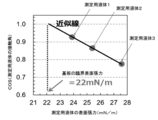
- FIG. 2 is a diagram for explaining the outline of the Zisman plotting method.
- the contact angle (°) with respect to each substrate surface is measured, and the cosine (COS) of the contact angle of each liquid is used as the surface tension of each liquid.
- the straight line shown in FIG. 2 is obtained.
- the surface tension when the cosine becomes 1.0 (completely wet state) on this straight line is determined as the critical surface tension (mN / m) of the substrate surface to be measured.
- the critical surface tension can be measured in the same manner as in the case of using the above-mentioned three kinds even when using two kinds or four or more kinds of measuring liquids.
- the substrate the substrate having the silicon oxide film after the above (1) treatment, the substrate having the silicon nitride film after the above treatment (3), and the above-mentioned measuring liquid were used, and the environmental temperature of the contact angle was measured.
- the liquid temperature of the working liquid was 25 ° C.
- the critical surface tension is set to 72.0 [mN / m], which is the same as the surface tension of water.
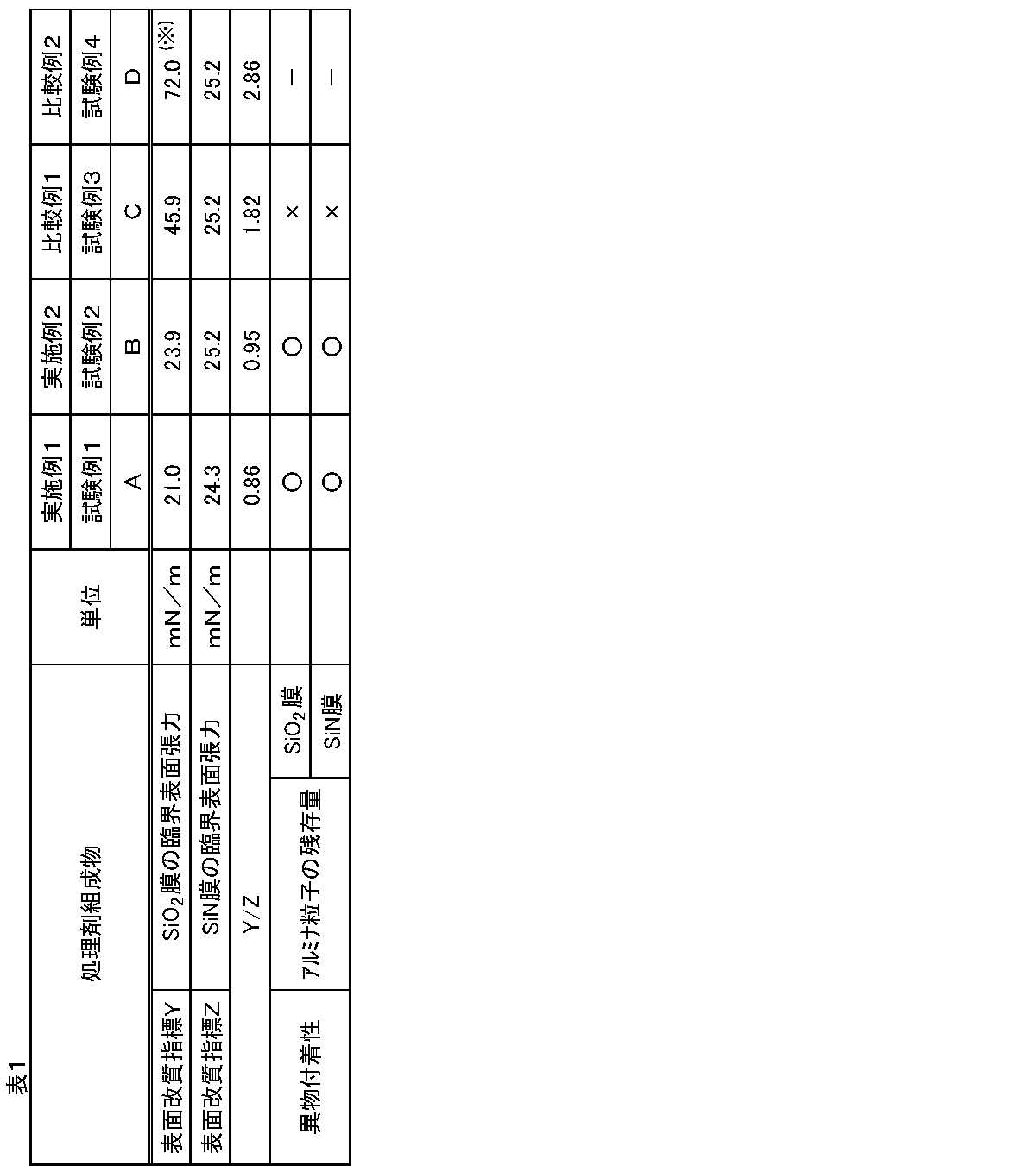
- the critical surface tension in this case is described as “*” in Table 1.
- treating agent compositions A and B of Test Examples 1 and 2 were used in Example 1 2, and treating agent compositions C and D of Test Examples 3 and 4 were used as Comparative Examples 1 and 2.
- a substrate A having a silicon oxide film (SiO 2 film) having a thickness of 1 ⁇ m on the surface and a substrate B having a silicon nitride film (SiN film) having a thickness of 50 nm on the surface were prepared.
- the substrates A and B of (1) above were immersed in a 1% by mass hydrofluoric acid aqueous solution at room temperature for 10 minutes, and then immersed in pure water for 1 minute to perform cleaning.
- An aqueous dispersion of alumina particles was applied onto the surfaces of the substrates A and B washed in (2) above, and then the substrates A and B were immersed in iPA for 1 minute.
- Substrates A and B obtained in (3) above were dipped in the respective treatment agent compositions obtained in Test Examples 1 to 4 at 25 ° C. for 1 minute, and then dipped in iPA for 1 minute. .. (5) After the above (4), the substrates A and B were taken out from the iPA and air was blown to remove the iPA on the surface of the substrate.
- the surfaces of the substrates A and B obtained in (1) to (5) above were observed using SEM, and the residual amount of alumina particles was evaluated based on the obtained SEM images.
- the SEM images of the substrates A of Examples 1 and 2 and Comparative Examples 1 and 2 are shown in FIGS. 3 to 6, respectively, and the SEM images of the substrates B of Examples 1 and 2 and Comparative Examples 1 and 2 are shown in FIGS. It is 7-10.
- White portions in FIGS. 3 to 10 indicate alumina particles remaining on the substrate surface.
- the treatment agent compositions of Examples 1 and 2 were superior in the prevention of adhesion of particles such as metal particles, as compared with Comparative Examples 1 and 2.
- the treating agent compositions of Examples 1 and 2 are expected to be preferably used as a bevel portion treating agent composition for treating the bevel portion of a semiconductor wafer.
Landscapes
- Chemical & Material Sciences (AREA)
- Organic Chemistry (AREA)
- Chemical Kinetics & Catalysis (AREA)
- Oil, Petroleum & Natural Gas (AREA)
- Engineering & Computer Science (AREA)
- Life Sciences & Earth Sciences (AREA)
- Wood Science & Technology (AREA)
- Health & Medical Sciences (AREA)
- Emergency Medicine (AREA)
- Inorganic Chemistry (AREA)
- Cleaning Or Drying Semiconductors (AREA)
- Mechanical Treatment Of Semiconductor (AREA)
- Weting (AREA)
- Formation Of Insulating Films (AREA)
Abstract
Description
また、半導体製造の各工程において、半導体ウェハのデバイス面以外の部分であるウェハ裏面、ベベル部(ウェハエッジ部及び周辺部)の表面に金属汚染などが発生することが知られている(特許文献2の段落0004)。
上述のとおり、ベベル部の表面の異物を洗浄用薬液で洗浄する方法が採用されている。しかしながら、洗浄した後のベベル部の表面に異物が再付着する恐れがある。
また、ベベル部表面において、シリコン酸化膜やシリコン窒化膜などの複数種の絶縁膜が積層されていることが一般的であり、異種材料が混在した状態の膜が露出していることが知られている。こうした事情を踏まえて検討した結果、異なる材料の膜に対する2つの臨界表面張力を指針として用いることで、ベベル部表面における異物付着性を安定的に評価できることが分かった。
ウェハのベベル部を処理するために用いる、シリル化剤を含有するベベル部処理剤組成物であって、
下記の手順(1)~(4)で測定される表面改質指標Yと表面改質指標Zとが、
0.5≦Y/Z≦1.0
を満たす、ベベル部処理剤組成物が提供される。
(手順)
(1)表面に厚さ1μmのシリコン酸化膜(SiO2膜)を有する基板を当該ベベル部処理剤組成物により処理する。処理条件は、前記基板を、室温で1質量%のフッ酸水溶液に10分浸漬し、次いで、純水に1分、2-プロパノール(iPA)に1分浸漬し、次いで、当該ベベル部処理剤組成物に25℃で1分浸漬し、次いで、iPAに1分浸漬し、最後に、前記基板をiPAから取出し、エアーを吹き付けて、前記基板の表面のiPAを除去する。
(2)(1)処理後のシリコン酸化膜の臨界表面張力を、水とiPAとの混合比率が異なる複数の測定用液体を用いZismanプロット法により求める。得られた臨界表面張力の値(mN/m)を「表面改質指標Y」とする。
(3)表面に厚さ50nmのシリコン窒化膜(SiN膜)を有する基板を当該ベベル部処理剤組成物により処理する。処理条件は、前記基板を、室温で1質量%のフッ酸水溶液に10分浸漬し、次いで、純水に1分、iPAに1分浸漬し、次いで、当該ベベル部処理剤組成物に25℃で1分浸漬し、次いで、iPAに1分浸漬し、最後に、前記基板をiPAから取出し、エアーを吹き付けて、前記基板の表面のiPAを除去する。
(4)(3)処理後のシリコン窒化膜の臨界表面張力を、水とiPAとの混合比率が異なる複数の測定用液体を用いZismanプロット法により求める。得られた臨界表面張力の値(mN/m)を「表面改質指標Z」とする。
ウェハの表面改質工程と、
ウェハの加工工程と、を含む、ウェハの製造方法であって、
前記表面改質工程において、上記のベベル部処理剤組成物を用いる、ウェハの製造方法が提供される。
本実施形態のベベル部処理剤組成物は、ウェハのベベル部を処理するために用いる表面改質剤である。当該ベベル部処理剤組成物は、シリル化剤を含有するものであり、下記の手順(1)~(4)で測定される表面改質指標Yと表面改質指標Zとで表される「Y/Z」が下記の式(I)を満たすという特性を有するものである。
0.5≦Y/Z≦1.0 ・・・(I)
(1)表面に厚さ1μmのシリコン酸化膜(熱酸化膜)を有する基板を当該ベベル部処理剤組成物により処理する。処理条件は、前記基板を、室温で1質量%のフッ酸水溶液に10分浸漬し、次いで、純水に1分、2-プロパノール(iPA)に1分浸漬し、次いで、当該ベベル部処理剤組成物に25℃で1分浸漬し、次いで、iPAに1分浸漬し、最後に、前記基板をiPAから取出し、エアーを吹き付けて、前記基板の表面のiPAを除去する。
(2)(1)処理後のシリコン酸化膜の臨界表面張力を、水とiPAとの混合比率が異なる複数の測定用液体を用いZismanプロット法により求める。得られた臨界表面張力の値(mN/m)を「表面改質指標Y」とする。
(3)表面に厚さ50nmのシリコン窒化膜(LP-CVD膜)を有する基板を当該ベベル部処理剤組成物により処理する。処理条件は、前記基板を、室温で1質量%のフッ酸水溶液に10分浸漬し、次いで、純水に1分、iPAに1分浸漬し、次いで、当該ベベル部処理剤組成物に25℃で1分浸漬し、次いで、iPAに1分浸漬し、最後に、前記基板をiPAから取出し、エアーを吹き付けて、前記基板の表面のiPAを除去する。
(4)(3)処理後のシリコン窒化膜の臨界表面張力を、水とiPAとの混合比率が異なる複数の測定用液体を用いZismanプロット法により求める。得られた臨界表面張力の値(mN/m)を「表面改質指標Z」とする。
本実施形態のウェハ100の一例は、素子形成領域10の外側に形成されたベベル部30を有し得る。ベベル部30は、傾斜面で構成された上ベベル部40および下ベベル部60、エッジの端面で構成されたエッジ部50を有する。
さらには、ベベル部30の表面に露出する異種膜の代表例であるシリコン酸化膜と、シリコン窒化膜との各々に対する臨界表面張力の比を指針として用いることで、ベベル部30における異物付着性を安定的に評価できることが分かった。
上記ベベル部処理剤組成物は、手順(1)~(4)で測定される表面改質指標Yと表面改質指標Zとで表される「Y/Z」が下記の式(I)を満たすという特性を有するものである。
0.5≦Y/Z≦1.0 ・・・(I)
上記表面改質指標Yとしては、例えば、15mN/m~26mN/m、好ましくは20mN/m~25mN/m、より好ましくは20mN/m~24mN/mである。表面改質指標Yを上記数値範囲内とすることで、ウェハ100としてシリコンウェハを用いた場合、例えば自然酸化膜が形成されたベベル部表面において、異物の付着防止能を高めることができる。
本実施形態のウェハの製造方法は、ウェハの表面改質工程と、ウェハの加工工程と、を含むものである。そして、当該表面改質工程において、本実施形態のベベル部処理剤組成物を用いるものである。
ウェハ100は、半導体素子が形成される素子形成領域10と、素子形成領域10の外側に設けられたダイシングのための周辺カット領域20と、周辺カット領域20の外側に設けられたベベル部30と、を有し得る。
上記ウェハ100の表面改質工程は、加工工程の前後、加工工程中の複数の各工程の間に行ってもよい。表面改質工程は、1回または2回以上実施してもよい。この中でも、加工工程中の合間に表面改質工程を行うことで、以後の加工工程において、ベベル部30の汚染やベベル部30からの二次汚染を抑制できることが期待される。
上記シリル化剤は、公知のシリル化剤を用いることができる。シリル化剤としては、例えば、下記の一般式[1]で表されるケイ素化合物が用いられる。
これらを単独で用いても2種以上を組み合わせて用いてもよい。
上記一般式[1]中のR1として、それぞれ互いに独立して、CeH2e+1(e=1~18)、および、CfF2f+1CH2CH2(f=1~8)から選ばれる少なくとも1つの基が挙げられる。この中でも、トリアルキルシリル基を有するケイ素化合物を用いることができる。また、上記R1には不飽和結合や芳香環が含まれていてもよい。
なお、上記一般式[1]中のR1がケイ素元素を含む場合は、以下に示す一般式[1-1]の構造をとってもよい。
R1 mX3-m-n(H)nSi-(CH2)p-Si(H)nX3-m-nR1 m [1-1]
なお、上記一般式[1-1]において、R1(ただしこのR1中にはケイ素元素を含まない)およびXは、上記一般式[1]と同様であり、mは1~2の整数、nは0~1の整数であり、mとnの合計は1~2であり、pは1~18の整数であり、-(CH2)p-で表されるメチレン鎖はハロゲン置換されていてもよい。
上記Si元素と結合する元素が窒素の1価の有機基の例としては、例えば、イソシアネート基、アミノ基、ジアルキルアミノ基、イソチオシアネート基、アジド基、アセトアミド基、-NHC(=O)CF3、-N(CH3)C(=O)CH3、-N(CH3)C(=O)CF3、-N=C(CH3)OSi(CH3)3、-N=C(CF3)OSi(CH3)3、-NHC(=O)-OSi(CH3)3、-NHC(=O)-NH-Si(CH3)3、イミダゾール環、トリアゾール環、テトラゾール環、オキサゾリジノン環、モルホリン環、-NH-C(=O)-Si(CH3)3、-N(H)2-g(Si(H)hR3 3-h)g(R3は、一部または全ての水素元素がフッ素元素に置き換えられていても良い炭素数が1~18の1価の炭化水素基、gは1または2、hは0~2の整数)、-N(S(=O)2R4)2(ここで、R4は、それぞれ互いに独立して、一部又は全ての水素元素がフッ素元素に置き換えられていても良い炭素数が1~8の1価の炭化水素基、及び、フッ素元素からなる群から選ばれる基である。)、また、下記一般式[1-2]の構造をとる置換基

~8の1価の炭化水素基、及び、フッ素元素からなる群から選ばれる基である。例えば、N-(トリメチルシリル)ビス(トリフルオロメタンスルホニル)イミド等)、また、下記一般式[1-2]の構造をとる置換基

Si(CH3)2OCH3、CF3CH2CH2Si(CH3)(H)OCH3等のフルオロアルキルメトキシシラン、あるいは、上記メトキシシランのメトキシ基のメチル基部分を、一部又は全ての水素元素がフッ素元素に置き換えられていても良い炭素数が2~18の1価の炭化水素基に置き換えた化合物等。)に置き換えたものなどが挙げられる。
上記環状シラザン化合物としては、2,2,5,5-テトラメチル-2,5-ジシラ-1-アザシクロペンタン、2,2,6,6-テトラメチル-2,6-ジシラ-1-アザシクロヘキサン等の環状ジシラザン化合物;2,2,4,4,6,6-ヘキサメチルシクロトリシラザン、2,4,6-トリメチル-2,4,6-トリビニルシクロトリシラザン等の環状トリシラザン化合物;2,2,4,4,6,6,8,8-オクタメチルシクロテトラシラザン等の環状テトラシラザン化合物;等が挙げられる。
上記化合物Aの具体例としては、例えば、トリメチルシリルトリフルオロアセテート、トリメチルシリルトリフルオロメタンスルホネート、ジメチルシリルトリフルオロアセテート、ジメチルシリルトリフルオロメタンスルホネート、ブチルジメチルシリルトリフルオロアセテート、ブチルジメチルシリルトリフルオロメタンスルホネート、ヘキシルジメチルシリルトリフルオロアセテート、ヘキシルジメチルシリルトリフルオロメタンスルホネート、オクチルジメチルシリルトリフルオロアセテート、オクチルジメチルシリルトリフルオロメタンスルホネート、デシルジメチルシリルトリフルオロアセテート、及びデシルジメチルシリルトリフルオロメタンスルホネートが挙げられ、それらの中から選択される一種以上を含むことができる。これらを単独で用いても2種以上を組み合わせて用いてもよい。
なお、上記の化合物Aは上述のシリル化剤に該当するものもあるが、加速剤として用いる場合は、化合物A以外のその他のシリル化剤と併用することを意味する。
この反応で消費されずに残存した余剰の下記一般式[2]で表されるケイ素化合物は、上記シリル化剤として、反応で得られた化合物Aとともに使用することができる。下記一般式[2]で表されるケイ素化合物は、上記酢酸またはスルホン酸に対して、例えば、モル比で0.2~100000モル倍、好ましくは0.5~50000モル倍、より好ましくは1~10000モル倍で反応させてもよい。
R8-S(=O)2OH [3]
[上記一般式[3]中、R8は、一部又は全ての水素元素がフッ素元素に置き換えられていても良い炭素数が1~8の1価の炭化水素基、及び、水酸基からなる群から選ばれる基である。]
R8-S(=O)2O-Si(H)3-r(R9)r [4]
[上記一般式[4]中、R8は、一部又は全ての水素元素がフッ素元素に置き換えられていても良い炭素数が1~8の1価の炭化水素基であり、R9は、それぞれ互いに独立して、一部又は全ての水素元素がフッ素元素に置き換えられていても良い炭素数が1~18の1価の炭化水素基から選ばれる少なくとも1つの基であり、rは、1~3の整数である。]
R10-S(=O)2OR11 [5]
[上記一般式[5]中、R10は、一部又は全ての水素元素がフッ素元素に置き換えられていても良い炭素数が1~8の1価の炭化水素基、及び、フッ素元素からなる群から選ばれる基であり、R11は、炭素数が1~18の1価のアルキル基である。]
(R12-S(=O)2)2NH [6]
[上記一般式[6]中、R12は、それぞれ互いに独立して、一部又は全ての水素元素がフッ素元素に置き換えられていても良い炭素数が1~8の1価の炭化水素基、及び、フッ素元素からなる群から選ばれる基である。]

((R14-S(=O)2)2N)sSi(H)t(R15)4-s-t [8]
[上記一般式[8]中、R14は、それぞれ互いに独立して、一部又は全ての水素元素がフッ素元素に置き換えられていても良い炭素数が1~8の1価の炭化水素基、及び、フッ素元素からなる群から選ばれる基であり、R15は、それぞれ互いに独立して、一部又は全ての水素元素がフッ素元素に置き換えられていても良い炭素数が1~18の1価の炭化水素基であり、sは、1~3の整数、tは0~2の整数であり、sとtの合計は3以下である。]

(R18-S(=O)2)3CH [10]
[上記一般式[10]中、R18は、それぞれ互いに独立して、一部又は全ての水素元素がフッ素元素に置き換えられていても良い炭素数が1~8の1価の炭化水素基、及び、フッ素元素からなる群から選ばれる基である。]
((R19-S(=O)2)3C)wSi(H)x(R20)4-w-x [11]
[上記一般式[11]中、R19は、それぞれ互いに独立して、一部又は全ての水素元素がフッ素元素に置き換えられていても良い炭素数が1~8の1価の炭化水素基、及び、フッ素元素からなる群から選ばれる基であり、R20は、それぞれ互いに独立して、一部又は全ての水素元素がフッ素元素に置き換えられていても良い炭素数が1~18の1価の炭化水素基であり、wは、1~3の整数、xは0~2の整数であり、wとxの合計は3以下である。]
上記酸イミド化物としては、例えば、カルボン酸、リン酸等の酸をイミド化した化学構造を有する化合物が挙げられる。
R21-N=C(NR22 2)2 [12]
R21-N=C(NR22 2)R22 [13]
[上記一般式[12]、[13]中、R21は、水素基、-C≡N基、-NO2基、アルキルシリル基、及び、一部又は全ての水素元素がフッ素元素に置き換えられていても良い炭化水素基から選択され、上記炭化水素基は酸素原子及び/又は窒素原子を有していてもよいが、窒素原子を含む場合は、非環状構造を取るものとする。R22は、それぞれ互いに独立して、水素基、-C≡N基、-NO2基、及び、一部又は全ての水素元素がフッ素元素に置き換えられていても良い炭化水素基から選択され、上記炭化水素基は酸素原子及び/又は窒素原子を有していてもよいが、窒素原子を含む場合は、非環状構造を取るものとする。]
上記含窒素化合物としては、例えば、グアニジン、1,1,3,3-テトラメチルグアニジン、2-tert-ブチル-1,1,3,3-テトラメチルグアニジン、1,3-ジフェニルグアニジン、1,2,3-トリフェニルグアニジン、N,N’-ジフェニルホルムアミジン、2,2,3,3,3-ペンタフルオロプロピルアミジン等が挙げられる。

上記含窒素複素環化合物は、環中に、酸素原子、硫黄原子等の窒素原子以外のヘテロ原子を含んでもよく、芳香性を有してもよく、2以上の複数の環が単結合、又は2価以上の多価の連結基により結合した化合物でもよい。
上記含窒素複素環化合物としては、例えば、ピリジン、ピリダジン、ピラジン、ピリミジン、トリアジン、テトラジン、ピロール、ピラゾール、イミダゾール、メチルイミダゾール、トリアゾール、テトラゾール、オキサゾール、イソオキサゾール、チアゾール、イソチアゾール、オキサジアゾール、チアジアゾール、キノリン、イソキノリン、シンノリン、フタラジン、キノキサリン、キナゾリン、インドール、インダゾール、ベンゾイミダゾール、ベンゾトリアゾール、ベンゾオキサゾール、ベンゾイソオキサゾール、ベンゾチアゾール、ベンゾイソチアゾール、ベンゾオキサジアゾール、ベンゾチアジアゾール、サッカリン、ピロリジン、及びピペリジン等が挙げられる。
上記含窒素複素環化合物は、置換基を有していてもよい。
上記シリル化複素環化合物は、シリル化イミダゾール化合物、シリル化トリアゾール化合物が挙げられる。シリル化複素環化合物の一例としては、モノメチルシリルイミダゾール、ジメチルシリルイミダゾール、トリメチルシリルイミダゾール、モノメチルシリルトリアゾール、ジメチルシリルトリアゾール、トリメチルシリルトリアゾール等が挙げられる。
なお、上記のシリル化複素環化合物は上述のシリル化剤に該当するものもあるが、加速剤として用いる場合は、シリル化複素環化合物以外のその他のシリル化剤と併用することを意味する。
上記溶媒は、上記シリル化剤を溶解するものであれば特に限定されない。溶媒としては、例えば、炭化水素類、エステル類、エーテル類、ケトン類、ハロゲン元素含有溶媒、スルホキシド系溶媒、アルコール類、カーボネート系溶媒、多価アルコールの誘導体、窒素元素含有溶媒、シリコーン溶媒、チオール類などの有機溶媒が用いられる。この中でも、炭化水素類、エステル類、エーテル類、ハロゲン元素含有溶媒、スルホキシド系溶媒、多価アルコールの誘導体のうちOH基を持たないものが好ましい。
これらを単独で用いても2種以上を組み合わせて用いてもよい。
上記ケトン類の例としては、アセトン、アセチルアセトン、メチルエチルケトン、メチルプロピルケトン、メチルブチルケトン、2-ヘプタノン、3-ヘプタノン、シクロヘキサンノン、イソホロンなどがある。
上記ハロゲン元素含有溶媒の例としては、パーフルオロオクタン、パーフルオロノナン、パーフルオロシクロペンタン、パーフルオロシクロヘキサン、ヘキサフルオロベンゼンなどのパーフルオロカーボン、1、1、1、3、3-ペンタフルオロブタン、オクタフルオロシクロペンタン、2,3-ジハイドロデカフルオロペンタン、ゼオローラH(日本ゼオン製)などのハイドロフルオロカーボン、メチルパーフルオロプロピルエーテル、メチルパーフルオロイソブチルエーテル、メチルパーフルオロブチルエーテル、エチルパーフルオロブチルエーテル、エチルパーフルオロイソブチルエーテル、メチルパーフルオロヘキシルエーテル、エチルパーフルオロヘキシルエーテル、アサヒクリンAE-3000(旭硝子製)、Novec HFE-7100、Novec HFE-7200、Novec7300、Novec7600(いずれも3M製)などのハイドロフルオロエーテル、テトラクロロメタンなどのクロロカーボン、クロロホルムなどのハイドロクロロカーボン、ジクロロジフルオロメタンなどのクロロフルオロカーボン、1,1-ジクロロ-2,2,3,3,3-ペンタフルオロプロパン、1,3-ジクロロ-1,1,2,2,3-ペンタフルオロプロパン、1-クロロ-3,3,3-トリフルオロプロペン、1,2-ジクロロ-3,3,3-トリフルオロプロペンなどのハイドロクロロフルオロカーボン、パーフルオロエーテル、パーフルオロポリエーテルなどがある。
上記スルホキシド系溶媒の例としては、ジメチルスルホキシドなどがある。
上記カーボネート系溶媒の例としては、ジメチルカーボネート、エチルメチルカーボネート、ジエチルカーボネート、プロピレンカーボネートなどがある。
上記多価アルコールの誘導体でOH基を持たないものの例としては、エチレングリコールジメチルエーテル、エチレングリコールジエチルエーテル、エチレングリコールジブチルエーテル、エチレングリコールモノメチルエーテルアセテート、エチレングリコールモノエチルエーテルアセテート、エチレングリコールモノブチルエーテルアセテート、エチレングリコールジアセテート、ジエチレングリコールジメチルエーテル、ジエチレングリコールエチルメチルエーテル、ジエチレングリコールジエチルエーテル、ジエチレングリコールブチルメチルエーテル、ジエチレングリコールジブチルエーテル、ジエチレングリコールモノメチルエーテルアセテート、ジエチレングリコールモノエチルエーテルアセテート、ジエチレングリコールモノブチルエーテルアセテート、ジエチレングリコールジアセテート、トリエチレングリコールジメチルエーテル、トリエチレングリコールジエチルエーテル、トリエチレングリコールジブチルエーテル、トリエチレングリコールブチルメチルエーテル、トリエチレングリコールモノメチルエーテルアセテート、トリエチレングリコールモノエチルエーテルアセテート、トリエチレングリコールモノブチルエーテルアセテート、トリエチレングリコールジアセテート、テトラエチレングリコールジメチルエーテル、テトラエチレングリコールジエチルエーテル、テトラエチレングリコールジブチルエーテル、テトラエチレングリコールモノメチルエーテルアセテート、テトラエチレングリコールモノエチルエーテルアセテート、テトラエチレングリコールモノブチルエーテルアセテート、テトラエチレングリコールジアセテート、プロピレングリコールジメチルエーテル、プロピレングリコールジエチルエーテル、プロピレングリコールジブチルエーテル、プロピレングリコールモノメチルエーテルアセテート、プロピレングリコールモノエチルエーテルアセテート、プロピレングリコールモノブチルエーテルアセテート、プロピレングリコールジアセテート、ジプロピレングリコールジメチルエーテル、ジプロピレングリコールメチルプロピルエーテル、ジプロピレングリコールジエチルエーテル、ジプロピレングリコールジブチルエーテル、ジプロピレングリコールモノメチルエーテルアセテート、ジプロピレングリコールモノエチルエーテルアセテート、ジプロピレングリコールモノブチルエーテルアセテート、ジプロピレングリコールジアセテート、トリプロピレングリコールジメチルエーテル、トリプロピレングリコールジエチルエーテル、トリプロピレングリコールジブチルエーテル、トリプロピレングリコールモノメチルエーテルアセテート、トリプロピレングリコールモノエチルエーテルアセテート、トリプロピレングリコールモノブチルエーテルアセテート、トリプロピレングリコールジアセテート、テトラプロピレングリコールジメチルエーテル、テトラプロピレングリコールモノメチルエーテルアセテート、テトラプロピレングリコールジアセテート、ブチレングリコールジメチルエーテル、ブチレングリコールモノメチルエーテルアセテート、ブチレングリコールジアセテート、グリセリントリアセテート、3-メトキシブチルアセテート、3-メチル-3-メトキシブチルアセテート、3-メチル-3-メトキシブチルプロピオネートなどがある。
上記窒素元素含有溶媒の例としては、ホルムアミド、N,N-ジメチルホルムアミド、N,N-ジメチルアセトアミド、N-メチル-2-ピロリドン、N-エチル-2-ピロリドン、N-プロピル-2-ピロリドン、1,3-ジメチル-2-イミダゾリジノン、1,3-ジエチル-2-イミダゾリジノン、1,3-ジイソプロピル-2-イミダゾリジノン、ジエチルアミン、トリエチルアミン、ピリジンなどがある。
シリコーン溶媒の例としては、ヘキサメチルジシロキサン、オクタメチルトリシロキサン、デカメチルテトラシロキサン、ドデカメチルペンタシロキサンなどがある。
上記チオール類の例としては、1-ヘキサンチオール、2-メチル-1-ペンタンチオール、3-メチル-1-ペンタンチオール、4-メチル-1-ペンタンチオール、2,2-ジメチル-1-ブタンチオール、3,3-ジメチル-1-ブタンチオール、2-エチル-1-ブタンチオール、1-ヘプタンチオール、ベンジルチオール、1-オクタンチオール、2-エチル-1-ヘキサンチオール、1-ノナンチオール、1-デカンチオール、1-ウンデカンチオール、1-ドデカンチオール、1-トリデカンチオールなどがある。
上記ベベル部処理剤組成物中において、上記シリル化剤の濃度、または上記シリル化剤および上記加速剤の合計濃度は、上記溶媒100質量%に対して、例えば、0.01質量%~100質量%でもよく、好ましくは0.1質量%~50質量%でもよく、より好ましくは1質量%~30質量%でもよい。
(試験例1)
(H3C)3Si-N(CH3)2 10gとCF3C(=O)OH 1gとをプロピレングリコールモノメチルエーテルアセテート(PGMEA) 989gに、液温25℃で、1分混合し、(H3C)3Si-N(CH3)2とCF3C(=O)OHとを反応させて、化合物AとしてCF3C(=O)OSi(H3C)3、ケイ素化合物として(H3C)3Si-N(CH3)2を含む処理剤組成物Aを調製した。調製後30分以内の処理剤組成物Aを使用した。以降、「調製後30分以内」を「調製直後」と表記する。
ヘキサメチルジシラザン(HMDS)をPGMEAに、液温25℃で、1分混合し、HMDS濃度が5質量%の混合溶液を調製した。調製直後の混合溶液をベベル部処理剤組成物Bとして使用した。
HMDSをPGMEAに、液温25℃で、1分混合し、HMDS濃度が3質量%の混合溶液を調製した。調製直後の混合溶液をベベル部処理剤組成物Cとして使用した。
試験例1と同様にして、化合物AとしてCF3C(=O)OSi(H3C)3、ケイ素化合物として(H3C)3Si-N(CH3)2を含むベベル部処理剤組成物Aを調製した。得られた処理剤組成物Aを、25℃、2週間、HDPE容器内で保管したものを処理剤組成物Dとして使用した。
試験例1~4で得られた処理剤組成物A~Dにおいて、以下の手順(1)~(4)に基づいて、シリコン酸化膜の臨界表面張力を表す「表面改質指標Y」、およびシリコン窒化膜の臨界表面張力を表す「表面改質指標Z」を測定した。測定結果を表1に示す。
(1)表面に厚さ1μmのシリコン酸化膜(SiO2膜、熱酸化膜)を有する基板を、得られた処理剤組成物により処理した。処理条件は、基板を、室温で1質量%のフッ酸水溶液に10分浸漬し、次いで、純水に1分、2-プロパノール(iPA)に1分浸漬し、次いで、得られた処理剤組成物に25℃で1分浸漬し、次いで、iPAに1分浸漬し、最後に、基板をiPAから取出し、エアーを吹き付けて、基板の表面のiPAを除去した。
(2)(1)処理後のシリコン酸化膜の臨界表面張力を、水とiPAとの混合比率が異なる複数の測定用液体(水とiPAとの混合比率が、質量比で100:0、99:1、95:5、87:13、80:20、66:34、60:40、50:50、40:60、30:70、20:80、10:90、5:95、3:97、0:100である溶液から選んだ2種以上の測定用液体)を用い、Zismanプロット法により求めた。得られたシリコン酸化膜の臨界表面張力の値(mN/m)を「表面改質指標Y」とした。
(3)表面に厚さ50nmのシリコン窒化膜(SiN膜、LP-CVD膜)を有する基板を、得られた処理剤組成物により処理した。処理条件は、基板を、室温で1質量%のフッ酸水溶液に10分浸漬し、次いで、純水に1分、iPAに1分浸漬し、次いで、得られた処理剤組成物に25℃で1分浸漬し、次いで、iPAに1分浸漬し、最後に、基板をiPAから取出し、エアーを吹き付けて、基板の表面のiPAを除去した。
(4)(3)処理後のシリコン窒化膜の臨界表面張力を、水とiPAとの混合比率が異なる複数の測定用液体(水とiPAとの混合比率が、質量比で100:0、99:1、95:5、87:13、80:20、66:34、60:40、50:50、40:60、30:70、20:80、10:90、5:95、3:97、0:100である溶液から選んだ2種以上の測定用液体)を用い、Zismanプロット法により求めた。得られたシリコン窒化膜の臨界表面張力の値(mN/m)を「表面改質指標Z」とした。
〈試験例1〉
・表面改質指標Y(80:20、66:34、60:40、50:50、40:60、30:70、20:80、10:90、5:95)
・表面改質指標Z(80:20、66:34、60:40、50:50)
〈試験例2〉:
・表面改質指標Y(80:20、66:34、60:40)
・表面改質指標Z(87:13、80:20)
〈試験例3〉
・表面改質指標Y(99:1、95:5)
・表面改質指標Z(87:13、80:20)
〈試験例4〉
・表面改質指標Y(100:0、99:1、95:5、87:13、80:20、66:34、60:40、50:50、40:60、30:70、20:80、10:90、5:95、3:97、0:100)
・表面改質指標Z(87:13、80:20)
例えば、表面張力が異なる複数の測定用液体1~3を用いた場合、それぞれの基板表面に対する接触角(°)を測定し、各液体の接触角の余弦(COS)を各液体の表面張力に対してプロットすることで、図2に示す直線が得られる。次いで、この直線上で余弦が1.0(完全に濡れた状態)となるときの表面張力を、測定対象の基板表面の臨界表面張力(mN/m)として求める。
2種あるいは4種以上の測定用液体を用いた場合も、上記の3種を用いた場合と同様にして、臨界表面張力を測定できる。
本実施例では、基板として、上記(1)処理後のシリコン酸化膜を有する基板、(3)処理後のシリコン窒化膜を有する基板、上記の測定用液体を用い、接触角の環境温度、測定用液体の液温は、25℃とした。
(1)表面に厚さ1μmのシリコン酸化膜(SiO2膜)を有する基板A、及び表面に厚さ50nmのシリコン窒化膜(SiN膜)を有する基板Bを準備した。
(2)上記(1)の基板A及び基板Bを、室温で1質量%のフッ酸水溶液に10分浸漬し、次いで、純水に1分浸漬し、洗浄を行った。
(3)上記(2)で洗浄した基板A及び基板Bの表面上に、アルミナ粒子の水分散液を塗布し、次いで、基板A及び基板BをiPAに1分浸漬した。
(4)上記(3)で得られた基板A及び基板Bを、試験例1~4で得られた各処理剤組成物中に25℃で1分浸漬し、次いで、iPAに1分浸漬した。
(5)上記(4)の後、基板A及び基板BをiPAから取出し、エアーを吹き付けて、基板の表面のiPAを除去した。
上記(1)~(5)で得られた基板A及び基板Bの表面について、SEMを用いて観察を行い、得られたSEM画像に基づいて、アルミナ粒子の残存量を評価した。
実施例1、2、及び比較例1、2の基板AにおけるSEM画像は、それぞれ図3~6であり、実施例1、2、及び比較例1、2の基板BにおけるSEM画像は、それぞれ図7~10である。図3~10中の白色部分が、基板表面に残存したアルミナ粒子を示す。
表1中、比較例2のアルミナ量の残存量を基準「-」とし、基準よりも低減された場合を「○」、基準以上または基準と同程度であった場合を「×」と表した。
なお、実施例1、2の処理剤組成物を使用した場合、基板A、基板Bにおいて、アルミナ粒子の凝集物の付着も殆ど見られなかった。
Claims (7)
- ウェハのベベル部を処理するために用いる、シリル化剤を含有するベベル部処理剤組成物であって、
下記の手順(1)~(4)で測定される表面改質指標Yと表面改質指標Zとが、
0.5≦Y/Z≦1.0
を満たす、ベベル部処理剤組成物。
(手順)
(1)表面に厚さ1μmのシリコン酸化膜(SiO2膜)を有する基板を当該ベベル部処理剤組成物により処理する。処理条件は、前記基板を、室温で1質量%のフッ酸水溶液に10分浸漬し、次いで、純水に1分、2-プロパノール(iPA)に1分浸漬し、次いで、当該ベベル部処理剤組成物に25℃で1分浸漬し、次いで、iPAに1分浸漬し、最後に、前記基板をiPAから取出し、エアーを吹き付けて、前記基板の表面のiPAを除去する。
(2)(1)処理後のシリコン酸化膜の臨界表面張力を、水とiPAとの混合比率が異なる複数の測定用液体を用いZismanプロット法により求める。得られた臨界表面張力の値(mN/m)を「表面改質指標Y」とする。
(3)表面に厚さ50nmのシリコン窒化膜(SiN膜)を有する基板を当該ベベル部処理剤組成物により処理する。処理条件は、前記基板を、室温で1質量%のフッ酸水溶液に10分浸漬し、次いで、純水に1分、iPAに1分浸漬し、次いで、当該ベベル部処理剤組成物に25℃で1分浸漬し、次いで、iPAに1分浸漬し、最後に、前記基板をiPAから取出し、エアーを吹き付けて、前記基板の表面のiPAを除去する。
(4)(3)処理後のシリコン窒化膜の臨界表面張力を、水とiPAとの混合比率が異なる複数の測定用液体を用いZismanプロット法により求める。得られた臨界表面張力の値(mN/m)を「表面改質指標Z」とする。 - 請求項1に記載のベベル部処理剤組成物であって、
前記表面改質指標Yが、
15mN/m≦Y≦26mN/m
を満たす、ベベル部処理剤組成物。 - 請求項1または2に記載のベベル部処理剤組成物であって、
前記シリル化剤が、下記の一般式[1]で表されるケイ素化合物を含む、ベベル部処理剤組成物。
R1 aSi(H)bX4-a-b [1]
(上記一般式[1]中、R1は、それぞれ互いに独立して、一部又はすべての水素元素がフッ素元素に置き換えられていても良い炭素数が1~18の炭化水素基を含む有機基であり、Xは、それぞれ互いに独立して、Si元素に結合する元素が窒素、酸素、炭素、又はハロゲンである1価の有機基であり、aは1~3の整数、bは0~2の整数であり、aとbの合計は1~3である。) - 請求項1~3のいずれか一項に記載のベベル部処理剤組成物であって、
前記シリル化剤が、トリアルキルシリル基を有するケイ素化合物を含む、ベベル部処理剤組成物。 - 請求項1~4のいずれか一項に記載のベベル部処理剤組成物であって、
有機溶媒を含む、ベベル部処理剤組成物。 - 請求項1~5のいずれか一項に記載のベベル部処理剤組成物であって、
前記ケイ素化合物の加速剤を含み、
前記加速剤が、トリメチルシリルトリフルオロアセテート、トリメチルシリルトリフルオロメタンスルホネート、ジメチルシリルトリフルオロアセテート、ジメチルシリルトリフルオロメタンスルホネート、ブチルジメチルシリルトリフルオロアセテート、ブチルジメチルシリルトリフルオロメタンスルホネート、ヘキシルジメチルシリルトリフルオロアセテート、ヘキシルジメチルシリルトリフルオロメタンスルホネート、オクチルジメチルシリルトリフルオロアセテート、オクチルジメチルシリルトリフルオロメタンスルホネート、デシルジメチルシリルトリフルオロアセテート、デシルジメチルシリルトリフルオロメタンスルホネート、下記一般式[3]で表されるスルホン酸、該スルホン酸の無水物、該スルホン酸の塩、下記一般式[4]で表されるスルホン酸誘導体、下記一般式[5]で表されるスルホン酸エステル、下記一般式[6]及び[7]で表されるスルホンイミド、下記一般式[8]及び[9]で表されるスルホンイミド誘導体、下記一般式[10]で表されるスルホンメチド、下記一般式[11]で表されるスルホンメチド誘導体、酸イミド化物、含窒素化合物、含窒素複素環化合物、およびシリル化複素環化合物からなる群から選択される一種以上を含む、ベベル部処理剤組成物。
R8-S(=O)2OH [3]
[上記一般式[3]中、R8は、一部又は全ての水素元素がフッ素元素に置き換えられていても良い炭素数が1~8の1価の炭化水素基、及び、水酸基からなる群から選ばれる基である。]
R8-S(=O)2O-Si(H)3-r(R9)r [4]
[上記一般式[4]中、R8は、一部又は全ての水素元素がフッ素元素に置き換えられていても良い炭素数が1~8の1価の炭化水素基であり、R9は、それぞれ互いに独立して、一部又は全ての水素元素がフッ素元素に置き換えられていても良い炭素数が1~18の1価の炭化水素基から選ばれる少なくとも1つの基であり、rは、1~3の整数である。]
R10-S(=O)2OR11 [5]
[上記一般式[5]中、R10は、一部又は全ての水素元素がフッ素元素に置き換えられていても良い炭素数が1~8の1価の炭化水素基、及び、フッ素元素からなる群から選ばれる基であり、R11は、炭素数が1~18の1価のアルキル基である。]
(R12-S(=O)2)2NH [6]
[上記一般式[6]中、R12は、それぞれ互いに独立して、一部又は全ての水素元素がフッ素元素に置き換えられていても良い炭素数が1~8の1価の炭化水素基、及び、フッ素元素からなる群から選ばれる基である。]

((R14-S(=O)2)2N)sSi(H)t(R15)4-s-t [8]
[上記一般式[8]中、R14は、それぞれ互いに独立して、一部又は全ての水素元素がフッ素元素に置き換えられていても良い炭素数が1~8の1価の炭化水素基、及び、フッ素元素からなる群から選ばれる基であり、R15は、それぞれ互いに独立して、一部又は全ての水素元素がフッ素元素に置き換えられていても良い炭素数が1~18の1価の炭化水素基であり、sは、1~3の整数、tは0~2の整数であり、sとtの合計は3以下である。]

(R18-S(=O)2)3CH [10]
[上記一般式[10]中、R18は、それぞれ互いに独立して、一部又は全ての水素元素がフッ素元素に置き換えられていても良い炭素数が1~8の1価の炭化水素基、及び、フッ素元素からなる群から選ばれる基である。]
((R19-S(=O)2)3C)wSi(H)x(R20)4-w-x [11]
[上記一般式[11]中、R19は、それぞれ互いに独立して、一部又は全ての水素元素がフッ素元素に置き換えられていても良い炭素数が1~8の1価の炭化水素基、及び、フッ素元素からなる群から選ばれる基であり、R20は、それぞれ互いに独立して、一部又は全ての水素元素がフッ素元素に置き換えられていても良い炭素数が1~18の1価の炭化水素基であり、wは、1~3の整数、xは0~2の整数であり、wとxの合計は3以下である。] - ウェハの表面改質工程と、
ウェハの加工工程と、を含む、ウェハの製造方法であって、
前記表面改質工程において、請求項1~6のいずれか一項に記載のベベル部処理剤組成物を用いる、ウェハの製造方法。
Priority Applications (5)
| Application Number | Priority Date | Filing Date | Title |
|---|---|---|---|
| CN201980076584.1A CN113169060B (zh) | 2018-11-22 | 2019-10-21 | 倒角部处理剂组合物和晶圆的制造方法 |
| SG11202105360UA SG11202105360UA (en) | 2018-11-22 | 2019-10-21 | Bevel portion treatment agent composition and method of manufacturing wafer |
| US17/295,739 US11817310B2 (en) | 2018-11-22 | 2019-10-21 | Bevel portion treatment agent composition and method of manufacturing wafer |
| KR1020217019164A KR102861672B1 (ko) | 2018-11-22 | 2019-10-21 | 베벨부 처리제 조성물 및 웨이퍼의 제조 방법 |
| JP2020558176A JP7328564B2 (ja) | 2018-11-22 | 2019-10-21 | ベベル部処理剤組成物およびウェハの製造方法 |
Applications Claiming Priority (2)
| Application Number | Priority Date | Filing Date | Title |
|---|---|---|---|
| JP2018218942 | 2018-11-22 | ||
| JP2018-218942 | 2018-11-22 |
Publications (1)
| Publication Number | Publication Date |
|---|---|
| WO2020105340A1 true WO2020105340A1 (ja) | 2020-05-28 |
Family
ID=70774250
Family Applications (1)
| Application Number | Title | Priority Date | Filing Date |
|---|---|---|---|
| PCT/JP2019/041349 Ceased WO2020105340A1 (ja) | 2018-11-22 | 2019-10-21 | ベベル部処理剤組成物およびウェハの製造方法 |
Country Status (7)
| Country | Link |
|---|---|
| US (1) | US11817310B2 (ja) |
| JP (1) | JP7328564B2 (ja) |
| KR (1) | KR102861672B1 (ja) |
| CN (1) | CN113169060B (ja) |
| SG (1) | SG11202105360UA (ja) |
| TW (1) | TWI886106B (ja) |
| WO (1) | WO2020105340A1 (ja) |
Cited By (1)
| Publication number | Priority date | Publication date | Assignee | Title |
|---|---|---|---|---|
| WO2023234370A1 (ja) * | 2022-06-02 | 2023-12-07 | セントラル硝子株式会社 | 基材の処理方法、および基材の製造方法 |
Citations (3)
| Publication number | Priority date | Publication date | Assignee | Title |
|---|---|---|---|---|
| JP2008277748A (ja) * | 2007-03-30 | 2008-11-13 | Renesas Technology Corp | レジストパターンの形成方法とその方法により製造した半導体デバイス |
| JP2012015335A (ja) * | 2010-06-30 | 2012-01-19 | Central Glass Co Ltd | 保護膜形成用薬液、および、ウェハ表面の洗浄方法 |
| JP2014197571A (ja) * | 2012-08-28 | 2014-10-16 | 大日本スクリーン製造株式会社 | 基板処理方法および基板処理装置 |
Family Cites Families (13)
| Publication number | Priority date | Publication date | Assignee | Title |
|---|---|---|---|---|
| JP2005340554A (ja) | 2004-05-28 | 2005-12-08 | Hitachi Ltd | 半導体記憶装置の製造方法 |
| US20080241489A1 (en) | 2007-03-30 | 2008-10-02 | Renesas Technology Corp. | Method of forming resist pattern and semiconductor device manufactured with the same |
| JP5136103B2 (ja) | 2008-02-12 | 2013-02-06 | 東京エレクトロン株式会社 | 洗浄装置及びその方法、塗布、現像装置及びその方法、並びに記憶媒体 |
| US8178983B2 (en) * | 2008-02-22 | 2012-05-15 | Renesas Electronics Corporation | Water repellant composition for substrate to be exposed, method for forming resist pattern, electronic device produced by the formation method, treatment method for imparting water repellency to substrate to be exposed, water repellant set for substrate to be exposed, and treatment method for imparting water repellency to substrate to be exposed using the same |
| JP2009218249A (ja) | 2008-03-07 | 2009-09-24 | Seiko Epson Corp | ウェハ洗浄装置及び半導体装置の製造方法 |
| US9244358B2 (en) * | 2008-10-21 | 2016-01-26 | Tokyo Ohka Kogyo Co., Ltd. | Surface treatment liquid, surface treatment method, hydrophobilization method, and hydrophobilized substrate |
| SG185632A1 (en) * | 2010-06-07 | 2012-12-28 | Central Glass Co Ltd | Liquid chemical for foaming protecting film |
| JP6098741B2 (ja) * | 2010-12-28 | 2017-03-22 | セントラル硝子株式会社 | ウェハの洗浄方法 |
| JP2013118347A (ja) * | 2010-12-28 | 2013-06-13 | Central Glass Co Ltd | ウェハの洗浄方法 |
| JP5288147B2 (ja) * | 2011-11-29 | 2013-09-11 | セントラル硝子株式会社 | 保護膜形成用薬液の調製方法 |
| US10093815B2 (en) * | 2015-09-24 | 2018-10-09 | Tokyo Ohka Kogyo Co., Ltd. | Surface treatment agent and surface treatment method |
| US10593538B2 (en) * | 2017-03-24 | 2020-03-17 | Fujifilm Electronic Materials U.S.A., Inc. | Surface treatment methods and compositions therefor |
| SG11202009171XA (en) * | 2018-04-05 | 2020-10-29 | Central Glass Co Ltd | Surface treatment method of wafer and composition used for said method |
-
2019
- 2019-10-21 SG SG11202105360UA patent/SG11202105360UA/en unknown
- 2019-10-21 US US17/295,739 patent/US11817310B2/en active Active
- 2019-10-21 CN CN201980076584.1A patent/CN113169060B/zh active Active
- 2019-10-21 WO PCT/JP2019/041349 patent/WO2020105340A1/ja not_active Ceased
- 2019-10-21 JP JP2020558176A patent/JP7328564B2/ja active Active
- 2019-10-21 KR KR1020217019164A patent/KR102861672B1/ko active Active
- 2019-10-30 TW TW108139200A patent/TWI886106B/zh active
Patent Citations (3)
| Publication number | Priority date | Publication date | Assignee | Title |
|---|---|---|---|---|
| JP2008277748A (ja) * | 2007-03-30 | 2008-11-13 | Renesas Technology Corp | レジストパターンの形成方法とその方法により製造した半導体デバイス |
| JP2012015335A (ja) * | 2010-06-30 | 2012-01-19 | Central Glass Co Ltd | 保護膜形成用薬液、および、ウェハ表面の洗浄方法 |
| JP2014197571A (ja) * | 2012-08-28 | 2014-10-16 | 大日本スクリーン製造株式会社 | 基板処理方法および基板処理装置 |
Cited By (1)
| Publication number | Priority date | Publication date | Assignee | Title |
|---|---|---|---|---|
| WO2023234370A1 (ja) * | 2022-06-02 | 2023-12-07 | セントラル硝子株式会社 | 基材の処理方法、および基材の製造方法 |
Also Published As
| Publication number | Publication date |
|---|---|
| TW202031668A (zh) | 2020-09-01 |
| SG11202105360UA (en) | 2021-06-29 |
| KR20210092297A (ko) | 2021-07-23 |
| US11817310B2 (en) | 2023-11-14 |
| TWI886106B (zh) | 2025-06-11 |
| KR102861672B1 (ko) | 2025-09-18 |
| CN113169060B (zh) | 2025-04-01 |
| US20220020582A1 (en) | 2022-01-20 |
| JPWO2020105340A1 (ja) | 2021-10-07 |
| JP7328564B2 (ja) | 2023-08-17 |
| CN113169060A (zh) | 2021-07-23 |
Similar Documents
| Publication | Publication Date | Title |
|---|---|---|
| TWI704220B (zh) | 表面處理劑及表面處理方法 | |
| US20130255534A1 (en) | Method of Preparing Liquid Chemical for Forming Protective Film | |
| US20260018421A1 (en) | Substrate processing method, and substrate manufacturing method | |
| US20180254182A1 (en) | Surface treatment method and surface treatment liquid | |
| JP7727202B2 (ja) | 半導体基板の表面処理方法、及び表面処理剤組成物 | |
| EP4459666A1 (en) | Composition for film formation and method for producing substrate | |
| CN111630633A (zh) | 拒水性保护膜形成用化学溶液和晶片的表面处理方法 | |
| JP7328564B2 (ja) | ベベル部処理剤組成物およびウェハの製造方法 | |
| WO2023234368A1 (ja) | 基材の処理方法、および基材の製造方法 | |
| JP7727203B2 (ja) | 半導体基板の表面処理方法、及び表面処理剤組成物 | |
| US9868090B2 (en) | Process for preparing chemical liquid of silylating agent and surface treatment method | |
| US11282709B2 (en) | Chemical agent for forming water repellent protective film and surface treatment method for wafers | |
| TWI918656B (zh) | 半導體基板的表面處理方法 | |
| WO2026014135A1 (ja) | 半導体装置の製造方法、基材、およびシリル化組成物 | |
| WO2025182440A1 (ja) | 基材の製造方法、および含Ge酸化物用エッチング液 |
Legal Events
| Date | Code | Title | Description |
|---|---|---|---|
| 121 | Ep: the epo has been informed by wipo that ep was designated in this application |
Ref document number: 19887536 Country of ref document: EP Kind code of ref document: A1 |
|
| ENP | Entry into the national phase |
Ref document number: 2020558176 Country of ref document: JP Kind code of ref document: A |
|
| NENP | Non-entry into the national phase |
Ref country code: DE |
|
| ENP | Entry into the national phase |
Ref document number: 20217019164 Country of ref document: KR Kind code of ref document: A |
|
| 122 | Ep: pct application non-entry in european phase |
Ref document number: 19887536 Country of ref document: EP Kind code of ref document: A1 |
|
| WWG | Wipo information: grant in national office |
Ref document number: 201980076584.1 Country of ref document: CN |