WO2020090749A1 - 水性塗料及び塗装物品 - Google Patents
水性塗料及び塗装物品 Download PDFInfo
- Publication number
- WO2020090749A1 WO2020090749A1 PCT/JP2019/042187 JP2019042187W WO2020090749A1 WO 2020090749 A1 WO2020090749 A1 WO 2020090749A1 JP 2019042187 W JP2019042187 W JP 2019042187W WO 2020090749 A1 WO2020090749 A1 WO 2020090749A1
- Authority
- WO
- WIPO (PCT)
- Prior art keywords
- meth
- fluoropolymer
- water
- acrylic polymer
- monomer
- Prior art date
- Legal status (The legal status is an assumption and is not a legal conclusion. Google has not performed a legal analysis and makes no representation as to the accuracy of the status listed.)
- Ceased
Links
Classifications
-
- C—CHEMISTRY; METALLURGY
- C09—DYES; PAINTS; POLISHES; NATURAL RESINS; ADHESIVES; COMPOSITIONS NOT OTHERWISE PROVIDED FOR; APPLICATIONS OF MATERIALS NOT OTHERWISE PROVIDED FOR
- C09D—COATING COMPOSITIONS, e.g. PAINTS, VARNISHES OR LACQUERS; FILLING PASTES; CHEMICAL PAINT OR INK REMOVERS; INKS; CORRECTING FLUIDS; WOODSTAINS; PASTES OR SOLIDS FOR COLOURING OR PRINTING; USE OF MATERIALS THEREFOR
- C09D127/00—Coating compositions based on homopolymers or copolymers of compounds having one or more unsaturated aliphatic radicals, each having only one carbon-to-carbon double bond, and at least one being terminated by a halogen; Coating compositions based on derivatives of such polymers
- C09D127/02—Coating compositions based on homopolymers or copolymers of compounds having one or more unsaturated aliphatic radicals, each having only one carbon-to-carbon double bond, and at least one being terminated by a halogen; Coating compositions based on derivatives of such polymers not modified by chemical after-treatment
- C09D127/12—Coating compositions based on homopolymers or copolymers of compounds having one or more unsaturated aliphatic radicals, each having only one carbon-to-carbon double bond, and at least one being terminated by a halogen; Coating compositions based on derivatives of such polymers not modified by chemical after-treatment containing fluorine atoms
-
- C—CHEMISTRY; METALLURGY
- C09—DYES; PAINTS; POLISHES; NATURAL RESINS; ADHESIVES; COMPOSITIONS NOT OTHERWISE PROVIDED FOR; APPLICATIONS OF MATERIALS NOT OTHERWISE PROVIDED FOR
- C09D—COATING COMPOSITIONS, e.g. PAINTS, VARNISHES OR LACQUERS; FILLING PASTES; CHEMICAL PAINT OR INK REMOVERS; INKS; CORRECTING FLUIDS; WOODSTAINS; PASTES OR SOLIDS FOR COLOURING OR PRINTING; USE OF MATERIALS THEREFOR
- C09D133/00—Coating compositions based on homopolymers or copolymers of compounds having one or more unsaturated aliphatic radicals, each having only one carbon-to-carbon double bond, and at least one being terminated by only one carboxyl radical, or of salts, anhydrides, esters, amides, imides, or nitriles thereof; Coating compositions based on derivatives of such polymers
-
- C—CHEMISTRY; METALLURGY
- C09—DYES; PAINTS; POLISHES; NATURAL RESINS; ADHESIVES; COMPOSITIONS NOT OTHERWISE PROVIDED FOR; APPLICATIONS OF MATERIALS NOT OTHERWISE PROVIDED FOR
- C09D—COATING COMPOSITIONS, e.g. PAINTS, VARNISHES OR LACQUERS; FILLING PASTES; CHEMICAL PAINT OR INK REMOVERS; INKS; CORRECTING FLUIDS; WOODSTAINS; PASTES OR SOLIDS FOR COLOURING OR PRINTING; USE OF MATERIALS THEREFOR
- C09D5/00—Coating compositions, e.g. paints, varnishes or lacquers, characterised by their physical nature or the effects produced; Filling pastes
- C09D5/02—Emulsion paints including aerosols
-
- C—CHEMISTRY; METALLURGY
- C09—DYES; PAINTS; POLISHES; NATURAL RESINS; ADHESIVES; COMPOSITIONS NOT OTHERWISE PROVIDED FOR; APPLICATIONS OF MATERIALS NOT OTHERWISE PROVIDED FOR
- C09D—COATING COMPOSITIONS, e.g. PAINTS, VARNISHES OR LACQUERS; FILLING PASTES; CHEMICAL PAINT OR INK REMOVERS; INKS; CORRECTING FLUIDS; WOODSTAINS; PASTES OR SOLIDS FOR COLOURING OR PRINTING; USE OF MATERIALS THEREFOR
- C09D7/00—Features of coating compositions, not provided for in group C09D5/00; Processes for incorporating ingredients in coating compositions
- C09D7/40—Additives
- C09D7/60—Additives non-macromolecular
- C09D7/63—Additives non-macromolecular organic
Definitions
- the present invention relates to water-based paints and painted articles.
- Patent Document 1 discloses an aqueous coating material containing a fluoropolymer containing a unit based on chlorotrifluoroethylene and a monomer unit having an aliphatic hydrocarbon ring (for example, a unit based on cyclohexyl vinyl ether). There is.
- an aqueous paint containing a (meth) acrylic polymer together with a fluoropolymer may be used.
- the present inventors have proposed an aqueous paint containing a (meth) acrylic polymer and a fluoropolymer having a low content of monomer units having an aliphatic hydrocarbon ring as described in Example 3 of Patent Document 1. When used, it was found that the water resistance of the coating film may be insufficient depending on the type of (meth) acrylic polymer.
- the present invention has been made in view of the above problems, and an object thereof is to provide a water-based paint and a coated article that can form a coating film having excellent water resistance.
- the present inventors have found that in a water-based paint containing a fluoropolymer and a (meth) acrylic polymer, the content of a monomer unit having at least one of an aliphatic hydrocarbon ring and an aromatic ring is equal to or less than a predetermined value.
- a fluoropolymer which is, a unit based on an alkyl (meth) acrylate having a branched chain alkyl group is contained, and a monomer unit having at least one of an aliphatic hydrocarbon ring and an aromatic ring is substantially not included. It was found that a coating film excellent in water resistance can be formed by using a (meth) acrylic polymer, and the present invention has been completed.
- [1] contains a fluoropolymer, a (meth) acrylic polymer, and water, or A water-based paint comprising a core-shell polymer having the fluoropolymer as a core part and the (meth) acrylic polymer as a shell part, and water, wherein the fluorine atom content of the fluoropolymer is 25% by mass or more,
- the content of the monomer unit having at least one of an aliphatic hydrocarbon ring and an aromatic ring is 5 mol% or less based on all monomer units contained in the fluoropolymer, and the (meth) acrylic polymer has a branched chain alkyl group.
- An aqueous coating material which comprises a unit based on an alkyl (meth) acrylate and is substantially free of a monomer unit having at least one of an aliphatic hydrocarbon ring and an aromatic ring.
- the content of the unit based on the alkyl (meth) acrylate having a branched alkyl group is 30 mol% or more based on all the monomer units of the (meth) acrylic polymer,
- Water-based paint [3] The water-based paint according to [1] or [2], wherein the (meth) acrylic polymer does not substantially contain a monomer unit having a hydroxy group.
- the fluoropolymer particles and the (meth) acrylic polymer particles are independently dispersed, and the absolute difference in average particle diameter between the fluoropolymer particles and the (meth) acrylic polymer particles is absolute.
- (Meth) acrylate is a general term for acrylate and methacrylate
- (meth) acrylic is a general term for acrylic and methacrylic.
- the monomer unit is a generic term for an atomic group based on one molecule of the monomer, which is directly formed by polymerization of a monomer, and an atomic group obtained by chemically converting a part of the atomic group.
- the content (mol%) of each monomer unit with respect to all the monomer units contained in the polymer is determined by analyzing the polymer by nuclear magnetic resonance spectroscopy.
- the average particle diameter is a value of D50 obtained by the dynamic light scattering method.
- D50 is the particle diameter value of the cumulative volume of 50% by volume calculated from the small particle side in the particle size distribution of the particles measured by the dynamic light scattering method.
- ELS-8000 manufactured by Otsuka Electronics Co., Ltd.
- the number average molecular weight (Mn) and the weight average molecular weight (Mw) are values measured by gel permeation chromatography using polystyrene as a standard substance.
- the glass transition temperature (Tg) is a midpoint glass transition temperature measured by a differential scanning calorimetry (DSC) method.
- the minimum film forming temperature is the minimum temperature at which a uniform coating film without cracks is formed when the fluoropolymer is dried.
- a film forming temperature measuring device IMC-1535 manufactured by Imoto Machinery Co., Ltd. was used as a measuring device.
- the acid value and the hydroxyl value are values measured according to the method of JIS K 0070-3 (1992), respectively.
- the solubility parameter (Solubility Parameter. Also referred to as SP value) is a cohesive energy density, that is, a value obtained by multiplying the evaporation energy per unit volume of one molecule to the power of 1/2, and is an index indicating the magnitude of polarity per unit volume. Is.
- the SP value is calculated by the Fedros method (see the literature: RF Fedros, Polym. Eng. Sci., 14 (2) 147 (1974)).
- Fluorine atom content means the ratio (%) of the mass of fluorine atoms to the total mass of the fluoropolymer, and can be measured by nuclear magnetic resonance (NMR) analysis.
- the water-based paint of the present invention contains a fluoropolymer, a (meth) acrylic polymer, and water, or has the fluoropolymer as a core part and the (meth) acrylic polymer as a shell part. It is a water-based paint containing a core-shell polymer as defined below and water.
- the fluoropolymer has a fluorine atom content of 25% by mass or more, and the content of a monomer unit having at least one of an aliphatic hydrocarbon ring and an aromatic ring (hereinafter, also referred to as unit D) is the fluoropolymer.
- the (meth) acrylic polymer contains a unit (hereinafter, also referred to as a unit M0) based on an alkyl (meth) acrylate having a branched alkyl group, and has at least one of an aliphatic hydrocarbon ring and an aromatic ring. It does not substantially contain the monomer unit that it has (hereinafter, also referred to as unit M1).
- a coating film formed using a fluoropolymer having a high content of fluorine atoms As in the case of the present paint, the adhesion of the coating film and the base material is reduced by the action of fluorine atoms, and the water resistance of the coating film is reduced. It tends to decrease.
- a coating film formed from the present coating material (hereinafter, also referred to as the present coating film) is excellent in water resistance despite using a fluoropolymer having a high fluorine atom content. The reason is not always clear, but it can be considered as follows.
- the fluoropolymer contained in the paint has a low content of the unit D.
- the (meth) acrylic polymer contained in the present coating material does not substantially contain the unit M1. Therefore, it is considered that both the fluoropolymer and the (meth) acrylic polymer contained in the present paint have relatively high polymer fluidity. In particular, since the (meth) acrylic polymer contained in the present coating material contains the unit M0, the fluidity of the polymer tends to be higher. As a result, it is considered that the fluoropolymer and the (meth) acrylic polymer are likely to spread on the substrate during the heat treatment for forming the coating film, and the coating film having a uniform composition is likely to be formed. As described above, since the composition of the coating film is uniform, the adhesion between the coating film and the substrate is improved, and it becomes difficult for water to enter between the coating film and the substrate. It is speculated that a film was obtained.
- the fluoropolymer includes a monomer unit having a fluorine atom.
- a monomer unit having a fluorine atom a unit based on a fluoroolefin (hereinafter, also referred to as a unit F) is preferable.
- Fluoroolefins are olefins in which one or more hydrogen atoms have been replaced by fluorine atoms. In the fluoroolefin, one or more hydrogen atoms which are not substituted with fluorine atoms may be substituted with chlorine atoms.
- the carbon number of the fluoroolefin is preferably 2-8, and particularly preferably 2-4.
- CF 2 ⁇ CF 2 or CF 2 ⁇ CFCl is more preferable, and CF 2 ⁇ CFCl is particularly preferable.
- the content of the unit F is preferably 20 to 100 mol%, more preferably 30 to 70 mol% based on all the monomer units contained in the fluoropolymer. , 40 to 60 mol% is particularly preferable.
- the unit D is a monomer unit having at least one of an aliphatic hydrocarbon ring and an aromatic ring, and a unit based on a monomer having at least one of an aliphatic hydrocarbon ring and an aromatic ring (hereinafter, also referred to as a monomer D) is preferable. ..
- the unit D preferably does not have a fluorine atom.
- aliphatic hydrocarbon ring examples include cyclobutane ring, cyclopentane ring, cyclohexane ring, cycloheptane ring, monocyclic aliphatic hydrocarbon ring such as cyclooctane ring, bicyclohexyl ring, decahydronaphthalene ring and the like.
- examples include polycyclic aliphatic hydrocarbon rings, norbornane rings, adamantane rings, and other bridged ring-structured aliphatic hydrocarbon rings, and spiro [3.4] octane rings, and other spiro-ring-structured aliphatic hydrocarbon rings.
- aromatic ring examples include aromatic hydrocarbon rings such as benzene ring and naphthalene ring, furan ring, thiophene ring, pyrrole ring, pyridine ring and other aromatic heterocycles.
- the monomer D vinyl ether, vinyl carboxylate, allyl ether, allyl ester and (meth) acrylate having at least one of an aliphatic hydrocarbon ring and an aromatic ring are preferable.
- the monomer D two or more kinds may be used in combination.
- the content of the unit D is 5 mol% or less, preferably 0 to 5 mol%, more preferably 1 to 4 mol%, based on all the monomer units contained in the fluoropolymer. It is particularly preferable that the content is 1 to 3 mol% from the viewpoint that the fluidity is maintained high and the coating film hardness is improved.
- the fluoropolymer may include a monomer unit having no aliphatic hydrocarbon ring or aromatic ring and having at least one of a hydroxy group and a carboxy group (hereinafter, also referred to as a unit H).
- the unit H preferably has no fluorine atom.
- the unit H is a unit based on a monomer having at least one of a hydroxy group and a carboxy group (hereinafter, also referred to as a monomer H).
- the unit H may be a unit obtained by converting this group into at least one of a hydroxy group and a carboxy group in a fluoropolymer including a monomer unit having a group that can be converted into a hydroxy group or a carboxy group.
- Such a unit examples include a unit obtained by reacting a fluoropolymer containing a monomer unit having a hydroxy group with a polycarboxylic acid or an acid anhydride thereof to convert at least a part of the hydroxy group into a carboxy group. Can be mentioned.
- Examples of the monomer H having a hydroxy group include vinyl ether, vinyl carboxylate, allyl ether, allyl ester, (meth) acrylate, and allyl alcohol having a hydroxy group.
- the monomer having a hydroxy group is preferably vinyl ether from the viewpoint of weather resistance of the coating film.
- Examples of the monomer H having a carboxy group include unsaturated carboxylic acid, (meth) acrylic acid, and a monomer obtained by reacting a carboxylic acid anhydride with the hydroxy group of the above-mentioned monomer having a hydroxy group.
- the monomer H having a carboxy group examples include CH 2 ⁇ CHCOOH, CH (CH 3 ) ⁇ CHCOOH, CH 2 ⁇ C (CH 3 ) COOH, HOOCCH ⁇ CHCOOH, CH 2 ⁇ CH (CH 2 ) n11 COOH ( However, n11 represents an integer of 1 to 10), CH 2 ⁇ CHO (CH 2 ) n12 OC (O) CH 2 CH 2 COOH (provided that n12 represents an integer of 1 to 10), and From the viewpoint of copolymerizability with a fluoroolefin, CH 2 ⁇ CH (CH 2 ) n11 COOH or CH 2 ⁇ CHO (CH 2 ) n12 OC (O) CH 2 CH 2 COOH is preferable.
- the monomer H may be used in combination of two or more kinds.
- the content of the unit H is preferably more than 0 mol% and 30 mol% or less, and preferably 1 to 15 mol% with respect to all the monomer units contained in the fluoropolymer. More preferably, it is particularly preferably from 1.5 to 5 mol%.
- the fluoropolymer includes a unit (hereinafter, also referred to as unit G) based on a monomer (hereinafter, also referred to as monomer G) that does not have an aliphatic hydrocarbon ring and an aromatic ring and does not have a hydroxy group and a carboxy group. But it's okay.
- the unit G preferably has no fluorine atom.
- the unit G may have a crosslinkable group other than a hydroxy group and a carboxy group. Specific examples of such a group include an amino group, an epoxy group, an oxetanyl group, and a hydrolyzable silyl group.
- the hydrolyzable silyl group is a group that hydrolyzes to a silanol group.
- the monomer G includes at least one selected from the group consisting of alkenes, vinyl ethers, vinyl carboxylates, allyl ethers, allyl esters, and (meth) acrylates.
- the monomer G at least one of vinyl ether and vinyl carboxylate is preferable, and vinyl ether is particularly preferable, from the viewpoint of copolymerizability with fluoroolefin and weather resistance of fluoropolymer.
- a monomer having an alkyl group having 3 or less carbon atoms is preferable, and a vinyl ether having an alkyl group having 3 or less carbon atoms is particularly preferable.
- the monomer G examples include ethylene, propylene, 1-butene, ethyl vinyl ether, tert-butyl vinyl ether, 2-ethylhexyl vinyl ether, vinyl acetate, vinyl pivalate, vinyl neononanoate (Hexion, trade name "Veova 9"), Examples thereof include vinyl neodecanoate (trade name “Veova 10” manufactured by HEXION) and tert-butyl (meth) acrylate.
- the monomer G may use 2 or more types together.
- the content of the unit G is preferably 5 to 60 mol%, more preferably 10 to 50 mol%, and further preferably 40 to 50 mol% based on all the monomer units contained in the fluoropolymer. Particularly preferred.
- the Tg of the fluoropolymer is preferably 0 to 80 ° C., and particularly preferably 10 to 30 ° C., from the viewpoint of fluidity of the fluoropolymer.
- the MFT of the fluoropolymer is preferably 0 to 100 ° C., and particularly preferably 10 to 35 ° C. from the viewpoint of fluidity of the fluoropolymer. From the viewpoint of fluidity of the fluoropolymer, Mn of the fluoropolymer is preferably 1,000 to 1,000,000.
- the hydroxyl value of the fluoropolymer is preferably 1 to 80 mgKOH / g, and particularly preferably 10 to 30 mgKOH / g.
- the acid value of the fluoropolymer is preferably 1 to 80 mgKOH / g, and particularly preferably 10 to 30 mgKOH / g.
- the fluoropolymer may have either an acid value or a hydroxyl value, or may have both.
- the fluorine atom content of the fluoropolymer is 25% by mass or more, preferably 26% by mass or more, and particularly preferably 27% by mass or more. When the fluorine atom content is 25% by mass or more, the weather resistance of the coating film is excellent.
- the fluorine atom content of the fluoropolymer is preferably 80% by mass or less, more preferably 50% by mass or less, and particularly preferably 30% by mass or less. When the fluorine atom content is 80% by mass or less, the flexibility of the present coating film is excellent.
- the unit M0 in the (meth) acrylic polymer is a unit based on an alkyl (meth) acrylate having a branched alkyl group (hereinafter, also referred to as a monomer M0).
- the number of carbon atoms of the branched chain alkyl group is preferably from 3 to 12, and particularly preferably from 4 to 10 from the viewpoint that the water resistance of the present coating film is more excellent.
- the monomer M0 examples include isopropyl (meth) acrylate, isobutyl (meth) acrylate, tert-butyl (meth) acrylate, neopentyl (meth) acrylate, isopentyl (meth) acrylate, 3-pentyl (meth) acrylate, tert- Examples thereof include pentyl (meth) acrylate and 2-ethylhexyl (meth) acrylate.
- the monomers M0 may be used in combination of two or more kinds.
- the content of the unit M0 is preferably 30 mol% or more, and is 35 mol% or more, based on all the monomer units contained in the (meth) acrylic polymer, from the viewpoint that the water resistance of the present coating film is more excellent. Is more preferable and 45 mol% or more is particularly preferable. From the viewpoint of weather resistance and transparency, the content of the unit M0 is preferably 60 mol% or less, and particularly preferably 55 mol% or less, based on all the monomer units contained in the (meth) acrylic polymer. ..
- the (meth) acrylic polymer is substantially free of the unit M1.
- the unit M1 is a monomer unit having at least one of an aliphatic hydrocarbon ring and an aromatic ring, and its specific example is the same as the unit D in the fluoropolymer, and therefore its description is omitted.
- the content of the unit M1 with respect to all the monomer units included in the (meth) acrylic polymer is It means less than 0.1 mol%.
- the content of the unit M1 is preferably 0.01 mol% or less, and particularly preferably 0 mol%.
- the (meth) acrylic polymer is a unit (hereinafter, also referred to as unit M2) based on an alkyl (meth) acrylate having a linear alkyl group (hereinafter, also referred to as monomer M2) from the viewpoint of weather resistance and transparency. May be included.
- the linear alkyl group preferably has 1 to 4 carbon atoms, and particularly preferably 1 to 2 carbon atoms.
- Specific examples of the monomer M2 include methyl (meth) acrylate, ethyl (meth) acrylate, n-propyl (meth) acrylate and n-butyl (meth) acrylate, with methyl (meth) acrylate being preferred.
- the monomer M2 may be used in combination of two or more kinds.
- the content of the unit M2 is preferably 1 to 70 mol%, and particularly preferably 35 to 55 mol% based on all the monomer units contained in the (meth) acrylic polymer.
- the (meth) acrylic polymer preferably does not substantially contain a monomer unit having a hydroxy group (hereinafter, also referred to as unit M3).
- the unit M3 include units based on hydroxyalkyl (meth) acrylate (hereinafter, also referred to as monomer M3).
- Specific examples of the hydroxyalkyl (meth) acrylate include 2-hydroxyethyl (meth) acrylate, 2-hydroxypropyl (meth) acrylate, 4-hydroxybutyl (meth) acrylate, 2-hydroxyethyl (meth) acrylate and 2-hydroxyethyl (meth) acrylate.
- Examples include hydroxypropyl (meth) acrylate and 4-hydroxybutyl (meth) acrylate.
- the term "does not substantially include the unit M3" means that the unit M3 is not included, or when the unit M3 is included, the content of the unit M3 is based on all monomer units included in the (meth) acrylic polymer. It means less than 0.1 mol%.
- the content of the unit M3 is preferably 0.01 mol% or less, and particularly preferably 0 mol%.
- the (meth) acrylic polymer may contain monomer units other than the above.
- the monomer unit include units based on monomers such as unsaturated carboxylic acid, hydrolyzable silyl group-containing monomer, vinyl carboxylate and ⁇ -olefin.
- the content of the monomer unit is preferably 0 to 30 mol% and particularly preferably 0 to 10 mol% based on all the monomer units contained in the (meth) acrylic polymer.
- the Tg of the (meth) acrylic polymer is preferably lower than the Tg of the fluoropolymer.
- the Tg of the (meth) acrylic polymer is preferably ⁇ 30 to 10 ° C., particularly preferably ⁇ 20 to 0 ° C., from the viewpoint of fluidity of the (meth) acrylic polymer.
- the MFT of the (meth) acrylic polymer is preferably lower than the MFT of the fluoropolymer. From the viewpoint of fluidity of the (meth) acrylic polymer, the MFT of the (meth) acrylic polymer is preferably ⁇ 20 to 30 ° C., particularly preferably ⁇ 10 to 20 ° C.
- the Mn of the (meth) acrylic polymer is preferably 1,000 to 1,000,000 from the viewpoint of fluidity of the (meth) acrylic polymer.
- the absolute value of the difference in SP value between the fluoropolymer and the (meth) acrylic polymer is preferably 20.0 (J / cm 3 ) 1/2 or less, more preferably 15 (J / cm 3 ) 1/2 or less. It is particularly preferably 10 (J / cm 3 ) 1/2 or less.
- the absolute value of the difference in SP value between the fluoropolymer and the (meth) acrylic polymer is preferably 1.0 (J / cm 3 ) 1/2 or more, and 2.0 (J / cm 3 ) 1/2 or more. More preferably, 5.0 (J / cm 3 ) 1/2 or more is particularly preferable. Within the above range, the compatibility of both polymers is improved and a coating film having excellent composition uniformity can be formed.
- the SP value of the fluoropolymer is preferably 15.0 to 20.0 (J / cm 3 ) 1/2, more preferably 16.0 to 19.0 (J / cm 3 ) 1/2 , and 16.5. ⁇ 17.5 (J / cm 3 ) 1/2 is particularly preferable.
- the SP value of the (meth) acrylic polymer is preferably 15.0 to 30.0 (J / cm 3 ) 1/2, more preferably 18.0 to 29.0 (J / cm 3 ) 1/2 , 22.0 to 27.0 (J / cm 3 ) 1/2 is particularly preferable.
- the fluoropolymer and the (meth) acrylic polymer may be dispersed independently in the dispersion medium.
- the fluoropolymer is dispersed in the paint as particles of the fluoropolymer and the (meth) acrylic polymer is particles of the (meth) acrylic polymer.
- the fluoropolymer and (meth) acrylic polymer in the present coating composition may be a core-shell polymer having a fluoropolymer as a core part and a (meth) acrylic polymer as a shell part.
- the core-shell polymer is dispersed in the paint as particles (core-shell particles).
- the core-shell particles are particles having a so-called core-shell structure having a core part of fluoropolymer and a shell part of (meth) acrylic polymer located on the surface of the core part.
- the shell part may cover a part of the surface of the core part, or may cover the entire core part.
- the polymer of the core part and the polymer of the shell part may have a chemical bond.
- the average particle size of the fluoropolymer particles, the (meth) acrylic polymer particles, and the core-shell particles is preferably 30 to 300 nm, respectively, from the viewpoint that the particles are densely packed and the water resistance of the present coating film is more excellent. , 50 to 200 nm is more preferable.
- the fluoropolymer and the (meth) acrylic polymer are independently dispersed in the dispersion medium from the viewpoint that the fluoropolymer and the (meth) acrylic polymer are easily wet and spread on the surface of the substrate when the coating film is formed.
- the average particle size of the fluoropolymer particles is preferably 100 to 200 nm, particularly preferably 130 to 180 nm.
- the average particle diameter of the particles of the (meth) acrylic polymer is preferably 50 to 180 nm, particularly preferably 80 to 130 nm.
- the absolute value of the difference in average particle size between the fluoropolymer particles and the (meth) acrylic polymer particles makes the flow properties of the fluoropolymer and the (meth) acrylic polymer close to each other, which facilitates the formation of a coating film having a uniform composition. From the viewpoint, it is preferably less than 100 nm, more preferably 10 to 80 nm, particularly preferably 20 to 60 nm.
- the average particle size of the particles of the (meth) acrylic polymer is preferably smaller than the average particle size of the particles of the fluoropolymer from the viewpoint that the fluoropolymer and the (meth) acrylic polymer are uniformly compatible with each other.
- the content of the fluoropolymer with respect to the total mass of the fluoropolymer and the (meth) acrylic polymer is preferably 5 to 95% by mass, and 30 to 90% by mass from the viewpoint of achieving a good balance between weather resistance and water resistance. Is more preferable, 40 to 85% by mass is further preferable, and 60 to 85% by mass is particularly preferable.
- the total content of the fluoropolymer particles and (meth) acrylic polymer particles is 10 to 10% with respect to the total mass of the coating composition. 80 mass% is preferable, and 10 to 50 mass% is particularly preferable.
- the content of the core-shell particles is preferably 10 to 70% by mass with respect to the total mass of the coating composition.
- the amount of water used may be appropriately determined so that it is preferably 20 to 90 mass% with respect to the total mass of the present coating composition.
- the fluoropolymer and (meth) acrylic polymer may be obtained by copolymerizing each monomer in the presence of a solvent or a dispersion medium and a radical polymerization initiator.
- Specific examples of the polymerization method include an emulsion polymerization method, a suspension polymerization method and a solution polymerization method, and the emulsion polymerization method is preferable.
- the solution may be polymerized to obtain a polymer, and then the solvent may be replaced and dispersed in water.
- the polymerization temperature and the polymerization time are appropriately selected.
- a surfactant, a radical polymerization initiator, a chain transfer agent, a chelating agent, a pH adjusting agent and the like may be added.
- the paint preferably contains a film-forming aid.
- a film-forming aid having a boiling point of 100 to 400 ° C. is preferable, a film-forming auxiliary having a boiling point of 130 to 300 ° C. is more preferable, and a film-forming auxiliary having a boiling point of 150 to 250 ° C. is particularly preferable.
- the film forming aid include glycol ether, glycol ether acetate, ester and the like.
- a film-forming aid having a boiling point in the above range is less likely to evaporate as compared with water when a coating film is formed, and therefore it is possible to prevent the aqueous coating material applied on the substrate from rapidly becoming a coating film.
- the fluoropolymer and the (meth) acrylic polymer are formed into a coating film while maintaining the uniformity of the composition, and it is presumed that the water resistance of the present coating film is more excellent.
- it is difficult for the formed coating film to remain in the formed coating film it is difficult for water to be drawn into the coating film, and the water resistance of the present coating film is considered to be more excellent.
- the film forming aid examples include ethylene glycol monomethyl ether, diethylene glycol monomethyl ether, diethylene glycol monoethyl ether, diethylene glycol dimethyl ether, diethylene glycol diethyl ether, diethylene glycol dibutyl ether, diethylene glycol monobenzyl ether, dipropylene glycol mono n-butyl ether, ethylene glycol.
- glycol ether such as ethylene glycol monoallyl ether
- glycol ether acetate such as ethylene glycol mono n-butyl ether acetate and diethylene glycol n-monobutyl ether acetate
- Te SANOL 2,2,4-trimethylpentane-1,3-diol Monoisobutyrate
- triacetin diethyl adipate, diisodecyl adipate, (2-butoxyethyl), esters such as dibutyl sebacate.
- the content of the film-forming auxiliary is preferably 1 to 30% by mass, and more preferably 4 to 20% by mass, based on the total mass of the water-based paint, from the viewpoint that the effect of the present invention is exhibited more. More preferably, it is particularly preferably 8 to 18% by mass.
- This coating contains pigments (inorganic pigments, organic pigments, etc.), surfactants, curing agents, curing aids, thickeners, dispersants, defoamers, light stabilizers, UV absorbers, surface conditioners, etc.
- the agent may be further included.
- the dispersion medium of the present coating material mainly contains water.
- "Mainly containing water” means containing 70% by mass or more of water with respect to the total mass of the dispersion medium, more preferably 90% by mass or more, and particularly preferably 95% by mass or more.
- the dispersion medium may contain components other than water. Examples of components other than water include water-soluble organic solvents. Examples of the water-soluble organic solvent include methanol, ethanol, propanol, butanol, propylene glycol, dipropylene glycol, dipropylene glycol monomethyl ether, tripropylene glycol and the like.
- a dispersion liquid in which polymer particles are dispersed in a dispersion medium mainly containing water is also referred to as an aqueous dispersion liquid.
- one embodiment of the method for producing the present coating material includes a first aqueous dispersion containing a fluoropolymer and a (meth) acrylic polymer.
- a method of mixing with the second aqueous dispersion to obtain an aqueous coating material containing a fluoropolymer and a (meth) acrylic polymer can be mentioned.
- the present coating composition contains a core-shell polymer
- the above-mentioned alkyl (meth) acrylate is polymerized in the presence of an aqueous dispersion of the fluoropolymer to form the fluoropolymer as a core part (meta )
- a method of obtaining an aqueous paint in which a core-shell polymer having an acrylic polymer as a shell portion is dispersed in a dispersion medium mainly containing water can be mentioned.
- a known surfactant may be used in the production of the present coating composition.
- the coated article of the present invention has a base material and a coating film (main coating film) formed on the base material by using the water-based coating material (main coating material).
- the base material include organic materials such as resin, rubber and wood, inorganic materials such as concrete, glass, ceramics and stone, iron, iron alloys, aluminum and aluminum alloys.
- the thickness of the coating film is preferably 5 to 300 ⁇ m, particularly preferably 10 to 100 ⁇ m. When the thickness of the main coating film is at least the lower limit value, the durability of the main coating film will be improved, and when it is at most the upper limit value, the weather resistance of the main coating film will be improved.
- a coated article can be manufactured by applying the present coating material on the surface of a base material and drying it to form the present coating film.
- the present coating composition may be applied directly to the surface of the base material, or may be applied to the surface of the base material after subjecting the surface of the base material to a known surface treatment (such as base treatment). Further, after the undercoat layer is formed on the substrate, it may be applied on the undercoat layer.
- Specific examples of the method for applying the present coating material include a method using a coating device such as a brush, roller, dipping, spray, roll coater, die coater, applicator, and spin coater. It is preferable that the present coating film is formed by applying a water-based paint to form a coating layer and drying the obtained coating layer.
- the drying temperature after coating is preferably 0 to 50 ° C.
- the present coating film may be formed by forming a coating layer and drying it, and then, if necessary, curing by heating.
- the heat curing temperature is preferably 50 to 200 ° C.
- the drying time is usually 30 minutes to 2 weeks, and the heat curing time is usually 1 minute to 24 hours.
- Examples 1 to 9 and 21 to 29 are Examples, and Examples 10 to 11 and 30 to 31 are Comparative Examples.
- Dispersion F1 50 mol% of units based on CTFE, 0.5 mol% of units based on CHVE, 47 mol% of units based on EVE and 1.50% of units based on CHMVE with respect to all monomer units contained in the polymer.
- Dispersion F2 50 mol% of CTFE-based units and CHVE-based units of all monomer units contained in the polymer.
- Dispersion liquid A2 based on all monomer units contained in the polymer A (meth) acrylic polymer containing 51 mol% of MMA-based units, 39 mol% of IBA-based units, and 10 mol% of 2-EHA-based units (MFT: 3 ° C., SP value: 1.2 (J / cm 3) 1/2 , comprising particles of an average particle diameter of 135 nm), polymer concentration 54% by weight of the aqueous dispersion Dispersion A3: the total monomer units polymer comprises, units based on MMA 66 mol%, the units based on IBA 13 mol%, including the units based on 2-EHA 21 mole% (meth) acrylic polymer (MFT: 13 ° C., SP value: 20.4 (J / cm 3) 1
- mol% including the units based on 2-EHA 21 mole% (meth) acrylic polymer (MFT:: 13 °C, SP value 20.4 (J / cm 3) 1/2 , average particle size 250 nm)
- Film-forming aid 1 dipropylene glycol mono-n-butyl ether (boiling point: 230 ° C)
- Film-forming aid 2 ethylene glycol mono-2-ethylhexyl ether (boiling point: 229 ° C)
- Film-forming aid 3 ethylene glycol monoallyl ether (boiling point: 159 ° C)
- Film-forming aid 4 Texanol (boiling point: 260 ° C)
- Thickener Brand name Rheolate 288 by Elementis
- the test piece A was immersed in water at 23 ° C. for 15 hours, and the appearance of the coating film on the test piece after immersion was evaluated according to the following criteria. 5: No blister was observed in 80% or more of the surface of the coating film. 4: No swelling was observed in the area of 70% or more and less than 80% of the coated surface. 3: No swelling was observed in the area of 60% or more and less than 70% of the coating film surface. 2: No blistering was observed in the area of 50% or more and less than 60% of the coating film surface. 1: Occurrence of blistering was observed in an area of more than 50% of the coating film surface.
- the test piece B was measured using a haze meter (trade name “NDH-5000W” manufactured by Nippon Denshoku Co., Ltd.) according to JIS K7136.
- the difference in particle size is the absolute value of the difference between the average particle size of fluoropolymer particles and the average particle size of (meth) acrylic polymer particles.
Landscapes
- Chemical & Material Sciences (AREA)
- Life Sciences & Earth Sciences (AREA)
- Engineering & Computer Science (AREA)
- Materials Engineering (AREA)
- Wood Science & Technology (AREA)
- Organic Chemistry (AREA)
- Dispersion Chemistry (AREA)
- Paints Or Removers (AREA)
- Laminated Bodies (AREA)
Abstract
耐水性に優れた塗膜を形成できる水性塗料及び塗装物品の提供。 本発明の水性塗料は、フルオロポリマーと、(メタ)アクリルポリマーと、水とを含む、又は、フルオロポリマーをコア部とし(メタ)アクリルポリマーをシェル部とするコアシェルポリマーと、水とを含む、水性塗料であって、フルオロポリマーのフッ素原子含有量が25質量%以上であり、脂肪族炭化水素環及び芳香環の少なくとも一方を有するモノマー単位の含有量が、フルオロポリマーが含む全モノマー単位に対して5モル%以下であり、(メタ)アクリルポリマーが分岐鎖状のアルキル基を有するアルキル(メタ)アクリレートに基づく単位を含み、脂肪族炭化水素環及び芳香環の少なくとも一方を有するモノマー単位を実質的に含まない。
Description
本発明は、水性塗料及び塗装物品に関する。
環境保護の観点から、塗料分野では、水を分散媒とする水性塗料が注目されている。更に、耐候性、耐薬品性、耐溶剤性等の塗膜物性の観点から、フルオロポリマーを含む水性塗料が期待されている。
特許文献1の実施例欄には、クロロトリフルオロエチレンに基づく単位、及び脂肪族炭化水素環を有するモノマー単位(例えば、シクロヘキシルビニルエーテルに基づく単位)等を含むフルオロポリマーを含む水性塗料が開示されている。
特許文献1の実施例欄には、クロロトリフルオロエチレンに基づく単位、及び脂肪族炭化水素環を有するモノマー単位(例えば、シクロヘキシルビニルエーテルに基づく単位)等を含むフルオロポリマーを含む水性塗料が開示されている。
水性塗料を用いて形成される塗膜の基材に対する密着性を向上するために、フルオロポリマーとともに(メタ)アクリルポリマーを含む水性塗料が用いられる場合がある。
しかしながら、本発明者らが、特許文献1の例3に記載されているような脂肪族炭化水素環を有するモノマー単位の含有量が少ないフルオロポリマーと、(メタ)アクリルポリマーとを含む水性塗料を用いた場合、(メタ)アクリルポリマーの種類によっては、塗膜の耐水性が不十分になる場合があるのを見出した。
しかしながら、本発明者らが、特許文献1の例3に記載されているような脂肪族炭化水素環を有するモノマー単位の含有量が少ないフルオロポリマーと、(メタ)アクリルポリマーとを含む水性塗料を用いた場合、(メタ)アクリルポリマーの種類によっては、塗膜の耐水性が不十分になる場合があるのを見出した。
本発明は、上記課題に鑑みてなされ、耐水性に優れた塗膜を形成できる水性塗料及び塗装物品の提供を目的とする。
本発明者らは、上記課題について鋭意検討した結果、フルオロポリマー及び(メタ)アクリルポリマーを含む水性塗料において、脂肪族炭化水素環及び芳香環の少なくとも一方を有するモノマー単位の含有量が所定値以下であるフルオロポリマーを用いた場合に、分岐鎖状のアルキル基を有するアルキル(メタ)アクリレートに基づく単位を含み、脂肪族炭化水素環及び芳香環の少なくとも一方を有するモノマー単位を実質的に含まない(メタ)アクリルポリマーを用いれば、耐水性に優れた塗膜を形成できるのを見出し、本発明に至った。
すなわち、発明者らは、以下の構成により上記課題が解決できることを見出した。
[1]フルオロポリマーと、(メタ)アクリルポリマーと、水とを含む、又は、
前記フルオロポリマーをコア部とし前記(メタ)アクリルポリマーをシェル部とするコアシェルポリマーと、水とを含む、水性塗料であって、前記フルオロポリマーのフッ素原子含有量が25質量%以上であり、前記フルオロポリマーが含む全モノマー単位に対する、脂肪族炭化水素環及び芳香環の少なくとも一方を有するモノマー単位の含有量が5モル%以下であり、前記(メタ)アクリルポリマーが分岐鎖状のアルキル基を有するアルキル(メタ)アクリレートに基づく単位を含み、脂肪族炭化水素環及び芳香環の少なくとも一方を有するモノマー単位を実質的に含まない、水性塗料。
[2]前記分岐鎖状のアルキル基を有するアルキル(メタ)アクリレートに基づく単位の含有量が、前記(メタ)アクリルポリマーが有する全モノマー単位に対して、30モル%以上である、[1]の水性塗料。
[3]前記(メタ)アクリルポリマーが、ヒドロキシ基を有するモノマー単位を実質的に含まない、[1]又は[2]の水性塗料。
[4]前記フルオロポリマーが、炭素数3以下のアルキル基を有するモノマーに基づく単位を含む、[1]~[3]のいずれかの水性塗料。
[5]前記フルオロポリマーと前記(メタ)アクリルポリマーとの溶解パラメータの差の絶対値が、20.0(J/cm3)1/2以下である、[1]~[4]のいずれかの水性塗料。
[6]前記フルオロポリマーの最低造膜温度が10~35℃である、[1]~[5]のいずれかの水性塗料。
[1]フルオロポリマーと、(メタ)アクリルポリマーと、水とを含む、又は、
前記フルオロポリマーをコア部とし前記(メタ)アクリルポリマーをシェル部とするコアシェルポリマーと、水とを含む、水性塗料であって、前記フルオロポリマーのフッ素原子含有量が25質量%以上であり、前記フルオロポリマーが含む全モノマー単位に対する、脂肪族炭化水素環及び芳香環の少なくとも一方を有するモノマー単位の含有量が5モル%以下であり、前記(メタ)アクリルポリマーが分岐鎖状のアルキル基を有するアルキル(メタ)アクリレートに基づく単位を含み、脂肪族炭化水素環及び芳香環の少なくとも一方を有するモノマー単位を実質的に含まない、水性塗料。
[2]前記分岐鎖状のアルキル基を有するアルキル(メタ)アクリレートに基づく単位の含有量が、前記(メタ)アクリルポリマーが有する全モノマー単位に対して、30モル%以上である、[1]の水性塗料。
[3]前記(メタ)アクリルポリマーが、ヒドロキシ基を有するモノマー単位を実質的に含まない、[1]又は[2]の水性塗料。
[4]前記フルオロポリマーが、炭素数3以下のアルキル基を有するモノマーに基づく単位を含む、[1]~[3]のいずれかの水性塗料。
[5]前記フルオロポリマーと前記(メタ)アクリルポリマーとの溶解パラメータの差の絶対値が、20.0(J/cm3)1/2以下である、[1]~[4]のいずれかの水性塗料。
[6]前記フルオロポリマーの最低造膜温度が10~35℃である、[1]~[5]のいずれかの水性塗料。
[7]前記フルオロポリマーの粒子と前記(メタ)アクリルポリマーの粒子とが独立して分散しており、前記フルオロポリマーの粒子と前記(メタ)アクリルポリマーの粒子との平均粒子径の差の絶対値が、100nm未満である、[1]~[6]のいずれかの水性塗料。
[8]前記フルオロポリマーの粒子の平均粒子径よりも前記(メタ)アクリルポリマーの粒子の平均粒子径の方が小さい、[7]の水性塗料。
[9]更に、造膜助剤を含む、[1]~[8]のいずれかの水性塗料。
[10]前記造膜助剤の沸点が100~400℃である、[9]の水性塗料。
[11]前記造膜助剤の含有量が、前記水性塗料の全質量に対して1~30質量%である、[9]又は[10]の水性塗料。
[12]基材と、前記基材上に配置され、[1]~[11]のいずれかの水性塗料を用いて形成された塗膜と、を有する、塗装物品。
[8]前記フルオロポリマーの粒子の平均粒子径よりも前記(メタ)アクリルポリマーの粒子の平均粒子径の方が小さい、[7]の水性塗料。
[9]更に、造膜助剤を含む、[1]~[8]のいずれかの水性塗料。
[10]前記造膜助剤の沸点が100~400℃である、[9]の水性塗料。
[11]前記造膜助剤の含有量が、前記水性塗料の全質量に対して1~30質量%である、[9]又は[10]の水性塗料。
[12]基材と、前記基材上に配置され、[1]~[11]のいずれかの水性塗料を用いて形成された塗膜と、を有する、塗装物品。
本発明によれば、耐水性に優れた塗膜を形成できる水性塗料及び塗装物品を提供できる。
本発明における用語を以下に説明する。
(メタ)アクリレートとは、アクリレート及びメタクリレートの総称であり、(メタ)アクリルとは、アクリル及びメタクリルの総称である。
モノマー単位とは、モノマーの重合により直接形成された、上記モノマー1分子に基づく原子団と、上記原子団の一部を化学変換して得られる原子団との総称である。ポリマーが含む全モノマー単位に対する、それぞれのモノマー単位の含有量(モル%)は、ポリマーを核磁気共鳴スペクトル法により分析して求められる。
平均粒子径は、動的光散乱法により求められるD50の値である。D50は、動的光散乱法により測定した粒子の粒度分布において、小さな粒子側から起算した体積累計50体積%の粒子直径値である。なお、本明細書の実施例においては、測定機器としてELS-8000(大塚電子株式会社製)を使用した。
数平均分子量(Mn)及び重量平均分子量(Mw)は、ポリスチレンを標準物質としてゲルパーミエーションクロマトグラフィーで測定される値である。
ガラス転移温度(Tg)は、示差走査熱量測定(DSC)法で測定される中間点ガラス転移温度である。
最低造膜温度(MFT)は、含フッ素重合体を乾燥させたとき、亀裂のない均一な塗膜が形成される最低温度である。なお、本明細書の実施例においては、測定機器として造膜温度測定装置IMC-1535型(株式会社井元製作所製)を使用した。
酸価及び水酸基価は、それぞれ、JIS K 0070-3(1992)の方法に準じて測定される値である。
溶解パラメータ(Solubility Parameter。SP値ともいう。)とは、凝集エネルギー密度、すなわち1分子の単位体積当たりの蒸発エネルギーを1/2乗した値であり、単位体積当たりの極性の大きさを示す指標である。SP値は、フェドロス(Fedros)法により算出される(文献:R.F.Fedros,Polym.Eng.Sci.,14(2)147(1974)を参照)。
(メタ)アクリレートとは、アクリレート及びメタクリレートの総称であり、(メタ)アクリルとは、アクリル及びメタクリルの総称である。
モノマー単位とは、モノマーの重合により直接形成された、上記モノマー1分子に基づく原子団と、上記原子団の一部を化学変換して得られる原子団との総称である。ポリマーが含む全モノマー単位に対する、それぞれのモノマー単位の含有量(モル%)は、ポリマーを核磁気共鳴スペクトル法により分析して求められる。
平均粒子径は、動的光散乱法により求められるD50の値である。D50は、動的光散乱法により測定した粒子の粒度分布において、小さな粒子側から起算した体積累計50体積%の粒子直径値である。なお、本明細書の実施例においては、測定機器としてELS-8000(大塚電子株式会社製)を使用した。
数平均分子量(Mn)及び重量平均分子量(Mw)は、ポリスチレンを標準物質としてゲルパーミエーションクロマトグラフィーで測定される値である。
ガラス転移温度(Tg)は、示差走査熱量測定(DSC)法で測定される中間点ガラス転移温度である。
最低造膜温度(MFT)は、含フッ素重合体を乾燥させたとき、亀裂のない均一な塗膜が形成される最低温度である。なお、本明細書の実施例においては、測定機器として造膜温度測定装置IMC-1535型(株式会社井元製作所製)を使用した。
酸価及び水酸基価は、それぞれ、JIS K 0070-3(1992)の方法に準じて測定される値である。
溶解パラメータ(Solubility Parameter。SP値ともいう。)とは、凝集エネルギー密度、すなわち1分子の単位体積当たりの蒸発エネルギーを1/2乗した値であり、単位体積当たりの極性の大きさを示す指標である。SP値は、フェドロス(Fedros)法により算出される(文献:R.F.Fedros,Polym.Eng.Sci.,14(2)147(1974)を参照)。
フッ素原子含有量とは、フルオロポリマーの全質量に対するフッ素原子の質量の割合(%)を意味し、核磁気共鳴(NMR)分析により測定できる。
本発明の水性塗料(以下、本塗料ともいう。)は、フルオロポリマーと、(メタ)アクリルポリマーと、水とを含む、又は、上記フルオロポリマーをコア部とし上記(メタ)アクリルポリマーをシェル部とするコアシェルポリマーと、水とを含む、水性塗料である。
また、上記フルオロポリマーは、フッ素原子含有量が25質量%以上であり、脂肪族炭化水素環及び芳香環の少なくとも一方を有するモノマー単位(以下、単位Dともいう。)の含有量が、上記フルオロポリマーが含む全モノマー単位に対して5モル%以下である。
また、上記(メタ)アクリルポリマーは、分岐鎖状のアルキル基を有するアルキル(メタ)アクリレートに基づく単位(以下、単位M0ともいう。)を含み、脂肪族炭化水素環及び芳香環の少なくとも一方を有するモノマー単位(以下、単位M1ともいう。)を実質的に含まない。
また、上記フルオロポリマーは、フッ素原子含有量が25質量%以上であり、脂肪族炭化水素環及び芳香環の少なくとも一方を有するモノマー単位(以下、単位Dともいう。)の含有量が、上記フルオロポリマーが含む全モノマー単位に対して5モル%以下である。
また、上記(メタ)アクリルポリマーは、分岐鎖状のアルキル基を有するアルキル(メタ)アクリレートに基づく単位(以下、単位M0ともいう。)を含み、脂肪族炭化水素環及び芳香環の少なくとも一方を有するモノマー単位(以下、単位M1ともいう。)を実質的に含まない。
本塗料のように、フッ素原子含有量の高いフルオロポリマーを用いて塗膜を形成した場合、フッ素原子の作用によって、塗膜と基材との密着性が低下して、塗膜の耐水性が低下する傾向にある。
しかしながら、本塗料から形成される塗膜(以下、本塗膜ともいう。)は、フッ素原子含有量の高いフルオロポリマーを使用しているのにもかかわらず、耐水性に優れる。その理由は必ずしも明確ではないが、以下の様に考えられる。
本塗料に含まれるフルオロポリマーは、単位Dの含有量が少ない。また、本塗料に含まれる(メタ)アクリルポリマーは、単位M1を実質的に含まない。そのため、本塗料に含まれるフルオロポリマー及び(メタ)アクリルポリマーはいずれも、ポリマーの流動性が比較的高いと考えられる。特に、本塗料に含まれる(メタ)アクリルポリマーは、単位M0を含むため、ポリマーの流動性がより高くなる傾向にある。
その結果、塗膜形成の際の加熱処理時に、フルオロポリマーと(メタ)アクリルポリマーとが基材上で広がりやすくなり、均一な組成の塗膜が形成されやすくなると考えられる。このように、塗膜の組成が均一であるので、塗膜と基材との密着性が向上して、塗膜と基材との間に水分が入り込みにくくなる結果、耐水性に優れた塗膜が得られたと推測される。
しかしながら、本塗料から形成される塗膜(以下、本塗膜ともいう。)は、フッ素原子含有量の高いフルオロポリマーを使用しているのにもかかわらず、耐水性に優れる。その理由は必ずしも明確ではないが、以下の様に考えられる。
本塗料に含まれるフルオロポリマーは、単位Dの含有量が少ない。また、本塗料に含まれる(メタ)アクリルポリマーは、単位M1を実質的に含まない。そのため、本塗料に含まれるフルオロポリマー及び(メタ)アクリルポリマーはいずれも、ポリマーの流動性が比較的高いと考えられる。特に、本塗料に含まれる(メタ)アクリルポリマーは、単位M0を含むため、ポリマーの流動性がより高くなる傾向にある。
その結果、塗膜形成の際の加熱処理時に、フルオロポリマーと(メタ)アクリルポリマーとが基材上で広がりやすくなり、均一な組成の塗膜が形成されやすくなると考えられる。このように、塗膜の組成が均一であるので、塗膜と基材との密着性が向上して、塗膜と基材との間に水分が入り込みにくくなる結果、耐水性に優れた塗膜が得られたと推測される。
フルオロポリマーは、フッ素原子を有するモノマー単位を含む。フッ素原子を有するモノマー単位としては、フルオロオレフィンに基づく単位(以下、単位Fともいう。)が好ましい。
フルオロオレフィンは、水素原子の1個以上がフッ素原子で置換されたオレフィンである。フルオロオレフィンは、フッ素原子で置換されていない水素原子の1個以上が塩素原子で置換されていてもよい。フルオロオレフィンの炭素数としては、2~8が好ましく、2~4が特に好ましい。
フルオロオレフィンは、水素原子の1個以上がフッ素原子で置換されたオレフィンである。フルオロオレフィンは、フッ素原子で置換されていない水素原子の1個以上が塩素原子で置換されていてもよい。フルオロオレフィンの炭素数としては、2~8が好ましく、2~4が特に好ましい。
フルオロオレフィンの具体例としては、CF2=CF2、CF2=CFCl、CF2=CHF、CH2=CF2、CF2=CFCF3、CF2=CHCF3、CF3CH=CHF、CF3CF=CH2、式CH2=CXf1(CF2)n1Yf1(式中、Xf1及びYf1は、独立に水素原子又はフッ素原子であり、n1は2~10の整数である。)で表されるモノマーが挙げられ、本塗膜の耐候性に優れる点から、CF2=CF2、CH2=CF2、CF2=CFCl、CF3CH=CHF、CF3CF=CH2が好ましく、CF2=CF2又はCF2=CFClがより好ましく、CF2=CFClが特に好ましい。
フルオロオレフィンは、二種以上を併用してもよい。
単位Fの含有量は、本塗膜の耐候性の点から、フルオロポリマーが含む全モノマー単位に対して、20~100モル%であることが好ましく、30~70モル%であることがより好ましく、40~60モル%であることが特に好ましい。
単位Fの含有量は、本塗膜の耐候性の点から、フルオロポリマーが含む全モノマー単位に対して、20~100モル%であることが好ましく、30~70モル%であることがより好ましく、40~60モル%であることが特に好ましい。
単位Dは、脂肪族炭化水素環及び芳香環の少なくとも一方を有するモノマー単位であり、脂肪族炭化水素環及び芳香環の少なくとも一方を有するモノマー(以下、モノマーDともいう。)に基づく単位が好ましい。
単位Dは、フッ素原子を有さないことが好ましい。
単位Dは、フッ素原子を有さないことが好ましい。
脂肪族炭化水素環の具体例としては、シクロブタン環、シクロペンタン環、シクロヘキサン環、シクロヘプタン環、シクロオクタン環等の単環の脂肪族炭化水素環、ビシクロへキシル環、デカヒドロナフタレン環等の多環の脂肪族炭化水素環、ノルボルナン環、アダマンタン環等の橋かけ環構造をもつ脂肪族炭化水素環、スピロ[3.4]オクタン環等のスピロ環構造をもつ脂肪族炭化水素環が挙げられる。
芳香環の具体例としては、ベンゼン環、ナフタレン環等の芳香族炭化水素環、フラン環、チオフェン環、ピロール環、ピリジン環等の芳香族複素環が挙げられる。
芳香環の具体例としては、ベンゼン環、ナフタレン環等の芳香族炭化水素環、フラン環、チオフェン環、ピロール環、ピリジン環等の芳香族複素環が挙げられる。
モノマーDとしては、脂肪族炭化水素環及び芳香環の少なくとも一方を有する、ビニルエーテル、カルボン酸ビニル、アリルエーテル、アリルエステル、(メタ)アクリレートが好ましい。
モノマーDの具体例としては、シクロヘキシル(メタ)アクリレート、シクロヘキシルビニルエーテル、シクロヘキサンジメタノールモノビニルエーテル(CH2=CHO-CH2-cycloC6H10-CH2OH)、CH2=CHCH2O-CH2-cycloC6H10-CH2OH、CH2=CHO-CH2-cycloC6H10-CH2-(OCH2CH2)15OH、安息香酸ビニル、tert-ブチル安息香酸ビニル、ベンジル(メタ)アクリレートが挙げられる。
なお、「-cycloC6H10-」はシクロへキシレン基を表し、「-cycloC6H10-」の結合部位は、通常1,4-である。
モノマーDの具体例としては、シクロヘキシル(メタ)アクリレート、シクロヘキシルビニルエーテル、シクロヘキサンジメタノールモノビニルエーテル(CH2=CHO-CH2-cycloC6H10-CH2OH)、CH2=CHCH2O-CH2-cycloC6H10-CH2OH、CH2=CHO-CH2-cycloC6H10-CH2-(OCH2CH2)15OH、安息香酸ビニル、tert-ブチル安息香酸ビニル、ベンジル(メタ)アクリレートが挙げられる。
なお、「-cycloC6H10-」はシクロへキシレン基を表し、「-cycloC6H10-」の結合部位は、通常1,4-である。
モノマーDは、二種以上を併用してもよい。
単位Dの含有量は、フルオロポリマーが含む全モノマー単位に対して、5モル%以下であり、0~5モル%であることが好ましく、1~4モル%であることがより好ましく、フルオロポリマーの流動性が高く保たれるとともに塗膜硬度が良好となる点から、1~3モル%であることが特に好ましい。
単位Dの含有量は、フルオロポリマーが含む全モノマー単位に対して、5モル%以下であり、0~5モル%であることが好ましく、1~4モル%であることがより好ましく、フルオロポリマーの流動性が高く保たれるとともに塗膜硬度が良好となる点から、1~3モル%であることが特に好ましい。
フルオロポリマーは、脂肪族炭化水素環及び芳香環を有さず、ヒドロキシ基及びカルボキシ基の少なくとも一方を有するモノマー単位(以下、単位Hともいう。)を含んでもよい。単位Hは、フッ素原子を有さないことが好ましい。
単位Hは、ヒドロキシ基及びカルボキシ基の少なくとも一方を有するモノマー(以下、モノマーHともいう。)に基づく単位である。また、単位Hは、ヒドロキシ基又はカルボキシ基に変換可能な基を有するモノマー単位を含むフルオロポリマーにおいて、この基をヒドロキシ基及びカルボキシ基の少なくとも一方に変換させて得られる単位であってもよい。このような単位としては、ヒドロキシ基を有するモノマー単位を含むフルオロポリマーに、ポリカルボン酸やその酸無水物等を反応させて、ヒドロキシ基の少なくとも一部をカルボキシ基に変換させて得られる単位が挙げられる。
単位Hは、ヒドロキシ基及びカルボキシ基の少なくとも一方を有するモノマー(以下、モノマーHともいう。)に基づく単位である。また、単位Hは、ヒドロキシ基又はカルボキシ基に変換可能な基を有するモノマー単位を含むフルオロポリマーにおいて、この基をヒドロキシ基及びカルボキシ基の少なくとも一方に変換させて得られる単位であってもよい。このような単位としては、ヒドロキシ基を有するモノマー単位を含むフルオロポリマーに、ポリカルボン酸やその酸無水物等を反応させて、ヒドロキシ基の少なくとも一部をカルボキシ基に変換させて得られる単位が挙げられる。
ヒドロキシ基を有するモノマーHとしては、ヒドロキシ基を有する、ビニルエーテル、カルボン酸ビニル、アリルエーテル、アリルエステル、(メタ)アクリレート、アリルアルコール等が挙げられる。ヒドロキシ基を有するモノマーは、本塗膜の耐候性の点から、ビニルエーテルが好ましい。
ヒドロキシ基を有するモノマーHの具体例としては、CH2=CHOCH2CH2OH、CH2=CHCH2OCH2CH2OH、CH2=CHOCH2CH2CH2CH2OH、CH2=CHCH2OCH2CH2CH2CH2OHが挙げられ、フルオロオレフィンとの共重合性の点から、CH2=CHCH2OCH2CH2OH又はCH2=CHOCH2CH2CH2CH2OHが好ましい。
ヒドロキシ基を有するモノマーHの具体例としては、CH2=CHOCH2CH2OH、CH2=CHCH2OCH2CH2OH、CH2=CHOCH2CH2CH2CH2OH、CH2=CHCH2OCH2CH2CH2CH2OHが挙げられ、フルオロオレフィンとの共重合性の点から、CH2=CHCH2OCH2CH2OH又はCH2=CHOCH2CH2CH2CH2OHが好ましい。
カルボキシ基を有するモノマーHとしては、不飽和カルボン酸、(メタ)アクリル酸、上記ヒドロキシ基を有するモノマーのヒドロキシ基にカルボン酸無水物を反応させて得られるモノマー等が挙げられる。
カルボキシ基を有するモノマーHの具体例としては、CH2=CHCOOH、CH(CH3)=CHCOOH、CH2=C(CH3)COOH、HOOCCH=CHCOOH、CH2=CH(CH2)n11COOH(ただし、n11は1~10の整数を示す。)、CH2=CHO(CH2)n12OC(O)CH2CH2COOH(ただし、n12は1~10の整数を示す。)が挙げられ、フルオロオレフィンとの共重合性の点から、CH2=CH(CH2)n11COOH又はCH2=CHO(CH2)n12OC(O)CH2CH2COOHが好ましい。
カルボキシ基を有するモノマーHの具体例としては、CH2=CHCOOH、CH(CH3)=CHCOOH、CH2=C(CH3)COOH、HOOCCH=CHCOOH、CH2=CH(CH2)n11COOH(ただし、n11は1~10の整数を示す。)、CH2=CHO(CH2)n12OC(O)CH2CH2COOH(ただし、n12は1~10の整数を示す。)が挙げられ、フルオロオレフィンとの共重合性の点から、CH2=CH(CH2)n11COOH又はCH2=CHO(CH2)n12OC(O)CH2CH2COOHが好ましい。
モノマーHは、二種以上を併用してもよい。
フルオロポリマーが単位Hを含む場合、単位Hの含有量は、フルオロポリマーが含む全モノマー単位に対して、0モル%超30モル%以下であることが好ましく、1~15モル%であることがより好ましく、1.5~5モル%であることが特に好ましい。
フルオロポリマーが単位Hを含む場合、単位Hの含有量は、フルオロポリマーが含む全モノマー単位に対して、0モル%超30モル%以下であることが好ましく、1~15モル%であることがより好ましく、1.5~5モル%であることが特に好ましい。
フルオロポリマーは、脂肪族炭化水素環及び芳香環を有さず、ヒドロキシ基及びカルボキシ基を有さないモノマー(以下、モノマーGともいう。)に基づく単位(以下、単位Gともいう。)を含んでもよい。単位Gは、フッ素原子を有さないことが好ましい。
単位Gは、ヒドロキシ基及びカルボキシ基以外の架橋性基を有していてもよい。このような基の具体例としては、アミノ基、エポキシ基、オキセタニル基、加水分解性シリル基が挙げられる。なお、加水分解性シリル基とは、加水分解してシラノール基となる基である。
単位Gは、ヒドロキシ基及びカルボキシ基以外の架橋性基を有していてもよい。このような基の具体例としては、アミノ基、エポキシ基、オキセタニル基、加水分解性シリル基が挙げられる。なお、加水分解性シリル基とは、加水分解してシラノール基となる基である。
モノマーGとしては、アルケン、ビニルエーテル、カルボン酸ビニル、アリルエーテル、アリルエステル、及び(メタ)アクリレートからなる群から選択される1種以上が挙げられる。モノマーGとしては、フルオロオレフィンとの共重合性及びフルオロポリマーの耐候性の点から、ビニルエーテル及びカルボン酸ビニルの少なくとも一方が好ましく、ビニルエーテルが特に好ましい。また、モノマーGとしては、炭素数3以下のアルキル基を有するモノマーが好ましく、炭素数3以下のアルキル基を有するビニルエーテルが特に好ましい。
モノマーGの具体例としては、エチレン、プロピレン、1-ブテン、エチルビニルエーテル、tert-ブチルビニルエーテル、2-エチルヘキシルビニルエーテル、酢酸ビニル、ピバル酸ビニル、ネオノナン酸ビニル(HEXION社商品名「ベオバ9」)、ネオデカン酸ビニル(HEXION社商品名「ベオバ10」)、tert-ブチル(メタ)アクリレートが挙げられる。
モノマーGは、二種以上を併用してもよい。
フルオロポリマーが単位Gを含む場合、単位Gの含有量は、フルオロポリマーが含む全モノマー単位に対して、5~60モル%が好ましく、10~50モル%が更に好ましく、40~50モル%が特に好ましい。
フルオロポリマーが単位Gを含む場合、単位Gの含有量は、フルオロポリマーが含む全モノマー単位に対して、5~60モル%が好ましく、10~50モル%が更に好ましく、40~50モル%が特に好ましい。
フルオロポリマーのTgとしては、フルオロポリマーの流動性の点から、0~80℃が好ましく、10~30℃が特に好ましい。
フルオロポリマーのMFTとしては、フルオロポリマーの流動性の点から、0~100℃が好ましく、10~35℃が特に好ましい。
フルオロポリマーのMnとしては、フルオロポリマーの流動性の点から、1,000~1,000,000が好ましい。
フルオロポリマーのMFTとしては、フルオロポリマーの流動性の点から、0~100℃が好ましく、10~35℃が特に好ましい。
フルオロポリマーのMnとしては、フルオロポリマーの流動性の点から、1,000~1,000,000が好ましい。
フルオロポリマーが水酸基価を有する場合、フルオロポリマーの水酸基価としては、1~80mgKOH/gが好ましく、10~30mgKOH/gが特に好ましい。
フルオロポリマーが酸価を有する場合、フルオロポリマーの酸価としては、1~80mgKOH/gが好ましく、10~30mgKOH/gが特に好ましい。
フルオロポリマーは、酸価又は水酸基価のどちらか一方のみを有してもよく、両方を有してもよい。
フルオロポリマーが酸価を有する場合、フルオロポリマーの酸価としては、1~80mgKOH/gが好ましく、10~30mgKOH/gが特に好ましい。
フルオロポリマーは、酸価又は水酸基価のどちらか一方のみを有してもよく、両方を有してもよい。
フルオロポリマーのフッ素原子含有量は、25質量%以上であり、26質量%以上であることが好ましく、27質量%以上であることが特に好ましい。フッ素原子含有量が25質量%以上であれば、本塗膜の耐候性が優れる。
フルオロポリマーのフッ素原子含有量は、80質量%以下であることが好ましく、50質量%以下であることがより好ましく、30質量%以下であることが特に好ましい。フッ素原子含有量が80質量%以下であれば、本塗膜の柔軟性が優れる。
フルオロポリマーのフッ素原子含有量は、80質量%以下であることが好ましく、50質量%以下であることがより好ましく、30質量%以下であることが特に好ましい。フッ素原子含有量が80質量%以下であれば、本塗膜の柔軟性が優れる。
(メタ)アクリルポリマーにおける単位M0は、分岐鎖状のアルキル基を有するアルキル(メタ)アクリレート(以下、モノマーM0ともいう。)に基づく単位である。
分岐鎖状のアルキル基の炭素数は、本塗膜の耐水性がより優れる点から、3~12が好ましく、4~10が特に好ましい。
モノマーM0の具体例としては、イソプロピル(メタ)アクリレート、イソブチル(メタ)アクリレート、tert-ブチル(メタ)アクリレート、ネオペンチル(メタ)アクリレート、イソペンチル(メタ)アクリレート、3-ペンチル(メタ)アクリレート、tert-ペンチル(メタ)アクリレート、2-エチルヘキシル(メタ)アクリレートが挙げられる。
分岐鎖状のアルキル基の炭素数は、本塗膜の耐水性がより優れる点から、3~12が好ましく、4~10が特に好ましい。
モノマーM0の具体例としては、イソプロピル(メタ)アクリレート、イソブチル(メタ)アクリレート、tert-ブチル(メタ)アクリレート、ネオペンチル(メタ)アクリレート、イソペンチル(メタ)アクリレート、3-ペンチル(メタ)アクリレート、tert-ペンチル(メタ)アクリレート、2-エチルヘキシル(メタ)アクリレートが挙げられる。
モノマーM0は、二種以上を併用してもよい。
単位M0の含有量は、本塗膜の耐水性がより優れる点から、(メタ)アクリルポリマーが含む全モノマー単位に対して、30モル%以上であることが好ましく、35モル%以上であることがより好ましく、45モル%以上であることが特に好ましい。
単位M0の含有量は、耐候性及び透明性の点から、(メタ)アクリルポリマーが含む全モノマー単位に対して、60モル%以下であることが好ましく、55モル%以下であることが特に好ましい。
単位M0の含有量は、本塗膜の耐水性がより優れる点から、(メタ)アクリルポリマーが含む全モノマー単位に対して、30モル%以上であることが好ましく、35モル%以上であることがより好ましく、45モル%以上であることが特に好ましい。
単位M0の含有量は、耐候性及び透明性の点から、(メタ)アクリルポリマーが含む全モノマー単位に対して、60モル%以下であることが好ましく、55モル%以下であることが特に好ましい。
(メタ)アクリルポリマーは、単位M1を実質的に含まない。単位M1は、上述したように、脂肪族炭化水素環及び芳香環の少なくとも一方を有するモノマー単位であり、その具体例はフルオロポリマーにおける単位Dと同様であるので、その説明を省略する。
ここで、単位M1を実質的に含まないとは、単位M1を含まないか、又は単位M1を含む場合は、単位M1の含有量が、(メタ)アクリルポリマーが含む全モノマー単位に対して、0.1モル%以下であることを意味する。単位M1の含有量としては、0.01モル%以下が好ましく、0モル%が特に好ましい。
ここで、単位M1を実質的に含まないとは、単位M1を含まないか、又は単位M1を含む場合は、単位M1の含有量が、(メタ)アクリルポリマーが含む全モノマー単位に対して、0.1モル%以下であることを意味する。単位M1の含有量としては、0.01モル%以下が好ましく、0モル%が特に好ましい。
(メタ)アクリルポリマーは、耐候性及び透明性の点から、直鎖状のアルキル基を有するアルキル(メタ)アクリレート(以下、モノマーM2ともいう。)に基づく単位(以下、単位M2ともいう。)を含んでもよい。
直鎖状のアルキル基の炭素数は、1~4が好ましく、1~2が特に好ましい。
モノマーM2の具体例としては、メチル(メタ)アクリレート、エチル(メタ)アクリレート、n-プロピル(メタ)アクリレート、n-ブチル(メタ)アクリレートが挙げられ、メチル(メタ)アクリレートが好ましい。
直鎖状のアルキル基の炭素数は、1~4が好ましく、1~2が特に好ましい。
モノマーM2の具体例としては、メチル(メタ)アクリレート、エチル(メタ)アクリレート、n-プロピル(メタ)アクリレート、n-ブチル(メタ)アクリレートが挙げられ、メチル(メタ)アクリレートが好ましい。
モノマーM2は、二種以上を併用してもよい。
(メタ)アクリルポリマーが単位M2を含む場合、単位M2の含有量は、(メタ)アクリルポリマーが含む全モノマー単位に対して、1~70モル%が好ましく、35~55モル%が特に好ましい。
(メタ)アクリルポリマーが単位M2を含む場合、単位M2の含有量は、(メタ)アクリルポリマーが含む全モノマー単位に対して、1~70モル%が好ましく、35~55モル%が特に好ましい。
(メタ)アクリルポリマーは、本塗膜の耐水性の点から、ヒドロキシ基を有するモノマー単位(以下、単位M3ともいう。)を実質的に含まないのが好ましい。単位M3としては、ヒドロキシアルキル(メタ)アクリレート(以下、モノマーM3ともいう。)に基づく単位が挙げられる。
ヒドロキシアルキル(メタ)アクリレートの具体例としては、2-ヒドロキシエチル(メタ)アクリレート、2-ヒドロキシプロピル(メタ)アクリレート、4-ヒドロキシブチル(メタ)アクリレート、2-ヒドロキシエチル(メタ)アクリレート、2-ヒドロキシプロピル(メタ)アクリレート及び4-ヒドロキシブチル(メタ)アクリレートが挙げられる。
ここで、単位M3を実質的に含まないとは、単位M3を含まないか、又は単位M3を含む場合は、単位M3の含有量が、(メタ)アクリルポリマーが含む全モノマー単位に対して、0.1モル%以下であることを意味する。単位M3の含有量としては、0.01モル%以下が好ましく、0モル%が特に好ましい。
ヒドロキシアルキル(メタ)アクリレートの具体例としては、2-ヒドロキシエチル(メタ)アクリレート、2-ヒドロキシプロピル(メタ)アクリレート、4-ヒドロキシブチル(メタ)アクリレート、2-ヒドロキシエチル(メタ)アクリレート、2-ヒドロキシプロピル(メタ)アクリレート及び4-ヒドロキシブチル(メタ)アクリレートが挙げられる。
ここで、単位M3を実質的に含まないとは、単位M3を含まないか、又は単位M3を含む場合は、単位M3の含有量が、(メタ)アクリルポリマーが含む全モノマー単位に対して、0.1モル%以下であることを意味する。単位M3の含有量としては、0.01モル%以下が好ましく、0モル%が特に好ましい。
(メタ)アクリルポリマーは、上記以外のモノマー単位を含んでいてもよい。該モノマー単位の具体例としては、不飽和カルボン酸、加水分解性シリル基含有モノマー、カルボン酸ビニル及びα-オレフィン等のモノマーに基づく単位が挙げられる。
該モノマー単位の含有量は、(メタ)アクリルポリマーが含む全モノマー単位に対して、0~30モル%が好ましく、0~10モル%が特に好ましい。
該モノマー単位の含有量は、(メタ)アクリルポリマーが含む全モノマー単位に対して、0~30モル%が好ましく、0~10モル%が特に好ましい。
(メタ)アクリルポリマーのTgは、フルオロポリマーのTgよりも低いことが好ましい。(メタ)アクリルポリマーのTgとしては、(メタ)アクリルポリマーの流動性の点から、-30~10℃が好ましく、-20~0℃が特に好ましい。
(メタ)アクリルポリマーのMFTは、フルオロポリマーのMFTよりも低いことが好ましい。(メタ)アクリルポリマーのMFTとしては、(メタ)アクリルポリマーの流動性の点から、-20~30℃が好ましく、-10~20℃が特に好ましい。
(メタ)アクリルポリマーのMnとしては、(メタ)アクリルポリマーの流動性の点から、1,000~1,000,000が好ましい。
(メタ)アクリルポリマーのMFTは、フルオロポリマーのMFTよりも低いことが好ましい。(メタ)アクリルポリマーのMFTとしては、(メタ)アクリルポリマーの流動性の点から、-20~30℃が好ましく、-10~20℃が特に好ましい。
(メタ)アクリルポリマーのMnとしては、(メタ)アクリルポリマーの流動性の点から、1,000~1,000,000が好ましい。
フルオロポリマーと(メタ)アクリルポリマーとのSP値の差の絶対値としては、20.0(J/cm3)1/2以下が好ましく、15(J/cm3)1/2以下がより好ましく、10(J/cm3)1/2以下が特に好ましい。フルオロポリマーと(メタ)アクリルポリマーとのSP値の差の絶対値としては、1.0(J/cm3)1/2以上が好ましく、2.0(J/cm3)1/2以上がより好ましく、5.0(J/cm3)1/2以上が特に好ましい。上記範囲内であれば、両ポリマーの相溶性が向上して、組成の均一性に優れた塗膜を形成できる。
フルオロポリマーのSP値としては、15.0~20.0(J/cm3)1/2が好ましく、16.0~19.0(J/cm3)1/2がより好ましく、16.5~17.5(J/cm3)1/2が特に好ましい。
(メタ)アクリルポリマーのSP値としては、15.0~30.0(J/cm3)1/2が好ましく、18.0~29.0(J/cm3)1/2がより好ましく、22.0~27.0(J/cm3)1/2が特に好ましい。
フルオロポリマーのSP値としては、15.0~20.0(J/cm3)1/2が好ましく、16.0~19.0(J/cm3)1/2がより好ましく、16.5~17.5(J/cm3)1/2が特に好ましい。
(メタ)アクリルポリマーのSP値としては、15.0~30.0(J/cm3)1/2が好ましく、18.0~29.0(J/cm3)1/2がより好ましく、22.0~27.0(J/cm3)1/2が特に好ましい。
本塗料において、フルオロポリマー及び(メタ)アクリルポリマーは、それぞれ独立して、分散媒中に分散していてもよい。この場合、フルオロポリマーはフルオロポリマーの粒子として、(メタ)アクリルポリマーは(メタ)アクリルポリマーの粒子として、本塗料中に分散している。
また、本塗料におけるフルオロポリマー及び(メタ)アクリルポリマーは、フルオロポリマーをコア部とし(メタ)アクリルポリマーをシェル部とするコアシェルポリマーであってもよい。この場合、コアシェルポリマーは、粒子(コアシェル粒子)として、本塗料中に分散している。
コアシェル粒子は、フルオロポリマーのコア部と該コア部の表面に位置する(メタ)アクリルポリマーのシェル部とを有する、いわゆるコアシェル構造の粒子である。シェル部は、コア部の表面の一部を被覆していてもよいし、コア部の全体を被覆していてもよい。コアシェル粒子において、コア部のポリマーとシェル部のポリマーは、化学結合を有していてもよい。
フルオロポリマーの粒子、(メタ)アクリルポリマーの粒子、及び、コアシェル粒子の平均粒子径としては、それぞれ、30~300nmが好ましく、粒子が密にパッキングして本塗膜の耐水性がより優れる観点から、50~200nmがより好ましい。
また、本塗料におけるフルオロポリマー及び(メタ)アクリルポリマーは、フルオロポリマーをコア部とし(メタ)アクリルポリマーをシェル部とするコアシェルポリマーであってもよい。この場合、コアシェルポリマーは、粒子(コアシェル粒子)として、本塗料中に分散している。
コアシェル粒子は、フルオロポリマーのコア部と該コア部の表面に位置する(メタ)アクリルポリマーのシェル部とを有する、いわゆるコアシェル構造の粒子である。シェル部は、コア部の表面の一部を被覆していてもよいし、コア部の全体を被覆していてもよい。コアシェル粒子において、コア部のポリマーとシェル部のポリマーは、化学結合を有していてもよい。
フルオロポリマーの粒子、(メタ)アクリルポリマーの粒子、及び、コアシェル粒子の平均粒子径としては、それぞれ、30~300nmが好ましく、粒子が密にパッキングして本塗膜の耐水性がより優れる観点から、50~200nmがより好ましい。
フルオロポリマー及び(メタ)アクリルポリマーは、塗膜が形成される際に基材表面上で濡れ広がりやすい点から、それぞれ独立して、分散媒中に分散していることが好ましい。この場合、フルオロポリマーの粒子の平均粒子径としては、100~200nmが好ましく、130~180nmが特に好ましい。(メタ)アクリルポリマーの粒子の平均粒子径としては、50~180nmが好ましく、80~130nmが特に好ましい。
フルオロポリマーの粒子と(メタ)アクリルポリマーの粒子との平均粒子径の差の絶対値は、フルオロポリマーと(メタ)アクリルポリマーとの流動性が近くなり均一な組成の塗膜が形成しやすくなる点から、100nm未満が好ましく、10~80nmがより好ましく、20~60nmが特に好ましい。
フルオロポリマー及び(メタ)アクリルポリマーが均一に相溶する点から、(メタ)アクリルポリマーの粒子の平均粒子径は、フルオロポリマーの粒子の平均粒子径よりも小さいことが好ましい。
フルオロポリマーの粒子と(メタ)アクリルポリマーの粒子との平均粒子径の差の絶対値は、フルオロポリマーと(メタ)アクリルポリマーとの流動性が近くなり均一な組成の塗膜が形成しやすくなる点から、100nm未満が好ましく、10~80nmがより好ましく、20~60nmが特に好ましい。
フルオロポリマー及び(メタ)アクリルポリマーが均一に相溶する点から、(メタ)アクリルポリマーの粒子の平均粒子径は、フルオロポリマーの粒子の平均粒子径よりも小さいことが好ましい。
フルオロポリマー及び(メタ)アクリルポリマーはいずれも、二種以上を併用してもよい。また、コアシェルポリマーは、二種以上を併用してもよい。
フルオロポリマーと(メタ)アクリルポリマーとの合計質量に対する、フルオロポリマーの含有量としては、耐候性と耐水性とのバランスが良好になる点から、5~95質量%が好ましく、30~90質量%がより好ましく、40~85質量%が更に好ましく、60~85質量%が特に好ましい。
本塗料がフルオロポリマーの粒子及び(メタ)アクリルポリマーの粒子を含む場合、フルオロポリマーの粒子及び(メタ)アクリルポリマーの粒子の含有量の合計としては、本塗料の全質量に対して、10~80質量%が好ましく、10~50質量%が特に好ましい。
本塗料がコアシェル粒子を含む場合、コアシェル粒子の含有量としては、本塗料の全質量に対して、10~70質量%が好ましい。
水の使用量は、本塗料の全質量に対して、好ましくは20~90質量%となるように、適宜決定されればよい。
フルオロポリマーと(メタ)アクリルポリマーとの合計質量に対する、フルオロポリマーの含有量としては、耐候性と耐水性とのバランスが良好になる点から、5~95質量%が好ましく、30~90質量%がより好ましく、40~85質量%が更に好ましく、60~85質量%が特に好ましい。
本塗料がフルオロポリマーの粒子及び(メタ)アクリルポリマーの粒子を含む場合、フルオロポリマーの粒子及び(メタ)アクリルポリマーの粒子の含有量の合計としては、本塗料の全質量に対して、10~80質量%が好ましく、10~50質量%が特に好ましい。
本塗料がコアシェル粒子を含む場合、コアシェル粒子の含有量としては、本塗料の全質量に対して、10~70質量%が好ましい。
水の使用量は、本塗料の全質量に対して、好ましくは20~90質量%となるように、適宜決定されればよい。
フルオロポリマー及び(メタ)アクリルポリマーは、溶媒又は分散媒とラジカル重合開始剤の存在下、各モノマーを共重合させて得ればよい。重合方法の具体例としては、乳化重合法、懸濁重合法、溶液重合法が挙げられ、乳化重合法が好ましい。また、溶液重合してポリマーを得た後、溶媒置換して水に分散させてもよい。重合温度、重合時間は、適宜選択される。
重合では、界面活性剤、ラジカル重合開始剤、連鎖移動剤、キレート化剤、pH調整剤等を添加してよい。
重合では、界面活性剤、ラジカル重合開始剤、連鎖移動剤、キレート化剤、pH調整剤等を添加してよい。
本塗料は、造膜助剤を含むのが好ましい。本塗料が造膜助剤を含む場合、本塗膜中のフルオロポリマーと(メタ)アクリルポリマーとの均一性が向上し、耐水性により優れた本塗膜を形成できる。
造膜助剤としては、沸点が100~400℃である造膜助剤が好ましく、130~300℃である造膜助剤がより好ましく、150~250℃である造膜助剤が特に好ましい。
造膜助剤としては、グリコールエーテル、グリコールエーテルアセテート、エステル等が挙げられる。
沸点が上記範囲にある造膜助剤であれば、塗膜形成時に水と比較して蒸発しにくいので、基材上に塗布した水性塗料が急速に塗膜化するのを抑制できる。これにより、フルオロポリマーと(メタ)アクリルポリマーとの組成の均一性が保持されたまま塗膜化するので、本塗膜の耐水性がより優れると推測される。その一方で、形成後の塗膜に残存しにくいため、塗膜に水が呼び込まれにくく、本塗膜の耐水性がより優れると考えられる。
造膜助剤としては、沸点が100~400℃である造膜助剤が好ましく、130~300℃である造膜助剤がより好ましく、150~250℃である造膜助剤が特に好ましい。
造膜助剤としては、グリコールエーテル、グリコールエーテルアセテート、エステル等が挙げられる。
沸点が上記範囲にある造膜助剤であれば、塗膜形成時に水と比較して蒸発しにくいので、基材上に塗布した水性塗料が急速に塗膜化するのを抑制できる。これにより、フルオロポリマーと(メタ)アクリルポリマーとの組成の均一性が保持されたまま塗膜化するので、本塗膜の耐水性がより優れると推測される。その一方で、形成後の塗膜に残存しにくいため、塗膜に水が呼び込まれにくく、本塗膜の耐水性がより優れると考えられる。
造膜助剤の具体例としては、エチレングリコールモノメチルエーテル、ジエチレングリコールモノメチルエーテル、ジエチレングリコールモノエチルエーテル、ジエチレングリコールジメチルエーテル、ジエチレングリコールジエチルエーテル、ジエチレングリコールジブチルエーテル、ジエチレングリコールモノベンジルエーテル、ジプロピレングリコールモノn-ブチルエーテル、エチレングリコールモノ2-エチルヘキシルエーテル、エチレングリコールモノアリルエーテル等のグリコールエーテル、エチレングリコールモノn-ブチルエーテルアセテート、ジエチレングリコールn-モノブチルエーテルアセテート等のグリコールエーテルアセテート、2,2,4-トリメチルペンタン-1,3-ジオールモノイソブチラート(テキサノール)、トリアセチン、アジピン酸ジエチル、アジピン酸ジイソデシル、アジピン酸(2-ブトキシエチル)、セバシン酸ジブチル等のエステルが挙げられる。
造膜助剤は、二種以上を併用してもよい。
造膜助剤の含有量は、本発明の効果がより発揮される点から、水性塗料の全質量に対して、1~30質量%であることが好ましく、4~20質量%であることがより好ましく、8~18質量%であることが特に好ましい。
造膜助剤の含有量は、本発明の効果がより発揮される点から、水性塗料の全質量に対して、1~30質量%であることが好ましく、4~20質量%であることがより好ましく、8~18質量%であることが特に好ましい。
本塗料は、顔料(無機顔料、有機顔料等)、界面活性剤、硬化剤、硬化助剤、増粘剤、分散剤、消泡剤、光安定剤、紫外線吸収剤、表面調整剤等の添加剤を更に含んでいてもよい。
本塗料の分散媒は、水を主要として含むことが好ましい。水を主要として含むとは、分散媒の全質量に対して水を70質量%以上含むことを意味し、より好ましくは90質量%以上、特に好ましくは95質量%以上含むことを意味する。
分散媒は、水以外の成分を含んでいてもよい。水以外の成分としては、水溶性有機溶剤等が挙げられる。水溶性有機溶剤としては、メタノール、エタノール、プロパノール、ブタノール、プロピレングリコール、ジプロピレングリコール、ジプロピレングリコールモノメチルエーテル、トリプロピレングリコール等が挙げられる。
以下、水を主要として含む分散媒中にポリマーの粒子が分散している分散液を、水性分散液ともいう。
分散媒は、水以外の成分を含んでいてもよい。水以外の成分としては、水溶性有機溶剤等が挙げられる。水溶性有機溶剤としては、メタノール、エタノール、プロパノール、ブタノール、プロピレングリコール、ジプロピレングリコール、ジプロピレングリコールモノメチルエーテル、トリプロピレングリコール等が挙げられる。
以下、水を主要として含む分散媒中にポリマーの粒子が分散している分散液を、水性分散液ともいう。
本塗料がフルオロポリマーの粒子と(メタ)アクリルポリマーの粒子とを含む場合、本塗料の製造方法の一態様としては、フルオロポリマーを含む第1の水性分散液と、(メタ)アクリルポリマーを含む第2の水性分散液とを混合して、フルオロポリマー及び(メタ)アクリルポリマーを含む水性塗料を得る方法が挙げられる。
本塗料がコアシェルポリマーを含む場合、本塗料の製造方法の一態様としては、フルオロポリマーの水性分散液の存在下、上述したアルキル(メタ)アクリレートを重合させて、フルオロポリマーをコア部とし(メタ)アクリルポリマーをシェル部とするコアシェルポリマーが水を主とする分散媒中に分散している水性塗料を得る方法が挙げられる。
本塗料の製造において、公知の界面活性剤を使用してもよい。また、必要に応じて、造膜助剤又はその他添加剤を添加してもよい。
本塗料がコアシェルポリマーを含む場合、本塗料の製造方法の一態様としては、フルオロポリマーの水性分散液の存在下、上述したアルキル(メタ)アクリレートを重合させて、フルオロポリマーをコア部とし(メタ)アクリルポリマーをシェル部とするコアシェルポリマーが水を主とする分散媒中に分散している水性塗料を得る方法が挙げられる。
本塗料の製造において、公知の界面活性剤を使用してもよい。また、必要に応じて、造膜助剤又はその他添加剤を添加してもよい。
本発明の塗装物品は、基材と、上記基材上に配置され、上記水性塗料(本塗料)を用いて形成された塗膜(本塗膜)と、を有する。
基材の具体例としては、樹脂、ゴム、木材等の有機質材料、コンクリート、ガラス、セラミックス、石材等の無機質材料、鉄、鉄合金、アルミニウム、アルミニウム合金が挙げられる。
本塗膜の膜厚としては、5~300μmが好ましく、10~100μmが特に好ましい。本塗膜の膜厚が下限値以上であれば、本塗膜の耐久性が向上し、上限値以下であれば、本塗膜の耐候性が向上する。
基材の具体例としては、樹脂、ゴム、木材等の有機質材料、コンクリート、ガラス、セラミックス、石材等の無機質材料、鉄、鉄合金、アルミニウム、アルミニウム合金が挙げられる。
本塗膜の膜厚としては、5~300μmが好ましく、10~100μmが特に好ましい。本塗膜の膜厚が下限値以上であれば、本塗膜の耐久性が向上し、上限値以下であれば、本塗膜の耐候性が向上する。
塗装物品は、基材の表面に本塗料を塗布し、乾燥させて本塗膜を形成させて製造できる。本塗料は、基材の表面に直接塗布してもよく、基材の表面に公知の表面処理(下地処理等)を施した上に塗布してもよい。更に、基材に下塗り層を形成した後、下塗り層上に塗布してもよい。
本塗料の塗布方法の具体例としては、刷毛、ローラー、ディッピング、スプレー、ロールコーター、ダイコーター、アプリケーター、スピンコーター等の塗装装置を使用する方法が挙げられる。
本塗膜は、水性塗料を塗布して塗布層を形成し、得られた塗布層を乾燥させて形成するのが好ましい。塗布後の乾燥温度は、0~50℃が好ましい。本塗膜は、塗布層を形成して乾燥させたのち、必要に応じて加熱硬化させて形成してもよい。加熱硬化温度としては、50~200℃が好ましい。乾燥時間は通常30分~2週間であり、加熱硬化時間は通常1分~24時間である。
本塗料の塗布方法の具体例としては、刷毛、ローラー、ディッピング、スプレー、ロールコーター、ダイコーター、アプリケーター、スピンコーター等の塗装装置を使用する方法が挙げられる。
本塗膜は、水性塗料を塗布して塗布層を形成し、得られた塗布層を乾燥させて形成するのが好ましい。塗布後の乾燥温度は、0~50℃が好ましい。本塗膜は、塗布層を形成して乾燥させたのち、必要に応じて加熱硬化させて形成してもよい。加熱硬化温度としては、50~200℃が好ましい。乾燥時間は通常30分~2週間であり、加熱硬化時間は通常1分~24時間である。
以下、例を挙げて本発明を詳細に説明する。ただし、本発明はこれらの例に限定されない。例1~9及び21~29は実施例であり、例10~11及び30~31は比較例である。
<使用した成分の略称と詳細>
〔モノマー〕
BMA:n-ブチルメタクリレート
CTFE:クロロトリフルオロエチレン
CHVE:シクロヘキシルビニルエーテル
CHMVE:シクロヘキサンジメタノールモノビニルエーテル
CMEOVE:CH2=CHOCH2-cycloC6H10-CH2O(CH2CH2O)nH(n=15)
2-EHA:2-エチルヘキシルアクリレート
EVE:エチルビニルエーテル
IBA:イソブチルアクリレート
MMA:メチルメタクリレート
〔モノマー〕
BMA:n-ブチルメタクリレート
CTFE:クロロトリフルオロエチレン
CHVE:シクロヘキシルビニルエーテル
CHMVE:シクロヘキサンジメタノールモノビニルエーテル
CMEOVE:CH2=CHOCH2-cycloC6H10-CH2O(CH2CH2O)nH(n=15)
2-EHA:2-エチルヘキシルアクリレート
EVE:エチルビニルエーテル
IBA:イソブチルアクリレート
MMA:メチルメタクリレート
〔分散液〕
公知の方法を用いて、下記水性分散液を製造した。
分散液F1:ポリマーが含む全モノマー単位に対して、CTFEに基づく単位を50モル%、CHVEに基づく単位を0.5モル%、EVEに基づく単位を47モル%、CHMVEに基づく単位を1.5モル%、CMEOVEに基づく単位を1モル%含むフルオロポリマー(水酸基価:15mgKOH/g、MFT:28℃、フッ素原子含有量:28質量%、SP値:16.9(J/cm3)1/2、平均粒子径150nm)の粒子を含む、ポリマー濃度50質量%の水性分散液
分散液F2:ポリマーが含む全モノマー単位に対して、CTFEに基づく単位を50モル%、CHVEに基づく単位を15モル%、EVEに基づく単位を25モル%、CHMVEに基づく単位を9モル%、CMEOVEに基づく単位を1モル%含むフルオロポリマー(水酸基価:49mgKOH/g、MFT:55℃、フッ素原子含有量:23質量%、SP値:17.8(J/cm3)1/2、平均粒子径150nm)の粒子を含む、ポリマー濃度50質量%の水性分散液
分散液A1:ポリマーが含む全モノマー単位に対して、MMAに基づく単位を50モル%、IBAに基づく単位を50モル%含む(メタ)アクリルポリマー(MFT:0℃以下、SP値:26.8(J/cm3)1/2、平均粒子径110nm)の粒子を含む、ポリマー濃度44質量%の水性分散液
分散液A2:ポリマーが含む全モノマー単位に対して、MMAに基づく単位を51モル%、IBAに基づく単位を39モル%、2-EHAに基づく単位を10モル%含む(メタ)アクリルポリマー(MFT:3℃、SP値:21.2(J/cm3)1/2、平均粒子径135nm)の粒子を含む、ポリマー濃度54質量%の水性分散液
分散液A3:ポリマーが含む全モノマー単位に対して、MMAに基づく単位を66モル%、IBAに基づく単位を13モル%、2-EHAに基づく単位を21モル%含む(メタ)アクリルポリマー(MFT:13℃、SP値:20.4(J/cm3)1/2、平均粒子径203nm)の粒子を含む、ポリマー濃度54質量%の水性分散液
分散液A4:ポリマーが含む全モノマー単位に対して、MMAに基づく単位を66モル%、IBAに基づく単位を13モル%、2-EHAに基づく単位を21モル%含む(メタ)アクリルポリマー(MFT:13℃、SP値:20.4(J/cm3)1/2、平均粒子径250nm)の粒子を含む、ポリマー濃度50質量%の水性分散液
分散液A5:ポリマーが含む全モノマー単位に対して、MMAに基づく単位を50モル%、BMAに基づく単位を50モル%含む(メタ)アクリルポリマー(MFT:0℃以下、SP値:18.3(J/cm3)1/2、平均粒子径130nm)の粒子を含む、ポリマー濃度50質量%の水性分散液
公知の方法を用いて、下記水性分散液を製造した。
分散液F1:ポリマーが含む全モノマー単位に対して、CTFEに基づく単位を50モル%、CHVEに基づく単位を0.5モル%、EVEに基づく単位を47モル%、CHMVEに基づく単位を1.5モル%、CMEOVEに基づく単位を1モル%含むフルオロポリマー(水酸基価:15mgKOH/g、MFT:28℃、フッ素原子含有量:28質量%、SP値:16.9(J/cm3)1/2、平均粒子径150nm)の粒子を含む、ポリマー濃度50質量%の水性分散液
分散液F2:ポリマーが含む全モノマー単位に対して、CTFEに基づく単位を50モル%、CHVEに基づく単位を15モル%、EVEに基づく単位を25モル%、CHMVEに基づく単位を9モル%、CMEOVEに基づく単位を1モル%含むフルオロポリマー(水酸基価:49mgKOH/g、MFT:55℃、フッ素原子含有量:23質量%、SP値:17.8(J/cm3)1/2、平均粒子径150nm)の粒子を含む、ポリマー濃度50質量%の水性分散液
分散液A1:ポリマーが含む全モノマー単位に対して、MMAに基づく単位を50モル%、IBAに基づく単位を50モル%含む(メタ)アクリルポリマー(MFT:0℃以下、SP値:26.8(J/cm3)1/2、平均粒子径110nm)の粒子を含む、ポリマー濃度44質量%の水性分散液
分散液A2:ポリマーが含む全モノマー単位に対して、MMAに基づく単位を51モル%、IBAに基づく単位を39モル%、2-EHAに基づく単位を10モル%含む(メタ)アクリルポリマー(MFT:3℃、SP値:21.2(J/cm3)1/2、平均粒子径135nm)の粒子を含む、ポリマー濃度54質量%の水性分散液
分散液A3:ポリマーが含む全モノマー単位に対して、MMAに基づく単位を66モル%、IBAに基づく単位を13モル%、2-EHAに基づく単位を21モル%含む(メタ)アクリルポリマー(MFT:13℃、SP値:20.4(J/cm3)1/2、平均粒子径203nm)の粒子を含む、ポリマー濃度54質量%の水性分散液
分散液A4:ポリマーが含む全モノマー単位に対して、MMAに基づく単位を66モル%、IBAに基づく単位を13モル%、2-EHAに基づく単位を21モル%含む(メタ)アクリルポリマー(MFT:13℃、SP値:20.4(J/cm3)1/2、平均粒子径250nm)の粒子を含む、ポリマー濃度50質量%の水性分散液
分散液A5:ポリマーが含む全モノマー単位に対して、MMAに基づく単位を50モル%、BMAに基づく単位を50モル%含む(メタ)アクリルポリマー(MFT:0℃以下、SP値:18.3(J/cm3)1/2、平均粒子径130nm)の粒子を含む、ポリマー濃度50質量%の水性分散液
〔添加剤〕
造膜助剤1:ジプロピレングリコールモノn-ブチルエーテル(沸点:230℃)
造膜助剤2:エチレングリコールモノ2-エチルヘキシルエーテル(沸点:229℃)
造膜助剤3:エチレングリコールモノアリルーテル(沸点:159℃)
造膜助剤4:テキサノール(沸点:260℃)
増粘剤:Elementis社商品名 Rheolate 288
造膜助剤1:ジプロピレングリコールモノn-ブチルエーテル(沸点:230℃)
造膜助剤2:エチレングリコールモノ2-エチルヘキシルエーテル(沸点:229℃)
造膜助剤3:エチレングリコールモノアリルーテル(沸点:159℃)
造膜助剤4:テキサノール(沸点:260℃)
増粘剤:Elementis社商品名 Rheolate 288
〔水性塗料及び試験片の製造〕
表1及び2に記載の水性塗料の成分を分散及び混合して、各例の水性塗料を得た。
得られた各水性塗料を、スレート板(縦120mm、横60mm、板厚15mm)の表面にアプリケーターを用いて塗布し、25℃で2週間乾燥させて塗膜(膜厚40μm)を形成した。得られた塗膜付きスレート板を試験片Aとして後述のとおり評価した。
また、ガラス板の表面に、各水性塗料をアプリケーターを用いて塗布し、100℃で30秒間乾燥させて塗膜(膜厚25μm)を形成した。得られた塗膜付きガラス板を試験片Bとして後述の通り評価した。
表1及び2に記載の水性塗料の成分を分散及び混合して、各例の水性塗料を得た。
得られた各水性塗料を、スレート板(縦120mm、横60mm、板厚15mm)の表面にアプリケーターを用いて塗布し、25℃で2週間乾燥させて塗膜(膜厚40μm)を形成した。得られた塗膜付きスレート板を試験片Aとして後述のとおり評価した。
また、ガラス板の表面に、各水性塗料をアプリケーターを用いて塗布し、100℃で30秒間乾燥させて塗膜(膜厚25μm)を形成した。得られた塗膜付きガラス板を試験片Bとして後述の通り評価した。
〔耐水性〕
試験片Aを23℃の水に15時間浸漬し、浸漬後の試験片における塗膜の外観について以下の基準に従い評価した。
5:塗膜面の80%以上の面積に、ふくれの発生が認められなかった。
4:塗膜面の70%以上80%未満の面積に、ふくれの発生が認められなかった。
3:塗膜面の60%以上70%未満の面積に、ふくれの発生が認められなかった。
2:塗膜面の50%以上60%未満の面積に、ふくれの発生が認められなかった。
1:塗膜面の50%超の面積に、ふくれの発生が認められた。
試験片Aを23℃の水に15時間浸漬し、浸漬後の試験片における塗膜の外観について以下の基準に従い評価した。
5:塗膜面の80%以上の面積に、ふくれの発生が認められなかった。
4:塗膜面の70%以上80%未満の面積に、ふくれの発生が認められなかった。
3:塗膜面の60%以上70%未満の面積に、ふくれの発生が認められなかった。
2:塗膜面の50%以上60%未満の面積に、ふくれの発生が認められなかった。
1:塗膜面の50%超の面積に、ふくれの発生が認められた。
〔透明性〕
試験片Bに対し、ヘイズメーター(日本電色(株)製、商品名「NDH-5000W」)を用いてJIS K7136に準拠して測定した。塗膜のヘイズ値が小さい方が、フルオロポリマーと(メタ)アクリルポリマーの相溶性に優れ、透明性により優れるため、外観がよいとともに、耐水性にも優れる。
5:ヘイズ値が3以下である。
4:ヘイズ値が3超4以下である。
3:ヘイズ値が4超5以下である。
2:ヘイズ値が5超10以下である。
1:ヘイズ値が10超である。
試験片Bに対し、ヘイズメーター(日本電色(株)製、商品名「NDH-5000W」)を用いてJIS K7136に準拠して測定した。塗膜のヘイズ値が小さい方が、フルオロポリマーと(メタ)アクリルポリマーの相溶性に優れ、透明性により優れるため、外観がよいとともに、耐水性にも優れる。
5:ヘイズ値が3以下である。
4:ヘイズ値が3超4以下である。
3:ヘイズ値が4超5以下である。
2:ヘイズ値が5超10以下である。
1:ヘイズ値が10超である。
評価結果を表1及び2に示す。なお、表中、粒子径差とは、フルオロポリマーの粒子の平均粒子径と(メタ)アクリルポリマーの粒子の平均粒子径との差の絶対値である。

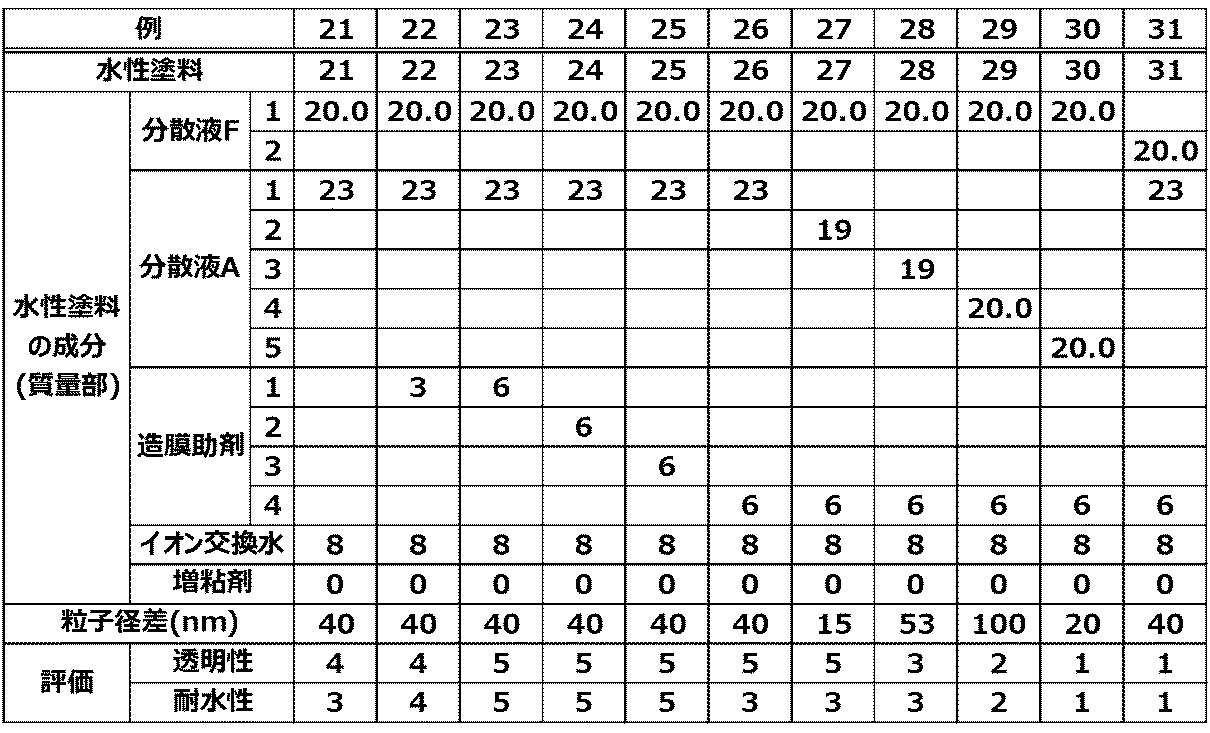
表1及び2に示す通り、脂肪族炭化水素環及び芳香環の少なくとも一方を有するモノマー単位の含有量が所定値以下であるフルオロポリマーとともに、分岐鎖状のアルキル基を有するアルキル(メタ)アクリレートに基づく単位を含み、脂肪族炭化水素環及び芳香環の少なくとも一方を有するモノマー単位を実質的に含まない(メタ)アクリルポリマーを用いれば、耐水性に優れた塗膜を形成できるのが確認できた(例1~9及び21~29)。
なお、2018年10月29日に出願された日本特許出願2018-202755号の明細書、特許請求の範囲および要約書の全内容をここに引用し、本発明の明細書の開示として、取り入れるものである。
なお、2018年10月29日に出願された日本特許出願2018-202755号の明細書、特許請求の範囲および要約書の全内容をここに引用し、本発明の明細書の開示として、取り入れるものである。
Claims (12)
- フルオロポリマーと、(メタ)アクリルポリマーと、水とを含む、又は、
前記フルオロポリマーをコア部とし前記(メタ)アクリルポリマーをシェル部とするコアシェルポリマーと、水とを含む、水性塗料であって、
前記フルオロポリマーのフッ素原子含有量が25質量%以上であり、前記フルオロポリマーが含む全モノマー単位に対する、脂肪族炭化水素環及び芳香環の少なくとも一方を有するモノマー単位の含有量が5モル%以下であり、
前記(メタ)アクリルポリマーが分岐鎖状のアルキル基を有するアルキル(メタ)アクリレートに基づく単位を含み、脂肪族炭化水素環及び芳香環の少なくとも一方を有するモノマー単位を実質的に含まない、水性塗料。 - 前記分岐鎖状のアルキル基を有するアルキル(メタ)アクリレートに基づく単位の含有量が、前記(メタ)アクリルポリマーが有する全モノマー単位に対して、30モル%以上である、請求項1に記載の水性塗料。
- 前記(メタ)アクリルポリマーが、ヒドロキシ基を有するモノマー単位を実質的に含まない、請求項1又は2に記載の水性塗料。
- 前記フルオロポリマーが、炭素数3以下のアルキル基を有するモノマーに基づく単位を含む、請求項1~3のいずれか1項に記載の水性塗料。
- 前記フルオロポリマーと前記(メタ)アクリルポリマーとの溶解パラメータの差の絶対値が、20.0(J/cm3)1/2以下である、請求項1~4のいずれか1項に記載の水性塗料。
- 前記フルオロポリマーの最低造膜温度が10~35℃である、請求項1~5のいずれか1項に記載の水性塗料。
- 前記フルオロポリマーの粒子と前記(メタ)アクリルポリマーの粒子とが独立して分散しており、
前記フルオロポリマーの粒子と前記(メタ)アクリルポリマーの粒子との平均粒子径の差の絶対値が、100nm未満である、請求項1~6のいずれか1項に記載の水性塗料。 - 前記フルオロポリマーの粒子の平均粒子径よりも前記(メタ)アクリルポリマーの粒子の平均粒子径の方が小さい、請求項7に記載の水性塗料。
- 更に、造膜助剤を含む、請求項1~8のいずれか1項に記載の水性塗料。
- 前記造膜助剤の沸点が100~400℃である、請求項9に記載の水性塗料。
- 前記造膜助剤の含有量が、前記水性塗料の全質量に対して1~30質量%である、請求項9又は10に記載の水性塗料。
- 基材と、前記基材上に配置され、請求項1~11のいずれか1項に記載の水性塗料を用いて形成された塗膜と、を有する、塗装物品。
Applications Claiming Priority (2)
| Application Number | Priority Date | Filing Date | Title |
|---|---|---|---|
| JP2018202755A JP2022013956A (ja) | 2018-10-29 | 2018-10-29 | 水性塗料および塗装物品 |
| JP2018-202755 | 2018-10-29 |
Publications (1)
| Publication Number | Publication Date |
|---|---|
| WO2020090749A1 true WO2020090749A1 (ja) | 2020-05-07 |
Family
ID=70464457
Family Applications (1)
| Application Number | Title | Priority Date | Filing Date |
|---|---|---|---|
| PCT/JP2019/042187 Ceased WO2020090749A1 (ja) | 2018-10-29 | 2019-10-28 | 水性塗料及び塗装物品 |
Country Status (2)
| Country | Link |
|---|---|
| JP (1) | JP2022013956A (ja) |
| WO (1) | WO2020090749A1 (ja) |
Cited By (1)
| Publication number | Priority date | Publication date | Assignee | Title |
|---|---|---|---|---|
| WO2024075612A1 (ja) * | 2022-10-06 | 2024-04-11 | Agc株式会社 | 塗料組成物及び塗装物品 |
Citations (4)
| Publication number | Priority date | Publication date | Assignee | Title |
|---|---|---|---|---|
| JP2005162994A (ja) * | 2003-12-05 | 2005-06-23 | Daikin Ind Ltd | 含フッ素水性分散組成物 |
| JP2012092316A (ja) * | 2010-09-27 | 2012-05-17 | Daikin Industries Ltd | アクリル−フッ素複合重合体粒子 |
| JP2015067829A (ja) * | 2013-10-01 | 2015-04-13 | Jsr株式会社 | 塗料用組成物、塗料及び塗装体 |
| JP6274339B1 (ja) * | 2017-03-29 | 2018-02-07 | 旭硝子株式会社 | 水性分散液 |
-
2018
- 2018-10-29 JP JP2018202755A patent/JP2022013956A/ja active Pending
-
2019
- 2019-10-28 WO PCT/JP2019/042187 patent/WO2020090749A1/ja not_active Ceased
Patent Citations (4)
| Publication number | Priority date | Publication date | Assignee | Title |
|---|---|---|---|---|
| JP2005162994A (ja) * | 2003-12-05 | 2005-06-23 | Daikin Ind Ltd | 含フッ素水性分散組成物 |
| JP2012092316A (ja) * | 2010-09-27 | 2012-05-17 | Daikin Industries Ltd | アクリル−フッ素複合重合体粒子 |
| JP2015067829A (ja) * | 2013-10-01 | 2015-04-13 | Jsr株式会社 | 塗料用組成物、塗料及び塗装体 |
| JP6274339B1 (ja) * | 2017-03-29 | 2018-02-07 | 旭硝子株式会社 | 水性分散液 |
Cited By (1)
| Publication number | Priority date | Publication date | Assignee | Title |
|---|---|---|---|---|
| WO2024075612A1 (ja) * | 2022-10-06 | 2024-04-11 | Agc株式会社 | 塗料組成物及び塗装物品 |
Also Published As
| Publication number | Publication date |
|---|---|
| JP2022013956A (ja) | 2022-01-19 |
Similar Documents
| Publication | Publication Date | Title |
|---|---|---|
| JPWO2013027679A1 (ja) | 含フッ素ブロック共重合体およびその製造方法、ならびに表面処理剤 | |
| KR20130072254A (ko) | 아크릴-불소 복합 중합체 입자 | |
| JP5121017B2 (ja) | 水性塗料組成物 | |
| EP3328949A1 (en) | Coating compositions | |
| JP6274339B1 (ja) | 水性分散液 | |
| CN105358594B (zh) | 可湿固化的组合物、使用方法以及复合制品 | |
| US20040259994A1 (en) | Resin compositions and uses thereof | |
| CN103890013B (zh) | 包含聚甘油的丙烯酸类缔合型增稠剂及其增加薄膜或厚膜的开放时间的用途 | |
| JP2022013956A (ja) | 水性塗料および塗装物品 | |
| US20200010693A1 (en) | Aqueous dispersion and method for producing aqueous dispersion | |
| JP2015174909A (ja) | 含フッ素樹脂塗料組成物および塗膜を有する塗装物品 | |
| US20200010694A1 (en) | Method for producing aqueous dispersion | |
| JP7176516B2 (ja) | 水性塗料および塗膜付き基材 | |
| TW201107352A (en) | (Meth) acrylate polymer, coating material, method of producing a coating and coated article | |
| JPH03287615A (ja) | 撥水,撥油性組成物 | |
| JP2024084216A (ja) | 硬化性組成物及び物品 | |
| JP2022179053A (ja) | 皮革用コーティング組成物 | |
| JP2017179322A (ja) | 塗料組成物および塗装物品 | |
| WO2024075612A1 (ja) | 塗料組成物及び塗装物品 | |
| JP2008208149A (ja) | アクリル共重合体の製造方法 | |
| WO2018194068A1 (ja) | 水性分散液、水性塗料、および塗装物品 | |
| JP7289204B2 (ja) | 含フッ素共重合体含有組成物 | |
| JP2018177992A (ja) | 水性塗料、塗膜付き基材の製造方法および塗膜付き基材 | |
| JP2017218520A (ja) | 水性分散液、水性分散液の製造方法、塗料組成物および塗装物品 | |
| JP2022100729A (ja) | 皮革用コーティング組成物 |
Legal Events
| Date | Code | Title | Description |
|---|---|---|---|
| 121 | Ep: the epo has been informed by wipo that ep was designated in this application |
Ref document number: 19877837 Country of ref document: EP Kind code of ref document: A1 |
|
| NENP | Non-entry into the national phase |
Ref country code: DE |
|
| 122 | Ep: pct application non-entry in european phase |
Ref document number: 19877837 Country of ref document: EP Kind code of ref document: A1 |
|
| NENP | Non-entry into the national phase |
Ref country code: JP |