WO2020084979A1 - Ais情報処理装置 - Google Patents
Ais情報処理装置 Download PDFInfo
- Publication number
- WO2020084979A1 WO2020084979A1 PCT/JP2019/037225 JP2019037225W WO2020084979A1 WO 2020084979 A1 WO2020084979 A1 WO 2020084979A1 JP 2019037225 W JP2019037225 W JP 2019037225W WO 2020084979 A1 WO2020084979 A1 WO 2020084979A1
- Authority
- WO
- WIPO (PCT)
- Prior art keywords
- ais
- ais information
- ship
- information processing
- processing apparatus
- Prior art date
- Legal status (The legal status is an assumption and is not a legal conclusion. Google has not performed a legal analysis and makes no representation as to the accuracy of the status listed.)
- Ceased
Links
Images


Classifications
-
- B—PERFORMING OPERATIONS; TRANSPORTING
- B63—SHIPS OR OTHER WATERBORNE VESSELS; RELATED EQUIPMENT
- B63B—SHIPS OR OTHER WATERBORNE VESSELS; EQUIPMENT FOR SHIPPING
- B63B49/00—Arrangements of nautical instruments or navigational aids
-
- G—PHYSICS
- G08—SIGNALLING
- G08G—TRAFFIC CONTROL SYSTEMS
- G08G3/00—Traffic control systems for marine craft
Definitions
- the present invention relates to an AIS information processing device that processes information obtained regarding an automatic ship identification device (AIS).
- AIS automatic ship identification device
- Patent Document 1 This type of AIS information processing device is disclosed in Patent Document 1, for example.
- the data complementing device of Patent Document 1 filters AIS data in an AIS data group in a database that stores AIS data that is regularly collected, for abnormal or partial loss of manually input data such as IMO number and size. It is equipped with a filtering processing unit.
- This data complementing device can specify which AIS data has an erroneous input, based on the filtering processing performed by the filtering processing unit.
- the ITU-R M.M. 1371 specifies that an MMSI number is included in an AIS message transmitted by an electric wave (AIS signal) from an AIS device mounted on a ship.
- the MMSI number is a 9-digit number, which is also called the maritime mobile service identification code, and is assigned by the prescribed jurisdiction so that it does not overlap.
- the MMSI number set in the AIS device usually uniquely indicates a wireless station (substantially, a ship). However, there is a case where the same MMSI number as the MMSI number of another ship is set in the AIS device of the relevant ship due to an erroneous input by the user of the AIS device or malicious intent (spoofing or the like). In this case, for example, two vessels may transmit AIS signals including the same MMSI number.
- the configuration of Patent Document 1 is based on the configuration of mapping the vessel image data on the satellite image of the sea area and the AIS data, and the IMO number included in the AIS data is the registered IMO number in the database.
- an abnormality such as an erroneous input of an IMO number, which is a ship identification number, is detected. Therefore, it is necessary to build a special database for IMO numbers and keep the contents up-to-date, and improvement is desired from the viewpoint of system simplification.
- Patent Document 1 does not mention the MMSI number at all.
- the message of the dynamic information indicating the current position of the ship and the like includes the MMSI number, but does not include the IMO number. Therefore, with the configuration of Patent Document 1, it is impossible to deal with a dynamic message in which an MMSI number is erroneously input or spoofed.
- the present invention has been made in view of the above circumstances, and an object thereof is to appropriately cope with AIS information processing even when a ship that transmits an AIS signal including an MMSI number that is the same as the MMSI number of another ship appears. To provide a device.
- an AIS information processing apparatus having the following configuration. That is, this AIS information processing device is provided with a transmitting vessel determination unit and a data processing unit.
- the transmitting vessel determination unit determines whether or not a plurality of pieces of AIS information including the same MMSI number are transmitted from different vessels based on at least the vessel position information included in the AIS information.
- the data processing unit performs a data process on the plurality of pieces of AIS information determined by the transmitting ship determination unit as being transmitted from different ships as the AIS information of different ships.
- the transmitting ship determination unit determines the ship identity based on the distance between the positions of the ships indicated by the respective AIS information.
- the above-mentioned AIS information processing device preferably has the following configuration. That is, the transmitting ship determination unit performs the ship identity determination based on the route of the ship predicted from the AIS information received first and the position of the ship indicated by the AIS information received later.
- the transmitting ship judgment unit can judge the ship identity with high accuracy.
- the above-mentioned AIS information processing device preferably has the following configuration. That is, the transmitting ship determination unit indicates the ship identity determination by the predicted position of the ship at the next and subsequent reception timings of the AIS information, which is predicted from the previously received AIS information, and the later received AIS information. Based on the position of the vessel and.
- the transmitting ship judgment unit can judge the ship identity with high accuracy.
- a specific information addition unit that adds, to the AIS information determined to be transmitted from a different ship, specific information that is information specifying which of the different ships has transmitted the AIS information. Is preferably further provided.
- the AIS information processing apparatus includes an AIS information output unit that outputs the AIS information to which the specific information is added to the outside.
- this AIS information processing apparatus includes a display data generation unit that generates display data for displaying information regarding the ship that has transmitted the AIS information.
- the display data generation unit displays display data for simultaneously displaying different ships indicated by the plurality of AIS information with a plurality of symbols. To generate.
- the display data generation unit generate display data for displaying the specific information.
- the display data generation unit when there are a plurality of pieces of AIS information determined to be transmitted from different ships, selects at least one of the ships different from each other indicated by the plurality of AIS information. It is preferable to generate display data for display with the highlighted symbols.
- the AIS information processing device preferably includes a storage unit that stores the MMSI number of the AIS information when there are a plurality of pieces of the AIS information determined to be transmitted from different ships.
- the above-mentioned AIS information processing device preferably has the following configuration. That is, this AIS information processing apparatus is provided with a report data generation unit that generates report data that reports ship information based on the AIS information. The report data generation unit generates report data of the ship having the MMSI number stored in the storage unit.
- the above-mentioned AIS information processing device preferably has the following configuration. That is, this AIS information processing apparatus is provided with a report data generation unit that generates report data that reports ship information based on the AIS information. The report data generation unit generates the report data of the ship corresponding to the symbol by the user selecting and operating the symbol.
- report data such as a suspicious ship selected by the user can be easily generated.
- this AIS information processing apparatus preferably has the following configuration. That is, this AIS information processing apparatus includes a storage unit that stores the MMSI number of the AIS information when there is a plurality of pieces of the AIS information determined to be transmitted from different ships. The storage unit stores a plurality of pieces of AIS information determined to be transmitted from different ships.
- the following AIS information processing method is provided. That is, at least the ship identity judgment, which is a judgment as to whether a plurality of AIS information including the same MMSI number is transmitted from the same ship or different ships, is included in the AIS information. Based on the information on the position of the ship. Data processing is performed on the plurality of pieces of AIS information determined to have been transmitted from different vessels as the AIS information of different vessels.
- the block diagram which shows the electric constitution of the AIS information monitoring apparatus which concerns on one Embodiment of this invention.
- the flowchart which shows the first half part of the process regarding AIS reception data. 9 is a flowchart showing the latter half of the processing related to AIS received data.
- the conceptual diagram explaining the 1st example of ship identity determination.
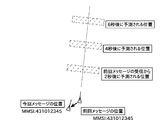
- the conceptual diagram explaining the 2nd example of ship identity determination.
- the conceptual diagram explaining the 3rd example of ship identity determination.
- FIG. 1 is a block diagram showing the overall electrical configuration of an AIS information monitoring device 1 according to an embodiment of the present invention.
- the AIS information monitoring apparatus (AIS information processing apparatus) 1 of the present embodiment shown in FIG. 1 is provided for an unillustrated airplane (flying body, moving body) flying over the sea to monitor the sea, for example, and Used to support discoveries, etc.
- the AIS information monitoring device 1 is electrically connected to the AIS receiver 101 and the display device 102 included in the airplane.
- the AIS receiver 101 receives an AIS signal transmitted from an AIS device included in a marine vessel via an antenna (not shown) and generates AIS reception data (AIS information). The AIS receiver 101 outputs the generated AIS reception data to the AIS information monitoring device 1.
- the display device 102 is configured as a liquid crystal display, for example, and can display various information.
- the AIS information monitoring device 1 can detect a ship that is transmitting an AIS signal having the same MMSI number as the MMSI number of another ship, based on the AIS reception data input from the AIS receiver 101.
- the configuration of the AIS information monitoring device 1 will be described in detail below.
- the AIS information monitoring device 1 includes a received data input unit 11, a transmitting ship determination unit 21, a sub number assigning unit (specific information assigning unit) 22, a data processing unit 31, a storage unit 41, and a received data storage unit 51.
- the AIS information monitoring device 1 is configured as a publicly known computer and includes a CPU, ROM, RAM and the like. A program for implementing the AIS information processing method of the present invention is stored in the ROM. By the cooperation of the above hardware and software, the AIS information monitoring device 1 can be used to store the reception data input unit 11, the transmission vessel determination unit 21, the sub-numbering unit 22, the data processing unit 31, the storage unit 41, the reception data accumulation. The unit 51, the received data output unit 61, the display data generation unit 71, and the report data generation unit 81 can be operated.
- the reception data input unit 11 inputs the AIS reception data from the AIS receiver 101 in real time.
- One AIS reception data is generated each time the AIS receiver 101 receives one AIS message, which is a unit of information transmitted by the ship from the AIS device as an AIS signal.
- Each AIS reception data generated by the AIS receiver 101 includes information such as the reception time of the AIS signal, the position of the ship (latitude, longitude and altitude).
- the dynamic information message includes information indicating the current position of the vessel, ground speed, ground course, turning angular velocity, and the like.
- the static information message includes information indicating the name of the ship, the length and width of the ship, and the like.
- a message of dynamic information may be simply called a dynamic message
- a message of static information may be simply called a static message.
- the MMSI number set in the AIS device is included in the AIS message regardless of whether the AIS device of the ship sends dynamic information or static information. Therefore, the AIS reception data input to the reception data input unit 11 always includes the MMSI number.
- the reception data input unit 11 outputs the input AIS reception data to the transmission ship determination unit 21 and the data processing unit 31.
- the transmitting ship determination unit 21 determines that the plurality of AIS reception data (specifically, the AIS reception data related to the plurality of dynamic messages) due to the AIS receiver 101 receiving the AIS signal within a short predetermined time is the same.
- the MMSI number is included, it is determined whether the respective AIS reception data are transmitted from the physically same ship or physically different ships. In the following explanation, this judgment may be called ship identity judgment.
- the AIS receiver 101 receives two dynamic messages including the same MMSI number with a time difference of 2 seconds, the AIS receiver 101 includes each dynamic message.
- the transmitting ship determination unit 21 determines that the AIS reception data relating to the two dynamic messages are physically different because the high speed navigation such as traveling 50 nautical miles in 2 seconds is not realistic. It is judged that they are transmitted from each of the two vessels. The details of the determination made by the transmitting ship determination unit 21 will be described later.
- the sub-numbering unit 22 When there is AIS reception data determined by the transmission ship determination unit 21 that the sub-number assigning unit 22 has transmitted the same MMSI number but is physically transmitted from a different ship, the sub-numbering unit 22 includes different AIS reception data in the AIS reception data. A sub-number is assigned as information that identifies from which of the above.
- the sending ship determination unit 21 determines that two pieces of AIS reception data including “431010345” as the MMSI number are sent from different ships.
- the sub-number assigning unit 22 assigns “01” as the sub-number to only one AIS reception data. This sub number corresponds to the specific information of the present invention. When there are three or more physically different ships, the assigned sub-numbers increase by 1 like "02", "03", ....
- the sub-number is a 2-digit number starting with "01”, but the format of the specific information is not limited to this. For example, alphabets such as "A” and "B” may be added as the specific information.
- the sub-number assigning unit 22 may assign the specific information by a method of overwriting the MMSI number itself with an MMSI number with a branch number such as “431010345-01”.
- the sub-numbering unit 22 outputs the AIS reception data to which the sub-number is added as necessary as described above to the data processing unit 31.
- the data processing unit 31 performs various types of data processing on the AIS reception data input from the sending ship determination unit 21. In this data processing, even if the MMSI numbers are the same, if there is AIS received data judged by the sending ship judging unit 21 as being sent from a physically different ship, the data processing unit 31 will The received signal data is treated as AIS reception data of physically different ships (in other words, different AIS targets). Specifically, the data processing unit 31 determines whether or not sub-numbers are assigned even if a plurality of AIS reception data includes the same MMSI number, or the assigned sub-numbers are different from each other. In this case, the processing is performed assuming that the AIS reception data is transmitted by a different AIS target.
- the data processing performed by the data processing unit 31 varies depending on the application, but for example, processing for obtaining a track for each ship can be considered.
- processing for obtaining a track for each ship can be considered.
- the display data generation unit 71 which will be described later, generates display data based on this track, so that the user can see the track of each ship displayed on the display device 102.
- the data processing unit 31 outputs the AIS reception data to the storage unit 41, the reception data storage unit 51, and the display data generation unit 71. Further, the data processing unit 31 outputs the result of the performed data processing to the display data generating unit 71.
- the storage unit 41 can store one or a plurality of MMSI numbers.
- the storage unit 41 stores the MMSI number of the AIS reception data when there are a plurality of AIS reception data determined by the transmission ship determination unit 21 to be transmitted from physically different ships even though the MMSI numbers are the same. Is input from the transmitting ship determination unit 21 and stored.
- the storage unit 41 outputs the stored MMSI number to the transmitting ship determination unit 21 and the display data generation unit 71.
- the reception data storage unit 51 stores all the AIS reception data input from the AIS receiver 101 as a reception log.
- the reception data storage unit 51 outputs the stored AIS reception data to the reception data output unit 61 and the report data generation unit 81 as needed.
- the storage unit 41 relates to a situation such as AIS reception data that the transmitting ship determination unit 21 has determined that the MMSI number is the same, but the transmission ship determination unit 21 transmitted the data, which is difficult to consider in normal AIS operation.
- the AIS reception data (irregular AIS information) to be stored is stored as a special reception log.
- the storage unit 41 outputs the stored AIS reception data to the reception data output unit 61 as needed.
- the reception data output unit 61 outputs all or part of the AIS reception data stored in the storage unit 41 and the reception data storage unit 51 to the outside of the AIS information monitoring device 1.
- the reception data output unit 61 can realize the output of data by storing the AIS reception data in a removable external storage memory electrically connected to the AIS information monitoring device 1, for example.
- the AIS reception data stored in the storage unit 41 and the reception data storage unit 51 includes a sub number assigned by the sub number assigning unit 22 as needed.
- the reception data output unit 61 can output the AIS reception data stored in the storage unit 41 or the reception data storage unit 51 in a form including the sub number. As a result, even when a plurality of ships with the same MMSI number appear, it is possible to perform analysis by an external device in a form in which each ship can be distinguished using the sub number.
- the display data generation unit 71 causes the display device 102 connected to the AIS information monitoring device 1 to graphically display the position and the like of each ship based on the AIS reception data output by the data processing unit 31, the data processing result, and the like. Generate display data for.
- the display data generation unit 71 determines that the plurality of AIS reception data items determined by the transmission ship determination unit 21 to be transmitted from physically different ships even though the MMSI numbers are the same.
- the vessel indicated by each AIS reception data can be displayed with a plurality of symbols at the same time.
- the display data generation unit 71 visually emphasizes and displays a ship that is transmitting such an unnatural AIS signal so that it is different from other ships. This facilitates the discovery of a suspicious ship by the user.
- the report data generation unit 81 When the user operates the AIS information monitoring device 1 as appropriate and gives an instruction, the report data generation unit 81 generates report data relating to the ship with reference to the data accumulated in the received data accumulation unit 51. . The creation of report data will be described later.
- 2 and 3 are flowcharts showing the processing for the AIS reception data.
- the flow shown in FIGS. 2 and 3 is started every time the AIS reception data regarding one dynamic message is input from the AIS receiver 101 to the AIS information monitoring device 1.
- the sending ship determination unit 21 checks whether or not the MMSI number of the dynamic message input this time matches the MMSI number stored in the storage unit 41 (step S101).
- the sending ship determination unit 21 determines the movement of the same MMSI number that was received most recently (but within a predetermined time from now) with the dynamic message input this time. The distance between the positions of the ships included in each message is compared with a predetermined threshold with the target message (step S102).
- the dynamic message input this time may be referred to as the current message and the most recently input dynamic message with the same MMSI number may be referred to as the previous message.
- the AIS reception data of the previous message is the one received earlier, and the AIS reception data of the message this time is the one received later.
- the transmitting ship determination unit 21 is a temporary storage unit (not shown) for storing AIS reception data of dynamic messages received in the past within a predetermined time from the present. have.
- a value larger than the distance that the ship can actually travel between two dynamic message reception timings is set.
- This threshold can be set to, for example, 30 to 40 nautical miles in consideration of the reach of the AIS signal (international VHF).
- FIG. 4 shows an example of the distance D1 between the position of the ship indicated by the current message and the position of the ship indicated by the previous message.
- the transmitting ship determination unit 21 determines that a dynamic message is transmitted from a physically different ship even though the MMSI numbers are the same.
- step S102 When it is determined in step S102 that a dynamic message is transmitted from a physically different ship even though the MMSI numbers are the same, only one MMSI number is included in such dynamic messages. It can be said that the uniqueness of identifying ships is no longer reliable. Therefore, the storage unit 41 stores the MMSI number (step S103).
- the sub-number assigning unit 22 adds a new sub-number (for example, "01" to the AIS reception data regarding the current message) to indicate that the ship that sent the message this time is physically different from the ship that sent the message last time. )) Is added (step S104 in FIG. 3). Even if the MMSI numbers are the same, the AIS reception data having no sub number and the AIS reception data having a sub number are assumed to be transmitted by another ship in the data processing performed by the data processing unit 31 (step S107 described later). Treated Accordingly, various data processing can be performed in consideration of the fact that the two dynamic messages are transmitted from physically different ships (that is, different AIS targets).
- a new sub-number for example, "01" to the AIS reception data regarding the current message
- the data processing unit 31 stores such AIS reception data in the storage unit 41 as an irregular reception log (step S105). As a result, it is possible to easily retrieve only the reception log under the situation that requires attention, so that the convenience of later analysis work can be improved.
- the data processing unit 31 stores the AIS reception data in the reception data storage unit 51 as a normal reception log (step S106). This reception log is used later for the report data generation unit 81 to generate report data.
- step S107 data processing is appropriately performed by the data processing unit 31 (step S107). After that, a series of processes regarding the dynamic message ends.
- the transmitting vessel determination unit 21 determines in step S108 in consideration of the course of the vessel. Specifically, the transmitting ship determination unit 21 uses the ground speed, the ground course, and the turning angular speed obtained from the previous message to predict the current ship course (route) according to a known formula. Then, the transmitting ship determination unit 21 determines whether or not the position of the ship indicated by the current message is near the predicted current course of the ship, based on a predetermined threshold value.
- FIG. 5 shows an example of the distance D2 between the position of the ship indicated by the current message and the current course of the ship predicted from the previous message.
- step S108 If the distance D2 between the position of the ship obtained from the current message and the current course of the ship predicted from the previous message is greater than the predetermined threshold value in the determination of step S108, the transmitting ship determination unit 21 , Even though the MMSI numbers are the same, it is determined that the dynamic message is transmitted from physically different ships. Therefore, the processes of steps S103 to S107 described above are performed, and the series of processes relating to the dynamic message ends.
- step S109 determines in step S109 the dynamic message transmission interval. In addition, make a more detailed judgment on the position of the ship in consideration of the speed of the ship. Specifically, the transmitting vessel determination unit 21 obtains the dynamic message transmission time interval using the ground speed and the turning angular velocity obtained from the previously received dynamic message.
- the time interval for the ship to transmit the AIS signal related to the dynamic message from the AIS device is a predetermined time that changes stepwise depending on the size of the navigation speed of the ship and whether or not the course is being changed. There is a stipulation that the interval must be set.
- the transmitting ship determination unit 21 assumes that the AIS device of each ship transmits a dynamic message according to the rule, and if the physically same ship has transmitted both the previous message and the current message. , Gets the number of seconds after the time when the previous message was received that the message should be received this time.
- the sending vessel determination unit 21 obtains a plurality of reception times of the current message. Further, the transmitting ship determination unit 21 uses the position of the ship, the ground speed, the ground course, etc. obtained from the previous message to determine the position of the ship at each of a plurality of possible reception times of this message. And predict.
- the transmitting ship determination unit 21 determines whether the position and the reception time (that is, the present time) of the ship obtained from the message this time are close to any of the combinations of the reception time and the predicted position of the ship or far from each of them. The determination is made by determining the predetermined range (step S109). In FIG. 6, the position of the ship obtained from the current message is shown, and the reception timing of the current message predicted using the previous message and the three ranges of the position of the ship are shown by dashed hatching. ing.
- step S109 if the position of the ship obtained from the current message is far from any combination of the current position of the ship and the reception time predicted in the previous message (that is, the position of the ship obtained from the message this time is (If the position is not within any of the three hatching ranges in FIG. 6), the transmitting ship determination unit 21 determines that the dynamic message is transmitted from a physically different ship even though the MMSI numbers are the same. Determine that Therefore, the processes of steps S103 to S107 described above are performed, and the series of processes relating to the dynamic message ends.
- step S109 If it is determined in step S109 that the position of the ship obtained from the current message is close to any of the combinations of the current position of the ship and the reception time predicted in the previous message, the sending ship determination unit 21 determines Is judged to have been sent from the ship physically the same as the previous message. In this case, the data processing unit 31 saves the AIS reception data of the current message as a normal reception log (step S106 in FIG. 3) and performs data processing (step S107). After that, a series of processes regarding the dynamic message ends.
- the transmitting ship determination unit 21 determines the physical identity of the ships by a method other than the MMSI number.
- the transmitting ship determination unit 21 determines that the current position of the current message is the current position estimated by the latest dynamic message without the sub number, which has the same MMSI number as the MMSI number of the current message. It is determined whether it is near or far (step S110 in FIG. 3). This determination may be made substantially in the same manner as step S109 described above.
- the transmitting ship determination unit 21 does not add the sub number to the AIS reception data related to the current message.
- the data processing unit 31 performs the accumulation processing and the data processing regarding the message this time (step S105 to step S107), and ends the processing.
- the transmission ship determination unit 21 determines that the position of the current message is , Which has the same MMSI number as the MMSI number of this message and is close to or far from any of the current positions estimated by the latest AIS reception data (dynamic message) with sub number It is determined whether or not (step S111). This determination can also be made substantially in the same manner as in step S109, similarly to the determination in step S110.
- step S111 the position of the current message has the same MMSI number as the MMSI number of the current message, and the current position estimated by the latest AIS reception information (dynamic message) with sub number is displayed. If it is close to either, it can be considered that the ship that sent the message this time is physically the same as the ship that sent the dynamic message related to the AIS reception data of the sub number. Therefore, the transmitting ship determination unit 21 assigns the same sub number as the corresponding sub number to the AIS reception data of the current message (step S112). After that, the data processing unit 31 performs the accumulation process and the data process for the current message (steps S105 to S107), and ends the process.
- step S111 the position of the current message has the same MMSI number as the MMSI number of the current message, and the current position estimated by the latest AIS reception information (dynamic message) with sub number is displayed. If it is far from either, it can be considered that the ship that sent the message this time is physically different from any ship that previously sent the dynamic message with the same MMSI number. Therefore, the transmitting ship determination unit 21 assigns a new sub number different from the sub number up to now to the AIS reception data of the current message (step S104). After that, the data processing unit 31 performs storage processing and data processing regarding the current message (steps S105 to S107), and ends the processing.
- the AIS information monitoring device 1 can appropriately detect the situation where AIS signals with the same MMSI number are actually transmitted from physically different ships based on the contents of the AIS reception data. . Further, the AIS information monitoring device 1 can handle the AIS received data and perform data processing even under such a condition as if the AIS signals have different MMSI numbers.
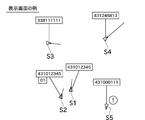
- FIG. 7 is a diagram showing a display example of symbols on the display device 102.
- the display data generation unit 71 uses the AIS reception data input from the AIS receiver 101 to display a symbol indicating the ship that transmitted the AIS message, the MMSI number, the ship name of the ship, the position and speed of the ship, and the like. Display data may be generated for display at 102.
- the positions, headings, and speeds of the five vessels are graphically shown by the symbols S1, S2, S3, S4, S5, and the MMSI numbers of the vessels are the symbols S1, S2, ... ⁇ A numerical value is displayed near.
- the display data generation unit 71 when there are a plurality of dynamic messages transmitted from physically different ships even though the MMSI numbers are the same, the display data that highlights the symbol based on the dynamic message. Can be generated.
- the manner of emphasizing the symbols is not particularly limited.
- the symbol of the ship may be emphasized by a mark, a color, character information, or the like.
- FIG. 7 an example in which the two symbols S1 and S2 having the MMSI number “431010345” are highlighted in a different color from normal is shown by hatching.
- the display data generating unit 71 assigns the sub-number in the vicinity of the corresponding symbol S2 as “01” shown in FIG. Display data to be displayed can be generated. This allows the user to easily distinguish and track each physically different ship.
- the display data generation unit 71 can highlight the symbol corresponding to the AIS reception data including the MMSI number stored in the storage unit 41. That is, even if a dynamic message of the MMSI number is not currently transmitted from a plurality of physically different ships, if there is such an abnormal situation regarding the MMSI number in the past, the display device 102 At, the symbol related to the dynamic message of the MMSI number is highlighted.
- FIG. 7 shows an example in which the symbol S5 is highlighted by the “!” Mark when the MMSI number “431010101” is stored in the storage unit 41. With this, for example, it is possible to notify the user that a ship that may have been spoofing in the past has appeared and call attention.
- the user operates the operation unit including the mouse and the trackball while watching the display on the display device 102, selects any one of the symbols S1, S2, ... Displayed on the screen to display the report data. Instruct generation. Then, the report data generation unit 81 generates the report data of the ship corresponding to the symbols S1, S2, ... Selected by the user by using the storage content of the reception data storage unit 51.
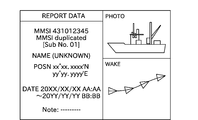
- FIG. 8 shows an example of the display screen when the symbol S2 in FIG. 7 is selected and the generation of report data is instructed.
- the report data includes the MMSI number of the ship, the sub number added due to the MMSI number overlapping with other ships, the ship name, the position of the ship, the transmission date and time of the AIS signal, and the track. This is the summarized data.
- the user appropriately operates the AIS information monitoring device 1 to attach image data of a photograph of the ship taken from an airplane to the report data displayed on the display device 102 as shown in FIG. Or add a text. Thereby, for example, report data of a suspicious ship can be easily created.
- the AIS information monitoring device 1 includes the sending vessel determination unit 21 and the data processing unit 31.
- the transmitting vessel determination unit 21 determines whether or not a plurality of AIS reception data including the same MMSI number are transmitted from different vessels based on the vessel position information included in each AIS reception data.
- the data processing unit 31 performs data processing on the plurality of AIS reception data that the transmission ship determination unit 21 has determined to be transmitted from physically different ships as the AIS reception data of different ships.
- the AIS information monitoring device 1 is used to monitor the AIS signal transmitted by each ship in real time.
- the AIS receiver 101 included in the flight aircraft receives the AIS signal, reads the AIS reception data saved as a log in an appropriate storage medium, and performs substantially the same processing as the AIS information monitoring device 1. It can also be applied to an AIS reception log analysis device for performing the following. In this case, the AIS reception log analysis device corresponds to the AIS information processing device.
- the AIS reception log analysis device can be provided in a moving body such as an airplane, or can be provided in an appropriate ground facility.
- the configuration of the AIS reception log analysis device is substantially the same as that of the AIS information monitoring device 1 except that the AIS reception data is input from a storage medium instead of being input from the AIS receiver 101, and thus the description thereof is omitted. .
- the AIS information monitoring device 1 can be used by being mounted on, for example, a small aircraft, a helicopter, or an unmanned aerial vehicle. Further, the AIS information monitoring device 1 can be used by being mounted on a moving body capable of navigating over water such as a ship or an unmanned watercraft. Furthermore, when the AIS information monitoring device 1 is used by being mounted on a ship or the like, the AIS information monitoring device 1 may be incorporated into an AIS device installed on the ship or the like.
- the determination performed by the transmitting vessel determination unit 21 is not limited to the combination of the determinations of steps S102, S108, and S109, as shown in the flowchart of FIG. For example, one or two of the determinations in steps S102, S108, and S109 can be omitted.
- the transmitting ship determination unit 21 can also determine the ship's acceleration from the ground speed and the course change to the ground included in the dynamic message, and can judge the ship identity in consideration of this acceleration.
- the ship identity can also be determined as follows. That is, the transmitting vessel determining unit 21 predicts the route of the vessel as a long and narrow area from the transition of the position indicated by a large number of AIS reception data (dynamic messages) including the same MMSI number transmitted over a certain length of time in the past. To do. The transmitting ship determination unit 21 determines that the AIS received data is transmitted from the physically same ship when the position of the current message is included in the predicted route area, and is not included. In this case, the AIS reception data is determined to have been transmitted from a physically different ship.
- AIS reception data dynamic messages
- the storage unit 41 does not have to store the irregular AIS information as a special reception log.
- the reception data output unit 61 extracts and outputs only the irregular reception data from the storage content of the reception data storage unit 51. Just do it.
- the reception data storage unit 51 also substantially functions as the storage unit 41.
- the AIS receiver 101 may be provided integrally with the AIS information monitoring device 1.
- the display device 102 may be integrally provided with the AIS information monitoring device 1.
- AIS information monitoring device (AIS information processing device) 21 sending vessel judging section 22 sub number giving section (specific information giving section) 31 data processing unit 41 storage unit 51 received data storage unit 61 received data output unit (AIS information output unit) 71 Display data generation unit 81 Report data generation unit S1 symbol S2 symbol S3 symbol S4 symbol S5 symbol
- All processes described herein may be embodied by software code modules executed by a computing system including one or more computers or processors and may be fully automated.
- the code modules may be stored on any type of non-transitory computer readable medium or other computer storage device. Some or all of the methods may be embodied in dedicated computer hardware.
- the various exemplary logic blocks and modules described in connection with the embodiments disclosed herein can be implemented or executed by a machine such as a processor.
- the processor may be a microprocessor, but in the alternative, the processor may be a controller, microcontroller, or state machine, combinations thereof, or the like.
- the processor can include electrical circuitry configured to process computer-executable instructions.
- the processor comprises an application specific integrated circuit (ASIC), field programmable gate array (FPGA), or other programmable device that performs logical operations without processing computer-executable instructions.
- ASIC application specific integrated circuit
- FPGA field programmable gate array
- a processor may also be a combination of computing devices, such as a combination of digital signal processors (digital signal processors) and microprocessors, multiple microprocessors, one or more microprocessors in combination with DSP cores, or any other thereof. It can be implemented as such a configuration. Although described primarily herein in terms of digital technology, a processor may also include primarily analog components. For example, some or all of the signal processing algorithms described herein may be implemented by analog circuits or mixed analog and digital circuits.
- a computing environment includes any type of computer system including, but not limited to, a microprocessor, mainframe computer, digital signal processor, portable computing device, device controller, or computer system based on a computing engine within an apparatus. be able to.
- conditional languages such as “capable”, “capable”, “possible” or “possible” refer to particular features, elements and / or steps that a particular embodiment includes. Embodiments are understood in the sense of the context commonly used to convey the inclusion. Accordingly, such a conditional language is generally any method in which features, elements and / or steps are required for one or more embodiments, or one or more embodiments It is not meant to necessarily include logic to determine whether an element and / or step is included in or executed by any particular embodiment.
- a disjunctive language such as the phrase "at least one of X, Y, and Z", unless otherwise specified, has an item, term, etc. that is any of X, Y, Z, or any combination thereof. Understood in a commonly used context to indicate that it can be (eg, X, Y, Z). Accordingly, such disjunctive languages generally require each of at least one of X, at least one of Y, or at least one of Z for which a particular embodiment is present. Does not mean.
- Numerals such as “one” should generally be construed to include one or more described items unless specifically stated. Thus, phrases such as “one device configured to” are intended to include one or more of the listed devices. Such one or more enumerated devices may also be collectively configured to perform the recited citations. For example, "a processor configured to perform A, B and C below” refers to a first processor configured to perform A and a second processor configured to perform B and C. Processor.
- a processor configured to perform A, B and C below refers to a first processor configured to perform A and a second processor configured to perform B and C. Processor.
- a specific number enumeration of the introduced examples is explicitly recited, one of ordinary skill in the art will appreciate that such an enumeration typically includes at least the recited number (e.g., other modifiers). The mere enumeration of "with two enumerations” without “is usually meant to mean at least two enumerations, or more than one
- the term "horizontal” as used herein, regardless of its orientation, is a plane parallel to the plane or surface of the floor of the area in which the described system is used, or description. Is defined as the plane in which the method is performed.
- the term “floor” can be replaced with the terms “ground” or “water surface”.
- the term “vertical / vertical” refers to the direction vertical / vertical to the defined horizontal line. Terms such as “upper”, “lower”, “lower”, “upper”, “side”, “higher”, “lower”, “upward”, “above”, and “below” are defined with respect to the horizontal plane. ing.
- connection As used herein, the terms “attach,” “connect,” “pair,” and other related terms, unless otherwise noted, are removable, moveable, fixed, adjustable, And / or should be construed as including a removable connection or coupling. Connections / couplings include direct connections and / or connections having an intermediate structure between the two described components.
- the numbers preceded by terms such as “approximately”, “about”, and “substantially” include the recited numbers, and unless otherwise indicated. Represents an amount near the stated amount that performs a desired function or achieves a desired result. For example, “approximately”, “about” and “substantially” refer to values less than 10% of the stated numerical value, unless expressly specified otherwise.
- the features of the embodiments in which the terms “about,” “about,” and “substantially” are previously disclosed perform additional desirable functions. Or represents a feature with some variability in achieving that desired result for that feature.
Landscapes
- Engineering & Computer Science (AREA)
- Radar, Positioning & Navigation (AREA)
- Remote Sensing (AREA)
- Ocean & Marine Engineering (AREA)
- Chemical & Material Sciences (AREA)
- Combustion & Propulsion (AREA)
- Mechanical Engineering (AREA)
- Physics & Mathematics (AREA)
- General Physics & Mathematics (AREA)
- Traffic Control Systems (AREA)
Abstract
【課題】他船のMMSI番号と同一のMMSI番号を含んだAIS信号を送信する船舶が出現した場合でも適切に対処できるAIS情報処理装置を提供する。 【解 決手段】AIS情報監視装置1は、送信船舶判断部21と、データ処理部31と、を備える。送信船舶判断部21は、同一のMMSI番号を含む複数のAIS受 信データが、異なる船舶から送信されたものかの船舶同一性判断を、前記AIS受信データに含まれる少なくとも船舶の位置の情報に基づいて行う。データ処理 部31は、前記送信船舶判断部21が異なる船舶から送信されたと判断した複数のAIS受信データを、異なる船舶のAIS受信データとしてデータ処理を行 う。
Description
本発明は、船舶自動識別装置(AIS)に関して得られた情報を処理するAIS情報処理装置に関する。
この種のAIS情報処理装置は、例えば特許文献1に開示されている。特許文献1のデータ補完装置は、定期的に収集されたAISデータを格納するデータベー ス内のAISデータ群において、IMO番号やサイズなど手入力されたデータの異常や部分欠損のAISデータをフィルタリングするフィルタリング処理部を備 える。このデータ補完装置は、フィルタリング処理部が行うフィルタリング処理に基づいて、どのAISデータに誤入力があったかを特定することができる。
AISでは、国際電気通信連合の勧告であるITU-R M.1371において、船舶に搭載するAIS装置から電波(AIS信号)により送信するAISメッ セージにMMSI番号を含めることが定められている。MMSI番号は海上移動業務識別コードとも呼ばれる9桁の数字であり、所定の管轄機関により重複がな いように付与される。
AIS装置に設定されるMMSI番号は、普通は、無線局(実質的には、船舶)を一意に示すものであ る。しかし、AIS装置のユーザの誤入力又は悪意(なりすまし等)により、当該船舶のAIS装置に他船のMMSI番号と同一のMMSI番号が設定される場 合がある。この場合、例えば2つの船舶から、同一のMMSI番号を含むAIS信号が送信されることがあり得る。
この点、 上記特許文献1の構成は、海域エリアの衛星画像上の船舶画像データとAISデータとをマッピングする構成を前提にして、AISデータに含まれるIMO番号 がデータベース内の既登録のIMO番号と一致するか否かを判断することで、船舶識別番号であるIMO番号の誤入力等の異常を検出する。従って、IMO番号 に関する特別なデータベースを構築して常に最新の内容にする必要があり、システムの簡素化の観点から改善が望まれていた。
また、特許文献1は、MMSI番号には全く言及していない。AISメッセージのうち、船舶の現在位置等を示す動的情報のメッセージには、MMSI番号は含 まれるが、IMO番号は含まれない。従って、特許文献1の構成では、MMSI番号の誤入力又はなりすましが行われている動的メッセージに対して、全く対処 することができない。
本発明は以上の事情に鑑みてされたものであり、その目的は、他船のMMSI番号と同一のMMSI番号を含んだAIS信号を送信する船舶が出現した場合でも適切に対処できるAIS情報処理装置を提供することにある。
本発明の解決しようとする課題は以上の如くであり、次にこの課題を解決するための手段とその効果を説明する。
本発明の第1の観点によれば、以下の構成のAIS情報処理装置が提供される。即ち、このAIS情報処理装置は、送信船舶判断部と、データ処理部と、を備え る。前記送信船舶判断部は、同一のMMSI番号を含む複数のAIS情報が、異なる船舶から送信されたものかの船舶同一性判断を、前記AIS情報に含まれる 少なくとも船舶の位置の情報に基づいて行う。前記データ処理部は、前記送信船舶判断部が異なる船舶から送信されたと判断した複数の前記AIS情報を、異な る船舶の前記AIS情報としてデータ処理を行う。
これにより、AIS情報から得られる船舶の位置の情報を利用して、同一 のMMSI番号を含んだAIS情報が、同一の船舶から送信されたか、異なる船舶から送信されたかを判断することができる。従って、同一のMMSI番号を AIS装置に設定している船舶が複数現れた場合でも、適切なデータ処理を行うことができる。
前記のAIS情報処理装置においては、前記送信船舶判断部は、前記船舶同一性判断を、それぞれの前記AIS情報が示す船舶の位置同士の距離に基づいて行うことが好ましい。
これにより、船舶同一性判断を簡単な処理で行うことができる。
前記のAIS情報処理装置においては、以下の構成とすることが好ましい。即ち、前記送信船舶判断部は、前記船舶同一性判断を、先に受信した前記AIS情報から予測する船舶の航路と、後に受信した前記AIS情報が示す船舶の位置と、に基づいて行う。
これにより、送信船舶判断部が船舶同一性判断を高精度で行うことができる。
前記のAIS情報処理装置においては、以下の構成とすることが好ましい。即ち、前記送信船舶判断部は、前記船舶同一性判断を、先に受信した前記AIS情報 から予測する次回以降の前記AIS情報の受信タイミングにおける船舶の予測位置と、後に受信した前記AIS情報が示す船舶の位置と、に基づいて行う。
これにより、送信船舶判断部が船舶同一性判断を高精度で行うことができる。
前記のAIS情報処理装置においては、異なる船舶から送信されたと判断した前記AIS情報に、異なる船舶のうち何れが当該AIS情報を送信したかを特定する情報である特定情報を付与する特定情報付与部を更に備えることが好ましい。
これにより、物理的に異なる船舶をそれぞれ適切に特定してデータ処理を行うことができる。
前記のAIS情報処理装置においては、前記特定情報が付与された前記AIS情報を外部に出力するAIS情報出力部を備えることが好ましい。
これにより、MMSI番号が同じであるにもかかわらず物理的に異なる船舶を適切に区別した形で、外部にAIS情報を提供することができる。
前記のAIS情報処理装置においては、以下の構成とすることが好ましい。即ち、このAIS情報処理装置は、前記AIS情報を送信した船舶に関する情報を表 示するための表示データを生成する表示データ生成部を備える。前記表示データ生成部は、異なる船舶から送信されたと判断した複数の前記AIS情報がある場 合に、当該複数のAIS情報が示す互いに異なる船舶を、複数のシンボルで同時に表示するための表示データを生成する。
これにより、物理的に異なる船舶を、複数のシンボルによって自然に表示することができる。
前記のAIS情報処理装置においては、前記表示データ生成部は、前記特定情報を表示するための表示データを生成することが好ましい。
これにより、ユーザは、物理的に異なるそれぞれの船舶を、特定情報の表示により視覚的に区別して把握することができる。
前記のAIS情報処理装置においては、前記表示データ生成部は、異なる船舶から送信されたと判断した複数の前記AIS情報がある場合に、当該複数のAIS 情報が示す互いに異なる船舶の少なくとも何れかを、強調されたシンボルで表示するための表示データを生成することが好ましい。
これにより、他船へのなりすましを意図している等の可能性がある注意すべき船舶を、ユーザに分かり易く知らせることができる。
前記のAIS情報処理装置においては、異なる船舶から送信されたと判断した複数の前記AIS情報がある場合に、当該AIS情報のMMSI番号を記憶する記憶部を備えることが好ましい。
これにより、以前にMMSI番号の重複があったと判断され、過去に例えば他船へのなりすましに用いた可能性がある注意すべきMMSI番号を記憶することができる。
前記のAIS情報処理装置においては、以下の構成とすることが好ましい。即ち、このAIS情報処理装置は、船舶の情報を報告するレポートデータを前記 AIS情報に基づいて生成するレポートデータ生成部を備える。前記レポートデータ生成部は、前記記憶部に記憶されたMMSI番号を持つ船舶のレポートデー タを生成する。
これにより、記憶部に記憶された情報を利用して、不審船等の報告データを容易に生成することができる。
前記のAIS情報処理装置においては、以下の構成とすることが好ましい。即ち、このAIS情報処理装置は、船舶の情報を報告するレポートデータを前記 AIS情報に基づいて生成するレポートデータ生成部を備える。前記レポートデータ生成部は、ユーザが前記シンボルを選択して操作することにより、当該シン ボルに対応する船舶のレポートデータを生成する。
これにより、ユーザによって選択された不審船等の報告データを容易に生成することができる。
前記のAIS情報処理装置においては、以下の構成とすることが好ましい。即ち、このAIS情報処理装置は、異なる船舶から送信されたと判断した複数の前記 AIS情報がある場合に、当該AIS情報のMMSI番号を記憶する記憶部を備える。前記記憶部は、異なる船舶から送信されたと判断した複数の前記AIS情 報を蓄積する。
これにより、不審なAIS情報を分析する等の作業を効率的に行うことができる。
本発明の第2の観点によれば、以下のAIS情報処理方法が提供される。即ち、同一のMMSI番号を含む複数のAIS情報が、同一の船舶から送信されたもの か、異なる船舶から送信されたものか、の判断である船舶同一性判断を、前記AIS情報に含まれる少なくとも船舶の位置の情報に基づいて行う。異なる船舶か ら送信されたと判断した複数の前記AIS情報を、異なる船舶のAIS情報としてデータ処理を行う。
これにより、AIS情 報から得られる船舶の位置の情報を利用して、同一のMMSI番号を含んだAIS情報が、同一の船舶から送信されたか、異なる船舶から送信されたかを判断す ることができる。従って、同一のMMSI番号をAIS装置に設定している船舶が複数現れた場合でも、適切なデータ処理を行うことができる。
次に、図面を参照して本発明の実施の形態を説明する。図1は、本発明の一実施形態に係るAIS情報監視装置1の全体的な電気的構成を示すブロック図である。
図1に示す本実施形態のAIS情報監視装置(AIS情報処理装置)1は、例えば洋上を監視するため上空を飛行する図略の飛行機(飛行体、移動体)に備えら れ、不審船の発見等を支援するために使用される。AIS情報監視装置1は、飛行機が備えるAIS受信機101及び表示装置102にそれぞれ電気的に接続さ れる。
AIS受信機101は、洋上の船舶が備えるAIS装置から送信されるAIS信号を図略のアンテナを介して受信し、AIS受信データ(AIS情報)を生成する。AIS受信機101は、生成したAIS受信データを、AIS情報監視装置1に出力する。
表示装置102は、例えば液晶ディスプレイとして構成され、様々な情報を表示することができる。
AIS情報監視装置1は、AIS受信機101から入力されたAIS受信データに基づいて、他船のMMSI番号と同一のMMSI番号によるAIS信号を送信している船舶を検知することができる。
以下、AIS情報監視装置1の構成を詳細に説明する。AIS情報監視装置1は、受信データ入力部11と、送信船舶判断部21と、サブ番号付与部(特定情報 付与部)22と、データ処理部31と、記憶部41と、受信データ蓄積部51と、受信データ出力部(AIS情報出力部)61と、表示データ生成部71と、レ ポートデータ生成部81と、を備える。
具体的には、AIS情報監視装置1は公知のコンピュータとして構成されており、 CPU、ROM、RAM等を備える。ROMには、本発明のAIS情報処理方法を実現するためのプログラムが記憶されている。上記のハードウェアとソフト ウェアの協働により、AIS情報監視装置1を、受信データ入力部11、送信船舶判断部21、サブ番号付与部22、データ処理部31、記憶部41、受信デー タ蓄積部51、受信データ出力部61、表示データ生成部71、及びレポートデータ生成部81として動作させることができる。
受信データ入力部11は、AIS受信機101からAIS受信データをリアルタイムで入力する。AIS受信データは、船舶がAIS装置からAIS信号で送信 する情報の単位であるAISメッセージを、AIS受信機101が1つ受信するたびに1つ生成される。AIS受信機101が生成するそれぞれのAIS受信 データには、当該AIS信号の受信時刻、船舶の位置(緯度、経度及び高度)等の情報が含められる。
船舶のAIS装置が送 信するAISメッセージの大部分は、動的情報のメッセージと、静的情報のメッセージと、の2種類である。動的情報のメッセージには、船舶の現在の位置、対 地速度、対地針路、及び回頭角速度等を示す情報が含まれている。静的情報のメッセージには、船名、船舶の長さ及び幅等を示す情報が含まれている。以下の説 明では、動的情報のメッセージを単に動的メッセージと呼び、静的情報のメッセージを単に静的メッセージと呼ぶことがある。
船舶のAIS装置が動的情報及び静的情報の何れを送信する場合にも、AISメッセージには、AIS装置に設定されたMMSI番号が含まれている。従って、 受信データ入力部11に入力されるAIS受信データには、常に当該MMSI番号が含まれている。受信データ入力部11は、入力したAIS受信データを送信 船舶判断部21及びデータ処理部31に出力する。
送信船舶判断部21は、AIS受信機101が短い所定時間内でAIS信 号を受信することによる複数のAIS受信データ(具体的には、複数の動的メッセージに係るAIS受信データ)が同一のMMSI番号を含んでいるときに、そ れぞれのAIS受信データが物理的に同一の船舶から送信されたものか、物理的に異なる船舶から送信されたものか、について判断する。以下の説明では、この 判断を船舶同一性判断と呼ぶことがある。
船舶同一性判断の一例を説明すると、例えば、AIS受信機101が同一の MMSI番号を含む2つの動的メッセージを2秒の時間差をおいて受信したにもかかわらず、それぞれの動的メッセージに含まれている船舶の位置が例えば50 海里以上離れている場合を考える。2秒で50海里を進むような高速航行は現実的に考えられないので、このような場合は、送信船舶判断部21は、2つの動的 メッセージに係るAIS受信データが、物理的に異なる2つの船舶からそれぞれ送信されたものであると判断する。なお、送信船舶判断部21が行う判断の詳細 については後述する。
サブ番号付与部22は、MMSI番号が同一であるにもかかわらず物理的に異なる船舶から送信された と送信船舶判断部21が判断したAIS受信データがある場合、当該AIS受信データに、異なる船舶のうち何れから送信されたものかを特定する情報として、 サブ番号を付与する。
例えば、MMSI番号として「431012345」が含まれる2つのAIS受信データが、互いに異 なる船舶から送信されたものであると送信船舶判断部21により判定された場合を考える。この場合、サブ番号付与部22は、一方のAIS受信データだけに、 サブ番号として「01」を付与する。このサブ番号が、本発明の特定情報に該当する。物理的に異なる船舶が3つ以上となる場合、付与されるサブ番号は、 「02」、「03」、・・・のように1ずつ増加していく。
上記の例では、サブ番号を「01」から始まる2桁の数字として いるが、特定情報の形式はこれに限定されない。例えば、「A」、「B」等のアルファベットを特定情報として付与しても良い。サブ番号付与部22が、 MMSI番号そのものを例えば「431012345-01」のように枝番付きのMMSI番号で上書きする方法で、特定情報を付与しても良い。
サブ番号付与部22は、上記のように必要に応じてサブ番号が付加されたAIS受信データを、データ処理部31に出力する。
データ処理部31は、送信船舶判断部21から入力されたAIS受信データに対し、各種のデータ処理を行う。このデータ処理にあたっては、MMSI番号が同 一であるにもかかわらず物理的に異なる船舶から送信されたと送信船舶判断部21が判断したAIS受信データがある場合、データ処理部31は、当該AIS受 信データを、物理的に異なる船舶(言い換えれば、互いに異なるAISターゲット)のAIS受信データとして扱う。具体的には、データ処理部31は、複数の AIS受信データが同一のMMSI番号を含んでいても、サブ番号が付与されているか否かが異なる場合、又は、付与されたサブ番号同士が異なる場合は、異な るAISターゲットが送信したAIS受信データであるとみなして処理を行う。
データ処理部31が行うデータ処理は用途に 応じて様々であるが、例えば、それぞれの船舶毎に航跡を求める処理が考えられる。MMSI番号が同じでも物理的に異なる船舶を互いに異なるAISターゲッ トであるとみなして、それぞれのAISターゲットの位置から航跡を生成することで、自然で現実に即した航跡を得ることができる。この航跡に基づいて後述の 表示データ生成部71が表示データを生成することで、ユーザは、表示装置102に表示された各船舶の航跡を見ることができる。
データ処理部31は、AIS受信データを、記憶部41、受信データ蓄積部51、及び表示データ生成部71に出力する。また、データ処理部31は、行ったデータ処理の結果を表示データ生成部71に出力する。
記憶部41は、MMSI番号を1又は複数記憶することができる。記憶部41は、MMSI番号が同一であるにもかかわらず物理的に異なる船舶から送信された と送信船舶判断部21が判断した複数のAIS受信データがある場合に、当該AIS受信データのMMSI番号を送信船舶判断部21から入力して記憶する。記 憶部41は、記憶したMMSI番号を、送信船舶判断部21及び表示データ生成部71に出力する。
受信データ蓄積部51は、AIS受信機101から入力されたAIS受信データを、受信ログとして全て記憶する。受信データ蓄積部51は、記憶したAIS受信データを、必要に応じて受信データ出力部61及びレポートデータ生成部81に出力する。
また、記憶部41は、MMSI番号が同一であるにもかかわらず物理的に異なる船舶から送信されたと送信船舶判断部21が判断したAIS受信データ等、 AISの通常の運用では考えにくい状況に関連するAIS受信データ(不規則AIS情報)を、特別な受信ログとして記憶する。記憶部41は、記憶したAIS 受信データを、必要に応じて受信データ出力部61に出力する。
受信データ出力部61は、記憶部41及び受信データ蓄積部 51の記憶内容であるAIS受信データの全部又は一部を、AIS情報監視装置1の外部に出力する。受信データ出力部61は、例えば、AIS情報監視装置1 に電気的に接続されたリムーバブル外部記憶メモリにAIS受信データを保存することで、データの出力を実現することができる。
記憶部41及び受信データ蓄積部51に記憶されるAIS受信データには、サブ番号付与部22が必要に応じて付与したサブ番号が含まれる。受信データ出力部 61は、サブ番号が含まれた形で、記憶部41又は受信データ蓄積部51に記憶されたAIS受信データを出力することができる。これにより、同一のMMSI 番号を設定している船舶が複数現れた場合でも、サブ番号を用いてそれぞれの船舶を区別できる形で外部装置により解析を行うことができる。
表示データ生成部71は、データ処理部31が出力するAIS受信データ及びデータ処理結果等に基づいて、AIS情報監視装置1に接続される表示装置102に各船舶の位置等をグラフィカルに表示させるための表示データを生成する。
詳細は後述するが、表示データ生成部71は、MMSI番号が同一であるにもかかわらず物理的に異なる船舶から送信されたものであると送信船舶判断部21が 判断した複数のAIS受信データがある場合に、それぞれのAIS受信データが示す船舶を、同時に複数のシンボルで表示することができる。これにより、表示 される船舶のシンボルが瞬間的に長距離を移動する従来の不自然な挙動を防止することができる。また、表示データ生成部71は、そのような不自然なAIS信 号を送信している船舶を、他の船舶と異なるように視覚的に強調して表示する。これにより、ユーザによる不審船の発見等が容易になる。
レポートデータ生成部81は、AIS情報監視装置1をユーザが適宜操作して指示を行ったときに、当該船舶に関するレポートデータを、受信データ蓄積部51に蓄積されたデータ等を参照して生成する。なお、レポートデータの作成については後述する。
次に、図2及び図3を中心に参照して、前述した送信船舶判断部21及びデータ処理部31等が行う処理について詳細に説明する。図2及び図3は、AIS受信データに対する処理を示すフローチャートである。
図2及び図3に示すフローは、1つの動的メッセージに関するAIS受信データがAIS受信機101からAIS情報監視装置1に入力される毎に開始される。
フローがスタートすると、送信船舶判断部21は、今回入力された動的メッセージのMMSI番号が、記憶部41に記憶されたMMSI番号と一致するか否かを調べる(ステップS101)。
MMSI番号が記憶部41に記憶されていない場合、送信船舶判断部21は、今回入力された動的メッセージと、直近に(ただし、現在から所定時間以内に)受 信した同一のMMSI番号の動的メッセージとで、それぞれのメッセージに含まれる船舶の位置の間の距離を所定の閾値と比較する(ステップS102)。
以下の説明では、今回入力された動的メッセージを今回メッセージと呼び、直近に入力された同一のMMSI番号の動的メッセージを前回メッセージと呼ぶこと がある。AIS信号の受信タイミングに関して言えば、前回メッセージのAIS受信データは先に受信されたものであり、今回メッセージのAIS受信データは 後に受信されたものである。
なお、ステップS102等の判断を実現するために、送信船舶判断部21は、現在から所定時間以内の過去に受信した動的メッセージのAIS受信データを記憶しておくための図略の一時記憶部を有している。
ステップS102の判断で用いられる閾値としては、2つの動的メッセージの受信タイミングの間に船舶が現実的に航行可能な距離よりも大きい値が設定され る。この閾値は、例えば、AIS信号(国際VHF)の到達範囲を考慮して30~40海里とすることができる。図4には、今回メッセージで示された船舶の位 置と、前回メッセージで示された船舶の位置と、の間の距離D1の例が示されている。
図2のステップS102の判断で、今 回メッセージから得られた船舶の位置と、前回メッセージから得られた船舶の位置と、の間の距離D1が所定の閾値を上回る場合、船舶は短時間にそのような長 距離を航行できないので、送信船舶判断部21は、MMSI番号が同じであるにもかかわらず物理的に異なる船舶から動的メッセージが送信されていると判断す る。
MMSI番号が同じであるにもかかわらず物理的に異なる船舶から動的メッセージが送信されているとステップS102 で判断された場合、そのような動的メッセージに含まれるMMSI番号については、ただ1つの船舶を特定して示す一意性が信頼できなくなっているということ ができる。そこで、記憶部41は、当該MMSI番号を記憶する(ステップS103)。
続いて、サブ番号付与部22は、今 回メッセージを送信した船舶が前回メッセージを送信した船舶と物理的に異なることを示すために、今回メッセージに関するAIS受信データに新しいサブ番号 (例えば、「01」)を付与する(図3のステップS104)。MMSI番号が同じでも、サブ番号がないAIS受信データと、サブ番号があるAIS受信デー タは、データ処理部31が行うデータ処理(後述のステップS107)においては、別の船舶が送信したものとして扱われる。これにより、2つの動的メッセー ジが物理的に異なる船舶(即ち、互いに異なるAISターゲット)から送信されていることを考慮して各種のデータ処理を行うことができる。
MMSI番号が同一であるにもかかわらず物理的に異なる船舶から動的メッセージが送信される状態は、例えば不審船等が現れている可能性を示唆している。そ こで、データ処理部31は、このようなAIS受信データを、記憶部41に不規則受信ログとして保存する(ステップS105)。これにより、注意すべき状況 下での受信ログだけを容易に取り出すことができるので、後の分析作業の利便性を高めることができる。
続いて、データ処理部31は、AIS受信データを受信データ蓄積部51に通常の受信ログとして保存する(ステップS106)。この受信ログは、後にレポートデータ生成部81がレポートデータを生成するため等に用いられる。
その後、データ処理部31によるデータ処理が適宜行われる(ステップS107)。その後、当該動的メッセージに関する一連の処理が終了する。
図2のステップS102の判断で、2つの動的メッセージが示す位置の間の距離D1が閾値以下である場合、送信船舶判断部21は、ステップS108において 船舶の針路を考慮した判断を行う。具体的には、送信船舶判断部21は、前回メッセージから得られる対地速度、対地針路、及び回頭角速度を利用して、現在の 船舶の針路(航路)を公知の式に従って予測する。そして、送信船舶判断部21は、今回メッセージが示す船舶の位置が、予測された船舶の現在の針路の近傍に あるか否かを、所定の閾値を基準にして判定する。図5には、今回メッセージで示された船舶の位置と、前回メッセージから予測された船舶の現在の針路と、の 間の距離D2の例が示されている。
ステップS108の判断で、今回メッセージから得られた船舶の位置と、前回メッセージ から予測された船舶の現在の針路と、の間の距離D2が所定の閾値を上回る場合は、送信船舶判断部21は、MMSI番号が同じであるにもかかわらず物理的に 異なる船舶から動的メッセージが送信されていると判断する。従って、上述したステップS103~ステップS107の処理が行われ、当該動的メッセージに関 する一連の処理が終了する。
ステップS108の判断で、今回メッセージから得られた船舶の位置が、前回メッセージから予 測された船舶の現在の針路に近い場合、送信船舶判断部21は、ステップS109において、動的メッセージの送信間隔及び船舶の速度を考慮して、船舶の位置 について更に詳細な判断を行う。具体的には、送信船舶判断部21は、前回受信した動的メッセージから得られる対地速度及び回頭角速度を利用して、動的メッ セージの送信時間間隔を求める。
上述のITU-R M.1371には、動的メッセージに係るAIS信号を船舶がAIS装 置から送信する時間間隔は、当該船舶の航行速度の大きさ及び針路変更中か否かに応じて段階的に変化する所定の時間間隔としなければならない旨が定められて いる。送信船舶判断部21は、各船舶のAIS装置が当該ルールに従って動的メッセージを送信することを前提にして、物理的に同一の船舶が前回メッセージと 今回メッセージの両方を送信したと仮定した場合に、前回メッセージの受信時刻から何秒後に今回メッセージが受信されるべきかを取得する。電波状況等の理由 でAIS受信機101が動的メッセージのAIS信号を1回又は複数回受信できない可能性を考慮して、送信船舶判断部21は、今回メッセージの受信時刻を複 数通り求める。更に、送信船舶判断部21は、考えられる複数通りの今回メッセージの受信時刻のそれぞれにおいて船舶はどの位置にありそうかを、前回メッ セージから得られる船舶の位置、対地速度、対地針路等を利用して予測する。
送信船舶判断部21は、今回メッセージから得 られた船舶の位置及び受信時刻(即ち、現在)が、受信時刻と船舶の予測位置の組合せの何れかに近いか、それとも何れからも遠いかを、所定の範囲を定めるこ とにより判定する(ステップS109)。図6には、今回メッセージから得られた船舶の位置が示されるとともに、前回メッセージを利用して予測した今回メッ セージの受信タイミング及び船舶の位置の3通りの範囲が、破線のハッチングにより示されている。
ステップS109の判断 で、今回メッセージから得られた船舶の位置が、前回メッセージで予測した船舶の現在の位置及び受信時刻の組合せの何れからも遠い場合(即ち、今回メッセー ジから得られた船舶の位置が図6の3つのハッチング範囲の何れにも入っていない場合)は、送信船舶判断部21は、MMSI番号が同じであるにもかかわらず 物理的に異なる船舶から動的メッセージが送信されていると判断する。従って、上述したステップS103~ステップS107の処理が行われ、当該動的メッ セージに関する一連の処理が終了する。
ステップS109の判断で、今回メッセージから得られた船舶の位置が、前回メッ セージで予測した船舶の現在の位置及び受信時刻の組合せの何れかに近い場合は、送信船舶判断部21は、今回メッセージが前回メッセージと物理的に同一の船 舶から送信されていると判断する。この場合は、データ処理部31は、今回メッセージのAIS受信データを通常の受信ログとして保存するとともに(図3のス テップS106)、データ処理を行う(ステップS107)。その後、当該動的メッセージに関する一連の処理が終了する。
図2のステップS101の判断で、今回メッセージのMMSI番号が記憶部41に記憶されている場合、当該MMSI番号は一意性が疑わしいことを意味する。そこで、送信船舶判断部21は、船舶の物理的な同一性をMMSI番号以外の方法で判断する。
具体的には、送信船舶判断部21は、今回メッセージの位置が、今回メッセージのMMSI番号と同一のMMSI番号を有している、サブ番号なしの最近の動的 メッセージにより推定される現在の位置と近いか遠いかを判断する(図3のステップS110)。この判断は、上記のステップS109と実質的に同様に行えば 良い。
ステップS110の判断で、最近に受信したサブ番号なしのAIS受信データ(動的メッセージ)から推定された現在 の位置に今回メッセージの位置が近い場合、今回メッセージを送信した船舶が、当該サブ番号なしの動的メッセージを送信した船舶と物理的に同一であると考え ることができる。従って、送信船舶判断部21は、今回メッセージに係るAIS受信データにもサブ番号を付与しない。その後、データ処理部31が今回メッ セージに関する蓄積処理及びデータ処理を行って(ステップS105~ステップS107)、処理を終了する。
ステップ S110の判断で、最近に受信したサブ番号なしのAIS受信データ(動的メッセージ)から推定された現在の位置から今回メッセージの位置が遠い場合、送信 船舶判断部21は、今回メッセージの位置が、今回メッセージのMMSI番号と同一のMMSI番号を有している、サブ番号ありの最近のAIS受信データ(動 的メッセージ)により推定される現在の位置の何れかに近いか、それとも何れからも遠いかを判断する(ステップS111)。この判断も、ステップS110の 判断と同様に、ステップS109と実質的に同様に行うことができる。
ステップS111の判断で、今回メッセージの位置 が、今回メッセージのMMSI番号と同一のMMSI番号を有している、サブ番号ありの最近のAIS受信情報(動的メッセージ)により推定される現在の位置 の何れかに近い場合、今回メッセージを送信した船舶が、当該サブ番号のAIS受信データに係る動的メッセージを送信した船舶と物理的に同一であると考える ことができる。従って、送信船舶判断部21は、今回メッセージのAIS受信データに対して、該当するサブ番号と同じサブ番号を付与する(ステップ S112)。その後、データ処理部31が今回メッセージに関する蓄積処理及びデータ処理を行って(ステップS105~ステップS107)、処理を終了す る。
ステップS111の判断で、今回メッセージの位置が、今回メッセージのMMSI番号と同一のMMSI番号を有してい る、サブ番号ありの最近のAIS受信情報(動的メッセージ)により推定される現在の位置の何れからも遠い場合、今回メッセージを送信した船舶が、同一の MMSI番号で以前に動的メッセージを送信した何れの船舶とも物理的に異なると考えることができる。従って、送信船舶判断部21は、今回メッセージの AIS受信データに対して、今までのサブ番号と異なる新しいサブ番号を付与する(ステップS104)。その後、データ処理部31が今回メッセージに関する 蓄積処理及びデータ処理を行って(ステップS105~ステップS107)、処理を終了する。
以上のフローにより、AIS 情報監視装置1は、同一のMMSI番号のAIS信号が実際は物理的に異なる船舶から送信されている状況を、AIS受信データの内容に基づいて適切に検出す ることができる。また、AIS情報監視装置1は、そのような状況下でもあたかも互いに異なるMMSI番号のAIS信号であるかようにAIS受信データを 扱って、データ処理を行うことができる。
次に、図1の表示データ生成部71による表示データの生成について、図7を参照して説明する。図7は、表示装置102におけるシンボルの表示例を示す図である。
表示データ生成部71は、AIS受信機101から入力したAIS受信データを利用して、AISメッセージを送信した船舶を示すシンボル、MMSI番号、船 舶の船名、船舶の位置や速力等を表示装置102に表示するための表示データを生成することができる。図7に示す表示例では、5つの船舶の位置、船首方位、 及び速度がシンボルS1,S2,S3,S4,S5でグラフィカルに示されるとともに、当該船舶のMMSI番号がシンボルS1,S2,・・・の近傍に数値で 表示されている。
表示データ生成部71は、MMSI番号が同一であるにもかかわらず物理的に異なる船舶から送信された複 数の動的メッセージがある場合に、当該動的メッセージに基づくシンボルを強調表示する表示データを生成することができる。シンボルの強調の態様は、特に限 定されない。例えば、船舶のシンボルは、マーク、色彩、文字情報等によって強調されてもよい。図7には、MMSI番号が「431012345」である2つ のシンボルS1,S2が通常と異なる色で強調表示される例が、ハッチングによって示されている。
更に、表示データ生成部 71は、サブ番号付与部22によってサブ番号が付与されたAIS受信データについては、図7に示す「01」のように、対応するシンボルS2の近傍に当該サ ブ番号を表示させる表示データを生成することができる。これにより、物理的に異なるそれぞれの船舶をユーザが区別して追跡し易くすることができる。
表示データ生成部71は、記憶部41に記憶されているMMSI番号を含むAIS受信データについて、当該AIS受信データに対応するシンボルを強調表示す ることができる。即ち、現在は物理的に異なる複数の船舶から当該MMSI番号の動的メッセージが送信されていなくても、過去に当該MMSI番号についてそ のような異常な状況があった場合には、表示装置102において当該MMSI番号の動的メッセージに係るシンボルが強調表示される。図7には、 「431010101」というMMSI番号が記憶部41に記憶されている場合に、シンボルS5が「!」マークにより強調表示された例が示されている。これ により、例えば過去になりすましをしていた可能性がある船舶が現れたことをユーザに知らせて、注意を喚起することができる。
次に、レポートデータ生成部81によるレポートデータの生成について詳細に説明する。
ユーザは、表示装置102の表示を見ながらマウスやトラックボール等を含む操作部を操作して、画面に表示されるシンボルS1,S2,・・・のうち何れかを 選択して、レポートデータの生成を指示する。すると、レポートデータ生成部81は、ユーザによって選択されたシンボルS1,S2,・・・に対応する船舶の レポートデータを、受信データ蓄積部51の記憶内容を利用して生成する。
図8には、図7のシンボルS2を選択してレポー トデータの生成を指示した場合の表示画面の例が示されている。レポートデータは、図8に示すように、船舶のMMSI番号、MMSI番号が他船と重複するこ とにより付加されたサブ番号、船名、船舶の位置、AIS信号の送信日時、及び航跡等をまとめたデータである。
ユーザは AIS情報監視装置1を適宜操作して、表示装置102に図8のように表示されたレポートデータに対し、飛行機から撮影した当該船舶の写真の画像データを添 付したり、特記事項等をテキストで追記したりする。これにより、例えば不審船の報告書データを簡単に作成することができる。
以上に説明したように、本実施形態のAIS情報監視装置1は、送信船舶判断部21と、データ処理部31と、を備える。送信船舶判断部21は、同一の MMSI番号を含む複数のAIS受信データが、異なる船舶から送信されたかの船舶同一性判断を、それぞれのAIS受信データに含まれる船舶の位置の情報に 基づいて行う。データ処理部31は、物理的に異なる船舶から送信されたと送信船舶判断部21が判断した複数のAIS受信データを、異なる船舶のAIS受信 データとしてデータ処理を行う。
これにより、AIS受信データから得られる船舶の位置情報を利用して、同一のMMSI番 号を含んだAIS受信データが、同一の船舶から送信されたか、異なる船舶から送信されたかを判断することができる。従って、同一のMMSI番号を設定して いる船舶が複数現れた場合でも、適切なデータ処理をすることができる。
以上に本発明の好適な実施の形態を説明したが、上記の構成は例えば以下のように変更することができる。
上述の実施形態では、AIS情報監視装置1は、各船舶が送信するAIS信号をリアルタイムで監視するために用いられている。しかしながら、本発明は、飛行 機に備えられるAIS受信機101がAIS信号を受信して適宜の記憶媒体にログとして保存したAIS受信データを読み込んで、AIS情報監視装置1と実質 的に同様の処理を事後的に行うためのAIS受信ログ解析装置に適用することもできる。この場合、当該AIS受信ログ解析装置がAIS情報処理装置に相当す る。
AIS受信ログ解析装置は、飛行機等の移動体に備えることもできるし、適宜の地上施設に備えることもできる。AIS 受信ログ解析装置の構成は、AIS受信データをAIS受信機101から入力する代わりに記憶媒体から入力する点を除き、AIS情報監視装置1と実質的に同 じであるため、説明を省略する。
AIS情報監視装置1は、例えば、小型の航空機、ヘリコプター、無人航空機に搭載して使 用することができる。また、AIS情報監視装置1は、船舶や無人水上艇等の水上を航行することができる移動体に搭載して使用することができる。更に、 AIS情報監視装置1を船舶等に搭載して使用する場合、船舶等に設置するAIS装置に当該AIS情報監視装置1を組み込んで使用しても良い。
送信船舶判断部21が行う判断(船舶同一性判断)は、図2のフローチャートに示すように、ステップS102、S108、S109の判断の組み合わせとする ことに限定されない。例えば、ステップS102、S108、S109の判断のうち1つ又は2つを省略することもできる。
送信船舶判断部21は、動的メッセージに含まれる対地速度及び対地針路の推移等から船舶の加速度を求め、この加速度を考慮して船舶同一性判断を行うこともできる。
船舶同一性判断は、以下のようにして行うこともできる。即ち、送信船舶判断部21は、過去のある程度長い間に送信された、同一のMMSI番号を含む多数の AIS受信データ(動的メッセージ)が示す位置の推移から、船舶の航路を細長い領域として予測する。送信船舶判断部21は、この予測された航路の領域に今 回メッセージの位置が含まれる場合に、AIS受信データが物理的に同一の船舶から送信されたものであると判定し、含まれない場合に、AIS受信データが物 理的に異なる船舶から送信されたものであると判定する。
記憶部41は、不規則AIS情報を、特別な受信ログとして記憶し なくても良い。この場合、不規則受信データだけの出力がAIS情報監視装置1に要求されたときは、受信データ出力部61は、受信データ蓄積部51の記憶内 容から不規則受信データだけを抽出して出力すれば良い。この構成では、受信データ蓄積部51は記憶部41としても実質的に機能することになる。
AIS受信機101は、AIS情報監視装置1と一体的に備えられても良い。同様に、表示装置102は、AIS情報監視装置1と一体的に備えられても良い。
1 AIS情報監視装置(AIS情報処理装置)
21 送信船舶判断部
22 サブ番号付与部(特定情報付与部)
31 データ処理部
41 記憶部
51 受信データ蓄積部
61 受信データ出力部(AIS情報出力部)
71 表示データ生成部
81 レポートデータ生成部
S1 シンボル
S2 シンボル
S3 シンボル
S4 シンボル
S5 シンボル
21 送信船舶判断部
22 サブ番号付与部(特定情報付与部)
31 データ処理部
41 記憶部
51 受信データ蓄積部
61 受信データ出力部(AIS情報出力部)
71 表示データ生成部
81 レポートデータ生成部
S1 シンボル
S2 シンボル
S3 シンボル
S4 シンボル
S5 シンボル
必ずしも全ての目的または効果・利点が、本明細書中に記載される任意の特定の実施形態に則って達成され得るわけではない。従って、例えば当業者であれば、特定の実施形態は、本明細書中で教示または示唆されるような他の目的または効果・利点を必ずしも達成することなく、本明細書中で教示されるような1つまたは複数の効果・利点を達成または最適化するように動作するように構成され得ることを想到するであろう。
本明細書中に記載される全ての処理は、1つまたは複数のコンピュータまたはプロセッサを含むコンピューティングシステムによって実行されるソフトウェアコードモジュールにより具現化され、完全に自動化され得る。コードモジュールは、任意のタイプの非一時的なコンピュータ可読媒体または他のコンピュータ記憶装置に記憶することができる。一部または全ての方法は、専用のコンピュータハードウェアで具現化され得る。
本明細書中に記載されるもの以外でも、多くの他の変形例があることは、本開示から明らかである。例えば、実施形態に応じて、本明細書中に記載されるアルゴリズムのいずれかの特定の動作、イベント、または機能は、異なるシーケンスで実行することができ、追加、併合、または完全に除外することができる (例えば、記述された全ての行為または事象がアルゴリズムの実行に必要というわけではない)。さらに、特定の実施形態では、動作またはイベントは、例えば、マルチスレッド処理、割り込み処理、または複数のプロセッサまたはプロセッサコアを介して、または他の並列アーキテクチャ上で、逐次ではなく、並列に実行することができる。さらに、異なるタスクまたはプロセスは、一緒に機能し得る異なるマシンおよび/またはコンピューティングシステムによっても実行され得る。
本明細書中に開示された実施形態に関連して説明された様々な例示的論理ブロックおよびモジュールは、プロセッサなどのマシンによって実施または実行することができる。プロセッサは、マイクロプロセッサであってもよいが、代替的に、プロセッサは、コントローラ、マイクロコントローラ、またはステートマシン、またはそれらの組み合わせなどであってもよい。プロセッサは、コンピュータ実行可能命令を処理するように構成された電気回路を含むことができる。別の実施形態では、プロセッサは、特定用途向け集積回路(ASIC)、フィールドプログラマブルゲートアレイ(FPGA)、またはコンピュータ実行可能命令を処理することなく論理演算を実行する他のプログラマブルデバイスを含む。プロセッサはまた、コンピューティングデバイスの組み合わせ、例えば、デジタル信号プロセッサ(デジタル信号処理装置)とマイクロプロセッサの組み合わせ、複数のマイクロプロセッサ、DSPコアと組み合わせた1つ以上のマイクロプロセッサ、または任意の他のそのような構成として実装することができる。本明細書中では、主にデジタル技術に関して説明するが、プロセッサは、主にアナログ素子を含むこともできる。例えば、本明細書中に記載される信号処理アルゴリズムの一部または全部は、アナログ回路またはアナログとデジタルの混合回路により実装することができる。コンピューティング環境は、マイクロプロセッサ、メインフレームコンピュータ、デジタル信号プロセッサ、ポータブルコンピューティングデバイス、デバイスコントローラ、または装置内の計算エンジンに基づくコンピュータシステムを含むが、これらに限定されない任意のタイプのコンピュータシステムを含むことができる。
特に明記しない限り、「できる」「できた」「だろう」または「可能性がある」などの条件付き言語は、特定の実施形態が特定の特徴、要素および/またはステップを含むが、他の実施形態は含まないことを伝達するために一般に使用される文脈内での意味で理解される。従って、このような条件付き言語は、一般に、特徴、要素および/またはステップが1つ以上の実施形態に必要とされる任意の方法であること、または1つ以上の実施形態が、これらの特徴、要素および/またはステップが任意の特定の実施形態に含まれるか、または実行されるかどうかを決定するための論理を必然的に含むことを意味するという訳ではない。
語句「X、Y、Zの少なくとも1つ」のような選言的言語は、特に別段の記載がない限り、項目、用語等が X, Y, Z、のいずれか、又はそれらの任意の組み合わせであり得ることを示すために一般的に使用されている文脈で理解される(例: X、Y、Z)。従って、このような選言的言語は、一般的には、特定の実施形態がそれぞれ存在するXの少なくとも1つ、Yの少なくとも1つ、またはZの少なくとも1つ、の各々を必要とすることを意味するものではない。
本明細書中に記載されかつ/または添付の図面に示されたフロー図における任意のプロセス記述、要素またはブロックは、プロセスにおける特定の論理機能または要素を実装するための1つ以上の実行可能命令を含む、潜在的にモジュール、セグメント、またはコードの一部を表すものとして理解されるべきである。代替の実施形態は、本明細書中に記載された実施形態の範囲内に含まれ、ここでは、要素または機能は、当業者に理解されるように、関連する機能性に応じて、実質的に同時にまたは逆の順序で、図示または説明されたものから削除、順不同で実行され得る。
特に明示されていない限り、「一つ」のような数詞は、一般的に、1つ以上の記述された項目を含むと解釈されるべきである。従って、「~するように設定された一つのデバイス」などの語句は、1つ以上の列挙されたデバイスを含むことを意図している。このような1つまたは複数の列挙されたデバイスは、記載された引用を実行するように集合的に構成することもできる。例えば、「以下のA、BおよびCを実行するように構成されたプロセッサ」は、Aを実行するように構成された第1のプロセッサと、BおよびCを実行するように構成された第2のプロセッサとを含むことができる。加えて、導入された実施例の具体的な数の列挙が明示的に列挙されたとしても、当業者は、このような列挙が典型的には少なくとも列挙された数(例えば、他の修飾語を用いない「2つの列挙と」の単なる列挙は、通常、少なくとも2つの列挙、または2つ以上の列挙を意味する)を意味すると解釈されるべきである。
一般に、本明細書中で使用される用語は、一般に、「非限定」用語(例えば、「~を含む」という用語は「それだけでなく、少なくとも~を含む」と解釈すべきであり、「~を持つ」という用語は「少なくとも~を持っている」と解釈すべきであり、「含む」という用語は「以下を含むが、これらに限定されない。」などと解釈すべきである。) を意図していると、当業者には判断される。
説明の目的のために、本明細書中で使用される「水平」という用語は、その方向に関係なく、説明されるシステムが使用される領域の床の平面または表面に平行な平面、または説明される方法が実施される平面として定義される。「床」という用語は、「地面」または「水面」という用語と置き換えることができる。「垂直/鉛直」という用語は、定義された水平線に垂直/鉛直な方向を指します。「上側」「下側」「下」「上」「側面」「より高く」「より低く」「上の方に」「~を越えて」「下の」などの用語は水平面に対して定義されている。
本明細書中で使用される用語の「付着する」、「接続する」、「対になる」及び他の関連用語は、別段の注記がない限り、取り外し可能、移動可能、固定、調節可能、及び/または、取り外し可能な接続または連結を含むと解釈されるべきである。接続/連結は、直接接続及び/または説明した2つの構成要素間の中間構造を有する接続を含む。
特に明示されていない限り、本明細書中で使用される、「およそ」、「約」、および「実質的に」のような用語が先行する数は、列挙された数を含み、また、さらに所望の機能を実行するか、または所望の結果を達成する、記載された量に近い量を表す。例えば、「およそ」、「約」及び「実質的に」とは、特に明示されていない限り、記載された数値の10%未満の値をいう。本明細書中で使用されているように、「およそ」、「約」、および「実質的に」などの用語が先行して開示されている実施形態の特徴は、さらに所望の機能を実行するか、またはその特徴について所望の結果を達成するいくつかの可変性を有する特徴を表す。
上述した実施形態には、多くの変形例および修正例を加えることができ、それらの要素は、他の許容可能な例の中にあるものとして理解されるべきである。そのような全ての修正および変形は、本開示の範囲内に含まれることを意図し、以下の特許請求の範囲によって保護される。
Claims (14)
- 同一のMMSI番号を含む複数のAIS情報が、異なる船舶から送信されたものかの船舶同一性判断を、前記AIS情報に含まれる少なくとも船舶の位置の情報に基づいて行う送信船舶判断部と、
前記送信船舶判断部が異なる船舶から送信されたと判断した複数の前記AIS情報を、異なる船舶の前記AIS情報としてデータ処理を行うデータ処理部と、
を備えることを特徴とするAIS情報処理装置。 - 請求項1に記載のAIS情報処理装置であって、
前記送信船舶判断部は、前記船舶同一性判断を、それぞれの前記AIS情報が示す船舶の位置同士の距離に基づいて行うことを特徴とするAIS情報処理装置。 - 請求項1又は2に記載のAIS情報処理装置であって、
前記送信船舶判断部は、前記船舶同一性判断を、
先に受信した前記AIS情報から予測する船舶の航路と、
後に受信した前記AIS情報が示す船舶の位置と、
に基づいて行うことを特徴とするAIS情報処理装置。 - 請求項1から3までの何れか一項に記載のAIS情報処理装置であって、
前記送信船舶判断部は、前記船舶同一性判断を、
先に受信した前記AIS情報から予測する次回以降の前記AIS情報の受信タイミングにおける船舶の予測位置と、
後に受信した前記AIS情報が示す船舶の位置と、
に基づいて行うことを特徴とするAIS情報処理装置。 - 請求項1から4までの何れか一項に記載のAIS情報処理装置であって、
異なる船舶から送信されたと判断した前記AIS情報に、異なる船舶のうち何れが当該AIS情報を送信したかを特定する情報である特定情報を付与する特定情報付与部を更に備えることを特徴とするAIS情報処理装置。 - 請求項5に記載のAIS情報処理装置であって、
前記特定情報が付与された前記AIS情報を外部に出力するAIS情報出力部を備えることを特徴とするAIS情報処理装置。 - 請求項5又は6に記載のAIS情報処理装置であって、
前記AIS情報を送信した船舶に関する情報を表示するための表示データを生成する表示データ生成部を備え、
前記表示データ生成部は、異なる船舶から送信されたと判断した複数の前記AIS情報がある場合に、当該複数のAIS情報が示す互いに異なる船舶を、複数のシンボルで同時に表示するための表示データを生成することを特徴とするAIS情報処理装置。 - 請求項7に記載のAIS情報処理装置であって、
前記表示データ生成部は、前記特定情報を表示するための表示データを生成することを特徴とするAIS情報処理装置。 - 請求項7又は8に記載のAIS情報処理装置であって、
前記表示データ生成部は、異なる船舶から送信されたと判断した複数の前記AIS情報がある場合に、当該複数のAIS情報が示す互いに異なる船舶の少なくとも何れかを、強調されたシンボルで表示するための表示データを生成することを特徴とするAIS情報処理装置。 - 請求項1から9までの何れか一項に記載のAIS情報処理装置であって、
異なる船舶から送信されたと判断した複数の前記AIS情報がある場合に、当該AIS情報のMMSI番号を記憶する記憶部を備えることを特徴とするAIS情報処理装置。 - 請求項10に記載のAIS情報処理装置であって、
船舶の情報を報告するレポートデータを前記AIS情報に基づいて生成するレポートデータ生成部を備え、
前記レポートデータ生成部は、前記記憶部に記憶されたMMSI番号を持つ船舶のレポートデータを生成することを特徴とするAIS情報処理装置。 - 請求項9に記載のAIS情報処理装置であって、
船舶の情報を報告するレポートデータを前記AIS情報に基づいて生成するレポートデータ生成部を備え、
前記レポートデータ生成部は、ユーザが前記シンボルを選択して操作することにより、当該シンボルに対応する船舶のレポートデータを生成することを特徴とするAIS情報処理装置。 - 請求項1から12までの何れか一項に記載のAIS情報処理装置であって、
異なる船舶から送信されたと判断した複数の前記AIS情報がある場合に、当該AIS情報のMMSI番号を記憶する記憶部を備え、
前記記憶部は、異なる船舶から送信されたと判断した複数の前記AIS情報を蓄積することを特徴とするAIS情報処理装置。 - 同一のMMSI番号を含む複数のAIS情報が、同一の船舶から送信されたものか、異なる船舶から送信されたものか、の判断である船舶同一性判断を、前記AIS情報に含まれる少なくとも船舶の位置の情報に基づいて行い、
異なる船舶から送信されたと判断した複数の前記AIS情報を、異なる船舶のAIS情報としてデータ処理を行うことを特徴とするAIS情報処理方法。
Priority Applications (1)
| Application Number | Priority Date | Filing Date | Title |
|---|---|---|---|
| JP2020552993A JP7159338B2 (ja) | 2018-10-25 | 2019-09-24 | Ais情報処理装置 |
Applications Claiming Priority (2)
| Application Number | Priority Date | Filing Date | Title |
|---|---|---|---|
| JP2018201318 | 2018-10-25 | ||
| JP2018-201318 | 2018-10-25 |
Publications (1)
| Publication Number | Publication Date |
|---|---|
| WO2020084979A1 true WO2020084979A1 (ja) | 2020-04-30 |
Family
ID=70331423
Family Applications (1)
| Application Number | Title | Priority Date | Filing Date |
|---|---|---|---|
| PCT/JP2019/037225 Ceased WO2020084979A1 (ja) | 2018-10-25 | 2019-09-24 | Ais情報処理装置 |
Country Status (2)
| Country | Link |
|---|---|
| JP (1) | JP7159338B2 (ja) |
| WO (1) | WO2020084979A1 (ja) |
Cited By (5)
| Publication number | Priority date | Publication date | Assignee | Title |
|---|---|---|---|---|
| CN112214264A (zh) * | 2020-10-10 | 2021-01-12 | 交通运输部规划研究院 | Ais交互操作处理方法及装置 |
| CN113781841A (zh) * | 2021-09-03 | 2021-12-10 | 广州海事科技有限公司 | Ais船舶信息采集方法、系统、计算机设备、及存储介质 |
| CN113870620A (zh) * | 2021-10-19 | 2021-12-31 | 遨海科技有限公司 | 一种多ais设备同时开启的船舶识别方法 |
| CN114898595A (zh) * | 2022-06-14 | 2022-08-12 | 泉州师范学院 | 一种船舶驾驶台通信集成设备 |
| KR20240018147A (ko) * | 2022-08-02 | 2024-02-13 | 삼성중공업 주식회사 | 선박 정보관리 시스템 및 방법 |
Citations (1)
| Publication number | Priority date | Publication date | Assignee | Title |
|---|---|---|---|---|
| US20170043848A1 (en) * | 2015-08-13 | 2017-02-16 | The Boeing Company | Estimating vessel intent |
-
2019
- 2019-09-24 JP JP2020552993A patent/JP7159338B2/ja active Active
- 2019-09-24 WO PCT/JP2019/037225 patent/WO2020084979A1/ja not_active Ceased
Patent Citations (1)
| Publication number | Priority date | Publication date | Assignee | Title |
|---|---|---|---|---|
| US20170043848A1 (en) * | 2015-08-13 | 2017-02-16 | The Boeing Company | Estimating vessel intent |
Cited By (8)
| Publication number | Priority date | Publication date | Assignee | Title |
|---|---|---|---|---|
| CN112214264A (zh) * | 2020-10-10 | 2021-01-12 | 交通运输部规划研究院 | Ais交互操作处理方法及装置 |
| CN113781841A (zh) * | 2021-09-03 | 2021-12-10 | 广州海事科技有限公司 | Ais船舶信息采集方法、系统、计算机设备、及存储介质 |
| CN113870620A (zh) * | 2021-10-19 | 2021-12-31 | 遨海科技有限公司 | 一种多ais设备同时开启的船舶识别方法 |
| CN113870620B (zh) * | 2021-10-19 | 2023-07-21 | 遨海科技有限公司 | 一种多ais设备同时开启的船舶识别方法 |
| CN114898595A (zh) * | 2022-06-14 | 2022-08-12 | 泉州师范学院 | 一种船舶驾驶台通信集成设备 |
| CN114898595B (zh) * | 2022-06-14 | 2024-03-01 | 泉州师范学院 | 一种船舶驾驶台通信集成设备 |
| KR20240018147A (ko) * | 2022-08-02 | 2024-02-13 | 삼성중공업 주식회사 | 선박 정보관리 시스템 및 방법 |
| KR102813828B1 (ko) | 2022-08-02 | 2025-05-27 | 삼성중공업 주식회사 | 선박 정보관리 시스템 및 방법 |
Also Published As
| Publication number | Publication date |
|---|---|
| JP7159338B2 (ja) | 2022-10-24 |
| JPWO2020084979A1 (ja) | 2021-09-16 |
Similar Documents
| Publication | Publication Date | Title |
|---|---|---|
| WO2020084979A1 (ja) | Ais情報処理装置 | |
| US9334030B2 (en) | Method and system for managing traffic considering GPS jamming | |
| CN109685086B (zh) | 海上船舶作业状态识别方法、装置、设备及存储介质 | |
| US11373401B2 (en) | Detection of discrepancies between imaged maritime vessels and received identification data | |
| JP4965377B2 (ja) | 警報制御装置 | |
| KR101695547B1 (ko) | Gps 누설 신호를 이용한 무인기 감지 방법 및 시스템 | |
| JP2012021947A (ja) | 航行援助装置 | |
| KR102477569B1 (ko) | 해안 감시 레이더 기반 통합 경계 시스템 및 통합 경계 방법 | |
| KR101842716B1 (ko) | 항법 데이터 공유 시스템 및 항법 기기 | |
| JP2010181985A (ja) | 船舶搭載用航行支援システム | |
| KR101727141B1 (ko) | 레이더기반 관제시스템에서 어선 입출항 통보용 해양경비안전망의 정보와 결합한 자동적 레이더 융합 추적처리 방법 | |
| CN111812610B (zh) | 一种水上目标监管系统、方法、终端设备及存储介质 | |
| KR102412419B1 (ko) | 차세대 전자해도 시스템 기초 해양 안전 관리 서비스의 운용 방법 | |
| JP2002372583A (ja) | 船舶表示装置および港湾監視装置 | |
| KR101378859B1 (ko) | 위험 선박 판별 장치 및 방법, 이를 이용한 해적선 퇴치 통합 시스템 | |
| JP6379430B2 (ja) | 端末装置、警報方法 | |
| CN112102361A (zh) | 一种多船只运行碰撞检测方法、装置及计算机设备 | |
| US20250321322A1 (en) | Vessel field of awareness apparatus and method | |
| EP4443190A1 (en) | Information processing method, radar apparatus, and computer program | |
| KR101860993B1 (ko) | 구역 및 기준선 기반 통항 선박 조회 시스템 및 방법 | |
| JP4890075B2 (ja) | 情報表示装置及び情報表示システム | |
| KR101658169B1 (ko) | Gps 교란을 고려한 교통관제 방법 및 시스템 | |
| JP6320126B2 (ja) | 無線信号判別装置 | |
| GB2578905A (en) | Anti-drone system | |
| CN113538975B (zh) | 基于云飞管的rnp ar自主监控及告警方法和系统 |
Legal Events
| Date | Code | Title | Description |
|---|---|---|---|
| 121 | Ep: the epo has been informed by wipo that ep was designated in this application |
Ref document number: 19876956 Country of ref document: EP Kind code of ref document: A1 |
|
| ENP | Entry into the national phase |
Ref document number: 2020552993 Country of ref document: JP Kind code of ref document: A |
|
| NENP | Non-entry into the national phase |
Ref country code: DE |
|
| 122 | Ep: pct application non-entry in european phase |
Ref document number: 19876956 Country of ref document: EP Kind code of ref document: A1 |