WO2020080396A1 - 生体電極及び生体電極の製造方法 - Google Patents
生体電極及び生体電極の製造方法 Download PDFInfo
- Publication number
- WO2020080396A1 WO2020080396A1 PCT/JP2019/040641 JP2019040641W WO2020080396A1 WO 2020080396 A1 WO2020080396 A1 WO 2020080396A1 JP 2019040641 W JP2019040641 W JP 2019040641W WO 2020080396 A1 WO2020080396 A1 WO 2020080396A1
- Authority
- WO
- WIPO (PCT)
- Prior art keywords
- electrode
- bioelectrode
- electrode member
- group
- metal particles
- Prior art date
- Legal status (The legal status is an assumption and is not a legal conclusion. Google has not performed a legal analysis and makes no representation as to the accuracy of the status listed.)
- Ceased
Links
Images




Classifications
-
- A—HUMAN NECESSITIES
- A61—MEDICAL OR VETERINARY SCIENCE; HYGIENE
- A61B—DIAGNOSIS; SURGERY; IDENTIFICATION
- A61B5/00—Measuring for diagnostic purposes; Identification of persons
- A61B5/68—Arrangements of detecting, measuring or recording means, e.g. sensors, in relation to patient
- A61B5/6801—Arrangements of detecting, measuring or recording means, e.g. sensors, in relation to patient specially adapted to be attached to or worn on the body surface
- A61B5/6813—Specially adapted to be attached to a specific body part
- A61B5/6814—Head
-
- A—HUMAN NECESSITIES
- A61—MEDICAL OR VETERINARY SCIENCE; HYGIENE
- A61B—DIAGNOSIS; SURGERY; IDENTIFICATION
- A61B5/00—Measuring for diagnostic purposes; Identification of persons
- A61B5/24—Detecting, measuring or recording bioelectric or biomagnetic signals of the body or parts thereof
- A61B5/25—Bioelectric electrodes therefor
- A61B5/251—Means for maintaining electrode contact with the body
- A61B5/256—Wearable electrodes, e.g. having straps or bands
-
- A—HUMAN NECESSITIES
- A61—MEDICAL OR VETERINARY SCIENCE; HYGIENE
- A61B—DIAGNOSIS; SURGERY; IDENTIFICATION
- A61B5/00—Measuring for diagnostic purposes; Identification of persons
- A61B5/24—Detecting, measuring or recording bioelectric or biomagnetic signals of the body or parts thereof
- A61B5/25—Bioelectric electrodes therefor
- A61B5/263—Bioelectric electrodes therefor characterised by the electrode materials
- A61B5/265—Bioelectric electrodes therefor characterised by the electrode materials containing silver or silver chloride
-
- A—HUMAN NECESSITIES
- A61—MEDICAL OR VETERINARY SCIENCE; HYGIENE
- A61B—DIAGNOSIS; SURGERY; IDENTIFICATION
- A61B5/00—Measuring for diagnostic purposes; Identification of persons
- A61B5/24—Detecting, measuring or recording bioelectric or biomagnetic signals of the body or parts thereof
- A61B5/25—Bioelectric electrodes therefor
- A61B5/263—Bioelectric electrodes therefor characterised by the electrode materials
- A61B5/268—Bioelectric electrodes therefor characterised by the electrode materials containing conductive polymers, e.g. PEDOT:PSS polymers
-
- A—HUMAN NECESSITIES
- A61—MEDICAL OR VETERINARY SCIENCE; HYGIENE
- A61B—DIAGNOSIS; SURGERY; IDENTIFICATION
- A61B5/00—Measuring for diagnostic purposes; Identification of persons
- A61B5/24—Detecting, measuring or recording bioelectric or biomagnetic signals of the body or parts thereof
- A61B5/25—Bioelectric electrodes therefor
- A61B5/279—Bioelectric electrodes therefor specially adapted for particular uses
- A61B5/291—Bioelectric electrodes therefor specially adapted for particular uses for electroencephalography [EEG]
-
- A—HUMAN NECESSITIES
- A61—MEDICAL OR VETERINARY SCIENCE; HYGIENE
- A61B—DIAGNOSIS; SURGERY; IDENTIFICATION
- A61B5/00—Measuring for diagnostic purposes; Identification of persons
- A61B5/68—Arrangements of detecting, measuring or recording means, e.g. sensors, in relation to patient
- A61B5/6801—Arrangements of detecting, measuring or recording means, e.g. sensors, in relation to patient specially adapted to be attached to or worn on the body surface
- A61B5/6802—Sensor mounted on worn items
- A61B5/6803—Head-worn items, e.g. helmets, masks, headphones or goggles
-
- C—CHEMISTRY; METALLURGY
- C08—ORGANIC MACROMOLECULAR COMPOUNDS; THEIR PREPARATION OR CHEMICAL WORKING-UP; COMPOSITIONS BASED THEREON
- C08K—Use of inorganic or non-macromolecular organic substances as compounding ingredients
- C08K3/00—Use of inorganic substances as compounding ingredients
- C08K3/02—Elements
- C08K3/08—Metals
-
- C—CHEMISTRY; METALLURGY
- C08—ORGANIC MACROMOLECULAR COMPOUNDS; THEIR PREPARATION OR CHEMICAL WORKING-UP; COMPOSITIONS BASED THEREON
- C08K—Use of inorganic or non-macromolecular organic substances as compounding ingredients
- C08K9/00—Use of pretreated ingredients
- C08K9/04—Ingredients treated with organic substances
-
- C—CHEMISTRY; METALLURGY
- C08—ORGANIC MACROMOLECULAR COMPOUNDS; THEIR PREPARATION OR CHEMICAL WORKING-UP; COMPOSITIONS BASED THEREON
- C08K—Use of inorganic or non-macromolecular organic substances as compounding ingredients
- C08K9/00—Use of pretreated ingredients
- C08K9/04—Ingredients treated with organic substances
- C08K9/06—Ingredients treated with organic substances with silicon-containing compounds
-
- C—CHEMISTRY; METALLURGY
- C08—ORGANIC MACROMOLECULAR COMPOUNDS; THEIR PREPARATION OR CHEMICAL WORKING-UP; COMPOSITIONS BASED THEREON
- C08L—COMPOSITIONS OF MACROMOLECULAR COMPOUNDS
- C08L19/00—Compositions of rubbers not provided for in groups C08L7/00 - C08L17/00
-
- A—HUMAN NECESSITIES
- A61—MEDICAL OR VETERINARY SCIENCE; HYGIENE
- A61B—DIAGNOSIS; SURGERY; IDENTIFICATION
- A61B2562/00—Details of sensors; Constructional details of sensor housings or probes; Accessories for sensors
- A61B2562/02—Details of sensors specially adapted for in-vivo measurements
-
- A—HUMAN NECESSITIES
- A61—MEDICAL OR VETERINARY SCIENCE; HYGIENE
- A61B—DIAGNOSIS; SURGERY; IDENTIFICATION
- A61B2562/00—Details of sensors; Constructional details of sensor housings or probes; Accessories for sensors
- A61B2562/02—Details of sensors specially adapted for in-vivo measurements
- A61B2562/0209—Special features of electrodes classified in A61B5/24, A61B5/25, A61B5/283, A61B5/291, A61B5/296, A61B5/053
- A61B2562/0215—Silver or silver chloride containing
-
- A—HUMAN NECESSITIES
- A61—MEDICAL OR VETERINARY SCIENCE; HYGIENE
- A61B—DIAGNOSIS; SURGERY; IDENTIFICATION
- A61B2562/00—Details of sensors; Constructional details of sensor housings or probes; Accessories for sensors
- A61B2562/12—Manufacturing methods specially adapted for producing sensors for in-vivo measurements
- A61B2562/125—Manufacturing methods specially adapted for producing sensors for in-vivo measurements characterised by the manufacture of electrodes
-
- A—HUMAN NECESSITIES
- A61—MEDICAL OR VETERINARY SCIENCE; HYGIENE
- A61B—DIAGNOSIS; SURGERY; IDENTIFICATION
- A61B5/00—Measuring for diagnostic purposes; Identification of persons
- A61B5/0002—Remote monitoring of patients using telemetry, e.g. transmission of vital signals via a communication network
- A61B5/0004—Remote monitoring of patients using telemetry, e.g. transmission of vital signals via a communication network characterised by the type of physiological signal transmitted
- A61B5/0006—ECG or EEG signals
-
- A—HUMAN NECESSITIES
- A61—MEDICAL OR VETERINARY SCIENCE; HYGIENE
- A61B—DIAGNOSIS; SURGERY; IDENTIFICATION
- A61B5/00—Measuring for diagnostic purposes; Identification of persons
- A61B5/0059—Measuring for diagnostic purposes; Identification of persons using light, e.g. diagnosis by transillumination, diascopy, fluorescence
- A61B5/0082—Measuring for diagnostic purposes; Identification of persons using light, e.g. diagnosis by transillumination, diascopy, fluorescence adapted for particular medical purposes
-
- A—HUMAN NECESSITIES
- A61—MEDICAL OR VETERINARY SCIENCE; HYGIENE
- A61B—DIAGNOSIS; SURGERY; IDENTIFICATION
- A61B5/00—Measuring for diagnostic purposes; Identification of persons
- A61B5/02—Detecting, measuring or recording for evaluating the cardiovascular system, e.g. pulse, heart rate, blood pressure or blood flow
- A61B5/024—Measuring pulse rate or heart rate
- A61B5/02416—Measuring pulse rate or heart rate using photoplethysmograph signals, e.g. generated by infrared radiation
- A61B5/02427—Details of sensor
-
- A—HUMAN NECESSITIES
- A61—MEDICAL OR VETERINARY SCIENCE; HYGIENE
- A61B—DIAGNOSIS; SURGERY; IDENTIFICATION
- A61B5/00—Measuring for diagnostic purposes; Identification of persons
- A61B5/02—Detecting, measuring or recording for evaluating the cardiovascular system, e.g. pulse, heart rate, blood pressure or blood flow
- A61B5/024—Measuring pulse rate or heart rate
- A61B5/02438—Measuring pulse rate or heart rate with portable devices, e.g. worn by the patient
-
- A—HUMAN NECESSITIES
- A61—MEDICAL OR VETERINARY SCIENCE; HYGIENE
- A61B—DIAGNOSIS; SURGERY; IDENTIFICATION
- A61B5/00—Measuring for diagnostic purposes; Identification of persons
- A61B5/24—Detecting, measuring or recording bioelectric or biomagnetic signals of the body or parts thereof
-
- A—HUMAN NECESSITIES
- A61—MEDICAL OR VETERINARY SCIENCE; HYGIENE
- A61B—DIAGNOSIS; SURGERY; IDENTIFICATION
- A61B5/00—Measuring for diagnostic purposes; Identification of persons
- A61B5/24—Detecting, measuring or recording bioelectric or biomagnetic signals of the body or parts thereof
- A61B5/25—Bioelectric electrodes therefor
- A61B5/263—Bioelectric electrodes therefor characterised by the electrode materials
-
- A—HUMAN NECESSITIES
- A61—MEDICAL OR VETERINARY SCIENCE; HYGIENE
- A61B—DIAGNOSIS; SURGERY; IDENTIFICATION
- A61B5/00—Measuring for diagnostic purposes; Identification of persons
- A61B5/24—Detecting, measuring or recording bioelectric or biomagnetic signals of the body or parts thereof
- A61B5/25—Bioelectric electrodes therefor
- A61B5/271—Arrangements of electrodes with cords, cables or leads, e.g. single leads or patient cord assemblies
- A61B5/273—Connection of cords, cables or leads to electrodes
-
- A—HUMAN NECESSITIES
- A61—MEDICAL OR VETERINARY SCIENCE; HYGIENE
- A61B—DIAGNOSIS; SURGERY; IDENTIFICATION
- A61B5/00—Measuring for diagnostic purposes; Identification of persons
- A61B5/24—Detecting, measuring or recording bioelectric or biomagnetic signals of the body or parts thereof
- A61B5/25—Bioelectric electrodes therefor
- A61B5/279—Bioelectric electrodes therefor specially adapted for particular uses
-
- A—HUMAN NECESSITIES
- A61—MEDICAL OR VETERINARY SCIENCE; HYGIENE
- A61B—DIAGNOSIS; SURGERY; IDENTIFICATION
- A61B5/00—Measuring for diagnostic purposes; Identification of persons
- A61B5/24—Detecting, measuring or recording bioelectric or biomagnetic signals of the body or parts thereof
- A61B5/25—Bioelectric electrodes therefor
- A61B5/279—Bioelectric electrodes therefor specially adapted for particular uses
- A61B5/28—Bioelectric electrodes therefor specially adapted for particular uses for electrocardiography [ECG]
- A61B5/282—Holders for multiple electrodes
-
- A—HUMAN NECESSITIES
- A61—MEDICAL OR VETERINARY SCIENCE; HYGIENE
- A61B—DIAGNOSIS; SURGERY; IDENTIFICATION
- A61B5/00—Measuring for diagnostic purposes; Identification of persons
- A61B5/24—Detecting, measuring or recording bioelectric or biomagnetic signals of the body or parts thereof
- A61B5/30—Input circuits therefor
- A61B5/307—Input circuits therefor specially adapted for particular uses
- A61B5/31—Input circuits therefor specially adapted for particular uses for electroencephalography [EEG]
-
- A—HUMAN NECESSITIES
- A61—MEDICAL OR VETERINARY SCIENCE; HYGIENE
- A61B—DIAGNOSIS; SURGERY; IDENTIFICATION
- A61B5/00—Measuring for diagnostic purposes; Identification of persons
- A61B5/24—Detecting, measuring or recording bioelectric or biomagnetic signals of the body or parts thereof
- A61B5/316—Modalities, i.e. specific diagnostic methods
-
- A—HUMAN NECESSITIES
- A61—MEDICAL OR VETERINARY SCIENCE; HYGIENE
- A61B—DIAGNOSIS; SURGERY; IDENTIFICATION
- A61B5/00—Measuring for diagnostic purposes; Identification of persons
- A61B5/24—Detecting, measuring or recording bioelectric or biomagnetic signals of the body or parts thereof
- A61B5/316—Modalities, i.e. specific diagnostic methods
- A61B5/318—Heart-related electrical modalities, e.g. electrocardiography [ECG]
- A61B5/333—Recording apparatus specially adapted therefor
-
- A—HUMAN NECESSITIES
- A61—MEDICAL OR VETERINARY SCIENCE; HYGIENE
- A61B—DIAGNOSIS; SURGERY; IDENTIFICATION
- A61B5/00—Measuring for diagnostic purposes; Identification of persons
- A61B5/24—Detecting, measuring or recording bioelectric or biomagnetic signals of the body or parts thereof
- A61B5/316—Modalities, i.e. specific diagnostic methods
- A61B5/369—Electroencephalography [EEG]
- A61B5/372—Analysis of electroencephalograms
-
- A—HUMAN NECESSITIES
- A61—MEDICAL OR VETERINARY SCIENCE; HYGIENE
- A61B—DIAGNOSIS; SURGERY; IDENTIFICATION
- A61B5/00—Measuring for diagnostic purposes; Identification of persons
- A61B5/24—Detecting, measuring or recording bioelectric or biomagnetic signals of the body or parts thereof
- A61B5/316—Modalities, i.e. specific diagnostic methods
- A61B5/369—Electroencephalography [EEG]
- A61B5/375—Electroencephalography [EEG] using biofeedback
-
- A—HUMAN NECESSITIES
- A61—MEDICAL OR VETERINARY SCIENCE; HYGIENE
- A61B—DIAGNOSIS; SURGERY; IDENTIFICATION
- A61B5/00—Measuring for diagnostic purposes; Identification of persons
- A61B5/68—Arrangements of detecting, measuring or recording means, e.g. sensors, in relation to patient
- A61B5/6801—Arrangements of detecting, measuring or recording means, e.g. sensors, in relation to patient specially adapted to be attached to or worn on the body surface
- A61B5/6843—Monitoring or controlling sensor contact pressure
-
- C—CHEMISTRY; METALLURGY
- C08—ORGANIC MACROMOLECULAR COMPOUNDS; THEIR PREPARATION OR CHEMICAL WORKING-UP; COMPOSITIONS BASED THEREON
- C08K—Use of inorganic or non-macromolecular organic substances as compounding ingredients
- C08K3/00—Use of inorganic substances as compounding ingredients
- C08K3/02—Elements
- C08K2003/023—Silicon
-
- C—CHEMISTRY; METALLURGY
- C08—ORGANIC MACROMOLECULAR COMPOUNDS; THEIR PREPARATION OR CHEMICAL WORKING-UP; COMPOSITIONS BASED THEREON
- C08K—Use of inorganic or non-macromolecular organic substances as compounding ingredients
- C08K3/00—Use of inorganic substances as compounding ingredients
- C08K3/02—Elements
- C08K3/08—Metals
- C08K2003/0806—Silver
-
- C—CHEMISTRY; METALLURGY
- C08—ORGANIC MACROMOLECULAR COMPOUNDS; THEIR PREPARATION OR CHEMICAL WORKING-UP; COMPOSITIONS BASED THEREON
- C08K—Use of inorganic or non-macromolecular organic substances as compounding ingredients
- C08K3/00—Use of inorganic substances as compounding ingredients
- C08K3/34—Silicon-containing compounds
-
- C—CHEMISTRY; METALLURGY
- C08—ORGANIC MACROMOLECULAR COMPOUNDS; THEIR PREPARATION OR CHEMICAL WORKING-UP; COMPOSITIONS BASED THEREON
- C08L—COMPOSITIONS OF MACROMOLECULAR COMPOUNDS
- C08L19/00—Compositions of rubbers not provided for in groups C08L7/00 - C08L17/00
- C08L19/006—Rubber characterised by functional groups, e.g. telechelic diene polymers
-
- C—CHEMISTRY; METALLURGY
- C08—ORGANIC MACROMOLECULAR COMPOUNDS; THEIR PREPARATION OR CHEMICAL WORKING-UP; COMPOSITIONS BASED THEREON
- C08L—COMPOSITIONS OF MACROMOLECULAR COMPOUNDS
- C08L2312/00—Crosslinking
-
- C—CHEMISTRY; METALLURGY
- C08—ORGANIC MACROMOLECULAR COMPOUNDS; THEIR PREPARATION OR CHEMICAL WORKING-UP; COMPOSITIONS BASED THEREON
- C08L—COMPOSITIONS OF MACROMOLECULAR COMPOUNDS
- C08L2312/00—Crosslinking
- C08L2312/08—Crosslinking by silane
Definitions
- the present invention relates to a bioelectrode and a method for manufacturing a bioelectrode, for example, a bioelectrode containing conductive particles and a method for manufacturing a bioelectrode.
- bioelectrodes have been used to detect biosignals.
- the biological electrode is used by contacting the body of the subject.
- a bioelectrode is used to detect an electroencephalogram signal for analysis of a brain functional state for the purpose of early detection of Alzheimer's disease.
- a bioelectrode for detecting an electroencephalogram is used in which an electrode member is brought into direct contact with the scalp of a subject in order to detect an electroencephalogram signal.
- Conventional bioelectrodes include thin plate-shaped plates made of highly conductive metal such as silver or gold.
- the thin bioelectrode has poor adhesion to the skin, and it was necessary to apply gel, cream, paste or the like between the skin and the bioelectrode in order to lower the contact impedance between the bioelectrode and the skin.
- These coatings need to be removed after the detection of the biomedical signal, which requires a lot of labor to use.
- an electric double layer is formed at the interface between the skin and the electrode due to ionization of the metal, and a polarization voltage is generated. This fluctuation of the polarization voltage causes a fluctuation of the base line of the signal, and in order to stabilize the polarization voltage, it was necessary to age the silver electrode to form a silver chloride film on the electrode surface.
- an amino acid or an organic salt was dissolved in a bioelectrode using a metal probe as a bioelectrode that does not require application of gel or the like (see, for example, Patent Document 1) or a water-absorbing member such as a sponge. There is one formed by impregnating an electrolyte solution (for example, refer to Patent Document 2).
- the metal probe Since the metal probe is hard, it may cause pain to the subject when it is brought into close contact with the scalp, and when multiple metal probes are provided, all probes to the scalp It is necessary to devise to improve the adhesion. Therefore, as in Patent Document 1, it is necessary to provide a buffer member such as a spring on the metal probe, which makes the structure complicated.
- the structure of the conventional bioelectrode is not complicated, and it has good elasticity so as not to make the subject uncomfortable, and prevents the contact impedance from increasing with the increase in the number of times of use. There was a demand for a configuration capable of doing so.
- the structure is not complicated, has a good elasticity, it is possible to prevent an increase in contact impedance due to the increase in the number of times of use bioelectrode and bioelectrode
- the present invention provides a method for manufacturing the same.
- the biological electrode according to the present invention includes a support member that is a conductive member, and at least one electrode member that is a member that projects from the support member, and at least the electrode member is crosslinked with silicone rubber on the surface. It is characterized by being molded from a conductive rubber containing metal particles having a functional group.
- the crosslinkable functional group comprises a hydrolyzable silyl group, silanol group, (meth) acryloyl group, amino group, ureido group, isocyanurate group, isocyanate group and epoxy group. It is at least one selected from the group.
- the metal particles are silver particles.
- the silicone rubber is a room temperature curable liquid silicone rubber.
- the electrode member has a sharp tip.
- the electrode member has an inclined surface that is a surface that is obliquely removed with respect to the extending direction at the distal end portion.
- the method for producing a bioelectrode according to the present invention is a method for producing a bioelectrode, which includes a support member that is a conductive member and at least one electrode member that is a member protruding from the support member, and is a silane coupling.
- the method for producing a biomedical electrode according to one aspect of the present invention further includes an electrode shape forming step of forming the tip of the electrode member formed by the electrode member forming step into a sharpened shape.
- a bioelectrode and a method for manufacturing a bioelectrode which has a simple structure, good elasticity, and can prevent an increase in contact impedance due to an increase in the number of times of use.
- FIG. 1 is a perspective view schematically showing an example of the configuration of the bioelectrode according to the embodiment of the present invention.
- FIG. 2 is a perspective view in another direction schematically showing an example of the configuration of the biomedical electrode shown in FIG. 1.
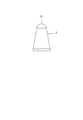
- FIG. 3 is a front view of an electrode member which is an example of the bioelectrode according to the embodiment of the present invention.
- FIG. 4 is a perspective view schematically showing another example of the configuration of the bioelectrode according to the embodiment of the present invention.
- FIG. 5 is a front view of an electrode member of another example of the biological electrode according to the embodiment of the present invention.
- FIG. 6 is a side view of an electrode member of another example of the biological electrode according to the embodiment of the present invention.
- FIG. 7 is a front view of an electrode member in an intermediate product that is molded in the electrode member molding step of the method for manufacturing a biomedical electrode according to the embodiment of the present invention.
- FIG. 8 is a flowchart showing an outline of the method for producing metal particles to be treated in the bioelectrode according to the embodiment of the present invention.
- FIG. 9 is a figure for demonstrating the contact impedance evaluation test of the bioelectrode which concerns on embodiment of this invention.
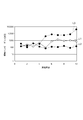
- FIG. 10 is a figure which shows the result of the contact impedance evaluation test which concerns on the Example and comparative example of this invention.
- FIG. 1 is a perspective view schematically showing a configuration of a biomedical electrode 1 according to an embodiment of the present invention.
- the biological electrode 1 includes a support member 2 that is a conductive member, and at least one electrode member 3 that is a member that projects from the support member 2.
- At least the electrode member 3 is formed of a conductive rubber containing silicone rubber and metal particles having a crosslinkable functional group on the surface.
- the metal particles have a crosslinkable functional group introduced on the surface of the metal particles by a surface treatment using a silane coupling agent.
- metal particles having a crosslinkable functional group introduced on the surface by the surface treatment with a silane coupling agent are also referred to as “metal particles to be treated”, and the surface is not subjected to the surface treatment with the silane coupling agent.
- Metal particles having no crosslinkable functional group introduced therein are also referred to as “untreated metal particles”, and "treated metal particles” and “untreated metal particles” are also collectively referred to as “metal particles”.
- the biomedical electrode 1 makes it possible to detect the biomedical signal of the subject through the electrode member 3 when the tip 31 of the electrode member 3 contacts the body of the subject.
- the biological electrode 1 is, for example, a biological electrode for detecting an electroencephalogram which is brought into contact with the head of a subject and detects an electroencephalogram.
- the biomedical electrode 1 is not limited to such an electroencephalogram detection device, but can be applied to other devices that detect a biomedical signal, such as a wearable information device.
- the configuration of the biological electrode 1 will be specifically described.
- the support member 2 supports the electrode member 3.
- the support member 2 is made of a conductive material and is electrically connected to the electrode member 3.
- the support member 2 and the electrode member 3 are integrally formed.
- the support member 2 may be formed of a conductive rubber containing the metal particles to be treated having a crosslinkable functional group on the same surface as the electrode member 3, and the untreated metal particles having no crosslinkable functional group on the surface may be formed. It may be formed from the conductive rubber contained.
- the shape of the support member 2 is not limited to a specific shape as long as it can support the electrode member 3 in a state where the electrode member 3 projects.
- the support member 2 has, for example, a disk shape or a substantially disk shape as shown in FIG.
- the support member 2 is provided with a terminal 21 for receiving a biological signal detected by the biological electrode 1 and electrically connecting it to a measuring device (not shown) for processing, analyzing, and displaying the received biological signal.
- the terminal 21 is connected to a connection line L that enables the measuring device to be electrically connected to an external device, for example, as shown in FIG.
- the terminal 21 is provided, for example, on a surface (terminal side surface 23) facing away from the surface (support surface 22) on which the electrode member 3 is supported, and has a shape in which the connection line L can be connected.
- the terminal 21 is, for example, a protrusion that protrudes from the terminal side surface 23.
- the terminal 21 is integrally formed with the other part by the same conductive rubber, but the terminal 21 may be formed separately from the other part by another material.
- the terminal 21 can be formed of a material suitable for electrical connection with the connection line L.
- the terminal 21 is made of metal and is provided by being bonded to the terminal side surface 23 of the supporting member 2 by a conductive adhesive, or by being embedded inside the terminal side surface 23 so that a part thereof protrudes from the terminal side surface 23. You can
- a plurality of electrode members 3 are provided on the biological electrode 1, and project from the support surface 22 of the support member 2 in the same or substantially the same direction. Further, as shown in FIG. 1, the electrode member 3 extends from the support member 2 so that the respective tip portions 31 are located on the same plane. The electrode member 3 projects from the support member 2 in a brush shape, for example, as shown in FIG. The electrode members 3 may each extend from the support member 2 to a position corresponding to the target site so that each tip 31 contacts the target site of the subject in a similar state in the use state. That is, the tip ends 31 of the electrode members 3 do not have to be located on the same plane. As shown in FIGS.
- the electrode member 3 has, for example, a columnar shape or a substantially columnar shape, and has a portion that tapers toward the tip 31.
- the electrode member 3 may have a conical shape or a substantially conical shape that tapers toward the tip 31 as a whole, as long as it has the tip 31 and projects from the support member 2.
- the shape of the tip portion 31 is, for example, a hemispherical shape or a substantially hemispherical shape as shown in FIG. Further, the shape of the tip portion 31 is a plane or a substantially flat surface which is formed by removing a part of the hemispherical or substantially hemispherical tip portion 31 and which is orthogonal or substantially orthogonal to the extending direction of the electrode member 3. It may have an exposed surface. In this case, the exposed surface may be a curved surface or a surface having a curved surface and a flat surface. The exposed surface is a cut surface or a polished surface obtained by cutting or polishing the tip portion 31 of the electrode member.
- FIG. 4 is a perspective view schematically showing another configuration of the biomedical electrode 1 according to the embodiment of the present invention.
- the tip end portion 31 of the electrode member 3 may have a sharpened shape in which the electrode member 3 becomes sharper from the support member 21 side of the tip end portion 31 toward the tip end side of the electrode member 3.
- the sharpened shape of the tip portion 31 of the electrode member 3 may be a conical shape, a substantially conical shape, or an angular shape.
- the bioelectrode 1 reduces the contact impedance between the skin and the electrode member 3 because the sharp tip 31 of the electrode portion 3 scrapes off the hair of the subject and easily contacts the scalp. can do.
- the electrode member 3 is formed of a flexible conductive rubber, there is no pain even when the tip portion 31 has a sharpened shape and is brought into contact with the scalp, and discomfort is unlikely to occur.
- the tip portion 31 of the electrode member 3 has a slope 32 formed by removing a part of the tip portion, as shown in FIGS. 5 and 6.
- the inclined surface 32 is, for example, a surface that faces obliquely with respect to the extending direction of the electrode member 3, and is, for example, a flat surface or a substantially flat surface as shown in FIG. 6, and is oblique with respect to the extending direction of the electrode member 3. It is a crossing plane.
- the slope 32 may be a curved surface or a surface having a curved surface and a flat surface.
- the sloped surface 32 is a surface formed by removing the tip portion 41 from the intermediate product 40 of the electrode member 3 molded from conductive rubber (see FIG. 7), as will be described later, and the intermediate product 40 of the electrode member 3 is formed. Is a cut surface or a polished surface, which is formed by cutting or polishing the tip portion 41 of each.
- the conductive rubber forming the electrode member 3 contains the silicone rubber and the metal particles to be treated in which the crosslinkable functional group is introduced on the surface of the metal particles by the silane coupling agent, as described above.
- the silicone rubber for example, an organic silicon polymer is used.
- the organosilicon polymer those having a siloxane bond (—Si—O—) as a main chain and a hydrocarbon group such as a methyl group, a phenyl group, a vinyl group or hydrogen as a side chain are preferable.
- the silicone rubber an addition reaction type silicone rubber may be used, or a condensation reaction type silicone rubber may be used.
- the addition reaction type silicone rubber is a silicone rubber that is cured by an addition reaction
- the condensation reaction type silicone rubber is a silicone rubber that is cured by a condensation reaction.
- These silicone rubbers may be used alone or in combination of two or more.
- room temperature curable liquid silicone rubber is preferable.
- the room temperature-curable liquid silicone rubber is a silicone rubber which is in a liquid or paste state before being cured and usually undergoes a curing reaction at 20 ° C. to 100 ° C. to become a rubber elastic body.
- the room temperature curable liquid silicone rubber only one kind of room temperature curable liquid silicone rubber may be used, or a plurality of kinds of room temperature curable liquid silicone rubber may be mixed and used.
- the room temperature curable liquid silicone rubber include silicone rubber (trade name “KE-106” (manufactured by Shin-Etsu Chemical Co., Ltd.) and curing agent (trade name “CAT-RG” (manufactured by Shin-Etsu Chemical Co., Ltd.)). And the one using.
- the metal particles surface-treated with the silane coupling agent are, for example, silver particles.
- the metal particles may be any metal-based material having conductivity. Further, the metal particles may include a carbon-based material such as carbon black or carbon nanotube.
- the silver particles of the conductive rubber it is possible to use the one containing agglomerated silver powder and flake silver powder.
- the agglomerated silver powder is a plurality of three-dimensionally agglomerated primary particles, and the flake-shaped silver powder has a scaly shape.
- the average particle size of the agglomerated silver powder and the flake-shaped silver powder is not limited to a specific value.
- the agglomerated silver powder preferably has an average particle size of 4 ⁇ m to 8 ⁇ m, and the flake-shaped one. It is preferable that the silver powder has an average particle size in the range of 5 ⁇ m to 15 ⁇ m.
- the average particle size of the silver particles is the average diameter measured by an electron micrograph and calculated by the arithmetic average.
- the total amount of the aggregated silver flake and the flake-shaped silver powder can be appropriately set within a range in which conductivity can be imparted. For example, it is in the range of 50 to 500 parts by weight with respect to 100 parts by weight of the liquid silicone rubber. It is preferably in the range of 100 to 300 parts by weight, and particularly preferably in the range of 100 to 300 parts by weight.
- the flake-shaped silver powder examples include a trade name “327077” (manufactured by Sigma-Aldrich), a trade name “FA-D-3” (manufactured by DOWA Electronics), and a trade name “FA-2-3” (DOWA Electronics Manufactured) and the like.
- the trade name “FA-2-3” (manufactured by DOWA Electronics Co., Ltd.) is preferable.
- trade name “G-35” (manufactured by DOWA Electronics) is preferable.
- Examples of the crosslinkable functional group introduced on the surface of the metal particles include a carboxyl group, an acid anhydride group, a vinyl group, a styryl group, a hydrolyzable silyl group, a silanol group, a (meth) acryloyl group, an amino group, and a ureido group. , A mercapto group, an isocyanurate group, an isocyanate group and an epoxy group.
- the crosslinkable functional group is a group consisting of a hydrolyzable silyl group, a silanol group, a (meth) acryloyl group, an amino group, a ureido group, an isocyanurate group, an isocyanate group and an epoxy group. At least one selected from is preferable, an isocyanate group and an epoxy group are more preferable, and an epoxy group is still more preferable.
- the silane coupling agent used for the surface treatment of the metal particles is not limited as long as it can introduce a crosslinkable functional group onto the surface of the metal particles.
- Examples of the silane coupling agent include silicon compounds having a hydrolyzable silyl group such as tetramethoxysilane, tetraethoxysilane, methyltrimethoxysilane, methyltriethoxysilane, dimethyldimethoxysilane, and dimethyldiethoxysilane, and 3-acryl acrylate.
- Polymerizable unsaturated groups such as Roxypropyltrimethoxysilane, 3-methacryloxypropylmethyldimethoxysilane, 3-methacryloxypropylmethyldiethoxysilane, 3-methacryloxypropyltrimethoxysilane, 3-methacryloxypropyltriethoxysilane Having silicon compound, N-2- (aminoethyl) -3-aminopropylmethyldimethoxysilane, N-2- (aminoethyl) -3-aminopropyltrimethoxysilane, 3-aminopropyltrimethoxy Silane, 3-aminopropyltriethoxysilane, 3-triethoxysilyl (1,3-dimethylbutylidene) propylamine, N-phenyl-3-aminopropyltrimethoxysilane, N- (vinylbenzyl) -2-aminoethyl Silicon compounds having amino groups such as
- silane coupling agent 3- (triethoxysilyl) propyl isocyanate and 2- (3,4-epoxycyclohexyl) ethyltrimethoxysilane are preferable as the silane coupling agent.
- silane coupling agent examples include a trade name “I0556” (3- (triethoxysilyl) propyl isocyanate, manufactured by Tokyo Chemical Industry Co., Ltd.) and a trade name “E00327” (2- (3,4-epoxycyclohexyl)).
- I0556 (3- (triethoxysilyl) propyl isocyanate
- E00327 (2- (3,4-epoxycyclohexyl)
- Commercially available products such as ethyltrimethoxysilane and manufactured by Tokyo Chemical Industry Co., Ltd. may be used.
- the conductive rubber forming the electrode member 3 may further contain other components in addition to the components described above, as long as the effects of the present invention are not impaired.
- a compounding agent generally used in the rubber industry such as a dispersant, a reinforcing agent, a filler such as dry silica, an antiaging agent, a processing aid, and a plasticizer may be appropriately mixed.
- the modified dispersant may contain modified silicone.
- a main chain composed of siloxane bonds (-Si-O-; also referred to as a silicone chain) into which a side chain that causes modification is introduced can be preferably used, and examples thereof include polyether modification and polyether.
- the silicone include alkyl co-modified, polyglycerin modified, polyglycerin / alkyl co-modified and the like.
- the side chain that causes the modification preferably contains an ether bond (—C—O—C—).
- the polyether-modified silicone one having a side chain composed of a polyether chain introduced into a main chain composed of a silicone chain can be used.
- the polyether / alkyl co-modified silicone one in which a side chain composed of a polyether chain and a side chain composed of an alkyl chain are introduced into a main chain composed of a silicone chain can be used.
- polyglycerin-modified silicone one in which a side chain composed of a polyglycerin chain is introduced into a main chain composed of a silicone chain can be used.
- polyglycerin / alkyl co-modified silicone one in which a side chain composed of a polyglycerin chain and a side chain composed of an alkyl chain are introduced into a main chain composed of a silicone chain can be used.
- polyether-modified silicone and polyglycerin-modified silicone are particularly preferable.
- dispersant for example, trade name “KF-6106” (polyglycerin-modified silicone surfactant, manufactured by Shin-Etsu Chemical Co., Ltd.) and trade name “KF-6015” (polyether-modified silicone surfactant, Shin-Etsu Chemical Co., Ltd.) Commercially available products such as manufactured products) may be used.
- the electrode member 3 is formed by curing silicone rubber, has flexibility and elasticity, has good adhesion to the body of the subject, and has a soft touch. It is possible to maintain a stable contact with the subject's body without causing discomfort even if they are in close contact with each other for a long time.
- the electrode member 3 is formed by curing silicone rubber as a binder mixed with metal particles, and the surface of the formed electrode member 3 has metal particles that are in electrical contact with the subject. .
- the contact impedance between the skin of the subject and the electrode member 3 is defined not by the apparent contact area but by the effective contact area between the metal particles responsible for electrical contact and the skin.
- the contact impedance may increase as the number of times of use increases, the noise mixed in the biological signal to be detected may increase, or the biological signal itself may not be acquired. This is because the metal particles at the tip of the electrode member fall off with use, and the effective contact area between the silver particles responsible for electrical contact and the skin decreases.
- the metal particles are surface-treated with a silane coupling agent to introduce a crosslinkable functional group on the surface of the metal particles, and the metal particles as a filler by a crosslink bond through the crosslinkable functional group. Since the adhesion with the silicone rubber as the binder is improved, even if the tip 31 of the electrode member 3 comes into contact with the skin of the subject, it is possible to prevent the metal particles from falling off from the tip 31. Therefore, even when the number of times of using the electrode member 3 is increased, it is possible to prevent the contact impedance from increasing, the noise mixed in the biological signal to be detected does not increase, and the biological signal acquisition itself. It doesn't stop.
- the method for manufacturing the biomedical electrode 1 includes a surface treatment step of metal particles, an electrode member forming step, and an electrode shape forming step.
- the surface treatment step of the metal particles is a step of obtaining metal particles having a crosslinkable functional group introduced on the surface by the surface treatment with a surface treatment agent.
- the electrode member molding step is a step of molding the electrode member 3 by stirring conductive rubber containing silicone rubber and metal particles and molding the conductive rubber into a shape protruding from the support member 2.
- the electrode shape forming step is a step of forming the tip portion 31 of the electrode member 3 into a sharp shape.
- FIG. 8 is a flowchart showing an outline of the surface treatment of the metal particles according to the embodiment of the present invention.
- the surface treatment of the metal particles according to the present embodiment includes a first step ST1 of preparing an alcohol aqueous solution, a second step ST2 of adding metal particles to the prepared alcohol aqueous solution, and a metal particle.
- an alcohol compound and water are mixed to prepare an aqueous alcohol solution.
- the alcohol compound include methanol, ethanol, propanol, isopropanol and butanol. Of these, ethanol is preferable as the alcohol compound.
- water include ion-exchanged water, distilled water and pure water.
- the mixing ratio of water and alcohol compound is preferably 0.1 to 99.9 to 50:50.
- metal particles are added to the alcohol aqueous solution prepared in the first step ST1 to form a slurry-like mixture.
- the addition amount of the metal particles is, for example, preferably 10% by mass or more and 70% by mass or less, and more preferably 20% by mass or more and 40% by mass or less, based on the total mass of the slurry-like mixture.
- the silane coupling agent is added to the slurry-like mixture prepared in the second step ST2.
- the addition amount of the silane coupling agent is preferably, for example, 0.1% by mass or more and 10% by mass or less, and 0.5% by mass or more and 5% by mass or less, with respect to the mass of the added metal particles. Is more preferable.
- the mixture to which the silane coupling agent has been added in the third step ST3 is agitated to react the silane coupling agent with the metal particles, and the cross-linkable functional group is introduced to the surface of the metal particles to be treated.
- the stirring temperature is, for example, 10 ° C. or higher and 40 ° C. or lower.
- the stirring time is, for example, 1 minute or more and 1 hour or less.
- the metal particles to be treated obtained in the fourth step ST4 are dried to remove the alcohol aqueous solution.
- the fifth step ST5 for example, after drying at 60 ° C. or higher and 100 ° C. or lower for 10 minutes or more and 50 minutes or less under atmospheric pressure (normal pressure), it is dried at 130 ° C. or higher and 170 ° C. or lower for 70 minutes or more and 110 minutes or less.
- the metal particles to be treated from which the aqueous alcohol solution has been removed are obtained.
- the drying in the fifth step ST5 does not necessarily have to be performed in two steps, and may be performed in one step. Further, the pressure condition at the time of drying, the drying temperature and the drying time can be appropriately changed.
- the biomedical electrode 1 is integrally molded from the same conductive rubber, and the conductive rubber is cured in the mold so that the support member 2 and the electrode member 3 are molded integrally. That is, in the electrode member forming step, the support member 2 and the electrode member 3 are integrally formed. However, in the state of being molded in the electrode member molding step, the inclined surface 32 is not formed on the electrode member 3, and the tip end portion 31 of the electrode member 3 has a hemispherical shape or a substantially hemispherical shape. Are molded (see FIG. 7).
- the tip portion 41 of the electrode member 3 of the intermediate product 40 is removed, and the inclined surface 32 is formed on the tip portion 31 (see FIG. 7). Thereby, the electrode member 3 is formed and the biological electrode 1 is completed.
- the removal of the tip portion 41 of the intermediate product 40 can be performed by various methods, for example, cutting or polishing.
- the cutting includes cutting with a cutting tool such as a cutter, and the polishing includes surface polishing.
- the tip portion 31 has the inclined surface 32 and has a sharp shape.
- the hair 31 is scraped off and the tip portion 31 comes into contact with the scalp, so that the contact impedance between the electrode member 3 and the scalp is reduced. be able to.
- the adhesiveness between the crosslinkable functional group of the metal particles to be treated and the silicone rubber is improved through the crosslinkage, even when the tip 31 of the electrode member 3 scrapes the hair, the electrode The metal particles to be treated do not fall off the surface of the member 3.
- the electrode member 3 is formed of conductive rubber, has good elasticity so as not to give discomfort to the subject, and is applied to the target site of the subject. Can adhere evenly. Therefore, a reinforcing member such as a core material for giving elasticity to the electrode member 3 is not required. Further, the electrode member 3 can be formed only from the conductive rubber, the structure of the electrode member 3 is not complicated, and the manufacturing can be facilitated. Further, the electrode member 3 has the exposed surface 32 from which the molding surface layer 42 has been removed, and it is not necessary to use a conductive gel or an electrolyte solution, so that the electrode member 3 is easy to use, and the subject feels uncomfortable. None.
- the electrode member since a cross-linking bond is formed between the silicone rubber and the metal particles contained in the conductive rubber via the cross-linking functional group during molding, the adhesion between the metal particles and the silicone rubber is improved. Held by silicone rubber. Thereby, the bioelectrode can prevent the metal particles from falling off from the electrode member surface after each use, even when the same bioelectrode is used a plurality of times for measuring an electroencephalogram. It is possible to prevent the contact impedance from increasing as the number of times increases.
- the contact impedance can be prevented from increasing, so that it is possible to prevent the increase in noise in the biomedical signal to be detected and prevent the biomedical signal from being unable to be acquired itself.
- An electrode can be realized. Therefore, the biological electrode can prevent metal particles from falling off the electrode member due to contact with the measurement target, and prevent increase in contact impedance due to increase in the number of times of use.
- the biomedical electrode 1 according to the embodiment of the present invention does not have a complicated structure and has good elasticity, and can prevent an increase in contact impedance due to an increase in the number of times of use.
- the present invention is not limited to the above-described embodiments of the present invention, and includes all aspects included in the concept and claims of the present invention. Further, the respective configurations may be appropriately and selectively combined so as to achieve at least a part of the above-mentioned problems and effects. For example, the shape, material, arrangement, size, etc. of each constituent element in the above-described embodiment can be appropriately changed according to the specific usage mode of the present invention.
- the support member 2 is not limited to the shape described above, and may have another shape.
- the electrode member 3 is not limited to the shape described above, and may have another shape.
- the support member 2 and the electrode member 3 may be separate bodies, and the support member 2 formed as a separate body after the electrode member 3 is formed by the surface treatment step and the electrode member molding step described above.
- the biological electrode 1 may be formed by being attached to and fixed to.
- the electrode member 3 and the supporting member 2 may be fixed to each other by a conductive adhesive or by engagement such as fitting.
- a concave portion or a convex portion is formed on the bottom of the electrode member 3, a convex portion or a concave portion corresponding to the support member 2 is formed, and the concave portion and the convex portion are engaged with each other, whereby the electrode member 3 is attached to the support member 2. It may be fixed.
- the electrode member 3 may be detachably fixed to the support member 2.
- both the support member 2 and the electrode member 3 can be made of the same material as the above-mentioned conductive rubber, or can be made of different materials. May be.
- the support member 2 is made of a material different from that of the electrode member 3, the support member 2 can be made of a material having conductivity different from conductive rubber.
- the material having conductivity of the support member 2 is preferably a material having conductivity suitable for supporting the electrode member 3, and has a strength capable of stably supporting the electrode member 3, for example, stainless steel, Metals such as copper and aluminum can be used.
- the material of the support member 2 is not limited to these, and a material having conductivity can be used.
- the present inventors produced the bioelectrode 1 according to the embodiment of the present invention (Examples 1 and 2), and conducted a contact impedance evaluation test on the bioelectrode 1.
- the present inventors also prepared a bioelectrode as a comparative example (Comparative Example 1), and conducted a similar contact impedance evaluation test on Comparative Example 1.
- the shapes of the electrodes of Examples 1 and 2 and Comparative Example 1 were as shown in FIG.
- the silver particles were surface-treated by a wet method using a silane coupling agent to prepare four types of surface-treated silver particles (hereinafter, the silver particles before the treatment with the silane coupling agent were “untreated”). Also referred to as “treated silver particles”, silver particles after silane coupling treatment are also referred to as “treated silver particles”, and “untreated silver particles” and “treated silver particles” are also collectively referred to as “silver particles”.) .
- Table 1 below shows the silane coupling agent used for the preparation of the four types of silver particles A to D and the functional groups introduced into the silver particles A to D.
- a method of adjusting the silver particles A to D to be processed will be described.
- Step ST1 Preparation of silver particles A to be treated
- 100 g of the prepared aqueous ethanol solution was stirred at room temperature (20 ° C. to 30 ° C.) while adding 30 g of untreated silver particles A (trade name “G-35”, manufactured by DOWA Electronics) to form a slurry (Ste ST2).
- silane coupling agent A (3- (triethoxysilyl) propyl isocyanate: trade name "I0556", manufactured by Tokyo Chemical Industry Co., Ltd.) with respect to untreated silver particles A
- the untreated silver particles A in the form of slurry were dropped and stirred for 10 minutes (steps ST3 and ST4).
- it was dried at 80 ° C. for 30 minutes and then dried at 150 ° C. for 90 minutes to prepare 30 g of silver particles A to be treated in which an isocyanate group was introduced by a silane coupling treatment (step ST5).
- the composition of silver particles A to be treated is shown in Table 1 below.
- Silane coupling agent A (3- (triethoxysilyl) propyl isocyanate: trade name "I0556", manufactured by Tokyo Chemical Industry Co., Ltd.) was replaced with 0.3 g of silane coupling agent B (2- (3,4-epoxy). Cyclohexyl) ethyltrimethoxysilane: trade name "E00327", manufactured by Tokyo Kasei Kogyo Co., Ltd.) except that 0.3 g of silver silane was used in the same manner as the silver particles A to be treated. 30 g of treated silver particles C was prepared. The composition of the treated silver particles C is shown in Table 1 below.
- -Untreated silver particles A trade name "G-35” (manufactured by DOWA Electronics)
- -Untreated silver particles B trade name "FA-2-3” (manufactured by DOWA Electronics)
- Silane coupling agent A 3- (triethoxysilyl) propyl isocyanate (trade name "I0556", manufactured by Tokyo Chemical Industry Co., Ltd.)
- Silane coupling agent B 2- (3,4-epoxycyclohexyl) ethyltrimethoxysilane (trade name "E00327”, manufactured by Tokyo Chemical Industry Co., Ltd.)
- Example 1 ⁇ Production of bioelectrode> 100 parts by mass of silicone rubber (trade name: “KE-106”, manufactured by Shin-Etsu Chemical Co., Ltd.) as a binder, 10 parts by mass of curing agent (trade name: “CAT-RG”, manufactured by Shin-Etsu Chemical Co., Ltd.), as a filler 165 parts by mass of silver particles A to be treated, 165 parts by mass of silver particles B to be treated, 10 parts by mass of dispersant A (trade name "KF-6106", manufactured by Shin-Etsu Chemical Co., Ltd.) and dispersant B (trade name: 10 parts by mass of "KF-6015” (manufactured by Shin-Etsu Chemical Co., Ltd.) was centrifugally stirred to prepare a dough.
- silicone rubber trade name: “KE-106”, manufactured by Shin-Etsu Chemical Co., Ltd.
- curing agent trade name: “CAT-RG”, manufactured by Shin-Etsu Chemical Co., Ltd.
- the obtained fabric was cast-molded, primary-crosslinked under the conditions of 150 ° C. for 3 minutes, and then secondary-crosslinked under the conditions of 150 ° C. for 30 minutes.
- an intermediate product was prepared by performing a salt water treatment of immersing the solution in a 10% by mass sodium chloride aqueous solution (salt water) at 121 ° C. at 0.1 MPaG for 1 hour in an autoclave.
- the tip 31 of the intermediate electrode member 3 was cut so as to have the shape shown in FIG. 4, and the electrode member 3 was molded to prepare the bioelectrode of Example 1.
- the formulation of the bioelectrode is shown in Table 2 below.
- Example 2 The treated silver particles A were replaced with 165 parts by mass, the treated silver particles C were used with 165 parts by mass, the treated silver particles B were replaced with 165 parts by mass, and the treated silver particles D were used with 165 parts by mass.
- a bioelectrode was produced in the same manner as in Example 1 except for the above. The formulation of the bioelectrode is shown in Table 2 below.
- Example 1 The treated silver particles A were replaced with 165 parts by mass, the untreated silver particles A not subjected to the silane coupling treatment were used with 165 parts by mass, the treated silver particles B were replaced with 165 parts by mass, and the silane coupling treatment was carried out.
- a bioelectrode was produced in the same manner as in Example 1 except that 165 parts by mass of untreated silver particles B which were not subjected to the above were used. The formulation of the bioelectrode is shown in Table 2 below.
- -Silicone rubber Polydimethylsiloxane (trade name: "KE-106", manufactured by Shin-Etsu Chemical Co., Ltd.)
- Curing agent Product name "CAT-RG” (manufactured by Shin-Etsu Chemical Co., Ltd.)
- Dispersant A polyglycerin-modified silicone surfactant (trade name "KF-6106", manufactured by Shin-Etsu Chemical Co., Ltd.)
- Dispersant B polyether modified silicone surfactant (trade name "KF-6015”, manufactured by Shin-Etsu Chemical Co., Ltd.)
- FIG. 9 is explanatory drawing of the contact impedance evaluation test which concerns on an Example and a comparative example.
- the contact impedance evaluation test was performed by measuring the contact impedances of Examples 1 and 2 and Comparative Example 1 using an LCR meter.
- a reference electrode of an LCR meter (model number “ZM2371”, manufactured by NF Circuit Design Block Co., Ltd.) was fixed to the base of the right earlobe of the subject with an electroencephalographic paste (model number “Ten20”, manufactured by WEAVER and company) to provide sufficient contact impedance.
- FIG. 10 is a diagram showing the results of the contact impedance measurement test according to the example and the comparative example of the present invention.
- the contact impedance slightly increased as the number of measurements increased, but the contact impedance value did not significantly increase with the increase in the number of measurements.
- the value of the average contact impedance after the measurement was a low value of 576 [k ⁇ ] (see the solid line L1).
- no increase in contact impedance was observed even if the number of measurements was increased, and the value of the contact impedance was maintained at 500 ⁇ or less between the first measurement and the tenth measurement.
- the average contact impedance value of 1 was 165 [k ⁇ ], which was an extremely low value (see the dashed-dotted line L2). These results indicate that the adhesion between the silicone rubber and the silver particles to be treated is improved by the cross-linking between the silicone rubber as the binder and the crosslinkable functional group of the silver particles to be treated after the silane coupling treatment as the filler. It is speculated that the fall of silver particles to be treated from the binder was suppressed. On the other hand, Comparative Example 1 showed a value of several hundreds k ⁇ at the first to fourth measurement times, but the contact impedance sharply increased at the measurement times of 5 or more, and the average after 10 times of measurement was obtained. The impedance value was 7180 [k ⁇ ] (see broken line L3).
- the present invention it is possible to prevent an increase in contact impedance due to dropout of silver particles due to an increase in the number of times of use and to realize a bioelectrode having excellent durability and a method for manufacturing a bioelectrode. It has an effect, and in particular, it can be suitably used in various fields such as wearable information devices, brain-machine interfaces, medical care, nursing care, welfare, medical measuring instruments, game machines, automatic driving, and electronic wiring.
Landscapes
- Health & Medical Sciences (AREA)
- Life Sciences & Earth Sciences (AREA)
- Chemical & Material Sciences (AREA)
- Surgery (AREA)
- Heart & Thoracic Surgery (AREA)
- Veterinary Medicine (AREA)
- Physics & Mathematics (AREA)
- Public Health (AREA)
- Biophysics (AREA)
- Pathology (AREA)
- Engineering & Computer Science (AREA)
- Biomedical Technology (AREA)
- General Health & Medical Sciences (AREA)
- Medical Informatics (AREA)
- Molecular Biology (AREA)
- Animal Behavior & Ethology (AREA)
- Chemical Kinetics & Catalysis (AREA)
- Polymers & Plastics (AREA)
- Medicinal Chemistry (AREA)
- Organic Chemistry (AREA)
- Measurement And Recording Of Electrical Phenomena And Electrical Characteristics Of The Living Body (AREA)
Priority Applications (4)
| Application Number | Priority Date | Filing Date | Title |
|---|---|---|---|
| EP19872922.0A EP3868289B1 (en) | 2018-10-17 | 2019-10-16 | Bioelectrode and bioelectrode production method |
| US16/977,013 US12527505B2 (en) | 2018-10-17 | 2019-10-16 | Bioelectrode and method for producing bioelectrode |
| CN201980006936.6A CN111511280A (zh) | 2018-10-17 | 2019-10-16 | 生物电极以及生物电极的制造方法 |
| JP2020509560A JP7277435B2 (ja) | 2018-10-17 | 2019-10-16 | 生体電極及び生体電極の製造方法 |
Applications Claiming Priority (2)
| Application Number | Priority Date | Filing Date | Title |
|---|---|---|---|
| JP2018-195920 | 2018-10-17 | ||
| JP2018195920 | 2018-10-17 |
Publications (1)
| Publication Number | Publication Date |
|---|---|
| WO2020080396A1 true WO2020080396A1 (ja) | 2020-04-23 |
Family
ID=70284376
Family Applications (1)
| Application Number | Title | Priority Date | Filing Date |
|---|---|---|---|
| PCT/JP2019/040641 Ceased WO2020080396A1 (ja) | 2018-10-17 | 2019-10-16 | 生体電極及び生体電極の製造方法 |
Country Status (5)
| Country | Link |
|---|---|
| US (1) | US12527505B2 (https=) |
| EP (1) | EP3868289B1 (https=) |
| JP (1) | JP7277435B2 (https=) |
| CN (1) | CN111511280A (https=) |
| WO (1) | WO2020080396A1 (https=) |
Cited By (1)
| Publication number | Priority date | Publication date | Assignee | Title |
|---|---|---|---|---|
| WO2022004282A1 (ja) * | 2020-07-03 | 2022-01-06 | Nok株式会社 | 生体電極 |
Families Citing this family (2)
| Publication number | Priority date | Publication date | Assignee | Title |
|---|---|---|---|---|
| CN113208598A (zh) * | 2021-04-22 | 2021-08-06 | 北京脑陆科技有限公司 | 生物电信号的采集装置 |
| EP4406480A4 (en) * | 2021-09-24 | 2025-04-16 | Sumitomo Bakelite Co., Ltd. | Brain wave detection electrode, brain wave measuring device, and brain wave measuring method |
Citations (7)
| Publication number | Priority date | Publication date | Assignee | Title |
|---|---|---|---|---|
| JPH07109501A (ja) * | 1993-10-06 | 1995-04-25 | Toray Dow Corning Silicone Co Ltd | 銀粉末およびその製造方法 |
| JP2002363411A (ja) * | 2001-06-08 | 2002-12-18 | Ge Toshiba Silicones Co Ltd | 金属粉含有シリコーンゴム組成物 |
| JP2011120866A (ja) * | 2009-11-10 | 2011-06-23 | Japan Health Science Foundation | 脳波測定用電極、脳波測定用電極付きキャップ及び脳波測定装置 |
| JP2013111361A (ja) * | 2011-11-30 | 2013-06-10 | Japan Health Science Foundation | 脳波測定用電極、脳波測定用部材、及び、脳波測定装置 |
| JP2013144051A (ja) | 2012-01-16 | 2013-07-25 | Sony Corp | 生体信号取得用電極 |
| JP2013248306A (ja) | 2012-06-04 | 2013-12-12 | Dejitekkusu Kenkyusho:Kk | 脳波測定用の生体電極 |
| US20180125386A1 (en) * | 2015-05-28 | 2018-05-10 | Samsung Electronics Co., Ltd. | Brainwave sensor unit and brainwave measurement device using same |
Family Cites Families (15)
| Publication number | Priority date | Publication date | Assignee | Title |
|---|---|---|---|---|
| JPS5440101B2 (https=) * | 1974-06-24 | 1979-12-01 | ||
| US4732939A (en) * | 1986-01-20 | 1988-03-22 | Sumitomo Bakelite Company Limited | Flame-retardant olefinic resin compositions |
| US5268404A (en) * | 1989-12-04 | 1993-12-07 | Lord Corporation | One-coat rubber-to-metal bonding adhesive |
| JP3501055B2 (ja) * | 1999-12-10 | 2004-02-23 | 信越化学工業株式会社 | 半導電性シリコーンゴム組成物及びシリコーンゴムロール |
| JP4114037B2 (ja) * | 2001-09-25 | 2008-07-09 | 信越化学工業株式会社 | 電気・電子部品の硫化防止又は遅延用シリコーンゴム封止・シール材及び硫化防止又は遅延方法 |
| JP2003225217A (ja) * | 2002-02-01 | 2003-08-12 | Shin Etsu Chem Co Ltd | 生体電極用シリコーンゴム組成物及び生体用電極 |
| JP4568472B2 (ja) * | 2002-11-29 | 2010-10-27 | 東レ・ダウコーニング株式会社 | 銀粉末の製造方法および硬化性シリコーン組成物 |
| WO2007142579A1 (en) * | 2006-06-05 | 2007-12-13 | Bactiguard Ab | A polymer matrix, uses thereof and a method of manufacturing the same |
| US9963786B2 (en) * | 2013-03-15 | 2018-05-08 | Henkel Ag & Co. Kgaa | Inorganic composite coatings comprising novel functionalized acrylics |
| WO2016080804A1 (en) * | 2014-11-20 | 2016-05-26 | Samsung Electronics Co., Ltd. | Apparatus for measuring bioelectrical signals |
| KR102361026B1 (ko) * | 2014-11-20 | 2022-02-08 | 삼성전자주식회사 | 생체신호 측정 장치 |
| JP6843075B2 (ja) * | 2015-05-28 | 2021-03-17 | コーニンクレッカ フィリップス エヌ ヴェKoninklijke Philips N.V. | 生体電位及び皮膚インピーダンス検出のための乾式電極及び使用方法 |
| JP2018061778A (ja) * | 2016-10-14 | 2018-04-19 | 国立大学法人群馬大学 | 生体信号計測用導電性ゴム組成物、生体信号計測用導電性部材及び生体信号計測用被服 |
| JP3209880U (ja) | 2017-01-30 | 2017-04-13 | 有限会社 啓 | 脳波信号検出センサ |
| CN107374622B (zh) * | 2017-06-16 | 2020-08-18 | 华南理工大学 | 一种采集脑电信号的柔性干式电极及其制备方法 |
-
2019
- 2019-10-16 JP JP2020509560A patent/JP7277435B2/ja active Active
- 2019-10-16 CN CN201980006936.6A patent/CN111511280A/zh active Pending
- 2019-10-16 US US16/977,013 patent/US12527505B2/en active Active
- 2019-10-16 EP EP19872922.0A patent/EP3868289B1/en active Active
- 2019-10-16 WO PCT/JP2019/040641 patent/WO2020080396A1/ja not_active Ceased
Patent Citations (7)
| Publication number | Priority date | Publication date | Assignee | Title |
|---|---|---|---|---|
| JPH07109501A (ja) * | 1993-10-06 | 1995-04-25 | Toray Dow Corning Silicone Co Ltd | 銀粉末およびその製造方法 |
| JP2002363411A (ja) * | 2001-06-08 | 2002-12-18 | Ge Toshiba Silicones Co Ltd | 金属粉含有シリコーンゴム組成物 |
| JP2011120866A (ja) * | 2009-11-10 | 2011-06-23 | Japan Health Science Foundation | 脳波測定用電極、脳波測定用電極付きキャップ及び脳波測定装置 |
| JP2013111361A (ja) * | 2011-11-30 | 2013-06-10 | Japan Health Science Foundation | 脳波測定用電極、脳波測定用部材、及び、脳波測定装置 |
| JP2013144051A (ja) | 2012-01-16 | 2013-07-25 | Sony Corp | 生体信号取得用電極 |
| JP2013248306A (ja) | 2012-06-04 | 2013-12-12 | Dejitekkusu Kenkyusho:Kk | 脳波測定用の生体電極 |
| US20180125386A1 (en) * | 2015-05-28 | 2018-05-10 | Samsung Electronics Co., Ltd. | Brainwave sensor unit and brainwave measurement device using same |
Cited By (3)
| Publication number | Priority date | Publication date | Assignee | Title |
|---|---|---|---|---|
| WO2022004282A1 (ja) * | 2020-07-03 | 2022-01-06 | Nok株式会社 | 生体電極 |
| JPWO2022004282A1 (https=) * | 2020-07-03 | 2022-01-06 | ||
| JP7511642B2 (ja) | 2020-07-03 | 2024-07-05 | Nok株式会社 | 生体電極 |
Also Published As
| Publication number | Publication date |
|---|---|
| US20210000371A1 (en) | 2021-01-07 |
| EP3868289B1 (en) | 2026-03-18 |
| CN111511280A (zh) | 2020-08-07 |
| US12527505B2 (en) | 2026-01-20 |
| JPWO2020080396A1 (ja) | 2021-10-07 |
| JP7277435B2 (ja) | 2023-05-19 |
| EP3868289A4 (en) | 2022-08-17 |
| EP3868289A1 (en) | 2021-08-25 |
Similar Documents
| Publication | Publication Date | Title |
|---|---|---|
| KR101727149B1 (ko) | 생체 신호 감지용 건식 전극 및 이를 제조하는 방법 | |
| JPWO2020080395A1 (ja) | 生体電極及び生体電極の製造方法 | |
| JP7277435B2 (ja) | 生体電極及び生体電極の製造方法 | |
| CN103687537B (zh) | Ecg电极连接器 | |
| US11596338B2 (en) | Bioelectrode | |
| WO2018070433A1 (ja) | 生体信号計測用導電性ゴム組成物、生体信号計測用導電性部材及び生体信号計測用被服 | |
| US20230397870A1 (en) | Conductive Hydrogel-Based Wearable Health Monitors | |
| EP3991654B1 (en) | Biomedical electrode, biomedical sensor, and biosignal measurement system | |
| JP6825744B2 (ja) | 生体用電極、生体センサーおよび生体信号測定システム | |
| KR20170042178A (ko) | 생체 신호 감지용 건식 전극 및 이를 제조하는 방법 | |
| EP3871595A1 (en) | Bioelectrode, biological sensor, and biological signal measurement system | |
| JP2013034699A (ja) | 生体信号計測用電極、並びに、その使用方法及び製造方法 | |
| CN114760923B (zh) | 生物体电极的制造方法 | |
| JP6986153B2 (ja) | 生体電極の製造方法 | |
| WO2020246358A1 (ja) | 生体電極 | |
| CN222841022U (zh) | 一种用于睡眠脑电信号采集的干电极 | |
| WO2020121777A1 (ja) | 生体電極及び生体電極の製造方法 | |
| KR20230133513A (ko) | 뇌파 측정용 전극 | |
| TW202535311A (zh) | 黏性電極貼片和包括電極貼片的裝置 | |
| JP2017148231A (ja) | 生体用電極およびその製造方法 |
Legal Events
| Date | Code | Title | Description |
|---|---|---|---|
| ENP | Entry into the national phase |
Ref document number: 2020509560 Country of ref document: JP Kind code of ref document: A |
|
| 121 | Ep: the epo has been informed by wipo that ep was designated in this application |
Ref document number: 19872922 Country of ref document: EP Kind code of ref document: A1 |
|
| NENP | Non-entry into the national phase |
Ref country code: DE |
|
| ENP | Entry into the national phase |
Ref document number: 2019872922 Country of ref document: EP Effective date: 20210517 |
|
| WWG | Wipo information: grant in national office |
Ref document number: 16977013 Country of ref document: US |
|
| WWG | Wipo information: grant in national office |
Ref document number: 2019872922 Country of ref document: EP |