WO2020059465A1 - 演奏データの情報処理装置 - Google Patents
演奏データの情報処理装置 Download PDFInfo
- Publication number
- WO2020059465A1 WO2020059465A1 PCT/JP2019/034188 JP2019034188W WO2020059465A1 WO 2020059465 A1 WO2020059465 A1 WO 2020059465A1 JP 2019034188 W JP2019034188 W JP 2019034188W WO 2020059465 A1 WO2020059465 A1 WO 2020059465A1
- Authority
- WO
- WIPO (PCT)
- Prior art keywords
- data
- pedal
- period
- unit
- key
- Prior art date
- Legal status (The legal status is an assumption and is not a legal conclusion. Google has not performed a legal analysis and makes no representation as to the accuracy of the status listed.)
- Ceased
Links
Images




Classifications
-
- G—PHYSICS
- G10—MUSICAL INSTRUMENTS; ACOUSTICS
- G10G—REPRESENTATION OF MUSIC; RECORDING MUSIC IN NOTATION FORM; ACCESSORIES FOR MUSIC OR MUSICAL INSTRUMENTS NOT OTHERWISE PROVIDED FOR, e.g. SUPPORTS
- G10G1/00—Means for the representation of music
-
- G—PHYSICS
- G06—COMPUTING OR CALCULATING; COUNTING
- G06N—COMPUTING ARRANGEMENTS BASED ON SPECIFIC COMPUTATIONAL MODELS
- G06N3/00—Computing arrangements based on biological models
- G06N3/02—Neural networks
- G06N3/04—Architecture, e.g. interconnection topology
- G06N3/044—Recurrent networks, e.g. Hopfield networks
-
- G—PHYSICS
- G06—COMPUTING OR CALCULATING; COUNTING
- G06N—COMPUTING ARRANGEMENTS BASED ON SPECIFIC COMPUTATIONAL MODELS
- G06N3/00—Computing arrangements based on biological models
- G06N3/02—Neural networks
- G06N3/04—Architecture, e.g. interconnection topology
- G06N3/044—Recurrent networks, e.g. Hopfield networks
- G06N3/0442—Recurrent networks, e.g. Hopfield networks characterised by memory or gating, e.g. long short-term memory [LSTM] or gated recurrent units [GRU]
-
- G—PHYSICS
- G06—COMPUTING OR CALCULATING; COUNTING
- G06N—COMPUTING ARRANGEMENTS BASED ON SPECIFIC COMPUTATIONAL MODELS
- G06N3/00—Computing arrangements based on biological models
- G06N3/02—Neural networks
- G06N3/04—Architecture, e.g. interconnection topology
- G06N3/0464—Convolutional networks [CNN, ConvNet]
-
- G—PHYSICS
- G06—COMPUTING OR CALCULATING; COUNTING
- G06N—COMPUTING ARRANGEMENTS BASED ON SPECIFIC COMPUTATIONAL MODELS
- G06N3/00—Computing arrangements based on biological models
- G06N3/02—Neural networks
- G06N3/08—Learning methods
-
- G—PHYSICS
- G06—COMPUTING OR CALCULATING; COUNTING
- G06N—COMPUTING ARRANGEMENTS BASED ON SPECIFIC COMPUTATIONAL MODELS
- G06N3/00—Computing arrangements based on biological models
- G06N3/02—Neural networks
- G06N3/08—Learning methods
- G06N3/09—Supervised learning
-
- G—PHYSICS
- G10—MUSICAL INSTRUMENTS; ACOUSTICS
- G10F—AUTOMATIC MUSICAL INSTRUMENTS
- G10F1/00—Automatic musical instruments
- G10F1/02—Pianofortes with keyboard
-
- G—PHYSICS
- G10—MUSICAL INSTRUMENTS; ACOUSTICS
- G10H—ELECTROPHONIC MUSICAL INSTRUMENTS; INSTRUMENTS IN WHICH THE TONES ARE GENERATED BY ELECTROMECHANICAL MEANS OR ELECTRONIC GENERATORS, OR IN WHICH THE TONES ARE SYNTHESISED FROM A DATA STORE
- G10H1/00—Details of electrophonic musical instruments
- G10H1/0008—Associated control or indicating means
-
- G—PHYSICS
- G10—MUSICAL INSTRUMENTS; ACOUSTICS
- G10H—ELECTROPHONIC MUSICAL INSTRUMENTS; INSTRUMENTS IN WHICH THE TONES ARE GENERATED BY ELECTROMECHANICAL MEANS OR ELECTRONIC GENERATORS, OR IN WHICH THE TONES ARE SYNTHESISED FROM A DATA STORE
- G10H1/00—Details of electrophonic musical instruments
- G10H1/32—Constructional details
- G10H1/34—Switch arrangements, e.g. keyboards or mechanical switches specially adapted for electrophonic musical instruments
- G10H1/344—Structural association with individual keys
- G10H1/348—Switches actuated by parts of the body other than fingers
-
- G—PHYSICS
- G06—COMPUTING OR CALCULATING; COUNTING
- G06N—COMPUTING ARRANGEMENTS BASED ON SPECIFIC COMPUTATIONAL MODELS
- G06N3/00—Computing arrangements based on biological models
- G06N3/02—Neural networks
- G06N3/04—Architecture, e.g. interconnection topology
- G06N3/045—Combinations of networks
-
- G—PHYSICS
- G06—COMPUTING OR CALCULATING; COUNTING
- G06N—COMPUTING ARRANGEMENTS BASED ON SPECIFIC COMPUTATIONAL MODELS
- G06N3/00—Computing arrangements based on biological models
- G06N3/02—Neural networks
- G06N3/08—Learning methods
- G06N3/084—Backpropagation, e.g. using gradient descent
-
- G—PHYSICS
- G10—MUSICAL INSTRUMENTS; ACOUSTICS
- G10H—ELECTROPHONIC MUSICAL INSTRUMENTS; INSTRUMENTS IN WHICH THE TONES ARE GENERATED BY ELECTROMECHANICAL MEANS OR ELECTRONIC GENERATORS, OR IN WHICH THE TONES ARE SYNTHESISED FROM A DATA STORE
- G10H2210/00—Aspects or methods of musical processing having intrinsic musical character, i.e. involving musical theory or musical parameters or relying on musical knowledge, as applied in electrophonic musical tools or instruments
- G10H2210/031—Musical analysis, i.e. isolation, extraction or identification of musical elements or musical parameters from a raw acoustic signal or from an encoded audio signal
- G10H2210/091—Musical analysis, i.e. isolation, extraction or identification of musical elements or musical parameters from a raw acoustic signal or from an encoded audio signal for performance evaluation, i.e. judging, grading or scoring the musical qualities or faithfulness of a performance, e.g. with respect to pitch, tempo or other timings of a reference performance
-
- G—PHYSICS
- G10—MUSICAL INSTRUMENTS; ACOUSTICS
- G10H—ELECTROPHONIC MUSICAL INSTRUMENTS; INSTRUMENTS IN WHICH THE TONES ARE GENERATED BY ELECTROMECHANICAL MEANS OR ELECTRONIC GENERATORS, OR IN WHICH THE TONES ARE SYNTHESISED FROM A DATA STORE
- G10H2210/00—Aspects or methods of musical processing having intrinsic musical character, i.e. involving musical theory or musical parameters or relying on musical knowledge, as applied in electrophonic musical tools or instruments
- G10H2210/155—Musical effects
-
- G—PHYSICS
- G10—MUSICAL INSTRUMENTS; ACOUSTICS
- G10H—ELECTROPHONIC MUSICAL INSTRUMENTS; INSTRUMENTS IN WHICH THE TONES ARE GENERATED BY ELECTROMECHANICAL MEANS OR ELECTRONIC GENERATORS, OR IN WHICH THE TONES ARE SYNTHESISED FROM A DATA STORE
- G10H2210/00—Aspects or methods of musical processing having intrinsic musical character, i.e. involving musical theory or musical parameters or relying on musical knowledge, as applied in electrophonic musical tools or instruments
- G10H2210/155—Musical effects
- G10H2210/265—Acoustic effect simulation, i.e. volume, spatial, resonance or reverberation effects added to a musical sound, usually by appropriate filtering or delays
-
- G—PHYSICS
- G10—MUSICAL INSTRUMENTS; ACOUSTICS
- G10H—ELECTROPHONIC MUSICAL INSTRUMENTS; INSTRUMENTS IN WHICH THE TONES ARE GENERATED BY ELECTROMECHANICAL MEANS OR ELECTRONIC GENERATORS, OR IN WHICH THE TONES ARE SYNTHESISED FROM A DATA STORE
- G10H2220/00—Input/output interfacing specifically adapted for electrophonic musical tools or instruments
- G10H2220/021—Indicator, i.e. non-screen output user interfacing, e.g. visual or tactile instrument status or guidance information using lights, LEDs or seven segments displays
- G10H2220/026—Indicator, i.e. non-screen output user interfacing, e.g. visual or tactile instrument status or guidance information using lights, LEDs or seven segments displays associated with a key or other user input device, e.g. key indicator lights
-
- G—PHYSICS
- G10—MUSICAL INSTRUMENTS; ACOUSTICS
- G10H—ELECTROPHONIC MUSICAL INSTRUMENTS; INSTRUMENTS IN WHICH THE TONES ARE GENERATED BY ELECTROMECHANICAL MEANS OR ELECTRONIC GENERATORS, OR IN WHICH THE TONES ARE SYNTHESISED FROM A DATA STORE
- G10H2220/00—Input/output interfacing specifically adapted for electrophonic musical tools or instruments
- G10H2220/155—User input interfaces for electrophonic musical instruments
- G10H2220/221—Keyboards, i.e. configuration of several keys or key-like input devices relative to one another
-
- G—PHYSICS
- G10—MUSICAL INSTRUMENTS; ACOUSTICS
- G10H—ELECTROPHONIC MUSICAL INSTRUMENTS; INSTRUMENTS IN WHICH THE TONES ARE GENERATED BY ELECTROMECHANICAL MEANS OR ELECTRONIC GENERATORS, OR IN WHICH THE TONES ARE SYNTHESISED FROM A DATA STORE
- G10H2250/00—Aspects of algorithms or signal processing methods without intrinsic musical character, yet specifically adapted for or used in electrophonic musical processing
- G10H2250/311—Neural networks for electrophonic musical instruments or musical processing, e.g. for musical recognition or control, automatic composition or improvisation
Definitions
- the present invention relates to a technique for processing performance data.
- Patent Literature 1 discloses a performance system that generates a control signal for driving a pedal of a piano.
- a control signal is generated from music data in which key operation timing and pedal operation timing are defined, and MIDI (Musical Instrument Digital Interface) data corresponding to a piano key operation.
- MIDI Musical Instrument Digital Interface
- an object of the present invention is to generate data representing a pedal operation.
- an information processing method includes generating, from performance data representing a performance content, pedal data representing an operation period of a pedal that extends sounding by pressing a key. Including.
- the generating may further include generating key press data indicating a key press period.
- the key press data may be data representing a key press period of a key corresponding to each of a plurality of pitches.
- the information processing apparatus includes a generation unit that generates, from the performance data representing the content of the performance, pedal data representing an operation period of a pedal that extends sounding by pressing a key.
- the generation unit may further generate key press data indicating a key press period.
- the key press data may be data representing a key press period of a key corresponding to each of a plurality of pitches.
- FIG. 9 is an explanatory diagram of a correction process 1;
- FIG. 14 is an explanatory diagram of a correction process 2;
- FIG. 14 is an explanatory diagram of a correction process 3;
- FIG. 14 is an explanatory diagram of a correction process 4;
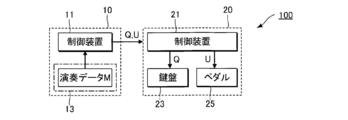
- FIG. 1 is a block diagram illustrating the configuration of an automatic performance system 100 according to the first embodiment of the present invention.
- the automatic performance system 100 is a computer system that automatically performs music.
- the automatic performance system 100 includes an information processing device 10 and an automatic performance instrument 20.
- the information processing device 10 is a computer system that generates various data used for automatic performance by the automatic performance instrument 20 from data M (hereinafter, referred to as “performance data”) representing performance contents.
- performance data data
- an information terminal such as a mobile phone, a smartphone, or a personal computer is suitably used as the information processing device 10.
- the automatic musical instrument 20 is a keyboard musical instrument that performs an automatic performance based on various data generated by the information processing apparatus 10.
- an automatic performance piano is exemplified as the automatic performance instrument 20.
- the automatic musical instrument 20 includes a keyboard 23 composed of a plurality of keys used for producing a plurality of different pitches, and a pedal 25 for extending the sound produced by pressing a key. I do.
- the information processing apparatus 10 and the automatic musical instrument 20 are connected, for example, by wire or wirelessly.
- the information processing device 10 may be mounted on the automatic musical instrument 20.
- the information processing device 10 includes a control device 11 and a storage device 13.
- the control device 11 is a processing circuit such as a CPU (Central Processing Unit), for example, and controls each element of the information processing device 10 in an integrated manner.
- the storage device 13 stores a program executed by the control device 11 and various data used by the control device 11.
- a known recording medium such as a magnetic recording medium or a semiconductor recording medium is used as the storage device 13.
- the storage device 13 may be configured by a combination of a plurality of types of recording media.
- a portable recording medium that can be attached to and detached from the information processing apparatus 10 or an external recording medium (for example, an online storage) with which the information processing apparatus 10 can communicate via a communication network can be used as the storage device 13. Good.
- the storage device 13 of the first embodiment stores performance data M of a musical piece to be played by the automatic musical instrument 20.
- FIG. 2 schematically shows the performance data M.
- the performance data M is data representing a sounding period E for each of a plurality of pitches K.
- the period from the time when the tone of each pitch K is started to the time when the tone is muted is a sounding period E.
- data representing the sound generation period E in chronological order is exemplified as the performance data M.
- MIDI data conforming to the MIDI standard is exemplified as the performance data M.
- performance data M is generated from a sound signal obtained by collecting a performance sound of a piano by a player by a sound collection device (for example, a microphone). For example, an audio signal is separated into band components for each pitch K, and a section in which the intensity of each band component exceeds a threshold is extracted as a sounding period E. It should be noted that the performance data M is generated by a similar method from an audio signal recorded in advance and recorded on a recording medium such as a CD. For generating the performance data M, a known music transcription technique is arbitrarily adopted.
- the performance data M of the first embodiment is divided into N different unit periods T1 to TN on the time axis.
- the unit period Tn (1 ⁇ n ⁇ N) is a period (frame) having a time length of about several tens to several hundreds of milliseconds, for example.
- the sounding period E of each pitch K can be continuous over a plurality of unit periods Tn.
- FIG. 3 is a block diagram illustrating a functional configuration of the information processing apparatus 10.
- the control device 11 realizes a plurality of functions (the pre-processing unit 112 and the generation unit 114) by executing a program stored in the storage device 13.
- the function of the control device 11 may be realized by a plurality of devices configured separately from each other. Some or all of the functions of the control device 11 may be realized by a dedicated electronic circuit.
- the pre-processing unit 112 generates the first unit data Xn corresponding to the performance data M for each unit period Tn.
- FIG. 2 schematically shows the first unit data Xn.
- the first unit data Xn corresponding to the unit period Tn includes sounding data An and start point data Bn.
- the sound data An is data indicating whether or not each pitch K is sounded during the unit period Tn.
- the pronunciation data An is represented by a 128-dimensional binary vector corresponding to 128 pitches K1 to K128.
- each bit corresponding to a pitch K having a sound black line in FIG. 2 is set to 1
- each bit corresponding to a pitch K having no sound is set to 0. You.
- the bit corresponding to the pitch K is set to 1 continuously over the sounding data An of the plurality of unit periods Tn. Note that a plurality of pitches K can be generated in a common unit period Tn.
- the start point data Bn is data indicating whether or not the pitch is the start point (hereinafter referred to as “sound start point”) for each pitch K in the unit period Tn.
- the start point data Bn is represented by a 128-dimensional binary vector corresponding to 128 pitches K1 to K128.
- each bit corresponding to the pitch K black line in FIG. 2 which is the start point is set to 1
- each bit corresponding to the pitch K which is not the start point is set to 0.
- the bit corresponding to the pitch K of the start point data Bn corresponding to the first unit period Tn is set to 1.
- a time series of N sets of first unit data X1 to XN corresponding to each unit period Tn is generated from the performance data M.
- the generation unit 114 in FIG. 3 generates key press data Q and pedal data U from the performance data M.
- the key press data Q and the pedal data U are used for automatic performance by the automatic performance instrument 20.
- FIG. 2 schematically shows key press data Q and pedal data U. As illustrated in FIG. 2, both the key press data Q and the pedal data U are divided into N unit periods T1 to TN similarly to the performance data M. That is, key press data Q and pedal data U having the same time length as the performance data M are generated.
- the key depression data Q is data representing a period H during which a key corresponding to each pitch K is depressed (hereinafter referred to as a “key depression period”).
- the period from when the key press starts to when the key press ends (ie, when the key is released) is the key press period H.
- the pedal data U is data representing a period (hereinafter, referred to as an “operation period”) S during which the pedal is operated.
- the period from the time when the operation of the pedal is started to the time when the operation is ended is an operation period S.
- a learning model in which the relationship between the input corresponding to the performance data M and the output corresponding to the key press data Q and the pedal data U is learned is exemplified as the generation unit 114.
- the learned model according to the first embodiment receives the first unit data Xn generated by the pre-processing unit 112 as an input and corresponds to the second unit data Yn corresponding to the key press data Q and the pedal data U for each unit period Tn. And outputs the third unit data Zn.
- FIG. 2 schematically shows the second unit data Yn and the third unit data Zn generated by the generation unit 114.
- the second unit data Yn is a portion of the key press data Q corresponding to the unit period Tn
- the third unit data Zn is a portion of the pedal data U corresponding to the unit period Tn. It is. That is, the time series of the second unit data Y1-YN of the N unit periods T1-TN is the key press data Q, and the time series of the third unit data Z1-ZN of the N unit periods T1-TN is the pedaling data.
- the second unit data Yn is a portion of the key press data Q corresponding to the unit period Tn
- the third unit data Zn is a portion of the pedal data U corresponding to the unit period Tn.
- the second unit data Yn is data indicating whether or not a key corresponding to each pitch K has been pressed.
- the second unit data Yn is represented by a 128-dimensional binary vector corresponding to 128 pitches K1 to K128.
- each bit corresponding to the pitch K of the key with the key pressed (black line in FIG. 2) is set to 1, and corresponds to the pitch K of the key without the key pressed.
- the bit corresponding to the pitch K is set to 1 continuously over the second unit data Yn of the plurality of unit periods Tn.
- the key pressing period H corresponding to each pitch K is expressed by the time series of the second unit data Y1 to YN of the N consecutive unit periods T1 to TN (that is, the key pressing data Q). Note that a plurality of pitches K can be depressed in a common unit period Tn.
- the key press data Q is generated by arranging the second unit data Yn in a time series for each of the N unit periods T1 to TN.
- the third unit data Zn is data indicating whether or not the pedal is operated.
- the third unit data Zn is represented by one bit.
- the operation period S is continuous over a plurality of unit periods Tn, it is set to 1 continuously over the third unit data Zn of the plurality of unit periods Tn. That is, the pedal operation period S is represented by the time series of the third unit data Z1 to ZN of the N consecutive unit periods T1 to TN (that is, the pedal data U).
- the pedal data U is generated by arranging the third unit data Zn in a time series for each of the N unit periods T1 to TN.
- a period in which the sounding period of the key pressing period H represented by the key pressing data Q is extended according to the contents of the pedal data U corresponds to the sounding period E of the performance data M.
- the learned model is a statistical prediction model that has learned the relationship between the performance data M, the key press data Q, and the pedal data U.
- a learned model that has learned the relationship between the first unit data Xn, the second unit data Yn, and the third unit data Zn is used.
- a neural network is suitably used as the trained model.
- the trained model includes a plurality of layers of long-term and short-term memory (LSTM: Long ⁇ Short ⁇ Term ⁇ Memory) units connected in series.
- the long-term storage unit is a specific example of a recurrent neural network (RNN: Recurrent Neural Network) suitable for analyzing time-series data.
- RNN Recurrent Neural Network
- the learned model includes a program (for example, a program module configuring artificial intelligence software) that causes the control device 11 to execute an operation of generating the key press data Q and the pedal data U from the performance data M, This is realized in combination with a plurality of applied coefficients.
- a plurality of coefficients defining the learned model are set by machine learning (particularly deep learning) using a plurality of sets of learning data, and are stored in the storage device 13.
- Each set of learning data is data in which the first unit data Xn corresponds to the correct value of the second unit data Yn and the third unit data Zn.
- the second unit data Yn and the third unit data Zn are generated by inputting the first unit data Xn of the learning data to a model in which a plurality of coefficients are provisionally set (hereinafter referred to as a “temporary model”).
- the plurality of coefficients of the tentative model are sequentially updated so that the evaluation function representing the error between the obtained second unit data Yn and third unit data Zn and the correct value of the learning data is minimized.
- an error back propagation method is suitably used for updating each coefficient according to the evaluation function.
- the above-described update of the coefficient is repeated, and the provisional model at the stage when the predetermined condition is satisfied is used as a deterministic learned model.
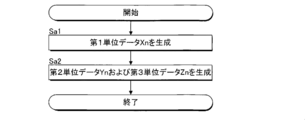
- FIG. 4 is a flowchart illustrating a process executed by the control device 11. The process of FIG. 4 is executed for each unit period Tn.
- the preprocessing unit 112 When the processing in FIG. 4 is started, the preprocessing unit 112 generates the first unit data Xn from the performance data M stored in the storage device 13 (Sa1). First unit data Xn is generated for each of the N unit periods T1 to TN.
- the generation unit 114 generates second unit data Yn and third unit data Zn from the first unit data Xn generated by the preprocessing unit 112 (Sa2).
- the used model is used as the generation unit 114. Since the second unit data Yn and the third unit data Zn are output for each of the N unit periods T1 to TN, key press data Q and pedal data U are generated.
- the automatic musical instrument 20 of FIG. 1 executes an automatic musical performance using the key press data Q and the pedal data U generated by the information processing device 10.
- the automatic musical instrument 20 includes a control device 21 in addition to the keyboard 23 and the pedal 25 described above.
- the control device 21 is a processing circuit such as a CPU, for example, and generally controls each element of the automatic musical instrument 20.
- the operation of the keyboard 23 and the operation of the pedal 25 are controlled by the control device 21.
- the control device 21 of the first embodiment operates a plurality of keys constituting the keyboard 23 in accordance with the key press data Q. Specifically, the control device 21 starts key depression at the start point of the key depression period H specified by the key depression data Q for each key, and releases the key at the end point of the key depression period H. Further, the control device 21 of the first embodiment operates the pedal 25 according to the pedal data U. Specifically, the control device 21 starts the operation of the pedal 25 at the start point of the operation period S specified by the pedal data U, and ends the operation of the pedal 25 at the end point of the operation period S.
- the keyboard 23 and the pedal 25 operate under the control described above. Therefore, each pitch K emitted according to the key pressing period H of the key pressing data Q is extended according to the operation period S of the pedal data U.
- the key press data Q and the pedal data U are generated from the performance data M.
- the performance data M is data representing the content of the performance of a musical piece, and does not distinguish between a sound produced by pressing a key and an extension of sound produced by operating a pedal.
- the pedal data U can be generated from the performance data M in which the key depression and the pedal operation are not distinguished as described above.
- the key press data Q and the pedal data U can be generated separately from the performance data M in which the key press and the pedal operation are not distinguished as described above.
- the key press data Q and the pedal data U are appropriately set according to the tone generation period E of each pitch K. Can be generated.
- the learned model that has learned the relationship between the input corresponding to the performance data M and the output corresponding to the key press data Q and the pedal data U generates the key press data Q and the pedal data U. Therefore, for example, the key pressing data Q and the pedal data U are compared with the method of generating the key pressing data Q and the pedal data U under the rule that the predetermined time from the sound generation start point is the key pressing period H and the operation period S of the pedal 25 is thereafter.
- the key press data Q and the pedal data U can be appropriately generated from the performance data M.
- the key press data Q And pedal data U can be generated.
- the learned model is a recursive neural network that inputs the first unit data Xn and outputs the second unit data Yn and the third unit data Zn for each unit period Tn. Therefore, a time series of the second unit data Yn (that is, key press data Q) and a time series of the third unit data Zn (that is, pedal data U) are generated.
- the first unit data Xn includes the sound data An and the start point data Bn. Therefore, the key press data Q and the pedal data U can be appropriately generated according to whether or not each pitch K is sounded and whether or not it is the sound start point.
- FIG. 5 is a block diagram illustrating a functional configuration of the information processing apparatus 10 according to the second embodiment.
- the control device 11 according to the second embodiment implements a post-processing unit 116 in addition to the pre-processing unit 112 and the generating unit 114 similar to the first embodiment.
- the post-processing unit 116 executes a process of correcting the key press data Q generated by the generation unit 114 in accordance with the performance data M (hereinafter, referred to as “correction process”).
- the correction process of the second embodiment is a process of correcting the key press data Q according to the start point data Bn.
- Correction key press data W is generated by the correction process.
- the automatic musical instrument 20 according to the second embodiment performs an automatic performance according to the pedal data U generated by the generating unit 114 and the modified key press data W generated by the post-processing unit 116.
- FIG. 6 is an explanatory diagram for explaining the content of the correction processing 1.
- the key-pressing data Q does not include a key-pressing period H corresponding to the sound-generating start point P, although the sound-generating start point P of the pitch K exists in the start-point data Bn. I do.
- the existence of the tone generation start point P indicates that the key is pressed, and thus it can be estimated that the key pressing period H has been overlooked. Therefore, in the correction process 1, if the key pressing data Q does not include the key pressing period H starting from the tone generation start point P of the start point data Bn, a key pressing period H having a predetermined length is added. That is, the post-processing unit 116 generates the modified key press data W by adding a key press period H of a predetermined length starting from the sound generation start point P to the key press data Q.
- the key press period H having a predetermined length starting from the sound generation start point is used. It is added to the key press data Q. Therefore, it is possible to appropriately add the key pressing period H to a place where the key pressing period H should actually exist (that is, a point where the generation unit 114 cannot detect the key pressing period H).
- FIG. 7 is an explanatory diagram for explaining the content of the correction processing 2.
- a first sounding start point P1 exists within a key pressing period H indicated by key pressing data Q
- a second sounding starting point P2 exists immediately after the first sounding start point P1.
- the correction process 2 a case where a plurality of start points (first sound generation start point P1 and second sound generation start point P2) exist in the start point data Bn within one key press period H represented by the key press data Q.
- the key pressing period H is separated.
- the post-processing unit 116 determines that the key press data Q represents the key press period H1 starting from the first sound generation start point P1 and the key press period H2 starting from the second sound generation start point P2. By separating the key period H, modified key press data W is generated.
- the first sound generation start point P1 and the second sound generation start point P2 exist within the key press period H represented by the key press data Q
- the first sound generation start point is set as the start point.
- the key pressing period H1 represented by the key pressing data Q is separated into a key pressing period H1 and a key pressing period H2 starting from the second sounding start point. Therefore, by adding the key depression period H2 which is originally required, the key depression period H can be appropriately generated for each sound generation start point.
- FIG. 8 is an explanatory diagram for explaining the content of the correction processing 3.
- the first key pressing period H1 and the second key pressing period H2 are periods separated from each other on the time axis. Note that there is a sounding start point P corresponding to the start point of the first key pressing period H1. If the sounding start point P does not exist, the key pressing period H corresponding to the sounding start point P should not exist. Therefore, it is estimated that the second key pressing period H2 in which the corresponding sounding start point P does not exist is unnecessary. it can.
- the post-processing unit 116 generates the modified key press data W by deleting the second key press period H2 from the key press data Q.
- the second key press period H2 is deleted from the key press data Q. Therefore, the key pressing period H can be appropriately generated for each sound generation start point P by deleting the key pressing period H2 which is originally unnecessary.
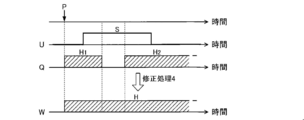
- FIG. 9 is an explanatory diagram for explaining the content of the correction processing 4.
- the modification process 4 as in the modification process 3, it is assumed that there is no tone generation start point at the start point of the second key press period H2 in the key press data Q.
- the pedal data U generated by the generation unit 114 is also added to the correction of the key press data Q.
- the operation period S in the pedal data U is continuous over the first key pressing period H1 and the second key pressing period H2
- the correction process 4 is executed.
- the start point of the operation period S of the pedal data U is located before the end point of the first key press period H1, and the end point of the operation period S of the pedal data U is set to the end point of the second key press period H2. This is the case when it exists after the start point.
- the tone generation start point P does not exist in the start point data Bn corresponding to the start point of the second key press period H2 in the key press data Q, and the operation period S in the pedal data U is the first key press period.
- the key period H1 and the second key pressing period H2 are continuous, the first key pressing period H1 and the second key pressing period H2 are connected. That is, the post-processing unit 116 generates the modified key press data W by linking the first key press period H1 and the second key press period H2 in the key press data Q.
- the tone generation start point P of the start point data Bn does not exist at the start point of the second key press period H2 in the key press data Q, and the operation period S in the pedal data U is the first key press period.
- the first key pressing period H1 and the second key pressing period H2 are linked in the key pressing data Q. Therefore, two key pressing periods H1 and H2, which should be consecutive key pressing periods H, can be appropriately connected.
- the correction processing 3 is executed in principle, but the operation of the pedal data U is performed.
- the correction process 4 is exceptionally executed. In the correction process 4, only the pedal data U may be added to the correction of the key press data Q. That is, the addition of the start point data Bn is not essential in the correction processing 4.
- the second embodiment also achieves the same effects as the first embodiment.
- the key press data Q is corrected according to the start point data Bn, there is an advantage that the key press data Q can be corrected so as to appropriately reflect the tendency of the start point data Bn. is there.
- the correction processing is not limited to the correction processing 1-4 described above.
- a correction process for extending the key pressing period H of the key pressing data Q according to the performance data M is also exemplified.
- a configuration in which the pedal data U is modified in accordance with the performance data M, a configuration in which the key press data Q is modified in accordance with the pedal data U, or a configuration in which the pedal data U is modified in accordance with the key press data Q is also adopted.
- the key press data Q and the pedal data U are generated by using the learned model. For example, a predetermined time from the sound generation start point is set as the key press period H, and thereafter, the pedal operation is performed. Under the rule of the period S, the key press data Q and the pedal data U may be generated. As understood from the above description, the generation unit 114 is not limited to the learned model.
- the data representing the sounding period E for each pitch K is used as the performance data M, but the performance data M is not limited to the above examples.
- sound data representing a waveform of a performance sound may be used as the performance data M.
- performance data M representing a time series (amplitude spectrogram) of the amplitude spectrum may be used.
- the key press data Q and the pedal data U are generated from the music performance data M stored in the storage device 13 in advance. In parallel with the generation of the data M, the key press data Q and the pedal data U may be generated from the performance data M.
- the first unit data Xn corresponding to the performance data M is input and the second unit data Yn corresponding to the key press data Q and the pedal data U are input for each unit period Tn.
- the learned model that outputs the third unit data Zn is used, the learned model is not limited to the above example.
- a learned model that inputs performance data M and outputs key press data Q and pedal data U may be used. That is, the preprocessing unit 112 that generates the first unit data Xn is not essential.
- the input corresponding to the performance data M includes the performance data M itself and data (for example, the first unit data Xn) generated from the performance data M.
- the output corresponding to the key press data Q and the pedal data U includes the key press data Q and the pedal data U itself, the data corresponding to the key press data Q (for example, the second unit data Yn), and the output corresponding to the pedal data U. (For example, third unit data Zn).
- the learning data used for machine learning for generating a learned model is appropriately changed according to the content of the learned model.
- the first unit data Xn for each unit period Tn is input to the generation unit 114, but a time series of the first unit data Xn over a plurality of unit periods Tn including the unit period Tn is generated.
- the information may be input to the unit 114.
- the first unit data Xn of a predetermined number of unit periods Tn extending before and after the unit period Tn is input to the generation unit 114.
- a learned model without recursion can be preferably used.
- any neural network such as a convolutional neural network (CNN) can be used as the trained model.
- CNN convolutional neural network
- the first unit data Xn includes the sound data An and the start point data Bn, but the start point data Bn is not essential. That is, it is possible to generate the key press data Q and the pedal data U only from the sound data An.
- the key press data Q and the pedal data U are compared with the configuration in which only the sound data An is included in the first unit data Xn. Can be generated appropriately.
- the first unit data Xn may include other data different from the sound data An and the start point data Bn.
- the first unit data Xn may include volume data representing the volume for each unit period Tn.
- a multi-value vector expressing the volume in multiple stages is used as the volume data.
- the sound data An in which the presence or absence of sound is expressed by a binary vector for each pitch K is illustrated, but the sound data An is not limited to the above examples.
- a multi-valued vector representing the strength of the pronunciation in multiple steps for each pitch K may be used as the pronunciation data An.
- the numerical value for each pitch K in the sound data An is set to 0 when there is no sound of the pitch K, and when there is sound of the pitch K, the numerical value corresponding to the strength of the sound is set. Set to the numerical value of the stage.
- the second unit data Yn in which the presence / absence of a key corresponding to each pitch K is expressed by a binary vector is illustrated, but the second unit data Yn is limited to the above example. Not done.
- a multi-value vector representing the strength of the key depression in multiple steps for each pitch K may be used as the second unit data Yn.
- the numerical value for each pitch K of the second unit data Yn is set to 0 when there is no key depression at the pitch K, and when there is a key depression at the pitch K, the strength of the key depression is set. It is set to a multi-step numerical value according to the depth (depth).
- the third unit data Zn in which the presence or absence of the pedal operation is represented by a binary vector is illustrated, but the third unit data Zn is not limited to the above example.
- a multi-value vector representing the strength of the pedal operation in multiple stages may be used as the third unit data Zn.
- the numerical value of the third unit data Zn is set to 0 when there is no pedal operation, and when there is a pedal operation, it is set to a multi-step numerical value according to the strength of the pedal operation (the degree of depression). You.
- the information processing device 10 may be mounted on a server device capable of communicating with the automatic musical instrument 20 via a communication network such as the Internet.
- the automatic performance piano is exemplified as the automatic performance instrument 20, but the automatic performance instrument 20 is not limited to the automatic performance piano as long as it has a keyboard and a pedal.
- a marimba capable of automatic performance may be used as the automatic performance instrument 20.
- the information processing apparatus 10 including both the preprocessing unit 112 and the generation unit 114 has been described as an example.
- the preprocessing unit 112 and the generation unit 114 may be realized by separate devices.
- the first unit data Xn generated by the preprocessing unit 112 of the information processing device 10 is transmitted to a server device capable of communicating with the information processing device 10, and the second unit data Yn and the second unit data Yn are generated by the generation unit 114 of the server device.
- the three-unit data Zn may be generated.
- the post-processing unit 116 may be realized by a device separate from the information processing device 10.
- the functions of the information processing apparatus 10 according to the above-described embodiments are realized by cooperation between a computer (for example, the control apparatus 11) and a program.
- a program according to a preferred embodiment of the present invention is provided in a form stored in a computer-readable recording medium and installed in a computer.
- the recording medium is, for example, a non-transitory recording medium, and an optical recording medium (optical disc) such as a CD-ROM is a good example, and a known arbitrary recording medium such as a semiconductor recording medium or a magnetic recording medium is used. In the form of a recording medium.
- non-transitory recording medium includes any recording medium except for a transient propagation signal (transitory, ⁇ propagating ⁇ signal), and does not exclude a volatile recording medium.
- the program may be provided to the computer in a form of distribution via a communication network.
- the execution subject of the artificial intelligence software for realizing the learned model is not limited to the CPU.
- a processing circuit dedicated to a neural network such as a Tensor Processing Unit and a Neural Engine, or a DSP (Digital Signal Processor) dedicated to artificial intelligence may execute the artificial intelligence software.
- a plurality of types of processing circuits selected from the above examples may cooperate to execute the artificial intelligence software.
- the generating unit 114 converts both the key press data Q (second unit data Yn) and the pedal data U (third unit data Zn) from the performance data M (first unit data Xn). However, only the pedal data U (third unit data Zn) may be generated. In this case, the learned model forming the generating unit 114 is based on data obtained by associating the first unit data Xn with the correct value of the third unit data Zn (the second unit data Yn is not associated). Can be done.
- An information processing method is characterized in that, based on performance data representing performance contents, key depression data representing a key depression period of a key corresponding to each of a plurality of pitches, And pedal data representing the operation period of the pedal for extending the pronunciation. According to the above aspect, it is possible to generate key press data and pedal data from performance data representing performance contents.
- the performance data is data representing a sounding period for each of the pitches. According to the above aspect, since the data representing the sounding period for each pitch is used as performance data, it is possible to appropriately generate key press data and pedal data according to the sounding period of each pitch.
- a learned model that has learned a relationship between an input corresponding to the performance data and an output corresponding to the key press data and the pedal data is used to generate the learned model from the performance data.
- Key press data and the pedal data are generated.
- the learned model that has learned the relationship between the input corresponding to the performance data and the output corresponding to the key press data and the pedal data generates the key press data and the pedal data. Therefore, for example, under the rule that a predetermined time from the sounding start point is a key pressing period and thereafter the pedal operation period, the key pressing data and the pedal data are compared with the method of generating the key pressing data and the pedal data, and the performance data is compared with the key generating data. Key press data and pedal data can be generated appropriately.
- the learned model is configured such that, for each unit period, the first unit data corresponding to the performance data is input, and the second unit data corresponding to the key press data and A recurrent neural network that outputs third unit data corresponding to the pedal data, wherein the first unit data includes pronunciation data indicating whether or not each of the pitches is produced; and the second unit data includes: The presence / absence of depression of a key corresponding to each pitch is indicated, and the third unit data indicates the presence / absence of operation of the pedal.
- the learned model is a recursive neural network that receives the first unit data and outputs the second unit data and the third unit data for each unit period
- the second unit data Ie, key press data
- the time series of third unit data ie, pedal data
- the first unit data includes sounding data indicating whether or not each pitch is sounded, it is possible to appropriately generate key press data and pedal data in accordance with whether or not each pitch is sounded.
- the first unit data includes start point data indicating whether or not each pitch is a sound generation start point.
- the key press data and the pedal are appropriately determined according to whether or not the pitch is the sound generation start point. Data can be generated.
- the key press data is corrected according to the start point data.
- the key press data is corrected according to the start point data, so that the key press data can be corrected so as to appropriately reflect the tendency of the start point data.
- a predetermined length of the sounding start point is set as the starting point.
- the key press period is added to the key press data.
- a first sounding start point and a second sounding start point immediately after the first sounding start point within a key pressing period represented by the key pressing data is separated into a key press period starting from the first sound generation start point and a key press period starting from the second sound generation start point.
- the first tone generation start point is determined.
- the key pressing period represented by the key pressing data is separated into a key pressing period starting from the point and a key pressing period starting from the second sounding start point. Therefore, by adding a key depression period that is originally required, a key depression period can be appropriately generated for each sound generation start point.
- sound generation is started at the start point data corresponding to a start point of a second key press period immediately after the first key press period in the key press data. If there is no point, the second key press period is deleted from the key press data. According to the above aspect, when there is no tone generation start point at the start point of the second key press period immediately after the first key press period in the key press data, the second key press period is deleted from the key press data. . Therefore, by deleting a key depression period which is not originally necessary, a key depression period can be appropriately generated for each sound generation start point.
- the sound generation start point of the start point data is set at a start point of a second key press period immediately after the first key press period in the key press data. If the key press data does not exist and the operation period in the pedal data is continuous over the first key press period and the second key press period, the first key press period and the second key press Concatenate with the key period.
- the sound generation start point of the start point data does not exist at the start point of the second key depression period immediately after the first key depression period in the key depression data, and the operation period in the pedal data is the first depression period.
- the key period and the second key pressing period are continuous, the first key pressing period and the second key pressing period are linked in the key pressing data. Therefore, two key pressing periods that should be consecutive key pressing periods can be appropriately connected.
- the information processing method includes generating, from performance data representing performance contents, pedal data representing an operation period of a pedal for extending sounding by pressing a key.
- the pedal data can be generated from the performance data representing the performance content.
- the generating includes generating a learned model that has learned a relationship between an input corresponding to the performance data and an output corresponding to the pedal data from the performance data. Generating the pedal data.
- the preferred embodiment of the present invention is also realized as an information processing apparatus that executes the information processing method of each of the above-described embodiments or a program that causes a computer to execute the information processing method of each of the above-described embodiments.
- Reference Signs List 100 automatic performance system, 10 information processing device, 11 control device, 112 pre-processing unit, 114 generation unit, 116 post-processing unit, 13 storage device, 20 automatic musical instrument, 21 control device, 23 ... keyboard, 25 ... pedal.
Landscapes
- Engineering & Computer Science (AREA)
- Physics & Mathematics (AREA)
- Theoretical Computer Science (AREA)
- General Health & Medical Sciences (AREA)
- Computing Systems (AREA)
- Biomedical Technology (AREA)
- Biophysics (AREA)
- Computational Linguistics (AREA)
- Data Mining & Analysis (AREA)
- Evolutionary Computation (AREA)
- Life Sciences & Earth Sciences (AREA)
- Molecular Biology (AREA)
- Artificial Intelligence (AREA)
- General Engineering & Computer Science (AREA)
- General Physics & Mathematics (AREA)
- Mathematical Physics (AREA)
- Software Systems (AREA)
- Health & Medical Sciences (AREA)
- Acoustics & Sound (AREA)
- Multimedia (AREA)
- Electrophonic Musical Instruments (AREA)
- Auxiliary Devices For Music (AREA)
Priority Applications (3)
| Application Number | Priority Date | Filing Date | Title |
|---|---|---|---|
| CN201980058992.4A CN112753067B (zh) | 2018-09-19 | 2019-08-30 | 演奏数据的信息处理装置 |
| EP19862004.9A EP3855425A4 (en) | 2018-09-19 | 2019-08-30 | INFORMATION PROCESSING DEVICE FOR READ DATA |
| US17/204,340 US12249305B2 (en) | 2018-09-19 | 2021-03-17 | Information processing method, information processing device and a non-transitory storage medium |
Applications Claiming Priority (2)
| Application Number | Priority Date | Filing Date | Title |
|---|---|---|---|
| JP2018-174785 | 2018-09-19 | ||
| JP2018174785A JP7103106B2 (ja) | 2018-09-19 | 2018-09-19 | 情報処理方法および情報処理装置 |
Related Child Applications (1)
| Application Number | Title | Priority Date | Filing Date |
|---|---|---|---|
| US17/204,340 Continuation US12249305B2 (en) | 2018-09-19 | 2021-03-17 | Information processing method, information processing device and a non-transitory storage medium |
Publications (1)
| Publication Number | Publication Date |
|---|---|
| WO2020059465A1 true WO2020059465A1 (ja) | 2020-03-26 |
Family
ID=69888775
Family Applications (1)
| Application Number | Title | Priority Date | Filing Date |
|---|---|---|---|
| PCT/JP2019/034188 Ceased WO2020059465A1 (ja) | 2018-09-19 | 2019-08-30 | 演奏データの情報処理装置 |
Country Status (5)
| Country | Link |
|---|---|
| US (1) | US12249305B2 (https=) |
| EP (1) | EP3855425A4 (https=) |
| JP (2) | JP7103106B2 (https=) |
| CN (1) | CN112753067B (https=) |
| WO (1) | WO2020059465A1 (https=) |
Families Citing this family (2)
| Publication number | Priority date | Publication date | Assignee | Title |
|---|---|---|---|---|
| CN113012668B (zh) * | 2019-12-19 | 2023-12-29 | 雅马哈株式会社 | 键盘装置及发音控制方法 |
| JP2025131948A (ja) | 2022-08-02 | 2025-09-10 | シャープ株式会社 | 端末装置、基地局装置、および、通信方法 |
Citations (5)
| Publication number | Priority date | Publication date | Assignee | Title |
|---|---|---|---|---|
| JP2001290474A (ja) * | 2000-04-06 | 2001-10-19 | Japan Science & Technology Corp | 音楽情報解析装置、音楽情報解析方法及び音楽情報解析プログラムを記録した記録媒体 |
| JP2005301299A (ja) * | 1998-02-05 | 2005-10-27 | Casio Comput Co Ltd | 楽音データ変換装置、操作指示装置及び記憶媒体 |
| JP2017102415A (ja) | 2015-12-04 | 2017-06-08 | ヤマハ株式会社 | 演奏システム |
| JP2017102414A (ja) * | 2015-12-04 | 2017-06-08 | ヤマハ株式会社 | 信号処理装置、演奏システム、及び演奏制御方法 |
| JP2018063295A (ja) * | 2016-10-11 | 2018-04-19 | ヤマハ株式会社 | 演奏制御方法および演奏制御装置 |
Family Cites Families (8)
| Publication number | Priority date | Publication date | Assignee | Title |
|---|---|---|---|---|
| JPH06118945A (ja) * | 1992-10-02 | 1994-04-28 | Yamaha Corp | 自動ピアノのペダル駆動データ作成方法 |
| JPH08227288A (ja) * | 1995-02-22 | 1996-09-03 | Roland Corp | 押鍵速度変換器および電子楽器 |
| US6025550A (en) | 1998-02-05 | 2000-02-15 | Casio Computer Co., Ltd. | Musical performance training data transmitters and receivers, and storage mediums which contain a musical performance training program |
| JP2004045455A (ja) * | 2002-07-08 | 2004-02-12 | Roland Corp | 電子楽器 |
| JP2005265903A (ja) * | 2004-03-16 | 2005-09-29 | Yamaha Corp | 鍵盤楽器 |
| US20090022331A1 (en) * | 2007-07-16 | 2009-01-22 | University Of Central Florida Research Foundation, Inc. | Systems and Methods for Inducing Effects In A Signal |
| WO2013166188A1 (en) * | 2012-05-01 | 2013-11-07 | Orshan Jesse Harris | Virtual audio effects package and corresponding network |
| US11295739B2 (en) * | 2018-08-23 | 2022-04-05 | Google Llc | Key phrase spotting |
-
2018
- 2018-09-19 JP JP2018174785A patent/JP7103106B2/ja active Active
-
2019
- 2019-08-30 WO PCT/JP2019/034188 patent/WO2020059465A1/ja not_active Ceased
- 2019-08-30 EP EP19862004.9A patent/EP3855425A4/en not_active Withdrawn
- 2019-08-30 CN CN201980058992.4A patent/CN112753067B/zh active Active
-
2021
- 2021-03-17 US US17/204,340 patent/US12249305B2/en active Active
-
2022
- 2022-06-20 JP JP2022098702A patent/JP7343012B2/ja active Active
Patent Citations (5)
| Publication number | Priority date | Publication date | Assignee | Title |
|---|---|---|---|---|
| JP2005301299A (ja) * | 1998-02-05 | 2005-10-27 | Casio Comput Co Ltd | 楽音データ変換装置、操作指示装置及び記憶媒体 |
| JP2001290474A (ja) * | 2000-04-06 | 2001-10-19 | Japan Science & Technology Corp | 音楽情報解析装置、音楽情報解析方法及び音楽情報解析プログラムを記録した記録媒体 |
| JP2017102415A (ja) | 2015-12-04 | 2017-06-08 | ヤマハ株式会社 | 演奏システム |
| JP2017102414A (ja) * | 2015-12-04 | 2017-06-08 | ヤマハ株式会社 | 信号処理装置、演奏システム、及び演奏制御方法 |
| JP2018063295A (ja) * | 2016-10-11 | 2018-04-19 | ヤマハ株式会社 | 演奏制御方法および演奏制御装置 |
Also Published As
| Publication number | Publication date |
|---|---|
| JP2020046533A (ja) | 2020-03-26 |
| US20210201865A1 (en) | 2021-07-01 |
| CN112753067B (zh) | 2024-09-10 |
| JP7103106B2 (ja) | 2022-07-20 |
| JP2022123072A (ja) | 2022-08-23 |
| EP3855425A4 (en) | 2022-06-01 |
| CN112753067A (zh) | 2021-05-04 |
| JP7343012B2 (ja) | 2023-09-12 |
| EP3855425A1 (en) | 2021-07-28 |
| US12249305B2 (en) | 2025-03-11 |
Similar Documents
| Publication | Publication Date | Title |
|---|---|---|
| JP6708179B2 (ja) | 情報処理方法、情報処理装置およびプログラム | |
| US11942106B2 (en) | Apparatus for analyzing audio, audio analysis method, and model building method | |
| CN111602193B (zh) | 用于处理乐曲的演奏的信息处理方法和装置 | |
| JP7343012B2 (ja) | 情報処理装置および情報処理方法 | |
| CN112669811B (zh) | 一种歌曲处理方法、装置、电子设备及可读存储介质 | |
| CN113539215B (zh) | 音乐风格转换方法、装置、设备及存储介质 | |
| JP6708180B2 (ja) | 演奏解析方法、演奏解析装置およびプログラム | |
| CN114556465B (zh) | 演奏解析方法、演奏解析装置以及计算机程序产品 | |
| CN115176307A (zh) | 推定模型构建方法、演奏解析方法、推定模型构建装置及演奏解析装置 | |
| US12510966B2 (en) | Haptic feedback method, system and related device for matching split-track music to vibration | |
| US11875777B2 (en) | Information processing method, estimation model construction method, information processing device, and estimation model constructing device | |
| CN113228158B (zh) | 演奏校正方法及演奏校正装置 | |
| JP7147384B2 (ja) | 情報処理方法および情報処理装置 | |
| US10431191B2 (en) | Method and apparatus for analyzing characteristics of music information | |
| CN116631359B (zh) | 乐曲的生成方法、装置、计算机可读介质及电子设备 | |
| CN113196381A (zh) | 音响解析方法以及音响解析装置 | |
| JP6733487B2 (ja) | 音響解析方法および音響解析装置 | |
| CN112420004B (zh) | 生成歌曲的方法、装置、电子设备及计算机可读存储介质 | |
| CN115331648A (zh) | 音频数据处理方法、装置、设备、存储介质及产品 | |
| CN117321675A (zh) | 乐谱制作装置、训练装置、乐谱制作方法以及训练方法 | |
| US20230410676A1 (en) | Information processing system, electronic musical instrument, information processing method, and machine learning system | |
| CN120877703B (zh) | 一种基于音频处理模型的音频生成方法和装置 | |
| CN116805480A (zh) | 音响设备及该音响设备的参数输出方法 | |
| JP2024033382A (ja) | 楽器識別方法、楽器識別装置、および、楽器識別プログラム | |
| JP2017078829A (ja) | 演奏解析装置 |
Legal Events
| Date | Code | Title | Description |
|---|---|---|---|
| 121 | Ep: the epo has been informed by wipo that ep was designated in this application |
Ref document number: 19862004 Country of ref document: EP Kind code of ref document: A1 |
|
| NENP | Non-entry into the national phase |
Ref country code: DE |
|
| ENP | Entry into the national phase |
Ref document number: 2019862004 Country of ref document: EP Effective date: 20210419 |