WO2020057096A1 - 一种原位碳化硅-铁硅复合材料及其制备方法 - Google Patents
一种原位碳化硅-铁硅复合材料及其制备方法 Download PDFInfo
- Publication number
- WO2020057096A1 WO2020057096A1 PCT/CN2019/080546 CN2019080546W WO2020057096A1 WO 2020057096 A1 WO2020057096 A1 WO 2020057096A1 CN 2019080546 W CN2019080546 W CN 2019080546W WO 2020057096 A1 WO2020057096 A1 WO 2020057096A1
- Authority
- WO
- WIPO (PCT)
- Prior art keywords
- silicon carbide
- iron
- composite material
- situ
- raw materials
- Prior art date
- Legal status (The legal status is an assumption and is not a legal conclusion. Google has not performed a legal analysis and makes no representation as to the accuracy of the status listed.)
- Ceased
Links
Images

Classifications
-
- C—CHEMISTRY; METALLURGY
- C04—CEMENTS; CONCRETE; ARTIFICIAL STONE; CERAMICS; REFRACTORIES
- C04B—LIME, MAGNESIA; SLAG; CEMENTS; COMPOSITIONS THEREOF, e.g. MORTARS, CONCRETE OR LIKE BUILDING MATERIALS; ARTIFICIAL STONE; CERAMICS; REFRACTORIES; TREATMENT OF NATURAL STONE
- C04B35/00—Shaped ceramic products characterised by their composition; Ceramics compositions; Processing powders of inorganic compounds preparatory to the manufacturing of ceramic products
- C04B35/515—Shaped ceramic products characterised by their composition; Ceramics compositions; Processing powders of inorganic compounds preparatory to the manufacturing of ceramic products based on non-oxide ceramics
- C04B35/56—Shaped ceramic products characterised by their composition; Ceramics compositions; Processing powders of inorganic compounds preparatory to the manufacturing of ceramic products based on non-oxide ceramics based on carbides or oxycarbides
- C04B35/565—Shaped ceramic products characterised by their composition; Ceramics compositions; Processing powders of inorganic compounds preparatory to the manufacturing of ceramic products based on non-oxide ceramics based on carbides or oxycarbides based on silicon carbide
-
- C—CHEMISTRY; METALLURGY
- C04—CEMENTS; CONCRETE; ARTIFICIAL STONE; CERAMICS; REFRACTORIES
- C04B—LIME, MAGNESIA; SLAG; CEMENTS; COMPOSITIONS THEREOF, e.g. MORTARS, CONCRETE OR LIKE BUILDING MATERIALS; ARTIFICIAL STONE; CERAMICS; REFRACTORIES; TREATMENT OF NATURAL STONE
- C04B35/00—Shaped ceramic products characterised by their composition; Ceramics compositions; Processing powders of inorganic compounds preparatory to the manufacturing of ceramic products
- C04B35/622—Forming processes; Processing powders of inorganic compounds preparatory to the manufacturing of ceramic products
-
- C—CHEMISTRY; METALLURGY
- C04—CEMENTS; CONCRETE; ARTIFICIAL STONE; CERAMICS; REFRACTORIES
- C04B—LIME, MAGNESIA; SLAG; CEMENTS; COMPOSITIONS THEREOF, e.g. MORTARS, CONCRETE OR LIKE BUILDING MATERIALS; ARTIFICIAL STONE; CERAMICS; REFRACTORIES; TREATMENT OF NATURAL STONE
- C04B2235/00—Aspects relating to ceramic starting mixtures or sintered ceramic products
- C04B2235/02—Composition of constituents of the starting material or of secondary phases of the final product
- C04B2235/30—Constituents and secondary phases not being of a fibrous nature
- C04B2235/32—Metal oxides, mixed metal oxides, or oxide-forming salts thereof, e.g. carbonates, nitrates, (oxy)hydroxides, chlorides
- C04B2235/327—Iron group oxides, their mixed metal oxides, or oxide-forming salts thereof
- C04B2235/3272—Iron oxides or oxide forming salts thereof, e.g. hematite, magnetite
-
- C—CHEMISTRY; METALLURGY
- C04—CEMENTS; CONCRETE; ARTIFICIAL STONE; CERAMICS; REFRACTORIES
- C04B—LIME, MAGNESIA; SLAG; CEMENTS; COMPOSITIONS THEREOF, e.g. MORTARS, CONCRETE OR LIKE BUILDING MATERIALS; ARTIFICIAL STONE; CERAMICS; REFRACTORIES; TREATMENT OF NATURAL STONE
- C04B2235/00—Aspects relating to ceramic starting mixtures or sintered ceramic products
- C04B2235/02—Composition of constituents of the starting material or of secondary phases of the final product
- C04B2235/30—Constituents and secondary phases not being of a fibrous nature
- C04B2235/42—Non metallic elements added as constituents or additives, e.g. sulfur, phosphor, selenium or tellurium
- C04B2235/422—Carbon
-
- C—CHEMISTRY; METALLURGY
- C04—CEMENTS; CONCRETE; ARTIFICIAL STONE; CERAMICS; REFRACTORIES
- C04B—LIME, MAGNESIA; SLAG; CEMENTS; COMPOSITIONS THEREOF, e.g. MORTARS, CONCRETE OR LIKE BUILDING MATERIALS; ARTIFICIAL STONE; CERAMICS; REFRACTORIES; TREATMENT OF NATURAL STONE
- C04B2235/00—Aspects relating to ceramic starting mixtures or sintered ceramic products
- C04B2235/02—Composition of constituents of the starting material or of secondary phases of the final product
- C04B2235/30—Constituents and secondary phases not being of a fibrous nature
- C04B2235/48—Organic compounds becoming part of a ceramic after heat treatment, e.g. carbonising phenol resins
-
- C—CHEMISTRY; METALLURGY
- C04—CEMENTS; CONCRETE; ARTIFICIAL STONE; CERAMICS; REFRACTORIES
- C04B—LIME, MAGNESIA; SLAG; CEMENTS; COMPOSITIONS THEREOF, e.g. MORTARS, CONCRETE OR LIKE BUILDING MATERIALS; ARTIFICIAL STONE; CERAMICS; REFRACTORIES; TREATMENT OF NATURAL STONE
- C04B2235/00—Aspects relating to ceramic starting mixtures or sintered ceramic products
- C04B2235/60—Aspects relating to the preparation, properties or mechanical treatment of green bodies or pre-forms
- C04B2235/602—Making the green bodies or pre-forms by moulding
-
- C—CHEMISTRY; METALLURGY
- C04—CEMENTS; CONCRETE; ARTIFICIAL STONE; CERAMICS; REFRACTORIES
- C04B—LIME, MAGNESIA; SLAG; CEMENTS; COMPOSITIONS THEREOF, e.g. MORTARS, CONCRETE OR LIKE BUILDING MATERIALS; ARTIFICIAL STONE; CERAMICS; REFRACTORIES; TREATMENT OF NATURAL STONE
- C04B2235/00—Aspects relating to ceramic starting mixtures or sintered ceramic products
- C04B2235/60—Aspects relating to the preparation, properties or mechanical treatment of green bodies or pre-forms
- C04B2235/606—Drying
-
- C—CHEMISTRY; METALLURGY
- C04—CEMENTS; CONCRETE; ARTIFICIAL STONE; CERAMICS; REFRACTORIES
- C04B—LIME, MAGNESIA; SLAG; CEMENTS; COMPOSITIONS THEREOF, e.g. MORTARS, CONCRETE OR LIKE BUILDING MATERIALS; ARTIFICIAL STONE; CERAMICS; REFRACTORIES; TREATMENT OF NATURAL STONE
- C04B2235/00—Aspects relating to ceramic starting mixtures or sintered ceramic products
- C04B2235/65—Aspects relating to heat treatments of ceramic bodies such as green ceramics or pre-sintered ceramics, e.g. burning, sintering or melting processes
- C04B2235/656—Aspects relating to heat treatments of ceramic bodies such as green ceramics or pre-sintered ceramics, e.g. burning, sintering or melting processes characterised by specific heating conditions during heat treatment
-
- C—CHEMISTRY; METALLURGY
- C04—CEMENTS; CONCRETE; ARTIFICIAL STONE; CERAMICS; REFRACTORIES
- C04B—LIME, MAGNESIA; SLAG; CEMENTS; COMPOSITIONS THEREOF, e.g. MORTARS, CONCRETE OR LIKE BUILDING MATERIALS; ARTIFICIAL STONE; CERAMICS; REFRACTORIES; TREATMENT OF NATURAL STONE
- C04B2235/00—Aspects relating to ceramic starting mixtures or sintered ceramic products
- C04B2235/65—Aspects relating to heat treatments of ceramic bodies such as green ceramics or pre-sintered ceramics, e.g. burning, sintering or melting processes
- C04B2235/656—Aspects relating to heat treatments of ceramic bodies such as green ceramics or pre-sintered ceramics, e.g. burning, sintering or melting processes characterised by specific heating conditions during heat treatment
- C04B2235/6567—Treatment time
-
- C—CHEMISTRY; METALLURGY
- C04—CEMENTS; CONCRETE; ARTIFICIAL STONE; CERAMICS; REFRACTORIES
- C04B—LIME, MAGNESIA; SLAG; CEMENTS; COMPOSITIONS THEREOF, e.g. MORTARS, CONCRETE OR LIKE BUILDING MATERIALS; ARTIFICIAL STONE; CERAMICS; REFRACTORIES; TREATMENT OF NATURAL STONE
- C04B2235/00—Aspects relating to ceramic starting mixtures or sintered ceramic products
- C04B2235/65—Aspects relating to heat treatments of ceramic bodies such as green ceramics or pre-sintered ceramics, e.g. burning, sintering or melting processes
- C04B2235/658—Atmosphere during thermal treatment
-
- C—CHEMISTRY; METALLURGY
- C04—CEMENTS; CONCRETE; ARTIFICIAL STONE; CERAMICS; REFRACTORIES
- C04B—LIME, MAGNESIA; SLAG; CEMENTS; COMPOSITIONS THEREOF, e.g. MORTARS, CONCRETE OR LIKE BUILDING MATERIALS; ARTIFICIAL STONE; CERAMICS; REFRACTORIES; TREATMENT OF NATURAL STONE
- C04B2235/00—Aspects relating to ceramic starting mixtures or sintered ceramic products
- C04B2235/70—Aspects relating to sintered or melt-casted ceramic products
- C04B2235/74—Physical characteristics
- C04B2235/77—Density
-
- C—CHEMISTRY; METALLURGY
- C04—CEMENTS; CONCRETE; ARTIFICIAL STONE; CERAMICS; REFRACTORIES
- C04B—LIME, MAGNESIA; SLAG; CEMENTS; COMPOSITIONS THEREOF, e.g. MORTARS, CONCRETE OR LIKE BUILDING MATERIALS; ARTIFICIAL STONE; CERAMICS; REFRACTORIES; TREATMENT OF NATURAL STONE
- C04B2235/00—Aspects relating to ceramic starting mixtures or sintered ceramic products
- C04B2235/70—Aspects relating to sintered or melt-casted ceramic products
- C04B2235/96—Properties of ceramic products, e.g. mechanical properties such as strength, toughness, wear resistance
-
- C—CHEMISTRY; METALLURGY
- C04—CEMENTS; CONCRETE; ARTIFICIAL STONE; CERAMICS; REFRACTORIES
- C04B—LIME, MAGNESIA; SLAG; CEMENTS; COMPOSITIONS THEREOF, e.g. MORTARS, CONCRETE OR LIKE BUILDING MATERIALS; ARTIFICIAL STONE; CERAMICS; REFRACTORIES; TREATMENT OF NATURAL STONE
- C04B2235/00—Aspects relating to ceramic starting mixtures or sintered ceramic products
- C04B2235/70—Aspects relating to sintered or melt-casted ceramic products
- C04B2235/96—Properties of ceramic products, e.g. mechanical properties such as strength, toughness, wear resistance
- C04B2235/9607—Thermal properties, e.g. thermal expansion coefficient
Definitions
- the invention belongs to the technical field of composite material preparation, and particularly relates to an in-situ silicon carbide-iron-silicon composite material and a preparation method thereof.
- Silicon carbide ceramics have excellent mechanical properties, such as low friction coefficient, high bending strength, and excellent thermal and electrical properties. Excellent mechanical properties make silicon carbide one of the important structural materials, such as bearings, mechanical seal rings, and armored vehicle bulletproof plates. Outstanding thermal and electrical properties make SiC useful in the fabrication of certain functional materials, such as catalyst carriers, electronic heat sinks, and sensitive resistors, with great application potential.
- silicon carbide because of its poor wettability with common metals such as Fe and Al, the interface between the metal and ceramic is poor, which affects the final performance of the material. This is also one of the difficulties of the current silicon carbide-metal composite materials. With the rapid development of high-tech industries such as aerospace, automotive, and atomic energy, the demand for low-cost and high-performance silicon carbide-based composite materials will increase.
- the purpose of the present invention is to overcome the shortcomings of the prior art described above, and to solve the defects of poor interface bonding and complex preparation process of silicon carbide-metal composite materials, and provide an in-situ silicon carbide-iron silicon composite material and preparation thereof.
- method Using silicon carbide and iron oxide as raw materials, an iron-silicon reinforcing phase is formed in situ at high temperatures. Because the intermetallic compound iron-silicon and silicon carbide have better wetting properties, and at the same time, when the iron-silicon is formed in situ, a part of the liquid phase is generated, and liquid-phase sintering is initiated to promote sintering.
- the present invention adopts the following technical solutions:
- An in-situ silicon carbide-iron-silicon composite material includes a raw material and a binder, wherein the raw material components and their mass percentages are: 35-73% of silicon carbide, 5-12% of carbon powder, and iron oxide 22 -53%, and the added mass of the binder is 1 to 5% of the total mass of the raw materials.
- the silicon carbide is industrial silicon carbide powder with a purity of ⁇ 98%.
- the carbon powder is one or more of activated carbon, carbon black, graphite or charcoal.
- iron oxide is chemically or industrially pure Fe 2 O 3 , and the added amount and carbon powder follow the following chemical formula ratio: 3C (s) + Fe 2 O 3 (s) ⁇ 2Fe (s) + 3CO (g).
- the binder is one or more of a solid phenolic resin, a liquid phenolic resin, asphalt, or water glass.
- the in-situ silicon carbide-iron-silicon composite material phase is ⁇ -SiC, SiO 2 , FexSiy (FeSi, FeSi 2 , Fe 3 Si, Fe 5 Si 3 ) and C, and the apparent porosity is 42-68%.
- the bulk density is 1.3 to 1.8 g ⁇ cm -3
- the compressive strength at room temperature is 6.4 to 15.8 MPa
- the number of air-cooled thermal shock cycles from room temperature to 1000 ° C reaches 50 to 66 times.
- a method for preparing an in-situ silicon carbide-iron-silicon composite material includes the following steps:
- the pressed green body is fully dried in a drying box or a tunnel drying kiln;
- the dried sample is put into a high-temperature furnace, and sintering is completed under the protection of high-purity argon. After the furnace is cooled, an in-situ silicon carbide-iron-silicon composite material is prepared.
- the mixing method in the step (1) is high-energy ball milling.
- the high-energy ball milling is mixed at a 2: 1 ball-to-material ratio, the ball milling speed is 200-400 r ⁇ min -1 , and the ball milling time is 1-8 h.
- the press forming operation is performed in a stainless steel mold.
- the molding method in the step (2) is one of compression molding or isostatic pressing, and the molding pressure is 50 to 300 MPa, and the holding time is 3 to 5 minutes.
- the drying temperature in the step (3) is 70 to 120 ° C, and the drying and holding time is 8 to 12 hours.
- the high temperature furnace in the step (4) is one of a box resistance furnace, a tube resistance furnace, and a tunnel kiln; the sintering temperature is 1400 to 1600 ° C, and the sintering holding time is 2 to 10 hours.
- the ferro-silicon phase is generated in situ by the carbothermal reduction method, and the compound with the silicon carbide interface is better, and the problem of poor interface bonding of the traditional silicon carbide-metal composite material is solved.
- iron oxide can also be used as an iron source and a pore-forming agent
- carbon powder can be used as a reducing agent and a pore-forming agent.
- the porous silicon carbide-iron-silicon composite material can be made by adjusting the addition amount to expand the carbonization. Applications of silicon-iron-silicon composites.
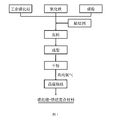
- FIG. 1 is a process flowchart of the present invention
- FIG. 2 is an XRD pattern of the silicon carbide-iron-silicon composite material prepared in Example 3.
- FIG. 2 is an XRD pattern of the silicon carbide-iron-silicon composite material prepared in Example 3.
- the silicon carbide used in the examples is commercially available industrial silicon carbide powder with a purity of ⁇ 98%.
- An in-situ silicon carbide-iron-silicon composite material includes a raw material and a solid phenolic resin, wherein the raw material components and their mass percentages are: 73% silicon carbide, 5% carbon powder, and 22% iron oxide; The added mass of solid phenolic resin is 3% of the total mass of the raw materials.
- FIG. 1 A method for preparing an in-situ silicon carbide-iron-silicon composite material.
- the process flow chart is shown in FIG. 1 and is made by the following specific steps:
- the phase of the obtained silicon carbide-iron-silicon composite was 6H-SiC and Fe 3 Si; the apparent porosity was 42%; the bulk density was 1.8g ⁇ cm -3 ; the compressive strength at room temperature was 15.8MPa; room temperature The number of air-cooled thermal shock cycles to 1000 ° C reached 55.
- An in-situ silicon carbide-iron-silicon composite material includes a raw material and a solid phenolic resin, wherein the raw material components and their mass percentages are: 57% industrial silicon carbide powder, 8% carbon powder, and ferric oxide 35 %, The added mass of the solid phenolic resin is 5% of the total mass of the raw materials, wherein the carbon powder is a 1: 1 mixture of graphite and activated carbon.
- FIG. 1 A method for preparing an in-situ silicon carbide-iron-silicon composite material.
- the process flow chart is shown in FIG. 1 and is made by the following specific steps:
- the phase of the obtained silicon carbide-iron-silicon composite is 6H-SiC, Fe 3 Si, and SiO 2 ; the apparent porosity is 50%; the bulk density is 1.74 g ⁇ cm -3 ; the compressive strength at room temperature is 10.9 MPa; Shock test: The number of air-cooled thermal shock cycles from room temperature to 1000 has reached 50 times.
- An in-situ silicon carbide-iron-silicon composite material includes a raw material and a liquid phenolic resin, wherein the raw material components and their mass percentages are: industrial silicon carbide powder silicon carbide 35%, carbon powder 12%, and trioxide The iron is 53%, and the added mass of the liquid phenolic resin is 5% of the total mass of the raw materials.
- FIG. 1 A method for preparing an in-situ silicon carbide-iron-silicon composite material.
- the process flow chart is shown in FIG. 1 and is made by the following specific steps:
- the phase of the obtained silicon carbide-iron-silicon composite is 6H-SiC, Fe 3 Si, Fe 5 Si 3 , SiO 2 , C; the apparent porosity is 68%; the bulk density is 1.37 g ⁇ cm -3 ; The compressive strength is 6.4 MPa; the number of air-cooled thermal shock cycles from room temperature to 1000 ° C reaches 66 times.
Landscapes
- Chemical & Material Sciences (AREA)
- Engineering & Computer Science (AREA)
- Ceramic Engineering (AREA)
- Manufacturing & Machinery (AREA)
- Materials Engineering (AREA)
- Structural Engineering (AREA)
- Organic Chemistry (AREA)
- Inorganic Chemistry (AREA)
- Ceramic Products (AREA)
Abstract
一种原位碳化硅-铁硅复合材料及其制备方法,复合材料包括原料和粘结剂,原料组分及其质量百分比为,碳化硅35~73%,碳粉5~12%和氧化铁22~53%,粘结剂添加质量为原料总质量1~5%。方法步骤为:(1)按质量百分比,将原料混合均匀,并按质量添加相应量粘结剂,使粘结剂与原料均匀混合,形成混合原料;(2)将混合原料压制成型;(3)将压制成型的生坯在干燥箱或隧道干燥窑中充分干燥;(4)将经过干燥的试样放入高温炉,并在高纯氩气保护下完成烧结,随炉冷却后制得原位碳化硅-铁硅复合材料。采用碳热还原法原位生成铁硅相,与碳化硅界面复合更好,且降低材料的烧结温度,节约能耗;并能够制成多孔碳化硅-铁硅复合材料。
Description
本发明属于复合材料制备技术领域,具体涉及一种原位碳化硅-铁硅复合材料及其制备方法。
碳化硅陶瓷具有优异的机械性能,如:摩擦系数低,抗弯强度高,且其热学和电学性能也非常出众。优异的机械性能使得碳化硅成为重要的结构材料之一,如轴承、机械密封环、装甲车防弹板等。出众的热学性能和电性能又使得碳化硅可用于制作某些功能材料,如催化剂载体、电子散热板、敏感电阻等,应用潜力巨大。
但是,本征脆性是陶瓷材料一种天然的缺陷,碳化硅也不例外。同时,因为碳化硅是强共价键化合物,常规烧结时扩散系数很低,一般需要很高的烧结温度才能最终成型。因此,可选用有较好韧性的金属(Fe、Al、Cu等)与之复合,以解决脆性和强度不足的缺陷,同时在烧结过程中加入一些烧结助剂(Al
2O
3+Y
2O
3、V
2O
5、MgO等)引发液相烧结,促进碳化硅的结晶过程和致密化行为。但对碳化硅而言,因为其与Fe、Al等常见金属的润湿性很差,导致金属与陶瓷之间的界面结合很差,影响了材料的最终性能。这也是目前碳化硅-金属复合材料的难点之一。随着航空航天、汽车、原子能等高精尖行业的迅猛发展,对低成本高性能碳化硅基复合材料的需求将日益增加。
发明内容:
本发明的目的是克服上述现有技术存在的不足,旨在解决碳化硅-金属复合材料界面结合差、制备过程复杂等缺陷,并提供了一种原位碳化硅-铁硅复合材料及其制备方法。以碳化硅和氧化铁为原料,高温原位形成铁硅增强相。因为金属间化合物铁硅与碳化硅有更好的润湿性能,同时在原位形成铁硅时会生成部分液相,引发液相烧结以促进烧结。
为实现上述目的,本发明采用以下技术方案:
一种原位碳化硅-铁硅复合材料,包括原料和粘结剂,其中,所述的原料组分及其质量百分比为,碳化硅35~73%,碳粉5~12%和氧化铁22~53%,所述的粘结剂添加质量为原料总质量的1~5%。
进一步地,所述的碳化硅为纯度≥98%的工业碳化硅粉。
进一步地,所述的碳粉为活性炭、炭黑、石墨或木炭的一种或多种。
进一步地,所述的氧化铁为化学纯或工业纯Fe
2O
3,并且加入量与碳粉遵循如下化学式 配比:3C(s)+Fe
2O
3(s)→2Fe(s)+3CO(g)。
进一步地,所述的粘结剂为固态酚醛树脂、液态酚醛树脂、沥青或水玻璃中的一种或多种。
所述的原位碳化硅-铁硅复合材料物相为α-SiC、SiO
2、FexSiy(FeSi、FeSi
2、Fe
3Si、Fe
5Si
3)和C,显气孔率为42~68%,体积密度为1.3~1.8g·cm
-3,常温抗压强度为6.4~15.8MPa,室温至1000℃的空冷热震循环次数达到50~66次。
一种原位碳化硅-铁硅复合材料的制备方法,包括以下步骤:
(1)配料:
按质量百分比:碳化硅35~73%,碳粉5~12%,氧化铁22~53%,将原料混合均匀,并按质量添加原料1~5%的粘结剂,使粘结剂与原料均匀混合,形成混合原料;
(2)成型:
将混合原料压制成型;
(3)干燥:
将压制成型的生坯在干燥箱或隧道干燥窑中充分干燥;
(4)烧结:
将经过干燥的试样放入高温炉,并在高纯氩气保护下完成烧结,随炉冷却后制得原位碳化硅-铁硅复合材料。
进一步地,所述步骤(1)中的混合方式为高能球磨,所述的高能球磨按2∶1球料比混合,球磨转速为200~400r·min
-1,球磨时间为1~8h。
进一步地,所述步骤(2)中,压制成型操作在不锈钢模具中进行。
进一步地,所述步骤(2)中的成型方式为模压成型或等静压成型的一种,成型压力为50~300MPa,保压时间为3~5min。
进一步地,所述步骤(3)中的干燥温度为70~120℃,干燥保温时间为8~12h。
进一步地,所述步骤(4)中的高温炉为箱式电阻炉、管式电阻炉、隧道窑中的一种;烧结温度为1400~1600℃,烧结保温时间为2~10h。
本发明的有益效果:
(1)本发明采用碳热还原法原位生成铁硅相,与碳化硅界面复合更好,解决了传统碳化硅-金属复合材料界面结合差的问题。
(2)在高温原位形成铁硅相的过程中,会有液相生成,少量液相将促进烧结过程,降低了材料的烧结温度,节约能耗。
(3)在制备过程中氧化铁还可作为铁源和造孔剂,碳粉可作为还原剂和造孔剂,可通过调 整其添加量制成多孔碳化硅-铁硅复合材料,扩大了碳化硅-铁硅复合材料的应用范围。
图1为本发明的工艺流程图;
图2为实施例3制备的碳化硅-铁硅复合材料的XRD图。
下面结合实施例对本发明作进一步的详细说明。
以下通过实施例对本发明的技术方案做更详细的说明,但本发明并不局限于以下实施例,所述只是适用本发明的部分实例。
实施例中采用的碳化硅为市购纯度≥98%的工业碳化硅粉。
实施例1
一种原位碳化硅-铁硅复合材料,包括原料和固态酚醛树脂,其中,所述的原料组分及其质量百分比为,碳化硅73%,碳粉5%和氧化铁22%;所述的固态酚醛树脂添加质量为原料总质量的3%。
一种原位碳化硅-铁硅复合材料的制备方法,其工艺流程图如图1所示,由以下具体步骤制成:
(1)按质量分数为73%工业碳化硅粉、22%三氧化二铁,5%活性炭配料,另外加3%的固态酚醛树脂(与酒精一起使用),并球磨转速为200~400r·min
-1,球磨2h,形成混合原料;
(2)将混合原料装入不锈钢模具,用单轴手动压样机在100MPa压力下保压5min制成φ20mm×20mm的素坯;
(3)将素坯在恒温干燥箱中100℃保温6h充分干燥;
(4)将干燥后的素坯放入真空管式炉中以5℃/min升温至1400℃保温2h,随炉冷却,便可制得碳化硅-铁硅复合材料。
本实施例相关性能指标如下:
经检测,制得碳化硅-铁硅复合材料的物相为6H-SiC、Fe
3Si;显气孔率为42%;体积密度为1.8g·cm
-3;常温耐压强度为15.8MPa;室温至1000℃的空冷热震循环次数达到55次。
实施例2
一种原位碳化硅-铁硅复合材料,包括原料和固态酚醛树脂,其中,所述的原料组分及其质量百分比为,工业碳化硅粉57%,碳粉8%和三氧化二铁35%,所述的固态酚醛树脂添加质量为原料总质量的5%,其中,碳粉为石墨与活性炭1∶1混合的料。
一种原位碳化硅-铁硅复合材料的制备方法,其工艺流程图如图1所示,由以下具体步骤制成:
(1)按质量分数为工业碳化硅粉57%,碳粉8%和三氧化二铁35%配料,另外加5%的固态酚醛树脂(与酒精一起使用),并球磨转速为200~400r·min
-1,球磨2h,形成混合原料;
(2)将混合原料装入不锈钢模具,用单轴手动压样机在100MPa压力下保压5min制成φ20mm×20mm的素坯;
(3)将素坯在恒温干燥箱中100℃保温6h充分干燥;
(4)将干燥后的素坯放入真空管式炉中以5℃/min升温至1500℃保温4h,随炉冷却,便可制得碳化硅-铁硅复合材料。
本实施例相关性能指标如下:
制得碳化硅-铁硅复合材料的物相为6H-SiC、Fe
3Si、SiO
2;显气孔率为50%;体积密度为1.74g·cm
-3;常温耐压强度为10.9MPa;热震试验:室温至1000的空冷热震循环次数达到50次。
实施例3
一种原位碳化硅-铁硅复合材料,包括原料和液态酚醛树脂,其中,所述的原料组分及其质量百分比为,工业碳化硅粉碳化硅35%,碳粉12%和三氧化二铁53%,所述的液态酚醛树脂添加质量为原料总质量的5%。
一种原位碳化硅-铁硅复合材料的制备方法,其工艺流程图如图1所示,由以下具体步骤制成:
(1)按质量分数为工业碳化硅粉57%,碳粉8%和三氧化二铁35%配料,另外加5%的固态酚醛树脂(与酒精一起使用),并球磨转速为200~400r·min
-1,球磨2h,形成混合原料;
(2)将混合原料装入不锈钢模具,用单轴手动压样机在100MPa压力下保压5min制成φ20mm×20mm的素坯;
(3)将素坯在恒温干燥箱中100℃保温6h充分干燥;
(4)将干燥后的素坯放入真空管式炉中以5℃/min升温至1600℃保温4h,随炉冷却,便可制得碳化硅-铁硅复合材料,其XRD图如图2所示。
本实施例相关性能指标如下:
制得碳化硅-铁硅复合材料的物相为6H-SiC、Fe
3Si、Fe
5Si
3、SiO
2、C;显气孔率为68%;体积密度为1.37g·cm
-3;常温耐压强度为6.4MPa;室温至1000℃的空冷热震循环次数达到66次。
Claims (10)
- 一种原位碳化硅-铁硅复合材料,其特征在于,包括原料和粘结剂,其中,所述的原料组分及其质量百分比为,碳化硅35~73%,碳粉5~12%和氧化铁22~53%,所述的粘结剂添加质量为原料总质量的1~5%。
- 根据权利要求1所述的原位碳化硅-铁硅复合材料,其特征在于,所述的碳化硅为纯度≥98%的工业碳化硅粉。
- 根据权利要求1所述的原位碳化硅-铁硅复合材料,其特征在于,所述的碳粉为活性炭、炭黑、石墨或木炭的一种或多种。
- 根据权利要求1所述的原位碳化硅-铁硅复合材料,其特征在于,所述的粘结剂为固态酚醛树脂、液态酚醛树脂、沥青或水玻璃中的一种或多种。
- 根据权利要求1所述的原位碳化硅-铁硅复合材料,其特征在于,所述的原位碳化硅-铁硅复合材料物相为α-SiC、SiO 2、Fe xSi y(FeSi、FeSi 2、Fe 3Si、Fe 5Si 3)和C,显气孔率为42~68%,体积密度为1.3~1.8g·cm -3,常温抗压强度为6.4~15.8MPa,室温至1000℃的空冷热震循环次数达到50~66次。
- 权利要求1所述的原位碳化硅-铁硅复合材料的制备方法,其特征在于,包括以下步骤:(1)配料:按质量百分比:碳化硅35~73%,碳粉5~12%,氧化铁22~53%,将原料混合均匀,并按质量添加原料1~5%的粘结剂,使粘结剂与原料均匀混合,形成混合原料;(2)成型:将混合原料压制成型;(3)干燥:将压制成型的生坯在干燥箱或隧道干燥窑中充分干燥;(4)烧结:将经过干燥的试样放入高温炉,并在高纯氩气保护下完成烧结,随炉冷却后制得原位碳化硅-铁硅复合材料。
- 根据权利要求6所述的原位碳化硅-铁硅复合材料的制备方法,其特征在于,所述步骤(1)中的混合方式为高能球磨,所述的高能球磨按2:1球料比混合,球磨转速为200~400r·min -1,球磨时间为1~8h。
- 根据权利要求6所述的原位碳化硅-铁硅复合材料的制备方法,其特征在于,进一步地,所述步骤(2)中的成型方式为模压成型或等静压成型的一种,成型压力为50~300MPa,保压时间为3~5min。
- 根据权利要求6所述的原位碳化硅-铁硅复合材料的制备方法,其特征在于,所述步骤(3)中的干燥温度为70~120℃,干燥保温时间为8~12h。
- 根据权利要求6所述的原位碳化硅-铁硅复合材料的制备方法,其特征在于,所述步骤(4)中的高温炉为箱式电阻炉、管式电阻炉、隧道窑中的一种;烧结温度为1400~1600℃,烧结保温时间为2~10h。
Applications Claiming Priority (2)
| Application Number | Priority Date | Filing Date | Title |
|---|---|---|---|
| CN201811099182.7A CN109160814A (zh) | 2018-09-20 | 2018-09-20 | 一种原位碳化硅-铁硅复合材料及其制备方法 |
| CN201811099182.7 | 2018-09-20 |
Publications (1)
| Publication Number | Publication Date |
|---|---|
| WO2020057096A1 true WO2020057096A1 (zh) | 2020-03-26 |
Family
ID=64879874
Family Applications (1)
| Application Number | Title | Priority Date | Filing Date |
|---|---|---|---|
| PCT/CN2019/080546 Ceased WO2020057096A1 (zh) | 2018-09-20 | 2019-03-29 | 一种原位碳化硅-铁硅复合材料及其制备方法 |
Country Status (2)
| Country | Link |
|---|---|
| CN (1) | CN109160814A (zh) |
| WO (1) | WO2020057096A1 (zh) |
Cited By (1)
| Publication number | Priority date | Publication date | Assignee | Title |
|---|---|---|---|---|
| CN112646989A (zh) * | 2020-12-08 | 2021-04-13 | 昆明理工大学 | 一种原位生成碳质增强体制备铜基复合材料的方法 |
Families Citing this family (2)
| Publication number | Priority date | Publication date | Assignee | Title |
|---|---|---|---|---|
| CN109160814A (zh) * | 2018-09-20 | 2019-01-08 | 东北大学 | 一种原位碳化硅-铁硅复合材料及其制备方法 |
| CN110918997A (zh) * | 2019-11-20 | 2020-03-27 | 内蒙古科技大学 | 用氧化铁皮制备多孔不锈钢的方法 |
Citations (4)
| Publication number | Priority date | Publication date | Assignee | Title |
|---|---|---|---|---|
| DE60005096T2 (de) * | 1999-07-21 | 2004-08-26 | Institut Français Du Petrole | Monolitische Honigwabenstruktur aus porösem Keramikmaterial, und Verwendung als Partikelfilter |
| CN101863668A (zh) * | 2010-05-24 | 2010-10-20 | 北京科技大学 | 一种用铁矿尾矿合成SiC/FexSiy复合材料的方法 |
| CN107686353A (zh) * | 2017-08-22 | 2018-02-13 | 东北大学 | 一种高强导电碳化硅‑铁复合多孔陶瓷的制备方法 |
| CN109160814A (zh) * | 2018-09-20 | 2019-01-08 | 东北大学 | 一种原位碳化硅-铁硅复合材料及其制备方法 |
-
2018
- 2018-09-20 CN CN201811099182.7A patent/CN109160814A/zh active Pending
-
2019
- 2019-03-29 WO PCT/CN2019/080546 patent/WO2020057096A1/zh not_active Ceased
Patent Citations (4)
| Publication number | Priority date | Publication date | Assignee | Title |
|---|---|---|---|---|
| DE60005096T2 (de) * | 1999-07-21 | 2004-08-26 | Institut Français Du Petrole | Monolitische Honigwabenstruktur aus porösem Keramikmaterial, und Verwendung als Partikelfilter |
| CN101863668A (zh) * | 2010-05-24 | 2010-10-20 | 北京科技大学 | 一种用铁矿尾矿合成SiC/FexSiy复合材料的方法 |
| CN107686353A (zh) * | 2017-08-22 | 2018-02-13 | 东北大学 | 一种高强导电碳化硅‑铁复合多孔陶瓷的制备方法 |
| CN109160814A (zh) * | 2018-09-20 | 2019-01-08 | 东北大学 | 一种原位碳化硅-铁硅复合材料及其制备方法 |
Cited By (1)
| Publication number | Priority date | Publication date | Assignee | Title |
|---|---|---|---|---|
| CN112646989A (zh) * | 2020-12-08 | 2021-04-13 | 昆明理工大学 | 一种原位生成碳质增强体制备铜基复合材料的方法 |
Also Published As
| Publication number | Publication date |
|---|---|
| CN109160814A (zh) | 2019-01-08 |
Similar Documents
| Publication | Publication Date | Title |
|---|---|---|
| CN106588021B (zh) | 一种碳化硅陶瓷及其制备方法 | |
| CN101462880B (zh) | 一种碳化硅基增强复合陶瓷及制备方法 | |
| CN102730690B (zh) | 一种Al4SiC4材料的合成方法 | |
| CN103833403B (zh) | 一种碳化硅晶须增韧碳化硼陶瓷复合材料的制备方法及产品 | |
| JPS59102872A (ja) | 炭化珪素.黒鉛複合焼結体の製造方法 | |
| CN106478105A (zh) | 一种多步反应烧结法制备低残硅的碳化硅陶瓷材料的方法 | |
| CN108409347A (zh) | 一种原位生成Ti3SiC2相增韧碳化硅陶瓷基复合材料的制备方法 | |
| CN101456737A (zh) | 一种碳化硼基复合陶瓷及其制备方法 | |
| CN106800420B (zh) | 一种碳化硅晶须原位复合刚玉高温陶瓷材料及其制备方法 | |
| CN105859301B (zh) | 一种氮化硅陶瓷及其制备方法 | |
| CN104045350B (zh) | 一种采用反应烧结工艺制备氮化硅-碳化硅复合陶瓷材料的方法 | |
| WO2020057096A1 (zh) | 一种原位碳化硅-铁硅复合材料及其制备方法 | |
| CN111196730B (zh) | 一种高热导率氮化硅陶瓷材料及其制备方法 | |
| CN100418923C (zh) | 一种致密Ti2AlC-TiB2复合材料及其制备方法 | |
| CN106348777A (zh) | 一种氧化铝基复合陶瓷刀具材料及其微波制备方法 | |
| CN106747446A (zh) | 一种微波混合加热合成Al4SiC4粉体的新方法 | |
| CN106747447A (zh) | 一种合成Al4SiC4粉体材料的新方法 | |
| CN102515770A (zh) | 一种制备纳米SiC增强MoSi2复合材料的方法 | |
| CN101182212B (zh) | 硼化物-氧化物复相陶瓷及其制备方法 | |
| CN105272297B (zh) | 一种Fe‑Sialon‑刚玉复合耐火材料及其制备方法 | |
| CN102659414B (zh) | 一种易烧结AlN多型体-Sialon复相材料及其制备方法 | |
| CN110511003A (zh) | 一种Ti(C,N)固溶体结合刚玉质耐火材料及其制备方法 | |
| CN111978074A (zh) | 一种碳纳米管增强的多孔陶瓷型芯及其制备方法 | |
| CN102731109B (zh) | 一种AlON材料的合成方法 | |
| CN101544496A (zh) | 一种硼化物-氮化物复相陶瓷及其制备工艺 |
Legal Events
| Date | Code | Title | Description |
|---|---|---|---|
| 121 | Ep: the epo has been informed by wipo that ep was designated in this application |
Ref document number: 19861595 Country of ref document: EP Kind code of ref document: A1 |
|
| NENP | Non-entry into the national phase |
Ref country code: DE |
|
| 122 | Ep: pct application non-entry in european phase |
Ref document number: 19861595 Country of ref document: EP Kind code of ref document: A1 |