WO2020044754A1 - 監視装置及び監視システム - Google Patents
監視装置及び監視システム Download PDFInfo
- Publication number
- WO2020044754A1 WO2020044754A1 PCT/JP2019/025178 JP2019025178W WO2020044754A1 WO 2020044754 A1 WO2020044754 A1 WO 2020044754A1 JP 2019025178 W JP2019025178 W JP 2019025178W WO 2020044754 A1 WO2020044754 A1 WO 2020044754A1
- Authority
- WO
- WIPO (PCT)
- Prior art keywords
- event
- culture
- sensor
- measurement interval
- environment
- Prior art date
- Legal status (The legal status is an assumption and is not a legal conclusion. Google has not performed a legal analysis and makes no representation as to the accuracy of the status listed.)
- Ceased
Links
Images





Classifications
-
- G—PHYSICS
- G06—COMPUTING OR CALCULATING; COUNTING
- G06Q—INFORMATION AND COMMUNICATION TECHNOLOGY [ICT] SPECIALLY ADAPTED FOR ADMINISTRATIVE, COMMERCIAL, FINANCIAL, MANAGERIAL OR SUPERVISORY PURPOSES; SYSTEMS OR METHODS SPECIALLY ADAPTED FOR ADMINISTRATIVE, COMMERCIAL, FINANCIAL, MANAGERIAL OR SUPERVISORY PURPOSES, NOT OTHERWISE PROVIDED FOR
- G06Q10/00—Administration; Management
- G06Q10/10—Office automation; Time management
-
- G—PHYSICS
- G08—SIGNALLING
- G08C—TRANSMISSION SYSTEMS FOR MEASURED VALUES, CONTROL OR SIMILAR SIGNALS
- G08C15/00—Arrangements characterised by the use of multiplexing for the transmission of a plurality of signals over a common path
-
- G—PHYSICS
- G08—SIGNALLING
- G08C—TRANSMISSION SYSTEMS FOR MEASURED VALUES, CONTROL OR SIMILAR SIGNALS
- G08C17/00—Arrangements for transmitting signals characterised by the use of a wireless electrical link
-
- C—CHEMISTRY; METALLURGY
- C12—BIOCHEMISTRY; BEER; SPIRITS; WINE; VINEGAR; MICROBIOLOGY; ENZYMOLOGY; MUTATION OR GENETIC ENGINEERING
- C12M—APPARATUS FOR ENZYMOLOGY OR MICROBIOLOGY; APPARATUS FOR CULTURING MICROORGANISMS FOR PRODUCING BIOMASS, FOR GROWING CELLS OR FOR OBTAINING FERMENTATION OR METABOLIC PRODUCTS, i.e. BIOREACTORS OR FERMENTERS
- C12M1/00—Apparatus for enzymology or microbiology
Definitions
- the present disclosure relates to a monitoring device and a monitoring system for monitoring cell culture.
- the culture vessel is usually installed in a storage (incubator, refrigerator, or the like) in which the temperature, humidity, and CO2 concentration are controlled to constant values.
- the environmental data values in these repositories usually do not change significantly. For this reason, environmental data values are measured at measurement intervals of, for example, about 5 to 10 minutes.
- the culture container may be temporarily carried out to a work place outside the storage for cell operation, and at this time, the culture environment will change rapidly.
- Environmental parameters during operation are important in understanding the relationship between quality and the environment. In particular, acceleration data when an impact is detected is important because the impact when the impact is applied is large.
- a system for recording environmental factors such as CO2 concentration, temperature, and humidity detected in a storage in which a culture tray for placing a culture container is stored is provided.
- environmental factors such as CO2 concentration, temperature, and humidity detected in a storage in which a culture tray for placing a culture container is stored.
- monitoring environmental factors in all of a large number of cell containers is laborious. Therefore, in Japanese Patent Application Laid-Open No. 2016-7169, position information of sensors for measuring environmental factors arranged at a plurality of positions in a space is stored, and based on the measurement values and position information measured by each sensor, A technique for calculating a predicted value of an environmental factor at a position where a sensor is placed is disclosed.
- Japanese Patent Application Laid-Open No. 9-107946 discloses a method of directly connecting an environment sensor and an indoor environment control device and changing the measurement interval of environmental data with the indoor environment control device in order to keep the culture environment constant. Have been.
- the sensor for measuring the environment is measured at predetermined time intervals.
- environmental data greatly changes. Therefore, it is necessary to change the measurement performed at a measurement interval of about 5 to 10 minutes to a short measurement interval of about 1 to 30 seconds.
- acceleration data at the time of detecting an impact is important, and after the detection, the data is shorter, for example, about 0.01 to 0.1 seconds. Data needs to be acquired at measurement intervals.
- a sensor that measures the environment of cell culture needs to acquire data at an appropriate measurement interval, that is, a sampling cycle, according to changes in the surroundings.
- a wireless sensor module in consideration of the fact that a person performs an operation or carries the sensor.
- the data measurement interval of a general wireless sensor module is given as a fixed value, and in order to change the measurement interval, a human needs to change the value to an appropriate value each time.
- multiple culture containers are installed in the storage, and since multiple people perform cell culture operations in parallel, it is not realistic for humans to change the value of the measurement interval in conjunction with all events .
- the present disclosure has been made in order to solve the above-described problem, and a monitoring device that automatically changes a data measurement interval of a sensor to an appropriate value in response to an event that affects the environment. And provide a monitoring system.
- the monitoring device is configured such that one or more types of environmental sensors that measure environmental data relating to each culture environment of a plurality of culture vessels in a culture space at a predetermined measurement interval, An event detection unit that detects an event that affects culture, and when an event is detected by the event detection unit, changes the measurement interval of each of the plurality of environment sensors to an interval shorter than the interval before the event is detected.
- An event detection unit that detects an event that affects culture, and when an event is detected by the event detection unit, changes the measurement interval of each of the plurality of environment sensors to an interval shorter than the interval before the event is detected.
- Detection of an event refers to detection of a signal indicating a change in the culture environment in the culture space, or detection of a change estimated to affect the culture environment based on the detected signal.
- the event detection unit detects a plurality of types of events, and the change unit changes the interval according to the type of the event detected by the event detection unit.
- the event detection unit is configured to detect a first event that requires a change in the measurement interval for any one of the plurality of culture containers
- the change unit may include: It is desirable to change the measurement interval of the environment sensor for the culture vessel in which the first event is detected to a shorter interval than before the detection of the first event.
- the first event is detected by detecting vibration of any of the culture vessels, detecting inclination of any of the culture vessels, detecting deterioration of a solution in any of the culture vessels, and culturing any of the culture vessels. At least one of detection of entry into and exit from a space and detection of the approach of an operator to any of the culture vessels may be used.
- the event detection unit detects a second event that requires a change in the measurement interval for all the culture vessels in the culture space, and when the second event is detected, the change unit performs an operation for all the culture vessels. It is desirable to change the measurement interval of the environment sensor to an interval shorter than before the detection of the second event.
- the detection of the second event includes detection of a temperature outside the specified value in the culture space, detection of humidity outside the specified value in the culture space, detection of a gas concentration outside the specified value in the culture space, and detection of the culture space. At least one of detection of opening and closing of a door of a structure to be configured and detection of turning on / off of illumination of a work room in a culture space may be used.
- “Outside the specified value” means a range of values that appear when the value is normal, and a value outside the specified value range.
- the change unit changes the measurement interval to an interval longer than the changed interval when no detection is performed by the event detection unit within a predetermined time after the change of the measurement interval.
- the environment sensor may be at least one of an acceleration sensor, a vibration sensor, a geomagnetic sensor, a temperature sensor, an illuminance sensor, a color sensor, an ultraviolet sensor, a gas concentration sensor, a barometric pressure sensor, and a humidity sensor.
- the event detection unit is a door opening / closing detector of a structure constituting the culture space, a temperature detector of the culture space, a humidity detector of the culture space, a gas concentration detector of the culture space, a switch provided in the culture space, Alternatively, the event may be detected based on the value measured by the environment sensor.
- the culture space may be an incubator, a refrigerator, a freezer, a clean room warehouse, a constant temperature and constant temperature bath, or an internal space of a work room.
- each of the plurality of environmental sensors for each of the plurality of culture vessels may include a change unit.
- the monitoring device described above may further include a transmission unit that transmits an event detected by the event detection unit to the data collection server, and the data collection server may include a change unit. You may.
- an identification information transmitting unit for transmitting identification information for identifying each of the plurality of environment sensors to the data collection server, and the changing unit needs to change the measurement interval according to the type of the detected event.
- the measurement interval of the environment sensor of certain identification information may be changed to an interval shorter than the event detection.
- the identification information includes information indicating the position of the environmental sensor for each of the culture vessels in the culture space.
- the data collection server may include a recording unit that records the type of event and the time of occurrence in association with each other.
- the data collection server may include a recording unit that records the type of the event and the time of occurrence in association with the identification information.
- a monitoring device includes a memory configured to store an instruction to be executed by a computer, and a processor configured to execute the stored instruction, and the processor executes the instruction stored in the memory.
- One or more types of environmental sensors that measure environmental data on each culture environment of a plurality of culture vessels in a culture space at a predetermined measurement interval, and an event that affects culture in the culture space. Is detected, and when the event is detected by the event detection unit, the measurement interval of each of the plurality of environment sensors is changed to an interval shorter than the interval before the event is detected.
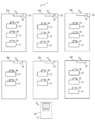
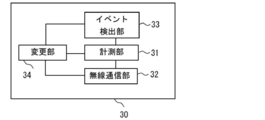
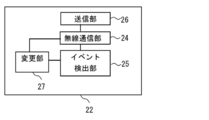
- FIG. 1 is a diagram illustrating a schematic configuration of a monitoring system according to a first embodiment. It is a figure showing the schematic structure of the environment sensor of a 1st embodiment. It is a figure showing the schematic structure of the repeater of a 1st embodiment.
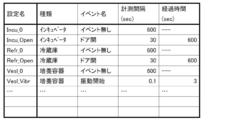
- FIG. 6 is a diagram illustrating an example of an event type and a measurement interval. It is a flowchart which shows the flow of a process of an environment sensor. It is a flowchart which shows the flow of a process of a repeater. It is a flowchart which shows the flow of a process of a data collection server. It is a figure showing the schematic structure of the environment sensor of a 2nd embodiment. It is a figure showing the schematic structure of the repeater of a 2nd embodiment.
- FIG. 1 illustrates a schematic configuration of a monitoring system 1 according to the first embodiment of the present disclosure.
- a case will be described in which a plurality of culture vessels are stored in each of the culture spaces provided at a plurality of locations, and environmental data of each of the culture spaces is monitored.
- the monitoring system 1 includes a data collection server 10 and monitoring devices disposed in each of the plurality of culture spaces 20a to 20f.
- the plurality of culture spaces will be described by taking six culture spaces 20a to 20f as an example for convenience, but the number of culture spaces is not limited to six.
- the description will be made using reference numerals with alphabets such as 20a to 20f.
- the culture space is provided inside.
- a storage 20 provided with a door that can be opened and closed.
- the data collection server 10 is a computer having a known hardware configuration such as a CPU (Central Processing Unit), a memory, a storage, an input / output interface, a communication interface, and a data bus.
- An operating system and various programs are installed in the data collection server 10.
- a recording program for recording environmental data in each culture space 20 is installed.
- the culture space 20 is a closed space for culturing cells or managing materials used for culture such as a culture solution, and includes, for example, an incubator, a refrigerator, a freezer, a clean room warehouse, a constant temperature and constant temperature bath, or a work room. And the like. At least one of the storages 20 has a culture space in which an event related to an abnormality in the culture space needs to be detected.
- a storage provided with a culture space in which an event related to an abnormality needs to be detected and a storage provided with a culture space in which an event need not be detected are provided in a mixed manner. I do.
- the culture spaces 20d to 20f are working rooms such as a safety cabinet, a microscope, a water bath, and a centrifuge. These may not be provided with the event detector 23.
- the culture spaces 20a to 20f will be simply described as the storage 20.
- the storage 20 is provided with a plurality of culture vessels 21 and a repeater 22, and the culture spaces 20a to 20c are further provided with an event detector 23.
- Each of the culture vessels 21 is provided with an environmental sensor 30 for measuring environmental data at preset measurement intervals.
- the culture vessel 21 is, for example, a cell stack, a medium bottle, or a centrifuge tube.
- the environment sensor 30 includes a wireless sensor module that detects vibration, temperature, tilt, and the like.
- the repeater 22 transmits and receives the environment sensor 30 wirelessly.
- one or more types of event detectors 23 are connected wirelessly or by wire.
- the relay device 22 is connected to the data collection server 10 via a network, and the relay device 22 transmits environmental data detected by the environment sensors 30 and event information detected by the event detector 23 to the data collection server 10.
- the network may be a local area network or a wide area network.
- the monitoring device includes, as an example, an environment sensor 30, an event detector 23, and a repeater 22.
- the event occurs in response to a change in the culture environment or a change in the culture environment, and includes an event detected by the event detector 23 and an event detected based on the environment data measured by the environment sensor 30. .
- the event includes a first event affecting one of the plurality of culture vessels 21 placed in the same storage 20 and a first event affecting all the culture vessels 21 placed in the same storage 20. It is divided into the influencing second events.
- the first event is, for example, detection of vibration of the culture container 21, detection of the inclination of the culture container 21, detection of deterioration of the solution in the culture container 21, and detection of the worker entering or leaving the storage container 20 of the culture container 21. Or detection of the approach of an operator to the culture container 21 or the like.
- the second event is, for example, detection of a temperature outside the specified value in the culture space 20, detection of a humidity outside the specified value in the culture space 20, detection of a gas concentration outside the specified value in the culture space 20, and culture space. For example, detection of opening and closing of a door of a structure that constitutes 20 or detection of turning on / off of illumination in the culture space 20 is performed.
- FIG. 2 shows a schematic configuration diagram of the environment sensor 30.
- the environment sensor 30 includes a measurement unit 31, a wireless communication unit 32, an event detection unit 33, and a change unit 34.
- the measuring unit 31 is a sensor configured by an element or a device that collects environmental data relating to an environment related to culture and replaces it with a signal that can be handled by a computer, and acquires environmental data at set measurement intervals.
- the measurement unit 31 includes, for example, at least one of an acceleration sensor, a vibration sensor, a geomagnetic sensor, a color sensor, a temperature sensor, an illuminance sensor, an ultraviolet sensor, a gas concentration sensor, a barometric pressure sensor, and a humidity sensor.
- the wireless communication unit 32 exchanges data with the relay device 22 by using wireless communication such as RFID (radio frequency identifier).
- RFID radio frequency identifier
- the event detection unit 33 detects an event that requires a change in the measurement interval according to the measurement value of the measurement unit 31. If it is detected that the measurement value measured by the measurement unit 31 has changed abruptly, it is determined that an event requiring a change in the measurement interval has occurred. For example, when the acceleration sensor detects acceleration equal to or higher than a threshold, it is determined that a vibration event has occurred.
- the change unit 34 changes the measurement interval of the environment sensor 30 to an interval shorter than the interval before the event is detected, according to the event detected by the event detection unit 33.
- the measurement interval is changed.
- the measurement interval of the acceleration sensor is, for example, 600 seconds, but when a vibration event is detected, the measurement interval is changed to a shorter interval, for example, 0.1 second.
- the change unit 34 changes the shortened measurement interval to a longer measurement interval when the same event is not detected within a predetermined time after the measurement interval is changed after the event occurs. .
- the measurement interval of the acceleration sensor is returned to the original measurement interval, for example, 600 seconds.
- the measurement interval changed to a short interval in response to the occurrence of an event is changed to a long measurement interval such as the original measurement interval before the event occurs, the measurement interval may be directly changed to a long measurement interval, or a gradually longer measurement interval may be used. The interval may be changed.
- the measurement interval is changed to a different interval depending on the event that has occurred.
- the measurement interval is changed to, for example, 0.1 second.However, when the influence on the culture environment is not so large as compared with the vibration, for example, a sudden temperature change occurs. If this occurs, the measurement interval is changed to, for example, one second.
- the shortened measurement interval is returned to the original measurement interval, but the elapsed time is set to a different elapsed time according to the event that occurred Is preferred.
- the environment sensor 30 may be directly attached to the culture vessel 21 to measure a change in each culture environment of the culture vessel 21.
- the environment sensor 30 may be attached to a position above the culture container 21 so as to measure the state of the culture solution in the culture container from the upper surface of the culture container 21 to measure a change in the culture solution.
- a cuvette for sampling the solution in the culture vessel 21 may be provided in the culture vessel 21 and attached to the cuvette of the environment sensor 30 so that the state of the solution in the cuvette can be measured.
- ⁇ Circle around (1) ⁇ In each of the culture vessels 21, one or more types of environmental sensors 30 are provided as necessary according to the measurement target. Further, an identification information ID is assigned to each of the environment sensors 30 in advance.
- the measurement interval is changed for one of the plurality of culture containers 21 placed in the same storage 20, and the second event is detected. , The measurement interval is changed for all the culture vessels 21 placed in the same storage 20.
- the first event is obtained from the environment sensor 30 provided for each of the culture vessels 21.
- the environmental sensor 30 for detecting the first event is, for example, a sensor for detecting vibration of the culture container 21, a sensor for detecting a change in the posture of the culture container 21, or a sensor for detecting deterioration of the solvent in the culture container 21.
- a sensor that detects vibration of the culture vessel 21 is, for example, an acceleration sensor
- a sensor that detects a change in the posture of the culture vessel 21 is, for example, a geomagnetic sensor or an acceleration sensor.
- the sensor that detects the deterioration of the solvent liquid in the culture vessel 21 is, for example, a color sensor that detects the color of the culture liquid, an illuminance sensor, or the like.
- the environment sensor 30 may be installed at a predetermined location of the storage 20 and the environment in the storage 20 may be measured so that the environment sensor 30 can obtain the second event.
- sensors for measuring the environment in the storage 20 for example, a temperature sensor, a humidity sensor, an acceleration (vibration) sensor, a geomagnetic sensor, an ultraviolet (UV) sensor, an atmospheric pressure sensor, a gas concentration sensor (specifically, volatile organic Compound (VOC) sensor, carbon dioxide (CO2) sensor, etc.), a color sensor, an illuminance sensor, and the like.
- the repeater 22 is a wireless signal read / write terminal provided with a CPU and a memory.
- the wireless communication unit 32 of the environment sensor 30 is an RFID, it is an RFID reader / writer.
- Fig. 3 shows a schematic diagram of the repeater.
- the relay device 22 includes a wireless communication unit 24, an event detection unit 25, a transmission unit 26, and a change unit 27.
- the wireless communication unit 24 transmits and receives data to and from the environment sensor 30 wirelessly.
- the wireless communication unit 32 of the environment sensor 30 communicates with the wireless communication units 24 of all the relay devices 22 provided in each of the plurality of storages 20. Try.
- the wireless communication unit 24 measures a value indicating the communication strength when the environment data is received, for example, RSSI (Received ⁇ Signal ⁇ Strength ⁇ Indication), and temporarily stores the measured value in the memory of the relay device 22 in association with the environment data.
- RSSI Receiveived ⁇ Signal ⁇ Strength ⁇ Indication
- the event detector 25 is connected to one or more types of event detectors 23 by wire or wirelessly, and when detecting an event of the event detector 23, notifies the change unit 27 of the detection of the event.
- the event detector 23 is, for example, a door open / close detector that detects opening / closing of a door of the storage 20, a temperature detector provided in the storage 20, and detects a temperature in the storage 20, and provided in the storage 20.
- a gas concentration detector for detecting the gas concentration in the storage 20 provided in the storage 20, lighting of the storage provided in the storage 20. It is a switch for turning off the light.
- the event detection unit 25 determines that an event has been detected.
- a signal indicating an abnormality for example, an abnormal signal of gas concentration detection of CO2 or the like
- the second event has been detected.
- an abnormality in temperature, humidity, or gas concentration affects the entire inside of the storage 20, and corresponds to the second event.
- the range of the measured value that appears when the value is normal is defined as the range of the specified value, and the measured value outside the range of the specified value is defined as the abnormal value.
- the event detection unit 25 may use the wireless communication unit 24 to receive the temperature, humidity, illuminance, ultraviolet light, gas concentration, or atmospheric pressure received from the environmental sensor 30 provided in the culture container 21 placed at a predetermined place in the storage 20. If the value of is an abnormal value, it may be determined that the second event has been detected, and the change unit 27 may be notified of the detection of the event.
- the change unit 27 transmits a change notification of the measurement interval from the wireless communication unit 24 to all the environment sensors 30 in the storage 20.
- All the environmental sensors 30 include an environmental sensor 30 provided for the culture container 21 and an environmental sensor 30 placed at a predetermined place in the storage 20.
- the measurement interval is shorter than the interval before the second event is detected at an interval corresponding to the type of the event detected by the event detection unit 25. Changed to the interval.
- the temperature measurement interval is set, for example, every 600 seconds, and when the door open / close detector detects the opening / closing of the door, the wireless communication unit 24 sets the temperature measurement interval to a short measurement interval, for example.
- a change notification is transmitted to each of the environment sensors 30 in the storage 20 so as to change every 30 seconds.
- the wireless communication unit 32 of each environment sensor 30 receives the change notification, the measurement interval of the environment sensor 30 that measures the temperature is changed.
- the measurement intervals of only the types of environment sensors 30 whose measurement intervals need to be changed are changed according to the detected event.
- the measurement interval according to the type may be included in the change notification transmitted by the relay device 22, or the environment sensor 30 may store a table of the type and the measurement interval.
- the changing unit 27 lengthens the shortened measurement interval after the change of the measurement interval. For example, if the door is not opened again for 600 seconds after detecting that the door was opened, the measurement interval of the temperature sensor is returned to, for example, 600 seconds. In many cases, the measurement interval before the change is returned after a certain time has elapsed from the occurrence of the event. However, the measurement interval may be divided into several times and the shortened measurement interval may be gradually increased. Alternatively, when the same event does not occur for a long time, the measurement interval may be set longer than the measurement interval that was initially set as time elapses.
- FIG. 4 shows an example of event types and measurement intervals. Further, these events may be notified to the repeater 22 by an interrupt signal.
- the storage 20 indicates a carbon dioxide incubator, a refrigerator, a freezer, a clean room warehouse, or a constant temperature and humidity chamber, and is described separately from the work room.
- the working room is, for example, a safety cabinet, a microscope, a water bath, or a centrifuge.
- the timing at which the culture container 21 “enters” the storage 20 or “takes out” from the storage 20 is defined as an event.
- the insertion / removal of the culture container 21 is detected from the communication strength between the environment sensor 30 and the relay device 22.
- An event is defined as “putting” or “putting out” a liquid in the culture container 21.
- the position of a pipette or aspirator for taking in and out of a liquid is detected by a sensor, and an event is detected by pressing these buttons and the vibration of a nearby culture vessel.
- the opening and closing of the cap of the culture vessel 21 is defined as an event.
- a sensor for detecting opening and closing is attached to the cap.
- the measurement interval of the container in the vicinity is changed.
- the sensor is the same as in (1).
- the timing at which the operator presses the push button is defined as an event.
- the position of the push button and the culture vessel 21 in the vicinity thereof are detected by the relay 22. Pressing of the push button serves as a trigger for changing the culture environment of each culture vessel 21.
- the timing at which a small amount of sample is taken from the culture vessel 21 is defined as an event.
- a sensor that detects a button press of a pipette for collecting a sample is attached.
- the timing at which ethanol is sprayed on the culture vessel 21 is defined as an event.
- a sensor for detecting the depression of the lever of the ethanol spray container is attached.
- the event is that the culture container 21 is “placed” or the culture container 21 is “taken” in a stirrer (stirring device) in the storage 20.
- stirrer stirrer (stirring device) in the storage 20.
- the position of the environment sensor 30 is detected from the communication strength between the environment sensor 30 and the repeater 22.
- An event is defined as a case where the atmospheric pressure changes significantly within a certain time. For example, it is detected from a barometric pressure sensor.
- the occurrence of an earthquake is defined as an event. For example, it is detected from information from the national instantaneous alarm system (J alert).
- the environment sensor 30 buffers measurement data at the shortest measurement interval in advance, so that when the request is received from the repeater 22, it is necessary to keep the measurement data within the range stored in the buffer. This can be realized by transmitting certain past data. Since the consumption of the battery of the environment sensor 30 is large when data is transmitted and received, unnecessary data is not transmitted, so that the consumption of the battery can be reduced.
- the transmission unit 26 is connected to the data collection server 10 via a network, and transmits to the data collection server 10 the environment data of the environment sensor 30 and the event information on the event detected by the event detection unit 25.
- the transmitting unit 26 also functions as an identification information transmitting unit.
- the transmitting unit 26 determines the communication strength at the time of receiving the environmental data stored in the memory and the communication intensity of the environmental sensor 30 that has transmitted the environmental data.
- the identification information ID for identifying each is transmitted to the data collection server 10 together.
- the event information includes the type of the event, the time of occurrence of the event, and information for specifying the storage 20 in which the event has occurred.
- a MAC (Media Access Control address) address or an IP address assigned to the relay device 22 can be used as the information for specifying the storage 20, for example, a MAC (Media Access Control address) address or an IP address assigned to the relay device 22 can be used.
- the change unit 34 changes the measurement interval of the measurement unit 31 of the environment sensor 30 itself.
- the change unit 34 stores The measurement intervals of all the environment sensors 30 inside are changed.
- the recording unit 11 of the data collection server 10 records the received identification information ID of the environment sensor 30, the environment data, and the communication strength in the storage in association with each other. Further, information for specifying the relay device 22 of the transmission source of the environmental data is recorded in association with the information. As the information for specifying the source relay device 22, for example, a MAC address or an IP address can be used. Also, the communication strength between the repeater 22 and the environment sensor 30 increases as the distance between the repeater 22 and the environment sensor 30 decreases. , It is possible to specify the storage 20 in which the culture container 21 provided with the environmental sensor 30 is placed. Even when the identification information ID is not assigned to the environment sensor 30, the position of the culture vessel 21 is specified from the communication strength between the environment sensor 30 and each relay device 22, and this position information is identified by the identification information. It may be.
- the identification information ID is assigned to the environment sensor 30 in advance, and the environmental data and By transmitting the identification information ID together, the position at which the environmental data is measured may be specified.
- the recording unit 11 also records the event information of the event detected by the event detector 23 in the storage 20 in the storage.
- the environmental data measured after the occurrence of the event is recorded in a format in which the correspondence between the type of the event and the time of occurrence can be understood. Thus, when there is a characteristic behavior in the environmental data, it is possible to easily understand when, where, and which event caused the characteristic data.
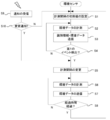
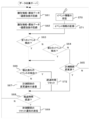
- FIG. 5 shows a processing flow of the environment sensor
- FIG. 6 shows a processing flow of the relay device
- FIG. 7 shows a processing flow of the data collection server.
- the changing unit 34 of the environment sensor 30 sets the measurement interval of the measurement unit 31 to an initial value, for example, 600 seconds (Step S1).
- the measurement unit 31 measures the measurement value of the acceleration sensor at the set measurement interval and acquires the environmental data (Step S2).
- the wireless communication unit 32 attempts to communicate with the repeaters 22 provided in each of the plurality of storages 20 and transmits the acquired environment data to all communicable repeaters.
- the identification information ID of each environment sensor 30 is transmitted to the relay device 22 together with the environment data (step S3). Further, it is preferable to transmit the environment data in a format including the type of the event and the time of occurrence of the environment data.
- the event detection unit 33 determines whether the first event, vibration, has been detected (step S4). When the measured value of the acceleration sensor is equal to or smaller than the reference value, the event detection unit 33 determines that vibration (first event) has not occurred, and until the event occurs (the determination in step S4 is negative). Returning to step S2, the measurement by the acceleration sensor and the transmission of the identification information ID and the environment data to the relay device 22 in step S3 are repeated.
- the event detection unit 33 determines that vibration has occurred (the determination in step S4 is affirmative), and the change unit 34 sets the measurement interval shorter than the measurement interval before the event occurred.
- the measurement interval is changed to, for example, 0.1 second (step S5).
- the measurement unit 31 starts measuring the acceleration at the changed measurement interval (Step S6).
- the wireless communication unit 32 transmits the measured acceleration to all of the communicable repeaters 22 among the plurality of storages 20 as environment data (step S7).
- the environment sensor 30 determines whether a predetermined elapsed time, for example, 3 seconds, has passed since the detection of the event, that is, the detection of the vibration (step S8).
- step S8 If it is determined that the elapsed time has not elapsed (the determination in step S8 is denied), the acceleration measurement in step S6 and the repeater of the acceleration in step S7 are performed every 0.1 seconds of the changed measurement interval. The transmission to 22 is repeated. If it is determined that the preset elapsed time has elapsed (the determination in step S8 is affirmative), the process returns to step S1, and returns the measurement interval to the initial value of 600 seconds.
- the temperature measurement interval is initially set to, for example, 600 seconds in step S1 of FIG. Further, as described above, the environment data measured according to the measurement interval is transmitted from the environment sensor 30 to the relay 22 (steps S2 to S4).
- the wireless communication unit 24 of the relay device 22 includes not only the environment sensor 30 in the storage 20 in which the relay device 22 is provided but also other storage devices in a communicable range.
- the communication is also performed with the environment sensor 30 within the communication device 20, and all the identification information ID and environment data transmitted from the environment sensor 30 within the communicable range are received (step S11). Further, the wireless communication unit 24 acquires the communication strength at the time of receiving the environment data (step S12), and the transmission unit 26 transmits the environment data and the communication strength to the data collection server 10 together with the identification information ID (step S12). S13).
- step S11 to step S13 the processing from step S11 to step S13 is repeated, and the identification information ID, the environmental data, And the communication strength thereof to the data collection server 10.
- the event detector (door opening / closing detector) 23 detects the opening / closing of the door
- the event detecting unit 25 determines that the second event has occurred (the determination in step 14 is affirmative). The occurrence of the second event is notified. Further, the transmitting unit 26 transmits the event information of the detected event to the data collection server 10 (Step S15).
- the changing unit 27 sets the measurement interval to the initial value, for example, 600 seconds (determination in step S16). Is denied), a change notification is sent from the wireless communication unit 24 to all the environmental sensors 30 in the storage 20 in which the relay device 22 that has detected the event is provided, so as to change the temperature measurement interval to 30 seconds. It transmits (step S17).
- the changing unit 34 determines whether the notification is a change notification of the measurement interval. (Step S10). If the notification is a change notification, the determination in step S10 is affirmed, and the measurement interval of the environment sensor 30 is changed to 30 seconds (step S5).
- the change unit 27 of the relay device 22 determines whether or not a set time, for example, 600 seconds, has elapsed since the event occurred (step S18). If 600 seconds have not elapsed since the event occurred, the determination in step 18 is denied, and the process returns to step S11 to transmit the identification information ID, environment data, and communication strength received from the environment sensor 30 to the data collection server 10. (Steps S11 to S13).
- step S14 is denied and the determination in step S19 is affirmed
- the elapsed time is counted until 600 seconds elapse from the occurrence of the event ( The determination in step S18 is denied)
- the process of transmitting the environment data measured from the environment sensor 30 at intervals of 30 seconds to the data collection server 10 together with the identification information ID and the communication strength is repeated (from step S11 to step S11). S13).
- the changing unit 27 determines that the detected event has the same type as the previous event. It is determined whether or not this event, that is, the detection of the opening / closing of the door (step S16). If the event is a door opening / closing event (the determination in step S16 is affirmative), the elapsed time is reset (step S21), and counting of the elapsed time is started again from this point.
- step S18 If, for example, 600 seconds have elapsed from the start of the elapsed time count (step S18 is affirmative), the temperature of all the environmental sensors 30 in the storage 20 provided with the repeater 22 that has detected the event from the wireless communication unit 24 is detected. A reset notification for resetting the measurement interval is transmitted (step S20).
- the changing unit 34 determines whether the received notification is a change notification of the measurement interval or a reset notification. Is determined (step S10). If the notification is a reset notification, the determination in step S10 is denied, and the measurement interval of the environment sensor 30 is changed to an initial value (step S1). As a result, the temperature measurement interval of the environment sensor 30 returns to 600 seconds again.
- the data collection server 10 receives the environment data transmitted from all the relays 22, the identification information ID of the environment sensor 30 that is the source of the environmental data, and the communication strength between the environment sensor 30 and each relay 22 (step S ⁇ b> 1).
- the recording unit 11 records the environment data, the identification information ID, and the communication strength in association with each other (Step S32). Further, the event information transmitted from the relay device 22 is recorded (step S33).
- the effect of the event can be observed by shortening the measurement interval of the environment sensor.
- the battery of the environment sensor is not consumed more than necessary, so that a long-term culture environment can be observed.
- the data collection server 10 instructs each storage 20 to change the measurement interval to the relay device 22, the data collection server 10 further changes the measurement intervals of all the environmental sensors 30 in the storage device 20 from the relay device 22. May be instructed at a later time.
- the case where the identification information ID assigned to the environment sensor 30 is used to transmit data from the relay device 22 to the environment sensor 30 has been described.
- the distance may be obtained from the intensity, and the corresponding environment sensor 30 may be specified.
- monitoring system 1 of the present embodiment is the same as that of the first embodiment, and a description thereof will be omitted.
- the environment sensor and the repeater only a configuration different from that of the first embodiment will be described in detail, and configurations having substantially the same functions as those of the first embodiment will be denoted by the same reference numerals and detailed description. Detailed description is omitted.
- the event detector provided in the storage is a door open / close detector.
- the monitoring device includes the environment sensor 30a, the event detector 23, and the repeater 22a.
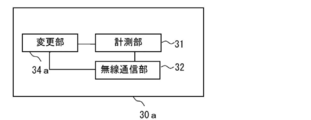
- FIG. 8 shows a schematic configuration diagram of an environment sensor 30a according to the second embodiment.
- the environment sensor 30a includes a measuring unit 31, a wireless communication unit 32, and a changing unit 34a.
- the changing unit 34a changes the measurement interval according to the change notification transmitted from the data collection server 10.
- FIG. 9 shows a schematic configuration diagram of a repeater 22a according to the second embodiment.
- the repeater 22a according to the present embodiment includes a wireless communication unit 24, an event detection unit 25a, a transmission unit 26, and a change unit 27a.
- the event detector 25a is connected to the event detector 23, and when detecting an event of the event detector 23, notifies the transmitter 26 of the detection of the event.
- the change unit 27a has a function of transmitting the change notification of the measurement interval transmitted from the data collection server 10 to the environment sensor 30a having the specified identification information ID.
- the change notification of the measurement interval of the environment sensor 30a will be described later.
- a recording program, an event detection program, and a change processing program for changing a data measurement interval are installed in the data collection server 10, and the instructions of the program recorded in the memory are executed by the CPU to execute the data collection server of the present disclosure.
- Each program is stored in a network storage or a storage device of a server computer connected to the network in a state where it can be accessed from the outside, and is installed after being downloaded to the computer in response to a request from the outside.
- each program may be recorded on a recording medium such as a DVD (Digital Versatile Disc) and a CD-ROM (Compact Disc Read Only Memory), distributed, and installed in the computer from the recording medium.
- FIG. 10 shows a schematic configuration diagram of a data collection server 10a according to the second embodiment.
- the data collection server 10 functions as a recording unit 11, an event detection unit 12, and a change unit 13.
- the recording unit 11 is the same as in the first embodiment, and a detailed description is omitted.
- the event detection unit 12 detects an abnormal value from the environment data transmitted from the relay device 22a, it determines that an event has occurred and notifies the change unit 13. Further, by finding the maximum communication intensity between the environment sensor 30a that has measured the abnormal value and each relay device 22a, the storage 20 in which the culture container 21 provided with the environment sensor 30a is placed is specified. Alternatively, when the event information of the event detected by the event detection unit 25a of the storage 20 is received, it is determined that an event has occurred, and the change unit 13 is notified.
- the change unit 13 detects that the event detected by the event detection unit 12 is the first event that requires a change in the measurement interval for the culture container 21 or all the culture containers in the culture space placed in the same storage 20. It is determined whether this is a second event that requires a change in the measurement interval for.
- the change unit 13 sends a change notification for causing the environment sensor 30a, which is the transmission source of the environment data indicating the abnormal value at which the event is detected, to change the measurement interval, to the change of the repeater 22a.
- the transmission is performed via the unit 27a.
- the change notification is transmitted to the relay device 22a provided in the storage 20 in which the environment sensor 30a that has measured the abnormal value is placed. Therefore, the relay device 22a having the maximum communication strength associated with the environment data in which the event is detected is specified, and the change notification is transmitted.
- the environment sensor 30a that further transmits the change notification from the relay device 22a can be specified based on the identification information ID associated with the environment data in which the event is detected. Therefore, the change notification includes the identification information ID of the environment sensor 30a.
- the change unit 13 changes the measurement interval to the relay device 22a where the environment sensor 30a that measured the abnormal value is located or the relay device 22a that is the source of the event information. Send notifications.
- the change unit 27a of the relay device 22a Upon receiving a change notification for changing the measurement interval for the first event from the data collection server 10a, the change unit 27a of the relay device 22a needs to change the measurement interval based on the identification information ID. The change notification is transmitted to the environmental sensor 30a. Further, when a change notification for changing the measurement interval is received for the second event, the change notification is transmitted to all the environmental sensors 30a in the storage 20 where the repeater 22a is placed.
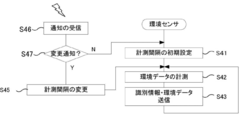
- FIG. 11 shows a processing flow of the environment sensor
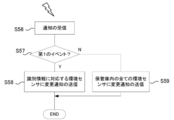
- FIGS. 12A and 12B show a processing flow of the repeater
- FIG. 12A shows a processing flow when transmitting environmental data and the like
- FIG. 12B shows a processing flow when a notification is received
- FIG. 13 shows a processing flow of the data collection server. The flow of processing for changing the measurement interval of the environment sensor will be described with reference to FIGS.
- the measurement interval of the environment sensor 30a is set to an initial value, for example, 600 seconds (step S41).
- the measurement unit 31 acquires environmental data by performing measurement at the set measurement interval (step S42).
- the wireless communication unit 32 of the environment sensor 30a attempts to communicate with the repeaters 22a provided in each of the plurality of storages 20, and transmits the measured environment data to all communicable repeaters 22a.
- the identification information ID of each environment sensor 30a is transmitted together with the environment data (step S43). Until the measurement interval is changed, the measurement of the environment data is repeated at intervals of 600 seconds, and the identification information ID, the environment data, and the communication strength are transmitted to the relay device 22a (steps S42 to S43).
- the repeater 22a not only the environment sensor 30a in the storage 20 in which the repeater 22a is provided by the wireless communication unit 24, but also the other storage 20 in the communicable range.
- the communication is also performed with the environment sensor 30a located in the communication area, and all of the identification information ID and the environment data transmitted from the environment sensor 30a within the communicable range are received (step S51).
- the wireless communication unit 24 acquires the communication strength at the time of receiving the environment data (step S52), and the transmission unit 26 transmits the environment data and the communication strength to the data collection server 10 together with the identification information ID (step S52). S53). Until the second event is detected by the event detector 23 of the storage 20 (the determination in step S54 is denied), the processing from step S11 to step S13 is repeated, and the identification information ID, environmental data, and its communication intensity Is transmitted to the data collection server 10.
- the event detecting unit 25a determines that the second event has occurred (the determination in step S54 is affirmative), and the changing unit. The occurrence of the second event is notified to 27a. Further, the transmitting unit 26 transmits the event information of the detected event to the data collection server 10 (Step S55).
- the data collection server 10a transmits the environment data transmitted from all the relays 22a, the identification information IDs of the environmental sensors 30a that are the transmission sources of the environmental data, and the communication between the environment sensor 30a and each relay 22a.
- the recording unit 11 Upon receiving the communication strength (Step S61), the recording unit 11 records the environment data, the identification information ID, and the communication strength in the storage in association with each other (Step S62).
- the determination in step S63 is negative, the determination in step S64 is negative, the determination in step S65 is negative, and step S68 is negative.
- the processing from step S61 to step S62 is repeated, and the environment data, the identification information ID, and the communication strength transmitted from all the relays 22 are recorded.
- the event detection unit 12 determines the first event based on the acceleration measured by the acceleration sensor of the environment sensor 30a. When the measured value of the acceleration of the environmental data transmitted from the repeater 22a is equal to or greater than the reference value, it is determined that a vibration event has occurred (the determination in step S63 is affirmative), and the change unit 13 is notified of the occurrence of the event. I do.
- the changing unit 13 sets the measurement interval to the initial value of 600 seconds (the determination in step S66). Is denied), the wireless communication unit 24 transmits the change notification to the relay 22a together with the identification information ID of the environment sensor 30a that has detected the vibration (step S67). Further, the relay device 22a on which the environment sensor 30a is located is specified based on the communication strength with the environment sensor 30a that has detected the vibration, and a change notification is transmitted to the specified relay device 22a.
- the change notification is a notification of the first event or a second event. Is determined (step S57). Since the change notification has been performed for the first event (the determination in step S57 is affirmative), the change unit 27a sends the change notification to the environment sensor 30a of the identification information ID included in the change notification. Send.
- step S46 when the wireless communication unit 24 receives the notification (step S46), the environment sensor 30a determines that the notification is a change in the measurement interval of the acceleration sensor (step S47: YES).
- the measurement interval of the acceleration sensor of the environment sensor 30a is changed to, for example, 0.1 (step S45). After the setting, the acceleration is measured at the changed measurement interval (step S42).
- the changing unit 13 of the data collection server 10 a performs the steps until a set elapsed time, for example, 3 seconds, has elapsed after the occurrence of the first event (the determination in step S ⁇ b> 68 is negative).
- a set elapsed time for example, 3 seconds
- the process of recording the identification information ID, environment data, and communication strength received from the environment sensor 30a in the data collection server 10a is repeated (steps S61 to S62).
- the change unit 13 of the data collection server 10a sends a reset notification of the first event to the change notification.
- the data is transmitted to the same relay device 22a as the transmission destination (step S69).
- the reset notification includes the identification information ID of the environment sensor 30a that has detected the vibration.
- step S56 when receiving the reset notification (step S56), if the notification is the notification of the first event (the determination in step S57 is affirmative), the relay device 22a performs the same operation as the change notification described above. Then, the reset unit 27a transmits the reset notification transmitted from the data collection server 10 to the environment sensor 30a of the identification information ID included in the reset notification (Step S58).
- step S46 when the wireless communication unit 24 receives the notification (step S46), if the notification is a reset notification (the determination in step S47 is negative), the environment sensor 30a The measurement interval of the acceleration sensor is changed to an initial value (Step S41). After the setting, the acceleration is measured at the original measurement interval (step S42).
- the event information is transmitted from the relay device 22a to the data collection server 10 (step S70).
- the recording unit 11 records the event information in the storage (Step S71).
- the event detecting unit 12 determines that the second event has been detected (No in Step S63 and Yes in Step S64), and the changing unit 13 Notify.
- the change unit 13 sets the measurement interval of the temperature sensor to the initial value, for example, 600 seconds (step S66). The determination is denied), and a change notification is transmitted from the wireless communication unit 24 to the relay device 22a that has detected the second event to change the measurement interval (step S67).
- the transmission destination of the change notification specifies the repeater 22a in which the second event has occurred from the information of the repeater 22a included in the event information and transmits the same.
- step S56 when the wireless communication unit 24 of the relay device 22a receives the change notification transmitted from the data collection server 10 (step S56), whether the notification is the first event or the second event is received. Is determined (step S57). Since the notification is made for the second event (the determination in step S57 is denied), the change unit 27a transmits the change notification to all the environmental sensors 30a in the storage 20.
- step S68 determines that the elapsed time set after the detection of the second event, for example, 600 seconds, has elapsed (the determination in step S68 is affirmative).
- the change unit 13 transmits the reset notification of the second event to the change notification. (Step S69).
- step S56 when the relay device 22a receives the reset notification (step S56), if it is the reset notification of the second event (negative in step S57), the relay device 22a performs the same operation as the change notification described above.
- the reset unit 13 transmits the reset notification transmitted from the data collection server 10 to all the environmental sensors 30a in the storage 20 (step S59).
- the measurement interval After changing the measurement interval to be shorter according to the occurrence of the event, the measurement interval is returned to the original interval after the set elapsed time. However, if it is detected that the same event has occurred again before resetting the measurement interval (Yes at step S66), the elapsed time count is reset (step S72), and finally the event is reset.
- step S68 When the set elapsed time has elapsed after the occurrence (step S68 is affirmative), a reset notification is transmitted to the storage 20 so as to return the measurement interval to the original interval (step S69).
- the event detector 23 provided in the storage 20 is connected to the data collection server 10 and the event detector 23 detects an event
- the event detector 12 of the data collection server 10 detects the second event. Then, the detection of the second event may be notified from the data collection server 10 to the relay device 22a of the storage 20 provided with the event detector 23.
- the processing after notifying the repeater 22a of the detection of the second event is the same as in the second embodiment.
- the effect of the event can be observed by shortening the measurement interval of the environment sensor.
- the battery of the environment sensor is not consumed more than necessary, so that a long-term culture environment can be observed.
- the measurement interval when the first event is detected, the measurement interval may be changed by the environment sensor 30a itself as in the first embodiment.
- the hardware structure of the processing unit (processing @ unit) that executes various processes of the relay device, the data collection server, and the environment sensor includes various processors ( processor).
- processors processors
- the circuit configuration is changed after manufacturing such as CPU (Central Processing Unit) and FPGA (Field Programmable Gate Array), which are general-purpose processors that execute software (programs) and function as various processing units.
- a programmable logic device Programmable Logic Device: PLD
- PLD programmable Logic Device
- PLD Programmable Logic Device
- dedicated electric circuit that is a processor having a circuit configuration specifically designed to execute a specific process such as an ASIC (Application Specific Integrated Circuit), etc. Is included.
- One processing unit may be configured by one of these various processors, or a combination of two or more processors of the same type or different types (for example, a plurality of FPGAs or a combination of a CPU and an FPGA). It may be configured. Further, a plurality of processing units may be configured by one processor. As an example in which a plurality of processing units are configured by one processor, first, as represented by a computer such as a client or a server, one processor is configured by a combination of one or more CPUs and software, There is a form in which this processor functions as a plurality of processing units.
- SoC system-on-chip
- a form using a processor that realizes the functions of the entire system including a plurality of processing units with one integrated circuit (IC) chip is used.
- IC integrated circuit
- the various processing units are configured using one or more of the above various processors as a hardware structure.
Landscapes
- Engineering & Computer Science (AREA)
- Business, Economics & Management (AREA)
- General Physics & Mathematics (AREA)
- Physics & Mathematics (AREA)
- Entrepreneurship & Innovation (AREA)
- Human Resources & Organizations (AREA)
- Strategic Management (AREA)
- Operations Research (AREA)
- Marketing (AREA)
- Quality & Reliability (AREA)
- Tourism & Hospitality (AREA)
- Economics (AREA)
- General Business, Economics & Management (AREA)
- Data Mining & Analysis (AREA)
- Theoretical Computer Science (AREA)
- Computer Networks & Wireless Communication (AREA)
- Arrangements For Transmission Of Measured Signals (AREA)
- Apparatus Associated With Microorganisms And Enzymes (AREA)
- Management, Administration, Business Operations System, And Electronic Commerce (AREA)
Abstract
センサのデータ計測間隔を自動的に適正な値に変更するための監視装置及び監視システムを提供する。 培養空間(20)内の複数の培養容器(21)の各々の培養環境に関する環境データを、予め定められた計測間隔で計測する複数種類の環境センサ(30)とを備え、培養空間(20)内の培養に影響を及ぼすイベントを検出し、イベントが検出された場合に、複数の環境センサ(30)の各々の計測間隔を、イベントを検出する前の間隔より短い間隔に変更する。
Description
本開示は、細胞培養を監視する監視装置及び監視システムに関する。
細胞培養において、昨今、無線センサーモジュールを培養環境に設置したり、培養容器に装着したりすることで、細胞の品質と環境との関連を把握しようとする試みがなされている。
培養容器は、通常は温度、湿度、及びCO2濃度が一定値に管理された保管庫(インキュベータ、又は冷蔵庫など)に設置される。これらの保管庫の環境データ値は通常は大きく変化しない。このため、例えば5~10分程度の計測間隔で環境データ値の計測が行われる。
しかし、培養容器は細胞操作を行うため一時的に保管庫外の作業場所に搬出されることがあり、この時は培養環境が急激に変化することになる。操作中の環境パラメータは品質と環境との関連を把握する上で重要となる。特に、衝撃が与えられた時の影響は大きいため、衝撃を検知した時の加速度データは重要である。
そこで、特許第5916475号では、細胞培養中に細胞培養容器に振動が加わったり変位が生じたりした事実を加速度センサ、ジャイロセンサ、地磁気センサ、衝撃センサ、又は磁気位置センサなどを用いて検出し、検出結果を培養環境の解析に利用するようにしている。
また、このような培養環境の解析を行うために、培養容器を置く培養トレイが収納される保管庫内で検出されたCO2濃度、温度、及び湿度などの環境因子を記録するためのシステムが設けられる。しかし、多数の細胞容器全ての環境因子を監視するのは労力がかかる。そこで、特開2016-7169号公報では、空間内の複数位置に配置された環境因子を計測するセンサの位置情報を記憶しておき、各々のセンサが計測した計測値と位置情報とに基づき、センサが置かれた位置における環境因子の予測値を算出する手法が開示されている。
さらに、特開平9-107946号公報には、培養環境を一定にするために、環境センサと室内環境制御装置とを直接接続し、室内環境制御装置で環境データの測定間隔を変更する手法が開示されている。
上述の通り、通常は保管庫内の環境が一定であることを前提にしているので、環境を計測するセンサは決められた時間間隔で計測が行われる。しかし、保管庫のドアが開閉された場合には、環境データが大きく変化する。そのため、例えば5~10分程度の計測間隔で行われていた計測を、1~30秒程度の短い計測間隔に変更する必要がある。また、培養容器に対して振動が加えられた場合の影響は大きいため、衝撃を検知した時の加速度データは重要であり、検出後は、例えば0.01~0.1秒間隔程度のさらに短い計測間隔でデータを取得する必要がある。
このように、細胞培養の環境を計測するセンサは周囲の変化に応じて適切な計測間隔、すなわちサンプリング周期でデータを取得する必要がある。また、培養容器にセンサを設ける場合には、人が操作を行ったり持ち運んだりすることを考えると無線センサーモジュールを用いるのが好ましい。一般的な無線センサーモジュールのデータ計測間隔は固定の値で与えられ、計測間隔を変更するためには人間が適切な値にその都度変更する必要がある。通常は複数の培養容器が保管庫に設置され、また、複数人が並行して細胞培養操作を行うため、全てのイベントに連動して人間が計測間隔の値を変更するのは現実的ではない。
このような手間を省くために、常に0.01~0.1秒といった最も短い計測間隔でデータ計測することも考えられるが、一般に無線センサーモジュールは搭載された電池によって駆動されるため、電力消費量が過大となる弊害が生じる。消費電力が過大になると、例えば電池交換が頻繁となり使い勝手が低下する、といった問題が生ずる。例えば、0.1秒間隔でデータ計測すると一般的な電池では数時間程度で消耗してしまい、頻繁に電池交換が必要となる。一般的な培養では、培養容器を数日間連続して使用するため、その間は連続して計測する必要がある。
そこで、本開示は、上述のような問題を解決するためになされたものであり、環境に影響を与えるイベントに対応して、センサのデータ計測間隔を自動的に適正な値に変更する監視装置及び監視システムを提供する。
本開示の監視装置は、培養空間内の複数の培養容器の各々の培養環境に関する環境データを、予め定められた計測間隔で計測する1種類又は複数種類の複数の環境センサと、培養空間内の培養に影響を及ぼすイベントを検出するイベント検出部と、イベント検出部でイベントが検出された場合に、複数の環境センサの各々の計測間隔を、イベントを検出する前の間隔より短い間隔に変更する変更部と、を備える。
「イベントを検出」とは、培養空間内の培養環境の変化を表す信号の検出、又は検出した信号に基づいて培養環境に影響を与えると推定される変化の検出を指す。
また、イベント検出部が、複数種類のイベントを検出するようにして、変更部は、イベント検出部で検出されたイベントの種類に応じた間隔に変更するものが望ましい。
また、イベント検出部が、複数の培養容器のいずれかの培養容器に対する計測間隔の変更が必要な第1のイベントを検出するようにし、変更部は、第1のイベントが検出された場合は、第1のイベントが検出された培養容器に対する環境センサの計測間隔を第1のイベントの検出前より短い間隔に変更するものが望ましい。
また、第1のイベントの検出は、いずれかの培養容器の振動の検出、いずれかの培養容器の傾きの検出、いずれかの培養容器内の溶液の劣化の検出、いずれかの培養容器の培養空間への出入りの検出、及びいずれかの培養容器への作業者の接近の検出、 の少なくとも1つであってもよい。
また、イベント検出部は、培養空間の全ての培養容器に対する計測間隔の変更が必要な第2のイベントを検出し、変更部は、第2のイベントが検出された場合は、全ての培養容器に対する環境センサの計測間隔を第2のイベントの検出前より短い間隔に変更するのが望ましい。
また、第2のイベントの検出は、培養空間内の規定値外の温度の検出、培養空間内の規定値外の湿度の検出、培養空間内の規定値外のガス濃度の検出、培養空間を構成する構造物のドア開閉の検出、及び培養空間内の作業室の照明の点灯消灯の検出、の少なくとも1つであってもよい。
「規定値外」とは、正常である場合に表れる値の範囲を規定値の範囲とし、規定値の範囲から外れた範囲の値をいう。
また、変更部は、計測間隔の変更から予め定められた時間内にイベント検出部による検出がなかった場合に、計測間隔を変更後の間隔より長い間隔に変更するものが望ましい。
また、環境センサは、加速度センサ、振動センサ、地磁気センサ、温度センサ、照度センサ、カラーセンサ、紫外線センサ、ガス濃度センサ、気圧センサ 及び湿度センサのうち少なくとも1つであってもよい。
また、イベント検出部は、培養空間を構成する構造物のドア開閉検出器、培養空間の温度検出器、培養空間の湿度検出器、培養空間のガス濃度検出器、培養空間に設けられたスイッチ、及び環境センサが計測した値に基づいてイベントを検出するようにしてもよい。
また、培養空間は、インキュベータ、冷蔵庫、冷凍庫、クリーンルーム倉庫、恒湿恒温槽、又は作業室の内部空間であってもよい。
また、複数の培養容器の各々に対する複数の環境センサの各々が、変更部を備えるようにしてもよい。
また、本開示の監視システムは、上述の監視装置に、イベント検出部で検出されたイベントをデータ収集サーバに送信する送信部をさらに設けるようにして、データ収集サーバに、変更部を設けるようにしてもよい。
また、複数の環境センサの各々を識別する識別情報をデータ収集サーバに送信する識別情報送信部をさらに設けるようにし、変更部が、検出したイベントの種類に応じて、計測間隔を変更する必要がある識別情報の環境センサの計測間隔をイベントの検出より短い間隔に変更するようにしてもよい。
また、識別情報は、培養空間内の培養容器の各々に対する環境センサの位置を表す情報を含むものが望ましい。
また、データ収集サーバが、イベントの種類と発生時刻とを対応づけて記録する記録部を備えるようにしてもよい。
また、データ収集サーバが、イベントの種類と発生時刻とを、識別情報に対応づけて記録する記録部を備えるようにしてもよい。
本開示の監視装置は、コンピュータに実行させるための命令を記憶するメモリと、記憶された命令を実行するよう構成されたプロセッサとを備え、プロセッサが前記メモリに記憶された命令を実行することにより、培養空間内の複数の培養容器の各々の培養環境に関する環境データを、予め定められた計測間隔で計測する1種類又は複数種類の複数の環境センサと、培養空間内の培養に影響を及ぼすイベントを検出し、イベント検出部でイベントが検出された場合に、複数の環境センサの各々の計測間隔を、イベントを検出する前の間隔より短い間隔に変更する。
本開示によれば、環境に影響を与えるイベントに対応して、センサのデータ計測間隔を自動的に適正な値に変更することが可能になる。
以下、図を用いて本開示の監視システムについて説明する。図1に、本開示の第1の実施の形態における監視システム1の概略構成を示す。本実施の形態では、複数箇所に設けられた培養空間の各々に複数の培養容器を保管して、培養空間各々の環境データを監視する場合について説明する。
図1に示すように、監視システム1は、データ収集サーバ10、及び複数の培養空間20a~20fの各々に配置された監視装置で構成される。なお、複数の培養空間は、便宜上6つの培養空間20a~20fを例に説明するが、培養空間の個数については6つに限定されない。また、個々の培養空間を区別して説明する場合は、20a~20fのようにアルファベットを付した符号を用いて説明するが、培養空間を区別する必要が無い場合は、内部に培養空間を有し、かつ開閉可能なドアを備えた保管庫20として説明する。
データ収集サーバ10は、CPU(Central Processing Unit)、メモリ、ストレージ、入出力インターフェース、通信インターフェース、及び、データバス等の周知のハードウェア構成を備えたコンピュータである。データ収集サーバ10には、オペレーティングシステムと各種プログラムがインストールされている。また、第1の実施の形態の監視システムのサーバとして機能させるために、各々の培養空間20内の環境データを記録するための記録プログラムがインストールされている。
培養空間20は、細胞を培養するため、あるいは培養液など培養に用いる資材を管理するための密閉された空間であり、例えば、インキュベータ、冷蔵庫、冷凍庫、クリーンルーム倉庫、恒湿恒温槽、又は作業室の内部空間等である。保管庫20の少なくとも1つは、培養空間内の異常に関するイベントを検出する必要のある培養空間を有している。本実施の形態では、異常に関するイベントを検出する必要のある培養空間を備えた保管庫と、イベントの検出が必要でない培養空間を備えた保管庫とが混在して設けられた場合を例に説明する。例えば、図1の培養空間20a~20cは、例えば、インキュベータ、冷蔵庫、冷凍庫、クリーンルーム倉庫、又は恒湿恒温槽であり、ドアの開閉等の培養空間を構成する構造物に関するイベント、又は、ガス検出等の培養空間内の異常に関するイベントを検出するイベント検出器23が各々設けられている。また、培養空間20d~20fは、例えば、安全キャビネット、顕微鏡、ウォーターバス、又は遠心分離器等の作業室である。これらには、イベント検出器23は設けられない場合がある。以下、培養空間20a~20fを、単に保管庫20として説明する。
保管庫20には、複数の培養容器21、及び中継機22が設けられ、培養空間20a~20cには更にイベント検出器23が設けられる。培養容器21の各々には、予め設定された計測間隔で環境データを計測するために環境センサ30が設けられる。培養容器21は、例えば、セルスタック、培地ボトル、又は、遠沈管等である。環境センサ30は、振動、温度、及び傾き等を検出する無線センサーモジュールで構成される。
中継機22は、環境センサ30と無線で送受信を行う。また、1種類又は複数種類のイベント検出器23と無線又は有線で接続される。さらに、中継機22は、データ収集サーバ10とネットワークで接続され、これらの環境センサ30で検出した環境データ及びイベント検出器23で検出したイベント情報を、中継機22はデータ収集サーバ10に送信する。また、ネットワークは、ローカルエリアネットワークであってもワイドエリアネットワークであってもよい。
なお、本開示の監視装置は、一例として、環境センサ30、イベント検出器23、及び中継機22で構成される。
イベントは、培養環境が変化する要因又は培養環境の変化に応じて発生し、上記のイベント検出器23で検出するイベントと、環境センサ30が計測した環境データに基づいて検出されるイベントとがある。また、イベントは、同じ保管庫20に置かれる複数の培養容器21のうちの1つの培養容器21に影響を与える第1のイベントと、同じ保管庫20に置かれる全ての培養容器21に対して影響を与える第2のイベントに分けられる。
第1のイベントは、例えば、培養容器21の振動の検出、培養容器21の傾きの検出、培養容器21内の溶液の劣化の検出、培養容器21の保管庫20への作業者の出し入れの検出、又は培養容器21への作業者の接近の検出等である。
第2のイベントは、例えば、培養空間20内の規定値外の温度の検出、培養空間20内の規定値外の湿度の検出、培養空間20内の規定値外のガス濃度の検出、培養空間20を構成する構造物のドア開閉の検出、又は培養空間20内の照明の点灯消灯の検出等である。
図2に、環境センサ30の概略構成図を示す。図2に示すように、環境センサ30は、計測部31、無線通信部32、イベント検出部33、及び変更部34を備える。
計測部31は、培養に関連する環境に関する環境データを収集し、コンピュータで取り扱うことのできる信号に置き換える素子又は装置で構成されたセンサであり、設定された計測間隔で環境データを取得する。計測部31は、例えば、加速度センサ、振動センサ、地磁気センサ、カラーセンサ、温度センサ、照度センサ、紫外線センサ、ガス濃度センサ、気圧センサ、及び湿度センサ等の少なくとも1つで構成される。
無線通信部32は、例えば、RFID(radio frequency identifier)等の無線通信を用いて、中継機22とデータをやりとりする。
イベント検出部33は、計測部31の計測値に応じて、計測間隔の変更が必要なイベントの検出を行う。計測部31で計測された計測値が急激に変化したことが検出された場合、計測間隔の変更が必要なイベントが発生したと判断する。例えば、加速度センサが閾値以上の加速度を検出した場合は振動のイベントが発生したと判断する。
変更部34は、イベント検出部33が検出したイベントに応じて、環境センサ30の計測間隔を、イベントを検出する前の間隔より短い間隔に変更する。あるいは、無線通信部32で中継機22から送信された計測間隔の変更通知を受信した場合に、計測間隔を変更する。例えば、通常、加速度センサの計測間隔は例えば600秒であるが、振動のイベントを検出すると、計測間隔をさらに短い間隔である例えば0.1秒に変更する。さらに、変更部34は、イベントが発生後に計測間隔の変更が行われてから、予め定められた時間内に同じイベントが検出されなかった場合には、短くした計測間隔を長い計測間隔に変更する。例えば、振動のイベントを検出してから、3秒間振動が発生しなかった場合には、加速度センサの計測間隔を元の計測間隔である例えば600秒に戻す。なお、イベントの発生に応じて短い間隔に変更した計測間隔を、イベント発生前の元の計測間隔などの長い計測間隔に変更する場合、直接長い計測間隔に変更しても良く、徐々に長い計測間隔に変更しても良い。
また、計測間隔は、発生したイベントに応じて異なる間隔に変更することが好ましい。培養環境に対する影響が大きい場合、例えば振動が発生した場合には、計測間隔を例えば0.1秒に変更するが、培養環境に対する影響が振動に比べてそれほど大きくない場合、例えば急な温度変化が発生した場合には、計測間隔を例えば1秒に変更する。さらに、イベントが発生後に計測間隔の変更が行われてから所定の経過時間を過ぎると、短くした計測間隔を元の計測間隔に戻すが、経過時間も発生したイベントに応じて異なる経過時間を設定するのが好ましい。
また、異なるイベントが短い間隔で連続して、すなわち立て続けに発生することにより、計測間隔の変更が重複する場合があり得る。異なるイベントの各々に対して設定されている計測間隔が異なる場合は、短い計測間隔を優先して計測間隔の変更を行うものとする。例えば、1秒間隔で温度計測を行っている最中に、10秒間隔への変更のイベントが発生したとしても、1秒間隔の計測を継続する。1秒間隔の計測に対して設けられた経過時間が経過してタイムアウトしても、10秒間隔の計測に対して設けられた経過時間が経過していなければ、10秒間隔への変更を行うようにするのが好ましい。
環境センサ30は、培養容器21に直接取り付けて培養容器21の各々の培養環境の変化を計測するようにしてもよい。又は、環境センサ30は、培養容器21の上面から培養容器内の培養液の状態を計測することができるように培養容器21の上部の位置に取り付けて培養液の変化を計測するようにしてもよい。あるいは、培養容器21内の溶液のサンプリングするためのキュベットを培養容器21に設け、キュベット内の溶液の状態を計測できるように環境センサ30のキュベットに取り付けてもよい。
また、各培養容器21には、必要に応じて1種類又は複数種類の環境センサ30が、計測対象に応じて設けられる。また、環境センサ30にはそれぞれ識別情報IDが予め割り当てられる。
なお、第1のイベントを検出した場合には、同じ保管庫20に置かれる複数の培養容器21のうちの1つの培養容器21に対して計測間隔を変更し、第2のイベントを検出した場合には、同じ保管庫20に置かれる全ての培養容器21に対して計測間隔を変更する。
第1のイベントは、培養容器21のそれぞれに対して設けられた環境センサ30から得られる。第1のイベントを検出するための環境センサ30は、例えば、培養容器21の振動を検出するセンサ、培養容器21の姿勢変化を検出するセンサ、又は培養容器21内の溶媒の劣化を検出するセンサを用いる。具体的には、培養容器21の振動を検出するセンサは、例えば、加速度センサであり、培養容器21の姿勢変化を検出するセンサは、例えば、地磁気センサ、又は加速度センサである。また、培養容器21内の溶媒液の劣化を検出するセンサは、例えば、培養液の色を検出するカラーセンサ、又は照度センサ等である。
あるいは、環境センサ30で第2のイベントが得られるように、環境センサ30を保管庫20の所定の場所に設置して、保管庫20内の環境を計測するようにしてもよい。保管庫20内の環境を計測するセンサとして、例えば、温度センサ、湿度センサ、加速度(振動)センサ、地磁気センサ、紫外線(UV)センサ、気圧センサ、ガス濃度センサ(具体的には、揮発性有機化合物(VOC)センサ、二酸化炭素(CO2)センサ等)、カラーセンサ、又は照度センサ等が挙げられる。
中継機22は、CPU、及びメモリが設けられた無線信号読取書込端末である。例えば、環境センサ30の無線通信部32がRFIDである場合には、RFIDリーダライタである。
図3に中継機の概略構成図を示す。図3に示すように、中継機22は、無線通信部24、イベント検出部25、送信部26、及び変更部27を備える。
無線通信部24は、環境センサ30と無線でデータの送受信を行う。各環境センサ30から中継機22へ環境データを送信する際、環境センサ30の無線通信部32は、複数の保管庫20の各々に設けられた全ての中継機22の無線通信部24との通信を試みる。無線通信部24は、環境データを受信したときの通信強度を表す値、例えば、RSSI(Received Signal Strength Indication)を計測して、環境データと対応付けて中継機22のメモリに一旦記憶する。
イベント検出部25は、1種類又は複数種類のイベント検出器23と有線又は無線で接続され、イベント検出器23のイベントを検出すると、変更部27にイベントの検出を通知する。イベント検出器23は、例えば、保管庫20のドアの開閉を検出するドア開閉検出器、保管庫20内に設けられ保管庫20内の温度を検出する温度検出器、保管庫20内に設けられた保管庫20内の湿度を検出する湿度検出器、保管庫20内に設けられた保管庫20内のガス濃度を検出するガス濃度検出器、保管庫20に設けられた保管庫の照明の点灯消灯のためのスイッチ等である。
イベント検出部25は、各イベント検出器23から異常値を受信した場合に、イベントを検出したと判断する。あるいは、異常を示す信号(例えば、CO2等のガス濃度検出の異常信号)を受信した場合に、第2のイベントを検出したと判断するようにしてもよい。このような温度、湿度、又はガス濃度の異常は、保管庫20内の全体に影響があり第2のイベントに該当する。異常値は、正常である場合に表れる計測値の範囲を規定値の範囲とし、規定値の範囲から外れた範囲の計測値を異常値とする。
あるいは、イベント検出部25は、無線通信部24で保管庫20の所定の場所に置かれた培養容器21に設けられた環境センサ30から受け取った温度、湿度、照度、紫外線、ガス濃度、又は気圧の値が異常値であった場合に、第2のイベントを検出したと判断して、変更部27にイベントの検出を通知するようにしてもよい。
変更部27は、イベント検出部25で第2のイベントが検出された場合には、保管庫20内の全ての環境センサ30へ、無線通信部24から計測間隔の変更通知を送信する。全ての環境センサ30には、培養容器21に対して設けられた環境センサ30と、保管庫20内の所定の場所に置かれた環境センサ30が含まれる。
また、環境センサ30は、無線通信部32で変更通知を受信すると、イベント検出部25で検出されたイベントの種類に応じた間隔で、計測間隔が第2のイベントを検出する前の間隔より短い間隔に変更される。
例えば、イベントの検出前は温度の計測間隔を例えば600秒毎に設定しておき、ドア開閉検出器がドアの開閉を検出すると、無線通信部24は温度の計測間隔を短い計測間隔である例えば30秒毎に変更するように変更通知を保管庫20内の環境センサ30の各々に送信する。各環境センサ30の無線通信部32が変更通知を受信すると、温度を計測する環境センサ30の計測間隔が変更される。複数種類の環境センサ30が培養容器21に設けられている場合には、検出したイベントに応じて、計測間隔を変更する必要がある種類の環境センサ30のみの計測間隔を変更する。例えば、温度センサと振動センサとの2種類が培養容器21に設けられている場合には、ドア開閉検出器がドアが開けられたことを検出した場合は、温度センサの計測間隔だけを変更する。種類に応じた計測間隔は、中継機22が送信する変更通知に含めてもよいし、環境センサ30が種類と計測間隔のテーブルを記憶するようにしてもよい。
さらに、変更部27は、計測間隔の変更が行われた時から予め定められた時間内に同じイベントが検出されなかった場合には、計測間隔を変更後の短くした計測間隔を長くする。例えば、ドアが開けられたことを検出してから600秒間ドアが再度開けられなかった場合には、温度センサの計測間隔を例えば600秒に戻す。多くの場合は、イベントの発生から一定の時間経過後に変更前の計測間隔に戻すが、何回かに分けて、短くした計測間隔を徐々に長くして行くようにしてもよい。あるいは、長時間同じイベントが発生しない場合には、時間の経過につれて初めに設定されていた計測間隔より計測間隔を長くしてもよい。
図4に、イベントの種類と計測間隔の一例を示す。また、これらのイベントは、割り込み信号で中継機22に通知されてもよい。
上記の環境センサ30の計測値が変化する要因になるイベントと、そのイベントを検出方法、計測間隔を変更する変更部が置かれる場所、及び環境センサの計測間隔を変更する方法の具体例を、下記の表1に示す。また、表1では、保管庫20は、二酸化炭素インキュベータ、冷蔵庫、冷凍庫、クリーンルーム倉庫、又は恒湿恒温槽を指し、作業室とは分けて記載する。作業室は、例えば、安全キャビネット、顕微鏡、ウォーターバス、又は遠心分離器である。

また、上記の表1以外に以下のようなイベントの検出するのが好ましい。
(1)保管庫20から培養容器21の出し入れを検出して、保管庫20に培養容器21が「入れた」、又は保管庫20から「出した」タイミングをイベントとする。例えば、環境センサ30と中継機22との通信強度から培養容器21の出し入れを検出する。
(2)培養容器21に液を「入れた」又は「出した」をイベントとする。例えば、液を出し入れするためのピペット又はアスピレータの位置をセンサで検出し、それらのボタン押下と近傍の培養容器の振動を合わせてイベントを検出する。
(3)培養容器21のキャップの開閉をイベントとする。例えば、キャップに開閉を検出するセンサを取り付ける。
(4)1個の培養容器21を保管庫20に「入れた」又は保管庫20から「出した」タイミングで、その近傍にある容器の計測間隔を変更する。センサは(1)と同様である。
(5)作業者が押しボタンを押したタイミングをイベントとする。押しボタンの位置とその近傍にある培養容器21を中継機22で検出する。押しボタンの押下が各培養容器21の培養環境を変えるトリガーとなるものである。複数種類の押しボタンがあり、それぞれに違う計測間隔を割り当ててもよい。
(6)培養容器21から少量のサンプルを取ったタイミングをイベントとする。例えば、サンプルを採取するためのピペットのボタン押下を検出するセンサを取り付ける。
(7)培養容器21にエタノールを吹きかけるタイミングをイベントとする。例えば、エタノール噴霧容器のレバー押下を検出するセンサを取り付ける。
(8)保管庫20内のスターラー(攪拌装置)に、培養容器21を「置いた」又は培養容器21を「取った」をイベントとする。例えば、スターラーの位置と環境センサ30の位置から検出する。環境センサ30の位置は環境センサ30と中継機22との通信強度から検出する。
(9)気圧が一定時間内に大きく変化した場合をイベントとする。例えば、気圧センサから検出する。
(10)地震発生をイベントとする。例えば、全国瞬時警報システム(Jアラート)からの情報から検出する。
(1)保管庫20から培養容器21の出し入れを検出して、保管庫20に培養容器21が「入れた」、又は保管庫20から「出した」タイミングをイベントとする。例えば、環境センサ30と中継機22との通信強度から培養容器21の出し入れを検出する。
(2)培養容器21に液を「入れた」又は「出した」をイベントとする。例えば、液を出し入れするためのピペット又はアスピレータの位置をセンサで検出し、それらのボタン押下と近傍の培養容器の振動を合わせてイベントを検出する。
(3)培養容器21のキャップの開閉をイベントとする。例えば、キャップに開閉を検出するセンサを取り付ける。
(4)1個の培養容器21を保管庫20に「入れた」又は保管庫20から「出した」タイミングで、その近傍にある容器の計測間隔を変更する。センサは(1)と同様である。
(5)作業者が押しボタンを押したタイミングをイベントとする。押しボタンの位置とその近傍にある培養容器21を中継機22で検出する。押しボタンの押下が各培養容器21の培養環境を変えるトリガーとなるものである。複数種類の押しボタンがあり、それぞれに違う計測間隔を割り当ててもよい。
(6)培養容器21から少量のサンプルを取ったタイミングをイベントとする。例えば、サンプルを採取するためのピペットのボタン押下を検出するセンサを取り付ける。
(7)培養容器21にエタノールを吹きかけるタイミングをイベントとする。例えば、エタノール噴霧容器のレバー押下を検出するセンサを取り付ける。
(8)保管庫20内のスターラー(攪拌装置)に、培養容器21を「置いた」又は培養容器21を「取った」をイベントとする。例えば、スターラーの位置と環境センサ30の位置から検出する。環境センサ30の位置は環境センサ30と中継機22との通信強度から検出する。
(9)気圧が一定時間内に大きく変化した場合をイベントとする。例えば、気圧センサから検出する。
(10)地震発生をイベントとする。例えば、全国瞬時警報システム(Jアラート)からの情報から検出する。
また、イベントに応じて計測間隔の変更する場合、下記の3つのモードがあり、予め作業者が選べるようにしてもよい。
(a) イベントを検出したタイミングですぐに変更する。
(b) イベントを検出したタイミングの少し後に変更する。
(c) イベントを検出したタイミングの少し前に変更する。
なお、(c)の場合は、環境センサ30が予め最短計測間隔での計測データをバッファリングすることで、中継機22から要求があった場合に、バッファに記憶している範囲内で必要となる過去データを送信することで実現することができる。環境センサ30の電池の消費は、データの送受信時に大きな消費となるので、不要なデータは送信しないため電池の消費を節約することが可能になる。
(a) イベントを検出したタイミングですぐに変更する。
(b) イベントを検出したタイミングの少し後に変更する。
(c) イベントを検出したタイミングの少し前に変更する。
なお、(c)の場合は、環境センサ30が予め最短計測間隔での計測データをバッファリングすることで、中継機22から要求があった場合に、バッファに記憶している範囲内で必要となる過去データを送信することで実現することができる。環境センサ30の電池の消費は、データの送受信時に大きな消費となるので、不要なデータは送信しないため電池の消費を節約することが可能になる。
送信部26は、データ収集サーバ10とネットワークを介して接続され、環境センサ30の環境データ、及びイベント検出部25で検出したイベントに関するイベント情報をデータ収集サーバ10に送信する。なお、送信部26は識別情報送信部としても機能し、環境データを送信する際は、メモリに記憶されている環境データを受信したときの通信強度と、環境データの送信元の環境センサ30の各々を識別する識別情報IDを一緒にデータ収集サーバ10に送信する。また、イベント情報には、イベントの種類、イベントの発生時刻、及びイベントが発生した保管庫20を特定するための情報が含まれる。保管庫20を特定するための情報は、例えば、中継機22に割り当てられているMAC(Media Access Control address)アドレス、又はIPアドレスを用いることができる。
上述の通り、環境センサ30のイベント検出部33で検出されたイベントの種類が第1のイベントに該当する場合は、変更部34は環境センサ30自身の計測部31の計測間隔を変更する。一方、中継機22のイベント検出部25で検出したイベント、又は、環境センサ30のイベント検出部33で検出されたイベントの種類が第2のイベントに該当する場合は、変更部34は保管庫20内にある全ての環境センサ30の計測間隔を変更する。
データ収集サーバ10の記録部11は、受信した環境センサ30の識別情報ID、環境データ、及び通信強度を対応付けてストレージに記録する。さらに、環境データの送信元の中継機22を特定する情報を対応付けて記録する。送信元の中継機22を特定する情報は、例えば、MACアドレス、又はIPアドレスを用いることができる。また、中継機22と環境センサ30間の通信強度は中継機22と環境センサ30間の距離が近いほど大きくなるので、1つの環境センサ30と各中継機22の通信強度が最大の中継機22を見つけることで、その環境センサ30が設けられた培養容器21が置かれている保管庫20を特定することができる。なお、環境センサ30に識別情報IDが割り当てられていない場合であっても、環境センサ30と各中継機22の間の通信強度から培養容器21の位置を特定して、この位置情報を識別情報としてもよい。
あるいは、各培養容器21の設置位置とその培養容器21に設けられている環境センサ30とが予め対応付けられている場合には、環境センサ30に予め識別情報IDを割り当てておき、環境データと識別情報IDを一緒に送信するようにしておくことで、環境データが計測された位置を特定することができるようにしてもよい。
また、記録部11は、保管庫20のイベント検出器23で検出したイベントのイベント情報もストレージに記録する。イベントの発生後に計測された環境データは、そのイベントの種類及び発生時刻との対応がわかる形式で記録する。これにより、環境データに特徴的な挙動があった場合、それが何時、何処で、どのイベントによりもたらされたのかが、容易にわかるようになる。
次に、図5~7のフローチャートに従って監視システムの処理の流れについて説明する。図5は環境センサの処理の流れを示し、図6は中継機の処理の流れを示し、図7はデータ収集サーバの処理の流れを示す。図5に従って、環境センサが加速度センサである場合に、環境センサで計測間隔を変更する例について説明する。
最初に、図5に示すように、環境センサ30の変更部34は、計測部31の計測間隔を初期値の例えば600秒に設定する(ステップS1)。計測部31は、設定された計測間隔で加速度センサの計測値を計測して環境データを取得する(ステップS2)。環境データを取得すると、無線通信部32は、複数の保管庫20の各々に設けられた中継機22と通信を試みて、通信可能な全ての中継機に取得した環境データを送信する。また、各環境センサ30の識別情報IDを環境データと一緒に中継機22に送信する(ステップS3)。さらに、環境データのイベントの種類及び発生時刻を含んだ形式で、環境データを送信するのが好ましい。
次に、イベント検出部33は、第1のイベントである振動を検出したか否かを判断する(ステップS4)。イベント検出部33は、加速度センサの計測値が基準値以下の場合は振動(第1のイベント)は発生していないと判断し、イベントが発生するまで(ステップS4の判断が否定される)、ステップS2に戻って加速度センサの計測と、ステップS3の識別情報IDと環境データの中継機22への送信を繰り返す。
イベント検出部33は加速度センサの計測値が基準値以上となると、振動が発生したと判断し(ステップS4の判断が肯定される)、変更部34は計測間隔をイベント発生前の計測間隔より短い計測間隔である例えば0.1秒に変更する(ステップS5)。計測部31は、変更された計測間隔で加速度の計測を開始する(ステップS6)。続いて、無線通信部32は、複数の保管庫20のうち通信可能な全ての中継機22に計測した加速度を環境データとして送信する(ステップS7)。次に、環境センサ30は、イベントの検出、つまり振動の検出から予め定められた経過時間、例えば3秒が過ぎたか否かを判断する(ステップS8)。経過時間を経過していないと判断された場合は(ステップS8の判断は否定される)、変更された計測間隔の0.1秒毎にステップS6の加速度の計測とステップS7の加速度の中継機22への送信を繰り返す。予め設定された経過時間が過ぎたと判断された場合は(ステップS8の判断が肯定される)、ステップS1に戻り、計測間隔を初期値の600秒に戻す。
次に、図5と図6に従って、イベント検出器23がドア開閉検出器であり、環境センサ30が温度センサである場合に、ドアの開閉を検出すると中継機からの通知に従って環境センサの計測間隔を変更する例について説明する。
まず、環境センサ30は図5のステップS1で温度の計測間隔が例えば600秒に初期設定される。また、上述の通り、計測間隔に従って計測された環境データが環境センサ30から中継機22に送信される(ステップS2~ステップS4)。
一方、図6に示すように、中継機22の無線通信部24は、中継機22が設けられている保管庫20内にある環境センサ30だけでなく、通信可能な範囲にある他の保管庫20内にある環境センサ30とも通信を行い、通信可能な範囲内にある環境センサ30から送信された識別情報IDと環境データを全て受信する(ステップS11)。また、無線通信部24は環境データを受信した時の通信強度を取得し(ステップS12)、送信部26で環境データとその通信強度を識別情報IDと一緒にデータ収集サーバ10に送信する(ステップS13)。イベント検出器23で第2のイベントが検出されるまで(ステップ14の判断が否定され、ステップS19の判断も否定される)、ステップS11からステップS13の処理を繰り返し、識別情報ID、環境データ、及びその通信強度をデータ収集サーバ10に送信する。
イベント検出器(ドア開閉検出器)23がドアの開閉を検出すると、イベント検出部25は第2のイベントが発生したと判断して(ステップ14の判断が肯定される)、変更部27に第2のイベントの発生を通知する。また、送信部26は検出したイベントのイベント情報をデータ収集サーバ10に送信する(ステップS15)。
変更部27は、今回のイベント検出より前に同じ種類のイベント(つまり、ドアの開閉)が検出されていない場合は計測間隔が初期値の例えば600秒に設定されているので(ステップS16の判断が否定される)、無線通信部24からイベントを検出した中継機22が設けられている保管庫20内にある全ての環境センサ30に温度の計測間隔を30秒に変更するように変更通知を送信する(ステップS17)。
図5に示すように、環境センサ30は、中継機22からの通知を無線通信部32で受信すると(ステップS9)、変更部34は通知が計測間隔の変更通知であるか否かを判断する(ステップS10)。通知が変更通知の場合はステップS10の判断が肯定され、環境センサ30の計測間隔を30秒に変更する(ステップS5)。
図6に戻り、中継機22の変更部27は、変更通知の送信後、イベント発生後から設定された経過時間、例えば600秒を経過したか否かを判断する(ステップS18)。イベント発生から600秒を経過していない場合はステップ18の判断は否定され、ステップS11に戻って、環境センサ30から受信した識別情報ID、環境データ、及び通信強度をデータ収集サーバ10に送信する(ステップS11からステップS13)。また、温度の計測間隔が30秒に変更されている間は(ステップS14の判断が否定され、ステップS19の判断が肯定される)、経過時間をカウントしてイベント発生から600秒経過するまで(ステップS18の判断が否定される)、環境センサ30から30秒間隔で計測された環境データが、識別情報ID、及び通信強度と一緒にデータ収集サーバ10に送信する処理を繰り返す(ステップS11からステップS13)。
しかし、設定された経過時間が過ぎる前に、再度、イベント検出器23がイベントを検出した場合は(ステップ14の判断が肯定される)、変更部27は検出したイベントが前回のイベントと同じ種類のイベント、つまりドアの開閉の検出であるか否かを判断する(ステップS16)。ドアの開閉のイベントである場合は(ステップS16の判断が肯定される)、経過時間をリセットして(ステップS21)、この時点から再度経過時間のカウントを開始する。
経過時間のカウント開始から例えば600秒経過すると(ステップS18が肯定され)、無線通信部24からイベントを検出した中継機22が設けられている保管庫20内にある全ての環境センサ30に温度の計測間隔をリセットするリセット通知を送信する(ステップS20)。
図5に戻り、環境センサ30は、中継機22からの通知を無線通信部32で受信すると(ステップS9)、変更部34は受信した通知が計測間隔の変更通知であるかリセット通知であるかを判断する(ステップS10)。通知がリセット通知の場合は、ステップS10の判断が否定され、環境センサ30の計測間隔を初期値に変更する(ステップS1)。これで、再び環境センサ30の温度の計測間隔が600秒に戻る。
次に、図7に従って、データ収集サーバの処理について説明する。
データ収集サーバ10は、全ての中継機22から送信された環境データ、環境データの送信元の環境センサ30の識別情報ID、及び環境センサ30と各中継機22との通信強度を受信すると(ステップS31)、記録部11は、環境データ、識別情報ID、及び通信強度を対応付けて記録する(ステップS32)。さらに、中継機22から送信されたイベント情報を記録する(ステップS33)。ステップS31からステップS33の処理を繰り返して、全ての中継機22から送信され環境データとイベント情報を記録することで、イベント発生に伴って計測された環境データに特徴的な挙動があった場合、それが何時、何処で、どのイベントによりもたらされたのかが、容易にわかるようになり、様々な解析に用いることが可能になる。また、イベント情報は、イベントの種類及び発生時刻も一緒に記録するのが望ましい。
以上詳細に説明したように、培養環境に影響を与える特定のイベントを検出すると、環境センサの計測間隔を短くすることで、そのイベントによる影響を観察することが可能になる。また、一定の時間が経過した後に、計測間隔を元に戻すことで、環境センサの電池を必要以上に消費することがないため、長期間に及ぶ培養環境を観察することが可能になる。
上述では、保管庫20に設けられる中継機22から、保管庫20にある全ての環境センサ30の計測間隔を変更する場合について説明したが、この機能を、データ収集サーバ10に設けるようにしてもよい。データ収集サーバ10が各保管庫20に対して、中継機22に計測間隔を変更するように指示すると、さらに、中継機22から保管庫20内の全ての環境センサ30の計測間隔を変更するように、指示をするようにしてもよい。
また、培養容器21の各々に対して環境センサとして2種類以上のセンサが設けられ、イベントの種類に応じて、それぞれ異なる計測間隔と経過時間を設定するようにするのが望ましい。
また、中継機22から環境センサ30にデータを送信するために、本実施の形態では、環境センサ30に割り当てられた識別情報IDを用いる場合について説明したが、環境データに対応付けられている通信強度から距離を求めて、該当する環境センサ30を特定するようにしてもよい。
(第2の実施の形態)
次に、本開示の第2の実施の形態における監視システムについて説明する。本実施の形態では、データ収集サーバが、全ての計測間隔の変更を管理する場合について説明する。本実施の形態の監視システム1の構成は第1の実施の形態と同じ構成であるので省略する。また、環境センサ及び中継機については、第1の実施の形態と相違する構成のみ詳細な説明を行い、第1の実施の形態と略同じ機能を備える構成には、同一符号を付して詳細な説明を省略する。
次に、本開示の第2の実施の形態における監視システムについて説明する。本実施の形態では、データ収集サーバが、全ての計測間隔の変更を管理する場合について説明する。本実施の形態の監視システム1の構成は第1の実施の形態と同じ構成であるので省略する。また、環境センサ及び中継機については、第1の実施の形態と相違する構成のみ詳細な説明を行い、第1の実施の形態と略同じ機能を備える構成には、同一符号を付して詳細な説明を省略する。
第2の実施の形態では、環境センサとして温度センサと加速度センサの2種類が設けられ、第1のイベントが振動であり、第2のイベントがドアの開閉である場合について説明する。また、保管庫に設けられるイベント検出器はドア開閉検出器である。
なお、本開示の監視装置は、環境センサ30a、イベント検出器23、及び中継機22aで構成される。
図8に第2の実施の形態の環境センサ30aの概略構成図を示す。図8に示すように、環境センサ30aは、計測部31、無線通信部32、及び変更部34aを備える。
変更部34aは、データ収集サーバ10から送信された変更通知に従って、計測間隔を変更する。
図9に第2の実施の形態の中継機22aの概略構成図を示す。図9に示すように、本実施の形態の中継機22aは、無線通信部24、イベント検出部25a、送信部26、及び変更部27aを備える。
イベント検出部25aは、イベント検出器23と接続され、イベント検出器23のイベントを検出すると、送信部26にイベントの検出を通知する。
変更部27aは、データ収集サーバ10から送信された計測間隔の変更通知を、指定された識別情報IDの環境センサ30aに送信する機能を備える。環境センサ30aの計測間隔の変更通知については後述する。
データ収集サーバ10には、記録プログラム、イベント検出プログラム、及びデータ計測間隔を変更する変更処理プログラムがインストールされ、CPUによってメモリに記録されたプログラムの命令が実行されることにより本開示のデータ収集サーバの各部として機能する。各プログラムは、ネットワークストレージ又はネットワークに接続されたサーバコンピュータの記憶装置に、外部からアクセス可能な状態で記憶され、外部からの要求に応じてコンピュータにダウンロードされた後にインストールされる。あるいは、各プログラムは、DVD(Digital Versatile Disc)及びCD-ROM(Compact Disc Read Only Memory)などの記録媒体に記録されて配布され、その記録媒体からコンピュータにインストールされてもよい。
図10に、第2の実施の形態のデータ収集サーバ10aの概略構成図を示す。図10に示すように、上記の各プログラムを実行することにより、データ収集サーバ10は、記録部11、イベント検出部12、及び変更部13として機能する。記録部11は、第1の実施の形態と同様であるので詳細な説明は省略する。
イベント検出部12は、中継機22aから送信されてきた環境データの中から異常値を検出するとイベントの発生であると判断して、変更部13に通知する。また、異常値を計測した環境センサ30aと各中継機22aの通信強度最大値を見つけることで、その環境センサ30aが設けられた培養容器21が置かれている保管庫20を特定する。あるいは、保管庫20のイベント検出部25aで検出したイベントのイベント情報を受信するとイベントの発生と判断して、変更部13に通知する。
変更部13は、イベント検出部12で検出したイベントは、培養容器21に対して計測間隔の変更が必要な第1のイベントであるか、同じ保管庫20に置かれる培養空間の全ての培養容器に対する計測間隔の変更が必要な第2のイベントであるかを判断する。
第1のイベントである場合には、変更部13はイベントが検出された異常値を示す環境データの送信元である環境センサ30aに計測間隔を変更させるための変更通知を、中継機22aの変更部27aを介して送信する。変更通知は、異常値を計測した環境センサ30aが置かれている保管庫20に設けられた中継機22aに送信する。そこで、イベントが検出された環境データに対応付けられている通信強度が最大の中継機22aを特定して変更通知を送信する。また、中継機22aから更に変更通知を転送する環境センサ30aは、イベントが検出された環境データに対応付けられている識別情報IDに基づいて特定することができる。そこで、変更通知には、環境センサ30aの識別情報IDを含める。
一方、第2のイベントである場合には、変更部13は、異常値を計測した環境センサ30aが置かれている中継機22a、又は、イベント情報の送信元の中継機22aに計測間隔の変更通知を送信する。
中継機22aの変更部27aは、データ収集サーバ10aから第1のイベントに対して計測間隔の変更するための変更通知を受け取った場合には、識別情報IDに基づいて、計測間隔の変更が必要な環境センサ30aに変更通知を送信する。また、第2のイベントに対して計測間隔の変更するための変更通知を受け取った場合には、中継機22aが置かれた保管庫20内の全ての環境センサ30aに変更通知を送信する。
次に、図11~図13のフローチャートに従って第2の実施の形態の監視システムの処理の流れについて説明する。図11は環境センサの処理の流れを示し、図12Aと図12Bは中継機の処理の流れを示し(図12Aは環境データ等を送信するときの処理の流れ、図12Bは通知を受信したときの処理の流れ)、図13はデータ収集サーバの処理の流れを示す。図11~13に従って、環境センサの計測間隔を変更する処理の流れについて説明する。
最初に、図11に示すように、環境センサ30aの計測間隔を初期値、例えば600秒に設定する(ステップS41)。計測部31は、設定された計測間隔で計測して環境データを取得する(ステップS42)。環境センサ30aの無線通信部32は、複数の保管庫20の各々に設けられた中継機22aと通信を試み、通信可能な全ての中継機22aに計測した環境データを送信する。また、各環境センサ30aの識別情報IDを環境データと一緒に送信する(ステップS43)。計測間隔が変更されるまで、600秒間隔で環境データの計測を繰り返して、識別情報ID、環境データ、及び通信強度を中継機22aに送信する(ステップS42からステップS43)。
図12Aに示すように、中継機22aでは、無線通信部24で中継機22aが設けられている保管庫20内にある環境センサ30aだけでなく、通信可能な範囲にある他の保管庫20内にある環境センサ30aとも通信を行い、通信可能な範囲内にある環境センサ30aから送信された識別情報ID、及び環境データを全て受信する(ステップS51)。また、無線通信部24は環境データを受信した時の通信強度を取得し(ステップS52)、送信部26で環境データとその通信強度を識別情報IDと一緒にデータ収集サーバ10に送信する(ステップS53)。保管庫20のイベント検出器23で第2のイベントが検出されるまで(ステップS54の判断が否定される)、ステップS11からステップS13の処理を繰り返し、識別情報ID,環境データ、及びその通信強度をデータ収集サーバ10に送信する。
保管庫20の検出器(ドア開閉検出器)23でドアの開閉を検出すると、イベント検出部25aは第2のイベントが発生したと判断して(ステップS54の判断が肯定される)、変更部27aに第2のイベントの発生を通知する。また、送信部26は検出したイベントのイベント情報をデータ収集サーバ10に送信する(ステップS55)。
図13に示すように、データ収集サーバ10aは、全ての中継機22aから送信された環境データ、環境データの送信元の環境センサ30aの識別情報ID、及び環境センサ30aと各中継機22aとの通信強度を受信すると(ステップS61)、記録部11は、環境データ、識別情報ID、及び通信強度を対応付けてストレージに記録する(ステップS62)。第1のイベント又は第2のイベントを中継機22aから受信するまで(ステップS63の判断が否定され、ステップS64の判断が否定され、ステップS65の判断が否定され、ステップS68が否定される)、ステップS61からステップS62の処理を繰り返して、全ての中継機22から送信された環境データ、識別情報ID、及び通信強度を記録する。
イベント検出部12は、第1のイベントを環境センサ30aの加速度センサで計測された加速度の計測値に基づいて判断する。中継機22aから送信された環境データの加速度の計測値が基準値以上となると、振動のイベントが発生したと判断し(ステップS63の判断が肯定される)、変更部13にイベントの発生を通知する。
変更部13は、同じ環境センサ30aから今回のイベント検出より前に同じ種類のイベント(振動)が検出されていない場合は計測間隔が初期値の600秒に設定されているので(ステップS66の判断が否定される)、無線通信部24は、変更通知に振動を検出した環境センサ30aの識別情報IDを含めて中継機22aに送信する(ステップS67)。また、振動を検出した環境センサ30aとの通信強度から環境センサ30aが置かれている中継機22aを特定して、特定した中継機22aに変更通知を送信する。
図12Bに示すように、データ収集サーバ10aから送信された変更通知を中継機22aの無線通信部24が受信すると(ステップS56)、変更通知が第1のイベントの通知であるか第2のイベントの通知であるかを判断する(ステップS57)。変更通知は第1のイベントに対して行われているので(ステップS57の判断が肯定される)、変更部27aは、変更通知に含まれる識別情報IDの環境センサ30aに対して、変更通知を送信する。
一方、図11に示すように、環境センサ30aは、無線通信部24が通知を受信すると(ステップS46)、通知が加速度センサの計測間隔の変更通知である場合には(ステップS47の判断が肯定される)、環境センサ30aの加速度センサの計測間隔を、例えば0.1に変更する(ステップS45)。設定後は、変更された計測間隔で加速度が計測される(ステップS42)。
図13に戻って、データ収集サーバ10aの変更部13は、第1のイベントの発生後から設定された経過時間、例えば3秒を経過するまでは(ステップS68の判断が否定される)、ステップS61に戻って、環境センサ30aから受信した識別情報ID、環境データ、及び通信強度をデータ収集サーバ10aに記録する処理を繰り返す(ステップS61からステップS62)。
さらに、データ収集サーバ10aの変更部13は、第1のイベントの検出から所定の時間例えば3秒経過すると(ステップS68の判断が肯定される)、第1のイベントのリセット通知を、変更通知の送信先と同じ中継機22aに送信する(ステップS69)。また、リセット通知には、振動を検出した環境センサ30aの識別情報IDを含める。
図12Bに示すように、中継機22aは、リセット通知を受信すると(ステップS56)、第1のイベントの通知である場合は(ステップS57の判断が肯定される)、前述の変更通知と同様に、変更部27aでデータ収集サーバ10から送信されたリセット通知を、リセット通知に含まれる識別情報IDの環境センサ30aに対して送信する(ステップS58)。
図11に示すように、環境センサ30aは、無線通信部24が通知を受信すると(ステップS46)、通知がリセット通知である場合には(ステップS47の判断が否定される)、環境センサ30aの加速センサの計測間隔を初期値に変更する(ステップS41)。設定後は、元の計測間隔で加速度が計測される(ステップS42)。
次に、第2のイベントを検出した場合について説明する。
図13に示すように、保管庫20に設けられたイベント検出器23のイベントが発生すると、中継機22aからデータ収集サーバ10へイベント情報を送信する(ステップS70)。データ収集サーバ10がイベント情報を受信すると、記録部11はイベント情報をストレージに記録する(ステップS71)。イベント検出部12は、受信したイベント情報がドアの開閉を示している場合は、第2のイベントを検出したと判断して(ステップS63が否定され、ステップS64が肯定される)、変更部13に通知する。
変更部13は、今回のイベント検出より前に同じ種類のイベント(ドアの開閉)が検出されていない場合は温度センサの計測間隔が初期値の例えば600秒に設定されているので(ステップS66の判断が否定される)、無線通信部24から、第2のイベントを検出した中継機22aに計測間隔を変更するために変更通知を送信する(ステップS67)。変更通知の送信先は、イベント情報に含まれる中継機22aの情報から第2のイベントが発生した中継機22aを特定して送信する。
図12Bに示すように、データ収集サーバ10から送信された変更通知を中継機22aの無線通信部24が受信すると(ステップS56)、通知が第1のイベントであるか第2のイベントであるかを判断する(ステップS57)。通知は第2のイベントに対して行われているので(ステップS57の判断が否定される)、変更部27aは、保管庫20内の全ての環境センサ30aに対して、変更通知を送信する。
図13に戻って、データ収集サーバ10の処理について説明する。変更部13は、第2のイベントの検出後から設定された経過時間、例えば600秒が経過したと判断すると(ステップS68の判断が肯定される)、第2のイベントのリセット通知を、変更通知の送信先と同じ中継機22aに送信する(ステップS69)。
図12Bに示すように、中継機22aは、リセット通知を受信すると(ステップS56)、第2のイベントのリセット通知である場合は(ステップS57の判断が否定される)、前述の変更通知と同様に、変更部13でデータ収集サーバ10から送信されたリセット通知を、保管庫20内の全ての環境センサ30aに対して送信する(ステップS59)。
第2のイベントが発生した場合も、環境センサ30aの各々が変更通知を受信したときの処理の流れは第1のイベントが発生したときと同じであるので、詳細な説明は省略する。
また、イベントの発生に応じて計測間隔を短くするように変更した後に、設定された経過時間が過ぎると計測間隔を元の間隔に戻す。しかし、計測間隔を元に戻す前に、再度同じイベントが発生したことを検出した場合には(ステップS66が肯定される)、経過時間のカウントをリセットして(ステップS72)、最後にイベントが発生した時から、設定された経過時間が過ぎた時に(ステップS68が肯定される)、計測間隔を元の間隔に戻すようにリセット通知を保管庫20に送信する(ステップS69)。
第2のイベントが発生した場合も、環境センサ30aの各々がリセット通知を受信したときの処理の流れは第1のイベントが発生したときと同じであるので、詳細な説明は省略する。
あるいは、保管庫20に設けられているイベント検出器23がデータ収集サーバ10に接続されて、イベント検出器23がイベントを検出すると、データ収集サーバ10のイベント検出部12で第2のイベントを検出して、データ収集サーバ10から第2のイベントの検出をイベント検出器23が設けられている保管庫20の中継機22aに通知するようにしてもよい。第2のイベントの検出を中継機22aに通知後の処理についは、第2の実施の形態と同様である。
以上詳細に説明したように、培養環境に影響が出る特定のイベントを検出すると、環境センサの計測間隔を短くすることで、そのイベントによる影響を観察することが可能になる。また、一定の時間が経過した後に、計測間隔を元に戻すことで、環境センサのバッテリーを必要以上に消費することがないため、長期間に及ぶ培養環境を観察することが可能になる。
第2の実施の形態において、第1のイベントを検出した場合には、第1の実施の形態と同様に、環境センサ30a自身で、計測間隔を変更するようにしてもよい。
なお、上記の各実施の形態において、中継機、データ収集サーバ、及び環境センサの各種の処理を実行する処理部(processing unit)のハードウェア的な構造は、次に示すような各種のプロセッサ(processor)である。各種のプロセッサには、ソフトウエア(プログラム)を実行して各種の処理部として機能する汎用的なプロセッサであるCPU(Central Processing Unit)、FPGA (Field Programmable Gate Array) などの製造後に回路構成を変更可能なプロセッサであるプログラマブルロジックデバイス(Programmable Logic Device:PLD)、又はASIC(Application Specific Integrated Circuit)などの特定の処理を実行させるために専用に設計された回路構成を有するプロセッサである専用電気回路などが含まれる。
1つの処理部は、これら各種のプロセッサのうちの1つで構成されてもよいし、同種又は異種の2つ以上のプロセッサの組み合せ(例えば、複数のFPGA、又はCPUとFPGAの組み合わせ等)で構成されてもよい。また、複数の処理部を1つのプロセッサで構成してもよい。複数の処理部を1つのプロセッサで構成する例としては、第1に、クライアントやサーバ等のコンピュータに代表されるように、1つ以上のCPUとソフトウエアの組み合わせで1つのプロセッサを構成し、このプロセッサが複数の処理部として機能する形態がある。第2に、システムオンチップ(System On Chip:SoC)等に代表されるように、複数の処理部を含むシステム全体の機能を1つのIC(Integrated Circuit)チップで実現するプロセッサを使用する形態がある。このように、各種の処理部は、ハードウェア的な構造として、上記各種のプロセッサの1つ以上を用いて構成される。
Claims (16)
- 培養空間内の複数の培養容器の各々の培養環境に関する環境データを、予め定められた計測間隔で計測する1種類又は複数種類の複数の環境センサと、
前記培養空間内の培養に影響を及ぼすイベントを検出するイベント検出部と、
前記イベント検出部でイベントが検出された場合に、前記複数の環境センサの各々の計測間隔を、前記イベントを検出する前の間隔より短い間隔に変更する変更部と、
を備えた監視装置。 - 前記イベント検出部は、複数種類のイベントを検出し、
前記変更部は、前記イベント検出部で検出されたイベントの種類に応じた間隔に変更する請求項1に記載の監視装置。 - 前記イベント検出部は、前記複数の培養容器のいずれかの培養容器に対する前記計測間隔の変更が必要な第1のイベントを検出し、
前記変更部は、前記第1のイベントが検出された場合は、前記第1のイベントが検出された培養容器に対する前記環境センサの計測間隔を前記第1のイベントの検出前より短い間隔に変更する請求項1又は2に記載の監視装置。 - 前記第1のイベントの検出は、前記いずれかの培養容器の振動の検出、前記いずれかの培養容器の傾きの検出、前記いずれかの培養容器内の溶液の劣化の検出、前記いずれかの培養容器の培養空間への出入りの検出、及び前記いずれかの培養容器への作業者の接近の検出、 の少なくとも1つである請求項3記載の監視装置。
- 前記イベント検出部は、前記培養空間の全ての培養容器に対する前記計測間隔の変更が必要な第2のイベントを検出し、
前記変更部は、前記第2のイベントが検出された場合は、前記全ての培養容器に対する前記環境センサの計測間隔を前記第2のイベントの検出前より短い間隔に変更する請求項1~4のいずれか1項に記載の監視装置。 - 前記第2のイベントの検出は、前記培養空間内の規定値外の温度の検出、前記培養空間内の規定値外の湿度の検出、前記培養空間内の規定値外のガス濃度の検出、前記培養空間を構成する構造物のドア開閉の検出、及び前記培養空間内の照明の点灯消灯の検出、 の少なくとも1つである請求項5記載の監視装置。
- 前記変更部は、前記計測間隔の変更から予め定められた時間内に前記イベント検出部による検出がなかった場合に、計測間隔を前記変更後の間隔より長い間隔に変更する請求項1~6のいずれか1項に記載の監視装置。
- 前記環境センサは、加速度センサ、振動センサ、地磁気センサ、温度センサ、照度センサ、カラーセンサ、紫外線センサ、ガス濃度センサ、気圧センサ、及び湿度センサのうち少なくとも1つである請求項1から7のいずれか1項に記載の監視装置。
- 前記イベント検出部は、前記培養空間を構成する構造物のドア開閉検出器、前記培養空間の温度検出器、前記培養空間の湿度検出器、前記培養空間のガス濃度検出器、前記培養空間に設けられたスイッチ、及び前記環境センサが計測した値に基づいてイベントを検出する検出器のうち少なくとも1つである請求項8に記載の監視装置。
- 前記培養空間は、インキュベータ、冷蔵庫、冷凍庫、クリーンルーム倉庫、恒湿恒温槽、又は作業室の内部空間である請求項1から9のいずれか1項に記載の監視装置。
- 前記複数の培養容器の各々に対する前記複数の環境センサの各々が、前記変更部を備える請求項1から10のいずれか1項に記載の監視装置。
- 請求項1から10のいずれか1項に記載の監視装置に、前記イベント検出部で検出されたイベントをデータ収集サーバに送信する送信部をさらに設け、
前記データ収集サーバに、前記変更部を設けた監視システム。 - 前記複数の環境センサの各々を識別する識別情報を前記データ収集サーバに送信する識別情報送信部をさらに設け、
前記変更部が、前記検出したイベントの種類に応じて、前記計測間隔を変更する必要がある前記識別情報の前記環境センサの計測間隔を前記イベントの検出より短い間隔に変更する請求項12に記載の監視システム。 - 前記識別情報は、前記培養空間内の前記培養容器の各々に対する前記環境センサの位置を表す情報を含む請求項13記載の監視システム。
- 前記データ収集サーバが、前記イベントの種類と発生時刻とを対応づけて記録する記録部を備えた請求項12から14のいずれか1項に記載の監視システム。
- 前記データ収集サーバが、前記イベントの種類と発生時刻とを、前記識別情報に対応づけて記録する記録部を備えた請求項13又は14に記載の監視システム。
Priority Applications (1)
| Application Number | Priority Date | Filing Date | Title |
|---|---|---|---|
| JP2020540099A JP7062074B2 (ja) | 2018-08-28 | 2019-06-25 | 監視装置及び監視システム |
Applications Claiming Priority (2)
| Application Number | Priority Date | Filing Date | Title |
|---|---|---|---|
| JP2018158930 | 2018-08-28 | ||
| JP2018-158930 | 2018-08-28 |
Publications (1)
| Publication Number | Publication Date |
|---|---|
| WO2020044754A1 true WO2020044754A1 (ja) | 2020-03-05 |
Family
ID=69642938
Family Applications (1)
| Application Number | Title | Priority Date | Filing Date |
|---|---|---|---|
| PCT/JP2019/025178 Ceased WO2020044754A1 (ja) | 2018-08-28 | 2019-06-25 | 監視装置及び監視システム |
Country Status (2)
| Country | Link |
|---|---|
| JP (1) | JP7062074B2 (ja) |
| WO (1) | WO2020044754A1 (ja) |
Cited By (2)
| Publication number | Priority date | Publication date | Assignee | Title |
|---|---|---|---|---|
| JP2023135742A (ja) * | 2022-03-16 | 2023-09-29 | Kddi株式会社 | 評価装置、評価方法及びコンピュータプログラム |
| JP2024500685A (ja) * | 2021-09-08 | 2024-01-10 | エルジー エナジー ソリューション リミテッド | バッテリー生産システム及びそれに関する管理方法 |
Citations (4)
| Publication number | Priority date | Publication date | Assignee | Title |
|---|---|---|---|---|
| JP2005291986A (ja) * | 2004-04-01 | 2005-10-20 | Matsushita Electric Ind Co Ltd | ガス遮断装置 |
| JP2010224701A (ja) * | 2009-03-20 | 2010-10-07 | Mitsubishi Materials Corp | センサシステム及びそのデータ収集方法 |
| JP2016007169A (ja) * | 2014-06-25 | 2016-01-18 | 大日本印刷株式会社 | 異常判定装置及びプログラム |
| JP2018009745A (ja) * | 2016-07-14 | 2018-01-18 | 株式会社CoLife | 環境情報取得装置及び生活環境管理システム |
-
2019
- 2019-06-25 WO PCT/JP2019/025178 patent/WO2020044754A1/ja not_active Ceased
- 2019-06-25 JP JP2020540099A patent/JP7062074B2/ja active Active
Patent Citations (4)
| Publication number | Priority date | Publication date | Assignee | Title |
|---|---|---|---|---|
| JP2005291986A (ja) * | 2004-04-01 | 2005-10-20 | Matsushita Electric Ind Co Ltd | ガス遮断装置 |
| JP2010224701A (ja) * | 2009-03-20 | 2010-10-07 | Mitsubishi Materials Corp | センサシステム及びそのデータ収集方法 |
| JP2016007169A (ja) * | 2014-06-25 | 2016-01-18 | 大日本印刷株式会社 | 異常判定装置及びプログラム |
| JP2018009745A (ja) * | 2016-07-14 | 2018-01-18 | 株式会社CoLife | 環境情報取得装置及び生活環境管理システム |
Cited By (5)
| Publication number | Priority date | Publication date | Assignee | Title |
|---|---|---|---|---|
| JP2024500685A (ja) * | 2021-09-08 | 2024-01-10 | エルジー エナジー ソリューション リミテッド | バッテリー生産システム及びそれに関する管理方法 |
| JP7700407B2 (ja) | 2021-09-08 | 2025-07-01 | エルジー エナジー ソリューション リミテッド | バッテリー生産システム及びそれに関する管理方法 |
| US12523675B2 (en) | 2021-09-08 | 2026-01-13 | Lg Energy Solution, Ltd. | Battery production system and method of managing the same |
| JP2023135742A (ja) * | 2022-03-16 | 2023-09-29 | Kddi株式会社 | 評価装置、評価方法及びコンピュータプログラム |
| JP7620587B2 (ja) | 2022-03-16 | 2025-01-23 | Kddi株式会社 | 評価装置、評価方法及びコンピュータプログラム |
Also Published As
| Publication number | Publication date |
|---|---|
| JP7062074B2 (ja) | 2022-05-02 |
| JPWO2020044754A1 (ja) | 2021-05-20 |
Similar Documents
| Publication | Publication Date | Title |
|---|---|---|
| KR101919849B1 (ko) | 냉장고 부착형 백신관리 장치 | |
| US9244086B2 (en) | Sample analyzing system, sample analyzer, and management method of sample analyzing system | |
| US20140244198A1 (en) | Calibration of a chemical sensor in a portable electronic device | |
| US20190079107A1 (en) | Automatic analyzer | |
| US10641532B2 (en) | System, method, and apparatus for monitoring refrigeration units | |
| CN106012416A (zh) | 衣物处理方法及装置 | |
| US10038798B2 (en) | Distributed sensing and video capture system and apparatus | |
| JP7062074B2 (ja) | 監視装置及び監視システム | |
| CN119314645A (zh) | 数据处理方法及装置 | |
| CN212433949U (zh) | 一种带工作环境检测功能的电能表 | |
| CN107454146A (zh) | 一种磅秤周期性监控货物重量的方法及磅秤 | |
| CN114594738A (zh) | 通用物联网安全管制方法 | |
| US20150177208A1 (en) | Gas sensor with interface to hand-held instrument | |
| US20160140822A1 (en) | System and Method of Airflow Monitoring for Variable Airflow Environments | |
| JP2000275249A (ja) | 自動分析装置 | |
| KR20080030173A (ko) | 냉장고의 내용물 감지장치 및 그 방법 | |
| US10989464B2 (en) | System, method, and apparatus for monitoring refrigeration units | |
| CA2912848A1 (en) | Device and method of identification and monitoring of a reagent kit of an analytical system | |
| EP4033273B1 (en) | Environmental monitoring device and system | |
| CN119595580A (zh) | 一种动物病源防控用的动物皮张有害因子检测方法及系统 | |
| KR20170091026A (ko) | 제어장치, 제어방법, 및 기억매체 | |
| Mowla et al. | CSI-Based People Counting in WiFi Networks: Leveraging Occupancy Detection | |
| EP4001926A1 (en) | Airflow measurement system and communication module | |
| JP2017200132A (ja) | 監視システム | |
| CN218600776U (zh) | 冷媒气体泄漏检测装置及系统 |
Legal Events
| Date | Code | Title | Description |
|---|---|---|---|
| 121 | Ep: the epo has been informed by wipo that ep was designated in this application |
Ref document number: 19854786 Country of ref document: EP Kind code of ref document: A1 |
|
| ENP | Entry into the national phase |
Ref document number: 2020540099 Country of ref document: JP Kind code of ref document: A |
|
| NENP | Non-entry into the national phase |
Ref country code: DE |
|
| 122 | Ep: pct application non-entry in european phase |
Ref document number: 19854786 Country of ref document: EP Kind code of ref document: A1 |