WO2020040306A1 - イットリウムアルミニウムガーネット蛍光体およびそれを備える発光装置 - Google Patents
イットリウムアルミニウムガーネット蛍光体およびそれを備える発光装置 Download PDFInfo
- Publication number
- WO2020040306A1 WO2020040306A1 PCT/JP2019/033134 JP2019033134W WO2020040306A1 WO 2020040306 A1 WO2020040306 A1 WO 2020040306A1 JP 2019033134 W JP2019033134 W JP 2019033134W WO 2020040306 A1 WO2020040306 A1 WO 2020040306A1
- Authority
- WO
- WIPO (PCT)
- Prior art keywords
- aluminum garnet
- yttrium aluminum
- yttrium
- phosphor
- examples
- Prior art date
- Legal status (The legal status is an assumption and is not a legal conclusion. Google has not performed a legal analysis and makes no representation as to the accuracy of the status listed.)
- Ceased
Links
Images




Classifications
-
- H—ELECTRICITY
- H10—SEMICONDUCTOR DEVICES; ELECTRIC SOLID-STATE DEVICES NOT OTHERWISE PROVIDED FOR
- H10H—INORGANIC LIGHT-EMITTING SEMICONDUCTOR DEVICES HAVING POTENTIAL BARRIERS
- H10H20/00—Individual inorganic light-emitting semiconductor devices having potential barriers, e.g. light-emitting diodes [LED]
- H10H20/80—Constructional details
- H10H20/85—Packages
- H10H20/851—Wavelength conversion means
-
- Y—GENERAL TAGGING OF NEW TECHNOLOGICAL DEVELOPMENTS; GENERAL TAGGING OF CROSS-SECTIONAL TECHNOLOGIES SPANNING OVER SEVERAL SECTIONS OF THE IPC; TECHNICAL SUBJECTS COVERED BY FORMER USPC CROSS-REFERENCE ART COLLECTIONS [XRACs] AND DIGESTS
- Y02—TECHNOLOGIES OR APPLICATIONS FOR MITIGATION OR ADAPTATION AGAINST CLIMATE CHANGE
- Y02B—CLIMATE CHANGE MITIGATION TECHNOLOGIES RELATED TO BUILDINGS, e.g. HOUSING, HOUSE APPLIANCES OR RELATED END-USER APPLICATIONS
- Y02B20/00—Energy efficient lighting technologies, e.g. halogen lamps or gas discharge lamps
Definitions
- the present invention relates to a yttrium aluminum garnet phosphor and a light emitting device including the same.
- a white LED Light Emitting Diode that realizes white in combination with a yellow phosphor excited by a blue LED is widely used in terms of price and the like.
- YAG has spread as a yellow phosphor: Ce (Y 3-x Al 5 O 12: Ce x) has a high luminous efficiency by absorbing the blue light efficiently, even chemically under high temperature and high humidity It is stable.
- a YAG: Ce polycrystalline phosphor ceramic plate is used as a phosphor that emits yellow light.
- white light produced by combining blue light and yellow light has a problem in that it has little reddish component and poor color rendering properties.
- an yttrium aluminum garnet phosphor that emits fluorescence capable of increasing a reddish component.
- a light emitting device including an yttrium aluminum garnet phosphor that emits fluorescence capable of increasing a red component.
- the yttrium aluminum garnet phosphor is an yttrium aluminum garnet phosphor that is represented by the following formula (1) and emits fluorescence having an emission peak wavelength longer than 579 nm.
- Y 3-m Al 5 O 12 Ce m (0.21 ⁇ m ⁇ 0.94) ⁇ (1)
- the yttrium aluminum garnet phosphor is made of a single-phase yttrium aluminum garnet crystal phase.
- the light emitting device includes at least one yttrium aluminum garnet phosphor of any one of Configurations 1 to 3.
- the reddish component of the yttrium aluminum garnet phosphor can be increased.
- FIG. 1 is a schematic diagram of a light emitting device according to an embodiment of the present invention.
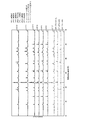
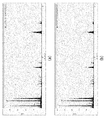
- FIG. 6 is a view showing an X-ray diffraction spectrum of a precursor when producing yttrium aluminum garnet phosphors in Examples 1, 3, 4, 6, 8 to 11 and Comparative Example 4.
- FIG. 9 is a view showing an X-ray diffraction spectrum when the complex polymer gel in Example 3 was heat-treated at a temperature of 200 ° C. and 350 ° C. It is a figure which shows the fluorescence spectrum of yttrium aluminum garnet fluorescent substance when the heat treatment temperature at the time of producing a precursor is changed.
- FIG. 1 is a schematic diagram of a light emitting device according to an embodiment of the present invention.
- FIG. 6 is a view showing an X-ray diffraction spectrum of a precursor when producing yttrium aluminum garnet phosphors in Examples 1, 3, 4, 6, 8 to 11 and Comparative Example 4.
- FIG. 9 is a view showing an
- FIG. 3 is a diagram showing X-ray diffraction spectra of yttrium aluminum garnet phosphors 10-1, 10-9 to 10-12 and 10-Comp1, 10-Comp9 in Examples 1, 9 to 12 and Comparative Examples 1, 9.
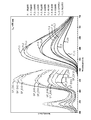
- FIG. 3 is a view showing the fluorescence spectra of the yttrium aluminum garnet phosphors 10-1 to 10-11 of Examples 1 to 11.
- FIG. 9 is a diagram showing the fluorescence spectra of yttrium aluminum garnet phosphors 10-Comp1 to 10-Comp4 of Comparative Examples 1 to 4.
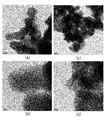
- FIG. 9 is a diagram showing the results of TEM analysis of yttrium aluminum garnet phosphors 10-1 and 10-8 in Examples 1 and 8.
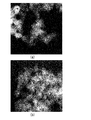
- FIG. 9 is a view showing a portion of the yttrium aluminum garnet phosphors 10-1 and 10-8 in Examples 1 and 8 where EDX analysis was performed.
- FIG. 3 is a view showing the result of EDX analysis of the yttrium aluminum garnet phosphor 10-1 in Example 1.
- FIG. 14 is a view showing the result of EDX analysis of the yttrium aluminum garnet phosphor 10-8 in Example 8.
- FIG. 3 is a diagram illustrating a relationship between an emission peak wavelength and an m value. It is a figure which shows the relationship between x value and y value in a chromaticity diagram.
- the yttrium aluminum garnet phosphor 10 is a yttrium aluminum garnet phosphor that contains cerium and emits fluorescence having an emission peak wavelength longer than 579 nm.
- the yttrium aluminum garnet phosphor 10 is represented by the following equation. Y 3-m Al 5 O 12 : Ce m (0.21 ⁇ m ⁇ 0.94) ⁇ (1) In the formula (1), m represents the content of cerium (Ce).
- the yttrium aluminum garnet phosphor 10 may include a crystal phase other than the yttrium aluminum garnet crystal phase, but is preferably made of a single-phase yttrium aluminum garnet crystal phase.
- the content Ce / Y of cerium (Ce) with respect to yttrium (Y) is not less than 7.5 mol% and not more than 46 mol% (the content m of Ce is not less than 0.21 and not more than 0.94).
- the content m of Ce is not less than 0.21 and not more than 0.94.
- Yes preferably 9.9 mol% or more and 46 mol% or less (Ce content m is 0.27 or more and 0.94 or less), and more preferably 7.5 mol% or more and 27 mol% or less (Ce content m Is 0.21 or more and 0.63 or less), and more preferably 9.9 mol% or more and 27 mol% or less (the Ce content m is 0.27 or more and 0.63 or less).
- the yttrium aluminum garnet phosphor 10 When Ce / Y is 7.5 mol% or more and 46 mol% or less (the Ce content m is 0.21 or more and 0.94 or less), the yttrium aluminum garnet phosphor 10 emits fluorescence having an emission peak wavelength longer than 579 nm. Can emit light. When Ce / Y is 9.9 mol% or more and 46 mol% or less (the Ce content m is 0.27 or more and 0.94 or less), the yttrium aluminum garnet phosphor 10 has a chromaticity x value of 0.5100 or more. Can also emit large fluorescent light.
- the yttrium aluminum garnet phosphor 10 is composed of only a single-phase yttrium aluminum garnet crystal. .
- the yttrium aluminum garnet phosphor 10 is composed of only a single-phase yttrium aluminum garnet crystal.
- the yttrium aluminum garnet phosphor 10 has, for example, a particle size of 30 nm to 40 nm.
- the yttrium aluminum garnet phosphor 10 contains 7.5 mol% or more and 46 mol% or less of Ce with respect to yttrium (Y) (the Ce content m is 0.21 or more and 0.94 or less). It absorbs the excitation light and emits fluorescence (orange fluorescence) having an emission peak wavelength longer than 579 nm. Therefore, the reddish component in white light emitted using the yttrium aluminum garnet phosphor 10 can be increased. As a result, the color rendering of white light can be improved.
- FIG. 1 is a process chart showing a method for manufacturing the yttrium aluminum garnet phosphor 10. Referring to FIG. 1, yttrium nitrate, aluminum nitrate, cerium nitrate, carboxylic acid and alcohol are added to water to form a mixed solution (step S1).
- step S2 The mixed solution is heated and concentrated to prepare a complex polymer gel.
- an ester reaction proceeds by a dehydration reaction between the carboxylic acid and the alcohol, and a concentrated complex polymer gel is formed.
- step S3 the complex polymer gel is thermally decomposed to generate a precursor (step S3).
- This pyrolysis forms a precursor in which yttrium, aluminum and cerium are uniformly dispersed.
- step S3 the precursor is fired in a reducing atmosphere to produce the yttrium aluminum garnet phosphor 10 (step S4).
- the yttrium aluminum garnet phosphor 10 is manufactured by a complex polymerization method.
- a production method according to an embodiment of the present invention is characterized in that a complex polymer gel is thermally decomposed to generate a precursor having an amorphous phase, and the generated precursor is fired in a reducing atmosphere.
- the temperature at which the precursor is generated is 450 ° C. or more and 1080 ° C. or less, and preferably 450 ° C. or more and less than 850 ° C.
- the precursor is preferably generated by thermally decomposing the complex polymer gel while maintaining the amorphous phase. That is, in step S3, it is preferable to thermally decompose the precursor in a temperature range in which the amorphous phase is maintained so that a crystalline phase is not generated.
- the content of cerium (Ce) in the yttrium aluminum garnet crystal can be increased.
- the precursor may be generated by thermally decomposing the complex polymer gel while increasing the temperature in a plurality of stages, and the complex may be formed while maintaining the amorphous phase and increasing the temperature in a plurality of stages.
- the precursor may be generated by thermally decomposing the polymer gel.
- the carboxylic acid used for producing the yttrium aluminum garnet phosphor 10 is, for example, any one of citric acid, acetic acid and malic acid.
- the alcohol used for manufacturing the yttrium aluminum garnet phosphor 10 is, for example, any one of ethylene glycol, polyethylene glycol and propylene glycol.
- the raw material of yttrium is, for example, any of yttrium nitrate, yttrium oxide, yttrium chloride and yttrium acetate.
- the raw material of aluminum is, for example, any of aluminum nitrate, aluminum oxide, aluminum chloride and aluminum acetate.
- the raw material of cerium is, for example, any of cerium nitrate, cerium oxide, cerium chloride and cerium acetate.
- FIG. 2 is a schematic diagram of a light emitting device according to an embodiment of the present invention.
- light emitting device 20 according to the embodiment of the present invention includes yttrium aluminum garnet phosphor 10, frame 21, electrodes 22, 23, semiconductor light emitting element 24, bonding wire 25, and resin 26.
- the frame 21 has a recess 21A.
- the electrodes 22 and 23 are arranged such that the upper surface matches the bottom surface 21B of the concave portion 21A of the frame 21.
- the semiconductor light emitting element 24 is disposed in contact with the electrode 22 and is electrically connected to the electrode 22. Then, the semiconductor light emitting element 24 is electrically connected to the electrode 23 by the bonding wire 25.
- the resin 26 has transparency and is filled in the recess 21 ⁇ / b> A of the frame 21.
- the yttrium aluminum garnet phosphor 10 is dispersed in the resin 26.
- the semiconductor light emitting element 24 is formed of a blue LED and emits blue light having a wavelength of 400 nm to 500 nm.
- the yttrium aluminum garnet phosphor 10 absorbs light from the semiconductor light emitting element 24 as excitation light, and emits fluorescent light having an emission peak wavelength longer than 579 nm.
- the light emitting device 20 emits white light by superimposing the blue light emitted from the semiconductor light emitting element 24 and the orange fluorescence emitted from the yttrium aluminum garnet phosphor 10.
- the yttrium aluminum garnet phosphor 10 may be composed of a plurality of yttrium aluminum garnet phosphors having different emission peak wavelengths, and generally, at least one that emits at least one fluorescence having at least one emission peak wavelength. What is necessary is just to consist of one yttrium aluminum garnet fluorescent substance.
- the light emitting device 20 can emit white light having a higher color rendering property than the case where the conventional yttrium aluminum garnet phosphor emits yellow fluorescent light.
- the cerium content (Ce / Y) (mol%) and m with respect to yttrium in Examples 1 to 11 are Ce / Y and m actually contained in the yttrium aluminum garnet phosphors 10-1 to 10-11. And is calculated from the amount of Ce and the amount of Y in the phosphor determined by ICP (Inductively Coupled Plasma) analysis. ICP analysis was performed using ICPS-8100 made by Shimadzu Corporation.
- Ce / Y (mol%) and m in Examples 12 to 14 and Comparative Examples 1 to 13 are yttrium aluminum garnet phosphors 10-12 to 10-14 and yttrium aluminum garnet phosphor 10-Comp1 to 10-Comp13. Represents Ce / Y and m contained in the raw material when producing
- Example 1 Cat NO. 2.30 g of yttrium nitrate hexahydrate (Y (NO 3 ) 3 .6H 2 O) of No. 630-87125 was weighed, and cat NO. 4.05 g of aluminum nitrate 9-hydrate (Al (NO 3 ) 3 .9H 2 O) of No. 018-01945 was weighed, and the cat NO. 0.196 g of cerium nitrate hexahydrate (Ce (NO 3 ) 3 .6H 2 O) No. 035-09735 was weighed, and cat NO. 1.5 g of 000-17275 citric acid monohydrate (C 3 H 4 (OH) (COOH) 3 .H 2 O) was weighed.
- the yttrium nitrate hexahydrate weighed 2.30g (Y (NO 3) 3 ⁇ 6H 2 O), aluminum nitrate nonahydrate 4.05g (Al (NO 3) 3 ⁇ 9H 2 O), 0.196 g of cerium nitrate hexahydrate (Ce (NO 3 ) 3 .6H 2 O), and 1.5 g of citric acid monohydrate (C 3 H 4 (OH) (COOH 3 ) H 2 O) was added to 15 ml of water and 5 ml of ethylene glycol and dissolved by ultrasound.
- the complex polymer gel obtained by heat concentration was thermally decomposed to produce a precursor. More specifically, the complex polymer gel was heat-treated at a temperature of 650 ° C. for 3 hours in the air, followed by a heat treatment at a temperature of 750 ° C. for 3 hours in the air to produce a precursor.
- the precursor was pulverized in a mortar to obtain a powder, and then fired at 1080 ° C. for 6 hours in an argon (Ar) gas atmosphere containing 3.0% hydrogen (H 2 ) gas.
- Ar argon
- H 2 hydrogen
- the yttrium aluminum garnet phosphor 10-1 in Example 1 was manufactured. In this case, the heating rate was 20 ° C./min, and the gas flow rate was 4 cc / min.
- the yttrium aluminum garnet phosphor 10-1 is represented by a composition formula of Y 2.79 Al 5 O 12 : Ce 0.21 , and the Ce / Y content of cerium with respect to yttrium is 7.5 mol%.
- Example 2 Cat NO. 2.30 g of yttrium nitrate hexahydrate (Y (NO 3 ) 3 .6H 2 O) of 630-87125, and cat NO. 4.13 g of aluminum nitrate 9-hydrate (Al (NO 3 ) 3 .9H 2 O) of No. 018-01945, and cat NO. Yttrium aluminum garnet phosphor 10- in Example 2 in the same manner as in Example 1 except that 0.257 g of cerium nitrate hexahydrate (Ce (NO 3 ) 3 .6H 2 O) of 035-09735 was used. 2 was produced.
- the yttrium aluminum garnet phosphor 10-2 is represented by a composition formula of Y 2.73 Al 5 O 12 : Ce 0.27 , and the cerium content Ce / Y with respect to yttrium is 9.9 mol%.
- Example 3 Cat NO. 2.30 g of yttrium nitrate hexahydrate (Y (NO 3 ) 3 .6H 2 O) of 630-87125, and cat NO. 4.20 g of aluminum nitrate 9-hydrate (Al (NO 3 ) 3 .9H 2 O) of No. 018-01945, and cat NO. Yttrium aluminum garnet phosphor 10- in Example 3 in the same manner as in Example 1 except that 0.322 g of cerium nitrate hexahydrate (Ce (NO 3 ) 3 .6H 2 O) of 035-09735 was used. 3 was produced.
- the yttrium aluminum garnet phosphor 10-3 is represented by a composition formula of Y 2.67 Al 5 O 12 : Ce 0.33 , and the cerium content Ce / Y with respect to yttrium is 12 mol%.
- Example 4 Cat NO. 2.30 g of yttrium nitrate hexahydrate (Y (NO 3 ) 3 .6H 2 O) of 630-87125, and cat NO. 4.31 g of aluminum nitrate 9-hydrate (Al (NO 3 ) 3 .9H 2 O) of 018-01945, and cat NO. Yttrium aluminum garnet phosphor 10- in Example 4 in the same manner as in Example 1 except that 0.39 g of cerium nitrate hexahydrate (Ce (NO 3 ) 3 .6H 2 O) of 035-09735 was used. 4 was produced.
- the yttrium aluminum garnet phosphor 10-4 is represented by a composition formula of Y 2.60 Al 5 O 12 : Ce 0.40 , and the cerium content Ce / Y with respect to yttrium is 15 mol%.
- Example 5 Cat NO. 2.30 g of yttrium nitrate hexahydrate (Y (NO 3 ) 3 .6H 2 O) of 630-87125, and cat NO. 4.43 g of aluminum nitrate 9-hydrate (Al (NO 3 ) 3 .9H 2 O) of No. 018-01945 and cat NO. Yttrium aluminum garnet phosphor 10- in Example 5 in the same manner as in Example 1 except that 0.46 g of cerium nitrate hexahydrate of 035-09735 (Ce (NO 3 ) 3 .6H 2 O) was used. 5 was produced.
- the yttrium aluminum garnet phosphor 10-5 is represented by a composition formula of Y 2.55 Al 5 O 12 : Ce 0.45 , and the cerium content Ce / Y with respect to yttrium is 18 mol%.
- Example 6 Cat NO. 2.30 g of yttrium nitrate hexahydrate (Y (NO 3 ) 3 .6H 2 O) of 630-87125, and cat NO. 4.50 g of aluminum nitrate 9-hydrate (Al (NO 3 ) 3 .9H 2 O) of 018-01945, and cat NO. Yttrium aluminum garnet phosphor 10- in Example 6 in the same manner as in Example 1 except that 0.534 g of cerium nitrate hexahydrate (Ce (NO 3 ) 3 .6H 2 O) of 035-09735 was used. 6 was produced.
- the yttrium aluminum garnet phosphor 10-6 is represented by a composition formula of Y 2.48 Al 5 O 12 : Ce 0.52 , and the cerium content Ce / Y with respect to yttrium is 21 mol%.
- Example 7 Cat NO. 2.30 g of yttrium nitrate hexahydrate (Y (NO 3 ) 3 .6H 2 O) of 630-87125, and cat NO. 4.61 g of aluminum nitrate 9-hydrate (Al (NO 3 ) 3 .9H 2 O) of No. 018-01945, and cat NO. Yttrium aluminum garnet phosphor 10- in Example 7 in the same manner as in Example 1 except that 0.610 g of cerium nitrate hexahydrate (Ce (NO 3 ) 3 .6H 2 O) of 035-09735 was used. 7 was produced.
- the yttrium aluminum garnet phosphor 10-7 is represented by a composition formula of Y 2.42 Al 5 O 12 : Ce 0.58 , and the cerium content Ce / Y with respect to yttrium is 24 mol%.
- Example 8 Cat NO. 2.30 g of yttrium nitrate hexahydrate (Y (NO 3 ) 3 .6H 2 O) of 630-87125, and cat NO. 4.76 g of aluminum nitrate 9-hydrate (Al (NO 3 ) 3 .9H 2 O) of No. 018-01945, and cat NO. Yttrium aluminum garnet phosphor 10- in Example 8 in the same manner as in Example 1 except that 0.690 g of cerium nitrate hexahydrate (Ce (NO 3 ) 3 .6H 2 O) of 035-09735 was used. 8 was produced.
- the yttrium aluminum garnet phosphor 10-8 is represented by a composition formula of Y 2.37 Al 5 O 12 : Ce 0.63 , and the cerium content Ce / Y with respect to yttrium is 27 mol%.
- Example 9 Cat NO. 2.30 g of yttrium nitrate hexahydrate (Y (NO 3 ) 3 .6H 2 O) of 630-87125, and cat NO. 4.99 g of aluminum nitrate 9-hydrate (Al (NO 3 ) 3 .9H 2 O) of 018-01945, and cat NO. Yttrium aluminum garnet phosphor 10- in Example 9 in the same manner as in Example 1 except that 0.868 g of cerium nitrate hexahydrate (Ce (NO 3 ) 3 .6H 2 O) of 035-09735 was used. 9 was produced.
- the yttrium aluminum garnet phosphor 10-9 is represented by a composition formula of Y 2.25 Al 5 O 12 : Ce 0.75 , and the cerium content Ce / Y with respect to yttrium is 33 mol%.
- Example 10 Cat NO. 2.30 g of yttrium nitrate hexahydrate (Y (NO 3 ) 3 .6H 2 O) of 630-87125, and cat NO. 5.29 g of aluminum nitrate 9-hydrate (Al (NO 3 ) 3 .9H 2 O) of No. 018-01945 and cat NO. Yttrium aluminum garnet phosphor 10- in Example 10 in the same manner as in Example 1 except that 1.064 g of cerium nitrate hexahydrate (Ce (NO 3 ) 3 .6H 2 O) of 035-09735 was used. 10 were produced.
- the yttrium aluminum garnet phosphor 10-10 is represented by a composition formula of Y 2.12 Al 5 O 12 : Ce 0.88 , and the cerium content Ce / Y with respect to yttrium is 42 mol%.
- Example 11 Cat NO. 2.30 g of yttrium nitrate hexahydrate (Y (NO 3 ) 3 .6H 2 O) of 630-87125, and cat NO. 5.44 g of aluminum nitrate 9-hydrate (Al (NO 3 ) 3 .9H 2 O) of No. 018-01945 and cat NO. Yttrium aluminum garnet phosphor 10- in Example 10 in the same manner as in Example 1 except that 1.172 g of cerium nitrate hexahydrate (Ce (NO 3 ) 3 .6H 2 O) of 035-09735 was used. 11 were produced.
- the yttrium aluminum garnet phosphor 10-11 is represented by a composition formula of Y 2.06 Al 5 O 12 : Ce 0.94 , and the cerium content Ce / Y with respect to yttrium is 46 mol%.
- Example 12 In Example 3, the yttrium aluminum garnet fluorescence in Example 12 was changed in the same manner as in Example 3 except that the conditions for forming the precursor were changed to 650 ° C. for 3 hours and 750 ° C. for 3 hours to 1080 ° C. for 3 hours. Body 10-12 was produced.
- the yttrium aluminum garnet phosphor 10-12 is represented by a composition formula of Y 2.67 Al 5 O 12 : Ce 0.33 , and the cerium content Ce / Y with respect to yttrium is 12 mol%.
- Example 13 In Example 4, the yttrium aluminum garnet fluorescence in Example 13 was changed in the same manner as in Example 4 except that the conditions for forming the precursor were changed to 650 ° C. for 3 hours and 750 ° C. for 3 hours to 1080 ° C. for 3 hours. Body 10-13 was prepared.
- the yttrium aluminum garnet phosphor 10-13 is represented by a composition formula of Y 2.61 Al 5 O 12 : Ce 0.39 , and the cerium content Ce / Y with respect to yttrium is 15 mol%.
- Example 14 In Example 5, the yttrium aluminum garnet fluorescence in Example 14 was changed in the same manner as in Example 5 except that the conditions for forming the precursor were changed to 650 ° C. for 3 hours and 750 ° C. for 3 hours to 1080 ° C. for 3 hours. Body 10-14 was prepared.
- the yttrium aluminum garnet phosphor 10-14 is represented by a composition formula of Y 2.55 Al 5 O 12 : Ce 0.45 , and the cerium content Ce / Y with respect to yttrium is 18 mol%.
- Comparative Example 1 Cat NO. 2.30 g of yttrium nitrate hexahydrate (Y (NO 3 ) 3 .6H 2 O) of 630-87125, and cat NO. 3.77 g of aluminum nitrate 9-hydrate (Al (NO 3 ) 3 .9H 2 O) of No. 018-01945 and cat NO. Yttrium aluminum garnet phosphor 10- in Comparative Example 1 in the same manner as in Example 1 except that 0.0157 g of cerium nitrate hexahydrate (Ce (NO 3 ) 3 .6H 2 O) of 035-09735 was used. Comp1 was produced.
- Yttrium aluminum garnet phosphor 10-Comp1 is, Y 2.982 Al 5 O 12: represented by the composition formula of Ce 0.018, the content Ce / Y cerium for yttrium is 0.60 mol%.
- Comparative Example 2 Cat NO. 2.30 g of yttrium nitrate hexahydrate (Y (NO 3 ) 3 .6H 2 O) of 630-87125, and cat NO. 3.79 g of aluminum nitrate 9-hydrate (Al (NO 3 ) 3 .9H 2 O) of No. 018-01945 and cat NO. Yttrium aluminum garnet phosphor 10- in Comparative Example 2 in the same manner as in Example 1 except that 0.0263 g of cerium nitrate hexahydrate (Ce (NO 3 ) 3 .6H 2 O) of 035-09735 was used. Comp2 was produced.
- the yttrium aluminum garnet phosphor 10-Comp2 is represented by a composition formula of Y 2.97 Al 5 O 12 : Ce 0.03 , and the cerium content Ce / Y with respect to yttrium is 1.0 mol%.
- the yttrium aluminum garnet phosphor 10-Comp3 is represented by a composition formula of Y 2.94 Al 5 O 12 : Ce 0.06 , and the cerium content Ce / Y with respect to yttrium is 2.0 mol%.
- Comparative Example 4 Cat NO. 2.30 g of yttrium nitrate hexahydrate (Y (NO 3 ) 3 .6H 2 O) of 630-87125, and cat NO. 3.90 g of aluminum nitrate 9-hydrate (Al (NO 3 ) 3 .9H 2 O) of No. 018-01945, and cat NO. Yttrium aluminum garnet phosphor 10- in Comparative Example 4 in the same manner as in Example 1 except that 0.109 g of cerium nitrate hexahydrate (Ce (NO 3 ) 3 .6H 2 O) of 035-09735 was used. Comp4 was produced.
- the yttrium aluminum garnet phosphor 10-Comp4 is represented by a composition formula of Y 2.88 Al 5 O 12 : Ce 0.12 , and the cerium content Ce / Y with respect to yttrium is 4.2 mol%.
- Comparative Example 5 The yttrium aluminum garnet phosphor 10-Comp5 in Comparative Example 5 was manufactured in the same manner as in Comparative Example 1 except that the manufacturing was not performed using the step of generating a precursor.
- Yttrium aluminum garnet phosphor 10-COMP5 is, Y 2.982 Al 5 O 12: represented by the composition formula of Ce 0.018, the content Ce / Y cerium for yttrium is 0.60 mol%.
- Comparative Example 6 The yttrium aluminum garnet phosphor 10-Comp6 in Comparative Example 6 was manufactured in the same manner as in Comparative Example 2 except that the manufacturing was not performed using the step of generating a precursor.
- the yttrium aluminum garnet phosphor 10-Comp6 is represented by a composition formula of Y 2.97 Al 5 O 12 : Ce 0.03 , and the cerium content Ce / Y with respect to yttrium is 1.0 mol%.
- Comparative Example 7 The yttrium aluminum garnet phosphor 10-Comp7 in Comparative Example 7 was manufactured in the same manner as in Comparative Example 3 except that the manufacturing was not performed using the step of generating a precursor.
- the yttrium aluminum garnet phosphor 10-Comp7 is represented by a composition formula of Y 2.94 Al 5 O 12 : Ce 0.06 , and the cerium content Ce / Y with respect to yttrium is 2.0 mol%.
- Comparative Example 8 The yttrium aluminum garnet phosphor 10-Comp8 in Comparative Example 8 was produced in the same manner as in Comparative Example 4, except that the precursor was not used.
- the yttrium aluminum garnet phosphor 10-Comp8 is represented by a composition formula of Y 2.88 Al 5 O 12 : Ce 0.12 , and the cerium content Ce / Y with respect to yttrium is 4.2 mol%.
- Comparative Example 9 A yttrium aluminum garnet phosphor 10-Comp9 in Comparative Example 9 was manufactured in the same manner as in Example 1 except that the manufacturing was not performed using the step of generating a precursor.
- the yttrium aluminum garnet phosphor 10-Comp9 is represented by a composition formula of Y 2.79 Al 5 O 12 : Ce 0.21 , and the cerium content Ce / Y with respect to yttrium is 7.5 mol%.
- Comparative Example 10 A yttrium aluminum garnet phosphor 10-Comp10 in Comparative Example 10 was manufactured in the same manner as in Example 2, except that the manufacturing process was not performed.
- the yttrium aluminum garnet phosphor 10-Comp10 is represented by a composition formula of Y 2.73 Al 5 O 12 : Ce 0.27 , and the cerium content Ce / Y with respect to yttrium is 9.9 mol%.
- Comparative Example 11 A yttrium aluminum garnet phosphor 10-Comp11 in Comparative Example 11 was produced in the same manner as in Example 3, except that the precursor was not used.
- the yttrium aluminum garnet phosphor 10-Comp11 is represented by a composition formula of Y 2.67 Al 5 O 12 : Ce 0.33 , and the cerium content Ce / Y with respect to yttrium is 12 mol%.
- Comparative Example 12 A yttrium aluminum garnet phosphor 10-Comp12 in Comparative Example 12 was produced in the same manner as in Example 4, except that the precursor was not produced.
- the yttrium aluminum garnet phosphor 10-Comp12 is represented by a composition formula of Y 2.61 Al 5 O 12 : Ce 0.39 , and the cerium content Ce / Y with respect to yttrium is 15 mol%.
- Comparative Example 13 A yttrium aluminum garnet phosphor 10-Comp13 in Comparative Example 13 was manufactured in the same manner as in Example 5, except that the manufacturing process was not performed.
- the yttrium aluminum garnet phosphor 10-Comp13 is represented by a composition formula of Y 2.55 Al 5 O 12 : Ce 0.45 , and the cerium content Ce / Y with respect to yttrium is 18 mol%.
- X-ray diffraction was measured for the yttrium aluminum garnet phosphors in Examples 1 to 11 and Comparative Examples 1 to 13.
- the measurement was performed using an X-ray Diffractometer X'Pert Pro MPD manufactured by PANalytical having a graphite monochromator on the side.
- FIG. 3 is a view showing the X-ray diffraction spectrum of the precursor when producing the yttrium aluminum garnet phosphor in Examples 1, 3, 4, 6, 8 to 11 and Comparative Example 4.
- spectra SP1 to SP8 are the yttrium aluminum garnet phosphors 10-1, 10-3, 10-4, 10-6, and 10-8 in Examples 1, 3, 4, 6, and 8 to 11, respectively.
- the X-ray diffraction spectrum of the precursor when producing ⁇ 10-11 is shown
- the spectrum SP9 is the X-ray diffraction spectrum of the precursor when producing the yttrium aluminum garnet phosphor 10-Comp4 in Comparative Example 4.
- the body was found to consist of an amorphous phase or a predominantly amorphous phase. Therefore, it has been clarified that even when the complex polymer gel is thermally decomposed, the amorphous state or the majority is maintained in the amorphous state.
- the precursor for producing 4,10-6,10-8 to 10-11 was composed of an amorphous phase or a large part of the amorphous phase.
- the precursor becomes amorphous.
- the X-ray diffraction spectrum showed that the quality phase or the majority consisted of the amorphous phase.
- FIG. 4 is a diagram showing an X-ray diffraction spectrum when the complex polymer gel in Example 3 was heat-treated at a temperature of 200 ° C. and 350 ° C.
- spectrum SP10 shows an X-ray diffraction spectrum when the complex polymer gel of Example 3 was heat-treated at a temperature of 350 ° C.
- spectrum SP11 shows that the complex polymer gel of Example 3 was heat-treated at a temperature of 200 ° C. 2 shows an X-ray diffraction spectrum when the measurement is performed.
- the precursor formed by heat-treating the complex polymer gel in Example 3 at a temperature of 200 ° C. and 350 ° C. maintained an amorphous state (spectrum SP10, See S11).
- the generated precursor had a dark color and possibly contained carbon.
- FIG. 5 is a diagram showing a fluorescence spectrum of the yttrium aluminum garnet phosphor when the heat treatment temperature for producing the precursor is changed.
- spectra SP12 to SP16 show the fluorescence spectra of the yttrium aluminum garnet phosphor when the heat treatment temperature for producing the precursor is 900 ° C., 850 ° C., 800 ° C., 450 ° C., and 350 ° C., respectively.
- the heat treatment temperature at the time of forming the precursor was 200 ° C., the precursor was not fired because there was a possibility that the precursor contained carbon. Therefore, FIG.
- the excitation wavelength for measuring the fluorescence spectra SP12 to SP16 is 450 nm.
- the fluorescence spectrum SP16 of the yttrium aluminum garnet phosphor having a heat treatment temperature of 350 ° C. when the precursor is generated shows that the heat treatment temperature at the time of forming the precursor is 900 ° C., 850 ° C., and 800 ° C. And the intensity is much lower than the fluorescence spectra SP12 to SP15 of the yttrium aluminum garnet phosphor at 450 ° C.
- the lower limit of the heat treatment temperature when generating the precursor may exist between 350 ° C. and 450 ° C. Do you get it.
- the lower limit of the heat treatment temperature experimentally obtained when forming the precursor is 450 ° C. Therefore, in step S3 of FIG. 1, a temperature of 450 ° C. or more and less than 850 ° C. is preferable as the heat treatment temperature when the complex polymer gel is thermally decomposed.
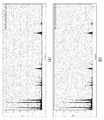
- FIG. 6 shows the X-ray diffraction spectra of the yttrium aluminum garnet phosphors 10-1, 10-9 to 10-12 and 10-Comp1, 10-Comp9 in Examples 1, 9 to 12 and Comparative Examples 1, 9. It is.
- spectrum SP17 shows the X-ray diffraction spectrum of the yttrium aluminum garnet phosphor in Example 1
- spectra SP18 to SP20 show the X-ray diffraction spectra of the yttrium aluminum garnet phosphor in Examples 9 to 11, respectively.
- the spectrum SP21 shows the X-ray diffraction spectrum of the yttrium aluminum garnet phosphor in Example 12
- the spectrum SP22 shows the X-ray diffraction spectrum of the yttrium aluminum garnet phosphor in Comparative Example 1
- the spectrum SP23 shows the comparative example.
- 9 shows an X-ray diffraction spectrum of the yttrium aluminum garnet phosphor in Example 9.
- the yttrium aluminum garnet phosphors in Examples 2 to 8 exhibited the same X-ray diffraction spectrum as the X-ray diffraction spectrum SP17 of the yttrium aluminum garnet phosphor in Example 1.
- the yttrium aluminum garnet phosphors of Examples 13 and 14 exhibited the same X-ray diffraction spectrum as the X-ray diffraction spectrum SP21 of the yttrium aluminum garnet phosphor of Example 12.
- the yttrium aluminum garnet phosphors in Comparative Examples 2 to 8 exhibited the same X-ray diffraction spectrum as the X-ray diffraction spectrum SP22 of the yttrium aluminum garnet phosphor in Comparative Example 1.
- the yttrium aluminum garnet phosphors in Comparative Examples 10 to 13 exhibited the same X-ray diffraction spectrum as the X-ray diffraction spectrum SP23 of the yttrium aluminum garnet phosphor in Comparative Example 9.
- the spectrum SP_STD_YAG in FIG. 6 shows the X-ray diffraction spectrum of a standard STD of yttrium aluminum garnet crystal not containing cerium registered in the Inorganic Crystal Structure Database (ICSD) (ICSD67103), and the spectrum SP_STD_CeO 2 is ICSD shows the X-ray spectrum of the standard STD of CeO 2 which has been registered in (ICSD88759), spectra SP_STD_CeAlO 3 shows the X-ray spectrum of the standard STD of CEALO 3 registered in the ICSD (ICSD245563).
- ICSD Inorganic Crystal Structure Database
- the yttrium aluminum garnet phosphors 10-1 to 10-8 in Examples 1 to 8 have the same spectrum as the yttrium aluminum garnet crystal of the standard product STD, and are caused by the yttrium aluminum garnet crystal phase. (See SP17, SP_STD).
- the yttrium aluminum garnet phosphors 10-9 to 10-11 in Examples 9 to 11 have the same spectrum as the yttrium aluminum garnet crystal of the standard product STD, and also have peaks derived from the crystal phase of CeAlO 3 (see arrows). ) (See SP18 to SP20, SP_STD).
- the yttrium aluminum garnet phosphors 10-12 to 10-14 in Examples 12 to 14 have the same spectrum as the yttrium aluminum garnet crystal of the standard product STD, and also have peaks derived from the crystal phase of CeAlO 3 (see arrows). ) (See SP21, SP_STD).
- the yttrium aluminum garnet phosphors 10-Comp1 and 10-Comp8 in Comparative Examples 1 to 8 have the same spectrum as the yttrium aluminum garnet crystal of the standard product STD, and have only a peak derived from the yttrium aluminum garnet crystal phase. (See SP22, SP_STD).
- the yttrium aluminum garnet phosphors 10-Comp9 to 10-Comp13 in Comparative Examples 9 to 13 have the same spectrum as the yttrium aluminum garnet crystal of the standard product STD, and also have peaks derived from the crystal phase of CeO 2 (see arrows). ) (See SP23 and SP_STD).
- the yttrium aluminum garnet phosphors 10-1 to 10-8 and 10-Comp1 to 10-Comp8 in Examples 1 to 8 and Comparative Examples 1 to 8 have a single phase having the same crystal structure as the yttrium aluminum garnet crystal phase. It turned out to be.
- the yttrium aluminum garnet phosphors 10-9 to 10-14 in Examples 9 to 14 were found to be a mixture of the yttrium aluminum garnet crystal phase and the CeAlO 3 crystal phase.
- the yttrium aluminum garnet phosphors 10-Copm9 to 10-Comp13 in Comparative Examples 9 to 13 were a mixture of the yttrium aluminum garnet crystal phase and the CeO 2 crystal phase.
- the yttrium aluminum garnet phosphor 10-9 in Example 9 has a temperature in the thermal decomposition step of 650 ° C. and 750 ° C., is lower than 1080 ° C., and contains 33 mol% of cerium (Ce) with respect to yttrium (Y). . From this, when the content of cerium (Ce) with respect to yttrium (Y) is less than 33 mol%, an yttrium aluminum garnet phosphor composed only of the yttrium aluminum garnet crystal phase is obtained, and cerium (Ce) with respect to yttrium (Y) is obtained. It has been found that when the content of is 33 mol% or more, an yttrium aluminum garnet phosphor composed of a mixture of a yttrium aluminum garnet crystal phase and a CeAlO 3 crystal phase can be obtained.
- the yttrium aluminum garnet phosphor 10-Comp9 in Comparative Example 9 contains 7.5 mol% of cerium (Ce) with respect to yttrium (Y), and is manufactured without using a step of generating a precursor. From this, when the content of cerium (Ce) with respect to yttrium (Y) is less than 7.5 mol%, an yttrium aluminum garnet phosphor composed of only the yttrium aluminum garnet crystal phase is obtained, and cerium (y) with respect to yttrium (Y) is obtained. It was found that when the content of Ce) was 7.5 mol% or more, a yttrium aluminum garnet phosphor, which was a mixture of a yttrium aluminum garnet crystal phase and a CeO 2 crystal phase, was obtained.
- the emission fluorescence spectrum and the emission peak wavelength in the emission fluorescence spectrum were measured.
- the measurement of the fluorescence spectrum was performed using Fluorescence spectrophotometer F-7100 manufactured by Hitachi High-Tech Science.
- the emission peak wavelength is measured by measuring the fluorescence spectrum emitted from the yttrium aluminum garnet phosphor when the light having a wavelength of 450 nm is used as the excitation light, and detecting the emission peak wavelength in the measured fluorescence spectrum. went.
- the peak corresponding to the standard product STD of the yttrium aluminum garnet crystal has a peak of cerium (Ce) relative to yttrium (Y). It shifts to the lower angle side as the content increases.
- FIG. 7 is a diagram showing the fluorescence spectra of the yttrium aluminum garnet phosphors 10-1 to 10-11 of Examples 1 to 11.
- the horizontal axis represents wavelength
- the vertical axis represents intensity.
- the fluorescence spectra FL1 to FL11 indicate the fluorescence spectra of the yttrium aluminum garnet phosphors 10-1 to 10-11 of Examples 1 to 11, respectively
- the spectra SP_EX1 to SP_EX11 indicate the yttrium of Examples 1 to 11, respectively.
- the excitation light spectrum when measuring the fluorescence spectra of the aluminum garnet phosphors 10-1 to 10-11 is shown.
- the peak wavelength ⁇ ex in the spectrum of the excitation light is 450 nm.
- the fluorescence spectra of yttrium aluminum garnet phosphors 10-1 to 10-11 of Examples 1 to 11 show that the peak wavelength becomes longer as the cerium content Ce / Y with respect to yttrium increases. , And the peak intensity was found to decrease (see FL1 to FL11).
- the yttrium aluminum garnet phosphor 10- in Examples 1 to 11 was measured.
- the emission peak wavelengths of 1 to 10-11 are 580.2 (nm), 585.8 (nm), 588.2 (nm), 594.6 (nm), 598.6 (nm), and 603. 2 (nm), 603.4 (nm), 606.2 (nm), 605.8 (nm), 609.8 (nm) and 610.4 (nm).
- the peak wavelengths of the fluorescence spectra of the yttrium aluminum garnet phosphors 10-12 to 10-14 of Examples 12 to 14 were measured. As a result, the yttrium aluminum garnet phosphors 10-12 to 10-14 of Examples 12 to 14 were measured. Were 580.2 (nm), 580.6 (nm), and 580.2 (nm), respectively.
- the peak wavelengths of the fluorescence spectra of the yttrium aluminum garnet phosphors 10-Comp1 to 10-Comp13 of Comparative Examples 1 to 13 were measured. As a result, the yttrium aluminum garnet phosphors 10-Comp1 to 10-Comp10 of Comparative Examples 1 to 13 were measured.
- the emission peak wavelengths of -Comp13 are 538.4 (nm), 541.6 (nm), 554.0 (nm), 564.8 (nm), 538.4 (nm) and 538.2 (nm), respectively. ), 541.4 (nm), 544.6 (nm), 549.4 (nm), 549.2 (nm), 547.8 (nm), 544.6 (nm), 544.4 (nm) Met.
- the yttrium aluminum garnet phosphors 10-1 to 10-14 in Examples 1 to 14 correspond to the emission peak wavelengths (538.2 nm to 564) of the yttrium aluminum garnet phosphors 10-Comp1 to 10-Comp13 in Comparative Examples 1 to 13. 0.8 nm) and an emission peak wavelength longer than 579 nm.
- FIG. 8 is a diagram showing the fluorescence spectra of the yttrium aluminum garnet phosphors 10-Comp1 to 10-Comp4 of Comparative Examples 1 to 4.
- the horizontal axis represents wavelength
- the vertical axis represents intensity.
- the fluorescence spectra FL_C1 to FL_C4 indicate the fluorescence spectra of the yttrium aluminum garnet phosphors 10-Comp1 to 10-Comp4 of Comparative Examples 1 to 4, respectively
- the spectra SP_EX_C1 to SP_EX_C4 indicate the yttrium of Comparative Examples 1 to 4, respectively.
- the excitation light spectrum when measuring the fluorescence spectra of the aluminum garnet phosphors 10-Comp1 to 10-Comp4 is shown.
- the peak wavelength ⁇ ex in the spectrum of the excitation light is 450 nm.
- the fluorescence spectra of yttrium aluminum garnet phosphors 10-Comp1 to 10-Comp4 of Comparative Examples 1 to 4 are those of yttrium aluminum garnet phosphors 10-1 to 10-14 of Examples 1 to 14. It has a shape similar to the spectrum (refer to FL_C1 to FL_C4).
- the peak wavelengths of the fluorescence spectra of the yttrium aluminum garnet phosphors 10-Comp1 to 10-Comp4 were measured.
- the yttrium aluminum garnet phosphor 10-comparative examples 1 to 4 were measured.
- the emission peak wavelengths of Comp1 to 10-Comp were 538.4 (nm), 541.6 (nm), 554.0 (nm), and 564.8 (nm), respectively.
- fluorescence spectra of the yttrium aluminum garnet phosphors 10-Comp5 to 10-Comp13 of Comparative Examples 5 to 13 are the fluorescence spectra of the yttrium aluminum garnet phosphors 10-Comp1 to 10-Comp4 of Comparative Examples 1 to 4 shown in FIG. It had the same shape as FL_C1 to FL_C4.
- TEM analysis Transmission Electron Microscope
- EDX analysis Eulegy dispersive X-ray spectrometry
- FIG. 9 is a diagram showing the results of TEM analysis of the yttrium aluminum garnet phosphors 10-1 and 10-8 in Examples 1 and 8.
- 9 (a) and 9 (b) show the results of TEM analysis of the yttrium aluminum garnet phosphor 10-1 in Example 1
- FIGS. 9 (c) and 9 (d) show the yttrium aluminum garnet phosphor in Example 8.
- the result of the TEM analysis of the garnet phosphor 10-8 is shown.
- FIG. 9 shows the result of TEM analysis of the same region in the yttrium aluminum garnet phosphors 10-1 and 10-8 at different magnifications.
- 9A and 9C the scale bar indicates 20 nm
- FIGS. 9B and 9D the scale bar indicates 5 nm.
- the particle diameter of yttrium aluminum garnet phosphors 10-1 and 10-8 was 30 to 40 nm, and it was found that the particle diameter was excellent in uniformity. Also, as shown in FIGS. 9B and 9D, lattice fringes are observed and the amorphous phase is extremely small, so that the yttrium aluminum garnet phosphors 10-1 and 10-8 have It was found that it consisted of a single-phase yttrium aluminum garnet crystal. From this, the result of the TEM analysis shows a good agreement with the above-mentioned X-ray diffraction analysis result.
- FIG. 10 is a diagram showing a portion of the yttrium aluminum garnet phosphors 10-1 and 10-8 in Examples 1 and 8 where EDX analysis was performed.
- FIG. 10A shows a portion of the yttrium aluminum garnet phosphor 10-1 in Example 1 on which EDX analysis was performed
- FIG. 10B shows a portion of the yttrium aluminum garnet phosphor 10-8 in Example 8. The site where EDX analysis was performed is shown. The EDX analysis was performed on the points 1 and 2 shown in FIG.
- FIG. 11 is a diagram showing the result of EDX analysis of the yttrium aluminum garnet phosphor 10-1 in Example 1.
- FIG. 11A shows the result of the EDX analysis at point 1 shown in FIG. 10A
- FIG. 11B shows the result of the EDX analysis at point 2 shown in FIG. Show.
- FIG. 12 is a view showing the result of EDX analysis of the yttrium aluminum garnet phosphor 10-8 in Example 8.
- FIG. 12A shows the result of the EDX analysis at point 1 shown in FIG. 10B
- FIG. 12B shows the result of the EDX analysis at point 2 shown in FIG. Show.
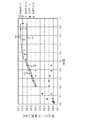
- FIG. 13 is a diagram showing the relationship between the emission peak wavelength and the m value.
- the vertical axis represents the emission peak wavelength
- the horizontal axis represents the m value indicating the Ce content.
- the m value in Examples 1 to 11 represents the content of Ce contained in the yttrium aluminum garnet phosphors 10-1 to 10-11, and the Ce value in the phosphor determined by ICP (Inductively Coupled Plasma) analysis It is calculated from the amount and the Y amount. ICP analysis was performed using ICPS-8100 made by Shimadzu Corporation.
- Examples 12 to 14 and Comparative Examples 1 to 13 are based on the raw materials for producing the yttrium aluminum garnet phosphors 10-12 to 10-14 and the yttrium aluminum garnet phosphors 10-Comp1 to 10-Comp13. Represents the m value.
- ⁇ , ⁇ , and ⁇ show the relationship between the emission peak wavelengths of the yttrium aluminum garnet phosphors 10-1 to 10-11 and the m value in Examples 1 to 11, and ⁇ shows the yttrium in Examples 12 to 14.
- the relationship between the emission peak wavelengths of the aluminum garnet phosphors 10-12 to 10-14 and the m value is shown, and ⁇ indicates the emission peak wavelengths of the yttrium aluminum garnet phosphors 10-Comp1 to 10-Comp4 in Comparative Examples 1 to 4.
- ⁇ indicates the relationship between the emission peak wavelengths of the yttrium aluminum garnet phosphors 10-Comp5 to 10-Comp13 in Comparative Examples 5 to 13 and the m value.
- ⁇ , ⁇ , and ⁇ show the relationship between the emission peak wavelength and the m value when the yttrium aluminum garnet phosphors 10-1 to 10-11 in Examples 1 to 11 were manufactured three times under the same conditions.
- ⁇ shows the relationship between the emission peak wavelengths of the yttrium aluminum garnet phosphors 10-1 to 10-11 prepared for the first time and the m value
- ⁇ shows the relation between the yttrium aluminum garnet phosphors 10-1 to 10-2 produced for the second time
- the relationship between the emission peak wavelength of 10-11 and the m value is shown
- the square shows the relationship between the emission peak wavelength of the yttrium aluminum garnet phosphors 10-1 to 10-11 and the m value.
- the emission peak wavelengths of yttrium aluminum garnet phosphors 10-1 to 10-11 in Examples 1 to 11 increase as the cerium content increases (see ⁇ , ⁇ , and ⁇ ). ).
- the regression curve RC1 for the m value of ⁇ P in the data indicated by ⁇ is represented by the following equation.
- ⁇ P 68.72 m 3 ⁇ 196.2 m 2 +185.99 m + 548.15 (0.21 ⁇ m ⁇ 0.94)
- the regression curve RC2 for the m value of ⁇ P in the data indicated by ⁇ is represented by the following equation.
- ⁇ P ⁇ 5.3812 m 3 ⁇ 60.998 m 2 +116.85 m + 558.46 (0.21 ⁇ m ⁇ 0.94)
- the regression curve RC3 for the m value of ⁇ P in the data indicated by ⁇ is represented by the following equation.
- ⁇ P ⁇ 35.645 m 3 ⁇ 5.7775 m 2 +89.055 m + 562.5 (0.21 ⁇ m ⁇ 0.94)
- the correlation coefficient between ⁇ P and m in equation (2) is 0.982
- the correlation coefficient between ⁇ P and m in equation (3) is 0.997
- ⁇ in equation (4) is The correlation coefficient between P and m is 0.994.
- the emission peak wavelengths of the yttrium aluminum garnet phosphors 10-12 to 10-14 in Examples 12 to 14 hardly change as the cerium content increases (see ⁇ ).
- the emission peak wavelength is 579. Longer than [nm].
- the emission peak wavelengths of the yttrium aluminum garnet phosphors 10-3 to 10-5 in Examples 3 to 5 in which the temperature of the thermal decomposition step was set lower than 1080 ° C. were set at 1080 ° C. in the thermal decomposition step.
- the emission peak wavelengths of the yttrium aluminum garnet phosphors 10-12 to 10-14 in Examples 12 to 14 shift to longer wavelengths. Then, the amount of shift of the emission peak wavelength to the longer wavelength side increases as the cerium content m increases. Therefore, it was found that the emission peak wavelength of the yttrium aluminum garnet phosphor can be shifted to a longer wavelength side by setting the temperature of the pyrolysis step to be lower than 1080 ° C.
- the emission peak wavelengths of the yttrium aluminum garnet phosphors 10-1 to 10-11 in Examples 1 to 11 are between the straight line k1 and the straight line k2 when the m value is in the range of 0.21 ⁇ m ⁇ 0.50. , And is distributed between the curves k3 and k4 when the m value is in the range of 0.50 ⁇ m ⁇ 0.94.
- the curve k4 is , 108.02 m 3 -266.77 m 2 +227.98 m + 547.07. Therefore, in the range of 0.21 ⁇ m ⁇ 0.50, the peak wavelength ⁇ p satisfies the following expression.
- the peak wavelength lambda p satisfy the following expression. 600.0 (0.50 ⁇ m ⁇ 0.94) ⁇ ⁇ P ⁇ 108.02m 3 ⁇ 266.77m 2 + 227.98m + 547.07 (0.50 ⁇ m ⁇ 0.94) (6)
- the emission peak wavelengths of the yttrium aluminum garnet phosphors 10-Comp1 to 10-Comp4 in Comparative Examples 1 to 4 increase as the cerium content increases (see ⁇ ), but the cerium content m is 0 at the maximum. .12, the emission peak wavelength remains at 564.8 [nm].
- the emission peak wavelengths of the yttrium aluminum garnet phosphors 10-Comp5 to 10-Comp13 in Comparative Examples 5 to 13 increase as the m value increases, and the longest 549.4 when the m value is 0.21. [Nm].
- the emission peak wavelength becomes shorter than 549.4 [nm] as the m value increases from 0.21 to 0.45 (see ⁇ ).
- Table 1 shows Ce / Y [mol%], m value, emission peak wavelength, and Stoke shift between the levels of 5d1 and 4f for Examples 1 to 11 and Comparative Examples 1 to 4.
- Table 1 shows Ce / Y [mol%], m value, emission peak wavelength, and Stoke shift between the levels of 5d1 and 4f for Examples 1 to 11 and Comparative Examples 1 to 4.
- the Stokes shift in the yttrium aluminum garnet phosphors 10-1 to 10-11 of Examples 1 to 11 is in the range of 127 to 163 [nm]
- the yttrium aluminum garnet of Comparative Examples 1 to 4 is shown.
- the Stokes shift of the phosphors 10-Comp1 to 10-Comp4 is in the range of 84 to 111 [nm].
- the Stokes shift in the yttrium aluminum garnet phosphors 10-1 to 10-11 of Examples 1 to 11 is smaller than the Stokes shift in the yttrium aluminum garnet phosphors 10-Comp1 to 10-Comp4 of Comparative Examples 1 to 4. , Greater than 10 nm. Accordingly, it was found that the yttrium aluminum garnet phosphors 10-1 to 10-11 of Examples 1 to 11 had a light emission peak wavelength longer than 579 [nm] due to a large Stokes shift. Therefore, the yttrium aluminum garnet phosphor having a Stokes shift in the range of 127 to 163 [nm] is the yttrium aluminum garnet phosphor according to the embodiment of the present invention.
- the emission peak wavelength of the conventionally known yttrium aluminum garnet phosphor containing cerium (Ce) is less than 579 nm.
- the emission peak wavelength is: 568 [nm].
- the yttrium aluminum garnet phosphors 10-1 to 10-11 in Examples 1 to 11 can contain more cerium than the conventional yttrium aluminum garnet phosphor, and the yttrium aluminum garnet phosphor of the conventional yttrium aluminum garnet phosphor can be used. It has an emission peak wavelength longer than the emission peak wavelength and longer than 579 [nm].
- the production of yttrium aluminum garnet phosphors 10-1 to 10-11 using the steps described above makes it possible to include more cerium (Ce) in the yttrium aluminum garnet crystal than the conventional yttrium aluminum garnet phosphor. It is considered that it is.
- Patent Document 2 discloses that AGa is a compound based on at least one element A selected from alkaline earth metals, gallium, silicon, oxygen, sulfur, and a rare earth metal capable of imparting luminescence properties.
- a phosphor composed of composite particles composed of a 2 S 4- type crystal phase and a SiO 2 crystal phase is disclosed.
- Patent Literature 2 discloses europium (Eu) as a rare earth metal imparting luminescence characteristics.
- Patent Document 2 discloses, as production methods for producing such a phosphor, (1) production of a metal complex solution, (2) production of a metal complex polymer gel, (3) heat treatment step of the gel, and (4) precursor Discloses a process of sulfidizing and forming composite particles.
- the heat treatment step of the gel is a step of heat-treating the metal complex polymer gel at 250 to 900 ° C. to thermally decompose the gel to synthesize a precursor. By this heat treatment step, a precursor in which Eu is uniformly dispersed is formed.
- Patent Document 2 does not disclose or suggest that in the gel heat treatment step, the metal complex polymer gel is heat-treated while maintaining the amorphous state. Further, in Patent Document 2, only europium (Eu) imparting luminescence properties is uniformly dispersed.
- the precursor generated in the above step S3 has an amorphous phase (see FIG. 3).
- aluminum, yttrium, and Ce are uniformly dispersed in step S3.
- the emission peak wavelengths of the yttrium aluminum garnet phosphors 10-1 to 10-14 in Examples 1 to 14 are the same as those of the yttrium aluminum garnet phosphors 10-Comp5 to 10- in Comparative Examples 5 to 13. It is longer than the emission peak wavelength of Comp13 by 30.8 [nm] or more. That is, the use of the thermal decomposition step (step S3) shown in FIG. 3 has a remarkable effect that the emission peak wavelength becomes longer than 30.8 [nm], which cannot be predicted by those skilled in the art.
- the x value of the yttrium aluminum garnet phosphors 10-1 to 10-14 in Examples 1 to 14 is 0.4974 ⁇ x ⁇ 0.5753, and the y value is 0.4220 ⁇ y ⁇ 0. 4929, and the (x + y) value was 0.9893 ⁇ (x + y) ⁇ 0.9981.
- the x value of the yttrium aluminum garnet phosphors 10-1 to 10-11 in Examples 1 to 11 is 0.4974 ⁇ x ⁇ 0.5753, and the y value is 0.4220 ⁇ y ⁇ 0.4929.
- the (x + y) value was 0.9903 ⁇ (x + y) ⁇ 0.9981.
- the x value of the yttrium aluminum garnet phosphors 10-Comp1 to 10-Comp4 in Comparative Examples 1 to 4 is 0.4158 ⁇ x ⁇ 0.4651, and the y value is 0.5158 ⁇ y ⁇ 0.5490.
- the (x + y) value is 0.9648 ⁇ (x + y) ⁇ 0.9809
- the x value of the yttrium aluminum garnet phosphors 10-Comp5 to 10-Comp13 in Comparative Examples 5 to 13 is 0.4179 ⁇ x ⁇ 0.4320, the y value is 0.5425 ⁇ y ⁇ 0.5519, and the (x + y) value is 0.9698 ⁇ (x + y) ⁇ 0.9745.
- the yttrium aluminum garnet phosphors 10-1 to 10-14 in Examples 1 to 14 have a larger x value than the yttrium aluminum garnet phosphors 10-Comp1 to 10-Comp13 in Comparative Examples 1 to 13.
- the yttrium aluminum garnet phosphors 10-1 to 10-14 in Examples 1 to 14 have larger (x + y) values than the yttrium aluminum garnet phosphors 10-Comp1 to 10-Comp4 in Comparative Examples 1 to 13.
- the yttrium aluminum garnet phosphors 10-1 to 10-11 in Examples 1 to 11 have x values of 0.4974 ⁇ x ⁇ 0.5753 and (x + y) values of 0.9903 ⁇ (x + y) values ⁇ 0.9981. Therefore, the yttrium aluminum garnet phosphor according to the embodiment of the present invention preferably has an x value of 0.4974 ⁇ x ⁇ 0.5753 and an (x + y) value of 0.9903 ⁇ (x + y) value ⁇ 0.9981. Has a value.
- Table 2 shows the wavelength and chromaticity values.
- the x and y values in Table 2 were measured using QE-1100 manufactured by Otsuka Electronics Co., Ltd.
- the yttrium aluminum garnet phosphors 10-1 to 10-8 of Examples 1 to 8 in which Ce / Y is 7.5 [mol%] to 27 [mol%] have a single phase.
- the yttrium aluminum garnet phosphors 10-9 to 10-11 of Examples 9 to 11 having a crystal structure of Ce / Y of 33 [mol%] to 46 [mol%] are mixtures,
- the yttrium aluminum garnet phosphors 10-12 to 10-14 of Examples 12 to 14 in which / Y is 12 [mol%] to 18 [mol%] are mixtures.
- the yttrium aluminum garnet phosphors 10-1 to 10-14 of Examples 1 to 14 have emission peak wavelengths longer from 580.2 nm to 610.4 nm as Ce / Y increases, and the chromaticity value is increased. X value and (x + y) value are increased.
- the x value indicates the red component of the color, and a large x value indicates that there are many red components. Since the yttrium aluminum garnet phosphors 10-1 to 10-11 of Examples 1 to 11 have an x value of 0.4974 ⁇ x ⁇ 0.5753, the emission peak wavelength longer than 579 nm, which is rich in reddish components, is provided. Having.
- the aluminum garnet phosphors 10-1 to 10-14 have a critical significance for emitting orange fluorescence.
- the yttrium aluminum garnet phosphors 10-Comp1 to 10-Comp4 in Comparative Examples 1 to 4 have an x value of 0.4158 ⁇ x ⁇ 0.4651, and the yttrium aluminum garnet phosphors 10 in Comparative Examples 5 to 13. Since -Comp5 to 10-Comp13 have an x value of 0.4179 ⁇ x ⁇ 0.4320, they emit yellow fluorescence.
- FIG. 14 is a diagram showing the relationship between the x value and the y value in the chromaticity diagram.
- the horizontal axis represents the x value
- the vertical axis represents the y value.
- the open circles indicate the relationship between the x value and the y value in the yttrium aluminum garnet phosphors 10-1 to 10-14 of Examples 1 to 14, and the closed triangles indicate the yttrium aluminum garnet phosphors of Comparative Examples 5 to 13.
- the relationship between the x value and the y value in -Comp5 to 10-Comp13 is shown.
- the x values of the yttrium aluminum garnet phosphors 10-1 to 10-14 of Examples 1 to 14 are significantly higher than the x values of the yttrium aluminum garnet phosphors 10-Comp5 to 10-Comp13 of Comparative Examples 5 to 13. The increase is apparent from FIG.
- the yttrium aluminum garnet phosphors 10-1 to 10-14 of Examples 1 to 14 were manufactured using the pyrolysis step (Step S3) shown in FIG. 1, and the yttrium aluminum garnet phosphors of Comparative Examples 5 to 13 were used.
- the phosphors 10-Comp5 to 10-Comp13 are manufactured without using the thermal decomposition step (step S3) shown in FIG. Therefore, yttrium aluminum garnet phosphors 10-1 to 10-14 having a large x value can be manufactured by using the pyrolysis step (step S3) shown in FIG.
- the yttrium aluminum garnet phosphor is composed of a single-phase yttrium aluminum garnet crystal.
- M) in (1) to (4) preferably satisfies 0.21 ⁇ m ⁇ 0.75.
- the fluorescence spectrum of the YAG: Ce phosphor P46 is set to be white (about 6500K) when the fluorescence (yellow) emitted by the commercially available YAG: Ce phosphor P46 and the fluorescence emitted by the blue LED are mixed.
- the spectral ratio with the fluorescent spectrum of the blue LED was calculated, and the yttrium aluminum garnet phosphors 10-1, 10-5, and 10- in Examples 1, 5, 8, 11, and Comparative Example 4 were calculated using the calculated spectral ratios. for 8,10-11,10-Comp4 to calculate the special color rendering index R 9.
- YAG: Ce special color rendering index R 9 of the phosphor P46 is a negative value
- Examples 1,5,8,11 and Comparative Example 4 in yttrium aluminum garnet phosphor 10- special color rendering index R 9 of 1,10-5,10-8,10-11,10-Comp4 is a positive value.
- the yttrium aluminum garnet phosphors 10-1, 10-5, 10-8, and 10-11 in Examples 1, 5, 8, and 11 have a more special color rendering than the yttrium aluminum garnet phosphor 10-Comp4 in Comparative Example 4. ratings R 9 is large.
- the Ce amounts (m) of the yttrium aluminum garnet phosphors 10-1, 10-5, 10-8, and 10-11 in Examples 1, 5, 8, and 11 were 0.21, 0.45, and 0.1, respectively. 63, 0.94, which covers the range of the amount of Ce (m) of the yttrium aluminum garnet phosphors 10-1 to 10-14 in Examples 1 to 14.
- Color rendering index of yttrium aluminum garnet phosphors 10-2 to 10-4, 10-6, 10-7, 10-9, 10-10, 10-12 to 10-14 in, 9, 10, 12 to 14 R 9 is also considered to be larger than the special color rendering index R 9 of the yttrium aluminum garnet phosphor 10-Comp4 in Comparative Example 4. Therefore, it was found that when the yttrium aluminum garnet phosphors 10-1 to 10-14 in Examples 1 to 14 were used for the light emitting device 20, white light having good color rendering properties could be emitted.
- the lattice constants of the yttrium aluminum garnet phosphors 10-1, 10-3, 10-6, 10-8, and 10-Comp1 in Examples 1, 3, 6, 8 and Comparative Example 1 were measured using a Panalical X-ray diffractometer. It was determined by Rietvel analysis of the obtained diffraction data. Rietan-FP was used for Rietvel analysis. Table 4 shows the results. The numbers in parentheses represent the standard deviation.
- the yttrium aluminum garnet phosphors 10-1, 10-3, 10-6, and 10-8 in Examples 1, 3, 6, and 8 were the same as the yttrium aluminum garnet phosphor 10- in Comparative Example 1. It has a larger lattice constant than Comp1.
- the lattice constants of the yttrium aluminum garnet phosphors 10-1, 10-3, 10-6, and 10-8 in Examples 1, 3, 6, and 8 increase as the Ce amount (m) increases. I understood.
- the present invention is applied to a yttrium aluminum garnet phosphor and a light emitting device including the same.
Landscapes
- Luminescent Compositions (AREA)
- Led Device Packages (AREA)
Abstract
赤味成分を増加可能な蛍光を発光するイットリウムアルミニウムガーネット蛍光体を提供する。イットリウムアルミニウムガーネット蛍光体は、以下の式(1)によって表され、波長450nmの励起光で励起した場合、発光ピーク波長が579nmよりも長い蛍光を発光する。このイットリウムアルミニウムガーネット蛍光体は、錯体重合法によって作製された。 Y3-mAl5O12:Cem(0.21≦m≦0.94)・・・(1)
Description
この発明は、イットリウムアルミニウムガーネット蛍光体およびそれを備える発光装置に関する。
白色LED(Light Emitting Diode)は、青色LEDによって励起される黄色蛍光体との組み合わせで白色を実現しているものが価格などの点で広く利用されている。黄色蛍光体として普及しているYAG:Ce(Y3-xAl5O12:Cex)は、青色光を効率的に吸収して高い発光効率を有し、高温高湿度下でも化学的に安定である。
そして、特許文献1に記載の発光装置においては、YAG:Ce多結晶蛍光体セラミック板が黄色系の光を発光する蛍光体として用いられている。
D. Haranath et al., "Enhanced luminescence of Y3Al5O12:Ce3+ nanophosphor for white light-emitting diodes", Applied Physics Letters, 89, 173118, (2006)
D. Jia et al., "Synthesis and Characterization of YAG:Ce3+ LED Nanophosphors", Journal of The Electrochemical Society, 154, J1-J4, (2007)
V. Bachmann et al., "Temperature Quenching of yellow Ce3+ Luminescence in YAG:Ce", Chemistry of Materials, 21, 2077-2084, (2009)
B. Wan et al., "Structural, luminescent properties and chemical state analysis of YAG:Ce nanoparticle-based films", Optical Materials Express, 6, 155-165, (2016)
Y. Pan et al., "Tailored photoluminescence of YAG:Ce phosphor through various methods", Journal of Physics and Chemistry of Solids, 65, 845-850, (2004)
X. He et al., "Effects of local structure of Ce3+ ions on luminescent properties of Y3Al5O12:Ce nanoparticles", Scientific Reports, 6, 22238, (2016)
R. D. Shannon, "Revised effective ionic radii and systematic studies of interatomic distances in halides and chalcogenides", Acta Crystallographica, A32, 751-767, (1976)
しかし、青色光と黄色光とを組み合わせて作製する白色光は、赤味成分が少なく、演色性が悪いという問題があった。
そこで、この発明の実施の形態によれば、赤味成分を増加可能な蛍光を発光するイットリウムアルミニウムガーネット蛍光体を提供する。
また、この発明の実施の形態によれば、赤味成分を増加可能な蛍光を発光するイットリウムアルミニウムガーネット蛍光体を備える発光装置を提供する。
(構成1)
この発明の実施の形態によれば、イットリウムアルミニウムガーネット蛍光体は、以下の式(1)によって表され、発光ピーク波長が579nmよりも長い蛍光を発光するイットリウムアルミニウムガーネット蛍光体である。
Y3-mAl5O12:Cem(0.21≦m≦0.94)・・・(1)
この発明の実施の形態によれば、イットリウムアルミニウムガーネット蛍光体は、以下の式(1)によって表され、発光ピーク波長が579nmよりも長い蛍光を発光するイットリウムアルミニウムガーネット蛍光体である。
Y3-mAl5O12:Cem(0.21≦m≦0.94)・・・(1)
(構成2)
構成1において、発光ピーク波長をλP[nm]としたとき、mおよびλPは、下記の式(5),(6)を満たす。
74.571m+563.55(0.21≦m<0.50)≦λP≦74.571m+566.55(0.21≦m<0.50)・・・(5)
600.0(0.50≦m≦0.94)≦λP≦108.02m3-266.77m2+227.98m+547.07(0.50≦m≦0.94)・・・(6)
構成1において、発光ピーク波長をλP[nm]としたとき、mおよびλPは、下記の式(5),(6)を満たす。
74.571m+563.55(0.21≦m<0.50)≦λP≦74.571m+566.55(0.21≦m<0.50)・・・(5)
600.0(0.50≦m≦0.94)≦λP≦108.02m3-266.77m2+227.98m+547.07(0.50≦m≦0.94)・・・(6)
(構成3)
構成1または構成2において、イットリウムアルミニウムガーネット蛍光体は、単相のイットリウムアルミニウムガーネット結晶相からなる。
構成1または構成2において、イットリウムアルミニウムガーネット蛍光体は、単相のイットリウムアルミニウムガーネット結晶相からなる。
(構成4)
また、この発明の実施の形態によれば、発光装置は、構成1~構成3のいずれかのイットリウムアルミニウムガーネット蛍光体を少なくとも1つ備える。
また、この発明の実施の形態によれば、発光装置は、構成1~構成3のいずれかのイットリウムアルミニウムガーネット蛍光体を少なくとも1つ備える。
上述した構成によれば、イットリウムアルミニウムガーネット蛍光体の赤味成分を増加できる。
この発明の実施の形態によるイットリウムアルミニウムガーネット蛍光体10は、セリウムを含み、発光ピーク波長が579nmよりも長い蛍光を発光するイットリウムアルミニウムガーネット蛍光体である。そして、イットリウムアルミニウムガーネット蛍光体10は、次式によって表される。
Y3-mAl5O12:Cem(0.21≦m≦0.94)・・・(1)
式(1)において、mは、セリウム(Ce)の含有量を表す。
Y3-mAl5O12:Cem(0.21≦m≦0.94)・・・(1)
式(1)において、mは、セリウム(Ce)の含有量を表す。
イットリウムアルミニウムガーネット蛍光体10は、イットリウムアルミニウムガーネット結晶相以外の結晶相を含んでいても良いが、単相のイットリウムアルミニウムガーネット結晶相からなるのが好ましい。
イットリウムアルミニウムガーネット蛍光体10において、イットリウム(Y)に対するセリウム(Ce)の含有量Ce/Yは、7.5mol%以上46mol%以下(Ceの含有量mが0.21以上0.94以下)であり、好ましくは、9.9mol%以上46mol%以下(Ceの含有量mが0.27以上0.94以下)であり、より好ましくは、7.5mol%以上27mol%以下(Ceの含有量mが0.21以上0.63以下)であり、更に好ましくは、9.9mol%以上27mol%以下(Ceの含有量mが0.27以上0.63以下)である。
Ce/Yが7.5mol%以上46mol%以下(Ceの含有量mが0.21以上0.94以下)であるとき、イットリウムアルミニウムガーネット蛍光体10は、発光ピーク波長が579nmよりも長い蛍光を発光することができる。Ce/Yが9.9mol%以上46mol%以下(Ceの含有量mが0.27以上0.94以下)であるとき、イットリウムアルミニウムガーネット蛍光体10は、色度のx値が0.5100よりも大きい蛍光を発光することができる。Ce/Yが7.5mol%以上27mol%以下(Ceの含有量mが0.21以上0.63以下)であるとき、イットリウムアルミニウムガーネット蛍光体10は、単相のイットリウムアルミニウムガーネット結晶のみからなる。Ce/Yが9.9mol%以上27mol%以下(Ceの含有量mが0.27以上0.63以下)であるとき、イットリウムアルミニウムガーネット蛍光体10は、単相のイットリウムアルミニウムガーネット結晶のみからなり、かつ、色度のx値が0.5100よりも大きい蛍光を発光することができる。
イットリウムアルミニウムガーネット蛍光体10は、例えば、30nm~40nmの粒径を有する。
イットリウムアルミニウムガーネット蛍光体10は、例えば、30nm~40nmの粒径を有する。
イットリウムアルミニウムガーネット蛍光体10は、イットリウム(Y)に対して7.5mol%以上46mol%以下(Ceの含有量mが0.21以上0.94以下)のCeを含むので、例えば、波長450nmの励起光を吸収して579nmよりも長い発光ピーク波長を有する蛍光(橙色の蛍光)を発光する。従って、イットリウムアルミニウムガーネット蛍光体10を用いて発光する白色光における赤味成分を増加できる。その結果、白色光の演色性を向上できる。
イットリウムアルミニウムガーネット蛍光体10の製造方法について説明する。図1は、イットリウムアルミニウムガーネット蛍光体10の製造方法を示す工程図である。図1を参照して、硝酸イットリウム、硝酸アルミニウム、硝酸セリウム、カルボン酸およびアルコールを水に加えて混合溶液を生成する(工程S1)。
そして、混合溶液を加熱濃縮して錯体重合ゲルを作製する(工程S2)。この工程においては、混合溶液を加熱することにより、カルボン酸とアルコールとの脱水反応によってエステル反応が進行し、濃縮された錯体重合ゲルが形成される。
工程S2の後、錯体重合ゲルを熱分解して前駆体を生成する(工程S3)。この熱分解によって、イットリウム、アルミニウムおよびセリウムが均一に分散された前駆体が形成される。そして、工程S3の後、前駆体を還元雰囲気下で焼成することによってイットリウムアルミニウムガーネット蛍光体10を製造する(工程S4)。
このように、イットリウムアルミニウムガーネット蛍光体10は、錯体重合法によって製造される。この発明の実施の形態における製造方法は、錯体重合ゲルを熱分解して非晶質相を有する前駆体を生成し、その生成した前駆体を還元雰囲気下で焼成することを特徴とする。この場合、前駆体を生成するときの温度は、450℃以上1080℃以下であり、好ましくは、450℃以上850℃未満である。
なお、工程S3においては、好ましくは、非晶質相を維持して錯体重合ゲルを熱分解して前駆体を生成する。即ち、工程S3においては、結晶相が生成されないように非晶質相が維持される温度範囲で前駆体を熱分解することが好ましい。非晶質相を維持して錯体重合ゲルを熱分解することによって、イットリウムアルミニウムガーネット結晶におけるセリウム(Ce)の含有量を増加させることができる。
また、工程S3においては、温度を複数段に上昇させながら錯体重合ゲルを熱分解して前駆体を生成してもよく、非晶質相を維持して、温度を複数段に上昇させながら錯体重合ゲルを熱分解して前駆体を生成してもよい。
イットリウムアルミニウムガーネット蛍光体10の製造に用いるカルボン酸は、例えば、クエン酸、酢酸およびリンゴ酸のいずれかである。
イットリウムアルミニウムガーネット蛍光体10の製造に用いるアルコールは、例えば、エチレングリコール、ポリエチレングリコールおよびプロピレングリコールのいずれかである。
イットリウムの原料としては、例えば、硝酸イットリウム、酸化イットリウム、塩化イットリウムおよび酢酸イットリウムのいずれかである。また、アルミニウムの原料としては、例えば、硝酸アルミニウム、酸化アルミニウム、塩化アルミニウムおよび酢酸アルミニウムのいずれかである。更に、セリウムの原料としては、例えば、硝酸セリウム、酸化セリウム、塩化セリウムおよび酢酸セリウムのいずれかである。
図2は、この発明の実施の形態による発光装置の概略図である。図2を参照して、この発明の実施の形態による発光装置20は、イットリウムアルミニウムガーネット蛍光体10と、フレーム21と、電極22,23と、半導体発光素子24と、ボンディングワイヤ25と、樹脂26とを備える。フレーム21は、凹部21Aを有する。
電極22,23は、上面がフレーム21の凹部21Aの底面21Bに一致するように配置される。半導体発光素子24は、電極22に接して配置され、電極22に電気的に接続される。そして、半導体発光素子24は、ボンディングワイヤ25によって電極23に電気的に接続される。
樹脂26は、透明性を有し、フレーム21の凹部21A内に充填される。イットリウムアルミニウムガーネット蛍光体10は、樹脂26中に分散されている。
半導体発光素子24は、青色LEDからなり、400nm~500nmの波長を有する青色光を発光する。イットリウムアルミニウムガーネット蛍光体10は、半導体発光素子24からの光を励起光として吸収し、発光ピーク波長が579nmよりも長い蛍光を発光する。その結果、発光装置20は、半導体発光素子24から発光された青色光と、イットリウムアルミニウムガーネット蛍光体10から発光された橙色の蛍光とが重畳されることによって白色光を発光する。なお、イットリウムアルミニウムガーネット蛍光体10は、発光ピーク波長が異なる複数のイットリウムアルミニウムガーネット蛍光体からなっていてもよく、一般的には、少なくとも1つの発光ピーク波長を有する少なくとも1つの蛍光を発光する少なくとも1つのイットリウムアルミニウムガーネット蛍光体からなっていればよい。
イットリウムアルミニウムガーネット蛍光体10が橙色の蛍光を発光するので、発光装置20は、従来の黄色の蛍光を発光するイットリウムアルミニウムガーネット蛍光体を備える場合よりも演色性が高い白色光を発光できる。
以下、実施例を用いて、この発明の実施の形態によるイットリウムアルミニウムガーネット蛍光体を具体的に説明する。
なお、実施例1~11におけるイットリウムに対するセリウムの含有量(Ce/Y)(mol%)およびmは、イットリウムアルミニウムガーネット蛍光体10-1~10-11に実際に含まれるCe/Yおよびmを表し、ICP(Inductively Coupled Plasma)分析によって求められた蛍光体中のCe量およびY量から算出されたものである。ICP分析は、島津製作所製のICPS-8100を用いて行われた。
また、実施例12~14および比較例1~13におけるCe/Y(mol%)およびmは、イットリウムアルミニウムガーネット蛍光体10-12~10-14およびイットリウムアルミニウムガーネット蛍光体10-Comp1~10-Comp13を製造するときの原料に含まれるCe/Yおよびmを表す。
なお、実施例1~11におけるイットリウムに対するセリウムの含有量(Ce/Y)(mol%)およびmは、イットリウムアルミニウムガーネット蛍光体10-1~10-11に実際に含まれるCe/Yおよびmを表し、ICP(Inductively Coupled Plasma)分析によって求められた蛍光体中のCe量およびY量から算出されたものである。ICP分析は、島津製作所製のICPS-8100を用いて行われた。
また、実施例12~14および比較例1~13におけるCe/Y(mol%)およびmは、イットリウムアルミニウムガーネット蛍光体10-12~10-14およびイットリウムアルミニウムガーネット蛍光体10-Comp1~10-Comp13を製造するときの原料に含まれるCe/Yおよびmを表す。
(実施例1)
キシダ化学のcat NO.630-87125の硝酸イットリウム・6水和物(Y(NO3)3・6H2O)を2.30g秤量し、富士フィルム和光純薬のcat NO.018-01945の硝酸アルミニウム・9水和物(Al(NO3)3・9H2O)を4.05g秤量し、富士フィルム和光純薬のcat NO.035-09735の硝酸セリウム・6水和物(Ce(NO3)3・6H2O)を0.196g秤量し、キシダ化学のcat NO.000-17275のクエン酸・1水和物(C3H4(OH)(COOH)3・H2O)を1.5g秤量した。
キシダ化学のcat NO.630-87125の硝酸イットリウム・6水和物(Y(NO3)3・6H2O)を2.30g秤量し、富士フィルム和光純薬のcat NO.018-01945の硝酸アルミニウム・9水和物(Al(NO3)3・9H2O)を4.05g秤量し、富士フィルム和光純薬のcat NO.035-09735の硝酸セリウム・6水和物(Ce(NO3)3・6H2O)を0.196g秤量し、キシダ化学のcat NO.000-17275のクエン酸・1水和物(C3H4(OH)(COOH)3・H2O)を1.5g秤量した。
そして、秤量した2.30gの硝酸イットリウム・6水和物(Y(NO3)3・6H2O)と、4.05gの硝酸アルミニウム・9水和物(Al(NO3)3・9H2O)と、0.196gの硝酸セリウム・6水和物(Ce(NO3)3・6H2O)と、1.5gのクエン酸・1水和物(C3H4(OH)(COOH)3・H2O)とを15mlの水および5mlのエチレングリコールに加え、超音波によって溶解させた。
そして、得られた混合溶液を90℃のオイルバス内に20時間静置して加熱濃縮を行った。この加熱濃縮によって錯体重合ゲルが得られる。
その後、加熱濃縮によって得られた錯体重合ゲルを熱分解して前駆体を生成した。より具体的には、錯体重合ゲルを大気中で650℃の温度で3時間熱処理し、続けて、大気中で750℃の温度で3時間熱処理して前駆体を生成した。
引き続いて、前駆体を乳鉢で粉砕して粉体を得た後、3.0%の水素(H2)ガスを含むアルゴン(Ar)ガス雰囲気下で粉体を1080℃で6時間焼成して実施例1におけるイットリウムアルミニウムガーネット蛍光体10-1を製造した。この場合の昇温速度は、20℃/minであり、ガスの流速は、4cc/minであった。
イットリウムアルミニウムガーネット蛍光体10-1は、Y2.79Al5O12:Ce0.21の組成式によって表され、イットリウムに対するセリウムの含有量Ce/Yは、7.5mol%である。
(実施例2)
キシダ化学のcat NO.630-87125の硝酸イットリウム・6水和物(Y(NO3)3・6H2O)を2.30g、富士フィルム和光純薬のcat NO.018-01945の硝酸アルミニウム・9水和物(Al(NO3)3・9H2O)を4.13g、および富士フィルム和光純薬のcat NO.035-09735の硝酸セリウム・6水和物(Ce(NO3)3・6H2O)を0.257g用いた以外は、実施例1と同様にして実施例2におけるイットリウムアルミニウムガーネット蛍光体10-2を製造した。
キシダ化学のcat NO.630-87125の硝酸イットリウム・6水和物(Y(NO3)3・6H2O)を2.30g、富士フィルム和光純薬のcat NO.018-01945の硝酸アルミニウム・9水和物(Al(NO3)3・9H2O)を4.13g、および富士フィルム和光純薬のcat NO.035-09735の硝酸セリウム・6水和物(Ce(NO3)3・6H2O)を0.257g用いた以外は、実施例1と同様にして実施例2におけるイットリウムアルミニウムガーネット蛍光体10-2を製造した。
イットリウムアルミニウムガーネット蛍光体10-2は、Y2.73Al5O12:Ce0.27の組成式によって表され、イットリウムに対するセリウムの含有量Ce/Yは、9.9mol%である。
(実施例3)
キシダ化学のcat NO.630-87125の硝酸イットリウム・6水和物(Y(NO3)3・6H2O)を2.30g、富士フィルム和光純薬のcat NO.018-01945の硝酸アルミニウム・9水和物(Al(NO3)3・9H2O)を4.20g、および富士フィルム和光純薬のcat NO.035-09735の硝酸セリウム・6水和物(Ce(NO3)3・6H2O)を0.322g用いた以外は、実施例1と同様にして実施例3におけるイットリウムアルミニウムガーネット蛍光体10-3を製造した。
キシダ化学のcat NO.630-87125の硝酸イットリウム・6水和物(Y(NO3)3・6H2O)を2.30g、富士フィルム和光純薬のcat NO.018-01945の硝酸アルミニウム・9水和物(Al(NO3)3・9H2O)を4.20g、および富士フィルム和光純薬のcat NO.035-09735の硝酸セリウム・6水和物(Ce(NO3)3・6H2O)を0.322g用いた以外は、実施例1と同様にして実施例3におけるイットリウムアルミニウムガーネット蛍光体10-3を製造した。
イットリウムアルミニウムガーネット蛍光体10-3は、Y2.67Al5O12:Ce0.33の組成式によって表され、イットリウムに対するセリウムの含有量Ce/Yは、12mol%である。
(実施例4)
キシダ化学のcat NO.630-87125の硝酸イットリウム・6水和物(Y(NO3)3・6H2O)を2.30g、富士フィルム和光純薬のcat NO.018-01945の硝酸アルミニウム・9水和物(Al(NO3)3・9H2O)を4.31g、および富士フィルム和光純薬のcat NO.035-09735の硝酸セリウム・6水和物(Ce(NO3)3・6H2O)を0.39g用いた以外は、実施例1と同様にして実施例4におけるイットリウムアルミニウムガーネット蛍光体10-4を製造した。
キシダ化学のcat NO.630-87125の硝酸イットリウム・6水和物(Y(NO3)3・6H2O)を2.30g、富士フィルム和光純薬のcat NO.018-01945の硝酸アルミニウム・9水和物(Al(NO3)3・9H2O)を4.31g、および富士フィルム和光純薬のcat NO.035-09735の硝酸セリウム・6水和物(Ce(NO3)3・6H2O)を0.39g用いた以外は、実施例1と同様にして実施例4におけるイットリウムアルミニウムガーネット蛍光体10-4を製造した。
イットリウムアルミニウムガーネット蛍光体10-4は、Y2.60Al5O12:Ce0.40の組成式によって表され、イットリウムに対するセリウムの含有量Ce/Yは、15mol%である。
(実施例5)
キシダ化学のcat NO.630-87125の硝酸イットリウム・6水和物(Y(NO3)3・6H2O)を2.30g、富士フィルム和光純薬のcat NO.018-01945の硝酸アルミニウム・9水和物(Al(NO3)3・9H2O)を4.43g、および富士フィルム和光純薬のcat NO.035-09735の硝酸セリウム・6水和物(Ce(NO3)3・6H2O)を0.46g用いた以外は、実施例1と同様にして実施例5におけるイットリウムアルミニウムガーネット蛍光体10-5を製造した。
キシダ化学のcat NO.630-87125の硝酸イットリウム・6水和物(Y(NO3)3・6H2O)を2.30g、富士フィルム和光純薬のcat NO.018-01945の硝酸アルミニウム・9水和物(Al(NO3)3・9H2O)を4.43g、および富士フィルム和光純薬のcat NO.035-09735の硝酸セリウム・6水和物(Ce(NO3)3・6H2O)を0.46g用いた以外は、実施例1と同様にして実施例5におけるイットリウムアルミニウムガーネット蛍光体10-5を製造した。
イットリウムアルミニウムガーネット蛍光体10-5は、Y2.55Al5O12:Ce0.45の組成式によって表され、イットリウムに対するセリウムの含有量Ce/Yは、18mol%である。
(実施例6)
キシダ化学のcat NO.630-87125の硝酸イットリウム・6水和物(Y(NO3)3・6H2O)を2.30g、富士フィルム和光純薬のcat NO.018-01945の硝酸アルミニウム・9水和物(Al(NO3)3・9H2O)を4.50g、および富士フィルム和光純薬のcat NO.035-09735の硝酸セリウム・6水和物(Ce(NO3)3・6H2O)を0.534g用いた以外は、実施例1と同様にして実施例6におけるイットリウムアルミニウムガーネット蛍光体10-6を製造した。
キシダ化学のcat NO.630-87125の硝酸イットリウム・6水和物(Y(NO3)3・6H2O)を2.30g、富士フィルム和光純薬のcat NO.018-01945の硝酸アルミニウム・9水和物(Al(NO3)3・9H2O)を4.50g、および富士フィルム和光純薬のcat NO.035-09735の硝酸セリウム・6水和物(Ce(NO3)3・6H2O)を0.534g用いた以外は、実施例1と同様にして実施例6におけるイットリウムアルミニウムガーネット蛍光体10-6を製造した。
イットリウムアルミニウムガーネット蛍光体10-6は、Y2.48Al5O12:Ce0.52の組成式によって表され、イットリウムに対するセリウムの含有量Ce/Yは、21mol%である。
(実施例7)
キシダ化学のcat NO.630-87125の硝酸イットリウム・6水和物(Y(NO3)3・6H2O)を2.30g、富士フィルム和光純薬のcat NO.018-01945の硝酸アルミニウム・9水和物(Al(NO3)3・9H2O)を4.61g、および富士フィルム和光純薬のcat NO.035-09735の硝酸セリウム・6水和物(Ce(NO3)3・6H2O)を0.610g用いた以外は、実施例1と同様にして実施例7におけるイットリウムアルミニウムガーネット蛍光体10-7を製造した。
キシダ化学のcat NO.630-87125の硝酸イットリウム・6水和物(Y(NO3)3・6H2O)を2.30g、富士フィルム和光純薬のcat NO.018-01945の硝酸アルミニウム・9水和物(Al(NO3)3・9H2O)を4.61g、および富士フィルム和光純薬のcat NO.035-09735の硝酸セリウム・6水和物(Ce(NO3)3・6H2O)を0.610g用いた以外は、実施例1と同様にして実施例7におけるイットリウムアルミニウムガーネット蛍光体10-7を製造した。
イットリウムアルミニウムガーネット蛍光体10-7は、Y2.42Al5O12:Ce0.58の組成式によって表され、イットリウムに対するセリウムの含有量Ce/Yは、24mol%である。
(実施例8)
キシダ化学のcat NO.630-87125の硝酸イットリウム・6水和物(Y(NO3)3・6H2O)を2.30g、富士フィルム和光純薬のcat NO.018-01945の硝酸アルミニウム・9水和物(Al(NO3)3・9H2O)を4.76g、および富士フィルム和光純薬のcat NO.035-09735の硝酸セリウム・6水和物(Ce(NO3)3・6H2O)を0.690g用いた以外は、実施例1と同様にして実施例8におけるイットリウムアルミニウムガーネット蛍光体10-8を製造した。
キシダ化学のcat NO.630-87125の硝酸イットリウム・6水和物(Y(NO3)3・6H2O)を2.30g、富士フィルム和光純薬のcat NO.018-01945の硝酸アルミニウム・9水和物(Al(NO3)3・9H2O)を4.76g、および富士フィルム和光純薬のcat NO.035-09735の硝酸セリウム・6水和物(Ce(NO3)3・6H2O)を0.690g用いた以外は、実施例1と同様にして実施例8におけるイットリウムアルミニウムガーネット蛍光体10-8を製造した。
イットリウムアルミニウムガーネット蛍光体10-8は、Y2.37Al5O12:Ce0.63の組成式によって表され、イットリウムに対するセリウムの含有量Ce/Yは、27mol%である。
(実施例9)
キシダ化学のcat NO.630-87125の硝酸イットリウム・6水和物(Y(NO3)3・6H2O)を2.30g、富士フィルム和光純薬のcat NO.018-01945の硝酸アルミニウム・9水和物(Al(NO3)3・9H2O)を4.99g、および富士フィルム和光純薬のcat NO.035-09735の硝酸セリウム・6水和物(Ce(NO3)3・6H2O)を0.868g用いた以外は、実施例1と同様にして実施例9におけるイットリウムアルミニウムガーネット蛍光体10-9を製造した。
キシダ化学のcat NO.630-87125の硝酸イットリウム・6水和物(Y(NO3)3・6H2O)を2.30g、富士フィルム和光純薬のcat NO.018-01945の硝酸アルミニウム・9水和物(Al(NO3)3・9H2O)を4.99g、および富士フィルム和光純薬のcat NO.035-09735の硝酸セリウム・6水和物(Ce(NO3)3・6H2O)を0.868g用いた以外は、実施例1と同様にして実施例9におけるイットリウムアルミニウムガーネット蛍光体10-9を製造した。
イットリウムアルミニウムガーネット蛍光体10-9は、Y2.25Al5O12:Ce0.75の組成式によって表され、イットリウムに対するセリウムの含有量Ce/Yは、33mol%である。
(実施例10)
キシダ化学のcat NO.630-87125の硝酸イットリウム・6水和物(Y(NO3)3・6H2O)を2.30g、富士フィルム和光純薬のcat NO.018-01945の硝酸アルミニウム・9水和物(Al(NO3)3・9H2O)を5.29g、および富士フィルム和光純薬のcat NO.035-09735の硝酸セリウム・6水和物(Ce(NO3)3・6H2O)を1.064g用いた以外は、実施例1と同様にして実施例10におけるイットリウムアルミニウムガーネット蛍光体10-10を製造した。
キシダ化学のcat NO.630-87125の硝酸イットリウム・6水和物(Y(NO3)3・6H2O)を2.30g、富士フィルム和光純薬のcat NO.018-01945の硝酸アルミニウム・9水和物(Al(NO3)3・9H2O)を5.29g、および富士フィルム和光純薬のcat NO.035-09735の硝酸セリウム・6水和物(Ce(NO3)3・6H2O)を1.064g用いた以外は、実施例1と同様にして実施例10におけるイットリウムアルミニウムガーネット蛍光体10-10を製造した。
イットリウムアルミニウムガーネット蛍光体10-10は、Y2.12Al5O12:Ce0.88の組成式によって表され、イットリウムに対するセリウムの含有量Ce/Yは、42mol%である。
(実施例11)
キシダ化学のcat NO.630-87125の硝酸イットリウム・6水和物(Y(NO3)3・6H2O)を2.30g、富士フィルム和光純薬のcat NO.018-01945の硝酸アルミニウム・9水和物(Al(NO3)3・9H2O)を5.44g、および富士フィルム和光純薬のcat NO.035-09735の硝酸セリウム・6水和物(Ce(NO3)3・6H2O)を1.172g用いた以外は、実施例1と同様にして実施例10におけるイットリウムアルミニウムガーネット蛍光体10-11を製造した。
キシダ化学のcat NO.630-87125の硝酸イットリウム・6水和物(Y(NO3)3・6H2O)を2.30g、富士フィルム和光純薬のcat NO.018-01945の硝酸アルミニウム・9水和物(Al(NO3)3・9H2O)を5.44g、および富士フィルム和光純薬のcat NO.035-09735の硝酸セリウム・6水和物(Ce(NO3)3・6H2O)を1.172g用いた以外は、実施例1と同様にして実施例10におけるイットリウムアルミニウムガーネット蛍光体10-11を製造した。
イットリウムアルミニウムガーネット蛍光体10-11は、Y2.06Al5O12:Ce0.94の組成式によって表され、イットリウムに対するセリウムの含有量Ce/Yは、46mol%である。
(実施例12)
実施例3において、前駆体を生成する条件を650℃、3時間および750℃、3時間から1080℃、3時間に変えた以外は、実施例3と同様にして実施例12におけるイットリウムアルミニウムガーネット蛍光体10-12を製造した。
実施例3において、前駆体を生成する条件を650℃、3時間および750℃、3時間から1080℃、3時間に変えた以外は、実施例3と同様にして実施例12におけるイットリウムアルミニウムガーネット蛍光体10-12を製造した。
イットリウムアルミニウムガーネット蛍光体10-12は、Y2.67Al5O12:Ce0.33の組成式によって表され、イットリウムに対するセリウムの含有量Ce/Yは、12mol%である。
(実施例13)
実施例4において、前駆体を生成する条件を650℃、3時間および750℃、3時間から1080℃、3時間に変えた以外は、実施例4と同様にして実施例13におけるイットリウムアルミニウムガーネット蛍光体10-13を製造した。
実施例4において、前駆体を生成する条件を650℃、3時間および750℃、3時間から1080℃、3時間に変えた以外は、実施例4と同様にして実施例13におけるイットリウムアルミニウムガーネット蛍光体10-13を製造した。
イットリウムアルミニウムガーネット蛍光体10-13は、Y2.61Al5O12:Ce0.39の組成式によって表され、イットリウムに対するセリウムの含有量Ce/Yは、15mol%である。
(実施例14)
実施例5において、前駆体を生成する条件を650℃、3時間および750℃、3時間から1080℃、3時間に変えた以外は、実施例5と同様にして実施例14におけるイットリウムアルミニウムガーネット蛍光体10-14を製造した。
実施例5において、前駆体を生成する条件を650℃、3時間および750℃、3時間から1080℃、3時間に変えた以外は、実施例5と同様にして実施例14におけるイットリウムアルミニウムガーネット蛍光体10-14を製造した。
イットリウムアルミニウムガーネット蛍光体10-14は、Y2.55Al5O12:Ce0.45の組成式によって表され、イットリウムに対するセリウムの含有量Ce/Yは、18mol%である。
(比較例1)
キシダ化学のcat NO.630-87125の硝酸イットリウム・6水和物(Y(NO3)3・6H2O)を2.30g、富士フィルム和光純薬のcat NO.018-01945の硝酸アルミニウム・9水和物(Al(NO3)3・9H2O)を3.77g、および富士フィルム和光純薬のcat NO.035-09735の硝酸セリウム・6水和物(Ce(NO3)3・6H2O)を0.0157g用いた以外は、実施例1と同様にして比較例1におけるイットリウムアルミニウムガーネット蛍光体10-Comp1を製造した。
キシダ化学のcat NO.630-87125の硝酸イットリウム・6水和物(Y(NO3)3・6H2O)を2.30g、富士フィルム和光純薬のcat NO.018-01945の硝酸アルミニウム・9水和物(Al(NO3)3・9H2O)を3.77g、および富士フィルム和光純薬のcat NO.035-09735の硝酸セリウム・6水和物(Ce(NO3)3・6H2O)を0.0157g用いた以外は、実施例1と同様にして比較例1におけるイットリウムアルミニウムガーネット蛍光体10-Comp1を製造した。
イットリウムアルミニウムガーネット蛍光体10-Comp1は、Y2.982Al5O12:Ce0.018の組成式によって表され、イットリウムに対するセリウムの含有量Ce/Yは、0.60mol%である。
(比較例2)
キシダ化学のcat NO.630-87125の硝酸イットリウム・6水和物(Y(NO3)3・6H2O)を2.30g、富士フィルム和光純薬のcat NO.018-01945の硝酸アルミニウム・9水和物(Al(NO3)3・9H2O)を3.79g、および富士フィルム和光純薬のcat NO.035-09735の硝酸セリウム・6水和物(Ce(NO3)3・6H2O)を0.0263g用いた以外は、実施例1と同様にして比較例2におけるイットリウムアルミニウムガーネット蛍光体10-Comp2を製造した。
キシダ化学のcat NO.630-87125の硝酸イットリウム・6水和物(Y(NO3)3・6H2O)を2.30g、富士フィルム和光純薬のcat NO.018-01945の硝酸アルミニウム・9水和物(Al(NO3)3・9H2O)を3.79g、および富士フィルム和光純薬のcat NO.035-09735の硝酸セリウム・6水和物(Ce(NO3)3・6H2O)を0.0263g用いた以外は、実施例1と同様にして比較例2におけるイットリウムアルミニウムガーネット蛍光体10-Comp2を製造した。
イットリウムアルミニウムガーネット蛍光体10-Comp2は、Y2.97Al5O12:Ce0.03の組成式によって表され、イットリウムに対するセリウムの含有量Ce/Yは、1.0mol%である。
(比較例3)
キシダ化学のcat NO.630-87125の硝酸イットリウム・6水和物(Y(NO3)3・6H2O)を2.30g、富士フィルム和光純薬のcat NO.018-01945の硝酸アルミニウム・9水和物(Al(NO3)3・9H2O)を3.83g、および富士フィルム和光純薬のcat NO.035-09735の硝酸セリウム・6水和物(Ce(NO3)3・6H2O)を0.0530g用いた以外は、実施例1と同様にして比較例3におけるイットリウムアルミニウムガーネット蛍光体10-Comp3を製造した。
キシダ化学のcat NO.630-87125の硝酸イットリウム・6水和物(Y(NO3)3・6H2O)を2.30g、富士フィルム和光純薬のcat NO.018-01945の硝酸アルミニウム・9水和物(Al(NO3)3・9H2O)を3.83g、および富士フィルム和光純薬のcat NO.035-09735の硝酸セリウム・6水和物(Ce(NO3)3・6H2O)を0.0530g用いた以外は、実施例1と同様にして比較例3におけるイットリウムアルミニウムガーネット蛍光体10-Comp3を製造した。
イットリウムアルミニウムガーネット蛍光体10-Comp3は、Y2.94Al5O12:Ce0.06の組成式によって表され、イットリウムに対するセリウムの含有量Ce/Yは、2.0mol%である。
(比較例4)
キシダ化学のcat NO.630-87125の硝酸イットリウム・6水和物(Y(NO3)3・6H2O)を2.30g、富士フィルム和光純薬のcat NO.018-01945の硝酸アルミニウム・9水和物(Al(NO3)3・9H2O)を3.90g、および富士フィルム和光純薬のcat NO.035-09735の硝酸セリウム・6水和物(Ce(NO3)3・6H2O)を0.109g用いた以外は、実施例1と同様にして比較例4におけるイットリウムアルミニウムガーネット蛍光体10-Comp4を製造した。
キシダ化学のcat NO.630-87125の硝酸イットリウム・6水和物(Y(NO3)3・6H2O)を2.30g、富士フィルム和光純薬のcat NO.018-01945の硝酸アルミニウム・9水和物(Al(NO3)3・9H2O)を3.90g、および富士フィルム和光純薬のcat NO.035-09735の硝酸セリウム・6水和物(Ce(NO3)3・6H2O)を0.109g用いた以外は、実施例1と同様にして比較例4におけるイットリウムアルミニウムガーネット蛍光体10-Comp4を製造した。
イットリウムアルミニウムガーネット蛍光体10-Comp4は、Y2.88Al5O12:Ce0.12の組成式によって表され、イットリウムに対するセリウムの含有量Ce/Yは、4.2mol%である。
(比較例5)
前駆体を生成する工程を用いずに製造した以外は、比較例1と同様にして比較例5におけるイットリウムアルミニウムガーネット蛍光体10-Comp5を製造した。
イットリウムアルミニウムガーネット蛍光体10-Comp5は、Y2.982Al5O12:Ce0.018の組成式によって表され、イットリウムに対するセリウムの含有量Ce/Yは、0.60mol%である。
前駆体を生成する工程を用いずに製造した以外は、比較例1と同様にして比較例5におけるイットリウムアルミニウムガーネット蛍光体10-Comp5を製造した。
イットリウムアルミニウムガーネット蛍光体10-Comp5は、Y2.982Al5O12:Ce0.018の組成式によって表され、イットリウムに対するセリウムの含有量Ce/Yは、0.60mol%である。
(比較例6)
前駆体を生成する工程を用いずに製造した以外は、比較例2と同様にして比較例6におけるイットリウムアルミニウムガーネット蛍光体10-Comp6を製造した。
イットリウムアルミニウムガーネット蛍光体10-Comp6は、Y2.97Al5O12:Ce0.03の組成式によって表され、イットリウムに対するセリウムの含有量Ce/Yは、1.0mol%である。
前駆体を生成する工程を用いずに製造した以外は、比較例2と同様にして比較例6におけるイットリウムアルミニウムガーネット蛍光体10-Comp6を製造した。
イットリウムアルミニウムガーネット蛍光体10-Comp6は、Y2.97Al5O12:Ce0.03の組成式によって表され、イットリウムに対するセリウムの含有量Ce/Yは、1.0mol%である。
(比較例7)
前駆体を生成する工程を用いずに製造した以外は、比較例3と同様にして比較例7におけるイットリウムアルミニウムガーネット蛍光体10-Comp7を製造した。
イットリウムアルミニウムガーネット蛍光体10-Comp7は、Y2.94Al5O12:Ce0.06の組成式によって表され、イットリウムに対するセリウムの含有量Ce/Yは、2.0mol%である。
前駆体を生成する工程を用いずに製造した以外は、比較例3と同様にして比較例7におけるイットリウムアルミニウムガーネット蛍光体10-Comp7を製造した。
イットリウムアルミニウムガーネット蛍光体10-Comp7は、Y2.94Al5O12:Ce0.06の組成式によって表され、イットリウムに対するセリウムの含有量Ce/Yは、2.0mol%である。
(比較例8)
前駆体を生成する工程を用いずに製造した以外は、比較例4と同様にして比較例8におけるイットリウムアルミニウムガーネット蛍光体10-Comp8を製造した。
イットリウムアルミニウムガーネット蛍光体10-Comp8は、Y2.88Al5O12:Ce0.12の組成式によって表され、イットリウムに対するセリウムの含有量Ce/Yは、4.2mol%である。
前駆体を生成する工程を用いずに製造した以外は、比較例4と同様にして比較例8におけるイットリウムアルミニウムガーネット蛍光体10-Comp8を製造した。
イットリウムアルミニウムガーネット蛍光体10-Comp8は、Y2.88Al5O12:Ce0.12の組成式によって表され、イットリウムに対するセリウムの含有量Ce/Yは、4.2mol%である。
(比較例9)
前駆体を生成する工程を用いずに製造した以外は、実施例1と同様にして比較例9におけるイットリウムアルミニウムガーネット蛍光体10-Comp9を製造した。
イットリウムアルミニウムガーネット蛍光体10-Comp9は、Y2.79Al5O12:Ce0.21の組成式によって表され、イットリウムに対するセリウムの含有量Ce/Yは、7.5mol%である。
前駆体を生成する工程を用いずに製造した以外は、実施例1と同様にして比較例9におけるイットリウムアルミニウムガーネット蛍光体10-Comp9を製造した。
イットリウムアルミニウムガーネット蛍光体10-Comp9は、Y2.79Al5O12:Ce0.21の組成式によって表され、イットリウムに対するセリウムの含有量Ce/Yは、7.5mol%である。
(比較例10)
前駆体を生成する工程を用いずに製造した以外は、実施例2と同様にして比較例10におけるイットリウムアルミニウムガーネット蛍光体10-Comp10を製造した。
イットリウムアルミニウムガーネット蛍光体10-Comp10は、Y2.73Al5O12:Ce0.27の組成式によって表され、イットリウムに対するセリウムの含有量Ce/Yは、9.9mol%である。
前駆体を生成する工程を用いずに製造した以外は、実施例2と同様にして比較例10におけるイットリウムアルミニウムガーネット蛍光体10-Comp10を製造した。
イットリウムアルミニウムガーネット蛍光体10-Comp10は、Y2.73Al5O12:Ce0.27の組成式によって表され、イットリウムに対するセリウムの含有量Ce/Yは、9.9mol%である。
(比較例11)
前駆体を生成する工程を用いずに製造した以外は、実施例3と同様にして比較例11におけるイットリウムアルミニウムガーネット蛍光体10-Comp11を製造した。
イットリウムアルミニウムガーネット蛍光体10-Comp11は、Y2.67Al5O12:Ce0.33の組成式によって表され、イットリウムに対するセリウムの含有量Ce/Yは、12mol%である。
前駆体を生成する工程を用いずに製造した以外は、実施例3と同様にして比較例11におけるイットリウムアルミニウムガーネット蛍光体10-Comp11を製造した。
イットリウムアルミニウムガーネット蛍光体10-Comp11は、Y2.67Al5O12:Ce0.33の組成式によって表され、イットリウムに対するセリウムの含有量Ce/Yは、12mol%である。
(比較例12)
前駆体を生成する工程を用いずに製造した以外は、実施例4と同様にして比較例12におけるイットリウムアルミニウムガーネット蛍光体10-Comp12を製造した。
イットリウムアルミニウムガーネット蛍光体10-Comp12は、Y2.61Al5O12:Ce0.39の組成式によって表され、イットリウムに対するセリウムの含有量Ce/Yは、15mol%である。
前駆体を生成する工程を用いずに製造した以外は、実施例4と同様にして比較例12におけるイットリウムアルミニウムガーネット蛍光体10-Comp12を製造した。
イットリウムアルミニウムガーネット蛍光体10-Comp12は、Y2.61Al5O12:Ce0.39の組成式によって表され、イットリウムに対するセリウムの含有量Ce/Yは、15mol%である。
(比較例13)
前駆体を生成する工程を用いずに製造した以外は、実施例5と同様にして比較例13におけるイットリウムアルミニウムガーネット蛍光体10-Comp13を製造した。
イットリウムアルミニウムガーネット蛍光体10-Comp13は、Y2.55Al5O12:Ce0.45の組成式によって表され、イットリウムに対するセリウムの含有量Ce/Yは、18mol%である。
前駆体を生成する工程を用いずに製造した以外は、実施例5と同様にして比較例13におけるイットリウムアルミニウムガーネット蛍光体10-Comp13を製造した。
イットリウムアルミニウムガーネット蛍光体10-Comp13は、Y2.55Al5O12:Ce0.45の組成式によって表され、イットリウムに対するセリウムの含有量Ce/Yは、18mol%である。
[評価]
実施例1,3,4,6,8~11および比較例4におけるイットリウムアルミニウムガーネット蛍光体について、製造工程S2の650℃、3時間および750℃、3時間の熱分解工程によって生成された前駆体のX線回折(X-ray diffraction)を測定した。
実施例1,3,4,6,8~11および比較例4におけるイットリウムアルミニウムガーネット蛍光体について、製造工程S2の650℃、3時間および750℃、3時間の熱分解工程によって生成された前駆体のX線回折(X-ray diffraction)を測定した。
また、実施例1~11および比較例1~13におけるイットリウムアルミニウムガーネット蛍光体についてX線回折を測定した。
X線回折の測定は、Cu管球(特性X線:Kα1=1.5406Å、Kα2=1.5444Å)を装備したリガク社製のX-ray Diffractometer Ultima IV、及び同管球を装備し、受光側にグラファイトモノクロメータを有するパナリティカル社製のX-ray Diffractometer X’Pert Pro MPDを用いて行った。
X線回折の測定は、Cu管球(特性X線:Kα1=1.5406Å、Kα2=1.5444Å)を装備したリガク社製のX-ray Diffractometer Ultima IV、及び同管球を装備し、受光側にグラファイトモノクロメータを有するパナリティカル社製のX-ray Diffractometer X’Pert Pro MPDを用いて行った。
図3は、実施例1,3,4,6,8~11および比較例4におけるイットリウムアルミニウムガーネット蛍光体を製造するときの前駆体のX線回折スペクトルを示す図である。図3において、スペクトルSP1~SP8は、それぞれ、実施例1,3,4,6,8~11におけるイットリウムアルミニウムガーネット蛍光体10-1,10-3,10-4,10-6,10-8~10-11を製造するときの前駆体のX線回折スペクトルを示し、スペクトルSP9は、比較例4におけるイットリウムアルミニウムガーネット蛍光体10-Comp4を製造するときの前駆体のX線回折スペクトルを示す。
図3を参照して、イットリウムアルミニウムガーネット蛍光体10-1,10-3,10-4,10-6,10-8~10-11およびイットリウムアルミニウムガーネット蛍光体10-Comp4を製造するときの前駆体は、非晶質相あるいは大部分が非晶質相からなっていることが分かった。従って、錯体重合ゲルを熱分解しても、非晶質状態あるいは大部分が非晶質状態を維持していることが明らかになった。このように、イットリウム(Y)に対するセリウム(Ce)のモル比Ce/Yを7.5mol%~46mol%の範囲で増加させても、イットリウムアルミニウムガーネット蛍光体10-1,10-3,10-4,10-6,10-8~10-11を製造するときの前駆体が非晶質相あるいは大部分が非晶質相から成っていることが確認された。
なお、実施例3におけるイットリウムアルミニウムガーネット蛍光体を製造するときの前駆体の熱分解温度を変えて実験を行った結果、熱処理温度が450℃以上850℃未満であるとき、前駆体は、非晶質相あるいは大部分が非晶質相から成ることがX線回折スペクトルから分かった。
前駆体を生成するための熱分解温度の下限値を調べるために、実施例3における錯体重合ゲルを大気中で200℃、350℃の温度で3時間熱処理して前駆体を生成した。
図4は、実施例3における錯体重合ゲルを200℃、350℃の温度で熱処理したときのX線回折スペクトルを示す図である。図4において、スペクトルSP10は、実施例3における錯体重合ゲルを350℃の温度で熱処理したときのX線回折スペクトルを示し、スペクトルSP11は、実施例3における錯体重合ゲルを200℃の温度で熱処理したときのX線回折スペクトルを示す。
図4は、実施例3における錯体重合ゲルを200℃、350℃の温度で熱処理したときのX線回折スペクトルを示す図である。図4において、スペクトルSP10は、実施例3における錯体重合ゲルを350℃の温度で熱処理したときのX線回折スペクトルを示し、スペクトルSP11は、実施例3における錯体重合ゲルを200℃の温度で熱処理したときのX線回折スペクトルを示す。
図4を参照して、実施例3における錯体重合ゲルを200℃、350℃の温度で熱処理して生成された前駆体は、非晶質状態を維持していることが分かった(スペクトルSP10,S11参照)。しかし、実施例3における錯体重合ゲルを200℃の温度で熱処理した場合、生成された前駆体は、黒っぽい色を有し、炭素を含んでいる可能性があった。
図5は、前駆体を生成するときの熱処理温度を変えたときのイットリウムアルミニウムガーネット蛍光体の蛍光スペクトルを示す図である。図5において、スペクトルSP12~SP16は、それぞれ、前駆体を生成するときの熱処理温度が900℃、850℃、800℃、450℃および350℃であるときのイットリウムアルミニウムガーネット蛍光体の蛍光スペクトルを示す。なお、前駆体を生成するときの熱処理温度が200℃である場合については、前駆体が炭素を含んでいる可能性があったため、前駆体を焼成しなかった。そのため、図5においては、前駆体を生成するときの熱処理温度が200℃であるときのイットリウムアルミニウムガーネット蛍光体の蛍光スペクトルは、示されていない。また、蛍光スペクトルSP12~SP16を測定するときの励起波長は、450nmである。
図5を参照して、前駆体を生成するときの熱処理温度が350℃であるイットリウムアルミニウムガーネット蛍光体の蛍光スペクトルSP16は、前駆体を生成するときの熱処理温度が900℃、850℃、800℃および450℃であるイットリウムアルミニウムガーネット蛍光体の蛍光スペクトルSP12~SP15よりも強度が非常に低い。
従って、前駆体を生成するときの熱処理温度が900℃、850℃、800℃および450℃であるイットリウムアルミニウムガーネット蛍光体の蛍光スペクトルSP12~SP15と同等程度の強度を有する蛍光スペクトルが得られるための前駆体を生成するときの熱処理温度の下限値を決定する観点からは、前駆体を生成するときの熱処理温度の下限値は、350℃と450℃との間に存在する可能性があることが分かった。そして、前駆体を生成するときの実験的に得られている熱処理温度の下限値は、450℃である。よって、図1の工程S3において、錯体重合ゲルを熱分解するときの熱処理温度として、450℃以上850℃未満の温度が好ましい。
図6は、実施例1,9~12および比較例1,9におけるイットリウムアルミニウムガーネット蛍光体10-1,10-9~10-12および10-Comp1,10-Comp9のX線回折スペクトルを示す図である。
図6において、スペクトルSP17は、実施例1におけるイットリウムアルミニウムガーネット蛍光体のX線回折スペクトルを示し、スペクトルSP18~SP20は、それぞれ、実施例9~11におけるイットリウムアルミニウムガーネット蛍光体のX線回折スペクトルを示し、スペクトルSP21は、実施例12におけるイットリウムアルミニウムガーネット蛍光体のX線回折スペクトルを示し、スペクトルSP22は、比較例1におけるイットリウムアルミニウムガーネット蛍光体のX線回折スペクトルを示し、スペクトルSP23は、比較例9におけるイットリウムアルミニウムガーネット蛍光体のX線回折スペクトルを示す。
図6において、スペクトルSP17は、実施例1におけるイットリウムアルミニウムガーネット蛍光体のX線回折スペクトルを示し、スペクトルSP18~SP20は、それぞれ、実施例9~11におけるイットリウムアルミニウムガーネット蛍光体のX線回折スペクトルを示し、スペクトルSP21は、実施例12におけるイットリウムアルミニウムガーネット蛍光体のX線回折スペクトルを示し、スペクトルSP22は、比較例1におけるイットリウムアルミニウムガーネット蛍光体のX線回折スペクトルを示し、スペクトルSP23は、比較例9におけるイットリウムアルミニウムガーネット蛍光体のX線回折スペクトルを示す。
なお、実施例2~8におけるイットリウムアルミニウムガーネット蛍光体は、実施例1におけるイットリウムアルミニウムガーネット蛍光体のX線回折スペクトルSP17と同様のX線回折スペクトルを示した。また、実施例13,14におけるイットリウムアルミニウムガーネット蛍光体は、実施例12におけるイットリウムアルミニウムガーネット蛍光体のX線回折スペクトルSP21と同様のX線回折スペクトルを示した。更に、比較例2~8におけるイットリウムアルミニウムガーネット蛍光体は、比較例1におけるイットリウムアルミニウムガーネット蛍光体のX線回折スペクトルSP22と同様のX線回折スペクトルを示した。更に、比較例10~13におけるイットリウムアルミニウムガーネット蛍光体は、比較例9におけるイットリウムアルミニウムガーネット蛍光体のX線回折スペクトルSP23と同様のX線回折スペクトルを示した。
また、図6におけるスペクトルSP_STD_YAGは、無機結晶構造データベース(ICSD)に登録されているセリウムを含まないイットリウムアルミニウムガーネット結晶の標準品STDのX線回折スペクトルを示し(ICSD67103)、スペクトルSP_STD_CeO2は、ICSDに登録されているCeO2の標準品STDのX線スペクトルを示し(ICSD88759)、スペクトルSP_STD_CeAlO3は、ICSDに登録されているCeAlO3の標準品STDのX線スペクトルを示す(ICSD245563)。
図6を参照して、実施例1~8におけるイットリウムアルミニウムガーネット蛍光体10-1~10-8は、標準品STDのイットリウムアルミニウムガーネット結晶と同様なスペクトルを有し、イットリウムアルミニウムガーネット結晶相に起因するピークのみを有する(SP17,SP_STD参照)。
一方、実施例9~11におけるイットリウムアルミニウムガーネット蛍光体10-9~10-11は、標準品STDのイットリウムアルミニウムガーネット結晶と同様なスペクトルを有するとともに、CeAlO3の結晶相に起因するピーク(矢印参照)を有する(SP18~SP20,SP_STD参照)。
また、実施例12~14におけるイットリウムアルミニウムガーネット蛍光体10-12~10-14は、標準品STDのイットリウムアルミニウムガーネット結晶と同様なスペクトルを有するとともに、CeAlO3の結晶相に起因するピーク(矢印参照)を有する(SP21,SP_STD参照)。
更に、比較例1~8におけるイットリウムアルミニウムガーネット蛍光体10-Comp1,10-Comp8は、標準品STDのイットリウムアルミニウムガーネット結晶と同様なスペクトルを有し、イットリウムアルミニウムガーネット結晶相に起因するピークのみを有する(SP22,SP_STD参照)。
更に、比較例9~13におけるイットリウムアルミニウムガーネット蛍光体10-Comp9~10-Comp13は、標準品STDのイットリウムアルミニウムガーネット結晶と同様なスペクトルを有するとともに、CeO2の結晶相に起因するピーク(矢印参照)を有する(SP23,SP_STD参照)。
従って、実施例1~8および比較例1~8におけるイットリウムアルミニウムガーネット蛍光体10-1~10-8,10-Comp1~10-Comp8は、イットリウムアルミニウムガーネット結晶相と同様な結晶構造を有する単相であることが分かった。一方、実施例9~14におけるイットリウムアルミニウムガーネット蛍光体10-9~10-14は、イットリウムアルミニウムガーネット結晶相とCeAlO3結晶相との混合物であることが分かった。更に、比較例9~13におけるイットリウムアルミニウムガーネット蛍光体10-Copm9~10-Comp13は、イットリウムアルミニウムガーネット結晶相とCeO2結晶相との混合物であることが分かった。
実施例9におけるイットリウムアルミニウムガーネット蛍光体10-9は、熱分解工程における温度が650℃および750℃であり、1080℃よりも低く、イットリウム(Y)に対して33mol%のセリウム(Ce)を含む。このことから、イットリウム(Y)に対するセリウム(Ce)の含有量が33mol%未満であるとき、イットリウムアルミニウムガーネット結晶相のみからなるイットリウムアルミニウムガーネット蛍光体が得られ、イットリウム(Y)に対するセリウム(Ce)の含有量が33mol%以上になると、イットリウムアルミニウムガーネット結晶相とCeAlO3結晶相との混合物からなるイットリウムアルミニウムガーネット蛍光体が得られることが分かった。
比較例9におけるイットリウムアルミニウムガーネット蛍光体10-Comp9は、イットリウム(Y)に対して7.5mol%のセリウム(Ce)を含み、前駆体を生成する工程を用いずに製造している。このことから、イットリウム(Y)に対するセリウム(Ce)の含有量が7.5mol%未満であるとき、イットリウムアルミニウムガーネット結晶相のみからなるイットリウムアルミニウムガーネット蛍光体が得られ、イットリウム(Y)に対するセリウム(Ce)の含有量が7.5mol%以上になると、イットリウムアルミニウムガーネット結晶相とCeO2結晶相との混合物であるイットリウムアルミニウムガーネット蛍光体が得られることが分かった。
また、実施例12~14におけるイットリウムアルミニウムガーネット蛍光体10-12~10-14は、熱分解工程における温度が1080℃であり、イットリウム(Y)に対するセリウム(Ce)の含有量が33mol%未満(Ce/Y=12mol%、15mol%および18mol%)であっても、イットリウムアルミニウムガーネット結晶相とCeAlO3結晶相との混合物であることが分かった。
従って、イットリウムアルミニウムガーネット結晶相のみからなるイットリウムアルミニウムガーネット蛍光体を製造するには、熱分解工程における温度を1080℃よりも低くすることが重要であることが分かった。
従って、イットリウムアルミニウムガーネット結晶相のみからなるイットリウムアルミニウムガーネット蛍光体を製造するには、熱分解工程における温度を1080℃よりも低くすることが重要であることが分かった。
実施例1~14および比較例1~13におけるイットリウムアルミニウムガーネット蛍光体について、発光蛍光スペクトルおよび発光蛍光スペクトルにおける発光ピーク波長を測定した。蛍光スペクトルの測定は、日立ハイテクサイエンス社製のFluorescence spectrophotometer F-7100を用いて行われた。また、発光ピーク波長の測定は、波長450nmの光を励起光として用いたときのイットリウムアルミニウムガーネット蛍光体から発光された蛍光スペクトルを測定し、その測定した蛍光スペクトルにおける発光ピーク波長を検出することによって行った。
実施例1~11におけるイットリウムアルミニウムガーネット蛍光体10-1~10-11のX線回折スペクトルを詳細に調べた結果、次のことが分かった。
実施例1~11におけるイットリウムアルミニウムガーネット蛍光体10-1~10-11のX線回折スペクトルにおいては、イットリウムアルミニウムガーネット結晶の標準品STDに対応するピークは、イットリウム(Y)に対するセリウム(Ce)の含有量が増加するに従って低角側へシフトする。
回折角(2θ)がイットリウムに対するセリウムの含有量Ce/Yの増加に対して低角側へシフトするのは、Ce3+のイオン半径(=1.143Å)がY3+のイオン半径(=1.019Å)よりも大きく、Ce3+のY3+サイト(空間群Ia-3d(No.230),24cサイト)への置換固溶が起こっているためであると考えられる(非特許文献7)。
図7は、実施例1~11のイットリウムアルミニウムガーネット蛍光体10-1~10-11の蛍光スペクトルを示す図である。
図7において、横軸は、波長を表し、縦軸は、強度を表す。また、蛍光スペクトルFL1~FL11は、それぞれ、実施例1~11のイットリウムアルミニウムガーネット蛍光体10-1~10-11の蛍光スペクトルを示し、スペクトルSP_EX1~SP_EX11は、それぞれ、実施例1~11のイットリウムアルミニウムガーネット蛍光体10-1~10-11の蛍光スペクトルを測定するときの励起光のスペクトルを示す。なお、励起光のスペクトルにおけるピーク波長λexは、450nmである。
図7において、横軸は、波長を表し、縦軸は、強度を表す。また、蛍光スペクトルFL1~FL11は、それぞれ、実施例1~11のイットリウムアルミニウムガーネット蛍光体10-1~10-11の蛍光スペクトルを示し、スペクトルSP_EX1~SP_EX11は、それぞれ、実施例1~11のイットリウムアルミニウムガーネット蛍光体10-1~10-11の蛍光スペクトルを測定するときの励起光のスペクトルを示す。なお、励起光のスペクトルにおけるピーク波長λexは、450nmである。
図7を参照して、実施例1~11のイットリウムアルミニウムガーネット蛍光体10-1~10-11の蛍光スペクトルは、イットリウムに対するセリウムの含有量Ce/Yの増加に伴って、ピーク波長が長波長側へシフトし、ピーク強度が減少することが分かった(FL1~FL11参照)。
そして、図7に示す蛍光スペクトルFL1~FL11に基づいてイットリウムアルミニウムガーネット蛍光体10-1~10-11の蛍光スペクトルのピーク波長を測定した結果、実施例1~11におけるイットリウムアルミニウムガーネット蛍光体10-1~10-11の発光ピーク波長は、それぞれ、580.2(nm),585.8(nm),588.2(nm),594.6(nm),598.6(nm),603.2(nm),603.4(nm),606.2(nm),605.8(nm),609.8(nm),610.4(nm)であった。
同様に、実施例12~14のイットリウムアルミニウムガーネット蛍光体10-12~10-14の蛍光スペクトルのピーク波長を測定した結果、実施例12~14のイットリウムアルミニウムガーネット蛍光体10-12~10-14の蛍光スペクトルのピーク波長は、それぞれ、580.2(nm)、580.6(nm)、580.2(nm)であった。
また、同様に、比較例1~13のイットリウムアルミニウムガーネット蛍光体10-Comp1~10-Comp13の蛍光スペクトルのピーク波長を測定した結果、比較例1~13におけるイットリウムアルミニウムガーネット蛍光体10-Comp1~10-Comp13の発光ピーク波長は、それぞれ、538.4(nm),541.6(nm),554.0(nm),564.8(nm),538.4(nm),538.2(nm),541.4(nm),544.6(nm),549.4(nm),549.2(nm),547.8(nm),544.6(nm),544.4(nm)であった。
また、同様に、比較例1~13のイットリウムアルミニウムガーネット蛍光体10-Comp1~10-Comp13の蛍光スペクトルのピーク波長を測定した結果、比較例1~13におけるイットリウムアルミニウムガーネット蛍光体10-Comp1~10-Comp13の発光ピーク波長は、それぞれ、538.4(nm),541.6(nm),554.0(nm),564.8(nm),538.4(nm),538.2(nm),541.4(nm),544.6(nm),549.4(nm),549.2(nm),547.8(nm),544.6(nm),544.4(nm)であった。
従って、実施例1~14におけるイットリウムアルミニウムガーネット蛍光体10-1~10-14は、比較例1~13におけるイットリウムアルミニウムガーネット蛍光体10-Comp1~10-Comp13の発光ピーク波長(538.2nm~564.8nm)よりも長く、579nmよりも長い発光ピーク波長を有することが分かった。
図8は、比較例1~4のイットリウムアルミニウムガーネット蛍光体10-Comp1~10-Comp4の蛍光スペクトルを示す図である。
図8において、横軸は、波長を表し、縦軸は、強度を表す。また、蛍光スペクトルFL_C1~FL_C4は、それぞれ、比較例1~4のイットリウムアルミニウムガーネット蛍光体10-Comp1~10-Comp4の蛍光スペクトルを示し、スペクトルSP_EX_C1~SP_EX_C4は、それぞれ、比較例1~4のイットリウムアルミニウムガーネット蛍光体10-Comp1~10-Comp4の蛍光スペクトルを測定するときの励起光のスペクトルを示す。なお、励起光のスペクトルにおけるピーク波長λexは、450nmである。
図8において、横軸は、波長を表し、縦軸は、強度を表す。また、蛍光スペクトルFL_C1~FL_C4は、それぞれ、比較例1~4のイットリウムアルミニウムガーネット蛍光体10-Comp1~10-Comp4の蛍光スペクトルを示し、スペクトルSP_EX_C1~SP_EX_C4は、それぞれ、比較例1~4のイットリウムアルミニウムガーネット蛍光体10-Comp1~10-Comp4の蛍光スペクトルを測定するときの励起光のスペクトルを示す。なお、励起光のスペクトルにおけるピーク波長λexは、450nmである。
図8を参照して、比較例1~4のイットリウムアルミニウムガーネット蛍光体10-Comp1~10-Comp4の蛍光スペクトルは、実施例1~14におけるイットリウムアルミニウムガーネット蛍光体10-1~10-14の蛍光スペクトルと同じような形状を有する(FL_C1~FL_C4参照)。
そして、図8に示す蛍光スペクトルFL_C1~FL_C4に基づいてイットリウムアルミニウムガーネット蛍光体10-Comp1~10-Comp4の蛍光スペクトルのピーク波長を測定した結果、比較例1~4のイットリウムアルミニウムガーネット蛍光体10-Comp1~10-Compの発光ピーク波長は、それぞれ、538.4(nm),541.6(nm),554.0(nm),564.8(nm)であった。
なお、比較例5~13のイットリウムアルミニウムガーネット蛍光体10-Comp5~10-Comp13の蛍光スペクトルは、図8に示す比較例1~4のイットリウムアルミニウムガーネット蛍光体10-Comp1~10-Comp4の蛍光スペクトルFL_C1~FL_C4と同じ形状であった。
なお、比較例5~13のイットリウムアルミニウムガーネット蛍光体10-Comp5~10-Comp13の蛍光スペクトルは、図8に示す比較例1~4のイットリウムアルミニウムガーネット蛍光体10-Comp1~10-Comp4の蛍光スペクトルFL_C1~FL_C4と同じ形状であった。
実施例1および実施例8におけるイットリウムアルミニウムガーネット蛍光体10-1,10-8のTEM分析(Transmission Electron Microscope)およびEDX分析(Energy dispersive X-ray spectrometry)を行った。
TEM分析およびEDX分析は、FEI社製のTecnai G2 F20を用いて行われた。
TEM分析およびEDX分析は、FEI社製のTecnai G2 F20を用いて行われた。
図9は、実施例1,8におけるイットリウムアルミニウムガーネット蛍光体10-1,10-8のTEM分析の結果を示す図である。図9の(a),(b)は、実施例1におけるイットリウムアルミニウムガーネット蛍光体10-1のTEM分析の結果を示し、図9の(c),(d)は、実施例8におけるイットリウムアルミニウムガーネット蛍光体10-8のTEM分析の結果を示す。図9においては、イットリウムアルミニウムガーネット蛍光体10-1,10-8における同一領域について倍率を変えてTEM分析を行った結果を示す。なお、図9の(a),(c)において、スケールバーは、20nmを示し、図9の(b),(d)において、スケールバーは、5nmを示す。
図9を参照して、イットリウムアルミニウムガーネット蛍光体10-1,10-8の粒子径は、30~40nmであり、粒子径の均一性が良いことが分かった。また、図9の(b)および図9の(d)に示すように、格子縞が観測されており、非晶質相が極めて少ないので、イットリウムアルミニウムガーネット蛍光体10-1,10-8は、単相のイットリウムアルミニウムガーネット結晶からなることが分かった。このことから、TEM分析の結果は、上述したX線回折の分析結果と良い一致を示すものである。
図10は、実施例1,8におけるイットリウムアルミニウムガーネット蛍光体10-1,10-8のEDX分析を行った部位を示す図である。図10の(a)は、実施例1におけるイットリウムアルミニウムガーネット蛍光体10-1のEDX分析を行った部位を示し、図10の(b)は、実施例8におけるイットリウムアルミニウムガーネット蛍光体10-8のEDX分析を行った部位を示す。図10に示すポイント1およびポイント2についてEDX分析を行った。
図11は、実施例1におけるイットリウムアルミニウムガーネット蛍光体10-1のEDX分析の結果を示す図である。図11の(a)は、図10の(a)に示すポイント1におけるEDX分析の結果を示し、図11の(b)は、図10の(a)に示すポイント2におけるEDX分析の結果を示す。
図11を参照して、ポイント1,2におけるEDX分析の結果においては、同じ元素が検出されており、各元素のピーク強度もほぼ同じである。
図12は、実施例8におけるイットリウムアルミニウムガーネット蛍光体10-8のEDX分析の結果を示す図である。図12の(a)は、図10の(b)に示すポイント1におけるEDX分析の結果を示し、図12の(b)は、図10の(b)に示すポイント2におけるEDX分析の結果を示す。
図12を参照して、ポイント1,2におけるEDX分析の結果においては、同じ元素が検出されており、各元素のピーク強度もほぼ同じである。
このように、実施例1,8におけるイットリウムアルミニウムガーネット蛍光体10-1,10-8は、ナノレベルでも組成ムラが極めて少ないことが分かった。
このように、実施例1,8におけるイットリウムアルミニウムガーネット蛍光体10-1,10-8は、ナノレベルでも組成ムラが極めて少ないことが分かった。
図13は、発光ピーク波長とm値との関係を示す図である。図13において、縦軸は、発光ピーク波長を表し、横軸は、Ceの含有量を示すm値を表す。なお、実施例1~11におけるm値は、イットリウムアルミニウムガーネット蛍光体10-1~10-11に含まれるCeの含有量を表し、ICP(Inductively Coupled Plasma)分析によって求められた蛍光体中のCe量およびY量から算出されたものである。ICP分析は、島津製作所製のICPS-8100を用いて行われた。また、実施例12~14および比較例1~13におけるm値は、イットリウムアルミニウムガーネット蛍光体10-12~10-14およびイットリウムアルミニウムガーネット蛍光体10-Comp1~10-Comp13を製造するときの原料におけるm値を表す。
また、●、◇および□は、実施例1~11におけるイットリウムアルミニウムガーネット蛍光体10-1~10-11の発光ピーク波長とm値との関係を示し、〇は、実施例12~14におけるイットリウムアルミニウムガーネット蛍光体10-12~10-14の発光ピーク波長とm値との関係を示し、▲は、比較例1~4におけるイットリウムアルミニウムガーネット蛍光体10-Comp1~10-Comp4の発光ピーク波長とm値との関係を示し、△は、比較例5~13におけるイットリウムアルミニウムガーネット蛍光体10-Comp5~10-Comp13の発光ピーク波長とm値との関係を示す。なお、●、◇および□は、実施例1~11におけるイットリウムアルミニウムガーネット蛍光体10-1~10-11を同じ条件で3回作製したときの発光ピーク波長とm値との関係を示す。●は、1回目に作製したイットリウムアルミニウムガーネット蛍光体10-1~10-11の発光ピーク波長とm値との関係を示し、◇は、2回目に作製したイットリウムアルミニウムガーネット蛍光体10-1~10-11の発光ピーク波長とm値との関係を示し、□は、3回目に作製したイットリウムアルミニウムガーネット蛍光体10-1~10-11の発光ピーク波長とm値との関係を示す。
図13を参照して、実施例1~11におけるイットリウムアルミニウムガーネット蛍光体10-1~10-11の発光ピーク波長は、セリウムの含有量が増加するに伴って長くなる(●、◇および□参照)。
そして、発光ピーク波長をλP[nm]とした場合、●で示されるデータにおけるλPのm値に対する回帰曲線RC1は、次式によって表される。
λP=68.72m3-196.2m2+185.99m+548.15(0.21≦m≦0.94)・・・(2)
また、◇で示されるデータにおけるλPのm値に対する回帰曲線RC2は、次式によって表される。
λP=-5.3812m3-60.992m2+116.85m+558.46(0.21≦m≦0.94)・・・(3)
更に、□で示されるデータにおけるλPのm値に対する回帰曲線RC3は、次式によって表される。
λP=-35.645m3-5.7752m2+89.055m+562.5(0.21≦m≦0.94)・・・(4)
式(2)におけるλPとmとの相関係数は、0.982であり、式(3)におけるλPとmとの相関係数は、0.997であり、式(4)におけるλPとmとの相関係数は、0.994である。
λP=68.72m3-196.2m2+185.99m+548.15(0.21≦m≦0.94)・・・(2)
また、◇で示されるデータにおけるλPのm値に対する回帰曲線RC2は、次式によって表される。
λP=-5.3812m3-60.992m2+116.85m+558.46(0.21≦m≦0.94)・・・(3)
更に、□で示されるデータにおけるλPのm値に対する回帰曲線RC3は、次式によって表される。
λP=-35.645m3-5.7752m2+89.055m+562.5(0.21≦m≦0.94)・・・(4)
式(2)におけるλPとmとの相関係数は、0.982であり、式(3)におけるλPとmとの相関係数は、0.997であり、式(4)におけるλPとmとの相関係数は、0.994である。
実施例12~14におけるイットリウムアルミニウムガーネット蛍光体10-12~10-14の発光ピーク波長は、セリウムの含有量が増加するに伴って、殆ど変化しない(〇参照)。
実施例1~14におけるイットリウムアルミニウムガーネット蛍光体10-1~10-14においては、m=0.21~0.94のセリウムをイットリウムアルミニウムガーネット結晶に含めることができるので、発光ピーク波長は、579[nm]よりも長くなる。
実施例1~14におけるイットリウムアルミニウムガーネット蛍光体10-1~10-14においては、m=0.21~0.94のセリウムをイットリウムアルミニウムガーネット結晶に含めることができるので、発光ピーク波長は、579[nm]よりも長くなる。
また、熱分解工程の温度を1080℃よりも低く設定した実施例3~5におけるイットリウムアルミニウムガーネット蛍光体10-3~10-5の発光ピーク波長は、熱分解工程の温度を1080℃に設定した実施例12~14におけるイットリウムアルミニウムガーネット蛍光体10-12~10-14の発光ピーク波長よりも長波長側へシフトする。そして、発光ピーク波長が長波長側へシフトするシフト量は、セリウムの含有量mの増加に伴って大きくなる。従って、熱分解工程の温度を1080℃よりも低く設定することによって、イットリウムアルミニウムガーネット蛍光体の発光ピーク波長を、より長波長側へシフトできることが分かった。
更に、実施例1~11におけるイットリウムアルミニウムガーネット蛍光体10-1~10-11の発光ピーク波長は、m値が0.21≦m<0.50の範囲において、直線k1と直線k2との間で分布し、m値が0.50≦m≦0.94の範囲において、曲線k3と曲線k4との間で分布する。直線k1は、λp=74.571m+563.55によって表され、直線k2は、λp=74.571m+566.55によって表され、直線k3は、λp==600.0によって表され、曲線k4は、108.02m3-266.77m2+227.98m+547.07によって表される。従って、0.21≦m<0.50の範囲において、ピーク波長λpは、次式を満たす。
74.571m+563.55(0.21≦m<0.50)≦λP≦74.571m+566.55(0.21≦m<0.50)・・・(5)
また、0.50≦m≦0.94の範囲において、ピーク波長λpは、次式を満たす。
600.0(0.50≦m≦0.94)≦λP≦108.02m3-266.77m2+227.98m+547.07(0.50≦m≦0.94)・・・(6)
74.571m+563.55(0.21≦m<0.50)≦λP≦74.571m+566.55(0.21≦m<0.50)・・・(5)
また、0.50≦m≦0.94の範囲において、ピーク波長λpは、次式を満たす。
600.0(0.50≦m≦0.94)≦λP≦108.02m3-266.77m2+227.98m+547.07(0.50≦m≦0.94)・・・(6)
比較例1~4におけるイットリウムアルミニウムガーネット蛍光体10-Comp1~10-Comp4の発光ピーク波長は、セリウムの含有量の増加に伴って長くなるが(▲参照)、セリウムの含有量mが最大でも0.12と少ないので、発光ピーク波長は、564.8[nm]に留まる。
また、比較例5~13におけるイットリウムアルミニウムガーネット蛍光体10-Comp5~10-Comp13の発光ピーク波長は、m値の増加に伴って長くなり、m値が0.21のとき、最長の549.4[nm]になる。そして、発光ピーク波長は、m値が0.21から0.45へ増加するに伴って549.4[nm]よりも短くなる(△参照)。
これは、上述したように、比較例5~13におけるイットリウムアルミニウムガーネット蛍光体10-Comp5~10-Comp13が、熱分解によって前駆体を生成する工程を用いずに製造されたためであると考えられる。
実施例1~11および比較例1~4について、Ce/Y[mol%]と、m値と、発光ピーク波長と、5d1と4fとの準位間におけるストークシフトとを表1に示す。

表1に示すように、実施例1~11のイットリウムアルミニウムガーネット蛍光体10-1~10-11におけるストークスシフトは、127~163[nm]の範囲であり、比較例1~4のイットリウムアルミニウムガーネット蛍光体10-Comp1~10-Comp4におけるストークスシフトは、84~111[nm]の範囲である。
このように、実施例1~11のイットリウムアルミニウムガーネット蛍光体10-1~10-11におけるストークスシフトは、比較例1~4のイットリウムアルミニウムガーネット蛍光体10-Comp1~10-Comp4におけるストークスシフトに比べ、10nmよりも大きい。
従って、実施例1~11のイットリウムアルミニウムガーネット蛍光体10-1~10-11は、ストークスシフトが大きいために、579[nm]よりも長波長の発光ピーク波長を有することが分かった。よって、127~163[nm]の範囲のストークスシフトを有するイットリウムアルミニウムガーネット蛍光体は、この発明の実施の形態によるイットリウムアルミニウムガーネット蛍光体である。
このように、実施例1~11のイットリウムアルミニウムガーネット蛍光体10-1~10-11におけるストークスシフトは、比較例1~4のイットリウムアルミニウムガーネット蛍光体10-Comp1~10-Comp4におけるストークスシフトに比べ、10nmよりも大きい。
従って、実施例1~11のイットリウムアルミニウムガーネット蛍光体10-1~10-11は、ストークスシフトが大きいために、579[nm]よりも長波長の発光ピーク波長を有することが分かった。よって、127~163[nm]の範囲のストークスシフトを有するイットリウムアルミニウムガーネット蛍光体は、この発明の実施の形態によるイットリウムアルミニウムガーネット蛍光体である。
非特許文献1には、Ce/Y[mol%]が1.0~9.9[mol%]([Y3-mAl5O12:Cem]のm=0.03~0.27)のとき、532~560[nm]の発光ピーク波長が得られることが記載されている。また、非特許文献2には、Ce/Y[mol%]が0.070~5.3[mol%](m=0.0021~0.15)のとき、527~551[nm]の発光ピーク波長が得られることが記載されている。更に、非特許文献3には、Ce/Y[mol%]が0.033~3.4[mol%](m=0.00099~0.099)のとき、536~558[nm]の発光ピーク波長が得られることが記載されている。更に、非特許文献4には、Ce/Y[mol%]が0.32[mol%](m=0.0096)のとき、575[nm]の発光ピーク波長が得られることが記載されている。更に、非特許文献5には、Ce/Y[mol%]が1.0~18[mol%](m=0.03~0.45)のとき、523~568[nm]の発光ピーク波長が得られることが記載されている。更に、非特許文献6には、Ce/Y[mol%]が0.55~5.8[mol%](m=0.017~0.17)のとき、525[nm]の発光ピーク波長が得られることが記載されている。
このように、従来、公知のセリウム(Ce)を含むイットリウムアルミニウムガーネット蛍光体の発光ピーク波長は、579nm未満である。そして、非特許文献5においては、原料におけるCe/Yが12[mol%](m=0.36)および18[mol%](m=0.45)であっても、発光ピーク波長は、568[nm]である。
このように、実施例1~11におけるイットリウムアルミニウムガーネット蛍光体10-1~10-11は、従来のイットリウムアルミニウムガーネット蛍光体よりも多くのセリウムを含むことができ、従来のイットリウムアルミニウムガーネット蛍光体の発光ピーク波長よりも長く、579[nm]よりも長い発光ピーク波長を有する。
そして、実施例1~11におけるイットリウムアルミニウムガーネット蛍光体10-1~10-11が579[nm]よりも長い発光ピーク波長を有するのは、非晶質相を維持して錯体重合ゲルを熱分解する工程を用いてイットリウムアルミニウムガーネット蛍光体10-1~10-11を製造したことにより、従来のイットリウムアルミニウムガーネット蛍光体よりも多くのセリウム(Ce)をイットリウムアルミニウムガーネット結晶に含めることが可能になったためであると考えられる。
特許文献2は、アルカリ土類金属から選択される少なくとも1種の元素Aと、ガリウム、珪素、酸素、硫黄と、ルミネセンス特性を付与することができる希土類金属とを基材とする化合物においてAGa2S4型結晶相とSiO2結晶相とからなる複合粒子で構成される蛍光体を開示している。そして、特許文献2は、ルミネッセンス特性を付与する希土類金属としてユーロピウム(Eu)を開示している。
特許文献2は、このような蛍光体を製造する製造方法として、(1)金属錯体溶液の作製、(2)金属錯体重合ゲルの作製、(3)ゲルの熱処理工程、および(4)前駆体を硫化ならびに複合粒子化する工程を開示している。
特許文献2において、ゲルの熱処理工程は、金属錯体重合ゲルを250~900℃で熱処理してゲルを熱分解して前駆体を合成する工程である。この熱処理工程によって、Euが均一に分散した前駆体が形成される。
特許文献2において、ゲルの熱処理工程は、金属錯体重合ゲルを250~900℃で熱処理してゲルを熱分解して前駆体を合成する工程である。この熱処理工程によって、Euが均一に分散した前駆体が形成される。
しかし、特許文献2は、ゲルの熱処理工程において、非晶質状態を維持したままで金属錯体重合ゲルを熱処理することを開示も示唆もしていない。また、特許文献2においては、均一に分散されるのは、ルミネッセンス特性を付与するユーロピウム(Eu)のみである。
一方、本願においては、上述した工程S3によって生成された前駆体は、非晶質相を有することを明示している(図3参照)。また、本願においては、工程S3によって、アルミニウム、イットリウムおよびCeが均一に分散される。
そして、図13に示すように、実施例1~14におけるイットリウムアルミニウムガーネット蛍光体10-1~10-14の発光ピーク波長は、比較例5~13におけるイットリウムアルミニウムガーネット蛍光体10-Comp5~10-Comp13の発光ピーク波長よりも30.8[nm]以上、長くなっている。即ち、図3に示す熱分解工程(工程S3)を用いることによって、発光ピーク波長が30.8[nm]以上長くなるという当業者が予測できない顕著な効果を有する。
従って、特許文献2に記載のゲルの熱処理工程をイットリウムアルミニウムガーネット蛍光体の錯体重合法に適用して本願のイットリウムアルミニウムガーネット蛍光体の製造方法に想到することは困難である。
実施例1~14におけるイットリウムアルミニウムガーネット蛍光体10-1~10-14および比較例1~13におけるイットリウムアルミニウムガーネット蛍光体10-Comp1~10-Comp13の発光ピーク波長のCIExyz色空間におけるx値およびy値を測定した。色度は、大塚電子社製のQE-1100を用いて測定された。
実施例1~14におけるイットリウムアルミニウムガーネット蛍光体10-1~10-14および比較例1~13におけるイットリウムアルミニウムガーネット蛍光体10-Comp1~10-Comp13の発光ピーク波長のCIExyz色空間におけるx値およびy値を測定した。色度は、大塚電子社製のQE-1100を用いて測定された。
その結果、実施例1~14におけるイットリウムアルミニウムガーネット蛍光体10-1~10-14のx値は、0.4974≦x≦0.5753であり、y値は、0.4220≦y≦0.4929であり、(x+y)値は、0.9893≦(x+y)≦0.9981であった。また、実施例1~11におけるイットリウムアルミニウムガーネット蛍光体10-1~10-11のx値は、0.4974≦x≦0.5753であり、y値は、0.4220≦y≦0.4929であり、(x+y)値は、0.9903≦(x+y)≦0.9981であった。
一方、比較例1~4におけるイットリウムアルミニウムガーネット蛍光体10-Comp1~10-Comp4のx値は、0.4158≦x≦0.4651であり、y値は、0.5158≦y≦0.5490であり、(x+y)値は、0.9648≦(x+y)≦0.9809であり、比較例5~13におけるイットリウムアルミニウムガーネット蛍光体10-Comp5~10-Comp13のx値は、0.4179≦x≦0.4320であり、y値は、0.5425≦y≦0.5519であり、(x+y)値は、0.9698≦(x+y)≦0.9745である。
このように、実施例1~14におけるイットリウムアルミニウムガーネット蛍光体10-1~10-14は、比較例1~13におけるイットリウムアルミニウムガーネット蛍光体10-Comp1~10-Comp13よりも大きいx値を有する。
また、実施例1~14におけるイットリウムアルミニウムガーネット蛍光体10-1~10-14は、比較例1~13におけるイットリウムアルミニウムガーネット蛍光体10-Comp1~10-Comp4よりも大きい(x+y)値を有する。そして、実施例1~14におけるイットリウムアルミニウムガーネット蛍光体10-1~10-14の(x+y)値は、0.9893≦(x+y)≦0.9981であるので、実施例1~14におけるイットリウムアルミニウムガーネット蛍光体10-1~10-14のz値(=1-(x+y))は、0.0019≦z≦0.0107と非常に小さい。
また、実施例1~14におけるイットリウムアルミニウムガーネット蛍光体10-1~10-14は、比較例1~13におけるイットリウムアルミニウムガーネット蛍光体10-Comp1~10-Comp4よりも大きい(x+y)値を有する。そして、実施例1~14におけるイットリウムアルミニウムガーネット蛍光体10-1~10-14の(x+y)値は、0.9893≦(x+y)≦0.9981であるので、実施例1~14におけるイットリウムアルミニウムガーネット蛍光体10-1~10-14のz値(=1-(x+y))は、0.0019≦z≦0.0107と非常に小さい。
実施例1~11におけるイットリウムアルミニウムガーネット蛍光体10-1~10-11は、0.4974≦x≦0.5753のx値および0.9903≦(x+y)値≦0.9981の(x+y)値を有するので、この発明の実施の形態によるイットリウムアルミニウムガーネット蛍光体は、好ましくは、0.4974≦x≦0.5753のx値および0.9903≦(x+y)値≦0.9981の(x+y)値を有する。
実施例1~14におけるイットリウムアルミニウムガーネット蛍光体10-1~10-14および比較例1~13におけるイットリウムアルミニウムガーネット蛍光体10-Comp1~10-Comp13のCe/Y、m値、結晶構造、発光ピーク波長および色度値を表2に示す。
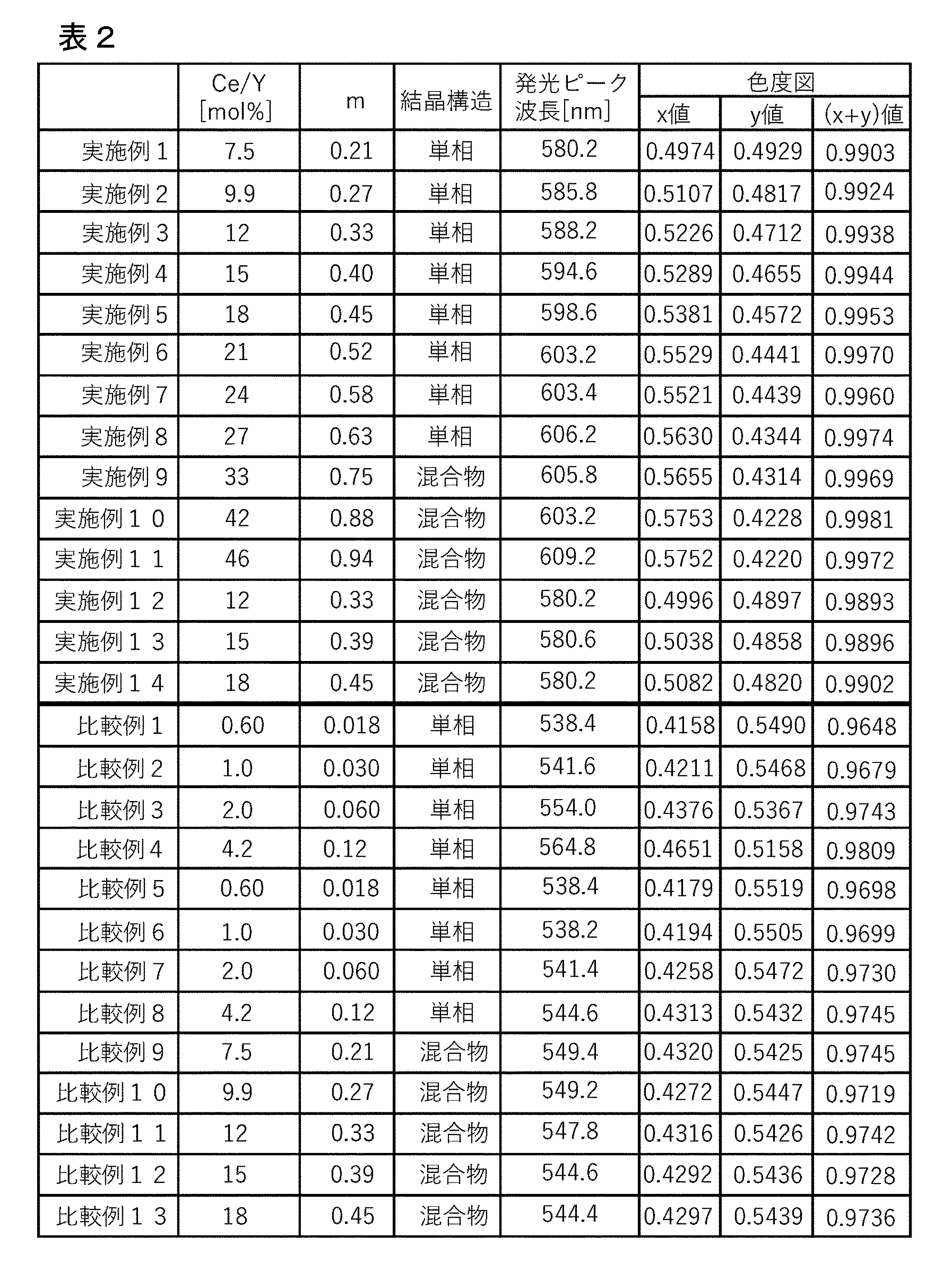
表2に示すように、Ce/Yが7.5[mol%]~27[mol%]である実施例1~実施例8のイットリウムアルミニウムガーネット蛍光体10-1~10-8は、単相の結晶構造からなり、Ce/Yが33[mol%]~46[mol%]である実施例9~実施例11のイットリウムアルミニウムガーネット蛍光体10-9~10-11は、混合物であり、Ce/Yが12[mol%]~18[mol%]である実施例12~14のイットリウムアルミニウムガーネット蛍光体10-12~10-14は、混合物である。
そして、実施例1~実施例14のイットリウムアルミニウムガーネット蛍光体10-1~10-14は、Ce/Yの増加に伴って発光ピーク波長が580.2nmから610.4nmまで長くなり、色度値のx値および(x+y)値が大きくなる。
x値は、色の赤味成分を示すものであり、x値が大きいことは、赤味成分が多いことを示す。実施例1~実施例11のイットリウムアルミニウムガーネット蛍光体10-1~10-11は、0.4974≦x≦0.5753のx値を有するので、赤味成分が多い579nmよりも長い発光ピーク波長を有する。
そして、580nmの発光ピーク波長は、蛍光の色が橙色になる下限値であるので、7.5[mol%]のCe/Y(即ち、式(1)におけるm=0.21)は、イットリウムアルミニウムガーネット蛍光体10-1~10-14が橙色の蛍光を発光するための臨界的意義を有する。
一方、比較例1~4におけるイットリウムアルミニウムガーネット蛍光体10-Comp1~10-Comp4は、0.4158≦x≦0.4651のx値を有し、比較例5~13におけるイットリウムアルミニウムガーネット蛍光体10-Comp5~10-Comp13は、0.4179≦x≦0.4320のx値を有するので、黄色の蛍光を発光する。
図14は、色度図におけるx値とy値との関係を示す図である。図14において、横軸は、x値を表し、縦軸は、y値を表す。また、白丸は、実施例1~14のイットリウムアルミニウムガーネット蛍光体10-1~10-14におけるx値とy値との関係を示し、黒三角は、比較例5~13イットリウムアルミニウムガーネット蛍光体10-Comp5~10-Comp13におけるx値とy値との関係を示す。
実施例1~14のイットリウムアルミニウムガーネット蛍光体10-1~10-14におけるx値は、比較例5~13のイットリウムアルミニウムガーネット蛍光体10-Comp5~10-Comp13におけるx値に比べて飛躍的に大きくなることは、図14からも明らかである。
実施例1~14のイットリウムアルミニウムガーネット蛍光体10-1~10-14は、図1に示す熱分解工程(工程S3)を用いて製造されたものであり、比較例5~13のイットリウムアルミニウムガーネット蛍光体10-Comp5~10-Comp13は、図1に示す熱分解工程(工程S3)を用いずに製造されたものである。従って、図1に示す熱分解工程(工程S3)を用いることによってx値が大きいイットリウムアルミニウムガーネット蛍光体10-1~10-14を製造することができる。
表2に示すように、Ce/Yが7.5[mol%]以上33[mol%]未満であるとき、イットリウムアルミニウムガーネット蛍光体は、単相のイットリウムアルミニウムガーネット結晶からなるので、式(1)~(4)におけるmは、好ましくは、0.21≦m<0.75である。
図13に示す直線k1は、λp=74.571m+563.55(0.21≦m<0.50)によって表されるので、m=0.21であるとき、λp=579.2[nm]である。従って、この発明の実施の形態におけるイットリウムアルミニウムガーネット蛍光体は、発光ピーク波長が579[nm]よりも長い蛍光を発光する。
上述した実施例1~14におけるイットリウムアルミニウムガーネット蛍光体10-1~10-14を用いた発光装置20が発光する白色光の演色性を評価するために、国際照明委員会(CIE:Commission Internationale de l’Eclairage)で定められた14種類の演色評価数R1~R14のうちの特殊演色評価数R9を実施例1,5,8,11および比較例4におけるイットリウムアルミニウムガーネット蛍光体10-1,10-5,10-8,10-11,10-Comp4について算出した。その結果を表3に示す。
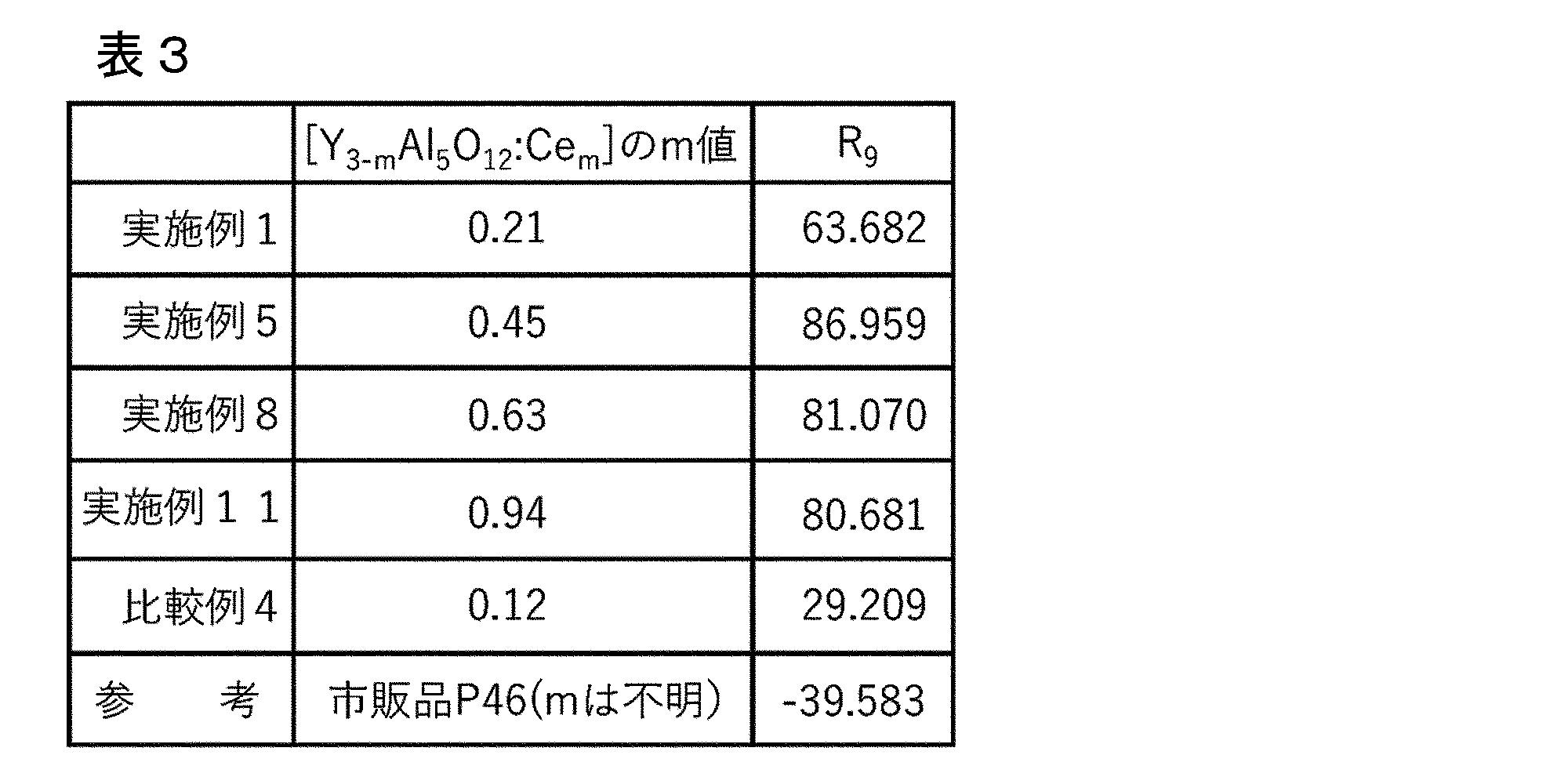
表3においては、市販品(Phosphor Technology社製、QMK58/N-C1)のYAG:Ce蛍光体P46について算出した特殊演色評価数R9を参考として示す。
市販品のYAG:Ce蛍光体P46が発光する蛍光(黄色)と、青色LEDが発光する蛍光とを混色させたときに白色(約6500K)になるようにYAG:Ce蛍光体P46の蛍光スペクトルと青色LEDの蛍光スペクトルとのスペクトル比を算出し、その算出したスペクトル比を用いて実施例1,5,8,11および比較例4におけるイットリウムアルミニウムガーネット蛍光体10-1,10-5,10-8,10-11,10-Comp4について特殊演色評価数R9を算出した。
表3に示すように、YAG:Ce蛍光体P46の特殊演色評価数R9は、マイナスの値であるが、実施例1,5,8,11および比較例4におけるイットリウムアルミニウムガーネット蛍光体10-1,10-5,10-8,10-11,10-Comp4の特殊演色評価数R9は、プラスの値である。そして、実施例1,5,8,11におけるイットリウムアルミニウムガーネット蛍光体10-1,10-5,10-8,10-11は、比較例4におけるイットリウムアルミニウムガーネット蛍光体10-Comp4よりも特殊演色評価数R9が大きい。
実施例1,5,8,11におけるイットリウムアルミニウムガーネット蛍光体10-1,10-5,10-8,10-11のCe量(m)は、それぞれ、0.21,0.45,0.63,0.94であり、実施例1~14におけるイットリウムアルミニウムガーネット蛍光体10-1~10-14のCe量(m)の範囲をカバーしているので、実施例2~4,6,7,9,10,12~14におけるイットリウムアルミニウムガーネット蛍光体10-2~10-4,10-6,10-7,10-9,10-10,10-12~10-14の特殊演色評価数R9も比較例4におけるイットリウムアルミニウムガーネット蛍光体10-Comp4の特殊演色評価数R9よりも大きいと考えられる。従って、実施例1~14におけるイットリウムアルミニウムガーネット蛍光体10-1~10-14を発光装置20に用いた場合、演色性の良い白色光を発光できることが分かった。
実施例1,3,6,8および比較例1におけるイットリウムアルミニウムガーネット蛍光体10-1,10-3,10-6,10-8,10-Comp1の格子定数をパナリティカル製X線回折装置で得られた回折データのリートベル解析によって求めた。リートベル解析には、RIETAN-FPを用いた。その結果を表4に示す。括弧内の数値は、標準偏差を表す。

表4に示すように、実施例1,3,6,8におけるイットリウムアルミニウムガーネット蛍光体10-1,10-3,10-6,10-8は、比較例1におけるイットリウムアルミニウムガーネット蛍光体10-Comp1よりも大きい格子定数を有する。そして、実施例1,3,6,8におけるイットリウムアルミニウムガーネット蛍光体10-1,10-3,10-6,10-8の格子定数は、Ce量(m)の増加に伴って大きくなることが分かった。
この発明は、イットリウムアルミニウムガーネット蛍光体およびそれを備える発光装置に適用される。
Claims (4)
- 以下の式(1)によって表され、発光ピーク波長が579nmよりも長い蛍光を発光するイットリウムアルミニウムガーネット蛍光体。
Y3-mAl5O12:Cem(0.21≦m≦0.94)・・・(1) - 前記発光ピーク波長をλP[nm]としたとき、mおよびλPは、下記の式(5),(6)を満たす、請求項1に記載のイットリウムアルミニウムガーネット蛍光体。
74.571m+563.55(0.21≦m<0.50)≦λP≦74.571m+566.55(0.21≦m<0.50)・・・(5)
600.0(0.50≦m≦0.94)≦λP≦108.02m3-266.77m2+227.98m+547.07(0.50≦m≦0.94)・・・(6) - 単相のイットリウムアルミニウムガーネット結晶相からなる、請求項1または請求項2に記載のイットリウムアルミニウムガーネット蛍光体。
- 請求項1から請求項3のいずれか1項に記載のイットリウムアルミニウムガーネット蛍光体を少なくとも1つ備える発光装置。
Priority Applications (1)
| Application Number | Priority Date | Filing Date | Title |
|---|---|---|---|
| JP2020538497A JP7265274B2 (ja) | 2018-08-24 | 2019-08-23 | イットリウムアルミニウムガーネット蛍光体およびそれを備える発光装置、イットリウムアルミニウムガーネット蛍光体の製造方法 |
Applications Claiming Priority (4)
| Application Number | Priority Date | Filing Date | Title |
|---|---|---|---|
| JP2018157417 | 2018-08-24 | ||
| JP2018-157417 | 2018-08-24 | ||
| JP2019034244 | 2019-02-27 | ||
| JP2019-034244 | 2019-02-27 |
Publications (1)
| Publication Number | Publication Date |
|---|---|
| WO2020040306A1 true WO2020040306A1 (ja) | 2020-02-27 |
Family
ID=69593018
Family Applications (1)
| Application Number | Title | Priority Date | Filing Date |
|---|---|---|---|
| PCT/JP2019/033134 Ceased WO2020040306A1 (ja) | 2018-08-24 | 2019-08-23 | イットリウムアルミニウムガーネット蛍光体およびそれを備える発光装置 |
Country Status (2)
| Country | Link |
|---|---|
| JP (1) | JP7265274B2 (ja) |
| WO (1) | WO2020040306A1 (ja) |
Cited By (1)
| Publication number | Priority date | Publication date | Assignee | Title |
|---|---|---|---|---|
| JP2022089043A (ja) * | 2020-12-03 | 2022-06-15 | シャープ株式会社 | 蛍光体およびその製造方法並びに蛍光体を用いた表示装置 |
Citations (3)
| Publication number | Priority date | Publication date | Assignee | Title |
|---|---|---|---|---|
| JP2011032416A (ja) * | 2009-08-04 | 2011-02-17 | Sumitomo Metal Mining Co Ltd | 蛍光体とその製造方法 |
| JP2013147643A (ja) * | 2011-12-22 | 2013-08-01 | Shin-Etsu Chemical Co Ltd | イットリウムセリウムアルミニウムガーネット蛍光体の製造方法 |
| JP2015067754A (ja) * | 2013-09-30 | 2015-04-13 | 住友大阪セメント株式会社 | 複合波長変換粒子及び複合波長変換粒子含有樹脂組成物並びに発光装置 |
-
2019
- 2019-08-23 JP JP2020538497A patent/JP7265274B2/ja active Active
- 2019-08-23 WO PCT/JP2019/033134 patent/WO2020040306A1/ja not_active Ceased
Patent Citations (3)
| Publication number | Priority date | Publication date | Assignee | Title |
|---|---|---|---|---|
| JP2011032416A (ja) * | 2009-08-04 | 2011-02-17 | Sumitomo Metal Mining Co Ltd | 蛍光体とその製造方法 |
| JP2013147643A (ja) * | 2011-12-22 | 2013-08-01 | Shin-Etsu Chemical Co Ltd | イットリウムセリウムアルミニウムガーネット蛍光体の製造方法 |
| JP2015067754A (ja) * | 2013-09-30 | 2015-04-13 | 住友大阪セメント株式会社 | 複合波長変換粒子及び複合波長変換粒子含有樹脂組成物並びに発光装置 |
Cited By (2)
| Publication number | Priority date | Publication date | Assignee | Title |
|---|---|---|---|---|
| JP2022089043A (ja) * | 2020-12-03 | 2022-06-15 | シャープ株式会社 | 蛍光体およびその製造方法並びに蛍光体を用いた表示装置 |
| JP7671935B2 (ja) | 2020-12-03 | 2025-05-07 | 国立大学法人東海国立大学機構 | 蛍光体の製造方法 |
Also Published As
| Publication number | Publication date |
|---|---|
| JP7265274B2 (ja) | 2023-04-26 |
| JPWO2020040306A1 (ja) | 2021-08-26 |
Similar Documents
| Publication | Publication Date | Title |
|---|---|---|
| Van Quang et al. | A high quantum efficiency plant growth LED by using a deep-red-emitting α-Al 2 O 3: Cr 3+ phosphor | |
| JP4730458B2 (ja) | 赤色蛍光体、赤色蛍光体の製造方法、白色光源、照明装置、および液晶表示装置 | |
| Zhu et al. | Hydrothermal synthesis, morphology and photoluminescent properties of an Mn 4+-doped novel red fluoride phosphor elpasolite K 2 LiAlF 6 | |
| Hussain et al. | Broad red-emission of Sr 3 Y 2 Ge 3 O 12: Eu 2+ garnet phosphors under blue excitation for warm WLED applications | |
| TWI651394B (zh) | 矽酸鹽磷光體 | |
| CN102433122B (zh) | 氮化物荧光体及其制造方法与发光装置 | |
| KR101854114B1 (ko) | 금속불화물 적색 형광체 및 이를 이용한 발광소자 | |
| CN102625820A (zh) | 氮氧化物荧光体粉、氮化物荧光体粉及其制造方法 | |
| Han et al. | Large micro-sized K 2 TiF 6: Mn 4+ red phosphors synthesised by a simple reduction reaction for high colour-rendering white light-emitting diodes | |
| WO2014104143A1 (ja) | 蛍光体、その蛍光体を用いた蛍光体含有組成物及び発光装置、並びに、その発光装置を用いた画像表示装置及び照明装置 | |
| CN106164218B (zh) | 用于固态照明的超四面体磷光体 | |
| Dai et al. | Preparation, structure, and luminescent properties of Dy3+-doped borate Ca3La3 (BO3) 5: Dy3+ for potential application in UV-LEDs | |
| JP7507149B2 (ja) | 表面被覆蛍光体粒子、表面被覆蛍光体粒子の製造方法および発光装置 | |
| JP5912121B2 (ja) | Mn賦活蛍光物質 | |
| Singh et al. | Rapid synthesis and photoluminescent characterization of MAl2O4: Eu2+, Dy3+ (M= Ca/Ca+ Ba/Ca+ Mg) blue nanophosphors for white lighting display applications | |
| TWI878624B (zh) | 螢光體、以及發光裝置 | |
| JP2023166642A (ja) | 蛍光体、蛍光体の製造方法、及び発光装置 | |
| JP2015063680A (ja) | 蛍光体 | |
| TWI844681B (zh) | 表面被覆螢光體粒子、以及發光裝置 | |
| Zhong et al. | Improvement in luminescent properties and thermo-optical conversion mechanism of Na 2 SiF 6: Mn 4+, K+@ GQDs | |
| JP2023166644A (ja) | 蛍光体、及び発光装置 | |
| JP7265274B2 (ja) | イットリウムアルミニウムガーネット蛍光体およびそれを備える発光装置、イットリウムアルミニウムガーネット蛍光体の製造方法 | |
| Yang et al. | Tuneable photoluminescence of β-K2SO4 phosphors with enhanced thermal stability and quantum efficiency by chemical substitution | |
| KR20210150475A (ko) | 표면 피복 형광체 입자, 표면 피복 형광체 입자의 제조 방법 및 발광 장치 | |
| Lau et al. | Effect of microwave time on the structural and luminescence properties of YAG: Ce prepared by microwave solution combustion (MSC) synthesis |
Legal Events
| Date | Code | Title | Description |
|---|---|---|---|
| 121 | Ep: the epo has been informed by wipo that ep was designated in this application |
Ref document number: 19853199 Country of ref document: EP Kind code of ref document: A1 |
|
| ENP | Entry into the national phase |
Ref document number: 2020538497 Country of ref document: JP Kind code of ref document: A |
|
| NENP | Non-entry into the national phase |
Ref country code: DE |
|
| 122 | Ep: pct application non-entry in european phase |
Ref document number: 19853199 Country of ref document: EP Kind code of ref document: A1 |