WO2020040126A1 - ペット用温度調節装置、及びペット用温度調節装置の温度調節方法 - Google Patents
ペット用温度調節装置、及びペット用温度調節装置の温度調節方法 Download PDFInfo
- Publication number
- WO2020040126A1 WO2020040126A1 PCT/JP2019/032405 JP2019032405W WO2020040126A1 WO 2020040126 A1 WO2020040126 A1 WO 2020040126A1 JP 2019032405 W JP2019032405 W JP 2019032405W WO 2020040126 A1 WO2020040126 A1 WO 2020040126A1
- Authority
- WO
- WIPO (PCT)
- Prior art keywords
- temperature
- pet
- heat conductor
- control device
- unit
- Prior art date
- Legal status (The legal status is an assumption and is not a legal conclusion. Google has not performed a legal analysis and makes no representation as to the accuracy of the status listed.)
- Ceased
Links
Images










Classifications
-
- A—HUMAN NECESSITIES
- A01—AGRICULTURE; FORESTRY; ANIMAL HUSBANDRY; HUNTING; TRAPPING; FISHING
- A01K—ANIMAL HUSBANDRY; AVICULTURE; APICULTURE; PISCICULTURE; FISHING; REARING OR BREEDING ANIMALS, NOT OTHERWISE PROVIDED FOR; NEW BREEDS OF ANIMALS
- A01K1/00—Housing animals; Equipment therefor
- A01K1/015—Floor coverings, e.g. bedding-down sheets ; Stable floors
Definitions
- the present invention relates to a temperature control device for a pet and a temperature control method of the temperature control device for a pet.
- Patent Literature 1 includes a heat conductor, a thermoelectric conversion element that adjusts the temperature of the heat conductor, and an atmosphere detection sensor. Based on the temperature detected by the atmosphere detection sensor, the thermoelectric conversion element 2. Description of the Related Art A small animal cooling device that controls temperature by switching between electrical positive and negative and electric energy has been disclosed.
- Patent Document 1 requires an additional atmosphere detection sensor for detecting the outside air temperature, which increases the cost.
- a large-sized thermoelectric conversion element is required.
- An object of the present invention is to provide a pet temperature control device and the like that can improve the comfort of a pet with a simple configuration that does not require cost.
- the temperature control device for a pet includes a heat conductor on which the pet rides, cooling means for cooling the heat conductor by providing a temperature difference between the heat conductor and the heat radiating means, Heating means for heating the conductor, first temperature detecting means for detecting the temperature of the heat conductor, second temperature detecting means for detecting the temperature of the heat radiating means, and a second temperature detecting means obtained from the first temperature detecting means.
- Temperature control means for controlling the temperature of the heat conductor by operating the cooling means or the heating means based on the first temperature and the second temperature acquired from the second temperature detection means.
- FIG. 4 is a diagram illustrating an example of a functional configuration of a control unit in the temperature control device for a pet illustrated in FIG. 3. It is a figure showing an example of the functional composition of the temperature control part in the above-mentioned control part. It is a figure showing an example of an energization level. It is a figure showing an example of initial energization level information.
- FIG. 1 is a perspective view of an example of a temperature control device for a pet according to the present embodiment.
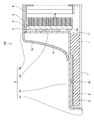
- FIG. 2 is a sectional view taken along line II-II of FIG.
- the pet temperature control device 100 includes a base 1, a heat conductor 2, and a housing 3.
- the base 1 supports the heat conductor 2 and the housing 3.
- the heat conductor 2 has a first end 2a and a second end 2b. On the first end 2a side of the heat conductor 2, a sheet-like sheet portion 2c on which a pet such as a cat or a dog rides or sleeps or rests is provided. The seat 2 c is exposed from the housing 3. Also, the heat conductor 2 has a shape that bends in an L-shape with respect to the sheet portion 2c and rises up on the second end 2b side, and a Peltier element (cooling means) 4. A mounting portion 2d for mounting a heat sink 5 (radiator) and the like is provided.
- the housing 3 has a rounded rectangular parallelepiped shape, and partially covers the base 1 and the heat conductor 2.
- the mounting portion 2 d of the heat conductor 2, the Peltier element 4, the heat sink 5, and the fan 6 To store.
- the Peltier element 4 is a thermoelectric conversion element for cooling at least the heat conductor 2, and is attached so as to be in contact with the back surface side of the attachment portion 2 d of the heat conductor 2.
- the Peltier element 4 cools the heat conductor by giving a temperature difference between the heat conductor 2 and a heat sink 5 as a heat radiation means, for example.
- the heat conductor 2 is preferably formed of a plate made of a heat conductive material such as aluminum, copper, steel, stainless steel, or the like. In consideration of conductivity, workability, cost, and the like, it is more preferable to use an aluminum plate made of an aluminum plate.
- the seat 2c can provide a comfortable temperature environment for the pet by transmitting the heat of the Peltier element 4 and adjusting the temperature.
- the cooling and heating of the Peltier element 4 can be adjusted by changing the direction and intensity of the current. Further, it is preferable that the shape of the mounting portion 2d of the heat conductor 2 be adjusted to the size of the Peltier element 4, the heat sink 5, and the like, for example.
- the heat sink 5 is a radiator that radiates heat of the Peltier element 4 and is installed so as to be in contact with the Peltier element 4.
- the heat sink 5 has a rectangular plate-like portion 5a and a plurality of fins 5b extending vertically from the plate-like portion 5a and aligned substantially parallel to the long sides of the plate-like portion 5a.
- the plate portion 5 a of the heat sink 5 is in contact with the Peltier device 4.
- the fan 6 is installed so as to face the fins 5b of the heat sink 5, and blows the heat sink 5 to air-cool.
- the heat sink 5 is provided with a second thermistor (second temperature detecting means) 11 for detecting a temperature near the Peltier element 4.
- the second thermistor 11 is for preventing, for example, the Peltier element 4 from being heated and damaged. For example, when the second thermistor 11 detects a predetermined temperature, for example, 80 ° C. or more, the power supply to the Peltier element 4 is stopped to prevent the Peltier element 4 from being damaged.
- the second thermistor 11 is provided on the heat sink 5.
- the present invention is not limited to this mode, and the configuration and the installation position may be any as long as the temperature near the Peltier element 4 can be detected. There is no particular limitation.
- a heat insulating member 7, a heater (heating means) 8, and an insulating sheet 9 are laminated in this order from the base 1 side between the sheet portion 2c and the base 1 in the heat conductor 2, and are supported by the base 1. .
- the heater 8 heats the seat 2c. Thereby, for example, it is preferable to heat the sheet portion 2c only by the heater 8 without operating the Peltier element 4.
- Examples of the heater 8 include a sheet-like aluminum heater.
- the heat insulating member 7 suppresses heat dissipation to the bottom surface side of the base 1 and is formed of, for example, styrene foam.
- the insulating sheet 9 insulates the sheet portion 2c from the heater 8, and is formed of an insulating resin or the like. Further, a first thermistor (first temperature detecting means) 10 for detecting the temperature of the seat 2c is provided below the seat 2c.
- a cooling mode in which the seat 2c is cooled by the Peltier element 4 and a heating mode in which the seat 2c is heated to the set temperature by the heater 8 can be switched.
- the set temperature of the heating mode may be, for example, a preset temperature in the pet temperature control device or a temperature set by the user, and may cause the pet to have discomfort such as burns. If there is no temperature, there is no particular limitation.
- FIG. 3 is a diagram showing an example of the temperature control device 100 for pets.
- the pet temperature control device 100 includes, for example, a control unit 101, a storage unit 102, a timing unit 103, a Peltier element 4, a heater 8, a first thermistor (first temperature detection unit) 10, and a second thermistor ( (Second temperature detecting means) 11.
- the control unit 101 is, for example, a CPU, an MPU, or the like, and executes various types of information processing according to a program stored in the storage unit 102.
- the storage unit 102 is, for example, a flash memory or a RAM, and holds a program executed by the control unit 101 and various data.
- the storage unit 102 also operates as a work memory of the control unit 101.
- the timer 103 measures time.
- the control unit 101 is connected to each of the Peltier element 4, the heater 8, the first thermistor 10, the second thermistor 11, and controls each unit.
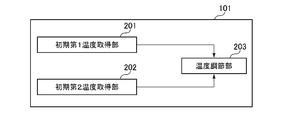
- FIG. 4 is a diagram showing an example of a functional configuration of a control unit of the temperature control device for pet 100 shown in FIG.
- the control unit 101 of the pet temperature adjustment device 100 functionally includes an initial first temperature acquisition unit 201, an initial second temperature acquisition unit 202, and a temperature adjustment unit 203.
- the temperature of the seat portion 2c is adjusted when the power of the temperature control device for pet 100 is turned on and the user instructs the operation in the heating mode.
- the initial first temperature acquisition unit 201 acquires the initial first temperature T1 which is the temperature of the sheet 2c detected by the first thermistor 10 when the power supply of the temperature control device for pet 100 is turned on.
- the initial second temperature acquisition unit 202 acquires the initial second temperature T2 which is the temperature of the heat sink 5 detected by the second thermistor 11 when the power supply of the temperature control device for pet 100 is turned on.
- the temperature controller 203 controls the Peltier element 4 or the heater 8 based on the initial first temperature T1 and the initial second temperature T2 to adjust the temperature of the seat 2c. For example, in the case of the heating mode, the temperature adjustment unit 203 adjusts the temperature of the seat 2c detected by the first thermistor 10 to be a set temperature (for example, 38 ° C.).
- the temperature adjustment unit 203 functionally includes a previous operation determination unit 301, an outside air temperature prediction unit 302, an initial energization level information acquisition unit 303, and a set temperature adjustment temperature acquisition unit 304. , A set temperature adjustment power supply level information acquisition unit 305 and an operation control unit 306.
- the operation control unit 306 controls the operations of the heater 8 and the Peltier device 4.
- the operation control unit 306 controls the duty ratio of the heater 8 and the Peltier element 4, so that the temperature of the seat 2c is adjusted.
- the operation control unit 306 sets the heater 8 to a predicted outside air temperature described later. Energize at the appropriate energization level. Thereby, the temperature of the seat portion 2c can be adjusted to the set temperature early.
- the energization level is set according to the energization rate at which the heater 8 is energized.
- the energization level is not particularly limited, and may be set according to, for example, the performance of the heater 8. Further, for example, in the present embodiment, when the operation control unit 306 operates the Peltier element 4, the power is supplied at a duty ratio of 100%.
- the previous operation determination unit 301 sets the initial first temperature T1 acquired by the initial first temperature acquisition unit 201 and the initial second temperature T2 acquired by the initial second temperature acquisition unit 202 when the power of the temperature control device for pet 100 is turned on. Based on this, the previous operating state of the pet temperature control device 100 is determined.
- the previous operation state is, for example, a heating mode, a cooling mode, or an unused state.
- the non-use state is, for example, a state in which the temperature of each part of the pet temperature control device 100 has been adjusted to the outside air temperature and has been leveled, and the pet temperature control device 100 has not been used for a long time. .
- the previous operation determination unit 301 determines that the vehicle is not used when
- This X is, for example, a detection error of a value detected by the first thermistor 10 and the second thermistor 11 set in advance, for example, a value obtained in advance by an experiment or the like.
- the components of the pet temperature control device 100 become accustomed to the outside air temperature, and (Non-use state).
- the previous operation determination unit 301 determines that the previous operation was performed in the cooling mode. This is because, when operated in the cooling mode, the Peltier element 4 operates and the heat sink 5 becomes hot, so that T2 becomes higher than the outside temperature, while the seat portion 2c is cooled and T1 becomes lower than the outside temperature, As a result, only T2 becomes high in temperature.
- the previous operation determination unit 301 determines that the previous operation was performed in the heating mode. This is because, when the heater 8 is operated in the heating mode, T1 becomes high because the heater 8 is operating, while T2 hardly changes from the outside air temperature because the Peltier element 4 does not operate. As a result, T1 becomes high. That's why.
- the outside air temperature prediction unit 302 predicts the predicted outside air temperature of the pet temperature control device 100 based on the determination of the previous operation determination unit 301.
- the outside temperature prediction unit 302 predicts the predicted outside temperature as T1 when the previous operation determination unit 301 has determined that the outside temperature is not used.
- T1 and T2 have substantially the same value as the outside air temperature. Therefore, although the predicted outside air temperature is T1 in the above description, the predicted outside air temperature may be predicted to be (T1 + T2) / 2 in consideration of T2 or an error or the like.
- the outside air temperature prediction unit 302 predicts the predicted outside air temperature as T1 + Y.
- This Y (for example, 5 ° C.) is a limit value of the cooling capacity of the Peltier element 4 that can be reduced from the actual outside temperature, and is a value obtained by an experiment or the like, for example. This is because, in the cooling mode, the seat portion 2c is normally cooled at the maximum output to cool the seat portion 2c by the Peltier element 4, and it can be determined that the outside air temperature is about Y higher than T1.
- the outside temperature prediction unit 302 predicts a predicted outside temperature based on the temperatures detected by the first thermistor 10 and the second thermistor 11, but is not limited to this, and has a configuration capable of predicting the predicted outside temperature. If there is, it is not particularly limited.
- the outside temperature prediction unit 302 predicts the predicted outside temperature to be T2 when the previous operation determination unit 301 determines that the previous operation was performed in the heating mode last time. As described above, when the operation is performed in the heating mode, the Peltier element 4 does not operate, so that T2 hardly changes from the outside air temperature.
- the outside air temperature can be predicted from the first thermistor 10 for detecting the temperature of the seat portion 2c and the second thermistor 11 for protecting the Peltier element 4. Further, even if the time has not passed much since the previous operation in the cooling mode or the heating mode, and the first thermistor 10 or the second thermistor 11 is at a temperature different from the outside air temperature, the first The outside air temperature can be predicted from the temperature difference between the thermistor 10 and the second thermistor 11.
- the heater 8 can be energized at an energization level corresponding to the predicted outside air temperature without separately providing a thermistor for detecting the outside air temperature.
- the duty ratio control based on the unexpected temperature will be described below.
- the initial energization level information acquisition unit 303 acquires initial energization level information indicating the energization rate at which the heater 8 is energized, based on the predicted outside air temperature predicted by the outside air temperature prediction unit 302. Specifically, the initial energization level information acquisition unit 303 acquires, for example, as shown in FIG. 7, initial energization level information in which an unexpected temperature and an energization level are associated. Then, the initial energization level information acquiring unit 303 acquires the initial energization level information based on the predicted outside temperature. This initial energization level is determined and set in advance through experiments and the like. Note that the initial energization level information corresponds to control information in the claims.
- the operation control unit 306 starts energizing the heater 8 based on the initial energizing level information. More specifically, for example, when the outside air temperature prediction unit 302 predicts the predicted outside air temperature to be 22 ° C., the initial energization level information acquisition unit 303 based on FIG. The initial energization level information: 4 associated with the temperature ⁇ 30 ° C. is acquired. Then, the operation control unit 306 energizes the heater 8 at level 4 based on the initial energization level information: 4.
- the set temperature adjusting temperature acquiring section 304 acquires the set temperature adjusting temperature T3 from the first thermistor 10.
- the temperature acquisition unit 304 for setting temperature adjustment may determine the predetermined temperature measured by the timer 103 from the start of energization of the heater 8 by the operation control unit 306 based on the initial energization level information or the energization level information for setting temperature described later. Every time (for example, 10 minutes) elapses, the set temperature adjustment temperature T3 is acquired.
- the set temperature adjustment power supply level information acquisition unit 305 obtains set temperature adjustment power supply level information based on the set temperature adjustment temperature T3. Specifically, for example, as shown in FIG. 8, the set temperature adjustment energization level information acquisition unit 305 sets the set temperature adjustment energization level related information in which the set temperature adjustment temperature T3 and the energization level change information are associated. To get. Then, from the obtained power supply level change information and the current power supply level at which the heater 8 is supplied, the power supply level information for setting temperature adjustment is obtained. The power supply level change information is obtained and set in advance through experiments and the like. Then, the operation control unit 306 energizes the heater 8 based on the set temperature adjusting energization level information.
- the set temperature adjustment energization level information acquisition unit 305 is associated with the set temperature adjustment temperature T3: less than 36 ° C.
- Energization level change information: +1 is acquired.
- the heater 8 is energized at level 4 as in the above example
- the energization level information for setting temperature adjustment: 5 is acquired from the acquired energization level change information: +1 and level 4 4.
- the operation control unit 306 energizes the heater 8 at level 5 based on the set temperature adjustment energization level information: 5.
- the seat portion 2c can be adjusted to almost the set temperature.
- the set temperature adjustment power supply level information corresponds to the control information in the claims.
- the operation control unit 306 acquires the set temperature adjustment energization level information based on the set temperature adjustment temperature T3.
- 306 energizes the heater 8 based on the set temperature adjustment energizing level information.
- the temperature of the seat portion 2c can be adjusted to approximately the set temperature.
- the configuration of the seat portion 2c including the set temperature adjustment temperature acquisition section 304, the set temperature adjustment energization level information acquisition section 305, the temperature adjustment section 203, and the like is merely an example, and is a configuration in which the temperature of the seat section 2c can be substantially maintained at the set temperature. If it is, it is not limited to the above configuration.
- FIG. 9 is a diagram illustrating an example of a flow of the operation control unit 306 of the temperature control device for pet 100 according to the present embodiment.
- the initial first temperature acquisition unit 201 acquires the initial first temperature T1 from the first thermistor 10 (S101).
- the initial second temperature acquisition unit 202 acquires the initial second temperature T2 from the second thermistor 11 (S102).
- the previous operation determination unit 301 determines the previous operation before turning on the power of the temperature control device for pet 100 based on the initial first temperature T1 and the initial second temperature T2 (S103).
- the previous operation determining unit 301 determines that the previous operation is not performed when
- the outside air temperature prediction unit 302 calculates the predicted outside air temperature based on the determination result of the previous operation determination unit 301, T1 when the previous operation is not in use, and T1 + Y (Y is outside if the previous operation is in the cooling mode).
- the limit value of the cooling capacity of the Peltier element 4 that can be reduced from the air temperature) is predicted, and T2 is predicted when the previous operation is in the heating mode (S104).
- the initial energization level information acquisition unit 303 acquires initial energization level information based on the predicted outside temperature (S105).
- the operation control unit 306 starts energizing the heater 8 at the acquired energizing level based on the initial energizing level information (S106).
- the set temperature adjustment temperature acquisition unit 304 acquires the set temperature adjustment temperature T3 from the first thermistor 10 (S107).
- the set temperature adjustment energization level information acquisition unit 305 acquires set temperature adjustment energization level information based on the set temperature adjustment temperature T3 (S108).
- the operation control unit 306 energizes the heater 8 at the set temperature adjustment energization level acquired based on the set temperature adjustment energization level information (S109). After S109, the process returns to S107 and repeats S107 to S109, thereby adjusting the temperature of the seat portion 2c to a substantially constant set temperature. Note that when the power of the temperature control device for pet 100 is turned off, the above-described flow is also terminated. Note that the present embodiment is not limited to the above flow, and various modifications are possible. For example, the order of S101 and S102 may be reversed or may be simultaneous.
- the Peltier element 4 or the heater 8 is controlled based on the first temperature obtained from the first thermistor 10 and the second temperature obtained from the second thermistor 11, and the sheet portion 2c of the heat conductor is formed.
- a temperature control device for pets that can control the temperature of the pet.
- the temperature of the sheet portion 2c of the heat conductor can be adjusted to a temperature that is comfortable for the pet.
- the outside temperature can be predicted by the outside temperature prediction unit that predicts the outside temperature from the first temperature and the second temperature to the pet temperature control device, the outside temperature is detected separately from the first thermistor 10 and the second thermistor 11.
- the temperature of the sheet portion 2c of the heat conductor can be adjusted without providing a sensor or the like.
- the initial duty ratio of heater 8 is controlled based on the outside air temperature predicted by the outside air temperature prediction unit.
- the power supply rate of the heater 8 is changed based on the power supply level information for adjustment.
- the present invention is not limited to the above-described embodiment, and is substantially the same as the configuration shown in the above-described embodiment, a configuration having the same operation and effect, or a configuration capable of achieving the same object. May be replaced by
- the operation control unit 306 may energize the heater 8 at a level 10 having a maximum energization rate of 100% for a predetermined period after the power is turned on or until the first thermistor 10 reaches a predetermined temperature.
- the user turns on the power supply of the temperature control device for a pet, the user wants to quickly change the temperature of the seat 2c in the heating mode or the cooling mode. By energizing at level 10, user dissatisfaction can be reduced. Also in this case, it is preferable to change a predetermined period or a predetermined temperature during which power is supplied at the maximum power supply rate in accordance with the predicted outside air temperature.
- a protection control information acquisition unit for preventing the temperature of the seat unit 2c from excessively rising may be included.
- the protection control information acquisition unit acquires protection control information for stopping power supply to the heater 8 when, for example, the temperature detected by the first thermistor 10 exceeds a predetermined temperature (for example, 50 ° C.).
- the temperature control unit 203 stops supplying power to the heater 8 based on the protection control information. Thereby, for example, a burn of a pet can be prevented, and safety can be ensured.
- the heater is again activated based on the predicted temperature predicted by the outside air temperature prediction unit 302. 8 may be configured to be energized.
- the mode switching unit when the power supply of the temperature control device for pet 100 is turned on, the user designates the heating mode.
- the seat portion 2c is cooled by the Peltier element 4 according to the outside air temperature.
- a mode switching unit may be provided for switching between a cooling mode in which heating is performed and a heating mode in which the seat 8 is heated by the heater 8.
- the mode switching unit operates in the cooling mode when the predicted outside air temperature predicted by the outside air temperature prediction unit 302 is equal to or higher than a predetermined temperature (for example, 25 ° C.), and when the predicted outside air temperature is lower than the predetermined temperature (for example, 25 ° C.). It is configured to operate in the heating mode. This eliminates the need for the user to specify the driving mode, thereby improving the convenience for the user.
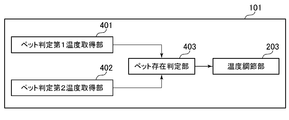
- FIG. 10 is a diagram for describing an example of a functional configuration of a control unit of the temperature control device for a pet according to the present embodiment.
- the control unit 101 of the pet temperature control apparatus 100 functionally includes, for example, a pet determination first temperature acquisition unit 401, a pet determination second temperature acquisition unit 402, and a pet presence.
- a determination unit 403 and a temperature adjustment unit 203 are included.
- the initial state of the temperature control device for pet 100 in the present embodiment is a state in which the power supply to the heating and cooling elements such as the Peltier element 4 and the heater 8 is cut off by, for example, a timer, but at least the power of the control unit 101 is turned on. State.
- the pet determination first temperature acquisition section 401 detects the sheet section detected by the first thermistor 10 at a time t every predetermined elapsed time (for example, 2 minutes) measured by the timer section 103 after the power supply to the heating / cooling element is cut off.
- the pet determination first temperature T4 which is the temperature of 2c, is acquired.
- the pet determination second temperature acquisition unit 402 detects, for example, the second thermistor 11 at a time t every predetermined elapsed time (for example, two minutes) measured by the timer 103 after the power supply to the heating / cooling element is cut off.
- the pet determination second temperature T5 which is the temperature of the heat sink 5, is acquired.
- the pet presence determination unit 403 determines whether a pet is on the seat 2c based on the first pet determination temperature T4 and the second pet determination temperature T5.
- the temperature controller 203 re-energizes the heating and cooling elements such as the Peltier element 4 and the heater 8, and adjusts the temperature of the seat 2c.
- an operation mode (cooling mode or heating mode) when the power supply to the heating / cooling element is cut off is stored, and the temperature control of the seat 2c is performed based on the determination of the pet presence determination unit 403.
- the operation is restarted, the operation is performed in the previously stored operation mode, and the temperature of the seat portion 2c is adjusted to a predetermined set temperature.
- the pet presence determination unit 403 determines that a pet is on board, for example, when T4 and T5 acquired at time t satisfy T4 ⁇ T5> X.
- X is a detection error of a value detected by the first thermistor 10 and the second thermistor 11 set in advance, for example, as in the first embodiment, and is a value obtained in advance by an experiment or the like. .
- the pet presence determination unit 403 determines whether or not the pet is on the basis of, for example, the inclination in the relationship between the time t and T4 in addition to the case of T4 ⁇ T5> X. I do. More specifically, for example, the pet presence determination unit 403 determines that T4 (x) obtained at time t (x) (x is an integer and indicates the order of T4 to be obtained) and a predetermined time later.
- ⁇ T4 (x + 1) -T4 (x) ⁇ / ⁇ t (x + 1) -t (x) ⁇ which is calculated from T4 (x + 1) acquired at time t (x + 1), Is larger than a threshold value (for example, ⁇ 1), and if T4 ⁇ T5> X, it is determined whether or not a pet is on the seat 2c.
- a threshold value for example, ⁇ 1
- the determination by the pet presence determination unit 403 will be described more specifically with reference to a temperature change in the pet temperature adjustment device in FIGS. 11 to 22.
- FIGS. 11 to 18 show the relationship between the elapsed time after the power supply to the heating / cooling element is cut off and the first pet determination temperature T4 and the second pet determination temperature T5.
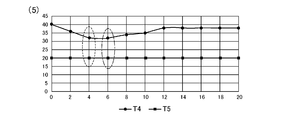
- the portion surrounded by the dotted line in the figure indicates the time when the pet rides on the seat portion 2c, and the portion surrounded by the dashed line indicates the time when the pet presence determination section 403 determines that the pet is riding on the seat portion 2c.
- the temperature change due to energization of the heating / cooling element is excluded in order to make the temperature change due to the pet riding more clear.
- the patterns of (A), (1) to (3), and (B) (4) to (6) are as follows.
- T4 is lower than the outside air temperature (30 ° C.). Then, as time elapses, T5 decreases and becomes almost the same as the outside temperature after 10 minutes. On the other hand, T4 rises with the passage of time and becomes almost the same as the outside temperature after 10 minutes. As described above, the temperature control device for pet 100 becomes familiar with the outside air temperature and becomes T4 ⁇ T5. Thereafter, since the pet is not riding, T4 and T5 hardly fluctuate.
- the temperature is substantially the same until 28 minutes from the start of acquisition, and it can be determined that the temperature is familiar with the outside temperature. Then, after 28 minutes, the pet rides on the seat portion 2c, and after 30 minutes, T4 has risen.
- the increase in the temperature of T4 30 minutes later can be determined to be an increase due to the body temperature of the pet riding on the seat portion 2c in view of the fact that the temperature is adapted to the outside air temperature.
- T5 is not affected by the pet and hardly changes from the outside temperature (30 ° C.).
- the pet presence determination unit 403 can determine that there has been a temperature change due to the body temperature of the pet when T4 ⁇ T5> X (X is, for example, 3 ° C. in the present embodiment), and the pet is in the seat 2c. It is determined that the user is riding.
- the increase of T4 beyond T5 can be determined to be a temperature change due to the body temperature of the pet, in view of the fact that T5 decreases only to the outside air temperature.
- the pet presence determination unit 403 can determine that there has been a temperature change due to the pet's body temperature, and determines that the pet is on the seat 2c.
- T4 since T4 has been cooled in the cooling mode, it rises after the power is turned off, and rises over time in a temperature range higher than the outside air temperature (30 ° C.) so as to approach the body temperature of the pet. And after 8 minutes, T4 exceeds T5.
- the rise of T4 beyond T5 can be determined to be the effect of the body temperature of the pet on the seat 2c in view of the fact that T5 only decreases to the outside air temperature.
- the pet presence determination unit 403 can determine that there has been a temperature change due to the pet's body temperature when T4 ⁇ T5> X, and determines that the pet is on the seat 2c.
- the pet temperature controller 100 does not immediately re-energize, and does not re-energize unless T4 exceeds T5. Therefore, the Peltier element 4 is prevented from being continuously energized and is not energized again until the heat sink 5 is cooled, so that damage to the Peltier element 4 can be prevented.
- T5 is almost the same as the outside air temperature (20 ° C.). Since T4 is heated by the heater 8, the temperature is higher than the outside air temperature. Then, as time elapses, T5 remains unchanged at the same temperature as the outside air temperature. On the other hand, T4 drops and becomes almost the same as the outside temperature 10 minutes later. As described above, the temperature control device for pet 100 becomes familiar with the outside air temperature and becomes T4 ⁇ T5. Thereafter, since the pet is not riding, T4 and T5 hardly fluctuate.
- T4 and T5 have almost the same temperature until 28 minutes from the start of acquisition, and the pet temperature control device 100 is adapted to the outside air temperature. Can be determined. Further, at T5, since the Peltier element 4 was not operated in the heating mode without being affected by the pet, the temperature does not substantially change from the outside air temperature (20 ° C.) as in the case of (B). Then, after 28 minutes, the pet rides on the seat portion 2c, and after 30 minutes, only T4 rises. The increase in the temperature of T4 30 minutes later can be determined to be an increase due to the body temperature of the pet riding on the seat portion 2c in view of the fact that the temperature is adapted to the outside air temperature. As a result, the pet presence determination unit 403 can determine that there has been a temperature change due to the pet's body temperature when T4 ⁇ T5> X, and determines that the pet is on the seat 2c.
- the pet presence determination unit 403 determines the presence of the pet from the above slope calculated from the time t and T4.
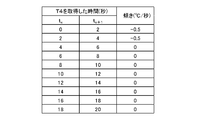
- the calculated inclination is as shown in FIG. As shown in FIG. 19, the inclination of the pet 4 minutes after riding on the pet is as small as -2, but after 6 minutes, T4 increases due to the temperature of the pet and the inclination becomes -1 (this embodiment). 0 which is larger than the threshold value of the form.
- the Peltier element 4 is not operating as in (B), so that T5 is equal to the outside air temperature (20 minutes). ° C), and since T4 was heated by the heater 8, it is higher than the outside air temperature. Thereafter, at T5, since the Peltier element 4 was not operated in the heating mode without being affected by the pet, the temperature does not substantially change from the outside air temperature (20 ° C.) as in the case of (B). On the other hand, at T4, since the pet remains on the seat portion 2c, the temperature change after 2 minutes is more gradual due to the pet's body temperature than the pattern (5).
- the pet presence determination unit 403 determines the time t and T4 in the same manner as in the pattern of (5).
- the presence of a pet is determined from the above slope calculated from the above.
- the calculated inclination is as shown in FIG. As shown in FIG. 20, since the slope after 2 minutes is more gradual than the temperature drop in the pattern (5) due to the effect of the body temperature of the pet as described above, it is smaller than ⁇ 1 (the threshold value in the present embodiment). It is large -0.5.
- the determination that the pet is on the seat 2c by the pet presence determination unit 403 is not limited to the above configuration as long as it can be determined that the pet is on the seat 2c. Absent. Further, in the present embodiment, the detection error in the first thermistor 10 and the second thermistor 11 is taken into consideration, but the determination may be made without taking the detection error into consideration. In addition, when the pattern does not apply to the patterns (1) to (6), for example, in the case of the patterns (A) and (B), it can be determined that the pet is not riding.
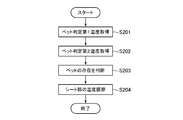
- FIG. 21 is a diagram showing an example of a flow of the pet temperature control device 100 according to the present embodiment.
- the first pet determination temperature acquisition unit 401 acquires the first pet determination temperature T4 at a time t for each predetermined elapsed time (S201).
- the pet determination second temperature acquisition unit 402 acquires the pet determination second temperature T5 at time t for each predetermined elapsed time (S202).
- the pet presence determination unit 403 determines whether a pet is on the seat 2c (whether or not a pet exists on the seat 2c) based on T4 and T5 (S203). More specifically, for example, in the cooling mode, the pet presence determination unit 403 determines that the pet is on when T4-T5> X.
- the temperature controller 203 turns on the power supply to the heating / cooling element of the pet temperature controller 100 to adjust the temperature of the seat 2c (S204).
- a threshold value for example, ⁇ 1
- the presence of the pet on the seat portion 2c is determined by the pet presence determination unit 403 based on the temperatures obtained from the first thermistor 10 and the second thermistor 11, so that another sensor such as a weight sensor can be used.
- the temperature of the seat 2c can be adjusted without adding a member when the pet is present in the seat 2c. Accordingly, when the pet is on the seat 2c in a state where the power supply to the heating / cooling element is cut off by, for example, a timer, the temperature adjustment of the seat 2c is automatically restarted, and the comfort of the pet is improved. be able to.
- the pet temperature control apparatus 100 of the second embodiment includes the previous operation determination unit 301 of the first embodiment, and the previous operation mode is determined by the previous operation determination unit, and the determined operation is performed. It may be configured to operate in the mode. Further, in the second embodiment, the operation mode may be automatically switched from the predicted outside air temperature by providing the outside air temperature prediction unit in the first embodiment.
Landscapes
- Life Sciences & Earth Sciences (AREA)
- Environmental Sciences (AREA)
- Zoology (AREA)
- Animal Husbandry (AREA)
- Biodiversity & Conservation Biology (AREA)
- Housing For Livestock And Birds (AREA)
- Transition And Organic Metals Composition Catalysts For Addition Polymerization (AREA)
- Materials For Medical Uses (AREA)
Abstract
ペットの快適性を向上させたペット用温度調節装置等を提供する。ペット用温度調節装置は、ペットが乗る熱伝導体と、前記熱伝導体と放熱手段との間に温度差を与えて前記熱伝導体を冷却する冷却手段と、前記熱伝導体を加熱する加熱手段と、前記熱伝導体の温度を検知する第1温度検知手段と、前記放熱手段の温度を検知する第2温度検知手段と、前記第1温度検知手段から取得した第1温度および前記第2温度検知手段から取得した第2温度に基づいて、前記冷却手段または前記加熱手段を動作させて前記熱伝導体の温度を調節する温度調節手段と、を有する。
Description
本発明は、ペット用温度調節装置、及びペット用温度調節装置の温度調節方法に関する。本願は、2018年8月24日に、日本に出願された特願2018-157143号に基づく優先権を主張するものであり、その内容をここに援用する。
特許文献1には、熱伝導体と、熱伝導体の温度を調節する熱電変換素子と、大気検知センサーと、を有し、大気検知センサーで検知された温度に基づいて、熱電変換素子への電気的正負や電力量を切り替えて温度を調節する小動物用冷房装置が開示されている。
しかしながら、特許文献1に記載の装置では、外気温を検知するための大気検知センサーが別途必要となり、コストアップとなる。また、ペットが乗る熱伝導体の温度調節を熱電変換素子だけで行うためには、大型の熱電変換素子が必要であり、特に、熱伝導体の加熱を十分に行うことが困難であった。本発明は、コストがかからない簡易な構成でペットの快適性を向上させることができるペット用温度調節装置等を提供することを目的とする。
本発明の一形態のペット用温度調節装置は、ペットが乗る熱伝導体と、前記熱伝導体と放熱手段との間に温度差を与えて前記熱伝導体を冷却する冷却手段と、前記熱伝導体を加熱する加熱手段と、前記熱伝導体の温度を検知する第1温度検知手段と、前記放熱手段の温度を検知する第2温度検知手段と、前記第1温度検知手段から取得した第1温度および前記第2温度検知手段から取得した第2温度に基づいて、前記冷却手段または前記加熱手段を動作させて前記熱伝導体の温度を調節する温度調節手段と、を有する。
以下、本発明の実施形態について、図面を参照しつつ説明する。なお、図面については、同一又は同等の要素には同一の符号を付し、重複する説明は省略する。
(第1の実施形態)
図1は、本実施形態にかかるペット用温度調節装置の一例の斜視図である。図2は、図1のII-II線矢視断面図である。
図1は、本実施形態にかかるペット用温度調節装置の一例の斜視図である。図2は、図1のII-II線矢視断面図である。
図1、図2に示すようにペット用温度調節装置100は、土台1、熱伝導体2、筐体3を有する。土台1は、熱伝導体2、筐体3を支持している。
熱伝導体2は、第1の端部2aおよび第2の端部2bを有する。熱伝導体2の第1の端部2a側には、猫や犬等のペットが乗って寝たり休憩したりするシート状のシート部2cが設けられている。このシート部2cは、筐体3から露出している。また、熱伝導体2の第2の端部2b側には、シート部2cに対してL字状に曲がって立ち上がった形状になっており、この立ち上がった部分には、ペルチェ素子(冷却手段)4、ヒートシンク5(放熱手段)等を取り付ける取り付け部2dが設けられている。
筐体3は、丸みを帯びた直方体状であり、土台1および熱伝導体2を部分的に覆うようになっており、熱伝導体2の取り付け部2d、ペルチェ素子4、ヒートシンク5、ファン6を収納する。
ペルチェ素子4は、少なくとも熱伝導体2を冷却するための熱電変換素子であり、熱伝導体2の取り付け部2dの裏面側に接触するように取り付けられている。このペルチェ素子4は、例えば、熱伝導体2と放熱手段であるヒートシンク5との間に温度差を与えて熱伝導体を冷却する。なお、熱伝導体2は、ペルチェ素子4の熱をシート部2cに伝達するために、例えばアルミニウム、銅、スチール、ステンレス等の熱伝導性の材質からなる板から成形されたものが好ましく、熱伝導性、加工性、コスト等を考慮して、アルミニウム板からなるアルミプレートからなることがより好ましい。シート部2cは、ペルチェ素子4の熱が伝達されて温度が調節されることにより、ペットに快適な温度環境を提供することができる。なお、ペルチェ素子4は、電流の向きおよび強度を変えることにより、冷却および加熱を調節することができる。また、熱伝導体2の取り付け部2dの形状は、例えばペルチェ素子4、ヒートシンク5等の大きさに合わせることが好ましい。
ヒートシンク5は、ペルチェ素子4の熱を放熱する放熱体であり、ペルチェ素子4と接触するように設置されている。ヒートシンク5は、矩形状の板状部5aと、当該板状部5aから垂直に伸び、板状部5aの長辺と略平行に整列した複数のフィン5bを有する。ヒートシンク5の板状部5aは、ペルチェ素子4と接触している。また、ファン6は、ヒートシンク5のフィン5bと対向するように設置されており、ヒートシンク5に送風して、空冷するようになっている。なお、本実施形態では、ヒートシンク5においてフィン5bが板状部5aの長辺と略平行に整列した例を挙げたが、これに限らず、例えば短辺と略平行に整列した構成でもよい。このヒートシンク5には、ペルチェ素子4近傍の温度を検出する第2サーミスタ(第2温度検知手段)11が設けられている。この第2サーミスタ11は、例えばペルチェ素子4が高温になり破損することを防止するためのものである。例えば第2サーミスタ11が所定の温度、例えば80℃以上を検出した場合に、ペルチェ素子4への通電を止め、ペルチェ素子4の破損を防止する。上記の通り、本実施形態においては第2サーミスタ11をヒートシンク5に設けているが、この形態に限るものではなく、ペルチェ素子4近傍の温度を検出できるものであれば、その構成、設置位置は特に限定されるものではない。
また、熱伝導体2におけるシート部2cと土台1との間には、土台1側から順に、断熱部材7、ヒーター(加熱手段)8、絶縁シート9が積層され、土台1に支持されている。ヒーター8は、シート部2cを加温するものである。これにより、例えば、ヒーター8のみで、ペルチェ素子4を動作させずに、シート部2cを加温することが好ましい。ヒーター8としては、例えばシート状のアルミヒータ等が挙げられる。断熱部材7は、土台1の底面側への熱の放散を抑制するものであり、例えば発泡スチロール等で形成されている。絶縁シート9は、シート部2cとヒーター8とを絶縁するものであり、絶縁性を有する樹脂等で形成されている。さらに、シート部2cの下部には、シート部2cの温度を検出する第1サーミスタ(第1温度検知手段)10が設けられている。
なお、上記ペット用温度調節装置100では、シート部2cをペルチェ素子4により冷却する冷房モードと、シート部2cをヒーター8で設定温度に加熱する暖房モードとが切り替えられるようになっている。この暖房モードの設定温度は、例えば、ペット用温度調節装置において予め設定されていたものであっても、使用者によって設定されるものであってもよく、ペットに火傷等の不快感を持たせない温度であれば、特に限定されるものではない。
図3は、ペット用温度調節装置100の一例を示す図である。本実施形態にかかるペット用温度調節装置100は、例えば、制御部101、記憶部102、計時部103、ペルチェ素子4、ヒーター8、第1サーミスタ(第1温度検知手段)10、第2サーミスタ(第2温度検知手段)11を有する。制御部101は、例えばCPU、MPU等であって、記憶部102に格納されるプログラムに従って各種の情報処理を実行する。記憶部102は、例えばフラッシュメモリやRAM等であって、制御部101によって実行されるプログラムや、各種のデータを保持する。また、記憶部102は、制御部101のワークメモリとしても動作する。また、計時部103は、時間を計測する。また、制御部101は、ペルチェ素子4、ヒーター8、第1サーミスタ10、第2サーミスタ11等のそれぞれに接続され、各部を制御する。
図4は、図3に示すペット用温度調節装置100の制御部の機能的構成の一例を示す図である。図4に示すように、本実施形態にかかるペット用温度調節装置100の制御部101は、機能的に、初期第1温度取得部201、初期第2温度取得部202、温度調節部203を含む。なお、本実施形態では、ペット用温度調節装置100の電源が投入され、使用者により暖房モードでの運転が指示された際に、シート部2cの温度を調節する場合について説明する。
初期第1温度取得部201は、ペット用温度調節装置100の電源投入時に、第1サーミスタ10が検知したシート部2cの温度である初期第1温度T1を取得する。
初期第2温度取得部202は、ペット用温度調節装置100の電源投入時に、第2サーミスタ11が検知したヒートシンク5の温度である初期第2温度T2を取得する。
温度調節部203は、初期第1温度T1および初期第2温度T2に基づいて、ペルチェ素子4またはヒーター8を制御して、シート部2cの温度を調節する。例えば、暖房モードの場合、温度調節部203は、第1サーミスタ10で検出されるシート部2cの温度が、設定温度(例えば38℃)になるように調節する。
具体的には、図5に示すように、温度調節部203は、機能的に、前回運転判定部301、外気温予測部302、初期通電レベル情報取得部303、設定温度調節用温度取得部304、設定温度調節用通電レベル情報取得部305、動作制御部306を含む。
動作制御部306は、ヒーター8、ペルチェ素子4の動作を制御する。この動作制御部306がヒーター8、ペルチェ素子4における通電率を制御することにより、シート部2cの温度が調節される。本実施形態では、例えば、電源が投入されてから、第1サーミスタで検出される温度が設定温度(例えば38℃)近くになるまで、動作制御部306は、ヒーター8を後述する予測外気温に応じた通電レベルで通電する。これにより、シート部2cの温度を、早期に設定温度に調節することができる。なお、本実施形態では、例えば、図6に示すように、ヒーター8に通電する通電率に応じて、通電レベルが設定されている。この通電レベルは、特に限定されるものではなく、例えばヒーター8の性能等に応じて設定されればよい。また、例えば、本実施形態において、動作制御部306がペルチェ素子4を動作させる場合、通電率を100%で通電する。
前回運転判定部301は、ペット用温度調節装置100の電源投入時に、初期第1温度取得部201が取得した初期第1温度T1および初期第2温度取得部202が取得した初期第2温度T2に基づいて、ペット用温度調節装置100における前回の運転状態を判定する。前回の運転状態は、例えば、暖房モード、冷房モード、または不使用状態である。なお、不使用状態とは、例えばペット用温度調節装置100の各部の温度が外気温に慣れ平準化された状態であって、ペット用温度調節装置100が長時間使用されていない状態等である。
前回運転判定部301は、|T1-T2|≦X(例えば3℃)の場合、不使用状態と判定する。このXは、例えば予め設定された第1サーミスタ10および第2サーミスタ11で検出される値の検出誤差であり、例えば予め実験等により得られた値である。つまり、前回運転判定部301は、シート部2cと、ヒートシンク5との離れた部位の温度がほぼ同じであると、ペット用温度調節装置100の各部が外気温に慣れ、外気温とほぼ同じ温度となった状態(不使用状態)と判定する。
また、前回運転判定部301は、T2>T1+Xの場合、前回、冷房モードで運転されていたと判定する。これは、冷房モードで運転された場合、ペルチェ素子4が動作してヒートシンク5が高温になるためT2が外気温よりも高くなる一方、シート部2cは冷却されてT1が外気温より低くなり、結果的にT2のみが高温になるためである。
さらに、前回運転判定部301は、T1>T2+Xの場合、前回、暖房モードで運転されていたと判定する。これは、暖房モードで運転された場合、ヒーター8が作動していたためT1が高くなる一方、ペルチェ素子4が作動しないためT2は外気温からの変化はほぼなく、結果的にT1が高温になるためである。
外気温予測部302は、前回運転判定部301の判定に基づいて、ペット用温度調節装置100の予測外気温を予測する。外気温予測部302は、前回運転判定部301が不使用状態と判定した場合、予測外気温をT1と予測する。上述の通り、不使用状態では、T1およびT2がほぼ外気温と同じ値になっているためである。そのため、上記では予測外気温をT1としたが、この予測外気温を、T2または誤差等を考慮して(T1+T2)/2と予測してもよい。
また、外気温予測部302は、前回運転判定部301が前回に冷房モードで運転されていたと判定した場合、予測外気温をT1+Yと予測する。このY(例えば5℃)は、実際の外気温から低下させることができるペルチェ素子4の冷却能力の限界値であり、例えば実験等により得られた値である。冷房モードでは、ペルチェ素子4によりシート部2cを冷却するのに通常最大出力で冷却しており、外気温がT1よりY程度高いと判断できるからである。なお、上記外気温予測部302は、第1サーミスタ10および第2サーミスタ11が検出した温度に基づいて、予測外気温を予測しているが、これに限らず、予測外気温を予測できる構成であれば、特に限定されるものではない。
さらに、外気温予測部302は、前回運転判定部301が前回に暖房モードで運転されていたと判定した場合、予測外気温をT2と予測する。上述の通り、暖房モードで運転された場合、ペルチェ素子4が作動しないため、T2は外気温からの変化がほぼないからである。
この様に、シート部2cの温度を検出する第1サーミスタ10、及びペルチェ素子4を保護するための第2サーミスタ11から、外気温を予測することができる。また、前回の冷房モードや暖房モードでの運転から時間があまり経過しておらず、第1サーミスタ10または第2サーミスタ11が外気温とは異なる温度となっている場合であっても、第1サーミスタ10および第2サーミスタ11の温度差によって、外気温を予測することができる。
したがって、外気温を検知するためのサーミスタを別途設けなくても、予測外気温に応じた通電レベルでヒーター8を通電することができる。予測外気温に基づく通電率制御について、以下に説明する。
初期通電レベル情報取得部303は、外気温予測部302が予測した予測外気温に基づいて、ヒーター8に通電する通電率を表す初期通電レベル情報を取得する。具体的には、初期通電レベル情報取得部303は、例えば、図7に示すように、予測外気温、および通電レベルが関連付けられた初期通電レベル情報を取得する。そして、初期通電レベル情報取得部303は、予測外気温に基づいて、初期通電レベル情報を取得する。この初期通電レベルは、予め実験等により把握され、設定されたものである。なお、上記初期通電レベル情報は、特許請求の範囲における制御情報に相当するものである。
動作制御部306は、上記初期通電レベル情報に基づいて、ヒーター8に通電を開始する。より具体的には、初期通電レベル情報取得部303は、例えば、外気温予測部302が予測外気温を22℃と予測した場合に、図7に基づいて、予測外気温:20℃≦予測外気温<30℃に関連付けられた初期通電レベル情報:4を取得する。そして、動作制御部306は、初期通電レベル情報:4に基づき、レベル4でヒーター8に通電する。
設定温度調節用温度取得部304は、第1サーミスタ10から設定温度調節用温度T3を取得する。設定温度調節用温度取得部304は、例えば、初期通電レベル情報または後述の設定温度調節用通電レベル情報に基づいた動作制御部306によるヒーター8への通電の開始から、計時部103が計測した所定時間(例えば、10分)経過するごとに、設定温度調節用温度T3を取得する。
設定温度調節用通電レベル情報取得部305は、設定温度調節用温度T3に基づいて、設定温度調節用通電レベル情報を取得する。具体的には、設定温度調節用通電レベル情報取得部305は、例えば、図8に示すように、設定温度調節用温度T3、および通電レベル変化情報が関連付けられた設定温度調節用通電レベル関連情報を取得する。そして、取得した通電レベル変化情報およびヒーター8に通電している現在の通電レベルから、設定温度調節用通電レベル情報を取得する。この通電レベル変化情報は、予め実験等により把握され、設定されたものである。そして、動作制御部306は、この設定温度調節用通電レベル情報に基づいて、ヒーター8に通電する。より具体的には、例えば、設定温度調節用温度T3として、35℃が取得された場合、設定温度調節用通電レベル情報取得部305は、設定温度調節用温度T3:36℃未満に関連付けられた、通電レベル変化情報:+1を取得する。そして、上記の例のようにレベル4でヒーター8に通電している場合には、取得した通電レベル変化情報:+1およびレベル4の4より、設定温度調節用通電レベル情報:5を取得する。そして、動作制御部306は、設定温度調節用通電レベル情報:5に基づいて、ヒーター8にレベル5で通電する。これにより、シート部2cをほぼ設定温度に調節することができる。なお、上記設定温度調節用通電レベル情報は、特許請求の範囲における制御情報に相当するものである。
上記のように、設定温度調節用通電レベル情報に基づいて動作制御部306がヒーター8に通電した後も、設定温度調節用温度T3に基づき、設定温度調節通電レベル情報を取得し、動作制御部306が設定温度調節通電レベル情報に基づいて、ヒーター8に通電する。これにより、シート部2cの温度を、ほぼ設定温度に調節することができる。なお、設定温度調節用温度取得部304、設定温度調節用通電レベル情報取得部305、温度調節部203等によるシート部2cの構成は一例であり、シート部2cの温度をほぼ設定温度に保てる構成であれば、上記の構成に限定されるものではない。
図9は、本実施形態におけるペット用温度調節装置100の動作制御部306のフローの一例を示す図である。図9に示すように、電源が投入されると、初期第1温度取得部201は、第1サーミスタ10から初期第1温度T1を取得する(S101)。初期第2温度取得部202は、第2サーミスタ11から初期第2温度T2を取得する(S102)。前回運転判定部301は、初期第1温度T1および初期第2温度T2に基づいて、ペット用温度調節装置100における電源投入前の前回運転を判定する(S103)。この前回運転判定部301は、前回の運転を、|T1-T2|≦X(Xは第1サーミスタ10および第2サーミスタ11における所定の誤差値)の場合は不使用状態、T2>T1+Xの場合は冷房モード、T1>T2+Xの場合は暖房モードと判定する。外気温予測部302は、前回運転判定部301の判定結果に基づいて、予測外気温を、前回の運転が不使用状態の場合はT1、前回の運転が冷房モードの場合はT1+Y(Yは外気温から低下させることができるペルチェ素子4の冷却能力の限界値)、前回の運転が暖房モードの場合はT2と予測する(S104)。初期通電レベル情報取得部303は、上記予測外気温に基づいて、初期通電レベル情報を取得する(S105)。動作制御部306は、初期通電レベル情報に基づき、取得された通電レベルでヒーター8に通電を開始する(S106)。設定温度調節用温度取得部304は、第1サーミスタ10から設定温度調節用温度T3を取得する(S107)。設定温度調節用通電レベル情報取得部305は、設定温度調節用温度T3に基づいて、設定温度調節通電レベル情報を取得する(S108)。そして、動作制御部306は、設定温度調節通電レベル情報に基づき取得された設定温度調節通電レベルでヒーター8に通電する(S109)。S109の後は、S107に戻り、S107からS109を繰り返すことにより、シート部2cの温度を設定温度にほぼ一定に調節する。なお、ペット用温度調節装置100の電源が切られた際に、上記のフローも終了する。なお、本実施の形態は、上記フローに限定されるものではなく、種々の変形が可能である。例えば、S101及びS102の順序は逆であっても、同時であってもよい。
本実施の形態によれば、第1サーミスタ10から取得した第1温度および第2サーミスタ11から取得した第2温度の基づき、ペルチェ素子4またはヒーター8を制御して、熱伝導体のシート部2cの温度を調節することができるペット用温度調節装置を提供することができる。これにより、熱伝導体のシート部2cの温度をペットに快適な温度に調節することができる。さらに、上記第1温度および第2温度からペット用温度調節装置に外気温を予測する外気温予測部で外気温を予測できるため、第1サーミスタ10および第2サーミスタ11とは別に外気温を検出するセンサー等を設けることなく、熱伝導体のシート部2cの温度を調節することができる。
また、本実施の形態によれば、外気温予測部で予測した外気温に基づきヒーター8の初期通電率を制御し、また、第1サーミスタ10が設定温度近くとなった場合には、設定温度調節用通電レベル情報に基づいて、ヒーター8の通電率を変化させる。これにより、予測外気温が低い場合であってもシート部2cの温度を早期に設定温度に到達させることができ、一方で、予測外気温が高い場合に、シート部2cの温度が設定温度を超えて高温となってしまうことで、ペットに不快感を与えてしまうことを防止できる。
本発明は、上記実施の形態に限定されるものではなく、上記実施の形態で示した構成と実質的に同一の構成、同一の作用効果を奏する構成又は同一の目的を達成することができる構成で置き換えてもよい。
例えば、動作制御部306は、電源が投入されてから所定の期間または第1サーミスタ10が所定の温度となるまで、ヒーター8に最大通電率100%のレベル10で通電してもよい。使用者がペット用温度調節装置の電源を投入するということは、暖房モードや冷房モードによって、シート部2cの温度を速やかに変えたいということであるから、まずはヒーター8を最大通電率100%のレベル10で通電することで、使用者の不満を軽減できる。なお、この場合も、予測した外気温に応じて、最大通電率で通電する所定の期間や所定の温度を変更することが好ましい。
また、例えば、上記の構成に加え、シート部2cの温度の上がりすぎを防止するための、保護制御情報取得部を含んでいてもよい。保護制御情報取得部は、例えば第1サーミスタ10で検出される温度が所定の温度(例えば50℃)を超えた場合に、ヒーター8への通電を止める保護制御情報を取得する。温度調節部203は、この保護制御情報に基づいてヒーター8への通電を止める。これにより、例えばペットの火傷等を防止することができ、安全性を確保することができる。さらに、通電を止めた後、例えば第1サーミスタ10で検出される温度が所定の温度(例えば30℃)を下回った場合に、前記外気温予測部302が予測した予測温度に基づいて、再度ヒーター8に通電するように構成してもよい。
さらに、本実施形態では、ペット用温度調節装置100の電源が投入された際に、使用者が暖房モードを指定しているが、例えば、外気温に応じてペルチェ素子4でシート部2cを冷却する冷房モードまたはヒーター8でシート部2cを加熱する暖房モードのいずれかに切り替えるモード切替部を有していてもよい。例えば、モード切替部は、上記外気温予測部302で予測された予測外気温が、所定の温度(例えば25℃)以上の場合に冷房モードで運転し、所定温度(例えば25℃)未満の場合に暖房モードで運転するように構成する。これにより、使用者が運転モードを指定する必要がなくなり、使用者の利便性を向上させることができる。
(第2の実施形態)
次に、本発明の第2の実施形態を説明する。なお、下記において第1の実施形態と同様である点については説明を省略する。
次に、本発明の第2の実施形態を説明する。なお、下記において第1の実施形態と同様である点については説明を省略する。
図10は、本実施の形態におけるペット用温度調節装置の制御部の機能的構成の一例について説明するための図である。図10に示すように、本実施の形態におけるペット用温度調節装置100の制御部101は、機能的に、例えば、ペット判定第1温度取得部401、ペット判定第2温度取得部402、ペット存在判定部403、温度調節部203を含む。本実施形態におけるペット用温度調節装置100の初期状態は、例えばタイマー等によりペルチェ素子4やヒーター8などの加熱冷却素子への通電が切れた状態ではあるが、少なくとも制御部101の電源は入っている状態とする。
ペット判定第1温度取得部401は、加熱冷却素子への通電が切れてから計時部103により計測された所定の経過時間(例えば2分)毎の時間tに第1サーミスタ10が検知したシート部2cの温度であるペット判定第1温度T4を取得する。
ペット判定第2温度取得部402は、例えば、加熱冷却素子への通電が切れてから計時部103により計測された所定の経過時間(例えば2分)毎の時間tに第2サーミスタ11が検知したヒートシンク5の温度であるペット判定第2温度T5を取得する。
ペット存在判定部403は、ペット判定第1温度T4およびペット判定第2温度T5に基づいて、シート部2c上にペットが乗っているか否かを判定する。シート部2c上にペットが乗っている判定した場合、例えば、温度調節部203は、ペルチェ素子4やヒーター8などの加熱冷却素子へ再通電し、シート部2cの温度を調節する。例えば、本実施形態においては、加熱冷却素子への通電が切れた際の運転モード(冷房モードまたは暖房モード)を記憶しておき、ペット存在判定部403の判定に基づきシート部2cの温度制御を再開した際に、記憶しておいた前回の運転モードで動作させ、シート部2cの温度を所定の設定温度に調節する。
より具体的には、ペット存在判定部403は、例えば、時間tにおいて取得したT4およびT5が、T4-T5>Xの場合に、ペットが乗っていると判定する。なお、Xは、第1の実施形態と同様に、例えば予め設定された第1サーミスタ10および第2サーミスタ11で検出される値の検出誤差であり、例えば予め実験等により得られた値である。
さらに、暖房モードにおいては、ペット存在判定部403は、上記T4-T5>Xの場合に加えて、例えば、時間tとT4との関係における傾きに基づいて、ペットが乗っているか否かを判定する。より具体的には、例えば、ペット存在判定部403は、時間t(x)(xは整数であり、取得されるT4の順番を表す。)に取得したT4(x)と、所定時間後の時間t(x+1)に取得したT4(x+1)とから算出される傾き:{T4(x+1)-T4(x)}/{t(x+1)-t(x)}に基づいて、例えば、この傾きが、閾値(例えば-1)より大きい場合で、且つ、T4-T5>Xの場合に、シート部2c上にペットが乗っているか否かを判定する。なお、上記の閾値は、実験等により、予め設定されたものである。
ペット存在判定部403における判定について、図11~図22のペット用温度調節装置における温度変化を参照しながら、より具体的に、説明する。
以下、夏季における(A)、(1)~(3)、および冬季における(B)(4)~(6)のパターンに分けて、図11~18に基づいて説明する。図11~18は、加熱冷却素子への通電が切れてからの経過時間と、ペット判定第1温度T4およびペット判定第2温度T5との関係を示したものである。図の点線で囲んだ部分は、ペットがシート部2cに乗った時点を示し、一点鎖線で囲んだ部分は、ペット存在判定部403がペットがシート部2cに乗っていると判定した時点を示す。なお、図11~18においては、ペットが乗ったことによる温度変化をより明確にすべく、加熱冷却素子への通電による温度変化は除外している。
(A)、(1)~(3)、および(B)(4)~(6)のパターンは以下の通りである。
(A)夏季(例えば外気温30℃)に、冷房モードで運転中に通電が切れた後、ペットがシート部2cに乗らなかった場合、
(1)夏季に、冷房モードで運転中に通電が切れた後、ペット用温度調節装置100が外気温に馴染み、外気温と同じ温度になっている状態において、ペットが乗った場合、
(2)夏季に、冷房モードで運転中に通電が切れた後、ペット用温度調節装置100が外気温に馴染む前に、ペットが乗った場合、
(3)夏季に、冷房モードで運転中にペットが乗っており、通電が切れた際にペットが乗ったままの場合、
(B)冬季(例えば外気温20℃)に、暖房モードで運転中に通電が切れた後、ペットがシート部2cに乗らなかった場合、
(4)冬季に、暖房モードで運転中に通電が切れた後、ペット用温度調節装置100が外気温に馴染み、外気温と同じ温度になっている状態においてペットが乗った場合、
(5)冬季に、暖房モードで運転中に通電が切れた後、ペット用温度調節装置100が外気温に馴染む前に、ペットが乗った場合、
(6)冬季に、暖房モードで運転中にペットが乗っており、通電が切れた際にペットが乗ったままの場合。
(A)夏季(例えば外気温30℃)に、冷房モードで運転中に通電が切れた後、ペットがシート部2cに乗らなかった場合、
(1)夏季に、冷房モードで運転中に通電が切れた後、ペット用温度調節装置100が外気温に馴染み、外気温と同じ温度になっている状態において、ペットが乗った場合、
(2)夏季に、冷房モードで運転中に通電が切れた後、ペット用温度調節装置100が外気温に馴染む前に、ペットが乗った場合、
(3)夏季に、冷房モードで運転中にペットが乗っており、通電が切れた際にペットが乗ったままの場合、
(B)冬季(例えば外気温20℃)に、暖房モードで運転中に通電が切れた後、ペットがシート部2cに乗らなかった場合、
(4)冬季に、暖房モードで運転中に通電が切れた後、ペット用温度調節装置100が外気温に馴染み、外気温と同じ温度になっている状態においてペットが乗った場合、
(5)冬季に、暖房モードで運転中に通電が切れた後、ペット用温度調節装置100が外気温に馴染む前に、ペットが乗った場合、
(6)冬季に、暖房モードで運転中にペットが乗っており、通電が切れた際にペットが乗ったままの場合。
(A)のパターンの場合、例えば、図11に示すように、通電が切れた時点(0分)では、ペルチェ素子4が動作していたため、T5が高温になっているとともに、シート部2cは冷却されていたためT4が外気温(30℃)より低温になっている。そして、時間の経過とともに、T5は低下していき10分後に外気温とほぼ同じになる。一方、T4は時間の経過とともに上昇していき10分後に外気温とほぼ同じになる。このようにペット用温度調節装置100は、外気温に馴染んでT4≒T5となり、その後は、ペットが乗っていないため、T4、T5は、ほぼ変動しない。
(1)のパターンの場合、例えば図12に示すように、T4およびT5は、取得開始から28分までは、ほぼ同じ温度となっており、外気温に馴染んでいると判断できる。そして、28分後にペットがシート部2cに乗り、30分後にはT4が上昇している。この30分後におけるT4の温度上昇は、外気温に馴染んでいることを鑑みて、シート部2cに乗ったペットの体温による上昇と判断できる。一方で、T5は、ペットの影響を受けず、外気温(30℃)からほぼ変化しない。これにより、ペット存在判定部403では、T4-T5>X(本実施例では、Xは例えば3℃)となった時点で、ペットの体温による温度変化があったと判断でき、ペットがシート部2cに乗っていると判定する。
(2)のパターンの場合、例えば図13に示すように、T5は、ペットの影響を受けないため、(A)の場合と同様に、外気温に馴染むまでの温度低下の挙動を示す。一方、T4は、通電が切れた後の初期において(A)の場合と同様に、時間の経過とともに外気温に近づくように上昇していくが、4分後にペットが乗り、それ以降、外気温(30℃)を超えてもさらに上昇し、10分後には、T5を上回っている。このT4のT5を超えての上昇は、T5が外気温までしか低下しないことを鑑みて、ペットの体温による温度変化であると判断できる。これにより、ペット存在判定部403は、T4-T5>Xとなった時点で、ペットの体温による温度変化があったと判断でき、ペットがシート部2cに乗っていると判定する。
(3)のパターンの場合、例えば図14に示すように、T5は、ペットの影響を受けないため、(A)の場合と同様に、外気温に馴染むまでの温度低下の挙動を示す。一方、T4は、冷房モードで冷却されていたため、電源が切れた後上昇し、外気温(30℃)よりも高温域で、時間の経過とともにペットの体温に近づくように上昇する。そして、8分後には、T4はT5を上回っている。T4のT5を超えての上昇は、T5が外気温までしか低下しないことを鑑みて、シート部2cに乗ったままのペットの体温の影響であると判断できる。これにより、ペット存在判定部403では、T4-T5>Xとなった時点で、ペットの体温による温度変化があったと判断でき、ペットがシート部2cに乗っていると判定する。このように、通電がタイマーなどで切れた際にペットが乗ったままの場合であっても、ペット用温度調節装置100は即座に再通電せず、T4がT5を上回らなければ再通電しない。したがって、ペルチェ素子4の連続通電状態を避け、ヒートシンク5が冷却されるまで再通電しないようにするため、ペルチェ素子4の破損を防止できる。
(B)のパターンの場合、例えば、図15に示すように、通電が切れた時点(0分)では、ペルチェ素子4は動作していなかったため、T5は外気温(20℃)とほぼ同じであり、T4はヒーター8により加熱されていたため、外気温より高温になっている。そして、時間の経過とともに、T5は引き続き外気温と同じ温度で変化がない。一方、T4は低下してき10分後に外気温とほぼ同じになる。このようにペット用温度調節装置100は、外気温に馴染んでT4≒T5となり、その後は、ペットが乗っていないため、T4、T5は、ほぼ変動しない。
(4)のパターンの場合、例えば図16に示すように、T4およびT5は、取得開始から28分までは、ほぼ同じ温度となっており、ペット用温度調節装置100が外気温に馴染んでいると判断できる。また、T5は、ペットの影響を受けず、暖房モードでペルチェ素子4が動作していなかったため、(B)の場合と同様に、外気温(20℃)からほぼ変化しない。そして、28分後にペットがシート部2cに乗り、30分後にはT4のみが上昇している。この30分後におけるT4の温度上昇は、外気温に馴染んでいることを鑑みて、シート部2cに乗ったペットの体温による上昇と判断できる。これにより、ペット存在判定部403では、T4-T5>Xとなった時点で、ペットの体温による温度変化があったと判断でき、ペットがシート部2cに乗っていると判定する。
(5)のパターンの場合、例えば図17に示すように、通電が切れた時点(0分)では、(B)と同様に、ペルチェ素子4は動作していなかったため、T5は外気温(20℃)とほぼ同じであり、T4はヒーター8により加熱されていたため、外気温より高温になっている。また、その後、T5は、ペットの影響を受けず、暖房モードでペルチェ素子4が動作していなかったため、(B)の場合と同様に、外気温(20℃)からほぼ変化しない。一方、T4は、(B)と同様に外気温に近づくように下降していくが、4分後にペットがシート部2cに乗り、そのペットの体温により、上昇に転じ始める。この(5)のパターンにおいては、図17に示す通り、通電が切れた時点(0分)で既にT4-T5>Xとなっているため、上記(A)や(1)~(3)に示した冷房モード時のように、T4-T5>Xとなった時点でペットがシート部2cに乗っていると判定することができない。そこで、ペット存在判定部403は、時間tとT4とから算出される上記傾きからペットの存在を判断する。この算出された傾きは、図19に示す通りである。図19に示すように、上述のペットが乗った4分後の傾きは、-2と小さいが、その次に6分後には、ペットの体温によりT4が上昇し、傾きが-1(本実施形態の閾値)より大きい0となっている。つまり、上述のとおり、ペット存在判定部403は、6分後におけるT4の取得の時点で、T4-T5=12℃>X(本実施形態では3℃)で、且つ、傾き>-1(本実施形態の閾値)の場合に当てはまり、ペットが乗っていると判定する。
(6)のパターンの場合、例えば図18に示すように、通電が切れた時点(0分)では、(B)と同様に、ペルチェ素子4は動作していなかったため、T5は外気温(20℃)とほぼ同じであり、T4はヒーター8により加熱されていたため、外気温より高温になっている。また、その後、T5は、ペットの影響を受けず、暖房モードでペルチェ素子4が動作していなかったため、(B)の場合と同様に、外気温(20℃)からほぼ変化しない。一方、T4は、ペットがシート部2cに乗ったままであるため、(5)のパターンに比べ2分後の温度変化はペットの体温により緩やかである。ここで、この(6)のパターンにおいては、図18に示す通り、T4-T5>Xとなっているため、(5)のパターンと同様に、ペット存在判定部403は、時間tとT4とから算出される上記傾きからペットの存在を判断する。この算出された傾きは、図20に示す通りである。図20に示すように、2分後の傾きは、上述のとおり、ペットの体温の影響により(5)のパターンにおける温度低下よりも、緩やかであるため、-1(本実施形態の閾値)より大きい-0.5となっている。つまり、上述の通り、ペット存在判定部403は、2分後の時点で、T4-T5=18℃>Xで、且つ、傾き>-1(本実施形態の閾値)の場合に当てはまり、ペットが乗っていると判定する。
なお、ペット存在判定部403におけるペットがシート部2cに乗っているとの判断は、シート部2c上にペットが乗っていることを判断できるものであれば、上記の構成に限定されるものではない。また、本実施形態では第1サーミスタ10および第2サーミスタ11における検出誤差を考慮に入れているが、検出誤差を考慮にいれずに判断してもよい。また、上記(1)~(6)のパターンに当てはまらない場合、例えば(A)(B)のパターンの場合、ペットが乗っていないと判定することができる。
また、時間tとT4との関係における傾きではなく、時間tと(T4-T5)との関係における傾きに基づいて、ペットが乗っているか否かを判定してもよい。T4-T5の値で判断することにより、外気温が急激に変化した場合に、誤動作することを防止できる。
図21は、本実施形態におけるペット用温度調節装置100のフローの一例を示す図である。図21に示すように、ペット判定第1温度取得部401は、所定の経過時間毎の時間tにペット判定第1温度T4を取得する(S201)。ペット判定第2温度取得部402は、所定の経過時間毎の時間tにペット判定第2温度T5を取得する(S202)。ペット存在判定部403は、T4およびT5に基づいて、シート部2c上にペットが乗っているか否か(シート部2c上にペットが存在するか否か)を判断する(S203)。より具体的には、例えば、冷房モードにおいては、ペット存在判定部403は、T4-T5>Xの場合に、ペットが乗っていると判断する。また、暖房モードにおいては、上記T4-T5>Xに当てはまり、且つ、T4について、時間tとT4との関係から算出される傾きが、閾値(例えば-1)より大きい場合に、ペットが乗っていると判定する。シート部2c上にペットが乗っている判断した場合、温度調節部203は、ペット用温度調節装置100の加熱冷却素子への通電をONにし、シート部2cの温度を調節する(S204)。なお、本実施の形態は、上記フローに限定されるものではなく、種々の変形が可能である。例えば、S201及びS202の順序は逆であっても、同時であってもよい。
本実施形態によれば、第1サーミスタ10および第2サーミスタ11から取得した温度に基づいて、ペット存在判定部403によりシート部2c上のペットの存在を判断することにより、重量センサー等の他の部材を追加することなく、ペットがシート部2cに存在する場合に、シート部2cの温度を調節することができる。これにより、例えばタイマー等により加熱冷却素子への通電が切れた状態で、ペットがシート部2cに乗った場合に、シート部2cの温度調節が自動的に再開され、ペットの快適性を向上させることができる。
本発明は、上記実施形態や各例示に限定されるものではなく、上記実施形態及び各変例示は、互いに矛盾しない限り、組み合わせて用いてもよい。例えば、第2の実施形態のペット用温度調節装置100において、第1の実施形態の前回運転判定部301を備え、この前回運転判定部にて前回の運転モードを判定して、その判定した運転モードで動作させるように構成してもよい。また、さらに、第2の実施形態において、第1の実施形態における外気温予測部を備えることにより、予測した外気温から運転モードを自動的に切り替えるように構成してもよい。
Claims (7)
- ペットが乗る熱伝導体と、
前記熱伝導体と放熱手段との間に温度差を与えて前記熱伝導体を冷却する冷却手段と、
前記熱伝導体を加熱する加熱手段と、
前記熱伝導体の温度を検知する第1温度検知手段と、
前記放熱手段の温度を検知する第2温度検知手段と、
前記第1温度検知手段から取得した第1温度および前記第2温度検知手段から取得した第2温度に基づいて、前記冷却手段または前記加熱手段を動作させて前記熱伝導体の温度を調節する温度調節手段と、
を有するペット用温度調節装置。 - 前記温度調節手段は、前記第1温度検知手段から電源投入時に取得した初期第1温度および前記第2温度検知手段から電源投入時に取得した初期第2温度に基づいて、前記ペット用温度調節装置の外気温を予測する外気温予測手段と、前記外気温予測手段が予測した予測外気温に基づいて、前記加熱手段の温度に関して制御する制御情報を取得する制御情報取得手段と、前記制御情報に基づいて前記加熱手段を制御する動作制御手段を有する請求項1に記載のペット用温度調節装置。
- 前記温度調節手段は、前記初期第1温度および前記初期第2温度に基づいて、前記ペット用温度調節装置における前回の運転状態を判定する前回運転判定手段を有し、前記外気温予測手段は、前記前回運転判定手段が判定した前回の運転状態に基づいて、外気温を予測する、請求項2に記載のペット用温度調節装置。
- 前記第1温度および前記第2温度に基づいて、前記熱伝導体上のペットの存在を判定するペット存在判定手段を有し、前記ペット存在判定手段の判定結果に基づいて、前記温度調節手段は前記熱伝導体の温度を調節する、請求項1~3のいずれか1項に記載のペット用温度調節装置。
- さらに、前記ペット存在判定手段は、時間と前記時間に取得した前記第1温度との関係から算出した傾きに基づいて、前記熱伝導体上のペットの存在を判定する、請求項4に記載のペット用温度調節装置。
- 前記温度調節手段は、前回電源が切れた際の運転状態で、前記熱伝導体の温度を調節する、請求項4または5に記載のペット用温度調節装置。
- ペットが乗る熱伝導体と、
前記熱伝導体と放熱手段との間に温度差を与えて前記熱伝導体を冷却する冷却手段と、
前記熱伝導体を加熱する加熱手段と、
前記熱伝導体の温度を検知する第1温度検知手段と、
前記放熱手段の温度を検知する第2温度検知手段と、を有するペット用温度調節装置において、
前記第1温度検知手段から取得した第1温度および前記第2温度検知手段から取得した第2温度に基づいて、前記冷却手段または前記加熱手段を動作させて前記熱伝導体の温度を調節する、ペット用温度調節装置の温度調節方法。
Priority Applications (1)
| Application Number | Priority Date | Filing Date | Title |
|---|---|---|---|
| JP2020538399A JP7352554B2 (ja) | 2018-08-24 | 2019-08-20 | ペット用温度調節装置、及びペット用温度調節装置の温度調節方法 |
Applications Claiming Priority (2)
| Application Number | Priority Date | Filing Date | Title |
|---|---|---|---|
| JP2018157143 | 2018-08-24 | ||
| JP2018-157143 | 2018-08-24 |
Publications (1)
| Publication Number | Publication Date |
|---|---|
| WO2020040126A1 true WO2020040126A1 (ja) | 2020-02-27 |
Family
ID=69592650
Family Applications (1)
| Application Number | Title | Priority Date | Filing Date |
|---|---|---|---|
| PCT/JP2019/032405 Ceased WO2020040126A1 (ja) | 2018-08-24 | 2019-08-20 | ペット用温度調節装置、及びペット用温度調節装置の温度調節方法 |
Country Status (3)
| Country | Link |
|---|---|
| JP (1) | JP7352554B2 (ja) |
| TW (1) | TWI810345B (ja) |
| WO (1) | WO2020040126A1 (ja) |
Citations (7)
| Publication number | Priority date | Publication date | Assignee | Title |
|---|---|---|---|---|
| JPH07322785A (ja) * | 1994-04-08 | 1995-12-12 | Katetsuku:Kk | 温度調節ができる動物用マット |
| JPH09275838A (ja) * | 1996-04-16 | 1997-10-28 | Aisin Seiki Co Ltd | 動物用冷暖房装置 |
| JPH10201388A (ja) * | 1997-01-23 | 1998-08-04 | Aisin Seiki Co Ltd | 動物用冷暖房装置 |
| JP2000116263A (ja) * | 1998-10-15 | 2000-04-25 | Matsushita Electric Works Ltd | 小動物用冷暖房装置 |
| JP2000175582A (ja) * | 1998-12-15 | 2000-06-27 | Matsushita Electric Works Ltd | 小動物用冷房装置 |
| US20080022935A1 (en) * | 2006-07-20 | 2008-01-31 | Hyperion Innovations, Inc. | Padding for pets with integrated heating, cooling, or a combination of heating and cooling |
| JP2014073200A (ja) * | 2012-10-03 | 2014-04-24 | Foxglove Co Ltd | 冷却装置及び冷却方法 |
Family Cites Families (4)
| Publication number | Priority date | Publication date | Assignee | Title |
|---|---|---|---|---|
| TWM469740U (zh) * | 2013-10-11 | 2014-01-11 | Univ Nat Formosa | 具有溫度調節功能之行動寵物箱 |
| CN107494320B (zh) * | 2017-05-12 | 2020-05-26 | 淮阴工学院 | 基于无线传感器网络的牛舍环境温度智能监测系统 |
| TWM556482U (zh) * | 2017-09-18 | 2018-03-11 | Sun Zhi Hui | 數位恆溫系統保溫箱 |
| CN107736257A (zh) * | 2017-10-11 | 2018-02-27 | 佛山汇众森泰科技有限公司 | 一种多功能宠物床及其结构 |
-
2019
- 2019-08-08 TW TW108128404A patent/TWI810345B/zh active
- 2019-08-20 JP JP2020538399A patent/JP7352554B2/ja active Active
- 2019-08-20 WO PCT/JP2019/032405 patent/WO2020040126A1/ja not_active Ceased
Patent Citations (7)
| Publication number | Priority date | Publication date | Assignee | Title |
|---|---|---|---|---|
| JPH07322785A (ja) * | 1994-04-08 | 1995-12-12 | Katetsuku:Kk | 温度調節ができる動物用マット |
| JPH09275838A (ja) * | 1996-04-16 | 1997-10-28 | Aisin Seiki Co Ltd | 動物用冷暖房装置 |
| JPH10201388A (ja) * | 1997-01-23 | 1998-08-04 | Aisin Seiki Co Ltd | 動物用冷暖房装置 |
| JP2000116263A (ja) * | 1998-10-15 | 2000-04-25 | Matsushita Electric Works Ltd | 小動物用冷暖房装置 |
| JP2000175582A (ja) * | 1998-12-15 | 2000-06-27 | Matsushita Electric Works Ltd | 小動物用冷房装置 |
| US20080022935A1 (en) * | 2006-07-20 | 2008-01-31 | Hyperion Innovations, Inc. | Padding for pets with integrated heating, cooling, or a combination of heating and cooling |
| JP2014073200A (ja) * | 2012-10-03 | 2014-04-24 | Foxglove Co Ltd | 冷却装置及び冷却方法 |
Also Published As
| Publication number | Publication date |
|---|---|
| JP7352554B2 (ja) | 2023-09-28 |
| TWI810345B (zh) | 2023-08-01 |
| TW202008882A (zh) | 2020-03-01 |
| JPWO2020040126A1 (ja) | 2021-08-26 |
Similar Documents
| Publication | Publication Date | Title |
|---|---|---|
| JP6304660B2 (ja) | バッテリーヒータ装置 | |
| JP7145047B2 (ja) | ペット用温度調節装置 | |
| JP5992260B2 (ja) | 温冷美容処理装置 | |
| KR20160039415A (ko) | 차량용 복사열 히터 | |
| KR20160001312A (ko) | 열전 소자 모듈 | |
| KR20150137980A (ko) | 냉온기능을 갖는 매트리스의 온도제어장치 | |
| WO2020040126A1 (ja) | ペット用温度調節装置、及びペット用温度調節装置の温度調節方法 | |
| WO2018008285A1 (ja) | ヒータ制御装置 | |
| JP2016154497A (ja) | 小動物用冷暖房装置 | |
| KR200448698Y1 (ko) | 자동차용 프리 히터 | |
| JP5332538B2 (ja) | 電気温風機 | |
| JP6297108B2 (ja) | 温冷美容処理装置 | |
| JP5608889B2 (ja) | 電子制御装置 | |
| KR100633132B1 (ko) | Ptc 소자 축열식 보조히터장치, 보조히터장치를 구비한자동차의 축열 시스템 및 그 제어방법 | |
| KR101706362B1 (ko) | 차량용 난방 장치 | |
| EP3108748B1 (en) | Aquarium thermostat using plurality of peltier elements and method for adjusting breeding water temperature | |
| KR101946600B1 (ko) | 피티씨 히터 | |
| JP2019075332A (ja) | 加熱装置及び加熱装置の電力上限決定方法 | |
| JP6549919B2 (ja) | 流体加熱装置 | |
| US10148062B2 (en) | Laser light source device | |
| JP6340198B2 (ja) | 液体加熱装置 | |
| JP2008032281A (ja) | 暖房システムの制御装置 | |
| KR101997899B1 (ko) | 냉온컵홀더 | |
| JP2020001505A (ja) | 冷却回路、及び冷却方法 | |
| JPWO2022230758A5 (ja) |
Legal Events
| Date | Code | Title | Description |
|---|---|---|---|
| 121 | Ep: the epo has been informed by wipo that ep was designated in this application |
Ref document number: 19852480 Country of ref document: EP Kind code of ref document: A1 |
|
| WWE | Wipo information: entry into national phase |
Ref document number: 2020538399 Country of ref document: JP |
|
| NENP | Non-entry into the national phase |
Ref country code: DE |
|
| 122 | Ep: pct application non-entry in european phase |
Ref document number: 19852480 Country of ref document: EP Kind code of ref document: A1 |