WO2020036210A1 - 情報処理装置、投票受付方法及びプログラム - Google Patents
情報処理装置、投票受付方法及びプログラム Download PDFInfo
- Publication number
- WO2020036210A1 WO2020036210A1 PCT/JP2019/032031 JP2019032031W WO2020036210A1 WO 2020036210 A1 WO2020036210 A1 WO 2020036210A1 JP 2019032031 W JP2019032031 W JP 2019032031W WO 2020036210 A1 WO2020036210 A1 WO 2020036210A1
- Authority
- WO
- WIPO (PCT)
- Prior art keywords
- information
- user
- voting
- screen
- terminal
- Prior art date
- Legal status (The legal status is an assumption and is not a legal conclusion. Google has not performed a legal analysis and makes no representation as to the accuracy of the status listed.)
- Ceased
Links
Images



Classifications
-
- G—PHYSICS
- G06—COMPUTING OR CALCULATING; COUNTING
- G06Q—INFORMATION AND COMMUNICATION TECHNOLOGY [ICT] SPECIALLY ADAPTED FOR ADMINISTRATIVE, COMMERCIAL, FINANCIAL, MANAGERIAL OR SUPERVISORY PURPOSES; SYSTEMS OR METHODS SPECIALLY ADAPTED FOR ADMINISTRATIVE, COMMERCIAL, FINANCIAL, MANAGERIAL OR SUPERVISORY PURPOSES, NOT OTHERWISE PROVIDED FOR
- G06Q50/00—Information and communication technology [ICT] specially adapted for implementation of business processes of specific business sectors, e.g. utilities or tourism
- G06Q50/34—Betting or bookmaking, e.g. Internet betting
-
- G—PHYSICS
- G06—COMPUTING OR CALCULATING; COUNTING
- G06Q—INFORMATION AND COMMUNICATION TECHNOLOGY [ICT] SPECIALLY ADAPTED FOR ADMINISTRATIVE, COMMERCIAL, FINANCIAL, MANAGERIAL OR SUPERVISORY PURPOSES; SYSTEMS OR METHODS SPECIALLY ADAPTED FOR ADMINISTRATIVE, COMMERCIAL, FINANCIAL, MANAGERIAL OR SUPERVISORY PURPOSES, NOT OTHERWISE PROVIDED FOR
- G06Q30/00—Commerce
- G06Q30/06—Buying, selling or leasing transactions
-
- G—PHYSICS
- G07—CHECKING-DEVICES
- G07F—COIN-FREED OR LIKE APPARATUS
- G07F17/00—Coin-freed apparatus for hiring articles; Coin-freed facilities or services
- G07F17/32—Coin-freed apparatus for hiring articles; Coin-freed facilities or services for games, toys, sports, or amusements
- G07F17/3202—Hardware aspects of a gaming system, e.g. components, construction, architecture thereof
- G07F17/3204—Player-machine interfaces
- G07F17/3211—Display means
-
- G—PHYSICS
- G07—CHECKING-DEVICES
- G07F—COIN-FREED OR LIKE APPARATUS
- G07F17/00—Coin-freed apparatus for hiring articles; Coin-freed facilities or services
- G07F17/32—Coin-freed apparatus for hiring articles; Coin-freed facilities or services for games, toys, sports, or amusements
- G07F17/3225—Data transfer within a gaming system, e.g. data sent between gaming machines and users
- G07F17/323—Data transfer within a gaming system, e.g. data sent between gaming machines and users wherein the player is informed, e.g. advertisements, odds, instructions
-
- G—PHYSICS
- G07—CHECKING-DEVICES
- G07F—COIN-FREED OR LIKE APPARATUS
- G07F17/00—Coin-freed apparatus for hiring articles; Coin-freed facilities or services
- G07F17/32—Coin-freed apparatus for hiring articles; Coin-freed facilities or services for games, toys, sports, or amusements
- G07F17/3244—Payment aspects of a gaming system, e.g. payment schemes, setting payout ratio, bonus or consolation prizes
-
- G—PHYSICS
- G07—CHECKING-DEVICES
- G07F—COIN-FREED OR LIKE APPARATUS
- G07F17/00—Coin-freed apparatus for hiring articles; Coin-freed facilities or services
- G07F17/32—Coin-freed apparatus for hiring articles; Coin-freed facilities or services for games, toys, sports, or amusements
- G07F17/3286—Type of games
- G07F17/3288—Betting, e.g. on live events, bookmaking
Definitions
- the present invention relates to an information processing device, a voting reception method, and a program.
- a voting device that accepts votes from voters is used (for example, see Patent Document 1).
- the voter can perform voting by writing voting items necessary for voting on a voting paper and inputting the information into a voting device.
- voting can be performed by writing a voting method such as a race place where a race is performed, a win, a win, and a horse to be voted on a voting paper and inputting the information to a voting device.
- the voting method may be complicated depending on the competition. For example, in the case of horse racing, the type of voting method to be selected and the number of horses to be voted on are large, and there are many voting patterns, which is complicated. Therefore, it is difficult for a voter who has little voting experience to determine which voting pattern should be voted, so that voting cannot be easily performed.
- an object of the present invention is to provide an information processing apparatus, a voting reception method, and a program that can easily perform voting even by a voter who has little voting experience.
- An information processing apparatus includes a transmitting unit that transmits screen information for displaying a predetermined screen to a terminal, information received by a first user from the terminal, and information received. And a receiving unit for voting for the first user based on the first information.
- the screen information includes information about one or a plurality of second users who have already voted, and the receiving unit determines at least one selected by the first user. , Or at least part of the voting information of the selected at least one second user, and the first user is voted based on the received information.
- the present invention it is possible to provide an information processing apparatus, a voting reception method, and a program that can easily perform voting even by a user with little voting experience.
- FIG. 3 is a diagram illustrating an example of a hardware configuration of a terminal and a server. It is a figure showing the example of functional block composition of a terminal.
- FIG. 3 is a diagram illustrating an example of a functional block configuration of a server. It is a figure showing an example of a voting information table. It is a figure showing an example of a voting object information table.
- FIG. 4 is a diagram illustrating an example of a user information table. It is a sequence diagram showing an example of a processing procedure performed by the voting system. It is a figure showing an example of a voting screen and a user selection screen displayed on a terminal. It is a figure showing an example of a voting screen and a user selection screen displayed on a terminal. It is a figure showing an example of a voting screen and a user selection screen displayed on a terminal. It is a figure showing an example of a voting screen and a user selection screen displayed on a terminal.
- FIG. 1 is a diagram illustrating an example of a system configuration of a voting system 1 according to an embodiment of the present invention.
- the voting system 1 shown in FIG. 1 is a system that manages voting by users in a competition in which voting such as horse racing is performed.
- the voting system 1 is used for horse racing will be described as an example. Good. Further, the voting system 1 according to the present embodiment may be used for various sports in which the ranking is determined. Further, it may be used in a simulation game or the like for the various sports described above.
- the voting system 1 includes a terminal 10a, a terminal 10b, a terminal 10c, a terminal 10d, and a server 20.
- the terminals 10a, 10b, 10c, 10d, and the server 20 are communicably connected to each other via a communication network N such as the Internet or a wireless LAN.
- a communication network N such as the Internet or a wireless LAN.
- the users who use the terminal 10a, the terminal 10b, the terminal 10c, and the terminal 10d are referred to as a user A, a user B, a user C, and a user D, respectively.
- the terminals 10a, 10b, 10c, and 10d are referred to as the terminals 10, respectively.
- the number of terminals 10 provided in the voting system 1 is not limited to four, and it is sufficient that at least one terminal 10 is provided.
- the terminal 10 and the server 20 may be collectively referred to as an information processing device, only the terminal 10 may be referred to as an information processing device, or only the server 20 may be referred to as an information processing device.
- any terminal such as a smartphone, a tablet terminal, a mobile phone, a personal computer (PC), a notebook PC, a personal digital assistant (PDA: Personal Digital Assistant), and a home game device may be used as the terminal 10.
- the server 20 may be configured by one device, may be configured by a plurality of devices, or may be a server realized on a cloud.
- the user A operates the terminal 10a to access the server 20.
- the user A inputs information (user ID: Identification, etc.) for specifying the user to the terminal 10a.
- the input information is transmitted to the server 20 via the communication network N.
- the server 20 specifies the user using the voting system 1 based on the received information.
- the server 20 generates screen information including information for displaying the voting screen, and transmits the screen information to the terminal 10a.
- the terminal 10a displays a voting screen based on the screen information.
- User A votes using the voting screen displayed on terminal 10a.
- the voting screen is a screen on which the user performs voting.
- a voting method such as a win, a win, a horse, and a horse to be voted (for example, if the voting method is a win, Is displayed on the voting screen, and the user A can use the voting screen to select a voting method and a horse to be voted.
- the “voting method” includes, but is not limited to, information for determining whether to specify a predetermined order or the like for one or a plurality of voting targets in random order or explicitly.
- the voting system 1 When voting by the user A is accepted, the voting system 1 performs processing to assist the voting of the user A. For example, if the user A is a user with a small voting record, a simple voting method with a small number of horses to be selected such as a win or a win may be preferentially displayed on the voting screen. The voting method selected by the user B and information on the horses voted may be displayed on the terminal 10a of the user A so that the user A can refer to the information when voting.
- the input voting information is sent from the terminal 10a to the server 20 via the communication network N. Thereafter, the server 20 determines whether or not the voting by the user A is successful based on the result of the actual race, and transmits the result of the determination to the terminal 10a.
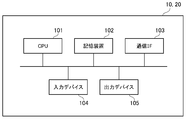
- FIG. 2 is a diagram illustrating an example of a hardware configuration of the terminal 10 and the server 20.
- the terminal 10 and the server 20 include a CPU (Central Processing Unit) 101 as an example of a processor, a storage device 102, a communication IF (Interface) 103, an input device 104, and an output device 105. These components are mutually connected so that data can be transmitted and received.
- CPU Central Processing Unit
- the CPU 101 is a control unit that performs control related to execution of a program stored in the storage device 102, and calculates and processes data.
- the CPU 101 receives data from the communication IF 103, outputs a calculation result of the data to the output device 105, and stores the calculation result in the storage device 102.
- the storage device 102 is a device that stores various information.
- the storage device 102 is a volatile storage medium in which data can be rewritten or a non-volatile storage medium in which data can only be read.
- the communication IF 103 is a device that connects the terminal 10 or the server 20 to the communication network N.
- the communication IF 103 may be provided outside the terminal 10 or the server 20. In that case, the communication IF 103 is connected to the terminal 10 or the server 20 via an interface such as a USB (Universal Serial Bus).
- USB Universal Serial Bus
- the input device 104 is a device for receiving input of information from a user.
- the input device 104 is, for example, a touch panel, a button, a keyboard, a mouse, a microphone, and the like.
- the output device 105 is a device for outputting information.
- the output device 105 is, for example, a liquid crystal display, an organic EL (Electronic Luminescent) display, a speaker, or the like.
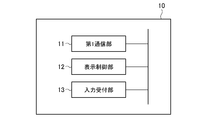
- FIG. 3 is a diagram illustrating an example of a functional block configuration of the terminal 10.
- the terminal 10 includes a first communication unit 11, a display control unit 12, and an input reception unit 13.
- the first communication unit 11, the display control unit 12, and the input reception unit 13 can be realized by the CPU 101 of the terminal 10 executing a program stored in the storage device 102.
- the program may be a program (application) downloaded from the server 20 and installable on the terminal 10. Further, the program can be stored in a storage medium.
- the storage medium storing the program may be a non-transitory computer-readable storage medium (Non-transitory computer readable medium).
- the non-transitory storage medium is not particularly limited, but may be a storage medium such as a USB memory or a CD-ROM (Compact Disc Read Only Memory).
- the first communication unit 11 has a function of transmitting / receiving various information including voting information to / from the server 20 via the communication IF 103.
- the voting information is information on voting performed by the user.
- the information includes a voting method such as a win, a win, and a horse, a horse to be voted, a voting amount, and the like.
- the first communication unit 11 receives screen information from the server 20 via the communication IF 103.
- Screen information is information for displaying a voting screen.
- the screen information is generated by the generation unit 22 included in the server 20.
- the display control unit 12 displays various screens including a voting screen on the output device 105 such as a liquid crystal display based on the information received from the server 20.
- the display control unit 12 causes the output device 105 to display a voting screen as shown in FIGS. 9A and 9C based on the screen information received from the server 20.
- the display control unit 12 and the input receiving unit 13 may be functional units realized by a Web browser included in the terminal 10.
- the input receiving unit 13 has a function of receiving various types of information including voting information from the user via the input device 104 such as a touch panel, a mouse, or a keyboard.
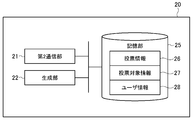
- FIG. 4 is a diagram showing an example of a functional block configuration of the server 20.
- the server 20 has a second communication unit 21, a generation unit 22, and a storage unit 25.
- the storage unit 25 can be realized using the storage device 102 or an external storage device with which the server 20 can communicate.
- the second communication unit 21 and the generation unit 22 can be realized by the CPU 101 of the server 20 executing a program stored in the storage device 102.
- the program can be stored in a storage medium.
- the storage medium storing the program may be a non-transitory computer-readable storage medium (Non-transitory computer readable medium).
- the non-transitory storage medium is not particularly limited, but may be a storage medium such as a USB memory or a CD-ROM.
- the second communication unit 21 has a function of transmitting and receiving various information including voting information to and from the terminal 10 via the communication IF 103. For example, when the user A copies the voting information of the user who has already voted and performs voting, the second communication unit 21 uses the information specifying the user to copy the voting information selected by the user A, or the selected information. At least a part of the voting information of the user may be received from the terminal 10a.
- the generation unit 22 generates screen information.
- the screen information is information for displaying a voting screen.
- the screen information includes information such as a voting method such as a win or a win and a choice of a horse number.
- the storage unit 25 stores various information for the user to vote. Specifically, the storage unit 25 stores voting information 26, voting target information 27, and user information 28. Each information will be described with reference to FIGS.
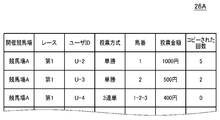
- FIG. 5 is a diagram showing an example of the voting information table 26A for managing the voting information 26.
- the voting information table 26A is not limited to the information described above, and may include arbitrary information.
- the column of “Hosted Racetrack” manages the name of the racetrack or information capable of identifying (specifying) the racetrack. By managing the names of the racetracks, it is possible to specify which of the racetracks the voting information included in each record is about. In this example, all pieces of voting information managed are information on the race held at “Horserace A”.
- the “race” column manages a race number or information capable of identifying (specifying) a race. Multiple races may be held per day at the same racetrack. By managing the race numbers, it is possible to specify which race the voting information included in each record is for. In this example, all of the managed voting information is information on the “first race”.
- the column of “user ID” manages the user IDs of the users who have voted.
- the user ID is an identifier associated with each user.
- the user can be specified by the user ID.
- identifiers “U-2”, “U-3”, and “U-4” are managed as user IDs.
- the column of “voting method” manages a voting method of voting performed by the user or information capable of identifying (identifying) the voting method.
- the voting method of the voting performed by the user having the user ID “U-2” and the user having the “U-3” is “win”, and the voting performed by the user having the user ID “U-4” is performed.
- the voting method is "single triple".
- the “horse number” column manages horse numbers identifying the horses to be voted on.
- the user with the user ID “U-2” votes for the horse with the number “1”
- the user with the user ID “U-3” votes for the horse with the number “2”
- the user ID “ The user of “U-4” has voted for the “No. 1”, “No. 2” and “No. 3” horses.
- the number of horses to vote differs depending on the voting method.
- the "voting amount” column manages the amount of votes cast by users.
- the voting amount of the user with the user ID “U-2” is "1000 yen”
- the voting amount of the user with the user ID “U-3” is “500 yen”
- the user ID is "500 yen”.
- the voting amount of the user of “U-4” is “400 yen”.
- the column of “number of times copied” manages the number of times voting information has been copied by other users.
- a user who intends to vote can copy at least a part of the voting information of the user who has already voted, and can vote based on the copied voting information.
- the voting information of the user with the user ID "U-2" is copied "5 times”
- the voting information of the user with the user ID "U-3” is copied "2 times”
- the user ID is The vote information of the user “U-4” has not been copied.
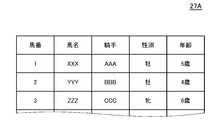
- FIG. 6 is a diagram showing an example of the voting object information table 27A for managing the voting object information 27. As shown in FIG. FIG. 6 includes columns of “horse number”, “horse name”, “jockey”, “sex” and “age”, and information corresponding to each column is managed.
- the voting target information table 27A is not limited to the above-described information, and may manage arbitrary information.
- the numbers assigned to each horse running in the race are managed.
- the horse numbers being managed are “No. 1”, “No. 2”, and “No. 3”.
- the “horse name” column manages the names of horses running in the race or information that can identify (identify) horses.
- the name of the horse whose horse number is 1 is “XXX”
- the name of the horse whose horse number is 2 is “YYY”
- the name of the horse whose horse number is 3 is “ZZZ”.
- the names of jockeys riding on horses are managed.
- the name of the jockey riding on horse number 1 is "AAA”
- the name of the jockey riding on horse number 2 is “BBB”
- the horse number is riding on horse number 3
- the name of the jockey performing is “CCC”.
- the gender of the horse is managed.
- the horses with the horse numbers 1 and 2 are “stallions”, and the horse with the horse number 3 is a “mare”.
- the age column manages the age of horses.
- the age of the horse with the first horse is “5 years old”
- the age of the second horse is “4 years old”
- the age of the third horse is “6 years old”. is there.
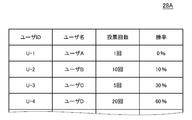
- FIG. 7 is a diagram showing an example of a user information table 28A for managing the user information 28.
- the user information 28 is information on a user who uses the voting system 1.
- FIG. 7 includes columns of “user ID”, “user name”, “number of votes”, and “winning rate”, and information corresponding to each column is managed.
- the user information table 28A is not limited to the information described above, and may include arbitrary information.
- the “user ID” column manages the identifiers of the users who use the voting system 1.
- the identifiers "U-1”, “U-2”, “U-3” and "U-4" are managed.
- the column of “user name” manages the names of users who use the voting system 1.
- the names of the users whose user IDs are “U-1", “U-2”, “U-3” and “U-4" are "User A”, “User B”, and “User C”, respectively.
- the column of "number of votes” manages the number of times the user has voted in the past.
- the user with the user ID “U-1” is "1 time”
- the user with the user ID “U-2” is “10 times”
- the user with the user ID “U-3” is “5 times”
- the user with the user ID “U-4” has voted “20 times”.
- the "winning rate” column manages the hit rate of the user's past voting.
- the hit rate of the user having the user ID “U-1” is “0%”
- the hit rate of the user having the user ID “U-2” is “10%”
- the user ID is “10%”. Is "30%” for the user with "U-3”
- the hit ratio for the user with the user ID "U-4" is "60%”.
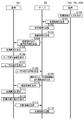
- FIG. 8 is a sequence diagram illustrating an example of a process performed by the voting system 1. The procedure of the process by the voting system 1 will be described with reference to FIG. In this example, a case will be described as an example where the user A votes via the terminal 10a.
- the terminal 10b, the terminal 10c, and the terminal 10d receive voting information input from the user B, the user C, and the user D (Step S100), and transmit the voting information to the server 20 (Step S101).
- the transmission of the voting information by the terminal 10b, the terminal 10c, and the terminal 10d may not be performed at the same time, and may be transmitted from the respective terminals at different times.
- the voting information may not be transmitted from all of the terminals 10b, 10c, and 10d.
- the server 20 receives the voting information, and stores the received voting information in the storage unit 25 (Step S102). Specifically, the corresponding record of the voting information table 26A shown in FIG. 5 may be updated.
- the server 20 when receiving a request for displaying a voting screen from the terminal 10a, the server 20 generates screen information for displaying the voting screen (step S103).
- the screen information may include a voting method and a voting target option.
- the server 20 transmits the screen information and the option information to the terminal 10a (Step S104).
- the user A who performs voting can perform voting without inputting voting information by himself / herself by copying at least a part of voting information regarding voting performed by another user. it can.
- User A intends to vote after User B has already voted
- User A himself / herself inputs voting information by copying User B's voting method and voting object.
- Voting can be performed for the same voting method and voting target as the user B.
- a case will be described in which only the voting method and the voting target of the voting information are copied, but the voting information to be copied is not limited.
- a copy may be made including the voting amount, or only a voting object may be copied in a competition in which the voting method is fixed.
- the option information transmitted from the server 20 to the terminal 10a is information on options for causing a voting user to vote to select a user who copies voting information from one or a plurality of voted users.
- the terminal 10a displays a voting screen based on the received screen information (Step S105). For example, a voting screen as shown in FIG. 9A may be displayed. Here, the voting screen will be described with reference to FIG. 9A.
- FIG. 9A is a diagram showing an example of the voting screen.
- the voting screen shown in FIG. 9A displays options for a voting method, an input field for a voting object (a horse to be voted on), and an input field for a voting amount.
- the voting method is not selected, the voting target input field is displayed, but the voting target input field is displayed after the voting method is selected. Is also good.
- the number of voting target input fields may be different depending on the selected voting method. For example, when the user selects the win, the horse to be selected is only the first horse, so the columns for selecting the second and third horses may not be displayed.
- the terminal 10a may receive the voting target information 27 from the server 20 and display it on the voting screen. For example, based on the voting object information 27, the horse name of the horse, the riding jockey, the sex of the horse, the age of the horse, and the like may be displayed.
- the terminal 10a may receive the voting object information 27 from the server 20 and display it on the voting screen. For example, based on the voting information 26, information specifying the number of votes for each horse and the horses voted by other users may be displayed.
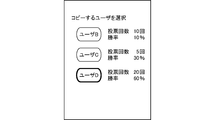
- the terminal 10a displays a user selection screen as shown in FIG. 9B based on the received option information (Ste S106).
- the user selection screen illustrated in FIG. 9B includes options “user B”, “user C”, and “user D”.
- user information of each user is displayed along with the user's options.
- the “voting frequency” and the “win percentage” of each user are displayed.
- the user selection screen is not limited to the user information, and may display voting information (voting method, voting target, voting amount, and the like) of the user displayed as an option.
- the user displayed as an option on the user selection screen may be determined based on a predetermined rule.
- a predetermined rule a specific example of the predetermined rule will be described.
- the user displayed as an option may be a user located within a predetermined distance from the position where the user A is present, or a predetermined number of users in the order of proximity to the position of the user A among a plurality of users. There may be. Further, the order of the users displayed on the user selection screen may be the order close to the position of the user A. At this time, the distance between the users may be determined based on the position information of the terminal used by the users. For example, the second communication unit 21 of the server 20 may receive the terminal location information from the terminal 10a and a plurality of terminals other than the terminal 10a.
- the server 20 includes a determination unit that determines whether a terminal other than the terminal 10a is located within a predetermined distance from the terminal 10a based on the received position information, and the terminal 10a performs the determination by the determination unit.
- the result may be received, and the user of the terminal located within a predetermined distance from the terminal 10a may be displayed as an option.
- the user displayed as an option on the user selection screen may be a user whose past winning percentage of voting is equal to or greater than a predetermined value.
- the server 20 further includes a determining unit that determines whether or not the winning rate of each user is equal to or more than a predetermined value based on the user information 28.
- the terminal 10a receives the determination result by the determining unit, A user having a predetermined value or more may be displayed as an option.
- the user displayed as an option on the user selection screen may be a user having the same attribute as the attribute indicating the past voting tendency of the user A.
- the user A may be a user whose voting information is similar to the user A, for example, a user who matches a horse voting in a past vote at a predetermined ratio or more.
- the server 20 further includes a determination unit that determines whether or not the attribute indicating the voting tendency of each user is the same as the attribute indicating the voting tendency of the user A based on the voting information 26. The determination result by the determination unit may be received, and a user having the same attribute may be displayed as an option.
- the user displayed as an option on the user selection screen may be a user with a predetermined flag.
- a flag may be attached to a user who is an entertainer or a celebrity, and the flagged user may be displayed as an option.
- the server 20 further includes a determination unit that determines whether or not each user is flagged based on the user information 28.
- the terminal 10a receives the determination result by the determination unit, The attached user may be displayed as an option.
- the above-described predetermined rules for determining a user to be displayed as an option on the user selection screen may be plurally combined. For example, even if a user displayed as an option on the user selection screen has a win rate of past voting equal to or more than a predetermined value and has the same attribute as the attribute indicating the past voting tendency of user A, Good. Further, for example, a user who has a winning rate of a past vote that is equal to or more than a predetermined value and a predetermined flag is given may be used. Further, the user A may have the same attribute as the attribute indicating the past voting tendency of the user A, and may be a user to which a predetermined flag is assigned.
- a user displayed as an option on the user selection screen indicates a past voting tendency of the user A among the plurality of users, when there are a plurality of users having a winning rate of the past voting equal to or more than a predetermined value.
- the user may have the same attribute as the attribute.
- a user to which a predetermined flag is assigned may be used among the plurality of users.
- a user to which a predetermined flag is assigned may be used among the plurality of users.
- terminal 10a When receiving the selection of the user who copies the voting information from user A (step S107), terminal 10a transmits information specifying the selected user to server 20 (step S108).
- the server 20 generates screen information including voting information of the selected user (Step S109), and transmits the screen information to the terminal 10a (Step S110).
- the terminal 10a updates the voting screen based on the received voting information (Step S111). Specifically, as shown in FIG. 9C, a voting screen in which voting information of the selected user is input is displayed. In this example, user A has selected “user D” on the user selection screen shown in FIG. 9B. Therefore, the voting screen displayed after the user is selected is displayed in a state where the same voting information as the voting information of the user D is input.
- the voting method is “single-triple”, the horse number of the first horse is “1”, the horse number of the second horse is “2”, the horse number of the third horse is “3”, A voting screen is displayed with the voting amount entered as "400 yen”.
- the terminal 10a accepts a voting execution instruction from the user A (step S112). After confirming the input voting content, the user A can input a voting execution instruction by selecting an option of “determination” displayed on the voting screen.
- the terminal 10a transmits voting information of the voting by the user A to the server 20 (Step S113).
- the server 20 stores the received voting information in the storage unit 25 (Step S114). Specifically, the corresponding record in the voting information table 26A is updated.
- the voting information of another user is automatically input to the voting screen of the voting user. Therefore, even a user with little voting experience can easily vote.
- information such as the past number of votes and the winning percentage of the user displayed as options is displayed. Therefore, it is possible to select a user having a high winning rate or a user who has a large number of votes and has a lot of experience, and even if the voting user is a beginner, it is possible to realize a winning rate similar to that of a veteran user.
- the voting screen displays information about the voting target, such as the name of the horse, the riding jockey, the sex of the horse, and the age of the horse. Can be determined.
- the user since the user can copy the voting information of other users, it is assumed that the user normally checks the information when deciding the voting object by himself (e.g., the state of the horse and the voting information for each voting object). Odds, etc.). Thereby, the communication amount between the terminal 10 and the server 20 can be reduced.
- the voting information of the user specified by the server 20 is extracted from the storage unit 25.
- the terminal 10a may have it. At this time, the terminal 10a may transmit at least a part of the voting information of the user who copies the voting information from the terminal 10a to the server.
- the voting screen in which the same voting information as the voting information of the user D selected by the user A is automatically generated.
- the voting screen of the user D is displayed on the terminal 10a of the user A.
- the user A may input the voting information by itself while referring to the displayed voting information of the user D.
- a button for copying another user's vote is prepared on the voting screen, and the user selection screen is displayed when the button is pressed, but the present invention is not limited to this.
- the home screen or the SNS (Social Network Service) screen may display voting information of another voted user or a button for selecting a user to copy voting information.
- the server 20 may generate screen information including information for displaying a predetermined screen (voting screen, home screen, SNS screen, or the like) and transmit the screen information to the terminal 10a.
Landscapes
- General Physics & Mathematics (AREA)
- Physics & Mathematics (AREA)
- Business, Economics & Management (AREA)
- General Business, Economics & Management (AREA)
- Theoretical Computer Science (AREA)
- Engineering & Computer Science (AREA)
- Economics (AREA)
- Marketing (AREA)
- Strategic Management (AREA)
- Health & Medical Sciences (AREA)
- General Health & Medical Sciences (AREA)
- Human Resources & Organizations (AREA)
- Primary Health Care (AREA)
- Tourism & Hospitality (AREA)
- Finance (AREA)
- Accounting & Taxation (AREA)
- Development Economics (AREA)
- Management, Administration, Business Operations System, And Electronic Commerce (AREA)
Priority Applications (4)
| Application Number | Priority Date | Filing Date | Title |
|---|---|---|---|
| US17/269,232 US20210327221A1 (en) | 2018-08-17 | 2019-08-15 | Information processing apparatus, bet acceptance method, and program |
| EP19850505.9A EP3839872A4 (en) | 2018-08-17 | 2019-08-15 | INFORMATION PROCESSING DEVICE, BET ACCEPTANCE METHOD AND PROGRAM |
| AU2019321479A AU2019321479A1 (en) | 2018-08-17 | 2019-08-15 | Information processing device, bet acceptance method, and program |
| JP2020537101A JP6949310B2 (ja) | 2018-08-17 | 2019-08-15 | 情報処理装置、投票受付方法及びプログラム |
Applications Claiming Priority (2)
| Application Number | Priority Date | Filing Date | Title |
|---|---|---|---|
| JP2018-153653 | 2018-08-17 | ||
| JP2018153653 | 2018-08-17 |
Publications (1)
| Publication Number | Publication Date |
|---|---|
| WO2020036210A1 true WO2020036210A1 (ja) | 2020-02-20 |
Family
ID=69525488
Family Applications (1)
| Application Number | Title | Priority Date | Filing Date |
|---|---|---|---|
| PCT/JP2019/032031 Ceased WO2020036210A1 (ja) | 2018-08-17 | 2019-08-15 | 情報処理装置、投票受付方法及びプログラム |
Country Status (5)
| Country | Link |
|---|---|
| US (1) | US20210327221A1 (https=) |
| EP (1) | EP3839872A4 (https=) |
| JP (5) | JP6949310B2 (https=) |
| AU (1) | AU2019321479A1 (https=) |
| WO (1) | WO2020036210A1 (https=) |
Cited By (6)
| Publication number | Priority date | Publication date | Assignee | Title |
|---|---|---|---|---|
| WO2021182203A1 (ja) * | 2020-03-12 | 2021-09-16 | 株式会社ミクシィ | 情報処理装置、情報処理方法及びプログラム |
| JPWO2021182120A1 (https=) * | 2020-03-11 | 2021-09-16 | ||
| JP2021144537A (ja) * | 2020-03-12 | 2021-09-24 | 株式会社ミクシィ | 情報処理装置、情報処理方法及びプログラム |
| JP2021189583A (ja) * | 2020-05-27 | 2021-12-13 | 株式会社ミクシィ | 情報処理装置、情報処理方法及びプログラム |
| JP2022190287A (ja) * | 2021-06-14 | 2022-12-26 | 株式会社Mixi | 情報処理装置、情報処理方法及びプログラム |
| JP2025123539A (ja) * | 2020-05-29 | 2025-08-22 | 株式会社Mixi | 情報処理システム、情報処理方法及びプログラム |
Families Citing this family (2)
| Publication number | Priority date | Publication date | Assignee | Title |
|---|---|---|---|---|
| US12008864B2 (en) * | 2021-02-24 | 2024-06-11 | Igt | Shareable sporting event wagers |
| US20250201082A1 (en) * | 2022-03-24 | 2025-06-19 | Oleg Avtsen | Dual Option Rapid Betting Platforms and Methods |
Citations (4)
| Publication number | Priority date | Publication date | Assignee | Title |
|---|---|---|---|---|
| JP2001188847A (ja) * | 2000-01-04 | 2001-07-10 | Kenji Kiyota | 情報提供システム、投票券購入システム、情報提供方法、投票券購入方法及び情報記録媒体 |
| JP2010160612A (ja) * | 2009-01-07 | 2010-07-22 | Ntt Data Corp | 投票予想公開システム及び方法ならびにコンピュータプログラム |
| JP2013114487A (ja) | 2011-11-29 | 2013-06-10 | Fujitsu Frontech Ltd | 投票処理のための表示システム、映像配信装置、および表示方法 |
| JP2018153653A (ja) | 2013-02-14 | 2018-10-04 | 株式会社ユピテル | システム |
Family Cites Families (8)
| Publication number | Priority date | Publication date | Assignee | Title |
|---|---|---|---|---|
| JP2004246428A (ja) * | 2003-02-10 | 2004-09-02 | Fujitsu Ltd | 端末装置、及びプログラム |
| EP2469489A1 (en) * | 2010-12-22 | 2012-06-27 | Tangiamo AB | Remote gaming system |
| JP5792703B2 (ja) * | 2012-10-16 | 2015-10-14 | 富士通フロンテック株式会社 | 情報共有システム、情報共有装置、及び、情報共有方法 |
| US20150050988A1 (en) * | 2013-08-16 | 2015-02-19 | Jason Todd Nichols | Wagering Technique Based on Projected Performance Benchmarks and Geographically Restricting.... |
| US20150194013A1 (en) * | 2013-12-26 | 2015-07-09 | Loot City LLC | Gaming method and system to selectively allow wagering and non-wagering play based on geographical location |
| EP3311358A4 (en) * | 2015-06-16 | 2018-12-05 | Exciting Holdings Pty Limited | Collaborative betting platform |
| AU2015101673A4 (en) * | 2015-11-16 | 2015-12-24 | Kathryn Wendy Adams | Wagering System |
| JP6619719B2 (ja) * | 2016-10-20 | 2019-12-11 | 富士通フロンテック株式会社 | 投票システム、情報処理装置および投票画面表示方法 |
-
2019
- 2019-08-15 EP EP19850505.9A patent/EP3839872A4/en not_active Withdrawn
- 2019-08-15 WO PCT/JP2019/032031 patent/WO2020036210A1/ja not_active Ceased
- 2019-08-15 JP JP2020537101A patent/JP6949310B2/ja active Active
- 2019-08-15 US US17/269,232 patent/US20210327221A1/en not_active Abandoned
- 2019-08-15 AU AU2019321479A patent/AU2019321479A1/en not_active Abandoned
-
2021
- 2021-09-14 JP JP2021149308A patent/JP7339557B2/ja active Active
-
2023
- 2023-08-08 JP JP2023129427A patent/JP7486007B2/ja active Active
-
2024
- 2024-04-16 JP JP2024066268A patent/JP7648965B2/ja active Active
-
2025
- 2025-02-26 JP JP2025029286A patent/JP7853621B2/ja active Active
Patent Citations (4)
| Publication number | Priority date | Publication date | Assignee | Title |
|---|---|---|---|---|
| JP2001188847A (ja) * | 2000-01-04 | 2001-07-10 | Kenji Kiyota | 情報提供システム、投票券購入システム、情報提供方法、投票券購入方法及び情報記録媒体 |
| JP2010160612A (ja) * | 2009-01-07 | 2010-07-22 | Ntt Data Corp | 投票予想公開システム及び方法ならびにコンピュータプログラム |
| JP2013114487A (ja) | 2011-11-29 | 2013-06-10 | Fujitsu Frontech Ltd | 投票処理のための表示システム、映像配信装置、および表示方法 |
| JP2018153653A (ja) | 2013-02-14 | 2018-10-04 | 株式会社ユピテル | システム |
Cited By (27)
| Publication number | Priority date | Publication date | Assignee | Title |
|---|---|---|---|---|
| EP4016440A4 (en) * | 2020-03-11 | 2022-11-02 | Mixi, Inc. | INFORMATION PROCESSING DEVICE, INFORMATION PROCESSING METHOD AND PROGRAM |
| JPWO2021182120A1 (https=) * | 2020-03-11 | 2021-09-16 | ||
| WO2021182120A1 (ja) * | 2020-03-11 | 2021-09-16 | 株式会社ミクシィ | 情報処理装置、情報処理方法及びプログラム |
| JP7769260B2 (ja) | 2020-03-11 | 2025-11-13 | 株式会社Mixi | 情報処理装置、情報処理方法及びプログラム |
| US12223806B2 (en) | 2020-03-11 | 2025-02-11 | Mixi, Inc. | Information processing apparatus, information processing method, and information processing system |
| JP2025015773A (ja) * | 2020-03-11 | 2025-01-30 | 株式会社Mixi | 情報処理装置、情報処理方法及びプログラム |
| JP7598037B2 (ja) | 2020-03-11 | 2024-12-11 | 株式会社Mixi | 情報処理装置、情報処理方法、情報処理システム及びプログラム |
| US12080131B2 (en) | 2020-03-12 | 2024-09-03 | Mixi, Inc. | Information processing apparatus, information processing method, and information processing system |
| JP6985640B1 (ja) * | 2020-03-12 | 2021-12-22 | 株式会社ミクシィ | 情報処理装置、情報処理方法及びプログラム |
| JP7415164B2 (ja) | 2020-03-12 | 2024-01-17 | 株式会社Mixi | 情報処理装置、情報処理方法及びプログラム |
| JP2021144537A (ja) * | 2020-03-12 | 2021-09-24 | 株式会社ミクシィ | 情報処理装置、情報処理方法及びプログラム |
| JP7751232B2 (ja) | 2020-03-12 | 2025-10-08 | 株式会社Mixi | 情報処理装置、情報処理方法及びプログラム |
| WO2021182203A1 (ja) * | 2020-03-12 | 2021-09-16 | 株式会社ミクシィ | 情報処理装置、情報処理方法及びプログラム |
| JP2024169636A (ja) * | 2020-03-12 | 2024-12-05 | 株式会社Mixi | 情報処理装置、情報処理方法及びプログラム |
| JP2022019779A (ja) * | 2020-03-12 | 2022-01-27 | 株式会社ミクシィ | 情報処理装置、情報処理方法及びプログラム |
| JP7614510B2 (ja) | 2020-03-12 | 2025-01-16 | 株式会社Mixi | 情報処理装置、情報処理方法及びプログラム |
| JP2025129420A (ja) * | 2020-03-12 | 2025-09-04 | 株式会社Mixi | 情報処理装置、情報処理方法及びプログラム |
| JP7716029B2 (ja) | 2020-03-12 | 2025-07-31 | 株式会社Mixi | 情報処理装置、情報処理方法及びプログラム |
| JP2025023358A (ja) * | 2020-03-12 | 2025-02-14 | 株式会社Mixi | 情報処理装置、情報処理方法及びプログラム |
| JP7678379B2 (ja) | 2020-05-27 | 2025-05-16 | 株式会社Mixi | 情報処理装置、情報処理方法及びプログラム |
| JP2021189583A (ja) * | 2020-05-27 | 2021-12-13 | 株式会社ミクシィ | 情報処理装置、情報処理方法及びプログラム |
| JP2024052992A (ja) * | 2020-05-27 | 2024-04-12 | 株式会社Mixi | 情報処理装置、情報処理方法及びプログラム |
| JP7460900B2 (ja) | 2020-05-27 | 2024-04-03 | 株式会社Mixi | 情報処理装置、情報処理方法、プログラム及び情報処理システム |
| JP2025123539A (ja) * | 2020-05-29 | 2025-08-22 | 株式会社Mixi | 情報処理システム、情報処理方法及びプログラム |
| JP7659181B2 (ja) | 2021-06-14 | 2025-04-09 | 株式会社Mixi | 情報処理装置、情報処理方法及びプログラム |
| JP2025083576A (ja) * | 2021-06-14 | 2025-05-30 | 株式会社Mixi | 情報処理装置、情報処理方法及びプログラム |
| JP2022190287A (ja) * | 2021-06-14 | 2022-12-26 | 株式会社Mixi | 情報処理装置、情報処理方法及びプログラム |
Also Published As
| Publication number | Publication date |
|---|---|
| JP7486007B2 (ja) | 2024-05-17 |
| US20210327221A1 (en) | 2021-10-21 |
| JP2025071329A (ja) | 2025-05-02 |
| EP3839872A1 (en) | 2021-06-23 |
| JP7853621B2 (ja) | 2026-04-30 |
| JPWO2020036210A1 (ja) | 2021-02-15 |
| JP2023138692A (ja) | 2023-10-02 |
| JP2021193597A (ja) | 2021-12-23 |
| JP7648965B2 (ja) | 2025-03-19 |
| JP2024086910A (ja) | 2024-06-28 |
| JP6949310B2 (ja) | 2021-10-13 |
| EP3839872A4 (en) | 2022-03-30 |
| JP7339557B2 (ja) | 2023-09-06 |
| AU2019321479A1 (en) | 2021-04-08 |
Similar Documents
| Publication | Publication Date | Title |
|---|---|---|
| JP7486007B2 (ja) | 情報処理装置、投票受付方法及びプログラム | |
| JP7560777B2 (ja) | 情報処理装置、投票受付方法及び投票受付プログラム | |
| JP5685678B2 (ja) | ゲーム制御装置、プログラム、記録媒体、ゲームシステム | |
| JP5161344B2 (ja) | コミュニケーション機能を備えたアミューズメントシステム | |
| US10839584B2 (en) | System, method, and program for managing evaluation of avatar images | |
| JP2023041928A (ja) | ゲームシステム、それに用いるコンピュータプログラム及びサーバ装置 | |
| AU2020361196B2 (en) | Information processing apparatus, information processing method, and program | |
| JP2023100691A (ja) | 情報処理システム、サーバ、およびプログラム | |
| JP2021190111A (ja) | 情報処理システム、情報処理方法及びプログラム | |
| US9704345B1 (en) | Single action betting system and method | |
| JPWO2019026327A1 (ja) | ゲームシステム、それに用いるコンピュータプログラム及びサーバ装置 | |
| JP7801056B2 (ja) | 抽選を提供するためのシステム、方法、及びプログラム | |
| KR101313239B1 (ko) | 온라인 게임에서의 보상 아이템 서비스 제공 방법 및 서버 | |
| US20150081409A1 (en) | Server and method for providing user with reward | |
| WO2025079260A1 (ja) | 情報処理方法、情報処理装置、非一時的なコンピュータ可読の記録媒体及び情報処理システム | |
| TWI423042B (zh) | Racing track record information system and program products | |
| JP2023008117A (ja) | 情報処理装置、情報処理方法及びプログラム | |
| WO2013133305A1 (ja) | ゲーム制御装置、ゲーム制御方法、プログラム、記録媒体、ゲームシステム |
Legal Events
| Date | Code | Title | Description |
|---|---|---|---|
| 121 | Ep: the epo has been informed by wipo that ep was designated in this application |
Ref document number: 19850505 Country of ref document: EP Kind code of ref document: A1 |
|
| ENP | Entry into the national phase |
Ref document number: 2020537101 Country of ref document: JP Kind code of ref document: A |
|
| NENP | Non-entry into the national phase |
Ref country code: DE |
|
| ENP | Entry into the national phase |
Ref document number: 2019850505 Country of ref document: EP Effective date: 20210317 |
|
| ENP | Entry into the national phase |
Ref document number: 2019321479 Country of ref document: AU Date of ref document: 20190815 Kind code of ref document: A |