WO2020022232A1 - 虚血性心疾患の診断支援システム - Google Patents
虚血性心疾患の診断支援システム Download PDFInfo
- Publication number
- WO2020022232A1 WO2020022232A1 PCT/JP2019/028565 JP2019028565W WO2020022232A1 WO 2020022232 A1 WO2020022232 A1 WO 2020022232A1 JP 2019028565 W JP2019028565 W JP 2019028565W WO 2020022232 A1 WO2020022232 A1 WO 2020022232A1
- Authority
- WO
- WIPO (PCT)
- Prior art keywords
- pressure
- data
- time
- stenosis
- blood flow
- Prior art date
- Legal status (The legal status is an assumption and is not a legal conclusion. Google has not performed a legal analysis and makes no representation as to the accuracy of the status listed.)
- Ceased
Links
Images



Classifications
-
- A—HUMAN NECESSITIES
- A61—MEDICAL OR VETERINARY SCIENCE; HYGIENE
- A61B—DIAGNOSIS; SURGERY; IDENTIFICATION
- A61B5/00—Measuring for diagnostic purposes; Identification of persons
- A61B5/02—Detecting, measuring or recording for evaluating the cardiovascular system, e.g. pulse, heart rate, blood pressure or blood flow
- A61B5/021—Measuring pressure in heart or blood vessels
- A61B5/0215—Measuring pressure in heart or blood vessels by means inserted into the body
- A61B5/02158—Measuring pressure in heart or blood vessels by means inserted into the body provided with two or more sensor elements
-
- A—HUMAN NECESSITIES
- A61—MEDICAL OR VETERINARY SCIENCE; HYGIENE
- A61B—DIAGNOSIS; SURGERY; IDENTIFICATION
- A61B5/00—Measuring for diagnostic purposes; Identification of persons
- A61B5/02—Detecting, measuring or recording for evaluating the cardiovascular system, e.g. pulse, heart rate, blood pressure or blood flow
- A61B5/021—Measuring pressure in heart or blood vessels
- A61B5/0215—Measuring pressure in heart or blood vessels by means inserted into the body
-
- A—HUMAN NECESSITIES
- A61—MEDICAL OR VETERINARY SCIENCE; HYGIENE
- A61B—DIAGNOSIS; SURGERY; IDENTIFICATION
- A61B5/00—Measuring for diagnostic purposes; Identification of persons
- A61B5/02—Detecting, measuring or recording for evaluating the cardiovascular system, e.g. pulse, heart rate, blood pressure or blood flow
- A61B5/026—Measuring blood flow
-
- A—HUMAN NECESSITIES
- A61—MEDICAL OR VETERINARY SCIENCE; HYGIENE
- A61B—DIAGNOSIS; SURGERY; IDENTIFICATION
- A61B5/00—Measuring for diagnostic purposes; Identification of persons
- A61B5/24—Detecting, measuring or recording bioelectric or biomagnetic signals of the body or parts thereof
- A61B5/25—Bioelectric electrodes therefor
- A61B5/279—Bioelectric electrodes therefor specially adapted for particular uses
- A61B5/28—Bioelectric electrodes therefor specially adapted for particular uses for electrocardiography [ECG]
- A61B5/283—Invasive
-
- A—HUMAN NECESSITIES
- A61—MEDICAL OR VETERINARY SCIENCE; HYGIENE
- A61B—DIAGNOSIS; SURGERY; IDENTIFICATION
- A61B5/00—Measuring for diagnostic purposes; Identification of persons
- A61B5/24—Detecting, measuring or recording bioelectric or biomagnetic signals of the body or parts thereof
- A61B5/316—Modalities, i.e. specific diagnostic methods
- A61B5/318—Heart-related electrical modalities, e.g. electrocardiography [ECG]
- A61B5/33—Heart-related electrical modalities, e.g. electrocardiography [ECG] specially adapted for cooperation with other devices
-
- A—HUMAN NECESSITIES
- A61—MEDICAL OR VETERINARY SCIENCE; HYGIENE
- A61B—DIAGNOSIS; SURGERY; IDENTIFICATION
- A61B5/00—Measuring for diagnostic purposes; Identification of persons
- A61B5/24—Detecting, measuring or recording bioelectric or biomagnetic signals of the body or parts thereof
- A61B5/316—Modalities, i.e. specific diagnostic methods
- A61B5/318—Heart-related electrical modalities, e.g. electrocardiography [ECG]
- A61B5/346—Analysis of electrocardiograms
- A61B5/349—Detecting specific parameters of the electrocardiograph cycle
-
- A—HUMAN NECESSITIES
- A61—MEDICAL OR VETERINARY SCIENCE; HYGIENE
- A61B—DIAGNOSIS; SURGERY; IDENTIFICATION
- A61B5/00—Measuring for diagnostic purposes; Identification of persons
- A61B5/72—Signal processing specially adapted for physiological signals or for diagnostic purposes
-
- A—HUMAN NECESSITIES
- A61—MEDICAL OR VETERINARY SCIENCE; HYGIENE
- A61B—DIAGNOSIS; SURGERY; IDENTIFICATION
- A61B5/00—Measuring for diagnostic purposes; Identification of persons
- A61B5/72—Signal processing specially adapted for physiological signals or for diagnostic purposes
- A61B5/7271—Specific aspects of physiological measurement analysis
- A61B5/7285—Specific aspects of physiological measurement analysis for synchronizing or triggering a physiological measurement or image acquisition with a physiological event or waveform, e.g. an ECG signal
-
- G—PHYSICS
- G16—INFORMATION AND COMMUNICATION TECHNOLOGY [ICT] SPECIALLY ADAPTED FOR SPECIFIC APPLICATION FIELDS
- G16H—HEALTHCARE INFORMATICS, i.e. INFORMATION AND COMMUNICATION TECHNOLOGY [ICT] SPECIALLY ADAPTED FOR THE HANDLING OR PROCESSING OF MEDICAL OR HEALTHCARE DATA
- G16H50/00—ICT specially adapted for medical diagnosis, medical simulation or medical data mining; ICT specially adapted for detecting, monitoring or modelling epidemics or pandemics
- G16H50/20—ICT specially adapted for medical diagnosis, medical simulation or medical data mining; ICT specially adapted for detecting, monitoring or modelling epidemics or pandemics for computer-aided diagnosis, e.g. based on medical expert systems
-
- A—HUMAN NECESSITIES
- A61—MEDICAL OR VETERINARY SCIENCE; HYGIENE
- A61B—DIAGNOSIS; SURGERY; IDENTIFICATION
- A61B5/00—Measuring for diagnostic purposes; Identification of persons
- A61B5/02—Detecting, measuring or recording for evaluating the cardiovascular system, e.g. pulse, heart rate, blood pressure or blood flow
- A61B5/02007—Evaluating blood vessel condition, e.g. elasticity, compliance
Definitions
- the present invention measures the pressure in the coronary artery of the patient at the proximal stenosis and the distal part of the stenosis in the patient's coronary artery as a diagnostic index of ischemic heart disease, and determines the pressure ratio between the proximal stenosis and the distal stenosis. More specifically, the present invention relates to a diagnosis support system that is useful for diagnosing ischemic heart disease by determining the pressure ratio at a timing where the influence of the resistance value in a blood vessel is small.
- Treatment such as placing a stent in a diseased vessel without myocardial ischemia, has no merit, and may worsen the prognosis due to stent restenosis or increased bleeding events due to antiplatelet agents. .
- a coronary artery insertion guide wire with a pressure sensor called a pressure wire is used, and a myocardial blood flow reserve ratio (FFR) or an instantaneous blood flow reserve ratio is used.
- FFR myocardial blood flow reserve ratio
- iFR instantaneous @ wave-free @ ratio
- the FFR is an index obtained in a state in which microvascular resistance is reduced by administration of a drug to a patient, and the pressure (proximal pressure) Pa of a stenosis proximal portion on the upstream side of a stenotic lesion in a coronary artery is referred to as ,
- the iFR is the total pressure ratio Pd in the middle to end of diastole (WFP: Wave ⁇ ⁇ ⁇ free period) of the heart, where the resistance value in the blood vessel is generally low at rest without administration of the drug to the patient. / Pa, for example, when the iFR is below 0.89, it is determined that there is myocardial ischemia.
- a drug such as adenosine or papaverine hydrochloride is administered to a subject in order to reduce microvascular resistance.
- the pressure ratio Pd / Pa is determined in a state of maximum blood congestion in which the pressure ratio is substantially uniform.
- adenosine may induce asthma, so it is difficult to use it in patients with a history of asthma.Also, some patients, including those after ingesting caffeine, may have diminished efficacy and may have a maximal hyperemia. It is necessary to confirm whether or not it has been obtained.
- papaverine hydrochloride has a risk of causing fatal arrhythmias and is not used in Europe and the United States. From the above, in recent years, in addition to the diagnosis based on the angiographic image, there is a need for deriving a pressure ratio Pd / Pa for appropriately performing treatment determination such as stent placement without administering the above-described drug.
- the diagnostic method using the iFR as an index unlike the above-described FFR, there is no need to administer a drug to a patient in advance, and thus the above-described problem caused by the drug administration does not occur.
- the intravascular resistance value may not be sufficiently reduced even with the WFP depending on the patient, and the possibility that an appropriate diagnosis of ischemic heart disease may not be obtained may be obtained. I found that there was.
- the resistance value of the coronary artery running on the surface of the myocardium also affects the motion of the myocardium.
- the slow inflow period is a time during which blood flows into the ventricle relatively slowly after a rapid inflow period in which blood flows into the ventricle immediately after the tricuspid valve and the mitral valve open.
- the diastole of the heart including each of these inflow phases is shortened.
- the slow inflow phase is faster than the rapid inflow phase. , The individual difference occurs in the time of the slow inflow period when the resistance value of the coronary artery becomes low.
- the diagnostic method using iFR uses only the pressure waveform of the proximal part, which is the entrance of the coronary artery, and the R wave of the electrocardiogram information of the body surface monitor, and uses a uniform algorithm in the coronary artery regardless of the individual patient.
- the resistance value is estimated, and depending on the patient, the resistance value in the coronary artery may not be sufficiently reduced even with WFP. For this reason, the resistance value in the coronary artery may not be constant even in the WFP time zone, and in this case, the fluctuation difference of each pressure ratio Pd / Pa corresponding to the resistance value becomes relatively large. Therefore, in the diagnostic method using iFR, the pressure ratios Pd / Pa cannot be obtained in a state where the resistance value of the coronary artery is uniformly low, and it may not be possible to properly diagnose ischemic heart disease.
- the present invention has been devised based on such findings of the present inventors, and its purpose is to estimate the timing at which the resistance value of the coronary artery is uniformly low in each patient, and at that timing.
- Another object of the present invention is to provide a diagnosis support system for ischemic heart disease, which can determine a pressure ratio between a stenosis proximal portion and a stenosis distal portion in a coronary artery.
- the present invention mainly provides a coronary artery of a stenosis proximal portion which is upstream of a stenotic lesion in a patient's coronary artery and a stenosis distal portion which is downstream of a stenotic lesion in a patient's coronary artery.
- a diagnostic system includes a proximal pressure that is a pressure of the proximal stenosis and a distal pressure that is a pressure of the distal stenosis.
- Pressure data acquisition means for acquiring pressure data consisting of distal pressure
- intracoronary electrocardiogram data acquisition means for acquiring intracoronary electrocardiogram data consisting of the local intracoronary electrocardiogram near the distal portion of the stenosis, and these pressure data
- an arithmetic processing means for obtaining the pressure ratio at a timing suitable for diagnosing ischemic heart disease based on each data obtained by the obtaining means and the intracoronary electrocardiogram data obtaining means.
- the pressure data is time-corresponding to the intracoronary electrocardiogram data, and from the waveform of the intracoronary electrocardiogram data, an analysis target time in which the vascular resistance is stable in a low state is estimated, and the pressure data at the analysis target time is extracted.
- a pressure ratio determining unit for obtaining the pressure ratio from the pressure data extracted by the pressure data extracting unit.
- the pressure at the timing stenosis proximal part and the stenosis distal part at which the exercise state becomes the lowest is obtained.
- the ratio can be determined. That is, assuming that the time period during which the low potential continues in the intracoronary electrocardiogram data is the timing at which the influence of the vascular resistance value in the coronary artery is minimized, the vascular resistance is determined based on the state of the waveform of the intracoronary electrocardiogram data of each patient.
- the pressure ratio can be calculated in a time when the pressure is low and stable.
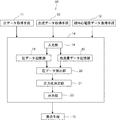
- FIG. 2 is a block diagram schematically illustrating a configuration of the diagnosis support system.
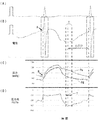
- A is a body surface electrocardiogram showing a change state of the cardiac potential with respect to the time measured on the body surface
- (B) is a change state of a local potential in the coronary artery with respect to the time measured in the coronary artery A.
- (C) is the graph which each showed the pressure waveform which shows the change state of the proximal part pressure Pa and the distal part pressure Pd with respect to time
- D is the pressure ratio Pd with respect to time.
- FIG. 5 is a graph showing a waveform representing a change state of / Pa.
- FIG. 11 is a block diagram schematically illustrating a configuration of a diagnosis support system according to another embodiment. It is a graph which superimposes the intracoronary electrocardiogram, the proximal pressure Pa and the distal pressure Pd, the blood flow volume of the coronary artery, and the intravascular resistance value used for processing in another embodiment, and shows a change with respect to time. .
- FIG. 1 is a conceptual diagram for explaining a pressure measurement site in the diagnosis support system for ischemic heart disease according to the present embodiment
- FIG. 2 schematically illustrates the configuration of the diagnosis support system. Is shown in FIG.
- the diagnosis support system 10 calculates the pressure ratio between the two blood vessels (intracoronary pressure) across the stenosis lesion B in the coronary artery A of the patient shown in FIG. It is a system that seeks. That is, in the diagnosis support system 10, the proximal pressure Pa, which is the pressure of the proximal stenosis A1, which is upstream of the stenotic lesion B, which corresponds to the aortic pressure, and the distal pressure A2, which is downstream thereof. From the measurement result with the distal pressure Pd, which is the pressure, a pressure ratio Pd / Pa, which is the ratio of the distal pressure Pd to the proximal pressure Pa, is obtained. The pressure ratio Pd / Pa is determined at a timing that is appropriate for diagnosis based on the intracoronary electrocardiogram (icECG) of the patient.
- icECG intracoronary electrocardiogram
- the diagnosis support system 10 includes a pressure data acquisition unit 11 that acquires pressure data including a proximal pressure Pa and a distal pressure Pd, and a vicinity of a stenosis distal portion A2.
- Intracoronary electrocardiogram data acquisition means 12 for acquiring intracoronary electrocardiogram data consisting of local icECG, and based on each data acquired by the pressure data acquisition means 11 and the intracoronary electrocardiogram data acquisition means 12, the ischemic heart disease Arithmetic processing means 14 consisting of a computer for calculating the pressure ratio Pd / Pa at a timing appropriate for diagnosis, and a display device such as a display for displaying diagnostic information such as the pressure ratio Pd / Pa obtained by the arithmetic processing means 14 And a display means 15 comprising:
- the pressure data acquiring means 11 is a known cardiac catheter testing device which is a pressure data acquiring device capable of measuring the proximal pressure Pa and the distal pressure Pd. That is, as shown in FIG. 1, the pressure data acquisition unit 11 can detect the proximal pressure Pa by the detection unit S1 provided on the catheter C whose distal end is located at the proximal stenosis A1, and A known structure capable of detecting the pressure on the distal end side as a distal pressure Pd by a metal guide wire W (pressure wire) with a pressure sensor S2 extending from the lumen to the stenosis distal portion A2 is adopted. Have been. After the distal end side of the catheter C and the guide wire W are aligned, an initial setting for adjusting the time phases of the proximal pressure Pa and the distal pressure Pd is performed.
- the pressure data acquisition unit 11 in the present invention is not limited to the above-described configuration example, and may be any other device or system that can measure the proximal pressure Pa and the distal pressure Pd. .
- an intracoronary electrocardiogram data acquisition device or an intracoronary electrocardiogram data acquisition system capable of measuring an icECG as a local electrocardiogram in the coronary artery A near the stenosis distal portion A2 is applied.
- the distal end side of the guide wire W is used as an electrode, and the guide wire W is connected to a measuring device via a lead wire (not shown), and in a monopolar induction state, in the coronary artery A around the pressure sensor S2. It is configured to be able to measure icECG.
- the intracoronary electrocardiogram data acquisition means 12 devices and systems having various structures can be adopted as long as a local electrocardiogram in the coronary artery A can be measured.
- the arithmetic processing means 14 includes the pressure data of the proximal pressure Pa and the distal pressure Pd from the pressure data obtaining means 11 and the intracoronary electrocardiogram obtained by the intracoronary electrocardiogram data obtaining means 12.
- An input unit 18 for inputting data, a pressure data storage unit 19 for storing each pressure data every predetermined time (for example, 5 ms), and a time-series pressure data stored in the pressure data storage unit 19 are stored in the input unit 18.
- the internal ECG data is time-correlated, and the pressure data extraction unit 20 that extracts pressure data in a time zone appropriate for diagnosis from the waveform of icECG, and the pressure data extracted by the pressure data extraction unit 20 are used to generate a pressure ratio Pd / A pressure ratio determining unit 21 for obtaining Pa and an output unit 22 for outputting diagnostic information including the pressure ratio Pd / Pa determined by the pressure ratio determining unit 21 to the display unit 15 are provided.
- the input unit 18 is configured to transmit electric signals from the pressure data obtaining unit 11 and the intracoronary electrocardiogram data obtaining unit 12, and the pressure data and the intracoronary electrocardiogram data are sequentially captured.
- the pressure data extraction unit 20 is configured to include a function of synchronizing the pressure data and the intracoronary electrocardiogram data, specifies a time zone in which the vascular resistance is stable in a low state as the analysis target time, and The proximal pressure Pa and the distal pressure Pd are extracted as pressure data.
- the analysis target time is a time period in which the potential is small over the entire range of the icECG, and the potential change is flat and stable.
- FIG. 3A is a body surface electrocardiogram showing a change state of the cardiac potential with respect to the time measured on the body surface
- FIG. 3B is a diagram showing the local potential of the coronary artery with respect to the time measured in the coronary artery A. It is an icECG representing a change state
- FIG. 3C is a graph showing pressure waveforms representing the change state of the proximal pressure Pa and the distal pressure Pd with respect to time, respectively
- FIG. 3D is a pressure ratio Pd with respect to time.
- 5 is a graph showing a waveform representing a change state of / Pa.
- the analysis target time T is specified from the following.
- the analysis target time T is the most for the target region excluding the region within the predetermined time including the highest potential and the lowest potential (within the dashed line frame in the figure) in the icECG waveform. With a period during which the potential becomes low, a range in which a potential change at a level lower than a predetermined value or a predetermined ratio with respect to the potential is continued. It should be noted that a time zone in which the potential of the icECG is small and flat and stable can be extracted from the waveform of the icECG by other various arithmetic analysis processes such as image processing of the icECG.
- a predetermined time for example, 25 ms to 50 ms
- the time zone of the remaining portion can be the analysis target time T.
- the time of the lowest potential in the target area may be set as the analysis target time T.
- the pressure ratio determination unit 21 calculates a pressure ratio Pd / Pa at each time from the proximal pressure Pa and the distal pressure Pd detected at the same time for the pressure data acquired at the analysis target time T, The pressure ratio Pd / Pa that is the average value of them is calculated.
- the pressure ratio Pd / Pa which is the average value, is presented to a doctor or the like through the display unit 15 from the output unit 22 as a diagnostic index for ischemic heart disease.
- the pressure ratio Pd / Pa as a diagnostic index is not limited to the above-described average value, and may be a maximum value and / or a minimum value. May be calculated.
- the pressure ratio Pd / Pa can be derived in the time zone in which the pressure is applied.
- the pressure waveform is almost the same as the WFP during the mid-diastolic to end-diastolic time period of the heart, where the resistance value in the blood vessel is generally low, from the pressure waveform in FIG. A monotonically decreasing time period is extracted, and the average value of the pressure ratio Pd / Pa at each time in the WFP is set as the iFR value.
- the pressure difference (pressure difference) between the proximal pressure Pa and the distal pressure Pd fluctuates, and as shown in FIG. As shown, the height difference of the pressure ratio Pd / Pa increases.
- the motion state of the myocardium is considered based on the intracoronary electrocardiogram data of FIG. 3B which is not used at all when obtaining the conventional pressure ratio Pd / Pa. A time period during which the resistance in the coronary artery is low is estimated.
- the fluctuation of the pressure difference between the proximal pressure Pa and the distal pressure Pd is reduced, and the height difference of the pressure ratio Pd / Pa can be significantly reduced as compared with the conventional method. Therefore, it is possible to derive the pressure ratio Pd / Pa, which is a diagnostic index, in a time zone in which the resistance value in the coronary artery is lower, and to properly determine the decrease in coronary artery blood flow due to the stenotic lesion from the pressure data. It can be expected to be useful as a diagnostic index.
- the diagnosis support system 30 further includes a blood flow data acquisition unit 32 that can measure the blood flow in the coronary artery in the distal stenosis part A2, as shown in FIG.
- the arithmetic processing means 14 derives the pressure ratio Pd / Pa also using the measurement result based on the blood flow rate.
- the blood flow data obtaining means 32 there is a blood flow data obtaining device having a known structure including a sensor capable of detecting a blood flow rate from measurement of a blood flow rate at a site on the distal end side of a wire extending to the stenosis distal portion A2.
- a blood flow data acquisition unit 32 for example, any device integrated with the pressure data acquisition unit 11 or any device that can detect blood flow data that is data relating to blood flow including the blood flow velocity may be used. .
- the arithmetic processing unit 14 in the present embodiment uses the blood flow data acquired by the blood flow data acquisition unit 32 in addition to the data acquired by the pressure data acquisition unit 11 and the intracoronary electrocardiogram data acquisition unit 12 to calculate the imaginary data.
- the pressure ratio Pd / Pa at a timing that is appropriate for the diagnosis of bloody heart disease is determined.
- the arithmetic processing means 14 here receives the blood flow data acquired by the blood flow data acquiring means 32 into the input section 18 and stores the blood flow data storage section 35 for storing the blood flow data at predetermined time intervals. It has more.
- the pressure data extraction unit 20 stores the time-corresponding pressure data and intracoronary electrocardiogram data in the blood flow data storage unit 35 as shown in FIG. 5, for example, as described above.
- the blood flow data V black area in the figure
- the pressure data extraction unit 20 further considers the blood flow data V and calculates the proximal part pressure Pa and the distal part pressure Pa at the analysis target time T.
- the partial pressure Pd is extracted as pressure data.
- the blood flow data V is used at a time when the blood flow is somewhat large.
- the pressure ratio determination unit 21 calculates the pressure ratio Pd / Pa at each time.
- the intravascular resistance R obtained by dividing the distal pressure Pd by the blood flow is further obtained, and the proximal pressure Pa and the distal pressure Pd are analyzed according to the magnitude of the intravascular resistance R. It is also possible to extract from the target time T. For example, the proximal pressure Pa and the distal pressure Pd at the time when the intravascular resistance value R becomes less than a predetermined threshold value may be extracted, and the pressure ratio Pd / Pa may be calculated.
- the diagnostic support systems 10 and 30 can be used not only at rest without a drug load on the patient but also at the same time as the conventional derivation of FFR, by using a drug that is in a maximally hyperemic state and using a pressure ratio Pd / Pa. It can be obtained, and it has been proved that the pressure ratio Pd / Pa in a stable state with low intravascular resistance can be derived not only at rest but also during drug loading.
- each unit of the device according to the present invention is not limited to the illustrated configuration example, and various changes can be made as long as substantially the same operation is achieved.
- Diagnosis support system 11 Pressure data acquisition means 12 Intracoronary electrocardiogram data acquisition means 14 Arithmetic processing means 20 Pressure data extraction unit 21 Pressure ratio determination unit 32 Blood flow data acquisition means A Coronary artery A1 Proximal stenosis A2 Distal stenosis B Stenosis lesion Pa Pa Proximal pressure Pd Distal pressure T Analysis target time V Blood flow data R Intravascular resistance
Landscapes
- Health & Medical Sciences (AREA)
- Life Sciences & Earth Sciences (AREA)
- Engineering & Computer Science (AREA)
- Cardiology (AREA)
- Public Health (AREA)
- Biomedical Technology (AREA)
- Medical Informatics (AREA)
- Pathology (AREA)
- General Health & Medical Sciences (AREA)
- Biophysics (AREA)
- Heart & Thoracic Surgery (AREA)
- Molecular Biology (AREA)
- Surgery (AREA)
- Animal Behavior & Ethology (AREA)
- Physics & Mathematics (AREA)
- Veterinary Medicine (AREA)
- Physiology (AREA)
- Computer Vision & Pattern Recognition (AREA)
- Artificial Intelligence (AREA)
- Psychiatry (AREA)
- Signal Processing (AREA)
- Vascular Medicine (AREA)
- Hematology (AREA)
- Data Mining & Analysis (AREA)
- Databases & Information Systems (AREA)
- Epidemiology (AREA)
- Primary Health Care (AREA)
- Measurement And Recording Of Electrical Phenomena And Electrical Characteristics Of The Living Body (AREA)
- Measuring Pulse, Heart Rate, Blood Pressure Or Blood Flow (AREA)
Priority Applications (5)
| Application Number | Priority Date | Filing Date | Title |
|---|---|---|---|
| CA3106237A CA3106237A1 (en) | 2018-07-26 | 2019-07-19 | Ischemic cardiopathy diagnosis assistance system |
| CN201980049701.5A CN112469332B (zh) | 2018-07-26 | 2019-07-19 | 缺血性心脏病的诊断支援系统 |
| US17/259,988 US12458238B2 (en) | 2018-07-26 | 2019-07-19 | Ischemic cardiopathy diagnosis assistance system |
| JP2020532365A JP7260188B2 (ja) | 2018-07-26 | 2019-07-19 | 虚血性心疾患の診断支援システム |
| EP19840507.8A EP3827742B1 (en) | 2018-07-26 | 2019-07-19 | Ischemic cardiopathy diagnosis assistance system |
Applications Claiming Priority (2)
| Application Number | Priority Date | Filing Date | Title |
|---|---|---|---|
| JP2018139860 | 2018-07-26 | ||
| JP2018-139860 | 2018-07-26 |
Publications (1)
| Publication Number | Publication Date |
|---|---|
| WO2020022232A1 true WO2020022232A1 (ja) | 2020-01-30 |
Family
ID=69180446
Family Applications (1)
| Application Number | Title | Priority Date | Filing Date |
|---|---|---|---|
| PCT/JP2019/028565 Ceased WO2020022232A1 (ja) | 2018-07-26 | 2019-07-19 | 虚血性心疾患の診断支援システム |
Country Status (6)
| Country | Link |
|---|---|
| US (1) | US12458238B2 (https=) |
| EP (1) | EP3827742B1 (https=) |
| JP (1) | JP7260188B2 (https=) |
| CN (1) | CN112469332B (https=) |
| CA (1) | CA3106237A1 (https=) |
| WO (1) | WO2020022232A1 (https=) |
Cited By (1)
| Publication number | Priority date | Publication date | Assignee | Title |
|---|---|---|---|---|
| WO2023021902A1 (ja) * | 2021-08-20 | 2023-02-23 | 世史明 川瀬 | 心疾患の評価支援システム及び評価支援方法 |
Families Citing this family (1)
| Publication number | Priority date | Publication date | Assignee | Title |
|---|---|---|---|---|
| WO2024038156A1 (en) | 2022-08-17 | 2024-02-22 | Sonck Jeroen | A system and method for determining a quantitative post-treatment symptom reduction index based on a quantified pressure pattern |
Citations (5)
| Publication number | Priority date | Publication date | Assignee | Title |
|---|---|---|---|---|
| US20140276140A1 (en) * | 2013-03-14 | 2014-09-18 | Volcano Corporation | Systems and Methods for Multi-Modality Medical Data Collection |
| US20150324962A1 (en) * | 2014-05-09 | 2015-11-12 | Siemens Aktiengesellschaft | Method and System for Non-Invasive Computation of Hemodynamic Indices for Coronary Artery Stenosis |
| JP2016534770A (ja) * | 2013-10-18 | 2016-11-10 | ボルケーノ コーポレイション | 充血剤を使用することなく取得された近位及び遠位圧力測定値の最適化によって導管を評価するためのデバイス、システム、及び方法 |
| JP2018500982A (ja) | 2014-12-08 | 2018-01-18 | コーニンクレッカ フィリップス エヌ ヴェKoninklijke Philips N.V. | 異常な心拍波形を検出し生理学的測定計算を行う装置、システム及び方法 |
| JP2018089364A (ja) | 2016-11-28 | 2018-06-14 | キヤノンメディカルシステムズ株式会社 | 医用画像処理装置、x線ct装置及び医用画像処理プログラム |
Family Cites Families (11)
| Publication number | Priority date | Publication date | Assignee | Title |
|---|---|---|---|---|
| SE9700182D0 (sv) * | 1997-01-22 | 1997-01-22 | Pacesetter Ab | Implantable heart stimulator |
| CA2617154C (en) * | 2005-07-29 | 2015-02-03 | Cvdevices, Llc | Devices and methods for controlling blood pressure using a retrograde cannula |
| EP2259740A2 (en) * | 2008-02-20 | 2010-12-15 | Guided Delivery Systems, Inc. | Electrophysiology catheter system |
| US20140142398A1 (en) * | 2010-06-13 | 2014-05-22 | Angiometrix Corporation | Multifunctional guidewire assemblies and system for analyzing anatomical and functional parameters |
| US20140257070A1 (en) * | 2011-06-20 | 2014-09-11 | St. Jude Medical Ab | Processing of lap signals |
| US9339348B2 (en) | 2011-08-20 | 2016-05-17 | Imperial Colege of Science, Technology and Medicine | Devices, systems, and methods for assessing a vessel |
| US8696584B2 (en) * | 2011-10-05 | 2014-04-15 | 3Dt Holdings, Llc | Devices, systems and methods for determining fractional flow reserve in the presence of a catheter |
| EP3062078B1 (en) * | 2013-10-25 | 2019-07-03 | Neubrex Co., Ltd. | Fiber optic biodiagnostic sensor system and vascular insertion type device for measuring pressure distribution |
| WO2016075601A1 (en) * | 2014-11-14 | 2016-05-19 | Koninklijke Philips N.V. | Percutaneous coronary intervention (pci) planning interface with pressure data and vessel data and associated devices, systems, and methods |
| CN108778149B (zh) * | 2016-01-04 | 2021-05-04 | 康福乐医疗公司 | 用于治疗mvo的系统和方法 |
| AU2017267505A1 (en) * | 2016-05-19 | 2019-01-17 | Dragon Medical Development Limited | Guidewire apparatus and method for multiple parameter analysis of Coronary stenosis |
-
2019
- 2019-07-19 WO PCT/JP2019/028565 patent/WO2020022232A1/ja not_active Ceased
- 2019-07-19 CA CA3106237A patent/CA3106237A1/en active Pending
- 2019-07-19 JP JP2020532365A patent/JP7260188B2/ja active Active
- 2019-07-19 CN CN201980049701.5A patent/CN112469332B/zh active Active
- 2019-07-19 US US17/259,988 patent/US12458238B2/en active Active
- 2019-07-19 EP EP19840507.8A patent/EP3827742B1/en active Active
Patent Citations (5)
| Publication number | Priority date | Publication date | Assignee | Title |
|---|---|---|---|---|
| US20140276140A1 (en) * | 2013-03-14 | 2014-09-18 | Volcano Corporation | Systems and Methods for Multi-Modality Medical Data Collection |
| JP2016534770A (ja) * | 2013-10-18 | 2016-11-10 | ボルケーノ コーポレイション | 充血剤を使用することなく取得された近位及び遠位圧力測定値の最適化によって導管を評価するためのデバイス、システム、及び方法 |
| US20150324962A1 (en) * | 2014-05-09 | 2015-11-12 | Siemens Aktiengesellschaft | Method and System for Non-Invasive Computation of Hemodynamic Indices for Coronary Artery Stenosis |
| JP2018500982A (ja) | 2014-12-08 | 2018-01-18 | コーニンクレッカ フィリップス エヌ ヴェKoninklijke Philips N.V. | 異常な心拍波形を検出し生理学的測定計算を行う装置、システム及び方法 |
| JP2018089364A (ja) | 2016-11-28 | 2018-06-14 | キヤノンメディカルシステムズ株式会社 | 医用画像処理装置、x線ct装置及び医用画像処理プログラム |
Non-Patent Citations (2)
| Title |
|---|
| HIYAMUTA, KOJI: "Clinical significance of intracoronary electrocardiogram", JAPANESE JOURNAL OF ELECTROCARDIOLOGY, vol. 12, no. 2, 31 March 1992 (1992-03-31), pages 190 - 198, XP055679699, DOI: 10.5105/jse.12.190 * |
| See also references of EP3827742A4 |
Cited By (1)
| Publication number | Priority date | Publication date | Assignee | Title |
|---|---|---|---|---|
| WO2023021902A1 (ja) * | 2021-08-20 | 2023-02-23 | 世史明 川瀬 | 心疾患の評価支援システム及び評価支援方法 |
Also Published As
| Publication number | Publication date |
|---|---|
| JP7260188B2 (ja) | 2023-04-18 |
| CA3106237A1 (en) | 2020-01-30 |
| CN112469332A (zh) | 2021-03-09 |
| EP3827742A4 (en) | 2021-09-22 |
| CN112469332B (zh) | 2024-08-06 |
| US20210267467A1 (en) | 2021-09-02 |
| EP3827742B1 (en) | 2025-05-14 |
| EP3827742A1 (en) | 2021-06-02 |
| JPWO2020022232A1 (ja) | 2021-08-02 |
| US12458238B2 (en) | 2025-11-04 |
Similar Documents
| Publication | Publication Date | Title |
|---|---|---|
| JP7239644B2 (ja) | 脈管を評価付けするためのデバイス、システム、及び方法 | |
| US8406864B2 (en) | Assessing cardiac activity | |
| US8145293B2 (en) | Adaptive medical image acquisition system and method | |
| CN110638432B (zh) | 用于评估血管中血流的系统和方法 | |
| US9706952B2 (en) | System for ventricular arrhythmia detection and characterization | |
| EP3095380A2 (en) | Weighing scale with extended functions | |
| JP2017504415A (ja) | 管を評価するデバイス、システム、及び方法 | |
| US20140276137A1 (en) | Systems and methods for determining coronary flow reserve | |
| CN112262377B (zh) | 基于压力的血管评估系统和方法 | |
| US20130072806A1 (en) | System for Cardiac Arrhythmia Detection and Characterization | |
| JP2008168120A (ja) | 固形組織由来インピーダンス推定方法、心拍出量の算出方法、肺動脈楔入圧の算出方法、心拍出量モニタ装置、心拍出量モニタシステム、肺動脈楔入圧モニタ装置および肺動脈楔入圧モニタシステム | |
| US8868168B2 (en) | System for cardiac condition characterization using electrophysiological signal data | |
| US12582320B2 (en) | Assessment of a vessel | |
| WO2014102964A1 (ja) | 胸郭インピーダンスに基づく心房細動や、洞不整脈の心機能グラフ作成・解析方法 | |
| JP7260188B2 (ja) | 虚血性心疾患の診断支援システム | |
| US6986741B2 (en) | Method for measurement of systolic and diastolic time intervals | |
| JP6009125B2 (ja) | 胸郭インピーダンスに基づく心機能測定評価装置 | |
| JP3989905B2 (ja) | T波交代性の改良型計測のための方法及びシステム | |
| WO2015109339A1 (en) | Devices, systems, and methods for assessing a vessel | |
| JPWO2004004556A1 (ja) | 脈波伝播の検出システム | |
| Nakayama et al. | Diagnostic Performance and Pressure Stability of a Novel Myocardial Ischemic Diagnostic Index―The Intracoronary-Electrocardiogram-Triggered Distal Pressure/Aortic Pressure Ratio― | |
| O'Donnell et al. | P wave morphology during spontaneous and paced pulmonary vein activity: differences between patients with atrial fibrillation and normal controls | |
| JP2023028739A (ja) | 心疾患の評価支援システム及び評価支援用プログラム | |
| JP2016209007A (ja) | 心臓カテーテル検査装置及びセミウェッジ検出方法 | |
| WO2021223248A1 (zh) | 使用血压来跟踪心脏循环事件的系统及方法 |
Legal Events
| Date | Code | Title | Description |
|---|---|---|---|
| 121 | Ep: the epo has been informed by wipo that ep was designated in this application |
Ref document number: 19840507 Country of ref document: EP Kind code of ref document: A1 |
|
| ENP | Entry into the national phase |
Ref document number: 3106237 Country of ref document: CA |
|
| ENP | Entry into the national phase |
Ref document number: 2020532365 Country of ref document: JP Kind code of ref document: A |
|
| NENP | Non-entry into the national phase |
Ref country code: DE |
|
| WWE | Wipo information: entry into national phase |
Ref document number: 2019840507 Country of ref document: EP |
|
| WWG | Wipo information: grant in national office |
Ref document number: 2019840507 Country of ref document: EP |
|
| WWG | Wipo information: grant in national office |
Ref document number: 17259988 Country of ref document: US |