EP3827742B1 - Ischemic cardiopathy diagnosis assistance system - Google Patents
Ischemic cardiopathy diagnosis assistance system Download PDFInfo
- Publication number
- EP3827742B1 EP3827742B1 EP19840507.8A EP19840507A EP3827742B1 EP 3827742 B1 EP3827742 B1 EP 3827742B1 EP 19840507 A EP19840507 A EP 19840507A EP 3827742 B1 EP3827742 B1 EP 3827742B1
- Authority
- EP
- European Patent Office
- Prior art keywords
- pressure
- data
- intracoronary
- distal
- blood flow
- Prior art date
- Legal status (The legal status is an assumption and is not a legal conclusion. Google has not performed a legal analysis and makes no representation as to the accuracy of the status listed.)
- Active
Links
Images

Classifications
-
- A—HUMAN NECESSITIES
- A61—MEDICAL OR VETERINARY SCIENCE; HYGIENE
- A61B—DIAGNOSIS; SURGERY; IDENTIFICATION
- A61B5/00—Measuring for diagnostic purposes; Identification of persons
- A61B5/02—Detecting, measuring or recording for evaluating the cardiovascular system, e.g. pulse, heart rate, blood pressure or blood flow
- A61B5/021—Measuring pressure in heart or blood vessels
- A61B5/0215—Measuring pressure in heart or blood vessels by means inserted into the body
- A61B5/02158—Measuring pressure in heart or blood vessels by means inserted into the body provided with two or more sensor elements
-
- A—HUMAN NECESSITIES
- A61—MEDICAL OR VETERINARY SCIENCE; HYGIENE
- A61B—DIAGNOSIS; SURGERY; IDENTIFICATION
- A61B5/00—Measuring for diagnostic purposes; Identification of persons
- A61B5/02—Detecting, measuring or recording for evaluating the cardiovascular system, e.g. pulse, heart rate, blood pressure or blood flow
- A61B5/021—Measuring pressure in heart or blood vessels
- A61B5/0215—Measuring pressure in heart or blood vessels by means inserted into the body
-
- A—HUMAN NECESSITIES
- A61—MEDICAL OR VETERINARY SCIENCE; HYGIENE
- A61B—DIAGNOSIS; SURGERY; IDENTIFICATION
- A61B5/00—Measuring for diagnostic purposes; Identification of persons
- A61B5/02—Detecting, measuring or recording for evaluating the cardiovascular system, e.g. pulse, heart rate, blood pressure or blood flow
- A61B5/026—Measuring blood flow
-
- A—HUMAN NECESSITIES
- A61—MEDICAL OR VETERINARY SCIENCE; HYGIENE
- A61B—DIAGNOSIS; SURGERY; IDENTIFICATION
- A61B5/00—Measuring for diagnostic purposes; Identification of persons
- A61B5/24—Detecting, measuring or recording bioelectric or biomagnetic signals of the body or parts thereof
- A61B5/25—Bioelectric electrodes therefor
- A61B5/279—Bioelectric electrodes therefor specially adapted for particular uses
- A61B5/28—Bioelectric electrodes therefor specially adapted for particular uses for electrocardiography [ECG]
- A61B5/283—Invasive
-
- A—HUMAN NECESSITIES
- A61—MEDICAL OR VETERINARY SCIENCE; HYGIENE
- A61B—DIAGNOSIS; SURGERY; IDENTIFICATION
- A61B5/00—Measuring for diagnostic purposes; Identification of persons
- A61B5/24—Detecting, measuring or recording bioelectric or biomagnetic signals of the body or parts thereof
- A61B5/316—Modalities, i.e. specific diagnostic methods
- A61B5/318—Heart-related electrical modalities, e.g. electrocardiography [ECG]
- A61B5/33—Heart-related electrical modalities, e.g. electrocardiography [ECG] specially adapted for cooperation with other devices
-
- A—HUMAN NECESSITIES
- A61—MEDICAL OR VETERINARY SCIENCE; HYGIENE
- A61B—DIAGNOSIS; SURGERY; IDENTIFICATION
- A61B5/00—Measuring for diagnostic purposes; Identification of persons
- A61B5/24—Detecting, measuring or recording bioelectric or biomagnetic signals of the body or parts thereof
- A61B5/316—Modalities, i.e. specific diagnostic methods
- A61B5/318—Heart-related electrical modalities, e.g. electrocardiography [ECG]
- A61B5/346—Analysis of electrocardiograms
- A61B5/349—Detecting specific parameters of the electrocardiograph cycle
-
- A—HUMAN NECESSITIES
- A61—MEDICAL OR VETERINARY SCIENCE; HYGIENE
- A61B—DIAGNOSIS; SURGERY; IDENTIFICATION
- A61B5/00—Measuring for diagnostic purposes; Identification of persons
- A61B5/72—Signal processing specially adapted for physiological signals or for diagnostic purposes
-
- A—HUMAN NECESSITIES
- A61—MEDICAL OR VETERINARY SCIENCE; HYGIENE
- A61B—DIAGNOSIS; SURGERY; IDENTIFICATION
- A61B5/00—Measuring for diagnostic purposes; Identification of persons
- A61B5/72—Signal processing specially adapted for physiological signals or for diagnostic purposes
- A61B5/7271—Specific aspects of physiological measurement analysis
- A61B5/7285—Specific aspects of physiological measurement analysis for synchronizing or triggering a physiological measurement or image acquisition with a physiological event or waveform, e.g. an ECG signal
-
- G—PHYSICS
- G16—INFORMATION AND COMMUNICATION TECHNOLOGY [ICT] SPECIALLY ADAPTED FOR SPECIFIC APPLICATION FIELDS
- G16H—HEALTHCARE INFORMATICS, i.e. INFORMATION AND COMMUNICATION TECHNOLOGY [ICT] SPECIALLY ADAPTED FOR THE HANDLING OR PROCESSING OF MEDICAL OR HEALTHCARE DATA
- G16H50/00—ICT specially adapted for medical diagnosis, medical simulation or medical data mining; ICT specially adapted for detecting, monitoring or modelling epidemics or pandemics
- G16H50/20—ICT specially adapted for medical diagnosis, medical simulation or medical data mining; ICT specially adapted for detecting, monitoring or modelling epidemics or pandemics for computer-aided diagnosis, e.g. based on medical expert systems
-
- A—HUMAN NECESSITIES
- A61—MEDICAL OR VETERINARY SCIENCE; HYGIENE
- A61B—DIAGNOSIS; SURGERY; IDENTIFICATION
- A61B5/00—Measuring for diagnostic purposes; Identification of persons
- A61B5/02—Detecting, measuring or recording for evaluating the cardiovascular system, e.g. pulse, heart rate, blood pressure or blood flow
- A61B5/02007—Evaluating blood vessel condition, e.g. elasticity, compliance
Definitions
- the present disclosure relates to a diagnosis assistance system that measures intracoronary pressures in a proximal stenotic segment and distal stenotic segment in a coronary artery of a patient and finds a pressure ratio between the proximal stenotic segment and distal stenotic segment as a diagnosis index of ischemic cardiopathy, and more particularly, to a diagnosis assistance system that becomes useful in diagnosing ischemic cardiopathy, by finding the pressure ratio at a time when intravascular resistance value has a reduced impact.
- ischemic cardiopathy such as cardiac angina
- Treatment such as stent placement in a lesioned blood vessel without myocardial ischemia is not only meritless, but also likely to lead to a poor prognosis due to in-stent restenosis, increased hemorrhagic events resulting from internal use of an antiplatelet agent, or the like.
- ischemia diagnosis that can be conducted during cardiac catheterization
- a method that makes a decision by calculating a diagnosis index known as fractional flow reserve (FFR) or instantaneous wave-free ratio (iFR) using a coronary insertion guide wire equipped with a pressure sensor and known as a pressure wire (see, for example, Patent Literatures 1 and 2).
- FFR fractional flow reserve
- iFR instantaneous wave-free ratio
- the FFR described above which is an index found with the microvascular resistance of the patient reduced by medication, is defined as a pressure ratio Pd/Pa between pressure in a proximal stenotic segment upstream of a stenotic lesion in a coronary artery (proximal pressure) Pa and pressure in a distal stenotic segment on the downstream side (distal pressure) Pd.
- proximal pressure pressure in a proximal stenotic segment upstream of a stenotic lesion in a coronary artery
- distal pressure distal pressure
- the iFR described above is an average value of all pressure ratios Pd/Pa measured without administering a medicine to the patient, during the mesodiastolic to telediastolic period (WFP: Wave free period) in which the intravascular resistance value at rest is considered to be generally low, and it is determined that the patient has myocardial ischemia, for example, when the iFR is lower than 0.89.
- a diagnostic technique that uses the FFR as an index finds the pressure ratio Pd/Pa in a fully congested state in which resistance vessels are expanded to the maximum, making vascular resistance uniform, in the entire cardiac cycle by administering a medicine such as adenosine or papaverine hydrochloride to a subject to reduce microvascular resistance.
- a medicine such as adenosine or papaverine hydrochloride
- adenosine which could induce asthma, is difficult to use for patients with a medical history of asthma.
- the effect of the medicine may be reduced for some patients after intake of caffeine and the like, making it necessary to check whether a fully congested state has been achieved.
- papaverine hydrochloride involves the risk of causing fatal arrhythmia, and is not in use in Europe and North America.
- the diagnostic technique that uses the iFR as an index is free of the need to administer a medicine to the patient in advance unlike the FFR described above, and is thus free of the problem arising from administration of the medicine.
- studies conducted by the present inventors have found that with iFR, the intravascular resistance value may not fall sufficiently even during the WFP depending on the patient and that an appropriate diagnosis of ischemic cardiopathy may not be reached.
- the slow filling phase is a period in which blood flows into the ventricles relatively slowly after the rapid filling phase in which blood flows rapidly into the ventricles right after the tricuspid valve and mitral valve open.
- the cardiac diastolic phase including the filling phases is shortened, and in so doing, the slow filling phase is shortened more greatly than the rapid filling phase to maintain the stroke volume of the ventricles, and consequently individual differences occur in the length of the slow filling phase in which the resistance values of the coronary arteries are reduced.
- the diagnostic technique that uses iFR estimates the intracoronary resistance values using a uniform algorithm regardless of the individuality of patients using only a pressure waveform at a proximal site serving as an inlet to a coronary artery and the R wave in electrocardiographic information of a body surface monitor, and the intracoronary resistance values may not fall sufficiently even during the WFP depending on the patient. Therefore, the intracoronary resistance value may not become constant even in a WFP time slot, in which case variations among the pressure ratios Pd/Pa corresponding to the values of resistance become relatively large. Thus, the diagnostic technique that uses iFR is not capable of finding a pressure ratio Pd/Pa with the resistance value of the coronary artery kept uniformly low, and may not reach an appropriate diagnosis of ischemic cardiopathy.
- An object of the present invention which has been made based on the above findings made by the inventors, is to provide an ischemic cardiopathy diagnosis assistance system that can estimate the time when the resistance values of the coronary arteries of respective patients become uniformly low and can find the pressure ratio between the proximal stenotic segment and distal stenotic segment of the coronary artery at this time.
- the present invention provides an assistance system configured to measure intracoronary pressure in a proximal stenotic segment upstream of a stenotic lesion site in a coronary artery of a patient and intracoronary pressure in a distal stenotic segment on a downstream side and finds a pressure ratio between the proximal stenotic segment and distal stenotic segment mainly as a diagnosis index of ischemic cardiopathy
- the assistance system comprising: pressure data acquisition means for acquiring pressure data including proximal pressure, which is pressure in the proximal stenotic segment, and distal pressure, which is pressure in the distal stenotic segment; intracoronary electrocardiogram data acquisition means for acquiring intracoronary electrocardiogram data made up of a local intracoronary artery electrocardiogram in a neighborhood of the distal stenotic segment; and computational processing means for finding the pressure ratio based on the data acquired by the pressure data acquisition means and the data acquired by the intracoronary electrocardiogram data acquisition means, wherein the computational
- the present invention can find the pressure ratio between the proximal stenotic segment and distal stenotic segment at the time when a state of myocardial motion becomes the lowest while monitoring the state of myocardial motion. That is, assuming that in the intracoronary electrocardiogram data, a time slot in which a low electric potential continues is a period in which the influence of an intracoronary vascular resistance value is minimized, the pressure ratio can be measured in a time period during which the vascular resistance remains stably low based on the state of the waveform of the intracoronary electrocardiogram data of each patient.
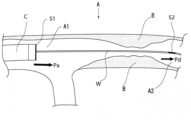
- Figure 1 shows a conceptual diagram for explaining pressure measurement sites in an ischemic cardiopathy diagnosis assistance system according to the present embodiment
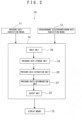
- Figure 2 shows a block diagram schematically illustrating a configuration of the diagnosis assistance system.
- the diagnosis assistance system 10 finds a pressure ratio between intravascular pressures (intracoronary pressures) at two sites as a diagnosis index of ischemic cardiopathy, where the two sites are located on opposite sides of a stenotic lesion site B in a coronary artery A of a patient shown in Figure 1 .
- the diagnosis assistance system 10 finds a pressure ratio Pd/Pa, which is a ratio of distal pressure Pd to proximal pressure Pa, from measurement results of the distal pressure Pd and proximal pressure Pa, where the proximal pressure Pa is a pressure in a proximal stenotic segment A1 upstream of the stenotic lesion site B, i.e., a pressure corresponding to aortic pressure, while the distal pressure Pd is a pressure in a distal stenotic segment A2 downstream of the stenotic lesion site B.
- the pressure ratio Pd/Pa is found based on an intracoronary electrocardiogram (icECG) of the patient at a time suitable for diagnosis.
- icECG intracoronary electrocardiogram
- the diagnosis assistance system 10 includes pressure data acquisition means 11 for acquiring pressure data made up of proximal pressure Pa and distal pressure Pd, intracoronary electrocardiogram data acquisition means 12 for acquiring intracoronary electrocardiogram data made up of a local icECG in the neighborhood of the distal stenotic segment A2, computational processing means 14 made up of a computer configured to find the pressure ratio Pd/Pa using arithmetic operations at a time suitable for diagnosis of ischemic cardiopathy based on the data acquired by the pressure data acquisition means 11 and the data acquired by the intracoronary electrocardiogram data acquisition means 12, and display means 15 made up of a display device or other display configured to display diagnosis information including the pressure ratio Pd/Pa found by the computational processing means 14.
- a known cardiac catheter testing device which is pressure data acquisition device capable of measuring the proximal pressure Pa and distal pressure Pd, is used as the pressure data acquisition means 11. That is, a device having a known structure is adopted as the pressure data acquisition means 11, provided that as shown in Figure 1 , the device can detect the proximal pressure Pa using a detection unit S1 provided on a catheter C whose distal side is located in the proximal stenotic segment A1 and detect the distal pressure Pd using a guide wire W (pressure wire) made of metal and equipped with a pressure sensor S2 extending to the distal stenotic segment A2 from inside a lumen of the catheter C. Note that after the guide wire W is aligned with the distal side of the catheter C, default is done to match the time phase between the proximal pressure Pa and distal pressure Pd.
- the pressure data acquisition means 11 is not limited to the configuration example described above, and may be any other device or system capable of measuring the proximal pressure Pa and distal pressure Pd.
- An intracoronary electrocardiogram data acquisition device or intracoronary electrocardiogram data acquisition system capable of measuring icECG which is a local electrocardiogram in the coronary artery A in the neighborhood of the distal stenotic segment A2 is used as the intracoronary electrocardiogram data acquisition means 12.
- Such a device or system is configured to be able to measure icECG in the coronary artery A around the pressure sensor S2 in a unipolar lead mode, with the guide wire W connected to a measuring instrument via a non-illustrated lead wire, for example, using the distal side of the guide wire W as an electrode.
- any of devices and systems of various structures can be adopted as the intracoronary electrocardiogram data acquisition means 12 as long as a local electrocardiogram in the coronary artery A can be measured.
- the computational processing means 14 includes an input unit 18 configured to accept, as input, pressure data of the proximal pressure Pa and distal pressure Pd received from the pressure data acquisition means 11 and intracoronary electrocardiogram data acquired by the intracoronary electrocardiogram data acquisition means 12, a pressure data storage unit 19 configured to store each item of the pressure data at predetermined time intervals (e.g., 5 ms), a pressure data extraction unit 20 configured to temporally associate the intracoronary electrocardiogram data with time-series pressure data stored by the pressure data storage unit 19 and extract pressure data in a time slot appropriate for diagnosis from an icECG waveform, a pressure ratio determination unit 21 configured to find the pressure ratio Pd/Pa using the pressure data extracted by the pressure data extraction unit 20, and an output unit 22 configured to output diagnosis information including the pressure ratio Pd/Pa determined by the pressure ratio determination unit 21 to the display means 15.
- an input unit 18 configured to accept, as input, pressure data of the proximal pressure Pa and distal pressure Pd received from the pressure data acquisition means 11
- the input unit 18 which is designed to receive electrical signals transmitted from the pressure data acquisition means 11 and intracoronary electrocardiogram data acquisition means 12, captures pressure data and intracoronary electrocardiogram data in succession.
- the pressure data extraction unit 20 includes a function to synchronize the pressure data and intracoronary electrocardiogram data with each other, identifies a time slot in which vascular resistance remains stably low as an analysis period, and extracts the proximal pressure Pa and distal pressure Pd in the analysis period as pressure data.
- the analysis period is a time slot in which a low electric potential continues over an entire icECG and the potential change is flat and stable.
- Figure 3(A) is a surface electrocardiogram showing a changing state of a cardiac potential versus time, the cardiac potential being measured on a body surface
- Figure 3(B) is icECG showing a changing state of a local potential versus time, the local potential being measured in the coronary artery A.
- Figure 3(C) is a graphic chart showing pressure waveforms versus time, the pressure waveforms representing changing states of proximal pressure Pa and distal pressure Pd
- Figure 3(D) is a graphic chart showing a waveform versus time, the waveform representing a changing state of a pressure ratio Pd/Pa.
- the start time (arrow A) of a QRS wave that represents a ventricular contraction on the icECG waveform in Figure 3(B) and the start time (arrow B) of a systole on the pressure waveform in Figure 3(C) are synchronized based on waveform information stored in advance. Note that in achieving the synchronization, a correction is made by taking into consideration a time lag from when ventricular excitation is measured based on icECG to when the ventricular excitation appears in a change in aortic pressure.
- an analysis period T is identified by selecting from a time interval starting from the Q wave, passing through the T wave or U wave, and ending at the wave on which the electric potential starts to rise the next time such as the P wave or Q wave.
- the analysis period T is not particularly limited, but a target zone excluding zones containing a maximum potential and a minimum potential (frames indicated by dashed lines in Figure 3(B) ) is extracted from the intracoronary electrocardiogram data, a zone in which a potential change remains within a predetermined range from a lowest potential is identified, the zone centering around a time point at which the lowest potential occurs, the predetermined range being smaller than a predetermined value or a predetermined ratio, and this zone is determined as the analysis period T.
- a time slot in which the icECG potential is low, flat, and stable can also be extracted by any of various other computation and analysis processes such as icECG image processing, according to the icECG waveform.
- a time slot corresponding to remaining part of the zone may be designated as the analysis period T.
- the duration of the minimum potential in the target zone may be designated as the analysis period T.
- the pressure ratio determination unit 21 calculates the pressure ratios Pd/Pa at individual time points from the proximal pressure Pa and distal pressure Pd detected at same times and calculates an average value of the pressure ratios Pd/Pa.
- the average pressure ratio Pd/Pa is presented as a diagnosis index of ischemic cardiopathy to physicians and the like from the output unit 22 via the display means 15.
- the pressure ratio Pd/Pa as a diagnosis index is not limited to the average value described above, and may be a maximum value and/or minimum value or may be calculated from pressure data in the analysis period T using a predetermined mathematical expression.
- the diagnosis assistance system 10 can derive the pressure ratio Pd/Pa in a time slot in which the intracoronary resistance value is considered to become lower than with the conventional diagnostic technique that uses iFR. That is, the conventional technique that uses iFR, extracts a time slot in which the pressure decreases almost monotonously as a WFP that corresponds to a time slot that ranges from the mid-diastolic to end-diastolic, in which the intravascular resistance value is considered to be generally low, from the pressure waveform in Figure 3(C) and designates the average value of the pressure ratios Pd/Pa at individual time points in the WFP as an iFR value.
- the diagnosis assistance system 10 estimates a time slot in which intracoronary resistance is low, with the state of myocardial motion taken into consideration, based on intracoronary electrocardiogram data of Figure 3(B) , which is never used conventionally in finding the pressure ratio Pd/Pa.
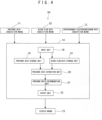
- a diagnosis assistance system 30 further includes blood flow data acquisition means 32 capable of measuring coronary blood flow in the distal stenotic segment A2 such that the computational processing means 14 can derive the pressure ratio Pd/Pa using measurement results of the blood flow as well.
- a blood flow data acquisition device having a known structure is adopted, the device including a sensor capable of detecting blood flow by measuring a blood flow rate at a site on a distal side of a wire extending to the distal stenotic segment A2.
- the blood flow data acquisition means 32 may be, for example, a device integrated with the pressure data acquisition means 11 or any other device as long as the device can detect blood flow data, which is data on blood flow including the blood flow rate.
- the computational processing means 14 is designed to find the pressure ratio Pd/Pa at a time suitable for diagnosis of ischemic cardiopathy using the blood flow data acquired by the blood flow data acquisition means 32 in addition to the data acquired by the pressure data acquisition means 11 and the data acquired by the intracoronary electrocardiogram data acquisition means 12.
- the computational processing means 14 further includes a blood flow data storage unit 35 configured to store blood flow data every predetermined time when the blood flow data acquired by the blood flow data acquisition means 32 is further inputted to the input unit 18.
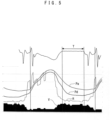
- the pressure data extraction unit 20 here causes the pressure data and intracoronary electrocardiogram data temporally associated with each other as described above to be temporally associated further with blood flow data V (black area in Figure 5 ) corresponding to time-series blood flow stored in the blood flow data storage unit 35, for example, as shown in Figure 5 . Then, by further taking the blood flow data V into consideration, the pressure data extraction unit 20 extracts the proximal pressure Pa and distal pressure Pd in the analysis period T as pressure data at individual time points in the analysis period T derived as described above.
- the pressure data extraction unit 20 extracts the proximal pressure Pa and distal pressure Pd at such time points in the analysis period T at which the volume of blood flow is relatively large among the blood flow data V, and then the pressure ratio determination unit 21 calculates the pressure ratio Pd/Pa at each time point. Also, it is possible to further find intravascular resistance value R by dividing the distal pressure Pd by the blood flow and extract the proximal pressure Pa and distal pressure Pd from the analysis period T according to the magnitude of the intravascular resistance value R. For example, it is possible to extract the proximal pressure Pa and distal pressure Pd at time points when the intravascular resistance value R falls below a predetermined threshold and calculate the pressure ratios Pd/Pa.
- diagnosis assistance systems 10 and 30 provide effects similar to those described above even when used for an atrial fibrillation patient having an irregular cardiac potential.
- diagnosis assistance systems 10 and 30 can be used not only when the patient is at rest under no medication, but also in finding the pressure ratio Pd/Pa by jointly using a medicine that induces a fully congested state as with conventional FFR derivation, and it has been demonstrated that the pressure ratio Pd/Pa can be derived with the intravascular resistance being kept stably low not only at rest, but also under medication.
Landscapes
- Health & Medical Sciences (AREA)
- Life Sciences & Earth Sciences (AREA)
- Engineering & Computer Science (AREA)
- Cardiology (AREA)
- Public Health (AREA)
- Biomedical Technology (AREA)
- Medical Informatics (AREA)
- Pathology (AREA)
- General Health & Medical Sciences (AREA)
- Biophysics (AREA)
- Heart & Thoracic Surgery (AREA)
- Molecular Biology (AREA)
- Surgery (AREA)
- Animal Behavior & Ethology (AREA)
- Physics & Mathematics (AREA)
- Veterinary Medicine (AREA)
- Physiology (AREA)
- Computer Vision & Pattern Recognition (AREA)
- Artificial Intelligence (AREA)
- Psychiatry (AREA)
- Signal Processing (AREA)
- Vascular Medicine (AREA)
- Hematology (AREA)
- Data Mining & Analysis (AREA)
- Databases & Information Systems (AREA)
- Epidemiology (AREA)
- Primary Health Care (AREA)
- Measurement And Recording Of Electrical Phenomena And Electrical Characteristics Of The Living Body (AREA)
- Measuring Pulse, Heart Rate, Blood Pressure Or Blood Flow (AREA)
Applications Claiming Priority (2)
| Application Number | Priority Date | Filing Date | Title |
|---|---|---|---|
| JP2018139860 | 2018-07-26 | ||
| PCT/JP2019/028565 WO2020022232A1 (ja) | 2018-07-26 | 2019-07-19 | 虚血性心疾患の診断支援システム |
Publications (3)
| Publication Number | Publication Date |
|---|---|
| EP3827742A1 EP3827742A1 (en) | 2021-06-02 |
| EP3827742A4 EP3827742A4 (en) | 2021-09-22 |
| EP3827742B1 true EP3827742B1 (en) | 2025-05-14 |
Family
ID=69180446
Family Applications (1)
| Application Number | Title | Priority Date | Filing Date |
|---|---|---|---|
| EP19840507.8A Active EP3827742B1 (en) | 2018-07-26 | 2019-07-19 | Ischemic cardiopathy diagnosis assistance system |
Country Status (6)
| Country | Link |
|---|---|
| US (1) | US12458238B2 (https=) |
| EP (1) | EP3827742B1 (https=) |
| JP (1) | JP7260188B2 (https=) |
| CN (1) | CN112469332B (https=) |
| CA (1) | CA3106237A1 (https=) |
| WO (1) | WO2020022232A1 (https=) |
Families Citing this family (2)
| Publication number | Priority date | Publication date | Assignee | Title |
|---|---|---|---|---|
| JP2023028739A (ja) * | 2021-08-20 | 2023-03-03 | 世史明 川瀬 | 心疾患の評価支援システム及び評価支援用プログラム |
| WO2024038156A1 (en) | 2022-08-17 | 2024-02-22 | Sonck Jeroen | A system and method for determining a quantitative post-treatment symptom reduction index based on a quantified pressure pattern |
Family Cites Families (16)
| Publication number | Priority date | Publication date | Assignee | Title |
|---|---|---|---|---|
| SE9700182D0 (sv) * | 1997-01-22 | 1997-01-22 | Pacesetter Ab | Implantable heart stimulator |
| CA2617154C (en) * | 2005-07-29 | 2015-02-03 | Cvdevices, Llc | Devices and methods for controlling blood pressure using a retrograde cannula |
| EP2259740A2 (en) * | 2008-02-20 | 2010-12-15 | Guided Delivery Systems, Inc. | Electrophysiology catheter system |
| US20140142398A1 (en) * | 2010-06-13 | 2014-05-22 | Angiometrix Corporation | Multifunctional guidewire assemblies and system for analyzing anatomical and functional parameters |
| US20140257070A1 (en) * | 2011-06-20 | 2014-09-11 | St. Jude Medical Ab | Processing of lap signals |
| US9339348B2 (en) | 2011-08-20 | 2016-05-17 | Imperial Colege of Science, Technology and Medicine | Devices, systems, and methods for assessing a vessel |
| US8696584B2 (en) * | 2011-10-05 | 2014-04-15 | 3Dt Holdings, Llc | Devices, systems and methods for determining fractional flow reserve in the presence of a catheter |
| US20140276140A1 (en) | 2013-03-14 | 2014-09-18 | Volcano Corporation | Systems and Methods for Multi-Modality Medical Data Collection |
| EP3057495B1 (en) * | 2013-10-18 | 2020-07-15 | Volcano Corporation | System for assessing a stenosis in a blood vessel with optimized proximal and distal pressure measurements |
| EP3062078B1 (en) * | 2013-10-25 | 2019-07-03 | Neubrex Co., Ltd. | Fiber optic biodiagnostic sensor system and vascular insertion type device for measuring pressure distribution |
| US9595089B2 (en) | 2014-05-09 | 2017-03-14 | Siemens Healthcare Gmbh | Method and system for non-invasive computation of hemodynamic indices for coronary artery stenosis |
| WO2016075601A1 (en) * | 2014-11-14 | 2016-05-19 | Koninklijke Philips N.V. | Percutaneous coronary intervention (pci) planning interface with pressure data and vessel data and associated devices, systems, and methods |
| EP3229658A1 (en) | 2014-12-08 | 2017-10-18 | Koninklijke Philips N.V. | Devices, systems, and methods for detecting anomalous cardiac waveforms and making physiologic measurement calculations |
| CN108778149B (zh) * | 2016-01-04 | 2021-05-04 | 康福乐医疗公司 | 用于治疗mvo的系统和方法 |
| AU2017267505A1 (en) * | 2016-05-19 | 2019-01-17 | Dragon Medical Development Limited | Guidewire apparatus and method for multiple parameter analysis of Coronary stenosis |
| JP7032111B2 (ja) | 2016-11-28 | 2022-03-08 | キヤノンメディカルシステムズ株式会社 | 医用画像処理装置、x線ct装置及び医用画像処理プログラム |
-
2019
- 2019-07-19 WO PCT/JP2019/028565 patent/WO2020022232A1/ja not_active Ceased
- 2019-07-19 CA CA3106237A patent/CA3106237A1/en active Pending
- 2019-07-19 JP JP2020532365A patent/JP7260188B2/ja active Active
- 2019-07-19 CN CN201980049701.5A patent/CN112469332B/zh active Active
- 2019-07-19 US US17/259,988 patent/US12458238B2/en active Active
- 2019-07-19 EP EP19840507.8A patent/EP3827742B1/en active Active
Also Published As
| Publication number | Publication date |
|---|---|
| JP7260188B2 (ja) | 2023-04-18 |
| CA3106237A1 (en) | 2020-01-30 |
| CN112469332A (zh) | 2021-03-09 |
| EP3827742A4 (en) | 2021-09-22 |
| WO2020022232A1 (ja) | 2020-01-30 |
| CN112469332B (zh) | 2024-08-06 |
| US20210267467A1 (en) | 2021-09-02 |
| EP3827742A1 (en) | 2021-06-02 |
| JPWO2020022232A1 (ja) | 2021-08-02 |
| US12458238B2 (en) | 2025-11-04 |
Similar Documents
| Publication | Publication Date | Title |
|---|---|---|
| JP7239644B2 (ja) | 脈管を評価付けするためのデバイス、システム、及び方法 | |
| US8406864B2 (en) | Assessing cardiac activity | |
| US7029448B2 (en) | Electronic hemomanometer and blood pressure measuring method of electronic hemomanometer | |
| EP2519145B1 (en) | Monitoring a property of the cardiovascular system of a subject | |
| US9706952B2 (en) | System for ventricular arrhythmia detection and characterization | |
| CN110638432B (zh) | 用于评估血管中血流的系统和方法 | |
| US9049994B2 (en) | System for cardiac arrhythmia detection and characterization | |
| EP2395908A2 (en) | Detection of parameters in cardiac output related waveforms | |
| US12582320B2 (en) | Assessment of a vessel | |
| EP3827742B1 (en) | Ischemic cardiopathy diagnosis assistance system | |
| EP2979629B1 (en) | Biological information measuring apparatus and program | |
| Krivoshei et al. | Electrical bio-impedance based non-invasive method for the central aortic blood pressure waveform estimation | |
| JP6226822B2 (ja) | 生体情報測定装置、作動方法、及びプログラム | |
| JP6431965B2 (ja) | 生体情報測定装置、及びプログラム | |
| HK40041737B (en) | Assessment of a vessel | |
| HK40041737A (en) | Assessment of a vessel | |
| JP2016187538A (ja) | 心拍出量測定装置 |
Legal Events
| Date | Code | Title | Description |
|---|---|---|---|
| STAA | Information on the status of an ep patent application or granted ep patent |
Free format text: STATUS: THE INTERNATIONAL PUBLICATION HAS BEEN MADE |
|
| PUAI | Public reference made under article 153(3) epc to a published international application that has entered the european phase |
Free format text: ORIGINAL CODE: 0009012 |
|
| STAA | Information on the status of an ep patent application or granted ep patent |
Free format text: STATUS: REQUEST FOR EXAMINATION WAS MADE |
|
| 17P | Request for examination filed |
Effective date: 20210205 |
|
| AK | Designated contracting states |
Kind code of ref document: A1 Designated state(s): AL AT BE BG CH CY CZ DE DK EE ES FI FR GB GR HR HU IE IS IT LI LT LU LV MC MK MT NL NO PL PT RO RS SE SI SK SM TR |
|
| A4 | Supplementary search report drawn up and despatched |
Effective date: 20210819 |
|
| RIC1 | Information provided on ipc code assigned before grant |
Ipc: A61B 5/026 20060101ALN20210813BHEP Ipc: A61B 5/00 20060101ALI20210813BHEP Ipc: A61B 5/33 20210101ALI20210813BHEP Ipc: G16H 50/20 20180101ALI20210813BHEP Ipc: A61B 5/02 20060101ALI20210813BHEP Ipc: A61B 5/0215 20060101AFI20210813BHEP |
|
| DAV | Request for validation of the european patent (deleted) | ||
| DAX | Request for extension of the european patent (deleted) | ||
| STAA | Information on the status of an ep patent application or granted ep patent |
Free format text: STATUS: EXAMINATION IS IN PROGRESS |
|
| 17Q | First examination report despatched |
Effective date: 20240312 |
|
| GRAP | Despatch of communication of intention to grant a patent |
Free format text: ORIGINAL CODE: EPIDOSNIGR1 |
|
| STAA | Information on the status of an ep patent application or granted ep patent |
Free format text: STATUS: GRANT OF PATENT IS INTENDED |
|
| INTG | Intention to grant announced |
Effective date: 20250102 |
|
| RIC1 | Information provided on ipc code assigned before grant |
Ipc: A61B 5/026 20060101ALN20241213BHEP Ipc: A61B 5/00 20060101ALI20241213BHEP Ipc: A61B 5/33 20210101ALI20241213BHEP Ipc: G16H 50/20 20180101ALI20241213BHEP Ipc: A61B 5/02 20060101ALI20241213BHEP Ipc: A61B 5/0215 20060101AFI20241213BHEP |
|
| GRAS | Grant fee paid |
Free format text: ORIGINAL CODE: EPIDOSNIGR3 |
|
| GRAA | (expected) grant |
Free format text: ORIGINAL CODE: 0009210 |
|
| STAA | Information on the status of an ep patent application or granted ep patent |
Free format text: STATUS: THE PATENT HAS BEEN GRANTED |
|
| AK | Designated contracting states |
Kind code of ref document: B1 Designated state(s): AL AT BE BG CH CY CZ DE DK EE ES FI FR GB GR HR HU IE IS IT LI LT LU LV MC MK MT NL NO PL PT RO RS SE SI SK SM TR |
|
| REG | Reference to a national code |
Ref country code: GB Ref legal event code: FG4D |
|
| REG | Reference to a national code |
Ref country code: CH Ref legal event code: EP |
|
| REG | Reference to a national code |
Ref country code: IE Ref legal event code: FG4D |
|
| REG | Reference to a national code |
Ref country code: DE Ref legal event code: R096 Ref document number: 602019070047 Country of ref document: DE |
|
| REG | Reference to a national code |
Ref country code: NL Ref legal event code: MP Effective date: 20250514 |
|
| PG25 | Lapsed in a contracting state [announced via postgrant information from national office to epo] |
Ref country code: PT Free format text: LAPSE BECAUSE OF FAILURE TO SUBMIT A TRANSLATION OF THE DESCRIPTION OR TO PAY THE FEE WITHIN THE PRESCRIBED TIME-LIMIT Effective date: 20250915 Ref country code: ES Free format text: LAPSE BECAUSE OF FAILURE TO SUBMIT A TRANSLATION OF THE DESCRIPTION OR TO PAY THE FEE WITHIN THE PRESCRIBED TIME-LIMIT Effective date: 20250514 Ref country code: FI Free format text: LAPSE BECAUSE OF FAILURE TO SUBMIT A TRANSLATION OF THE DESCRIPTION OR TO PAY THE FEE WITHIN THE PRESCRIBED TIME-LIMIT Effective date: 20250514 |
|
| PGFP | Annual fee paid to national office [announced via postgrant information from national office to epo] |
Ref country code: DE Payment date: 20250722 Year of fee payment: 7 |
|
| REG | Reference to a national code |
Ref country code: LT Ref legal event code: MG9D |
|
| PG25 | Lapsed in a contracting state [announced via postgrant information from national office to epo] |
Ref country code: GR Free format text: LAPSE BECAUSE OF FAILURE TO SUBMIT A TRANSLATION OF THE DESCRIPTION OR TO PAY THE FEE WITHIN THE PRESCRIBED TIME-LIMIT Effective date: 20250815 Ref country code: NO Free format text: LAPSE BECAUSE OF FAILURE TO SUBMIT A TRANSLATION OF THE DESCRIPTION OR TO PAY THE FEE WITHIN THE PRESCRIBED TIME-LIMIT Effective date: 20250814 |
|
| PG25 | Lapsed in a contracting state [announced via postgrant information from national office to epo] |
Ref country code: PL Free format text: LAPSE BECAUSE OF FAILURE TO SUBMIT A TRANSLATION OF THE DESCRIPTION OR TO PAY THE FEE WITHIN THE PRESCRIBED TIME-LIMIT Effective date: 20250514 Ref country code: NL Free format text: LAPSE BECAUSE OF FAILURE TO SUBMIT A TRANSLATION OF THE DESCRIPTION OR TO PAY THE FEE WITHIN THE PRESCRIBED TIME-LIMIT Effective date: 20250514 |
|
| REG | Reference to a national code |
Ref country code: AT Ref legal event code: MK05 Ref document number: 1794104 Country of ref document: AT Kind code of ref document: T Effective date: 20250514 |
|
| PG25 | Lapsed in a contracting state [announced via postgrant information from national office to epo] |
Ref country code: BG Free format text: LAPSE BECAUSE OF FAILURE TO SUBMIT A TRANSLATION OF THE DESCRIPTION OR TO PAY THE FEE WITHIN THE PRESCRIBED TIME-LIMIT Effective date: 20250514 |
|
| PGFP | Annual fee paid to national office [announced via postgrant information from national office to epo] |
Ref country code: GB Payment date: 20250722 Year of fee payment: 7 |
|
| PG25 | Lapsed in a contracting state [announced via postgrant information from national office to epo] |
Ref country code: HR Free format text: LAPSE BECAUSE OF FAILURE TO SUBMIT A TRANSLATION OF THE DESCRIPTION OR TO PAY THE FEE WITHIN THE PRESCRIBED TIME-LIMIT Effective date: 20250514 |
|
| PG25 | Lapsed in a contracting state [announced via postgrant information from national office to epo] |
Ref country code: AT Free format text: LAPSE BECAUSE OF FAILURE TO SUBMIT A TRANSLATION OF THE DESCRIPTION OR TO PAY THE FEE WITHIN THE PRESCRIBED TIME-LIMIT Effective date: 20250514 |
|
| PGFP | Annual fee paid to national office [announced via postgrant information from national office to epo] |
Ref country code: FR Payment date: 20250725 Year of fee payment: 7 |
|
| PG25 | Lapsed in a contracting state [announced via postgrant information from national office to epo] |
Ref country code: RS Free format text: LAPSE BECAUSE OF FAILURE TO SUBMIT A TRANSLATION OF THE DESCRIPTION OR TO PAY THE FEE WITHIN THE PRESCRIBED TIME-LIMIT Effective date: 20250814 |
|
| PG25 | Lapsed in a contracting state [announced via postgrant information from national office to epo] |
Ref country code: IS Free format text: LAPSE BECAUSE OF FAILURE TO SUBMIT A TRANSLATION OF THE DESCRIPTION OR TO PAY THE FEE WITHIN THE PRESCRIBED TIME-LIMIT Effective date: 20250914 |
|
| PG25 | Lapsed in a contracting state [announced via postgrant information from national office to epo] |
Ref country code: LV Free format text: LAPSE BECAUSE OF FAILURE TO SUBMIT A TRANSLATION OF THE DESCRIPTION OR TO PAY THE FEE WITHIN THE PRESCRIBED TIME-LIMIT Effective date: 20250514 |
|
| PG25 | Lapsed in a contracting state [announced via postgrant information from national office to epo] |
Ref country code: DK Free format text: LAPSE BECAUSE OF FAILURE TO SUBMIT A TRANSLATION OF THE DESCRIPTION OR TO PAY THE FEE WITHIN THE PRESCRIBED TIME-LIMIT Effective date: 20250514 Ref country code: SM Free format text: LAPSE BECAUSE OF FAILURE TO SUBMIT A TRANSLATION OF THE DESCRIPTION OR TO PAY THE FEE WITHIN THE PRESCRIBED TIME-LIMIT Effective date: 20250514 |
|
| PG25 | Lapsed in a contracting state [announced via postgrant information from national office to epo] |
Ref country code: CZ Free format text: LAPSE BECAUSE OF FAILURE TO SUBMIT A TRANSLATION OF THE DESCRIPTION OR TO PAY THE FEE WITHIN THE PRESCRIBED TIME-LIMIT Effective date: 20250514 |
|
| PG25 | Lapsed in a contracting state [announced via postgrant information from national office to epo] |
Ref country code: EE Free format text: LAPSE BECAUSE OF FAILURE TO SUBMIT A TRANSLATION OF THE DESCRIPTION OR TO PAY THE FEE WITHIN THE PRESCRIBED TIME-LIMIT Effective date: 20250514 |
|
| PG25 | Lapsed in a contracting state [announced via postgrant information from national office to epo] |
Ref country code: RO Free format text: LAPSE BECAUSE OF FAILURE TO SUBMIT A TRANSLATION OF THE DESCRIPTION OR TO PAY THE FEE WITHIN THE PRESCRIBED TIME-LIMIT Effective date: 20250514 Ref country code: SK Free format text: LAPSE BECAUSE OF FAILURE TO SUBMIT A TRANSLATION OF THE DESCRIPTION OR TO PAY THE FEE WITHIN THE PRESCRIBED TIME-LIMIT Effective date: 20250514 |
|
| PG25 | Lapsed in a contracting state [announced via postgrant information from national office to epo] |
Ref country code: IT Free format text: LAPSE BECAUSE OF FAILURE TO SUBMIT A TRANSLATION OF THE DESCRIPTION OR TO PAY THE FEE WITHIN THE PRESCRIBED TIME-LIMIT Effective date: 20250514 |
|
| REG | Reference to a national code |
Ref country code: DE Ref legal event code: R097 Ref document number: 602019070047 Country of ref document: DE |
|
| REG | Reference to a national code |
Ref country code: CH Ref legal event code: H13 Free format text: ST27 STATUS EVENT CODE: U-0-0-H10-H13 (AS PROVIDED BY THE NATIONAL OFFICE) Effective date: 20260224 |
|
| PG25 | Lapsed in a contracting state [announced via postgrant information from national office to epo] |
Ref country code: LU Free format text: LAPSE BECAUSE OF NON-PAYMENT OF DUE FEES Effective date: 20250719 |
|
| PLBE | No opposition filed within time limit |
Free format text: ORIGINAL CODE: 0009261 |
|
| STAA | Information on the status of an ep patent application or granted ep patent |
Free format text: STATUS: NO OPPOSITION FILED WITHIN TIME LIMIT |
|
| REG | Reference to a national code |
Ref country code: CH Ref legal event code: L10 Free format text: ST27 STATUS EVENT CODE: U-0-0-L10-L00 (AS PROVIDED BY THE NATIONAL OFFICE) Effective date: 20260325 |
|
| REG | Reference to a national code |
Ref country code: BE Ref legal event code: MM Effective date: 20250731 |
|
| PG25 | Lapsed in a contracting state [announced via postgrant information from national office to epo] |
Ref country code: BE Free format text: LAPSE BECAUSE OF NON-PAYMENT OF DUE FEES Effective date: 20250731 |
|
| 26N | No opposition filed |
Effective date: 20260217 |
|
| PG25 | Lapsed in a contracting state [announced via postgrant information from national office to epo] |
Ref country code: CH Free format text: LAPSE BECAUSE OF NON-PAYMENT OF DUE FEES Effective date: 20250731 |