WO2020017440A1 - Vr装置、方法、プログラム及び記憶媒体 - Google Patents
Vr装置、方法、プログラム及び記憶媒体 Download PDFInfo
- Publication number
- WO2020017440A1 WO2020017440A1 PCT/JP2019/027611 JP2019027611W WO2020017440A1 WO 2020017440 A1 WO2020017440 A1 WO 2020017440A1 JP 2019027611 W JP2019027611 W JP 2019027611W WO 2020017440 A1 WO2020017440 A1 WO 2020017440A1
- Authority
- WO
- WIPO (PCT)
- Prior art keywords
- hmd
- player
- wearer
- detecting
- speed
- Prior art date
- Legal status (The legal status is an assumption and is not a legal conclusion. Google has not performed a legal analysis and makes no representation as to the accuracy of the status listed.)
- Ceased
Links
Images








Classifications
-
- A—HUMAN NECESSITIES
- A63—SPORTS; GAMES; AMUSEMENTS
- A63F—CARD, BOARD, OR ROULETTE GAMES; INDOOR GAMES USING SMALL MOVING PLAYING BODIES; VIDEO GAMES; GAMES NOT OTHERWISE PROVIDED FOR
- A63F13/00—Video games, i.e. games using an electronically generated display having two or more dimensions
- A63F13/20—Input arrangements for video game devices
- A63F13/21—Input arrangements for video game devices characterised by their sensors, purposes or types
- A63F13/211—Input arrangements for video game devices characterised by their sensors, purposes or types using inertial sensors, e.g. accelerometers or gyroscopes
-
- A—HUMAN NECESSITIES
- A63—SPORTS; GAMES; AMUSEMENTS
- A63F—CARD, BOARD, OR ROULETTE GAMES; INDOOR GAMES USING SMALL MOVING PLAYING BODIES; VIDEO GAMES; GAMES NOT OTHERWISE PROVIDED FOR
- A63F13/00—Video games, i.e. games using an electronically generated display having two or more dimensions
- A63F13/20—Input arrangements for video game devices
- A63F13/21—Input arrangements for video game devices characterised by their sensors, purposes or types
- A63F13/213—Input arrangements for video game devices characterised by their sensors, purposes or types comprising photodetecting means, e.g. cameras, photodiodes or infrared cells
-
- A—HUMAN NECESSITIES
- A63—SPORTS; GAMES; AMUSEMENTS
- A63F—CARD, BOARD, OR ROULETTE GAMES; INDOOR GAMES USING SMALL MOVING PLAYING BODIES; VIDEO GAMES; GAMES NOT OTHERWISE PROVIDED FOR
- A63F13/00—Video games, i.e. games using an electronically generated display having two or more dimensions
- A63F13/25—Output arrangements for video game devices
-
- A—HUMAN NECESSITIES
- A63—SPORTS; GAMES; AMUSEMENTS
- A63F—CARD, BOARD, OR ROULETTE GAMES; INDOOR GAMES USING SMALL MOVING PLAYING BODIES; VIDEO GAMES; GAMES NOT OTHERWISE PROVIDED FOR
- A63F13/00—Video games, i.e. games using an electronically generated display having two or more dimensions
- A63F13/40—Processing input control signals of video game devices, e.g. signals generated by the player or derived from the environment
- A63F13/42—Processing input control signals of video game devices, e.g. signals generated by the player or derived from the environment by mapping the input signals into game commands, e.g. mapping the displacement of a stylus on a touch screen to the steering angle of a virtual vehicle
- A63F13/428—Processing input control signals of video game devices, e.g. signals generated by the player or derived from the environment by mapping the input signals into game commands, e.g. mapping the displacement of a stylus on a touch screen to the steering angle of a virtual vehicle involving motion or position input signals, e.g. signals representing the rotation of an input controller or a player's arm motions sensed by accelerometers or gyroscopes
-
- A—HUMAN NECESSITIES
- A63—SPORTS; GAMES; AMUSEMENTS
- A63F—CARD, BOARD, OR ROULETTE GAMES; INDOOR GAMES USING SMALL MOVING PLAYING BODIES; VIDEO GAMES; GAMES NOT OTHERWISE PROVIDED FOR
- A63F13/00—Video games, i.e. games using an electronically generated display having two or more dimensions
- A63F13/45—Controlling the progress of the video game
- A63F13/48—Starting a game, e.g. activating a game device or waiting for other players to join a multiplayer session
-
- A—HUMAN NECESSITIES
- A63—SPORTS; GAMES; AMUSEMENTS
- A63F—CARD, BOARD, OR ROULETTE GAMES; INDOOR GAMES USING SMALL MOVING PLAYING BODIES; VIDEO GAMES; GAMES NOT OTHERWISE PROVIDED FOR
- A63F13/00—Video games, i.e. games using an electronically generated display having two or more dimensions
- A63F13/50—Controlling the output signals based on the game progress
- A63F13/52—Controlling the output signals based on the game progress involving aspects of the displayed game scene
-
- G—PHYSICS
- G02—OPTICS
- G02B—OPTICAL ELEMENTS, SYSTEMS OR APPARATUS
- G02B27/00—Optical systems or apparatus not provided for by any of the groups G02B1/00 - G02B26/00, G02B30/00
- G02B27/02—Viewing or reading apparatus
-
- G—PHYSICS
- G06—COMPUTING OR CALCULATING; COUNTING
- G06F—ELECTRIC DIGITAL DATA PROCESSING
- G06F3/00—Input arrangements for transferring data to be processed into a form capable of being handled by the computer; Output arrangements for transferring data from processing unit to output unit, e.g. interface arrangements
- G06F3/01—Input arrangements or combined input and output arrangements for interaction between user and computer
-
- G—PHYSICS
- G06—COMPUTING OR CALCULATING; COUNTING
- G06T—IMAGE DATA PROCESSING OR GENERATION, IN GENERAL
- G06T19/00—Manipulating three-dimensional [3D] models or images for computer graphics
-
- G—PHYSICS
- G09—EDUCATION; CRYPTOGRAPHY; DISPLAY; ADVERTISING; SEALS
- G09G—ARRANGEMENTS OR CIRCUITS FOR CONTROL OF INDICATING DEVICES USING STATIC MEANS TO PRESENT VARIABLE INFORMATION
- G09G5/00—Control arrangements or circuits for visual indicators common to cathode-ray tube indicators and other visual indicators
-
- G—PHYSICS
- G09—EDUCATION; CRYPTOGRAPHY; DISPLAY; ADVERTISING; SEALS
- G09G—ARRANGEMENTS OR CIRCUITS FOR CONTROL OF INDICATING DEVICES USING STATIC MEANS TO PRESENT VARIABLE INFORMATION
- G09G5/00—Control arrangements or circuits for visual indicators common to cathode-ray tube indicators and other visual indicators
- G09G5/36—Control arrangements or circuits for visual indicators common to cathode-ray tube indicators and other visual indicators characterised by the display of a graphic pattern, e.g. using an all-points-addressable [APA] memory
-
- G—PHYSICS
- G09—EDUCATION; CRYPTOGRAPHY; DISPLAY; ADVERTISING; SEALS
- G09G—ARRANGEMENTS OR CIRCUITS FOR CONTROL OF INDICATING DEVICES USING STATIC MEANS TO PRESENT VARIABLE INFORMATION
- G09G5/00—Control arrangements or circuits for visual indicators common to cathode-ray tube indicators and other visual indicators
- G09G5/36—Control arrangements or circuits for visual indicators common to cathode-ray tube indicators and other visual indicators characterised by the display of a graphic pattern, e.g. using an all-points-addressable [APA] memory
- G09G5/37—Details of the operation on graphic patterns
- G09G5/377—Details of the operation on graphic patterns for mixing or overlaying two or more graphic patterns
Definitions
- the present invention relates to a VR device, a method, a program, and a storage medium that can prevent VR sickness.
- VR games have been developed and provided to the market with an HMD (Head Mounted Display) attached to the user and showing a 3D image to enhance the sense of reality and increase the immersion.
- HMD Head Mounted Display
- JP-A-2018-085137 Patent Document 1
- JP-A-2018-072992 Patent Document 2
- JP-A-2016-031439 Patent Document 3
- Table 2016/017245 Patent Document 4
- Table 2015/107817 Patent Document 5
- JP-A-12-339490 JP-A-12-339490
- the present invention has been made in view of the above-described problems of the related art, and monitors at least the head and hand movements of a user wearing an HMD, and detects a moving direction, a moving distance, a moving speed, and an acceleration,
- the autonomous movement of the user wearing the HMD is linked to the change in the scene seen by the player in the 3D movie by reflecting the change in the scene seen by the player in the 3D movie displayed on the HMD.
- An object of the present invention is to provide a VR device, a method, a program, and a storage medium storing the same, which can prevent VR sickness.
- the head tracking and the hand tracking are fully utilized, the actual gesture of the user wearing the HMD is maximized, and the user (HMD wearer) shakes his arm.
- the gesture is recognized and the VR moving image is developed so that the player in the 3D moving image moves forward. It is an object of the present invention to provide a VR device, a method, a program, and a storage medium storing the same, which can match and prevent VR sickness of a user.
- the present invention provides an HMD, a head posture detector that detects the position, orientation, and inclination of the head of the wearer wearing the HMD, and the position, movement speed, and acceleration of at least one hand of the HMD wearer.
- a position / speed / acceleration detector for detecting a hand
- an HMD movement direction / speed calculator for calculating the movement direction and movement speed of the HMD wearer, and a calculation result of the movement direction and movement speed of the HMD wearer are input.
- a player movement direction / speed calculator for calculating a movement direction and a movement speed of the player in the VR space; and a calculation result of the movement direction and the movement speed of the player in the visual field of the player in the VR space.
- a VR device provided with a VR scene changer for changing the scene of the vehicle, a VR method using the VR device, a VR program executed by the VR device, and a VR program. And wherein the ⁇ body.
- the present invention also provides an HMD, a head posture detector for detecting the position, orientation, and inclination of the head of the wearer wearing the HMD, and a hand for detecting the position of at least one hand of the HMD wearer.
- a calculator, a player position / moving speed calculator for calculating a position and a moving speed of a player in a VR space based on a calculation result of a distance between the position of the hand and the arbitrary point, and a position of the player
- a VR scene changer for changing the scene in the field of view of the player in the VR space based on the calculation result of the VR device and the moving speed.
- the present invention also provides an HMD, a head posture detector for detecting the position, orientation, and inclination of the head of the wearer wearing the HMD, and a shooting operation detector for detecting a shooting operation of the HMD wearer.
- a target detector that detects the shooting operation and determines a shooting target in a VR space
- a pullback operation detector that detects a pullback operation and a pullback distance of the hand of the HMD wearer
- a pulling distance calculator for calculating a distance in which the shooting target is drawn to the player side in the VR space based on the pullback operation and the detection result of the pullback distance, and the shooting in the VR space in accordance with the drawn distance. Change the view in the player's field of view so that the target approaches the player Characterized by VR device that includes a VR views changer for.
- VR method of the VR device the VR program and wherein the storage medium the VR device executes.
- the present invention provides an HMD, a head posture detector for detecting the position and orientation of the head of the wearer wearing the HMD, and detecting an input of at least one hand button or gesture of the HMD wearer.
- An input detector that detects the direction of the HMD wearer and the input time of the button or gesture of the one hand, and calculates a rising direction and a rising speed of the player in the VR space; and the VR space.
- the VR device is provided with a VR scene changer that changes the scene in the field of view of the player according to the ascending direction and the ascending speed of the player, and a VR method using the VR device, It is characterized by a VR program to be executed and its storage medium.
- an effect line expressing a sense of speed can be superimposed and displayed in the VR space.
- the moving direction and the speed of the player in the VR moving image are determined by the swinging speed of the hand of the HMD wearer, and the VR moving image is expressed as if the player is moving in the moving direction at that speed. Accordingly, the VR moving image can be developed and progressed in response to the intention and movement of the HMD wearer, and VR sickness can be effectively prevented.
- the wearer of the HMD when the wearer of the HMD lowers his / her head and approaches his / her hand, the scene in the VR moving image advances rapidly, and when the hand is removed from the head and the distance between the two is increased, the scene in the VR moving image advances. Slows down, and gives the HMD wearer a feeling close to the actual driving and kinetic feelings of riders, skiers, snowboarders and surfers who are riding jockeys, motorcycles, and bicycles while riding, and has an effect on VR sickness Can be prevented.
- the player moves the hand in the VR moving image by shooting with the controller to determine the target in the moving image, and in this state, the wearer performs an operation of pulling back with his / her hand. It is possible to pull in at a speed corresponding to the distance, and to make the player in the VR moving image perform a motion according to the intention or motion of the HMD wearer, thereby effectively preventing VR sickness.
- the HMD wearer inputs an arbitrary trigger such as a button, and moves or slows down the view seen by a player flying in the air in the VR movie depending on the duration of the input. It is possible to change the view seen by the player in the VR moving image according to the motion or intention of the HMD wearer, and it is possible to effectively prevent VR sickness.
- an arbitrary trigger such as a button
- the wearer by displaying an effect line for displaying a sense of speed in the VR moving image, the speed and direction of change as viewed from the viewpoint of the player, the moving speed and direction according to the direction, and the direction, the wearer is given to the wearer.
- Realistic sense of speed and sense of direction can be given, and VR sickness can be more effectively prevented.
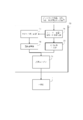
- FIG. 3 is a block diagram showing a hardware configuration of the VR game device according to the first to fourth embodiments of the present invention.
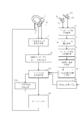
- FIG. 2 is a block diagram showing a functional configuration of the VR game device according to the first embodiment of the present invention.
- FIG. 2 is a block diagram showing a functional configuration of a game engine in the VR game device according to the embodiment.
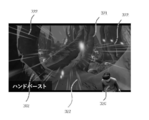
- 9 is a flowchart of a processing procedure of the VR game device of the embodiment. Explanatory drawing showing an example of a 3D screen displayed in the HMD by the VR game device of the embodiment.
- FIG. 7 is a block diagram showing a functional configuration of a VR game device according to a second embodiment of the present invention. 9 is a flowchart of a processing procedure of the VR game device of the embodiment.
- FIG. 1 is a block diagram showing a hardware configuration of the VR game device according to the first to fourth embodiments of the present invention.
- FIG. 2 is a block diagram showing a functional configuration of the VR game device according to the first embodiment of the
- FIG. 13 is a block diagram showing a functional configuration of a VR game device according to a third embodiment of the present invention.
- FIG. 2 is a block diagram showing a functional configuration of a game engine in the VR game device according to the embodiment.
- 9 is a flowchart of a processing procedure of the VR game device of the embodiment. Explanatory drawing showing an example of a 3D screen displayed in the HMD by the VR game device of the embodiment.
- FIG. 13 is a block diagram showing a functional configuration of a VR game device according to a fourth embodiment of the present invention.
- FIG. 2 is a block diagram showing a functional configuration of a game engine in the VR game device according to the embodiment.
- 9 is a flowchart of a processing procedure of the VR game device of the embodiment.
- FIG. 17 is a block diagram showing a functional configuration of the VR game device according to the fifth embodiment.
- 15 is a flowchart of a processing procedure of the VR game device according to the fifth embodiment.
- the “player” is a virtual play subject in a 3D moving image projected on a display in the HMD, and a change in scenery seen from the subject is reflected in the VR game moving image. Normally, the player's line of sight is set at the center of the screen.
- the “user” is a person who wears the HMD and enjoys the VR game moving image, and may be referred to as a “HMD wearer” or a “wearer”. The gesture performed by the wearer is reflected in the operation of the player during the VR game moving image.
- HMD is formally a "head mounted display", a device sometimes referred to as a “head mounted display”, which has a stereoscopic display inside and allows the wearer to view a VR game stereoscopically. Can be done.
- the software referred to as "VR game” in the present specification includes not only the 3DVR game but also all the user-interactive 3D contents that can show a moving image to an HMD wearer in three dimensions. .
- the present invention is not limited to the VR game device and the like, and can be widely applied to VR devices, methods, and programs.
- the movement of at least the head and the hand of the user wearing the HMD is monitored, the moving direction, the moving distance, the moving speed, the acceleration, and the like are detected, and the player can view the 3D moving image displayed on the HMD.
- a VR device, a method, and a program having a function of reflecting a change in a scene an autonomous movement of a user wearing an HMD can be linked with a change in a scene seen from a player in a 3D moving image.
- the actual gesture of the user matches the development of the VR video while being a VR video, Just as a driver driving a car is less likely to have a motion sickness, an HMD wearer operating a VR moving image is less likely to have a VR sickness.
- the first embodiment of the present invention calculates a moving direction and a speed of a player in a moving image based on a swinging speed of a hand of an HMD wearer and a moving direction of the player in a VR game moving image displayed on the HMD.
- the VR game video can be developed and progressed as if moving at that speed, thereby matching the development and progression of the VR game video with the intention and action of the HMD wearer, effectively reducing VR sickness VR game device, method and program that can be prevented.
- FIG. 1 is a block diagram of a VR game device according to a first embodiment.
- the VR game device includes a camera that tracks its own position, posture, and orientation by an inside-out method, and includes acceleration, angular velocity, and terrestrial magnetism.
- HMD 1 with a built-in 9-axis sensor, controllers 2R and 2L with a built-in 6-axis sensor that the HMD wearer holds in each of the left and right hands to operate the progress and development of the VR game moving image, and executes a VR game or VR And a VR game execution device 3 for playing back video.
- the VR game execution device 3 reproduces a VR game or a VR game moving image, such as a VR game machine specialized in a VR game, a PC that executes various VR game software, a game machine dedicated to a specific VR game, and the like, and outputs it to the HMD 1. It includes a stand-alone computer capable of outputting and a computer device having all general-purpose VR image processing functions.
- any of a plurality of types of devices that can display a VR game moving image that are currently on the market can be adopted.
- an HMD1 of Windows Mixed Reality will be described as an example.
- the controllers 2L and 2R are similarly equipped with a touch pad, an analog stick, a trigger button, and a ring-shaped tracking LED marker.
- the HMD 1 incorporates an inside-out type 6DOF tracking system 101 that can detect three-dimensional spatial coordinates (three directions of front and rear, left and right, and up and down) of the wearer's head.
- the controllers 2R and 2L also include six-axis sensors 2R1 and 2L1.
- the operation signals of the controllers 2R and 2L and the detection signals of the 6-axis sensors 2R1 and 2L1 are transmitted to a Bluetooth (registered trademark) receiver (not shown) of the VR game execution device 3 by Bluetooth (registered trademark) communication. Is done.
- signal communication between the controllers 2R and 2L and the VR game execution device 3 is not limited to Bluetooth (registered trademark), and other wired communication or wireless communication technology may be adopted.
- the 6DOF tracking system 101 of the HMD 1 can detect the positions of the controllers 2R and 2L with the tracking LED markers and detect the three-dimensional spatial coordinates (three directions of front and rear, left and right, and up and down) of the controllers 2R and 2L.
- FIG. 2 shows a functional configuration of the VR game apparatus according to the present embodiment. This mainly shows a processing function inside the game execution device 3.
- HMD sensor signal receiving unit 11 for inputting a sensor signal from the 6DOF tracking system 101 of the HMD 1 and the 9-axis sensor 102, calculating the coordinates of the head of the HMD wearer, the azimuth that the wearer's face is facing, and the vertical angle HMD position / azimuth / up / down angle calculation unit 12 to be executed.
- a controller signal receiving unit 13 for receiving an operation signal from the controllers 2R and 2L and a 6-axis sensor signal, a tracking LED marker information of each of the controllers 2R and 2L, and a controller position for calculating a position of the controller using the 6-axis sensor signal.
- An arm swing duration calculator 17 for calculating time and an arm swing speed calculator 18 for calculating an arm swing speed of the HMD wearer are provided.
- the calculation results of the HMD position / azimuth / up / down angle calculation unit 12, the arm swing duration calculation unit 17, and the arm swing speed calculation unit 18 are input, and the current position, the movement direction, and the movement speed of the player in the VR game are input.
- the player position / moving direction / moving distance / speed calculating unit 19 for calculating the moving distance and the moving speed calculated by the player position / moving direction / moving distance / speed calculating unit 19 are input, and the length corresponding to the moving speed is input.
- a speed line creating unit 110 is provided for creating a speed line with different pod speeds and appearance densities.
- the calculation result of the player position / moving direction / moving distance / speed calculating unit 19 and the speed line creating unit 110 create the speed line.
- the speed line is output to the game engine 20 executing the VR game.
- the game engine 20 is a computer for advancing / developing the VR game, inputs the calculation result of the position / movement direction / movement distance / velocity calculation unit 19 of the player, advances the VR game, and converts the 3D moving image of the VR game into the HMD1 And display it.
- the game engine 20 creates a player position, posture, and orientation setting unit 21, a VR video generation unit 22, a speed line drawing unit 23, an image superimposition unit 24, and creates a stereoscopic video.
- a rendering engine 25 is provided, and a video signal of the rendering engine 25 is output to the HMD 1 for 3D display.
- the processing procedure of the VR game device according to the first embodiment will be described with reference to the flowchart in FIG.
- This processing procedure is also a description of the VR game method and the program for realizing it.
- the processing of the flowchart in FIG. 4 is repeatedly executed at a predetermined cycle according to the processing speed of the system.
- the 6DOF tracking system 101 of the HMD 1 tracks the positions of the controllers 2R and 2L and determines the coordinates of the controllers 2R and 2L (steps ST1 and ST3).
- step ST5 When the wearer of the HMD shakes the hand holding the controllers 2R and 2L back and forth, the acceleration of the controllers 2R and 2L generated by the gesture is calculated, and the acceleration is compared with a threshold value registered in advance (step ST5). , ST7). If NO in this comparison, the process returns without doing anything.
- step ST9 If the calculated acceleration is greater than the threshold value and the result is YES, the acceleration value is held, and the arm swing duration time is measured and held (step ST9). Subsequently, the front direction of the HMD 1 is obtained (step ST11), the moving speed of the player is calculated (step ST13), and the moving direction and the moving distance of the player in the VR game moving image are calculated (step ST15). Then, a speed line corresponding to the moving speed of the player is created (step ST17), the VR game moving image is developed based on the moving direction, the moving distance, and the moving speed, and at the same time, a speed line indicating a sense of speed is superimposed on the moving image. This is displayed in 3D on the HMD 1 (step ST19).
- the intention of the wearer is determined based on the azimuth and the vertical angle of the HMD 1 and the movement of the hand of the HMD wearer.
- the moving direction, the moving distance, and the moving speed to be read are read and reflected in the development of the VR game moving image viewed from the player in the VR game.
- the wearer keeps swinging his arm fast for a long time, the scene change in the VR game moving image viewed from the player's viewpoint also changes quickly and the player runs at the intended speed in the direction intended by the HMD wearer.
- the VR game animation can be developed in accordance with the intended movement of the wearer of the HMD1, and for example, a driver driving a car does not get drunk.
- the VR game can be developed as if the player in the VR game is moving in accordance with the movement intended by the HMD wearer, and VR sickness can be prevented.
- FIG. 5 shows one screen 30 of the VR game.
- the person image 31 of the HMD wearer is superimposed for explanation, and in this case, the HMD wearer is making a fast running gesture with the controllers 2R and 2L. However, this person image 31 is not displayed on the screen 30 of the actual VR game.
- the VR game screen 30 converts the speed to the moving speed of the player and makes the player appear to be moving forward at the moving speed.
- the scenery 32 within 30 is developed so as to approach the player quickly.
- a speed line 33 is displayed as an effect line for making the moving speed more realizable, and the speed line 33 is moved so as to be directed to an assumed player standing at the center of the screen 30.
- the moving speed of the speed line 33 is a speed reflecting the moving speed of the player. This is because, for example, assuming a passenger on a train looking out during snowfall or rainfall, if the train speed is fast, snowflakes and raindrops will fall diagonally downward and backward in the direction of movement, and if further faster, it will be horizontal. It appears to fly close to the rear, but if the train speed is slow, snowflakes and raindrops seem to fall near directly below.
- a speed line as an effect line reflecting the moving speed of the player in the VR game moving image
- the sense of reality in the VR game development can be increased. May not be displayed unless necessary, and the program may be simplified.
- the HMD 1 and the controllers 2R and 2L are exemplified by devices that conform to Windows Mixed Reality.
- other currently available HMDs and controllers can be used. It is also possible to use a so-called stand-alone or integrated HMD that is not required as a game execution machine.
- a glove-type controller that can be put into the hand of the HMD wearer can be adopted, and further, a means for sensing the movement of the HMD wearer's hand itself can be adopted.
- an HMD a head posture detector that detects the position, orientation, and inclination of the head of the wearer wearing the HMD, and a hand that detects the position, movement speed, and acceleration of at least one hand of the HMD wearer
- a position / velocity / acceleration detector, an HMD moving direction / speed calculator for calculating the moving direction and moving speed of the HMD wearer, and a calculation result of the moving direction and moving speed of the HMD wearer are input to the VR space.
- a player movement direction / speed calculator that calculates the movement direction and movement speed of the player, and a VR scene change that changes the scene in the visual field of the player in the VR space based on the calculation result of the movement direction and movement speed of the player.
- Device a VR method using the VR device, a VR program executed by the VR device, and a storage medium therefor.
- This embodiment is effective in preventing VR sickness in VR games such as racing games such as horses, motorcycles and bicycles, and riding games such as skiing, snowboarding and surfing.
- the system configuration of the second embodiment is similar to that of the first embodiment shown in FIG. 1, and includes an HMD 1, controllers 2R and 2L, and a VR game for executing a VR game and playing a VR video. And an execution device 3.
- FIG. 6 shows a functional configuration of the VR game device of the present embodiment. This mainly shows processing functions inside the VR game execution device 3.
- An HMD sensor signal receiving unit 11 for inputting a sensor signal from the 6-DOF tracking system 101 of the HMD 1 and the 9-axis sensor 102, and an HMD coordinate / azimuth for calculating the coordinates of the head and the azimuth of the face of the HMD wearer.
- An angle calculator 121 is provided.
- the controller signal receiving unit 13 that receives the operation signals from the controllers 2R and 2L and the sensor signals of the six-axis sensors 2R1 and 2L1, the tracking LED marker information of each of the controllers 2R and 2L, and the sensor signals of the six-axis sensors 2R1 and 2L1.
- a controller position calculating unit 14 that calculates the position of the controller using the HMD position / azimuth calculating unit 121 and the calculation result of the controller position calculating unit 14, and inputs the current position, moving direction, and moving speed of the player in the VR game.
- the player position / moving direction / moving distance / speed calculating unit 191 for calculating the moving distance and the moving speed calculated by the player position / moving direction / moving distance / speed calculating unit 191 are input, and the length and the length corresponding to the moving speed are input.
- Speed line creation unit 1 that creates speed lines with different speeds and appearance densities It has a 0, and outputs the created speed line calculation results and speed line creating unit 110 of the player position and the moving direction, speed, distance calculation unit 191, the game engine 20 running VR game.
- FIG. 7 shows a processing procedure of the player position / moving direction / moving distance / speed calculating unit 191 and the speed line creating unit 110.
- This processing procedure is also a description of the VR game method and the program for realizing it.
- the 6DOF tracking system 101 of the HMD1 determines arbitrary reference coordinates by tracking the positions of the controllers 2R and 2L and determining the position coordinates of the controllers (step ST101). Further, the position coordinates and azimuth of the HMD 1 are input (step ST103), and the distance between the HMD 1 and the reference coordinates determined in the step ST101 is calculated (step ST105).
- step ST107 based on the calculation result of the distance between the HMD 1 and the reference coordinates, the speed of the horse, motorcycle, ski, or the like on which the player who is the game is riding is calculated (step ST107), and the current position and moving direction of the player are also obtained. (Step ST109). Subsequently, a speed line is created as an effect line expressing the moving speed of the player using these calculation results (step ST111), and the VR game is developed using these calculation results (step ST113).
- the method and the program of the second embodiment when the VR game is developed by the game engine 20, depending on the distance between the HMD 1 and reference coordinates such as the positions of the controllers 2R and 2L.
- the VR game is developed so that the player's movement speed is determined, and if the distance between the two is short, the speed of the player and eventually the horse, motorcycle, ski, etc. riding on the player is increased, and if the distance is long, the speed is reduced. be able to.
- a speed line is displayed as an effect line for making the moving speed more realizable, and the speed line is moved so as to come toward the player at the center of the screen.
- the state of actual VR game development is almost common to the screen 30 of the first embodiment shown in FIG.
- the HMD wearer makes a gesture of leaning forward, that is, a gesture of rapidly increasing the speed, the speed of approaching the scenery around the player in the VR game or the player on the road surface becomes faster, and conversely, the HMD wearer becomes physically inactive. If you make a gesture that causes the VR game, the scenery around the player in the VR game and the speed of approaching the player on the road surface will be slowed down, and the intended operation of the HMD user and the deployment speed of the VR game can be matched. It is possible to prevent sickness and to enjoy a realistic VR game development. In addition, by displaying a scene in the VR game and a speed line corresponding to a speed approaching the player on the road surface, the HMD wearer can enjoy a more realistic game development.
- the HMD 1 and the controllers 2R and 2L are exemplified by Windows ⁇ Mixed ⁇ Reality compliant devices in this embodiment, but other HMDs and controllers currently available, and stand-alone type devices are also available. Also, an integrated HMD can be used. Furthermore, as for the controllers 2R and 2L that are held, a glove-type controller that can be put into the hand of the HMD wearer can be adopted, and further, a means for sensing the movement of the HMD wearer's hand itself can be adopted. When these glove type controllers or means for sensing the actual hand movement are employed, the movement of the hand of the wearer of the HMD is detected and taken into the VR game engine as a gesture intended by the wearer. As described above, the change in the VR game space viewed from the player in the VR game can be reflected.
- an HMD a head posture detector that detects the position, orientation, and inclination of the head of the wearer wearing the HMD, a hand position detector that detects at least one hand position of the HMD wearer,
- An arbitrary point determiner for determining an arbitrary point of the wearer; a real space two-point distance calculator for calculating a distance between the position of the hand of the HMD wearer and the arbitrary point;
- a player position / movement speed calculator for calculating the position and movement speed of the player in the VR space based on the calculation result of the distance to the arbitrary point, and a calculation result of the position and movement speed of the player,
- a VR device including a VR scene changer for changing a scene in the field of view of the player in the VR space, a VR method using the VR device, a VR program executed by the VR device, and a storage medium for
- the HMD wearer operates the controller to cause a player in the VR game to aim at any one of a plurality of targets in the VR game and shoot a laser beam or a gun to specify the target, or HMD wearers pull back a controller in their hand, such as a fishing game in which the fishing rod is thrown away with a fishing hook to catch a target in the VR game at a speed corresponding to the distance to pull back the controller. It can be applied to such VR game contents.
- the VR game apparatus has the hardware configuration shown in FIG. 1 and includes an HMD 1, controllers 2R and 2L, and executes a VR game and plays a VR video. And a VR game execution device 3 for playing back.
- FIG. 8 shows a functional configuration of the VR game device according to the present embodiment. This mainly shows processing functions inside the VR game execution device 3.
- a controller signal receiving unit 13 for receiving an operation signal from the controllers 2R and 2L and a 6-axis sensor signal, a tracking LED marker information of each of the controllers 2R and 2L, and a controller position for calculating a position of the controller using the 6-axis sensor signal.
- a pullback duration calculator 171 for calculating the duration and a pullback distance calculator 181 for calculating the pullback distance of the arm of the HMD wearer are provided.
- the player position calculation unit 192 calculates the current position of the player in the VR game.
- a pull-in effect line creating unit 1101 for inputting a player position and a pull-back speed, and creating a pull-in effect line having a length and thickness corresponding to the pull-back speed.
- the calculation result of the player position calculating unit 192 and the pull-in effect The drawing effect line created by the line creating unit 1101 is output to the game engine 20 executing the VR game.
- the game engine 20 is a computer for advancing and developing the VR game, inputs the calculation result of the player's position calculation unit 192, advances the VR game, and outputs a 3D moving image of the VR game to the HMD 1 for display. More specifically, as shown in the block diagram of FIG. 9, the game engine 20 creates a player position / orientation setting unit 211, a VR image generation unit 22, a drawing effect line drawing unit 231, an image superimposition unit 24, and a stereoscopic image. A configuration is provided in which a drawing engine 25 is provided, and a video signal of the drawing engine 25 is output to the HMD 1 to perform 3D display.
- the processing procedure of the VR game device according to the third embodiment will be described with reference to the flowchart of FIG.
- This processing procedure is also a description of the VR game method and the program for realizing it.
- the processing of this flowchart is repeatedly executed at a predetermined cycle according to the processing speed of the system.
- the 6DOF tracking system 101 of the HMD 1 tracks the positions of the controllers 2R and 2L and determines the reference coordinates of the controllers 2R and 2L (steps ST121 and ST123).
- the controller 2R or 2L When the HMD wearer operates the control buttons of the controllers 2R and 2L to irradiate a laser beam to the target in the VR game, shoot a gun, or throw a hook with a fishing rod to specify the target, the controller 2R or 2L. Calculates the difference in distance from the reference coordinates to the position of the controller after the pull-back operation by performing a gesture of pulling back the hand holding the (here, the right hand), and the threshold value in which the distance difference is registered in advance. (Steps ST125 and ST127). If NO in this comparison, the process returns without doing anything.
- step ST129 the difference amount of the retraction distance and the retraction duration time are measured and held (step ST129). Subsequently, the position and orientation of the player in the VR game space are calculated from the HMD position and orientation information (step ST131). Then, a target attraction effect line corresponding to the difference amount of the controller withdrawal distance of the HMD wearer is created (step ST133), and the specified target in the VR game space is attracted to the player by the attraction distance, and at the same time, the attraction effect line is superimposed. Then, this is displayed on the HMD 1 in 3D (step ST135).
- FIG. 11 shows one screen 301 of the VR game according to the third embodiment.
- the person image 310 of the HMD wearer is superimposed for explanation.
- the HMD wearer has the controllers 2R and 2L, and shoots by setting a target in the VR game space by operating a control button.
- the target 312 in the VR game space 311 can be drawn toward the player.
- the drawing direction at that time can be realized by the drawing effect line 313.
- the usage of the right hand and the left hand is not particularly limited.
- the VR game device when the VR engine is developed by the game engine 20, the orientation and the vertical angle of the HMD 1 and the movement of the hand of the HMD wearer are determined.
- the pulling direction intended by the wearer is read, and this is reflected in the development of the VR game moving image viewed from the player in the VR game. That is, when the wearer makes a gesture of pulling back his hand to a target, it is possible to make it appear as if the target in the VR game moving image viewed from the player's viewpoint is drawn to the player's hand.
- the VR game can be developed in accordance with the performed movement, and VR sickness can be prevented.
- HMD 1 and the controllers 2R and 2L a device conforming to Windows Mixed Reality is exemplified in the present embodiment, but other currently available HMDs and controllers can be used, and a stand-alone or integrated HMD can be used. Can also be used.
- a glove-type controller that can be put into the hand of the HMD wearer can be adopted, and further, a means for sensing the movement of the HMD wearer's hand itself can be adopted.
- these glove type controllers or means for sensing the actual hand movement are employed, the movement of the hand of the wearer of the HMD is detected and taken into the VR game engine as a gesture intended by the wearer. As described above, the change in the VR game space viewed from the player in the VR game can be reflected.
- an HMD an HMD
- a head posture detector that detects the position, orientation, and inclination of the head of the wearer wearing the HMD
- a shooting operation detector that detects a shooting operation of the HMD wearer, and a shooting operation that is detected
- a target detector that determines a shooting target in the VR space
- a pullback operation detector that detects the pullback operation and the pullback distance of the hand of the HMD wearer
- a drawing distance calculator for calculating a distance that the shooting target is drawn to the player side in the VR space, and a field of view of the player so that the shooting target approaches the player side in the VR space in accordance with the drawn distance.
- a VR game device, a method, a program, and a storage medium according to a fourth embodiment of the present invention will be described below.
- an arbitrary trigger such as a button of a controller held by the HMD wearer is input, and the player travels in the air according to the duration of the input and the VR according to the direction of the controllers 2R and 2L.
- the hardware configuration of the VR game device according to the fourth embodiment is the same as that of the first embodiment shown in FIG. 1, and includes an HMD 1, controllers 2R and 2L, a VR game, and a VR image. And a VR game execution device 3 for playing back the.
- FIG. 12 shows a functional configuration of the VR game device of the present embodiment. This mainly shows processing functions inside the VR game execution device 3.
- HMD sensor signal receiving unit 11 for inputting a sensor signal from the 6DOF tracking system 101 of the HMD 1 and the 9-axis sensor 102, calculating the coordinates of the head of the HMD wearer, the azimuth that the wearer's face is facing, and the vertical angle HMD position / azimuth / up / down angle calculation unit 12 to be executed.
- the controller signal receiving unit 13 which receives the operation signals from the controllers 2R and 2L and the sensor signals of the six-axis sensors 2R1 and 2L1, the tracking LED marker information of each of the controllers 2R and 2L, and the vertical position of the controller using the six-axis sensor signals.
- An arm swing duration calculator 172 is provided to calculate the input duration of the HMD wearer in response to the sensor signals from the six-axis sensors 2R1 and 2L1.
- the calculation results of the HMD position / azimuth / up / down angle calculation unit 12 and the input duration calculation unit 172 are input, and the current position, movement direction, movement speed, and movement distance of the player in the VR game are calculated.
- a speed line creating section 1102 for creating a speed line is provided, and the VR line is used for the calculation result of the player position / moving direction / moving distance / speed calculating section 193 and the speed line created by the speed line creating section 1102. Is output to the playing game engine 20.
- the game engine 20 is a computer that advances / develops the VR game, inputs the calculation result of the position / movement direction / movement distance / velocity calculator 193 of the player, advances the VR game, and converts the 3D moving image of the VR game into the HMD1. And display it.
- the game engine 20 creates a player position / orientation setting unit 211, a VR video generation unit 22, a speed line drawing unit 231, an image superimposition unit 24, and a stereoscopic video.
- a configuration is provided in which a drawing engine 25 is provided, and a video signal of the drawing engine 25 is output to the HMD 1 to perform 3D display.
- This processing procedure is also a description of the VR game method and the program for realizing it.
- the processing of this flowchart is repeatedly executed at a predetermined cycle according to the processing speed of the system.
- the sensor signals are taken in from the 6-axis sensors 2R1 and 2L1 of the controllers 2R and 2L, and the directions of the controllers 2R and 2L are determined (steps ST141 and ST143).
- step ST149 If the input duration is longer than the threshold and the answer is YES, the input duration is counted and held (step ST149). Subsequently, the position coordinates and the front direction of the HMD 1 are obtained (step ST151), the moving speed of the player is calculated (step ST153), and the moving direction and the moving distance of the player in the VR game moving image are calculated (step ST155). . Then, a speed line corresponding to the duration of the input is created (step ST157), and the VR game moving image is developed based on the moving direction, the moving distance, and the moving speed, and at the same time, a speed line indicating a sense of speed is superimposed on the moving image. This is displayed in 3D on the HMD 1 (step ST159).
- FIG. 15 is a display example of a VR game.
- the VR image is obtained by repeatedly moving the controller held by the left and right hands of the person image (HMD wearer image) 320 superimposed on the screen 302 downward.
- the surrounding scenery 321 viewed from the player in the screen 302 moves so as to fall toward the player at the center of the screen, and at the same time, the speed line 322 also moves from the center back side of the screen 302 to the front outside at a speed corresponding to the moving speed. It is displayed as passing by.
- This allows the HMD wearer 302 to move the scenery 321 as if the player were moving up the VR game space during the VR game by repeatedly pressing the hand holding his or her controller downward. Also, by speeding up the operation of depressing the controller, it is possible to make the player's ascending speed increase.
- the VR game device of the present embodiment when the VR game is developed by the game engine 20, the azimuth and the vertical angle of the HMD 1 and the movement direction intended by the wearer from the movement of the hand of the HMD wearer, The moving distance and the moving speed can be read, and these can be reflected in the development of the VR game moving image viewed from the player in the VR game, and the VR game moving image can be developed in accordance with the intended movement of the wearer of the HMD1. And VR sickness can be prevented.
- the sense of reality in the VR game development can be increased, but this speed line is not necessary.
- the program may be simplified without being displayed.
- HMD 1 and the controllers 2R and 2L a device conforming to Windows Mixed Reality is exemplified in the present embodiment, but other currently available HMDs and controllers can be used, and a stand-alone or integrated HMD can be used. Can also be used.
- a glove-type controller that can be put into the hand of the HMD wearer can be adopted, and further, a means for sensing the movement of the HMD wearer's hand itself can be adopted.
- these glove type controllers or means for sensing the actual hand movement are employed, the movement of the hand of the wearer of the HMD is detected and taken into the VR game engine as a gesture intended by the wearer. As described above, the change in the VR game space viewed from the player in the VR game can be reflected.
- the 6-axis DOF sensor 101 of the HMD 1 and the 6-axis DOF sensors 2R1 and 2L1 of the controllers 2R and 2L are not necessarily limited to those mounted as hardware sensors, but may be video signals from the HMD 1 or a controller.
- An externally installed sensor that detects the position, inclination, direction, etc. of the controllers 2R, 2L by wireless communication with the controller, and further captures the position, movement, direction, inclination, etc. of the controllers 2R, 2L, and outputs a video signal to a VR game execution device. 3 and can be replaced by software detecting means for calculating the position, speed, direction, acceleration, etc.
- the sensing means for the position, inclination, direction, vertical angle, etc. of the HMD 1 and the sensing means for the same information of the controllers 2R, 2L are not limited to hardware sensors.
- a storage medium storing the VR game program of each of the above embodiments is also included in the technical scope.
- an HMD a head posture detector that detects the position and orientation of the head of the wearer wearing the HMD
- an input detector that detects an input of at least one button or gesture of the HMD wearer
- a climbing motion calculation unit that detects the direction of the HMD wearer and the input time of a button or gesture of one hand and calculates the climbing direction and climbing speed of the player in the VR space, and the climbing direction and climbing of the player in the VR space.
- the present invention can be applied to a VR device including a VR scene changer that changes a scene in the field of view of the player according to the speed, a VR method by the VR device, a VR program executed by the VR device, and a storage medium thereof. Further, by displaying the speed line as an effect line reflecting the moving speed of the player in the VR moving image, the sense of reality in the development of the VR moving image can be increased.
- the feature of this embodiment is that, in an FPS (first person shooting) game and other games, a moving speed and a vector of a player are measured, and a speed line according to the speed and the vector is automatically superimposed on a game screen.
- the game device, the method and the program which can give the user a sense of realism by giving the user a sense of presence and also give the user a sense of unity with the game, and can also enhance the immersive feeling while preventing so-called game sickness.
- the present embodiment is characterized by a game device, a method, and a program capable of preventing such game sickness.
- FIG. 16 shows the system configuration of the present embodiment.
- the present invention can be applied to a VR game using the HMD 1 as described in the first to fourth embodiments or an FPS game using a game machine or a PC and a controller.
- a game device that executes an FSP game using a PC 50 and a keyboard and a mouse as a controller 51 as shown in FIG. 16 will be described.
- FIG. 17 shows a functional configuration of the game device according to the present embodiment.
- the game engine 60 that executes various computer games inputs, from the game engine 60, the position coordinates of the player in the currently running game.
- a player's coordinate input unit 61, a player's moving speed / vector calculating unit 62 which calculates displacement of the input player's coordinates per unit time and calculates a moving direction vector, and also calculates a moving direction of the player.
- a speed line creation unit 63 that creates a speed line as an effect line expressing the movement speed of the player and the movement vector according to the movement speed of the player and the magnitude of the vector obtained by the vector calculation unit 62, and a game output by the game engine.
- the speed line created by this speed line creation unit 63 is superimposed on the video screen And a speed line superimposing unit 64 for.
- the display 65 superimposes and displays the speed line from the speed line superimposing unit 64 on the game moving image output from the game engine.
- This processing procedure is also a description of a game method and a program for realizing it.
- the processing of this flowchart is repeatedly executed at a predetermined cycle according to the processing speed of the system.
- the coordinates of the current position of the player are determined (step ST201), and the coordinate displacement from the previous processing is obtained to calculate a vector of the moving speed and the moving direction of the player (step ST203).
- step ST205 it is determined whether or not the obtained moving speed of the player is greater than a preset threshold value. If NO, the player is regarded as almost stopped and waits for the next processing without creating a speed line. (Branch to NO in step ST205). On the other hand, if “YES” in the step ST205, the process shifts to a process of creating a speed line.
- the moving speed and the vector of the player obtained in the step S203 are stored in the storage device, and the moving speed and the magnitude of the vector are stored in the storage device.
- a speed line is created (step ST209) and displayed on the game moving image on the display (step ST211).
- the speed line for example, the speed line 33 shown in FIG. 5 in the first embodiment and the speed line 322 shown in FIG. 15 in the third embodiment can be adopted. Other forms are also possible.
- the game device, the method, and the program have been described.
- the present invention widely expands a VR moving image or a normal moving image to interactively display a scene in a field of view viewed from a player in the moving image. It can be widely applied to changing moving image operation technology.
- HMD 2R, 2L controller 2R1, 2L1 6-axis sensor 3 VR game execution device 101 6 DOF tracking system 102 9-axis sensor 11 HMD sensor signal receiving unit 12 HMD position / azimuth / vertical angle calculation unit 121 LED position / azimuth calculation unit 13 Controller signal receiving section 14 Controller position calculating section 141 Controller position calculating section 15 Controller acceleration calculating section 151 Controller vertical acceleration calculating section 16 Acceleration / threshold comparing section 161 Acceleration / threshold comparing section 17 Arm swing duration calculating section 171 Pullback duration calculating Unit 172 input duration calculating unit 18 arm swing speed calculating unit 181 pullback distance calculating unit 19 player position / moving direction / moving distance / speed calculating unit 191 player position / moving direction / moving distance / speed calculating unit 192 player Position calculation unit 193 Player position / movement direction / movement distance / speed calculation unit 110 Speed line creation unit 1101 Attraction effect line creation unit 1102 Speed line creation unit 20 Game engine 211 Player position / orientation setting unit 21 Player position / orientation
Landscapes
- Engineering & Computer Science (AREA)
- Multimedia (AREA)
- Physics & Mathematics (AREA)
- Theoretical Computer Science (AREA)
- Human Computer Interaction (AREA)
- General Physics & Mathematics (AREA)
- Computer Hardware Design (AREA)
- General Engineering & Computer Science (AREA)
- Computer Graphics (AREA)
- Optics & Photonics (AREA)
- Software Systems (AREA)
- User Interface Of Digital Computer (AREA)
- Processing Or Creating Images (AREA)
- Controls And Circuits For Display Device (AREA)
Priority Applications (1)
| Application Number | Priority Date | Filing Date | Title |
|---|---|---|---|
| JP2020531282A JP7441442B2 (ja) | 2018-07-17 | 2019-07-11 | Vr装置、方法、プログラム及び記憶媒体 |
Applications Claiming Priority (2)
| Application Number | Priority Date | Filing Date | Title |
|---|---|---|---|
| JP2018134577 | 2018-07-17 | ||
| JP2018-134577 | 2018-07-17 |
Publications (1)
| Publication Number | Publication Date |
|---|---|
| WO2020017440A1 true WO2020017440A1 (ja) | 2020-01-23 |
Family
ID=69163633
Family Applications (1)
| Application Number | Title | Priority Date | Filing Date |
|---|---|---|---|
| PCT/JP2019/027611 Ceased WO2020017440A1 (ja) | 2018-07-17 | 2019-07-11 | Vr装置、方法、プログラム及び記憶媒体 |
Country Status (2)
| Country | Link |
|---|---|
| JP (1) | JP7441442B2 (https=) |
| WO (1) | WO2020017440A1 (https=) |
Cited By (5)
| Publication number | Priority date | Publication date | Assignee | Title |
|---|---|---|---|---|
| CN114327039A (zh) * | 2021-11-24 | 2022-04-12 | 青岛歌尔声学科技有限公司 | 检测vr游戏用户动作的方法、系统及存储介质 |
| JP2023095706A (ja) * | 2021-12-25 | 2023-07-06 | 公立大学法人公立諏訪東京理科大学 | 仮想現実体験用装置 |
| CN116501175A (zh) * | 2023-06-25 | 2023-07-28 | 江西格如灵科技股份有限公司 | 虚拟角色移动方法、装置、计算机设备及介质 |
| CN118270001A (zh) * | 2023-09-28 | 2024-07-02 | 比亚迪股份有限公司 | 车辆的控制方法及其装置、车辆的驾驶系统和车辆 |
| WO2025238676A1 (en) * | 2024-05-13 | 2025-11-20 | Hitachi Systems, Ltd. | Virtual reality management device and virtual reality management method |
Citations (1)
| Publication number | Priority date | Publication date | Assignee | Title |
|---|---|---|---|---|
| WO2018020735A1 (ja) * | 2016-07-28 | 2018-02-01 | 株式会社コロプラ | 情報処理方法及び当該情報処理方法をコンピュータに実行させるためのプログラム |
Family Cites Families (1)
| Publication number | Priority date | Publication date | Assignee | Title |
|---|---|---|---|---|
| JP2008220580A (ja) * | 2007-03-12 | 2008-09-25 | Univ Of Tsukuba | 没入歩行感覚呈示装置 |
-
2019
- 2019-07-11 JP JP2020531282A patent/JP7441442B2/ja active Active
- 2019-07-11 WO PCT/JP2019/027611 patent/WO2020017440A1/ja not_active Ceased
Patent Citations (1)
| Publication number | Priority date | Publication date | Assignee | Title |
|---|---|---|---|---|
| WO2018020735A1 (ja) * | 2016-07-28 | 2018-02-01 | 株式会社コロプラ | 情報処理方法及び当該情報処理方法をコンピュータに実行させるためのプログラム |
Non-Patent Citations (3)
| Title |
|---|
| "Three trends of VR shown from the latest VR experience spots Part2", RIDE TYPE -VR SPACE SHIBUYA, 7 August 2017 (2017-08-07), Retrieved from the Internet <URL:https://www.entertainment-future-lab.net/2017/08/07/1423> [retrieved on 20190930] * |
| HYPERSUIT HANDS-ON:CES 2017 BRINGS THE WORLDS'S FIRST VR VEHICLE, 3 January 2017 (2017-01-03), Retrieved from the Internet <URL:https://www.youtube.com/watch?v=OLDwoN937-Y> [retrieved on 20190930] * |
| WORLD'S BEST SPY - I EXPECT YOU TO DIE(VR) #1, 19 January 2018 (2018-01-19), Retrieved from the Internet <URL:https://www.youtube.com/watch?v=BIqqiOQlkNc> [retrieved on 20171010] * |
Cited By (7)
| Publication number | Priority date | Publication date | Assignee | Title |
|---|---|---|---|---|
| CN114327039A (zh) * | 2021-11-24 | 2022-04-12 | 青岛歌尔声学科技有限公司 | 检测vr游戏用户动作的方法、系统及存储介质 |
| JP2023095706A (ja) * | 2021-12-25 | 2023-07-06 | 公立大学法人公立諏訪東京理科大学 | 仮想現実体験用装置 |
| JP7783621B2 (ja) | 2021-12-25 | 2025-12-10 | 公立大学法人公立諏訪東京理科大学 | 仮想現実体験用装置 |
| CN116501175A (zh) * | 2023-06-25 | 2023-07-28 | 江西格如灵科技股份有限公司 | 虚拟角色移动方法、装置、计算机设备及介质 |
| CN116501175B (zh) * | 2023-06-25 | 2023-09-22 | 江西格如灵科技股份有限公司 | 虚拟角色移动方法、装置、计算机设备及介质 |
| CN118270001A (zh) * | 2023-09-28 | 2024-07-02 | 比亚迪股份有限公司 | 车辆的控制方法及其装置、车辆的驾驶系统和车辆 |
| WO2025238676A1 (en) * | 2024-05-13 | 2025-11-20 | Hitachi Systems, Ltd. | Virtual reality management device and virtual reality management method |
Also Published As
| Publication number | Publication date |
|---|---|
| JPWO2020017440A1 (ja) | 2021-09-16 |
| JP7441442B2 (ja) | 2024-03-01 |
Similar Documents
| Publication | Publication Date | Title |
|---|---|---|
| JP7644915B2 (ja) | 情報処理システム、情報処理方法、及びプログラム | |
| US8419545B2 (en) | Method and system for controlling movements of objects in a videogame | |
| JP7441442B2 (ja) | Vr装置、方法、プログラム及び記憶媒体 | |
| JP6714791B2 (ja) | シミュレーションシステム及びプログラム | |
| CN109478340B (zh) | 模拟系统、处理方法以及信息存储介质 | |
| EP2243525A2 (en) | Method and system for creating a shared game space for a networked game | |
| US9884248B2 (en) | Display control method for head-mounted display (HMD) and image generation device | |
| US10252162B2 (en) | Method of providing a virtual space, medium for causing a computer to execute the method, and system for providing a virtual space | |
| CN110769906A (zh) | 模拟系统、图像处理方法以及信息存储介质 | |
| KR102848504B1 (ko) | 게임 프로그램, 게임 방법, 및 정보 단말 장치 | |
| JP2019179433A (ja) | プログラム、情報処理装置、及び情報処理方法 | |
| JP7194495B2 (ja) | プログラム、コンピュータシステムおよびゲーム実行制御方法 | |
| JP7440401B2 (ja) | ゲームプログラム、ゲーム方法、および情報端末装置 | |
| JP2019185723A (ja) | プログラム、情報処理装置、及び情報処理方法 | |
| JP7121518B2 (ja) | プログラム、情報処理装置、及び情報処理方法 | |
| JP6946084B2 (ja) | 情報処理方法、装置、および当該情報処理方法をコンピュータに実行させるためのプログラム |
Legal Events
| Date | Code | Title | Description |
|---|---|---|---|
| 121 | Ep: the epo has been informed by wipo that ep was designated in this application |
Ref document number: 19838319 Country of ref document: EP Kind code of ref document: A1 |
|
| DPE1 | Request for preliminary examination filed after expiration of 19th month from priority date (pct application filed from 20040101) | ||
| NENP | Non-entry into the national phase |
Ref country code: DE |
|
| ENP | Entry into the national phase |
Ref document number: 2020531282 Country of ref document: JP Kind code of ref document: A |
|
| 122 | Ep: pct application non-entry in european phase |
Ref document number: 19838319 Country of ref document: EP Kind code of ref document: A1 |