WO2020013018A1 - マウスピース及びその製造方法 - Google Patents
マウスピース及びその製造方法 Download PDFInfo
- Publication number
- WO2020013018A1 WO2020013018A1 PCT/JP2019/026197 JP2019026197W WO2020013018A1 WO 2020013018 A1 WO2020013018 A1 WO 2020013018A1 JP 2019026197 W JP2019026197 W JP 2019026197W WO 2020013018 A1 WO2020013018 A1 WO 2020013018A1
- Authority
- WO
- WIPO (PCT)
- Prior art keywords
- mouthpiece
- subject
- state
- producing
- teeth
- Prior art date
- Legal status (The legal status is an assumption and is not a legal conclusion. Google has not performed a legal analysis and makes no representation as to the accuracy of the status listed.)
- Ceased
Links
Images

Classifications
-
- A—HUMAN NECESSITIES
- A63—SPORTS; GAMES; AMUSEMENTS
- A63B—APPARATUS FOR PHYSICAL TRAINING, GYMNASTICS, SWIMMING, CLIMBING, OR FENCING; BALL GAMES; TRAINING EQUIPMENT
- A63B71/00—Games or sports accessories not covered in groups A63B1/00 - A63B69/00
- A63B71/08—Body-protectors for players or sportsmen, i.e. body-protecting accessories affording protection of body parts against blows or collisions
Definitions
- the present invention relates to a mouthpiece and a method of manufacturing the mouthpiece.
- mouthpieces of various shapes and materials have been proposed as mouthpieces for sports or medical use.
- a mouthpiece whose main purpose is to protect teeth, intraoral tissues, or perioral tissues is required, and mouthpieces having a certain thickness or strength have been developed (for example, , Patent Document 1).
- mouthpieces have been developed not only to protect teeth and tissues around the mouth, but also to improve performance in sports.
- a mouthpiece that can be clenched in a central occlusal position, based on the hypothesis that if the teeth can clench in a central occlusal position, the maximum muscular strength is improved (Patent Document 1).
- stress hormone is released at a level that may adversely affect performance, for the purpose of suppressing or preventing the completion of clenching, even between clenching upper and lower molars
- a mouthpiece provided with a spacer so as to create a space has also been proposed (Patent Document 2).
- the present invention provides a mouthpiece for improving performance in sports and daily life, and a method for manufacturing the same.
- the muscles of the whole body when using the mouthpiece are manufactured. And improve the balance of the joints, and thus the performance in sports and everyday life.
- the muscles, nervous system, and inter-organ network of the whole body are considered to be interlocked with each other, but if so, an unbalanced state such as occurrence of tension in some muscles and joints has occurred. In some cases, adjustments are made to achieve balance in other muscles and joints.
- the correct position eg, neutral position
- the correct position is also set in other muscles or joints (eg, , Neutral position). Therefore, by using the mouthpiece according to the present invention, the temporomandibular joint is guided to a correct position (neutral position), so that the temporomandibular joint and related muscle groups are calibrated. It is considered that the whole body is calibrated by being fed back to the network or the inter-organ network, and as a result, performance in sports and daily life is improved.
- performance in sports and daily life is considered to be improved as compared with the conventional mouthpiece.
- agility, flexibility, or suppleness can be improved.
- the muscles and joints of the whole body can be maintained in a relaxed state, so that, for example, during sports, the airway is secured and breathing is smooth, and it is hard to be tired.
- symptoms caused by imbalanced muscle tone such as stiff shoulders and migraines are improved.
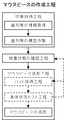
- FIG. 1 is a flowchart illustrating an example of a process of manufacturing a mouthpiece according to the present invention.
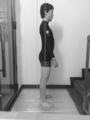
- FIG. 2 is a diagram showing a state in which the subject is standing or standing still on a horizontal plane in the step of checking the cover state.
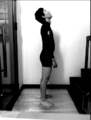
- FIG. 3 is a diagram showing a state in which the subject has warped his head and upper body backward with respect to the vertical axis with respect to the horizontal plane in the step of checking the cover state.
- FIG. 4 shows the posture of FIG. 3 after the step of maintaining the posture of FIG. 3 and the relaxed state without the upper and lower teeth in contact with the posture of FIG.
- FIG. 3 is a diagram showing a state in which the line of sight is lowered from a horizontal plane while returning the head position to the head position in FIG.
- FIG. 5 is a view showing a state in which the cutting tool covers the dentition to be obtained in a bucco-lingual manner (left side in FIG. 5) and a state in which the tooth row is not covered (right side in FIG. 5).
- FIG. 6 is a diagram showing that the lingual end of the molar of the mouthpiece is shaped like a pigeon tail of a chicken.
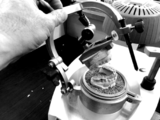
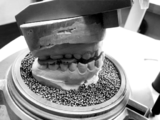
- FIG. 7 is a diagram showing a molding device used in a mouthpiece molding process and a dental model installed in the molding device.
- FIG. 8 shows, in the mouthpiece molding step, a step of using the cutting tool material obtained in the cutting tool acquisition step to store the position information of the resting position of the covered state confirmed in the step of confirming the covered state in the molding device.
- the step of producing a mouthpiece in the present invention includes (i) an impression taking step, (ii) a step of checking a covered state, and (iii) a mouthpiece forming step (FIG. 1).
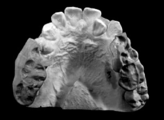
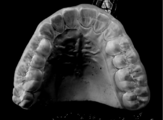
- the (i) impression acquisition step in the present invention includes the step of acquiring information on the dentition of the subject's upper or lower jaw (dentition and perioral tissue), and the dentition based on the acquired dentition and the like. And a step of producing a model. Any method may be used as a method for acquiring information such as the dentition, for example, a method of acquiring a dentition using an impression material and a tray, and a method of scanning the inside of the oral cavity to obtain information on the dentition. There is a method of acquiring digital data. In this step, it is desirable to obtain information on the dentition and the like up to the cheek cheek transition.
- the process of producing a model of the dentition and the like based on the acquired information of the dentition and the like may be performed by using any M method.
- a plaster could be poured into the tooth impression to create a model, and digital data of information such as dentition was acquired by scanning the oral cavity and the like.
- a model can be manufactured using a 3D printer or a milling machine.
- the step of checking the state of the lid is as follows: (1) a step in which the subject stands still or standing on a horizontal plane (FIG. 2); (3) a step of relaxing the head backward 30 to 60 °, preferably 45 to 50 ° backward with respect to the vertical axis with respect to the horizontal plane (FIG. 3.
- the upper body may be slightly bent backward with the backward bending.
- the subject relaxes while the upper and lower jaw teeth are not in contact with each other while maintaining the posture of step (3).
- the subject returns the head position to the same head position as in the step (2) after the step (4) while maintaining the posture of the step (3) after the step (4).
- the eyes While lowering the line of sight from the horizontal plane by about 5 ° to 15 ° (Fig. 4 In this process, the eyes may be lowered after returning the head, or the head may be returned after the eyes are lowered, or the eyes may be lowered while lowering the head.
- the posture in this state with the head and eyes lowered is referred to as “resting position”, and the position of the chin in the resting position is referred to as “neutral position.”), And (6) the upper and lower jaws in the resting position of the subject
- the method includes a step of confirming a state of covering of the front teeth (anteria coupling). Note that the state of covering the front teeth confirmed here is the state of covering the front teeth when the position of the jaw is in the neutral position.
- step (1) of the step (ii) of checking the state of the cover in the present invention when standing, it is desirable to open the foot to the width of the shoulder and stand on a horizontal plane.
- the angle of the knee of the subject is set to approximately 90 ° on a chair placed on a horizontal surface, and all the soles are attached, and the seat is shallow and the waist is shallow. It is desirable to apply.
- the upper and lower jaw dental models obtained in the impression taking step are set to the position of the covered state confirmed in the (ii) covered state confirmation step.
- This is the step of molding the mouthpiece.
- this is a step of producing a mouthpiece with a jaw in a neutral position.
- the mouthpiece may be formed using any method.
- a model such as a tooth row obtained in the impression obtaining step can be installed, and the model is (ii) covered.
- the model of the tooth row etc. obtained in the impression taking process is used for the mouthpiece material.
- thermoplastic resin such as ethylene vinyl acetate, polyolefin, etc.
- the mouthpiece to be molded may cover the entire dentition, or may cover a part of the dentition (for example, only the molars).
- the lower surface or the upper surface of the mouthpiece is replaced with a tooth row to which the mouthpiece is attached. It is desirable to make the shape corresponding to the meshing with the tooth row that is paired with the gear.
- a method such as excavation or pressing a model of a tooth row facing a mouthpiece in a heat-softened state to leave an indentation can be appropriately selected.
- press the dental model in the covered state in the resting position and make an indentation see FIG. 8).
- the jaw of the mouthpiece wearer can easily fit in the resting position (neutral position).
- the cutting tool material obtained in the cutting tool obtaining step may be used.
- the bite obtaining step referred to herein means a step of obtaining a bite of the subject in the resting state of the covered state confirmed in (ii) the covered state confirming step. For example, (ii) after the step (6) in the step of checking the cover state, the subject was asked to open the mouth, a bite was placed in the mouth, and then closed and returned to the resting state of the resting state, and relaxed. By waiting the hardening of the cutting tool in the state, the cutting tool can be obtained.
- the tongue base falls down to the pharyngeal side by contacting the tongue with the anterior jig, and eventually the posture is collapsed, tension is generated, and the covered state of the resting position is affected. It is advisable to avoid the use of anterior jigs in order to prevent them from being lost.
- the bite is mainly acquired for the molar part, but may be the canine tooth or the entire dentition. Further, it is desirable that the bite material covers the dentition to be acquired in a near-mesio-lingual manner (see the left side of FIG. 5).
- the dentition to be acquired may be the entire dentition or a part of the dentition (for example, only the molars).
- the target dentition is the dentition (Particularly, the posterior row).
- the bite part of the molar part is put into position.
- the anterior tooth bite may be obtained.
- the bite obtaining step in the present invention may include a step of having the subject wear the bite after the bite is hardened, and confirming whether or not the jaw position is shifted. In this process, the opposing teeth contact each other when clenching because the subject does not feel discomfort left and right or back and forth, does not feel that the bite material is too high (too thick), or that the bite material is too low (too thin). Check if it is done.
- the mouthpiece molding step of the present invention may include a physical condition test step (see FIG. 1).
- a physical condition test step see FIG. 1.
- the physical condition test process the subject tested the flexibility test by bending forward and rotating, the balance test with one leg standing, the center of gravity track, and The difference between when the cutting tool is mounted and when it is not mounted is measured by performing a test, a center of gravity sway displacement test, and the like.
- the subject wears the bite bite so that the bite is attached rather than bitten. However, clenching or clenching may occur naturally when performing a heavy exercise.
- the physical condition test step when no significant difference is observed between the wearing and the non-wearing of the cutting tool, (ii) it is desirable to start over from the step of checking the covered state or the step of obtaining the cutting tool.
- the physical condition test step may be performed using a hardened cutting tool, or may be performed by performing a similar test using a molded mouthpiece.
- the mouthpiece according to the present invention is characterized in that the mouthpiece worn by the mouthpiece wearer at the time of wearing the mouthpiece has a neutral position.
- the lingual side shape of the mouthpiece manufactured according to the present invention takes into consideration the tongue position at the time of occlusion. Further, it is desirable that the mouthpiece has a shape that does not contact the back of the mouth or the pharynx. Specifically, it is desirable to have a shape and thickness that do not unnecessarily contact the tongue, and it is desirable that the lingual end of the molar is in a dovetail shape (see the left side of FIG. 6).
- Example 1 Impression Taking Step The molds of the upper and lower dentitions (including the cheek-to-cheek transition part) of the subject were obtained using an impression material and a tray, respectively. After that, a commercially available plaster is poured into the acquired tooth impression to create a model
- Step of Checking Covered State The subject, who was barefoot, was allowed to stand on a horizontal surface with his / her feet wide about the width of the shoulder and kept still, and the subject's upper and lower jaw teeth were not in contact. Thereafter, the subject was warped backward by about 45 ° with respect to the vertical axis with respect to the horizontal plane while maintaining that state, and while maintaining that posture, the upper jaw and lower jaw were weakened without contact with each other. I let it. Further, the subject was kept in that state for 25 seconds, after which the head position was returned to the vertical position, and the line of sight was lowered by about 10 ° from the horizontal plane (resting position). While maintaining the resting position, the subject confirmed the state of covering of the upper teeth (anterior coupling) of the upper and lower jaws.
- Mouthpiece forming step 2 After the step, the subject is opened while maintaining the resting position, a bite material (FP bite, manufactured by Feed Co., Ltd.) is put in the mouth, and the resting position confirmed in the step 2) The upper and lower jaws were closed so that the anterior teeth were covered (Anteria coupling), and the cutting of the bite material was awaited. The bite of the maxillary dentition was obtained. The bites were collected on the upper and lower jaw molars and canines, and the bite was collected so that the bite covered the dentition buccally and mesio-centrifugally.
- FP bite manufactured by Feed Co., Ltd.
- a flexibility test to measure flexibility in forward bending and rotation and a balance test in a standing state were performed for each of the subjects with and without the mouthpiece, with both the flexibility test and the balance test. , The performance with the mouthpiece attached was higher.
- Example 2 Preparation of Mouthpieces Mouthpieces for runners 1 and 2 as test subjects were prepared in the same manner as in Example 1 1) Impression obtaining step, 2) Cover state checking step, and 3) Mouthpiece molding After the process, each was created.
- Example 2 Running test The runners 1 and 2 wearing the mouthpiece of Example 2 were allowed to stand still at a starting position in a standing state at the starting point. Next, the runner 1 and the runner 2 were allowed to run about 30 m with full power together with a start signal, and travel data of a section (referred to as “target section”) between 20 m from the start point was obtained. In addition, the runner was equipped with a GPS measurement device (OptEye S5 manufactured by Catapult), and the running data was acquired. Here, the average speed (m / min) in the target section and the maximum speed (m / sec) in the target section were acquired as the traveling data.
- a GPS measurement device OEM manufactured by Catapult
- Example 2 The running data obtained in Example 2 and Comparative Example 1 were as shown in Table 1.
- the average speed is improved by 18.6 (m / min) when the mouthpiece is worn (Example 2) compared to when it is not worn (Comparative Example 1), and the maximum speed is 0.2 (m / sec). ) Improved.
- the average speed was improved by 17.7 (m / min) and the maximum speed was 0.3 (m) when the mouthpiece was worn (Example 2) compared to when it was not worn (Comparative Example 1). / Sec) improved.
Landscapes
- Health & Medical Sciences (AREA)
- General Health & Medical Sciences (AREA)
- Physical Education & Sports Medicine (AREA)
- Dental Tools And Instruments Or Auxiliary Dental Instruments (AREA)
Applications Claiming Priority (2)
| Application Number | Priority Date | Filing Date | Title |
|---|---|---|---|
| JP2018124069 | 2018-06-29 | ||
| JP2018-124069 | 2018-06-29 |
Publications (1)
| Publication Number | Publication Date |
|---|---|
| WO2020013018A1 true WO2020013018A1 (ja) | 2020-01-16 |
Family
ID=69142506
Family Applications (1)
| Application Number | Title | Priority Date | Filing Date |
|---|---|---|---|
| PCT/JP2019/026197 Ceased WO2020013018A1 (ja) | 2018-06-29 | 2019-07-01 | マウスピース及びその製造方法 |
Country Status (2)
| Country | Link |
|---|---|
| JP (1) | JP6834096B6 (enExample) |
| WO (1) | WO2020013018A1 (enExample) |
Families Citing this family (1)
| Publication number | Priority date | Publication date | Assignee | Title |
|---|---|---|---|---|
| JP7072920B1 (ja) * | 2020-11-30 | 2022-05-23 | 株式会社ホワイトライン | マウスガードの製造方法 |
Citations (3)
| Publication number | Priority date | Publication date | Assignee | Title |
|---|---|---|---|---|
| JP2005000385A (ja) * | 2003-06-11 | 2005-01-06 | Molten Corp | マウスピース用成形材およびそれからなるマウスピース |
| US20110209714A1 (en) * | 2009-08-28 | 2011-09-01 | Makkar Athletics Group Inc. | Methods of preparing customized mouthpieces for enhancing athletic performance |
| JP6472101B1 (ja) * | 2017-11-01 | 2019-02-20 | 俊郎 蟹江 | マウスガードの製造方法 |
-
2019
- 2019-07-01 WO PCT/JP2019/026197 patent/WO2020013018A1/ja not_active Ceased
- 2019-07-01 JP JP2019123252A patent/JP6834096B6/ja active Active
Patent Citations (3)
| Publication number | Priority date | Publication date | Assignee | Title |
|---|---|---|---|---|
| JP2005000385A (ja) * | 2003-06-11 | 2005-01-06 | Molten Corp | マウスピース用成形材およびそれからなるマウスピース |
| US20110209714A1 (en) * | 2009-08-28 | 2011-09-01 | Makkar Athletics Group Inc. | Methods of preparing customized mouthpieces for enhancing athletic performance |
| JP6472101B1 (ja) * | 2017-11-01 | 2019-02-20 | 俊郎 蟹江 | マウスガードの製造方法 |
Non-Patent Citations (1)
| Title |
|---|
| ATSUMI, YOJIRO: "Relationship between Bite Raising Measurements of Mouthguards and Sports Performance of Athletes", JOURNAL OF SPORTS DENTISTRY, vol. 8, no. 1, March 2005 (2005-03-01), pages 50 - 56 * |
Also Published As
| Publication number | Publication date |
|---|---|
| JP6834096B6 (ja) | 2021-05-26 |
| JP6834096B2 (ja) | 2021-02-24 |
| JP2020006169A (ja) | 2020-01-16 |
Similar Documents
| Publication | Publication Date | Title |
|---|---|---|
| US4848365A (en) | Method of in-situ custom fitting a protective mouthguard | |
| JP6502529B2 (ja) | 高さ調節型スプリント及びその作製方法 | |
| EP2088974B1 (en) | Mandibular advancement device | |
| US6257239B1 (en) | Dental appliance with anti-microbial additive | |
| US6626180B1 (en) | Quadruple composite performance enhancing dental appliance | |
| US6237601B1 (en) | Cross-cantilever connectors for a dental appliance | |
| US6415794B1 (en) | Composite dental appliance with wedge | |
| US7918228B2 (en) | Musculoskeletal repositioning device | |
| US20160157962A1 (en) | Dental appliance detachably attached to the teeth, and fabricating method therefor | |
| KR101497493B1 (ko) | 치아에 피착되는 가철식 덴탈기구 및 그 제조방법 | |
| US20080178892A1 (en) | Method and system for swallow control resulting in improved posture | |
| JP4489503B2 (ja) | マウスガード | |
| US20130213412A1 (en) | Mouthpiece for Athletic Performance Enhancement | |
| CN105246437A (zh) | 用于防止及治疗打鼾和阻塞性睡眠呼吸暂停的增量可调式下颌前移装置 | |
| US8061358B2 (en) | Birthing aid: method of using musculoskeletal repositioning device | |
| KR101509231B1 (ko) | 치아 교합관계 채득 도구 및 이를 위한 바이트 프레임 | |
| US10085821B2 (en) | Guard for mouth | |
| JP6834096B2 (ja) | マウスピースの製造方法 | |
| Chapman | The bimaxillary mouthguard: a preliminary report of use in contact sports | |
| CN114073844A (zh) | 包覆上颚齿的口腔内吞咽辅具及其制造方法 | |
| JP6472101B1 (ja) | マウスガードの製造方法 | |
| JP7453124B2 (ja) | マウスガード | |
| RU153858U1 (ru) | Каппа для лечения парафункции жевательных мышц | |
| CN206508393U (zh) | 一种简易电激止鼾装置 | |
| JP2005118513A (ja) | 湯熱で対合歯の圧痕がつかなく、フィット感の良い熱湯軟化式歯列適合マウスピース。 |
Legal Events
| Date | Code | Title | Description |
|---|---|---|---|
| 121 | Ep: the epo has been informed by wipo that ep was designated in this application |
Ref document number: 19834966 Country of ref document: EP Kind code of ref document: A1 |
|
| NENP | Non-entry into the national phase |
Ref country code: DE |
|
| 32PN | Ep: public notification in the ep bulletin as address of the adressee cannot be established |
Free format text: NOTING OF LOSS OF RIGHTS PURSUANT TO RULE 112(1) EPC (EPO FORM 1205A DATED 14-04-2021) |
|
| NENP | Non-entry into the national phase |
Ref country code: JP |
|
| 122 | Ep: pct application non-entry in european phase |
Ref document number: 19834966 Country of ref document: EP Kind code of ref document: A1 |