WO2020008965A1 - 基板処理膜形成用組成物及び基板の処理方法 - Google Patents
基板処理膜形成用組成物及び基板の処理方法 Download PDFInfo
- Publication number
- WO2020008965A1 WO2020008965A1 PCT/JP2019/025256 JP2019025256W WO2020008965A1 WO 2020008965 A1 WO2020008965 A1 WO 2020008965A1 JP 2019025256 W JP2019025256 W JP 2019025256W WO 2020008965 A1 WO2020008965 A1 WO 2020008965A1
- Authority
- WO
- WIPO (PCT)
- Prior art keywords
- substrate
- substrate processing
- processing film
- forming
- composition
- Prior art date
- Legal status (The legal status is an assumption and is not a legal conclusion. Google has not performed a legal analysis and makes no representation as to the accuracy of the status listed.)
- Ceased
Links
Images


Classifications
-
- H—ELECTRICITY
- H10—SEMICONDUCTOR DEVICES; ELECTRIC SOLID-STATE DEVICES NOT OTHERWISE PROVIDED FOR
- H10P—GENERIC PROCESSES OR APPARATUS FOR THE MANUFACTURE OR TREATMENT OF DEVICES COVERED BY CLASS H10
- H10P70/00—Cleaning of wafers, substrates or parts of devices
- H10P70/10—Cleaning before device manufacture, i.e. Begin-Of-Line process
-
- C—CHEMISTRY; METALLURGY
- C08—ORGANIC MACROMOLECULAR COMPOUNDS; THEIR PREPARATION OR CHEMICAL WORKING-UP; COMPOSITIONS BASED THEREON
- C08K—Use of inorganic or non-macromolecular organic substances as compounding ingredients
- C08K5/00—Use of organic ingredients
- C08K5/04—Oxygen-containing compounds
- C08K5/09—Carboxylic acids; Metal salts thereof; Anhydrides thereof
- C08K5/092—Polycarboxylic acids
-
- C—CHEMISTRY; METALLURGY
- C09—DYES; PAINTS; POLISHES; NATURAL RESINS; ADHESIVES; COMPOSITIONS NOT OTHERWISE PROVIDED FOR; APPLICATIONS OF MATERIALS NOT OTHERWISE PROVIDED FOR
- C09D—COATING COMPOSITIONS, e.g. PAINTS, VARNISHES OR LACQUERS; FILLING PASTES; CHEMICAL PAINT OR INK REMOVERS; INKS; CORRECTING FLUIDS; WOODSTAINS; PASTES OR SOLIDS FOR COLOURING OR PRINTING; USE OF MATERIALS THEREFOR
- C09D5/00—Coating compositions, e.g. paints, varnishes or lacquers, characterised by their physical nature or the effects produced; Filling pastes
- C09D5/008—Temporary coatings
-
- B—PERFORMING OPERATIONS; TRANSPORTING
- B08—CLEANING
- B08B—CLEANING IN GENERAL; PREVENTION OF FOULING IN GENERAL
- B08B7/00—Cleaning by methods not provided for in a single other subclass or a single group in this subclass
- B08B7/0014—Cleaning by methods not provided for in a single other subclass or a single group in this subclass by incorporation in a layer which is removed with the contaminants
-
- C—CHEMISTRY; METALLURGY
- C08—ORGANIC MACROMOLECULAR COMPOUNDS; THEIR PREPARATION OR CHEMICAL WORKING-UP; COMPOSITIONS BASED THEREON
- C08G—MACROMOLECULAR COMPOUNDS OBTAINED OTHERWISE THAN BY REACTIONS ONLY INVOLVING UNSATURATED CARBON-TO-CARBON BONDS
- C08G61/00—Macromolecular compounds obtained by reactions forming a carbon-to-carbon link in the main chain of the macromolecule
- C08G61/02—Macromolecular compounds containing only carbon atoms in the main chain of the macromolecule, e.g. polyxylylenes
- C08G61/04—Macromolecular compounds containing only carbon atoms in the main chain of the macromolecule, e.g. polyxylylenes only aliphatic carbon atoms
-
- C—CHEMISTRY; METALLURGY
- C08—ORGANIC MACROMOLECULAR COMPOUNDS; THEIR PREPARATION OR CHEMICAL WORKING-UP; COMPOSITIONS BASED THEREON
- C08G—MACROMOLECULAR COMPOUNDS OBTAINED OTHERWISE THAN BY REACTIONS ONLY INVOLVING UNSATURATED CARBON-TO-CARBON BONDS
- C08G61/00—Macromolecular compounds obtained by reactions forming a carbon-to-carbon link in the main chain of the macromolecule
- C08G61/02—Macromolecular compounds containing only carbon atoms in the main chain of the macromolecule, e.g. polyxylylenes
- C08G61/10—Macromolecular compounds containing only carbon atoms in the main chain of the macromolecule, e.g. polyxylylenes only aromatic carbon atoms, e.g. polyphenylenes
-
- C—CHEMISTRY; METALLURGY
- C08—ORGANIC MACROMOLECULAR COMPOUNDS; THEIR PREPARATION OR CHEMICAL WORKING-UP; COMPOSITIONS BASED THEREON
- C08L—COMPOSITIONS OF MACROMOLECULAR COMPOUNDS
- C08L61/00—Compositions of condensation polymers of aldehydes or ketones; Compositions of derivatives of such polymers
- C08L61/04—Condensation polymers of aldehydes or ketones with phenols only
- C08L61/06—Condensation polymers of aldehydes or ketones with phenols only of aldehydes with phenols
-
- H—ELECTRICITY
- H10—SEMICONDUCTOR DEVICES; ELECTRIC SOLID-STATE DEVICES NOT OTHERWISE PROVIDED FOR
- H10P—GENERIC PROCESSES OR APPARATUS FOR THE MANUFACTURE OR TREATMENT OF DEVICES COVERED BY CLASS H10
- H10P70/00—Cleaning of wafers, substrates or parts of devices
- H10P70/20—Cleaning during device manufacture
-
- C—CHEMISTRY; METALLURGY
- C08—ORGANIC MACROMOLECULAR COMPOUNDS; THEIR PREPARATION OR CHEMICAL WORKING-UP; COMPOSITIONS BASED THEREON
- C08G—MACROMOLECULAR COMPOUNDS OBTAINED OTHERWISE THAN BY REACTIONS ONLY INVOLVING UNSATURATED CARBON-TO-CARBON BONDS
- C08G8/00—Condensation polymers of aldehydes or ketones with phenols only
- C08G8/04—Condensation polymers of aldehydes or ketones with phenols only of aldehydes
- C08G8/08—Condensation polymers of aldehydes or ketones with phenols only of aldehydes of formaldehyde, e.g. of formaldehyde formed in situ
Definitions
- the present invention relates to a composition for forming a substrate processing film and a method for processing a substrate.
- Japanese Patent Application Laid-Open No. 7-74137 discloses a method in which a coating liquid is supplied to a substrate surface to form a thin film, and the thin film is peeled off with an adhesive tape or the like to remove particles on the substrate surface. . According to this method, minute particles and particles between patterns can be removed at a high removal rate while reducing the influence on the semiconductor substrate.
- Japanese Patent Application Laid-Open No. 2014-95983 discloses that a processing liquid for forming a film on a substrate surface is supplied, solidified or hardened, and then all of the solidified or hardened processing liquid is dissolved by a removing liquid.
- a substrate cleaning apparatus and a substrate cleaning method for removing particles are disclosed.
- Japanese Patent Application Laid-Open No. 7-74137 it is necessary to physically peel the thin film from the substrate surface, which makes the process complicated and difficult to remove when a part of the thin film remains in the pattern. There is a problem that there is.
- Japanese Patent Application Laid-Open No. 2014-95983 describes a topcoat liquid as a non-limiting example of a processing liquid in the detailed description of the invention. There is no description.
- the present invention has been made based on the above circumstances. That is, in the present invention, in the process of forming a substrate processing film on the surface of a semiconductor substrate and removing foreign substances on the substrate surface, minute particles on the substrate surface can be efficiently removed, and the formed substrate processing film is removed from the substrate surface. It is an object of the present invention to provide a composition for forming a substrate processing film and a method for processing a substrate that can be easily removed from the substrate.
- the invention made in order to solve the above problems is a step of applying a composition for forming a substrate treatment film to a substrate, and a step of contacting a substrate treatment film removal liquid with the substrate treatment film formed by the application step.
- a composition for forming a substrate processing film used in a method of processing a substrate comprising: a resin; and a solvent, wherein the solvent includes a first solvent component having a standard boiling point of 175 ° C. or higher; The content of the first solvent component is 1 part by mass or more based on 100 parts by mass.
- composition for forming a substrate treatment film contains a resin and a solvent, wherein the solvent contains a first solvent component having a standard boiling point of 175 ° C or higher, A method for treating a substrate wherein the content of the first solvent component is 1 part by mass or more based on 100 parts by mass of the resin.
- the composition for forming a substrate processing film and the method for processing a substrate of the present invention in a process of forming a substrate processing film on a semiconductor substrate surface and removing foreign substances on the substrate surface, fine particles on the substrate surface are efficiently removed. It can be removed, and the formed substrate processing film can be easily removed from the substrate surface. Therefore, the present invention can be suitably used in a manufacturing process of a semiconductor device in which miniaturization and a higher aspect ratio are expected to progress more and more in the future.
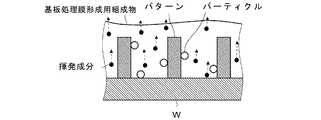
- FIG. 3 is an explanatory view showing formation of a substrate processing film in the substrate processing method of the present invention.
- FIG. 4 is an explanatory view showing a substrate processing film removing liquid contacting step in the substrate processing method of the present invention.
- the composition for forming a substrate processing film includes a step of applying the composition for forming a substrate processing film to a substrate, and a step of bringing a substrate processing film-removing solution into contact with the substrate processing film formed by the coating step.
- used for substrate processing methods The composition for forming a substrate processing film contains a resin (hereinafter, also referred to as “[A] resin”) and a solvent (hereinafter, also referred to as “[B] solvent”). It contains a first solvent component having a standard boiling point of 175 ° C. or higher (hereinafter, also referred to as “(B1) solvent component”), and the content of the (B1) solvent component is 1 part by mass based on 100 parts by mass of the resin [A]. That is all.
- the substrate processing film is formed on the surface of the semiconductor substrate, and by removing the substrate processing film, the substrate processing film adheres to the surface of the semiconductor substrate, particularly, the semiconductor substrate on which the pattern is formed. Particles and the like can be efficiently removed (hereinafter, also referred to as “particle removal properties”), and the formed substrate processing film can be easily removed from the substrate surface (hereinafter, also referred to as “film removal properties”). it can.
- composition for forming a substrate processing film may contain, as a suitable component, an organic acid that is not a polymer (hereinafter, also referred to as “[C] organic acid”) in addition to the resin [A] and the solvent [B]. Further, other optional components may be contained as long as the effects of the present invention are not impaired. Hereinafter, each component will be described.
- resin means a polymer.
- Polymer refers to a compound having two or more structural units.
- the resin may be a polymer, and is not particularly limited.
- the lower limit of the molecular weight of the resin is preferably 300, and more preferably 500.
- Examples of the resin include a novolak resin, a resol resin, an aromatic ring-containing vinyl resin, an acrylic resin, and a calixarene resin.
- the resin can be used alone or in combination of two or more.
- the novolak resin is a chain polymer obtained by reacting a compound having an aromatic ring with an aldehyde compound using an acidic catalyst.
- Examples of the compound having an aromatic ring include a substituted or unsubstituted aromatic hydrocarbon having 6 to 20 carbon atoms.
- Examples of the substituted or unsubstituted aromatic hydrocarbon having 6 to 20 carbon atoms include benzene, toluene, xylene, phenol, 3-methylphenol, 4-methylphenol, pyrogallol, cresol, naphthalene, ⁇ -naphthol, ⁇ -naphthol 1,5-dihydroxynaphthalene, 2,7-dihydroxynaphthalene, anthracene, phenanthrene, tetracene, pyrene, 1-hydroxypyrene, triphenylene, fluorene, 9,9-bis (4-hydroxyphenyl) fluorene, 9,9-bis (6-Hydroxynaphthyl) fluorene, indenofluorene, tolcene and the like can be mentioned.
- aldehyde compound examples include aldehydes such as formaldehyde, acetaldehyde, propionaldehyde, benzaldehyde, and parahydroxybenzaldehyde. Of these, formaldehyde is preferred. Note that paraformaldehyde may be used instead of formaldehyde, and paraaldehyde may be used instead of acetaldehyde.
- the novolak resin preferably has a structural unit represented by the following formula (1) (hereinafter, also referred to as “structural unit (I)”).
- the structural unit (I) is a structural unit represented by the following formula (1).
- Ar 1 is a (m + 2) -valent group obtained by removing (m + 2) hydrogen atoms on an aromatic ring from an arene having 6 to 20 carbon atoms.
- R 1 is a substituted or unsubstituted alkylene group having 1 to 20 carbon atoms.
- X is a monovalent hetero atom-containing group or a monovalent organic group.
- m is an integer of 0 to 10. When m is 2 or more, a plurality of Xs are the same or different from each other.
- Examples of arenes having 6 to 20 carbon atoms that provide Ar 1 include benzene, naphthalene, anthracene, phenanthrene, tetracene, pyrene, triphenylene, fluorene, and tolcene. Of these, benzene or naphthalene is preferred, and benzene is more preferred.
- Examples of the monovalent hetero atom-containing group represented by X include a hydroxy group and a halogen atom.
- Examples of the halogen atom include a fluorine atom, a chlorine atom, a bromine atom, an iodine atom and the like.
- As the monovalent hetero atom-containing group for X a hydroxy group is preferable.
- Organic group refers to a group containing at least one carbon atom.
- Examples of the monovalent organic group represented by X include a monovalent hydrocarbon group having 1 to 20 carbon atoms, a group containing a divalent hetero atom-containing group between carbon and carbon of the hydrocarbon group, Examples thereof include groups in which part or all of the hydrogen atoms of the hydrogen group or the group containing the divalent hetero atom-containing group are substituted with a monovalent hetero atom-containing group.
- Examples of the monovalent hydrocarbon group having 1 to 20 carbon atoms include a monovalent linear hydrocarbon group having 1 to 20 carbon atoms, a monovalent alicyclic hydrocarbon group having 3 to 20 carbon atoms, and a carbon number having 1 to 20 carbon atoms. And 6-20 monovalent aromatic hydrocarbon groups.
- Examples of the monovalent chain hydrocarbon group having 1 to 20 carbon atoms include alkanes such as methane, ethane, propane and butane; alkenes such as ethene, propene and butene; and alkynes such as ethyne, propyne and butyne. And a group from which hydrogen atoms have been removed.
- Examples of the monovalent alicyclic hydrocarbon group having 3 to 20 carbon atoms include alicyclic saturated hydrocarbon such as cycloalkane such as cyclopentane and cyclohexane, bridged cyclic saturated hydrocarbon such as norbornane, adamantane and tricyclodecane.
- Examples thereof include groups in which one hydrogen atom in hydrogen, cycloalkene such as cyclopentene and cyclohexene, alicyclic unsaturated hydrocarbons such as bridged unsaturated hydrocarbons such as norbornene and tricyclodecene, and the like is removed, and the like.
- Examples of the monovalent aromatic hydrocarbon group having 6 to 20 carbon atoms include a hydrogen atom or an alkyl group on an aromatic ring of an arene such as benzene, toluene, ethylbenzene, xylene, naphthalene, methylnaphthalene, anthracene, and methylanthracene. And the like from which a hydrogen atom has been removed.
- the hetero atom constituting the divalent or monovalent hetero atom-containing group includes, for example, an oxygen atom, a nitrogen atom, a sulfur atom, a phosphorus atom, a silicon atom, a halogen atom and the like.
- divalent hetero atom-containing group examples include -O-, -CO-, -S-, -CS-, -NR'-, and a group obtained by combining two or more of these.
- R ' is a hydrogen atom or a monovalent hydrocarbon group. Of these, -O- and -S- are preferred.
- Examples of the monovalent hetero atom-containing group include a halogen atom such as a fluorine atom, a chlorine atom, a bromine atom and an iodine atom, a hydroxy group, a carboxy group, a cyano group, an amino group and a sulfanyl group.
- a halogen atom such as a fluorine atom, a chlorine atom, a bromine atom and an iodine atom, a hydroxy group, a carboxy group, a cyano group, an amino group and a sulfanyl group.
- an alkyl group or an oxyhydrocarbon group is preferable, an alkyl group or an alkyloxy group is more preferable, and a methyl group, an ethyl group, a propyl group, a butyl group, a methoxy group, an ethoxy group, or a propoxy group. Is preferred.
- ⁇ m is preferably 1 to 3, more preferably 1 or 2, and still more preferably 1.
- m in the formula (1) is preferably an integer of 1 or more, and at least one of X is preferably a hydroxy group.
- Examples of the substituted or unsubstituted alkylene group having 1 to 20 carbon atoms represented by R 1 include a methylene group, a methylmethylene group, a phenylmethylene group, a parahydroxyphenylmethylene group and the like. Among these, a methylene group or a methylmethylene group is preferred, and a methylene group is more preferred.
- the acidic catalyst examples include inorganic acids such as hydrochloric acid, sulfuric acid and phosphoric acid; organic acids such as methanesulfonic acid, paratoluenesulfonic acid and oxalic acid; boron trifluoride, anhydrous aluminum chloride and Lewis acids such as zinc acetate. No. Of these, organic acids are preferred, and paratoluenesulfonic acid is more preferred.
- the resole resin is a polymer obtained by reacting a compound having an aromatic ring with an aldehyde compound using a basic catalyst.
- Examples of the compound having an aromatic ring and the aldehyde compound include the same compounds as the compound having an aromatic ring and the aldehyde compound in the above novolak resin.
- the basic catalyst examples include alkali metal or alkaline earth metal hydroxides such as sodium hydroxide, lithium hydroxide, potassium hydroxide, and calcium hydroxide, and amines such as ammonia, monoethanolamine, triethylamine, and hexamethylenetetramine.
- alkali metal or alkaline earth metal hydroxides such as sodium hydroxide, lithium hydroxide, potassium hydroxide, and calcium hydroxide
- amines such as ammonia, monoethanolamine, triethylamine, and hexamethylenetetramine.
- Compounds, basic substances such as sodium carbonate, and the like.
- the aromatic ring-containing vinyl resin is a polymer having a structural unit derived from a compound having an aromatic ring and a polymerizable carbon-carbon double bond.
- Examples of the compound having an aromatic ring and a polymerizable carbon-carbon double bond include styrene, methylstyrene, ⁇ -methylstyrene, vinylnaphthalene, and phenylvinylether.
- the acrylic resin is a polymer having a structural unit derived from (meth) acrylic acid or (meth) acrylate.
- the (meth) acrylate include an alkyl (meth) acrylate such as methyl (meth) acrylate, an alicyclic hydrocarbon group ester of (meth) acrylic acid such as cyclohexyl (meth) acrylate, and a (meth) acrylate.
- Aryl (meth) acrylates such as phenyl acrylate, 1,1,1,3,3,3-hexafluoro-2-propyl (meth) acrylate, 1,1,1-trifluoro- (meth) acrylate Examples thereof include (meth) acrylic acid fluorine-containing esters such as 2-hydroxy-2-trifluoromethyl-4-pentyl.
- the calixarene resin is a cyclic oligomer in which a plurality of aromatic rings to which a phenolic hydroxyl group is bonded are cyclically bonded via a hydrocarbon group.
- the compound giving an aromatic ring to which a phenolic hydroxyl group is bonded include phenol, methylphenol, t-butylphenol, naphthol and the like.
- the hydrocarbon group include a methylene group and a methylmethylene group.
- the lower limit of the weight average molecular weight (Mw) of the resin [A] is preferably 1,000, more preferably 2,000, still more preferably 3,000, and particularly preferably 5,000.
- the upper limit of Mw is preferably 100,000, more preferably 80,000, and even more preferably 60,000.
- Mw was measured using a GPC column (Two “G2000HXL”, one “G3000HXL” and one “G4000HXL”) manufactured by Tosoh Corporation, at a flow rate of 1.0 mL / min and an elution solvent of tetrahydrofuran.
- Column temperature A value measured by gel permeation chromatography (detector: differential refractometer) using monodisperse polystyrene as a standard under analysis conditions of 40 ° C.
- the lower limit of the content of the resin [A] in all components other than the solvent [B] of the composition for forming a substrate processing film is preferably 70% by mass, more preferably 80% by mass, and still more preferably 90% by mass. , 95% by mass is particularly preferred.
- the upper limit of the content is preferably 99.99% by mass, more preferably 99.9% by mass, and still more preferably 99.0% by mass.
- the solvent dissolves or disperses the [A] resin and optional components contained as necessary.
- the solvent contains a solvent component (B1) having a standard boiling point of 175 ° C. or higher.
- the solvent may further contain, in addition to the (B1) solvent component, a second solvent component having a standard boiling point of 170 ° C. or lower (hereinafter, also referred to as “(B2) solvent component”).
- the composition may further contain other solvent components other than the (B1) solvent component and the (B2) solvent component.
- Each of the above solvent components can be used alone or in combination of two or more.
- the composition for forming a substrate processing film contains a solvent [B] in addition to the resin [A], and the solvent [B] contains a solvent component (B1), and (B1) a solvent component [A] resin 100.
- the content is at least 1 part by mass with respect to parts by mass, excellent film removing properties and particle removing properties will be obtained.
- the composition for forming a substrate processing film contains a certain amount or more of the solvent component (B1) having a relatively high standard boiling point, the volatile component in the composition for forming a substrate processing film applied to the substrate is volatilized.
- the composition for forming a substrate processing film is thereby solidified or cured on the substrate to form a substrate processing film, it is considered that part or all of the solvent component (B1) remains in the substrate processing film.
- the residual (B1) solvent component promotes the incorporation of particles into the substrate processing film, thereby improving the particle removability and improving the film removability of the substrate processing film.
- the solvent component is a solvent having a standard boiling point of 175 ° C. or higher.
- the lower limit of the standard boiling point of the solvent component is preferably 180 ° C, more preferably 200 ° C, further preferably 215 ° C, and particularly preferably 230 ° C.
- B1 As a maximum of a standard boiling point of a solvent ingredient, 320 ° C is preferred, 300 ° C is more preferred, 290 ° C is still more preferred, and 280 ° C is especially preferred.
- B1 By setting the standard boiling point of the solvent component in the above range, the coatability of the composition for forming a substrate processing film can be further improved.
- the upper limit of ClogP of the solvent component is preferably 0.6, more preferably 0.3, further preferably 0.0, and particularly preferably -0.25.
- the lower limit of ClogP is preferably -2, more preferably -1.6, still more preferably -1.3, and particularly preferably -1.0.
- ClogP of the solvent component is also referred to as “ClogPow” and is a value of the octanol / water partition coefficient (logP) calculated by the ClogP method. The larger the value, the higher the hydrophobicity (lipid solubility). I do.
- the value of ClogP of the solvent component was calculated based on the structural formula of the solvent using “ChemBioDraw ⁇ Ultra ⁇ 12.0.2.1076” manufactured by CambridgeSoft.
- Alcohols refers to solvents having at least one hydroxy group.
- (B1) As the solvent component, for example, as alcohols, ethers and esters, the following compounds (“(temperature) (° C.)” in () indicates the value of the standard boiling point, and “numerical value” indicates the value of ClogP. Shown).
- alcohols for example, monoalcohols such as benzyl alcohol (205 ° C., 1.10) and phenylpropanol (236 ° C., 1.71); Ethylene glycol (197 ° C, 1.37), 1,4-butanediol (230 ° C, 1.16), 1,3-butanediol (203 ° C, -0.73), 1,5-pentanediol (240 ° C, -0.64), 2,5-hexanediol (221 ° C, -0.55), 1,2-butanediol (193 ° C, -0.53), 2,2-dimethyl-1,3- Propanediol (210 ° C, -0.24), 2-methyl-2,4-pentanediol (197 ° C, -0.02), 2,5-dimethyl-2,5-hexanediol (214 ° C, 0.2%) 25), tetraethylene glycol (314
- ether solvents include diethylene glycol methyl ethyl ether (176 ° C., 0.21), diethylene glycol diethyl ether (188 ° C., 0.60), tetraethylene glycol dimethyl ether (275 ° C., ⁇ 0.45), triethylene glycol dimethyl ether ( 216 ° C, -0.32), diethylene glycol isopropyl methyl ether (179 ° C, 0.52), triethylene glycol butyl methyl ether (261 ° C, 1.13), diethylene glycol butyl methyl ether (212 ° C, 1.27), etc. And all ethers of polyhydric alcohols.
- esters for example, polyhydric alcohol partial ether carboxylates such as diethylene glycol monoethyl ether acetate (219 ° C., 0.54) and dipropylene glycol monomethyl ether acetate (209 ° C., 0.77); Polyhydric alcohol total carboxylate such as 1,3-butylene glycol diacetate (232 ° C., 1.13); And carbonates such as propylene carbonate (240 ° C., ⁇ 0.38).
- polyhydric alcohol partial ether carboxylates such as diethylene glycol monoethyl ether acetate (219 ° C., 0.54) and dipropylene glycol monomethyl ether acetate (209 ° C., 0.77
- Polyhydric alcohol total carboxylate such as 1,3-butylene glycol diacetate (232 ° C., 1.13)
- carbonates such as propylene carbonate (240 ° C., ⁇ 0.38).
- solvent component As the solvent component, alcohols are preferable, and a solvent having a plurality of hydroxy groups is more preferable. Further, as the solvent component (B1), a solvent having an ether bond is preferable. Examples of the solvent having a plurality of hydroxy groups and ether bonds include tetraethylene glycol, triethylene glycol, dipropylene glycol, and tripropylene glycol.
- the solvent component is a solvent having a standard boiling point of 170 ° C. or lower.
- the solvent component for example, propylene glycol monomethyl ether acetate (146 ° C.), ethyl lactate (151 ° C.), propylene glycol monomethyl ether (121 ° C.), propylene glycol monoethyl ether (133 ° C.), propylene glycol monopropyl ether (149 ° C.), 4-methyl-2-pentanol (132 ° C.), diethylene glycol dimethyl ether (162 ° C.) and the like (the value of “temperature (° C.)” in () indicates a standard boiling point).
- solvent components include, for example, dipropylene glycol dimethyl ether (171 ° C.).
- the lower limit of the content of the solvent component is 1 part by mass, preferably 5 parts by mass, more preferably 15 parts by mass, even more preferably 50 parts by mass, based on 100 parts by mass of the resin [A]. 150 parts by weight are particularly preferred.
- the upper limit of the content is preferably 1,000 parts by mass, more preferably 500 parts by mass.
- the lower limit of the content of the solvent component is preferably 0.01% by mass, more preferably 0.1% by mass, further preferably 0.5% by mass, and particularly preferably 1% by mass in the solvent [B]. Preferably, 3% by weight is more particularly preferred. As a maximum of the above-mentioned content rate, 50 mass% is preferred, 30 mass% is more preferred, and 20 mass% is still more preferred. (B1) By setting the content of the solvent component in the above range, the film removability and the particle removability can be further improved.
- the organic acid is an organic acid that is not a polymer.
- the addition of the organic acid facilitates the removal of the film formed on the substrate surface.
- the upper limit of the molecular weight of the organic acid is, for example, 500, preferably 400, and more preferably 300.
- the lower limit of the molecular weight of the organic acid is, for example, 50, and preferably 55.
- the organic acid can be used alone or in combination of two or more.
- the organic acid is preferably a carboxylic acid, and more specifically, for example, acetic acid, propionic acid, butanoic acid, pentanoic acid, hexanoic acid, cyclohexanecarboxylic acid, cyclohexylacetic acid, 1-adamantanecarboxylic acid, benzoic acid,
- a carboxylic acid consisting of an aliphatic saturated hydrocarbon group such as phenylacetic acid and / or an aromatic hydrocarbon group and a carboxy group, Fluorine atom-containing monocarboxylic acids such as difluoroacetic acid, trifluoroacetic acid, pentafluoropropanoic acid, heptafluorobutanoic acid, fluorophenylacetic acid, and difluorobenzoic acid; 10-hydroxydecanoic acid, 5-oxohexanoic acid, 3-methoxycyclohexanecarboxylic acid, camphorcarboxylic acid, dinitrobe
- the lower limit of the solubility of [C] organic acid in water at 25 ° C. is preferably 5% by mass, more preferably 7% by mass, and still more preferably 10% by mass.
- 50 mass% is preferred, 40 mass% is more preferred, and 30 mass% is still more preferred.
- the organic acid is preferably solid at 25 ° C.
- the [C] organic acid is solid at 25 ° C., it is considered that the solid [C] organic acid precipitates in a film formed from the composition for forming a substrate processing film, and the removability is further improved.
- a polycarboxylic acid is preferable from the viewpoint of easier removal of the film, and malonic acid, succinic acid, glutaric acid, adipic acid, dodecanedicarboxylic acid, propanetricarboxylic acid, butanetetracarboxylic acid, Hexafluoroglutaric acid, cyclohexanehexacarboxylic acid, 1,4-naphthalenedicarboxylic acid, phthalic acid, isophthalic acid, terephthalic acid, trimellitic acid, pyromellitic acid, citric acid, malic acid, aconitic acid and 1,2,3 4-Cyclobutanetetracarboxylic acid is more preferred.
- the lower limit of the content of the [C] organic acid is preferably 0.01 part by mass with respect to 100 parts by mass of the [A] resin. , 0.1 part by mass, more preferably 0.5 part by mass, particularly preferably 1 part by mass.
- the upper limit of the content is preferably 100 parts by mass, more preferably 50 parts by mass, further preferably 20 parts by mass, and particularly preferably 10 parts by mass.
- composition for forming a substrate processing film may contain other optional components such as a surfactant.
- other optional components such as a surfactant.
- the above-mentioned other optional components can be used alone or in combination of two or more.
- the composition for forming a substrate processing film can further improve coatability by further containing a surfactant.
- a surfactant include a nonionic surfactant, a cationic surfactant, and an anionic surfactant.
- nonionic surfactant examples include ether nonionic surfactants such as polyoxyethylene alkyl ether, ether ester nonionic surfactants such as polyoxyethylene ether of glycerin ester, polyethylene glycol fatty acid ester, glycerin ester, and sorbitan ester. And other ester-type nonionic surfactants.
- cationic surfactant examples include an aliphatic amine salt and an aliphatic ammonium salt.
- anionic surfactants include carboxylic acid salts such as fatty acid soaps and alkyl ether carboxylic acid salts, sulfonic acid salts such as alkyl benzene sulfonic acid salts, alkyl naphthalene sulfonic acid salts and ⁇ -olefin sulfonic acid salts; higher alcohol sulfates Salts, sulfates such as alkyl ether sulfates, and phosphates such as alkyl phosphates.
- carboxylic acid salts such as fatty acid soaps and alkyl ether carboxylic acid salts
- sulfonic acid salts such as alkyl benzene sulfonic acid salts, alkyl naphthalene sulfonic acid salts and ⁇ -olefin sulfonic acid salts
- higher alcohol sulfates Salts sulfates such as alkyl ether sulfates
- the upper limit of the content of the surfactant is, for example, 2 parts by mass with respect to 100 parts by mass of the resin [A].
- the lower limit of the content is, for example, 0.01 parts by mass.
- the composition for forming a substrate processing film is prepared by mixing arbitrary components such as [A] a resin, [B] a solvent, and [C] an organic acid if necessary at a predetermined ratio, and preferably obtains a mixed solution.
- the lower limit of the content of all components other than the solvent [B] in the composition for forming a substrate processing film is preferably 0.1% by mass, more preferably 0.5% by mass, still more preferably 1% by mass. % By weight is particularly preferred.
- the upper limit of the content of all components other than the solvent [B] is 20% by mass, preferably 15% by mass, more preferably 13% by mass, and particularly preferably 10% by mass. [B] By setting the content ratio of all components other than the solvent within the above range, coatability can be further improved.
- the method for treating a substrate includes a step of applying a composition for forming a substrate treatment film to the substrate, and a step of bringing a substrate treatment film removal liquid into contact with the substrate treatment film formed by the application step.
- the above-described composition for forming a substrate processing film is used as the composition for forming a substrate processing film.
- a substrate processing film (hereinafter, also referred to as “substrate processing film (B)”) is formed on the surface of the semiconductor substrate, and In the process of removing foreign matter on the surface, fine particles on the substrate surface can be efficiently removed, and the formed substrate processing film (B) can be easily removed from the substrate surface.
- a composition for forming a substrate processing film is applied to a substrate.
- the above-described composition for forming a substrate processing film is used as the composition for forming a substrate processing film.
- a substrate processing film is formed on the substrate.
- the substrate may be a substrate on which no pattern is formed or a substrate on which a pattern is formed.
- a metal or semimetal substrate such as a silicon substrate, an aluminum substrate, a nickel substrate, a chromium substrate, a molybdenum substrate, a tungsten substrate, a copper substrate, a tantalum substrate, a titanium substrate, a silicon nitride substrate, and an alumina substrate
- silicon dioxide substrates, tantalum nitride substrates, ceramic substrates such as titanium nitride, and the like can be used.
- a silicon substrate, a silicon nitride substrate or a titanium nitride substrate is preferable, and a silicon substrate is more preferable.
- the pattern of the substrate on which the pattern is formed for example, a line and space pattern or a trench pattern having a line width of a space portion of 2,000 nm or less, 1,000 nm or less, 500 nm or less, or even 50 nm or less, a diameter of 300 nm or less, A hole pattern of 150 nm or less, 100 nm or less, and even 50 nm or less can be given.
- the dimensions of the pattern formed on the substrate include, for example, a height of 100 nm or more, 200 nm or more, further 300 nm or more, a width of 50 nm or less, 40 nm or less, and even 30 nm or less, and an aspect ratio (pattern height / pattern width). ), A fine pattern of 3 or more, 5 or more, further 10 or more.
- a coating film formed by applying the composition for forming a substrate processing film to the substrate (hereinafter, also referred to as “coating film (A)”) has a It is preferable that the recess can be embedded.
- Examples of a method for applying the composition for forming a substrate processing film to a substrate include a spin coating method (spin coating), a flow coating method, and a roll coating method. Thereby, the coating film (A) of the composition for forming a substrate processing film is formed.
- a composition for forming a substrate processing film is applied on a wafer W as shown in FIG. 1A. Thereby, the coating film (A) of the composition for forming a substrate processing film is formed.
- the composition for forming a substrate processing film is formed on the substrate.
- the substrate processing film (B) is formed.
- Solidification means solidification
- curing means that molecules are linked to each other to increase the molecular weight (for example, to crosslink or polymerize).
- particles adhering to the pattern, the wafer W, etc. are taken into the substrate processing film (B) and separated from the pattern, the wafer W, etc.
- the solidification or curing of the coating film (A) can be promoted by heating and / or reducing the pressure of the coating film (A).
- the lower limit of the heating temperature for the solidification and / or curing is preferably 30 ° C, more preferably 40 ° C.
- the upper limit of the heating temperature is preferably 200 ° C., more preferably 100 ° C., and even more preferably 90 ° C.
- the lower limit of the heating time is preferably 5 seconds, more preferably 10 seconds, and even more preferably 30 seconds.
- the upper limit of the heating time is preferably 10 minutes, more preferably 5 minutes, and even more preferably 2 minutes.
- the lower limit of the average thickness of the formed substrate processing film (B) is preferably 10 nm, more preferably 20 nm, and still more preferably 50 nm.
- the upper limit of the average thickness is preferably 1,000 nm, more preferably 500 nm.
- the upper limit of the content is preferably 65% by mass, more preferably 50% by mass, still more preferably 30% by mass, and particularly preferably 10% by mass.
- the substrate processing film (B) is applied to the substrate processing film (B) obtained by solidifying or curing the composition for forming a substrate processing film on the substrate by volatilization of the volatile component.
- the substrate treatment film removing liquid to be stripped from the substrate is brought into contact with the substrate treatment film removing liquid.
- the substrate treatment film removing solution is brought into contact with the substrate treatment film (B).
- the entire substrate processing film (B) is removed from the wafer W.
- the particles are removed from the wafer W together with the substrate processing film (B).
- Water, an organic solvent, an alkaline aqueous solution, or the like can be used as the substrate processing film removing liquid.
- a liquid containing water is preferable, water or an alkaline aqueous solution is more preferable, and an alkaline aqueous solution is further preferable.
- an alkaline aqueous solution an alkaline developer can be used.
- a known alkaline developer can be used. Specific examples include, for example, an aqueous solution containing at least one of ammonia, tetramethylammonium hydroxide (TMAH) and choline.
- the organic solvent for example, thinner, isopropyl alcohol (IPA), 4-methyl-2-pentanol (MIBC), toluene, acetates, alcohols, glycols (propylene glycol monomethyl ether and the like) can be used.
- the removal of the substrate processing film (B) can be performed by sequentially contacting different types of substrate processing film removing liquids, for example, by bringing water into contact with the substrate processing film (B) and then contacting with an alkali developing solution. May be used. By sequentially using different types of substrate processing film removing liquids, the film removing property can be further improved.
- a zeta potential of the same polarity (here, minus) is generated on the surface of the wafer W or the pattern and the surface of the particle as shown in FIG. 1C. .
- the particles separated from the wafer W or the like are repelled by the wafer W or the like by being charged to a zeta potential having the same polarity as the wafer W or the like. Thereby, re-adhesion of particles to the wafer W or the like can be further suppressed.
- the particles can be removed with a weaker force as compared with the conventional particle removal using physical force, so that pattern collapse can be suppressed.
- particles are removed without using a chemical action, erosion of the wafer W or the pattern due to an etching action or the like can be suppressed.
- the composition for forming a substrate processing film to be brought into contact with the wafer W is eventually completely removed from the wafer W. Therefore, the wafer W after the cleaning is in a state before contacting the composition for forming a substrate processing film, specifically, in a state where the circuit formation surface is exposed.
- the above-described substrate processing method can be performed by various known devices, storage media, and the like.
- a substrate cleaning apparatus disclosed in JP-A-2014-95983.
- a first liquid supply unit for supplying the substrate processing film forming composition to the semiconductor substrate, and a substrate processing film forming composition supplied to the substrate by the first liquid supply unit.
- a semiconductor substrate cleaning apparatus including a second liquid supply unit that supplies a removal liquid for dissolving the deposited film onto the film.
- the storage medium is a computer-readable storage medium that operates on a computer and stores a program for controlling the substrate cleaning apparatus, and the program executes the method of processing the substrate when executed.
- Another example is a storage medium that allows a computer to control the substrate cleaning apparatus.
- Mw Weight average molecular weight
- Average film thickness The average thickness of the film was measured using a spectroscopic ellipsometer (“M2000D” manufactured by JA WOLLAM).
- Resins represented by the following formulas (A-1) to (A-4) (hereinafter also referred to as “resins (A-1) to (A-4)”) were synthesized by the following procedure.
- the polymerization was started for 6 hours with the start of the dropping as the polymerization start time. After completion of the polymerization, the reaction solution was cooled to 30 ° C. or lower. The reaction solution was concentrated under reduced pressure until the mass became 150 g. To the obtained concentrate, 150 g of methanol and 750 g of n-hexane were added, and separated into an upper layer liquid and a lower layer liquid. After the separation, the lower layer liquid was recovered. 750 g of n-hexane was added to the collected lower layer liquid, separated again, and the lower layer liquid was recovered. The solvent was removed from the collected lower layer solution, and 4-methyl-2-pentanol was added to obtain a solution containing the resin (A-4). Mw of the resin (A-4) was 10,000.
- composition for forming substrate treatment film ⁇ Preparation of composition for forming substrate treatment film> The components used for preparing the composition for forming a substrate processing film are shown below.
- B1-1 Tetraethylene glycol (boiling point: 314 ° C.)
- B1-2 Triethylene glycol (boiling point: 287 ° C)
- B1-3 Propylene glycol (boiling point: 187 ° C)
- B1-4 Dipropylene glycol (boiling point: 231 ° C.)
- B1-5 diethylene glycol monoethyl ether (boiling point: 196 ° C)
- B1-6 Tripropylene glycol (boiling point: 267 ° C)
- B1-7 diethylene glycol methyl ethyl ether (boiling point: 176 ° C)
- B1-8 1,2-hexanediol (boiling point: 223 ° C.)
- B2-1 Propylene glycol monomethyl acetate acetate (boiling point: 146 ° C)
- B2-2 Ethyl lactate
- Example 1 [A] 5 parts by mass of (A-1) as a resin and [C] 0.15 parts by mass of (C-1) as an organic acid, and (B1-1) as a solvent component of (B1) of a solvent [B] 1) and 99 parts by mass of (B2-4) as the solvent component (B2).
- the obtained solution was filtered through a membrane filter having a pore size of 0.1 ⁇ m to prepare a composition (J-1) for forming a substrate-treated film.
- Examples 2 to 25 and Comparative Examples 1 to 5 Compositions (J-2) to (J-30) for forming a substrate-treated film were prepared in the same manner as in Example 1, except that the components having the types and contents shown in Table 1 below were used. "-" In Table 1 indicates that the corresponding component was not used.
- Silica particles having a particle size of 80 nm were adhered onto an 8-inch silicon wafer on which a line and space pattern (1L1S, aspect ratio 1) having a line width of 1,000 nm in a space portion was formed.
- Each composition for forming a substrate processing film was coated on this silicon wafer, and a substrate on which a substrate processing film was formed was obtained by a spin coating method at 1,500 rpm for 30 seconds.
- a liquid film of a 2.38% by mass aqueous solution of tetramethylammonium hydroxide as a substrate processing film removing liquid is formed on the substrate processing film using a paddle developing device.
- immersion in the substrate processing film removal liquid was started. Thirty seconds after the start of the immersion, the semiconductor substrate was washed by washing with water and drying by a spin dry method.
- the film removability is “A” (very good) when residual defects other than silica particles are less than 10 / cm 2, and “B” (good) when 10 / cm 2 or more and less than 50 / cm 2. ) And 50 or more pieces / cm 2 were evaluated as “C” (defective).
- the particle removability is “A” (very good) when the removal rate of silica particles is 90% or more, “B” (good) when the removal rate is 50% or more and less than 90%, and “B” (less than 50%). C "(poor).
- both the film removing property and the particle removing property were good or extremely good.
- both the film removability and the particle removability were poor.
- the composition for forming a substrate processing film and the method for processing a substrate of the present invention in a process of forming a substrate processing film on a semiconductor substrate surface and removing foreign substances on the substrate surface, fine particles on the substrate surface are efficiently removed. It can be removed, and the formed substrate processing film can be easily removed from the substrate surface. Therefore, the present invention can be suitably used in a manufacturing process of a semiconductor device in which miniaturization and a higher aspect ratio are expected to progress more and more in the future.
Landscapes
- Chemical & Material Sciences (AREA)
- Organic Chemistry (AREA)
- Health & Medical Sciences (AREA)
- Chemical Kinetics & Catalysis (AREA)
- Medicinal Chemistry (AREA)
- Polymers & Plastics (AREA)
- Life Sciences & Earth Sciences (AREA)
- Engineering & Computer Science (AREA)
- Materials Engineering (AREA)
- Wood Science & Technology (AREA)
- Cleaning Or Drying Semiconductors (AREA)
- Photosensitive Polymer And Photoresist Processing (AREA)
Abstract
Description
当該基板処理膜形成用組成物は、基板に基板処理膜形成用組成物を塗工する工程と、上記塗工工程により形成された基板処理膜に基板処理膜除去液を接触させる工程とを備える基板の処理方法に用いられる。当該基板処理膜形成用組成物は、樹脂(以下、「[A]樹脂」ともいう)と、溶媒(以下、「[B]溶媒」ともいう)とを含有し、上記[B]溶媒が、標準沸点が175℃以上である第1溶媒成分(以下、「(B1)溶媒成分」ともいう)を含み、上記[A]樹脂100質量部に対する上記(B1)溶媒成分の含有量が1質量部以上である。
「樹脂」とは、重合体を意味する。「重合体」とは、2以上の構造単位を有する化合物をいう。[A]樹脂は、重合体であればよく、特に限定されない。[A]樹脂の分子量の下限としては、300が好ましく、500がより好ましい。[A]樹脂としては、例えばノボラック樹脂、レゾール樹脂、芳香環含有ビニル系樹脂、アクリル樹脂、カリックスアレーン樹脂等が挙げられる。[A]樹脂は、1種単独で又は2種以上を組み合わせて用いることができる。
ノボラック樹脂は、芳香環を有する化合物と、アルデヒド化合物とを酸性触媒を用いて反応させて得られる鎖状の重合体である。
構造単位(I)は、下記式(1)で表される構造単位である。

レゾール樹脂は、芳香環を有する化合物と、アルデヒド化合物とを塩基性触媒を用いて反応させて得られる重合体である。
芳香環含有ビニル系樹脂は、芳香環及び重合性炭素-炭素二重結合を有する化合物に由来する構造単位を有する重合体である。芳香環及び重合性炭素-炭素二重結合を有する化合物としては、例えばスチレン、メチルスチレン、α-メチルスチレン、ビニルナフタレン、フェニルビニルエーテル等が挙げられる。
アクリル樹脂は、(メタ)アクリル酸又は(メタ)アクリル酸エステルに由来する構造単位を有する重合体である。(メタ)アクリル酸エステルとしては、例えば(メタ)アクリル酸メチル等の(メタ)アクリル酸アルキル、(メタ)アクリル酸シクロヘキシル等の(メタ)アクリル酸の脂環式炭化水素基エステル、(メタ)アクリル酸フェニル等の(メタ)アクリル酸アリール、(メタ)アクリル酸1,1,1,3,3,3-ヘキサフルオロ-2-プロピル、(メタ)アクリル酸1,1,1-トリフルオロ-2-ヒドロキシ-2-トリフルオロメチル-4-ペンチル等の(メタ)アクリル酸含フッ素エステルなどが挙げられる。
カリックスアレーン樹脂は、フェノール性水酸基が結合する芳香環が炭化水素基を介して複数個環状に結合した環状オリゴマーである。フェノール性水酸基が結合する芳香環を与える化合物としては、例えばフェノール、メチルフェノール、t-ブチルフェノール、ナフトール等が挙げられる。上記炭化水素基としては、例えばメチレン基、メチルメチレン基等が挙げられる。
[B]溶媒は、[A]樹脂及び必要に応じて含有される任意成分を溶解又は分散する。[B]溶媒は、標準沸点が175℃以上である(B1)溶媒成分を含む。[B]溶媒は、(B1)溶媒成分以外に、標準沸点が170℃以下である第2溶媒成分(以下、「(B2)溶媒成分」ともいう)をさらに含んでいてもよく、本発明の効果を損なわない範囲において、(B1)溶媒成分及び(B2)溶媒成分以外のその他の溶媒成分をさらに含んでいてもよい。上記各溶媒成分は、それぞれ1種単独で又は2種以上を組み合わせて用いることができる。
(B1)溶媒成分は、標準沸点が175℃以上である溶媒である。
ベンジルアルコール(205℃、1.10)、フェニルプロパノール(236℃、1.71)等のモノアルコール類、
エチレングリコール(197℃、1.37)、1,4-ブタンジオール(230℃、1.16)、1,3-ブタンジオール(203℃、-0.73)、1,5-ペンタンジオール(240℃、-0.64)、2,5-ヘキサンジオール(221℃、-0.55)、1,2-ブタンジオール(193℃、-0.53)、2,2-ジメチル-1,3-プロパンジオール(210℃、-0.24)、2-メチル-2,4-ペンタンジオール(197℃、-0.02)、2,5-ジメチル-2,5-ヘキサンジオール(214℃、0.25)、テトラエチレングリコール(314℃、-1.58)、トリエチレングリコール(287℃、1.44)、プロピレングリコール(187℃、1.06)、ジプロピレングリコール(231℃、-0.69)、トリプロピレングリコール(267℃、-0.29)、1,2-ヘキサンジオール(223℃、0.53)、グリセリン(290℃、-1.54)等の多価アルコール類、
エチレングリコールモノフェニルエーテル(237℃、1.19)、ジエチレングリコールモノメチルエーテル(193℃、-0.74)、ジエチレングリコールモノエチルエーテル(196℃、-0.35)、トリエチレングリコールモノメチルエーテル(248℃、-0.88)、ジプロピレングリコールモノメチルエーテル(188℃、0.09)、ジプロピレングリコールモノブチルエーテル(230℃、1.54)、トリプロピレングリコールモノメチルエーテル(243℃、0.47)、ジエチレングリコールモノブチルエーテル(230℃、0.71)等の多価アルコール部分エーテル類などが挙げられる。
ジエチレングリコールメチルエチルエーテル(176℃、0.21)、ジエチレングリコールジエチルエーテル(188℃、0.60)、テトラエチレングリコールジメチルエーテル(275℃、-0.45)、トリエチレングリコールジメチルエーテル(216℃、-0.32)、ジエチレングリコールイソプロピルメチルエーテル(179℃、0.52)、トリエチレングリコールブチルメチルエーテル(261℃、1.13)、ジエチレングリコールブチルメチルエーテル(212℃、1.27)等の多価アルコール全エーテル類などが挙げられる。
ジエチレングリコールモノエチルエーテルアセテート(219℃、0.54)、ジプロピレングリコールモノメチルエーテルアセテート(209℃、0.77)等の多価アルコール部分エーテルカルボキシレート類、
1,3-ブチレングリコールジアセテート(232℃、1.13)等の多価アルコール全カルボキシレート類、
プロピレンカーボネート(240℃、-0.38)等のカーボネート類などが挙げられる。
(B2)溶媒成分は、標準沸点が170℃以下である溶媒である。
その他の溶媒成分としては、例えばジプロピレングリコールジメチルエーテル(171℃)等が挙げられる。
[C]有機酸は、重合体でない有機酸である。[C]有機酸を加えることにより、基板表面に形成された膜の除去が容易となる。[C]有機酸の分子量の上限としては、例えば500であり、400が好ましく、300がより好ましい。[C]有機酸の分子量の下限としては、例えば50であり、55が好ましい。[C]有機酸は、1種単独で又は2種以上を組み合わせて用いることができる。
ジフルオロ酢酸、トリフルオロ酢酸、ペンタフルオロプロパン酸、ヘプタフルオロブタン酸、フルオロフェニル酢酸、ジフルオロ安息香酸等のフッ素原子含有モノカルボン酸、
10-ヒドロキシデカン酸、5-オキソヘキサン酸、3-メトキシシクロヘキサンカルボン酸、カンファーカルボン酸、ジニトロ安息香酸、ニトロフェニル酢酸、乳酸、グリコール酸、グリセリン酸、サリチル酸、アニス酸、没食子酸、フランカルボン酸等のカルボキシ基以外の部分にフッ素原子以外のヘテロ原子を含むモノカルボン酸、
(メタ)アクリル酸、クロトン酸、ケイ皮酸、ソルビン酸等の二重結合含有モノカルボン酸などのモノカルボン酸化合物、
シュウ酸、マロン酸、コハク酸、グルタル酸、アジピン酸、ドデカンジカルボン酸、プロパントリカルボン酸、ブタンテトラカルボン酸、シクロヘキサンヘキサカルボン酸、1,4-ナフタレンジカルボン酸、フタル酸、イソフタル酸、テレフタル酸、トリメリット酸、ピロメリット酸、1,2,3,4-シクロブタンテトラカルボン酸等の単結合、脂肪族飽和炭化水素基及び/又は芳香族炭化水素基と複数のカルボキシ基とからなるポリカルボン酸、
上記ポリカルボン酸の部分エステル化物、
ジフルオロマロン酸、テトラフルオロフタル酸、ヘキサフルオログルタル酸等のフッ素原子含有ポリカルボン酸、
酒石酸、クエン酸、リンゴ酸、タルトロン酸、ジグリコール酸、イミノジ酢酸等のカルボキシ基以外の部分にフッ素原子以外のヘテロ原子を含むポリカルボン酸、
マレイン酸、フマル酸、アコニット酸等の二重結合含有ポリカルボン酸などのポリカルボン酸化合物などが挙げられる。
当該基板処理膜形成用組成物は、界面活性剤等のその他の任意成分を含有していてもよい。上記その他の任意成分は、1種単独で又は2種以上を組み合わせて用いることができる。
当該基板処理膜形成用組成物は、例えば[A]樹脂、[B]溶媒、必要に応じて[C]有機酸等の任意成分を所定の割合で混合し、好ましくは、得られた混合液を、例えば孔径0.1~5μm以下のフィルター等でろ過することで調製することができる。当該基板処理膜形成用組成物における[B]溶媒以外の全成分の含有割合の下限としては、0.1質量%が好ましく、0.5質量%がより好ましく、1質量%がさらに好ましく、2質量%が特に好ましい。上記[B]溶媒以外の全成分の含有割合の上限としては、20質量%であり、15質量%がより好ましく、13質量%がさらに好ましく、10質量%が特に好ましい。[B]溶媒以外の全成分の含有割合を上記範囲とすることで、塗工性をより向上させることができる。
当該基板の処理方法は、基板に基板処理膜形成用組成物を塗工する工程と、上記塗工工程により形成された基板処理膜に基板処理膜除去液を接触させる工程とを備える。当該基板の処理方法においては、上記基板処理膜形成用組成物として、上述の当該基板処理膜形成用組成物を用いる。
本工程では、基板に基板処理膜形成用組成物を塗工する。上記基板処理膜形成用組成物として、上述の当該基板処理膜形成用組成物を用いる。本工程により、基板上に基板処理膜が形成される。
本工程では、上記揮発成分が揮発することによって上記基板処理膜形成用組成物が上記基板上で固化又は硬化してなる基板処理膜(B)に対してこの基板処理膜(B)を上記基板から剥離させる基板処理膜除去液を接触させる。
樹脂のMwは、GPCカラム(東ソー(株)の「G2000HXL」2本、「G3000HXL」1本、「G4000HXL」1本)を使用し、流量:1.0mL/分、溶出溶媒:テトラヒドロフラン、カラム温度:40℃の分析条件で、単分散ポリスチレンを標準とするゲルパーミエーションクロマトグラフィー(検出器:示差屈折計)により測定した。
膜の平均厚みは、分光エリプソメータ(J.A.WOOLLAM社の「M2000D」)を用いて測定した。
下記式(A-1)~(A-4)で表される樹脂(以下、「樹脂(A-1)~(A-4)」ともいう)を以下に示す手順により合成した。
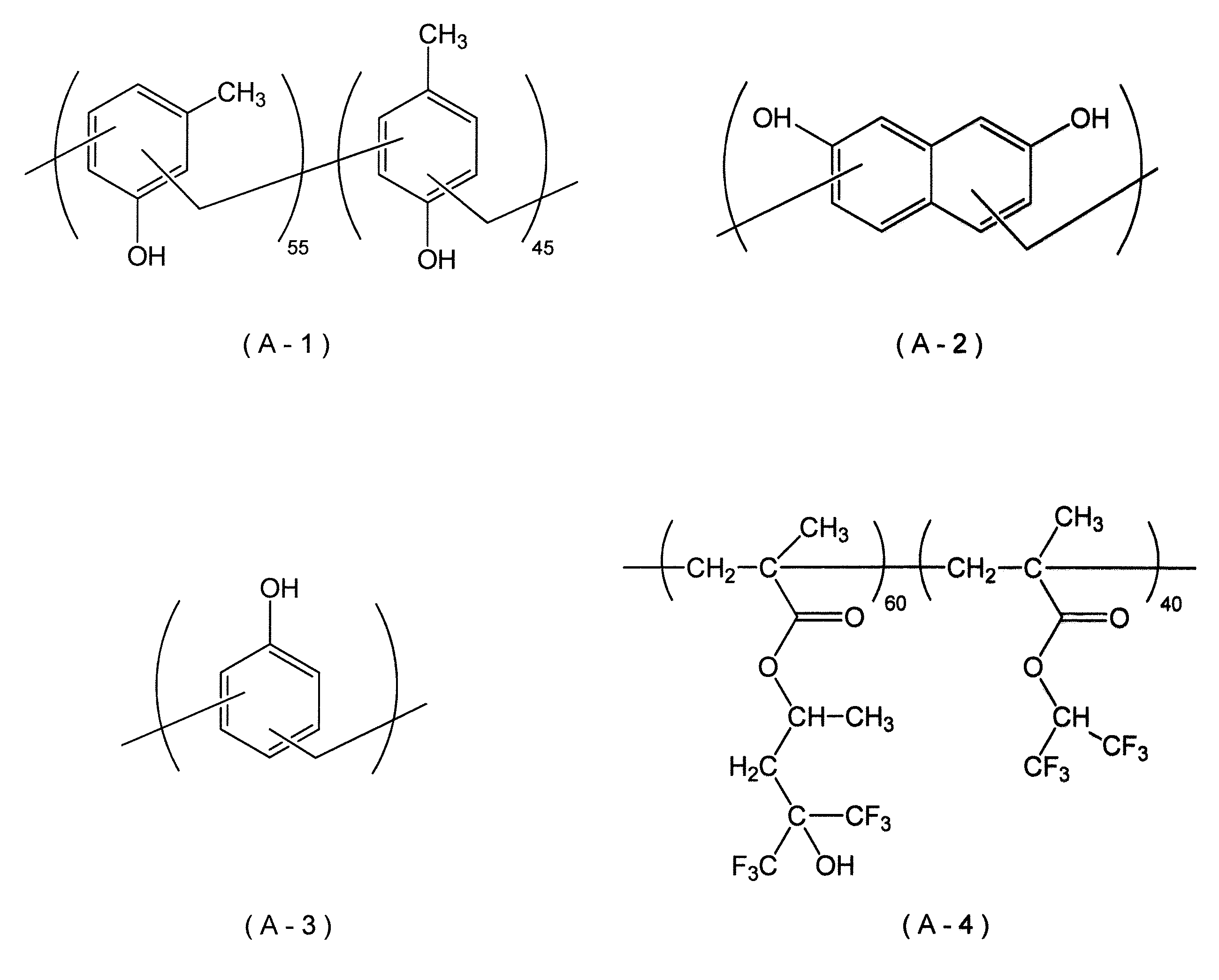
反応容器に、窒素雰囲気下、m-クレゾール70g、p-クレゾール57.27g、37質量%ホルムアルデヒド95.52g及びメチルイソブチルケトン381.82gを加えて溶解させた。得られた溶液を40℃に加熱した後、パラトルエンスルホン酸2.03gを加え、85℃で4時間反応させた。反応液を30℃以下に冷却し、この反応液をメタノール/水(50/50(質量比))の混合溶液に投入し再沈殿した。沈殿物をろ紙で回収し、乾燥して上記樹脂(A-1)を得た。樹脂(A-1)のMwは50,000であった。
反応容器に、窒素雰囲気下、2,7-ジヒドロキシナフタレン150g、37質量%ホルムアルデヒド76.01g及びメチルイソブチルケトン450gを加えて溶解させた。得られた溶液を40℃に加熱した後、パラトルエンスルホン酸1.61gを加え、80℃で7時間反応させた。反応液を30℃以下に冷却し、この反応液をメタノール/水(50/50(質量比))の混合溶液に投入し再沈殿した。沈殿物をろ紙で回収し、乾燥して上記樹脂(A-2)を得た。樹脂(A-2)のMwは3,000であった。
反応容器に、窒素雰囲気下、フェノール120g、37質量%ホルムアルデヒド103.49g及びメチルイソブチルケトン360.00gを加えて溶解させた。得られた溶液を40℃に加熱した後、パラトルエンスルホン酸2.20gを加え、79℃で4時間反応させた。反応液を30℃以下に冷却し、この反応液をメタノール/水(50/50(質量比))の混合溶液に投入し再沈殿した。沈殿物をろ紙で回収し、乾燥して上記樹脂(A-3)を得た。樹脂(A-3)のMwは10,000であった。
下記式(M-1)で表される化合物(M-1)64.49g、下記式(M-2)で表される化合物(M-2)34.51g及びアゾビスイソブチロニトリル(AIBN)4.20gを2-ブタノン100gに溶解させた単量体溶液を調製した。100gの2-ブタノンを投入した1,000mLの三口フラスコを30分窒素パージした。窒素パージの後、80℃に加熱し、撹拌しながら上記調製した単量体溶液を3時間かけて滴下した。滴下開始を重合開始時間とし、6時間重合させた。重合終了後、反応溶液を30℃以下に冷却した。反応溶液を質量が150gになるまで減圧濃縮した。得られた濃縮物に、メタノール150g及びn-ヘキサン750gを投入し、上層液と下層液に分離させた。分離後、下層液を回収した。回収した下層液にn-ヘキサン750gを投入し、再度分離させ、下層液を回収した。回収した下層液から溶媒を除去し、4-メチル-2-ペンタノールを加えて、上記樹脂(A-4)を含む溶液を得た。樹脂(A-4)のMwは10,000であった。
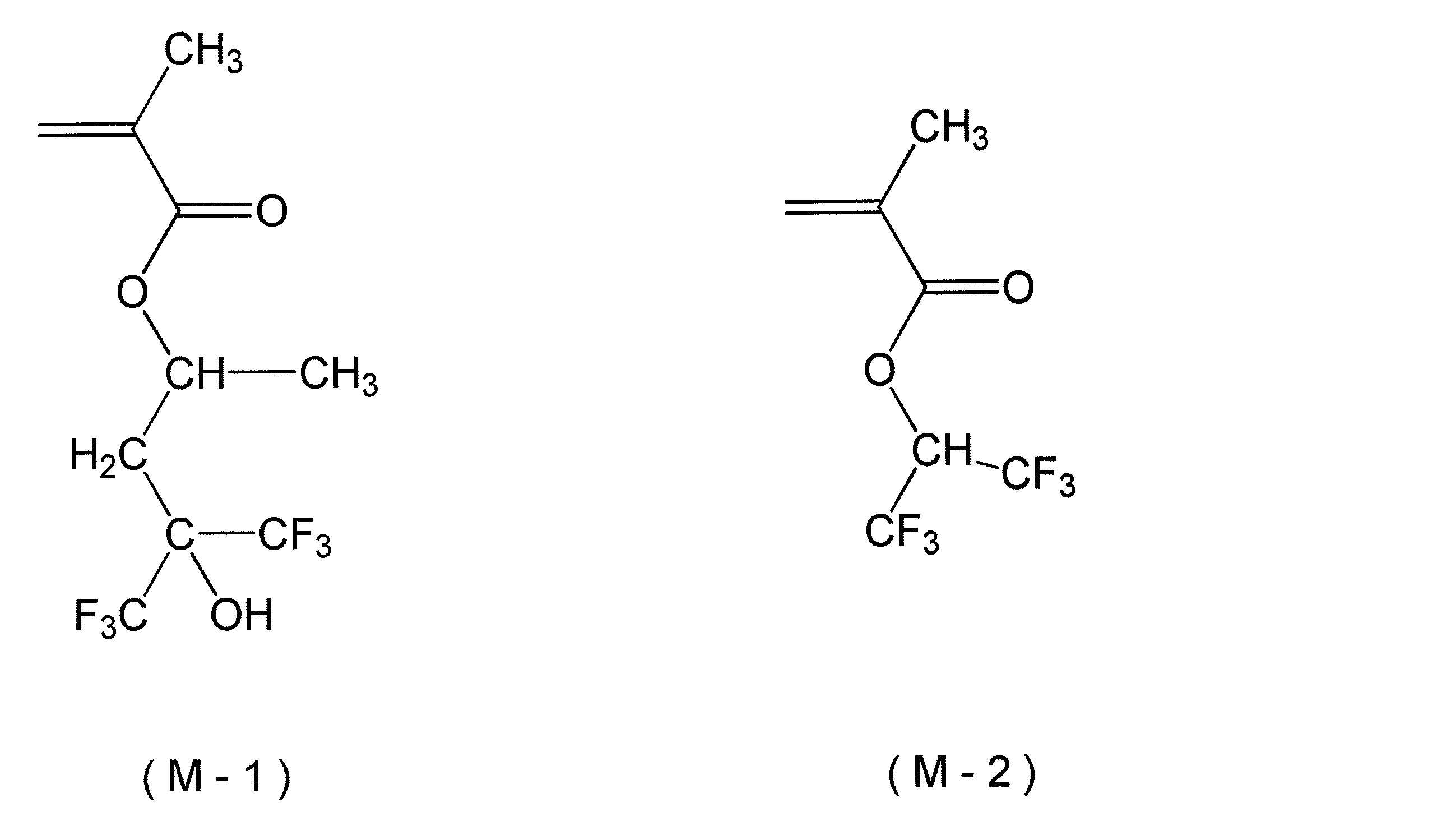
基板処理膜形成用組成物の調製に用いた各成分を以下に示す。
上記合成例で合成した樹脂(A-1)~(A-4)を用いた。
((B1)溶媒成分)
B1-1:テトラエチレングリコール(沸点:314℃)
B1-2:トリエチレングリコール(沸点:287℃)
B1-3:プロピレングリコール(沸点:187℃)
B1-4:ジプロピレングリコール(沸点:231℃)
B1-5:ジエチレングリコールモノエチルエーテル(沸点:196℃)
B1-6:トリプロピレングリコール(沸点:267℃)
B1-7:ジエチレングリコールメチルエチルエーテル(沸点:176℃)
B1-8:1,2-ヘキサンジオール(沸点:223℃)
((B2)溶媒成分)
B2-1:酢酸プロピレングリコールモノメチルエーテル(沸点:146℃)
B2-2:乳酸エチル(沸点:151℃)
B2-3:プロピレングリコールモノメチルエーテル(沸点:121℃)
B2-4:プロピレングリコールモノエチルエーテル(沸点:133℃)
B2-5:4-メチル-2-ペンタノール(沸点:132℃)
C-1:リンゴ酸
C-2:酢酸
[A]樹脂としての(A-1)5質量部及び[C]有機酸としての(C-1)0.15質量部を、[B]溶媒の(B1)溶媒成分としての(B1-1)1質量部及び(B2)溶媒成分としての(B2-4)99質量部に溶解した。得られた溶液を孔径0.1μmのメンブランフィルターでろ過して、基板処理膜形成用組成物(J-1)を調製した。
下記表1に示す種類及び含有量の各成分を用いた以外は、実施例1と同様にして、基板処理膜形成用組成物(J-2)~(J-30)を調製した。表1中の「-」は、該当する成分を使用しなかったことを示す。
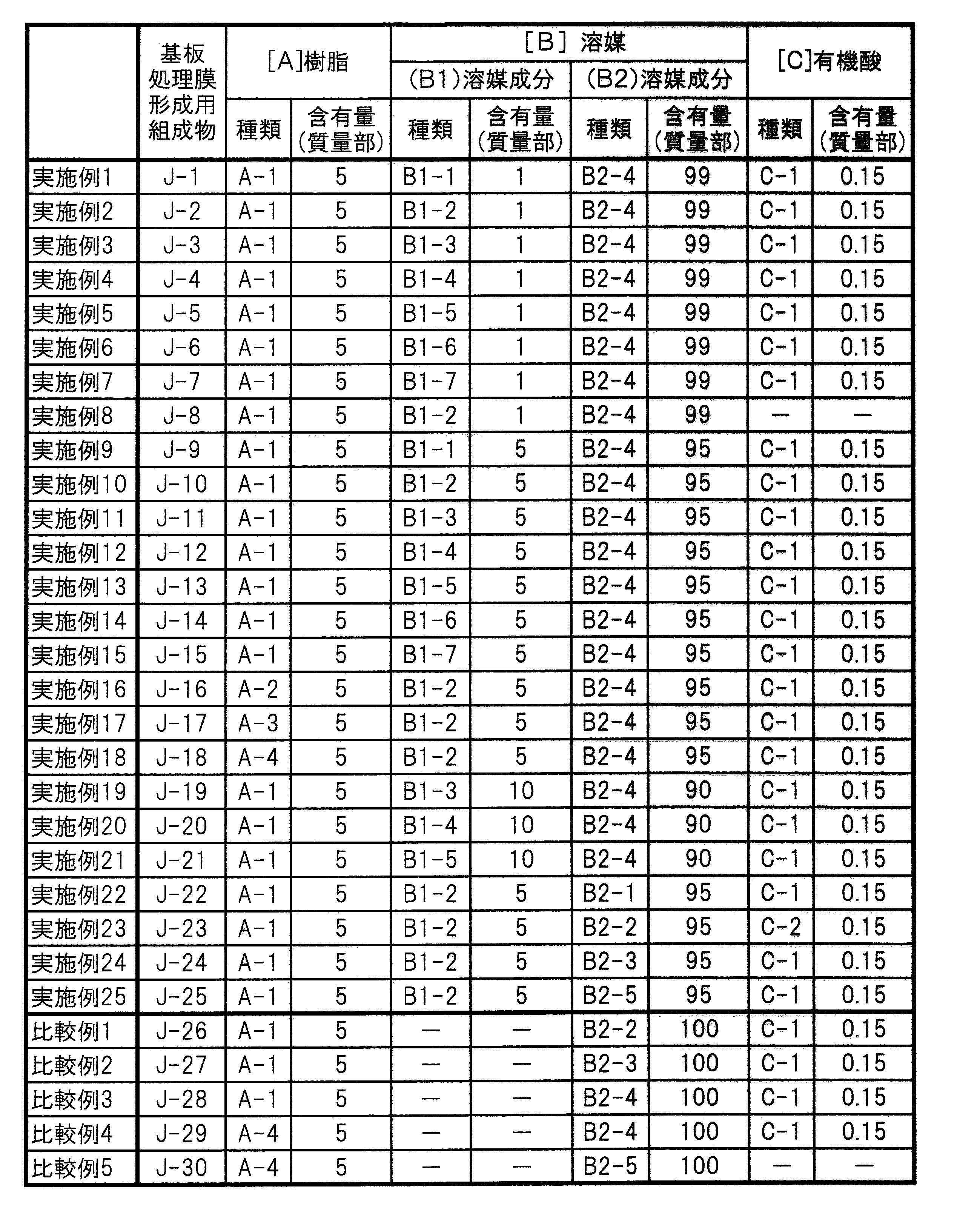
実施例1~25及び比較例1~5の基板処理膜形成用組成物を用い、以下の方法により、半導体基板の洗浄を行った。
上記洗浄した半導体基板について、暗視野欠陥装置(KLA-TENCOR社の「KLA2800」)を用いて、半導体基板の表面全体を分析することで、膜除去性及びパーティクル除去性を評価した。評価結果を下記表2に合わせて示す。

Claims (10)
- 基板に基板処理膜形成用組成物を塗工する工程と、
上記塗工工程により形成された基板処理膜に基板処理膜除去液を接触させる工程と
を備える基板の処理方法に用いられる基板処理膜形成用組成物であって、
樹脂と、
溶媒と
を含有し、
上記溶媒が、標準沸点が175℃以上である第1溶媒成分を含み、
上記樹脂100質量部に対する上記第1溶媒成分の含有量が1質量部以上である基板処理膜形成用組成物。 - 上記第1溶媒成分がヒドロキシ基を有する請求項1に記載の基板処理膜形成用組成物。
- 上記第1溶媒成分が複数のヒドロキシ基を有する請求項2に記載の基板処理膜形成用組成物。
- 上記第1溶媒成分のClogPが0.6以下である請求項1、請求項2又は請求項3に記載の基板処理膜形成用組成物。
- 上記第1溶媒成分がエーテル結合を有する請求項1から請求項4のいずれか1項に記載の基板処理膜形成用組成物。
- 上記第1溶媒成分の標準沸点が230℃以上である請求項1から請求項5のいずれか1項に記載の基板処理膜形成用組成物。
- 上記溶媒が、標準沸点が170℃以下である第2溶媒成分をさらに含む請求項1から請求項6のいずれか1項に記載の基板処理膜形成用組成物。
- 重合体でない有機酸をさらに含有する請求項1から請求項7のいずれか1項に記載の基板処理膜形成用組成物。
- 上記基板処理膜除去液が水を含有する請求項1から請求項8のいずれか1項に記載の基板処理膜形成用組成物。
- 基板に基板処理膜形成用組成物を塗工する工程と、
上記塗工工程により形成された基板処理膜に基板処理膜除去液を接触させる工程と
を備える基板の処理方法であって、
上記基板処理膜形成用組成物が、
樹脂と、
溶媒と
を含有し、
上記溶媒が、標準沸点が175℃以上である第1溶媒成分を含み、
上記樹脂100質量部に対する上記第1溶媒成分の含有量が1質量部以上である基板の処理方法。
Priority Applications (3)
| Application Number | Priority Date | Filing Date | Title |
|---|---|---|---|
| JP2020528814A JPWO2020008965A1 (ja) | 2018-07-04 | 2019-06-25 | 基板処理膜形成用組成物及び基板の処理方法 |
| KR1020207037823A KR20210027292A (ko) | 2018-07-04 | 2019-06-25 | 기판 처리막 형성용 조성물 및 기판의 처리 방법 |
| US17/134,593 US20210115221A1 (en) | 2018-07-04 | 2020-12-28 | Composition and substrate-treating method |
Applications Claiming Priority (2)
| Application Number | Priority Date | Filing Date | Title |
|---|---|---|---|
| JP2018-127839 | 2018-07-04 | ||
| JP2018127839 | 2018-07-04 |
Related Child Applications (1)
| Application Number | Title | Priority Date | Filing Date |
|---|---|---|---|
| US17/134,593 Continuation US20210115221A1 (en) | 2018-07-04 | 2020-12-28 | Composition and substrate-treating method |
Publications (1)
| Publication Number | Publication Date |
|---|---|
| WO2020008965A1 true WO2020008965A1 (ja) | 2020-01-09 |
Family
ID=69059599
Family Applications (1)
| Application Number | Title | Priority Date | Filing Date |
|---|---|---|---|
| PCT/JP2019/025256 Ceased WO2020008965A1 (ja) | 2018-07-04 | 2019-06-25 | 基板処理膜形成用組成物及び基板の処理方法 |
Country Status (5)
| Country | Link |
|---|---|
| US (1) | US20210115221A1 (ja) |
| JP (1) | JPWO2020008965A1 (ja) |
| KR (1) | KR20210027292A (ja) |
| TW (1) | TW202006108A (ja) |
| WO (1) | WO2020008965A1 (ja) |
Cited By (9)
| Publication number | Priority date | Publication date | Assignee | Title |
|---|---|---|---|---|
| WO2020189683A1 (ja) * | 2019-03-19 | 2020-09-24 | Jsr株式会社 | 組成物及び基板の処理方法 |
| KR20210117774A (ko) * | 2020-03-20 | 2021-09-29 | 동우 화인켐 주식회사 | 반도체 기판 세정용 조성물 |
| KR20210119731A (ko) * | 2020-03-25 | 2021-10-06 | 동우 화인켐 주식회사 | 반도체 기판 세정용 조성물 |
| WO2022014323A1 (ja) * | 2020-07-16 | 2022-01-20 | 株式会社Screenホールディングス | 基板処理方法および基板処理装置 |
| JP2024047257A (ja) * | 2022-09-26 | 2024-04-05 | 株式会社Screenホールディングス | 基板処理方法、基板処理装置及び基板処理液 |
| WO2024117235A1 (ja) | 2022-12-01 | 2024-06-06 | 日産化学株式会社 | 異物除去用コーティング膜形成組成物及び半導体基板 |
| KR20250026183A (ko) | 2022-06-21 | 2025-02-25 | 닛산 가가쿠 가부시키가이샤 | 이물질 제거용 코팅막 형성 조성물 및 반도체 기판 |
| WO2025154594A1 (ja) * | 2024-01-15 | 2025-07-24 | 日産化学株式会社 | 異物除去用コーティング膜形成組成物及び半導体基板 |
| KR20250155534A (ko) | 2023-02-20 | 2025-10-30 | 닛산 가가쿠 가부시키가이샤 | 보호막 형성용 조성물, 반도체 기판, 및 전자 부품 |
Families Citing this family (1)
| Publication number | Priority date | Publication date | Assignee | Title |
|---|---|---|---|---|
| WO2026139475A1 (en) * | 2024-12-24 | 2026-07-02 | Merck Patent Gmbh | Substrate cleaning liquid, method for producing substrate cleaned using same, and method for producing device |
Citations (3)
| Publication number | Priority date | Publication date | Assignee | Title |
|---|---|---|---|---|
| WO2011034099A1 (ja) * | 2009-09-15 | 2011-03-24 | Jsr株式会社 | 上層膜形成組成物及びフォトレジストパターンの形成方法 |
| JP2014099583A (ja) * | 2012-08-07 | 2014-05-29 | Tokyo Electron Ltd | 基板洗浄装置、基板洗浄システム、基板洗浄方法および記憶媒体 |
| JP2016034006A (ja) * | 2014-07-31 | 2016-03-10 | 東京エレクトロン株式会社 | 基板洗浄方法および記憶媒体 |
-
2019
- 2019-06-25 JP JP2020528814A patent/JPWO2020008965A1/ja active Pending
- 2019-06-25 WO PCT/JP2019/025256 patent/WO2020008965A1/ja not_active Ceased
- 2019-06-25 KR KR1020207037823A patent/KR20210027292A/ko not_active Withdrawn
- 2019-07-03 TW TW108123360A patent/TW202006108A/zh unknown
-
2020
- 2020-12-28 US US17/134,593 patent/US20210115221A1/en not_active Abandoned
Patent Citations (3)
| Publication number | Priority date | Publication date | Assignee | Title |
|---|---|---|---|---|
| WO2011034099A1 (ja) * | 2009-09-15 | 2011-03-24 | Jsr株式会社 | 上層膜形成組成物及びフォトレジストパターンの形成方法 |
| JP2014099583A (ja) * | 2012-08-07 | 2014-05-29 | Tokyo Electron Ltd | 基板洗浄装置、基板洗浄システム、基板洗浄方法および記憶媒体 |
| JP2016034006A (ja) * | 2014-07-31 | 2016-03-10 | 東京エレクトロン株式会社 | 基板洗浄方法および記憶媒体 |
Cited By (16)
| Publication number | Priority date | Publication date | Assignee | Title |
|---|---|---|---|---|
| WO2020189683A1 (ja) * | 2019-03-19 | 2020-09-24 | Jsr株式会社 | 組成物及び基板の処理方法 |
| KR20210117774A (ko) * | 2020-03-20 | 2021-09-29 | 동우 화인켐 주식회사 | 반도체 기판 세정용 조성물 |
| KR102862936B1 (ko) * | 2020-03-20 | 2025-09-22 | 동우 화인켐 주식회사 | 반도체 기판 세정용 조성물 |
| KR20210119731A (ko) * | 2020-03-25 | 2021-10-06 | 동우 화인켐 주식회사 | 반도체 기판 세정용 조성물 |
| KR102833137B1 (ko) * | 2020-03-25 | 2025-07-11 | 동우 화인켐 주식회사 | 반도체 기판 세정용 조성물 |
| JP7596089B2 (ja) | 2020-07-16 | 2024-12-09 | 株式会社Screenホールディングス | 基板処理方法および基板処理装置 |
| CN115868010A (zh) * | 2020-07-16 | 2023-03-28 | 株式会社斯库林集团 | 衬底处理方法及衬底处理装置 |
| JP2022018883A (ja) * | 2020-07-16 | 2022-01-27 | 株式会社Screenホールディングス | 基板処理方法および基板処理装置 |
| WO2022014323A1 (ja) * | 2020-07-16 | 2022-01-20 | 株式会社Screenホールディングス | 基板処理方法および基板処理装置 |
| KR20250026183A (ko) | 2022-06-21 | 2025-02-25 | 닛산 가가쿠 가부시키가이샤 | 이물질 제거용 코팅막 형성 조성물 및 반도체 기판 |
| JP2024047257A (ja) * | 2022-09-26 | 2024-04-05 | 株式会社Screenホールディングス | 基板処理方法、基板処理装置及び基板処理液 |
| WO2024117235A1 (ja) | 2022-12-01 | 2024-06-06 | 日産化学株式会社 | 異物除去用コーティング膜形成組成物及び半導体基板 |
| KR20250114500A (ko) | 2022-12-01 | 2025-07-29 | 닛산 가가쿠 가부시키가이샤 | 이물질 제거용 코팅막 형성 조성물 및 반도체 기판 |
| EP4629280A1 (en) | 2022-12-01 | 2025-10-08 | Nissan Chemical Corporation | Composition for forming coating film for foreign substance removal, and semiconductor substrate |
| KR20250155534A (ko) | 2023-02-20 | 2025-10-30 | 닛산 가가쿠 가부시키가이샤 | 보호막 형성용 조성물, 반도체 기판, 및 전자 부품 |
| WO2025154594A1 (ja) * | 2024-01-15 | 2025-07-24 | 日産化学株式会社 | 異物除去用コーティング膜形成組成物及び半導体基板 |
Also Published As
| Publication number | Publication date |
|---|---|
| TW202006108A (zh) | 2020-02-01 |
| JPWO2020008965A1 (ja) | 2021-07-08 |
| KR20210027292A (ko) | 2021-03-10 |
| US20210115221A1 (en) | 2021-04-22 |
Similar Documents
| Publication | Publication Date | Title |
|---|---|---|
| JPWO2020008965A1 (ja) | 基板処理膜形成用組成物及び基板の処理方法 | |
| KR102498810B1 (ko) | 반도체 기판 세정용 조성물 | |
| TWI678388B (zh) | 半導體基板洗淨用組成物 | |
| TWI704219B (zh) | 半導體基板洗淨用膜形成組成物及半導體基板的洗淨方法 | |
| JP6426936B2 (ja) | 基板洗浄方法および記憶媒体 | |
| JP7021438B2 (ja) | 処理剤及び基板の処理方法 | |
| KR102018121B1 (ko) | 유기막 형성용 조성물의 제조방법 | |
| US20200057370A1 (en) | Compound, resist composition containing compound and pattern formation method using same | |
| KR20190129907A (ko) | 레지스트 조성물 및 이를 이용하는 패턴형성방법, 그리고, 화합물 및 수지 | |
| WO2020130094A1 (ja) | 基板処理膜形成用組成物及び半導体基板の洗浄方法 | |
| WO2020170934A1 (ja) | 膜形成用組成物及び半導体基板の製造方法 | |
| WO2020189683A1 (ja) | 組成物及び基板の処理方法 | |
| TW201910370A (zh) | 附有多層阻劑膜之基板及圖案形成方法 | |
| JP2018067696A (ja) | 基板パターン倒壊抑制用処理材及び基板の処理方法 | |
| KR102051189B1 (ko) | 유기막 형성용 조성물 | |
| JP7123668B2 (ja) | レジスト多層膜付き基板及びパターン形成方法 | |
| TWI534532B (zh) | Manufacture of photoresist for non - spin coating |
Legal Events
| Date | Code | Title | Description |
|---|---|---|---|
| 121 | Ep: the epo has been informed by wipo that ep was designated in this application |
Ref document number: 19830307 Country of ref document: EP Kind code of ref document: A1 |
|
| ENP | Entry into the national phase |
Ref document number: 2020528814 Country of ref document: JP Kind code of ref document: A |
|
| ENP | Entry into the national phase |
Ref document number: 20207037823 Country of ref document: KR Kind code of ref document: A |
|
| NENP | Non-entry into the national phase |
Ref country code: DE |
|
| 122 | Ep: pct application non-entry in european phase |
Ref document number: 19830307 Country of ref document: EP Kind code of ref document: A1 |