WO2020008898A1 - 液晶組成物及び液晶表示素子 - Google Patents
液晶組成物及び液晶表示素子 Download PDFInfo
- Publication number
- WO2020008898A1 WO2020008898A1 PCT/JP2019/024462 JP2019024462W WO2020008898A1 WO 2020008898 A1 WO2020008898 A1 WO 2020008898A1 JP 2019024462 W JP2019024462 W JP 2019024462W WO 2020008898 A1 WO2020008898 A1 WO 2020008898A1
- Authority
- WO
- WIPO (PCT)
- Prior art keywords
- group
- mass
- formula
- carbon atoms
- present
- Prior art date
- Legal status (The legal status is an assumption and is not a legal conclusion. Google has not performed a legal analysis and makes no representation as to the accuracy of the status listed.)
- Ceased
Links
- 0 Cc1c([*+])c([*+])c([*+])c([*+])c1[*+] Chemical compound Cc1c([*+])c([*+])c([*+])c([*+])c1[*+] 0.000 description 2
Classifications
-
- C—CHEMISTRY; METALLURGY
- C09—DYES; PAINTS; POLISHES; NATURAL RESINS; ADHESIVES; COMPOSITIONS NOT OTHERWISE PROVIDED FOR; APPLICATIONS OF MATERIALS NOT OTHERWISE PROVIDED FOR
- C09K—MATERIALS FOR MISCELLANEOUS APPLICATIONS, NOT PROVIDED FOR ELSEWHERE
- C09K19/00—Liquid crystal materials
- C09K19/04—Liquid crystal materials characterised by the chemical structure of the liquid crystal components, e.g. by a specific unit
- C09K19/06—Non-steroidal liquid crystal compounds
- C09K19/08—Non-steroidal liquid crystal compounds containing at least two non-condensed rings
- C09K19/10—Non-steroidal liquid crystal compounds containing at least two non-condensed rings containing at least two benzene rings
- C09K19/12—Non-steroidal liquid crystal compounds containing at least two non-condensed rings containing at least two benzene rings at least two benzene rings directly linked, e.g. biphenyls
-
- C—CHEMISTRY; METALLURGY
- C09—DYES; PAINTS; POLISHES; NATURAL RESINS; ADHESIVES; COMPOSITIONS NOT OTHERWISE PROVIDED FOR; APPLICATIONS OF MATERIALS NOT OTHERWISE PROVIDED FOR
- C09K—MATERIALS FOR MISCELLANEOUS APPLICATIONS, NOT PROVIDED FOR ELSEWHERE
- C09K19/00—Liquid crystal materials
- C09K19/04—Liquid crystal materials characterised by the chemical structure of the liquid crystal components, e.g. by a specific unit
- C09K19/06—Non-steroidal liquid crystal compounds
- C09K19/08—Non-steroidal liquid crystal compounds containing at least two non-condensed rings
- C09K19/10—Non-steroidal liquid crystal compounds containing at least two non-condensed rings containing at least two benzene rings
- C09K19/14—Non-steroidal liquid crystal compounds containing at least two non-condensed rings containing at least two benzene rings linked by a carbon chain
-
- C—CHEMISTRY; METALLURGY
- C09—DYES; PAINTS; POLISHES; NATURAL RESINS; ADHESIVES; COMPOSITIONS NOT OTHERWISE PROVIDED FOR; APPLICATIONS OF MATERIALS NOT OTHERWISE PROVIDED FOR
- C09K—MATERIALS FOR MISCELLANEOUS APPLICATIONS, NOT PROVIDED FOR ELSEWHERE
- C09K19/00—Liquid crystal materials
- C09K19/04—Liquid crystal materials characterised by the chemical structure of the liquid crystal components, e.g. by a specific unit
- C09K19/06—Non-steroidal liquid crystal compounds
- C09K19/08—Non-steroidal liquid crystal compounds containing at least two non-condensed rings
- C09K19/10—Non-steroidal liquid crystal compounds containing at least two non-condensed rings containing at least two benzene rings
- C09K19/14—Non-steroidal liquid crystal compounds containing at least two non-condensed rings containing at least two benzene rings linked by a carbon chain
- C09K19/16—Non-steroidal liquid crystal compounds containing at least two non-condensed rings containing at least two benzene rings linked by a carbon chain the chain containing carbon-to-carbon double bonds, e.g. stilbenes
-
- C—CHEMISTRY; METALLURGY
- C09—DYES; PAINTS; POLISHES; NATURAL RESINS; ADHESIVES; COMPOSITIONS NOT OTHERWISE PROVIDED FOR; APPLICATIONS OF MATERIALS NOT OTHERWISE PROVIDED FOR
- C09K—MATERIALS FOR MISCELLANEOUS APPLICATIONS, NOT PROVIDED FOR ELSEWHERE
- C09K19/00—Liquid crystal materials
- C09K19/04—Liquid crystal materials characterised by the chemical structure of the liquid crystal components, e.g. by a specific unit
- C09K19/06—Non-steroidal liquid crystal compounds
- C09K19/08—Non-steroidal liquid crystal compounds containing at least two non-condensed rings
- C09K19/10—Non-steroidal liquid crystal compounds containing at least two non-condensed rings containing at least two benzene rings
- C09K19/14—Non-steroidal liquid crystal compounds containing at least two non-condensed rings containing at least two benzene rings linked by a carbon chain
- C09K19/18—Non-steroidal liquid crystal compounds containing at least two non-condensed rings containing at least two benzene rings linked by a carbon chain the chain containing carbon-to-carbon triple bonds, e.g. tolans
-
- C—CHEMISTRY; METALLURGY
- C09—DYES; PAINTS; POLISHES; NATURAL RESINS; ADHESIVES; COMPOSITIONS NOT OTHERWISE PROVIDED FOR; APPLICATIONS OF MATERIALS NOT OTHERWISE PROVIDED FOR
- C09K—MATERIALS FOR MISCELLANEOUS APPLICATIONS, NOT PROVIDED FOR ELSEWHERE
- C09K19/00—Liquid crystal materials
- C09K19/04—Liquid crystal materials characterised by the chemical structure of the liquid crystal components, e.g. by a specific unit
- C09K19/06—Non-steroidal liquid crystal compounds
- C09K19/08—Non-steroidal liquid crystal compounds containing at least two non-condensed rings
- C09K19/10—Non-steroidal liquid crystal compounds containing at least two non-condensed rings containing at least two benzene rings
- C09K19/20—Non-steroidal liquid crystal compounds containing at least two non-condensed rings containing at least two benzene rings linked by a chain containing carbon and oxygen atoms as chain links, e.g. esters or ethers
-
- C—CHEMISTRY; METALLURGY
- C09—DYES; PAINTS; POLISHES; NATURAL RESINS; ADHESIVES; COMPOSITIONS NOT OTHERWISE PROVIDED FOR; APPLICATIONS OF MATERIALS NOT OTHERWISE PROVIDED FOR
- C09K—MATERIALS FOR MISCELLANEOUS APPLICATIONS, NOT PROVIDED FOR ELSEWHERE
- C09K19/00—Liquid crystal materials
- C09K19/04—Liquid crystal materials characterised by the chemical structure of the liquid crystal components, e.g. by a specific unit
- C09K19/06—Non-steroidal liquid crystal compounds
- C09K19/08—Non-steroidal liquid crystal compounds containing at least two non-condensed rings
- C09K19/10—Non-steroidal liquid crystal compounds containing at least two non-condensed rings containing at least two benzene rings
- C09K19/24—Non-steroidal liquid crystal compounds containing at least two non-condensed rings containing at least two benzene rings linked by a chain containing nitrogen-to-nitrogen bonds
-
- C—CHEMISTRY; METALLURGY
- C09—DYES; PAINTS; POLISHES; NATURAL RESINS; ADHESIVES; COMPOSITIONS NOT OTHERWISE PROVIDED FOR; APPLICATIONS OF MATERIALS NOT OTHERWISE PROVIDED FOR
- C09K—MATERIALS FOR MISCELLANEOUS APPLICATIONS, NOT PROVIDED FOR ELSEWHERE
- C09K19/00—Liquid crystal materials
- C09K19/04—Liquid crystal materials characterised by the chemical structure of the liquid crystal components, e.g. by a specific unit
- C09K19/06—Non-steroidal liquid crystal compounds
- C09K19/08—Non-steroidal liquid crystal compounds containing at least two non-condensed rings
- C09K19/30—Non-steroidal liquid crystal compounds containing at least two non-condensed rings containing saturated or unsaturated non-aromatic rings, e.g. cyclohexane rings
-
- C—CHEMISTRY; METALLURGY
- C09—DYES; PAINTS; POLISHES; NATURAL RESINS; ADHESIVES; COMPOSITIONS NOT OTHERWISE PROVIDED FOR; APPLICATIONS OF MATERIALS NOT OTHERWISE PROVIDED FOR
- C09K—MATERIALS FOR MISCELLANEOUS APPLICATIONS, NOT PROVIDED FOR ELSEWHERE
- C09K19/00—Liquid crystal materials
- C09K19/04—Liquid crystal materials characterised by the chemical structure of the liquid crystal components, e.g. by a specific unit
- C09K19/06—Non-steroidal liquid crystal compounds
- C09K19/32—Non-steroidal liquid crystal compounds containing condensed ring systems, i.e. fused, bridged or spiro ring systems
-
- C—CHEMISTRY; METALLURGY
- C09—DYES; PAINTS; POLISHES; NATURAL RESINS; ADHESIVES; COMPOSITIONS NOT OTHERWISE PROVIDED FOR; APPLICATIONS OF MATERIALS NOT OTHERWISE PROVIDED FOR
- C09K—MATERIALS FOR MISCELLANEOUS APPLICATIONS, NOT PROVIDED FOR ELSEWHERE
- C09K19/00—Liquid crystal materials
- C09K19/04—Liquid crystal materials characterised by the chemical structure of the liquid crystal components, e.g. by a specific unit
- C09K19/06—Non-steroidal liquid crystal compounds
- C09K19/34—Non-steroidal liquid crystal compounds containing at least one heterocyclic ring
-
- C—CHEMISTRY; METALLURGY
- C09—DYES; PAINTS; POLISHES; NATURAL RESINS; ADHESIVES; COMPOSITIONS NOT OTHERWISE PROVIDED FOR; APPLICATIONS OF MATERIALS NOT OTHERWISE PROVIDED FOR
- C09K—MATERIALS FOR MISCELLANEOUS APPLICATIONS, NOT PROVIDED FOR ELSEWHERE
- C09K19/00—Liquid crystal materials
- C09K19/04—Liquid crystal materials characterised by the chemical structure of the liquid crystal components, e.g. by a specific unit
- C09K19/38—Polymers
-
- C—CHEMISTRY; METALLURGY
- C09—DYES; PAINTS; POLISHES; NATURAL RESINS; ADHESIVES; COMPOSITIONS NOT OTHERWISE PROVIDED FOR; APPLICATIONS OF MATERIALS NOT OTHERWISE PROVIDED FOR
- C09K—MATERIALS FOR MISCELLANEOUS APPLICATIONS, NOT PROVIDED FOR ELSEWHERE
- C09K19/00—Liquid crystal materials
- C09K19/52—Liquid crystal materials characterised by components which are not liquid crystals, e.g. additives with special physical aspect: solvents, solid particles
- C09K19/54—Additives having no specific mesophase characterised by their chemical composition
-
- G—PHYSICS
- G02—OPTICS
- G02F—OPTICAL DEVICES OR ARRANGEMENTS FOR THE CONTROL OF LIGHT BY MODIFICATION OF THE OPTICAL PROPERTIES OF THE MEDIA OF THE ELEMENTS INVOLVED THEREIN; NON-LINEAR OPTICS; FREQUENCY-CHANGING OF LIGHT; OPTICAL LOGIC ELEMENTS; OPTICAL ANALOGUE/DIGITAL CONVERTERS
- G02F1/00—Devices or arrangements for the control of the intensity, colour, phase, polarisation or direction of light arriving from an independent light source, e.g. switching, gating or modulating; Non-linear optics
- G02F1/01—Devices or arrangements for the control of the intensity, colour, phase, polarisation or direction of light arriving from an independent light source, e.g. switching, gating or modulating; Non-linear optics for the control of the intensity, phase, polarisation or colour
- G02F1/13—Devices or arrangements for the control of the intensity, colour, phase, polarisation or direction of light arriving from an independent light source, e.g. switching, gating or modulating; Non-linear optics for the control of the intensity, phase, polarisation or colour based on liquid crystals, e.g. single liquid crystal display cells
Definitions
- the present invention relates to a polymerizable compound-containing liquid crystal composition and a liquid crystal display device using the same.
- a PSA (Polymer Sustained Alignment) type liquid crystal display element has a structure in which a polymer structure is formed in a cell in order to control a pretilt angle of liquid crystal molecules, and is practically used as a liquid crystal display element because of its high-speed response and high contrast. Has been transformed.
- a PSA-type liquid crystal display element is manufactured by injecting a polymerizable composition containing a liquid crystal compound and a polymerizable compound between substrates, applying a voltage, and polymerizing the polymerizable compound in a state where the liquid crystal molecules are aligned. Is performed by fixing the orientation of. It is known that image sticking, which is a display defect of the PSA type liquid crystal display element, is caused by impurities and a change in the orientation of liquid crystal molecules (a change in pretilt angle).
- Burn-in caused by a change in the pretilt angle of liquid crystal molecules is a phenomenon in which the structure of the polymer changes when the same pattern is continuously displayed for a long time when a display element is configured, and as a result, the pretilt angle changes. It is. For this reason, a polymerizable compound that forms a polymer having a rigid structure that does not change the polymer structure is required.
- Patent Document 1 discloses a display element using a polymerizable compound having a biphenyl structure as a ring structure
- Patent Document 2 discloses a ring structure.
- Patent Document 1 As shown in the examples of Patent Document 1 and Patent Document 2, by using a compound (A) having a biphenyl skeleton or a compound (B) having a terphenyl skeleton as described below, Attempts have been made to improve image sticking due to changes in pretilt angle.
- the problem to be solved by the present invention is that the polymerization rate of the polymerizable compound is sufficiently high, and the device using the same has no or very few display defects due to a change in the pretilt angle, and has a sufficient pretilt angle. It is another object of the present invention to provide a liquid crystal composition containing a polymerizable compound for producing a PSA or PSVA liquid crystal display device having excellent response performance, and to provide a liquid crystal display device using the same.
- the liquid crystal composition of the present invention has a low viscosity ( ⁇ ) and a small rotational viscosity ( ⁇ 1) without lowering the refractive index anisotropy ( ⁇ n) and the nematic phase-isotropic liquid phase transition temperature (Tni).
- K33 high elastic constant
- the liquid crystal display device using the liquid crystal composition of the present invention has a sufficient pretilt angle, a small amount of the polymerizable compound remaining, a high voltage holding ratio (VHR), a high-speed response, and poor alignment and image sticking. Excellent display quality with no or suppressed display defects.
- the liquid crystal composition of the present invention can control the pretilt angle and the residual amount of the polymerizable compound by using a specific polymerizable compound, and can easily improve the production efficiency by optimizing and reducing the energy cost for production. . Therefore, the liquid crystal composition of the present invention and a liquid crystal display device using the same are very useful.
- the liquid crystal composition of the present invention has the general formula (i)
- X i1 , X i2 , X i3 and X i4 each independently represent P i3 —S i3 —, an alkyl group having 1 to 8 carbon atoms which may be substituted by a fluorine atom, Represents an alkoxy group having 1 to 8 carbon atoms which may be substituted, a fluorine atom or a hydrogen atom, wherein at least one of X i1 , X i2 , X i3 and X i4 is a carbon atom which may be substituted by a fluorine atom; Represents an alkyl group having 1 to 8 atoms,
- a i1 is (A) 1,4-cyclohexylene group (this is present in the group one -CH 2 - or nonadjacent two or more -CH 2 - may be replaced by -O-.)
- P i1 , P i2 and P i3 are each independently represented by the formulas (R-1) to (R-9)
- R 11 , R 12 , R 13 , R 14 and R 15 each independently represent an alkyl group having 1 to 5 carbon atoms, a fluorine atom or a hydrogen atom, and m r5 , m r7 , nr5 and nr7 each independently represent 0, 1, or 2.
- S i1 , S i2 and S i3 each independently represent a single bond or an alkylene group having 1 to 15 carbon atoms, and one —CH 2 — or two or more non-adjacent ones in the alkylene group , as the oxygen atoms are not directly adjacent, -O - - -CH 2 of, - OCO- or -COO- in may be substituted, When there are a plurality of A i1 , P i3 and / or S i3 , they may be the same or different.
- a L1, A L2, and A L3 are each independently (a) 1,4-cyclohexylene group (the one present in the group -CH 2 - or nonadjacent two or more -CH 2 - May be replaced by -O-.)
- the liquid crystal composition containing the polymerizable compound represented by the general formula (i) can provide a desired pretilt angle in a short ultraviolet irradiation time when the polymerization rate is appropriately high. Furthermore, when the polymerization rate is appropriately high, the residual amount of the polymerizable compound can be reduced. Therefore, the production efficiency of PSA-type liquid crystal display element production can be improved. Further, there is an effect that a display defect (for example, a defect such as burn-in) due to a change in the pretilt angle does not occur or is extremely small.
- a display defect for example, a defect such as burn-in
- the display failure in this specification is a display failure due to a change in the pretilt angle after polymerization with time, a display failure due to the residual amount of the unreacted polymerizable compound, and a display failure due to a decrease in the voltage holding ratio. Take into account.
- X i1 , X i2 , X i3 and X i4 each independently represent P i3 —S i3 — or an alkyl group having 1 to 8 carbon atoms which may be substituted by a fluorine atom.
- the alkyl group and the alkoxy group preferably have 1 to 6 carbon atoms, It is more preferably from 1 to 4, and further preferably from 1 to 3.
- the alkyl group and the alkoxy group may be linear or branched, but are particularly preferably linear.
- At least one of X i1 , X i2 , X i3 and X i4 represents an alkyl group having 1 to 8 carbon atoms which may be substituted by a fluorine atom.
- the preferred number of carbon atoms of the alkyl group is , 1-6, more preferably 1-4, even more preferably 1-3, even more preferably 1-2, and particularly preferably 1.
- the alkyl group may be linear or branched, but is particularly preferably linear.
- X i1 , X i2 , X i3 and X i4 each independently represent P i3 —S i3 — or an alkyl group having 1 to 3 carbon atoms which may be substituted by a fluorine atom.
- P i3 —S i3 preferably P i3 —S i3 —
- an alkyl group having 1 to 3 carbon atoms which may be substituted by a fluorine atom, or a hydrogen atom.
- alkyl group having 1 to 8 carbon atoms which may be substituted by the fluorine atom a linear alkyl group is preferable, and a methyl group, an ethyl group, a propyl group or a butyl group or a hydrogen atom of these groups is a fluorine atom
- a fluorinated alkyl group substituted with an atom and among them, a methyl group, an ethyl group, a propyl group, a monofluoromethyl group, a difluoromethyl group, and a trifluoromethyl group are preferable, and a methyl group or an ethyl group is even more preferable.
- a methyl group is particularly preferred.
- a methyl group is particularly preferable since the substituent becomes bulky as the number of carbon atoms increases in view of electron conjugation and the polymerization rate and the degree of polymerization tend to decrease.
- the number of those representing an alkyl group having 1 to 8 carbon atoms which may be substituted by a fluorine atom is 1 or more and 3 or less. Preferably, it is 1 or more, more preferably 2 or less, and particularly preferably 1.
- any one of X i1 , X i2 , X i3 and X i4 is an alkyl group having 1 to 8 carbon atoms which may be substituted by a fluorine atom, preferably representing the i1 or X i4 alkyl group having from good carbon atoms 1 be substituted by a fluorine atom 8, alkyl of X i1 or X i4 from good carbon atoms 1 be substituted by a fluorine atom 3 It is particularly preferred to represent a group.
- the number of those representing P i3 —S i3 — is preferably 0, 1 or 2, and is 0 or 1. Is more preferable, and 0 is particularly preferable.
- R i1 and R i2 each independently represent an alkyl group having 1 to 8 carbon atoms, an alkoxy group having 1 to 8 carbon atoms, a fluorine atom, or P i3 —S i3 —.
- 1,4-phenylene group 2-methyl-1,4-phenylene group, 3-methyl-1,4-phenylene group, 2-methoxy-1,4-phenylene group, 3-methoxy-1,4-phenylene group , 2-fluoro-1,4-phenylene group, 3-fluoro-1,4-phenylene group or naphthalene-2,6-diyl group, more preferably 1,4-phenylene group, 2-methyl-1 , 4-phenylene group or 3-methyl-1,4-phenylene group, more preferably 1,4-phenylene group or 2-methyl-1,4-phenylene group, Particularly preferred is a 4-phenylene group.
- mi1 represents 2 or 3, but preferably represents 2.
- P i1 , P i2 and P i3 may be the same polymerizable group (formulas (R-1) to (R-9)) or different polymerizable groups.
- P i1 , P i2 and P i3 are each independently represented by the formulas (R-1), (R-2), (R-3) and (R-4).
- a formula (R-5) or a formula (R-7) Preferably a formula (R-1), a formula (R-2), a formula (R-3) or a formula (R-4) Is more preferable, and the formula (R-1) is further preferable, and an acryloxy group or a methacryloxy group is particularly preferable.
- At least one of P i1 and P i2 is preferably a formula (R-1), more preferably an acrylic group or a methacrylic group, more preferably a methacryloxy group, P i1 and P It is particularly preferred that i2 is a methacryloxy group.
- R 11 , R 12 , R 13 , R 14 and R 15 are each independently preferably a methyl group or a hydrogen atom, and preferably a hydrogen atom when importance is attached to the polymerization rate of the polymerizable compound.
- a methyl group is preferred.
- S i1 , S i2, and S i3 are each independently preferably a single bond or an alkylene group having 1 to 5 carbon atoms, and particularly preferably a single bond.
- S i1 , S i2, and S i3 are single bonds, the residual amount of the polymerizable compound after irradiation with ultraviolet rays is sufficiently small, and display failure due to a change in pretilt angle is less likely to occur.
- the lower limit of the content of the polymerizable compound represented by the general formula (i) in the liquid crystal composition of the present invention is preferably 0.01% by mass, preferably 0.02% by mass, and more preferably 0.03% by mass. 0.04% by mass is preferable, 0.05% by mass is preferable, 0.06% by mass is preferable, 0.07% by mass is preferable, 0.08% by mass is preferable, 0.09% by mass is preferable, and 0.09% by mass is preferable.
- 1 mass% is preferable, 0.12 mass% is preferable, 0.15 mass% is preferable, 0.17 mass% is preferable, 0.2 mass% is preferable, 0.22 mass% is preferable, 0.25 mass% % Is preferable, 0.27% by mass is preferable, 0.3% by mass is preferable, 0.32% by mass is preferable, 0.35% by mass is preferable, 0.37% by mass is preferable, and 0.4% by mass is preferable.
- 0.42% by mass is preferred ,
- 0.45 mass% preferably 0.5 wt%, preferably 0.55% by mass.
- the upper limit of the content of the polymerizable compound represented by the general formula (i) in the liquid crystal composition of the present invention is preferably 5% by mass, more preferably 4.5% by mass, and preferably 4% by mass, and is 3.5% by mass.
- it is preferably 0.55% by mass, more preferably 0.5% by mass, preferably 0.45% by mass, and more preferably 0.4% by mass.
- the content is preferably 0.2 to 1.5% by mass.
- the content is preferably 0.01 to 1.0% by mass.
- the content of each is preferably from 0.01 to 0.6% by mass. Therefore, in order to solve all these problems, it is particularly desirable to adjust the amount of the polymerizable compound represented by the general formula (i) in the range of 0.1 to 1.0% by mass.
- the polymerizable compound represented by the general formula (i) specifically, the general formulas (i-1-1) to (i-1-6) and the general formula (i-2-1) To (I-2-7), general formulas (i-3-1) to (i-3-7), general formulas (i-4-1) to (i-4-4), and general formula (i- Compounds represented by 5-1) to (i-5-4) are preferred.
- R i3 , R i4 and R i5 each independently represent an alkyl group having 1 to 5 carbon atoms, a fluorine atom or a hydrogen atom.
- R i3 , R i4 and R i5 each independently preferably represent an alkyl group having 1 to 5 carbon atoms, a fluorine atom or a hydrogen atom, and more preferably represent a methyl group or a hydrogen atom.
- the liquid crystal composition containing the polymerizable compound represented by the general formula (i-1-1) has excellent response performance, has a sufficient pretilt angle, has a small residual amount of the polymerizable compound, It is particularly preferable because there is no defect such as alignment failure or display failure due to a change in pretilt, or a PSA-type or PSVA-type liquid crystal display element with a very small number can be manufactured efficiently.
- the liquid crystal composition of the present invention preferably contains one or more compounds represented by formula (L).
- the compound represented by the general formula (L) corresponds to a substantially dielectrically neutral compound ( ⁇ value is ⁇ 2 to 2).
- ⁇ value is ⁇ 2 to 2.
- the number of polar groups such as halogens contained in the molecule is two or less, more preferably one or less, and it is more preferable that the number is not provided.
- n L1 represents 0, 1, 2 or 3
- a L1 , A L2 and A L3 each independently represent (a) a 1,4-cyclohexylene group (one —CH 2 — present in this group or two or more non-adjacent —CH 2 — May be replaced by -O-.)
- the group (a), the group (b) and the group (c) may be each independently substituted with a cyano group, a fluorine atom or a chlorine atom
- the compounds represented by the formula (L) may be used alone or in combination. There are no particular restrictions on the types of compounds that can be combined, but they may be used in appropriate combinations according to desired properties such as solubility at low temperatures, transition temperature, electrical reliability, and birefringence.
- the kind of the compound used is, for example, one kind in one embodiment of the present invention. Alternatively, in another embodiment of the present invention, there are two types, three types, four types, five types, six types, seven types, eight types, nine types, and ten types. More than kind.
- the content of the compound represented by the general formula (L) is as follows: solubility at low temperature, transition temperature, electrical reliability, birefringence, process compatibility, drop marks, burn-in, It is necessary to appropriately adjust according to required performance such as dielectric anisotropy.
- the lower limit of the preferable content of the compound represented by the formula (L) based on the total amount of the composition of the present invention is 1%, 10%, 20%, 30%, and 40%. %, 50%, 55%, 60%, 65%, 70%, 75%, and 80%.
- the preferable upper limit of the content is 95%, 85%, 75%, 65%, 55%, 45%, 35%, and 25%.
- the lower limit is higher and the upper limit is higher. Furthermore, when the composition of the present invention is required to maintain a high Tni and have good temperature stability, the lower limit is preferably higher and the upper limit is preferably higher. When it is desired to increase the dielectric anisotropy in order to keep the drive voltage low, it is preferable that the lower limit is lower and the upper limit is lower.
- R L1 and R L2 are both preferably an alkyl group, and when importance is placed on reducing the volatility of the compound, it is preferably an alkoxy group. In such a case, at least one is preferably an alkenyl group.
- the number of halogen atoms present in the molecule is preferably 0, 1, 2 or 3, preferably 0 or 1, and 1 is preferred when emphasis is placed on compatibility with other liquid crystal molecules.
- R L1 and R L2 are a linear alkyl group having 1 to 5 carbon atoms, a linear alkyl group having 1 to 4 carbon atoms. And an alkoxy group and an alkenyl group having 4 to 5 carbon atoms are preferable.
- R L structure to which it is bonded is a saturated ring structure such as cyclohexane, pyran and dioxane, a linear C 1 to C 5 carbon atom is preferred.
- An alkyl group, a linear alkoxy group having 1 to 4 carbon atoms and a linear alkenyl group having 2 to 5 carbon atoms are preferable.
- the total of carbon atoms and, if present, oxygen atoms is preferably 5 or less, and is preferably linear.
- the alkenyl group is preferably selected from groups represented by any of formulas (R1) to (R5). (The black dots in each formula represent carbon atoms in the ring structure.)
- n L1 is preferably 0 when importance is placed on the response speed, is preferably 2 or 3 to improve the maximum temperature of the nematic phase, and is preferably 1 to balance these. Further, in order to satisfy the properties required for the composition, it is preferable to combine compounds having different values.
- a L1 , A L2 and A L3 are preferably aromatic when it is required to increase ⁇ n, and are preferably aliphatic in order to improve the response speed, and are independently trans- 1,4-cyclohexylene group, 1,4-phenylene group, 2-fluoro-1,4-phenylene group, 3-fluoro-1,4-phenylene group, 3,5-difluoro-1,4-phenylene group 1,4-cyclohexenylene group, 1,4-bicyclo [2.2.2] octylene group, piperidine-1,4-diyl group, naphthalene-2,6-diyl group, decahydronaphthalene-2,6 -Diyl group or 1,2,3,4-tetrahydronaphthalene-2,6-diyl group, more preferably the following structure,
- it represents a trans-1,4-cyclohexylene group or a 1,4-phenylene group.
- Z L1 and Z L2 are preferably single bonds when importance is placed on the response speed.
- the compound represented by formula (L) preferably has 0 or 1 halogen atom in the molecule.
- the compound represented by formula (L) is preferably a compound selected from the group of compounds represented by formulas (L-1) to (L-7).
- R L11 and R L12 each independently represent the same meaning as R L1 and R L2 in formula (L).
- R L11 and R L12 are preferably a linear alkyl group having 1 to 5 carbon atoms, a linear alkoxy group having 1 to 4 carbon atoms, and a linear alkenyl group having 2 to 5 carbon atoms. .
- the compound represented by formula (L-1) can be used alone, or two or more compounds can be used in combination. There are no particular restrictions on the types of compounds that can be combined, but they are used in an appropriate combination according to the required properties such as solubility at low temperatures, transition temperature, electrical reliability, and birefringence.
- the kind of the compound to be used is, for example, one kind in one embodiment of the present invention, two kinds, three kinds, four kinds, and five kinds or more.
- a preferred lower limit of the content is 1%, 2%, 3%, 5%, 7%, 10%, 15%, or 2% based on the total amount of the composition of the present invention. %, 20%, 25%, 30%, 35%, 40%, 45%, 50%, and 55%.
- the preferred upper limit of the content is 95%, 90%, 85%, 80%, 75%, 70%, 65%, or 95%, based on the total amount of the composition of the present invention. %, 60%, 55%, 50%, 45%, 40%, 35%, 30%, and 25%.
- the lower limit is higher and the upper limit is higher. Further, when the composition of the present invention is required to maintain a high Tni and have good temperature stability, it is preferable that the lower limit is moderate and the upper limit is moderate. When it is desired to increase the dielectric anisotropy in order to keep the drive voltage low, it is preferable that the lower limit is lower and the upper limit is lower.
- the compound represented by formula (L-1) is preferably a compound selected from the group of compounds represented by formula (L-1-1).
- the compound represented by formula (L-1-1) is a compound selected from the group consisting of compounds represented by formula (L-1-1.1) to formula (L-1-1.3) Is preferable, and a compound represented by the formula (L-1-1.2) or the formula (L-1-1.3) is preferable. In particular, the compound represented by the formula (L-1-1.3) is preferable.
- the compound is
- the lower limit of the preferable content of the compound represented by the formula (L-1-1.3) relative to the total amount of the composition of the present invention is 1%, 2%, 3%, 5%, 7% and 10%.
- the preferred upper limit of the content is 20%, 15%, 13%, 10%, 8%, 7%, and 6% based on the total amount of the composition of the present invention. %, 5%, and 3%.
- the compound represented by formula (L-1) is preferably a compound selected from the group of compounds represented by formula (L-1-2).
- the lower limit of the preferable content of the compound represented by the formula (L-1-2) relative to the total amount of the composition of the present invention is 1%, 5%, 10%, 15% , 17%, 20%, 23%, 25%, 27%, 30%, and 35%.
- the preferred upper limit of the content is 60%, 55%, 50%, 45%, 42%, 40%, 38% based on the total amount of the composition of the present invention. %, 35%, 33%, and 30%.
- the compound represented by the general formula (L-1-2) is a compound selected from the group of compounds represented by the formulas (L-1-2.1) to (L-1-2.4).
- the compound is preferably a compound represented by the formula (L-1-2.2) to the formula (L-1-2.4).
- the compound represented by the formula (L-1-2.2) is preferable because it particularly improves the response speed of the composition of the present invention.
- Tni higher than the response speed it is preferable to use a compound represented by the formula (L-1-2.3) or the formula (L-1-2.4).
- the content of the compounds represented by the formulas (L-1-2.3) and (L-1-2.4) is preferably not more than 30% in order to improve the solubility at low temperatures.
- the lower limit of the preferable content of the compound represented by the formula (L-1-2.2) relative to the total amount of the composition of the present invention is 10%, 15%, 18%, 20%, 23%, 25%, 27%, 30%, 33%, 35%, 38%, 40%.
- the preferred upper limit of the content is 60%, 55%, 50%, 45%, 43%, 40%, 38% based on the total amount of the composition of the present invention. %, 35%, 32%, 30%, 27%, 25%, and 22%.
- Lower limit of the preferable total content of the compound represented by formula (L-1-1.3) and the compound represented by formula (L-1-2.2) based on the total amount of the composition of the present invention The values are 10%, 15%, 20%, 25%, 27%, 30%, 35% and 40%.
- the preferred upper limit of the content is 60%, 55%, 50%, 45%, 43%, 40%, 38% based on the total amount of the composition of the present invention. %, 35%, 32%, 30%, 27%, 25%, and 22%.
- the compound represented by formula (L-1) is preferably a compound selected from the group of compounds represented by formula (L-1-3).
- R L13 and R L14 each independently represent an alkyl group having 1 to 8 carbon atoms or an alkoxy group having 1 to 8 carbon atoms.
- R L13 and R L14 are preferably a linear alkyl group having 1 to 5 carbon atoms or a linear alkoxy group having 1 to 4 carbon atoms.
- the lower limit of the preferable content of the compound represented by the formula (L-1-3) relative to the total amount of the composition of the present invention is 1%, 5%, 10%, 13% , 15%, 17%, 20%, 23%, 25%, and 30%.
- the preferred upper limit of the content is 60%, 55%, 50%, 45%, 40%, 37%, 35%, or 60% based on the total amount of the composition of the present invention. %, 33%, 30%, 27%, 25%, 23%, 20%, 17%, 15%, 13%, 10% %.
- the compound represented by the general formula (L-1-3) is a compound selected from the group of compounds represented by the formulas (L-1-3.1) to (L-1-3.13).
- the compound represented by the formula (L-1-3.1) is preferable because it particularly improves the response speed of the composition of the present invention.
- the sum of the compounds represented by the formulas (L-1-3.3), (L-1-3.4), (L-1-3.11), and (L-1-3.13) Is preferably not more than 20% in order to improve the solubility at low temperatures.
- the lower limit of the preferable content of the compound represented by the formula (L-1-3.1) relative to the total amount of the composition of the present invention is 1%, 2%, 3%, 5%, 7%, 10%, 13%, 15%, 18% and 20%.
- the preferred upper limit of the content is 20%, 17%, 15%, 13%, 10%, 8%, and 7% based on the total amount of the composition of the present invention. % And 6%.
- the compound represented by formula (L-1) is preferably a compound selected from the group of compounds represented by formulas (L-1-4) and / or (L-1-5).
- R L15 and R L16 each independently represent an alkyl group having 1 to 8 carbon atoms or an alkoxy group having 1 to 8 carbon atoms.
- R L15 and R L16 are preferably a linear alkyl group having 1 to 5 carbon atoms or a linear alkoxy group having 1 to 4 carbon atoms.
- the lower limit of the preferable content of the compound represented by the formula (L-1-4) relative to the total amount of the composition of the present invention is 1%, 5%, 10%, 13% , 15%, 17%, and 20%.
- the preferred upper limit of the content is 25%, 23%, 20%, 17%, 15%, 13%, and 10% based on the total amount of the composition of the present invention. %.
- the lower limit of the preferable content of the compound represented by the formula (L-1-5) relative to the total amount of the composition of the present invention is 1%, 5%, 10%, 13% , 15%, 17%, and 20%.
- the preferred upper limit of the content is 25%, 23%, 20%, 17%, 15%, 13%, and 10% based on the total amount of the composition of the present invention. %.
- the compounds represented by formulas (L-1-4) and (L-1-5) are represented by formulas (L-1-4.1) to (L-1-5.3).
- the compound is preferably a compound selected from the group of compounds represented by formula (L-1-4.2) or (L-1-5.2).
- the lower limit of the preferable content of the compound represented by the formula (L-1-4.2) relative to the total amount of the composition of the present invention is 1%, 2%, 3%, 5%, 7%, 10%, 13%, 15%, 18% and 20%.
- the preferred upper limit of the content is 20%, 17%, 15%, 13%, 10%, 8%, and 7% based on the total amount of the composition of the present invention. % And 6%.
- Equation (L-1-1.3), Equation (L-1-2.2), Equation (L-1-3.1), Equation (L-1-3.3), Equation (L-1- 3.4), two or more compounds selected from the compounds represented by the formulas (L-1-3.11) and (L-1-3.12) are preferable, and the compound represented by the formula (L-1 -1.3), Equation (L-1-2.2), Equation (L-1-3.1), Equation (L-1-3.3), Equation (L-1-3.4), and It is preferable to combine two or more compounds selected from the compounds represented by the formula (L-1-4.2), and the lower limit of the preferable content of the total content of these compounds is determined by the composition of the present invention.
- the compounds represented by the formulas (L-1-3.1), (L-1-3.3) and (L-1-3.4) may be used. It is preferable to combine two or more selected compounds.
- the compounds are represented by the formulas (L-1-1.3) and (L-1-2.2). It is preferable to combine two or more compounds selected from the compounds.
- the compound represented by formula (L-1) is preferably a compound selected from the group of compounds represented by formula (L-1-6).
- R L17 and R L18 each independently represent a methyl group or a hydrogen atom.
- the lower limit of the preferable content of the compound represented by the formula (L-1-6) relative to the total amount of the composition of the present invention is 1%, 5%, 10%, 15% , 17%, 20%, 23%, 25%, 27%, 30%, and 35%.
- the preferred upper limit of the content is 60%, 55%, 50%, 45%, 42%, 40%, 38% based on the total amount of the composition of the present invention. %, 35%, 33%, and 30%.
- the compound represented by the general formula (L-1-6) is a compound selected from the group of compounds represented by the formulas (L-1-6.1) to (L-1-6.3). Preferably, there is.
- R L21 and R L22 each independently represent the same meaning as R L1 and R L2 in Formula (L).
- R L21 is preferably an alkyl group having 1 to 5 carbon atoms or an alkenyl group having 2 to 5 carbon atoms
- R L22 is an alkyl group having 1 to 5 carbon atoms, an alkenyl group having 4 to 5 carbon atoms or a carbon atom. Alkoxy groups of numbers 1 to 4 are preferred.
- the compound represented by formula (L-2) can be used alone, or two or more compounds can be used in combination. There are no particular restrictions on the types of compounds that can be combined, but they are used in an appropriate combination according to the required properties such as solubility at low temperatures, transition temperature, electrical reliability, and birefringence.
- the kind of the compound to be used is, for example, one kind in one embodiment of the present invention, two kinds, three kinds, four kinds, and five kinds or more.
- the lower limit of the preferable content of the compound represented by the formula (L-2) based on the total amount of the composition of the present invention is 1%, 2%, 3%, or 5%. , 7% and 10%.
- the preferred upper limit of the content is 20%, 15%, 13%, 10%, 8%, 7%, and 6% based on the total amount of the composition of the present invention. %, 5%, and 3%.
- the compound represented by the general formula (L-2) is preferably a compound selected from the group of compounds represented by the formulas (L-2.1) to (L-2.6), Compounds represented by formula (L-2.1), formula (L-2.3), formula (L-2.4) and formula (L-2.6) are preferable.
- R L31 and R L32 each independently represent the same meaning as R L1 and R L2 in formula (L).
- R L31 and R L32 are each independently preferably an alkyl group having 1 to 5 carbon atoms, an alkenyl group having 4 to 5 carbon atoms or an alkoxy group having 1 to 4 carbon atoms.
- the compound represented by formula (L-3) can be used alone, or two or more compounds can be used in combination. There are no particular restrictions on the types of compounds that can be combined, but they are used in an appropriate combination according to the required properties such as solubility at low temperatures, transition temperature, electrical reliability, and birefringence.
- the kind of the compound to be used is, for example, one kind in one embodiment of the present invention, two kinds, three kinds, four kinds, and five kinds or more.
- the lower limit of the preferable content of the compound represented by the formula (L-3) relative to the total amount of the composition of the present invention is 1%, 2%, 3%, 5%. , 7% and 10%.
- the preferred upper limit of the content is 20%, 15%, 13%, 10%, 8%, 7%, and 6% based on the total amount of the composition of the present invention. %, 5%, and 3%.
- the compound represented by the general formula (L-3) is preferably a compound selected from the group of compounds represented by the formulas (L-3.1) to (L-3.7), It is preferably a compound represented by the formula (L-3.5) from (L-3.2).
- R L41 and R L42 each independently represent the same meaning as R L1 and R L2 in formula (L).
- R L41 is preferably an alkyl group having 1 to 5 carbon atoms or an alkenyl group having 2 to 5 carbon atoms
- R L42 is an alkyl group having 1 to 5 carbon atoms, an alkenyl group having 4 to 5 carbon atoms or a carbon atom. Alkoxy groups of numbers 1 to 4 are preferred.
- the compound represented by formula (L-4) can be used alone, or two or more compounds can be used in combination.
- the kind of the compound to be used is, for example, one kind in one embodiment of the present invention, two kinds, three kinds, four kinds, and five kinds or more.
- the content of the compound represented by the general formula (L-4) is determined based on solubility at a low temperature, transition temperature, electrical reliability, birefringence, process compatibility, drop marks, It is necessary to appropriately adjust according to required performance such as image sticking and dielectric anisotropy.
- the lower limit of the preferable content of the compound represented by the formula (L-4) relative to the total amount of the composition of the present invention is 1%, 2%, 3%, 5%. , 7%, 10%, 14%, 16%, 20%, 23%, 26%, 30%, 35%, 40% .
- the preferred upper limit of the content of the compound represented by the formula (L-4) to the total amount of the composition of the present invention is 50%, 40%, 35%, and 30%. , 20%, 15%, 10%, and 5%.
- the compound represented by the general formula (L-4) is preferably, for example, a compound represented by the formula (L-4.1) to the formula (L-4.3).
- the compound represented by the formula (L-4.1) -4.2 it contains both the compound represented by the formula (L-4.1) and the compound represented by the formula (L-4.2). Or may include all the compounds represented by the formulas (L-4.1) to (L-4.3).
- the lower limit of the preferred content of the compound represented by the formula (L-4.1) or (L-4.2) relative to the total amount of the composition of the present invention is 3%, and 5% Yes, 7%, 9%, 11%, 12%, 13%, 18%, 21%, with a preferred upper limit of 45, 40% , 35%, 30%, 25%, 23%, 20%, 18%, 15%, 13%, 10%, 8% .
- the content of the both compounds relative to the total amount of the composition of the present invention is 15%, 19%, 24%, and 30%, and the preferred upper limit is 45, 40%, 35%, and 30%. Yes, 25%, 23%, 20%, 18%, 15%, 13%.
- the compound represented by formula (L-4) is preferably, for example, a compound represented by formula (L-4.4) to formula (L-4.6), and preferably represented by formula (L-4.4). ) Is preferable.
- the lower limit of the preferable content of the compound represented by the formula (L-4.4) or (L-4.5) relative to the total amount of the composition of the present invention is 3%, and 5% Yes, 7%, 9%, 11%, 12%, 13%, 18%, 21%.
- Preferred upper limits are 45, 40%, 35%, 30%, 25%, 23%, 20%, 18%, 15%, 13% %, 10%, and 8%.
- the content of both compounds with respect to the total amount of the composition of the present invention is 15%, 19%, 24%, and 30%, and the preferred upper limit is 45, 40%, 35%, and 30%. Yes, 25%, 23%, 20%, 18%, 15%, 13%.
- the compound represented by the general formula (L-4) is preferably a compound represented by the formula (L-4.7) to the formula (L-4.10), and particularly preferably the compound represented by the formula (L-4.
- the compound represented by 9) is preferred.
- R L51 and R L52 each independently represent the same meaning as R L1 and R L2 in formula (L).
- R L51 is preferably an alkyl group having 1 to 5 carbon atoms or an alkenyl group having 2 to 5 carbon atoms
- R L52 is an alkyl group having 1 to 5 carbon atoms, an alkenyl group having 4 to 5 carbon atoms or a carbon atom. Alkoxy groups of numbers 1 to 4 are preferred.
- the compound represented by formula (L-5) can be used alone, or two or more compounds can be used in combination. There are no particular restrictions on the types of compounds that can be combined, but they are used in an appropriate combination according to the required properties such as solubility at low temperatures, transition temperature, electrical reliability, and birefringence.
- the kind of the compound to be used is, for example, one kind in one embodiment of the present invention, two kinds, three kinds, four kinds, and five kinds or more.
- the content of the compound represented by the general formula (L-5) is determined as follows: solubility at low temperature, transition temperature, electrical reliability, birefringence, process compatibility, drop marks, It is necessary to appropriately adjust according to required performance such as image sticking and dielectric anisotropy.
- the preferable lower limit of the content of the compound represented by the formula (L-5) relative to the total amount of the composition of the present invention is 1%, 2%, 3%, or 5%. , 7%, 10%, 14%, 16%, 20%, 23%, 26%, 30%, 35%, 40% .
- the preferred upper limit of the content of the compound represented by the formula (L-5) relative to the total amount of the composition of the present invention is 50%, 40%, 35%, and 30%. , 20%, 15%, 10%, and 5%
- the compound represented by the general formula (L-5) is represented by the formula (L-5.1) or the formula (L-5.2). ) Is preferable, and particularly preferable is a compound represented by the formula (L-5.1).
- the lower limit of the preferable content of these compounds with respect to the total amount of the composition of the present invention is 1%, 2%, 3%, 5%, and 7%.
- the upper limit of the preferable content of these compounds is 20%, 15%, 13%, 10%, and 9%.
- the compound represented by the formula (L-5) is preferably a compound represented by the formula (L-5.3) or the formula (L-5.4).
- the lower limit of the preferable content of these compounds with respect to the total amount of the composition of the present invention is 1%, 2%, 3%, 5%, and 7%.
- the upper limit of the preferable content of these compounds is 20%, 15%, 13%, 10%, and 9%.
- the compound represented by the general formula (L-5) is preferably a compound selected from the group of compounds represented by the formulas (L-5.5) to (L-5.7), and in particular, the compound represented by the formula (L-5) Compounds represented by L-5.7) are preferred.
- the lower limit of the preferable content of these compounds with respect to the total amount of the composition of the present invention is 1%, 2%, 3%, 5%, and 7%.
- the upper limit of the preferable content of these compounds is 20%, 15%, 13%, 10%, and 9%.
- R L61 and R L62 each independently represent the same meaning as R L1 and R L2 in formula (L), and X L61 and X L62 each independently represent a hydrogen atom or a fluorine atom.
- R L61 and R L62 are each independently preferably an alkyl group having 1 to 5 carbon atoms or an alkenyl group having 2 to 5 carbon atoms, and one of X L61 and X L62 is a fluorine atom and the other is a hydrogen atom. Is preferred.
- the compound represented by formula (L-6) can be used alone, or two or more compounds can be used in combination. There are no particular restrictions on the types of compounds that can be combined, but they are used in an appropriate combination according to the required properties such as solubility at low temperatures, transition temperature, electrical reliability, and birefringence.
- the kind of the compound to be used is, for example, one kind in one embodiment of the present invention, two kinds, three kinds, four kinds, and five kinds or more.
- the lower limit of the preferable content of the compound represented by the formula (L-6) relative to the total amount of the composition of the present invention is 1%, 2%, 3%, 5%. , 7%, 10%, 14%, 16%, 20%, 23%, 26%, 30%, 35%, 40% .
- the upper limit of the preferable content of the compound represented by the formula (L-6) relative to the total amount of the composition of the present invention is 50%, 40%, 35%, and 30%. , 20%, 15%, 10%, and 5%.
- the compound represented by the general formula (L-6) is preferably a compound represented by the formula (L-6.1) to the formula (L-6.9).
- the types of compounds that can be combined are not particularly limited, but one to three of these compounds are preferable, and one to four of them are more preferable. Further, since the wide molecular weight distribution of the selected compound is also effective for solubility, for example, one kind of the compound represented by the formula (L-6.1) or (L-6.2), 6.4) or one kind of the compound represented by (L-6.5), and one kind of the compound represented by the formula (L-6.6) or (L-6.7), one kind of the compound represented by the formula (L It is preferable to select one kind of compound from the compounds represented by -6.8) or (L-6.9) and appropriately combine them. Among them, the formula (L-6.1), the formula (L-6.3), the formula (L-6.4), the formula (L-6.6) and the formula (L-6.9) are used. Preferably, it contains a compound.
- the compound represented by the general formula (L-6) is preferably, for example, a compound represented by the formula (L-6.10) to the formula (L-6.17). L-6.11).
- the lower limit of the preferable content of these compounds with respect to the total amount of the composition of the present invention is 1%, 2%, 3%, 5%, and 7%.
- the upper limit of the preferable content of these compounds is 20%, 15%, 13%, 10%, and 9%.
- R L71 and R L72 each independently represent the same meaning as R L1 and R L2 in Formula (L), A L71 and A L72 is A L2 and in the general formula (L) independently A represents the same meaning as A L3 , but the hydrogen atoms on A L71 and A L72 may be each independently substituted by a fluorine atom, and Z L71 represents the same meaning as Z L2 in formula (L); X L71 and X L72 each independently represent a fluorine atom or a hydrogen atom.
- R L71 and R L72 are each independently preferably an alkyl group having 1 to 5 carbon atoms, an alkenyl group having 2 to 5 carbon atoms or an alkoxy group having 1 to 4 carbon atoms, and A L71 and A L72 Are preferably each independently a 1,4-cyclohexylene group or a 1,4-phenylene group, the hydrogen atoms on AL71 and AL72 may be each independently replaced by a fluorine atom, and
- the types of compounds that can be combined are not particularly limited, but they are combined according to the required properties such as solubility at low temperatures, transition temperature, electrical reliability, and birefringence.
- the kind of the compound to be used is, for example, one kind in one embodiment of the present invention, two kinds, three kinds, and four kinds.
- the content of the compound represented by the general formula (L-7) is determined based on solubility at a low temperature, transition temperature, electrical reliability, birefringence, process compatibility, drop marks, It is necessary to appropriately adjust according to required performance such as image sticking and dielectric anisotropy.
- the lower limit of the preferable content of the compound represented by the formula (L-7) relative to the total amount of the composition of the present invention is 1%, 2%, 3%, 5%. , 7%, 10%, 14%, 16%, and 20%.
- the upper limit of the preferred content of the compound represented by the formula (L-7) relative to the total amount of the composition of the present invention is 30%, 25%, 23%, and 20%. , 18%, 15%, 10%, and 5%.
- the compound represented by the general formula (L-7) is preferably a compound represented by the formula (L-7.1) to the formula (L-7.4), and more preferably a compound represented by the formula (L-7.
- the compound represented by 2) is preferred.
- the compound represented by the general formula (L-7) is preferably a compound represented by the formula (L-7.11) to the formula (L-7.13). It is preferably a compound represented by 11).
- the compound represented by the general formula (L-7) is a compound represented by the formula (L-7.21) to the formula (L-7.23).
- the compound represented by the formula (L-7.21) is preferable.
- the compound represented by the general formula (L-7) is preferably a compound represented by the formula (L-7.31) to the formula (L-7.34). 31) and / or a compound represented by the formula (L-7.32).
- the compound represented by the general formula (L-7) is preferably a compound represented by the formula (L-7.41) to the formula (L-7.44), and more preferably a compound represented by the formula (L-7. 41) and / or a compound represented by the formula (L-7.42).
- the compound represented by the general formula (L-7) is preferably a compound represented by the formula (L-7.51) to the formula (L-7.53).
- composition of the present invention preferably contains one or more compounds selected from the compounds represented by formulas (N-1), (N-2) and (N-3). These compounds correspond to dielectrically negative compounds (the sign of ⁇ is negative and the absolute value is greater than 2).
- the compounds represented by the general formulas (N-1), (N-2) and (N-3) are preferably compounds having a negative ⁇ and an absolute value larger than 3.
- R N11 , R N12 , R N21 , R N22 , R N31 and R N32 each independently represent 1 to 8 carbon atoms.
- Preferred is an alkyl group having 1 to 8 carbon atoms, an alkoxy group having 1 to 8 carbon atoms, an alkenyl group having 2 to 8 carbon atoms or an alkenyloxy group having 2 to 8 carbon atoms, and an alkyl group having 1 to 5 carbon atoms
- An alkoxy group having 1 to 5 carbon atoms, an alkenyl group having 2 to 5 carbon atoms or an alkenyloxy group having 2 to 5 carbon atoms is preferable, and an alkyl group having 1 to 5 carbon atoms or an alkenyl group having 2 to 5 carbon atoms is preferable.
- an alkyl group having 2 to 5 carbon atoms or an alkenyl group having 2 to 3 carbon atoms is more preferable, and an alken
- the ring structure to which it is bonded is a phenyl group (aromatic)
- a linear alkyl group having 1 to 5 carbon atoms a linear alkoxy group having 1 to 4 carbon atoms
- An alkenyl group having 4 to 5 atoms is preferable.
- the ring structure to which it is bonded is a saturated ring structure such as cyclohexane, pyran, or dioxane
- a linear alkyl group having 1 to 5 carbon atoms Preference is given to linear alkoxy groups having 1 to 4 carbon atoms and linear alkenyl groups having 2 to 5 carbon atoms.
- the total of carbon atoms and, if present, oxygen atoms is preferably 5 or less, and is preferably linear.
- the alkenyl group is preferably selected from groups represented by any of formulas (R1) to (R5). (The black dots in each formula represent carbon atoms in the ring structure.)
- a N11 , A N12 , A N21 , A N22 , A N31, and A N32 are each preferably aromatic when it is required to increase ⁇ n independently, and in order to improve the response speed,
- it represents a trans-1,4-cyclohexylene group, a 1,4-cyclohexenylene group or a 1,4-phenylene group.
- Z N11, Z N12, Z N21 , Z N22, Z N31 and Z N32 -CH 2 each independently O -, - CF 2 O - , - CH 2 CH 2 -, - CF 2 CF 2 - or a single bond preferably represents an, -CH 2 O -, - CH 2 CH 2 - or a single bond is more preferable, -CH 2 O-or a single bond is particularly preferred.
- XN21 is preferably a fluorine atom.
- T N31 is preferably an oxygen atom.
- n N11 + n N12 , n N21 + n N22 and n N31 + n N32 are preferably 1 or 2, a combination in which n N11 is 1 and n N12 is 0, a combination in which n N11 is 2 and n N12 is 0, n A combination in which N11 is 1 and n N12 is 1, a combination in which n N11 is 2 and n N12 is 1, a combination in which n N21 is 1 and n N22 is 0, a combination in which n N21 is 2 and n N22 are A combination in which n N31 is 1 and n N32 is 0, and a combination in which n N31 is 2 and n N32 is 0 are preferable.
- the lower limit of the preferable content of the compound represented by the formula (N-1) based on the total amount of the composition of the present invention is 1%, 10%, 20%, and 30%. , 40%, 50%, 55%, 60%, 65%, 70%, 75%, and 80%.
- the preferred upper limit of the content is 95%, 85%, 75%, 65%, 55%, 45%, 35%, 25%, 20% It is.
- the lower limit of the preferable content of the compound represented by the formula (N-2) relative to the total amount of the composition of the present invention is 1%, 10%, 20%, and 30%. , 40%, 50%, 55%, 60%, 65%, 70%, 75%, and 80%.
- the preferred upper limit of the content is 95%, 85%, 75%, 65%, 55%, 45%, 35%, 25%, 20% It is.
- the preferable lower limit of the content of the compound represented by the formula (N-3) relative to the total amount of the composition of the present invention is 1%, 10%, 20%, and 30%. , 40%, 50%, 55%, 60%, 65%, 70%, 75%, and 80%.
- the preferred upper limit of the content is 95%, 85%, 75%, 65%, 55%, 45%, 35%, 25%, 20% It is.
- the lower limit is preferably lower and the upper limit is lower. Furthermore, when the composition of the present invention is required to maintain a high Tni and have good temperature stability, it is preferable that the lower limit is lower and the upper limit is lower. When it is desired to increase the dielectric anisotropy in order to keep the drive voltage low, it is preferable that the lower limit is set higher and the upper limit is set higher.
- Examples of the compound represented by the general formula (N-1) include compounds represented by the following general formulas (N-1a) to (N-1g).
- n Na11 represents 0 or 1
- n Nb11 represents 1 or 2
- n Nc11 represents Represents 0 or 1
- n Nd11 represents 1 or 2
- n Ne11 represents 1 or 2
- n Nf12 represents 1 or 2
- n Ng11 represents 1 or 2
- a Ne11 represents trans-1,4.
- a Ng11 represents a trans-1,4-cyclohexylene group, a 1,4-cyclohexenylene group or a 1,4-phenylene group, but at least one of them represents a 1,4-cyclohexenylene group
- Z NE11 at least one present in the represents a single bond or ethylene molecules represent ethylene, a NE11 a plurality present in the molecule, Z Ne 1, and / or A NG11 may or may not be the same.
- the compound represented by formula (N-1) may be a compound selected from the group of compounds represented by formulas (N-1-1) to (N-1-22). preferable.
- R N111 and R N112 independently represent the same meaning as R N11 and R N12 in formula (N-1).
- RN111 is preferably an alkyl group having 1 to 5 carbon atoms or an alkenyl group having 2 to 5 carbon atoms, and more preferably a propyl group, a pentyl group or a vinyl group.
- R N112 is preferably an alkyl group having 1 to 5 carbon atoms, an alkenyl group having 4 to 5 carbon atoms or an alkoxy group having 1 to 4 carbon atoms, and more preferably an ethoxy group or a butoxy group.
- the compound represented by the general formula (N-1-1) can be used alone, or two or more compounds can be used in combination. There are no particular restrictions on the types of compounds that can be combined, but they are used in an appropriate combination according to the required properties such as solubility at low temperatures, transition temperature, electrical reliability, and birefringence.
- the kind of the compound to be used is, for example, one kind in one embodiment of the present invention, two kinds, three kinds, four kinds, and five kinds or more.
- the content is higher.
- the solubility at low temperature is emphasized, setting the content higher is more effective.
- the T NI is emphasized, the content is higher. The effect is high when is set low. Further, in order to improve dripping marks and seizure characteristics, it is preferable to set the content range in the middle.
- the lower limit of the preferable content of the compound represented by the formula (N-1-1) relative to the total amount of the composition of the present invention is 5%, 10%, 13%, and 15%. , 17%, 20%, 23%, 25%, 27%, 30%, 33%, and 35%.
- the preferred upper limit of the content is 50%, 40%, 38%, 35%, 33%, 30%, 28%, or 40% based on the total amount of the composition of the present invention. %, 25%, 23%, 20%, 18%, 15%, 13%, 10%, 8%, 7%, 6% %, 5%, and 3%.
- the compound represented by the general formula (N-1-1) is a compound selected from the group of compounds represented by the formulas (N-1-1.1) to (N-1-1.25). It is preferable that the compound is a compound represented by any one of formulas (N-1-1.1) to (N-1-1.4). Compounds represented by 1-1.3) are preferred.
- the compounds represented by the formulas (N-1-1.1) to (N-1-1.25) can be used alone or in combination.
- the lower limit of the preferable content of these compounds alone or based on the total amount is 5%, 10%, 13%, 15%, 17%, 20%, 23% , 25%, 27%, 30%, 33%, and 35%.
- the preferred upper limit of the content is 50%, 40%, 38%, 35%, 33%, 30%, 28%, or 40% based on the total amount of the composition of the present invention. %, 25%, 23%, 20%, 18%, 15%, 13%, 10%, 8%, 7%, 6% %, 5%, and 3%.
- R N121 and R N122 each independently represent the same meaning as R N11 and R N12 in Formula (N-1).
- RN121 is preferably an alkyl group having 1 to 5 carbon atoms or an alkenyl group having 2 to 5 carbon atoms, and more preferably an ethyl group, a propyl group, a butyl group or a pentyl group.
- R N122 is preferably an alkyl group having 1 to 5 carbon atoms, an alkenyl group having 4 to 5 carbon atoms or an alkoxy group having 1 to 4 carbon atoms, and is preferably a methyl group, a propyl group, a methoxy group, an ethoxy group or a propoxy group. preferable.
- the compound represented by the general formula (N-1-2) can be used alone, or two or more compounds can be used in combination. There are no particular restrictions on the types of compounds that can be combined, but they are used in an appropriate combination according to the required properties such as solubility at low temperatures, transition temperature, electrical reliability, and birefringence.
- the kind of the compound to be used is, for example, one kind in one embodiment of the present invention, two kinds, three kinds, four kinds, and five kinds or more.
- the content is preferably set to a high value.
- the solubility at low temperature is emphasized, the effect is high when the content is set to a low value.
- the T NI is emphasized, the content is high. The effect is high if is set higher. Further, in order to improve dripping marks and seizure characteristics, it is preferable to set the content range in the middle.
- the lower limit of the preferable content of the compound represented by the formula (N-1-2) relative to the total amount of the composition of the present invention is 5%, 7%, 10%, 13% And 15%, 17%, 20%, 23%, 25%, 27%, 30%, 33%, 35%, 37% And 40% and 42%.
- the upper limit of the preferred content is 50%, 48%, 45%, 43%, 40%, 38%, 35%, or 50% based on the total amount of the composition of the present invention. %, 33%, 30%, 28%, 25%, 23%, 20%, 18%, 15%, 13%, 10% %, 8%, 7%, 6%, and 5%.
- the compound represented by the general formula (N-1-2) is a compound selected from the group of compounds represented by the formulas (N-1-2.1) to (N-1-2.25). It is preferable that there are formulas (N-1-2.3) to (N-1-2.7), (N-1-2.10), (N-1-2.11), Compounds represented by formula (N-1-2.13) and formula (N-1-2.20) are preferable, and when importance is attached to improvement of ⁇ , formula (N-1-2.3) And the compound represented by the formula (N-1-2.7) is preferable.
- the compounds represented by the formulas (N-1-2.1) to (N-1-2.25) can be used alone or in combination. Is 5%, 10%, 13%, 15%, 17%, 20%, 23% or less. %, 25%, 27%, 30%, 33%, and 35%.
- the preferred upper limit of the content is 50%, 40%, 38%, 35%, 33%, 30%, 28%, or 40% based on the total amount of the composition of the present invention. %, 25%, 23%, 20%, 18%, 15%, 13%, 10%, 8%, 7%, 6% %, 5%, and 3%.
- R N131 and R N132 each independently represent the same meaning as R N11 and R N12 in formula (N-1).
- RN131 is preferably an alkyl group having 1 to 5 carbon atoms or an alkenyl group having 2 to 5 carbon atoms, and more preferably an ethyl group, a propyl group or a butyl group.
- RN 132 is preferably an alkyl group having 1 to 5 carbon atoms, an alkenyl group having 3 to 5 carbon atoms or an alkoxy group having 1 to 4 carbon atoms, and more preferably a 1-propenyl group, an ethoxy group, a propoxy group or a butoxy group. .
- the compound represented by formula (N-1-3) can be used alone, or two or more compounds can be used in combination. There are no particular restrictions on the types of compounds that can be combined, but they are used in an appropriate combination according to the required properties such as solubility at low temperatures, transition temperature, electrical reliability, and birefringence.
- the kind of the compound to be used is, for example, one kind in one embodiment of the present invention, two kinds, three kinds, four kinds, and five kinds or more.
- the content is higher.
- the solubility at low temperature is emphasized, setting the content higher is more effective.
- the T NI is emphasized, the content is higher. The effect is high if is set higher. Further, in order to improve dripping marks and seizure characteristics, it is preferable to set the content range in the middle.
- the lower limit of the preferable content of the compound represented by the formula (N-1-3) relative to the total amount of the composition of the present invention is 5%, 10%, 13%, 15% And 17% and 20%.
- the preferred upper limit of the content is 35%, 30%, 28%, 25%, 23%, 20%, 18%, or 35%, based on the total amount of the composition of the present invention. %, 15%, and 13%.
- the compound represented by the general formula (N-1-3) is a compound selected from the group of compounds represented by the formulas (N-1-3.1) to (N-1-3.21).
- the compound is preferably a compound represented by the formulas (N-1-3.1) to (N-1-3.7) and the formula (N-1-3.21).
- -1-3.1), Formula (N-1-3.2), Formula (N-1-3.3), Formula (N-1-3.4), and Formula (N-1-3.6) ) Is preferred.
- R N141 and R N142 each independently represents the same meaning as R N11 and R N12 in the general formula (N-1).
- R N141 and R N142 are each independently an alkyl group having 1 to 5 carbon atoms, an alkenyl group or an alkoxy group having 1 to 4 carbon atoms carbon atoms 4-5 preferably a methyl group, a propyl group, an ethoxy Or butoxy groups are preferred.
- the compound represented by the general formula (N-1-4) can be used alone, or two or more compounds can be used in combination. There are no particular restrictions on the types of compounds that can be combined, but they are used in an appropriate combination according to the required properties such as solubility at low temperatures, transition temperature, electrical reliability, and birefringence.
- the kind of the compound to be used is, for example, one kind in one embodiment of the present invention, two kinds, three kinds, four kinds, and five kinds or more.
- the content is higher.
- the solubility at low temperature is emphasized, setting the content higher is more effective.
- the T NI is emphasized, the content is higher. The effect is high when is set low. Further, in order to improve dripping marks and seizure characteristics, it is preferable to set the content range in the middle.
- the lower limit of the preferable content of the compound represented by the formula (N-1-4) relative to the total amount of the composition of the present invention is 3%, 5%, 7%, and 10%. And 13%, 15%, 17% and 20%.
- the preferred upper limit of the content is 35%, 30%, 28%, 25%, 23%, 20%, 18%, or 35%, based on the total amount of the composition of the present invention. %, 15%, 13%, 11%, 10%, and 8%.
- the compound represented by the general formula (N-1-4) is a compound selected from the group of compounds represented by the formula (N-1-4.1) to the formula (N-1-4.24).
- the compounds are preferably compounds represented by the formulas (N-1-4.1) to (N-1-4.4), and the compounds represented by the formulas (N-1-4.1) and (N-1-4.1) -1-4.2) and a compound represented by the formula (N-1-4.4).
- the compounds represented by the formulas (N-1-4.1) to (N-1-4.24) can be used alone or in combination.
- the lower limit of the preferable content of these compounds alone or based on the total amount is 3%, 5%, 7%, 10%, 13%, 15%, 17% And 20%.
- the preferred upper limit of the content is 35%, 30%, 28%, 25%, 23%, 20%, 18%, or 35%, based on the total amount of the composition of the present invention. %, 15%, 13%, 11%, 10%, and 8%.
- R N151 and R N152 each independently represent the same meaning as R N11 and R N12 in formula (N-1).
- R N151 and R N152 are each independently preferably an alkyl group having 1 to 5 carbon atoms, an alkenyl group having 4 to 5 carbon atoms or an alkoxy group having 1 to 4 carbon atoms, preferably an ethyl group, a propyl group or a butyl group. Is preferred.
- the compound represented by the general formula (N-1-5) can be used alone, or two or more compounds can be used in combination. There are no particular restrictions on the types of compounds that can be combined, but they are used in an appropriate combination according to the required properties such as solubility at low temperatures, transition temperature, electrical reliability, and birefringence.
- the kind of the compound to be used is, for example, one kind in one embodiment of the present invention, two kinds, three kinds, four kinds, and five kinds or more.
- the content is preferably set to a high value.
- the solubility at low temperature is emphasized, the effect is high when the content is set to a low value.
- the T NI is emphasized, the content is high. The effect is high if is set higher. Further, in order to improve dripping marks and seizure characteristics, it is preferable to set the content range in the middle.
- the lower limit of the preferable content of the compound represented by the formula (N-1-5) relative to the total amount of the composition of the present invention is 5%, 8%, 10%, 13% , 15%, 17%, and 20%.
- the preferred upper limit of the content is 35%, 33%, 30%, 28%, 25%, 23%, 20%, or 35% based on the total amount of the composition of the present invention. %, 18%, 15%, and 13%.
- the compound represented by the general formula (N-1-5) is a compound selected from the group of compounds represented by the formulas (N-1-5.1) to (N-1-5.12).
- the compound represented by the formula (N-1-5.1), the formula (N-1-5.2) and the formula (N-1-5.4) is preferable.
- the compounds represented by the formulas (N-1-5.1), (N-1-5.2) and (N-1-5.4) may be used alone or in combination.
- the lower limit of the preferable content of these compounds alone or based on the total amount of the composition of the present invention is 5%, 8%, 10%, 13%, 15%, 17% and 20%.
- the preferred upper limit of the content is 35%, 33%, 30%, 28%, 25%, 23%, 20%, or 35% based on the total amount of the composition of the present invention. %, 18%, 15%, and 13%.
- R N1101 and R N1102 each independently represent the same meaning as R N11 and R N12 in Formula (N-1).
- RN1101 is preferably an alkyl group having 1 to 5 carbon atoms or an alkenyl group having 2 to 5 carbon atoms, and more preferably an ethyl group, a propyl group, a butyl group, a vinyl group or a 1-propenyl group.
- RN1102 is preferably an alkyl group having 1 to 5 carbon atoms, an alkenyl group having 4 to 5 carbon atoms or an alkoxy group having 1 to 4 carbon atoms, and more preferably an ethoxy group, a propoxy group or a butoxy group.
- the compound represented by the formula (N-1-10) can be used alone, or two or more compounds can be used in combination. There are no particular restrictions on the types of compounds that can be combined, but they are used in an appropriate combination according to the required properties such as solubility at low temperatures, transition temperature, electrical reliability, and birefringence.
- the kind of the compound to be used is, for example, one kind in one embodiment of the present invention, two kinds, three kinds, four kinds, and five kinds or more.
- the content is higher.
- the solubility at low temperature is emphasized, setting the content higher is more effective.
- the T NI is emphasized, the content is higher. The effect is high when is set low. Further, in order to improve dripping marks and seizure characteristics, it is preferable to set the content range in the middle.
- the lower limit of the preferable content of the compound represented by the formula (N-1-10) relative to the total amount of the composition of the present invention is 5%, 10%, 13%, and 15%. And 17% and 20%.
- the preferred upper limit of the content is 35%, 30%, 28%, 25%, 23%, 20%, 18%, or 35%, based on the total amount of the composition of the present invention. %, 15%, and 13%.
- the compound represented by the general formula (N-1-10) is a compound selected from the group of compounds represented by the formulas (N-1-10.1) to (N-1-10.14). It is preferable that the compound is a compound represented by any one of formulas (N-1-10.1) to (N-1-10.5). -1-10.2) are preferred.
- the compounds represented by the formulas (N-1-10.1) and (N-1-10.2) can be used alone or in combination.
- the lower limit of the preferred content of these compounds alone or with respect to the total amount is 5%, 10%, 13%, 15%, 17%, and 20%.
- the preferred upper limit of the content is 35%, 30%, 28%, 25%, 23%, 20%, 18%, or 35%, based on the total amount of the composition of the present invention. %, 15%, and 13%.
- R N1111 and R N1112 each independently represent the same meaning as R N11 and R N12 in formula (N-1).
- RN1111 is preferably an alkyl group having 1 to 5 carbon atoms or an alkenyl group having 2 to 5 carbon atoms, and more preferably an ethyl group, a propyl group, a butyl group, a vinyl group or a 1-propenyl group.
- RN1112 is preferably an alkyl group having 1 to 5 carbon atoms, an alkenyl group having 4 to 5 carbon atoms or an alkoxy group having 1 to 4 carbon atoms, and more preferably an ethoxy group, a propoxy group or a butoxy group.
- the compound represented by the general formula (N-1-11) can be used alone, or two or more compounds can be used in combination. There are no particular restrictions on the types of compounds that can be combined, but they are used in an appropriate combination according to the required properties such as solubility at low temperatures, transition temperature, electrical reliability, and birefringence.
- the kind of the compound to be used is, for example, one kind in one embodiment of the present invention, two kinds, three kinds, four kinds, and five kinds or more.
- the content is preferably set to a high value.
- the solubility at low temperature is emphasized, the effect is high when the content is set to a low value.
- the T NI is emphasized, the content is high. The effect is high if is set higher. Further, in order to improve dripping marks and seizure characteristics, it is preferable to set the content range in the middle.
- the lower limit of the preferable content of the compound represented by the formula (N-1-11) relative to the total amount of the composition of the present invention is 5%, 10%, 13%, and 15%. And 17% and 20%.
- the preferred upper limit of the content is 35%, 30%, 28%, 25%, 23%, 20%, 18%, or 35%, based on the total amount of the composition of the present invention. %, 15%, and 13%.
- the compound represented by the general formula (N-1-11) is a compound selected from the group of compounds represented by the formulas (N-1-11.1) to (N-1-11.14).
- the compounds represented by the formulas (N-1-11.1) to (N-1-11.14) are represented by the formulas (N-1-11.2) and (N-1-11.2).
- the compound represented by 1-1-11.4) is preferred.
- the compounds represented by the formulas (N-1-11.2) and (N-1-11.4) can be used alone or in combination.
- the lower limit of the preferred content of these compounds alone or with respect to the total amount is 5%, 10%, 13%, 15%, 17%, and 20%.
- the preferred upper limit of the content is 35%, 30%, 28%, 25%, 23%, 20%, 18%, or 35%, based on the total amount of the composition of the present invention. %, 15%, and 13%.
- R N1121 and R N1122 independently represent the same meaning as R N11 and R N12 in formula (N-1).
- RN1121 is preferably an alkyl group having 1 to 5 carbon atoms or an alkenyl group having 2 to 5 carbon atoms, and more preferably an ethyl group, a propyl group or a butyl group.
- R N1122 is preferably an alkyl group having 1 to 5 carbon atoms, an alkenyl group having 4 to 5 carbon atoms or an alkoxy group having 1 to 4 carbon atoms, and more preferably an ethoxy group, a propoxy group or a butoxy group.
- the compound represented by the general formula (N-1-12) can be used alone, or two or more compounds can be used in combination. There are no particular restrictions on the types of compounds that can be combined, but they are used in an appropriate combination according to the required properties such as solubility at low temperatures, transition temperature, electrical reliability, and birefringence.
- the kind of the compound to be used is, for example, one kind in one embodiment of the present invention, two kinds, three kinds, four kinds, and five kinds or more.
- the content is higher.
- the solubility at low temperature is emphasized, setting the content higher is more effective.
- the T NI is emphasized, the content is higher. The effect is high when is set low. Further, in order to improve dripping marks and seizure characteristics, it is preferable to set the content range in the middle.
- the lower limit of the preferable content of the compound represented by the formula (N-1-12) relative to the total amount of the composition of the present invention is 5%, 10%, 13%, 15% And 17% and 20%.
- the preferred upper limit of the content is 35%, 30%, 28%, 25%, 23%, 20%, 18%, or 35%, based on the total amount of the composition of the present invention. %, 15%, and 13%.
- R N1131 and R N1132 each independently represent the same meaning as R N11 and R N12 in formula (N-1).
- RN1131 is preferably an alkyl group having 1 to 5 carbon atoms or an alkenyl group having 2 to 5 carbon atoms, and more preferably an ethyl group, a propyl group or a butyl group.
- RN1132 is preferably an alkyl group having 1 to 5 carbon atoms, an alkenyl group having 4 to 5 carbon atoms or an alkoxy group having 1 to 4 carbon atoms, and more preferably an ethoxy group, a propoxy group or a butoxy group.
- the compound represented by the formula (N-1-13) can be used alone, or two or more compounds can be used in combination. There are no particular restrictions on the types of compounds that can be combined, but they are used in an appropriate combination according to the required properties such as solubility at low temperatures, transition temperature, electrical reliability, and birefringence.
- the kind of the compound to be used is, for example, one kind in one embodiment of the present invention, two kinds, three kinds, four kinds, and five kinds or more.
- the content is higher.
- the solubility at low temperature is emphasized, setting the content higher is more effective.
- the T NI is emphasized, the content is higher. The effect is high if is set higher. Further, in order to improve dripping marks and seizure characteristics, it is preferable to set the content range in the middle.
- the lower limit of the preferable content of the compound represented by the formula (N-1-13) relative to the total amount of the composition of the present invention is 5%, 10%, 13%, and 15%. And 17% and 20%.
- the preferred upper limit of the content is 35%, 30%, 28%, 25%, 23%, 20%, 18%, or 35%, based on the total amount of the composition of the present invention. %, 15%, and 13%.
- R N1141 and R N1142 each independently represent the same meaning as R N11 and R N12 in formula (N-1).
- RN1141 is preferably an alkyl group having 1 to 5 carbon atoms or an alkenyl group having 2 to 5 carbon atoms, and more preferably an ethyl group, a propyl group or a butyl group.
- RN1142 is preferably an alkyl group having 1 to 5 carbon atoms, an alkenyl group having 4 to 5 carbon atoms or an alkoxy group having 1 to 4 carbon atoms, and more preferably an ethoxy group, a propoxy group or a butoxy group.
- the compound represented by the general formula (N-1-14) can be used alone, or two or more compounds can be used in combination. There are no particular restrictions on the types of compounds that can be combined, but they are used in an appropriate combination according to the required properties such as solubility at low temperatures, transition temperature, electrical reliability, and birefringence.
- the kind of the compound to be used is, for example, one kind in one embodiment of the present invention, two kinds, three kinds, four kinds, and five kinds or more.
- the content is higher.
- the solubility at low temperature is emphasized, setting the content higher is more effective.
- the T NI is emphasized, the content is higher. The effect is high when is set low. Further, in order to improve dripping marks and seizure characteristics, it is preferable to set the content range in the middle.
- the lower limit of the preferable content of the compound represented by the formula (N-1-14) relative to the total amount of the composition of the present invention is 5%, 10%, 13%, and 15%. And 17% and 20%.
- the preferred upper limit of the content is 35%, 30%, 28%, 25%, 23%, 20%, 18%, or 35%, based on the total amount of the composition of the present invention. %, 15%, and 13%.
- R N1151 and R N1152 each independently represent the same meaning as R N11 and R N12 in formula (N-1).
- RN1151 is preferably an alkyl group having 1 to 5 carbon atoms or an alkenyl group having 2 to 5 carbon atoms, and more preferably an ethyl group, a propyl group or a butyl group.
- RN1152 is preferably an alkyl group having 1 to 5 carbon atoms, an alkenyl group having 4 to 5 carbon atoms or an alkoxy group having 1 to 4 carbon atoms, and more preferably an ethoxy group, a propoxy group or a butoxy group.
- the compound represented by the general formula (N-1-15) can be used alone, or two or more compounds can be used in combination. There are no particular restrictions on the types of compounds that can be combined, but they are used in an appropriate combination according to the required properties such as solubility at low temperatures, transition temperature, electrical reliability, and birefringence.
- the kind of the compound to be used is, for example, one kind in one embodiment of the present invention, two kinds, three kinds, four kinds, and five kinds or more.
- the content is higher.
- the solubility at low temperature is emphasized, setting the content higher is more effective.
- the T NI is emphasized, the content is higher. The effect is high if is set higher. Further, in order to improve dripping marks and seizure characteristics, it is preferable to set the content range in the middle.
- the lower limit of the preferable content of the compound represented by the formula (N-1-15) relative to the total amount of the composition of the present invention is 5%, 10%, 13%, 15% And 17% and 20%.
- the preferred upper limit of the content is 35%, 30%, 28%, 25%, 23%, 20%, 18%, or 35%, based on the total amount of the composition of the present invention. %, 15%, and 13%.
- R N1161 and R N1162 each independently represent the same meaning as R N11 and R N12 in General Formula (N-1).
- RN1161 is preferably an alkyl group having 1 to 5 carbon atoms or an alkenyl group having 2 to 5 carbon atoms, and more preferably an ethyl group, a propyl group or a butyl group.
- RN1162 is preferably an alkyl group having 1 to 5 carbon atoms, an alkenyl group having 4 to 5 carbon atoms or an alkoxy group having 1 to 4 carbon atoms, and more preferably an ethoxy group, a propoxy group or a butoxy group.
- the compound represented by the general formula (N-1-16) can be used alone, or two or more compounds can be used in combination. There are no particular restrictions on the types of compounds that can be combined, but they are used in an appropriate combination according to the required properties such as solubility at low temperatures, transition temperature, electrical reliability, and birefringence.
- the kind of the compound to be used is, for example, one kind in one embodiment of the present invention, two kinds, three kinds, four kinds, and five kinds or more.
- the content is higher.
- the solubility at low temperature is emphasized, setting the content higher is more effective.
- the T NI is emphasized, the content is higher. The effect is high if is set higher. Further, in order to improve dripping marks and seizure characteristics, it is preferable to set the content range in the middle.
- the lower limit of the preferable content of the compound represented by the formula (N-1-16) relative to the total amount of the composition of the present invention is 5%, 10%, 13%, 15% And 17% and 20%.
- the preferred upper limit of the content is 35%, 30%, 28%, 25%, 23%, 20%, 18%, or 35%, based on the total amount of the composition of the present invention. %, 15%, and 13%.
- R N1171 and R N1172 independently represent the same meaning as R N11 and R N12 in formula (N-1).
- RN1171 is preferably an alkyl group having 1 to 5 carbon atoms or an alkenyl group having 2 to 5 carbon atoms, and more preferably an ethyl group, a propyl group or a butyl group.
- RN1172 is preferably an alkyl group having 1 to 5 carbon atoms, an alkenyl group having 4 to 5 carbon atoms or an alkoxy group having 1 to 4 carbon atoms, and more preferably an ethoxy group, a propoxy group or a butoxy group.
- the compound represented by the general formula (N-1-17) can be used alone, or two or more compounds can be used in combination. There are no particular restrictions on the types of compounds that can be combined, but they are used in an appropriate combination according to the required properties such as solubility at low temperatures, transition temperature, electrical reliability, and birefringence.
- the kind of the compound to be used is, for example, one kind in one embodiment of the present invention, two kinds, three kinds, four kinds, and five kinds or more.
- the content is higher.
- the solubility at low temperature is emphasized, setting the content higher is more effective.
- the T NI is emphasized, the content is higher. The effect is high if is set higher. Further, in order to improve dripping marks and seizure characteristics, it is preferable to set the content range in the middle.
- the lower limit of the preferable content of the compound represented by the formula (N-1-17) relative to the total amount of the composition of the present invention is 5%, 10%, 13%, 15% And 17% and 20%.
- the preferred upper limit of the content is 35%, 30%, 28%, 25%, 23%, 20%, 18%, or 35%, based on the total amount of the composition of the present invention. %, 15%, and 13%.
- RN1181 is preferably an alkyl group having 1 to 5 carbon atoms or an alkenyl group having 2 to 5 carbon atoms, and more preferably a methyl group, an ethyl group, a propyl group or a butyl group.
- RN 1182 is preferably an alkyl group having 1 to 5 carbon atoms, an alkenyl group having 4 to 5 carbon atoms or an alkoxy group having 1 to 4 carbon atoms, and more preferably an ethoxy group, a propoxy group or a butoxy group.
- the compound represented by the general formula (N-1-18) can be used alone, or two or more compounds can be used in combination. There are no particular restrictions on the types of compounds that can be combined, but they are used in an appropriate combination according to the required properties such as solubility at low temperatures, transition temperature, electrical reliability, and birefringence.
- the kind of the compound to be used is, for example, one kind in one embodiment of the present invention, two kinds, three kinds, four kinds, and five kinds or more.
- the content is higher.
- the solubility at low temperature is emphasized, setting the content higher is more effective.
- the T NI is emphasized, the content is higher. The effect is high if is set higher. Further, in order to improve dripping marks and seizure characteristics, it is preferable to set the content range in the middle.
- the lower limit of the preferable content of the compound represented by the formula (N-1-18) relative to the total amount of the composition of the present invention is 5%, 10%, 13%, 15% And 17% and 20%.
- the preferred upper limit of the content is 35%, 30%, 28%, 25%, 23%, 20%, 18%, or 35%, based on the total amount of the composition of the present invention. %, 15%, and 13%.
- the compound represented by the general formula (N-1-18) is a compound selected from the group of compounds represented by the formulas (N-18.1) to (N-1-18.5). It is preferable that they are compounds represented by formulas (N-1-18.1) to (N-1-11.3), and that the compounds represented by formulas (N-1-18.2 and (N-1-18.2) Compounds represented by 1-18.3) are preferred.
- R N1201 and R N1202 each independently represent the same meaning as R N11 and R N12 in formula (N-1).
- R N1201 and R N1202 are each independently preferably an alkyl group having 1 to 5 carbon atoms or an alkenyl group having 2 to 5 carbon atoms, and more preferably an ethyl group, a propyl group or a butyl group.
- the compound represented by formula (N-1-20) can be used alone, or two or more compounds can be used in combination. There are no particular restrictions on the types of compounds that can be combined, but they are used in an appropriate combination according to the required properties such as solubility at low temperatures, transition temperature, electrical reliability, and birefringence.
- the kind of the compound to be used is, for example, one kind in one embodiment of the present invention, two kinds, three kinds, four kinds, and five kinds or more.
- the content is higher.
- the solubility at low temperature is emphasized, setting the content higher is more effective.
- the T NI is emphasized, the content is higher. The effect is high if is set higher. Further, in order to improve dripping marks and seizure characteristics, it is preferable to set the content range in the middle.
- the lower limit of the preferable content of the compound represented by the formula (N-1-20) relative to the total amount of the composition of the present invention is 5%, 10%, 13%, and 15%. And 17% and 20%.
- the preferred upper limit of the content is 35%, 30%, 28%, 25%, 23%, 20%, 18%, or 35%, based on the total amount of the composition of the present invention. %, 15%, and 13%.
- R N1211 and R N1212 each independently represent the same meaning as R N11 and R N12 in formula (N-1).
- R N1211 and R N1212 are each independently preferably an alkyl group having 1 to 5 carbon atoms or an alkenyl group having 2 to 5 carbon atoms, and more preferably an ethyl group, a propyl group or a butyl group.
- the compound represented by the general formula (N-1-21) can be used alone, or two or more compounds can be used in combination. There are no particular restrictions on the types of compounds that can be combined, but they are used in an appropriate combination according to the required properties such as solubility at low temperatures, transition temperature, electrical reliability, and birefringence.
- the kind of the compound to be used is, for example, one kind in one embodiment of the present invention, two kinds, three kinds, four kinds, and five kinds or more.
- the content is higher.
- the solubility at low temperature is emphasized, setting the content higher is more effective.
- the T NI is emphasized, the content is higher. The effect is high if is set higher. Further, in order to improve dripping marks and seizure characteristics, it is preferable to set the content range in the middle.
- the lower limit of the preferable content of the compound represented by the formula (N-1-21) relative to the total amount of the composition of the present invention is 5%, 10%, 13%, and 15%. And 17% and 20%.
- the preferred upper limit of the content is 35%, 30%, 28%, 25%, 23%, 20%, 18%, or 35%, based on the total amount of the composition of the present invention. %, 15%, and 13%.
- R N1221 and R N1222 independently represent the same meaning as R N11 and R N12 in formula (N-1).
- R N1221 and R N1222 each independently are preferably an alkyl group having 1 to 5 carbon atoms or an alkenyl group having 2 to 5 carbon atoms, and more preferably an ethyl group, a propyl group or a butyl group.
- the compound represented by the general formula (N-1-22) can be used alone, or two or more compounds can be used in combination. There are no particular restrictions on the types of compounds that can be combined, but they are used in an appropriate combination according to the required properties such as solubility at low temperatures, transition temperature, electrical reliability, and birefringence.
- the kind of the compound to be used is, for example, one kind in one embodiment of the present invention, two kinds, three kinds, four kinds, and five kinds or more.
- the content is higher.
- the solubility at low temperature is emphasized, setting the content higher is more effective.
- the T NI is emphasized, the content is higher. The effect is high if is set higher. Further, in order to improve dripping marks and seizure characteristics, it is preferable to set the content range in the middle.
- the lower limit of the preferable content of the compound represented by the formula (N-1-21) relative to the total amount of the composition of the present invention is 1%, 5%, 10%, 13% And 15%, 17% and 20%.
- the preferred upper limit of the content is 35%, 30%, 28%, 25%, 23%, 20%, 18%, or 35%, based on the total amount of the composition of the present invention. %, 15%, 13%, 10%, and 5%.
- the compound represented by the general formula (N-1-22) is a compound selected from the group of compounds represented by the formulas (N-1-22.1) to (N-1-2.12).
- the compounds are represented by the formulas (N-1-22.1) to (N-1-22.5), and the compounds represented by the formulas (N-1-22.1) to (N- Compounds represented by 1-22.4) are preferred.
- the compound represented by formula (N-3) is preferably a compound selected from the group of compounds represented by formula (N-3-2).
- R N321 and R N322 each independently represent the same meaning as R N11 and R N12 in Formula (N-3).
- R N321 and R N322 are preferably an alkyl group having 1 to 5 carbon atoms or an alkenyl group having 2 to 5 carbon atoms, and more preferably a propyl group or a pentyl group.
- the compound represented by formula (N-3-2) can be used alone, or two or more compounds can be used in combination. There are no particular restrictions on the types of compounds that can be combined, but they are used in an appropriate combination according to the required properties such as solubility at low temperatures, transition temperature, electrical reliability, and birefringence.
- the kind of the compound to be used is, for example, one kind in one embodiment of the present invention, two kinds, three kinds, four kinds, and five kinds or more.
- the content is higher.
- the solubility at low temperature is emphasized, setting the content higher is more effective.
- the T NI is emphasized, the content is higher. The effect is high if is set higher. Further, in order to improve dripping marks and seizure characteristics, it is preferable to set the content range in the middle.
- the lower limit of the preferable content of the compound represented by the formula (N-3-2) based on the total amount of the composition of the present invention is 3%, 5%, 10%, and 13%. And 15%, 17%, 20%, 23%, 25%, 27%, 30%, 33%, and 35%.
- the preferred upper limit of the content is 50%, 40%, 38%, 35%, 33%, 30%, 28%, or 40% based on the total amount of the composition of the present invention. %, 25%, 23%, 20%, 18%, 15%, 13%, 10%, 8%, 7%, 6% % And 5%.
- the compound represented by the general formula (N-3-2) is a compound selected from the group of compounds represented by the formula (N-3-2.1) to the formula (N-3-2.3). Preferably, there is.
- composition of the present invention preferably contains one or more compounds represented by the general formula (J). These compounds correspond to dielectrically positive compounds ( ⁇ is greater than 2).
- n J1 represents 0, 1, 2, 3, or 4
- a J1 , A J2 and A J3 are each independently (A) 1,4-cyclohexylene group (this is present in the group one -CH 2 - or nonadjacent two or more -CH 2 - may be replaced by -O-.)
- Z J1 and Z J2 each independently represent a single bond, —CH 2 CH 2 —, — (CH 2 ) 4 —, —OCH 2 —, —CH 2 O—, —OCF 2 —, —CF 2 O—, Represents —COO—, —OCO— or —C ⁇ C—,
- n J1 is 2, 3 or 4 and a plurality of A J2 are present, they may be the same or different, and n J1 is 2, 3 or 4 and a plurality of Z J1 exist.
- X J1 represents a hydrogen atom, a fluorine atom, a chlorine atom, a cyano group, a trifluoromethyl group, a fluoromethoxy group, a difluoromethoxy group, a trifluoromethoxy group, or a 2,2,2-trifluoroethyl group.
- R J1 represents an alkyl group having 1 to 8 carbon atoms, an alkoxy group having 1 to 8 carbon atoms, an alkenyl group having 2 to 8 carbon atoms, or an alkenyloxy group having 2 to 8 carbon atoms.
- alkyl groups having 1 to 5 carbon atoms Preferred are alkyl groups having 1 to 5 carbon atoms, alkoxy groups having 1 to 5 carbon atoms, alkenyl groups having 2 to 5 carbon atoms and alkenyloxy groups having 2 to 5 carbon atoms.
- An alkyl group having 1 to 5 carbon atoms or an alkenyl group having 2 to 5 carbon atoms is more preferable, an alkyl group having 2 to 5 carbon atoms or an alkenyl group having 2 to 3 carbon atoms is more preferable, and an alkenyl group having 3 carbon atoms is more preferable.
- (Propenyl group) is particularly preferred.
- R J1 is preferably an alkyl group, and when importance is placed on lowering the viscosity, R J1 is preferably an alkenyl group.
- the ring structure to which it is bonded is a phenyl group (aromatic)
- a linear alkyl group having 1 to 5 carbon atoms a linear alkoxy group having 1 to 4 carbon atoms
- An alkenyl group having 4 to 5 atoms is preferable.
- the ring structure to which it is bonded is a saturated ring structure such as cyclohexane, pyran, or dioxane
- a linear alkyl group having 1 to 5 carbon atoms Preference is given to linear alkoxy groups having 1 to 4 carbon atoms and linear alkenyl groups having 2 to 5 carbon atoms.
- the total of carbon atoms and, if present, oxygen atoms is preferably 5 or less, and is preferably linear.
- the alkenyl group is preferably selected from groups represented by any of formulas (R1) to (R5). (The black dots in each formula represent carbon atoms in the ring structure to which the alkenyl group is bonded.)
- a J1 , A J2 and A J3 are each preferably aromatic when it is required to independently increase ⁇ n, and are preferably aliphatic in order to improve the response speed, and trans- 1,4-cyclohexylene group, 1,4-phenylene group, 1,4-cyclohexenylene group, 1,4-bicyclo [2.2.2] octylene group, piperidine-1,4-diyl group, naphthalene It preferably represents a 2,6-diyl group, a decahydronaphthalene-2,6-diyl group or a 1,2,3,4-tetrahydronaphthalene-2,6-diyl group, which are substituted by a fluorine atom. It is more preferable to represent the following structure,
- Z J1 and Z J2 each preferably independently represent —CH 2 O—, —OCH 2 —, —CF 2 O—, —CH 2 CH 2 —, —CF 2 CF 2 — or a single bond; OCH 2 —, —CF 2 O—, —CH 2 CH 2 — or a single bond is more preferable, and —OCH 2 —, —CF 2 O— or a single bond is particularly preferable.
- X J1 is preferably a fluorine atom or a trifluoromethoxy group, and more preferably a fluorine atom.
- n J1 is preferably 0, 1, 2 or 3, preferably 0, 1 or 2, 0 or 1 when emphasizing the improvement of ⁇ , and 1 or 2 when emphasizing T NI. preferable.
- the kind of the compound to be used is, for example, one kind in one embodiment of the present invention, two kinds, and three kinds. Furthermore, in another embodiment of the present invention, there are four types, five types, six types, and seven types or more.
- the content of the compound represented by the general formula (J) is as follows: solubility at a low temperature, transition temperature, electrical reliability, birefringence, process compatibility, drop marks, burn-in, It is necessary to appropriately adjust according to required performance such as dielectric anisotropy.
- the lower limit of the preferable content of the compound represented by the general formula (J) based on the total amount of the composition of the present invention is 1%, 10%, 20%, 30%, 40%, 50%, 55%, 60%, 65%, 70%, 75%, and 80%.
- the upper limit of the preferable content is, for example, 95%, 85%, 75%, 65%, and 55% in one form of the present invention based on the total amount of the composition of the present invention. Yes, 45%, 35%, 25%.
- R J1 is preferably an alkyl group, and when importance is placed on lowering the viscosity, R J1 is preferably an alkenyl group.
- composition of the present invention preferably contains one or more compounds represented by the general formula (M). These compounds correspond to dielectrically positive compounds ( ⁇ is greater than 2).
- n M1 represents 0, 1, 2, 3, or 4
- a hydrogen atom on the group (a) and the group (b) may be each independently substituted with a cyano group, a fluorine atom or a chlorine atom;
- R M1 represents an alkyl group having 1 to 8 carbon atoms, an alkoxy group having 1 to 8 carbon atoms, an alkenyl group having 2 to 8 carbon atoms, or an alkenyloxy group having 2 to 8 carbon atoms.
- Preferred are alkyl groups having 1 to 5 carbon atoms, alkoxy groups having 1 to 5 carbon atoms, alkenyl groups having 2 to 5 carbon atoms and alkenyloxy groups having 2 to 5 carbon atoms.
- An alkyl group having 1 to 5 carbon atoms or an alkenyl group having 2 to 5 carbon atoms is more preferable, an alkyl group having 2 to 5 carbon atoms or an alkenyl group having 2 to 3 carbon atoms is more preferable, and an alkenyl group having 3 carbon atoms is more preferable. (Propenyl group) is particularly preferred.
- R M1 is an alkyl group in the case of emphasizing reliability, it is preferred when emphasizing a reduction in viscosity is an alkenyl group.
- the ring structure to which it is bonded is a phenyl group (aromatic)
- a linear alkyl group having 1 to 5 carbon atoms a linear alkoxy group having 1 to 4 carbon atoms
- An alkenyl group having 4 to 5 atoms is preferable.
- the ring structure to which it is bonded is a saturated ring structure such as cyclohexane, pyran, or dioxane
- a linear alkyl group having 1 to 5 carbon atoms Preference is given to linear alkoxy groups having 1 to 4 carbon atoms and linear alkenyl groups having 2 to 5 carbon atoms.
- the total of carbon atoms and, if present, oxygen atoms is preferably 5 or less, and is preferably linear.
- the alkenyl group is preferably selected from groups represented by any of formulas (R1) to (R5). (The black dots in each formula represent carbon atoms in the ring structure to which the alkenyl group is bonded.)
- a M1 and A M2 are preferably aromatic when it is required to independently increase ⁇ n, and are preferably aliphatic for improving the response speed, and trans-1,4 -Cyclohexylene group, 1,4-phenylene group, 2-fluoro-1,4-phenylene group, 3-fluoro-1,4-phenylene group, 3,5-difluoro-1,4-phenylene group, 2, 3-difluoro-1,4-phenylene group, 1,4-cyclohexenylene group, 1,4-bicyclo [2.2.2] octylene group, piperidine-1,4-diyl group, naphthalene-2,6- It preferably represents a diyl group, a decahydronaphthalene-2,6-diyl group or a 1,2,3,4-tetrahydronaphthalene-2,6-diyl group, more preferably the following structure,
- Z M1 and Z M2 each independently -CH 2 O -, - CF 2 O -, - CH 2 CH 2 -, - CF 2 CF 2 - or preferably a single bond, -CF 2 O-, —CH 2 CH 2 — or a single bond is more preferred, and —CF 2 O— or a single bond is particularly preferred.
- n M1 is preferably 0, 1, 2 or 3, preferably 0, 1 or 2, and 0 or 1 when emphasizing the improvement of ⁇ , and 1 or 2 when emphasizing T NI. preferable.
- the kind of the compound to be used is, for example, one kind in one embodiment of the present invention, two kinds, and three kinds. Furthermore, in another embodiment of the present invention, there are four types, five types, six types, and seven types or more.
- the content of the compound represented by the general formula (M) is as follows: solubility at a low temperature, transition temperature, electrical reliability, birefringence, process compatibility, drop marks, burn-in, It is necessary to appropriately adjust according to required performance such as dielectric anisotropy.
- the lower limit of the preferable content of the compound represented by the formula (M) based on the total amount of the composition of the present invention is 1%, 10%, 20%, 30%, 40% or less. %, 50%, 55%, 60%, 65%, 70%, 75%, and 80%.
- the upper limit of the preferable content is, for example, 95%, 85%, 75%, 65%, and 55% in one form of the present invention based on the total amount of the composition of the present invention. Yes, 45%, 35%, 25%.
- the liquid crystal composition according to the present invention contains the polymerizable compound represented by the general formula (i), but other polymerizable compounds may be used in combination.
- the other polymerizable compound the following general formula (P)
- R p1 represents a hydrogen atom, a fluorine atom, a cyano group, an alkyl group having 1 to 15 carbon atoms, or —Sp p2 —P p2 , and one or more of the alkyl groups
- One or more hydrogen atoms in the alkyl group may be each independently substituted with a cyano group, a fluorine atom or a chlorine atom
- P p1 and P p2 are each independently a general formula (P p1 -1) to a formula (P p1 -9)
- R p11 and R p12 each independently represent a hydrogen atom, an alkyl group having 1 to 5 carbon atoms or a halogenated alkyl group having 1 to 5 carbon atoms
- W p11 represents a single bond
- t p11 represents 0, 1 or 2.
- m p1 represents 0, 1, 2 or 3
- a p3 represents a single bond when m p1 is 0
- a p1 is a phenanthrene-2,7-diyl group or an anthracene-2,6-diyl group.
- the compound represented by the general formula (i) is excluded.
- the compound represented by is preferred. Further, it is preferable that the polymerizable monomer contains one or more kinds.
- R p1 is preferably -Sp p2 -P p2 .
- P p1 and P p2 each independently represent any of formulas (P p1 -1) to (P p1 -3), and more preferably (P p1 -1).
- R p11 and R p12 are each independently a hydrogen atom or a methyl group.
- tp11 is preferably 0 or 1.
- W p11 is preferably a single bond, a methylene group or an ethylene group.
- m p1 is preferably 0, 1 or 2, and more preferably 0 or 1.
- a p1 , A p2 and A p3 are each independently preferably a 1,4-phenylene group or a 1,4-cyclohexylene group, and more preferably a 1,4-phenylene group.
- the 1,4-phenylene group is preferably substituted with one fluorine atom, one methyl group or one methoxy group in order to improve the compatibility with the liquid crystal compound.
- the total content of the compound represented by the general formula (P) is preferably 0.05 to 10% with respect to the composition containing the compound represented by the general formula (P) of the present application, Preferably, it contains 0.1 to 8%, preferably 0.1 to 5%, more preferably 0.1 to 3%, and 0.2 to 2%. Preferably, it contains 0.2 to 1.3%, more preferably 0.2 to 1%, and more preferably 0.2 to 0.56%.
- a preferable lower limit of the total content of the compound represented by the general formula (P) is 0.01% with respect to the composition containing the compound represented by the general formula (P) of the present application, and the content of the compound is 0.1%. 03%, 0.05%, 0.08%, 0.1%, 0.15%, 0.2%, 0.25%, 0.3% %.
- the preferred upper limit of the total content of the compound represented by the general formula (P) is 10% and 8% with respect to the composition containing the compound represented by the general formula (P) of the present application. 5%, 3%, 1.5%, 1.2%, 1%, 0.8%, and 0.5%.
- the content is small, the effect of adding the compound represented by the general formula (P) is difficult to appear, and problems such as weak alignment control force of the liquid crystal composition or weakening over time occur. Problems such as an increase in the amount remaining afterward, a long time for curing, and a decrease in the reliability of the liquid crystal occur. Therefore, the content is set in consideration of these balances.
- the total content of the compound represented by the general formula (i) and the compound represented by the general formula (P) is preferably 0.05 to 10% based on the composition containing these compounds. , Preferably 0.1 to 8%, preferably 0.1 to 5%, more preferably 0.1 to 3%, and 0.2 to 2%. , Preferably 0.2 to 1.3%, more preferably 0.2 to 1%, and more preferably 0.2 to 0.56%.
- a preferred lower limit of the total content of the compound represented by the general formula (i) and the compound represented by the general formula (P) is 0.01% with respect to the composition containing these compounds, 0.03%, 0.05%, 0.08%, 0.1%, 0.15%, 0.2%, 0.25%, 0. 3%.
- a preferred upper limit of the total content of the compound represented by the general formula (i) and the compound represented by the general formula (P) is 10% with respect to the composition containing those compounds, and 8% Yes, 5%, 3%, 1.5%, 1.2%, 1%, 0.8%, and 0.5%.
- the content is small, the effect of adding the compound represented by the general formula (i) and the compound represented by the general formula (P) is difficult to appear, and the alignment regulating force of the liquid crystal composition is weak or weak over time. If the amount is too large, the amount remaining after curing increases, the curing takes time, and the reliability of the liquid crystal decreases. Therefore, the content is set in consideration of these balances.
- Preferred examples of the compound represented by the general formula (P) according to the present invention include polymerizable compounds represented by the following formulas (P-1-1) to (P-1-46).
- P p11 , P p12 , Sp p11 and Sp p12 represent the same meaning as P p1 , P p2 , Sp p1 and Sp p2 in the general formula (P), respectively.
- Preferred examples of the compound represented by the general formula (P) according to the present invention include polymerizable compounds represented by the following formulas (P-2-1) to (P-2-12).
- P p21 , P p22 , Sp p21 and Sp p22 represent the same meaning as P p1 , P p2 , Sp p1 and Sp p2 in the general formula (P), respectively.
- Preferred examples of the compound represented by the general formula (P) according to the present invention include polymerizable compounds represented by the following formulas (P-3-1) to (P-3-15).
- P p31 , P p32 , Sp p31 and Sp p32 represent the same meaning as P p1 , P p2 , Sp p1 and Sp p2 in the general formula (P).
- Preferred examples of the compound represented by formula (P) according to the present invention include polymerizable compounds represented by the following formulas (P-4-1) to (P-4-21).
- P p41 , P p42 , Sp p41 and Sp p42 have the same meaning as P p1 , P p2 , Sp p1 and Sp p2 in the general formula (P).
- a plurality of P p41 and P p42 in the formula , Sp p41 and Sp p42 may be the same or different.
- the polymerization initiator include benzoin ethers, benzophenones, acetophenones, benzyl ketals, acylphosphine oxides, and the like.
- composition of the present invention may further contain a compound represented by the general formula (Q).
- R Q represents a straight-chain alkyl group or a branched-chain alkyl group having 1 to 22 carbon atoms, and one or more CH 2 groups in the alkyl group are such that an oxygen atom is not directly adjacent.
- M Q is trans Represents a 1,4-cyclohexylene group, a 1,4-phenylene group or a single bond.
- MQ represents a trans-1,4-cyclohexylene group, 1,4-phenylene group or a single bond, preferably a trans-1,4-cyclohexylene group or 1,4-phenylene group.
- the compound represented by the general formula (Q) is preferably a compound represented by the following general formulas (Qa) to (Qd).
- R Q1 is preferably a linear alkyl group or a branched alkyl group having 1 to 10 carbon atoms
- R Q2 is preferably a linear alkyl group or a branched alkyl group having 1 to 20 carbon atoms
- R Q3 is linear alkyl group having a carbon number of 1 to 8, branched chain alkyl group, preferably a linear alkoxy group or a branched chain alkoxy group
- L Q is preferably a linear alkylene group or branched alkylene group having 1 to 8 carbon atoms .
- the compounds represented by the general formulas (Qa) to (Qd) are more preferable.
- composition of the present invention preferably contains one or two compounds represented by the general formula (Q), more preferably 1 to 5, and the content is preferably 0.001 to 5. It is preferably 1%, more preferably 0.001 to 0.1%, and particularly preferably 0.001 to 0.05%.
- the liquid crystal composition of the present invention may contain, in addition to the above-mentioned compounds, ordinary nematic liquid crystals, smectic liquid crystals, cholesteric liquid crystals, antioxidants, ultraviolet absorbers, light stabilizers, infrared absorbers, and the like.
- compounds represented by the following (III-1) to (III-40) are preferable as antioxidants or light stabilizers that can be used in the present invention.
- n represents an integer of 0 to 20.
- the composition of the present invention preferably contains one or more compounds represented by the general formula (Q) or compounds selected from the general formulas (III-1) to (III-40). More preferably, the content is 0.001 to 1%, more preferably 0.001 to 0.1%, and particularly preferably 0.001 to 0.05%.
- the dielectric anisotropy ( ⁇ ) at 20 ° C. is preferably ⁇ 2.0 to ⁇ 8.0, more preferably ⁇ 2.0 to ⁇ 5.0, and more preferably ⁇ 2.5 to ⁇ 5.0. -5.0 is particularly preferred.
- the refractive index anisotropy ( ⁇ n) at 20 ° C. is preferably 0.08 to 0.14, more preferably 0.09 to 0.13, and particularly preferably 0.09 to 0.12. preferable. More specifically, when it corresponds to a thin cell gap, it is preferably 0.10 to 0.13, and when it corresponds to a thick cell gap, it is preferably 0.08 to 0.10.
- the viscosity ( ⁇ ) at 20 ° C. of the liquid crystal composition of the present invention is preferably from 10 to 50 mPa ⁇ s, more preferably from 10 to 40 mPa ⁇ s, and preferably from 10 to 35 mPa ⁇ s. To 30 mPa ⁇ s, more preferably 10 to 25 mPa ⁇ s, particularly preferably 10 to 22 mPa ⁇ s.
- the rotational viscosity ( ⁇ 1 ) at 20 ° C. of the liquid crystal composition of the present invention is preferably 50 to 160 mPa ⁇ s, preferably 60 to 160 mPa ⁇ s, and more preferably 60 to 150 mPa ⁇ s.
- the liquid crystal composition of the present invention has a nematic phase-isotropic liquid phase transition temperature (T ni ) of preferably from 60 ° C to 120 ° C, more preferably from 70 ° C to 100 ° C, particularly preferably from 70 ° C to 85 ° C.
- T ni nematic phase-isotropic liquid phase transition temperature
- Preferred embodiments of the liquid crystal composition according to the present invention are divided into a case where the entire liquid crystal composition exhibits a positive dielectric anisotropy and a case where the entire liquid crystal composition exhibits a negative dielectric anisotropy. Is preferred.
- the entire liquid crystal composition according to the present invention exhibits a positive dielectric anisotropy, a compound selected from a polymerizable compound represented by the general formula (i) and a compound represented by the general formula (J) And one or more of these, and a compound represented by the general formula (L).
- the upper limit value of the ratio of the component composed of only the compounds represented by the general formulas (i), (J) and (L) is 100% by mass. , 99 wt%, 98 wt%, 97 wt%, 96 wt%, 95 wt%, 94 wt%, 93 wt%, 92 wt%, 91 wt%, 90 wt%, 89 wt%, 88 wt%, 87 wt% It is preferable that the content is 86%, 86%, 85%, or 84% by mass.
- the lower limit value of the ratio of the component composed of only the compounds represented by the general formulas (i), (J) and (L) in the entire liquid crystal composition according to the present invention is 78. Mass%, 80 mass%, 81 mass%, 83 mass%, 85 mass%, 86 mass%, 87 mass%, 88 mass%, 89 mass%, 90 mass%, 91 mass%, 92 mass%, 93 mass% , 94% by mass, 95% by mass, 96% by mass, 97% by mass, 98% by mass and 99% by mass.
- the upper limit of the ratio of the component composed of only the compounds represented by the general formulas (i), (P) and (L) is 100% by mass. , 99 wt%, 98 wt%, 97 wt%, 96 wt%, 95 wt%, 94 wt%, 93 wt%, 92 wt%, 91 wt%, 90 wt%, 89 wt%, 88 wt%, 87 wt% It is preferable that the content is 86%, 86%, 85%, or 84% by mass.
- the lower limit value of the ratio of the component occupied only by the compounds represented by the general formulas (I), (P) and (L) in the entire liquid crystal composition according to the present invention is 78. Mass%, 80 mass%, 81 mass%, 83 mass%, 85 mass%, 86 mass%, 87 mass%, 88 mass%, 89 mass%, 90 mass%, 91 mass%, 92 mass%, 93 mass% , 94% by mass, 95% by mass, 96% by mass, 97% by mass, 98% by mass and 99% by mass.
- the whole liquid crystal composition according to the present invention it is represented by the general formula (i), the general formula (N-1), the general formula (N-2), the general formula (N-3) and the general formula (L).
- the upper limit of the ratio of the component composed of only the compound is 100% by mass, 99% by mass, 98% by mass, 97% by mass, 96% by mass, 95% by mass, 94% by mass, 93% by mass, and 92% by mass. , 91% by mass, 90% by mass, 89% by mass, 88% by mass, 87% by mass, 86% by mass, 85% by mass, and 84% by mass.
- the general formula (i), the general formula (N-1), the general formula (N-2), the general formula (N-3) and the general formula (L) are used.
- the lower limit value of the ratio of the component constituted only by the compound to be produced is 78% by mass, 80% by mass, 81% by mass, 83% by mass, 85% by mass, 86% by mass, 87% by mass, 88% by mass, 89% by mass. It is preferable to be 90% by mass, 90% by mass, 91% by mass, 92% by mass, 93% by mass, 94% by mass, 95% by mass, 96% by mass, 97% by mass, 98% by mass and 99% by mass.
- the lower limit of the ratio of the components constituted only by the compounds represented by formulas (N-1e) and (L) is 78% by mass, 80% by mass, 81% by mass, and 83% by mass. , 85%, 86%, 87%, 88%, 89%, 90%, 91%, 92%, 93%, 94%, 95%, 96%, 97% It is preferable to be 98% by mass, 98% by mass, and 99% by mass.
- composition of the present invention preferably does not contain a compound having a structure in which oxygen atoms are bonded to each other, such as a peracid (—CO—OO—) structure in the molecule.
- the content of the compound having a carbonyl group is preferably 5% or less, more preferably 3% or less, based on the total mass of the composition. It is more preferably set to 1% or less, and most preferably substantially not contained.
- the content of the compound substituted by chlorine atoms is preferably 15% or less, more preferably 10% or less, based on the total mass of the composition. %, Preferably 5% or less, more preferably 3% or less, and further preferably substantially no content.
- the content of the compound in which all of the ring structures in the molecule are 6-membered rings is 80 to the total mass of the composition. % Or more, more preferably 90% or more, even more preferably 95% or more, and the composition is composed of only a compound having substantially all 6-membered ring structures in the molecule. Is most preferred.
- the content of the compound having a cyclohexenylene group as a ring structure is determined based on the total mass of the composition. On the other hand, it is preferably at most 10%, more preferably at most 8%, more preferably at most 5%, more preferably at most 3%, even more preferably substantially free of.
- a hydrogen atom to reduce the content of the compound having the optionally substituted 2-methyl-1,4-diyl group halogen in the molecule is preferably 10% or less, and more preferably 8% or less, based on the total mass of the composition.
- the content is preferably set to 5% or less, more preferably 3% or less, and further preferably substantially not contained.
- the liquid crystal display device using the liquid crystal composition of the present invention has a remarkable feature of high-speed response, in addition, a sufficient tilt angle is obtained, and there is no unreacted polymerizable compound, or there is no problem. Since the voltage holding ratio (VHR) is high and the voltage holding ratio (VHR) is high, defects such as poor alignment and poor display are sufficiently suppressed. Further, since the tilt angle and the residual amount of the polymerizable compound can be easily controlled, it is easy to optimize and reduce the energy cost for the production, which is optimal for improving the production efficiency and for stable mass production.
- the liquid crystal display device using the liquid crystal composition of the present invention is particularly useful for a liquid crystal display device for driving an active matrix, and is used for a PSA mode, a PSVA mode, a VA mode, a PS-IPS mode or a PS-FFS mode. Can be used.
- the liquid crystal display element includes a first substrate and a second substrate disposed opposite to each other, a common electrode provided on the first substrate or the second substrate, and the first substrate or the second substrate. It is preferable to include a pixel electrode provided on a second substrate and having a thin film transistor, and a liquid crystal layer containing a liquid crystal composition provided between the first substrate and the second substrate. If necessary, an alignment film for controlling the alignment direction of liquid crystal molecules may be provided on at least one of the first substrate and / or the second substrate so as to be in contact with the liquid crystal layer.
- a vertical alignment film, a horizontal alignment film, or the like can be appropriately selected according to the driving mode of the liquid crystal display element, and a rubbing alignment film (eg, polyimide) or a photo alignment film (decomposition type polyimide, etc.) Can be used. Further, a color filter may be appropriately provided over the first substrate or the second substrate, and a color filter may be provided over the pixel electrode or the common electrode.
- a rubbing alignment film eg, polyimide
- a photo alignment film decomposition type polyimide, etc.
- the two substrates of the liquid crystal cell used in the liquid crystal display element according to the present invention can be made of a flexible transparent material such as glass or plastic, and one of them may be an opaque material such as silicon.
- a transparent substrate having a transparent electrode layer can be obtained, for example, by sputtering indium tin oxide (ITO) on a transparent substrate such as a glass plate.
- the color filter can be prepared by, for example, a pigment dispersion method, a printing method, an electrodeposition method, a dyeing method, or the like.
- An example of a method for producing a color filter by a pigment dispersion method is described below.
- a curable coloring composition for a color filter is applied on the transparent substrate, subjected to a patterning treatment, and cured by heating or light irradiation. By performing this step for each of the three colors red, green, and blue, a pixel portion for a color filter can be created.
- a pixel electrode provided with an active element such as a TFT, a thin film diode, a metal insulator and a metal specific resistance element may be provided on the substrate.
- first substrate and the second substrate are opposed to each other so that a common electrode and a pixel electrode layer are on the inside.
- the distance between the first substrate and the second substrate may be adjusted via a spacer.
- the thickness of the light control layer may be 1 to 100 ⁇ m.
- a polarizing plate it is preferable to adjust the product of the refractive index anisotropy ⁇ n of the liquid crystal and the cell thickness d so as to maximize the contrast.
- the polarizing axis of each polarizing plate can be adjusted so that the viewing angle and contrast are improved.
- a retardation film for widening the viewing angle can also be used.
- the spacer include glass particles, plastic particles, alumina particles, and a photoresist material.
- a normal vacuum injection method, an ODF method, or the like can be used as a method of holding the liquid crystal composition between two substrates.
- an appropriate polymerization rate is desirable in order to obtain good alignment performance of the liquid crystal.
- the method of polymerizing by irradiating one or more or in combination or sequentially is preferable.
- ultraviolet light When ultraviolet light is used, a polarized light source or a non-polarized light source may be used.
- a polarized light source or a non-polarized light source may be used.
- at least the substrate on the irradiation surface side must be given appropriate transparency to active energy rays.
- the orientation state of the unpolymerized portion is changed, and the active energy ray is further irradiated.
- a method of performing polymerization by using the same may be used.
- the applied AC electric field is preferably an alternating current having a frequency of 10 Hz to 10 kHz, more preferably a frequency of 60 Hz to 10 kHz, and the voltage is selected depending on a desired pretilt angle of the liquid crystal display element. That is, the pretilt angle of the liquid crystal display element can be controlled by the applied voltage.
- the pretilt angle of the liquid crystal display element can be controlled by the applied voltage.
- the temperature at the time of irradiation with active energy rays such as ultraviolet rays or electron beams used for polymerizing the polymerizable compound contained in the liquid crystal composition of the present invention is not particularly limited.
- the temperature is preferably within a temperature range in which the liquid crystal state of the liquid crystal composition is maintained. It is preferred to polymerize at a temperature close to room temperature, typically 15-35 ° C.
- the liquid crystal composition of the present invention when applied to a liquid crystal display device having a substrate having no alignment film, the irradiation at the time of application to a liquid crystal display device having a substrate having the above alignment film is performed.
- the temperature range may be wider than the temperature range.
- a lamp that generates ultraviolet light a metal halide lamp, a high-pressure mercury lamp, an ultra-high-pressure mercury lamp, or the like can be used.
- the wavelength of the ultraviolet light to be irradiated it is preferable to irradiate ultraviolet light in a wavelength region other than the absorption wavelength region of the liquid crystal composition, and it is preferable to cut off the ultraviolet light when necessary.
- the intensity of the irradiated ultraviolet light is preferably from 0.1 mW / cm 2 to 100 W / cm 2, more preferably from 2 mW / cm 2 to 50 W / cm 2 .
- the energy amount of the irradiated ultraviolet light can be appropriately adjusted, but is preferably from 10 mJ / cm 2 to 500 J / cm 2, more preferably from 100 mJ / cm 2 to 200 J / cm 2 .
- the intensity may be changed.
- the time for irradiating the ultraviolet ray is appropriately selected depending on the intensity of the irradiating ultraviolet ray, but is preferably from 10 to 3600 seconds, more preferably from 10 to 600 seconds.
- T ni Nematic phase-isotropic liquid phase transition temperature (° C) ⁇ n: refractive index anisotropy at 20 ° C. ⁇ : viscosity at 20 ° C. (mPa ⁇ s) ⁇ 1 : rotational viscosity at 20 ° C. (mPa ⁇ s) ⁇ : dielectric anisotropy at 20 ° C. K 33 : elastic constant at 20 ° C.
- the illuminance measured at a center wavelength of 365 nm using a fluorescent UV lamp was adjusted to 3.5 mW / cm 2 in the liquid crystal cell into which the liquid crystal composition containing the polymerizable compound was injected, and the liquid crystal cell was charged for an arbitrary time.
- the liquid crystal display element was obtained by irradiating ultraviolet rays.
- the residual amount [ppm] of the polymerizable compound in the liquid crystal display device after irradiation with ultraviolet rays for 15, 30 and 60 minutes was measured.
- a method for measuring the residual amount of the polymerizable compound will be described.
- the liquid crystal display element was decomposed to obtain an acetonitrile solution of an elution component containing a liquid crystal composition, a polymer, and an unreacted polymerizable compound. This was analyzed by high performance liquid chromatography, and the peak area of each component was measured. The amount of the remaining polymerizable compound was determined from the peak area ratio of the liquid crystal compound and the peak area of the unreacted polymerizable compound as an index. From this value and the amount of the polymerizable compound initially added, the residual amount of the polymerizable compound was determined. The detection limit of the residual amount of the polymerizable compound was 100 ppm.
- pretilt angle of the liquid crystal display element was measured and set as the pretilt angle (initial).
- a backlight was irradiated to the liquid crystal display element for 24 hours while applying a voltage of 30 V at a frequency of 100 Hz.
- the pretilt angle was measured and defined as the pretilt angle (after the test).
- the pretilt angle was measured using OPTIPRO manufactured by Shintech.
- pretilt angle change amount is to 0 [°]
- Liquid crystal compositions LC-001 to LC-009 were prepared, and the physical properties thereof were measured.
- the composition of the liquid crystal composition and the results of the physical properties thereof are as shown in Tables 1 and 2.
- Comparative Example 1 A liquid crystal composition containing a polymerizable compound obtained by adding 0.3 parts by mass of a compound represented by the formula (RM-R1) to 99.7 parts by mass of the liquid crystal composition LC-001 was used as Comparative Example 1. .
- Example 1 was a liquid crystal composition containing a polymerizable compound obtained by adding 0.3 part by mass of a compound represented by the formula (RM-1) to 99.7 parts by mass of the liquid crystal composition LC-001. .
- Example 2 was a liquid crystal composition containing a polymerizable compound in which 0.3 part by mass of a compound represented by the formula (RM-2) was added to 99.7 parts by mass of the liquid crystal composition LC-001. .
- Example 3 was a liquid crystal composition containing a polymerizable compound obtained by adding 0.3 part by mass of the compound represented by the formula (RM-3) to 99.7 parts by mass of the liquid crystal composition LC-001. .
- the compound represented by the general formula (i) the residual amount of the polymerizable compound can be reduced by short-time ultraviolet irradiation. It was found that the pretilt angle change in Examples 1 to 3 was sufficiently small. Further, even after the liquid crystal compositions of Examples 1 to 3 were stored at ⁇ 20 ° C. for 240 hours, the nematic liquid crystal phase was maintained, and no precipitation of the polymerizable compound was confirmed.
- Example 4 was a liquid crystal composition containing a polymerizable compound obtained by adding 0.6 part by mass of the compound represented by the formula (RM-1) to 99.4 parts by mass of the liquid crystal composition LC-001. .
- Example 5 was a liquid crystal composition containing a polymerizable compound obtained by adding 0.9 parts by mass of the compound represented by the formula (RM-1) to 99.1 parts by mass of the liquid crystal composition LC-001. .
- Example 6 was a liquid crystal composition containing a polymerizable compound obtained by adding 0.3 parts by mass of the compound represented by the formula (RM-1) to 99.7 parts by mass of the liquid crystal composition LC-002. .
- Example 7 was a liquid crystal composition containing a polymerizable compound obtained by adding 0.3 part by mass of the compound represented by the formula (RM-1) to 99.7 parts by mass of the liquid crystal composition LC-003. .
- Example 8 was a liquid crystal composition containing a polymerizable compound obtained by adding 0.3 part by mass of the compound represented by the formula (RM-1) to 99.7 parts by mass of the liquid crystal composition LC-004. .
- Example 9 was a liquid crystal composition containing a polymerizable compound obtained by adding 0.3 part by mass of the compound represented by the formula (RM-1) to 99.7 parts by mass of the liquid crystal composition LC-005. .
- Example 10 was a liquid crystal composition containing a polymerizable compound obtained by adding 0.3 part by mass of the compound represented by the formula (RM-1) to 99.7 parts by mass of the liquid crystal composition LC-006. .
- Example 11 was a liquid crystal composition containing a polymerizable compound obtained by adding 0.3 part by mass of the compound represented by the formula (RM-1) to 99.7 parts by mass of the liquid crystal composition LC-007. .
- Example 12 was a liquid crystal composition containing a polymerizable compound in which 0.3 part by mass of the compound represented by the formula (RM-1) was added to 99.7 parts by mass of the liquid crystal composition LC-008. .
- Example 13 was a liquid crystal composition containing a polymerizable compound in which 0.3 parts by mass of the compound represented by the formula (RM-1) was added to 99.7 parts by mass of the liquid crystal composition LC-009. .
- the residual amount of the polymerizable compound and the pretilt angle change amount of Examples 4 to 13 were evaluated in the same manner as in Examples 1 to 3, and it was confirmed that the residual amount of the polymerizable compound was sufficiently small and the pretilt angle change amount was also small. Was done.
Landscapes
- Chemical & Material Sciences (AREA)
- Crystallography & Structural Chemistry (AREA)
- Engineering & Computer Science (AREA)
- Materials Engineering (AREA)
- Organic Chemistry (AREA)
- Physics & Mathematics (AREA)
- Nonlinear Science (AREA)
- General Physics & Mathematics (AREA)
- Optics & Photonics (AREA)
- Liquid Crystal Substances (AREA)
Abstract
本発明が解決しようとする課題は、重合性化合物の重合速度が十分に速く、かつ、それを用いた素子はプレチルト角の変化による表示不良が無いか、あるいは極めて少なく、十分なプレチルト角を有し、応答性能に優れるPSA型又はPSVA型液晶表示素子を製造するための重合性化合物を含む液晶組成物を提供すること、及び、これを用いた液晶表示素子を提供することにある。 一般式(i)で表される重合性化合物を1種又は2種以上含有し、一般式(L)で表される化合物から選ばれる化合物を1種類又は2種類以上含有する液晶組成物を提供し、あわせてこれらを使用した液晶表示素子を提供する。
Description
本発明は重合性化合物含有液晶組成物及びそれを使用した液晶表示素子に関する。
PSA(Polymer Sustained Alignment)型液晶表示素子は、液晶分子のプレチルト角を制御するためにセル内にポリマー構造物を形成した構造を有するものであり、高速応答性や高いコントラストから液晶表示素子として実用化されてきた。
PSA型液晶表示素子の製造は、液晶性化合物及び重合性化合物を含む重合性組成物を基板間に注入し、電圧を印加し液晶分子を配向させた状態で重合性化合物を重合させて液晶分子の配向を固定することにより行われる。このPSA型液晶表示素子の表示不良である焼き付きの原因としては、不純物によるもの及び液晶分子の配向の変化(プレチルト角の変化)が知られている。
液晶分子のプレチルト角の変化に起因する焼き付きは、表示素子を構成した場合において同一のパターンを長時間表示し続けたときにポリマーの構造が変化し、その結果としてプレチルト角が変化してしまうものである。このためポリマー構造が変化しない剛直な構造を持つポリマーを形成する重合性化合物が必要となる。
従来、ポリマーの剛直性を向上させることにより焼き付きを防止するために、特許文献1では、環構造としてビフェニル構造を有する重合性化合物を用いて表示素子を構成するもの、特許文献2では、環構造としてターフェニル構造を有する重合性化合物を用いて表示素子を構成するものが開示されている。
上記特許文献1や上記特許文献2の実施例でも示されているように、以下のようなビフェニル骨格を備えた化合物(A)やターフェニル骨格を備えた化合物(B)を使用することによって、プレチルト角の変化に起因する焼き付きを改善する試みがなされてきた。
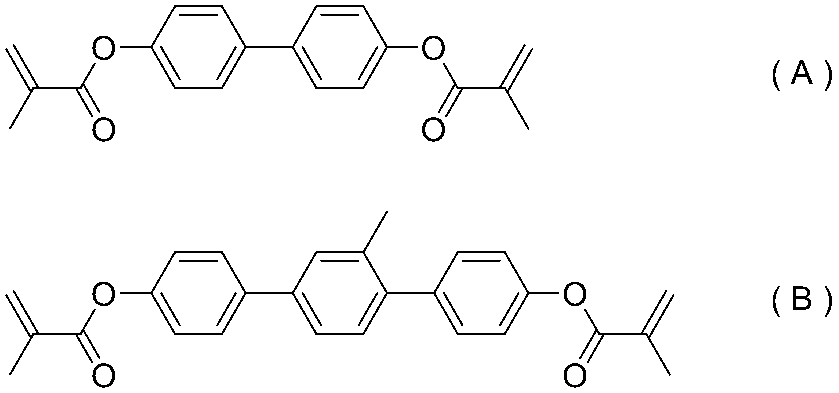
近年、液晶素子の製造において、生産効率の向上を目的に重合速度が適度に速い液晶組成物が求められている。しかし、化合物(A)や化合物(B)を含む液晶組成物は、重合速度が十分でないため、改善が求められていた。
本発明が解決しようとする課題は、重合性化合物の重合速度が十分に速く、かつ、それを用いた素子はプレチルト角の変化による表示不良が無いか、あるいは極めて少なく、十分なプレチルト角を有し、応答性能に優れるPSA型又はPSVA型液晶表示素子を製造するための重合性化合物を含む液晶組成物を提供すること、及び、これを用いた液晶表示素子を提供することにある。
本発明者らが鋭意検討した結果、特定の化学構造を有する重合性化合物を含む液晶組成物により、上記課題を解決できることを見出し、本願発明を完成するに至った。
本発明の液晶組成物は、屈折率異方性(Δn)及びネマチック相-等方性液体相転移温度(Tni)を低下させることなく、低い粘度(η)と、小さい回転粘性(γ1)と、大きい弾性定数(K33)を示し、重合性化合物の重合速度が十分に速く、重合性化合物の析出のない液晶組成物である。本発明の液晶組成物を用いた液晶表示素子は、プレチルト角が十分に得られ、重合性化合物の残留量が少なく、高い電圧保持率(VHR)と、高速応答を示し、配向不良や焼き付きといった表示不良がない又は抑制された、優れた表示品位を示す。
本発明の液晶組成物は、特定の重合性化合物を用いることにより、プレチルト角及び重合性化合物の残留量を制御でき、製造のためのエネルギーコストの最適化及び削減により容易に生産効率を向上できる。そのため、本発明の液晶組成物及びこれを使用した液晶表示素子は非常に有用である。
本発明の液晶組成物は、一般式(i)
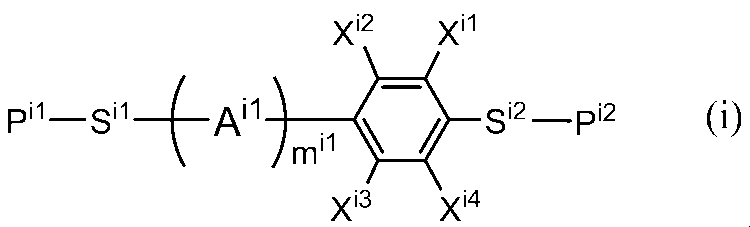
(式中、Xi1、Xi2、Xi3及びXi4は、それぞれ独立して、Pi3-Si3-、フッ素原子に置換されてもよい炭素原子数1から8のアルキル基、フッ素原子に置換されてもよい炭素原子数1から8のアルコキシ基、フッ素原子又は水素原子を表すが、Xi1、Xi2、Xi3及びXi4の少なくとも1つは、フッ素原子に置換されてもよい炭素原子数1から8のアルキル基を表し、
Ai1は、
(a) 1,4-シクロヘキシレン基(この基中に存在する1個の-CH2-又は隣接していない2個以上の-CH2-は-O-に置き換えられてもよい。)
(b) 1,4-フェニレン基(この基中に存在する1個の-CH=又は隣接していない2個以上の-CH=は-N=に置き換えられてもよい。)及び
(c) ナフタレン-2,6-ジイル基、1,2,3,4-テトラヒドロナフタレン-2,6-ジイル基又はデカヒドロナフタレン-2,6-ジイル基(ナフタレン-2,6-ジイル基又は1,2,3,4-テトラヒドロナフタレン-2,6-ジイル基中に存在する1個の-CH=又は隣接していない2個以上の-CH=は-N=に置き換えられても良い。)
からなる群より選ばれる基を表し、上記の基(a)、基(b)及び基(c)は、それぞれ独立して、炭素原子数1~8のアルキル基、炭素原子数1~8のアルコキシ基、ハロゲン、シアノ基、ニトロ基又はPi3-Si3-で置換されていても良く、
mi1は、2又は3を表し、
Pi1、Pi2及びPi3は、それぞれ独立して、式(R-1)から式(R-9)
Ai1は、
(a) 1,4-シクロヘキシレン基(この基中に存在する1個の-CH2-又は隣接していない2個以上の-CH2-は-O-に置き換えられてもよい。)
(b) 1,4-フェニレン基(この基中に存在する1個の-CH=又は隣接していない2個以上の-CH=は-N=に置き換えられてもよい。)及び
(c) ナフタレン-2,6-ジイル基、1,2,3,4-テトラヒドロナフタレン-2,6-ジイル基又はデカヒドロナフタレン-2,6-ジイル基(ナフタレン-2,6-ジイル基又は1,2,3,4-テトラヒドロナフタレン-2,6-ジイル基中に存在する1個の-CH=又は隣接していない2個以上の-CH=は-N=に置き換えられても良い。)
からなる群より選ばれる基を表し、上記の基(a)、基(b)及び基(c)は、それぞれ独立して、炭素原子数1~8のアルキル基、炭素原子数1~8のアルコキシ基、ハロゲン、シアノ基、ニトロ基又はPi3-Si3-で置換されていても良く、
mi1は、2又は3を表し、
Pi1、Pi2及びPi3は、それぞれ独立して、式(R-1)から式(R-9)
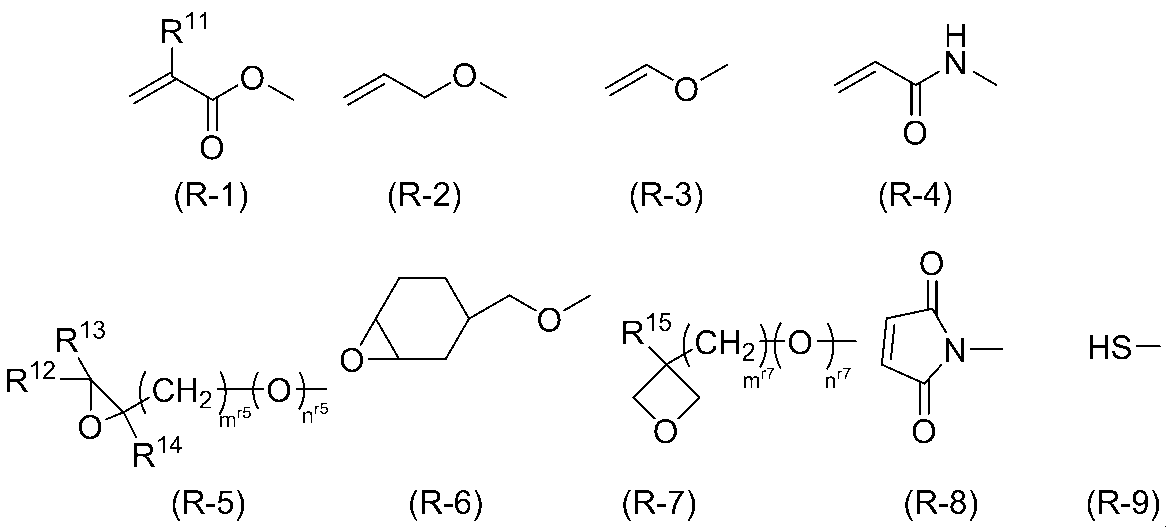
(式中、R11、R12、R13、R14及びR15は、それぞれ独立して、炭素原子数1から5のアルキル基、フッ素原子又は水素原子のいずれかを表し、mr5、mr7、nr5及びnr7は、それぞれ独立して、0、1、又は2を表す。)から選ばれる基を表し、
Si1、Si2及びSi3は、それぞれ独立して、単結合又は炭素原子数1~15のアルキレン基を表し、該アルキレン基中の1個の-CH2-又は隣接していない2個以上の-CH2-は、酸素原子が直接隣接しないように、-O-、-OCO-又は-COO-で置換されても良く、
Ai1、Pi3及び/又はSi3が複数存在する場合は、それぞれ、同一であっても異なっていても良い。)で表される重合性化合物を1種又は2種以上含有し、一般式(L)
Si1、Si2及びSi3は、それぞれ独立して、単結合又は炭素原子数1~15のアルキレン基を表し、該アルキレン基中の1個の-CH2-又は隣接していない2個以上の-CH2-は、酸素原子が直接隣接しないように、-O-、-OCO-又は-COO-で置換されても良く、
Ai1、Pi3及び/又はSi3が複数存在する場合は、それぞれ、同一であっても異なっていても良い。)で表される重合性化合物を1種又は2種以上含有し、一般式(L)

(式中、RL1及びRL2は、それぞれ独立して、炭素原子数1~8のアルキル基を表し、該アルキル基中の1個又は非隣接の2個以上の-CH2-はそれぞれ独立して-CH=CH-、-C≡C-、-O-、-CO-、-COO-又は-OCO-によって置換されていてもよく、
nL1は0、1、2又は3を表し、
AL1、AL2及びAL3は、それぞれ独立して
(a) 1,4-シクロヘキシレン基(この基中に存在する1個の-CH2-又は隣接していない2個以上の-CH2-は-O-に置き換えられてもよい。)
(b) 1,4-フェニレン基(この基中に存在する1個の-CH=又は隣接していない2個以上の-CH=は-N=に置き換えられてもよい。)及び
(c) ナフタレン-2,6-ジイル基、1,2,3,4-テトラヒドロナフタレン-2,6-ジイル基又はデカヒドロナフタレン-2,6-ジイル基(ナフタレン-2,6-ジイル基又は1,2,3,4-テトラヒドロナフタレン-2,6-ジイル基中に存在する1個の-CH=又は隣接していない2個以上の-CH=は-N=に置き換えられても良い。)
からなる群より選ばれる基を表し、上記の基(a)、基(b)及び基(c)は、それぞれ独立して、シアノ基、フッ素原子又は塩素原子で置換されていても良く、
ZL1及びZL2は、それぞれ独立して、単結合、-CH2CH2-、-(CH2)4-、-OCH2-、-CH2O-、-COO-、-OCO-、-OCF2-、-CF2O-、-CH=N-N=CH-、-CH=CH-、-CF=CF-又は-C≡C-を表し、
nL1が2又は3であってAL2が複数存在する場合は、それらは同一であっても異なっていても良く、nL1が2又は3であってZL2が複数存在する場合は、それらは同一であっても異なっていても良い。)で表される化合物から選ばれる化合物を1種類又は2種類以上含有する液晶組成物である。
nL1は0、1、2又は3を表し、
AL1、AL2及びAL3は、それぞれ独立して
(a) 1,4-シクロヘキシレン基(この基中に存在する1個の-CH2-又は隣接していない2個以上の-CH2-は-O-に置き換えられてもよい。)
(b) 1,4-フェニレン基(この基中に存在する1個の-CH=又は隣接していない2個以上の-CH=は-N=に置き換えられてもよい。)及び
(c) ナフタレン-2,6-ジイル基、1,2,3,4-テトラヒドロナフタレン-2,6-ジイル基又はデカヒドロナフタレン-2,6-ジイル基(ナフタレン-2,6-ジイル基又は1,2,3,4-テトラヒドロナフタレン-2,6-ジイル基中に存在する1個の-CH=又は隣接していない2個以上の-CH=は-N=に置き換えられても良い。)
からなる群より選ばれる基を表し、上記の基(a)、基(b)及び基(c)は、それぞれ独立して、シアノ基、フッ素原子又は塩素原子で置換されていても良く、
ZL1及びZL2は、それぞれ独立して、単結合、-CH2CH2-、-(CH2)4-、-OCH2-、-CH2O-、-COO-、-OCO-、-OCF2-、-CF2O-、-CH=N-N=CH-、-CH=CH-、-CF=CF-又は-C≡C-を表し、
nL1が2又は3であってAL2が複数存在する場合は、それらは同一であっても異なっていても良く、nL1が2又は3であってZL2が複数存在する場合は、それらは同一であっても異なっていても良い。)で表される化合物から選ばれる化合物を1種類又は2種類以上含有する液晶組成物である。
一般式(i)で表される重合性化合物を含む液晶組成物は、適度に速い重合速度であると、短い紫外線照射時間で目的のプレチルト角を付与することができる。更に、適度に速い重合速度であると、重合性化合物の残留量を少なくできる。そのため、PSA型液晶表示素子製造の生産効率を向上できる。また、プレチルト角の変化による表示不良(例えば、焼き付きなどの不具合)が生じないか、又は極めて少ないといった効果を奏する。なお、本明細書における表示不良は、重合後のプレチルト角が経時的に変化することによる表示不良、未反応の重合性化合物の残留量に起因する表示不良、電圧保持率の低下による表示不良を考慮している。
上記一般式(i)において、Xi1、Xi2、Xi3及びXi4は、それぞれ独立して、Pi3-Si3-、フッ素原子に置換されてもよい炭素原子数1から8のアルキル基、フッ素原子に置換されてもよい炭素原子数1から8のアルコキシ基、フッ素原子又は水素原子を表すが、この場合、前記アルキル基及びアルコキシ基の好ましい炭素原子数は、1~6であり、より好ましくは1~4であり、さらに好ましくは1~3である。また、前記アルキル基及びアルコキシ基は、直鎖状又は分岐状であってもよいが、直鎖状が特に好ましい。
Xi1、Xi2、Xi3及びXi4の少なくとも1つは、フッ素原子に置換されてもよい炭素原子数1から8のアルキル基を表すが、この場合、前記アルキル基の好ましい炭素原子数は、1~6であり、より好ましくは1~4であり、さらに好ましくは1~3であり、よりさらに好ましくは1~2であり、特に好ましくは1である。また、前記アルキル基は、直鎖状又は分岐状であってもよいが、直鎖状が特に好ましい。
Xi1、Xi2、Xi3及びXi4の少なくとも1つは、フッ素原子に置換されてもよい炭素原子数1から8のアルキル基を表すが、この場合、前記アルキル基の好ましい炭素原子数は、1~6であり、より好ましくは1~4であり、さらに好ましくは1~3であり、よりさらに好ましくは1~2であり、特に好ましくは1である。また、前記アルキル基は、直鎖状又は分岐状であってもよいが、直鎖状が特に好ましい。
上記一般式(i)において、Xi1、Xi2、Xi3及びXi4は、それぞれ独立して、Pi3-Si3-、フッ素原子に置換されてもよい炭素原子数1から3のアルキル基、フッ素原子又は水素原子のいずれかを表すことが好ましく、Pi3-Si3-、フッ素原子に置換されてもよい炭素原子数1から3のアルキル基又は水素原子のいずれかを表すことが更に好ましい。
前記フッ素原子に置換されてもよい炭素原子数1から8のアルキル基としては、直鎖状のアルキル基が好ましく、メチル基、エチル基、プロピル基もしくはブチル基又はこれらの基の水素原子がフッ素原子に置換されたフッ化アルキル基などが挙げられ、その内、メチル基、エチル基、プロピル基、モノフルオロメチル基、ジフルオロメチル基、トリフルオロメチル基が好ましく、メチル基又はエチル基が更により好ましく、メチル基が特に好ましい。電子共役の観点、及び炭素原子数が増えるごとに置換基が嵩高くなり、重合速度及び重合度の低下を引き起こしやすくなるため、メチル基であることが特に好ましい。
上記一般式(i)において、Xi1、Xi2、Xi3及びXi4のうち、フッ素原子に置換されてもよい炭素原子数1から8のアルキル基を表すものの数が、1以上3以下であることが好ましく、1以上2以下であることがより好ましく、1であることが特に好ましい。
上記一般式(i)において、Xi1、Xi2、Xi3及びXi4のいずれか1つがフッ素原子に置換されてもよい炭素原子数1から8のアルキル基である場合の態様としては、Xi1又はXi4がフッ素原子に置換されてもよい炭素原子数1から8のアルキル基を表すことが好ましく、Xi1又はXi4がフッ素原子に置換されてもよい炭素原子数1から3のアルキル基を表すことが特に好ましい。
上記一般式(i)において、Xi1、Xi2、Xi3及びXi4のうち、Pi3-Si3-を表すものの数は、0、1又は2であることが好ましく、0又は1であることがより好ましく、0であることが特に好ましい。
上記一般式(i)において、Ai1は、
(a) 1,4-シクロヘキシレン基(この基中に存在する1個の-CH2-又は隣接していない2個以上の-CH2-は-O-に置き換えられてもよい。)
(b) 1,4-フェニレン基(この基中に存在する1個の-CH=又は隣接していない2個以上の-CH=は-N=に置き換えられてもよい。)及び
(c) ナフタレン-2,6-ジイル基、1,2,3,4-テトラヒドロナフタレン-2,6-ジイル基又はデカヒドロナフタレン-2,6-ジイル基(ナフタレン-2,6-ジイル基又は1,2,3,4-テトラヒドロナフタレン-2,6-ジイル基中に存在する1個の-CH=又は隣接していない2個以上の-CH=は-N=に置き換えられても良い。)
からなる群より選ばれる基を表し、上記の基(a)、基(b)及び基(c)は、それぞれ独立して、炭素原子数1~8のアルキル基、炭素原子数1~8のアルコキシ基、ハロゲン、シアノ基、ニトロ基又はPi3-Si3-で置換されていても良いが、下記の構造を表すことが好ましく、
(a) 1,4-シクロヘキシレン基(この基中に存在する1個の-CH2-又は隣接していない2個以上の-CH2-は-O-に置き換えられてもよい。)
(b) 1,4-フェニレン基(この基中に存在する1個の-CH=又は隣接していない2個以上の-CH=は-N=に置き換えられてもよい。)及び
(c) ナフタレン-2,6-ジイル基、1,2,3,4-テトラヒドロナフタレン-2,6-ジイル基又はデカヒドロナフタレン-2,6-ジイル基(ナフタレン-2,6-ジイル基又は1,2,3,4-テトラヒドロナフタレン-2,6-ジイル基中に存在する1個の-CH=又は隣接していない2個以上の-CH=は-N=に置き換えられても良い。)
からなる群より選ばれる基を表し、上記の基(a)、基(b)及び基(c)は、それぞれ独立して、炭素原子数1~8のアルキル基、炭素原子数1~8のアルコキシ基、ハロゲン、シアノ基、ニトロ基又はPi3-Si3-で置換されていても良いが、下記の構造を表すことが好ましく、

(式中、Ri1及びRi2は、それぞれ独立して、炭素原子数1~8のアルキル基、炭素原子数1~8のアルコキシ基、フッ素原子又はPi3-Si3-を表す。)
1,4-フェニレン基、2-メチル-1,4-フェニレン基、3-メチル-1,4-フェニレン基、2-メトキシ-1,4-フェニレン基、3-メトキシ-1,4-フェニレン基、2-フルオロ-1,4-フェニレン基、3-フルオロ-1,4-フェニレン基又はナフタレン-2,6-ジイル基であることがより好ましく、1,4-フェニレン基、2-メチル-1,4-フェニレン基又は3-メチル-1,4-フェニレン基であることが更に好ましく、1,4-フェニレン基又は2-メチル-1,4-フェニレン基であることがより更に好ましく、1,4-フェニレン基であることが特に好ましい。
上記一般式(i)において、mi1は、2又は3を表すが、2を表すことが特に好ましい。
上記一般式(i)において、Pi1、Pi2及びPi3は、全て同一の重合性基(式(R-1)~(R-9))であっても、異なる重合性基でもよい。
1,4-フェニレン基、2-メチル-1,4-フェニレン基、3-メチル-1,4-フェニレン基、2-メトキシ-1,4-フェニレン基、3-メトキシ-1,4-フェニレン基、2-フルオロ-1,4-フェニレン基、3-フルオロ-1,4-フェニレン基又はナフタレン-2,6-ジイル基であることがより好ましく、1,4-フェニレン基、2-メチル-1,4-フェニレン基又は3-メチル-1,4-フェニレン基であることが更に好ましく、1,4-フェニレン基又は2-メチル-1,4-フェニレン基であることがより更に好ましく、1,4-フェニレン基であることが特に好ましい。
上記一般式(i)において、mi1は、2又は3を表すが、2を表すことが特に好ましい。
上記一般式(i)において、Pi1、Pi2及びPi3は、全て同一の重合性基(式(R-1)~(R-9))であっても、異なる重合性基でもよい。
上記一般式(i)において、Pi1、Pi2及びPi3は、それぞれ独立して、式(R-1)、式(R-2)、式(R-3)、式(R-4)、式(R-5)又は式(R-7)であることが好ましく、式(R-1)、式(R-2)、式(R-3)又は式(R-4)であることがより好ましく、式(R-1)であることが更に好ましく、アクリルオキシ基又はメタクリルオキシ基であることが特に好ましい。
Pi1及びPi2の少なくとも一方が、式(R-1)であることが好ましく、アクリルオキシ基又はメタクリルオキシ基であることがより好ましく、メタクリルオキシ基であることがさらに好ましく、Pi1及びPi2がメタクリルオキシ基であることが特に好ましい。
R11、R12、R13、R14及びR15は、それぞれ独立して、メチル基又は水素原子であることが好ましく、重合性化合物の重合速度を重視する場合は水素原子であることが好ましく、プレチルト角の変化による表示不良の低減を重視する場合はメチル基であることが好ましい。
上記一般式(i)において、Si1、Si2及びSi3は、それぞれ独立して、単結合又は炭素原子数1~5のアルキレン基であることが好ましく、単結合であることが特に好ましい。Si1、Si2及びSi3が単結合である場合、紫外線照射後の重合性化合物の残留量が十分に少なく、プレチルト角の変化による表示不良が発生しにくくなる。
本発明の液晶組成物における一般式(i)で表される重合性化合物の含有量の下限は、0.01質量%が好ましく、0.02質量%が好ましく、0.03質量%が好ましく、0.04質量%が好ましく、0.05質量%が好ましく、0.06質量%が好ましく、0.07質量%が好ましく、0.08質量%が好ましく、0.09質量%が好ましく、0.1質量%が好ましく、0.12質量%が好ましく、0.15質量%が好ましく、0.17質量%が好ましく、0.2質量%が好ましく、0.22質量%が好ましく、0.25質量%が好ましく、0.27質量%が好ましく、0.3質量%が好ましく、0.32質量%が好ましく、0.35質量%が好ましく、0.37質量%が好ましく、0.4質量%が好ましく、0.42質量%が好ましく、0.45質量%が好ましく、0.5質量%が好ましく、0.55質量%が好ましい。本発明の液晶組成物における一般式(i)で表される重合性化合物の含有量の上限は、5質量%が好ましく、4.5質量%が好ましく、4質量%が好ましく、3.5質量%が好ましく、3質量%が好ましく、2.5質量%が好ましく、2質量%が好ましく、1.5質量%が好ましく、1質量%が好ましく、0.95質量%が好ましく、0.9質量%が好ましく、0.85質量%が好ましく、0.8質量%が好ましく、0.75質量%が好ましく、0.7質量%が好ましく、0.65質量%が好ましく、0.6質量%が好ましく、0.55質量%が好ましく、0.5質量%が好ましく、0.45質量%が好ましく、0.4質量%が好ましい。
更に詳述すると、十分なプレチルト角又は重合性化合物の少ない残留量又は高い電圧保持率(VHR)を得るには、その含有量は0.2から1.5質量%が好ましいが、低温における析出の抑制を重視する場合にはその含有量は0.01から1.0質量%が好ましい。また、一般式(i)で表される重合性化合物を複数含有する場合は、それぞれの含有量が0.01から0.6質量%であることが好ましい。従って、これら全ての課題を解決するためには、一般式(i)で表される重合性化合物を0.1から1.0質量%の範囲で調整することが特に望ましい。
本発明に係る一般式(i)で表される重合性化合物として、具体的には、一般式(i-1-1)から(i-1-6)、一般式(i-2-1)から(I-2-7)、一般式(i-3-1)から(i-3-7)、一般式(i-4-1)から(i-4-4)、一般式(i-5-1)から(i-5-4)で表される化合物が好ましい。

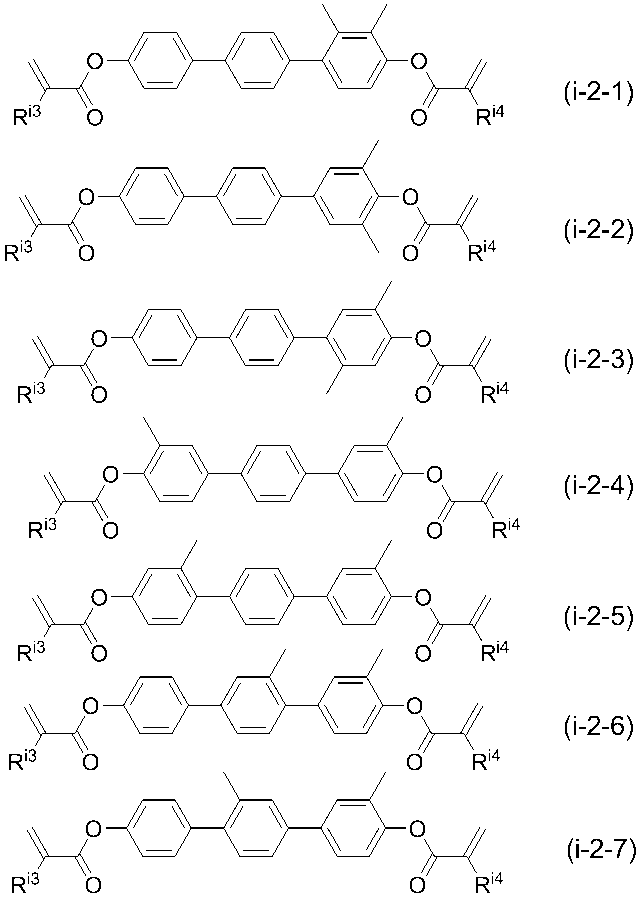


(式中、Ri3、Ri4及びRi5は、それぞれ独立して、炭素原子数1~5のアルキル基、フッ素原子又は水素原子のいずれかを表す。)
上記式中、Ri3、Ri4及びRi5は、それぞれ独立して、炭素原子数1から5のアルキル基、フッ素原子又は水素原子が好ましく、メチル基又は水素原子を表すことがより好ましい。
上記式中、Ri3、Ri4及びRi5は、それぞれ独立して、炭素原子数1から5のアルキル基、フッ素原子又は水素原子が好ましく、メチル基又は水素原子を表すことがより好ましい。
上記一般式(i-1-1)から(i-1-6)、一般式(i-2-1)から(I-2-7)、一般式(i-3-1)から(i-3-7)、一般式(i-4-1)から(i-4-4)、一般式(i-5-1)から(i-5-4)で表される化合物のうち、一般式(i-1-1)から(i-1-4)、一般式(i-2-4)から(I-2-7)がより好ましく、一般式(i-1-1)、又は一般式(i-2-4)が更に好ましく、一般式(i-1-1)が特に好ましい。
上記一般式一般式(i-1-1)のような重合性化合物を含有する液晶組成物は、応答性能に優れ、なおかつ、十分なプレチルト角を有し、重合性化合物の残留量が少なく、プレチルトの変化等に起因した配向不良や表示不良といった不具合が無いか、あるいは極めて少ないPSA型又はPSVA型液晶表示素子を効率よく製造できるため、特に好ましい。
本発明の液晶組成物は、一般式(L)で表される化合物を1種類又は2種類以上含有することが好ましい。一般式(L)で表される化合物は誘電的にほぼ中性の化合物(Δεの値が-2~2)に該当する。このため、分子内に有する、ハロゲン等の極性基の個数を2個以下とした方が好ましく、1個以下とした方が好ましく、有さない方が好ましい。

(式中、RL1及びRL2はそれぞれ独立して炭素原子数1~8のアルキル基を表し、該アルキル基中の1個又は非隣接の2個以上の-CH2-はそれぞれ独立して-CH=CH-、-C≡C-、-O-、-CO-、-COO-又は-OCO-によって置換されていてもよく、
nL1は0、1、2又は3を表し、
AL1、AL2及びAL3はそれぞれ独立して
(a) 1,4-シクロヘキシレン基(この基中に存在する1個の-CH2-又は隣接していない2個以上の-CH2-は-O-に置き換えられてもよい。)及び
(b) 1,4-フェニレン基(この基中に存在する1個の-CH=又は隣接していない2個以上の-CH=は-N=に置き換えられてもよい。)
(c) ナフタレン-2,6-ジイル基、1,2,3,4-テトラヒドロナフタレン-2,6-ジイル基又はデカヒドロナフタレン-2,6-ジイル基(ナフタレン-2,6-ジイル基又は1,2,3,4-テトラヒドロナフタレン-2,6-ジイル基中に存在する1個の-CH=又は隣接していない2個以上の-CH=は-N=に置き換えられても良い。)
からなる群より選ばれる基を表し、上記の基(a)、基(b)及び基(c)はそれぞれ独立してシアノ基、フッ素原子又は塩素原子で置換されていても良く、
ZL1及びZL2はそれぞれ独立して単結合、-CH2CH2-、-(CH2)4-、-OCH2-、-CH2O-、-COO-、-OCO-、-OCF2-、-CF2O-、-CH=N-N=CH-、-CH=CH-、-CF=CF-又は-C≡C-を表し、
nL1が2又は3であってAL2が複数存在する場合は、それらは同一であっても異なっていても良く、nL1が2又は3であってZL3が複数存在する場合は、それらは同一であっても異なっていても良いが、一般式(N-1)、(N-2)及び(N-3)で表される化合物を除く。)
一般式(L)で表される化合物は単独で用いてもよいが、組み合わせて使用することもできる。組み合わせることができる化合物の種類に特に制限は無いが、低温での溶解性、転移温度、電気的な信頼性、複屈折率などの所望の性能に応じて適宜組み合わせて使用する。使用する化合物の種類は、例えば本発明の一つの実施形態としては1種類である。あるいは本発明の別の実施形態では2種類であり、3種類であり、4種類であり、5種類であり、6種類であり、7種類であり、8種類であり、9種類であり、10種類以上である。
nL1は0、1、2又は3を表し、
AL1、AL2及びAL3はそれぞれ独立して
(a) 1,4-シクロヘキシレン基(この基中に存在する1個の-CH2-又は隣接していない2個以上の-CH2-は-O-に置き換えられてもよい。)及び
(b) 1,4-フェニレン基(この基中に存在する1個の-CH=又は隣接していない2個以上の-CH=は-N=に置き換えられてもよい。)
(c) ナフタレン-2,6-ジイル基、1,2,3,4-テトラヒドロナフタレン-2,6-ジイル基又はデカヒドロナフタレン-2,6-ジイル基(ナフタレン-2,6-ジイル基又は1,2,3,4-テトラヒドロナフタレン-2,6-ジイル基中に存在する1個の-CH=又は隣接していない2個以上の-CH=は-N=に置き換えられても良い。)
からなる群より選ばれる基を表し、上記の基(a)、基(b)及び基(c)はそれぞれ独立してシアノ基、フッ素原子又は塩素原子で置換されていても良く、
ZL1及びZL2はそれぞれ独立して単結合、-CH2CH2-、-(CH2)4-、-OCH2-、-CH2O-、-COO-、-OCO-、-OCF2-、-CF2O-、-CH=N-N=CH-、-CH=CH-、-CF=CF-又は-C≡C-を表し、
nL1が2又は3であってAL2が複数存在する場合は、それらは同一であっても異なっていても良く、nL1が2又は3であってZL3が複数存在する場合は、それらは同一であっても異なっていても良いが、一般式(N-1)、(N-2)及び(N-3)で表される化合物を除く。)
一般式(L)で表される化合物は単独で用いてもよいが、組み合わせて使用することもできる。組み合わせることができる化合物の種類に特に制限は無いが、低温での溶解性、転移温度、電気的な信頼性、複屈折率などの所望の性能に応じて適宜組み合わせて使用する。使用する化合物の種類は、例えば本発明の一つの実施形態としては1種類である。あるいは本発明の別の実施形態では2種類であり、3種類であり、4種類であり、5種類であり、6種類であり、7種類であり、8種類であり、9種類であり、10種類以上である。
本発明の組成物において、一般式(L)で表される化合物の含有量は、低温での溶解性、転移温度、電気的な信頼性、複屈折率、プロセス適合性、滴下痕、焼き付き、誘電率異方性などの求められる性能に応じて適宜調整する必要がある。
本発明の組成物の総量に対しての式(L)で表される化合物の好ましい含有量の下限値は、1%であり、10%であり、20%であり、30%であり、40%であり、50%であり、55%であり、60%であり、65%であり、70%であり、75%であり、80%である。好ましい含有量の上限値は、95%であり、85%であり、75%であり、65%であり、55%であり、45%であり、35%であり、25%である。
本発明の組成物の粘度を低く保ち、応答速度が速い組成物が必要な場合は上記の下限値が高く上限値が高いことが好ましい。さらに、本発明の組成物のTniを高く保ち、温度安定性の良い組成物が必要な場合は上記の下限値が高く上限値が高いことが好ましい。また、駆動電圧を低く保つために誘電率異方性を大きくしたいときは、上記の下限値を低く上限値が低いことが好ましい。
信頼性を重視する場合にはRL1及びRL2はともにアルキル基であることが好ましく、化合物の揮発性を低減させることを重視する場合にはアルコキシ基であることが好ましく、粘性の低下を重視する場合には少なくとも一方はアルケニル基であることが好ましい。
分子内に存在するハロゲン原子は0、1、2又は3個が好ましく、0又は1が好ましく、他の液晶分子との相溶性を重視する場合には1が好ましい。
RL1及びRL2は、それが結合する環構造がフェニル基(芳香族)である場合には、直鎖状の炭素原子数1~5のアルキル基、直鎖状の炭素原子数1~4のアルコキシ基及び炭素原子数4~5のアルケニル基が好ましく、それが結合する環構造がシクロヘキサン、ピラン及びジオキサンなどの飽和した環構造の場合には、直鎖状の炭素原子数1~5のアルキル基、直鎖状の炭素原子数1~4のアルコキシ基及び直鎖状の炭素原子数2~5のアルケニル基が好ましい。ネマチック相を安定化させるためには炭素原子及び存在する場合酸素原子の合計が5以下であることが好ましく、直鎖状であることが好ましい。
アルケニル基としては、式(R1)から式(R5)のいずれかで表される基から選ばれることが好ましい。(各式中の黒点は環構造中の炭素原子を表す。)

nL1は応答速度を重視する場合には0が好ましく、ネマチック相の上限温度を改善するためには2又は3が好ましく、これらのバランスをとるためには1が好ましい。また、組成物として求められる特性を満たすためには異なる値の化合物を組み合わせることが好ましい。
AL1、AL2及びAL3はΔnを大きくすることが求められる場合には芳香族であることが好ましく、応答速度を改善するためには脂肪族であることが好ましく、それぞれ独立してトランス-1,4-シクロへキシレン基、1,4-フェニレン基、2-フルオロ-1,4-フェニレン基、3-フルオロ-1,4-フェニレン基、3,5-ジフルオロ-1,4-フェニレン基、1,4-シクロヘキセニレン基、1,4-ビシクロ[2.2.2]オクチレン基、ピペリジン-1,4-ジイル基、ナフタレン-2,6-ジイル基、デカヒドロナフタレン-2,6-ジイル基又は1,2,3,4-テトラヒドロナフタレン-2,6-ジイル基を表すことが好ましく、下記の構造を表すことがより好ましく、
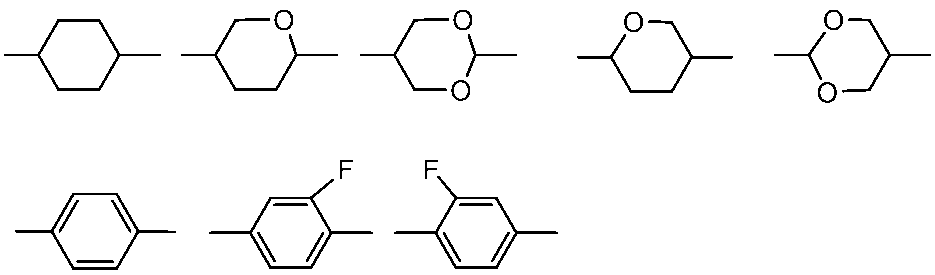
トランス-1,4-シクロへキシレン基又は1,4-フェニレン基を表すことがより好ましい。
ZL1及びZL2は応答速度を重視する場合には単結合であることが好ましい。
一般式(L)で表される化合物は分子内のハロゲン原子数が0個又は1個であることが好ましい。
一般式(L)で表される化合物は一般式(L-1)~(L-7)で表される化合物群から選ばれる化合物であることが好ましい。
一般式(L-1)で表される化合物は下記の化合物である。

(式中、RL11及びRL12はそれぞれ独立して、一般式(L)におけるRL1及びRL2と同じ意味を表す。)
RL11及びRL12は、直鎖状の炭素原子数1~5のアルキル基、直鎖状の炭素原子数1~4のアルコキシ基及び直鎖状の炭素原子数2~5のアルケニル基が好ましい。
RL11及びRL12は、直鎖状の炭素原子数1~5のアルキル基、直鎖状の炭素原子数1~4のアルコキシ基及び直鎖状の炭素原子数2~5のアルケニル基が好ましい。
一般式(L-1)で表される化合物は単独で使用することもできるが、2以上の化合物を組み合わせて使用することもできる。組み合わせることができる化合物の種類に特に制限は無いが、低温での溶解性、転移温度、電気的な信頼性、複屈折率などの求められる性能に応じて適宜組み合わせて使用する。使用する化合物の種類は、例えば本発明の一つの実施形態としては1種類であり、2種類であり、3種類であり、4種類であり、5種類以上である。
好ましい含有量の下限値は、本発明の組成物の総量に対して、1%であり、2%であり、3%であり、5%であり、7%であり、10%であり、15%であり、20%であり、25%であり、30%であり、35%であり、40%であり、45%であり、50%であり、55%である。好ましい含有量の上限値は、本発明の組成物の総量に対して、95%であり、90%であり、85%であり、80%であり、75%であり、70%であり、65%であり、60%であり、55%であり、50%であり、45%であり、40%であり、35%であり、30%であり、25%である。
本発明の組成物の粘度を低く保ち、応答速度が速い組成物が必要な場合は上記の下限値が高く上限値が高いことが好ましい。さらに、本発明の組成物のTniを高く保ち、温度安定性の良い組成物が必要な場合は上記の下限値が中庸で上限値が中庸であることが好ましい。また、駆動電圧を低く保つために誘電率異方性を大きくしたいときは、上記の下限値が低く上限値が低いことが好ましい。
一般式(L-1)で表される化合物は一般式(L-1-1)で表される化合物群から選ばれる化合物であることが好ましい。

(式中RL12は一般式(L-1)における意味と同じ意味を表す。)
一般式(L-1-1)で表される化合物は、式(L-1-1.1)から式(L-1-1.3)で表される化合物群から選ばれる化合物であることが好ましく、式(L-1-1.2)又は式(L-1-1.3)で表される化合物であることが好ましく、特に、式(L-1-1.3)で表される化合物であることが好ましい。
一般式(L-1-1)で表される化合物は、式(L-1-1.1)から式(L-1-1.3)で表される化合物群から選ばれる化合物であることが好ましく、式(L-1-1.2)又は式(L-1-1.3)で表される化合物であることが好ましく、特に、式(L-1-1.3)で表される化合物であることが好ましい。

本発明の組成物の総量に対しての式(L-1-1.3)で表される化合物の好ましい含有量の下限値は、1%であり、2%であり、3%であり、5%であり、7%であり、10%である。好ましい含有量の上限値は、本発明の組成物の総量に対して、20%であり、15%であり、13%であり、10%であり、8%であり、7%であり、6%であり、5%であり、3%である。
一般式(L-1)で表される化合物は一般式(L-1-2)で表される化合物群から選ばれる化合物であることが好ましい。

(式中RL12は一般式(L-1)における意味と同じ意味を表す。)
本発明の組成物の総量に対しての式(L-1-2)で表される化合物の好ましい含有量の下限値は、1%であり、5%であり、10%であり、15%であり、17%であり、20%であり、23%であり、25%であり、27%であり、30%であり、35%である。好ましい含有量の上限値は、本発明の組成物の総量に対して、60%であり、55%であり、50%であり、45%であり、42%であり、40%であり、38%であり、35%であり、33%であり、30%である。
本発明の組成物の総量に対しての式(L-1-2)で表される化合物の好ましい含有量の下限値は、1%であり、5%であり、10%であり、15%であり、17%であり、20%であり、23%であり、25%であり、27%であり、30%であり、35%である。好ましい含有量の上限値は、本発明の組成物の総量に対して、60%であり、55%であり、50%であり、45%であり、42%であり、40%であり、38%であり、35%であり、33%であり、30%である。
さらに、一般式(L-1-2)で表される化合物は、式(L-1-2.1)から式(L-1-2.4)で表される化合物群から選ばれる化合物であることが好ましく、式(L-1-2.2)から式(L-1-2.4)で表される化合物であることが好ましい。特に、式(L-1-2.2)で表される化合物は本発明の組成物の応答速度を特に改善するため好ましい。また、応答速度よりも高いTniを求めるときは、式(L-1-2.3)又は式(L-1-2.4)で表される化合物を用いることが好ましい。式(L-1-2.3)及び式(L-1-2.4)で表される化合物の含有量は、低温での溶解度を良くするために30%以上にすることは好ましくない。
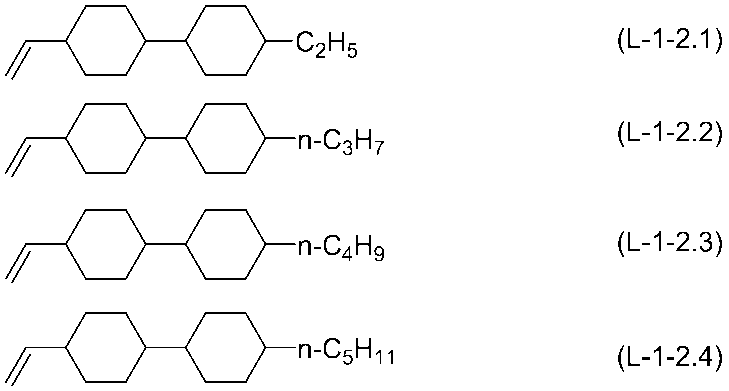
本発明の組成物の総量に対しての式(L-1-2.2)で表される化合物の好ましい含有量の下限値は、10%であり、15%であり、18%であり、20%であり、23%であり、25%であり、27%であり、30%であり、33%であり、35%であり、38%であり、40%である。好ましい含有量の上限値は、本発明の組成物の総量に対して、60%であり、55%であり、50%であり、45%であり、43%であり、40%であり、38%であり、35%であり、32%であり、30%であり、27%であり、25%であり、22%である。
本発明の組成物の総量に対しての式(L-1-1.3)で表される化合物及び式(L-1-2.2)で表される化合物の合計の好ましい含有量の下限値は、10%であり、15%であり、20%であり、25%であり、27%であり、30%であり、35%であり、40%である。好ましい含有量の上限値は、本発明の組成物の総量に対して、60%であり、55%であり、50%であり、45%であり、43%であり、40%であり、38%であり、35%であり、32%であり、30%であり、27%であり、25%であり、22%である。
一般式(L-1)で表される化合物は一般式(L-1-3)で表される化合物群から選ばれる化合物であることが好ましい。

(式中RL13及びRL14はそれぞれ独立して炭素原子数1~8のアルキル基又は炭素原子数1~8のアルコキシ基を表す。)
RL13及びRL14は、直鎖状の炭素原子数1~5のアルキル基又は直鎖状の炭素原子数1~4のアルコキシ基が好ましい。
RL13及びRL14は、直鎖状の炭素原子数1~5のアルキル基又は直鎖状の炭素原子数1~4のアルコキシ基が好ましい。
本発明の組成物の総量に対しての式(L-1-3)で表される化合物の好ましい含有量の下限値は、1%であり、5%であり、10%であり、13%であり、15%であり、17%であり、20%であり、23%であり、25%であり、30%である。好ましい含有量の上限値は、本発明の組成物の総量に対して、60%であり、55%であり、50%であり、45%であり、40%であり、37%であり、35%であり、33%であり、30%であり、27%であり、25%であり、23%であり、20%であり、17%であり、15%であり、13%であり、10%である。
さらに、一般式(L-1-3)で表される化合物は、式(L-1-3.1)から式(L-1-3.13)で表される化合物群から選ばれる化合物であることが好ましく、式(L-1-3.1)、式(L-1-3.3)又は式(L-1-3.4)で表される化合物であることが好ましい。特に、式(L-1-3.1)で表される化合物は本発明の組成物の応答速度を特に改善するため好ましい。また、応答速度よりも高いTniを求めるときは、式(L-1-3.3)、式(L-1-3.4)、式(L-1-3.11)及び式(L-1-3.13)で表される化合物を用いることが好ましい。式(L-1-3.3)、式(L-1-3.4)、式(L-1-3.11)及び式(L-1-3.13)で表される化合物の合計の含有量は、低温での溶解度を良くするために20%以上にすることは好ましくない。
さらに、一般式(L-1-3)で表される化合物は、式(L-1-3.1)から式(L-1-3.13)で表される化合物群から選ばれる化合物であることが好ましく、式(L-1-3.1)、式(L-1-3.3)又は式(L-1-3.4)で表される化合物であることが好ましい。特に、式(L-1-3.1)で表される化合物は本発明の組成物の応答速度を特に改善するため好ましい。また、応答速度よりも高いTniを求めるときは、式(L-1-3.3)、式(L-1-3.4)、式(L-1-3.11)及び式(L-1-3.13)で表される化合物を用いることが好ましい。式(L-1-3.3)、式(L-1-3.4)、式(L-1-3.11)及び式(L-1-3.13)で表される化合物の合計の含有量は、低温での溶解度を良くするために20%以上にすることは好ましくない。
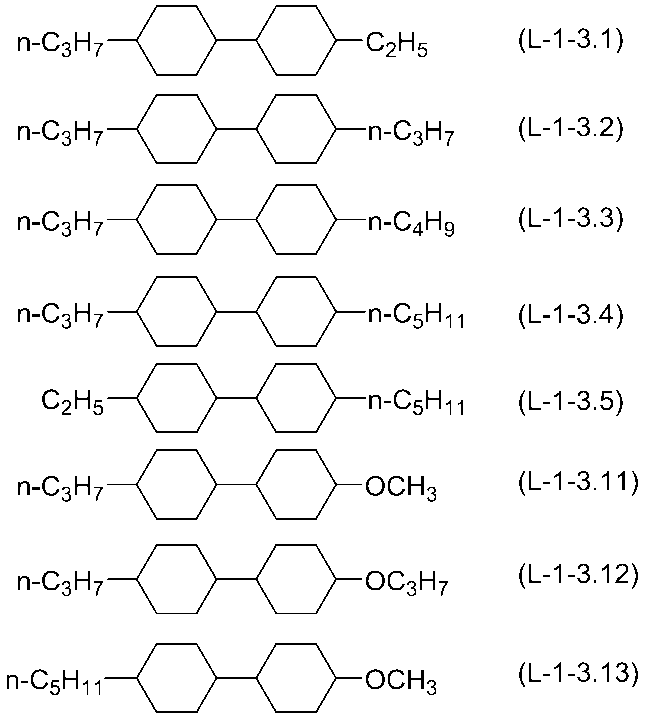
本発明の組成物の総量に対しての式(L-1-3.1)で表される化合物の好ましい含有量の下限値は、1%であり、2%であり、3%であり、5%であり、7%であり、10%であり、13%であり、15%であり、18%であり、20%である。好ましい含有量の上限値は、本発明の組成物の総量に対して、20%であり、17%であり、15%であり、13%であり、10%であり、8%であり、7%であり、6%である。
一般式(L-1)で表される化合物は一般式(L-1-4)及び/又は(L-1-5)で表される化合物群から選ばれる化合物であることが好ましい。

(式中RL15及びRL16はそれぞれ独立して炭素原子数1~8のアルキル基又は炭素原子数1~8のアルコキシ基を表す。)
RL15及びRL16は、直鎖状の炭素原子数1~5のアルキル基又は直鎖状の炭素原子数1~4のアルコキシ基が好ましい。
RL15及びRL16は、直鎖状の炭素原子数1~5のアルキル基又は直鎖状の炭素原子数1~4のアルコキシ基が好ましい。
本発明の組成物の総量に対しての式(L-1-4)で表される化合物の好ましい含有量の下限値は、1%であり、5%であり、10%であり、13%であり、15%であり、17%であり、20%である。好ましい含有量の上限値は、本発明の組成物の総量に対して、25%であり、23%であり、20%であり、17%であり、15%であり、13%であり、10%である。
本発明の組成物の総量に対しての式(L-1-5)で表される化合物の好ましい含有量の下限値は、1%であり、5%であり、10%であり、13%であり、15%であり、17%であり、20%である。好ましい含有量の上限値は、本発明の組成物の総量に対して、25%であり、23%であり、20%であり、17%であり、15%であり、13%であり、10%である。
さらに、一般式(L-1-4)及び(L-1-5)で表される化合物は、式(L-1-4.1)から式(L-1-5.3)で表される化合物群から選ばれる化合物であることが好ましく、式(L-1-4.2)又は式(L-1-5.2)で表される化合物であることが好ましい。
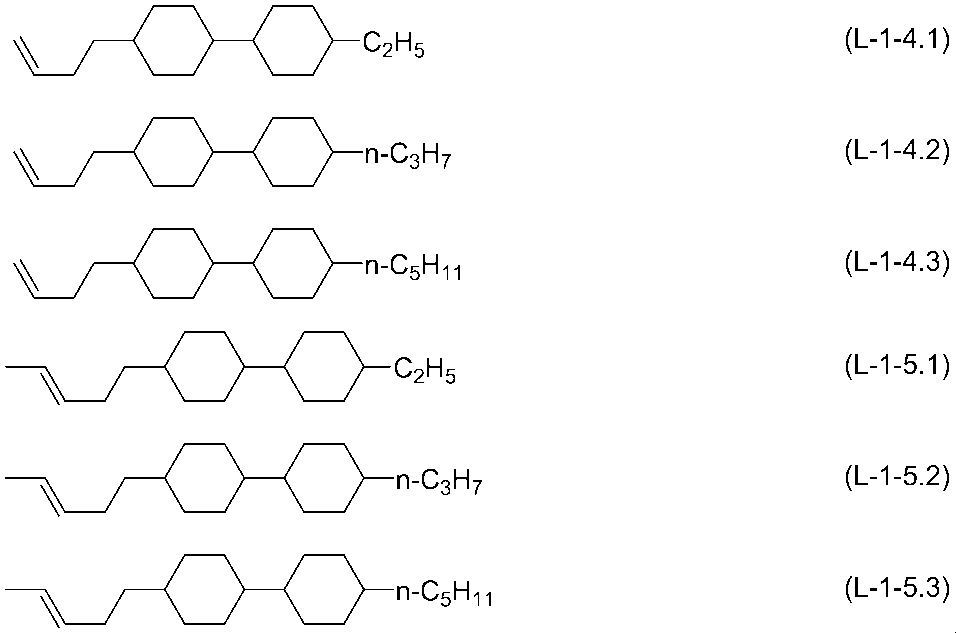
本発明の組成物の総量に対しての式(L-1-4.2)で表される化合物の好ましい含有量の下限値は、1%であり、2%であり、3%であり、5%であり、7%であり、10%であり、13%であり、15%であり、18%であり、20%である。好ましい含有量の上限値は、本発明の組成物の総量に対して、20%であり、17%であり、15%であり、13%であり、10%であり、8%であり、7%であり、6%である。
式(L-1-1.3)、式(L-1-2.2)、式(L-1-3.1)、式(L-1-3.3)、式(L-1-3.4)、式(L-1-3.11)及び式(L-1-3.12)で表される化合物から選ばれる2種以上の化合物を組み合わせることが好ましく、式(L-1-1.3)、式(L-1-2.2)、式(L-1-3.1)、式(L-1-3.3)、式(L-1-3.4)及び式(L-1-4.2)で表される化合物から選ばれる2種以上の化合物を組み合わせることが好ましく、これら化合物の合計の含有量の好ましい含有量の下限値は、本発明の組成物の総量に対して、1%であり、2%であり、3%であり、5%であり、7%であり、10%であり、13%であり、15%であり、18%であり、20%であり、23%であり、25%であり、27%であり、30%であり、33%であり、35%であり、上限値は、本発明の組成物の総量に対して、80%であり、70%であり、60%であり、50%であり、45%であり、40%であり、37%であり、35%であり、33%であり、30%であり、28%であり、25%であり、23%であり、20%である。組成物の信頼性を重視する場合には、式(L-1-3.1)、式(L-1-3.3)及び式(L-1-3.4)で表される化合物から選ばれる2種以上の化合物を組み合わせることが好ましく、組成物の応答速度を重視する場合には、式(L-1-1.3)、式(L-1-2.2)で表される化合物から選ばれる2種以上の化合物を組み合わせることが好ましい。
一般式(L-1)で表される化合物は一般式(L-1-6)で表される化合物群から選ばれる化合物であることが好ましい。
一般式(L-1)で表される化合物は一般式(L-1-6)で表される化合物群から選ばれる化合物であることが好ましい。

(式中RL17及びRL18はそれぞれ独立してメチル基又は水素原子を表す。)
本発明の組成物の総量に対しての式(L-1-6)で表される化合物の好ましい含有量の下限値は、1%であり、5%であり、10%であり、15%であり、17%であり、20%であり、23%であり、25%であり、27%であり、30%であり、35%である。好ましい含有量の上限値は、本発明の組成物の総量に対して、60%であり、55%であり、50%であり、45%であり、42%であり、40%であり、38%であり、35%であり、33%であり、30%である。
本発明の組成物の総量に対しての式(L-1-6)で表される化合物の好ましい含有量の下限値は、1%であり、5%であり、10%であり、15%であり、17%であり、20%であり、23%であり、25%であり、27%であり、30%であり、35%である。好ましい含有量の上限値は、本発明の組成物の総量に対して、60%であり、55%であり、50%であり、45%であり、42%であり、40%であり、38%であり、35%であり、33%であり、30%である。
さらに、一般式(L-1-6)で表される化合物は、式(L-1-6.1)から式(L-1-6.3)で表される化合物群から選ばれる化合物であることが好ましい。

一般式(L-2)で表される化合物は下記の化合物である。

(式中、RL21及びRL22はそれぞれ独立して、一般式(L)におけるRL1及びRL2と同じ意味を表す。)
RL21は炭素原子数1~5のアルキル基又は炭素原子数2~5のアルケニル基が好ましく、RL22は炭素原子数1~5のアルキル基、炭素原子数4~5のアルケニル基又は炭素原子数1~4のアルコキシ基が好ましい。
RL21は炭素原子数1~5のアルキル基又は炭素原子数2~5のアルケニル基が好ましく、RL22は炭素原子数1~5のアルキル基、炭素原子数4~5のアルケニル基又は炭素原子数1~4のアルコキシ基が好ましい。
一般式(L-2)で表される化合物は単独で使用することもできるが、2以上の化合物を組み合わせて使用することもできる。組み合わせることができる化合物の種類に特に制限は無いが、低温での溶解性、転移温度、電気的な信頼性、複屈折率などの求められる性能に応じて適宜組み合わせて使用する。使用する化合物の種類は、例えば本発明の一つの実施形態としては1種類であり、2種類であり、3種類であり、4種類であり、5種類以上である。
低温での溶解性を重視する場合は含有量を高めに設定すると効果が高く、反対に、応答速度を重視する場合は含有量を低めに設定すると効果が高い。さらに、滴下痕や焼き付き特性を改良する場合は、含有量の範囲を中間に設定することが好ましい。
本発明の組成物の総量に対しての式(L-2)で表される化合物の好ましい含有量の下限値は、1%であり、2%であり、3%であり、5%であり、7%であり、10%である。好ましい含有量の上限値は、本発明の組成物の総量に対して、20%であり、15%であり、13%であり、10%であり、8%であり、7%であり、6%であり、5%であり、3%である。
さらに、一般式(L-2)で表される化合物は、式(L-2.1)から式(L-2.6)で表される化合物群から選ばれる化合物であることが好ましく、式(L-2.1)、式(L-2.3)、式(L-2.4)及び式(L-2.6)で表される化合物であることが好ましい。
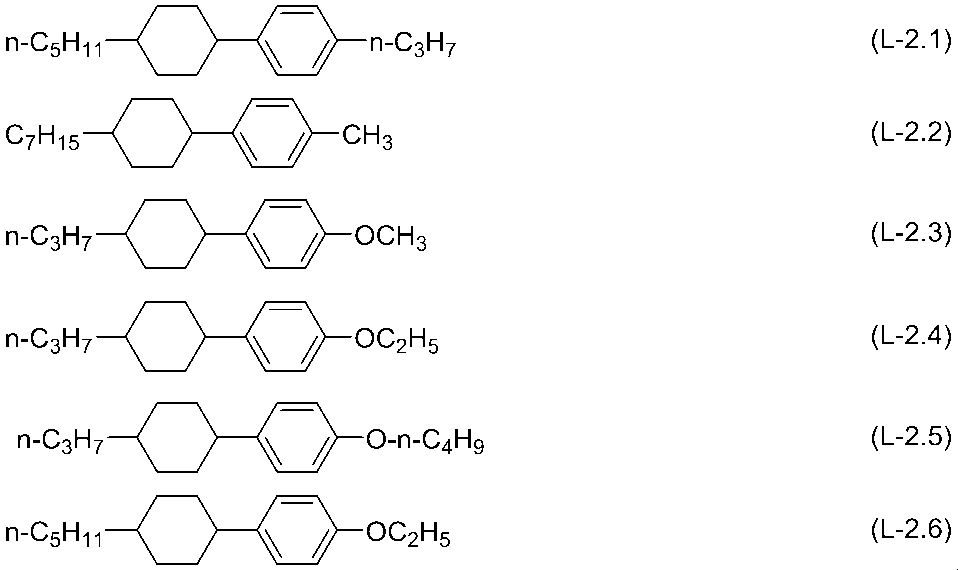
一般式(L-3)で表される化合物は下記の化合物である。

(式中、RL31及びRL32はそれぞれ独立して、一般式(L)におけるRL1及びRL2と同じ意味を表す。)
RL31及びRL32はそれぞれ独立して炭素原子数1~5のアルキル基、炭素原子数4~5のアルケニル基又は炭素原子数1~4のアルコキシ基が好ましい。
RL31及びRL32はそれぞれ独立して炭素原子数1~5のアルキル基、炭素原子数4~5のアルケニル基又は炭素原子数1~4のアルコキシ基が好ましい。
一般式(L-3)で表される化合物は単独で使用することもできるが、2以上の化合物を組み合わせて使用することもできる。組み合わせることができる化合物の種類に特に制限は無いが、低温での溶解性、転移温度、電気的な信頼性、複屈折率などの求められる性能に応じて適宜組み合わせて使用する。使用する化合物の種類は、例えば本発明の一つの実施形態としては1種類であり、2種類であり、3種類であり、4種類であり、5種類以上である。
本発明の組成物の総量に対しての式(L-3)で表される化合物の好ましい含有量の下限値は、1%であり、2%であり、3%であり、5%であり、7%であり、10%である。好ましい含有量の上限値は、本発明の組成物の総量に対して、20%であり、15%であり、13%であり、10%であり、8%であり、7%であり、6%であり、5%であり、3%である。
高い複屈折率を得る場合は含有量を高めに設定すると効果が高く、反対に、高いTniを重視する場合は含有量を低めに設定すると効果が高い。さらに、滴下痕や焼き付き特性を改良する場合は、含有量の範囲を中間に設定することが好ましい。
さらに、一般式(L-3)で表される化合物は、式(L-3.1)から式(L-3.7)で表される化合物群から選ばれる化合物であることが好ましく、式(L-3.2)から式(L-3.5)で表される化合物であることが好ましい。

一般式(L-4)で表される化合物は下記の化合物である。

(式中、RL41及びRL42はそれぞれ独立して、一般式(L)におけるRL1及びRL2と同じ意味を表す。)
RL41は炭素原子数1~5のアルキル基又は炭素原子数2~5のアルケニル基が好ましく、RL42は炭素原子数1~5のアルキル基、炭素原子数4~5のアルケニル基又は炭素原子数1~4のアルコキシ基が好ましい。)
一般式(L-4)で表される化合物は単独で使用することもできるが、2以上の化合物を組み合わせて使用することもできる。組み合わせることができる化合物の種類に特に制限は無いが、低温での溶解性、転移温度、電気的な信頼性、複屈折率などの求められる性能に応じて適宜組み合わせて使用する。使用する化合物の種類は、例えば本発明の一つの実施形態としては1種類であり、2種類であり、3種類であり、4種類であり、5種類以上である。
RL41は炭素原子数1~5のアルキル基又は炭素原子数2~5のアルケニル基が好ましく、RL42は炭素原子数1~5のアルキル基、炭素原子数4~5のアルケニル基又は炭素原子数1~4のアルコキシ基が好ましい。)
一般式(L-4)で表される化合物は単独で使用することもできるが、2以上の化合物を組み合わせて使用することもできる。組み合わせることができる化合物の種類に特に制限は無いが、低温での溶解性、転移温度、電気的な信頼性、複屈折率などの求められる性能に応じて適宜組み合わせて使用する。使用する化合物の種類は、例えば本発明の一つの実施形態としては1種類であり、2種類であり、3種類であり、4種類であり、5種類以上である。
本発明の組成物において、一般式(L-4)で表される化合物の含有量は、低温での溶解性、転移温度、電気的な信頼性、複屈折率、プロセス適合性、滴下痕、焼き付き、誘電率異方性などの求められる性能に応じて適宜調整する必要がある。
本発明の組成物の総量に対しての式(L-4)で表される化合物の好ましい含有量の下限値は、1%であり、2%であり、3%であり、5%であり、7%であり、10%であり、14%であり、16%であり、20%であり、23%であり、26%であり、30%であり、35%であり、40%である。本発明の組成物の総量に対しての式(L-4)で表される化合物の好ましい含有量の上限値は、50%であり、40%であり、35%であり、30%であり、20%であり、15%であり、10%であり、5%である。
一般式(L-4)で表される化合物は、例えば式(L-4.1)から式(L-4.3)で表される化合物であることが好ましい。
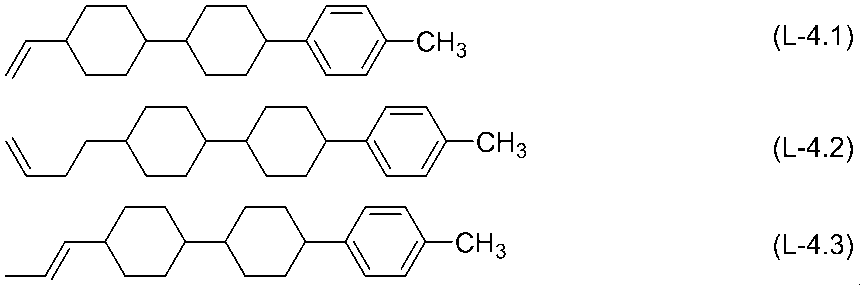
低温での溶解性、転移温度、電気的な信頼性、複屈折率などの求められる性能に応じて、式(L-4.1)で表される化合物を含有していても、式(L-4.2)で表される化合物を含有していても、式(L-4.1)で表される化合物と式(L-4.2)で表される化合物との両方を含有していても良いし、式(L-4.1)から式(L-4.3)で表される化合物を全て含んでいても良い。本発明の組成物の総量に対しての式(L-4.1)又は式(L-4.2)で表される化合物の好ましい含有量の下限値は、3%であり、5%であり、7%であり、9%であり、11%であり、12%であり、13%であり、18%であり、21%であり、好ましい上限値は、45であり、40%であり、35%であり、30%であり、25%であり、23%であり、20%であり、18%であり、15%であり、13%であり、10%であり、8%である。
式(L-4.1)で表される化合物と式(L-4.2)で表される化合物との両方を含有する場合は、本発明の組成物の総量に対しての両化合物の好ましい含有量の下限値は、15%であり、19%であり、24%であり、30%であり、好ましい上限値は、45であり、40%であり、35%であり、30%であり、25%であり、23%であり、20%であり、18%であり、15%であり、13%である。
一般式(L-4)で表される化合物は、例えば式(L-4.4)から式(L-4.6)で表される化合物であることが好ましく、式(L-4.4)で表される化合物であることが好ましい。
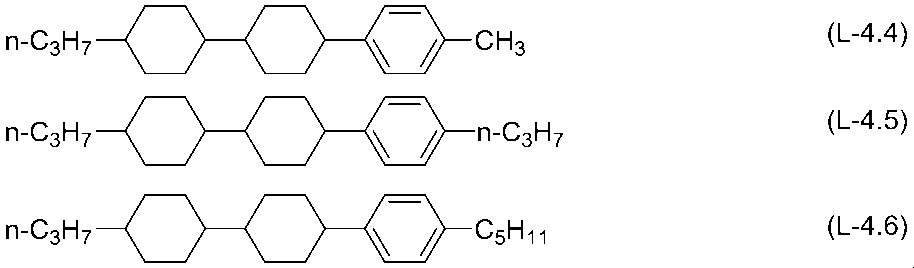
低温での溶解性、転移温度、電気的な信頼性、複屈折率などの求められる性能に応じて、式(L-4.4)で表される化合物を含有していても、式(L-4.5)で表される化合物を含有していても、式(L-4.4)で表される化合物と式(L-4.5)で表される化合物との両方を含有していても良い。
本発明の組成物の総量に対しての式(L-4.4)又は式(L-4.5)で表される化合物の好ましい含有量の下限値は、3%であり、5%であり、7%であり、9%であり、11%であり、12%であり、13%であり、18%であり、21%である。好ましい上限値は、45であり、40%であり、35%であり、30%であり、25%であり、23%であり、20%であり、18%であり、15%であり、13%であり、10%であり、8%である。
式(L-4.4)で表される化合物と式(L-4.5)で表される化合物との両方を含有する場合は、本発明の組成物の総量に対しての両化合物の好ましい含有量の下限値は、15%であり、19%であり、24%であり、30%であり、好ましい上限値は、45であり、40%であり、35%であり、30%であり、25%であり、23%であり、20%であり、18%であり、15%であり、13%である。
一般式(L-4)で表される化合物は、式(L-4.7)から式(L-4.10)で表される化合物であることが好ましく、特に、式(L-4.9)で表される化合物が好ましい。

一般式(L-5)で表される化合物は下記の化合物である。

(式中、RL51及びRL52はそれぞれ独立して、一般式(L)におけるRL1及びRL2と同じ意味を表す。)
RL51は炭素原子数1~5のアルキル基又は炭素原子数2~5のアルケニル基が好ましく、RL52は炭素原子数1~5のアルキル基、炭素原子数4~5のアルケニル基又は炭素原子数1~4のアルコキシ基が好ましい。
RL51は炭素原子数1~5のアルキル基又は炭素原子数2~5のアルケニル基が好ましく、RL52は炭素原子数1~5のアルキル基、炭素原子数4~5のアルケニル基又は炭素原子数1~4のアルコキシ基が好ましい。
一般式(L-5)で表される化合物は単独で使用することもできるが、2以上の化合物を組み合わせて使用することもできる。組み合わせることができる化合物の種類に特に制限は無いが、低温での溶解性、転移温度、電気的な信頼性、複屈折率などの求められる性能に応じて適宜組み合わせて使用する。使用する化合物の種類は、例えば本発明の一つの実施形態としては1種類であり、2種類であり、3種類であり、4種類であり、5種類以上である。
本発明の組成物において、一般式(L-5)で表される化合物の含有量は、低温での溶解性、転移温度、電気的な信頼性、複屈折率、プロセス適合性、滴下痕、焼き付き、誘電率異方性などの求められる性能に応じて適宜調整する必要がある。
本発明の組成物の総量に対しての式(L-5)で表される化合物の好ましい含有量の下限値は、1%であり、2%であり、3%であり、5%であり、7%であり、10%であり、14%であり、16%であり、20%であり、23%であり、26%であり、30%であり、35%であり、40%である。本発明の組成物の総量に対しての式(L-5)で表される化合物の好ましい含有量の上限値は、50%であり、40%であり、35%であり、30%であり、20%であり、15%であり、10%であり、5%である
一般式(L-5)で表される化合物は、式(L-5.1)又は式(L-5.2)で表される化合物であることが好ましく、特に、式(L-5.1)で表される化合物であることが好ましい。
一般式(L-5)で表される化合物は、式(L-5.1)又は式(L-5.2)で表される化合物であることが好ましく、特に、式(L-5.1)で表される化合物であることが好ましい。
本発明の組成物の総量に対してのこれら化合物の好ましい含有量の下限値は、1%であり、2%であり、3%であり、5%であり、7%である。これら化合物の好ましい含有量の上限値は、20%であり、15%であり、13%であり、10%であり、9%である。

一般式(L-5)で表される化合物は、式(L-5.3)又は式(L-5.4)で表される化合物であることが好ましい。
本発明の組成物の総量に対してのこれら化合物の好ましい含有量の下限値は、1%であり、2%であり、3%であり、5%であり、7%である。これら化合物の好ましい含有量の上限値は、20%であり、15%であり、13%であり、10%であり、9%である。

一般式(L-5)で表される化合物は、式(L-5.5)から式(L-5.7)で表される化合物群から選ばれる化合物であることが好ましく、特に式(L-5.7)で表される化合物であることが好ましい。
本発明の組成物の総量に対してのこれら化合物の好ましい含有量の下限値は、1%であり、2%であり、3%であり、5%であり、7%である。これら化合物の好ましい含有量の上限値は、20%であり、15%であり、13%であり、10%であり、9%である。

一般式(L-6)で表される化合物は下記の化合物である。

(式中、RL61及びRL62はそれぞれ独立して、一般式(L)におけるRL1及びRL2と同じ意味を表し、XL61及びXL62はそれぞれ独立して水素原子又はフッ素原子を表す。)
RL61及びRL62はそれぞれ独立して炭素原子数1~5のアルキル基又は炭素原子数2~5のアルケニル基が好ましく、XL61及びXL62のうち一方がフッ素原子他方が水素原子であることが好ましい。
RL61及びRL62はそれぞれ独立して炭素原子数1~5のアルキル基又は炭素原子数2~5のアルケニル基が好ましく、XL61及びXL62のうち一方がフッ素原子他方が水素原子であることが好ましい。
一般式(L-6)で表される化合物は単独で使用することもできるが、2以上の化合物を組み合わせて使用することもできる。組み合わせることができる化合物の種類に特に制限は無いが、低温での溶解性、転移温度、電気的な信頼性、複屈折率などの求められる性能に応じて適宜組み合わせて使用する。使用する化合物の種類は、例えば本発明の一つの実施形態としては1種類であり、2種類であり、3種類であり、4種類であり、5種類以上である。
本発明の組成物の総量に対しての式(L-6)で表される化合物の好ましい含有量の下限値は、1%であり、2%であり、3%であり、5%であり、7%であり、10%であり、14%であり、16%であり、20%であり、23%であり、26%であり、30%であり、35%であり、40%である。本発明の組成物の総量に対しての式(L-6)で表される化合物の好ましい含有量の上限値は、50%であり、40%であり、35%であり、30%であり、20%であり、15%であり、10%であり、5%である。Δnを大きくすることに重点を置く場合には含有量を多くした方が好ましく、低温での析出に重点を置いた場合には含有量は少ない方が好ましい。
一般式(L-6)で表される化合物は、式(L-6.1)から式(L-6.9)で表される化合物であることが好ましい。

組み合わせることができる化合物の種類に特に制限は無いが、これらの化合物の中から1種~3種類含有することが好ましく、1種~4種類含有することがさらに好ましい。また、選ぶ化合物の分子量分布が広いことも溶解性に有効であるため、例えば、式(L-6.1)又は(L-6.2)で表される化合物から1種類、式(L-6.4)又は(L-6.5)で表される化合物から1種類、式(L-6.6)又は式(L-6.7)で表される化合物から1種類、式(L-6.8)又は(L-6.9)で表される化合物から1種類の化合物を選び、これらを適宜組み合わせることが好ましい。その中でも、式(L-6.1)、式(L-6.3)式(L-6.4)、式(L-6.6)及び式(L-6.9)で表される化合物を含むことが好ましい。
さらに、一般式(L-6)で表される化合物は、例えば式(L-6.10)から式(L-6.17)で表される化合物であることが好ましく、その中でも、式(L-6.11)で表される化合物であることが好ましい。
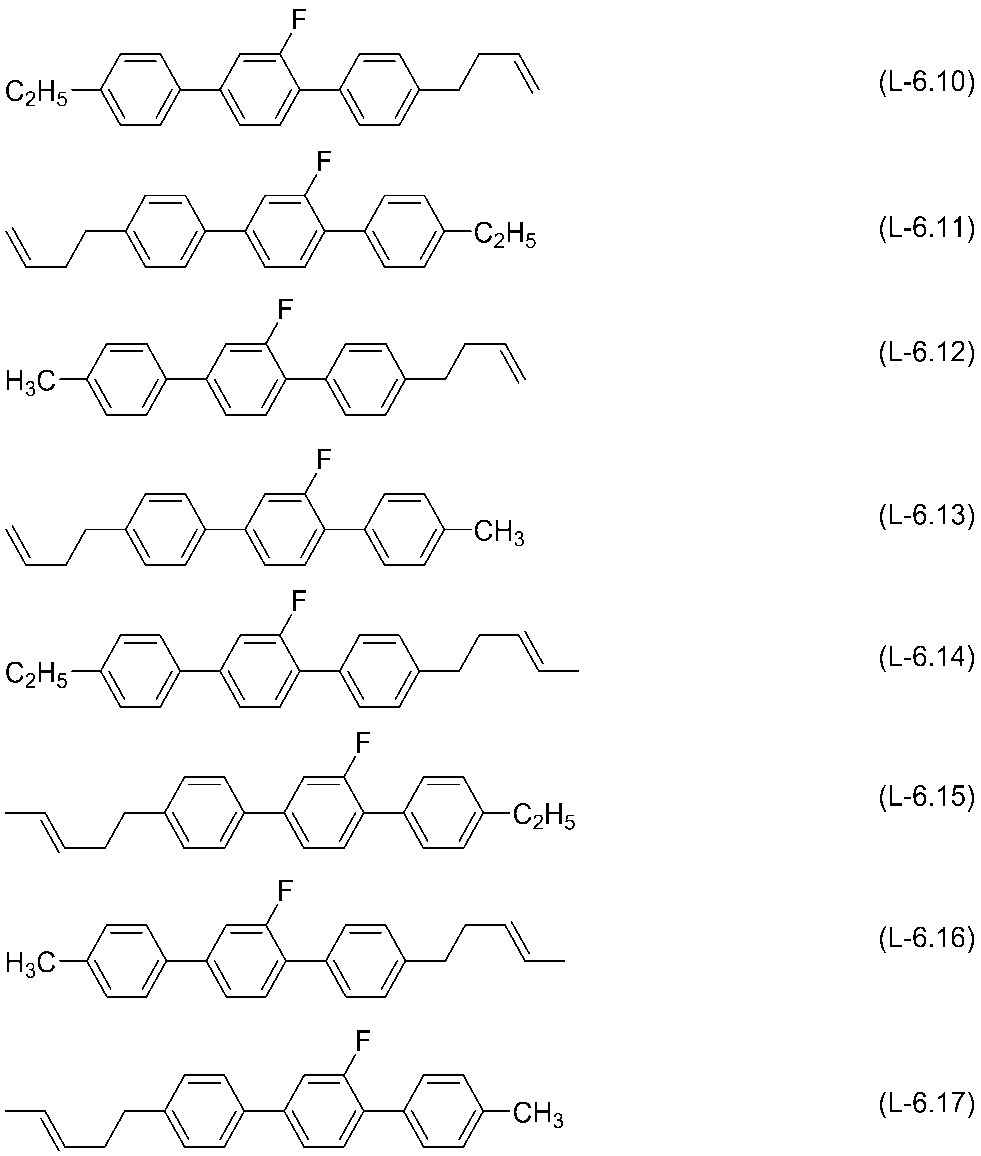
本発明の組成物の総量に対してのこれら化合物の好ましい含有量の下限値は、1%であり、2%であり、3%であり、5%であり、7%である。これら化合物の好ましい含有量の上限値は、20%であり、15%であり、13%であり、10%であり、9%である。
一般式(L-7)で表される化合物は下記の化合物である。

(式中、RL71及びRL72はそれぞれ独立して一般式(L)におけるRL1及びRL2と同じ意味を表し、AL71及びAL72はそれぞれ独立して一般式(L)におけるAL2及びAL3と同じ意味を表すが、AL71及びAL72上の水素原子はそれぞれ独立してフッ素原子によって置換されていてもよく、ZL71は一般式(L)におけるZL2と同じ意味を表し、XL71及びXL72はそれぞれ独立してフッ素原子又は水素原子を表す。)
式中、RL71及びRL72はそれぞれ独立して炭素原子数1~5のアルキル基、炭素原子数2~5のアルケニル基又は炭素原子数1~4のアルコキシ基が好ましく、AL71及びAL72はそれぞれ独立して1,4-シクロヘキシレン基又は1,4-フェニレン基が好ましく、AL71及びAL72上の水素原子はそれぞれ独立してフッ素原子によって置換されていてもよく、ZL71は単結合又は-COO-が好ましく、単結合が好ましく、XL71及びXL72は水素原子が好ましい。
式中、RL71及びRL72はそれぞれ独立して炭素原子数1~5のアルキル基、炭素原子数2~5のアルケニル基又は炭素原子数1~4のアルコキシ基が好ましく、AL71及びAL72はそれぞれ独立して1,4-シクロヘキシレン基又は1,4-フェニレン基が好ましく、AL71及びAL72上の水素原子はそれぞれ独立してフッ素原子によって置換されていてもよく、ZL71は単結合又は-COO-が好ましく、単結合が好ましく、XL71及びXL72は水素原子が好ましい。
組み合わせることができる化合物の種類に特に制限は無いが、低温での溶解性、転移温度、電気的な信頼性、複屈折率などの求められる性能に応じて組み合わせる。使用する化合物の種類は、例えば本発明の一つの実施形態としては1種類であり、2種類であり、3種類であり、4種類である。
本発明の組成物において、一般式(L-7)で表される化合物の含有量は、低温での溶解性、転移温度、電気的な信頼性、複屈折率、プロセス適合性、滴下痕、焼き付き、誘電率異方性などの求められる性能に応じて適宜調整する必要がある。
本発明の組成物の総量に対しての式(L-7)で表される化合物の好ましい含有量の下限値は、1%であり、2%であり、3%であり、5%であり、7%であり、10%であり、14%であり、16%であり、20%である。本発明の組成物の総量に対しての式(L-7)で表される化合物の好ましい含有量の上限値は、30%であり、25%であり、23%であり、20%であり、18%であり、15%であり、10%であり、5%である。
本発明の組成物が高いTniの実施形態が望まれる場合は式(L-7)で表される化合物の含有量を多めにすることが好ましく、低粘度の実施形態が望まれる場合は含有量を少なめにすることが好ましい。
さらに、一般式(L-7)で表される化合物は、式(L-7.1)から式(L-7.4)で表される化合物であることが好ましく、式(L-7.2)で表される化合物であることが好ましい。
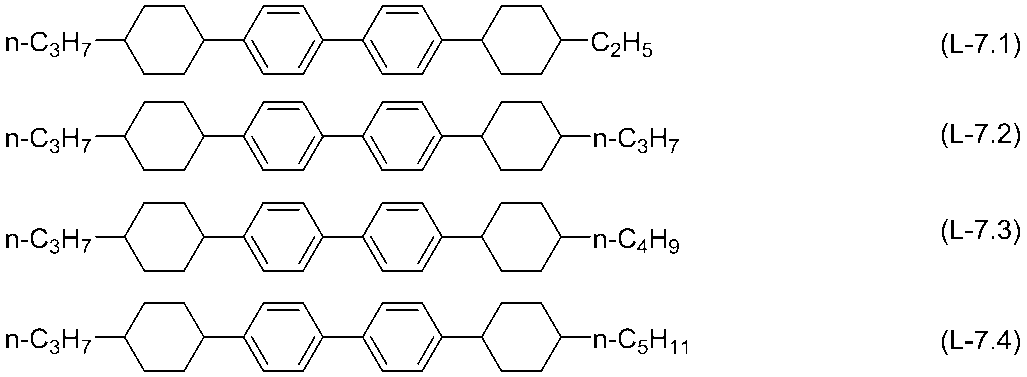
さらに、一般式(L-7)で表される化合物は、式(L-7.11)から式(L-7.13)で表される化合物であることが好ましく、式(L-7.11)で表される化合物であることが好ましい。
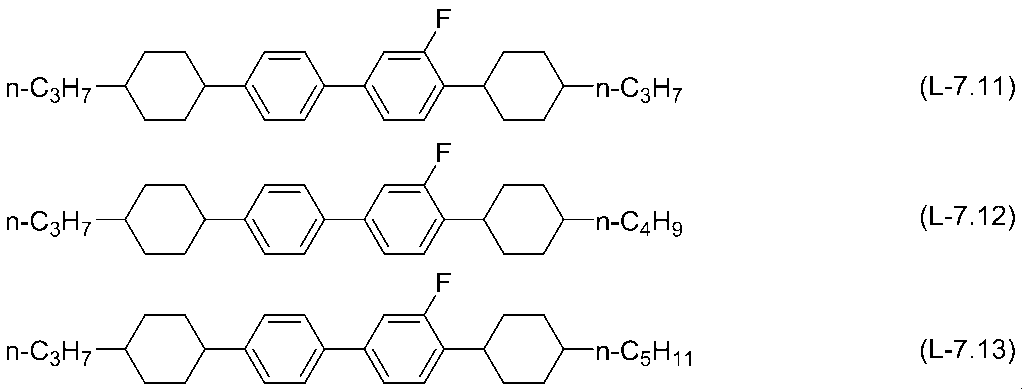
さらに、一般式(L-7)で表される化合物は、式(L-7.21)から式(L-7.23)で表される化合物である。式(L-7.21)で表される化合物であることが好ましい。

さらに、一般式(L-7)で表される化合物は、式(L-7.31)から式(L-7.34)で表される化合物であることが好ましく、式(L-7.31)又は/及び式(L-7.32)で表される化合物であることが好ましい。
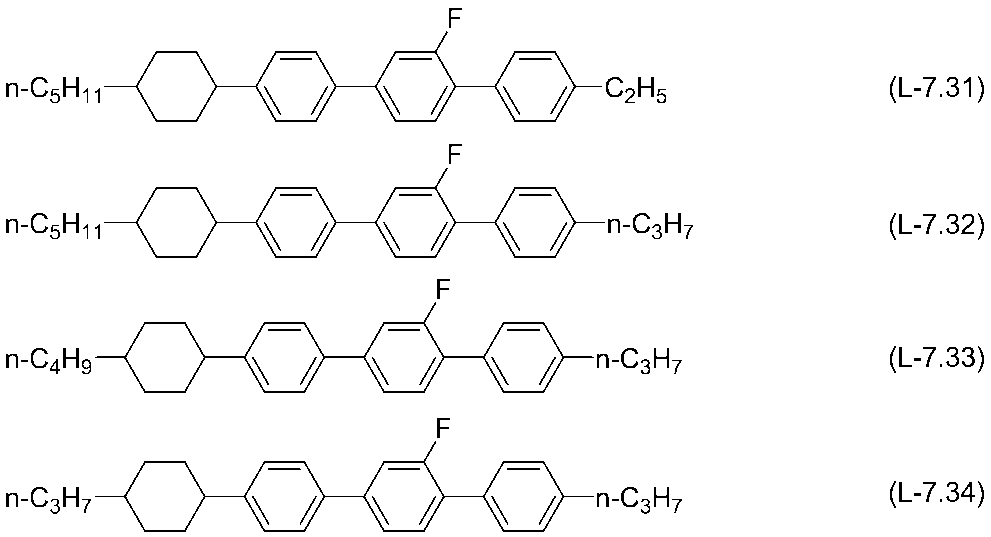
さらに、一般式(L-7)で表される化合物は、式(L-7.41)から式(L-7.44)で表される化合物であることが好ましく、式(L-7.41)又は/及び式(L-7.42)で表される化合物であることが好ましい。

さらに、一般式(L-7)で表される化合物は、式(L-7.51)から式(L-7.53)で表される化合物であることが好ましい。

本発明の組成物は、一般式(N-1)、(N-2)及び(N-3)で表される化合物から選ばれる化合物を1種類又は2種類以上含有することが好ましい。これら化合物は誘電的に負の化合物(Δεの符号が負で、その絶対値が2より大きい。)に該当する。
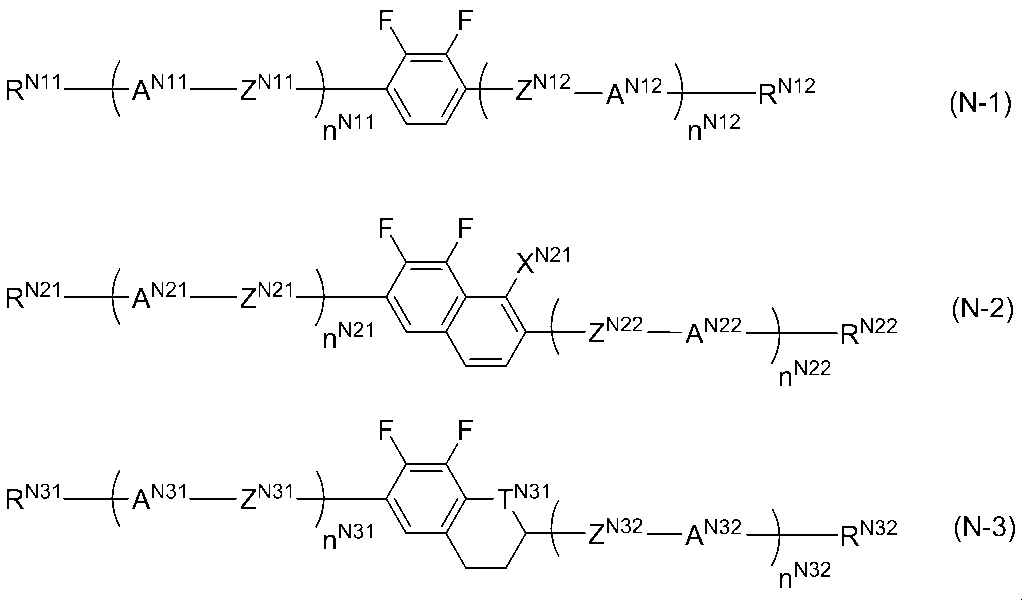
(式中、RN11、RN12、RN21、RN22、RN31及びRN32はそれぞれ独立して炭素原子数1~8のアルキル基を表し、該アルキル基中の1個又は非隣接の2個以上の-CH2-はそれぞれ独立して-CH=CH-、-C≡C-、-O-、-CO-、-COO-又は-OCO-によって置換されていてもよく、
AN11、AN12、AN21、AN22、AN31及びAN32はそれぞれ独立して
(a) 1,4-シクロヘキシレン基(この基中に存在する1個の-CH2-又は隣接していない2個以上の-CH2-は-O-に置き換えられてもよい。)、
(b) 1,4-フェニレン基(この基中に存在する1個の-CH=又は隣接していない2個以上の-CH=は-N=に置き換えられてもよい。)、
(c) ナフタレン-2,6-ジイル基、1,2,3,4-テトラヒドロナフタレン-2,6-ジイル基又はデカヒドロナフタレン-2,6-ジイル基(ナフタレン-2,6-ジイル基又は1,2,3,4-テトラヒドロナフタレン-2,6-ジイル基中に存在する1個の-CH=又は隣接していない2個以上の-CH=は-N=に置き換えられても良い。)及び
(d) 1,4-シクロヘキセニレン基
からなる群より選ばれる基を表し、上記の基(a)、基(b)、基(c)及び基(d)はそれぞれ独立してシアノ基、フッ素原子又は塩素原子で置換されていても良く、
ZN11、ZN12、ZN21、ZN22、ZN31及びZN32はそれぞれ独立して単結合、-CH2CH2-、-(CH2)4-、-OCH2-、-CH2O-、-COO-、-OCO-、-OCF2-、-CF2O-、-CH=N-N=CH-、-CH=CH-、-CF=CF-又は-C≡C-を表し、
XN21は水素原子又はフッ素原子を表し、
TN31は-CH2-又は酸素原子を表し、
nN11、nN12、nN21、nN22、nN31及びnN32はそれぞれ独立して0~3の整数を表すが、nN11+nN12、nN21+nN22及びnN31+nN32はそれぞれ独立して1、2又は3であり、AN11~AN32、ZN11~ZN32が複数存在する場合は、それらは同一であっても異なっていても良い。)
一般式(N-1)、(N-2)及び(N-3)で表される化合物は、Δεが負でその絶対値が3よりも大きな化合物であることが好ましい。
AN11、AN12、AN21、AN22、AN31及びAN32はそれぞれ独立して
(a) 1,4-シクロヘキシレン基(この基中に存在する1個の-CH2-又は隣接していない2個以上の-CH2-は-O-に置き換えられてもよい。)、
(b) 1,4-フェニレン基(この基中に存在する1個の-CH=又は隣接していない2個以上の-CH=は-N=に置き換えられてもよい。)、
(c) ナフタレン-2,6-ジイル基、1,2,3,4-テトラヒドロナフタレン-2,6-ジイル基又はデカヒドロナフタレン-2,6-ジイル基(ナフタレン-2,6-ジイル基又は1,2,3,4-テトラヒドロナフタレン-2,6-ジイル基中に存在する1個の-CH=又は隣接していない2個以上の-CH=は-N=に置き換えられても良い。)及び
(d) 1,4-シクロヘキセニレン基
からなる群より選ばれる基を表し、上記の基(a)、基(b)、基(c)及び基(d)はそれぞれ独立してシアノ基、フッ素原子又は塩素原子で置換されていても良く、
ZN11、ZN12、ZN21、ZN22、ZN31及びZN32はそれぞれ独立して単結合、-CH2CH2-、-(CH2)4-、-OCH2-、-CH2O-、-COO-、-OCO-、-OCF2-、-CF2O-、-CH=N-N=CH-、-CH=CH-、-CF=CF-又は-C≡C-を表し、
XN21は水素原子又はフッ素原子を表し、
TN31は-CH2-又は酸素原子を表し、
nN11、nN12、nN21、nN22、nN31及びnN32はそれぞれ独立して0~3の整数を表すが、nN11+nN12、nN21+nN22及びnN31+nN32はそれぞれ独立して1、2又は3であり、AN11~AN32、ZN11~ZN32が複数存在する場合は、それらは同一であっても異なっていても良い。)
一般式(N-1)、(N-2)及び(N-3)で表される化合物は、Δεが負でその絶対値が3よりも大きな化合物であることが好ましい。
一般式(N-1)、(N-2)及び(N-3)中、RN11、RN12、RN21、RN22、RN31及びRN32はそれぞれ独立して、炭素原子数1~8のアルキル基、炭素原子数1~8のアルコキシ基、炭素原子数2~8のアルケニル基又は炭素原子数2~8のアルケニルオキシ基が好ましく、炭素原子数1~5のアルキル基、炭素原子数1~5のアルコキシ基、炭素原子数2~5のアルケニル基又は炭素原子数2~5のアルケニルオキシ基が好ましく、炭素原子数1~5のアルキル基又は炭素原子数2~5のアルケニル基が更に好ましく、炭素原子数2~5のアルキル基又は炭素原子数2~3のアルケニル基が更に好ましく、炭素原子数3のアルケニル基(プロペニル基)が特に好ましい。
また、それが結合する環構造がフェニル基(芳香族)である場合には、直鎖状の炭素原子数1~5のアルキル基、直鎖状の炭素原子数1~4のアルコキシ基及び炭素原子数4~5のアルケニル基が好ましく、それが結合する環構造がシクロヘキサン、ピラン及びジオキサンなどの飽和した環構造の場合には、直鎖状の炭素原子数1~5のアルキル基、直鎖状の炭素原子数1~4のアルコキシ基及び直鎖状の炭素原子数2~5のアルケニル基が好ましい。ネマチック相を安定化させるためには炭素原子及び存在する場合酸素原子の合計が5以下であることが好ましく、直鎖状であることが好ましい。
アルケニル基としては、式(R1)から式(R5)のいずれかで表される基から選ばれることが好ましい。(各式中の黒点は環構造中の炭素原子を表す。)

AN11、AN12、AN21、AN22、AN31及びAN32はそれぞれ独立してΔnを大きくすることが求められる場合には芳香族であることが好ましく、応答速度を改善するためには脂肪族であることが好ましく、トランス-1,4-シクロへキシレン基、1,4-フェニレン基、2-フルオロ-1,4-フェニレン基、3-フルオロ-1,4-フェニレン基、3,5-ジフルオロ-1,4-フェニレン基、2,3-ジフルオロ-1,4-フェニレン基、1,4-シクロヘキセニレン基、1,4-ビシクロ[2.2.2]オクチレン基、ピペリジン-1,4-ジイル基、ナフタレン-2,6-ジイル基、デカヒドロナフタレン-2,6-ジイル基又は1,2,3,4-テトラヒドロナフタレン-2,6-ジイル基を表すことが好ましく、下記の構造を表すことがより好ましく、

トランス-1,4-シクロへキシレン基、1,4-シクロヘキセニレン基又は1,4-フェニレン基を表すことがより好ましい。
ZN11、ZN12、ZN21、ZN22、ZN31及びZN32はそれぞれ独立して-CH2O-、-CF2O-、-CH2CH2-、-CF2CF2-又は単結合を表すことが好ましく、-CH2O-、-CH2CH2-又は単結合が更に好ましく、-CH2O-又は単結合が特に好ましい。
XN21はフッ素原子が好ましい。
TN31は酸素原子が好ましい。
nN11+nN12、nN21+nN22及びnN31+nN32は1又は2が好ましく、nN11が1でありnN12が0である組み合わせ、nN11が2でありnN12が0である組み合わせ、nN11が1でありnN12が1である組み合わせ、nN11が2でありnN12が1である組み合わせ、nN21が1でありnN22が0である組み合わせ、nN21が2でありnN22が0である組み合わせ、nN31が1でありnN32が0である組み合わせ、nN31が2でありnN32が0である組み合わせ、が好ましい。
本発明の組成物の総量に対しての式(N-1)で表される化合物の好ましい含有量の下限値は、1%であり、10%であり、20%であり、30%であり、40%であり、50%であり、55%であり、60%であり、65%であり、70%であり、75%であり、80%である。好ましい含有量の上限値は、95%であり、85%であり、75%であり、65%であり、55%であり、45%であり、35%であり、25%であり、20%である。
本発明の組成物の総量に対しての式(N-2)で表される化合物の好ましい含有量の下限値は、1%であり、10%であり、20%であり、30%であり、40%であり、50%であり、55%であり、60%であり、65%であり、70%であり、75%であり、80%である。好ましい含有量の上限値は、95%であり、85%であり、75%であり、65%であり、55%であり、45%であり、35%であり、25%であり、20%である。
本発明の組成物の総量に対しての式(N-3)で表される化合物の好ましい含有量の下限値は、1%であり、10%であり、20%であり、30%であり、40%であり、50%であり、55%であり、60%であり、65%であり、70%であり、75%であり、80%である。好ましい含有量の上限値は、95%であり、85%であり、75%であり、65%であり、55%であり、45%であり、35%であり、25%であり、20%である。
本発明の組成物の粘度を低く保ち、応答速度が速い組成物が必要な場合は上記の下限値が低く上限値が低いことが好ましい。さらに、本発明の組成物のTniを高く保ち、温度安定性の良い組成物が必要な場合は上記の下限値が低く上限値が低いことが好ましい。また、駆動電圧を低く保つために誘電率異方性を大きくしたいときは、上記の下限値を高く上限値が高いことが好ましい。
一般式(N-1)で表される化合物として、下記の一般式(N-1a)~(N-1g)で表される化合物群を挙げることができる。

(式中、RN11及びRN12は一般式(N-1)におけるRN11及びRN12と同じ意味を表し、nNa11は0又は1を表し、nNb11は1又は2を表し、nNc11は0又は1を表し、nNd11は1又は2を表し、nNe11は1又は2を表し、nNf12は1又は2を表し、nNg11は1又は2を表し、ANe11はトランス-1,4-シクロへキシレン基又は1,4-フェニレン基を表し、ANg11はトランス-1,4-シクロへキシレン基、1,4-シクロヘキセニレン基又は1,4-フェニレン基を表すが少なくとも1つは1,4-シクロヘキセニレン基を表し、ZNe11は単結合又はエチレンを表すが分子内に存在する少なくとも1つはエチレンを表し、分子内に複数存在するANe11、ZNe11、及び/又はANg11は同一であっても異なっていても良い。)
より具体的には、一般式(N-1)で表される化合物は一般式(N-1-1)~(N-1-22)で表される化合物群から選ばれる化合物であることが好ましい。
より具体的には、一般式(N-1)で表される化合物は一般式(N-1-1)~(N-1-22)で表される化合物群から選ばれる化合物であることが好ましい。
一般式(N-1-1)で表される化合物は下記の化合物である。

(式中、RN111及びRN112はそれぞれ独立して、一般式(N-1)におけるRN11及びRN12と同じ意味を表す。)
RN111は炭素原子数1~5のアルキル基又は炭素原子数2~5のアルケニル基が好ましく、プロピル基、ペンチル基又はビニル基が好ましい。RN112は炭素原子数1~5のアルキル基、炭素原子数4~5のアルケニル基又は炭素原子数1~4のアルコキシ基が好ましく、エトキシ基又はブトキシ基が好ましい。
RN111は炭素原子数1~5のアルキル基又は炭素原子数2~5のアルケニル基が好ましく、プロピル基、ペンチル基又はビニル基が好ましい。RN112は炭素原子数1~5のアルキル基、炭素原子数4~5のアルケニル基又は炭素原子数1~4のアルコキシ基が好ましく、エトキシ基又はブトキシ基が好ましい。
一般式(N-1-1)で表される化合物は単独で使用することもできるが、2以上の化合物を組み合わせて使用することもできる。組み合わせることができる化合物の種類に特に制限は無いが、低温での溶解性、転移温度、電気的な信頼性、複屈折率などの求められる性能に応じて適宜組み合わせて使用する。使用する化合物の種類は、例えば本発明の一つの実施形態としては1種類であり、2種類であり、3種類であり、4種類であり、5種類以上である。
Δεの改善を重視する場合には含有量を高めに設定することが好ましく、低温での溶解性を重視する場合は含有量を高めに設定すると効果が高く、TNIを重視する場合は含有量を低めに設定すると効果が高い。さらに、滴下痕や焼き付き特性を改良する場合は、含有量の範囲を中間に設定することが好ましい。
本発明の組成物の総量に対しての式(N-1-1)で表される化合物の好ましい含有量の下限値は、5%であり、10%であり、13%であり、15%であり、17%であり、20%であり、23%であり、25%であり、27%であり、30%であり、33%であり、35%である。好ましい含有量の上限値は、本発明の組成物の総量に対して、50%であり、40%であり、38%であり、35%であり、33%であり、30%であり、28%であり、25%であり、23%であり、20%であり、18%であり、15%であり、13%であり、10%であり、8%であり、7%であり、6%であり、5%であり、3%である。
さらに、一般式(N-1-1)で表される化合物は、式(N-1-1.1)から式(N-1-1.25)で表される化合物群から選ばれる化合物であることが好ましく、式(N-1-1.1)~(N-1-1.4)で表される化合物であることが好ましく、式(N-1-1.1)及び式(N-1-1.3)で表される化合物が好ましい。
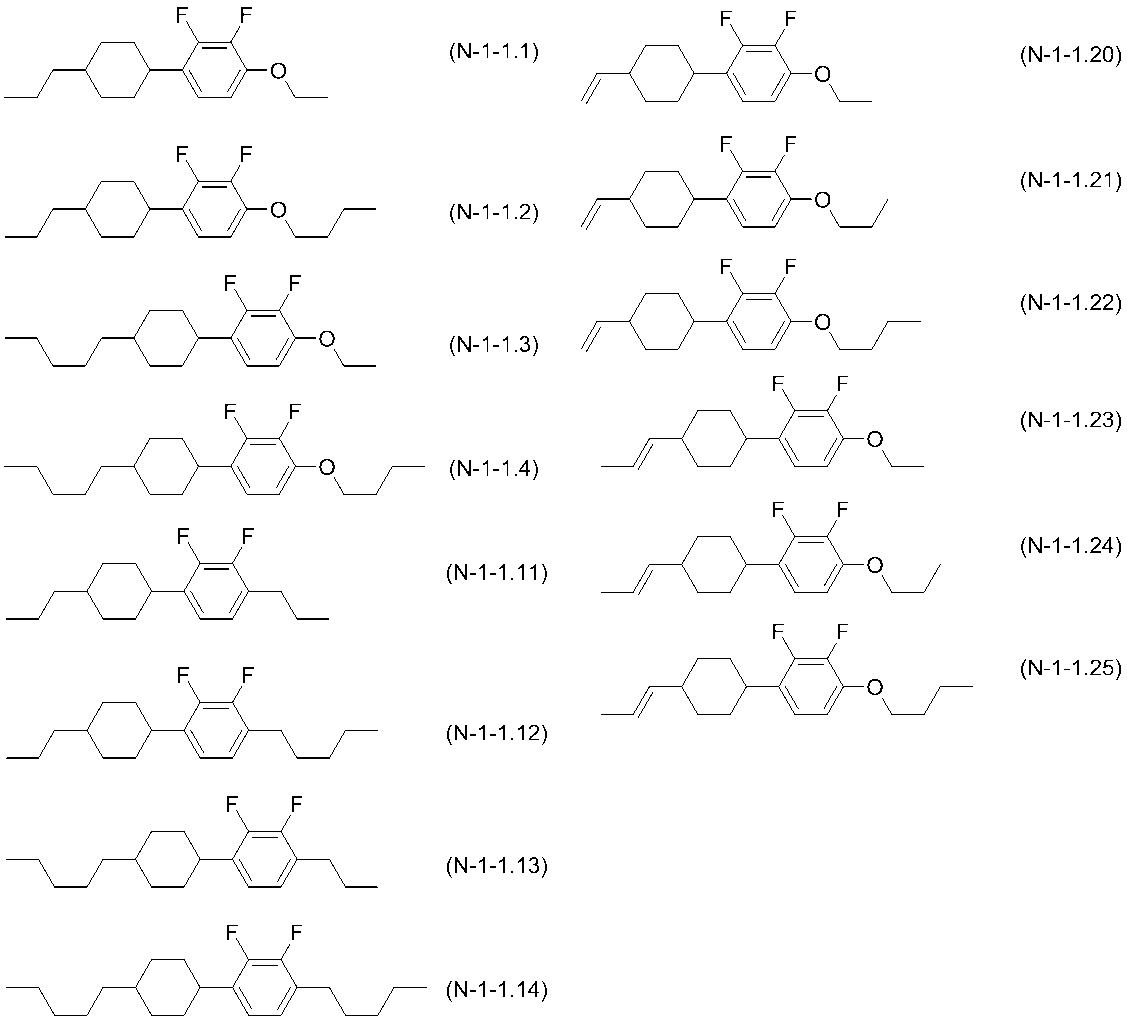
式(N-1-1.1)~(N-1-1.25)で表される化合物は単独で使用することも、組み合わせて使用することも可能であるが、本発明の組成物の総量に対しての単独又はこれら化合物の好ましい含有量の下限値は、5%であり、10%であり、13%であり、15%であり、17%であり、20%であり、23%であり、25%であり、27%であり、30%であり、33%であり、35%である。好ましい含有量の上限値は、本発明の組成物の総量に対して、50%であり、40%であり、38%であり、35%であり、33%であり、30%であり、28%であり、25%であり、23%であり、20%であり、18%であり、15%であり、13%であり、10%であり、8%であり、7%であり、6%であり、5%であり、3%である。
一般式(N-1-2)で表される化合物は下記の化合物である。

(式中、RN121及びRN122はそれぞれ独立して、一般式(N-1)におけるRN11及びRN12と同じ意味を表す。)
RN121は炭素原子数1~5のアルキル基又は炭素原子数2~5のアルケニル基が好ましく、エチル基、プロピル基、ブチル基又はペンチル基が好ましい。RN122は炭素原子数1~5のアルキル基、炭素原子数4~5のアルケニル基又は炭素原子数1~4のアルコキシ基が好ましく、メチル基、プロピル基、メトキシ基、エトキシ基又はプロポキシ基が好ましい。
RN121は炭素原子数1~5のアルキル基又は炭素原子数2~5のアルケニル基が好ましく、エチル基、プロピル基、ブチル基又はペンチル基が好ましい。RN122は炭素原子数1~5のアルキル基、炭素原子数4~5のアルケニル基又は炭素原子数1~4のアルコキシ基が好ましく、メチル基、プロピル基、メトキシ基、エトキシ基又はプロポキシ基が好ましい。
一般式(N-1-2)で表される化合物は単独で使用することもできるが、2以上の化合物を組み合わせて使用することもできる。組み合わせることができる化合物の種類に特に制限は無いが、低温での溶解性、転移温度、電気的な信頼性、複屈折率などの求められる性能に応じて適宜組み合わせて使用する。使用する化合物の種類は、例えば本発明の一つの実施形態としては1種類であり、2種類であり、3種類であり、4種類であり、5種類以上である。
Δεの改善を重視する場合には含有量を高めに設定することが好ましく、低温での溶解性を重視する場合は含有量を低めに設定すると効果が高く、TNIを重視する場合は含有量を高めに設定すると効果が高い。さらに、滴下痕や焼き付き特性を改良する場合は、含有量の範囲を中間に設定することが好ましい。
本発明の組成物の総量に対しての式(N-1-2)で表される化合物の好ましい含有量の下限値は、5%であり、7%であり、10%であり、13%であり、15%であり、17%であり、20%であり、23%であり、25%であり、27%であり、30%であり、33%であり、35%であり、37%であり、40%であり、42%である。好ましい含有量の上限値は、本発明の組成物の総量に対して、50%であり、48%であり、45%であり、43%であり、40%であり、38%であり、35%であり、33%であり、30%であり、28%であり、25%であり、23%であり、20%であり、18%であり、15%であり、13%であり、10%であり、8%であり、7%であり、6%であり、5%である。
さらに、一般式(N-1-2)で表される化合物は、式(N-1-2.1)から式(N-1-2.25)で表される化合物群から選ばれる化合物であることが好ましく、式(N-1-2.3)から式(N-1-2.7)、式(N-1-2.10)、式(N-1-2.11)、式(N-1-2.13)及び式(N-1-2.20)で表される化合物であることが好ましく、Δεの改良を重視する場合には式(N-1-2.3)から式(N-1-2.7)で表される化合物が好ましく、TNIの改良を重視する場合には式(N-1-2.10)、式(N-1-2.11)及び式(N-1-2.13)で表される化合物であることが好ましく、応答速度の改良を重視する場合には式(N-1-2.20)で表される化合物であることが好ましい。

式(N-1-2.1)から式(N-1-2.25)で表される化合物は単独で使用することも、組み合わせて使用することも可能であるが、本発明の組成物の総量に対しての単独又はこれら化合物の好ましい含有量の下限値は、5%であり、10%であり、13%であり、15%であり、17%であり、20%であり、23%であり、25%であり、27%であり、30%であり、33%であり、35%である。好ましい含有量の上限値は、本発明の組成物の総量に対して、50%であり、40%であり、38%であり、35%であり、33%であり、30%であり、28%であり、25%であり、23%であり、20%であり、18%であり、15%であり、13%であり、10%であり、8%であり、7%であり、6%であり、5%であり、3%である。
一般式(N-1-3)で表される化合物は下記の化合物である。

(式中、RN131及びRN132はそれぞれ独立して、一般式(N-1)におけるRN11及びRN12と同じ意味を表す。)
RN131は炭素原子数1~5のアルキル基又は炭素原子数2~5のアルケニル基が好ましく、エチル基、プロピル基又はブチル基が好ましい。RN132は炭素原子数1~5のアルキル基、炭素原子数3~5のアルケニル基又は炭素原子数1~4のアルコキシ基が好ましく、1-プロペニル基、エトキシ基、プロポキシ基又はブトキシ基が好ましい。
RN131は炭素原子数1~5のアルキル基又は炭素原子数2~5のアルケニル基が好ましく、エチル基、プロピル基又はブチル基が好ましい。RN132は炭素原子数1~5のアルキル基、炭素原子数3~5のアルケニル基又は炭素原子数1~4のアルコキシ基が好ましく、1-プロペニル基、エトキシ基、プロポキシ基又はブトキシ基が好ましい。
一般式(N-1-3)で表される化合物は単独で使用することもできるが、2以上の化合物を組み合わせて使用することもできる。組み合わせることができる化合物の種類に特に制限は無いが、低温での溶解性、転移温度、電気的な信頼性、複屈折率などの求められる性能に応じて適宜組み合わせて使用する。使用する化合物の種類は、例えば本発明の一つの実施形態としては1種類であり、2種類であり、3種類であり、4種類であり、5種類以上である。
Δεの改善を重視する場合には含有量を高めに設定することが好ましく、低温での溶解性を重視する場合は含有量を高めに設定すると効果が高く、TNIを重視する場合は含有量を高めに設定すると効果が高い。さらに、滴下痕や焼き付き特性を改良する場合は、含有量の範囲を中間に設定することが好ましい。
本発明の組成物の総量に対しての式(N-1-3)で表される化合物の好ましい含有量の下限値は、5%であり、10%であり、13%であり、15%であり、17%であり、20%である。好ましい含有量の上限値は、本発明の組成物の総量に対して、35%であり、30%であり、28%であり、25%であり、23%であり、20%であり、18%であり、15%であり、13%である。
さらに、一般式(N-1-3)で表される化合物は、式(N-1-3.1)から式(N-1-3.21)で表される化合物群から選ばれる化合物であることが好ましく、式(N-1-3.1)~(N-1-3.7)及び式(N-1-3.21)で表される化合物であることが好ましく、式(N-1-3.1)、式(N-1-3.2)、式(N-1-3.3)、式(N-1-3.4)及び式(N-1-3.6)で表される化合物が好ましい。
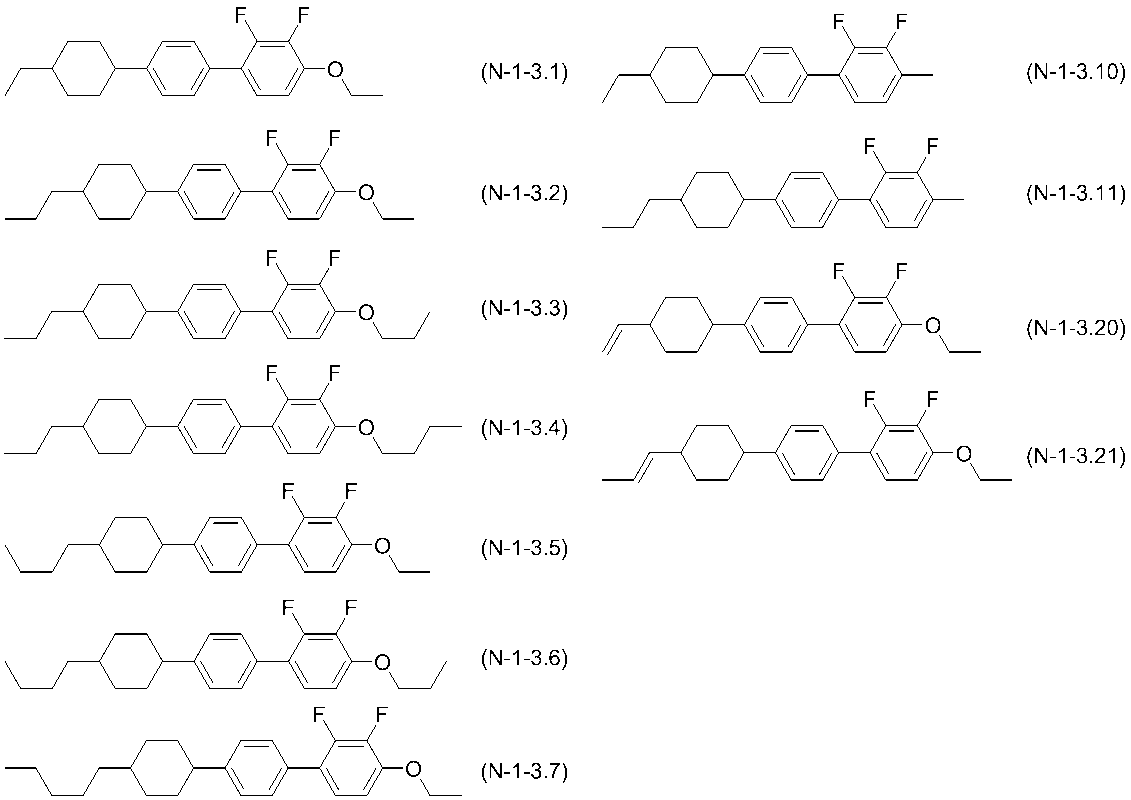
式(N-1-3.1)~式(N-1-3.4)、式(N-1-3.6)及び式(N-1-3.21)で表される化合物は単独で使用することも、組み合わせて使用することも可能であるが、式(N-1-3.1)及び式(N-1-3.2)の組み合わせ、式(N-1-3.3)、式(N-1-3.4)及び式(N-1-3.6)から選ばれる2種又は3種の組み合わせが好ましい。本発明の組成物の総量に対しての単独又はこれら化合物の好ましい含有量の下限値は、5%であり、10%であり、13%であり、15%であり、17%であり、20%である。好ましい含有量の上限値は、本発明の組成物の総量に対して、35%であり、30%であり、28%であり、25%であり、23%であり、20%であり、18%であり、15%であり、13%である。
一般式(N-1-4)で表される化合物は下記の化合物である。
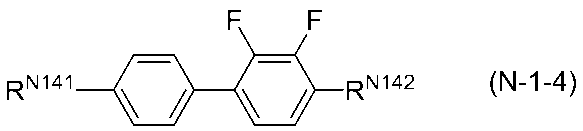
(式中、RN141及びRN142はそれぞれ独立して、一般式(N-1)におけるRN11及びRN12と同じ意味を表す。)
RN141及びRN142はそれぞれ独立して、炭素原子数1~5のアルキル基、炭素原子数4~5のアルケニル基又は炭素原子数1~4のアルコキシ基が好ましく、メチル基、プロピル基、エトキシ基又はブトキシ基が好ましい。
RN141及びRN142はそれぞれ独立して、炭素原子数1~5のアルキル基、炭素原子数4~5のアルケニル基又は炭素原子数1~4のアルコキシ基が好ましく、メチル基、プロピル基、エトキシ基又はブトキシ基が好ましい。
一般式(N-1-4)で表される化合物は単独で使用することもできるが、2以上の化合物を組み合わせて使用することもできる。組み合わせることができる化合物の種類に特に制限は無いが、低温での溶解性、転移温度、電気的な信頼性、複屈折率などの求められる性能に応じて適宜組み合わせて使用する。使用する化合物の種類は、例えば本発明の一つの実施形態としては1種類であり、2種類であり、3種類であり、4種類であり、5種類以上である。
Δεの改善を重視する場合には含有量を高めに設定することが好ましく、低温での溶解性を重視する場合は含有量を高めに設定すると効果が高く、TNIを重視する場合は含有量を低めに設定すると効果が高い。さらに、滴下痕や焼き付き特性を改良する場合は、含有量の範囲を中間に設定することが好ましい。
本発明の組成物の総量に対しての式(N-1-4)で表される化合物の好ましい含有量の下限値は、3%であり、5%であり、7%であり、10%であり、13%であり、15%であり、17%であり、20%である。好ましい含有量の上限値は、本発明の組成物の総量に対して、35%であり、30%であり、28%であり、25%であり、23%であり、20%であり、18%であり、15%であり、13%であり、11%であり、10%であり、8%である。
さらに、一般式(N-1-4)で表される化合物は、式(N-1-4.1)から式(N-1-4.24)で表される化合物群から選ばれる化合物であることが好ましく、式(N-1-4.1)~(N-1-4.4)で表される化合物であることが好ましく、式(N-1-4.1)、式(N-1-4.2)及び式(N-1-4.4)で表される化合物が好ましい。
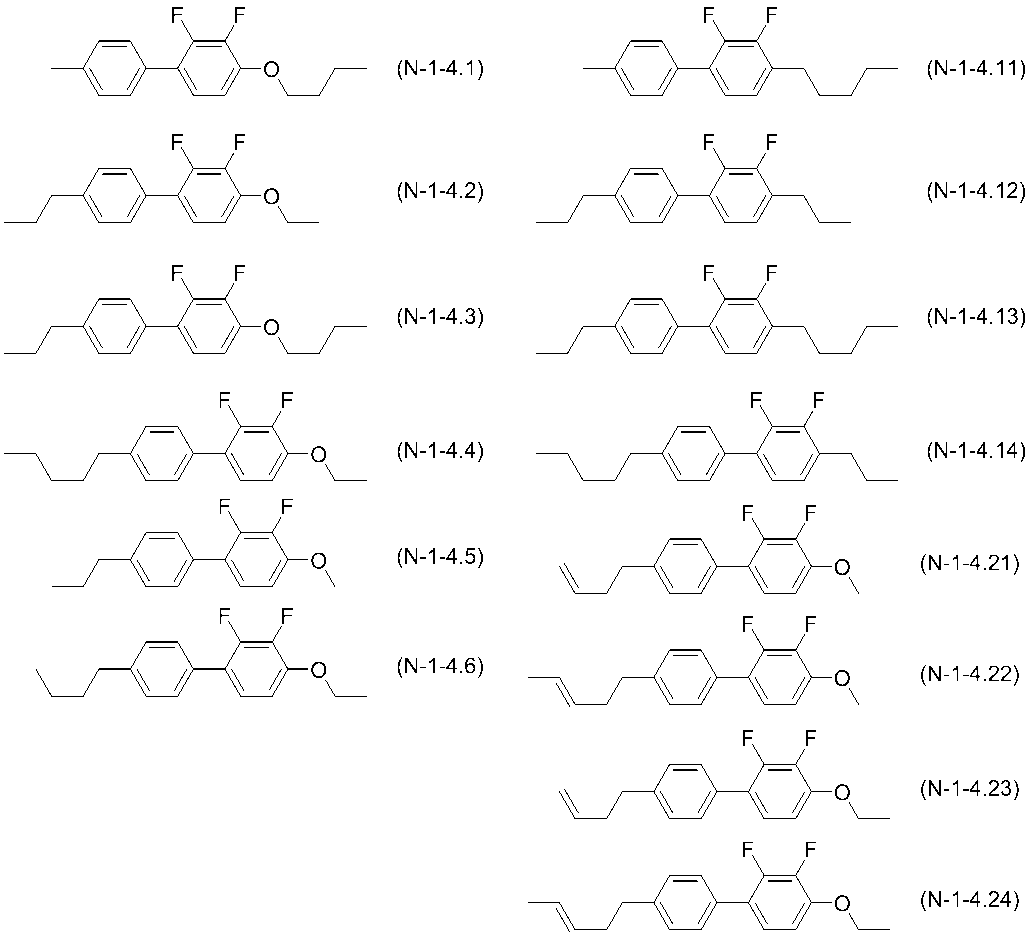
式(N-1-4.1)~(N-1-4.24)で表される化合物は単独で使用することも、組み合わせて使用することも可能であるが、本発明の組成物の総量に対しての単独又はこれら化合物の好ましい含有量の下限値は、3%であり、5%であり、7%であり、10%であり、13%であり、15%であり、17%であり、20%である。好ましい含有量の上限値は、本発明の組成物の総量に対して、35%であり、30%であり、28%であり、25%であり、23%であり、20%であり、18%であり、15%であり、13%であり、11%であり、10%であり、8%である。
一般式(N-1-5)で表される化合物は下記の化合物である。

(式中、RN151及びRN152はそれぞれ独立して、一般式(N-1)におけるRN11及びRN12と同じ意味を表す。)
RN151及びRN152はそれぞれ独立して、炭素原子数1~5のアルキル基、炭素原子数4~5のアルケニル基又は炭素原子数1~4のアルコキシ基が好ましくエチル基、プロピル基又はブチル基が好ましい。
RN151及びRN152はそれぞれ独立して、炭素原子数1~5のアルキル基、炭素原子数4~5のアルケニル基又は炭素原子数1~4のアルコキシ基が好ましくエチル基、プロピル基又はブチル基が好ましい。
一般式(N-1-5)で表される化合物は単独で使用することもできるが、2以上の化合物を組み合わせて使用することもできる。組み合わせることができる化合物の種類に特に制限は無いが、低温での溶解性、転移温度、電気的な信頼性、複屈折率などの求められる性能に応じて適宜組み合わせて使用する。使用する化合物の種類は、例えば本発明の一つの実施形態としては1種類であり、2種類であり、3種類であり、4種類であり、5種類以上である。
Δεの改善を重視する場合には含有量を高めに設定することが好ましく、低温での溶解性を重視する場合は含有量を低めに設定すると効果が高く、TNIを重視する場合は含有量を高めに設定すると効果が高い。さらに、滴下痕や焼き付き特性を改良する場合は、含有量の範囲を中間に設定することが好ましい。
本発明の組成物の総量に対しての式(N-1-5)で表される化合物の好ましい含有量の下限値は、5%であり、8%であり、10%であり、13%であり、15%であり、17%であり、20%である。好ましい含有量の上限値は、本発明の組成物の総量に対して、35%であり、33%であり、30%であり、28%であり、25%であり、23%であり、20%であり、18%であり、15%であり、13%である。
さらに、一般式(N-1-5)で表される化合物は、式(N-1-5.1)から式(N-1-5.12)で表される化合物群から選ばれる化合物であることが好ましく、式(N-1-5.1)、式(N-1-5.2)及び式(N-1-5.4)で表される化合物が好ましい。

式(N-1-5.1)、式(N-1-5.2)及び式(N-1-5.4)で表される化合物は単独で使用することも、組み合わせて使用することも可能であるが、本発明の組成物の総量に対しての単独又はこれら化合物の好ましい含有量の下限値は、5%であり、8%であり、10%であり、13%であり、15%であり、17%であり、20%である。好ましい含有量の上限値は、本発明の組成物の総量に対して、35%であり、33%であり、30%であり、28%であり、25%であり、23%であり、20%であり、18%であり、15%であり、13%である。
一般式(N-1-10)で表される化合物は下記の化合物である。

(式中、RN1101及びRN1102はそれぞれ独立して、一般式(N-1)におけるRN11及びRN12と同じ意味を表す。)
RN1101は炭素原子数1~5のアルキル基又は炭素原子数2~5のアルケニル基が好ましく、エチル基、プロピル基、ブチル基、ビニル基又は1-プロペニル基が好ましい。RN1102は炭素原子数1~5のアルキル基、炭素原子数4~5のアルケニル基又は炭素原子数1~4のアルコキシ基が好ましく、エトキシ基、プロポキシ基又はブトキシ基が好ましい。
RN1101は炭素原子数1~5のアルキル基又は炭素原子数2~5のアルケニル基が好ましく、エチル基、プロピル基、ブチル基、ビニル基又は1-プロペニル基が好ましい。RN1102は炭素原子数1~5のアルキル基、炭素原子数4~5のアルケニル基又は炭素原子数1~4のアルコキシ基が好ましく、エトキシ基、プロポキシ基又はブトキシ基が好ましい。
一般式(N-1-10)で表される化合物は単独で使用することもできるが、2以上の化合物を組み合わせて使用することもできる。組み合わせることができる化合物の種類に特に制限は無いが、低温での溶解性、転移温度、電気的な信頼性、複屈折率などの求められる性能に応じて適宜組み合わせて使用する。使用する化合物の種類は、例えば本発明の一つの実施形態としては1種類であり、2種類であり、3種類であり、4種類であり、5種類以上である。
Δεの改善を重視する場合には含有量を高めに設定することが好ましく、低温での溶解性を重視する場合は含有量を高めに設定すると効果が高く、TNIを重視する場合は含有量を低めに設定すると効果が高い。さらに、滴下痕や焼き付き特性を改良する場合は、含有量の範囲を中間に設定することが好ましい。
本発明の組成物の総量に対しての式(N-1-10)で表される化合物の好ましい含有量の下限値は、5%であり、10%であり、13%であり、15%であり、17%であり、20%である。好ましい含有量の上限値は、本発明の組成物の総量に対して、35%であり、30%であり、28%であり、25%であり、23%であり、20%であり、18%であり、15%であり、13%である。
さらに、一般式(N-1-10)で表される化合物は、式(N-1-10.1)から式(N-1-10.14)で表される化合物群から選ばれる化合物であることが好ましく、式(N-1-10.1)~(N-1-10.5)で表される化合物であることが好ましく、式(N-1-10.1)及び式(N-1-10.2)で表される化合物が好ましい。
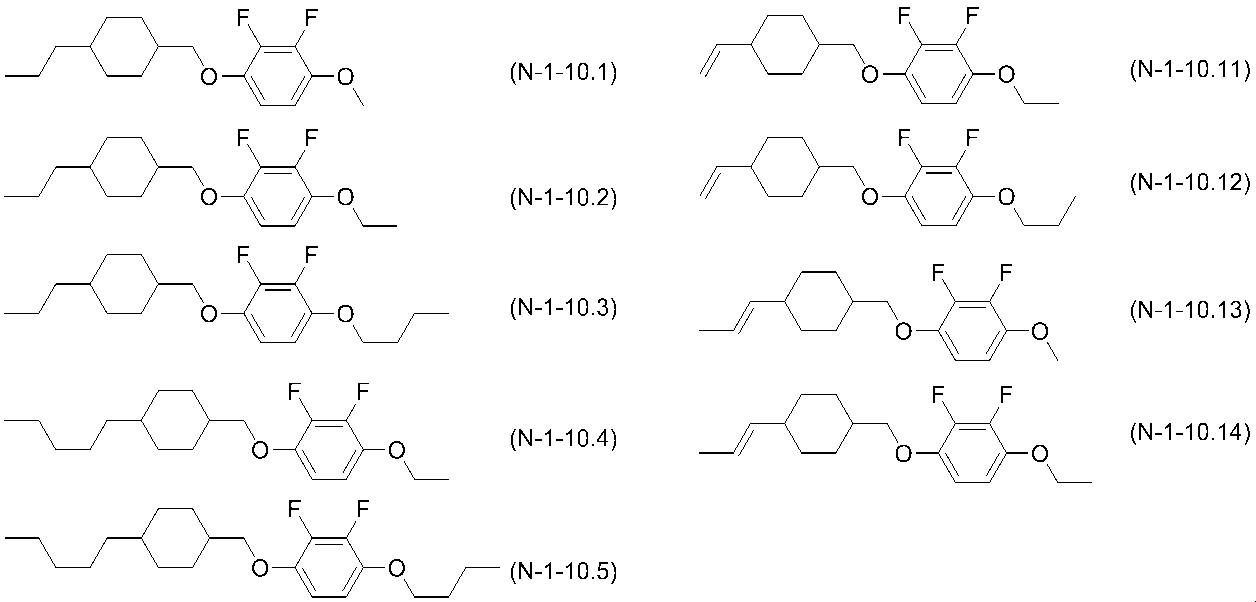
式(N-1-10.1)及び式(N-1-10.2)で表される化合物は単独で使用することも、組み合わせて使用することも可能であるが、本発明の組成物の総量に対しての単独又はこれら化合物の好ましい含有量の下限値は、5%であり、10%であり、13%であり、15%であり、17%であり、20%である。好ましい含有量の上限値は、本発明の組成物の総量に対して、35%であり、30%であり、28%であり、25%であり、23%であり、20%であり、18%であり、15%であり、13%である。
一般式(N-1-11)で表される化合物は下記の化合物である。

(式中、RN1111及びRN1112はそれぞれ独立して、一般式(N-1)におけるRN11及びRN12と同じ意味を表す。)
RN1111は炭素原子数1~5のアルキル基又は炭素原子数2~5のアルケニル基が好ましく、エチル基、プロピル基、ブチル基、ビニル基又は1-プロペニル基が好ましい。RN1112は炭素原子数1~5のアルキル基、炭素原子数4~5のアルケニル基又は炭素原子数1~4のアルコキシ基が好ましく、エトキシ基、プロポキシ基又はブトキシ基が好ましい。
RN1111は炭素原子数1~5のアルキル基又は炭素原子数2~5のアルケニル基が好ましく、エチル基、プロピル基、ブチル基、ビニル基又は1-プロペニル基が好ましい。RN1112は炭素原子数1~5のアルキル基、炭素原子数4~5のアルケニル基又は炭素原子数1~4のアルコキシ基が好ましく、エトキシ基、プロポキシ基又はブトキシ基が好ましい。
一般式(N-1-11)で表される化合物は単独で使用することもできるが、2以上の化合物を組み合わせて使用することもできる。組み合わせることができる化合物の種類に特に制限は無いが、低温での溶解性、転移温度、電気的な信頼性、複屈折率などの求められる性能に応じて適宜組み合わせて使用する。使用する化合物の種類は、例えば本発明の一つの実施形態としては1種類であり、2種類であり、3種類であり、4種類であり、5種類以上である。
Δεの改善を重視する場合には含有量を高めに設定することが好ましく、低温での溶解性を重視する場合は含有量を低めに設定すると効果が高く、TNIを重視する場合は含有量を高めに設定すると効果が高い。さらに、滴下痕や焼き付き特性を改良する場合は、含有量の範囲を中間に設定することが好ましい。
本発明の組成物の総量に対しての式(N-1-11)で表される化合物の好ましい含有量の下限値は、5%であり、10%であり、13%であり、15%であり、17%であり、20%である。好ましい含有量の上限値は、本発明の組成物の総量に対して、35%であり、30%であり、28%であり、25%であり、23%であり、20%であり、18%であり、15%であり、13%である。
さらに、一般式(N-1-11)で表される化合物は、式(N-1-11.1)から式(N-1-11.14)で表される化合物群から選ばれる化合物であることが好ましく、式(N-1-11.1)~(N-1-11.14)で表される化合物であることが好ましく、式(N-1-11.2)及び式(N-1-11.4)で表される化合物が好ましい。
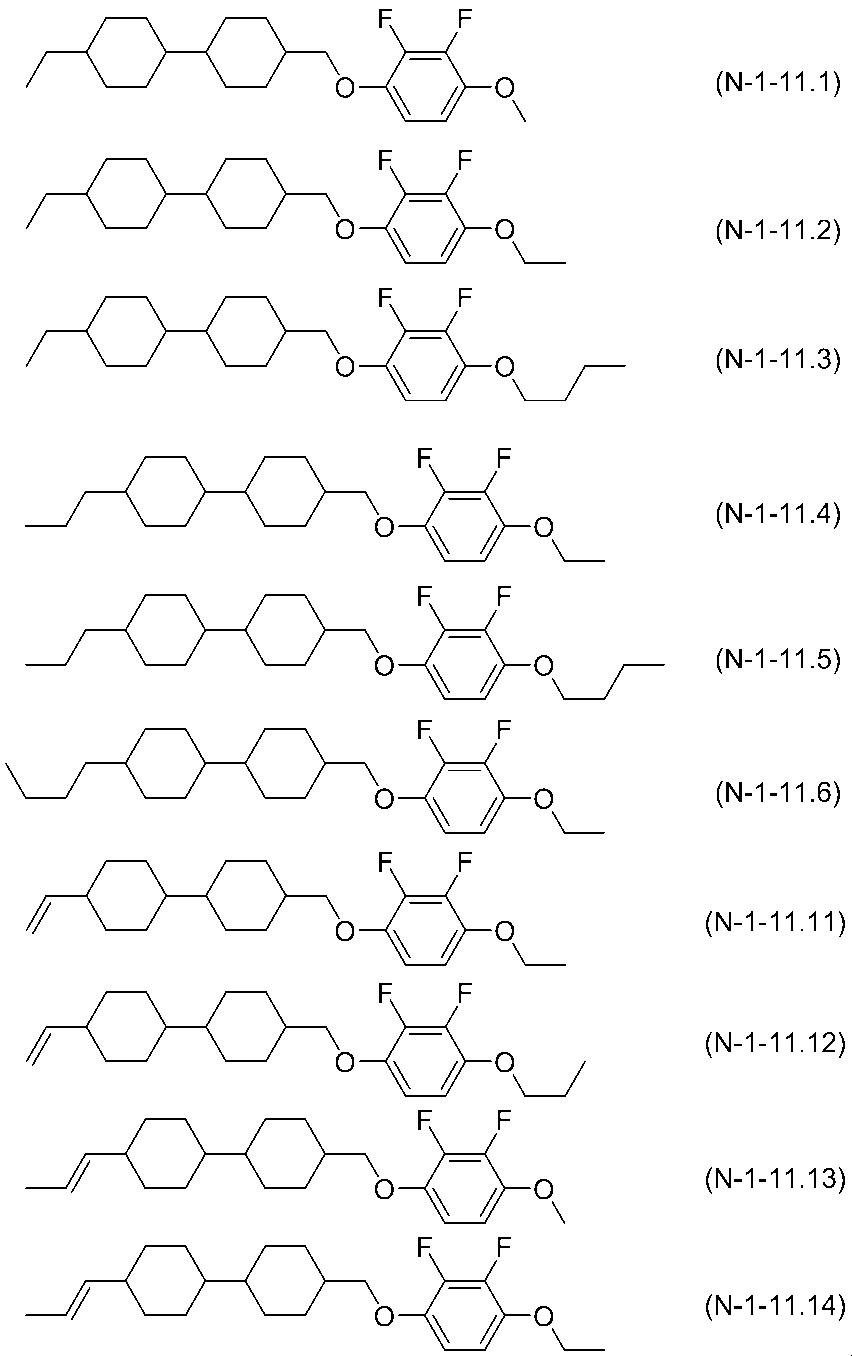
式(N-1-11.2)及び式(N-1-11.4)で表される化合物は単独で使用することも、組み合わせて使用することも可能であるが、本発明の組成物の総量に対しての単独又はこれら化合物の好ましい含有量の下限値は、5%であり、10%であり、13%であり、15%であり、17%であり、20%である。好ましい含有量の上限値は、本発明の組成物の総量に対して、35%であり、30%であり、28%であり、25%であり、23%であり、20%であり、18%であり、15%であり、13%である。
一般式(N-1-12)で表される化合物は下記の化合物である。

(式中、RN1121及びRN1122はそれぞれ独立して、一般式(N-1)におけるRN11及びRN12と同じ意味を表す。)
RN1121は炭素原子数1~5のアルキル基又は炭素原子数2~5のアルケニル基が好ましく、エチル基、プロピル基又はブチル基が好ましい。RN1122は炭素原子数1~5のアルキル基、炭素原子数4~5のアルケニル基又は炭素原子数1~4のアルコキシ基が好ましく、エトキシ基、プロポキシ基又はブトキシ基が好ましい。
RN1121は炭素原子数1~5のアルキル基又は炭素原子数2~5のアルケニル基が好ましく、エチル基、プロピル基又はブチル基が好ましい。RN1122は炭素原子数1~5のアルキル基、炭素原子数4~5のアルケニル基又は炭素原子数1~4のアルコキシ基が好ましく、エトキシ基、プロポキシ基又はブトキシ基が好ましい。
一般式(N-1-12)で表される化合物は単独で使用することもできるが、2以上の化合物を組み合わせて使用することもできる。組み合わせることができる化合物の種類に特に制限は無いが、低温での溶解性、転移温度、電気的な信頼性、複屈折率などの求められる性能に応じて適宜組み合わせて使用する。使用する化合物の種類は、例えば本発明の一つの実施形態としては1種類であり、2種類であり、3種類であり、4種類であり、5種類以上である。
Δεの改善を重視する場合には含有量を高めに設定することが好ましく、低温での溶解性を重視する場合は含有量を高めに設定すると効果が高く、TNIを重視する場合は含有量を低めに設定すると効果が高い。さらに、滴下痕や焼き付き特性を改良する場合は、含有量の範囲を中間に設定することが好ましい。
本発明の組成物の総量に対しての式(N-1-12)で表される化合物の好ましい含有量の下限値は、5%であり、10%であり、13%であり、15%であり、17%であり、20%である。好ましい含有量の上限値は、本発明の組成物の総量に対して、35%であり、30%であり、28%であり、25%であり、23%であり、20%であり、18%であり、15%であり、13%である。
一般式(N-1-13)で表される化合物は下記の化合物である。

(式中、RN1131及びRN1132はそれぞれ独立して、一般式(N-1)におけるRN11及びRN12と同じ意味を表す。)
RN1131は炭素原子数1~5のアルキル基又は炭素原子数2~5のアルケニル基が好ましく、エチル基、プロピル基又はブチル基が好ましい。RN1132は炭素原子数1~5のアルキル基、炭素原子数4~5のアルケニル基又は炭素原子数1~4のアルコキシ基が好ましく、エトキシ基、プロポキシ基又はブトキシ基が好ましい。
RN1131は炭素原子数1~5のアルキル基又は炭素原子数2~5のアルケニル基が好ましく、エチル基、プロピル基又はブチル基が好ましい。RN1132は炭素原子数1~5のアルキル基、炭素原子数4~5のアルケニル基又は炭素原子数1~4のアルコキシ基が好ましく、エトキシ基、プロポキシ基又はブトキシ基が好ましい。
一般式(N-1-13)で表される化合物は単独で使用することもできるが、2以上の化合物を組み合わせて使用することもできる。組み合わせることができる化合物の種類に特に制限は無いが、低温での溶解性、転移温度、電気的な信頼性、複屈折率などの求められる性能に応じて適宜組み合わせて使用する。使用する化合物の種類は、例えば本発明の一つの実施形態としては1種類であり、2種類であり、3種類であり、4種類であり、5種類以上である。
Δεの改善を重視する場合には含有量を高めに設定することが好ましく、低温での溶解性を重視する場合は含有量を高めに設定すると効果が高く、TNIを重視する場合は含有量を高めに設定すると効果が高い。さらに、滴下痕や焼き付き特性を改良する場合は、含有量の範囲を中間に設定することが好ましい。
本発明の組成物の総量に対しての式(N-1-13)で表される化合物の好ましい含有量の下限値は、5%であり、10%であり、13%であり、15%であり、17%であり、20%である。好ましい含有量の上限値は、本発明の組成物の総量に対して、35%であり、30%であり、28%であり、25%であり、23%であり、20%であり、18%であり、15%であり、13%である。
一般式(N-1-14)で表される化合物は下記の化合物である。

(式中、RN1141及びRN1142はそれぞれ独立して、一般式(N-1)におけるRN11及びRN12と同じ意味を表す。)
RN1141は炭素原子数1~5のアルキル基又は炭素原子数2~5のアルケニル基が好ましく、エチル基、プロピル基又はブチル基が好ましい。RN1142は炭素原子数1~5のアルキル基、炭素原子数4~5のアルケニル基又は炭素原子数1~4のアルコキシ基が好ましく、エトキシ基、プロポキシ基又はブトキシ基が好ましい。
RN1141は炭素原子数1~5のアルキル基又は炭素原子数2~5のアルケニル基が好ましく、エチル基、プロピル基又はブチル基が好ましい。RN1142は炭素原子数1~5のアルキル基、炭素原子数4~5のアルケニル基又は炭素原子数1~4のアルコキシ基が好ましく、エトキシ基、プロポキシ基又はブトキシ基が好ましい。
一般式(N-1-14)で表される化合物は単独で使用することもできるが、2以上の化合物を組み合わせて使用することもできる。組み合わせることができる化合物の種類に特に制限は無いが、低温での溶解性、転移温度、電気的な信頼性、複屈折率などの求められる性能に応じて適宜組み合わせて使用する。使用する化合物の種類は、例えば本発明の一つの実施形態としては1種類であり、2種類であり、3種類であり、4種類であり、5種類以上である。
Δεの改善を重視する場合には含有量を高めに設定することが好ましく、低温での溶解性を重視する場合は含有量を高めに設定すると効果が高く、TNIを重視する場合は含有量を低めに設定すると効果が高い。さらに、滴下痕や焼き付き特性を改良する場合は、含有量の範囲を中間に設定することが好ましい。
本発明の組成物の総量に対しての式(N-1-14)で表される化合物の好ましい含有量の下限値は、5%であり、10%であり、13%であり、15%であり、17%であり、20%である。好ましい含有量の上限値は、本発明の組成物の総量に対して、35%であり、30%であり、28%であり、25%であり、23%であり、20%であり、18%であり、15%であり、13%である。
一般式(N-1-15)で表される化合物は下記の化合物である。

(式中、RN1151及びRN1152はそれぞれ独立して、一般式(N-1)におけるRN11及びRN12と同じ意味を表す。)
RN1151は炭素原子数1~5のアルキル基又は炭素原子数2~5のアルケニル基が好ましく、エチル基、プロピル基又はブチル基が好ましい。RN1152は炭素原子数1~5のアルキル基、炭素原子数4~5のアルケニル基又は炭素原子数1~4のアルコキシ基が好ましく、エトキシ基、プロポキシ基又はブトキシ基が好ましい。
RN1151は炭素原子数1~5のアルキル基又は炭素原子数2~5のアルケニル基が好ましく、エチル基、プロピル基又はブチル基が好ましい。RN1152は炭素原子数1~5のアルキル基、炭素原子数4~5のアルケニル基又は炭素原子数1~4のアルコキシ基が好ましく、エトキシ基、プロポキシ基又はブトキシ基が好ましい。
一般式(N-1-15)で表される化合物は単独で使用することもできるが、2以上の化合物を組み合わせて使用することもできる。組み合わせることができる化合物の種類に特に制限は無いが、低温での溶解性、転移温度、電気的な信頼性、複屈折率などの求められる性能に応じて適宜組み合わせて使用する。使用する化合物の種類は、例えば本発明の一つの実施形態としては1種類であり、2種類であり、3種類であり、4種類であり、5種類以上である。
Δεの改善を重視する場合には含有量を高めに設定することが好ましく、低温での溶解性を重視する場合は含有量を高めに設定すると効果が高く、TNIを重視する場合は含有量を高めに設定すると効果が高い。さらに、滴下痕や焼き付き特性を改良する場合は、含有量の範囲を中間に設定することが好ましい。
本発明の組成物の総量に対しての式(N-1-15)で表される化合物の好ましい含有量の下限値は、5%であり、10%であり、13%であり、15%であり、17%であり、20%である。好ましい含有量の上限値は、本発明の組成物の総量に対して、35%であり、30%であり、28%であり、25%であり、23%であり、20%であり、18%であり、15%であり、13%である。
一般式(N-1-16)で表される化合物は下記の化合物である。

(式中、RN1161及びRN1162はそれぞれ独立して、一般式(N-1)におけるRN11及びRN12と同じ意味を表す。)
RN1161は炭素原子数1~5のアルキル基又は炭素原子数2~5のアルケニル基が好ましく、エチル基、プロピル基又はブチル基が好ましい。RN1162は炭素原子数1~5のアルキル基、炭素原子数4~5のアルケニル基又は炭素原子数1~4のアルコキシ基が好ましく、エトキシ基、プロポキシ基又はブトキシ基が好ましい。
RN1161は炭素原子数1~5のアルキル基又は炭素原子数2~5のアルケニル基が好ましく、エチル基、プロピル基又はブチル基が好ましい。RN1162は炭素原子数1~5のアルキル基、炭素原子数4~5のアルケニル基又は炭素原子数1~4のアルコキシ基が好ましく、エトキシ基、プロポキシ基又はブトキシ基が好ましい。
一般式(N-1-16)で表される化合物は単独で使用することもできるが、2以上の化合物を組み合わせて使用することもできる。組み合わせることができる化合物の種類に特に制限は無いが、低温での溶解性、転移温度、電気的な信頼性、複屈折率などの求められる性能に応じて適宜組み合わせて使用する。使用する化合物の種類は、例えば本発明の一つの実施形態としては1種類であり、2種類であり、3種類であり、4種類であり、5種類以上である。
Δεの改善を重視する場合には含有量を高めに設定することが好ましく、低温での溶解性を重視する場合は含有量を高めに設定すると効果が高く、TNIを重視する場合は含有量を高めに設定すると効果が高い。さらに、滴下痕や焼き付き特性を改良する場合は、含有量の範囲を中間に設定することが好ましい。
本発明の組成物の総量に対しての式(N-1-16)で表される化合物の好ましい含有量の下限値は、5%であり、10%であり、13%であり、15%であり、17%であり、20%である。好ましい含有量の上限値は、本発明の組成物の総量に対して、35%であり、30%であり、28%であり、25%であり、23%であり、20%であり、18%であり、15%であり、13%である。
一般式(N-1-17)で表される化合物は下記の化合物である。

(式中、RN1171及びRN1172はそれぞれ独立して、一般式(N-1)におけるRN11及びRN12と同じ意味を表す。)
RN1171は炭素原子数1~5のアルキル基又は炭素原子数2~5のアルケニル基が好ましく、エチル基、プロピル基又はブチル基が好ましい。RN1172は炭素原子数1~5のアルキル基、炭素原子数4~5のアルケニル基又は炭素原子数1~4のアルコキシ基が好ましく、エトキシ基、プロポキシ基又はブトキシ基が好ましい。
RN1171は炭素原子数1~5のアルキル基又は炭素原子数2~5のアルケニル基が好ましく、エチル基、プロピル基又はブチル基が好ましい。RN1172は炭素原子数1~5のアルキル基、炭素原子数4~5のアルケニル基又は炭素原子数1~4のアルコキシ基が好ましく、エトキシ基、プロポキシ基又はブトキシ基が好ましい。
一般式(N-1-17)で表される化合物は単独で使用することもできるが、2以上の化合物を組み合わせて使用することもできる。組み合わせることができる化合物の種類に特に制限は無いが、低温での溶解性、転移温度、電気的な信頼性、複屈折率などの求められる性能に応じて適宜組み合わせて使用する。使用する化合物の種類は、例えば本発明の一つの実施形態としては1種類であり、2種類であり、3種類であり、4種類であり、5種類以上である。
Δεの改善を重視する場合には含有量を高めに設定することが好ましく、低温での溶解性を重視する場合は含有量を高めに設定すると効果が高く、TNIを重視する場合は含有量を高めに設定すると効果が高い。さらに、滴下痕や焼き付き特性を改良する場合は、含有量の範囲を中間に設定することが好ましい。
本発明の組成物の総量に対しての式(N-1-17)で表される化合物の好ましい含有量の下限値は、5%であり、10%であり、13%であり、15%であり、17%であり、20%である。好ましい含有量の上限値は、本発明の組成物の総量に対して、35%であり、30%であり、28%であり、25%であり、23%であり、20%であり、18%であり、15%であり、13%である。
一般式(N-1-18)で表される化合物は下記の化合物である。

(式中、RN1181及びRN1182はそれぞれ独立して、一般式(N-1)におけるRN11及びRN12と同じ意味を表す。)
RN1181は炭素原子数1~5のアルキル基又は炭素原子数2~5のアルケニル基が好ましく、メチル基、エチル基、プロピル基又はブチル基が好ましい。RN1182は炭素原子数1~5のアルキル基、炭素原子数4~5のアルケニル基又は炭素原子数1~4のアルコキシ基が好ましく、エトキシ基、プロポキシ基又はブトキシ基が好ましい。
RN1181は炭素原子数1~5のアルキル基又は炭素原子数2~5のアルケニル基が好ましく、メチル基、エチル基、プロピル基又はブチル基が好ましい。RN1182は炭素原子数1~5のアルキル基、炭素原子数4~5のアルケニル基又は炭素原子数1~4のアルコキシ基が好ましく、エトキシ基、プロポキシ基又はブトキシ基が好ましい。
一般式(N-1-18)で表される化合物は単独で使用することもできるが、2以上の化合物を組み合わせて使用することもできる。組み合わせることができる化合物の種類に特に制限は無いが、低温での溶解性、転移温度、電気的な信頼性、複屈折率などの求められる性能に応じて適宜組み合わせて使用する。使用する化合物の種類は、例えば本発明の一つの実施形態としては1種類であり、2種類であり、3種類であり、4種類であり、5種類以上である。
Δεの改善を重視する場合には含有量を高めに設定することが好ましく、低温での溶解性を重視する場合は含有量を高めに設定すると効果が高く、TNIを重視する場合は含有量を高めに設定すると効果が高い。さらに、滴下痕や焼き付き特性を改良する場合は、含有量の範囲を中間に設定することが好ましい。
本発明の組成物の総量に対しての式(N-1-18)で表される化合物の好ましい含有量の下限値は、5%であり、10%であり、13%であり、15%であり、17%であり、20%である。好ましい含有量の上限値は、本発明の組成物の総量に対して、35%であり、30%であり、28%であり、25%であり、23%であり、20%であり、18%であり、15%であり、13%である。
さらに、一般式(N-1-18)で表される化合物は、式(N-1-18.1)から式(N-1-18.5)で表される化合物群から選ばれる化合物であることが好ましく、式(N-1-18.1)~(N-1-11.3)で表される化合物であることが好ましく、式(N-1-18.2及び式(N-1-18.3)で表される化合物が好ましい。
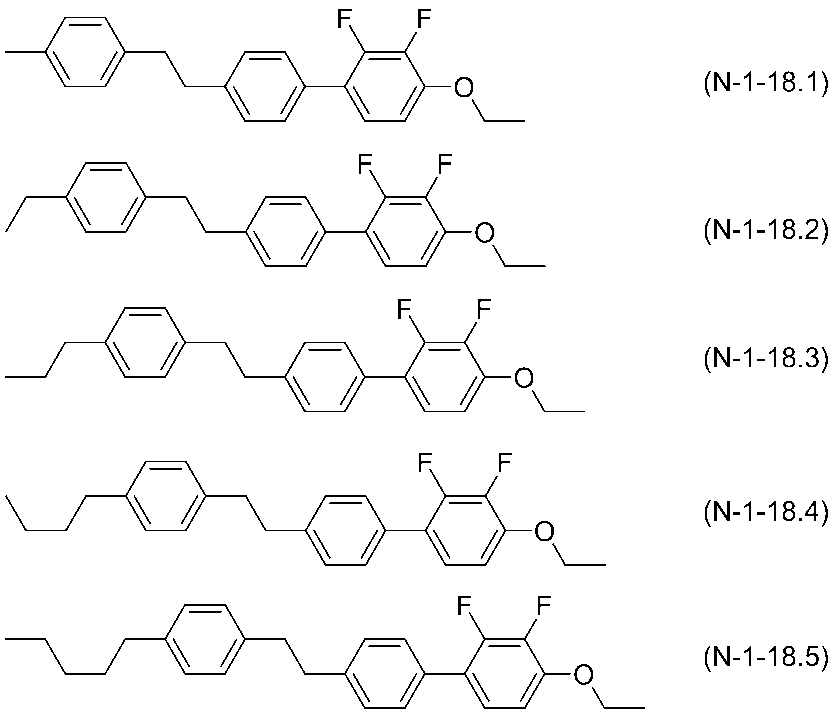
一般式(N-1-20)で表される化合物は下記の化合物である。

(式中、RN1201及びRN1202はそれぞれ独立して、一般式(N-1)におけるRN11及びRN12と同じ意味を表す。)
RN1201及びRN1202はそれぞれ独立して、炭素原子数1~5のアルキル基又は炭素原子数2~5のアルケニル基が好ましく、エチル基、プロピル基又はブチル基が好ましい。
RN1201及びRN1202はそれぞれ独立して、炭素原子数1~5のアルキル基又は炭素原子数2~5のアルケニル基が好ましく、エチル基、プロピル基又はブチル基が好ましい。
一般式(N-1-20)で表される化合物は単独で使用することもできるが、2以上の化合物を組み合わせて使用することもできる。組み合わせることができる化合物の種類に特に制限は無いが、低温での溶解性、転移温度、電気的な信頼性、複屈折率などの求められる性能に応じて適宜組み合わせて使用する。使用する化合物の種類は、例えば本発明の一つの実施形態としては1種類であり、2種類であり、3種類であり、4種類であり、5種類以上である。
Δεの改善を重視する場合には含有量を高めに設定することが好ましく、低温での溶解性を重視する場合は含有量を高めに設定すると効果が高く、TNIを重視する場合は含有量を高めに設定すると効果が高い。さらに、滴下痕や焼き付き特性を改良する場合は、含有量の範囲を中間に設定することが好ましい。
本発明の組成物の総量に対しての式(N-1-20)で表される化合物の好ましい含有量の下限値は、5%であり、10%であり、13%であり、15%であり、17%であり、20%である。好ましい含有量の上限値は、本発明の組成物の総量に対して、35%であり、30%であり、28%であり、25%であり、23%であり、20%であり、18%であり、15%であり、13%である。
一般式(N-1-21)で表される化合物は下記の化合物である。

(式中、RN1211及びRN1212はそれぞれ独立して、一般式(N-1)におけるRN11及びRN12と同じ意味を表す。)
RN1211及びRN1212はそれぞれ独立して、炭素原子数1~5のアルキル基又は炭素原子数2~5のアルケニル基が好ましく、エチル基、プロピル基又はブチル基が好ましい。
RN1211及びRN1212はそれぞれ独立して、炭素原子数1~5のアルキル基又は炭素原子数2~5のアルケニル基が好ましく、エチル基、プロピル基又はブチル基が好ましい。
一般式(N-1-21)で表される化合物は単独で使用することもできるが、2以上の化合物を組み合わせて使用することもできる。組み合わせることができる化合物の種類に特に制限は無いが、低温での溶解性、転移温度、電気的な信頼性、複屈折率などの求められる性能に応じて適宜組み合わせて使用する。使用する化合物の種類は、例えば本発明の一つの実施形態としては1種類であり、2種類であり、3種類であり、4種類であり、5種類以上である。
Δεの改善を重視する場合には含有量を高めに設定することが好ましく、低温での溶解性を重視する場合は含有量を高めに設定すると効果が高く、TNIを重視する場合は含有量を高めに設定すると効果が高い。さらに、滴下痕や焼き付き特性を改良する場合は、含有量の範囲を中間に設定することが好ましい。
本発明の組成物の総量に対しての式(N-1-21)で表される化合物の好ましい含有量の下限値は、5%であり、10%であり、13%であり、15%であり、17%であり、20%である。好ましい含有量の上限値は、本発明の組成物の総量に対して、35%であり、30%であり、28%であり、25%であり、23%であり、20%であり、18%であり、15%であり、13%である。
一般式(N-1-22)で表される化合物は下記の化合物である。

(式中、RN1221及びRN1222はそれぞれ独立して、一般式(N-1)におけるRN11及びRN12と同じ意味を表す。)
RN1221及びRN1222はそれぞれ独立して、炭素原子数1~5のアルキル基又は炭素原子数2~5のアルケニル基が好ましく、エチル基、プロピル基又はブチル基が好ましい。
RN1221及びRN1222はそれぞれ独立して、炭素原子数1~5のアルキル基又は炭素原子数2~5のアルケニル基が好ましく、エチル基、プロピル基又はブチル基が好ましい。
一般式(N-1-22)で表される化合物は単独で使用することもできるが、2以上の化合物を組み合わせて使用することもできる。組み合わせることができる化合物の種類に特に制限は無いが、低温での溶解性、転移温度、電気的な信頼性、複屈折率などの求められる性能に応じて適宜組み合わせて使用する。使用する化合物の種類は、例えば本発明の一つの実施形態としては1種類であり、2種類であり、3種類であり、4種類であり、5種類以上である。
Δεの改善を重視する場合には含有量を高めに設定することが好ましく、低温での溶解性を重視する場合は含有量を高めに設定すると効果が高く、TNIを重視する場合は含有量を高めに設定すると効果が高い。さらに、滴下痕や焼き付き特性を改良する場合は、含有量の範囲を中間に設定することが好ましい。
本発明の組成物の総量に対しての式(N-1-21)で表される化合物の好ましい含有量の下限値は、1%であり、5%であり、10%であり、13%であり、15%であり、17%であり20%である。好ましい含有量の上限値は、本発明の組成物の総量に対して、35%であり、30%であり、28%であり、25%であり、23%であり、20%であり、18%であり、15%であり、13%であり、10%であり、5%である。
さらに、一般式(N-1-22)で表される化合物は、式(N-1-22.1)から式(N-1-22.12)で表される化合物群から選ばれる化合物であることが好ましく、式(N-1-22.1)~(N-1-22.5)で表される化合物であることが好ましく、式(N-1-22.1)~(N-1-22.4)で表される化合物が好ましい。
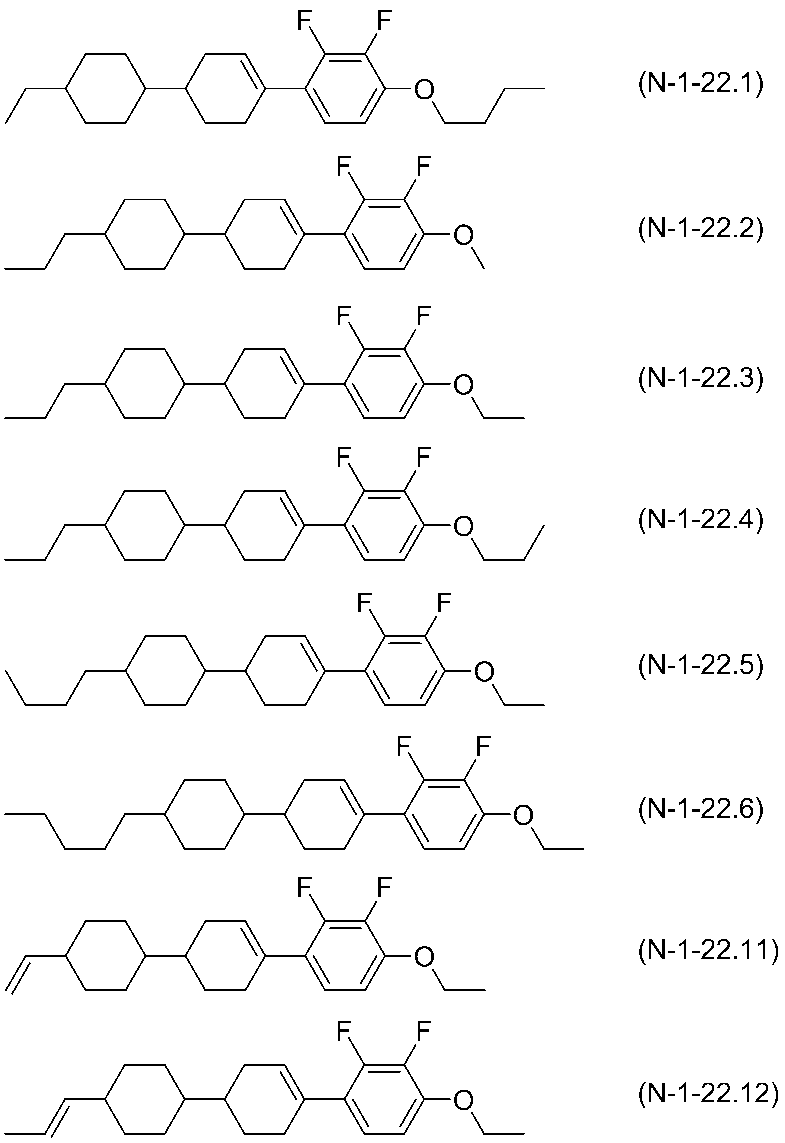
一般式(N-3)で表される化合物は一般式(N-3-2)で表される化合物群から選ばれる化合物であることが好ましい。

(式中、RN321及びRN322はそれぞれ独立して、一般式(N-3)におけるRN11及びRN12と同じ意味を表す。)
RN321及びRN322は炭素原子数1~5のアルキル基又は炭素原子数2~5のアルケニル基が好ましく、プロピル基又はペンチル基が好ましい。
RN321及びRN322は炭素原子数1~5のアルキル基又は炭素原子数2~5のアルケニル基が好ましく、プロピル基又はペンチル基が好ましい。
一般式(N-3-2)で表される化合物は単独で使用することもできるが、2以上の化合物を組み合わせて使用することもできる。組み合わせることができる化合物の種類に特に制限は無いが、低温での溶解性、転移温度、電気的な信頼性、複屈折率などの求められる性能に応じて適宜組み合わせて使用する。使用する化合物の種類は、例えば本発明の一つの実施形態としては1種類であり、2種類であり、3種類であり、4種類であり、5種類以上である。
Δεの改善を重視する場合には含有量を高めに設定することが好ましく、低温での溶解性を重視する場合は含有量を高めに設定すると効果が高く、TNIを重視する場合は含有量を高めに設定すると効果が高い。さらに、滴下痕や焼き付き特性を改良する場合は、含有量の範囲を中間に設定することが好ましい。
本発明の組成物の総量に対しての式(N-3-2)で表される化合物の好ましい含有量の下限値は、3%であり、5%であり、10%であり、13%であり、15%であり、17%であり、20%であり、23%であり、25%であり、27%であり、30%であり、33%であり、35%である。好ましい含有量の上限値は、本発明の組成物の総量に対して、50%であり、40%であり、38%であり、35%であり、33%であり、30%であり、28%であり、25%であり、23%であり、20%であり、18%であり、15%であり、13%であり、10%であり、8%であり、7%であり、6%であり、5%である。
さらに、一般式(N-3-2)で表される化合物は、式(N-3-2.1)から式(N-3-2.3)で表される化合物群から選ばれる化合物であることが好ましい。

本発明の組成物は、一般式(J)で表される化合物を1種類又は2種類以上含有することが好ましい。これら化合物は誘電的に正の化合物(Δεが2より大きい。)に該当する。

(式中、RJ1は炭素原子数1~8のアルキル基を表し、該アルキル基中の1個又は非隣接の2個以上の-CH2-はそれぞれ独立して-CH=CH-、-C≡C-、-O-、-CO-、-COO-又は-OCO-によって置換されていてもよく、
nJ1は、0、1、2、3又は4を表し、
AJ1、AJ2及びAJ3はそれぞれ独立して、
(a) 1,4-シクロヘキシレン基(この基中に存在する1個の-CH2-又は隣接していない2個以上の-CH2-は-O-に置き換えられてもよい。)
(b) 1,4-フェニレン基(この基中に存在する1個の-CH=又は隣接していない2個以上の-CH=は-N=に置き換えられてもよい。)及び
(c) ナフタレン-2,6-ジイル基、1,2,3,4-テトラヒドロナフタレン-2,6-ジイル基又はデカヒドロナフタレン-2,6-ジイル基(ナフタレン-2,6-ジイル基又は1,2,3,4-テトラヒドロナフタレン-2,6-ジイル基中に存在する1個の-CH=又は隣接していない2個以上の-CH=は-N=に置き換えられても良い。)
からなる群より選ばれる基を表し、上記の基(a)、基(b)及び基(c)はそれぞれ独立してシアノ基、フッ素原子、塩素原子、メチル基、トリフルオロメチル基又はトリフルオロメトキシ基で置換されていても良く、
ZJ1及びZJ2はそれぞれ独立して単結合、-CH2CH2-、-(CH2)4-、-OCH2-、-CH2O-、-OCF2-、-CF2O-、-COO-、-OCO-又は-C≡C-を表し、
nJ1が2、3又は4であってAJ2が複数存在する場合は、それらは同一であっても異なっていても良く、nJ1が2、3又は4であってZJ1が複数存在する場合は、それらは同一であっても異なっていても良く、
XJ1は、水素原子、フッ素原子、塩素原子、シアノ基、トリフルオロメチル基、フルオロメトキシ基、ジフルオロメトキシ基、トリフルオロメトキシ基又は2,2,2-トリフルオロエチル基を表す。)
一般式(J)中、RJ1は、炭素原子数1~8のアルキル基、炭素原子数1~8のアルコキシ基、炭素原子数2~8のアルケニル基又は炭素原子数2~8のアルケニルオキシ基が好ましく、炭素原子数1~5のアルキル基、炭素原子数1~5のアルコキシ基、炭素原子数2~5のアルケニル基又は炭素原子数2~5のアルケニルオキシ基が好ましく、炭素原子数1~5のアルキル基又は炭素原子数2~5のアルケニル基が更に好ましく、炭素原子数2~5のアルキル基又は炭素原子数2~3のアルケニル基が更に好ましく、炭素原子数3のアルケニル基(プロペニル基)が特に好ましい。
nJ1は、0、1、2、3又は4を表し、
AJ1、AJ2及びAJ3はそれぞれ独立して、
(a) 1,4-シクロヘキシレン基(この基中に存在する1個の-CH2-又は隣接していない2個以上の-CH2-は-O-に置き換えられてもよい。)
(b) 1,4-フェニレン基(この基中に存在する1個の-CH=又は隣接していない2個以上の-CH=は-N=に置き換えられてもよい。)及び
(c) ナフタレン-2,6-ジイル基、1,2,3,4-テトラヒドロナフタレン-2,6-ジイル基又はデカヒドロナフタレン-2,6-ジイル基(ナフタレン-2,6-ジイル基又は1,2,3,4-テトラヒドロナフタレン-2,6-ジイル基中に存在する1個の-CH=又は隣接していない2個以上の-CH=は-N=に置き換えられても良い。)
からなる群より選ばれる基を表し、上記の基(a)、基(b)及び基(c)はそれぞれ独立してシアノ基、フッ素原子、塩素原子、メチル基、トリフルオロメチル基又はトリフルオロメトキシ基で置換されていても良く、
ZJ1及びZJ2はそれぞれ独立して単結合、-CH2CH2-、-(CH2)4-、-OCH2-、-CH2O-、-OCF2-、-CF2O-、-COO-、-OCO-又は-C≡C-を表し、
nJ1が2、3又は4であってAJ2が複数存在する場合は、それらは同一であっても異なっていても良く、nJ1が2、3又は4であってZJ1が複数存在する場合は、それらは同一であっても異なっていても良く、
XJ1は、水素原子、フッ素原子、塩素原子、シアノ基、トリフルオロメチル基、フルオロメトキシ基、ジフルオロメトキシ基、トリフルオロメトキシ基又は2,2,2-トリフルオロエチル基を表す。)
一般式(J)中、RJ1は、炭素原子数1~8のアルキル基、炭素原子数1~8のアルコキシ基、炭素原子数2~8のアルケニル基又は炭素原子数2~8のアルケニルオキシ基が好ましく、炭素原子数1~5のアルキル基、炭素原子数1~5のアルコキシ基、炭素原子数2~5のアルケニル基又は炭素原子数2~5のアルケニルオキシ基が好ましく、炭素原子数1~5のアルキル基又は炭素原子数2~5のアルケニル基が更に好ましく、炭素原子数2~5のアルキル基又は炭素原子数2~3のアルケニル基が更に好ましく、炭素原子数3のアルケニル基(プロペニル基)が特に好ましい。
信頼性を重視する場合にはRJ1はアルキル基であることが好ましく、粘性の低下を重視する場合にはアルケニル基であることが好ましい。
また、それが結合する環構造がフェニル基(芳香族)である場合には、直鎖状の炭素原子数1~5のアルキル基、直鎖状の炭素原子数1~4のアルコキシ基及び炭素原子数4~5のアルケニル基が好ましく、それが結合する環構造がシクロヘキサン、ピラン及びジオキサンなどの飽和した環構造の場合には、直鎖状の炭素原子数1~5のアルキル基、直鎖状の炭素原子数1~4のアルコキシ基及び直鎖状の炭素原子数2~5のアルケニル基が好ましい。ネマチック相を安定化させるためには炭素原子及び存在する場合酸素原子の合計が5以下であることが好ましく、直鎖状であることが好ましい。
アルケニル基としては、式(R1)から式(R5)のいずれかで表される基から選ばれることが好ましい。(各式中の黒点はアルケニル基が結合している環構造中の炭素原子を表す。)

AJ1、AJ2及びAJ3はそれぞれ独立してΔnを大きくすることが求められる場合には芳香族であることが好ましく、応答速度を改善するためには脂肪族であることが好ましく、トランス-1,4-シクロへキシレン基、1,4-フェニレン基、1,4-シクロヘキセニレン基、1,4-ビシクロ[2.2.2]オクチレン基、ピペリジン-1,4-ジイル基、ナフタレン-2,6-ジイル基、デカヒドロナフタレン-2,6-ジイル基又は1,2,3,4-テトラヒドロナフタレン-2,6-ジイル基を表すことが好ましく、それらはフッ素原子により置換されていてもよく、下記の構造を表すことがより好ましく、

下記の構造を表すことがより好ましい。
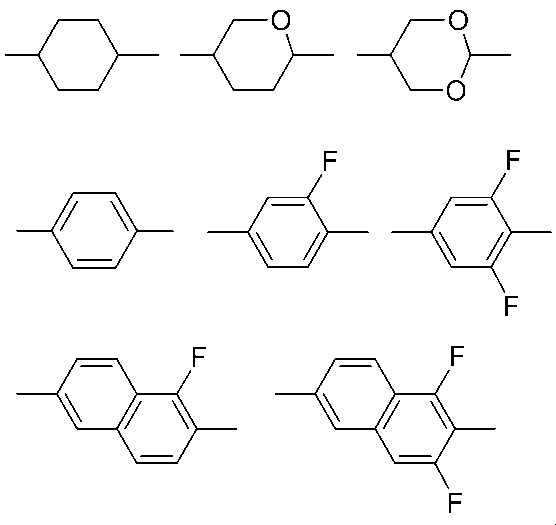
ZJ1及びZJ2はそれぞれ独立して-CH2O-、-OCH2-、-CF2O-、-CH2CH2-、-CF2CF2-又は単結合を表すことが好ましく、-OCH2-、-CF2O-、-CH2CH2-又は単結合が更に好ましく、-OCH2-、-CF2O-又は単結合が特に好ましい。
XJ1はフッ素原子又はトリフルオロメトキシ基が好ましく、フッ素原子が好ましい。
nJ1は、0、1、2又は3が好ましく、0、1又は2が好ましく、Δεの改善に重点を置く場合には0又は1が好ましく、TNIを重視する場合には1又は2が好ましい。
組み合わせることができる化合物の種類に特に制限は無いが、低温での溶解性、転移温度、電気的な信頼性、複屈折率などの所望の性能に応じて組み合わせて使用する。使用する化合物の種類は、例えば本発明の一つの実施形態としては1種類であり、2種類であり、3種類である。またさらに、本発明の別の実施形態では4種類であり、5種類であり、6種類であり、7種類以上である。
本発明の組成物において、一般式(J)で表される化合物の含有量は、低温での溶解性、転移温度、電気的な信頼性、複屈折率、プロセス適合性、滴下痕、焼き付き、誘電率異方性などの求められる性能に応じて適宜調整する必要がある。
本発明の組成物の総量に対しての一般式(J)で表される化合物の好ましい含有量の下限値は、1%であり、10%であり、20%であり、30%であり、40%であり、50%であり、55%であり、60%であり、65%であり、70%であり、75%であり、80%である。好ましい含有量の上限値は、本発明の組成物の総量に対して、例えば本発明の一つの形態では95%であり、85%であり、75%であり、65%であり、55%であり、45%であり、35%であり、25%である。
本発明の組成物の粘度を低く保ち、応答速度が速い組成物が必要な場合は上記の下限値を低めに、上限値を低めにすることが好ましい。さらに、本発明の組成物のTNIを高く保ち、温度安定性の良い組成物が必要な場合は上記の下限値を低めに、上限値を低めにすることが好ましい。また、駆動電圧を低く保つために誘電率異方性を大きくしたいときは、上記の下限値を高めに、上限値を高めにすることが好ましい。
信頼性を重視する場合にはRJ1はアルキル基であることが好ましく、粘性の低下を重視する場合にはアルケニル基であることが好ましい。
一般式(J)で表される化合物としては一般式(M)で表される化合物が好ましい。
本発明の組成物は、一般式(M)で表される化合物を1種類又は2種類以上含有することが好ましい。これら化合物は誘電的に正の化合物(Δεが2より大きい。)に該当する。

(式中、RM1は炭素原子数1~8のアルキル基を表し、該アルキル基中の1個又は非隣接の2個以上の-CH2-はそれぞれ独立して-CH=CH-、-C≡C-、-O-、-CO-、-COO-又は-OCO-によって置換されていてもよく、
nM1は、0、1、2、3又は4を表し、
AM1及びAM2はそれぞれ独立して、
(a) 1,4-シクロヘキシレン基(この基中に存在する1個の-CH2-又は隣接していない2個以上の-CH2-は-O-又は-S-に置き換えられてもよい。)及び
(b) 1,4-フェニレン基(この基中に存在する1個の-CH=又は隣接していない2個以上の-CH=は-N=に置き換えられてもよい。)
からなる群より選ばれる基を表し、上記の基(a)及び基(b)上の水素原子はそれぞれ独立してシアノ基、フッ素原子又は塩素原子で置換されていても良く、
ZM1及びZM2はそれぞれ独立して単結合、-CH2CH2-、-(CH2)4-、-OCH2-、-CH2O-、-OCF2-、-CF2O-、-COO-、-OCO-又は-C≡C-を表し、
nM1が2、3又は4であってAM2が複数存在する場合は、それらは同一であっても異なっていても良く、nM1が2、3又は4であってZM1が複数存在する場合は、それらは同一であっても異なっていても良く、
XM1及びXM3はそれぞれ独立して水素原子、塩素原子又はフッ素原子を表し、
XM2は、水素原子、フッ素原子、塩素原子、シアノ基、トリフルオロメチル基、フルオロメトキシ基、ジフルオロメトキシ基、トリフルオロメトキシ基又は2,2,2-トリフルオロエチル基を表す。
nM1は、0、1、2、3又は4を表し、
AM1及びAM2はそれぞれ独立して、
(a) 1,4-シクロヘキシレン基(この基中に存在する1個の-CH2-又は隣接していない2個以上の-CH2-は-O-又は-S-に置き換えられてもよい。)及び
(b) 1,4-フェニレン基(この基中に存在する1個の-CH=又は隣接していない2個以上の-CH=は-N=に置き換えられてもよい。)
からなる群より選ばれる基を表し、上記の基(a)及び基(b)上の水素原子はそれぞれ独立してシアノ基、フッ素原子又は塩素原子で置換されていても良く、
ZM1及びZM2はそれぞれ独立して単結合、-CH2CH2-、-(CH2)4-、-OCH2-、-CH2O-、-OCF2-、-CF2O-、-COO-、-OCO-又は-C≡C-を表し、
nM1が2、3又は4であってAM2が複数存在する場合は、それらは同一であっても異なっていても良く、nM1が2、3又は4であってZM1が複数存在する場合は、それらは同一であっても異なっていても良く、
XM1及びXM3はそれぞれ独立して水素原子、塩素原子又はフッ素原子を表し、
XM2は、水素原子、フッ素原子、塩素原子、シアノ基、トリフルオロメチル基、フルオロメトキシ基、ジフルオロメトキシ基、トリフルオロメトキシ基又は2,2,2-トリフルオロエチル基を表す。
一般式(M)中、RM1は、炭素原子数1~8のアルキル基、炭素原子数1~8のアルコキシ基、炭素原子数2~8のアルケニル基又は炭素原子数2~8のアルケニルオキシ基が好ましく、炭素原子数1~5のアルキル基、炭素原子数1~5のアルコキシ基、炭素原子数2~5のアルケニル基又は炭素原子数2~5のアルケニルオキシ基が好ましく、炭素原子数1~5のアルキル基又は炭素原子数2~5のアルケニル基が更に好ましく、炭素原子数2~5のアルキル基又は炭素原子数2~3のアルケニル基が更に好ましく、炭素原子数3のアルケニル基(プロペニル基)が特に好ましい。
信頼性を重視する場合にはRM1はアルキル基であることが好ましく、粘性の低下を重視する場合にはアルケニル基であることが好ましい。
また、それが結合する環構造がフェニル基(芳香族)である場合には、直鎖状の炭素原子数1~5のアルキル基、直鎖状の炭素原子数1~4のアルコキシ基及び炭素原子数4~5のアルケニル基が好ましく、それが結合する環構造がシクロヘキサン、ピラン及びジオキサンなどの飽和した環構造の場合には、直鎖状の炭素原子数1~5のアルキル基、直鎖状の炭素原子数1~4のアルコキシ基及び直鎖状の炭素原子数2~5のアルケニル基が好ましい。ネマチック相を安定化させるためには炭素原子及び存在する場合酸素原子の合計が5以下であることが好ましく、直鎖状であることが好ましい。
アルケニル基としては、式(R1)から式(R5)のいずれかで表される基から選ばれることが好ましい。(各式中の黒点はアルケニル基が結合している環構造中の炭素原子を表す。)

AM1及びAM2はそれぞれ独立してΔnを大きくすることが求められる場合には芳香族であることが好ましく、応答速度を改善するためには脂肪族であることが好ましく、トランス-1,4-シクロへキシレン基、1,4-フェニレン基、2-フルオロ-1,4-フェニレン基、3-フルオロ-1,4-フェニレン基、3,5-ジフルオロ-1,4-フェニレン基、2,3-ジフルオロ-1,4-フェニレン基、1,4-シクロヘキセニレン基、1,4-ビシクロ[2.2.2]オクチレン基、ピペリジン-1,4-ジイル基、ナフタレン-2,6-ジイル基、デカヒドロナフタレン-2,6-ジイル基又は1,2,3,4-テトラヒドロナフタレン-2,6-ジイル基を表すことが好ましく、下記の構造を表すことがより好ましく、
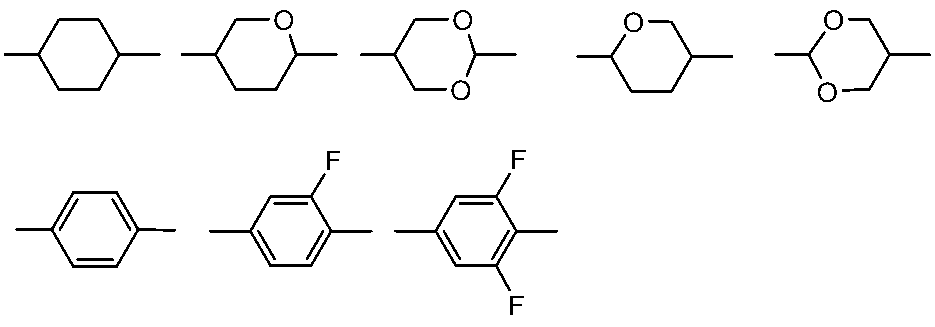
下記の構造を表すことがより好ましい。

ZM1及びZM2はそれぞれ独立して-CH2O-、-CF2O-、-CH2CH2-、-CF2CF2-又は単結合を表すことが好ましく、-CF2O-、-CH2CH2-又は単結合が更に好ましく、-CF2O-又は単結合が特に好ましい。
nM1は、0、1、2又は3が好ましく、0、1又は2が好ましく、Δεの改善に重点を置く場合には0又は1が好ましく、TNIを重視する場合には1又は2が好ましい。
組み合わせることができる化合物の種類に特に制限は無いが、低温での溶解性、転移温度、電気的な信頼性、複屈折率などの所望の性能に応じて組み合わせて使用する。使用する化合物の種類は、例えば本発明の一つの実施形態としては1種類であり、2種類であり、3種類である。またさらに、本発明の別の実施形態では4種類であり、5種類であり、6種類であり、7種類以上である。
本発明の組成物において、一般式(M)で表される化合物の含有量は、低温での溶解性、転移温度、電気的な信頼性、複屈折率、プロセス適合性、滴下痕、焼き付き、誘電率異方性などの求められる性能に応じて適宜調整する必要がある。
本発明の組成物の総量に対しての式(M)で表される化合物の好ましい含有量の下限値は、1%であり、10%であり、20%であり、30%であり、40%であり、50%であり、55%であり、60%であり、65%であり、70%であり、75%であり、80%である。好ましい含有量の上限値は、本発明の組成物の総量に対して、例えば本発明の一つの形態では95%であり、85%であり、75%であり、65%であり、55%であり、45%であり、35%であり、25%である。
本発明の組成物の粘度を低く保ち、応答速度が速い組成物が必要な場合は上記の下限値を低めに、上限値を低めにすることが好ましい。さらに、本発明の組成物のTNIを高く保ち、温度安定性の良い組成物が必要な場合は上記の下限値を低めに、上限値を低めにすることが好ましい。また、駆動電圧を低く保つために誘電率異方性を大きくしたいときは、上記の下限値を高めに、上限値を高めにすることが好ましい。
本発明に係る液晶組成物は、一般式(i)で表される重合性化合物を含有するが、その他の重合性化合物を併用しても良い。当該その他の重合性化合物としては、以下の一般式(P)

(上記一般式(P)中、Rp1は、水素原子、フッ素原子、シアノ基、炭素原子数1~15のアルキル基又は-Spp2-Pp2を表し、該アルキル基中の1個又は非隣接の2個以上の-CH2-はそれぞれ独立して-CH=CH-、-C≡C-、-O-、-CO-、-COO-又は-OCO-によって置換されていてもよく、該アルキル基中の1個又は2個以上の水素原子はそれぞれ独立して、シアノ基、フッ素原子又は塩素原子で置換されていても良く、
Pp1及びPp2はそれぞれ独立して、一般式(Pp1-1)~式(Pp1-9)
Pp1及びPp2はそれぞれ独立して、一般式(Pp1-1)~式(Pp1-9)

(式中、Rp11及びRp12はそれぞれ独立して、水素原子、炭素原子数1~5のアルキル基又は炭素原子数1~5のハロゲン化アルキル基を表し、Wp11は単結合、-O-、-COO-又はメチレン基を表し、tp11は、0、1又は2を表すが、分子内にRp11、Rp12、Wp11及び/又はtp11が複数存在する場合、それらは同一であっても異なっていても良い。)
のいずれかを表し、
Spp1及びSpp2はそれぞれ独立して、単結合又はスペーサー基を表し、
Zp1及びZp2はそれぞれ独立して、単結合、-O-、-S-、-CH2-、-OCH2-、-CH2O-、-CO-、-C2H4-、-COO-、-OCO-、-OCOOCH2-、-CH2OCOO-、-OCH2CH2O-、-CO-NRZP1-、-NRZP1-CO-、-SCH2-、-CH2S-、-CH=CRZP1-COO-、-CH=CRZP1-OCO-、-COO-CRZP1=CH-、-OCO-CRZP1=CH-、-COO-CRZP1=CH-COO-、-COO-CRZP1=CH-OCO-、-OCO-CRZP1=CH-COO-、-OCO-CRZP1=CH-OCO-、-(CH2)z-COO-、-(CH2)2-OCO-、-OCO-(CH2)2-、-(C=O)-O-(CH2)2-、-CH=CH-、-CF=CF-、-CF=CH-、-CH=CF-、-CF2-、-CF2O-、-OCF2-、-CF2CH2-、-CH2CF2-、-CF2CF2-又は-C≡C-(式中、zはそれぞれ独立して1~4の整数を表し、RZP1はそれぞれ独立して水素原子又は炭素原子数1~4のアルキル基を表すが、分子内にRZP1が複数存在する場合、それらは同一であっても異なっていても良い。)
を表し、
Ap1、Ap2及びAp3はそれぞれ独立して、
(ap) 1,4-シクロヘキシレン基(この基中に存在する1個の-CH2-又は隣接していない2個以上の-CH2-は-O-に置き換えられてもよい。)
(bp) 1,4-フェニレン基(この基中に存在する1個の-CH=又は隣接していない2個以上の-CH=は-N=に置き換えられてもよい。)及び
(cp) ナフタレン-2,6-ジイル基、1,2,3,4-テトラヒドロナフタレン-2,6-ジイル基、デカヒドロナフタレン-2,6-ジイル基、フェナントレン-2,7-ジイル基又はアントラセン-2,6-ジイル基(これら基中に存在する1個の-CH=又は隣接していない2個以上の-CH=は-N=に置き換えられても良く、この基中に存在する水素原子は、ハロゲン原子、炭素原子数1~8のアルキル基又は炭素原子数1~8のアルケニル基で置換されていてもよい。)
からなる群より選ばれる基を表し、上記の基(ap)、基(bp)及び基(cp)は、それぞれ独立して、この基中に存在する水素原子は、ハロゲン原子、炭素原子数1~8のアルキル基、炭素数1~8のアルコキシ基又は炭素原子数1~8のアルケニル基で置換されていてもよい。シアノ基、フッ素原子、塩素原子又は-Spp2-Pp2で置換されていても良く、
mp1は、0、1、2又は3を表し、分子内にZp1、Ap2、Spp2及び/又はPp2が複数存在する場合、それらは同一であっても異なっていても良いが、Ap3は、mp1が0で、Ap1がフェナントレン-2,7-ジイル基又はアントラセン-2,6-ジイル基である場合には単結合を表す。
ただし、一般式(i)で表される化合物を除く。)
で表される化合物が好ましい。また、当該重合性モノマーは1種又は2種以上含有することが好ましい。
のいずれかを表し、
Spp1及びSpp2はそれぞれ独立して、単結合又はスペーサー基を表し、
Zp1及びZp2はそれぞれ独立して、単結合、-O-、-S-、-CH2-、-OCH2-、-CH2O-、-CO-、-C2H4-、-COO-、-OCO-、-OCOOCH2-、-CH2OCOO-、-OCH2CH2O-、-CO-NRZP1-、-NRZP1-CO-、-SCH2-、-CH2S-、-CH=CRZP1-COO-、-CH=CRZP1-OCO-、-COO-CRZP1=CH-、-OCO-CRZP1=CH-、-COO-CRZP1=CH-COO-、-COO-CRZP1=CH-OCO-、-OCO-CRZP1=CH-COO-、-OCO-CRZP1=CH-OCO-、-(CH2)z-COO-、-(CH2)2-OCO-、-OCO-(CH2)2-、-(C=O)-O-(CH2)2-、-CH=CH-、-CF=CF-、-CF=CH-、-CH=CF-、-CF2-、-CF2O-、-OCF2-、-CF2CH2-、-CH2CF2-、-CF2CF2-又は-C≡C-(式中、zはそれぞれ独立して1~4の整数を表し、RZP1はそれぞれ独立して水素原子又は炭素原子数1~4のアルキル基を表すが、分子内にRZP1が複数存在する場合、それらは同一であっても異なっていても良い。)
を表し、
Ap1、Ap2及びAp3はそれぞれ独立して、
(ap) 1,4-シクロヘキシレン基(この基中に存在する1個の-CH2-又は隣接していない2個以上の-CH2-は-O-に置き換えられてもよい。)
(bp) 1,4-フェニレン基(この基中に存在する1個の-CH=又は隣接していない2個以上の-CH=は-N=に置き換えられてもよい。)及び
(cp) ナフタレン-2,6-ジイル基、1,2,3,4-テトラヒドロナフタレン-2,6-ジイル基、デカヒドロナフタレン-2,6-ジイル基、フェナントレン-2,7-ジイル基又はアントラセン-2,6-ジイル基(これら基中に存在する1個の-CH=又は隣接していない2個以上の-CH=は-N=に置き換えられても良く、この基中に存在する水素原子は、ハロゲン原子、炭素原子数1~8のアルキル基又は炭素原子数1~8のアルケニル基で置換されていてもよい。)
からなる群より選ばれる基を表し、上記の基(ap)、基(bp)及び基(cp)は、それぞれ独立して、この基中に存在する水素原子は、ハロゲン原子、炭素原子数1~8のアルキル基、炭素数1~8のアルコキシ基又は炭素原子数1~8のアルケニル基で置換されていてもよい。シアノ基、フッ素原子、塩素原子又は-Spp2-Pp2で置換されていても良く、
mp1は、0、1、2又は3を表し、分子内にZp1、Ap2、Spp2及び/又はPp2が複数存在する場合、それらは同一であっても異なっていても良いが、Ap3は、mp1が0で、Ap1がフェナントレン-2,7-ジイル基又はアントラセン-2,6-ジイル基である場合には単結合を表す。
ただし、一般式(i)で表される化合物を除く。)
で表される化合物が好ましい。また、当該重合性モノマーは1種又は2種以上含有することが好ましい。
本発明に係る一般式(P)において、Rp1は-Spp2-Pp2であることが好ましい。
Pp1及びPp2はそれぞれ独立して式(Pp1-1)~式(Pp1-3)のいずれかであることが好ましく、(Pp1-1)であることが好ましい。
Rp11及びRp12はそれぞれ独立して、水素原子又はメチル基であることが好ましい。
tp11は、0又は1が好ましい。
Wp11は、単結合、メチレン基又はエチレン基が好ましい。
mp1は0、1又は2であることが好ましく、0又は1が好ましい。
Zp1及びZp2はそれぞれ独立して、単結合、-OCH2-、-CH2O-、-CO-、-C2H4-、-COO-、-OCO-、-COOC2H4-、-OCOC2H4-、-C2H4OCO-、-C2H4COO-、-CH=CH-、-CF2-、-CF2O-、-(CH2)2-COO-、-(CH2)2-OCO-、-OCO-(CH2)2-、-CH=CH-COO-、-COO-CH=CH-、-OCOCH=CH-、-COO-(CH2)2-、-OCF2-又は-C≡C-が好ましく、単結合、-OCH2-、-CH2O-、-C2H4-、-COO-、-OCO-、-COOC2H4-、-OCOC2H4-、-C2H4OCO-、-C2H4COO-、-CH=CH-、-(CH2)2-COO-、-(CH2)2-OCO-、-OCO-(CH2)2-、-CH=CH-COO-、-COO-CH=CH-、-OCOCH=CH-、-COO-(CH2)2-又は-C≡C-が好ましく、分子内に存在する1つのみが-OCH2-、-CH2O-、-C2H4-、-COO-、-OCO-、-COOC2H4-、-OCOC2H4-、-C2H4OCO-、-C2H4COO-、-CH=CH-、-(CH2)2-COO-、-(CH2)2-OCO-、-OCO-(CH2)2-、-CH=CH-COO-、-COO-CH=CH-、-OCOCH=CH-、-COO-(CH2)2-又は-C≡C-であり、他がすべて単結合であることが好ましく、分子内に存在する1つのみが、-OCH2-、-CH2O-、-C2H4-、-COO-又は-OCO-であり、他がすべて単結合であることが好ましく、すべてが単結合であることが好ましい。
また、分子内に存在するZp1及びZp2の1つのみが、-CH=CH-COO-、-COO-CH=CH-、-(CH2)2-COO-、-(CH2)2-OCO-、-O-CO-(CH2)2-、-COO-(CH2)2-からなる群から選択される連結基であり、他は単結合であることが好ましい。
Spp1及びSpp2はそれぞれ独立して、単結合又はスペーサー基を表すが、スペーサー基は、炭素原子数1~30のアルキレン基が好ましく、該アルキレン基中の-CH2-は酸素原子同士が直接連結しない限りにおいて-O-、-CO-、-COO-、-OCO-、-CH=CH-又は-C≡C-で置換されていてもよく、該アルキレン基中の水素原子はハロゲン原子で置換されていても良いが、直鎖の炭素原子数1~10のアルキレン基又は単結合が好ましい。
Ap1、Ap2及びAp3はそれぞれ独立して、1,4-フェニレン基又は1,4-シクロヘキシレン基が好ましく、1,4-フェニレン基が好ましい。1,4-フェニレン基は液晶化合物との相溶性を改善するために、1個のフッ素原子、1個のメチル基又は1個のメトキシ基で置換されていることが好ましい。
Ap1、Ap2及びAp3はそれぞれ独立して、1,4-フェニレン基又は1,4-シクロヘキシレン基が好ましく、1,4-フェニレン基が好ましい。1,4-フェニレン基は液晶化合物との相溶性を改善するために、1個のフッ素原子、1個のメチル基又は1個のメトキシ基で置換されていることが好ましい。
一般式(P)で表される化合物の合計の含有量は、本願の一般式(P)で表される化合物を含む組成物に対して、0.05~10%含んでいることが好ましく、0.1~8%含んでいることが好ましく、0.1~5%含んでいることが好ましく、0.1~3%含んでいることが好ましく、0.2~2%含んでいることが好ましく、0.2~1.3%含んでいることが好ましく、0.2~1%含んでいることが好ましく、0.2~0.56%含んでいることが好ましい。
一般式(P)で表される化合物の合計の含有量の好ましい下限値は、本願の一般式(P)で表される化合物を含む組成物に対して、0.01%であり、0.03%であり、0.05%であり、0.08%であり、0.1%であり、0.15%であり、0.2%であり、0.25%であり、0.3%である。
一般式(P)で表される化合物の合計の含有量の好ましい上限値は、本願の一般式(P)で表される化合物を含む組成物に対して、10%であり、8%であり、5%であり、3%であり、1.5%であり、1.2%であり、1%であり、0.8%であり、0.5%である。
含有量が少ないと一般式(P)で表される化合物を加える効果が現れにくく、液晶組成物の配向規制力が弱い又は経時的に弱くなってしまうなどの問題が発生し、多すぎると硬化後に残存する量が多くなる、硬化に時間がかかる、液晶の信頼性が低下する等の問題が生じる。このため、これらのバランスを考慮し含有量を設定する。
一般式(i)で表される化合物及び一般式(P)で表される化合物の合計の含有量は、それら化合物を含む組成物に対して、0.05~10%含んでいることが好ましく、0.1~8%含んでいることが好ましく、0.1~5%含んでいることが好ましく、0.1~3%含んでいることが好ましく、0.2~2%含んでいることが好ましく、0.2~1.3%含んでいることが好ましく、0.2~1%含んでいることが好ましく、0.2~0.56%含んでいることが好ましい。
一般式(i)で表される化合物及び一般式(P)で表される化合物の合計の含有量の好ましい下限値は、それら化合物を含む組成物に対して、0.01%であり、0.03%であり、0.05%であり、0.08%であり、0.1%であり、0.15%であり、0.2%であり、0.25%であり、0.3%である。
一般式(i)で表される化合物及び一般式(P)で表される化合物の合計の含有量の好ましい上限値は、それら化合物を含む組成物に対して、10%であり、8%であり、5%であり、3%であり、1.5%であり、1.2%であり、1%であり、0.8%であり、0.5%である。
含有量が少ないと一般式(i)で表される化合物及び一般式(P)で表される化合物を加える効果が現れにくく、液晶組成物の配向規制力が弱い又は経時的に弱くなってしまうなどの問題が発生し、多すぎると硬化後に残存する量が多くなる、硬化に時間がかかる、液晶の信頼性が低下する等の問題が生じる。このため、これらのバランスを考慮し含有量を設定する。
本発明に係る一般式(P)で表される化合物の好ましい例として、下記式(P-1-1)~式(P-1-46)で表される重合性化合物が挙げられる。
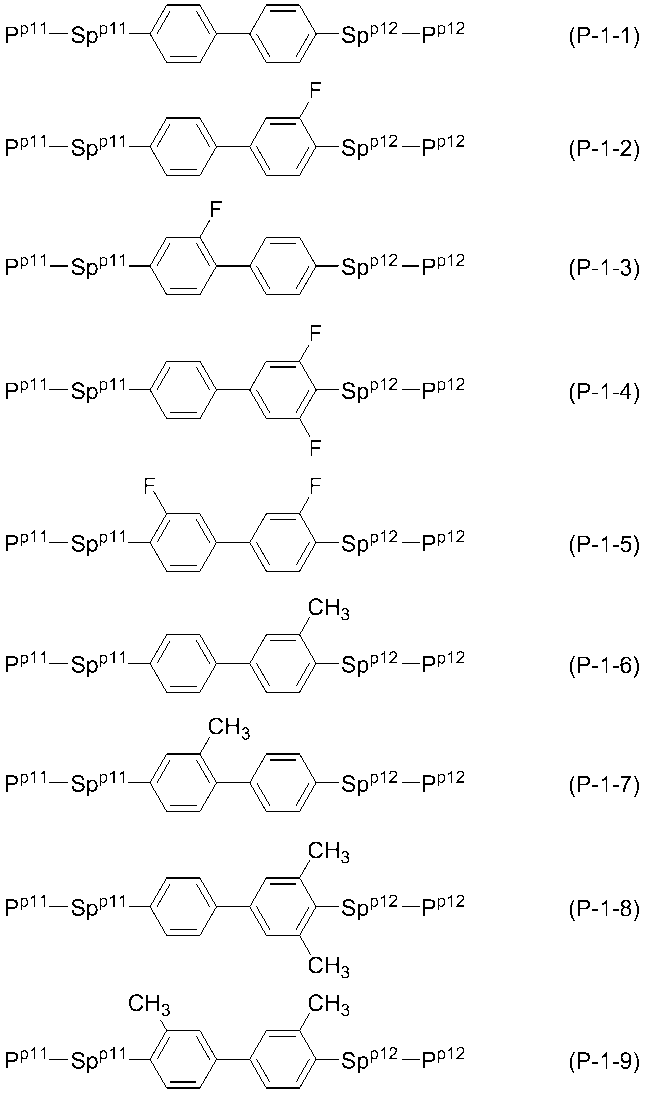
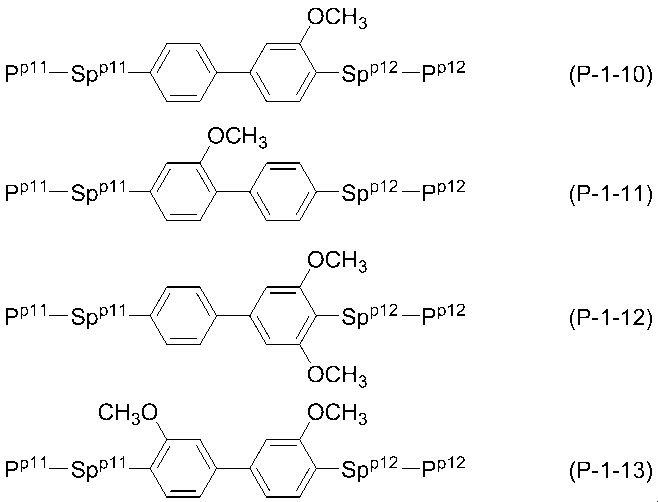


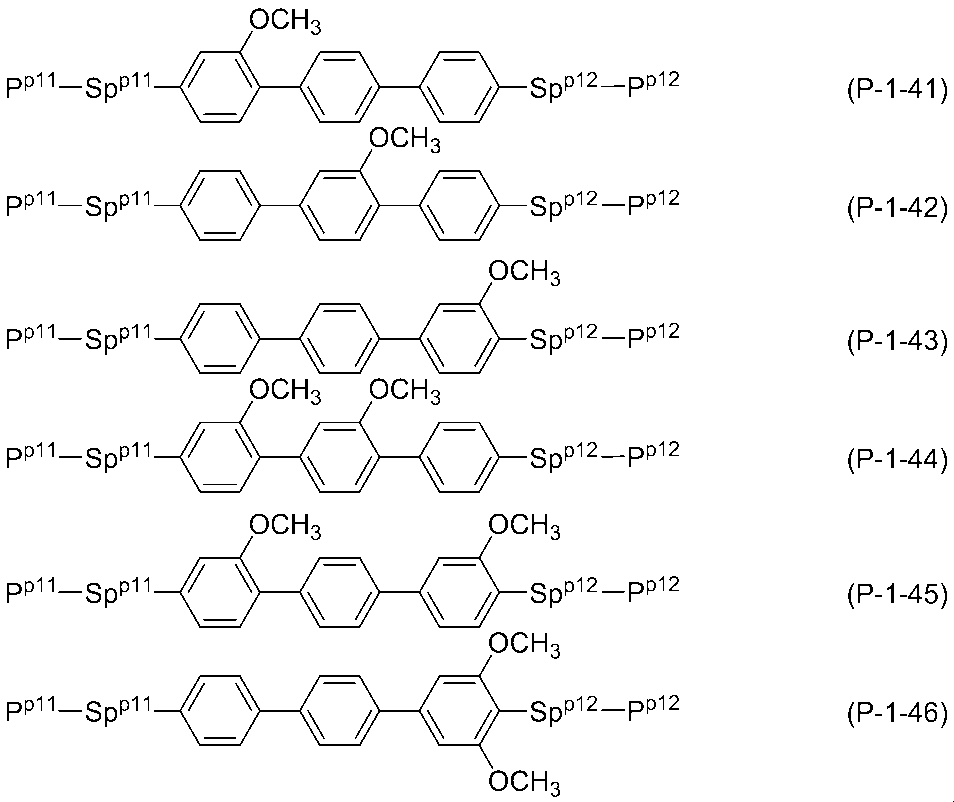
(式中、Pp11、Pp12、Spp11及びSpp12はそれぞれ、一般式(P)におけるPp1、Pp2、Spp1及びSpp2と同じ意味を表す。)
本発明に係る一般式(P)で表される化合物の好ましい例として、下記式(P-2-1)~式(P-2-12)で表される重合性化合物が挙げられる。
本発明に係る一般式(P)で表される化合物の好ましい例として、下記式(P-2-1)~式(P-2-12)で表される重合性化合物が挙げられる。

(式中、Pp21、Pp22、Spp21及びSpp22はそれぞれ、一般式(P)におけるPp1、Pp2、Spp1及びSpp2と同じ意味を表す。)
本発明に係る一般式(P)で表される化合物の好ましい例として、下記式(P-3-1)~式(P-3-15)で表される重合性化合物が挙げられる。
本発明に係る一般式(P)で表される化合物の好ましい例として、下記式(P-3-1)~式(P-3-15)で表される重合性化合物が挙げられる。


(式中、Pp31、Pp32、Spp31及びSpp32は、一般式(P)におけるPp1、Pp2、Spp1及びSpp2と同じ意味を表す。)
本発明に係る一般式(P)で表される化合物の好ましい例として、下記式(P-4-1)~式(P-4-21)で表される重合性化合物が挙げられる。
本発明に係る一般式(P)で表される化合物の好ましい例として、下記式(P-4-1)~式(P-4-21)で表される重合性化合物が挙げられる。


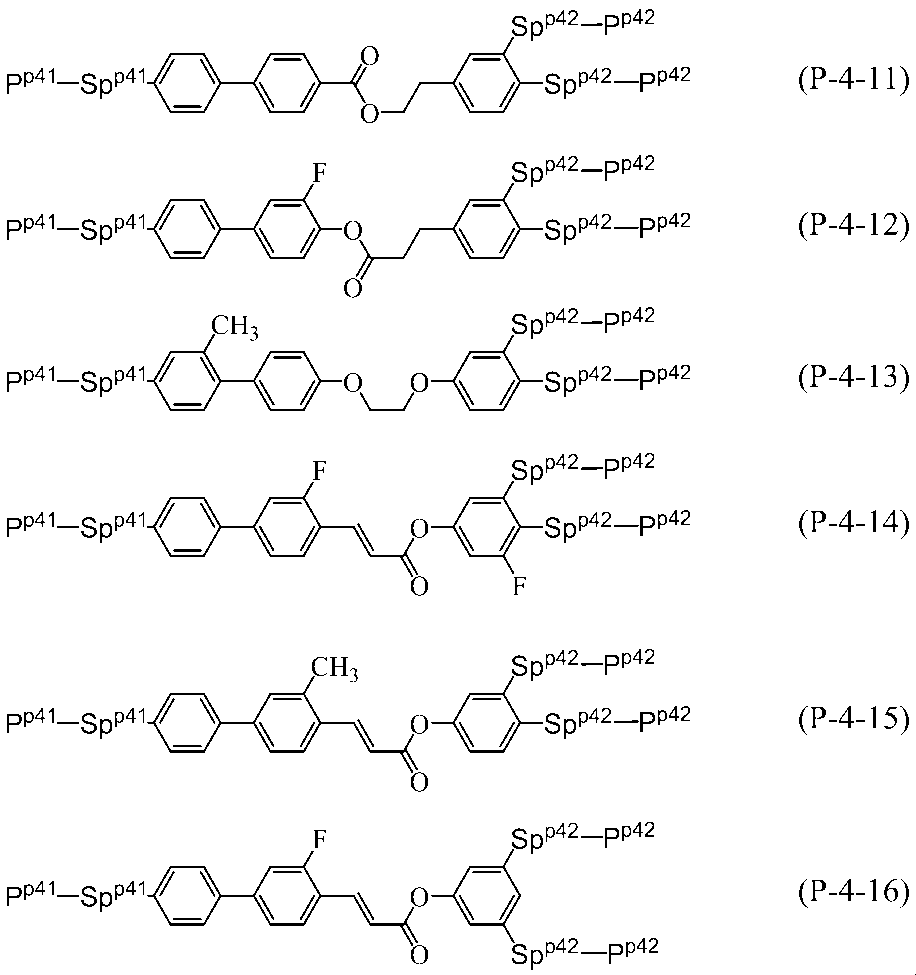
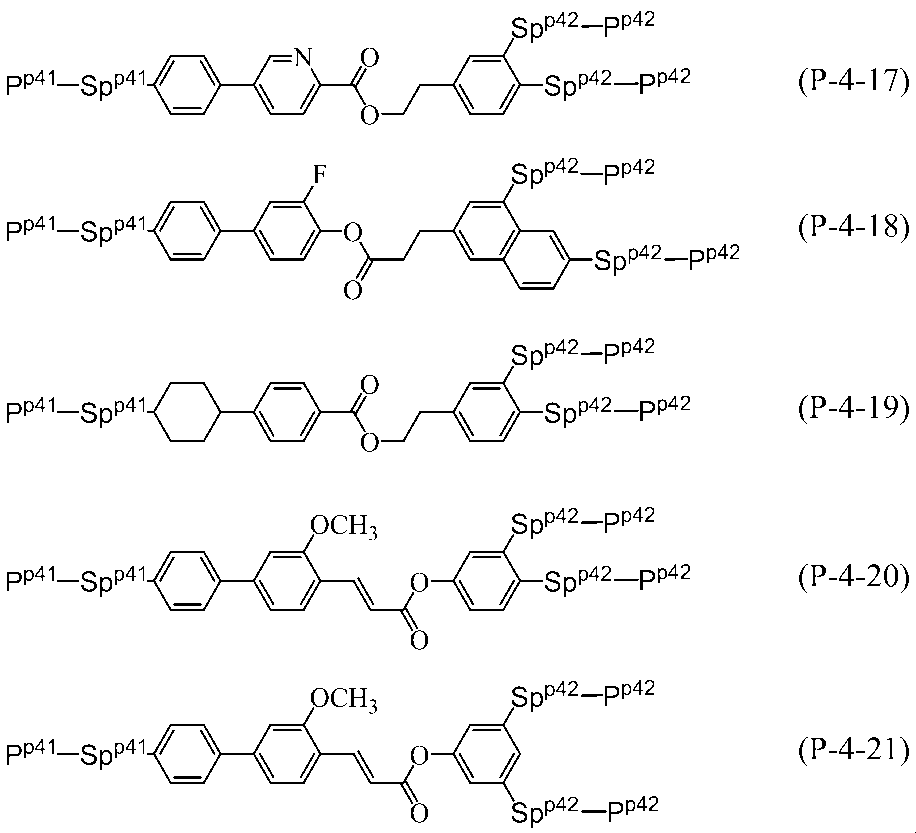
(式中、Pp41、Pp42、Spp41及びSpp42は、一般式(P)におけるPp1、Pp2、Spp1及びSpp2と同じ意味を表す。式中の複数のPp41、Pp42、Spp41及びSpp42はそれぞれ同一であっても異なっていてもよい。)
本発明の組成物にモノマーを添加する場合において、重合開始剤が存在しない場合でも重合は進行するが、重合を促進するために重合開始剤を含有していてもよい。重合開始剤としては、ベンゾインエーテル類、ベンゾフェノン類、アセトフェノン類、ベンジルケタール類、アシルフォスフィンオキサイド類等が挙げられる。
本発明の組成物にモノマーを添加する場合において、重合開始剤が存在しない場合でも重合は進行するが、重合を促進するために重合開始剤を含有していてもよい。重合開始剤としては、ベンゾインエーテル類、ベンゾフェノン類、アセトフェノン類、ベンジルケタール類、アシルフォスフィンオキサイド類等が挙げられる。
本発明における組成物は、さらに、一般式(Q)で表される化合物を含有することができる。
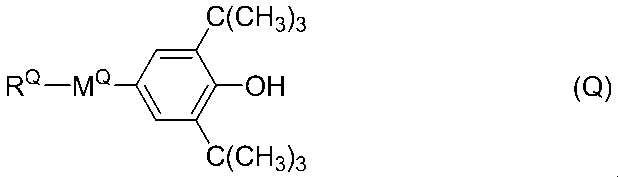
(式中、RQは炭素原子数1から22の直鎖アルキル基又は分岐鎖アルキル基を表し、該アルキル基中の1つ又は2つ以上のCH2基は、酸素原子が直接隣接しないように、-O-、-CH=CH-、-CO-、-OCO-、-COO-、-C≡C-、-CF2O-、-OCF2-で置換されてよく、MQはトランス-1,4-シクロへキシレン基、1,4-フェニレン基又は単結合を表す。)
RQは炭素原子数1から22の直鎖アルキル基又は分岐鎖アルキル基を表し、該アルキル基中の1つ又は2つ以上のCH2基は、酸素原子が直接隣接しないように、-O-、-CH=CH-、-CO-、-OCO-、-COO-、-C≡C-、-CF2O-、-OCF2-で置換されてよいが、炭素原子数1から10の直鎖アルキル基、直鎖アルコキシ基、1つのCH2基が-OCO-又は-COO-に置換された直鎖アルキル基、分岐鎖アルキル基、分岐アルコキシ基、1つのCH2基が-OCO-又は-COO-に置換された分岐鎖アルキル基が好ましく、炭素原子数1から20の直鎖アルキル基、1つのCH2基が-OCO-又は-COO-に置換された直鎖アルキル基、分岐鎖アルキル基、分岐アルコキシ基、1つのCH2基が-OCO-又は-COO-に置換された分岐鎖アルキル基が更に好ましい。MQはトランス-1,4-シクロへキシレン基、1,4-フェニレン基又は単結合を表すが、トランス-1,4-シクロへキシレン基又は1,4-フェニレン基が好ましい。
RQは炭素原子数1から22の直鎖アルキル基又は分岐鎖アルキル基を表し、該アルキル基中の1つ又は2つ以上のCH2基は、酸素原子が直接隣接しないように、-O-、-CH=CH-、-CO-、-OCO-、-COO-、-C≡C-、-CF2O-、-OCF2-で置換されてよいが、炭素原子数1から10の直鎖アルキル基、直鎖アルコキシ基、1つのCH2基が-OCO-又は-COO-に置換された直鎖アルキル基、分岐鎖アルキル基、分岐アルコキシ基、1つのCH2基が-OCO-又は-COO-に置換された分岐鎖アルキル基が好ましく、炭素原子数1から20の直鎖アルキル基、1つのCH2基が-OCO-又は-COO-に置換された直鎖アルキル基、分岐鎖アルキル基、分岐アルコキシ基、1つのCH2基が-OCO-又は-COO-に置換された分岐鎖アルキル基が更に好ましい。MQはトランス-1,4-シクロへキシレン基、1,4-フェニレン基又は単結合を表すが、トランス-1,4-シクロへキシレン基又は1,4-フェニレン基が好ましい。
一般式(Q)で表される化合物は、より具体的には、下記の一般式(Q-a)から一般式(Q-d)で表される化合物が好ましい。
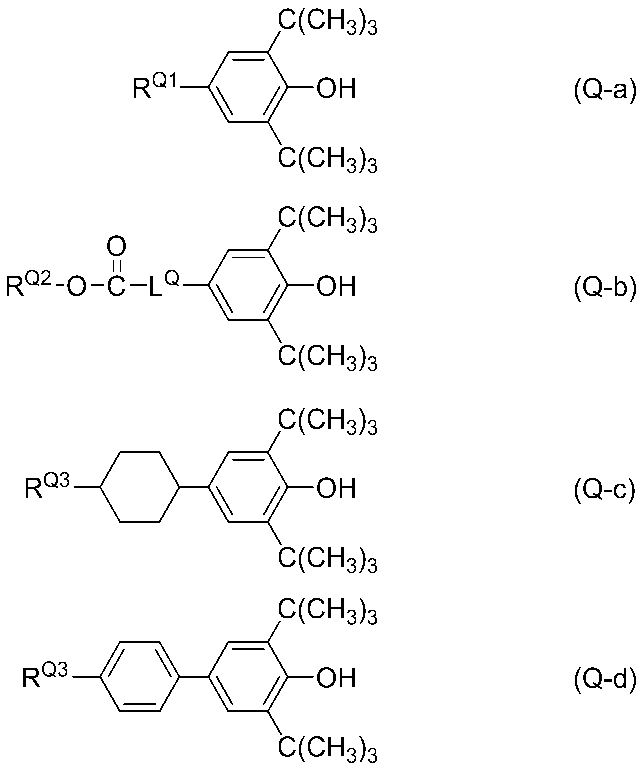
式中、RQ1は炭素原子数1から10の直鎖アルキル基又は分岐鎖アルキル基が好ましく、RQ2は炭素原子数1から20の直鎖アルキル基又は分岐鎖アルキル基が好ましく、RQ3は炭素原子数1から8の直鎖アルキル基、分岐鎖アルキル基、直鎖アルコキシ基又は分岐鎖アルコキシ基が好ましく、LQは炭素原子数1から8の直鎖アルキレン基又は分岐鎖アルキレン基が好ましい。一般式(Q-a)から一般式(Q-d)で表される化合物中、一般式(Q-c)及び一般式(Q-d)で表される化合物が更に好ましい。
本願発明の組成物において、一般式(Q)で表される化合物を1種又は2種を含有することが好ましく、1種から5種含有することが更に好ましく、その含有量は0.001から1%であることが好ましく、0.001から0.1%が更に好ましく、0.001から0.05%が特に好ましい。
本発明の液晶組成物は、上述の化合物以外に、通常のネマチック液晶、スメクチック液晶、コレステリック液晶、酸化防止剤、紫外線吸収剤、光安定剤又は赤外線吸収剤等を含有しても良い。
また、本発明に使用できる酸化防止剤又は光安定剤としてより具体的には以下の(III-1)~(III-40)で表される化合物が好ましい。


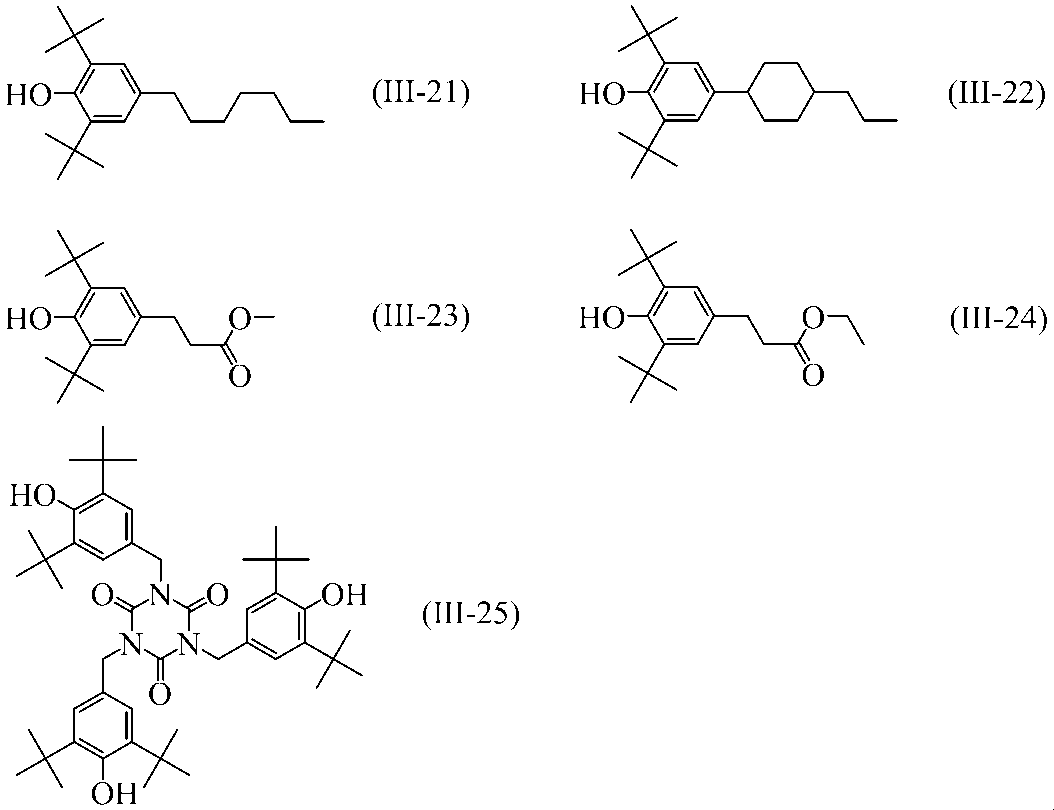


式中、nは0から20の整数を表す。)
本願発明の組成物において、一般式(Q)で表される化合物又は一般式(III-1)~(III-40)から選ばれる化合物を1種又は2種以上含有することが好ましく、1種から5種含有することが更に好ましく、その含有量は0.001から1%であることが好ましく、0.001から0.1%が更に好ましく、0.001から0.05%が特に好ましい。
本願発明の組成物において、一般式(Q)で表される化合物又は一般式(III-1)~(III-40)から選ばれる化合物を1種又は2種以上含有することが好ましく、1種から5種含有することが更に好ましく、その含有量は0.001から1%であることが好ましく、0.001から0.1%が更に好ましく、0.001から0.05%が特に好ましい。
本発明の液晶組成物は、20℃における誘電率異方性(Δε)は-2.0から-8.0が好ましく、-2.0から-5.0がより好ましく、-2.5から-5.0が特に好ましい。
本発明の液晶組成物は、20℃における屈折率異方性(Δn)は0.08から0.14が好ましく、0.09から0.13がより好ましく、0.09から0.12が特に好ましい。更に詳述すると、薄いセルギャップに対応する場合は0.10から0.13であることが好ましく、厚いセルギャップに対応する場合は0.08から0.10であることが好ましい。
本発明の液晶組成物は、20℃における粘度(η)は10から50mPa・sであることが好ましく、10から40mPa・sであることが好ましく、10から35mPa・sであることが好ましく、10から30mPa・sであることが好ましく、10から25mPa・sであることが更に好ましく、10から22mPa・sであることが特に好ましい。
本発明の液晶組成物は、20℃における回転粘性(γ1)は50から160mPa・sであることが好ましく、60から160mPa・sであることが好ましく、60から150mPa・sであることが好ましく、60から140mPa・sであることが好ましく、60から130mPa・sであることが好ましく、60から125mPa・sであることが好ましく、60から120mPa・sであることがより好ましく、60から115mPa・sであることがより好ましく、60から110mPa・sであることがより好ましく、60から100mPa・sであることが特に好ましい。
本発明の液晶組成物は、ネマチック相-等方性液体相転移温度(Tni)は60℃から120℃が好ましく、70℃から100℃がより好ましく、70℃から85℃が特に好ましい。
本発明に係る液晶組成物の好適な実施形態は、液晶組成物全体が正の誘電率異方性を示す場合と、液晶組成物全体が負の誘電率異方性を示す場合と、に分けることが好ましい。
例えば、本発明に係る液晶組成物全体が正の誘電率異方性を示す場合、一般式(i)で表される重合性化合物と、一般式(J)で表される化合物から選ばれる化合物を1種類又は2種類以上と、一般式(L)で表される化合物と、を含むことが好ましい。
本発明に係る液晶組成物全体のうち、一般式(i)、一般式(J)及び一般式(L)で表される化合物のみから構成される成分の占める割合の上限値は、100質量%、99質量%、98質量%、97質量%、96質量%、95質量%、94質量%、93質量%、92質量%、91質量%、90質量%、89質量%、88質量%、87質量%、86質量%、85質量%、84質量%であることが好ましい。
また、本発明に係る液晶組成物全体のうち、一般式(i)、一般式(J)及び一般式(L)で表される化合物のみから構成される成分の占める割合の下限値は、78質量%、80質量%、81質量%、83質量%、85質量%、86質量%、87質量%、88質量%、89質量%、90質量%、91質量%、92質量%、93質量%、94質量%、95質量%、96質量%、97質量%、98質量%、99質量%であることが好ましい。
本発明に係る液晶組成物全体のうち、一般式(i)、一般式(P)及び一般式(L)で表される化合物のみから構成される成分の占める割合の上限値は、100質量%、99質量%、98質量%、97質量%、96質量%、95質量%、94質量%、93質量%、92質量%、91質量%、90質量%、89質量%、88質量%、87質量%、86質量%、85質量%、84質量%であることが好ましい。
また、本発明に係る液晶組成物全体のうち、一般式(I)、一般式(P)及び一般式(L)で表される化合物のみから構成される成分の占める割合の下限値は、78質量%、80質量%、81質量%、83質量%、85質量%、86質量%、87質量%、88質量%、89質量%、90質量%、91質量%、92質量%、93質量%、94質量%、95質量%、96質量%、97質量%、98質量%、99質量%であることが好ましい。
例えば、本発明に係る液晶組成物全体が負の誘電率異方性を示す場合、一般式(i)で表される重合性化合物と、一般式(N-1)、(N-2)及び(N-3)で表される化合物から選ばれる化合物を1種類又は2種類以上と、一般式(L)で表される化合物と、を含むことが好ましい。
本発明に係る液晶組成物全体のうち、一般式(i)、一般式(N-1)、一般式(N-2)、一般式(N-3)及び一般式(L)で表される化合物のみから構成される成分の占める割合の上限値は、100質量%、99質量%、98質量%、97質量%、96質量%、95質量%、94質量%、93質量%、92質量%、91質量%、90質量%、89質量%、88質量%、87質量%、86質量%、85質量%、84質量%であることが好ましい。
また、本発明に係る液晶組成物全体のうち、一般式(i)、一般式(N-1)、一般式(N-2)、一般式(N-3)及び一般式(L)で表される化合物のみから構成される成分の占める割合の下限値は、78質量%、80質量%、81質量%、83質量%、85質量%、86質量%、87質量%、88質量%、89質量%、90質量%、91質量%、92質量%、93質量%、94質量%、95質量%、96質量%、97質量%、98質量%、99質量%であることが好ましい。
本発明に係る液晶組成物全体のうち、一般式(i)、一般式(N-1a)、一般式(N-1b)、一般式(N-1c)、一般式(N-1d)、一般式(N-1e)及び一般式(L)で表される化合物のみから構成される成分の占める割合の上限値は、100質量%、99質量%、98質量%、97質量%、96質量%、95質量%、94質量%、93質量%、92質量%、91質量%、90質量%、89質量%、88質量%、87質量%、86質量%、85質量%、84質量%であることが好ましい。
また、本発明に係る液晶組成物全体のうち、一般式(i)、一般式(N-1a)、一般式(N-1b)、一般式(N-1c)、一般式(N-1d)、一般式(N-1e)及び一般式(L)で表される化合物のみから構成される成分の占める割合の下限値は、78質量%、80質量%、81質量%、83質量%、85質量%、86質量%、87質量%、88質量%、89質量%、90質量%、91質量%、92質量%、93質量%、94質量%、95質量%、96質量%、97質量%、98質量%、99質量%であることが好ましい。
本発明に係る液晶組成物全体のうち、一般式(i)、一般式(N-1-4)、一般式(N-1b)、一般式(N-1c)、一般式(N-1d)、一般式(N-1e)及び一般式(L)で表される化合物のみから構成される成分の占める割合の上限値は、100質量%、99質量%、98質量%、97質量%、96質量%、95質量%、94質量%、93質量%、92質量%、91質量%、90質量%、89質量%、88質量%、87質量%、86質量%、85質量%、84質量%であることが好ましい。
また、本発明に係る液晶組成物全体のうち、一般式(i)、一般式(N-1-4)、一般式(N-1b)、一般式(N-1c)、一般式(N-1d)、一般式(N-1e)及び一般式(L)で表される化合物のみから構成される成分の占める割合の下限値は、78質量%、80質量%、81質量%、83質量%、85質量%、86質量%、87質量%、88質量%、89質量%、90質量%、91質量%、92質量%、93質量%、94質量%、95質量%、96質量%、97質量%、98質量%、99質量%であることが好ましい。
本発明に係る液晶組成物全体のうち、一般式(i)、一般式(N-1a)、一般式(N-1b)、一般式(N-1c)、一般式(N-1d)、一般式(N-1e)、一般式(L-1)、一般式(L-3)、一般式(L-4)、一般式(L-5)及び一般式(L-6)で表される化合物のみから構成される成分の占める割合の上限値は、100質量%、99質量%、98質量%、97質量%、96質量%、95質量%、94質量%、93質量%、92質量%、91質量%、90質量%、89質量%、88質量%、87質量%、86質量%、85質量%、84質量%、83質量%、82質量%、81質量%、80質量%であることが好ましい。
また、本発明に係る液晶組成物全体のうち、一般式(i)、一般式(N-1a)、一般式(N-1b)、一般式(N-1c)、一般式(N-1d)、一般式(N-1e)及び一般式(L-1)、一般式(L-3)、一般式(L-4)、一般式(L-5)及び一般式(L-6)で表される化合物のみから構成される成分の占める割合の下限値は、68質量%、70質量%、71質量%、73質量%、75質量%、78質量%、80質量%、81質量%、83質量%、85質量%、86質量%、87質量%、88質量%、89質量%、90質量%、91質量%、92質量%、93質量%、94質量%、95質量%、96質量%、97質量%、98質量%、99質量%であることが好ましい。
本発明に係る液晶組成物全体のうち、一般式(i)、一般式(N-1a)、一般式(L-1)、一般式(L-3)、一般式(L-4)、一般式(L-5)及び一般式(L-6)で表される化合物のみから構成される成分の占める割合の上限値は、100質量%、99質量%、98質量%、97質量%、96質量%、95質量%、94質量%、93質量%、92質量%、91質量%、90質量%、89質量%、88質量%、87質量%、86質量%、85質量%、84質量%、83質量%、82質量%、81質量%、80質量%、79質量%、78質量%、77質量%、76質量%、75質量%、74質量%、73質量%、72質量%、71質量%、70質量%、69質量%、68質量%、67質量%、66質量%、65質量%、64質量%、63質量%、62質量%、であることが好ましい。
また、本発明に係る液晶組成物全体のうち、一般式(i)、一般式(N-1a)、一般式(L-1)、一般式(L-3)、一般式(L-4)、一般式(L-5)及び一般式(L-6)で表される化合物のみから構成される成分の占める割合の下限値は、38質量%、40質量%、41質量%、43質量%、45質量%、48質量%、50質量%、61質量%、63質量%、65質量%、66質量%、67質量%、68質量%、69質量%、70質量%、72質量%、74質量%、76質量%、78質量%、80質量%、82質量%、84質量%、86質量%、88質量%、90質量%、92質量%であることが好ましい。
本発明に係る液晶組成物全体のうち、一般式(i)、一般式(N-1d)、一般式(L-1)、一般式(L-3)、一般式(L-4)、一般式(L-5)及び一般式(L-6)で表される化合物のみから構成される成分の占める割合の上限値は、100質量%、99質量%、98質量%、97質量%、96質量%、95質量%、94質量%、93質量%、92質量%、91質量%、90質量%、89質量%、88質量%、87質量%、86質量%、85質量%、84質量%、83質量%、82質量%、81質量%、80質量%、79質量%、78質量%、77質量%、76質量%、75質量%、74質量%、73質量%、72質量%、71質量%、70質量%、69質量%、68質量%、67質量%、66質量%、65質量%、64質量%、63質量%、62質量%、であることが好ましい。
また、本発明に係る液晶組成物全体のうち、一般式(i)、一般式(N-1d)、一般式(L-1)、一般式(L-3)、一般式(L-4)、一般式(L-5)及び一般式(L-6)で表される化合物のみから構成される成分の占める割合の下限値は、38質量%、40質量%、41質量%、43質量%、45質量%、48質量%、50質量%、61質量%、63質量%、65質量%、66質量%、67質量%、68質量%、69質量%、70質量%、72質量%、74質量%、76質量%、78質量%、80質量%、82質量%、84質量%、86質量%、88質量%、90質量%、92質量%であることが好ましい。
本願発明の組成物は、分子内に過酸(-CO-OO-)構造等の酸素原子同士が結合した構造を持つ化合物を含有しないことが好ましい。
組成物の信頼性及び長期安定性を重視する場合にはカルボニル基を有する化合物の含有量を前記組成物の総質量に対して5%以下とすることが好ましく、3%以下とすることがより好ましく、1%以下とすることが更に好ましく、実質的に含有しないことが最も好ましい。
UV照射による安定性を重視する場合、塩素原子が置換している化合物の含有量を前記組成物の総質量に対して15%以下とすることが好ましく、10%以下とすることが好ましく、8%以下とすることが好ましく、5%以下とすることがより好ましく、3%以下とすることが好ましく、実質的に含有しないことが更に好ましい。
分子内の環構造がすべて6員環である化合物の含有量を多くすることが好ましく、分子内の環構造がすべて6員環である化合物の含有量を前記組成物の総質量に対して80%以上とすることが好ましく、90%以上とすることがより好ましく、95%以上とすることが更に好ましく、実質的に分子内の環構造がすべて6員環である化合物のみで組成物を構成することが最も好ましい。
組成物の酸化による劣化を抑えるためには、環構造としてシクロヘキセニレン基を有する化合物の含有量を少なくすることが好ましく、シクロヘキセニレン基を有する化合物の含有量を前記組成物の総質量に対して10%以下とすることが好ましく、8%以下とすることが好ましく、5%以下とすることがより好ましく、3%以下とすることが好ましく、実質的に含有しないことが更に好ましい。
粘度の改善及びTNIの改善を重視する場合には、水素原子がハロゲンに置換されていてもよい2-メチルベンゼン-1,4-ジイル基を分子内に持つ化合物の含有量を少なくすることが好ましく、前記2-メチルベンゼン-1,4-ジイル基を分子内に持つ化合物の含有量を前記組成物の総質量に対して10%以下とすることが好ましく、8%以下とすることが好ましく、5%以下とすることがより好ましく、3%以下とすることが好ましく、実質的に含有しないことが更に好ましい。
本願において実質的に含有しないとは、意図せずに含有する物を除いて含有しないという意味である。
本発明の液晶組成物を用いた液晶表示素子は、高速応答という顕著な特徴を有しており、加えて、チルト角が十分に得られ、未反応の重合性化合物がないか、問題にならないほど少なく、電圧保持率(VHR)が高いため、配向不良や表示不良といった不具合がないか、十分に抑制されている。また、チルト角及び重合性化合物の残留量を容易に制御できるため、製造のためのエネルギーコストの最適化及び削減が容易であるため、生産効率の向上と安定した量産に最適である。
本発明の液晶組成物を用いた液晶表示素子は、特に、アクティブマトリックス駆動用液晶表示素子に有用であり、PSAモード、PSVAモード、VAモード、PS-IPSモード又はPS-FFSモード用液晶表示素子に用いることができる。
本発明に係る液晶表示素子は、対向に配置された第1の基板及び第2の基板と、前記第1の基板又は前記第2の基板に設けられる共通電極と、前記第1の基板又は前記第2の基板に設けられ、薄膜トランジスタを有する画素電極と、前記第1の基板と第2の基板間に設けられる液晶組成物を含有する液晶層と、を有することが好ましい。必要により前記液晶層と当接するように第1の基板及び/又は第2の基板の少なくとも一つの基板の対向面側に、液晶分子の配向方向を制御する配向膜を設けてもよい。該配向膜としては、液晶表示素子の駆動モードに併せて、垂直配向膜や水平配向膜など適宜選択することができ、ラビング配向膜(例えば、ポリイミド)又は光配向膜(分解型ポリイミドなど)などの公知の配向膜を使用することができる。さらに、カラーフィルターを、第1の基板又は第2の基板上に適宜設けてもよく、また前記画素電極や共通電極上にカラーフィルターを設けることができる。
本発明に係る液晶表示素子に使用される液晶セルの2枚の基板はガラス又はプラスチックの如き柔軟性をもつ透明な材料を用いることができ、一方はシリコン等の不透明な材料でも良い。透明電極層を有する透明基板は、例えば、ガラス板等の透明基板上にインジウムスズオキシド(ITO)をスパッタリングすることにより得ることができる。
カラーフィルターは、例えば、顔料分散法、印刷法、電着法又は、染色法等によって作成することができる。顔料分散法によるカラーフィルターの作成方法を一例に説明すると、カラーフィルター用の硬化性着色組成物を、該透明基板上に塗布し、パターニング処理を施し、そして加熱又は光照射により硬化させる。この工程を、赤、緑、青の3色についてそれぞれ行うことで、カラーフィルター用の画素部を作成することができる。その他、該基板上に、TFT、薄膜ダイオード、金属絶縁体金属比抵抗素子等の能動素子を設けた画素電極を設置してもよい。
前記第1の基板及び前記第2の基板を、共通電極や画素電極層が内側となるように対向させることが好ましい。
第1の基板と第2の基板との間隔はスペーサーを介して、調整してもよい。このときは、得られる調光層の厚さが1~100μmとなるように調整するのが好ましい。1.5から10μmが更に好ましく、偏光板を使用する場合は、コントラストが最大になるように液晶の屈折率異方性Δnとセル厚dとの積を調整することが好ましい。又、二枚の偏光板がある場合は、各偏光板の偏光軸を調整して視野角やコントラトが良好になるように調整することもできる。更に、視野角を広げるための位相差フィルムも使用することもできる。スペーサーとしては、例えば、ガラス粒子、プラスチック粒子、アルミナ粒子、フォトレジスト材料等が挙げられる。その後、エポキシ系熱硬化性組成物等のシール剤を、液晶注入口を設けた形で該基板にスクリーン印刷し、該基板同士を貼り合わせ、加熱しシール剤を熱硬化させる。
2枚の基板間に液晶組成物を狭持させる方法は、通常の真空注入法又はODF法などを用いることができる。
本発明の液晶組成物に含まれる重合性化合物を重合させる方法としては、液晶の良好な配向性能を得るためには、適度な重合速度が望ましいので、紫外線又は電子線等の活性エネルギー線を単一又は併用又は順番に照射することによって重合させる方法が好ましい。紫外線を使用する場合、偏光光源を用いても良いし、非偏光光源を用いても良い。また、液晶組成物を2枚の基板間に挟持させた状態で重合を行う場合には、少なくとも照射面側の基板は活性エネルギー線に対して適当な透明性が与えられていなければならない。また、光照射時にマスクを用いて特定の部分のみを重合させた後、電場や磁場又は温度等の条件を変化させることにより、未重合部分の配向状態を変化させて、更に活性エネルギー線を照射して重合させるという手段を用いても良い。特に紫外線露光する際には、液晶組成物に交流電界を印加しながら紫外線露光することが好ましい。印加する交流電界は、周波数10Hzから10kHzの交流が好ましく、周波数60Hzから10kHzがより好ましく、電圧は液晶表示素子の所望のプレチルト角に依存して選ばれる。つまり、印加する電圧により液晶表示素子のプレチルト角を制御することができる。PSVAモードの液晶表示素子においては、配向安定性及びコントラストの観点からプレチルト角を80度から89.9度に制御することが好ましい。
本発明の液晶組成物に含まれる重合性化合物を重合させる際に使用する紫外線又は電子線等の活性エネルギー線の照射時の温度は特に制限されることはない。例えば、配向膜を有する基板を備えた液晶表示素子に本発明の液晶組成物を適用する場合は、前記液晶組成物の液晶状態が保持される温度範囲内であることが好ましい。室温に近い温度、即ち、典型的には15~35℃で重合させることが好ましい。
一方、例えば、配向膜を有していない基板を備えた液晶表示素子に本発明の液晶組成物を適用する場合は、上記の配向膜を有する基板を備えた液晶表示素子に適用する照射時の温度範囲より広い温度範囲でもよい。
紫外線を発生させるランプとしては、メタルハライドランプ、高圧水銀ランプ、超高圧水銀ランプ等を用いることができる。また、照射する紫外線の波長としては、液晶組成物の吸収波長域でない波長領域の紫外線を照射することが好ましく、必要に応じて、紫外線をカットして使用することが好ましい。照射する紫外線の強度は、0.1mW/cm2~100W/cm2が好ましく、2mW/cm2~50W/cm2が更に好ましい。照射する紫外線のエネルギー量は、適宜調整することができるが、10mJ/cm2から500J/cm2が好ましく、100mJ/cm2から200J/cm2が更に好ましい。紫外線を照射する際に、強度を変化させても良い。紫外線を照射する時間は照射する紫外線強度により適宜選択されるが、10秒から3600秒が好ましく、10秒から600秒が更に好ましい。
以下に実施例を挙げて本発明を更に詳述するが、本発明はこれらの実施例に限定されるものではない。また、以下の実施例及び比較例の組成物における「%」は「質量%」を意味する。実施例において化合物の記載について以下の略号を用いる。
(側鎖)
-n -CnH2n+1 炭素数nの直鎖状のアルキル基
n- CnH2n+1- 炭素数nの直鎖状のアルキル基
-On -OCnH2n+1 炭素数nの直鎖状のアルコキシ基
nO- CnH2n+1O- 炭素数nの直鎖状のアルコキシ基
-V -CH=CH2
V- CH2=CH-
-V- -CH=CH-
-O1V -O-CH2-V
-V1 -CH=CH-CH3
1V- CH3-CH=CH-
-2V -CH2-CH2-CH=CH2
V2- CH2=CH-CH2-CH2-
-2V1 -CH2-CH2-CH=CH-CH3
1V2- CH3-CH=CH-CH2-CH2-
-F -F
-OCF3 -OCF3
(連結基)
-CF2O- -CF2-O-
-OCF2- -O-CF2-
-1O- -CH2-O-
-O1- -O-CH2-
-COO- -COO-
-OCO- -OCO-
(環構造)
-n -CnH2n+1 炭素数nの直鎖状のアルキル基
n- CnH2n+1- 炭素数nの直鎖状のアルキル基
-On -OCnH2n+1 炭素数nの直鎖状のアルコキシ基
nO- CnH2n+1O- 炭素数nの直鎖状のアルコキシ基
-V -CH=CH2
V- CH2=CH-
-V- -CH=CH-
-O1V -O-CH2-V
-V1 -CH=CH-CH3
1V- CH3-CH=CH-
-2V -CH2-CH2-CH=CH2
V2- CH2=CH-CH2-CH2-
-2V1 -CH2-CH2-CH=CH-CH3
1V2- CH3-CH=CH-CH2-CH2-
-F -F
-OCF3 -OCF3
(連結基)
-CF2O- -CF2-O-
-OCF2- -O-CF2-
-1O- -CH2-O-
-O1- -O-CH2-
-COO- -COO-
-OCO- -OCO-
(環構造)

実施例中、測定した特性は以下の通りである。
Tni :ネマチック相-等方性液体相転移温度(℃)
Δn :20℃における屈折率異方性
η :20℃における粘度(mPa・s)
γ1 :20℃における回転粘性(mPa・s)
Δε :20℃における誘電率異方性
K33 :20℃における弾性定数K33(pN)
(液晶表示素子の製造方法及び評価方法)
まず、垂直配向を誘起するポリイミド配向膜を塗布しラビング処理したITO付き基板を含むセルギャップ3.5μmの液晶セルに、重合性化合物を含有する液晶組成物を真空注入法で注入した。
Δn :20℃における屈折率異方性
η :20℃における粘度(mPa・s)
γ1 :20℃における回転粘性(mPa・s)
Δε :20℃における誘電率異方性
K33 :20℃における弾性定数K33(pN)
(液晶表示素子の製造方法及び評価方法)
まず、垂直配向を誘起するポリイミド配向膜を塗布しラビング処理したITO付き基板を含むセルギャップ3.5μmの液晶セルに、重合性化合物を含有する液晶組成物を真空注入法で注入した。
その後、重合性化合物を含有する液晶組成物を注入した液晶セルに、蛍光UVランプを用いて、中心波長365nmの条件で測定した照度が3.5mW/cm2になるように調整し、任意時間紫外線を照射して液晶表示素子を得た。
上述の照射条件で、紫外線を15分、30分、60分照射した後の液晶表示素子中の重合性化合物の残留量[ppm]を測定した。この重合性化合物の残留量の測定方法を説明する。まず液晶表示素子を分解し、液晶組成物、重合物、未反応の重合性化合物を含む溶出成分のアセトニトリル溶液を得た。これを高速液体クロマトグラフで分析し、各成分のピーク面積を測定した。指標とする液晶化合物のピーク面積と未反応の重合性化合物のピーク面積比から、残存する重合性化合物の量を決定した。この値と当初添加した重合性化合物の量から重合性化合物の残留量を決定した。なお、重合性化合物の残留量の検出限界は100ppmであった。
次に、上述の照射条件で、紫外線を90分照射後、プレチルト角の変化による表示不良(焼き付き)評価を行った。まず、液晶表示素子のプレチルト角を測定し、プレチルト角(初期)とした。この液晶表示素子に周波数100Hzで電圧を30V印加しながらバックライトを24時間照射した。その後、プレチルト角を測定し、プレチルト角(試験後)とした。測定したプレチルト角(初期)からプレチルト角(試験後)を引いた値をプレチルト角変化量(=プレチルト角変化の絶対値)[°]とした。プレチルト角は、シンテック製OPTIPROを用いて測定した。
プレチルト角変化量は、0[°]に近いほどプレチルト角の変化による表示不良が発生する可能性がより低くなり、0.5[°]以上となると、プレチルト角の変化による表示不良の発生する可能性がより高くなる。
(液晶組成物の調製と評価結果)
LC-001からLC-009の液晶組成物を調製し、その物性値を測定した。液晶組成物の構成とその物性値の結果は表1及び表2のとおりであった。
LC-001からLC-009の液晶組成物を調製し、その物性値を測定した。液晶組成物の構成とその物性値の結果は表1及び表2のとおりであった。
(表1)

(表2)
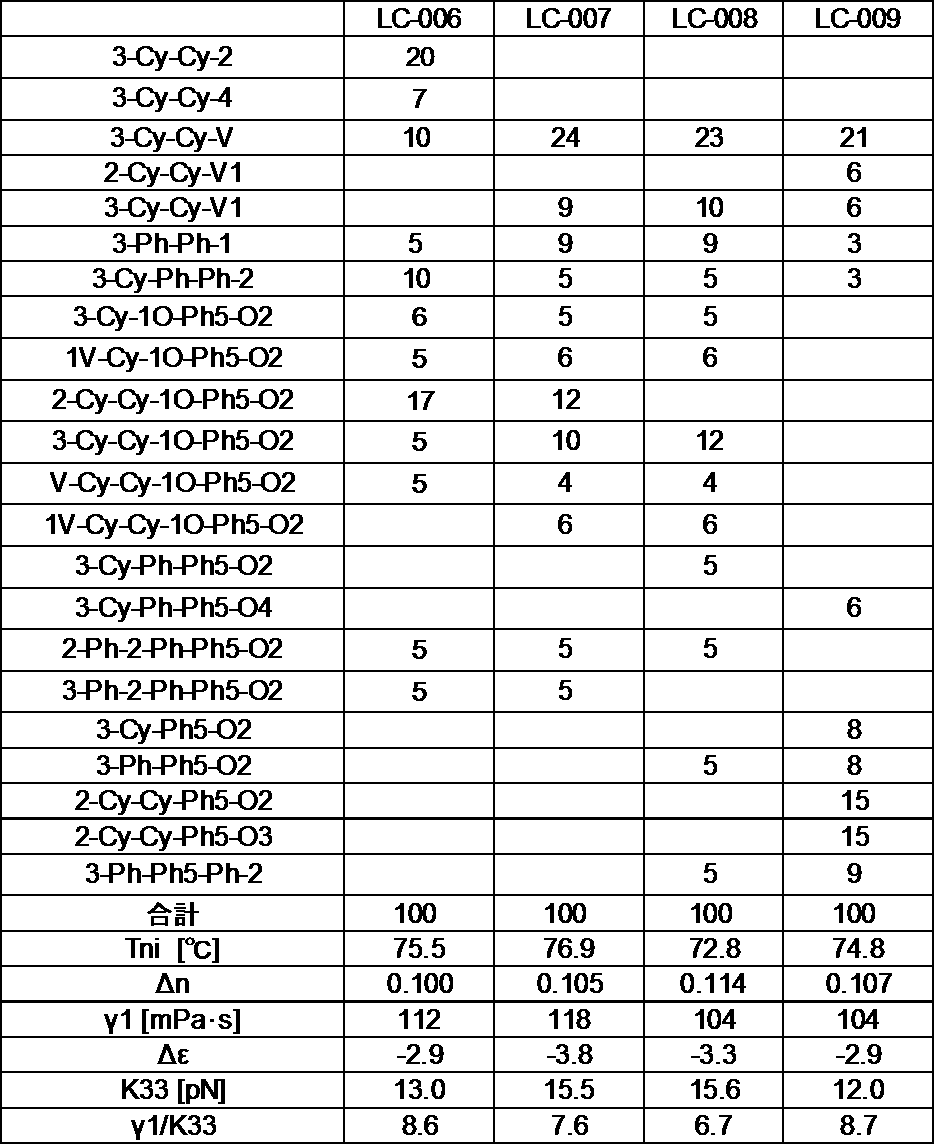
(比較例1、実施例1~3)
液晶組成物LC-001を99.7質量部に対して、式(RM-R1)で表される化合物を0.3質量部添加した重合性化合物を含有する液晶組成物を比較例1とした。
液晶組成物LC-001を99.7質量部に対して、式(RM-R1)で表される化合物を0.3質量部添加した重合性化合物を含有する液晶組成物を比較例1とした。
液晶組成物LC-001を99.7質量部に対して、式(RM-1)で表される化合物を0.3質量部添加した重合性化合物を含有する液晶組成物を実施例1とした。
液晶組成物LC-001を99.7質量部に対して、式(RM-2)で表される化合物を0.3質量部添加した重合性化合物を含有する液晶組成物を実施例2とした。
液晶組成物LC-001を99.7質量部に対して、式(RM-3)で表される化合物を0.3質量部添加した重合性化合物を含有する液晶組成物を実施例3とした。
比較例1及び実施例1~3の紫外線照射後の重合性化合物の残留量及びプレチルト角変化量は以下の表3のとおりであった。
(表3)

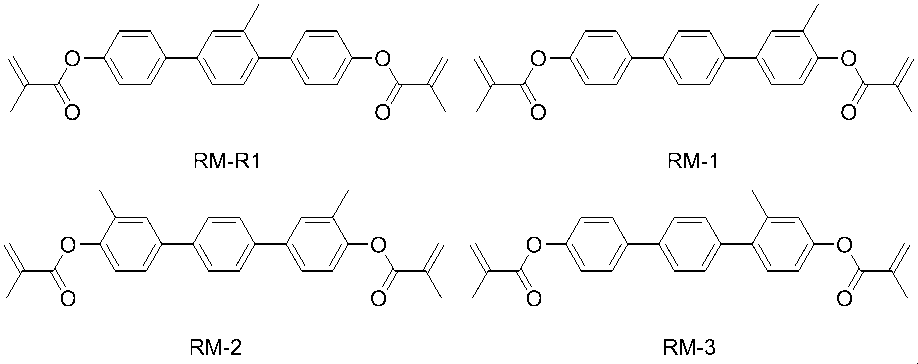
本発明の液晶組成物である実施例1~3の重合性化合物の残留量は、明らかに比較例1よりも少ない量を示し、重合性化合物の重合速度が十分に速いことがわかった。このように、一般式(i)で表される化合物を用いることにより、短時間の紫外線照射で重合性化合物の残留量を低減できる。
実施例1~3のプレチルト角変化量は十分に小さいことがわかった。
また、実施例1~3の液晶組成物を-20℃で240時間保管した後も、ネマチック液晶相を保持しており、重合性化合物の析出は確認されなかった。
実施例1~3のプレチルト角変化量は十分に小さいことがわかった。
また、実施例1~3の液晶組成物を-20℃で240時間保管した後も、ネマチック液晶相を保持しており、重合性化合物の析出は確認されなかった。
以上のことから、本発明の液晶組成物は、重合性化合物の反応速度が十分に速く、プレチルト角の変化による表示不良が発生しにくく、重合性化合物の析出がないことが確認できた。
(実施例4~13)
液晶組成物LC-001を99.4質量部に対して、式(RM-1)で表される化合物を0.6質量部添加した重合性化合物を含有する液晶組成物を実施例4とした。
(実施例4~13)
液晶組成物LC-001を99.4質量部に対して、式(RM-1)で表される化合物を0.6質量部添加した重合性化合物を含有する液晶組成物を実施例4とした。
液晶組成物LC-001を99.1質量部に対して、式(RM-1)で表される化合物を0.9質量部添加した重合性化合物を含有する液晶組成物を実施例5とした。
液晶組成物LC-002を99.7質量部に対して、式(RM-1)で表される化合物を0.3質量部添加した重合性化合物を含有する液晶組成物を実施例6とした。
液晶組成物LC-003を99.7質量部に対して、式(RM-1)で表される化合物を0.3質量部添加した重合性化合物を含有する液晶組成物を実施例7とした。
液晶組成物LC-004を99.7質量部に対して、式(RM-1)で表される化合物を0.3質量部添加した重合性化合物を含有する液晶組成物を実施例8とした。
液晶組成物LC-005を99.7質量部に対して、式(RM-1)で表される化合物を0.3質量部添加した重合性化合物を含有する液晶組成物を実施例9とした。
液晶組成物LC-006を99.7質量部に対して、式(RM-1)で表される化合物を0.3質量部添加した重合性化合物を含有する液晶組成物を実施例10とした。
液晶組成物LC-007を99.7質量部に対して、式(RM-1)で表される化合物を0.3質量部添加した重合性化合物を含有する液晶組成物を実施例11とした。
液晶組成物LC-008を99.7質量部に対して、式(RM-1)で表される化合物を0.3質量部添加した重合性化合物を含有する液晶組成物を実施例12とした。
液晶組成物LC-009を99.7質量部に対して、式(RM-1)で表される化合物を0.3質量部添加した重合性化合物を含有する液晶組成物を実施例13とした。
実施例1~3と同様に実施例4~13の重合性化合物の残留量及びプレチルト角変化量を評価した結果、重合性化合物の残存量は十分に少なく、プレチルト角変化量も小さいことが確認された。
Claims (8)
- 一般式(i)

Ai1は、
(a) 1,4-シクロヘキシレン基(この基中に存在する1個の-CH2-又は隣接していない2個以上の-CH2-は-O-に置き換えられてもよい。)
(b) 1,4-フェニレン基(この基中に存在する1個の-CH=又は隣接していない2個以上の-CH=は-N=に置き換えられてもよい。)及び
(c) ナフタレン-2,6-ジイル基、1,2,3,4-テトラヒドロナフタレン-2,6-ジイル基又はデカヒドロナフタレン-2,6-ジイル基(ナフタレン-2,6-ジイル基又は1,2,3,4-テトラヒドロナフタレン-2,6-ジイル基中に存在する1個の-CH=又は隣接していない2個以上の-CH=は-N=に置き換えられても良い。)
からなる群より選ばれる基を表し、上記の基(a)、基(b)及び基(c)は、それぞれ独立して、炭素原子数1~8のアルキル基、炭素原子数1~8のアルコキシ基、ハロゲン、シアノ基、ニトロ基又はPi3-Si3-で置換されていても良く、
mi1は、2又は3を表し、
Pi1、Pi2及びPi3は、それぞれ独立して、式(R-1)から式(R-9)
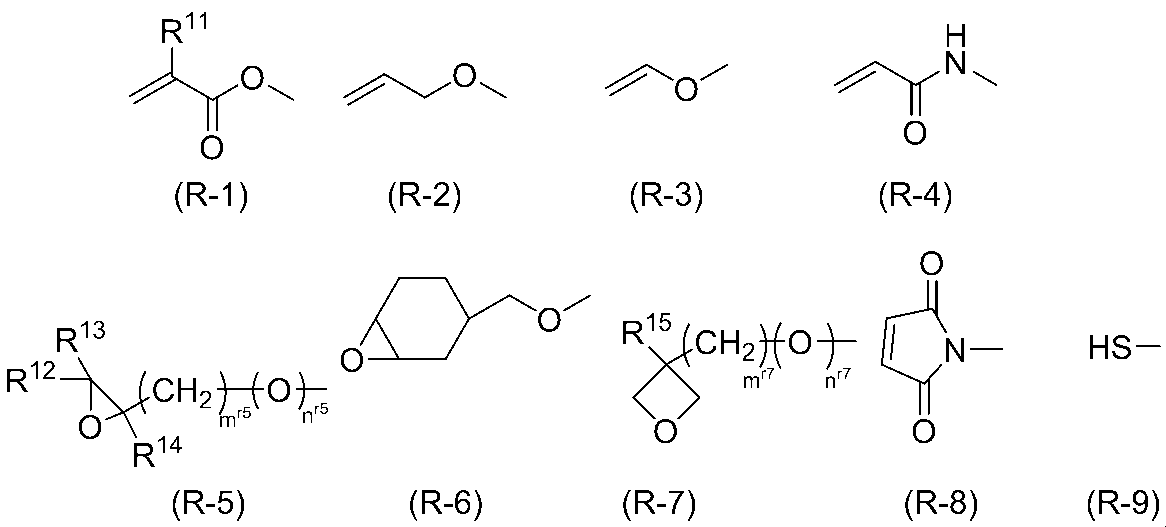
Si1、Si2及びSi3は、それぞれ独立して、単結合又は炭素原子数1~15のアルキレン基を表し、該アルキレン基中の1個の-CH2-又は隣接していない2個以上の-CH2-は、酸素原子が直接隣接しないように、-O-、-OCO-又は-COO-で置換されても良く、
Ai1、Pi3及び/又はSi3が複数存在する場合は、それぞれ、同一であっても異なっていても良い。)で表される重合性化合物を1種又は2種以上含有し、一般式(L)

nL1は0、1、2又は3を表し、
AL1、AL2及びAL3は、それぞれ独立して
(a) 1,4-シクロヘキシレン基(この基中に存在する1個の-CH2-又は隣接していない2個以上の-CH2-は-O-に置き換えられてもよい。)
(b) 1,4-フェニレン基(この基中に存在する1個の-CH=又は隣接していない2個以上の-CH=は-N=に置き換えられてもよい。)及び
(c) ナフタレン-2,6-ジイル基、1,2,3,4-テトラヒドロナフタレン-2,6-ジイル基又はデカヒドロナフタレン-2,6-ジイル基(ナフタレン-2,6-ジイル基又は1,2,3,4-テトラヒドロナフタレン-2,6-ジイル基中に存在する1個の-CH=又は隣接していない2個以上の-CH=は-N=に置き換えられても良い。)
からなる群より選ばれる基を表し、上記の基(a)、基(b)及び基(c)は、それぞれ独立して、シアノ基、フッ素原子又は塩素原子で置換されていても良く、
ZL1及びZL2は、それぞれ独立して、単結合、-CH2CH2-、-(CH2)4-、-OCH2-、-CH2O-、-COO-、-OCO-、-OCF2-、-CF2O-、-CH=N-N=CH-、-CH=CH-、-CF=CF-又は-C≡C-を表し、
nL1が2又は3であってAL2が複数存在する場合は、それらは同一であっても異なっていても良く、nL1が2又は3であってZL2が複数存在する場合は、それらは同一であっても異なっていても良い。)で表される化合物から選ばれる化合物を1種類又は2種類以上含有する液晶組成物。 - 更に一般式(N-1)、(N-2)及び(N-3)
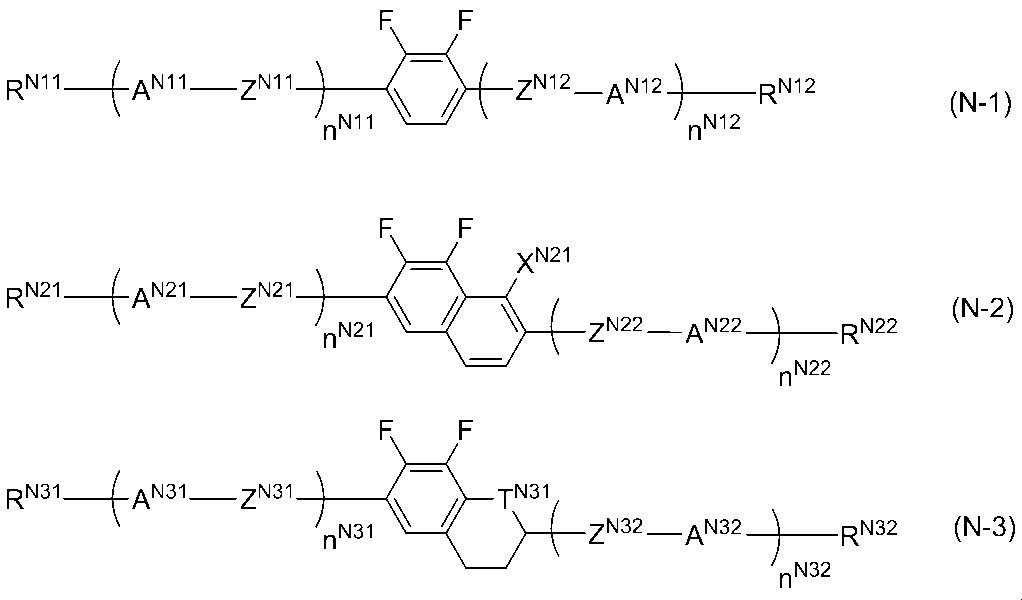
AN11、AN12、AN21、AN22、AN31及びAN32は、それぞれ独立して
(a) 1,4-シクロヘキシレン基(この基中に存在する1個の-CH2-又は隣接していない2個以上の-CH2-は-O-に置き換えられてもよい。)
(b) 1,4-フェニレン基(この基中に存在する1個の-CH=又は隣接していない2個以上の-CH=は-N=に置き換えられてもよい。)
(c) ナフタレン-2,6-ジイル基、1,2,3,4-テトラヒドロナフタレン-2,6-ジイル基又はデカヒドロナフタレン-2,6-ジイル基(ナフタレン-2,6-ジイル基又は1,2,3,4-テトラヒドロナフタレン-2,6-ジイル基中に存在する1個の-CH=又は隣接していない2個以上の-CH=は-N=に置き換えられても良い。)及び
(d) 1,4-シクロヘキセニレン基
からなる群より選ばれる基を表し、上記の基(a)、基(b)、基(c)及び基(d)はそれぞれ独立してシアノ基、フッ素原子又は塩素原子で置換されていても良く、
ZN11、ZN12、ZN21、ZN22、ZN31及びZN32は、それぞれ独立して、単結合、-CH2CH2-、-(CH2)4-、-OCH2-、-CH2O-、-COO-、-OCO-、-OCF2-、-CF2O-、-CH=N-N=CH-、-CH=CH-、-CF=CF-又は-C≡C-を表し、
XN21は水素原子又はフッ素原子を表し、
TN31は-CH2-又は酸素原子を表し、
nN11、nN12、nN21、nN22、nN31及びnN32は、それぞれ独立して、0~3の整数を表すが、nN11+nN12、nN21+nN22及びnN31+nN32は、それぞれ独立して、1、2又は3であり、AN11~AN32、ZN11~ZN32が複数存在する場合は、それらは同一であっても異なっていても良い。)で表される化合物から選ばれる化合物を1種類又は2種類以上含有する請求項1記載の液晶組成物。 - 更に一般式(J)

nJ1は、0、1、2、3又は4を表し、
AJ1、AJ2及びAJ3は、それぞれ独立して、
(a) 1,4-シクロヘキシレン基(この基中に存在する1個の-CH2-又は隣接していない2個以上の-CH2-は-O-に置き換えられてもよい。)
(b) 1,4-フェニレン基(この基中に存在する1個の-CH=又は隣接していない2個以上の-CH=は-N=に置き換えられてもよい。)及び
(c) (c)ナフタレン-2,6-ジイル基、1,2,3,4-テトラヒドロナフタレン-2,6-ジイル基又はデカヒドロナフタレン-2,6-ジイル基(ナフタレン-2,6-ジイル基又は1,2,3,4-テトラヒドロナフタレン-2,6-ジイル基中に存在する1個の-CH=又は隣接していない2個以上の-CH=は-N=に置き換えられても良い。)
からなる群より選ばれる基を表し、上記の基(a)、基(b)及び基(c)はそれぞれ独立してシアノ基、フッ素原子、塩素原子、メチル基、トリフルオロメチル基又はトリフルオロメトキシ基で置換されていても良く、
ZJ1及びZJ2は、それぞれ独立して、単結合、-CH2CH2-、-(CH2)4-、-OCH2-、-CH2O-、-OCF2-、-CF2O-、-COO-、-OCO-又は-C≡C-を表し、
nJ1が2、3又は4であってAJ2が複数存在する場合は、それらは同一であっても異なっていても良く、nJ1が2、3又は4であってZJ1が複数存在する場合は、それらは同一であっても異なっていても良く、
XJ1は、水素原子、フッ素原子、塩素原子、シアノ基、トリフルオロメチル基、フルオロメトキシ基、ジフルオロメトキシ基、トリフルオロメトキシ基又は2,2,2-トリフルオロエチル基を表す。)で表される化合物から選ばれる化合物を1種類又は2種類以上含有する請求項1又は2記載の液晶組成物。 - 一般式(I)において、Xi1又はXi4の少なくとも1つが、フッ素原子に置換されてもよい炭素原子数1から8のアルキル基を表す化合物を1種類又は2種類以上含有する請求項1から3のいずれか1項に記載の液晶組成物。
- 更に一般式(P)

Pp1及びPp2はそれぞれ独立して、一般式(Pp1-1)~式(Pp1-9)
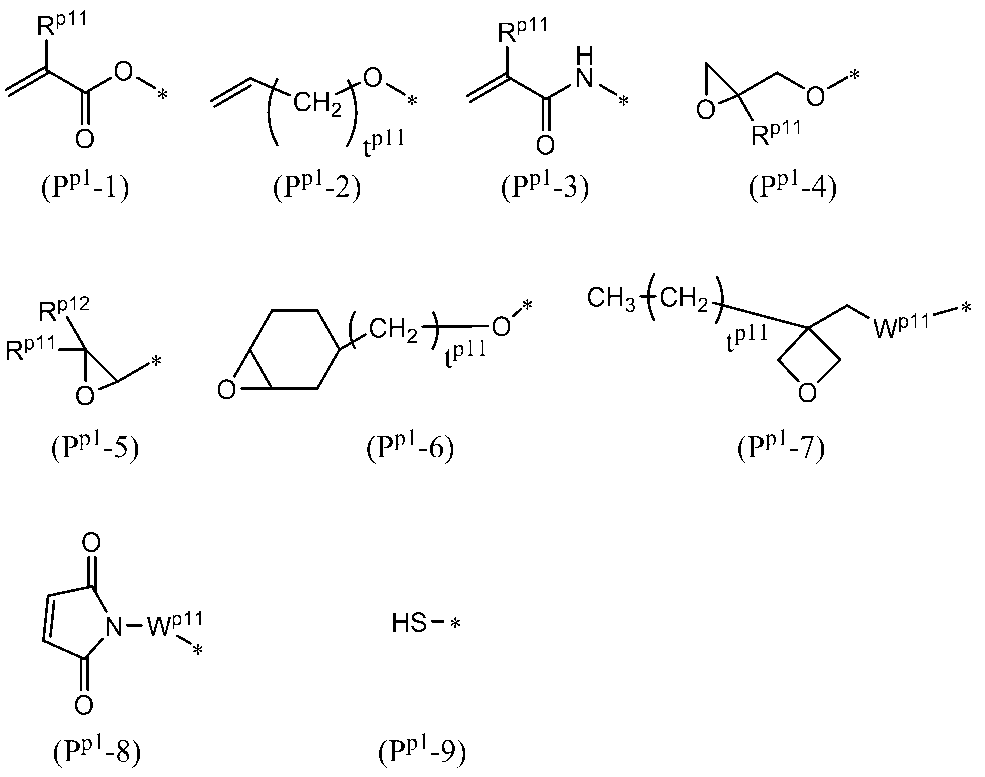
のいずれかを表し、
Spp1及びSpp2はそれぞれ独立して、単結合又はスペーサー基を表し、
Zp1及びZp2はそれぞれ独立して、単結合、-O-、-S-、-CH2-、-OCH2-、-CH2O-、-CO-、-C2H4-、-COO-、-OCO-、-OCOOCH2-、-CH2OCOO-、-OCH2CH2O-、-CO-NRZP1-、-NRZP1-CO-、-SCH2-、-CH2S-、-CH=CRZP1-COO-、-CH=CRZP1-OCO-、-COO-CRZP1=CH-、-OCO-CRZP1=CH-、-COO-CRZP1=CH-COO-、-COO-CRZP1=CH-OCO-、-OCO-CRZP1=CH-COO-、-OCO-CRZP1=CH-OCO-、-(CH2)z-COO-、-(CH2)2-OCO-、-OCO-(CH2)2-、-(C=O)-O-(CH2)2-、-CH=CH-、-CF=CF-、-CF=CH-、-CH=CF-、-CF2-、-CF2O-、-OCF2-、-CF2CH2-、-CH2CF2-、-CF2CF2-又は-C≡C-(式中、zはそれぞれ独立して1~4の整数を表し、RZP1はそれぞれ独立して水素原子又は炭素原子数1~4のアルキル基を表すが、分子内にRZP1が複数存在する場合、それらは同一であっても異なっていても良い。)
を表し、
Ap1、Ap2及びAp3はそれぞれ独立して、
(ap) 1,4-シクロヘキシレン基(この基中に存在する1個の-CH2-又は隣接していない2個以上の-CH2-は-O-に置き換えられてもよい。)
(bp) 1,4-フェニレン基(この基中に存在する1個の-CH=又は隣接していない2個以上の-CH=は-N=に置き換えられてもよい。)及び
(cp) ナフタレン-2,6-ジイル基、1,2,3,4-テトラヒドロナフタレン-2,6-ジイル基、デカヒドロナフタレン-2,6-ジイル基、フェナントレン-2,7-ジイル基又はアントラセン-2,6-ジイル基(これら基中に存在する1個の-CH=又は隣接していない2個以上の-CH=は-N=に置き換えられても良い。)
からなる群より選ばれる基を表し、上記の基(ap)、基(bp)及び基(cp)は、それぞれ独立して、この基中に存在する水素原子は、ハロゲン原子、炭素原子数1~8のアルキル基、炭素数1~8のアルコキシ基又は炭素原子数1~8のアルケニル基で置換されていてもよい。シアノ基、フッ素原子、塩素原子又は-Spp2-Pp2で置換されていても良く、
mp1は、0、1、2又は3を表し、分子内にZp1、Ap2、Spp2及び/又はPp2が複数存在する場合、それらは同一であっても異なっていても良いが、Ap3は、mp1が0で、Ap1がフェナントレン-2,7-ジイル基又はアントラセン-2,6-ジイル基である場合には単結合を表す。
ただし、一般式(i)で表される化合物を除く。)
で表される重合性化合物を1種又は2種以上含有する請求項1から4のいずれか1項に記載の液晶組成物。 - 請求項1から5のいずれか1項に記載の液晶組成物を用いた液晶表示素子。
- 請求項1から5のいずれか1項に記載の液晶組成物を用いたアクティブマトリックス駆動用液晶表示素子。
- 請求項1から5のいずれか1項に記載の液晶組成物を用いたPSAモード、PSVAモード、PS-IPSモード又はPS-FSSモード用液晶表示素子。
Priority Applications (2)
| Application Number | Priority Date | Filing Date | Title |
|---|---|---|---|
| JP2020505948A JP6750755B2 (ja) | 2018-07-02 | 2019-06-20 | 液晶組成物及び液晶表示素子 |
| CN201980039060.5A CN112262201A (zh) | 2018-07-02 | 2019-06-20 | 液晶组合物和液晶显示元件 |
Applications Claiming Priority (2)
| Application Number | Priority Date | Filing Date | Title |
|---|---|---|---|
| JP2018-126017 | 2018-07-02 | ||
| JP2018126017 | 2018-07-02 |
Publications (1)
| Publication Number | Publication Date |
|---|---|
| WO2020008898A1 true WO2020008898A1 (ja) | 2020-01-09 |
Family
ID=69060288
Family Applications (1)
| Application Number | Title | Priority Date | Filing Date |
|---|---|---|---|
| PCT/JP2019/024462 Ceased WO2020008898A1 (ja) | 2018-07-02 | 2019-06-20 | 液晶組成物及び液晶表示素子 |
Country Status (3)
| Country | Link |
|---|---|
| JP (1) | JP6750755B2 (ja) |
| CN (1) | CN112262201A (ja) |
| WO (1) | WO2020008898A1 (ja) |
Cited By (3)
| Publication number | Priority date | Publication date | Assignee | Title |
|---|---|---|---|---|
| WO2021196414A1 (zh) * | 2020-04-01 | 2021-10-07 | 北京八亿时空液晶科技股份有限公司 | 一种含有聚合性化合物的液晶组合物及其应用 |
| CN113913195A (zh) * | 2020-07-09 | 2022-01-11 | Dic株式会社 | 液晶组合物及液晶显示元件 |
| EP4656703A1 (en) * | 2024-05-28 | 2025-12-03 | Merck Patent GmbH | Liquid-crystal medium comprising polymerizable compounds |
Families Citing this family (1)
| Publication number | Priority date | Publication date | Assignee | Title |
|---|---|---|---|---|
| JP2023012110A (ja) * | 2021-07-13 | 2023-01-25 | Dic株式会社 | 液晶組成物及び液晶表示素子 |
Citations (5)
| Publication number | Priority date | Publication date | Assignee | Title |
|---|---|---|---|---|
| WO2003057799A1 (en) * | 2001-12-28 | 2003-07-17 | Asahi Glass Company, Limited | Dimmer element and production method therefor |
| JP2003255315A (ja) * | 2001-12-28 | 2003-09-10 | Asahi Glass Co Ltd | 液晶調光素子およびその製造方法 |
| WO2015004947A1 (ja) * | 2013-07-10 | 2015-01-15 | Jnc株式会社 | 重合性化合物、重合性組成物および液晶表示素子 |
| WO2018097630A1 (ko) * | 2016-11-23 | 2018-05-31 | 주식회사 동진쎄미켐 | 중합성 화합물 및 이를 포함하는 액정 조성물 |
| WO2018162454A1 (en) * | 2017-03-09 | 2018-09-13 | Merck Patent Gmbh | Polymerisable compounds and the use thereof in liquid-crystal displays |
-
2019
- 2019-06-20 WO PCT/JP2019/024462 patent/WO2020008898A1/ja not_active Ceased
- 2019-06-20 JP JP2020505948A patent/JP6750755B2/ja active Active
- 2019-06-20 CN CN201980039060.5A patent/CN112262201A/zh not_active Withdrawn
Patent Citations (5)
| Publication number | Priority date | Publication date | Assignee | Title |
|---|---|---|---|---|
| WO2003057799A1 (en) * | 2001-12-28 | 2003-07-17 | Asahi Glass Company, Limited | Dimmer element and production method therefor |
| JP2003255315A (ja) * | 2001-12-28 | 2003-09-10 | Asahi Glass Co Ltd | 液晶調光素子およびその製造方法 |
| WO2015004947A1 (ja) * | 2013-07-10 | 2015-01-15 | Jnc株式会社 | 重合性化合物、重合性組成物および液晶表示素子 |
| WO2018097630A1 (ko) * | 2016-11-23 | 2018-05-31 | 주식회사 동진쎄미켐 | 중합성 화합물 및 이를 포함하는 액정 조성물 |
| WO2018162454A1 (en) * | 2017-03-09 | 2018-09-13 | Merck Patent Gmbh | Polymerisable compounds and the use thereof in liquid-crystal displays |
Cited By (5)
| Publication number | Priority date | Publication date | Assignee | Title |
|---|---|---|---|---|
| WO2021196414A1 (zh) * | 2020-04-01 | 2021-10-07 | 北京八亿时空液晶科技股份有限公司 | 一种含有聚合性化合物的液晶组合物及其应用 |
| CN113493693A (zh) * | 2020-04-01 | 2021-10-12 | 北京八亿时空液晶科技股份有限公司 | 一种含有聚合性化合物的液晶组合物及其应用 |
| CN113913195A (zh) * | 2020-07-09 | 2022-01-11 | Dic株式会社 | 液晶组合物及液晶显示元件 |
| CN113913195B (zh) * | 2020-07-09 | 2025-04-25 | 石家庄诚志永华显示材料有限公司 | 液晶组合物及液晶显示元件 |
| EP4656703A1 (en) * | 2024-05-28 | 2025-12-03 | Merck Patent GmbH | Liquid-crystal medium comprising polymerizable compounds |
Also Published As
| Publication number | Publication date |
|---|---|
| JPWO2020008898A1 (ja) | 2020-07-16 |
| CN112262201A (zh) | 2021-01-22 |
| JP6750755B2 (ja) | 2020-09-02 |
Similar Documents
| Publication | Publication Date | Title |
|---|---|---|
| TWI769374B (zh) | 液晶組成物及液晶顯示元件 | |
| JP6660560B2 (ja) | ネマチック液晶組成物及びこれを用いた液晶表示素子 | |
| JP7298136B2 (ja) | 液晶組成物及び液晶表示素子 | |
| JP6465255B2 (ja) | 液晶組成物及び液晶表示素子 | |
| JP6750755B2 (ja) | 液晶組成物及び液晶表示素子 | |
| JP6369655B2 (ja) | 液晶組成物及び液晶表示素子 | |
| JP2020052305A (ja) | 液晶表示素子の製造方法 | |
| JP6566153B1 (ja) | ネマチック液晶組成物及びこれを用いた液晶表示素子 | |
| JP6565648B2 (ja) | 液晶表示素子 | |
| JP2021161317A (ja) | 液晶組成物及び液晶表示素子 | |
| JP6132122B2 (ja) | 液晶組成物及びこれを用いた液晶表示素子 | |
| WO2018123417A1 (ja) | 液晶組成物及び液晶表示素子 | |
| JP2017222749A (ja) | 液晶組成物、及び液晶表示素子 | |
| WO2020044833A1 (ja) | 液晶組成物 | |
| JP6787527B2 (ja) | 液晶組成物および液晶表示素子 | |
| JP6849151B2 (ja) | 重合性化合物含有液晶組成物及び液晶表示素子ならびに重合性化合物 | |
| JPWO2018043144A1 (ja) | 液晶表示素子 | |
| JP2017095630A (ja) | 組成物及びそれを使用した液晶表示素子 | |
| JP6409995B2 (ja) | 液晶表示素子 | |
| JP7472607B2 (ja) | 液晶組成物及び液晶表示素子 | |
| JPWO2021002205A1 (ja) | 液晶組成物及び液晶表示素子 |
Legal Events
| Date | Code | Title | Description |
|---|---|---|---|
| ENP | Entry into the national phase |
Ref document number: 2020505948 Country of ref document: JP Kind code of ref document: A |
|
| 121 | Ep: the epo has been informed by wipo that ep was designated in this application |
Ref document number: 19830994 Country of ref document: EP Kind code of ref document: A1 |
|
| NENP | Non-entry into the national phase |
Ref country code: DE |
|
| 122 | Ep: pct application non-entry in european phase |
Ref document number: 19830994 Country of ref document: EP Kind code of ref document: A1 |