WO2020008609A1 - 吸収性物品 - Google Patents
吸収性物品 Download PDFInfo
- Publication number
- WO2020008609A1 WO2020008609A1 PCT/JP2018/025597 JP2018025597W WO2020008609A1 WO 2020008609 A1 WO2020008609 A1 WO 2020008609A1 JP 2018025597 W JP2018025597 W JP 2018025597W WO 2020008609 A1 WO2020008609 A1 WO 2020008609A1
- Authority
- WO
- WIPO (PCT)
- Prior art keywords
- skin
- concave portion
- wrap sheet
- absorbent
- core wrap
- Prior art date
- Legal status (The legal status is an assumption and is not a legal conclusion. Google has not performed a legal analysis and makes no representation as to the accuracy of the status listed.)
- Ceased
Links
Images

Classifications
-
- A—HUMAN NECESSITIES
- A61—MEDICAL OR VETERINARY SCIENCE; HYGIENE
- A61F—FILTERS IMPLANTABLE INTO BLOOD VESSELS; PROSTHESES; DEVICES PROVIDING PATENCY TO, OR PREVENTING COLLAPSING OF, TUBULAR STRUCTURES OF THE BODY, e.g. STENTS; ORTHOPAEDIC, NURSING OR CONTRACEPTIVE DEVICES; FOMENTATION; TREATMENT OR PROTECTION OF EYES OR EARS; BANDAGES, DRESSINGS OR ABSORBENT PADS; FIRST-AID KITS
- A61F13/00—Bandages or dressings; Absorbent pads
- A61F13/15—Absorbent pads, e.g. sanitary towels, swabs or tampons for external or internal application to the body; Supporting or fastening means therefor; Tampon applicators
-
- A—HUMAN NECESSITIES
- A61—MEDICAL OR VETERINARY SCIENCE; HYGIENE
- A61F—FILTERS IMPLANTABLE INTO BLOOD VESSELS; PROSTHESES; DEVICES PROVIDING PATENCY TO, OR PREVENTING COLLAPSING OF, TUBULAR STRUCTURES OF THE BODY, e.g. STENTS; ORTHOPAEDIC, NURSING OR CONTRACEPTIVE DEVICES; FOMENTATION; TREATMENT OR PROTECTION OF EYES OR EARS; BANDAGES, DRESSINGS OR ABSORBENT PADS; FIRST-AID KITS
- A61F13/00—Bandages or dressings; Absorbent pads
- A61F13/15—Absorbent pads, e.g. sanitary towels, swabs or tampons for external or internal application to the body; Supporting or fastening means therefor; Tampon applicators
- A61F13/53—Absorbent pads, e.g. sanitary towels, swabs or tampons for external or internal application to the body; Supporting or fastening means therefor; Tampon applicators characterised by the absorbing medium
-
- A—HUMAN NECESSITIES
- A61—MEDICAL OR VETERINARY SCIENCE; HYGIENE
- A61F—FILTERS IMPLANTABLE INTO BLOOD VESSELS; PROSTHESES; DEVICES PROVIDING PATENCY TO, OR PREVENTING COLLAPSING OF, TUBULAR STRUCTURES OF THE BODY, e.g. STENTS; ORTHOPAEDIC, NURSING OR CONTRACEPTIVE DEVICES; FOMENTATION; TREATMENT OR PROTECTION OF EYES OR EARS; BANDAGES, DRESSINGS OR ABSORBENT PADS; FIRST-AID KITS
- A61F13/00—Bandages or dressings; Absorbent pads
- A61F13/15—Absorbent pads, e.g. sanitary towels, swabs or tampons for external or internal application to the body; Supporting or fastening means therefor; Tampon applicators
- A61F13/53—Absorbent pads, e.g. sanitary towels, swabs or tampons for external or internal application to the body; Supporting or fastening means therefor; Tampon applicators characterised by the absorbing medium
- A61F13/531—Absorbent pads, e.g. sanitary towels, swabs or tampons for external or internal application to the body; Supporting or fastening means therefor; Tampon applicators characterised by the absorbing medium having a homogeneous composition through the thickness of the pad
- A61F13/532—Absorbent pads, e.g. sanitary towels, swabs or tampons for external or internal application to the body; Supporting or fastening means therefor; Tampon applicators characterised by the absorbing medium having a homogeneous composition through the thickness of the pad inhomogeneous in the plane of the pad
Definitions
- the present invention relates to an absorbent article having an antibacterial function.
- Patent Literature 3 discloses that a core wrap sheet covering an absorbent core contains a cationic antibacterial agent and a pH buffering deodorant, and elutes these agents in a permeation passage of excreta, thereby providing a sustained release. A technique for achieving the deodorizing effect is described.
- Patent Literature 4 also discloses a central height in which a high basis weight portion and a low basis weight portion are alternately formed in the longitudinal or lateral direction at the laterally central portion of the absorbent core in the excretion portion-facing portion of the absorbent article. It is described that a ventilation area is provided, and a deodorant sheet containing a deodorant such as activated carbon is disposed between the absorbent core and the back sheet in the central high ventilation area. According to the absorbent article described in Patent Literature 4, the odor component contained in menstrual blood flows through the absorbent core having improved air permeability and is efficiently adsorbed on the deodorant sheet. It is said that particularly excellent deodorizing performance can be obtained even when used not only at the time when the amount is large but also when the amount of menstrual blood is small.
- a fiber sheet in which an inorganic substance such as an antibacterial agent is blended generally has a configuration in which the inorganic substance is supported in inter-fiber voids.
- the inter-fiber voids are smaller than those of the above fiber sheet, and therefore the liquid permeability is inferior. Therefore, when a fiber sheet containing an antimicrobial agent is used as a member for covering the outer surface of an absorbent core in an absorbent article, such as a core wrap sheet, excretion due to poor liquid flow of the fiber sheet The material stays without permeating the fiber sheet, bacteria may propagate in the staying excrement, and it may become a source of unpleasant odor. Since the fiber sheet hardly moves into the absorbent core together with the excrement moving in the thickness direction, there is room for improvement in antibacterial action on the inside of the absorbent core.
- an object of the present invention is to provide an absorbent article that can solve the above-mentioned disadvantages of the prior art, and specifically, has excellent antibacterial performance and is used without concern for excrement-derived odor. To provide an absorbent article that can be used.
- the present invention has a vertical direction corresponding to the wearer's front-rear direction and a horizontal direction perpendicular thereto, and in the vertical direction, an excretion part opposing part including an excretion spot part disposed opposite to the excretion part of the wearer.
- a front portion disposed on the abdomen side of the wearer relative to the excretion portion facing portion, and a rear portion disposed on the back side of the wearer than the excretion portion facing portion, forming a skin-facing surface.
- An absorbent article comprising a top sheet, a back sheet forming a non-skin facing surface, and an absorber located between these two sheets, wherein the absorber has a liquid-retentive absorbent core, A skin-side core wrap sheet that covers the skin-facing surface of the absorbent core; and a non-skin-side core wrap sheet that covers the non-skin-facing surface of the absorbent core.
- the skin-side core wrap sheet comes into contact with water to absorb the water from the core wrap sheet.
- a non-skin-facing surface of the absorbent core has a concave portion and a convex portion, and the non-skin side core wrap sheet does not follow the concave portion. , An absorbent article in contact with the top of the projection.
- an absorbent article that can be used without concern for odors derived from excrement.
- FIG. 1 is a perspective view showing a skin-facing surface side (top sheet side) of a sanitary napkin which is one embodiment of the absorbent article of the present invention.
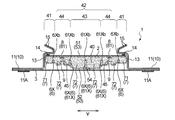
- FIG. 2 is a cross-sectional view schematically showing a cross section taken along line II of FIG. 1 (a cross section at a portion where a lateral concave portion is not formed).
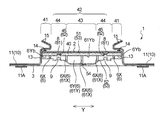
- FIG. 3 is a cross-sectional view schematically showing a cross section taken along line II-II of FIG. 1 (cross section at a portion where a horizontal concave portion is formed).
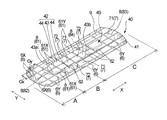
- FIG. 4 is a perspective view showing the non-skin-facing surface side of the absorbent core of the sanitary napkin of FIG.
- FIG. 1 to 3 show a sanitary napkin 1 which is an embodiment of the absorbent article according to the present invention.
- the napkin 1 includes a top sheet 2 forming a skin-facing surface, a back sheet 3 forming a non-skin-facing surface, and a liquid-retentive absorber 4 located between the two sheets 2 and 3.
- the “skin-facing surface” is a surface of the absorbent article or a component thereof (for example, the absorbent body 4) that faces the wearer's skin side when the absorbent article is worn, that is, the surface of the wearer relatively.
- the side close to the skin, the “non-skin-facing surface” refers to the side of the absorbent article or its components opposite to the skin side when the absorbent article is worn, that is, the side relatively far from the skin of the wearer. It is a face that can be.
- “at the time of wearing” here means the state where the normal appropriate wearing position, ie, the correct wearing position of the said absorbent article was maintained.
- the napkin 1 corresponds to the front-back direction of the wearer, and has a vertical direction X extending from the wearer's abdomen to the back side via the crotch portion and a horizontal direction Y orthogonal to the wearer.
- an excretory portion facing portion B including an excretory spot portion (not shown) facing the excretory portion, such as the vaginal opening of the wearer, and the wearer's ventral side with respect to the excretory portion facing portion B
- the front part A is disposed on the (front side) and the rear part C is disposed on the back side (rear side) of the wearer with respect to the excretion part facing part B.
- the vertical direction X is the vertical direction X of the absorbent article or a direction along the vertical direction X of the absorbent article in its constituent members
- the horizontal direction Y is the horizontal direction of the absorbent article. It is the direction along the lateral direction Y of the absorbent article in the direction Y or its constituent members.
- the napkin 1 includes an absorbent main body 5 having a shape elongated in the vertical direction X and outer sides in the horizontal direction Y from both sides along the vertical direction X of the excretion part facing portion B of the absorbent main body 5. And a pair of rear flap portions 12, 12 extending outward in the lateral direction Y from both sides along the longitudinal direction X of the rear portion C of the absorbent main body 5. It is a napkin that has and is preferably used for so-called night use. The night napkin is intended to be used at bedtime, and preferably has a total length of 30 cm or more.
- the absorbent main body 5 is a main part of the napkin 1 and includes the top sheet 2, the back sheet 3 and the absorbent body 4, and has a front part A, an excretion part facing part B and a rear part C in the vertical direction X. Is divided into three.
- the absorbent article of the present invention when the absorbent article has a wing portion as in the napkin 1 shown in FIG.
- the napkin 1 is sandwiched between the root of the one wing 11 along the vertical direction X and the root of the other wing 11 along the vertical direction X. Area.
- the excretion part-facing portion in the absorbent article having no wing portion is a vertically central area when the absorbent article is divided into three equal parts in the vertical direction. is there.
- the topsheet 2 covers the entire surface of the absorber 4 facing the skin.
- the back sheet 3 covers the entire area of the non-skin-facing surface of the absorber 4, and further extends outward in the lateral direction Y from both side edges along the longitudinal direction X of the absorber 4. 13 together with the side flap portion 10.
- the side flap portion 10 is a portion formed of a member extending outward from the absorber 4 in the lateral direction Y.
- the back sheet 3 and the side leakage prevention sheet 13 are joined to each other at a portion extending from both side edges along the longitudinal direction X of the absorber 4 by a known joining means such as an adhesive, a heat seal, and an ultrasonic seal. I have.
- the absorber 4 is thus sandwiched between the topsheet 2 and the backsheet 3, and the topsheet 2 or the side leakage-preventing sheet 13 and the backsheet 3 are joined around the entire outer edge of the napkin 1.
- Any bonding means such as an adhesive, a heat seal, an ultrasonic seal, or the like is used for bonding between the sheets constituting the napkin 1.
- the side flap portions 10 protrude greatly outward in the lateral direction Y at the excretion portion facing portion B, and thereby a pair of left and right sides along the longitudinal direction X of the absorbent main body 5 are provided.
- the wing portions 11 and 11 are extended.
- a wing adhesive portion 11 ⁇ / b> A for fixing the wing 11 to clothing such as shorts is provided on the non-skin facing surface of the wing 11.
- the wing portion 11 is used by being folded back to the non-skin facing surface (outer surface) side of the crotch portion of clothes such as shorts.
- the side flap portions 10 protrude greatly outward in the lateral direction Y at the rear portion C, so that a pair of rear flap portions 12 and 12 are provided on both left and right sides of the absorbent main body 5 along the vertical direction X. Is extended.
- the rear flap portion 12 is formed on the non-skin-facing surface in a state in which the rear flap portion 12 is not folded back when it is fixed to the garment and the non-skin-facing surface is expanded, that is, extended to the side of the absorbent main body 5.
- the clothing is fixed to the skin-facing surface, that is, the inner surface of the clothing via the provided rear adhesive portion (not shown).
- the wing adhesive portion and the rear adhesive portion are covered with a release sheet (not shown) made of a film, a nonwoven fabric, paper or the like before use.
- both sides along the vertical direction X of the skin-facing surface of the absorbent main body 5, that is, the skin-facing surface of the topsheet 2 are located on the left and right along the vertical direction X of the absorber 4 in plan view.
- the side leakage prevention sheets 13, 13 are arranged over substantially the entire length of the absorbent main body 5 in the vertical direction X so as to overlap the both sides.
- Each of the pair of side leakage prevention sheets 13 and 13 is joined to the topsheet 2 at a joining line 14 extending in the vertical direction X by a known joining means such as an adhesive, and is located within the lateral direction Y from the joining line 14.
- the inner edge located on the side is a free end.
- a leakage-preventing cuff-forming elastic member 15 is arranged so as to extend in the vertical direction X, so that the napkin 1 is worn. At times, due to the contraction force of the elastic member 15, the free end of the sheet 13 rises toward the wearer's skin side to form a leak-proof cuff, and the leak-proof cuff excretes on the skin-facing surface of the napkin 1. Lateral leakage of excrement such as menstrual blood is effectively prevented.
- top sheet 2 As the top sheet 2, the back sheet 3, and the side leakage prevention sheet 13, various kinds of substances conventionally used for absorbent articles such as sanitary napkins can be used without any particular limitation.
- topsheet 2 a non-woven fabric having liquid permeability or a perforated film can be used.
- back sheet 3 a liquid-impermeable film made of a synthetic resin or a water-repellent nonwoven fabric having a high water pressure resistance such as a spunbond-meltblown-spunbond laminated nonwoven fabric can be used.
- side leakage prevention sheet 13 As the side leakage prevention sheet 13, a water-repellent nonwoven fabric having high water pressure resistance, for example, a spunbond-meltblown-spunbond laminated nonwoven fabric or the like can be used.
- the absorbent body 4 includes a liquid-retentive absorbent core 40, a skin-side core wrap sheet 51 covering the skin-facing surface of the absorbent core 40, and a non-skin-side core covering the non-skin facing surface of the absorbent core 40.
- the wrap sheet 52 is included.
- the absorbent core 40 and thus the napkin 1 are formed symmetrically with respect to a horizontal center line (not shown) that bisects the absorbent main body 5 in the horizontal direction Y.
- the absorbent core 40 in the napkin 1 is made of a fiber assembly made of a fiber material such as pulp fiber, or a fiber assembly in which a water-absorbing polymer is held.
- the core wrap sheets 51 and 52 have a role of preventing leakage of the material forming the absorbent core 40 and improving the shape retention of the absorbent core 40.
- the front sheet 2 and the skin-side core wrap sheet 51 and the back sheet 3 and the non-skin-side core wrap sheet 52 are joined to each other by a pattern-coated adhesive such as dots, spirals, and stripes. Is preferred.
- the skin-side core wrap sheet 51 and the non-skin-side core wrap sheet 52 are each a part of one wide core wrap sheet 53, and the sheet 53 is shown in FIGS. 2 and 3.
- the surface (outer surface) of the absorbent core 40 is covered so that the overlapping portion 54 between both ends in the lateral direction Y is located on the non-skin-facing surface of the absorbent core 40 (the absorber 4). I have.
- the overlapping portion 54 is located at the center of the absorber 4 in the lateral direction Y.
- the wide core wrap sheet 53 is made of a fiber having a width that is not less than twice and not more than three times the length of the absorbent core 40 in the lateral direction Y, and whose length (width) in the lateral direction Y is relatively long.
- the absorbent core 40 covers the entire area of the skin facing surface of the absorbent core 40 and extends outward in the lateral direction Y from both side edges along the longitudinal direction X of the absorbent core 40, and the extended portion is formed of an absorbent portion. It is wound down below the core 40 and covers the entire non-skin-facing surface of the absorbent core 40.
- the portion covering the skin facing surface of the absorbent core 40 is the skin side core wrap sheet 51
- the portion covering the non-skin facing surface of the absorbent core 40 is the non-skin side.
- the skin-side core wrap sheet 51 and the non-skin-side core wrap sheet 52 are the same.
- the basis weight of the wide core wrap sheet 53 (core wrap sheets 51, 52) is preferably 5 g / m 2 or more, more preferably 10 g / m 2 or more, and preferably 40 g / m 2 or less, more preferably 30 g / m 2 or less. m 2 or less.
- the core wrap sheets 51 and 52 are typically sheet-like materials such as nonwoven fabric and paper mainly composed of hydrophilic fibers.
- the hydrophilic fibers contained in the core wrap sheets 51 and 52 include natural fibers such as wood pulp such as softwood pulp and hardwood pulp, and non-wood pulp such as cotton pulp and hemp pulp; denaturation such as cationized pulp and mercerized pulp Pulp; Regenerated fiber such as cupra and rayon; Semi-synthetic fiber such as acetate; Hydrophilic synthetic fiber such as polyvinyl alcohol fiber and polyacrylonitrile fiber; Hydrophilized into synthetic fiber such as polyethylene terephthalate fiber, polyethylene fiber, polypropylene fiber and polyester fiber Treated fibers and the like can be mentioned, and one of these can be used alone or as a mixture of two or more.
- hydrophilic fibers in the core wrap sheets 51 and 52 are natural fibers, cellulose-based regenerated fibers, or semi-synthetic fibers.
- the core wrap sheets 51 and 52 may further include synthetic fibers (hydrophobic fibers), for example, thermoplastic fibers, in addition to the hydrophilic fibers.
- thermoplastic fiber for example, a single fiber formed using a single synthetic resin such as polyethylene, polypropylene, polyester, and polyurethane, or formed using a synthetic resin such as a composite of two or more of these.
- a conjugate fiber for example, a conjugate fiber such as a core-sheath type or a side-by-side type formed using two or more kinds of synthetic resins can also be used.
- the skin-side core wrap sheet 51 and the non-skin-side core wrap sheet 52 are each provided with an antibacterial agent.
- the skin side core wrap sheet 51 is a part of one wide core wrap sheet 53 together with the non-skin side core wrap sheet 52, and the antibacterial agent is disposed on the entire sheet 53. I have.
- the antibacterial agents disposed on the core wrap sheets 51 and 52 each have a thickness corresponding to the thickness of the sheets 51 and 52 on which the antibacterial agents are disposed.
- the sheet contains an organic antibacterial agent that can move in the thickness direction from the sheets 51 and 52 when it comes into contact with water moving in the direction. That is, each of the core wrap sheets 51 and 52 contains an organic antibacterial agent having water mobility.
- an organic antibacterial agent having water mobility is also referred to as a “first antibacterial agent”.
- the first antibacterial agent When the first antibacterial agent is present in the skin-side core wrap sheet 51, the first antibacterial agent is used as the organic excrement such as menstrual blood moves through the sheet 51 in the thickness direction when the napkin 1 is used. Combined with the affinity for the organic matter contained in the excrement, the excrement moves quickly from the sheet 51 by dissolving or dispersing in the excrement, and reaches the absorbent core 40 together with the excrement. Thereby, the growth of bacteria in the excrement absorbed and held in the absorbent core 40 can be suppressed, and the generation of an unpleasant odor can be suppressed.
- the excrement that has passed through the top sheet 2, the skin side core wrap sheet 51, and the absorbent core 40 and reached the sheet 52 is dissolved or dispersed, and excrement containing the antibacterial agent is generated on the non-skin-facing surface side of the absorbent core 40.
- the excrement containing the first antibacterial agent, which has passed through the skin side core wrap sheet 51 and reached the non-skin side core wrap sheet 52 earlier further contains the first antibacterial agent in the sheet 52.
- excrement having a high concentration of the first antibacterial agent is present on the non-skin-facing surface side of the absorbent core 40, thereby suppressing the growth of bacteria inside the napkin 1 and the generation of unpleasant odor. Will be connected.
- the core wrap sheets 51 and 52 may further contain another antibacterial agent that is harder to move due to contact with water than the first antibacterial agent.
- another antibacterial agent that is harder to move due to contact with water than the first antibacterial agent.
- other antibacterial agents that is, water mobility (the property of easily moving with water) is lower than that of the first antibacterial agent, in other words, hardly water-migrating (hardly migrate with water).
- the antibacterial agent having the property (property) is also referred to as “second antibacterial agent”.
- the first antibacterial agent is mainly expected to exhibit an antibacterial effect inside the absorbent core 40. Since most of the second antibacterial agent remains on the skin-side core wrap sheet 51 or the non-skin-side core wrap sheet 52, which is the initial arrangement part, even if body fluids such as menstrual blood are repeatedly excreted, the second antibacterial agent is mainly used for 52 and can exhibit an antibacterial effect. Therefore, by arranging these two kinds of antibacterial agents on the core wrap sheets 51 and 52, the propagation of bacteria inside the napkin 1 and the generation of unpleasant odors are more effectively suppressed.
- the antibacterial agent contained in the skin-side core wrap sheet 51 has water mobility, that is, a factor that determines whether the first antibacterial agent or the second antibacterial agent is not limited, For example, the following (1) to (5) are mentioned.
- the water mobility of such an antibacterial agent is largely affected by any one or a combination of a plurality of factors such as the following (1) to (5).
- the antibacterial agent is present on the surface of the fiber constituting the skin-side core wrap sheet 51 or is present inside the fiber.
- (1) will be described. Since the antibacterial agent is firmly fixed to the skin-side core wrap sheet 51, even when the antibacterial agent comes into contact with water moving in the thickness direction of the disposition portion of the antibacterial agent, it is difficult to separate from the sheet 51, As a result, the antibacterial agent becomes difficult to transfer to water.
- a means for firmly fixing the antibacterial agent to the core wrap sheet 51 a physical fixation with an adhesive such as hot melt to the constituent fibers of the sheet 51 is typically given.
- the antibacterial agent When the antibacterial agent is present on the surface of the fiber constituting the skin-side core wrap sheet 51, contact with water moving in the thickness direction of the disposition portion of the antibacterial agent, and excreted liquid flows from the wearer side.
- the antimicrobial agent can easily be separated from the fiber surface and moved by the pressure or the like that is sometimes generated, and easily becomes water-mobile.
- the antibacterial agent when the antibacterial agent is present inside the fibers constituting the skin-side core wrap sheet 51, the antibacterial agent is less likely to be separated and easily becomes hard to move in water than when it is present on the fiber surface.
- a method of kneading the antibacterial agent during fiber production is typically given.
- hydrophilic fiber material when used as the material constituting the skin-side core wrap sheet 51, when the hydrophilic fiber material is naturally hydrophilic such as pulp (cellulose fiber), In some cases, synthetic fibers treated with a hydrophilizing agent are used. In the former case, since the pulp itself is hydrophilic and water-absorbing, the water is captured by the pulp, so that the antibacterial agent existing on the pulp is easily released. In particular, when the antibacterial agent is hardly water-soluble or water-insoluble and is not fixed to the pulp or is present on the pulp surface, the antibacterial agent separates from the pulp and moves to the absorbent core 40. It will be easier.
- the antibacterial agent is water-soluble, the antibacterial agent is firmly fixed to the skin-side core wrap sheet 51 as in the above (1), or the structure of the sheet 51 as in the above (2). If not present on the surface of the fiber, the antimicrobial agent will readily migrate from the sheet 51 to the absorbent core 40.
- the antimicrobial agent When the antimicrobial agent is poorly water-soluble, it means that the solubility per 100 g of ion exchange water at 25 ° C. is less than 20 g. When the antimicrobial agent is insoluble in water, the solubility is 0.1 g or less. Means As is clear from such a definition, a water-insoluble antibacterial agent is also poorly water-soluble. Further, that the antibacterial agent is water-soluble means that the solubility is 20 g or more.
- the solubility can be measured by the following method. To 100 g of ion-exchanged water at 25 ° C. placed in a 200 mL beaker, a sufficiently dried measurement target (antibacterial agent) is put, a stirrer chip having a length of 20 mm and a width of 7 mm is put, and a magnetic stirrer is used at 600 rpm. The amount of the antibacterial agent to be added immediately before stirring and stirring for one hour before dissolution is defined as the solubility of the antibacterial agent in water at 25 ° C. As a magnetic stirrer, HPS-100 manufactured by As One Corporation can be used.
- the solubility of the water-insoluble or water-insoluble antibacterial agent per 100 g of ion-exchanged water at 25 ° C is preferably 10 g or less, more preferably 1 g or less.
- the skin-side core wrap sheet 51 contains an organic antibacterial agent, and the sheet 51 has a relatively hydrophilic property on the non-skin-facing surface side in the thickness direction as compared with the adjacent material (the absorbent core 40 in the present embodiment). Has been lowered. Therefore, when the skin-side core wrap sheet 51 comes into contact with the excrement, it is hard to get wet by the moisture in the excrement, and it can be said that the excrement and the antibacterial agent easily stay on the sheet 51. However, since the skin-side core wrap sheet 51 containing an organic antibacterial agent is adjacent to a material having higher hydrophilicity or water absorption in the thickness direction, moisture in the excrement is transferred to the material. It becomes easy to be drawn in.
- the ease with which moisture is drawn into the excrement from the skin-side core wrap sheet 51 to the highly hydrophilic or highly water-absorbing material (absorbent core 40 in the present embodiment) adjacent to the excrement is determined by the organic components in the excrement In a state where the organic antibacterial agent and the antibacterial agent coexist with each other, the organic antibacterial agent easily moves to the material having high hydrophilicity or water absorption adjacent to the core wrap sheet 51 together with the moisture.
- the absorbent core 40 is a typical example of the material that is adjacent to the skin-side core wrap sheet 51 on the side of the non-skin-facing surface in the thickness direction and that has higher hydrophilicity or higher water-absorbency than the sheet 51.
- An absorbent core containing pulp that is more hydrophilic than sheet 51 is preferred.
- the content (basis weight) of the antibacterial agent in each of the core wrap sheets 51 and 52 can be appropriately determined according to the type of the antibacterial agent and the like.
- the first antimicrobial agent, both the second antimicrobial agent respectively, preferably 0.05 g / m 2 or more, more preferably 0.10 g / m 2 or more, and preferably 1.00 g / m 2 or less, more preferably 0.50 g / m 2 or less.
- the content (basis weight) of the antibacterial agent in the skin-side core wrap sheet 51 and the non-skin-side core wrap sheet 52 may be the same or different.
- the phrase "the first antibacterial agent can move from the core wrap sheet to the absorbent core upon contact with water” means that the amount of the first antibacterial agent released from the core wrap sheet by the following measurement method is 1 mass. % Or more, and preferably 2% by mass or more.
- the “core wrap sheet” here includes both the skin side core wrap sheet 51 and the non-skin side core wrap sheet 52.
- the first antibacterial agent of the skin-side core wrap sheet 51 is an organic compound
- the first antibacterial agent and the excrement coexist due to the good affinity with the organic component contained in the excrement. It is easy to be in a state where it was done.
- the coexistent matter of the first antibacterial agent and the excrement easily moves to the absorbent core 40 together with the water in the excrement being drawn into the absorbent core 40. Therefore, the transfer amount of the first antibacterial agent contained in the skin-side core wrap sheet 51 to the absorbent core 40 tends to fluctuate depending on the amount of the organic component contained in the excrement.
- the organic antibacterial agent can be suppressed from existing in a large amount in the absorbent core 40 from the initial stage of use of the napkin 1 and the hydrophilicity can be maintained, the absorption performance can be easily maintained in a favorable state.
- the first antibacterial agent remains in the skin-side core wrap sheet 51, the following effects are obtained. First, since the antibacterial action is maintained even in the skin-side core wrap sheet 51, even if excrement remains on the sheet 51, generation of an odor can be suppressed.
- the napkin 1 when the napkin 1 is used for a long time, it is possible to continue to supply the first antibacterial agent from the skin-side core wrap sheet 51 to the absorbent core 40, so that the long-term antibacterial treatment with the absorbent core 40 is possible.
- the effect is obtained.
- the amount of the first antibacterial agent released from the skin-side core wrap sheet 51 is preferably 20% by mass or less, and particularly preferably 10% by mass or less. The same applies to the amount of the first antibacterial agent released from the non-skin side core wrap sheet 52.
- the above operation may be performed on 100 to 1000 core wrap sheets to reduce a measurement error of the detachment amount.
- the first antibacterial agent is extracted from the core wrap sheet using an appropriate solvent, and then the high-performance liquid chromatography is performed.
- the amount of the separated first antimicrobial agent may be calculated by quantitatively analyzing the amount of the first antimicrobial agent remaining on the core wrap sheet by using the chromatography.
- the skin-side core wrap sheet 51 has a relative hydrophilic property on the non-skin-facing surface side in the thickness direction than the adjacent material (the absorbent core 40 in the present embodiment). It is low.
- the non-skin side core wrap sheet 52 is in a state where the relative hydrophilicity is lower than that of the adjacent material (the absorbent core 40 in the present embodiment) on the skin facing surface side in the thickness direction.
- the state in which the core wrap sheets 51 and 52 have “relatively low hydrophilicity” means that the hydrophilicity of the constituent fibers (preferably pulp fibers) taken out of the sheets 51 and 52 by the following measurement method.
- hydrophilicity is evaluated based on the contact angle of the constituent fibers of each member measured by the method described below. The larger the contact angle, the stronger the hydrophobicity, and conversely, the higher the contact angle. The smaller, the more hydrophilic.
- the contact angle of the pulp fibers is preferably 30 ° or more, more preferably 32 ° or more, and further preferably 34 ° or more.
- the contact angle of the pulp fiber is preferably less than 30 °, more preferably 28. ° or less, more preferably 27 ° or less.
- the constituent fibers are taken out of the core wrap sheet to be measured and the material (absorbent core 40) adjacent to the sheet in the thickness direction, and the contact angle of water with the constituent fibers is measured.
- the case where each constituent fiber is pulp will be described.
- an automatic contact angle meter MCA-J manufactured by Kyowa Interface Science Co., Ltd. is used. Distilled water is used for measuring the contact angle.
- the amount of liquid discharged from an ink jet type water droplet discharge unit (Pulse Injector CTC-25 having a discharge part hole diameter of 25 ⁇ m, manufactured by Cluster Technology Co., Ltd.) is set to 20 pL, and water droplets are dropped just above pulp fibers. Then, the state of the drop is recorded on a high-speed recording device connected to a horizontally installed camera.
- the recording device is preferably a personal computer in which a high-speed capture device is incorporated from the viewpoint of performing image analysis later. In this measurement, an image is recorded every 17 ms.
- the first image of water droplets adhering to the pulp fibers taken out of the core wrap sheet 51 and the absorbent core 40 was attached to the attached software FAMAS (software version 2.6.2, analysis method was droplets).
- FAMAS software version 2.6.2, analysis method was droplets.
- Method analysis method is ⁇ / 2 method, image processing algorithm is non-reflective, image processing image mode is frame, threshold level is 200, and curvature correction is not performed).
- the angle between the surface to be touched and the pulp fiber is calculated and defined as the contact angle.
- the pulp fiber to be measured is cut into a fiber length of 1 mm, and the fiber is placed on a sample table of a contact angle meter and kept horizontal. Two different contact angles are measured for each fiber.
- N 5 contact angles are measured to one digit after the decimal point, and a value obtained by averaging the measured values of a total of 10 points (rounded to the second digit after the decimal point) is defined as the contact angle.
- the “water contact angle” refers to the contact angle measured by the present measuring method.
- the first antibacterial agent is water-mobile or is disposed on the skin-side core wrap sheet 51 so as to be water-mobile.
- the first antibacterial agent is hardly water-soluble or water-insoluble ionic one firmly fixed to the skin-side core wrap sheet 51 so that the amount of transfer to the absorbent core 40 varies depending on the organic matter in the excrement. It is preferable to arrange in an unfixed state or a non-fixed state.
- an ionic organic compound is preferable from the viewpoint of an affinity with water or an organic component capable of being charged in excrement as compared with nonionic,
- cationic antibacterial agents such as benzalkonium cetyl phosphate, benzethonium chloride, benzalkonium chloride and cetylpyridinium chloride are preferred.
- the first antibacterial agent of the non-skin side core wrap sheet 52 can be the same as that of the skin side core wrap sheet 51.
- an antibacterial metal carrier is preferably used as the second antibacterial agent.
- antibacterial metal carriers include silver zeolite, divinylbenzene-2-vinylpyridine-2-vinylpyridine silver copolymer (for example, described in JP-A-2006-307404), aluminum / silver / sodium nitrate silicate (For example, described in JP-A-2005-232654), a composite of silicon dioxide / zinc oxide / aluminum oxide carrying silver or zinc (specifically, a metal-substituted cancrinite-like mineral carrying an antibacterial metal) , Silver zirconium phosphate, a mixture of silver / zinc zeolite, and the like, and a water-insoluble or water-insoluble antibacterial agent.
- the term “antimicrobial metal carrier is poorly water-soluble or water-insoluble” means that the carrier (preferably, porous particles) supporting the antibacterial metal is hardly water-soluble or water-soluble even if the supported metal is water-soluble. Means insoluble
- the concave portion 6 and the convex portion 7 are present on the non-skin-facing surface of the absorbent core 40, and the non-skin side core wrap sheet 52 is provided. Has a structure that does not follow the concave portion 6 and is in contact with the top of the convex portion 7.
- a plurality of regions where the positions in the thickness direction of the absorbent core 40 are different from each other are present on the non-skin facing surface of the absorbent core 40, and specifically, Where there is a region consisting of the non-skin-facing surface of the standard absorbing portion 41 having a small thickness and a region consisting of the non-skin-facing surfaces of the thick portions 42 and 49 having a relatively large thickness.
- the core wrap sheet 52 does not follow the concave portion 6 and is in contact with the top of the convex portion 7. In the present embodiment, such a configuration is adopted in each of the standard absorption section 41 and the excretion section thick section 42.
- the recess 6 is a “dent” or “dent” formed on the non-skin-facing surface of the absorbent core 40, and is a portion protruding toward the skin-facing surface of the absorbent core 40.
- the concave portion 6 is typically a portion sandwiched between two convex portions 7 having the same thickness (the position of the non-skin-facing surface) facing each other at a predetermined interval in one direction in the plane direction.
- the recess 6 does not penetrate the absorbent core 40 in the thickness direction, and has a bottom on the opposite side of the opening.
- the concave portion according to the present invention has the following features: 1) The grammage of the concave portion (that is, the grammage of the bottom portion of the concave portion, or the grammage of a portion overlapping the concave portion in plan view) with the peripheral portion (ie, The concave portion may be formed by reducing the size of the absorbent core as compared to the convex portion. 2) Pressing treatment such as embossing is performed on the surface of the absorbent core having a uniform basis weight and having no irregularities on the surface (non-skin facing surface). May be formed.
- the concave portion of 1) has the same density as the peripheral portion (that is, the convex portion) or is lower than the peripheral portion. Therefore, the density is higher than that of the peripheral portion (that is, the convex portion).
- FIG. 4 shows the non-skin-facing surface side of the absorbent core 40.
- the concave portion 6 of the non-skin-facing surface of the absorbent core 40 in the present embodiment has a groove-shaped vertical concave portion 6X extending in the vertical direction X and a groove-shaped vertical concave portion 6X extending in the horizontal direction Y. And a lateral recess 6Y.
- the vertical recesses 6X have a continuous linear shape extending in the vertical direction X, and a plurality of the vertical recesses 6X exist at predetermined intervals in the horizontal direction Y.
- the horizontal concave portions 6Y have a continuous linear shape extending in the horizontal direction Y, and a plurality of the horizontal concave portions 6Y are present at predetermined intervals in the vertical direction X.
- the vertical recess 6X and the horizontal recess 6Y intersect each other, more specifically, are orthogonal to each other.
- the absorbent core 40 has a standard absorbing portion 41 and a thickness which is larger than the standard absorbing portion 41 and which is raised toward the back sheet 3. Parts 42 and 49.
- the non-skin facing surface of the absorbent core 40 has irregularities, whereas the skin facing surface of the absorbent core 40 is microscopically described as a skin-side depression described later. Although it can be said that it has irregularities due to the existence of the portion 8 and the like, it is macroscopically flat without relatively large raised portions such as the thick portions 42 and 49.
- the two thick portions 42 and 49 are intermittently arranged at predetermined intervals in the vertical direction X.
- the excretion portion thick portion 42 disposed on the front side is The rear thick part 49 is located at the center in the lateral direction Y of the excretion part facing part B, and is located at the center in the width direction Y of the rear part C.
- the excretory part thick part 42 has a central thick part 43 having a vertically long plan view shape that is long in the vertical direction X, and a side that bulges outward from each side edge of the central thick part 43 along the vertical direction X.
- the rear thick portion 49 has a rectangular shape in plan view.
- the absorbent core 40 in the present embodiment is formed by partially varying the amount of deposit (basis weight) of the material (fiber material, water-absorbing polymer, etc.) of the absorbent core 40, and the deposition of the material
- the portion having a relatively small amount is the standard absorption portion 41, and the portions having a relatively large deposition amount of the forming material are the thick portions 42 and 49.
- the thick portions 42 and 49 have not only a greater thickness but also a greater basis weight than the standard absorption portion 41.
- the central thick portion 43 of the thick excrement portion 42 exists on the non-skin-facing surface side of the topsheet 2 as described above, as shown in FIG.
- a front ridge 1F protruding toward the wearer's skin is formed.
- the presence of the rear thick portion 49 on the non-skin facing surface side of the topsheet 2 protrudes toward the wearer's skin side at the center of the rear portion C in the lateral direction Y of the skin facing surface.
- a rear ridge 1R is formed. It is preferable that the rear raised portion 1R is arranged to face the hip cleft of the wearer when the napkin 1 is worn.
- both sides in the lateral direction Y of the absorber 4 more specifically, a portion including the side thick portion 44 and the standard absorption portion 41 (a portion having a relatively small thickness).
- a portion including the side thick portion 44 and the standard absorption portion 41 a portion having a relatively small thickness.
- both sides in the horizontal direction Y of the absorber 4 are hung on the back sheet 3 side and come into contact with the back sheet 3, and the skin-facing surface of the napkin 1 is
- the central portion in the direction Y (the position where the central thick portion 43 is formed) may be in a state of protruding toward the wearer's skin from both sides thereof.
- the central thick part 43 of the excretion part thick part 42 has a linear side edge extending in the longitudinal direction X of the absorbent core 40, and has a front end and a rear end in the longitudinal direction X.
- Each of the portions has a shape in which the length in the horizontal direction Y gradually decreases outward in the vertical direction X.
- the central thick part 43 has arc-shaped front and rear ends 43a and 43b, and has an oval plan view shape having a major axis in the vertical direction X as a whole.
- the central thick portion 43 of the excretory portion thick portion 42 may be formed only in the excretory portion facing portion B, but in the present embodiment, the central thick portion 43 extends from the excretory portion facing portion B to a part of the rear portion C. Extending.
- the concave portion 6 extends the excretion portion thick portion 42 from one end to the other end in one direction in at least one of the vertical direction X and the horizontal direction Y.
- Section passing portion 61 More specifically, a part of the plurality of vertical recesses 6 ⁇ / b> X existing on the non-skin-facing surface of the absorbent core 40 has a thickness that extends the excretion part thick part 42 from one end to the other end in the vertical direction X. Section passing portion 61X.
- a part of the plurality of lateral recesses 6Y existing on the non-skin-facing surface of the absorbent core 40 includes a thick portion passing portion 61Y that extends the excretion portion thick portion 42 from one end to the other end in the lateral direction Y. have.
- the non-skin-facing surface side of the standard absorbent portion 41 of the absorbent core 40 is divided into a plurality of standard small absorbent portions 71 by vertical concave portions 6X and horizontal concave portions 6Y crossing each other.
- Each standard small absorbing portion 71 is the convex portion 7 on the non-skin-facing surface of the standard absorbing portion 41.
- a concave portion 6 (6X, 6Y) linear in a plan view and a convex portion 7 (standard small absorbing portion 71) in a rectangular shape in a plan view are provided in the vertical direction X and the horizontal direction Y. In each of them, they exist alternately.
- the standard absorption section 41 in the present embodiment includes the standard small absorption section 71 (convex section 7) having a relatively high basis weight and the concave section 6 surrounding the small absorption section 71 and having a relatively low basis weight. It has a block structure having many block regions consisting of (6X, 6Y). Due to the presence of the standard absorbent section 41 having such a block structure, the absorbent core 40 becomes flexible in both the vertical direction X and the horizontal direction Y, and as a result, the absorbent core 40 becomes It will be easy to follow the shape of.
- the non-skin facing surfaces of the excretion portion thick portion 42 (central thick portion 43, side thick portion 44) of the absorbent core 40 intersect each other.
- the concave portion 6X (thick portion passing portion 61X) and the lateral concave portion 6Y (thick portion passing portion 61Y) are divided into a plurality of thick portion small absorbing portions 72, and each thick portion small absorbing portion 72 is excreted.
- a concave portion 6 (6X, 6Y) linear in plan view and a convex portion 7 (thick portion small absorbing portion 72) having a rectangular shape in plan view are provided in the vertical direction X and
- the non-skin-facing surface of the side thick portion 44 is alternately present in each of the lateral directions Y, and the concave portion 6 having a linear shape in plan view and the convex portion 7 having a trapezoidal shape in plan view (thick portion small absorbing portion 72). ) are alternately present in the vertical direction X.
- the excretion portion thick portion 42 in the present embodiment includes the thick portion small absorbing portion 72 (convex portion 7) having a relatively high basis weight, and the surrounding portion surrounding the small absorbing portion 72 and having a relatively basis weight.
- the skin-side core wrap sheet 51 is in contact with the absorbent core 40 over substantially the entire area, or is arranged in a state capable of contacting the absorbent core 40.
- the excrement containing the first antibacterial agent is transferred from the portion where the skin-side core wrap sheet 51 and the absorbent core 40 are in contact to the absorbent core 40. It is drawn in.
- the first antimicrobial agent which is organic, is hardly compatible with the water in the excrement, but has a high affinity for the organic component in the excrement. Co-existing materials are formed.
- this coexisting substance contains water, it moves to the absorbent core 40 which is a material adjacent to the skin side core wrap sheet 51 in the thickness direction.
- the transferred coexistent substance suppresses the generation of odor in the absorbent core 40 due to the antibacterial effect of the first antibacterial agent.
- most of the non-skin-facing surface of the absorbent core 40 specifically, the non-skin-facing surface of each of the standard absorption part 41 and the excretion part thick part 42 has the concave part 6 and the convex part 7,
- the non-skin side core wrap sheet 52 does not follow the concave portion 6 but is in contact with the top of the convex portion 7.
- the non-skin side core wrap sheet 52 does not follow the recess 6” means that the sheet 52 is not arranged along the wall defining the recess 6 and the sheet 52
- the portion that overlaps with the concave portion 6 in the thickness direction is not in contact with the absorbent core 40, and means a state in which it is floating from the absorbent core 40. That is, the non-skin side core wrap sheet 52 does not entirely contact the non-skin-facing surface of the absorbent core 40, and is partially at the top of the convex portion 7 (small absorbent portions 71, 72). It is in contact with the absorbent core 40 at the position where the recess 6 is formed, and is not in contact with the absorbent core 40.
- the excrement moves into the concave portion 6 because the absorbent core 40 corresponding to the concave portion 6 has a smaller basis weight of the absorbent material than its peripheral portion (the convex portion 7).
- the excrement moved to the concave portion 6 spreads in the direction in which the concave portion extends while being in contact with the side wall of the concave portion 6 and the non-skin side core wrap sheet 52.
- the excreted liquid takes in the first antibacterial agent contained in the non-skin side core wrap sheet 52 and is taken into the absorbent core 40 from the side wall of the concave portion 6.
- the excreted liquid is held in a region near the non-skin side in the thickness direction of the absorbent core 40 while containing a sufficient amount of the first antibacterial agent. Therefore, the excrement is held in a state having a sufficient antibacterial performance over a wide range in the surface direction and the thickness direction of the absorbent core 40, so that generation of odor is suppressed. Further, since the excrement is easily transferred to the non-skin side due to the recess 6, it is difficult for the excrement to remain on the skin-side core wrap sheet. Excessive first antimicrobial agent is less likely to be taken into the absorbent core 40 due to moisture, so that the organic first antimicrobial agent hardly affects the absorbability.
- the non-skin side core wrap sheet 52 is formed.
- Excrement containing the first antimicrobial agent supplied from the excretion part opposing portion B is diffused in the vertical direction X by the vertical concave portion 6X and is also diffused in the horizontal direction Y by the horizontal concave portion 6Y.
- the excrement containing the first antibacterial agent can be promptly supplied to the entirety of the non-skin-facing surfaces.
- this "excretion containing the first antibacterial agent supplied from the non-skin side core wrap sheet 52" usually includes, as described above, not only the first antibacterial agent initially disposed on the sheet 52, It also contains the first antibacterial agent originally distributed on the skin-side core wrap sheet 51, and is excrement containing the first antibacterial agent at a high concentration.
- the length in the horizontal direction Y, and in the case of the horizontal concave portion 6Y, the length in the vertical direction X) is preferably 1.0 mm or more, more preferably 1.5 mm or more, and preferably 5 mm or less. Preferably it is 4.5 mm or less.
- the width of the concave portion 6 here means the width at the opening of the concave portion 6 (the width at the portion closest to the non-skin side core wrap sheet 52). If the width of the recess 6 is too small, the function of the recess 6 as a passage for excrement may be insufficient. If the width of the recess 6 is too large, the non-skin side core wrap sheet 52 follows the recess 6. As a result, there is a possibility that it becomes difficult to quickly absorb the excrement into the absorbent core 40.
- the interval Gx (see FIG. 4) between the vertical concave portions 6X, 6X adjacent in the horizontal direction Y is preferably 5 mm or more, more preferably 8 mm or more, and preferably 20 mm or less, more preferably 17 mm or less. It is.
- the distance Gy (see FIG. 4) between the horizontal concave portions 6Y, 6Y adjacent in the vertical direction X is preferably 10 mm or more, more preferably 13 mm or more, and preferably 35 mm or less, more preferably 32 mm or less.
- the depth of each of the plurality of recesses 6 (6X, 6Y) is constant over the entire length of the recess 6 in the extending direction (longitudinal direction). That is, the bottom of each recess 6 is located at a predetermined fixed position in the thickness direction of the absorbent core 40 over the entire length of the recess 6 in the extending direction. That is, in the vertical concave portion 6X having the thick portion passing portion 61X, the bottom (not shown) of the portion (the portion passing through the standard absorption portion 41) other than the excretion portion thick portion 42 in the vertical concave portion 6X is The bottom portion 61Xb (see FIG.
- the thick portion passing portion 61X in the vertical recess 6X is located at the same position in the thickness direction of the absorbent core 40.
- the bottom 6Yb of the portion (the portion passing through the standard absorption portion 41) other than the excretion portion thick portion 42 in the lateral recess 6Y are located at the same position in the thickness direction of the absorbent core 40 as the bottom portion 61Yb of the thick portion passing portion 61Y.
- the magnitude relationship of “basal weight of concave portion 6 ⁇ basal weight of convex portion 7” is established in each of the regions. That is, in the present embodiment, it is preferable that the standard absorption section 41 has a magnitude relationship of “basis weight of the recess 6 (6X, 6Y) of the standard absorption section 41 ⁇ basis weight of the standard small absorption section 71”. In the excretory part thick part 42, it is preferable that the magnitude relation of “basis weight of the concave part 6 (6X, 6Y) of the excretory part thick part 42 ⁇ basis weight of the thick part small absorbing part 72” is satisfied.
- the basis weight of the concave portion 6 (6X, 6Y) is preferably 20 g / m 2 or more, more preferably 30 g / m 2 , provided that the basis weight of the standard small absorbing portion 71 and the thick portion small absorbing portion 72 is lower. 2 or more, and preferably 680 g / m 2 or less, and more preferably not more than 640 g / m 2.
- the basis weight of the standard small absorbing portion 71 is preferably 100 g / m 2 or more, more preferably 150 g / m 2 or more, and preferably 400 g / m 2 or less, more preferably 350 g / m 2 or less.
- the basis weight of the thick part small absorption part 72 is preferably 300 g / m 2 or more, more preferably 350 g / m 2 or more, and preferably 850 g / m 2 or less, more preferably 800 g / m 2 or less.
- the basis weight of the concave portions 6 (6X, 6Y) and the convex portions 7 (71, 72) is measured by the following method.
- Cutting is performed using a single-edged razor manufactured by Feather Co., Ltd. along the boundary between the portion (the low basis weight portion) where the concave portion 6 is formed and the convex portion 7 (the high basis weight portion) in the absorbent core 40 to be measured.
- Ten small pieces of the high basis weight part obtained by cutting were measured using an electronic balance (Electronic balance GR-300 manufactured by A & D, accuracy: 4 digits after the decimal point), and one small piece of the high basis weight part was measured. Determine the average weight.
- the obtained average weight is divided by the average area per small piece of the high basis weight portion to calculate the basis weight of the high basis weight portion, and the calculated basis weight is used as the basis weight of the convex portion 7 (71, 72).
- the length is 100 mm, and the width is adjusted to the design dimensions of the width of the low basis weight portion.
- Each of the five obtained small pieces is measured using an electronic balance (an electronic balance GR-300 manufactured by A & D, precision: 4 digits after the decimal point), and the average weight of one small piece having a low basis weight is determined on average.
- the calculated average weight is divided by the average area per small piece in the vertical direction X of the low basis weight portion to calculate the basis weight in the vertical direction X of the low basis weight portion, and the concave portion 6 extending in the vertical direction X,
- the basis weight of the vertical recess 6X is used.
- the grammage of the concave portion 6 extending in the horizontal direction Y, that is, the horizontal concave portion 6Y is calculated in the same manner as the vertical concave portion 6X.
- a method of making the amount of pile of the material forming the core different between the concave portion 6 and the convex portion 7 is exemplified.
- a known method of manufacturing an absorbent core typically includes forming a material for forming the absorbent core, which is supplied through an air stream, on a bottom of a stacking concave portion formed on an outer surface of a stacking device (such as a rotating drum).
- the amount of the piled material of the forming material can be partially varied by using the accumulation concave portion having a partially different bottom opening ratio.
- the porosity of the bottom corresponding to the portion where the concave portion 6 (vertical concave portion 6X, horizontal concave portion 6Y) is to be formed is equal to that of the convex portion 7 (standard small absorbing portion 71, thick portion small absorbing portion 72).
- the absorbent core 40 having a thin and low-basis-weight portion where is formed and a thick and high-basis-weight portion where the protrusions 7 are formed.
- a method of manufacturing an absorbent core described in Patent Document 1 may be used.
- a skin-side recessed portion 8 in which a skin-side core wrap sheet 51 and an absorbent core 40 are integrally recessed is formed on the skin-facing surface of the absorber 4.
- the skin-side depression 8 has a pair of skin-side vertical depressions 81, 81 extending in the vertical direction X in the excretion part facing part B, and the lateral part Y in the front part A.
- a rear skin side lateral concave portion 83 extending in the lateral direction Y is provided in the rear portion C.
- the concave portions 81, 82, 83 are connected to each other at their ends in the extending direction, and form a skin-side concave portion 8 having an annular shape (an oblong shape) in plan view.
- the skin-side recess 8 has an intermediate skin-side recess 84 extending in the width direction Y between the excretion thick part 42 (central thick part 43) and the rear thick part 49. are doing.
- the pair of skin-side vertical concave portions 81, 81 extend in the vertical direction X on both outer sides in the horizontal direction Y of the central thick portion 43, and the central thick portion 43 is formed by the annular skin-side concave portion 8. Besieged.
- the skin-side recessed portions 8 (81, 82, 83, 84) in the present embodiment are formed by pressing (so-called embossing) with or without heat.
- the topsheet 2, the skin-side core wrap sheet 51, and the absorbent core 40 are integrated (coupled).
- the depth of the skin-side recessed portion 8 is constant over the entire length in the extending direction, but may be partially different.
- the shape and arrangement of the skin-side depression 8 in plan view are not limited to those shown in the drawings, and can be set in the same manner as what is called a leak-proof groove or the like in this type of absorbent article.
- Shape or a shape including a curve and may be continuous or discontinuous over the entire length in the extending direction. Examples of the discontinuous skin-side depression 8 include a form in which two types of portions having different depths are alternately arranged in the extending direction of the depression 8.
- one or more concave portions 6 exist between the pair of skin-side vertical concave portions 81, 81.
- three vertical concave portions 6X exist between the pair of skin-side vertical concave portions 81, 81.
- the skin-side depression 8 such as the skin-side vertical depression 81
- the skin-side core wrap sheet 51 on which the antibacterial agent is disposed is firmly bonded and integrated with the absorbent core 40.
- the antibacterial agent in the portion of the sheet 51 located in the skin-side vertical depression 81 is more easily absorbed into the absorbent core 40 than the antibacterial agent in the other portions.
- the presence of one or more vertical recesses 6X between the pair of skin-side vertical recesses 81, 81 having an excellent function of promoting the excretion of excrement into the absorbent core 40 allows each skin side
- the excrement containing the first antibacterial agent supplied from the skin-side core wrap sheet 51 of the vertical concave portion 81 is diffused throughout the absorbent core 40 through the vertical concave portion 6X, and thereby the inside of the absorbent core 40 is Germ growth in the soil can be more effectively suppressed.
- the skin-side core wrap sheet 51 on which the first antibacterial agent is disposed is firmly bonded and integrated with the absorbent core 40. Therefore, the above-described effects can be more reliably achieved by their presence.
- the recess 6 and the skin-side recess 8 partially overlap in plan view, more specifically, extend in the width direction Y with the vertical recess 6X.
- the skin-side lateral concave portions 82, 83, 84 partially overlap in plan view, and the horizontal concave portion 6Y and the skin-side vertical concave portion 81 extending in the vertical direction X partially overlap in plan view. are doing.
- the toner is supplied from the portion of skin-side core wrap sheet 51 located at skin-side concave portion 8.
- the excrement containing the first antibacterial agent is quickly diffused throughout the absorbent core 40 through the concave portions 6 (6X, 6Y) overlapping the skin-side concave portions 8 in plan view, and the convex portions. 7 allows efficient absorption into the interior of the absorbent core 40, which is combined with the above-described operation and effect due to the presence of one or more concave portions 6 between the pair of skin-side vertical concave portions 81, 81. As a result, the growth of bacteria inside the absorbent core 40 can be more reliably suppressed.
- the concave portion 6 and the skin-side concave portion 8 partially overlap in a plan view, even if the excrement does not move to the absorbent core 40 but stays in the skin-side core wrap sheet 51, The second antibacterial agent of the sheet 51 can effectively act on the excrement staying on the sheet 51.
- one or more recesses 6 are present in a region sandwiched or surrounded by the skin-side recess 8 such as between the pair of skin-side vertical recesses 81, 81, and the recess 6 and the skin-side recess 8 Is partially overlapped with each other, so that an antibacterial action can be surely exerted on both the inside and the outside (the skin-side core wrap sheet 51 and the topsheet 2) of the absorbent core 40.
- such an effect can be further ensured by establishing a magnitude relationship of “basal weight of concave portion 6 ⁇ basic weight of convex portion 7”.
- the concave portion 6 has a vertical concave portion 6X extending in the vertical direction X and a horizontal concave portion 6Y extending in the horizontal direction Y, and both concave portions 6X, 6Y Intersect with each other, and both the vertical concave portion 6X and the horizontal concave portion 6Y partially overlap with the skin-side concave portion 8 in a plan view, so that the above-described operation and effect can be more reliably achieved.
- the absorbent core 40 includes the standard absorption part 41 and the excretion part thick part 42 which is thicker than the standard absorption part 41 and protrudes toward the wearer's skin.
- the skin-side concave portion 8 skin-side vertical concave portion 81
- the excretion part thick portion 42 side thick portion 44
- the first antibacterial agent in the portion of the skin-side core wrap sheet 51 located in the skin-side depression 8 is excreted.
- the excrement is easily supplied to the excrement thick part 42 together with the excrement, so that an antibacterial action can be efficiently exerted on a relatively large amount of excretion.
- the first antibacterial agent is disposed on both the skin-side core wrap sheet 51 and the non-skin-side core wrap sheet 52, so that excrement having a high antibacterial agent concentration can be absorbed by the absorbent core 40.
- the absorbent core 40 from the viewpoint of more reliably performing such a function and effect, it is possible to generate the predetermined function and effect on the non-skin-facing surface side.
- the structure of the absorbent core 40 is devised. That is, in the present embodiment, as shown in FIGS. 2 and 3, the non-skin facing portion 8 on the non-skin facing surface (the surface facing the back sheet 3) of the absorber 4 overlaps the skin side recess 8 in the thickness direction.
- the non-skin side concave portion 9 in which the side core wrap sheet 52 and the absorbent core 40 are integrally concave is formed.
- the non-skin-side concave portion 9 has the same plan view shape as the skin-side concave portion 8, and at a position on the non-skin-facing surface of the absorber 4, which overlaps the respective portions 81 to 84 of the skin-side concave portion 8 in the thickness direction, These portions 81 to 84 have portions having the same shape in plan view.
- the non-skin-side depression 9 is typically formed when the skin-side depression 8 is formed on the skin-facing surface of the absorbent body 4 by a pressing process such as embossing in accordance with a conventional method, in accordance with the pressing during the pressing.
- the non-skin-side depression 9 formed on the non-skin-facing surface of the absorber 4 and formed in this way almost completely matches the skin-side depression 8 in plan view of the absorber 4.
- the inside of the absorber 4 (absorbent core 40) in which the skin-side recessed portions 8 and the non-skin-side recessed portions 9 are formed, is provided with two recessed portions 8 and 9. There is a sandwiched high-density portion 45.
- the high-density portion 45 has a line shape in a plan view corresponding to the two concave portions 8 and 9 in a line shape in a plan view.
- the presence of the high-density portion 45 allows the excrement containing the antibacterial agent to be absorbed inside the absorbent core 40 and further absorbed.
- the excrement comes into contact with the sheet 52 covering the non-skin-facing surface because the non-skin-facing surface of the conductive core 40 is easily guided to the non-skin-facing surface.
- the non-skin-facing surface of the absorbent core 40 is diffused along the density portion 45 over the entire surface.
- the antibacterial action of the antibacterial agent disposed on the core wrap sheets 51 and 52 comes to be exhibited, and a large amount of excrement is removed. An antibacterial action can be efficiently exhibited.
- the high portion which is the portion sandwiched between the skin-side recessed portion 8 and the non-skin-side recessed portion 9, is provided.
- the density portion 45 is smaller than the bottom of at least one of all the recesses 6 (6X, 6Y) present in the absorbent core 40, particularly, compared with the bottom of the recess 6 adjacent to the high density portion 45.
- the excrement containing the first antibacterial agent supplied from the skin-side core wrap sheet 51 is moving toward the opening of the concave portion 6 through the concave portion 6, the excrement is high via the wall defining the concave portion 6.
- the high-density portion 45 can be reached, and the operation and effect of the high-density portion 45 can be more reliably achieved.
- the above-described configuration in which “the high-density portion 45 is closer to the non-skin-facing surface of the absorber 4 as compared to at least one bottom portion of all the recesses 6 present in the absorbent core 40” This means a configuration in which both side portions in the lateral direction Y of the body 4 are substantially horizontal as shown in FIGS. 2 and 3 without hanging down on the back sheet 3 side.
- the concave portion 6 has the horizontal concave portion 6Y extending in the horizontal direction Y, and the horizontal concave portion 6Y has the skin side concave portion 8 and the non-skin
- the high-density portion 45 (between the two concave portions 8 and 9) is provided in the concave portion vertical portion 62 where the side concave portion 9 is longitudinally formed.
- the bottom of the concave portion longitudinal section 62 in the horizontal concave portion 6Y is formed in the lateral direction Y of the concave portion longitudinal section 62 in the horizontal concave portion 6Y due to the presence of the non-skin side concave portion 9.
- FIG. 3 schematically illustrates a state in which the bottoms of the lateral recesses 6Y indicated by reference numerals 6Yb and 61Yb are closer to the skin-facing surface of the absorbent core 40 at the formation position of the recessed longitudinal section 62 than at both sides of the formation position. Is shown.
- the concave longitudinal section 62 of the lateral concave portion 6Y having such a configuration has an effect of inhibiting movement of excrement such as menstrual blood outward in the lateral direction Y, so that lateral leakage is prevented and excrement is also prevented. In the vertical direction X is further promoted.
- the density of the absorbent core 40 is (1) a portion other than the concave portion longitudinal section 62 in the horizontal concave portion 6Y, and (2) a concave portion. It is preferable that the vertical section 62, (3) the portion other than the skin-side depression 8 in the projection 7, and (4) the skin-side depression 8 be lower in this order. That is, in the absorbent core 40, it is preferable that (1) has the lowest density and (4) has the highest density.
- the depression 6 (6X). , 6Y) (the length in the direction perpendicular to the extending direction of the concave portion 6) is shorter than the width of the skin-side concave portion 8 (the length in the direction perpendicular to the extending direction of the skin-side concave portion 8). Is preferred.
- the concave portion 6 that is relatively far from the skin of the wearer of the napkin 1 has a skin that is relatively close to the skin. Since the capillary force acts more heavily than the side recess 8, the excrement pull-in property is improved, and the movement of the excrement from the skin-facing surface to the non-skin-facing surface can be further smoothed.
- the ratio of the width of the concave portion 6 to the width of the skin-side concave portion 8 is preferably 0.2 or more, more preferably 0.3 or more, and preferably 0.8 as the former / the latter on the assumption that the former ⁇ the latter.
- the width of the skin-side depression 8 is the width at the opening of the skin-side depression 8 (the width at the portion closest to the skin-side core wrap sheet 51), similarly to the width of the above-described depression 6. means.
- the overlapping portion 54 between both ends in the horizontal direction Y of one wide core wrap sheet 53 constituting the skin-side core wrap sheet 51 and the non-skin-side core wrap sheet 52 As shown in FIGS. 2 and 3, when the absorbent core 40 (absorber 4) is located on the non-skin-facing surface of the absorbent core 40 (absorbent body 4), the overlapping portion 54 and the absorbent core 40 in the thickness direction overlap with the recess 6 ( The vertical recess 6X) extends in the vertical direction X.
- the antibacterial agent is disposed on the non-skin side core wrap sheet 52, the antibacterial agent is disposed on the overlapping portion 54 in which the two sheets 52 are stacked, An antibacterial agent is present in the overlapping portion 54 at a relatively high basis weight.
- the presence of the vertical recess 6X at a position overlapping in plan view with the overlapping portion 54 in which such an antibacterial agent exists at high density moves from the skin facing surface side to the non-skin facing surface side via the vertical recess 6X.
- the excreted matter comes into contact with the overlapping portion 54, whereby a high antibacterial effect is obtained.
- the overlapping portion 54 is located at the central portion in the lateral direction Y of the absorber 4 (napkin 1) where excrement such as menstrual blood is concentrated most. Therefore, an antibacterial action can be efficiently exerted on excrement.
- the absorbent article of the present invention is not limited to the above embodiments, and can be appropriately changed.
- the absorbent article of the present invention may be, for example, a panty liner (a vaginal sheet) in addition to the sanitary napkin as shown. All the parts of only one embodiment described above can be mutually used as appropriate.
Landscapes
- Health & Medical Sciences (AREA)
- Epidemiology (AREA)
- Engineering & Computer Science (AREA)
- Biomedical Technology (AREA)
- Heart & Thoracic Surgery (AREA)
- Vascular Medicine (AREA)
- Life Sciences & Earth Sciences (AREA)
- Animal Behavior & Ethology (AREA)
- General Health & Medical Sciences (AREA)
- Public Health (AREA)
- Veterinary Medicine (AREA)
- Absorbent Articles And Supports Therefor (AREA)
Abstract
抗菌性能に優れ、排泄物由来の臭いを気にせずに使用することができる吸収性物品を提供することを課題とする。 吸収性物品(1)における吸収体(4)は、液保持性の吸収性コア(40)と、該吸収性コア(40)の肌対向面を被覆する肌側コアラップシート(51)と、該吸収性コア(40)の非肌対向面を被覆する非肌側コアラップシート(52)とを含んで構成されている。肌側コアラップシート(51)及び非肌側コアラップシート(52)に抗菌剤が配されている。前記抗菌剤は、水と接触してコアラップシート(51,52)それぞれから吸収性コア(40)へ移動し得る有機性の抗菌剤を含む。吸収性コア(40)の非肌対向面に凹部(6)と凸部(7)とが存在し、非肌側コアラップシート(52)は、凹部(6)に追従しておらず、凸部(7)の頂部に接している。
Description
本発明は、抗菌機能を有する吸収性物品に関する。
生理用ナプキン等の吸収性物品においては、着用者の肌に対するフィット性が不十分で肌との隙間があると、経血等の排泄物が肌の表面を伝って臀部などに流れてしまい、液漏れに繋がる場合がある。これに対し、吸収性物品中の吸収性コアにおける、着用者の膣口等の排泄部に対向配置される部位に、周辺部に比して厚みが大きい肉厚部を形成して肌対向面に隆起させることによって、吸収性物品の身体に対するフィット性を高め、液漏れを防止する技術が知られている。また、平面方向に延設された溝状の空間が設けられたブロック状の吸収性コアが知られている(特許文献1及び2)。
また吸収性物品では、着用中における排泄物由来の不快な臭いは、着用者や周囲の人にとって気になる問題である。この問題を解決するために従来、吸収性物品に消臭剤や抗菌剤を配合することが行われている。例えば特許文献3には、吸収性コアを被覆するコアラップシートにカチオン性抗菌剤及びpH緩衝性消臭剤を含有させ、排泄物の透過経路においてこれらの剤を溶出させることで、持続的な消臭作用の発現を図った技術が記載されている。また特許文献4には、吸収性物品の排泄部対向部における吸収性コアの横方向中央部に、高坪量部と低坪量部とが縦方向又は横方向に交互に形成された中央高通気領域を設け、且つ該中央高通気領域における吸収性コアと裏面シートとの間に、活性炭などの消臭剤を含有する消臭シートを配置することが記載されている。特許文献4記載の吸収性物品によれば、経血中に含まれる臭い成分が、通気性が向上した吸収性コア内を流通して、消臭シートにおいて効率的に吸着されるため、経血量の多い時期の臭いだけではなく、経血量の少ない時期に使用しても特に優れた消臭性能が得ることができるとされている。
特許文献3及び4に記載の如き、抗菌剤などの無機物が配合された繊維シートは、一般には、無機物が繊維間空隙に担持された構成であるため、このような無機物が配合されていない通常の繊維シートに比して、繊維間空隙が小さく、それ故に液透過性に劣る。そのため、抗菌剤が配合された繊維シートを、コアラップシートのような、吸収性物品において吸収性コアの外面を被覆する部材として用いると、該繊維シートの液通りの悪さに起因して、排泄物が該繊維シートを透過せずに滞留し、その滞留する排泄物中で菌が繁殖して、不快な臭いの発生源となるおそれがあり、また、繊維シートに配合されていた抗菌剤が、該繊維シートを厚み方向に移動する排泄物とともに吸収性コアの内部に移動することが少ないため、吸収性コアの内部に対する抗菌作用の点で改善の余地があった。
したがって本発明の課題は、前述した従来技術が有する欠点を解消し得る吸収性物品を提供することにあり、具体的には、抗菌性能に優れ、排泄物由来の臭いを気にせずに使用することができる吸収性物品を提供することに関する。
本発明は、着用者の前後方向に対応する縦方向とこれに直交する横方向とを有し、縦方向において、着用者の排泄部に対向配置される排泄スポット部を含む排泄部対向部と、該排泄部対向部よりも着用者の腹側に配される前方部と、該排泄部対向部よりも着用者の背側に配される後方部とに区分され、肌対向面を形成する表面シートと、非肌対向面を形成する裏面シートと、これら両シート間に位置する吸収体とを具備する吸収性物品であって、前記吸収体は、液保持性の吸収性コアと、該吸収性コアの肌対向面を被覆する肌側コアラップシートと、該吸収性コアの非肌対向面を被覆する非肌側コアラップシートとを含んで構成され、前記肌側コアラップシート及び非肌側コアラップシートは、水と接触して該コアラップシートから前記吸収性コアへ移動し得る有機性の抗菌剤を含み、前記吸収性コアの非肌対向面に凹部と凸部とが存在し、前記非肌側コアラップシートは、該凹部に追従しておらず、該凸部の頂部に接している吸収性物品である。
本発明によれば、排泄物由来の臭いを気にせずに使用することができる吸収性物品が提供される。
以下、本発明の吸収性物品をその好ましい実施形態に基づき図面を参照しながら説明する。図1~図3には、本発明の吸収性物品の一実施形態である生理用ナプキン1が示されている。ナプキン1は、肌対向面を形成する表面シート2と、非肌対向面を形成する裏面シート3と、これら両シート2,3間に位置する液保持性の吸収体4とを備えている。
本明細書において、「肌対向面」は、吸収性物品又はその構成部材(例えば吸収体4)における、吸収性物品の着用時に着用者の肌側に向けられる面、すなわち相対的に着用者の肌に近い側であり、「非肌対向面」は、吸収性物品又はその構成部材における、吸収性物品の着用時に肌側とは反対側、すなわち相対的に着用者の肌から遠い側に向けられる面である。なお、ここでいう「着用時」は、通常の適正な着用位置、すなわち当該吸収性物品の正しい着用位置が維持された状態を意味する。
ナプキン1は、図1に示すように、着用者の前後方向に対応し、着用者の腹側から股間部を介して背側に延びる縦方向Xと、これに直交する横方向Yとを有し、また縦方向Xにおいて、着用者の膣口などの排泄部に対向する排泄スポット部(図示せず)を含む排泄部対向部Bと、該排泄部対向部Bよりも着用者の腹側(前側)に配される前方部Aと、該排泄部対向部Bよりも着用者の背側(後側)に配される後方部Cとの3つに区分される。以下の説明において、特に説明しない場合、縦方向Xは、吸収性物品の縦方向X又はその構成部材における吸収性物品の縦方向Xに沿う方向であり、横方向Yは、吸収性物品の横方向Y又はその構成部材における吸収性物品の横方向Yに沿う方向である。
ナプキン1は、図1に示すように、縦方向Xに長い形状の吸収性本体5と、吸収性本体5における排泄部対向部Bの縦方向Xに沿う両側部それぞれから横方向Yの外方に延出する一対のウイング部11,11と、吸収性本体5における後方部Cの縦方向Xに沿う両側部それぞれから横方向Yの外方に延出する一対の後方フラップ部12,12を有していて、いわゆる夜用として好ましく使用されるナプキンである。夜用ナプキンは、就寝時に使用されることを想定しており、全長が30cm以上であることが好ましい。吸収性本体5は、ナプキン1の主体をなす部分であり、前記の表面シート2、裏面シート3及び吸収体4を具備し、縦方向Xにおいて前方部A、排泄部対向部B及び後方部Cの3つに区分される。
なお、本発明の吸収性物品における排泄部対向部は、図1に示すナプキン1のように、吸収性物品がウイング部を有する場合には、該吸収性物品の縦方向(長手方向、図中のX方向)においてウイング部を有する領域を意味し、ナプキン1を例にとれば、一方のウイング部11の縦方向Xに沿う付け根と他方のウイング部11の縦方向Xに沿う付け根とに挟まれた領域である。また、図示していないが、ウイング部を有しない吸収性物品における排泄部対向部は、該吸収性物品を縦方向に三等分して3領域に区分したときの、縦方向中央の領域である。
図1~図3に示すように、表面シート2は、吸収体4の肌対向面の全域を被覆している。一方、裏面シート3は、吸収体4の非肌対向面の全域を被覆し、さらに吸収体4の縦方向Xに沿う両側縁から横方向Yの外方に延出し、後述するサイド防漏シート13とともにサイドフラップ部10を形成している。サイドフラップ部10は、吸収体4から横方向Yの外方に延出する部材からなる部分である。裏面シート3とサイド防漏シート13とは、吸収体4の縦方向Xに沿う両側縁からの延出部において、接着剤、ヒートシール、超音波シール等の公知の接合手段によって互いに接合されている。ナプキン1においてはこのように、吸収体4が表面シート2と裏面シート3とで挟持され、表面シート2又はサイド防漏シート13と裏面シート3とがナプキン1の外縁部全周で接合されている。ナプキン1を構成するシート間の接合には、接着剤、ヒートシール、超音波シール等の任意の接合手段が用いられる。
サイドフラップ部10は、図1に示すように、排泄部対向部Bにおいて横方向Yの外方に向かって大きく張り出しており、これにより吸収性本体5の縦方向Xに沿う左右両側に、一対のウイング部11,11が延設されている。ウイング部11の非肌対向面には、図2及び図3に示すように、ウイング部11をショーツ等の着衣に固定するウイング部粘着部11Aが設けられている。ウイング部11は、ショーツ等の着衣のクロッチ部の非肌対向面(外面)側に折り返されて用いられる。また、サイドフラップ部10は、後方部Cにおいて横方向Yの外方に向かって大きく張り出しており、これにより吸収性本体5の縦方向Xに沿う左右両側に、一対の後方フラップ部12,12が延設されている。後方フラップ部12は、これを着衣に固定する際に折り返されず、その非肌対向面が広げられた状態すなわち吸収性本体5の側方に延ばされた状態で、その非肌対向面に形成された後方粘着部(図示せず)を介して、着衣の肌対向面すなわち内面に固定される。前記ウイング部粘着部及び前記後方粘着部は、その使用前においてはフィルム、不織布、紙等からなる剥離シート(図示せず)によって被覆されている。
図1~図3に示すように、吸収性本体5の肌対向面すなわち表面シート2の肌対向面における縦方向Xに沿う両側部には、平面視において吸収体4の縦方向Xに沿う左右両側部に重なるように、サイド防漏シート13,13が吸収性本体5の縦方向Xの略全長にわたって配されている。一対のサイド防漏シート13,13それぞれは、縦方向Xに延びる接合線14にて、接着剤等の公知の接合手段によって表面シート2に接合されており、接合線14より横方向Yの内方に位置する内側縁部が自由端部となっている。このサイド防漏シート13の自由端部(折り返された該シート13の内部)には防漏カフ形成用弾性部材15が縦方向Xに伸長状態で配されており、これにより、ナプキン1の着用時には該弾性部材15の収縮力により、該シート13の自由端部が着用者の肌側に向かって起立して防漏カフが形成され、この防漏カフにより、ナプキン1の肌対向面に排泄された経血等の排泄物の横漏れが効果的に防止される。
表面シート2、裏面シート3、サイド防漏シート13としては、生理用ナプキン等の吸収性物品に従来使用されている各種のもの等を特に制限なく用いることができる。表面シート2としては、液透過性を有する不織布や、穿孔フィルムを用いることができる。裏面シート3としては、合成樹脂製の液不透過性フィルムや、スパンボンド-メルトブローン-スパンボンド積層不織布等の耐水圧が高い撥水性の不織布を用いることができる。サイド防漏シート13としては、耐水圧が高い撥水性の不織布、例えば、スパンボンド-メルトブローン-スパンボンド積層不織布等を用いることができる。
吸収体4は、液保持性の吸収性コア40と、吸収性コア40の肌対向面を被覆する肌側コアラップシート51と、吸収性コア40の非肌対向面を被覆する非肌側コアラップシート52とを含んで構成されている。本実施形態においては、吸収性コア40延いてはナプキン1は、吸収性本体5を横方向Yに二等分する横中心線(図示せず)を基準として対称に形成されている。ナプキン1における吸収性コア40は、パルプ繊維等の繊維材料からなる繊維集合体、又は該繊維集合体に吸水性ポリマーを保持させたものからなる。コアラップシート51,52は、吸収性コア40の形成材料の漏れ出し防止、吸収性コア40の保形性の向上などの役割を担う。表面シート2と肌側コアラップシート51との間、裏面シート3と非肌側コアラップシート52との間は、ドット、スパイラル、ストライプ等のパターン塗工された接着剤により互いに接合されていることが好ましい。
本実施形態においては、肌側コアラップシート51及び非肌側コアラップシート52は、それぞれ、1枚の幅広コアラップシート53の一部であり、該シート53は、図2及び図3に示すように、その横方向Yの両端部どうしの重なり部54が吸収性コア40(吸収体4)の非肌対向面に位置するように、該吸収性コア40の表面(外面)を被覆している。重なり部54は吸収体4の横方向Yの中央部に位置している。
より具体的には、幅広コアラップシート53は、吸収性コア40の横方向Yの長さの2倍以上3倍以下の幅を有する、横方向Yの長さ(幅)が比較的長い繊維シートであり、吸収性コア40の肌対向面の全域を被覆し、且つ吸収性コア40の縦方向Xに沿う両側縁から横方向Yの外方に延出し、その延出部が、吸収性コア40の下方に巻き下げられて、吸収性コア40の非肌対向面の全域を被覆している。そして、この1枚の幅広コアラップシート53において、吸収性コア40の肌対向面を被覆する部分が肌側コアラップシート51、吸収性コア40の非肌対向面を被覆する部分が非肌側コアラップシート52であり、本実施形態においては、肌側コアラップシート51と非肌側コアラップシート52とは同一物である。幅広コアラップシート53(コアラップシート51,52)の坪量は、好ましくは5g/m2以上、より好ましくは10g/m2以上、そして、好ましくは40g/m2以下、より好ましくは30g/m2以下である。
コアラップシート51,52は、典型的には、親水性繊維を主体とする不織布、紙などのシート状物である。コアラップシート51,52に含まれる親水性繊維としては、針葉樹パルプや広葉樹パルプ等の木材パルプ、綿パルプや麻パルプ等の非木材パルプ等の天然繊維;カチオン化パルプ、マーセル化パルプ等の変性パルプ;キュプラ、レーヨン等の再生繊維;アセテート等の半合成繊維;ポリビニルアルコール繊維、ポリアクリロニトリル繊維等の親水性合成繊維;ポリエチレンテレフタレート繊維、ポリエチレン繊維、ポリプロピレン繊維、ポリエステル繊維等の合成繊維に親水化処理を施した繊維等が挙げられ、これらの1種を単独で又は2種以上を混合して用いることができる。コアラップシート51,52における親水性繊維の典型的なものは、天然繊維、セルロース系の再生繊維又は半合成繊維である。コアラップシート51,52は、親水性繊維に加えてさらに、合成繊維(疎水性繊維)、例えば熱可塑性繊維を含んでいてもよい。熱可塑性繊維としては、例えばポリエチレン、ポリプロピレン、ポリエステル、ポリウレタン等の単一の合成樹脂を用いて形成された単一繊維、あるいは、これら2種以上の複合体等の合成樹脂を用いて形成された複合繊維、例えば、2種以上の合成樹脂を用いて形成した芯鞘型、サイドバイサイド型等の複合繊維を用いることもできる。
肌側コアラップシート51及び非肌側コアラップシート52には、それぞれ、抗菌剤が配されている。ナプキン1においては前述したとおり、肌側コアラップシート51は、非肌側コアラップシート52とともに1枚の幅広コアラップシート53の一部であり、該シート53の全体に抗菌剤が配されている。
ナプキン1の主たる特徴の1つとして、両コアラップシート51,52に配された抗菌剤は、それぞれ、該抗菌剤が配されている該シート51,52(該抗菌剤の配置部)を厚み方向に移動する水と接触すると、該シート51,52から厚み方向へ移動し得る状態の、有機性の抗菌剤を含む点が挙げられる。すなわち、両コアラップシート51,52には、それぞれ、水移動性を有する有機性の抗菌剤が存在している。以下、本明細書中では、水移動性を有する有機性の抗菌剤を「第一抗菌剤」とも言う。
肌側コアラップシート51に第一抗菌剤が存在すると、ナプキン1の使用時に経血等の有機性の排泄物が該シート51を厚み方向に移動するのに伴って、該第一抗菌剤が、該排泄物に含まれる有機物との親和性と相まって、該排泄物に溶解又は分散するなどして該シート51から速やかに移動し、該排泄物とともに吸収性コア40に到達する。これにより、吸収性コア40内に吸収保持された排泄物中での菌の繁殖が抑制され、延いては不快な臭いの発生が抑制され得る。
また、非肌側コアラップシート52にも第一抗菌剤が配されていることにより、表面シート2、肌側コアラップシート51、吸収性コア40を透過して該シート52に到達した排泄物に、該シート52内の第一抗菌剤が溶解又は分散し、該抗菌剤を含む排泄物が吸収性コア40の非肌対向面側に生成される。そうすると、先に肌側コアラップシート51を透過して非肌側コアラップシート52に到達した、第一抗菌剤を含む排泄物が、該シート52内の第一抗菌剤をさらに含有することになり、結果として、第一抗菌剤濃度の高い排泄物が吸収性コア40の非肌対向面側に存在するようになり、ナプキン1内部での菌の繁殖の抑制、不快な臭いの発生の抑制に繋がることになる。
コアラップシート51,52には、第一抗菌剤に加えてさらに、第一抗菌剤よりも水との接触によって移動し難い状態の他の抗菌剤を含んでいてもよい。以下、本明細書中では、この他の抗菌剤、すなわち水移動性(水とともに移動し易い性質)が第一抗菌剤との比較において低い、換言すれば、水難移動性(水とともに移動し難い性質)を有して存在している抗菌剤を「第二抗菌剤」とも言う。
第一抗菌剤は、前述したとおり主として、吸収性コア40の内部での抗菌効果の発現が期待されるものである。第二抗菌剤は、経血等の体液が繰り返し排泄されても当初の配置部である肌側コアラップシート51又は非肌側コアラップシート52に大部分が残るため、主として、該シート51,52に滞留し、抗菌効果を発現し得る。したがって、これら2種類の抗菌剤がコアラップシート51,52に配されていることで、ナプキン1内部での菌の繁殖、不快な臭いの発生がより一層効果的に抑制されるようになる。
肌側コアラップシート51が含有する抗菌剤が水移動性を有するか否か、すなわち第一抗菌剤であるか第二抗菌剤であるかを決定する因子は、限定されるものではないが、例えば下記(1)~(5)が挙げられる。斯かる抗菌剤の水移動性には、下記(1)~(5)のような因子のいずれか1つ又は複数の組み合わせが影響することが大きい。
(1)抗菌剤が肌側コアラップシート51に対して強固に固定されているか否か。
(2)抗菌剤が肌側コアラップシート51を構成する繊維の表面に存在するか、それとも繊維の内部に存在するか。
(3)抗菌剤と肌側コアラップシート51との親和性と、抗菌剤と水との親和性との相対的な大小関係
(4)抗菌剤が水溶性であるか、水難溶性ないし水不溶性であるか。
(5)肌側コアラップシート51が、該シート51よりも親水性又は吸水性の高い材料と厚み方向において隣接しているか。
各因子について、以下に詳述する。
(1)抗菌剤が肌側コアラップシート51に対して強固に固定されているか否か。
(2)抗菌剤が肌側コアラップシート51を構成する繊維の表面に存在するか、それとも繊維の内部に存在するか。
(3)抗菌剤と肌側コアラップシート51との親和性と、抗菌剤と水との親和性との相対的な大小関係
(4)抗菌剤が水溶性であるか、水難溶性ないし水不溶性であるか。
(5)肌側コアラップシート51が、該シート51よりも親水性又は吸水性の高い材料と厚み方向において隣接しているか。
各因子について、以下に詳述する。
まず前記(1)について説明する。抗菌剤が肌側コアラップシート51に強固に固定されることによって、抗菌剤が、該抗菌剤の配置部を厚み方向に移動する水と接触しても、該シート51から離脱し難くなり、結果として抗菌剤が水難移動性となる。抗菌剤をコアラップシート51に強固に固定する手段としては、該シート51の構成繊維に対するホットメルト等の接着剤による物理的な固定が代表的に挙げられる。
次に前記(2)について説明する。抗菌剤が肌側コアラップシート51を構成する繊維の表面に存在していると、該抗菌剤の配置部を厚み方向に移動する水との接触、及び排泄液が着用者側から流れてくるときに生じる圧力等によって、抗菌剤が容易に繊維表面から離脱して移動でき、水移動性となりやすい。一方で、抗菌剤が肌側コアラップシート51を構成する繊維の内部に存在していると、繊維表面に存在する場合に比べて抗菌剤が離脱し難く、水難移動性となり易い。抗菌剤が繊維内部に存在するようにするには、繊維製造時に抗菌剤を練り込む方法が代表的に挙げられる。
次に前記(3)について説明する。肌側コアラップシート51を構成する材料として親水性の繊維材料を用いる場合に該親水性の繊維材料として、パルプ(セルロース繊維)のように元来親水性のものを用いる場合と、疎水性の合成繊維を親水化剤で処理したものを用いる場合とがある。前者の場合には、パルプ自身が親水性且つ吸水性であることから、水がパルプに捕捉されることによって、パルプ上に存在していた抗菌剤は離脱し易くなる。特に、抗菌剤が水難溶性ないし水不溶性であって、パルプに対して固定されていない、又はパルプ表面に存在する場合には、当該抗菌剤はパルプから離脱して吸収性コア40へと移動し易くなる。
次に前記(4)について説明する。抗菌剤が水溶性であると、該抗菌剤が、前記(1)のように肌側コアラップシート51に対して強固に固定されているか、又は前記(2)のように該シート51の構成繊維の表面に存在している状態になければ、該抗菌剤は容易に該シート51から吸収性コア40へと移動し易い。
抗菌剤が水難溶性であるとは、25℃のイオン交換水100g当たりに対する溶解度が20g未満であることを意味し、抗菌剤が水不溶性であるとは、該溶解度が0.1g以下である場合を意味する。斯かる定義から明らかなように、水不溶性の抗菌剤は、水難溶性でもある。また、抗菌剤が水溶性であるとは、前記溶解度が20g以上であること意味する。
前記溶解度は次の方法によって測定することができる。200mLビーカーに入れた25℃のイオン交換水100gに対して、十分乾燥させた測定対象(抗菌剤)を投入し、長さ20mm、幅7mmのスターラーチップを入れ、マグネチックスターラーを用いて600rpmで撹拌し、1時間撹拌しても溶解できない直前の投入量を、当該抗菌剤の25℃の水に対する溶解度とする。なお、マグネチックスターラーとしてはアズワン株式会社製HPS?100等を使用できる。
水難溶性ないし水不溶性の抗菌剤の25℃のイオン交換水100g当たりに対する溶解度は、好ましくは10g以下、より好ましくは1g以下である。
最後に前記(5)について説明する。肌側コアラップシート51は有機性の抗菌剤を含んでおり、該シート51は厚み方向の非肌対向面側において隣接する材料(本実施形態では吸収性コア40)よりも相対的な親水性は低くなされた状態となっている。したがって、肌側コアラップシート51が排泄物と接触したときに、排泄物中の水分によって濡れ難い状態になっていて、排泄物と抗菌剤とが該シート51に留まりやすい環境と言える。しかしながら、有機性の抗菌剤が含有される肌側コアラップシート51がこれよりも親水性又は吸水性の高い材料と厚み方向において隣接していることによって、排泄物中の水分が当該材料へと引き込まれ易くなる。この排泄物の肌側コアラップシート51からこれに隣接する高親水性又は高吸水性の材料(本実施形態では吸収性コア40)への水分の引込み易さが、排泄物中の有機成分と有機性の抗菌剤とが互いの親和力によって共存した状態で水分とともに、コアラップシート51と隣接する親水性又は吸水性の高い材料へと移動し易くする。肌側コアラップシート51と厚み方向の非肌対向面側において隣接する、該シート51よりも高親水性又は高吸水性材料としては、吸収性コア40が代表的に挙げられるが、特に、該シート51よりも親水的なパルプを含む吸収性コアが好ましい。
前述した(1)~(5)の説明は、非肌側コアラップシート52の抗菌剤にも適用される。ただし、前記(5)については、非肌側コアラップシート52よりも親水性又は吸水性の高い材料(本実施形態では吸収性コア40)は、該シート52の厚み方向の肌対向面側において該シート52と隣接する。
コアラップシート51,52それぞれにおける抗菌剤の含有量(坪量)は、抗菌剤の種類等に応じて適宜に決定することができる。例えば第一抗菌剤、第二抗菌剤ともに、それぞれ、好ましくは0.05g/m2以上、より好ましくは0.10g/m2以上、そして、好ましくは1.00g/m2以下、より好ましくは0.50g/m2以下である。肌側コアラップシート51と非肌側コアラップシート52とで、抗菌剤の含有量(坪量)は同じでもよく、異なっていてもよい。
本明細書において、第一抗菌剤が「水と接触してコアラップシートから吸収性コアへ移動し得る」とは、以下の測定方法によってコアラップシートから離脱した第一抗菌剤量が1質量%以上であることを意味し、好ましくは2質量%以上であることが好ましい。ここでいう「コアラップシート」には、肌側コアラップシート51及び非肌側コアラップシート52の両方が含まれる。
なお、肌側コアラップシート51の第一抗菌剤は有機化合物であることから、排泄物中に含まれる有機成分との良好な親和性に起因して、第一抗菌剤と排泄物とが共存した状態になり易い。この第一抗菌剤と排泄物との共存物が、該排泄物中の水分が吸収性コア40へと引き込まれる過程で、一緒に吸収性コア40へと移動し易くなる。したがって、排泄物中に含まれる有機成分の量によって、肌側コアラップシート51に含まれる第一抗菌剤の吸収性コア40への移動量が変動し易い。このために、吸収性コア40に有機性の抗菌剤が、ナプキン1の使用初期段階から大量に存在することを抑制でき、親水性を維持できるので、吸収性能を良好な状態に維持し易い。一方で、肌側コアラップシート51にも第一抗菌剤が残存するので、以下のような効果が得られる。第一に、肌側コアラップシート51でも抗菌作用が維持されるので、該シート51に排泄物が残存しても、臭いの発生を抑制可能となる。第二に、ナプキン1を長時間使用する場合には、第一抗菌剤を肌側コアラップシート51から吸収性コア40へ供給し続けることが可能なので、吸収性コア40での長時間の抗菌効果が得られる。このような観点から、肌側コアラップシート51から離脱する第一抗菌剤の量は20質量%以下であることが好ましく、特に、10質量%以下であることが好ましい。非肌側コアラップシート52から離脱する第一抗菌剤の量についても同様であることが好ましい。
〔離脱した第一抗菌剤量の測定方法〕
第一抗菌剤を含有するコアラップシート(100mm×100mm)を電気乾燥機で十分乾燥した後の質量を測定する。その後、乾燥したコアラップシートの上下面を、一対の直径60mm、開口部の直径55mmのガラス製円柱で挟み、上側から3mLのイオン交換水を1±0.5秒で流し込む。ガラス製円柱を取り外して、コアラップシートについて電機乾燥機で十分に乾燥した後の質量を測定する。イオン交換水流入操作前後のコアラップシートの質量の差から、第一抗菌剤の離脱量を算出する。なお、離脱量の算出に際しては、上記操作を100枚~1000枚のコアラップシートについて行うことで離脱量の測定誤差を少なくする工夫を行ってもよい。また、コアラップシートの質量を測定するのに変えて、前述した、イオン交換水を流し込む操作の前後において、コアラップシートから適当な溶媒を用いて第一抗菌剤を抽出した後に、高速液体クロマトグラフィーを用いて、コアラップシートに残存した第一抗菌剤量を定量分析することで、離脱した第一抗菌剤の量を算出してもよい。
第一抗菌剤を含有するコアラップシート(100mm×100mm)を電気乾燥機で十分乾燥した後の質量を測定する。その後、乾燥したコアラップシートの上下面を、一対の直径60mm、開口部の直径55mmのガラス製円柱で挟み、上側から3mLのイオン交換水を1±0.5秒で流し込む。ガラス製円柱を取り外して、コアラップシートについて電機乾燥機で十分に乾燥した後の質量を測定する。イオン交換水流入操作前後のコアラップシートの質量の差から、第一抗菌剤の離脱量を算出する。なお、離脱量の算出に際しては、上記操作を100枚~1000枚のコアラップシートについて行うことで離脱量の測定誤差を少なくする工夫を行ってもよい。また、コアラップシートの質量を測定するのに変えて、前述した、イオン交換水を流し込む操作の前後において、コアラップシートから適当な溶媒を用いて第一抗菌剤を抽出した後に、高速液体クロマトグラフィーを用いて、コアラップシートに残存した第一抗菌剤量を定量分析することで、離脱した第一抗菌剤の量を算出してもよい。
前記(5)の説明で言及したように、肌側コアラップシート51は、厚み方向の非肌対向面側において隣接する材料(本実施形態では吸収性コア40)よりも相対的な親水性が低い状態となっている。また、非肌側コアラップシート52は、厚み方向の肌対向面側において隣接する材料(本実施形態では吸収性コア40)よりも相対的な親水性が低い状態となっている。ここでいう、コアラップシート51,52が「相対的な親水性が低い状態」とは、以下の測定方法によって該シート51,52から取り出した構成繊維(好ましくはパルプ繊維)の親水性が、該シートと厚み方向において隣接する材料(吸収性コア)の構成繊維(好ましくは吸水性繊維、より好ましくはパルプ繊維)の親水性よりも低いことを意味する。ここでいう「親水性」とは、以下に述べる方法で測定された各部材の構成繊維の接触角に基づき評価されるものであり、接触角が大きいほど疎水性が強く、逆に接触角が小さいほど親水性が強い。コアラップシート51,52がパルプ繊維を含んで構成される場合、当該パルプ繊維の接触角は、好ましくは30°以上、より好ましくは32°以上、さらに好ましくは34°以上である。一方、コアラップシート51,52と厚み方向において隣接する材料(吸収性コア40)がパルプ繊維を含んで構成される場合、当該パルプ繊維の接触角は、好ましくは30°未満、より好ましくは28°以下、更に好ましくは27°以下である。
〔接触角の測定方法〕
測定対象のコアラップシート及び該シートと厚み方向において隣接する材料(吸収性コア40)から構成繊維(パルプ繊維)を取り出し、その構成繊維に対する水の接触角を測定する。以下、各構成繊維がパルプの場合について説明する。
測定装置として、協和界面科学株式会社製の自動接触角計MCA-Jを用いる。接触角の測定には蒸留水を用いる。インクジェット方式水滴吐出部(クラスターテクノロジー社製、吐出部孔径が25μmのパルスインジェクターCTC-25)から吐出される液量を20pLに設定して、水滴を、パルプ繊維の真上に滴下する。そして、滴下の様子を水平に設置されたカメラに接続された高速度録画装置に録画する。録画装置は後に画像解析をする観点から、高速度キャプチャー装置が組み込まれたパーソナルコンピュータが望ましい。本測定では、17m秒毎に画像が録画される。録画された映像において、コアラップシート51ならびに吸収性コア40から取り出したパルプ繊維に水滴が着滴した最初の画像を、付属ソフトFAMAS(ソフトのバージョンは2.6.2、解析手法は液滴法、解析方法はθ/2法、画像処理アルゴリズムは無反射、画像処理イメージモードはフレーム、スレッシホールドレベルは200、曲率補正はしない、とする)にて画像解析を行い、水滴の空気に触れる面とパルプ繊維のなす角を算出し、接触角とする。測定対象のパルプ繊維は、繊維長1mmに裁断し、該繊維を接触角計のサンプル台に載せて、水平に維持する。該繊維1本につき異なる2箇所の接触角を測定する。N=5本の接触角を小数点以下1桁まで計測し、合計10箇所の測定値を平均した値(小数点以下第2桁で四捨五入)を接触角と定義する。なお、以下で「水の接触角」という場合は、本測定方法で測定された接触角のことである。
測定対象のコアラップシート及び該シートと厚み方向において隣接する材料(吸収性コア40)から構成繊維(パルプ繊維)を取り出し、その構成繊維に対する水の接触角を測定する。以下、各構成繊維がパルプの場合について説明する。
測定装置として、協和界面科学株式会社製の自動接触角計MCA-Jを用いる。接触角の測定には蒸留水を用いる。インクジェット方式水滴吐出部(クラスターテクノロジー社製、吐出部孔径が25μmのパルスインジェクターCTC-25)から吐出される液量を20pLに設定して、水滴を、パルプ繊維の真上に滴下する。そして、滴下の様子を水平に設置されたカメラに接続された高速度録画装置に録画する。録画装置は後に画像解析をする観点から、高速度キャプチャー装置が組み込まれたパーソナルコンピュータが望ましい。本測定では、17m秒毎に画像が録画される。録画された映像において、コアラップシート51ならびに吸収性コア40から取り出したパルプ繊維に水滴が着滴した最初の画像を、付属ソフトFAMAS(ソフトのバージョンは2.6.2、解析手法は液滴法、解析方法はθ/2法、画像処理アルゴリズムは無反射、画像処理イメージモードはフレーム、スレッシホールドレベルは200、曲率補正はしない、とする)にて画像解析を行い、水滴の空気に触れる面とパルプ繊維のなす角を算出し、接触角とする。測定対象のパルプ繊維は、繊維長1mmに裁断し、該繊維を接触角計のサンプル台に載せて、水平に維持する。該繊維1本につき異なる2箇所の接触角を測定する。N=5本の接触角を小数点以下1桁まで計測し、合計10箇所の測定値を平均した値(小数点以下第2桁で四捨五入)を接触角と定義する。なお、以下で「水の接触角」という場合は、本測定方法で測定された接触角のことである。
第一抗菌剤としては、前述の(1)~(5)を考慮して、水移動性のもの、又は水移動性となるように肌側コアラップシート51に配されることが好ましい。特に、第一抗菌剤は、排泄物中の有機物によって吸収性コア40への移動量が変動するように、水難溶性ないし水不溶性のイオン性のものを肌側コアラップシート51に強固に固定されていない状態ないし非固定状態で配することが好ましい。水難溶性ないし水不溶性の抗菌剤としては、イオン性の有機化合物が、非イオン性に比べて水との親和性ないし排泄物中で電荷を帯び得る有機性成分との親和性の観点から好ましく、特にセチルリン酸ベンザルコニウム、塩化ベンゼトニウム、塩化ベンザルコニウム、塩化セチルピリジニウム等の陽イオン性の抗菌剤等が好ましい。非肌側コアラップシート52の第一抗菌剤については、肌側コアラップシート51のそれと同様にすることができる。
一方で、第二抗菌剤としては、抗菌性金属担持物が好ましく用いられる。抗菌性金属担持物としては、銀ゼオライト、ジビニルベンゼン-2-ビニルピリジン-2-ビニルピリジン銀共重合体(例えば特開2006-307404号公報記載のもの)、アルミニウム・銀・ナトリウム硝酸ケイ酸塩(例えば特開2005-232654号公報記載のもの)、銀又は亜鉛を担持した二酸化ケイ素・酸化亜鉛・酸化アルミニウムの複合物(具体的には、抗菌性金属を担持した金属置換カンクリナイト様鉱物)、リン酸銀ジルコニウム、銀・亜鉛ゼオライトの混合物、等の水難溶性又は水不溶性の抗菌剤が挙げられる。なお、抗菌性金属担持物が水難溶性又は水不溶性であるとは、担持された金属は水溶性であっても、抗菌性金属を担持する担体(好ましくは、多孔性粒子)が水難溶性又は水不溶性であることを意味する。
前述した工夫に加えて、ナプキン1においては、図2及び図3に示すように、吸収性コア40の非肌対向面に凹部6と凸部7とが存在し、非肌側コアラップシート52は、凹部6に追従しておらず、凸部7の頂部に接する構造となっている。
本実施形態においては、後述するように、吸収性コア40の非肌対向面には、吸収性コア40の厚み方向における位置が互いに異なる複数の領域が存在し、具体的には、相対的に厚みの小さい標準吸収部41の非肌対向面からなる領域と、相対的に厚みの大きい肉厚部42,49の非肌対向面からなる領域とが存在するところ、このように、吸収性コア40の非肌対向面に厚み方向の位置が互いに異なる複数の領域が存在する場合には、少なくともその1つの領域において、前記のように、凹部6と凸部7とが存在し、非肌側コアラップシート52は、凹部6に追従しておらず、凸部7の頂部に接していることが好ましい。本実施形態においては、標準吸収部41及び排泄部肉厚部42それぞれにおいて、斯かる構成が採用されている。
凹部6は、吸収性コア40の非肌対向面に形成された「窪み」ないし「凹み」であり、吸収性コア40肌対向面側に凸の部分である。凹部6は、典型的には、平面方向の一方向において所定間隔を置いて相対向する、厚み(非肌対向面の位置)が互いに同じ2個の凸部7,7によって挟まれた部分であり、吸収性コア40の非肌対向面に開口を有する。また、凹部6は、吸収性コア40を厚み方向に貫通しておらず、前記開口の反対側に底部が存する。
なお、凹部6の如き本発明に係る凹部は、1)該凹部の坪量(すなわち、該凹部の底部の坪量、あるいは該凹部と平面視において重複する部分の坪量)を周辺部(すなわち凸部)に比して低減させることで形成された凹部でもよく、2)坪量が均一で表面(非肌対向面)に凹凸のない吸収性コアの該表面に、エンボス加工などの押圧処理を施すことで形成された凹部でもよい。一般的には、前記1)の凹部は、周辺部(すなわち凸部)と密度が同じか又は周辺部よりも低いが、前記2)の凹部は、押圧処理により吸収性コアの形成材料が圧密化されているため、周辺部(すなわち凸部)に比して高密度である。
図4には、吸収性コア40の非肌対向面側が示されている。本実施形態における吸収性コア40の非肌対向面の凹部6は、図4に示すように、縦方向Xに延在する溝状の縦凹部6Xと、横方向Yに延在する溝状の横凹部6Yとを有する。縦凹部6Xは、縦方向Xに延びる連続直線状をなし、横方向Yに所定間隔を置いて複数存在している。横凹部6Yは、横方向Yに延びる連続直線状をなし、縦方向Xに所定間隔を置いて複数存在している。縦凹部6Xと横凹部6Yとは互いに交差、より具体的には直交している。
また、本実施形態における吸収性コア40は、図2~図4に示すように、標準吸収部41と、該標準吸収部41に比して厚みが大きく且つ裏面シート3側に隆起した肉厚部42,49とを有している。本実施形態においてはこのように、吸収性コア40の非肌対向面は凹凸を有しているのに対し、吸収性コア40の肌対向面は、微視的には、後述する肌側凹陥部8などの存在により凹凸を有しているとも言えるが、巨視的には、肉厚部42,49のような比較的大きな隆起部を有しておらず平坦である。2個の肉厚部42,49は、図4に示すように、縦方向Xに所定間隔を置いて間欠配置され、その2個のうち、前方側に配された排泄部肉厚部42は、排泄部対向部Bの横方向Yの中央部に位置し、後方側に配された後方部肉厚部49は、後方部Cの幅方向Yの中央部に位置する。排泄部肉厚部42は、縦方向Xに長い縦長の平面視形状を有する中央肉厚部43と、該中央肉厚部43の縦方向Xに沿う両側縁それぞれから外方に膨出する側方肉厚部44,44とを有する。後方部肉厚部49は平面視四角形形状を有する。
本実施形態における吸収性コア40は、吸収性コア40の形成材料(繊維材料、吸水性ポリマーなど)の堆積量(坪量)を部分的に異ならせることで形成されており、形成材料の堆積量が相対的に少ない部位が標準吸収部41、形成材料の堆積量が相対的に多い部位が肉厚部42,49である。肉厚部42,49は標準吸収部41に比して、厚みだけでなく、坪量も大きい。
本実施形態においてはこのように、表面シート2の非肌対向面側に排泄部肉厚部42の中央肉厚部43が存在することによって、図1に示すように、排泄部対向部Bにおける肌対向面の横方向Yの中央部に、着用者の肌側に向かって突出する前方隆起部1Fが形成されている。また、表面シート2の非肌対向面側に後方部肉厚部49が存在することによって、後方部Cにおける肌対向面の横方向Yの中央部に、着用者の肌側に向かって突出する後方隆起部1Rが形成されている。後方隆起部1Rは、ナプキン1の着用時に着用者の臀裂に対向配置されることが好ましい。
なお、図2及び図3においては、吸収体4の横方向Yの両側部、より具体的には、側方肉厚部44及び標準吸収部41を含む部分(相対的に厚みの薄い部分)が裏面シート3に対して非接触であり、ナプキン1の肌対向面(表面シート2の肌対向面)がほぼ平坦な状態となっているが、実際には必ずしも図示の如き状態になるとは限らない。例えば、図2及び図3に示す状態から、吸収体4の横方向Yの両側部が裏面シート3側に垂れた状態となって裏面シート3と接触し、ナプキン1の肌対向面が、横方向Yの中央部(中央肉厚部43の形成位置)がその両側部よりも着用者の肌に向けて突出した状態となり得る。そして、このように吸収体4の横方向Yの両側部が裏面シート3側に垂れると、ナプキン1に図1に示す如き前方隆起部1F及び後方隆起部1Rが形成されやすい。
排泄部肉厚部42の中央肉厚部43は、図4に示すように、吸収性コア40の縦方向Xに延びる直線状の側縁部を有し、縦方向Xの前端部及び後端部が、それぞれ、縦方向Xの外方に向かって横方向Yの長さが漸減する形状となっている。より具体的には、中央肉厚部43は、円弧状の前後端部43a,43bを有し、全体として、縦方向Xに長軸を有する長円状の平面視形状を有している。また、排泄部肉厚部42の中央肉厚部43は、排泄部対向部Bのみに形成されていてもよいが、本実施形態においては、排泄部対向部Bから後方部Cの一部にわたって延在している。
本実施形態においては、凹部6は図4に示すように、縦方向X及び横方向Yの少なくとも一方向において、排泄部肉厚部42を該一方向の一端から他端にわたって延在する肉厚部通過部61を有している。より具体的には、吸収性コア40の非肌対向面に存する複数の縦凹部6Xのうちの一部は、排泄部肉厚部42を縦方向Xの一端から他端にわたって延在する肉厚部通過部61Xを有している。また、吸収性コア40の非肌対向面に存する複数の横凹部6Yのうちの一部は、排泄部肉厚部42を横方向Yの一端から他端にわたって延在する肉厚部通過部61Yを有している。斯かる構成により、非肌側コアラップシート52から供給された抗菌剤を含む排泄物が、肉厚部通過部61(61X,61Y)を介して排泄部肉厚部42の全体に速やかに拡散するようになる。
本実施形態においては図4に示すように、吸収性コア40の標準吸収部41の非肌対向面側が、互いに交差する縦凹部6X及び横凹部6Yによって複数の標準小吸収部71に区分されており、この各標準小吸収部71が、標準吸収部41の非肌対向面における凸部7である。標準吸収部41の非肌対向面には、平面視直線状の凹部6(6X,6Y)と平面視四角形形状の凸部7(標準小吸収部71)とが、縦方向X及び横方向Yそれぞれにおいて交互に存在している。このように、本実施形態における標準吸収部41は、相対的に坪量が高い標準小吸収部71(凸部7)と、該小吸収部71を包囲し相対的に坪量が低い凹部6(6X,6Y)とからなるブロック領域を多数有する、ブロック構造を有している。このようなブロック構造の標準吸収部41の存在により、吸収性コア40は、縦方向X及び横方向Yの双方に柔軟なものとなり、そのことに起因して吸収性コア40は着用者の身体の形状に沿いやすいものとなる。
また、本実施形態においては図4に示すように、吸収性コア40の排泄部肉厚部42(中央肉厚部43、側方肉厚部44)の非肌対向面が、互いに交差する縦凹部6X(肉厚部通過部61X)及び横凹部6Y(肉厚部通過部61Y)によって複数の肉厚部小吸収部72に区分されており、この各肉厚部小吸収部72が、排泄部肉厚部42の非肌対向面における凸部7である。中央肉厚部43の非肌対向面には、平面視直線状の凹部6(6X,6Y)と平面視四角形形状の凸部7(肉厚部小吸収部72)とが、縦方向X及び横方向Yそれぞれにおいて交互に存在し、また、側方肉厚部44の非肌対向面には、平面視直線状の凹部6と平面視台形形状の凸部7(肉厚部小吸収部72)とが、縦方向Xにおいて交互に存在している。このように、本実施形態における排泄部肉厚部42は、相対的に坪量が高い肉厚部小吸収部72(凸部7)と、該小吸収部72を包囲し相対的に坪量が低い凹部6(6X,6Y)とからなるブロック領域を多数有する、ブロック構造を有している。
ナプキン1においては、前述したとおり図2及び図3に示すように、肌側コアラップシート51は、吸収性コア40とほぼ全域に亘って接触しているか、又は接触し得る状態で配されている。排泄物と肌側コアラップシート51とが接触することによって、第一抗菌剤を含む排泄物は、肌側コアラップシート51と吸収性コア40とが接触している部分から吸収性コア40へと引き込まれていく。有機性である第一抗菌剤は、排泄物中の水分とは馴染み難い一方で、排泄物中の有機成分とは親和性が高いため、排泄物の有機成分及び水と第一抗菌剤との共存物が形成される。この共存物は、水分を含んでいるので、肌側コアラップシート51と厚み方向において隣接する材料である吸収性コア40へ移動する。移動した共存物は第一抗菌剤による抗菌効果により、吸収性コア40内での臭いの発生を抑制する。
一方で、吸収性コア40の非肌対向面の大部分、具体的には、標準吸収部41及び排泄部肉厚部42それぞれの非肌対向面に凹部6と凸部7とが存在し、非肌側コアラップシート52は、凹部6に追従しておらず、凸部7の頂部に接している。ここでいう、「非肌側コアラップシート52が凹部6に追従していない」とは、該シート52が、凹部6を画成する壁部に沿って配されておらず、該シート52における凹部6と厚み方向において重なる部分が、吸収性コア40と非接触であり、吸収性コア40から浮いている状態を意味する。すなわち、非肌側コアラップシート52は、吸収性コア40の非肌対向面に対して全面的に接触しておらず、凸部7(小吸収部71,72)の頂部にて部分的に接触し、凹部6の形成位置においては吸収性コア40と非接触である。凹部6に対応する吸収性コア40ではその周囲部(凸部7)よりも吸収性材料の坪量が小さいため、排泄物は凹部6内へと移動する。凹部6へ移動した排泄物は、凹部6の側壁及び非肌側コアラップシート52と接しながら凹部の延びる方向へと拡散していく。この拡散の過程で排泄液は非肌側コアラップシート52に含まれる第一抗菌剤を取り込んでいき、凹部6の側壁から吸収性コア40内へと取り込まれていく。この結果として、排泄液は吸収性コア40の厚み方向において非肌側に近い領域に、十分な第一抗菌剤を含んだ状態で保持されることとなる。したがって、排泄物が吸収性コア40の面方向及び厚み方向の広い範囲に亘って、十分な抗菌性能を有する状態で保持されることとなるので、臭いの発生が抑制される。また、凹部6によって排泄物が素早く非肌面側へと移行し易いので、肌側コアラップシートに排泄物が残り難く、肌と近い面での菌の繁殖が抑えられるし、排泄物中の水分によって過剰の第一抗菌剤が吸収性コア40へ取り込まれ難いので、有機性の第一抗菌剤による吸収性への影響が生じ難い。
一方で、吸収性コア40の非肌対向面の大部分、具体的には、標準吸収部41及び排泄部肉厚部42それぞれの非肌対向面に凹部6と凸部7とが存在し、非肌側コアラップシート52は、凹部6に追従しておらず、凸部7の頂部に接している。ここでいう、「非肌側コアラップシート52が凹部6に追従していない」とは、該シート52が、凹部6を画成する壁部に沿って配されておらず、該シート52における凹部6と厚み方向において重なる部分が、吸収性コア40と非接触であり、吸収性コア40から浮いている状態を意味する。すなわち、非肌側コアラップシート52は、吸収性コア40の非肌対向面に対して全面的に接触しておらず、凸部7(小吸収部71,72)の頂部にて部分的に接触し、凹部6の形成位置においては吸収性コア40と非接触である。凹部6に対応する吸収性コア40ではその周囲部(凸部7)よりも吸収性材料の坪量が小さいため、排泄物は凹部6内へと移動する。凹部6へ移動した排泄物は、凹部6の側壁及び非肌側コアラップシート52と接しながら凹部の延びる方向へと拡散していく。この拡散の過程で排泄液は非肌側コアラップシート52に含まれる第一抗菌剤を取り込んでいき、凹部6の側壁から吸収性コア40内へと取り込まれていく。この結果として、排泄液は吸収性コア40の厚み方向において非肌側に近い領域に、十分な第一抗菌剤を含んだ状態で保持されることとなる。したがって、排泄物が吸収性コア40の面方向及び厚み方向の広い範囲に亘って、十分な抗菌性能を有する状態で保持されることとなるので、臭いの発生が抑制される。また、凹部6によって排泄物が素早く非肌面側へと移行し易いので、肌側コアラップシートに排泄物が残り難く、肌と近い面での菌の繁殖が抑えられるし、排泄物中の水分によって過剰の第一抗菌剤が吸収性コア40へ取り込まれ難いので、有機性の第一抗菌剤による吸収性への影響が生じ難い。
特に本実施形態においては、図4に示すように、吸収性コア40の非肌対向面の全体に凹部6として縦凹部6X及び横凹部6Yが形成されているため、非肌側コアラップシート52から供給される第一抗菌剤を含む排泄物は、排泄部対向部Bから縦凹部6Xによって縦方向Xに拡散されるとともに、横凹部6Yによって横方向Yに拡散され、結果として、吸収性コア40の非肌対向面の全体に、第一抗菌剤を含む排泄物が速やかに供給され得る。なお、この「非肌側コアラップシート52から供給される第一抗菌剤を含む排泄物」には通常、前述したように、該シート52に当初配されていた第一抗菌剤のみならず、肌側コアラップシート51に当初配されていた第一抗菌剤も含有しており、第一抗菌剤を高濃度で含有する排泄物である。
前述した凹部6(縦凹部6X、横凹部6Y)による作用効果をより一層確実に奏させるようにする観点から、凹部6の幅、すなわち凹部6の延在方向と直交する方向の長さ(縦凹部6Xの場合は横方向Yの長さ、横凹部6Yの場合は縦方向Xの長さ)は、好ましくは1.0mm以上、より好ましくは1.5mm以上、そして、好ましくは5mm以下、より好ましくは4.5mm以下である。ここでいう凹部6の幅は、凹部6の開口での幅(非肌側コアラップシート52に最も近い部位での幅)を意味する。凹部6の幅が小さすぎると、凹部6の排泄物の導通路としての機能が不十分となるおそれがあり、凹部6の幅が大きすぎると、非肌側コアラップシート52が凹部6に追従するようになって、排泄物を吸収性コア40の内部に速やかに吸収し難くなるおそれがある。
同様の観点から、横方向Yに隣り合う縦凹部6X,6Xどうしの間隔Gx(図4参照)は、好ましくは5mm以上、より好ましくは8mm以上、そして、好ましくは20mm以下、より好ましくは17mm以下である。縦方向Xに隣り合う横凹部6Y,6Yどうしの間隔Gy(図4参照)は、好ましくは10mm以上、より好ましくは13mm以上、そして、好ましくは35mm以下、より好ましくは32mm以下である。
なお、本実施形態においては、複数の凹部6(6X,6Y)の深さは、それぞれ、該凹部6の延在方向(長手方向)の全長にわたって一定である。つまり、各凹部6の底部は、該凹部6の延在方向の全長にわたって、吸収性コア40の厚み方向の所定の定位置に存在する。すなわち、肉厚部通過部61Xを有する縦凹部6Xにおいては、該縦凹部6Xにおける排泄部肉厚部42以外の部分(標準吸収部41を通過する部分)の底部(図示せず)は、該縦凹部6Xにおける該肉厚部通過部61Xの底部61Xb(図2参照)と吸収性コア40の厚み方向において同位置にある。また、肉厚部通過部61Yを有する横凹部6Yにおいては、図3に示すように、該横凹部6Yにおける排泄部肉厚部42以外の部分(標準吸収部41を通過する部分)の底部6Ybは、該肉厚部通過部61Yの底部61Ybと吸収性コア40の厚み方向において同位置にある。
非肌側コアラップシート52から吸収性コア40の非肌対向面に供給される、第一抗菌剤を含む排泄物を、該非肌対向面の凹部6により面方向に拡散させ、凸部7から効率よく吸収させる観点から、凹部6(6X,6Y)の坪量は、凸部7(71,72)の坪量に比して低いことが好ましい。また、斯かる凹部6と凸部7との坪量の大小関係は、本実施形態の吸収性コア40における標準吸収部41と肉厚部42,49のように、坪量(厚み)が互いに異なる領域が複数存在する場合には、各領域において「凹部6の坪量<凸部7の坪量」という大小関係が成立することが好ましい。すなわち本実施形態においては、標準吸収部41では、「標準吸収部41の凹部6(6X,6Y)の坪量<標準小吸収部71の坪量」なる大小関係が成立することが好ましく、また排泄部肉厚部42では、「排泄部肉厚部42の凹部6(6X,6Y)の坪量<肉厚部小吸収部72の坪量」なる大小関係が成立することが好ましい。
凹部6(6X,6Y)の坪量は、標準小吸収部71及び肉厚部小吸収部72の坪量よりも低いことを条件として、好ましくは20g/m2以上、より好ましくは30g/m2以上、そして、好ましくは680g/m2以下、より好ましくは640g/m2以下である。
標準小吸収部71の坪量は、好ましくは100g/m2以上、より好ましくは150g/m2以上、そして、好ましくは400g/m2以下、より好ましくは350g/m2以下である。
肉厚部小吸収部72の坪量は、好ましくは300g/m2以上、より好ましくは350g/m2以上、そして、好ましくは850g/m2以下、より好ましくは800g/m2以下である。
凹部6(6X,6Y)、凸部7(71,72)の坪量は下記方法により測定される。
標準小吸収部71の坪量は、好ましくは100g/m2以上、より好ましくは150g/m2以上、そして、好ましくは400g/m2以下、より好ましくは350g/m2以下である。
肉厚部小吸収部72の坪量は、好ましくは300g/m2以上、より好ましくは350g/m2以上、そして、好ましくは850g/m2以下、より好ましくは800g/m2以下である。
凹部6(6X,6Y)、凸部7(71,72)の坪量は下記方法により測定される。
<坪量の測定方法>
測定対象の吸収性コア40における凹部6の形成部位(低坪量部)と凸部7(高坪量部)との境界線に沿ってフェザー社製の片刃剃刀を用いて切断する。切断して得られた高坪量部の小片10個をそれぞれ電子天秤(A&D社製電子天秤GR-300、精度:小数点以下4桁)を用いて測定し、高坪量部の小片1個の平均重量を求める。求めた平均重量を高坪量部の小片1個当りの平均面積で除して高坪量部の坪量を算出し、凸部7(71,72)の坪量とする。
次いで、低坪量部と高坪量部との境界線のうちナプキン1の縦方向Xに延びた境界線に沿って、長さ100mm、幅は低坪量部の幅の設計寸法に合わせて、フェザー社製の片刃剃刀を用いて、細いストライプ状の低坪量部の縦方向Xの小片5個を切り出す。得られた小片5個をそれぞれ電子天秤(A&D社製電子天秤GR-300、精度:小数点以下4桁)を用いて測定し、平均して低坪量部の小片1個の平均重量を求める。求めた平均重量を低坪量部の縦方向Xの小片1個当たりの平均面積で除して低坪量部の縦方向Xの坪量を算出し、縦方向Xに延在する凹部6すなわち縦凹部6Xの坪量とする。横方向Yに延在する凹部6すなわち横凹部6Yについても、縦凹部6Xと同様にして坪量を算出する。
測定対象の吸収性コア40における凹部6の形成部位(低坪量部)と凸部7(高坪量部)との境界線に沿ってフェザー社製の片刃剃刀を用いて切断する。切断して得られた高坪量部の小片10個をそれぞれ電子天秤(A&D社製電子天秤GR-300、精度:小数点以下4桁)を用いて測定し、高坪量部の小片1個の平均重量を求める。求めた平均重量を高坪量部の小片1個当りの平均面積で除して高坪量部の坪量を算出し、凸部7(71,72)の坪量とする。
次いで、低坪量部と高坪量部との境界線のうちナプキン1の縦方向Xに延びた境界線に沿って、長さ100mm、幅は低坪量部の幅の設計寸法に合わせて、フェザー社製の片刃剃刀を用いて、細いストライプ状の低坪量部の縦方向Xの小片5個を切り出す。得られた小片5個をそれぞれ電子天秤(A&D社製電子天秤GR-300、精度:小数点以下4桁)を用いて測定し、平均して低坪量部の小片1個の平均重量を求める。求めた平均重量を低坪量部の縦方向Xの小片1個当たりの平均面積で除して低坪量部の縦方向Xの坪量を算出し、縦方向Xに延在する凹部6すなわち縦凹部6Xの坪量とする。横方向Yに延在する凹部6すなわち横凹部6Yについても、縦凹部6Xと同様にして坪量を算出する。
吸収性コア40において前述の「凹部6の坪量<凸部7の坪量」なる大小関係を成立させる方法の一例として、積繊装置を用いた公知の吸収性コアの製造方法において、吸収性コアの形成材料の積繊量を凹部6と凸部7とで異ならせる方法が挙げられる。公知の吸収性コアの製造方法は、典型的には、空気流に乗せて供給した吸収性コアの形成材料を、積繊装置(回転ドラム等)の外面に形成された集積用凹部の底部に吸引堆積させる工程を有するところ、斯かる工程において、底部の開孔率が部分的に異なる集積用凹部を使用することで、形成材料の積繊量を部分的に異ならせることができる。具体的には例えば、凹部6(縦凹部6X、横凹部6Y)の形成予定部位に対応する底部の開孔率が、凸部7(標準小吸収部71、肉厚部小吸収部72)の形成予定部位に対応する底部の開孔率に比して高く、前者の底部が後者の底部よりも前記空気流が通過しやすいように調整されている集積用凹部を使用することにより、凹部6が形成された肉薄且つ低坪量の部位と、凸部7が形成された肉厚且つ高坪量の部位とを有する、吸収性コア40を形成することができる。また、前述の「凹部6の坪量<凸部7の坪量」なる大小関係を得るために、特許文献1に記載の吸収性コアの製造方法を利用してもよい。
本実施形態においては、図1~図4に示すように吸収体4の肌対向面に、肌側コアラップシート51及び吸収性コア40が一体的に凹陥した肌側凹陥部8が形成されている。より具体的には、肌側凹陥部8は、排泄部対向部Bに、縦方向Xに延在する一対の肌側縦凹陥部81,81を有し、また前方部Aに、横方向Yに延在する前方肌側横凹陥部82を有し、また後方部Cに、横方向Yに延在する後方肌側横凹陥部83を有している。各凹陥部81,82,83どうしはそれらの延在方向の端部にて互いに連結されており、平面視環状(長楕円形状)の肌側凹陥部8を形成している。また、肌側凹陥部8は、排泄部肉厚部42(中央肉厚部43)と後方部肉厚部49との間に、幅方向Yに延在する中間肌側横凹陥部84を有している。一対の肌側縦凹陥部81,81は、中央肉厚部43の横方向Yの両外方を縦方向Xに延在しており、中央肉厚部43は環状の肌側凹陥部8によって包囲されている。本実施形態における肌側凹陥部8(81,82,83,84)は、熱を伴うか又は伴わない圧搾加工(いわゆるエンボス加工)によって形成されている。肌側凹陥部8においては、表面シート2、肌側コアラップシート51及び吸収性コア40が一体化(結合)している。ナプキン1においては、肌側凹陥部8の深さは、その延在方向の全長にわたって一定であるが、部分的に異なっていてもよい。また、肌側凹陥部8の平面視形状・配置等は図示の形態に制限されず、この種の吸収性物品において防漏溝などと呼ばれるものと同様に設定でき、例えば、平面視形状は直線状でも曲線を含む形状でもよく、また、その延在方向の全長にわたって連続してもよく、不連続でもよい。不連続な肌側凹陥部8として、例えば、深さが異なる2種類の部分が該凹陥部8の延在方向に交互に配された形態が挙げられる。
一対の肌側縦凹陥部81,81の間には、1以上の凹部6が存在することが好ましい。本実施形態においては、図2~図4に示すように、一対の肌側縦凹陥部81,81の間に縦凹部6Xが3本存在する。肌側縦凹陥部81などの肌側凹陥部8においては、抗菌剤が配された肌側コアラップシート51が吸収性コア40と強固に結合一体化しているため、該シート51を経血等の排泄物が厚み方向に移動した場合、該シート51における肌側縦凹陥部81に位置する部分の抗菌剤は、他の部分の抗菌剤よりも吸収性コア40の内部に吸収されやすい。そして、このような、吸収性コア40の内部への排泄物の吸収促進機能に優れる一対の肌側縦凹陥部81,81の間に、縦凹部6Xが1以上存在することにより、各肌側縦凹陥部81の肌側コアラップシート51から供給された、第一抗菌剤を含む排泄物が、縦凹部6Xを介して吸収性コア40の全体に拡散され、これにより吸収性コア40の内部での菌の繁殖がより一層効果的に抑制され得る。また、肌側横凹陥部82,83,84それぞれにおいても、肌側縦凹陥部81と同様に、第一抗菌剤が配された肌側コアラップシート51が吸収性コア40と強固に結合一体化しているため、これらの存在により、前述した効果がより一層確実に奏され得る。
本実施形態においては、図4に示すように、凹部6と肌側凹陥部8とが平面視において部分的に重複している、より具体的には、縦凹部6Xと幅方向Yに延在する肌側横凹陥部82,83,84とが平面視において部分的に重複し、また、横凹部6Yと縦方向Xに延在する肌側縦凹陥部81とが平面視において部分的に重複している。斯かる構成において、前述した「凹部6の坪量<凸部7の坪量」なる大小関係が成立していると、肌側コアラップシート51における肌側凹陥部8に位置する部分から供給される、第一抗菌剤を含む排泄物が、該肌側凹陥部8と平面視において重複する凹部6(6X,6Y)を介して吸収性コア40の全体に速やかに拡散されるとともに、凸部7から効率よく吸収性コア40の内部に吸収され得るようになり、前述した、一対の肌側縦凹陥部81,81の間に1以上の凹部6が存在することによる作用効果と相俟って、吸収性コア40の内部での菌の繁殖抑制がより一層確実に奏されるようになる。また、凹部6と肌側凹陥部8とが平面視において部分的に重複していることにより、仮に、排泄物が吸収性コア40へ移動せずに肌側コアラップシート51に滞留しても、その該シート51に滞留する排泄物に対して、該シート51の第二抗菌剤が効果的に作用し得る。このように、一対の肌側縦凹陥部81,81の間など、肌側凹陥部8に挟まれあるいは包囲された領域に1以上の凹部6が存在し、且つ凹部6と肌側凹陥部8とが部分的に重複することで、吸収性コア40の内部及び外部(肌側コアラップシート51や表面シート2など)に存する排泄物の双方に対して、確実に抗菌作用を発現し得るようになり、また、斯かる作用効果は、「凹部6の坪量<凸部7の坪量」なる大小関係が成立することでより一層確実なものとなり得る。
特に本実施形態においては、図4に示すように、凹部6が、縦方向Xに延在する縦凹部6Xと、横方向Yに延在する横凹部6Yとを有し、両凹部6X,6Yが互いに交差しており、これら縦凹部6X及び横凹部6Yの双方と肌側凹陥部8とが平面視において部分的に重複しているため、前述した作用効果がより一層確実に奏される。
また、本実施形態においては前述したとおり、吸収性コア40は、標準吸収部41と、該標準吸収部41に比して厚みが大きく且つ着用者の肌側に隆起した排泄部肉厚部42とを有し、排泄部肉厚部42には比較的多量の排泄物が吸収保持されるところ、図2~図4に示すように、肌側凹陥部8(肌側縦凹陥部81)が、排泄部肉厚部42(側方肉厚部44)を縦方向Xに縦断しているため、肌側コアラップシート51における肌側凹陥部8に位置する部分の第一抗菌剤が、排泄物とともに排泄部肉厚部42に供給されやすく、これにより、比較的多量の排泄物に対して抗菌作用を効率よく発現することが可能となる。
ところで、ナプキン1においては前述したとおり、肌側コアラップシート51及び非肌側コアラップシート52の双方に第一抗菌剤が配され、これにより、抗菌剤濃度の高い排泄物が吸収性コア40の非肌対向面側に生成し得るようにして、所定の作用効果が奏されるようにしているところ、ナプキン1においては、斯かる作用効果をより一層確実に奏させるようにする観点から、吸収性コア40の構成を工夫している。すなわち本実施形態においては、図2及び図3に示すように、吸収体4の非肌対向面(裏面シート3との対向面)における肌側凹陥部8と厚み方向において重なる位置に、非肌側コアラップシート52及び吸収性コア40が一体的に凹陥した非肌側凹陥部9が形成されている。非肌側凹陥部9は、肌側凹陥部8と同一の平面視形状をなし、吸収体4の非肌対向面における、肌側凹陥部8の各部81~84と厚み方向において重なる位置に、これら各部81~84と平面視形状が同一の部分を有している。非肌側凹陥部9は、典型的には、吸収体4の肌対向面にエンボス加工などの圧搾加工により常法に従って肌側凹陥部8を形成した場合に、その圧搾時の押圧に伴って吸収体4の非肌対向面に形成され、こうして形成された非肌側凹陥部9は、吸収体4の平面視において肌側凹陥部8と略完全に一致する。
このように肌側凹陥部8及び非肌側凹陥部9が形成された吸収体4(吸収性コア40)の内部には、図2及び図3に示すように、両凹陥部8,9に挟まれた高密度部45が存在する。高密度部45は、平面視線状の両凹陥部8,9に対応して、平面視線状をなしている。吸収性コア40の内部にこのような高密度部45が存在すると、肌側コアラップシート51から供給される抗菌剤を含む排泄物が高密度部45に導かれやすくなるため、該抗菌剤による吸収性コア40内での菌の繁殖がより一層確実に抑制され得る。
また特に、ナプキン1においては、非肌側コアラップシート52に抗菌剤が配されているので、高密度部45の存在により、抗菌剤を含む排泄物が吸収性コア40の内部、さらには吸収性コア40の非肌対向面側に導かれやすくなっていることで、該排泄物が、該非肌対向面を被覆する該シート52と接触し、該シート52に配合されていた抗菌剤が高密度部45に沿って吸収性コア40の非肌対向面の全体に拡散されるようになる。したがって、吸収体4の肌対向面側及び非肌対向面側の双方において、コアラップシート51,52に配されていた抗菌剤による抗菌作用が発現するようになり、多量の排泄物に対して抗菌作用を効率よく発現することが可能となる。
前述した、吸収性コア40の内部の高密度部45による作用効果をより確実に奏させるようにする観点から、肌側凹陥部8と非肌側凹陥部9とで挟まれた部分である高密度部45は、吸収性コア40に存する全ての凹部6(6X,6Y)のうちの少なくとも1個の底部に比して、特に、高密度部45と隣接する凹部6の底部に比して、とりわけ、吸収性コア40に存する全ての凹部6それぞれの底部に比して、吸収体4の非肌対向面に近いことが好ましい。斯かる構成により、肌側コアラップシート51から供給される第一抗菌剤を含む排泄物が、凹部6をその開口に向かって移動中に、該凹部6を画成する壁部を介して高密度部45に到達可能となり、前述した高密度部45による作用効果がより一層確実に奏されるようになる。なお、前記の「高密度部45が、吸収性コア40に存する全ての凹部6のうちの少なくとも1個の底部に比して、吸収体4の非肌対向面に近い」という構成は、吸収体4の横方向Yの両側部が、裏面シート3側に垂れずに、図2及び図3に示す如くにほぼ水平となっている状態での構成を意味する。
また、本実施形態においては前述したとおり、凹部6は横方向Yに延在する横凹部6Yを有し、該横凹部6Yには、図4に示すように、肌側凹陥部8及び非肌側凹陥部9が縦断する凹陥部縦断部62が存在し、該凹陥部縦断部62には、前述したように図3に示す如くに高密度部45(両凹陥部8,9に挟まれた部分)が存在しているところ、該横凹部6Yにおける凹陥部縦断部62の底部は、非肌側凹陥部9の存在に起因して、該横凹部6Yにおける凹陥部縦断部62の横方向Yの両側に位置する部分(非肌側凹陥部9の非存在部分)の底部に比して、吸収性コア40の肌対向面(肌側コアラップシート51)に近い。図3では、符号6Yb,61Ybで示す横凹部6Yの底部が、凹陥部縦断部62の形成位置において、該形成位置の両側よりも吸収性コア40の肌対向面に近くなっている状態が模式的に示されている。このような構成の横凹部6Yの凹陥部縦断部62は、経血等の排泄物の横方向Yの外方への移動を阻害する作用を有するため、横漏れが防止されるとともに、排泄物の縦方向Xにおける拡散が一層促進されるようになる。
また、前述した凹陥部縦断部62による作用効果の一層の向上等の観点から、吸収性コア40の密度は、(1)横凹部6Yにおける凹陥部縦断部62以外の部分、(2)凹陥部縦断部62、(3)凸部7における肌側凹陥部8以外の部分、(4)肌側凹陥部8の順で低いことが好ましい。すなわち、吸収性コア40において、前記(1)が最も低密度、前記(4)が最も高密度であることが好ましい。吸収性コア40の各部の密度についてこのような大小関係が成立することで、経血等の排泄物が比較的液吸収量の多い凸部7(71,72)に集中しやすくなるため、肌側コアラップシート51及び非肌側コアラップシート52から排泄物とともに供給される第一抗菌剤による抗菌効率が一層向上するとともに、吸収性コア40の液保持性が向上し、凹陥部縦断部62による横漏れ防止効果がより一層確実に奏されるようになる。吸収性コア40の各部の密度は常法により測定することができる。
前述した肌側凹陥部8(81,82,83,84)、さらにはこれに対応して形成された非肌側凹陥部9が関わる作用効果のより一層の向上の観点から、凹部6(6X,6Y)の幅(凹部6の延在方向と直交する方向の長さ)は、肌側凹陥部8の幅(肌側凹陥部8の延在方向と直交する方向の長さ)よりも短いことが好ましい。このように「凹部6の幅<肌側凹陥部8の幅」なる大小関係が成立すると、ナプキン1の着用者の肌から相対的に遠い凹部6の方が、該肌から相対的に近い肌側凹陥部8よりも毛管力が大きく作用するため、排泄物の引き込み性が向上し、排泄物の肌対向面側から非肌対向面側への移動が一層スムーズになり得る。凹部6の幅と肌側凹陥部8の幅との比率は、前者<後者を前提として、前者/後者として好ましくは0.2以上、より好ましくは0.3以上、そして、好ましくは0.8以下、より好ましくは0.7以下である。なお、ここでいう肌側凹陥部8の幅は、前述した凹部6の幅と同様に、肌側凹陥部8の開口での幅(肌側コアラップシート51に最も近い部位での幅)を意味する。
また、本実施形態においては前述したとおり、肌側コアラップシート51及び非肌側コアラップシート52を構成する1枚の幅広コアラップシート53の横方向Yの両端部どうしの重なり部54が、吸収性コア40(吸収体4)の非肌対向面に位置しているところ、図2及び図3に示すように、重なり部54と吸収性コア40の厚み方向において重なる位置を、凹部6(縦凹部6X)が縦方向Xに延在している。そして、ナプキン1においては、非肌側コアラップシート52に抗菌剤が配されているので、該シート52が2枚重ねられた構成の重なり部54に抗菌剤が配されていることになり、重なり部54には抗菌剤が比較的高坪量で存在することになる。このような抗菌剤が高密度で存在する重なり部54と平面視において重複する位置に縦凹部6Xが存在することにより、該縦凹部6Xを介して肌対向面側から非肌対向面側に移動してきた排泄物が重なり部54と接触するようになり、これにより高い抗菌効果が得られる。
特に本実施形態においては、図2及び図3に示すように、重なり部54が、経血等の排泄物が最も集中する吸収体4(ナプキン1)の横方向Yの中央部に位置しているため、排泄物に対して効率的に抗菌作用を発現し得る。
以上、本発明をその好ましい実施形態に基づき説明したが、本発明の吸収性物品は前記実施形態に何ら制限されるものではなく、適宜変更可能である。
例えば、吸収性や防漏性等の向上の観点から、表面シート2と吸収体4(肌側コアラップシート51)との間に、セカンドシート、サブレイヤーシートなどとも呼ばれる、紙や各種不織布からなる液透過性シートが介在配置されていてもよい。
本発明の吸収性物品は、図示の如き生理用ナプキンの他、パンティーライナー(おりものシート)等であってもよい。
前述した一の実施形態のみが有する部分は、すべて適宜相互に利用できる。
例えば、吸収性や防漏性等の向上の観点から、表面シート2と吸収体4(肌側コアラップシート51)との間に、セカンドシート、サブレイヤーシートなどとも呼ばれる、紙や各種不織布からなる液透過性シートが介在配置されていてもよい。
本発明の吸収性物品は、図示の如き生理用ナプキンの他、パンティーライナー(おりものシート)等であってもよい。
前述した一の実施形態のみが有する部分は、すべて適宜相互に利用できる。
1 生理用ナプキン(吸収性物品)
2 表面シート
3 裏面シート
4 吸収体
40 吸収性コア
41 標準吸収部
42 排泄部肉厚部
43 中央肉厚部
44 側方肉厚部
45 高密度部(肌側凹陥部と非肌側凹陥部とで挟まれた部分)
49 後方部肉厚部
51 肌側コアラップシート
52 非肌側コアラップシート
53 幅広コアラップシート
54 幅広コアラップシートの横方向両端部の重なり部
5 吸収性本体
6 凹部
6X 縦凹部
6Y 横凹部
61X,61Y 肉厚部通過部
62 凹陥部縦断部
7 凸部
71 標準小吸収部
72 肉厚部小吸収部
8 肌側凹陥部
81 肌側縦凹陥部
82 前方肌側横凹陥部
83 後方肌側横凹陥部
84 中間肌側横凹陥部
9 非肌側凹陥部
A 前方部
B 排泄部対向部
C 後方部
2 表面シート
3 裏面シート
4 吸収体
40 吸収性コア
41 標準吸収部
42 排泄部肉厚部
43 中央肉厚部
44 側方肉厚部
45 高密度部(肌側凹陥部と非肌側凹陥部とで挟まれた部分)
49 後方部肉厚部
51 肌側コアラップシート
52 非肌側コアラップシート
53 幅広コアラップシート
54 幅広コアラップシートの横方向両端部の重なり部
5 吸収性本体
6 凹部
6X 縦凹部
6Y 横凹部
61X,61Y 肉厚部通過部
62 凹陥部縦断部
7 凸部
71 標準小吸収部
72 肉厚部小吸収部
8 肌側凹陥部
81 肌側縦凹陥部
82 前方肌側横凹陥部
83 後方肌側横凹陥部
84 中間肌側横凹陥部
9 非肌側凹陥部
A 前方部
B 排泄部対向部
C 後方部
Claims (21)
- 着用者の前後方向に対応する縦方向とこれに直交する横方向とを有し、縦方向において、着用者の排泄部に対向配置される排泄スポット部を含む排泄部対向部と、該排泄部対向部よりも着用者の腹側に配される前方部と、該排泄部対向部よりも着用者の背側に配される後方部とに区分され、肌対向面を形成する表面シートと、非肌対向面を形成する裏面シートと、これら両シート間に位置する吸収体とを具備する吸収性物品であって、
前記吸収体は、液保持性の吸収性コアと、該吸収性コアの肌対向面を被覆する肌側コアラップシートと、該吸収性コアの非肌対向面を被覆する非肌側コアラップシートとを含んで構成され、
前記肌側コアラップシート及び非肌側コアラップシートは、水と接触して該コアラップシートから前記吸収性コアへ移動し得る有機性の抗菌剤を含み、
前記吸収性コアの非肌対向面に凹部と凸部とが存在し、前記非肌側コアラップシートは、該凹部に追従しておらず、該凸部の頂部に接している吸収性物品。 - 前記肌側コアラップシート及び前記非肌側コアラップシートは、それぞれ、1枚の幅広コアラップシートの一部であり、該幅広コアラップシートは、その横方向両端部どうしの重なり部が前記吸収性コアの非肌対向面に位置するように、該吸収性コアの表面を被覆しており、
前記重なり部と厚み方向において重なる位置に前記凹部が存在する請求項1に記載の吸収性物品。 - 前記重なり部が前記吸収体の横方向中央部に位置する請求項2に記載の吸収性物品。
- 前記凹部は、縦方向に延在する縦凹部を有する請求項1~3のいずれか1項に記載の吸収性物品。
- 前記凹部は、横方向に延在する横凹部を有する請求項4に記載の吸収性物品。
- 前記凹部の坪量は、前記凸部の坪量に比して低い請求項1~5のいずれ1項に記載の吸収性物品。
- 前記吸収性コアは、標準吸収部と、該標準吸収部に比して厚みが大きく且つ前記裏面シート側に隆起した肉厚部とを有し、
前記凹部は、縦方向及び横方向の少なくとも一方向において、前記肉厚部を該一方向の一端から他端にわたって延在する肉厚部通過部を有する請求項1~6のいずれか1項に記載の吸収性物品。 - 前記吸収体の肌対向面に、前記肌側コアラップシート及び前記吸収性コアが一体的に凹陥した肌側凹陥部が形成され、
前記肌側凹陥部は、前記排泄部対向部に、縦方向に延在する一対の肌側縦凹陥部を有し、該一対の肌側縦凹陥部の間に前記凹部が存在する請求項1に記載の吸収性物品。 - 前記肌側凹陥部は、前記前方部及び前記後方部に、横方向に延在する横肌側凹陥部を有する請求項8に記載の吸収性物品。
- 前記凹部と前記肌側凹陥部とが部分的に重複している請求項8又は9に記載の吸収性物品。
- 前記凹部は、縦方向に延在する縦凹部と、横方向に延在する横凹部とを有し、該縦凹部と該横凹部とが交差しており、
前記縦凹部及び前記横凹部の双方と前記肌側凹陥部とが部分的に重複している請求項10に記載の吸収性物品。 - 前記吸収性コアは、標準吸収部と、該標準吸収部に比して厚みが大きく且つ着用者の肌側に隆起した肉厚部とを有し、
前記肌側凹陥部が前記肉厚部を縦方向に縦断している請求項8~11のいずれか1項に記載の吸収性物品。 - 前記吸収体の非肌対向面における前記肌側凹陥部と厚み方向において重なる位置に、前記非肌側コアラップシート及び前記吸収性コアが一体的に凹陥した非肌側凹陥部が形成されている請求項8~12のいずれか1項に記載の吸収性物品。
- 前記肌側凹陥部と前記非肌側凹陥部とで挟まれた部分は、前記吸収性コアに存する全ての前記凹部のうちの少なくとも1個の底部に比して、前記吸収体の非肌対向面に近い請求項13に記載の吸収性物品。
- 前記凹部は、横方向に延在する横凹部を有し、該横凹部に、前記肌側凹陥部及び前記非肌側凹陥部が縦断する凹陥部縦断部が存在し、
前記横凹部における前記凹陥部縦断部の底部は、該横凹部における該凹陥部縦断部の横方向両側に位置する部分の底部に比して、前記吸収性コアの肌対向面に近い請求項13又は14に記載の吸収性物品。 - 前記吸収性コアの密度は、前記横凹部における前記凹陥部縦断部以外の部分、該凹陥部縦断部、前記凸部における前記肌側凹陥部以外の部分、該肌側凹陥部の順で低い請求項15に記載の吸収性物品。
- 前記凹部の幅は、前記肌側凹陥部の幅よりも短い請求項8~16のいずれか1項に記載の吸収性物品。
- 前記肌側コアラップシート及び前記非肌側コアラップシートは、前記抗菌剤よりも水との接触によって移動し難い第二抗菌剤を含む請求項1~17のいずれ1項に記載の吸収性物品。
- 前記肌側コアラップシート及び前記非肌側コアラップシートそれぞれの前記抗菌剤を含む構成繊維は、前記吸収性コアの構成繊維よりも親水性が低い請求項1~18のいずれか1項に記載の吸収性物品。
- 前記肌側コアラップシート及び前記非肌側コアラップシートそれぞれの前記抗菌剤を含む構成繊維が、水との接触角が30°以上のパルプ繊維を含み、前記吸収性コアの構成繊維が、水との接触角が30°未満のパルプ繊維を含む請求項19に記載の吸収性物品。
- 生理用ナプキンである請求項1~20のいずれか1項に記載の吸収性物品。
Priority Applications (2)
| Application Number | Priority Date | Filing Date | Title |
|---|---|---|---|
| PCT/JP2018/025597 WO2020008609A1 (ja) | 2018-07-05 | 2018-07-05 | 吸収性物品 |
| JP2018559900A JP6505339B1 (ja) | 2018-07-05 | 2018-07-05 | 吸収性物品 |
Applications Claiming Priority (1)
| Application Number | Priority Date | Filing Date | Title |
|---|---|---|---|
| PCT/JP2018/025597 WO2020008609A1 (ja) | 2018-07-05 | 2018-07-05 | 吸収性物品 |
Publications (1)
| Publication Number | Publication Date |
|---|---|
| WO2020008609A1 true WO2020008609A1 (ja) | 2020-01-09 |
Family
ID=66324181
Family Applications (1)
| Application Number | Title | Priority Date | Filing Date |
|---|---|---|---|
| PCT/JP2018/025597 Ceased WO2020008609A1 (ja) | 2018-07-05 | 2018-07-05 | 吸収性物品 |
Country Status (2)
| Country | Link |
|---|---|
| JP (1) | JP6505339B1 (ja) |
| WO (1) | WO2020008609A1 (ja) |
Citations (4)
| Publication number | Priority date | Publication date | Assignee | Title |
|---|---|---|---|---|
| JP2014104093A (ja) * | 2012-11-27 | 2014-06-09 | Kao Corp | 吸収性物品 |
| JP2016198416A (ja) * | 2015-04-14 | 2016-12-01 | 花王株式会社 | 吸収性物品 |
| JP2017070515A (ja) * | 2015-10-07 | 2017-04-13 | 花王株式会社 | 吸収性物品用シート、吸収性物品、及びそれらの製造方法 |
| JP2017108883A (ja) * | 2015-12-16 | 2017-06-22 | 花王株式会社 | 吸収性物品 |
-
2018
- 2018-07-05 WO PCT/JP2018/025597 patent/WO2020008609A1/ja not_active Ceased
- 2018-07-05 JP JP2018559900A patent/JP6505339B1/ja active Active
Patent Citations (4)
| Publication number | Priority date | Publication date | Assignee | Title |
|---|---|---|---|---|
| JP2014104093A (ja) * | 2012-11-27 | 2014-06-09 | Kao Corp | 吸収性物品 |
| JP2016198416A (ja) * | 2015-04-14 | 2016-12-01 | 花王株式会社 | 吸収性物品 |
| JP2017070515A (ja) * | 2015-10-07 | 2017-04-13 | 花王株式会社 | 吸収性物品用シート、吸収性物品、及びそれらの製造方法 |
| JP2017108883A (ja) * | 2015-12-16 | 2017-06-22 | 花王株式会社 | 吸収性物品 |
Also Published As
| Publication number | Publication date |
|---|---|
| JPWO2020008609A1 (ja) | 2020-07-30 |
| JP6505339B1 (ja) | 2019-04-24 |
Similar Documents
| Publication | Publication Date | Title |
|---|---|---|
| JP6506484B1 (ja) | 吸収性物品 | |
| EP0360285B1 (en) | Absorbent body having hydrophobic insert | |
| CN109152679B (zh) | 吸收性物品 | |
| JP6042181B2 (ja) | 吸収性物品 | |
| BR112017024228B1 (pt) | Artigo absorvente flexível com uma camada absorvente lobulada | |
| TWM481709U (zh) | 吸收性物品 | |
| EP3763345B1 (en) | Absorbent article | |
| KR20140022880A (ko) | 흡수성 물품 | |
| JP7452976B2 (ja) | 吸収性物品 | |
| EP1207833B1 (en) | Absorbent article with improved liquid-handling ability | |
| CN110913817B (zh) | 吸收性物品 | |
| JP6494889B1 (ja) | 吸収性物品 | |
| JP2003284741A (ja) | 吸収性物品 | |
| JP6172809B2 (ja) | 吸収性物品 | |
| JP2014100201A (ja) | 吸収性物品 | |
| JP6518393B1 (ja) | 吸収性物品 | |
| JP6505339B1 (ja) | 吸収性物品 | |
| CA2395818C (en) | Incontinent pad | |
| JP7098424B2 (ja) | 吸収性物品 | |
| WO2021039513A1 (ja) | 吸収性物品 | |
| JP5784341B2 (ja) | 吸収性物品 | |
| TW201938209A (zh) | 吸收性物品 | |
| JP2016067466A (ja) | 吸収性物品 | |
| JP7551237B2 (ja) | 吸収性物品 | |
| JP2018201891A (ja) | 吸収性物品 |
Legal Events
| Date | Code | Title | Description |
|---|---|---|---|
| ENP | Entry into the national phase |
Ref document number: 2018559900 Country of ref document: JP Kind code of ref document: A |
|
| 121 | Ep: the epo has been informed by wipo that ep was designated in this application |
Ref document number: 18925252 Country of ref document: EP Kind code of ref document: A1 |
|
| NENP | Non-entry into the national phase |
Ref country code: DE |
|
| 122 | Ep: pct application non-entry in european phase |
Ref document number: 18925252 Country of ref document: EP Kind code of ref document: A1 |