WO2019230757A1 - 循環冷却水用初期処理剤、及び循環冷却水系の腐食防止方法 - Google Patents
循環冷却水用初期処理剤、及び循環冷却水系の腐食防止方法 Download PDFInfo
- Publication number
- WO2019230757A1 WO2019230757A1 PCT/JP2019/021219 JP2019021219W WO2019230757A1 WO 2019230757 A1 WO2019230757 A1 WO 2019230757A1 JP 2019021219 W JP2019021219 W JP 2019021219W WO 2019230757 A1 WO2019230757 A1 WO 2019230757A1
- Authority
- WO
- WIPO (PCT)
- Prior art keywords
- initial treatment
- cooling water
- circulating cooling
- treatment agent
- corrosion
- Prior art date
- Legal status (The legal status is an assumption and is not a legal conclusion. Google has not performed a legal analysis and makes no representation as to the accuracy of the status listed.)
- Ceased
Links
Images

Classifications
-
- C—CHEMISTRY; METALLURGY
- C23—COATING METALLIC MATERIAL; COATING MATERIAL WITH METALLIC MATERIAL; CHEMICAL SURFACE TREATMENT; DIFFUSION TREATMENT OF METALLIC MATERIAL; COATING BY VACUUM EVAPORATION, BY SPUTTERING, BY ION IMPLANTATION OR BY CHEMICAL VAPOUR DEPOSITION, IN GENERAL; INHIBITING CORROSION OF METALLIC MATERIAL OR INCRUSTATION IN GENERAL
- C23F—NON-MECHANICAL REMOVAL OF METALLIC MATERIAL FROM SURFACE; INHIBITING CORROSION OF METALLIC MATERIAL OR INCRUSTATION IN GENERAL; MULTI-STEP PROCESSES FOR SURFACE TREATMENT OF METALLIC MATERIAL INVOLVING AT LEAST ONE PROCESS PROVIDED FOR IN CLASS C23 AND AT LEAST ONE PROCESS COVERED BY SUBCLASS C21D OR C22F OR CLASS C25
- C23F11/00—Inhibiting corrosion of metallic material by applying inhibitors to the surface in danger of corrosion or adding them to the corrosive agent
- C23F11/08—Inhibiting corrosion of metallic material by applying inhibitors to the surface in danger of corrosion or adding them to the corrosive agent in other liquids
- C23F11/10—Inhibiting corrosion of metallic material by applying inhibitors to the surface in danger of corrosion or adding them to the corrosive agent in other liquids using organic inhibitors
- C23F11/12—Oxygen-containing compounds
-
- F—MECHANICAL ENGINEERING; LIGHTING; HEATING; WEAPONS; BLASTING
- F28—HEAT EXCHANGE IN GENERAL
- F28F—DETAILS OF HEAT-EXCHANGE AND HEAT-TRANSFER APPARATUS, OF GENERAL APPLICATION
- F28F19/00—Preventing the formation of deposits or corrosion, e.g. by using filters or scrapers
Definitions
- the present invention relates to an initial treatment agent for circulating cooling water that is added to the aqueous system at the time of starting the circulating cooling water system to form an anticorrosive film on the surface of the metallic member of the aqueous system, and a method for preventing corrosion of the circulating cooling water system.
- the cooling water used in the circulating cooling water system contains impurities (such as dissolved oxygen, chloride ions, sulfate ions, etc.) that become a corrosive factor.
- impurities such as dissolved oxygen, chloride ions, sulfate ions, etc.
- the problem is that troubles such as corrosion occur.
- Patent Document 1 a phosphate is added to a cooling water system so that the total phosphoric acid concentration is 70 to 120 mg PO 4 / L, and a zinc compound is added so that the zinc concentration is 10 to 30 mg Zn / L.
- a cooling water treatment method is disclosed in which a basic treatment step of adding and forming an initial anticorrosion film on the surface of a cooling water metal member is disclosed.
- An object of the present invention is to provide an initial treatment agent for circulating cooling water and an anticorrosion method for circulating cooling water, which can provide an excellent corrosion prevention effect.
- the present inventor added a specific initial treatment agent to a water system in a specific amount (20 to 150 mg / L, preferably 30 to 100 mg / L in terms of tartaric acid), It has been found that the above problems can be solved by setting the pH of the aqueous system after adding the initial treating agent to a specific range (pH 6.0 to 8.0), and the present invention has been completed. That is, the present invention is as follows.
- An initial treatment agent for circulating cooling water which is added to the aqueous system at the time of starting the circulating cooling water system to form an anticorrosive film on the surface of the metallic member of the aqueous system, and is at least 1 selected from tartaric acid and tartrate
- An initial treatment agent for circulating cooling water containing seeds [2] The circulating cooling water use according to [1], wherein the content of at least one selected from tartaric acid and tartrate is 90 to 100% by mass in 100% by mass of the initial processing agent for circulating cooling water.
- Initial treatment agent is added to the aqueous system at the time of starting the circulating cooling water system to form an anticorrosive film on the surface of the metallic member of the aqueous system, and is at least 1 selected from tartaric acid and tartrate
- An initial treatment agent for circulating cooling water containing seeds [2] The circulating cooling water use according to [1], wherein the content of at least one selected from tartaric acid and tartrate is 90 to 100% by mass in 100% by mass of the initial processing
- a method for preventing corrosion of a circulating cooling water system including an initial treatment step of forming an anticorrosive film on the surface of a metallic member of the aqueous system when the circulating cooling water system is started up.
- An initial treatment agent for circulating cooling water containing at least one selected from the tartaric acid and tartrate salt according to [1] or [2] is added so as to be 20 to 150 mg / L in terms of tartaric acid, and the circulating cooling water
- a method for preventing corrosion of a circulating cooling water system wherein the pH of the aqueous system after adding the initial treating agent is 6.0 to 8.0.
- an initial treatment agent for circulating cooling water containing at least one selected from the tartaric acid and tartrate is added to the aqueous system so as to be 30 to 100 mg / L in terms of tartaric acid,
- Corrosion of the circulating cooling water system according to any one of [3] to [6] wherein in the initial treatment step, the temperature of the aqueous system is 10 to 40 ° C. and the aqueous system is circulated for 20 to 48 hours. Prevention method.
- [8] The circulating cooling water system according to any one of [3] to [7], including a normal operation step for holding the anticorrosion film formed in the initial treatment step after the initial treatment step. Corrosion prevention method. [9] The method for preventing corrosion of the circulating cooling water system according to [8], wherein a retention treatment agent is added to the aqueous system after the initial treatment process in the normal operation process. [10] The circulating cooling water system according to [8] or [9], wherein in the normal operation step, the retention treatment agent is added to the aqueous system after the initial treatment step so as to be 20 to 100 mg / L. Corrosion prevention method.
- a treatment agent and a method for preventing corrosion of a cooling water system can be provided.
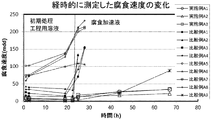
- Example B1 and Comparative Examples B1 and B2 show the change of the corrosion rate measured with time in the initial treatment process and the corrosion treatment process of Examples A1 to A3 and Comparative Examples A1 to A9.
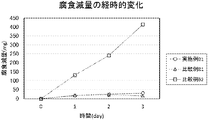
- the initial treatment step and the blank treatment step are taken as one set, and this set is repeated three times, and shows the change in corrosion weight loss measured over time.
- An initial treatment agent for circulating cooling water (hereinafter referred to as “initial treating agent”) of the present invention is added to the aqueous system at the time of starting the circulating cooling water system, and is used for forming an anticorrosive film on the surface of the metallic member of the aqueous system.
- An initial treatment agent for cooling water containing at least one selected from tartaric acid and tartrate.
- the initial treating agent of the present invention contains at least one selected from tartaric acid and tartrate.
- the content of at least one selected from tartaric acid and tartrate is preferably 70 to 100% by mass, more preferably 80 to 100% by mass, and still more preferably 90 to 100% by mass, in 100% by mass of the initial treatment agent. More preferably, it is 95 to 100% by mass, and still more preferably 100% by mass.
- “the content of at least one selected from tartaric acid and tartrate” means the total content of tartaric acid and tartrate in the initial treatment agent.
- the content of at least one selected from the above tartaric acid and tartrate is in the above range, so that an anticorrosion film can be satisfactorily formed on the metal member surface without using a phosphate and a zinc compound as an initial treatment agent. It is easy to be obtained and an excellent corrosion prevention effect is easily obtained.
- Tartaric acid used in the present invention is also referred to as 2,3-dihydroxybutanedioic acid, and is represented by (CH (OH) COOH) 2 in the formula, and refers to a hydroxy acid having two asymmetric carbons in the molecule.
- Tartaric acid includes L-form, D-form, meso-form and racemic form, but is not particularly limited.
- the tartrate used in the present invention has tartaric acid in which at least one hydrogen atom selected from two hydrogen atoms of two OH groups in the tartaric acid molecule and two hydrogen atoms of two COOH groups in the tartaric acid molecule is used.
- This refers to a compound produced by the reaction of tartaric acid, which is ionized from the anion and reacted with a cation.
- Tartrate is one of the two OH groups and two COOH groups in the tartaric acid molecule.
- One or two hydrogen atoms of the COOH group are ionized from tartaric acid, and the tartaric acid that has become an anion reacts with the cation.
- the compound produced is preferred.
- examples of the cation include alkali metal ions, alkaline earth metal ions, ammonium ions, zinc ions, aluminum ions, iron ions (II) and the like.
- tartrate formed by ionizing one hydrogen atom from tartaric acid include lithium tartrate, potassium tartrate, sodium tartrate and the like.
- tartrate formed by ionizing two or more hydrogen atoms from tartaric acid include dilithium tartrate, potassium sodium tartrate, diammonium tartrate, calcium tartrate, iron (II) tartrate, zinc tartrate and the like.
- These tartrate salts may be used alone or in combination of two or more.
- sodium tartrate is preferable as the tartrate formed by ionizing one hydrogen atom from tartaric acid from the viewpoint of satisfactorily forming an anticorrosive film on the metal member surface, and two from tartrate.
- calcium tartrate and iron (II) tartrate are preferable.
- the initial treating agent in the present invention contains at least one selected from tartaric acid and tartrate as an essential component, but may contain other components as long as the object effects of the present invention are not impaired.
- examples of other components include zinc salts and calcium salts.
- the content of other components is preferably 0 to 10% by mass, more preferably 0 to 5% by mass, and still more preferably 0% by mass in 100% by mass of the initial treating agent.
- an anticorrosion film is easily formed on the metal member surface without using a phosphate and a zinc compound as an initial treatment agent, and excellent corrosion prevention. The effect is easily obtained.
- the method for preventing corrosion of a circulating cooling water system according to the present invention includes an initial treatment step of forming an anticorrosive film on the surface of a metal member of the water system when the circulating cooling water system is started.
- Corrosion prevention method wherein an initial treatment agent containing at least one selected from tartaric acid and tartrate in an initial treatment step is 20 to 150 mg / L, preferably 30 to 100 mg / L in terms of tartaric acid.
- the pH of the aqueous system after adding the initial treating agent is adjusted to 6.0 to 8.0.
- An initial treatment agent containing at least one selected from tartaric acid and tartrate is bonded to calcium ions present in water, and an anticorrosion film mainly composed of calcium salt that is hardly soluble in water is formed on the surface of the metal member. It is thought that it is done. Moreover, it is thought that the initial processing agent containing at least 1 sort (s) chosen from tartaric acid and tartrate reacts with the iron component of a metal member, and iron (II) tartrate is formed.
- an anticorrosion film prevents an aqueous system containing impurities (for example, dissolved oxygen, chloride ions, sulfate ions, etc.) that are corrosive factors from coming into direct contact with the surface of the metal member, thereby causing corrosion on the surface of the metal member. It is considered that the traveling speed (corrosion speed) can be lowered.
- impurities for example, dissolved oxygen, chloride ions, sulfate ions, etc.
- the corrosion prevention method of the present invention includes an initial treatment step of forming an anticorrosion film on the surface of the aqueous metal member when the circulating cooling water system is activated.
- an initial treatment agent containing at least one selected from tartaric acid and tartrate in an aqueous system is 20 to 150 mg / L, preferably 30 to 100 mg / L, more preferably 40 in terms of tartaric acid. It is added so as to be -90 mg / L, more preferably 50-70 mg / L.
- the addition amount of the initial treatment agent is less than the above range (less than 20 mg / L)
- the initial treatment agent is too little, so that the anticorrosion film is not sufficiently formed on the surface of the metal member, preventing corrosion. The effect may not be obtained.
- the addition amount of the initial treatment agent exceeds the above range (exceeds 150 mg / L)
- the initial treatment agent is too much, and inconvenience such as chelate corrosion is likely to occur.
- the rate at which corrosion proceeds may be accelerated.
- the content of at least one selected from tartaric acid and tartrate is more preferably 100% by mass in 100% by mass of the initial treating agent. That is, the initial treating agent is preferably composed of at least one selected from tartaric acid and tartrate.
- the initial treating agent is preferably composed of at least one selected from tartaric acid and tartrate.
- at least one selected from tartaric acid and tartrate is preferably 20 to 150 mg / L, more preferably 30 to 100 mg / L, still more preferably 40 to 90 mg / L, and still more preferably, in terms of tartaric acid. Is added so as to be 50 to 70 mg / L.
- the addition amount of at least one selected from the above tartaric acid and tartrate is in the above range, so that an anticorrosion film can be satisfactorily formed on the metal member surface without using a phosphate and a zinc compound as an initial treatment agent. It is easy to be obtained and an excellent corrosion prevention effect is easily obtained.
- the pH of the aqueous system is 6.0 to 8.0, preferably 6.0 to 7.5, More preferably, it is 6.5 to 7.5. If the pH of the aqueous system after adding the initial treatment agent is less than the above range (less than 6.0), inconvenience such as acid corrosion is likely to occur, and the rate at which corrosion proceeds on the metal member surface (corrosion rate). ) May accelerate.
- PH in this specification refers to the value calculated
- phthalate, neutral phosphate, and carbonate pH standard solutions can be used.
- the pH of the aqueous system after the addition of the initial treating agent specified in the present invention can be set within a specific range (pH 6.0 to 8.0).
- a specific range pH 6.0 to 8.0
- sulfuric acid sodium hydroxide
- potassium hydroxide etc. It is only necessary that the pH of the aqueous system can be adjusted to a specific range (pH 6.0 to 8.0) using the pH adjuster.
- the water quality of the aqueous system applied to the initial treatment step of the corrosion prevention method of the present invention that is, the water quality of the aqueous system before the addition of the initial treatment agent affects the pH of the aqueous system after the addition of the initial treatment agent, thereby preventing corrosion. An effect may not be exhibited suitably.
- the initial stage of the corrosion prevention method of the present invention is used.
- the water quality of the water system applied to the treatment process preferably has the following parameters.
- the pH of the water quality is preferably 6.0 to 8.0, more preferably 6.0 to 7.5, and still more preferably 6.5 to 7.5.
- Calcium hardness of water is preferably 30 ⁇ 150mgCaCO 3 / L, more preferably 30 ⁇ 120mgCaCO 3 / L, more preferably 30 ⁇ 100mgCaCO 3 / L.
- the water quality ionic silica is preferably 5 to 35 mg SiO 2 / L, more preferably 10 to 30 mg SiO 2 / L, and still more preferably 15 to 25 mg SiO 2 / L.
- the initial treatment step for forming the anticorrosive film on the surface of the metal member is preferably carried out in the water system circulation preferably 20 to 48 hours, more preferably 24 to 36 hours without applying a heat load to the water system.
- the corrosion weight loss after passing through an initial treatment process and a normal operation process can be made small.
- membrane is easy to be formed favorably with respect to the metal member surface, and it becomes easy to obtain the outstanding corrosion prevention effect.
- the initial treatment step in the present invention is preferably in a state where no heat load is applied to the water system.
- the temperature of the aqueous system in the initial treatment step without applying a heat load is preferably 10 to 40 ° C., more preferably 15 to 35 ° C., and still more preferably 20 to 30 ° C.
- the “state where no heat load is applied to the water system” refers to a state before entering the normal operation process and a state where the object to be cooled is not introduced into the circulating cooling water system.
- the initial treatment step in the present invention is preferably circulated in an aqueous system for 20 to 48 hours.
- the concentration of the initial treatment agent in the aqueous system is preferably kept constant from the viewpoint of forming the anticorrosion film uniformly on the surface of the metal member.
- the concentration of the initial treatment agent in the aqueous system is 20 to 150 mg / L in terms of tartaric acid, preferably 30 to It is preferable to add an initial treatment agent so as to be 100 mg / L.
- the reason why the concentration of the initial treatment agent in the aqueous system is lower than the initial concentration may be exhaustion in the system, adsorption to a corrosion product, or the like.
- the concentration of the initial treatment agent in the aqueous system is preferably 20 to 150 mg / L in terms of tartaric acid, preferably It is preferable to add an aqueous system so as to be 30 to 100 mg / L.
- the corrosion prevention method of the present invention may include a normal operation step for holding the anticorrosion film formed in the initial treatment step after the aforementioned initial treatment step.
- the “normal operation process” refers to a process performed for the purpose of holding the anticorrosion film formed on the surface of the metal member so as not to be peeled off in the initial treatment process.
- a retention treatment agent to the aqueous system after the initial treatment step.
- the retention treatment agent is adsorbed on the surface of the anticorrosion film formed on the surface of the metal member, making the anticorrosion film difficult to peel off, and the corrosion prevention effect is easily maintained.
- a scale adhesion preventing effect that prevents insoluble components from adhering to the surface of the anticorrosion film can be easily obtained.
- the retention treatment agent is preferably 20 to 100 mg / L, more preferably 30 to 80 mg / L, still more preferably 50 to 80 mg / L in the aqueous system after the initial treatment step. Added.
- the amount of the retention treatment agent is within the above range, the retention treatment agent is adsorbed on the surface of the anticorrosion film formed on the surface of the metal member, making the anticorrosion film difficult to peel off, and the corrosion prevention effect is easily maintained. .
- a scale adhesion preventing effect that prevents insoluble components from adhering to the surface of the anticorrosion film can be easily obtained.
- the amount of the initial treatment agent containing at least one selected from tartaric acid and tartrate contained in the aqueous system in the normal operation process is selected from tartaric acid and tartrate contained in the aqueous system in the above-described initial treatment process.
- the amount of the initial treating agent containing at least one kind is selected from tartaric acid and tartrate contained in the aqueous system in the above-described initial treatment process.
- the retention treatment agent is not particularly limited as long as it is adsorbed on the surface of the anticorrosion film, makes the anticorrosion film difficult to peel off, and the corrosion prevention effect is easily maintained.
- Examples of the retention treatment include polymer compounds such as a copolymer of acrylic acid and maleic acid, a copolymer of isobutylene and maleic acid, a maleic acid polymer, and a copolymer of acrylic acid / AMPS; zinc sulfate, chloride Zinc compounds such as zinc; phosphates such as inorganic phosphates and organic phosphates; and the like.
- These retention treatment agents may be used alone or in combination of two or more.
- AMPS means 2-acrylamido-2-methylpropanesulfonic acid.
- the water quality of the aqueous system applied when no phosphate is used preferably has the following parameters.
- the pH of the water quality is preferably 8.0 to 9.2, more preferably 8.5 to 9.0, and still more preferably 8.6 to 9.0.
- the calcium hardness of water quality is preferably 350 to 650 mg CaCO 3 / L, more preferably 400 to 600 mg CaCO 3 / L, still more preferably 450 to 550 mg CaCO 3 / L. By setting it as the range, the anticorrosion film is hardly peeled off, and the corrosion prevention effect is easily maintained.
- a calcium source may be added to the aqueous system.
- the acid consumption of water quality is preferably 130 to 170 mg CaCO 3 / L, more preferably 140 to 160 mg CaCO 3 / L, and still more preferably 145 to 155 mg CaCO 3 / L.
- the concentration of the retention treatment agent in the aqueous system is kept constant from the viewpoint of easily exerting the effect of retaining the anticorrosion film formed on the surface of the metal member so as not to peel off. It is preferable.
- the retention treatment agent in the aqueous system is adjusted so that the concentration of the retention treatment agent in the aqueous system is 20 to 100 mg / L. It is preferable to add.
- the reason why the concentration of the retention treatment agent in the aqueous system is lower than the initial concentration may be exhaustion in the system, adsorption to a corrosion product, or the like.
- the aqueous system is adjusted so that the concentration of the retention treatment agent in the aqueous system is 20 to 100 mg / L. It is preferable to add.
- Evaluation test A for corrosion prevention effect A test for evaluating the corrosion prevention effect on the surface of the metal member was conducted by the following method for the solutions for the initial treatment step prepared in Examples A1 to A3 and Comparative Examples A1 to A9.
- Example A1 ⁇ Preparation of specimen> An iron sensor (material: SS400, 10 ⁇ ⁇ 30 mm iron bar, surface area: 10.3 cm 2 ) degreased with toluene and dried was used as a test piece.
- Nogi-cho water (hereinafter referred to as “Nogi-cho water”) in Shimotsuga-gun, Tochigi Prefecture was used.
- the water quality of Nogi-cho water was pH 7.0, calcium hardness: 40 mg CaCO 3 / L, and ionic silica: 20 mg SiO 2 / L.
- Nogicho water was put into a 1 L beaker, and sodium tartrate was added to Nogicho water as an initial treatment agent so as to be 30 mg / L. This beaker was moved to a thermostat set at 30 ° C. and heated to prepare the solution for the initial treatment step of Example A1.
- ⁇ Initial treatment process> The test piece was immersed in the solution for the initial treatment step of Example A1 prepared above. And stirring of the solution for initial process steps was started by rotating a stirrer at 300 rpm, and after stirring was continued for 24 hours at room temperature, stirring was terminated. Using the corrosion meter (“K-600” manufactured by Toho Giken Co., Ltd.) from the start to the end of stirring of the solution for the initial treatment process, the rate at which the corrosion of the test piece proceeds (corrosion rate) over time Measured. The measurement results are shown in FIG.
- the “corrosion rate” refers to a weight reduction amount (mdd: mg / dm 2 ⁇ day) of the test piece due to corrosion per unit area and unit time of the test piece.
- Example A2 In the preparation of the solution for the initial treatment step of Example A1, the corrosion prevention of Example A2 was conducted in the same manner as in Example A1, except that sodium tartrate was added to Nogi-cho water as an initial treatment agent so as to be 50 mg / L. A test to evaluate the effect was conducted. It was pH 6.9 when pH of the solution for initial process steps of Example A2 (pH of the water system after adding the initial process agent of Example A2) was measured.
- Example A3 In the preparation of the solution for the initial treatment step of Example A1, the corrosion prevention of Example A3 was performed in the same manner as in Example A1, except that sodium tartrate was added to Nogi-cho water as an initial treatment agent so as to be 100 mg / L. A test to evaluate the effect was conducted. The pH of the solution for the initial treatment step of Example A3 (the pH of the aqueous system after the addition of the initial treatment agent of Example A3) was measured and found to be 7.0.
- Comparative Example A1 In the preparation of the solution for the initial treatment step of Example A1, corrosion prevention of Comparative Example A1 was conducted in the same manner as in Example A1, except that sodium tartrate was added as an initial treatment agent to Nogi-cho water so as to be 300 mg / L. A test to evaluate the effect was conducted.
- the pH of the solution for the initial treatment step of Comparative Example A1 (water-based pH after addition of the initial treatment agent of Comparative Example A1) was measured to be pH 7.1.
- Comparative Example A2 In the preparation of the solution for the initial treatment step of Example A1, the anti-corrosion effect of Comparative Example A2 is the same as that of Example A1, except that tartaric acid is added to Nogi-cho water as an initial treatment agent so as to be 100 mg / L. The test which evaluates was conducted. The pH of the solution for the initial treatment step of Comparative Example A2 (water-based pH after the addition of the initial treatment agent of Comparative Example A2) was measured and found to be 5.0.
- Comparative Example A3 In the preparation of the solution for the initial treatment step of Example A1, the corrosion prevention of Comparative Example A3 was performed in the same manner as in Example 1 except that gluconic acid was added to Nogi-cho water as an initial treatment agent so as to be 50 mg / L. A test to evaluate the effect was conducted.
- the pH of the solution for the initial treatment step of Comparative Example A3 (the pH of the aqueous system after addition of the initial treatment agent of Comparative Example A3) was measured and found to be pH 7.3.
- Comparative Example A4 In the preparation of the solution for the initial treatment step of Example A1, the corrosion prevention of Comparative Example A4 was performed in the same manner as in Example A1, except that citric acid was added to Nogi-cho water as an initial treatment agent so as to be 50 mg / L. A test to evaluate the effect was conducted.
- the pH of the solution for the initial treatment step of Comparative Example A4 (the pH of the aqueous system after the addition of the initial treatment agent of Comparative Example A4) was measured and found to be 6.1.
- Comparative Example A5 In the preparation of the solution for the initial treatment step of Example A1, the corrosion prevention effect of Comparative Example A5 is the same as that of Example A1, except that acetic acid is added to Nogi-cho water as an initial treatment agent so as to be 50 mg / L. The test which evaluates was conducted. The pH of the solution for the initial treatment step of Comparative Example A5 (the pH of the aqueous system after the addition of the initial treatment agent of Comparative Example A5) was measured and found to be 6.1.
- Comparative Example A6 In the preparation of the solution for the initial treatment step of Example A1, the corrosion of Comparative Example A6 was performed in the same manner as in Example A1, except that ethylenediaminetetraacetic acid was added to Nogi-cho water as an initial treatment agent so as to be 50 mg / L. A test was conducted to evaluate the prevention effect.
- the pH of the solution for the initial treatment step of Comparative Example A6 (the pH of the aqueous system after adding the initial treatment agent of Comparative Example A6) was measured to be 6.7.
- Comparative Example A7 In the preparation of the solution for the initial treatment step of Example A1, the corrosion prevention of Comparative Example A7 was performed in the same manner as in Example A1, except that maleic acid was added to Nogi-cho water as an initial treatment agent so as to be 50 mg / L. A test to evaluate the effect was conducted. The pH of the solution for the initial treatment step of Comparative Example A7 (water-based pH after the addition of the initial treatment agent of Comparative Example A7) was measured and found to be 6.2.
- Comparative Example A8 In the preparation of the solution for the initial treatment step of Example A1, the corrosion prevention of Comparative Example A8 was carried out in the same manner as in Example A1, except that succinic acid was added to Nogi-cho water as an initial treatment agent so as to be 50 mg / L. A test to evaluate the effect was conducted.
- the pH of the solution for the initial treatment step of Comparative Example A8 (the pH of the aqueous system after the addition of the initial treatment agent of Comparative Example A8) was measured and found to be 6.1.
- Comparative Example A9 In the preparation of the solution for the initial treatment step of Example A1, as the initial treatment agent, hexametaphosphoric acid, which is a phosphate, is added to Nogi-cho water to 100 mg PO 4 / L, and zinc chloride, which is a zinc compound, is added to 20 mg Zn / L. A test for evaluating the corrosion prevention effect of Comparative Example A9 was conducted in the same manner as in Example A1 except that this was done. The pH of the solution for the initial treatment step of Comparative Example A9 (the pH of the aqueous system after addition of the initial treatment agent of Comparative Example A9) was measured and found to be 6.5.
- FIG. 1 shows the change in corrosion rate (mdd: mg / dm 2 ⁇ day) measured over time in the initial treatment process and the corrosion treatment process of Examples A1 to A3 and Comparative Examples A1 to A9 described above. .
- the corrosion rate in Comparative Example A1 is attributed to the fact that the initial treatment agent specified in the present invention was added to the aqueous system in excess of a specific amount (20 to 150 mg / L, especially 30 to 100 mg / L in terms of tartaric acid). It was higher than the corrosion rate of ⁇ A3. From this, it was found that Comparative Example A1 cannot satisfactorily form the anticorrosion film on the surface of the metal member, and the corrosion prevention effect cannot be sufficiently obtained.
- the corrosion rate in Comparative Example A2 is due to the fact that the pH of the aqueous system after addition of the initial treating agent specified in the present invention was less than a specific range (pH 6.0 to 8.0). It was higher than the corrosion rate. From this, it was found that Comparative Example A2 cannot satisfactorily form the anticorrosion film on the surface of the metal member, and the corrosion prevention effect cannot be sufficiently obtained.
- Comparative Examples A3 to A8 were higher than those in Examples A1 to A3 because the initial treatment agent specified in the present invention was not used. From this, it was found that Comparative Examples A3 to A8 cannot satisfactorily form the anticorrosion film on the surface of the metal member, and the corrosion preventing effect cannot be sufficiently obtained.
- the corrosion rates in Examples A1 to A3 were determined by adding a specific amount (20 to 150 mg / L, especially 30 to 100 mg / L in terms of tartaric acid) of the initial treatment agent specified in the present invention to the aqueous system. Due to the fact that the pH of the aqueous system after the addition of the agent is in a specific range (pH 6.0 to 8.0), it is as low as Comparative Example A9 using a phosphate and a zinc compound as the initial treatment agent Met. From this, it was found that Examples A1 to A3 can form a good anticorrosion film on the surface of the metal member and have an excellent anticorrosion effect.
- Example B1 ⁇ Preparation of specimen> An SPCC test piece (size: 30 mm ⁇ 50 mm ⁇ 1 mm) was etched with a 20% by mass nitric acid solution and a 10% by mass sulfuric acid solution and dried to obtain a test piece. The weight W 1 of the test piece before performing corrosion test B is measured in advance.
- the initial treatment step solution of Example A2 was switched to the blank solution, and the test piece was immersed in the blank solution and heated to 30 ° C., and the rotary corrosion was performed similarly to the initial treatment step.
- the rotation of the test piece was started at 150 rpm, and this rotation was continued for 24 hours. Then, the rotation was stopped and the first blanking process was completed.
- the “blank solution” refers to the same as Nogimachi water used as raw water for the preparation of the initial treatment step solution of Example A1.
- the second initial processing step was performed for 24 hours in the same manner as the first time, and then the second blank processing step was performed for 24 hours.
- the corrosion weight loss W A of the second test piece was calculated by the equation 1 in the same manner as the first.
- the third initial treatment step was performed for 24 hours in the same manner as the first time, and then the third blank processing step was performed for 24 hours.
- the corrosion weight loss W A of the third test piece was calculated by the equation 1 in the same manner as the first.
- Comparative Example B1 In the initial treatment step of Example B1, the corrosion prevention effect of Comparative Example B1 is the same as Example B1, except that the solution for the initial treatment step of Example A2 is changed to the solution for the initial treatment step of Comparative Example A9. The test to evaluate was done.
- Comparative Example B2 In the initial treatment step of Example B1, a test for evaluating the corrosion prevention effect of Comparative Example B2 was performed in the same manner as in Example B1, except that the solution for the initial treatment step of Example A2 was changed to a blank solution.
- Example B1 and Comparative Examples B1 and B2 described above the initial treatment step and the blank treatment step were set as one set, and this set was repeated three times, and the change in corrosion weight loss measured over time is shown in FIG.
- the corrosion weight loss in Example B1 is the addition of a specific amount (20 to 150 mg / L, especially 30 to 100 mg / L in terms of tartaric acid) of the initial treatment agent specified in the present invention to the aqueous system. Due to the fact that the pH of the aqueous system after the addition was within a specific range (pH 6.0 to 8.0), it was as low as Comparative Example B1 using a phosphate and a zinc compound as an initial treatment agent. It was. From this, it turned out that Example B1 can form an anticorrosion film
- Evaluation test C for corrosion prevention effect Using the heat transfer surface evaluation test apparatus shown in FIG. 3, a test for evaluating the corrosion prevention effect on the surface of the metal member (specifically, the evaluation tube 2 made of iron) was performed by the following method.
- the heat transfer surface evaluation test apparatus shown in FIG. 3 adjusts the flow rate of the test water in the test water tank (100 L capacity) 1 with the circulating water pump P 1 and supplies the test water to the test tube 3 through the circulation line L 1. , in which circulates the test water in the test water tank 1 through the circulation return line L 2.
- An evaluation tube 2 made of iron is inserted into the test tube 3, and the evaluation tube 2 made of iron can be immersed in test water when the apparatus is activated.
- a heater (thermocouple) 4 is inserted into the iron evaluation tube 2, and the iron evaluation tube 2 can be heated by the heater (thermocouple) 4 when the apparatus is activated.
- the circulation return line L 2, the flow rate regulating valve V is provided.
- the test water in the make-up water tank (300 L capacity) 5 can be supplied to the test water tank 1 through the make-up water line L 3 as necessary.
- the flow rate of the test water to be replenished is adjusted by circulating water pump P 2.
- Test water tank (100L capacity) 1 Put Nogi-cho water, add tartaric acid to Nogi-cho water as an initial treatment so as to be 50 mg / L, warm the water system to 30 ° C, and test water for the initial treatment process 1 was prepared.
- “Nogimachi water” refers to the same Nogimachi water used as raw water for the preparation of the initial treatment step solution of Example A1.
- the water quality of the test water 1 at this time was pH: 7.0, calcium hardness: 40 mg CaCO 3 / L, ionic silica: 20 mg SiO 2 / L, and acid consumption: 40 mg CaCO 3 / L.
- the heater (thermocouple) 4 is driven to set the power to 2 kW and the tube temperature to 80 ° C. to apply a heat load to the water system, and the flow rate of the test water 1 in the test water tank (100 L capacity) 1 is a circulating water pump.
- a series of water system circulation in which the test water 1 is adjusted to 0.5 m / s at P 1 , the test water 1 is supplied to the test tube 3 through the circulation line L 1 , and the test water 1 is returned to the test water tank 1 through the circulation return line L 2. It went for 24 hours. It should be noted that the actual temperature of the aqueous system was controlled to be 30 ° C. even in a state where a heat load was applied to the aqueous system in the initial treatment step.
- the heater (thermocouple) 4 is driven to set the power to 2 kW, the tube temperature to 80 ° C. to apply a heat load to the water system, and the flow rate of the test water 2 in the test water tank (100 L capacity) 1 is a circulating water pump.
- a series of water system circulation in which the test water 2 is adjusted to 0.5 m / s at P 1 , the test water 2 is supplied to the test tube 3 through the circulation line L 1 , and the test water 2 is returned to the test water tank 1 through the circulation return line L 2. It went for 48 hours. It should be noted that the actual temperature of the aqueous system was controlled to be 30 ° C. even in a state where a heat load was applied to the aqueous system in the normal operation process.
- Test 2 In the initial treatment process of Test 1, the heater (thermocouple) 4 was not driven, that is, no heat load was applied to the water system, and a series of water system circulation was performed for 24 hours. A test was conducted to evaluate the corrosion prevention effect. It should be noted that the actual temperature of the aqueous system was controlled to be 30 ° C. even in a state where no heat load was applied to the aqueous system in the initial treatment step.
- Table 2 shows the measurement results of the weight loss after the initial treatment process and the normal operation process of Test 1 and Test 2 described above.
- test water tank 2 evaluation tube 3: test tube 4: heater 5: makeup water tank L1: circulation line L2: circulation return line L3: makeup water line L4: overflow line P1: circulation water pump P2: circulation water pump V : Flow adjustment valve
Landscapes
- Engineering & Computer Science (AREA)
- Chemical & Material Sciences (AREA)
- Mechanical Engineering (AREA)
- Materials Engineering (AREA)
- Metallurgy (AREA)
- Organic Chemistry (AREA)
- Physics & Mathematics (AREA)
- Thermal Sciences (AREA)
- General Engineering & Computer Science (AREA)
- Preventing Corrosion Or Incrustation Of Metals (AREA)
Abstract
本発明の循環冷却水用初期処理剤は、循環冷却水系の起動時に該水系に添加して、該水系の金属部材表面に防食皮膜を形成するための循環冷却水用初期処理剤であって、酒石酸及び酒石酸塩から選ばれる少なくとも1種を含有する。
Description
本発明は、循環冷却水系の起動時に該水系に添加して、該水系の金属部材表面に防食皮膜を形成するための循環冷却水用初期処理剤、及び循環冷却水系の腐食防止方法に関する。
循環冷却水系システムで用いられる冷却水には、少なからず腐食因子となる不純物(例えば、溶存酸素、塩化物イオン、硫酸イオン等)が含まれることから、冷却水に接する金属部材表面を経時的に腐食させてしまう等の障害が発生することが問題になっている。
このため、循環冷却水系システムの起動時における初期処理工程として、冷却水に無機リン酸塩及び亜鉛化合物を添加し、一定時間冷却水を循環させることにより、金属部材表面に対して防食皮膜を形成させ、腐食防止効果を得る、循環冷却水系の初期処理方法が提案されている。
例えば、特許文献1には、冷却水系に、全リン酸濃度が70~120mgPO4/Lとなるようにリン酸塩を添加し、且つ亜鉛濃度が10~30mgZn/Lとなるように亜鉛化合物を添加し、冷却水系の金属部材表面に初期防食皮膜を形成する基礎処理工程を行う冷却水系の処理方法が開示されている。
特許文献1に開示された冷却水系の処理方法にあっては、金属部材表面に防食皮膜を形成するために用いる初期処理剤として、リン酸塩及び亜鉛化合物を用い、腐食防止効果を得ている。しかし、近年、水質環境への関心の高まりから、工場、及び事業所等から排出される汚水及び廃液に含まれる、リンや亜鉛の量を減少させることも望まれている。
そこで、本発明は、上記課題を解決するためになされたものであり、初期処理剤としてリン酸塩及び亜鉛化合物を用いずとも、金属部材表面に対して防食皮膜を良好に形成することができ、優れた腐食防止効果が得られる、循環冷却水用初期処理剤、及び循環冷却水系の腐食防止方法を提供することを目的とする。
本発明者は、上記課題を解決するために鋭意検討を重ねた結果、特定の初期処理剤を水系に特定量(酒石酸換算で20~150mg/L好ましくは30~100mg/L)添加し、該初期処理剤を添加した後の水系のpHを特定範囲(pH6.0~8.0)とすることで、上記課題を解決し得ることを見出し、本発明を完成させるに至った。
すなわち、本発明は以下の通りである。
すなわち、本発明は以下の通りである。
[1]循環冷却水系の起動時に該水系に添加して、該水系の金属部材表面に防食皮膜を形成するための循環冷却水用初期処理剤であって、酒石酸及び酒石酸塩から選ばれる少なくとも1種を含有する、循環冷却水用初期処理剤。
[2]前記酒石酸及び酒石酸塩から選ばれる少なくとも1種の含有量が、循環冷却水用初期処理剤100質量%中、90~100質量%である、前記[1]に記載の循環冷却水用初期処理剤。
[3]循環冷却水系の起動時に、該水系の金属部材表面に防食皮膜を形成する初期処理工程を含む循環冷却水系の腐食防止方法であって、前記初期処理工程において、前記水系に、前記[1]又は[2]に記載の酒石酸及び酒石酸塩から選ばれる少なくとも1種を含有する循環冷却水用初期処理剤を酒石酸換算で20~150mg/Lとなるように添加し、該循環冷却水用初期処理剤を添加した後の水系のpHを6.0~8.0とする、循環冷却水系の腐食防止方法。
[4]前記循環冷却水用初期処理剤が、酒石酸及び酒石酸塩から選ばれる少なくとも1種からなる、前記[3]に記載の循環冷却水系の腐食防止方法。
[5]前記初期処理工程において、前記水系に熱負荷をかけない状態で、20~48時間水系循環させる、前記[3]又は[4]に記載の循環冷却水系の腐食防止方法。
[6]前記初期処理工程において、前記水系に、前記酒石酸及び酒石酸塩から選ばれる少なくとも1種を含有する循環冷却水用初期処理剤を酒石酸換算で30~100mg/Lとなるように添加し、該循環冷却水用初期処理剤を添加した後の水系のpHを6.0~8.0とする、前記[3]~[5]のいずれか1つに記載の循環冷却水系の腐食防止方法。
[7]前記初期処理工程において、前記水系の温度が10~40℃であり、20~48時間水系循環させる、前記[3]~[6]のいずれか1つに記載の循環冷却水系の腐食防止方法。
[8]前記初期処理工程後に、前記初期処理工程で形成された防食皮膜を保持するための通常運転工程を含む、前記[3]~[7]のいずれか1つに記載の循環冷却水系の腐食防止方法。
[9]前記通常運転工程において、前記初期処理工程後の水系中に、保持処理剤を添加する、前記[8]に記載の循環冷却水系の腐食防止方法。
[10]前記通常運転工程において、前記初期処理工程後の水系中に、前記保持処理剤を20~100mg/Lとなるように添加する、前記[8]又は[9]に記載の循環冷却水系の腐食防止方法。
[2]前記酒石酸及び酒石酸塩から選ばれる少なくとも1種の含有量が、循環冷却水用初期処理剤100質量%中、90~100質量%である、前記[1]に記載の循環冷却水用初期処理剤。
[3]循環冷却水系の起動時に、該水系の金属部材表面に防食皮膜を形成する初期処理工程を含む循環冷却水系の腐食防止方法であって、前記初期処理工程において、前記水系に、前記[1]又は[2]に記載の酒石酸及び酒石酸塩から選ばれる少なくとも1種を含有する循環冷却水用初期処理剤を酒石酸換算で20~150mg/Lとなるように添加し、該循環冷却水用初期処理剤を添加した後の水系のpHを6.0~8.0とする、循環冷却水系の腐食防止方法。
[4]前記循環冷却水用初期処理剤が、酒石酸及び酒石酸塩から選ばれる少なくとも1種からなる、前記[3]に記載の循環冷却水系の腐食防止方法。
[5]前記初期処理工程において、前記水系に熱負荷をかけない状態で、20~48時間水系循環させる、前記[3]又は[4]に記載の循環冷却水系の腐食防止方法。
[6]前記初期処理工程において、前記水系に、前記酒石酸及び酒石酸塩から選ばれる少なくとも1種を含有する循環冷却水用初期処理剤を酒石酸換算で30~100mg/Lとなるように添加し、該循環冷却水用初期処理剤を添加した後の水系のpHを6.0~8.0とする、前記[3]~[5]のいずれか1つに記載の循環冷却水系の腐食防止方法。
[7]前記初期処理工程において、前記水系の温度が10~40℃であり、20~48時間水系循環させる、前記[3]~[6]のいずれか1つに記載の循環冷却水系の腐食防止方法。
[8]前記初期処理工程後に、前記初期処理工程で形成された防食皮膜を保持するための通常運転工程を含む、前記[3]~[7]のいずれか1つに記載の循環冷却水系の腐食防止方法。
[9]前記通常運転工程において、前記初期処理工程後の水系中に、保持処理剤を添加する、前記[8]に記載の循環冷却水系の腐食防止方法。
[10]前記通常運転工程において、前記初期処理工程後の水系中に、前記保持処理剤を20~100mg/Lとなるように添加する、前記[8]又は[9]に記載の循環冷却水系の腐食防止方法。
本発明によれば、初期処理剤としてリン酸塩及び亜鉛化合物を用いずとも、金属部材表面に対して防食皮膜を良好に形成することができ、優れた腐食防止効果が得られる、冷却用初期処理剤、及び冷却水系の腐食防止方法を提供することができる。
[循環冷却水用初期処理剤]
本発明の循環冷却水用初期処理剤(以下「初期処理剤」と称す)は、循環冷却水系の起動時に該水系に添加して、該水系の金属部材表面に防食皮膜を形成するための循環冷却水用初期処理剤であって、酒石酸及び酒石酸塩から選ばれる少なくとも1種を含有する。
これにより、初期処理剤としてリン酸塩及び亜鉛化合物を用いずとも、金属部材表面に対して防食皮膜を良好に形成することができ、優れた腐食防止効果が得られる。
本発明の循環冷却水用初期処理剤(以下「初期処理剤」と称す)は、循環冷却水系の起動時に該水系に添加して、該水系の金属部材表面に防食皮膜を形成するための循環冷却水用初期処理剤であって、酒石酸及び酒石酸塩から選ばれる少なくとも1種を含有する。
これにより、初期処理剤としてリン酸塩及び亜鉛化合物を用いずとも、金属部材表面に対して防食皮膜を良好に形成することができ、優れた腐食防止効果が得られる。
(酒石酸及び酒石酸塩)
本発明の初期処理剤は、酒石酸及び酒石酸塩から選ばれる少なくとも1種を含有する。
酒石酸及び酒石酸塩から選ばれる少なくとも1種の含有量は、初期処理剤100質量%中、好ましくは70~100質量%、より好ましくは80~100質量%、さらに好ましくは90~100質量%、より更に好ましくは95~100質量%、より更に好ましくは100質量%である。
ここで、「酒石酸及び酒石酸塩から選ばれる少なくとも1種の含有量」とは、初期処理剤中における、酒石酸及び酒石酸塩の合計含有量を意味する。
上記酒石酸及び酒石酸塩から選ばれる少なくとも1種の含有量が、上記範囲にあることで、初期処理剤としてリン酸塩及び亜鉛化合物を用いずとも、金属部材表面に対して防食皮膜が良好に形成され易く、優れた腐食防止効果が得られ易くなる。
本発明の初期処理剤は、酒石酸及び酒石酸塩から選ばれる少なくとも1種を含有する。
酒石酸及び酒石酸塩から選ばれる少なくとも1種の含有量は、初期処理剤100質量%中、好ましくは70~100質量%、より好ましくは80~100質量%、さらに好ましくは90~100質量%、より更に好ましくは95~100質量%、より更に好ましくは100質量%である。
ここで、「酒石酸及び酒石酸塩から選ばれる少なくとも1種の含有量」とは、初期処理剤中における、酒石酸及び酒石酸塩の合計含有量を意味する。
上記酒石酸及び酒石酸塩から選ばれる少なくとも1種の含有量が、上記範囲にあることで、初期処理剤としてリン酸塩及び亜鉛化合物を用いずとも、金属部材表面に対して防食皮膜が良好に形成され易く、優れた腐食防止効果が得られ易くなる。
本発明で用いる酒石酸は、2,3-ジヒドロキシブタン二酸とも呼称され、示性式では(CH(OH)COOH)2と表され、分子内に不斉炭素を2つ有するヒドロキシ酸を指していう。
酒石酸としては、L体、D体、メソ体、ラセミ体が存在するが、特に限定されるものではない。
酒石酸としては、L体、D体、メソ体、ラセミ体が存在するが、特に限定されるものではない。
本発明で用いる酒石酸塩は、酒石酸分子内の2つのOH基のうちの2つの水素原子、及び酒石酸分子内の2つのCOOH基のうちの2つの水素原子から選ばれる少なくとも1つの水素原子が酒石酸から電離し、陰イオンとなった酒石酸が陽イオンと反応して生成された化合物を指していう。酒石酸塩としては、酒石酸分子内の2つのОH基及び2つのCOOH基のうち、COOH基の1つ又は2つの水素原子が酒石酸から電離し、陰イオンとなった酒石酸が陽イオンと反応して生成された化合物が好ましい。
ここで、陽イオンとしては、アルカリ金属イオン、アルカリ土類金属イオン、アンモニウムイオン、亜鉛イオン、アルミニウムイオン、鉄イオン(II)等が挙げられる。
ここで、陽イオンとしては、アルカリ金属イオン、アルカリ土類金属イオン、アンモニウムイオン、亜鉛イオン、アルミニウムイオン、鉄イオン(II)等が挙げられる。
酒石酸から1つの水素原子が電離して形成された酒石酸塩の具体例としては、酒石酸リチウム、酒石酸カリウム、酒石酸ナトリウム等が挙げられる。
また、酒石酸から2つ以上の水素原子が電離して形成された酒石酸塩の具体例としては、酒石酸二リチウム、酒石酸カリウムナトリウム、酒石酸ジアンモニウム、酒石酸カルシウム、酒石酸鉄(II)、酒石酸亜鉛等が挙げられる。
これらの酒石酸塩は、単独で用いても、2種以上を併用してもよい。
これらの酒石酸塩の中でも、金属部材表面に対して防食皮膜を良好に形成する観点から、酒石酸から1つの水素原子が電離して形成された酒石酸塩としては、酒石酸ナトリウムが好ましく、酒石酸から2つ以上の水素原子が電離して形成された酒石酸塩としては、酒石酸カルシウム、酒石酸鉄(II)が好ましい。
また、酒石酸から2つ以上の水素原子が電離して形成された酒石酸塩の具体例としては、酒石酸二リチウム、酒石酸カリウムナトリウム、酒石酸ジアンモニウム、酒石酸カルシウム、酒石酸鉄(II)、酒石酸亜鉛等が挙げられる。
これらの酒石酸塩は、単独で用いても、2種以上を併用してもよい。
これらの酒石酸塩の中でも、金属部材表面に対して防食皮膜を良好に形成する観点から、酒石酸から1つの水素原子が電離して形成された酒石酸塩としては、酒石酸ナトリウムが好ましく、酒石酸から2つ以上の水素原子が電離して形成された酒石酸塩としては、酒石酸カルシウム、酒石酸鉄(II)が好ましい。
(その他の成分)
本発明における初期処理剤は、酒石酸及び酒石酸塩から選ばれる少なくとも1種を必須成分として含有するが、本発明の目的効果を損なわない範囲で、その他の成分を含有してもよい。
その他の成分としては、例えば、亜鉛塩、カルシウム塩等が挙げられる。
本発明における初期処理剤は、酒石酸及び酒石酸塩から選ばれる少なくとも1種を必須成分として含有するが、本発明の目的効果を損なわない範囲で、その他の成分を含有してもよい。
その他の成分としては、例えば、亜鉛塩、カルシウム塩等が挙げられる。
その他の成分の含有量は、初期処理剤100質量%中、好ましくは0~10質量%、より好ましくは0~5質量%、更に好ましくは0質量%である。
上記その他の成分の含有量が、上記範囲にあることで、初期処理剤としてリン酸塩及び亜鉛化合物を用いずとも、金属部材表面に対して防食皮膜が良好に形成され易く、優れた腐食防止効果が得られ易くなる。
上記その他の成分の含有量が、上記範囲にあることで、初期処理剤としてリン酸塩及び亜鉛化合物を用いずとも、金属部材表面に対して防食皮膜が良好に形成され易く、優れた腐食防止効果が得られ易くなる。
[循環冷却水系の腐食防止方法]
本発明の循環冷却水系の腐食防止方法(以下「腐食防止方法」と称す)は、循環冷却水系の起動時に、該水系の金属部材表面に防食皮膜を形成する初期処理工程を含む循環冷却水系の腐食防止方法であって、初期処理工程において、水系に、酒石酸及び酒石酸塩から選ばれる少なくとも1種を含有する初期処理剤を酒石酸換算で20~150mg/L好ましくは30~100mg/Lとなるように添加し、該初期処理剤を添加した後の水系のpHを6.0~8.0とする。
これにより、初期処理剤としてリン酸塩及び亜鉛化合物を用いずとも、金属部材表面に対して防食皮膜を良好に形成することができ、優れた腐食防止効果が得られる。
本発明の循環冷却水系の腐食防止方法(以下「腐食防止方法」と称す)は、循環冷却水系の起動時に、該水系の金属部材表面に防食皮膜を形成する初期処理工程を含む循環冷却水系の腐食防止方法であって、初期処理工程において、水系に、酒石酸及び酒石酸塩から選ばれる少なくとも1種を含有する初期処理剤を酒石酸換算で20~150mg/L好ましくは30~100mg/Lとなるように添加し、該初期処理剤を添加した後の水系のpHを6.0~8.0とする。
これにより、初期処理剤としてリン酸塩及び亜鉛化合物を用いずとも、金属部材表面に対して防食皮膜を良好に形成することができ、優れた腐食防止効果が得られる。
本発明の腐食防止方法による優れた腐食防止効果が得られるメカニズムの詳細は明らかではないが、以下のように考えられる。
酒石酸及び酒石酸塩から選ばれる少なくとも1種を含有する初期処理剤は、水中に存在するカルシウムイオンと結合して、水に対して難溶性のカルシウム塩を主体とする防食皮膜が金属部材表面に形成されると考えられる。
また、酒石酸及び酒石酸塩から選ばれる少なくとも1種を含有する初期処理剤は、金属部材の鉄成分と反応し、酒石酸鉄(II)が形成されると考えられる。
このような防食皮膜の形成により、腐食因子となる不純物(例えば、溶存酸素、塩化物イオン、硫酸イオン等)を含む水系が金属部材表面に直接接触することが妨げられ、金属部材表面において腐食が進行する速度(腐食速度)を低くすることができると考えられる。
酒石酸及び酒石酸塩から選ばれる少なくとも1種を含有する初期処理剤は、水中に存在するカルシウムイオンと結合して、水に対して難溶性のカルシウム塩を主体とする防食皮膜が金属部材表面に形成されると考えられる。
また、酒石酸及び酒石酸塩から選ばれる少なくとも1種を含有する初期処理剤は、金属部材の鉄成分と反応し、酒石酸鉄(II)が形成されると考えられる。
このような防食皮膜の形成により、腐食因子となる不純物(例えば、溶存酸素、塩化物イオン、硫酸イオン等)を含む水系が金属部材表面に直接接触することが妨げられ、金属部材表面において腐食が進行する速度(腐食速度)を低くすることができると考えられる。
(初期処理工程)
本発明の腐食防止方法は、循環冷却水系の起動時に、水系の金属部材表面に防食皮膜を形成する初期処理工程を含む。
本発明の初期処理工程においては、水系に、酒石酸及び酒石酸塩から選ばれる少なくとも1種を含有する初期処理剤を酒石酸換算で20~150mg/L、好ましくは30~100mg/L、より好ましくは40~90mg/L、さらに好ましくは50~70mg/Lとなるように添加する。
上記初期処理剤の添加量が、上記範囲未満(20mg/L未満)にある場合、初期処理剤が少な過ぎることに起因し、金属部材表面に対して防食皮膜が十分に形成されず、腐食防止効果が得られないおそれがある。
一方、上記初期処理剤の添加量が、上記範囲を超える(150mg/Lを超える)場合、初期処理剤が多過ぎることに起因し、キレート腐食などの不都合が発生し易くなり、金属部材表面において腐食が進行する速度(腐食速度)が加速するおそれがある。
本発明の腐食防止方法は、循環冷却水系の起動時に、水系の金属部材表面に防食皮膜を形成する初期処理工程を含む。
本発明の初期処理工程においては、水系に、酒石酸及び酒石酸塩から選ばれる少なくとも1種を含有する初期処理剤を酒石酸換算で20~150mg/L、好ましくは30~100mg/L、より好ましくは40~90mg/L、さらに好ましくは50~70mg/Lとなるように添加する。
上記初期処理剤の添加量が、上記範囲未満(20mg/L未満)にある場合、初期処理剤が少な過ぎることに起因し、金属部材表面に対して防食皮膜が十分に形成されず、腐食防止効果が得られないおそれがある。
一方、上記初期処理剤の添加量が、上記範囲を超える(150mg/Lを超える)場合、初期処理剤が多過ぎることに起因し、キレート腐食などの不都合が発生し易くなり、金属部材表面において腐食が進行する速度(腐食速度)が加速するおそれがある。
前述したように、酒石酸及び酒石酸塩から選ばれる少なくとも1種の含有量は、初期処理剤100質量%中、更に好ましくは100質量%である。
すなわち、初期処理剤は、酒石酸及び酒石酸塩から選ばれる少なくとも1種からなることが好ましい。
この場合、水系に、酒石酸及び酒石酸塩から選ばれる少なくとも1種を酒石酸換算で、好ましくは20~150mg/L、より好ましくは30~100mg/L、更に好ましくは40~90mg/L、より更に好ましくは50~70mg/Lとなるように添加する。
上記酒石酸及び酒石酸塩から選ばれる少なくとも1種の添加量が、上記範囲にあることで、初期処理剤としてリン酸塩及び亜鉛化合物を用いずとも、金属部材表面に対して防食皮膜が良好に形成され易く、優れた腐食防止効果が得られ易くなる。
すなわち、初期処理剤は、酒石酸及び酒石酸塩から選ばれる少なくとも1種からなることが好ましい。
この場合、水系に、酒石酸及び酒石酸塩から選ばれる少なくとも1種を酒石酸換算で、好ましくは20~150mg/L、より好ましくは30~100mg/L、更に好ましくは40~90mg/L、より更に好ましくは50~70mg/Lとなるように添加する。
上記酒石酸及び酒石酸塩から選ばれる少なくとも1種の添加量が、上記範囲にあることで、初期処理剤としてリン酸塩及び亜鉛化合物を用いずとも、金属部材表面に対して防食皮膜が良好に形成され易く、優れた腐食防止効果が得られ易くなる。
本発明において、酒石酸及び酒石酸塩から選ばれる少なくとも1種を含有する初期処理剤を添加した後、その水系のpHは6.0~8.0であり、好ましくは6.0~7.5、より好ましくは6.5~7.5である。
上記初期処理剤を添加した後の水系のpHが、上記範囲未満(6.0未満)である場合、酸腐食などの不都合が発生し易くなり、金属部材表面において腐食が進行する速度(腐食速度)が加速するおそれがある。
一方、上記初期処理剤を添加した後の水系のpHが、上記範囲を超える(8.0を超える)場合、陰イオンとなった酒石酸が水中に存在するカルシウムイオンと結合して、水に対して難溶性のカルシウム塩を主体とする防食皮膜が金属部材表面に形成され難くなるおそれがある。
上記初期処理剤を添加した後の水系のpHが、上記範囲未満(6.0未満)である場合、酸腐食などの不都合が発生し易くなり、金属部材表面において腐食が進行する速度(腐食速度)が加速するおそれがある。
一方、上記初期処理剤を添加した後の水系のpHが、上記範囲を超える(8.0を超える)場合、陰イオンとなった酒石酸が水中に存在するカルシウムイオンと結合して、水に対して難溶性のカルシウム塩を主体とする防食皮膜が金属部材表面に形成され難くなるおそれがある。
本明細書におけるpHは、JIS Z8802:2011に記載の方法に準拠し、ガラス電極法の操作に基づいて求められる値のことをいう。
なお、pHの校正には、フタル酸塩、中性りん酸塩、及び炭酸塩の各pH標準液を用いることができる。
なお、pHの校正には、フタル酸塩、中性りん酸塩、及び炭酸塩の各pH標準液を用いることができる。
本発明においては、本発明で規定する初期処理剤を添加した後の水系のpHは、特定範囲(pH6.0~8.0)とすることができる。
しかし、本発明で規定する初期処理剤を添加した後の水系のpHが、特定範囲(pH6.0~8.0)から外れた場合であっても、硫酸、水酸化ナトリウム、水酸化カリウム等のpH調整剤を用いて水系のpHを特定範囲(pH6.0~8.0)に調整することができればよい。
しかし、本発明で規定する初期処理剤を添加した後の水系のpHが、特定範囲(pH6.0~8.0)から外れた場合であっても、硫酸、水酸化ナトリウム、水酸化カリウム等のpH調整剤を用いて水系のpHを特定範囲(pH6.0~8.0)に調整することができればよい。
本発明の腐食防止方法の初期処理工程に適用する水系の水質は、すなわち初期処理剤を添加する前の水系の水質は、初期処理剤を添加した後の水系のpHに影響を与え、腐食防止効果が好適に発揮されない場合がある。
本発明においては、本発明で規定する初期処理剤を添加した後の水系のpHを、特定範囲(pH6.0~8.0)に調整し易くする観点から、本発明の腐食防止方法の初期処理工程に適用する水系の水質は、以下のパラメータを有することが好ましい。
本発明においては、本発明で規定する初期処理剤を添加した後の水系のpHを、特定範囲(pH6.0~8.0)に調整し易くする観点から、本発明の腐食防止方法の初期処理工程に適用する水系の水質は、以下のパラメータを有することが好ましい。
水質のpHは、好ましくは6.0~8.0、より好ましくは6.0~7.5、更に好ましくは6.5~7.5である。
水質のカルシウム硬度は、好ましくは30~150mgCaCO3/L、より好ましくは30~120mgCaCO3/L、更に好ましくは30~100mgCaCO3/Lである。
水質のイオン状シリカは、好ましくは5~35mgSiO2/L、より好ましくは10~30mgSiO2/L、更に好ましくは15~25mgSiO2/Lである。
水質のカルシウム硬度は、好ましくは30~150mgCaCO3/L、より好ましくは30~120mgCaCO3/L、更に好ましくは30~100mgCaCO3/Lである。
水質のイオン状シリカは、好ましくは5~35mgSiO2/L、より好ましくは10~30mgSiO2/L、更に好ましくは15~25mgSiO2/Lである。
本発明において、金属部材表面に防食皮膜を形成させる初期処理工程は、水系に熱負荷をかけない状態で、好ましくは20~48時間、より好ましくは24~36時間水系循環させることが好ましい。
これにより、初期処理工程や通常運転工程を経た後の腐食減量を少ないものにすることができる。そして、金属部材表面に対して防食皮膜が良好に形成され易く、優れた腐食防止効果が得られ易くなる。
これにより、初期処理工程や通常運転工程を経た後の腐食減量を少ないものにすることができる。そして、金属部材表面に対して防食皮膜が良好に形成され易く、優れた腐食防止効果が得られ易くなる。
前述したように、本発明における初期処理工程は、水系に熱負荷をかけない状態が好ましい。具体的に、熱負荷をかけない状態での初期処理工程における水系の温度は、好ましくは10~40℃、より好ましくは15~35℃、更に好ましくは20~30℃である。
ここで「水系に熱負荷をかけない状態」とは、通常運転工程に入る前の状態であって冷却対象物が循環冷却水系システムへ導入されていない状態を指していう。
上記初期処理工程における水系の温度が、上記範囲にあることで、水系の蒸発を最小限に抑えることができ、水系中の初期処理剤の濃度を一定に保つことが容易となる。
ここで「水系に熱負荷をかけない状態」とは、通常運転工程に入る前の状態であって冷却対象物が循環冷却水系システムへ導入されていない状態を指していう。
上記初期処理工程における水系の温度が、上記範囲にあることで、水系の蒸発を最小限に抑えることができ、水系中の初期処理剤の濃度を一定に保つことが容易となる。
また、前述したように、本発明における初期処理工程は、20~48時間水系循環させることが好ましい。初期処理工程の過程において、水系中の初期処理剤の濃度は、金属部材表面に対して防食皮膜をムラなく形成させる観点から、一定に保たれることが好ましい。
上記初期処理工程の過程において、水系中の初期処理剤の濃度が初期濃度よりも低下するようであれば、水系中の初期処理剤の濃度が酒石酸換算で20~150mg/L、好ましくは30~100mg/Lとなるように初期処理剤を追加することが好ましい。
ここで、水系中の初期処理剤の濃度が初期濃度よりも低下する理由としては、系内の消耗、および腐食生成物への吸着等が考えられる。
ここで、水系中の初期処理剤の濃度が初期濃度よりも低下する理由としては、系内の消耗、および腐食生成物への吸着等が考えられる。
一方、上記初期処理工程の過程において、水系中の初期処理剤の濃度が初期濃度よりも上昇するようであれば、水系中の初期処理剤の濃度が酒石酸換算で、20~150mg/L、好ましくは30~100mg/Lとなるように水系を追加することが好ましい。
(通常運転工程)
本発明の腐食防止方法は、前述した初期処理工程後に、初期処理工程で形成された防食皮膜を保持するための通常運転工程を含んでいてもよい。
ここで「通常運転工程」とは、初期処理工程で金属部材表面に形成された防食皮膜が剥がれないよう保持する目的で行う工程を指していう。
本発明の腐食防止方法は、前述した初期処理工程後に、初期処理工程で形成された防食皮膜を保持するための通常運転工程を含んでいてもよい。
ここで「通常運転工程」とは、初期処理工程で金属部材表面に形成された防食皮膜が剥がれないよう保持する目的で行う工程を指していう。
初期処理工程で形成された防食皮膜を保持するためには、初期処理工程後の水系中に、保持処理剤を添加することが好ましい。
これにより、金属部材表面に形成された防食皮膜の表面に保持処理剤が吸着し、防食皮膜を剥がれ難くさせ、腐食防止効果が維持され易くなる。更には、防食皮膜の表面に不溶解成分が付着することを防止するスケール付着防止効果も得られ易くなる。
これにより、金属部材表面に形成された防食皮膜の表面に保持処理剤が吸着し、防食皮膜を剥がれ難くさせ、腐食防止効果が維持され易くなる。更には、防食皮膜の表面に不溶解成分が付着することを防止するスケール付着防止効果も得られ易くなる。
本発明の通常運転工程においては、初期処理工程後の水系に、保持処理剤を好ましくは20~100mg/L、より好ましくは30~80mg/L、更に好ましくは50~80mg/Lとなるように添加する。
上記保持処理剤の添加量が、上記範囲にあることで、金属部材表面に形成された防食皮膜の表面に保持処理剤が吸着し、防食皮膜を剥がれ難くさせ、腐食防止効果が維持され易くなる。更には、防食皮膜の表面に不溶解成分が付着することを防止するスケール付着防止効果も得られ易くなる。
上記保持処理剤の添加量が、上記範囲にあることで、金属部材表面に形成された防食皮膜の表面に保持処理剤が吸着し、防食皮膜を剥がれ難くさせ、腐食防止効果が維持され易くなる。更には、防食皮膜の表面に不溶解成分が付着することを防止するスケール付着防止効果も得られ易くなる。
また、通常運転工程において水系中に含まれる、酒石酸及び酒石酸塩から選ばれる少なくとも1種を含有する初期処理剤の量は、前述した初期処理工程において水系中に含まれる、酒石酸及び酒石酸塩から選ばれる少なくとも1種を含有する初期処理剤の量よりも少なければ特に限定されない。
通常運転工程の水系中にも初期処理剤が存在することで、たとえ金属部材表面から防食皮膜の一部が剥がれたとしても、剥がれた部分の金属部材表面に対して再び防食皮膜を形成させることもできる。
通常運転工程の水系中にも初期処理剤が存在することで、たとえ金属部材表面から防食皮膜の一部が剥がれたとしても、剥がれた部分の金属部材表面に対して再び防食皮膜を形成させることもできる。
保持処理剤としては、防食皮膜の表面に吸着し、防食皮膜を剥がれ難くさせ、腐食防止効果が維持され易くなるものであれば、特に限定されるものではない。
保持処理剤としては、例えば、アクリル酸とマレイン酸の共重合体、イソブチレンとマレイン酸の共重合体、マレイン酸系ポリマー、アクリル酸/AMPSの共重合体等の高分子化合物;硫酸亜鉛、塩化亜鉛等の亜鉛化合物;無機りん酸塩、有機りん酸塩等のりん酸塩;等が挙げられる。これらの保持処理剤は、単独で用いても、2種以上を併用してもよい。なお、AMPSとは、2-アクリルアミド-2-メチルプロパンスルホン酸のことである。
保持処理剤としては、例えば、アクリル酸とマレイン酸の共重合体、イソブチレンとマレイン酸の共重合体、マレイン酸系ポリマー、アクリル酸/AMPSの共重合体等の高分子化合物;硫酸亜鉛、塩化亜鉛等の亜鉛化合物;無機りん酸塩、有機りん酸塩等のりん酸塩;等が挙げられる。これらの保持処理剤は、単独で用いても、2種以上を併用してもよい。なお、AMPSとは、2-アクリルアミド-2-メチルプロパンスルホン酸のことである。
通常運転工程において、リン酸塩を用いない場合に適用する水系の水質は、以下のパラメータを有することが好ましい。
水質のpHは、好ましくは8.0~9.2、より好ましくは8.5~9.0、更に好ましくは8.6~9.0である。
水質のカルシウム硬度は、好ましくは350~650mgCaCO3/L、より好ましくは400~600mgCaCO3/L、更に好ましくは450~550mgCaCO3/Lである。当該範囲とすることにより、防食皮膜を剥がれ難くさせ、腐食防止効果が維持され易くなる。 なお、水質のカルシウム硬度を上記範囲に調整するために、水系にカルシウム源を添加しても良い。当該カルシウム源としては、塩化カルシウムが挙げられる。
水質の酸消費量は、好ましくは130~170mgCaCO3/L、より好ましくは140~160mgCaCO3/L、更に好ましくは145~155mgCaCO3/Lである。
水質のpHは、好ましくは8.0~9.2、より好ましくは8.5~9.0、更に好ましくは8.6~9.0である。
水質のカルシウム硬度は、好ましくは350~650mgCaCO3/L、より好ましくは400~600mgCaCO3/L、更に好ましくは450~550mgCaCO3/Lである。当該範囲とすることにより、防食皮膜を剥がれ難くさせ、腐食防止効果が維持され易くなる。 なお、水質のカルシウム硬度を上記範囲に調整するために、水系にカルシウム源を添加しても良い。当該カルシウム源としては、塩化カルシウムが挙げられる。
水質の酸消費量は、好ましくは130~170mgCaCO3/L、より好ましくは140~160mgCaCO3/L、更に好ましくは145~155mgCaCO3/Lである。
また、通常運転工程の過程において、水系中の保持処理剤の濃度は、金属部材表面に形成された防食皮膜が剥がれないよう保持する効果を好適に発揮させ易くする観点から、一定に保たれることが好ましい。
上記通常運転工程の過程において、水系中の保持処理剤の濃度が初期濃度よりも低下するようであれば、水系中の保持処理剤の濃度が20~100mg/Lとなるように保持処理剤を追加することが好ましい。
ここで、水系中の保持処理剤の濃度が初期濃度よりも低下する理由としては、系内の消耗、および腐食生成物への吸着等が考えられる。
ここで、水系中の保持処理剤の濃度が初期濃度よりも低下する理由としては、系内の消耗、および腐食生成物への吸着等が考えられる。
一方、上記通常運転工程の過程において、水系中の保持処理剤の濃度が初期濃度よりも上昇するようであれば、水系中の保持処理剤の濃度が20~100mg/Lとなるように水系を追加することが好ましい。
以下に示す評価試験A~Cを行い、本発明をさらに具体的に説明するが、本発明はこれらの実施例に限定されるものではない。
(1)腐食防止効果に関する評価試験A
実施例A1~A3及び比較例A1~A9で調製した初期処理工程用溶液を対象として、以下に示す方法で金属部材表面に対する腐食防止効果を評価する試験を行った。
実施例A1~A3及び比較例A1~A9で調製した初期処理工程用溶液を対象として、以下に示す方法で金属部材表面に対する腐食防止効果を評価する試験を行った。
(実施例A1)
<試験片の準備>
鉄センサー(材質:SS400、10φ×30mmの鉄棒、表面積:10.3cm2)を、トルエンによって脱脂し、乾燥させたものを試験片とした。
<試験片の準備>
鉄センサー(材質:SS400、10φ×30mmの鉄棒、表面積:10.3cm2)を、トルエンによって脱脂し、乾燥させたものを試験片とした。
<初期処理工程用溶液の調製>
原水として栃木県下都賀郡野木町水(以下「野木町水」と称す)を用いた。
このときの野木町水の水質は、pH:7.0、カルシウム硬度:40mgCaCO3/L、イオン状シリカ:20mgSiO2/Lであった。
1Lビーカーに野木町水を入れ、野木町水に初期処理剤として酒石酸ナトリウムを30mg/Lとなるように添加した。このビーカーを、30℃に設定した恒温槽に移動させて加温し、実施例A1の初期処理工程用溶液を調製した。
原水として栃木県下都賀郡野木町水(以下「野木町水」と称す)を用いた。
このときの野木町水の水質は、pH:7.0、カルシウム硬度:40mgCaCO3/L、イオン状シリカ:20mgSiO2/Lであった。
1Lビーカーに野木町水を入れ、野木町水に初期処理剤として酒石酸ナトリウムを30mg/Lとなるように添加した。このビーカーを、30℃に設定した恒温槽に移動させて加温し、実施例A1の初期処理工程用溶液を調製した。
<初期処理工程用溶液のpH測定>
ここで、調製した初期処理工程用溶液を適量採取し、JIS Z8802:2011に記載の方法に準拠して、ガラス電極法の操作に基づき、実施例A1の初期処理工程用溶液のpH(実施例A1の初期処理剤を添加した後の水系のpH)を測定したところ、pH7.3であった。
なお、pHの校正には、フタル酸塩、中性りん酸塩、及び炭酸塩の各pH標準液を用いた。
ここで、調製した初期処理工程用溶液を適量採取し、JIS Z8802:2011に記載の方法に準拠して、ガラス電極法の操作に基づき、実施例A1の初期処理工程用溶液のpH(実施例A1の初期処理剤を添加した後の水系のpH)を測定したところ、pH7.3であった。
なお、pHの校正には、フタル酸塩、中性りん酸塩、及び炭酸塩の各pH標準液を用いた。
<腐食加速液の調製>
腐食処理剤として10質量%塩化物イオン溶液(塩化ナトリウム溶液)、及び10質量%硫酸イオン溶液(硫酸ナトリウム溶液)を用いた。
1Lビーカーに、野木町水を入れ、野木町水に、10質量%塩化物イオン溶液(塩化ナトリウム溶液)、及び10質量%硫酸イオン溶液(硫酸ナトリウム溶液)をそれぞれ80mg/Lとなるように添加し、腐食加速液を調製した。
腐食処理剤として10質量%塩化物イオン溶液(塩化ナトリウム溶液)、及び10質量%硫酸イオン溶液(硫酸ナトリウム溶液)を用いた。
1Lビーカーに、野木町水を入れ、野木町水に、10質量%塩化物イオン溶液(塩化ナトリウム溶液)、及び10質量%硫酸イオン溶液(硫酸ナトリウム溶液)をそれぞれ80mg/Lとなるように添加し、腐食加速液を調製した。
<初期処理工程>
上記で調製した実施例A1の初期処理工程用溶液に、試験片を浸漬させた。そして、300rpmでスターラーを回転させることで初期処理工程用溶液の撹拌を開始し、この撹拌を室温にて24時間継続させた後、撹拌を終了した。
初期処理工程用溶液の撹拌を開始してから終了までの間、腐食計(東方技研社製、「K-600」)を用いて、試験片の腐食が進行する速度(腐食速度)を経時的に測定した。この測定結果を図1に示した。
なお、ここで「腐食速度」とは、試験片の単位面積、単位時間当たりの腐食による試験片の重量減少量(mdd:mg/dm2・day)を指していう。
上記で調製した実施例A1の初期処理工程用溶液に、試験片を浸漬させた。そして、300rpmでスターラーを回転させることで初期処理工程用溶液の撹拌を開始し、この撹拌を室温にて24時間継続させた後、撹拌を終了した。
初期処理工程用溶液の撹拌を開始してから終了までの間、腐食計(東方技研社製、「K-600」)を用いて、試験片の腐食が進行する速度(腐食速度)を経時的に測定した。この測定結果を図1に示した。
なお、ここで「腐食速度」とは、試験片の単位面積、単位時間当たりの腐食による試験片の重量減少量(mdd:mg/dm2・day)を指していう。
<腐食処理工程>
初期処理工程の撹拌終了後、初期処理工程用溶液を腐食加速液に切り替え、初期処理工程と同様にして、腐食加速液に試験片を浸漬させた。そして、300rpmでスターラーを回転させることで腐食加速液の撹拌を開始し、この撹拌を48時間継続させた後、撹拌を終了した。
腐食加速液の撹拌を開始してから終了までの間、初期処理工程と同様にして、腐食計(東方技研社製、「K-600」)を用いて、試験片の腐食が進行する速度(腐食速度)を経時的に測定した。この測定結果を図1に示した。
初期処理工程の撹拌終了後、初期処理工程用溶液を腐食加速液に切り替え、初期処理工程と同様にして、腐食加速液に試験片を浸漬させた。そして、300rpmでスターラーを回転させることで腐食加速液の撹拌を開始し、この撹拌を48時間継続させた後、撹拌を終了した。
腐食加速液の撹拌を開始してから終了までの間、初期処理工程と同様にして、腐食計(東方技研社製、「K-600」)を用いて、試験片の腐食が進行する速度(腐食速度)を経時的に測定した。この測定結果を図1に示した。
(実施例A2)
実施例A1の初期処理工程用溶液の調製において、野木町水に初期処理剤として酒石酸ナトリウムを50mg/Lとなるように添加したこと以外は、実施例A1と同様にして実施例A2の腐食防止効果を評価する試験を行った。
実施例A2の初期処理工程用溶液のpH(実施例A2の初期処理剤を添加した後の水系のpH)を測定したところ、pH6.9であった。
実施例A1の初期処理工程用溶液の調製において、野木町水に初期処理剤として酒石酸ナトリウムを50mg/Lとなるように添加したこと以外は、実施例A1と同様にして実施例A2の腐食防止効果を評価する試験を行った。
実施例A2の初期処理工程用溶液のpH(実施例A2の初期処理剤を添加した後の水系のpH)を測定したところ、pH6.9であった。
(実施例A3)
実施例A1の初期処理工程用溶液の調製において、野木町水に初期処理剤として酒石酸ナトリウムを100mg/Lとなるように添加したこと以外は、実施例A1と同様にして実施例A3の腐食防止効果を評価する試験を行った。
実施例A3の初期処理工程用溶液のpH(実施例A3の初期処理剤を添加した後の水系のpH)を測定したところ、pH7.0であった。
実施例A1の初期処理工程用溶液の調製において、野木町水に初期処理剤として酒石酸ナトリウムを100mg/Lとなるように添加したこと以外は、実施例A1と同様にして実施例A3の腐食防止効果を評価する試験を行った。
実施例A3の初期処理工程用溶液のpH(実施例A3の初期処理剤を添加した後の水系のpH)を測定したところ、pH7.0であった。
(比較例A1)
実施例A1の初期処理工程用溶液の調製において、野木町水に初期処理剤として酒石酸ナトリウムを300mg/Lとなるように添加したこと以外は、実施例A1と同様にして比較例A1の腐食防止効果を評価する試験を行った。
比較例A1の初期処理工程用溶液のpH(比較例A1の初期処理剤を添加した後の水系のpH)を測定したところ、pH7.1であった。
実施例A1の初期処理工程用溶液の調製において、野木町水に初期処理剤として酒石酸ナトリウムを300mg/Lとなるように添加したこと以外は、実施例A1と同様にして比較例A1の腐食防止効果を評価する試験を行った。
比較例A1の初期処理工程用溶液のpH(比較例A1の初期処理剤を添加した後の水系のpH)を測定したところ、pH7.1であった。
(比較例A2)
実施例A1の初期処理工程用溶液の調製において、野木町水に初期処理剤として酒石酸を100mg/Lとなるように添加したこと以外は、実施例A1と同様にして比較例A2の腐食防止効果を評価する試験を行った。
比較例A2の初期処理工程用溶液のpH(比較例A2の初期処理剤を添加した後の水系のpH)を測定したところ、pH5.0であった。
実施例A1の初期処理工程用溶液の調製において、野木町水に初期処理剤として酒石酸を100mg/Lとなるように添加したこと以外は、実施例A1と同様にして比較例A2の腐食防止効果を評価する試験を行った。
比較例A2の初期処理工程用溶液のpH(比較例A2の初期処理剤を添加した後の水系のpH)を測定したところ、pH5.0であった。
(比較例A3)
実施例A1の初期処理工程用溶液の調製において、野木町水に初期処理剤としてグルコン酸を50mg/Lとなるように添加したこと以外は、実施例1と同様にして比較例A3の腐食防止効果を評価する試験を行った。
比較例A3の初期処理工程用溶液のpH(比較例A3の初期処理剤を添加した後の水系のpH)を測定したところ、pH7.3であった。
実施例A1の初期処理工程用溶液の調製において、野木町水に初期処理剤としてグルコン酸を50mg/Lとなるように添加したこと以外は、実施例1と同様にして比較例A3の腐食防止効果を評価する試験を行った。
比較例A3の初期処理工程用溶液のpH(比較例A3の初期処理剤を添加した後の水系のpH)を測定したところ、pH7.3であった。
(比較例A4)
実施例A1の初期処理工程用溶液の調製において、野木町水に初期処理剤としてクエン酸を50mg/Lとなるように添加したこと以外は、実施例A1と同様にして比較例A4の腐食防止効果を評価する試験を行った。
比較例A4の初期処理工程用溶液のpH(比較例A4の初期処理剤を添加した後の水系のpH)を測定したところ、pH6.1であった。
実施例A1の初期処理工程用溶液の調製において、野木町水に初期処理剤としてクエン酸を50mg/Lとなるように添加したこと以外は、実施例A1と同様にして比較例A4の腐食防止効果を評価する試験を行った。
比較例A4の初期処理工程用溶液のpH(比較例A4の初期処理剤を添加した後の水系のpH)を測定したところ、pH6.1であった。
(比較例A5)
実施例A1の初期処理工程用溶液の調製において、野木町水に初期処理剤として酢酸を50mg/Lとなるように添加したこと以外は、実施例A1と同様にして比較例A5の腐食防止効果を評価する試験を行った。
比較例A5の初期処理工程用溶液のpH(比較例A5の初期処理剤を添加した後の水系のpH)を測定したところ、pH6.1であった。
実施例A1の初期処理工程用溶液の調製において、野木町水に初期処理剤として酢酸を50mg/Lとなるように添加したこと以外は、実施例A1と同様にして比較例A5の腐食防止効果を評価する試験を行った。
比較例A5の初期処理工程用溶液のpH(比較例A5の初期処理剤を添加した後の水系のpH)を測定したところ、pH6.1であった。
(比較例A6)
実施例A1の初期処理工程用溶液の調製において、野木町水に初期処理剤としてエチレンジアミン四酢酸を50mg/Lとなるように添加したこと以外は、実施例A1と同様にして比較例A6の腐食防止効果を評価する試験を行った。
比較例A6の初期処理工程用溶液のpH(比較例A6の初期処理剤を添加した後の水系のpH)を測定したところ、pH6.7であった。
実施例A1の初期処理工程用溶液の調製において、野木町水に初期処理剤としてエチレンジアミン四酢酸を50mg/Lとなるように添加したこと以外は、実施例A1と同様にして比較例A6の腐食防止効果を評価する試験を行った。
比較例A6の初期処理工程用溶液のpH(比較例A6の初期処理剤を添加した後の水系のpH)を測定したところ、pH6.7であった。
(比較例A7)
実施例A1の初期処理工程用溶液の調製において、野木町水に初期処理剤としてマレイン酸を50mg/Lとなるように添加したこと以外は、実施例A1と同様にして比較例A7の腐食防止効果を評価する試験を行った。
比較例A7の初期処理工程用溶液のpH(比較例A7の初期処理剤を添加した後の水系のpH)を測定したところ、pH6.2であった。
実施例A1の初期処理工程用溶液の調製において、野木町水に初期処理剤としてマレイン酸を50mg/Lとなるように添加したこと以外は、実施例A1と同様にして比較例A7の腐食防止効果を評価する試験を行った。
比較例A7の初期処理工程用溶液のpH(比較例A7の初期処理剤を添加した後の水系のpH)を測定したところ、pH6.2であった。
(比較例A8)
実施例A1の初期処理工程用溶液の調製において、野木町水に初期処理剤としてコハク酸を50mg/Lとなるように添加したこと以外は、実施例A1と同様にして比較例A8の腐食防止効果を評価する試験を行った。
比較例A8の初期処理工程用溶液のpH(比較例A8の初期処理剤を添加した後の水系のpH)を測定したところ、pH6.1であった。
実施例A1の初期処理工程用溶液の調製において、野木町水に初期処理剤としてコハク酸を50mg/Lとなるように添加したこと以外は、実施例A1と同様にして比較例A8の腐食防止効果を評価する試験を行った。
比較例A8の初期処理工程用溶液のpH(比較例A8の初期処理剤を添加した後の水系のpH)を測定したところ、pH6.1であった。
(比較例A9)
実施例A1の初期処理工程用溶液の調製において、野木町水に初期処理剤としてリン酸塩であるヘキサメタリン酸を100mgPO4/L、及び亜鉛化合物である塩化亜鉛を20mgZn/Lとなるように添加したこと以外は、実施例A1と同様にして比較例A9の腐食防止効果を評価する試験を行った。
比較例A9の初期処理工程用溶液のpH(比較例A9の初期処理剤を添加した後の水系のpH)を測定したところ、pH6.5であった。
実施例A1の初期処理工程用溶液の調製において、野木町水に初期処理剤としてリン酸塩であるヘキサメタリン酸を100mgPO4/L、及び亜鉛化合物である塩化亜鉛を20mgZn/Lとなるように添加したこと以外は、実施例A1と同様にして比較例A9の腐食防止効果を評価する試験を行った。
比較例A9の初期処理工程用溶液のpH(比較例A9の初期処理剤を添加した後の水系のpH)を測定したところ、pH6.5であった。
前述した実施例A1~A3及び比較例A1~A9の初期処理工程用溶液の調製で用いた、初期処理剤の種類、その添加量(mg/L)、及び初期処理工程用溶液のpH(初期処理剤を添加した後の水系のpH)の測定結果を表1に示した。
また、前述した実施例A1~A3及び比較例A1~A9の初期処理工程及び腐食処理工程において、経時的に測定した腐食速度(mdd:mg/dm2・day)の変化を図1に示した。

(評価試験Aの結果のまとめ)
図1に示した腐食防止効果に関する評価試験Aの結果より、以下のことが分かる。
比較例A1における腐食速度は、本発明で規定する初期処理剤を水系に特定量(酒石酸換算で20~150mg/L特に30~100mg/L)を超えて添加したことに起因し、実施例A1~A3の腐食速度よりも高いものであった。
このことから、比較例A1は、金属部材表面に対して防食皮膜を良好に形成することができず、腐食防止効果が十分に得られないことが分かった。
図1に示した腐食防止効果に関する評価試験Aの結果より、以下のことが分かる。
比較例A1における腐食速度は、本発明で規定する初期処理剤を水系に特定量(酒石酸換算で20~150mg/L特に30~100mg/L)を超えて添加したことに起因し、実施例A1~A3の腐食速度よりも高いものであった。
このことから、比較例A1は、金属部材表面に対して防食皮膜を良好に形成することができず、腐食防止効果が十分に得られないことが分かった。
比較例A2における腐食速度は、本発明で規定する初期処理剤を添加した後の水系のpHを特定範囲(pH6.0~8.0)未満としたことに起因し、実施例A1~A3の腐食速度よりも高いものであった。
このことから、比較例A2は、金属部材表面に対して防食皮膜を良好に形成することができず、腐食防止効果が十分に得られないことが分かった。
このことから、比較例A2は、金属部材表面に対して防食皮膜を良好に形成することができず、腐食防止効果が十分に得られないことが分かった。
また、比較例A3~A8における腐食速度は、本発明で規定する初期処理剤を用いなかったことに起因し、実施例A1~A3の腐食速度よりも高いものであった。
このことから、比較例A3~A8は、金属部材表面に対して防食皮膜を良好に形成することができず、腐食防止効果が十分に得られないことが分かった。
このことから、比較例A3~A8は、金属部材表面に対して防食皮膜を良好に形成することができず、腐食防止効果が十分に得られないことが分かった。
これに対して、実施例A1~A3における腐食速度は、本発明で規定する初期処理剤を水系に特定量(酒石酸換算で20~150mg/L特に30~100mg/L)添加し、該初期処理剤を添加した後の水系のpHを特定範囲(pH6.0~8.0)としたことに起因し、初期処理剤としてリン酸塩及び亜鉛化合物を用いた比較例A9と同程度に低いものであった。
このことから、実施例A1~A3は、金属部材表面に対して防食皮膜を良好に形成することができ、優れた腐食防止効果が得られることが分かった。
このことから、実施例A1~A3は、金属部材表面に対して防食皮膜を良好に形成することができ、優れた腐食防止効果が得られることが分かった。
(2)腐食防止効果に関する評価試験B
前述した腐食防止効果に関する評価試験Aで用いた、実施例A2及び比較例A9で調製した初期処理工程用溶液、及びブランク液を対象として、以下に示す方法で金属部材表面に対する腐食防止効果を評価する試験を行った。
前述した腐食防止効果に関する評価試験Aで用いた、実施例A2及び比較例A9で調製した初期処理工程用溶液、及びブランク液を対象として、以下に示す方法で金属部材表面に対する腐食防止効果を評価する試験を行った。
(実施例B1)
<試験片の準備>
SPCC製テストピース(サイズ:30mm×50mm×1mm)を、20質量%硝酸溶液、及び10質量%硫酸溶液にてエッチング処理し、乾燥させたものを試験片とした。
なお、腐食試験Bを行う前の試験片の重量W1は予め測定しておいた。
<試験片の準備>
SPCC製テストピース(サイズ:30mm×50mm×1mm)を、20質量%硝酸溶液、及び10質量%硫酸溶液にてエッチング処理し、乾燥させたものを試験片とした。
なお、腐食試験Bを行う前の試験片の重量W1は予め測定しておいた。
<初期処理工程>
実施例A2の初期処理工程用溶液に、試験片を浸漬させ30℃に加温した状態で、回転腐食試験装置(信和加工社製)を用いて、試験片の回転を150rpmで開始し、この回転を24時間継続させた後、回転を停止し、1回目の初期処理工程を終了した。
実施例A2の初期処理工程用溶液に、試験片を浸漬させ30℃に加温した状態で、回転腐食試験装置(信和加工社製)を用いて、試験片の回転を150rpmで開始し、この回転を24時間継続させた後、回転を停止し、1回目の初期処理工程を終了した。
<ブランク処理工程>
1回目の初期処理工程終了後、実施例A2の初期処理工程用溶液をブランク液に切り替え、ブランク液に、試験片を浸漬させ30℃に加温した状態で、初期処理工程と同様に回転腐食試験装置を用いて、試験片の回転を150rpmで開始し、この回転を24時間継続させた後、回転を停止し、1回目のブランク処理工程を終了した。
なお、ここで「ブランク液」とは、実施例A1の初期処理工程溶液の調製に原水として用いた野木町水と同様のものを指していう。
1回目の初期処理工程終了後、実施例A2の初期処理工程用溶液をブランク液に切り替え、ブランク液に、試験片を浸漬させ30℃に加温した状態で、初期処理工程と同様に回転腐食試験装置を用いて、試験片の回転を150rpmで開始し、この回転を24時間継続させた後、回転を停止し、1回目のブランク処理工程を終了した。
なお、ここで「ブランク液」とは、実施例A1の初期処理工程溶液の調製に原水として用いた野木町水と同様のものを指していう。
<腐食減量WAの算出>
1回目のブランク処理工程終了後、試験片を引き上げ、乾燥させて試験片の重量W2を測定し、1回目の試験片の腐食減量WAを下記式1により算出した。
なお、評価試験Bを行う前の試験片の重量W1は予め測定しておいた。
(式1): 腐食減量WA(mg)=|W2-W1|
1回目のブランク処理工程終了後、試験片を引き上げ、乾燥させて試験片の重量W2を測定し、1回目の試験片の腐食減量WAを下記式1により算出した。
なお、評価試験Bを行う前の試験片の重量W1は予め測定しておいた。
(式1): 腐食減量WA(mg)=|W2-W1|
続いて、1回目と同様にして2回目の初期処理工程を24時間行った後、2回目のブランク処理工程を24時間行った。そして、2回目のブランク処理工程終了後、1回目と同様にして2回目の試験片の腐食減量WAを上記式1により算出した。
更に、1回目と同様にして3回目の初期処理工程を24時間行った後、3回目のブランク処理工程を24時間行った。そして、3回目のブランク処理工程終了後、1回目と同様にして3回目の試験片の腐食減量WAを上記式1により算出した。
更に、1回目と同様にして3回目の初期処理工程を24時間行った後、3回目のブランク処理工程を24時間行った。そして、3回目のブランク処理工程終了後、1回目と同様にして3回目の試験片の腐食減量WAを上記式1により算出した。
(比較例B1)
実施例B1の初期処理工程において、実施例A2の初期処理工程用溶液を比較例A9の初期処理工程用溶液に変更したこと以外は、実施例B1と同様にして比較例B1の腐食防止効果を評価する試験を行った。
実施例B1の初期処理工程において、実施例A2の初期処理工程用溶液を比較例A9の初期処理工程用溶液に変更したこと以外は、実施例B1と同様にして比較例B1の腐食防止効果を評価する試験を行った。
(比較例B2)
実施例B1の初期処理工程において、実施例A2の初期処理工程用溶液をブランク液に変更したこと以外は、実施例B1と同様にして比較例B2の腐食防止効果を評価する試験を行った。
実施例B1の初期処理工程において、実施例A2の初期処理工程用溶液をブランク液に変更したこと以外は、実施例B1と同様にして比較例B2の腐食防止効果を評価する試験を行った。
前述した実施例B1及び比較例B1、B2において、初期処理工程及びブランク処理工程を1セットとし、この1セットを3回繰り返し行い、経時的に測定した腐食減量の変化を図2に示した。
(評価試験Bの結果のまとめ)
図2に示した腐食防止効果に関する評価試験Bの結果より、以下のことが分かる。
比較例B2における腐食減量は、初期処理剤を用いなかったことに起因し、多いものであった。
このことから、比較例B2は、金属部材表面に対して防食皮膜を形成することができず、腐食防止効果が得られないことが分かった。
図2に示した腐食防止効果に関する評価試験Bの結果より、以下のことが分かる。
比較例B2における腐食減量は、初期処理剤を用いなかったことに起因し、多いものであった。
このことから、比較例B2は、金属部材表面に対して防食皮膜を形成することができず、腐食防止効果が得られないことが分かった。
これに対して、実施例B1における腐食減量は、本発明で規定する初期処理剤を水系に特定量(酒石酸換算で20~150mg/L特に30~100mg/L)添加し、該初期処理剤を添加した後の水系のpHを特定範囲(pH6.0~8.0)としたことに起因し、初期処理剤としてリン酸塩及び亜鉛化合物を用いた比較例B1と同程度に少ないものであった。
このことから、実施例B1は、金属部材表面に対して防食皮膜を良好に形成することができ、優れた腐食防止効果が得られることが分かった。
このことから、実施例B1は、金属部材表面に対して防食皮膜を良好に形成することができ、優れた腐食防止効果が得られることが分かった。
(3)腐食防止効果に関する評価試験C
図3に示す伝熱面評価試験装置を用いて、以下に示す方法で金属部材表面(具体的には鉄製の評価チューブ2)に対する腐食防止効果を評価する試験を行った。
図3に示す伝熱面評価試験装置を用いて、以下に示す方法で金属部材表面(具体的には鉄製の評価チューブ2)に対する腐食防止効果を評価する試験を行った。
<伝熱面評価試験装置>
図3に示す伝熱面評価試験装置は、試験水タンク(100L容)1にある試験水の流速を循環水ポンプP1で調整し、循環ラインL1を通じて試験水を試験管3に供給し、循環戻りラインL2を通じて試験水を試験水タンク1に循環させるものである。
試験管3には、鉄製の評価チューブ2が挿入されており、装置起動時には鉄製の評価チューブ2を試験水に浸漬させることができる。
鉄製の評価チューブ2には、ヒーター(熱電対)4が挿入されており、装置起動時にはヒーター(熱電対)4によって鉄製の評価チューブ2を加熱することができる。
循環戻りラインL2には、流量調整バルブVが設けられている。
補給水タンク(300L容)5にある試験水は、必要に応じて、補給水ラインL3を通じて試験水を試験水タンク1に補給することができる。
補給水タンク5にある試験水が試験水タンク1に補給される際には、補給される試験水の流速は循環水ポンプP2で調整される。
試験水タンク1には、試験水が所定量を超えると外部に排出することができるオーバーフローラインL4が設けられている。
図3に示す伝熱面評価試験装置は、試験水タンク(100L容)1にある試験水の流速を循環水ポンプP1で調整し、循環ラインL1を通じて試験水を試験管3に供給し、循環戻りラインL2を通じて試験水を試験水タンク1に循環させるものである。
試験管3には、鉄製の評価チューブ2が挿入されており、装置起動時には鉄製の評価チューブ2を試験水に浸漬させることができる。
鉄製の評価チューブ2には、ヒーター(熱電対)4が挿入されており、装置起動時にはヒーター(熱電対)4によって鉄製の評価チューブ2を加熱することができる。
循環戻りラインL2には、流量調整バルブVが設けられている。
補給水タンク(300L容)5にある試験水は、必要に応じて、補給水ラインL3を通じて試験水を試験水タンク1に補給することができる。
補給水タンク5にある試験水が試験水タンク1に補給される際には、補給される試験水の流速は循環水ポンプP2で調整される。
試験水タンク1には、試験水が所定量を超えると外部に排出することができるオーバーフローラインL4が設けられている。
(試験1)
<初期処理工程>
試験水タンク(100L容)1に野木町水を入れ、野木町水に初期処理剤として酒石酸を50mg/Lとなるように添加し、水系を30℃に加温して初期処理工程の試験水1を調製した。
なお、ここで「野木町水」とは、実施例A1の初期処理工程溶液の調製に原水として用いた野木町水と同様のものを指していう。
このときの試験水1の水質は、pH:7.0、カルシウム硬度:40mgCaCO3/L、イオン状シリカ:20mgSiO2/L、酸消費量:40mgCaCO3/Lであった。
ヒーター(熱電対)4を駆動させて電力を2kW、管肉温度を80℃に設定して水系に熱負荷をかけ、試験水タンク(100L容)1にある試験水1の流速を循環水ポンプP1で0.5m/sに調整し、循環ラインL1を通じて試験水1を試験管3に供給し、循環戻りラインL2を通じて試験水1を試験水タンク1に戻すといった一連の水系循環を24時間行った。
なお、初期処理工程において水系に熱負荷をかけた状態であっても、実際の水系の温度は30℃になるよう制御した。
<初期処理工程>
試験水タンク(100L容)1に野木町水を入れ、野木町水に初期処理剤として酒石酸を50mg/Lとなるように添加し、水系を30℃に加温して初期処理工程の試験水1を調製した。
なお、ここで「野木町水」とは、実施例A1の初期処理工程溶液の調製に原水として用いた野木町水と同様のものを指していう。
このときの試験水1の水質は、pH:7.0、カルシウム硬度:40mgCaCO3/L、イオン状シリカ:20mgSiO2/L、酸消費量:40mgCaCO3/Lであった。
ヒーター(熱電対)4を駆動させて電力を2kW、管肉温度を80℃に設定して水系に熱負荷をかけ、試験水タンク(100L容)1にある試験水1の流速を循環水ポンプP1で0.5m/sに調整し、循環ラインL1を通じて試験水1を試験管3に供給し、循環戻りラインL2を通じて試験水1を試験水タンク1に戻すといった一連の水系循環を24時間行った。
なお、初期処理工程において水系に熱負荷をかけた状態であっても、実際の水系の温度は30℃になるよう制御した。
<通常運転工程>
初期処理工程の水系循環終了後、試験水タンク(100L容)1にある試験水1に、保持処理剤としてアクリル酸とマレイン酸との共重合体を50mg/L、及び亜鉛化合物である塩化亜鉛を2mg/Lとなるように添加し、更に、カルシウム硬度が500mgCaCO3/Lとなるように10質量%塩化カルシウム溶液を添加し、酸消費量が150mgCaCO3/Lとなるように5質量%重炭酸ナトリウム溶液を添加し、水系を30℃に加温して通常運転工程の試験水2を調製した。
このときの試験水2の水質は、pH:8.6、カルシウム硬度:500mgCaCO3/L、酸消費量:150mgCaCO3/Lであった。
ヒーター(熱電対)4を駆動させて電力を2kW、管肉温度を80℃に設定して水系に熱負荷をかけ、試験水タンク(100L容)1にある試験水2の流速を循環水ポンプP1で0.5m/sに調整し、循環ラインL1を通じて試験水2を試験管3に供給し、循環戻りラインL2を通じて試験水2を試験水タンク1に戻すといった一連の水系循環を48時間行った。
なお、通常運転工程において水系に熱負荷をかけた状態であっても、実際の水系の温度は30℃になるよう制御した。
初期処理工程の水系循環終了後、試験水タンク(100L容)1にある試験水1に、保持処理剤としてアクリル酸とマレイン酸との共重合体を50mg/L、及び亜鉛化合物である塩化亜鉛を2mg/Lとなるように添加し、更に、カルシウム硬度が500mgCaCO3/Lとなるように10質量%塩化カルシウム溶液を添加し、酸消費量が150mgCaCO3/Lとなるように5質量%重炭酸ナトリウム溶液を添加し、水系を30℃に加温して通常運転工程の試験水2を調製した。
このときの試験水2の水質は、pH:8.6、カルシウム硬度:500mgCaCO3/L、酸消費量:150mgCaCO3/Lであった。
ヒーター(熱電対)4を駆動させて電力を2kW、管肉温度を80℃に設定して水系に熱負荷をかけ、試験水タンク(100L容)1にある試験水2の流速を循環水ポンプP1で0.5m/sに調整し、循環ラインL1を通じて試験水2を試験管3に供給し、循環戻りラインL2を通じて試験水2を試験水タンク1に戻すといった一連の水系循環を48時間行った。
なお、通常運転工程において水系に熱負荷をかけた状態であっても、実際の水系の温度は30℃になるよう制御した。
<腐食減量WBの算出>
通常運転工程の水系循環終了後、鉄製の評価チューブ2を引き上げ、乾燥させて評価チューブ2の重量W4を測定し、試験1の評価チューブ2の腐食減量WBを下記式2により算出した。
なお、評価試験Cを行う前の評価チューブ2の重量W3は予め測定しておいた。
(式2): 腐食減量WB(mg)=|W4-W3|
通常運転工程の水系循環終了後、鉄製の評価チューブ2を引き上げ、乾燥させて評価チューブ2の重量W4を測定し、試験1の評価チューブ2の腐食減量WBを下記式2により算出した。
なお、評価試験Cを行う前の評価チューブ2の重量W3は予め測定しておいた。
(式2): 腐食減量WB(mg)=|W4-W3|
(試験2)
試験1の初期処理工程において、ヒーター(熱電対)4を駆動させず、すなわち水系に熱負荷をかけず、一連の水系循環を24時間行ったこと以外は、試験1と同様にして試験2の腐食防止効果を評価する試験を行った。
なお、初期処理工程において水系に熱負荷をかけなかった状態であっても、実際の水系の温度は30℃になるよう制御した。
試験1の初期処理工程において、ヒーター(熱電対)4を駆動させず、すなわち水系に熱負荷をかけず、一連の水系循環を24時間行ったこと以外は、試験1と同様にして試験2の腐食防止効果を評価する試験を行った。
なお、初期処理工程において水系に熱負荷をかけなかった状態であっても、実際の水系の温度は30℃になるよう制御した。
前述した試験1及び試験2の初期処理工程及び通常運転工程を経た後の腐食減量の測定結果を表2に示した。

(評価試験Cの結果のまとめ)
表2に示した腐食防止効果に関する評価試験Cの結果より、以下のことが分かる。
試験1における腐食減量は、初期処理工程において、水系に熱負荷をかけ、一連の水系循環を行ったことに起因し、多いものであった。
これに対して、試験2における腐食減量は、初期処理工程において、水系に熱負荷をかけずに、一連の水系循環を行ったことに起因し、少ないものであった。
このことから、試験2は、試験1よりも、金属部材表面に対して防食皮膜を良好に形成することができ、優れた腐食防止効果が得られることが分かった。
表2に示した腐食防止効果に関する評価試験Cの結果より、以下のことが分かる。
試験1における腐食減量は、初期処理工程において、水系に熱負荷をかけ、一連の水系循環を行ったことに起因し、多いものであった。
これに対して、試験2における腐食減量は、初期処理工程において、水系に熱負荷をかけずに、一連の水系循環を行ったことに起因し、少ないものであった。
このことから、試験2は、試験1よりも、金属部材表面に対して防食皮膜を良好に形成することができ、優れた腐食防止効果が得られることが分かった。
1:試験水タンク
2:評価チューブ
3:試験管
4:ヒーター
5:補給水タンク
L1:循環ライン
L2:循環戻りライン
L3:補給水ライン
L4:オーバーフローライン
P1:循環水ポンプ
P2:循環水ポンプ
V:流量調整バルブ
2:評価チューブ
3:試験管
4:ヒーター
5:補給水タンク
L1:循環ライン
L2:循環戻りライン
L3:補給水ライン
L4:オーバーフローライン
P1:循環水ポンプ
P2:循環水ポンプ
V:流量調整バルブ
Claims (10)
- 循環冷却水系の起動時に該水系に添加して、該水系の金属部材表面に防食皮膜を形成するための循環冷却水用初期処理剤であって、
酒石酸及び酒石酸塩から選ばれる少なくとも1種を含有する、循環冷却水用初期処理剤。 - 前記酒石酸及び酒石酸塩から選ばれる少なくとも1種の含有量が、循環冷却水用初期処理剤100質量%中、90~100質量%である、請求項1に記載の循環冷却水用初期処理剤。
- 循環冷却水系の起動時に、該水系の金属部材表面に防食皮膜を形成する初期処理工程を含む循環冷却水系の腐食防止方法であって、
前記初期処理工程において、前記水系に、請求項1又は2に記載の酒石酸及び酒石酸塩から選ばれる少なくとも1種を含有する循環冷却水用初期処理剤を酒石酸換算で20~150mg/Lとなるように添加し、該循環冷却水用初期処理剤を添加した後の水系のpHを6.0~8.0とする、循環冷却水系の腐食防止方法。 - 前記循環冷却水用初期処理剤が、酒石酸及び酒石酸塩から選ばれる少なくとも1種からなる、請求項3に記載の循環冷却水系の腐食防止方法。
- 前記初期処理工程において、前記水系に熱負荷をかけない状態で、20~48時間水系循環させる、請求項3又は4に記載の循環冷却水系の腐食防止方法。
- 前記初期処理工程において、前記水系に、前記酒石酸及び酒石酸塩から選ばれる少なくとも1種を含有する循環冷却水用初期処理剤を酒石酸換算で30~100mg/Lとなるように添加し、該循環冷却水用初期処理剤を添加した後の水系のpHを6.0~8.0とする、請求項3~5のいずれか1項に記載の循環冷却水系の腐食防止方法。
- 前記初期処理工程において、前記水系の温度が10~40℃であり、20~48時間水系循環させる、請求項3~6のいずれか1項に記載の循環冷却水系の腐食防止方法。
- 前記初期処理工程後に、前記初期処理工程で形成された防食皮膜を保持するための通常運転工程を含む、請求項3~7のいずれか1項に記載の循環冷却水系の腐食防止方法。
- 前記通常運転工程において、前記初期処理工程後の水系中に、保持処理剤を添加する、請求項8に記載の循環冷却水系の腐食防止方法。
- 前記通常運転工程において、前記初期処理工程後の水系中に、前記保持処理剤を20~100mg/Lとなるように添加する、請求項8又は9に記載の循環冷却水系の腐食防止方法。
Priority Applications (1)
| Application Number | Priority Date | Filing Date | Title |
|---|---|---|---|
| CN201980035760.7A CN112236547A (zh) | 2018-05-30 | 2019-05-29 | 循环冷却水用初始处理剂和循环冷却水系的防腐蚀方法 |
Applications Claiming Priority (4)
| Application Number | Priority Date | Filing Date | Title |
|---|---|---|---|
| JP2018104013 | 2018-05-30 | ||
| JP2018-104013 | 2018-05-30 | ||
| JP2019095812A JP6750705B2 (ja) | 2018-05-30 | 2019-05-22 | 循環冷却水用初期処理剤、及び循環冷却水系の腐食防止方法 |
| JP2019-095812 | 2019-05-22 |
Publications (1)
| Publication Number | Publication Date |
|---|---|
| WO2019230757A1 true WO2019230757A1 (ja) | 2019-12-05 |
Family
ID=68698230
Family Applications (1)
| Application Number | Title | Priority Date | Filing Date |
|---|---|---|---|
| PCT/JP2019/021219 Ceased WO2019230757A1 (ja) | 2018-05-30 | 2019-05-29 | 循環冷却水用初期処理剤、及び循環冷却水系の腐食防止方法 |
Country Status (1)
| Country | Link |
|---|---|
| WO (1) | WO2019230757A1 (ja) |
Cited By (1)
| Publication number | Priority date | Publication date | Assignee | Title |
|---|---|---|---|---|
| CN113652727A (zh) * | 2021-07-29 | 2021-11-16 | 天津正达科技有限责任公司 | 一种循环冷却水系统快速预膜方法 |
Citations (4)
| Publication number | Priority date | Publication date | Assignee | Title |
|---|---|---|---|---|
| JPS5045744A (ja) * | 1973-08-28 | 1975-04-24 | ||
| JPH04166298A (ja) * | 1990-10-30 | 1992-06-12 | Kao Corp | 水処理剤 |
| JPH1077445A (ja) * | 1996-07-19 | 1998-03-24 | Nalco Chem Co | ヒドロキサム酸含有側鎖を含むポリ(アミノ酸)ポリマーを含む組成物 |
| JP2012507628A (ja) * | 2008-10-31 | 2012-03-29 | ゼネラル・エレクトリック・カンパニイ | 水性媒体での腐食防止法 |
-
2019
- 2019-05-29 WO PCT/JP2019/021219 patent/WO2019230757A1/ja not_active Ceased
Patent Citations (4)
| Publication number | Priority date | Publication date | Assignee | Title |
|---|---|---|---|---|
| JPS5045744A (ja) * | 1973-08-28 | 1975-04-24 | ||
| JPH04166298A (ja) * | 1990-10-30 | 1992-06-12 | Kao Corp | 水処理剤 |
| JPH1077445A (ja) * | 1996-07-19 | 1998-03-24 | Nalco Chem Co | ヒドロキサム酸含有側鎖を含むポリ(アミノ酸)ポリマーを含む組成物 |
| JP2012507628A (ja) * | 2008-10-31 | 2012-03-29 | ゼネラル・エレクトリック・カンパニイ | 水性媒体での腐食防止法 |
Cited By (1)
| Publication number | Priority date | Publication date | Assignee | Title |
|---|---|---|---|---|
| CN113652727A (zh) * | 2021-07-29 | 2021-11-16 | 天津正达科技有限责任公司 | 一种循环冷却水系统快速预膜方法 |
Similar Documents
| Publication | Publication Date | Title |
|---|---|---|
| JPS58199878A (ja) | 水性系における腐蝕および沈積を抑制する方法および組成物 | |
| JPH09503823A (ja) | 金属表面用の化成被覆剤 | |
| JP2019210545A (ja) | 循環冷却水用初期処理剤、及び循環冷却水系の腐食防止方法 | |
| JP6589286B2 (ja) | 循環冷却水用初期処理剤及び循環冷却水系の初期処理方法 | |
| WO2019230757A1 (ja) | 循環冷却水用初期処理剤、及び循環冷却水系の腐食防止方法 | |
| WO2011118389A1 (ja) | 冷却水系の処理方法 | |
| JP5099884B2 (ja) | 腐食抑制剤 | |
| CZ216697A3 (en) | Method of coating metal surfaces with a highly hydrophilic, biologically resistant odorless coating exhibiting high resistance to corrosion | |
| JPH041073B2 (ja) | ||
| JPS5855229B2 (ja) | リン酸亜鉛処理用表面調整剤 | |
| US3996072A (en) | Phosphate coating process and control of the phosphate coating solution | |
| CN107304082B (zh) | 一种缓蚀阻垢杀菌用组合物及其应用 | |
| JP3072757B2 (ja) | 高耐久性表面調整剤 | |
| US8163105B2 (en) | Corrosion inhibition method | |
| JP6635173B1 (ja) | 冷却水系の金属部材の防食方法 | |
| JP7188190B2 (ja) | 水系の防食方法及び水系システム | |
| CN118270931B (zh) | 基于电化学除垢的循环水系统专用阻垢缓蚀剂及其制备方法 | |
| JP2991579B2 (ja) | スケール防止剤およびスケール防止方法 | |
| CN107304076B (zh) | 一种缓蚀阻垢杀菌用组合物及其应用 | |
| KR101021084B1 (ko) | 액상 표면 조정제 | |
| TW201925102A (zh) | 冷卻水用金屬防腐蝕劑及冷卻水系的處理方法 | |
| CN107304081B (zh) | 一种缓蚀阻垢杀菌用组合物及其应用 | |
| JP2794848B2 (ja) | 表面調整剤の補給方法 | |
| JP2013204148A (ja) | 鉄の腐食抑制方法 | |
| JP7247794B2 (ja) | 循環冷却水系の処理方法 |
Legal Events
| Date | Code | Title | Description |
|---|---|---|---|
| 121 | Ep: the epo has been informed by wipo that ep was designated in this application |
Ref document number: 19810264 Country of ref document: EP Kind code of ref document: A1 |
|
| NENP | Non-entry into the national phase |
Ref country code: DE |
|
| 122 | Ep: pct application non-entry in european phase |
Ref document number: 19810264 Country of ref document: EP Kind code of ref document: A1 |