WO2019220833A1 - 診断支援システムおよび診断支援装置 - Google Patents
診断支援システムおよび診断支援装置 Download PDFInfo
- Publication number
- WO2019220833A1 WO2019220833A1 PCT/JP2019/016122 JP2019016122W WO2019220833A1 WO 2019220833 A1 WO2019220833 A1 WO 2019220833A1 JP 2019016122 W JP2019016122 W JP 2019016122W WO 2019220833 A1 WO2019220833 A1 WO 2019220833A1
- Authority
- WO
- WIPO (PCT)
- Prior art keywords
- learning model
- information
- patient
- biological information
- generation unit
- Prior art date
- Legal status (The legal status is an assumption and is not a legal conclusion. Google has not performed a legal analysis and makes no representation as to the accuracy of the status listed.)
- Ceased
Links
Images




Classifications
-
- G—PHYSICS
- G16—INFORMATION AND COMMUNICATION TECHNOLOGY [ICT] SPECIALLY ADAPTED FOR SPECIFIC APPLICATION FIELDS
- G16H—HEALTHCARE INFORMATICS, i.e. INFORMATION AND COMMUNICATION TECHNOLOGY [ICT] SPECIALLY ADAPTED FOR THE HANDLING OR PROCESSING OF MEDICAL OR HEALTHCARE DATA
- G16H50/00—ICT specially adapted for medical diagnosis, medical simulation or medical data mining; ICT specially adapted for detecting, monitoring or modelling epidemics or pandemics
- G16H50/20—ICT specially adapted for medical diagnosis, medical simulation or medical data mining; ICT specially adapted for detecting, monitoring or modelling epidemics or pandemics for computer-aided diagnosis, e.g. based on medical expert systems
-
- G—PHYSICS
- G06—COMPUTING OR CALCULATING; COUNTING
- G06N—COMPUTING ARRANGEMENTS BASED ON SPECIFIC COMPUTATIONAL MODELS
- G06N20/00—Machine learning
- G06N20/20—Ensemble learning
-
- G—PHYSICS
- G06—COMPUTING OR CALCULATING; COUNTING
- G06N—COMPUTING ARRANGEMENTS BASED ON SPECIFIC COMPUTATIONAL MODELS
- G06N3/00—Computing arrangements based on biological models
- G06N3/02—Neural networks
- G06N3/04—Architecture, e.g. interconnection topology
- G06N3/045—Combinations of networks
-
- G—PHYSICS
- G06—COMPUTING OR CALCULATING; COUNTING
- G06N—COMPUTING ARRANGEMENTS BASED ON SPECIFIC COMPUTATIONAL MODELS
- G06N3/00—Computing arrangements based on biological models
- G06N3/02—Neural networks
- G06N3/04—Architecture, e.g. interconnection topology
- G06N3/0499—Feedforward networks
-
- G—PHYSICS
- G06—COMPUTING OR CALCULATING; COUNTING
- G06N—COMPUTING ARRANGEMENTS BASED ON SPECIFIC COMPUTATIONAL MODELS
- G06N3/00—Computing arrangements based on biological models
- G06N3/02—Neural networks
- G06N3/08—Learning methods
- G06N3/09—Supervised learning
-
- G—PHYSICS
- G16—INFORMATION AND COMMUNICATION TECHNOLOGY [ICT] SPECIALLY ADAPTED FOR SPECIFIC APPLICATION FIELDS
- G16H—HEALTHCARE INFORMATICS, i.e. INFORMATION AND COMMUNICATION TECHNOLOGY [ICT] SPECIALLY ADAPTED FOR THE HANDLING OR PROCESSING OF MEDICAL OR HEALTHCARE DATA
- G16H10/00—ICT specially adapted for the handling or processing of patient-related medical or healthcare data
- G16H10/60—ICT specially adapted for the handling or processing of patient-related medical or healthcare data for patient-specific data, e.g. for electronic patient records
-
- G—PHYSICS
- G16—INFORMATION AND COMMUNICATION TECHNOLOGY [ICT] SPECIALLY ADAPTED FOR SPECIFIC APPLICATION FIELDS
- G16H—HEALTHCARE INFORMATICS, i.e. INFORMATION AND COMMUNICATION TECHNOLOGY [ICT] SPECIALLY ADAPTED FOR THE HANDLING OR PROCESSING OF MEDICAL OR HEALTHCARE DATA
- G16H50/00—ICT specially adapted for medical diagnosis, medical simulation or medical data mining; ICT specially adapted for detecting, monitoring or modelling epidemics or pandemics
- G16H50/30—ICT specially adapted for medical diagnosis, medical simulation or medical data mining; ICT specially adapted for detecting, monitoring or modelling epidemics or pandemics for calculating health indices; for individual health risk assessment
-
- G—PHYSICS
- G16—INFORMATION AND COMMUNICATION TECHNOLOGY [ICT] SPECIALLY ADAPTED FOR SPECIFIC APPLICATION FIELDS
- G16H—HEALTHCARE INFORMATICS, i.e. INFORMATION AND COMMUNICATION TECHNOLOGY [ICT] SPECIALLY ADAPTED FOR THE HANDLING OR PROCESSING OF MEDICAL OR HEALTHCARE DATA
- G16H50/00—ICT specially adapted for medical diagnosis, medical simulation or medical data mining; ICT specially adapted for detecting, monitoring or modelling epidemics or pandemics
- G16H50/70—ICT specially adapted for medical diagnosis, medical simulation or medical data mining; ICT specially adapted for detecting, monitoring or modelling epidemics or pandemics for mining of medical data, e.g. analysing previous cases of other patients
-
- G—PHYSICS
- G06—COMPUTING OR CALCULATING; COUNTING
- G06N—COMPUTING ARRANGEMENTS BASED ON SPECIFIC COMPUTATIONAL MODELS
- G06N20/00—Machine learning
- G06N20/10—Machine learning using kernel methods, e.g. support vector machines [SVM]
-
- G—PHYSICS
- G06—COMPUTING OR CALCULATING; COUNTING
- G06N—COMPUTING ARRANGEMENTS BASED ON SPECIFIC COMPUTATIONAL MODELS
- G06N5/00—Computing arrangements using knowledge-based models
- G06N5/01—Dynamic search techniques; Heuristics; Dynamic trees; Branch-and-bound
-
- G—PHYSICS
- G06—COMPUTING OR CALCULATING; COUNTING
- G06N—COMPUTING ARRANGEMENTS BASED ON SPECIFIC COMPUTATIONAL MODELS
- G06N7/00—Computing arrangements based on specific mathematical models
- G06N7/01—Probabilistic graphical models, e.g. probabilistic networks
Definitions
- the present invention relates to a diagnosis support system and a diagnosis support device, and more particularly to a diagnosis support system and a diagnosis support device including a learning model generation unit that generates learning model information by machine learning based on biological information of a patient group.
- a diagnosis support apparatus including a learning model generation unit that generates learning model information by machine learning based on biological information of a patient group is known.
- Such a diagnosis support apparatus is disclosed in, for example, Japanese Patent Application Laid-Open No. 2018-41434.
- JP-A-2018-41434 discloses a diagnosis support apparatus for diagnosing a lesion from a captured image.
- This diagnosis support apparatus is configured such that machine learning (neural network) is performed by an ensemble classifier (learning model generation unit). Specifically, a plurality of learning images (reference images) whose lesions are known are prepared for machine learning. Next, a predetermined image is extracted from the plurality of learning images, and a plurality of images with different rotation angles and magnifications are prepared. These images are input to an ensemble classifier (neural network) to perform machine learning. As a result, a learned ensemble classifier is generated. Then, an image whose lesion is unknown is input to the learned ensemble classifier, and it is inferred (determined) whether the lesion is a lesion.
- machine learning neural network
- an ensemble classifier learning model generation unit
- machine learning such as a neural network described in JP-A-2018-41434.
- machine learning data a relatively large number of machine learning images (machine learning data) are required.
- large hospital large hospital
- small hospital since there are few patients to visit, it is difficult to acquire data for machine learning sufficient to perform machine learning.
- the machine learning data includes personal information for identifying a patient, and the machine learning data held in the large hospital cannot be used in the small hospital.
- the present invention has been made to solve the above-described problems, and one object of the present invention is to provide patient personal information even in a small hospital where it is difficult to obtain data for machine learning.
- a diagnosis support system is based on a storage unit storing biological information of a patient group and a patient group based on the biological information stored in the storage unit.
- a learning model generation unit that generates learning model information that is a pattern included in the biological information of the group by machine learning, and learning model information generated by the learning model generation unit is received via the external network, and the received learning model Based on the information, a determination unit is provided that determines whether or not the patient is not included in the patient group.
- the learning model information generated by the learning model generation unit is received via the external network, and based on the received learning model information, the patient group Is provided with a determination unit that determines whether or not a patient is not included.
- the learning model information can be received by the determination unit installed in the small hospital etc. via the external network. Therefore, even in small hospitals where it is difficult to acquire machine learning data, Based on this, the presence or absence of the patient's disease can be determined.
- the learning model information generated by the learning model generation unit is configured by statistical information that does not include patient personal information.
- the learning model information is provided to the outside (a small hospital or the like) via an external network, the patient's personal information does not leak.
- the patient's personal information is not leaked to the outside (such as small hospitals), but based on the results of machine learning (learning model information) Can determine whether the patient is ill.
- the storage unit stores electronic medical record data in which identification information of individual patients included in the patient group and biological information of the individual patients are described.
- the learning model generation unit extracts the biometric information of each patient from the electronic medical record data stored in the storage unit, and generates the learning model information based on the extracted biometric information of each patient. It is configured. With this configuration, since the learning model information is generated based only on the individual patient's biological information extracted from the electronic medical record data without using the patient identification information, the patient's personal information leaks. Can be reliably prevented.
- the learning model generation unit includes biometric information of individual patients extracted from the electronic medical record data stored in the storage unit, and analysis information of the biological samples of individual patients associated with the electronic medical record data, Based on the learning model information. If comprised in this way, since learning model information will be produced
- the determination unit receives the learning model information received via the external network based on the biological information of the patient whose presence or absence of the disease is not included in the patient group. Includes a first learning model updating unit.
- the biological information of a patient whose presence or absence of a disease that is not included in the patient group is known, with the patient identification information excluded, via an external network
- the learning model generation unit further includes a transmission unit that transmits to the learning model generation unit, and the learning model generation unit includes a second learning model update unit that updates the learning model information based on the biological information transmitted from the transmission unit. If comprised in this way, the 2nd learning model update part based on the patient's biological information with which the presence or absence of the disease which is not contained in the patient group transmitted via the external network from the outside (small hospital etc.) is known Thus, the quality (determination ability) of learning model information can be improved.
- the learning model information with improved quality is received again by multiple external institutions such as small hospitals via the external network, so that the quality has been improved at multiple external institutions.
- the transmission unit transmits the patient's biological information to the second learning model update unit in a state where the patient's identification information is excluded, the patient's identification information does not leak to the outside.
- the learning model information is preferably configured to be exported from the learning model generation unit and imported to the determination unit via an external network. If comprised in this way, even if the application of a learning model production
- the biological information of the patient group includes the presence or absence of liver cancer, HCV antibody, HBs antigen, age, sex, height, weight, albumin, total bilirubin, AST, ALT, ALP, Including GGT, platelet, AFP, L3 fraction, and DCP data
- the determination unit determines the presence or absence of liver cancer in patients not included in the patient group based on learning model information received via an external network Is configured to do. If comprised in this way, the presence or absence of a patient's liver cancer can be determined with a comparatively high correct answer rate. It has been confirmed by experiments by the inventors described later that the presence or absence of liver cancer can be determined with a relatively high correct answer rate based on the biological information.
- a diagnosis support apparatus includes a storage unit storing biological information of a patient group and a pattern included in the biological information of the patient group based on the biological information of the patient group stored in the storage unit. And a learning model generation unit that generates learning model information by machine learning, and the learning model information generated by the learning model generation unit is configured to be exported to the outside via an external network.
- the diagnosis support apparatus is configured to export the learning model information generated by the learning model generation unit to the outside via an external network as described above.
- the learning model information can be received by the determination unit installed in the small hospital etc. via the external network. Therefore, even in small hospitals where it is difficult to acquire machine learning data, Based on this, the presence or absence of the patient's disease can be determined.
- the learning model information generated by the learning model generation unit is configured by statistical information that does not include patient personal information. Thereby, even if the learning model information is provided to the outside (a small hospital or the like) via an external network, the patient's personal information does not leak.
- the storage unit stores electronic medical record data in which identification information of individual patients included in the patient group and biological information of the individual patients are described.
- the learning model generation unit extracts the biometric information of each patient from the electronic medical record data stored in the storage unit, and generates the learning model information based on the extracted biometric information of each patient. It is configured. With this configuration, since the learning model information is generated based only on the individual patient's biological information extracted from the electronic medical record data without using the patient identification information, the patient's personal information leaks. Can be reliably prevented.
- the learning model generation unit includes biometric information of individual patients extracted from the electronic medical record data stored in the storage unit, and analysis information of the biological samples of individual patients associated with the electronic medical record data, Based on the learning model information. If comprised in this way, since learning model information will be produced
- the result of machine learning is performed without leaking personal information of the patient to the outside (such as a small hospital). Based on the above, the presence or absence of the patient's disease can be determined.
- FIG. 1 is a block diagram of a diagnosis support system according to a first embodiment of the present invention. It is a figure for demonstrating the diagnosis assistance system by 1st Embodiment of this invention. It is a block diagram of the diagnosis assistance system by 2nd Embodiment of this invention. It is a block diagram of the diagnosis assistance system by 3rd Embodiment of this invention. It is a figure for demonstrating the diagnosis assistance system by 3rd Embodiment of this invention. It is a block diagram of the diagnosis assistance system by 4th Embodiment of this invention.
- the electronic medical record (electronic medical record data) is for storing a doctor's diagnosis record electronically instead of paper (information system).
- Electronic medical records make it possible to improve the efficiency of medical staff's office work and centralize information management.
- the visibility of characters is good, and the electronic medical record can be easily searched.
- a doctor makes a diagnosis by comprehensively judging the state of the patient P1 from information obtained through an electronic medical chart or an inquiry.
- This diagnosis means that the patient P1 is subjected to a heavy and highly invasive examination and a treatment policy is determined.
- the comprehensive judgment of the doctor is based on the experience of the doctor backed by statistical knowledge.
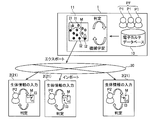
- the diagnosis support system 100 performs diagnosis (supports diagnosis) based on a pattern (learning model information M) included in the biological information of the patient group PF.
- the diagnosis support system 100 includes an electronic medical record database 10, a learning model generation unit 11, an electronic medical record database 20, and a determination unit 21.
- the electronic medical record database 10 and the learning model generation unit 11 are arranged, for example, in a facility 1 such as a large hospital where a relatively large number of patients visit.
- the electronic medical record database 20 and the determination unit 21 are arranged, for example, in a facility 2 such as a small hospital with few patients to visit.
- the electronic medical record database 10 and the learning model generation unit 11 are provided in the diagnosis support apparatus 100a.
- the learning model generation unit 11 and the determination unit 21 are configured by software (program).
- the electronic medical record database 10 is an example of the “storage unit” in the claims.
- biological information of the patient group PF is stored.
- the electronic medical record database 10 stores electronic medical record data in which identification information (name and the like) of each patient P1 included in the patient group PF and biological information of each patient P1 are described.
- the biological information of the patient group PF includes the presence or absence of liver cancer, HCV antibody, HBs antigen, age, sex, height, weight, albumin, total bilirubin, AST, ALT, ALP, GGT, platelets, AFP, L3 fraction, And DCP data.
- the HCV antibody is an index indicating that hepatitis C virus was once infected or is persistently infected.
- the HBs antigen is an index indicating that hepatitis B virus is present (infecting).
- Albumin is a numerical value for measuring the concentration of protein in serum, and it is possible to examine liver and kidney abnormalities based on a decrease in albumin.
- Total bilirubin is an indicator of the metabolic capacity of the liver.
- AST is an index for knowing how much damage has occurred mainly in the liver and heart.
- ALT is an index for knowing whether or not the liver is damaged.
- GGT is an index of liver function.
- AFP is an indicator of the presence or absence of liver cancer.
- the L3 fraction is a value indicating how much AFP-L3 is included in the AFP.
- DCP is an abnormal prothrombin with no coagulation activity synthesized in the liver, and is a tumor marker specific for hepatocellular carcinoma.
- the learning model generation unit 11 generates machine learning model information M, which is a pattern included in the biological information of the patient group PF, based on the biological information of the patient group PF stored in the electronic medical record database 10. It is configured. Specifically, in the first embodiment, the learning model generation unit 11 extracts the biological information of the individual patient P1 from the electronic medical record data stored in the electronic medical record database 10, and the extracted individual patient P1. The learning model information M is generated based on the biological information.
- the machine learning is to repeatedly learn the data to be a teacher (data whose determination result is known) and find a pattern hidden in the data to be the teacher.
- the teacher data is iteratively learned using various algorithms, so the computer is autonomous even if it does not explicitly program where the human should look for (part of the teacher data). Derive a pattern.
- a pattern found by machine learning is referred to as learning model information M.
- the electronic medical record data includes personal information such as the name of the patient P1.
- the electronic medical record data includes biometric information (presence / absence of liver cancer, HCV antibody, HBs antigen, age, sex, height, weight, albumin, total bilirubin, AST, ALT, ALP, GGT, platelets, AFP, L3 fraction, And DCP data).
- the learning model generation unit 11 uses the biometric information (presence / absence of liver cancer, HCV antibody, HBs antigen, age, sex, height, weight, albumin, total bilirubin, AST, ALT, ALP, GGT, platelet, AFP, L3 fraction, and DCP data) are extracted.
- the learning model generation unit 11 performs machine learning such as logistic regression for generating linear learning model information M and soft margin support vector machine, neural network, and random forest for generating nonlinear learning model information M. Using this, learning model information M is generated.
- the created learning model information M has data close to the numerical information subjected to statistical processing, and is data that does not include the personal information of the patient P1.
- a variable to be predicted is called a target variable (in the first embodiment, the presence or absence of liver cancer).
- a variable that affects the objective variable is referred to as an explanatory variable (biological information in the first embodiment).
- the relationship between the objective variable and the explanatory variable is expressed by a relational expression.
- Logistic regression uses the above relational expression to calculate a predicted value (predicted value of the presence or absence of liver cancer) and to determine the contribution of the explanatory variable used in the relational expression to the objective variable.
- the support vector machine is provided with teacher data (biological information in the first embodiment), some biological information (features) with liver cancer and some biological information (features) without liver cancer. Find the hyperplane that separates the quantity).
- the support vector machine searches for a hyperplane having a maximum margin among a plurality of hyperplanes separating biometric information.
- the margin means the minimum value of the distance between the hyperplane and each feature point, and a hyperplane that maximizes the margin is searched for.
- the method of searching for a hyperplane that completely separates the feature points with and without liver cancer is called a hard margin support vector machine, and the method of searching for the hyperplane to allow misjudgment of the presence or absence of liver cancer. Called soft margin support vector machine.
- Neural network is a mathematical model that expresses nerve cells (neurons) in the human brain and their connections.
- the neural network is composed of an input layer, an output layer, and a hidden layer. And between each phase, the weight which shows the strength of connection between neurons is provided. In the learning of the neural network, the weight is adjusted so that the presence or absence of liver cancer can be correctly determined in the output layer using data whose determination (presence or absence of liver cancer) is known.
- Random forest is an ensemble learning algorithm that integrates multiple decision trees.
- the decision tree is to find an explanatory variable that affects the objective variable and create a model in a tree shape.
- the learning model generation unit 11 discriminates the biological information of the patient P1 (patient group PF) who is liver cancer from the biological information of the patient P1 (patient group PF) who is not liver cancer.
- Information M is generated.
- the biological information (I1) located above the learning model information M is the biological information of the patient P1 who has liver cancer
- the biological information (I2) located below the learning model information M. ) Is the biological information of the patient P1 who does not have liver cancer.
- machine learning software application
- the learning model information M is composed of R language objects. This object does not include personal information of the patient P1.
- the diagnosis support apparatus 100a is configured to export the learning model information M generated by the learning model generation unit 11 from the learning model generation unit 11 via the external network 30. That is, the diagnosis support apparatus 100a is configured to output the learning model information M in a state that can be read by the determination unit 21.
- the determination unit 21 receives the learning model information M generated by the learning model generation unit 11 via the external network 30. And the determination part 21 is comprised based on the received learning model information M, and the presence or absence of the disease of the patient P2 which is not contained in the patient group PF is comprised.
- the learning model information M is configured to be exported from the learning model generation unit 11 via the external network 30 and imported to the determination unit 21.
- the electronic medical record database 20 of the facility 2 stores the electronic medical record data of the patient P2.
- the patient P2 is a patient P2 that is not included in the patient P1 (patient group PF) having the biological information used when the learning model information M is generated.
- the electronic medical record data of the patient P2 includes biological information (HCV antibody, HBs antigen, age, sex, height, weight, albumin, total bilirubin, AST, ALT stored in the electronic medical record database 10 of the facility 1 described above. , ALP, GGT, platelets, AFP, L3 fraction, and DCP data).
- the electronic medical record data of patient P2 does not include the presence or absence of liver cancer.
- the determination unit 21 is configured to determine the presence or absence of liver cancer of the patient P2 not included in the patient group PF based on the learning model information M received via the external network 30. Specifically, biological information included in the electronic medical record data of the patient P2 is input to the learning model information M. In FIG. 2, the presence or absence of liver cancer is determined based on whether the biological information (I3) of the patient P2 is classified above or below the learning model information M.
- learning model information was generated based on the biological information of 1584 patients who visited the hospital.
- Patient biometric information includes the presence or absence of liver cancer, HCV antibody, HBs antigen, age, sex, height, weight, albumin, total bilirubin, AST, ALT, ALP, GGT, platelets, AFP, L3 fraction, and DCP data It is.
- logistic regression, soft margin support vector machine, neural network, random forest, etc. were used as machine learning algorithms.
- cross-validation was performed to find the correct rate of machine learning. The cross-validation is to divide the biometric information of 1582 patients, generate learning model information from a part thereof, and obtain the correct answer rate in the remaining part.
- the correct answer rate was obtained in the vicinity of 80% or exceeding 80% in any of the machine learning algorithms. Accordingly, for example, by selecting a machine learning algorithm exceeding 80%, it is possible to determine the presence or absence of liver cancer using the learning model information M with relatively high accuracy.
- the diagnosis support system 100 receives the learning model information M generated by the learning model generation unit 11 via the external network 30, and based on the received learning model information M.
- the determination unit 21 determines whether or not there is a disease (liver cancer) of the patient P2 not included in the patient group PF.
- the learning model information M can be received via the external network 30 by the determination unit 21 installed in a small hospital or the like, so that it is difficult to obtain machine learning data (facility 2) or the like.
- the learning model information M generated by the learning model generation unit 11 includes statistical information that does not include personal information of the patient P1.
- the learning model information M is provided to the outside (small hospital etc.) via the external network 30, the personal information of the patient P1 is not leaked.
- the personal information of the patient P1 is not leaked to the outside (such as small hospitals), and machine learning results (learning model information M) Based on the above, it is possible to determine whether or not the patient P2 is ill.
- the learning model generation unit 11 extracts the biological information of the individual patient P1 from the electronic medical record data stored in the electronic medical record database 10 and extracts the extracted individual patient.
- Learning model information M is generated based on the biological information of P1.
- the learning model information M is generated based on only the biological information of each patient P1 extracted from the electronic medical record data without using the identification information of the patient P1, personal information of the patient P1 is leaked. Can be reliably prevented.
- the learning model information M is configured to be exported from the learning model generation unit 11 and imported to the determination unit 21 via the external network 30. . Thereby, even if the application of the learning model generation unit 11 and the application of the determination unit 21 are different, the learning model generation unit 11 outputs the learning model information M in a format that can be read by the application of the determination unit 21 (export) ), The learning model information M can be used in the determination unit 21.
- the biological information of the patient group PF includes the presence or absence of liver cancer, HCV antibody, HBs antigen, age, sex, height, weight, albumin, total bilirubin, AST, ALT, ALP
- the determination unit 21 includes data of GGT, platelets, AFP, L3 fraction, and DCP. Based on the learning model information M received via the external network 30, the determination unit 21 includes the patient P2 that is not included in the patient group PF. It is configured to determine the presence or absence of liver cancer. Thereby, as described for the above-described experiment, the presence or absence of liver cancer in the patient P2 can be determined with a relatively high correct answer rate (near 80% or a correct answer rate exceeding 80%).
- the learning model information M1 is generated based on the analysis information of the biological sample of the patient P1.
- the facility 1 is provided with an analysis apparatus 201 for analyzing a biological sample of the patient P1.
- the analyzer 201 is, for example, a mass spectrometer.
- the analyzer 201 is configured to identify a molecule that is a marker for the disease (liver cancer) of the patient P1, for example.
- the analyzed analysis information of the biological sample of the patient P1 is automatically associated (automatically linked) with the electronic medical record data.
- generation part 211 is the individual patient P1 linked
- the learning model information M1 is generated based on the analysis information of the biological sample. That is, the learning model information M1 reflects the biological information of the patient P1 and the analysis information of the biological sample, and in the machine learning of the learning model generation unit 211, compared with the first embodiment, The amount of information (feature amount) of the data becomes larger.
- the facility 2 is provided with an analyzer 201 for analyzing a biological sample of the patient P2.
- the analysis information of the biological sample of the patient P2 analyzed by the analyzer 201 is associated with the electronic medical record data of the patient P2.
- the determination unit 221 determines whether or not the patient P2 is not included in the patient group PF. Specifically, the biological information included in the electronic medical record data of the patient P2 and the analysis information associated with the electronic medical record data are applied (input) to the learning model information M1. Thereby, the presence or absence of liver cancer is determined.
- the learning model generation unit 211 includes the biometric information of each patient P1 extracted from the electronic medical record data stored in the electronic medical record database 10 and the individual associated with the electronic medical record data.
- Learning model information M1 is generated based on the analysis information of the biological sample of the patient P1.
- the learning model information M1 is generated based on the analysis information of the biological samples of the individual patients P1 in addition to the biological information of the individual patients P1, so that the presence or absence of the disease of the patient P2 is more accurately determined. be able to.
- the structure of the diagnostic assistance system 300 by 3rd Embodiment is demonstrated.
- the learning model information M is updated based on the biological information of the patient P2.
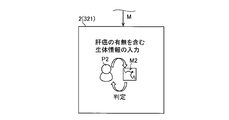
- the determination unit 321 of the diagnosis support system 300 includes a learning model update unit 322.
- the learning model update unit 322 is configured to update the learning model information M received via the external network 30 based on the biological information of the patient P2 whose presence or absence of the disease is not included in the patient group PF. ing.
- the learning model information M is generated by machine learning of all biological information of the patient group PF.
- the learning model update unit 322 updates the learning model information M only with the biological information of the patient P2 without using the biological information of the patient group PF, thereby generating the learning model information M2.
- the biological information of the patient P2 is reflected in the learning model information M2.
- the parameters of the learning model information M2 are updated based on the biological information of the patient P2.
- the learning model update unit 322 is an example of the “first learning model update unit” in the claims.
- the determination unit 321 receives the learning model received via the external network 30 based on the biological information of the patient P2 whose presence or absence of the disease is not included in the patient group PF.
- a learning model updating unit 322 that updates the information M is included.
- the diagnosis support system 400 is provided with a transmission unit 410.
- the transmission unit 410 is provided in the facility 2.
- the transmission unit 410 includes a learning model generation unit via the external network 30 with the biological information I3 of the patient P2 whose presence or absence of disease not included in the patient group PF is known, excluding the identification information of the patient P2. It is comprised so that it may transmit to 411.
- the biological information I3 of each patient P2 is extracted from the electronic medical record data stored in the electronic medical record database 20 of the facility 2. Note that identification information (personal information such as name) of the patient P2 is not extracted.
- the transmission unit 410 transmits the extracted biological information I3 of each patient P2 to the learning model generation unit 411.
- the learning model generation unit 411 includes a learning model update unit 412.
- the learning model update unit 412 is configured to update the learning model information M based on the biological information I3 of the patient P2 whose presence or absence of the disease is not included in the patient group PF.
- the learning model update unit 412 updates the learning model information M only with the biological information I3 of the patient P2 without using the biological information of the patient group PF.
- the biometric information I3 includes the presence or absence of liver cancer, HCV antibody, HBs antigen, age, sex, height, weight, albumin, total bilirubin, AST, ALT, ALP, GGT, platelets, AFP, L3 fraction, and DCP Contains data.
- the transmission unit 410 may periodically transmit the biological information I3 of the patient P2 to the learning model generation unit 11. Thereby, the learning model information M is regularly updated.
- the learning model update unit 412 is an example of the “second learning model update unit” in the claims.
- the biological information I3 of the patient P2 whose presence or absence of the disease that is not included in the patient group PF is known is removed via the external network 30 with the identification information of the patient P2 removed.
- a transmission unit 410 that transmits to the learning model generation unit 11 is provided.
- learning is performed by the learning model update unit 412 based on the biological information I3 of the patient P2 whose presence or absence of the disease is not included in the patient group PF transmitted from the outside (facility 2) via the external network 30.
- the quality (determination ability) of the model information M can be improved.
- the learning model information M with improved quality is received again by the plurality of facilities 2 via the external network 30, so that the quality is improved and shared by the plurality of facilities 2.
- the learning model information M it is possible to determine the presence or absence of illness of the patient (patient whose illness is unknown).
- the transmission unit 410 transmits the biological information I3 of the patient P2 to the learning model update unit 412 without the identification information of the patient P2, the identification information of the patient P2 leaks to the outside (facility 1 or the like). There is no.
- machine learning is performed on individual patient biometric information extracted from electronic medical record data
- the present invention is not limited to this.
- machine learning may be performed based on individual patient biometric information other than electronic medical record data.
- the present invention is not limited to this.
- the present invention is also applicable to determination of diseases other than liver cancer (for example, pancreatic cancer).
- the biological information of the patient group includes HCV antibody, HBs antigen, age, sex, height, weight, albumin, total bilirubin, AST, ALT, ALP, GGT, platelets, AFP,
- HCV antibody, HBs antigen, age, sex, height, weight, albumin, total bilirubin, AST, ALT, ALP, GGT, platelets, AFP Although an example in which all of the L3 fraction and DCP data are used has been shown, the present invention is not limited to this.
- HCV antibody, HBs antigen, age, sex, height, weight, albumin, total bilirubin, AST, ALT, ALP, GGT, platelet, AFP, L3 fraction, and DCP data Some of the data may be used.
- the second embodiment in which learning model information is generated based on the biological information extracted from the electronic medical record data and the analysis information of the biological sample, and the third and third cases in which the learning model information is updated.
- the fourth embodiment has been described as a separate embodiment, the configuration of the second embodiment, the configuration of the third embodiment, and the configuration of the fourth embodiment may be combined.
- examples using logistic regression, a soft margin support vector machine, a neural network, and a random forest are shown as machine learning algorithms.
- the present invention is not limited to this.
- a machine learning algorithm other than logistic regression, soft margin support vector machine, neural network, and random forest may be used as the machine learning algorithm.
Landscapes
- Engineering & Computer Science (AREA)
- Health & Medical Sciences (AREA)
- Medical Informatics (AREA)
- Public Health (AREA)
- Data Mining & Analysis (AREA)
- Biomedical Technology (AREA)
- General Health & Medical Sciences (AREA)
- Theoretical Computer Science (AREA)
- Physics & Mathematics (AREA)
- Primary Health Care (AREA)
- Epidemiology (AREA)
- Databases & Information Systems (AREA)
- Pathology (AREA)
- Software Systems (AREA)
- General Physics & Mathematics (AREA)
- Evolutionary Computation (AREA)
- General Engineering & Computer Science (AREA)
- Computing Systems (AREA)
- Mathematical Physics (AREA)
- Artificial Intelligence (AREA)
- Life Sciences & Earth Sciences (AREA)
- Computational Linguistics (AREA)
- Biophysics (AREA)
- Molecular Biology (AREA)
- Computer Vision & Pattern Recognition (AREA)
- Medical Treatment And Welfare Office Work (AREA)
- Measuring And Recording Apparatus For Diagnosis (AREA)
- Investigating Or Analysing Biological Materials (AREA)
Abstract
Description
図1および図2を参照して、第1実施形態による診断支援システム100の構成について説明する。
次に、患者の生体情報に基づく機械学習の実験について説明する。
第1実施形態では、以下のような効果を得ることができる。
図3を参照して、第2実施形態による診断支援システム200の構成について説明する。第2実施形態では、患者P1の生体サンプルの分析情報に基づいて、学習モデル情報M1を生成するように構成されている。
第2実施形態では、以下のような効果を得ることができる。
図4および図5を参照して、第3実施形態による診断支援システム300の構成について説明する。第3実施形態では、患者P2の生体情報に基づいて学習モデル情報Mを更新するように構成されている。
第3実施形態では、以下のような効果を得ることができる。
図6を参照して、第4実施形態による診断支援システム400の構成について説明する。第4実施形態では、患者P2の生体情報I3を送信する送信部410が設けられている。
第4実施形態では、以下のような効果を得ることができる。
なお、今回開示された実施形態は、すべての点で例示であって制限的なものではないと考えられるべきである。本発明の範囲は、上記した実施形態の説明ではなく特許請求の範囲によって示され、さらに特許請求の範囲と均等の意味および範囲内でのすべての変更(変形例)が含まれる。
11、211、411 学習モデル生成部
21、221、321 判定部
30 外部ネットワーク
100、200、300、400 診断支援システム
100a、200a 診断支援装置
322 学習モデル更新部(第1学習モデル更新部)
401 送信部
412 学習モデル更新部(第2学習モデル更新部)
M、M1、M2 学習モデル情報
P1、P2 患者
PF 患者群
Claims (10)
- 患者群の生体情報が記憶された記憶部と、
前記記憶部に記憶された前記患者群の前記生体情報に基づいて、前記患者群の前記生体情報に含まれるパターンである学習モデル情報を機械学習により生成する学習モデル生成部と、
前記学習モデル生成部により生成された前記学習モデル情報を、外部ネットワークを介して受け取るとともに、受け取った前記学習モデル情報に基づいて、前記患者群には含まれない患者の病気の有無を判定する判定部とを備える、診断支援システム。 - 前記記憶部には、前記患者群に含まれる個々の患者の識別情報と、前記個々の患者の前記生体情報とが記載された電子カルテデータが記憶されており、
前記学習モデル生成部は、前記記憶部に記憶された前記電子カルテデータから前記個々の患者の前記生体情報を抽出するとともに、抽出された前記個々の患者の前記生体情報に基づいて、前記学習モデル情報を生成するように構成されている、請求項1に記載の診断支援システム。 - 前記学習モデル生成部は、前記記憶部に記憶された前記電子カルテデータから抽出された前記個々の患者の前記生体情報と、前記電子カルテデータに関連付けられた前記個々の患者の生体サンプルの分析情報とに基づいて、前記学習モデル情報を生成するように構成されている、請求項2に記載の診断支援システム。
- 前記判定部は、前記患者群には含まれない病気の有無が既知である患者の前記生体情報に基づいて、前記外部ネットワークを介して受け取った前記学習モデル情報を更新する第1学習モデル更新部を含む、請求項1~3のいずれか1項に記載の診断支援システム。
- 前記患者群には含まれない病気の有無が既知である患者の前記生体情報を、前記患者の識別情報を除いた状態で、前記外部ネットワークを介して、前記学習モデル生成部に送信する送信部をさらに備え、
前記学習モデル生成部は、前記送信部から送信された前記生体情報に基づいて、前記学習モデル情報を更新する第2学習モデル更新部を含む、請求項1または2に記載の診断支援システム。 - 前記学習モデル情報は、前記外部ネットワークを介して、前記学習モデル生成部からエクスポートされるとともに、前記判定部にインポートされるように構成されている、請求項1または2に記載の診断支援システム。
- 前記患者群の前記生体情報は、肝癌の有無、HCV抗体、HBs抗原、年齢、性別、身長、体重、アルブミン、総ビリルビン、AST、ALT、ALP、GGT、血小板、AFP、L3分画、および、DCPのデータを含み、
前記判定部は、前記外部ネットワークを介して受け取った前記学習モデル情報に基づいて、前記患者群には含まれない患者の肝癌の有無を判定するように構成されている、請求項1または2に記載の診断支援システム。 - 患者群の生体情報が記憶された記憶部と、
前記記憶部に記憶された前記患者群の前記生体情報に基づいて、前記患者群の生体情報に含まれるパターンである学習モデル情報を機械学習により生成する学習モデル生成部とを備え、
前記学習モデル生成部により生成された前記学習モデル情報を、外部ネットワークを介して、外部にエクスポートするように構成されている、診断支援装置。 - 前記記憶部には、前記患者群に含まれる個々の患者の識別情報と、前記個々の患者の前記生体情報とが記載された電子カルテデータが記憶されており、
前記学習モデル生成部は、前記記憶部に記憶された前記電子カルテデータから前記個々の患者の前記生体情報を抽出するとともに、抽出された前記個々の患者の前記生体情報に基づいて、前記学習モデル情報を生成するように構成されている、請求項8に記載の診断支援装置。 - 前記学習モデル生成部は、前記記憶部に記憶された前記電子カルテデータから抽出された前記個々の患者の前記生体情報と、前記電子カルテデータに関連付けられた前記個々の患者の生体サンプルの分析情報とに基づいて、前記学習モデル情報を生成するように構成されている、請求項9に記載の診断支援装置。
Priority Applications (3)
| Application Number | Priority Date | Filing Date | Title |
|---|---|---|---|
| JP2020519521A JP7115693B2 (ja) | 2018-05-18 | 2019-04-15 | 診断支援システム、診断支援装置および診断支援方法 |
| CN201980033149.0A CN112136183B (zh) | 2018-05-18 | 2019-04-15 | 诊断辅助系统和诊断辅助装置 |
| US17/056,232 US20210217523A1 (en) | 2018-05-18 | 2019-04-15 | Diagnosis assistance system and diagnosis assistance device |
Applications Claiming Priority (2)
| Application Number | Priority Date | Filing Date | Title |
|---|---|---|---|
| JP2018096192 | 2018-05-18 | ||
| JP2018-096192 | 2018-05-18 |
Publications (1)
| Publication Number | Publication Date |
|---|---|
| WO2019220833A1 true WO2019220833A1 (ja) | 2019-11-21 |
Family
ID=68540145
Family Applications (1)
| Application Number | Title | Priority Date | Filing Date |
|---|---|---|---|
| PCT/JP2019/016122 Ceased WO2019220833A1 (ja) | 2018-05-18 | 2019-04-15 | 診断支援システムおよび診断支援装置 |
Country Status (4)
| Country | Link |
|---|---|
| US (1) | US20210217523A1 (ja) |
| JP (1) | JP7115693B2 (ja) |
| CN (1) | CN112136183B (ja) |
| WO (1) | WO2019220833A1 (ja) |
Cited By (6)
| Publication number | Priority date | Publication date | Assignee | Title |
|---|---|---|---|---|
| CN112712893A (zh) * | 2021-01-04 | 2021-04-27 | 山东众阳健康科技集团有限公司 | 一种提升计算机临床辅助诊断效果的方法 |
| JP2021149672A (ja) * | 2020-03-19 | 2021-09-27 | キヤノンメディカルシステムズ株式会社 | 情報処理装置、学習方法、およびプログラム |
| JP2021180361A (ja) * | 2020-05-11 | 2021-11-18 | キヤノン株式会社 | 情報処理装置とその制御方法、及びプログラム |
| JPWO2022025069A1 (ja) * | 2020-07-28 | 2022-02-03 | ||
| WO2022064708A1 (ja) * | 2020-09-28 | 2022-03-31 | 日本電気株式会社 | 診断支援装置、診断支援方法、及びコンピュータ読み取り可能な記録媒体 |
| JP7528555B2 (ja) | 2020-06-17 | 2024-08-06 | コニカミノルタ株式会社 | 医療診断支援装置、医療診断支援方法、およびプログラム |
Families Citing this family (1)
| Publication number | Priority date | Publication date | Assignee | Title |
|---|---|---|---|---|
| JP2024076442A (ja) * | 2022-11-25 | 2024-06-06 | 株式会社ジャパンディスプレイ | 報酬決定システム及び報酬決定方法 |
Citations (6)
| Publication number | Priority date | Publication date | Assignee | Title |
|---|---|---|---|---|
| JP2014135066A (ja) * | 2014-02-24 | 2014-07-24 | Canon Inc | 情報処理装置及びその制御方法、コンピュータプログラム |
| JP2015533437A (ja) * | 2012-10-19 | 2015-11-24 | アピシオ,インク. | 識別不能化および再識別を用いた医療情報解析のためのシステムおよび方法 |
| JP2016532459A (ja) * | 2013-07-31 | 2016-10-20 | コーニンクレッカ フィリップス エヌ ヴェKoninklijke Philips N.V. | 患者のケアを調整する医療用意思決定支援システム |
| JP2016534723A (ja) * | 2013-10-22 | 2016-11-10 | キム・ソンチョン | 生体分子と核酸の結合情報を生成するためのマーカー、その製造方法、並びにそれを用いた生体分子分析方法及び装置 |
| JP2017516411A (ja) * | 2014-10-21 | 2017-06-15 | アイアンネット・サイバーセキュリティ・インコーポレイテッドIronNet Cybersecurity, Inc. | サイバーセキュリティシステム |
| JP2018072029A (ja) * | 2016-10-25 | 2018-05-10 | ファナック株式会社 | 学習モデル構築装置、故障予測システム、学習モデル構築方法及び学習モデル構築プログラム |
Family Cites Families (8)
| Publication number | Priority date | Publication date | Assignee | Title |
|---|---|---|---|---|
| EP2605791B1 (en) * | 2010-08-17 | 2017-03-08 | Immuron Limited | Anti-lps enriched immunoglobulin preparation for use in treatment and/or prophylaxis of a pathologic disorder |
| US20150193583A1 (en) * | 2014-01-06 | 2015-07-09 | Cerner Innovation, Inc. | Decision Support From Disparate Clinical Sources |
| TW201621315A (zh) * | 2014-12-03 | 2016-06-16 | 拜歐迪希克斯公司 | 使用maldi-tof質譜分析以早期偵測高風險群中之肝細胞癌 |
| US11450437B2 (en) * | 2015-09-24 | 2022-09-20 | Tencent Technology (Shenzhen) Company Limited | Health management method, apparatus, and system |
| US20170277841A1 (en) * | 2016-03-23 | 2017-09-28 | HealthPals, Inc. | Self-learning clinical intelligence system based on biological information and medical data metrics |
| JP7042755B2 (ja) * | 2016-06-05 | 2022-03-28 | バーグ エルエルシー | 患者層別化及び潜在的バイオマーカー同定のためのシステム及び方法 |
| TW201812646A (zh) * | 2016-07-18 | 2018-04-01 | 美商南坦奧美克公司 | 分散式機器學習系統、分散式機器學習方法、以及產生代用資料之方法 |
| WO2019211089A1 (en) * | 2018-04-30 | 2019-11-07 | Koninklijke Philips N.V. | Adapting a machine learning model based on a second set of training data |
-
2019
- 2019-04-15 CN CN201980033149.0A patent/CN112136183B/zh active Active
- 2019-04-15 WO PCT/JP2019/016122 patent/WO2019220833A1/ja not_active Ceased
- 2019-04-15 JP JP2020519521A patent/JP7115693B2/ja active Active
- 2019-04-15 US US17/056,232 patent/US20210217523A1/en not_active Abandoned
Patent Citations (6)
| Publication number | Priority date | Publication date | Assignee | Title |
|---|---|---|---|---|
| JP2015533437A (ja) * | 2012-10-19 | 2015-11-24 | アピシオ,インク. | 識別不能化および再識別を用いた医療情報解析のためのシステムおよび方法 |
| JP2016532459A (ja) * | 2013-07-31 | 2016-10-20 | コーニンクレッカ フィリップス エヌ ヴェKoninklijke Philips N.V. | 患者のケアを調整する医療用意思決定支援システム |
| JP2016534723A (ja) * | 2013-10-22 | 2016-11-10 | キム・ソンチョン | 生体分子と核酸の結合情報を生成するためのマーカー、その製造方法、並びにそれを用いた生体分子分析方法及び装置 |
| JP2014135066A (ja) * | 2014-02-24 | 2014-07-24 | Canon Inc | 情報処理装置及びその制御方法、コンピュータプログラム |
| JP2017516411A (ja) * | 2014-10-21 | 2017-06-15 | アイアンネット・サイバーセキュリティ・インコーポレイテッドIronNet Cybersecurity, Inc. | サイバーセキュリティシステム |
| JP2018072029A (ja) * | 2016-10-25 | 2018-05-10 | ファナック株式会社 | 学習モデル構築装置、故障予測システム、学習モデル構築方法及び学習モデル構築プログラム |
Cited By (12)
| Publication number | Priority date | Publication date | Assignee | Title |
|---|---|---|---|---|
| JP2021149672A (ja) * | 2020-03-19 | 2021-09-27 | キヤノンメディカルシステムズ株式会社 | 情報処理装置、学習方法、およびプログラム |
| JP7638626B2 (ja) | 2020-03-19 | 2025-03-04 | キヤノンメディカルシステムズ株式会社 | 情報処理装置及びプログラム |
| JP2021180361A (ja) * | 2020-05-11 | 2021-11-18 | キヤノン株式会社 | 情報処理装置とその制御方法、及びプログラム |
| JP7511382B2 (ja) | 2020-05-11 | 2024-07-05 | キヤノン株式会社 | 情報処理装置とその制御方法、及びプログラム |
| JP7528555B2 (ja) | 2020-06-17 | 2024-08-06 | コニカミノルタ株式会社 | 医療診断支援装置、医療診断支援方法、およびプログラム |
| JPWO2022025069A1 (ja) * | 2020-07-28 | 2022-02-03 | ||
| WO2022025069A1 (ja) * | 2020-07-28 | 2022-02-03 | 株式会社シンクメディカル | 疾患リスク評価方法、疾患リスク評価装置、及び疾患リスク評価プログラム |
| JP7170368B2 (ja) | 2020-07-28 | 2022-11-14 | 株式会社シンクメディカル | 疾患リスク評価方法、疾患リスク評価装置、及び疾患リスク評価プログラム |
| WO2022064708A1 (ja) * | 2020-09-28 | 2022-03-31 | 日本電気株式会社 | 診断支援装置、診断支援方法、及びコンピュータ読み取り可能な記録媒体 |
| JPWO2022064708A1 (ja) * | 2020-09-28 | 2022-03-31 | ||
| JP7613473B2 (ja) | 2020-09-28 | 2025-01-15 | 日本電気株式会社 | 診断支援装置、診断支援方法、及びプログラム |
| CN112712893A (zh) * | 2021-01-04 | 2021-04-27 | 山东众阳健康科技集团有限公司 | 一种提升计算机临床辅助诊断效果的方法 |
Also Published As
| Publication number | Publication date |
|---|---|
| CN112136183B (zh) | 2025-03-14 |
| US20210217523A1 (en) | 2021-07-15 |
| CN112136183A (zh) | 2020-12-25 |
| JPWO2019220833A1 (ja) | 2021-04-08 |
| JP7115693B2 (ja) | 2022-08-09 |
Similar Documents
| Publication | Publication Date | Title |
|---|---|---|
| JP7115693B2 (ja) | 診断支援システム、診断支援装置および診断支援方法 | |
| Vinitha et al. | Disease prediction using machine learning over big data | |
| US11037070B2 (en) | Diagnostic test planning using machine learning techniques | |
| CN105868524B (zh) | 用于医学图像集的自动基准真值生成 | |
| Kadry et al. | Res-Unet based blood vessel segmentation and cardio vascular disease prediction using chronological chef-based optimization algorithm based deep residual network from retinal fundus images | |
| CN112183572B (zh) | 一种生成预测肺炎严重程度的预测模型的方法及装置 | |
| Jang et al. | Laterality classification of fundus images using interpretable deep neural network | |
| JPWO2019146357A1 (ja) | 医療画像処理装置、方法及びプログラム並びに診断支援装置、方法及びプログラム | |
| Cobb et al. | Seeing the forest beyond the trees: predicting survival in burn patients with machine learning | |
| CN118571495A (zh) | 内耳疾病诊断模型构建方法、系统、介质、产品及终端 | |
| Avci | An automatic diagnosis system for hepatitis diseases based on genetic wavelet kernel extreme learning machine | |
| Schlosser et al. | Visual acuity prediction on real-life patient data using a machine learning based multistage system | |
| CN112365976A (zh) | 一种基于迁移学习的复合病种临床路径构建方法及系统 | |
| EP4390960A1 (en) | Systems and methods for providing an updated machine learning algorithm | |
| Chudhey et al. | An autonomous dementia prediction method using various machine learning models | |
| CN119446560A (zh) | 基于向量计算与开源大模型集群的医疗决策方法与系统 | |
| Holland et al. | Clustering disease trajectories in contrastive feature space for biomarker proposal in age-related macular degeneration | |
| CN120148720A (zh) | 基于语义提取的快速建档方法及系统 | |
| Nieto et al. | Impact of leakage on data harmonization in machine learning pipelines in class imbalance across sites | |
| Yousef et al. | Heart disease prediction model using Naïve Bayes algorithm and machine learning techniques | |
| Guan et al. | Cost-sensitive meta-learning for progress prediction of subjective cognitive decline with brain structural MRI | |
| Shaik et al. | ML applications in healthcare | |
| Kumar et al. | A Framework for early recognition of Alzheimer’s using machine learning approaches | |
| Shen et al. | Exposing and Mitigating Calibration Biases and Demographic Unfairness in MLLM Few-Shot In-Context Learning for Medical Image Classification | |
| Zhang et al. | Prior-ssl: A thickness distribution prior and uncertainty guided semi-supervised learning method for choroidal segmentation in oct images |
Legal Events
| Date | Code | Title | Description |
|---|---|---|---|
| 121 | Ep: the epo has been informed by wipo that ep was designated in this application |
Ref document number: 19803224 Country of ref document: EP Kind code of ref document: A1 |
|
| ENP | Entry into the national phase |
Ref document number: 2020519521 Country of ref document: JP Kind code of ref document: A |
|
| NENP | Non-entry into the national phase |
Ref country code: DE |
|
| 122 | Ep: pct application non-entry in european phase |
Ref document number: 19803224 Country of ref document: EP Kind code of ref document: A1 |
|
| WWG | Wipo information: grant in national office |
Ref document number: 201980033149.0 Country of ref document: CN |