WO2019156140A1 - 画像処理装置、画像処理方法及び画像処理プログラム - Google Patents
画像処理装置、画像処理方法及び画像処理プログラム Download PDFInfo
- Publication number
- WO2019156140A1 WO2019156140A1 PCT/JP2019/004337 JP2019004337W WO2019156140A1 WO 2019156140 A1 WO2019156140 A1 WO 2019156140A1 JP 2019004337 W JP2019004337 W JP 2019004337W WO 2019156140 A1 WO2019156140 A1 WO 2019156140A1
- Authority
- WO
- WIPO (PCT)
- Prior art keywords
- image
- pixel
- image processing
- target pixel
- interest
- Prior art date
- Legal status (The legal status is an assumption and is not a legal conclusion. Google has not performed a legal analysis and makes no representation as to the accuracy of the status listed.)
- Ceased
Links
Images



Classifications
-
- G—PHYSICS
- G06—COMPUTING OR CALCULATING; COUNTING
- G06T—IMAGE DATA PROCESSING OR GENERATION, IN GENERAL
- G06T5/00—Image enhancement or restoration
- G06T5/70—Denoising; Smoothing
-
- G—PHYSICS
- G06—COMPUTING OR CALCULATING; COUNTING
- G06T—IMAGE DATA PROCESSING OR GENERATION, IN GENERAL
- G06T12/00—Tomographic reconstruction from projections
- G06T12/10—Image preprocessing, e.g. calibration, positioning of sources or scatter correction
-
- G—PHYSICS
- G06—COMPUTING OR CALCULATING; COUNTING
- G06T—IMAGE DATA PROCESSING OR GENERATION, IN GENERAL
- G06T5/00—Image enhancement or restoration
- G06T5/50—Image enhancement or restoration using two or more images, e.g. averaging or subtraction
-
- G—PHYSICS
- G06—COMPUTING OR CALCULATING; COUNTING
- G06T—IMAGE DATA PROCESSING OR GENERATION, IN GENERAL
- G06T7/00—Image analysis
- G06T7/0002—Inspection of images, e.g. flaw detection
- G06T7/0012—Biomedical image inspection
-
- H—ELECTRICITY
- H04—ELECTRIC COMMUNICATION TECHNIQUE
- H04N—PICTORIAL COMMUNICATION, e.g. TELEVISION
- H04N1/00—Scanning, transmission or reproduction of documents or the like, e.g. facsimile transmission; Details thereof
- H04N1/40—Picture signal circuits
- H04N1/409—Edge or detail enhancement; Noise or error suppression
-
- A—HUMAN NECESSITIES
- A61—MEDICAL OR VETERINARY SCIENCE; HYGIENE
- A61B—DIAGNOSIS; SURGERY; IDENTIFICATION
- A61B3/00—Apparatus for testing the eyes; Instruments for examining the eyes
- A61B3/0016—Operational features thereof
- A61B3/0025—Operational features thereof characterised by electronic signal processing, e.g. eye models
-
- A—HUMAN NECESSITIES
- A61—MEDICAL OR VETERINARY SCIENCE; HYGIENE
- A61B—DIAGNOSIS; SURGERY; IDENTIFICATION
- A61B3/00—Apparatus for testing the eyes; Instruments for examining the eyes
- A61B3/10—Objective types, i.e. instruments for examining the eyes independent of the patients' perceptions or reactions
- A61B3/102—Objective types, i.e. instruments for examining the eyes independent of the patients' perceptions or reactions for optical coherence tomography [OCT]
-
- A—HUMAN NECESSITIES
- A61—MEDICAL OR VETERINARY SCIENCE; HYGIENE
- A61B—DIAGNOSIS; SURGERY; IDENTIFICATION
- A61B3/00—Apparatus for testing the eyes; Instruments for examining the eyes
- A61B3/10—Objective types, i.e. instruments for examining the eyes independent of the patients' perceptions or reactions
- A61B3/12—Objective types, i.e. instruments for examining the eyes independent of the patients' perceptions or reactions for looking at the eye fundus, e.g. ophthalmoscopes
- A61B3/1225—Objective types, i.e. instruments for examining the eyes independent of the patients' perceptions or reactions for looking at the eye fundus, e.g. ophthalmoscopes using coherent radiation
-
- G—PHYSICS
- G06—COMPUTING OR CALCULATING; COUNTING
- G06T—IMAGE DATA PROCESSING OR GENERATION, IN GENERAL
- G06T2207/00—Indexing scheme for image analysis or image enhancement
- G06T2207/10—Image acquisition modality
- G06T2207/10072—Tomographic images
- G06T2207/10101—Optical tomography; Optical coherence tomography [OCT]
-
- G—PHYSICS
- G06—COMPUTING OR CALCULATING; COUNTING
- G06T—IMAGE DATA PROCESSING OR GENERATION, IN GENERAL
- G06T2207/00—Indexing scheme for image analysis or image enhancement
- G06T2207/20—Special algorithmic details
- G06T2207/20172—Image enhancement details
- G06T2207/20182—Noise reduction or smoothing in the temporal domain; Spatio-temporal filtering
-
- G—PHYSICS
- G06—COMPUTING OR CALCULATING; COUNTING
- G06T—IMAGE DATA PROCESSING OR GENERATION, IN GENERAL
- G06T2207/00—Indexing scheme for image analysis or image enhancement
- G06T2207/30—Subject of image; Context of image processing
- G06T2207/30004—Biomedical image processing
- G06T2207/30041—Eye; Retina; Ophthalmic
Definitions
- the present invention relates to an image processing apparatus, an image processing method, and an image processing program for processing an image including noise to generate an image with reduced noise.
- An image with a poor signal-to-noise ratio contains a lot of noise consisting of white points and black points. These noises can cause incorrect analysis / analysis results or increase the variation in the results obtained during image processing to analyze / analyze images to obtain some information. It becomes.
- S / N signal-to-noise ratio
- a structure to be considered as abnormal is very small, unclear, or narrow.
- the noise point is mistakenly extracted as the target structure of interest, or the noise component breaks down the structure of interest, so that the structure that was originally a single structure is divided into a plurality of structures. It may cause you to recognize it as a structure. Therefore, how to remove noise has become a very important issue in the process of image processing.
- the present invention has been made in view of the above points, and an image processing apparatus, an image processing method, and an image processing program capable of reducing noise in an image while maintaining the characteristics of a structure in the image.
- the purpose is to provide.
- the present invention includes an alignment unit that sequentially arranges a target pixel and a plurality of adjacent pixels located around the target pixel according to the magnitude of each luminance value, and the target Determining means for determining whether a pixel is in a predetermined range in the middle of the target pixel and the plurality of adjacent pixels arranged by the aligning means; and when the target pixel is not in the predetermined range,
- An image processing apparatus is provided that includes a replacement unit that replaces the luminance value of the pixel of interest based on the luminance value of a pixel in a predetermined range (Invention 1).
- the luminance value of the target pixel is not simply averaged using the luminance values of the peripheral pixels (adjacent pixels located around the target pixel), but the target pixel, the peripheral pixel, Are arranged in order of brightness value, and if the target pixel is included in the intermediate predetermined range, nothing is done, and if the target pixel is not included, attention is based on the luminance value of the pixel in the predetermined range. Since the luminance value of the pixel is replaced, only noise in the image can be removed. As a result, noise reduction processing can be performed without impairing features such as the shape, brightness, and color of characteristic structures present in the image.
- the predetermined range is set so as to include the same number of pixels before and after the pixel of interest and the pixel located at the center of the plurality of adjacent pixels arranged by the aligning unit. It is preferable (Invention 2).
- the replacement means replaces the luminance value of the pixel of interest with an average value of luminance values of pixels in the predetermined range (Invention 3).
- the image in which the image of interest exists is one tomographic image among a plurality of continuous tomographic images, and the plurality of adjacent pixels are the one tomographic image and its front and back It may be a plurality of adjacent pixels spatially located around the pixel of interest in the tomographic image (Invention 4).
- the present invention provides an alignment step of sequentially arranging a target pixel and a plurality of adjacent pixels located around the target pixel according to the magnitude of each luminance value, and the target pixel is aligned by the alignment unit.
- a replacement step of replacing the luminance value of the target pixel based on the value (Invention 5).
- the luminance value of the target pixel is not simply averaged using the luminance values of the peripheral pixels (adjacent pixels located around the target pixel), but the target pixel and the peripheral pixels Are arranged in order of brightness value, and if the target pixel is included in the intermediate predetermined range, nothing is done, and if the target pixel is not included, attention is based on the luminance value of the pixel in the predetermined range. Since the luminance value of the pixel is replaced, only noise in the image can be removed. As a result, noise reduction processing can be performed without impairing features such as the shape, brightness, and color of characteristic structures present in the image.
- the predetermined range is set so as to include the same number of pixels before and after the pixel of interest and the pixel located at the center of the plurality of adjacent pixels arranged by the aligning unit. It is preferable (Invention 6).
- the luminance value of the target pixel is replaced with an average value of luminance values of the pixels in the predetermined range (invention 7).
- the image having the image of interest is one tomographic image among a plurality of continuous tomographic images
- the plurality of adjacent pixels are the one tomographic image and tomographic images before and after the tomographic image.
- a plurality of adjacent pixels spatially positioned around the pixel of interest in the image may be used (invention 8).
- invention 8 the features of the structure of interest are not impaired even when consecutive tomographic images are handled, and the structures included in the preceding and following tomographic images are reflected in the tomographic image of interest after processing. Therefore, noise reduction processing can be performed.
- the present invention is for causing a computer to function as an image processing apparatus according to any one of inventions 1 to 4, or for causing a computer to execute the image processing method according to any one of inventions 5 to 8.
- An image processing program is provided (Invention 9).
- the image processing apparatus According to the image processing apparatus, the image processing method, and the image processing program of the present invention, it is possible to reduce noise in the image while maintaining the characteristics of the structure in the image.
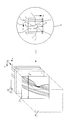
- FIG. 1 is a block diagram illustrating an overall configuration of an image processing apparatus according to an embodiment of the present invention. It is explanatory drawing which shows the state which acquires a fundus tomographic image by scanning a fundus. It is explanatory drawing which shows typically the relationship between the attention pixel and adjacent pixel in the case of processing a single image with the image processing apparatus which concerns on this embodiment. It is a flowchart which shows the flow of the image processing in this embodiment. It is explanatory drawing which shows typically a mode that the luminance value of a focused pixel is replaced by the image processing apparatus which concerns on this embodiment.
- FIG. 1 is a block diagram showing the entire system for acquiring and processing a tomographic image of the fundus of the eye to be examined.
- the tomographic imaging apparatus 10 is an apparatus (OCT: Optical Coherence Tomography) that captures a tomographic image of the fundus of the subject's eye and operates, for example, in the Fourier domain method. Since the tomographic imaging apparatus 10 is known, detailed description thereof is omitted, but the tomographic imaging apparatus 10 is provided with a low coherence light source, and light from the low coherence light source is divided into reference light and signal light.
- the signal light is raster scanned on the fundus oculi E, for example, in the X and Y directions.
- the signal light scanned and reflected by the fundus E is superimposed on the reference light reflected by the reference mirror to generate interference light, and an OCT signal indicating information in the depth direction (Z direction) of the fundus is generated based on the interference light.
- OCT Optical Coherence
- the image processing apparatus 20 includes a control unit 21 realized by a computer including a CPU, a RAM, a ROM, and the like, and the control unit 21 controls the entire image processing by executing an image processing program.
- the image processing apparatus 20 is provided with a tomographic image forming unit 22.
- the tomographic image forming unit 22 is realized by a dedicated electronic circuit that executes a known analysis method such as a Fourier domain method, or an image processing program executed by the CPU, and an OCT signal generated by the tomographic imaging apparatus 10. Based on the above, a tomographic image of the fundus of the eye to be examined is formed.
- the tomographic image B N is an image having a size of m ⁇ n pixels and is also called a B scan image. .
- the t pieces of tomographic images B N formed by the tomographic image forming unit 22 or the three-dimensional volume image constructed from these t pieces of tomographic images B N are, for example, a storage unit configured by a semiconductor memory, a hard disk device, or the like. 23.
- the storage unit 23 further stores the above-described image processing program and the like.
- the image processing device 20 is provided with an image processing unit 30.
- the image processing unit 30 includes an alignment unit 31, a determination unit 32, and a replacement unit 33.
- the alignment unit 31 sequentially arranges the target pixel in the image to be processed and a plurality of adjacent pixels located around the target pixel in accordance with the magnitude of each luminance value. Determines whether the target pixel is within a predetermined range between the target pixel and the plurality of adjacent pixels arranged by the aligning unit, and the replacement unit 33 determines whether the target pixel is not within the predetermined range.
- the luminance value of the pixel of interest is replaced based on the luminance value of the pixel in the range.
- Each means or each image processing in the image processing unit 30 is realized by using a dedicated electronic circuit or by executing an image processing program.
- the display unit 24 is configured by a display device such as an LCD, for example, and displays accompanying information such as a tomographic image stored in the storage unit 23, an image generated or processed by the image processing device 20, information about a subject, and the like. .
- the operation unit 25 includes, for example, a mouse, a keyboard, an operation pen, a pointer, an operation panel, and the like.
- the operation unit 25 is used to select an image displayed on the display unit 24 or to give an instruction to the image processing apparatus 20 or the like. It is done.
- a tomographic image of the fundus E of the eye to be examined is photographed by the tomographic imaging apparatus 10, and noise in the tomographic image of the eye fundus of the eye to be examined generated by the tomographic image forming unit 22 based on the photographed tomographic image is subjected to image processing.
- a flow of removal by image processing by the unit 30 will be described.
- the processing target image B T a piece of the resulting t tomographic image B N, describing the flow to remove noise from the single processing target image B T.
- the processing target image BT is an image having a size of m ⁇ n pixels, as shown in FIG. It shows a flow for removing noise from the processed image B T in FIG.
- S101 to S106 in FIG. 4 correspond to steps 101 to 106 in the description of the flow described below.
- FIG. 3 (B) showing the fourth column from the left of the target image B T, the pixel of interest P set in the third row from the top, eight relationship adjacent pixels p i located therearound.
- adjacent pixels is eight set in the case of setting the end portion of the pixel of interest P in the processing target image B T, if the pixel of interest P is set to the end in the processing target image B T
- the adjacent pixels may be appropriately set within 8 according to the position of the target pixel. For example the first column the pixel of interest from the left of the processing target image B T, when it is set in the third row from the top, as shown in FIG. 3 (C), on the pixel of interest P, down, right, right Five pixels located diagonally above and diagonally below right are set as adjacent pixels.
- pixels located above, below, left, and right of the target pixel may be set as adjacent pixels, In addition to eight pixels positioned so as to be in contact with the four corners of the pixel of interest, 24 pixels including 16 pixels positioned further outside are set as adjacent pixels. You may change suitably.
- the alignment means 31 After obtaining the luminance value D of the pixel of interest P and the luminance value d i of the adjacent pixel p i , the alignment means 31 performs the attention based on the luminance value D of the pixel of interest P and the luminance value d i of each adjacent pixel p i. arranging the pixel P and the neighboring pixel p i in the order according to the magnitude of the luminance value (step 103).
- the determination unit 32 determines whether or not the target pixel P is within a predetermined range in the middle between the target pixel P and the adjacent pixel p i aligned by the alignment unit 31 (step 104).
- the predetermined range is set to include the same number of pixels before and after the pixel located in the center of the target pixel P and the neighboring pixel p i obtained by arranging the alignment means 31.
- the luminance value D of the target pixel P is 35
- the luminance values d i of the adjacent pixels p i are 178, 187, 97, 141, 254, 209, 134 in this order.
- the target pixel P and the adjacent pixel p i are arranged from the left in order from the smallest luminance value
- the target pixel P, the adjacent pixel p 3 , the adjacent pixel p 7 , and the adjacent pixel p are arranged from the left. 4
- the adjacent pixels p 8 , the adjacent pixels p 1 , the adjacent pixels p 2 , the adjacent pixels p 6 , and the adjacent pixels p 5 are arranged in this order.
- the predetermined range a pixel located at the center of the target pixel P and the neighboring pixel p i lined by alignment means 31, that is, a total of five pixels including two pixels before and after from the adjacent pixel p 8 range
- the determination unit 32 determines that the target pixel P is not in the range W.
- the luminance value D of the target pixel P and the luminance value d 1 of the adjacent pixel p 1 are opposite to those in FIG.
- the luminance value d i adjacent pixels p i is assumed that a 35,187,97,141,254,209,134,157 sequentially, a target pixel P and the neighboring pixel p i of the luminance values
- Each pixel is arranged in the order of the adjacent pixel p 5 .
- the determination unit 32 determines that the target pixel P is in the range W.
- the replacement unit 33 calculates the average value of the five pixels in the range W (step 105). Then, an image in which the luminance value of the target pixel P is replaced with the calculated average value is generated (step 106) and stored in the storage unit 23. For example, in the example shown in FIG. 5A, the target pixel is outside the range W, and the average value of five pixels in the range W is 159. Therefore, the luminance value of the target pixel P is replaced with 159. An image is generated.
- the determination unit 32 determines that the target pixel P is in the range W, the luminance value of the target pixel P is left as it is without being replaced with the average value. For example, in the example shown in FIG. 5B, since the target pixel is in the range W, the luminance value of the target pixel P remains 178.
- the replacement unit 33 replaces the luminance value of the target pixel P with the average value of the luminance values of the five pixels in the predetermined range W.
- the present invention is not limited to this.
- the luminance value of the pixel of interest P is replaced with the luminance value of the pixel located at the center of the range W, or the center three pixels of the range W Or may be replaced based on the average value of.
- the present invention does not simply average the luminance value of the target pixel in the image to be processed using the luminance values of the neighboring pixels positioned around the target pixel, but the target pixel and the surrounding pixel.
- Arrange adjacent pixels in order of their luminance values do nothing if the pixel of interest is included in the intermediate predetermined range, and only if the pixel of interest is not included in the luminance value of the pixel in the predetermined range Based on this, the luminance value of the target pixel is replaced.
- noise reduction processing can be performed without impairing features such as the shape, brightness, and color of characteristic structures present in the image.
- the target pixel of interest is a noise consisting of a white point or a black point
- the target pixel has a luminance value that is significantly different from the luminance values of neighboring pixels located around it.
- a pixel having a shifted luminance value is positioned at an end in the arrangement if the target pixel and the adjacent pixel are arranged in order of the luminance value. Therefore, according to the present invention, if the target pixel is within the predetermined range, the target pixel is considered not to be noise.
- the luminance value of the target pixel is not replaced, and if the target pixel is not within the predetermined range, Since there is a high possibility of noise, only the noise in the image can be removed by replacing the luminance value of the target pixel with a luminance value that matches the surrounding tendency. As a result, noise reduction processing can be performed without impairing features such as the shape, brightness, and color of characteristic structures present in the image.
- one of the tomographic images B N acquired by the tomographic imaging apparatus 10 is used as the processing target image B T , but the fundus plane acquired by a scanning laser ophthalmoscope (SLO) is used. It is also possible to remove the noise by performing the same image processing as heretofore with the image as the processing target image.
- SLO scanning laser ophthalmoscope
- a tomographic image of t Like obtained from the place which is spatially continuous, as shown in FIG. 2 B N
- a method of setting a pixel of interest and an adjacent pixel using one of the images as a processing target image B T and using the tomographic image B T-1 and the tomographic image B T + 1 before and after the processing target image B T will be described.
- the tomographic image B T-1 and the tomographic image B T + 1 are tomographic images continuous to the processing target image B T in the y direction shown in FIG. 2, and have a size of m ⁇ n pixels as in the processing target image B T. It is an image that has.
- the tomographic imaging apparatus 10 and the image processing apparatus 20 used for image processing in this modification have the same configuration as described above, detailed description is omitted, but the tomographic image B T-1 and the processing target image B are omitted. Both T and tomographic image B T + 1 are stored in the storage unit 23.
- one pixel of interest in the processing target image B T is set as a target pixel Q, and the processing target image B T and the tomographic images B T-1 and B T + 1 before and after the processing target image B T are spatially
- the adjacent pixel q i in this modification example includes a total of eight pixels, that is, a pixel located at the top, bottom, left, and right of the target pixel Q in the processing target image B T and a pixel located so as to be in contact with the four corners of the target pixel.
- FIG. 6 shows a state in which only the target pixel Q and the adjacent pixel q i are cut out from the state in which the processing target image B T and the tomographic images B T ⁇ 1 and the tomographic image B T + 1 before and after the processing target image B T are arranged.
- adjacent pixels is 26 set in the case of setting the end portion of the pixel of interest Q in the processing target image B T, when the target pixel Q is set to end the process target image B T
- the adjacent pixels may be appropriately set within 26 in accordance with the position of the target pixel. Even when there are no continuous tomographic images before and after, adjacent pixels may be appropriately set within 26 according to the position of the target pixel.
- the method for setting adjacent pixels may be appropriately changed according to the type of image to be processed, the purpose of noise removal, and the like.
- Image processing flow is omitted because it is similar to the flow that removes noise from a single processed image B T.
- OCT angiography the front image of the (OCTA Optical Coherence Tomography Angiography) Retinal vascular generated using (En Face image) It is also possible to perform image processing on the image and remove noise from the image.
- the OCT angiography generates an angiographic image without using a fluorescent agent, and the same portion of the fundus E of the eye to be examined is continuously detected using the tomographic imaging apparatus 10 described in the above embodiment.
- a plurality of images are taken and a change in the acquired time difference tomographic image (B scan image) of several ms is regarded as a blood flow change to generate a front image.
- a known change detection method such as an OMAG (Optical Microangiography) method, an SSADA (Split-spectrum Amplitude-) is applied to a group of B scan images obtained by continuously capturing a plurality of identical portions of the fundus E of the eye to be examined.
- decorrelation (Angiography) method is applied to generate one blood flow tomographic image. This is repeated while changing the scan position in the y direction with respect to the observation target region, and one three-dimensional data set is generated from a plurality of continuous blood flow tomographic images obtained. That is, the three-dimensional data set is data in which the observation target region of the fundus E of the eye to be examined is three-dimensionally modeled.
- each B scan image constituting the B scan image group is a tomographic image on the xz plane in FIG. 2
- the blood flow tomographic image generated from the B scan image group is also a tomographic image on the xz plane.
- a blood flow tomographic image is generated as a tomographic image of a plurality of xy planes that are continuous in the z direction.
- a front image of the retinal blood vessel is generated by layering a plurality of blood flow tomographic images on the xy plane continuous in the z direction.
- the images are the tomographic image B T-1 and the tomographic image B T + 1
- the same image processing method as that described in the first modified example is applied to the front image of the retinal blood vessel generated by OCT angiography. And only noise in the front image can be removed.
- the pixels included in the tomographic images B T + 1 and B T ⁇ 1 before and after the processing target image B T are set as adjacent pixels.
- the pixels included in the preceding and following tomographic images B T + 1 and B T-1 are not set as the adjacent pixels, but the adjacent pixels are set only by the pixels included in the tomographic images B T, B T + 2, and B T-2.
- adjacent pixels may be set only from the two images of the tomographic image B T + 1 adjacent to one side of the processing target images B T and B T.
- the present invention can be used as a method for efficiently removing noise in image diagnosis using an image with a poor signal to noise ratio (S / N).
- S / N signal to noise ratio
- the shape and number of minute structures in an image with a poor S / N are not diagnosed.
- the present invention can be expected to be used as a powerful image noise removal method.
Landscapes
- Engineering & Computer Science (AREA)
- Physics & Mathematics (AREA)
- General Physics & Mathematics (AREA)
- Theoretical Computer Science (AREA)
- Computer Vision & Pattern Recognition (AREA)
- Health & Medical Sciences (AREA)
- General Health & Medical Sciences (AREA)
- Medical Informatics (AREA)
- Nuclear Medicine, Radiotherapy & Molecular Imaging (AREA)
- Radiology & Medical Imaging (AREA)
- Quality & Reliability (AREA)
- Signal Processing (AREA)
- Multimedia (AREA)
- Image Processing (AREA)
- Image Analysis (AREA)
- Eye Examination Apparatus (AREA)
Priority Applications (4)
| Application Number | Priority Date | Filing Date | Title |
|---|---|---|---|
| EP19750976.3A EP3751509A4 (en) | 2018-02-08 | 2019-02-07 | IMAGE PROCESSING DEVICE, IMAGE PROCESSING METHOD AND IMAGE PROCESSING PROGRAM |
| CN201980012345.XA CN111712851B (zh) | 2018-02-08 | 2019-02-07 | 图像处理装置、图像处理方法及图像处理程序 |
| US16/967,784 US20210042885A1 (en) | 2018-02-08 | 2019-02-07 | Image processing device, image processing method, and image processing program |
| JP2019570790A JP7284103B2 (ja) | 2018-02-08 | 2019-02-07 | 画像処理装置、画像処理方法及び画像処理プログラム |
Applications Claiming Priority (2)
| Application Number | Priority Date | Filing Date | Title |
|---|---|---|---|
| JP2018-021452 | 2018-02-08 | ||
| JP2018021452 | 2018-02-08 |
Publications (1)
| Publication Number | Publication Date |
|---|---|
| WO2019156140A1 true WO2019156140A1 (ja) | 2019-08-15 |
Family
ID=67548265
Family Applications (1)
| Application Number | Title | Priority Date | Filing Date |
|---|---|---|---|
| PCT/JP2019/004337 Ceased WO2019156140A1 (ja) | 2018-02-08 | 2019-02-07 | 画像処理装置、画像処理方法及び画像処理プログラム |
Country Status (5)
| Country | Link |
|---|---|
| US (1) | US20210042885A1 (https=) |
| EP (1) | EP3751509A4 (https=) |
| JP (1) | JP7284103B2 (https=) |
| CN (1) | CN111712851B (https=) |
| WO (1) | WO2019156140A1 (https=) |
Families Citing this family (2)
| Publication number | Priority date | Publication date | Assignee | Title |
|---|---|---|---|---|
| DE102018214325A1 (de) * | 2018-08-24 | 2020-02-27 | Siemens Healthcare Gmbh | Verfahren und Bereitstellungseinheit zum Bereitstellen eines virtuellen tomographischen Schlaganfall-Nachfolgeuntersuchungsbildes |
| DE102020122605B4 (de) | 2020-08-28 | 2025-04-24 | Abberior Instruments Gmbh | Verfahren, Bildverarbeitungseinheit und Laserscanningmikroskop zum hintergrundreduzierten Abbilden einer Struktur in einer Probe |
Citations (4)
| Publication number | Priority date | Publication date | Assignee | Title |
|---|---|---|---|---|
| JP2004166010A (ja) * | 2002-11-14 | 2004-06-10 | Matsushita Electric Ind Co Ltd | 画像ノイズ低減方法及び画像処理装置 |
| JP2011029704A (ja) * | 2009-07-21 | 2011-02-10 | Sony Corp | 画像処理装置、画像処理方法及び撮像装置 |
| JP2013197680A (ja) * | 2012-03-16 | 2013-09-30 | Fujitsu Ltd | 画像補正装置、画像補正方法及び画像補正用コンピュータプログラム |
| WO2014112611A1 (ja) | 2013-01-21 | 2014-07-24 | 興和株式会社 | 画像処理装置、画像処理方法、画像処理プログラム及びそのプログラムを格納した記録媒体 |
Family Cites Families (11)
| Publication number | Priority date | Publication date | Assignee | Title |
|---|---|---|---|---|
| US6847737B1 (en) * | 1998-03-13 | 2005-01-25 | University Of Houston System | Methods for performing DAF data filtering and padding |
| CN101107850B (zh) * | 2005-01-26 | 2012-05-30 | 皇家飞利浦电子股份有限公司 | 闪烁处理 |
| JP2007266956A (ja) * | 2006-03-28 | 2007-10-11 | Sony Corp | 撮像装置、インパルス成分検出回路、インパルス成分除去回路、インパルス成分検出方法、インパルス成分除去方法及びコンピュータプログラム |
| CN101697229B (zh) * | 2009-10-30 | 2012-06-13 | 宁波大学 | 一种医学图像的感兴趣区域提取方法 |
| CN102958450B (zh) * | 2010-08-31 | 2015-03-18 | 株式会社日立医疗器械 | 三维弹性图像生成方法以及超声波诊断装置 |
| CN102129673B (zh) * | 2011-04-19 | 2012-07-25 | 大连理工大学 | 一种随意光照下彩色数字图像增强和去噪方法 |
| JP2012235332A (ja) * | 2011-05-02 | 2012-11-29 | Sony Corp | 撮像装置、および撮像装置制御方法、並びにプログラム |
| CN102547338B (zh) * | 2011-12-05 | 2013-11-06 | 四川虹微技术有限公司 | 一种适用于3d电视的dibr系统 |
| CN103269412B (zh) * | 2013-04-19 | 2017-03-08 | 华为技术有限公司 | 一种视频图像的降噪方法及装置 |
| CN107067389B (zh) * | 2017-01-05 | 2019-09-17 | 佛山科学技术学院 | 一种图像篡改盲取证方法 |
| JP2017221741A (ja) * | 2017-08-28 | 2017-12-21 | キヤノン株式会社 | 画像生成装置、画像生成方法およびプログラム |
-
2019
- 2019-02-07 JP JP2019570790A patent/JP7284103B2/ja active Active
- 2019-02-07 WO PCT/JP2019/004337 patent/WO2019156140A1/ja not_active Ceased
- 2019-02-07 US US16/967,784 patent/US20210042885A1/en not_active Abandoned
- 2019-02-07 EP EP19750976.3A patent/EP3751509A4/en not_active Withdrawn
- 2019-02-07 CN CN201980012345.XA patent/CN111712851B/zh active Active
Patent Citations (4)
| Publication number | Priority date | Publication date | Assignee | Title |
|---|---|---|---|---|
| JP2004166010A (ja) * | 2002-11-14 | 2004-06-10 | Matsushita Electric Ind Co Ltd | 画像ノイズ低減方法及び画像処理装置 |
| JP2011029704A (ja) * | 2009-07-21 | 2011-02-10 | Sony Corp | 画像処理装置、画像処理方法及び撮像装置 |
| JP2013197680A (ja) * | 2012-03-16 | 2013-09-30 | Fujitsu Ltd | 画像補正装置、画像補正方法及び画像補正用コンピュータプログラム |
| WO2014112611A1 (ja) | 2013-01-21 | 2014-07-24 | 興和株式会社 | 画像処理装置、画像処理方法、画像処理プログラム及びそのプログラムを格納した記録媒体 |
Also Published As
| Publication number | Publication date |
|---|---|
| JPWO2019156140A1 (ja) | 2021-02-04 |
| EP3751509A4 (en) | 2021-11-10 |
| CN111712851B (zh) | 2023-08-29 |
| CN111712851A (zh) | 2020-09-25 |
| JP7284103B2 (ja) | 2023-05-30 |
| US20210042885A1 (en) | 2021-02-11 |
| EP3751509A1 (en) | 2020-12-16 |
Similar Documents
| Publication | Publication Date | Title |
|---|---|---|
| JP5025715B2 (ja) | 断層画像撮影装置、画像処理装置、画像処理システム、画像処理装置の制御方法及びプログラム | |
| US9320423B2 (en) | Image processing apparatus for detecting boundaries in tomographic image, method for image processing, image pickup system, and computer-readable storage medium | |
| JP6408916B2 (ja) | 画像処理装置、画像処理方法、画像処理プログラム及びそのプログラムを格納した記録媒体 | |
| US10102621B2 (en) | Apparatus, method, and program for processing image | |
| JP2015085198A (ja) | 医用画像における金属アーチファクト除去のための方法および装置 | |
| EP3081148A1 (en) | Image processing apparatus and method of operation of the same | |
| EP3453312B1 (en) | Image processing apparatus, image processing method, and program | |
| US20170202449A1 (en) | Image processing apparatus and control method of image processing apparatus | |
| JP7195745B2 (ja) | 画像処理装置、画像処理方法及びプログラム | |
| US20200226755A1 (en) | Image processing apparatus, ophthalmic imaging apparatus, image processing method, and computer-readable medium | |
| JP2017046976A (ja) | 眼科撮影装置及び眼科撮影プログラム | |
| JP2020039430A (ja) | 画像処理装置、画像処理方法及びプログラム | |
| EP3453313A1 (en) | Image processing apparatus, alignment method and program | |
| JP7284103B2 (ja) | 画像処理装置、画像処理方法及び画像処理プログラム | |
| US20220172358A1 (en) | IMAGE PROCESSING APPARATUS, IMAGE PROCESSING METHOD, AND RECORDING MEDIUM (as amended) | |
| WO2018074459A1 (ja) | 画像処理装置、画像処理方法及び画像処理プログラム | |
| JP7005382B2 (ja) | 情報処理装置、情報処理方法およびプログラム | |
| JP7297952B2 (ja) | 情報処理装置、情報処理方法およびプログラム | |
| JP7604160B2 (ja) | 画像処理装置、画像処理方法及びプログラム | |
| HK40037196A (en) | Image processing device, image processing method, and image processing program | |
| JP2018157841A (ja) | 画像処理装置、画像処理方法、及び画像処理プログラム | |
| WO2019156139A1 (ja) | 画像処理装置、画像処理方法及び画像処理プログラム | |
| JPWO2015129718A1 (ja) | 画像処理装置、画像処理方法、及び画像処理プログラム | |
| JP7646321B2 (ja) | 画像処理装置、画像処理方法及びプログラム | |
| WO2017030057A1 (ja) | 画像処理装置、画像処理方法、及び画像処理プログラム |
Legal Events
| Date | Code | Title | Description |
|---|---|---|---|
| 121 | Ep: the epo has been informed by wipo that ep was designated in this application |
Ref document number: 19750976 Country of ref document: EP Kind code of ref document: A1 |
|
| ENP | Entry into the national phase |
Ref document number: 2019570790 Country of ref document: JP Kind code of ref document: A |
|
| NENP | Non-entry into the national phase |
Ref country code: DE |
|
| ENP | Entry into the national phase |
Ref document number: 2019750976 Country of ref document: EP Effective date: 20200908 |