WO2019131502A1 - 脂質の生産方法 - Google Patents
脂質の生産方法 Download PDFInfo
- Publication number
- WO2019131502A1 WO2019131502A1 PCT/JP2018/047230 JP2018047230W WO2019131502A1 WO 2019131502 A1 WO2019131502 A1 WO 2019131502A1 JP 2018047230 W JP2018047230 W JP 2018047230W WO 2019131502 A1 WO2019131502 A1 WO 2019131502A1
- Authority
- WO
- WIPO (PCT)
- Prior art keywords
- acetic acid
- microorganism
- producing
- culture
- lipid
- Prior art date
- Legal status (The legal status is an assumption and is not a legal conclusion. Google has not performed a legal analysis and makes no representation as to the accuracy of the status listed.)
- Ceased
Links
Images


Classifications
-
- C—CHEMISTRY; METALLURGY
- C12—BIOCHEMISTRY; BEER; SPIRITS; WINE; VINEGAR; MICROBIOLOGY; ENZYMOLOGY; MUTATION OR GENETIC ENGINEERING
- C12P—FERMENTATION OR ENZYME-USING PROCESSES TO SYNTHESISE A DESIRED CHEMICAL COMPOUND OR COMPOSITION OR TO SEPARATE OPTICAL ISOMERS FROM A RACEMIC MIXTURE
- C12P7/00—Preparation of oxygen-containing organic compounds
- C12P7/64—Fats; Fatty oils; Ester-type waxes; Higher fatty acids, i.e. having at least seven carbon atoms in an unbroken chain bound to a carboxyl group; Oxidised oils or fats
- C12P7/6409—Fatty acids
- C12P7/6427—Polyunsaturated fatty acids [PUFA], i.e. having two or more double bonds in their backbone
-
- C—CHEMISTRY; METALLURGY
- C12—BIOCHEMISTRY; BEER; SPIRITS; WINE; VINEGAR; MICROBIOLOGY; ENZYMOLOGY; MUTATION OR GENETIC ENGINEERING
- C12P—FERMENTATION OR ENZYME-USING PROCESSES TO SYNTHESISE A DESIRED CHEMICAL COMPOUND OR COMPOSITION OR TO SEPARATE OPTICAL ISOMERS FROM A RACEMIC MIXTURE
- C12P7/00—Preparation of oxygen-containing organic compounds
- C12P7/64—Fats; Fatty oils; Ester-type waxes; Higher fatty acids, i.e. having at least seven carbon atoms in an unbroken chain bound to a carboxyl group; Oxidised oils or fats
-
- C—CHEMISTRY; METALLURGY
- C12—BIOCHEMISTRY; BEER; SPIRITS; WINE; VINEGAR; MICROBIOLOGY; ENZYMOLOGY; MUTATION OR GENETIC ENGINEERING
- C12P—FERMENTATION OR ENZYME-USING PROCESSES TO SYNTHESISE A DESIRED CHEMICAL COMPOUND OR COMPOSITION OR TO SEPARATE OPTICAL ISOMERS FROM A RACEMIC MIXTURE
- C12P7/00—Preparation of oxygen-containing organic compounds
- C12P7/64—Fats; Fatty oils; Ester-type waxes; Higher fatty acids, i.e. having at least seven carbon atoms in an unbroken chain bound to a carboxyl group; Oxidised oils or fats
- C12P7/6436—Fatty acid esters
- C12P7/6445—Glycerides
- C12P7/6463—Glycerides obtained from glyceride producing microorganisms, e.g. single cell oil
-
- C—CHEMISTRY; METALLURGY
- C12—BIOCHEMISTRY; BEER; SPIRITS; WINE; VINEGAR; MICROBIOLOGY; ENZYMOLOGY; MUTATION OR GENETIC ENGINEERING
- C12P—FERMENTATION OR ENZYME-USING PROCESSES TO SYNTHESISE A DESIRED CHEMICAL COMPOUND OR COMPOSITION OR TO SEPARATE OPTICAL ISOMERS FROM A RACEMIC MIXTURE
- C12P7/00—Preparation of oxygen-containing organic compounds
- C12P7/64—Fats; Fatty oils; Ester-type waxes; Higher fatty acids, i.e. having at least seven carbon atoms in an unbroken chain bound to a carboxyl group; Oxidised oils or fats
- C12P7/6436—Fatty acid esters
- C12P7/6445—Glycerides
- C12P7/6472—Glycerides containing polyunsaturated fatty acid [PUFA] residues, i.e. having two or more double bonds in their backbone
-
- C—CHEMISTRY; METALLURGY
- C12—BIOCHEMISTRY; BEER; SPIRITS; WINE; VINEGAR; MICROBIOLOGY; ENZYMOLOGY; MUTATION OR GENETIC ENGINEERING
- C12N—MICROORGANISMS OR ENZYMES; COMPOSITIONS THEREOF; PROPAGATING, PRESERVING, OR MAINTAINING MICROORGANISMS; MUTATION OR GENETIC ENGINEERING; CULTURE MEDIA
- C12N1/00—Microorganisms; Compositions thereof; Processes of propagating, maintaining or preserving microorganisms or compositions thereof; Processes of preparing or isolating a composition containing a microorganism; Culture media therefor
- C12N1/12—Unicellular algae; Culture media therefor
Definitions
- the present invention relates to a method for producing a lipid using a Labyrinthula aurantiochytrium microorganism.
- Labyrinthula aurantiochytrium microbes are expected as industrial microbes applicable to various industries because they have properties of producing remarkable amounts of various hydrocarbons in addition to polyunsaturated fatty acids and carotenoids.
- the heterotrophic microorganisms such as Aurantiochytrium microorganisms are efficiently cultured on the heterotrophic microorganisms by stepwise culturing them using two types of media having different contents of nitrogen and carbon. It is described that it can produce fats and oils well and can produce fats and oils in a large amount in a short time.
- heterotrophic microorganisms such as Auranthiochytrium microorganisms are cultured in a stepwise manner using two types of media having different contents of saccharides and glycerol, thereby achieving a large amount of in a short time. It is described that oil and fat can be produced.
- Japanese Patent Publication Japanese Unexamined Patent Publication No. 2013-126404 (published on June 27, 2013)
- Japanese patent publication Japanese Patent Application Laid-Open No. 2013-183687 (Sep. 19, 2013)
- carbohydrates are mainly used as a carbon source in lipid production such as fats and oils by aurantiochytrium microbes, and the raw material cost due to the supply of the carbohydrates is a problem.
- green algae capable of producing similar lipids such as fat and oil autonomously produce carbohydrates by photosynthesis but their growth rate is generally low due to conditions of light irradiation or equipment restrictions, and as a result, production of lipids Low efficiency.
- one aspect of the present invention aims to achieve both reduction in raw material cost and high-efficient production of lipids in lipid production such as fats and oils by Aurantiochytrium microbes.
- Another object of the present invention is to provide a novel lipid production technology that can contribute to environmental conservation and a low carbon society by using unused biomass, exhaust gas, and the like as raw materials.
- the method for producing a lipid of the present invention is characterized in that it comprises a culture step of culturing the Aurantiochytrium microorganism in a medium containing acetic acid.
- the acetic acid concentration in the above-mentioned medium is preferably 10 g / L or more.
- the acetic acid may be acetic acid produced by an acetic acid-producing bacterium.
- an acetic acid producing bacterium culture step of culturing an acetic acid producing bacterium in a culture medium may be further included prior to the culture step.
- the above-mentioned acetic acid-producing bacteria are preferably anaerobic microorganisms.
- an alunch is produced in an acetic acid-producing bacterial culture step of culturing an anaerobic acetic acid-producing bacterium in a culture medium under anaerobic conditions, and in a medium containing acetic acid after the above acetic acid-producing bacterial culture step. It is preferable to include a culture step of culturing an Ochrium microorganism.
- the above-mentioned acetic acid-producing bacteria is a microorganism of the genus Morella (Moorella), a microorganism of the genus Clostridium (Clostridium), a microorganism of the genus Acetobacterium (Acetobacterium), a microorganism of the genus Blautia, Eubacteria It is preferable that it is any one or more selected from the group consisting of a microorganism belonging to the genus Eubacterium and a microorganism belonging to the genus Sporomusa.
- the culture of the acetic acid-producing bacteria in the above-mentioned acetic acid-producing bacteria culture step is preferably performed in an anaerobic atmosphere containing carbon dioxide.
- lipids such as fats and oils by Aurangthiochytrium microorganisms
- highly efficient production of lipids can be performed by using acetic acid as a raw material.
- acetic acid produced from raw materials such as unused biomass and exhaust gas for the lipid production method of the present invention, it is possible to reduce the cost of lipid production while contributing to environmental conservation and a low carbon society can do.
- (A) is a graph which shows the dry-cell body quantity of the Oranthiochytrium microorganism strain
- (b) is a graph which shows the composition and the production amount of the fatty acid which the Oranthiochytrium microorganism produced. It is a graph which shows the dry-cell body amount and fatty-acid production amount of aurantiochytrium microbe by two-step fermentation of an acetobacterium genus microbe and auranthiochytrium microbe. It is a graph which shows the fatty acid content rate (total fatty acid / dry cell amount) by two-step fermentation of an acetobacterium genus microorganism and an aurantiochytrium microorganism.
- Embodiment 1 A method for producing a lipid according to an aspect of the present invention (hereinafter referred to as "the production method of the present invention") is characterized by comprising a culture step of culturing alanthiochytrium microorganism in a medium containing acetic acid. .
- lipid as used herein means a lipid that can be produced by Aurantiochytrium microorganisms.
- lipids that can be produced by Aurantiochytrium microorganisms include saturated fatty acids such as myristic acid, pentadecanoic acid, palmitic acid, heptadecanoic acid, stearic acid; docosahexaenoic acid, docosapentaenoic acid, eicosapentaenoic acid, oleic acid, Unsaturated fatty acids such as linoleic acid, ⁇ -linolenic acid, ⁇ -linolenic acid, dihomo- ⁇ -linolenic acid; Astaxanthin, phenicoxanthin, canthaxanthin, equinenone, ⁇ -carotene, carotenoids such as lycopene; squalene, sterol, etc.
- the microorganism of the genus Orangiochytrium is cultured in a medium containing acetic acid. It will not be limited especially if it is a microorganism classified into Labyrinthula aurantithiochytrium (Aurantiochytrium) genus as the above-mentioned "Aurantiochytrium microorganism".
- Aurantiochytrium microorganism For example, Aurantiochytrium sp. SR21, Aurantiochytrium sp. KH105 (reception number: FERM AP-22267) etc. can be mentioned.
- said "Orranthiochytrium microbe” is also called "Schizochytrium microbe".
- the culture medium used in the above-mentioned culture step is a culture medium in which the Aurantiochytrium microorganism can grow, and contains acetic acid.
- the above-mentioned culture medium is not particularly limited, but is preferably a liquid culture medium because it is suitable for mass culture and that culture conditions can be easily controlled.
- the concentration of acetic acid contained in the culture medium is preferably 1 g / L or more, more preferably 5 g / L or more, and still more preferably 10 g / L or more.
- the Aurantiochytrium microorganism can efficiently produce a lipid.
- the upper limit of the acetic acid concentration is not particularly limited as long as it is a concentration at which the Aurantiochytrium microorganism can grow and can produce a lipid, but preferably 40 g / L or less, for example, 35 g / L. It is preferably L or less, more preferably 30 g / L or less.
- acetic acid commercially available ones may be used, or acetic acid produced using an acetic acid-producing bacterium may be used.
- an acetic acid-producing bacterium means a microorganism capable of fermentatively producing acetic acid.
- the above-mentioned acetic acid-producing bacteria may be either an anaerobic microorganism or an aerobic microorganism, and it is not particularly limited.
- a microorganism of the genus Morella a microorganism of the genus Clostridium
- a microorganism of the genus Acetobacterium a microorganism of the genus Blautia
- a eubacteria Anaerobic microbes such as Ummus microbes and Sporomyces microbes are preferred.
- Acetobacterium microbes which are aerobic microorganisms and Gluconacetobacter microbes etc. exist as acetic acid-producing bacteria, but aerobic acetic acid-producing bacteria can not produce acetic acid from hydrogen and carbon dioxide.
- aerobic acetic acid-producing bacteria can not produce acetic acid from hydrogen and carbon dioxide.
- it is an anaerobic acetic acid producing bacterium, it is possible to produce acetic acid from hydrogen and carbon dioxide, and it is possible to reduce the raw material cost associated with the supply of a carbon source.
- Morella Morella
- Morella microorganism examples include Moorella thermoacetica, Moorella thermoautotrophica and the like.
- Clostridium microorganism is not particularly limited as long as it is an acetic acid-producing bacterium belonging to the genus Clostridium thermoaceticum.
- Examples of the Clostridium microorganism include Clostridium thermoaceticum, Clostridium aceticum, Clostridium cellulolyticum, Clostridium ljungdahlii and the like.
- Acetobacterium an acetic acid producing microbe which belongs to Acetobacterium (Acetobacterium) as a microorganism which belongs to said Acetobacter microorganism.
- Acetobacter microorganism examples include Acetobacterium woodii, Acetobacterium dehalogenans and the like.
- the above-mentioned Blautia microorganism is not particularly limited as long as it is an acetic acid-producing bacterium belonging to Blautia.
- Examples of the above-mentioned Blautia microbes include Blautia hydrogenotrophica, Blautia producta, and the like.
- the above-mentioned Eubacteria is not particularly limited as long as it is an acetic acid-producing bacterium belonging to the genus Eubacterium.
- Examples of the above-mentioned Eubacterium microorganism include Eubacterium aggregans, Eubacterium limosum and the like.
- Sporommus Sporomusa
- Sporomomas genus microorganisms examples include Sporomusa acidovorans, Sporomusa malonica and the like.
- the microorganism belonging to the Acetobacter microorganism is not particularly limited as long as it is an acetic acid-producing microorganism belonging to Acetobacter.
- Examples of the Acetobacter microorganism include Acetobacter aceti, Acetobacter pasteurianus, Acetobacter xylinus and the like.
- the microorganism belonging to the above Gluconacetobacter microorganism is not particularly limited as long as it is an acetic acid producing bacterium belonging to Gluconacetobacter.
- Examples of the above-mentioned Gluconacetobacter microorganism include Gluconacetobacter xylinus, Gluconacetobacter liquefaciens and the like.
- any one of the above-mentioned acetic acid-producing bacteria may be used, or a plurality of them may be used in combination.
- the culture solution after cultivation of the above-mentioned acetic acid-producing bacteria is used as it is.
- the culture solution may be used as a medium of (1), or acetic acid purified from a culture solution after culture of an acetic acid-producing bacterium may be used.
- the components contained in the above medium may include a carbon source, a nitrogen source and sodium chloride necessary for the growth of Aurantiochytrium microorganisms.
- acetic acid is contained in the medium as a carbon source, but in the production method of the present invention, other carbon sources other than acetic acid may be contained.
- the above-mentioned "other carbon source” is not particularly limited as long as it is capable of assimilating the microorganism of the genus Oranthiochytrium.
- carbohydrates monosaccharides, oligosaccharides, polysaccharides, sugar alcohols, etc.
- organic acids alcohols And lipids, etc.
- As another carbon source only one type may be used, or a plurality of types may be used in combination.
- nitrogen source is not particularly limited as long as it can be utilized by aurantiochytrium microorganism, for example, nitrogen-containing compounds such as polypeptone, yeast extract, peptone, soybean flour, corn steep liquor and the like; ammonium sulfate And ammonium salts of inorganic acids such as ammonium nitrate and ammonium phosphate or organic acids, and the like.
- nitrogen source only one type may be used, or a plurality of types may be used in combination.
- the concentration of the nitrogen source added to the culture medium is preferably 1 to 50 g / L, more preferably 5 to 20 g / L. If the nitrogen source concentration in the culture medium is in the above range, the Aurantiochytrium microorganism can be grown well. When a plurality of types of nitrogen sources are used in combination, the nitrogen source may be added to the culture medium so that the total concentration of the plurality of types of nitrogen sources is in the above range.
- Sodium chloride is contained in the above-mentioned culture medium in order for the above-mentioned Aurantiochytrium microorganism which is a marine eukaryotic microorganism to stably grow in the above-mentioned culture medium.
- the concentration of sodium chloride that can be contained in the above medium is preferably 0.5 to 4% (w / v), and more preferably 1.5 to 3% (w / v).
- the Auranthiochytrium microorganism can be suitably grown.
- seawater other than sodium is also included in the seawater in which the Auranthiochytrium microorganism naturally grows
- seawater including artificial seawater
- seawater may be used as a source of sodium chloride.
- seawater may be used in such a manner that the concentration of sodium chloride falls within the above-mentioned preferred range.
- the medium may contain other components other than the carbon source and the nitrogen source.
- the above-mentioned “other components” are not particularly limited as long as they are generally used for culturing a microorganism, and examples thereof include inorganic salts, coenzymes such as vitamins, dyes and the like.
- concentration of the above-mentioned “other components” in the culture medium can be set appropriately.
- the medium becomes acidic if it is not adjusted.
- the pH of the culture medium is preferably adjusted with sodium hydroxide or the like so as to fall within the above range.
- the temperature during culture is preferably 20 ° C. to 40 ° C., More preferably, the temperature is 25 to 35 ° C.
- the culture step in the production method of the present invention is carried out under aerobic conditions.
- a known culture apparatus such as a jar fermenter can be suitably used for the culture in the culture step.
- the operating conditions (temperature, aeration amount, pH, stirring speed, etc.) of the culture apparatus such as the jar fermenter may be appropriately set according to the culture scale and the growth state of the Auranthochytrium microorganism.
- an acetic acid-producing bacterium is cultured in a culture medium prior to the above-mentioned culturing step, and an acetic acid-producing bacterium culturing step, and a lipid recovery for recovering the lipid accumulated in Auranthiochytrium microorganisms after the culturing step Process, lipid purification process to purify lipid recovered by lipid recovery process, substance conversion process to convert obtained lipid to other substance, pre-culture process to pre-culture various microorganisms before main culture, etc. Any one or more steps may be included as appropriate.
- the lipid recovery step, lipid purification step, and substance conversion step are described below.
- the produced lipid may be taken out of the cell of Oranthiochytrium microorganism, and (b) the produced lipid may be Orangthiochytrium microorganism. It may be recovered in the state of being accumulated in the cells of
- the method of recovering the lipid is not particularly limited as long as the lipid can be removed from the extracellular part of the Aurantiochytrium microorganism.
- chloroform / methanol mixture (2: 1, v / v)
- t-butyl methyl ether / methanol / water 2: 1: 0.5, v / v
- carotenoids can be extracted from Aurantiochytrium microorganisms.
- squalene can be extracted from Alanthiochytrium microorganisms by using hexane or a mixture of chloroform / methanol (2: 1, v / v).
- the recovery method is not particularly limited as long as high value added lipid can be recovered in a state where it is accumulated in the cells of Alanthiochytrium microorganism.
- high-added-value lipid-containing bacterial cells can be recovered by discarding the culture supernatant by centrifuging, filtering, etc., the culture solution in which the Aurantiochytrium microorganism is cultured.
- the method for purifying the lipid in the lipid purification step is not particularly limited.
- the lipid can be purified by methods such as solvent fractionation, supercritical fluid extraction, adsorption chromatography and the like.
- the conversion step is a step of converting the obtained lipid into another substance, but for example, the obtained triacylglycerol or isoprenoid hydrocarbon is converted into jet fuel using a known method May be Alternatively, the obtained triacylglycerol may be converted into diesel fuel using a known method. In addition, the obtained isoprenoid hydrocarbon may be converted to a chemical material using a known method.
- the method for producing a lipid according to an aspect of the present invention may further include an acetic acid producing bacterium culture step of culturing an acetic acid producing bacterium in a culture medium before the culture step. That is, the production method of the present invention may be a two-step fermentation including an acetic acid-producing bacterial culture step and a culture step of culturing the above Aurantiochytrium microorganism.
- the method of producing a lipid which contributes to the reduction of the cost involved in supplying the carbon source used for the production of lipid and the realization of environmental preservation by the two-step fermentation of the above-mentioned culture step and the above-mentioned acetic acid producing bacteria culture step. realizable.
- the description of Embodiment 1 is incorporated into the description common to the present embodiment and [Embodiment 1].
- the culture medium for acetic acid-producing bacteria culture used in the above-mentioned acetic acid-producing bacteria culture step is not particularly limited as long as it is a culture medium in which the acetic acid-producing bacteria can grow, and carbon sources, nitrogen sources and other components may be included.
- the description of [Embodiment 1] can be incorporated for the carbon source, the nitrogen source, and the other components.
- acetic acid-producing bacteria belonging to anaerobic microorganisms are used in the acetic acid-producing bacteria culture step, since acetic acid can be produced using carbon dioxide as a carbon source, carbon sources such as carbohydrates other than carbon dioxide are contained in the medium. It does not have to be included.
- a liquid culture medium is preferable because it is suitable for a large-scale culture medium and that culture conditions can be easily controlled.
- an anaerobic microorganism When using an anaerobic microorganism as an acetic acid-producing bacterium, culture (anaerobic culture) must be performed under anaerobic conditions.
- an anaerobic gas such as nitrogen or carbon dioxide other than oxygen is generally supplied under a culture atmosphere to achieve an anaerobic atmosphere.
- it is preferable to achieve an anaerobic atmosphere in particular, by aerating an anaerobic gas containing hydrogen and carbon dioxide and containing no oxygen under a culture atmosphere.
- Acetic acid can be produced from the hydrogen and carbon dioxide of the anaerobic gas used to achieve the anaerobic atmosphere, as long as it is an acetic acid-producing bacterium belonging to the anaerobic microorganism.
- the anaerobic atmosphere means that the oxygen concentration in the atmosphere is as low as 0.1% (v / v) or less as close to 0 as possible.
- the partial pressure of hydrogen and carbon dioxide in the anaerobic gas supplied to the culture atmosphere is preferably 1: 1 to 8: 1, more preferably 2: 1 to 8: 1, and still more preferably 4: 1 to 8: 1.
- Anaerobic gases supplied to the culture atmosphere may contain, in addition to hydrogen and carbon dioxide, gases such as carbon monoxide, methane and water vapor.
- the above-mentioned anaerobic gas may be prepared by appropriately mixing hydrogen and carbon dioxide etc.
- it is prepared by gasifying various biomass such as rice straw, wheat straw, bagasse etc.
- an anaerobic gas is used.
- anaerobic gas prepared from biomass effective utilization of biomass can be performed.
- by-product gases generated when purifying hydrogen for fuel cells from naphtha and methane derived from fossil fuel mainly hydrogen and carbon dioxide are included, and other components include methane, carbon monoxide and water vapor
- this by-product gas as an anaerobic gas in the present invention, it is possible to reduce emissions of greenhouse gases such as carbon dioxide.
- the culture conditions in the above-mentioned acetic acid producing bacteria culture step are appropriately determined according to the genus of the acetic acid producing bacteria to be cultured.
- acetic acid-producing bacteria that are anaerobic microorganisms such as the above-mentioned Morella microorganism, Clostridium microorganism, and Acetobacter microorganism can be cultured according to a known anaerobic culture method.
- acetic acid-producing bacteria that are aerobic microorganisms such as the above-mentioned Acetobacter microorganism or Gluconacetobacter microorganism can be cultured according to a known aerobic culture method.
- FIG. 1 shows a flow diagram of a method for producing lipid according to an embodiment of the present invention.
- the production method of the present invention is not limited to the invention shown in FIG.
- Anaerobic gases obtained by gasifying various biomasses such as rice straw, straw and bagasse, and by-product gases generated when hydrogen is produced using naphtha or methane as a raw material can be a Morella microorganism, Clostridium microorganism, aceto It is supplied to a culture tank of an acetic acid-producing bacterium that is an anaerobic microorganism such as a bacterium belonging to the genus Bacteria to perform anaerobic culture (anaerobic fermentation).
- various types of biomass may be subjected to pressurized hot water treatment and the like, and various degradation products obtained may be supplied to a culture tank for acetic acid-producing bacteria to perform anaerobic fermentation.
- Acetic acid-producing bacteria produce acetic acid by this anaerobic fermentation, and acetic acid is secreted into the medium.
- Sodium chloride etc. which are essential for the growth of Aurantiochytrium microbes are added to the culture medium containing this acetic acid (if necessary, a nitrogen source, a carbon source, and other components may be further added. Moreover, it is necessary if necessary.
- the culture medium may be diluted with water etc.), pH is adjusted to a suitable range, and then the Alanthiochytrium microorganism is inoculated and aerobic culture is performed.
- aerobic culture acetic acid-producing bacteria that are anaerobic microorganisms are killed and lysed.
- the bacterial cell component of the lysed acetic acid-producing bacteria can be used as the nitrogen source of the Aurantiochytrium microorganism, and the like.
- lipids such as polyunsaturated fatty acids (PUFAs), long-chain fatty acids, hydrocarbons, and carotenoids are accumulated in the cells of Aurantiothiotrium microorganisms.
- the cells of the Auranthiochytrium microorganism having accumulated lipids may be collected by centrifugation or the like, and the produced lipid may be recovered from the obtained cells.
- any one or more of the lipid recovery step, lipid purification step, substance conversion step, pre-culture step, etc. described in [Embodiment 1] is appropriately included. It may be
- Example 1 Production of fatty acid by Aurantiochytrium microorganism
- Aurantiochytrium microorganism Aurantiochytrium sp. SR21 strain ATCC HYA-1381
- 0-30 g / L acetic acid Nacalai Tesque
- 6 g / L high polypeptone Nippon Pharmaceutical Co., Ltd.
- 2 g / L yeast extract Kyuto Pharmaceutical Co., Ltd.
- the cells contained in the culture solution after culture were collected by centrifugation and lyophilized to determine the amount of dry cells.
- FIG. (A) of FIG. 2 is a graph showing the dry cell mass (g / L) of Aurantiochytrium SR21 strain recovered from various culture solutions
- (b) of FIG. 2 is a genus of Auranthiochytrium. It is a graph which shows the composition and production amount of fatty acid in SR21 strain.
- Auranthiochytrium is The SR21 strain was found to be able to grow vigorously in a medium containing acetic acid.
- the total fatty acid production amount increases as the concentration of acetic acid contained in the culture medium increases, and the total fatty acid production amount is 4.8 g / l at an acetic acid concentration of 30 g / L. It became L.
- the dry cell weight was 0.59 g / g-cell, that is, the lipid content accumulated in the cells of the Aurantiochytrium SR21 strain was 59%.
- the Aurantiochytrium sp. SR21 is capable of using acetic acid as a main carbon source and capable of accumulating a large amount of lipid in the cell (that is, capable of producing lipid with high efficiency).
- acetic acid is produced in the culture medium by the anaerobic acetic acid-producing bacteria in the culture medium containing hydrogen and carbon dioxide.
- H 2 -CO 2 medium NH 4 Cl 1.0 g / L, KH 2 PO 4 0.33 g, K 2 HPO 4 0.45 g, MgSO 4 ⁇ 7 H 2 O 0.16 g, NaHCO 3 10.0 g, yeast extract 2.0 g, Na 2 S ⁇ 9 H 2 O 0.5 g, cysteine-HCl ⁇ H 2 O 0.5 g, various It is described that 50 g / L of acetic acid was produced by cultivating Acetobacterium woodii in metal salts ⁇ 10 mg, vitamin B group ⁇ 0.1 mg).
- Example 2 Fats and oils production from CO 2 by two-step fermentation of Acetobacter microorganism and Aurantiochytrium microorganism [Method] ⁇ Acetate formation by Acetobacter bacteria>
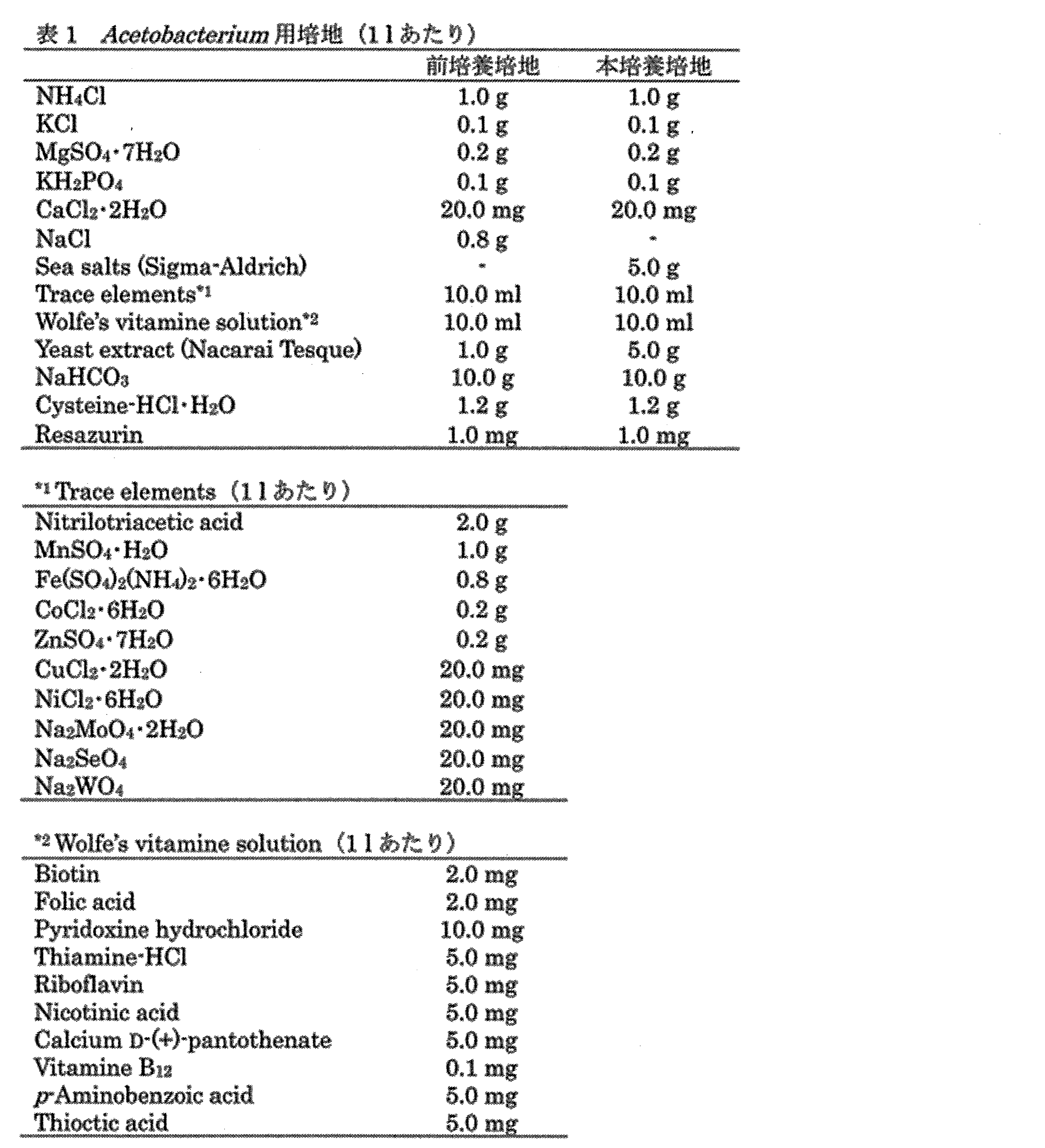
- a pre-culture medium for Acetobacter sp. was prepared anaerobically according to the method of Miller et al. (Appl. Microbiol. 27: 985, 1974). Briefly, the culture medium of Table 1 is prepared, and 50 ml of the culture medium is placed in a vial and filled so that the H 2 -CO 2 gas (80:20 (v / v)) is 0.20 MPa. did.
- the above-mentioned vial was inoculated with the acetic acid-producing bacterium Acetobacterium woodii, and cultured at 30 ° C., 180 rpm, until the OD 600 reached 0.15 to 0.25.
- 40 ml of this pre-culture solution was inoculated into 500 L of the main culture medium for acetobacterium (Table 1) and anaerobically treated in a 1 L reactor treated with H 2 -CO 2 gas (60:40 (v / v)) While culturing at 30 ° C. and 700 rpm while aeration at 1.5 L / h.
- Aurantiochytrium microbe Aurantiochytrium limacinum SR21 strain is reciprocally shaken at 250C and 250 rpm using GPY medium (3% glucose, 0.2% yeast extract, 0.6% high polypeptone, 2% artificial seawater salt) While culturing for 48 hours. This was used as a pre-culture solution of the Aurantiochytrium microorganism Aurantiochytrium limacinum SR21 strain.
- acetic acid is added to the main culture medium for Acetobacterium (0% acetic acid) prepared based on Table 1 and the main culture medium for Acetobacterium prepared based on Table 1 to a final concentration of 30 g / L.
- Three test tubes were prepared, each containing 5 mL of culture medium (3% acetic acid) and culture solution 1 (2.9% acetic acid) prepared above.
- the preculture liquid of the Aurantiochytrium microorganism Aurantiochytrium limacinum SR21 strain was inoculated in each of the test tubes so that the OD600 was 0.1, and cultured for 48 hours while reciprocating at 28 ° C. and 250 rpm. .
- the amount of acetic acid remaining in the culture solution was measured, the cells were collected, and the amount of dried cells and the fatty acid composition of the Orangiochytrium microorganism Aurantiochytrium limacinum SR21 strain were measured.
- lipid production can be performed from CO 2 with high efficiency by two-step fermentation of an acetobacter microorganism (Acetobacterium woodii) and an Aurantithiochytrium microorganism (Aurantiochytrium limacinum).
- the production method of the present invention can be used in a wide range of industrial fields, such as food, cosmetics, pharmaceuticals, feeds, chemicals, fuels, etc. using lipids.
Landscapes
- Chemical & Material Sciences (AREA)
- Organic Chemistry (AREA)
- Life Sciences & Earth Sciences (AREA)
- Engineering & Computer Science (AREA)
- Wood Science & Technology (AREA)
- Zoology (AREA)
- Biotechnology (AREA)
- Health & Medical Sciences (AREA)
- Genetics & Genomics (AREA)
- Bioinformatics & Cheminformatics (AREA)
- General Health & Medical Sciences (AREA)
- General Engineering & Computer Science (AREA)
- Microbiology (AREA)
- Biochemistry (AREA)
- General Chemical & Material Sciences (AREA)
- Chemical Kinetics & Catalysis (AREA)
- Oil, Petroleum & Natural Gas (AREA)
- Cell Biology (AREA)
- Botany (AREA)
- Medicinal Chemistry (AREA)
- Tropical Medicine & Parasitology (AREA)
- Virology (AREA)
- Biomedical Technology (AREA)
- Preparation Of Compounds By Using Micro-Organisms (AREA)
- Measuring Temperature Or Quantity Of Heat (AREA)
Abstract
オーランチオキトリウム属微生物による油脂等の脂質生産において、原料コストの削減と脂質の高効率生産と両立させることを目的とする。本発明の一態様における脂質の生産方法は、酢酸生産菌が二酸化炭素を含む副生ガス等から酢酸を発酵生産する工程、およびオーランチオキトリウム属微生物が前工程で発酵生産された酢酸から脂質を発酵生産する工程を含む、二段階発酵法である。
Description
本発明は、ラビリンチュラ類オーランチオキトリウム(Aurantiochytrium)属微生物を用いた脂質の生産方法に関する。
ラビリンチュラ類オーランチオキトリウム属微生物は、高度不飽和脂肪酸やカロテノイドのほか、各種炭化水素を顕著量生産する性質を有することから、多様な産業に応用可能な工業微生物として期待されている。
例えば、特許文献1には、オーランチオキトリウム属微生物等の従属栄養微生物を、窒素および炭素の含有量が異なる2種類の培地を用いて段階的に培養することによって、上記従属栄養微生物に効率よく油脂を生産させることができ、且つ、より短期間で大量に油脂を生産することができることが記載されている。また、特許文献2には、オーランチオキトリウム属微生物等の従属栄養微生物を、糖類およびグリセリンの含有量が異なる2種類の培地を用いて段階的に培養することによって、より短期間で大量に油脂を生産できることが記載されている。
しかし、オーランチオキトリウム属微生物による油脂等の脂質生産では、炭素源として主に糖質が用いられており、その糖質の供給による原料コストが問題となっている。一方、同様の油脂等の脂質を生産することができる緑藻類は、光合成によって自律的に糖質を生成するが、光照射の条件あるいは設備的制約などから概ね増殖速度が低く、結果として脂質の生産効率が低い。
そこで、本発明の一態様は、オーランチオキトリウム属微生物による油脂等の脂質生産において、原料コストの削減と脂質の高効率生産とを両立させることを目的とする。また、本発明の一態様は、未利用バイオマスや排気ガス等を原料とすることによって、環境保全や低炭素社会に貢献し得る新規な脂質生産技術を提供することを目的とする。
上記の課題を解決するために、本発明者らが鋭意研究した結果、オーランチオキトリウム属微生物が酢酸を炭素源として油脂等の脂質を効率よく生産し得ることを初めて見出し、本発明を完成させるに至った。特に、プロピオン酸をはじめとする有機酸は、オーランチオキトリウム属微生物の培養には好ましくないということは、従来からの経験則により当業者に知られているため、同微生物が有機酸の一つである酢酸を利用して効率よく脂質を生産できるということは驚くべき知見である。
すなわち本発明の脂質の生産方法は、酢酸を含む培地中で、オーランチオキトリウム属微生物を培養する培養工程を含むことを特徴としている。
また本発明の脂質の生産方法において、上記培地における酢酸濃度は、10g/L以上であることが好ましい。
また本発明の脂質の生産方法において、上記酢酸は、酢酸生産菌により生産された酢酸であり得る。
また本発明の脂質の生産方法において、上記培養工程の前に、培地中で酢酸生産菌を培養する酢酸生産菌培養工程をさらに含んでいてもよい。
また本発明の脂質の生産方法において、上記酢酸生産菌は嫌気性微生物であることが好ましい。
また本発明の脂質の生産方法において、培地中で嫌気性の酢酸生産菌を嫌気条件下で培養する酢酸生産菌培養工程、および上記酢酸生産菌培養工程後の酢酸を含む培地中で、オーランチオキトリウム属微生物を培養する培養工程を含むことが好ましい。
また本発明の脂質の生産方法において、上記酢酸生産菌は、モレラ(Moorella)属微生物、クロストリジウム(Clostridium)属微生物、アセトバクテリウム(Acetobacterium)属微生物、ブラウティア(Blautia)属微生物、ユーバクテリウム(Eubacterium)属微生物、およびスポロムサ(Sporomusa)属微生物からなる群から選択されるいずれか1つ以上であることが好ましい。
また本発明の脂質の生産方法において、上記酢酸生産菌培養工程における酢酸生産菌の培養は、二酸化炭素を含む、嫌気雰囲気中で行われることが好ましい。
本発明の一態様によれば、オーランチオキトリウム属微生物による油脂等の脂質生産において、酢酸を原料とすることによって脂質の高効率生産を行うことができる。また、未利用バイオマスや排気ガス等を原料として生産した酢酸を本発明の脂質の生産方法に利用することによって、脂質生産の低コスト化を図ることができるとともに、環境保全や低炭素社会に貢献することができる。
以下、本発明の実施の形態について、詳細に説明する。ただし、本発明はこれに限定されるものではなく、記述した範囲内で種々の変形を加えた態様で実施できるものである。なお、本明細書において特記しない限り、数値範囲を表す「A~B」は、「A以上、B以下」を意味する。
〔実施形態1〕
本発明の一態様に係る脂質の生産方法(以下「本発明の生産方法」という。)は、酢酸を含む培地中で、オーランチオキトリウム属微生物を培養する培養工程を含むことを特徴としている。
本発明の一態様に係る脂質の生産方法(以下「本発明の生産方法」という。)は、酢酸を含む培地中で、オーランチオキトリウム属微生物を培養する培養工程を含むことを特徴としている。
ここで、本明細書において「脂質」とは、オーランチオキトリウム属微生物によって生産可能な脂質を意味する。オーランチオキトリウム属微生物によって生産可能な脂質としては、例えば、ミリスチン酸、ペンタデカン酸、パルチミン酸、ヘプタデカン酸、ステアリン酸等の飽和脂肪酸;ドコサヘキサエン酸、ドコサペンタエン酸、エイコサペンタエン酸、オレイン酸、リノール酸、α-リノレン酸、γ-リノレン酸、ジホモ-γ-リノレン酸等の不飽和脂肪酸;アスタキサンチン、フェニコキサンチン、カンタキサンチン、エキネノン、β-カロテン、リコペン等のカロテノイド;スクアレン、ステロール等の炭化水素化合物等が挙げられる。
本発明の生産方法における培養工程においては、酢酸を含む培地中において、オーランチオキトリウム属微生物を培養する。上記「オーランチオキトリウム属微生物」としては、ラビリンチュラ類オーランチオキトリウム(Aurantiochytrium)属に分類される微生物であれば特に限定されない。例えば、Aurantiochytrium sp.SR21、Aurantiochytrium sp.
KH105(受領番号:FERM AP-22267)等を挙げることができる。なお、上記「オーランチオキトリウム属微生物」は、「シゾキトリウム(Schizochytrium)属微生物」とも称される。
KH105(受領番号:FERM AP-22267)等を挙げることができる。なお、上記「オーランチオキトリウム属微生物」は、「シゾキトリウム(Schizochytrium)属微生物」とも称される。
上記培養工程において用いる培地は、オーランチオキトリウム属微生物が生育可能な培地で、且つ酢酸が含まれている。また、上記培地は、特に限定されないが、大量培養に適していること、培養条件を制御しやすいこと等の理由から、液体培地であることが好ましい。
上記培地に含まれる酢酸の濃度について、1g/L以上が好ましく、5g/L以上がより好ましく、10g/L以上であることがさらに好ましい。上記構成によれば、オーランチオキトリウム属微生物が効率よく脂質を生産することができる。一方、上記酢酸濃度の上限はオーランチオキトリウム属微生物が生育可能でかつ脂質を生産できる濃度であれば特に限定されるものではないが、例えば、40g/L以下であることが好ましく、35g/L以下であることが好ましく、30g/L以下であることがさらに好ましい。
上記酢酸としては、商業的に入手可能なものが用いられてもよいし、酢酸生産菌を用いて生産された酢酸が用いられてもよい。
ここで、本明細書中において酢酸生産菌とは、酢酸を発酵生産し得る微生物を意味する。上記酢酸生産菌としては嫌気性微生物であっても、好気性微生物であってもよく、特に限定されないが、例えば、モレラ属微生物、クロストリジウム属微生物、アセトバクテリウム属微生物、ブラウティア属微生物、ユーバクテリウム属微生物、およびスポロムサ属微生物等の嫌気性微生物が好ましい。酢酸生産菌としては好気性微生物であるアセトバクター属微生物や、グルコンアセトバクター属微生物等が存在するが、好気性の酢酸生産菌は、水素および二酸化炭素から酢酸を生産することができない。一方、嫌気性の酢酸生産菌であれば、水素および二酸化炭素から酢酸を生産することができ、炭素源供給に伴う原料コストを削減することができる。
上記モレラ属微生物としては、モレラ(Moorella)属に属する酢酸生産菌であれば特に限定されない。上記モレラ属微生物としては、例えば、Moorella thermoacetica、Moorella thermoautotrophica等が挙げられる。
上記クロストリジウム属微生物としては、クロストリジウム(Clostridium thermoaceticum)属に属する酢酸生産菌であれば特に限定されない。上記クロストリジウム属微生物としては、例えばClostridium thermoaceticum、Clostridium aceticum、Clostridium cellulolyticum、Clostridium ljungdahlii等が挙げられる。
上記アセトバクテリウム属微生物に属する微生物としては、アセトバクテリウム属(Acetobacterium)に属する酢酸生産菌であれば特に限定されない。上記アセトバクテリウム属微生物としては、例えば、Acetobacterium woodii、Acetobacterium dehalogenans等が挙げられる。
上記ブラウティア属微生物としてはブラウティア(Blautia)属に属する酢酸生産菌であれば特に限定されない。上記ブラウティア属微生物としては、例えば、Blautia hydrogenotrophica、Blautia producta等が挙げられる。
上記ユーバクテリウム属微生物としてはユーバクテリウム(Eubacterium)属に属する酢酸生産菌であれば特に限定されない。上記ユーバクテリウム属微生物としては、例えば、Eubacterium aggregans、Eubacterium limosum等が挙げられる。
上記スポロムサ属微生物としてはスポロムサ(Sporomusa)属に属する酢酸生産菌であれば特に限定されない。上記スポロムサ属微生物としては、例えば、Sporomusa acidovorans、Sporomusa malonica等が挙げられる。
上記アセトバクター属微生物に属する微生物としては、アセトバクター属(Acetobacter)に属する酢酸生産菌であれば特に限定されない。上記アセトバクター属微生物としては、例えば、Acetobacter aceti、Acetobacter pasteurianus、Acetobacter xylinus等が挙げられる。
上記グルコンアセトバクター属微生物に属する微生物としては、グルコンアセトバクター属(Gluconacetobacter)に属する酢酸生産菌であれば特に限定されない。上記グルコンアセトバクター属微生物としては、例えば、Gluconacetobacter xylinus、Gluconacetobacter liquefaciens等が挙げられる。
本発明の生産方法においては上記の酢酸生産菌のいずれか一種類を利用してもよいし、複数を組み合わせて利用してもよい。
上記酢酸生産菌により産生された酢酸を、上記培養工程において培養される上記オーランチオキトリウム属微生物へ供給する際には、上記酢酸生産菌の培養後の培養液をそのままオーランチオキトリウム属微生物の培地として用いてもよいし、酢酸生産菌の培養後の培養液から精製された酢酸を用いてもよい。
上記酢酸以外に上記培地に含まれる成分としては、オーランチオキトリウム属微生物が生育するために必要な炭素源、窒素源および塩化ナトリウムが含まれ得る。本発明の生産方法においては酢酸が炭素源として培地中に含まれているが、本発明の生産方法においては、酢酸以外の他の炭素源が含まれていてもよい。上記「他の炭素源」としては、オーランチオキトリウム属微生物が資化し得るものであれば特に限定されず、例えば、炭水化物(単糖、オリゴ糖、多糖、糖アルコール等)、有機酸、アルコール類、脂質類等を挙げることができる。他の炭素源としては、一種類のみを用いてもよく、複数種類を組み合わせて用いてもよい。
また上記「窒素源」としては、オーランチオキトリウム属微生物が資化し得るものであれば特に限定されず、例えば、ポリペプトン、酵母エキス、ペプトン、大豆粉、コーンスティープリカー等の含窒素化合物;硫酸アンモニウム、硝酸アンモニウム、リン酸アンモニウム等の無機酸若しくは有機酸のアンモニウム塩等を挙げることができる。窒素源としては、一種類のみを用いてもよく、複数種類を組み合わせて用いてもよい。
培地に添加する窒素源の濃度は、1~50g/Lであることが好ましく、5~20g/Lであることがより好ましい。培地中の窒素源濃度が上記範囲であれば、オーランチオキトリウム属微生物が良好に成育することができる。窒素源として、複数種類を組み合わせて用いる場合は、複数種類の窒素源の総濃度が上記範囲になるように、窒素源を培養培地に添加すればよい。
海洋性真核微生物である上記オーランチオキトリウム属微生物が上記培地中において安定的に生育するために、上記培地中に塩化ナトリウムが含まれる。上記培地中に含まれ得る塩化ナトリウムの濃度は、0.5~4%(w/v)であることが好ましく、1.5~3%(w/v)であることがより好ましい。上記培地中に含まれ得る塩化ナトリウムの濃度が上記範囲内であることで、オーランチオキトリウム属微生物が好適に増殖することができる。なお、オーランチオキトリウム属微生物が天然において生育する海水中には、ナトリウム以外のミネラルも含まれるため、塩化ナトリウムの供給源として、海水(人工海水を含む)が用いられてもよい。本発明の生産方法において海水が用いられる場合、塩化ナトリウムの濃度が上記の好ましい範囲内となるようにして海水を用いればよい。
上記培地には、炭素源および窒素源以外の他の成分を含有していてもよい。上記「他の成分」としては、微生物の培養に一般的に用いられるものであれば特に限定されず、例えば、無機塩類、ビタミン等の補酵素、色素類等を挙げることができる。培地における上記「他の成分」の濃度は、適宜設定することができる。
上記培地には酢酸が含まれているために調整しなければ培地は酸性となる。オーランチオキトリウム属微生物は、pH4.0~8.0で好適に増殖するため、培地のpHは上記の範囲内となるように水酸化ナトリウム等により調整されることが好ましい。
上記培養工程において、上記オーランチオキトリウム属微生物を培養する条件として、上記オーランチオキトリウム属微生物の安定的な生育という観点から、培養時の温度は20℃~40℃であることが好ましく、さらには25~35℃であることがより好ましい。
オーランチオキトリウム属微生物は好気性微生物であるため、本発明の生産方法における培養工程は好気条件下で実施される。培養工程における培養は、ジャーファーメンターなどの公知の培養装置が好適に利用され得る。ジャーファーメンター等の培養装置の運転条件(温度、通気量、pH、攪拌速度、等)については、培養規模や、オーランチオキトリウム属微生物の生育状態に応じて適宜、設定され得る。
本発明の脂質の生産方法は、上記培養工程の前に培地中で酢酸生産菌を培養する酢酸生産菌培養工程、培養工程後にオーランチオキトリウム属微生物内に蓄積された脂質を回収する脂質回収工程、脂質回収工程によって回収された脂質を精製する脂質精製工程、得られた脂質から他の物質へ変換する物質変換工程、本培養を行う前に各種微生物を前培養する前培養工程、等のいずれか一つ以上の工程が適宜含まれていてもよい。以下に、脂質回収工程、脂質精製工程、および物質変換工程を説明する。
(1)脂質回収工程
脂質回収工程では、(a)生産された脂質をオーランチオキトリウム属微生物の菌体外に取り出してもよく、また(b)生産された脂質をオーランチオキトリウム属微生物の菌体内に蓄積された状態で回収してもよい。
脂質回収工程では、(a)生産された脂質をオーランチオキトリウム属微生物の菌体外に取り出してもよく、また(b)生産された脂質をオーランチオキトリウム属微生物の菌体内に蓄積された状態で回収してもよい。
上記(a)の場合、脂質の回収方法は、脂質をオーランチオキトリウム属微生物の菌体外に取り出すことができる限りは特に限定されない。例えば、ヘキサンやクロロホルム/メタノール混液(2:1、v/v)、t-ブチルメチルエーテル/メタノール/水(2:1:0.5、v/v)を用いることによって、オーランチオキトリウム属微生物から脂肪酸を抽出することができる。抽出した脂肪酸は、その後エステル化してもよい。また、例えば、アセトン/メタノール混液(7:3、v/v)を用いることによって、オーランチオキトリウム属微生物からカロテノイドを抽出することができる。また、例えば、ヘキサンやクロロホルム/メタノール混液(2:1、v/v)を用いることによって、オーランチオキトリウム属微生物からスクアレンを抽出することができる。
一方、上記(b)の場合、回収方法は、高付加価値脂質がオーランチオキトリウム属微生物の菌体内に蓄積された状態で回収できる限りは特に限定されない。例えば、オーランチオキトリウム属微生物を培養した培養液を遠心分離やろ過等により、培養上清を廃棄することによって、高付加価値脂質含有菌体を回収することができる。
(2)脂質精製工程
脂質精製工程における脂質を精製する方法としては特に限定されないが、例えば、溶媒分画、超臨界流体抽出、吸着クロマトグラフィー等の方法によって、脂質を精製することができる。
脂質精製工程における脂質を精製する方法としては特に限定されないが、例えば、溶媒分画、超臨界流体抽出、吸着クロマトグラフィー等の方法によって、脂質を精製することができる。
(3)物質変換工程
変換工程では得られた脂質から他の物質へ変換する工程であるが、例えば、得られたトリアシルグリセロールやイソプレノイド系炭化水素から公知の方法を用いてジェット燃料に変換してもよい。また、得られたトリアシルグリセロールから、公知の方法を用いてディーゼル燃料に変換してもよい。また、得られたイソプレノイド系炭化水素から、公知の方法を用いて化学素材に変換してもよい。
変換工程では得られた脂質から他の物質へ変換する工程であるが、例えば、得られたトリアシルグリセロールやイソプレノイド系炭化水素から公知の方法を用いてジェット燃料に変換してもよい。また、得られたトリアシルグリセロールから、公知の方法を用いてディーゼル燃料に変換してもよい。また、得られたイソプレノイド系炭化水素から、公知の方法を用いて化学素材に変換してもよい。
〔実施形態2〕
本発明の一態様に係る脂質の生産方法は、上記培養工程の前に、培地中で酢酸生産菌を培養する酢酸生産菌培養工程をさらに含み得る。すなわち、本発明の生産方法は、酢酸生産菌培養工程と、上記オーランチオキトリウム属微生物を培養する培養工程とを含む、二段階発酵であり得る。上記構成によれば、上記培養工程と上記酢酸生産菌培養工程との二段階発酵により、脂質の生産に用いる炭素源の供給時に伴うコストの低減および環境保全の実現に寄与する脂質の生産方法を実現できる。本実施形態と〔実施形態1〕との間で共通する事項については、実施形態1の説明が援用される。
本発明の一態様に係る脂質の生産方法は、上記培養工程の前に、培地中で酢酸生産菌を培養する酢酸生産菌培養工程をさらに含み得る。すなわち、本発明の生産方法は、酢酸生産菌培養工程と、上記オーランチオキトリウム属微生物を培養する培養工程とを含む、二段階発酵であり得る。上記構成によれば、上記培養工程と上記酢酸生産菌培養工程との二段階発酵により、脂質の生産に用いる炭素源の供給時に伴うコストの低減および環境保全の実現に寄与する脂質の生産方法を実現できる。本実施形態と〔実施形態1〕との間で共通する事項については、実施形態1の説明が援用される。
上記酢酸生産菌培養工程に用いられる酢酸生産菌培養用培地としては、酢酸生産菌が生育可能な培地であれば特に限定されず、炭素源、窒素源およびその他の成分が含まれ得る。炭素源、窒素源、およびその他の成分については、〔実施形態1〕の説明を援用することができる。なお、嫌気性微生物に属する酢酸生産菌を酢酸生産菌培養工程に用いる場合は、二酸化炭素を炭素源として酢酸を生産することができるため、培地中に二酸化炭素以外の糖質等の炭素源が含まれていなくてもよい。また、大量培地に適していること、培養条件を制御しやすいこと等の理由から、液体培地であることが好ましい。
酢酸生産菌として嫌気性微生物を用いる場合、嫌気条件下で培養(嫌気培養)しなければならない。嫌気培養を行う場合、通常、酸素以外の窒素や二酸化炭素などの嫌気性ガスを培養雰囲気下に供給し、嫌気雰囲気を達成する。本発明の生産方法においては、特に水素および二酸化炭素を含み且つ酸素を含まない嫌気性ガスを培養雰囲気下に通気することによって嫌気雰囲気を達成することが好ましい。嫌気性微生物に属する酢酸生産菌であれば、嫌気雰囲気を達成するために用いた嫌気性ガスの水素および二酸化炭素から、酢酸を生産することができる。なお、嫌気雰囲気とは、雰囲気中の酸素濃度が0.1%(v/v)以下で限りなく0に近い状態にあることを意味する。
培養雰囲気に供給される嫌気性ガス中の水素および二酸化炭素の分圧は1:1~8:1が好ましく、2:1~8:1がより好ましく、4:1~8:1がさらに好ましい。培養雰囲気に供給される嫌気性ガスには、水素および二酸化炭素の他に、一酸化炭素、メタン、水蒸気等の気体が含まれていてもよい。
上記嫌気性ガスは、水素および二酸化炭素等を適宜、混合して調製してもよいが、本発明の生産方法においては、稲わら、麦わら、バガス等の各種バイオマスをガス化することによって調製された嫌気性ガスを用いられることが好ましい。バイオマスから調製された嫌気性ガスを用いることによって、バイオマスの有効利用を行うことができる。また、化石燃料由来のナフサやメタンなどから燃料電池用の水素を精製する際に生じる副生ガス(主に水素、二酸化炭素を含み、その他の成分としてはメタン、一酸化炭素および水蒸気を含む)は利用されずに廃棄されているが、この副生ガスを本発明において嫌気性ガスとして利用することによって、二酸化炭素などの温室効果ガスの排出量を低減することができる。さらに、石油や石炭などの化石燃料を用いて火力発電する際にも大量の二酸化炭素が発生するが、この二酸化炭素を本発明において嫌気性ガスの一部として利用すれば、上述の場合と同様に資源の有効活用ができる。よって、本発明の生産方法は、低炭素社会に貢献することができるといえる。
上記酢酸生産菌培養工程における培養条件は、培養する酢酸生産菌の属種に応じて適宜決定される。例えば、上記モレラ属微生物、クロストリジウム属微生物、アセトバクテリウム属微生物等の嫌気性微生物である酢酸生産菌は、公知の嫌気培養法に従って培養することができる。また、上記アセトバクター属微生物、グルコンアセトバクター属微生物等の好気性微生物である酢酸生産菌は、公知の好気培養法に従って培養することができる。
図1に本発明の一実施形態に係る脂質の生産方法のフロー図を示す。なお、本発明の生産方法は図1に示す発明に限定されるものではない。稲わら、麦わら、バガス等の各種バイオマスをガス化して得られた嫌気性ガスや、ナフサまたはメタンを原料として水素を製造した際に発生する副生ガスを、モレラ属微生物、クロストリジウム属微生物、アセトバクテリウム属微生物等の嫌気性微生物である酢酸生産菌の培養槽に供給して嫌気培養を行う(嫌気発酵)。また、各種バイオマスに対し加圧熱水処理等を行い、得られる各種分解産物を酢酸生産菌の培養槽へ供給して嫌気発酵を行ってもよい。この嫌気発酵によって酢酸生産菌が酢酸を生産し、培地中に酢酸が分泌される。この酢酸を含む培地に、オーランチオキトリウム属微生物の生育に必須な塩化ナトリウム等を添加し(必要に応じて窒素源、炭素源、その他の成分をさらに添加してもよい。また必要に応じて培地を水等で希釈してもよい。)、pHを好適な範囲に調整した後に、オーランチオキトリウム属微生物を植菌し、好気培養を行う。好気培養を行うと、嫌気性微生物である酢酸生産菌は死滅し、溶菌する。溶菌した酢酸生産菌の菌体成分は、オーランチオキトリウム属微生物の窒素源等となり利用されうる。オーランチオキトリウム属微生物による好気発酵により、多価不飽和脂肪酸(PUFA)、長鎖脂肪酸、炭化水素、カロテノイド、等の脂質が、オーランチオキトリウム属微生物の菌体内に蓄積される。脂質を蓄積したオーランチオキトリウム属微生物の菌体を遠心分離等で集菌し、得られた菌体から生産された脂質を回収すればよい。
本実施形態に係る脂質の生産方法においても、〔実施形態1〕に記載された脂質回収工程、脂質精製工程、物質変換工程、前培養工程、等のいずれか一つ以上の工程が適宜含まれていてもよい。
本発明の一実施例について以下に説明するが、本発明は実施例によって限定されるものではない。
(実施例1)オーランチオキトリウム属微生物による脂肪酸の生産
〔方法〕
オーランチオキトリウム属微生物Aurantiochytrium sp.SR21株(ATCC HYA-1381)を、0~30g/L酢酸(ナカライテスク社)、6g/Lハイポリペプトン(日本製薬社)、2g/L酵母エキス(極東製薬社)、20g/L人工海水塩(シグマ-アルドリッチ社)を含む5mlの液体培地(pH6.5)に接種して、試験管にて28℃で3日間培養した。
〔方法〕
オーランチオキトリウム属微生物Aurantiochytrium sp.SR21株(ATCC HYA-1381)を、0~30g/L酢酸(ナカライテスク社)、6g/Lハイポリペプトン(日本製薬社)、2g/L酵母エキス(極東製薬社)、20g/L人工海水塩(シグマ-アルドリッチ社)を含む5mlの液体培地(pH6.5)に接種して、試験管にて28℃で3日間培養した。
培養後の培養液中に含まれる菌体を遠心分離にて回収し、凍結乾燥することによって乾燥菌体量を求めた。
また菌体内に蓄積された脂質をt-ブチルメチルエーテル/メタノール/水混液(2:1:0.5、v/v)で抽出した後、内部標準としてアラキジン酸を加えて、塩酸メタノールを加えて脂肪酸をメチルエステル化した。脂肪酸メチルエステルはガスクロマトグラフィーで分析し、各脂肪酸を定量した。
〔結果〕
上記実験の結果を図2に示す。図2の(a)は各種培養液中から回収したオーランチオキトリウム属SR21株の乾燥菌体量(g/L)を示すグラフであり、図2の(b)は、オーランチオキトリウム属SR21株中の脂肪酸の組成および生産量を示すグラフである。図2の(a)に示す通り、培地中に含まれている酢酸の濃度に比例して、オーランチオキトリウム属SR21株の乾燥菌体量が増加していたことから、オーランチオキトリウム属SR21株は酢酸を含む培地中において旺盛に生育できることが分かった。また図2の(b)の結果から、培地中に含まれている酢酸の濃度が高い程、総脂肪酸生産量は増加し、酢酸濃度が30g/Lの時に総脂肪酸生産量が4.8g/Lとなった。
上記実験の結果を図2に示す。図2の(a)は各種培養液中から回収したオーランチオキトリウム属SR21株の乾燥菌体量(g/L)を示すグラフであり、図2の(b)は、オーランチオキトリウム属SR21株中の脂肪酸の組成および生産量を示すグラフである。図2の(a)に示す通り、培地中に含まれている酢酸の濃度に比例して、オーランチオキトリウム属SR21株の乾燥菌体量が増加していたことから、オーランチオキトリウム属SR21株は酢酸を含む培地中において旺盛に生育できることが分かった。また図2の(b)の結果から、培地中に含まれている酢酸の濃度が高い程、総脂肪酸生産量は増加し、酢酸濃度が30g/Lの時に総脂肪酸生産量が4.8g/Lとなった。
この結果から、乾燥菌体重量あたり0.59g/g-cell、すなわち、オーランチオキトリウム属SR21株の菌体内に蓄積される脂質含量は59%であることがわかった。よって、オーランチオキトリウム属SR21株は、酢酸を主な炭素源として資化し、多量の脂質を菌体内に蓄積可能である(すなわち高効率で脂質を生産し得る)ことが示された。
なお、水素および二酸化炭素を含む培地で嫌気性の酢酸生産菌によって、培地中に酢酸が生産されることは公知である。例えば、M. Straub et al., Journal of Biotechnology, 178(2014) 67-72には、H2-CO2培地(NH4Cl 1.0g/L、KH2PO4 0.33g、K2HPO40.45g、MgSO4・7H2O 0.16g、NaHCO310.0g、yeast extract 2.0g、Na2S・9H2O 0.5g、cysteine-HCl・H2O 0.5g、各種金属塩<10mg、ビタミンB群<0.1mg)中で、Acetobacterium woodiiを培養することによって50g/Lの酢酸を生産したことが記載されている。よって、本実施例の実験結果を見た当業者であれば、水素および二酸化炭素を含む培地で嫌気性の酢酸生産菌を培養した後、オーランチオキトリウム属微生物を培養することによって、脂質を生産できるということを十分に理解することができる。
(実施例2)アセトバクテリウム属微生物とオーランチオキトリウム属微生物の二段階発酵によるCO2からの油脂生産
〔方法〕
<アセトバクテリウム属微生物による酢酸生成>
Millerらの方法(Appl. Microbiol. 27:985, 1974)により、アセトバクテリウム属用前培養培地を嫌気的に調製した。簡潔には、表1の培養培地を調製し、その培養培地を50ml、バイアル瓶に入れて、H2-CO2ガス(80:20(v/v))が0.20MPaとなるように充填した。上記バイアル瓶に、酢酸生産菌Acetobacterium woodiiを植菌し、30℃、180rpmで振盪しながら、OD600が0.15~0.25となるまで培養した。この前培養液40mlを、アセトバクテリウム属用本培養培地(表1)500mlを入れて嫌気処理した1L容量のリアクターに植菌し、H2-CO2ガス(60:40(v/v))を1.5L/hで通気しながら、30℃、700rpmで回転撹拌して培養した。102時間培養した時点で培養上清の酢酸濃度が29.3g/Lに達したため、培養を終了して、培養液を回収した(培養液1)。
<オーランチオキトリウム属微生物による油脂生成>
オーランチオキトリウム属微生物Aurantiochytrium limacinum SR21株は、GPY培地(3%グルコース、0.2%酵母エキス、0.6%ハイポリペプトン、2%人工海水塩)を用いて、28℃、250rpmで往復振盪しながら、48時間培養した。これを、オーランチオキトリウム属微生物Aurantiochytrium limacinum SR21株の前培養液とした。
〔方法〕
<アセトバクテリウム属微生物による酢酸生成>
Millerらの方法(Appl. Microbiol. 27:985, 1974)により、アセトバクテリウム属用前培養培地を嫌気的に調製した。簡潔には、表1の培養培地を調製し、その培養培地を50ml、バイアル瓶に入れて、H2-CO2ガス(80:20(v/v))が0.20MPaとなるように充填した。上記バイアル瓶に、酢酸生産菌Acetobacterium woodiiを植菌し、30℃、180rpmで振盪しながら、OD600が0.15~0.25となるまで培養した。この前培養液40mlを、アセトバクテリウム属用本培養培地(表1)500mlを入れて嫌気処理した1L容量のリアクターに植菌し、H2-CO2ガス(60:40(v/v))を1.5L/hで通気しながら、30℃、700rpmで回転撹拌して培養した。102時間培養した時点で培養上清の酢酸濃度が29.3g/Lに達したため、培養を終了して、培養液を回収した(培養液1)。
<オーランチオキトリウム属微生物による油脂生成>
オーランチオキトリウム属微生物Aurantiochytrium limacinum SR21株は、GPY培地(3%グルコース、0.2%酵母エキス、0.6%ハイポリペプトン、2%人工海水塩)を用いて、28℃、250rpmで往復振盪しながら、48時間培養した。これを、オーランチオキトリウム属微生物Aurantiochytrium limacinum SR21株の前培養液とした。
続いて、表1に基づき調製したアセトバクテリウム属用本培養培地(0%酢酸)、表1に基づき調製したアセトバクテリウム属用本培養培地に酢酸を最終濃度30g/Lとなるように加えた培地(3%酢酸)、および上記で調製した培養液1(2.9%酢酸)が各々5mL入った試験管を、各3本ずつ準備した。
上記オーランチオキトリウム属微生物Aurantiochytrium limacinum SR21株の前培養液を、OD600が0.1となるように、上記各試験管に植菌し、28℃、250rpmで往復振盪しながら、48時間培養した。培養液中の酢酸残存量を測定するとともに、菌体を回収して、オーランチオキトリウム属微生物Aurantiochytrium limacinum SR21株の乾燥菌体量および脂肪酸組成を測定した。
〔結果〕
その結果、酢酸生産菌Acetobacterium woodiiの培養液(培養液1)を用いた場合は、酢酸消費率99%、菌体量7.4g/L、総脂肪酸量4.5g/Lとなり、脂肪酸含有率は、60%にも達した(図3および4)。一方、3%酢酸を加えたアセトバクテリウム属用本培養培地を用いた場合は、酢酸消費率78%、菌体量9.9g/L、総脂肪酸量3.1g/Lとなり、脂肪酸含有率は、31%に留まった(同上図)。さらに、酢酸を含まないアセトバクテリウム属用本培養培地を用いた場合は、脂肪酸はほとんど生成されていなかった。
その結果、酢酸生産菌Acetobacterium woodiiの培養液(培養液1)を用いた場合は、酢酸消費率99%、菌体量7.4g/L、総脂肪酸量4.5g/Lとなり、脂肪酸含有率は、60%にも達した(図3および4)。一方、3%酢酸を加えたアセトバクテリウム属用本培養培地を用いた場合は、酢酸消費率78%、菌体量9.9g/L、総脂肪酸量3.1g/Lとなり、脂肪酸含有率は、31%に留まった(同上図)。さらに、酢酸を含まないアセトバクテリウム属用本培養培地を用いた場合は、脂肪酸はほとんど生成されていなかった。
以上より、アセトバクテリウム属微生物(Acetobacterium woodii)とオーランチオキトリウム属微生物(Aurantiochytrium limacinum)との二段階発酵により、CO2から高効率で脂質生産が行えることが実証された。
本発明の生産方法は、脂質を利用する、食品、化粧品、医薬品、飼料、化学品、燃料等の広範な産業分野等に利用することができる。
Claims (5)
- 培地中で嫌気性の酢酸生産菌を嫌気条件下で培養する酢酸生産菌培養工程、および
上記酢酸生産菌培養工程後の酢酸を含む培地中で、オーランチオキトリウム属微生物を培養する培養工程を含むことを特徴とする脂質の生産方法。 - 上記培地における酢酸濃度は、10g/L以上である、請求項1に記載の脂質の生産方法。
- 上記酢酸は、酢酸生産菌により生産された酢酸である、請求項1または2に記載の脂質の生産方法。
- 上記酢酸生産菌は、モレラ属微生物、クロストリジウム属微生物、アセトバクテリウム属微生物、ブラウティア属微生物、ユーバクテリウム属微生物、およびスポロムサ属微生物からなる群から選択されるいずれか1つ以上である、請求項1~3のいずれか1項に記載の脂質の生産方法。
- 上記酢酸生産菌培養工程における酢酸生産菌の培養は、二酸化炭素を含む、嫌気雰囲気中で行われる、請求項1~4のいずれか1項に記載の脂質の生産方法。
Priority Applications (3)
| Application Number | Priority Date | Filing Date | Title |
|---|---|---|---|
| MYPI2020003211A MY200471A (en) | 2017-12-26 | 2018-12-21 | Method for producing lipids |
| PL434591A PL434591A1 (pl) | 2017-12-26 | 2018-12-21 | Sposób wytwarzania lipidów |
| JP2019561642A JP7048056B2 (ja) | 2017-12-26 | 2018-12-21 | 脂質の生産方法 |
Applications Claiming Priority (2)
| Application Number | Priority Date | Filing Date | Title |
|---|---|---|---|
| JP2017-250129 | 2017-12-26 | ||
| JP2017250129 | 2017-12-26 |
Publications (1)
| Publication Number | Publication Date |
|---|---|
| WO2019131502A1 true WO2019131502A1 (ja) | 2019-07-04 |
Family
ID=67067407
Family Applications (1)
| Application Number | Title | Priority Date | Filing Date |
|---|---|---|---|
| PCT/JP2018/047230 Ceased WO2019131502A1 (ja) | 2017-12-26 | 2018-12-21 | 脂質の生産方法 |
Country Status (4)
| Country | Link |
|---|---|
| JP (1) | JP7048056B2 (ja) |
| MY (1) | MY200471A (ja) |
| PL (1) | PL434591A1 (ja) |
| WO (1) | WO2019131502A1 (ja) |
Cited By (1)
| Publication number | Priority date | Publication date | Assignee | Title |
|---|---|---|---|---|
| WO2020071444A1 (ja) * | 2018-10-02 | 2020-04-09 | 国立研究開発法人科学技術振興機構 | 淡水産微細藻類の培養方法 |
Citations (3)
| Publication number | Priority date | Publication date | Assignee | Title |
|---|---|---|---|---|
| JP2003052357A (ja) * | 2001-08-10 | 2003-02-25 | Japan Science & Technology Corp | 海洋性微生物と、この微生物を用いたカロテノイド系色素および/または高度不飽和脂肪酸の製造方法 |
| US20130065282A1 (en) * | 2011-09-08 | 2013-03-14 | Lanzatech New Zealand Limited | Fermentation Process |
| JP2016152798A (ja) * | 2015-01-24 | 2016-08-25 | インディアン オイル コーポレーション リミテッド | 廃液を処理するためのスラウストキトリッドに基づいたプロセス |
-
2018
- 2018-12-21 JP JP2019561642A patent/JP7048056B2/ja active Active
- 2018-12-21 MY MYPI2020003211A patent/MY200471A/en unknown
- 2018-12-21 WO PCT/JP2018/047230 patent/WO2019131502A1/ja not_active Ceased
- 2018-12-21 PL PL434591A patent/PL434591A1/pl unknown
Patent Citations (3)
| Publication number | Priority date | Publication date | Assignee | Title |
|---|---|---|---|---|
| JP2003052357A (ja) * | 2001-08-10 | 2003-02-25 | Japan Science & Technology Corp | 海洋性微生物と、この微生物を用いたカロテノイド系色素および/または高度不飽和脂肪酸の製造方法 |
| US20130065282A1 (en) * | 2011-09-08 | 2013-03-14 | Lanzatech New Zealand Limited | Fermentation Process |
| JP2016152798A (ja) * | 2015-01-24 | 2016-08-25 | インディアン オイル コーポレーション リミテッド | 廃液を処理するためのスラウストキトリッドに基づいたプロセス |
Non-Patent Citations (6)
| Title |
|---|
| BALCH, W. E. ET AL.: "Acetobacterium, a New Genus of Hydrogen-Oxidizing, Carbon Dioxide-Reducing, Anaerobic Bacteria", INTERNATIONAL JOURNAL OF SYSTEMATIC BACTERIOLOGY, vol. 27, no. 4, October 1977 (1977-10-01), pages 355 - 361, XP002659783 * |
| DATABASE NUCLEOTIDE [online] 31 October 2014 (2014-10-31), SINGH, D. ET AL.: "Aurantiochytrium sp. DBTIOC-18 18S ribosomal RNA gene , partial sequence.", XP055622329, retrieved from NCBI Database accession no. KF668632 * |
| DATABASE NUCLEOTIDE [online] 31 October 2014 (2014-10-31), SINGH, D. ET AL.: "Aurantiochytrium sp. DBTIOC-6 18S ribosomal RNA gene , partial sequence", XP055622326, retrieved from NCBI Database accession no. KF668627 * |
| PEREZ, C. M. T. ET AL.: "Growth, lipid and metabolite profile analysis of Aurantiochytrium limacinum SR21 grown on acetate-based medium for biotechnological applications", vol. 70, 7 August 2018 (2018-08-07), pages 114 * |
| PEREZ, C. M. T. ET AL.: "Optimization on lipid productivity of Aurantiochytrium limacinum SR21 grown in acetate-based medium by metabolic engineering", LECTURE ABSTRACTS OF THE ANNUAL CONFERENCE OF JAPAN OIL CHEMISTS' SOCIETY, vol. 57, 4 September 2018 (2018-09-04), ISSN: 1348-6764 * |
| YOKOYAMA, R. ET AL.: "Taxonomic rearrangement of the genus Schizochytrium sensu lato based on morphology, chemotaxonomic characteristics, and 18S rRNA gene phylogeny (Thraustochytriaceae, Labyrinthulomycetes): emendation for Schizochytrium and erection of Aurantiochytrium and Oblongichytrium gen. nov.", MYCOSCIENCE, vol. 48, 2007, pages 199 - 211, XP019521654, doi:10.1007/s10267-006-0362-0 * |
Cited By (1)
| Publication number | Priority date | Publication date | Assignee | Title |
|---|---|---|---|---|
| WO2020071444A1 (ja) * | 2018-10-02 | 2020-04-09 | 国立研究開発法人科学技術振興機構 | 淡水産微細藻類の培養方法 |
Also Published As
| Publication number | Publication date |
|---|---|
| PL434591A1 (pl) | 2021-05-31 |
| JP7048056B2 (ja) | 2022-04-05 |
| MY200471A (en) | 2023-12-27 |
| JPWO2019131502A1 (ja) | 2020-12-17 |
Similar Documents
| Publication | Publication Date | Title |
|---|---|---|
| Huang et al. | Biodiesel production by microalgal biotechnology | |
| Ethier et al. | Continuous culture of the microalgae Schizochytrium limacinum on biodiesel-derived crude glycerol for producing docosahexaenoic acid | |
| US11111510B2 (en) | Fermentation process for the production of lipids | |
| Chng et al. | Sustainable production of bioethanol using lipid-extracted biomass from Scenedesmus dimorphus | |
| Cheirsilp et al. | Mixed culture of oleaginous yeast Rhodotorula glutinis and microalga Chlorella vulgaris for lipid production from industrial wastes and its use as biodiesel feedstock | |
| Byreddy et al. | Bead milling for lipid recovery from thraustochytrid cells and selective hydrolysis of Schizochytrium DT3 oil using lipase | |
| Estévez-Landazábal et al. | Improvement of lipid productivity on Chlorella vulgaris using waste glycerol and sodium acetate | |
| Sineli et al. | Bioconversion of sugarcane molasses and waste glycerol on single cell oils for biodiesel by the red yeast Rhodotorula glutinis R4 from Antarctica | |
| TWI797569B (zh) | 用於生產脂質的醱酵方法 | |
| Arafiles et al. | Value-added lipid production from brown seaweed biomass by two-stage fermentation using acetic acid bacterium and thraustochytrid | |
| Kongjan et al. | Butanol production from algal biomass by acetone-butanol-ethanol fermentation process | |
| Hamed et al. | Complementary production of biofuels by the green alga Chlorella vulgaris | |
| Yang et al. | Fungi (Mold)-based lipid production | |
| Vaishnavi et al. | Marine biomass toward biofuel production | |
| JP2020054391A (ja) | パームオイル工場排出液(pome)をつかった従属栄養性微細藻類の培養方法及びdha製造方法 | |
| JP6351328B2 (ja) | 高付加価値脂質の生産方法 | |
| JP7048056B2 (ja) | 脂質の生産方法 | |
| Nawkarkar et al. | Carbon dioxide capture for biofuel production | |
| US20120323029A1 (en) | Methods, Biological Oils, Biofuels, Units, and Organisms Related to Use in Compression Engines | |
| Haldar et al. | Microalgae as a potential source of biofuels and its current advances | |
| Bautista et al. | Biodiesel from microbial oil | |
| Shalini et al. | A review on recent trends in the microbial production of biodiesel | |
| Ruiz et al. | Lipids accumulation in Chlorella protothecoides through mixotrophic and heterotrophic cultures for biodiesel production | |
| US12065625B2 (en) | Methods and formulations for enhancing high value lipids | |
| Kazimierowicz et al. | Waste Glycerol in the Biosynthesis of Liquid Fuels and Other Value-Added Products–a Review |
Legal Events
| Date | Code | Title | Description |
|---|---|---|---|
| 121 | Ep: the epo has been informed by wipo that ep was designated in this application |
Ref document number: 18896828 Country of ref document: EP Kind code of ref document: A1 |
|
| DPE1 | Request for preliminary examination filed after expiration of 19th month from priority date (pct application filed from 20040101) | ||
| ENP | Entry into the national phase |
Ref document number: 2019561642 Country of ref document: JP Kind code of ref document: A |
|
| NENP | Non-entry into the national phase |
Ref country code: DE |
|
| 122 | Ep: pct application non-entry in european phase |
Ref document number: 18896828 Country of ref document: EP Kind code of ref document: A1 |