WO2019130587A1 - 熱硬化性樹脂組成物、回転電機用コイル及びその製造方法並びに回転電機 - Google Patents
熱硬化性樹脂組成物、回転電機用コイル及びその製造方法並びに回転電機 Download PDFInfo
- Publication number
- WO2019130587A1 WO2019130587A1 PCT/JP2017/047387 JP2017047387W WO2019130587A1 WO 2019130587 A1 WO2019130587 A1 WO 2019130587A1 JP 2017047387 W JP2017047387 W JP 2017047387W WO 2019130587 A1 WO2019130587 A1 WO 2019130587A1
- Authority
- WO
- WIPO (PCT)
- Prior art keywords
- group
- thermosetting resin
- resin composition
- general formula
- coil
- Prior art date
- Legal status (The legal status is an assumption and is not a legal conclusion. Google has not performed a legal analysis and makes no representation as to the accuracy of the status listed.)
- Ceased
Links
Classifications
-
- C—CHEMISTRY; METALLURGY
- C08—ORGANIC MACROMOLECULAR COMPOUNDS; THEIR PREPARATION OR CHEMICAL WORKING-UP; COMPOSITIONS BASED THEREON
- C08G—MACROMOLECULAR COMPOUNDS OBTAINED OTHERWISE THAN BY REACTIONS ONLY INVOLVING UNSATURATED CARBON-TO-CARBON BONDS
- C08G59/00—Polycondensates containing more than one epoxy group per molecule; Macromolecules obtained by polymerising compounds containing more than one epoxy group per molecule using curing agents or catalysts which react with the epoxy groups
- C08G59/18—Macromolecules obtained by polymerising compounds containing more than one epoxy group per molecule using curing agents or catalysts which react with the epoxy groups ; e.g. general methods of curing
- C08G59/68—Macromolecules obtained by polymerising compounds containing more than one epoxy group per molecule using curing agents or catalysts which react with the epoxy groups ; e.g. general methods of curing characterised by the catalysts used
-
- C—CHEMISTRY; METALLURGY
- C08—ORGANIC MACROMOLECULAR COMPOUNDS; THEIR PREPARATION OR CHEMICAL WORKING-UP; COMPOSITIONS BASED THEREON
- C08L—COMPOSITIONS OF MACROMOLECULAR COMPOUNDS
- C08L63/00—Compositions of epoxy resins; Compositions of derivatives of epoxy resins
-
- H—ELECTRICITY
- H01—ELECTRIC ELEMENTS
- H01F—MAGNETS; INDUCTANCES; TRANSFORMERS; SELECTION OF MATERIALS FOR THEIR MAGNETIC PROPERTIES
- H01F5/00—Coils
- H01F5/06—Insulation of windings
-
- H—ELECTRICITY
- H02—GENERATION; CONVERSION OR DISTRIBUTION OF ELECTRIC POWER
- H02K—DYNAMO-ELECTRIC MACHINES
- H02K3/00—Details of windings
- H02K3/30—Windings characterised by the insulating material
Definitions
- the present invention relates to a thermosetting resin composition, a coil for a rotary electric machine, a method of manufacturing the same, and a rotary electric machine.
- An insulating layer is formed to ensure insulation of the coil.
- a prepreg (resin rich) mica tape or a dry mica tape is used to form the insulating layer.
- the prepreg mica tape mainly comprises a backing material, mica paper, and a thermosetting resin composition previously impregnated with mica paper.
- the dry mica tape mainly includes a backing material, mica paper, and an adhesive layer that integrally bonds the backing material and the mica paper.
- a prepreg mica tape When forming an insulating layer using a prepreg mica tape, a prepreg mica tape is wound around a portion requiring insulation of a coil conductor, and is heated while being pressurized to cure a thermosetting resin composition which is impregnated in mica paper in advance. Thus, the insulating layer is formed.
- dry mica tape dry mica tape is wound around the coil conductor where insulation is required, the dry mica tape is impregnated with the thermosetting resin composition, and then heating is performed.
- the insulating layer is formed by curing the thermosetting resin composition impregnated in the dry mica tape by heating under pressure.
- thermosetting resin composition can be arbitrarily selected, so the degree of freedom in designing the configuration of the insulating layer tends to be high.
- thermosetting resin composition may be impregnated at the location which needs insulation, and the insulation of a coil may be ensured by hardening this.
- thermosetting resin composition is required to have long-term storage stability.
- Japanese Patent Application Laid-Open No. 2000-297204 is characterized by containing an epoxy resin, an onium salt which is a cationic polymerization initiator, and an ion adsorbent as essential components.
- An epoxy resin composition is disclosed.
- cured material of high glass transition temperature is calculated
- One embodiment of the present invention has been made in view of the above-mentioned conventional circumstances, and shows a high glass transition temperature and a thermosetting resin composition excellent in storage stability, a coil for a rotating electrical machine using the same, and a method of manufacturing the same And it aims at providing a rotating electrical machine.
- curing agent containing the cation type represented by following General formula (I).
- R 1 and R 2 each independently represent an alkyl group.
- R 3 independently represents an alkyl group, a hydroxy group, a carboxy group, an alkoxy group, an aryloxy group, an alkylcarbonyl group.
- R 1 and R 2 each independently represent an alkyl group having 1 to 4 carbon atoms.
- R 4 is a hydrogen atom, R-CO- group or R-SO 2 -group (R Each represents an alkyl group having 1 to 4 carbon atoms which may be substituted with one or more halogen atoms.)
- Each R 5 independently represents an alkyl group having 1 to 4 carbon atoms or Represents a halogen atom, m represents an integer of 0 to 4)
- R 4 in the general formula (II) is a R—CO— group (R represents an alkyl group having 1 to 4 carbon atoms which may be substituted with one or more halogen atoms)
- the thermosetting resin composition as described in a certain ⁇ 2>.
- thermosetting resin composition described in any one of ⁇ 1> to ⁇ 3>, which is a group, and b is an integer of 1 to 5).
- thermosetting resin composition according to ⁇ 4>, wherein the anionic species is SbF 6 ⁇ .
- thermosetting resin composition according to any one of ⁇ 1> to ⁇ 6>, which further contains an inorganic filler.
- the inorganic filler contains at least one selected from the group consisting of alumina, magnesium oxide, beryllium oxide, boron nitride, aluminum nitride, silicon nitride, silicon carbide, aluminum fluoride and calcium fluoride ⁇ 7>
- the thermosetting resin composition as described in-.
- thermosetting resin composition forming a laminate of mica tape covering at least a part of the outer periphery of the coil conductor; Impregnating the laminated body with the thermosetting resin composition according to any one of ⁇ 1> to ⁇ 8>; And curing the thermosetting resin composition to form an insulating layer.
- a coil for a rotating electrical machine including a cured product of the object.
- a rotating electrical machine comprising a coil or a coil end sealed by a cured product of the thermosetting resin composition according to any one of ⁇ 1> to ⁇ 8>.
- thermosetting resin composition exhibiting a high glass transition temperature and excellent in storage stability, a coil for a rotating electrical machine using the same, a method of manufacturing the same, and a rotating electrical machine are provided.
- thermosetting resin composition of the present invention a coil for a rotating electrical machine, a method of manufacturing the same, and a mode for carrying out the rotating machine will be described in detail.
- the present invention is not limited to the following embodiments.
- the constituent elements including element steps and the like) are not essential unless otherwise specified.
- the term “step” includes, in addition to steps independent of other steps, such steps as long as the purpose of the step is achieved even if it can not be clearly distinguished from other steps. .
- numerical values described before and after “to” are included in the numerical range indicated using “to” as the minimum value and the maximum value, respectively.
- each component may contain a plurality of corresponding substances.
- the content or content of each component is the total content or content of the plurality of substances present in the composition unless otherwise specified.
- particles corresponding to each component may contain a plurality of types.
- the particle diameter of each component means the value for the mixture of the plurality of particles present in the composition unless otherwise specified.
- layer may mean that when the region in which the layer is present is observed, it is formed in only a part of the region, in addition to the case where the region is entirely formed. included.
- laminate in the present disclosure refers to stacking layers, two or more layers may be combined, and two or more layers may be removable.
- thermosetting resin composition of the present disclosure contains a thermosetting resin and a curing agent containing a cationic species represented by the following general formula (I) (hereinafter, may be referred to as a specific curing agent). Do.
- R 1 and R 2 each independently represent an alkyl group.
- Each R 3 independently represents an alkyl group, a hydroxy group, a carboxy group, an alkoxy group, an aryloxy group, an alkylcarbonyl group, an arylcarbonyl group, an aralkylcarbonyl group, an alkoxycarbonyl group, an alkoxycarbonyl group, an aryloxycarbonyl group, an aralkyloxycarbonyl group, Alkyl carbonyloxy group, aryl carbonyloxy group, aralkyl carbonyloxy group, alkoxy carbonyloxy group, aryloxy carbonyloxy group, aralkyl oxy carbonyloxy group, arylthio carbonyl group, arylthio group, alkylthio group, aryl group, heterocyclic carbonization Hydrogen group, alkylsulfinyl group, arylsulfinyl group, alkylsulfonyl group
- thermosetting resin composition of the present disclosure contains a specific curing agent as a curing agent for the thermosetting resin, the curing reaction of the thermosetting resin by the specific curing agent during storage is suppressed. Therefore, it is guessed that the thermosetting resin composition of this indication is excellent in storage stability. Moreover, since the thermosetting resin composition of this indication contains a specific curing agent as a curing agent of a thermosetting resin, it is guessed that the glass transition temperature of the cured
- thermosetting resin As the thermosetting resin used in the present disclosure, epoxy resin, phenol resin, urea resin, melamine resin, unsaturated polyester resin, cyanate ester resin, polyimide resin, bismaleimide triazine resin, phenol aralkyl resin, etc. It can be used alone or in combination of two or more. Among the thermosetting resins, epoxy resins are preferred. As the epoxy resin, for example, bisphenol A epoxy resin, bisphenol F epoxy resin, phenol novolac epoxy resin, cresol novolac epoxy resin and alicyclic epoxy resin can be used alone or in combination of two or more kinds. .
- a reactive diluent having an epoxy group may be mixed as the thermosetting resin in order to adjust the viscosity of the thermosetting resin composition.
- a reactive diluent having an epoxy group for example, n-butyl glycidyl ether, glycidyl ether for versatic acid, styrene oxide, ethylhexyl glycidyl ether, phenyl glycidyl ether, butylphenyl glycidyl ether, 1,6-hexanediol diglycidyl ether And neopentyl glycol diglycidyl ether, diethylene glycol diglycidyl ether and trimethylolpropane triglycidyl ether. One or more of these may be used in combination.
- thermosetting resin composition When using a thermosetting resin composition as a resin composition for impregnating or casting, it is desirable that the thermosetting resin composition be liquid at normal temperature (25 ° C.). In order to obtain a liquid thermosetting resin composition at normal temperature (25 ° C.), it is preferable to use a liquid thermosetting resin at normal temperature (25 ° C.). When using 2 or more types of thermosetting resin together, the mixture of thermosetting resin should just be liquid at normal temperature (25 degreeC). In the present disclosure, “liquid at normal temperature (25 ° C.)” specifically means that the viscosity measured by an E-type viscometer at 25 ° C. is 1000 Pa ⁇ s or less.
- the viscosity is assumed using the E-type viscometer EHD type (cone angle 3 °, cone diameter 28 mm) at a measurement temperature of 25 ° C and a sample volume of 0.7 ml, assuming the sample rotation speed with reference to the following: Set the value according to the viscosity to be measured, and use the value one minute after the start of measurement as the measurement value.
- the rotation speed 0.5 revolutions / minute
- the assumed viscosity is less than 100 Pa ⁇ s: the rotation speed 5 revolutions / minute
- the specific curing agent used in the present disclosure is not particularly limited as long as it is a curing agent containing a cationic species represented by the following general formula (I).
- R 1 and R 2 each independently represent an alkyl group.
- Each R 3 independently represents an alkyl group, a hydroxy group, a carboxy group, an alkoxy group, an aryloxy group, an alkylcarbonyl group, an arylcarbonyl group, an aralkylcarbonyl group, an alkoxycarbonyl group, an alkoxycarbonyl group, an aryloxycarbonyl group, an aralkyloxycarbonyl group, Alkyl carbonyloxy group, aryl carbonyloxy group, aralkyl carbonyloxy group, alkoxy carbonyloxy group, aryloxy carbonyloxy group, aralkyl oxy carbonyloxy group, arylthio carbonyl group, arylthio group, alkylthio group, aryl group, heterocyclic carbonization Hydrogen group, alkylsulfinyl group, arylsulfinyl group, alkylsulfonyl group
- examples of the alkyl group represented by R 1 to R 3 include a linear alkyl group having 1 to 18 carbon atoms, a branched alkyl group having 1 to 18 carbon atoms, and a cycloalkenyl having 3 to 18 carbon atoms.
- An alkyl group etc. are mentioned.
- Specific examples of the linear alkyl group having 1 to 18 carbon atoms include methyl group, ethyl group, n-propyl group, n-butyl group, n-pentyl group, n-octyl group, n-decyl group and n-dodecyl group.
- branched alkyl group having 1 to 18 carbon atoms include an isopropyl group, an isobutyl group, a sec-butyl group, a t-butyl group, an isopentyl group, a neopentyl group, a t-pentyl group, an isohexyl group and an isooctadecyl group.
- cycloalkyl group having 3 to 18 carbon atoms include cyclopropyl group, cyclobutyl group, cyclopentyl group, cyclohexyl group, 4-decylcyclohexyl group and the like.
- Examples of the alkoxy group represented by R 3 in the general formula (I) include a linear or branched alkoxy group having 1 to 18 carbon atoms. Specifically as an alkoxy group, a methoxy group, an ethoxy group, a propoxy group, an isopropoxy group, a butoxy group, an isobutoxy group, a sec-butoxy group, a t-butoxy group, a hexyloxy group, a decyloxy group, a dodecyloxy group, an octadecyloxy group. And the like.
- Examples of the aryloxy group represented by R 3 in the general formula (I) include aryloxy groups having 6 to 10 carbon atoms. Specific examples of the aryloxy group include phenoxy group and naphthyloxy group.
- examples of the alkylcarbonyl group represented by R 3 include linear or branched alkylcarbonyl groups having 2 to 18 carbon atoms. Specifically as an alkylcarbonyl group, an acetyl group, a propionyl group, a butanoyl group, a 2-methylpropionyl group, a heptanoyl group, a 2-methylbutanoyl group, a 3-methylbutanoyl group, an octanoyl group, a decanoyl group, a dodecanoyl group, Octadecanoyl group etc. are mentioned.
- examples of the arylcarbonyl group represented by R 3 include arylcarbonyl groups having 7 to 11 carbon atoms. Specific examples of the arylcarbonyl group include benzoyl group and naphthoyl group.
- Examples of the aralkylcarbonyl group represented by R 3 in the general formula (I) include lower alkylcarbonyl groups substituted with an aryl group having 6 to 10 carbon atoms.
- Specific examples of the aralkylcarbonyl group include benzylcarbonyl group, 2-methylbenzylcarbonyl group, 1-naphthylmethylcarbonyl group, 2-naphthylmethylcarbonyl group and the like.
- alkoxycarbonyl group represented by R 3 in the general formula (I) examples include a linear or branched alkoxycarbonyl group having 2 to 19 carbon atoms.
- Specific examples of the alkoxycarbonyl group include methoxycarbonyl, ethoxycarbonyl, propoxycarbonyl, isopropoxycarbonyl, butoxycarbonyl, isobutoxycarbonyl, sec-butoxycarbonyl, t-butoxycarbonyl, octyloxycarbonyl Groups, tetradecyloxycarbonyl group, octadecyloxycarbonyl group and the like.
- Examples of the aryloxycarbonyl group represented by R 3 in the general formula (I) include an aryloxycarbonyl group having 7 to 11 carbon atoms. Specific examples of the aryloxycarbonyl group include phenoxy carbonyl group and naphthoxycarbonyl group.
- examples of the aralkyloxycarbonyl group represented by R 3 include a lower alkoxycarbonyl group substituted with an aryl group having 6 to 10 carbon atoms.
- Specific examples of the aralkyloxycarbonyl group include benzyloxycarbonyl group, 2-methylbenzyloxycarbonyl group, 1-naphthylmethyloxycarbonyl group, 2-naphthylmethyloxycarbonyl group and the like.
- examples of the alkylcarbonyloxy group represented by R 3 include linear or branched alkylcarbonyloxy groups having 2 to 19 carbon atoms. Specifically as an alkyl carbonyloxy group, an acetoxy group, an ethyl carbonyloxy group, a propyl carbonyloxy group, an isopropyl carbonyloxy group, a butyl carbonyloxy group, an isobutyl carbonyloxy group, a sec-butyl carbonyloxy group, a t-butyl carbonyloxy group Groups, octyl carbonyloxy group, tetradecyl carbonyloxy group, octadecyl carbonyloxy group and the like.
- Examples of the arylcarbonyloxy group represented by R 3 in the general formula (I) include arylcarbonyloxy groups having 7 to 11 carbon atoms. Specific examples of the arylcarbonyloxy group include benzoyloxy group and naphthoyloxy group.
- examples of the aralkylcarbonyloxy group represented by R 3 include lower alkylcarbonyloxy groups substituted with aryl groups having 6 to 10 carbon atoms.
- Specific examples of the aralkylcarbonyloxy group include benzylcarbonyloxy group, 2-methylbenzylcarbonyloxy group, 1-naphthylmethylcarbonyloxy group, 2-naphthylmethylcarbonyloxy group and the like.
- alkoxycarbonyloxy group represented by R 3 in the general formula (I) examples include a linear or branched alkoxycarbonyloxy group having 2 to 19 carbon atoms.
- Specific examples of the alkoxycarbonyloxy group include methoxycarbonyloxy group, ethoxycarbonyloxy group, propoxycarbonyloxy group, isopropoxycarbonyloxy group, butoxycarbonyloxy group, isobutoxycarbonyloxy group, sec-butoxycarbonyloxy group, t And -butoxycarbonyloxy group, octyloxycarbonyloxy group, tetradecyloxycarbonyloxy group, octadecyloxycarbonyloxy group and the like.
- Examples of the aryloxycarbonyloxy group represented by R 3 in the general formula (I) include an aryloxycarbonyloxy group having 7 to 11 carbon atoms. Specific examples of the aryloxycarbonyloxy group include phenoxycarbonyloxy group and naphthoxycarbonyloxy group.
- examples of the aralkyloxycarbonyloxy group represented by R 3 include lower alkoxycarbonyloxy groups substituted with an aryl group having 6 to 10 carbon atoms.
- Specific examples of the aralkyloxycarbonyloxy group include benzyloxycarbonyloxy group, 2-methylbenzyloxycarbonyloxy group, 1-naphthylmethyloxycarbonyloxy group, 2-naphthylmethyloxycarbonyloxy group and the like.
- Examples of the arylthiocarbonyl group represented by R 3 in the general formula (I) include arylthiocarbonyl groups having 7 to 11 carbon atoms. Specific examples of the arylthiocarbonyl group include phenylthiocarbonyl group and naphthylthiocarbonyl group.
- Examples of the arylthio group represented by R 3 in the general formula (I) include arylthio groups having 6 to 20 carbon atoms.
- Specific examples of the arylthio group include phenylthio group, 2-methylphenylthio group, 3-methylphenylthio group, 4-methylphenylthio group, 2-chlorophenylthio group, 3-chlorophenylthio group, 4-chlorophenylthio group, 2-bromophenylthio group, 3-bromophenylthio group, 4-bromophenylthio group, 2-fluorophenylthio group, 3-fluorophenylthio group, 4-fluorophenylthio group, 2-hydroxyphenylthio group, 4 -Hydroxyphenylthio group, 2-methoxyphenylthio group, 4-methoxyphenylthio group, 1-naphthylthio group, 2-naphthylthio group, 4-
- examples of the alkylthio group represented by R 3 include linear or branched alkylthio groups having 1 to 18 carbon atoms.
- Specific examples of the alkylthio group include methylthio group, ethylthio group, propylthio group, isopropylthio group, butylthio group, isobutylthio group, sec-butylthio group, t-butylthio group, pentylthio group, isopentylthio group, neopentylthio group.
- Examples of the aryl group represented by R 3 in the general formula (I) include aryl groups having 6 to 10 carbon atoms. Specific examples of the aryl group include phenyl group, tolyl group, dimethylphenyl group and naphthyl group.
- heterocyclic hydrocarbon group represented by R 3 in the general formula (I) examples include heterocyclic hydrocarbon groups having 4 to 20 carbon atoms.
- Specific examples of the heterocyclic hydrocarbon group include thienyl group, furanyl group, pyranyl group, pyrrolyl group, oxazolyl group, thiazolyl group, pyridyl group, pyrimidyl group, pyrazinyl group, indolyl group, benzofuranyl group, benzothienyl group, quinolyl.
- examples of the alkylsulfinyl group represented by R 3 include linear or branched alkylsulfinyl groups having 1 to 18 carbon atoms.
- Specific examples of the alkylsulfinyl group include methylsulfinyl group, ethylsulfinyl group, propylsulfinyl group, isopropylsulfinyl group, butylsulfinyl group, isobutylsulfinyl group, sec-butylsulfinyl group, t-butylsulfinyl group, pentylsulfinyl group, iso Examples thereof include pentylsulfinyl group, neopentylsulfinyl group, t-pentylsulfinyl group, octylsulfinyl group, isooctadecylsulfinyl group and the like
- examples of the arylsulfinyl group represented by R 3 include arylsulfinyl groups having 6 to 10 carbon atoms.
- Specific examples of the arylsulfinyl group include phenylsulfinyl group, tolylsulfinyl group, and naphthylsulfinyl group.
- examples of the alkylsulfonyl group represented by R 3 include a linear or branched alkylsulfonyl group having 1 to 18 carbon atoms.
- Specific examples of the alkylsulfonyl group include methylsulfonyl group, ethylsulfonyl group, propylsulfonyl group, isopropylsulfonyl group, butylsulfonyl group, isobutylsulfonyl group, sec-butylsulfonyl group, t-butylsulfonyl group, pentylsulfonyl group, iso Examples thereof include pentyl sulfonyl group, neopentyl sulfonyl group, t-pentyl sulfonyl group, octyl sulfonyl group, octadecyl sulfon
- Examples of the arylsulfonyl group represented by R 3 in the general formula (I) include an arylsulfonyl group having 6 to 10 carbon atoms. Specific examples of the arylsulfonyl group include phenylsulfonyl group, tolylsulfonyl group (tosyl group), and naphthylsulfonyl group.
- examples of the alkylsulfonyloxy group represented by R 3 include linear or branched alkylsulfonyloxy groups having 1 to 18 carbon atoms. Specifically, as the alkylsulfonyloxy group, methylsulfonyloxy group, ethylsulfonyloxy group, propylsulfonyloxy group, isopropylsulfonyloxy group, butylsulfonyloxy group, isobutylsulfonyloxy group, sec-butylsulfonyloxy group, t-butyl A sulfonyloxy group, a pentyl sulfonyloxy group, an isopentyl sulfonyloxy group, a neopentyl sulfonyloxy group, a t-pentyl sulfonyloxy group, an octyl s
- Examples of the arylsulfonyloxy group represented by R 3 in the general formula (I) include an arylsulfonyloxy group having 6 to 10 carbon atoms. Specific examples of the arylsulfonyloxy group include phenylsulfonyloxy group, tolylsulfonyloxy group, and naphthylsulfonyloxy group.
- examples of the amino group represented by R 3 include an amino group (—NH 2 ), a substituted amino group having 1 to 15 carbon atoms, and the like.
- a substituted amino group methylamino group, dimethylamino group, ethylamino group, methylethylamino group, diethylamino group, n-propylamino group, methyl-n-propylamino group, ethyl-n-propylamino group
- Examples of the halogen atom represented by R 3 in the general formula (I) include a fluorine atom, a chlorine atom, a bromine atom and an iodine atom.
- n represents the number of R 3 and is preferably an integer of 0 to 5, more preferably 0 to 3, still more preferably 0 to 2, particularly preferably 0 or 1 It is.
- Each group represented by R 3 may further have a substituent.
- substituents include an alkyl group, an aryl group, an amino group, a cyano group, a nitro group, a halogen atom and the like.
- the cationic species represented by the general formula (I) is preferably a cationic species represented by the general formula (II).
- R 1 and R 2 each independently represent an alkyl group having 1 to 4 carbon atoms.
- R 4 is a hydrogen atom, R-CO- group or R-SO 2 -group (R represents an alkyl group having 1 to 4 carbon atoms which may be substituted by one or more halogen atoms).
- R 5 independently represents an alkyl group having 1 to 4 carbon atoms or a halogen atom.
- m is an integer of 0 to 4;
- alkyl group having 1 to 4 carbon atoms in R 1 , R 2 , R 4 or R 5 include methyl, ethyl, n-propyl, isopropyl and n- Examples thereof include a butyl group, an isobutyl group, a sec-butyl group and a t-butyl group.
- m is an integer of 0 to 4, preferably 0 to 3, more preferably 0 to 2, and still more preferably 0 or 1.
- R 4 is an R-CO- group or an R-SO 2 -group (R is an alkyl group having 1 to 4 carbon atoms which may be substituted with one or more halogen atoms Is preferable, and R-CO- group is more preferable.
- R-CO- group represented as R 4 is more preferably an acetyl group.
- R 4 is an R-CO- group
- specific examples of the R 4 O- group are those having 2 to 5 carbon atoms of the specific examples when R 3 in the general formula (I) is an alkylcarbonyloxy group It is similar to Also, specific examples of the R 4 O- group when R 4 is a R-SO 2 -group are the carbon numbers of the specific examples when R 3 in the general formula (I) is an alkylsulfonyloxy group It is similar to that of 1 to 4.
- R 1 and R 2 are preferably each independently a methyl group.
- the preferable combination of R 1 and R 2, R 1 and R 2 are both include a combination of a methyl group.
- Rf CF 3 , C 2 F 5 , (CF 3 ) 2 CF, C 3 F 7 , C 4 F 9 , (CF 3 ) 2 CFCF 2 , CF 3 CF 2 (CF 3 ) CF, (CF 3 )
- curing agents other curing agents other than the specific curing agent may be used in combination.
- Other curing agents include polyfunctional novolac resins, cresol novolac resins, polyfunctional phenol compounds such as aminotriazine novolac resins, amine compounds such as dicyandiamide, diaminodiphenylmethane, diaminodiphenylsulfone, phthalic anhydride, pyromellitic anhydride, and maleic anhydride Examples thereof include acid and acid anhydrides such as maleic anhydride copolymer.
- the ratio of the specific curing agent to the curing agent is preferably 80% by mass to 100% by mass, more preferably 90% by mass to 100% by mass, and further preferably 95% by mass to 100% by mass. preferable.
- the content of the curing agent is not particularly limited.
- the ratio of the curing agent to the thermosetting resin is preferably 0.001 to 0.05 in mass ratio (curing agent / thermosetting resin). From the viewpoint of increasing the glass transition temperature of the cured product, it is more preferable to set it to 0.004 to 0.05, and from the viewpoint of increasing the gel time, it is more preferable to set it to 0.004 to 0.015, and the catalyst From the viewpoint of reducing the amount used, it is particularly preferable to set it to 0.004 to 0.01.
- thermosetting resin composition of the present disclosure may include an inorganic filler to improve the thermal conductivity.
- the inorganic filler is preferably at least one selected from the group consisting of alumina, magnesium oxide, beryllium oxide, boron nitride, aluminum nitride, silicon nitride, silicon carbide, aluminum fluoride and calcium fluoride. Silica can also be used as the inorganic filler.
- the average particle diameter of the inorganic filler is preferably 1 ⁇ m to 40 ⁇ m, more preferably 5 ⁇ m to 20 ⁇ m, and still more preferably 5 ⁇ m to 10 ⁇ m.
- the thermal conductivity and the insulation withstand voltage tend to be further improved. It can suppress that the anisotropy of the heat conductivity by the anisotropy of particle shape becomes it large that the average particle diameter of an inorganic filler is 40 micrometers or less.
- the average particle diameter of the inorganic filler can be measured by using a laser diffraction scattering particle size distribution measuring apparatus (for example, Microtrac MT3000II, Nikkiso Co., Ltd.). After charging the inorganic filler into pure water, it is dispersed by an ultrasonic dispersion machine. The particle size distribution of the inorganic filler is measured by measuring the particle size distribution of the dispersion. Based on the particle size distribution, the average particle size is determined as the particle size corresponding to 50% of the volume accumulation from the small diameter side.
- a laser diffraction scattering particle size distribution measuring apparatus for example, Microtrac MT3000II, Nikkiso Co., Ltd.
- the ratio of the inorganic filler to the solid content of the thermosetting resin composition is preferably 10% by volume to 50% by volume, and 15% by volume to 35% by volume. More preferably, it is volume%.
- the solid content of the thermosetting resin composition means a residue obtained by removing volatile components from the components constituting the thermosetting resin composition.
- One type of inorganic filler may be used alone, or two or more types may be used in combination.
- two or more types of inorganic fillers are used in combination, for example, when two or more types of inorganic fillers having the same component and different average particle sizes are used, two or more types of inorganic fillers having the same average particle size and different components are used. In some cases, two or more types of inorganic fillers having different average particle sizes and types are used.
- boron nitride as an inorganic filler from the viewpoint of high thermal conductivity.
- boron nitride include hexagonal boron nitride (h-BN), cubic boron nitride (c-BN), wurtzite boron nitride and the like.
- hexagonal boron nitride (h-BN) is preferable.
- the boron nitride may be a primary particle of boron nitride formed in a scaly shape or a secondary particle formed by aggregating such primary particles.
- thermosetting resin composition of the present disclosure may optionally include various additives.
- Additives that may be used in the present disclosure include various additives commonly used in resin compositions such as coupling agents, elastomers, antioxidants, anti-aging agents, stabilizers, flame retardants, thickeners, etc. be able to.
- the content of these additives is not particularly limited as long as the effects of the present disclosure are not impaired.
- a curing retarder can be used for the purpose of suppressing the curing rate of the curing agent.
- the content of the curing retarder can be appropriately set according to the curing rate, and is not particularly limited as long as the effects of the present disclosure are not impaired.
- the content of the solvent is preferably 20% by mass to 50% by mass, and is 30% by mass to 40% by mass. Is more preferred.
- the thermosetting resin composition of the present disclosure is used as a resin composition for impregnating dry mica tape or as a casting resin composition, it does not contain a solvent or the content of the solvent is 5% by mass or less. It is preferable that the solvent is not contained or the content of the solvent is 2% by mass or less.
- the solvent refers to a substance which is in a liquid state at room temperature (25 ° C.) and which does not have a functional group capable of causing a curing reaction with the thermosetting resin.
- a solvent can be suitably selected according to the kind of thermosetting resin.
- the solvent include acetone, methyl ethyl ketone, methyl n-propyl ketone, methyl isopropyl ketone, methyl n-butyl ketone, methyl isobutyl ketone, methyl n-pentyl ketone, methyl n-hexyl ketone, diethyl ketone, and di-ketone Ketone solvents such as propyl ketone, diisobutyl ketone, trimethylnonanone, cyclohexanone, cyclopentanone, methylcyclohexanone, 2,4-pentanedione and acetonylacetone; diethyl ether, methyl ethyl ether, methyl-n-propyl ether, diisopropyl ether , Tetrahydrofuran, methyltetrahydrofuran, dioxane
- thermosetting resin composition contains a solvent
- one kind of solvent may be contained alone, or two or more kinds of solvents may be contained in combination.
- thermosetting resin composition preferably has a viscosity of 500 mPa ⁇ s to 10000 mPa ⁇ s at normal temperature (25 ° C.), more preferably 1000 mPa ⁇ s to 5000 mPa ⁇ s, and 2000 mPa ⁇ s to 4500 mPa ⁇ s. It is further preferred that
- thermosetting resin composition may be prepared by any method as long as the above-mentioned various components can be dispersed and mixed.
- a thermosetting resin composition can be obtained by weighing the components, mixing and kneading using a grinder, a mixing roll, a planetary mixer, etc., and defoaming as necessary. .
- Method of manufacturing coil for rotary electric machine In the method of manufacturing a coil for a rotating electrical machine of the present disclosure, a step of forming a laminate of mica tape covering at least a part of the outer periphery of the coil conductor, and impregnating the laminate with the thermosetting resin composition of the present disclosure. And a step of curing the thermosetting resin composition to form an insulating layer.
- the method for forming a laminate of mica tapes, which covers at least a part of the outer periphery of the coil conductor is not particularly limited, and a method which is usually performed can be employed.
- a method which is usually performed can be employed.
- the mica tape may be wound multiple times so that a part (for example, a half of the width of the mica tape) overlaps each other.
- the method for impregnating the laminate of the mica tape with the thermosetting resin composition is not particularly limited.
- a method of impregnating a thermosetting resin composition in a laminated body of mica tape by vacuum pressure impregnation (VPI) can be mentioned.
- Other methods include a vacuum impregnation method, a normal pressure impregnation method and the like.
- thermosetting resin composition in a laminate of mica tape for example, a thermosetting resin composition in a state in which a coil conductor at least partially covered with a laminate of mica tape is disposed on an iron core of a coil And a single coil impregnation system in which the thermosetting resin composition is impregnated in the state of the coil conductor covered at least in part by the laminate of the mica tape.
- the coil conductor may be dipped in an impregnation tank filled with the thermosetting resin composition. After the coil conductor is immersed in the impregnation tank, the thermosetting resin composition remains in the impregnation tank.
- thermosetting resin composition is to be reused by adding the insufficient amount of thermosetting resin composition at the next impregnation treatment.
- the viscosity of the thermosetting resin composition is increased, for example, and it is not possible to ensure the infiltration property suitable as a resin material for impregnation, it becomes necessary to discard the thermosetting resin composition. Therefore, storage stability is required for the thermosetting resin composition.
- the thermosetting resin composition of the present disclosure which is excellent in storage stability as the thermosetting resin composition, it is possible to reduce the amount of the thermosetting resin composition to be discarded.
- the method for curing the thermosetting resin composition to form the insulating layer is not particularly limited, and a commonly used method can be employed.
- the thermosetting resin composition can be cured by heating the iron core of the coil in which the coil conductor is disposed in a heating furnace.
- a thermosetting resin composition is obtained by heating the coil conductor while applying pressure to the laminate by clamping the coil conductor from the outside of the laminate of the mica tape. Can be cured.
- the mica tape used in the method of manufacturing a coil for a rotating electrical machine of the present disclosure a so-called dry mica tape in which mica paper and a backing material are adhered by an adhesive can be used.
- the material, shape, size, and the like of the coil conductor are not particularly limited, and can be selected according to the application of the manufactured coil.
- a coil for a rotating electrical machine includes a coil conductor and an insulating layer arranged to cover at least a part of the outer periphery of the coil conductor, and the insulating layer is at least one of the outer periphery of the coil conductor.
- cured material of the thermosetting resin composition of this indication impregnated by the said laminated body is included.
- the coil for a rotating electrical machine according to the present disclosure may be manufactured through any process, and may be manufactured through the method for manufacturing a coil for a rotating electrical machine according to the present disclosure described above.
- the details and preferred embodiments of the mica tape used for forming the insulating layer of the coil for a rotating electrical machine of the present disclosure are the same as those of the method for manufacturing a coil for a rotating electrical machine described above. Further, the material, shape, size, and the like of the coil conductor used for the coil for a rotating electrical machine of the present disclosure are not particularly limited, and can be selected according to the application of the coil and the like.
- the rotating electrical machine of the present disclosure includes a coil or a coil end sealed by a cured product of the thermosetting resin composition of the present disclosure.
- the method of sealing the coil or coil end is not particularly limited.
- the entire coil or the coil end portion of the coil is immersed in the impregnation tank filled with the thermosetting resin composition of the present disclosure to apply the thermosetting resin composition to the necessary part of the coil, and a thermosetting resin There is a method of heating a coil to which the composition has been applied to cure the thermosetting resin composition.
- thermosetting resin composition The storage stability of the thermosetting resin composition was evaluated based on the flexibility of the prepreg mica tape using a prepreg mica tape produced by the following method using the above-mentioned thermosetting resin composition.
- the average thickness of mica paper was obtained by measuring the thickness of 10 points using a micrometer (Mitutoyo, MDC-SB) and calculating the arithmetic average value thereof.
- thermosetting resin composition was applied to a glass cloth (SOHYO Co., Ltd., WEA 03G 103) with a roll coater, and was further bonded to mica paper. After drying, it was cut into a width of 30 mm to form a prepreg mica tape.
- the average thickness of the obtained prepreg mica tape was 280 ⁇ m.
- the average thickness of the prepreg mica tape was determined by measuring the thickness of 10 points using a micrometer (Mitutoyo, MDC-SB) and calculating the arithmetic average value thereof.
- Evaluation of flexibility The obtained prepreg mica tape was allowed to stand in a thermostat set at 20 ° C. The flexibility of the prepreg mica tape is periodically evaluated by the method described in JIS C 2116: 2011, pages 14 to 15, and the number of days required to reach 140 (N / m) or more is the storage stability (day) and did.
- the cured product of the obtained thermosetting resin composition was prepared by placing an appropriate amount of the thermosetting resin composition on an aluminum cup and heating at 170 ° C. for 10 hours.
- the viscoelastic property of the cured product of the thermosetting resin composition is measured using a viscoelastic device (TA Instrumental, RSAG2, frequency 10 Hz, load 50 g, heating rate 5 ° C./min), and the peak top temperature of tan ⁇ As the glass transition temperature.
- Comparative Example 1 It produced and evaluated like Example 1 except having used BF 3 mono-ethylamine complex (Wako Pure Chemical Industries Ltd.) as a hardening
- Comparative Example 2 The same preparation and evaluation as in Comparative Example 1 were carried out except that the amount of the curing agent used was 4.3 parts by mass.
- thermosetting resin composition that exhibits a high glass transition temperature and is excellent in storage stability can be provided.
- either high glass transition temperature or long storage stability could not be satisfied.
Landscapes
- Chemical & Material Sciences (AREA)
- Engineering & Computer Science (AREA)
- Power Engineering (AREA)
- Health & Medical Sciences (AREA)
- Chemical Kinetics & Catalysis (AREA)
- Medicinal Chemistry (AREA)
- Polymers & Plastics (AREA)
- Organic Chemistry (AREA)
- Compositions Of Macromolecular Compounds (AREA)
Abstract
熱硬化性樹脂組成物は、熱硬化性樹脂と、下記一般式(I)で表されるカチオン種を含む硬化剤と、を含有する。一般式(I)において、R1及びR2は各々独立に、アルキル基を示す。R3は、各々独立に、アルキル基等を示す。nは0~5の整数を示す。
Description
本発明は、熱硬化性樹脂組成物、回転電機用コイル及びその製造方法並びに回転電機に関する。
コイルの絶縁を確保するために、絶縁層が形成される。絶縁層の形成には、プリプレグ(レジンリッチ)マイカテープ又はドライマイカテープが用いられる。
プリプレグマイカテープは、主として、裏打ち材と、マイカペーパーと、マイカペーパーに予め含浸される熱硬化性樹脂組成物と、を含んで構成される。一方、ドライマイカテープは、主として、裏打ち材と、マイカペーパーと、裏打ち材とマイカペーパーとを一体的に結合する接着層と、を含んで構成される。
プリプレグマイカテープは、主として、裏打ち材と、マイカペーパーと、マイカペーパーに予め含浸される熱硬化性樹脂組成物と、を含んで構成される。一方、ドライマイカテープは、主として、裏打ち材と、マイカペーパーと、裏打ち材とマイカペーパーとを一体的に結合する接着層と、を含んで構成される。
プリプレグマイカテープを用いて絶縁層を形成する場合、コイル導体の絶縁性を要する箇所にプリプレグマイカテープを巻き付け、加圧しながら加熱してマイカペーパーに予め含浸される熱硬化性樹脂組成物を硬化することで絶縁層が形成される。
一方、ドライマイカテープを用いて絶縁層を形成する場合、コイル導体の絶縁性を要する箇所にドライマイカテープを巻き付け、そのドライマイカテープに熱硬化性樹脂組成物を含浸させ、その後、加熱するか又は加圧しながら加熱してドライマイカテープ中に含浸させた熱硬化性樹脂組成物を硬化することで絶縁層が形成される。
一方、ドライマイカテープを用いて絶縁層を形成する場合、コイル導体の絶縁性を要する箇所にドライマイカテープを巻き付け、そのドライマイカテープに熱硬化性樹脂組成物を含浸させ、その後、加熱するか又は加圧しながら加熱してドライマイカテープ中に含浸させた熱硬化性樹脂組成物を硬化することで絶縁層が形成される。
絶縁層を形成するためにプリプレグマイカテープを用いると、巻き付けられたマイカテープに熱硬化性樹脂組成物を含浸させる必要がないため、製造工程が簡易になる傾向にある。一方、絶縁層を形成するためにドライマイカテープを用いると、熱硬化性樹脂組成物の種類を任意に選択できるため、絶縁層の構成を設計する際の自由度が高い傾向にある。
また、回転電機を構成するコイルを絶縁するために、絶縁性を要する箇所に熱硬化性樹脂組成物を含浸させ、これを硬化することでコイルの絶縁を確保することがある。
熱硬化性樹脂組成物には、長期間にわたる貯蔵安定性が求められる。
含浸用の熱硬化性樹脂組成物として、特開2000-297204号公報には、エポキシ樹脂と、カチオン重合開始剤であるオニウム塩と、イオン吸着剤とを必須成分として含有することを特徴とするエポキシ樹脂組成物が開示されている。
また、絶縁層の信頼性を向上するために、高ガラス転移温度の硬化物を形成可能な熱硬化性樹脂組成物が求められている。
含浸用の熱硬化性樹脂組成物として、特開2000-297204号公報には、エポキシ樹脂と、カチオン重合開始剤であるオニウム塩と、イオン吸着剤とを必須成分として含有することを特徴とするエポキシ樹脂組成物が開示されている。
また、絶縁層の信頼性を向上するために、高ガラス転移温度の硬化物を形成可能な熱硬化性樹脂組成物が求められている。
しかしながら、特開2000-297204号公報に開示されているエポキシ樹脂組成物を用いても、貯蔵安定性又は形成される硬化物のガラス転移温度が十分ではない場合があった。
本発明の一形態は上記従来の事情に鑑みてなされたものであり、高いガラス転移温度を示し、貯蔵安定性に優れる熱硬化性樹脂組成物並びにこれを用いた回転電機用コイル及びその製造方法並びに回転電機を提供することを目的とする。
本発明の一形態は上記従来の事情に鑑みてなされたものであり、高いガラス転移温度を示し、貯蔵安定性に優れる熱硬化性樹脂組成物並びにこれを用いた回転電機用コイル及びその製造方法並びに回転電機を提供することを目的とする。
前記課題を達成するための具体的手段は以下の通りである。
<1> 熱硬化性樹脂と、下記一般式(I)で表されるカチオン種を含む硬化剤と、を含有する熱硬化性樹脂組成物。
<1> 熱硬化性樹脂と、下記一般式(I)で表されるカチオン種を含む硬化剤と、を含有する熱硬化性樹脂組成物。
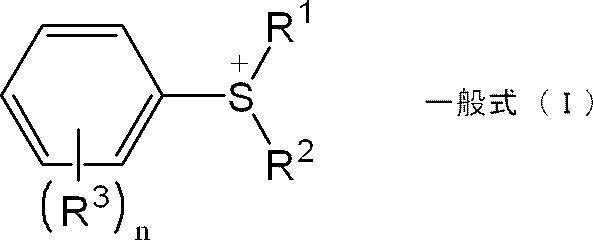
(一般式(I)において、R1及びR2は各々独立に、アルキル基を示す。R3は、各々独立に、アルキル基、ヒドロキシ基、カルボキシ基、アルコキシ基、アリールオキシ基、アルキルカルボニル基、アリールカルボニル基、アラルキルカルボニル基、アルコキシカルボニル基、アリールオキシカルボニル基、アラルキルオキシカルボニル基、アルキルカルボニルオキシ基、アリールカルボニルオキシ基、アラルキルカルボニルオキシ基、アルコキシカルボニルオキシ基、アリールオキシカルボニルオキシ基、アラルキルオキシカルボニルオキシ基、アリールチオカルボニル基、アリールチオ基、アルキルチオ基、アリール基、複素環式炭化水素基、アルキルスルフィニル基、アリールスルフィニル基、アルキルスルホニル基、アリールスルホニル基、アルキルスルホニルオキシ基、アリールスルホニルオキシ基、ヒドロキシ(ポリ)アルキレンオキシ基、アミノ基、シアノ基、ニトロ基又はハロゲン原子を示す。nは0~5の整数を示す。)
<2> 前記一般式(I)で表されるカチオン種が、下記一般式(II)で表されるカチオン種である<1>に記載の熱硬化性樹脂組成物。
<2> 前記一般式(I)で表されるカチオン種が、下記一般式(II)で表されるカチオン種である<1>に記載の熱硬化性樹脂組成物。
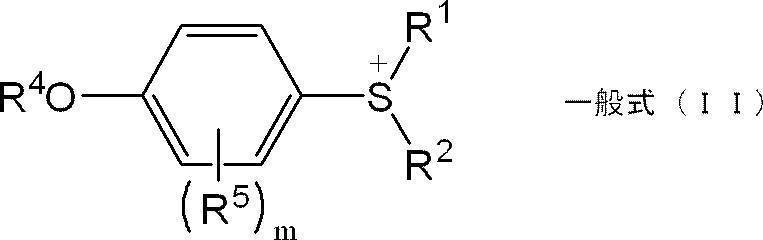
(一般式(II)において、R1及びR2は各々独立に、炭素数が1~4のアルキル基を示す。R4は水素原子、R-CO-基又はR-SO2-基(Rは、1又は2以上のハロゲン原子で置換されていてもよい炭素数が1~4のアルキル基を示す。)を示す。R5は、各々独立に、炭素数が1~4のアルキル基又はハロゲン原子を示す。mは0~4の整数を示す。)
<3> 一般式(II)におけるR4が、R-CO-基(Rは、1又は2以上のハロゲン原子で置換されていてもよい炭素数が1~4のアルキル基を示す。)である<2>に記載の熱硬化性樹脂組成物。
<4> 前記硬化剤に含まれるアニオン種が、SbF6 -、PF6 -、BF4 -及び(Rf)bPF6-b -(Rfは水素の80%以上がフッ素原子で置換されたアルキル基を示し、bは1~5の整数を示す。)のいずれかである<1>~<3>のいずれか1項に記載の熱硬化性樹脂組成物。
<5> 前記アニオン種が、SbF6 -である<4>に記載の熱硬化性樹脂組成物。
<6> 前記熱硬化性樹脂が、エポキシ樹脂を含む<1>~<5>のいずれか1項に記載の熱硬化性樹脂組成物。
<7> 無機充填材をさらに含有する<1>~<6>のいずれか1項に記載の熱硬化性樹脂組成物。
<8> 前記無機充填材が、アルミナ、酸化マグネシウム、酸化ベリリウム、窒化ホウ素、窒化アルミニウム、窒化ケイ素、炭化ケイ素、フッ化アルミニウム及びフッ化カルシウムからなる群より選択される少なくとも一種を含む<7>に記載の熱硬化性樹脂組成物。
<9> コイル導体の外周の少なくとも一部を覆う、マイカテープの積層体を形成する工程と、
前記積層体に<1>~<8>のいずれか1項に記載の熱硬化性樹脂組成物を含浸する工程と、
前記熱硬化性樹脂組成物を硬化して絶縁層を形成する工程と、を有する回転電機用コイルの製造方法。
<10> コイル導体と、前記コイル導体の外周の少なくとも一部を覆うように配置された絶縁層と、を有し、
前記絶縁層が、前記コイル導体の外周の少なくとも一部を覆うマイカテープの積層体と、前記積層体に含浸された<1>~<8>のいずれか1項に記載の熱硬化性樹脂組成物の硬化物とを含む回転電機用コイル。
<11> <1>~<8>のいずれか1項に記載の熱硬化性樹脂組成物の硬化物により封止されたコイル又はコイルエンドを備える回転電機。
<3> 一般式(II)におけるR4が、R-CO-基(Rは、1又は2以上のハロゲン原子で置換されていてもよい炭素数が1~4のアルキル基を示す。)である<2>に記載の熱硬化性樹脂組成物。
<4> 前記硬化剤に含まれるアニオン種が、SbF6 -、PF6 -、BF4 -及び(Rf)bPF6-b -(Rfは水素の80%以上がフッ素原子で置換されたアルキル基を示し、bは1~5の整数を示す。)のいずれかである<1>~<3>のいずれか1項に記載の熱硬化性樹脂組成物。
<5> 前記アニオン種が、SbF6 -である<4>に記載の熱硬化性樹脂組成物。
<6> 前記熱硬化性樹脂が、エポキシ樹脂を含む<1>~<5>のいずれか1項に記載の熱硬化性樹脂組成物。
<7> 無機充填材をさらに含有する<1>~<6>のいずれか1項に記載の熱硬化性樹脂組成物。
<8> 前記無機充填材が、アルミナ、酸化マグネシウム、酸化ベリリウム、窒化ホウ素、窒化アルミニウム、窒化ケイ素、炭化ケイ素、フッ化アルミニウム及びフッ化カルシウムからなる群より選択される少なくとも一種を含む<7>に記載の熱硬化性樹脂組成物。
<9> コイル導体の外周の少なくとも一部を覆う、マイカテープの積層体を形成する工程と、
前記積層体に<1>~<8>のいずれか1項に記載の熱硬化性樹脂組成物を含浸する工程と、
前記熱硬化性樹脂組成物を硬化して絶縁層を形成する工程と、を有する回転電機用コイルの製造方法。
<10> コイル導体と、前記コイル導体の外周の少なくとも一部を覆うように配置された絶縁層と、を有し、
前記絶縁層が、前記コイル導体の外周の少なくとも一部を覆うマイカテープの積層体と、前記積層体に含浸された<1>~<8>のいずれか1項に記載の熱硬化性樹脂組成物の硬化物とを含む回転電機用コイル。
<11> <1>~<8>のいずれか1項に記載の熱硬化性樹脂組成物の硬化物により封止されたコイル又はコイルエンドを備える回転電機。
本発明の一形態によれば、高いガラス転移温度を示し、貯蔵安定性に優れる熱硬化性樹脂組成物並びにこれを用いた回転電機用コイル及びその製造方法並びに回転電機が提供される。
以下、本発明の熱硬化性樹脂組成物、回転電機用コイル及びその製造方法並びに回転電機を実施するための形態について詳細に説明する。但し、本発明は以下の実施形態に限定されるものではない。以下の実施形態において、その構成要素(要素ステップ等も含む)は、特に明示した場合を除き、必須ではない。数値及びその範囲についても同様であり、本発明を制限するものではない。
本開示において「工程」との語には、他の工程から独立した工程に加え、他の工程と明確に区別できない場合であってもその工程の目的が達成されれば、当該工程も含まれる。
本開示において「~」を用いて示された数値範囲には、「~」の前後に記載される数値がそれぞれ最小値及び最大値として含まれる。
本開示中に段階的に記載されている数値範囲において、一つの数値範囲で記載された上限値又は下限値は、他の段階的な記載の数値範囲の上限値又は下限値に置き換えてもよい。また、本開示中に記載されている数値範囲において、その数値範囲の上限値又は下限値は、実施例に示されている値に置き換えてもよい。
本開示において各成分は該当する物質を複数種含んでいてもよい。組成物中に各成分に該当する物質が複数種存在する場合、各成分の含有率又は含有量は、特に断らない限り、組成物中に存在する当該複数種の物質の合計の含有率又は含有量を意味する。
本開示において各成分に該当する粒子は複数種含んでいてもよい。組成物中に各成分に該当する粒子が複数種存在する場合、各成分の粒子径は、特に断らない限り、組成物中に存在する当該複数種の粒子の混合物についての値を意味する。
本開示において「層」との語には、当該層が存在する領域を観察したときに、当該領域の全体に形成されている場合に加え、当該領域の一部にのみ形成されている場合も含まれる。
本開示において「積層」との語は、層を積み重ねることを示し、二以上の層が結合されていてもよく、二以上の層が着脱可能であってもよい。
本開示において「工程」との語には、他の工程から独立した工程に加え、他の工程と明確に区別できない場合であってもその工程の目的が達成されれば、当該工程も含まれる。
本開示において「~」を用いて示された数値範囲には、「~」の前後に記載される数値がそれぞれ最小値及び最大値として含まれる。
本開示中に段階的に記載されている数値範囲において、一つの数値範囲で記載された上限値又は下限値は、他の段階的な記載の数値範囲の上限値又は下限値に置き換えてもよい。また、本開示中に記載されている数値範囲において、その数値範囲の上限値又は下限値は、実施例に示されている値に置き換えてもよい。
本開示において各成分は該当する物質を複数種含んでいてもよい。組成物中に各成分に該当する物質が複数種存在する場合、各成分の含有率又は含有量は、特に断らない限り、組成物中に存在する当該複数種の物質の合計の含有率又は含有量を意味する。
本開示において各成分に該当する粒子は複数種含んでいてもよい。組成物中に各成分に該当する粒子が複数種存在する場合、各成分の粒子径は、特に断らない限り、組成物中に存在する当該複数種の粒子の混合物についての値を意味する。
本開示において「層」との語には、当該層が存在する領域を観察したときに、当該領域の全体に形成されている場合に加え、当該領域の一部にのみ形成されている場合も含まれる。
本開示において「積層」との語は、層を積み重ねることを示し、二以上の層が結合されていてもよく、二以上の層が着脱可能であってもよい。
<<熱硬化性樹脂組成物>>
本開示の熱硬化性樹脂組成物は、熱硬化性樹脂と、下記一般式(I)で表されるカチオン種を含む硬化剤(以下、特定硬化剤と称することがある。)と、を含有する。
本開示の熱硬化性樹脂組成物は、熱硬化性樹脂と、下記一般式(I)で表されるカチオン種を含む硬化剤(以下、特定硬化剤と称することがある。)と、を含有する。
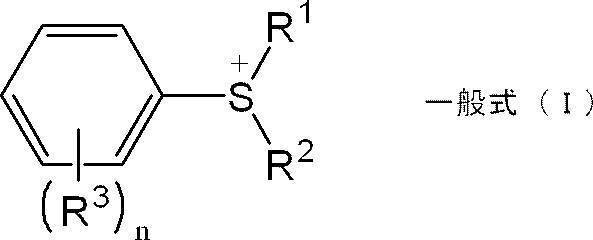
一般式(I)において、R1及びR2は各々独立に、アルキル基を示す。R3は、各々独立に、アルキル基、ヒドロキシ基、カルボキシ基、アルコキシ基、アリールオキシ基、アルキルカルボニル基、アリールカルボニル基、アラルキルカルボニル基、アルコキシカルボニル基、アリールオキシカルボニル基、アラルキルオキシカルボニル基、アルキルカルボニルオキシ基、アリールカルボニルオキシ基、アラルキルカルボニルオキシ基、アルコキシカルボニルオキシ基、アリールオキシカルボニルオキシ基、アラルキルオキシカルボニルオキシ基、アリールチオカルボニル基、アリールチオ基、アルキルチオ基、アリール基、複素環式炭化水素基、アルキルスルフィニル基、アリールスルフィニル基、アルキルスルホニル基、アリールスルホニル基、アルキルスルホニルオキシ基、アリールスルホニルオキシ基、ヒドロキシ(ポリ)アルキレンオキシ基、アミノ基、シアノ基、ニトロ基又はハロゲン原子を示す。nは0~5の整数を示す。
本開示の熱硬化性樹脂組成物は熱硬化性樹脂の硬化剤として特定硬化剤を含むことから、貯蔵時における特定硬化剤による熱硬化性樹脂の硬化反応が抑制される。そのため、本開示の熱硬化性樹脂組成物は貯蔵安定性に優れると推察される。また、本開示の熱硬化性樹脂組成物は熱硬化性樹脂の硬化剤として特定硬化剤を含むことから、形成される硬化物のガラス転移温度が高くなると推察される。
以下、本開示の熱硬化性樹脂組成物に含有される成分について説明する。
-熱硬化性樹脂-
本開示で用いられる熱硬化性樹脂としては、エポキシ樹脂、フェノール樹脂、尿素樹脂、メラミン樹脂、不飽和ポリエステル樹脂、シアン酸エステル樹脂、ポリイミド樹脂、ビスマレイミド・トリアジン樹脂、フェノール・アラルキル樹脂等を、単独あるいは2種類以上組み合わせて用いることができる。
熱硬化性樹脂の中でも、エポキシ樹脂が好ましい。エポキシ樹脂としては、例えば、ビスフェノールA型エポキシ樹脂、ビスフェノールF型エポキシ樹脂、フェノールノボラック型エポキシ樹脂、クレゾールノボラック型エポキシ樹脂及び脂環式エポキシ樹脂を単独で又は2種類以上を組み合わせて用いることができる。
-熱硬化性樹脂-
本開示で用いられる熱硬化性樹脂としては、エポキシ樹脂、フェノール樹脂、尿素樹脂、メラミン樹脂、不飽和ポリエステル樹脂、シアン酸エステル樹脂、ポリイミド樹脂、ビスマレイミド・トリアジン樹脂、フェノール・アラルキル樹脂等を、単独あるいは2種類以上組み合わせて用いることができる。
熱硬化性樹脂の中でも、エポキシ樹脂が好ましい。エポキシ樹脂としては、例えば、ビスフェノールA型エポキシ樹脂、ビスフェノールF型エポキシ樹脂、フェノールノボラック型エポキシ樹脂、クレゾールノボラック型エポキシ樹脂及び脂環式エポキシ樹脂を単独で又は2種類以上を組み合わせて用いることができる。
熱硬化性樹脂としてエポキシ樹脂が用いられる場合、熱硬化性樹脂組成物の粘度調整のため、熱硬化性樹脂としてエポキシ基を有する反応性希釈剤を混合してもよい。エポキシ基を有する反応性希釈剤としては、例えば、n-ブチルグリシジルエーテル、バーサティック酸グリシジルエーテル、スチレンオキサイド、エチルヘキシルグリシジルエーテル、フェニルグリシジルエーテル、ブチルフェニルグリシジルエーテル、1,6-ヘキサンジオールジグリシジルエーテル、ネオペンチルグリコールジグリシジルエーテル、ジエチレングリコールジグリシジルエーテル及びトリメチロールプロパントリグリシジルエーテルが挙げられる。これらの内の1種類あるいは複数種を併用してもよい。
熱硬化性樹脂組成物を含浸用又は注型用の樹脂組成物として用いる場合、熱硬化性樹脂組成物は常温(25℃)で液状であることが望ましい。常温(25℃)で液状の熱硬化性樹脂組成物を得るためには、常温(25℃)で液状の熱硬化性樹脂を用いることが好ましい。2種以上の熱硬化性樹脂を併用する場合、熱硬化性樹脂の混合物が常温(25℃)で液状であればよい。
本開示において、常温(25℃)で液状とは、具体的には、25℃において、E型粘度計で測定される粘度が1000Pa・s以下であることを意味する。粘度は、E型粘度計EHD型(コーン角度3°、コーン直径28mm)を用いて、測定温度:25℃、サンプル容量:0.7mlの条件にて、以下を参考に回転数をサンプルの想定される粘度に合わせて設定の上、測定開始から1分経過後の値を測定値とする。
(1)想定される粘度が100Pa・s~1000Pa・sの場合:回転数0.5回転/分
(2)想定される粘度が100Pa・s未満の場合:回転数5回転/分
本開示において、常温(25℃)で液状とは、具体的には、25℃において、E型粘度計で測定される粘度が1000Pa・s以下であることを意味する。粘度は、E型粘度計EHD型(コーン角度3°、コーン直径28mm)を用いて、測定温度:25℃、サンプル容量:0.7mlの条件にて、以下を参考に回転数をサンプルの想定される粘度に合わせて設定の上、測定開始から1分経過後の値を測定値とする。
(1)想定される粘度が100Pa・s~1000Pa・sの場合:回転数0.5回転/分
(2)想定される粘度が100Pa・s未満の場合:回転数5回転/分
-硬化剤-
本開示で用いられる特定硬化剤としては、下記一般式(I)で表されるカチオン種を含む硬化剤であれば特に限定されない。
本開示で用いられる特定硬化剤としては、下記一般式(I)で表されるカチオン種を含む硬化剤であれば特に限定されない。

一般式(I)において、R1及びR2は各々独立に、アルキル基を示す。R3は、各々独立に、アルキル基、ヒドロキシ基、カルボキシ基、アルコキシ基、アリールオキシ基、アルキルカルボニル基、アリールカルボニル基、アラルキルカルボニル基、アルコキシカルボニル基、アリールオキシカルボニル基、アラルキルオキシカルボニル基、アルキルカルボニルオキシ基、アリールカルボニルオキシ基、アラルキルカルボニルオキシ基、アルコキシカルボニルオキシ基、アリールオキシカルボニルオキシ基、アラルキルオキシカルボニルオキシ基、アリールチオカルボニル基、アリールチオ基、アルキルチオ基、アリール基、複素環式炭化水素基、アルキルスルフィニル基、アリールスルフィニル基、アルキルスルホニル基、アリールスルホニル基、アルキルスルホニルオキシ基、アリールスルホニルオキシ基、ヒドロキシ(ポリ)アルキレンオキシ基、アミノ基、シアノ基、ニトロ基又はハロゲン原子を示す。nは0~5の整数を示す。
一般式(I)において、R1~R3で示されるアルキル基としては、炭素数1~18の直鎖アルキル基、炭素数1~18の分枝鎖アルキル基、炭素数3~18のシクロアルキル基等が挙げられる。
炭素数1~18の直鎖アルキル基として具体的には、メチル基、エチル基、n-プロピル基、n-ブチル基、n-ペンチル基、n-オクチル基、n-デシル基、n-ドデシル基、n-テトラデシル基、n-ヘキサデシル基、n-オクタデシル基等が挙げられる。
炭素数1~18の分枝鎖アルキル基として具体的には、イソプロピル基、イソブチル基、sec-ブチル基、t-ブチル基、イソペンチル基、ネオペンチル基、t-ペンチル基、イソヘキシル基、イソオクタデシル基等が挙げられる。
炭素数3~18のシクロアルキル基として具体的には、シクロプロピル基、シクロブチル基、シクロペンチル基、シクロヘキシル基、4-デシルシクロヘキシル基等が挙げられる。
炭素数1~18の直鎖アルキル基として具体的には、メチル基、エチル基、n-プロピル基、n-ブチル基、n-ペンチル基、n-オクチル基、n-デシル基、n-ドデシル基、n-テトラデシル基、n-ヘキサデシル基、n-オクタデシル基等が挙げられる。
炭素数1~18の分枝鎖アルキル基として具体的には、イソプロピル基、イソブチル基、sec-ブチル基、t-ブチル基、イソペンチル基、ネオペンチル基、t-ペンチル基、イソヘキシル基、イソオクタデシル基等が挙げられる。
炭素数3~18のシクロアルキル基として具体的には、シクロプロピル基、シクロブチル基、シクロペンチル基、シクロヘキシル基、4-デシルシクロヘキシル基等が挙げられる。
一般式(I)において、R3で示されるアルコキシ基としては、炭素数1~18の直鎖又は分枝鎖アルコキシ基等が挙げられる。
アルコキシ基として具体的には、メトキシ基、エトキシ基、プロポキシ基、イソプロポキシ基、ブトキシ基、イソブトキシ基、sec-ブトキシ基、t-ブトキシ基、ヘキシルオキシ基、デシルオキシ基、ドデシルオキシ基、オクタデシルオキシ基等が挙げられる。
アルコキシ基として具体的には、メトキシ基、エトキシ基、プロポキシ基、イソプロポキシ基、ブトキシ基、イソブトキシ基、sec-ブトキシ基、t-ブトキシ基、ヘキシルオキシ基、デシルオキシ基、ドデシルオキシ基、オクタデシルオキシ基等が挙げられる。
一般式(I)において、R3で示されるアリールオキシ基としては、炭素数6~10のアリールオキシ基等が挙げられる。
アリールオキシ基として具体的には、フェノキシ基、ナフチルオキシ基等が挙げられる。
アリールオキシ基として具体的には、フェノキシ基、ナフチルオキシ基等が挙げられる。
一般式(I)において、R3で示されるアルキルカルボニル基としては、炭素数2~18の直鎖又は分枝鎖アルキルカルボニル基等が挙げられる。
アルキルカルボニル基として具体的には、アセチル基、プロピオニル基、ブタノイル基、2-メチルプロピオニル基、ヘプタノイル基、2-メチルブタノイル基、3-メチルブタノイル基、オクタノイル基、デカノイル基、ドデカノイル基、オクタデカノイル基等が挙げられる。
アルキルカルボニル基として具体的には、アセチル基、プロピオニル基、ブタノイル基、2-メチルプロピオニル基、ヘプタノイル基、2-メチルブタノイル基、3-メチルブタノイル基、オクタノイル基、デカノイル基、ドデカノイル基、オクタデカノイル基等が挙げられる。
一般式(I)において、R3で示されるアリールカルボニル基としては、炭素数7~11のアリールカルボニル基等が挙げられる。
アリールカルボニル基として具体的には、ベンゾイル基、ナフトイル基等が挙げられる。
アリールカルボニル基として具体的には、ベンゾイル基、ナフトイル基等が挙げられる。
一般式(I)において、R3で示されるアラルキルカルボニル基としては、炭素数6~10のアリール基で置換されている低級アルキルカルボニル基等が挙げられる。
アラルキルカルボニル基として具体的には、ベンジルカルボニル基、2-メチルベンジルカルボニル基、1-ナフチルメチルカルボニル基、2-ナフチルメチルカルボニル基等が挙げられる。
アラルキルカルボニル基として具体的には、ベンジルカルボニル基、2-メチルベンジルカルボニル基、1-ナフチルメチルカルボニル基、2-ナフチルメチルカルボニル基等が挙げられる。
一般式(I)において、R3で示されるアルコキシカルボニル基としては、炭素数2~19の直鎖又は分枝鎖アルコキシカルボニル基等が挙げられる。
アルコキシカルボニル基として具体的には、メトキシカルボニル基、エトキシカルボニル基、プロポキシカルボニル基、イソプロポキシカルボニル基、ブトキシカルボニル基、イソブトキシカルボニル基、sec-ブトキシカルボニル基、t-ブトキシカルボニル基、オクチロキシカルボニル基、テトラデシルオキシカルボニル基、オクタデシロキシカルボニル基等が挙げられる。
アルコキシカルボニル基として具体的には、メトキシカルボニル基、エトキシカルボニル基、プロポキシカルボニル基、イソプロポキシカルボニル基、ブトキシカルボニル基、イソブトキシカルボニル基、sec-ブトキシカルボニル基、t-ブトキシカルボニル基、オクチロキシカルボニル基、テトラデシルオキシカルボニル基、オクタデシロキシカルボニル基等が挙げられる。
一般式(I)において、R3で示されるアリールオキシカルボニル基としては、炭素数7~11のアリールオキシカルボニル基等が挙げられる。
アリールオキシカルボニル基として具体的には、フェノキシカルボニル基、ナフトキシカルボニル基等が挙げられる。
アリールオキシカルボニル基として具体的には、フェノキシカルボニル基、ナフトキシカルボニル基等が挙げられる。
一般式(I)において、R3で示されるアラルキルオキシカルボニル基としては、炭素数6~10のアリール基で置換されている低級アルコキシカルボニル基等が挙げられる。
アラルキルオキシカルボニル基として具体的には、ベンジルオキシカルボニル基、2-メチルベンジルオキシカルボニル基、1-ナフチルメチルオキシカルボニル基、2-ナフチルメチルオキシカルボニル基等が挙げられる。
アラルキルオキシカルボニル基として具体的には、ベンジルオキシカルボニル基、2-メチルベンジルオキシカルボニル基、1-ナフチルメチルオキシカルボニル基、2-ナフチルメチルオキシカルボニル基等が挙げられる。
一般式(I)において、R3で示されるアルキルカルボニルオキシ基としては、炭素数2~19の直鎖又は分枝鎖アルキルカルボニルオキシ基等が挙げられる。
アルキルカルボニルオキシ基として具体的には、アセトキシ基、エチルカルボニルオキシ基、プロピルカルボニルオキシ基、イソプロピルカルボニルオキシ基、ブチルカルボニルオキシ基、イソブチルカルボニルオキシ基、sec-ブチルカルボニルオキシ基、t-ブチルカルボニルオキシ基、オクチルカルボニルオキシ基、テトラデシルカルボニルオキシ基、オクタデシルカルボニルオキシ基等が挙げられる。
アルキルカルボニルオキシ基として具体的には、アセトキシ基、エチルカルボニルオキシ基、プロピルカルボニルオキシ基、イソプロピルカルボニルオキシ基、ブチルカルボニルオキシ基、イソブチルカルボニルオキシ基、sec-ブチルカルボニルオキシ基、t-ブチルカルボニルオキシ基、オクチルカルボニルオキシ基、テトラデシルカルボニルオキシ基、オクタデシルカルボニルオキシ基等が挙げられる。
一般式(I)において、R3で示されるアリールカルボニルオキシ基としては、炭素数7~11のアリールカルボニルオキシ基等が挙げられる。
アリールカルボニルオキシ基として具体的には、ベンゾイルオキシ基、ナフトイルオキシ基等が挙げられる。
アリールカルボニルオキシ基として具体的には、ベンゾイルオキシ基、ナフトイルオキシ基等が挙げられる。
一般式(I)において、R3で示されるアラルキルカルボニルオキシ基としては、炭素数6~10のアリール基で置換されている低級アルキルカルボニルオキシ基等が挙げられる。
アラルキルカルボニルオキシ基として具体的には、ベンジルカルボニルオキシ基、2-メチルベンジルカルボニルオキシ基、1-ナフチルメチルカルボニルオキシ基、2-ナフチルメチルカルボニルオキシ基等が挙げられる。
アラルキルカルボニルオキシ基として具体的には、ベンジルカルボニルオキシ基、2-メチルベンジルカルボニルオキシ基、1-ナフチルメチルカルボニルオキシ基、2-ナフチルメチルカルボニルオキシ基等が挙げられる。
一般式(I)において、R3で示されるアルコキシカルボニルオキシ基としては、炭素数2~19の直鎖又は分枝鎖アルコキシカルボニルオキシ基等が挙げられる。
アルコキシカルボニルオキシ基として具体的には、メトキシカルボニルオキシ基、エトキシカルボニルオキシ基、プロポキシカルボニルオキシ基、イソプロポキシカルボニルオキシ基、ブトキシカルボニルオキシ基、イソブトキシカルボニルオキシ基、sec-ブトキシカルボニルオキシ基、t-ブトキシカルボニルオキシ基、オクチロキシカルボニルオキシ基、テトラデシルオキシカルボニルオキシ基、オクタデシロキシカルボニルオキシ基等が挙げられる。
アルコキシカルボニルオキシ基として具体的には、メトキシカルボニルオキシ基、エトキシカルボニルオキシ基、プロポキシカルボニルオキシ基、イソプロポキシカルボニルオキシ基、ブトキシカルボニルオキシ基、イソブトキシカルボニルオキシ基、sec-ブトキシカルボニルオキシ基、t-ブトキシカルボニルオキシ基、オクチロキシカルボニルオキシ基、テトラデシルオキシカルボニルオキシ基、オクタデシロキシカルボニルオキシ基等が挙げられる。
一般式(I)において、R3で示されるアリールオキシカルボニルオキシ基としては、炭素数7~11のアリールオキシカルボニルオキシ基等が挙げられる。
アリールオキシカルボニルオキシ基として具体的には、フェノキシカルボニルオキシ基、ナフトキシカルボニルオキシ基等が挙げられる。
アリールオキシカルボニルオキシ基として具体的には、フェノキシカルボニルオキシ基、ナフトキシカルボニルオキシ基等が挙げられる。
一般式(I)において、R3で示されるアラルキルオキシカルボニルオキシ基としては、炭素数6~10のアリール基で置換されている低級アルコキシカルボニルオキシ基等が挙げられる。
アラルキルオキシカルボニルオキシ基として具体的には、ベンジルオキシカルボニルオキシ基、2-メチルベンジルオキシカルボニルオキシ基、1-ナフチルメチルオキシカルボニルオキシ基、2-ナフチルメチルオキシカルボニルオキシ基等が挙げられる。
アラルキルオキシカルボニルオキシ基として具体的には、ベンジルオキシカルボニルオキシ基、2-メチルベンジルオキシカルボニルオキシ基、1-ナフチルメチルオキシカルボニルオキシ基、2-ナフチルメチルオキシカルボニルオキシ基等が挙げられる。
一般式(I)において、R3で示されるアリールチオカルボニル基としては、炭素数7~11のアリールチオカルボニル基等が挙げられる。
アリールチオカルボニル基として具体的には、フェニルチオカルボニル基、ナフチルチオカルボニル基等が挙げられる。
アリールチオカルボニル基として具体的には、フェニルチオカルボニル基、ナフチルチオカルボニル基等が挙げられる。
一般式(I)において、R3で示されるアリールチオ基としては、炭素数6~20のアリールチオ基等が挙げられる。
アリールチオ基として具体的には、フェニルチオ基、2-メチルフェニルチオ基、3-メチルフェニルチオ基、4-メチルフェニルチオ基、2-クロロフェニルチオ基、3-クロロフェニルチオ基、4-クロロフェニルチオ基、2-ブロモフェニルチオ基、3-ブロモフェニルチオ基、4-ブロモフェニルチオ基、2-フルオロフェニルチオ基、3-フルオロフェニルチオ基、4-フルオロフェニルチオ基、2-ヒドロキシフェニルチオ基、4-ヒドロキシフェニルチオ基、2-メトキシフェニルチオ基、4-メトキシフェニルチオ基、1-ナフチルチオ基、2-ナフチルチオ基、4-[4-(フェニルチオ)ベンゾイル]フェニルチオ基、4-[4-(フェニルチオ)フェノキシ]フェニルチオ基、4-[4-(フェニルチオ)フェニル]フェニルチオ基、4-(フェニルチオ)フェニルチオ基、4-ベンゾイルフェニルチオ基、4-ベンゾイル-2-クロロフェニルチオ基、4-ベンゾイル-3-クロロフェニルチオ基、4-ベンゾイル-3-メチルチオフェニルチオ基、4-ベンゾイル-2-メチルチオフェニルチオ基、4-(4-メチルチオベンゾイル)フェニルチオ基、4-(2-メチルチオベンゾイル)フェニルチオ基、4-(p-メチルベンゾイル)フェニルチオ基、4-(p-エチルベンゾイル)フェニルチオ基、4-(p-イソプロピルベンゾイル)フェニルチオ基、4-(p-t-ブチルベンゾイル)フェニルチオ基等が挙げられる。
アリールチオ基として具体的には、フェニルチオ基、2-メチルフェニルチオ基、3-メチルフェニルチオ基、4-メチルフェニルチオ基、2-クロロフェニルチオ基、3-クロロフェニルチオ基、4-クロロフェニルチオ基、2-ブロモフェニルチオ基、3-ブロモフェニルチオ基、4-ブロモフェニルチオ基、2-フルオロフェニルチオ基、3-フルオロフェニルチオ基、4-フルオロフェニルチオ基、2-ヒドロキシフェニルチオ基、4-ヒドロキシフェニルチオ基、2-メトキシフェニルチオ基、4-メトキシフェニルチオ基、1-ナフチルチオ基、2-ナフチルチオ基、4-[4-(フェニルチオ)ベンゾイル]フェニルチオ基、4-[4-(フェニルチオ)フェノキシ]フェニルチオ基、4-[4-(フェニルチオ)フェニル]フェニルチオ基、4-(フェニルチオ)フェニルチオ基、4-ベンゾイルフェニルチオ基、4-ベンゾイル-2-クロロフェニルチオ基、4-ベンゾイル-3-クロロフェニルチオ基、4-ベンゾイル-3-メチルチオフェニルチオ基、4-ベンゾイル-2-メチルチオフェニルチオ基、4-(4-メチルチオベンゾイル)フェニルチオ基、4-(2-メチルチオベンゾイル)フェニルチオ基、4-(p-メチルベンゾイル)フェニルチオ基、4-(p-エチルベンゾイル)フェニルチオ基、4-(p-イソプロピルベンゾイル)フェニルチオ基、4-(p-t-ブチルベンゾイル)フェニルチオ基等が挙げられる。
一般式(I)において、R3で示されるアルキルチオ基としては、炭素数1~18の直鎖又は分枝鎖アルキルチオ基等が挙げられる。
アルキルチオ基として具体的には、メチルチオ基、エチルチオ基、プロピルチオ基、イソプロピルチオ基、ブチルチオ基、イソブチルチオ基、sec-ブチルチオ基、t-ブチルチオ基、ペンチルチオ基、イソペンチルチオ基、ネオペンチルチオ基、t-ペンチルチオ基、オクチルチオ基、デシルチオ基、ドデシルチオ基、イソオクタデシルチオ基等が挙げられる。
アルキルチオ基として具体的には、メチルチオ基、エチルチオ基、プロピルチオ基、イソプロピルチオ基、ブチルチオ基、イソブチルチオ基、sec-ブチルチオ基、t-ブチルチオ基、ペンチルチオ基、イソペンチルチオ基、ネオペンチルチオ基、t-ペンチルチオ基、オクチルチオ基、デシルチオ基、ドデシルチオ基、イソオクタデシルチオ基等が挙げられる。
一般式(I)において、R3で示されるアリール基としては、炭素数6~10のアリール基等が挙げられる。
アリール基として具体的には、フェニル基、トリル基、ジメチルフェニル基、ナフチル基等が挙げられる。
アリール基として具体的には、フェニル基、トリル基、ジメチルフェニル基、ナフチル基等が挙げられる。
一般式(I)において、R3で示される複素環式炭化水素基としては、炭素数4~20の複素環式炭化水素基等が挙げられる。
複素環式炭化水素基として具体的には、チエニル基、フラニル基、ピラニル基、ピロリル基、オキサゾリル基、チアゾリル基、ピリジル基、ピリミジル基、ピラジニル基、インドリル基、ベンゾフラニル基、ベンゾチエニル基、キノリル基、イソキノリル基、キノキサリニル基、キナゾリニル基、カルバゾリル基、アクリジニル基、フェノチアジニル基、フェナジニル基、キサンテニル基、チアントレニル基、フェノキサジニル基、フェノキサチイニル基、クロマニル基、イソクロマニル基、ジベンゾチエニル基、キサントニル基、チオキサントニル基、ジベンゾフラニル基等が挙げられる。
複素環式炭化水素基として具体的には、チエニル基、フラニル基、ピラニル基、ピロリル基、オキサゾリル基、チアゾリル基、ピリジル基、ピリミジル基、ピラジニル基、インドリル基、ベンゾフラニル基、ベンゾチエニル基、キノリル基、イソキノリル基、キノキサリニル基、キナゾリニル基、カルバゾリル基、アクリジニル基、フェノチアジニル基、フェナジニル基、キサンテニル基、チアントレニル基、フェノキサジニル基、フェノキサチイニル基、クロマニル基、イソクロマニル基、ジベンゾチエニル基、キサントニル基、チオキサントニル基、ジベンゾフラニル基等が挙げられる。
一般式(I)において、R3で示されるアルキルスルフィニル基としては、炭素数1~18の直鎖又は分枝鎖アルキルスルフィニル基等が挙げられる。
アルキルスルフィニル基として具体的には、メチルスルフィニル基、エチルスルフィニル基、プロピルスルフィニル基、イソプロピルスルフィニル基、ブチルスルフィニル基、イソブチルスルフィニル基、sec-ブチルスルフィニル基、t-ブチルスルフィニル基、ペンチルスルフィニル基、イソペンチルスルフィニル基、ネオペンチルスルフィニル基、t-ペンチルスルフィニル基、オクチルスルフィニル基、イソオクタデシルスルフィニル基等が挙げられる。
アルキルスルフィニル基として具体的には、メチルスルフィニル基、エチルスルフィニル基、プロピルスルフィニル基、イソプロピルスルフィニル基、ブチルスルフィニル基、イソブチルスルフィニル基、sec-ブチルスルフィニル基、t-ブチルスルフィニル基、ペンチルスルフィニル基、イソペンチルスルフィニル基、ネオペンチルスルフィニル基、t-ペンチルスルフィニル基、オクチルスルフィニル基、イソオクタデシルスルフィニル基等が挙げられる。
一般式(I)において、R3で示されるアリールスルフィニル基としては、炭素数6~10のアリールスルフィニル基等が挙げられる。
アリールスルフィニル基として具体的には、フェニルスルフィニル基、トリルスルフィニル基、ナフチルスルフィニル基等が挙げられる。
アリールスルフィニル基として具体的には、フェニルスルフィニル基、トリルスルフィニル基、ナフチルスルフィニル基等が挙げられる。
一般式(I)において、R3で示されるアルキルスルホニル基としては、炭素数1~18の直鎖又は分枝鎖アルキルスルホニル基等が挙げられる。
アルキルスルホニル基として具体的には、メチルスルホニル基、エチルスルホニル基、プロピルスルホニル基、イソプロピルスルホニル基、ブチルスルホニル基、イソブチルスルホニル基、sec-ブチルスルホニル基、t-ブチルスルホニル基、ペンチルスルホニル基、イソペンチルスルホニル基、ネオペンチルスルホニル基、t-ペンチルスルホニル基、オクチルスルホニル基、オクタデシルスルホニル基等が挙げられる。
アルキルスルホニル基として具体的には、メチルスルホニル基、エチルスルホニル基、プロピルスルホニル基、イソプロピルスルホニル基、ブチルスルホニル基、イソブチルスルホニル基、sec-ブチルスルホニル基、t-ブチルスルホニル基、ペンチルスルホニル基、イソペンチルスルホニル基、ネオペンチルスルホニル基、t-ペンチルスルホニル基、オクチルスルホニル基、オクタデシルスルホニル基等が挙げられる。
一般式(I)において、R3で示されるアリールスルホニル基としては、炭素数6~10のアリールスルホニル基等が挙げられる。
アリールスルホニル基として具体的には、フェニルスルホニル基、トリルスルホニル基(トシル基)、ナフチルスルホニル基等が挙げられる。
アリールスルホニル基として具体的には、フェニルスルホニル基、トリルスルホニル基(トシル基)、ナフチルスルホニル基等が挙げられる。
一般式(I)において、R3で示されるアルキルスルホニルオキシ基としては、炭素数1~18の直鎖又は分枝鎖アルキルスルホニルオキシ基等が挙げられる。
アルキルスルホニルオキシ基として具体的には、メチルスルホニルオキシ基、エチルスルホニルオキシ基、プロピルスルホニルオキシ基、イソプロピルスルホニルオキシ基、ブチルスルホニルオキシ基、イソブチルスルホニルオキシ基、sec-ブチルスルホニルオキシ基、t-ブチルスルホニルオキシ基、ペンチルスルホニルオキシ基、イソペンチルスルホニルオキシ基、ネオペンチルスルホニルオキシ基、t-ペンチルスルホニルオキシ基、オクチルスルホニルオキシ基、オクタデシルスルホニルオキシ基等が挙げられる。
アルキルスルホニルオキシ基として具体的には、メチルスルホニルオキシ基、エチルスルホニルオキシ基、プロピルスルホニルオキシ基、イソプロピルスルホニルオキシ基、ブチルスルホニルオキシ基、イソブチルスルホニルオキシ基、sec-ブチルスルホニルオキシ基、t-ブチルスルホニルオキシ基、ペンチルスルホニルオキシ基、イソペンチルスルホニルオキシ基、ネオペンチルスルホニルオキシ基、t-ペンチルスルホニルオキシ基、オクチルスルホニルオキシ基、オクタデシルスルホニルオキシ基等が挙げられる。
一般式(I)において、R3で示されるアリールスルホニルオキシ基としては、炭素数6~10のアリールスルホニルオキシ基等が挙げられる。
アリールスルホニルオキシ基として具体的には、フェニルスルホニルオキシ基、トリルスルホニルオキシ基、ナフチルスルホニルオキシ基等が挙げられる。
アリールスルホニルオキシ基として具体的には、フェニルスルホニルオキシ基、トリルスルホニルオキシ基、ナフチルスルホニルオキシ基等が挙げられる。
一般式(I)において、R3で示されるヒドロキシ(ポリ)アルキレンオキシ基としては、[HO(-AO)q-(AOはエチレンオキシ基及びプロピレンオキシ基の少なくとも一方を示し、qは1~5の整数を示す。)]で表されるヒドロキシ(ポリ)アルキレンオキシ基等が挙げられる。
一般式(I)において、R3で示されるアミノ基としては、アミノ基(-NH2)、炭素数1~15の置換アミノ基等が挙げられる。
置換アミノ基として具体的には、メチルアミノ基、ジメチルアミノ基、エチルアミノ基、メチルエチルアミノ基、ジエチルアミノ基、n-プロピルアミノ基、メチル-n-プロピルアミノ基、エチル-n-プロピルアミノ基、イソプロピルアミノ基、イソプロピルメチルアミノ基、イソプロピルエチルアミノ基、ジイソプロピルアミノ基、フェニルアミノ基、ジフェニルアミノ基、メチルフェニルアミノ基、エチルフェニルアミノ基、n-プロピルフェニルアミノ基、イソプロピルフェニルアミノ基等が挙げられる。
置換アミノ基として具体的には、メチルアミノ基、ジメチルアミノ基、エチルアミノ基、メチルエチルアミノ基、ジエチルアミノ基、n-プロピルアミノ基、メチル-n-プロピルアミノ基、エチル-n-プロピルアミノ基、イソプロピルアミノ基、イソプロピルメチルアミノ基、イソプロピルエチルアミノ基、ジイソプロピルアミノ基、フェニルアミノ基、ジフェニルアミノ基、メチルフェニルアミノ基、エチルフェニルアミノ基、n-プロピルフェニルアミノ基、イソプロピルフェニルアミノ基等が挙げられる。
一般式(I)において、R3で示されるハロゲン原子としては、フッ素原子、塩素原子、臭素原子、ヨウ素原子等が挙げられる。
式(I)において、nはR3の個数を示し、0~5の整数であることが好ましく、より好ましくは0~3であり、さらに好ましくは0~2であり、特に好ましくは0又は1である。
R3で示される各基はさらに置換基を有していてもよい。置換基の具体例としては、アルキル基、アリール基、アミノ基、シアノ基、ニトロ基、ハロゲン原子等を挙げることができる。
一般式(I)で表されるカチオン種としては、一般式(II)で表されるカチオン種であることが好ましい。
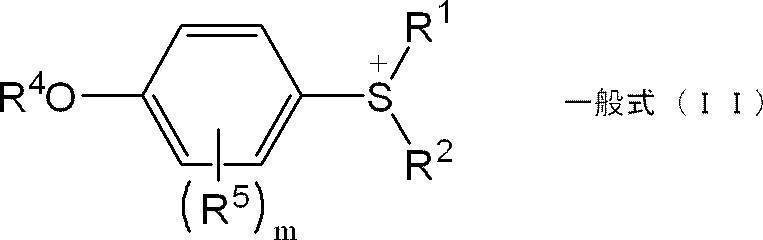
一般式(II)において、R1及びR2は各々独立に、炭素数が1~4のアルキル基を示す。R4は水素原子、R-CO-基又はR-SO2-基(Rは、1又は2以上のハロゲン原子で置換されていてもよい炭素数が1~4のアルキル基を示す。)を示す。R5は、各々独立に、炭素数が1~4のアルキル基又はハロゲン原子を示す。mは0~4の整数を示す。
一般式(II)において、R1、R2、R4又はR5における炭素数が1~4のアルキル基の具体例としては、メチル基、エチル基、n-プロピル基、イソプロピル基、n-ブチル基、イソブチル基、sec-ブチル基、t-ブチル基等が挙げられる。mは0~4の整数を示し、好ましくは0~3であり、より好ましくは0~2であり、さらに好ましくは0又は1である。
一般式(II)において、R4は、R-CO-基又はR-SO2-基(Rは、1又は2以上のハロゲン原子で置換されていてもよい炭素数が1~4のアルキル基を示す。)であることが好ましく、R-CO-基であることがより好ましい。R4として示されるR-CO-基としては、アセチル基であることがさらに好ましい。
R4がR-CO-基である場合のR4O-基の具体例は、一般式(I)におけるR3がアルキルカルボニルオキシ基である場合の具体例のうちの炭素数が2~5のものと同様である。また、R4がR-SO2-基である場合のR4O-基の具体例は、一般式(I)におけるR3がアルキルスルホニルオキシ基である場合の具体例のうちの炭素数が1~4のものと同様である。
R4がR-CO-基である場合のR4O-基の具体例は、一般式(I)におけるR3がアルキルカルボニルオキシ基である場合の具体例のうちの炭素数が2~5のものと同様である。また、R4がR-SO2-基である場合のR4O-基の具体例は、一般式(I)におけるR3がアルキルスルホニルオキシ基である場合の具体例のうちの炭素数が1~4のものと同様である。
一般式(I)又は一般式(II)において、R1及びR2は、それぞれ独立に、メチル基であることが好ましい。
また、一般式(I)又は一般式(II)において、R1及びR2の好ましい組み合わせとしては、R1及びR2が共にメチル基の組み合わせが挙げられる。
また、一般式(I)又は一般式(II)において、R1及びR2の好ましい組み合わせとしては、R1及びR2が共にメチル基の組み合わせが挙げられる。
特定硬化剤に含まれるカチオン種と対をなすアニオン種としては特に限定されるものではなく、例えば、SbF6
-、PF6
-、BF4
-及び(Rf)bPF6-b
-(Rfは水素の80%以上がフッ素原子で置換されたアルキル基を示し、bは1~5の整数を示す。)を挙げることができる。(Rf)bPF6-b
-におけるRfはそれぞれ同一であっても異なっていてもよい。
Rfとしては、CF3、C2F5、(CF3)2CF、C3F7、C4F9、(CF3)2CFCF2、CF3CF2(CF3)CF、(CF3)3C等の、水素原子の100%がフッ素原子で置換された直鎖又は分枝状の炭素数1~4のアルキル基(パーフルオロアルキル基)であってもよい。(Rf)bPF6-b -(フッ化アルキルフルオロリン酸イオン)としては、[(C2F5)3PF3]-、[(C3F7)3PF3]-、[((CF3)2CF)3PF3]-、[((CF3)2CF)2PF4]-、[((CF3)2CFCF2)3PF3]-、[((CF3)2CFCF2)2PF4]-等が挙げられる。
アニオン種としては、硬化剤の安定性の観点からSbF6 -であることが好ましい。
Rfとしては、CF3、C2F5、(CF3)2CF、C3F7、C4F9、(CF3)2CFCF2、CF3CF2(CF3)CF、(CF3)3C等の、水素原子の100%がフッ素原子で置換された直鎖又は分枝状の炭素数1~4のアルキル基(パーフルオロアルキル基)であってもよい。(Rf)bPF6-b -(フッ化アルキルフルオロリン酸イオン)としては、[(C2F5)3PF3]-、[(C3F7)3PF3]-、[((CF3)2CF)3PF3]-、[((CF3)2CF)2PF4]-、[((CF3)2CFCF2)3PF3]-、[((CF3)2CFCF2)2PF4]-等が挙げられる。
アニオン種としては、硬化剤の安定性の観点からSbF6 -であることが好ましい。
特定硬化剤の具体例としては、ジメチル-p-アセトキシフェニルスルホニウム=ヘキサフルオロアンチモナート、ジメチルアセトキシフェニルスルホニウム=フッ素化アルキルフルオロホスフェート等が挙げられる。
硬化剤としては、特定硬化剤以外のその他の硬化剤が併用されてもよい。その他の硬化剤としては、フェノールノボラック樹脂、クレゾールノボラック樹脂、アミノトリアジンノボラック樹脂等の多官能フェノール化合物、ジシアンジアミド、ジアミノジフェニルメタン、ジアミノジフェニルスルホン等のアミン化合物、無水フタル酸、無水ピロメリット酸、無水マレイン酸、無水マレイン酸共重合体等の酸無水物などが挙げられる。
硬化剤に占める特定硬化剤の割合は、80質量%~100質量%であることが好ましく、90質量%~100質量%であることがより好ましく、95質量%~100質量%であることがさらに好ましい。
硬化剤に占める特定硬化剤の割合は、80質量%~100質量%であることが好ましく、90質量%~100質量%であることがより好ましく、95質量%~100質量%であることがさらに好ましい。
硬化剤の含有率は特に限定されない。硬化剤と熱硬化性樹脂との割合が、質量比(硬化剤/熱硬化性樹脂)で0.001~0.05とすることが好ましい。硬化物の高ガラス転移温度化の観点から、0.004~0.05とすることがより好ましく、ゲルタイムの長時間化の観点から、0.004~0.015とすることがさらに好ましく、触媒使用量の低減の観点から、0.004~0.01とすることが特に好ましい。
-無機充填材-
本開示の熱硬化性樹脂組成物は、熱伝導性の向上のために、無機充填材を含んでもよい。無機充填材としては、アルミナ、酸化マグネシウム、酸化ベリリウム、窒化ホウ素、窒化アルミニウム、窒化ケイ素、炭化ケイ素、フッ化アルミニウム及びフッ化カルシウムからなる群より選択される少なくとも一種であることが好ましい。無機充填材として、シリカを用いることもできる。
本開示の熱硬化性樹脂組成物は、熱伝導性の向上のために、無機充填材を含んでもよい。無機充填材としては、アルミナ、酸化マグネシウム、酸化ベリリウム、窒化ホウ素、窒化アルミニウム、窒化ケイ素、炭化ケイ素、フッ化アルミニウム及びフッ化カルシウムからなる群より選択される少なくとも一種であることが好ましい。無機充填材として、シリカを用いることもできる。
無機充填材の平均粒子径は、1μm~40μmであることが好ましく、5μm~20μmであることがより好ましく、5μm~10μmであることがさらに好ましい。
無機充填材の平均粒子径が1μm以上であると、熱伝導率及び絶縁耐電圧がより向上する傾向がある。無機充填材の平均粒子径が40μm以下であると、粒子形状の異方性による熱伝導率の異方性が大きくなりすぎることが抑制できる。
無機充填材の平均粒子径が1μm以上であると、熱伝導率及び絶縁耐電圧がより向上する傾向がある。無機充填材の平均粒子径が40μm以下であると、粒子形状の異方性による熱伝導率の異方性が大きくなりすぎることが抑制できる。
無機充填材の平均粒子径は、レーザー回折散乱方式粒度分布測定装置(例えば、マイクロトラック MT3000II、日機装株式会社)を用いることで測定可能である。純水中に無機充填材を投入した後に、超音波分散機で分散する。この分散液の粒子径分布を測定することで無機充填材の粒子径分布が測定される。粒子径分布に基づいて、平均粒子径は、小径側からの体積累積50%に対応する粒子径として求められる。
熱硬化性樹脂組成物が無機充填材を含む場合、熱硬化性樹脂組成物の固形分に占める無機充填材の割合は、10体積%~50体積%であることが好ましく、15体積%~35体積%であることがより好ましい。
熱硬化性樹脂組成物の固形分とは、熱硬化性樹脂組成物を構成する成分から揮発性の成分を除去した残分を意味する。
熱硬化性樹脂組成物の固形分とは、熱硬化性樹脂組成物を構成する成分から揮発性の成分を除去した残分を意味する。
無機充填材は、1種類を単独で使用してもよいし、2種類以上を併用して用いてもよい。なお、無機充填材を2種類以上併用するとは、例えば、同じ成分で平均粒子径が異なる無機充填材を2種類以上用いる場合、平均粒子径が同じで成分の異なる無機充填材を2種類以上用いる場合並びに平均粒子径及び種類の異なる無機充填材を2種類以上用いる場合が挙げられる。
これらの中でも、高熱伝導化の観点から、無機充填材として窒化ホウ素を含むことが好ましい。
窒化ホウ素としては、六方晶窒化ホウ素(h-BN)、立方晶窒化ホウ素(c-BN)、ウルツ鉱型窒化ホウ素等が挙げられる。これらの中でも、六方晶窒化ホウ素(h-BN)が好ましい。窒化ホウ素は、鱗片状に形成されている窒化ホウ素の一次粒子であっても、このような一次粒子が凝集されて形成された二次粒子であってもよい。
窒化ホウ素としては、六方晶窒化ホウ素(h-BN)、立方晶窒化ホウ素(c-BN)、ウルツ鉱型窒化ホウ素等が挙げられる。これらの中でも、六方晶窒化ホウ素(h-BN)が好ましい。窒化ホウ素は、鱗片状に形成されている窒化ホウ素の一次粒子であっても、このような一次粒子が凝集されて形成された二次粒子であってもよい。
-添加剤-
本開示の熱硬化性樹脂組成物は、必要に応じて各種添加剤を含んでもよい。
本開示で用いてもよい添加剤としては、カップリング剤、エラストマ、酸化防止剤、老化防止剤、安定剤、難燃剤、増粘剤等の、樹脂組成物に一般に用いられる各種添加剤を挙げることができる。これらの添加剤の含有量は、本開示の効果を損なわない範囲であれば特に制限されない。
また、硬化剤の硬化速度抑制を目的として、硬化遅延剤を利用することができる。硬化遅延剤の含有量は、硬化速度に応じて適宜設定でき、本開示の効果を損なわない範囲であれば特に制限されない。
本開示の熱硬化性樹脂組成物は、必要に応じて各種添加剤を含んでもよい。
本開示で用いてもよい添加剤としては、カップリング剤、エラストマ、酸化防止剤、老化防止剤、安定剤、難燃剤、増粘剤等の、樹脂組成物に一般に用いられる各種添加剤を挙げることができる。これらの添加剤の含有量は、本開示の効果を損なわない範囲であれば特に制限されない。
また、硬化剤の硬化速度抑制を目的として、硬化遅延剤を利用することができる。硬化遅延剤の含有量は、硬化速度に応じて適宜設定でき、本開示の効果を損なわない範囲であれば特に制限されない。
-溶剤-
本開示の熱硬化性樹脂組成物が例えばプリプレグマイカテープの製造に用いられる場合には、溶剤の含有率が20質量%~50質量%であることが好ましく、30質量%~40質量%であることがより好ましい。
本開示の熱硬化性樹脂組成物がドライマイカテープへの含浸用樹脂組成物又は注型樹脂組成物として用いられる場合には、溶剤を含有しないか又は溶剤の含有率が5質量%以下であることが好ましく、溶剤を含有しないか又は溶剤の含有率が2質量%以下であることがより好ましい。
本開示において、溶剤とは、室温(25℃)において液体の状態であり、且つ熱硬化性樹脂と硬化反応を生じうる官能基を有しない物質をいう。
本開示の熱硬化性樹脂組成物が例えばプリプレグマイカテープの製造に用いられる場合には、溶剤の含有率が20質量%~50質量%であることが好ましく、30質量%~40質量%であることがより好ましい。
本開示の熱硬化性樹脂組成物がドライマイカテープへの含浸用樹脂組成物又は注型樹脂組成物として用いられる場合には、溶剤を含有しないか又は溶剤の含有率が5質量%以下であることが好ましく、溶剤を含有しないか又は溶剤の含有率が2質量%以下であることがより好ましい。
本開示において、溶剤とは、室温(25℃)において液体の状態であり、且つ熱硬化性樹脂と硬化反応を生じうる官能基を有しない物質をいう。
溶剤は、熱硬化性樹脂の種類に応じて適宜選択することができる。
溶剤の具体例としては、アセトン、メチルエチルケトン、メチル-n-プロピルケトン、メチルイソプロピルケトン、メチル-n-ブチルケトン、メチルイソブチルケトン、メチル-n-ペンチルケトン、メチル-n-ヘキシルケトン、ジエチルケトン、ジプロピルケトン、ジイソブチルケトン、トリメチルノナノン、シクロヘキサノン、シクロペンタノン、メチルシクロヘキサノン、2,4-ペンタンジオン、アセトニルアセトン等のケトン溶剤;ジエチルエーテル、メチルエチルエーテル、メチル-n-プロピルエーテル、ジイソプロピルエーテル、テトラヒドロフラン、メチルテトラヒドロフラン、ジオキサン、ジメチルジオキサン、エチレングリコールジメチルエーテル、エチレングリコールジエチルエーテル、エチレングリコールジ-n-プロピルエーテル、エチレングリコールジ-n-ブチルエーテル、ジエチレングリコールジメチルエーテル、ジエチレングリコールジエチルエーテル、ジエチレングリコールメチルエチルエーテル、ジエチレングリコールメチル-n-プロピルエーテル、ジエチレングリコールメチル-n-ブチルエーテル、ジエチレングリコールジ-n-プロピルエーテル、ジエチレングリコールジ-n-ブチルエーテル、ジエチレングリコールメチル-n-ヘキシルエーテル、トリエチレングリコールジメチルエーテル、トリエチレングリコールジエチルエーテル、トリエチレングリコールメチルエチルエーテル、トリエチレングリコールメチル-n-ブチルエーテル、トリエチレングリコールジ-n-ブチルエーテル、トリエチレングリコールメチル-n-ヘキシルエーテル、テトラエチレングリコールジメチルエーテル、テトラエチレングリコールジエチルエーテル、テトラエチレングリコールメチルエチルエーテル、テトラエチレングリコールメチル-n-ブチルエーテル、テトラエチレングリコールジ-n-ブチルエーテル、テトラエチレングリコールメチル-n-ヘキシルエーテル、プロピレングリコールジメチルエーテル、プロピレングリコールジエチルエーテル、プロピレングリコールジ-n-プロピルエーテル、プロピレングリコールジ-n-ブチルエーテル、ジプロピレングリコールジメチルエーテル、ジプロピレングリコールジエチルエーテル、ジプロピレングリコールメチルエチルエーテル、ジプロピレングリコールメチル-n-ブチルエーテル、ジプロピレングリコールジ-n-プロピルエーテル、ジプロピレングリコールジ-n-ブチルエーテル、ジプロピレングリコールメチル-n-ヘキシルエーテル、トリプロピレングリコールジメチルエーテル、トリプロピレングリコールジエチルエーテル、トリプロピレングリコールメチルエチルエーテル、トリプロピレングリコールメチル-n-ブチルエーテル、トリプロピレングリコールジ-n-ブチルエーテル、トリプロピレングリコールメチル-n-ヘキシルエーテル、テトラプロピレングリコールジメチルエーテル、テトラプロピレングリコールジエチルエーテル、テトラプロピレングリコールメチルエチルエーテル、テトラプロピレングリコールメチル-n-ブチルエーテル、テトラプロピレングリコールジ-n-ブチルエーテル、テトラプロピレングリコールメチル-n-ヘキシルエーテル等のエーテル溶剤;プロピレンカーボネート、エチレンカーボネート、ジエチルカーボネート等のカーボネート溶剤;酢酸メチル、酢酸エチル、酢酸n-プロピル、酢酸イソプロピル、酢酸n-ブチル、酢酸イソブチル、酢酸sec-ブチル、酢酸n-ペンチル、酢酸sec-ペンチル、酢酸3-メトキシブチル、酢酸メチルペンチル、酢酸2-エチルブチル、酢酸2-エチルヘキシル、酢酸2-(2-ブトキシエトキシ)エチル、酢酸ベンジル、酢酸シクロヘキシル、酢酸メチルシクロヘキシル、酢酸ノニル、アセト酢酸メチル、アセト酢酸エチル、酢酸ジエチレングリコールメチルエーテル、酢酸ジエチレングリコールモノエチルエーテル、酢酸ジプロピレングリコールメチルエーテル、酢酸ジプロピレングリコールエチルエーテル、ジ酢酸グリコール、酢酸メトキシトリエチレングリコール、プロピオン酸エチル、プロピオン酸n-ブチル、プロピオン酸イソアミル、シュウ酸ジエチル、シュウ酸ジ-n-ブチル、乳酸メチル、乳酸エチル、乳酸n-ブチル、乳酸n-アミル、エチレングリコールメチルエーテルプロピオネート、エチレングリコールエチルエーテルプロピオネート、エチレングリコールメチルエーテルアセテート、エチレングリコールエチルエーテルアセテート、プロピレングリコールメチルエーテルアセテート、プロピレングリコールエチルエーテルアセテート、プロピレングリコールプロピルエーテルアセテート、γ-ブチロラクトン、γ-バレロラクトン等のエステル溶剤;アセトニトリル、N-メチルピロリジノン、N-エチルピロリジノン、N-プロピルピロリジノン、N-ブチルピロリジノン、N-ヘキシルピロリジノン、N-シクロヘキシルピロリジノン、N,N-ジメチルホルムアミド、N,N-ジメチルアセトアミド、ジメチルスルホキシド等の非プロトン性極性溶剤;メタノール、エタノール、n-プロパノール、イソプロパノール、n-ブタノール、イソブタノール、sec-ブタノール、t-ブタノール、n-ペンタノール、イソペンタノール、2-メチルブタノール、sec-ペンタノール、t-ペンタノール、3-メトキシブタノール、n-ヘキサノール、2-メチルペンタノール、sec-ヘキサノール、2-エチルブタノール、sec-ヘプタノール、n-オクタノール、2-エチルヘキサノール、sec-オクタノール、n-ノニルアルコール、n-デカノール、sec-ウンデシルアルコール、トリメチルノニルアルコール、sec-テトラデシルアルコール、sec-ヘプタデシルアルコール、シクロヘキサノール、メチルシクロヘキサノール、ベンジルアルコール、エチレングリコール、1,2-プロピレングリコール、1,3-ブチレングリコール、ジエチレングリコール、ジプロピレングリコール、トリエチレングリコール、トリプロピレングリコール等のアルコール溶剤;エチレングリコールモノメチルエーテル、エチレングリコールモノエチルエーテル、エチレングリコールモノフェニルエーテル、ジエチレングリコールモノメチルエーテル、ジエチレングリコールモノエチルエーテル、ジエチレングリコールモノ-n-ブチルエーテル、ジエチレングリコールモノ-n-ヘキシルエーテル、トリエチレングリコールモノエチルエーテル、テトラエチレングリコールモノ-n-ブチルエーテル、プロピレングリコールモノメチルエーテル、ジプロピレングリコールモノメチルエーテル、ジプロピレングリコールモノエチルエーテル、トリプロピレングリコールモノメチルエーテル等のグリコールモノエーテル溶剤;テルピネン、テルピネオール、ミルセン、アロオシメン、リモネン、ジペンテン、ピネン、カルボン、オシメン、フェランドレン等のテルペン溶剤;ブタン酸、ペンタン酸、ヘキサン酸、ヘプタン酸、オクタン酸、ノナン酸、デカン酸、ウンデカン酸、ドデカン酸、トリデカン酸、テトラデカン酸、ペンタデカン酸、ヘキサデカン酸、ヘプタデカン酸、オクタデカン酸、ノナデカン酸、イコサン酸、エイコセン酸等の炭素数4以上の飽和脂肪族モノカルボン酸;などが挙げられる。熱硬化性樹脂組成物が溶剤を含有する場合、1種類の溶剤を単独で含有していてもよく、2種類以上の溶剤を組み合わせて含有していてもよい。
溶剤の具体例としては、アセトン、メチルエチルケトン、メチル-n-プロピルケトン、メチルイソプロピルケトン、メチル-n-ブチルケトン、メチルイソブチルケトン、メチル-n-ペンチルケトン、メチル-n-ヘキシルケトン、ジエチルケトン、ジプロピルケトン、ジイソブチルケトン、トリメチルノナノン、シクロヘキサノン、シクロペンタノン、メチルシクロヘキサノン、2,4-ペンタンジオン、アセトニルアセトン等のケトン溶剤;ジエチルエーテル、メチルエチルエーテル、メチル-n-プロピルエーテル、ジイソプロピルエーテル、テトラヒドロフラン、メチルテトラヒドロフラン、ジオキサン、ジメチルジオキサン、エチレングリコールジメチルエーテル、エチレングリコールジエチルエーテル、エチレングリコールジ-n-プロピルエーテル、エチレングリコールジ-n-ブチルエーテル、ジエチレングリコールジメチルエーテル、ジエチレングリコールジエチルエーテル、ジエチレングリコールメチルエチルエーテル、ジエチレングリコールメチル-n-プロピルエーテル、ジエチレングリコールメチル-n-ブチルエーテル、ジエチレングリコールジ-n-プロピルエーテル、ジエチレングリコールジ-n-ブチルエーテル、ジエチレングリコールメチル-n-ヘキシルエーテル、トリエチレングリコールジメチルエーテル、トリエチレングリコールジエチルエーテル、トリエチレングリコールメチルエチルエーテル、トリエチレングリコールメチル-n-ブチルエーテル、トリエチレングリコールジ-n-ブチルエーテル、トリエチレングリコールメチル-n-ヘキシルエーテル、テトラエチレングリコールジメチルエーテル、テトラエチレングリコールジエチルエーテル、テトラエチレングリコールメチルエチルエーテル、テトラエチレングリコールメチル-n-ブチルエーテル、テトラエチレングリコールジ-n-ブチルエーテル、テトラエチレングリコールメチル-n-ヘキシルエーテル、プロピレングリコールジメチルエーテル、プロピレングリコールジエチルエーテル、プロピレングリコールジ-n-プロピルエーテル、プロピレングリコールジ-n-ブチルエーテル、ジプロピレングリコールジメチルエーテル、ジプロピレングリコールジエチルエーテル、ジプロピレングリコールメチルエチルエーテル、ジプロピレングリコールメチル-n-ブチルエーテル、ジプロピレングリコールジ-n-プロピルエーテル、ジプロピレングリコールジ-n-ブチルエーテル、ジプロピレングリコールメチル-n-ヘキシルエーテル、トリプロピレングリコールジメチルエーテル、トリプロピレングリコールジエチルエーテル、トリプロピレングリコールメチルエチルエーテル、トリプロピレングリコールメチル-n-ブチルエーテル、トリプロピレングリコールジ-n-ブチルエーテル、トリプロピレングリコールメチル-n-ヘキシルエーテル、テトラプロピレングリコールジメチルエーテル、テトラプロピレングリコールジエチルエーテル、テトラプロピレングリコールメチルエチルエーテル、テトラプロピレングリコールメチル-n-ブチルエーテル、テトラプロピレングリコールジ-n-ブチルエーテル、テトラプロピレングリコールメチル-n-ヘキシルエーテル等のエーテル溶剤;プロピレンカーボネート、エチレンカーボネート、ジエチルカーボネート等のカーボネート溶剤;酢酸メチル、酢酸エチル、酢酸n-プロピル、酢酸イソプロピル、酢酸n-ブチル、酢酸イソブチル、酢酸sec-ブチル、酢酸n-ペンチル、酢酸sec-ペンチル、酢酸3-メトキシブチル、酢酸メチルペンチル、酢酸2-エチルブチル、酢酸2-エチルヘキシル、酢酸2-(2-ブトキシエトキシ)エチル、酢酸ベンジル、酢酸シクロヘキシル、酢酸メチルシクロヘキシル、酢酸ノニル、アセト酢酸メチル、アセト酢酸エチル、酢酸ジエチレングリコールメチルエーテル、酢酸ジエチレングリコールモノエチルエーテル、酢酸ジプロピレングリコールメチルエーテル、酢酸ジプロピレングリコールエチルエーテル、ジ酢酸グリコール、酢酸メトキシトリエチレングリコール、プロピオン酸エチル、プロピオン酸n-ブチル、プロピオン酸イソアミル、シュウ酸ジエチル、シュウ酸ジ-n-ブチル、乳酸メチル、乳酸エチル、乳酸n-ブチル、乳酸n-アミル、エチレングリコールメチルエーテルプロピオネート、エチレングリコールエチルエーテルプロピオネート、エチレングリコールメチルエーテルアセテート、エチレングリコールエチルエーテルアセテート、プロピレングリコールメチルエーテルアセテート、プロピレングリコールエチルエーテルアセテート、プロピレングリコールプロピルエーテルアセテート、γ-ブチロラクトン、γ-バレロラクトン等のエステル溶剤;アセトニトリル、N-メチルピロリジノン、N-エチルピロリジノン、N-プロピルピロリジノン、N-ブチルピロリジノン、N-ヘキシルピロリジノン、N-シクロヘキシルピロリジノン、N,N-ジメチルホルムアミド、N,N-ジメチルアセトアミド、ジメチルスルホキシド等の非プロトン性極性溶剤;メタノール、エタノール、n-プロパノール、イソプロパノール、n-ブタノール、イソブタノール、sec-ブタノール、t-ブタノール、n-ペンタノール、イソペンタノール、2-メチルブタノール、sec-ペンタノール、t-ペンタノール、3-メトキシブタノール、n-ヘキサノール、2-メチルペンタノール、sec-ヘキサノール、2-エチルブタノール、sec-ヘプタノール、n-オクタノール、2-エチルヘキサノール、sec-オクタノール、n-ノニルアルコール、n-デカノール、sec-ウンデシルアルコール、トリメチルノニルアルコール、sec-テトラデシルアルコール、sec-ヘプタデシルアルコール、シクロヘキサノール、メチルシクロヘキサノール、ベンジルアルコール、エチレングリコール、1,2-プロピレングリコール、1,3-ブチレングリコール、ジエチレングリコール、ジプロピレングリコール、トリエチレングリコール、トリプロピレングリコール等のアルコール溶剤;エチレングリコールモノメチルエーテル、エチレングリコールモノエチルエーテル、エチレングリコールモノフェニルエーテル、ジエチレングリコールモノメチルエーテル、ジエチレングリコールモノエチルエーテル、ジエチレングリコールモノ-n-ブチルエーテル、ジエチレングリコールモノ-n-ヘキシルエーテル、トリエチレングリコールモノエチルエーテル、テトラエチレングリコールモノ-n-ブチルエーテル、プロピレングリコールモノメチルエーテル、ジプロピレングリコールモノメチルエーテル、ジプロピレングリコールモノエチルエーテル、トリプロピレングリコールモノメチルエーテル等のグリコールモノエーテル溶剤;テルピネン、テルピネオール、ミルセン、アロオシメン、リモネン、ジペンテン、ピネン、カルボン、オシメン、フェランドレン等のテルペン溶剤;ブタン酸、ペンタン酸、ヘキサン酸、ヘプタン酸、オクタン酸、ノナン酸、デカン酸、ウンデカン酸、ドデカン酸、トリデカン酸、テトラデカン酸、ペンタデカン酸、ヘキサデカン酸、ヘプタデカン酸、オクタデカン酸、ノナデカン酸、イコサン酸、エイコセン酸等の炭素数4以上の飽和脂肪族モノカルボン酸;などが挙げられる。熱硬化性樹脂組成物が溶剤を含有する場合、1種類の溶剤を単独で含有していてもよく、2種類以上の溶剤を組み合わせて含有していてもよい。
-熱硬化性樹脂組成物の物性-
熱硬化性樹脂組成物は、常温(25℃)における粘度が500mPa・s~10000mPa・sであることが好ましく、1000mPa・s~5000mPa・sであることがより好ましく、2000mPa・s~4500mPa・sであることがさらに好ましい。
熱硬化性樹脂組成物は、常温(25℃)における粘度が500mPa・s~10000mPa・sであることが好ましく、1000mPa・s~5000mPa・sであることがより好ましく、2000mPa・s~4500mPa・sであることがさらに好ましい。
-熱硬化性樹脂組成物の調製方法-
熱硬化性樹脂組成物は、上記各種成分を分散し混合できるのであれば、いずれの手法で調製してもよい。一般的な手法として、成分を秤量し、らいかい機、ミキシングロール、プラネタリミキサ等を用いて混合及び混練し、必要に応じて脱泡することによって、熱硬化性樹脂組成物を得ることができる。
熱硬化性樹脂組成物は、上記各種成分を分散し混合できるのであれば、いずれの手法で調製してもよい。一般的な手法として、成分を秤量し、らいかい機、ミキシングロール、プラネタリミキサ等を用いて混合及び混練し、必要に応じて脱泡することによって、熱硬化性樹脂組成物を得ることができる。
<<回転電機用コイルの製造方法>>
本開示の回転電機用コイルの製造方法は、コイル導体の外周の少なくとも一部を覆う、マイカテープの積層体を形成する工程と、前記積層体に本開示の熱硬化性樹脂組成物を含浸する工程と、前記熱硬化性樹脂組成物を硬化して絶縁層を形成する工程と、を有する。
本開示の回転電機用コイルの製造方法は、コイル導体の外周の少なくとも一部を覆う、マイカテープの積層体を形成する工程と、前記積層体に本開示の熱硬化性樹脂組成物を含浸する工程と、前記熱硬化性樹脂組成物を硬化して絶縁層を形成する工程と、を有する。
コイル導体の外周の少なくとも一部を覆う、マイカテープの積層体を形成する方法は特に制限されず、通常行われる方法を採用することができる。例えば、コイル導体の外周に、マイカテープを巻き付ける方法が挙げられる。この場合、マイカテープを一部(例えば、マイカテープの幅の半分の部分)が互いに重なるように複数回巻き付けてもよい。
マイカテープの積層体に熱硬化性樹脂組成物を含浸する方法は特に制限されない。例えば、マイカテープの積層体に真空加圧含浸法(Vacuum Pressure Impregnation、VPI)にて熱硬化性樹脂組成物を含浸する方法が挙げられる。その他の方法としては、真空含浸法、常圧含浸法等が挙げられる。
マイカテープの積層体に熱硬化性樹脂組成物を含浸する場合、例えば、マイカテープの積層体で少なくとも一部を覆われたコイル導体を、コイルの鉄芯に配置した状態で熱硬化性樹脂組成物を含浸する全含浸方式、及びマイカテープの積層体で少なくとも一部を覆われたコイル導体の状態で、熱硬化性樹脂組成物を含浸するコイル単体含浸方式が挙げられる。
マイカテープの積層体に熱硬化性樹脂組成物を含浸させる場合、例えば、熱硬化性樹脂組成物で満たされた含浸タンク中にコイル導体を浸漬させる工程を経ることがある。コイル導体を含浸タンク中に浸漬させた後においては、含浸タンク中に熱硬化性樹脂組成物が残存するようになる。残存した熱硬化性樹脂組成物は、次回の含浸処理の際に不足分の熱硬化性樹脂組成物を追加して再使用することとなる。熱硬化性樹脂組成物の粘度が上昇する等して含浸用の樹脂材料として適切な浸潤性が確保できなくなると、熱硬化性樹脂組成物を廃棄する必要が生ずる。そのため、熱硬化性樹脂組成物には貯蔵安定性が要求される。
熱硬化性樹脂組成物として貯蔵安定性に優れる本開示の熱硬化性樹脂組成物を用いることで、廃棄される熱硬化性樹脂組成物の量を減らすことが可能となる。
マイカテープの積層体に熱硬化性樹脂組成物を含浸する場合、例えば、マイカテープの積層体で少なくとも一部を覆われたコイル導体を、コイルの鉄芯に配置した状態で熱硬化性樹脂組成物を含浸する全含浸方式、及びマイカテープの積層体で少なくとも一部を覆われたコイル導体の状態で、熱硬化性樹脂組成物を含浸するコイル単体含浸方式が挙げられる。
マイカテープの積層体に熱硬化性樹脂組成物を含浸させる場合、例えば、熱硬化性樹脂組成物で満たされた含浸タンク中にコイル導体を浸漬させる工程を経ることがある。コイル導体を含浸タンク中に浸漬させた後においては、含浸タンク中に熱硬化性樹脂組成物が残存するようになる。残存した熱硬化性樹脂組成物は、次回の含浸処理の際に不足分の熱硬化性樹脂組成物を追加して再使用することとなる。熱硬化性樹脂組成物の粘度が上昇する等して含浸用の樹脂材料として適切な浸潤性が確保できなくなると、熱硬化性樹脂組成物を廃棄する必要が生ずる。そのため、熱硬化性樹脂組成物には貯蔵安定性が要求される。
熱硬化性樹脂組成物として貯蔵安定性に優れる本開示の熱硬化性樹脂組成物を用いることで、廃棄される熱硬化性樹脂組成物の量を減らすことが可能となる。
熱硬化性樹脂組成物を硬化して絶縁層を形成する方法は特に制限されず、通常行われる方法を採用することができる。例えば、全含浸方式を採用した場合には、コイル導体を配置されたコイルの鉄芯を加熱炉内で加熱して熱硬化性樹脂組成物を硬化することができる。一方、コイル単体含浸方式を採用した場合には、コイル導体をマイカテープの積層体の外側から型締めすることにより、積層体に圧力を加えた状態で加熱等することにより、熱硬化性樹脂組成物を硬化することができる。
本開示の回転電機用コイルの製造方法で用いられるマイカテープとしては、マイカペーパーと裏打ち材とが接着剤で接着された所謂ドライマイカテープを用いることができる。
また、コイル導体の材質、形状、大きさ等は特に制限されず、製造されるコイルの用途等に応じて選択できる。
また、コイル導体の材質、形状、大きさ等は特に制限されず、製造されるコイルの用途等に応じて選択できる。
<<回転電機用コイル>>
本開示の回転電機用コイルは、コイル導体と、前記コイル導体の外周の少なくとも一部を覆うように配置された絶縁層と、を有し、前記絶縁層が、前記コイル導体の外周の少なくとも一部を覆うマイカテープの積層体と、前記積層体に含浸された本開示の熱硬化性樹脂組成物の硬化物とを含む。
本開示の回転電機用コイルはいかなる工程を経て製造されたものであってもよく、上述の本開示の回転電機用コイルの製造方法を経て製造されたものであってもよい。
本開示の回転電機用コイルは、コイル導体と、前記コイル導体の外周の少なくとも一部を覆うように配置された絶縁層と、を有し、前記絶縁層が、前記コイル導体の外周の少なくとも一部を覆うマイカテープの積層体と、前記積層体に含浸された本開示の熱硬化性樹脂組成物の硬化物とを含む。
本開示の回転電機用コイルはいかなる工程を経て製造されたものであってもよく、上述の本開示の回転電機用コイルの製造方法を経て製造されたものであってもよい。
本開示の回転電機用コイルの絶縁層の形成に用いられるマイカテープの詳細及び好ましい態様は、上述の回転電機用コイルの製造方法の場合と同様である。また、本開示の回転電機用コイルに用いられるコイル導体の材質、形状、大きさ等は特に制限されず、コイルの用途等に応じて選択できる。
<<回転電機>>
本開示の回転電機は、本開示の熱硬化性樹脂組成物の硬化物により封止されたコイル又はコイルエンドを備える。
コイル又はコイルエンドの封止方法は特に限定されるものではない。例えば、本開示の熱硬化性樹脂組成物で満たされた含浸タンク中にコイル全体又はコイルのコイルエンド部を浸漬してコイルの必要部分に熱硬化性樹脂組成物を付与し、熱硬化性樹脂組成物の付与されたコイルを加熱して熱硬化性樹脂組成物を硬化する方法が挙げられる。
本開示の回転電機は、本開示の熱硬化性樹脂組成物の硬化物により封止されたコイル又はコイルエンドを備える。
コイル又はコイルエンドの封止方法は特に限定されるものではない。例えば、本開示の熱硬化性樹脂組成物で満たされた含浸タンク中にコイル全体又はコイルのコイルエンド部を浸漬してコイルの必要部分に熱硬化性樹脂組成物を付与し、熱硬化性樹脂組成物の付与されたコイルを加熱して熱硬化性樹脂組成物を硬化する方法が挙げられる。
以下、本開示を実施例により具体的に説明するが、本開示はこれらの実施例に限定されるものではない。
<実施例1>
エポキシ樹脂(ダウ・ケミカル日本株式会社、商品名「DEN438」)143質量部と、硬化剤としてジメチル-p-アセトキシフェニルスルホニウム=ヘキサフルオロアンチモナート1.0質量部と、溶剤としてメチルエチルケトン(和光純薬工業株式会社)173質量部とを混合した。その後、窒化ホウ素144質量部(平均粒子径5μm、デンカ株式会社、商品名「SP-3」)を加えてさらに混合し熱硬化性樹脂組成物を得た。
なお、熱硬化性樹脂組成物の全固形分体積中の窒化ホウ素の含有率は、35体積%であった。
エポキシ樹脂(ダウ・ケミカル日本株式会社、商品名「DEN438」)143質量部と、硬化剤としてジメチル-p-アセトキシフェニルスルホニウム=ヘキサフルオロアンチモナート1.0質量部と、溶剤としてメチルエチルケトン(和光純薬工業株式会社)173質量部とを混合した。その後、窒化ホウ素144質量部(平均粒子径5μm、デンカ株式会社、商品名「SP-3」)を加えてさらに混合し熱硬化性樹脂組成物を得た。
なお、熱硬化性樹脂組成物の全固形分体積中の窒化ホウ素の含有率は、35体積%であった。
<評価>
上記で得られた熱硬化性樹脂組成物について、以下のような評価を行った。結果を表1に示す。
上記で得られた熱硬化性樹脂組成物について、以下のような評価を行った。結果を表1に示す。
(熱硬化性樹脂組成物の貯蔵安定性)
熱硬化性樹脂組成物の貯蔵安定性は、上述の熱硬化性樹脂組成物を用いて以下の方法で作製したプリプレグマイカテープを用いて、プリプレグマイカテープの柔軟性に基づいて評価した。
(1)マイカペーパーの作製
マイカ(粒子径が2.8mm以上のマイカ片の含有率は63質量%)を水中に分散してマイカ粒子とし、抄紙機にて抄造し平均厚み0.13mmのマイカペーパーを作製した。マイカペーパーの平均厚みは、マイクロメーター(株式会社ミツトヨ、MDC-SB)を用いて10点の厚みを測定し、その算術平均値として求めた。
熱硬化性樹脂組成物の貯蔵安定性は、上述の熱硬化性樹脂組成物を用いて以下の方法で作製したプリプレグマイカテープを用いて、プリプレグマイカテープの柔軟性に基づいて評価した。
(1)マイカペーパーの作製
マイカ(粒子径が2.8mm以上のマイカ片の含有率は63質量%)を水中に分散してマイカ粒子とし、抄紙機にて抄造し平均厚み0.13mmのマイカペーパーを作製した。マイカペーパーの平均厚みは、マイクロメーター(株式会社ミツトヨ、MDC-SB)を用いて10点の厚みを測定し、その算術平均値として求めた。
(2)プリプレグマイカテープの作製
得られた熱硬化性樹脂組成物をロールコーターでガラスクロス(株式会社双洋、WEA 03G 103)へ塗布し、さらにマイカペーパーと貼り合わせた。乾燥後、幅30mmに切断しプリプレグマイカテープを形成した。得られたプリプレグマイカテープの平均厚みは280μmであった。なお、プリプレグマイカテープの平均厚みは、マイクロメーター(株式会社ミツトヨ、MDC-SB)を用いて10点の厚みを測定し、その算術平均値として求めた。
(3)柔軟性の評価
得られたプリプレグマイカテープを、20℃に設定された恒温槽内に静置した。プリプレグマイカテープの柔軟性をJIS C 2116:2011 14頁~15頁に記載の方法で定期的に評価し、140(N/m)以上となるのに要した日数を貯蔵安定性(日)とした。
得られた熱硬化性樹脂組成物をロールコーターでガラスクロス(株式会社双洋、WEA 03G 103)へ塗布し、さらにマイカペーパーと貼り合わせた。乾燥後、幅30mmに切断しプリプレグマイカテープを形成した。得られたプリプレグマイカテープの平均厚みは280μmであった。なお、プリプレグマイカテープの平均厚みは、マイクロメーター(株式会社ミツトヨ、MDC-SB)を用いて10点の厚みを測定し、その算術平均値として求めた。
(3)柔軟性の評価
得られたプリプレグマイカテープを、20℃に設定された恒温槽内に静置した。プリプレグマイカテープの柔軟性をJIS C 2116:2011 14頁~15頁に記載の方法で定期的に評価し、140(N/m)以上となるのに要した日数を貯蔵安定性(日)とした。
(熱硬化性樹脂組成物の硬化物のガラス転移温度)
得られた熱硬化性樹脂組成物の硬化物は、アルミカップ上に適量の熱硬化性樹脂組成物を入れ、170℃で10時間の条件で加熱することで作製した。熱硬化性樹脂組成物の硬化物の粘弾性特性を、粘弾性装置(TA Instrumental社、RSAG2、周波数10Hz、荷重50g、昇温速度5℃/分)を用いて測定し、tanδのピークトップ温度をガラス転移温度とした。
得られた熱硬化性樹脂組成物の硬化物は、アルミカップ上に適量の熱硬化性樹脂組成物を入れ、170℃で10時間の条件で加熱することで作製した。熱硬化性樹脂組成物の硬化物の粘弾性特性を、粘弾性装置(TA Instrumental社、RSAG2、周波数10Hz、荷重50g、昇温速度5℃/分)を用いて測定し、tanδのピークトップ温度をガラス転移温度とした。
<実施例2>
硬化剤としてジメチルアセトキシフェニルスルホニウム=フッ素化アルキルフルオロホスフェートを用いた以外は、実施例1と同様に作製及び評価した。
硬化剤としてジメチルアセトキシフェニルスルホニウム=フッ素化アルキルフルオロホスフェートを用いた以外は、実施例1と同様に作製及び評価した。
<比較例1>
硬化剤としてBF3モノエチルアミン錯体(和光純薬工業株式会社)を用いた以外は、実施例1と同様に作製及び評価した。
硬化剤としてBF3モノエチルアミン錯体(和光純薬工業株式会社)を用いた以外は、実施例1と同様に作製及び評価した。
<比較例2>
硬化剤の使用量を4.3質量部とした以外は、比較例1と同様に作製及び評価した。
硬化剤の使用量を4.3質量部とした以外は、比較例1と同様に作製及び評価した。

表1において「-」は、該当する成分を含有しないことを意味する。
表1の評価結果から明らかなように、本開示によれば、高いガラス転移温度を示し、貯蔵安定性に優れる熱硬化性樹脂組成物を提供することができる。比較例では、高いガラス転移温度又は長い貯蔵安定性のいずれかを満足することができなかった。
本明細書に記載された全ての文献、特許出願、及び技術規格は、個々の文献、特許出願、及び技術規格が参照により取り込まれることが具体的かつ個々に記された場合と同程度に、本明細書中に参照により取り込まれる。
Claims (11)
- 熱硬化性樹脂と、下記一般式(I)で表されるカチオン種を含む硬化剤と、を含有する熱硬化性樹脂組成物。

(一般式(I)において、R1及びR2は各々独立に、アルキル基を示す。R3は、各々独立に、アルキル基、ヒドロキシ基、カルボキシ基、アルコキシ基、アリールオキシ基、アルキルカルボニル基、アリールカルボニル基、アラルキルカルボニル基、アルコキシカルボニル基、アリールオキシカルボニル基、アラルキルオキシカルボニル基、アルキルカルボニルオキシ基、アリールカルボニルオキシ基、アラルキルカルボニルオキシ基、アルコキシカルボニルオキシ基、アリールオキシカルボニルオキシ基、アラルキルオキシカルボニルオキシ基、アリールチオカルボニル基、アリールチオ基、アルキルチオ基、アリール基、複素環式炭化水素基、アルキルスルフィニル基、アリールスルフィニル基、アルキルスルホニル基、アリールスルホニル基、アルキルスルホニルオキシ基、アリールスルホニルオキシ基、ヒドロキシ(ポリ)アルキレンオキシ基、アミノ基、シアノ基、ニトロ基又はハロゲン原子を示す。nは0~5の整数を示す。) - 前記一般式(I)で表されるカチオン種が、下記一般式(II)で表されるカチオン種である請求項1に記載の熱硬化性樹脂組成物。

(一般式(II)において、R1及びR2は各々独立に、炭素数が1~4のアルキル基を示す。R4は水素原子、R-CO-基又はR-SO2-基(Rは、1又は2以上のハロゲン原子で置換されていてもよい炭素数が1~4のアルキル基を示す。)を示す。R5は、各々独立に、炭素数が1~4のアルキル基又はハロゲン原子を示す。mは0~4の整数を示す。) - 一般式(II)におけるR4が、R-CO-基(Rは、1又は2以上のハロゲン原子で置換されていてもよい炭素数が1~4のアルキル基を示す。)である請求項2に記載の熱硬化性樹脂組成物。
- 前記硬化剤に含まれるアニオン種が、SbF6 -、PF6 -、BF4 -及び(Rf)bPF6-b -(Rfは水素の80%以上がフッ素原子で置換されたアルキル基を示し、bは1~5の整数を示す。)のいずれかである請求項1~請求項3のいずれか1項に記載の熱硬化性樹脂組成物。
- 前記アニオン種が、SbF6 -である請求項4に記載の熱硬化性樹脂組成物。
- 前記熱硬化性樹脂が、エポキシ樹脂を含む請求項1~請求項5のいずれか1項に記載の熱硬化性樹脂組成物。
- 無機充填材をさらに含有する請求項1~請求項6のいずれか1項に記載の熱硬化性樹脂組成物。
- 前記無機充填材が、アルミナ、酸化マグネシウム、酸化ベリリウム、窒化ホウ素、窒化アルミニウム、窒化ケイ素、炭化ケイ素、フッ化アルミニウム及びフッ化カルシウムからなる群より選択される少なくとも一種を含む請求項7に記載の熱硬化性樹脂組成物。
- コイル導体の外周の少なくとも一部を覆う、マイカテープの積層体を形成する工程と、
前記積層体に請求項1~請求項8のいずれか1項に記載の熱硬化性樹脂組成物を含浸する工程と、
前記熱硬化性樹脂組成物を硬化して絶縁層を形成する工程と、を有する回転電機用コイルの製造方法。 - コイル導体と、前記コイル導体の外周の少なくとも一部を覆うように配置された絶縁層と、を有し、
前記絶縁層が、前記コイル導体の外周の少なくとも一部を覆うマイカテープの積層体と、前記積層体に含浸された請求項1~請求項8のいずれか1項に記載の熱硬化性樹脂組成物の硬化物とを含む回転電機用コイル。 - 請求項1~請求項8のいずれか1項に記載の熱硬化性樹脂組成物の硬化物により封止されたコイル又はコイルエンドを備える回転電機。
Priority Applications (1)
| Application Number | Priority Date | Filing Date | Title |
|---|---|---|---|
| PCT/JP2017/047387 WO2019130587A1 (ja) | 2017-12-28 | 2017-12-28 | 熱硬化性樹脂組成物、回転電機用コイル及びその製造方法並びに回転電機 |
Applications Claiming Priority (1)
| Application Number | Priority Date | Filing Date | Title |
|---|---|---|---|
| PCT/JP2017/047387 WO2019130587A1 (ja) | 2017-12-28 | 2017-12-28 | 熱硬化性樹脂組成物、回転電機用コイル及びその製造方法並びに回転電機 |
Publications (1)
| Publication Number | Publication Date |
|---|---|
| WO2019130587A1 true WO2019130587A1 (ja) | 2019-07-04 |
Family
ID=67066948
Family Applications (1)
| Application Number | Title | Priority Date | Filing Date |
|---|---|---|---|
| PCT/JP2017/047387 Ceased WO2019130587A1 (ja) | 2017-12-28 | 2017-12-28 | 熱硬化性樹脂組成物、回転電機用コイル及びその製造方法並びに回転電機 |
Country Status (1)
| Country | Link |
|---|---|
| WO (1) | WO2019130587A1 (ja) |
Cited By (1)
| Publication number | Priority date | Publication date | Assignee | Title |
|---|---|---|---|---|
| JP2021097110A (ja) * | 2019-12-16 | 2021-06-24 | 味の素株式会社 | 磁性ペースト |
Citations (7)
| Publication number | Priority date | Publication date | Assignee | Title |
|---|---|---|---|---|
| JP2000297204A (ja) * | 1999-04-16 | 2000-10-24 | Toshiba Corp | エポキシ樹脂組成物および回転電機コイルおよび注型樹脂組成物および回転電機 |
| JP2011203578A (ja) * | 2010-03-26 | 2011-10-13 | Sanyo Chem Ind Ltd | 感光性樹脂組成物 |
| JP2015048438A (ja) * | 2013-09-03 | 2015-03-16 | デクセリアルズ株式会社 | 化合物、熱硬化性樹脂組成物、及び熱硬化性シート |
| WO2015046333A1 (ja) * | 2013-09-27 | 2015-04-02 | 株式会社ダイセル | 半導体積層用接着剤組成物 |
| JP2015151442A (ja) * | 2014-02-13 | 2015-08-24 | 旭化成イーマテリアルズ株式会社 | カチオン重合性組成物、フィルム状接続材料、接続構造体の製造方法、接続構造体及び非プロトン性カチオン発生剤 |
| JP2016069433A (ja) * | 2014-09-27 | 2016-05-09 | アイカ工業株式会社 | 熱カチオン硬化性樹脂組成物 |
| JP2017008146A (ja) * | 2015-06-17 | 2017-01-12 | 株式会社ダイセル | ポリオルガノシルセスキオキサン、ハードコートフィルム、接着シート、積層物及び装置 |
-
2017
- 2017-12-28 WO PCT/JP2017/047387 patent/WO2019130587A1/ja not_active Ceased
Patent Citations (7)
| Publication number | Priority date | Publication date | Assignee | Title |
|---|---|---|---|---|
| JP2000297204A (ja) * | 1999-04-16 | 2000-10-24 | Toshiba Corp | エポキシ樹脂組成物および回転電機コイルおよび注型樹脂組成物および回転電機 |
| JP2011203578A (ja) * | 2010-03-26 | 2011-10-13 | Sanyo Chem Ind Ltd | 感光性樹脂組成物 |
| JP2015048438A (ja) * | 2013-09-03 | 2015-03-16 | デクセリアルズ株式会社 | 化合物、熱硬化性樹脂組成物、及び熱硬化性シート |
| WO2015046333A1 (ja) * | 2013-09-27 | 2015-04-02 | 株式会社ダイセル | 半導体積層用接着剤組成物 |
| JP2015151442A (ja) * | 2014-02-13 | 2015-08-24 | 旭化成イーマテリアルズ株式会社 | カチオン重合性組成物、フィルム状接続材料、接続構造体の製造方法、接続構造体及び非プロトン性カチオン発生剤 |
| JP2016069433A (ja) * | 2014-09-27 | 2016-05-09 | アイカ工業株式会社 | 熱カチオン硬化性樹脂組成物 |
| JP2017008146A (ja) * | 2015-06-17 | 2017-01-12 | 株式会社ダイセル | ポリオルガノシルセスキオキサン、ハードコートフィルム、接着シート、積層物及び装置 |
Cited By (3)
| Publication number | Priority date | Publication date | Assignee | Title |
|---|---|---|---|---|
| JP2021097110A (ja) * | 2019-12-16 | 2021-06-24 | 味の素株式会社 | 磁性ペースト |
| JP7338443B2 (ja) | 2019-12-16 | 2023-09-05 | 味の素株式会社 | 磁性ペースト |
| TWI859363B (zh) * | 2019-12-16 | 2024-10-21 | 日商味之素股份有限公司 | 磁性糊料 |
Similar Documents
| Publication | Publication Date | Title |
|---|---|---|
| JP6030126B2 (ja) | 絶縁配合物 | |
| JP6030125B2 (ja) | 絶縁配合物 | |
| CN103087665B (zh) | 一种高导热绝缘低粘度环氧树脂灌封胶及其制备方法 | |
| CN107430899B (zh) | 绝缘体系及其用途以及电机 | |
| JP6996743B2 (ja) | エポキシ樹脂組成物 | |
| BRPI0722152A2 (pt) | Sistema de isolamento elétrico de concreto polimérico | |
| JP2015137327A (ja) | 樹脂組成物、樹脂フィルム及び半導体装置とその製造方法 | |
| JP2016204553A (ja) | 樹脂組成物、樹脂フィルム及び半導体装置とその製造方法 | |
| TW201704334A (zh) | 環氧基樹脂組成物 | |
| CN106084184A (zh) | 组合物、环氧树脂固化剂、环氧树脂组合物、热固性组合物、固化物、半导体装置以及层间绝缘材料 | |
| JP2017128476A (ja) | 複合フィラー及び熱硬化性材料 | |
| CN104448701A (zh) | 环氧树脂组合物、其用途及环氧树脂组合物用填充材 | |
| CN106634763A (zh) | 一种高导热绝缘胶粘材料及其制备方法 | |
| TW201802135A (zh) | 用於發電機及馬達之基於環氧樹脂的電絕緣系統 | |
| WO2017010403A1 (ja) | エポキシ樹脂成形材料、成形物及び硬化物 | |
| JP2010265358A (ja) | Cof封止用樹脂組成物およびその製造方法 | |
| JP5159684B2 (ja) | 熱硬化性樹脂組成物 | |
| JP2019121501A (ja) | プリプレグマイカテープ、回転電機用コイル及びその製造方法 | |
| JP2000309685A (ja) | 封止用樹脂組成物および半導体封止装置 | |
| WO2019130588A1 (ja) | プリプレグマイカテープ、回転電機用コイル及びその製造方法 | |
| JP2016113475A (ja) | エポキシ樹脂系組成物 | |
| WO2019130586A1 (ja) | プリプレグマイカテープ、回転電機用コイル及びその製造方法 | |
| JP2018044072A (ja) | 窒化アルミニウム含有硬化性樹脂組成物 | |
| JPH03134051A (ja) | 半導体封止用エポキシ樹脂組成物 | |
| JP2005060573A (ja) | 硬化性樹脂組成物 |
Legal Events
| Date | Code | Title | Description |
|---|---|---|---|
| 121 | Ep: the epo has been informed by wipo that ep was designated in this application |
Ref document number: 17936928 Country of ref document: EP Kind code of ref document: A1 |
|
| NENP | Non-entry into the national phase |
Ref country code: DE |
|
| 122 | Ep: pct application non-entry in european phase |
Ref document number: 17936928 Country of ref document: EP Kind code of ref document: A1 |
|
| NENP | Non-entry into the national phase |
Ref country code: JP |