WO2019107168A1 - 歯磨剤組成物 - Google Patents
歯磨剤組成物 Download PDFInfo
- Publication number
- WO2019107168A1 WO2019107168A1 PCT/JP2018/042281 JP2018042281W WO2019107168A1 WO 2019107168 A1 WO2019107168 A1 WO 2019107168A1 JP 2018042281 W JP2018042281 W JP 2018042281W WO 2019107168 A1 WO2019107168 A1 WO 2019107168A1
- Authority
- WO
- WIPO (PCT)
- Prior art keywords
- oil
- dentifrice composition
- antibacterial effect
- component
- oral
- Prior art date
- Legal status (The legal status is an assumption and is not a legal conclusion. Google has not performed a legal analysis and makes no representation as to the accuracy of the status listed.)
- Ceased
Links
Classifications
-
- A—HUMAN NECESSITIES
- A61—MEDICAL OR VETERINARY SCIENCE; HYGIENE
- A61K—PREPARATIONS FOR MEDICAL, DENTAL OR TOILETRY PURPOSES
- A61K8/00—Cosmetics or similar toiletry preparations
- A61K8/18—Cosmetics or similar toiletry preparations characterised by the composition
- A61K8/30—Cosmetics or similar toiletry preparations characterised by the composition containing organic compounds
- A61K8/33—Cosmetics or similar toiletry preparations characterised by the composition containing organic compounds containing oxygen
- A61K8/34—Alcohols
- A61K8/347—Phenols
-
- A—HUMAN NECESSITIES
- A61—MEDICAL OR VETERINARY SCIENCE; HYGIENE
- A61K—PREPARATIONS FOR MEDICAL, DENTAL OR TOILETRY PURPOSES
- A61K8/00—Cosmetics or similar toiletry preparations
- A61K8/18—Cosmetics or similar toiletry preparations characterised by the composition
- A61K8/30—Cosmetics or similar toiletry preparations characterised by the composition containing organic compounds
- A61K8/33—Cosmetics or similar toiletry preparations characterised by the composition containing organic compounds containing oxygen
- A61K8/34—Alcohols
-
- A—HUMAN NECESSITIES
- A61—MEDICAL OR VETERINARY SCIENCE; HYGIENE
- A61K—PREPARATIONS FOR MEDICAL, DENTAL OR TOILETRY PURPOSES
- A61K8/00—Cosmetics or similar toiletry preparations
- A61K8/18—Cosmetics or similar toiletry preparations characterised by the composition
- A61K8/30—Cosmetics or similar toiletry preparations characterised by the composition containing organic compounds
- A61K8/46—Cosmetics or similar toiletry preparations characterised by the composition containing organic compounds containing sulfur
-
- A—HUMAN NECESSITIES
- A61—MEDICAL OR VETERINARY SCIENCE; HYGIENE
- A61K—PREPARATIONS FOR MEDICAL, DENTAL OR TOILETRY PURPOSES
- A61K8/00—Cosmetics or similar toiletry preparations
- A61K8/18—Cosmetics or similar toiletry preparations characterised by the composition
- A61K8/30—Cosmetics or similar toiletry preparations characterised by the composition containing organic compounds
- A61K8/46—Cosmetics or similar toiletry preparations characterised by the composition containing organic compounds containing sulfur
- A61K8/466—Cosmetics or similar toiletry preparations characterised by the composition containing organic compounds containing sulfur containing sulfonic acid derivatives; Salts
-
- A—HUMAN NECESSITIES
- A61—MEDICAL OR VETERINARY SCIENCE; HYGIENE
- A61K—PREPARATIONS FOR MEDICAL, DENTAL OR TOILETRY PURPOSES
- A61K8/00—Cosmetics or similar toiletry preparations
- A61K8/18—Cosmetics or similar toiletry preparations characterised by the composition
- A61K8/96—Cosmetics or similar toiletry preparations characterised by the composition containing materials, or derivatives thereof of undetermined constitution
- A61K8/97—Cosmetics or similar toiletry preparations characterised by the composition containing materials, or derivatives thereof of undetermined constitution from algae, fungi, lichens or plants; from derivatives thereof
- A61K8/9783—Angiosperms [Magnoliophyta]
- A61K8/9789—Magnoliopsida [dicotyledons]
-
- A—HUMAN NECESSITIES
- A61—MEDICAL OR VETERINARY SCIENCE; HYGIENE
- A61Q—SPECIFIC USE OF COSMETICS OR SIMILAR TOILETRY PREPARATIONS
- A61Q11/00—Preparations for care of the teeth, of the oral cavity or of dentures; Dentifrices, e.g. toothpastes; Mouth rinses
Definitions
- the present invention relates to an isopropylmethylphenol-containing dentifrice composition which has an antibacterial effect on bacteria in the oral cavity for a long time and is suitable for the prevention or control of caries and periodontal disease.
- an oral composition such as a dentifrice containing a bactericidal agent or an antibacterial agent to sterilize oral bacteria that cause oral diseases such as dental caries and periodontal disease, and, as a preferable preventive measure, go to bed
- a dentifrice containing a bactericidal agent or an antibacterial agent to sterilize oral bacteria that cause oral diseases such as dental caries and periodontal disease, and, as a preferable preventive measure, go to bed
- it is widely known that it is recommended to brush before it is difficult to completely kill pathogenic bacteria in the oral cavity.
- the number of bacteria in the oral cavity tends to increase overnight because the temperature and humidity at which bacteria can easily propagate are maintained. Therefore, it is considered effective if, for example, the teeth are brushed before going to bed, and if the antibacterial effect continues even after waking up overnight.
- the antibacterial power by the conventional dentifrice composition has a problem in durability and is not sufficient, and a dentifrice composition having an antibacterial effect which lasts for a long time, for example, sleeps overnight and gets up even when getting up A thing was desired.
- Patent documents 1 and 2 Japanese Patent Laid-Open No. 2011-98916, Japanese Patent Laid-open No. 2011-989178 propose a blended dentifrice composition, but the sustainability of the bactericidal activity is not mentioned and is unknown. is there.
- Patent Document 3 Japanese Patent No. 55688766 proposes a deashing inhibitor using isopropylmethylphenol and arabitol in combination, and is to be combined with a surfactant and an oral composition such as a mouthwash and the like Is disclosed.
- tea extract such as green tea as a compounding component for oral cavity composition not only to improve the feeling of use but also to prevent dental caries and halitosis by its antibacterial action
- Patent Documents 4 to 7 Patent No. 222419, Patent No. 5067529, Japanese Patent Application Laid-Open No. 2006-199661, and International Publication No. WO 2013/100089, but no mention is made of the durability of the antibacterial effect.
- JP, 2011-98916, A JP, 2011-98918, A Patent No. 5568876 gazette Japanese Patent Application Laid-Open No. 11-222419 Patent No. 5067529 JP, 2006-199661, A International Publication No. 2013/100089
- the present invention has been made in view of the above circumstances, and it is an object of the present invention to provide a dentifrice composition in which the antibacterial effect on bacteria in the oral cavity lasts for a long time.
- the present inventor combines isopropylphenol of an oral bactericide, a specific anionic surfactant and tea extract in combination with a dentifrice composition, It has been found that the durability of the antibacterial effect is remarkably improved, and the antibacterial effect can be imparted immediately after brushing teeth and can be sustained even after a long time, and that the stimulation and unpleasant taste are suppressed and the feeling in use becomes good. That is, according to the present invention, the dentifrice composition containing (A) isopropylmethylphenol, (B) ⁇ -olefin sulfonate, and (C) tea extract can provide a long-lasting antibacterial effect on oral bacteria. The present invention has been made based on the finding that the composition can be sustained over time and can impart low irritation and good taste.
- the durability of the antibacterial effect of the oral cavity antibacterial agent is not sufficient, and the antibacterial effect of tea extract is weak and the durability is also poor.
- surfactants such as anionic surfactants, which are general components of dentifrice compositions, are generally known to have a cleaning action and to some extent have an antibacterial effect, but the surfactant It could not provide a satisfactory antimicrobial effect.
- the three people unexpectedly act synergistically to give oral bacteria, in particular, pathogenic bacteria such as periodontal disease.
- the durability of the antibacterial effect was remarkably improved, and it was possible to impart an excellent antibacterial effect which lasts even after a long period of time immediately after brushing teeth.
- the component (A) has a unique unpleasant taste and the component (B) has a unique stimulus or bitterness
- these components unexpectedly interact with each other to cause the aforementioned unpleasant taste.
- the combination of the components (A), (B) and (C) gives a specific and remarkable action and effect as an antibacterial agent for oral cavity, and such action and effect, in particular, the durability of the antibacterial effect is As apparent from the results of the comparative examples described later, it was inferior if any of the components (A), (B) or (C) was lacking (comparative examples 2 to 5).
- the durability (after 8 hours) of the antimicrobial effect is inferior even if the antimicrobial agent triclosan and the components (B) and (C) are blended (comparative example) 3) Even if the components (A) and (C) are blended and the anionic surfactant sodium lauryl sulfate is further blended, if the component (B) is not blended, durability of the antimicrobial effect (8) After time) was inferior (comparative example 4).
- the present invention provides the following dentifrice composition.
- the present invention it is possible to provide a dentifrice composition in which the antibacterial effect on bacteria in the oral cavity lasts for a long time and the feeling of use is good.
- the dentifrice composition of the present invention can prevent the increase of bacteria in the oral cavity, which may cause oral diseases such as caries and periodontal disease, for a long time, since the antibacterial effect continues after use, and is more effective. And oral cavity diseases such as dental caries and periodontal disease can be prevented or suppressed.
- the dentifrice composition of the present invention contains (A) isopropylmethylphenol, (B) ⁇ -olefin sulfonate and (C) tea extract.
- Isopropylmethylphenol is an antibacterial agent, and its blending amount is preferably 0.001 to 0.1% (% by mass, hereinafter the same) of the whole composition, and more preferably 0.01 to 0.06. %. When the amount is 0.001% or more, a sufficient antibacterial effect is exhibited, and when it is 0.1% or less, unique unpleasant taste by itself is sufficiently suppressed.
- the (B) ⁇ -olefin sulfonate acts as an agent for improving the antimicrobial activity of the (A) component in combination with the (C) tea extract, and also as an inhibitor of the unpleasant taste of the (A) component.
- an alkali metal salt such as sodium or potassium of an ⁇ -olefinsulfonic acid having 10 to 16 carbon atoms, particularly 14 to 16 carbon atoms can be used.
- it is an ⁇ -olefin sulfonate having 14 carbon atoms, particularly a sodium salt (general name: sodium tetradecene sulfonate).
- trade name “K Lipolan PJ-400CJ” manufactured by Lion Specialty Chemicals Co., Ltd. can be used.
- the content of the (B) ⁇ -olefin sulfonate is preferably 0.1 to 2%, more preferably 0.3 to 1% of the total composition. If the blending amount is 0.1% or more, a sustained antibacterial effect can be sufficiently obtained. If it is 2% or less, the stimulation and bitter taste by itself are sufficiently suppressed, resulting in a feeling of use of low irritation.
- Tea extract acts as an agent for improving the antimicrobial activity of component (A) in combination with component (B), and also an inhibitor of unpleasant taste of component (A) and stimulation of component (B). Acts as well.
- the tea extract commercially available products or those obtained by known methods can be used. Specifically, green tea may be used as the raw material.
- the extraction solvent may be a hydrophilic solvent, and water, lower monohydric alcohols such as ethanol and propanol, polyhydric alcohols such as 1,3-butylene glycol and propylene glycol, etc. may be mentioned, and one kind selected from these A solvent or two or more mixed solvents can be used. Extraction conditions and post-processing can adopt a usual method.
- Commercially available products include green tea extract ("Japanese ism" manufactured by Maruzen Pharmaceutical Co., Ltd.) and the like.
- the blending amount of (C) tea extract is preferably 0.0007 to 0.01%, more preferably 0.001 to 0.005% of the whole composition as a pure extract extract excluding a solvent.
- a sustained antibacterial effect is fully acquired as a compounding quantity is 0.0007% or more, deterioration of a taste (oating taste) can be prevented as it is 0.01% or less, and a feeling of use can be maintained favorably.
- the blending ratio of the (B) component or the (C) component to the (A) component, or the blending ratio of the (B) component and the (C) component is not particularly limited. It can be set within the range that satisfies the blending amount of
- the dentifrice composition of the present invention can be prepared by a usual method as toothpaste, liquid toothpaste such as liquid toothpaste, moistened toothpaste, etc., and is particularly suitable as a toothpaste.
- other known components can be blended as needed in a range that does not impair the effects of the present invention.
- a surfactant other than the abrasive, the wetting agent, the caking agent, and the component (B), and if necessary, the colorant, the sweetener, the preservative, the flavor, the components other than the components (A) and (C) An active ingredient etc. can be mix
- blended may be conventional amounts as long as the effects of the present invention are not impaired.
- polishing agent examples include precipitated silica, silica-based polishing agents such as aluminosilicate and zirconosilicate, calcium phosphate-based compounds, calcium carbonate, and synthetic resin-based polishing agents. Silica-based polishing agents are particularly preferable.
- the blending amount of the abrasive is usually 2 to 50%, particularly 10 to 30%.
- the wetting agent may, for example, be a sugar alcohol such as sorbite or xylite, glycerin, propylene glycol, or a polyhydric alcohol such as polyethylene glycol having an average molecular weight of 160 to 400 (average molecular weight described in Quasi-drug raw material standard 2006).
- the blending amount of the wetting agent is usually 5 to 50%, particularly 10 to 30%.
- An organic or inorganic caking agent can be blended as a caking agent.
- cellulose derivatives such as sodium carboxymethyl cellulose, methyl cellulose and hydroxymethyl cellulose
- alginic acid derivatives such as propylene glycol alginate
- gums such as xanthan gum
- organic caking agents such as carrageenan, polyvinyl alcohol and sodium polyacrylate
- gelability Inorganic binders such as thickening silica such as silica, gelling aluminum silica and the like can be mentioned.
- the blending amount of the caking agent is usually 0.1 to 10%, particularly 0.1 to 5%.
- a combination of an organic caking agent and an inorganic caking agent is preferable, and the compounding amount of the organic caking agent is 5% or less, in particular 3% or less, and the compounding amount of the inorganic caking agent is 5% or less Especially 2% or less is good.
- anionic surfactants other than the component (B), nonionic surfactants, cationic surfactants, and amphoteric surfactants can be blended.
- Anionic surfactants include alkyl sulfates such as lauryl sulfate.
- Nonionic surfactants include sugar fatty acid esters such as sucrose fatty acid esters, sugar alcohol fatty acid esters, sorbitan fatty acid esters, glycerin fatty acid esters, polyglycerin fatty acid esters, polyoxyethylene sorbitan fatty acid esters, polyoxyethylene hydrogenated castor oil, etc. Examples thereof include polyoxyethylene fatty acid esters, polyoxyethylene higher alcohol ethers, and fatty acid alkanolamides.
- the cationic surfactant includes alkyl ammonium type, alkyl benzyl ammonium salt and the like.
- Amphoteric surfactants include betaine acetates such as alkyl betaines and fatty acid amidopropyl betaines, betaines such as alkyl imidazolinium betaines, imidazolines and imidazolium betaines.
- the content of the surfactant is usually 0 to 10%, particularly 0.1 to 5%.
- the preferred blending amount of anionic surfactants other than the component (B), in particular lauryl sulfate, is 1 to 5%, particularly 1 to 3%.
- the preferred blending amount of the nonionic surfactant is 0 to 2%.
- Blue No. 1 Yellow No. 4, titanium dioxide and the like can be mentioned.
- saccharin sodium etc. are mentioned.
- the preservative include p-hydroxybenzoic acid esters such as methylparaben and butylparaben, benzoic acid or salts thereof, and the like.
- peppermint oil As flavoring agents, peppermint oil, spearmint oil, anise oil, eucalyptus oil, wintergreen oil, cassia oil, clove oil, thyme oil, sage oil, lemon oil, orange oil, mint oil, cardamom oil, coriander oil, mandarin oil, Lime oil, lavender oil, rosemary oil, laurel oil, camomile oil, caraway oil, marjoram oil, bay oil, lemongrass oil, origanum oil, pine needle oil, neroli oil, rose oil, jasmine oil, grapefruit oil, sweetie Processing of natural flavors such as oil, soy sauce, iris concrete, absolute peppermint, absolute rose, orange flower, and processing of these natural flavors (pre-cut, pre-cut, fractional distillation, liquid extraction, essence, powder flavor And the like), and menthol, karl , Anethole, cineole, methyl salicylate, cinnamic aldehyde, eugenol, 3-l-menthoxy
- the known perfume materials used can be used in combination and are not limited to the perfumes described in the examples.
- the blending amount of the flavor is not particularly limited, it is preferable to use 0.00001 to 1% of the above-mentioned flavor material in the composition, and the flavoring fragrance using the above-mentioned flavor material has 0. It is preferable to use 1 to 2%.
- those known as medicinal ingredients for oral cavity for example, cationic bactericidal agents such as cetyl pyridinium chloride, anti-inflammatory agents such as tranexamic acid, allantoin, fluorine-containing compounds such as sodium fluoride and sodium monofluorophosphate , Enzymes, plant extracts, anti-calculus agents, anti-plaque agents and the like. These can be blended in effective amounts.
- Example Comparative Example
- the dentifrice composition (toothpaste) having the composition shown in Tables 1 to 3 was prepared by a conventional method and evaluated by the following method. The results are shown in the table.
- the culture solution was prepared by dissolving 30 g of trypticase soy broth (manufactured by Difco) in 1 L of purified water, 5 mg / L of hemin (manufactured by Sigma), 1 mg / L of vitamin K (manufactured by Wako Pure Chemical Industries, Ltd.) The one to which was added was used.
- As oral bacteria Streptococcus mutans strain ATCC 25175, Streptococcus sanguinis strain ATCC 10556, Actinomyces naes Landi strain ATCC 51655, Fusobacterium nucleatum strain ATCC 10953 and Bayionella parvula strain ATCC 17745, respectively, each of these 5 species is 2 ⁇ .
- model biofilm (1-2) Evaluation Method of Antibacterial Effect Immediately after Application
- the formed above-mentioned model biofilm is dispersed after adding an evaluation drug (double mass of artificial saliva * to a dentifrice composition to be evaluated, dispersed, and centrifuged) Soaked in 2 mL for 3 minutes and washed 6 times with 1 mL of sterile saline.
- the model biofilm is dispersed in sterile saline by sonication (200 ⁇ A, 10 seconds) in 4 mL of sterile saline, and 50 ⁇ L is spread on Bacteroides agar plate until colonies can be confirmed with naked eyes Anaerobic culture (80 vol% nitrogen, 10 vol% carbon dioxide, 10 vol% hydrogen) was performed.
- the model biofilm is dispersed in sterile saline by sonication (200 ⁇ A, 10 seconds) in 4 mL of sterile saline, and 50 ⁇ L can be spread on Bacteroides agar plates, and colonies can be confirmed visually Anaerobic culture was carried out (80 vol% nitrogen, 10 vol% carbon dioxide, 10 vol% hydrogen). The number of grown colonies was counted to determine the viable count (cfu) of the remaining Porphyromonas gingivalis bacteria, and the number was determined according to the following criteria.
- ⁇ Evaluation criteria> ⁇ : cfu is less than 10 7 ⁇ : cfu 10 7 to 10 8 less than ⁇ : cfu 10 8 or more
- the collected saliva samples were respectively diluted, and after anaerobic culture, the number of oral bacteria (Log (cfu / mL)) was measured.
- the numbers of oral bacteria of the samples A, B and C were a, b and c, respectively.
- saliva samples A, B, and C were collected in the same manner as described above except that the dentifrice composition was not used and the water was dipped in a toothbrush.
Landscapes
- Health & Medical Sciences (AREA)
- Life Sciences & Earth Sciences (AREA)
- Veterinary Medicine (AREA)
- Animal Behavior & Ethology (AREA)
- General Health & Medical Sciences (AREA)
- Public Health (AREA)
- Birds (AREA)
- Epidemiology (AREA)
- Engineering & Computer Science (AREA)
- Biotechnology (AREA)
- Botany (AREA)
- Microbiology (AREA)
- Mycology (AREA)
- Oral & Maxillofacial Surgery (AREA)
- Emergency Medicine (AREA)
- Cosmetics (AREA)
Abstract
口腔内細菌への抗菌効果が長時間に亘って持続し、使用感も良い歯磨剤組成物を提供する。 (A)イソプロピルメチルフェノール、(B)α-オレフィンスルホン酸塩、及び(C)チャエキスを含有する歯磨剤組成物。
Description
本発明は、口腔内細菌への抗菌効果が長時間に亘って持続し、う蝕や歯周病の予防又は抑制に好適な、イソプロピルメチルフェノール含有の歯磨剤組成物に関する。
う蝕や歯周病等の口腔疾患の原因ともなる口腔内細菌を殺菌するため、殺菌剤や抗菌剤を配合した歯磨剤等の口腔用組成物を用いること、更には、好ましい予防策として就寝前に歯磨きを行うことが推奨されることは広く知られているが、口腔内の病原性細菌を完全に殺菌することは難しい。とりわけ就寝中の口腔内は、細菌が繁殖し易い温度や湿度に維持されているため、一晩で口腔内細菌数が激増する傾向にある。したがって、例えば就寝前に歯磨きし、一晩睡眠後、起床時までも抗菌効果が持続すれば効果的であると考えられる。しかし、従来の歯磨剤組成物による抗菌力は持続性に課題があり十分とは言い難く、長時間に亘って、例えば一晩睡眠して起床時までも持続する抗菌効果が得られる歯磨剤組成物が望まれていた。
口腔用の殺菌剤や抗菌剤による作用の改善技術は種々提案されている。例えば、非イオン性殺菌剤としてイソプロピルメチルフェノールにはバイオフィルム浸透殺菌作用があり、その殺菌力向上のために特定の香料成分とアニオン性界面活性剤のアシルタウリン塩又は特定の糖アルコール等とを配合した歯磨剤組成物が特許文献1、2(特開2011-98916号公報、特開2011-98918号公報)に提案されているが、殺菌力の持続性に関しては触れられておらず不明である。また、特許文献3(特許第5568876号公報)には、イソプロピルメチルフェノールとアラビトールとを併用した脱灰抑制剤が提案され、界面活性剤と共に洗口剤等の口腔用組成物に配合されることが開示されている。
一方、口腔用組成物の配合成分として緑茶等のチャ抽出物が、使用感の改善のみならずその抗菌作用によってう蝕や口臭の予防に応用できることが、特許文献4~7(特開平11-222419号公報、特許第5067529号公報、特開2006-199661号公報、国際公開第2013/100089号)に開示されているが、抗菌効果の持続性について言及されていない。
本発明は上記事情に鑑みなされたもので、口腔内細菌への抗菌効果が長時間に亘って持続する歯磨剤組成物を提供することを目的とする。
本発明者は、上記目的を達成するため鋭意検討を行った結果、口腔用殺菌剤のうちのイソプロピルフェノールと、特定のアニオン性界面活性剤とチャエキスとを組み合わせて歯磨剤組成物に配合すると、抗菌効果の持続性が格段に向上し、歯磨き直後から長時間経過後も持続する抗菌効果を付与できること、また、刺激や嫌味が抑えられ使用感も良好になることを知見した。即ち、本発明によれば、(A)イソプロピルメチルフェノール、(B)α-オレフィンスルホン酸塩、及び(C)チャエキスを配合した歯磨剤組成物によって、口腔内細菌への抗菌効果が長時間に亘って持続し、また、低刺激で味もよい使用感も付与できることを見出し、本発明をなすに至った。
更に詳述すると、口腔用の抗菌剤による抗菌効果の持続性は十分ではなく、チャエキスによる抗菌効果は弱く持続性も悪い。一方、歯磨剤組成物の汎用成分であるアニオン性界面活性剤等の界面活性剤は、一般的に洗浄作用を有し、ある程度の抗菌効果があることも知られているが、界面活性剤によって満足な抗菌効果を与えることはできないものであった。しかし、本発明では、(A)、(B)及び(C)成分を組み合わせると、意外にも、三者が相乗的に作用し、口腔内細菌、特に歯周病等の病原性細菌への抗菌効果の持続性が格段に向上し、歯磨き直後から長時間経過後においても持続する優れた抗菌効果を付与できた。また、(A)成分には独特な嫌味、(B)成分には独特な刺激や苦味もあるにもかかわらず、三者を組み合わせると、予想外に、これら成分が相互作用して前記の嫌味及び刺激を十分に抑制して良い使用感を与えることもできた。従って、本発明によれば、う蝕、歯周病等の口腔疾患の原因ともなる口腔内細菌を長時間に亘って持続的に抗菌し、効果的に予防又は抑制することが可能である。
本発明では、(A)、(B)及び(C)成分の組み合わせが、口腔用の抗菌剤として特異的かつ格別な作用効果を与えるものであり、かかる作用効果、とりわけ抗菌効果の持続性は、後述の比較例の結果からも明らかなように、(A)、(B)又は(C)成分のいずれかを欠くと劣るものであった(比較例2~5)。この場合、(A)成分が配合されていないと、抗菌剤であるトリクロサンと(B)及び(C)成分とが配合されていても抗菌効果の持続性(8時間後)が劣り(比較例3)、(B)成分が配合されていないと、(A)及び(C)成分が配合され、更にアニオン性界面活性剤のラウリル硫酸ナトリウムが配合されていても、抗菌効果の持続性(8時間後)が劣っていた(比較例4)。
本発明では、(A)、(B)及び(C)成分の組み合わせが、口腔用の抗菌剤として特異的かつ格別な作用効果を与えるものであり、かかる作用効果、とりわけ抗菌効果の持続性は、後述の比較例の結果からも明らかなように、(A)、(B)又は(C)成分のいずれかを欠くと劣るものであった(比較例2~5)。この場合、(A)成分が配合されていないと、抗菌剤であるトリクロサンと(B)及び(C)成分とが配合されていても抗菌効果の持続性(8時間後)が劣り(比較例3)、(B)成分が配合されていないと、(A)及び(C)成分が配合され、更にアニオン性界面活性剤のラウリル硫酸ナトリウムが配合されていても、抗菌効果の持続性(8時間後)が劣っていた(比較例4)。
従って、本発明は、下記の歯磨剤組成物を提供する。
〔1〕
(A)イソプロピルメチルフェノール、
(B)α-オレフィンスルホン酸塩
及び
(C)チャエキス
を含有する歯磨剤組成物。
〔2〕
(A)成分を0.001~0.1質量%、(B)成分を0.1~2質量%、(C)成分をエキス純分として0.0007~0.01質量%含有する〔1〕に記載の歯磨剤組成物。
〔3〕
練歯磨剤である〔1〕又は〔2〕に記載の歯磨剤組成物。
〔1〕
(A)イソプロピルメチルフェノール、
(B)α-オレフィンスルホン酸塩
及び
(C)チャエキス
を含有する歯磨剤組成物。
〔2〕
(A)成分を0.001~0.1質量%、(B)成分を0.1~2質量%、(C)成分をエキス純分として0.0007~0.01質量%含有する〔1〕に記載の歯磨剤組成物。
〔3〕
練歯磨剤である〔1〕又は〔2〕に記載の歯磨剤組成物。
本発明によれば、口腔内細菌への抗菌効果が長時間に亘って持続し、使用感も良い歯磨剤組成物を提供できる。本発明の歯磨剤組成物は、抗菌効果が使用後も持続することから、う蝕、歯周病等の口腔疾患の原因ともなる口腔内細菌の増加を長時間に亘って防止し、より効果的かつ有効にう蝕、歯周病等の口腔疾患を予防又は抑制することができる。
以下、本発明につき更に詳述する。本発明の歯磨剤組成物は、(A)イソプロピルメチルフェノール、(B)α-オレフィンスルホン酸塩及び(C)チャエキスを含有する。
(A)イソプロピルメチルフェノールは、抗菌剤であり、その配合量は、組成物全体の0.001~0.1%(質量%、以下同様)が好ましく、より好ましくは0.01~0.06%である。配合量が0.001%以上であると十分な抗菌効果が発揮され、0.1%以下であるとそれ自身による独特な嫌味が十分に抑えられる。
(B)α-オレフィンスルホン酸塩は、(C)チャエキスと併用することで、(A)成分の抗菌作用の持続性向上剤として作用し、また、(A)成分の嫌味の抑制剤としても作用する。
(B)α-オレフィンスルホン酸塩は、炭素数が10~16、特に14~16のα-オレフィンスルホン酸のナトリウム、カリウム等のアルカリ金属塩を用いることができる。好ましくは炭素数14のα-オレフィンスルホン酸塩、特にナトリウム塩(一般名;テトラデセンスルホン酸ナトリウム)である。
これらは、口腔用製剤に使用可能な市販品、例えばライオン・スペシャリティ・ケミカルズ(株)製の商品名「KリポランPJ-400CJ」を使用することができる。
(B)α-オレフィンスルホン酸塩は、炭素数が10~16、特に14~16のα-オレフィンスルホン酸のナトリウム、カリウム等のアルカリ金属塩を用いることができる。好ましくは炭素数14のα-オレフィンスルホン酸塩、特にナトリウム塩(一般名;テトラデセンスルホン酸ナトリウム)である。
これらは、口腔用製剤に使用可能な市販品、例えばライオン・スペシャリティ・ケミカルズ(株)製の商品名「KリポランPJ-400CJ」を使用することができる。
(B)α-オレフィンスルホン酸塩の配合量は、組成物全体の0.1~2%が好ましく、より好ましくは0.3~1%である。配合量が0.1%以上であると、持続的な抗菌効果が十分に得られる。2%以下であると、それ自身による刺激や苦味が十分に抑えられ、低刺激性の使用感となる。
(C)チャエキスは、(B)成分と併用することで、(A)成分の抗菌作用の持続性向上剤として作用し、また、(A)成分の嫌味や(B)成分の刺激の抑制剤としても作用する。
チャエキスは、市販品又は公知の方法によって得られたものを使用できる。
具体的に原料は、緑茶を使用し得る。抽出溶媒は親水性溶媒が使用でき、水や、エタノール、プロパノール等の低級1価アルコール、1,3-ブチレングリコール、プロピレングリコール等の多価アルコールなどが挙げられ、これらから選ばれる1種の単独溶媒又は2種以上の混合溶媒を使用できる。抽出条件、後処理は通常の方法を採用できる。
市販品としては、緑茶抽出物(「和ism」、丸善製薬(株)製)等が挙げられる。
チャエキスは、市販品又は公知の方法によって得られたものを使用できる。
具体的に原料は、緑茶を使用し得る。抽出溶媒は親水性溶媒が使用でき、水や、エタノール、プロパノール等の低級1価アルコール、1,3-ブチレングリコール、プロピレングリコール等の多価アルコールなどが挙げられ、これらから選ばれる1種の単独溶媒又は2種以上の混合溶媒を使用できる。抽出条件、後処理は通常の方法を採用できる。
市販品としては、緑茶抽出物(「和ism」、丸善製薬(株)製)等が挙げられる。
(C)チャエキスの配合量は、溶媒を除いたエキス純分として、組成物全体の0.0007~0.01%が好ましく、より好ましくは0.001~0.005%である。配合量が0.0007%以上であると、持続的な抗菌効果が十分に得られ、0.01%以下であると、味(嫌味)の悪化を防止して使用感を良好に維持できる。
なお、本発明において、(A)成分に対する(B)成分又は(C)成分の配合割合、あるいは(B)成分と(C)成分との配合割合は、特に限定されないが、それぞれ上記した各成分の配合量を満たす範囲内で設定することができる。
本発明の歯磨剤組成物は、練歯磨、液体歯磨等の液状歯磨、潤製歯磨などとして、通常の方法で調製することができ、特に練歯磨剤として好適である。また、上記成分に加えて、その他の公知成分を必要に応じて、本発明の効果を妨げない範囲で配合できる。例えば、練歯磨剤では研磨剤、湿潤剤、粘結剤、(B)成分以外の界面活性剤、更に必要により着色剤、甘味料、防腐剤、香料、(A)及び(C)成分以外の有効成分などを配合し得る。これらの配合量は、本発明の効果を妨げない範囲で通常量でよい。
研磨剤としては、沈降性シリカ、アルミノシリケート、ジルコノシリケート等のシリカ系研磨剤、リン酸カルシウム系化合物、炭酸カルシウム、合成樹脂系研磨剤が挙げられ、特にシリカ系研磨剤がよい。研磨剤の配合量は、通常、2~50%、特に10~30%である。
湿潤剤としては、ソルビット、キシリット等の糖アルコール、グリセリン、プロピレングリコール、平均分子量160~400(医薬部外品原料規格2006記載の平均分子量)のポリエチレングリコール等の多価アルコールが挙げられる。湿潤剤の配合量は、通常、5~50%、特に10~30%である。
粘結剤としては、有機又は無機粘結剤を配合できる。具体的には、カルボキシメチルセルロースナトリウム、メチルセルロース、ヒドロキシメチルセルロース等のセルロース誘導体、アルギン酸プロピレングリコール等のアルギン酸誘導体、キサンタンガム等のガム類、カラギーナン、ポリビニルアルコール、ポリアクリル酸ナトリウムといった有機粘結剤、ゲル化性シリカ、ゲル化性アルミニウムシリカ等の増粘性シリカといった無機粘結剤が挙げられる。
粘結剤の配合量は、通常、0.1~10%、特に0.1~5%である。なお、本発明では、有機粘結剤及び無機粘結剤の配合が好ましく、有機粘結剤の配合量は5%以下、特に3%以下がよく、無機粘結剤の配合量は5%以下、特に2%以下がよい。
粘結剤の配合量は、通常、0.1~10%、特に0.1~5%である。なお、本発明では、有機粘結剤及び無機粘結剤の配合が好ましく、有機粘結剤の配合量は5%以下、特に3%以下がよく、無機粘結剤の配合量は5%以下、特に2%以下がよい。
界面活性剤としては、(B)成分以外のアニオン性界面活性剤、ノニオン性界面活性剤、カチオン性界面活性剤、両性界面活性剤を配合できる。
アニオン性界面活性剤は、ラウリル硫酸塩等のアルキル硫酸塩が挙げられる。
ノニオン性界面活性剤は、ショ糖脂肪酸エステル等の糖脂肪酸エステル、糖アルコール脂肪酸エステル、ソルビタン脂肪酸エステル、グリセリン脂肪酸エステル、ポリグリセリン脂肪酸エステル、ポリオキシエチレンソルビタン脂肪酸エステル、ポリオキシエチレン硬化ヒマシ油等のポリオキシエチレン脂肪酸エステル、ポリオキシエチレン高級アルコールエーテル、脂肪酸アルカノールアミドが挙げられる。
カチオン性界面活性剤は、アルキルアンモニウム型、アルキルベンジルアンモニウム塩などが挙げられる。両性界面活性剤としては、アルキルベタイン、脂肪酸アミドプロピルベタイン等の酢酸ベタイン型、アルキルイミダゾリニウムベタイン等のベタイン型、イミダゾリン型、イミダゾリウムベタイン型が挙げられる。
界面活性剤の配合量は、通常、0~10%、特に0.1~5%である。
なお、(B)成分以外のアニオン性界面活性剤、特にラウリル硫酸塩の好ましい配合量は1~5%、特に1~3%である。また、ノニオン性界面活性剤の好ましい配合量は0~2%である。
アニオン性界面活性剤は、ラウリル硫酸塩等のアルキル硫酸塩が挙げられる。
ノニオン性界面活性剤は、ショ糖脂肪酸エステル等の糖脂肪酸エステル、糖アルコール脂肪酸エステル、ソルビタン脂肪酸エステル、グリセリン脂肪酸エステル、ポリグリセリン脂肪酸エステル、ポリオキシエチレンソルビタン脂肪酸エステル、ポリオキシエチレン硬化ヒマシ油等のポリオキシエチレン脂肪酸エステル、ポリオキシエチレン高級アルコールエーテル、脂肪酸アルカノールアミドが挙げられる。
カチオン性界面活性剤は、アルキルアンモニウム型、アルキルベンジルアンモニウム塩などが挙げられる。両性界面活性剤としては、アルキルベタイン、脂肪酸アミドプロピルベタイン等の酢酸ベタイン型、アルキルイミダゾリニウムベタイン等のベタイン型、イミダゾリン型、イミダゾリウムベタイン型が挙げられる。
界面活性剤の配合量は、通常、0~10%、特に0.1~5%である。
なお、(B)成分以外のアニオン性界面活性剤、特にラウリル硫酸塩の好ましい配合量は1~5%、特に1~3%である。また、ノニオン性界面活性剤の好ましい配合量は0~2%である。
着色剤としては、青色1号、黄色4号、二酸化チタン等が挙げられる。甘味料としては、サッカリンナトリウム等が挙げられる。
防腐剤としては、メチルパラベン、ブチルパラベン等のパラオキシ安息香酸エステル、安息香酸又はその塩等が挙げられる。
防腐剤としては、メチルパラベン、ブチルパラベン等のパラオキシ安息香酸エステル、安息香酸又はその塩等が挙げられる。
香料としては、ペパーミント油、スペアミント油、アニス油、ユーカリ油、ウィンターグリーン油、カシア油、クローブ油、タイム油、セージ油、レモン油、オレンジ油、ハッカ油、カルダモン油、コリアンダー油、マンダリン油、ライム油、ラベンダー油、ローズマリー油、ローレル油、カモミル油、キャラウェイ油、マジョラム油、ベイ油、レモングラス油、オリガナム油、パインニードル油、ネロリ油、ローズ油、ジャスミン油、グレープフルーツ油、スウィーティー油、柚油、イリスコンクリート、アブソリュートペパーミント、アブソリュートローズ、オレンジフラワー等の天然香料や、これら天然香料の加工処理(前溜部カット、後溜部カット、分留、液抽出、エッセンス化、粉末香料化等)した香料、及び、メントール、カルボン、アネトール、シネオール、サリチル酸メチル、シンナミックアルデヒド、オイゲノール、3-l-メントキシプロパン-1,2-ジオール、チモール、リナロール、リナリールアセテート、リモネン、メントン、メンチルアセテート、N-置換-パラメンタン-3-カルボキサミド、ピネン、オクチルアルデヒド、シトラール、プレゴン、カルビールアセテート、アニスアルデヒド、エチルアセテート、エチルブチレート、アリルシクロヘキサンプロピオネート、メチルアンスラニレート、エチルメチルフェニルグリシデート、バニリン、ウンデカラクトン、ヘキサナール、ブタノール、イソアミルアルコール、ヘキセノール、ジメチルサルファイド、シクロテン、フルフラール、トリメチルピラジン、エチルラクテート、エチルチオアセテート等の単品香料、更に、ストロベリーフレーバー、アップルフレーバー、バナナフレーバー、パイナップルフレーバー、グレープフレーバー、マンゴーフレーバー、バターフレーバー、ミルクフレーバー、フルーツミックスフレーバー、トロピカルフルーツフレーバー等の調合香料等、歯磨剤組成物に用いられる公知の香料素材を組み合わせて使用することができ、実施例記載の香料に限定されない。
香料の配合量は特に限定されないが、上記の香料素材は、組成物中に0.000001~1%使用するのが好ましく、上記香料素材を使用した賦香用香料は、組成物中に0.1~2%使用するのが好ましい。
香料の配合量は特に限定されないが、上記の香料素材は、組成物中に0.000001~1%使用するのが好ましく、上記香料素材を使用した賦香用香料は、組成物中に0.1~2%使用するのが好ましい。
有効成分としては、口腔用の薬効成分として公知のもの、例えば塩化セチルピリジニウム等のカチオン性殺菌剤、トラネキサム酸、アラントイン等の抗炎症剤、フッ化ナトリウム、モノフルオロリン酸ナトリウム等のフッ素含有化合物、酵素、植物抽出物、歯石防止剤、歯垢防止剤などが挙げられる。これらは、有効量配合できる。
以下、実施例及び比較例を示し、本発明を具体的に説明するが、本発明は下記の実施例に制限されるものではない。下記において%は特に断らない限りいずれも質量%を示す。
[実施例、比較例]
表1~3に示す組成の歯磨剤組成物(練歯磨)を常法によって調製し、下記方法で評価した。結果を表に併記した。
表1~3に示す組成の歯磨剤組成物(練歯磨)を常法によって調製し、下記方法で評価した。結果を表に併記した。
(1)適用直後の抗菌効果及び抗菌効果の持続性(8時間後)の評価方法-1
(1-1)モデルバイオフィルムの調製
直径7mm×厚さ3.5mmのハイドロキシアパタイト(HA)板(旭光学工業(株)製)を0.45μmのフィルターでろ過したヒト無刺激唾液で4時間処理したものをモデルバイオフィルム作製担体に用いた。培養液は、トリプチケースソイブロス(Difco社製)30gを1Lの精製水に溶解した液にヘミン(Sigma社製)5mg/L、ビタミンK(和光純薬工業(株)製)1mg/Lを添加したものを用いた。
口腔内細菌としては、ストレプトコッカス・ミュータンス ATCC25175株、ストレプトコッカス・サングイニス ATCC10556株、アクチノマイセス・ナエスランディー ATCC51655株、フゾバクテリウム・ヌクレアタム ATCC10953株及びベイヨネラ・パルブラ ATCC17745株を用い、これら5菌種をそれぞれ2×10⁷cfu/mL(colony forming units)になるように上述の培養液に接種し、唾液処理したHA担体と共に37℃、嫌気条件下(80vol%窒素、10vol%二酸化炭素、10vol%水素)で2週間連続培養(培養液の置換率は10vol%とした)を行い、HA担体表面に5菌種混合のモデルバイオフィルムを形成させた。
(1-1)モデルバイオフィルムの調製
直径7mm×厚さ3.5mmのハイドロキシアパタイト(HA)板(旭光学工業(株)製)を0.45μmのフィルターでろ過したヒト無刺激唾液で4時間処理したものをモデルバイオフィルム作製担体に用いた。培養液は、トリプチケースソイブロス(Difco社製)30gを1Lの精製水に溶解した液にヘミン(Sigma社製)5mg/L、ビタミンK(和光純薬工業(株)製)1mg/Lを添加したものを用いた。
口腔内細菌としては、ストレプトコッカス・ミュータンス ATCC25175株、ストレプトコッカス・サングイニス ATCC10556株、アクチノマイセス・ナエスランディー ATCC51655株、フゾバクテリウム・ヌクレアタム ATCC10953株及びベイヨネラ・パルブラ ATCC17745株を用い、これら5菌種をそれぞれ2×10⁷cfu/mL(colony forming units)になるように上述の培養液に接種し、唾液処理したHA担体と共に37℃、嫌気条件下(80vol%窒素、10vol%二酸化炭素、10vol%水素)で2週間連続培養(培養液の置換率は10vol%とした)を行い、HA担体表面に5菌種混合のモデルバイオフィルムを形成させた。
(1-2)適用直後の抗菌効果の評価方法
形成させた上記モデルバイオフィルムを、評価薬剤(評価する歯磨剤組成物に人工唾液*を2倍質量添加し、分散させた後、遠心した上清)2mLに3分間浸漬し、滅菌生理食塩水1mLで6回洗浄した。その後、滅菌生理食塩水4mL中で超音波処理(200μA、10秒間)することにより、滅菌生理食塩水中にモデルバイオフィルムを分散し、バクテロイデス寒天平板に50μL塗沫し、肉眼でコロニーが確認できるまで嫌気培養(80vol%窒素、10vol%二酸化炭素、10vol%水素)した。生育したコロニー数をカウントし、残存するポルフィロモナス ジンジバリス菌の生菌数(cfu)を求め、下記基準に則り、判定した。
*;人工唾液組成(溶媒;水、pH6.5)
CaCl2 2.2mmol/L
KH2PO4 2.2mmol/L
酢酸 0.1mol/L
Clostridium histolyticum由来のコラゲナーゼ
(Type 1A,Sigma社製) 1.0単位/mL
<評価基準>
◎:cfuが106未満
○:cfuが106以上107未満
×:cfuが107以上
形成させた上記モデルバイオフィルムを、評価薬剤(評価する歯磨剤組成物に人工唾液*を2倍質量添加し、分散させた後、遠心した上清)2mLに3分間浸漬し、滅菌生理食塩水1mLで6回洗浄した。その後、滅菌生理食塩水4mL中で超音波処理(200μA、10秒間)することにより、滅菌生理食塩水中にモデルバイオフィルムを分散し、バクテロイデス寒天平板に50μL塗沫し、肉眼でコロニーが確認できるまで嫌気培養(80vol%窒素、10vol%二酸化炭素、10vol%水素)した。生育したコロニー数をカウントし、残存するポルフィロモナス ジンジバリス菌の生菌数(cfu)を求め、下記基準に則り、判定した。
*;人工唾液組成(溶媒;水、pH6.5)
CaCl2 2.2mmol/L
KH2PO4 2.2mmol/L
酢酸 0.1mol/L
Clostridium histolyticum由来のコラゲナーゼ
(Type 1A,Sigma社製) 1.0単位/mL
<評価基準>
◎:cfuが106未満
○:cfuが106以上107未満
×:cfuが107以上
(1-3)抗菌効果の持続性(8時間後)の評価方法
形成させた上記モデルバイオフィルムを、評価薬剤((1-2)と同様にして得た歯磨剤組成物上清)2mLに3分間浸漬し、滅菌生理食塩水1mLで6回洗浄した後、37℃で8時間嫌気培養した。培養後、滅菌生理食塩水4mL中で超音波処理(200μA、10秒間)することにより、滅菌生理食塩水中にモデルバイオフィルムを分散し、バクテロイデス寒天平板に50μL塗沫し、肉眼でコロニーが確認できるまで嫌気培養(80vol%窒素、10vol%二酸化炭素、10vol%水素)した。生育したコロニー数をカウントし、残存するポルフィロモナス ジンジバリス菌の生菌数(cfu)を求め、下記基準に則り、判定した。
<評価基準>
◎:cfuが107未満
○:cfuが107以上108未満
×:cfuが108以上
形成させた上記モデルバイオフィルムを、評価薬剤((1-2)と同様にして得た歯磨剤組成物上清)2mLに3分間浸漬し、滅菌生理食塩水1mLで6回洗浄した後、37℃で8時間嫌気培養した。培養後、滅菌生理食塩水4mL中で超音波処理(200μA、10秒間)することにより、滅菌生理食塩水中にモデルバイオフィルムを分散し、バクテロイデス寒天平板に50μL塗沫し、肉眼でコロニーが確認できるまで嫌気培養(80vol%窒素、10vol%二酸化炭素、10vol%水素)した。生育したコロニー数をカウントし、残存するポルフィロモナス ジンジバリス菌の生菌数(cfu)を求め、下記基準に則り、判定した。
<評価基準>
◎:cfuが107未満
○:cfuが107以上108未満
×:cfuが108以上
(2)使用感(低刺激性)の評価方法
専門家パネラー10人を用いた官能試験により評価した。歯磨剤組成物を歯ブラシ上に1g載せ、普段と同じ方法で3分間ブラッシングを行い、使用中に感じた舌及び口腔粘膜への刺激について、以下の評点基準で判定した。
<評点基準>
4点:刺激が全くない
3点:刺激がほとんどない
2点:刺激がややある
1点:刺激がある
10人の評点結果を平均し、以下の評価基準で使用感(低刺激性)を評価した。◎及び○の評価が確保されるものを刺激のない歯磨剤組成物であると判断した。
<評価基準>
◎:3.5点以上4.0点以下
○:3.0点以上3.5点未満
△:2.0点以上3.0点未満
×:2.0点未満
専門家パネラー10人を用いた官能試験により評価した。歯磨剤組成物を歯ブラシ上に1g載せ、普段と同じ方法で3分間ブラッシングを行い、使用中に感じた舌及び口腔粘膜への刺激について、以下の評点基準で判定した。
<評点基準>
4点:刺激が全くない
3点:刺激がほとんどない
2点:刺激がややある
1点:刺激がある
10人の評点結果を平均し、以下の評価基準で使用感(低刺激性)を評価した。◎及び○の評価が確保されるものを刺激のない歯磨剤組成物であると判断した。
<評価基準>
◎:3.5点以上4.0点以下
○:3.0点以上3.5点未満
△:2.0点以上3.0点未満
×:2.0点未満
(3)使用感(嫌味のなさ)の評価方法
専門家パネラー10人を用いた官能試験により評価した。歯磨剤組成物を歯ブラシ上に1g載せ、普段と同じ方法で3分間ブラッシングを行い、使用中に感じた嫌味について、以下の評点基準で判定した。
<評点基準>
4点:嫌味が全くない
3点:嫌味がほとんどない
2点:嫌味がややある
1点:嫌味がある
10人の評点結果を平均し、以下の評価基準で使用感(嫌味のなさ)を評価した。◎及び○の評価が確保されるものを嫌味のない歯磨剤組成物であると判断した。
<評価基準>
◎:3.5点以上4.0点以下
○:3.0点以上3.5点未満
△:2.0点以上3.0点未満
×:2.0点未満
専門家パネラー10人を用いた官能試験により評価した。歯磨剤組成物を歯ブラシ上に1g載せ、普段と同じ方法で3分間ブラッシングを行い、使用中に感じた嫌味について、以下の評点基準で判定した。
<評点基準>
4点:嫌味が全くない
3点:嫌味がほとんどない
2点:嫌味がややある
1点:嫌味がある
10人の評点結果を平均し、以下の評価基準で使用感(嫌味のなさ)を評価した。◎及び○の評価が確保されるものを嫌味のない歯磨剤組成物であると判断した。
<評価基準>
◎:3.5点以上4.0点以下
○:3.0点以上3.5点未満
△:2.0点以上3.0点未満
×:2.0点未満
使用した主原料の詳細を下記に示す。
(A)イソプロピルメチルフェノール(4-イソプロピル-3-メチルフェ
ノール、大阪化成(株)製)
(B)α-オレフィンスルホン酸ナトリウム(ライオン(株)製)
(C)チャエキス(「和ism」、丸善製薬(株)製、エキス分0.2%、
抽出溶媒:50%ブチレングリコール水溶液)
トリクロサン(比較品)(イルガサン、チバ・スペシャルティ・ケミカルズ(株)製)
なお、表中の(C)チャエキスの配合量は、いずれもエキス純分量である。
(A)イソプロピルメチルフェノール(4-イソプロピル-3-メチルフェ
ノール、大阪化成(株)製)
(B)α-オレフィンスルホン酸ナトリウム(ライオン(株)製)
(C)チャエキス(「和ism」、丸善製薬(株)製、エキス分0.2%、
抽出溶媒:50%ブチレングリコール水溶液)
トリクロサン(比較品)(イルガサン、チバ・スペシャルティ・ケミカルズ(株)製)
なお、表中の(C)チャエキスの配合量は、いずれもエキス純分量である。

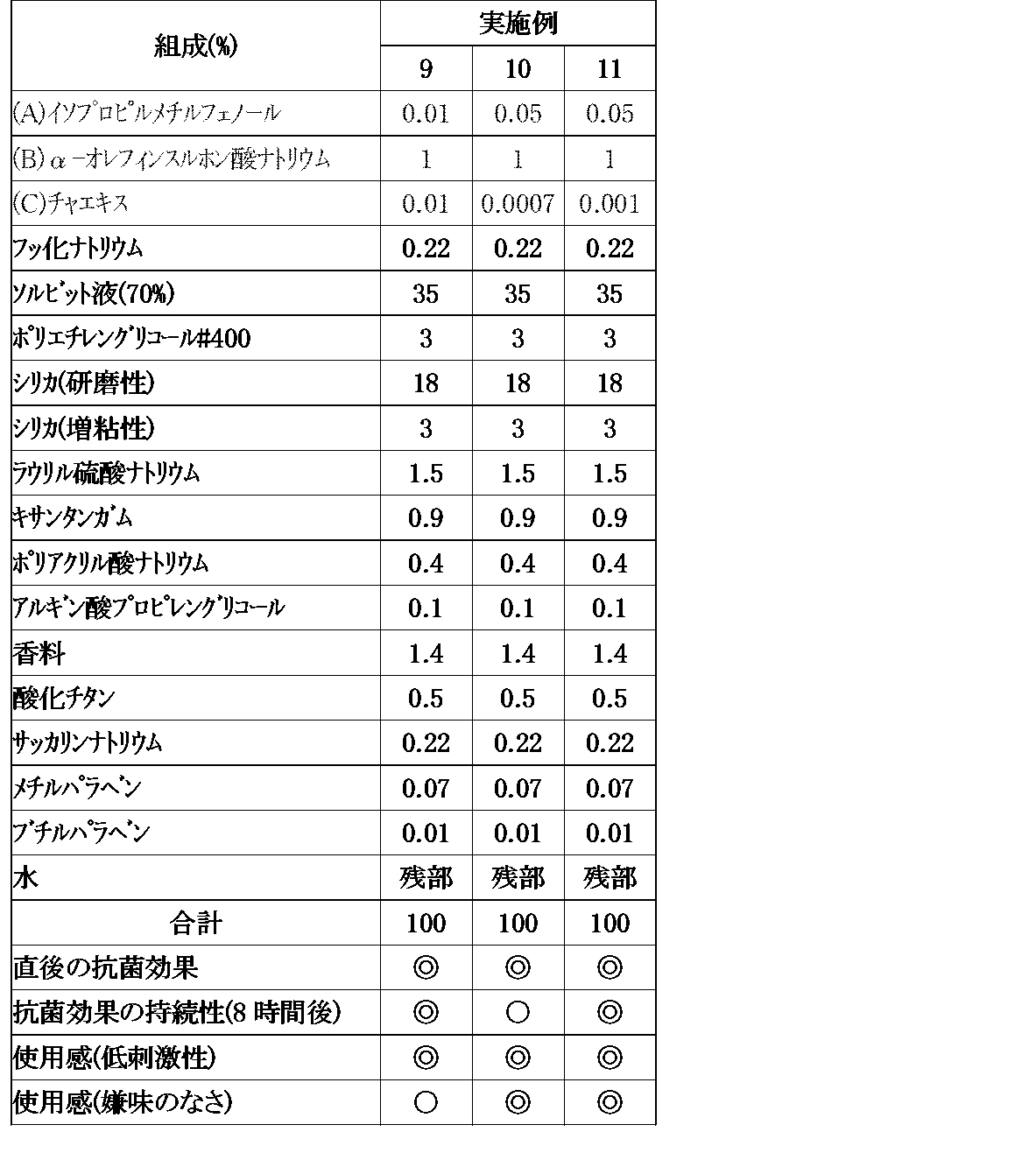
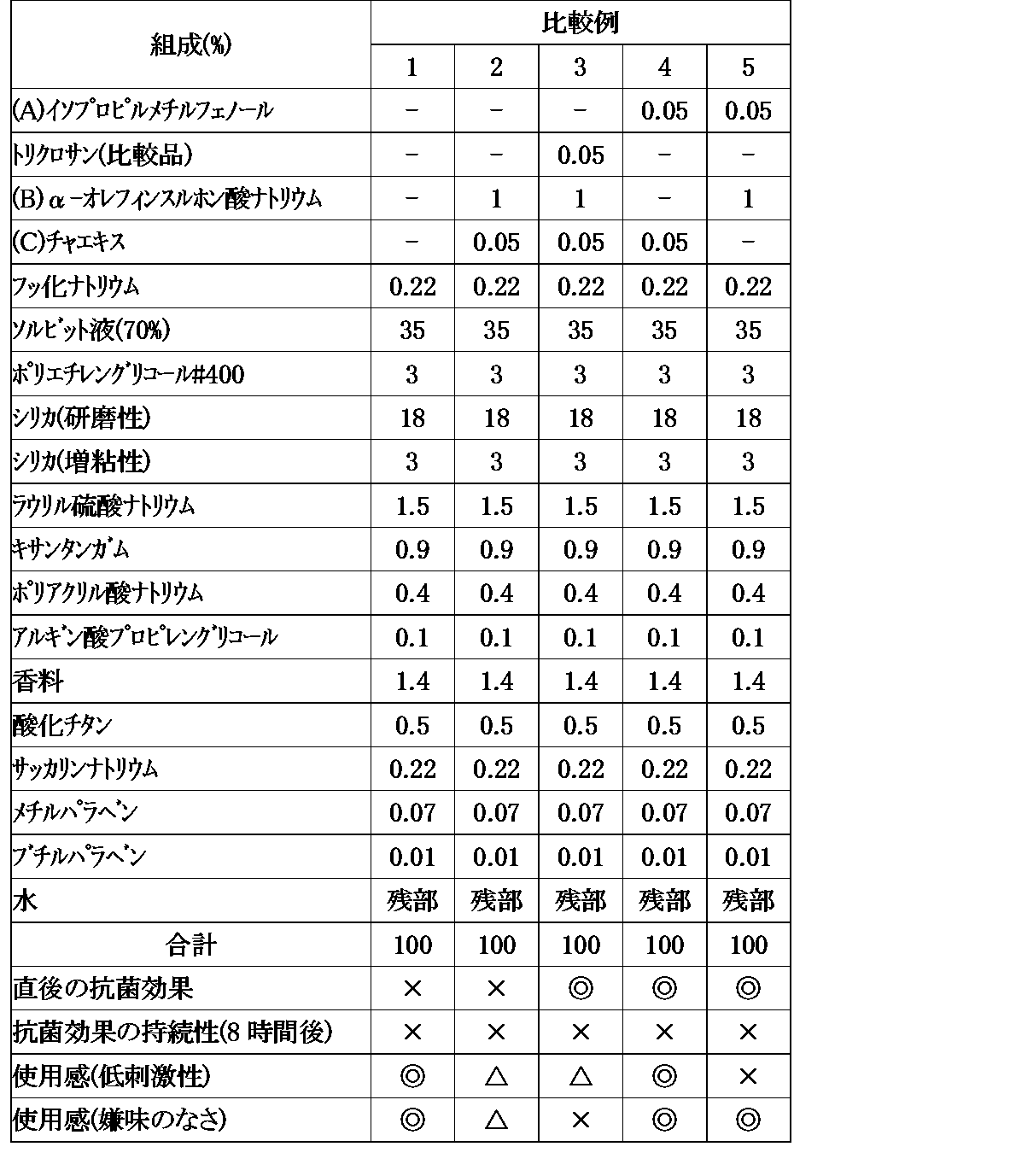
また、上記実施例1、比較例4,5の歯磨剤組成物について、下記試験を実施した。結果を表4に示した。
(4)歯磨き直後の抗菌効果及び抗菌効果の持続性(8時間後)の評価方法-2
ヒトの唾液中の口腔細菌数を測定することで、口腔内細菌への抗菌効果を評価した。
被験者は、無作為に15人ずつの2群(I;歯磨剤群、II;水ブラッシング群(コントロール))に分類した。
各被験者の昼食後の口腔清掃を停止し、そのまま歯磨きすることなく就寝前の唾液を採取した(初期唾液サンプルA)。また、被験者が、歯磨剤組成物を歯ブラシ上に1g載せ、普段と同じ方法で3分間歯をブラッシングし、その直後の唾液を採取した(直後唾液サンプルB)。更に、8時間就寝した後、唾液を採取した(8時間後唾液サンプルC)。採取した唾液サンプルは、それぞれ希釈後、嫌気培養の後、口腔細菌数(Log(cfu/mL))を測定した。前記サンプルA、B、Cの口腔細菌数をそれぞれa、b、cとした。なお、水ブラッシング群(コントロール群)は、歯磨剤組成物を使用せず水を歯ブラシに浸す以外は上記と同様にして唾液サンプルA、B、Cを採取した。
測定結果について、群ごとの初期値に対する口腔細菌数増加率(直後;b/a×100(%)、8時間後;c/a×100(%))の平均値を求め、以下に示す評価基準でそれぞれを判定し、歯磨き直後の抗菌効果と歯磨き後に長時間(8時間)経過した後の抗菌効果の持続性とを評価した。
<評価基準>
◎:歯磨剤群の口腔細菌数増加率がコントロール群に対して25%未満
○:歯磨剤群の口腔細菌数増加率がコントロール群に対して25%以上
50%未満
×:歯磨剤群の口腔細菌数増加率がコントロール群に対して50%以上
ヒトの唾液中の口腔細菌数を測定することで、口腔内細菌への抗菌効果を評価した。
被験者は、無作為に15人ずつの2群(I;歯磨剤群、II;水ブラッシング群(コントロール))に分類した。
各被験者の昼食後の口腔清掃を停止し、そのまま歯磨きすることなく就寝前の唾液を採取した(初期唾液サンプルA)。また、被験者が、歯磨剤組成物を歯ブラシ上に1g載せ、普段と同じ方法で3分間歯をブラッシングし、その直後の唾液を採取した(直後唾液サンプルB)。更に、8時間就寝した後、唾液を採取した(8時間後唾液サンプルC)。採取した唾液サンプルは、それぞれ希釈後、嫌気培養の後、口腔細菌数(Log(cfu/mL))を測定した。前記サンプルA、B、Cの口腔細菌数をそれぞれa、b、cとした。なお、水ブラッシング群(コントロール群)は、歯磨剤組成物を使用せず水を歯ブラシに浸す以外は上記と同様にして唾液サンプルA、B、Cを採取した。
測定結果について、群ごとの初期値に対する口腔細菌数増加率(直後;b/a×100(%)、8時間後;c/a×100(%))の平均値を求め、以下に示す評価基準でそれぞれを判定し、歯磨き直後の抗菌効果と歯磨き後に長時間(8時間)経過した後の抗菌効果の持続性とを評価した。
<評価基準>
◎:歯磨剤群の口腔細菌数増加率がコントロール群に対して25%未満
○:歯磨剤群の口腔細菌数増加率がコントロール群に対して25%以上
50%未満
×:歯磨剤群の口腔細菌数増加率がコントロール群に対して50%以上

Claims (3)
- (A)イソプロピルメチルフェノール、
(B)α-オレフィンスルホン酸塩
及び
(C)チャエキス
を含有する歯磨剤組成物。 - (A)成分を0.001~0.1質量%、(B)成分を0.1~2質量%、(C)成分をエキス純分として0.0007~0.01質量%含有する請求項1記載の歯磨剤組成物。
- 練歯磨剤である請求項1又は2記載の歯磨剤組成物。
Priority Applications (3)
| Application Number | Priority Date | Filing Date | Title |
|---|---|---|---|
| CN201880051483.4A CN111050747B (zh) | 2017-11-29 | 2018-11-15 | 洁齿剂组合物 |
| MYPI2020001382A MY199799A (en) | 2017-11-29 | 2018-11-15 | Dentifrice composition |
| KR1020207006424A KR102651630B1 (ko) | 2017-11-29 | 2018-11-15 | 치마제 조성물 |
Applications Claiming Priority (2)
| Application Number | Priority Date | Filing Date | Title |
|---|---|---|---|
| JP2017-228839 | 2017-11-29 | ||
| JP2017228839A JP7031253B2 (ja) | 2017-11-29 | 2017-11-29 | 歯磨剤組成物 |
Publications (1)
| Publication Number | Publication Date |
|---|---|
| WO2019107168A1 true WO2019107168A1 (ja) | 2019-06-06 |
Family
ID=66664872
Family Applications (1)
| Application Number | Title | Priority Date | Filing Date |
|---|---|---|---|
| PCT/JP2018/042281 Ceased WO2019107168A1 (ja) | 2017-11-29 | 2018-11-15 | 歯磨剤組成物 |
Country Status (5)
| Country | Link |
|---|---|
| JP (1) | JP7031253B2 (ja) |
| KR (1) | KR102651630B1 (ja) |
| CN (1) | CN111050747B (ja) |
| MY (1) | MY199799A (ja) |
| WO (1) | WO2019107168A1 (ja) |
Families Citing this family (1)
| Publication number | Priority date | Publication date | Assignee | Title |
|---|---|---|---|---|
| JP6766823B2 (ja) * | 2015-11-30 | 2020-10-14 | ライオン株式会社 | 口腔用組成物 |
Citations (3)
| Publication number | Priority date | Publication date | Assignee | Title |
|---|---|---|---|---|
| JP2013245187A (ja) * | 2012-05-25 | 2013-12-09 | Nippon Zettoc Co Ltd | バイオフィルム抑制剤 |
| WO2017094579A1 (ja) * | 2015-11-30 | 2017-06-08 | ライオン株式会社 | 歯磨剤組成物及び口腔バイオフィルム除去剤 |
| WO2017094582A1 (ja) * | 2015-11-30 | 2017-06-08 | ライオン株式会社 | 口腔用組成物 |
Family Cites Families (18)
| Publication number | Priority date | Publication date | Assignee | Title |
|---|---|---|---|---|
| JPS5145807Y2 (ja) | 1973-10-24 | 1976-11-06 | ||
| JPS5568876U (ja) | 1978-11-07 | 1980-05-12 | ||
| JP3570482B2 (ja) | 1997-12-02 | 2004-09-29 | ライオン株式会社 | 歯磨組成物及び苦味抑制方法 |
| JP4193443B2 (ja) * | 2001-08-21 | 2008-12-10 | 味の素株式会社 | 殺菌剤および防腐剤 |
| JP2006199661A (ja) | 2005-01-24 | 2006-08-03 | Sunstar Inc | 共凝集阻害剤 |
| JP2008115115A (ja) * | 2006-11-06 | 2008-05-22 | Lion Corp | 歯磨剤組成物 |
| JP5067529B2 (ja) * | 2006-12-13 | 2012-11-07 | ライオン株式会社 | 口腔用組成物 |
| US20080253976A1 (en) * | 2007-04-16 | 2008-10-16 | Douglas Craig Scott | Personal Care Compositions Comprising An Antimicrobial Blend of Essential Oils or Constituents Thereof |
| JP2009196967A (ja) * | 2008-02-25 | 2009-09-03 | Kikkoman Corp | 血中多価不飽和脂肪酸相対量増加剤並びにこれを含有する医薬組成物、医薬部外品、化粧品、可食性組成物及び動物用飼料 |
| JP5568876B2 (ja) * | 2009-03-17 | 2014-08-13 | ライオン株式会社 | 歯の脱灰抑制剤及び口腔用組成物 |
| JP5493731B2 (ja) | 2009-11-06 | 2014-05-14 | ライオン株式会社 | 歯磨剤組成物 |
| JP5597969B2 (ja) * | 2009-11-06 | 2014-10-01 | ライオン株式会社 | 歯磨剤組成物 |
| US20120237458A1 (en) * | 2009-12-04 | 2012-09-20 | Yasuhiro Shidahara | Hydrogel particles |
| JP2011256125A (ja) * | 2010-06-08 | 2011-12-22 | Lion Corp | 歯磨剤組成物 |
| IN2014MN00931A (ja) * | 2011-11-25 | 2015-04-17 | Unilever Plc | |
| WO2013100089A1 (ja) | 2011-12-28 | 2013-07-04 | 株式会社明治 | 保存安定性に優れた口腔用抗菌剤および口腔ケア用組成物 |
| CN105358128B (zh) * | 2013-07-18 | 2019-03-01 | 狮王株式会社 | 口腔生物膜除去剂以及口腔用组合物 |
| JP2016138047A (ja) * | 2015-01-26 | 2016-08-04 | ライオン株式会社 | 歯磨組成物 |
-
2017
- 2017-11-29 JP JP2017228839A patent/JP7031253B2/ja not_active Expired - Fee Related
-
2018
- 2018-11-15 CN CN201880051483.4A patent/CN111050747B/zh active Active
- 2018-11-15 WO PCT/JP2018/042281 patent/WO2019107168A1/ja not_active Ceased
- 2018-11-15 KR KR1020207006424A patent/KR102651630B1/ko active Active
- 2018-11-15 MY MYPI2020001382A patent/MY199799A/en unknown
Patent Citations (3)
| Publication number | Priority date | Publication date | Assignee | Title |
|---|---|---|---|---|
| JP2013245187A (ja) * | 2012-05-25 | 2013-12-09 | Nippon Zettoc Co Ltd | バイオフィルム抑制剤 |
| WO2017094579A1 (ja) * | 2015-11-30 | 2017-06-08 | ライオン株式会社 | 歯磨剤組成物及び口腔バイオフィルム除去剤 |
| WO2017094582A1 (ja) * | 2015-11-30 | 2017-06-08 | ライオン株式会社 | 口腔用組成物 |
Also Published As
| Publication number | Publication date |
|---|---|
| MY199799A (en) | 2023-11-23 |
| CN111050747A (zh) | 2020-04-21 |
| JP7031253B2 (ja) | 2022-03-08 |
| KR102651630B1 (ko) | 2024-03-27 |
| JP2019099470A (ja) | 2019-06-24 |
| CN111050747B (zh) | 2022-08-26 |
| KR20200093521A (ko) | 2020-08-05 |
Similar Documents
| Publication | Publication Date | Title |
|---|---|---|
| JP5136797B2 (ja) | イソプロピルメチルフェノール含有液体口腔用組成物 | |
| US7074391B1 (en) | Use of olive oil in the preparation of a product for oral hygiene for eliminating or reducing bacterial plaque and/or bacteria in the mouth | |
| CN102548526B (zh) | 洁齿剂组合物 | |
| JP7167938B2 (ja) | 口腔バイオフィルム形成抑制剤及び口腔用組成物 | |
| JP6318487B2 (ja) | 口腔用組成物 | |
| JP7423925B2 (ja) | 口腔内常在菌の生育促進剤及び口腔用組成物 | |
| WO2011055708A1 (ja) | イソプロピルメチルフェノール含有液体口腔用組成物 | |
| JP2009256228A (ja) | 液体口腔用組成物 | |
| EA022986B1 (ru) | Композиция для ухода за полостью рта | |
| JP2011098918A (ja) | 歯磨剤組成物 | |
| JPWO2018194111A1 (ja) | 口腔バイオフィルム除去剤及び口腔用組成物 | |
| CN103068363A (zh) | 用于去除烟焦油的物质以及包含该物质的组合物 | |
| JP6756156B2 (ja) | 口腔用組成物 | |
| JPWO2007066497A1 (ja) | 歯磨組成物 | |
| JP2008143825A (ja) | 歯磨組成物 | |
| JP2008156288A (ja) | 口腔用組成物 | |
| CN111050747B (zh) | 洁齿剂组合物 | |
| JP4158036B2 (ja) | 歯磨剤組成物及びその製造方法 | |
| JP2009137897A (ja) | 歯磨組成物 | |
| JP2017007993A (ja) | 口腔用組成物及び口腔バイオフィルム殺菌剤 | |
| JP5471318B2 (ja) | 歯磨剤組成物 | |
| JP7172028B2 (ja) | 口腔用組成物 | |
| JP7815617B2 (ja) | 液体口腔用組成物 | |
| JP7298601B2 (ja) | 口腔用組成物 | |
| WO2026068847A1 (en) | A toothpaste composition |
Legal Events
| Date | Code | Title | Description |
|---|---|---|---|
| 121 | Ep: the epo has been informed by wipo that ep was designated in this application |
Ref document number: 18883192 Country of ref document: EP Kind code of ref document: A1 |
|
| ENP | Entry into the national phase |
Ref document number: 20207006424 Country of ref document: KR Kind code of ref document: A |
|
| NENP | Non-entry into the national phase |
Ref country code: DE |
|
| 122 | Ep: pct application non-entry in european phase |
Ref document number: 18883192 Country of ref document: EP Kind code of ref document: A1 |