WO2019087561A1 - 推論装置、推論方法、プログラムおよび持続的有形コンピュータ読み取り媒体 - Google Patents
推論装置、推論方法、プログラムおよび持続的有形コンピュータ読み取り媒体 Download PDFInfo
- Publication number
- WO2019087561A1 WO2019087561A1 PCT/JP2018/032689 JP2018032689W WO2019087561A1 WO 2019087561 A1 WO2019087561 A1 WO 2019087561A1 JP 2018032689 W JP2018032689 W JP 2018032689W WO 2019087561 A1 WO2019087561 A1 WO 2019087561A1
- Authority
- WO
- WIPO (PCT)
- Prior art keywords
- inference
- feature
- basis
- feature quantity
- class
- Prior art date
- Legal status (The legal status is an assumption and is not a legal conclusion. Google has not performed a legal analysis and makes no representation as to the accuracy of the status listed.)
- Ceased
Links
Images




Classifications
-
- G—PHYSICS
- G06—COMPUTING OR CALCULATING; COUNTING
- G06N—COMPUTING ARRANGEMENTS BASED ON SPECIFIC COMPUTATIONAL MODELS
- G06N3/00—Computing arrangements based on biological models
- G06N3/02—Neural networks
- G06N3/08—Learning methods
-
- G—PHYSICS
- G06—COMPUTING OR CALCULATING; COUNTING
- G06F—ELECTRIC DIGITAL DATA PROCESSING
- G06F18/00—Pattern recognition
- G06F18/20—Analysing
- G06F18/21—Design or setup of recognition systems or techniques; Extraction of features in feature space; Blind source separation
- G06F18/211—Selection of the most significant subset of features
- G06F18/2113—Selection of the most significant subset of features by ranking or filtering the set of features, e.g. using a measure of variance or of feature cross-correlation
-
- G—PHYSICS
- G06—COMPUTING OR CALCULATING; COUNTING
- G06F—ELECTRIC DIGITAL DATA PROCESSING
- G06F18/00—Pattern recognition
- G06F18/20—Analysing
- G06F18/24—Classification techniques
- G06F18/243—Classification techniques relating to the number of classes
- G06F18/2431—Multiple classes
-
- G—PHYSICS
- G06—COMPUTING OR CALCULATING; COUNTING
- G06N—COMPUTING ARRANGEMENTS BASED ON SPECIFIC COMPUTATIONAL MODELS
- G06N20/00—Machine learning
-
- G—PHYSICS
- G06—COMPUTING OR CALCULATING; COUNTING
- G06N—COMPUTING ARRANGEMENTS BASED ON SPECIFIC COMPUTATIONAL MODELS
- G06N3/00—Computing arrangements based on biological models
- G06N3/02—Neural networks
- G06N3/04—Architecture, e.g. interconnection topology
- G06N3/042—Knowledge-based neural networks; Logical representations of neural networks
-
- G—PHYSICS
- G06—COMPUTING OR CALCULATING; COUNTING
- G06N—COMPUTING ARRANGEMENTS BASED ON SPECIFIC COMPUTATIONAL MODELS
- G06N3/00—Computing arrangements based on biological models
- G06N3/02—Neural networks
- G06N3/04—Architecture, e.g. interconnection topology
- G06N3/045—Combinations of networks
-
- G—PHYSICS
- G06—COMPUTING OR CALCULATING; COUNTING
- G06N—COMPUTING ARRANGEMENTS BASED ON SPECIFIC COMPUTATIONAL MODELS
- G06N3/00—Computing arrangements based on biological models
- G06N3/02—Neural networks
- G06N3/04—Architecture, e.g. interconnection topology
- G06N3/0464—Convolutional networks [CNN, ConvNet]
-
- G—PHYSICS
- G06—COMPUTING OR CALCULATING; COUNTING
- G06N—COMPUTING ARRANGEMENTS BASED ON SPECIFIC COMPUTATIONAL MODELS
- G06N3/00—Computing arrangements based on biological models
- G06N3/02—Neural networks
- G06N3/08—Learning methods
- G06N3/09—Supervised learning
-
- G—PHYSICS
- G06—COMPUTING OR CALCULATING; COUNTING
- G06N—COMPUTING ARRANGEMENTS BASED ON SPECIFIC COMPUTATIONAL MODELS
- G06N5/00—Computing arrangements using knowledge-based models
- G06N5/02—Knowledge representation; Symbolic representation
-
- G—PHYSICS
- G06—COMPUTING OR CALCULATING; COUNTING
- G06V—IMAGE OR VIDEO RECOGNITION OR UNDERSTANDING
- G06V10/00—Arrangements for image or video recognition or understanding
- G06V10/40—Extraction of image or video features
- G06V10/44—Local feature extraction by analysis of parts of the pattern, e.g. by detecting edges, contours, loops, corners, strokes or intersections; Connectivity analysis, e.g. of connected components
- G06V10/443—Local feature extraction by analysis of parts of the pattern, e.g. by detecting edges, contours, loops, corners, strokes or intersections; Connectivity analysis, e.g. of connected components by matching or filtering
- G06V10/449—Biologically inspired filters, e.g. difference of Gaussians [DoG] or Gabor filters
- G06V10/451—Biologically inspired filters, e.g. difference of Gaussians [DoG] or Gabor filters with interaction between the filter responses, e.g. cortical complex cells
- G06V10/454—Integrating the filters into a hierarchical structure, e.g. convolutional neural networks [CNN]
-
- G—PHYSICS
- G06—COMPUTING OR CALCULATING; COUNTING
- G06V—IMAGE OR VIDEO RECOGNITION OR UNDERSTANDING
- G06V10/00—Arrangements for image or video recognition or understanding
- G06V10/70—Arrangements for image or video recognition or understanding using pattern recognition or machine learning
- G06V10/77—Processing image or video features in feature spaces; using data integration or data reduction, e.g. principal component analysis [PCA] or independent component analysis [ICA] or self-organising maps [SOM]; Blind source separation
- G06V10/771—Feature selection, e.g. selecting representative features from a multi-dimensional feature space
-
- G—PHYSICS
- G06—COMPUTING OR CALCULATING; COUNTING
- G06V—IMAGE OR VIDEO RECOGNITION OR UNDERSTANDING
- G06V10/00—Arrangements for image or video recognition or understanding
- G06V10/70—Arrangements for image or video recognition or understanding using pattern recognition or machine learning
- G06V10/82—Arrangements for image or video recognition or understanding using pattern recognition or machine learning using neural networks
Definitions
- the present disclosure relates to an inference apparatus, an inference method, a program, and a persistent tangible computer-readable medium.
- the present disclosure aims to provide an inference apparatus, an inference method, a program, and a tangible computer-readable medium for explaining the process of inference using machine learning and deep learning.
- the frequently appearing feature quantity as the frequently appearing feature quantity, the frequent appearing feature quantity database stored for each class, and to which class the input information belongs is inferred using the inference model
- a representative feature amount extraction unit for extracting a feature amount appearing in an inference process in the inference unit, and extracting a feature amount satisfying a predetermined condition among the feature amounts as a representative feature amount
- a root that reads frequent feature quantities corresponding to inferred classes from a quantity database, and extracts one or more ground feature quantities based on the frequent feature quantities and the representative feature quantity It includes a feature calculation unit, and an output unit which outputs the grounds feature quantity along with the inferred class.
- the basis feature value is a feature value considered to be a basis for determining that the input information belongs to a predetermined class. According to the above-described inference apparatus, it is possible to obtain a basis feature quantity as a basis for deriving an inference result based on the representative feature quantity appearing in the process of inference and the frequent feature quantity possessed by the inferred class information. .
- the inference apparatus further includes an annotation database storing the data of the concept representing the feature amount, and an explanatory information generating unit for reading out the data of the concept corresponding to the base feature amount from the annotation database and generating explanatory information And may be provided.
- the output unit outputs the explanation information together with the inferred class. In this case, by displaying the explanatory information generated based on the data of the concept corresponding to the basis feature amount together with the class as the inference result, the user can easily grasp the basis for the inference result.
- the input unit may receive an input of an image as information.
- the basis feature quantity extraction unit extracts data of a receptive field in the image corresponding to the basis feature quantity together with the basis feature quantity.
- the output unit performs display to specify in the image a receptive field corresponding to the basis feature amount in the image. In this case, by displaying the receptive field corresponding to the base feature in the image, it is possible to easily understand which part of the image the base feature describes the feature, and the inference result is obtained. We can grasp the ground specifically.
- the basis feature amount calculation unit may obtain basis feature amounts of receptive fields of different regions using the data of the receptive fields. In this case, since basis features for receptive fields in different regions are shown, it is possible to make the user understand that the inference has been made by grasping the image widely.
- the output unit may arrange and display the basis feature amounts in descending order of the representative feature amounts corresponding to the basis feature amounts. In this case, as a basis for inference, the feature amount matching the image is likely to be displayed at the top.
- the output unit may arrange and display the basis feature amounts based on the frequent feature amounts corresponding to the basis feature amounts and the representative feature amount.
- base feature quantities are arranged using feature quantities that frequently appear in the inferred class image, features that are often found in that class are displayed at the top.
- attribute data may be stored in the annotation database in association with data of the concept.
- the basis feature amount calculation unit obtains basis feature amounts of different attributes using data of the attribute. In this case, since basis feature quantities for different attributes are shown, it is possible to make the user understand that information has been multilaterally grasped to be inferred.
- the output unit may output that effect. If the number of basis feature quantities is less than or equal to the predetermined threshold value, the inference result may be erroneous, but the configuration of the present disclosure can draw attention to the inference result.
- the reasoning apparatus further stores a basis feature amount storage unit that stores data of the basis feature amounts calculated by the basis feature amount calculation unit for each class, and a basis feature stored in the basis feature amount storage unit. And a clustering unit that clusters the quantities.
- the output unit outputs an effect when the clustering unit can classify the basis feature amount. In this case, it can be noticed that a new class may exist.
- the above reasoning apparatus makes it possible to easily grasp the grounds for reaching the inference result.
- the output unit may display, together with the feature amount, a receptive field corresponding to the feature amount in the image.
- the output unit may display, together with the feature amount, a receptive field corresponding to the feature amount in the image.
- the output unit may output basis feature quantities of receptive fields in different regions. In this case, it is possible to capture the image widely and make the user understand that the inference has been made.
- an inference method is used as an inference method for inferring which of input information belongs to a predetermined class by inference using an inference model generated by machine learning. Inferring, using the inference model, to which class the input information belongs, and the inference apparatus extracts a feature quantity that has appeared in the inference process, and a predetermined condition in the feature quantity is extracted.
- the inferring device frequently appearing feature quantities in the inference process using the inference model Reading out frequent feature amounts corresponding to the class, and extracting one or more base feature amounts based on the frequent feature amounts and the representative feature amount by the inference apparatus , And a said inference device, outputs the grounds feature quantity along with the inferred class.
- a non-transitory tangible computer-readable medium comprising computer-implemented instructions, wherein the instructions are input by inference using an inference model generated by machine learning by an inference device.
- the inference apparatus extracts a feature quantity appearing in an inference process, and extracts, as a representative feature quantity, a feature quantity satisfying a predetermined condition in the feature quantity; and the inference apparatus uses the inference model.
- FIG. 1 is a diagram showing a configuration of an image recognition apparatus according to a first embodiment
- FIG. 8 is a diagram schematically showing the contents of processing by a representative feature extraction unit and a basis feature extraction unit; It is a figure which shows the example of the basis feature-value in case an image recognition result is "rooster", It is a figure which shows the example of the data memorize
- FIG. 6 is a diagram showing the operation of the image recognition device of the first embodiment, It is a figure which shows the structure of the image recognition apparatus of 2nd Embodiment.
- FIG. 1 is a diagram showing the configuration of an image recognition apparatus 1 according to the first embodiment.
- the image recognition device 1 is a device that infers which one of a plurality of classes the input image is classified into.
- the image recognition apparatus 1 includes an input unit 10 for inputting an image to be processed, an inference unit 11 for inferring a class of images, and an output unit 12 for displaying and outputting an inference result.
- the inference unit 11 uses a so-called deep learning neural network model having a plurality of layers of convolutional neural networks.
- a well-known neural network system called "AlexNet” may be used as Alex Krizhevsky et al.
- AlexNet a well-known neural network system called Alex Krizhevsky et al.
- the configuration of the image recognition device 1 described so far is the same as the configuration of a conventional inference device using a neural network.
- the image recognition device 1 includes a representative feature quantity extraction unit 13, a ground feature quantity extraction unit 14, and an explanation information generation unit 15.
- the representative feature quantity extraction unit 13 has a function of acquiring the feature quantity appearing in the inference process in the inference unit 11 and extracting the representative feature quantity from the feature quantity.
- the feature quantity appearing in the layer closest to the deep learning output layer is acquired.
- the degree of abstraction of the feature increases as it gets closer to the output layer, so by acquiring the feature that appears in the layer closest to the output layer, it is possible to easily understand the user's inference results. This is because it is considered that the reason for showing the ground which has been reached can be appropriately expressed.
- an example of acquiring the feature quantity appearing in the layer closest to the output layer has been described, but as a modification, the feature quantity of another layer may be acquired.
- the ground feature quantity extraction unit 14 infers based on the representative feature quantity extracted by the representative feature quantity extraction unit 13 and the data stored in the frequent feature quantity database (hereinafter, referred to as a frequent feature quantity DB) 16. It has a function of extracting a basis feature that led to the inference result by the unit 11.
- the representative feature quantity extraction unit 13 and the basis feature quantity extraction unit 14 will be described in more detail.
- FIG. 2 is a diagram schematically showing the contents of processing by the representative feature quantity extraction unit 13 and the basis feature quantity extraction unit 14.
- the representative feature quantity extraction unit 13 extracts a firing feature quantity from the feature map of CNN (Convolutional Neural Network) extracted from the inference unit 11.
- the firing feature is a feature of an activated neuron.
- the representative feature quantity extraction unit 13 has data of average feature quantities of a large number of images used to generate the neural network model of the inference unit 11. For example, if there are 1000 classes such as "dog”, “horse” and “rooster” and 1300 images are included in each class, 1.3 million images will be used for learning the neural network model. . In this case, the data of the average feature amount is the average feature amount of the 1.3 million images of all classes.
- the representative feature quantity extraction unit 13 compares the firing feature quantity with the average feature quantity, and extracts a feature quantity having a particularly large feature quantity among the firing feature quantities.
- the feature quantities extracted here are referred to as "representative feature quantities" in this specification.
- the condition for determining that the feature amount is a representative feature amount is, for example, having a size twice or more the average feature amount.
- the condition for extracting the representative feature amount is twice or more the average feature amount, but the condition for extracting the representative feature amount is not limited to twice the average feature amount, and may be three times or five times Good.
- the representative feature quantity extraction unit 13 passes the extracted representative feature quantity to the base feature quantity extraction unit 14.
- the representative feature quantity extraction unit 13 receives feature quantity data from the inference unit 11
- the representative feature quantity extraction unit 13 receives data of a receptive field corresponding to the feature quantity.
- the data of the receptive field may be data specifying an area in the image having the feature amount.
- the ground feature quantity extraction unit 14 first reads the frequent feature quantity of the class according to the recognition result of the image from the frequent feature quantity DB 16. That is, when the input image is determined to be "rooster" as a result of image recognition, the frequent feature amount of "rooster” is read out.
- the frequently-appearing feature amount is a feature amount that frequently appears in an image of that class, and can be said to be a feature amount that represents the characteristics of that class. For example, frequently occurring feature quantities of the class "rooster" are "bright red”, “drop”, “beak” and the like.
- the basis feature quantity extraction unit 14 extracts a feature quantity common to the representative feature quantity and the frequent feature quantity as a basis feature quantity.
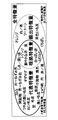
- FIG. 3 is a diagram showing an example of the basis feature amount when the image recognition result is “rooster”.
- the set on the left side in FIG. 3 indicates representative feature quantities observed in the image to be analyzed, that is, the image input from the input unit 10.
- the set on the right side in FIG. 3 indicates feature quantities that are often found in the image of the class "rooster", that is, frequent feature quantities of "rooster”.
- the basis feature value is an overlapping portion of two sets.
- the basis feature quantity extraction unit 14 extracts the feature quantity of the overlapping part of the two sets as a basis feature quantity, and passes the extracted basis feature quantity to the explanation information generation unit 15. At this time, the basis feature quantity extraction unit 14 passes data of the receptive field corresponding to the basis feature quantity to the explanation information generation unit 15.
- the explanatory information generation unit 15 receives the basis feature amount from the basis feature amount extraction unit 14, the explanatory information generation unit 15 reads out the conceptual data corresponding to the basis feature amount from the data of the annotation database (hereinafter referred to as “annotation DB”) 17. Generate information.
- FIG. 4 is a diagram showing an example of data stored in the annotation DB 17.
- the annotation DB 17 stores an identification number specifying a feature amount and data of a concept corresponding to the feature amount in association with each other. For example, conceptual data "empty” is associated with the identification number "# 1" of the feature amount. Further, two conceptual data of "protrusion” and “concave and convexity” are associated with the identification number "# 2" of the feature amount. As described above, there may be a case where a plurality of conceptual data are associated with one feature amount. Also, conversely, conceptual data "grassland” is associated with the feature amounts “# 4" and "# 5". Thus, there are also cases where a plurality of symbols correspond to one concept.
- the explanatory information generation unit 15 reads out concept data corresponding to the identification number of the basis feature amount from the annotation DB 17, and uses the read out concept data to generate a sentence that explains the basis for the inference result. For example, when conceptual data of "sky”, “grassland” and “small animal” are read out from the basis feature quantities of identification numbers "# 1", “# 4" and “# 9", "This image is ⁇ The reason is that the text includes "Sky”, “Prairie” and "Small Animal”. For example, when a plurality of concept data are associated with one basis feature amount such as identification numbers "# 2" and "# 7", an explanatory text in which a plurality of concepts are connected by "or” Generate For example, a caption “This image is OO.
- the explanatory information generation unit 15 passes the generated explanatory information and the data of the receptive field corresponding to the explanatory information to the output unit 12.
- the explanation information generation unit 15 sets the explanation information in accordance with the number (for example, three) of the explanation information displayed on the output unit 12. Select the basis feature to be used. In the present embodiment, the explanation information generation unit 15 selects a predetermined number of base feature quantities from among the common feature quantities in descending order of the representative feature quantity.
- the output unit 12 combines the image recognition result inferred by the inference unit 11 with the explanation information generated by the explanation information generation unit 15 and displays the result on the screen.
- FIG. 5 is a diagram showing an example of the recognition result displayed on the screen by the output unit 12. As shown in FIG. 5, on the output screen of the recognition result, the image D1 to be recognized is displayed largely at the center of the screen, and on top of that, the recognition result D2 and the basis for the recognition result under the image D1 The explanatory information D3 is displayed.
- three images D4 to D6 are displayed on the right side of the image D1 to be recognized.
- These images D4 to D6 are images showing the receptive field corresponding to the explanation information, and the unmasked part is the receptive field.
- the top image D4 corresponds to the explanatory information that "the end of the tire or object" is included, and indicates the region in the image that is determined as such.
- the three images D4 to D6 are preferably arranged from the top in the descending order of the basis feature value.
- the strength of the representative feature is used as the strength of the basis feature.
- the image recognition apparatus 1 not only shows the recognition result D2 of the image D1 to be recognized, but also displays the grounds D3, D4 to D6 of the recognition result D2.
- FIG. 6 is a diagram schematically showing how to obtain the frequent feature amount.
- an example is described in which the frequently appearing feature value of “dog” is determined.
- an image used in the learning of the neural network used in the inference unit 11 (in the example described above, 1.3 million images having class information) is used.
- the ignition feature amount and the average feature amount are compared for all the images given the “dog” class, and the representative feature amount is obtained by the same method as the method described in the representative feature amount extraction unit 13 described above.
- the representative feature amount is obtained by the same method as the method described in the representative feature amount extraction unit 13 described above.
- the process of multiplying by “0” may be performed. According to the above-described processing, it is possible to obtain a feature amount that is determined as a representative feature amount among feature amounts (for example, 256 feature amounts) for each of the images of the “dog” class.
- the representative feature amount is determined in the same manner as the method described in the representative feature amount extraction unit 13 only on the basis of only the size of the feature amount. This is because there is a possibility that the frequently appearing feature amount can be determined as the feature amount of the “dog” class if
- the configuration of the image recognition apparatus 1 according to the present embodiment has been described above, but the hardware of the image recognition apparatus 1 described above includes a CPU, a RAM, a ROM, a hard disk, a display, a keyboard, a mouse, a communication interface, etc. Computer.
- the image recognition apparatus 1 described above is realized by storing a program having a module for realizing the above-described functions in a RAM or a ROM and executing the program by the CPU. Such programs are also within the scope of the present disclosure.
- FIG. 7 is a flowchart showing the operation of the image recognition device 1 according to the first embodiment.
- the input unit 10 receives an input of an image to be recognized (S10).
- the image recognition apparatus 1 operates the inference unit 11 to perform inference, performs image recognition of which class the image belongs to (S11), and passes the recognition result to the output unit 12.
- the representative feature quantity extraction unit 13 of the image recognition device 1 acquires the feature quantity appearing in the inference process from the inference unit 11, and extracts the representative feature quantity from the acquired feature quantities (S12).
- the representative feature quantity extraction unit 13 extracts a feature quantity having a size twice or more the average feature quantity as a representative feature quantity.
- the representative feature quantity extraction unit 13 passes data of the extracted representative feature quantity to the ground feature quantity extraction unit 14.
- the basis feature quantity extraction unit 14 of the image recognition device 1 reads the frequent feature quantity corresponding to the class inferred by the inference unit 11 (S13), and the feature quantity common to the frequent feature quantity and the representative feature quantity Are extracted as basis feature quantities (S14).
- the basis feature quantity extraction unit 14 passes data of the determined basis feature quantity to the explanation information generation unit 15.
- the explanation information generation unit 15 of the image recognition device 1 reads out concept data corresponding to the basis feature amount from the annotation DB 17, generates explanation information (S15), and passes the generated explanation information to the output unit 12.
- the output unit 12 outputs the inference result received from the inference unit 11 and the explanation information generated by the explanation information generation unit 15 (S16).
- the configuration and the operation of the image recognition device 1 according to the first embodiment have been described above.
- the image recognition apparatus 1 according to the first embodiment displays the explanatory information generated based on the feature quantity appearing in the process of actual inference, so that the problem of the neural network that the inference process is a black box is solved. it can.
- the image recognition apparatus 1 since the image recognition apparatus 1 according to the first embodiment displays the area of the image corresponding to the explanation information, it is possible to grasp which part of the image the explanation information describes. Can easily understand the rationale of
- the image recognition device 1 outputs explanatory information that is considered to be the basis for reaching the inference result, the explanatory information does not match the inference result even though the inference result is correct.
- a use case may be considered in which relearning of the neural network is performed based on the obtained explanatory information. By learning a neural network using images of situations similar to explanatory information that does not match the inference results, it is possible to increase the inference accuracy with respect to types of images that have never been available.
- the base feature value of the inference displayed as the explanatory information may be selected so as to be a region having a different receptive field. That is, when selecting the basis feature quantity to be displayed on the output unit 12, processing is performed so as not to select the basis feature quantity for the same receptive field, instead of simply selecting the size of the feature quantity. This makes it possible to display the basis for different regions in the image, thereby enhancing the sense of reason for the reasoning.
- FIG. 8 is a diagram showing the configuration of the image recognition device 2 according to the second embodiment.
- the configuration for generating the explanation information that has led to the inference result in the image recognition device 2 of the second embodiment is the same as that of the image recognition device 1 of the first embodiment.
- the image recognition apparatus 2 according to the second embodiment stores data of the basis feature amount obtained by the basis feature amount extraction unit 14 in the basis feature amount storage unit 18 and analyzes the basis feature amount. It has a configuration.
- the basis feature amount storage unit 18 stores data of basis feature amounts for each class obtained by inference.
- the clustering unit 19 performs clustering of basis feature quantities.
- the basis feature amount is classified into a plurality of clusters (for example, two clusters)
- data of the clusters is passed to the output unit 12, and the output unit 12 displays the result of the clustering.
- the image recognition apparatus 1 and 2 was demonstrated to the example about the inference apparatus of this indication, the inference apparatus of this indication is not limited to above-mentioned embodiment.
- the image recognition apparatuses 1 and 2 including the explanation information generation unit 15 are described as an example, but the explanation information generation unit 15 is not essential, and the ground feature extracted by the ground feature extraction unit 14
- the identification number of the quantity may be output. If the identification number of the basis feature amount is output, it is possible to evaluate the inference process later using the identification number.
- the explanation information on different attributes may be selected.
- the attribute is, for example, an attribute related to color, an attribute related to shape, an attribute related to texture, an attribute related to a category such as animal / inanimate objects, and the like. Rather than arranging explanatory information on the same attribute, displaying explanatory information on different attributes enhances the sense of convincing of the user who has seen the basis of the inference.
- the following configuration can be considered as a configuration for outputting the description information of different attributes.
- Data of an attribute is stored in the frequent feature amount DB 16 in association with the conceptual data.
- the basis feature quantity extraction unit 14 After extracting the basis feature quantities common to the frequent feature quantity and the representative feature quantity, the basis feature quantity extraction unit 14 already selects the basis feature quantity to be used as the explanatory information in the descending order of the representative feature quantity. It is assumed that no basis feature having the same attribute as the basis feature is selected.
- the first place of the representative feature amount is “bright red” (attribute related to color)
- the second place is “black” (attribute related to color)
- the third place is “jagged” (attribute related to shape)
- the output unit 12 may output that effect.
- a predetermined threshold for example, two or less
- the output unit 12 may output that effect.
- the predetermined threshold may be a value that fluctuates for each class. Depending on the class, the frequent feature amount may be small, and in this case, even if the number of basis feature amounts is small, it is normal.
- the method of generating the frequent feature amount DB 16 has been described in the above-described embodiment. Among them, for each image, the representative feature is determined by comparing the firing feature and the average feature, and an example is described in which the total of these is determined. First, the feature of all images in the "dog" class May be added, and the result of the addition may be compared with the average feature amount. By performing such processing, it is possible to have data of the strength of the frequent feature amount.
- the data of the strength of the frequent feature amount is also used to arrange the explanatory information.
- the explanation information base feature
- the explanation information may be displayed side by side in descending order of the sum of both features.
- a neural network is taken as an example of machine learning, but the present disclosure can be applied to machine learning in which the strength of a feature amount is known.
- the reason why the inference result is obtained can be determined based on the feature quantity appearing in the inference process.
- feature quantities calculated by another method are used as an input, so base feature quantities can be determined as follows. First, frequently appearing feature quantities are obtained as frequent appearing feature quantities in the input data itself and feature vectors obtained by feature extraction algorithms such as HOG and SIFT.
- the feature amount of the input information is also obtained using the same algorithm as that described above, and a feature amount satisfying a predetermined condition among the obtained feature amounts is used as a representative feature amount. Thereby, the feature amount common to both can be obtained as the basis feature amount.
- An application to an autonomous vehicle can be considered as one use case of the inference apparatus of the present disclosure.
- Automatic driving by adopting a configuration in which a ground feature is obtained from an inference process in which a self-driving car determines driving behavior based on various types of sensor information, and explanatory information corresponding to the ground feature is continuously recorded. It is possible to understand why the car has taken a predetermined driving action. This can be used for debugging when an autonomous vehicle causes an accident.
- each section is expressed as, for example, S10.
- each section can be divided into multiple subsections, while multiple sections can be combined into one section.
- each section configured in this way can be referred to as a device, a module, or a means.
Landscapes
- Engineering & Computer Science (AREA)
- Theoretical Computer Science (AREA)
- Physics & Mathematics (AREA)
- Evolutionary Computation (AREA)
- Artificial Intelligence (AREA)
- General Physics & Mathematics (AREA)
- Software Systems (AREA)
- Computing Systems (AREA)
- Data Mining & Analysis (AREA)
- Health & Medical Sciences (AREA)
- General Health & Medical Sciences (AREA)
- Computer Vision & Pattern Recognition (AREA)
- General Engineering & Computer Science (AREA)
- Life Sciences & Earth Sciences (AREA)
- Mathematical Physics (AREA)
- Biomedical Technology (AREA)
- Molecular Biology (AREA)
- Computational Linguistics (AREA)
- Biophysics (AREA)
- Multimedia (AREA)
- Medical Informatics (AREA)
- Databases & Information Systems (AREA)
- Biodiversity & Conservation Biology (AREA)
- Bioinformatics & Cheminformatics (AREA)
- Bioinformatics & Computational Biology (AREA)
- Evolutionary Biology (AREA)
- Image Analysis (AREA)
Priority Applications (2)
| Application Number | Priority Date | Filing Date | Title |
|---|---|---|---|
| DE112018005089.0T DE112018005089T5 (de) | 2017-10-31 | 2018-09-04 | Inferenzvorrichtung, Inferenzverfahren, Programm und nicht transitorisches greifbares computerlesbares Medium |
| US16/860,843 US11625561B2 (en) | 2017-10-31 | 2020-04-28 | Inference device, inference method, and non-transitory tangible computer-readable medium |
Applications Claiming Priority (2)
| Application Number | Priority Date | Filing Date | Title |
|---|---|---|---|
| JP2017210178A JP7032623B2 (ja) | 2017-10-31 | 2017-10-31 | 推論装置、推論方法及びプログラム |
| JP2017-210178 | 2017-10-31 |
Related Child Applications (1)
| Application Number | Title | Priority Date | Filing Date |
|---|---|---|---|
| US16/860,843 Continuation US11625561B2 (en) | 2017-10-31 | 2020-04-28 | Inference device, inference method, and non-transitory tangible computer-readable medium |
Publications (1)
| Publication Number | Publication Date |
|---|---|
| WO2019087561A1 true WO2019087561A1 (ja) | 2019-05-09 |
Family
ID=66331662
Family Applications (1)
| Application Number | Title | Priority Date | Filing Date |
|---|---|---|---|
| PCT/JP2018/032689 Ceased WO2019087561A1 (ja) | 2017-10-31 | 2018-09-04 | 推論装置、推論方法、プログラムおよび持続的有形コンピュータ読み取り媒体 |
Country Status (4)
| Country | Link |
|---|---|
| US (1) | US11625561B2 (enExample) |
| JP (1) | JP7032623B2 (enExample) |
| DE (1) | DE112018005089T5 (enExample) |
| WO (1) | WO2019087561A1 (enExample) |
Cited By (2)
| Publication number | Priority date | Publication date | Assignee | Title |
|---|---|---|---|---|
| WO2021090897A1 (ja) * | 2019-11-08 | 2021-05-14 | ソニー株式会社 | 情報処理装置、情報処理方法及び情報処理プログラム |
| JP2022131406A (ja) * | 2021-02-26 | 2022-09-07 | 日本電気通信システム株式会社 | モデル学習装置、モデル学習方法、およびプログラム |
Families Citing this family (23)
| Publication number | Priority date | Publication date | Assignee | Title |
|---|---|---|---|---|
| JP7119774B2 (ja) * | 2018-08-28 | 2022-08-17 | 富士通株式会社 | 学習プログラム、画像分類プログラム、学習方法、画像分類方法、学習装置および画像分類装置 |
| WO2020070876A1 (ja) * | 2018-10-05 | 2020-04-09 | 日本電気株式会社 | 教師データ拡張装置、教師データ拡張方法およびプログラム |
| JP7493813B2 (ja) * | 2019-07-26 | 2024-06-03 | 国立大学法人横浜国立大学 | 説明生成装置、説明生成方法およびプログラム |
| JP7161979B2 (ja) * | 2019-07-26 | 2022-10-27 | 株式会社 日立産業制御ソリューションズ | 説明支援装置、および、説明支援方法 |
| JP7418171B2 (ja) * | 2019-08-30 | 2024-01-19 | キヤノン株式会社 | 画像処理装置、放射線撮影システム、画像処理方法及びプログラム |
| JP2021105807A (ja) * | 2019-12-26 | 2021-07-26 | 株式会社日立製作所 | 計算機システム及び業務システムの運用環境の解析方法 |
| WO2021161896A1 (ja) * | 2020-02-14 | 2021-08-19 | ソニーグループ株式会社 | 情報処理装置、情報処理方法、プログラム |
| JP7256766B2 (ja) * | 2020-03-04 | 2023-04-12 | 株式会社日立製作所 | 推測根拠分析装置及び推測根拠分析方法 |
| JP7374829B2 (ja) * | 2020-03-24 | 2023-11-07 | 株式会社東芝 | ニューラルネット解析装置、ニューラルネット解析方法及びプログラム |
| FR3113155B1 (fr) | 2020-07-28 | 2022-11-25 | Adventive | Procédé d’identification d’un implant dentaire visible sur une image d’entrée au moyen d’au moins un réseau de neurones à convolution. |
| JP6872214B1 (ja) | 2020-08-20 | 2021-05-19 | 株式会社医療情報技術研究所 | 分類システム |
| JP7481956B2 (ja) * | 2020-08-26 | 2024-05-13 | 株式会社東芝 | 推論装置、方法、プログラムおよび学習装置 |
| CN116235201A (zh) | 2020-09-25 | 2023-06-06 | 富士胶片株式会社 | 结构物的修复支持装置、方法及程序 |
| JP7670066B2 (ja) * | 2020-11-20 | 2025-04-30 | 日本電気株式会社 | 状態判定装置、状態判定システム、状態判定方法、及び、プログラム |
| JP7537242B2 (ja) * | 2020-11-25 | 2024-08-21 | セイコーエプソン株式会社 | 方法、装置、および、コンピュータープログラム |
| KR20220073464A (ko) * | 2020-11-26 | 2022-06-03 | 삼성에스디에스 주식회사 | 설명 가능한 인공지능 제공 방법 |
| US12579454B2 (en) * | 2020-12-18 | 2026-03-17 | International Business Machines Corporation | Providing explainable machine learning model results using distributed ledgers |
| US12223432B2 (en) * | 2020-12-23 | 2025-02-11 | International Business Machines Corporation | Using disentangled learning to train an interpretable deep learning model |
| JP7101349B1 (ja) | 2021-05-28 | 2022-07-15 | 株式会社医療情報技術研究所 | 分類システム |
| US12229222B2 (en) * | 2021-10-12 | 2025-02-18 | International Business Machines Corporation | Machine learning classifying of data using decision boundaries |
| JPWO2024135423A1 (enExample) * | 2022-12-23 | 2024-06-27 | ||
| WO2025210785A1 (ja) * | 2024-04-03 | 2025-10-09 | オリンパスメディカルシステムズ株式会社 | 説明支援装置、説明支援方法、説明支援用プログラム及び説明支援用プログラムを記録する非一時的記録媒体 |
| WO2026004164A1 (ja) * | 2024-06-28 | 2026-01-02 | 三菱電機株式会社 | 学習データ生成装置、学習装置、推論装置及び学習データ生成方法 |
Citations (1)
| Publication number | Priority date | Publication date | Assignee | Title |
|---|---|---|---|---|
| JP2016114592A (ja) * | 2014-12-12 | 2016-06-23 | キヤノン株式会社 | 情報処理装置、情報処理方法、プログラム |
Family Cites Families (8)
| Publication number | Priority date | Publication date | Assignee | Title |
|---|---|---|---|---|
| JP4624594B2 (ja) * | 2000-06-28 | 2011-02-02 | パナソニック株式会社 | 物体認識方法および物体認識装置 |
| JP4247362B2 (ja) * | 2002-04-15 | 2009-04-02 | グローリー株式会社 | 特徴抽出装置 |
| JP2005037992A (ja) * | 2003-07-15 | 2005-02-10 | Seiko Epson Corp | 画像ファイルの分類 |
| JP4480508B2 (ja) * | 2004-08-02 | 2010-06-16 | 富士通株式会社 | 診断支援プログラムおよび診断支援装置 |
| WO2012073421A1 (ja) * | 2010-11-29 | 2012-06-07 | パナソニック株式会社 | 画像分類装置、画像分類方法、プログラム、記録媒体、集積回路、モデル作成装置 |
| CN105740842B (zh) * | 2016-03-01 | 2018-10-19 | 浙江工业大学 | 基于快速密度聚类算法的无监督人脸识别方法 |
| JP6750307B2 (ja) | 2016-05-27 | 2020-09-02 | 三菱自動車工業株式会社 | 車外給電装置 |
| JP6760490B2 (ja) * | 2017-04-10 | 2020-09-23 | 富士通株式会社 | 認識装置、認識方法および認識プログラム |
-
2017
- 2017-10-31 JP JP2017210178A patent/JP7032623B2/ja active Active
-
2018
- 2018-09-04 WO PCT/JP2018/032689 patent/WO2019087561A1/ja not_active Ceased
- 2018-09-04 DE DE112018005089.0T patent/DE112018005089T5/de active Pending
-
2020
- 2020-04-28 US US16/860,843 patent/US11625561B2/en active Active
Patent Citations (1)
| Publication number | Priority date | Publication date | Assignee | Title |
|---|---|---|---|---|
| JP2016114592A (ja) * | 2014-12-12 | 2016-06-23 | キヤノン株式会社 | 情報処理装置、情報処理方法、プログラム |
Non-Patent Citations (3)
| Title |
|---|
| KOBAYASHI, MASAYUKI ET AL.: "Visualizing Evolutionary Decision Network Process for Image Classification", IPSJ SIG TECHNICAL REPORT: MATHEMATICAL MODELING AND PROBLEM SOLVING (MPS, 27 June 2016 (2016-06-27), pages 1 - 7, XP055615038, ISSN: 2188-8833, Retrieved from the Internet <URL:https://ipsj.ixsq.nii.ac.jp/ej/?action=repository_uri&item_id=164474&file_id=1&file_no=1> [retrieved on 20181127] * |
| RIBEIRO, MARCO TULIO ET AL.: "Why Should I Trust You? Explaining the Predictions of Any Classifier", ARXIV:1602.04938V3 [CS.LG] 9 AUG 2016, 9 August 2016 (2016-08-09), pages 1 - 10, XP058276906, Retrieved from the Internet <URL:https://arxiv.org/pdf/1602.04938v3.pdf> [retrieved on 20181127] * |
| SAKITSU, MIHO ET AL.: "Automatic Generation of Sentences Explaining Image Classification Processes Constructed by Decision Tree and Decision Network", IPSJ TRANSACTIONS ON MATHEMATICAL MODELING AND ITS APPLICATIONS (TOM, vol. 9, no. 1, 8 February 2016 (2016-02-08), pages 43 - 52, XP055615036, ISSN: 1882-7780, Retrieved from the Internet <URL:https://ipsj.ixsq.nii.ac.jp/ej/?action=repository_uri&item_id=147623&file_id=1&file_no=1> [retrieved on 20181127] * |
Cited By (6)
| Publication number | Priority date | Publication date | Assignee | Title |
|---|---|---|---|---|
| WO2021090897A1 (ja) * | 2019-11-08 | 2021-05-14 | ソニー株式会社 | 情報処理装置、情報処理方法及び情報処理プログラム |
| JPWO2021090897A1 (enExample) * | 2019-11-08 | 2021-05-14 | ||
| CN114586044A (zh) * | 2019-11-08 | 2022-06-03 | 索尼集团公司 | 信息处理装置、信息处理方法及信息处理程序 |
| JP7593328B2 (ja) | 2019-11-08 | 2024-12-03 | ソニーグループ株式会社 | 情報処理装置、情報処理方法及び情報処理プログラム |
| JP2022131406A (ja) * | 2021-02-26 | 2022-09-07 | 日本電気通信システム株式会社 | モデル学習装置、モデル学習方法、およびプログラム |
| JP7636060B2 (ja) | 2021-02-26 | 2025-02-26 | 日本電気通信システム株式会社 | モデル学習装置、モデル学習方法、およびプログラム |
Also Published As
| Publication number | Publication date |
|---|---|
| JP7032623B2 (ja) | 2022-03-09 |
| US20200257925A1 (en) | 2020-08-13 |
| DE112018005089T5 (de) | 2020-06-25 |
| US11625561B2 (en) | 2023-04-11 |
| JP2019082883A (ja) | 2019-05-30 |
Similar Documents
| Publication | Publication Date | Title |
|---|---|---|
| WO2019087561A1 (ja) | 推論装置、推論方法、プログラムおよび持続的有形コンピュータ読み取り媒体 | |
| Huang et al. | A multilayer stacking method base on RFE-SHAP feature selection strategy for recognition of driver’s mental load and emotional state | |
| Furnari et al. | Rolling-unrolling lstms for action anticipation from first-person video | |
| US20210201003A1 (en) | Synthetic data for neural network training using vectors | |
| Jakhar et al. | Big data deep learning framework using keras: A case study of pneumonia prediction | |
| US20220019870A1 (en) | Verification of classification decisions in convolutional neural networks | |
| US20240153630A1 (en) | Apparatus and methods for supporting medical decisions | |
| Munir et al. | TSXplain: demystification of DNN decisions for time-series using natural language and statistical features | |
| KR102585149B1 (ko) | 인지 특징을 활용한 딥러닝 기반 맞춤형 자율주행 장치 및 방법 | |
| CN112016493B (zh) | 图像描述方法、装置、电子设备及存储介质 | |
| Xiao et al. | FDAN: Fuzzy deep attention networks for driver behavior recognition | |
| Shukla et al. | An efficient approach of face detection and prediction of drowsiness using SVM | |
| Gite et al. | Context–aware assistive driving: an overview of techniques for mitigating the risks of driver in real-time driving environment | |
| JPWO2020003392A1 (ja) | 運転支援装置および運転モード判断モデル生成装置 | |
| US12530572B2 (en) | Method for configuring a neural network model | |
| CN118201554A (zh) | 认知功能评估系统和训练方法 | |
| CN111563522B (zh) | 用于识别图像中的干扰的方法和设备 | |
| John et al. | Advancing transport safety with faster pre-convoluted neural networks and lightweight multi-scale fusion for driver distraction detection | |
| Melo et al. | Experimental insights towards explainable and interpretable pedestrian crossing prediction | |
| CN113643395B (zh) | 一种视觉场景认知模型构建方法及系统 | |
| CN117273844A (zh) | 一种基于知识图谱的产品推荐方法、装置、设备及介质 | |
| Du et al. | Driver state analysis based on imperfect multi-view evidence support | |
| Anigbogu et al. | Driver behavior model for healthy driving style using machine learning methods | |
| Asad et al. | Suspicious activity detection during physical exams | |
| WO2016006021A1 (ja) | データ分析装置、データ分析装置の制御方法、およびデータ分析装置の制御プログラム |
Legal Events
| Date | Code | Title | Description |
|---|---|---|---|
| 121 | Ep: the epo has been informed by wipo that ep was designated in this application |
Ref document number: 18872490 Country of ref document: EP Kind code of ref document: A1 |
|
| 122 | Ep: pct application non-entry in european phase |
Ref document number: 18872490 Country of ref document: EP Kind code of ref document: A1 |