WO2019078097A1 - 防錆塗料、塗膜及び積層体 - Google Patents
防錆塗料、塗膜及び積層体 Download PDFInfo
- Publication number
- WO2019078097A1 WO2019078097A1 PCT/JP2018/038025 JP2018038025W WO2019078097A1 WO 2019078097 A1 WO2019078097 A1 WO 2019078097A1 JP 2018038025 W JP2018038025 W JP 2018038025W WO 2019078097 A1 WO2019078097 A1 WO 2019078097A1
- Authority
- WO
- WIPO (PCT)
- Prior art keywords
- aluminum
- fluorine
- metal
- containing copolymer
- copper
- Prior art date
- Legal status (The legal status is an assumption and is not a legal conclusion. Google has not performed a legal analysis and makes no representation as to the accuracy of the status listed.)
- Ceased
Links
- AHWDQDMGFXRVFB-UHFFFAOYSA-N CN(C(N(C)C(N1C)=O)=O)C1=O Chemical compound CN(C(N(C)C(N1C)=O)=O)C1=O AHWDQDMGFXRVFB-UHFFFAOYSA-N 0.000 description 2
Images


Classifications
-
- B—PERFORMING OPERATIONS; TRANSPORTING
- B32—LAYERED PRODUCTS
- B32B—LAYERED PRODUCTS, i.e. PRODUCTS BUILT-UP OF STRATA OF FLAT OR NON-FLAT, e.g. CELLULAR OR HONEYCOMB, FORM
- B32B15/00—Layered products comprising a layer of metal
- B32B15/04—Layered products comprising a layer of metal comprising metal as the main or only constituent of a layer, which is next to another layer of the same or of a different material
- B32B15/08—Layered products comprising a layer of metal comprising metal as the main or only constituent of a layer, which is next to another layer of the same or of a different material of synthetic resin
-
- C—CHEMISTRY; METALLURGY
- C09—DYES; PAINTS; POLISHES; NATURAL RESINS; ADHESIVES; COMPOSITIONS NOT OTHERWISE PROVIDED FOR; APPLICATIONS OF MATERIALS NOT OTHERWISE PROVIDED FOR
- C09D—COATING COMPOSITIONS, e.g. PAINTS, VARNISHES OR LACQUERS; FILLING PASTES; CHEMICAL PAINT OR INK REMOVERS; INKS; CORRECTING FLUIDS; WOODSTAINS; PASTES OR SOLIDS FOR COLOURING OR PRINTING; USE OF MATERIALS THEREFOR
- C09D127/00—Coating compositions based on homopolymers or copolymers of compounds having one or more unsaturated aliphatic radicals, each having only one carbon-to-carbon double bond, and at least one being terminated by a halogen; Coating compositions based on derivatives of such polymers
- C09D127/02—Coating compositions based on homopolymers or copolymers of compounds having one or more unsaturated aliphatic radicals, each having only one carbon-to-carbon double bond, and at least one being terminated by a halogen; Coating compositions based on derivatives of such polymers not modified by chemical after-treatment
- C09D127/12—Coating compositions based on homopolymers or copolymers of compounds having one or more unsaturated aliphatic radicals, each having only one carbon-to-carbon double bond, and at least one being terminated by a halogen; Coating compositions based on derivatives of such polymers not modified by chemical after-treatment containing fluorine atoms
-
- C—CHEMISTRY; METALLURGY
- C09—DYES; PAINTS; POLISHES; NATURAL RESINS; ADHESIVES; COMPOSITIONS NOT OTHERWISE PROVIDED FOR; APPLICATIONS OF MATERIALS NOT OTHERWISE PROVIDED FOR
- C09D—COATING COMPOSITIONS, e.g. PAINTS, VARNISHES OR LACQUERS; FILLING PASTES; CHEMICAL PAINT OR INK REMOVERS; INKS; CORRECTING FLUIDS; WOODSTAINS; PASTES OR SOLIDS FOR COLOURING OR PRINTING; USE OF MATERIALS THEREFOR
- C09D129/00—Coating compositions based on homopolymers or copolymers of compounds having one or more unsaturated aliphatic radicals, each having only one carbon-to-carbon double bond, and at least one being terminated by an alcohol, ether, aldehydo, ketonic, acetal, or ketal radical; Coating compositions based on hydrolysed polymers of esters of unsaturated alcohols with saturated carboxylic acids; Coating compositions based on derivatives of such polymers
- C09D129/02—Homopolymers or copolymers of unsaturated alcohols
- C09D129/04—Polyvinyl alcohol; Partially hydrolysed homopolymers or copolymers of esters of unsaturated alcohols with saturated carboxylic acids
-
- C—CHEMISTRY; METALLURGY
- C09—DYES; PAINTS; POLISHES; NATURAL RESINS; ADHESIVES; COMPOSITIONS NOT OTHERWISE PROVIDED FOR; APPLICATIONS OF MATERIALS NOT OTHERWISE PROVIDED FOR
- C09D—COATING COMPOSITIONS, e.g. PAINTS, VARNISHES OR LACQUERS; FILLING PASTES; CHEMICAL PAINT OR INK REMOVERS; INKS; CORRECTING FLUIDS; WOODSTAINS; PASTES OR SOLIDS FOR COLOURING OR PRINTING; USE OF MATERIALS THEREFOR
- C09D5/00—Coating compositions, e.g. paints, varnishes or lacquers, characterised by their physical nature or the effects produced; Filling pastes
- C09D5/08—Anti-corrosive paints
Definitions
- the present invention relates to an anticorrosion paint, a coating film and a laminate.
- paints containing a fluorine-containing copolymer are conventionally known as paints containing a fluorine-containing copolymer.
- Patent Document 1 contains a fluorine-containing copolymer (A) and a pigment (B), and the fluorine-containing copolymer (A) is represented by a unit represented by the following formula (1), and a unit represented by the following formula: And a unit represented by (2), wherein the fluorine-containing copolymer (A) has a number average molecular weight of 10,000 to 100,000, and the content of the pigment (B) is A paint composition characterized in that it is 20 to 200 parts by mass with respect to 100 parts by mass of the fluorocopolymer (A) is described.
- X and Y are each independently H, F, CF 3 or Cl.
- a water-based surface treatment agent used to form an insulating film on the surface of a magnetic steel sheet which is a unit based on fluoroolefin, vinyl ether, allyl ether or vinyl carboxylate, A unit based on monomer A having an alicyclic alkyl group, and a single amount having a vinyl ether, allyl ether or vinyl carboxylate, and at least one crosslinkable group selected from a hydroxyl group, a carboxy group and an amino group
- An aqueous surface treatment agent which comprises a fluoropolymer having a unit based on Body B, a crosslinking agent, and a metal salt.
- the present invention can sufficiently prevent the corrosion of a specific metal and the corrosion of a dissimilar metal joint, and can form a coating film excellent in transparency, antifouling property and adhesion.
- the purpose is to provide paint.
- Another object of the present invention is to provide a coating film which can sufficiently prevent the corrosion of a specific metal and the corrosion of a dissimilar metal joint and is also excellent in transparency, antifouling property and adhesion. Do.
- the metal base or the dissimilar metal joint is not easily corroded, and the high transparency of the coating film can sufficiently exhibit the aesthetics of the metal base or the dissimilar metal joint, and the antifouling property and the adhesion Also aims to provide an excellent laminate.
- a fluorine-containing copolymer containing a specific monomer unit contains a specific water vapor permeability, a specific oxygen permeability coefficient and a specific oxygen permeability coefficient.
- the present invention is a rust preventive paint comprising a fluorine-containing copolymer comprising a fluorine-containing olefin unit and a vinyl alcohol unit, wherein the fluorine-containing copolymer has the characteristics (a) to (c). is there.
- the said fluorine-containing copolymer is 3.0 or less in conversion haze value per 30 micrometers.
- the hydroxyl value of the said fluorine-containing copolymer is 400 mgKOH / g or more.
- the anticorrosion paint of the present invention is preferably for a dissimilar metal joint.
- the dissimilar metal joint is preferably a dissimilar metal joint of a wire or a dissimilar metal joint of piping.
- the different metals are aluminum or aluminum alloy and copper, aluminum or aluminum alloy and iron, aluminum or aluminum alloy and zinc, aluminum or aluminum alloy and nickel, aluminum or aluminum alloy and tin, copper and iron, copper and zinc, copper and the like Preferably, it is nickel or copper and tin.
- the anti-corrosive paint of the present invention is preferably for steel plate, for cast iron, for high-temperature and high-pressure cast steel, or for aluminum-zinc alloy-plated steel plate.
- the above-mentioned anticorrosive paint can further contain a curing agent.
- the said fluorine-containing copolymer has the solubility to alcohol solvent.
- the above-mentioned anticorrosion paint preferably further contains a solvent.
- the present invention is also a coating film characterized in that it is formed from the above-mentioned anticorrosion paint.
- the present invention is also a laminate comprising a metal substrate and the above-mentioned coating film.
- the anticorrosion paint of the present invention can sufficiently prevent corrosion of metal and dissimilar metal joints, and can form a coating excellent in transparency, antifouling property and adhesion.
- the coating film of the present invention can sufficiently prevent corrosion of metal and dissimilar metal bonding portions, and is also excellent in transparency, antifouling property and adhesion.
- the laminate of the present invention is resistant to corrosion of the metal base and the dissimilar metal joint, and can sufficiently exhibit the aesthetics of the metal base and the dissimilar metal joint due to the high transparency of the coating film, and has antifouling properties and adhesion. It is also excellent in In particular, when the above-mentioned metal is a steel plate, cast iron, cast steel for high temperature and high pressure, or aluminum zinc alloy plated steel plate, it exhibits excellent corrosion resistance.
- the anti-corrosive paint of the present invention is characterized in that it contains a fluorine-containing copolymer, and the above-mentioned fluorine-containing copolymer has the characteristics (a) to (c).
- Samples for measuring the water vapor permeability, the oxygen permeability coefficient, and the water absorption rate are prepared by the following method.
- a fluorocopolymer is dissolved in dimethylacetamide (DMAC) or isopropyl alcohol (IPA) solvent to a concentration of 15% by mass, formed on a polypropylene plate using a 10 mil doctor blade, and then formed for 30 minutes at room temperature.
- DMAC dimethylacetamide
- IPA isopropyl alcohol
- the coated film is similarly formed on a glass plate or an aluminum plate and dried to prepare a coated plate.
- a highly peelable polypropylene board as said polypropylene board.
- the water vapor permeability is measured according to the cup method (JIS Z0208-1976), condition B (temperature 40 ⁇ 0.5 ° C., relative humidity 90 ⁇ 2%). Assuming that the measured value is Q (g / m 2 ⁇ day) and the film thickness value is T ( ⁇ m), the water vapor transmission rate Q T per 100 ⁇ m can be calculated by the following equation.
- Q T Q ⁇ T / 100
- the oxygen permeability coefficient is measured according to JIS K 7126-1. Specifically, measurement can be performed according to JIS K 7126-1 using a differential pressure type gas / vapor permeability measurement device.
- the differential pressure is 1 atm
- the test temperature is 23 ⁇ 2 ° C.
- the drying condition is measured
- the detector is measured by a gas chromatograph (thermal conductivity detector) by a differential pressure method according to JIS K 7126-1.
- the differential pressure type gas / vapor permeability measuring apparatus for example, GTR Tech Inc. GTR-30XAD2, Yanako Technical Science Inc. G2700T • F can be used.
- Water vapor permeability per above 100 ⁇ m is less 25g / m 2 ⁇ day, 22g / m 2 ⁇ day or less are preferred, 20 g / m or less, more preferably 2 ⁇ day, although a lower limit is not particularly limited, 0.1 g It may be / m 2 ⁇ day.
- oxygen permeability coefficient is preferably at most 2.0E-13cc ⁇ cm / cm 2 ⁇ sec ⁇ cmHg, more preferably not more than 1.5E-13cc ⁇ cm / cm 2 ⁇ sec ⁇ cmHg, but the lower limit is not particularly limited , 1.0 E-15 cc cm / cm 2 sec cm Hg.
- 10 mass% or less is preferable, 8 mass% or less is more preferable, and although a minimum is not specifically limited, 0.1 mass% may be sufficient.
- the said fluorine-containing copolymer is 3.0 or less in conversion haze value per 30 micrometers.
- the converted haze value is more preferably 2.5 or less.
- the said converted haze value is measured according to JISK7136 using a haze meter.
- a haze meter As a haze meter, a haze meter (made by Nippon Denshoku Co., Ltd. HAZE MATER NDH7000SP) can be used.
- the haze value was measured using a haze meter H, the value of the film thickness when the T ( ⁇ m), converted haze value H T per 30 ⁇ m can be calculated by the following equation.
- H T H ⁇ 30 / T
- the sample for measuring the said conversion haze value is prepared by the same method as the sample for measuring a water vapor transmission rate, an oxygen transmission coefficient, and a water absorption.
- the fluorine-containing copolymer has a fluorine-containing olefin unit and a vinyl alcohol unit (—CH 2 —CH (OH) —).
- the fluorine-containing olefin unit represents a polymerization unit based on a fluorine-containing olefin.
- the fluorine-containing olefin is a monomer having a fluorine atom.
- PAVE perfluoro (methyl vinyl ether) [PMVE], perfluoro (ethyl vinyl ether) [PEVE], perfluoro (propyl vinyl ether) [PPVE], perfluoro (butyl vinyl ether) and the like, among them PMVE , PEVE or PPVE is more preferred.
- Rf 2 is a perfluoroalkyl group having 1 to 3 carbon atoms
- CF 2 CFCF—OCH 2 —CF 2 CF 3 is more preferable.
- At least 1 sort (s) selected from the group which consists of TFE, CTFE, and HFP is more preferable, and TFE is still more preferable.
- the water vapor permeability, the oxygen permeability coefficient, and the water absorption can be adjusted mainly by adjusting the content of the fluorine-containing olefin unit and the vinyl alcohol unit.
- the fluorine-containing copolymer it is preferable that the fluorine-containing olefin unit is 15 to 45 mol% and the vinyl alcohol unit is 55 to 85 mol%.
- the content of each monomer unit is more preferably 20 to 40% by mole, and more preferably 60 to 80% by mole of the vinyl alcohol unit.
- the fluorine-containing copolymer preferably has an alternating rate of 50% or less of a fluorine-containing olefin unit and a vinyl alcohol unit.
- the alternating ratio is in such a range, effects of high transparency of the coating film and high solvent solubility are obtained. More preferably, it is 45% or less, and particularly preferably 35% or less. Moreover, Preferably it is 1% or more, More preferably, it is 3% or more, More preferably, it is 5% or more. If the alternating ratio is too low, the heat resistance may be reduced, which is not preferable.
- the alternating ratio of the fluorine-containing olefin unit and the vinyl alcohol unit is measured with the fluorine-containing copolymer before hydroxylation.
- the fluorine-containing copolymer before hydroxylation represents a polymer of a fluorine-containing olefin unit and a vinyl ester unit.
- the fluorine-containing copolymer can be synthesized, for example, by hydrolysis of a polymer of a fluorine-containing olefin unit and a vinyl ester unit. It is difficult to use for polymerization because vinyl monomers corresponding to vinyl alcohol units are chemically unstable and decompose in the first place.
- the alternating ratio of the fluorine-containing olefin unit and the vinyl alcohol unit in the present invention is one obtained by measuring the fluorine-containing copolymer before hydroxylation.
- the number of V units of A, B and C is a vinyl ester unit (-CH 2 -
- the unit R is preferably an alkyl group having 1 to 11 carbon atoms, and more preferably an alkyl group having 1 to 5 carbon atoms. Particularly preferably, it is an alkyl group having 1 to 3 carbon atoms.
- vinyl ester monomer units monomer units derived from the following vinyl esters are exemplified.
- Vinyl benzoate vinyl versatate.
- monomer units derived from vinyl acetate, vinyl propionate and vinyl versatate are preferable. More preferably, they are a vinyl acetate monomer unit and a vinyl propionate monomer unit, and still more preferably a vinyl acetate monomer unit.
- the content of the vinyl ester monomer unit is the total content of the fluorine-containing olefin unit and the vinyl alcohol unit.
- the vinyl ester monomer unit content is preferably 1 to 30 mol%, and more preferably 1 to 20 mol%.
- the alternating ratio of the fluorine-containing olefin unit and the vinyl alcohol unit and the vinyl ester monomer unit is 50% or less Is preferred.
- the alternating ratio is in such a range, effects of high transparency of the coating film and high solvent solubility are obtained. More preferably, it is 45% or less, and particularly preferably 35% or less.
- it is 1% or more, More preferably, it is 3% or more, More preferably, it is 5% or more. If the alternating ratio is too low, the heat resistance may be reduced, which is not preferable.
- the alternating ratio of the fluorine-containing olefin unit and the vinyl alcohol unit and the vinyl ester monomer unit is the same as the alternating ratio of the fluorine olefin unit and the vinyl alcohol unit, and the fluorine-containing copolymer before hydroxylation is used. That is, when the structural unit before hydroxylation is a vinyl ester monomer unit, 1 H-NMR measurement of the fluorine-containing copolymer is carried out using a solvent in which the fluorine-containing copolymer such as heavy acetone is dissolved, and the following formula It can be calculated as an alternating rate of 3 chains.
- Alteration rate (%) C / (A + B + C) ⁇ 100
- the higher the alternating ratio of the fluoroolefin unit and the vinyl alcohol unit of the fluorocopolymer the better the dispersibility of the pigment and the uniformity of the crosslinking improve.
- the alternating ratio of the fluoroolefin unit and the vinyl alcohol unit is increased, the heat resistance is improved, but the crystallinity is also improved. It was found that the film was likely to be opaque (the haze value was increased) due to scattering. This is a big problem when it is desired to use a clear paint without adding a pigment. Therefore, the alternating rate is preferably 50% or less, for example.
- the above-mentioned fluorine-containing copolymer may have other monomer units other than a fluorine-containing olefin unit, a vinyl alcohol unit, and a vinyl ester monomer unit in the range which does not impair the effect of the present invention.
- a monomer not containing a fluorine atom for example, ethylene, propylene, 1-butene, 2-butene, vinyl chloride, At least one fluorine-free ethylenic monomer selected from the group consisting of vinylidene chloride, vinyl ether monomer, and unsaturated carboxylic acid is preferred.
- the total content of the other monomer units is preferably 0 to 50 mol%, more preferably 0 to 40 mol%, of the total monomer units of the fluorine-containing copolymer, and 0 to 50 More preferably, it is 30 mol%.
- each monomer unit constituting the fluorine-containing copolymer can be calculated by appropriately combining NMR, FT-IR, and elemental analysis according to the type of the monomer.
- the weight-average molecular weight of the fluorine-containing copolymer is not particularly limited, but is preferably 9,000 or more, and more preferably 10,000 or more. More preferably, it is 20,000 to 2,000,000, and particularly preferably 30,000 to 1,000,000.
- the weight average molecular weight is preferably 200,000 or less, may be 150,000 or less, and may be 100,000 or less.
- the weight average molecular weight can be determined by gel permeation chromatography (GPC).
- the hydroxyl value of the above-mentioned fluorine-containing copolymer is 200 mg KOH / g or more because it can form a coating film which is further excellent in anti-corrosion effect and excellent in transparency, stain resistance and adhesion. Is preferred.
- 400 mgKOH / g or more is more preferable, 500 mgKOH / g or more is still more preferable, 1000 mgKOH / g or less is preferable, and 800 mgKOH / g or less is more preferable.
- the above-mentioned hydroxyl value can be measured by the method according to JIS K 0070 or the calculation from the nuclear magnetic resonance method.
- the anticorrosion paint of the present invention is suitable for preventing corrosion for dissimilar metal joints.
- the dissimilar metal joint include the dissimilar metal joint of the electric wire shown in FIG. 2, and the dissimilar metal joint of the pipe shown in FIG.
- different metals are two metals respectively (A) and (B), and when their standard electrode potentials are EA and EB, a combination of EA and EB with a difference of 0.1 volt or more is different metal I will call.
- the standard electrode potential is separated by 0.1 volt or more, when the metals come in contact with each other, the corrosion is more likely to progress than when each metal is present alone.
- the combinations exemplified here are specific examples of the dissimilar metals.
- the dissimilar metals include aluminum or aluminum alloy and copper, aluminum or aluminum alloy and iron, aluminum or aluminum alloy and zinc, aluminum or aluminum alloy and nickel, aluminum or aluminum alloy and tin, copper and iron, copper and zinc, copper and the like Nickel or copper and tin are preferred. Since oxygen and moisture are required for the progress of corrosion accompanying this dissimilar metal bonding, the anticorrosion paint of the present invention exhibits high barrier properties against oxygen and water vapor, and low water absorption, so it is effective to rust effectively. Occurrence is suppressed.
- the dissimilar metal indicates the state at the joint portion generated when the article (A) and the article (B) are joined, and does not indicate the state of the dissimilar metal internally generated in an alloy such as SUS.
- the dissimilar metal species is not iron but tin or zinc on the outermost surface. That is, when the article (A) is a tinplate, it is tin as the metal species, and when the article (B) is tin, it is zinc as the metal species.
- the dissimilar metal joining portion refers to a dissimilar metal joining portion of an electric wire, or a dissimilar metal joining portion of a pipe, or a joining portion in the case of fixing a metal plate or a metal member with a metal screw or bolt, a metal duct And the joint portion of the metal wall portion.
- dissimilar metal junctions junctions of aluminum core wires and copper core wires, junctions of aluminum pipes and SUS pipes, metal plates of tin (tin) and tin (zinc) and SUS The fixed part etc. with a manufactured screw are mentioned.
- the present invention is also applied to the joint portion between the core wire of aluminum and copper such as a printed circuit board. Can be suitably employed. It has been found that the anticorrosion paint of the present invention exhibits particularly excellent anticorrosion to a dissimilar metal joint by being composed of a fluorine-containing copolymer having the following characteristics.
- the anti-corrosive paint of the present invention exhibits excellent anti-corrosion properties for steel plates, cast irons, high-temperature and high-pressure cast steels, or aluminum-zinc alloy plated steel plates, and has transparency, anti-staining properties and adhesion. It is possible to form an excellent coating film for marine structures, kitchen appliances, metal pipes for automobiles, exteriors with high designability, piping for water and water treatment facilities, wiring for various power generation facilities or prevention of piping. It can be suitably used as a rust paint.
- dissimilar metal joint examples include a dissimilar metal joint of a wire, a dissimilar metal joint of a pipe, and the like.
- the dissimilar metal joint may be joined with a dissimilar metal, and may be mechanically joined or chemically joined.
- the dissimilar metals include aluminum or aluminum alloy and copper, aluminum or aluminum alloy and iron, aluminum or aluminum alloy and zinc, aluminum or aluminum alloy and nickel, aluminum or aluminum alloy and tin, copper and iron, copper and zinc, copper and the like Preferably, it is nickel or copper and tin.
- aluminum alloy aluminum 2000 series (Al-Cu-Mg series: aluminum copper magnesium alloy) aluminum alloy, aluminum 3000 series (Al-Mn series: aluminum manganese alloy) aluminum alloy, aluminum 4000 series (Al-Si) System: Aluminum silicon alloy) Aluminum alloy, Aluminum 5000 series (Al-Mg: Aluminum magnesium alloy) Aluminum alloy, Aluminum 6000 series (Al-Mg-Si system: Aluminum magnesium silicon alloy) Aluminum alloy, Aluminum 7000 series (Al- Zn—Mg-based: Aluminum Zinc Magnesium Alloy) Aluminum alloy or aluminum 8000-based (Li-added system: Aluminum-lithium alloy) aluminum alloy is preferable.
- the duralumin is an aluminum 7000 series aluminum alloy.
- the anticorrosion paint of the present invention preferably contains a curing agent. Since the said fluorine-containing copolymer has a hydroxyl group, a cured coating film can be formed from the rustproofing coating material of this invention. The cured coating film formed from the rust-preventing paint of the present invention exhibits a further excellent rust-preventing effect as compared with a non-cured coating film, and is further excellent in transparency, antifouling property and adhesion.
- the curing agent may be of any type as long as it is capable of crosslinking the hydroxyl group in the fluorine-containing copolymer, but is preferably an isocyanate curing agent, an amino resin curing agent or the like.
- XDI xylylene diisocyanate
- H6XDI bis (isocyanatomethyl) cyclohexane
- hexa At least one selected from the group consisting of blocked isocyanate compounds based on methylene diisocyanate (HDI), polyisocyanate compounds derived from hexamethylene diisocyanate (HDI), and polyisocyanate compounds derived from isophorone diisocyanate (IPDI) Compounds are preferred.
- HDI methylene diisocyanate
- HDI hexamethylene diisocyanate
- IPDI isophorone diisocyanate
- isocyanate (i) isocyanate selected from the group consisting of xylylene diisocyanate (XDI) and bis (isocyanatomethyl) cyclohexane (hydrogenated XDI, H6XDI) as a curing agent.
- XDI xylylene diisocyanate
- H6XDI bis (isocyanatomethyl) cyclohexane
- a polyisocyanate compound (hereinafter, also referred to as polyisocyanate compound (I)) is used, the adhesion between the cured coating film obtained from the rust-preventive coating of the present invention and the metal substrate becomes more excellent. .
- polyisocyanate compound (I) for example, an adduct obtained by addition polymerization of the isocyanate (i) and an aliphatic polyhydric alcohol having a valence of 3 or more, an isocyanurate structure (nurate comprising the isocyanate (i) And the biuret comprising the above-mentioned isocyanate (i).
- R 6 represents an aliphatic hydrocarbon group having 3 to 20 carbon atoms.
- R 7 represents a phenylene group or a cyclohexylene group.
- K is an integer of 3 to 20.
- R 6 in the general formula (3) is a hydrocarbon group based on the trivalent or higher aliphatic polyhydric alcohol, and is preferably an aliphatic hydrocarbon group having 3 to 10 carbon atoms, and more preferably 3 to 6 carbon atoms. Aliphatic hydrocarbon groups are more preferred.
- R 7 is a phenylene group, 1,2-phenylene group (o-phenylene group), 1,3-phenylene group (m-phenylene group), and 1,4-phenylene group (p-phenylene group) It may be either. Among these, 1,3-phenylene group (m-phenylene group) is preferable. In addition, all of R 7 in the general formula (3) may be the same phenylene group, or two or more types may be mixed. When R 7 is a cyclohexylene group, it may be any of a 1,2-cyclohexylene group, a 1,3-cyclohexylene group, and a 1,4-cyclohexylene group. Among these, 1,3-cyclohexylene is preferable.
- R 7 in the general formula (3) may be the same cyclohexylene group, or two or more kinds may be mixed.
- the above k is a number corresponding to the valence of a trivalent or higher aliphatic polyhydric alcohol.
- the above k is more preferably an integer of 3 to 10, and still more preferably an integer of 3 to 6.
- the isocyanurate structure has the following general formula (4): And one or more isocyanurate rings represented by As said isocyanurate structure, the trimer obtained by trimerization reaction of the said isocyanate, the pentamer obtained by pentamerization reaction, the heptamer obtained by heptamerization reaction etc. can be mentioned.
- Trimer is preferably represented by. That is, it is preferable that the said isocyanurate structure is a trimer of at least 1 sort (s) of isocyanate selected from the group which consists of xylylene diisocyanate and bis (isocyanate methyl) cyclohexane.
- the above biuret has the following general formula (6): (Wherein, R 7 has the general formula (3) is the same as R 7 in.) Is a compound having a structure represented by, under different conditions than the case of obtaining the isocyanurate structure, the It can be obtained by trimerizing an isocyanate.
- an example of the trivalent or more aliphatic polyhydric alcohol is glycerol Trimethylolpropane (TMP), 1,2,6-hexanetriol, trimethylolethane, 2,4-dihydroxy-3-hydroxymethylpentane, 1,1,1-tris (bishydroxymethyl) propane, 2,2 -Trihydric alcohols such as bis (hydroxymethyl) butanol-3; tetrahydric alcohols such as pentaerythritol and diglycerol; pentahydric alcohols such as arabitol, ribitol and xylitol (pentitol); sorbit, mannit, galactitol, allodulcit and the like Hexavalent alcohol (hexit) etc. That.
- TMP Trimethylolpropane
- 1,2,6-hexanetriol trimethylolethane
- 2,4-dihydroxy-3-hydroxymethylpentane 1,1,1-tris (bishydroxymethyl) propane
- xylylene diisocyanate (XDI) used as a component of the above adduct 1,3-xylylene diisocyanate (m-xylylene diisocyanate), 1,2-xylylene diisocyanate (o-xylylene diisocyanate), 1 And 4-xylylene diisocyanate (p-xylylene diisocyanate).
- 1,3-xylylene diisocyanate m-xylylene diisocyanate
- p-xylylene diisocyanate 1,3-xylylene diisocyanate (m-xylylene diisocyanate) is preferable.
- Preferred in the present invention by addition polymerization of at least one isocyanate selected from the group consisting of xylylene diisocyanate and bis (isocyanatomethyl) cyclohexane and an aliphatic polyhydric alcohol having 3 or more valences as described above.
- R 8 represents a phenylene group or a cyclohexylene group
- R 8 represents a phenylene group or a cyclohexylene group
- TMP trimethylolpropane
- the phenylene group or cyclohexylene group represented by R 8 in the general formula (7) is as described for R 7 in the general formula (3).
- the said polyisocyanate compound (I) is an isocyanurate structure
- Takenate D121N The Mitsui Chemicals make, H6XDI nurate, NCO content 14.0%
- Takenate D127N the Mitsui Chemicals make, H6XDI nurate, trimer of H6XDI, NCO content 13.5%
- the rustproofing coating of the present invention has a longer pot life (useful time) .
- blocked isocyanate those obtained by reacting a polyisocyanate compound derived from hexamethylene diisocyanate (hereinafter, also referred to as polyisocyanate compound (II)) with a blocking agent are preferable.
- polyisocyanate compound (II) for example, an adduct obtained by addition polymerization of hexamethylene diisocyanate and an aliphatic polyhydric alcohol having a valence of 3 or more, an isocyanurate structure (nurate structure) comprising hexamethylene diisocyanate, And biurets composed of hexamethylene diisocyanate.
- R 9 represents an aliphatic hydrocarbon group having 3 to 20 carbon atoms, and k is an integer of 3 to 20).
- R 9 in the above general formula (8) is a hydrocarbon group based on the trivalent or higher aliphatic polyhydric alcohol, and an aliphatic hydrocarbon group having 3 to 10 carbon atoms is more preferable, and 3 to 6 carbon atoms are more preferable. Aliphatic hydrocarbon groups are more preferred.
- the above k is a number corresponding to the valence of a trivalent or higher aliphatic polyhydric alcohol. The above k is more preferably an integer of 3 to 10, and still more preferably an integer of 3 to 6.
- the isocyanurate structure has the following general formula (4): And one or more isocyanurate rings represented by As said isocyanurate structure, the trimer obtained by trimerization reaction of the said isocyanate, the pentamer obtained by pentamerization reaction, the heptamer obtained by heptamerization reaction etc. can be mentioned.
- trimer represented by is preferable.
- the above biuret has the following general formula (10): It is a compound which has a structure represented by these, and can be obtained by trimerizing hexamethylene diisocyanate under the conditions different from the case where the said isocyanurate structure is obtained.
- a compound having active hydrogen as the blocking agent.
- the compound having an active hydrogen it is preferable to use, for example, at least one selected from the group consisting of alcohols, oximes, lactams, active methylene compounds, and pyrazole compounds.
- the above-mentioned blocked isocyanate is obtained by reacting a polyisocyanate compound derived from hexamethylene diisocyanate with a blocking agent, and the above-mentioned blocking agent includes alcohols, oximes, lactams, active methylene compounds It is one of the preferred embodiments of the present invention to be at least one selected from the group consisting of pyrazole compounds.
- the polyisocyanate compound (II) for obtaining the above-mentioned blocked isocyanate is an adduct of hexamethylene diisocyanate and a trivalent or higher aliphatic polyhydric alcohol
- specific examples of the trivalent or higher aliphatic polyhydric alcohol include Glycerol, trimethylolpropane (TMP), 1,2,6-hexanetriol, trimethylolethane, 2,4-dihydroxy-3-hydroxymethylpentane, 1,1,1-tris (bishydroxymethyl) propane Trihydric alcohols such as 2,2-bis (hydroxymethyl) butanol-3; tetrahydric alcohols such as pentaerythritol and diglycerol; pentahydric alcohols such as arabit, ribitol and xylitol (pentitol); sorbit, mannit and ga Lactitol, allodulcit It includes hexavalent alcohols (hexites) or the like is.
- trimethylolpropane and pentaerythritol are particularly preferable.
- the adduct is obtained by the addition polymerization of hexamethylene diisocyanate and the trivalent or higher aliphatic polyhydric alcohol as described above.
- Specific examples of the compound having active hydrogen to be reacted with the above-mentioned polyisocyanate compound (II) include alcohols such as methanol, ethanol, n-propanol, isopropanol and methoxypropanol; acetone oxime, 2-butanone oxime, cyclohexanone Oximes such as oxime; lactams such as caprolactam; active methylene compounds such as methyl acetoacetate, ethyl malonate; pyrazole compounds such as 3-methylpyrazole, 3,5-dimethylpyrazole, 3,5-diethylpyrazole, etc. These may be used alone or in combination of two or more. Among them, active methylene compounds and oximes are preferable, and active methylene compounds are more preferable.
- a polyisocyanate compound derived from hexamethylene diisocyanate (HDI) (hereinafter also referred to as polyisocyanate compound (III)) can also be used as a curing agent.
- polyisocyanate compound (III) what was mentioned above as polyisocyanate compound (II) is mentioned.
- polyisocyanate compound (III) Coronate HX (manufactured by Nippon Polyurethane Co., Ltd., isocyanurate structure of hexamethylene diisocyanate, NCO content 21.1%), Sumidule N 3300 (manufactured by Sumika Bayer Co., Ltd., hexamethylene) Isocyanurate structure of diisocyanate), Takenate D 170 N (Mitsui Chemical Co., Ltd., isocyanurate structure of hexamethylene diisocyanate), Sumidule N 3800 (Suumi Chemical Bayer, isocyanurate structure prepolymer type of hexamethylene diisocyanate), etc. Can be mentioned.
- Coronate HX manufactured by Nippon Polyurethane Co., Ltd., isocyanurate structure of hexamethylene diisocyanate, NCO content 21.1%
- Sumidule N 3300 manufactured by Sumika Bayer Co., Ltd., he
- a polyisocyanate compound derived from isophorone diisocyanate (IPDI) (hereinafter, also referred to as a polyisocyanate compound (IV)) can be used.
- polyisocyanate compound (IV) examples include an adduct obtained by addition polymerization of isophorone diisocyanate and an aliphatic polyhydric alcohol having a valence of 3 or more, an isocyanurate structure (nulate structure) comprising isophorone diisocyanate, and Mention may be made of biuret consisting of isophorone diisocyanate.
- R 10 represents an aliphatic hydrocarbon group having 3 to 20 carbon atoms.
- R 11 represents a group represented by the following general formula (12): Is a group represented by k is an integer of 3 to 20. What has a structure represented by) is preferable.
- R 10 in the general formula (11) is a hydrocarbon group based on the trivalent or higher aliphatic polyhydric alcohol, and is preferably an aliphatic hydrocarbon group having 3 to 10 carbon atoms, and more preferably 3 to 6 carbon atoms Aliphatic hydrocarbon groups are more preferred.
- the above k is a number corresponding to the valence of a trivalent or higher aliphatic polyhydric alcohol. The above k is more preferably an integer of 3 to 10, and still more preferably an integer of 3 to 6.
- the isocyanurate structure has the following general formula (4): And one or more isocyanurate rings represented by Examples of the isocyanurate structure include trimers obtained by trimerization reaction of isophorone diisocyanate, pentamers obtained by pentamerization reaction, heptamers obtained by heptamerization reaction, and the like.
- Trimer is preferably represented by. That is, the isocyanurate structure is preferably a trimer of isophorone diisocyanate.
- the above biuret has the following general formula (14): (Wherein, R 11 has the general formula (11) in the same as R 11 in.) Is a compound having a structure represented by, under different conditions than the case of obtaining the isocyanurate structure, isophorone It can be obtained by trimerizing diisocyanate.
- the polyisocyanate compound (IV) is preferably at least one selected from the group consisting of the adduct and the isocyanurate structure. That is, the polyisocyanate compound (IV) is selected from the group consisting of an adduct obtained by addition polymerization of isophorone diisocyanate and an aliphatic polyhydric alcohol having a valence of 3 or more, and an isocyanurate structure comprising isophorone diisocyanate. Preferably, it is at least one selected from the group consisting of
- polyisocyanate compound (IV) is an adduct of isophorone diisocyanate and a trivalent or higher aliphatic polyhydric alcohol
- examples of the trivalent or higher aliphatic polyhydric alcohol include glycerol and trimethylol.
- TMP Propane
- 1,2,6-hexanetriol trimethylolethane, 2,4-dihydroxy-3-hydroxymethylpentane, 1,1,1-tris (bishydroxymethyl) propane, 2,2-bis Trihydric alcohols such as hydroxymethyl) butanol-3; tetrahydric alcohols such as pentaerythritol and diglycerol; pentahydric alcohols such as arabitol, ribitol and xylitol (pentitol); hexavalents such as sorbit, mannit, galactitol, allodulcit and the like Alcohol (hexit) etc. It is. Among these, trimethylolpropane and pentaerythritol are particularly preferable.
- An adduct suitably used in the present invention can be obtained by addition polymerization of isophorone diisocyanate and a trivalent or higher aliphatic polyhydric alcohol as described above.
- R 12 has the following general formula (12): Is a group represented by And a polyisocyanate compound obtained by addition polymerization of isophorone diisocyanate and trimethylolpropane (TMP).
- TMP trimethylolpropane
- TMP adduct of isophorone diisocyanate represented by the above general formula (12)
- Takenate D140N manufactured by Mitsui Chemicals, Inc., NCO content: 11%) and the like can be mentioned.
- isocyanurate structure which consists of isophorone diisocyanate, Desmodur Z4470 (The Sumika Bayer urethane company make, NCO content 11%) etc. are mentioned.
- the curing agent Takenate D120N (manufactured by Mitsui Chemicals, Inc., NCO content: 11%) and Sumidule N3300 (manufactured by Sumika Bayer Co., Ltd., isocyanurate structure of hexamethylene diisocyanate) are more preferable.
- the above-mentioned isocyanate curing agent may be used alone or in combination of two or more.
- amino resin-based curing agent examples include polyamine compounds, melamine resins, urea resins, benzoguanamine resins, and glycoluril resins.
- polyamine compound examples include low molecular weight diamines such as 1,2-ethanediamine, 1,3- and 1,2-propanediamine, and 1,4-butanediamine; tetraamines such as 1,2,5-pentanetriamine; Examples include tetraamines such as 1,2,4,5-benzenetetraamine.
- the methylol melamine derivative obtained by condensing melamine and formaldehyde is made to react with methyl alcohol, ethyl alcohol, isopropyl alcohol, butyl alcohol, isobutyl alcohol etc. as a lower alcohol, the compound and etherified, and mixtures thereof Can be mentioned preferably.
- methylolmelamine derivative examples include monomethylolmelamine, dimethylolmelmelamine, trimethylolmelamine, tetramethylolmelamine, pentamethylolmelamine, hexamethylolmelamine and the like.
- the melamine resin is classified into a completely alkyl type, a methylol group type, an imino group type and a methylol / imino group type according to the ratio to be alkoxylated, and any of them can be used in the present invention.
- a polyisocyanate compound, a polyamine compound or a melamine resin is used among the above-mentioned curing agents, since the curing agent has a relatively large molecular weight, the flexural modulus and toughness as a coating film are increased by suppressing the elastic modulus after curing. Can be preferred. In addition, the scratching property of the surface of the coating is also suppressed, and the self-repairing property is also developed.
- the curing agent is preferably blended in an equivalent ratio of 0.5 to 1.5, more preferably 0.8 to 1.2, in terms of the equivalent ratio to the hydroxyl group moiety of the fluorine-containing copolymer. .
- the anticorrosion paint of the present invention may optionally contain a curing catalyst.
- the curing catalyst is used to accelerate the curing reaction and impart excellent chemical and physical performance to the cured film.
- a known catalyst can be used as the curing catalyst, and may be appropriately selected according to the type of the curing agent. For example, when the curing agent is an isocyanate curing agent or a blocked isocyanate curing agent, a tin catalyst, a zirconium catalyst or the like is preferable as the curing catalyst.
- the tin catalyst examples include tin octylate, tributyltin dilaurate, dibutyltin dilaurate and the like.
- a zirconium catalyst a zirconium chelate etc. are mentioned, for example.
- commercially available products of zirconium catalysts include “K-KAT XC-4205” (trade name, manufactured by Kushimoto Chemical Co., Ltd.).
- a blocked acid catalyst is preferable as the curing catalyst.
- the blocked acid catalyst include amine salts of various acids such as carboxylic acid, sulfonic acid and phosphoric acid.
- the curing catalyst may be used alone or in combination of two or more.
- the content of the curing catalyst is preferably 0.00001 to 10% by mass, and more preferably 0.0001 to 5% by mass, based on the total amount of the fluorine-containing copolymer and the curing agent.
- the said fluorine-containing copolymer has the solubility to an alcohol solvent from having excellent handleability.
- having solubility means that when 5% by mass of the fluorine-containing copolymer is dissolved in an alcohol solvent, the fluorine-containing copolymer can not be visually recognized.
- having solubility in an alcohol solvent may be dissolved in at least one alcohol solvent, and it is not necessary to dissolve in all alcohol solvents.
- the alcohol-based solvent is preferably an alcohol having 1 to 10 carbon atoms, and examples thereof include methanol, ethanol, normal propyl alcohol, isopropyl alcohol, normal butanol, isobutyl alcohol, tertiary butyl alcohol, pentanol, hexanol, heptanol, octanol and the like. It can be mentioned. It is preferable that the said fluorine-containing copolymer especially has the solubility to methanol.
- the anticorrosion paint of the present invention can be prepared by a conventional method in the form of a solvent type paint, an aqueous type paint, a powder type paint or the like.
- the solvent-type paint is preferable in terms of ease of film formation, good drying property, and the like. That is, the rustproofing paint of the present invention preferably further contains a solvent. By including a solvent, thin film coating becomes easier, and the resulting coating can be made thinner.
- organic solvents are preferable, and esters such as ethyl acetate, butyl acetate, isopropyl acetate, isobutyl acetate, cellosolve acetate, propylene glycol methyl ether acetate and the like; ketones such as acetone, methyl ethyl ketone, methyl isobutyl ketone and cyclohexanone; , Cyclic ethers such as dioxane; amides such as N, N-dimethylformamide, N, N-dimethylacetamide; aromatic hydrocarbons such as xylene, toluene and solvent naphtha; glycols such as propylene glycol methyl ether and ethyl cellosolve Ethers; Diethylene glycol esters such as carbitol acetate; n-pentane, n-hexane, n-heptane, n-octane,
- the concentration of the fluorocopolymer is preferably 5 to 95% by mass, more preferably 10 to 70% by mass, based on 100% by mass of the total amount of the paint. preferable.
- Other polymers may be added to the rustproofing paint of the present invention as long as the effects of the present invention are not impaired.
- Another polymer is a polymer which does not correspond to the above-mentioned fluorine-containing copolymer.
- the other polymer may or may not have a curable group.
- a hardenable group a hydroxyl group, a carboxy group, an amino group, an epoxy group, an alkoxy silyl group, an isocyanate group etc. are mentioned.
- fluorine-containing polymers other than the above-mentioned fluorine-containing copolymer; acrylic resin, polyester resin, acrylic polyol resin, polyester polyol resin, urethane resin, acrylic silicone resin, silicone resin, alkyd resin, epoxy Non-fluororesins, such as resin, oxetane resin, an amino resin, etc. are mentioned.
- the other polymers may be used alone or in combination of two or more.
- a polymer which is compatible with the above-mentioned fluorine-containing copolymer and which can obtain a uniform cured film is preferable since the cured film tends to have gloss.
- the other polymer may be a thermosetting resin or a thermoplastic resin.
- the thermosetting resin is contained as another polymer, it is preferable that the other polymer can be linked to the fluorine-containing copolymer by a curing agent.
- a polyester resin or an acrylic resin having a hydroxyl group, an epoxy group, a carbonyl group or the like at the terminal or side chain is preferable.
- the other polymer preferably contains a polar group which interacts with the hydroxyl group of the fluorine-containing copolymer, for example, an ester group.
- polyester resins or acrylic resins having no curable group are preferred.
- the content of the other polymer described above is preferably 0 to 100 parts by mass, and more preferably 5 to 75% by mass with respect to 100 parts by mass of the fluorine-containing copolymer.
- additives can be added to the anticorrosion paint of the present invention in accordance with the required characteristics within the range that does not impair the effects of the present invention.
- additives include pigments, coupling agents, silica, pigment dispersants, antifoaming agents, leveling agents, ultraviolet light absorbers, light stabilizers, thickeners, adhesion improvers, matting agents and the like.
- the anticorrosion paint of the present invention is highly transparent, so the corrosion state inside can be confirmed with the naked eye. Therefore, it is very effective in the field where durability is required, for example, metal piping inside a car, metal wiring, and an ocean structure such as a bridge. Moreover, it is suitable as an anticorrosion coating of the metal surface which needs designability.
- the present invention is also a coating film characterized in that it is formed from the above-mentioned anticorrosion paint.
- the coating film may be a non-cured coating film or a cured coating film.
- the non-cured coating film is obtained from the above-mentioned anticorrosion paint which does not contain the curing agent (but which does not contain the curing agent).
- the said non-hardened coating film can be manufactured by, for example, apply
- the said cured coating film is obtained from the above-mentioned anticorrosion paint containing the said hardening
- the said cured coating film can be manufactured by, for example, apply
- the above-mentioned curing is preferably carried out at 10 to 300 ° C., preferably 100 to 200 ° C., for 30 seconds to 3 days in the case of a solvent-based paint. In the case of a solvent-based paint or a water-based paint, it is preferable to dry the coating. Drying may be performed simultaneously with the above curing or separately. After curing (and drying) of the coating, it may be cured. Curing is preferably performed at 20 to 300 ° C. for 1 minute to 3 days.
- the thickness of the coating film is preferably 5 to 1000 ⁇ m from the viewpoint of rust prevention. More preferably, it is 7 to 500 ⁇ m, and still more preferably 10 to 100 ⁇ m.
- the coating film of the present invention can sufficiently prevent the corrosion of metals and dissimilar metal joints, and is excellent in transparency, antifouling property and adhesion, so it is suitable for dissimilar metal joints, marine structures, It can be suitably used as a coating for kitchen appliances, metal piping for automobiles, exterior for high designability, piping for water and water treatment facilities, wiring in various power generation facilities or a coating for piping.
- the above-mentioned is for preventing corrosion of wiring or piping in pipes of various kinds of metal joints, marine structures, kitchen appliances, metal pipes for automobiles, exteriors with high designability, pipes in water and water treatment facilities, or various power generation facilities.
- the use of a coating of is also one of the preferred embodiments of the present invention.
- the anticorrosion paint of the present invention and the coating film of the present invention can be applied to glass substrates, resin substrates, ceramic substrates, ceramic substrates, concrete substrates, metal substrates, etc. It is preferable to apply to the said metal base material from having.
- the present invention is also a laminate comprising the above-mentioned metal base and the above-mentioned coating film.
- Examples of materials for forming the metal base include steel plate, cast iron, high-temperature and high-pressure cast steel, and aluminum-zinc alloy-plated steel plate.
- An example of cast iron is FC200.
- An example of high temperature and high pressure casting steel is SCPH2.
- metals, metal compounds such as aluminum, nickel, titanium, molybdenum, magnesium, manganese, copper, silver, lead, tin, chromium, beryllium, tungsten, cobalt, and alloys composed of two or more of them are mentioned, And can be selected according to the application.
- the metal substrate may have a dissimilar metal joint to which dissimilar metals are joined. When the metal substrate has a dissimilar metal joint, corrosion can be particularly suppressed.
- alloys include stainless steel, alloy steel such as permalloy, aluminum alloy such as Al-Cu, Al-Mg, Al-Si, Al-Cu-Ni-Mg, Al-Si-Cu-Ni-Mg, etc. Brass, bronze (bronze), silicon bronze, silicon brass, nickel-white, copper alloys such as nickel bronze, nickel-manganese (D-nickel), nickel-aluminum (Z-nickel), nickel-silicon, monel metal, constantan, nichrome inconel, hastelloy And other nickel alloys.
- alloy steel such as permalloy
- aluminum alloy such as Al-Cu, Al-Mg, Al-Si, Al-Cu-Ni-Mg, Al-Si-Cu-Ni-Mg, etc.
- the metal surface is electroplated, hot-dip plated, chrominizing, siliconizing, calorizing, shella jig, thermal spraying, etc. to coat other metals, or by phosphate treatment
- a phosphate film may be formed, a metal oxide may be formed by anodization or thermal oxidation, or electrochemical corrosion protection may be applied.
- the metal substrate subjected to hot-dip plating include hot-dip galvanized steel sheets, hot-dip zinc-aluminum-magnesium alloy-plated steel sheets, hot-dip aluminum-galvanized steel sheets, hot-dip aluminum plated steel sheets and the like.
- the metal surface is subjected to a conversion treatment with phosphate, sulfuric acid, chromic acid, oxalic acid, etc., sand blast, shot blast, grit blast, horning, paper scratch, wire scratch Surface roughening treatment such as hairline treatment may be performed, and for the purpose of design, the metal surface may be colored, printed, etched or the like.
- the laminate may have a primer layer.
- the formation of the primer layer is carried out by a conventional method using a conventionally known primer coating material.
- a paint for a primer an epoxy resin, a urethane resin, an acrylic resin, a silicone resin, a polyester resin etc. are mentioned as a representative example, for example.
- the laminate is also preferable for the laminate to be in direct contact with the metal base and the above-mentioned coating film, and excellent adhesion can be obtained even if the laminate is directly in contact.
- the above-mentioned coating is a cured coating, higher adhesion can be obtained.
- the metal base is resistant to corrosion, and the high transparency of the coating film can sufficiently exhibit the aesthetics of the metal base and is excellent in antifouling property and adhesion, so that dissimilar metal bonding It can be suitably used as a laminate for parts, marine structures, kitchen appliances, metal pipes for automobiles, exteriors with high designability, piping for water and water treatment facilities, wiring for various power generation facilities or piping. .
- the above-mentioned is for preventing corrosion of wiring or piping in pipes of various kinds of metal joints, marine structures, kitchen appliances, metal pipes for automobiles, exteriors with high designability, pipes in water and water treatment facilities, or various power generation facilities.
- the use of laminates is also one of the preferred embodiments of the present invention.
- the electric wire which has a dissimilar-metal junction part and has a coating film formed from the said anticorrosion paint on a dissimilar-metal junction part is also one of this invention.
- a wire having a dissimilar metal joint since current flows, corrosion is apt to occur due to a slight amount of water or oxygen, and in particular, it is required to suppress the corrosion of the dissimilar metal joint.
- the electric wire of the present invention can suppress the corrosion of the dissimilar metal joint by having the coating film formed of the above-mentioned rust preventive paint on the dissimilar metal joint.
- the electric wire of the present invention includes a first core wire made of metal (A) and a second core wire made of metal (B) different from metal (A), and the dissimilar metal joining of the first core wire and the second core wire is carried out. It is preferable to include a portion and to have a coating film formed from the above-mentioned rust preventive paint on the dissimilar metal joint portion.
- the dissimilar metal joint may be mechanically joined as long as the metal (A) and the metal (B) are joined, and the metal (A) and the metal (B) are chemically linked. It may be joined.
- the combination of metal (A) and metal (B) is not particularly limited, and the combination of the different metals mentioned above may be mentioned, but in particular, aluminum and copper, aluminum and gold, aluminum and nickel, aluminum And tin or aluminum and silver are preferred.
- the electric wire of the present invention preferably has a covering layer covering the first core wire and the second core wire, as required.
- the material, thickness, and the like of the coating layers of the first core wire and the second core wire are not particularly limited, and conventionally known resins, thicknesses, and the like used in electric wires can be adopted.
- a first core wire A1 made of a metal (A) and a second core wire B1 made of a metal (B) different from the metal (A) The form which has the different-metal junction part D1 to which it joined, and has the coating film C1 formed from the said anticorrosion paint on a dissimilar-metal junction part D1 is mentioned.
- a pipe having a dissimilar metal joint and having a coating film formed from the above-mentioned anticorrosive paint on the dissimilar metal joint is also one of the preferred embodiments of the present invention.
- a pipe having a dissimilar metal joint when corrosion occurs in the joint, the internal fluid leaks or the outside air acts on the internal fluid, so it is required to suppress corrosion of the dissimilar metal joint, in particular.
- the pipe of the present invention can suppress the corrosion of the dissimilar metal joint by having the coating film formed of the above-mentioned rust preventive paint on the dissimilar metal joint.
- the pipe of the present invention includes a first pipe made of metal (A) and a second pipe made of metal (B) different from metal (A), and the first pipe and the second pipe described above It is preferable to have the coating film formed from the said anticorrosion paint on a dissimilar-metal junction part including the dissimilar-metal junction part.
- the dissimilar metal joint may be mechanically joined as long as the metal (A) and the metal (B) are joined, and the metal (A) and the metal (B) are chemically linked. It may be joined.
- the combination of metal (A) and metal (B) is not particularly limited, and the combination of the different metals mentioned above may be mentioned, but in particular, aluminum and copper, SUS and iron, or aluminum and iron Is preferred.
- the structures, thicknesses, and the like of the first and second pipes are not particularly limited, and conventionally known structures, thicknesses, and the like can be adopted.
- a first piping A2 made of a metal (A) and a second piping B2 made of a metal (B) different from the metal (A) The form which has the different metal junction part D2 to which it joined, and has the coating film C2 formed from the said anticorrosion paint on a dissimilar metal junction part D2 is mentioned.
- Test condition B After coating, the paint prepared on Galvarium steel plate (registered trademark) was air dried at normal temperature for 30 minutes, and then heat dried under conditions of 80 ° C. for 2 hours to prepare a coated plate. The periphery of the coated plate was protected by aluminum tape, and a solution (50 g / L) was sprayed to the extent that the entire plate was wet, and after holding for 4 days at 35 ° C 90% RT, the surface condition was visually confirmed .
- the criteria are that the substrate is ⁇ , no change, ⁇ is rust on a portion of the substrate, and x is rust on the entire substrate.
- the polymers used are as follows.
- Reference Examples 1-1 to 1-3 and Reference Comparative Examples 1-1 to 1-4 The solvent solubility of the solvent-soluble polymers 1 to 3 and the comparative polymers 1 and 2 was measured. The results are summarized in Table 3.
- Examples 1-1 to 1-3 and Comparative Example 2 A 15% by mass solution of polymer 1 in dimethylacetamide was prepared, and formed into a film on a PP (polypropylene) plate using a 10 mil doctor blade. After air-drying at room temperature for 30 minutes, it was dried at 80 ° C. for 2 hours to obtain a coating. Thereafter, the coating was peeled from the PP plate to obtain a film. Films were similarly produced for Polymers 2 and 3 and Comparative Polymers 1 and 2.
- Comparative Polymer 1 and Evar (R) L104B were 20.6% and 20.3%, respectively.
- Poval polyvinyl alcohol
- Examples 2-1 and 2-2 A 15% by mass solution of polymer 1 in dimethylacetamide was prepared, and 20% by mass of Sumidule N3300 manufactured by Sumika Bayer Urethane Co., Ltd. as a curing agent was added to the polymer to prepare a paint. After forming a film on a variety of substrates using a doctor blade of 10 mils, the film was air-dried at room temperature for 30 minutes, dried at 80 ° C. for 4 hours, and then evaluated for adhesion. The polymer 2 was similarly formed into a film, and the adhesion was evaluated. The results are shown in Table 7.
- Examples 3-1 and 3-2 and Comparative Examples 3-1 to 3-3 Antirust Test 1 A 15% by mass solution of polymer 1 in dimethylacetamide was prepared and used as a paint. The anticorrosion test was done using the paint. The rust prevention test was similarly conducted on Polymer 2, Comparative Polymer 1, L104B and Poval. The results are shown in Table 9.
- Examples 4-1 and 4-2 Hot Water Test The hot water test was conducted using the samples formed on the glass plates prepared in Examples 2-1 and 2-2. The results are shown in Table 10.
- Example 5 and Comparative Examples 5-1 to 5-3 Antirust Test 2 A 15% by mass solution of polymer 2 in dimethylacetamide was prepared, and 20% by mass of Sumidule N3300 manufactured by Sumika Bayer Urethane Co., Ltd. was added as a curing agent to the polymer to prepare a coating. After forming a film using a doctor blade of 10 mils on various metal plates, it was air-dried at room temperature for 30 minutes and then dried at 80 ° C. for 4 hours to obtain a metal-painted plate. After that, in order to remove the influence of the surroundings, the circumference of the metal coated plate was protected by aluminum tape. After immersion in 5% brine and holding at 50 ° C. for 7 days, the appearance was visually evaluated. Each evaluation standard is as follows. ⁇ : No change, ⁇ : Partial rusting, ⁇ : Overall rusting Similarly to Comparative Polymers 1 and 2 and L104B, rusting was evaluated. The results are summarized in Table 11.
- Dissimilar metal bonding (copper plate-aluminum foil) As shown in FIG. 1, a hole of 3 mm is drilled in a copper plate 1 of 0.5 mm in thickness, an aluminum foil 2 of 50 ⁇ m in thickness is cut into 4 mm square, a hole of 3 mm in diameter is made in the center, It was crimped with a SUS screw 3 and a nut 4 and tightly fixed on the copper plate 1 so that the aluminum foil 2 was partially exposed. Thereafter, the paints prepared in Example 5 and Comparative Example 5-2 are applied so as to completely cover screw 3, nut 4, aluminum foil 2 and copper plate 1, air-dried at room temperature for 30 minutes, and dried at 80 ° C for 4 hours I did.
- a saline solution 6 (50 g / L) was dropped onto the coating film 5 and held at 35 ° C. and 90% RT for 4 days, and the state of the interface 7 between the aluminum foil 2 and the copper plate 1 was visually confirmed.
- the results are shown in Table 12.
- the criteria in Table 12 are the surface of the aluminum foil and the copper plate to which the saline solution was dropped, ⁇ : no change, ⁇ : rust partially generated, and ⁇ : rust entirely generated.
- FC200-Aluminum foil Dissimilar metal bonding (FC200-Aluminum foil) Further, the appearance evaluation of dissimilar metal bonding was performed in the same manner as in the case of copper plate-aluminum foil except that FC200 was used instead of the copper plate. The results are shown in Table 13.
Landscapes
- Chemical & Material Sciences (AREA)
- Life Sciences & Earth Sciences (AREA)
- Engineering & Computer Science (AREA)
- Materials Engineering (AREA)
- Wood Science & Technology (AREA)
- Organic Chemistry (AREA)
- Paints Or Removers (AREA)
- Laminated Bodies (AREA)
Abstract
特定の金属の腐食、異種金属接合部の腐食を充分に防ぐことができるとともに、透明性、防汚性及び密着性にも優れた塗膜を形成できる防錆塗料を提供する。含フッ素オレフィン単位及びビニルアルコール単位を含む含フッ素共重合体を含み、上記含フッ素共重合体が特性(a)~(c)を有することを特徴とする防錆塗料である。
特性(a):100μmあたりの水蒸気透過度が25g/m2・day以下
特性(b):酸素透過係数が2.0E-13cc・cm/cm2・sec・cmHg以下
特性(c):吸水率が10質量%以下
Description
本発明は、防錆塗料、塗膜及び積層体に関する。
従来、含フッ素共重合体を含む塗料として、以下のような塗料が知られている。
特許文献1には、含フッ素共重合体(A)と、顔料(B)とを含有し、前記含フッ素共重合体(A)が、下式(1)で表される単位と、下式(2)で表される単位とを有し、前記含フッ素共重合体(A)の数平均分子量が10,000~100,000であり、かつ前記顔料(B)の含有量が、前記含フッ素共重合体(A)の100質量部に対して、20~200質量部であることを特徴とする塗料用組成物が記載されている。

[式(1)中、XおよびYは、それぞれ独立に、H、F、CF3またはClである。]
特許文献2には、電磁鋼板の表面に絶縁被膜を形成するために用いられる、水を含む水系表面処理剤であって、フルオロオレフィンに基づく単位、ビニルエーテル、アリルエーテルまたはカルボン酸ビニルであって、脂環式アルキル基を有する単量体Aに基づく単位、並びに、ビニルエーテル、アリルエーテルまたはカルボン酸ビニルであって、水酸基、カルボキシ基およびアミノ基から選ばれる少なくとも1種の架橋性基を有する単量体Bに基づく単位を有する含フッ素重合体と、架橋剤と、金属塩と、を含むことを特徴とする水系表面処理剤が記載されている。
しかしながら、従来の塗料は、特定の金属の腐食、また異種金属接合部の腐食を防止する効果が充分ではなかった。
本発明は、上記現状に鑑み、特定の金属の腐食、異種金属接合部の腐食を充分に防ぐことができるとともに、透明性、防汚性及び密着性にも優れた塗膜を形成できる防錆塗料を提供することを目的とする。
本発明は、また、特定の金属の腐食、また異種金属接合部の腐食を充分に防ぐことができるとともに、透明性、防汚性及び密着性にも優れた塗膜を提供することを目的とする。
本発明は、また、金属基材又は異種金属接合部が腐食しにくいとともに、塗膜の高い透明性により金属基材又は異種金属接合部の有する美観を充分に発揮でき、防汚性及び密着性にも優れた積層体を提供することを目的とする。
本発明者らは、上記課題を解決するための手段を鋭意検討した結果、特定の単量体単位を含む含フッ素共重合体を含み、特定の水蒸気透過度、特定の酸素透過係数および特定の吸水率を有する塗膜を与える塗料を、金属基材や異種金属接合部に塗布することによって、金属や異種金属接合部の腐食を充分に防止できるとともに、透明性、防汚性及び密着性にも優れた塗膜を形成できることを見出し、本発明を完成するに至った。
すなわち、本発明は、含フッ素オレフィン単位及びビニルアルコール単位を含む含フッ素共重合体を含み、上記含フッ素共重合体が特性(a)~(c)を有することを特徴とする防錆塗料である。
特性(a):100μmあたりの水蒸気透過度が25g/m2・day以下
特性(b):酸素透過係数が2.0E-13cc・cm/cm2・sec・cmHg以下
特性(c):吸水率が10質量%以下
特性(a):100μmあたりの水蒸気透過度が25g/m2・day以下
特性(b):酸素透過係数が2.0E-13cc・cm/cm2・sec・cmHg以下
特性(c):吸水率が10質量%以下
上記含フッ素共重合体は、30μmあたりの換算ヘイズ値が3.0以下であることが好ましい。
上記含フッ素共重合体の水酸基価が400mgKOH/g以上であることが好ましい。
本発明の防錆塗料は、異種金属接合部用であることが好ましい。
上記異種金属接合部は、電線の異種金属接合部、又は、配管の異種金属接合部であることが好ましい。
上記異種金属が、アルミニウムもしくはアルミニウム合金と銅、アルミニウムもしくはアルミニウム合金と鉄、アルミニウムもしくはアルミニウム合金と亜鉛、アルミニウムもしくはアルミニウム合金とニッケル、アルミニウムもしくはアルミニウム合金と錫、銅と鉄、銅と亜鉛、銅とニッケル、又は、銅と錫であることが好ましい。
上記異種金属接合部は、電線の異種金属接合部、又は、配管の異種金属接合部であることが好ましい。
上記異種金属が、アルミニウムもしくはアルミニウム合金と銅、アルミニウムもしくはアルミニウム合金と鉄、アルミニウムもしくはアルミニウム合金と亜鉛、アルミニウムもしくはアルミニウム合金とニッケル、アルミニウムもしくはアルミニウム合金と錫、銅と鉄、銅と亜鉛、銅とニッケル、又は、銅と錫であることが好ましい。
本発明の防錆塗料は、鋼板用、鋳鉄用、高温高圧用鋳鋼用、又は、アルミ亜鉛合金めっき鋼板用であることが好ましい。
上述の防錆塗料は、更に、硬化剤を含むことができる。
上記含フッ素共重合体がアルコール系溶剤への溶解性を有することが好ましい。
上述の防錆塗料は、更に、溶剤を含むことが好ましい。
本発明は、上述の防錆塗料から形成されることを特徴とする塗膜でもある。
本発明は、金属基材と、上述の塗膜と、を含むことを特徴とする積層体でもある。
本発明の防錆塗料は、金属および異種金属接合部の腐食を充分に防ぐことができるとともに、透明性、防汚性及び密着性にも優れた塗膜を形成できる。
本発明の塗膜は、金属および異種金属接合部の腐食を充分に防ぐことができるとともに、透明性、防汚性及び密着性にも優れる。
本発明の積層体は、金属基材および異種金属接合部が腐食しにくいとともに、塗膜の高い透明性により金属基材および異種金属接合部の有する美観を充分に発揮でき、防汚性及び密着性にも優れる。特に、上記金属が鋼板、鋳鉄、高温高圧用鋳鋼、又は、アルミ亜鉛合金めっき鋼板である場合に特にすぐれた防錆性を示す。
以下、本発明を具体的に説明する。
本発明の防錆塗料は、含フッ素共重合体を含み、上記含フッ素共重合体が特性(a)~(c)を有することを特徴とする。
特性(a):100μmあたりの水蒸気透過度が25g/m2・day以下
特性(b):酸素透過係数が2.0E-13cc・cm/cm2・sec・cmHg以下
特性(c):吸水率が10質量%以下
特性(a):100μmあたりの水蒸気透過度が25g/m2・day以下
特性(b):酸素透過係数が2.0E-13cc・cm/cm2・sec・cmHg以下
特性(c):吸水率が10質量%以下
(サンプル(塗膜、フィルムなど)の調製方法)
上記水蒸気透過度、上記酸素透過係数及び上記吸水率を測定するためのサンプルは次の方法により調製する。
ジメチルアセトアミド(DMAC)又はイソプロピルアルコール(IPA)溶媒に15質量%になるように含フッ素共重合体を溶解させ、ポリプロピレン板上に、10ミルのドクターブレードを用いて製膜後、室温で30分から8時間風乾後、溶媒としてDMACを用いた場合は120℃で、IPAを用いた場合は60℃で、熱風式乾燥機にて12時間乾燥させた後に、ポリプロピレン板より剥離させることでフィルムを作製する。
塗膜評価の場合は、ガラス板もしくはアルミ板上に、同様に製膜、乾燥させて塗板を作製する。なお、上記ポリプロピレン板としては剥離性の高いポリプロピレン板を用いることが好ましい。
(膜厚の測定方法)
水蒸気透過度を100μmあたりの値に換算するため、酸素透過係数を算出するため、および、換算ヘイズ値を算出するためには膜厚の値が必要である。膜厚の測定方法には特に制限はないが、一般的なマイクロメーターや膜厚計を用いて測定することができる。本明細書では場所を変えて5か所測定し、その平均値をフィルムの膜厚とする。
上記水蒸気透過度、上記酸素透過係数及び上記吸水率を測定するためのサンプルは次の方法により調製する。
ジメチルアセトアミド(DMAC)又はイソプロピルアルコール(IPA)溶媒に15質量%になるように含フッ素共重合体を溶解させ、ポリプロピレン板上に、10ミルのドクターブレードを用いて製膜後、室温で30分から8時間風乾後、溶媒としてDMACを用いた場合は120℃で、IPAを用いた場合は60℃で、熱風式乾燥機にて12時間乾燥させた後に、ポリプロピレン板より剥離させることでフィルムを作製する。
塗膜評価の場合は、ガラス板もしくはアルミ板上に、同様に製膜、乾燥させて塗板を作製する。なお、上記ポリプロピレン板としては剥離性の高いポリプロピレン板を用いることが好ましい。
(膜厚の測定方法)
水蒸気透過度を100μmあたりの値に換算するため、酸素透過係数を算出するため、および、換算ヘイズ値を算出するためには膜厚の値が必要である。膜厚の測定方法には特に制限はないが、一般的なマイクロメーターや膜厚計を用いて測定することができる。本明細書では場所を変えて5か所測定し、その平均値をフィルムの膜厚とする。
(水蒸気透過度の測定方法)
上記水蒸気透過度は、カップ法(JIS Z0208-1976)、条件B(温度40±0.5℃、相対湿度90±2%)に準じて測定する。測定した値をQ(g/m2・day)、膜厚の値をT(μm)とした時に、100μmあたりの水蒸気透過度QTは下式で計算できる。
QT=Q×T/100
上記水蒸気透過度は、カップ法(JIS Z0208-1976)、条件B(温度40±0.5℃、相対湿度90±2%)に準じて測定する。測定した値をQ(g/m2・day)、膜厚の値をT(μm)とした時に、100μmあたりの水蒸気透過度QTは下式で計算できる。
QT=Q×T/100
(酸素透過係数の測定方法)
上記酸素透過係数は、JIS K 7126-1に準じて測定を行う。具体的には、差圧式ガス・蒸気透過率測定装置を用いて、JIS K 7126-1に準じて測定を行うことができる。JIS K 7126-1に準拠した差圧法にて、差圧1atm、試験温度23±2℃、乾燥条件、検知器はガスクロマトグラフ(熱伝導度検出器)にて測定する。差圧式ガス・蒸気透過率測定装置としては、例えば、GTRテック(株)GTR-30XAD2、ヤナコテクニカルサイエンス(株)G2700T・Fを用いることができる。
上記酸素透過係数は、JIS K 7126-1に準じて測定を行う。具体的には、差圧式ガス・蒸気透過率測定装置を用いて、JIS K 7126-1に準じて測定を行うことができる。JIS K 7126-1に準拠した差圧法にて、差圧1atm、試験温度23±2℃、乾燥条件、検知器はガスクロマトグラフ(熱伝導度検出器)にて測定する。差圧式ガス・蒸気透過率測定装置としては、例えば、GTRテック(株)GTR-30XAD2、ヤナコテクニカルサイエンス(株)G2700T・Fを用いることができる。
(吸水率の測定方法)
上記吸水率は、次の方法により測定する。
フィルム片を室温23℃において水中に浸漬させ、数日間重量変化を測定し、吸水量が前日比で飽和したところで、吸水率(R)を下式にて求めた。
R(%)=(飽和吸水重量-初期重量)/初期重量×100
上記吸水率は、次の方法により測定する。
フィルム片を室温23℃において水中に浸漬させ、数日間重量変化を測定し、吸水量が前日比で飽和したところで、吸水率(R)を下式にて求めた。
R(%)=(飽和吸水重量-初期重量)/初期重量×100
上記100μmあたりの水蒸気透過度は、25g/m2・day以下であり、22g/m2・day以下が好ましく、20g/m2・day以下がより好ましく、下限は特に限定されないが、0.1g/m2・dayであってよい。
上記酸素透過係数としては、2.0E-13cc・cm/cm2・sec・cmHg以下が好ましく、1.5E-13cc・cm/cm2・sec・cmHg以下がより好ましく、下限は特に限定されないが、1.0E-15cc・cm/cm2・sec・cmHgであってよい。
上記吸水率としては、10質量%以下が好ましく、8質量%以下がより好ましく、下限は特に限定されないが、0.1質量%であってよい。
上記含フッ素共重合体は、30μmあたりの換算ヘイズ値が3.0以下であることが好ましい。上記換算ヘイズ値は、2.5以下であることがより好ましい。
上記換算ヘイズ値は、ヘイズメーターを用いて、JIS K7136に準じて測定する。ヘイズメーターとしては、ヘイズメーター(日本電飾社製 HAZE MATER NDH7000SP)を用いることができる。
ヘイズメーターを用いて測定したヘイズ値をH、膜厚の値をT(μm)とした時に、30μmあたりの換算ヘイズ値HTは下式で計算できる。
HT=H×30/T
上記換算ヘイズ値を測定するためのサンプルは、水蒸気透過度、酸素透過係数及び吸水率を測定するためのサンプルと同じ方法により調製する。
上記換算ヘイズ値は、ヘイズメーターを用いて、JIS K7136に準じて測定する。ヘイズメーターとしては、ヘイズメーター(日本電飾社製 HAZE MATER NDH7000SP)を用いることができる。
ヘイズメーターを用いて測定したヘイズ値をH、膜厚の値をT(μm)とした時に、30μmあたりの換算ヘイズ値HTは下式で計算できる。
HT=H×30/T
上記換算ヘイズ値を測定するためのサンプルは、水蒸気透過度、酸素透過係数及び吸水率を測定するためのサンプルと同じ方法により調製する。
上記含フッ素共重合体は、含フッ素オレフィン単位及びビニルアルコール単位(-CH2-CH(OH)-)を有する。
上記含フッ素オレフィン単位とは、含フッ素オレフィンに基づく重合単位を表している。該含フッ素オレフィンは、フッ素原子を有する単量体である。
上記含フッ素オレフィンとしては、テトラフルオロエチレン〔TFE〕、フッ化ビニリデン〔VdF〕、クロロトリフルオロエチレン〔CTFE〕、フッ化ビニル、へキサフルオロプロピレン〔HFP〕、へキサフルオロイソブテン、CH2=CZ1(CF2)n1Z2(式中、Z1はH、F又はCl、Z2はH、F又はCl、n1は1~10の整数である。)で示される単量体、CF2=CF-ORf1(式中、Rf1は、炭素数1~8のパーフルオロアルキル基を表す。)で表されるパーフルオロ(アルキルビニルエーテル)〔PAVE〕、及び、CF2=CF-OCH2-Rf2(式中、Rf2は、炭素数1~5のパーフルオロアルキル基)で表されるアルキルパーフルオロビニルエーテル誘導体からなる群より選択される少なくとも1種の含フッ素オレフィンであることが好ましい。
上記CH2=CZ1(CF2)n1Z2で示される単量体としては、CH2=CFCF3、CH2=CHCF3、CH2=CFCHF2、CH2=CClCF3等が挙げられる。
上記PAVEとしては、パーフルオロ(メチルビニルエーテル)〔PMVE〕、パーフルオロ(エチルビニルエーテル)〔PEVE〕、パーフルオロ(プロピルビニルエーテル)〔PPVE〕、パーフルオロ(ブチルビニルエーテル)等が挙げられ、なかでも、PMVE、PEVE又はPPVEがより好ましい。
上記アルキルパーフルオロビニルエーテル誘導体としては、Rf2が炭素数1~3のパーフルオロアルキル基であるものが好ましく、CF2=CF-OCH2-CF2CF3がより好ましい。
上記含フッ素オレフィンとしては、TFE、CTFE及びHFPからなる群より選択される少なくとも1種がより好ましく、TFEが更に好ましい。
上記水蒸気透過度、上記酸素透過係数及び上記吸水率は、主に、含フッ素オレフィン単位及びビニルアルコール単位の含有量を調整することにより、調整できる。上記含フッ素共重合体において、上記含フッ素オレフィン単位が15~45モル%であり、ビニルアルコール単位が55~85モル%であることが好ましい。各モノマー単位の含有率としては、上記含フッ素オレフィン単位が20~40モル%であり、ビニルアルコール単位が60~80モル%であることがより好ましい。
上記含フッ素共重合体は、含フッ素オレフィン単位とビニルアルコール単位との交互率が50%以下であることが好ましい。交互率がこのような範囲であると、塗膜の透明性が高い、溶剤溶解性が高いという効果が得られる。より好ましくは45%以下であり、特に好ましくは35%以下である。また、好ましくは1%以上であり、より好ましくは3%以上であり、更に好ましくは5%以上である。交互率が低すぎると耐熱性が低下するおそれがあるため、好ましくない。
上記含フッ素オレフィン単位とビニルアルコール単位との交互率は、水酸基化前の含フッ素共重合体で測定を実施する。水酸基化前の含フッ素共重合体とは含フッ素オレフィン単位とビニルエステル単位の重合体を表す。上記含フッ素共重合体は含フッ素オレフィン単位とビニルエステル単位の重合体を例えば加水分解することにより合成できる。そもそもビニルアルコール単位に相当するビニルモノマーは化学的に不安定で分解するため、重合に用いる事は難しい。そのため、本発明における含フッ素オレフィン単位とビニルアルコール単位との交互率は、水酸基化前の含フッ素共重合体で測定を実施したものを採用する。重アセトン等の上記水酸基化前の含フッ素共重合体が溶解する溶媒を用いて、上記水酸基化前の含フッ素共重合体の1H-NMR測定を行い、以下の式より3連鎖の交互率として算出できる。
交互率(%)=C/(A+B+C)×100
A:-V-V-V-のように2つのVと結合したVの個数
B:-V-V-T-のようにVとTとに結合したVの個数
C:-T-V-T-のように2つのTに結合したVの個数
(T:含フッ素オレフィン単位、V:ビニルアルコール単位)
A、B、CのV単位の数は、1H-NMR測定のビニルエステル単位(-CH2-CH(O(C=O)R)-)(ここでRは炭素数1以上のノルマルアルキル基を示す)の3級炭素に結合する主鎖のHの強度比より算出する。
交互率(%)=C/(A+B+C)×100
A:-V-V-V-のように2つのVと結合したVの個数
B:-V-V-T-のようにVとTとに結合したVの個数
C:-T-V-T-のように2つのTに結合したVの個数
(T:含フッ素オレフィン単位、V:ビニルアルコール単位)
A、B、CのV単位の数は、1H-NMR測定のビニルエステル単位(-CH2-CH(O(C=O)R)-)(ここでRは炭素数1以上のノルマルアルキル基を示す)の3級炭素に結合する主鎖のHの強度比より算出する。
上記含フッ素共重合体は、更に、-CH2-CH(O(C=O)R)-(式中、Rは、水素原子又は炭素数1~17の炭化水素基を表す。)で表されるビニルエステルモノマー単位を有するものであってもよい。
上記ビニルエステルモノマー単位は、-CH2-CH(O(C=O)R)-(式中、Rは、水素原子又は炭素数1~17の炭化水素基を表す。)で表されるモノマー単位であるが、上記式中のRとしては、炭素数1~11のアルキル基が好ましく、炭素数1~5のアルキル基がより好ましい。特に好ましくは、炭素数1~3のアルキル基である。
上記ビニルエステルモノマー単位としては、中でも、以下のビニルエステルに由来するモノマー単位などが例示される。
ギ酸ビニル、酢酸ビニル、プロピオン酸ビニル、酪酸ビニル、イソ酪酸ビニル、バレリン酸ビニル、イソバレリン酸ビニル、カプロン酸ビニル、へプチル酸ビニル、カプリル酸ビニル、ピバリン酸ビニル、ペラルゴン酸ビニル、カプリン酸ビニル、ラウリン酸ビニル、ミリスチン酸ビニル、ペンタデシル酸ビニル、パルチミン酸ビニル、マルガリン酸ビニル、ステアリン酸ビニル、オクチル酸ビニル、ベオバ-9(昭和シェル石油(株)製)、ベオバ-10(昭和シェル石油(株)製)、安息香酸ビニル、バーサチック酸ビニル。
これらの中でも、酢酸ビニル、プロピオン酸ビニル、バーサチック酸ビニルに由来するモノマー単位が好ましい。より好ましくは、酢酸ビニルモノマー単位、プロピオン酸ビニルモノマー単位であり、更に好ましくは、酢酸ビニルモノマー単位である。
ギ酸ビニル、酢酸ビニル、プロピオン酸ビニル、酪酸ビニル、イソ酪酸ビニル、バレリン酸ビニル、イソバレリン酸ビニル、カプロン酸ビニル、へプチル酸ビニル、カプリル酸ビニル、ピバリン酸ビニル、ペラルゴン酸ビニル、カプリン酸ビニル、ラウリン酸ビニル、ミリスチン酸ビニル、ペンタデシル酸ビニル、パルチミン酸ビニル、マルガリン酸ビニル、ステアリン酸ビニル、オクチル酸ビニル、ベオバ-9(昭和シェル石油(株)製)、ベオバ-10(昭和シェル石油(株)製)、安息香酸ビニル、バーサチック酸ビニル。
これらの中でも、酢酸ビニル、プロピオン酸ビニル、バーサチック酸ビニルに由来するモノマー単位が好ましい。より好ましくは、酢酸ビニルモノマー単位、プロピオン酸ビニルモノマー単位であり、更に好ましくは、酢酸ビニルモノマー単位である。
上記含フッ素共重合体が、含フッ素オレフィン単位、ビニルアルコール単位及びビニルエステルモノマー単位を有する場合、ビニルエステルモノマー単位の含有率としては、含フッ素オレフィン単位及びビニルアルコール単位の合計の含有率に対して、ビニルエステルモノマー単位が1~30モル%であることが好ましく、1~20モル%であることがより好ましい。
上記含フッ素共重合体が、含フッ素オレフィン単位、ビニルアルコール単位及びビニルエステルモノマー単位を有する場合、含フッ素オレフィン単位とビニルアルコール単位及びビニルエステルモノマー単位との交互率は、50%以下であることが好ましい。交互率がこのような範囲であると、塗膜の透明性が高い、溶剤溶解性が高いという効果が得られる。より好ましくは45%以下であり、特に好ましくは35%以下である。また、好ましくは1%以上であり、より好ましくは3%以上であり、更に好ましくは5%以上である。交互率が低すぎると耐熱性が低下するおそれがあるため、好ましくない。
含フッ素オレフィン単位とビニルアルコール単位及びビニルエステルモノマー単位との交互率は、フッ素オレフィン単位とビニルアルコール単位との交互率と同様に水酸基化前の含フッ素共重合体で実施する。すなわち、水酸基化前の構造単位がビニルエステルモノマー単位の場合、重アセトン等の含フッ素共重合体が溶解する溶媒を用いて、含フッ素共重合体の1H-NMR測定を行い、以下の式より3連鎖の交互率として算出できる。
交互率(%)=C/(A+B+C)×100
A:-V-V-V-のように2つのVと結合したVの個数
B:-V-V-T-のようにVとTとに結合したVの個数
C:-T-V-T-のように2つのTに結合したVの個数
(T:含フッ素オレフィン単位、V:ビニルエステルモノマー単位)
A、B、CのV単位の数は、1H-NMR測定のビニルエステルモノマー単位(-CH2-CH(O(C=O)R)-)の3級炭素に結合する主鎖のHの強度比より算出する。
交互率(%)=C/(A+B+C)×100
A:-V-V-V-のように2つのVと結合したVの個数
B:-V-V-T-のようにVとTとに結合したVの個数
C:-T-V-T-のように2つのTに結合したVの個数
(T:含フッ素オレフィン単位、V:ビニルエステルモノマー単位)
A、B、CのV単位の数は、1H-NMR測定のビニルエステルモノマー単位(-CH2-CH(O(C=O)R)-)の3級炭素に結合する主鎖のHの強度比より算出する。
国際公開第2015/137284号には、含フッ素共重合体のフッ素オレフィン単位とビニルアルコール単位の交互率が高くなるほど、顔料の分散性の向上や、架橋の均一性が向上することが記載されている。
本発明において詳細に検討をすすめていくと、フッ素オレフィン単位とビニルアルコール単位の交互率が高くなると耐熱性が向上するが、結晶性も向上し、そのため、ポリマー中に多く生じた結晶部が光散乱するため、塗膜が不透明(ヘイズ値が高くなる)になりやすい事がわかった。顔料を添加せずにクリアな塗料として使用したい際には大きな問題となる。そのため、交互率は、例えば50%以下が好ましい。
また、共重合体中のフッ素オレフィン単位とビニルアルコール単位が交互になっている部分においては-CF2-CH(OH)-といった構造になる。この場合、-CF2-が結合した炭素原子に直接結合した水酸基の酸性度は、フェノールと同程度の高さであり、金属が直接接触すると腐食するが、本発明者等が鋭意検討したところ、交互率が高いと腐食性が高く、交互率が低下するほど腐食性が低下し、交互率が50%以下になるとほぼ腐食性がなくなることがわかった。
このように防錆性が必要なクリア塗料の用途においては、フッ素オレフィン単位とビニルアルコール単位の交互率は50%以下が好ましい。
本発明において詳細に検討をすすめていくと、フッ素オレフィン単位とビニルアルコール単位の交互率が高くなると耐熱性が向上するが、結晶性も向上し、そのため、ポリマー中に多く生じた結晶部が光散乱するため、塗膜が不透明(ヘイズ値が高くなる)になりやすい事がわかった。顔料を添加せずにクリアな塗料として使用したい際には大きな問題となる。そのため、交互率は、例えば50%以下が好ましい。
また、共重合体中のフッ素オレフィン単位とビニルアルコール単位が交互になっている部分においては-CF2-CH(OH)-といった構造になる。この場合、-CF2-が結合した炭素原子に直接結合した水酸基の酸性度は、フェノールと同程度の高さであり、金属が直接接触すると腐食するが、本発明者等が鋭意検討したところ、交互率が高いと腐食性が高く、交互率が低下するほど腐食性が低下し、交互率が50%以下になるとほぼ腐食性がなくなることがわかった。
このように防錆性が必要なクリア塗料の用途においては、フッ素オレフィン単位とビニルアルコール単位の交互率は50%以下が好ましい。
上記含フッ素共重合体は、本発明の効果を損なわない範囲で、含フッ素オレフィン単位、ビニルアルコール単位及びビニルエステルモノマー単位以外の他の単量体単位を有していてもよい。
上記他の単量体としては、フッ素原子を含まない単量体(但し、ビニルアルコール及びビニルエステル単量体を除く)として、例えば、エチレン、プロピレン、1-ブテン、2-ブテン、塩化ビニル、塩化ビニリデン、ビニルエーテル単量体、及び、不飽和カルボン酸からなる群より選択される少なくとも1種のフッ素非含有エチレン性単量体が好ましい。
上記他の単量体単位の合計含有率は、含フッ素共重合体の全単量体単位の0~50モル%であることが好ましく、0~40モル%であることがより好ましく、0~30モル%であることが更に好ましい。
本明細書において、含フッ素共重合体を構成する各単量体単位の含有量は、NMR、FT-IR、元素分析を単量体の種類によって適宜組み合わせることで算出できる。
上記含フッ素共重合体の重量平均分子量は、特に制限されないが、9,000以上であることが好ましく、10,000以上であることがより好ましい。更に好ましくは、20,000~2,000,000であり、特に好ましくは、30,000~1,000,000である。上記重量平均分子量は、200,000以下であることも好ましく、150,000以下であってよく、100,000以下であってもよい。
上記重量平均分子量は、ゲル浸透クロマトグラフィー(GPC)により求めることができる。
上記重量平均分子量は、ゲル浸透クロマトグラフィー(GPC)により求めることができる。
上記含フッ素共重合体の水酸基価は、より一層すぐれた防錆効果が得られ、透明性、防汚性及び密着性にも一層優れた塗膜を形成できることから、200mgKOH/g以上であることが好ましい。上記水酸基価としては、400mgKOH/g以上がより好ましく、500mgKOH/g以上が更に好ましく、1000mgKOH/g以下が好ましく、800mgKOH/g以下がより好ましい。
上記水酸基価は、JIS K 0070に準拠した方法や核磁気共鳴法からの計算により測定できる。
本発明の防錆塗料は、異種金属接合部用の腐食の防止に好適である。異種金属接合部としては、図2で示した電線の異種金属接合部、図3で示した配管の異種金属接合部等が挙げられる。
ここで異種金属とは、2つの金属をそれぞれ(A)と(B)とし、その標準電極電位をEA、EBとする時に、EAとEBの差が0.1ボルト以上の組合せを異種金属とよぶ。標準電極電位が0.1ボルト以上離れている場合、その金属同士が接触した際に金属がそれぞれ単独で存在しているより腐食が進行しやすくなる。その差が大きい程、腐食されやすく、また、その際の腐食は標準電極電位が低い金属側に多く発生する。
具体的な例であげると、
銅(0.34V)とアルミニウム(-1.66V)の場合、アルミニウム側で腐食が発生する。
鉄(-0.44V)とアルミニウム(-1.66V)の場合、アルミニウム側で腐食が発生する。
亜鉛(-0.76V)とアルミニウム(-1.66V)の場合、アルミニウム側で腐食が発生する。
ニッケル(-0.25V)とアルミニウム(-1.66V)の場合、アルミニウム側で腐食が発生する。
錫(-0.14V)とアルミニウム(-1.66V)の場合、アルミニウム側で腐食が発生する。
鉄(-0.44V)と亜鉛(-0.76V)の場合、亜鉛側で腐食が発生する。
錫(-0.14V)と鉄(-0.44V)の場合、鉄側で腐食発生する。
ニッケル(-0.25V)と亜鉛(-0.76V)の場合、亜鉛側で腐食が発生する。
銅(0.34V)と鉄(-0.44V)の場合、鉄側で腐食が発生する。
銅(0.34V)とニッケル(-0.25V)の場合、ニッケル側で腐食が発生する。
銅(0.34V)と亜鉛(-0.76V)の場合、亜鉛側で腐食が発生する。
銅(0.34V)と錫(-0.14V)の場合、錫側で腐食が発生する。
SUSの場合は、複数金属種があり、標準電極電位の値としては銅とほぼ同じくらいの値とされている。
SUS(約0.34V、銅の値)とアルミニウム(-1.66V)の場合、アルミニウム側で腐食が発生する。
SUS(約0.34V、銅の値)と鉄(-0.44V)の場合、鉄側で腐食が発生する。
SUS(約0.34V、銅の値)と亜鉛(-0.76V)の場合、亜鉛側で腐食が発生する。
SUS(約0.34V、銅の値)と錫(-0.14V)の場合、錫側で腐食が発生する。
アルミニウム合金の場合も同様である。その組成によって-1.53V~-0.40Vの範囲の値をもつ。
銅(0.34V)とアルミニウム合金(-1.53V~-0.40V)の場合、アルミニウム合金側で腐食が発生する。
表1に代表的な金属の標準電極電位を示す。
ここで異種金属とは、2つの金属をそれぞれ(A)と(B)とし、その標準電極電位をEA、EBとする時に、EAとEBの差が0.1ボルト以上の組合せを異種金属とよぶ。標準電極電位が0.1ボルト以上離れている場合、その金属同士が接触した際に金属がそれぞれ単独で存在しているより腐食が進行しやすくなる。その差が大きい程、腐食されやすく、また、その際の腐食は標準電極電位が低い金属側に多く発生する。
具体的な例であげると、
銅(0.34V)とアルミニウム(-1.66V)の場合、アルミニウム側で腐食が発生する。
鉄(-0.44V)とアルミニウム(-1.66V)の場合、アルミニウム側で腐食が発生する。
亜鉛(-0.76V)とアルミニウム(-1.66V)の場合、アルミニウム側で腐食が発生する。
ニッケル(-0.25V)とアルミニウム(-1.66V)の場合、アルミニウム側で腐食が発生する。
錫(-0.14V)とアルミニウム(-1.66V)の場合、アルミニウム側で腐食が発生する。
鉄(-0.44V)と亜鉛(-0.76V)の場合、亜鉛側で腐食が発生する。
錫(-0.14V)と鉄(-0.44V)の場合、鉄側で腐食発生する。
ニッケル(-0.25V)と亜鉛(-0.76V)の場合、亜鉛側で腐食が発生する。
銅(0.34V)と鉄(-0.44V)の場合、鉄側で腐食が発生する。
銅(0.34V)とニッケル(-0.25V)の場合、ニッケル側で腐食が発生する。
銅(0.34V)と亜鉛(-0.76V)の場合、亜鉛側で腐食が発生する。
銅(0.34V)と錫(-0.14V)の場合、錫側で腐食が発生する。
SUSの場合は、複数金属種があり、標準電極電位の値としては銅とほぼ同じくらいの値とされている。
SUS(約0.34V、銅の値)とアルミニウム(-1.66V)の場合、アルミニウム側で腐食が発生する。
SUS(約0.34V、銅の値)と鉄(-0.44V)の場合、鉄側で腐食が発生する。
SUS(約0.34V、銅の値)と亜鉛(-0.76V)の場合、亜鉛側で腐食が発生する。
SUS(約0.34V、銅の値)と錫(-0.14V)の場合、錫側で腐食が発生する。
アルミニウム合金の場合も同様である。その組成によって-1.53V~-0.40Vの範囲の値をもつ。
銅(0.34V)とアルミニウム合金(-1.53V~-0.40V)の場合、アルミニウム合金側で腐食が発生する。
表1に代表的な金属の標準電極電位を示す。
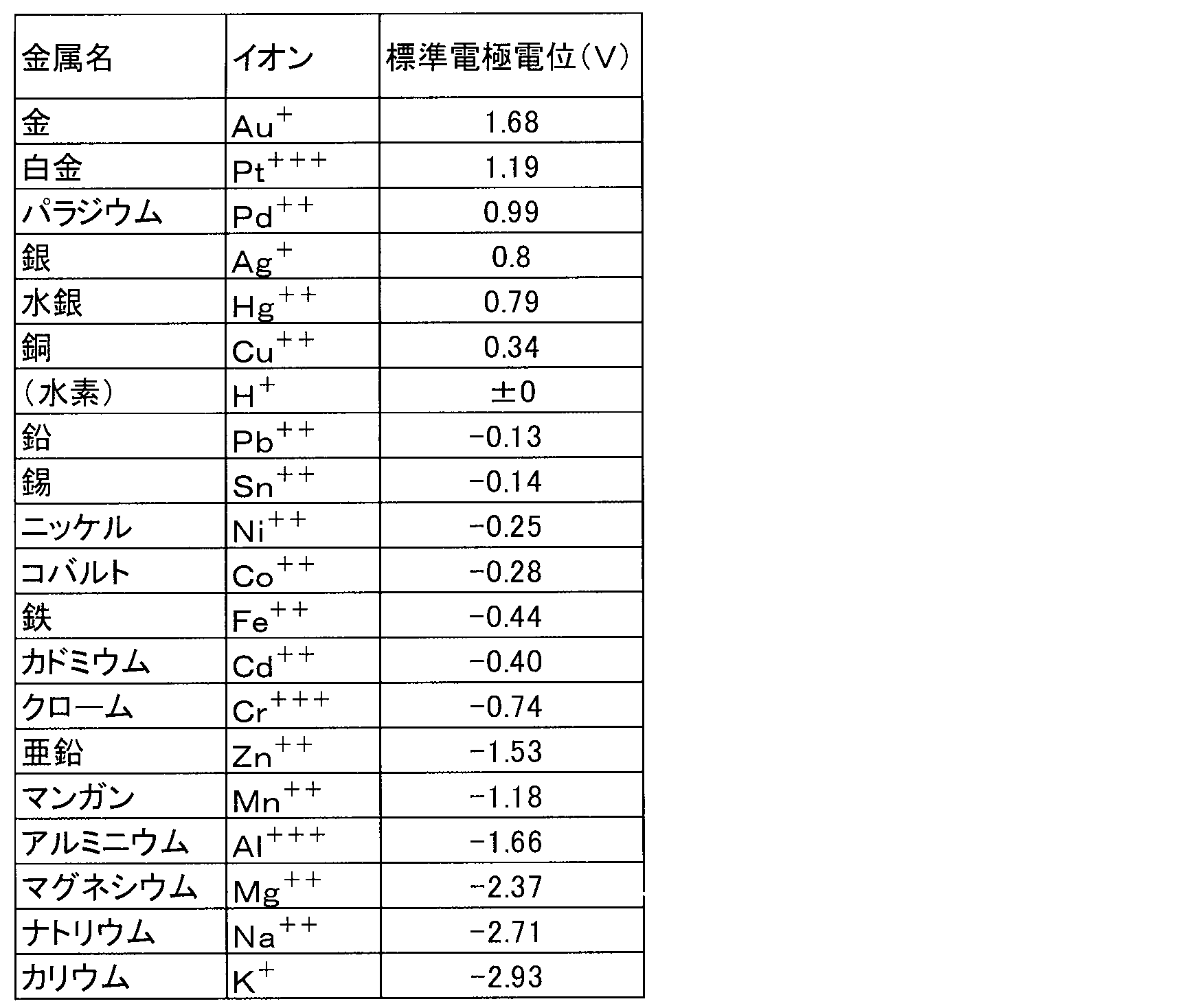
ここで例示した組み合わせが異種金属の具体的な例示になる。
異種金属としては、アルミニウムもしくはアルミニウム合金と銅、アルミニウムもしくはアルミニウム合金と鉄、アルミニウムもしくはアルミニウム合金と亜鉛、アルミニウムもしくはアルミニウム合金とニッケル、アルミニウムもしくはアルミニウム合金と錫、銅と鉄、銅と亜鉛、銅とニッケル、又は、銅と錫が好ましい。
この異種金属接合に伴う腐食の進行には酸素と水分が必要であり、本発明の防錆塗料は酸素、水蒸気に対して高いバリア性、および低吸水性を発現するため、効果的に錆の発生が抑制される。
また、異種金属とは、物品(A)と物品(B)を接合した際に生じる接合部における状態を示し、SUSのような合金において内部で生じている異種金属の状態を示すものではない。また、ブリキやトタンのように鉄板の最表面に錫や亜鉛の薄膜を形成した物品の場合、異種金属種としては鉄ではなく、最表面の錫や亜鉛が該当する。すなわち、物品(A)がブリキの場合、金属種として錫であり、物品(B)がトタンの場合、金属種としては亜鉛になる。
異種金属接合部位とは、電線の異種金属接合部、又は、配管の異種金属接合部、あるいは金属製のビスやボルトで金属板や金属製の部材を固定する場合の接合部、金属製のダクトと金属製の壁部の接合部位等があげられる。具体的な、異種金属接合部位としては、アルミの芯線と銅の芯線との接合部、アルミ製の配管とSUSの配管の接合部や、ブリキ(錫)やトタン(亜鉛)の金属板とSUS製のビスとの固定部位等があげられる。
また、近年、電線として軽量なアルミ配線が注目されているが、基板の銅との接合部における腐食が問題となっており、アルミの芯線とプリント基板等の銅との接合部にも本発明の防錆塗料を好適に採用できる。
本発明の防錆塗料は、以下の特性をもつ含フッ素共重合体からなることより、異種金属接合部に対して特に優れた防錆性を発現することが見出された。
特性(a):100μmあたりの水蒸気透過度が25g/m2・day以下
特性(b):酸素透過係数が2.0E-13cc・cm/cm2・sec・cmHg以下
特性(c):吸水率が10質量%以下
異種金属としては、アルミニウムもしくはアルミニウム合金と銅、アルミニウムもしくはアルミニウム合金と鉄、アルミニウムもしくはアルミニウム合金と亜鉛、アルミニウムもしくはアルミニウム合金とニッケル、アルミニウムもしくはアルミニウム合金と錫、銅と鉄、銅と亜鉛、銅とニッケル、又は、銅と錫が好ましい。
この異種金属接合に伴う腐食の進行には酸素と水分が必要であり、本発明の防錆塗料は酸素、水蒸気に対して高いバリア性、および低吸水性を発現するため、効果的に錆の発生が抑制される。
また、異種金属とは、物品(A)と物品(B)を接合した際に生じる接合部における状態を示し、SUSのような合金において内部で生じている異種金属の状態を示すものではない。また、ブリキやトタンのように鉄板の最表面に錫や亜鉛の薄膜を形成した物品の場合、異種金属種としては鉄ではなく、最表面の錫や亜鉛が該当する。すなわち、物品(A)がブリキの場合、金属種として錫であり、物品(B)がトタンの場合、金属種としては亜鉛になる。
異種金属接合部位とは、電線の異種金属接合部、又は、配管の異種金属接合部、あるいは金属製のビスやボルトで金属板や金属製の部材を固定する場合の接合部、金属製のダクトと金属製の壁部の接合部位等があげられる。具体的な、異種金属接合部位としては、アルミの芯線と銅の芯線との接合部、アルミ製の配管とSUSの配管の接合部や、ブリキ(錫)やトタン(亜鉛)の金属板とSUS製のビスとの固定部位等があげられる。
また、近年、電線として軽量なアルミ配線が注目されているが、基板の銅との接合部における腐食が問題となっており、アルミの芯線とプリント基板等の銅との接合部にも本発明の防錆塗料を好適に採用できる。
本発明の防錆塗料は、以下の特性をもつ含フッ素共重合体からなることより、異種金属接合部に対して特に優れた防錆性を発現することが見出された。
特性(a):100μmあたりの水蒸気透過度が25g/m2・day以下
特性(b):酸素透過係数が2.0E-13cc・cm/cm2・sec・cmHg以下
特性(c):吸水率が10質量%以下
また、本発明の防錆塗料は、鋼板用、鋳鉄用、高温高圧用鋳鋼用、又は、アルミ亜鉛合金めっき鋼板用に対してすぐれた防錆性をしめし、透明性、防汚性及び密着性にも優れた塗膜を形成できることから、海洋構造物用、キッチン家電用、自動車用金属配管用、意匠性の高いエクステリア用、上下水処理施設内配管用、各種発電設備内配線若しくは配管用防錆塗料として、好適に使用できる。
異種金属接合部としては、例えば、電線の異種金属接合部、配管の異種金属接合部等が挙げられる。上記異種金属接合部は、異種金属が接合されていればよく、機械的に接合されていてもよいし、化学的に接合されていてもよい。
異種金属としては、アルミニウムもしくはアルミニウム合金と銅、アルミニウムもしくはアルミニウム合金と鉄、アルミニウムもしくはアルミニウム合金と亜鉛、アルミニウムもしくはアルミニウム合金とニッケル、アルミニウムもしくはアルミニウム合金と錫、銅と鉄、銅と亜鉛、銅とニッケル、又は、銅と錫であることが好ましい。
ここで、アルミニウム合金としては、アルミニウム2000系(Al-Cu-Mg系:アルミ銅マグネシウム合金)アルミ合金、アルミニウム3000系(Al-Mn系:アルミマンガン合金)アルミ合金、アルミニウム4000系(Al-Si系:アルミシリコン合金)アルミ合金、アルミニウム5000系(Al-Mg系:アルミマグネシウム合金)アルミ合金、アルミニウム6000系(Al-Mg-Si系:アルミマグネシウムシリコン合金)アルミ合金、アルミニウム7000系(Al-Zn-Mg系:アルミ亜鉛マグネシウム合金)アルミ合金、又は、アルミニウム8000系(Li添加系:アルミリチウム合金)アルミ合金が好ましい。なお、ジュラルミンはアルミニウム7000系のアルミ合金である。
ここで、アルミニウム合金としては、アルミニウム2000系(Al-Cu-Mg系:アルミ銅マグネシウム合金)アルミ合金、アルミニウム3000系(Al-Mn系:アルミマンガン合金)アルミ合金、アルミニウム4000系(Al-Si系:アルミシリコン合金)アルミ合金、アルミニウム5000系(Al-Mg系:アルミマグネシウム合金)アルミ合金、アルミニウム6000系(Al-Mg-Si系:アルミマグネシウムシリコン合金)アルミ合金、アルミニウム7000系(Al-Zn-Mg系:アルミ亜鉛マグネシウム合金)アルミ合金、又は、アルミニウム8000系(Li添加系:アルミリチウム合金)アルミ合金が好ましい。なお、ジュラルミンはアルミニウム7000系のアルミ合金である。
異種金属接合部、海洋構造物、キッチン家電、自動車用金属配管、意匠性の高いエクステリア、上下水処理施設内配管、又は、各種発電設備内配線若しくは配管の腐食を防止するための、上述の防錆塗料の使用も、本発明の好適な態様の1つである。
本発明の防錆塗料は、硬化剤を含むことが好ましい。上記含フッ素共重合体は水酸基を有しているため、本発明の防錆塗料から、硬化塗膜を形成することができる。本発明の防錆塗料から形成される硬化塗膜は、非硬化の塗膜と比較して、より一層優れた防錆効果を発揮し、透明性、防汚性及び密着性にも一層優れる。
上記硬化剤としては、上記含フッ素共重合体中の水酸基を架橋させるものであれば種類を問わないが、イソシアネート系硬化剤、アミノ樹脂系硬化剤等が好適である。
イソシアネート系硬化剤としては、中でも、キシリレンジイソシアネート(XDI)及びビス(イソシアネートメチル)シクロヘキサン(水素化XDI、H6XDI)からなる群より選択される少なくとも1種のイソシアネートから誘導されるポリイソシアネート化合物、ヘキサメチレンジイソシアネート(HDI)に基づくブロックイソシアネート化合物、ヘキサメチレンジイソシアネート(HDI)から誘導されるポリイソシアネート化合物、並びに、イソホロンジイソシアネート(IPDI)から誘導されるポリイソシアネート化合物からなる群より選択される少なくとも1種の化合物が好ましい。
硬化剤として、キシリレンジイソシアネート(XDI)及びビス(イソシアネートメチル)シクロヘキサン(水素化XDI、H6XDI)からなる群より選択される少なくとも1種のイソシアネート(以下、イソシアネート(i)ともいう。)から誘導されるポリイソシアネート化合物(以下、ポリイソシアネート化合物(I)ともいう。)を用いた場合、本発明の防錆塗料から得られる硬化塗膜と金属基材との密着性が、より優れたものになる。
上記ポリイソシアネート化合物(I)としては、例えば、上記イソシアネート(i)と3価以上の脂肪族多価アルコールとを付加重合して得られるアダクト、上記イソシアネート(i)からなるイソシアヌレート構造体(ヌレート構造体)、及び、上記イソシアネート(i)からなるビウレットを挙げることができる。
上記アダクトとしては、例えば、下記一般式(3):

(式中、R6は、炭素数3~20の脂肪族炭化水素基を表す。R7は、フェニレン基又はシクロヘキシレン基を表す。kは、3~20の整数である。)で表される構造を有するものが好ましい。
上記一般式(3)中のR6は、上記3価以上の脂肪族多価アルコールに基づく炭化水素基であり、炭素数3~10の脂肪族炭化水素基がより好ましく、炭素数3~6の脂肪族炭化水素基が更に好ましい。
上記R7がフェニレン基である場合、1,2-フェニレン基(o-フェニレン基)、1,3-フェニレン基(m-フェニレン基)、及び、1,4-フェニレン基(p-フェニレン基)のいずれであってもよい。中でも、1,3-フェニレン基(m-フェニレン基)が好ましい。また、上記一般式(3)中の全てのR7が同じフェニレン基であってもよく、2種以上が混在していてもよい。
上記R7がシクロヘキシレン基である場合、1,2-シクロヘキシレン基、1,3-シクロヘキシレン基、及び、1,4-シクロヘキシレン基のいずれであってもよい。中でも、1,3-シクロヘキシレン基が好ましい。また、上記一般式(3)中の全てのR7が同じシクロヘキシレン基であってもよく、2種以上が混在していてもよい。
上記kは、3価以上の脂肪族多価アルコールの価数に対応する数である。上記kとして、より好ましくは3~10の整数であり、更に好ましくは3~6の整数である。
上記一般式(3)中のR6は、上記3価以上の脂肪族多価アルコールに基づく炭化水素基であり、炭素数3~10の脂肪族炭化水素基がより好ましく、炭素数3~6の脂肪族炭化水素基が更に好ましい。
上記R7がフェニレン基である場合、1,2-フェニレン基(o-フェニレン基)、1,3-フェニレン基(m-フェニレン基)、及び、1,4-フェニレン基(p-フェニレン基)のいずれであってもよい。中でも、1,3-フェニレン基(m-フェニレン基)が好ましい。また、上記一般式(3)中の全てのR7が同じフェニレン基であってもよく、2種以上が混在していてもよい。
上記R7がシクロヘキシレン基である場合、1,2-シクロヘキシレン基、1,3-シクロヘキシレン基、及び、1,4-シクロヘキシレン基のいずれであってもよい。中でも、1,3-シクロヘキシレン基が好ましい。また、上記一般式(3)中の全てのR7が同じシクロヘキシレン基であってもよく、2種以上が混在していてもよい。
上記kは、3価以上の脂肪族多価アルコールの価数に対応する数である。上記kとして、より好ましくは3~10の整数であり、更に好ましくは3~6の整数である。
上記イソシアヌレート構造体は、分子中に、下記一般式(4):

で表されるイソシアヌレート環を1個又は2個以上有するものである。
上記イソシアヌレート構造体としては、上記イソシアネートの三量化反応により得られる三量体、五量化反応により得られる五量体、七量化反応により得られる七量体等を挙げることができる。
上記イソシアヌレート構造体としては、上記イソシアネートの三量化反応により得られる三量体、五量化反応により得られる五量体、七量化反応により得られる七量体等を挙げることができる。
中でも、下記一般式(5):

(式中、R7は、一般式(3)中のR7と同じである。)で表される三量体が好ましい。
すなわち、上記イソシアヌレート構造体は、キシリレンジイソシアネート及びビス(イソシアネートメチル)シクロヘキサンからなる群より選択される少なくとも1種のイソシアネートの三量体であることが好ましい。
すなわち、上記イソシアヌレート構造体は、キシリレンジイソシアネート及びビス(イソシアネートメチル)シクロヘキサンからなる群より選択される少なくとも1種のイソシアネートの三量体であることが好ましい。
上記ビウレットは、下記一般式(6):

(式中、R7は、一般式(3)中のR7と同じである。)で表される構造を有する化合物であり、上記イソシアヌレート構造体を得る場合とは異なる条件下で、上記イソシアネートを三量化することにより、得ることができる。
上記ポリイソシアネート化合物(I)としては、中でも、上記アダクト、すなわち、キシリレンジイソシアネート及びビス(イソシアネートメチル)シクロヘキサンからなる群より選択される少なくとも1種のイソシアネートと、3価以上の脂肪族多価アルコールと、を付加重合して得られるものであることが好ましい。
上記ポリイソシアネート化合物(I)が、上記イソシアネート(i)と3価以上の脂肪族多価アルコールとのアダクトである場合、該3価以上の脂肪族多価アルコールとしては、具体的には、グリセロール、トリメチロールプロパン(TMP)、1,2,6-ヘキサントリオール、トリメチロールエタン、2,4-ジヒドロキシ-3-ヒドロキシメチルペンタン、1,1,1-トリス(ビスヒドロキシメチル)プロパン、2,2-ビス(ヒドロキシメチル)ブタノール-3等の3価アルコール;ペンタエリスリトール、ジグリセロール等の4価アルコール;アラビット、リビトール、キシリトール等の5価アルコール(ペンチット);ソルビット、マンニット、ガラクチトール、アロズルシット等の6価アルコール(ヘキシット)等が挙げられる。中でも、トリメチロールプロパン、ペンタエリスリトールが特に好ましい。
また、上記アダクトの構成成分として用いられるキシリレンジイソシアネート(XDI)としては、1,3-キシリレンジイソシアネート(m-キシリレンジイソシアネート)、1,2-キシリレンジイソシアネート(o-キシリレンジイソシアネート)、1,4-キシリレンジイソシアネート(p-キシリレンジイソシアネート)が挙げられるが、中でも、1,3-キシリレンジイソシアネート(m-キシリレンジイソシアネート)が好ましい。
また、上記アダクトの構成成分として用いられるビス(イソシアネートメチル)シクロヘキサン(水素化XDI、H6XDI)としては、1,3-ビス(イソシアネートメチル)シクロヘキサン、1,2-ビス(イソシアネートメチル)シクロヘキサン、1,4-ビス(イソシアネートメチル)シクロヘキサンが挙げられるが、中でも、1,3-ビス(イソシアネートメチル)シクロヘキサンが好ましい。
キシリレンジイソシアネート及びビス(イソシアネートメチル)シクロヘキサンからなる群より選択される少なくとも1種のイソシアネートと、上記のような3価以上の脂肪族多価アルコールと、を付加重合することにより、本発明で好適に用いられるアダクトが得られる。
本発明で好ましく用いられるアダクトとして、具体的には、例えば下記一般式(7):
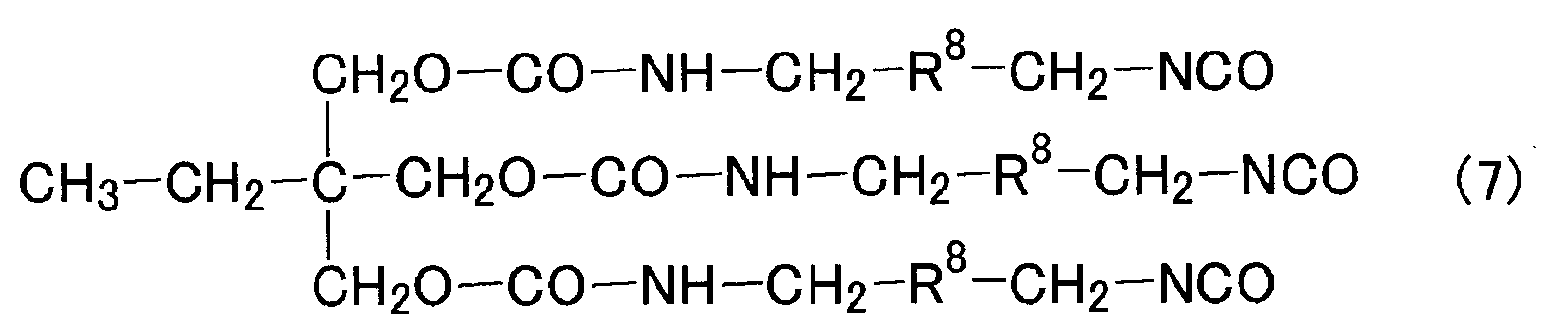
(式中、R8は、フェニレン基又はシクロヘキシレン基を表す。)で表される化合物、すなわち、キシリレンジイソシアネート及びビス(イソシアネートメチル)シクロヘキサンからなる群より選択される少なくとも1種のイソシアネートと、トリメチロールプロパン(TMP)と、を付加重合することにより得られるポリイソシアネート化合物を挙げることができる。
上記一般式(7)中のR8で表されるフェニレン基又はシクロヘキシレン基については、上記一般式(3)におけるR7について述べたとおりである。
上記一般式(7)中のR8で表されるフェニレン基又はシクロヘキシレン基については、上記一般式(3)におけるR7について述べたとおりである。
上記一般式(7)で表されるポリイソシアネート化合物の市販品としては、タケネートD110N(三井化学社製、XDIとTMPとのアダクト、NCO含有量11.8%)、タケネートD120N(三井化学社製、H6XDIとTMPとのアダクト、NCO含有量11.0%)等が挙げられる。
上記ポリイソシアネート化合物(I)が、イソシアヌレート構造体である場合の具体例としては、タケネートD121N(三井化学社製、H6XDIヌレート、NCO含有量14.0%)、タケネートD127N(三井化学社製、H6XDIヌレート、H6XDIの3量体、NCO含有量13.5%)等が挙げられる。
硬化剤として、ヘキサメチレンジイソシアネート(HDI)に基づくブロックイソシアネート(以下、単にブロックイソシアネートともいう。)を用いることにより、本発明の防錆塗料がより長いポットライフ(可使時間)を有するものとなる。
上記ブロックイソシアネートとしては、ヘキサメチレンジイソシアネートから誘導されるポリイソシアネート化合物(以下、ポリイソシアネート化合物(II)ともいう。)をブロック化剤で反応させて得られるものが好ましい。
上記ポリイソシアネート化合物(II)としては、例えば、ヘキサメチレンジイソシアネートと3価以上の脂肪族多価アルコールとを付加重合して得られるアダクト、ヘキサメチレンジイソシアネートからなるイソシアヌレート構造体(ヌレート構造体)、及び、ヘキサメチレンジイソシアネートからなるビウレットを挙げることができる。
上記ブロックイソシアネートとしては、ヘキサメチレンジイソシアネートから誘導されるポリイソシアネート化合物(以下、ポリイソシアネート化合物(II)ともいう。)をブロック化剤で反応させて得られるものが好ましい。
上記ポリイソシアネート化合物(II)としては、例えば、ヘキサメチレンジイソシアネートと3価以上の脂肪族多価アルコールとを付加重合して得られるアダクト、ヘキサメチレンジイソシアネートからなるイソシアヌレート構造体(ヌレート構造体)、及び、ヘキサメチレンジイソシアネートからなるビウレットを挙げることができる。
上記アダクトとしては、例えば、下記一般式(8):

(式中、R9は、炭素数3~20の脂肪族炭化水素基を表す。kは、3~20の整数である。)で表される構造を有するものが好ましい。
上記一般式(8)中のR9は、上記3価以上の脂肪族多価アルコールに基づく炭化水素基であり、炭素数3~10の脂肪族炭化水素基がより好ましく、炭素数3~6の脂肪族炭化水素基が更に好ましい。
上記kは、3価以上の脂肪族多価アルコールの価数に対応する数である。上記kとして、より好ましくは3~10の整数であり、更に好ましくは3~6の整数である。
上記一般式(8)中のR9は、上記3価以上の脂肪族多価アルコールに基づく炭化水素基であり、炭素数3~10の脂肪族炭化水素基がより好ましく、炭素数3~6の脂肪族炭化水素基が更に好ましい。
上記kは、3価以上の脂肪族多価アルコールの価数に対応する数である。上記kとして、より好ましくは3~10の整数であり、更に好ましくは3~6の整数である。
上記イソシアヌレート構造体は、分子中に、下記一般式(4):
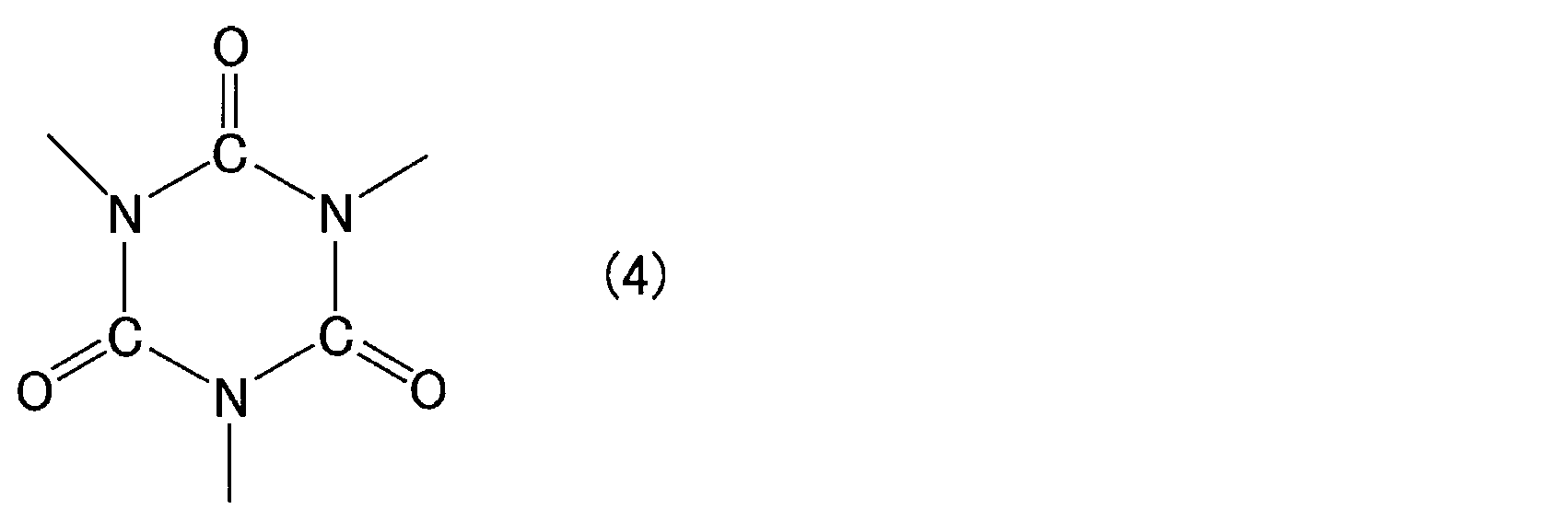
で表されるイソシアヌレート環を1個又は2個以上有するものである。
上記イソシアヌレート構造体としては、上記イソシアネートの三量化反応により得られる三量体、五量化反応により得られる五量体、七量化反応により得られる七量体等を挙げることができる。
上記イソシアヌレート構造体としては、上記イソシアネートの三量化反応により得られる三量体、五量化反応により得られる五量体、七量化反応により得られる七量体等を挙げることができる。
中でも、下記一般式(9):

で表される三量体が好ましい。
上記ビウレットは、下記一般式(10):

で表される構造を有する化合物であり、上記イソシアヌレート構造体を得る場合とは異なる条件下で、ヘキサメチレンジイソシアネートを三量化することにより、得ることができる。
上記ブロック化剤としては、活性水素を有する化合物を用いることが好ましい。上記活性水素を有する化合物としては、例えば、アルコール類、オキシム類、ラクタム類、活性メチレン化合物、及び、ピラゾール化合物からなる群より選択される少なくとも1種を用いることが好ましい。
このように、上記ブロックイソシアネートがヘキサメチレンジイソシアネートから誘導されるポリイソシアネート化合物をブロック化剤で反応させて得られるものであり、上記ブロック化剤は、アルコール類、オキシム類、ラクタム類、活性メチレン化合物、及び、ピラゾール化合物からなる群より選択される少なくとも1種であることは、本発明の好ましい実施形態の1つである。
上記ブロックイソシアネートを得るためのポリイソシアネート化合物(II)が、ヘキサメチレンジイソシアネートと3価以上の脂肪族多価アルコールとのアダクトである場合、該3価以上の脂肪族多価アルコールとしては、具体的には、グリセロール、トリメチロールプロパン(TMP)、1,2,6-ヘキサントリオール、トリメチロールエタン、2,4-ジヒドロキシ-3-ヒドロキシメチルペンタン、1,1,1-トリス(ビスヒドロキシメチル)プロパン、2,2-ビス(ヒドロキシメチル)ブタノール-3等の3価アルコール;ペンタエリスリトール、ジグリセロール等の4価アルコール;アラビット、リビトール、キシリトール等の5価アルコール(ペンチット);ソルビット、マンニット、ガラクチトール、アロズルシット等の6価アルコール(ヘキシット)等が挙げられる。中でも、トリメチロールプロパン、ペンタエリスリトールが特に好ましい。
ヘキサメチレンジイソシアネートと、上記のような3価以上の脂肪族多価アルコールとを付加重合することにより、上記アダクトが得られる。
ヘキサメチレンジイソシアネートと、上記のような3価以上の脂肪族多価アルコールとを付加重合することにより、上記アダクトが得られる。
上記ポリイソシアネート化合物(II)と反応させる、活性水素を有する化合物としては、具体的には、メタノール、エタノール、n-プロパノール、イソプロパノール、メトキシプロパノール等のアルコール類;アセトンオキシム、2-ブタノンオキシム、シクロヘキサノンオキシム等のオキシム類;-カプロラクタム等のラクタム類;アセト酢酸メチル、マロン酸エチル等の活性メチレン化合物;3-メチルピラゾール、3,5-ジメチルピラゾール、3,5-ジエチルピラゾール等のピラゾール化合物等が挙げられ、これらの1種又は2種以上を用いることができる。
中でも、活性メチレン化合物、オキシム類が好ましく、活性メチレン化合物がより好ましい。
中でも、活性メチレン化合物、オキシム類が好ましく、活性メチレン化合物がより好ましい。
上記ブロックイソシアネートの市販品としては、デュラネートK6000(旭化成ケミカルズ社製、HDIの活性メチレン化合物ブロックイソシアネート)、デュラネートTPA-B80E(旭化成ケミカルズ社製)、デュラネートMF-B60X(旭化成ケミカルズ社製)、デュラネート17B-60PX(旭化成ケミカルズ社製)、コロネート2507(日本ポリウレタン社製)、コロネート2513(日本ポリウレタン社製)、コロネート2515(日本ポリウレタン社製)、スミジュールBL-3175(住化バイエルウレタン社製)、LuxateHC1170(オリン・ケミカルズ社製)、LuxateHC2170(オリン・ケミカルズ社製)等が挙げられる。
硬化剤として、ヘキサメチレンジイソシアネート(HDI)から誘導されるポリイソシアネート化合物(以下、ポリイソシアネート化合物(III)ともいう。)を用いることもできる。ポリイソシアネート化合物(III)としては、ポリイソシアネート化合物(II)として上述したものが挙げられる。
ポリイソシアネート化合物(III)の具体例としては、コロネートHX(日本ポリウレタン社製、ヘキサメチレンジイソシアネートのイソシアヌレート構造体、NCO含有量21.1%)、スミジュールN3300(住化バイエル社製、ヘキサメチレンジイソシアネートのイソシアヌレート構造体)、タケネートD170N(三井化学社製、ヘキサメチレンジイソシアネートのイソシアヌレート構造体)、スミジュールN3800(住化バイエル社製、ヘキサメチレンジイソシアネートのイソシアヌレート構造体プレポリマータタイプ)等が挙げられる。
硬化剤として、イソホロンジイソシアネート(IPDI)から誘導されるポリイソシアネート化合物(以下、ポリイソシアネート化合物(IV)ともいう。)を用いることもできる。
上記ポリイソシアネート化合物(IV)としては、例えば、イソホロンジイソシアネートと3価以上の脂肪族多価アルコールとを付加重合して得られるアダクト、イソホロンジイソシアネートからなるイソシアヌレート構造体(ヌレート構造体)、及び、イソホロンジイソシアネートからなるビウレットを挙げることができる。
上記アダクトとしては、例えば、下記一般式(11):

(式中、R10は、炭素数3~20の脂肪族炭化水素基を表す。R11は、下記一般式(12):

で表される基である。kは、3~20の整数である。)で表される構造を有するものが好ましい。
上記一般式(11)中のR10は、上記3価以上の脂肪族多価アルコールに基づく炭化水素基であり、炭素数3~10の脂肪族炭化水素基がより好ましく、炭素数3~6の脂肪族炭化水素基が更に好ましい。
上記kは、3価以上の脂肪族多価アルコールの価数に対応する数である。上記kとして、より好ましくは3~10の整数であり、更に好ましくは3~6の整数である。
上記kは、3価以上の脂肪族多価アルコールの価数に対応する数である。上記kとして、より好ましくは3~10の整数であり、更に好ましくは3~6の整数である。
上記イソシアヌレート構造体は、分子中に、下記一般式(4):

で表されるイソシアヌレート環を1個又は2個以上有するものである。
上記イソシアヌレート構造体としては、イソホロンジイソシアネートの三量化反応により得られる三量体、五量化反応により得られる五量体、七量化反応により得られる七量体等を挙げることができる。
上記イソシアヌレート構造体としては、イソホロンジイソシアネートの三量化反応により得られる三量体、五量化反応により得られる五量体、七量化反応により得られる七量体等を挙げることができる。
中でも、下記一般式(13):

(式中、R11は、一般式(11)中のR11と同じである。)で表される三量体が好ましい。すなわち、上記イソシアヌレート構造体は、イソホロンジイソシアネートの三量体であることが好ましい。
上記ビウレットは、下記一般式(14):

(式中、R11は、一般式(11)中のR11と同じである。)で表される構造を有する化合物であり、上記イソシアヌレート構造体を得る場合とは異なる条件下で、イソホロンジイソシアネートを三量化することにより、得ることができる。
上記ポリイソシアネート化合物(IV)としては、中でも、上記アダクト及び上記イソシアヌレート構造体からなる群より選択される少なくとも1種であることが好ましい。すなわち、上記ポリイソシアネート化合物(IV)は、イソホロンジイソシアネートと、3価以上の脂肪族多価アルコールと、を付加重合して得られるアダクト、及び、イソホロンジイソシアネートからなるイソシアヌレート構造体からなる群より選択される少なくとも1種であることが好ましい。
上記ポリイソシアネート化合物(IV)が、イソホロンジイソシアネートと3価以上の脂肪族多価アルコールとのアダクトである場合、該3価以上の脂肪族多価アルコールとしては、具体的には、グリセロール、トリメチロールプロパン(TMP)、1,2,6-ヘキサントリオール、トリメチロールエタン、2,4-ジヒドロキシ-3-ヒドロキシメチルペンタン、1,1,1-トリス(ビスヒドロキシメチル)プロパン、2,2-ビス(ヒドロキシメチル)ブタノール-3等の3価アルコール;ペンタエリスリトール、ジグリセロール等の4価アルコール;アラビット、リビトール、キシリトール等の5価アルコール(ペンチット);ソルビット、マンニット、ガラクチトール、アロズルシット等の6価アルコール(ヘキシット)等が挙げられる。中でも、トリメチロールプロパン、ペンタエリスリトールが特に好ましい。
イソホロンジイソシアネートと、上記のような3価以上の脂肪族多価アルコールと、を付加重合することにより、本発明で好適に用いられるアダクトが得られる。
本発明で好ましく用いられるアダクトとして、具体的には、例えば下記一般式(15):

(式中、R12は、下記一般式(12):
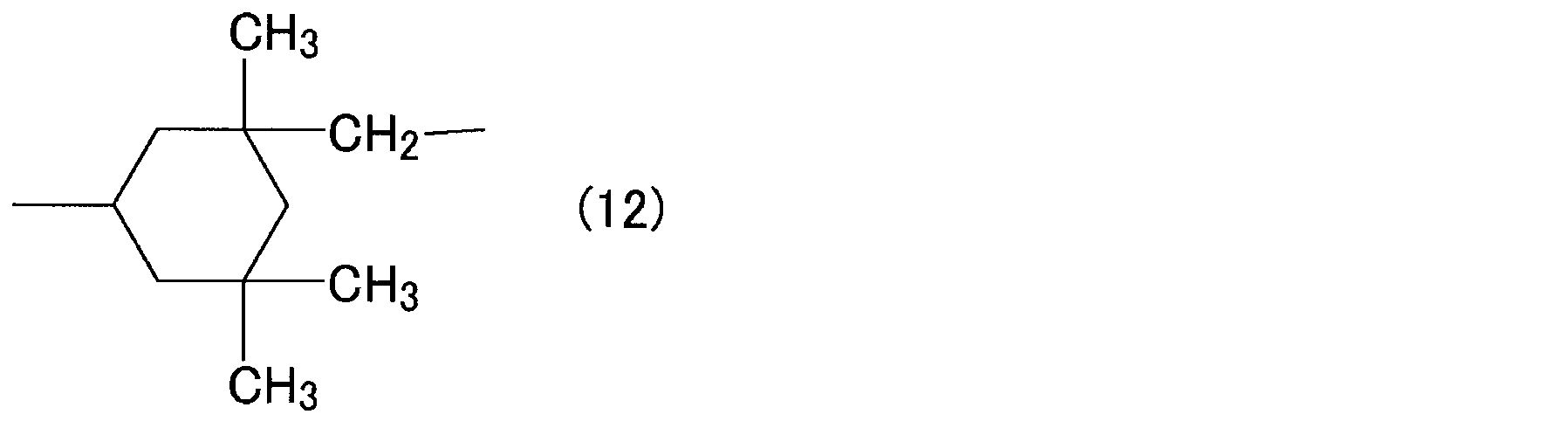
で表される基である。)で表される化合物、すなわち、イソホロンジイソシアネートとトリメチロールプロパン(TMP)とを付加重合することにより得られるポリイソシアネート化合物を挙げることができる。
上記一般式(12)で表されるポリイソシアネート化合物(イソホロンジイソシアネートのTMPアダクト体)の市販品としては、タケネートD140N(三井化学社製、NCO含有量11%)等が挙げられる。
イソホロンジイソシアネートからなるイソシアヌレート構造体の市販品としては、デスモジュールZ4470(住化バイエルウレタン社製、NCO含有量11%)等が挙げられる。
なかでも、上記硬化剤としては、タケネートD120N(三井化学社製、NCO含有量11%)、スミジュールN3300(住化バイエル社製、ヘキサメチレンジイソシアネートのイソシアヌレート構造体)がより好ましい。
上記イソシアネート系硬化剤は1種でも、2種以上を併用してもよい。
上記アミノ樹脂系硬化剤としては、例えばポリアミン化合物、メラミン樹脂、尿素樹脂、ベンゾグアナミン樹脂、グリコールウリル樹脂が挙げられる。
上記ポリアミン化合物としては、例えば1,2-エタンジアミン、1,3-及び1,2プロパンジアミン、1,4―ブタンジアミン等の低分子量ジアミン;例えば1,2,5-ペンタントリアミン等のテトラアミン;例えば1,2,4,5-ベンゼンテトラアミン等のテトラアミン等が挙げられる。
上記メラミン樹脂としては、メラミンとホルムアルデヒドとを縮合して得られるメチロールメラミン誘導体に低級アルコールとしてメチルアルコール、エチルアルコール、イソプロピルアルコール、ブチルアルコール、イソブチルアルコール等を反応させてエーテル化した化合物及びそれらの混合物を好ましく挙げることができる。
上記メチロールメラミン誘導体としては、例えばモノメチロールメラミン、ジメチロールメラミン、トリメチロールメラミン、テトラメチロールメラミン、ペンタメチロールメラミン、ヘキサメチロールメラミン等を挙げることができる。
メラミン樹脂の分類として、アルコキシ化される割合によって、完全アルキル型、メチロール基型、イミノ基型、メチロール/イミノ基型に分けられるが、いずれも本発明に使用できる。
上記硬化剤の中でポリイソシアネート化合物やポリアミン化合物やメラミン樹脂を用いると、硬化剤の分子量が比較的大きいため、硬化後の弾性率が抑えられる事で、塗膜としての曲げ強度や靱性を上げることができ好ましい。また、塗膜の表面の傷つき性も抑えられ、自己修復性も発現される。
上記硬化剤は含フッ素共重合体の水酸基部位に対する当量比で0.5~1.5となるように配合することが好ましく、0.8~1.2となるように配合することがより好ましい。
本発明の防錆塗料は、必要に応じて硬化触媒を含んでいてもよい。硬化触媒は、硬化反応を促進し、硬化膜に優れた化学性能および物理性能を付与するために用いられる。特に、低温において短時間で硬化させる場合には、硬化触媒を含有させることが好ましい。
硬化触媒としては、公知のものを用いることができ、硬化剤の種類等に応じて適宜選択すればよい。
例えば、硬化剤がイソシアネート系硬化剤またはブロック化イソシアネート系の硬化剤である場合、硬化触媒としては、錫触媒、ジルコニウム触媒等が好ましい。
錫触媒としては、例えば、オクチル酸錫、トリブチル錫ジラウレート、ジブチルチンジラウレート等が挙げられる。
ジルコニウム触媒としては、例えば、ジルコニウムキレート等が挙げられる。ジルコニウム触媒の市販品としては、例えば、「K-KAT XC-4205」(商品名、楠本化成社製)等が挙げられる。
硬化剤がアミン系硬化剤である場合、硬化触媒としては、ブロック化した酸触媒が好ましい。
ブロック化した酸触媒としては、カルボン酸、スルホン酸、リン酸等の各種酸のアミン塩が挙げられる。中でも、p-トルエンスルホン酸のジエタノールアミン塩またはトリエチルアミン塩、ドデシルベンゼンスルホン酸のジエタノールアミン塩またはトリエチルアミン塩等の高級アルキル置換スルホン酸アミン塩が好ましい。
硬化触媒は1種を単独で用いても2種以上を併用してもよい。
上記硬化触媒は含フッ素共重合体と硬化剤の合計に対して0.00001~10質量%が好ましく、0.0001~5質量%となるように配合することがより好ましい。
硬化触媒としては、公知のものを用いることができ、硬化剤の種類等に応じて適宜選択すればよい。
例えば、硬化剤がイソシアネート系硬化剤またはブロック化イソシアネート系の硬化剤である場合、硬化触媒としては、錫触媒、ジルコニウム触媒等が好ましい。
錫触媒としては、例えば、オクチル酸錫、トリブチル錫ジラウレート、ジブチルチンジラウレート等が挙げられる。
ジルコニウム触媒としては、例えば、ジルコニウムキレート等が挙げられる。ジルコニウム触媒の市販品としては、例えば、「K-KAT XC-4205」(商品名、楠本化成社製)等が挙げられる。
硬化剤がアミン系硬化剤である場合、硬化触媒としては、ブロック化した酸触媒が好ましい。
ブロック化した酸触媒としては、カルボン酸、スルホン酸、リン酸等の各種酸のアミン塩が挙げられる。中でも、p-トルエンスルホン酸のジエタノールアミン塩またはトリエチルアミン塩、ドデシルベンゼンスルホン酸のジエタノールアミン塩またはトリエチルアミン塩等の高級アルキル置換スルホン酸アミン塩が好ましい。
硬化触媒は1種を単独で用いても2種以上を併用してもよい。
上記硬化触媒は含フッ素共重合体と硬化剤の合計に対して0.00001~10質量%が好ましく、0.0001~5質量%となるように配合することがより好ましい。
上記含フッ素共重合体は、取り扱い性に優れることから、アルコール系溶剤への溶解性を有することが好ましい。本明細書において、溶解性を有するとは、アルコール系溶剤に対して5質量%の上記含フッ素共重合体を溶解させた場合に、上記含フッ素共重合体が視認できなくなることを意味する。また、アルコール系溶剤への溶解性を有するとは、少なくとも1種のアルコール系溶剤に溶解すればよく、全てのアルコール系溶剤に溶解することを要しない。
上記アルコール系溶剤としては、炭素数1~10のアルコールが好ましく、例えばメタノール、エタノール、ノルマルプロピルアルコール、イソプロピルアルコール、ノルマルブタノール、イソブチルアルコール、ターシャルブチルアルコール、ペンタノール、ヘキサノール、ヘプタノール、オクタノール等が挙げられる。上記含フッ素共重合体は、特にメタノールへの溶解性を有することが好ましい。
本発明の防錆塗料は、溶剤型塗料、水性型塗料、粉体型塗料等の形態に、常法により調製することができる。なかでも成膜の容易さ、乾燥性の良好さ等の点からは溶剤型塗料の形態が好ましい。すなわち、本発明の防錆塗料は、更に、溶剤を含むことが好ましい。溶剤を含むことにより、薄膜コーティングが一層容易になり、得られる塗膜を一層薄膜化することができる。
上記溶剤としては、有機溶剤が好ましく、酢酸エチル、酢酸ブチル、酢酸イソプロピル、酢酸イソブチル、酢酸セロソルブ、プロピレングリコールメチルエーテルアセテート等のエステル類;アセトン、メチルエチルケトン、メチルイソブチルケトン、シクロヘキサノン等のケトン類;テトラヒドロフラン、ジオキサン等の環状エーテル類;N,N-ジメチルホルムアミド、N,N-ジメチルアセトアミド等のアミド類;キシレン、トルエン、ソルベントナフサ等の芳香族炭化水素類;プロピレングリコールメチルエーテル、エチルセロソルブ等のグリコールエーテル類;カルビトールアセテート等のジエチレングリコールエステル類;n-ペンタン、n-ヘキサン、n-ヘプタン、n-オクタン、n-ノナン、n-デカン、n-ウンデカン、n-ドデカン、ミネラルスピリット等の脂肪族炭化水素類;これらの混合溶剤等が挙げられる。
中でも、エステル類やアミド類が好ましく、酢酸ブチルやN,N-ジメチルアセトアミドが特に好ましい。
中でも、エステル類やアミド類が好ましく、酢酸ブチルやN,N-ジメチルアセトアミドが特に好ましい。
本発明の防錆塗料を溶剤型塗料とする場合、塗料の総量100質量%に対する含フッ素共重合体の濃度を5~95質量%とすることが好ましく、10~70質量%とすることがより好ましい。
本発明の防錆塗料には、更に、本発明の効果を損なわない範囲で、他の重合体を加えても良い。他の重合体は、上記含フッ素共重合体に該当しない重合体である。
他の重合体は、硬化性基を有するものでもよく、有しないものでもよい。硬化性基としては、水酸基、カルボキシ基、アミノ基、エポキシ基、アルコキシシリル基、イソシアナート基等が挙げられる。
他の重合体としては、例えば、上記含フッ素共重合体以外の含フッ素重合体;アクリル樹脂、ポリエステル樹脂、アクリルポリオール樹脂、ポリエステルポリオール樹脂、ウレタン樹脂、アクリルシリコーン樹脂、シリコーン樹脂、アルキッド樹脂、エポキシ樹脂、オキセタン樹脂、アミノ樹脂等の非含フッ素樹脂等が挙げられる。
他の重合体は1種を単独で用いても2種以上を併用してもよい。
他の重合体としては、硬化膜に光沢が出やすいことから、上記含フッ素共重合体と相溶し、均一な硬化膜が得られるものが好ましい。この場合、他の重合体は、熱硬化性樹脂であっても熱可塑性樹脂であってもよい。
熱硬化性樹脂を他の重合体として含む場合、他の重合体は、硬化剤により、含フッ素共重合体と連結し得ることが好ましい。具体的には、水酸基、エポキシ基、カルボニル基等を末端または側鎖に含有するポリエステル樹脂又はアクリル樹脂が好ましい。
熱可塑性樹脂を他の重合体として含む場合、他の重合体は、含フッ素共重合体の水酸基と相互作用するような極性基、例えば、エステル基を含むことが好ましい。具体的には、硬化性基を有しないポリエステル樹脂又はアクリル樹脂が好ましい。
上記の他の重合体の含有量は、含フッ素共重合体100質量部に対して、0~100質量部が好ましく、5~75質量%となるように配合することがより好ましい。
本発明の防錆塗料には、更に、本発明の効果を損なわない範囲で、他の重合体を加えても良い。他の重合体は、上記含フッ素共重合体に該当しない重合体である。
他の重合体は、硬化性基を有するものでもよく、有しないものでもよい。硬化性基としては、水酸基、カルボキシ基、アミノ基、エポキシ基、アルコキシシリル基、イソシアナート基等が挙げられる。
他の重合体としては、例えば、上記含フッ素共重合体以外の含フッ素重合体;アクリル樹脂、ポリエステル樹脂、アクリルポリオール樹脂、ポリエステルポリオール樹脂、ウレタン樹脂、アクリルシリコーン樹脂、シリコーン樹脂、アルキッド樹脂、エポキシ樹脂、オキセタン樹脂、アミノ樹脂等の非含フッ素樹脂等が挙げられる。
他の重合体は1種を単独で用いても2種以上を併用してもよい。
他の重合体としては、硬化膜に光沢が出やすいことから、上記含フッ素共重合体と相溶し、均一な硬化膜が得られるものが好ましい。この場合、他の重合体は、熱硬化性樹脂であっても熱可塑性樹脂であってもよい。
熱硬化性樹脂を他の重合体として含む場合、他の重合体は、硬化剤により、含フッ素共重合体と連結し得ることが好ましい。具体的には、水酸基、エポキシ基、カルボニル基等を末端または側鎖に含有するポリエステル樹脂又はアクリル樹脂が好ましい。
熱可塑性樹脂を他の重合体として含む場合、他の重合体は、含フッ素共重合体の水酸基と相互作用するような極性基、例えば、エステル基を含むことが好ましい。具体的には、硬化性基を有しないポリエステル樹脂又はアクリル樹脂が好ましい。
上記の他の重合体の含有量は、含フッ素共重合体100質量部に対して、0~100質量部が好ましく、5~75質量%となるように配合することがより好ましい。
本発明の防錆塗料には、更に、本発明の効果を損なわない範囲で、要求特性に応じて各種の添加剤を配合することができる。添加剤としては、顔料、カップリング剤、シリカ、顔料分散剤、消泡剤、レベリング剤、紫外線吸収剤、光安定剤、増粘剤、密着改良剤、つや消し剤等が挙げられる。
本発明の防錆塗料は透明性が高いため、内部の腐食状況が肉眼で確認できる。そのため、耐久性が必要とされる分野、例えば自動車内部の金属配管、金属配線、橋梁のような海洋構造物、において非常に有効である。また、意匠性が必要な金属表面の防錆コーティングとして好適である。
本発明は、上述の防錆塗料から形成されることを特徴とする塗膜でもある。上記塗膜は、非硬化塗膜であっても、硬化塗膜であってよい。
上記非硬化塗膜は、上記硬化剤を含まない上述の防錆塗料(但し、硬化剤を含まない)から得られる。上記非硬化塗膜は、例えば、任意の基材に上述の防錆塗料を塗布し、乾燥させることにより製造できる。
上記硬化塗膜は、上記硬化剤を含む上述の防錆塗料から得られる。上記硬化塗膜は、例えば、任意の基材に上述の防錆塗料を塗布し、硬化させることにより製造できる。上記硬化は、溶剤型塗料の場合、10~300℃、好ましくは100~200℃で、30秒から3日間行うことが好ましい。溶剤型塗料又は水性型塗料の場合は、塗膜の乾燥を行うことが好ましい。乾燥は、上記硬化と同時に行っても、別に行ってもよい。塗膜を硬化(及び乾燥)させた後、養生してもよい。養生は、20~300℃にて1分間~3日間行うことが好ましい。
上記塗膜の厚さは、5~1000μmであることが防錆の観点から好ましい。より好ましくは、7~500μmであり、更に好ましくは、10~100μmである。
本発明の塗膜は、金属や異種金属接合部の腐食を充分に防ぐことができるとともに、透明性、防汚性及び密着性にも優れることから、異種金属接合部用、海洋構造物用、キッチン家電用、自動車用金属配管用、意匠性の高いエクステリア用、上下水処理施設内配管用、各種発電設備内配線若しくは配管用の塗膜として、好適に使用できる。
すなわち、異種金属接合部、海洋構造物、キッチン家電、自動車用金属配管、意匠性の高いエクステリア、上下水処理施設内配管、又は、各種発電設備内配線若しくは配管の腐食を防止するための、上述の塗膜の使用も、本発明の好適な態様の1つである。
本発明の防錆塗料及び本発明の塗膜は、ガラス基材、樹脂基材、セラミック基材、窯業系基材、コンクリート基材、金属基材等に適用できるが、いずれも防錆効果を有することから、上記金属基材に適用することが好ましい。本発明は、上記金属基材と、上述の塗膜と、を含むことを特徴とする積層体でもある。
上記金属基材の形成材料は、鋼板用、鋳鉄用、高温高圧用鋳鋼用、又は、アルミ亜鉛合金めっき鋼板があげられる。鋳鉄としてはFC200があげられる。高温高圧用鋳鋼としてはSCPH2があげられる。また、アルミニウム、ニッケル、チタン、モリブデン、マグネシウム、マンガン、銅、銀、鉛、スズ、クロム、ベリリウム、タングステン、コバルトなど金属や金属化合物およびこれらの2種以上からなる合金類などがあげられ、目的や用途により選択できる。
金属基材は異種金属が接合された異種金属接合部を有するものでもよい。金属基材が異種金属接合部を有する場合、特に腐食を抑制することができる。
金属基材は異種金属が接合された異種金属接合部を有するものでもよい。金属基材が異種金属接合部を有する場合、特に腐食を抑制することができる。
合金類の具体例としてはステンレス鋼、パーマロイなどの合金鋼、Al-Cu、Al-Mg、Al-Si、Al-Cu-Ni-Mg、Al-Si-Cu-Ni-Mgなどのアルミニウム合金、黄銅、青銅(ブロンズ)、珪素青銅、珪素黄銅、洋白、ニッケル青銅などの銅合金、ニッケルマンガン(Dニッケル)、ニッケル-アルミニウム(Zニッケル)、ニッケル-珪素、モネルメタル、コンスタンタン、ニクロムインコネル、ハステロイなどのニッケル合金などがあげられる。
また、金属の腐食防止などを目的として、金属表面に電気メッキ、溶融メッキ、クロマイジンク、シリコナイジング、カロライジング、シェラダイジグ、溶射などを施して他の金属を被膜したり、リン酸塩処理によりリン酸塩皮膜を形成させたり、陽極酸化や加熱酸化により金属酸化物を形成させたり、電気化学的防食を施してもよい。溶融メッキを施した金属基材としては、溶融亜鉛めっき鋼板、溶融亜鉛-アルミニウム-マグネシウム合金めっき鋼板、溶融アルミニウム-亜鉛めっき鋼板、溶融アルミニウムめっき鋼板等が挙げられる。
さらに、接着性をさらに向上させることを目的として、金属表面をリン酸塩、硫酸、クロム酸、シュウ酸などによる化成処理を施したり、サンドブラスト、ショットブラスト、グリットブラスト、ホーニンク、ペーパースクラッチ、ワイヤースクラッチ、ヘアーライン処理などの表面粗面化処理を施してもよく、意匠性を目的として、金属表面に、着色、印刷、エッチングなどを施してもよい。
上記積層体は、プライマー層を有していてもよい。上記プライマー層の形成は、従来公知のプライマー用塗料を用いて、常法により行う。プライマー用の塗料としては、例えばエポキシ樹脂、ウレタン樹脂、アクリル樹脂、シリコーン樹脂、ポリエステル樹脂等が代表例として挙げられる。
上記積層体は、上記金属基材と上述の塗膜とが直接密着していることも好ましく、直接密着させても優れた密着性が得られる。特に上述の塗膜が硬化塗膜であると、より一層高い密着性が得られる。
本発明の積層体は、金属基材が腐食しにくいとともに、塗膜の高い透明性により金属基材の有する美観を充分に発揮でき、防汚性及び密着性にも優れることから、異種金属接合部用、海洋構造物用、キッチン家電用、自動車用金属配管用、意匠性の高いエクステリア用、上下水処理施設内配管用、各種発電設備内配線若しくは配管用の積層体として、好適に使用できる。
すなわち、異種金属接合部、海洋構造物、キッチン家電、自動車用金属配管、意匠性の高いエクステリア、上下水処理施設内配管、又は、各種発電設備内配線若しくは配管の腐食を防止するための、上述の積層体の使用も、本発明の好適な態様の1つである。
異種金属接合部を有し、異種金属接合部上に上記防錆塗料から形成される塗膜を有する電線も本発明の1つである。
異種金属接合部を有する電線は、電流が流れるため、わずかな水分や酸素によって腐食が発生しやすく、特に異種金属接合部の腐食を抑制することが求められる。
本発明の電線は、異種金属接合部上に上記防錆塗料から形成される塗膜を有することによって、異種金属接合部の腐食を抑制することができる。
本発明の電線は、金属(A)からなる第1芯線と、金属(A)とは異なる金属(B)からなる第2芯線とを含み、上記第1芯線と第2芯線との異種金属接合部を含み、異種金属接合部上に上記防錆塗料から形成される塗膜を有することが好ましい。
上記異種金属接合部は、金属(A)と金属(B)とが接合されていればよく、機械的に接合されていてもよいし、金属(A)と金属(B)とが化学的に接合されていてもよい。
本発明の電線において、金属(A)と金属(B)との組合せは特に限定されず、上述した異種金属の組合せが挙げられるが、特に、アルミニウムと銅、アルミニウムと金、アルミニウムとニッケル、アルミニウムと錫、又は、アルミニウムと銀が好ましい。
本発明の電線は、必要に応じて、上記第1芯線及び第2芯線を被覆する被覆層を有することが好ましい。上記第1芯線及び第2芯線における被覆層の材料、厚み等は特に限定されず、電線において使用される従来公知の樹脂、厚み等を採用できる。
異種金属接合部を有する電線は、電流が流れるため、わずかな水分や酸素によって腐食が発生しやすく、特に異種金属接合部の腐食を抑制することが求められる。
本発明の電線は、異種金属接合部上に上記防錆塗料から形成される塗膜を有することによって、異種金属接合部の腐食を抑制することができる。
本発明の電線は、金属(A)からなる第1芯線と、金属(A)とは異なる金属(B)からなる第2芯線とを含み、上記第1芯線と第2芯線との異種金属接合部を含み、異種金属接合部上に上記防錆塗料から形成される塗膜を有することが好ましい。
上記異種金属接合部は、金属(A)と金属(B)とが接合されていればよく、機械的に接合されていてもよいし、金属(A)と金属(B)とが化学的に接合されていてもよい。
本発明の電線において、金属(A)と金属(B)との組合せは特に限定されず、上述した異種金属の組合せが挙げられるが、特に、アルミニウムと銅、アルミニウムと金、アルミニウムとニッケル、アルミニウムと錫、又は、アルミニウムと銀が好ましい。
本発明の電線は、必要に応じて、上記第1芯線及び第2芯線を被覆する被覆層を有することが好ましい。上記第1芯線及び第2芯線における被覆層の材料、厚み等は特に限定されず、電線において使用される従来公知の樹脂、厚み等を採用できる。
本発明の電線の具体的な態様としては、例えば、図2に示すように、金属(A)からなる第1芯線A1と、金属(A)とは異なる金属(B)からなる第2芯線B1とが接合された異種金属接合部D1を含み、異種金属接合部D1上に上記防錆塗料から形成される塗膜C1を有する形態が挙げられる。
異種金属接合部を有し、異種金属接合部上に上記防錆塗料から形成される塗膜を有する配管も本発明の好適な態様の1つである。
異種金属接合部を有する配管は、接合部において腐食が発生すると内部流体が漏れたり、外気が内部流体に作用したりするため、特に異種金属接合の腐食を抑制することが求められる。
本発明の配管は、異種金属接合部上に上記防錆塗料から形成される塗膜を有することによって、異種金属接合部の腐食を抑制することができる。
本発明の配管は、金属(A)からなる第1の管と、金属(A)とは異なる金属(B)からなる第2の管とを含み、上記第1の管と第2の管との異種金属接合部を含み、異種金属接合部上に上記防錆塗料から形成される塗膜を有することが好ましい。
上記異種金属接合部は、金属(A)と金属(B)とが接合されていればよく、機械的に接合されていてもよいし、金属(A)と金属(B)とが化学的に接合されていてもよい。
本発明の配管において、金属(A)と金属(B)との組合せは特に限定されず、上述した異種金属の組合せが挙げられるが、特に、アルミニウムと銅、SUSと鉄、又は、アルミニウムと鉄が好ましい。
第1の管及び第2の管の構造、厚み等は特に限定されるものではなく、従来公知の構造、厚み等を採用できる。
異種金属接合部を有する配管は、接合部において腐食が発生すると内部流体が漏れたり、外気が内部流体に作用したりするため、特に異種金属接合の腐食を抑制することが求められる。
本発明の配管は、異種金属接合部上に上記防錆塗料から形成される塗膜を有することによって、異種金属接合部の腐食を抑制することができる。
本発明の配管は、金属(A)からなる第1の管と、金属(A)とは異なる金属(B)からなる第2の管とを含み、上記第1の管と第2の管との異種金属接合部を含み、異種金属接合部上に上記防錆塗料から形成される塗膜を有することが好ましい。
上記異種金属接合部は、金属(A)と金属(B)とが接合されていればよく、機械的に接合されていてもよいし、金属(A)と金属(B)とが化学的に接合されていてもよい。
本発明の配管において、金属(A)と金属(B)との組合せは特に限定されず、上述した異種金属の組合せが挙げられるが、特に、アルミニウムと銅、SUSと鉄、又は、アルミニウムと鉄が好ましい。
第1の管及び第2の管の構造、厚み等は特に限定されるものではなく、従来公知の構造、厚み等を採用できる。
本発明の配管の具体的な態様としては、例えば、図3に示すように、金属(A)からなる第1配管A2と、金属(A)とは異なる金属(B)からなる第2配管B2とが接合された異種金属接合部D2を含み、異種金属接合部D2上に上記防錆塗料から形成される塗膜C2を有する形態が挙げられる。
つぎに本発明を実施例をあげて説明するが、本発明はかかる実施例のみに限定されるものではない。
実施例の各数値は以下の方法により測定した。
(1)ヘイズ値、全光線透過率
ヘイズメーターを用いてJIS K7136に準じてフィルムのヘイズ、透過率を測定した。
(2)NMRによる交互率の測定
下記条件でNMR測定を行い、その結果から交互率を算出した。
1H-NMR測定条件:400MHz(テトラメチルシラン=0ppm)
(3)重量平均分子量、分子量分布
ゲルパーミエーションクロマトグラフィー(GPC)により、Shodex社製のカラム(GPC LF-Gを1本、Shodex GPC LF-604を2本、GPC LF-601を2本直列に接続)を使用し、溶媒としてTHFを流速1ml/minで流して測定したデータより、標準ポリスチレン換算の重量平均分子量(Mw)、数平均分子量(Mn)および分子量分布(Mw/Mn)を算出した。
(4)熱分解温度
示差熱熱重量同時測定装置(TG/DTA)を用い、air雰囲気の条件で昇温速度10℃/minの条件で測定し、1%質量減の温度で評価した。
(5)ガラス転移温度Tg、融点Tm
示差走査熱量測定により、-30℃~150℃の温度範囲で昇温(降温)速度 20℃/minの条件で昇温(ファーストラン)-降温-昇温(セカンドラン)させ、セカンドランにおける吸熱曲線の中間点をTg(℃)とした。セカンドランの吸熱ピークの値をTm(℃)とした。
(6)密着性
JIS K5600-5-6クロスカット法に準じて、碁盤目試験(1mm×1mm×25マス)を行い、残ったマス数で評価した。
(7)水蒸気透過試験
カップ法(JIS Z0208-1976)条件B(温度 40±0.5℃ 相対湿度 90±2%)に準じて行った。得られた値(R)と実測の厚み(t(μm))から100μmあたりの水蒸気透過度(P)に以下の式を用いて換算した。
P(100μm)=R×100/t
(8)防錆試験
試験条件A
ガルバリウム鋼板(登録商標)に作製した塗料を塗装後30分間常温で風乾後、80℃2時間の条件で加熱乾燥し、塗板を作成した。塗板の周囲をアルミテープで保護し、板上に食塩水(50g/L)を5ヶ所に滴下し、35℃90%RTの条件で4日間保持後、表面の状態を目視で確認した。基準は、食塩水を滴下した下地が、○は変化なし、△は下地の一部に錆が発生、×は下地全体に錆が発生である。
試験条件B
ガルバリウム鋼板(登録商標)に作製した塗料を塗装後30分間常温で風乾後、80℃2時間の条件で加熱乾燥し、塗板を作成した。塗板の周囲をアルミテープで保護し、板上に全体が濡れる程度に食塩水(50g/L)を霧吹きし、35℃90%RTの条件で4日保持後、表面の状態を目視で確認した。基準は、下地が、○は変化なし、△は下地の一部に錆が発生、×は下地全体に錆が発生、である。
(9)吸水率
フィルム片を室温23℃において水中に浸漬させ、数日間重量変化を測定し、吸水量が前日比で飽和したところを測定し、吸水率(Q)を下式にて求めた。
Q(%)=(飽和吸水重量-初期重量)/初期重量×100
(10)温水試験
ガラス板に作製した塗料を塗装後30分間常温で風乾後、80℃2時間の条件で加熱乾燥し、塗板を作成した。塗膜を塗布したガラス板を50℃の温水に4日間浸漬し、前後のヘイズを測定した。
(11)酸素透過係数
差圧式ガス・蒸気透過率測定装置を用いて、JIS K 7126-1に準じて測定を行った。
(12)溶剤溶解性
固体状のポリマーを溶液に対して約5質量%入れ、常温(23℃)で振り混ぜ、24時間後、目視で状態を確認した。○は溶解した、△は防潤、×は溶解しない、である。
(13)マジック汚染性
JIS K6902に準拠し、赤、黒、青のマジックインキを塗布し、16時間後にエタノールにて拭き取り、汚染の状態を目視で確認した。○は完全に拭き取れる、△は拭き取り残りあり、×はほぼ拭き取れず、である。
ヘイズメーターを用いてJIS K7136に準じてフィルムのヘイズ、透過率を測定した。
(2)NMRによる交互率の測定
下記条件でNMR測定を行い、その結果から交互率を算出した。
1H-NMR測定条件:400MHz(テトラメチルシラン=0ppm)
(3)重量平均分子量、分子量分布
ゲルパーミエーションクロマトグラフィー(GPC)により、Shodex社製のカラム(GPC LF-Gを1本、Shodex GPC LF-604を2本、GPC LF-601を2本直列に接続)を使用し、溶媒としてTHFを流速1ml/minで流して測定したデータより、標準ポリスチレン換算の重量平均分子量(Mw)、数平均分子量(Mn)および分子量分布(Mw/Mn)を算出した。
(4)熱分解温度
示差熱熱重量同時測定装置(TG/DTA)を用い、air雰囲気の条件で昇温速度10℃/minの条件で測定し、1%質量減の温度で評価した。
(5)ガラス転移温度Tg、融点Tm
示差走査熱量測定により、-30℃~150℃の温度範囲で昇温(降温)速度 20℃/minの条件で昇温(ファーストラン)-降温-昇温(セカンドラン)させ、セカンドランにおける吸熱曲線の中間点をTg(℃)とした。セカンドランの吸熱ピークの値をTm(℃)とした。
(6)密着性
JIS K5600-5-6クロスカット法に準じて、碁盤目試験(1mm×1mm×25マス)を行い、残ったマス数で評価した。
(7)水蒸気透過試験
カップ法(JIS Z0208-1976)条件B(温度 40±0.5℃ 相対湿度 90±2%)に準じて行った。得られた値(R)と実測の厚み(t(μm))から100μmあたりの水蒸気透過度(P)に以下の式を用いて換算した。
P(100μm)=R×100/t
(8)防錆試験
試験条件A
ガルバリウム鋼板(登録商標)に作製した塗料を塗装後30分間常温で風乾後、80℃2時間の条件で加熱乾燥し、塗板を作成した。塗板の周囲をアルミテープで保護し、板上に食塩水(50g/L)を5ヶ所に滴下し、35℃90%RTの条件で4日間保持後、表面の状態を目視で確認した。基準は、食塩水を滴下した下地が、○は変化なし、△は下地の一部に錆が発生、×は下地全体に錆が発生である。
試験条件B
ガルバリウム鋼板(登録商標)に作製した塗料を塗装後30分間常温で風乾後、80℃2時間の条件で加熱乾燥し、塗板を作成した。塗板の周囲をアルミテープで保護し、板上に全体が濡れる程度に食塩水(50g/L)を霧吹きし、35℃90%RTの条件で4日保持後、表面の状態を目視で確認した。基準は、下地が、○は変化なし、△は下地の一部に錆が発生、×は下地全体に錆が発生、である。
(9)吸水率
フィルム片を室温23℃において水中に浸漬させ、数日間重量変化を測定し、吸水量が前日比で飽和したところを測定し、吸水率(Q)を下式にて求めた。
Q(%)=(飽和吸水重量-初期重量)/初期重量×100
(10)温水試験
ガラス板に作製した塗料を塗装後30分間常温で風乾後、80℃2時間の条件で加熱乾燥し、塗板を作成した。塗膜を塗布したガラス板を50℃の温水に4日間浸漬し、前後のヘイズを測定した。
(11)酸素透過係数
差圧式ガス・蒸気透過率測定装置を用いて、JIS K 7126-1に準じて測定を行った。
(12)溶剤溶解性
固体状のポリマーを溶液に対して約5質量%入れ、常温(23℃)で振り混ぜ、24時間後、目視で状態を確認した。○は溶解した、△は防潤、×は溶解しない、である。
(13)マジック汚染性
JIS K6902に準拠し、赤、黒、青のマジックインキを塗布し、16時間後にエタノールにて拭き取り、汚染の状態を目視で確認した。○は完全に拭き取れる、△は拭き取り残りあり、×はほぼ拭き取れず、である。
各実施例において、使用した重合体は以下の通りである。
重合体1:テトラフルオロエチレン(TFE)/ビニルアルコール(VOH)共重合体(TFE/VOH=23.8/76.2(モル%)、重量平均分子量:46,000、分子量分布(Mw/Mn):2.01、交互率(VTV):5.4%、熱分解温度:256℃、Tg:79℃、Tm:192℃、水酸基価:761mgKOH/g
それぞれの値は上述に記載の方法で測定した。
さらに重合体2、3を用いた。各重合体の物性値を表2にまとめる。

重合体1:テトラフルオロエチレン(TFE)/ビニルアルコール(VOH)共重合体(TFE/VOH=23.8/76.2(モル%)、重量平均分子量:46,000、分子量分布(Mw/Mn):2.01、交互率(VTV):5.4%、熱分解温度:256℃、Tg:79℃、Tm:192℃、水酸基価:761mgKOH/g
それぞれの値は上述に記載の方法で測定した。
さらに重合体2、3を用いた。各重合体の物性値を表2にまとめる。
比較ポリマーとして以下のものを用いた。
比較重合体1:テトラフルオロエチレン(TFE)/ビニルアルコール(VOH)共重合体(TFE/VOH=11/89(モル%)、重量平均分子量:252,000、分子量分布(Mw/Mn):2.20、交互率(VTV):0.9%、熱分解温度:238℃、Tg:87℃、Tm:204℃、水酸基価:995mgKOH/g
比較重合体2:テトラフルオロエチレン(TFE)/ビニルアルコール(VOH)共重合体(TFE/VOH=47.8/52.2(モル%)、重量平均分子量:40,000、分子量分布(Mw/Mn):1.77、交互率(VTV):49.1%、熱分解温度:321℃、Tg:79℃、Tm:206℃、水酸基価:413mgKOH/g
エバール(R)L104B:クレハ社製、エチレン(E)/ビニルアルコール(VOH)共重合体(E/VOH=27/73(モル%))、Tg:60℃、Tm:165℃
ポバール:ポリビニルアルコール、アルドリッチ社により購入した試薬
比較重合体1:テトラフルオロエチレン(TFE)/ビニルアルコール(VOH)共重合体(TFE/VOH=11/89(モル%)、重量平均分子量:252,000、分子量分布(Mw/Mn):2.20、交互率(VTV):0.9%、熱分解温度:238℃、Tg:87℃、Tm:204℃、水酸基価:995mgKOH/g
比較重合体2:テトラフルオロエチレン(TFE)/ビニルアルコール(VOH)共重合体(TFE/VOH=47.8/52.2(モル%)、重量平均分子量:40,000、分子量分布(Mw/Mn):1.77、交互率(VTV):49.1%、熱分解温度:321℃、Tg:79℃、Tm:206℃、水酸基価:413mgKOH/g
エバール(R)L104B:クレハ社製、エチレン(E)/ビニルアルコール(VOH)共重合体(E/VOH=27/73(モル%))、Tg:60℃、Tm:165℃
ポバール:ポリビニルアルコール、アルドリッチ社により購入した試薬
参考例1-1~1-3及び参考比較例1-1~1-4:溶剤溶解性
重合体1~3および比較重合体1および2に関して溶剤溶解性を測定した。結果を表3にまとめる。
重合体1~3および比較重合体1および2に関して溶剤溶解性を測定した。結果を表3にまとめる。
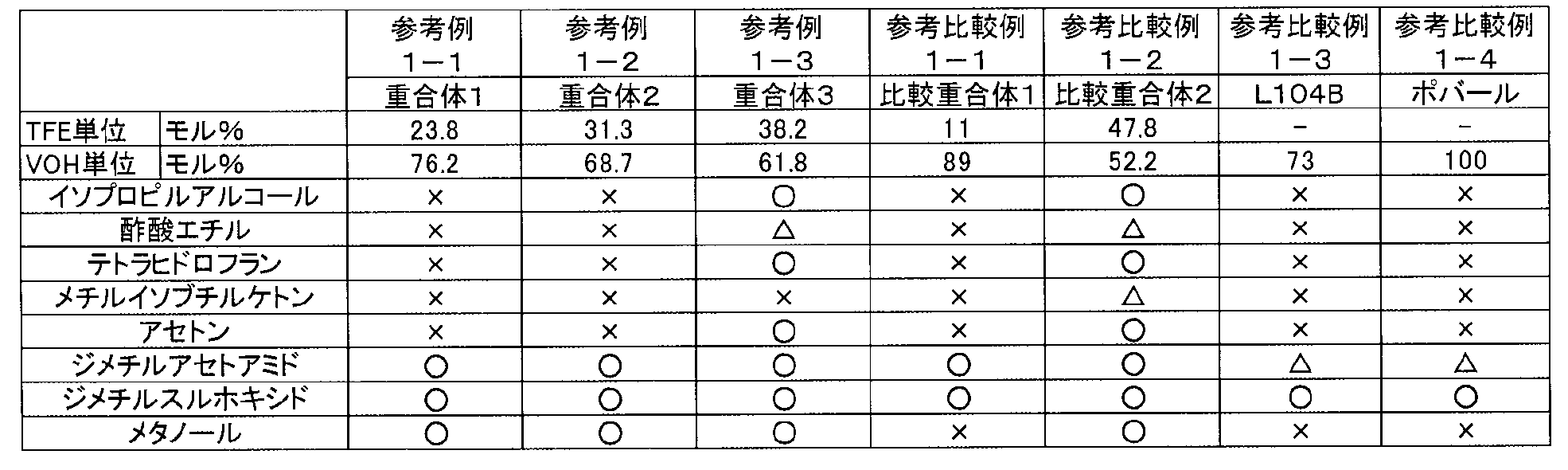
実施例1-1~1-3及び比較例2:
重合体1のジメチルアセトアミド15質量%溶液を作製し、PP(ポリプロピレン)板上に10ミルのドクターブレードを用いて製膜した。室温で30分間風乾後、80℃、2時間の条件で乾燥させ、塗膜を得た。その後、PP板より塗膜を剥離させ、フィルムを得た。
重合体2、3及び比較重合体1、2に関しても同様にフィルムを作製した。
重合体1のジメチルアセトアミド15質量%溶液を作製し、PP(ポリプロピレン)板上に10ミルのドクターブレードを用いて製膜した。室温で30分間風乾後、80℃、2時間の条件で乾燥させ、塗膜を得た。その後、PP板より塗膜を剥離させ、フィルムを得た。
重合体2、3及び比較重合体1、2に関しても同様にフィルムを作製した。
酸素透過率、水蒸気透過度、吸水率の測定
実施例1-1~1-3及び比較例2で得られたフィルムを用いて酸素透過率、水蒸気透過度、吸水率の測定をおこなった。結果を表4にまとめる。
実施例1-1~1-3及び比較例2で得られたフィルムを用いて酸素透過率、水蒸気透過度、吸水率の測定をおこなった。結果を表4にまとめる。

また比較重合体1およびエバール(R)L104Bの吸水率はそれぞれ20.6%および20.3%であった。またポバール(ポリビニルアルコール)は水溶性を示すため、試験をおこなわなかった。
光学特性
実施例1-1~1-2及び比較例2で得られたフィルムに関して全光線透過率およびヘイズの測定をおこなった。結果を表5にまとめる。

実施例1-1~1-2及び比較例2で得られたフィルムに関して全光線透過率およびヘイズの測定をおこなった。結果を表5にまとめる。
マジック汚染性
実施例1-1~1-3で得られたフィルムに関してマジック汚染性を評価した。結果を表6にまとめる。
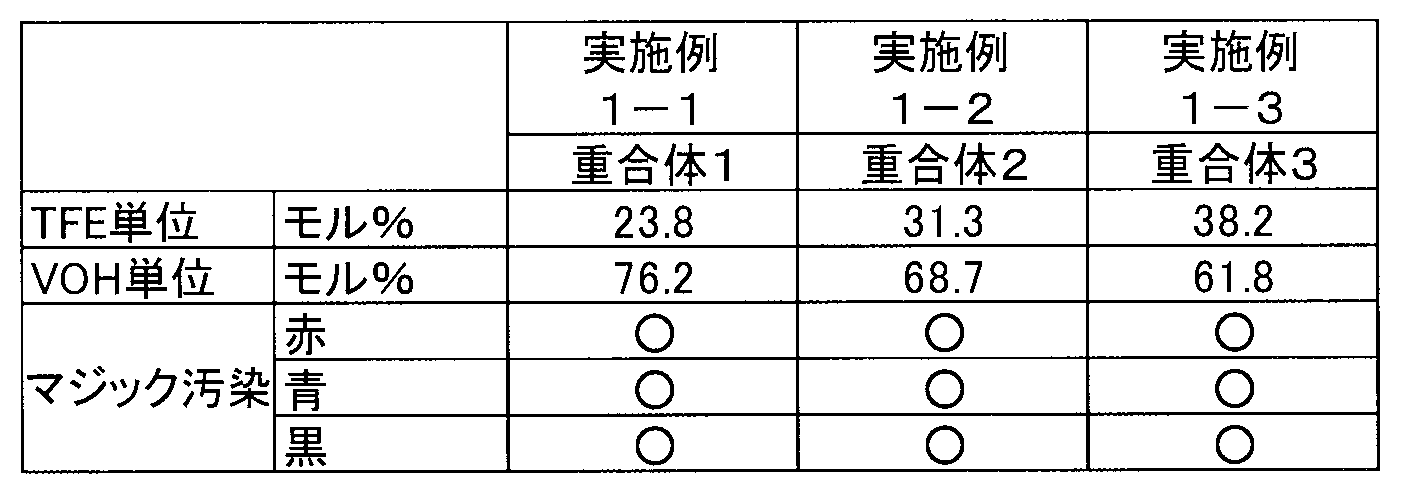
実施例1-1~1-3で得られたフィルムに関してマジック汚染性を評価した。結果を表6にまとめる。
実施例2-1及び2-2
重合体1のジメチルアセトアミド15質量%溶液を作製し、硬化剤として住化バイエルウレタン社製のスミジュールN3300を重合体に対して20質量%添加し、塗料を作製した。各種基板に10ミルのドクターブレードを用いて製膜後、室温で30分風乾後、80℃で4時間乾燥させた後に、密着性を評価した。
重合体2についても同様に製膜して密着性評価を行った。結果を表7に示す。
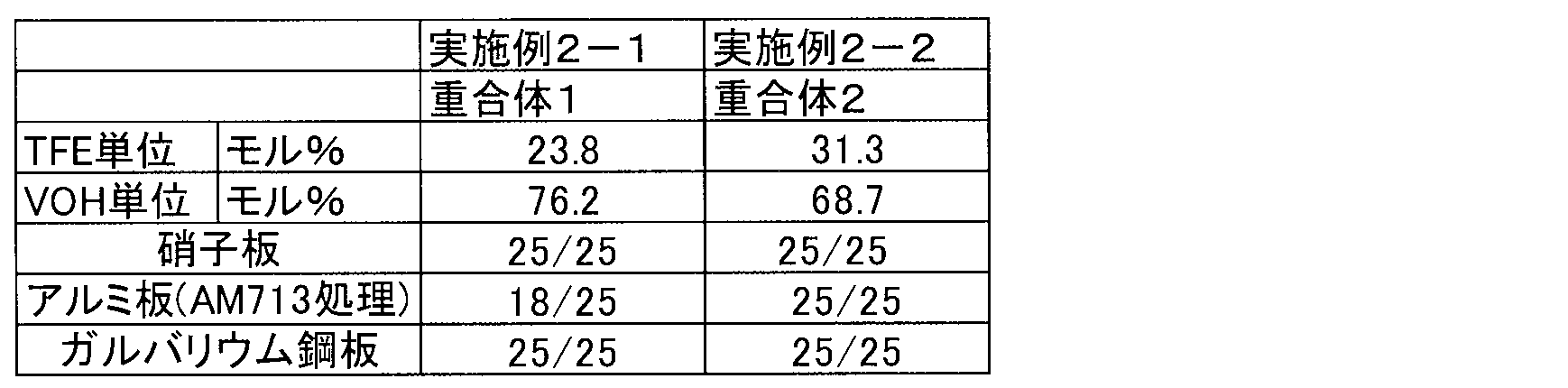
重合体1のジメチルアセトアミド15質量%溶液を作製し、硬化剤として住化バイエルウレタン社製のスミジュールN3300を重合体に対して20質量%添加し、塗料を作製した。各種基板に10ミルのドクターブレードを用いて製膜後、室温で30分風乾後、80℃で4時間乾燥させた後に、密着性を評価した。
重合体2についても同様に製膜して密着性評価を行った。結果を表7に示す。
実施例2-1及び2-2に関し、酸素透過率、水蒸気透過度、吸水率の測定をおこなった。その結果を表8にまとめる。

実施例3-1、3-2及び比較例3-1~3-3:防錆試験1
重合体1のジメチルアセトアミド15質量%溶液を作製し塗料とした。その塗料を用いて防錆試験をおこなった。重合体2、比較重合体1、L104B、ポバールについても同様に防錆試験をおこなった。結果を表9に示す。

重合体1のジメチルアセトアミド15質量%溶液を作製し塗料とした。その塗料を用いて防錆試験をおこなった。重合体2、比較重合体1、L104B、ポバールについても同様に防錆試験をおこなった。結果を表9に示す。
実施例4-1及び4-2:温水試験
実施例2-1及び2-2で作製した硝子板上に製膜したサンプルを用いて温水試験をおこなった。結果を表10にしめす。
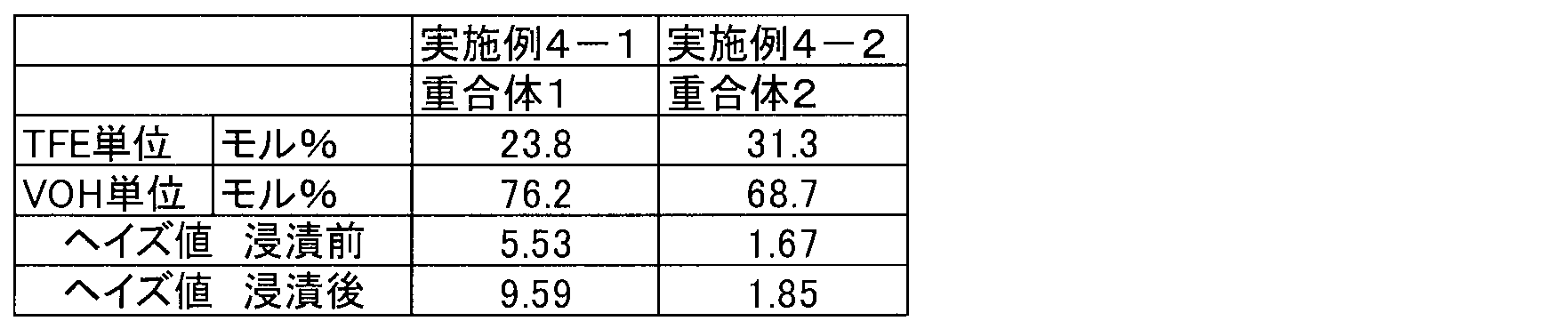
実施例2-1及び2-2で作製した硝子板上に製膜したサンプルを用いて温水試験をおこなった。結果を表10にしめす。
実施例5及び比較例5-1~5-3:防錆試験2
重合体2のジメチルアセトアミド15質量%溶液を作製し、硬化剤として住化バイエルウレタン社製のスミジュールN3300を重合体に対して20質量%添加し、塗料を作製した。各種金属板の上に10ミルのドクターブレードを用いて製膜後、室温で30分風乾後、80℃で4時間乾燥させ金属塗板を得た。その後、周辺の影響を除くため、金属塗板の周囲をアルミテープで保護した。5%の塩水に浸漬し、50℃で7日間保持後、外観を目視で評価した。各評価基準は以下の通りである。
○:変化なし、△:一部に錆が発生、×:全体に錆が発生
同様に比較重合体1、2、L104Bに関しても防錆を評価した。結果を表11にまとめる。

重合体2のジメチルアセトアミド15質量%溶液を作製し、硬化剤として住化バイエルウレタン社製のスミジュールN3300を重合体に対して20質量%添加し、塗料を作製した。各種金属板の上に10ミルのドクターブレードを用いて製膜後、室温で30分風乾後、80℃で4時間乾燥させ金属塗板を得た。その後、周辺の影響を除くため、金属塗板の周囲をアルミテープで保護した。5%の塩水に浸漬し、50℃で7日間保持後、外観を目視で評価した。各評価基準は以下の通りである。
○:変化なし、△:一部に錆が発生、×:全体に錆が発生
同様に比較重合体1、2、L104Bに関しても防錆を評価した。結果を表11にまとめる。
異種金属接合(銅板-アルミ箔)
図1で示すように、厚さ0.5mmの銅板1に3mmφの穴をドリルで加工し、厚み50μmのアルミ箔2を4mm角に切り出し、中央に3mmφの穴をあけ、先の銅板1とSUS製のネジ3とナット4でかしめてアルミ箔2が一部露出するように銅板1上に密着固定した。その後、ネジ3、ナット4、アルミ箔2、銅板1を完全に覆うように実施例5及び比較例5-2で作製した塗料を塗布し、室温で30分風乾後、80℃で4時間乾燥させた。その後、塗膜5上に食塩水6(50g/L)を滴下し、35℃90%RTの条件で4日間保持後、アルミ箔2と銅板1の界面7の状態を目視で確認した。結果を表12に示す。表12中の基準は、食塩水を滴下したアルミ箔と銅板の表面が、○は変化なし、△は一部に錆が発生、×は全体に錆が発生、である。

図1で示すように、厚さ0.5mmの銅板1に3mmφの穴をドリルで加工し、厚み50μmのアルミ箔2を4mm角に切り出し、中央に3mmφの穴をあけ、先の銅板1とSUS製のネジ3とナット4でかしめてアルミ箔2が一部露出するように銅板1上に密着固定した。その後、ネジ3、ナット4、アルミ箔2、銅板1を完全に覆うように実施例5及び比較例5-2で作製した塗料を塗布し、室温で30分風乾後、80℃で4時間乾燥させた。その後、塗膜5上に食塩水6(50g/L)を滴下し、35℃90%RTの条件で4日間保持後、アルミ箔2と銅板1の界面7の状態を目視で確認した。結果を表12に示す。表12中の基準は、食塩水を滴下したアルミ箔と銅板の表面が、○は変化なし、△は一部に錆が発生、×は全体に錆が発生、である。
異種金属接合(FC200-アルミ箔)
また、銅板の代わりに、FC200を用いたこと以外は銅板-アルミ箔の場合と同様にして異種金属接合の外観評価を行った。結果を表13に示す。

また、銅板の代わりに、FC200を用いたこと以外は銅板-アルミ箔の場合と同様にして異種金属接合の外観評価を行った。結果を表13に示す。
1:銅板
2:アルミ箔
3:ネジ
4:ナット
5:塗膜
6:食塩水
7:界面
A1:第1芯線
B1:第2芯線
C1:塗膜
D1:異種金属接合部
A2:第1配管
B2:第2配管
C2:塗膜
D2:異種金属接合部
2:アルミ箔
3:ネジ
4:ナット
5:塗膜
6:食塩水
7:界面
A1:第1芯線
B1:第2芯線
C1:塗膜
D1:異種金属接合部
A2:第1配管
B2:第2配管
C2:塗膜
D2:異種金属接合部
Claims (12)
- 含フッ素オレフィン単位及びビニルアルコール単位を含む含フッ素共重合体を含み、前記含フッ素共重合体が特性(a)~(c)を有することを特徴とする防錆塗料。
特性(a):100μmあたりの水蒸気透過度が25g/m2・day以下
特性(b):酸素透過係数が2.0E-13cc・cm/cm2・sec・cmHg以下
特性(c):吸水率が10質量%以下 - 前記含フッ素共重合体は、30μmあたりの換算ヘイズ値が3.0以下である請求項1記載の防錆塗料。
- 前記含フッ素共重合体の水酸基価が400mgKOH/g以上である請求項1又は2記載の防錆塗料。
- 異種金属接合部用である請求項1、2又は3記載の防錆塗料。
- 異種金属接合部は、電線の異種金属接合部、又は、配管の異種金属接合部である請求項4記載の防錆塗料。
- 異種金属は、アルミニウムもしくはアルミニウム合金と銅、アルミニウムもしくはアルミニウム合金と鉄、アルミニウムもしくはアルミニウム合金と亜鉛、アルミニウムもしくはアルミニウム合金とニッケル、アルミニウムもしくはアルミニウム合金と錫、銅と鉄、銅と亜鉛、銅とニッケル、又は、銅と錫である請求項4又は5記載の防錆塗料。
- 鋼板用、鋳鉄用、高温高圧用鋳鋼用、又は、アルミ亜鉛合金めっき鋼板用である請求項1、2、3、4、5又は6記載の防錆塗料。
- 更に、硬化剤を含む請求項1、2、3、4、5、6又は7記載の防錆塗料。
- 前記含フッ素共重合体がアルコール系溶剤への溶解性を有する請求項1、2、3、4、5、6、7又は8記載の防錆塗料。
- 更に、溶剤を含む請求項1、2、3、4、5、6、7、8又は9記載の防錆塗料。
- 請求項1、2、3、4、5、6、7、8、9又は10記載の防錆塗料から形成されることを特徴とする塗膜。
- 金属基材と、請求項11記載の塗膜と、を含むことを特徴とする積層体。
Priority Applications (1)
| Application Number | Priority Date | Filing Date | Title |
|---|---|---|---|
| JP2019549237A JP6863469B2 (ja) | 2017-10-20 | 2018-10-12 | 防錆塗料、塗膜及び積層体 |
Applications Claiming Priority (2)
| Application Number | Priority Date | Filing Date | Title |
|---|---|---|---|
| JP2017-203506 | 2017-10-20 | ||
| JP2017203506 | 2017-10-20 |
Publications (1)
| Publication Number | Publication Date |
|---|---|
| WO2019078097A1 true WO2019078097A1 (ja) | 2019-04-25 |
Family
ID=66174067
Family Applications (1)
| Application Number | Title | Priority Date | Filing Date |
|---|---|---|---|
| PCT/JP2018/038025 Ceased WO2019078097A1 (ja) | 2017-10-20 | 2018-10-12 | 防錆塗料、塗膜及び積層体 |
Country Status (2)
| Country | Link |
|---|---|
| JP (1) | JP6863469B2 (ja) |
| WO (1) | WO2019078097A1 (ja) |
Cited By (1)
| Publication number | Priority date | Publication date | Assignee | Title |
|---|---|---|---|---|
| CN108610784A (zh) * | 2016-12-02 | 2018-10-02 | 中国科学院宁波材料技术与工程研究所 | 一种粉末冶金金属表面的防腐层及其制备方法 |
Citations (4)
| Publication number | Priority date | Publication date | Assignee | Title |
|---|---|---|---|---|
| JPH07118599A (ja) * | 1993-10-25 | 1995-05-09 | Asahi Glass Co Ltd | 塗料用樹脂、塗料、および建築材料 |
| JPH10513217A (ja) * | 1995-02-03 | 1998-12-15 | イー・アイ・デユポン・ドウ・ヌムール・アンド・カンパニー | フルオロ単量体/官能化された炭化水素単量体共重合方法および共重合体生成物 |
| JP2000274754A (ja) * | 1999-03-24 | 2000-10-06 | Japan Gore Tex Inc | 加湿用シート及び加湿エレメント |
| JP2014001369A (ja) * | 2012-05-24 | 2014-01-09 | Daikin Ind Ltd | 含フッ素重合体及びその製造方法 |
Family Cites Families (2)
| Publication number | Priority date | Publication date | Assignee | Title |
|---|---|---|---|---|
| JP2013103172A (ja) * | 2011-11-14 | 2013-05-30 | Asahi Glass Co Ltd | 金属板の被覆方法、および被覆された金属板 |
| DE112015001167T5 (de) * | 2014-03-10 | 2016-12-01 | Asahi Glass Company, Limited | Beschichtungsmaterialzusammensetzung, Beschichtungsmaterial auf Lösungsmittelbasis, wässriges Beschichtungsmaterial, Pulverbeschichtungsmaterial und beschichteter Gegenstand |
-
2018
- 2018-10-12 WO PCT/JP2018/038025 patent/WO2019078097A1/ja not_active Ceased
- 2018-10-12 JP JP2019549237A patent/JP6863469B2/ja active Active
Patent Citations (4)
| Publication number | Priority date | Publication date | Assignee | Title |
|---|---|---|---|---|
| JPH07118599A (ja) * | 1993-10-25 | 1995-05-09 | Asahi Glass Co Ltd | 塗料用樹脂、塗料、および建築材料 |
| JPH10513217A (ja) * | 1995-02-03 | 1998-12-15 | イー・アイ・デユポン・ドウ・ヌムール・アンド・カンパニー | フルオロ単量体/官能化された炭化水素単量体共重合方法および共重合体生成物 |
| JP2000274754A (ja) * | 1999-03-24 | 2000-10-06 | Japan Gore Tex Inc | 加湿用シート及び加湿エレメント |
| JP2014001369A (ja) * | 2012-05-24 | 2014-01-09 | Daikin Ind Ltd | 含フッ素重合体及びその製造方法 |
Cited By (2)
| Publication number | Priority date | Publication date | Assignee | Title |
|---|---|---|---|---|
| CN108610784A (zh) * | 2016-12-02 | 2018-10-02 | 中国科学院宁波材料技术与工程研究所 | 一种粉末冶金金属表面的防腐层及其制备方法 |
| CN108610784B (zh) * | 2016-12-02 | 2021-02-26 | 中国科学院宁波材料技术与工程研究所 | 一种粉末冶金金属表面的防腐层及其制备方法 |
Also Published As
| Publication number | Publication date |
|---|---|
| JPWO2019078097A1 (ja) | 2020-07-16 |
| JP6863469B2 (ja) | 2021-04-21 |
Similar Documents
| Publication | Publication Date | Title |
|---|---|---|
| JP6571007B2 (ja) | 耐衝撃性を有する塗膜を形成するための塗料組成物 | |
| CN102770498B (zh) | 太阳能集热用反射镜用的涂料组合物、以及太阳能集热用反射镜及其制造方法 | |
| US20130202786A1 (en) | Coating composition for coating surface of solar heat-collecting reflective plate, and process for producing solar heat-collecting reflective plate | |
| JPH05311116A (ja) | 被覆組成物、これを使用する被覆方法および被覆された陽極酸化基材 | |
| CN113597455A (zh) | 涂料组合物及涂装金属板 | |
| RU2765189C1 (ru) | Отверждаемые пленкообразующие композиции, полученные из нескольких гидрофобных полимеров, и способ уменьшения накопления загрязнений на подложке | |
| US20160090510A1 (en) | Urethane Coating Composition For Metal Substrate | |
| KR20110138490A (ko) | 자동차 오이엠용 용접성 프리-프라임용 도료 조성물 및 이를 이용한 코팅방법 | |
| WO2021065486A1 (ja) | 防錆塗料組成物及び防錆塗膜の製造方法 | |
| JP6863469B2 (ja) | 防錆塗料、塗膜及び積層体 | |
| CN112437795A (zh) | 涂料、带涂膜的基材、及带涂膜的基材的制造方法 | |
| KR20180114944A (ko) | 반제품, 그의 제조 방법 및 용도 | |
| WO2012147569A1 (ja) | 塗装物品および鏡の製造方法 | |
| JPS58137471A (ja) | 旧塗膜上の補修塗装仕上げ方法 | |
| US11827808B2 (en) | Erosion and corrosion resistant overlay coating systems for protection of metal components | |
| JP2022045989A (ja) | 積層体及び積層体の製造方法 | |
| JP2002079175A (ja) | 塗装金属板 | |
| JP7685377B2 (ja) | 積層体及び積層体の製造方法 | |
| JP6838195B1 (ja) | 防錆塗料組成物及び防錆塗膜の製造方法 | |
| JPS58133870A (ja) | 防食被覆方法 | |
| JPS6141262B2 (ja) | ||
| JP2025165116A (ja) | 含フッ素塗料用組成物、及び、塗装物品 | |
| JPH10298485A (ja) | 塗装物品および補修塗装方法 | |
| JP2024090941A (ja) | 積層フィルム | |
| WO2012081642A1 (ja) | 太陽熱集熱用反射板の表面塗布用塗料組成物および太陽熱集熱用反射板の製造方法 |
Legal Events
| Date | Code | Title | Description |
|---|---|---|---|
| 121 | Ep: the epo has been informed by wipo that ep was designated in this application |
Ref document number: 18867582 Country of ref document: EP Kind code of ref document: A1 |
|
| ENP | Entry into the national phase |
Ref document number: 2019549237 Country of ref document: JP Kind code of ref document: A |
|
| NENP | Non-entry into the national phase |
Ref country code: DE |
|
| 122 | Ep: pct application non-entry in european phase |
Ref document number: 18867582 Country of ref document: EP Kind code of ref document: A1 |