WO2019012575A1 - 目標追尾装置 - Google Patents
目標追尾装置 Download PDFInfo
- Publication number
- WO2019012575A1 WO2019012575A1 PCT/JP2017/025118 JP2017025118W WO2019012575A1 WO 2019012575 A1 WO2019012575 A1 WO 2019012575A1 JP 2017025118 W JP2017025118 W JP 2017025118W WO 2019012575 A1 WO2019012575 A1 WO 2019012575A1
- Authority
- WO
- WIPO (PCT)
- Prior art keywords
- target
- probability
- motion specification
- current time
- motion
- Prior art date
- Legal status (The legal status is an assumption and is not a legal conclusion. Google has not performed a legal analysis and makes no representation as to the accuracy of the status listed.)
- Ceased
Links
Images


Classifications
-
- G—PHYSICS
- G01—MEASURING; TESTING
- G01S—RADIO DIRECTION-FINDING; RADIO NAVIGATION; DETERMINING DISTANCE OR VELOCITY BY USE OF RADIO WAVES; LOCATING OR PRESENCE-DETECTING BY USE OF THE REFLECTION OR RERADIATION OF RADIO WAVES; ANALOGOUS ARRANGEMENTS USING OTHER WAVES
- G01S13/00—Systems using the reflection or reradiation of radio waves, e.g. radar systems; Analogous systems using reflection or reradiation of waves whose nature or wavelength is irrelevant or unspecified
- G01S13/66—Radar-tracking systems; Analogous systems
Definitions
- the present invention relates to a target tracking device that estimates the number of targets and the motion specification of each target from the reception signals of sensors such as radars and cameras for observing targets such as aircraft and aircraft.
- the sensor reception signal refers to the observation information of the target acquired by the sensor, and is, for example, the reflected radio wave intensity from the target in the radar, and also the light quantity in each pixel in the infrared camera, for example.
- a target tracking device for example, as a technology assuming that one target is separated into two targets, a plurality of parallel tracking algorithms in which the number of targets to be assumed and the motion model to be assumed are different There is also a technique of mixing the results of tracking algorithms obtained from the time series of sensor reception signals to estimate the number of targets and motion specifications.
- Non-Patent Document 1 has a problem that the amount of calculation becomes large by parallelly executing a model assuming before separation and a model assuming after separation.
- the technique disclosed in Non-Patent Document 1 when one target is first split into two and thereafter two are maintained, at least “maintain target number 1” “target number 1 to 2” As in the case of “increase”, “maintain target number 2”, etc., it is necessary to execute in parallel the tracking algorithm of the same number as the target number is maintained and increased / decreased. As a result, there has been a problem that as the fluctuation of the target number becomes more complicated, the amount of calculation is combinedly increased.
- An object of the present invention is to provide a target tracking device capable of estimating the motion specification of a target with a small amount of calculation.
- the target tracking device is based on the motion specification probability distribution of the first target at the past time and the target detection signal information which is observation information of the target, the motion specification probability distribution of the first target at the current time.
- the motion specification probability distribution of the second target at the current time is predicted The first target is observed at the current time based on the second target motion specification prediction unit, the probability that the first target of the past time is present in the observation area, and the probability that the second target is present in the observation area
- An existence probability prediction unit that calculates a prediction value of a probability existing in a region and a prediction value of a probability that a second target exists in an observation region, a first target motion specification prediction unit, and a second target motion specification prediction First target and second target of the current time based on the output of the division unit, the existence probability prediction unit, and the target detection signal information Based on the output of the update processor and the update processor that calculates
- the target tracking device uses the motion specification probability distribution of the first target at the current time based on the motion specification probability distribution of the first target at the past time and the target detection signal information that is observation information of the target.
- the motion specification probability distribution of the second target at the current time is predicted based on the motion specification probability distribution of the second target which is different from the first target at the past time, and the prediction results of the current target are used to
- the motion specification probability distribution of the first and second targets at time, the probability that the first target is present in the observation area at the current time, and the probability that the second target is present in the observation area are calculated. It is a thing. This makes it possible to estimate the number of targets and the motion specifications of each target with a small amount of calculation.
- the target tracking device is targeted at the case where one target appearing at an unknown time separates and emits another target at a certain time. It shall apply.
- the target on the separating side will be referred to as the "first target”
- the target on the separated side will be referred to as the "second target”. That is, the case where the target tracking device is applied to the case where the first target appears at a certain time and the first target separates and emits the second target at a certain time will be described.
- FIG. 1 is a configuration diagram of a target tracking device and its peripheral devices according to Embodiment 1 of the present invention.
- the target tracking device 100 receives an input from the sensor 200 and sends an output to the display 300.
- the target tracking device 100 includes a first target motion specification prediction unit 1, a second target motion specification prediction unit 2, an existing probability prediction unit 3, an update processing unit 4, and an estimated value calculation unit 5.
- time frame the division of the time that the sensor 200 inputs to the target tracking device 100 will be described as “time frame”, and the latest time frame in the process will be “current time frame”, and the time one time frame past from the current time frame
- the frame is referred to as a "previous time frame”.
- FIG. 2 shows observation conditions to which the target tracking device 100 according to the first embodiment is applied.
- the horizontal axis represents the observation time
- the vertical axis represents the position in the sensor observation area.
- the detection signal 201 in FIG. 2 represents “a signal detected by the sensor 200 at each time frame”, and is data transmitted from the sensor 200 to the target tracking device 100.
- the detection signal 201 can be obtained by thresholding the signal strength of each received beam, such as the signal strength exceeding the threshold and the position of the received beam, Doppler velocity, etc. It is.
- the detection signal 201 is the light amount exceeding the threshold, the position of the pixel, or the like obtained by performing the threshold process on the light amount data of each pixel.
- the position component of the detection signal 201 output from the sensor 200 is drawn at each observation time.
- the detection signal 201 may be a reception signal of a sensor that does not pass threshold processing. That is, as a detection signal when the threshold value is set to the minimum value, signal intensity data of all received beams may be input to the target tracking device 100 in the case of radar, or light intensity data of all pixels in the case of a camera. May be input to the target tracking device 100.
- Loss detection 202 in FIG. 2 represents “an event that was not observed as a detection signal 201 despite the presence of a target”. For example, due to the small size of the target, a loss detection 202 occurs if the strength of the received signal from the target falls below the threshold for detection. The target tracking device 100 presupposes that such a loss detection 202 can occur.
- the false detection 203 in FIG. 2 is “an unnecessary detection signal caused by something other than the target”. For example, when a received signal derived from topography, noise inside the device, or the like exceeds a detection threshold, false detection 203 occurs. The target tracking device 100 presupposes that such false detection 203 can occur.
- the first target track 204 in FIG. 2 represents the trajectory of the target separating the second target.
- the target tracking device 100 assumes that the first target track 204 appears at an unknown position at an unknown time, moves at an unknown speed, separates the second target at an unknown time, and disappears at an unknown time. I assume.
- the second target track 205 in FIG. 2 represents the trajectory of the separated target.
- the target tracking device 100 assumes that the second target track 205 is separated from the first target track at an unknown time, travels at an unknown speed, and disappears at an unknown time.
- at most one detection signal 201 derived from one target is assumed. Further, separation is defined as that the first target and the second target are output from the sensor 200 as different detection signals 201.
- the sensor 200 is configured of an apparatus for observing the position of a target.
- the sensor 200 includes existing devices such as a pulse transmission device, a transceiver, an antenna, a receiver, and a signal processing device.
- the sensor 200 includes an existing device such as a light collecting device, a light receiving device, and an image processing device.
- the sensor 200 is configured to send a detection signal 201 to the first target motion specification prediction unit 1 and the update processing unit 4.
- the first target exercise specification prediction unit 1 receives the detection signal 201 which is target detection signal information from the sensor 200, and from the update processing unit 4, the exercise specification probability of the first target in the previous time frame (past time)
- the distribution 4 a is received, and the predicted value 1 a of the movement specification probability distribution of the first target in the current time frame (current time) is sent to the update processing unit 4.
- the motion specification probability distribution of the first target is a distribution that represents the probability that the motion specification of the first target becomes a certain value, and, for example, the motions of the position and velocity in the three-dimensional space are estimated.
- the motion specification probability distribution is a probability density distribution in a total of six-dimensional space of three-dimensional position and three-dimensional velocity.
- the second target motion specification prediction unit 2 receives from the update processing unit 4 the motion specification probability distribution 4a of the first target in the previous time frame and the motion specification probability distribution 4b of the second target in the previous time frame, The predicted value 2 a of the target motion specification probability distribution is sent to the update processing unit 4.
- the motion specification probability distribution of the second target is a distribution that represents the probability that the motion specification of the second target becomes a certain value.
- the existence probability prediction unit 3 receives the existence probability 4c of the first target in the previous time frame and the existence probability 4d of the second target in the previous time frame from the update processing unit 4, and generates the predicted value 3a of the existence probability of the first target , The predicted value 3b of the existence probability of the second target is sent to the update processing unit 4.
- the “presence probability” is a value of 0 or more and 1 or less that represents the magnitude of the possibility that the target is within the observable range.
- the update processing unit 4 includes a detection signal 201 from the sensor 200, a predicted value 1a of the motion parameter probability distribution of the first target from the first target motion parameter predicting unit 1, and a second target motion parameter predicting unit 2
- the predicted value 2a of the motion specification probability distribution of the second target from the second, the predicted value 3a of the existing probability of the first target from the existing probability predicting unit 3, and the predicted value 3b of the existing probability of the second target are received.
- the update processing unit 4 determines that the first target's motion specification probability distribution 4a in the current time frame, the second target's motion specification probability distribution 4b in the current time frame, and the existence of the first target in the current time frame The probability 4 c and the existence probability 4 d of the second target in the current time frame are calculated, and the calculation result is sent to the estimated value calculation unit 5.
- the update processing unit 4 sets the first target motion specification prediction unit 1 and the second target motion specification prediction unit 1 as the first target's motion specification probability of the first target in the current time frame. It sends to the target motion specification prediction unit 2.
- the update processing unit 4 sends the second target motion specification probability distribution 4b of the second target in the current time frame to the second target motion specification prediction unit 2 as the motion specification probability of the second target in the previous time frame.
- the update processing unit 4 also determines the existence probability 4c of the first target in the current time frame and the existence probability 4d of the second target in the current time frame, the existence probability of the first target in the previous time frame, and the second target in the previous time frame. It sends to the existing probability predicting unit 3 as the existing probability of.
- the estimated value calculation unit 5 calculates the first target motion specification probability distribution 4 a in the current time frame, the second target motion specification probability distribution 4 b in the current time frame, and One target presence probability 4c and a second target presence probability 4d in the current time frame are received. Then, the estimated value calculation unit 5 obtains the motion specification estimated value 5a in the current time frame, and sends this to the display 300.
- “motion specification estimates” are motion specifications of each target estimated to exist in the observation area. For example, in the case of estimating position and velocity as movement parameters, if it is estimated that only the first target exists in the estimated value calculation unit 5, the movement parameter estimation value is the position and velocity of the first target.
- the motion specification estimated values are the position and the velocity of the first target and the position and the velocity of the second target. If it is estimated by the estimated value calculation unit 5 that there is no target, the motion specification estimated value is data representing no value.
- the display 300 comprises an existing device for displaying the motion specification estimated value 5a sent from the estimated value calculation unit 5 to the user. For example, it is a display etc. which display an image. Further, an apparatus for recording the exercise specification estimation value 5a as an image for displaying to the user, and a processing apparatus for combining with other information are also examples of the display 300.
- the display 300 receives the motion specification estimated value 5a in the current time frame from the estimated value calculation unit 5, and displays information such as the motion specification of each target to the user.
- FIG. 3 is a diagram showing an example of a hardware configuration of the target tracking device 100 according to the first embodiment.
- the illustrated target tracking device 100 includes an arithmetic device 101, a recording device 102, an input interface 103, an output interface 104, and a bus 105.
- the arithmetic device 101 is configured of a processor such as a central processing unit (CPU) or a graphics processing unit (GPU).
- the recording device 102 is a storage device such as a hard disk drive (HDD) or a solid state drive (SSD), a storage device such as a dynamic random access memory (DRAM), or a flash memory.
- the input interface 103 is a USB (Universal Serial Bus), Ethernet (registered trademark), or the like.
- the output interface 104 is, for example, DVI (Digital Visual Interface: registered trademark), HDMI (High-Definition Multimedia Interface: registered trademark), USB (Universal Serial Bus), Ethernet (registered trademark), or the like.
- the bus 105 is a communication path for connecting the arithmetic device 101 to the output interface 104 to each other.
- the programs corresponding to the respective functions are stored in the recording device 102, and the programs corresponding to the processing are read out by the arithmetic device 101 and executed. It is realized by being done.
- the arithmetic device 101 writes, reads, and deletes input / output values and processing intermediate data in the recording device 102 while the program is being executed.
- the detection signal 201 from the sensor 200 is taken into the target tracking device 100 via the input interface 103. That is, the first target motion specification prediction unit 1 and the update processing unit 4 acquire the detection signal 201 via the input interface 103.
- the output from the estimated value calculation unit 5 is sent to the display 300 via the output interface 104. That is, the motion specification estimated value from the estimated value calculation unit 5 is transmitted to the display 300 via the output interface 104.
- FIG. 4 shows operations of the first target motion specification prediction unit 1, the second target motion specification prediction unit 2, the existence probability prediction unit 3, the update processing unit 4, and the estimated value calculation unit 5 in the current time frame. It is a flowchart.
- FIG. 5 is a flowchart showing the operation of the update processing unit 4 in the current time frame, and shows the operation of step ST4 of FIG. 4 in more detail.
- the premise in the following operation explanation will be shown below.
- the coordinate system of the three-dimensional position space is orthogonal XYZ coordinate axes, and the velocity component representing the target velocity is also each direction of the XYZ axes.
- the motion specification in the target tracking device 100 is not limited to this example, and for example, for a target moving in a two-dimensional plane, the position in the two-dimensional position space and the velocity in the two-dimensional velocity space It may be assumed that Also, for example, when the acceleration of the target is also estimated, the acceleration component may be included in the movement specification. Also, polar coordinates or the like may be used instead of the orthogonal coordinate system. In addition, in the following, the target predicts movement specifications based on the premise of constant-speed linear movement. Note that the premise of the target tracking device 100 is not limited to this example, and instead of constant velocity straight movement, motion specifications may be predicted on the assumption of, for example, constant acceleration straight movement, constant angular velocity swing movement, and the like.
- the detection signal 201 input from the sensor 200 to the target tracking device 100 is the position of the detected signal and the intensity of the detected signal.
- the premise of the input in the target tracking device 100 is not limited to this.
- the sensor 200 includes a radar device
- the Doppler component of the detected signal may be used as the input of the target tracking device 100.
- the sensor 200 includes a camera
- the light quantity of the detected signal for each color system may be used as the input of the target tracking device 100.
- the motion parameter probability distribution is approximated as a linear combination of Gaussian distributions (strictly speaking, “approximated as a linear combination of probability density functions of Gaussian distributions”, but in the following, for simplification of the notation “Probability density function of Gaussian distribution” is described as “Gaussian distribution”.
- the method of approximating the motion parameter probability distribution in the target tracking device 100 is not limited to this, and, for example, B. Vo, B. Vo, D.
- the number of the previous time frame is k-1 and represented as "time k-1.”
- x (1) , x (2) and x (3) represent the X-axis component, Y-axis component and Z-axis component of the position
- x (4) , x (5) and x (6) are the velocity Represents an X-axis direction component, a Y-axis direction component, and a Z-axis direction component of
- T in the upper right subscript represents transposition of a matrix.
- a vector representing such motion specification will be referred to as a "state vector".
- the first target motion specification prediction unit 1 estimates the predicted value of the first target motion specification probability distribution at time k from the detection signal 201 and the first target motion specification probability distribution at time k-1. calculate.
- the Gaussian distribution that constitutes the predicted value of the first target motion specification probability distribution at time k is classified into two types. One is a Gaussian distribution representing the possibility that "the first target has appeared in the past from time k", and is calculated from the first target motion specification probability distribution at time k-1. The other is a Gaussian distribution representing the possibility that "the first target appears at time k", and is calculated from the detection signal 201 in a time frame in the past from time k.
- the Gaussian distribution representing the possibility that "the first target has appeared in the past from time k" is suffixed with "S”
- a Gaussian distribution that represents the possibility of "the first target appeared at time k" is It represents.
- k-1 Gaussian distributions representing the possibility that "the first target has appeared in the past from time k", and each weighting coefficient, Gaussian distribution average value, Gaussian distribution
- the covariance matrix is calculated from the following equation.
- j 1, 2,..., J k ⁇ 1
- ⁇ k is a matrix that causes the state vector to transition from time k-1 to time k based on a model that the target moves at a constant speed and rectilinearly, It is.
- ⁇ k represents an elapsed time between time k-1 and time k.
- Q k is a matrix that represents the ambiguity of the model that the target moves at a constant linear motion, and is a parameter of 6 rows and 6 columns.
- the k-2 Gaussian distributions, and their respective weighting factors, Gaussian distribution mean values, and Gaussian distribution covariance matrix are calculated from the following equations.
- w init is a parameter representing the initial value of the weighting coefficient
- ⁇ k-1 is an elapsed time between time k-2 and time k-1
- P init is the initial value of the Gaussian distribution covariance matrix 6 It is a parameter of row 6 column.
- Gaussian distributions ie Is the predicted value of the first target motion specification probability distribution at time k (the symbol ⁇ represents a union).
- Each weighting coefficient in the predicted value of the first target motion specification probability distribution is standardized at the end of this step so as to satisfy the following equation.
- the second target motion specification prediction unit 2 calculates the second target motion specification probability distribution at time k-1 and the second target motion specification probability distribution at time k-1
- the predicted value of the target motion specification probability distribution is calculated.
- the Gaussian distribution that constitutes the predicted value of the second target motion specification probability distribution at time k is classified into two types. One is a Gaussian distribution representing the possibility of “the second target has been separated in the past from time k”, and is calculated from the second target motion specification probability distribution at time k ⁇ 1. The other is a Gaussian distribution representing the possibility of “the second target is separated at time k”, which is calculated from the first target motion specification probability distribution at time k ⁇ 1.
- the Gaussian distribution representing the possibility that “the second target has been separated in the past from time k” is given the suffix "S"
- k-1 (2) Gaussian distributions representing the possibility that “the second target has been separated in the past from time k”, and each weighting coefficient, Gaussian distribution average value, Gaussian
- the distribution covariance matrix is calculated from the following equation.
- j 1, 2,..., J k ⁇ 1
- k k and Q k are the same as step ST1.
- k-1 (1) Gaussian distributions representing the possibility of “the second target is separated at time k”, and the respective weighting coefficients, the Gaussian distribution average value, the Gaussian
- the distribution covariance matrix is calculated from the following equation.
- j 1, 2,..., J k ⁇ 1
- w init and P init are the same as described above.
- ⁇ A is a parameter of 6 rows and 6 columns giving “the moving direction immediately after the separation of the second target”, for example It is.
- ⁇ 1 , ⁇ 2 and ⁇ 3 are parameters representing an X-axis rotation angle, a Y-axis rotation angle and a Z-axis rotation angle, respectively, from the moving direction of the first target.
- ⁇ B is a 6 ⁇ 6 parameter giving “the speed immediately after the separation of the second target”, and, for example, It is.
- ⁇ is a parameter representing the ratio of the second target velocity to the first target velocity.
- a plurality of parameters related to the velocity component immediately after separation of the second target, for example, ⁇ 1 to ⁇ 3 and ⁇ may be set. In that case, J k ⁇ 1
- the Gaussian distribution representing the possibility of “the second target has been separated in the past from time k” calculated by the above and the Gaussian distribution representing the possibility of “the second target being separated in time k” are combined Total J k
- the weighting coefficient in the predicted value of the second target motion specification probability distribution is standardized at the end of this step so as to satisfy the following equation.
- step ST3 the existing probability predicting unit 3 predicts the existing probability of the first target at time k from the existing probability of the first target at time k-1 and the existing probability of the second target at time k-1.
- the predicted value of the existence probability of the second target at time k is calculated.
- FIG. 6 shows a model of a stochastic process used when predicting the existence probability of each target in step ST3.
- processing for predicting the existence probability of the first target and the second target will be described according to FIG.
- FIG. 6 shows a model that transits between observation time frames with a specific probability between the four states S1 to S4 in which the presence or absence of each target is different.
- S1 represents "a state in which neither a first goal nor a second goal exists”.
- S2 represents "a state in which a first target exists and a second target does not exist”.
- S3 represents "a state in which both the first goal and the second goal exist”.
- S4 represents "a state in which the first target does not exist and the second target exists”.
- S0 represents an initial state, and in this example, it indicates that the state starts from S1 in the time frame at the start of observation.
- arrows between the states indicate paths of transition.
- the transition path TR12 is a transition from S1 to S2, and represents a transition of "the first target appears and the second target does not appear".
- the transition path TR22 is a transition from S2 to S2, and represents a transition of "the first target does not disappear and continues to exist, and the second target does not appear.”
- transition between some states is prohibited.
- the transition route from S1 to S3, the transition route from S4 to S2, and the transition route from S4 to S3 are also prohibited based on the same idea.
- step ST4 the update processing unit 4 detects the detection signal 201 at time k, the predicted value of the first target exercise specification probability distribution at time k, and the predicted value of the second target exercise specification probability distribution at time k And the predicted value of the existence probability of the first target at time k and the prediction value of the existence probability of the second target at time k, the motion specification probability distribution of the first target at time k, and the second target at time k The motion specification probability distribution of the first target, the existence probability of the first target at the time k, and the existence probability of the second target at the time k are calculated.
- the process in step ST4 is the same as the process disclosed in the document 1.
- FIG. 5 shows the process flow in step ST4 in more detail.
- the processes in steps ST41 to ST44 in FIG. 5 will be described below.
- step ST41 the predicted value of the existence probability of the nth target And the confidence level for each subset of goal numbers
- the subset reliability in step ST41 is calculated from the following equation. Where on the right side of the equation
- step ST42 the detection signal at time k is And the subset reliability And the predicted value of the motion specification probability distribution of the nth target And the degree of confidence for each mapping And the motion specification probability distribution of the nth target for each mapping.
- the prime (“'") attached to the symbol of the reliability and the weighting factor is used as a symbol indicating that it is a value before being standardized. The method of standardization will be described later in step ST43.
- step ST42 The value calculated by step ST42 is obtained from the following equation.
- R in the equation (41) is a 6 ⁇ 6 parameter representing an error covariance with respect to the position component of the detection signal.
- pk and DT in equation (39) are parameters representing the probability of detection without loss of the target at time k
- ⁇ k and FLS in equation (39) are per unit volume at time k It is a parameter that represents the number of false detections.
- ⁇ (z k ( ⁇ (n), 4) ) in the equation (39) is the value of “intensity component z k ( ⁇ (n), 4) ” for the intensity component z k ( ⁇ (n), 4 ) of the detection signal.
- detection signal is the target probability " ⁇ " intensity components z k of) (theta (n), is the likelihood ratio representing the probability "is erroneously detected detection signal of 4).
- the specific value of this ⁇ (z k ( ⁇ (n), 4) ) differs depending on the type of sensor, and for example, if the detection signal is a value acquired by a radar device, D. Lerro, Y. Bar-Shalomo , "Automated Tracking with Target Amplitude Information," American Control Conference 1990, pp. 2875-2880, San Diego, May 1990. (hereinafter referred to as "Document 2").
- step ST43 the degree of reliability for each mapping And the weighting factor in the motion specification probability distribution of the nth target for each mapping Standardize each When Calculate The normalization in step ST43 is performed by the following equation.
- step ST44 the reliability for each standardized mapping is obtained. And the motion specification probability distribution of the nth target for each mapping whose weighting factor is normalized And the probability of the existence of the nth target at time k And the motion specification probability distribution of the nth target at time k Are calculated, and the process of step ST4 is finished.
- step ST44 The value calculated by step ST44 is obtained from the following equation. here, I assume. Also, on the right side of equation (46) In addition, since the number of Gaussian distributions representing the motion specification probability distribution monotonously increases each time step ST4 is executed, processing for simplifying the shape of the motion specification probability distribution of each target is added after step ST4. It is also good. Specifically, B. Vo, W. Ma, "The Gaussian mixture probability hypothesis density filter," IEEE Trans. Signal Process., Vol. 54, no. 11, pp. 4091-4104, Nov. 2006. 3) deletion of a Gaussian distribution whose weighting factor is smaller than a predetermined value, and processing of combining Gaussian distributions having similar average values into one Gaussian distribution.
- step ST5 the estimated value calculation unit 5 determines whether the existence probability of the first target at time k exceeds the existence probability threshold. That is, it is determined whether the following equation is true or false.
- r Th (1) is a parameter having a meaning that “If the probability of existence of the first target is larger than this value, the first target is presumed to exist”. If the above determination is true, step ST6 is executed, and if false, the process proceeds to step ST7.
- step ST6 the estimated value calculation unit 5 estimates the movement specification of the first target at time k from the movement specification probability distribution of the first target at time k.
- iEx represents "the number of the Gaussian distribution having the largest weighting coefficient among the Gaussian distributions constituting the first target motion specification probability distribution". That is, when expressed by a formula, It is.
- step ST7 the estimated value calculation unit 5 determines whether the existence probability of the second target at time k exceeds the existence probability threshold. That is, it is determined whether the following equation is true or false.
- r Th (2) is a parameter having a meaning of “estimates that the second target is present if the probability of the presence of the second target is larger than this value”. If the above determination is true, step ST8 is executed, and if false, the operation of the target tracking device 100 at time k is ended.
- step ST8 the estimated value calculation unit 5 estimates the movement specification of the second target at time k from the movement specification probability distribution of the second target at time k.
- i Ex represents “the number of the Gaussian distribution having the largest weighting coefficient among the Gaussian distributions constituting the movement specification probability distribution of the second target”. That is, when expressed by a formula, It is.
- the following effects can be obtained.
- the second target motion specification prediction unit 2 in addition to the predicted values of the motion specification probability distribution of the second target at the current time, other than the motion specification probability distribution of the second target at the previous time, It was configured to calculate also from the movement specification probability distribution of the first target at the previous time.
- the predicted value based on the law of inertia that is, when the second target is separated from the first target, motion parameters such as the position and velocity of the second target immediately after separation are close to the first target.
- the predicted value of the motion specification probability distribution of the second target conforming to the physical law is obtained.
- the accuracy of the second target motion specification estimated value calculated by the update processing unit 4 and the estimated value calculation unit 5 based on the predicted value is, for example, as described in Document 1 and DB Reid, “An Algorithm for Tracking Multiple Targets,” Motion parameter prediction values for each target as disclosed in IEEE Trans. Automatic Control, vol. 24, no. 6, pp. 843-854, Dec., 1979. (hereinafter referred to as reference 4)
- reference 4 Compared with the prior art that estimates without using the motion specification prediction value of the target of the target, it is an estimated value obtained from a prediction value based on a model close to real physical law, so the error with the true motion specification is small . That is, even if the observation time from separation is short, or even if the number of times of detection of the second target is small due to a loss detection, the motions of the second target with higher accuracy than the techniques disclosed in Document 1 and Document 4 You can get the source.
- the existence probability of the second target is used when calculating the prediction value of the existence probability of the second target. It was configured to use the probability of existence. According to this configuration, the predicted value of the existence probability of each target is obtained based on the premise that the second target appears after the first target appears.
- the number of motion specifications of each target estimated by the update processing unit 4 and the estimated value calculation unit 5 based on the predicted values is, for example, each target as disclosed in the documents 1 and 4 It is obtained from the predicted value based on a model that simulates the order of actual target appearance, compared to the prior art in which it is presumed that the stochastic process of appearance and disappearance is independent of the appearance and appearance of another target. Since the estimated value is calculated, the error from the actual target number is small.
- the first target motion specification prediction unit 1 and the second target motion specification prediction unit 2 calculate predicted values of the motion specification probability density distribution for each target, and the presence probability prediction unit 3
- the predicted value of the existence probability is calculated for each target
- the update processing unit 4 calculates the exercise specification probability distribution and the existence probability for each target
- the estimated value calculation unit 5 calculates the exercise specification estimated value for each target Configured to calculate
- the "first target exercise specification” that maintains the previous exercise and the "second target exercise specification” separated from the first goal are obtained separately.
- This effect is particularly important in prioritizing goals after separation. For example, when applied to a condition in which another target is emitted from a target moving in a parabolic trajectory, a first target moving in a parabolic trajectory as in the case before separation, and a second target emitted with acceleration at the time of separation Can distinguish. Therefore, for example, when the interest with respect to the first target maintaining the parabolic orbit is high and the first target needs to be additionally observed, it is possible to avoid the situation where the second target is erroneously additionally observed.
- the presence probability predicting unit 3 is configured to predict the presence probability by the equations (29) and (30) based on the model of FIG. According to this configuration, the target number is maintained and fluctuates as disclosed in Non-Patent Document 1 under observation conditions in which one target is divided into two and the target number fluctuates between 0 and 2. (29) and (30), each target can be calculated with a small amount of operation as compared with the prior art in which it is necessary to execute in parallel the tracking algorithm of the same number as the number of transition paths TR11 to TR44 in FIG. Motion specifications can be estimated.
- the second target motion specification prediction unit 2 predicts the predicted value of the second specification's motion specification probability distribution at the current time, the motion value probability distribution of the first target at the previous time, and It was configured to calculate from the motion specification probability distribution of the second target at time. With this configuration, even when the observation time is short or the movement specification of the first target is not narrowed down due to the detection of the loss of the first target, etc., the movement specification with the possibility of the second target is predicted. 2) It is possible to estimate the presence or absence of a goal. Therefore, for example, as disclosed in Japanese Patent Application Laid-Open No.
- Patent Document 1 the movement target of the separating target, that is, the first target's movement specification is referred to as "the main track”.
- the main track the movement target of the separating target, that is, the first target's movement specification.
- the target tracking device of the first embodiment based on the first target motion specification probability distribution of the past time and the target detection signal information which is observation information of the target,
- the second target of the current time based on the first target motion specification prediction unit that predicts the motion specification probability distribution of the first target, and the motion specification probability distribution of the second target that is different from the first target of the past time
- An existence probability prediction unit for calculating a predicted value of the probability that the first target is present in the observation area at the current time and a predicted value of the probability that the second target is present in the observation area; Based on the output of the target unit, the second target motion specification prediction unit, the presence probability prediction unit, and the target detection signal information.
- Update processing unit that calculates the motion specification probability distribution of the first target and the second target at time, the probability that the first target exists in the observation area at the current time, and the probability that the second target exists in the observation area
- an estimated value calculation unit that determines whether each target is present in the observation area at the current time based on the output of the update processing unit, and calculates an estimated movement parameter value of the target determined to be present. Therefore, it is possible to estimate the number of targets and the motion specifications of each target with a small amount of calculation.
- the second target motion specification prediction unit is configured to calculate the motion specification probability distribution of the first target at the past time and the movement specification of the second target at the past time Since the motion specification probability distribution of the second target at the current time is predicted based on the probability distribution, the motion specification of the second target with high accuracy can be obtained.
- the existence probability prediction unit observes the first target at the current time according to the probability transition model between states regarding the presence or absence of the first target and the presence or absence of the second target. Since the predicted value of the probability existing in the area and the predicted value of the probability that the second target exists in the observation area at the current time are calculated, the motion specification of each target can be estimated with a small amount of calculation. it can.
- Second Embodiment In the first embodiment, assuming that one target appearing at an unknown time can be divided into two at an unknown time, the motion specification probability distribution and the existence probability of each target are sequentially calculated, I was trying to estimate the movement specification of each target at time. However, depending on the type of goal, one goal may be separated into three or more goals. In such a case, in the configuration of the first embodiment, although there are actually three or more targets, the operation is performed to estimate motion specifications based on the premise that the target number is at most two. There is a problem that at most, only two target movement specifications can be obtained. Therefore, in the second embodiment, on the premise that one target is divided into N maximum targets, the motion specification probability distribution and the existence probability of each target are calculated, and the motion specification of each target is estimated.
- the maximum target number N is a parameter.
- first target the target on the separation side
- FIG. 7 is a block diagram of the target tracking device 100a according to the second embodiment and its peripheral devices.
- the target tracking device 100 a is configured to receive an input from the sensor 200 and send an output to the display 300.
- the sensor 200 and the display 300 have the same configuration as in the first embodiment.
- the target tracking device 100a according to the second embodiment includes a first target motion specification prediction unit 1, second to N target motion specification prediction units 6, an existence probability prediction unit 30, an update processing unit 40, and an estimated value calculation unit. It has 50.
- the first target motion specification prediction unit 1 is the same as that of the first embodiment, the description here is omitted.
- the 2nd to Nth target motion specification prediction unit 6 receives from the update processing unit 40 the motion specification probability distribution 40a of the first target in the previous time frame and the motion specification of the second to Nth targets in the previous time frame.
- the probability distribution 40b is received, and the predicted value 6a of the motion specification probability distribution of the second target to the Nth target is sent to the update processing unit 40.
- the motion specification probability distribution of the second target to the Nth target represents each motion specification probability distribution of the second target to the Nth target.
- the existence probability prediction unit 30 receives the existence probability 40c of the first target in the previous time frame and the existence probability 40d of the second target to the Nth target in the previous time frame from the update processing unit 40, and the existence probability of the first target
- the predicted value 30a and the predicted value 30b of the existence probability of the second target to the Nth target are sent to the update processing unit 40.
- Presence probability of the second to Nth targets represents the probability of each of the second to Nth targets.
- the update processing unit 40 detects the detection signal 201 from the sensor 200, the predicted value 1a of the motion parameter probability distribution of the first target from the first target motion parameter predicting unit 1, and the second to N target motion parameter predictions.
- Predicted value 6a of the motion specification probability distribution of the second target to the Nth target from the part 6 and the predicted value 30a of the existence probability of the first target from the existing probability prediction unit 30 and the existence of the second target to the Nth target The predicted value 30b of the probability is received.
- the update processing unit 40 generates the motion parameter probability distribution 40a of the first target in the current time frame, the motion parameter probability distribution 40b of the second target to the Nth target in the current time frame, and the The existence probability 40c of one target and the existence probability 40d of the second to Nth targets in the current time frame are calculated, and the calculation result is sent to the estimated value calculation unit 50. Further, the update processing unit 40 sets the first target motion specification prediction unit 1 and the second target motion specification unit 1 as the first target motion specification probability of the first target in the current time frame as the first target motion specification probability. N Send to target motion specification prediction unit 6.
- the update processing unit 40 sets the motion parameter probability distribution 40b of the second target to the Nth target in the current time frame as the motion parameter probability of the second target to the Nth target in the previous time frame. Send to specification prediction unit 6.
- the update processing unit 40 determines the existence probability 40c of the first target in the current time frame and the existence probability 40d of the second target to the Nth target in the current time frame, and the existence probability of the first target in the previous time frame and the previous time It is sent to the existing probability predicting unit 30 as the existing probability of the second to Nth targets in the frame.
- the estimated value calculation unit 50 calculates the first target motion specification probability distribution 40a in the current time frame, the second target to the Nth target motion specification probability distribution 40b in the current time frame, and The existence probability 40c of the first target in the time frame and the existence probability 40d of the second to Nth targets in the current time frame are received, and it is determined whether each target is present in the observation area in the current time frame.
- the motion specification estimated value 50a of the determined target is calculated.
- the hardware configuration of the target tracking device is realized by the configuration shown in FIG. That is, the first target motion specification prediction unit 1, the second to N target motion specification prediction units 6, the existence probability prediction unit 30, the update processing unit 40, and the estimated value calculation unit 50 in FIG. 7 correspond to their respective functions. These programs are stored in the recording device 102, and are realized by the arithmetic device 101 reading and executing programs corresponding to the processing. The configuration of each part is the same as that of the first embodiment, and thus the description thereof is omitted.
- FIG. 9 shows operations of the first target motion specification prediction unit 1, the second to N target motion specification prediction units 6, the existence probability prediction unit 30, the update processing unit 40, and the estimated value calculation unit 50 in the current time frame.
- the motion specification of the estimation target is the position and velocity in the three-dimensional position space
- the coordinate system is an orthogonal coordinate system
- the motion of the target is assumed to be straight at a constant velocity
- the detection signal 201 is the position of the detected signal.
- the value be an intensity
- the motion specification probability distribution be approximated by a linear combination of Gaussian distribution.
- the definitions of symbols in the following description are the same as in the first embodiment.
- “n” representing the target number is defined as 1 or more and 2 or less, but in the second embodiment, the range of n is 1 or more and N or less.
- Step ST1 performed by the first target motion item prediction unit 1 is the same process as step ST1 of FIG. 4 in the first embodiment.
- step ST10 the 2nd to Nth target motion item prediction portion 6-n inside the 2nd to Nth target motion item prediction portion 6 is at time k-1
- the predicted value of the nth target motion specification probability distribution at time k is calculated from the first target motion specification probability distribution and the nth target motion specification probability distribution at time k-1.
- n is an integer of 2 or more and N or less
- n is set to 2 in step ST9, and n is determined to be n in step ST11.
- step ST10 is the same as the one in which the input / output of the calculation in step ST2 in the first embodiment is replaced with the “second target” from the “nth target”. That is, in this step ST9, a Gaussian distribution representing the possibility of "the nth target has been separated in the past from time k" Gaussian distribution representing the possibility of “the nth target being separated at time k” Calculate
- a Gaussian distribution representing the possibility of “the nth target has been separated in the past from time k” is calculated by the following equation.
- j 1, 2,..., J k ⁇ 1
- a Gaussian distribution that represents the possibility of “the nth target being separated at time k” is calculated by the following equation. It is.
- j 1, 2,..., J k ⁇ 1
- the definitions of k k , Q k , w init , P init , ⁇ A and ⁇ B are the same as in the first embodiment.
- Gaussian distribution representing the possibility that "the nth target has appeared in the past from time k" calculated by the above formulas (56) to (61), and "the nth target has appeared in the time k" Total of J k
- the weighting factor in the predicted value of the nth target motion specification probability distribution is assumed to be standardized so as to satisfy the following equation at the end of this step.
- the existence probability predicting unit 30 determines the existence probability of the first target at time k ⁇ 1 and the existence probability of the second target to the Nth target at time k ⁇ 1.
- a predicted value of the existence probability of the target and a predicted value of the existence probability of the second to Nth targets at time k are calculated.
- the predicted value of the existence probability of the nth target is Calculated.
- p b (1) and p s (1) are the same as in the first embodiment.
- the probability that the nth target appears between time frames is p b (n)
- the probability that the nth target disappears between time frames is p s (n) .
- These probabilities p b (n) and p s (n) may be parameters set in advance or may be values that change with time according to observation conditions.
- Step ST4 which is the processing subsequent to step ST13, is the same processing as step ST4 of FIG. 4 in the first embodiment except for the maximum number of targets. That is, although the maximum value N of n representing the target number is 2 in the description of the process of step ST4 of the first embodiment, in the second embodiment, this N is a parameter N representing the maximum value of the target number. It is the same as the processing when replacing.
- Step ST5 is the same process as step ST5 of FIG. 4 in the first embodiment. Further, step ST6 is the same process as step ST6 of FIG. 4 in the first embodiment.
- the estimated value calculation unit 50 determines whether the existence probability of the nth target at time k exceeds the existence probability threshold value in step ST15. That is, it is determined whether the following equation is true or false.
- the estimated value calculation unit 50 estimates the movement specification of the nth target at time k from the movement specification probability distribution of the nth target at time k.
- n is an integer of 2 or more and N or less.
- iEx represents “the number of the Gaussian distribution having the largest weighting coefficient among the Gaussian distributions constituting the motion parameter probability distribution of the nth target”. That is, when expressed by a formula, It is.
- the predicted values of the motion specification probability distribution of the second target to the Nth target at the current time in the second to Nth target motion specification prediction unit 6 are the movement specifications of the first target at the previous time. It is configured to calculate from the probability distribution and the motion specification probability distribution of the second target to the Nth target at the previous time.
- the existing probability predicting unit 30 predicted values of the existing probability of the second target to the Nth target at the current time, the motion specification probability distribution of the first target at the previous time, and the second target to the Nth target at the previous time It is configured to calculate from the existence probability of In this configuration, even if at most N-1 targets can be separated from one target, that is, even if the second to the Nth targets can be separated from the first target, the first target and the second target An estimated value of movement specification determined to be present among the presence and absence of the Nth target and the first and second targets to the Nth target is obtained.
- This effect is particularly the maximum target number after separation even if an unknown number of alternative targets can be separately emitted from targets such as aircraft appearing at unknown times, or even if the separation of targets may occur an unknown number of times. If even the assumption that the number does not exceed N is valid, the point at which the motion specifications of each target at each time can be estimated is obtained as a great effect.
- the second to Nth target motion specification prediction unit 6 predicts the predicted values of the motion specification probability distribution of the second to the Nth targets at the current time, the second targets to the Nth at the previous time, and so on. In addition to the motion parameter probability distribution of the target, calculation was also made from the motion parameter probability distribution of the first target at the previous time.
- the predicted value based on the law of inertia that is, when the second target to the Nth target are separated from the first target, the movement specifications such as the position and the speed of the second to Nth targets immediately after the separation are Predicted values of motion specification probability distributions of the second to Nth targets in accordance with the physical law of being close to the first target are obtained.
- the estimation accuracy of motion specifications of the second to Nth targets estimated by the update processing unit 40 and the estimated value calculation unit 50 based on the predicted values is, for example, as disclosed in documents 1 and 4.
- the motion specification prediction value of each target is estimated independently of the motion specification prediction value of another target, it is an estimated value obtained from a prediction value based on a model close to the physical laws of reality,
- the error with the true movement specification is small. That is, even if the observation time from separation is short, or even if the number of times of detection of the second target is small due to the missing detection 202, the second target to the second with better accuracy compared to the techniques disclosed in Document 1 and Document 4. N You can get the movement specification of the target.
- the existence probabilities of the second to Nth targets are used, and the second to Nth targets are used.
- the existence probability of the first target is used. According to this configuration, a predicted value of the existence probability of each goal is obtained based on the premise that the second goal to the Nth goal appear after the first goal appears.
- the number of motion specifications of each target estimated by the update processing unit 40 and the estimated value calculation unit 50 based on the predicted value is, for example, as disclosed in documents 1 and 4 It is obtained from the predicted value based on a model based on a model that is closer to the order of actual target appearance, compared to the prior art in which the stochastic process in which a target appears and disappears is assumed to be independent of the appearance and another stochastic process of another target. Since the estimated value is calculated, the error with respect to the target number that is truly present is small.
- the motion specifications of the actually existing target can not be estimated as compared with the techniques disclosed in the documents 1 and 4. It is possible to reduce the frequency of missing out and the frequency of outputting estimates of non-existent targets.
- the existence probability prediction unit 30 is configured to predict the existence probability by the equations (64) and (65) based on a model obtained by expanding FIG.
- one target separates up to N-1 additional targets, and the target number as disclosed in Non-Patent Document 1 under observation conditions where the number of targets varies between 0 and N.
- Equations (64) and (65) make it possible to estimate the motion specification of each target with a small amount of calculation, as compared with the prior art in which the tracking algorithm is executed in parallel with the number in the case where the number is maintained and fluctuates.
- the predicted values of the motion specification probability distribution of the second target to the Nth target at the current time in the second to Nth target motion specification prediction unit 6 It is configured to calculate from the original probability distribution and the motion specification probability distribution of the second target to the Nth target at the previous time.
- the movement specification of the separation target that is, the second to Nth targets is disclosed.
- the movement specification of the separation target that is, the second to Nth targets.
- the first target motion specification prediction unit that predicts the motion specification probability distribution of the first target, and the nth target (n is an integer of 2 or more and N or less) different from the first target
- Presence probability prediction unit for calculating the predicted value of the probability existing in the first target motion specification prediction unit and the second Based on the output of the target motion specification prediction unit and the presence probability prediction unit and the target detection signal information, the motion specification probability distribution of the first target
- the second to Nth target motion specification prediction units are configured to calculate the motion specification probability distribution of the first target at the past time and the motion of the nth target at the past time Since the motion data probability distribution of the nth target at the current time is predicted based on the data probability distribution, the motion data of the nth target with high accuracy can be obtained.
- the presence probability prediction unit observes the first target at the current time according to the probability transition model between the states regarding the presence or absence of the first target and the presence or absence of the nth target. Since the predicted value of the probability existing in the area and the predicted value of the probability that the nth target exists in the observation area at the current time are calculated, the motion specification of each target can be estimated with a small amount of calculation. it can.
- the predicted value of the motion specification probability distribution of the first target the motion specification probability distribution of the first target in the past, (2) Calculated from the distribution of probability of movement of target.
- the combined target is the “first target” and the combined target is the “second target”.
- a goal whose appearance is early is taken as a first goal
- a goal whose appearance is late is taken as a second goal.
- the target tracking device is applied when the first target appears at a certain time, the second target appears at a later time, and the second target is combined with the first target at a later time Do.
- the second goal may occur even if it disappears without being combined with the first goal.
- FIG. 10 is a block diagram of a target tracking device 100b according to the third embodiment.
- the target tracking device 100b is configured to receive an input from the sensor 200 and send an output to the display 300.
- the target tracking device 100 b includes a first target motion specification prediction unit 10, a second target motion specification prediction unit 20, an existing probability prediction unit 3, an update processing unit 4, and an estimated value calculation unit 5.
- the configuration other than the first target motion specification prediction unit 10 and the second target motion specification prediction unit 20 is the same as that of the first embodiment shown in FIG. The explanation is omitted.
- the configuration of the sensor 200 and the display 300 is the same as that of the first embodiment.
- the detection signal 201 from the sensor 200 is also input to the second target motion specification prediction unit 20, and the movement specification of the second target output from the update processing unit 4 is established.
- This embodiment differs from the configuration of the first embodiment in that the distribution 4 b is also input to the first target motion specification prediction unit 10.
- the first target motion specification prediction unit 10 receives the detection signal 201 from the sensor 200 and, in addition to the motion specification probability distribution 4 a of the first target in the previous time frame from the update processing unit 4, the motion data of the second target The source probability distribution 4b is received, and the predicted value 10a of the motion specification probability distribution of the first target in the current time frame is sent to the update processing unit 4.
- the second target motion specification prediction unit 20 receives the detection signal 201 from the sensor 200, and receives from the update processing unit 4 the motion specification probability distribution 4b of the second target in the previous time frame, and sends the update processing unit 4 to the current time.
- the predicted value 20a of the movement specification probability distribution of the second target in the frame is sent.
- the update processing unit 4 detects the detection signal 201 from the sensor 200, the predicted value 10a of the motion parameter probability distribution of the first target in the current time frame from the first target motion parameter predicting unit 10, and the second target motion data.
- the predicted value 20a of the movement specification probability distribution of the second target in the current time frame from the original prediction unit 20 is received.
- the update processing unit 4 calculates the motion specification probability distribution 4a of the first target in the current time frame, the motion specification probability distribution 4b of the second target in the current time frame, and the existence probability 4c of the first target in the current time frame.
- the existence probability 4d of the second target in the current time frame is sent to the estimated value calculation unit 5.
- the update processing unit 4 sends the first target motion specification probability distribution 4 a of the first target in the current time frame to the first target motion specification prediction unit 10 as the motion target probability of the first target in the previous time frame. Further, the update processing unit 4 sets the first target motion specification prediction unit 10 and the second target motion specification prediction unit 10 as the second target motion specification probability distribution 4b in the current time frame as the motion specification probability of the second target in the previous time frame. It sends to the target motion specification prediction unit 20. Furthermore, the update processing unit 4 determines the existence probability 4c of the first target in the current time frame and the existence probability 4d of the second target in the current time frame, the existence probability of the first target in the previous time frame, and the second target in the previous time frame. It sends to the existing probability predicting unit 3 as the existing probability of.
- the hardware configuration of the target tracking device is realized by the configuration shown in FIG. That is, in the first target motion specification prediction unit 10 to the estimated value calculation unit 5 in FIG. 10, the program corresponding to each function is stored in the recording device 102, and the program corresponding to the processing is read by the arithmetic device 101. It is realized by being executed.
- the configuration of each part is the same as that of the first embodiment, and thus the description thereof is omitted.
- the motion specification of the estimation target is the position and velocity in the three-dimensional position space
- the coordinate system is an orthogonal coordinate system
- the motion of the target is assumed to be straight at a constant velocity
- the detection signal 201 is the position of the detected signal.
- the value be an intensity
- the motion specification probability distribution be approximated by a linear combination of Gaussian distribution.
- the first target motion specification prediction unit 10 uses the detection signal 201, the first target motion specification probability distribution at time k-1, and the second target motion specification probability distribution at time k-1.
- the predicted value of the first target motion specification probability distribution at time k is calculated.
- the Gaussian distribution constituting the predicted value of the first target motion specification probability distribution at time k is classified into three types.
- the first is a Gaussian distribution representing the possibility that "the first target appears in the past from time k and does not combine with the second target at time k", and the first target motion specification probability at time k-1 Calculated from the distribution.
- the second is a Gaussian distribution representing the possibility that "the first target appears at time k", and is calculated from the detection signal 201 of the past time frame from time k.
- the third is a Gaussian distribution representing the possibility that "the first target appears in the past from time k and combines with the second target at time k", and the first target motion specification probability at time k-1 It is calculated from the distribution and the second target motion specification probability distribution at time k-1.
- the Gaussian distribution representing the possibility that the first target "the first target appears in the past from time k and does not combine with the second target at time k" is suffixed with "S”
- a Gaussian distribution that represents the possibility of the second "the first target appeared at time k" is denoted by a suffix "B”
- the Gaussian distribution representing the possibility of the third "The first target appears in the past from time k and combines with the second target at time k" is given the suffix "M" It represents.
- k ⁇ 1 Gaussian distributions representing the possibility that “the first target appears in the past from time k and does not combine with the second target at time k”.
- the weighting factor, the Gaussian distribution mean value, and the Gaussian distribution covariance matrix are calculated from the following equations.
- j 1, 2,..., J k ⁇ 1
- k k and Q k are the same as the definition in step ST1 in the first embodiment.
- w init , ⁇ k-1 and P init are the same as the definition in step ST1 in the first embodiment.
- k-1 (1, jM) represents a Gaussian distributed covariance matrix after combining at time k-1 It is.
- c 1 is a scalar value representing the magnitude of the influence of the first target's motion parameters before binding on the motion parameters after binding at time k-1
- c 2 is a value at time k-1 It is a scalar value representing the magnitude of the influence exerted by the movement specification of the second target before combination on the movement specification after combination.
- c 1 and c 2 are parameters, and set, for example, the assumed mass of the first target and the second target.
- k-1 Gaussian distributions Is the predicted value of the first target motion specification probability distribution at time k (the symbol ⁇ represents a union). Each weighting coefficient in the predicted value of the first target motion specification probability distribution is standardized at the end of this step so as to satisfy the following equation.
- the second target motion specification prediction unit 20 generates the second target motion specification probability distribution at time k from the detection signal 201 and the second target motion specification probability distribution at time k-1. Calculate the predicted value.
- the Gaussian distribution that constitutes the predicted value of the second target motion specification probability distribution at time k is classified into two types. One is a Gaussian distribution representing the possibility that "the second target has appeared in the past from time k", and is calculated from the second target motion specification probability distribution at time k-1. The other is a Gaussian distribution representing the possibility that "the second target has appeared at time k", and is calculated from the detection signal 201 in the past time frame from time k.
- the Gaussian distribution representing the possibility that "the second target has appeared in the past from time k" is suffixed with "S”
- a Gaussian distribution that represents the possibility of "the second target appeared at time k" is It represents.
- k-1 (2) Gaussian distributions representing the possibility that “the second target has appeared in the past from time k”, and each weighting coefficient, Gaussian distribution average value, Gaussian
- the distribution covariance matrix is calculated from the following equation.
- j 1, 2,..., J k ⁇ 1
- k k and Q k are the same as the definition in step ST1 in the first embodiment.
- w init , ⁇ k-1 and P init are the same as the definition in step ST1 in the first embodiment.
- Gaussian distribution representing the possibility that "the first target has appeared in the past from time k" calculated by the above formulas (87) to (92), and "the first target has appeared in time k"
- Gaussian distributions which is a combination of Gaussian distributions representing the possibility of Is the predicted value of the second target motion specification probability distribution at time k (the symbol ⁇ represents a union).
- each weighting coefficient in the predicted value of the second target motion specification probability distribution is standardized at the end of this step so as to satisfy the following equation.
- the predicted value of the exercise specification probability distribution of the first target at the current time is set to the exercise specification probability distribution of the first target at the previous time, It is configured to calculate also from the movement specification probability distribution of the second target at the current time.
- the predicted values when the targets based on the law of inertia are combined, that is, when the first target and the second target are combined, the movement specifications such as the position and velocity of the first target immediately after combining are A predicted value of the motion parameter probability distribution of the first target according to the physical law that depends on the motion specifications of the first target and the second target is obtained.
- the estimation accuracy of the motion specifications of the first target estimated by the update processing unit 4 and the estimated value calculation unit 5 based on the predicted values is, for example, the motion of each target as disclosed in the documents 1 and 4.
- specification predicted values are estimated independently from movement target values of another target, it is an estimated value obtained from predicted values based on a model close to real physical laws, so true movement specification
- the error with is small. That is, even if the observation time from coupling is short, or even if the number of times of detection of the first target after coupling is small due to the missing detection 202, a more accurate post-coupling than in the techniques disclosed in reference 1 and reference 4 It is possible to obtain the motion specifications of the first goal of the
- the second target is a target which is different from the first target exercise specification probability distribution of the past time and the first target of the past time.
- a first target motion specification prediction unit that predicts a motion specification probability distribution of the first target at the current time based on the motion specification probability distribution and target detection signal information that is observation information of the target;
- a second target exercise specification prediction unit for predicting an exercise specification probability distribution of the second target at the current time based on the exercise specification probability distribution of the second target and target detection signal information, and a first target of the past time Based on the probability that the first target exists in the observation area and the second target of the past time exist in the observation area, the predicted value of the probability that the first target exists in the observation area at the current time and the current time
- An existing probability predicting unit that calculates a predicted value of the probability that the second target is present in the observation area;
- Motion specification probability distribution of the first target and the second target at the current time based on the output of the target motion specification prediction unit, the second target motion specification prediction unit,
- the existence probability prediction unit monitors the first target at the current time according to the probability transition model between states regarding the presence or absence of the first target and the presence or absence of the second target. Since the predicted value of the probability existing in the area and the predicted value of the probability that the second target exists in the observation area at the current time are calculated, the motion specification of each target can be estimated with a small amount of calculation. it can.
- the present invention allows free combination of each embodiment, or modification of any component of each embodiment, or omission of any component in each embodiment. .
- the target tracking device estimates the number of targets and the movement specification of each target from the received signal of a sensor such as a radar or a camera for observing the target such as an aircraft or a flying object. It is suitable for estimating the motion specifications of each target when the targets are separated or combined.
Landscapes
- Engineering & Computer Science (AREA)
- Radar, Positioning & Navigation (AREA)
- Remote Sensing (AREA)
- Computer Networks & Wireless Communication (AREA)
- Physics & Mathematics (AREA)
- General Physics & Mathematics (AREA)
- Radar Systems Or Details Thereof (AREA)
Abstract
第1目標運動諸元予測部(1)は、第1目標の運動諸元確率分布の予測値(1a)を出力する。第2目標運動諸元予測部(2)は、第2目標の運動諸元確率分布の予測値(2a)を出力する。存在確率予測部(3)は、第1目標の存在確率の予測値(3a)と、第2目標の存在確率の予測値(3b)を出力する。更新処理部(4)はこれらの予測値を更新し、第1目標の運動諸元確率分布(4a)と、第2目標の運動諸元確率分布(4b)と第1目標の存在確率(4c)と、第2目標の存在確率(4d)とを推定値算出部(5)に出力する。推定値算出部(5)はこれらの値を基に運動諸元推定値(5a)を算出する。
Description
この発明は、航空機や飛しょう体等の目標を観測するためのレーダやカメラ等のセンサの受信信号から、目標の個数及び各目標の運動諸元を推定する目標追尾装置に関するものである。
従来より、センサ受信信号の時系列から、目標の個数及び運動諸元(位置、速度、加速度等の運動を特徴付ける値)を推定する技術が複数知られている。なお、ここで、センサ受信信号とは、センサによって取得された目標の観測情報を指し、例えばレーダにおける目標からの反射電波強度であり、また例えば赤外線カメラにおける各画素における光量である。
従来、このような目標追尾装置として、例えば、1個の目標が2個の目標に分離する場合を想定した技術として、前提とする目標の個数及び前提とする運動モデルが異なる追尾アルゴリズムを複数並列し、センサ受信信号の時系列から得られた各追尾アルゴリズムの結果を混合し、目標の個数及び運動諸元を推定する技術があった。
Y. Bar-Shalom, K.C. Chang, H.A.P. Blom, "Tracking of Splitting Targets in Clutter Using an Interacting Multiple Model Joint Probabilistic Data Association Filter, " Proceedings of the 30th Conference on Decision and Control, pp.2043-2048, Brighton, Dec. 1991.
しかしながら、上記非特許文献1に記載された技術では、分離前を仮定したモデルと、分離後を仮定したモデルとを並列に実行することにより、演算量が大きくなるという課題があった。例えば非特許文献1で開示されている技術では、初めに1個の目標が2個に分離しその後は2個を維持する場合、最低でも「目標数1を維持」「目標数1から2へ増加」「目標数2を維持」といったように、目標個数が維持及び増減する場合の数と同数の追尾アルゴリズムを並列実行する必要がある。その結果、目標個数の変動が複雑なほど演算量が組み合わせ的に増大するという課題があった。
この発明は上記の課題を解決するためになされたもので、出現する位置、移動速度、出現する時刻、消滅する時刻が未知、かつ目標が未知の時刻に分離する場合において、目標の個数及び各目標の運動諸元を、少ない演算量で推定することのできる目標追尾装置を提供することを目的とする。
この発明に係る目標追尾装置は、過去の時刻の第1目標の運動諸元確率分布と目標の観測情報である目標検出信号情報とを基に、現在時刻の第1目標の運動諸元確率分布を予測する第1目標運動諸元予測部と、過去の時刻の第1目標と異なる第2目標の運動諸元確率分布を基に、現在時刻の第2目標の運動諸元確率分布を予測する第2目標運動諸元予測部と、過去の時刻の第1目標が観測領域内に存在する確率と第2目標が観測領域内に存在する確率とを基に、現在時刻に第1目標が観測領域内に存在する確率の予測値と第2目標が観測領域内に存在する確率の予測値とを算出する存在確率予測部と、第1目標運動諸元予測部と第2目標運動諸元予測部と存在確率予測部の出力と目標検出信号情報とを基に、現在時刻の第1目標と第2目標の運動諸元確率分布と、現在時刻に第1目標が観測領域内に存在する確率と第2目標が観測領域内に存在する確率とを算出する更新処理部と、更新処理部の出力を基に、現在時刻に各目標が観測領域内に存在するかを判定し、存在すると判定された目標の運動諸元推定値を算出する推定値算出部とを備えたものである。
この発明に係る目標追尾装置は、過去の時刻の第1目標の運動諸元確率分布と目標の観測情報である目標検出信号情報とを基に現在時刻の第1目標の運動諸元確率分布を予測すると共に、過去の時刻の第1目標と異なる第2目標の運動諸元確率分布を基に現在時刻の第2目標の運動諸元確率分布を予測し、これらの予測結果を用いて、現在時刻の第1目標と第2目標の運動諸元確率分布と、現在時刻に第1目標が観測領域内に存在する確率と第2目標が観測領域内に存在する確率とを算出するようにしたものである。これにより、目標の個数及び各目標の運動諸元を少ない演算量で推定することができる。
以下、この発明をより詳細に説明するために、この発明を実施するための形態について、添付の図面に従って説明する。
実施の形態1.
以下の説明においては、一例としてこの発明の実施の形態1に係る目標追尾装置を、未知の時刻に出現する1個の目標が、ある時刻において別の目標1個を分離射出する場合を対象として適用したものとする。
なお以降では、分離する側の目標を「第1目標」、分離される側の目標を「第2目標」と記載する。すなわち、ある時刻に第1目標が出現し、その後ある時刻に第1目標が第2目標を分離射出する場合について目標追尾装置を適用した場合について説明する。
実施の形態1.
以下の説明においては、一例としてこの発明の実施の形態1に係る目標追尾装置を、未知の時刻に出現する1個の目標が、ある時刻において別の目標1個を分離射出する場合を対象として適用したものとする。
なお以降では、分離する側の目標を「第1目標」、分離される側の目標を「第2目標」と記載する。すなわち、ある時刻に第1目標が出現し、その後ある時刻に第1目標が第2目標を分離射出する場合について目標追尾装置を適用した場合について説明する。
図1は、この発明の実施の形態1に係る目標追尾装置とその周辺装置の構成図である。
図1に示すように、目標追尾装置100はセンサ200から入力を受け、表示器300に出力を送る。目標追尾装置100は、第1目標運動諸元予測部1、第2目標運動諸元予測部2、存在確率予測部3、更新処理部4、推定値算出部5を備えている。
なお、以降では、センサ200が目標追尾装置100に入力する時間の区切りを「時刻フレーム」と記載し、処理において最新の時刻フレームを「現時刻フレーム」、現時刻フレームから1時刻フレーム過去の時刻フレームを「前時刻フレーム」と称する。
図1に示すように、目標追尾装置100はセンサ200から入力を受け、表示器300に出力を送る。目標追尾装置100は、第1目標運動諸元予測部1、第2目標運動諸元予測部2、存在確率予測部3、更新処理部4、推定値算出部5を備えている。
なお、以降では、センサ200が目標追尾装置100に入力する時間の区切りを「時刻フレーム」と記載し、処理において最新の時刻フレームを「現時刻フレーム」、現時刻フレームから1時刻フレーム過去の時刻フレームを「前時刻フレーム」と称する。
図2は、実施の形態1に係る目標追尾装置100を適用する観測条件を表している。図2において、横軸は観測時間、縦軸はセンサ観測領域内の位置を表す。
図2における検出信号201は「各時刻フレームにおいてセンサ200によって検出された信号」を表し、センサ200から目標追尾装置100に送られるデータである。例えばセンサ200が既存のレーダ装置の場合、検出信号201は、各受信ビームの信号強度をしきい値処理することで得られる、しきい値を超えた信号強度及び受信ビームの位置、ドップラ速度等である。また、例えばセンサ200がカメラの場合、検出信号201は、各画素の光量データをしきい値処理することで得られる、しきい値を超えた光量及び画素の位置等である。図2における検出信号201では、各観測時刻でセンサ200から出力された検出信号201の位置成分を描画している。
なお検出信号201は、しきい値処理を通さないセンサの受信信号としてもよい。すなわち、しきい値を極小値に設定した場合の検出信号として、レーダであれば全受信ビームの信号強度データを目標追尾装置100に入力してもよい、またカメラであれば全画素の光量データを目標追尾装置100に入力してもよい。
図2における検出信号201は「各時刻フレームにおいてセンサ200によって検出された信号」を表し、センサ200から目標追尾装置100に送られるデータである。例えばセンサ200が既存のレーダ装置の場合、検出信号201は、各受信ビームの信号強度をしきい値処理することで得られる、しきい値を超えた信号強度及び受信ビームの位置、ドップラ速度等である。また、例えばセンサ200がカメラの場合、検出信号201は、各画素の光量データをしきい値処理することで得られる、しきい値を超えた光量及び画素の位置等である。図2における検出信号201では、各観測時刻でセンサ200から出力された検出信号201の位置成分を描画している。
なお検出信号201は、しきい値処理を通さないセンサの受信信号としてもよい。すなわち、しきい値を極小値に設定した場合の検出信号として、レーダであれば全受信ビームの信号強度データを目標追尾装置100に入力してもよい、またカメラであれば全画素の光量データを目標追尾装置100に入力してもよい。
図2における失検出202は「目標が存在するにもかかわらず検出信号201として観測されなかった事象」を表す。例えば目標が小型であるために、目標からの受信信号の強度が、検出のためのしきい値を下回った場合に失検出202が生じる。目標追尾装置100はこのような失検出202が起こり得ることを前提とする。
図2における誤検出203は、「目標以外に起因する不要な検出信号」である。例えば、地形に由来する受信信号や、機器内部の雑音等が検出のしきい値を超えた場合、誤検出203が生じる。目標追尾装置100はこのような誤検出203が起こり得ることを前提とする。
図2における第1目標航跡204は、第2目標を分離する側の目標の軌道を表す。目標追尾装置100は、第1目標航跡204が未知の時刻に未知の位置に出現し、未知の速度で移動し、未知の時刻に第2目標を分離し、未知の時刻に消滅することを前提とする。
図2における第2目標航跡205は、分離される側の目標の軌道を表す。目標追尾装置100は、第2目標航跡205が未知の時刻に第1目標航跡から分離され、未知の速度で移動し、未知の時刻に消滅することを前提とする。
なお、目標追尾装置100では、目標1個に由来する検出信号201は高々1個を前提とする。また分離とは、第1目標と第2目標が異なる検出信号201としてセンサ200から出力されることと定義する。
図2における誤検出203は、「目標以外に起因する不要な検出信号」である。例えば、地形に由来する受信信号や、機器内部の雑音等が検出のしきい値を超えた場合、誤検出203が生じる。目標追尾装置100はこのような誤検出203が起こり得ることを前提とする。
図2における第1目標航跡204は、第2目標を分離する側の目標の軌道を表す。目標追尾装置100は、第1目標航跡204が未知の時刻に未知の位置に出現し、未知の速度で移動し、未知の時刻に第2目標を分離し、未知の時刻に消滅することを前提とする。
図2における第2目標航跡205は、分離される側の目標の軌道を表す。目標追尾装置100は、第2目標航跡205が未知の時刻に第1目標航跡から分離され、未知の速度で移動し、未知の時刻に消滅することを前提とする。
なお、目標追尾装置100では、目標1個に由来する検出信号201は高々1個を前提とする。また分離とは、第1目標と第2目標が異なる検出信号201としてセンサ200から出力されることと定義する。
以下、図1における各機能ブロックの構成について説明する。
センサ200は、目標の位置を観測するための装置から構成される。例えば、レーダ装置に対し目標追尾装置100を適用する場合、センサ200はパルス送信装置、送受切替機、アンテナ、受信機、及び信号処理装置等の既存の装置を備える。また例えば、カメラに対し目標追尾装置100を適用する場合、センサ200は集光装置、受光装置、画像処理装置等の既存の装置を備える。センサ200は、第1目標運動諸元予測部1と更新処理部4へ検出信号201を送るよう構成されている。
センサ200は、目標の位置を観測するための装置から構成される。例えば、レーダ装置に対し目標追尾装置100を適用する場合、センサ200はパルス送信装置、送受切替機、アンテナ、受信機、及び信号処理装置等の既存の装置を備える。また例えば、カメラに対し目標追尾装置100を適用する場合、センサ200は集光装置、受光装置、画像処理装置等の既存の装置を備える。センサ200は、第1目標運動諸元予測部1と更新処理部4へ検出信号201を送るよう構成されている。
第1目標運動諸元予測部1は、センサ200から、目標検出信号情報である検出信号201を受け取ると共に、更新処理部4から前時刻フレーム(過去の時刻)における第1目標の運動諸元確率分布4aを受け取り、現時刻フレーム(現在時刻)における第1目標の運動諸元確率分布の予測値1aを、更新処理部4へ送る。
ここで「第1目標の運動諸元確率分布」とは、第1目標の運動諸元がある値となる確率を表す分布であり、例えば3次元空間内の位置及び速度を推定対象の運動諸元とする場合、運動諸元確率分布は位置3次元と速度3次元の合計6次元空間内の確率密度分布である。
ここで「第1目標の運動諸元確率分布」とは、第1目標の運動諸元がある値となる確率を表す分布であり、例えば3次元空間内の位置及び速度を推定対象の運動諸元とする場合、運動諸元確率分布は位置3次元と速度3次元の合計6次元空間内の確率密度分布である。
第2目標運動諸元予測部2は、更新処理部4から前時刻フレームにおける第1目標の運動諸元確率分布4aと前時刻フレームにおける第2目標の運動諸元確率分布4bを受け取り、第2目標の運動諸元確率分布の予測値2aを、更新処理部4へ送る。
ここで「第2目標の運動諸元確率分布」とは、第2目標の運動諸元がある値となる確率を表す分布である。
ここで「第2目標の運動諸元確率分布」とは、第2目標の運動諸元がある値となる確率を表す分布である。
存在確率予測部3は、更新処理部4から前時刻フレームにおける第1目標の存在確率4cと、前時刻フレームにおける第2目標の存在確率4dを受け取り、第1目標の存在確率の予測値3aと、第2目標の存在確率の予測値3bを、更新処理部4へ送る。
ここで「存在確率」とは、目標が観測可能範囲内に存在する可能性の大きさを表す0以上1以下の値である。
ここで「存在確率」とは、目標が観測可能範囲内に存在する可能性の大きさを表す0以上1以下の値である。
更新処理部4は、センサ200からの検出信号201と、第1目標運動諸元予測部1からの第1目標の運動諸元確率分布の予測値1aと、第2目標運動諸元予測部2からの第2目標の運動諸元確率分布の予測値2aと、存在確率予測部3からの第1目標の存在確率の予測値3aと第2目標の存在確率の予測値3bとを受け取る。これにより、更新処理部4は、現時刻フレームにおける第1目標の運動諸元確率分布4aと、現時刻フレームにおける第2目標の運動諸元確率分布4bと、現時刻フレームにおける第1目標の存在確率4cと、現時刻フレームにおける第2目標の存在確率4dを演算し、その演算結果を推定値算出部5に送る。また、更新処理部4は、現時刻フレームにおける第1目標の運動諸元確率分布4aを、前時刻フレームにおける第1目標の運動諸元確率として、第1目標運動諸元予測部1と第2目標運動諸元予測部2へ送る。また更新処理部4は、現時刻フレームにおける第2目標の運動諸元確率分布4bを、前時刻フレームにおける第2目標の運動諸元確率として、第2目標運動諸元予測部2へ送る。また更新処理部4は、現時刻フレームにおける第1目標の存在確率4cと現時刻フレームにおける第2目標の存在確率4dを、前時刻フレームにおける第1目標の存在確率と前時刻フレームにおける第2目標の存在確率として、存在確率予測部3へ送る。
推定値算出部5は、更新処理部4から、現時刻フレームにおける第1目標の運動諸元確率分布4aと、現時刻フレームにおける第2目標の運動諸元確率分布4bと、現時刻フレームにおける第1目標の存在確率4cと、現時刻フレームにおける第2目標の存在確率4dを受け取る。そして推定値算出部5は、現時刻フレームにおける運動諸元推定値5aを求め、これを表示器300へ送る。
ここで「運動諸元推定値」とは、観測領域内に存在すると推定された各目標の運動諸元である。例えば運動諸元として位置及び速度を推定する場合、推定値算出部5にて第1目標のみが存在すると推定されたならば、運動諸元推定値は第1目標の位置及び速度である。また推定値算出部5にて第1目標と第2目標が存在すると推定されたならば、運動諸元推定値は、第1目標の位置及び速度と第2目標の位置及び速度である。また推定値算出部5にて、一つも目標が存在しないと推定されたならば、運動諸元推定値は値無しを表すデータである。
ここで「運動諸元推定値」とは、観測領域内に存在すると推定された各目標の運動諸元である。例えば運動諸元として位置及び速度を推定する場合、推定値算出部5にて第1目標のみが存在すると推定されたならば、運動諸元推定値は第1目標の位置及び速度である。また推定値算出部5にて第1目標と第2目標が存在すると推定されたならば、運動諸元推定値は、第1目標の位置及び速度と第2目標の位置及び速度である。また推定値算出部5にて、一つも目標が存在しないと推定されたならば、運動諸元推定値は値無しを表すデータである。
表示器300は、推定値算出部5から送出された運動諸元推定値5aを利用者に表示するための既存の装置から構成される。例えば、映像を表示するディスプレイ等である。また、運動諸元推定値5aを利用者に表示するために画像として記録する装置や、別の情報と合成するための処理装置も表示器300の一例である。表示器300は、推定値算出部5から、現時刻フレームにおける運動諸元推定値5aを受け取り、各目標の運動諸元等の情報を利用者に表示する。
図3は、実施の形態1に係る目標追尾装置100のハードウェア構成の一例を示す図である。図示の目標追尾装置100は、演算装置101、記録装置102、入力インタフェース103、出力インタフェース104、バス105で構成されている。演算装置101は、CPU(Central Processing Unit)またはGPU(Graphics Processing Unit)といったプロセッサからなる。記録装置102は、HDD(Hard Disck Drive)、SSD(Solid State Drive)等の記憶装置、またはDRAM(Dynamic Random Access Memory)等の記憶装置、またはフラッシュメモリ等である。入力インタフェース103は、USB(Universal Serial Bus)、イーサネット(登録商標)等である。出力インタフェース104は、DVI(Digital Visual Interface:登録商標)、HDMI(High-Definition Multimedia Interface:登録商標)、USB(Universal Serial Bus)、イーサネット(登録商標)等である。バス105は、演算装置101~出力インタフェース104を相互に接続するための通信路である。
図1における第1目標運動諸元予測部1~推定値算出部5は、それぞれの機能に対応したプログラムが記録装置102に格納され、演算装置101によって処理に対応したプログラムが読み出されて実行されることで実現される。また、演算装置101は、プログラムの実行中に、記録装置102に入出力値及び処理中間データの書き込み、読み出し及び削除を行う。また、センサ200からの検出信号201は入力インタフェース103を介して目標追尾装置100に取り込まれるとする。すなわち、第1目標運動諸元予測部1及び更新処理部4は、入力インタフェース103を介して検出信号201を取得する。さらに、推定値算出部5からの出力は、出力インタフェース104を介して表示器300に送られるとする。すなわち、推定値算出部5からの運動諸元推定値は出力インタフェース104を介して表示器300に送信される。
次に、図4と図5のフローチャートを用いて、実施の形態1に係る目標追尾装置100の動作を説明する。図4は、第1目標運動諸元予測部1、第2目標運動諸元予測部2、存在確率予測部3、更新処理部4、推定値算出部5それぞれの現時刻フレームにおける動作を示したフローチャートである。図5は、更新処理部4の現時刻フレームにおける動作を示したフローチャートであり、図4のステップST4の動作をより詳細に表したものである。
図4及び図5による目標追尾装置100の動作を説明するための第1の準備として、以降の動作説明における前提を以下に示す。
以降では、各目標の運動諸元として、3次元位置空間内の位置と、3次元速度空間内の速度成分を推定する場合について説明する。また、3次元位置空間の座標系は、直交なXYZ座標軸とし、目標速度を表す速度成分もXYZ軸の各方向とする。なお、目標追尾装置100における運動諸元はこの例に限らず、例えば2次元の平面内を移動する目標に対しては2次元位置空間内の位置と2次元速度空間内の速度を運動諸元と仮定してもよい。また例えば、目標の加速度も推定する場合は、加速度成分を運動諸元に含めてもよい。また直交座標系の代わりに、極座標等を用いてもよい。
また、以降では、目標は等速直進運動するとの前提を基に運動諸元を予測する。なお、目標追尾装置100における前提はこの例に限らず、等速直進運動の代わりに、例えば等加速度直進、等角速度旋回運動等を前提に運動諸元を予測してもよい。
また、以降では、センサ200から目標追尾装置100に入力される検出信号201は、検出された信号の位置と、検出された信号の強度とする。なお、目標追尾装置100における入力の前提はこれに限らず、例えばセンサ200がレーダ装置を含む場合、検出された信号のドップラ成分を目標追尾装置100の入力としてもよい。また例えばセンサ200がカメラを含む場合、検出された信号の表色系別の光量を目標追尾装置100の入力としてもよい。
以降では、各目標の運動諸元として、3次元位置空間内の位置と、3次元速度空間内の速度成分を推定する場合について説明する。また、3次元位置空間の座標系は、直交なXYZ座標軸とし、目標速度を表す速度成分もXYZ軸の各方向とする。なお、目標追尾装置100における運動諸元はこの例に限らず、例えば2次元の平面内を移動する目標に対しては2次元位置空間内の位置と2次元速度空間内の速度を運動諸元と仮定してもよい。また例えば、目標の加速度も推定する場合は、加速度成分を運動諸元に含めてもよい。また直交座標系の代わりに、極座標等を用いてもよい。
また、以降では、目標は等速直進運動するとの前提を基に運動諸元を予測する。なお、目標追尾装置100における前提はこの例に限らず、等速直進運動の代わりに、例えば等加速度直進、等角速度旋回運動等を前提に運動諸元を予測してもよい。
また、以降では、センサ200から目標追尾装置100に入力される検出信号201は、検出された信号の位置と、検出された信号の強度とする。なお、目標追尾装置100における入力の前提はこれに限らず、例えばセンサ200がレーダ装置を含む場合、検出された信号のドップラ成分を目標追尾装置100の入力としてもよい。また例えばセンサ200がカメラを含む場合、検出された信号の表色系別の光量を目標追尾装置100の入力としてもよい。
また、以降では、センサ200から目標追尾装置100に入力される検出信号201に対し、失検出202と誤検出203が生じることを前提とする。
また、以降では、運動諸元確率分布を、ガウス分布の線形結合として近似する(厳密には「ガウス分布の確率密度関数の線形結合として近似する」であるが、以降では表記の簡略化のため「ガウス分布の確率密度関数」を「ガウス分布」と記述する)。なお、目標追尾装置100における運動諸元確率分布を近似する方法はこれ限らず、例えば、B. Vo, B. Vo, D. Phung, “Labeled Random Finite Sets and the Bayes Multi-Target Tracking Filter, ” IEEE Trans. on Signal Processing, vol.62, no.24, pp.6554-6567, Dec. 2014.(以下、これを文献1という)に記載されているように、運動諸元確率分布を、重みをもった粒子として近似する手法を用いてもよい。
また、以降では、運動諸元確率分布を、ガウス分布の線形結合として近似する(厳密には「ガウス分布の確率密度関数の線形結合として近似する」であるが、以降では表記の簡略化のため「ガウス分布の確率密度関数」を「ガウス分布」と記述する)。なお、目標追尾装置100における運動諸元確率分布を近似する方法はこれ限らず、例えば、B. Vo, B. Vo, D. Phung, “Labeled Random Finite Sets and the Bayes Multi-Target Tracking Filter, ” IEEE Trans. on Signal Processing, vol.62, no.24, pp.6554-6567, Dec. 2014.(以下、これを文献1という)に記載されているように、運動諸元確率分布を、重みをもった粒子として近似する手法を用いてもよい。
次に、図4及び図5による目標追尾装置100の動作を説明するための第2の準備として、以降の動作説明における記号の定義を以下に示す。
以降では、現時刻フレームにおける目標追尾装置100の動作を説明する。また、現時刻フレームの番号をkとし「時刻k」と表す。また、前時刻フレームの番号をk-1とし「時刻k-1」と表す。
 ここで、x(1)、x(2)、x(3)は位置のX軸成分、Y軸成分、Z軸成分を表し、x(4)、x(5)、x(6)は速度のX軸方向成分、Y軸方向成分、Z軸方向成分を表す。また右上添え字のTは、行列の転置を表す。このような運動諸元を表すベクトルを以降では「状態ベクトル」と呼ぶ。
以降では、現時刻フレームにおける目標追尾装置100の動作を説明する。また、現時刻フレームの番号をkとし「時刻k」と表す。また、前時刻フレームの番号をk-1とし「時刻k-1」と表す。





時刻kにおける第n目標(n=1、2)の運動諸元確率分布を


 と表す。なおガウス分布を


また、時刻k-1の運動諸元確率分布から算出した、時刻kにおける第n目標(n=1、2)の運動諸元確率分布の予測値を
 と表し、この分布をガウス分布の線形結合で近似し



以下、図4のフローチャートにおける各ステップの処理について説明する。
ステップST1において、第1目標運動諸元予測部1は、検出信号201と、時刻k-1における第1目標運動諸元確率分布から、時刻kにおける第1目標運動諸元確率分布の予測値を算出する。
時刻kにおける第1目標運動諸元確率分布の予測値を構成するガウス分布は2種類に分類される。一つは「時刻kより過去において第1目標が出現した」との可能性を表すガウス分布であり、時刻k-1における第1目標運動諸元確率分布から算出する。もう一つは「時刻kにおいて第1目標が出現した」との可能性を表すガウス分布であり、時刻kより過去の時刻フレームにおける検出信号201から算出する。
以下、「時刻kより過去において第1目標が出現した」との可能性を表すガウス分布は添え字「S」を付け
 と表し、「時刻kにおいて第1目標が出現した」との可能性を表すガウス分布は添え字「B」を付け
 と表す。
と表す。
ステップST1において、第1目標運動諸元予測部1は、検出信号201と、時刻k-1における第1目標運動諸元確率分布から、時刻kにおける第1目標運動諸元確率分布の予測値を算出する。
時刻kにおける第1目標運動諸元確率分布の予測値を構成するガウス分布は2種類に分類される。一つは「時刻kより過去において第1目標が出現した」との可能性を表すガウス分布であり、時刻k-1における第1目標運動諸元確率分布から算出する。もう一つは「時刻kにおいて第1目標が出現した」との可能性を表すガウス分布であり、時刻kより過去の時刻フレームにおける検出信号201から算出する。
以下、「時刻kより過去において第1目標が出現した」との可能性を表すガウス分布は添え字「S」を付け
まず「時刻kより過去において第1目標が出現した」との可能性を表すガウス分布は、Jk-1|k-1
(1)個あり、それぞれの重み係数、ガウス分布平均値、ガウス分布共分散行列は以下の式から算出する。
 ここでj=1、2、…、Jk-1|k-1
(1)である。Φkは、目標が等速直進運動するとのモデルに基づき状態ベクトルを時刻k-1から時刻kへ遷移させる行列であり、
ここでj=1、2、…、Jk-1|k-1
(1)である。Φkは、目標が等速直進運動するとのモデルに基づき状態ベクトルを時刻k-1から時刻kへ遷移させる行列であり、
 である。τkは時刻k-1と時刻k間の経過時間を表す。またQkは、目標が等速直進運動するとのモデルの曖昧さを表す行列であり、6行6列のパラメタである。
次に、「時刻kにおいて第1目標が出現した」との可能性を表すガウス分布は、時刻k-1における検出信号201であるzk-1
(j1)(j1=1、2、…、Mk-1)と、時刻k-2における検出信号201であるzk-2
(j2)(j2=1、2、…、Mk-2)の組み合わせから算出されるMk-1×Mk-2個のガウス分布であり、それぞれの重み係数、ガウス分布平均値、ガウス分布共分散行列は以下の式から算出する。
 ここで、winitは重み係数の初期値を表すパラメタであり、τk-1は時刻k-2と時刻k-1間の経過時間、Pinitはガウス分布共分散行列の初期値を表す6行6列のパラメタである。


上記によって算出された、「時刻kより過去において第1目標が出現した」との可能性を表すガウス分布と、「時刻kにおいて第1目標が出現した」との可能性を表すガウス分布を合わせた合計Jk|k-1
(1)個のガウス分布、すなわち
 が、時刻kにおける第1目標運動諸元確率分布の予測値である(記号∪は和集合を表す)。なお、第1目標運動諸元確率分布の予測値における各々の重み係数は、このステップの最後に、以下の式を満たすように規格化されているものとする。

ステップST2において、第2目標運動諸元予測部2は、時刻k-1における第1目標運動諸元確率分布と、時刻k-1における第2目標運動諸元確率分布から、時刻kにおける第2目標運動諸元確率分布の予測値を算出する。
時刻kにおける第2目標運動諸元確率分布の予測値を構成するガウス分布は2種類に分類される。一つは「時刻kより過去において第2目標が分離された」との可能性を表すガウス分布であり、時刻k-1における第2目標運動諸元確率分布から算出する。もう一つは「時刻kにおいて第2目標が分離された」との可能性を表すガウス分布であり、時刻k-1における第1目標運動諸元確率分布から算出する。
時刻kにおける第2目標運動諸元確率分布の予測値を構成するガウス分布は2種類に分類される。一つは「時刻kより過去において第2目標が分離された」との可能性を表すガウス分布であり、時刻k-1における第2目標運動諸元確率分布から算出する。もう一つは「時刻kにおいて第2目標が分離された」との可能性を表すガウス分布であり、時刻k-1における第1目標運動諸元確率分布から算出する。
以下、「時刻kより過去において第2目標が分離された」との可能性を表すガウス分布は添え字「S」を付け、
 と表し、「時刻kにおいて第2目標が分離された」との可能性を表すガウス分布は添え字「B」を付け、
 と表す。
と表す。
まず「時刻kより過去において第2目標が分離された」との可能性を表すガウス分布は、Jk-1|k-1 (2)個あり、それぞれの重み係数、ガウス分布平均値、ガウス分布共分散行列は以下の式から算出する。
 ここでj=1、2、…、Jk-1|k-1
(2)である。またΦk、QkはステップST1と同じである。
ここでj=1、2、…、Jk-1|k-1
(2)である。またΦk、QkはステップST1と同じである。
まず「時刻kより過去において第2目標が分離された」との可能性を表すガウス分布は、Jk-1|k-1 (2)個あり、それぞれの重み係数、ガウス分布平均値、ガウス分布共分散行列は以下の式から算出する。
次に、「時刻kにおいて第2目標が分離された」との可能性を表すガウス分布は、Jk-1|k-1
(1)個あり、それぞれの重み係数、ガウス分布平均値、ガウス分布共分散行列は以下の式から算出する。
 ここでj=1、2、…、Jk-1|k-1
(1)である。また、winitとPinitは前述と同じである。またΓAは、「第2目標の分離直後の移動方向」を与える6行6列のパラメタであり、例えば
ここでj=1、2、…、Jk-1|k-1
(1)である。また、winitとPinitは前述と同じである。またΓAは、「第2目標の分離直後の移動方向」を与える6行6列のパラメタであり、例えば
 である。ここでα1、α2、α3はそれぞれ、第1目標の移動方向からのX軸回転角、Y軸回転角、Z軸回転角を表すパラメタである。またΓBは、「第2目標の分離直後の速度」を与える6行6列のパラメタであり、例えば
 である。ここでρは、第1目標速度に対する、第2目標速度の比率を表すパラメタである。
なお、第2目標の分離直後の速度成分に関するパラメタ、例えばα1~α3及びρは複数通り設定してもよい。その場合、Jk-1|k-1、B (2)は第2目標の初期速度に関するパラメタの組み合わせ個数倍となる。
なお、第2目標の分離直後の速度成分に関するパラメタ、例えばα1~α3及びρは複数通り設定してもよい。その場合、Jk-1|k-1、B (2)は第2目標の初期速度に関するパラメタの組み合わせ個数倍となる。
上記によって算出された「時刻kより過去において第2目標が分離された」との可能性を表すガウス分布と「時刻kにおいて第2目標が分離された」との可能性を表すガウス分布を合わせた合計Jk|k-1
(2)個のガウス分布、すなわち
 が、時刻kにおける第2目標運動諸元確率分布の予測値である。なお、第2目標運動諸元確率分布の予測値における重み係数は、このステップの最後に、以下の式を満たすように規格化されているものとする。

ステップST3において、存在確率予測部3は、時刻k-1における第1目標の存在確率と、時刻k-1における第2目標の存在確率から、時刻kにおける第1目標の存在確率の予測値と、時刻kにおける第2目標の存在確率の予測値を算出する。図6は、ステップST3において各目標の存在確率を予測する際に用いる確率過程のモデルを表している。以下、図6に従って第1目標及び第2目標の存在確率を予測する処理について説明する。
図6では、各目標の存在有無が異なるS1~S4の4状態間を、特定の確率で観測時刻フレーム間を遷移するモデルを表す。S1は「第1目標も第2目標も存在しない状態」を表す。S2は「第1目標が存在し、第2目標が存在しない状態」を表す。S3は「第1目標も第2目標も存在する状態」を表す。S4は「第1目標が存在せず、第2目標は存在する状態」を表す。なおS0は初期状態を表し、この例では観測開始時の時刻フレームにおいてS1から状態が開始することを示している。
また図6において、状態間の矢印は遷移の経路を表している。例えば遷移経路TR12は、S1からS2への遷移であり、「第1目標が出現し、第2目標は出現しない」との遷移を表す。また例えば遷移経路TR22は、S2からS2への遷移であり、「第1目標は消滅せず存在し続ける、第2目標は出現しない」との遷移を表す。
なお、図6のモデルでは、「第2目標は第1目標の後に出現する」ことを前提とし、一部の状態間遷移を禁止している。例えば、S1からS4への経路は存在し得ないと仮定している。これは、「分離する側である第1目標が存在しない場合、分離される側である第2目標は出現し得ない」との考えに基づく。また、S1からS3への遷移経路、S4からS2への遷移経路、S4からS3への遷移経路も同様の考えに基づき禁止している。
また図6において、状態間の矢印は遷移の経路を表している。例えば遷移経路TR12は、S1からS2への遷移であり、「第1目標が出現し、第2目標は出現しない」との遷移を表す。また例えば遷移経路TR22は、S2からS2への遷移であり、「第1目標は消滅せず存在し続ける、第2目標は出現しない」との遷移を表す。
なお、図6のモデルでは、「第2目標は第1目標の後に出現する」ことを前提とし、一部の状態間遷移を禁止している。例えば、S1からS4への経路は存在し得ないと仮定している。これは、「分離する側である第1目標が存在しない場合、分離される側である第2目標は出現し得ない」との考えに基づく。また、S1からS3への遷移経路、S4からS2への遷移経路、S4からS3への遷移経路も同様の考えに基づき禁止している。
上記のような遷移経路を持つ図6のモデルに関して、それぞれの遷移が起こる確率を考える。以下では、第1目標が時刻フレーム間に出現する確率を
 とし、第1目標が時刻フレーム間に消滅する確率を
 とする。また、第2目標が時刻フレーム間に出現する確率を
 とし、第2目標が時刻フレーム間に消滅する確率を
 とする。これらの確率pb
(n)、ps
(n)(n=1、2)は、事前設定したパラメタとしても、観測条件に応じて時間的に変動する値としてもよい。
とする。これらの確率pb
(n)、ps
(n)(n=1、2)は、事前設定したパラメタとしても、観測条件に応じて時間的に変動する値としてもよい。
これらの確率pb
(n)、ps
(n)(n=1、2)によって、各経路の遷移が生じる確率は以下のように表せる。
TR11の確率:1-pb (1)
TR12の確率:pb (1)
TR21の確率:(1-ps (1))(1-pb (2))
TR22の確率:ps (1)(1-pb (2))
TR23の確率:ps (1)pb (2)
TR32の確率:ps (1)(1-ps (2))
TR33の確率:ps (1)ps (2)
TR34の確率:(1-ps (1))ps (2)
TR24の確率:(1-ps (1))pb (2)
TR44の確率:ps (2)
TR41の確率:(1-ps (2))
また、時刻k-1における第1目標の存在確率rk-1|k-1 (1)と、時刻k-1における第2目標の存在確率rk-1|k-1 (2)より、時刻k-1が状態S1~S4である各々の確率は以下のように表せる。
時刻k-1にS1である確率:
(1-rk-1|k-1 (1))(1-rk-1|k-1 (2))
時刻k-1にS2である確率:
rk-1|k-1 (1)(1-rk-1|k-1 (2))
時刻k-1にS3である確率:
rk-1|k-1 (1)rk-1|k-1 (2)
時刻k-1にS4である確率:
(1-rk-1|k-1 (1))rk-1|k-1 (2)
TR11の確率:1-pb (1)
TR12の確率:pb (1)
TR21の確率:(1-ps (1))(1-pb (2))
TR22の確率:ps (1)(1-pb (2))
TR23の確率:ps (1)pb (2)
TR32の確率:ps (1)(1-ps (2))
TR33の確率:ps (1)ps (2)
TR34の確率:(1-ps (1))ps (2)
TR24の確率:(1-ps (1))pb (2)
TR44の確率:ps (2)
TR41の確率:(1-ps (2))
また、時刻k-1における第1目標の存在確率rk-1|k-1 (1)と、時刻k-1における第2目標の存在確率rk-1|k-1 (2)より、時刻k-1が状態S1~S4である各々の確率は以下のように表せる。
時刻k-1にS1である確率:
(1-rk-1|k-1 (1))(1-rk-1|k-1 (2))
時刻k-1にS2である確率:
rk-1|k-1 (1)(1-rk-1|k-1 (2))
時刻k-1にS3である確率:
rk-1|k-1 (1)rk-1|k-1 (2)
時刻k-1にS4である確率:
(1-rk-1|k-1 (1))rk-1|k-1 (2)
よって、時刻kにおいて第1目標が存在する確率の予測値は、「時刻kにおける第1目標の存在確率の予測値」=「S1からTR12で遷移する確率」+「S2からTR22で遷移する確率」+「S3からTR32で遷移する確率」+「S2からTR23で遷移する確率」+「S3からTR33で遷移する確率」である。これを数式で表すと
 となる。
となる。
また、時刻kにおいて第2目標が存在する確率の予測値も同様に、「時刻kにおける第2目標の存在確率の予測値」=「S2からTR24で遷移する確率」+「S3からTR34で遷移する確率」+「S4からTR44で遷移する確率」+「S2からTR23で遷移する確率」+「S3からTR33で遷移する確率」である。これを数式で表すと
 となる。
となる。
よってステップST3では、図6のモデルを基に、式(29)と式(30)によって時刻kにおける第1目標の存在確率の予測値と、第2目標の存在確率の予測値を算出する。
よってステップST3では、図6のモデルを基に、式(29)と式(30)によって時刻kにおける第1目標の存在確率の予測値と、第2目標の存在確率の予測値を算出する。
ステップST4において、更新処理部4は、時刻kにおける検出信号201と、時刻kにおける第1目標の運動諸元確率分布の予測値と、時刻kにおける第2目標の運動諸元確率分布の予測値と、時刻kにおける第1目標の存在確率の予測値と、時刻kにおける第2目標の存在確率の予測値から、時刻kにおける第1目標の運動諸元確率分布と、時刻kにおける第2目標の運動諸元確率分布と、時刻kにおける第1目標の存在確率と、時刻kにおける第2目標の存在確率を算出する。
なお、ステップST4における処理は文献1にて開示されている処理と同様である。
なお、ステップST4における処理は文献1にて開示されている処理と同様である。
図5は、ステップST4における処理フローをさらに詳細に記したものである。以下、図5のステップST41~ST44における処理を説明する。なお以降のステップST4に関する説明では、一般化された記述として、最大N個の目標の第n目標(n=1、2、…、N)に対する処理として記述する。ただし実施の形態1ではN=2である。
ステップST41では、第n目標の存在確率の予測値
 から、目標番号の部分集合ごとの信頼度


 ステップST41における、部分集合信頼度は以下の式から算出する。
 ここで、上式右辺にある


続いてステップST42では、時刻kにおける検出信号
 と、部分集合信頼度
 と、第n目標の運動諸元確率分布の予測値
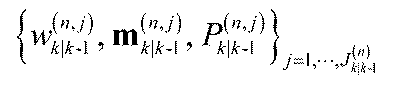 から、写像ごとの信頼度
 と、写像ごとの第n目標の運動諸元確率分布
 を算出する。なお、上記にて、信頼度及び重み係数の記号に付けられたプライム(「´」)は、規格化される前の値であることを表す記号として用いる。規格化の方法はステップST43にて後述する。


ステップST42によって算出される値は以下の式より求まる。


ここで、各変数の算出式は以下のとおりである。


なお式(41)におけるRは、検出信号の位置成分に対する誤差共分散を表す6行6列のパラメタである。また式(39)におけるpk、DTは、時刻kにおいて目標が失検出せずに検出される確率を表すパラメタであり、式(39)におけるβk、FLSは、時刻kにおける単位体積当たりの誤検出個数を表すパラメタである。
また式(39)におけるλ(zk (θ(n)、4))は、検出信号の強度成分zk (θ(n)、4)に対する、「強度成分zk (θ(n)、4)の検出信号が目標である確率」÷「強度成分zk (θ(n)、4)の検出信号が誤検出である確率」を表す尤度比である。このλ(zk (θ(n)、4))の具体的な値は、センサの種類によって異なり、例えば検出信号がレーダ装置によって取得された値ならば、D. Lerro,Y. Bar-Shalom,“Automated Tracking with Target Amplitude Information,”American Control Conference 1990,pp.2875-2880,San Diego,May 1990.(以下、文献2という)に記載の受信信号強度モデルより設定できる。
また式(39)におけるλ(zk (θ(n)、4))は、検出信号の強度成分zk (θ(n)、4)に対する、「強度成分zk (θ(n)、4)の検出信号が目標である確率」÷「強度成分zk (θ(n)、4)の検出信号が誤検出である確率」を表す尤度比である。このλ(zk (θ(n)、4))の具体的な値は、センサの種類によって異なり、例えば検出信号がレーダ装置によって取得された値ならば、D. Lerro,Y. Bar-Shalom,“Automated Tracking with Target Amplitude Information,”American Control Conference 1990,pp.2875-2880,San Diego,May 1990.(以下、文献2という)に記載の受信信号強度モデルより設定できる。
続いてステップST43では、写像ごとの信頼度
 と、写像ごとの第n目標の運動諸元確率分布における重み係数
 をそれぞれ規格化し、
 と
と
 を算出する。
ステップST43における規格化は以下の式により行う。


ステップST43における規格化は以下の式により行う。
続いてステップST44では、規格化された写像ごとの信頼度
 と、重み係数が規格化された写像ごとの第n目標の運動諸元確率分布
 から、時刻kにおける第n目標の存在確率
 と、時刻kにおける第n目標の運動諸元確率分布
 を算出し、ステップST4の処理を終える。
ステップST44によって算出される値は以下の式から求める。

 ここで、
ここで、
 とする。また式(46)右辺における

 なお、運動諸元確率分布を表すガウス分布の個数はステップST4を実行するごとに単調増加するため、ステップST4の後に、各目標の運動諸元確率分布の形状を簡略化する処理を追加してもよい。具体的には、B. Vo, W. Ma,“The Gaussian mixture probability hypothesis density filter,”IEEE Trans. Signal Process.,vol.54,no.11,pp.4091-4104,Nov. 2006.(以下、文献3という)に記載されているような、重み係数が一定値より小さいガウス分布の削除や、平均値が類似しているガウス分布同士を合成し一つのガウス分布にする処理等である。
以降、図4のフローチャートについての説明に戻る。
ステップST5において、推定値算出部5は、時刻kにおける第1目標の存在確率に対し、存在確率しきい値を超えるか否かの判定を行う。すなわち、以下の式の真偽を判定する。
 ここで、rTh
(1)は「第1目標の存在確率がこの値より大ならば、第1目標は存在すると推定する」意味を持つパラメタである。上記判定が真ならばステップST6を実行し、偽ならばステップST7に移行する。
ここで、rTh
(1)は「第1目標の存在確率がこの値より大ならば、第1目標は存在すると推定する」意味を持つパラメタである。上記判定が真ならばステップST6を実行し、偽ならばステップST7に移行する。
ステップST5において、推定値算出部5は、時刻kにおける第1目標の存在確率に対し、存在確率しきい値を超えるか否かの判定を行う。すなわち、以下の式の真偽を判定する。
ステップST6において、推定値算出部5は、時刻kにおける第1目標の運動諸元確率分布より、時刻kにおける第1目標の運動諸元を推定する。
 ここで、iExは「第1目標の運動諸元確率分布を構成するガウス分布のうち、重み係数が最大のガウス分布の番号」を表す。すなわち数式で表すと、
 である。
である。
ステップST7において、推定値算出部5は、時刻kにおける第2目標の存在確率に対し、存在確率しきい値を超えるか否かの判定を行う。すなわち、以下の式の真偽を判定する。
 ここで、rTh
(2)は「第2目標の存在確率がこの値より大ならば、第2目標は存在すると推定する」意味を持つパラメタである。上記判定が真ならばステップST8を実行し、偽ならば時刻kにおける目標追尾装置100の動作を終了する。
ここで、rTh
(2)は「第2目標の存在確率がこの値より大ならば、第2目標は存在すると推定する」意味を持つパラメタである。上記判定が真ならばステップST8を実行し、偽ならば時刻kにおける目標追尾装置100の動作を終了する。
ステップST8において、推定値算出部5は、時刻kにおける第2目標の運動諸元確率分布より、時刻kにおける第2目標の運動諸元を推定する。
 ここで、iExは「第2目標の運動諸元確率分布を構成するガウス分布のうち、重み係数が最大のガウス分布の番号」を表す。すなわち数式で表すと、
 である。
である。
以上のように構成された実施の形態1によれば、次の効果が得られる。
実施の形態1では、第2目標運動諸元予測部2において、現時刻における第2目標の運動諸元確率分布の予測値を、前時刻における第2目標の運動諸元確率分布の他に、前時刻における第1目標の運動諸元確率分布からも算出するように構成した。
この構成により、慣性の法則に基づいた予測値、すなわち第1目標から第2目標が分離された際、分離直後の第2目標の位置や速度等の運動諸元は第1目標に近しいとの物理法則に則った第2目標の運動諸元確率分布の予測値が得られる。その予測値を基に更新処理部4、推定値算出部5によって算出された第2目標の運動諸元推定値の精度は、例えば、文献1及びD.B. Reid,“An Algorithm for Tracking Multiple Targets,”IEEE Trans. Automatic Control,vol.24,no.6,pp.843-854,Dec.,1979.(以下、文献4という)で開示されているような、各目標の運動諸元予測値を別の目標の運動諸元予測値を用いずに推定する従来技術に比べ、現実の物理法則に近いモデルに基づく予測値から得られた推定値であるため、真の運動諸元との誤差が小さい。すなわち、分離から観測時間が短い場合でも、または失検出により第2目標の検出回数が少ない場合でも、文献1及び文献4で開示されている技術に比べ、より精度のよい第2目標の運動諸元を得ることができる。
実施の形態1では、第2目標運動諸元予測部2において、現時刻における第2目標の運動諸元確率分布の予測値を、前時刻における第2目標の運動諸元確率分布の他に、前時刻における第1目標の運動諸元確率分布からも算出するように構成した。
この構成により、慣性の法則に基づいた予測値、すなわち第1目標から第2目標が分離された際、分離直後の第2目標の位置や速度等の運動諸元は第1目標に近しいとの物理法則に則った第2目標の運動諸元確率分布の予測値が得られる。その予測値を基に更新処理部4、推定値算出部5によって算出された第2目標の運動諸元推定値の精度は、例えば、文献1及びD.B. Reid,“An Algorithm for Tracking Multiple Targets,”IEEE Trans. Automatic Control,vol.24,no.6,pp.843-854,Dec.,1979.(以下、文献4という)で開示されているような、各目標の運動諸元予測値を別の目標の運動諸元予測値を用いずに推定する従来技術に比べ、現実の物理法則に近いモデルに基づく予測値から得られた推定値であるため、真の運動諸元との誤差が小さい。すなわち、分離から観測時間が短い場合でも、または失検出により第2目標の検出回数が少ない場合でも、文献1及び文献4で開示されている技術に比べ、より精度のよい第2目標の運動諸元を得ることができる。
また、存在確率予測部3において、第1目標の存在確率の予測値を算出する際に第2目標の存在確率を用い、第2目標の存在確率の予測値を算出する際に第1目標の存在確率を用いるよう構成した。
この構成により、第1目標が出現した後に第2目標が出現する、との前提に基づく各目標の存在確率の予測値が得られる。その予測値を基に更新処理部4、推定値算出部5によって推定された各目標の運動諸元の個数すなわち目標の個数は、例えば文献1及び文献4で開示されているような、各目標が出現、消滅する確率過程が、別の目標の出現、消滅する確率過程と独立であることを前提に推定する従来技術に比べ、実際の目標出現の順序を模したモデルに基づく予測値から得られた推定値であるため、実際の目標個数との誤差が小さい。すなわち、失検出、誤検出が発生する状況において観測時間が短い場合でも、文献1及び文献4で開示されている技術に比べ、実際に存在している目標の運動諸元を推定できずに見落とす頻度、及び存在しない目標の推定値を出力する頻度を減らすことができる。
この構成により、第1目標が出現した後に第2目標が出現する、との前提に基づく各目標の存在確率の予測値が得られる。その予測値を基に更新処理部4、推定値算出部5によって推定された各目標の運動諸元の個数すなわち目標の個数は、例えば文献1及び文献4で開示されているような、各目標が出現、消滅する確率過程が、別の目標の出現、消滅する確率過程と独立であることを前提に推定する従来技術に比べ、実際の目標出現の順序を模したモデルに基づく予測値から得られた推定値であるため、実際の目標個数との誤差が小さい。すなわち、失検出、誤検出が発生する状況において観測時間が短い場合でも、文献1及び文献4で開示されている技術に比べ、実際に存在している目標の運動諸元を推定できずに見落とす頻度、及び存在しない目標の推定値を出力する頻度を減らすことができる。
また実施の形態1では、第1目標運動諸元予測部1と第2目標運動諸元予測部2において、目標ごとに運動諸元確率密度分布の予測値を算出し、存在確率予測部3において、目標ごとに存在確率の予測値を算出し、更新処理部4において、目標ごとに運動諸元確率分布と存在確率を算出し、推定値算出部5にて、目標ごとの運動諸元推定値を算出するよう構成した。
この構成により、各時刻フレームにおいて推定された各運動諸元が第1目標と第2目標のいずれの運動諸元であるか推定された結果が得られる。すなわち、第1目標と第2目標が存在すると判定された場合に、文献3で開示されているように「第1目標または第2目標の運動諸元」を複数推定する従来技術と異なり、分離前の運動を維持する「第1目標の運動諸元」と、第1目標から分離される「第2目標の運動諸元」が区別されて得られる。
この効果は特に、分離後の目標を優先順位を設定する際に重要である。例えば、放物線軌道で運動する目標から別の目標が射出される条件に適用した場合、分離前と同様に放物線軌道で運動する第1目標と、分離時に加速度を伴って射出される第2目標とを区別できる。そのため、例えば放物線軌道を維持する第1目標に対する関心が高く、第1目標を追加観測する必要がある場合、第2目標を誤って追加観測する事態を避けることができる。
この構成により、各時刻フレームにおいて推定された各運動諸元が第1目標と第2目標のいずれの運動諸元であるか推定された結果が得られる。すなわち、第1目標と第2目標が存在すると判定された場合に、文献3で開示されているように「第1目標または第2目標の運動諸元」を複数推定する従来技術と異なり、分離前の運動を維持する「第1目標の運動諸元」と、第1目標から分離される「第2目標の運動諸元」が区別されて得られる。
この効果は特に、分離後の目標を優先順位を設定する際に重要である。例えば、放物線軌道で運動する目標から別の目標が射出される条件に適用した場合、分離前と同様に放物線軌道で運動する第1目標と、分離時に加速度を伴って射出される第2目標とを区別できる。そのため、例えば放物線軌道を維持する第1目標に対する関心が高く、第1目標を追加観測する必要がある場合、第2目標を誤って追加観測する事態を避けることができる。
また実施の形態1では、存在確率予測部3において、図6のモデルに基づく式(29)及び式(30)によって存在確率を予測するよう構成した。
この構成により、目標1個が2個に分離し、目標個数が0個~2個の間で変動する観測条件において、非特許文献1で開示されているような、目標個数が維持、変動する場合の数、すなわち図6における遷移経路TR11~TR44の本数と同数の追尾アルゴリズムを並列実行する必要のある従来技術に比べ、式(29)及び式(30)により、少ない演算量で各目標の運動諸元を推定することができる。
この構成により、目標1個が2個に分離し、目標個数が0個~2個の間で変動する観測条件において、非特許文献1で開示されているような、目標個数が維持、変動する場合の数、すなわち図6における遷移経路TR11~TR44の本数と同数の追尾アルゴリズムを並列実行する必要のある従来技術に比べ、式(29)及び式(30)により、少ない演算量で各目標の運動諸元を推定することができる。
また実施の形態1では、第2目標運動諸元予測部2において、現時刻における第2目標の運動諸元確率分布の予測値を、前時刻における第1目標の運動諸元確率分布と、前時刻における第2目標の運動諸元確率分布から算出するように構成した。
この構成により、観測時間が短い、または第1目標の失検出等により第1目標の運動諸元が絞り込まれていない場合においても、第2目標の可能性のある運動諸元を予測し、第2目標の有無を推定することができる。よって、例えば、特開2005-214665号公報(以下、特許文献1という)で開示されているような、分離する側の目標すなわち第1目標の運動諸元を「本航跡」として一つの運動諸元に絞り込んだ後に、分離される側の目標すなわち第2目標の運動諸元の推定を開始する従来技術と異なり、第1目標が出現した後に短時間で第2目標を分離した場合においても、第2目標の運動諸元を推定することができる。
この構成により、観測時間が短い、または第1目標の失検出等により第1目標の運動諸元が絞り込まれていない場合においても、第2目標の可能性のある運動諸元を予測し、第2目標の有無を推定することができる。よって、例えば、特開2005-214665号公報(以下、特許文献1という)で開示されているような、分離する側の目標すなわち第1目標の運動諸元を「本航跡」として一つの運動諸元に絞り込んだ後に、分離される側の目標すなわち第2目標の運動諸元の推定を開始する従来技術と異なり、第1目標が出現した後に短時間で第2目標を分離した場合においても、第2目標の運動諸元を推定することができる。
以上説明したように、実施の形態1の目標追尾装置によれば、過去の時刻の第1目標の運動諸元確率分布と目標の観測情報である目標検出信号情報とを基に、現在時刻の第1目標の運動諸元確率分布を予測する第1目標運動諸元予測部と、過去の時刻の第1目標と異なる第2目標の運動諸元確率分布を基に、現在時刻の第2目標の運動諸元確率分布を予測する第2目標運動諸元予測部と、過去の時刻の第1目標が観測領域内に存在する確率と第2目標が観測領域内に存在する確率とを基に、現在時刻に第1目標が観測領域内に存在する確率の予測値と第2目標が観測領域内に存在する確率の予測値とを算出する存在確率予測部と、第1目標運動諸元予測部と第2目標運動諸元予測部と存在確率予測部の出力と目標検出信号情報とを基に、現在時刻の第1目標と第2目標の運動諸元確率分布と、現在時刻に第1目標が観測領域内に存在する確率と第2目標が観測領域内に存在する確率とを算出する更新処理部と、更新処理部の出力を基に、現在時刻に各目標が観測領域内に存在するかを判定し、存在すると判定された目標の運動諸元推定値を算出する推定値算出部とを備えたので、目標の個数及び各目標の運動諸元を少ない演算量で推定することができる。
また、実施の形態1の目標追尾装置によれば、第2目標運動諸元予測部は、過去の時刻における第1目標の運動諸元確率分布と、過去の時刻における第2目標の運動諸元確率分布を基に、現在時刻における第2目標の運動諸元確率分布を予測するようにしたので、精度の良い第2目標の運動諸元を得ることができる。
また、実施の形態1の目標追尾装置によれば、存在確率予測部は、第1目標の有無と第2目標の有無とに関する状態間の確率遷移モデルに従って、現在時刻に第1目標が観測領域内に存在する確率の予測値と、現在時刻に第2目標が観測領域内に存在する確率の予測値を算出するようにしたので、少ない演算量で各目標の運動諸元を推定することができる。
実施の形態2.
実施の形態1では、未知の時刻に出現した1個の目標が、未知の時間に2個へ分離し得ることを前提に、各目標の運動諸元確率分布と存在確率を逐次算出し、各時刻における各目標の運動諸元を推定するようにしていた。
しかし、目標の種類によっては、1個の目標が3個以上の目標に分離する場合が起こり得る。このような場合、実施の形態1の構成では、実際には3個以上の目標が存在するにもかかわらず、目標個数が最大2個との前提に基づき運動諸元を推定するよう動作するため、最大でも2個の目標の運動諸元しか得られないという課題がある。
そこで、この実施の形態2では、1個の目標が最大N個の目標に分離することを前提に、各目標の運動諸元確率分布と存在確率を算出し、各目標の運動諸元を推定する。ここで最大目標個数Nはパラメタである。
なお、以降では、分離する側の目標を「第1目標」、分離される側のN-1個の目標を「第n目標(n=2、3、…、N)」と記載する。すなわち、ある時刻に第1目標が出現し、その後ある時刻に第1目標が第n目標を分離射出する場合について目標追尾装置を適用した場合について説明する。なお、各目標が出現する時刻は同時でなくてもよいとする。
実施の形態1では、未知の時刻に出現した1個の目標が、未知の時間に2個へ分離し得ることを前提に、各目標の運動諸元確率分布と存在確率を逐次算出し、各時刻における各目標の運動諸元を推定するようにしていた。
しかし、目標の種類によっては、1個の目標が3個以上の目標に分離する場合が起こり得る。このような場合、実施の形態1の構成では、実際には3個以上の目標が存在するにもかかわらず、目標個数が最大2個との前提に基づき運動諸元を推定するよう動作するため、最大でも2個の目標の運動諸元しか得られないという課題がある。
そこで、この実施の形態2では、1個の目標が最大N個の目標に分離することを前提に、各目標の運動諸元確率分布と存在確率を算出し、各目標の運動諸元を推定する。ここで最大目標個数Nはパラメタである。
なお、以降では、分離する側の目標を「第1目標」、分離される側のN-1個の目標を「第n目標(n=2、3、…、N)」と記載する。すなわち、ある時刻に第1目標が出現し、その後ある時刻に第1目標が第n目標を分離射出する場合について目標追尾装置を適用した場合について説明する。なお、各目標が出現する時刻は同時でなくてもよいとする。
図7は、実施の形態2に係る目標追尾装置100aとその周辺装置の構成図である。図7に示すように、目標追尾装置100aはセンサ200から入力を受け、表示器300へ出力を送るよう構成されている。ここで、センサ200及び表示器300は実施の形態1と同様の構成である。また、実施の形態2の目標追尾装置100aは、第1目標運動諸元予測部1、第2~N目標運動諸元予測部6、存在確率予測部30、更新処理部40、推定値算出部50を備えている。ここで、第1目標運動諸元予測部1は実施の形態1と同様であるため、ここでの説明は省略する。
図8は、図7における第2~N目標運動諸元予測部6の構成をより詳細に表したものである。図8に示すように、第2~N目標運動諸元予測部6は、N-1個の第2~N目標運動諸元予測部6-n(n=2、3、…、N)から構成される。
図8は、図7における第2~N目標運動諸元予測部6の構成をより詳細に表したものである。図8に示すように、第2~N目標運動諸元予測部6は、N-1個の第2~N目標運動諸元予測部6-n(n=2、3、…、N)から構成される。
以下、図7、図8における各機能ブロックの構成について説明する。第2~N目標運動諸元予測部6は、更新処理部40から、前時刻フレームにおける第1目標の運動諸元確率分布40aと、前時刻フレームにおける第2目標~第N目標の運動諸元確率分布40bを受け取り、第2目標~第N目標の運動諸元確率分布の予測値6aを、更新処理部40へ送る。なお、ここで、「第2目標~第N目標の運動諸元確率分布」とは、第2目標から第N目標までの各々の運動諸元確率分布を表すとする。
また、第2~N目標運動諸元予測部6の内部における、第2~N目標運動諸元予測部6-n(n=2、3、…、N)の各々は、更新処理部40から前時刻フレームにおける第1目標の運動諸元確率分布40aと、第n目標の運動諸元確率分布40b-n(n=2、3、…、N)を受け取り、第n目標の運動諸元確率分布の予測値6a-n(n=2、3、…、N)を、更新処理部40へ送る。
存在確率予測部30は、更新処理部40から前時刻フレームにおける第1目標の存在確率40cと、前時刻フレームにおける第2目標~第N目標の存在確率40dを受け取り、第1目標の存在確率の予測値30aと、第2目標~第N目標の存在確率の予測値30bを、更新処理部40へ送る。なお、ここで、「第2目標~第N目標の存在確率」とは、第2目標から第N目標までの各々の存在確率を表すとする。
更新処理部40は、センサ200からの検出信号201と、第1目標運動諸元予測部1からの第1目標の運動諸元確率分布の予測値1aと、第2~N目標運動諸元予測部6からの第2目標~第N目標の運動諸元確率分布の予測値6aと、存在確率予測部30からの第1目標の存在確率の予測値30aと第2目標~第N目標の存在確率の予測値30bとを受け取る。これにより、更新処理部40は、現時刻フレームにおける第1目標の運動諸元確率分布40aと、現時刻フレームにおける第2目標~第N目標の運動諸元確率分布40bと、現時刻フレームにおける第1目標の存在確率40cと、現時刻フレームにおける第2目標~第N目標の存在確率40dとを算出し、この算出結果を推定値算出部50に送る。また、更新処理部40は、現時刻フレームにおける第1目標の運動諸元確率分布40aを前時刻フレームにおける第1目標の運動諸元確率として、第1目標運動諸元予測部1と第2~N目標運動諸元予測部6へ送る。また更新処理部40は、現時刻フレームにおける第2目標~第N目標の運動諸元確率分布40bを前時刻フレームにおける第2目標~第N目標の運動諸元確率として、第2~N目標運動諸元予測部6へ送る。また、更新処理部40は、現時刻フレームにおける第1目標の存在確率40cと現時刻フレームにおける第2目標~第N目標の存在確率40dを、前時刻フレームにおける第1目標の存在確率と前時刻フレームにおける第2目標~第N目標の存在確率として、存在確率予測部30へ送る。
推定値算出部50は、更新処理部40から、現時刻フレームにおける第1目標の運動諸元確率分布40aと、現時刻フレームにおける第2目標~第N目標の運動諸元確率分布40bと、現時刻フレームにおける第1目標の存在確率40cと、現時刻フレームにおける第2目標~第N目標の存在確率40dを受け取り、現時刻フレームに各目標が観測領域内に存在するかを判定し、存在すると判定された目標の運動諸元推定値50aを算出する。
また、実施の形態2の目標追尾装置のハードウェア構成については、図3に示す構成で実現される。すなわち、図7における第1目標運動諸元予測部1、第2~N目標運動諸元予測部6、存在確率予測部30、更新処理部40、推定値算出部50は、それぞれの機能に対応したプログラムが記録装置102に格納され、演算装置101によって処理に対応したプログラムが読み出されて実行されることで実現される。各部の構成については実施の形態1と同様であるため、ここでの説明は省略する。
次に、図9のフローチャートを用いて、実施の形態2に係る目標追尾装置100aの動作の詳細を説明する。図9は、第1目標運動諸元予測部1、第2~N目標運動諸元予測部6、存在確率予測部30、更新処理部40、推定値算出部50の現時刻フレームにおける動作を示したフローチャートである。
なお、以降の説明における前提は、目標個数の違い以外は実施の形態1と同一とする。すなわち、推定対象の運動諸元は3次元位置空間内の位置と速度とし、座標系は直交座標系とし、目標の運動は等速直進と前提し、検出信号201は検出された信号の位置と強度を表す値とし、運動諸元確率分布はガウス分布の線形結合で近似するものとする。
また以降の説明における記号の定義は実施の形態1と同様とする。なお実施の形態1では目標番号を表す「n」を1以上2以下と定義したが、実施の形態2ではnの範囲を1以上N以下とする。
また以降の説明における記号の定義は実施の形態1と同様とする。なお実施の形態1では目標番号を表す「n」を1以上2以下と定義したが、実施の形態2ではnの範囲を1以上N以下とする。
以下、図9の各ステップについて説明する。
第1目標運動諸元予測部1が行うステップST1は実施の形態1における図4のステップST1と同一処理である。次に、ステップST9でn=2として、ステップST10において、第2~N目標運動諸元予測部6の内部にある第2~N目標運動諸元予測部6-nは、時刻k-1における第1目標運動諸元確率分布と、時刻k-1における第n目標運動諸元確率分布から、時刻kにおける第n目標運動諸元確率分布の予測値を算出する。ここで「n」は2以上N以下の整数であるため、ステップST9において、n=2とし、また、ステップST11でn=Nかの判定を行い、そうでない場合はステップST12でnを1増加してステップST10に戻る処理を、n=2からn=Nまで繰り返す。
ステップST10における計算は、実施の形態1におけるステップST2における計算の入出力を、「第2目標」から「第n目標」に置き換えたものと同一である。
すなわち、このステップST9では、「時刻kより過去において第n目標が分離された」との可能性を表すガウス分布
 と、「時刻kにおいて第n目標が分離された」との可能性を表すガウス分布
 を算出する。
第1目標運動諸元予測部1が行うステップST1は実施の形態1における図4のステップST1と同一処理である。次に、ステップST9でn=2として、ステップST10において、第2~N目標運動諸元予測部6の内部にある第2~N目標運動諸元予測部6-nは、時刻k-1における第1目標運動諸元確率分布と、時刻k-1における第n目標運動諸元確率分布から、時刻kにおける第n目標運動諸元確率分布の予測値を算出する。ここで「n」は2以上N以下の整数であるため、ステップST9において、n=2とし、また、ステップST11でn=Nかの判定を行い、そうでない場合はステップST12でnを1増加してステップST10に戻る処理を、n=2からn=Nまで繰り返す。
ステップST10における計算は、実施の形態1におけるステップST2における計算の入出力を、「第2目標」から「第n目標」に置き換えたものと同一である。
すなわち、このステップST9では、「時刻kより過去において第n目標が分離された」との可能性を表すガウス分布
まず「時刻kより過去において第n目標が分離された」との可能性を表すガウス分布は以下の式より算出される。
 ここでj=1、2、…、Jk-1|k-1
(n)である。
ここでj=1、2、…、Jk-1|k-1
(n)である。
次に、「時刻kにおいて第n目標が分離された」との可能性を表すガウス分布は、以下の式により算出される。
 である。ここでj=1、2、…、Jk-1|k-1
(1)である。またΦk、Qk、winit、Pinit、ΓA、ΓBの定義は実施の形態1と同一である。
である。ここでj=1、2、…、Jk-1|k-1
(1)である。またΦk、Qk、winit、Pinit、ΓA、ΓBの定義は実施の形態1と同一である。
上記の式(56)~式(61)によって算出された、「時刻kより過去において第n目標が出現した」との可能性を表すガウス分布と、「時刻kにおいて第n目標が出現した」との可能性を表すガウス分布を合わせた合計Jk|k-1 (n)個のガウス分布、すなわち
 が、時刻kにおける第n目標運動諸元確率分布の予測値である。なお、第n目標運動諸元確率分布の予測値における重み係数は、このステップの最後に、以下の式を満たすように規格化されているものとする。
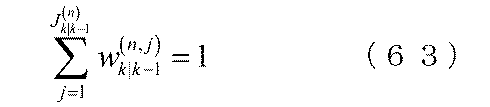
上記の式(56)~式(61)によって算出された、「時刻kより過去において第n目標が出現した」との可能性を表すガウス分布と、「時刻kにおいて第n目標が出現した」との可能性を表すガウス分布を合わせた合計Jk|k-1 (n)個のガウス分布、すなわち
ステップST13において、存在確率予測部30は、時刻k-1における第k-1における第1目標の存在確率と、時刻k-1における第2目標~第N目標の存在確率から、時刻kにおける第1目標の存在確率の予測値と、時刻kにおける第2目標~第N目標の存在確率の予測値を算出する。
ステップST13における、各目標の存在確率を予測する際に用いるモデルは、図6における「第2目標」を「第n目標(n=2、…、N)」としたモデルを用いる。この拡張されたモデルにおいて、「第n目標と第n´目標の存在確率は互いに独立(n及びn´=2、…、Nかつn≠n´)」との前提を置くと、第1目標の存在確率の予測値は
 より算出される。また、第n目標の存在確率の予測値は
 より算出される。
ここで、pb (1)及びps (1)は実施の形態1と同じである。また第n目標が時刻フレーム間に出現する確率をpb (n)とし、第n目標が時刻フレーム間に消滅する確率をps (n)とした。これらの確率はpb (n)、ps (n)は、事前設定したパラメタとしても、観測条件に応じて時間的に変動する値としてもよい。
ステップST13における、各目標の存在確率を予測する際に用いるモデルは、図6における「第2目標」を「第n目標(n=2、…、N)」としたモデルを用いる。この拡張されたモデルにおいて、「第n目標と第n´目標の存在確率は互いに独立(n及びn´=2、…、Nかつn≠n´)」との前提を置くと、第1目標の存在確率の予測値は
ここで、pb (1)及びps (1)は実施の形態1と同じである。また第n目標が時刻フレーム間に出現する確率をpb (n)とし、第n目標が時刻フレーム間に消滅する確率をps (n)とした。これらの確率はpb (n)、ps (n)は、事前設定したパラメタとしても、観測条件に応じて時間的に変動する値としてもよい。
ステップST13の次の処理であるステップST4は実施の形態1における図4のステップST4と、目標の最大個数以外は同一処理である。すなわち、実施の形態1のステップST4の処理の説明では、目標の番号を表すnの最大値Nを2としたが、実施の形態2では、このNを目標個数の最大値を表すパラメタNに置き換えた場合の処理と同一である。
ステップST5は実施の形態1における図4のステップST5と同一処理である。また、ステップST6は実施の形態1における図4のステップST6と同一処理である。
次に、ステップST14でn=2として、ステップST15で、推定値算出部50は、時刻kにおける第n目標の存在確率に対し、存在確率しきい値を超えるか否かの判定を行う。すなわち、以下の式の真偽を判定する。
 ここで、rTh
(n)は「第n目標の存在確率がこの値より大ならば、第n目標は存在すると推定する」意味を持つパラメタである。上記判定が真ならばステップST16を実行し、偽でかつステップST17でn=Nであれば時刻kにおける2~N目標に関する目標追尾装置100aの動作を終了する。一方、ステップST17においてn≠NであればステップST18でnを1増加してステップST15に戻り、ステップST17でn=Nになるまでこれを繰り返す。
ここで、rTh
(n)は「第n目標の存在確率がこの値より大ならば、第n目標は存在すると推定する」意味を持つパラメタである。上記判定が真ならばステップST16を実行し、偽でかつステップST17でn=Nであれば時刻kにおける2~N目標に関する目標追尾装置100aの動作を終了する。一方、ステップST17においてn≠NであればステップST18でnを1増加してステップST15に戻り、ステップST17でn=Nになるまでこれを繰り返す。
ステップST16において、推定値算出部50は、時刻kにおける第n目標の運動諸元確率分布より、時刻kにおける第n目標の運動諸元を推定する。なおここで「n」は2以上N以下の整数である。
 ここで、iExは「第n目標の運動諸元確率分布を構成するガウス分布のうち、重み係数が最大のガウス分布の番号」を表す。すなわち数式で表すと、
 である。
である。
以上のように構成された実施の形態2によれば、次の効果が得られる。
実施の形態2では、第2~N目標運動諸元予測部6において、現時刻における第2目標~第N目標の運動諸元確率分布の予測値を、前時刻における第1目標の運動諸元確率分布及び前時刻における第2目標~第N目標の運動諸元確率分布から算出すように構成した。また、存在確率予測部30において、現時刻における第2目標~第N目標の存在確率の予測値を、前時刻における第1目標の運動諸元確率分布及び前時刻における第2目標~第N目標の存在確率から算出するように構成した。
この構成により、1個の目標から最大N-1個の目標が分離され得る場合、すなわち第1目標から第2目標~第N目標が分離され得る場合においても、第1目標及び第2目標~第N目標の有無と、第1目標及び第2目標~第N目標のうち存在すると判定された運動諸元の推定値が得られる。この効果は特に、未知の時刻に出現する航空機等の目標から、未知個数の別目標が分離射出され得る場合、または目標の分離が未知の回数起こり得る場合においても、分離後の最大目標個数がN個を超えないとの前提さえ妥当であれば、各時刻における各目標の運動諸元が推定できる点が大きな効果として得られるものである。
実施の形態2では、第2~N目標運動諸元予測部6において、現時刻における第2目標~第N目標の運動諸元確率分布の予測値を、前時刻における第1目標の運動諸元確率分布及び前時刻における第2目標~第N目標の運動諸元確率分布から算出すように構成した。また、存在確率予測部30において、現時刻における第2目標~第N目標の存在確率の予測値を、前時刻における第1目標の運動諸元確率分布及び前時刻における第2目標~第N目標の存在確率から算出するように構成した。
この構成により、1個の目標から最大N-1個の目標が分離され得る場合、すなわち第1目標から第2目標~第N目標が分離され得る場合においても、第1目標及び第2目標~第N目標の有無と、第1目標及び第2目標~第N目標のうち存在すると判定された運動諸元の推定値が得られる。この効果は特に、未知の時刻に出現する航空機等の目標から、未知個数の別目標が分離射出され得る場合、または目標の分離が未知の回数起こり得る場合においても、分離後の最大目標個数がN個を超えないとの前提さえ妥当であれば、各時刻における各目標の運動諸元が推定できる点が大きな効果として得られるものである。
また実施の形態2では、第2~N目標運動諸元予測部6において、現時刻における第2目標~第N目標の運動諸元確率分布の予測値を、前時刻における第2目標~第N目標の運動諸元確率分布の他に、前時刻における第1目標の運動諸元確率分布からも算出するように構成した。
この構成により、慣性の法則に基づく予測値、すなわち第1目標から第2目標~第N目標が分離された際、分離直後の第2目標~第N目標の位置や速度等の運動諸元は第1目標に近しいとの物理法則に則った第2目標~第N目標の運動諸元確率分布の予測値が得られる。その予測値を基に更新処理部40、推定値算出部50によって推定された第2目標~第N目標の運動諸元の推定精度は、例えば、文献1及び文献4で開示されているような、各目標の運動諸元予測値を別の目標の運動諸元予測値と独立に推定する従来技術に比べ、現実の物理法則に近いモデルに基づく予測値から得られた推定値であるため、真の運動諸元との誤差が小さい。すなわち、分離から観測時間が短い場合でも、または失検出202により第2目標の検出回数が少ない場合でも、文献1及び文献4で開示されている技術に比べ、より精度のよい第2目標~第N目標の運動諸元を得ることができる。
この構成により、慣性の法則に基づく予測値、すなわち第1目標から第2目標~第N目標が分離された際、分離直後の第2目標~第N目標の位置や速度等の運動諸元は第1目標に近しいとの物理法則に則った第2目標~第N目標の運動諸元確率分布の予測値が得られる。その予測値を基に更新処理部40、推定値算出部50によって推定された第2目標~第N目標の運動諸元の推定精度は、例えば、文献1及び文献4で開示されているような、各目標の運動諸元予測値を別の目標の運動諸元予測値と独立に推定する従来技術に比べ、現実の物理法則に近いモデルに基づく予測値から得られた推定値であるため、真の運動諸元との誤差が小さい。すなわち、分離から観測時間が短い場合でも、または失検出202により第2目標の検出回数が少ない場合でも、文献1及び文献4で開示されている技術に比べ、より精度のよい第2目標~第N目標の運動諸元を得ることができる。
また、実施の形態2では、存在確率予測部30において、第1目標の存在確率の予測値を算出する際に第2目標~第N目標の存在確率を用い、第2目標~第N目標の存在確率の予測値を算出する際に第1目標の存在確率を用いるよう構成した。
この構成により、第1目標が出現した後に第2目標~第N目標が出現する、との前提に基づく各目標の存在確率の予測値が得られる。その予測値を基に更新処理部40、推定値算出部50によって推定された各目標の運動諸元の個数、すなわち目標の個数は、例えば文献1及び文献4で開示されているような、各目標が出現、消滅する確率過程が、別の目標の出現、消滅する確率過程と独立であることを前提に推定する従来技術に比べ、実際の目標出現の順序に近いモデルに基づく予測値から得られた推定値であるため、真に存在する目標個数との誤差が小さい。すなわち、失検出202と誤検出203が発生する状況において観測時間が短い場合でも、文献1及び文献4で開示されている技術に比べ、実際に存在している目標の運動諸元を推定できずに見落とす頻度、及び存在しない目標の推定値を出力する頻度を減らすことができる。
この構成により、第1目標が出現した後に第2目標~第N目標が出現する、との前提に基づく各目標の存在確率の予測値が得られる。その予測値を基に更新処理部40、推定値算出部50によって推定された各目標の運動諸元の個数、すなわち目標の個数は、例えば文献1及び文献4で開示されているような、各目標が出現、消滅する確率過程が、別の目標の出現、消滅する確率過程と独立であることを前提に推定する従来技術に比べ、実際の目標出現の順序に近いモデルに基づく予測値から得られた推定値であるため、真に存在する目標個数との誤差が小さい。すなわち、失検出202と誤検出203が発生する状況において観測時間が短い場合でも、文献1及び文献4で開示されている技術に比べ、実際に存在している目標の運動諸元を推定できずに見落とす頻度、及び存在しない目標の推定値を出力する頻度を減らすことができる。
また実施の形態2では、第1目標運動諸元予測部1と第2~N目標運動諸元予測部6において、目標ごとに運動諸元確率密度分布の予測値を算出し、存在確率予測部30において、目標ごとに存在確率の予測値を算出し、更新処理部40において、目標ごとに運動諸元確率分布と存在確率を算出し、推定値算出部50にて、目標ごとの運動諸元推定値を算出するよう構成した。
この構成により、各時刻フレームにおいて推定された各運動諸元が第1目標と第2目標~第N目標のいずれの運動諸元であるか推定された結果が得られる。すなわち、第1目標と第2目標~第N目標が存在すると判定された場合に、文献3で開示されているようにN個の「第1目標または第2目標~第N目標のいずれかの運動諸元」を推定する従来技術と異なり、分離前の運動を維持する「第1目標の運動諸元」と、第1目標から分離される「第n目標の運動諸元(n=2、…、N)」が区別されて得られる。
この構成により、各時刻フレームにおいて推定された各運動諸元が第1目標と第2目標~第N目標のいずれの運動諸元であるか推定された結果が得られる。すなわち、第1目標と第2目標~第N目標が存在すると判定された場合に、文献3で開示されているようにN個の「第1目標または第2目標~第N目標のいずれかの運動諸元」を推定する従来技術と異なり、分離前の運動を維持する「第1目標の運動諸元」と、第1目標から分離される「第n目標の運動諸元(n=2、…、N)」が区別されて得られる。
また実施の形態2では、存在確率予測部30において、図6を拡張したモデルに基づく式(64)及び式(65)によって存在確率を予測するよう構成した。
この構成により、目標1個が最大N-1個の別目標を分離し、目標個数が0個~N個の間で変動する観測条件において、非特許文献1で開示されているような、目標個数が維持、変動する場合の数と同数の追尾アルゴリズムを並列実行する従来技術に比べ、式(64)及び(65)により、少ない演算量で各目標の運動諸元を推定することができる。
この構成により、目標1個が最大N-1個の別目標を分離し、目標個数が0個~N個の間で変動する観測条件において、非特許文献1で開示されているような、目標個数が維持、変動する場合の数と同数の追尾アルゴリズムを並列実行する従来技術に比べ、式(64)及び(65)により、少ない演算量で各目標の運動諸元を推定することができる。
また実施の形態2では、第2~N目標運動諸元予測部6において、現時刻における第2目標~第N目標の運動諸元確率分布の予測値を、前時刻における第1目標の運動諸元確率分布と、前時刻における第2目標~第N目標の運動諸元確率分布から算出するように構成した。
この構成により、観測時間が短い、または第1目標の失検出等により第1目標の運動諸元が絞り込まれていない場合においても、第2目標~第N目標の可能性のある運動諸元を予測し、第2目標~第N目標の有無を推定することができる。よって、特許文献1で開示されているような、分離する側の目標すなわち第1目標の運動諸元を決定した後に、分離される側の目標すなわち第2目標~第N目標の運動諸元の推定を開始する従来技術と異なり、第1目標が出現した後に短時間で第2目標~第N目標を分離した場合においても、第2目標~第N目標の運動諸元を推定することができる。
この構成により、観測時間が短い、または第1目標の失検出等により第1目標の運動諸元が絞り込まれていない場合においても、第2目標~第N目標の可能性のある運動諸元を予測し、第2目標~第N目標の有無を推定することができる。よって、特許文献1で開示されているような、分離する側の目標すなわち第1目標の運動諸元を決定した後に、分離される側の目標すなわち第2目標~第N目標の運動諸元の推定を開始する従来技術と異なり、第1目標が出現した後に短時間で第2目標~第N目標を分離した場合においても、第2目標~第N目標の運動諸元を推定することができる。
以上説明したように、実施の形態2の目標追尾装置によれば、過去の時刻の第1目標の運動諸元確率分布と目標の観測情報である目標検出信号情報とを基に、現在時刻の第1目標の運動諸元確率分布を予測する第1目標運動諸元予測部と、第1目標と異なる第n目標(nは2以上N以下の整数)に関し、過去の時刻の第n目標の運動諸元確率分布を基に、現在時刻の第n目標の運動諸元確率分布を予測する第2~N目標運動諸元予測部と、過去の時刻の第1目標が観測領域内に存在する確率と過去の時刻の第n目標が観測領域内に存在する確率とを基に、現在時刻に第1目標が観測領域内に存在する確率の予測値と現在時刻に第n目標が観測領域内に存在する確率の予測値とを算出する存在確率予測部と、第1目標運動諸元予測部と第2~N目標運動諸元予測部と存在確率予測部の出力と目標検出信号情報とを基に、現在時刻における第1目標及び第n目標の運動諸元確率分布と、現在時刻に第1目標が観測領域内に存在する確率と現在時刻に第n目標が観測領域内に存在する確率とを算出する更新処理部と、更新処理部の出力を基に、現在時刻に各目標が観測領域内に存在するかを判定し、存在すると判定された目標の運動諸元推定値を算出する推定値算出部とを備えたので、実施の形態1の効果に加えて、1個の目標から2個以上の目標が分離される場合でも確実に目標の個数及び各目標の運動諸元を推定することができる。
また、実施の形態2の目標追尾装置によれば、第2~N目標運動諸元予測部は、過去の時刻における第1目標の運動諸元確率分布と、過去の時刻における第n目標の運動諸元確率分布を基に、現在時刻における第n目標の運動諸元確率分布を予測するようにしたので、精度の良い第n目標の運動諸元を得ることができる。
また、実施の形態2の目標追尾装置によれば、存在確率予測部は、第1目標の有無と第n目標の有無とに関する状態間の確率遷移モデルに従って、現在時刻に第1目標が観測領域内に存在する確率の予測値と、現在時刻に第n目標が観測領域内に存在する確率の予測値を算出するようにしたので、少ない演算量で各目標の運動諸元を推定することができる。
実施の形態3.
実施の形態1では、未知の時刻に出現した1個の目標が、未知の時間に1個から2個へ分離し得ることを前提に、各目標の運動諸元確率分布と存在確率を逐次算出し、各時刻における各目標の運動諸元を推定するようにしていた。
しかし、目標の種類によっては、2個の目標が結合し1個の目標となる場合が起こり得る。例えば、給油機等への航空機や船舶等のドッキングが挙げられる。
また、目標同士が接近し、目標間の距離が、センサ200の分解能に比べ十分小さくなった場合、センサ200から出力される検出信号の見かけ上、1個の目標として観測される場合が起こり得る。このような場合も、センサ200における見かけ上は目標同士が結合したと言える。
実施の形態1では、未知の時刻に出現した1個の目標が、未知の時間に1個から2個へ分離し得ることを前提に、各目標の運動諸元確率分布と存在確率を逐次算出し、各時刻における各目標の運動諸元を推定するようにしていた。
しかし、目標の種類によっては、2個の目標が結合し1個の目標となる場合が起こり得る。例えば、給油機等への航空機や船舶等のドッキングが挙げられる。
また、目標同士が接近し、目標間の距離が、センサ200の分解能に比べ十分小さくなった場合、センサ200から出力される検出信号の見かけ上、1個の目標として観測される場合が起こり得る。このような場合も、センサ200における見かけ上は目標同士が結合したと言える。
上記のような目標が結合する場合に対応するため、実施の形態3では、第1目標の運動諸元確率分布の予測値を、過去の第1目標の運動諸元確率分布と、過去の第2目標の運動諸元確率分布から算出する構成とする。
なお、以降では、結合される側の目標を「第1目標」、結合する側の目標を「第2目標」として説明を行う。また、出現が早い目標を第1目標とし、出現が遅い目標を第2目標とする。同時に2個の目標が出現する場合は、いずれを第1目標及び第2目標とするかは任意とする。すなわち、ある時刻に第1目標が出現し、以降の時刻に第2目標が出現し、さらにその後の時刻に第1目標へ第2目標が結合した場合について、目標追尾装置を適用した場合について説明する。なお、第2目標は第1目標と結合せずに消滅する場合も起こり得るとする。
なお、以降では、結合される側の目標を「第1目標」、結合する側の目標を「第2目標」として説明を行う。また、出現が早い目標を第1目標とし、出現が遅い目標を第2目標とする。同時に2個の目標が出現する場合は、いずれを第1目標及び第2目標とするかは任意とする。すなわち、ある時刻に第1目標が出現し、以降の時刻に第2目標が出現し、さらにその後の時刻に第1目標へ第2目標が結合した場合について、目標追尾装置を適用した場合について説明する。なお、第2目標は第1目標と結合せずに消滅する場合も起こり得るとする。
図10は、実施の形態3に係る目標追尾装置100bの構成図である。図10に示すように、目標追尾装置100bはセンサ200から入力を受け、表示器300へ出力を送るよう構成されている。目標追尾装置100bは、第1目標運動諸元予測部10と、第2目標運動諸元予測部20と、存在確率予測部3と、更新処理部4と、推定値算出部5を備えている。なお、第1目標運動諸元予測部10及び第2目標運動諸元予測部20以外の構成は図1に示した実施の形態1の構成と同様であるため、対応する部分に同一符号を付してその説明を省略する。また、センサ200及び表示器300についてもその構成は実施の形態1と同様である。ただし、センサ200からの検出信号201が第2目標運動諸元予測部20に対しても入力されるようになっている点と、更新処理部4から出力される第2目標の運動諸元確立分布4bが第1目標運動諸元予測部10にも入力されるようになっている点が実施の形態1の構成とは異なっている。
以下、図10における各機能ブロックの構成について説明する。
第1目標運動諸元予測部10は、センサ200から検出信号201を受け取ると共に、更新処理部4から前時刻フレームにおける第1目標の運動諸元確率分布4aに加えて、第2目標の運動諸元確率分布4bを受け取り、更新処理部4へ現時刻フレームにおける第1目標の運動諸元確率分布の予測値10aを送る。
第1目標運動諸元予測部10は、センサ200から検出信号201を受け取ると共に、更新処理部4から前時刻フレームにおける第1目標の運動諸元確率分布4aに加えて、第2目標の運動諸元確率分布4bを受け取り、更新処理部4へ現時刻フレームにおける第1目標の運動諸元確率分布の予測値10aを送る。
第2目標運動諸元予測部20は、センサ200から検出信号201を受け取ると共に、更新処理部4から前時刻フレームにおける第2目標の運動諸元確率分布4bを受け取り、更新処理部4へ現時刻フレームにおける第2目標の運動諸元確率分布の予測値20aを送る。
更新処理部4は、センサ200からの検出信号201と、第1目標運動諸元予測部10からの現時刻フレームにおける第1目標の運動諸元確率分布の予測値10aと、第2目標運動諸元予測部20からの現時刻フレームにおける第2目標の運動諸元確率分布の予測値20aとを受け取る。そして更新処理部4は、現時刻フレームにおける第1目標の運動諸元確率分布4aと、現時刻フレームにおける第2目標の運動諸元確率分布4bと、現時刻フレームにおける第1目標の存在確率4cと、現時刻フレームにおける第2目標の存在確率4dを、推定値算出部5に送る。また、更新処理部4は、現時刻フレームにおける第1目標の運動諸元確率分布4aを、前時刻フレームにおける第1目標の運動諸元確率として、第1目標運動諸元予測部10へ送る。また、更新処理部4は、現時刻フレームにおける第2目標の運動諸元確率分布4bを、前時刻フレームにおける第2目標の運動諸元確率として、第1目標運動諸元予測部10と第2目標運動諸元予測部20へ送る。さらに更新処理部4は、現時刻フレームにおける第1目標の存在確率4cと現時刻フレームにおける第2目標の存在確率4dを、前時刻フレームにおける第1目標の存在確率と前時刻フレームにおける第2目標の存在確率として、存在確率予測部3へ送る。
また、実施の形態3の目標追尾装置のハードウェア構成については、図3に示す構成で実現される。すなわち、図10における第1目標運動諸元予測部10~推定値算出部5は、それぞれの機能に対応したプログラムが記録装置102に格納され、演算装置101によって処理に対応したプログラムが読み出されて実行されることで実現される。各部の構成については実施の形態1と同様であるため、ここでの説明は省略する。
次に、実施の形態3に係る目標追尾装置100bの動作を説明する。なお、動作フローチャートについて図面上は図4に示した実施の形態1と同様であるため、図4を援用して実施の形態3の動作を説明する。
なお、以降の説明における前提は、第1目標と第2目標が結合するとの前提以外は実施の形態1と同一とする。すなわち、推定対象の運動諸元は3次元位置空間内の位置と速度とし、座標系は直交座標系とし、目標の運動は等速直進と前提し、検出信号201は検出された信号の位置と強度を表す値とし、運動諸元確率分布はガウス分布の線形結合で近似するものとする。
また以降の説明における記号の定義は実施の形態1と同様とする。
また以降の説明における記号の定義は実施の形態1と同様とする。
以下、実施の形態3における図4の各ステップについて説明する。
ステップST1において、第1目標運動諸元予測部10は、検出信号201と、時刻k-1における第1目標運動諸元確率分布と、時刻k-1における第2目標運動諸元確率分布から、時刻kにおける第1目標運動諸元確率分布の予測値を算出する。
時刻kにおける第1目標運動諸元確率分布の予測値を構成するガウス分布は3種類に分類される。一つ目は「時刻kより過去において第1目標が出現し、時刻kにおいて第2目標と結合しない」との可能性を表すガウス分布であり、時刻k-1における第1目標運動諸元確率分布から算出する。二つ目は「時刻kにおいて第1目標が出現した」との可能性を表すガウス分布であり、時刻kより過去の時刻フレームの検出信号201から算出する。三つ目は「時刻kより過去において第1目標が出現し、時刻kにおいて第2目標と結合する」との可能性を表すガウス分布であり、時刻k-1における第1目標運動諸元確率分布と、時刻k-1における第2目標運動諸元確率分布から算出する。
ステップST1において、第1目標運動諸元予測部10は、検出信号201と、時刻k-1における第1目標運動諸元確率分布と、時刻k-1における第2目標運動諸元確率分布から、時刻kにおける第1目標運動諸元確率分布の予測値を算出する。
時刻kにおける第1目標運動諸元確率分布の予測値を構成するガウス分布は3種類に分類される。一つ目は「時刻kより過去において第1目標が出現し、時刻kにおいて第2目標と結合しない」との可能性を表すガウス分布であり、時刻k-1における第1目標運動諸元確率分布から算出する。二つ目は「時刻kにおいて第1目標が出現した」との可能性を表すガウス分布であり、時刻kより過去の時刻フレームの検出信号201から算出する。三つ目は「時刻kより過去において第1目標が出現し、時刻kにおいて第2目標と結合する」との可能性を表すガウス分布であり、時刻k-1における第1目標運動諸元確率分布と、時刻k-1における第2目標運動諸元確率分布から算出する。
以下、一つ目の「時刻kより過去において第1目標が出現し、時刻kにおいて第2目標と結合しない」との可能性を表すガウス分布は添え字「S」を付け
 と表し、二つ目の「時刻kにおいて第1目標が出現した」との可能性を表すガウス分布は添え字「B」を付け
 と表し、三つ目の「時刻kより過去において第1目標が出現し、時刻kにおいて第2目標と結合する」との可能性を表すガウス分布は添え字「M」を付け
 と表す。
と表す。
まず、「時刻kより過去において第1目標が出現し、時刻kにおいて第2目標と結合しない」との可能性を表すガウス分布はJk-1|k-1
(1)個あり、それぞれの重み係数、ガウス分布平均値、ガウス分布共分散行列は以下の式から算出する。
 ここでj=1、2、…、Jk-1|k-1
(1)である。またΦk、Qkは実施の形態1におけるステップST1での定義と同一である。
ここでj=1、2、…、Jk-1|k-1
(1)である。またΦk、Qkは実施の形態1におけるステップST1での定義と同一である。





上記式(72)~式(82)によって算出された、「時刻kより過去において第1目標が出現し、時刻kにおいて第2目標と結合しない」との可能性を表すガウス分布と、「時刻kにおいて第1目標が出現した」との可能性を表すガウス分布と、「時刻kより過去において第1目標が出現し、時刻kにおいて第2目標と結合する」との可能性を表すガウス分布を合わせた合計Jk|k-1
(1)個のガウス分布、すなわち
 が、時刻kにおける第1目標運動諸元確率分布の予測値である(記号∪は和集合を表す)。なお、第1目標運動諸元確率分布の予測値における各々の重み係数は、このステップの最後に、以下の式を満たすように規格化されているものとする。

次に、ステップST2において、第2目標運動諸元予測部20は、検出信号201と、時刻k-1における第2目標運動諸元確率分布から、時刻kにおける第2目標運動諸元確率分布の予測値を算出する。
時刻kにおける第2目標運動諸元確率分布の予測値を構成するガウス分布は2種類に分類される。一つは「時刻kより過去において第2目標が出現した」との可能性を表すガウス分布であり、時刻k-1における第2目標運動諸元確率分布から算出する。もう一つは「時刻kにおいて第2目標が出現した」との可能性を表すガウス分布であり、時刻kより過去の時刻フレームにおける検出信号201から算出する。
以下、「時刻kより過去において第2目標が出現した」との可能性を表すガウス分布は添え字「S」を付け
 と表し、「時刻kにおいて第2目標が出現した」との可能性を表すガウス分布は添え字「B」を付け
 と表す。
と表す。
時刻kにおける第2目標運動諸元確率分布の予測値を構成するガウス分布は2種類に分類される。一つは「時刻kより過去において第2目標が出現した」との可能性を表すガウス分布であり、時刻k-1における第2目標運動諸元確率分布から算出する。もう一つは「時刻kにおいて第2目標が出現した」との可能性を表すガウス分布であり、時刻kより過去の時刻フレームにおける検出信号201から算出する。
以下、「時刻kより過去において第2目標が出現した」との可能性を表すガウス分布は添え字「S」を付け
まず、「時刻kより過去において第2目標が出現した」との可能性を表すガウス分布は、Jk-1|k-1
(2)個あり、それぞれの重み係数、ガウス分布平均値、ガウス分布共分散行列は以下の式から算出する。
 ここでj=1、2、…、Jk-1|k-1
(2)である。またΦk、Qkは実施の形態1におけるステップST1での定義と同一である。
ここでj=1、2、…、Jk-1|k-1
(2)である。またΦk、Qkは実施の形態1におけるステップST1での定義と同一である。




上記式(87)~式(92)によって算出された、「時刻kより過去において第1目標が出現した」との可能性を表すガウス分布と、「時刻kにおいて第1目標が出現した」との可能性を表すガウス分布を合わせた合計Jk|k-1
(2)個のガウス分布、すなわち
 が、時刻kにおける第2目標運動諸元確率分布の予測値である(記号∪は和集合を表す)。なお、第2目標運動諸元確率分布の予測値における各々の重み係数は、このステップの最後に、以下の式を満たすように規格化されているものとする。

これ以降のステップST3~ステップST8は実施の形態1におけるステップST3~ステップST8と同様であるため、ここでの説明は省略する。
以上のように構成された実施の形態3によれば、次の効果が得られる。
実施の形態3では、第1目標運動諸元予測部10において、現時刻における第1目標の運動諸元確率分布の予測値を、前時刻における第1目標の運動諸元確率分布の他に、現時刻における第2目標の運動諸元確率分布からも算出するように構成した。
この構成により、慣性の法則に基づいた目標同士が結合する場合の予測値、すなわち第1目標と第2目標が結合する際、結合直後の第1目標の位置や速度等の運動諸元は、第1目標と第2目標の運動諸元に依存するとの物理法則に則った第1目標の運動諸元確率分布の予測値が得られる。その予測値を基に更新処理部4及び推定値算出部5によって推定された第1目標の運動諸元の推定精度は、例えば文献1及び文献4で開示されているような、各目標の運動諸元予測値を別の目標の運動諸元予測値と独立に推定する従来技術に比べ、現実の物理法則に近いモデルに基づく予測値から得られた推定値であるため、真の運動諸元との誤差が小さい。すなわち、結合から観測時間が短い場合でも、または失検出202により結合後の第1目標の検出回数が少ない場合でも、文献1及び文献4で開示されている技術に比べ、より精度のよい結合後の第1目標の運動諸元を得ることができる。
実施の形態3では、第1目標運動諸元予測部10において、現時刻における第1目標の運動諸元確率分布の予測値を、前時刻における第1目標の運動諸元確率分布の他に、現時刻における第2目標の運動諸元確率分布からも算出するように構成した。
この構成により、慣性の法則に基づいた目標同士が結合する場合の予測値、すなわち第1目標と第2目標が結合する際、結合直後の第1目標の位置や速度等の運動諸元は、第1目標と第2目標の運動諸元に依存するとの物理法則に則った第1目標の運動諸元確率分布の予測値が得られる。その予測値を基に更新処理部4及び推定値算出部5によって推定された第1目標の運動諸元の推定精度は、例えば文献1及び文献4で開示されているような、各目標の運動諸元予測値を別の目標の運動諸元予測値と独立に推定する従来技術に比べ、現実の物理法則に近いモデルに基づく予測値から得られた推定値であるため、真の運動諸元との誤差が小さい。すなわち、結合から観測時間が短い場合でも、または失検出202により結合後の第1目標の検出回数が少ない場合でも、文献1及び文献4で開示されている技術に比べ、より精度のよい結合後の第1目標の運動諸元を得ることができる。
以上説明したように、実施の形態3の目標追尾装置によれば、過去の時刻の第1目標の運動諸元確率分布と、過去の時刻の第1目標とは異なる目標である第2目標の運動諸元確率分布と、目標の観測情報である目標検出信号情報を基に、現在時刻の第1目標の運動諸元確率分布を予測する第1目標運動諸元予測部と、過去の時刻の第2目標の運動諸元確率分布と目標検出信号情報を基に、現在時刻の第2目標の運動諸元確率分布を予測する第2目標運動諸元予測部と、過去の時刻の第1目標が観測領域内に存在する確率と過去の時刻の第2目標が観測領域内に存在する確率とを基に、現在時刻に第1目標が観測領域内に存在する確率の予測値と現在時刻に第2目標が観測領域内に存在する確率の予測値とを算出する存在確率予測部と、第1目標運動諸元予測部と第2目標運動諸元予測部と存在確率予測部の出力と目標検出信号情報とを基に、現在時刻における第1目標及び第2目標の運動諸元確率分布と、現在時刻に第1目標が観測領域内に存在する確率と現在時刻に第2目標が観測領域内に存在する確率とを算出する更新処理部と、更新処理部の出力を基に、現在時刻に各目標が観測領域内に存在するかを判定し、存在すると判定された目標の運動諸元推定値を算出する推定値算出部とを備えたので、実施の形態1の効果に加えて、目標同士が結合するような場合でも目標の個数及び各目標の運動諸元を推定することができる。
また、実施の形態3の目標追尾装置によれば、存在確率予測部は、第1目標の有無と第2目標の有無とに関する状態間の確率遷移モデルに従って、現在時刻に第1目標が観測領域内に存在する確率の予測値と、現在時刻に第2目標が観測領域内に存在する確率の予測値を算出するようにしたので、少ない演算量で各目標の運動諸元を推定することができる。
なお、上記各実施の形態では、目標の運動諸元を推定するための現在時刻として最新の時刻フレームとしたが、現在時刻をどの時刻フレームとするかは適宜選択が可能である。
なお、本願発明はその発明の範囲内において、各実施の形態の自由な組み合わせ、あるいは各実施の形態の任意の構成要素の変形、もしくは各実施の形態において任意の構成要素の省略が可能である。
以上のように、この発明に係る目標追尾装置は、航空機や飛しょう体等の目標を観測するためのレーダやカメラ等のセンサの受信信号から、目標の個数及び各目標の運動諸元を推定する構成に関するものであり、目標が分離したり結合したりする場合の各目標の運動諸元を推定するのに適している。
1,10 第1目標運動諸元予測部、1a,10a 第1目標の運動諸元確率分布の予測値、2,20 第2目標運動諸元予測部、2a,20a 第2目標の運動諸元確率分布の予測値、3,30 存在確率予測部、3a,30a 第1目標の存在確率の予測値、3b,30b 第2目標の存在確率の予測値、4,40 更新処理部、4a,40a 第1目標の運動諸元確率分布、4b 第2目標の運動諸元確率分布、4c,40c 第1目標の存在確率、4d,40d 第2目標の存在確率、5,50 推定値算出部、5a 運動諸元推定値、6 第2~N目標運動諸元予測部、6a 第2目標~第N目標の運動諸元確率分布の予測値、40b 第2目標~第N目標の運動諸元確率分布、100,100a,100b 目標追尾装置、200 センサ、201 検出信号、202 失検出、203 誤検出、204 第1目標航跡、205 第2目標航跡、300 表示器。
Claims (8)
- 過去の時刻の第1目標の運動諸元確率分布と目標の観測情報である目標検出信号情報とを基に、現在時刻の前記第1目標の運動諸元確率分布を予測する第1目標運動諸元予測部と、
過去の時刻の前記第1目標と異なる第2目標の運動諸元確率分布を基に、現在時刻の前記第2目標の運動諸元確率分布を予測する第2目標運動諸元予測部と、
過去の時刻の前記第1目標が観測領域内に存在する確率と前記第2目標が観測領域内に存在する確率とを基に、現在時刻に前記第1目標が観測領域内に存在する確率の予測値と前記第2目標が観測領域内に存在する確率の予測値とを算出する存在確率予測部と、
前記第1目標運動諸元予測部と前記第2目標運動諸元予測部と前記存在確率予測部の出力と前記目標検出信号情報とを基に、現在時刻の前記第1目標と前記第2目標の運動諸元確率分布と、現在時刻に前記第1目標が観測領域内に存在する確率と前記第2目標が観測領域内に存在する確率とを算出する更新処理部と、
前記更新処理部の出力を基に、現在時刻に各目標が観測領域内に存在するかを判定し、存在すると判定された目標の運動諸元推定値を算出する推定値算出部とを備えた目標追尾装置。 - 前記第2目標運動諸元予測部は、過去の時刻における前記第1目標の運動諸元確率分布と、過去の時刻における前記第2目標の運動諸元確率分布を基に、現在時刻における前記第2目標の運動諸元確率分布を予測することを特徴とする請求項1記載の目標追尾装置。
- 前記存在確率予測部は、前記第1目標の有無と前記第2目標の有無とに関する状態間の確率遷移モデルに従って、現在時刻に前記第1目標が観測領域内に存在する確率の予測値と、現在時刻に前記第2目標が観測領域内に存在する確率の予測値を算出することを特徴とする請求項1または請求項2記載の目標追尾装置。
- 過去の時刻の第1目標の運動諸元確率分布と目標の観測情報である目標検出信号情報とを基に、現在時刻の前記第1目標の運動諸元確率分布を予測する第1目標運動諸元予測部と、
前記第1目標と異なる第n目標(nは2以上N以下の整数)に関し、過去の時刻の前記第n目標の運動諸元確率分布を基に、現在時刻の前記第n目標の運動諸元確率分布を予測する第2~N目標運動諸元予測部と、
過去の時刻の前記第1目標が観測領域内に存在する確率と過去の時刻の前記第n目標が観測領域内に存在する確率とを基に、現在時刻に前記第1目標が観測領域内に存在する確率の予測値と現在時刻に前記第n目標が観測領域内に存在する確率の予測値とを算出する存在確率予測部と、
前記第1目標運動諸元予測部と前記第2~N目標運動諸元予測部と前記存在確率予測部の出力と前記目標検出信号情報とを基に、現在時刻における前記第1目標及び前記第n目標の運動諸元確率分布と、現在時刻に前記第1目標が観測領域内に存在する確率と現在時刻に前記第n目標が観測領域内に存在する確率とを算出する更新処理部と、
前記更新処理部の出力を基に、現在時刻に各目標が観測領域内に存在するかを判定し、存在すると判定された目標の運動諸元推定値を算出する推定値算出部とを備えた目標追尾装置。 - 前記第2~N目標運動諸元予測部は、過去の時刻における前記第1目標の運動諸元確率分布と、過去の時刻における前記第n目標の運動諸元確率分布を基に、現在時刻における前記第n目標の運動諸元確率分布を予測することを特徴とする請求項4記載の目標追尾装置。
- 前記存在確率予測部は、前記第1目標の有無と前記第n目標の有無とに関する状態間の確率遷移モデルに従って、現在時刻に前記第1目標が観測領域内に存在する確率の予測値と、現在時刻に前記第n目標が観測領域内に存在する確率の予測値を算出することを特徴とする請求項4または請求項5記載の目標追尾装置。
- 過去の時刻の第1目標の運動諸元確率分布と、過去の時刻の前記第1目標とは異なる目標である第2目標の運動諸元確率分布と、目標の観測情報である目標検出信号情報を基に、現在時刻の前記第1目標の運動諸元確率分布を予測する第1目標運動諸元予測部と、
過去の時刻の前記第2目標の運動諸元確率分布と前記目標検出信号情報を基に、現在時刻の前記第2目標の運動諸元確率分布を予測する第2目標運動諸元予測部と、
過去の時刻の前記第1目標が観測領域内に存在する確率と過去の時刻の前記第2目標が観測領域内に存在する確率とを基に、現在時刻に前記第1目標が観測領域内に存在する確率の予測値と現在時刻に前記第2目標が観測領域内に存在する確率の予測値とを算出する存在確率予測部と、
前記第1目標運動諸元予測部と前記第2目標運動諸元予測部と前記存在確率予測部の出力と前記目標検出信号情報とを基に、現在時刻における前記第1目標及び前記第2目標の運動諸元確率分布と、現在時刻に前記第1目標が観測領域内に存在する確率と現在時刻に前記第2目標が観測領域内に存在する確率とを算出する更新処理部と、
前記更新処理部の出力を基に、現在時刻に各目標が観測領域内に存在するかを判定し、存在すると判定された目標の運動諸元推定値を算出する推定値算出部とを備えた目標追尾装置。 - 前記存在確率予測部は、前記第1目標の有無と前記第2目標の有無とに関する状態間の確率遷移モデルに従って、現在時刻に前記第1目標が観測領域内に存在する確率の予測値と、現在時刻に前記第2目標が観測領域内に存在する確率の予測値を算出することを特徴とする請求項7記載の目標追尾装置。
Priority Applications (2)
| Application Number | Priority Date | Filing Date | Title |
|---|---|---|---|
| JP2019529328A JP6570800B2 (ja) | 2017-07-10 | 2017-07-10 | 目標追尾装置 |
| PCT/JP2017/025118 WO2019012575A1 (ja) | 2017-07-10 | 2017-07-10 | 目標追尾装置 |
Applications Claiming Priority (1)
| Application Number | Priority Date | Filing Date | Title |
|---|---|---|---|
| PCT/JP2017/025118 WO2019012575A1 (ja) | 2017-07-10 | 2017-07-10 | 目標追尾装置 |
Publications (1)
| Publication Number | Publication Date |
|---|---|
| WO2019012575A1 true WO2019012575A1 (ja) | 2019-01-17 |
Family
ID=65002171
Family Applications (1)
| Application Number | Title | Priority Date | Filing Date |
|---|---|---|---|
| PCT/JP2017/025118 Ceased WO2019012575A1 (ja) | 2017-07-10 | 2017-07-10 | 目標追尾装置 |
Country Status (2)
| Country | Link |
|---|---|
| JP (1) | JP6570800B2 (ja) |
| WO (1) | WO2019012575A1 (ja) |
Cited By (2)
| Publication number | Priority date | Publication date | Assignee | Title |
|---|---|---|---|---|
| JP2022175094A (ja) * | 2021-05-12 | 2022-11-25 | 株式会社Soken | 追跡装置 |
| CN118200848A (zh) * | 2024-05-16 | 2024-06-14 | 中国人民解放军海军工程大学 | 融合运动特征和探测信号的目标位置估计方法及电子设备 |
Citations (6)
| Publication number | Priority date | Publication date | Assignee | Title |
|---|---|---|---|---|
| JPH11271437A (ja) * | 1998-03-20 | 1999-10-08 | Mitsubishi Electric Corp | 目標追尾装置及び目標追尾方法 |
| JP2000180542A (ja) * | 1998-12-10 | 2000-06-30 | Mitsubishi Electric Corp | 目標追尾装置 |
| JP2004037262A (ja) * | 2002-07-03 | 2004-02-05 | Mitsubishi Electric Corp | 目標追尾装置 |
| JP2008261739A (ja) * | 2007-04-12 | 2008-10-30 | Mitsubishi Electric Corp | 多目標追尾装置 |
| JP2012127890A (ja) * | 2010-12-17 | 2012-07-05 | Mitsubishi Electric Corp | 推定装置及びコンピュータプログラム及び推定方法 |
| US20160161606A1 (en) * | 2014-12-08 | 2016-06-09 | Northrop Grumman Systems Corporation | Variational track management |
-
2017
- 2017-07-10 WO PCT/JP2017/025118 patent/WO2019012575A1/ja not_active Ceased
- 2017-07-10 JP JP2019529328A patent/JP6570800B2/ja active Active
Patent Citations (6)
| Publication number | Priority date | Publication date | Assignee | Title |
|---|---|---|---|---|
| JPH11271437A (ja) * | 1998-03-20 | 1999-10-08 | Mitsubishi Electric Corp | 目標追尾装置及び目標追尾方法 |
| JP2000180542A (ja) * | 1998-12-10 | 2000-06-30 | Mitsubishi Electric Corp | 目標追尾装置 |
| JP2004037262A (ja) * | 2002-07-03 | 2004-02-05 | Mitsubishi Electric Corp | 目標追尾装置 |
| JP2008261739A (ja) * | 2007-04-12 | 2008-10-30 | Mitsubishi Electric Corp | 多目標追尾装置 |
| JP2012127890A (ja) * | 2010-12-17 | 2012-07-05 | Mitsubishi Electric Corp | 推定装置及びコンピュータプログラム及び推定方法 |
| US20160161606A1 (en) * | 2014-12-08 | 2016-06-09 | Northrop Grumman Systems Corporation | Variational track management |
Cited By (3)
| Publication number | Priority date | Publication date | Assignee | Title |
|---|---|---|---|---|
| JP2022175094A (ja) * | 2021-05-12 | 2022-11-25 | 株式会社Soken | 追跡装置 |
| JP7593877B2 (ja) | 2021-05-12 | 2024-12-03 | 株式会社Soken | 追跡装置 |
| CN118200848A (zh) * | 2024-05-16 | 2024-06-14 | 中国人民解放军海军工程大学 | 融合运动特征和探测信号的目标位置估计方法及电子设备 |
Also Published As
| Publication number | Publication date |
|---|---|
| JPWO2019012575A1 (ja) | 2019-11-07 |
| JP6570800B2 (ja) | 2019-09-04 |
Similar Documents
| Publication | Publication Date | Title |
|---|---|---|
| Kirubarajan et al. | Probabilistic data association techniques for target tracking in clutter | |
| Gilholm et al. | Spatial distribution model for tracking extended objects | |
| Niedfeldt et al. | Multiple target tracking using recursive RANSAC | |
| CN114144697A (zh) | 用于内插虚拟孔径雷达跟踪的系统和方法 | |
| US10935653B2 (en) | Multi-target tracking method and tracking system applicable to clutter environment | |
| KR102175239B1 (ko) | 인공 지능을 이용하여 레이더 신호로부터 타겟을 추적하는 방법 및 그 장치 | |
| EP3982160A1 (en) | Method and system for indoor multipath ghosts recognition | |
| CN117197491B (zh) | 基于高斯过程的概率假设密度滤波多机动目标跟踪方法 | |
| CN114708257B (zh) | Sar运动舰船目标检测方法及装置 | |
| JP6570800B2 (ja) | 目標追尾装置 | |
| US20180372857A1 (en) | Target tracking apparatus | |
| CN113313739B (zh) | 目标跟踪方法、装置和存储介质 | |
| US9921306B1 (en) | Active optimal reduced state estimator | |
| US12380589B2 (en) | Method and apparatus to evaluate radar images and radar device | |
| Petetin et al. | Marginalized particle PHD filters for multiple object Bayesian filtering | |
| JP6952914B2 (ja) | 運動状態判定装置 | |
| JP7281472B2 (ja) | 追尾対象識別装置、追尾対象識別方法、および、追尾対象識別プログラム | |
| Meiresone et al. | Ego-motion estimation with a lowpower millimeterwave radar on a UAV | |
| JP2001228245A (ja) | 目標追尾装置および目標追尾方法 | |
| CN116758261A (zh) | 基于生成对抗网络的宽带前视成像雷达目标识别方法 | |
| CN116012412A (zh) | 目标跟踪方法、装置、设备以及存储介质 | |
| Javadi et al. | Multi-target tracking pipeline for MIMO-FMCW radars based on modified GM-PHD | |
| Lee et al. | Enhanced Multiple Target Tracking Using a Generalized Multi-Target Smoothing Algorithm With Tracklet Association | |
| Ma et al. | Robust power line detection with particle-filter-based tracking in radar video | |
| JP6641534B2 (ja) | 目標追尾装置 |
Legal Events
| Date | Code | Title | Description |
|---|---|---|---|
| 121 | Ep: the epo has been informed by wipo that ep was designated in this application |
Ref document number: 17917623 Country of ref document: EP Kind code of ref document: A1 |
|
| ENP | Entry into the national phase |
Ref document number: 2019529328 Country of ref document: JP Kind code of ref document: A |
|
| NENP | Non-entry into the national phase |
Ref country code: DE |
|
| 122 | Ep: pct application non-entry in european phase |
Ref document number: 17917623 Country of ref document: EP Kind code of ref document: A1 |