WO2018207229A1 - 燃料製造装置、および、燃料製造方法 - Google Patents
燃料製造装置、および、燃料製造方法 Download PDFInfo
- Publication number
- WO2018207229A1 WO2018207229A1 PCT/JP2017/017368 JP2017017368W WO2018207229A1 WO 2018207229 A1 WO2018207229 A1 WO 2018207229A1 JP 2017017368 W JP2017017368 W JP 2017017368W WO 2018207229 A1 WO2018207229 A1 WO 2018207229A1
- Authority
- WO
- WIPO (PCT)
- Prior art keywords
- water
- electrical conductivity
- raw material
- unit
- storage tank
- Prior art date
- Legal status (The legal status is an assumption and is not a legal conclusion. Google has not performed a legal analysis and makes no representation as to the accuracy of the status listed.)
- Ceased
Links
Images


Classifications
-
- C—CHEMISTRY; METALLURGY
- C10—PETROLEUM, GAS OR COKE INDUSTRIES; TECHNICAL GASES CONTAINING CARBON MONOXIDE; FUELS; LUBRICANTS; PEAT
- C10L—FUELS NOT OTHERWISE PROVIDED FOR; NATURAL GAS; SYNTHETIC NATURAL GAS OBTAINED BY PROCESSES NOT COVERED BY SUBCLASSES C10G OR C10K; LIQUIFIED PETROLEUM GAS; USE OF ADDITIVES TO FUELS OR FIRES; FIRE-LIGHTERS
- C10L5/00—Solid fuels
- C10L5/40—Solid fuels essentially based on materials of non-mineral origin
- C10L5/44—Solid fuels essentially based on materials of non-mineral origin on vegetable substances
-
- Y—GENERAL TAGGING OF NEW TECHNOLOGICAL DEVELOPMENTS; GENERAL TAGGING OF CROSS-SECTIONAL TECHNOLOGIES SPANNING OVER SEVERAL SECTIONS OF THE IPC; TECHNICAL SUBJECTS COVERED BY FORMER USPC CROSS-REFERENCE ART COLLECTIONS [XRACs] AND DIGESTS
- Y02—TECHNOLOGIES OR APPLICATIONS FOR MITIGATION OR ADAPTATION AGAINST CLIMATE CHANGE
- Y02E—REDUCTION OF GREENHOUSE GAS [GHG] EMISSIONS, RELATED TO ENERGY GENERATION, TRANSMISSION OR DISTRIBUTION
- Y02E50/00—Technologies for the production of fuel of non-fossil origin
- Y02E50/10—Biofuels, e.g. bio-diesel
-
- Y—GENERAL TAGGING OF NEW TECHNOLOGICAL DEVELOPMENTS; GENERAL TAGGING OF CROSS-SECTIONAL TECHNOLOGIES SPANNING OVER SEVERAL SECTIONS OF THE IPC; TECHNICAL SUBJECTS COVERED BY FORMER USPC CROSS-REFERENCE ART COLLECTIONS [XRACs] AND DIGESTS
- Y02—TECHNOLOGIES OR APPLICATIONS FOR MITIGATION OR ADAPTATION AGAINST CLIMATE CHANGE
- Y02E—REDUCTION OF GREENHOUSE GAS [GHG] EMISSIONS, RELATED TO ENERGY GENERATION, TRANSMISSION OR DISTRIBUTION
- Y02E50/00—Technologies for the production of fuel of non-fossil origin
- Y02E50/30—Fuel from waste, e.g. synthetic alcohol or diesel
Definitions
- the present disclosure relates to a fuel manufacturing apparatus and a fuel manufacturing method.
- Herbaceous biomass is, for example, empty fruit bunches (EFB: Empty ⁇ Bunch), palm coconut shell (PKS), etc., produced as a result of producing palm oil from palm coconut.
- Woody biomass is wood, sawdust, bark, and the like.
- biomass contains a relatively large amount of potassium (K) contained in ash compared to coal.
- K potassium
- Patent Document 1 a technique for removing potassium from biomass by depressurizing and dehydrating biomass, then adding water, and depressurizing and dehydrating again is disclosed (for example, Patent Document 1).
- the present disclosure is intended to provide a fuel production apparatus and a fuel production method capable of maintaining the washing efficiency of biomass while reusing water.
- a fuel manufacturing apparatus includes a cleaning unit that introduces a biomass raw material into a storage tank that stores water and cleans the biomass raw material with water, and the cleaning unit. Measurement for measuring the electrical conductivity of one or both of a dehydrator for dehydrating the washed biomass material, water stored in the storage tank, and water obtained by the dehydrator And a processing unit that maintains the electrical conductivity measured by the measurement unit below a predetermined electrical conductivity threshold.
- the measurement unit measures the pH of the water
- the processing unit maintains the electrical conductivity measured by the measurement unit below the electrical conductivity threshold, and
- the pH measured by the measurement unit may be maintained below a predetermined pH threshold.
- another fuel manufacturing apparatus includes a cleaning unit that introduces a biomass raw material into a storage tank that stores water, and cleans the biomass raw material with water, and the cleaning Measurement to measure the pH of one or both of the dehydrator for dehydrating the biomass raw material washed by the unit, the water stored in the storage tank, and the water obtained by the dehydrator And a processing unit that maintains the pH measured by the measurement unit below a predetermined pH threshold value.
- a fuel production method includes a step of introducing a biomass raw material into a storage tank containing water and washing the biomass raw material with water, and the washed biomass A step of dehydrating the raw material, a step of measuring the electrical conductivity of one or both of the water stored in the storage tank and the water obtained in the dehydrating step, and Maintaining the electrical conductivity below a predetermined electrical conductivity threshold.
- the measuring step measures the pH of the water in addition to the electrical conductivity
- the maintaining step maintains the measured electrical conductivity below the electrical conductivity threshold, and measures The pH to be maintained may be maintained below a predetermined pH threshold.
- another fuel manufacturing method includes a step of introducing a biomass raw material into a storage tank containing water, and washing the biomass raw material with water.
- the step of dehydrating the biomass raw material, the step of measuring the pH of one or both of the water stored in the storage tank and the water obtained in the step of dehydrating are measured. Maintaining the pH below a predetermined pH threshold.
- EFB empty fruit bunch
- FIG. 1 is a diagram for explaining a fuel production apparatus 100.
- the flow of substances such as biomass raw materials, pellets, solid fuel, and water is indicated by solid arrows, and the flow of signals is indicated by broken arrows.
- the fuel production apparatus 100 includes a sorting unit 110, a cleaning unit 120, a dehydrator 130, a primary crushing unit 140, a drying unit 150, a secondary crushing unit 160, a pelletizer 170, The cooling unit 180, the measurement unit 190, and the processing unit 200 are included.
- the sorting unit 110 sorts the biomass material into a biomass material having a predetermined size (for example, about 5 cm) or more and a biomass material having a size less than the predetermined size. Biomass raw materials of a predetermined size or larger sorted by the sorting unit 110 are conveyed to the subsequent cleaning unit 120.
- the cleaning unit 120 cleans the biomass raw material. More specifically, the cleaning unit 120 includes a storage tank 122 and a transport unit 124.
- the storage tank 122 stores (stores) water.
- the conveyance part 124 is comprised with a conveyor, for example.
- the transport unit 124 introduces the biomass raw material having a predetermined size or more, which has been sorted by the sorting unit 110, into the storage tank 122.
- the transport unit 124 takes out the biomass raw material from the storage tank 122 and transports it to the subsequent dehydrator 130.
- the dehydrator 130 includes a filter press machine, a screw press machine, and the like.
- the dehydrator 130 dehydrates the biomass material transported by the transport unit 124.
- the primary crushing unit 140 crushes (primary crushing) the biomass material dehydrated by the dehydrator 130 to, for example, about 5 cm.
- the biomass raw material crushed by the primary crushing unit 140 is conveyed to the subsequent drying unit 150.
- the drying unit 150 is dried by high-temperature gas such as high-temperature air or combustion exhaust gas.
- the combustion exhaust gas is a gas generated when fuel is burned in a combustion apparatus (not shown).
- the drying unit 150 dries the biomass material crushed by the primary crushing unit 140 with the supplied combustion exhaust gas until the water content becomes about 10%.
- the biomass material dried by the drying unit 150 is conveyed to the secondary crushing unit 160 at the subsequent stage.
- the secondary crushing unit 160 crushes (secondary crushing) the dried biomass material to about 1 cm, for example.
- the biomass material crushed by the secondary crushing unit 160 is conveyed to the subsequent pelletizer 170.
- the pelletizer 170 molds the biomass material that has been secondarily crushed to generate pellets (for example, a cylindrical shape).
- the pellets generated by the pelletizer 170 are conveyed to the subsequent cooling unit 180.
- the cooling unit 180 cools the pellet to room temperature (for example, about 25 ° C.) to obtain a solid fuel.
- the biomass raw material is washed with water by the washing unit 120 before being processed into a solid fuel.
- the washing unit 120 There is a desire to reduce the amount of water required for cleaning in order to reduce the cost of cleaning. Therefore, it is conceivable to repeatedly use (reuse) the water used in the cleaning unit 120. That is, it can be considered that the biomass raw material is continuously washed without exchanging the water stored in the storage tank 122.
- the concentration of the water-soluble ash component (potassium or the like) contained in the water in the storage tank 122 increases as the biomass raw material to be cleaned (the biomass raw material introduced by the transport unit 124) increases. If it does so, even if the conveyance part 124 introduce
- the fuel production apparatus 100 includes the measurement unit 190 and the processing unit 200, thereby maintaining the cleaning efficiency of the biomass material while reusing the water required for cleaning.
- the measurement unit 190 and the processing unit 200 specific configurations of the measurement unit 190 and the processing unit 200 will be described.
- the measuring unit 190 measures the electrical conductivity (electrical conductivity) and pH of the water obtained by the dehydrator 130.
- the measurement unit 190 includes an existing electrical conductivity meter and an existing pH meter.
- the processing unit 200 includes a semiconductor integrated circuit including a CPU (Central Processing Unit).
- the processing unit 200 reads programs, parameters, and the like for operating the CPU itself from the ROM, and manages and controls the entire fuel manufacturing apparatus 100 in cooperation with the RAM as a work area and other electronic circuits.
- CPU Central Processing Unit
- the processing unit 200 maintains the electrical conductivity measured by the measurement unit 190 below a predetermined electrical conductivity threshold, and maintains the pH measured by the measurement unit 190 below a predetermined pH threshold.
- the electrical conductivity threshold is an electrical conductivity at which the ash content in the solid fuel (pellet) produced from the washed biomass material becomes a predetermined target amount.
- the pH threshold is a pH at which the ash content in the solid fuel produced from the washed biomass material is a predetermined target amount.
- the predetermined target amount is determined based on the melting point of ash content allowed in the combustor (boiler) for burning the solid fuel.
- the more biomass raw material to be washed the more ash eluted from the biomass raw material into water (the concentration of ash dissolved in water).
- the electrical conductivity of water increases as the biomass raw material to be washed increases.
- the amount of ash eluted into water increases as the pH of water decreases.
- a map associating the electrical conductivity, pH, and target amount is created in advance and stored in a memory (not shown). Then, the processing unit 200 refers to the map and acquires the electrical conductivity threshold value or the pH threshold value based on the target amount.
- Ash f (EC ⁇ pH) Formula (1)
- the formula (1) when the formula (1) is a linear formula, the formula (1) becomes the following formula (2).
- Ash a ⁇ EC + b ⁇ pH + c (2)
- Ash indicates the amount of ash (wt%) in the solid fuel.
- EC represents the electrical conductivity of water.
- pH indicates the pH of water.
- a, b, and c represent coefficients.
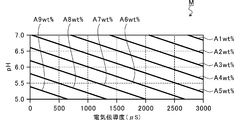
- FIG. 2 is a diagram for explaining the map M.
- target amounts (indicated by A1 wt% to A9 wt% in FIG. 2) are associated with electrical conductivity ( ⁇ S) and pH.
- the electric conductivity threshold value and the pH threshold value are located in the lower left region of the line indicating the target amount.
- the electrical conductivity threshold is 1000 ⁇ S.
- the pH threshold value is 6.0.
- the processing unit 200 refers to the map M and acquires the electrical conductivity threshold value based on the pH measured by the measurement unit 190 and the target amount. Then, the processing unit 200 determines whether or not the electrical conductivity measured by the measurement unit 190 is equal to or greater than a safe value less than the electrical conductivity threshold. As a result, when the measured electrical conductivity is equal to or higher than the safe value, the processing unit 200 drives a pump (not shown), extracts a part of the water stored in the storage tank 122, and creates new water (electrical conductivity). Is less than a safe value and the pH is less than the pH threshold).
- the processing unit 200 predicts the water replacement timing based on the electrical conductivity and pH of the water obtained by the dehydrator 130. Thereby, while reducing the exchange frequency of the water accommodated in the storage tank 122, the electrical conductivity of water can always be maintained below the electrical conductivity threshold, and the pH of the water can be maintained below the pH threshold. . That is, it is possible to maintain the cleaning efficiency of the biomass raw material while reusing water.
- the processing unit 200 extracts a part of the water stored in the storage tank 122 and throws new water into the storage tank 122. .
- the electrical conductivity of the water in the storage tank 122 is maintained below the electrical conductivity threshold, and the pH is set to pH. It becomes possible to maintain below the threshold. That is, the biomass raw material can be washed continuously.
- FIG. 3 is a flowchart showing a processing flow of the fuel production method.
- the fuel manufacturing method of this embodiment includes a measurement step S110, a threshold acquisition step S120, a determination step S130, and a processing step S140.
- the conveyance part 124 which comprises the washing
- the dehydrator 130 continuously dehydrates the washed biomass material.
- the fuel production method is repeatedly performed by interruptions generated at predetermined time intervals.
- the measurement step S110 is a step in which the measurement unit 190 measures the electrical conductivity and pH of the water obtained by the dehydrator 130.
- the processing unit 200 refers to the map M stored in advance in a memory (not shown), and based on the target amount and the pH of the water measured in the measurement step S110, the electrical conductivity threshold value. It is the process of acquiring.
- Determination step S130 In the determination step S130, whether or not the electrical conductivity of the water measured in the measurement step S110 is greater than or equal to the safety value determined based on the electrical conductivity threshold acquired in the threshold acquisition step S120. It is the process of determining. As a result, if it is determined that the value is greater than or equal to the safe value, the process proceeds to process step S140. When it is determined that the fuel value is less than the safe value, the fuel production method is terminated.
- processing step S140 In the processing step S140, the processing unit 200 drives a pump (not shown) to extract a part of the water stored in the storage tank 122 and introduce new water into the storage tank 122.
- EFB has been described as an example of biomass raw material.
- biomass raw material palm coconut shell (PKS), wood, sawdust, bark, and straw may be employed as the biomass material.
- the processing unit 200 has been described by taking as an example a process of extracting a part of the water stored in the storage tank 122 and introducing new water into the storage tank 122 as the predetermined process.
- the treatment unit 200 is not limited to the treatment as long as the electrical conductivity of the water stored in the storage tank 122 can be maintained below the electrical conductivity threshold and the pH of the water can be maintained below the pH threshold.
- the processing unit 200 may replace all the water stored in the storage tank 122 with new water as the predetermined process.
- the processing unit 200 may put a chemical that aggregates (precipitates) ash into the storage tank 122 as a predetermined process.
- the process part 200 may throw the chemical
- the agent that lowers the pH is preferably an organic acid (for example, acetic acid) that does not generate nitrogen oxides (NOx) or sulfur oxides (SOx) when remaining in the solid fuel.
- the processing unit 200 has been described with reference to the map M by taking as an example a configuration that acquires the electrical conductivity threshold value based on the pH measured by the measurement unit 190 and the target amount. .
- the processing unit 200 may acquire the pH threshold value based on the electrical conductivity measured by the measurement unit 190 and the target amount with reference to the map M.
- the processing unit 200 determines whether or not the pH of water measured by the measuring unit 190 is equal to or higher than a safe value determined based on the pH threshold value. As a result, when the measured pH is equal to or higher than the safe value, the processing unit 200 performs a predetermined process on the water stored in the storage tank 122.
- the measurement unit 190 has been described by taking as an example a configuration for measuring the electrical conductivity and pH of the water obtained by the dehydrator 130.
- the measurement unit 190 may measure the electrical conductivity and pH of the water stored in the storage tank 122 in addition to or instead of the water obtained by the dehydrator 130.
- the measurement unit 190 has been described by taking the configuration for measuring the electrical conductivity and pH as an example.
- the measurement unit 190 may measure only the electrical conductivity.
- the processing unit 200 may maintain the electrical conductivity measured by the measuring unit 190 below a predetermined electrical conductivity threshold.
- the measurement part 190 may measure only pH.
- the processing unit 200 may maintain the pH measured by the measuring unit 190 below a predetermined pH threshold value.
- cleaning part 120 ie, the structure which carries out the primary crushing of the washed biomass raw material, was mentioned as an example and demonstrated.
- the cleaning unit 120 may be provided after the primary crushing unit 140.
- the primary crushing unit 140 primarily crushes biomass raw materials having a predetermined size or larger selected by the selecting unit 110.
- the present disclosure can be used for a fuel manufacturing apparatus and a fuel manufacturing method.
Landscapes
- Chemical & Material Sciences (AREA)
- Oil, Petroleum & Natural Gas (AREA)
- Organic Chemistry (AREA)
- Solid Fuels And Fuel-Associated Substances (AREA)
- Processing Of Solid Wastes (AREA)
Abstract
燃料製造装置100は、水を収容した収容槽122にバイオマス原料を導入して、バイオマス原料を水で洗浄する洗浄部120と、洗浄部によって洗浄されたバイオマス原料を脱水する脱水機130と、収容槽に収容された水、および、脱水機によって得られた水のうち、いずれか一方または両方の水の電気伝導度を測定する測定部190と、測定部によって測定された電気伝導度を所定の電気伝導度閾値未満に維持する処理部200と、を備える。
Description
本開示は、燃料製造装置、および、燃料製造方法に関する。
近年、草本系バイオマス、木質系バイオマス等のリグノセルロース系のバイオマスを燃料として有効利用する技術が開発されている。草本系バイオマスは、例えば、パーム椰子からパーム油を生産した結果生じる空果房(EFB:Empty Fruit Bunch)、パーム椰子殻(PKS:Palm Kernel Shell)等である。木質系バイオマスは、木材、おがくず、樹皮、等である。
しかし、バイオマスは、灰中に含まれるカリウム(K)が、石炭と比べて相対的に多く含まれている。このため、石炭焚きボイラにおいて、バイオマスを石炭と混焼させた場合に、石炭のみを燃焼させた場合と比較して、灰(燃焼残渣)の融点が低下する。そうすると、灰が溶融して石炭焚きボイラの内壁に付着し、石炭焚きボイラの熱交換効率が低下してしまうという問題がある。
そこで、バイオマスを圧搾脱水し、その後に加水し、再び圧搾脱水することで、バイオマスからカリウムを除去する技術が開示されている(例えば、特許文献1)。
上記特許文献1の技術等のバイオマスを水で洗浄する技術において、洗浄に要する水の量を削減しコストを低減するために、水を再利用したいという要望がある。しかし、水を再利用し続けると、水に含まれるカリウム等の水溶性の灰成分の濃度が上昇し、バイオマスの洗浄効率が低下する。したがって、水を再利用しつつ、バイオマスの洗浄効率を維持することができる技術の開発が希求されている。
本開示は、水を再利用しつつ、バイオマスの洗浄効率を維持することが可能な燃料製造装置、および、燃料製造方法を提供することを目的としている。
上記課題を解決するために、本開示の一態様にかかる燃料製造装置は、水を収容した収容槽にバイオマス原料を導入して、前記バイオマス原料を水で洗浄する洗浄部と、前記洗浄部によって洗浄された前記バイオマス原料を脱水する脱水機と、前記収容槽に収容された水、および、前記脱水機によって得られた水のうち、いずれか一方または両方の水の電気伝導度を測定する測定部と、前記測定部によって測定される前記電気伝導度を所定の電気伝導度閾値未満に維持する処理部と、を備える。
また、前記測定部は、電気伝導度に加えて、前記水のpHを測定し、前記処理部は、前記測定部によって測定される前記電気伝導度を前記電気伝導度閾値未満に維持し、かつ、前記測定部によって測定される前記pHを所定のpH閾値未満に維持してもよい。
上記課題を解決するために、本開示の一態様にかかる他の燃料製造装置は、水を収容した収容槽にバイオマス原料を導入して、前記バイオマス原料を水で洗浄する洗浄部と、前記洗浄部によって洗浄された前記バイオマス原料を脱水する脱水機と、前記収容槽に収容された水、および、前記脱水機によって得られた水のうち、いずれか一方または両方の水のpHを測定する測定部と、前記測定部によって測定される前記pHを所定のpH閾値未満に維持する処理部と、を備える。
上記課題を解決するために、本開示の一態様にかかる燃料製造方法は、水を収容した収容槽にバイオマス原料を導入して、前記バイオマス原料を水で洗浄する工程と、洗浄された前記バイオマス原料を脱水する工程と、前記収容槽に収容された水、および、前記脱水する工程で得られた水のうち、いずれか一方または両方の水の電気伝導度を測定する工程と、測定される前記電気伝導度を所定の電気伝導度閾値未満に維持する工程と、を含む。
また、前記測定する工程は、電気伝導度に加えて、前記水のpHを測定し、前記維持する工程は、測定される前記電気伝導度を前記電気伝導度閾値未満に維持し、かつ、測定される前記pHを所定のpH閾値未満に維持してもよい。
上記課題を解決するために、本開示の一態様にかかる他の燃料製造方法は、水を収容した収容槽にバイオマス原料を導入して、前記バイオマス原料を水で洗浄する工程と、洗浄された前記バイオマス原料を脱水する工程と、前記収容槽に収容された水、および、前記脱水する工程で得られた水のうち、いずれか一方または両方の水のpHを測定する工程と、測定される前記pHを所定のpH閾値未満に維持する工程と、を含む。
水を再利用しつつ、バイオマスの洗浄効率を維持することが可能となる。
以下に添付図面を参照しながら、本開示の実施形態について詳細に説明する。実施形態に示す寸法、材料、その他具体的な数値等は、理解を容易とするための例示にすぎず、特に断る場合を除き、本開示を限定するものではない。なお、本明細書および図面において、実質的に同一の機能、構成を有する要素については、同一の符号を付することにより重複説明を省略する。また本開示に直接関係のない要素は図示を省略する。
(燃料製造装置100)
本実施形態では、バイオマス原料として、EFB(空果房)を例に挙げて説明する。
本実施形態では、バイオマス原料として、EFB(空果房)を例に挙げて説明する。
図1は、燃料製造装置100を説明する図である。図1中、バイオマス原料、ペレット、固体燃料、水等の物質の流れを実線の矢印で示し、信号の流れを破線の矢印で示す。図1に示すように、燃料製造装置100は、選別部110と、洗浄部120と、脱水機130と、一次破砕部140と、乾燥部150と、二次破砕部160と、ペレタイザ170と、冷却部180と、測定部190と、処理部200とを含んで構成される。
選別部110は、バイオマス原料を、所定の大きさ(例えば、5cm程度)以上のバイオマス原料と、所定の大きさ未満のバイオマス原料とに選別する。選別部110によって選別された所定の大きさ以上のバイオマス原料は、後段の洗浄部120に搬送される。
洗浄部120は、バイオマス原料を洗浄する。具体的に説明すると、洗浄部120は、収容槽122と、搬送部124とを含んで構成される。収容槽122は、水を収容(貯留)する。搬送部124は、例えば、コンベアで構成される。搬送部124は、選別部110によって選別された、所定の大きさ以上のバイオマス原料を収容槽122に導入する。また、搬送部124は、収容槽122に収容された水にバイオマス原料を所定時間接触させた後に、バイオマス原料を収容槽122から取り出して、後段の脱水機130に搬送する。
脱水機130は、フィルタープレス機や、スクリュープレス機等で構成される。脱水機130は、搬送部124によって搬送されたバイオマス原料を脱水する。
一次破砕部140は、脱水機130によって脱水されたバイオマス原料を、例えば5cm程度に破砕(一次破砕)する。一次破砕部140によって破砕されたバイオマス原料は、後段の乾燥部150に搬送される。
乾燥部150では、高温の空気や燃焼排ガス等の高温のガスによって乾燥がなされている。なお、燃焼排ガスは、不図示の燃焼装置において燃料を燃焼させた際に発生するガスである。乾燥部150は、一次破砕部140によって破砕されたバイオマス原料を、供給された燃焼排ガスで含水率10%程度となるまで乾燥させる。乾燥部150によって乾燥されたバイオマス原料は、後段の二次破砕部160に搬送される。
二次破砕部160は、乾燥されたバイオマス原料を、例えば1cm程度に破砕(二次破砕)する。二次破砕部160によって破砕されたバイオマス原料は、後段のペレタイザ170に搬送される。
ペレタイザ170は、二次破砕されたバイオマス原料を成型して、ペレット(例えば、円柱形状)を生成する。ペレタイザ170によって生成されたペレットは、後段の冷却部180に搬送される。冷却部180は、ペレットを常温(例えば、25℃程度)まで冷却して固体燃料とする。
上記したように、バイオマス原料は、固体燃料に加工される前に洗浄部120によって水で洗浄される。洗浄にかかるコストを低減するために、洗浄に要する水の量を削減したいという要望がある。そこで、洗浄部120で利用した水を繰り返し利用(再利用)することが考えられる。つまり、収容槽122に収容された水を交換せずに、バイオマス原料を洗浄し続けることが考えられる。
しかし、この場合、洗浄するバイオマス原料(搬送部124によって導入されるバイオマス原料)が多くなるほど、収容槽122内の水に含まれる水溶性の灰成分(カリウム等)の濃度が上昇する。そうすると、搬送部124が収容槽122にバイオマス原料を導入しても、バイオマス原料から水に溶出される水溶性の灰成分の量が低下してしまう。つまり、洗浄部120によるバイオマス原料の洗浄効率が低下してしまう。
そこで、本実施形態の燃料製造装置100では、測定部190、処理部200を備えることにより、洗浄に要する水を再利用しつつ、バイオマス原料の洗浄効率を維持する。以下、測定部190、処理部200の具体的な構成について説明する。
測定部190は、脱水機130によって得られた水の電気伝導度(電気伝導率)およびpHを測定する。測定部190は、既存の電気伝導度計および既存のpHメータで構成される。
処理部200は、CPU(中央処理装置)を含む半導体集積回路で構成される。処理部200は、ROMからCPU自体を動作させるためのプログラムやパラメータ等を読み出し、ワークエリアとしてのRAMや他の電子回路と協働して燃料製造装置100全体を管理および制御する。
本実施形態において、処理部200は、測定部190によって測定される電気伝導度を所定の電気伝導度閾値未満に維持し、かつ、測定部190によって測定されるpHを所定のpH閾値未満に維持するように、収容槽122に収容される水に所定の処理を施す。ここで、電気伝導度閾値は、洗浄後のバイオマス原料で製造された固体燃料(ペレット)中の灰分量が所定の目標量となる電気伝導度である。また、pH閾値は、洗浄後のバイオマス原料で製造された固体燃料中の灰分量が所定の目標量となるpHである。
なお、所定の目標量は、固体燃料を燃焼させる燃焼器(ボイラ)において許容される灰分の融点に基づいて決定される。詳細に説明すると、洗浄するバイオマス原料が多くなるほど、バイオマス原料から水に溶出される灰分(水に溶解した灰分の濃度)が増加する。つまり、洗浄するバイオマス原料が多くなるほど、水の電気伝導度が上昇する。また、水のpHが低くなるほど、水への灰分の溶出量が増加する。
すなわち、固体燃料中の灰分量と、脱水機130によって得られる水、または、収容槽122に収容される水のうち、いずれか一方または両方の水の電気伝導度およびpHとは、相関がある。
そこで、電気伝導度と、pHと、目標量とを関連付けたマップを予め作成しておき、不図示のメモリに記憶させておく。そして、処理部200は、マップを参照し、目標量に基づいて、電気伝導度閾値またはpH閾値を取得する。
マップの作成について具体的に説明すると、脱水機130によって得られる水、または、収容槽122に収容される水のうち、いずれか一方または両方の水の電気伝導度およびpHと、固体燃料中の灰分の量とは、下記式(1)に基づいて導出することができる。
Ash = f(EC・pH) …式(1)
Ash = f(EC・pH) …式(1)
例えば、式(1)が一次式である場合、式(1)は、下記式(2)となる。
Ash = a×EC + b×pH +c …式(2)
なお、上記式(1)、式(2)中、Ashは固体燃料中の灰分の量(wt%)を示す。式(1)、式(2)中、ECは、水の電気伝導度を示す。式(1)、式(2)中、pHは、水のpHを示す。式(2)中、a、b、cは係数を示す。
Ash = a×EC + b×pH +c …式(2)
なお、上記式(1)、式(2)中、Ashは固体燃料中の灰分の量(wt%)を示す。式(1)、式(2)中、ECは、水の電気伝導度を示す。式(1)、式(2)中、pHは、水のpHを示す。式(2)中、a、b、cは係数を示す。
そして、式(2)および実測値から係数a、b、cを導出し、Ash計算値-Ash実測値>0の条件を満たすようにして、マップを作成する。
図2は、マップMを説明する図である。図2に示すようにマップMは、電気伝導度(μS)およびpHに目標量(図2中、A1wt%~A9wt%で示す)が関連付けられている。マップMにおいて、電気伝導度閾値およびpH閾値は、目標量を示す線の左下の領域に位置することになる。例えば、目標量をA6wt%とする場合であって、水のpHが6.0である場合、電気伝導度閾値は1000μSとなる。換言すれば、目標量をA6wt%とする場合であって、水の電気伝導度が1000μSである場合、pH閾値は6.0となる。
そして、例えば、処理部200は、マップMを参照して、測定部190によって測定されたpHと、目標量とに基づいて、電気伝導度閾値を取得する。そして、処理部200は、測定部190によって測定された電気伝導度が電気伝導度閾値未満の安全値以上であるか否かを判定する。その結果、測定された電気伝導度が安全値以上である場合、処理部200は、不図示のポンプを駆動し、収容槽122に収容された水を一部抜き出し、新たな水(電気伝導度が安全値未満であり、pHがpH閾値未満である水)を収容槽122に投入する。
以上説明したように、本実施形態の燃料製造装置100では、処理部200が、脱水機130によって得られた水の電気伝導度およびpHに基づいて、水の交換タイミングを予測する。これにより、収容槽122に収容される水の交換頻度を低下させつつ、水の電気伝導度を常に電気伝導度閾値未満に維持し、かつ、水のpHをpH閾値未満に維持することができる。つまり、水を再利用しつつ、バイオマス原料の洗浄効率を維持することが可能となる。
また、上記したように、処理部200は、測定された電気伝導度が安全値に到達した場合に、収容槽122に収容された水を一部抜き出し、新たな水を収容槽122に投入する。これにより、バイオマス原料の洗浄を停止させることなく(搬送部124の運転を停止させることなく)、収容槽122内の水の電気伝導度を電気伝導度閾値未満に維持し、かつ、pHをpH閾値未満に維持することが可能となる。つまり、バイオマス原料を連続して洗浄することができる。
(燃料製造方法)
続いて、燃料製造装置100を用いた燃料製造方法について説明する。図3は、燃料製造方法の処理の流れを示すフローチャートである。図3に示すように、本実施形態の燃料製造方法は、測定工程S110、閾値取得工程S120、判定工程S130、処理工程S140を含む。なお、洗浄部120を構成する搬送部124は、収容槽122にバイオマス原料を連続して導入し、バイオマス原料を水で洗浄している。また、脱水機130は、洗浄後のバイオマス原料を連続して脱水している。さらに、本実施形態において、所定の時間間隔毎に生じる割込によって燃料製造方法が繰り返し遂行される。
続いて、燃料製造装置100を用いた燃料製造方法について説明する。図3は、燃料製造方法の処理の流れを示すフローチャートである。図3に示すように、本実施形態の燃料製造方法は、測定工程S110、閾値取得工程S120、判定工程S130、処理工程S140を含む。なお、洗浄部120を構成する搬送部124は、収容槽122にバイオマス原料を連続して導入し、バイオマス原料を水で洗浄している。また、脱水機130は、洗浄後のバイオマス原料を連続して脱水している。さらに、本実施形態において、所定の時間間隔毎に生じる割込によって燃料製造方法が繰り返し遂行される。
(測定工程S110)
測定工程S110は、測定部190が、脱水機130によって得られた水の電気伝導度およびpHを測定する工程である。
測定工程S110は、測定部190が、脱水機130によって得られた水の電気伝導度およびpHを測定する工程である。
(閾値取得工程S120)
閾値取得工程S120は、処理部200が、不図示のメモリに予め記憶されているマップMを参照し、目標量と、測定工程S110で測定された水のpHとに基づいて、電気伝導度閾値を取得する工程である。
閾値取得工程S120は、処理部200が、不図示のメモリに予め記憶されているマップMを参照し、目標量と、測定工程S110で測定された水のpHとに基づいて、電気伝導度閾値を取得する工程である。
(判定工程S130)
判定工程S130は、処理部200が、測定工程S110で測定された水の電気伝導度が、閾値取得工程S120で取得した電気伝導度閾値に基づいて決定される上記安全値以上であるか否かを判定する工程である。その結果、安全値以上であると判定した場合には、処理工程S140に処理を移す。また、安全値未満であると判定した場合には、当該燃料製造方法を終了する。
判定工程S130は、処理部200が、測定工程S110で測定された水の電気伝導度が、閾値取得工程S120で取得した電気伝導度閾値に基づいて決定される上記安全値以上であるか否かを判定する工程である。その結果、安全値以上であると判定した場合には、処理工程S140に処理を移す。また、安全値未満であると判定した場合には、当該燃料製造方法を終了する。
(処理工程S140)
処理工程S140は、処理部200が不図示のポンプを駆動して、収容槽122に収容された水を一部抜き出し、新たな水を収容槽122に投入する工程である。
処理工程S140は、処理部200が不図示のポンプを駆動して、収容槽122に収容された水を一部抜き出し、新たな水を収容槽122に投入する工程である。
以上説明したように、本実施形態の燃料製造装置100を用いた燃料製造方法では、水を再利用しつつ、バイオマス原料の洗浄効率を維持することが可能となる。
以上、添付図面を参照しながら実施形態について説明したが、本開示は上記実施形態に限定されないことは言うまでもない。当業者であれば、請求の範囲に記載された範疇において、各種の変更例または修正例に想到し得ることは明らかであり、それらについても当然に本開示の技術的範囲に属するものと了解される。
例えば、上記実施形態において、バイオマス原料としてEFBを例に挙げて説明した。しかし、バイオマス原料に限定はない。例えば、バイオマス原料として、パーム椰子殻(PKS)、木材、おがくず、樹皮、藁を採用してもよい。
また、上記実施形態において、処理部200は、所定の処理として、収容槽122に収容された水を一部抜き出し、新たな水を収容槽122に投入する処理を例に挙げて説明した。しかし、処理部200は、収容槽122に収容された水の電気伝導度を電気伝導度閾値未満に維持し、かつ、水のpHをpH閾値未満に維持することができれば、処理に限定はない。例えば、処理部200は、所定の処理として、収容槽122に収容された水をすべて新たな水に交換してもよい。また、処理部200は、所定の処理として、灰分を凝集(沈殿)させる薬剤を収容槽122に投入してもよい。また、処理部200は、所定の処理として、pHを低下させる薬剤を収容槽122に投入してもよい。なお、pHを低下させる薬剤は、固体燃料に残留した場合に、窒素酸化物(NOx)や硫黄酸化物(SOx)を発生させない有機酸(例えば、酢酸)が好ましい。
また、上記実施形態において、処理部200は、マップMを参照し、測定部190によって測定されたpHと、目標量とに基づいて、電気伝導度閾値を取得する構成を例に挙げて説明した。しかし、処理部200は、マップMを参照し、測定部190によって測定された電気伝導度と、目標量とに基づいて、pH閾値を取得してもよい。この場合、処理部200は、測定部190によって測定された水のpHが、pH閾値に基づいて決定される安全値以上であるか否かを判定する。その結果、測定されたpHが安全値以上である場合、処理部200は、収容槽122に収容される水に所定の処理を施す。
また、上記実施形態において、測定部190は、脱水機130によって得られた水の電気伝導度およびpHを測定する構成を例に挙げて説明した。しかし、測定部190は、脱水機130によって得られた水に加えて、または、代えて収容槽122に収容された水の電気伝導度およびpHを測定してもよい。
また、上記実施形態において、測定部190は、電気伝導度およびpHを測定する構成を例に挙げて説明した。しかし、測定部190は、電気伝導度のみを測定してもよい。この場合、処理部200は、測定部190によって測定される電気伝導度を所定の電気伝導度閾値未満に維持するとよい。また、測定部190は、pHのみを測定してもよい。この場合、処理部200は、測定部190によって測定されるpHを所定のpH閾値未満に維持するとよい。
また、上記実施形態において、洗浄部120の後段に一次破砕部140が設けられる構成、すなわち、洗浄されたバイオマス原料を一次破砕する構成を例に挙げて説明した。しかし、一次破砕部140の後段に洗浄部120が設けられてもよい。この場合、一次破砕部140は、選別部110によって選別された所定の大きさ以上のバイオマス原料を一次破砕する。そして、洗浄部120は、一次破砕されたバイオマス原料を洗浄する。
本開示は、燃料製造装置、および、燃料製造方法に利用することができる。
S110 測定工程
S140 処理工程
100 燃料製造装置
120 洗浄部
122 収容槽
130 脱水機
190 測定部
200 処理部
S140 処理工程
100 燃料製造装置
120 洗浄部
122 収容槽
130 脱水機
190 測定部
200 処理部
Claims (6)
- 水を収容した収容槽にバイオマス原料を導入して、前記バイオマス原料を水で洗浄する洗浄部と、
前記洗浄部によって洗浄された前記バイオマス原料を脱水する脱水機と、
前記収容槽に収容された水、および、前記脱水機によって得られた水のうち、いずれか一方または両方の水の電気伝導度を測定する測定部と、
前記測定部によって測定される前記電気伝導度を所定の電気伝導度閾値未満に維持する処理部と、
を備える燃料製造装置。 - 前記測定部は、電気伝導度に加えて、前記水のpHを測定し、
前記処理部は、前記測定部によって測定される前記電気伝導度を前記電気伝導度閾値未満に維持し、かつ、前記測定部によって測定される前記pHを所定のpH閾値未満に維持する請求項1に記載の燃料製造装置。 - 水を収容した収容槽にバイオマス原料を導入して、前記バイオマス原料を水で洗浄する洗浄部と、
前記洗浄部によって洗浄された前記バイオマス原料を脱水する脱水機と、
前記収容槽に収容された水、および、前記脱水機によって得られた水のうち、いずれか一方または両方の水のpHを測定する測定部と、
前記測定部によって測定される前記pHを所定のpH閾値未満に維持する処理部と、
を備える燃料製造装置。 - 水を収容した収容槽にバイオマス原料を導入して、前記バイオマス原料を水で洗浄する工程と、
洗浄された前記バイオマス原料を脱水する工程と、
前記収容槽に収容された水、および、前記脱水する工程で得られた水のうち、いずれか一方または両方の水の電気伝導度を測定する工程と、
測定される前記電気伝導度を所定の電気伝導度閾値未満に維持する工程と、
を含む燃料製造方法。 - 前記測定する工程は、電気伝導度に加えて、前記水のpHを測定し、
前記維持する工程は、測定される前記電気伝導度を前記電気伝導度閾値未満に維持し、かつ、測定される前記pHを所定のpH閾値未満に維持する請求項4に記載の燃料製造方法。 - 水を収容した収容槽にバイオマス原料を導入して、前記バイオマス原料を水で洗浄する工程と、
洗浄された前記バイオマス原料を脱水する工程と、
前記収容槽に収容された水、および、前記脱水する工程で得られた水のうち、いずれか一方または両方の水のpHを測定する工程と、
測定される前記pHを所定のpH閾値未満に維持する工程と、
を含む燃料製造方法。
Priority Applications (2)
| Application Number | Priority Date | Filing Date | Title |
|---|---|---|---|
| PCT/JP2017/017368 WO2018207229A1 (ja) | 2017-05-08 | 2017-05-08 | 燃料製造装置、および、燃料製造方法 |
| MYPI2019005799A MY203833A (en) | 2017-05-08 | 2017-05-08 | Apparatus for producing a fuel and method of producing a fuel |
Applications Claiming Priority (1)
| Application Number | Priority Date | Filing Date | Title |
|---|---|---|---|
| PCT/JP2017/017368 WO2018207229A1 (ja) | 2017-05-08 | 2017-05-08 | 燃料製造装置、および、燃料製造方法 |
Publications (1)
| Publication Number | Publication Date |
|---|---|
| WO2018207229A1 true WO2018207229A1 (ja) | 2018-11-15 |
Family
ID=64105408
Family Applications (1)
| Application Number | Title | Priority Date | Filing Date |
|---|---|---|---|
| PCT/JP2017/017368 Ceased WO2018207229A1 (ja) | 2017-05-08 | 2017-05-08 | 燃料製造装置、および、燃料製造方法 |
Country Status (2)
| Country | Link |
|---|---|
| MY (1) | MY203833A (ja) |
| WO (1) | WO2018207229A1 (ja) |
Cited By (3)
| Publication number | Priority date | Publication date | Assignee | Title |
|---|---|---|---|---|
| JP2020084043A (ja) * | 2018-11-26 | 2020-06-04 | 日鉄エンジニアリング株式会社 | バイオマス固体燃料原料の処理方法及びバイオマス固体燃料原料の処理装置 |
| WO2020152759A1 (ja) * | 2019-01-21 | 2020-07-30 | 株式会社Ihi | 固形燃料製造装置、および、固形燃料製造方法 |
| WO2020217305A1 (ja) * | 2019-04-23 | 2020-10-29 | 岩谷産業株式会社 | バイオマス燃料の製造方法およびバイオマス燃料 |
Citations (4)
| Publication number | Priority date | Publication date | Assignee | Title |
|---|---|---|---|---|
| JP2005008663A (ja) * | 2003-06-16 | 2005-01-13 | Ishikawajima Harima Heavy Ind Co Ltd | 炭化物成型方法 |
| JP2007083144A (ja) * | 2005-09-21 | 2007-04-05 | Mitsubishi Heavy Ind Ltd | 灰処理方法及びシステム |
| JP2009191229A (ja) * | 2008-02-18 | 2009-08-27 | Sumitomo Heavy Ind Ltd | 燃料改質装置及びこれを備えたボイラ設備 |
| JP2016125030A (ja) * | 2015-01-08 | 2016-07-11 | 株式会社日立製作所 | 植物性バイオ燃料改質方法、システムおよび生産方法 |
-
2017
- 2017-05-08 WO PCT/JP2017/017368 patent/WO2018207229A1/ja not_active Ceased
- 2017-05-08 MY MYPI2019005799A patent/MY203833A/en unknown
Patent Citations (4)
| Publication number | Priority date | Publication date | Assignee | Title |
|---|---|---|---|---|
| JP2005008663A (ja) * | 2003-06-16 | 2005-01-13 | Ishikawajima Harima Heavy Ind Co Ltd | 炭化物成型方法 |
| JP2007083144A (ja) * | 2005-09-21 | 2007-04-05 | Mitsubishi Heavy Ind Ltd | 灰処理方法及びシステム |
| JP2009191229A (ja) * | 2008-02-18 | 2009-08-27 | Sumitomo Heavy Ind Ltd | 燃料改質装置及びこれを備えたボイラ設備 |
| JP2016125030A (ja) * | 2015-01-08 | 2016-07-11 | 株式会社日立製作所 | 植物性バイオ燃料改質方法、システムおよび生産方法 |
Cited By (4)
| Publication number | Priority date | Publication date | Assignee | Title |
|---|---|---|---|---|
| JP2020084043A (ja) * | 2018-11-26 | 2020-06-04 | 日鉄エンジニアリング株式会社 | バイオマス固体燃料原料の処理方法及びバイオマス固体燃料原料の処理装置 |
| WO2020110373A1 (ja) * | 2018-11-26 | 2020-06-04 | 日鉄エンジニアリング株式会社 | バイオマス固体燃料原料の処理方法及びバイオマス固体燃料原料の処理装置 |
| WO2020152759A1 (ja) * | 2019-01-21 | 2020-07-30 | 株式会社Ihi | 固形燃料製造装置、および、固形燃料製造方法 |
| WO2020217305A1 (ja) * | 2019-04-23 | 2020-10-29 | 岩谷産業株式会社 | バイオマス燃料の製造方法およびバイオマス燃料 |
Also Published As
| Publication number | Publication date |
|---|---|
| MY203833A (en) | 2024-07-19 |
Similar Documents
| Publication | Publication Date | Title |
|---|---|---|
| Tomani | The lignoboost process | |
| RU2369631C2 (ru) | Способ получения топливных гранул | |
| WO2018207229A1 (ja) | 燃料製造装置、および、燃料製造方法 | |
| CN113883528B (zh) | 一种基于煤粉锅炉的多源废弃物处置系统及方法 | |
| JP7134127B2 (ja) | バイオマス燃料化システム及びバイオマス由来燃料ペレットの製造方法 | |
| CN101979478A (zh) | 一种生物燃料的制备方法 | |
| CN108883445A (zh) | 生物质改性体系和方法 | |
| CN107417068A (zh) | 一种新型污泥处置工艺 | |
| CN108949282A (zh) | 高热值固态衍生性燃料的制造方法 | |
| CN103131501A (zh) | 一种高钠煤间歇式脱钠净化方法 | |
| KR101722698B1 (ko) | 팜유 생산 부산물과 목질계 바이오매스를 이용한 화력발전소 및 제철소용 고발열량 고체연료, 그의 제조장치 및 제조방법 | |
| WO2018193567A1 (ja) | 燃料製造装置、および、燃料製造方法 | |
| JP5843568B2 (ja) | 焼却灰の処理方法及び処理装置 | |
| CN116462157B (zh) | 一种含高硫份洗煤废弃物综合利用的系统和方法 | |
| US20110070549A1 (en) | System for ash recycling | |
| WO2018185804A1 (ja) | 燃料製造方法 | |
| CN204529622U (zh) | 一种污泥处理系统 | |
| CN204478121U (zh) | 一种粉煤气化炉湿灰的再利用装置 | |
| CN107824171B (zh) | 活性炭的再生系统及再生方法 | |
| CN101745298A (zh) | 一种有机化工生产中产生的二氧化硫尾气的回收利用方法 | |
| JP2005200522A (ja) | 高含水有機物の炭化処理方法及び装置並びに白煙防止方法 | |
| CN114247739B (zh) | 一种基于燃煤电厂的风电叶片处置系统及方法 | |
| JP2025024612A (ja) | 半炭化物ペレット、その調製方法及びその調製システム | |
| CN104147884B (zh) | 一种末精煤干燥系统热烟气处理工艺 | |
| KR102129779B1 (ko) | 커피허스크 연료 생산시스템 |
Legal Events
| Date | Code | Title | Description |
|---|---|---|---|
| 121 | Ep: the epo has been informed by wipo that ep was designated in this application |
Ref document number: 17909222 Country of ref document: EP Kind code of ref document: A1 |
|
| NENP | Non-entry into the national phase |
Ref country code: DE |
|
| 122 | Ep: pct application non-entry in european phase |
Ref document number: 17909222 Country of ref document: EP Kind code of ref document: A1 |
|
| NENP | Non-entry into the national phase |
Ref country code: JP |