WO2018168017A1 - 紙パルプ製造工程における殺菌方法 - Google Patents
紙パルプ製造工程における殺菌方法 Download PDFInfo
- Publication number
- WO2018168017A1 WO2018168017A1 PCT/JP2017/033057 JP2017033057W WO2018168017A1 WO 2018168017 A1 WO2018168017 A1 WO 2018168017A1 JP 2017033057 W JP2017033057 W JP 2017033057W WO 2018168017 A1 WO2018168017 A1 WO 2018168017A1
- Authority
- WO
- WIPO (PCT)
- Prior art keywords
- manufacturing process
- paper
- paper pulp
- halogen
- pulp
- Prior art date
- Legal status (The legal status is an assumption and is not a legal conclusion. Google has not performed a legal analysis and makes no representation as to the accuracy of the status listed.)
- Ceased
Links
Images
Classifications
-
- A—HUMAN NECESSITIES
- A01—AGRICULTURE; FORESTRY; ANIMAL HUSBANDRY; HUNTING; TRAPPING; FISHING
- A01N—PRESERVATION OF BODIES OF HUMANS OR ANIMALS OR PLANTS OR PARTS THEREOF; BIOCIDES, e.g. AS DISINFECTANTS, AS PESTICIDES OR AS HERBICIDES; PEST REPELLANTS OR ATTRACTANTS; PLANT GROWTH REGULATORS
- A01N33/00—Biocides, pest repellants or attractants, or plant growth regulators containing organic nitrogen compounds
- A01N33/02—Amines; Quaternary ammonium compounds
- A01N33/04—Nitrogen directly attached to aliphatic or cycloaliphatic carbon atoms
-
- A—HUMAN NECESSITIES
- A01—AGRICULTURE; FORESTRY; ANIMAL HUSBANDRY; HUNTING; TRAPPING; FISHING
- A01N—PRESERVATION OF BODIES OF HUMANS OR ANIMALS OR PLANTS OR PARTS THEREOF; BIOCIDES, e.g. AS DISINFECTANTS, AS PESTICIDES OR AS HERBICIDES; PEST REPELLANTS OR ATTRACTANTS; PLANT GROWTH REGULATORS
- A01N59/00—Biocides, pest repellants or attractants, or plant growth regulators containing elements or inorganic compounds
- A01N59/08—Alkali metal chlorides; Alkaline earth metal chlorides
-
- C—CHEMISTRY; METALLURGY
- C02—TREATMENT OF WATER, WASTE WATER, SEWAGE, OR SLUDGE
- C02F—TREATMENT OF WATER, WASTE WATER, SEWAGE, OR SLUDGE
- C02F1/00—Treatment of water, waste water, or sewage
- C02F1/50—Treatment of water, waste water, or sewage by addition or application of a germicide or by oligodynamic treatment
-
- C—CHEMISTRY; METALLURGY
- C02—TREATMENT OF WATER, WASTE WATER, SEWAGE, OR SLUDGE
- C02F—TREATMENT OF WATER, WASTE WATER, SEWAGE, OR SLUDGE
- C02F1/00—Treatment of water, waste water, or sewage
- C02F1/72—Treatment of water, waste water, or sewage by oxidation
- C02F1/76—Treatment of water, waste water, or sewage by oxidation with halogens or compounds of halogens
-
- D—TEXTILES; PAPER
- D21—PAPER-MAKING; PRODUCTION OF CELLULOSE
- D21H—PULP COMPOSITIONS; PREPARATION THEREOF NOT COVERED BY SUBCLASSES D21C OR D21D; IMPREGNATING OR COATING OF PAPER; TREATMENT OF FINISHED PAPER NOT COVERED BY CLASS B31 OR SUBCLASS D21G; PAPER NOT OTHERWISE PROVIDED FOR
- D21H21/00—Non-fibrous material added to the pulp, characterised by its function, form or properties; Paper-impregnating or coating material, characterised by its function, form or properties
- D21H21/02—Agents for preventing deposition on the paper mill equipment, e.g. pitch or slime control
- D21H21/04—Slime-control agents
Definitions
- the present invention relates to a sterilization method in a paper pulp manufacturing process, and more particularly to a sterilization method for reducing the number of bacteria in a paper product.
- antibacterial agents are used for several purposes.
- the most common purpose is to prevent slime from sticking to bacteria and fungi on the walls of the paper and pulp manufacturing process, producing sticky substances, and growing while strewn with dust, forming a sticky mass It is.
- an antibacterial agent is added to the papermaking process as a slime control agent for preventing slime.
- antibacterial agents are used for the purpose of preventing odors caused by the generation of organic acids through the decomposition and fermentation of starch under anaerobic conditions by bacteria and the deterioration of the quality of formulated chemicals such as paints and starches due to pH reduction Is used.
- inorganic antibacterial agents have become mainstream in slime control, such as in the papermaking process in the pulp and paper industry. This is because it is less expensive than conventional organic antibacterial agents and has excellent sterilization and slime prevention effects.
- specific examples of inorganic antibacterial agents include hypochlorites such as sodium hypochlorite, sodium hypobromite, and chlorine dioxide. Recently, hypochlorite and ammonium salts, amines, Reaction products with nitrogen compounds consisting of imines, amides and imides are often used.
- ammonium bromide, ammonium sulfate, ammonium chloride, ammonium carbamate, urea and sulfamic acid are oxidative antibacterial agents that form haloamines and haloamides that are reactively bonded with chlorine in hypochlorite, and exhibit high bactericidal and antiseptic effects and slime control effects.
- organic antibacterial agents include isothiazolone compounds (Japanese Patent Laid-Open No. 2002-336867).
- JP 2002-336867 A there is an example in which a combination of an inorganic antibacterial agent and an organic antibacterial agent exhibits a synergistic effect, and exhibits a higher slime control and antiseptic effect.
- the number of bacteria is usually 1.0E + 03 CFU / g or more, and it is necessary to apply a more enhanced antibacterial agent different from slime control. .
- bacterial spores that have not received much attention are obstacles.
- Bacterial spores are forms in which specific bacteria such as the genus Bacillus form a strong shell structure and have extremely high heat resistance and chemical resistance. Usually, bacterial spores do not grow as they are and do not form slime or promote spoilage. Therefore, there is no problem with slime control or antiseptic. However, bacterial spores are difficult to die by the heat and antibacterial agents of dryers in the paper manufacturing process, and are therefore a major obstacle when controlling the number of bacteria in paper products.
- Bacterial spore treatment methods are being studied especially in food handling facilities and cleaning facilities. For example, sterilization with high-pressure steam such as autoclave, treatment at extremely high temperature, or use of glutaraldehyde, peracetic acid, sodium hypochlorite, etc. as a chemical is a kind of bacillus that forms spores. Recommended by the World Health Organization for disinfection of anthrax (JP 2004-75659). In addition to these general drugs, polyhexamethylene guanidine salts and quaternary ammonium salts are also recommended (Japanese Patent Laid-Open Nos. 2009-108184 and 2016-160245).
- An object of the present invention is to provide a sterilization method in a paper pulp manufacturing process that can sufficiently reduce the number of bacteria in the paper pulp manufacturing process and reduce the number of bacteria in the paper product.
- the gist of the present invention is as follows. [1] A sterilization method in a paper pulp manufacturing process in which a halogen-based oxidizing disinfectant and a polyalkyleneguanidine compound are added in the paper pulp manufacturing process.
- the halogen-based oxidizing disinfectant is selected from the group consisting of hypochlorous acid, hypochlorite, hypobromite, hypobromite, chlorine dioxide, haloamine, and haloamide.
- a sterilization method in a paper pulp manufacturing process which is at least one selected and the polyalkylene guanidine compound is a polyalkylene biguanide.
- the haloamine or haloamide is a reaction product of ammonium bromide, ammonium sulfate, ammonium chloride, ammonium carbamate urea or sulfamic acid and hypochlorous acid and / or hypochlorite.
- the sterilization method in the paper pulp manufacturing process which is.
- bacterial spores in the pulp and paper manufacturing process, can be sterilized by using a small amount of antibacterial agent without performing high-temperature and high-pressure treatment, and without using a high alkali or surfactant.
- the number of bacteria in the product can be sufficiently reduced.
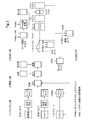
- FIG. 1 is a block diagram showing an example of a paper pulp manufacturing process.
- a halogen-based oxidizing bactericidal agent and a polyalkylene guanidine compound are added in the paper pulp manufacturing process.
- the application target of the present invention is a paper pulp manufacturing process.
- the paper pulp manufacturing process includes at least the following processes (1) to (4).
- Pulp forming step There are a plurality of methods for producing pulp as a raw material for paper as a final product as follows.
- wood chips are steamed with alkali in a digester to remove lignin, and further bleached with chlorine dioxide, hydrogen peroxide, ozone or the like to obtain pulp.
- kraft pulp is dehydrated and used as a raw material.
- waste paper pulp water is added to magazine waste paper or newspaper waste paper to form a slurry that loosens the fibers with a disintegrator (pulpa), then deinked with a deinking agent, and whitened with a bleaching agent. Get ink pulp.
- pulp sheet pulp is obtained by simply loosening the fibers of the corrugated cardboard or the like with a disintegrator (pulpa).
- Preparation step A step in which the above-described pulp slurry is modified (beaten) with mechanical force, mixed and then various chemicals are added.
- the chemicals to be added are fillers that fill the gaps in the pulp and increase the whiteness and opacity, fine fibers and fillers stay on the wire, improve the dehydration, improve the yield and drainage, and blot the paper ink.
- Papermaking process About 3% of the pulp slurry obtained in the above preparation process is diluted to about 1%. Next, it is sent out to the traveling papermaking wire using a head box and dehydrated. The dehydrated water is called white water and is used for dilution of pulp slurry.
- starch slurry is sprayed on each layer of wet paper as an adhesive.
- the wet paper exiting the wire has a solid content of about 20%, and is then dehydrated to a solid content of about 50% by press dehydration with felt. Next, it is dried to a moisture content of less than 10% by a dryer using steam as a heat source.
- a size press process may be provided between the dryer parts.
- the size press is a method of applying a sizing agent to the paper surface, and is a step of applying a coating liquid containing not only the sizing agent but also a pigment for improving the gloss and smoothness of the paper.
- the processing target of the present invention is one or more of the above steps (1) to (4), and may be all of them.
- the pulping step (1) the pulp and bleaching at the time of disaggregation mixed with bacteria are all completed and stored, and in the preparation step (2), all the steps, especially bacteria
- the recovery step (4) and the raw materials (calcium carbonate, clay, starch, latex, etc.), all recovered white water and waste paper are targeted.
- the pulp slurry and white water in the preparation step (2), the paper making step (3), and the recovery step (4) circulate through the white water from which the starch added to each place is recovered. It is easy for bacteria to grow. Depending on the factory, supplementary water such as river water and well water may also be a source of contamination with bacteria.
- Bacterial spores are detected at any of these sites, but are often found particularly at the following three sites.
- Bringing in from outside For example, starch or pulp slurry purchased from outside
- Bacterial spores are formed and survived in the starch paste solution that has been subjected to a cooking process in which starch is heated and swollen.
- halogen-based oxidizing disinfectant examples include hypochlorous acid (salt), hypobromite (salt), and chlorine dioxide.
- examples of the halogen-based oxidizing bactericides include ammonium bromide, ammonium sulfate, ammonium chloride, ammonium carbamate, haloamine and haloamide which are a reaction product of urea or sulfamic acid and hypochlorous acid (salt). As the halogen-based oxidizing bactericides, one or more of these are used.
- Polyalkylene guanidine compound As the polyalkylene guanidine compound, polyalkylene biguanide or a derivative thereof is preferable, and specifically, polyhexamethylene biguanide (PHMB) is preferable.
- PHMB polyhexamethylene biguanide
- the addition point of the oxidizing bactericide and the polyalkylene guanidine compound need not be the same, and the addition location may be freely determined according to the situation. This is because, in the paper pulp manufacturing process, water and raw materials are circulated, and in particular, the oxidizing disinfectant tends to remain from the addition point to the subsequent process. For example, only an oxidizing bactericide is added to a place where there are almost no bacterial spores, and a polyalkylene guanidine compound is additionally added to a place where there are many bacterial spores downstream.
- the recovered water of white water is often used as feed water at the time of pulp or broken paper disaggregation.
- the recovered water of white water is often used as feed water at the time of pulp or broken paper disaggregation.
- there are almost no bacterial spores in the recovered water of white water but if there are many normal bacteria, sterilization and bacteriostasis with a normal oxidizing bactericide is necessary.
- the oxidizing fungicide alone is not sufficient, and a polyalkyleneguanidine compound is additionally added.
- the oxidizing disinfectant is mixed into the pulp through the recovered water of white water serving as the feed water, it is not necessary to add it at the time of disaggregation of the pulp unless the residual concentration is extremely reduced.
- starch slurry and paste liquid processes are basically non-circulating and transient, so when bacterial spores are present, the addition points are at the same or close positions.
- halogen-based oxidizing disinfectant is generally defined by the effective chlorine concentration
- all the halogen-based oxidizing disinfectants are also defined by the effective chlorine concentration in this specification.
- halogen-based oxidizing disinfectants often have adverse effects such as corrosion of stainless steel, fading of dyes, and decomposition of polymers when the concentration is excessively high due to its oxidizing power.
- the polyalkylene guanidine compound does not particularly adversely affect the process, but it is more expensive than the halogen-based oxidative fungicide, so the amount used should be as small as possible.
- the additive concentration be in the following range.
- Halogen-based oxidizing fungicide 0.1 to 100 mg / L as Cl 2, especially 1.0 to 20 mg / L as Cl 2
- Polyalkylene guanidine compound 0.1 to 200 mg / L, particularly 1.0 to 50 mg / L
- the antibacterial agent may be added either intermittently or continuously.
- an addition interval that always keeps chemicals is desirable even with intermittent addition.
- batch production such as pulp disaggregation and starch dissolution
- it may be difficult to control the addition of chemicals linked to the batch it may be added frequently.
- ⁇ Pulpa tanks and size circulating fluids need to be added frequently because their residence time is short.
- the halogen-based oxidizing disinfectant is likely to remain until the subsequent process, the halogen-based oxidizing disinfectant added to the white water or the recovered water tank remains in the pulper, so it is not necessary to add it to the pulper.
- a halogen-based oxidative fungicide alone can be sufficient. Therefore, it is efficient to add polyalkylene guanidine compounds only in places where many bacterial spores are detected. .
- Pulping step Polyalkylene guanidine compound is added to the pulper tank 24 times / day.
- Papermaking process A polyalkylene guanidine compound and a halogen-based oxidative disinfectant are added to a white water tank 12 times / day.
- Collection process Polyalkylene guanidine compound and halogen-based oxidative disinfectant are added to the waste paper tank 8 times / day. Add halogen-based oxidizing disinfectant 8 times / day to the recovered water tank Batch-add polyalkylene guanidine compound and halogen-based oxidative fungicide to size starch tank. The polyalkylene guanidine compound is added 24 times / day to the circulating starch solution.
- Example 1 and Comparative Example 1 [Preparation of sample for bacterial test]
- White water pH 7.4, temperature 30 ° C., SS concentration 0.1%) was collected from the paper making process of the A factory that manufactures the cup base paper.
- the number of bacterial spores was as small as 7.0E + 01 CFU / ml, and the number of bacterial spores was increased by the following method in order to conduct a bactericidal test.
- General bacteria other than bacterial spores are killed by heating the white water sample at 80 ° C. for 20 minutes, and then mixed with standard agar medium (5 g of meat extract, 10 g of peptone, 1 L of water, 15 g of powdered agar, pH 7). Then, it was left to stand at 30 ° C. for 2 days in a thermostat to obtain bacterial spore colonies. The bacterial spore colony is scraped with a platinum loop, added to a test tube containing 2 ml of a liquid medium excluding the agar of the standard agar medium, and cultured with shaking at 30 ° C. and 80 rpm overnight. Obtained.
- This bacterial solution was added to 0.01% white water, and the total number of bacteria that had not been heat-treated and the number of bacterial spores that had been heat-treated were measured in the same manner. As a result, the total number of bacteria was 3.0E + 04CFU / ml, and the number of bacterial spores was 1. 8E + 03 CFU / ml, which was used as a sample for sterilization test.
- BAC Bromine activated chloramine
- Polyalkylene guanidine compound 20% polyhexamethylene biguanide (PHMB) was obtained from Lonza Japan.
- the sterilization test was performed under the condition that the above chemicals were added to the sample together with the halogen-based oxidizing bactericidal agent alone, PHMB alone, or both. Each chemical was added to the white water sample heated to a temperature of 30 ° C. while stirring and contacted with shaking at 80 ° C. for 30 minutes at 30 ° C. Next, as in the preparation of the sample, the total number of bacteria and the number of bacterial spores were measured.
- Table 1 shows the test results using BAC and PHMB
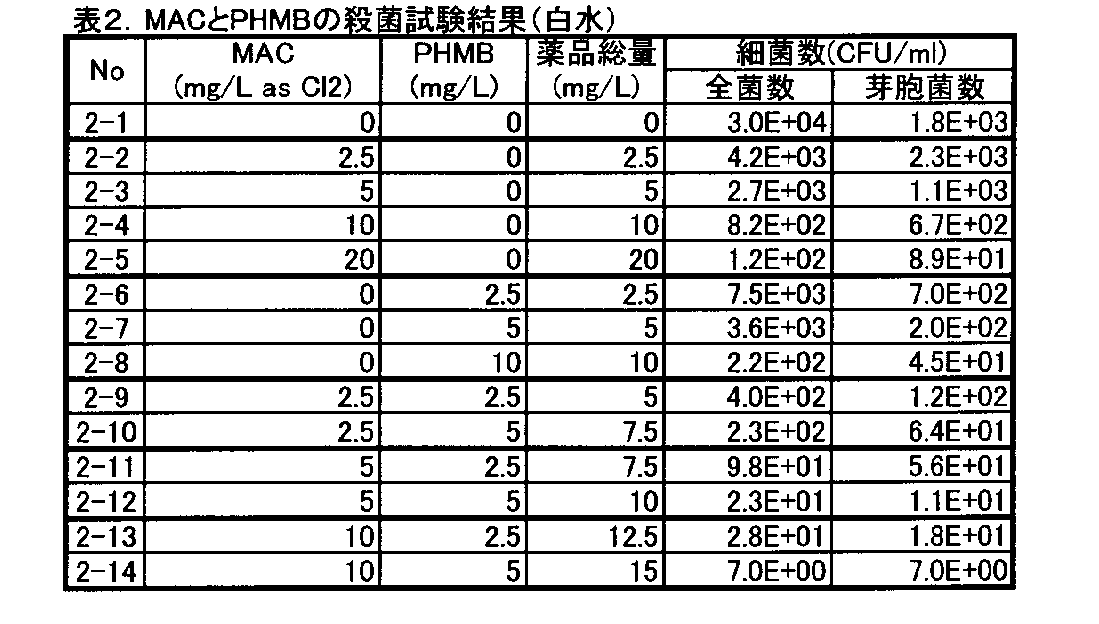
- Table 2 shows the test results using MAC and PHMB.
- Example 2 Preparation of sterilization test sample
- Manufacture of hand-wiped paper The starch powder for size of Factory B was collected, and 10% (w / w) starch slurry was prepared with sterilized water.
- the total number of bacteria and the number of bacterial spores were measured in the same manner as in Example, the total number of bacteria was 2.5E + 05 CFU / ml, and the number of bacterial spores was 8.2E + 03 CFU / ml.
- Antimicrobial agent As the antibacterial agent, the same BAC and PHMB as in Example 1 were used.
Landscapes
- Life Sciences & Earth Sciences (AREA)
- Engineering & Computer Science (AREA)
- Chemical & Material Sciences (AREA)
- Plant Pathology (AREA)
- Environmental Sciences (AREA)
- Environmental & Geological Engineering (AREA)
- Organic Chemistry (AREA)
- Agronomy & Crop Science (AREA)
- Water Supply & Treatment (AREA)
- Pest Control & Pesticides (AREA)
- Hydrology & Water Resources (AREA)
- Health & Medical Sciences (AREA)
- Dentistry (AREA)
- General Health & Medical Sciences (AREA)
- Wood Science & Technology (AREA)
- Zoology (AREA)
- Inorganic Chemistry (AREA)
- Paper (AREA)
- Agricultural Chemicals And Associated Chemicals (AREA)
- Treatment Of Water By Oxidation Or Reduction (AREA)
Abstract
紙パルプ製造工程において、ハロゲン系の酸化性殺菌剤と、ポリアルキレングアニジン化合物とを添加する紙パルプ製造工程における殺菌方法。ハロゲン系の酸化性殺菌剤の一例は、次亜塩素酸、次亜塩素酸塩、次亜臭素酸、次亜臭素酸塩、二酸化塩素、ハロアミン及びハロアミドよりなる群から選ばれる少なくとも1種であり、ポリアルキレングアニジン化合物の一例はポリヘキサメチレングアニジンである。
Description
本発明は、紙パルプの製造工程における殺菌方法に関するものであり、特に、紙製品中の菌数を低減するための殺菌方法に関する。
紙パルプ製造工程においては、いくつかの目的に応じて抗菌剤が用いられている。もっとも一般的であるのが、細菌や真菌が紙やパルプの製造工程の壁面に付着し、粘着物質を生成し、夾雑物をまきこみながら増殖し、粘ちょうな塊を形成するスライムを防止する目的である。スライムは工程内で成長し、剥離をすると、紙製品に混入することで異物汚れとなり、紙製品としての品質を著しく低下させる。したがって、製紙工程には、スライムを防止するスライムコントロール剤として抗菌剤が添加されている。また、それ以外にも、細菌が嫌気条件下における澱粉の分解と発酵によって、有機酸を発生することによる臭気の防止やpH低下による塗料や澱粉などの配合薬品の品質低下防止目的にも抗菌剤が使用される。
紙パルプ製造工程では、従来から様々な抗菌素材を組合せた殺菌方法が検討されてきた。近年は、無機抗菌剤が紙パルプ工業における製紙工程などのスライムコントロールでは主流となっている。従来の有機抗菌剤と比べて安価で殺菌・スライム防止効果が優れるためである。無機抗菌剤とは具体的には、次亜塩素酸ナトリウムなどの次亜塩素酸塩や次亜臭素酸ナトリウム、二酸化塩素などがあるが、近年は特に次亜塩素酸塩とアンモニウム塩、アミン、イミン、アミド及びイミドからなる窒素化合物との反応生成物が多く用いられている。例えば、臭化アンモニウムや硫酸アンモニウム、塩化アンモニウムや、カルバミン酸アンモニウム、尿素やスルファミン酸などである。これらは次亜塩素酸塩の塩素と反応結合をしたハロアミン、ハロアミドを形成した酸化性抗菌剤であり、これが高い殺菌・防腐効果やスライムコントロール効果を発揮する。有機抗菌剤としては、イソチアゾロン化合物などがある(特開2002-336867)。また、無機抗菌剤と有機抗菌剤を併用することで、相乗効果を発揮し、さらに高いスライムコントロールと防腐効果を示す例もある(特開2002-336867)。
近年は、スライムコントロール、防臭、防腐以外に、紙製品の衛生目的でも抗菌剤を用いることが必要になっている。特に紙製品の中でも紙コップや手拭き紙などは衛生条件が厳しくなっており、紙製品中の菌数を2.5E+02~1.0E+03(2.5×10²~1.0×10³)CFU/g未満など上限を設定することが増えている。
通常のスライムコントロールを目的とした抗菌剤の使用方法では、菌数は1.0E+03CFU/g以上というのが通常であり、スライムコントロールとは異なる、より強化された抗菌剤の適用が必要とされる.しかしながら、現在のところ、上記基準を確実に下回るように殺菌することは容易ではない。中でも紙パルプ製造工程では、あまり着目されなかった細菌芽胞がその障害となる。
細菌芽胞とは、バチルス属など特定の細菌が強固な殻構造を形成し、極めて高い耐熱性や耐薬性をもった形態である。通常、細菌芽胞は、そのままでは増殖せず、スライムを形成したり、腐敗を促進することはない。そのため、スライムコントロールや防腐などで問題になることはない。しかし、細菌芽胞は、紙製造工程にあるドライヤの熱や抗菌剤で死ににくいため、紙製品中の菌数を抑制する場合には、大きな障害因子になる。
細菌芽胞の処理方法は、特に食品を取り扱う施設やクリーニング施設において検討がおこなわれている。例えば、オートクレーブのような高圧蒸気で滅菌したり、極めて高い温度での処理、または薬剤として、グルタルアルデヒドや過酢酸、次亜塩素酸ナトリウムなどを使用することが、芽胞を形成するバチルスの一種である炭疽菌の消毒に世界保健機構から推奨されている(特開2004-75659)。また、これらの一般的な薬剤以外にもポリヘキサメチレングアニジン塩や第4級アンモニウム塩も推奨されている(特開2009-108184、特開2016-160245)。
これらの薬剤は、単独では効果発現が不十分であり、高アルカリにする、もしくは界面活性剤などを配合しているが、これらは洗浄剤としての用途である。しかし、紙製造工程において、このような高圧、高温、高アルカリ、高濃度の薬剤処理や発泡性の界面活性剤を加えるというのは現実的ではない。
このように、紙パルプ製造工程においては、既知のスライムコントロールや防腐技術に基づく抗菌剤の適用だけでは、特に細菌芽胞が障害となり、紙パルプ製造工程における細菌数を十分に低減し、紙製品中の菌数を低減することは難しい。さらに食品やクリーニング設備向けの既存の芽胞処理技術をそのまま紙パルプ製造工程に適用することもできない。
本発明は、紙パルプ製造工程における細菌数を十分に低減し、紙製品中の菌数を低減することができる紙パルプ製造工程における殺菌方法を提供することを目的とする。
本発明は次を要旨とする。
[1]紙パルプ製造工程において、ハロゲン系の酸化性殺菌剤と、ポリアルキレングアニジン化合物とを添加する紙パルプ製造工程における殺菌方法。
[1]紙パルプ製造工程において、ハロゲン系の酸化性殺菌剤と、ポリアルキレングアニジン化合物とを添加する紙パルプ製造工程における殺菌方法。
[2][1]において、前記ハロゲン系の酸化性殺菌剤は、次亜塩素酸、次亜塩素酸塩、次亜臭素酸、次亜臭素酸塩、二酸化塩素、ハロアミン及びハロアミドよりなる群から選ばれる少なくとも1種であり、ポリアルキレングアニジン化合物がポリアルキレンビグアナイドである紙パルプ製造工程における殺菌方法。
[3][2]において、前記ポリアルキレンビグアナイドがポリヘキサメチレンビグアナイドである紙パルプ製造工程における殺菌方法。
[4][2]又は[3]において、ハロアミン又はハロアミドは、臭化アンモニウム、硫酸アンモニウム、塩化アンモニウム、カルバミン酸アンモニウム尿素又はスルファミン酸と次亜塩素酸及び/又は次亜塩素酸塩との反応物である紙パルプ製造工程における殺菌方法。
本発明によると、紙パルプ製造工程において、高温高圧処理を行うことなく、また、高アルカリや界面活性剤などを使用せずに、少量の抗菌剤の使用により、細菌芽胞をも殺菌し、紙製品中の細菌数を十分に低減することができる。
本発明の紙パルプ製造工程における殺菌方法では、紙パルプ製造工程において、ハロゲン系の酸化性殺菌剤と、ポリアルキレングアジニン化合物とを添加する。
[適用対象]
本発明の適用対象は、紙パルプ製造工程である。図1に示すように、紙パルプ製造工程は、少なくとも次の工程(1)~(4)を有する。
本発明の適用対象は、紙パルプ製造工程である。図1に示すように、紙パルプ製造工程は、少なくとも次の工程(1)~(4)を有する。
(1)パルプ化工程:最終製品である紙の原料となるパルプの製造方法は以下のように複数ある。
化学パルプのパルプ化工程では、通常、蒸解釜中で木材チップをアルカリで蒸煮して、リグニンを除去し、さらに二酸化塩素や過酸化水素、オゾンなどで漂白してパルプを得る。このようなパルプ化工程を持たない製紙工場では、クラフトパルプを脱水し、シートにしたパルプシートを原料として用いる。
古紙パルプの場合は、雑誌古紙や新聞古紙に水を加えて離解機(パルパ)によって、繊維をほぐしたスラリーとした後に、脱墨剤によってインキ除去をし、漂白剤によって白色度を高めて脱墨パルプを得る。
パルプシートの場合は、段ボール古紙などを単純に離解機(パルパ)によって、繊維をほぐしてパルプを得る。
化学パルプのパルプ化工程では、通常、蒸解釜中で木材チップをアルカリで蒸煮して、リグニンを除去し、さらに二酸化塩素や過酸化水素、オゾンなどで漂白してパルプを得る。このようなパルプ化工程を持たない製紙工場では、クラフトパルプを脱水し、シートにしたパルプシートを原料として用いる。
古紙パルプの場合は、雑誌古紙や新聞古紙に水を加えて離解機(パルパ)によって、繊維をほぐしたスラリーとした後に、脱墨剤によってインキ除去をし、漂白剤によって白色度を高めて脱墨パルプを得る。
パルプシートの場合は、段ボール古紙などを単純に離解機(パルパ)によって、繊維をほぐしてパルプを得る。
(2)調成工程:上記のパルプスラリーを機械的な力で改質(叩解)し、混合してから、様々な薬品などを添加する工程である。添加する薬品は、パルプの空隙を埋め、白色度や不透明性を高める填料や、微細な繊維や填料がワイヤ上に留まり、脱水性を向上させる歩留・ろ水向上剤、紙のインキのにじみを防止するための耐水化剤、サイズ剤、紙の強度を高める紙力増強剤、色を調成する染料、発泡を抑える消泡剤、スライムを防止するスライムコントロール剤などである。
(3)抄紙工程:上記の調成工程で得た3%程度のパルプスラリーを、1%程度に希釈する。次いで、走行する抄紙ワイヤにヘッドボックスを用いて送り出し、脱水する。脱水した水は白水と呼ばれ、パルプスラリーの希釈などに用いられる。多層抄きの場合は、接着剤として澱粉スラリーが各層の湿紙に噴霧される。ワイヤを出た湿紙は固形分濃度20%程度であり、次にフェルトによるプレス脱水で固形分濃度50%程度に脱水される。次に蒸気を熱源としたドライヤによって、含水率10%未満まで乾燥される。また、ドライヤパートの間にサイズプレスの工程が設けられることがある。サイズプレスとは、サイズ剤を紙表面に塗布する方法で、サイズ剤だけでなく、紙の光沢性や平滑性を向上させる顔料の入った塗工液を塗布する工程である。
(4)回収工程:紙パルプ製造工程では、脱水した水(白水)や余剰のパルプのほか、紙切れや品質不良で損紙が発生する。これらはいずれも再利用され、残った一部だけが排水処理や廃棄物となる。
本発明の処理対象は上記の工程(1)~(4)の1又は2以上であり、すべてであってもよい。細菌の混入源と繁殖源のすべてにおいて殺菌・静菌をすることにより、紙製品中の菌数レベルを十分に低減することができる。
具体的には、パルプ化工程(1)においては、細菌が混入する離解時のパルプや漂白などすべて完了し貯留される完成パルプスラリー、調成工程(2)においては、全工程と、特に細菌が混入・繁殖しやすい澱粉系のサイズ剤、紙力向上剤、抄紙工程(3)においては、抄紙ワイヤ前のパルプスラリーと白水、多層抄きの接着澱粉、澱粉系のサイズ澱粉や塗工液とその原料(炭酸カルシウム、クレー、澱粉、ラテックスなど)、回収工程(4)においては、回収された白水、損紙すべてが対象となる。
特に、調成工程(2)と抄紙工程(3)、回収工程(4)のパルプスラリーや白水は、各所に添加された澱粉が回収された白水などを介して循環するため、それが栄養源となって細菌が繁殖しやすい。また、工場によるが、河川水や井戸水などの補給水もまた、細菌の混入源になることがある。
細菌芽胞は、これらのいずれの箇所でも検出されるが、特に以下の3箇所で多く見られる。
(i) 外部からの持込み:例えば澱粉や外部から購入したパルプシートの離解スラリー
(ii) 澱粉を加熱し、膨潤させるクッキングという工程を経た澱粉糊液では細菌芽胞が形成され生き残っている。
(iii) 回収工程の損紙スラリーや回収した水(回収水)を長時間貯留するタンク。腐敗が進行する中で生存が厳しくなり細菌芽胞を形成すると推測される。
(i) 外部からの持込み:例えば澱粉や外部から購入したパルプシートの離解スラリー
(ii) 澱粉を加熱し、膨潤させるクッキングという工程を経た澱粉糊液では細菌芽胞が形成され生き残っている。
(iii) 回収工程の損紙スラリーや回収した水(回収水)を長時間貯留するタンク。腐敗が進行する中で生存が厳しくなり細菌芽胞を形成すると推測される。
[抗菌剤]
〈ハロゲン系酸化性殺菌剤〉
ハロゲン系酸化性殺菌剤としては、次亜塩素酸(塩)、次亜臭素酸(塩)、二酸化塩素が挙げられる。また、ハロゲン系酸化性殺菌剤としては、臭化アンモニウム、硫酸アンモニウム、塩化アンモニウム、カルバミン酸アンモニウム、尿素やスルファミン酸と次亜塩素酸(塩)との反応物であるハロアミン、ハロアミドも挙げられる。ハロゲン系酸化性殺菌剤としては、これらの1種又は2種以上が用いられる。
〈ハロゲン系酸化性殺菌剤〉
ハロゲン系酸化性殺菌剤としては、次亜塩素酸(塩)、次亜臭素酸(塩)、二酸化塩素が挙げられる。また、ハロゲン系酸化性殺菌剤としては、臭化アンモニウム、硫酸アンモニウム、塩化アンモニウム、カルバミン酸アンモニウム、尿素やスルファミン酸と次亜塩素酸(塩)との反応物であるハロアミン、ハロアミドも挙げられる。ハロゲン系酸化性殺菌剤としては、これらの1種又は2種以上が用いられる。
〈ポリアルキレングアジニン化合物〉
ポリアルキレングアジニン化合物としては、ポリアルキレンビグアナイド又はその誘導体が好適であり、具体的にはポリヘキサメチレンビグアナイド(PHMB)が好ましい。
ポリアルキレングアジニン化合物としては、ポリアルキレンビグアナイド又はその誘導体が好適であり、具体的にはポリヘキサメチレンビグアナイド(PHMB)が好ましい。
[抗菌剤の添加場所]
酸化性殺菌剤とポリアルキレングアジニン化合物の添加点は、同一である必要はなく、状況に応じて添加場所を自由に決めてよい。紙パルプ製造工程は、水と原料が循環をしており、特に酸化性殺菌剤は添加点から後工程まで残留しやすい特徴があるためである。例えば、細菌芽胞がほとんど存在しない場所には酸化性殺菌剤のみを添加し、その下流の細菌芽胞の多い場所にポリアルキレングアジニン化合物を追加添加する。
酸化性殺菌剤とポリアルキレングアジニン化合物の添加点は、同一である必要はなく、状況に応じて添加場所を自由に決めてよい。紙パルプ製造工程は、水と原料が循環をしており、特に酸化性殺菌剤は添加点から後工程まで残留しやすい特徴があるためである。例えば、細菌芽胞がほとんど存在しない場所には酸化性殺菌剤のみを添加し、その下流の細菌芽胞の多い場所にポリアルキレングアジニン化合物を追加添加する。
より具体的な例を挙げると、白水の回収水はパルプや損紙の離解時の仕込水として用いられることが多い。ここで、白水の回収水に細菌芽胞はほとんど存在しないが、通常の細菌が多いとすると、通常の酸化性殺菌剤による殺菌・静菌が必要である。一方でパルプには持ち込みの芽胞が存在する場合には、酸化性殺菌剤だけでは不十分であり、ポリアルキレングアジニン化合物を追加添加する。ただし、酸化性殺菌剤は仕込み水となる白水の回収水を介してパルプに混入するので、残留濃度が極端に低下していなければ、パルプの離解時に追加添加する必要はない。
一方、澱粉のスラリーや糊液の工程は、基本的に循環はなく、一過式であるため、細菌芽胞が存在する場合には、添加点は同一か近い位置になる。
[抗菌剤の添加濃度]
ハロゲン系酸化性殺菌剤は、一般的に、有効塩素濃度で濃度が規定されるので、本明細書においてもすべて有効塩素濃度で規定をする。通常、ハロゲン系酸化性殺菌剤は、その酸化力のために、過度に高い濃度になると、ステンレス鋼の腐食や、染料の退色、高分子の分解など悪影響を及ぼすことが多い。
ハロゲン系酸化性殺菌剤は、一般的に、有効塩素濃度で濃度が規定されるので、本明細書においてもすべて有効塩素濃度で規定をする。通常、ハロゲン系酸化性殺菌剤は、その酸化力のために、過度に高い濃度になると、ステンレス鋼の腐食や、染料の退色、高分子の分解など悪影響を及ぼすことが多い。
ポリアルキレングアジニン化合物は、特に工程内で悪影響を及ぼすことはないが、ハロゲン系酸化性殺菌剤に比べると高価であることから、使用量はできる限り少ないほうがよい。
以上の点と、種々の実験結果とから、添加濃度は次の範囲が望ましい。
ハロゲン系酸化性殺菌剤:0.1~100mg/L as Cl2特に1.0~20mg/L as Cl2
ポリアルキレングアジニン化合物:0.1~200mg/L特に1.0~50mg/L
ポリアルキレングアジニン化合物:0.1~200mg/L特に1.0~50mg/L
[抗菌剤の添加方法]
抗菌剤の添加は、間欠添加と連続添加のどちらでもよい。ただし、紙製品中の菌数レベルを常時抑えることが目的であることから、間欠添加であっても、常時薬品が残留するような添加間隔が望ましい。例えば、パルプの離解や澱粉の溶解などバッチ製造の場合は、バッチごとに添加をするのが効率的である。ただし、バッチに連動した薬品添加の制御が難しいこともあるので、高頻度の添加であってもかまわない。
抗菌剤の添加は、間欠添加と連続添加のどちらでもよい。ただし、紙製品中の菌数レベルを常時抑えることが目的であることから、間欠添加であっても、常時薬品が残留するような添加間隔が望ましい。例えば、パルプの離解や澱粉の溶解などバッチ製造の場合は、バッチごとに添加をするのが効率的である。ただし、バッチに連動した薬品添加の制御が難しいこともあるので、高頻度の添加であってもかまわない。
紙パルプ製造工程は、上述のとおり、水や原料が循環しているが、その循環のフローや、循環/廃水・廃原料の比率が設備ごとで全く異なるので、間欠添加の場合、添加頻度を一律に規定することは難しいが、基本的に、滞留時間の長いタンク(回収水タンクや損紙タンク)は低頻度の添加であっても常時薬品を残留させることができる。
パルパタンクやサイズ循環液は、滞留時間が短いため、高頻度での添加が必要である。また、特にハロゲン系酸化性殺菌剤は後工程まで残留しやすいため、白水や回収水タンクに添加したハロゲン系酸化性殺菌剤が、パルパにまで残留するので、パルパに添加する必要はない。通常の細菌数を低下させるには、ハロゲン系酸化性殺菌剤だけでも十分にできるので、ポリアルキレングアジニン化合物は、特に細菌芽胞が多く検出される場所に限って添加することが効率的である。
以下に添加方法の一例を挙げる。
パルプ化工程:パルパタンクにポリアルキレングアジニン化合物を24回/日添加する。
抄紙工程:白水タンクにポリアルキレングアジニン化合物とハロゲン系酸化性殺菌剤とを12回/日添加する。
回収工程:損紙タンクにポリアルキレングアジニン化合物とハロゲン系酸化性殺菌剤とを8回/日添加する。
回収水タンクにハロゲン系酸化性殺菌剤を8回/日添加する。
サイズ澱粉仕込みタンクにポリアルキレングアジニン化合物とハロゲン系酸化性殺菌剤をバッチ添加する。
サイズ澱粉循環液にポリアルキレングアジニン化合物を24回/日添加する。
パルプ化工程:パルパタンクにポリアルキレングアジニン化合物を24回/日添加する。
抄紙工程:白水タンクにポリアルキレングアジニン化合物とハロゲン系酸化性殺菌剤とを12回/日添加する。
回収工程:損紙タンクにポリアルキレングアジニン化合物とハロゲン系酸化性殺菌剤とを8回/日添加する。
回収水タンクにハロゲン系酸化性殺菌剤を8回/日添加する。
サイズ澱粉仕込みタンクにポリアルキレングアジニン化合物とハロゲン系酸化性殺菌剤をバッチ添加する。
サイズ澱粉循環液にポリアルキレングアジニン化合物を24回/日添加する。
[実施例1及び比較例1]
[細菌試験用試料の調成]
カップ原紙を製造するA工場の抄紙工程から白水(pH7.4、温度30℃、SS濃度0.1%)を採取した。ただし、細菌芽胞数が7.0E+01CFU/mlと数が少なく、殺菌試験を実施するために以下の方法で細菌芽胞数を増やした。
[細菌試験用試料の調成]
カップ原紙を製造するA工場の抄紙工程から白水(pH7.4、温度30℃、SS濃度0.1%)を採取した。ただし、細菌芽胞数が7.0E+01CFU/mlと数が少なく、殺菌試験を実施するために以下の方法で細菌芽胞数を増やした。
白水サンプルを80℃20分で加熱することで、細菌芽胞以外の一般細菌を死滅させ、その後に、標準寒天培地(肉エキス5g、ペプトン10g、水1L、粉末寒天15g、pH7)に混釈し、恒温器で30℃2日間静置し、細菌芽胞のコロニーを得た。この細菌芽胞のコロニーを白金耳で一かきし、標準寒天培地の寒天を除いた液体培地2mlの入った試験管に加えて30℃80rpmでオーバーナイトで振とう培養し、細菌芽胞の菌液を得た。この菌液を0.01%白水に加えて、加熱処理をしていない全菌数と加熱処理した細菌芽胞数を同様に測定した結果、全菌数3.0E+04CFU/ml、細菌芽胞数1.8E+03CFU/mlであり、殺菌試験用の試料とした。
[ハロゲン系酸化性殺菌剤の調製]
薬品は、ハロゲン系酸化性殺菌剤として以下のBACとMACを作製した。
1)臭素活性化クロラミン(BAC)
純水で7,000mg/Lに希釈した臭化アンモニウム水溶液と、純水で有効塩素濃度5,000mg/Lに調製した次亜塩素酸ナトリウム水溶液を1:1で混合反応させた有効塩素濃度2,500mg/Lの臭素活性化クロラミン(BAC)を得た。
2)モノクロラミン(MAC)
同様に純水で有効塩素濃度5,000mg/Lに調製した次亜塩素酸ナトリウム水溶液と、5,000mg/Lの硫酸アンモニウム水溶液を1:1で混合反応させた有効塩素濃度2,500mg/Lのモノクロラミン(MAC)を得た。
薬品は、ハロゲン系酸化性殺菌剤として以下のBACとMACを作製した。
1)臭素活性化クロラミン(BAC)
純水で7,000mg/Lに希釈した臭化アンモニウム水溶液と、純水で有効塩素濃度5,000mg/Lに調製した次亜塩素酸ナトリウム水溶液を1:1で混合反応させた有効塩素濃度2,500mg/Lの臭素活性化クロラミン(BAC)を得た。
2)モノクロラミン(MAC)
同様に純水で有効塩素濃度5,000mg/Lに調製した次亜塩素酸ナトリウム水溶液と、5,000mg/Lの硫酸アンモニウム水溶液を1:1で混合反応させた有効塩素濃度2,500mg/Lのモノクロラミン(MAC)を得た。
[ポリアルキレングアジニン化合物]
ポリアルキレングアジニン化合物として、ロンザジャパンより20%ポリヘキサメチレンビグアナイド(PHMB)を入手した。
ポリアルキレングアジニン化合物として、ロンザジャパンより20%ポリヘキサメチレンビグアナイド(PHMB)を入手した。
[殺菌試験]
上記の薬品をハロゲン系酸化性殺菌剤単独、PHMB単独、および両方を同時に試料に添加した条件で殺菌試験を実施した。温度30℃に加温した白水サンプルを、撹拌しながら各薬品を加えて、30分30℃で80rpmで振とう接触した。次に試料の調成と同様に、全菌数と細菌芽胞数を測定した。
上記の薬品をハロゲン系酸化性殺菌剤単独、PHMB単独、および両方を同時に試料に添加した条件で殺菌試験を実施した。温度30℃に加温した白水サンプルを、撹拌しながら各薬品を加えて、30分30℃で80rpmで振とう接触した。次に試料の調成と同様に、全菌数と細菌芽胞数を測定した。
BACとPHMBを用いた試験結果を表1に、MACとPHMBを用いた試験結果を表2に示す。

<考察>
表1,2の通り、薬品総濃度で見ると、BAC単独、あるいはPHMB単独と比べてBACとPHMB併用のほうが低い濃度で芽胞菌数を低減し、その結果として全菌数の低減が認められる。一概には言えないが、紙製品中の菌数基準として、2.5E+02CFU/mlを下回るには、全菌数と芽胞菌数で少なくとも1.0E+02CFU/ml未満である必要がある。この試験の場合、BAC単独で20mg/Lが必要であり、PHMBとMAC単独では20mg/Lでも1.0E+02CFU/mlを下回ることはできなかった。一方、BACとPHMB、又はMACとPHMBを併用をすることで、BAC又はMACとPHMBとの総濃度で10mg/Lで基準を満たすといえる。
表1,2の通り、薬品総濃度で見ると、BAC単独、あるいはPHMB単独と比べてBACとPHMB併用のほうが低い濃度で芽胞菌数を低減し、その結果として全菌数の低減が認められる。一概には言えないが、紙製品中の菌数基準として、2.5E+02CFU/mlを下回るには、全菌数と芽胞菌数で少なくとも1.0E+02CFU/ml未満である必要がある。この試験の場合、BAC単独で20mg/Lが必要であり、PHMBとMAC単独では20mg/Lでも1.0E+02CFU/mlを下回ることはできなかった。一方、BACとPHMB、又はMACとPHMBを併用をすることで、BAC又はMACとPHMBとの総濃度で10mg/Lで基準を満たすといえる。
[実施例2]
[殺菌試験用試料の調成]
手拭き紙を製造B工場のサイズ用澱粉の粉を採取し、滅菌水で10%(w/w)の澱粉スラリーを調成した。実施例と同様に全細菌数と細菌芽胞数を測定すると、全細菌数2.5E+05CFU/ml、細菌芽胞数8.2E+03CFU/mlであった。
[殺菌試験用試料の調成]
手拭き紙を製造B工場のサイズ用澱粉の粉を採取し、滅菌水で10%(w/w)の澱粉スラリーを調成した。実施例と同様に全細菌数と細菌芽胞数を測定すると、全細菌数2.5E+05CFU/ml、細菌芽胞数8.2E+03CFU/mlであった。
[抗菌剤]
抗菌剤としては、実施例1と同じBACとPHMBを用いた。
抗菌剤としては、実施例1と同じBACとPHMBを用いた。
[殺菌試験]
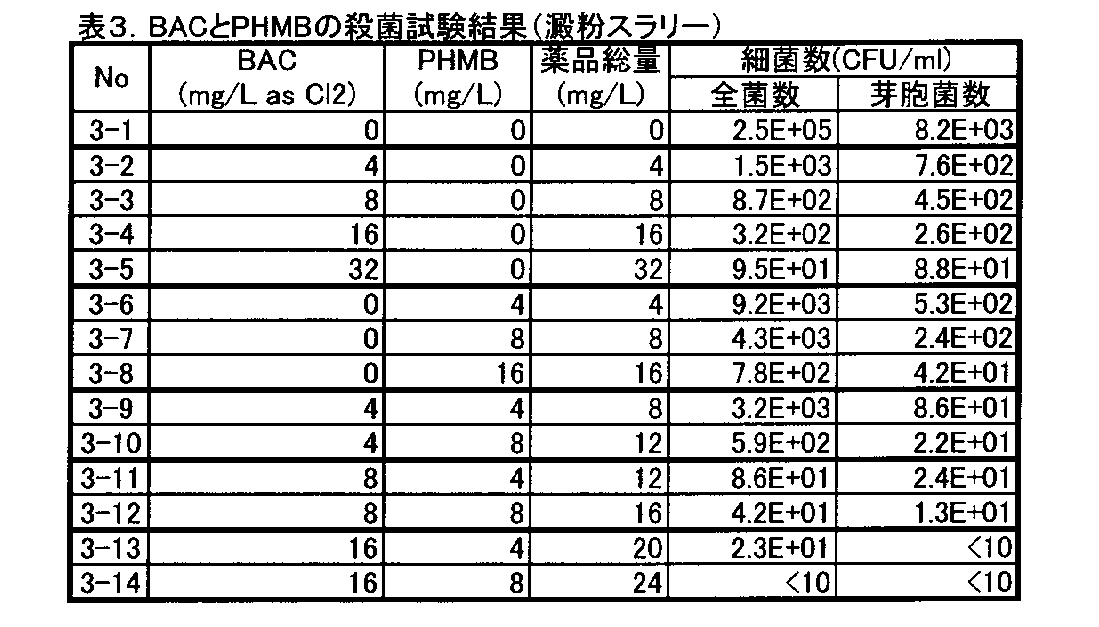
BACとPHMBを用いて実施例1と同様の試験を行った。結果を表3に示す。
BACとPHMBを用いて実施例1と同様の試験を行った。結果を表3に示す。
<考察>
澱粉スラリーの場合、白水と異なりSS濃度が高く、希釈をしないと菌数測定ができないため、測定下限は10CFU/mlとした。その結果、実施例1と同様に、BACとPHMBを併用することで芽胞菌数が低減し、低い添加濃度で全菌数の低減することが認められた。全菌数1.0E+02CFU/mlを下回るためには、(BAC)単独では32mg/L必要であり、PHMB単独では16mg/Lでも下回ることができなかった。一方、併用をすることで、総濃度12mg/Lで1.0E+02CFU/mlを下回ることができた。
澱粉スラリーの場合、白水と異なりSS濃度が高く、希釈をしないと菌数測定ができないため、測定下限は10CFU/mlとした。その結果、実施例1と同様に、BACとPHMBを併用することで芽胞菌数が低減し、低い添加濃度で全菌数の低減することが認められた。全菌数1.0E+02CFU/mlを下回るためには、(BAC)単独では32mg/L必要であり、PHMB単独では16mg/Lでも下回ることができなかった。一方、併用をすることで、総濃度12mg/Lで1.0E+02CFU/mlを下回ることができた。
本発明を特定の態様を用いて詳細に説明したが、本発明の意図と範囲を離れることなく様々な変更が可能であることは当業者に明らかである。
本出願は、2017年3月15日付で出願された日本特許出願2017-050168に基づいており、その全体が引用により援用される。
本出願は、2017年3月15日付で出願された日本特許出願2017-050168に基づいており、その全体が引用により援用される。
Claims (4)
- 紙パルプ製造工程において、ハロゲン系の酸化性殺菌剤と、ポリアルキレングアニジン化合物とを添加する紙パルプ製造工程における殺菌方法。
- 請求項1において、前記ハロゲン系の酸化性殺菌剤は、次亜塩素酸、次亜塩素酸塩、次亜臭素酸、次亜臭素酸塩、二酸化塩素、ハロアミン及びハロアミドよりなる群から選ばれる少なくとも1種であり、
ポリアルキレングアニジン化合物がポリアルキレンビグアナイドである紙パルプ製造工程における殺菌方法。 - 請求項2において、前記ポリアルキレンビグアナイドがポリヘキサメチレンビグアナイドである紙パルプ製造工程における殺菌方法。
- 請求項2又は3において、ハロアミン又はハロアミドは、臭化アンモニウム、硫酸アンモニウム、塩化アンモニウム、カルバミン酸アンモニウム尿素又はスルファミン酸と次亜塩素酸及び/又は次亜塩素酸塩との反応物である紙パルプ製造工程における殺菌方法。
Priority Applications (1)
| Application Number | Priority Date | Filing Date | Title |
|---|---|---|---|
| CN201780085261.XA CN110268115A (zh) | 2017-03-15 | 2017-09-13 | 纸浆制造工序中的杀菌方法 |
Applications Claiming Priority (2)
| Application Number | Priority Date | Filing Date | Title |
|---|---|---|---|
| JP2017-050168 | 2017-03-15 | ||
| JP2017050168A JP6361766B1 (ja) | 2017-03-15 | 2017-03-15 | 紙パルプ製造工程における細菌芽胞の殺菌方法 |
Publications (1)
| Publication Number | Publication Date |
|---|---|
| WO2018168017A1 true WO2018168017A1 (ja) | 2018-09-20 |
Family
ID=62976527
Family Applications (1)
| Application Number | Title | Priority Date | Filing Date |
|---|---|---|---|
| PCT/JP2017/033057 Ceased WO2018168017A1 (ja) | 2017-03-15 | 2017-09-13 | 紙パルプ製造工程における殺菌方法 |
Country Status (3)
| Country | Link |
|---|---|
| JP (1) | JP6361766B1 (ja) |
| CN (1) | CN110268115A (ja) |
| WO (1) | WO2018168017A1 (ja) |
Cited By (2)
| Publication number | Priority date | Publication date | Assignee | Title |
|---|---|---|---|---|
| CN110904183A (zh) * | 2019-04-30 | 2020-03-24 | 玖龙纸业(天津)有限公司 | 一种造纸系统中细菌的测试方法 |
| JP2021088787A (ja) * | 2019-12-05 | 2021-06-10 | 日本製紙株式会社 | 飲食品用多層紙 |
Families Citing this family (1)
| Publication number | Priority date | Publication date | Assignee | Title |
|---|---|---|---|---|
| CN111493088A (zh) * | 2020-04-29 | 2020-08-07 | 广西夏阳环保科技有限公司 | 一种高效复合84消毒液及其制备方法 |
Citations (9)
| Publication number | Priority date | Publication date | Assignee | Title |
|---|---|---|---|---|
| JPH0967797A (ja) * | 1995-08-31 | 1997-03-11 | Daiwa Kagaku Kogyo Kk | 抗菌防カビ性を有する紙製品 |
| JPH10273408A (ja) * | 1996-11-27 | 1998-10-13 | K I Kasei Kk | 殺微生物組成物及び微生物の制御方法 |
| JPH1171208A (ja) * | 1997-08-27 | 1999-03-16 | Sagami Chem Res Center | 殺微生物活性を有する組成物および微生物の制御方法 |
| JP2003113004A (ja) * | 2001-10-04 | 2003-04-18 | Nicca Chemical Co Ltd | カチオン性抗菌加工用併用剤及び抗菌加工方法 |
| JP2006022097A (ja) * | 2004-07-02 | 2006-01-26 | Rohm & Haas Co | 殺菌組成物 |
| JP2011226044A (ja) * | 2010-03-30 | 2011-11-10 | Kurita Water Ind Ltd | スライムを抑制する方法 |
| JP2012072071A (ja) * | 2010-09-28 | 2012-04-12 | Sumika Enviro-Science Co Ltd | 工業用抗菌組成物 |
| JP2013505956A (ja) * | 2009-09-28 | 2013-02-21 | ダウ グローバル テクノロジーズ エルエルシー | ジブロモマロンアミドの組成物および殺生剤としてのその使用 |
| WO2014030751A1 (ja) * | 2012-08-24 | 2014-02-27 | ナルコジャパン合同会社 | 製紙工程におけるスライム発生防止方法 |
Family Cites Families (2)
| Publication number | Priority date | Publication date | Assignee | Title |
|---|---|---|---|---|
| CN103930619B (zh) * | 2011-08-25 | 2016-12-07 | 索理思科技开曼公司 | 增加强度助剂在制造纸和纸板中的优势的方法 |
| CN105165879B (zh) * | 2014-04-29 | 2021-01-01 | 金红叶纸业集团有限公司 | 一种抗菌纸 |
-
2017
- 2017-03-15 JP JP2017050168A patent/JP6361766B1/ja active Active
- 2017-09-13 CN CN201780085261.XA patent/CN110268115A/zh active Pending
- 2017-09-13 WO PCT/JP2017/033057 patent/WO2018168017A1/ja not_active Ceased
Patent Citations (9)
| Publication number | Priority date | Publication date | Assignee | Title |
|---|---|---|---|---|
| JPH0967797A (ja) * | 1995-08-31 | 1997-03-11 | Daiwa Kagaku Kogyo Kk | 抗菌防カビ性を有する紙製品 |
| JPH10273408A (ja) * | 1996-11-27 | 1998-10-13 | K I Kasei Kk | 殺微生物組成物及び微生物の制御方法 |
| JPH1171208A (ja) * | 1997-08-27 | 1999-03-16 | Sagami Chem Res Center | 殺微生物活性を有する組成物および微生物の制御方法 |
| JP2003113004A (ja) * | 2001-10-04 | 2003-04-18 | Nicca Chemical Co Ltd | カチオン性抗菌加工用併用剤及び抗菌加工方法 |
| JP2006022097A (ja) * | 2004-07-02 | 2006-01-26 | Rohm & Haas Co | 殺菌組成物 |
| JP2013505956A (ja) * | 2009-09-28 | 2013-02-21 | ダウ グローバル テクノロジーズ エルエルシー | ジブロモマロンアミドの組成物および殺生剤としてのその使用 |
| JP2011226044A (ja) * | 2010-03-30 | 2011-11-10 | Kurita Water Ind Ltd | スライムを抑制する方法 |
| JP2012072071A (ja) * | 2010-09-28 | 2012-04-12 | Sumika Enviro-Science Co Ltd | 工業用抗菌組成物 |
| WO2014030751A1 (ja) * | 2012-08-24 | 2014-02-27 | ナルコジャパン合同会社 | 製紙工程におけるスライム発生防止方法 |
Cited By (3)
| Publication number | Priority date | Publication date | Assignee | Title |
|---|---|---|---|---|
| CN110904183A (zh) * | 2019-04-30 | 2020-03-24 | 玖龙纸业(天津)有限公司 | 一种造纸系统中细菌的测试方法 |
| JP2021088787A (ja) * | 2019-12-05 | 2021-06-10 | 日本製紙株式会社 | 飲食品用多層紙 |
| JP7439360B2 (ja) | 2019-12-05 | 2024-02-28 | 日本製紙株式会社 | 飲食品用多層紙 |
Also Published As
| Publication number | Publication date |
|---|---|
| JP6361766B1 (ja) | 2018-07-25 |
| JP2018154931A (ja) | 2018-10-04 |
| CN110268115A (zh) | 2019-09-20 |
Similar Documents
| Publication | Publication Date | Title |
|---|---|---|
| EP2079308B1 (en) | Method for preventing growth of microorganisms, and a combination for the prevention of microbial growth | |
| US12114659B2 (en) | Method for controlling growth of microorganisms and/or biofilms in an industrial process | |
| JP6361766B1 (ja) | 紙パルプ製造工程における細菌芽胞の殺菌方法 | |
| TW201741527A (zh) | 組成物之用途及減少漿體懸浮液中細菌孢子之方法 | |
| JP4914146B2 (ja) | 製紙工程水の殺菌方法 | |
| JP7205975B2 (ja) | 繊維ウェブを製造するための方法 | |
| JP5357440B2 (ja) | 有害微生物撲滅剤及びそれを用いた有害微生物撲滅方法 | |
| JPH08260392A (ja) | 抄紙工程における微生物の抑制ならびにスライム及びピッチによる堆積物処理剤 | |
| JP2003105692A (ja) | 製紙工程における微生物抑制方法 | |
| FI130297B (en) | METHOD FOR REDUCING THE QUANTITY OF BACTERIAL ENDOSPORES IN AN AQUEOUS FIBER SUSPENSION | |
| JP5213299B2 (ja) | スライムコントロール剤の添加方法及び装置 | |
| JP2002138393A (ja) | 製紙工程における微生物の抑制方法およびこれを用いて製造された紙 | |
| JP7766288B1 (ja) | 食品添加物を利用した古紙パルプの食品用抗菌板紙への再生方法及び製造法 | |
| US20250261660A1 (en) | Formulations and methods for use in oxidation treatment applications | |
| JP3887085B2 (ja) | スライムコントロール剤及び方法 | |
| JP2024146047A (ja) | 芽胞形成菌の殺芽胞方法 | |
| CA3080946C (en) | Method for manufacturing a fibrous web | |
| Simpson | Whitewater Technologies Ltd, PO Box 1153, Stourbridge, West Midlands DY8 2GB | |
| EP2709960B1 (en) | Method for reducing the biological contamination in a paper production procedure. | |
| JP2024137210A (ja) | 芽胞形成菌の殺芽胞方法 | |
| NZ761890B2 (en) | Method for controlling growth of microorganisms and/or biofilms in an industrial process | |
| WO2008055967A2 (de) | Pulverförmige additive für die papierherstellung |
Legal Events
| Date | Code | Title | Description |
|---|---|---|---|
| 121 | Ep: the epo has been informed by wipo that ep was designated in this application |
Ref document number: 17900464 Country of ref document: EP Kind code of ref document: A1 |
|
| NENP | Non-entry into the national phase |
Ref country code: DE |
|
| 122 | Ep: pct application non-entry in european phase |
Ref document number: 17900464 Country of ref document: EP Kind code of ref document: A1 |