WO2018147446A1 - イソプレノイド化合物の製造方法 - Google Patents
イソプレノイド化合物の製造方法 Download PDFInfo
- Publication number
- WO2018147446A1 WO2018147446A1 PCT/JP2018/004729 JP2018004729W WO2018147446A1 WO 2018147446 A1 WO2018147446 A1 WO 2018147446A1 JP 2018004729 W JP2018004729 W JP 2018004729W WO 2018147446 A1 WO2018147446 A1 WO 2018147446A1
- Authority
- WO
- WIPO (PCT)
- Prior art keywords
- protein
- seq
- polynucleotide
- amino acid
- full
- Prior art date
- Legal status (The legal status is an assumption and is not a legal conclusion. Google has not performed a legal analysis and makes no representation as to the accuracy of the status listed.)
- Ceased
Links
Images


Classifications
-
- C—CHEMISTRY; METALLURGY
- C12—BIOCHEMISTRY; BEER; SPIRITS; WINE; VINEGAR; MICROBIOLOGY; ENZYMOLOGY; MUTATION OR GENETIC ENGINEERING
- C12N—MICROORGANISMS OR ENZYMES; COMPOSITIONS THEREOF; PROPAGATING, PRESERVING, OR MAINTAINING MICROORGANISMS; MUTATION OR GENETIC ENGINEERING; CULTURE MEDIA
- C12N15/00—Mutation or genetic engineering; DNA or RNA concerning genetic engineering, vectors, e.g. plasmids, or their isolation, preparation or purification; Use of hosts therefor
- C12N15/09—Recombinant DNA-technology
-
- C—CHEMISTRY; METALLURGY
- C12—BIOCHEMISTRY; BEER; SPIRITS; WINE; VINEGAR; MICROBIOLOGY; ENZYMOLOGY; MUTATION OR GENETIC ENGINEERING
- C12N—MICROORGANISMS OR ENZYMES; COMPOSITIONS THEREOF; PROPAGATING, PRESERVING, OR MAINTAINING MICROORGANISMS; MUTATION OR GENETIC ENGINEERING; CULTURE MEDIA
- C12N9/00—Enzymes; Proenzymes; Compositions thereof; Processes for preparing, activating, inhibiting, separating or purifying enzymes
- C12N9/90—Isomerases (5.)
-
- C—CHEMISTRY; METALLURGY
- C12—BIOCHEMISTRY; BEER; SPIRITS; WINE; VINEGAR; MICROBIOLOGY; ENZYMOLOGY; MUTATION OR GENETIC ENGINEERING
- C12P—FERMENTATION OR ENZYME-USING PROCESSES TO SYNTHESISE A DESIRED CHEMICAL COMPOUND OR COMPOSITION OR TO SEPARATE OPTICAL ISOMERS FROM A RACEMIC MIXTURE
- C12P5/00—Preparation of hydrocarbons or halogenated hydrocarbons
- C12P5/02—Preparation of hydrocarbons or halogenated hydrocarbons acyclic
Definitions
- the present invention relates to a method for producing an isoprenoid compound.
- Isopentenyl diphosphate isomerase isopentenyl diphosphate delta isomerase: EC: 5.3.3.2
- DMAPP dimethylallyl diphosphate
- IPP isopentenyl diphosphate
- Non-Patent Documents 1 and 2 each include Streptomyces sp. It has been described that CL190 and Streptomyces glycerosporeus (Kitasatosporia griseola) MF730-N6 strain have isopentenyl diphosphate isomerase.
- Non-Patent Document 3 describes that the amount of lycopene and astaxanthin produced can be increased by expressing a mevalonate pathway gene cluster derived from Streptomyces bacteria containing an isopentenyl diphosphate isomerase gene in E. coli. ing.
- Kaneda K, Kuzuyama T, Takagi M, Hayaka Y, Seto H. An unusual isopentenyl diphosphate isomerase found in the mevalonate pathway gene cluster from Streptomyces sp. strain CL190. Proc Natl Acad Sci USA. 2001 Jan 30; 98 (3): 932-7 Hamano Y, Dairi T, Yamamoto M, Kawasaki T, Kaneda K, Kuzuyama T, Itoh N, Seto H. Cloning of a gene cluster encoding encodings respondable for the mevalonate pathway from terpenoid-antibiotic-production streptomyces. Biosci Biotechnol Biochem. 2001 Jul; 65 (7): 1627-35.
- An object of this invention is to provide the efficient manufacturing method of an isoprenoid compound.
- a method for producing an isoprenoid compound comprising culturing a bacterium expressing a protein selected from the group consisting of the following (A-1) to (B-3) in a culture medium to produce an isoprenoid compound.
- A-1) a protein comprising the full-length amino acid sequence of SEQ ID NO: 13;
- A-2) a protein comprising an amino acid sequence having 90% or more identity with the full-length amino acid sequence of SEQ ID NO: 13 and having isopentenyl diphosphate isomerase activity;
- A-3) a protein comprising an amino acid sequence in which one or several amino acid residues are deleted, substituted, added or inserted in the full-length amino acid sequence of SEQ ID NO: 13, and having isopentenyl diphosphate isomerase activity ;
- B-1) a protein comprising the full-length amino acid sequence of SEQ ID NO: 14;
- B-2) a protein comprising an amino acid sequence having 90% or more identity with the full-length amino acid sequence of SEQ ID NO: 14 and having isopentenyl diphosphate isomerase activity;
- B-3) a protein comprising an amino acid sequence in which one or several amino acid residues are deleted, substituted, added or inserted in the full-length amino acid sequence of SEQ
- A-1) a polynucleotide comprising the full-length base sequence of SEQ ID NO: 9;
- A-2) a polynucleotide comprising a base sequence having 90% or more identity with the full-length base sequence of SEQ ID NO: 9 and encoding a protein having isopentenyl diphosphate isomerase activity;
- A-3) a polynucleotide that hybridizes under stringent conditions with a polynucleotide comprising a base sequence complementary to the full-length base sequence of SEQ ID NO: 9 and encodes a protein having isopentenyl diphosphate isomerase activity;
- B-1) a polynucleotide comprising the full-length base sequence of SEQ ID NO: 10;
- B-2) a polynucleotide comprising a base sequence having 90% or more identity with the full-length base sequence of SEQ ID NO: 10 and encoding a protein having isopentenyl diphosphate isomerase activity;
- a host cell comprising the expression vector according to [13].
- a method for producing a protein comprising producing the protein using the host cell according to [14].
- a bacterium comprising a heterologous expression unit comprising a polynucleotide encoding the protein of [10] or [11] and a promoter operably linked thereto.
- the bacterium according to [16] wherein the bacterium belongs to the family Enterobacteriaceae.
- an excellent isoprenoid compound production system can be established.
- FIG. 1 is a diagram illustrating the alignment and matching degree between cs79IDI and gfgk858IDI.
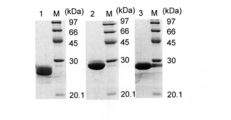
- FIG. 2 is a diagram showing the molecular mass analysis results of ecIDI, cs79IDI, and fgk858IDI by SDS-PAGE.
- M indicates a molecular weight marker
- 1 indicates a result of ecIDI
- 2 indicates a result of cs79IDI
- 3 indicates a result of fgk858IDI.
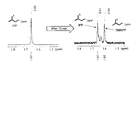
- FIG. 3 shows a 1 H-NMR chart before the start of the reaction (left diagram) and after the addition of the enzyme (right diagram).
- FIG. 4 is a graph showing stoichiometry in the isomerization reaction of IPP and DMAPP of each enzyme.
- the graph on the left shows the isomerization reaction of each enzyme using IPP and the graph on the right shows DMAPP as the starting substrate.
- the present invention provides a method for producing an isoprenoid compound.
- the method of the invention comprises culturing a microorganism expressing isopentenyl diphosphate isomerase in a culture medium to produce an isoprenoid compound.
- the isoprenoid compound consists of one or more isoprene units having the molecular formula (C 5 H 8 ) n .
- the precursor of the isoprene unit is isopentenyl pyrophosphate or dimethylallyl pyrophosphate.
- 30,000 isoprenoid compounds have been identified and new compounds have been identified.
- Isoprenoid compounds are also referred to as “terpenes” or “terpenoids”. The difference between terpenes and terpenoids is that terpenoids are hydrocarbons, whereas terpenoids contain additional functional groups.
- Terpenes are classified according to the number of isoprene units in the molecule [for example, hemiterpene (C5), monoterpene (C10), sesquiterpene (C15), diterpene (C20), sesterterpene (C25), triterpene (C30), Sescal terpenes (C35), tetraterpenes (C40), polyterpenes, norisoprenoids].
- monoterpenes include pinene, nerol, citral, camphor, menthol, limonene, and linalool.
- sesquiterpenes include nerolidol and farnesol.
- diterpenes include phytol and vitamin A1.
- Squalene is an example of a triterpene and carotene (provitamin A1) is a tetraterpene (Nature Chemical Biology 2,674 to 681 (2006); Nature Chemical Biology 5,283 to 291 (2009); Nature Reviews 9 Microbiols 37 Adv Biochem Eng Biotechmol (DOI: 10.1007 / 10 — 2014 — 288)
- Irregular isoprenoids and polyterpenes have been reported and are also included in the isoprenoid compounds: “isoprenoid”, “isoprenoid compound”, “ The terms terpene, terpene compound, terpenoid, and terpenoid compound are They are used interchangeably in writing.
- Isopentenyl diphosphate isomerase isopentenyl diphosphate delta isomerase: EC: 5.3.3.2
- DMAPP dimethylallyl diphosphate
- IPP isopentenyl diphosphate
- the present inventors have found that the proteins described below have higher isomerization activity than the previously reported isopentenyl diphosphate isomerase.
- the protein of the invention is: (A-1) a protein comprising the full-length amino acid sequence of SEQ ID NO: 13; and (B-1) a protein comprising the full-length amino acid sequence of SEQ ID NO: 14.
- SEQ ID NO: 13 is an actinomycete Streptomyces sp. It is the amino acid sequence of FGK858-derived isopentenyl diphosphate isomerase FGK858IDI.
- SEQ ID NO: 14 is an actinomycete Streptomyces sp. It is the amino acid sequence of isopentenyl diphosphate isomerase CS79IDI derived from CS79. The identity obtained by using EMBOSS Stretcher (http://www.ebi.ac.uk/Tools/psa/emboss_stretcher/help/index-protein.html) is 75.8%, and the homology is 83. 7% (see FIG. 1, Example 3 and Table 7), both having many common sequence portions.
- the protein of the present invention is a homologous protein of the protein of (A-1) or (B-1).
- homologous proteins include the following: (A-2) a protein comprising an amino acid sequence having 90% or more identity with the full-length amino acid sequence of SEQ ID NO: 13 and having isopentenyl diphosphate isomerase activity; and (B-2) a full-length amino acid of SEQ ID NO: 14 A protein comprising an amino acid sequence having 90% or more identity with a sequence and having isopentenyl diphosphate isomerase activity.
- The% identity with the amino acid sequence may be 91%, 92%, 93%, 94%, 95%, 96%, 97%, 98% or 99% or more.
- the protein of the present invention is a modified protein of the protein of (A-1) or (B-1).
- modified proteins include the following: (A-3) a protein comprising an amino acid sequence in which one or several amino acid residues are deleted, substituted, added or inserted in the full-length amino acid sequence of SEQ ID NO: 13, and having isopentenyl diphosphate isomerase activity And (B-3) an amino acid sequence in which one or several amino acid residues are deleted, substituted, added or inserted in the full-length amino acid sequence of SEQ ID NO: 14, and have isopentenyl diphosphate isomerase activity Protein.
- one or several amino acid residues can be modified by 1, 2, 3 or 4 mutations selected from the group consisting of deletion, substitution, addition and insertion of amino acid residues.
- the amino acid residue mutation may be introduced into one region in the amino acid sequence, or may be introduced into a plurality of different regions.
- the term “one or several” refers to a number that does not significantly impair the activity of the protein.
- the number represented by the term “one or several” is, for example, 1 to 100, preferably 1 to 80, more preferably 1 to 50, 1 to 30, 1 to 20, 1 to 10 or 1 to 5 (eg, 1, 2, 3, 4, or 5).
- isopentenyl diphosphate isomerase activity refers to an enzyme activity that isomerizes isopentenyl diphosphate (IPP) and dimethylallyl diphosphate (DMAPP) with each other.
- the protein isopentenyl diphosphate isomerase activity of the present invention is 50% or more, 60% or more, 70% or more, 80% or more of the isopentenyl diphosphate isomerase activity of the protein (A-1) or (B-1). 90% or more, or preferably 95% or more.
- reaction time when the concentration of IPP and DMAPP is 1 1 in the same reaction solution (eg, 50 mM imidazole (pH 7.5), 5 mM MgCl 2 , 6.7 mM IPP, and 1.0 mg / ml enzyme).
- reaction time when the concentration of IPP and DMAPP reaches an equilibrium state is not particularly limited, but is about 1.1 times or less, about 1.2 times or less, about 1.3 times or less, about 1 .4 times or less, or about 1.5 times or less.
- the protein of the present invention may have mutations introduced at sites in the catalytic domain and at sites other than the catalytic domain as long as the target activity can be maintained.
- the positions of amino acid residues to which mutations can be introduced that can retain the desired activity will be apparent to those skilled in the art. Specifically, a person skilled in the art compares 1) the amino acid sequences of a plurality of proteins having the same type of activity (eg, the amino acid sequence of SEQ ID NO: 13 or 14 and the amino acid sequence of other isopentenyl diphosphate isomerase).
- amino acid residue substitution may be a conservative substitution.
- conservative substitution refers to the replacement of a given amino acid residue with an amino acid residue having a similar side chain. Families of amino acid residues with similar side chains are well known in the art.
- such families include amino acids having basic side chains (eg, lysine, arginine, histidine), amino acids having acidic side chains (eg, aspartic acid, glutamic acid), amino acids having uncharged polar side chains (Eg, asparagine, glutamine, serine, threonine, tyrosine, cysteine), amino acids with non-polar side chains (eg, glycine, alanine, valine, leucine, isoleucine, proline, phenylalanine, methionine, tryptophan), ⁇ -branched side chain Amino acids (eg, threonine, valine, isoleucine), amino acids having aromatic side chains (eg, tyrosine, phenylalanine, tryptophan, histidine), amino acids having side groups containing hydroxyl groups (eg, alcoholic, phenolic) ( Example, serine, thread Nin, tyrosine), and amino acids (e.g.
- the conservative substitution of amino acids is a substitution between aspartic acid and glutamic acid, a substitution between arginine and lysine and histidine, a substitution between tryptophan and phenylalanine, and between phenylalanine and valine. Or a substitution between leucine, isoleucine and alanine, and a substitution between glycine and alanine.
- the protein of the present invention may also be a fusion protein linked to a heterologous moiety via a peptide bond.
- heterogeneous moieties include peptide components that facilitate the purification of the target protein (eg, tag sections such as histidine tag, Strep-tag II, etc .; purification of target proteins such as glutathione-S-transferase, maltose binding protein, etc. ), Peptide components that improve the solubility of the target protein (eg, Nus-tag), peptide components that act as chaperones (eg, trigger factor), peptide components that have other functions (eg, full-length protein or its protein) Some), as well as linkers.
- tag sections such as histidine tag, Strep-tag II, etc .
- target proteins such as glutathione-S-transferase, maltose binding protein, etc.
- Peptide components that improve the solubility of the target protein eg, Nus-tag
- the proteins of the invention can also be post-translationally modified (eg, glycosylated) proteins, or post-translationally unmodified (eg, non-glycosylated) proteins, depending on the type of host cell in which production of the protein of the invention is desired. There may be. Since the protein of the present invention is derived from the eukaryotic ginkgo, it is considered that it may be post-translationally modified (eg, glycosylated) in nature. In prokaryotes, proteins are not post-translationally modified, and in animal cells, plant cells, insect cells (eg, Sf9 cells), and lower eukaryotes (eg, yeast), the post-translational modification of proteins is very different.
- Examples of the protein of the present invention as described above include proteins derived from actinomycetes, naturally occurring homologues, or artificially produced mutant proteins.
- the mutant protein can be obtained, for example, by introducing a mutation into DNA encoding the target protein and producing the mutant protein using the obtained mutant DNA.
- Examples of the mutagenesis method include site-specific mutagenesis and random mutagenesis treatment (eg, treatment with a mutagen and ultraviolet irradiation).
- the actinomycete herein for example, Streptomyces genus, Kitasatospora spp, Streptacidiphilus genus, Pseudonocardia sp, Actinoalloteichus genus, Actinokineospora genus, Actinomycetospora genus, Actinophytocola genus, Actinosynnema spp, Alloactinosynnema genus, Allokutzneria genus, Amycolatopsis sp, Crossiella genus, Goodfellowiella Genus, Haloechinothrix, Kidelosporangium, Kutzneria, Labedaea, Lechevaleria, Lentzea, Lo gimycelium genus Prauserella genus Saccharomonospora genus Saccharopolyspora genus Saccharothrix genus Sciscionella genus Streptoalloteich
- the polynucleotide may be DNA or RNA, but is preferably DNA.
- the polynucleotide of the present invention can be derived from actinomycetes.
- the polynucleotide of the present invention is not particularly limited as long as it encodes the protein.
- the polynucleotide described below may be used.
- the polynucleotide of the present invention is: (A-1) a polynucleotide comprising the full-length base sequence of SEQ ID NO: 9; and (b-1) a polynucleotide comprising the full-length base sequence of SEQ ID NO: 10.
- the base sequence of SEQ ID NO: 9 encodes the amino acid sequence of SEQ ID NO: 13.
- the base sequence of SEQ ID NO: 10 encodes the amino acid sequence of SEQ ID NO: 14.
- start codon refers to a codon that specifies the start of protein synthesis.
- start codon include, for example, a codon encoding a methionine residue (eg, AUG), a codon encoding a valine residue (eg, GUG), a codon encoding an isoleucine residue (eg, AUA), and a leucine residue Are codons (eg, UUG), and a codon (eg, AUG) encoding a methionine residue is preferred.
- nucleotide residue “U” should be used as described above.
- T is substituted for nucleotide residue “U”. Should be used.
- the polynucleotide of the present invention is a homologous polynucleotide of the polynucleotide of (a) or (b).
- homologous polynucleotides include the following: (A-2) a polynucleotide comprising a base sequence having 90% or more identity with the full-length base sequence of SEQ ID NO: 9 and encoding a protein having isopentenyl diphosphate isomerase activity; and (b-2) sequence A polynucleotide encoding a protein comprising a base sequence having 90% or more identity with the full-length base sequence of No. 10 and having isopentenyl diphosphate isomerase activity.
- The% identity with the base sequence may be 91%, 92%, 93%, 94%, 95%, 96%, 97%, 98% or 99% or more.
- the polynucleotide of the present invention is an analog polynucleotide of the polynucleotide of (a-3) or (b-3).
- analog polynucleotides include the following: (A-3) a polynucleotide that hybridizes under stringent conditions with a polynucleotide comprising a nucleotide sequence complementary to the full-length nucleotide sequence of SEQ ID NO: 9 and encodes a protein having isopentenyl diphosphate isomerase activity; (B-3) A polynucleotide that hybridizes under stringent conditions with a polynucleotide comprising a base sequence complementary to the full-length base sequence of SEQ ID NO: 10 and encodes a protein having isopentenyl diphosphate isomerase activity.
- stringent conditions refers to conditions under which so-called specific hybrids are formed and non-specific hybrids are not formed.
- stringent conditions include hybridization at about 45 ° C. in 6 ⁇ SSC (sodium chloride / sodium citrate), followed by 50 ⁇ 65 ° C. in 0.2 ⁇ SSC, 0.1% SDS. 1 or 2 or more washing
- the polynucleotide of the invention is a degenerate polynucleotide.
- degenerate polynucleotides include the following: (C) A degenerate variant of a polynucleotide selected from the group consisting of (a-1) to (b-3).
- the term “degenerate variant” refers to another codon in which at least one codon encoding a given amino acid residue in a polynucleotide before mutation encodes the same amino acid residue. Refers to a polynucleotide variant that has been altered to. Since such a degenerate mutant is a mutant based on a silent mutation, the protein encoded by the degenerate mutant is the same as the protein encoded by the polynucleotide before the mutation.
- a degenerate variant is a polynucleotide variant in which the codons have been altered to match the codon usage of the host cell into which it is to be introduced.
- a gene is expressed in a heterologous host cell (eg, a microorganism)
- the corresponding tRNA molecular species are not sufficiently supplied due to the difference in codon usage, resulting in decreased translation efficiency and / or incorrect translation (eg, translation). Stop) may occur.
- the low frequency codons shown in Table 1 are known.
- a degenerate mutant that matches the codon usage of the host cell (eg, microorganism) as described below can be used.
- the codon encoding one or more amino acid residues selected from the group consisting of arginine residues, glycine residues, isoleucine residues, leucine residues, and proline residues is changed. It may be what was done.
- the degenerate mutant of the present invention has one or more codons selected from the group consisting of low frequency codons (eg, AGG, AGA, CGG, CGA, GGA, AUA, CUA, and CCC). It may have been changed.
- the degenerate variant may comprise one or more (eg, 1, 2, 3, 4 or 5) codon changes selected from the group consisting of: i) Change of at least one codon selected from the group consisting of four codons encoding Arg (AGG, AGA, CGG, and CGA) to another codon encoding Arg (CGU or CGC); ii) changing one codon (GGA) encoding Gly to another codon (GGG, GGU, or GGC); iii) changing one codon (AUA) encoding Ile to another codon (AUU, or AUC); iv) changing one codon (CUA) encoding Leu to another codon (UUG, UUA, CUG, CUU, or CUC); and v) one codon (CCC) encoding Pro. Change to another codon (CCG, CCA, or CCU).
- codon changes selected from the group consisting of: i) Change of at least one codon selected from the group consisting of four cod
- nucleotide residue “U” When the degenerate variant of the present invention is RNA, the nucleotide residue “U” should be used as described above. However, when the degenerate variant of the present invention is DNA, the nucleotide residue “U” is substituted. “T” should be used.
- the number of nucleotide residue mutations for adapting to the codon usage of the host cell is not particularly limited as long as it encodes the same protein before and after the mutation. For example, 1 to 500, 1 to 400, 1 to 300 1 to 200, or 1 to 100.
- a degenerate variant may include a change from a low frequency codon to a non-low frequency codon (eg, a high frequency codon).
- a non-low frequency codon eg, a high frequency codon.
- there are known methods for designing mutants in consideration of not only low-frequency codons but also factors such as suitability of the production strain to the genomic GC content (Alan Villabos et al., Gene Designer: a synthetic). biology tool for constructing artificial DNA segments, BMC Bioinformatics. 2006 Jun 6; 7: 285.), such a method may be used.
- the above-described mutant can be appropriately prepared according to the type of any host cell into which it can be introduced (for example, a microorganism as described below).
- a host commonly used for fermentation production of heterologous proteins. It may be made to fit the cell type.
- host cells widely used for fermentative production of heterologous proteins include any microorganism described below, and bacteria and yeasts are preferred. Examples of such bacteria and yeasts include bacteria belonging to the genus Bacillus such as Bacillus subtilis, bacteria belonging to the genus Corynebacterium such as Corynebacterium glutamicum, and Escherichia coli.
- Escherichia bacteria such as Escherichia coli
- Pantoea bacteria such as Pantoea ananatis
- Enterobacter cerevisiae such as Enterobacter aerogenes (Saccha Omyces cerevisiae) Saccharomyces (Saccharomyces) genus, and the like
- Schizosaccharomyces pombe Schizosaccharomyces pombe
- Schizosaccharomyces Schizosaccharomyces such
- yeasts of the genus include yeasts of the genus. Therefore, consideration of factors such as changing the low frequency codons to non-low frequency codons in such microorganisms (eg, bacteria, yeast) and suitability for genomic GC content is preferable.
- the expression vector of the present invention contains a polynucleotide encoding the protein of the present invention or the polynucleotide of the present invention.
- heterologous promoter refers to a promoter other than the natural promoter of the isopentenyl diphosphate isomerase gene derived from actinomycetes. Therefore, examples of heterologous promoters include promoters of actinomycetes-derived genes other than actinomycetes-derived isopentenyl diphosphate isomerase genes, promoters derived from organisms other than actinomycetes (eg, microorganisms, animals, insects, and plants), Examples include virus-derived promoters as well as artificially synthesized promoters.
- heterologous promoter a promoter widely used for heterologous protein production may be used.
- promoters include PhoA promoter, PhoC promoter, T7 promoter, T5 promoter, T3 promoter, lac promoter, trp promoter, trc promoter, tac promoter, PR promoter, PL promoter, SP6 promoter, arabinose inducible promoter, cold A shock promoter and a tetracycline inducible promoter are mentioned.
- the expression vector of the present invention may further contain a terminator downstream of the polynucleotide.
- terminators include T7 terminator, fd phage terminator, T4 terminator, tetracycline resistance gene terminator, and Escherichia coli trpA gene terminator.
- the expression vector of the present invention may further contain a ribosome binding site (eg, Shine-Dalgarno sequence) upstream of the start codon.
- a ribosome binding site eg, Shine-Dalgarno sequence
- the expression vector of the present invention may further contain a polynucleotide encoding a drug resistance gene.
- drug resistance genes include resistance genes for drugs such as tetracycline, ampicillin, kanamycin, hygromycin, and phosphinothricin.
- Examples of the expression vector of the present invention include a cell-based vector for expressing a protein in a host and a cell-free vector utilizing a protein translation system.
- the expression vector can also be a plasmid, viral vector, phage, integrative vector, or artificial chromosome.
- An integrative vector may be a type of vector that is integrated entirely into the genome of the host cell.
- the integrative vector may be a vector in which only a part (eg, an expression unit described later) is integrated into the host cell genome.
- the expression vector may further be a DNA vector or an RNA vector.
- a known expression vector suitable for the host is used as the cell-based vector.
- examples of such vectors include pUC (eg, pUC19, pUC18), pSTV, pBR (eg, pBR322), pHSG (eg, pHSG299, pHSG298, pHSG399, pHSG398), RSF (eg, RSF1010), pACYC (eg, PACYC177, pACYC184), pMW (eg, pMW119, pMW118, pMW219, pMW218), pQE (eg, pQE30), and derivatives thereof.
- the cell-free vector examples include an expression vector having a T7 or T3 promoter, a wheat cell-free protein synthesis vector such as a pEU-based plasmid having an SP6 promoter and the like.
- bacterium that expresses the protein of the present invention or expresses the polynucleotide of the present invention to produce the protein is used.
- the bacterium of the present invention is a host cell containing an expression unit comprising the polynucleotide of the present invention.
- the expression unit containing the polynucleotide of the present invention refers to the expression of the protein encoded by the polynucleotide of the present invention, including the polynucleotide of the present invention and a promoter operably linked thereto (eg, homologous promoter, heterologous promoter). A unit that makes possible.
- Examples of the bacterium containing the expression unit containing the polynucleotide of the present invention include host cells (transformants) containing the expression vector of the present invention.
- the host cell is not particularly limited as long as it can express the protein of the present invention.
- the host cell may be homologous or heterologous to the protein of the present invention and the polynucleotide of the present invention, but is preferably heterologous.
- the host cell may also be homologous or heterologous to the promoter, but is preferably heterologous.
- Examples of host cells include animal cells, plant cells, insect cells, and microorganisms, with microorganisms being preferred.
- Examples of the microorganism include bacteria such as bacteria belonging to the family Enterobacteriaceae and fungi.
- the bacterium may be a gram positive bacterium or a gram negative bacterium.
- Gram-positive bacteria examples include Bacillus bacteria, Listeria bacteria, Staphylococcus bacteria, Streptococcus bacteria, Enterococcus bacteria, Clostridium bacteria, Clostridium bacteria, and Clostridium bacteria.
- Gram-positive bacteria examples include Bacillus bacteria, Listeria bacteria, Staphylococcus bacteria, Streptococcus bacteria, Enterococcus bacteria, Clostridium bacteria, Clostridium bacteria, and Clostridium bacteria.
- bacteria belonging to the genus Corynebacterium and bacteria belonging to the genus Streptomyces examples include bacteria belonging to the genus Bacillus and bacteria belonging to the genus Corynebacterium are preferred.
- bacteria belonging to the genus Bacillus include Bacillus subtilis, Bacillus anthracis, Bacillus cereus, and the like, and more preferably Bacillus subtilis.
- Examples of bacteria belonging to the genus Corynebacterium include Corynebacterium glutamicum, Corynebacterium efficiens, Corynebacterium carnae, and Corynebacterium. Is more preferable.
- Examples of the gram-negative bacteria include Escherichia bacteria, Pantoea bacteria, Salmonella bacteria, Vibrio bacteria, Serratia bacteria, Enterobacter bacteria, and the like. Among them, Escherichia bacteria, Pantoea bacteria, Enterobacter bacteria are preferable.
- Escherichia bacterium Escherichia coli is preferable.
- Pantoea examples include Pantoea ananatis, Pantoea stewartii, Pantoea agglomerans, Pantoea citrea, Pantoea citreato Pantoea ananatis) and Pantoea citrea are preferred.
- Pantoea bacterium strains exemplified in European Patent Application Publication No. 09522121 may be used.
- Pantoea ananatis AJ13355 strain (FERM BP-6614), Pantoea ananatis AJ13356 strain (FERM BP-6615) disclosed in European Patent Application Publication No.
- Pantoea Ananatis SC17 (0) strain Pantoea Ananatis SC17 (0) strain (Katashkina JI et al., BMC Mol Biol., 2009; 10:34) was published on 21 September 2005, Russian National Collection of Industrial My Croorganism (Russian National). Registration of Industrial Microorganisms (VKPM), GNII Genetika) (Address: Russia, 117545 Moscow, 1 Dorozhny proezd. 1) is registered as the accession number VKPM B-9246.
- Enterobacter bacteria examples include Enterobacter agglomerans, Enterobacter aerogenes, and the like, with Enterobacter aerogenes being preferred. Further, as the Enterobacter bacterium, a strain exemplified in European Patent Application Publication No. 09522121 may be used. Representative strains of Enterobacter bacteria include, for example, Enterobacter agglomerans ATCC 12287 strain, Enterobacter aerogenes ATCC 13048 strain, Enterobacter aerogenes NBRC 12010 strain (Sakai S et al., Biotechnol. Bioeng., Vol. 98, pp. 340-348, 2007), and Enterobacter aerogenes AJ11037 (FERM BP-10955) strain.
- Enterobacter aerogenes AJ110737 is an independent administrative corporation, National Institute of Advanced Industrial Science and Technology (now National Institute of Advanced Industrial Science and Technology), Patent Biological Depositary Center (Tsukuba, Ibaraki, 305-8586, Japan) Deposited as FERM P-21348 at 1-chome, 1-Chome, 1st, 6th), transferred to an international deposit based on the Budapest Treaty on March 13, 2008, and given a receipt number of FERM BP-10955 .
- fungi examples include the genus Saccharomyces, the genus Schizosaccharomyces, the genus Yarrowia, the genus Trichoderma, the genus Aspergillus, the genus Aspergillus, Preferred are microorganisms of the genus Saccharomyces, the genus Schizosaccharomyces, the genus Yarrowia, or the genus Trichoderma.
- Saccharomyces The Saccharomyces (Saccharomyces) microorganisms of the genus, Saccharomyces carlsbergensis (Saccharomyces carlsbergensis), Saccharomyces cerevisiae (Saccharomyces cerevisiae), Saccharomyces Deer statics (Saccharomyces diastaticus), Saccharomyces Dougurashi (Saccharomyces douglasii), Saccharomyces Kuruibera (Saccharomyces reteyveri), Saccharomyces norbensis, and Saccharomyces obiformis.
- Karomisesu cerevisiae (Saccharomyces cerevisiae) is preferable.
- Schizosaccharomyces pombe is preferable.
- Yarrowia lipolytica is preferable.
- Trichoderma The Trichoderma (Trichoderma) microorganisms of the genus, Trichoderma Harujianumu (Ttichoderma harzianum), Trichoderma Koningi (Trichoderma koningii), Trichoderma Rongiburakiamu (Trichoderma longibrachiatum), Trichoderma reesei (Trichoderma reesei), Trichoderma viride (Trichoderma viride) are And Trichoderma reesei is preferred.
- DMAPP dimethylallyl diphosphate
- the host used in the present invention includes an isoprenoid diphosphate through the mevalonic acid (MVA) pathway and / or the methylerythritol phosphate (MEP) pathway involved in the synthesis of dimethylallyl diphosphate, which is a substrate for isopentenyl diphosphate isomerase. It is not particularly limited as long as it has the ability to synthesize acid (IPP) and / or dimethylallyl diphosphate (DMAPP), and may be insect cells, animal cells, plant cells, and the like.
- MVA mevalonic acid
- MEP methylerythritol phosphate
- IPP synthesize acid
- DMAPP dimethylallyl diphosphate
- Escherichia bacteria such as Escherichia coli and Pantoea bacteria such as Pantoea ananatis may inherently have the ability to synthesize isoprenoid diphosphate and dimethylallyl diphosphate through the methylerythritol phosphate pathway.
- Streptomyces sp. Actinomycetes such as CL190
- Streptomyces davawensis may inherently have the ability to synthesize isoprenoid diphosphate and dimethylallyl diphosphate via the mevalonate pathway.
- the bacterium of the present invention is further introduced with an expression vector for one or more enzymes involved in the mevalonate pathway and / or the methylerythritol phosphate pathway that produces IPP and / or DMAPP, which are substrates for isopentenyl diphosphate isomerase. It may be.
- Such enzyme expression vectors may be plasmids or integrative vectors.
- Such enzyme expression vectors may also be DNA vectors or RNA vectors.
- Such an enzyme expression vector further expresses a plurality of (eg, 1, 2, 3 or 4 or more) enzymes involved in the mevalonate pathway and / or the methylerythritol phosphate pathway.
- it may be an expression vector for polycistronic mRNA.
- the origin of one or more enzymes involved in the mevalonate pathway and / or the methylerythritol phosphate pathway may be homologous or heterologous to the host.
- the origin of the enzyme involved in the mevalonate pathway and / or the methylerythritol phosphate pathway is heterologous to the host, for example, the host is a bacterium as described above (eg, Escherichia coli), and mevalonic acid
- At least one enzyme involved in the pathway may be derived from a fungus (eg, Saccharomyces cerevisiae).
- one or more expression vectors introduced into the host are involved in the mevalonate pathway (eg, 1 type, 2 types). (3 types or 4 types or more) of enzymes may be expressed.
- Examples of enzymes involved in the mevalonate (MVA) pathway include, for example, mevalonate kinase (EC: 2.7.1.36; Example 1, Erg12p, ACCESSION ID NP — 013935; Example 2, AT5G27450, ACCESSION ID NP — 001190411), phosphomevalonic acid Kinase (EC: 2.7.4.2; Example 1, Erg8p, ACCESSION ID NP_013947; Example 2, AT1G31910, ACCESSION ID NP_001185124), diphosphomevalonate decarboxylase (EC: 4.1.1.33; Example 1, Mvd1p , ACCESSION ID NP_014441; Example 2, AT2G38700, ACCESSION ID NP_181404; Example 3, AT3G54250, A CESSION ID NP_566995), acetyl-CoA-C-acetyltransferase (EC: 2.3.1.9; Example 1, Erg10p,
- Examples of enzymes involved in the methylerythritol phosphate (MEP) pathway include 1-deoxy-D-xylulose-5-phosphate synthase (EC: 2.2.1.7, Example 1, Dxs, ACCESSION ID NP_414954; Example 2, AT3G21500, ACCESSION ID NP_566686; Example 3, AT4G15560, ACCESSION ID NP_193291; Example 4, AT5G11380, ACCESSION ID NP_001078570), 1-deoxy-D-xylulose-5-phosphate reductoisomerase (EC: 1.1.
- Example 1 Dxr, ACCESSION ID NP_414715; Example 2, AT5G62790, ACCESSION ID NP_001190600), 4 Diphosphocytidyl-2-C-methyl-D-erythritol synthase (EC: 2.7.7.60; Example 1, IspD, ACCESSION ID NP_417227; Example 2, AT2G02500, ACCESSION ID NP_565286), 4-diphosphocytidyl-2-C- Methyl-D-erythritol kinase (EC: 2.7.1.148; Example 1, IspE, ACCESSION ID NP_415726; Example 2, AT2G26930, ACCESSION ID NP_180261), 2-C-methyl-D-erythritol-2,4- Cyclodiphosphate synthase (EC: 4.6.1.12; Example 1, IspF, ACCESSION ID NP_417226;
- the introduction (transformation) of an expression vector into which a gene has been incorporated into a host can be performed using a conventionally known method.
- a competent cell method using microbial cells treated with calcium, an electroporation method, and the like can be mentioned.
- a phage vector may be used to infect and introduce into a microbial cell.
- the bacterium of the present invention preferably has an ability to synthesize isoprenoid compounds from IPP and / or DMAPP.
- the bacterium of the present invention may be introduced with an expression vector for one or more enzymes involved in the synthesis of isoprenoid compounds from IPP and / or DMAPP.
- Such enzyme expression vectors may be plasmids or integrative vectors.
- Such enzyme expression vectors may also be DNA vectors or RNA vectors.
- Such an enzyme expression vector may further express a plurality of (eg, one, two, three, or four or more) enzymes involved in isoprenoid compound synthesis.
- polycistronic It may be an mRNA expression vector.
- the origin of one or more enzymes involved in isoprenoid compound synthesis may be the same or different from the host.
- the origin of an enzyme involved in isoprenoid compound synthesis is heterologous to the host, for example, the host is a bacterium as described above (eg, Escherichia coli), and at least one enzyme involved in isoprenoid compound synthesis May be derived from a fungus (eg, Saccharomyces cerevisiae).
- the host may inherently produce an enzyme involved in isoprenoid compound synthesis.
- Isoprene synthase EC: 4.2.2.37
- DMAPP dimethylallyl diphosphate
- isoprene synthase for example, Pueraria montana var.
- Populus tremula Populus alba
- Populus tremula x Populus alba Populus tremuloides
- Populus tremuloides (American mountain conditioned), Populus Examples include plant-derived isoprene synthase such as trichocarpa (black cotton wood) and Salix discoror (cat willow).
- GPP GPP synthesis using dimethylallyl diphosphate and isopentenyl diphosphate as substrates and producing geranyl diphosphate (GPP) having 10 carbon atoms through a head-to-tail type condensation reaction Enzymes. Further, by repeating this reaction in sequence, a farnesyl diphosphate (FPP) having 15 carbon atoms, a geranylgeranyl diphosphate (GGPP) having 20 carbon atoms, and a geranyl farnesyl diphosphate (GFPP) having 25 carbon atoms are obtained. Examples thereof include FPP synthase, GGPP synthase, and GFPP synthase.
- FPP farnesyl diphosphate
- GGPP geranylgeranyl diphosphate
- GFPP geranyl farnesyl diphosphate
- the chain alcohol diphosphate ester having 10 to 25 carbon atoms produced in this manner is a precursor of each terpenoid.
- Another example is a squalene synthase that combines FPP bimolecules to synthesize squalene.
- Squalene is known to be a common precursor for triterpenoids and steroids.
- Another example is phytoene synthase, which synthesizes phytoene by dimerization of GGPP.
- Phytoene is known to be a common precursor for carotenoid compounds such as astaxanthin.
- Examples of monoterpenoid synthases using GPP as a precursor include, for example, geraniol synthase, linalool synthase, limonene synthase, myrcene synthase, oximen synthase, ⁇ -pinene synthase, ⁇ -pinene synthase, sabinene synthase, ⁇ - Examples include terpinene synthase and terpinolene synthase.
- Examples of synthesizing enzymes of sesquiterpenoids using FPP as a precursor include farnesol synthase, valencene synthase, amorphadiene synthase, nerolidol synthase, and patchoulol synthase.
- diterpenoid synthases having GGPP as a precursor include, for example, abietadiene synthase, fusicoccadiene synthase, kaurene synthase, taxadiene synthase, and abietadiene synthase.
- enzymes involved in biosynthesis of isoprenoid compounds include enzymes that convert other terpenoid compounds using the generated terpenoid compounds as a substrate, in addition to enzymes that use chain alcohol diphosphate as a precursor.
- limonene 6-monooxygenase adds a hydroxyl group to the 6-position of limonene to produce carbeol.
- Carveol dehydrogenase generates carvone from carveol.
- certain cytochrome P450s use valencene as a substrate to produce nootkatol.
- certain alcohol dehydrogenases oxidize nootkatol and produce nootkatones.
- genomic regions include, for example, the crt operon (encoding isoprenoid biosynthetic pathways such as polyprenyl synthetase, beta-carotene hydroxylase, phytoene synthase, phytoene dehydrogenase, lycopene cyclase), amp gene (eg, ampC gene, Or ampH gene).
- the destruction of the crt operon can be advantageous because it can suppress the production of isoprenoid compounds.
- the disruption of the amp gene can be advantageous as an ampicillin resistance gene (drug resistance selection marker) becomes available.
- the term “disruption” for a gene means that the gene coding region is modified so that the function or expression of the protein encoded by the gene is reduced or completely lost.
- the term “disruption” for an operon means that the genomic region corresponding to the operon has been modified to reduce or completely eliminate the function of the operon.
- the function of an operon that can act as an enhancer eg, the crt operon described above
- the expression of a protein encoded by a gene operably linked to the operon can be reduced or completely lost.
- the function of an operon that can act as a repressor is reduced or completely eliminated, the expression of a protein encoded by a gene operably linked to the operon can be improved.
- modifications include, but are not limited to, insertions, deletions and exchanges, for example.
- the genomic region may be destroyed, for example, by introducing the above-described gene (eg, isopentenyl diphosphate isomerase gene) into the genomic region according to a known gene targeting method.
- the above-described gene eg, isopentenyl diphosphate isomerase gene
- Isopentenyl diphosphate isomerase may be purified from the bacterium of the present invention.
- the purification method include a salting-out method and a method using various chromatographies.
- an isopentenyl diphosphate isomerase can be obtained by affinity column using a metal such as nickel or a substance having affinity for the heterogeneous moiety.
- the purity of the protein of the present invention can be increased by appropriately combining methods such as ion exchange chromatography and gel filtration chromatography.
- the present invention provides a method for producing an isoprenoid compound, comprising producing an isoprenoid compound using the protein of the present invention.
- the method for producing an isoprenoid compound of the present invention can be performed using the protein of the present invention itself.
- a natural protein or a recombinant protein can be used as the protein of the present invention.
- the recombinant protein can be obtained, for example, using a cell-free vector or from the bacterium of the present invention.
- the protein of the present invention can be used as an unpurified, crudely purified or purified protein.
- the method for producing an isoprenoid compound of the present invention can be performed using the bacterium of the present invention.
- Isopentenyl diphosphate and dimethylallyl diphosphate which are raw materials for the isoprenoid compound, are synthesized by the mevalonate pathway or the methyl erythritol phosphate pathway in the host, with the carbon source in the medium as the basis.
- isopentenyl diphosphate and dimethylallyl diphosphate may be added to the medium.
- the medium for culturing the bacterium of the present invention preferably contains a carbon source for conversion to mevalonic acid or isoprene.
- Carbon sources include carbohydrates such as monosaccharides, disaccharides, oligosaccharides and polysaccharides; invert sugars obtained by hydrolyzing sucrose; glycerol; methanol, formaldehyde, formate, carbon monoxide, carbon dioxide, and the like.
- C1 compound oil such as corn oil, palm oil, soybean oil; acetate; animal oil; animal oil; fatty acid such as saturated fatty acid and unsaturated fatty acid; lipid; phospholipid; glycerolipid;
- examples include glycerin fatty acid esters such as monoglycerides, diglycerides, and triglycerides; polypeptides such as microbial proteins and plant proteins; renewable carbon sources such as hydrolyzed biomass carbon sources; yeast extracts; or combinations thereof .
- inorganic ammonium salts such as ammonium sulfate, ammonium chloride and ammonium phosphate
- organic nitrogen such as soybean hydrolysate, ammonia gas, aqueous ammonia and the like
- it is desirable to contain an appropriate amount of a required substance such as vitamin B1, L-homoserine or a yeast extract.
- a small amount of potassium phosphate, magnesium sulfate, iron ion, manganese ion or the like is added as necessary.
- the medium used in the present invention may be a natural medium or a synthetic medium as long as it contains a carbon source, a nitrogen source, inorganic ions, and other organic trace components as required.
- monosaccharides include trioses such as ketotriose (dihydroxyacetone) and aldtriose (glyceraldehyde); tetroses such as ketotetrose (erythrulose) and aldetetrose (erythrose and threose); ketopentose (ribulose and xylulose), aldpentose ( Pentose such as ribose, arabinose, xylose, lyxose), deoxy sugar (deoxyribose); ketohexose (psicose, fructose, sorbose, tagatose), aldohexose (allose, altrose, glucose, mannose, gulose, idose, galactose, talose) ), Deoxy sugars (fucose, fucose, rhamnose) and other hexoses; heptose such as sedoheptulose,
- disaccharide examples include sucrose, lactose, maltose, trehalose, tunulose, and cellobiose, and sucrose and lactose are preferable.
- oligosaccharides examples include trisaccharides such as raffinose, melezitose, and maltotriose; tetrasaccharides such as acarbose and stachyose; and other oligosaccharides such as fructooligosaccharide (FOS), galactooligosaccharide (GOS), and mannan oligosaccharide (MOS).
- trisaccharides such as raffinose, melezitose, and maltotriose
- tetrasaccharides such as acarbose and stachyose
- other oligosaccharides such as fructooligosaccharide (FOS), galactooligosaccharide (GOS), and mannan oligosaccharide (MOS).
- FOS fructooligosaccharide
- GOS galactooligosaccharide
- MOS mannan oligosacchari
- polysaccharide examples include glycogen, starch (amylose, amylopectin), cellulose, dextrin, and glucan ( ⁇ 1,3-glucan), and starch and cellulose are preferable.
- microbial proteins examples include polypeptides derived from yeast or bacteria.
- Plant proteins include polypeptides derived from soybean, corn, canola, jatropha, palm, peanut, sunflower, coconut, mustard, cottonseed, palm kernel oil, olive, safflower, sesame and flaxseed.
- lipids include substances containing one or more saturated or unsaturated fatty acids of C4 or higher.
- the oil contains one or more saturated or unsaturated fatty acids of C4 or higher, and is preferably a lipid that is liquid at room temperature.
- Soybean, corn, canola, jatropha, palm, peanut, sunflower, coconut, mustard, cottonseed, palm kernel oil examples include olives, safflowers, sesame, flaxseed, oily microbial cells, peanuts, or combinations of two or more thereof.
- fatty acid examples include compounds represented by the formula RCOOH (“R” represents a hydrocarbon group).
- the unsaturated fatty acid is a compound having at least one carbon-carbon double bond in “R”, and examples thereof include oleic acid, vaccenic acid, linoleic acid, palmitate acid, and arachidonic acid.
- the saturated fatty acid is a compound in which “R” is a saturated aliphatic group, and examples thereof include docosanoic acid, icosanoic acid, octadecanoic acid, hexadecanoic acid, tetradecanoic acid, and dodecanoic acid.
- fatty acids containing one or more C2 to C22 fatty acids are preferred, and those containing C12 fatty acids, C14 fatty acids, C16 fatty acids, C18 fatty acids, C20 fatty acids and C22 fatty acids are more preferred.
- examples of the carbon source include salts of these fatty acids, derivatives, and salts of derivatives.
- examples of the salt include lithium salt, potassium salt, sodium salt and the like.
- examples of the carbon source include lipids, oils, fats and oils, fatty acids, combinations of glycerin fatty acid esters and carbohydrates such as glucose.
- Renewable carbon sources include hydrolyzed biomass carbon sources.
- Biomass carbon sources include cellulosic substrates such as wood, paper, and pulp waste, foliar plants, and pulp; plant parts such as stems, grains, roots, and tubers.
- Plants used as a biomass carbon source include legumes such as corn, wheat, rye, sorghum, triticate, rice, millet, barley, cassava, pea, potato, sweet potato, banana, sugar cane, tapioca and the like.
- pretreatment is preferably performed.
- the pretreatment include enzymatic pretreatment, chemical pretreatment, and a combination of enzymatic pretreatment and chemical pretreatment.
- examples of the carbon source include yeast extract or a combination of yeast extract and another carbon source such as glucose, and a combination of yeast extract and C1 compound such as carbon dioxide or methanol is preferable.
- the method of culturing bacteria is preferably a method of culturing in a standard medium containing physiological saline and nutrient sources.
- the culture medium is not particularly limited, and examples thereof include commercially available conventional culture media such as Luria Bertani (LB) broth, Sabouraud Dextrose (SD) broth, and Yeast medium (YM) broth.
- LB Luria Bertani
- SD Sabouraud Dextrose
- YM Yeast medium
- a medium suitable for cultivation of a specific host can be appropriately selected and used.
- the cell culture medium includes suitable minerals, salts, cofactors, buffers, and ingredients known to those skilled in the art to be suitable for culture or to promote isoprene production. It is desirable.
- the bacterium of the present invention it is preferable to add sugar, metal salt, antibacterial substance and the like to the medium in order to maintain the expression of the target protein.
- the culture conditions of the bacterium of the present invention are not particularly limited as long as the target protein can be expressed, and standard cell culture conditions can be used.
- the culture temperature is preferably 20 ° C. to 37 ° C.
- the gas composition is preferably a CO 2 concentration of about 6% to about 84%, and a pH of about 5 to about 9.
- the culture under aerobic, anoxic, or anaerobic conditions depending on the nature of the host.
- Examples of the culture method include a method of culturing bacteria using a known fermentation method such as a batch culture method, a fed-batch culture method, or a continuous culture method.
- the batch culture method is a method in which a medium composition is prepared at the start of fermentation, a host is inoculated into the medium, and bacteria are cultured while controlling pH, oxygen concentration, and the like.
- the bacteria go from a mild induction phase to a logarithmic growth phase and finally to a stationary phase where the growth rate is reduced or stopped. Isoprenoid compounds are produced by transformants in the logarithmic growth phase or stationary phase.
- the fed-batch culture method is a method in which a carbon source is gradually added as the fermentation process proceeds in addition to the batch method described above.
- the fed-batch culture method is effective when the metabolism of bacteria tends to be suppressed by catabolite suppression and it is preferable to limit the amount of carbon source in the medium.
- the fed-batch culture method can be performed using a limited or excessive amount of a carbon source such as glucose.
- the continuous culture method is a culture method in which a predetermined amount of culture medium is continuously supplied to the bioreactor at a constant rate, and at the same time, the same amount of culture solution is withdrawn.
- the culture can be kept at a constant high density, and the bacteria in the culture are mainly in the logarithmic growth phase.
- nutrients can be replenished by replacing part or all of the medium, and accumulation of metabolic byproducts and dead cells that can adversely affect the growth of bacteria can be prevented.
- an inducing agent such as IPTG (isopropyl- ⁇ -thiogalactopyranoside) is added to the culture solution to express the target protein. May be induced.
- Examples of a method for evaluating the production amount of isoprene monomer obtained by culturing the bacterium of the present invention include a method of collecting a gas phase by a headspace method and analyzing the gas phase by a gas chromatography method.
- the isoprenoid compound in the head space when cultured in a sealed vial while shaking the culture solution containing bacteria is analyzed using standard gas chromatography.
- the area obtained from the gas chromatography measurement curve is converted into the amount of bacterial isoprene monomer produced.
- the method for recovering the isoprene monomer obtained by culturing the bacterium of the present invention includes gas stripping, fractional distillation, desorption of the isoprene monomer adsorbed on the solid phase from the solid phase by heat or vacuum, or by a solvent. Extraction etc. are mentioned.
- isoprene gas is continuously removed from the outgas.
- isoprene gas can be removed by various methods, such as adsorption to a solid phase, separation into a liquid phase, or a method of directly condensing isoprene gas.
- the recovery of isoprene monomer can be performed in one stage or in multiple stages.
- the separation of the isoprene monomer from the outgas and the conversion of the isoprene monomer into a liquid phase are performed simultaneously.
- Isoprene monomer can also be condensed directly from the outgas into a liquid phase.
- the separation of the isoprene monomer from the off-gas and the conversion of the isoprene monomer into a liquid phase are sequentially performed.
- a method in which isoprene monomer is adsorbed on a solid phase and extracted from the solid phase with a solvent can be mentioned.
- the method for recovering the isoprene monomer may include a step of purifying the isoprene monomer.
- the purification step include separation from a liquid phase extract by distillation and various chromatographies.
- the present invention also provides a method for producing an isoprene polymer.
- the method for producing the isoprene polymer of the present invention includes the following (I) and (II): (I) producing an isoprene monomer by the method of the present invention; (II) polymerizing isoprene monomers to produce isoprene polymers.
- Step (I) can be performed in the same manner as the above-described method for producing the isoprene monomer of the present invention.
- the polymerization of the isoprene monomer in the step (II) can be performed by any method known in the art (eg, organic chemical synthesis method).
- Example 1 (1-1) Construction of Escherichia coli-derived IDI expression plasmid
- the isoprene synthase expression plasmid pSTV28-Ptac-ispS (M) -Mmamvk (WO2015 / 056813A1) shown in SEQ ID NO: 1 is used as a template, and SEQ ID NOS: 2 and 3 are used.
- PCR Principal Sequence (registered trademark) GXL DNA polymerase; 92 ° C. for 10 seconds, 54 ° C. for 20 seconds, 72 ° C. for 60 seconds, 40 cycles) was performed, and a DNA fragment except for the mvk (mva) gene (A ).
- the amino acid sequence of IDI derived from Escherichia coli is set forth in SEQ ID NO: 7.
- the DNA fragment (A) and the Escherichia coli idi gene fragment (B) were ligated using In-Fusion® HD Cloning Kit, and the isoprene synthase and Escherichia coli idi co-expression plasmid pSTV28-Ptac-ispS ( M) -ecoIDI was constructed.
- the base sequence of pSTV28-Ptac-ispS (M) -ecoIDI is set forth in SEQ ID NO: 8.
- actinomycete-derived IDI expression plasmids Two types of idi gene fragments encoding actinomycetes-derived IDI were obtained. Two different actinomycetes-derived IDIs were obtained by artificial gene synthesis. The FGK858idi and CS79idi genes shown in SEQ ID NOs: 9 and 10 were artificially synthesized, and pUC-FGK858IDI (SEQ ID NO: 11) and pUC-CS79IDI (SEQ ID NO: 12) cloned into pUC57 were obtained (synthesis request from GenScript). The amino acid sequences of FGK858IDI and CS79IDI are set forth in SEQ ID NOs: 13 and 14.
- PCR PrimeSTAR (registered trademark) GXL DNA polymerase; 92 ° C. 10 seconds, 54 ° C. 20 seconds, 72 ° C. 60 seconds, 40 cycles
- PCR PrimeSTAR (registered trademark) GXL DNA polymerase; 92 ° C. 10 seconds, 54 ° C. 20 seconds, 72 ° C. 60 seconds, 40 cycles
- SEQ ID NOS: 15 and 16 The FGK858idi gene fragment (C) was obtained.
- the DNA fragment (A) obtained in the previous section and the actinomycete-derived FGK858idi gene fragment (C) are ligated using In-Fusion (registered trademark) HD Cloning Kit, and isoprene synthase and actinomycete-derived FGK858IDI co-expression plasmid pSTV28- Ptac-ispS (M) -FGK858IDI was constructed.
- the base sequence of pSTV28-Ptac-ispS (M) -FGK858IDI is set forth in SEQ ID NO: 17.
- CS79idi gene was cloned.
- PCR PrimeSTAR (registered trademark) GXL DNA polymerase: 92 ° C. 10 seconds, 54 ° C. 20 seconds, 72 ° C. 60 seconds, 40 cycles
- PCR PrimeSTAR (registered trademark) GXL DNA polymerase: 92 ° C. 10 seconds, 54 ° C. 20 seconds, 72 ° C. 60 seconds, 40 cycles
- the CS79idi gene fragment (D) was obtained.
- the DNA fragment (A) obtained in the previous section and the actinomycete-derived CS79idi gene fragment (D) are combined using an In-Fusion (registered trademark) HD Cloning Kit, and isoprene synthase and actinomycete-derived CS79IDI co-expression plasmid pSTV28- Ptac-ispS (M) -CS79IDI was constructed.
- the base sequence of pSTV28-Ptac-ispS (M) -CS79IDI is set forth in SEQ ID NO: 20.
- strains were MG1655 / pSTV28-Ptac-ispS (M) -ecoIDI strain, MG1655 / pSTV28-Ptac-ispS (M) -FGK858IDI strain, MG1655 / pSTV28-Ptac-ispS (M) -CS79ID strain, MG1655 / It was named pSTV28-Ptac-ispS (M).
- Pantoea ananatis-derived isoprene-producing bacteria Pantoea ananatis-derived isoprene-producing bacteria
- Pantoea ananatis to which isoprene-producing ability was imparted was constructed as in the previous section.
- the obtained strains were SC17 (0) / pSTV28-Ptac-ispS (M) -ecoIDI strain, SC17 (0) / pSTV28-Ptac-ispS (M) -FGK858IDI strain, SC17 (0) / pSTV28-Ptac-ispS, respectively. It was named (M) -CS79IDI strain, SC17 (0) / pSTV28-Ptac-ispS (M) strain.
- M) strain was evenly applied to an LB plate containing 40 ⁇ g / ml of chloramphenicol and cultured at 34 ° C. for 16 hours.
- Headspace Sampler (Turbo Matrix 40 manufactured by Perkin Elmer) Vial insulation temperature 40 ° C Vial incubation time 30 min Pressurization time 3.0min Injection time 0.02min Needle temperature 70 °C Transfer temperature 80 °C Carrier gas pressure (high purity helium) 124kPa
- Example 2 (Measurement of activity of isopentenyl diphosphate isomerase (IDI)) (2-1) IDI gene cloning Primers such as those shown in Table 5 were designed and Streptomyces sp.
- the target gene fragment was obtained by PCR using genomic DNA of CS79 strain and FGK858 strain as a template.
- the amplified fragment was cloned into pT7Blue T-vector (Novagen), and after confirming the base sequence, the protein expression vector pHIS8 [Biochemistry. , Vol. 39, no. 5, pp. 890-902, 2000].
- E. coli strain into which an expression plasmid was introduced was introduced.
- E. coli BL21 (DE3) strain was used. Culture conditions and purification methods are described below.
- E. coli-derived IDI used for activity measurement as a control has already been constructed an expression plasmid obtained by subcloning the ecIDI gene into pQE-30 vector (QIAGEN) (Proc. Natl. Acad. Sci., Vol. 98, no. 3, pp. 932-937, 2000), according to a conventional method.
- a recombinant protein was prepared using E. coli strain JM109.
- E. coli BL21 (DE3) strain into which a recombinant protein expression plasmid was introduced was precultured in LB + 50 ⁇ g / ml kanamylcin medium, and then 2% planted in TB + 50 ⁇ g / ml kanamylcin medium.
- the culture was collected, suspended in Wash Buffer, and then sonicated.
- the bacterial cell lysate is centrifuged at 45,100 g for 20 minutes, the collected supernatant is applied to an open column of Ni-NTA superflow (QIAGEN), washed with Wash Buffer, and then the target protein is eluted with Election Buffer. Elute. The fraction containing the target protein was concentrated with VIVA SPIN20 (10,000 MWCO PES) to obtain the target soluble protein (see FIG. 2).
- the enzyme reaction solution shown in Table 6 (with no enzyme added) was transferred to an NMR sample tube ( ⁇ 3 mm), and 1 H-NMR was measured with a JEOL ECA-600 spectrometer. Thereafter, an enzyme was added to the reaction solution in the sample tube, and the reaction was carried out for 60 to 120 minutes in the NMR apparatus (maintaining around 27 ° C.). During this time, 1 H-NMR measurement was performed at intervals of 10 to 15 minutes, and the time-dependent changes in the peak areas of the 5-position hydrogen atom (1.65 ppm) of IPP and the 5-position hydrogen atom (1.60 ppm) of DMAPP was recorded (FIG. 3), and the stoichiometry was calculated.
- FIG. 4 shows the stoichiometry calculated from the peak area of 1 H-NMR.
- the graph on the left shows IPP and the graph on the right shows the isomerization reaction of each enzyme using DMAPP as the starting substrate.
- DMAPP 2: 3 when the equilibrium state was reached in all reaction systems regardless of the added enzyme.
- cs79IDI and fgk858IDI reached equilibrium earlier than ecIDI in any reaction system using IPP or DMAPP as the starting substrate.
- Example 3 (Identification of amino acid sequences of various isopentenyl diphosphate isomerases) The homology analysis of the amino acid sequences of isopentenyl diphosphate isomerase listed below was performed. The analysis conditions and results are shown in Table 7.
- CS79 Streptomyces sp. Isopentenyl diphosphate isomerase derived from CS79 (SEQ ID NO: 14)
- FGK858 Streptomyces sp. Isopentenyl diphosphate isomerase derived from FGK858 (SEQ ID NO: 13)
- E. E. coli Isopentenyl diphosphate isomerase derived from Escherichia coli MG1655 (SEQ ID NO: 25)
- Streptomyces sp. Isopentenyl diphosphate isomerase derived from FGK858 and Streptomyces sp.
- the isopentenyl diphosphate isomerase from CS79 showed high identity. Such a high identity means that this numerical value is calculated according to Streptomyces sp.
- the method of the present invention is useful for the production of isoprenoid compounds.
Landscapes
- Chemical & Material Sciences (AREA)
- Life Sciences & Earth Sciences (AREA)
- Engineering & Computer Science (AREA)
- Organic Chemistry (AREA)
- Health & Medical Sciences (AREA)
- Genetics & Genomics (AREA)
- Wood Science & Technology (AREA)
- Zoology (AREA)
- Bioinformatics & Cheminformatics (AREA)
- Biotechnology (AREA)
- General Engineering & Computer Science (AREA)
- Microbiology (AREA)
- Biochemistry (AREA)
- General Health & Medical Sciences (AREA)
- Biomedical Technology (AREA)
- Molecular Biology (AREA)
- General Chemical & Material Sciences (AREA)
- Chemical Kinetics & Catalysis (AREA)
- Medicinal Chemistry (AREA)
- Physics & Mathematics (AREA)
- Biophysics (AREA)
- Plant Pathology (AREA)
- Preparation Of Compounds By Using Micro-Organisms (AREA)
- Micro-Organisms Or Cultivation Processes Thereof (AREA)
Abstract
本発明は、配列番号13の全長アミノ酸配列を含むタンパク質、配列番号14の全長アミノ酸配列を含むタンパク質、及びこれらと類似又は相同の配列を含みかつイソペンテニル二リン酸イソメラーゼ活性を有するタンパク質を発現する細菌を培養培地中で培養してイソプレノイド化合物を生成することを含む、イソプレノイド化合物の製造方法を提供する。
Description
本発明は、イソプレノイド化合物の製造方法などに関する。
イソペンテニル二リン酸イソメラーゼ(イソペンテニル二リン酸デルタイソメラーゼ:EC:5.3.3.2)は、ジメチルアリル二リン酸(DMAPP)とイソペンテニル二リン酸(IPP)の間の異性化反応を触媒する酵素である。非特許文献1と2にはそれぞれ、放線菌であるストレプトマイセス・sp.CL190、およびストレプトマイセス・グリセロスポレウス(Kitasatospora griseola)MF730-N6株がイソペンテニル二リン酸イソメラーゼを有することが記載されている。
非特許文献3には、大腸菌においてイソペンテニル二リン酸イソメラーゼ遺伝子を含むストレプトマイセス属細菌由来のメバロン酸経路遺伝子クラスターを発現させることにより、リコピンやアスタキサンチンの産生量が増大し得ることが記載されている。
Kaneda K,Kuzuyama T,Takagi M,Hayakawa Y,Seto H.,An unusual isopentenyl diphosphate isomerase found in the mevalonate pathway gene cluster from Streptomyces sp.strain CL190.Proc Natl Acad Sci USA.2001 Jan 30;98(3):932-7
Hamano Y,Dairi T,Yamamoto M,Kawasaki T,Kaneda K,Kuzuyama T,Itoh N,Seto H.Cloning of a gene cluster encoding enzymes responsible for the mevalonate pathway from a terpenoid-antibiotic-producing Streptomyces strain.Biosci Biotechnol Biochem.2001 Jul;65(7):1627-35.
Harada H,Yu F,Okamoto S,Kuzuyama T,Utsumi R,Misawa N.,Efficient synthesis of functional isoprenoids from acetoacetate through metabolic pathway-engineered Escherichia coli.Appl Microbiol Biotechnol.2009 Jan;81(5):915-25
しかし、従来知られている放線菌由来イソペンテニル二リン酸イソメラーゼを異種発現させても、イソプレノイド化合物を十分に効率的に産生することができなかった。本発明は、イソプレノイド化合物の効率的な製造方法を提供することを目的とする。
すなわち、本発明は、以下のとおりである。
〔1〕以下の(A-1)~(B-3)からなる群より選ばれるタンパク質を発現する細菌を培養培地中で培養してイソプレノイド化合物を生成することを含む、イソプレノイド化合物の製造方法。
(A-1)配列番号13の全長アミノ酸配列を含むタンパク質;
(A-2)配列番号13の全長アミノ酸配列と90%以上の同一性を有するアミノ酸配列を含み、かつイソペンテニル二リン酸イソメラーゼ活性を有するタンパク質;
(A-3)配列番号13の全長アミノ酸配列において1個または数個のアミノ酸残基が欠失、置換、付加または挿入されているアミノ酸配列を含み、かつイソペンテニル二リン酸イソメラーゼ活性を有するタンパク質;
(B-1)配列番号14の全長アミノ酸配列を含むタンパク質;
(B-2)配列番号14の全長アミノ酸配列と90%以上の同一性を有するアミノ酸配列を含み、かつイソペンテニル二リン酸イソメラーゼ活性を有するタンパク質;
(B-3)配列番号14の全長アミノ酸配列において1個または数個のアミノ酸残基が欠失、置換、付加または挿入されているアミノ酸配列を含み、かつイソペンテニル二リン酸イソメラーゼ活性を有するタンパク質。
〔2〕前記タンパク質が放線菌に由来する、〔1〕に記載の方法。
〔3〕前記細菌は、前記タンパク質をコードするポリヌクレオチドおよびそれに作動可能に連結されたプロモーターを含む異種発現単位を含む、〔1〕または〔2〕に記載の方法。
〔4〕前記ポリヌクレオチドは、以下の(a-1)~(c)からなる群より選ばれる1または2以上のポリヌクレオチドである、〔3〕に記載の方法。
(a-1)配列番号9の全長塩基配列を含むポリヌクレオチド;
(a-2)配列番号9の全長塩基配列と90%以上の同一性を有する塩基配列を含み、かつイソペンテニル二リン酸イソメラーゼ活性を有するタンパク質をコードするポリヌクレオチド;
(a-3)配列番号9の全長塩基配列と相補的な塩基配列からなるポリヌクレオチドとストリンジェント条件下でハイブリダイズし、かつイソペンテニル二リン酸イソメラーゼ活性を有するタンパク質をコードするポリヌクレオチド;
(b-1)配列番号10の全長塩基配列を含むポリヌクレオチド;
(b-2)配列番号10の全長塩基配列と90%以上の同一性を有する塩基配列を含み、かつイソペンテニル二リン酸イソメラーゼ活性を有するタンパク質をコードするポリヌクレオチド;
(b-3)配列番号10の全長塩基配列と相補的な塩基配列からなるポリヌクレオチドとストリンジェント条件下でハイブリダイズし、かつイソペンテニル二リン酸イソメラーゼ活性を有するタンパク質をコードするポリヌクレオチド;
(c)(a-1)~(b-3)からなる群より選ばれるポリヌクレオチドの縮重変異体。
〔5〕前記細菌が、メチルエリスリトールリン酸経路および/またはメバロン酸経路によるイソペンテニル二リン酸またはジメチルアリル二リン酸の合成能を有する、〔1〕~〔4〕のいずれか1項に記載の方法。
〔6〕前記細菌は、イソプレノイド化合物合成活性を有するタンパク質をさらに発現する細菌である、〔1〕~〔5〕のいずれか1項に記載の方法。
〔7〕前記細菌は、腸内細菌科に属する細菌である、〔1〕~〔6〕のいずれか1項に記載の方法。
〔8〕前記細菌は、エシェリヒア属またはパントエア属に属する細菌である、〔7〕に記載の方法。
〔9〕前記細菌がエシェリヒア・コリまたはパントエア・アナナティスである、〔7〕または〔8〕に記載の方法。
〔10〕以下の(A-1)~(B-3)からなる群より選ばれるタンパク質:
(A-1)配列番号13の全長アミノ酸配列を含むタンパク質;
(A-2)配列番号13の全長アミノ酸配列と90%以上の同一性を有するアミノ酸配列を含み、かつイソペンテニル二リン酸イソメラーゼ活性を有するタンパク質;
(A-3)配列番号13の全長アミノ酸配列において1個または数個のアミノ酸残基が欠失、置換、付加または挿入されているアミノ酸配列を含み、かつイソペンテニル二リン酸イソメラーゼ活性を有するタンパク質;
(B-1)配列番号14の全長アミノ酸配列を含むタンパク質;
(B-2)配列番号14の全長アミノ酸配列と90%以上の同一性を有するアミノ酸配列を含み、かつイソペンテニル二リン酸イソメラーゼ活性を有するタンパク質;
(B-3)配列番号14の全長アミノ酸配列において1個または数個のアミノ酸残基が欠失、置換、付加または挿入されているアミノ酸配列を含み、かつイソペンテニル二リン酸イソメラーゼ活性を有するタンパク質。
〔11〕放線菌に由来する、〔10〕に記載のタンパク質。
〔12〕以下の(a-1)~(c)からなる群より選ばれるポリヌクレオチド:
(a-1)配列番号9の全長塩基配列を含むポリヌクレオチド;
(a-2)配列番号9の全長塩基配列と90%以上の同一性を有する塩基配列を含み、かつイソペンテニル二リン酸イソメラーゼ活性を有するタンパク質をコードするポリヌクレオチド;
(a-3)配列番号9の全長塩基配列と相補的な塩基配列からなるポリヌクレオチドとストリンジェント条件下でハイブリダイズし、かつイソペンテニル二リン酸イソメラーゼ活性を有するタンパク質をコードするポリヌクレオチド;
(b-1)配列番号10の全長塩基配列を含むポリヌクレオチド;
(b-2)配列番号10の全長塩基配列と90%以上の同一性を有する塩基配列を含み、かつイソペンテニル二リン酸イソメラーゼ活性を有するタンパク質をコードするポリヌクレオチド;
(b-3)配列番号10の全長塩基配列と相補的な塩基配列からなるポリヌクレオチドとストリンジェント条件下でハイブリダイズし、かつイソペンテニル二リン酸イソメラーゼ活性を有するタンパク質をコードするポリヌクレオチド;
(c)(a-1)~(b-3)からなる群より選ばれるポリヌクレオチドの縮重変異体。
〔13〕〔10〕または〔11〕に記載のタンパク質をコードするポリヌクレオチド、または〔12〕に記載のポリヌクレオチド、およびそれに作動可能に連結された異種プロモーターを含む、発現ベクター。
〔14〕〔13〕に記載の発現ベクターを含む宿主細胞。
〔15〕〔14〕に記載の宿主細胞を用いて前記タンパク質を産生することを含む、タンパク質の製造方法。
〔16〕〔10〕または〔11〕に記載のタンパク質をコードするポリヌクレオチドおよびそれに作動可能に連結されたプロモーターを含む異種発現単位を含む、細菌。
〔17〕前記細菌は、腸内細菌科に属する細菌である、〔16〕に記載の細菌。
〔18〕エシェリヒア属またはパントエア属に属する細菌である、〔16〕または〔17〕に記載の細菌。
〔19〕エシェリヒア・コリまたはパントエア・アナナティスである、〔16〕~〔18〕のいずれか1項に記載の細菌。
〔1〕以下の(A-1)~(B-3)からなる群より選ばれるタンパク質を発現する細菌を培養培地中で培養してイソプレノイド化合物を生成することを含む、イソプレノイド化合物の製造方法。
(A-1)配列番号13の全長アミノ酸配列を含むタンパク質;
(A-2)配列番号13の全長アミノ酸配列と90%以上の同一性を有するアミノ酸配列を含み、かつイソペンテニル二リン酸イソメラーゼ活性を有するタンパク質;
(A-3)配列番号13の全長アミノ酸配列において1個または数個のアミノ酸残基が欠失、置換、付加または挿入されているアミノ酸配列を含み、かつイソペンテニル二リン酸イソメラーゼ活性を有するタンパク質;
(B-1)配列番号14の全長アミノ酸配列を含むタンパク質;
(B-2)配列番号14の全長アミノ酸配列と90%以上の同一性を有するアミノ酸配列を含み、かつイソペンテニル二リン酸イソメラーゼ活性を有するタンパク質;
(B-3)配列番号14の全長アミノ酸配列において1個または数個のアミノ酸残基が欠失、置換、付加または挿入されているアミノ酸配列を含み、かつイソペンテニル二リン酸イソメラーゼ活性を有するタンパク質。
〔2〕前記タンパク質が放線菌に由来する、〔1〕に記載の方法。
〔3〕前記細菌は、前記タンパク質をコードするポリヌクレオチドおよびそれに作動可能に連結されたプロモーターを含む異種発現単位を含む、〔1〕または〔2〕に記載の方法。
〔4〕前記ポリヌクレオチドは、以下の(a-1)~(c)からなる群より選ばれる1または2以上のポリヌクレオチドである、〔3〕に記載の方法。
(a-1)配列番号9の全長塩基配列を含むポリヌクレオチド;
(a-2)配列番号9の全長塩基配列と90%以上の同一性を有する塩基配列を含み、かつイソペンテニル二リン酸イソメラーゼ活性を有するタンパク質をコードするポリヌクレオチド;
(a-3)配列番号9の全長塩基配列と相補的な塩基配列からなるポリヌクレオチドとストリンジェント条件下でハイブリダイズし、かつイソペンテニル二リン酸イソメラーゼ活性を有するタンパク質をコードするポリヌクレオチド;
(b-1)配列番号10の全長塩基配列を含むポリヌクレオチド;
(b-2)配列番号10の全長塩基配列と90%以上の同一性を有する塩基配列を含み、かつイソペンテニル二リン酸イソメラーゼ活性を有するタンパク質をコードするポリヌクレオチド;
(b-3)配列番号10の全長塩基配列と相補的な塩基配列からなるポリヌクレオチドとストリンジェント条件下でハイブリダイズし、かつイソペンテニル二リン酸イソメラーゼ活性を有するタンパク質をコードするポリヌクレオチド;
(c)(a-1)~(b-3)からなる群より選ばれるポリヌクレオチドの縮重変異体。
〔5〕前記細菌が、メチルエリスリトールリン酸経路および/またはメバロン酸経路によるイソペンテニル二リン酸またはジメチルアリル二リン酸の合成能を有する、〔1〕~〔4〕のいずれか1項に記載の方法。
〔6〕前記細菌は、イソプレノイド化合物合成活性を有するタンパク質をさらに発現する細菌である、〔1〕~〔5〕のいずれか1項に記載の方法。
〔7〕前記細菌は、腸内細菌科に属する細菌である、〔1〕~〔6〕のいずれか1項に記載の方法。
〔8〕前記細菌は、エシェリヒア属またはパントエア属に属する細菌である、〔7〕に記載の方法。
〔9〕前記細菌がエシェリヒア・コリまたはパントエア・アナナティスである、〔7〕または〔8〕に記載の方法。
〔10〕以下の(A-1)~(B-3)からなる群より選ばれるタンパク質:
(A-1)配列番号13の全長アミノ酸配列を含むタンパク質;
(A-2)配列番号13の全長アミノ酸配列と90%以上の同一性を有するアミノ酸配列を含み、かつイソペンテニル二リン酸イソメラーゼ活性を有するタンパク質;
(A-3)配列番号13の全長アミノ酸配列において1個または数個のアミノ酸残基が欠失、置換、付加または挿入されているアミノ酸配列を含み、かつイソペンテニル二リン酸イソメラーゼ活性を有するタンパク質;
(B-1)配列番号14の全長アミノ酸配列を含むタンパク質;
(B-2)配列番号14の全長アミノ酸配列と90%以上の同一性を有するアミノ酸配列を含み、かつイソペンテニル二リン酸イソメラーゼ活性を有するタンパク質;
(B-3)配列番号14の全長アミノ酸配列において1個または数個のアミノ酸残基が欠失、置換、付加または挿入されているアミノ酸配列を含み、かつイソペンテニル二リン酸イソメラーゼ活性を有するタンパク質。
〔11〕放線菌に由来する、〔10〕に記載のタンパク質。
〔12〕以下の(a-1)~(c)からなる群より選ばれるポリヌクレオチド:
(a-1)配列番号9の全長塩基配列を含むポリヌクレオチド;
(a-2)配列番号9の全長塩基配列と90%以上の同一性を有する塩基配列を含み、かつイソペンテニル二リン酸イソメラーゼ活性を有するタンパク質をコードするポリヌクレオチド;
(a-3)配列番号9の全長塩基配列と相補的な塩基配列からなるポリヌクレオチドとストリンジェント条件下でハイブリダイズし、かつイソペンテニル二リン酸イソメラーゼ活性を有するタンパク質をコードするポリヌクレオチド;
(b-1)配列番号10の全長塩基配列を含むポリヌクレオチド;
(b-2)配列番号10の全長塩基配列と90%以上の同一性を有する塩基配列を含み、かつイソペンテニル二リン酸イソメラーゼ活性を有するタンパク質をコードするポリヌクレオチド;
(b-3)配列番号10の全長塩基配列と相補的な塩基配列からなるポリヌクレオチドとストリンジェント条件下でハイブリダイズし、かつイソペンテニル二リン酸イソメラーゼ活性を有するタンパク質をコードするポリヌクレオチド;
(c)(a-1)~(b-3)からなる群より選ばれるポリヌクレオチドの縮重変異体。
〔13〕〔10〕または〔11〕に記載のタンパク質をコードするポリヌクレオチド、または〔12〕に記載のポリヌクレオチド、およびそれに作動可能に連結された異種プロモーターを含む、発現ベクター。
〔14〕〔13〕に記載の発現ベクターを含む宿主細胞。
〔15〕〔14〕に記載の宿主細胞を用いて前記タンパク質を産生することを含む、タンパク質の製造方法。
〔16〕〔10〕または〔11〕に記載のタンパク質をコードするポリヌクレオチドおよびそれに作動可能に連結されたプロモーターを含む異種発現単位を含む、細菌。
〔17〕前記細菌は、腸内細菌科に属する細菌である、〔16〕に記載の細菌。
〔18〕エシェリヒア属またはパントエア属に属する細菌である、〔16〕または〔17〕に記載の細菌。
〔19〕エシェリヒア・コリまたはパントエア・アナナティスである、〔16〕~〔18〕のいずれか1項に記載の細菌。
本発明によれば、優れたイソプレノイド化合物生産系を確立することができる。
本発明は、イソプレノイド化合物の製造方法を提供する。本発明の方法は、イソペンテニル二リン酸イソメラーゼを発現する微生物を培養培地中で培養してイソプレノイド化合物を生成することを含む。
イソプレノイド化合物は、分子式(C5H8)nを有する1以上のイソプレン単位からなる。イソプレン単位の前駆体は、イソペンテニルピロリン酸、またはジメチルアリルピロリン酸である。30,000種のイソプレノイド化合物が同定されており、新たな化合物が同定されている。イソプレノイド化合物は、「テルペン」または「テルペノイド」とも呼ばれる。テルペンとテルペノイドとの相違は、テルペンが炭化水素であるのに対し、テルペノイドはさらなる官能基を含む点にある。テルペンは、分子中のイソプレン単位数により分類される〔例えば、ヘミテルペン(C5)、モノテルペン(C10)、セスキテルペン(C15)、ジテルペン(C20)、セステルテルペン(C25)、トリテルペン(C30)、セスカルテルペン(C35)、テトラテルペン(C40)、ポリテルペン、ノルイソプレノイド〕。モノテルペンとしては、例えば、ピネン、ネロール、シトラール、カンファー、メントール、リモネン、およびリナロールが挙げられる。セスキテルペンとしては、例えば、ネロリドール、およびファルネソールが挙げられる。ジテルペンとしては、例えば、フィトール、およびビタミンA1が挙げられる。スクアレンはトリテルペンの例であり、カロテン(プロビタミンA1)はテトラテルペンである(Nature Chemical Biology 2,674~681(2006);Nature Chemical Biology 5,283~291(2009);Nature Reviews Microbiology 3,937~947(2005);Adv Biochem Eng Biotechmol(DOI:10.1007/10_2014_288)。不規則なイソプレノイドおよびポリテルペンが報告されており、これらもイソプレノイド化合物に含まれる。「イソプレノイド」、「イソプレノイド化合物」、「テルペン」、「テルペン化合物」、「テルペノイド」、および「テルペノイド化合物」という表現は、本明細書で互換的に使用される。
イソペンテニル二リン酸イソメラーゼ(イソペンテニル二リン酸デルタイソメラーゼ:EC:5.3.3.2)は、ジメチルアリル二リン酸(DMAPP)とイソペンテニル二リン酸(IPP)の間の異性化反応を触媒する酵素である。本発明者らは、後述のタンパク質が、既報のイソペンテニル二リン酸イソメラーゼに比し、異性化活性が高いことを見出した。
<イソペンテニル二リン酸イソメラーゼ活性を有するタンパク質>
一実施形態では、本発明のタンパク質は、以下である:
(A-1)配列番号13の全長アミノ酸配列を含むタンパク質;および
(B-1)配列番号14の全長アミノ酸配列を含むタンパク質。
一実施形態では、本発明のタンパク質は、以下である:
(A-1)配列番号13の全長アミノ酸配列を含むタンパク質;および
(B-1)配列番号14の全長アミノ酸配列を含むタンパク質。
配列番号13は、放線菌Streptomyces sp.FGK858由来のイソペンテニル二リン酸イソメラーゼFGK858IDIのアミノ酸配列である。配列番号14は、放線菌Streptomyces sp.CS79由来のイソペンテニル二リン酸イソメラーゼCS79IDIのアミノ酸配列である。EMBOSS Stretcher(http://www.ebi.ac.uk/Tools/psa/emboss_stretcher/help/index-protein.html)を使用して得られる両者の同一性は75.8%、相同性は83.7%であり(図1、実施例3および表7参照)、両者は多くの共通の配列部分を有している。
別の実施形態では、本発明のタンパク質は、(A-1)または(B-1)のタンパク質の相同タンパク質である。このような相同タンパク質としては、例えば、以下が挙げられる:
(A-2)配列番号13の全長アミノ酸配列と90%以上の同一性を有するアミノ酸配列を含み、かつイソペンテニル二リン酸イソメラーゼ活性を有するタンパク質;および
(B-2)配列番号14の全長アミノ酸配列と90%以上の同一性を有するアミノ酸配列を含み、かつイソペンテニル二リン酸イソメラーゼ活性を有するタンパク質。
(A-2)配列番号13の全長アミノ酸配列と90%以上の同一性を有するアミノ酸配列を含み、かつイソペンテニル二リン酸イソメラーゼ活性を有するタンパク質;および
(B-2)配列番号14の全長アミノ酸配列と90%以上の同一性を有するアミノ酸配列を含み、かつイソペンテニル二リン酸イソメラーゼ活性を有するタンパク質。
アミノ酸配列との同一性%は、91%、92%、93%、94%、95%、96%、97%、98%または99%以上であってもよい。
上述したアミノ酸配列および後述する塩基配列の相同性(即ち、同一性または類似性)は、例えばKarlinおよびAltschulによるアルゴリズムBLAST(Pro.Natl.Acad.Sci.USA,90,5873(1993))、PearsonによるFASTA(MethodsEnzymol.,183,63(1990))を用いて決定することができる。このアルゴリズムBLASTに基づいて、BLASTP、BLASTNとよばれるプログラムが開発されているので(http://www.ncbi.nlm.nih.gov参照)、これらのプログラムをデフォルト設定で用いて、相同性を計算してもよい。また、相同性としては、例えば、Lipman-Pearson法を採用している株式会社ゼネティックスのソフトウェアGENETYX Ver7.0.9を使用し、ORFにコードされるポリペプチド部分全長を用いて、Unit Size to Compare=2の設定でSimilarityをpercentage計算させた際の数値を用いてもよい。あるいは、相同性は、NEEDLEプログラム(J Mol Biol 1970;48:443-453)検索において、デフォルト設定のパラメータ(Gap penalty=10、Extend penalty=0.5、Matrix=EBLOSUM62)を用いて得られた値(Identity)であってもよい。相同性として、これらの計算で導き出される値のうち、最も低い値を採用してもよい。
さらに別の実施形態では、本発明のタンパク質は、(A-1)または(B-1)のタンパク質の改変タンパク質である。このような改変タンパク質としては、例えば、以下が挙げられる:
(A-3)配列番号13の全長アミノ酸配列において1個または数個のアミノ酸残基が欠失、置換、付加または挿入されているアミノ酸配列を含み、かつイソペンテニル二リン酸イソメラーゼ活性を有するタンパク質;および
(B-3)配列番号14の全長アミノ酸配列において1個または数個のアミノ酸残基が欠失、置換、付加または挿入されているアミノ酸配列を含み、かつイソペンテニル二リン酸イソメラーゼ活性を有するタンパク質。
(A-3)配列番号13の全長アミノ酸配列において1個または数個のアミノ酸残基が欠失、置換、付加または挿入されているアミノ酸配列を含み、かつイソペンテニル二リン酸イソメラーゼ活性を有するタンパク質;および
(B-3)配列番号14の全長アミノ酸配列において1個または数個のアミノ酸残基が欠失、置換、付加または挿入されているアミノ酸配列を含み、かつイソペンテニル二リン酸イソメラーゼ活性を有するタンパク質。
上記タンパク質では、アミノ酸残基の欠失、置換、付加および挿入からなる群より選ばれる1、2、3または4種の変異により、1個または数個のアミノ酸残基が改変され得る。アミノ酸残基の変異は、アミノ酸配列中の1つの領域に導入されてもよいが、複数の異なる領域に導入されてもよい。用語「1個または数個」は、タンパク質の活性を大きく損なわない個数を示す。用語「1個または数個」が示す数は、例えば、1~100個、好ましくは1~80個、より好ましくは1~50個、1~30個、1~20個、1~10個または1~5個(例、1個、2個、3個、4個、または5個)である。
本明細書中で用いられる場合、用語「イソペンテニル二リン酸イソメラーゼ活性」とは、イソペンテニル二リン酸(IPP)とジメチルアリル二リン酸(DMAPP)を相互に異性化する酵素活性をいう。本発明のタンパク質イソペンテニル二リン酸イソメラーゼ活性は、(A-1)または(B-1)のタンパク質のイソペンテニル二リン酸イソメラーゼ活性の50%以上、60%以上、70%以上、80%以上、90%以上または95%以上の活性を有することが好ましい。一方、同一反応液〔例、50mM イミダゾール(pH7.5)、5mM MgCl2、6.7mM IPP、および1.0mg/ml酵素〕でIPPとDMAPPの濃度が1:1になる時の反応時間が、上記(A-1)または(B-1)のタンパク質の場合の反応時間に対し約1.1倍以下、約1.2倍以下、約1.3倍以下、約1.4倍以下、約1.5倍以下、約1.6倍以下、約1.7倍以下、約1.8倍以下、約1.9倍以下、約2.0倍以下、約2.1倍以下、約2.2倍以下、約2.3倍以下、約2.4倍以下、または約2.5倍以下であってもよい。あるいは、同一反応液〔例、50mM イミダゾール(pH7.5)、5mM MgCl2、6.7mM DMAPP、および1.0mg/ml酵素〕でIPPとDMAPPの濃度が平衡状態に達する時の反応時間が、上記(A-1)または(B-1)のタンパク質の場合の反応時間に対し、特に限定されないが、約1.1倍以下、約1.2倍以下、約1.3倍以下、約1.4倍以下、約1.5倍以下であってもよい。
本発明のタンパク質は、目的活性を保持し得る限り、触媒ドメイン中の部位、および触媒ドメイン以外の部位に、変異が導入されていてもよい。目的活性を保持し得る、変異が導入されてもよいアミノ酸残基の位置は、当業者に明らかである。具体的には、当業者は、1)同種の活性を有する複数のタンパク質のアミノ酸配列(例、配列番号13または14のアミノ酸配列、および他のイソペンテニル二リン酸イソメラーゼのアミノ酸配列)を比較し、2)相対的に保存されている領域、および相対的に保存されていない領域を明らかにし、次いで、3)相対的に保存されている領域および相対的に保存されていない領域から、それぞれ、機能に重要な役割を果たし得る領域および機能に重要な役割を果たし得ない領域を予測できるので、構造・機能の相関性を認識できる。したがって、当業者は、イソペンテニル二リン酸イソメラーゼのアミノ酸配列において変異が導入されてもよいアミノ酸残基の位置を特定できる。
アミノ酸残基が置換により変異される場合、アミノ酸残基の置換は、保存的置換であってもよい。本明細書中で用いられる場合、用語「保存的置換」とは、所定のアミノ酸残基を、類似の側鎖を有するアミノ酸残基で置換することをいう。類似の側鎖を有するアミノ酸残基のファミリーは、当該分野で周知である。例えば、このようなファミリーとしては、塩基性側鎖を有するアミノ酸(例、リジン、アルギニン、ヒスチジン)、酸性側鎖を有するアミノ酸(例、アスパラギン酸、グルタミン酸)、非荷電性極性側鎖を有するアミノ酸(例、アスパラギン、グルタミン、セリン、スレオニン、チロシン、システイン)、非極性側鎖を有するアミノ酸(例、グリシン、アラニン、バリン、ロイシン、イソロイシン、プロリン、フェニルアラニン、メチオニン、トリプトファン)、β位分岐側鎖を有するアミノ酸(例、スレオニン、バリン、イソロイシン)、芳香族側鎖を有するアミノ酸(例、チロシン、フェニルアラニン、トリプトファン、ヒスチジン)、ヒドロキシル基(例、アルコール性、フェノール性)含有側鎖を有するアミノ酸(例、セリン、スレオニン、チロシン)、および硫黄含有側鎖を有するアミノ酸(例、システイン、メチオニン)が挙げられる。好ましくは、アミノ酸の保存的置換は、アスパラギン酸とグルタミン酸との間での置換、アルギニンとリジンとヒスチジンとの間での置換、トリプトファンとフェニルアラニンとの間での置換、フェニルアラニンとバリンとの間での置換、ロイシンとイソロイシンとアラニンとの間での置換、およびグリシンとアラニンとの間での置換であってもよい。
本発明のタンパク質はまた、異種部分とペプチド結合を介して連結された融合タンパク質であってもよい。このような異種部分としては、例えば、目的タンパク質の精製を容易にするペプチド成分(例、ヒスチジンタグ、Strep-tag II等のタグ部分;グルタチオン-S-トランスフェラーゼ、マルトース結合タンパク質等の目的タンパク質の精製に利用されるタンパク質)、目的タンパク質の可溶性を向上させるペプチド成分(例、Nus-tag)、シャペロンとして働くペプチド成分(例、トリガーファクター)、他の機能を有するペプチド成分(例、全長タンパク質またはその一部)、ならびにリンカーが挙げられる。
本発明のタンパク質はまた、本発明のタンパク質の産生が所望される宿主細胞の種類に応じて、翻訳後修飾(例、グリコシル化)タンパク質、または翻訳後非修飾(例、非グリコシル化)タンパク質であってもよい。本発明のタンパク質は、真核生物であるギンコウバイに由来するので、天然では翻訳後修飾(例、グリコシル化)される可能性があると考えられる。原核生物では、タンパク質が翻訳後修飾されないこと、ならびに動物細胞、植物細胞、昆虫細胞(例、Sf9細胞)、および下等真核生物(例、酵母)では、タンパク質の翻訳後修飾が大きく異なることが一般に知られている〔例、Bretthauer et al.,Biotechnol.Appl.Biochem.(1999),30(19),3-200を参照〕。したがって、天然で植物細胞に由来するタンパク質を、このような異種宿主細胞で産生させた場合、天然では生じ得ない、翻訳後非修飾タンパク質、または異なる翻訳後修飾を有するタンパク質を入手し得ると考えられる。
上述したような本発明のタンパク質としては、例えば、放線菌に由来するタンパク質、天然に生じるそのホモログ、または人為的に作出された変異タンパク質が挙げられる。変異タンパク質は、例えば、目的タンパク質をコードするDNAに変異を導入し、得られた変異DNAを用いて変異タンパク質を産生させることにより、得ることができる。変異導入法としては、例えば、部位特異的変異導入、ならびに無作為変異導入処理(例、変異剤による処理、および紫外線照射)が挙げられる。
本明細書において放線菌としては例えば、Streptomyces属、Kitasatospora属、Streptacidiphilus属、Pseudonocardia属、Actinoalloteichus属、Actinokineospora属、Actinomycetospora属、Actinophytocola属、Actinosynnema属、Alloactinosynnema属、Allokutzneria属、Amycolatopsis属、Crossiella属、Goodfellowiella属、Haloechinothrix属、Kibdelosporangium属、Kutzneria属、Labedaea属、Lechevalieria属、Lentzea属、Longimycelium属、Prauserella属、Saccharomonospora属、Saccharopolyspora属、Saccharothrix属、Sciscionella属、Streptoalloteichus属、Tamaricihabitans属、Thermobispora属、Thermocrispum属、Thermotunica属、Umezawaea属、Yuhushiella属等の微生物が挙げられ、好ましくはStreptomyces属微生物(例:Streptomyces clavuligerus、Streptomyces griseus、Streptomyces antibioticus、Streptomyces avermitilis、Streptomyces verticillus、Streptomyces peuceticus、Streptomyces tsukubaensis、Stereptomyces hygroscopicus var.limoneus、Streptomyces sp.CS79、Streptomyces sp.FGK858、Streptomyces sp.CL190)である。
<イソペンテニル二リン酸イソメラーゼをコードするポリヌクレオチド>
本発明においてポリヌクレオチドは、DNAであってもRNAであってもよいが、DNAであることが好ましい。本発明のポリヌクレオチドは、放線菌に由来し得る。本発明のポリヌクレオチドは、前記タンパク質をコードする限り特に限定されないが、例えば、以下に述べるポリヌクレオチドであってもよい。
本発明においてポリヌクレオチドは、DNAであってもRNAであってもよいが、DNAであることが好ましい。本発明のポリヌクレオチドは、放線菌に由来し得る。本発明のポリヌクレオチドは、前記タンパク質をコードする限り特に限定されないが、例えば、以下に述べるポリヌクレオチドであってもよい。
一実施形態では、本発明のポリヌクレオチドは、以下である:
(a-1)配列番号9の全長塩基配列を含むポリヌクレオチド;ならびに
(b-1)配列番号10の全長塩基配列を含むポリヌクレオチド。
(a-1)配列番号9の全長塩基配列を含むポリヌクレオチド;ならびに
(b-1)配列番号10の全長塩基配列を含むポリヌクレオチド。
配列番号9の塩基配列は、配列番号13のアミノ酸配列をコードする。配列番号10の塩基配列は、配列番号14のアミノ酸配列をコードする。
本明細書中で用いられる場合、用語「開始コドン」とは、タンパク質の合成開始を指定するコドンをいう。開始コドンとしては、例えば、メチオニン残基をコードするコドン(例、AUG)、バリン残基をコードするコドン(例、GUG)、イソロイシン残基をコードするコドン(例、AUA)、およびロイシン残基をコードするコドン(例、UUG)が挙げられるが、メチオニン残基をコードするコドン(例、AUG)が好ましい。本発明のポリヌクレオチドがRNAの場合、上記のとおりヌクレオチド残基「U」が利用されるべきであるが、本発明のポリヌクレオチドがDNAの場合、ヌクレオチド残基「U」の代わりに「T」が利用されるべきである。
別の実施形態では、本発明のポリヌクレオチドは、(a)または(b)のポリヌクレオチドの相同ポリヌクレオチドである。このような相同ポリヌクレオチドとしては、例えば、以下が挙げられる:
(a-2)配列番号9の全長塩基配列と90%以上の同一性を有する塩基配列を含み、かつイソペンテニル二リン酸イソメラーゼ活性を有するタンパク質をコードするポリヌクレオチド;ならびに
(b-2)配列番号10の全長塩基配列と90%以上の同一性を有する塩基配列を含み、かつイソペンテニル二リン酸イソメラーゼ活性を有するタンパク質をコードするポリヌクレオチド。
(a-2)配列番号9の全長塩基配列と90%以上の同一性を有する塩基配列を含み、かつイソペンテニル二リン酸イソメラーゼ活性を有するタンパク質をコードするポリヌクレオチド;ならびに
(b-2)配列番号10の全長塩基配列と90%以上の同一性を有する塩基配列を含み、かつイソペンテニル二リン酸イソメラーゼ活性を有するタンパク質をコードするポリヌクレオチド。
塩基配列との同一性%は、91%、92%、93%、94%、95%、96%、97%、98%または99%以上であってもよい。
さらに別の実施形態では、本発明のポリヌクレオチドは、(a-3)または(b-3)のポリヌクレオチドのアナログポリヌクレオチドである。このようなアナログポリヌクレオチドとしては、例えば、以下が挙げられる:
(a-3)配列番号9の全長塩基配列と相補的な塩基配列からなるポリヌクレオチドとストリンジェント条件下でハイブリダイズし、かつイソペンテニル二リン酸イソメラーゼ活性を有するタンパク質をコードするポリヌクレオチド;ならびに
(b-3)配列番号10の全長塩基配列と相補的な塩基配列からなるポリヌクレオチドとストリンジェント条件下でハイブリダイズし、かつイソペンテニル二リン酸イソメラーゼ活性を有するタンパク質をコードするポリヌクレオチド。
(a-3)配列番号9の全長塩基配列と相補的な塩基配列からなるポリヌクレオチドとストリンジェント条件下でハイブリダイズし、かつイソペンテニル二リン酸イソメラーゼ活性を有するタンパク質をコードするポリヌクレオチド;ならびに
(b-3)配列番号10の全長塩基配列と相補的な塩基配列からなるポリヌクレオチドとストリンジェント条件下でハイブリダイズし、かつイソペンテニル二リン酸イソメラーゼ活性を有するタンパク質をコードするポリヌクレオチド。
本明細書中で用いられる場合、用語「ストリンジェント条件」とは、いわゆる特異的なハイブリッドが形成され、非特異的なハイブリッドが形成されない条件をいう。例えば、ストリンジェント条件としては、6×SSC(塩化ナトリウム/クエン酸ナトリウム)中、約45℃でのハイブリダイゼーション、続いて、0.2×SSC、0.1%SDS中、50~65℃での1または2回以上の洗浄が挙げられる。
なおさらに別の実施形態では、本発明のポリヌクレオチドは、縮重ポリヌクレオチドである。このような縮重ポリヌクレオチドとしては、例えば、以下が挙げられる:
(c)(a-1)~(b-3)からなる群より選ばれるポリヌクレオチドの縮重変異体。
(c)(a-1)~(b-3)からなる群より選ばれるポリヌクレオチドの縮重変異体。
本明細書中で用いられる場合、用語「縮重変異体」とは、変異前のポリヌクレオチド中の所定のアミノ酸残基をコードする少なくとも1つのコドンが、同一アミノ酸残基をコードする別のコドンに変更されたポリヌクレオチド変異体をいう。このような縮重変異体はサイレント変異に基づく変異体であることから、縮重変異体によりコードされるタンパク質は、変異前のポリヌクレオチドによりコードされるタンパク質と同一である。
好ましくは、縮重変異体は、それが導入されるべき宿主細胞のコドン使用頻度に適合するようにコドンが変更されたポリヌクレオチド変異体である。ある遺伝子を異種宿主細胞(例、微生物)で発現させる場合、コドン使用頻度の相違により、対応するtRNA分子種が十分に供給されず、翻訳効率の低下および/または不正確な翻訳(例、翻訳の停止)が生じることがある。例えば、エシェリヒア・コリでは、表1に示される低頻度コドンが知られている。

したがって、本発明では、後述するような宿主細胞(例、微生物)のコドン使用頻度に適合する縮重変異体を利用することができる。例えば、本発明の縮重変異体は、アルギニン残基、グリシン残基、イソロイシン残基、ロイシン残基、およびプロリン残基からなる群より選ばれる1種以上のアミノ酸残基をコードするコドンが変更されたものであってもよい。より具体的には、本発明の縮重変異体は、低頻度コドン(例、AGG、AGA、CGG、CGA、GGA、AUA、CUA、およびCCC)からなる群より選ばれる1種以上のコドンが変更されたものであってもよい。好ましくは、縮重変異体は、以下からなる群より選ばれる1種以上(例、1種、2種、3種、4種、または5種)のコドンの変更を含んでいてもよい:
i)Argをコードする4種のコドン(AGG、AGA、CGG、およびCGA)からなる群より選ばれる少なくとも1種のコドンの、Argをコードする別のコドン(CGU、またはCGC)への変更;
ii)Glyをコードする1種のコドン(GGA)の、別のコドン(GGG、GGU、またはGGC)への変更;
iii)Ileをコードする1種のコドン(AUA)の、別のコドン(AUU、またはAUC)への変更;
iv)Leuをコードする1種のコドン(CUA)の、別のコドン(UUG、UUA、CUG、CUU、またはCUC)への変更;ならびに
v)Proをコードする1種のコドン(CCC)の、別のコドン(CCG、CCA、またはCCU)への変更。
i)Argをコードする4種のコドン(AGG、AGA、CGG、およびCGA)からなる群より選ばれる少なくとも1種のコドンの、Argをコードする別のコドン(CGU、またはCGC)への変更;
ii)Glyをコードする1種のコドン(GGA)の、別のコドン(GGG、GGU、またはGGC)への変更;
iii)Ileをコードする1種のコドン(AUA)の、別のコドン(AUU、またはAUC)への変更;
iv)Leuをコードする1種のコドン(CUA)の、別のコドン(UUG、UUA、CUG、CUU、またはCUC)への変更;ならびに
v)Proをコードする1種のコドン(CCC)の、別のコドン(CCG、CCA、またはCCU)への変更。
本発明の縮重変異体がRNAの場合、上記のとおりヌクレオチド残基「U」が利用されるべきであるが、本発明の縮重変異体がDNAの場合、ヌクレオチド残基「U」の代わりに「T」が利用されるべきである。宿主細胞のコドン使用頻度に適合させるためのヌクレオチド残基の変異数は、変異前後で同一のタンパク質をコードする限り特に限定されないが、例えば、1~500個、1~400個、1~300個、1~200個、または1~100個である。
低頻度コドンの同定は、当該分野で既知の技術を利用することにより、任意の宿主細胞の種類およびゲノム配列情報に基づいて容易に行うことができる。したがって、縮重変異体は、低頻度コドンの非低頻度コドン(例、高頻度コドン)への変更を含むものであってもよい。また、低頻度コドンのみならず、生産菌株のゲノムGC含量への適合性などの要素を考慮して変異体を設計する方法が知られているので(Alan Villalobos et al., Gene Designer: a synthetic biology tool for constructing artificial DNA segments, BMC Bioinformatics. 2006 Jun 6;7:285.)、このような方法を利用してもよい。このように、上述の変異体は、それが導入され得る任意の宿主細胞(例、後述するような微生物)の種類に応じて適宜作製できるが、例えば、異種タンパク質の発酵生産に汎用される宿主細胞の種類に適合するように作製されてもよい。異種タンパク質の発酵生産に汎用される宿主細胞としては、例えば、後述する任意の微生物が挙げられるが、細菌および酵母が好ましい。このような細菌および酵母としては、例えば、枯草菌(Bacillus subtilis)等のバシラス(Bacillus)属細菌、コリネバクテリウム・グルタミカム(Corynebacterium glutamicum)等のコリネバクテリウム(Corynebacterium)属細菌、エシェリヒア・コリ(Escherichia coli)等のエシェリヒア(Escherichia)属細菌、パントエア・アナナティス(Pantoea ananatis)等のパントエア(Pantoea)属細菌、エンテロバクター・アエロゲネス(Enterobacter aerogenes)等のエンテロバクター(Enterobacter)属細菌、ならびにサッカロミセス・セレビシエー(Saccharomyces cerevisiae)等のサッカロミセス(Saccharomyces)属、およびシゾサッカロミセス・ポンベ(Schizosaccharomyces pombe)等のシゾサッカロミセス(Schizosaccharomyces)属の酵母が挙げられる。したがって、このような微生物(例、細菌、酵母)における低頻度コドンの非低頻度コドンへの変更、およびゲノムGC含量適合性等の要素の考慮が好ましい。
<発現ベクター>
本発明の発現ベクターは、本発明のタンパク質をコードするポリヌクレオチド、または本発明のポリヌクレオチドを含む。
本発明の発現ベクターは、本発明のタンパク質をコードするポリヌクレオチド、または本発明のポリヌクレオチドを含む。
本発明の発現ベクターは、上記ポリヌクレオチドに作動可能に連結された異種プロモーターをさらに含んでいてもよい。用語「異種プロモーター」とは、放線菌由来イソペンテニル二リン酸イソメラーゼ遺伝子の天然プロモーター以外のプロモーターをいう。したがって、異種プロモーターとしては、例えば、放線菌由来イソペンテニル二リン酸イソメラーゼ遺伝子以外の放線菌由来遺伝子のプロモーター、放線菌以外の他の生物(例、微生物、動物、昆虫、および植物)由来プロモーター、ウイルス由来プロモーター、ならびに人工合成プロモーターが挙げられる。異種プロモーターとしてはまた、異種タンパク質生産に汎用されるプロモーターを用いてもよい。このようなプロモーターとしては、例えば、PhoAプロモーター、PhoCプロモーター、T7プロモーター、T5プロモーター、T3プロモーター、lacプロモーター、trpプロモーター、trcプロモーター、tacプロモーター、PRプロモーター、PLプロモーター、SP6プロモーター、アラビノース誘導プロモーター、コールドショックプロモーター、テトラサイクリン誘導性プロモーターが挙げられる。
本発明の発現ベクターはまた、上記ポリヌクレオチドの下流にターミネーターをさらに含んでいてもよい。このようなターミネーターとしては、例えば、T7ターミネーター、fdファージターミネーター、T4ターミネーター、テトラサイクリン耐性遺伝子のターミネーター、エシェリヒア・コリtrpA遺伝子のターミネーターが挙げられる。
本発明の発現ベクターはまた、開始コドンの上流にリボゾーム結合部位(例、シャイン・ダルガノ配列)をさらに含んでいてもよい。
本発明の発現ベクターはまた、薬剤耐性遺伝子をコードするポリヌクレオチドをさらに含んでいてもよい。薬剤耐性遺伝子としては、例えば、テトラサイクリン、アンピシリン、カナマイシン、ハイグロマイシン、ホスフィノスリシン等の薬剤に対する耐性遺伝子が挙げられる。
本発明の発現ベクターとしては、例えば、宿主においてタンパク質を発現させる細胞系ベクター、およびタンパク質翻訳系を利用する無細胞系ベクターが挙げられる。発現ベクターはまた、プラスミド、ウイルスベクター、ファージ、組込み型(integrative)ベクター、または人工染色体であってもよい。組込み型ベクターは、その全体が宿主細胞のゲノムに組み込まれるタイプのベクターであってもよい。あるいは、組込み型ベクターは、その一部(例、後述の発現単位)のみが宿主細胞のゲノムに組み込まれるタイプのベクターであってもよい。発現ベクターはさらに、DNAベクターまたはRNAベクターであってもよい。
細胞系ベクターとしては、宿主に適した公知の発現ベクターが用いられる。このようなベクターとしては、例えば、pUC(例、pUC19、pUC18)、pSTV、pBR(例、pBR322)、pHSG(例、pHSG299、pHSG298、pHSG399、pHSG398)、RSF(例、RSF1010)、pACYC(例、pACYC177、pACYC184)、pMW(例、pMW119、pMW118、pMW219、pMW218)、pQE(例、pQE30)、およびその誘導体が挙げられる。
無細胞系ベクターとしては、例えば、T7またはT3プロモーターを有する発現ベクター、SP6プロモーター等を有するpEU系プラスミド等の小麦無細胞タンパク質合成用ベクター等が挙げられる。
<細菌(宿主細胞、形質転換体)>
本発明においては、本発明のタンパク質を発現する、または本発明のポリヌクレオチドを発現してタンパク質を産生できる細菌を用いる。具体的には、本発明の細菌は、本発明のポリヌクレオチドを含む発現単位を含む宿主細胞である。本発明のポリヌクレオチドを含む発現単位とは、本発明のポリヌクレオチドおよびそれに作動可能に連結されたプロモーター(例、同種プロモーター、異種プロモーター)を含む、本発明のポリヌクレオチドによりコードされるタンパク質の発現を可能にする単位をいう。本発明のポリヌクレオチドを含む発現単位を含む細菌としては、例えば、本発明の発現ベクターを含む宿主細胞(形質転換体)が挙げられる。宿主細胞は、本発明のタンパク質を発現できる限り特に限定されない。宿主細胞は、本発明のタンパク質および本発明のポリヌクレオチドに対して同種であっても異種であってもよいが、異種であることが好ましい。宿主細胞はまた、上記プロモーターに対して同種であっても異種であってもよいが、異種であることが好ましい。宿主細胞としては、例えば、動物細胞、植物細胞、昆虫細胞、および微生物が挙げられるが、微生物が好ましい。微生物としては、例えば、腸内細菌科(Enterobacteriaceae)に属する細菌等の細菌、および真菌が挙げられる。細菌は、グラム陽性菌であってもグラム陰性菌であってもよい。
本発明においては、本発明のタンパク質を発現する、または本発明のポリヌクレオチドを発現してタンパク質を産生できる細菌を用いる。具体的には、本発明の細菌は、本発明のポリヌクレオチドを含む発現単位を含む宿主細胞である。本発明のポリヌクレオチドを含む発現単位とは、本発明のポリヌクレオチドおよびそれに作動可能に連結されたプロモーター(例、同種プロモーター、異種プロモーター)を含む、本発明のポリヌクレオチドによりコードされるタンパク質の発現を可能にする単位をいう。本発明のポリヌクレオチドを含む発現単位を含む細菌としては、例えば、本発明の発現ベクターを含む宿主細胞(形質転換体)が挙げられる。宿主細胞は、本発明のタンパク質を発現できる限り特に限定されない。宿主細胞は、本発明のタンパク質および本発明のポリヌクレオチドに対して同種であっても異種であってもよいが、異種であることが好ましい。宿主細胞はまた、上記プロモーターに対して同種であっても異種であってもよいが、異種であることが好ましい。宿主細胞としては、例えば、動物細胞、植物細胞、昆虫細胞、および微生物が挙げられるが、微生物が好ましい。微生物としては、例えば、腸内細菌科(Enterobacteriaceae)に属する細菌等の細菌、および真菌が挙げられる。細菌は、グラム陽性菌であってもグラム陰性菌であってもよい。
グラム陽性細菌としては、バシラス(Bacillus)属細菌、リステリア(Listeria)属細菌、スタフィロコッカス(Staphylococcus)属細菌、ストレプトコッカス(Streptococcus)属細菌、エンテロコッカス(Enterococcus)属細菌、クロストリジウム(Clostridium)属細菌、コリネバクテリウム(Corynebacterium)属細菌、ストレプトマイセス(Streptomyces)属細菌等が挙げられ、バシラス(Bacillus)属細菌、コリネバクテリウム(Corynebacterium)属細菌が好ましい。
バシラス(Bacillus)属細菌としては、枯草菌(Bacillus subtilis)、炭疽菌(Bacillus anthracis)、セレウス菌(Bacillus cereus)等が挙げられ、枯草菌(Bacillus subtilis)がより好ましい。
コリネバクテリウム(Corynebacterium)属細菌としては、コリネバクテリウム・グルタミカム(Corynebacterium glutamicum)、コリネバクテリウム・エフィシエンス(Corynebacterium efficiens)、コリネバクテリウム・カルナエ(Corynebacterium callunae)等が挙げられ、コリネバクテリウム・グルタミカムがより好ましい。
グラム陰性細菌としては、エシェリヒア(Escherichia)属細菌、パントエア(Pantoea)属細菌、サルモネラ(Salmonella)属細菌、ビブリオ(Vivrio)属細菌、セラチア(Serratia)属細菌、エンテロバクター(Enterobacter)属細菌等が挙げられ、エシェリヒア(Escherichia)属細菌、パントエア(Pantoea)属細菌、エンテロバクター(Enterobacter)属細菌が好ましい。
エシェリヒア(Escherichia)属細菌としては、エシェリヒア・コリ(Escherichia coli)が好ましい。
パントエア(Pantoea)属細菌としては、パントエア・アナナティス(Pantoea ananatis)、パントエア・スチューアルティ(Pantoea stewartii)、パントエア・アグロメランス(Pantoea agglomerans)、パントエア・シトレア(Pantoea citrea)等が挙げられ、パントエア・アナナティス(Pantoea ananatis)、パントエア・シトレア(Pantoea citrea)が好ましい。また、パントエア属細菌としては、欧州特許出願公開0952221号明細書に例示された株を使用してもよい。パントエア属細菌の代表的な株としては、例えば、欧州特許出願公開0952221号明細書に開示されるパントエア・アナナティスAJ13355株(FERM BP-6614)、パントエア・アナナティスAJ13356株(FERM BP-6615)、およびパントエア・アナナティスSC17(0)株が挙げられる。パントエア・アナナティスSC17(0)株(Katashkina JI et al.,BMC Mol Biol.,2009;10:34)は、2005年9月21にロシアン・ナショナル・コレクション・オブ・インダストリアル・マイ クロオーガニズム(Russian National Collection of Industrial Microorganisms (VKPM), GNII Genetika)(住所:Russia, 117545 Moscow, 1 Dorozhny proezd. 1)に受託番号VKPM B-9246として登録されている。
エンテロバクター(Enterobacter)属細菌としては、エンテロバクター・アグロメランス(Enterobacter agglomerans)、エンテロバクター・アエロゲネス(Enterobacter aerogenes)等が挙げられ、エンテロバクター・アエロゲネス(Engerobacter aerogenes)が好ましい。また、エンテロバクター属細菌としては、欧州特許出願公開0952221号に例示された菌株を使用してもよい。エンテロバクター属細菌の代表的な株としては、例えば、エンテロバクター・アグロメランスATCC12287株、エンテロバクター・アエロゲネスATCC13048株、エンテロバクター・アエロゲネスNBRC12010株(Sakai S et al.,Biotechnol.Bioeng.,vol.98,pp.340-348,2007)、エンテロバクター・アエロゲネスAJ110637(FERM BP-10955)株等が挙げられる。エンテロバクター・アエロゲネスAJ110637株は、2007年8月22日付で独立行政法人 産業技術総合研究所(現:国立研究開発法人 産業技術総合研究所) 特許生物寄託センター(〒305-8566 日本国茨城県つくば市東1丁目1番地1 中央第6)に受託番号FERM P-21348として寄託され、2008年3月13日にブダペスト条約に基づく国際寄託に移管され、FERM BP-10955の受領番号が付与されている。
真菌としては、サッカロミセス(Saccharomyces)属、シゾサッカロミセス(Schizosaccharomyces)属、ヤロウイア(Yarrowia)属、トリコデルマ(Trichoderma)属、アスペルギルス(Aspergillus)属、フザリウム(Fusarium)属、ムコール(Mucor)属の微生物等が挙げられ、サッカロミセス(Saccharomyces)属、シゾサッカロミセス(Schizosaccharomyces)属、ヤロウイア(Yarrowia)属、またはトリコデルマ(Trichoderma)属の微生物が好ましい。
サッカロミセス(Saccharomyces)属の微生物としては、サッカロミセス・カールスベルゲンシス(Saccharomyces carlsbergensis)、サッカロミセス・セレビシエー(Saccharomyces cerevisiae)、サッカロミセス・ディアスタティクス(Saccharomyces diastaticus)、サッカロミセス・ドウグラシー(Saccharomyces douglasii)、サッカロミセス・クルイベラ(Saccharomyces kluyveri)、サッカロミセス・ノルベンシス(Saccharomyces norbensis)、サッカロミセス・オビフォルミス(Saccharomyces oviformis)が挙げられ、サッカロミセス・セレビシエー(Saccharomyces cerevisiae)が好ましい。
シゾサッカロミセス(Schizosaccharomyces)属の微生物としては、シゾサッカロミセス・ポンベ(Schizosaccharomyces pombe)が好ましい。
ヤロウイア(Yarrowia)属の微生物としては、ヤロウィア・リポリティカ(Yarrowia lipolytica)が好ましい。
トリコデルマ(Trichoderma)属の微生物としては、トリコデルマ・ハルジアヌム(Ttichoderma harzianum)、トリコデルマ・コニンギー(Trichoderma koningii)、トリコデルマ・ロンギブラキアム(Trichoderma longibrachiatum)、トリコデルマ・リーゼイ(Trichoderma reesei)、トリコデルマ・ビリデ(Trichoderma viride)が挙げられ、トリコデルマ・リーゼイ(Trichoderma reesei)が好ましい。
表現「ジメチルアリル二リン酸(DMAPP)の合成能」については、Michelle C Y Chang およびJay D Keasling,Nature Chemical Biology 2,674-681(2006)を参照のこと。
表現「メバロン酸(MVA)経路」については、Kuzuyama TおよびSeto H, Proc Jpn Acad Ser B Phys Biol Sci.88,41-52(2012);Miziorko HM,Arch Biochem Biophys.505,131-143(2011)を参照のこと。
表現「メチルエリスリトールリン酸(MEP)経路」については、Kuzuyama TおよびSeto H,Proc Jpn Acad Ser B Phys Biol Sci.88,41-52(2012);Grawert T et al.,Cell Mol Life Sci.68,3797-3814(2011)を参照のこと。
本発明に用いられる宿主としては、イソペンテニル二リン酸イソメラーゼの基質であるジメチルアリル二リン酸の合成に関与するメバロン酸(MVA)経路および/またはメチルエリスリトールリン酸(MEP)経路によるイソプレノイド二リン酸(IPP)および/またはジメチルアリル二リン酸(DMAPP)の合成能を備えていれば特に限定されず、昆虫細胞、動物細胞、植物細胞等であってもよい。例えば、エシェリヒア・コリ等のエシェリヒア属細菌、パントエア・アナナティス等のパントエア属細菌は、メチルエリスリトールリン酸経路によるイソプレノイド二リン酸およびジメチルアリル二リン酸の合成能を固有に有し得る。例えば、Streptomyces sp. CL190、Streptomyces davawensis等の放線菌は、メバロン酸経路によるイソプレノイド二リン酸およびジメチルアリル二リン酸の合成能を固有に有し得る。
本発明の細菌は、さらにイソペンテニル二リン酸イソメラーゼの基質であるIPPおよび/またはDMAPPを生産するメバロン酸経路および/またはメチルエリスリトールリン酸経路に関与する1以上の酵素の発現ベクターが、導入されていてもよい。このような酵素の発現ベクターは、プラスミド、または組込み型(integrative)ベクターであってもよい。このような酵素の発現ベクターはまた、DNAベクターまたはRNAベクターであってもよい。このような酵素の発現ベクターはさらに、メバロン酸経路および/またはメチルエリスリトールリン酸経路に関与する複数(例、1種、2種、3種または4種以上)の酵素を発現するものであってもよく、例えば、ポリシストロニックmRNAの発現ベクターであってもよい。メバロン酸経路および/またはメチルエリスリトールリン酸経路に関与する1以上の酵素の由来は、宿主に対して同種であってもよいし、異種であってもよい。メバロン酸経路および/またはメチルエリスリトールリン酸経路に関与する酵素の由来が宿主に対して異種である場合、例えば、宿主が上述したような細菌(例、エシェリヒア・コリ)であり、かつ、メバロン酸経路に関与する少なくとも1つの酵素が真菌(例、サッカロミセス・セレビシエ)に由来するものであってもよい。また、宿主が、メチルエリスリトールリン酸経路に関与する酵素を固有に産生するものである場合、宿主に導入される発現ベクターは、メバロン酸経路に関与する1または複数(例、1種、2種、3種または4種以上)の酵素を発現するものであってもよい。
メバロン酸(MVA)経路に関与する酵素としては、例えば、メバロン酸キナーゼ(EC:2.7.1.36;例1、Erg12p、ACCESSION ID NP_013935;例2、AT5G27450、ACCESSION ID NP_001190411)、ホスホメバロン酸キナーゼ(EC:2.7.4.2;例1、Erg8p、ACCESSION ID NP_013947;例2、AT1G31910、ACCESSION ID NP_001185124)、ジホスホメバロン酸デカルボキシラーゼ(EC:4.1.1.33;例1、Mvd1p、ACCESSION ID NP_014441;例2、AT2G38700、ACCESSION ID NP_181404;例3、AT3G54250、ACCESSION ID NP_566995)、アセチル-CoA-C-アセチルトランスフェラーゼ(EC:2.3.1.9;例1、Erg10p、ACCESSION ID NP_015297;例2、AT5G47720、ACCESSION ID NP_001032028;例3、AT5G48230、ACCESSION ID NP_568694)、ヒドロキシメチルグルタリル-CoAシンターゼ(EC:2.3.3.10;例1、Erg13p、ACCESSION ID NP_013580;例2、AT4G11820、ACCESSION ID NP_192919;例3、MvaS、ACCESSION ID AAG02438)、ヒドロキシメチルグルタリル-CoAリダクターゼ(EC:1.1.1.34;例1、Hmg2p、ACCESSION ID NP_013555;例2、Hmg1p、ACCESSION ID NP_013636;例3、AT1G76490、ACCESSION ID NP_177775;例4、AT2G17370、ACCESSION ID NP_179329、EC:1.1.1.88、例、MvaA、ACCESSION ID P13702)、アセチル-CoA-C-アセチルトランスフェラーゼ/ヒドロキシメチルグルタリル-CoAリダクターゼ(EC:2.3.1.9/1.1.1.34、例、MvaE、ACCESSION ID AAG02439)が挙げられる。
メチルエリスリトールリン酸(MEP)経路に関与する酵素としては、例えば、1-デオキシ-D-キシルロース-5-リン酸シンターゼ(EC:2.2.1.7、例1、Dxs、ACCESSION ID NP_414954;例2、AT3G21500、ACCESSION ID NP_566686;例3、AT4G15560、ACCESSION ID NP_193291;例4、AT5G11380、ACCESSION ID NP_001078570)、1-デオキシ-D-キシルロース-5-リン酸リダクトイソメラーゼ(EC:1.1.1.267;例1、Dxr、ACCESSION ID NP_414715;例2、AT5G62790、ACCESSION ID NP_001190600)、4-ジホスホシチジル-2-C-メチル-D-エリスリトールシンターゼ(EC:2.7.7.60;例1、IspD、ACCESSION ID NP_417227;例2、AT2G02500、ACCESSION ID NP_565286)、4-ジホスホシチジル-2-C-メチル-D-エリスリトールキナーゼ(EC:2.7.1.148;例1、IspE、ACCESSION ID NP_415726;例2、AT2G26930、ACCESSION ID NP_180261)、2-C-メチル-D-エリスリトール-2,4-シクロ二リン酸シンターゼ(EC:4.6.1.12;例1、IspF、ACCESSION ID NP_417226;例2、AT1G63970、ACCESSION ID NP_564819)、1-ヒドロキシ-2-メチル-2-(E)-ブテニル-4-二リン酸シンターゼ(EC:1.17.7.1;例1、IspG、ACCESSION ID NP_417010;例2、AT5G60600、ACCESSION ID NP_001119467)、4-ヒドロキシ-3-メチル-2-ブテニル二リン酸レダクターゼ(EC:1.17.1.2;例1、IspH、ACCESSION ID NP_414570;例2、AT4G34350、ACCESSION ID NP_567965)が挙げられる。
遺伝子が組込まれた発現ベクターの宿主への導入(形質転換)は、従来公知の方法を用いて行うことができる。例えば、カルシウム処理された菌体を用いるコンピテント細胞法や、エレクトロポレーション法等が挙げられる。また、プラスミドベクター以外にもファージベクターを用いて、菌体内に感染させ導入する方法によってもよい。
本発明の細菌は、IPPおよび/あるいはDMAPPからのイソプレノイド化合物の合成能を備えていることが好ましい。本発明の細菌には、IPPおよび/あるいはDMAPPからのイソプレノイド化合物合成に関与する1以上の酵素の発現ベクターが導入されていてもよい。このような酵素の発現ベクターは、プラスミド、または組込み型(integrative)ベクターであってもよい。このような酵素の発現ベクターはまた、DNAベクターまたはRNAベクターであってもよい。このような酵素の発現ベクターはさらに、イソプレノイド化合物合成に関与する複数(例、1種、2種、3種または4種以上)の酵素を発現するものであってもよく、例えば、ポリシストロニックmRNAの発現ベクターであってもよい。イソプレノイド化合物合成に関与する1以上の酵素の由来は、宿主に対して同種であってもよいし、異種であってもよい。イソプレノイド化合物合成に関与する酵素の由来が宿主に対して異種である場合、例えば、宿主が上述したような細菌(例、エシェリヒア・コリ)であり、かつ、イソプレノイド化合物合成に関与する少なくとも1つの酵素が真菌(例、サッカロミセス・セレビシエ)に由来するものであってもよい。また、宿主は、イソプレノイド化合物合成に関与する酵素を固有に産生するものであってもよい。
イソプレノイド化合物合成に関与する酵素としては、例えば、イソプレンシンターゼが挙げられる。イソプレンシンターゼ(EC:4.2.3.27)は、ジメチルアリル二リン酸(DMAPP)をイソプレンに転換する酵素である。イソプレンシンターゼとしては、例えば、Pueraria montana var.lobata(葛)、Mucuna pururiens(ムクナ)、True myrtle(ギンコウバイ)、Populus alba(ギンドロ)、Populus nigra(セイヨウハコヤナギ)、Populus tremula x Populus alba、Populus tremula x Populus tremuloides、Populus tremuloides(アメリカヤマナラシ)、Populus trichocarpa(ブラックコットンウツド)、Salix discolor(ネコヤナギ)等の植物由来のイソプレンシンターゼが挙げられる。別の例として、例えば、ジメチルアリル二リン酸とイソペンテニル二リン酸を基質として利用し、head to tail型の縮合反応により、炭素原子数10のゲラニル二リン酸(GPP)を生成するGPP合成酵素が挙げられる。更に、順次、この反応を繰り返すことにより炭素原子数15のファルネシル二リン酸(FPP)、炭素原子数20のゲラニルゲラニル二リン酸(GGPP)、炭素原子数25のゲラニルファルネシル二リン酸(GFPP)を生成するFPP合成酵素、GGPP合成酵素、GFPP合成酵素が挙げられる。このようにして生成した炭素原子数10から炭素原子数25までの鎖状アルコール二リン酸エステルは、それぞれのテルペノイドの前駆体となることが知られている。別の例として、FPP二分子を結合し、スクワレンを合成するスクワレン合成酵素が挙げられる。スクワレンはトリテルペノイドやステロイドの共通前駆体である事が知られている。別の例として、GGPPの二量化によりフィトエンを合成するフィトエン合成酵素が挙げられる。フィトエンはアスタキサンチン等のカロテノイド化合物の共通前駆体であることが知られている。
GPPを前駆体としたモノテルペノイド類の合成酵素の例として、例えば、ゲラニオールシンターゼ、リナロールシンターゼ、リモネンシンターゼ、ミルセンシンターゼ、オシメンシンターゼ、α-ピネンシンターゼ、β-ピネンシンターゼ、サビネンシンターゼ、γ-テルピネンシンターゼ、テルピノレンシンターゼが挙げられる。
FPPを前駆体としたセスキテルペノイド類の合成酵素の例として、例えば、ファルネソールシンターゼ、バレンセンシンターゼ、アモルファジエンシンターゼ、ネロリドールシンターゼ、パチョロールシンターゼが挙げられる。
GGPPを前駆体としたジテルペノイド類の合成酵素の例として、例えば、アビエタジエンシンターゼ、フシコッカジエンシンターゼ、カウレンシンターゼ、タキサジエンシンターゼ、アビエタジエンシンターゼが挙げられる。
イソプレノイド化合物生合成に関与する酵素として、鎖状アルコール二リン酸エステルを前駆体とした酵素以外にも、生成したテルペノイド類化合物を基質として、別のテルペノイド類化合物に変換する酵素が挙げられる。例えば、リモネン 6-モノオキシゲナーゼはリモネンの6位に水酸基を付与し、カルベオールを生成する。カルベオールデヒドロゲナーゼはカルベオールからカルボンを生成する。別の例として、ある種のシトクロムP450はバレンセンを基質とし、ヌートカトールを生成する。更に、ある種のアルコールデヒドロゲナーゼはヌートカトールを酸化し、ヌートカトンを生成する。
本発明の細菌では、1箇所または複数(例、2、3、4または5箇所)の特定のゲノム領域(例、コーディングまたはノンコーディング領域)が、破壊されていてもよい。このようなゲノム領域としては、例えば、crtオペロン(ポリプレニルシンテターゼ、ベータ-カロテンヒドロキシラーゼ、フィトエンシンターゼ、フィトエンデヒドロゲナーゼ、リコペンシクラーゼ等のイソプレノイド生合成経路をコードする)、amp遺伝子(例、ampC遺伝子、またはampH遺伝子)が挙げられる。例えば、crtオペロンの破壊は、イソプレノイド化合物の生成を抑制できるので有利であり得る。amp遺伝子の破壊は、アンピシリン耐性遺伝子(薬剤耐性選択マーカー)が利用可能になるので有利であり得る。
遺伝子について用語「破壊」とは、遺伝子よりコードされるタンパク質の機能または発現を低下または完全消失させるように、遺伝子コーディング領域が改変されることを意味する。オペロンについて用語「破壊」とは、オペロンの機能を低下または完全消失させるように、オペロンに対応するゲノム領域が改変されることを意味する。エンハンサーとして作用し得るオペロン(例、上述したcrtオペロン)の機能が低下または完全消失すると、当該オペロンに作動可能に連結されている遺伝子によりコードされるタンパク質の発現が低下または完全消失し得る。一方、リプレッサーとして作用し得るオペロンの機能が低下または完全消失すると、当該オペロンに作動可能に連結されている遺伝子によりコードされるタンパク質の発現が向上し得る。当該改変としては、例えば、挿入、欠失および交換が挙げられるが、これらに限定されない。
ゲノム領域は、例えば、既知の遺伝子ターゲティング法に従い上述の遺伝子(例、イソペンテニル二リン酸イソメラーゼ遺伝子)を当該ゲノム領域に導入することにより、破壊されてもよい。
イソペンテニル二リン酸イソメラーゼは、本発明の細菌から精製されてもよい。精製方法としては、例えば、塩析法、および各種クロマトグラフィーを用いた方法が挙げられる。イソペンテニル二リン酸イソメラーゼがヒスチジンタグ等の異種部分を含むように設計されている場合、ニッケル等の金属、または異種部分に親和性を有する物質を用いたアフィニティーカラムにより、イソペンテニル二リン酸イソメラーゼを精製することができる。その他、イオン交換クロマトグラフィーやゲルろ過クロマトグラフィー等の方法を適宜組み合わせて精製することにより、本発明のタンパク質の純度を高めることができる。
<イソプレノイド化合物の製造方法>
本発明は、本発明のタンパク質を用いてイソプレノイド化合物を生成することを含む、イソプレノイド化合物の製造方法を提供する。
本発明は、本発明のタンパク質を用いてイソプレノイド化合物を生成することを含む、イソプレノイド化合物の製造方法を提供する。
一実施形態では、本発明のイソプレノイド化合物の製造方法は、本発明のタンパク質自体を用いて行うこともできる。本発明のタンパク質として、天然タンパク質または組換えタンパク質を利用することができる。組換えタンパク質は、例えば、無細胞系ベクターを用いて、または本発明の細菌から得ることができる。本発明のタンパク質は、未精製、粗精製または精製タンパク質として利用することができる。
別の実施形態では、本発明のイソプレノイド化合物の製造方法は、本発明の細菌を用いて行うことができる。イソプレノイド化合物の原料となるイソペンテニル二リン酸、ジメチルアリル二リン酸は、培地中の炭素源を素に、宿主内のメバロン酸経路またはメチルエリスリトールリン酸経路で合成される。あるいは、イソペンテニル二リン酸、ジメチルアリル二リン酸を培地に加えてもよい。
本発明の細菌を培養する培地としては、メバロン酸またはイソプレンに転換されるための炭素源を含むことが好ましい。炭素源としては、単糖類、二糖類、オリゴ糖類、多糖類等の炭水化物;ショ糖を加水分解した転化糖;グリセロール;メタノール、ホルムアルデヒド、ギ酸塩、一酸化炭素、二酸化炭素等の炭素原子数が1の化合物(以下、C1化合物という。);コーン油、パーム油、大豆油等のオイル;アセテート;動物油脂;動物オイル;飽和脂肪酸、不飽和脂肪酸等の脂肪酸;脂質;リン脂質;グリセロ脂質;モノグリセライド、ジグリセライド、トリグリセライド等のグリセリン脂肪酸エステル;微生物性タンパク質、植物性タンパク質等のポリペプチド;加水分解されたバイオマス炭素源等の再生可能な炭素源;酵母エキス;またはこれらを組み合わせたものが挙げられる。窒素源としては、硫酸アンモニウム、塩化アンモニウム、リン酸アンモニウム等の無機アンモニウム塩、大豆加水分解物などの有機窒素、アンモニアガス、アンモニア水等を用いることができる。有機微量栄養源としては、ビタミンB1、L-ホモセリンなどの要求物質または酵母エキス等を適量含有させることが望ましい。これらの他に、必要に応じて、リン酸カリウム、硫酸マグネシウム、鉄イオン、マンガンイオン等が少量添加される。なお、本発明で用いる培地は、炭素源、窒素源、無機イオンおよび必要に応じてその他の有機微量成分を含む培地であれば、天然培地、合成培地のいずれでもよい。
単糖類としては、ケトトリオース(ジヒドロキシアセトン)、アルドトリオース(グリセルアルデヒド)等のトリオース;ケトテトロース(エリトルロース)、アルドテトロース(エリトロース、トレオース)等のテトロース;ケトペントース(リブロース、キシルロース)、アルドペントース(リボース、アラビノース、キシロース、リキソース)、デオキシ糖(デオキシリボース)等のペントース;ケトヘキソース(プシコース、フルクトース、ソルボース、タガトース)、アルドヘキソース(アロース、アルトロース、グルコース、マンノース、グロース、イドース、ガラクトース、タロース)、デオキシ糖(フコース、フクロース、ラムノース)等のヘキソース;セドヘプツロース等のヘプトースが挙げられ、フルクトース、マンノース、ガラクトース、グルコース等のC6糖;キシロース、アラビノース等のC5糖の炭水化物が好ましい。
二糖類としては、スクロース、ラクトース、マルトース、トレハロース、ツラノース、セロビオース等が挙げられ、スクロース、ラクトースが好ましい。
オリゴ糖類としては、ラフィノース、メレジトース、マルトトリオース等の三糖類;アカルボース、スタキオース等の四糖類;フラクトオリゴ糖(FOS)、ガラクトオリゴ糖(GOS)、マンナンオリゴ糖(MOS)等のその他のオリゴ糖類が挙げられる。
多糖類としては、グリコーゲン、デンプン(アミロース、アミロペクチン)、セルロース、デキストリン、グルカン(β1,3-グルカン)が挙げられ、デンプン、セルロースが好ましい。
微生物性タンパク質としては、酵母または細菌由来のポリペプチドが挙げられる。
植物性タンパク質としては、大豆、コーン、キャノーラ、ジャトロファ、パーム、ピーナッツ、ヒマワリ、ココナッツ、マスタード、綿実、パーム核油、オリーブ、紅花、ゴマ、亜麻仁由来のポリペプチドが挙げられる。
脂質としては、C4以上の飽和、不飽和脂肪酸を1以上含む物質が挙げられる。
オイルとしては、C4以上の飽和、不飽和脂肪酸が1以上含み、室温で液体の脂質が好ましく、大豆、コーン、キャノーラ、ジャトロファ、パーム、ピーナッツ、ヒマワリ、ココナッツ、マスタード、綿実、パーム核油、オリーブ、紅花、ゴマ、亜麻仁、油性微生物細胞、ナンキンハゼ、またはこれらの2以上の組み合わせからなるものが挙げられる。
脂肪酸としては、式RCOOH(「R」は炭化水素基を表す。)で表される化合物が挙げられる。
不飽和脂肪酸は、「R」に少なくとも1の炭素-炭素二重結合を有する化合物であり、オレイン酸、バクセン酸、リノール酸、パルミテライジン酸、アラキドン酸等が挙げられる。
飽和脂肪酸は、「R」が飽和脂肪族基である化合物であり、ドコサン酸、イコサン酸、オクタデカン酸、ヘキサデカン酸、テトラデカン酸、ドデカン酸等が挙げられる。
中でも、脂肪酸としては、1以上のC2からC22の脂肪酸が含まれるものが好ましく、C12脂肪酸、C14脂肪酸、C16脂肪酸、C18脂肪酸、C20脂肪酸、C22脂肪酸が含まれるものがより好ましい。
また、炭素源としては、これら脂肪酸の塩、誘導体、誘導体の塩も挙げられる。塩としては、リチウム塩、カリウム塩、ナトリウム塩等が挙げられる。
また、炭素源としては、脂質、オイル、油脂、脂肪酸、グリセリン脂肪酸エステルとグルコース等の炭水化物との組み合わせが挙げられる。
再生可能な炭素源としては、加水分解されたバイオマス炭素源が挙げられる。
バイオマス炭素源としては、木、紙、およびパルプの廃材、葉状植物、果肉等のセルロース系基質;柄、穀粒、根、塊茎等の植物の一部分が挙げられる。
バイオマス炭素源として用いられる植物としては、コーン、小麦、ライ麦、ソルガム、トリティケイト、コメ、アワ、大麦、キャッサバ、エンドウマメ等のマメ科植物、ジャガイモ、サツマイモ、バナナ、サトウキビ、タピオカ等が挙げられる。
バイオマス等の再生可能な炭素源を細胞培地に添加する際には、前処理することが好ましい。前処理としては、酵素的前処理、化学的前処理、酵素的前処理と化学的前処理の組み合わせが挙げられる。
再生可能な炭素源を細胞培地に添加する前に、その全部または一部を加水分解することが好ましい。
また、炭素源としては、酵母エキス、または酵母エキスと、グルコース等の他の炭素源との組み合わせが挙げられ、酵母エキスと、二酸化炭素やメタノール等のC1化合物との組み合わせが好ましい。
本発明において、細菌の培養方法としては、生理食塩水と栄養源を含む標準的培地で培養する方法が好ましい。
培養培地としては、特に限定されず、Luria Bertani(LB)ブロス、Sabouraud Dextrose(SD)ブロス、Yeast medium(YM)ブロス等の一般的に市販されている既成の培地が挙げられる。特定の宿主の培養に適した培地を適宜選択して用いることができる。
細胞培地には適切な炭素源の他に、適切なミネラル、塩、補助因子、緩衝液、および培養に適していること、またはイソプレン産出を促進することが当業者にとって公知の成分が含まれていることが望ましい。
本発明の細菌において、目的タンパク質の発現を維持するために、糖、金属塩、抗菌物質等を培地に添加しておくことが好ましい。
本発明の細菌の培養条件としては、目的タンパク質の発現が可能な条件であれば、特に限定されず、標準的な細胞培養条件を用いることができる。
培養温度としては、20℃~37℃が好ましく、ガス組成としては、CO2濃度が約6%~約84%であることが好ましく、pHが、約5~約9であることが好ましい。
また、宿主の性質に応じて好気性、無酸素性、または嫌気性条件下で培養を行うことが好ましい。
培養方法としては、細菌をバッチ培養法、流加培養法、連続培養法等の公知の発酵方法を用いて培養する方法が挙げられる。
バッチ培養法は、発酵開始時に培地組成物に仕込み、宿主を培地に植菌し、pHや酸素濃度等の制御を行いながら細菌の培養を行う方法である。バッチ培養法による培養において、細菌は、穏やかな誘導期から対数増殖期を経て最終的に成長速度が減少または停止する定常期に至る。イソプレノイド化合物は、対数増殖期や定常期の形質転換体によって産出される。
流加培養法は、上述したバッチ法に加えて、発酵プロセスが進行するに従い徐々に炭素源を添加する方法である。流加培養法は、カタボライト抑制により細菌の代謝が抑制される傾向があり、培地中の炭素源の量を制限することが好ましいときに有効である。流加培養法は、制限された量または過剰な量のグルコース等の炭素源を用いて行うことができる。
連続培養法は、一定の速度でバイオリアクターに所定量の培地を連続的に供給しながら、同時に同量の培養液を抜き取る培養法である。連続培養法では培養物を一定の高密度に保つことができ、培養液中の細菌は主に対数増殖期にある。
適宜、培地の一部または全部を入れ換えることにより、栄養素の補給を行うことができ、細菌の生育に悪影響を及ぼす可能性のある代謝副産物、および死細胞の蓄積を防ぐことができる。
発現ベクターがlacプロモーター等の誘導的プロモーターを有している場合には、培養液中に、例えばIPTG(イソプロピル-β-チオガラクトピラノシド)等の誘導剤を添加して、目的タンパク質の発現を誘導してもよい。
以下、イソプレノイド化合物がイソプレンモノマーである場合を例にとり、これらの方法を説明する。本発明の細菌を培養することにより得られるイソプレンモノマーの生産量の評価方法としては、ヘッドスペース法により気相を採取し、この気相をガスクロマトグラフィー法で分析する方法が挙げられる。
詳細には、密封したバイアル中で細菌を含む培養液を振蕩しながら培養したときのヘッドスペース中のイソプレノイド化合物を、標準的なガスクロマトグラフィーを用いて分析する。次いで、検量線を用いて、ガスクロマトグラフィー測定カーブから得られる面積を、細菌のイソプレンモノマー生産量に換算する。
本発明の細菌を培養することにより得られるイソプレンモノマーの回収方法としては、ガスストリッピング、分留、あるいは、固相に吸着させたイソプレンモノマーの熱若しくは真空による固相からの脱着、または溶媒による抽出等が挙げられる。
ガスストリッピングでは、アウトガスから連続的にイソプレンガスを除去する。このようなイソプレンガスの除去は種々の方法で行うことができ、固相への吸着、液相への分離、またはイソプレンガスを直接凝縮させる方法が挙げられる。
イソプレンモノマーの回収は一段階または多段階で行うことができる。イソプレンモノマーを一段階で回収する場合には、アウトガスからのイソプレンモノマーの分離と、イソプレンモノマーの液相への変換を同時に行う。イソプレンモノマーをアウトガスから直接凝縮させて液相にすることもできる。イソプレンモノマーを多段階で回収する場合には、オフガスからのイソプレンモノマーの分離と、イソプレンモノマーの液相への変換とを順次行う。例えば、イソプレンモノマーを固相に吸着させ、溶媒で固相から抽出する方法が挙げられる。
更に、イソプレンモノマーの回収方法は、イソプレンモノマーを精製する工程が含まれていてもよい。精製工程としては、液相抽出物からの蒸留による分離や各種クロマトグラフィーが挙げられる。
本発明はまた、イソプレンポリマーの製造方法を提供する。本発明のイソプレンポリマーの製造方法は、以下(I)および(II)を含む:
(I)本発明の方法によりイソプレンモノマーを生成すること;
(II)イソプレンモノマーを重合してイソプレンポリマーを生成すること。
(I)本発明の方法によりイソプレンモノマーを生成すること;
(II)イソプレンモノマーを重合してイソプレンポリマーを生成すること。
工程(I)は、上述した本発明のイソプレンモノマーの製造方法と同様にして行うことができる。工程(II)におけるイソプレンモノマーの重合は、当該分野で公知の任意の方法(例、有機化学的な合成法)により行うことができる。
次に実施例を示して本発明をさらに詳細に説明するが、本発明は以下の実施例に限定されるものではない。
実施例1
(1-1)エシェリヒア・コリ由来IDI発現プラスミドの構築
配列番号1で示したイソプレンシンターゼ発現プラスミドpSTV28-Ptac-ispS(M)-Mmamvk(WO2015/056813A1)を鋳型に、配列番号2、3に示したオリゴヌクレオチドを用いてPCR(PrimeSTAR(登録商標) GXL DNA polymerase;92℃ 10秒、54℃ 20秒、72℃ 60秒、40サイクル)を実施し、mvk(mva)遺伝子を除くDNA断片(A)を取得した。次に、エシェリヒア・コリ由来IDIをコードするidi遺伝子断片の取得を実施した。エシェリヒア・コリK-12株のゲノムの全塩基配列(Genbank Accession NO.U00096)は既に明らかにされている(Science,277,1453-1474(1997))。本配列を基にidi遺伝子のクローニングを行った。配列番号4、5に示したオリゴヌクレオチドを用いて、エシェリヒア・コリ MG1655株(ATCC47076,ATCC700926)のゲノムDNAを鋳型としてPCRを行い、エシェリヒア・コリ由来idi遺伝子断片(B)(配列番号6)を得た。エシェリヒア・コリ由来IDIのアミノ酸配列を配列番号7に記載する。DNA断片(A)とエシェリヒア・コリ由来idi遺伝子断片(B)をIn-Fusion(R) HD Cloning Kitを用いて連結させ、イソプレンシンターゼとエシェリヒア・コリ由来idiの共発現プラスミドpSTV28-Ptac-ispS(M)-ecoIDIを構築した。pSTV28-Ptac-ispS(M)-ecoIDIの塩基配列を配列番号8に記載する。
(1-1)エシェリヒア・コリ由来IDI発現プラスミドの構築
配列番号1で示したイソプレンシンターゼ発現プラスミドpSTV28-Ptac-ispS(M)-Mmamvk(WO2015/056813A1)を鋳型に、配列番号2、3に示したオリゴヌクレオチドを用いてPCR(PrimeSTAR(登録商標) GXL DNA polymerase;92℃ 10秒、54℃ 20秒、72℃ 60秒、40サイクル)を実施し、mvk(mva)遺伝子を除くDNA断片(A)を取得した。次に、エシェリヒア・コリ由来IDIをコードするidi遺伝子断片の取得を実施した。エシェリヒア・コリK-12株のゲノムの全塩基配列(Genbank Accession NO.U00096)は既に明らかにされている(Science,277,1453-1474(1997))。本配列を基にidi遺伝子のクローニングを行った。配列番号4、5に示したオリゴヌクレオチドを用いて、エシェリヒア・コリ MG1655株(ATCC47076,ATCC700926)のゲノムDNAを鋳型としてPCRを行い、エシェリヒア・コリ由来idi遺伝子断片(B)(配列番号6)を得た。エシェリヒア・コリ由来IDIのアミノ酸配列を配列番号7に記載する。DNA断片(A)とエシェリヒア・コリ由来idi遺伝子断片(B)をIn-Fusion(R) HD Cloning Kitを用いて連結させ、イソプレンシンターゼとエシェリヒア・コリ由来idiの共発現プラスミドpSTV28-Ptac-ispS(M)-ecoIDIを構築した。pSTV28-Ptac-ispS(M)-ecoIDIの塩基配列を配列番号8に記載する。
(1-2)放線菌由来IDI発現プラスミドの構築
放線菌由来IDIをコードする2種類のidi遺伝子断片の取得を実施した。2種類の異なる放線菌由来IDIを人工遺伝子合成により取得した。配列番号9、10で示したFGK858idiとCS79idi遺伝子を人工合成し、pUC57にクローニングされたpUC-FGK858IDI(配列番号11)、pUC-CS79IDI(配列番号12)を取得した(GenScript社に合成依頼)。FGK858IDIとCS79IDIのアミノ酸配列を、配列番号13、14に記載する。pUC-FGK858IDIを鋳型に、配列番号15、16で示したオリゴヌクレオチドを用いてPCR(PrimeSTAR(登録商標) GXL DNA polymerase;92℃ 10秒、54℃ 20秒、72℃ 60秒、40サイクル)を実施し、FGK858idi遺伝子断片(C)を取得した。前項で得られたDNA断片(A)と放線菌由来FGK858idi遺伝子断片(C)をIn-Fusion(登録商標) HD Cloning Kitを用いて連結させ、イソプレンシンターゼと放線菌由来FGK858IDIの共発現プラスミドpSTV28-Ptac-ispS(M)-FGK858IDIを構築した。pSTV28-Ptac-ispS(M)-FGK858IDIの塩基配列を配列番号17に記載する。
放線菌由来IDIをコードする2種類のidi遺伝子断片の取得を実施した。2種類の異なる放線菌由来IDIを人工遺伝子合成により取得した。配列番号9、10で示したFGK858idiとCS79idi遺伝子を人工合成し、pUC57にクローニングされたpUC-FGK858IDI(配列番号11)、pUC-CS79IDI(配列番号12)を取得した(GenScript社に合成依頼)。FGK858IDIとCS79IDIのアミノ酸配列を、配列番号13、14に記載する。pUC-FGK858IDIを鋳型に、配列番号15、16で示したオリゴヌクレオチドを用いてPCR(PrimeSTAR(登録商標) GXL DNA polymerase;92℃ 10秒、54℃ 20秒、72℃ 60秒、40サイクル)を実施し、FGK858idi遺伝子断片(C)を取得した。前項で得られたDNA断片(A)と放線菌由来FGK858idi遺伝子断片(C)をIn-Fusion(登録商標) HD Cloning Kitを用いて連結させ、イソプレンシンターゼと放線菌由来FGK858IDIの共発現プラスミドpSTV28-Ptac-ispS(M)-FGK858IDIを構築した。pSTV28-Ptac-ispS(M)-FGK858IDIの塩基配列を配列番号17に記載する。
同様にCS79idi遺伝子のクローニングを実施した。pUC-CS79IDIを鋳型に、配列番号18、19で示したオリゴヌクレオチドを用いてPCR(PrimeSTAR(登録商標) GXL DNA polymerase;92℃ 10秒、54℃ 20秒、72℃ 60秒、40サイクル)を実施し、CS79idi遺伝子断片(D)を取得した。前項で得られたDNA断片(A)と放線菌由来CS79idi遺伝子断片(D)をIn-Fusion(登録商標) HD Cloning Kitを用いて結合させ、イソプレンシンターゼと放線菌由来CS79IDIの共発現プラスミドpSTV28-Ptac-ispS(M)-CS79IDIを構築した。pSTV28-Ptac-ispS(M)-CS79IDIの塩基配列を配列番号20に記載する。
(1-3)エシェリヒア・コリ由来イソプレン生産菌の構築
イソプレン生産能が付与されたエシェリヒア・コリを構築した。上記で得られた3種類の共発現プラスミド、pSTV28-Ptac-ispS(M)-ecoIDI、pSTV28-Ptac-ispS(M)-FGK858IDI、pSTV28-Ptac-ispS(M)-CS79IDI、とpSTV28-Ptac-ispS(M)(WO2013/179722の実施例3参照)をエシェリヒア・コリMG1655株に電気パルス法により導入した。その後、クロラムフェニコール40μg/mlを含むLB寒天培地に塗布し、34℃で約16時間培養した。出現したコロニーを純化し、定法によりプラスミドを抽出し、目的のプラスミドが導入されていることを確認した。得られた株をそれぞれMG1655/pSTV28-Ptac-ispS(M)-ecoIDI株、MG1655/pSTV28-Ptac-ispS(M)-FGK858IDI株、MG1655/pSTV28-Ptac-ispS(M)-CS79ID株、MG1655/pSTV28-Ptac-ispS(M)と命名した。
イソプレン生産能が付与されたエシェリヒア・コリを構築した。上記で得られた3種類の共発現プラスミド、pSTV28-Ptac-ispS(M)-ecoIDI、pSTV28-Ptac-ispS(M)-FGK858IDI、pSTV28-Ptac-ispS(M)-CS79IDI、とpSTV28-Ptac-ispS(M)(WO2013/179722の実施例3参照)をエシェリヒア・コリMG1655株に電気パルス法により導入した。その後、クロラムフェニコール40μg/mlを含むLB寒天培地に塗布し、34℃で約16時間培養した。出現したコロニーを純化し、定法によりプラスミドを抽出し、目的のプラスミドが導入されていることを確認した。得られた株をそれぞれMG1655/pSTV28-Ptac-ispS(M)-ecoIDI株、MG1655/pSTV28-Ptac-ispS(M)-FGK858IDI株、MG1655/pSTV28-Ptac-ispS(M)-CS79ID株、MG1655/pSTV28-Ptac-ispS(M)と命名した。
(1-4)パントエア・アナナティス由来イソプレン生産菌の構築
前項と同様に、イソプレン生産能が付与されたパントエア・アナナティスを構築した。上記で得られた3種類の共発現プラスミド、pSTV28-Ptac-ispS(M)-ecoIDI、pSTV28-Ptac-ispS(M)-FGK858IDI、pSTV28-Ptac-ispS(M)-CS79IDIとpSTV28-Ptac-ispS(M)(WO2013/179722)を用いて、パントエア・アナナティスSC17(0)株に電気パルス法により導入した。その後、クロラムフェニコール40μg/mlを含むLB寒天培地に塗布し、34℃で約16時間培養した。出現したコロニーを純化し、定法によりプラスミドを抽出し、目的のプラスミドが導入されていることを確認した。得られた株をそれぞれSC17(0)/pSTV28-Ptac-ispS(M)-ecoIDI株、SC17(0)/pSTV28-Ptac-ispS(M)-FGK858IDI株、SC17(0)/pSTV28-Ptac-ispS(M)-CS79IDI株、SC17(0)/pSTV28-Ptac-ispS(M)株と命名した。
前項と同様に、イソプレン生産能が付与されたパントエア・アナナティスを構築した。上記で得られた3種類の共発現プラスミド、pSTV28-Ptac-ispS(M)-ecoIDI、pSTV28-Ptac-ispS(M)-FGK858IDI、pSTV28-Ptac-ispS(M)-CS79IDIとpSTV28-Ptac-ispS(M)(WO2013/179722)を用いて、パントエア・アナナティスSC17(0)株に電気パルス法により導入した。その後、クロラムフェニコール40μg/mlを含むLB寒天培地に塗布し、34℃で約16時間培養した。出現したコロニーを純化し、定法によりプラスミドを抽出し、目的のプラスミドが導入されていることを確認した。得られた株をそれぞれSC17(0)/pSTV28-Ptac-ispS(M)-ecoIDI株、SC17(0)/pSTV28-Ptac-ispS(M)-FGK858IDI株、SC17(0)/pSTV28-Ptac-ispS(M)-CS79IDI株、SC17(0)/pSTV28-Ptac-ispS(M)株と命名した。
(1-5)エシェリヒア・コリ由来イソプレン生産菌のイソプレン生産量の測定
エシェリヒア・コリにおいて、各IDIの発現強化がイソプレン生産能に及ぼす影響を評価した。MG1655/pSTV28-Ptac-ispS(M)-ecoIDI株、MG1655/pSTV28-Ptac-ispS(M)-FGK858IDI株、MG1655/pSTV28-Ptac-ispS(M)-CS79IDI株、MG1655/pSTV28-Ptac-ispS(M)株を、クロラムフェニコール40μg/mlを含むLBプレートに均一に塗布し、34℃にて16時間培養した。得られたプレートから、1白金耳分の菌体を、ヘッドスペースバイアル中のM9グルコース培地1mLに接種し、ヘッドスペースバイアル用キャップブチルゴムセプタム付(Perkin Elmer社製CRIMPS cat♯B0104240)で密栓後、往復振とう培養装置(120rpm)で、30℃にて48時間培養を行った。培養終了後、バイアルのヘッドスペース中のイソプレン濃度をガスクロマトグラフィーにより測定し、OD値は分光光度計(HITACHI U-2900)によって600nmで測定した。表3に各菌株の培養終了時のイソプレン濃度とOD値を記載した。
エシェリヒア・コリにおいて、各IDIの発現強化がイソプレン生産能に及ぼす影響を評価した。MG1655/pSTV28-Ptac-ispS(M)-ecoIDI株、MG1655/pSTV28-Ptac-ispS(M)-FGK858IDI株、MG1655/pSTV28-Ptac-ispS(M)-CS79IDI株、MG1655/pSTV28-Ptac-ispS(M)株を、クロラムフェニコール40μg/mlを含むLBプレートに均一に塗布し、34℃にて16時間培養した。得られたプレートから、1白金耳分の菌体を、ヘッドスペースバイアル中のM9グルコース培地1mLに接種し、ヘッドスペースバイアル用キャップブチルゴムセプタム付(Perkin Elmer社製CRIMPS cat♯B0104240)で密栓後、往復振とう培養装置(120rpm)で、30℃にて48時間培養を行った。培養終了後、バイアルのヘッドスペース中のイソプレン濃度をガスクロマトグラフィーにより測定し、OD値は分光光度計(HITACHI U-2900)によって600nmで測定した。表3に各菌株の培養終了時のイソプレン濃度とOD値を記載した。
以下にガスクロマトグラフィーの分析条件とM9培地の組成を記載する。
Headspace Sampler(Perkin Elmer社製 Turbo Matrix 40)
バイアル保温温度 40℃
バイアル保温時間 30min
加圧時間 3.0min
注入時間 0.02min
ニードル温度 70℃
トランスファー温度 80℃
キャリアガス圧力(高純度ヘリウム) 124kPa
バイアル保温温度 40℃
バイアル保温時間 30min
加圧時間 3.0min
注入時間 0.02min
ニードル温度 70℃
トランスファー温度 80℃
キャリアガス圧力(高純度ヘリウム) 124kPa
ガスクロマトグラフィー(島津社製 GC-2010 Plus AF)
カラム(Rxi(登録商標)-1ms:長さ30m、内径0.53mm、液相膜厚1.5μm cat♯13370)
カラム温度 37℃
圧力 24.8kPa
カラム流量 5mL/min
流入方法 スプリット 1:0(実測1:18)
トランスファー流量 90mL
GC注入量 1.8mL(トランスファー流量×注入時間)
カラムへの試料注入量 0.1mL
注入口温度 250℃
検出機 FID(水素 40mL/min、空気 400mL/min、メイクアップガス ヘリウム 30mL/min)
検出器温度 250℃
カラム(Rxi(登録商標)-1ms:長さ30m、内径0.53mm、液相膜厚1.5μm cat♯13370)
カラム温度 37℃
圧力 24.8kPa
カラム流量 5mL/min
流入方法 スプリット 1:0(実測1:18)
トランスファー流量 90mL
GC注入量 1.8mL(トランスファー流量×注入時間)
カラムへの試料注入量 0.1mL
注入口温度 250℃
検出機 FID(水素 40mL/min、空気 400mL/min、メイクアップガス ヘリウム 30mL/min)
検出器温度 250℃
(1-6)イソプレン標準試料の調製
試薬イソプレン(比重0.681)を冷却したメタノールで10、100、1000、10000、100000倍希釈し、添加用標準溶液を調製した。その後、水1mLを入れたヘッドスペースバイアルに各添加用標準溶液を、それぞれ1μL添加し、標準試料とした。
試薬イソプレン(比重0.681)を冷却したメタノールで10、100、1000、10000、100000倍希釈し、添加用標準溶液を調製した。その後、水1mLを入れたヘッドスペースバイアルに各添加用標準溶液を、それぞれ1μL添加し、標準試料とした。

培地を調製後、フィルター滅菌を実施した。

表中の各値は、n=4の平均値を表す。
(1-7)パントエア・アナナティス由来イソプレン生産菌のイソプレン生産量の測定
前項と同様に、パントエア・アナナティスにおいて、各IDIの発現強化がイソプレン生産能に及ぼす影響を評価した。SC17(0)/pSTV28-Ptac-ispS(M)-ecoIDI株、SC17(0)/pSTV28-Ptac-ispS(M)-FGK858IDI株、SC17(0)/pSTV28-Ptac-ispS(M)-CS79IDI株、SC17(0)/pSTV28-Ptac-ispS(M)株を、クロラムフェニコール40μg/mlを含むLBプレートに均一に塗布し、34℃にて16時間培養した。得られたプレートから、1白金耳分の菌体を、ヘッドスペースバイアル中のM9グルコース培地1mLに接種し、ヘッドスペースバイアル用キャップブチルゴムセプタム付(Perkin Elmer社製CRIMPS cat♯B0104240)で密栓後、往復振とう培養装置(120rpm)で、30℃にて48時間培養を行った。培養終了後、バイアルのヘッドスペース中のイソプレン濃度をガスクロマトグラフィーにより測定し、OD値は分光光度計(HITACHI U-2900)によって600nmで測定した。表4に各菌株の培養終了時のイソプレン濃度とOD値を記載した。
前項と同様に、パントエア・アナナティスにおいて、各IDIの発現強化がイソプレン生産能に及ぼす影響を評価した。SC17(0)/pSTV28-Ptac-ispS(M)-ecoIDI株、SC17(0)/pSTV28-Ptac-ispS(M)-FGK858IDI株、SC17(0)/pSTV28-Ptac-ispS(M)-CS79IDI株、SC17(0)/pSTV28-Ptac-ispS(M)株を、クロラムフェニコール40μg/mlを含むLBプレートに均一に塗布し、34℃にて16時間培養した。得られたプレートから、1白金耳分の菌体を、ヘッドスペースバイアル中のM9グルコース培地1mLに接種し、ヘッドスペースバイアル用キャップブチルゴムセプタム付(Perkin Elmer社製CRIMPS cat♯B0104240)で密栓後、往復振とう培養装置(120rpm)で、30℃にて48時間培養を行った。培養終了後、バイアルのヘッドスペース中のイソプレン濃度をガスクロマトグラフィーにより測定し、OD値は分光光度計(HITACHI U-2900)によって600nmで測定した。表4に各菌株の培養終了時のイソプレン濃度とOD値を記載した。
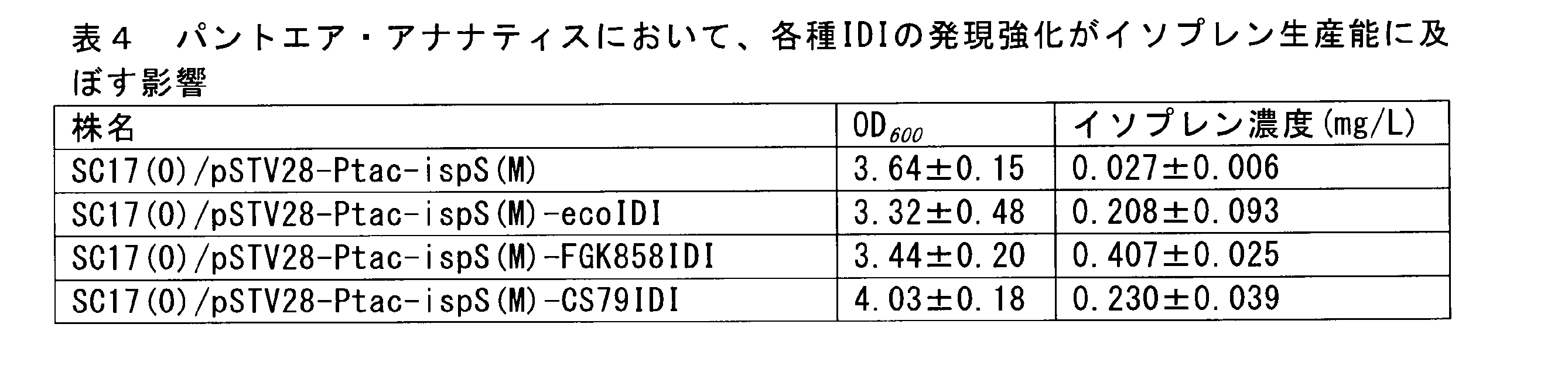
表中の各値は、n=4の平均値を表す。
実施例2(イソペンテニル2リン酸イソメラーゼ(IDI)の活性測定)
(2-1)IDIの遺伝子クローニング
表5のようなプライマーを設計し、放線菌Streptomyces sp.CS79株およびFGK858株のゲノムDNAをテンプレートとしてPCRを行うことで目的遺伝子断片を得た。増幅した断片をpT7Blue T-vector(Novagen)にクローニングし、塩基配列を確認後、タンパク質発現用ベクターpHIS8[Biochemistry.,vol.39,no.5,pp.890-902,2000]にサブクローニングした。N末端にヒスチジンタグを付加した組換えタンパク質の生産には、発現用プラスミドを導入したE.coli BL21(DE3)株を用いた。培養条件や精製方法を以下に記す。
(2-1)IDIの遺伝子クローニング
表5のようなプライマーを設計し、放線菌Streptomyces sp.CS79株およびFGK858株のゲノムDNAをテンプレートとしてPCRを行うことで目的遺伝子断片を得た。増幅した断片をpT7Blue T-vector(Novagen)にクローニングし、塩基配列を確認後、タンパク質発現用ベクターpHIS8[Biochemistry.,vol.39,no.5,pp.890-902,2000]にサブクローニングした。N末端にヒスチジンタグを付加した組換えタンパク質の生産には、発現用プラスミドを導入したE.coli BL21(DE3)株を用いた。培養条件や精製方法を以下に記す。
なお、コントロールとして活性測定に使用する大腸菌由来IDI(ecIDI)は、pQE-30 vector(QIAGEN)にecIDI遺伝子をサブクローニングした発現用プラスミドが構築済みであり(Proc.Natl.Acad.Sci.,vol.98,no.3,pp.932-937,2000)、定法に従いE.coli JM109株を用いて組換えタンパク質を調製した。
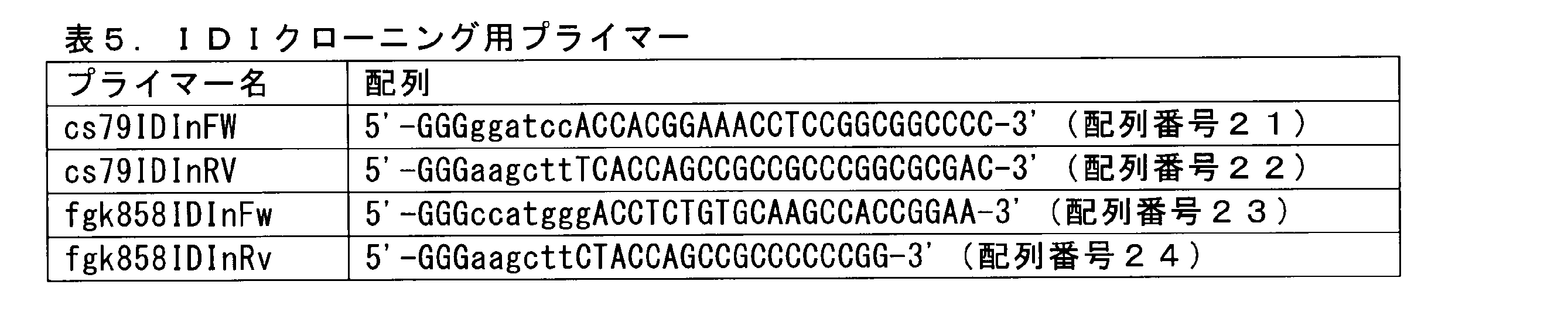
(2-2)組換えタンパク質の発現と精製
組換えタンパク質発現用プラスミドを導入したE.coli BL21(DE3)株を、LB+50μg/ml kanamycin培地で前培養後、TB+50μg/ml kanamycin培地に2%植菌してOD600=0.5になるまで培養し、そののち終濃度0.1mMとなるようIPTGを添加して、さらに18℃で16時間振盪培養(120strokes/min)した。培養液を集菌し、Wash Bufferに懸濁した後、超音波破砕した。菌体破砕液は45,100gで20分遠心し、回収した上清をNi-NTA superflow(QIAGEN)のオープンカラムにアプライし、Wash Bufferで洗浄を行った後、Elution Bufferを用いて目的タンパク質を溶出させた。目的タンパク質を含む画分をVIVA SPIN20(10,000 MWCO PES)で濃縮し、目的の可溶性タンパク質を得た(図2を参照)。
組換えタンパク質発現用プラスミドを導入したE.coli BL21(DE3)株を、LB+50μg/ml kanamycin培地で前培養後、TB+50μg/ml kanamycin培地に2%植菌してOD600=0.5になるまで培養し、そののち終濃度0.1mMとなるようIPTGを添加して、さらに18℃で16時間振盪培養(120strokes/min)した。培養液を集菌し、Wash Bufferに懸濁した後、超音波破砕した。菌体破砕液は45,100gで20分遠心し、回収した上清をNi-NTA superflow(QIAGEN)のオープンカラムにアプライし、Wash Bufferで洗浄を行った後、Elution Bufferを用いて目的タンパク質を溶出させた。目的タンパク質を含む画分をVIVA SPIN20(10,000 MWCO PES)で濃縮し、目的の可溶性タンパク質を得た(図2を参照)。
(Wash Buffer)
50mM Tris-HCl(pH8.0)
0.5M NaCl
20mM Imidazole(pH8.0)
50mM Tris-HCl(pH8.0)
0.5M NaCl
20mM Imidazole(pH8.0)
(Elution Buffer)
50mM Tris-HCl(pH8.0)
0.5M NaCl
250mM Imidazole(pH8.0)
50mM Tris-HCl(pH8.0)
0.5M NaCl
250mM Imidazole(pH8.0)
(2-3)イソペンテニル2リン酸イソメラーゼの活性測定
ecIDI(コントロール)、cs79IDI、fgk858IDIの3種類のIDIについて、IPPからDMAPPへの異性化反応およびDMAPPからIPPへの異性化反応がそれぞれどのような割合で進行するかを明らかにするため、そのストイキオメトリーを検討した。
ecIDI(コントロール)、cs79IDI、fgk858IDIの3種類のIDIについて、IPPからDMAPPへの異性化反応およびDMAPPからIPPへの異性化反応がそれぞれどのような割合で進行するかを明らかにするため、そのストイキオメトリーを検討した。
表6に示した酵素反応溶液(酵素は添加せず)をNMRサンプルチューブ(φ3mm)に移し、JEOL ECA-600 spectrometerで1H-NMRを測定した。その後、サンプルチューブ内の反応溶液に酵素を添加し、NMR機器内(27℃前後を維持)で60~120分間反応させた。この間、10~15分の間隔で1H-NMRの測定を行い、IPPの5位水素原子(1.65ppm)、およびDMAPPの5位水素原子(1.60ppm)のそれぞれのピーク面積の経時変化を記録することで(図3)、そのストイキオメトリーを算出した。

(2-4)結果
1H-NMRのピーク面積から算出したストイキオメトリーを図4に示す。左側のグラフはIPPを、右側のグラフはDMAPPを開始基質とした各酵素の異性化反応を示している。実験の結果、添加した酵素にかかわらず、すべての反応系において平衡状態に達した時の基質と生成物の割合はほぼIPP:DMAPP=2:3となることがわかった。さらに、IPPまたはDMAPPを開始基質に用いたいずれの反応系においても、cs79IDIおよびfgk858IDIはecIDIよりも早く平衡状態に到達した。
1H-NMRのピーク面積から算出したストイキオメトリーを図4に示す。左側のグラフはIPPを、右側のグラフはDMAPPを開始基質とした各酵素の異性化反応を示している。実験の結果、添加した酵素にかかわらず、すべての反応系において平衡状態に達した時の基質と生成物の割合はほぼIPP:DMAPP=2:3となることがわかった。さらに、IPPまたはDMAPPを開始基質に用いたいずれの反応系においても、cs79IDIおよびfgk858IDIはecIDIよりも早く平衡状態に到達した。
図4左図(IPP→DMAPP)において、IPPとDMAPPの濃度が1:1の時の反応時間を比較すると、ecIDIが約75分後であるのに対し、cs79IDIで約22分後、fgk858IDIで約30分後となっている。逆反応(DMAPP→IPP)でも同様に、cs79IDIおよびfgk858IDIの異性化反応はecIDIよりも進行が早く、反応を開始して30~40分後には平衡に達している。以上のin vitro実験の結果より、放線菌の二次代謝関連遺伝子クラスター内に存在するcs79IDIおよびfgk858IDIは、大腸菌由来ecIDIと比較して優れたIPPとDMAPPの異性化活性を有していることが明らかである。
実施例3(種々のイソペンテニル二リン酸イソメラーゼのアミノ酸配列の同一性確認)
以下に列記するイソペンテニル二リン酸イソメラーゼのアミノ酸配列の相同性分析を行った。分析条件および結果を表7に示す。
以下に列記するイソペンテニル二リン酸イソメラーゼのアミノ酸配列の相同性分析を行った。分析条件および結果を表7に示す。
・CS79:Streptomyces sp.CS79由来のイソペンテニル二リン酸イソメラーゼ(配列番号14)
・FGK858:Streptomyces sp.FGK858由来のイソペンテニル二リン酸イソメラーゼ(配列番号13)
・CL190:Streptomyces sp.CL190由来のイソペンテニル二リン酸イソメラーゼ(非特許文献1、GenPept accession number:BAB07793.1、http://www.ncbi.nlm.nih.gov/sviewer/viewer.fcgi?db=protein&term=BAB07793.1&report=genpept)
・K.griseola:Kitasatospora griseola由来のイソペンテニル二リン酸イソメラーゼ(非特許文献2、GenPept accession number:BAB07820.1、http://www.ncbi.nlm.nih.gov/sviewer/viewer.fcgi?db=protein&term=BAB07820.1&report=genpept)
・S.violaceusniger:Streptomyces violaceusniger Tu 4113由来のイソペンテニル二リン酸イソメラーゼ、GenPept accession number:AEM82542.1、http://www.ncbi.nlm.nih.gov/sviewer/viewer.fcgi?db=protein&term=AEM82542.1&report=genpept)
・E.coli:Escherichia coli MG1655由来のイソペンテニル二リン酸イソメラーゼ(配列番号25)
・FGK858:Streptomyces sp.FGK858由来のイソペンテニル二リン酸イソメラーゼ(配列番号13)
・CL190:Streptomyces sp.CL190由来のイソペンテニル二リン酸イソメラーゼ(非特許文献1、GenPept accession number:BAB07793.1、http://www.ncbi.nlm.nih.gov/sviewer/viewer.fcgi?db=protein&term=BAB07793.1&report=genpept)
・K.griseola:Kitasatospora griseola由来のイソペンテニル二リン酸イソメラーゼ(非特許文献2、GenPept accession number:BAB07820.1、http://www.ncbi.nlm.nih.gov/sviewer/viewer.fcgi?db=protein&term=BAB07820.1&report=genpept)
・S.violaceusniger:Streptomyces violaceusniger Tu 4113由来のイソペンテニル二リン酸イソメラーゼ、GenPept accession number:AEM82542.1、http://www.ncbi.nlm.nih.gov/sviewer/viewer.fcgi?db=protein&term=AEM82542.1&report=genpept)
・E.coli:Escherichia coli MG1655由来のイソペンテニル二リン酸イソメラーゼ(配列番号25)
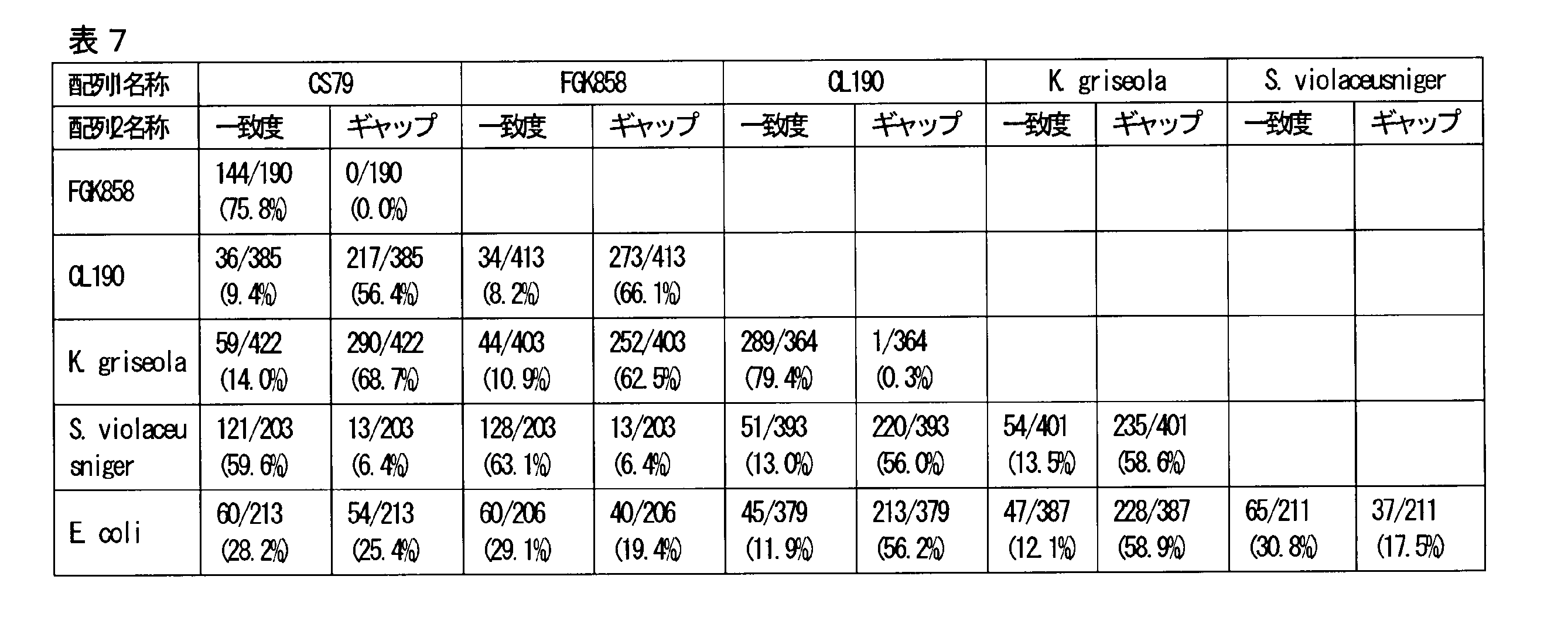
〔表7の脚注〕
一致度:ペアワイズアラインメントにおいて{一致した残基数}/{アラインメント全長}、およびその結果を%にて表記
ギャップ:ペアワイズアラインメントにおいて{ギャップを生じた残基数}/{アラインメント全長}、およびその結果を%にて表記
アラインメントはEMBOSSのneedleを利用した。同プログラムはhttp://www.bioinformatics.nl/cgi-bin/emboss/needleにて利用可能である。
一致度:ペアワイズアラインメントにおいて{一致した残基数}/{アラインメント全長}、およびその結果を%にて表記
ギャップ:ペアワイズアラインメントにおいて{ギャップを生じた残基数}/{アラインメント全長}、およびその結果を%にて表記
アラインメントはEMBOSSのneedleを利用した。同プログラムはhttp://www.bioinformatics.nl/cgi-bin/emboss/needleにて利用可能である。
Streptomyces sp.FGK858由来のイソペンテニル二リン酸イソメラーゼおよびStreptomyces sp.CS79由来のイソペンテニル二リン酸イソメラーゼは高い同一性を示した。斯かる同一性が高いことは、この数値を、Streptomyces sp.FGK858由来のイソペンテニル二リン酸イソメラーゼおよびStreptomyces sp.CS79由来のイソペンテニル二リン酸イソメラーゼのそれぞれと、既知で最も同一性の高いS.violaceusniger由来の同酵素との同一性を比較することにより明白であった。
本発明の方法は、イソプレノイド化合物の製造に有用である。
Claims (19)
- 以下の(A-1)~(B-3)からなる群より選ばれるタンパク質を発現する細菌を培養培地中で培養してイソプレノイド化合物を生成することを含む、イソプレノイド化合物の製造方法。
(A-1)配列番号13の全長アミノ酸配列を含むタンパク質;
(A-2)配列番号13の全長アミノ酸配列と90%以上の同一性を有するアミノ酸配列を含み、かつイソペンテニル二リン酸イソメラーゼ活性を有するタンパク質;
(A-3)配列番号13の全長アミノ酸配列において1個または数個のアミノ酸残基が欠失、置換、付加または挿入されているアミノ酸配列を含み、かつイソペンテニル二リン酸イソメラーゼ活性を有するタンパク質;
(B-1)配列番号14の全長アミノ酸配列を含むタンパク質;
(B-2)配列番号14の全長アミノ酸配列と90%以上の同一性を有するアミノ酸配列を含み、かつイソペンテニル二リン酸イソメラーゼ活性を有するタンパク質;
(B-3)配列番号14の全長アミノ酸配列において1個または数個のアミノ酸残基が欠失、置換、付加または挿入されているアミノ酸配列を含み、かつイソペンテニル二リン酸イソメラーゼ活性を有するタンパク質。 - 前記タンパク質が放線菌に由来する、請求項1に記載の方法。
- 前記細菌は、前記タンパク質をコードするポリヌクレオチドおよびそれに作動可能に連結されたプロモーターを含む異種発現単位を含む、請求項1または2に記載の方法。
- 前記ポリヌクレオチドは、以下の(a-1)~(c)からなる群より選ばれる1または2以上のポリヌクレオチドである、請求項3に記載の方法。
(a-1)配列番号9の全長塩基配列を含むポリヌクレオチド;
(a-2)配列番号9の全長塩基配列と90%以上の同一性を有する塩基配列を含み、かつイソペンテニル二リン酸イソメラーゼ活性を有するタンパク質をコードするポリヌクレオチド;
(a-3)配列番号9の全長塩基配列と相補的な塩基配列からなるポリヌクレオチドとストリンジェント条件下でハイブリダイズし、かつイソペンテニル二リン酸イソメラーゼ活性を有するタンパク質をコードするポリヌクレオチド;
(b-1)配列番号10の全長塩基配列を含むポリヌクレオチド;
(b-2)配列番号10の全長塩基配列と90%以上の同一性を有する塩基配列を含み、かつイソペンテニル二リン酸イソメラーゼ活性を有するタンパク質をコードするポリヌクレオチド;
(b-3)配列番号10の全長塩基配列と相補的な塩基配列からなるポリヌクレオチドとストリンジェント条件下でハイブリダイズし、かつイソペンテニル二リン酸イソメラーゼ活性を有するタンパク質をコードするポリヌクレオチド;
(c)(a-1)~(b-3)からなる群より選ばれるポリヌクレオチドの縮重変異体。 - 前記細菌が、メチルエリスリトールリン酸経路および/またはメバロン酸経路によるイソペンテニル二リン酸またはジメチルアリル二リン酸の合成能を有する、請求項1~4のいずれか1項に記載の方法。
- 前記細菌は、イソプレノイド化合物合成活性を有するタンパク質をさらに発現する細菌である、請求項1~5のいずれか1項に記載の方法。
- 前記細菌は、腸内細菌科に属する細菌である、請求項1~6のいずれか1項に記載の方法。
- 前記細菌は、エシェリヒア属またはパントエア属に属する細菌である、請求項7に記載の方法。
- 前記細菌がエシェリヒア・コリまたはパントエア・アナナティスである、請求項7または8に記載の方法。
- 以下の(A-1)~(B-3)からなる群より選ばれるタンパク質:
(A-1)配列番号13の全長アミノ酸配列を含むタンパク質;
(A-2)配列番号13の全長アミノ酸配列と90%以上の同一性を有するアミノ酸配列を含み、かつイソペンテニル二リン酸イソメラーゼ活性を有するタンパク質;
(A-3)配列番号13の全長アミノ酸配列において1個または数個のアミノ酸残基が欠失、置換、付加または挿入されているアミノ酸配列を含み、かつイソペンテニル二リン酸イソメラーゼ活性を有するタンパク質;
(B-1)配列番号14の全長アミノ酸配列を含むタンパク質;
(B-2)配列番号14の全長アミノ酸配列と90%以上の同一性を有するアミノ酸配列を含み、かつイソペンテニル二リン酸イソメラーゼ活性を有するタンパク質;
(B-3)配列番号14の全長アミノ酸配列において1個または数個のアミノ酸残基が欠失、置換、付加または挿入されているアミノ酸配列を含み、かつイソペンテニル二リン酸イソメラーゼ活性を有するタンパク質。 - 放線菌に由来する、請求項10に記載のタンパク質。
- 以下の(a-1)~(c)からなる群より選ばれるポリヌクレオチド:
(a-1)配列番号9の全長塩基配列を含むポリヌクレオチド;
(a-2)配列番号9の全長塩基配列と90%以上の同一性を有する塩基配列を含み、かつイソペンテニル二リン酸イソメラーゼ活性を有するタンパク質をコードするポリヌクレオチド;
(a-3)配列番号9の全長塩基配列と相補的な塩基配列からなるポリヌクレオチドとストリンジェント条件下でハイブリダイズし、かつイソペンテニル二リン酸イソメラーゼ活性を有するタンパク質をコードするポリヌクレオチド;
(b-1)配列番号10の全長塩基配列を含むポリヌクレオチド;
(b-2)配列番号10の全長塩基配列と90%以上の同一性を有する塩基配列を含み、かつイソペンテニル二リン酸イソメラーゼ活性を有するタンパク質をコードするポリヌクレオチド;
(b-3)配列番号10の全長塩基配列と相補的な塩基配列からなるポリヌクレオチドとストリンジェント条件下でハイブリダイズし、かつイソペンテニル二リン酸イソメラーゼ活性を有するタンパク質をコードするポリヌクレオチド;
(c)(a-1)~(b-3)からなる群より選ばれるポリヌクレオチドの縮重変異体。 - 請求項10または11に記載のタンパク質をコードするポリヌクレオチド、または請求項12に記載のポリヌクレオチド、およびそれに作動可能に連結された異種プロモーターを含む、発現ベクター。
- 請求項13に記載の発現ベクターを含む宿主細胞。
- 請求項14に記載の宿主細胞を用いて前記タンパク質を産生することを含む、タンパク質の製造方法。
- 請求項10または11に記載のタンパク質をコードするポリヌクレオチドおよびそれに作動可能に連結されたプロモーターを含む異種発現単位を含む、細菌。
- 前記細菌は、腸内細菌科に属する細菌である、請求項16に記載の細菌。
- エシェリヒア属またはパントエア属に属する細菌である、請求項16または17に記載の細菌。
- エシェリヒア・コリまたはパントエア・アナナティスである、請求項16~18のいずれか1項に記載の細菌。
Applications Claiming Priority (2)
| Application Number | Priority Date | Filing Date | Title |
|---|---|---|---|
| JP2017023633 | 2017-02-10 | ||
| JP2017-023633 | 2017-02-10 |
Publications (1)
| Publication Number | Publication Date |
|---|---|
| WO2018147446A1 true WO2018147446A1 (ja) | 2018-08-16 |
Family
ID=63107208
Family Applications (1)
| Application Number | Title | Priority Date | Filing Date |
|---|---|---|---|
| PCT/JP2018/004729 Ceased WO2018147446A1 (ja) | 2017-02-10 | 2018-02-09 | イソプレノイド化合物の製造方法 |
Country Status (1)
| Country | Link |
|---|---|
| WO (1) | WO2018147446A1 (ja) |
Cited By (1)
| Publication number | Priority date | Publication date | Assignee | Title |
|---|---|---|---|---|
| CN115851693A (zh) * | 2022-10-24 | 2023-03-28 | 湖北大学 | 葡萄糖异构酶突变体及其高产葡萄糖异构酶的地衣芽胞杆菌工程菌及应用 |
Citations (1)
| Publication number | Priority date | Publication date | Assignee | Title |
|---|---|---|---|---|
| JP2011505841A (ja) * | 2007-12-13 | 2011-03-03 | ダニスコ・ユーエス・インク | イソプレンを産出する組成物及び方法 |
-
2018
- 2018-02-09 WO PCT/JP2018/004729 patent/WO2018147446A1/ja not_active Ceased
Patent Citations (1)
| Publication number | Priority date | Publication date | Assignee | Title |
|---|---|---|---|---|
| JP2011505841A (ja) * | 2007-12-13 | 2011-03-03 | ダニスコ・ユーエス・インク | イソプレンを産出する組成物及び方法 |
Non-Patent Citations (2)
| Title |
|---|
| DATABASE GenBank 12 March 2014 (2014-03-12), "isopentenyl-diphosphate delta-isomerase [Streptomyces sp. PRh5", XP055533112, Database accession no. EXU63102 * |
| DATABASE GenBank 31 December 2015 (2015-12-31), "IPP isomerase [Streptomyces sp. MA37", XP055533110, Database accession no. ALL53316 * |
Cited By (2)
| Publication number | Priority date | Publication date | Assignee | Title |
|---|---|---|---|---|
| CN115851693A (zh) * | 2022-10-24 | 2023-03-28 | 湖北大学 | 葡萄糖异构酶突变体及其高产葡萄糖异构酶的地衣芽胞杆菌工程菌及应用 |
| CN115851693B (zh) * | 2022-10-24 | 2024-05-24 | 湖北大学 | 葡萄糖异构酶突变体及其高产葡萄糖异构酶的地衣芽胞杆菌工程菌及应用 |
Similar Documents
| Publication | Publication Date | Title |
|---|---|---|
| JP6254728B2 (ja) | イソプレンシンターゼおよびそれをコードするポリヌクレオチド、ならびにイソプレンモノマーの製造方法 | |
| JP6750629B2 (ja) | リナロールの製造方法 | |
| CN102906268A (zh) | 用6-磷酸葡萄糖酸内酯酶(pgl)来增加异戊二烯及其他产物的产量的组合物和方法 | |
| US10941420B2 (en) | Linalool composition and method of producing therefor | |
| US20210403954A1 (en) | Method of producing isoprenoid compound | |
| Wang et al. | Combined bioderivatization and engineering approach to improve the efficiency of geraniol production | |
| US8962296B2 (en) | Isoprene synthase and gene encoding the same, and method for producing isoprene monomer | |
| JP6520954B2 (ja) | イソプレンモノマーの製造方法 | |
| CN110317765A (zh) | 一种高产香叶醇葡萄糖苷的大肠杆菌表达菌株及其应用 | |
| EP3072967B1 (en) | Modified isoprene synthase | |
| JP2017104099A (ja) | リモネンの製造方法 | |
| WO2017022856A1 (ja) | イソプレンモノマーの製造方法 | |
| JP7742602B2 (ja) | イソプレノイド類産生能を有する遺伝子改変微生物およびこれを用いたイソプレノイド類製造方法 | |
| JPWO2015080273A1 (ja) | イソプレンモノマーの製造方法 | |
| WO2024116153A1 (en) | Compositions and methods for using previously cultured cells | |
| JP7216396B2 (ja) | 新規メバロン酸経路を有する非古細菌生物 | |
| CN120290608A (zh) | 产法尼烯的重组菌株及构建方法与应用 |
Legal Events
| Date | Code | Title | Description |
|---|---|---|---|
| 121 | Ep: the epo has been informed by wipo that ep was designated in this application |
Ref document number: 18751896 Country of ref document: EP Kind code of ref document: A1 |
|
| NENP | Non-entry into the national phase |
Ref country code: DE |
|
| 122 | Ep: pct application non-entry in european phase |
Ref document number: 18751896 Country of ref document: EP Kind code of ref document: A1 |
|
| NENP | Non-entry into the national phase |
Ref country code: JP |