WO2018131682A1 - 硬化膜形成組成物、配向材および位相差材 - Google Patents
硬化膜形成組成物、配向材および位相差材 Download PDFInfo
- Publication number
- WO2018131682A1 WO2018131682A1 PCT/JP2018/000657 JP2018000657W WO2018131682A1 WO 2018131682 A1 WO2018131682 A1 WO 2018131682A1 JP 2018000657 W JP2018000657 W JP 2018000657W WO 2018131682 A1 WO2018131682 A1 WO 2018131682A1
- Authority
- WO
- WIPO (PCT)
- Prior art keywords
- group
- carbon atoms
- fluorine
- cured film
- alkyl group
- Prior art date
- Legal status (The legal status is an assumption and is not a legal conclusion. Google has not performed a legal analysis and makes no representation as to the accuracy of the status listed.)
- Ceased
Links
Classifications
-
- C—CHEMISTRY; METALLURGY
- C08—ORGANIC MACROMOLECULAR COMPOUNDS; THEIR PREPARATION OR CHEMICAL WORKING-UP; COMPOSITIONS BASED THEREON
- C08F—MACROMOLECULAR COMPOUNDS OBTAINED BY REACTIONS ONLY INVOLVING CARBON-TO-CARBON UNSATURATED BONDS
- C08F220/00—Copolymers of compounds having one or more unsaturated aliphatic radicals, each having only one carbon-to-carbon double bond, and only one being terminated by only one carboxyl radical or a salt, anhydride ester, amide, imide or nitrile thereof
- C08F220/02—Monocarboxylic acids having less than ten carbon atoms; Derivatives thereof
- C08F220/04—Acids; Metal salts or ammonium salts thereof
-
- C—CHEMISTRY; METALLURGY
- C08—ORGANIC MACROMOLECULAR COMPOUNDS; THEIR PREPARATION OR CHEMICAL WORKING-UP; COMPOSITIONS BASED THEREON
- C08F—MACROMOLECULAR COMPOUNDS OBTAINED BY REACTIONS ONLY INVOLVING CARBON-TO-CARBON UNSATURATED BONDS
- C08F220/00—Copolymers of compounds having one or more unsaturated aliphatic radicals, each having only one carbon-to-carbon double bond, and only one being terminated by only one carboxyl radical or a salt, anhydride ester, amide, imide or nitrile thereof
- C08F220/02—Monocarboxylic acids having less than ten carbon atoms; Derivatives thereof
- C08F220/10—Esters
- C08F220/26—Esters containing oxygen in addition to the carboxy oxygen
-
- C—CHEMISTRY; METALLURGY
- C08—ORGANIC MACROMOLECULAR COMPOUNDS; THEIR PREPARATION OR CHEMICAL WORKING-UP; COMPOSITIONS BASED THEREON
- C08F—MACROMOLECULAR COMPOUNDS OBTAINED BY REACTIONS ONLY INVOLVING CARBON-TO-CARBON UNSATURATED BONDS
- C08F220/00—Copolymers of compounds having one or more unsaturated aliphatic radicals, each having only one carbon-to-carbon double bond, and only one being terminated by only one carboxyl radical or a salt, anhydride ester, amide, imide or nitrile thereof
- C08F220/02—Monocarboxylic acids having less than ten carbon atoms; Derivatives thereof
- C08F220/10—Esters
- C08F220/34—Esters containing nitrogen, e.g. N,N-dimethylaminoethyl (meth)acrylate
- C08F220/36—Esters containing nitrogen, e.g. N,N-dimethylaminoethyl (meth)acrylate containing oxygen in addition to the carboxy oxygen, e.g. 2-N-morpholinoethyl (meth)acrylate or 2-isocyanatoethyl (meth)acrylate
-
- C—CHEMISTRY; METALLURGY
- C08—ORGANIC MACROMOLECULAR COMPOUNDS; THEIR PREPARATION OR CHEMICAL WORKING-UP; COMPOSITIONS BASED THEREON
- C08F—MACROMOLECULAR COMPOUNDS OBTAINED BY REACTIONS ONLY INVOLVING CARBON-TO-CARBON UNSATURATED BONDS
- C08F290/00—Macromolecular compounds obtained by polymerising monomers on to polymers modified by introduction of aliphatic unsaturated end or side groups
- C08F290/08—Macromolecular compounds obtained by polymerising monomers on to polymers modified by introduction of aliphatic unsaturated end or side groups on to polymers modified by introduction of unsaturated side groups
- C08F290/12—Polymers provided for in subclasses C08C or C08F
-
- C—CHEMISTRY; METALLURGY
- C09—DYES; PAINTS; POLISHES; NATURAL RESINS; ADHESIVES; COMPOSITIONS NOT OTHERWISE PROVIDED FOR; APPLICATIONS OF MATERIALS NOT OTHERWISE PROVIDED FOR
- C09D—COATING COMPOSITIONS, e.g. PAINTS, VARNISHES OR LACQUERS; FILLING PASTES; CHEMICAL PAINT OR INK REMOVERS; INKS; CORRECTING FLUIDS; WOODSTAINS; PASTES OR SOLIDS FOR COLOURING OR PRINTING; USE OF MATERIALS THEREFOR
- C09D133/00—Coating compositions based on homopolymers or copolymers of compounds having one or more unsaturated aliphatic radicals, each having only one carbon-to-carbon double bond, and at least one being terminated by only one carboxyl radical, or of salts, anhydrides, esters, amides, imides, or nitriles thereof; Coating compositions based on derivatives of such polymers
- C09D133/04—Homopolymers or copolymers of esters
- C09D133/06—Homopolymers or copolymers of esters of esters containing only carbon, hydrogen and oxygen, the oxygen atom being present only as part of the carboxyl radical
-
- G—PHYSICS
- G02—OPTICS
- G02B—OPTICAL ELEMENTS, SYSTEMS OR APPARATUS
- G02B5/00—Optical elements other than lenses
- G02B5/30—Polarising elements
-
- G—PHYSICS
- G02—OPTICS
- G02F—OPTICAL DEVICES OR ARRANGEMENTS FOR THE CONTROL OF LIGHT BY MODIFICATION OF THE OPTICAL PROPERTIES OF THE MEDIA OF THE ELEMENTS INVOLVED THEREIN; NON-LINEAR OPTICS; FREQUENCY-CHANGING OF LIGHT; OPTICAL LOGIC ELEMENTS; OPTICAL ANALOGUE/DIGITAL CONVERTERS
- G02F1/00—Devices or arrangements for the control of the intensity, colour, phase, polarisation or direction of light arriving from an independent light source, e.g. switching, gating or modulating; Non-linear optics
- G02F1/01—Devices or arrangements for the control of the intensity, colour, phase, polarisation or direction of light arriving from an independent light source, e.g. switching, gating or modulating; Non-linear optics for the control of the intensity, phase, polarisation or colour
- G02F1/13—Devices or arrangements for the control of the intensity, colour, phase, polarisation or direction of light arriving from an independent light source, e.g. switching, gating or modulating; Non-linear optics for the control of the intensity, phase, polarisation or colour based on liquid crystals, e.g. single liquid crystal display cells
- G02F1/133—Constructional arrangements; Operation of liquid crystal cells; Circuit arrangements
- G02F1/1333—Constructional arrangements; Manufacturing methods
- G02F1/1337—Surface-induced orientation of the liquid crystal molecules, e.g. by alignment layers
-
- G—PHYSICS
- G02—OPTICS
- G02F—OPTICAL DEVICES OR ARRANGEMENTS FOR THE CONTROL OF LIGHT BY MODIFICATION OF THE OPTICAL PROPERTIES OF THE MEDIA OF THE ELEMENTS INVOLVED THEREIN; NON-LINEAR OPTICS; FREQUENCY-CHANGING OF LIGHT; OPTICAL LOGIC ELEMENTS; OPTICAL ANALOGUE/DIGITAL CONVERTERS
- G02F1/00—Devices or arrangements for the control of the intensity, colour, phase, polarisation or direction of light arriving from an independent light source, e.g. switching, gating or modulating; Non-linear optics
- G02F1/01—Devices or arrangements for the control of the intensity, colour, phase, polarisation or direction of light arriving from an independent light source, e.g. switching, gating or modulating; Non-linear optics for the control of the intensity, phase, polarisation or colour
- G02F1/13—Devices or arrangements for the control of the intensity, colour, phase, polarisation or direction of light arriving from an independent light source, e.g. switching, gating or modulating; Non-linear optics for the control of the intensity, phase, polarisation or colour based on liquid crystals, e.g. single liquid crystal display cells
- G02F1/133—Constructional arrangements; Operation of liquid crystal cells; Circuit arrangements
- G02F1/1333—Constructional arrangements; Manufacturing methods
- G02F1/1337—Surface-induced orientation of the liquid crystal molecules, e.g. by alignment layers
- G02F1/133711—Surface-induced orientation of the liquid crystal molecules, e.g. by alignment layers by organic films, e.g. polymeric films
Definitions
- the present invention relates to a cured film forming composition suitable for a vertical alignment material for vertically aligning liquid crystal molecules.
- the present invention provides a liquid crystal display such as an IPS liquid crystal display (In-plane Switching LCD) filled with a liquid crystal having positive dielectric anisotropy ( ⁇ > 0).
- IPS liquid crystal display In-plane Switching LCD
- ⁇ > 0 positive dielectric anisotropy
- the present invention relates to a cured film forming composition, an alignment material, and a retardation material.
- IPS-LCD is characterized by little change in brightness / color due to viewing angle because no vertical tilt of liquid crystal molecules occurs. However, it is difficult to increase contrast ratio, brightness, and response speed. It is done.
- a viewing angle compensation film is not used in the early IPS-LCD, and an IPS-LCD not using such a viewing angle compensation film has a tilt angle of Due to the relatively large light leakage in the dark state, there is a disadvantage of showing a low contrast ratio value.
- Patent Document 2 discloses an IPS-LCD compensation film using a + C plate and a + A plate (positive A plate).
- This document shows the following configuration of the liquid crystal display element described therein. 1) A liquid crystal layer having a horizontal alignment is sandwiched between both substrates supplied by electrodes capable of applying an electric field parallel to the surface of the liquid crystal layer. 2) One or more + A plates and + C plates are sandwiched between both polarizing plates. 3) The main optical axis of the + A plate is perpendicular to the main optical axis of the liquid crystal layer. 4) of the liquid crystal layer retardation value R LC, + C plate retardation value R + C, + A retardation value R + A plate is determined so as to satisfy the following equation.
- the + A plate is intended to provide an IPS-LCD having high contrast characteristics at the front and tilt angles and low color shift by minimizing dark light leakage at the tilt angle.
- an IPS-LCD having a + C plate is disclosed (Patent Document 3).
- Patent Document 5 in order to improve the viewing angle characteristics of a circularly polarizing plate used as an antireflection film for an organic EL display, a proposal has been made to use a + C plate (Patent Document 5).
- JP-A-2-256603 Japanese Patent Laid-Open No. 11-133408 JP 2009-122715 A JP 2001-281669 A Japanese Patent Laying-Open No. 2015-79256
- the + C plate can compensate for light leakage where the viewing angle of the polarizing plate is large, so that the circular polarizing plate used as an anti-reflection film for IPS-LCD and organic EL displays can be used. It is very useful as an optical compensation film. However, it is difficult to develop the vertical alignment (positive C plate) property by a conventionally known stretching method.
- a conventionally proposed vertical alignment film using polyimide requires the use of a polyimide solvent such as N-methyl-2-pyrrolidone for film production. For this reason, although it does not become a problem in a glass base material, when a base material is a film, there exists a problem of giving a damage to a base material at the time of alignment film formation.
- the vertical alignment film using polyimide requires firing at a high temperature, and there is a problem that the film substrate cannot withstand the high temperature.
- the present invention has been made on the basis of the above findings and examination results, and the problem to be solved has excellent vertical alignment, and has transparency and solvent resistance required for an optical compensation film, Further, a cured film for providing an alignment material having an adhesive property with a base material and a polymerizable liquid crystal layer, and capable of stably aligning the polymerizable liquid crystal vertically on a resin film under low-temperature and short-time firing conditions. It is to provide a forming composition.
- Another object of the present invention is obtained from the above cured film-forming composition, and has excellent vertical alignment and adhesion, solvent resistance, and stable on low temperature and short time baking conditions even on a resin film.
- Another object of the present invention is to provide an alignment material capable of vertically aligning a polymerizable liquid crystal and a retardation material useful for a + C plate formed using the alignment material.
- the present inventors have made extensive studies and, as a result, select a cured film forming material based on a polymer having a vertically-alignable group and a polymerizable group containing a C ⁇ C double bond. Thus, it was found that a cured film having excellent vertical alignment and adhesion could be formed, and the present invention was completed.
- the present invention as a first aspect, (A) a polymer having a vertical alignment group and a polymerizable group containing a C ⁇ C double bond, and (B) a cured film forming composition containing a radical polymerization initiator,
- the vertical alignment group is a group represented by the following formula (1), and relates to a cured film forming composition.
- Y 1 represents a single bond or a linking group
- Y 2 represents a single bond, an alkylene group having 1 to 15 carbon atoms or —CH 2 —CH (OH) —CH 2 —, or a divalent cyclic group selected from a benzene ring, a cyclohexane ring and a heterocyclic ring.
- any hydrogen atom on the cyclic group is an alkyl group having 1 to 3 carbon atoms, an alkoxyl group having 1 to 3 carbon atoms, a fluorine-containing alkyl group having 1 to 3 carbon atoms, or 1 to 3 carbon atoms.
- Y 3 may be substituted with a fluorine-containing alkoxyl group or a fluorine atom
- Y 3 represents a single bond or an alkylene group having 1 to 15 carbon atoms
- Y 4 represents a single bond, a divalent cyclic group selected from a benzene ring, a cyclohexane ring or a heterocyclic ring, or a divalent organic group having 17 to 30 carbon atoms and having a steroid skeleton
- Arbitrary hydrogen atoms on the cyclic group are a hydroxy group, an alkyl group having 1 to 3 carbon atoms, an alkoxyl group having 1 to 3 carbon atoms, a fluorine-containing alkyl group having 1 to 3 carbon atoms, or 1 to 3 carbon atoms.
- Y 3 may be substituted with a fluorine-containing alkoxyl group or a fluorine atom
- Y 5 represents a divalent cyclic group selected from a benzene ring, a cyclohexane ring or a heterocyclic ring, and any hydrogen atom on these cyclic groups is a hydroxy group, an alkyl group having 1 to 3 carbon atoms, or the number of carbon atoms 1 to 3 alkoxyl groups, a fluorine-containing alkyl group having 1 to 3 carbon atoms, a fluorine-containing alkoxyl group having 1 to 3 carbon atoms or a fluorine atom may be substituted
- n represents an integer of 0 to 4, and when n is 2 or more, Y 5 may be the same or different
- Y 6 represents a hydrogen atom, an alkyl group having 1 to 18 carbon atoms, a fluorine-containing alkyl group having 1 to 18 carbon atoms, an alkoxy
- the alkylene group in Y 2 and Y 3 , the substituent on the cyclic group, and the alkyl group, fluorine-containing alkyl group, alkoxyl group, and fluorine-containing alkoxyl group in Y 6 are any of linear, branched, or cyclic Or a combination thereof,
- the alkylene group in Y 2 and Y 3 and the alkyl group, fluorine-containing alkyl group, alkoxyl group, and fluorine-containing alkoxyl group in Y 6 are interrupted by 1 to 3 bonding groups unless the bonding groups are adjacent to each other.
- Y 2 , Y 4 or Y 5 represents a divalent cyclic group, or Y 4 represents a divalent organic group having a steroid skeleton, or Y 2 represents —CH 2 —CH (OH) —CH.
- Y 2 or Y 3 represents an alkylene group
- Y 6 represents an alkyl group or a fluorine-containing alkyl group
- the divalent organic group having the divalent cyclic group and the steroid skeleton The group, the —CH 2 —CH (OH) —CH 2 —, the alkylene group, the alkyl group and the fluorine-containing alkyl group may be bonded to a group adjacent thereto via a bonding group
- the linking group is a group selected from the group consisting of —O—, —CH 2 O—, —COO—, —OCO—, —NHCO—, —NH—CO—O— and —NH—CO—NH—.
- each of Y 2 to Y 6 represents a single bond, an alkylene group having 1 to 15 carbon atoms, a benzene ring, a cyclohexane ring, a heterocyclic ring, a divalent organic group having a steroid skeleton, —CH 2 —CH ( OH) —CH 2 —, an alkyl group having 1 to 18 carbon atoms, a fluorine-containing alkyl group having 1 to 18 carbon atoms, an alkoxyl group having 1 to 18 carbon atoms, and a fluorine-containing alkoxyl group having 1 to 18 carbon atoms
- the total number of carbon atoms is from 6 to 30).
- the polymerizable group containing a C ⁇ C double bond is at least one selected from the group consisting of an acryl group, a methacryl group, a vinyl group, an allyl group, and a maleimide group.
- the present invention relates to a cured film forming composition described in the first aspect.
- the present invention relates to a cured film forming composition.
- a 5th viewpoint based on 100 mass parts of (A) component, it is related with the cured film formation composition as described in a 3rd viewpoint or a 4th viewpoint containing 10 mass parts thru
- the present invention relates to an alignment material obtained by curing the cured film forming composition according to any one of the first aspect to the fifth aspect.
- the present invention relates to a retardation material characterized by being formed using a cured film obtained from the cured film forming composition according to any one of the first aspect to the fifth aspect.
- the first aspect of the present invention in order to provide an alignment material that has excellent vertical alignment and can stably align a polymerizable liquid crystal vertically under low-temperature and short-time firing conditions even on a resin film.
- Useful cured film forming compositions can be provided.
- the cured film forming composition of the present invention further comprises a group consisting of a monomer and a polymer having a polymerizable group containing a C ⁇ C double bond as the component (C). It can also contain at least one selected from And as long as the effect of this invention is not impaired, another additive can be contained.
- the component (A) contained in the cured film-forming composition of the present invention is a polymer having a vertical alignment group and a polymerizable group containing a C ⁇ C double bond.
- the vertical alignment group refers to a group containing a hydrocarbon group having, for example, about 6 to 30 carbon atoms, and specifically refers to a group represented by the formula [1] described later.
- examples of the monomer having a vertical alignment group include a monomer having a hydrocarbon group having about 6 to 30 carbon atoms.
- hydrocarbon group having 6 to 30 carbon atoms examples include linear, branched or cyclic alkyl groups having 6 to 30 carbon atoms or hydrocarbon groups having 6 to 30 carbon atoms including aromatic groups.
- specific examples of monomers containing a hydrocarbon group having 6 to 30 carbon atoms include alkyl esters of acrylic acid, alkyl esters of methacrylic acid, alkyl vinyl ethers, 2-alkyl styrene, 3-alkyl styrene, 4-alkyl styrene, N-alkylmaleimide, wherein the alkyl group has 6 to 30 carbon atoms, or the alkyl group of these monomers has 6 to 30 carbon atoms including the aromatic group having 6 to 30 carbon atoms.
- the thing replaced by 30 hydrocarbon groups is mentioned.
- the vertical alignment group is a group represented by the following formula [1].
- Y 1 represents a single bond or a linking group.
- Y 2 represents a single bond, an alkylene group having 1 to 15 carbon atoms, or —CH 2 —CH (OH) —CH 2 —.
- Y 2 includes a divalent cyclic group selected from a benzene ring, a cyclohexane ring and a heterocyclic ring.
- An arbitrary hydrogen atom on these cyclic groups is an alkyl group having 1 to 3 carbon atoms, a carbon atom number of 1 It may be substituted with 1 to 3 alkoxyl groups, 1 to 3 fluorine-containing alkyl groups, 1 to 3 fluorine-containing alkoxyl groups or fluorine atoms.
- heterocyclic ring examples include pyrrole ring, imidazole ring, oxazole ring, thiazole ring, pyrazole ring, pyridine ring, pyrimidine ring, quinoline ring, pyrazoline ring, isoquinoline ring, carbazole ring, purine ring, thiadiazole ring, pyridazine ring, pyrazoline ring, Triazine ring, pyrazolidine ring, triazole ring, pyrazine ring, benzimidazole ring, cinnoline ring, phenanthroline ring, indole ring, quinoxaline ring, benzothiazole ring, phenothiazine ring, oxadiazole ring, acridine ring and the like are more preferable.
- Examples of the alkyl group exemplified as the substituent include a methyl group, an ethyl group, an n-propyl group, an isopropyl group, and a cyclopropyl group.
- examples of the alkyl group include oxygen groups. And a group to which an atom —O— is bonded.
- Examples of the fluorine-containing alkyl group and fluorine-containing alkoxyl group include groups in which any hydrogen atom of the alkyl group and alkoxyl group is substituted with a fluorine atom.
- Y 2 is preferably a single bond, an alkylene group having 1 to 15 carbon atoms, or a divalent cyclic group selected from a benzene ring or a cyclohexane ring from the viewpoint of ease of synthesis. .
- Y 3 represents a single bond or an alkylene group having 1 to 15 carbon atoms.
- Y 4 represents a single bond or a divalent cyclic group selected from a benzene ring, a cyclohexane ring or a heterocyclic ring, and any hydrogen atom on these cyclic groups is a hydroxy group, Substituted with an alkyl group having 1 to 3 carbon atoms, an alkoxyl group having 1 to 3 carbon atoms, a fluorine-containing alkyl group having 1 to 3 carbon atoms, a fluorine-containing alkoxyl group having 1 to 3 carbon atoms, or a fluorine atom May be.
- alkyl group and the like mentioned as the heterocyclic ring and the substituent can be the same as those mentioned for Y 2 above.
- Y 4 may be a divalent organic group having 17 to 30 carbon atoms and having a steroid skeleton.
- Preferred examples thereof include cholesteryl, androsteryl, ⁇ -cholesteryl, epiandrosteryl, erygosteryl, estril, 11 ⁇ -hydroxymethylsteryl, 11 ⁇ -progesteryl, lanosteryl, melatranyl, methyltestosteryl, noretisteryl, pregnenoyl, ⁇ -sitosteryl, It is a divalent group having a structure in which two hydrogen atoms are removed from a structure selected from stigmasteryl, testosteryl, acetic acid cholesterol ester, and the like. More specifically, for example, as follows.
- Y 4 is a single bond, a divalent cyclic group selected from a benzene ring or a cyclohexane ring, or a divalent group having 17 to 30 carbon atoms and having a steroid skeleton, from the viewpoint of ease of synthesis.
- the organic group is preferably.
- Y 5 represents a divalent cyclic group selected from a benzene ring, a cyclohexane ring or a heterocyclic ring, and an arbitrary hydrogen atom on these cyclic groups is a hydroxy group, having 1 to 3 carbon atoms. It may be substituted with an alkyl group, an alkoxyl group having 1 to 3 carbon atoms, a fluorine-containing alkyl group having 1 to 3 carbon atoms, a fluorine-containing alkoxyl group having 1 to 3 carbon atoms, or a fluorine atom.
- the alkyl group and the like mentioned as the heterocyclic ring and the substituent can be the same as those mentioned above for Y 4 .
- Y 5 is preferably a divalent cyclic group selected from a benzene ring or a cyclohexane ring.
- n represents an integer of 0 to 4, and when n is 2 or more, Y 5 may be the same group or different groups. Among these, n is preferably 0 to 3 from the viewpoint of availability of raw materials and ease of synthesis. More preferred is 0-2.
- Y 6 represents a hydrogen atom, an alkyl group having 1 to 18 carbon atoms, a fluorine-containing alkyl group having 1 to 18 carbon atoms, an alkoxyl group having 1 to 18 carbon atoms, or 1 to 18 carbon atoms. Represents a fluorine-containing alkoxyl group.
- Y 6 is an alkyl group having 1 to 18 carbon atoms, a fluorine-containing alkyl group having 1 to 10 carbon atoms, an alkoxyl group having 1 to 18 carbon atoms, or a fluorine-containing alkoxyl group having 1 to 10 carbon atoms.
- Y 6 is an alkyl group having 1 to 17 carbon atoms or an alkoxyl group having 1 to 17 carbon atoms.
- Y 6 is an alkyl group having 1 to 16 carbon atoms or an alkoxyl group having 1 to 16 carbon atoms.
- Y 6 is preferably a hydrogen atom.
- alkylene group, alkyl group, fluorine-containing alkyl group, alkoxyl group and fluorine-containing alkoxyl group mentioned in the definition in the above formula [1] are either linear, branched or cyclic, or a combination thereof. Also good.
- alkyl group examples include methyl group, ethyl group, n-propyl group, isopropyl group, n-butyl group, isobutyl group, sec-butyl group, tert-butyl group, n-pentyl group, 1-methyl-n- Butyl group, 2-methyl-n-butyl group, 3-methyl-n-butyl group, 1,1-dimethyl-n-propyl group, 1,2-dimethyl-n-propyl group, 2,2-dimethyl-n -Propyl group, 1-ethyl-n-propyl group, n-hexyl group, 1-methyl-n-pentyl group, 2-methyl-n-pentyl group, 3-methyl-n-pentyl group, 4-methyl-n -Pentyl group, 1,1-dimethyl-n-butyl group, 1,2-dimethyl-n-butyl group, 1,3-dimethyl-n-butyl group, 2,
- the bivalent group which removed one arbitrary hydrogen atom from the said alkyl group can be mentioned.
- the alkoxyl group include groups in which an oxygen atom —O— is bonded to the groups listed as specific examples of the alkyl group.
- the fluorine-containing alkyl group and fluorine-containing alkoxyl group include groups in which any hydrogen atom of the alkyl group and alkoxyl group is substituted with a fluorine atom.
- the alkylene group in Y 2 and Y 3 , the substituent on the cyclic group, and the alkyl group, fluorine-containing alkyl group, alkoxyl group, and fluorine-containing alkoxyl group in Y 6 are linear, branched, or cyclic. Any or a combination thereof may be used.
- alkylene group in Y 2 and Y 3 and the alkyl group, fluorine-containing alkyl group, alkoxyl group, and fluorine-containing alkoxyl group in Y 6 are interrupted with 1 to 3 bonding groups unless the bonding groups are adjacent to each other. It may be.
- Y 2 , Y 4 or Y 5 represents a divalent cyclic group, or Y 4 represents a divalent organic group having a steroid skeleton, or Y 2 represents —CH 2 —CH (OH) —. CH 2 —, or when Y 2 or Y 3 represents an alkylene group, or Y 6 represents an alkyl group or a fluorine-containing alkyl group, the divalent cyclic group, the divalent group having the steroid skeleton
- the organic group, the —CH 2 —CH (OH) —CH 2 —, the alkylene group, the alkyl group, and the fluorine-containing alkyl group may be bonded to a group adjacent thereto via a bonding group.
- the linking group includes —O—, —CH 2 O—, —CO—, —COO—, —OCO—, —NHCO—, —CONH—, —NH—CO—O—, —O—CO—NH.
- the total number of carbon atoms is 6-30, for example 6-20.
- the vertical alignment group is preferably a group containing an alkyl group having 7 to 18 carbon atoms, particularly 8 to 16 carbon atoms.
- examples of the polymerizable group containing a C ⁇ C double bond include an acryl group, a methacryl group, a vinyl group, an allyl group, and a maleimide group.
- the polymerizable group containing a C ⁇ C double bond can be incorporated into the side chain of the main skeleton of the polymer, that is, as a specific side chain having a polymerizable group containing a C ⁇ C double bond, It can be incorporated into the side chain of the polymer.
- the specific side chain having a polymerizable group containing a C ⁇ C double bond has 3 to 16 carbon atoms and has an unsaturated bond at the terminal.
- the specific side chain represented by the formula (b2) is particularly preferable.
- R 51 has 1 to 14 carbon atoms and is a divalent organic group selected from the group consisting of an aliphatic group, an aliphatic group having a cyclic structure, and an aromatic group, or A divalent organic group comprising a combination of a plurality of divalent organic groups selected from this group.
- R 51 may contain an ester bond, an ether bond, an amide bond, a —CH 2 CH (OH) CH 2 — bond, a urethane bond, or the like.
- R 52 is a hydrogen atom or a methyl group, and a specific side chain in which R 52 is a hydrogen atom is preferred, and more preferably a specific side chain in which the terminal is an acryloyl group, a methacryloyl group or a styryl group. is there.
- the method for obtaining the polymer of the component (A) of the present invention is not particularly limited.
- a polymer having a vertical alignment group and a specific functional group is generated in advance by a polymerization method such as radical polymerization.
- a polymerization method such as radical polymerization.
- a specific compound a compound having a group that reacts with the specific functional group and a polymerizable group containing a C ⁇ C double bond
- the specific functional group means a functional group such as a carboxyl group, an epoxy group, a hydroxy group, an amino group having active hydrogen, a phenolic hydroxy group or an isocyanate group, or a plurality of types of functional groups selected from these functional groups.
- the preferred combination of the specific functional group and the functional group of the specific compound that is involved in the reaction is a carboxyl group and an epoxy group, a hydroxy group and an isocyanate group, or a phenolic hydroxy group.
- the method for obtaining a polymer having a specific functional group is not particularly limited.
- a monomer having a functional group (specific functional group) for reacting with a specific compound that is, a carboxyl group, an epoxy group, a hydroxy group, an amino group having active hydrogen, a phenolic hydroxy group, an isocyanate group, or the like. It can be obtained by polymerizing a monomer (also referred to as a specific monomer).
- the monomer having the specific functional group used for the polymerization may be used alone, or a plurality of types may be used in combination as long as the combination does not react during the polymerization.
- Examples of the monomer having a carboxyl group include acrylic acid, methacrylic acid, crotonic acid, mono- (2- (acryloyloxy) ethyl) phthalate, mono- (2- (methacryloyloxy) ethyl) phthalate, and N- (carboxyphenyl).
- Examples of the monomer having an epoxy group include glycidyl methacrylate, glycidyl acrylate, 3,4-epoxycyclohexylmethyl methacrylate, allyl glycidyl ether, 3-ethenyl-7-oxabicyclo [4.1.0] heptane, 1,2- Examples thereof include epoxy-5-hexene and 1,7-octadiene monoepoxide.
- Examples of the monomer having a hydroxy group include 2-hydroxyethyl acrylate, 2-hydroxyethyl methacrylate, 2-hydroxypropyl acrylate, 2-hydroxypropyl methacrylate, 4-hydroxybutyl acrylate, 4-hydroxybutyl methacrylate, 2,3- Dihydroxypropyl acrylate, 2,3-dihydroxypropyl methacrylate, diethylene glycol monoacrylate, diethylene glycol monomethacrylate, caprolactone 2- (acryloyloxy) ethyl ester, caprolactone 2- (methacryloyloxy) ethyl ester, poly (ethylene glycol) ethyl ether acrylate, poly (Ethylene glycol) ethyl ether methacrylate, 5-acryloyl Carboxymethyl-6-hydroxy-norbornene-2-carboxylic-6-lactone and 5-methacryloyloxy such acryloyloxy-6-hydroxy-norbornene-2-carboxylic
- Examples of the monomer having an amino group include 2-aminoethyl acrylate and 2-aminomethyl methacrylate.
- Examples of the monomer having a phenolic hydroxy group include hydroxystyrene, N- (hydroxyphenyl) acrylamide, N- (hydroxyphenyl) methacrylamide and N- (hydroxyphenyl) maleimide.
- Examples of the monomer having an isocyanate group include acryloylethyl isocyanate, methacryloylethyl isocyanate, and m-tetramethylxylene isocyanate.
- a monomer that can be copolymerized with the monomer and does not have the specific functional group can be used in combination.
- Specific examples of such monomers include acrylic ester compounds or methacrylic ester compounds having a structure different from that of the specific monomer, maleimide compounds, acrylamide compounds, acrylonitrile, maleic anhydride, styrene compounds and vinyl compounds. .
- the specific example of the said monomer is given, it is not limited to these.
- the acrylate compound having a structure different from that of the specific monomer include methyl acrylate, ethyl acrylate, n-propyl acrylate, isopropyl acrylate, n-butyl acrylate, isobutyl acrylate, t-butyl acrylate, benzyl acrylate, and naphthyl acrylate.
- Examples of the methacrylic acid ester compound having a structure different from that of the specific monomer include methyl methacrylate, ethyl methacrylate, n-propyl methacrylate, isopropyl methacrylate, n-butyl methacrylate, isobutyl methacrylate, t-butyl methacrylate, benzyl methacrylate, and naphthyl methacrylate.
- vinyl compound examples include methyl vinyl ether, benzyl vinyl ether, vinyl naphthalene, vinyl carbazole, allyl glycidyl ether, 3-ethenyl-7-oxabicyclo [4.1.0] heptane, 1,2-epoxy-5-hexene. And 1,7-octadiene monoepoxide.
- styrene compound examples include styrene, methyl styrene, chlorostyrene, and bromostyrene.
- maleimide compound examples include maleimide, N-methylmaleimide, N-phenylmaleimide, and N-cyclohexylmaleimide.
- the polymer which has the said specific functional group can use a commercial item suitably.
- commercially available polymers having one or more epoxy groups in the side chain or terminal include bisphenol A type epoxy resins such as jER1001, 1002, 1003, 1004, 1055, 1007, 1009, 1010, 834, 828 (Mitsubishi Chemical Co., Ltd.), etc., and bisphenol F type epoxy resin, jER806, 807 (Mitsubishi Chemical Co., Ltd.), etc. are phenol novolac type epoxy.
- jER152, 154 above, manufactured by Mitsubishi Chemical Corporation
- EPPN201, 202 above, manufactured by Nippon Kayaku Co., Ltd.
- cresol novolac type epoxy resin ECN-1299 (Asahi Kasei).
- Examples of the 1,2-epoxy-4- (2-oxiranyl) cyclohexane adduct of polyol include EHPE-3150 (manufactured by Daicel Corporation).
- polyether polyols include ADEKA Adeka Polyether P Series, G Series, EDP Series, BPX Series, FC Series, CM series, NOF UNIOX (registered trademark) HC-40, HC-60, ST-30E, ST-40E, G-450, G-750, UNIOR (registered trademark) TG-330, TG-1000, TG -3000, TG-4000, HS-1600D, DA-400, DA-700, DB-400, Nonion (registered trademark) LT-221, ST-221, OT-221, etc.
- the polymer of component (A) preferably has a weight average molecular weight of 1,000 to 200,000, more preferably 2,000 to 150,000, and more preferably 3,000 to 100,000. Even more preferred. If the weight average molecular weight is over 200,000, the solubility in the solvent may be lowered and the handling property may be lowered. If the weight average molecular weight is less than 1,000, the light There may be insufficient curing during curing and solvent resistance and heat resistance may decrease. In the present specification, the weight average molecular weight is a value obtained by gel permeation chromatography (GPC) using polystyrene as a standard sample.
- GPC gel permeation chromatography
- the proportion of the vertically aligning group is preferably 3 mol% to 50 mol%, preferably 5 mol% to 45 mol%, per 100 mol of all repeating units of the polymer. Is more preferable. When the amount is less than 3 mol%, the vertical alignment may be insufficient, and when it is more than 50 mol%, the adhesion to the liquid crystal may be adversely affected.
- the ratio of the polymerizable group containing a C ⁇ C double bond is preferably 20 mol% to 97 mol% per 100 mol of all repeating units of the polymer, and 25 mol%. More preferably, it is ⁇ 95 mol%. When it is less than 20 mol%, curing may be insufficient, and when it is more than 97 mol%, vertical alignment may be insufficient.
- the component (B) in the cured film forming composition of the present invention is a radical polymerization initiator.
- the radical polymerization initiator known ones can be used. For example, alkylphenones, benzophenones, acylphosphine oxides, Michler's benzoylbenzoates, oxime esters, tetramethylthiuram monosulfides, Examples include thioxanthones.
- radical polymerization initiator used in the present invention examples include ⁇ -diketones such as diacetyl; acyloins such as benzoin; acyloin ethers such as benzoin methyl ether, benzoin ethyl ether and benzoin isopropyl ether; thioxanthone, 2, Benzophenones such as 4-diethylthioxanthone, thioxanthone-4-sulfonic acid, benzophenone, 4,4′-bis (dimethylamino) benzophenone, 4,4′-bis (diethylamino) benzophenone; acetophenone, p-dimethylaminoacetophenone, ⁇ , ⁇ -Dimethoxy- ⁇ -acetoxyacetophenone, ⁇ , ⁇ -dimethoxy- ⁇ -phenylacetophenone, p-methoxyacetophenone, 1- [2-methyl-4-methylthiophenyl] -2
- Acetophenones such as ⁇ , ⁇ -dimethoxy- ⁇ -phenylacetophenone, phenacyl chloride, tribromomethylphenyl sulfone, 2,4,6-trimethylbenzoyldiphenylphosphine oxide, 1,2′-bisimidazoles and 4, Combination of 4′-bis (diethylamino) benzophenone and mercaptobenzothiazole, Lucillin TPO (trade name), Irgacure 651 (trade name), Irgacure 369 (trade name), Irgacure 907 (trade name), Irgacure OXE02 (trade name) Is preferred.
- the radical polymerization initiators may be used alone or in combination of two or more.
- the radical polymerization initiator is preferably used in an amount of 0.1 to 50 parts by mass, more preferably 1 to 30 parts by mass, and particularly preferably 2 to 30 parts by mass with respect to 100 parts by mass of the component (A). Can do. If the amount of radical polymerization initiator used is less than the above range, it is easily affected by radical deactivation by oxygen (decrease in sensitivity), and if it exceeds the above range, compatibility is deteriorated and storage stability is lowered. There is a tendency to do.
- the (meth) acrylate compound refers to both an acrylate compound and a methacrylate compound.
- (meth) acrylic acid refers to acrylic acid and methacrylic acid.
- the (meth) acryloyl group represents CH 2 ⁇ CHCO— and CH (CH 3 ) ⁇ CHCO—.
- Monomers and polymers having two or more in each are preferred.
- (C) component is not limited to these illustrations.
- Examples of the compound having two (meth) acryloyl groups include ethylene glycol di (meth) acrylate, diethylene glycol di (meth) acrylate, triethylene glycol di (meth) acrylate, propylene glycol di (meth) acrylate, and neopentyl glycol di (Meth) acrylate, polyethylene glycol di (meth) acrylate, polypropylene glycol di (meth) acrylate, 1,4-butanediol di (meth) acrylate, neopentyl glycol di (meth) acrylate, 1,6-hexanediol di ( (Meth) acrylate, 1,9-nonanediol di (meth) acrylate, 2-methyl-1,8-octanediol di (meth) acrylate, 1,10-decanediol di (meth) acrylate, Pentaerythritol di (meth) acryl
- the compound having two or more (meth) acryloyl groups commercially available products can be suitably used.
- Examples of the compound having three (meth) acryloyl groups include, for example, ethylene oxide-modified 1,1,1-trimethylolethane tri (meth) acrylate [ethylene oxide addition mole number 3 to 30], ethylene oxide-modified trimethylol.
- Propane tri (meth) acrylate [ethylene oxide addition moles 3 to 30], propylene oxide modified trimethylolpropane tri (meth) acrylate [propylene oxide addition moles 3 to 30], ethylene oxide modified glycerin tri (meth) acrylate [ethylene oxide addition moles] 3-30], propylene oxide-modified glycerin tri (meth) acrylate [propylene oxide addition mole number 3-30], tris (2- (acryloyloxy) ethyl) isocyanurate, ⁇ -ca Lolactone-modified tris (2- (acryloyloxy) ethyl) isocyanurate [ ⁇ -caprolactone addition mole number 1-30], 1,1,1-trimethylolethane tri (meth) acrylate, trimethylolpropane tri (meth) acrylate, Examples include ditrimethylolpropane tri (meth) acrylate, pentaerythritol tri (meth) acrylate, and
- Examples of the compound having four (meth) acryloyl groups include ethylene oxide-modified ditrimethylolpropane tetra (meth) acrylate [ethylene oxide addition mole number 4 to 40], ethylene oxide-modified pentaerythritol tetra (meth) acrylate [ Ethylene oxide addition mole number 4 to 40], ditrimethylolpropane tetra (meth) acrylate, pentaerythritol tetra (meth) acrylate and the like.
- NK ester ATM-4E, ATM-35E [above, both manufactured by Shin-Nakamura Chemical Co., Ltd.]
- EBECRYL (registered trademark) 40 [Daicel Ornex] Biscoat # 300 [Osaka Organic Chemical Co., Ltd.]
- light acrylate PE-4A [manufactured by Kyoeisha Chemical Co., Ltd.]
- NK ester AD-TMP, A-TMMT [above, both Shin-Nakamura Chemical Co., Ltd.]
- EBECRYL registered trademark
- Examples of the compound having 5 or more (meth) acryloyl groups include ethylene oxide-modified dipentaerythritol hexa (meth) acrylate [ethylene oxide addition mole number 6 to 60], ethylene oxide-modified tripentaerythritol octa ( Examples thereof include (meth) acrylate [ethylene oxide addition mole number 6 to 60], dipentaerythritol penta (meth) acrylate, dipentaerythritol hexa (meth) acrylate, tripentaerythritol octa (meth) acrylate and the like.
- NK ester A-DPH-12E [manufactured by Shin-Nakamura Chemical Co., Ltd.], biscort # 802 [manufactured by Osaka Organic Chemical Co., Ltd.]; Acrylate DPE-6A [manufactured by Kyoeisha Chemical Co., Ltd.]; NK Ester A-9550, A-DPH [all of which are manufactured by Shin-Nakamura Chemical Co., Ltd.]; DPHA [manufactured by Daicel Ornex Co., Ltd.] Can be mentioned.
- bifunctional urethane (meth) acrylate examples include urethanized product of phenylglycidyl ether (meth) acrylic acid adduct and hexamethylene diisocyanate, phenylglycidyl ether (meth) acrylic acid adduct and toluene diisocyanate. Etc.
- bifunctional urethane (meth) acrylate for example, AH-600, AT-600 [above, both manufactured by Kyoeisha Chemical Co., Ltd.]; NK Oligo U-2PPA, U-200PA, UA-160TM, UA-290TM, UA-4200, UA-4400, UA-122P, UA-W2A [all of which are manufactured by Shin-Nakamura Chemical Co., Ltd.]; EBECRYL (registered trademark) 210 215, 230, 244, 245, 270, 280 / 15IB, 284, 285, 4858, 8307, 8402, 8411, 8804, 8807, 9227EA, 9270 , KRM (registered trademark) 7735 [above, both manufactured by Daicel Ornex Co., Ltd.]; Murasaki (registered trademark) UV-6630B, 7000 7461TE, 2000B, 2750B, 3
- polyfunctional urethane (meth) acrylate compounds having three (meth) acryloyl groups include NK Oligo UA-7100 (manufactured by Shin-Nakamura Chemical Co., Ltd.); EBECRYL (registered trademark) 204, 205, 264, 265, 294 / 25HD, 1259, 4820, 8311, 8465, 8701, 9260, KRM (Registered Trademark) 8296, 8667 [above, Daicel Ornex Co., Ltd. ); Murasaki (registered trademark) UV-7550B, 7000B, 7510B, 7461TE, 2750B [all of which are manufactured by Nippon Synthetic Chemical Industry Co., Ltd.].
- polyfunctional urethane (meth) acrylate compounds having four (meth) acryloyl groups include EBECRYL (Registered Trademark) 8210, 8405, KRM (Registered Trademark) 8528 [above, both are Daicel Ornex Manufactured by Co., Ltd.]; Shikko (registered trademark) UV-7650B [manufactured by Nippon Synthetic Chemical Industry Co., Ltd.].
- Examples of the polyfunctional urethane (meth) acrylate compound having 5 or more (meth) acryloyl groups are urethanized products of pentaerythritol tri (meth) acrylate and hexamethylene diisocyanate, Urethanes of pentaerythritol tri (meth) acrylate and toluene diisocyanate, urethanates of pentaerythritol tri (meth) acrylate and isophorone diisocyanate, urethanates of dipentaerythritol penta (meth) acrylate and hexamethylene diisocyanate, etc. .
- urethane (meth) acrylates having 5 or more functional groups can be suitably used.
- UA-306H, UA-306T, UA-306I, UA-510H [above, all manufactured by Kyoeisha Chemical Co., Ltd.]
- the 7650B [above,
- the component (C) of the present invention may be a polymer compound having one or more side chains each having a polymerizable unsaturated bond in the molecule.
- a polymer compound having a side chain whose terminal is a polymerizable unsaturated bond a polymer compound having a (meth) acryloyl group in two or more side chains in the molecule is preferable.
- polymer compound examples include polymer compounds containing one or more (meth) acryloyl groups such as urethane acrylic, epoxy acrylic, and various (meth) acrylates.
- the weight average molecular weight of the polymer compound (C) is preferably 1,000 to 200,000, more preferably 5,000 to 50,000. If the molecular weight is less than 1,000, the effects of the present invention may not be achieved. On the other hand, if the molecular weight exceeds 100,000, it may not dissolve in the composition.
- Examples of such a compound as component (C) include Acryt 8BR-930M, 8UH-1006, 8KQ-2001, 8KX-078, 1SX-1055 [above, Taisei Fine Chemical Co., Ltd.], SMP -250A, SMP-360A, SMP-550A [above, manufactured by Kyoeisha Chemical Co., Ltd.] and the like.
- the content is 10 parts by mass to 1000 parts by mass, preferably 15 parts by mass to 500 parts by mass based on 100 parts by mass of the component (A).
- the cured film forming composition of the present invention is mainly used in a solution state dissolved in a solvent.
- the solvent used in that case is only required to be able to dissolve the component (A), the component (B), the component (C) and / or other additives as described below, and the type and structure thereof are particularly limited. Not.
- the solvent include, for example, methanol, ethanol, n-propanol, isopropanol, n-butanol, isobutanol, 2-methyl-1-butanol, n-pentanol, ethylene glycol monomethyl ether, ethylene glycol monoethyl ether, Methyl cellosolve acetate, ethyl cellosolve acetate, diethylene glycol, diethylene glycol monomethyl ether, diethylene glycol monoethyl ether, propylene glycol, propylene glycol monomethyl ether, propylene glycol monomethyl ether acetate, propylene glycol monoethyl ether, propylene glycol propyl ether, propylene glycol propyl ether acetate, Toluene, xylene, methyl Ethyl ketone, isobutyl methyl ketone, cyclopentanone, cyclohexanone, 2-butanone
- the cured film-forming composition of the present invention is used to produce an alignment material by forming a cured film on a resin film
- methanol, ethanol, n-propanol, isopropanol, n-butanol, 2-methyl-1-butanol 2-heptanone, isobutyl methyl ketone, diethylene glycol, propylene glycol, propylene glycol monomethyl ether, propylene glycol monomethyl ether acetate and the like are preferable from the viewpoint that the resin film is a resistant solvent.
- solvents can be used alone or in combination of two or more.
- the cured film forming composition of the present invention is a sensitizer, an adhesion improver, a silane coupling agent, a surfactant, a rheology modifier, a pigment, as necessary, as long as the effects of the present invention are not impaired.
- Dyes, storage stabilizers, antifoaming agents, antioxidants and the like can be contained.
- Component (C) may contain at least one selected from the group consisting of monomers and polymers having a polymerizable group containing a C ⁇ C double bond, and other additives as long as the effects of the present invention are not impaired.
- Composition Usually, they are used in the form of a solution in which they are dissolved in a solvent.
- Preferred examples of the cured film forming composition of the present invention are as follows. [1]: A cured film forming composition containing 0.1 part by weight to 50 parts by weight of the component (B) based on 100 parts by weight of the component (A) and the component (A). [2]: Based on (A) component, 100 parts by weight of component (A), 0.1 to 50 parts by weight of component (B), and on the basis of 100 parts by weight of component (A), 10 parts by weight A cured film forming composition containing 1000 parts by mass of component (C) and a solvent.
- the blending ratio, preparation method, etc. when the cured film forming composition of the present invention is used as a solution are described in detail below.
- the ratio of the solid content in the cured film-forming composition of the present invention is not particularly limited as long as each component is uniformly dissolved in the solvent, but is 1% by mass to 60% by mass, preferably 2%.
- the mass is from 50% by mass to 50% by mass, and more preferably from 2% by mass to 20% by mass.
- solid content means what remove
- the method for preparing the cured film forming composition of the present invention is not particularly limited.
- a preparation method for example, a method of mixing the component (B), further the component (C), etc. in a predetermined ratio with a solution of the component (A) dissolved in a solvent to obtain a uniform solution, or this preparation method In an appropriate stage, there may be mentioned a method in which other additives are further added and mixed as necessary.
- the prepared cured film-forming composition solution is preferably used after being filtered using a filter having a pore size of about 0.2 ⁇ m.
- a solution of the cured film forming composition of the present invention is applied to a substrate (for example, a silicon / silicon dioxide-coated substrate, a silicon nitride substrate, a substrate coated with a metal such as aluminum, molybdenum, or chromium, a glass substrate, a quartz substrate, or ITO.
- a substrate for example, a silicon / silicon dioxide-coated substrate, a silicon nitride substrate, a substrate coated with a metal such as aluminum, molybdenum, or chromium, a glass substrate, a quartz substrate, or ITO.
- Substrates) and film substrates eg, triacetyl cellulose (TAC) film, polycarbonate (PC) film, cycloolefin polymer (COP) film, cycloolefin copolymer (COC) film, polyethylene terephthalate (PET) film, acrylic film, polyethylene
- TAC triacetyl cellulose
- PC polycarbonate
- COP cycloolefin polymer
- COC cycloolefin copolymer
- PET polyethylene terephthalate
- acrylic film e.g., acrylic film, polyethylene
- a resin film such as a film, etc., a bar coating, spin coating, flow coating, roll coating, slit coating, spin coating following slits, ink jet coating, printing, etc.
- the cured film can be used as an alignment material as it is.
- the heating and drying conditions may be such that the crosslinking reaction with the crosslinking agent proceeds to such an extent that the components of the cured film (alignment material) do not elute into the polymerizable liquid crystal solution applied thereon.
- a heating temperature and a heating time appropriately selected from the range of 200 ° C. and a time of 0.4 minutes to 60 minutes are adopted.
- the heating temperature and the heating time are preferably 70 to 160 ° C. and 0.5 to 10 minutes.
- the thickness of the cured film (alignment material) formed using the curable composition of the present invention is, for example, 0.05 ⁇ m to 5 ⁇ m, and is appropriately determined in consideration of the level difference of the substrate to be used and optical and electrical properties. You can choose.
- phase difference material such as a polymerizable liquid crystal solution having vertical alignment property is applied onto the alignment material.
- the phase difference material can be formed as a layer which has optical anisotropy by hardening the phase difference material which became the orientation state as it is.
- substrate which forms an orientation material is a film, it becomes useful as a phase difference film.
- the alignment materials on both substrates are bonded to each other via a spacer, and then between the substrates.
- a liquid crystal display element in which liquid crystal is injected to align the liquid crystal may be used.
- the cured film forming composition of this invention can be used suitably for manufacture of various retardation materials (retardation film), a liquid crystal display element, etc.
- LAA lauryl acrylate
- PAA palmityl acrylate
- HEMA 2-hydroxyethyl methacrylate
- GMA glycidyl methacrylate
- AOI Karenz AOI manufactured by Showa Denko K.K.
- AIBN ⁇ , ⁇ ′-azobisisobutyronitrile
- LA lauric acid
- M100 3,4-epoxycyclohexylmethyl methacrylate
- 5PCA 4- (4-pentylcyclohexyl) benzoic acid
- ⁇ C component> DPHA: manufactured by Daicel Ornex Co., Ltd. Dipentaerythritol hexaacrylate SMP: manufactured by Kyoeisha Chemical Co., Ltd. UV curable acrylic polymer SMP-550A
- Each cured film forming composition of an Example and a comparative example contained a solvent, and propylene glycol monomethyl ether (PM), butyl acetate (BA), and ethyl acetate (EA) were used as the solvent.
- PM propylene glycol monomethyl ether
- BA butyl acetate
- EA ethyl acetate
- the molecular weight of the acrylic copolymer in the polymerization example was as follows using a room temperature gel permeation chromatography (GPC) apparatus (GPC-101) manufactured by Shodex Co., Ltd. and columns (KD-803, KD-805) manufactured by Shodex Co. And measured.
- the following number average molecular weight (hereinafter referred to as Mn) and weight average molecular weight (hereinafter referred to as Mw) were expressed in terms of polystyrene.
- Acrylic copolymer solution was obtained by dissolving 3.0 g of LAA, 12.0 g of GMA and 0.3 g of AIBN as a polymerization catalyst in 45.7 g of PM and reacting at 80 ° C. for 20 hours.
- the obtained acrylic copolymer solution was gradually added dropwise to 500.0 g of hexane to precipitate a solid, which was filtered and dried under reduced pressure to obtain an acrylic copolymer (P1).
- Mn of the obtained acrylic copolymer was 14,000 and Mw was 38,000.
- Acrylic copolymer solution was obtained by dissolving 3.0 g of LAA, 12.0 g of HEMA, and 0.3 g of AIBN as a polymerization catalyst in 45.7 g of PM and reacting at 80 ° C. for 20 hours.
- the obtained acrylic copolymer solution was gradually added dropwise to 500.0 g of hexane to precipitate a solid, which was filtered and dried under reduced pressure to obtain an acrylic copolymer (P3).
- Mn of the obtained acrylic copolymer was 8,600 and Mw was 20,000.
- Mn of the obtained acrylic copolymer was 14,000 and Mw was 31,000.
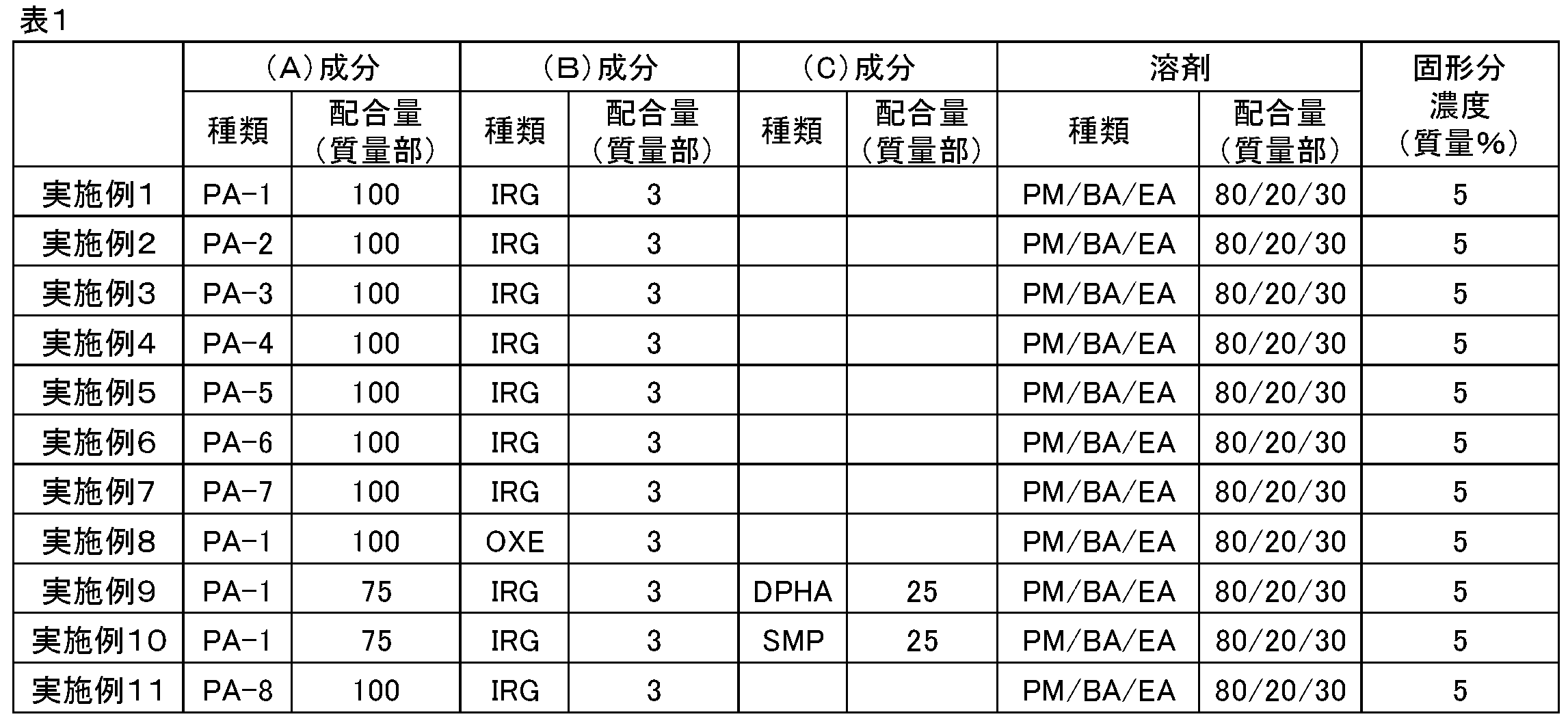
- Example> Each cured film forming composition of an Example was prepared with the composition shown in Table 1. Next, a cured film was formed using each cured film forming composition, and vertical alignment and adhesion were evaluated for each of the obtained cured films.
- Each cured film forming composition of the comparative example was applied on a TAC film with a wet film thickness of 4 ⁇ m using a bar coater. Each was heated and dried in a heat circulation oven at a temperature of 110 ° C. for 60 seconds to form a cured film on the TAC film. On this cured film, a polymerizable liquid crystal solution RMS03-015 for vertical alignment manufactured by Merck Co., Ltd. was applied with a wet film thickness of 6 ⁇ m using a bar coater. This coating film was exposed at 500 mJ / cm 2 to prepare a retardation material.
- This phase difference material was cut with a cutter knife so as to be 5 ⁇ 5 squares at intervals of 1 mm in length and width.
- a cellophane tape peeling test was performed on the cut using a scotch tape. In the evaluation, a case where all the 25 squares were not peeled off was marked with ⁇ , and a case where even one square was peeled off was marked with x. The evaluation results are summarized in Table 3 later.
- the alignment material obtained using the cured film-forming composition of the example had good vertical alignment properties similar to the alignment material obtained using the cured film-forming composition of the comparative example. showed that.
- the cured films obtained using the cured film forming compositions of the examples showed excellent adhesion. On the other hand, it was difficult for the cured film obtained using the cured film forming composition of the comparative example to obtain adhesion.
- the cured film forming composition according to the present invention is very useful as a material for forming a liquid crystal alignment film of a liquid crystal display element and an alignment material for forming an optically anisotropic film provided inside or outside the liquid crystal display element.
- it is suitable as a material for an optical compensation film of a circularly polarizing plate used as an antireflection film for an IPS-LCD or an organic EL display.
Landscapes
- Chemical & Material Sciences (AREA)
- Physics & Mathematics (AREA)
- Organic Chemistry (AREA)
- Polymers & Plastics (AREA)
- Medicinal Chemistry (AREA)
- Chemical Kinetics & Catalysis (AREA)
- Health & Medical Sciences (AREA)
- Nonlinear Science (AREA)
- Optics & Photonics (AREA)
- General Physics & Mathematics (AREA)
- Crystallography & Structural Chemistry (AREA)
- Wood Science & Technology (AREA)
- Materials Engineering (AREA)
- Engineering & Computer Science (AREA)
- Life Sciences & Earth Sciences (AREA)
- Mathematical Physics (AREA)
- Spectroscopy & Molecular Physics (AREA)
- Liquid Crystal (AREA)
- Polarising Elements (AREA)
- Macromonomer-Based Addition Polymer (AREA)
- Addition Polymer Or Copolymer, Post-Treatments, Or Chemical Modifications (AREA)
Abstract
Description
1)液晶層面に平行な電場が印加できる電極により供給される両基板の間に水平配向を有する液晶層が挟まれている。
2)一枚以上の+Aプレートと+Cプレートが両偏光板に挟まれている。
3)+Aプレートの主光軸は、液晶層の主光軸に垂直である。
4)液晶層の位相差値RLC、+Cプレートの位相差値R+C、+Aプレートの位相差値R+Aは、次式を満たすように決められる。
RLC:R+C:R+A≒1:0.5:0.25
5)+Aプレートと+Cプレートの位相差値に対し偏光板の保護フィルムの厚み方向の位相差値の関係は示されていない(TAC、COP、PNB)。
さらに、長鎖アルキルを有するシランカップリング剤等で基材を直接処理することにより、垂直配向膜を形成する方法も提案されているが、基材表面にヒドロキシ基が存在していない場合には処理が難しく、基材が制限されるという問題がある(特許文献4)。
(A)垂直配向性基とC=C二重結合を含む重合性基とを有するポリマー、並びに
(B)ラジカル重合開始剤を含有する硬化膜形成組成物であって、
前記垂直配向性基は下記式(1)で表される基であることを特徴とする、硬化膜形成組成物に関する。

Y1は単結合又は結合基を表し、
Y2は単結合、炭素原子数1~15のアルキレン基若しくは-CH2-CH(OH)-CH2-を表すか、又はベンゼン環、シクロヘキサン環若しくは複素環から選ばれる2価の環状基を表し、前記環状基上の任意の水素原子が、炭素原子数1~3のアルキル基、炭素原子数1~3のアルコキシル基、炭素原子数1~3のフッ素含有アルキル基、炭素原子数1~3のフッ素含有アルコキシル基又はフッ素原子で置換されていてもよく、
Y3は単結合又は炭素原子数1~15のアルキレン基を表し、
Y4は単結合を表すか、又はベンゼン環、シクロヘキサン環若しくは複素環から選ばれる2価の環状基、又は炭素原子数17~30であってステロイド骨格を有する2価の有機基を表し、前記環状基上の任意の水素原子が、ヒドロキシ基、炭素原子数1~3のアルキル基、炭素原子数1~3のアルコキシル基、炭素原子数1~3のフッ素含有アルキル基、炭素原子数1~3のフッ素含有アルコキシル基又はフッ素原子で置換されていてもよく、
Y5はベンゼン環、シクロヘキサン環又は複素環から選ばれる2価の環状基を表し、これらの環状基上の任意の水素原子が、ヒドロキシ基、炭素原子数1~3のアルキル基、炭素原子数1~3のアルコキシル基、炭素原子数1~3のフッ素含有アルキル基、炭素原子数1~3のフッ素含有アルコキシル基又はフッ素原子で置換されていてもよく、
nは0~4の整数を表し、nが2以上の場合、Y5同士は同一でも異なっていてもよく、
Y6は水素原子、炭素原子数1~18のアルキル基、炭素原子数1~18のフッ素含有アルキル基、炭素原子数1~18のアルコキシル基又は炭素原子数1~18のフッ素含有アルコキシル基を表し、
Y2及びY3におけるアルキレン基、並びに、前記環状基上の置換基及びY6におけるアルキル基、フッ素含有アルキル基、アルコキシル基及びフッ素含有アルコキシル基は、直鎖状、枝分かれ状、若しくは環状の何れか又はそれらの組み合わせであってもよく、
またY2及びY3におけるアルキレン基、並びに、Y6におけるアルキル基、フッ素含有アルキル基、アルコキシル基及びフッ素含有アルコキシル基は、結合基同士が隣り合わない限り1ないし3の結合基で中断されていてもよく、
さらにY2、Y4若しくはY5が2価の環状基を表すか、又はY4がステロイド骨格を有する2価の有機基を表すか、又はY2が-CH2-CH(OH)-CH2-を表すか、又はY2若しくはY3がアルキレン基を表すか、又はY6がアルキル基若しくはフッ素含有アルキル基を表すとき、該2価の環状基、該ステロイド骨格を有する2価の有機基、該-CH2-CH(OH)-CH2-、該アルキレン基、該アルキル基及び該フッ素含有アルキル基は、それらに隣接する基と結合基を介して結合していてもよく、
そして上記結合基は、-O-、-CH2O-、-COO-、-OCO-、-NHCO-、-NH-CO-O-及び-NH-CO-NH-からなる群から選ばれる基を表し、
但し、Y2乃至Y6がそれぞれ表すところの単結合、炭素原子数1~15のアルキレン基、ベンゼン環、シクロヘキサン環、複素環、ステロイド骨格を有する2価の有機基、-CH2-CH(OH)-CH2-、炭素原子数1~18のアルキル基、炭素原子数1~18のフッ素含有アルキル基、炭素原子数1~18のアルコキシル基及び炭素原子数1~18のフッ素含有アルコキシル基の炭素原子数の合計は6~30である)。
第3観点として、(C)C=C二重結合を含む重合性基を有するモノマーおよびポリマーからなる群から選ばれる少なくとも一種をさらに含有する、第1観点または第2観点に記載の硬化膜形成組成物に関する。
第4観点として、(A)成分100質量部に基づいて、0.1質量部~50質量部の(B)成分を含有する、第1観点乃至第3観点のうち何れか一項に記載の硬化膜形成組成物に関する。
第5観点として、(A)成分の100質量部に基づいて、10質量部乃至1000質量部の(C)成分を含有する、第3観点または第4観点に記載の硬化膜形成組成物に関する。
第7観点として、第1観点乃至第5観点のうち何れか一項に記載の硬化膜形成組成物から得られる硬化膜を使用して形成されることを特徴とする位相差材に関する。
本発明の第2の態様によれば、優れた垂直配向性を備え、低温短時間の焼成条件で安定して重合性液晶を垂直配向させることができる配向材を提供することができる。
本発明の第3の態様によれば、樹脂フィルム上でも高い効率で形成でき、高透明で高い溶剤耐性と基板及び液晶フィルムとの密着性とを有する位相差材を提供することができる。
本発明の硬化膜形成組成物は、(A)成分である垂直配向性基とC=C二重結合を含む重合性基とを有するポリマー、及び(B)成分であるラジカル重合開始剤とを含有する。本発明の硬化膜形成組成物は、上記(A)成分及び(B)成分に加えて、さらに、(C)成分としてC=C二重結合を含む重合性基を有するモノマーおよびポリマーからなる群から選ばれる少なくとも一種をも含有することができる。そして、本発明の効果を損なわない限りにおいて、その他の添加剤を含有することができる。
以下、各成分の詳細を説明する。
本発明の硬化膜形成組成物に含有される(A)成分は、垂直配向性基とC=C二重結合を含む重合性基とを有するポリマーである。
本明細書において、垂直配向性基とは、例えば炭素原子数が6~30程度の炭化水素基を含む基を表し、具体的には後述する式[1]で表される基を指す。
従って、垂直配向性基を有するモノマーとして、例えば炭素原子数6~30程度の炭化水素基を有するモノマーが挙げられる。炭素原子数6~30の炭化水素基としては、直鎖状、枝分かれ状若しくは環状の炭素原子数6~30のアルキル基または芳香族基を含む炭素原子数6~30の炭化水素基が挙げられる。従って炭素原子数6~30の炭化水素基を含むモノマーの具体例としては、アクリル酸のアルキルエステル、メタクリル酸のアルキルエステル、アルキルビニルエーテル、2-アルキルスチレン、3-アルキルスチレン、4-アルキルスチレン、N-アルキルマレイミドであって、当該アルキル基が炭素原子数6~30であるものや、これらのモノマーのアルキル基が上記の炭素原子数が6~30の芳香族基を含む炭素原子数6~30の炭化水素基に置き換わったものが挙げられる。

式[1]中、Y2は単結合、炭素原子数1~15のアルキレン基又は-CH2-CH(OH)-CH2-を表す。
またY2として、ベンゼン環、シクロヘキサン環または複素環から選ばれる2価の環状基が挙げられ、これら環状基上の任意の水素原子は、炭素原子数1~3のアルキル基、炭素原子数1~3のアルコキシル基、炭素原子数1~3のフッ素含有アルキル基、炭素原子数1~3のフッ素含有アルコキシル基またはフッ素原子で置換されていてもよい。
上記式[1]中、Y4は単結合を表すか、又はベンゼン環、シクロヘキサン環若しくは複素環から選ばれる2価の環状基を表し、これら環状基上の任意の水素原子が、ヒドロキシ基、炭素原子数1~3のアルキル基、炭素原子数1~3のアルコキシル基、炭素原子数1~3のフッ素含有アルキル基、炭素原子数1~3のフッ素含有アルコキシル基またはフッ素原子で置換されていてもよい。
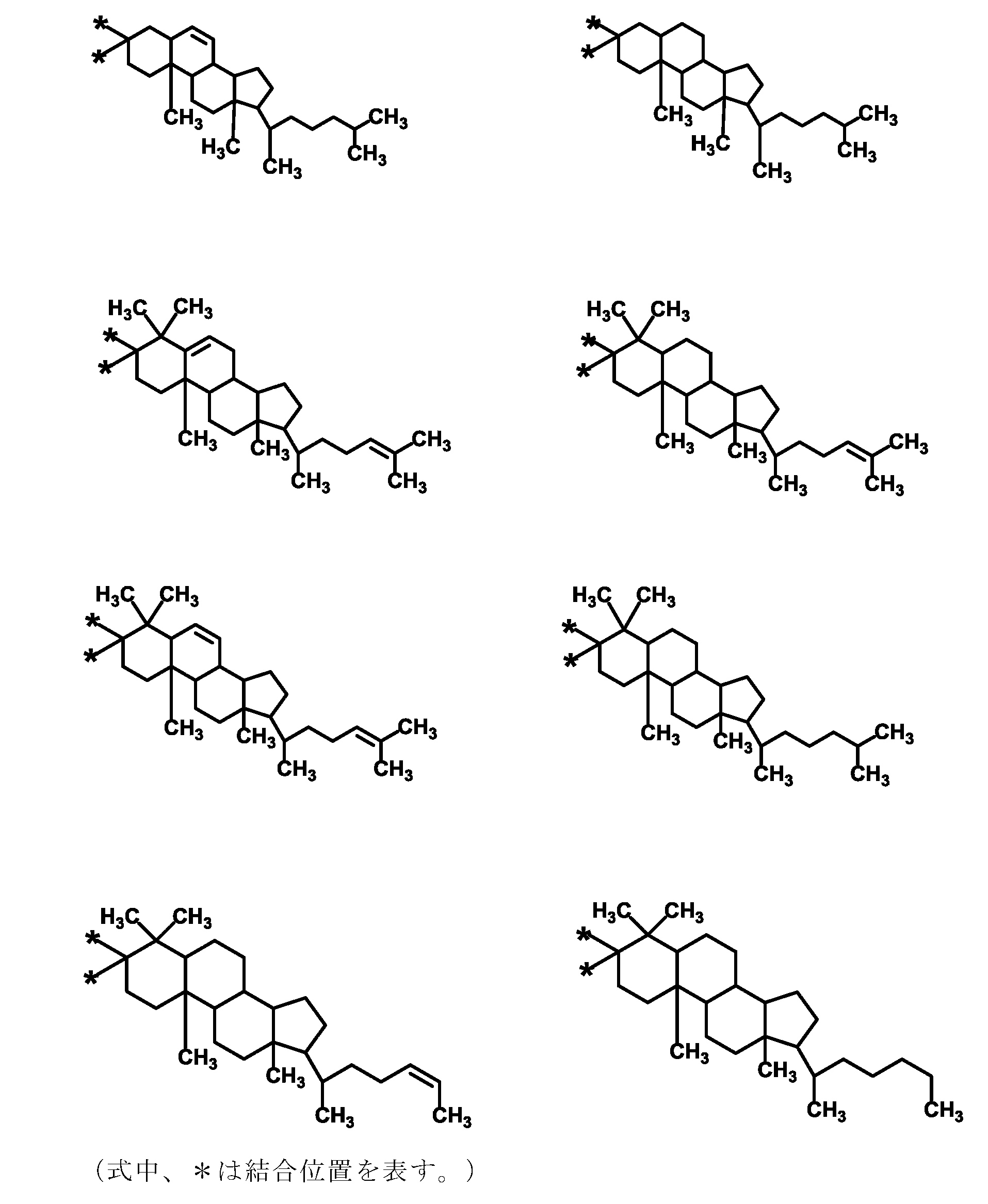
上記アルコキシル基としては、前記アルキル基の具体例として挙げた基に酸素原子-O-が結合した基を挙げることができる。
また上記フッ素含有アルキル基、フッ素含有アルコキシル基としては、前記アルキル基及びアルコキシル基のうち任意の水素原子がフッ素原子で置換された基を挙げることができる。
これらのうち、垂直配向性と重合性液晶の塗布性を考慮すると、垂直配向性基は、炭素原子数7~18、特に8~16のアルキル基を含む基であることが好ましい。
(A)成分のポリマーにおいて、上記C=C二重結合を含む重合性基を有する特定側鎖は、炭素原子数が3~16であって、末端に不飽和結合を有するものであることが好ましく、式(b2)で表される特定側鎖が特に好ましい。

式(b2)において、R52は水素原子またはメチル基であり、R52が水素原子である特定側鎖が好ましく、より好ましくは、末端がアクリロイル基、メタクリロイル基またはスチリル基である特定側鎖である。
そのようなモノマーの具体例としては、特定モノマーとは異なる構造を有するアクリル酸エステル化合物又はメタクリル酸エステル化合物、マレイミド化合物、アクリルアミド化合物、アクリロニトリル、マレイン酸無水物、スチレン化合物及びビニル化合物等が挙げられる。
前記特定モノマーとは異なる構造を有するアクリル酸エステル化合物としては、例えば、メチルアクリレート、エチルアクリレート、n-プロピルアクリレート、イソプロピルアクリレート、n-ブチルアクリレート、イソブチルアクリレート、t-ブチルアクリレート、ベンジルアクリレート、ナフチルアクリレート、アントリルアクリレート、アントリルメチルアクリレート、フェニルアクリレート、2,2,2-トリフルオロエチルアクリレート、シクロヘキシルアクリレート、イソボルニルアクリレート、2-メトキシエチルアクリレート、メトキシトリエチレングリコールアクリレート、2-エトキシエチルアクリレート、テトラヒドロフルフリルアクリレート、3-メトキシブチルアクリレート、2-メチル-2-アダマンチルアクリレート、2-プロピル-2-アダマンチルアクリレート、8-メチル-8-トリシクロデシルアクリレート、及び、8-エチル-8-トリシクロデシルアクリレート等が挙げられる。
エポキシ基を側鎖または末端に1個以上有するポリマーの市販品の具体例としては、ビスフェノールA型エポキシ樹脂としては、jER1001、同1002、同1003、同1004、同1055、同1007、同1009、同1010、同834、同828(以上、三菱化学(株)製)等を、ビスフェノールF型エポキシ樹脂としては、jER806、同807(以上、三菱化学(株)製)等を、フェノールノボラック型エポキシ樹脂としては、jER152、同154(以上、三菱化学(株)製)、EPPN201、同202(以上、日本化薬(株)製)等を、クレゾールノボラック型エポキシ樹脂としては、ECN-1299(旭化成(株)製)、EOCN-102、EOCN-103S、EOCN-104S、EOCN-1020、EOCN-1025、EOCN-1027(以上、日本化薬(株)製)、jER80S75(三菱化学(株)製)等を、ビスフェノールAノボラック型エポキシ樹脂としては、jER157S70(三菱化学(株)製)等を、ポリオールの1,2-エポキシ-4-(2-オキシラニル)シクロヘキサン付加物としてはEHPE-3150((株)ダイセル製)等を挙げることができる。
なお、本明細書において、重量平均分子量はゲルパーミッションクロマトグラフィー(GPC)により、標準試料としてポリスチレンを用いて得られる値である。
本発明の硬化膜形成組成物における(B)成分は、ラジカル重合開始剤である。
ラジカル重合開始剤としては、公知のものが使用することが可能であり、例えば、アルキルフェノン類、ベンゾフェノン類、アシルホスフィンオキシド類、ミヒラーのベンゾイルベンゾエート類、オキシムエステル類、テトラメチルチウラムモノスルフィド類、チオキサントン類等が挙げられる。
市販品としては、イルガキュア184、369、379EG、651、500、907、CGI369、CG24-61、OXE02、ルシリンLR8728、ルシリンTPO、ダロキュア1116、1173(以上、BASF(株)製)、ユベクリルP36(UCB(株)製)などの商品名で市販されているものを挙げることができる。
上記ラジカル重合開始剤は、(A)成分100質量部に対して、好ましくは0.1~50質量部、より好ましくは1~30質量部、特に好ましくは2~30質量部の量で用いることができる。ラジカル重合開始剤の使用量が前記範囲より少ないと、酸素によるラジカルの失活の影響(感度の低下)を受けやすく、前記範囲よりも多いと、相溶性が悪くなったり、保存安定性が低下したりする傾向がある。
本発明の硬化膜形成組成物は、(C)成分として、C=C二重結合を含む重合性基を有するモノマーおよびポリマーからなる群から選ばれる少なくとも一種を含有していても良い。
本発明の硬化膜形成組成物は、主として溶剤に溶解した溶液状態で用いられる。その際に使用する溶剤は、(A)成分、(B)成分、必要に応じて(C)成分および/または後述するその他添加剤を溶解できればよく、その種類および構造などは特に限定されるものでない。
さらに、本発明の硬化膜形成組成物は、本発明の効果を損なわない限りにおいて、必要に応じて、増感剤、密着向上剤、シランカップリング剤、界面活性剤、レオロジー調整剤、顔料、染料、保存安定剤、消泡剤、酸化防止剤等を含有することができる。
本発明の硬化膜形成組成物は、(A)成分の垂直配向性基とC=C二重結合を含む重合性基とを有するポリマー、(B)成分の重合開始剤を含有し、所望により(C)成分のC=C二重結合を含む重合性基を有するモノマーおよびポリマーからなる群から選ばれる少なくとも一種、そして更に本発明の効果を損なわない限りにおいてその他の添加剤を含有することができる組成物である。そして通常は、それらが溶剤に溶解した溶液の形態として用いられる。
[1]:(A)成分、(A)成分100質量部に基づいて、0.1質量部~50質量部の(B)成分を含有する硬化膜形成組成物。
[2]:(A)成分、(A)成分100質量部に基づいて、0.1質量部~50質量部の(B)成分、(A)成分100質量部に基づいて、10質量部~1000質量部の(C)成分、並びに、溶剤を含有する硬化膜形成組成物。
本発明の硬化膜形成組成物における固形分の割合は、各成分が均一に溶剤に溶解している限り、特に限定されるものではないが、1質量%~60質量%であり、好ましくは2質量%~50質量%であり、より好ましくは2質量%~20質量%である。ここで、固形分とは、硬化膜形成組成物の全成分から溶剤を除いたものをいう。
本発明の硬化膜形成組成物の溶液を基板(例えば、シリコン/二酸化シリコン被覆基板、シリコンナイトライド基板、金属、例えば、アルミニウム、モリブデン、クロムなどが被覆された基板、ガラス基板、石英基板、ITO基板等)やフィルム基板(例えば、トリアセチルセルロース(TAC)フィルム、ポリカーボネート(PC)フィルム、シクロオレフィンポリマー(COP)フィルム、シクロオレフィンコポリマー(COC)フィルム、ポリエチレンテレフタレート(PET)フィルム、アクリルフィルム、ポリエチレンフィルム等の樹脂フィルム)等の上に、バーコート、回転塗布、流し塗布、ロール塗布、スリット塗布、スリットに続いた回転塗布、インクジェット塗布、印刷などによって塗布して塗膜を形成し、その後、ホットプレートまたはオーブン等で加熱乾燥することにより、硬化膜を形成することができる。該硬化膜はそのまま配向材として適用できる。
このように本発明の硬化膜形成組成物は、各種位相差材(位相差フィルム)や液晶表示素子等の製造に好適に用いることができる。
[実施例で用いる略記号]
以下の実施例で用いる略記号の意味は、次のとおりである。
LAA:ラウリルアクリレート
PAA:パルミチルアクリレート
HEMA:2-ヒドロキシエチルメタクリレート
GMA:グリシジルメタクリレート
AOI:昭和電工(株)製カレンズAOI
AIBN:α,α’-アゾビスイソブチロニトリル
LA:ラウリル酸
M100:3,4-エポキシシクロヘキシルメチルメタクリレート
5PCA:4-(4-ペンチルシクロヘキシル)安息香酸
IRG:BASF社製 IRGACURE 907
OXE:BASF社製 IRGACURE OXE 02
DPHA:ダイセル・オルネクス(株)製 ジペンタエリスリトールヘキサアクリレート
SMP:共栄社化学(株)製 UV硬化型アクリルポリマー SMP-550A
MAA:メタクリル酸
CYM303:ヘキサメトキシメチルメラミン
PTSA:p-トルエンスルホン酸・一水和物
実施例及び比較例の各硬化膜形成組成物は溶剤を含有し、その溶剤として、プロピレングリコールモノメチルエーテル(PM)、酢酸ブチル(BA)、酢酸エチル(EA)を用いた。
重合例におけるアクリル共重合体の分子量は、(株)Shodex社製常温ゲル浸透クロマトグラフィー(GPC)装置(GPC-101)、Shodex社製カラム(KD―803、KD-805)を用い以下のようにして測定した。
なお、下記の数平均分子量(以下、Mnと称す。)及び重量平均分子量(以下、Mwと称す。)は、ポリスチレン換算値にて表した。
カラム温度:50℃
溶離液:N,N-ジメチルホルムアミド(添加剤として、臭化リチウム-水和物(LiBr・H2O)が30mmol/L、リン酸・無水結晶(o―リン酸)が30mmol/L、テトラヒドロフラン(THF)が10mL/L)
流速:1.0mL/分
検量線作成用標準サンプル:東ソー社製 TSK 標準ポリエチレンオキサイド(分子量 約900,000、150,000、100,000、30,000)、及び、ポリマーラボラトリー社製 ポリエチレングリコール(分子量 約12,000、4,000、1,000)。
LAA 3.0g、GMA 12.0g、重合触媒としてAIBN 0.3gをPM 45.7gに溶解し、80℃にて20時間反応させることによりアクリル共重合体溶液を得た。得られたアクリル共重合体溶液をヘキサン500.0gに徐々に滴下して固体を析出させ、ろ過および減圧乾燥することでアクリル共重合体(P1)を得た。得られたアクリル共重合体のMnは14,000、Mwは38,000であった。
PAA 3.0g、GMA 12.0g、重合触媒としてAIBN 0.3gをPM 45.7gに溶解し、80℃にて20時間反応させることによりアクリル共重合体溶液を得た。得られたアクリル共重合体溶液をヘキサン500.0gに徐々に滴下して固体を析出させ、ろ過および減圧乾燥することでアクリル共重合体(P2)を得た。得られたアクリル共重合体のMnは12,000、Mwは30,000であった。
LAA 3.0g、HEMA 12.0g、重合触媒としてAIBN 0.3gをPM 45.7gに溶解し、80℃にて20時間反応させることによりアクリル共重合体溶液を得た。得られたアクリル共重合体溶液をヘキサン500.0gに徐々に滴下して固体を析出させ、ろ過および減圧乾燥することでアクリル共重合体(P3)を得た。得られたアクリル共重合体のMnは8,600、Mwは20,000であった。
LAA 1.5g、GMA 13.5g、重合触媒としてAIBN 0.3gをPM 45.7gに溶解し、80℃にて20時間反応させることによりアクリル共重合体溶液を得た。得られたアクリル共重合体溶液をヘキサン500.0gに徐々に滴下して固体を析出させ、ろ過および減圧乾燥することでアクリル共重合体(P4)を得た。得られたアクリル共重合体のMnは15,000、Mwは32,000であった。
LAA 4.5g、GMA 10.5g、重合触媒としてAIBN 0.3gをPM 45.7gに溶解し、80℃にて20時間反応させることによりアクリル共重合体溶液を得た。得られたアクリル共重合体溶液をヘキサン500.0gに徐々に滴下して固体を析出させ、ろ過および減圧乾燥することでアクリル共重合体(P5)を得た。得られたアクリル共重合体のMnは14,000、Mwは31,000であった。
M100 10.0g、重合触媒としてAIBN 0.4gをPM 46.4gに溶解し、80℃にて20時間反応させることによりアクリル共重合体溶液を得た。得られたアクリル共重合体溶液をヘキサン500.0gに徐々に滴下して固体を析出させ、ろ過および減圧乾燥することでアクリル共重合体(P6)を得た。得られたアクリル共重合体のMnは18,000、Mwは38,000であった。
MAA 13.8g、LAA 14.1g、HEMA 7.2g、重合触媒としてAIBN 0.68gをPM 107.0gに溶解し、80℃にて16時間反応させることによりアクリル共重合体溶液(固形分濃度25質量%)(P7)を得た。得られたアクリル共重合体のMnは13,300、Mwは27,800であった。
重合例1で得たアクリル共重合体(P1)7.5g、アクリル酸4.5g、ジブチルヒドロキシトルエン0.4g、反応触媒としてベンジルトリエチルアンモニウムクロリド0.3gをPM30gに溶解させ、110℃で20時間反応させた。この溶液をヘキサン500gに徐々に滴下して固体を析出させ、ろ過および減圧乾燥することで、アクロイル基を有するアクリル共重合体(PA-1)を得た。1H-NMR分析を行い、アクリル共重合体(PA-1)がアクロイル基を有することを確認した。
重合例2で得たアクリル共重合体(P2)7.5g、アクリル酸4.5g、ジブチルヒドロキシトルエン0.4g、反応触媒としてベンジルトリエチルアンモニウムクロリド0.3gをPM30gに溶解させ、110℃で20時間反応させた。この溶液をヘキサン500gに徐々に滴下して固体を析出させ、ろ過および減圧乾燥することで、アクロイル基を有するアクリル共重合体(PA-2)を得た。1H-NMR分析を行い、アクリル共重合体(PA-2)がアクロイル基を有することを確認した。
重合例3で得たアクリル共重合体(P3)2.0g、2-アクリロイルオキシエチルイソシアナート4.3g、ジブチルヒドロキシトルエン0.4g、反応触媒としてジブチルスズジラウレート10mgをテトラヒドロフラン60gに溶解させ、60℃で5時間反応させた。この溶液をヘキサン500gに徐々に滴下して固体を析出させ、ろ過および減圧乾燥することで、アクロイル基を有するアクリル共重合体(PA-3)を得た。1H-NMR分析を行い、アクリル共重合体(PA-3)がアクロイル基を有することを確認した。
重合例4で得たアクリル共重合体(P4)6.8g、アクリル酸4.5g、ジブチルヒドロキシトルエン0.4g、反応触媒としてベンジルトリエチルアンモニウムクロリド0.3gをPM30gに溶解させ、110℃で20時間反応させた。この溶液をヘキサン500gに徐々に滴下して固体を析出させ、ろ過および減圧乾燥することで、アクロイル基を有するアクリル共重合体(PA-4)を得た。1H-NMR分析を行い、アクリル共重合体(PA-4)がアクロイル基を有することを確認した。
重合例5で得たアクリル共重合体(P5)8.2g、アクリル酸4.5g、ジブチルヒドロキシトルエン0.4g、反応触媒としてベンジルトリエチルアンモニウムクロリド0.3gをPM30gに溶解させ、110℃で20時間反応させた。この溶液をヘキサン500gに徐々に滴下して固体を析出させ、ろ過および減圧乾燥することで、アクロイル基を有するアクリル共重合体(PA-5)を得た。1H-NMR分析を行い、アクリル共重合体(PA-5)がアクロイル基を有することを確認した。
重合例6で得たアクリル共重合体(P6)8.0g、アクリル酸2.4g、LA1.6g、ジブチルヒドロキシトルエン0.4g、反応触媒としてベンジルトリエチルアンモニウムクロリド0.3gをPM50gに溶解させ、110℃で20時間反応させた。この溶液をヘキサン500gに徐々に滴下して固体を析出させ、ろ過および減圧乾燥することで、アクロイル基を有するアクリル共重合体(PA-6)を得た。1H-NMR分析を行い、アクリル共重合体(PA-6)がアクロイル基を有することを確認した。
重合例6で得たアクリル共重合体(P6)8.0g、アクリル酸1.8g、LA1.7g、ジブチルヒドロキシトルエン0.4g、反応触媒としてベンジルトリエチルアンモニウムクロリド0.3gをPM50gに溶解させ、110℃で20時間反応させた。この溶液をヘキサン500gに徐々に滴下して固体を析出させ、ろ過および減圧乾燥することで、アクロイル基を有するアクリル共重合体(PA-7)を得た。1H-NMR分析を行い、アクリル共重合体(PA-7)がアクロイル基を有することを確認した。
重合例6で得たアクリル共重合体(P6)8.0g、アクリル酸3.2g、5PCA2.2g、ジブチルヒドロキシトルエン0.4g、反応触媒としてベンジルトリエチルアンモニウムクロリド0.3gをPM60gに溶解させ、110℃で20時間反応させた。この溶液をヘキサン500gに徐々に滴下して固体を析出させ、ろ過および減圧乾燥することで、アクロイル基を有するアクリル共重合体(PA-8)を得た。1H-NMR分析を行い、アクリル共重合体(PA-8)がアクロイル基を有することを確認した。
表1に示す組成にて実施例の各硬化膜形成組成物を調製した。次に、各硬化膜形成組成物を用いて硬化膜を形成し、得られた硬化膜それぞれについて、垂直配向性および密着性の評価を行った。
WO2015/019962号に記載の方法を参考に、表2に示す比較例の各硬化膜形成組成物を調製した。次に、各硬化膜形成組成物を用いて硬化膜を形成し、得られた硬化膜それぞれについて、垂直配向性および密着性の評価を行った。

実施例の各硬化膜形成組成物を、TACフィルム上にバーコーターを用いてWet膜厚4μmにて塗布した。それぞれ温度110℃で60秒間、熱循環式オーブン中で加熱乾燥を行い、その後、この塗膜を1000mJ/cm2で露光し、TACフィルム上にそれぞれ硬化膜を形成した。
この硬化膜上に、メルク(株)製の垂直配向用重合性液晶溶液RMS03-015を、バーコーターを用いてWet膜厚6μmにて塗布した。この塗膜を500mJ/cm2で露光し、位相差材を作製した。
作製したこれら位相差材を、大塚電子(株)製位相差測定装置RETS100を用いて面内位相差の入射角度依存性を測定した。入射角度0度での面内位相差値が0、入射角度±50度での面内位相差が38±5nmの範囲にあるものを垂直配向していると判断した。評価結果は、後に表3にまとめて示す。
この硬化膜上に、メルク(株)製の垂直配向用重合性液晶溶液RMS03-015を、バーコーターを用いてWet膜厚6μmにて塗布した。この塗膜を500mJ/cm2で露光し、位相差材を作製した。
作製したこれら位相差材を、大塚電子(株)製位相差測定装置RETS100を用いて面内位相差の入射角度依存性を測定した。入射角度0度での面内位相差値が0、入射角度±50度での面内位相差が38±5nmの範囲にあるものを垂直配向していると判断した。評価結果は、後に表3にまとめて示す。
実施例及び比較例の各硬化膜形成組成物を、TACフィルム上にバーコーターを用いてWet膜厚4μmにて塗布した。それぞれ温度110℃で60秒間、熱循環式オーブン中で加熱乾燥を行い、その後、この塗膜を1000mJ/cm2で露光し、TACフィルム上にそれぞれ硬化膜を形成した。
この硬化膜上に、メルク(株)製の垂直配向用重合性液晶溶液RMS03-015を、バーコーターを用いてWet膜厚6μmにて塗布した。この基板上の塗膜を500mJ/cm2で露光し、位相差材を作製した。
この位相差材に縦横1mm間隔で5×5マスとなるようカッターナイフで切込みをつけた。この切り込みの上にスコッチテープを用いてセロハンテープ剥離試験を行った。評価は、25マス全て剥がれずに残っているものを○、1マスでも剥がれているものを×とした。評価結果は、後に表3にまとめて示す。

Claims (7)
- (A)垂直配向性基とC=C二重結合を含む重合性基とを有するポリマー、並びに
(B)ラジカル重合開始剤
を含有する硬化膜形成組成物であって、
前記垂直配向性基は下記式(1)で表される基であることを特徴とする、硬化膜形成組成物。

Y1は単結合又は結合基を表し、
Y2は単結合、炭素原子数1~15のアルキレン基若しくは-CH2-CH(OH)-CH2-を表すか、又はベンゼン環、シクロヘキサン環若しくは複素環から選ばれる2価の環状基を表し、前記環状基上の任意の水素原子が、炭素原子数1~3のアルキル基、炭素原子数1~3のアルコキシル基、炭素原子数1~3のフッ素含有アルキル基、炭素原子数1~3のフッ素含有アルコキシル基又はフッ素原子で置換されていてもよく、
Y3は単結合又は炭素原子数1~15のアルキレン基を表し、
Y4は単結合を表すか、又はベンゼン環、シクロヘキサン環若しくは複素環から選ばれる2価の環状基、又は炭素原子数17~30であってステロイド骨格を有する2価の有機基を表し、前記環状基上の任意の水素原子が、ヒドロキシ基、炭素原子数1~3のアルキル基、炭素原子数1~3のアルコキシル基、炭素原子数1~3のフッ素含有アルキル基、炭素原子数1~3のフッ素含有アルコキシル基又はフッ素原子で置換されていてもよく、
Y5はベンゼン環、シクロヘキサン環又は複素環から選ばれる2価の環状基を表し、これらの環状基上の任意の水素原子が、ヒドロキシ基、炭素原子数1~3のアルキル基、炭素原子数1~3のアルコキシル基、炭素原子数1~3のフッ素含有アルキル基、炭素原子数1~3のフッ素含有アルコキシル基又はフッ素原子で置換されていてもよく、
nは0~4の整数を表し、nが2以上の場合、Y5同士は同一でも異なっていてもよく、
Y6は水素原子、炭素原子数1~18のアルキル基、炭素原子数1~18のフッ素含有アルキル基、炭素原子数1~18のアルコキシル基又は炭素原子数1~18のフッ素含有アルコキシル基を表し、
Y2及びY3におけるアルキレン基、並びに、前記環状基上の置換基及びY6におけるアルキル基、フッ素含有アルキル基、アルコキシル基及びフッ素含有アルコキシル基は、直鎖状、枝分かれ状、若しくは環状の何れか又はそれらの組み合わせであってもよく、
またY2及びY3におけるアルキレン基、並びに、Y6におけるアルキル基、フッ素含有アルキル基、アルコキシル基及びフッ素含有アルコキシル基は、結合基同士が隣り合わない限り1ないし3の結合基で中断されていてもよく、
さらにY2、Y4若しくはY5が2価の環状基を表すか、又はY4がステロイド骨格を有する2価の有機基を表すか、又はY2が-CH2-CH(OH)-CH2-を表すか、又はY2若しくはY3がアルキレン基を表すか、又はY6がアルキル基若しくはフッ素含有アルキル基を表すとき、該2価の環状基、該ステロイド骨格を有する2価の有機基、該-CH2-CH(OH)-CH2-、該アルキレン基、該アルキル基及び該フッ素含有アルキル基は、それらに隣接する基と結合基を介して結合していてもよく、
そして上記結合基は、-O-、-CH2O-、-COO-、-OCO-、-NHCO-、-NH-CO-O-及び-NH-CO-NH-からなる群から選ばれる基を表し、
但し、Y2乃至Y6がそれぞれ表すところの単結合、炭素原子数1~15のアルキレン基、ベンゼン環、シクロヘキサン環、複素環、ステロイド骨格を有する2価の有機基、-CH2-CH(OH)-CH2-、炭素原子数1~18のアルキル基、炭素原子数1~18のフッ素含有アルキル基、炭素原子数1~18のアルコキシル基及び炭素原子数1~18のフッ素含有アルコキシル基の炭素原子数の合計は6~30である)。 - (A)成分のポリマーにおいて、C=C二重結合を含む重合性基が、アクリル基、メタクリル基、ビニル基、アリル基及びマレイミド基からなる群から選ばれる少なくとも一種である、請求項1に記載の硬化膜形成組成物。
- (C)C=C二重結合を含む重合性基を有するモノマーおよびポリマーからなる群から選ばれる少なくとも一種をさらに含有する、請求項1または2に記載の硬化膜形成組成物。
- (A)成分100質量部に基づいて、0.1質量部~50質量部の(B)成分を含有する、請求項1乃至3のうち何れか一項に記載の硬化膜形成組成物。
- (A)成分の100質量部に基づいて、10質量部乃至1000質量部の(C)成分を含有する、請求項3または4に記載の硬化膜形成組成物。
- 請求項1乃至5のうち何れか一項に記載の硬化膜形成組成物を硬化させて得られることを特徴とする配向材。
- 請求項1乃至5のうち何れか一項に記載の硬化膜形成組成物から得られる硬化膜を使用して形成されることを特徴とする位相差材。
Priority Applications (3)
| Application Number | Priority Date | Filing Date | Title |
|---|---|---|---|
| JP2018561429A JP7070839B2 (ja) | 2017-01-13 | 2018-01-12 | 硬化膜形成組成物、配向材および位相差材 |
| KR1020197022789A KR102662074B1 (ko) | 2017-01-13 | 2018-01-12 | 경화막 형성 조성물, 배향재 및 위상차재 |
| CN201880006538.XA CN110167980B (zh) | 2017-01-13 | 2018-01-12 | 固化膜形成用组合物、取向材及相位差材 |
Applications Claiming Priority (2)
| Application Number | Priority Date | Filing Date | Title |
|---|---|---|---|
| JP2017004141 | 2017-01-13 | ||
| JP2017-004141 | 2017-01-13 |
Publications (1)
| Publication Number | Publication Date |
|---|---|
| WO2018131682A1 true WO2018131682A1 (ja) | 2018-07-19 |
Family
ID=62840344
Family Applications (1)
| Application Number | Title | Priority Date | Filing Date |
|---|---|---|---|
| PCT/JP2018/000657 Ceased WO2018131682A1 (ja) | 2017-01-13 | 2018-01-12 | 硬化膜形成組成物、配向材および位相差材 |
Country Status (5)
| Country | Link |
|---|---|
| JP (1) | JP7070839B2 (ja) |
| KR (1) | KR102662074B1 (ja) |
| CN (1) | CN110167980B (ja) |
| TW (1) | TWI761424B (ja) |
| WO (1) | WO2018131682A1 (ja) |
Cited By (1)
| Publication number | Priority date | Publication date | Assignee | Title |
|---|---|---|---|---|
| JP2020181148A (ja) * | 2019-04-26 | 2020-11-05 | 日産化学株式会社 | 位相差材 |
Families Citing this family (1)
| Publication number | Priority date | Publication date | Assignee | Title |
|---|---|---|---|---|
| CN118887872A (zh) * | 2020-03-09 | 2024-11-01 | 大日本印刷株式会社 | 柔性显示装置用层积体、显示装置用层积体和柔性显示装置 |
Citations (8)
| Publication number | Priority date | Publication date | Assignee | Title |
|---|---|---|---|---|
| JP2001240615A (ja) * | 2000-02-29 | 2001-09-04 | Nippon Shokubai Co Ltd | 反応性液状ポリマー及びその製造方法 |
| JP2008116809A (ja) * | 2006-11-07 | 2008-05-22 | Nissan Chem Ind Ltd | 液晶配向層形成用樹脂組成物 |
| JP2009236942A (ja) * | 2008-03-25 | 2009-10-15 | Fujifilm Corp | 平版印刷版原版及びその製版方法 |
| JP2011006558A (ja) * | 2009-06-24 | 2011-01-13 | Showa Denko Kk | 水系媒体に分散した光硬化性樹脂組成物 |
| JP2011032365A (ja) * | 2009-07-31 | 2011-02-17 | Natoko Kk | 活性エネルギー線硬化性組成物 |
| JP2011221463A (ja) * | 2010-04-14 | 2011-11-04 | Samsung Electronics Co Ltd | 感光性樹脂組成物 |
| JP2012057012A (ja) * | 2010-09-07 | 2012-03-22 | Kansai Paint Co Ltd | 共重合体、該共重合体を含有する水性塗料組成物及び複層塗膜形成方法 |
| WO2015019962A1 (ja) * | 2013-08-09 | 2015-02-12 | 日産化学工業株式会社 | 硬化膜形成組成物、配向材および位相差材 |
Family Cites Families (12)
| Publication number | Priority date | Publication date | Assignee | Title |
|---|---|---|---|---|
| JP2857889B2 (ja) | 1988-11-04 | 1999-02-17 | 富士写真フイルム株式会社 | 液晶表示装置 |
| JP3204182B2 (ja) | 1997-10-24 | 2001-09-04 | 日本電気株式会社 | 横電界方式の液晶表示装置 |
| JP2001281669A (ja) | 2000-03-30 | 2001-10-10 | Matsushita Electric Ind Co Ltd | 液晶配向膜とその製造方法、およびそれを用いた液晶表示装置とその製造方法 |
| KR100677050B1 (ko) | 2003-10-22 | 2007-01-31 | 주식회사 엘지화학 | +a-플레이트와 +c-플레이트를 이용한 시야각보상필름을 포함하는 면상 스위칭 액정 표시장치 |
| JP2008292677A (ja) * | 2007-05-23 | 2008-12-04 | Mitsubishi Chemicals Corp | 反応性樹脂組成物、カラーフィルター及び画像表示装置 |
| US10100201B2 (en) * | 2014-02-28 | 2018-10-16 | Nissan Chemical Industries, Ltd. | Cured film formation composition, orientation material and retardation material |
| CN111240102B (zh) * | 2014-08-28 | 2022-11-15 | 日产化学工业株式会社 | 固化膜形成用组合物、取向材料及相位差材料 |
| KR102406797B1 (ko) * | 2014-09-08 | 2022-06-10 | 닛산 가가쿠 가부시키가이샤 | 경화막 형성 조성물, 배향재 및 위상차재 |
| JP2015079256A (ja) | 2014-11-11 | 2015-04-23 | 大日本印刷株式会社 | 光学フィルム、光学フィルム用転写体、画像表示装置 |
| KR101987371B1 (ko) * | 2015-04-08 | 2019-06-10 | 주식회사 엘지화학 | 수직 배향막 및 이를 포함하는 액정 소자 |
| CN107532006B (zh) * | 2015-04-17 | 2021-06-25 | 日产化学工业株式会社 | 热固化性树脂组合物和垂直取向相位差膜 |
| CN105936830A (zh) * | 2016-04-22 | 2016-09-14 | 深圳市华星光电技术有限公司 | 液晶材料、液晶显示面板的制作方法及液晶显示面板 |
-
2018
- 2018-01-12 CN CN201880006538.XA patent/CN110167980B/zh active Active
- 2018-01-12 KR KR1020197022789A patent/KR102662074B1/ko active Active
- 2018-01-12 WO PCT/JP2018/000657 patent/WO2018131682A1/ja not_active Ceased
- 2018-01-12 JP JP2018561429A patent/JP7070839B2/ja active Active
- 2018-01-12 TW TW107101202A patent/TWI761424B/zh active
Patent Citations (8)
| Publication number | Priority date | Publication date | Assignee | Title |
|---|---|---|---|---|
| JP2001240615A (ja) * | 2000-02-29 | 2001-09-04 | Nippon Shokubai Co Ltd | 反応性液状ポリマー及びその製造方法 |
| JP2008116809A (ja) * | 2006-11-07 | 2008-05-22 | Nissan Chem Ind Ltd | 液晶配向層形成用樹脂組成物 |
| JP2009236942A (ja) * | 2008-03-25 | 2009-10-15 | Fujifilm Corp | 平版印刷版原版及びその製版方法 |
| JP2011006558A (ja) * | 2009-06-24 | 2011-01-13 | Showa Denko Kk | 水系媒体に分散した光硬化性樹脂組成物 |
| JP2011032365A (ja) * | 2009-07-31 | 2011-02-17 | Natoko Kk | 活性エネルギー線硬化性組成物 |
| JP2011221463A (ja) * | 2010-04-14 | 2011-11-04 | Samsung Electronics Co Ltd | 感光性樹脂組成物 |
| JP2012057012A (ja) * | 2010-09-07 | 2012-03-22 | Kansai Paint Co Ltd | 共重合体、該共重合体を含有する水性塗料組成物及び複層塗膜形成方法 |
| WO2015019962A1 (ja) * | 2013-08-09 | 2015-02-12 | 日産化学工業株式会社 | 硬化膜形成組成物、配向材および位相差材 |
Cited By (1)
| Publication number | Priority date | Publication date | Assignee | Title |
|---|---|---|---|---|
| JP2020181148A (ja) * | 2019-04-26 | 2020-11-05 | 日産化学株式会社 | 位相差材 |
Also Published As
| Publication number | Publication date |
|---|---|
| JP7070839B2 (ja) | 2022-05-18 |
| KR20190103295A (ko) | 2019-09-04 |
| TW201831538A (zh) | 2018-09-01 |
| CN110167980A (zh) | 2019-08-23 |
| TWI761424B (zh) | 2022-04-21 |
| JPWO2018131682A1 (ja) | 2019-11-07 |
| CN110167980B (zh) | 2022-09-20 |
| KR102662074B1 (ko) | 2024-05-02 |
Similar Documents
| Publication | Publication Date | Title |
|---|---|---|
| US10100201B2 (en) | Cured film formation composition, orientation material and retardation material | |
| JP6604483B2 (ja) | 硬化膜形成組成物、配向材および位相差材 | |
| KR102406797B1 (ko) | 경화막 형성 조성물, 배향재 및 위상차재 | |
| JP7070839B2 (ja) | 硬化膜形成組成物、配向材および位相差材 | |
| CN107532006B (zh) | 热固化性树脂组合物和垂直取向相位差膜 | |
| CN106604973B (zh) | 固化膜形成用组合物、取向材料及相位差材料 | |
| JP7249271B2 (ja) | 硬化膜形成組成物、配向材および位相差材 | |
| CN107207641B (zh) | 固化膜形成用组合物、取向材料和相位差材料 | |
| JP2020181148A (ja) | 位相差材 |
Legal Events
| Date | Code | Title | Description |
|---|---|---|---|
| 121 | Ep: the epo has been informed by wipo that ep was designated in this application |
Ref document number: 18738753 Country of ref document: EP Kind code of ref document: A1 |
|
| ENP | Entry into the national phase |
Ref document number: 2018561429 Country of ref document: JP Kind code of ref document: A |
|
| NENP | Non-entry into the national phase |
Ref country code: DE |
|
| ENP | Entry into the national phase |
Ref document number: 20197022789 Country of ref document: KR Kind code of ref document: A |
|
| 122 | Ep: pct application non-entry in european phase |
Ref document number: 18738753 Country of ref document: EP Kind code of ref document: A1 |