WO2018121607A1 - 苯并[b]噻吩酰胺类衍生物及其用途 - Google Patents
苯并[b]噻吩酰胺类衍生物及其用途 Download PDFInfo
- Publication number
- WO2018121607A1 WO2018121607A1 PCT/CN2017/118994 CN2017118994W WO2018121607A1 WO 2018121607 A1 WO2018121607 A1 WO 2018121607A1 CN 2017118994 W CN2017118994 W CN 2017118994W WO 2018121607 A1 WO2018121607 A1 WO 2018121607A1
- Authority
- WO
- WIPO (PCT)
- Prior art keywords
- group
- cancer
- alkyl
- compound
- independently selected
- Prior art date
- Legal status (The legal status is an assumption and is not a legal conclusion. Google has not performed a legal analysis and makes no representation as to the accuracy of the status listed.)
- Ceased
Links
- PWHIWZFMIGCYSB-WXUXXXNLSA-N CN([C@H](CC1)CC[C@@H]1N(Cc1cccc(-c2ccncc2)c1)C(c([s]c1ccccc11)c1Cl)=O)C(Cc1ccccc1)=O Chemical compound CN([C@H](CC1)CC[C@@H]1N(Cc1cccc(-c2ccncc2)c1)C(c([s]c1ccccc11)c1Cl)=O)C(Cc1ccccc1)=O PWHIWZFMIGCYSB-WXUXXXNLSA-N 0.000 description 2
- XJHXFRFCNOFIIM-UHFFFAOYSA-N CC(C)CN(C)C(CC1)CCC1N(Cc1cccc(-c2ccncc2)c1)C(c([s]c1c2cccc1)c2Cl)=O Chemical compound CC(C)CN(C)C(CC1)CCC1N(Cc1cccc(-c2ccncc2)c1)C(c([s]c1c2cccc1)c2Cl)=O XJHXFRFCNOFIIM-UHFFFAOYSA-N 0.000 description 1
- WHKVFKMUWYAWIZ-UHFFFAOYSA-N CC(C)N(C)C(CC1)CCC1N(Cc1cccc(-c2ccncc2)c1)C(c([s]c1c2cccc1)c2Cl)=O Chemical compound CC(C)N(C)C(CC1)CCC1N(Cc1cccc(-c2ccncc2)c1)C(c([s]c1c2cccc1)c2Cl)=O WHKVFKMUWYAWIZ-UHFFFAOYSA-N 0.000 description 1
- YPCNRDKWSSVFEO-UHFFFAOYSA-N CC(C=C)N(C)C(CC1)CCC1N(Cc1cccc(-c2ccncc2)c1)C(c([s]c1ccccc11)c1Cl)=O Chemical compound CC(C=C)N(C)C(CC1)CCC1N(Cc1cccc(-c2ccncc2)c1)C(c([s]c1ccccc11)c1Cl)=O YPCNRDKWSSVFEO-UHFFFAOYSA-N 0.000 description 1
- YPCNRDKWSSVFEO-OSYQAYTFSA-N CC(C=C)N(C)[C@H](CC1)CC[C@@H]1N(Cc1cccc(-c2ccncc2)c1)C(c([s]c1c2cccc1)c2Cl)=O Chemical compound CC(C=C)N(C)[C@H](CC1)CC[C@@H]1N(Cc1cccc(-c2ccncc2)c1)C(c([s]c1c2cccc1)c2Cl)=O YPCNRDKWSSVFEO-OSYQAYTFSA-N 0.000 description 1
- IFEKGSDBRRRYIU-UHFFFAOYSA-N CCN(C)C(CC1)CCC1N(Cc1cccc(-c2cnccc2)c1)C(c([s]c1c2cccc1)c2Cl)=O Chemical compound CCN(C)C(CC1)CCC1N(Cc1cccc(-c2cnccc2)c1)C(c([s]c1c2cccc1)c2Cl)=O IFEKGSDBRRRYIU-UHFFFAOYSA-N 0.000 description 1
- JZRHDWPCTDLVLI-UHFFFAOYSA-N CN(C(CC1)CCC1N(Cc1cccc(-c2ccncc2)c1)C(c([s]c1c2cccc1)c2Cl)=O)C(Cc1ccc(cc[nH]2)c2c1)=O Chemical compound CN(C(CC1)CCC1N(Cc1cccc(-c2ccncc2)c1)C(c([s]c1c2cccc1)c2Cl)=O)C(Cc1ccc(cc[nH]2)c2c1)=O JZRHDWPCTDLVLI-UHFFFAOYSA-N 0.000 description 1
- WILFOFCCJXAXKT-UHFFFAOYSA-N CN(C(CC1)CCC1N(Cc1cccc(-c2ccncc2)c1)C(c([s]c1c2cccc1)c2Cl)=O)C=C Chemical compound CN(C(CC1)CCC1N(Cc1cccc(-c2ccncc2)c1)C(c([s]c1c2cccc1)c2Cl)=O)C=C WILFOFCCJXAXKT-UHFFFAOYSA-N 0.000 description 1
- NYQJGBXVCDGLII-UHFFFAOYSA-N CN(C(CC1)CCC1N(Cc1cccc(-c2ccncc2)c1)C(c([s]c1ccccc11)c1Cl)=O)c1ccccc1 Chemical compound CN(C(CC1)CCC1N(Cc1cccc(-c2ccncc2)c1)C(c([s]c1ccccc11)c1Cl)=O)c1ccccc1 NYQJGBXVCDGLII-UHFFFAOYSA-N 0.000 description 1
- SAQFKDYMDFFZAC-UHFFFAOYSA-N CN(C)C(CC1)CCC1N(Cc1cccc(-c2ccncc2)c1)C(c([s]c1c2cccc1)c2Cl)=O Chemical compound CN(C)C(CC1)CCC1N(Cc1cccc(-c2ccncc2)c1)C(c([s]c1c2cccc1)c2Cl)=O SAQFKDYMDFFZAC-UHFFFAOYSA-N 0.000 description 1
- AFBPFSWMIHJQDM-UHFFFAOYSA-N CNc1ccccc1 Chemical compound CNc1ccccc1 AFBPFSWMIHJQDM-UHFFFAOYSA-N 0.000 description 1
- KCXMKQUNVWSEMD-UHFFFAOYSA-N ClCc1ccccc1 Chemical compound ClCc1ccccc1 KCXMKQUNVWSEMD-UHFFFAOYSA-N 0.000 description 1
- GOFIMQVJGKCLGF-UHFFFAOYSA-N N#Cc1cc(Cc2ccccc2)ccc1 Chemical compound N#Cc1cc(Cc2ccccc2)ccc1 GOFIMQVJGKCLGF-UHFFFAOYSA-N 0.000 description 1
- JFDZBHWFFUWGJE-UHFFFAOYSA-N N#Cc1ccccc1 Chemical compound N#Cc1ccccc1 JFDZBHWFFUWGJE-UHFFFAOYSA-N 0.000 description 1
- QRYHQZQENZDXHP-UHFFFAOYSA-N O=C(c([s]c1c2cccc1)c2Cl)N(Cc1cccc(-c2ccncc2)c1)C1CCCCC1 Chemical compound O=C(c([s]c1c2cccc1)c2Cl)N(Cc1cccc(-c2ccncc2)c1)C1CCCCC1 QRYHQZQENZDXHP-UHFFFAOYSA-N 0.000 description 1
- 0 O=C(c([s]c1ccccc11)c1Cl)N(Cc1cccc(-c2ccncc2)c1)C1CC*CC1 Chemical compound O=C(c([s]c1ccccc11)c1Cl)N(Cc1cccc(-c2ccncc2)c1)C1CC*CC1 0.000 description 1
- RMOKWSUUUYFPRQ-UHFFFAOYSA-N O=Cc1cc(Cc2ccccc2)ccc1 Chemical compound O=Cc1cc(Cc2ccccc2)ccc1 RMOKWSUUUYFPRQ-UHFFFAOYSA-N 0.000 description 1
Images
Classifications
-
- A—HUMAN NECESSITIES
- A61—MEDICAL OR VETERINARY SCIENCE; HYGIENE
- A61K—PREPARATIONS FOR MEDICAL, DENTAL OR TOILETRY PURPOSES
- A61K31/00—Medicinal preparations containing organic active ingredients
- A61K31/33—Heterocyclic compounds
-
- A—HUMAN NECESSITIES
- A61—MEDICAL OR VETERINARY SCIENCE; HYGIENE
- A61P—SPECIFIC THERAPEUTIC ACTIVITY OF CHEMICAL COMPOUNDS OR MEDICINAL PREPARATIONS
- A61P35/00—Antineoplastic agents
-
- C—CHEMISTRY; METALLURGY
- C07—ORGANIC CHEMISTRY
- C07D—HETEROCYCLIC COMPOUNDS
- C07D409/00—Heterocyclic compounds containing two or more hetero rings, at least one ring having sulfur atoms as the only ring hetero atoms
- C07D409/02—Heterocyclic compounds containing two or more hetero rings, at least one ring having sulfur atoms as the only ring hetero atoms containing two hetero rings
- C07D409/12—Heterocyclic compounds containing two or more hetero rings, at least one ring having sulfur atoms as the only ring hetero atoms containing two hetero rings linked by a chain containing hetero atoms as chain links
Definitions
- the present disclosure relates to the field of pharmaceutical technology, and in particular to benzo[b]thiophene amide derivatives and pharmaceutically acceptable salts thereof, and the compounds which modulate the activity of the Smoothened receptor or Hedgehog pathway or are used for the treatment and the smoothened receptor Use in activity or diseases associated with Hedgehog pathway activity.
- the hedgehog signaling pathway plays an important role in the early development of tissues and organs in vertebrates, and is responsible for regulating cell proliferation and differentiation.
- the Hh pathway is involved in controlling left and right asymmetry, polarity in the CNS, somites and limbs, organogenesis, cartilage, and gonad maturation.
- the Hh signaling pathway regulates the regulation of its own signaling pathway on the one hand, and regulates various functional behaviors of cells such as cell proliferation, anti-apoptosis, angiogenesis, induction and maintenance of stem cell characteristics, cell fate. Decision, epithelial mesenchymal transition, migration, etc.
- the Hh signaling pathway includes four major members: the Hh ligand, the twelve transmembrane protein receptor Patched (Ptch), the seven transmembrane protein receptor Smoothened (Smo), and the Gli family of transcription factors.
- Hh ligands mainly include three subtypes, Sonic hedgehog (Shh), Desert hedgehog (Dhh), and Indian hedgehog (Ihh).
- Ptch is a 12-transmembrane protein with two homologous genes: Ptch1 and Ptch2.
- the seven transmembrane protein Smo is an important member of the Hh signaling pathway and belongs to the Frizzled family and is a member of the GPCR superfamily.
- Gli is the most downstream transcription factor of the Hh signaling pathway, and there are three homologous genes in vertebrates: Gli1, Gli2, and Gli3.
- Gli1 is a transcriptional activator
- Gli2 and Gli3 are bifunctional transcription factors
- the full-length form is a transcriptional activator, which is a transcriptional repressor when partially modified by proteasome degradation.
- Ptch inhibits the activity of downstream Smo protein, and Sufu binds to Gli to form a complex.
- the complex is cleaved by hydrolase to form Gli inhibition form (Gli R ), which inhibits the activity of the pathway.
- Hh ligand When Hh ligand is present, the inhibition of Smo by Ptch is released, and Smo activates the downstream transcription factor Gli into the nucleus, promoting the transcriptional expression of different target genes and realizing the activation of Hh signaling pathway.
- Smo receptor As a key transmembrane signaling receptor in the Hh signaling pathway, Smo receptor plays an important role in Hh signaling.
- Smo small molecule regulators can promote the differentiation of stem cells to repair damage caused by diseases, such as promoting angiogenesis, treating damage caused by ischemia, regulating proliferation and differentiation of osteogenic cells, and treating osteoporosis and bone diseases. ; regulate the differentiation of central and peripheral neuronal cells, treatment of Parkinson's disease and diabetic neuropathy.
- Hh signaling pathway hyperactivation of the Hh signaling pathway is involved in the development of some malignant tumors and cancers. According to current authoritative statistics, one-quarter of cancers have abnormal activation of Hh signaling. Cancers associated with abnormal activation of the Hh signaling pathway are classified into three types depending on the activation pattern of Hh signaling pathway in cancer: type I caused by mutation, such as sputum-like basal cell carcinoma syndrome, basal cell carcinoma, and medulloblastoma , rhabdomyosarcoma, etc.; ligand autocrine dependent type II, such as small cell lung cancer, pancreatic cancer, esophageal cancer, gastric cancer, cholangiocarcinoma, colon cancer, prostate cancer, breast cancer, melanoma, etc.; ligand paracrine dependent III Type, such as prostate cancer, pancreatic cancer, lymphoma, multiple myeloma, leukemia, etc.
- type I caused by mutation, such as sputum-like basal
- Hh signaling pathway inhibitors are used to treat a variety of tumor diseases, and are in the stage of rapid development of research and development.
- the FDA approved the small-molecule Smo inhibitor Vismodegib from Genentech (Roche) for the treatment of advanced basal cell carcinoma that is not suitable for surgery.
- the subsequently approved Novartis small molecule Smo inhibitor Sonidegib validated the feasibility of Smo as a target for Hh pathway inhibitors.
- the present disclosure provides a compound of Formula (I), or a pharmaceutically acceptable salt thereof,
- R 1 is selected from the group consisting of C 5 -C 10 cycloalkyl, C 5 -C 10 heterocycloalkyl, C 6 -C 10 aryl and C 5 -C 10 heteroaryl, wherein the cycloalkyl, heterocycloalkane
- the base, aryl and heteroaryl are optionally substituted by 1, 2 or 3 R 7 groups;
- R 2 is selected from the group consisting of -H and -CH 3 ;
- R 3 is selected from -H, hydroxy, alkoxy, C 1 -C 10 alkoxycarbonyl, C 1 -C 10 alkyl, C 3 -C 10 cycloalkyl, C 3 -C 10 heterocycloalkyl, - (CH 2 ) n NR 9a R 9b , -(CH 2 ) n OR 9a , -(CH 2 ) n CONR 9a R 9b , -CO-((CH 2 ) n -A) m1 -((CH 2 ) n -B) m2 -R 9a , -CO-(A-(CH 2 ) n ) m -BR 9a , carbonyl, C 1 -C 10 alkylcarbonyl, C 3 -C 10 cycloalkylcarbonyl, amino, C 1 a -C 10 alkylamino group, a C 5 -C 10 heterocycloalkylamino group, a C
- R 4 , R 5 , R 6 are each independently selected from -H, -F, -Cl, -Br and -I, and R 5 and R 6 are not simultaneously -H;
- each R 7 is independently selected from halo, hydroxy, decyl, cyano, nitroalkyl, C 1 -C 10 alkyl, alkoxy, C 3 -C 10 cycloalkyl, C 3 -C 10 heterocycloalkyl, -(CH 2 ) n NR 8a R 8b , -(CH 2 ) n OR 8a , -(CH 2 ) n CONR 8a R 8b , carbonyl, C 1 -C 10 alkylcarbonyl, C 3 -C 10 cycloalkylcarbonyl, amino, C 1 -C 10 alkylamino, C 5 -C 10 heterocycloalkylamino, C 6 -C 10 aryl and C 5 -C 10 heteroaryl, wherein Said alkyl, alkoxy, cycloalkyl, heterocycloalkyl, carbonyl, alkylcarbonyl, cycloalkylcarbonyl, amino
- R 8a , R 8b , R 9a and R 9b are each independently selected from hydrogen, C 1 -C 10 alkyl, halo C 1 -C 10 alkyl, C 1 -C 10 alkylamino, C 3 -C 10 a cycloalkyl group, a C 5 -C 10 heterocycloalkyl group and a C 6 -C 10 aryl group; or R 8a /R 8b or R 9a /R 9b together with the N to which they are attached form a 3 to 8 membered monocyclic ring, said The 3 to 8 membered monocyclic ring is saturated or unsaturated, and includes one or more of the 3 to 8 membered monocyclic rings including the nitrogen atom to which R 8a /R 8b or R 9a /R 9b is attached.
- Heteroatoms each independently selected from O, S or N;
- R 10 is independently selected from the group consisting of halogen, hydroxy, decyl, cyano, nitroalkyl, alkoxy, C 6 -C 10 aryl and -NR 8a R 8b ;
- a and B are each independently selected from -O- and -NH-;
- n, m 1 and m 2 are each independently 0, 1 , 2 , 3, 4, 5 or 6;
- n 0, 1, or 2.
- R 1 is selected from the group consisting of C 6 -C 10 aryl and C 5 -C 10 heteroaryl, wherein the cycloalkyl, heterocycloalkyl, aryl, and heteroaryl are optionally 1, 2 or 3 R 7 groups are substituted; when R 7 is present, each R 7 is independently selected from halo and C 1 -C 10 alkyl.
- R 1 is selected from the group consisting of phenyl, naphthyl, and C 5 -C 6 heteroaryl, wherein the phenyl, naphthyl, and C 5 -C 6 heteroaryl are optionally 1,2 or Three R 7 groups are substituted; when R 7 is present, each R 7 is independently selected from the group consisting of -F, -Cl, -Br, -I, and C 1-6 alkyl.
- R 1 is selected from the group consisting of:
- R 1 is selected from the group consisting of:
- R 3 is selected from C 1 -C 10 alkyl, C 1 -C 10 alkylcarbonyl, -CO-((CH 2 ) n -A) m1 -((CH 2 ) n -B) M2 - R 9a and -CO-(A-(CH 2 ) n ) m -BR 9a , wherein the alkyl and alkylcarbonyl groups are optionally further substituted with one or more R 10 groups;
- R 10 is independently selected from C 6 -C 10 aryl and -NR 8a R 8b ;
- R 8a , R 8b and R 9a are each independently selected from hydrogen and C 1 -C 10 alkyl
- a and B are each independently selected from -O- and -NH-;
- n, m 1 and m 2 are each independently 0, 1 , 2 , 3, 4, 5 or 6;
- n 0, 1, or 2.
- R 3 is selected from C 1 -C 6 alkyl, C 1 -C 6 alkylcarbonyl, -CO-(CH 2 CH 2 -A) m1 -(CH 2 CH 2 -B) m 2 - R 9a and -CO- (a-CH 2 CH 2 ) m -BR 9a, wherein the alkyl and alkylcarbonyl group optionally further substituted with one or more R 10 groups;
- R 10 is independently selected from the group consisting of phenyl, naphthyl and -NR 8a R 8b ;
- R 8a , R 8b and R 9a are each independently selected from hydrogen and C 1 -C 6 alkyl
- a and B are each independently selected from -O- and -NH-;
- n, m 1 and m 2 are each independently 0, 1 , 2 , 3, 4, 5 or 6.
- R 3 is selected from the group consisting of C 1 -C 4 alkyl, C 1 -C 4 alkylcarbonyl, -CO-(CH 2 CH 2 O) m1 -(CH 2 CH 2 NH) m2 -R 9a And -CO-(OCH 2 CH 2 ) m NH-R 9a , wherein the alkyl and alkylcarbonyl groups are optionally further substituted with one or more R 10 groups;
- R 10 is independently selected from the group consisting of phenyl, naphthyl and -NR 8a R 8b ;
- R 8a , R 8b and R 9a are each independently selected from C 1 -C 4 alkyl
- n and m 1 are each independently 1, 2, 3, 4, 5 or 6;
- n 2 0, 1, or 2.
- R 3 is selected from the group consisting of -CO-(CH 2 CH 2 O) m1 -(CH 2 CH 2 NH) m2 -R 9a and -CO-(OCH 2 CH 2 ) m NH-R 9a ;
- R 9a is selected from C 1 -C 4 alkyl
- n and m 1 are each independently 1, 2, 3, 4, 5 or 6;
- n 2 0, 1, or 2.
- R 3 is selected from the group consisting of:
- R 3 is selected from the group consisting of:
- the compound is selected from the group consisting of
- the present disclosure provides a pharmaceutical composition
- a pharmaceutical composition comprising a therapeutically effective amount of the above compound, together with one or more pharmaceutically acceptable carrier materials and/or diluents.
- the carrier includes, but is not limited to, alumina, aluminum stearate, lecithin, serum proteins such as human serum albumin, phosphate, glycerol, sorbic acid, potassium sorbate, partial glycerol of saturated vegetable fatty acids Ester mixture, water, protamine sulfate, disodium hydrogen phosphate, potassium hydrogen phosphate, sodium chloride, zinc salt, colloidal silica, magnesium trisilicate, polyvinylpyrrolidone, cellulosic material, polyethylene glycol, carboxy Sodium methylcellulose, polyacrylate, beeswax, lanolin.
- the diluent also known as a filler, may be selected from starches such as starch, compressible starch or dextrin; 2) sugars such as powdered sugar, lactose or mannitol; 3) others, such as microcrystalline cellulose Or an inorganic salt such as a calcium salt of sulfuric acid, hydrogen carbonate, carbonic acid or the like.
- the compounds of the present disclosure or pharmaceutically acceptable salts thereof can be administered by parenteral, topical, intravenous, oral, subcutaneous, intraarterial, intradermal, transdermal, rectal, intracranial, intraperitoneal, nasal. Internal or intramuscular route or as an inhaler.
- the compound of the present application or a pharmaceutically acceptable salt thereof can be formulated into various suitable dosage forms depending on the route of administration.
- the present disclosure provides the use of a compound or pharmaceutical composition as described above for the preparation of a Smoothened Inhibitor.
- the present disclosure provides the use of a compound or pharmaceutical composition as described above for the manufacture of a medicament for inhibiting Hedgehog signaling pathway activity.
- the present disclosure provides the use of a compound or pharmaceutical composition described above for the manufacture of a disease associated with over-activation of the Hedgehog signaling pathway.
- the present disclosure provides a method of inhibiting Smoothened activity comprising the step of administering to a subject or cell in need thereof an effective amount of the above compound or pharmaceutical composition.
- the present disclosure provides a method of inhibiting Hedgehog signaling pathway activity comprising the step of administering to a subject or cell in need thereof an effective amount of the above compound or pharmaceutical composition.
- the present disclosure provides a method of treating a disorder associated with hyperactivation of a Hedgehog signaling pathway comprising the step of administering to a subject in need thereof an effective amount of a compound or a pharmaceutical composition as described above.
- the present disclosure provides the aforementioned compound or pharmaceutical composition for use as a Smoothened inhibitor.
- the disclosure provides a compound or pharmaceutical composition as described above for use in inhibiting Hedgehog signaling pathway activity.
- the disclosure provides a compound or pharmaceutical composition as described above for use in the treatment of a disorder associated with over-activation of the Hedgehog signaling pathway.
- the cells described herein are cell lines or cells from a subject.
- the cell is a cancer cell.
- the cell is selected from the group consisting of a cancerous basal cell, a cancerous medulloblastic cell, a medulloblastic cancer cell, a pancreatic cancer cell, a prostate cancer cell, a liver cancer cell, a colon cancer cell, a small cell lung cancer cell, a breast Cancer cells, rhabdomyosarcoma cells, esophageal cancer cells, gastric cancer cells, biliary cancer cells, multiple myeloma cells, leukemia cells, meningioma cells, glioblastoma cells, and melanoma cells.
- a cancerous basal cell a cancerous medulloblastic cell, a medulloblastic cancer cell, a pancreatic cancer cell, a prostate cancer cell, a liver cancer cell, a colon cancer cell, a small cell lung cancer cell, a breast Cancer cells, rhabdomyosarcoma cells, esophageal cancer cells, gastric cancer cells, bili
- the subject described herein is a mammal, such as a human.
- the disease associated with over-activation of the Hedgehog signaling pathway is cancer.
- the cancer is selected from the group consisting of basal cell carcinoma, medulloblastic cell carcinoma, medulloblastic carcinoma, pancreatic cancer, prostate cancer, liver cancer, colon cancer, small cell lung cancer, breast cancer, rhabdomyosarcoma, esophageal cancer, Gastric cancer, biliary tract cancer, multiple myeloma, leukemia, meningioma, glioblastoma, and melanoma.
- R 1 is selected from C 5 -C 10 cycloalkyl, C 5 -C 10 heterocycloalkyl, C 6 -C 10 aryl or C 5 -C 10 heteroaryl, wherein the cycloalkyl, heterocycloalkane
- the base, aryl and heteroaryl are optionally substituted by 1, 2 or 3 R 7 groups;
- R 2 is selected from -H or -CH 3 ;
- R 3 is selected from the group consisting of hydrogen, C 1 -C 10 alkyl, C 3 -C 10 cycloalkyl, C 3 -C 10 heterocycloalkyl, -(CH 2 ) n NR 9a R 9b , -(CH 2 ) n OR 9a , -(CH 2 ) n CONR 9a R 9b , carbonyl, C 1 -C 10 alkylcarbonyl, C 3 -C 10 cycloalkylcarbonyl, C 6 -C 10 aryl or C 5 -C 10 heteroaryl a group wherein the alkyl group, cycloalkyl group, heterocycloalkyl group, carbonyl group, alkylcarbonyl group, cycloalkylcarbonyl group, heterocycloalkylamino group, aryl group or heteroaryl group is optionally further substituted by one or more R Substituted by 10 groups;
- R 4 , R 5 , R 6 are selected from -H, -F, -Cl, -Br, -I and R 5 and R 6 are not simultaneously -H;
- each R 7 is independently selected from halo, hydroxy, decyl, cyano, nitroalkyl, alkoxy, C 3 -C 10 cycloalkyl, C 3 -C 10 heterocycloalkyl, -(CH 2 ) n NR 8a R 8b , -(CH 2 ) n OR 8a , -(CH 2 ) n CONR 8a R 8b , carbonyl, C 1 -C 10 alkylcarbonyl, C 3 -C 10 cycloalkyl a carbonyl group, an amino group, a C 1 -C 10 alkylamino group, a C 5 -C 10 heterocycloalkylamino group, a C 6 -C 10 aryl group or a C 5 -C 10 heteroaryl group, wherein the alkyl group, the alkoxy group, a cycloalkyl, heterocycloalkyl, carbonyl, alkylcarbonyl,
- R 8a , R 8b , R 9a and R 9b are each independently hydrogen, C 1 -C 10 alkyl, halogenated C 1 -C 10 alkyl, C 1 -C 10 alkylamino, C 3 -C 10 Cycloalkyl, C 5 -C 10 heterocycloalkyl, C 6 -C 10 aryl.
- R 8a /R 8b or R 9a /R 9b together with their attached N form a 3 to 8 membered monocyclic ring which is saturated or unsaturated, including with R 8a /R 8b or The nitrogen atom to which R 9a /R 9b is bonded, the 3- to 8-membered monocyclic ring contains one or more heteroatoms each independently selected from O, S or N;
- n 0, 1 or 2;
- n 0, 1 or 2;
- R 10 is independently selected from the group consisting of halogen, hydroxy, decyl, cyano, nitroalkyl, alkoxy.
- R 1 is selected from the group consisting of: but not exclusively selected from the group consisting of:
- R 3 is selected from the group consisting of: but not exclusively selected from the group consisting of:
- the present invention provides a class of benzo[b]thiophene amide derivatives having the structure of formula (I) and (or a) pharmaceutically acceptable salt thereof.
- the present disclosure provides a class of benzo[b]thiophene amide derivatives having the structure of formula (I), or a pharmaceutically acceptable salt thereof,
- R 1 is selected from C 5 -C 10 cycloalkyl, C 5 -C 10 heterocycloalkyl, C 6 -C 10 aryl or C 5 -C 10 heteroaryl, wherein the cycloalkyl, heterocycloalkane
- the base, aryl and heteroaryl are optionally substituted by 1, 2 or 3 R 7 groups;
- R 2 is selected from -H or -CH 3 ;
- R 3 is selected from the group consisting of hydrogen, hydroxy, alkoxy, C 1 -C 10 alkyl, C 3 -C 10 cycloalkyl, C 3 -C 10 heterocycloalkyl, -(CH 2 ) n NR 9a R 9b , -(CH 2 ) n OR 9a , -(CH 2 ) n CONR 9a R 9b , carbonyl, C 1 -C 10 alkylcarbonyl, C 3 -C 10 cycloalkylcarbonyl, amino, C 1 -C 10 An alkylamino group, a C 5 -C 10 heterocycloalkylamino group, a C 6 -C 10 aryl group or a C 5 -C 10 heteroaryl group, wherein the alkyl group, alkoxy group, cycloalkyl group, heterocycloalkyl group, a carbonyl, alkylcarbonyl, cycloalkylcarbonyl, amino, cycl
- R 4 , R 5 and R 6 are each independently selected from -H, -F, -Cl, -Br, -I and R 5 and R 6 are not simultaneously -H.
- R 1 is selected from C 5 -C 10 cycloalkyl, C 5 -C 10 heterocycloalkyl, C 6 -C 10 aryl or C 5 -C 10 heteroaryl, wherein said ring Alkyl, heterocycloalkyl, aryl and heteroaryl are optionally substituted by 1, 2 or 3 R 7 groups;
- each R 7 is independently selected from halo, hydroxy, decyl, cyano, nitroalkyl, alkoxy, C 3 -C 10 cycloalkyl, C 3 -C 10 heterocycloalkyl, -(CH 2 ) n NR 8a R 8b , -(CH 2 ) n OR 8a , -(CH 2 ) n CONR 8a R 8b , carboxyl group, aldehyde group, C 1 -C 10 alkylcarbonyl group, C 3 -C 10 Cycloalkylcarbonyl, C 1 -C 10 alkoxycarbonyl, C 3 -C 10 cycloalkoxycarbonyl, amino, C 1 -C 10 alkylamino, C 5 -C 10 heterocycloalkylamino, C 6 - C 10 aryl or C 5 -C 10 heteroaryl; R 8a and R 8b are each independently hydrogen, C 1 -C 10 alkyl
- n 0, 1 or 2;
- n 0, 1, or 2.
- R 1 is selected from the group consisting of: but not exclusively selected from the group consisting of:
- R 3 is selected from the group consisting of hydrogen, hydroxy, alkoxy, C 1 -C 10 alkyl, C 3 -C 10 cycloalkyl, C 3 -C 10 heterocycloalkyl, -(CH 2 ) n NR 9a R 9b , -(CH 2 ) n OR 9a , -(CH 2 ) n CONR 9a R 9b , carbonyl, C 1 -C 10 alkylcarbonyl, C 3 -C 10 cycloalkylcarbonyl, amino a C 1 -C 10 alkylamino group, a C 5 -C 10 heterocycloalkylamino group, a C 6 -C 10 aryl group or a C 5 -C 10 heteroaryl group, wherein the alkyl group, the alkoxy group, the cycloalkyl group , heterocycloalkyl, carbonyl, alkylcarbonyl, cycloalkylcarbonyl,
- R 9a and R 9b are each independently hydrogen, C 1 -C 10 alkyl, halogenated C 1 -C 10 alkyl, C 3 -C 10 cycloalkyl, C 5 -C 10 heterocycloalkyl, C 6- C 10 aryl, or R 9a , R 9b together with the N to which they are attached form a 3 to 8 membered monocyclic ring which is saturated or unsaturated, including with R 9a , R 9b
- the 3 to 8 membered monocyclic ring contains one or more heteroatoms each independently selected from O, S or N, in addition to the nitrogen atom to which it is attached;
- n 0, 1 or 2;
- n 0, 1 or 2;
- R 10 is independently selected from the group consisting of halogen, hydroxy, decyl, cyano, nitroalkyl, alkoxy.
- R 3 is selected from the group consisting of: but not exclusively selected from the group consisting of:
- the present disclosure also provides a pharmaceutical composition
- a pharmaceutical composition comprising a therapeutically effective amount of a benzo[b]thiophene amide derivative having the structure of formula (I) in free form or in a pharmaceutically acceptable salt form and Or a pharmaceutically acceptable salt thereof as an active ingredient, and/or one or more pharmaceutically acceptable carrier materials and/or diluents.
- compositions provided by the present disclosure are useful in the preparation of pharmaceutical and cosmetic products that activate Hedgehog signaling pathway activity, for modulating cell proliferation or differentiation, for administration to a patient as part of a therapeutic or cosmetic application.
- the therapeutic or cosmetic application is selected from the group consisting of regulating the formation and repair of nerve tissue, bone and cartilage, regulating spermatogenesis, regulating the growth of smooth muscle, regulating the growth of the lungs, liver and other organs originating from the primitive digestive tract, regulating hematopoiesis and regulation. Growth of skin and hair.
- compositions provided by the present disclosure are also useful in the preparation of a medicament for inhibiting the activity of the Hedgehog signaling pathway for the treatment of diseases ameliorated by inhibition of Hedgehog activity, including but not limited to cancer.
- the cancer described therein is selected from the group consisting of basal cell carcinoma, medulloblastic cell carcinoma, medulloblastic carcinoma, pancreatic cancer, prostate cancer, liver cancer, colon cancer, small cell lung cancer, breast cancer, rhabdomyosarcoma, esophageal cancer, gastric cancer, biliary tract cancer. , multiple myeloma, leukemia, meningioma, malignant glioma, melanoma.
- the present disclosure also provides a process for the preparation of a class of benzo[b]thiophene amide derivatives having the structure of formula (I) and (or a pharmaceutically acceptable salt thereof) thereof, including intermediates and preparation of the compounds of the present disclosure.
- the compounds of the present disclosure can be prepared by the synthetic methods described herein, and the compounds of formula (I) can be used as single isomers, racemates Exist, it can also exist as a geometric isomer.
- the compounds of the present disclosure can be prepared by methods of preparation known to those skilled in the art. In addition to non-consistent regulations, the reactions described herein are carried out at atmospheric pressure at temperatures ranging from about -78 ° C to about 150 ° C.
- the present disclosure adopts the following technical solutions (the following schemes are merely illustrative of the present disclosure, and are not intended to limit the present disclosure).
- the aryl side chain can be modified using a wide variety of reactions known to those skilled in the art.
- the chemical methods of the aromatic ring and the heteroaryl ring are abundant, and only some examples of useful reactions are given here. method one:
- the Fischer-Calcylation reaction can be carried out for some cycloalkyl substitutions and arylmethyl substitutions.
- the Suzuki coupling reaction can be used for some aromatic or aromatic heterocyclic substitutions.
- this method can be used for some ⁇ -hydrogen-free and bulky substituent groups.
- R3 can be generally classified into three classes, an alkane group and a cycloalkane group, an aromatic ring and an aromatic heterocyclic ring, and a carbonyl compound. Similarly, the synthesis of compounds can be roughly divided into three categories.
- the starting material is a benzaldehyde derivative, which is reacted with Knoevenagel to give a cinnamic acid derivative, which is then reacted with compound 11 to give the desired product.
- the amine (compound 7) and the acid chloride (compound 12) form an amide, thereby obtaining the target product compound 1.
- C 1 -C 10 alkyl refers to a straight or branched alkyl group having from 1 to 10 carbon atoms, such as C 1 -C 6 alkyl, C 1 -C 4 alkane. Or a C 1 -C 2 alkyl group or the like. Specific examples include, but are not limited to, methyl, ethyl, propyl, isopropyl, n-butyl, isobutyl, sec-butyl, tert-butyl, and the like.
- C 1 -C 10 alkoxy refers to a group formed in the C 1 -C 10 alkyl-O- form, wherein "C 1 -C 10 alkyl” is as defined As mentioned above. Specific examples include, but are not limited to, methoxy, ethoxy, propoxy, isopropoxy, butoxy, sec-butoxy, isobutoxy, tert-butoxy, and the like.
- C 1 -C 10 alkylamino refers to a group formed in the form of C 1 -C 10 alkyl-NH-, wherein "C 1 -C 10 alkyl” is as defined above Said. Specific examples include, but are not limited to, methoxy, ethoxy, propoxy, isopropoxy, butoxy, sec-butoxy, isobutoxy, tert-butoxy, and the like.
- C 3 -C 10 cycloalkyl refers to a cycloalkyl group containing from 3 to 10 ring-forming carbon atoms, such as a C 3 -C 8 cycloalkyl group, a C 3 -C 6 cycloalkyl group, C 5 -C 10 cycloalkyl, C 5 -C 6 cycloalkyl, C 5 , C 6 , C 7 , C 8 , C 9 or C 10 cycloalkyl.
- Specific examples include, but are not limited to, cyclopropyl, cyclobutyl, cyclopentyl, cyclohexyl, and the like.
- C 3 -C 10 heterocycloalkyl refers to a cycloalkyl group containing from 3 to 10 ring members, and at least one of up to four of the ring members (eg 1, 2, 3 or 4) are heteroatoms selected from N, O and S, such as C 3 -C 8 heterocycloalkyl, C 3 -C 6 heterocycloalkyl, C 5 -C 10 heterocycloalkyl, C 5 -C 6 Heterocycloalkyl, C 5 , C 6 , C 7 , C 8 , C 9 or C 10 heterocycloalkyl.
- Specific examples include, but are not limited to, epoxyethyl, oxocyclobutyl, pyrrolidinyl, tetrahydrofuranyl, piperidinyl, piperazinyl, morpholinyl, thiomorpholinyl and the like.
- C 6 -C 10 aryl refers to a monocyclic, bicyclic or polycyclic aromatic group containing from 6 to 10 carbon atoms, such as phenyl, naphthyl and the like.
- C 5 -C 10 heteroaryl refers to an aromatic 5-10 membered cyclic group containing at least one hetero atom selected from N, O and S, such as C 5 , C 6 , C 7 , C 8 , C 9 or C 10 heteroaryl.
- Specific examples include, but are not limited to, furyl, thienyl, pyrrolyl, thiazolyl, oxazolyl, isoxazolyl, imidazolyl, pyrazolyl, pyridyl, pyrimidinyl, pyridazinyl or pyrazinyl, and the like.
- C 1 -C 10 alkoxycarbonyl refers to a group formed in the form of a C 1 -C 10 alkoxy-CO- group, wherein "C 1 -C 10 alkoxy”
- the definition is as described above.
- C 3 -C 10 cycloalkylcarbonyl refers to a group formed in the form of a C 3 -C 10 cycloalkyl-CO- group, wherein "C 3 -C 10 cycloalkyl”
- the definition is as described above.
- C 5 -C 10 heterocycloalkylamino refers to a group formed by a C 5 -C 10 heterocycloalkyl-NH- form, wherein "C 5 -C 10 heterocycle”
- alkyl is as previously described.
- halogen includes fluoro, chloro, bromo and iodo.
- “Pharmaceutically acceptable salt” means those salts which retain the biological effectiveness and properties of the parent compound. Such salts include, but are not limited to, salts with acids derived from the reaction of the free base of the parent compound with an inorganic or organic acid, including hydrochloric acid, hydrobromic acid, nitric acid, phosphoric acid, metaphosphoric acid, sulfuric acid, sulfurous acid, and Perchloric acid, etc., organic acids include acetic acid, trifluoroacetic acid, propionic acid, acrylic acid, caproic acid, cyclopentanepropionic acid, glycolic acid, pyruvic acid, oxalic acid, (D) or (L) malic acid, fumaric acid, Maleic acid, benzoic acid, hydroxybenzoic acid, hydroxybutyric acid, methoxybenzoic acid, phthalic acid, methanesulfonic acid, ethanesulfonic acid, naphthalene-1-sulfonic acid, naphthal
- “Pharmaceutical composition” means a mixture of one or more of the compounds of the present disclosure, or a pharmaceutically acceptable salt, solvate, hydrate or prodrug thereof, with another chemical component, such as a pharmaceutically acceptable carrier. .
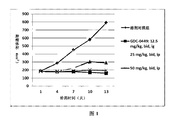
- Figure 1 shows the effect of intraperitoneal injection of compound 24 on the volume of subcutaneous MB xenografts in mice.
- the cell culture, molecular genetics, nucleic acid chemistry, and immunology laboratory procedures used herein are all routine steps widely used in the corresponding art.
- the biological materials and chemical reagents used are either commercially available or can be prepared by conventional methods in the art.
- Phenylacetic acid (13.6 mg, 0.10 mmol) was dissolved in SOCl 2 (3.0 mL) and warmed to 40 ° C for 4.0 h. The reaction mixture was cooled to room temperature, evaporated, evaporated, evaporated. The reaction mixture was concentrated and purified mjjjjjj
- N,N-dimethylethanolamine (17.9 mg, 0.2 mmol) was dissolved in THF (mL), CDI (32 mg, 0.2 mmol) was added and stirred for 6.0 h, then compound H (125.43 mg, 0.2 mmol) was added and reacted. The solution was heated to 40 ° C for 12 h. The reaction mixture was concentrated and purified by silica gel column chromatography to afford white solid J (68.35mg, 53.4%)
- Smo-containing cell membranes were prepared using CHO-K1 cells transfected with mouse or human Smo cDNA, and the test compounds were formulated into a series of gradients and placed in an empty assay plate for later use.
- the cell membrane containing Smo was added to the assay plate, and 1.5 nM of [ 3 H]Hh-Ag 1.5 was prepared by using a buffer solution (50 mM Tris-HCl, 10 mM EDTA, and 5 mM MgSO 4 , pH 7.2), and the assay plate was placed. Incubate for 48 h at 37 °C.
- the 96-well Unifilter GF/B filter plate was pre-incubated with 0.5% polyethyleneimine and 1% fetal bovine serum for 60 minutes and washed three times with 2% HPCD distilled water.
- the culture medium in the assay plate was transferred to the filter plate using a Unifilter-96 pipette.
- the loaded filter plate was washed three times with 2% HPCD buffer, and the unbound [ 3 H]Hh-Ag 1.5 was washed away. Dry at 60 ° C for 30 minutes and cool.
- the bottom end was sealed, 50 ⁇ L of Microscint-O was added to each well, the tip was sealed, and incubated for 100 minutes-overnight.
- the cell membrane was diluted to 0.01-0.02 mg/ml with a buffer solution containing 50 mM HEPES and 3 mM MgCl 2 at pH 7.2. 200 ⁇ l of the cell membrane suspension was added to 100 ⁇ l of a buffer solution containing fluorescent ligands, various concentrations of inhibitors and protease inhibitors, and 0.02% fetal calf serum was added to reduce non-specific binding. Binding experiments were performed on 96-well plates. The 96-well plates were incubated for 5 h at 23 ° C to bring the inhibitors to equilibrium, and the free labeled ligands were quickly vacuum filtered using an infiltrated glass fiber filter (0.3% polyethyleneimine).
- the filtrate was washed twice with 0.3 ml of cold phosphate buffered saline containing 0.01% Triton X-100.
- the fluorescence activity of the filtrate was quantified using a TopCount liquid scintillation counter.
- 2 x 10 6 HEK-293 cells were seeded into 10 cm plates, and cells were transfected with 3 ⁇ g of SMO-expressing GeneJuice plasmid. After 40 h, the cells were transferred to a 1 mmol/L EDTA solution, treated with 4% paraformaldehyde in PBS for 10 minutes and washed three times with PBSA. One 96-well plate was added, and 2 ⁇ 10 5 cells were added to each well. 50 mM unlabeled GDC-0449 or blank control was added, then 5 nM [ 3 H]-GDC-0449 was added, and incubated in PBS for 1 h at 37 °C. The cells were transferred to a filter tray, washed 6 times and dried. Radioactivity was measured using a Microscint-20 scintillation fluid and a Topcount reader. The results are presented in raw data or removed from the background and presented as SMO-WT.
- Fluorescence binding assay with BODIPY FL or 558/568 labeled cyclopamine was carried out as follows: CHO cells expressing human or mouse SMO were added to a 384-well plate, treated with 4% paraformaldehyde for 15 minutes at room temperature, and added with 0.5% after washing. Fetal bovine serum in PBS buffer, then fluorescently labeled BODIPY-cyclopamine (20 nM) and test compound were added and incubated for 4 h at 37 °C. The cells were washed with PBS and stained with Hoechst 33258. Ultra imager analysis.
- Test compounds were dissolved in DMSO and diluted to different gradients for use.
- TM3Hh12 cells pTA-8xGli-Luc containing Hh-responsive reporter gene construct
- F12Ham's/DMEM medium containing 5% horse serum, 2.5% fetal bovine serum and 15 mM HEPES buffer solution (pH 7.3) with trypsin
- F12Ham's/DMEM (1:1) medium containing 5% horse serum and 15 mM HEPES pH 7.3
- the cells were added to the assay plate containing the compound and incubated at 37 ° C for 30 minutes in a 5% CO 2 atmosphere.
- Endogenous mouse Gli and Ptch1 or human Gli and Ptch1 gene expression was expressed by rat NIH 3T3 or human HEPM cells.
- NIH 3T3 and HEPM cells were cultured in 6-well plates cultured in EMEM medium containing 0.5% FBS, and cultured with recombinant ShhN (200 ng/ml), Smo inhibitor or DMSO control. All RNA was obtained with TRIzol reagent, followed by extraction with chloroform and purification using a RNeasy mini-column column. Reverse transcription was performed using a high efficiency cDNA reverse transcriptase kit. Quantified by TaqMan gene expression analysis, the internal standard was VIC/MGB Probe. The TaqMan Gene Expression Master Mix kit was used for RT-PCR and the workstation was ABI Prism 7900HT Fast RT-PCR.
- C3H10T1/2 cells were transfected with wild-type or D473H mutant SMO and Gli fluorescent markers.
- the transfection process of DNA and GeneJuice was as follows: 3 ⁇ L of Opti-MEM and 0.15 ⁇ L of GeneJuice transfection reagent were added to an empty 96-well plate and incubated for 5 minutes at room temperature. Add 20 ng of 8x-Gli1 fluorescent label, 1 ng of p-RL-TK and 10 ng of pcDNA-Smo-WT, pcDNA-Smo-D473H or empty pcDNA3.1 control, carefully mix, incubate for 15 minutes at room temperature and add to the cells. .
- Sufu -/- mouse fibroblasts were seeded into 48-well plates (250,000 per well) and incubated with DMEM containing 10% FBS and 1x antibiotic/neomycin to confluence. After fusion, the cells were incubated with Opti-MEM containing 25 ⁇ M inhibitor or DMSO control (without serum) for 24 h. After 24 h, RNA was extracted and cDNA was obtained. The expression level of Gli mRNA was analyzed by RT-PCR.
- TM3-SV40 cells were obtained by transfecting TM3 cells with 1 ⁇ g of the selective pGL3-SV40-Luc plasmid in the presence of neomycin, and operating with Fugene reagent according to the instructions. Cells were screened selectively with G418 for two weeks and the remaining cells were collected for later use.
- 293T-STF-Luc cells were obtained by transfecting 293T cells with the SuperTopflash-Luc vector responsive to Wnt in the presence of neomycin. Screening was selectively performed with G418 for two weeks and the remaining cells were collected for later use.
- a 384-well plate containing 30 ⁇ l of DMEM + 5% FBS per well was added, and 10,000 cells were added per well. After 12 h, the diluted inhibitor solution was added. 20 ⁇ l of Wnt medium was added and incubated for 48 hours, and the fluorescence activity was measured using a BrightGlo fluorescent kit.
- 293T-NFexcellentB-Luc cells were obtained by transfecting 293T cells with a Luc vector responsive to NF MéB in the presence of neomycin. Screening was selectively performed with G418 for two weeks and the remaining cells were collected for later use.
- a 384-well plate containing 40 ⁇ l of DMEM + 5% FBS per well was added to each well and 10,000 cells were added per well. After 12 h, the diluted inhibitor solution was added, and after 30 minutes, 10 ⁇ l of the culture medium containing recombinant TNF ⁇ was added. Fluorescence activity was measured using a BrightGlo Fluorescence Kit after 24 hours of incubation.
- Ptch +/- p53 -/- transgenic mice were divided into multiple fragments and passaged in nude mice.
- Ptch +/- p53 -/- MB cells were isolated from transplanted mice and cultured in a non-adhesive 10 cm Petri dish with Neurobasal containing 2% B-27, 1% N2 additive and 1% penicillin/streptomycin. Liquid culture, 1 x 10 7 cells per well. Three days after cell culture, the wild type or D477G mutant lentiviral supernatant was infected. The Smo expression level was tested by RT-PCR, and the proliferation assay was performed using the Click-iT EdU Cell Proliferation Assay Kit according to the instructions.
- CGNP was isolated from 4 day old C57BL/6. Cultured in a 384-well plate supplemented with poly-D-lysine with Neurobasal medium containing 2% B-27 additive, 1 mM sodium pyruvate, 2 mM L-glutamine and 1% penicillin/streptomycin. The cell concentration was 10 5 and then recombinant ShhN (200 ng/ml) and inhibitor were added.
- the Click-iT EdU Cell Proliferation Assay Kit performs cell proliferation experiments as described above.
- HEPM cells are derived from human embryonic mesenchymal tissue and obtained from ATCC. HEPM cells were treated with minimal basic medium (MEM) + Earle's Salts + L-glutamine + 10% fetal bovine serum, 1 x sodium pyruvate and 1 x MEM non-essential amino acids at 35 ° C with 5% CO 2 to cultivate. The cells were dispensed twice a week with 0.05% trypsin EDTA solution and then placed in a 75 cm Erlenmeyer flask. Cells were added to 96-well plates in an amount of 50,000 per well for Gli1 RT-PCR analysis. Next, 50 nM of agonist and different concentrations of inhibitor were added. Cells were harvested at 48 h for RT-PCR.
- MEM minimal basic medium
- the medium was removed, 50 ⁇ l of different concentrations of the inhibitor were added, followed by 50 ⁇ l of the agonist, and incubated for 48 hours.
- 50 ⁇ l of the agonist Hh Ag1.5 (1:1000) diluted with the medium was added, and the concentration of the agonist per well was 50 nM.
- the inhibitor was obtained by diluting 10 mM DMSO solution 1:3 and then diluting 1000 times with the culture solution.
- Quantitative expression of mRNA was performed by RT-PCR using Taqman reagent on an Applied Biosystems 7900HT Fast RT-PCR or 7900HT Sequence Detection System.
- the instrument setting procedure is as follows: cancel ROX, the first stage is 50 ° C for 2 min, the second stage is 95 ° C for 10 min, the third stage is 95 ° C for 15 sec, and the last 60 ° C for 1 min is cycled 40 times.
- Five solutions are required during the reaction: 2x Master mix, primers for Gli and betaactin, and the desired cDNA and water for the reaction. Note that 2 ⁇ Master mix needs to contain the following ingredients: Amplitaq Gold DNA Polymerase, Amperase UNG, dNTP’s, with UTP, negative control ROX.
- Real-time PCR data removes betaactin effects.
- the IC 50 value was calculated using XLfit4using Fit Designer Dose Response Model 202.
- the A549 cell suspension in the logarithmic growth phase was diluted to 4 ⁇ 10 4 - 5 ⁇ 10 4 / mL, and seeded in a 96-well plate (100 ⁇ L / well). After incubating for 8 h at 37 ° C, 5% CO 2 , 100 ⁇ L of different concentrations of compound dilution (diluted in medium) were added to each well, and three replicate wells were set for each concentration. After incubation for 48 h, 10 ⁇ L of 0.5% MTT staining solution was added to each well, and incubation was continued for 4 h.
- E3LZ10.7 cells were injected subcutaneously into male CD1 nude mice, and tumors were removed after 2-4 weeks and cut into small pieces of about 1 mm 3 . 6-8 weeks old male CD1 nude mice were anesthetized with anesthetic gas, and opened under the rib of 1 cm on the left side of the abdomen until the spleen and pancreatic appendages were visible, and a small opening was placed in the pancreas to implant the prepared tumor and suture.
- L3.6pl group 10 6 cells were suspended in 50 ⁇ L of PBS/Matrigel (1:1) mixture and directly injected into the mouse pancreas. After 21 days, the volume of the tumor was measured with ultrasound. The tumor size was divided into four groups: control, cyclopamine (25 mg/kg feed supplemented, once every two days), gemcitabine (100 mg/kg, once every four days) and combination group, continuous administration 30 days.
- the L3.6pl group only needed to give cyclopamine for 15 days, 50 mg/kg/d.
- mice After 30 days, the mice were sacrificed and the tumor spread of the kidney, liver, spleen, small intestine, peritoneum and lung was examined and preserved with formalin. Tumor samples were rapidly frozen for RNA analysis. In addition to direct observation, each mouse should be randomly selected for kidney, liver, spleen, small intestine, peritoneum and lung tissue for microscopic examination to observe the presence or absence of micrometastases. Obtain local lymph node samples, make sections and check for lesions. The L3.6pl group only needs to observe the lesions of the liver and peritoneum.
- the compound was dissolved in a solution of 5% NMP + 10% PEG400 + 35% of 10% ETPGS + 50% D5W, and male C57BL mice (2 per time point) were injected intravenously (1 mg/kg, 0.2 mg). /mL) or gavage (10mg/kg, 1mg/ml). Blood samples were taken at a fixed time after 24 hours of administration (2 per time point). Plasma was separated by centrifugation and the concentration of the compound in the plasma was measured by HPLC/MS/MS. Related plasma pharmacokinetic constants such as clearance, volume of distribution and half-life are calculated as non-compartmental models.
- Sprague-Dawley rat tail vein injection (1mg/kg, 1mg/mL compound solution prepared by dissolving 1.5eq HCl, 20% captisol in pH 8 buffer solution, 2 times each time) or gavage (10mg/kg, 0.5)
- the sodium carboxymethylcellulose suspension was administered in three doses each time. After 24 hours, blood samples were taken at fixed times and the plasma was centrifuged. The concentration of plasma compounds was determined by HPLC/MS/MS and the relevant plasma pharmacokinetic constants such as clearance, volume and half-life were calculated as non-compartmental models.
- the compound was dissolved in 20% captisol and formulated into a 0.4 mg/ml solution, and the fasted male Beagle dogs (3) were given a single dose (0.1 mg/kg) or orally (0.3 mg/kg). After 24 hours, blood samples were taken at fixed times and the plasma was centrifuged. The concentration of plasma compounds was determined by HPLC/MS/MS and the relevant plasma pharmacokinetic constants such as clearance, volume and half-life were calculated as non-compartmental models.
- the compound was dissolved in DMSO to prepare a mother liquor having a concentration of 100 mg/mL, and stored at 4 °C.
- the standard solution was diluted to 10, 1, 0.1, and 0.01 mg/mL by chromatography with methanol; LC-MS was used to determine the peak area at different concentrations to establish a standard curve.
- 10 ⁇ L of the mother liquor was added to 1 mL of purified water and sonicated for 0.5 h to determine the absorption peak area of the compound in water, and the saturated solubility of the compound was calculated.
- the experimental results are shown in column 6 of Table 1.
- *TM3-GLi-Luc data greater than 500 nM for D; less than 500 greater than 300 for C; less than 300 greater than 100 nM for B; less than 100 nM for A.
Landscapes
- Chemical & Material Sciences (AREA)
- Health & Medical Sciences (AREA)
- Organic Chemistry (AREA)
- Animal Behavior & Ethology (AREA)
- Medicinal Chemistry (AREA)
- Pharmacology & Pharmacy (AREA)
- Life Sciences & Earth Sciences (AREA)
- General Health & Medical Sciences (AREA)
- Public Health (AREA)
- Veterinary Medicine (AREA)
- Nuclear Medicine, Radiotherapy & Molecular Imaging (AREA)
- General Chemical & Material Sciences (AREA)
- Chemical Kinetics & Catalysis (AREA)
- Epidemiology (AREA)
- Pharmaceuticals Containing Other Organic And Inorganic Compounds (AREA)
Abstract
公开了苯并[b]噻吩酰胺类衍生物及其用途。具体地,涉及具有式(I)结构的苯并[b]噻吩酰胺类衍生物或其药学上可接受的盐,以及这些化合物在调节Smoothened受体或者Hedgehog通路活性中的用途。
Description
本公开属于药物技术领域,具体地,涉及苯并[b]噻吩酰胺类衍生物及其药学上可接受的盐,以及这些化合物在调节Smoothened受体或者Hedgehog通路活性或用于治疗与Smoothened受体活性或者Hedgehog通路活性相关的疾病中的用途。
刺猬信号通路(Hedgehog/Hh通路)在脊椎动物早期发育的组织器官形成过程中起着重要的作用,负责调节细胞增殖和分化。在脊椎动物发育过程中,Hh通路参与控制左右不对称、CNS中的极性、体节和肢体、器官发生、软骨发生和生殖腺的成熟。在成体组织中,Hh信号通路一方面对自身信号通路进行精细的反馈调节,另一方面调控细胞的多种功能行为如:细胞增殖、抗凋亡、血管形成,诱导和维持干细胞特性、细胞命运决定、上皮间充质转化,迁移等。Hh信号通路包括四个主要成员:Hh配体,十二跨膜蛋白受体Patched(Ptch),七跨膜蛋白受体Smoothened(Smo)和Gli家族的转录因子。在脊椎动物中,Hh配体主要包括3个亚型,Sonic hedgehog(Shh)、Desert hedgehog(Dhh)和Indian hedgehog(Ihh)。Ptch是一个12跨膜蛋白,有两个同源基因:Ptch1和Ptch2。七跨膜蛋白Smo是Hh信号通路中的一个重要成员,属于Frizzled家族,是GPCR超家族的一支。Gli是Hh信号通路最下游的转录因子,脊椎动物中有3个同源基因:Gli1,Gli2,Gli3。Gli1是一转录激活因子,Gli2和Gli3是双功能转录因子,全长形式是转录激活因子,当被蛋白酶体部分降解修饰后的截短形式是转录抑制因子。没有Hh配体存在时,Ptch抑制下游Smo蛋白活性,Sufu与Gli结合形成复合物,该复合物经过水解酶的裂解形成Gli的抑制形态(Gli
R),抑制通路的活性。当Hh配体存在时,Ptch对Smo的抑制解除,Smo激活下游的转录因子Gli进入细胞核,促进不同靶基因的转录表达,实现Hh信号通路的激活。Smo受体作为Hh信号通路中关键的跨膜信号传导受体,在Hh信号传导过程中起着重要的作用。
在成年生物中,仅有少部分的Hh信号通路处于激活状态,用于组织的稳态维持和损伤修复过程,大部分都被沉默关闭掉。这部分激活的Hh信号通路能够维持干细胞的分布,再生和分化。因此,Smo小分子调节剂可以促进干细胞的分化从而修复由疾病引起的损伤,例如促进血管再生,治疗由局部缺血引起的损伤;调节骨原细胞的增殖和分化,治疗骨质 疏松和骨病;调节中枢及外周神经元细胞的分化,治疗帕金森症和糖尿病性神经病变。
但是,Hh信号通路过度激活,则参与了一些恶性肿瘤和癌症的发生。据目前权威数据统计,四分之一的癌症中都有Hh信号的异常激活。跟Hh信号通路异常激活相关的癌症,根据Hh信号通路在癌症中激活形式的不同分为三种类型:突变导致的I型,如痣样基底细胞癌综合征、基底细胞癌、髓母细胞癌、横纹肌肉瘤等;配体自分泌依赖的II型,如小细胞肺癌、胰腺癌、食管癌、胃癌、胆管癌、结肠癌、前列腺癌、乳腺癌、黑色素瘤等;配体旁分泌依赖的III型,如前列腺癌、胰腺癌、淋巴瘤、多发性骨髓瘤、白血病等。
目前Hh信号通路抑制剂用于治疗多种肿瘤疾病,正处于研发迅速上升阶段。伴随着2012年1月30日,FDA批准了Genentech(Roche)的小分子Smo抑制剂Vismodegib,用于治疗不适于手术性的晚期基底细胞癌。以及随后批准的Novartis小分子Smo抑制剂Sonidegib,验证了Smo作为Hh通路抑制剂靶点的可行性。目前,在各大公司的Hh抑制剂研发中有多个小分子Smo抑制剂药物处于不同研发阶段,所涉及临床适应症也种类繁多。其中Novartis公司开发的Erismodegib、Lilly公司的LY-2940680、BMS公司开发的BMS-833923在临床II期进展均较为顺利,此外,Novartis公司的第二代Smo抑制剂LEQ-506正处于临床I期研究中。虽然已报道多种抑制剂,但是Smo抑制剂的巨大医药价值并未被完全开发,目前仅有适应症较为狭窄,并且已有多种耐药性问题报道。另外,Hh激动剂的研究逐渐受到重视,有多个化合物正在进行临床前研究。
发明内容
在一个方面,本公开提供式(I)所述化合物或其药学上可接受的盐,

其中:
R
1选自C
5-C
10环烷基、C
5-C
10杂环烷基、C
6-C
10芳基和C
5-C
10杂芳基,其中所述环烷基、杂环烷基、芳基和杂芳基任选地被1,2或3个R
7基团所取代;
R
2选自-H和-CH
3;
R
3选自-H、羟基、烷氧基、C
1-C
10烷氧羰基、C
1-C
10烷基、C
3-C
10环烷基、C
3-C
10杂 环烷基、-(CH
2)
nNR
9aR
9b、-(CH
2)
nOR
9a、-(CH
2)
nCONR
9aR
9b、-CO-((CH
2)
n-A)
m1-((CH
2)
n-B)
m2-R
9a、-CO-(A-(CH
2)
n)
m-B-R
9a、羰基、C
1-C
10烷基羰基、C
3-C
10环烷基羰基、氨基、C
1-C
10烷氨基、C
5-C
10杂环烷基氨基、C
6-C
10芳基和C
5-C
10杂芳基,其中所述烷基、烷氧基、环烷基、杂环烷基、羰基、烷基羰基、环烷基羰基、氨基、环氨基、杂环烷基氨基、芳基或者杂芳基任选地进一步被一个或多个R
10基团所取代;
R
4、R
5、R
6各自独立地选自-H、-F、-Cl、-Br和-I,且R
5和R
6不能同时为-H;
当R
7存在时,各R
7独立地选自卤素、羟基、巯基、氰基、硝基烷基、C
1-C
10烷基、烷氧基、C
3-C
10环烷基、C
3-C
10杂环烷基、-(CH
2)
nNR
8aR
8b、-(CH
2)
nOR
8a、-(CH
2)
nCONR
8aR
8b、羰基、C
1-C
10烷基羰基、C
3-C
10环烷基羰基、氨基、C
1-C
10烷氨基、C
5-C
10杂环烷基氨基、C
6-C
10芳基和C
5-C
10杂芳基,其中所述烷基、烷氧基、环烷基、杂环烷基、羰基、烷基羰基、环烷基羰基、氨基、环氨基、杂环烷基氨基、芳基或者杂芳基任选地进一步被一个或多个选自卤素、羟基、氨基、氰基、硝基和醛基的基团所取代;
R
8a,R
8b,R
9a和R
9b各自独立地选自氢、C
1-C
10烷基、卤代C
1-C
10烷基、C
1-C
10烷基氨基、C
3-C
10环烷基、C
5-C
10杂环烷基和C
6-C
10芳基;或者R
8a/R
8b或R
9a/R
9b与他们相连的N一起形成3至8元单环,所述3至8元单环是饱和的或者不饱和的,包括与R
8a/R
8b或R
9a/R
9b所连接的氮原子在内,所述的3至8元单环中含有一个或者多个各自独立地选自O、S或N的杂原子;
R
10独立地选自卤素、羟基、巯基、氰基、硝基烷基、烷氧基、C
6-C
10芳基和-NR
8aR
8b;
A和B各自独立地选自-O-和-NH-;
m、m
1和m
2各自独立地为0、1、2、3、4、5或者6;
n为0、1或者2。
在一些实施方案中,R
1选自C
6-C
10芳基和C
5-C
10杂芳基,其中所述环烷基、杂环烷基、芳基和杂芳基任选被1,2或3个R
7基团所取代;当R
7存在时,各R
7独立地选自卤素和C
1-C
10烷基。
在一些实施方案中,R
1选自苯基、萘基和C
5-C
6杂芳基,其中所述苯基、萘基和C
5-C
6杂芳基任选地被1,2或3个R
7基团所取代;当R
7存在时,各R
7独立地选自-F、-Cl、-Br、-I和C
1-6烷基。
在一些实施方案中,R
1选自下述基团:

在一些实施方案中,R
1选自下述基团:

在一些实施方案中,R
3选自C
1-C
10烷基、C
1-C
10烷基羰基、-CO-((CH
2)
n-A)
m1-((CH
2)
n-B)
m2-R
9a和-CO-(A-(CH
2)
n)
m-B-R
9a,其中所述烷基和烷基羰基任选地进一步被一个或多个R
10基团所取代;
R
10独立地选自C
6-C
10芳基和-NR
8aR
8b;
R
8a、R
8b和R
9a各自独立地选自氢和C
1-C
10烷基;
A和B各自独立地选自-O-和-NH-;
m、m
1和m
2各自独立地为0、1、2、3、4、5或者6;
n为0、1或者2。
在一些实施方案中,R
3选自C
1-C
6烷基、C
1-C
6烷基羰基、-CO-(CH
2CH
2-A)
m1-(CH
2CH
2-B)
m2-R
9a和-CO-(A-CH
2CH
2)
m-B-R
9a,其中所述烷基和烷基羰基任选地进一步被一个或多个R
10基团所取代;
R
10独立地选自苯基、萘基和-NR
8aR
8b;
R
8a、R
8b和R
9a各自独立地选自氢和C
1-C
6烷基;
A和B各自独立地选自-O-和-NH-;
m、m
1和m
2各自独立地为0、1、2、3、4、5或者6。
在一些实施方案中,R
3选自C
1-C
4烷基、C
1-C
4烷基羰基、-CO-(CH
2CH
2O)
m1-(CH
2CH
2NH)
m2-R
9a和-CO-(OCH
2CH
2)
mNH-R
9a,其中所述烷基和烷基羰基任选地进一步被一个或多个R
10基团所取代;
R
10独立地选自苯基、萘基和-NR
8aR
8b;
R
8a、R
8b和R
9a各自独立地选自C
1-C
4烷基;
m和m
1各自独立地为1、2、3、4、5或者6;
m
2为0、1或2。
在一些实施方案中,R
3选自-CO-(CH
2CH
2O)
m1-(CH
2CH
2NH)
m2-R
9a和-CO-(OCH
2CH
2)
mNH-R
9a;
R
9a选自C
1-C
4烷基;
m和m
1各自独立地为1、2、3、4、5或者6;
m
2为0、1或2。
在一些实施方案中,R
3选自下述基团:

在一些实施方案中,R
3选自下述基团:

在一些实施方案中,所述化合物选自:


在另一个方面,本公开提供一种药物组合物,其含有治疗有效量的上述化合物,以及一种或多种药用载体物质和/或稀释剂。
在一些实施方案中,所述载体包括但不限于:氧化铝,硬脂酸铝,卵磷脂,血清蛋白如人血清蛋白,磷酸盐,甘油,山梨酸,山梨酸钾,饱和植物脂肪酸的部分甘油酯混合物,水,硫酸鱼精蛋白,磷酸氢二钠,磷酸氢钾,氯化钠,锌盐,胶态氧化硅,三硅酸镁,聚乙烯吡咯烷酮,纤维素物质,聚乙二醇,羧甲基纤维素钠,聚丙烯酸酯,蜂蜡,羊毛脂。所述稀释剂,又称填充剂,可选自淀粉类,例如淀粉、可压性淀粉或糊精;2)糖类,例如糖粉、乳糖或甘露醇;3)其他,例如微晶纤维素或无机盐类,例如硫酸、碳酸氢、碳酸等的钙盐。
本公开的化合物或其药学上可接受的盐可以通过以下途径给药:胃肠外、局部、静脉内、口服、皮下、动脉内、真皮内、经皮、直肠、颅内、腹膜内、鼻内、肌内途径或作为吸入剂。
本申请的化合物或其药学上可接受的盐可根据给药途径配成各种适宜的剂型。
在另一个方面,本公开提供前述化合物或药物组合物在制备Smoothened抑制剂中的用途。
在另一个方面,本公开提供前述化合物或药物组合物在制备用于抑制Hedgehog信号通路活性的药物中的用途。
在另一个方面,本公开提供上述化合物或药物组合物在制备治疗与Hedgehog信号通路过度激活相关的疾病中的用途。
在另一个方面,本公开提供一种抑制Smoothened活性的方法,其包括向有此需要的受试者或细胞施用有效量的上述化合物或药物组合物的步骤。
在另一个方面,本公开提供一种抑制Hedgehog信号通路活性的方法,其包括向有此需要的受试者或细胞施用有效量的上述化合物或药物组合物的步骤。
在另一个方面,本公开提供一种治疗与Hedgehog信号通路过度激活相关的疾病的方法,其包括向有此需要的受试者施用有效量的上述化合物或药物组合物的步骤。
在另一个方面,本公开提供前述化合物或药物组合物,其用作Smoothened抑制剂。
在另一个方面,本公开提供前述化合物或药物组合物,其用于抑制Hedgehog信号通路活性。
在另一个方面,本公开提供前述化合物或药物组合物,其用于治疗与Hedgehog信号通路过度激活相关的疾病。
本文中所述细胞为细胞系或来自受试者的细胞。
在一些实施方案中,所述细胞为癌细胞。
在一些实施方案中,所述细胞选自癌变的基底细胞、癌变的成神经管细胞、髓母细胞癌细胞、胰腺癌细胞、前列腺癌细胞、肝癌细胞、结肠癌细胞、小细胞肺癌细胞、乳腺癌细胞、横纹肌肉瘤细胞、食道癌细胞、胃癌细胞、胆道癌细胞、多发性骨髓瘤细胞、白血病细胞、脊膜瘤细胞、恶性胶质瘤细胞和黑色素瘤细胞。
本文中所述受试者为哺乳动物,例如人。
在一些实施方案中,所述与Hedgehog信号通路过度激活相关的疾病为癌症。
在一些实施方案中,所述癌症选自基底细胞癌、成神经管细胞癌、髓母细胞癌、胰腺癌、前列腺癌、肝癌、结肠癌、小细胞肺癌、乳腺癌、横纹肌肉瘤、食道癌、胃癌、胆道癌、多发性骨髓瘤、白血病、脊膜瘤、恶性胶质瘤和黑色素瘤。
本公开的目的在于提供一种式(I)结构的一类苯并[b]噻吩酰胺类衍生物及其(或其)药学上可接受的盐,

其中:
R
1选自C
5-C
10环烷基、C
5-C
10杂环烷基、C
6-C
10芳基或者C
5-C
10杂芳基,其中所述环烷基、杂环烷基、芳基和杂芳基任选被1,2或3个R
7基团所取代;
R
2选自-H或者-CH
3;
R
3选自氢、C
1-C
10烷基、C
3-C
10环烷基、C
3-C
10杂环烷基、-(CH
2)
nNR
9aR
9b、-(CH
2)
nOR
9a、-(CH
2)
nCONR
9aR
9b、羰基、C
1-C
10烷基羰基、C
3-C
10环烷基羰基、C
6-C
10芳基或者C
5-C
10杂芳基,其中所述烷基、环烷基、杂环烷基、羰基、烷基羰基、环烷基羰基、杂环烷基氨基、芳基或者杂芳基,可选进一步被一个或多个R
10基团所取代;
R
4、R
5、R
6选自-H、-F、-Cl、-Br、-I且R
5、R
6不能同时为-H;
当R
7存在时,各R
7独立地选自卤素、羟基、巯基、氰基、硝基烷基、烷氧基、C
3-C
10环烷基、C
3-C
10杂环烷基、-(CH
2)
nNR
8aR
8b、-(CH
2)
nOR
8a、-(CH
2)
nCONR
8aR
8b、羰基、C
1-C
10烷基羰基、C
3-C
10环烷基羰基、氨基、C
1-C
10烷氨基、C
5-C
10杂环烷基氨基、C
6-C
10芳基或者C
5-C
10杂芳基,其中所述烷基、烷氧基、环烷基、杂环烷基、羰基、烷基羰基、环烷基羰基、氨基、环氨基、杂环烷基氨基、芳基或者杂芳基,可选进一步被一个或多个选自卤素、羟基、氨基、氰基、硝基、醛基所取代;
R
8a,R
8b,R
9a和R
9b为各自独立的是氢、C
1-C
10烷基、卤代C
1-C
10烷基、C
1-C
10烷基氨基、C
3-C
10环烷基、C
5-C
10杂环烷基、C
6-C
10芳基。或者R
8a/R
8b或R
9a/R
9b与他们相连的N一起形成3至8元单环,所述3至8元单环是饱和的或者不饱和的,包括与R
8a/R
8b或R
9a/R
9b所连接的氮原子在内,所述的3至8元单环中含有一个或者多个各自独立地选自O、S或N的杂原子;
m为0、1或者2;
n为0、1或者2;
R
10独立地选自卤素、羟基、巯基、氰基、硝基烷基、烷氧基。
在一些实施方案中,R
1任选自下述基团但不完全选自下述基团:

在一些实施方案中,R
3任选自下述基团但不完全选自下述基团:

本公开所提供的具有式(I)结构的一类苯并[b]噻吩酰胺类衍生物及其(或其)药学上可接受的盐。
其结构选自:


在一些实施方案中,本公开提供具有式(I)结构的一类苯并[b]噻吩酰胺类衍生物或其药学上可接受的盐,

其中:
R
1选自C
5-C
10环烷基、C
5-C
10杂环烷基、C
6-C
10芳基或者C
5-C
10杂芳基,其中所述环烷基、杂环烷基、芳基和杂芳基任选被1,2或3个R
7基团所取代;
R
2选自-H或者-CH
3;
R
3选自选自氢、羟基、烷氧基、C
1-C
10烷基、C
3-C
10环烷基、C
3-C
10杂环烷基、-(CH
2)
nNR
9aR
9b、-(CH
2)
nOR
9a、-(CH
2)
nCONR
9aR
9b、羰基、C
1-C
10烷基羰基、C
3-C
10环烷基羰基、氨基、C
1-C
10烷氨基、C
5-C
10杂环烷基氨基、C
6-C
10芳基或者C
5-C
10杂芳基,其中所述烷基、烷氧基、环烷基、杂环烷基、羰基、烷基羰基、环烷基羰基、氨基、环氨基、杂环烷基氨基、芳基或者杂芳基,可选进一步被一个或多个R
10基团所取代;
R
4、R
5、R
6各自独立地选自-H、-F、-Cl、-Br、-I且R
5、R
6不能同时为-H。
在一些实施方案中,R
1选自C
5-C
10环烷基、C
5-C
10杂环烷基、C
6-C
10芳基或者C
5-C
10杂芳基,其中所述环烷基、杂环烷基、芳基和杂芳基任选被1,2或3个R
7基团所取代;
当R
7存在时,各R
7独立地选自卤素、羟基、巯基、氰基、硝基烷基、烷氧基、C
3-C
10环烷基、C
3-C
10杂环烷基、-(CH
2)
nNR
8aR
8b、-(CH
2)
nOR
8a、-(CH
2)
nCONR
8aR
8b、羧基、醛基、C
1-C
10烷基羰基、C
3-C
10环烷基羰基、C
1-C
10烷氧基羰基、C
3-C
10环烷氧基羰基、氨基、C
1-C
10烷氨基、C
5-C
10杂环烷基氨基、C
6-C
10芳基或者C
5-C
10杂芳基;R
8a和R
8b为各自独立的是氢、C
1-C
10烷基、卤代C
1-C
10烷基、C
3-C
10环烷基、C
5-C
10杂环烷基、或者R
8a、R
8b与他们相连的N一起形成3至8元单环,所述3至8元单环是饱和的或者不饱和的,包括与R
8a、R
8b所连接的氮原子在内,所述的3至8元单环中含有一个或者多个各自独立地选自O、S或N的杂原子;
m为0、1或者2;
n为0、1或者2。
在一些实施方案中,R
1任选自下述基团但不完全选自下述基团:

在一些实施方案中,R
3选自选自氢、羟基、烷氧基、C
1-C
10烷基、C
3-C
10环烷基、C
3-C
10杂环烷基、-(CH
2)
nNR
9aR
9b、-(CH
2)
nOR
9a、-(CH
2)
nCONR
9aR
9b、羰基、C
1-C
10烷基羰基、C
3-C
10环烷基羰基、氨基、C
1-C
10烷氨基、C
5-C
10杂环烷基氨基、C
6-C
10芳基或者C
5-C
10杂芳基,其中所述烷基、烷氧基、环烷基、杂环烷基、羰基、烷基羰基、环烷基羰基、氨基、环氨基、杂环烷基氨基、芳基或者杂芳基,可选进一步被一个或多个R
10基团所取代;
R
9a和R
9b为各自独立的是氢、C
1-C
10烷基、卤代C
1-C
10烷基、C
3-C
10环烷基、C
5-C
10杂环烷基、C
6-C
10芳基、或者R
9a、R
9b与他们相连的N一起形成3至8元单环,所述3至8元单环是饱和的或者不饱和的,包括与R
9a、R
9b所连接的氮原子在内,所述的3至8元单环中含有一个或者多个各自独立地选自O、S或N的杂原子;
m为0、1或者2;
n为0、1或者2;
R
10独立地选自卤素、羟基、巯基、氰基、硝基烷基、烷氧基。
在一些实施方案中,R
3任选自下述基团但不完全选自下述基团:

本公开还提供一种药物组合物,该药物组合物包含治疗有效量的游离形式或可药用盐形式的具有式(I)结构的一类苯并[b]噻吩酰胺类衍生物及其(或其)药学上可接受的盐作为活性成分,和/或一种或多种药用载体物质和/或稀释剂。
本公开所提供的药物组合物应用于激活Hedgehog信号通路活性的药物和美容产品制备中,用于调节细胞增殖或分化,为治疗或美容应用的一部分给予患者。
其中所述治疗或美容应用选自调节神经组织、骨和软骨的形成和修复、调节精子发生、调节平滑肌的生长、调节肺、肝和其它起源于原始消化管的器官生长、调节造血功能和调节皮肤和毛发的生长。
本公开所提供的药物组合物还应用于抑制Hedgehog信号通路活性的药物制备,该药物用于治疗因Hedgehog活性抑制而改善的疾病,这些疾病包括但不限于癌症。
其中所述的癌症选自基底细胞癌、成神经管细胞癌、髓母细胞癌、胰腺癌、前列腺癌、肝癌、结肠癌、小细胞肺癌、乳腺癌、横纹肌肉瘤、食道癌、胃癌、胆道癌、多发性骨髓 瘤、白血病、脊膜瘤、恶性胶质瘤、黑色素瘤。
本公开还提供了具有式(I)结构的一类苯并[b]噻吩酰胺类衍生物及其(或其)药学上可接受的盐的制备方法,包括中间体和本公开化合物的制备。
本公开化合物、其药学上可接受的盐、水合物、溶剂合物或其组合物可通过本文所述的合成方法制备,式(I)结构的化合物可作为单一异构体、外消旋体存在,也可作为几何异构体存在。
本公开的化合物可采用本领域技术人员已知的制备方法制备。除有非一致的规定,本文描述的反应在大气压下,在约-78℃至约150℃的温度范围内进行。
为了完成本公开的目的,本公开采用如下技术方案(如下方案仅为说明本公开,而不是用来限定本公开)。
合成流程

化合物3的说明性制备方法
采用本领域技术人员已知的各种各样的反应,可以对芳基侧链进行修饰。芳环和杂芳环的化学方法是丰富的,在此仅给出有用反应的一些例子。方法一:
付-克烷基化反应,对于一些环烷基取代和芳甲基取代可采用此方法。

方法二:
Suzuki偶联反应,对于一些芳环或芳杂环取代时可采用此方法。

或者

方法三:
Stille偶联反应,对于一些无β-氢且体积较大的取代基团可采用此方法。

化合物6的说明性制备方法
采用本领域技术人员已知的各种各样的反应,可以得到仲胺和叔胺,R3从总体上可以分为三类,烷烃基和环烷烃基、芳环和芳杂环以及羰基化合物。同样的,化合物的合成方法也大致可以分为三类。
方法一,卤代烃法。

方法二,Borch还原胺化法。

方法三,N-酰基化反应

化合物7的说明性制备方法
化合物4和化合物6通过Borch还原胺化反应即可得到化合物7

化合物12的说明性制备方法
采用本领域技术人员已知的各种各样的反应,起始原料选用苯甲醛衍生物,经Knoevenagel反应得到肉桂酸衍生物,再与化合物11反应得到目标产物。

目标产物化合物1的说明性制备方法
通过N-酰基化反应,胺(化合物7)和酰氯(化合物12)生成酰胺,从而得到目标产物化合物1.

如本文中所使用的,术语“C
1-C
10烷基”是指具有1-10个碳原子的直链或支链烷基,例如C
1-C
6烷基、C
1-C
4烷基或C
1-C
2烷基等。具体的实例包括但不限于甲基、乙基、丙基、异丙基、正丁基、异丁基、仲丁基、叔丁基等。
如本文中所使用的,术语“C
1-C
10烷氧基”是指以C
1-C
10烷基-O-方式形成的基团,其中“C
1-C
10烷基”的定义如前文所述。具体的实例包括但不限于甲氧基、乙氧基、丙氧基、异丙氧基、丁氧基、仲丁氧基、异丁氧基、叔丁氧基等。
如本文中所使用的,术语“C
1-C
10烷氨基”是指以C
1-C
10烷基-NH-方式形成的基团,其中“C
1-C
10烷基”的定义如前文所述。具体的实例包括但不限于甲氧基、乙氧基、丙氧基、异丙氧基、丁氧基、仲丁氧基、异丁氧基、叔丁氧基等。
本申请中所用术语“C
3-C
10环烷基”是指含有3-10个成环碳原子的环烷基,例如C
3-C
8环烷基、C
3-C
6环烷基、C
5-C
10环烷基、C
5-C
6环烷基、C
5、C
6、C
7、C
8、C
9或C
10环烷基。具体的实例包括但不限于:环丙基、环丁基、环戊基、环己基等。
本申请中所用术语“C
3-C
10杂环烷基”是指含有3-10个环成员的环烷基,且所述环成员中至少1个至多4个(例如1、2、3或4个)为选自N、O和S的杂原子,例如C
3-C
8杂环烷基、C
3-C
6杂环烷基、C
5-C
10杂环烷基、C
5-C
6杂环烷基、C
5、C
6、C
7、C
8、C
9或C
10杂环烷基。具体的实例包括但不限于:环氧乙基、氧代环丁基、吡咯烷基、四氢呋喃基、哌啶基、哌嗪基、吗啉基、硫吗啉基等。
如本文中所使用的,术语“C
6-C
10芳基”是指含有6-10个碳原子的单环、双环或多环芳香族基团,例如苯基、萘基等。
如本文中所使用的,术语“C
5-C
10杂芳基”是指至少含有一个选自N、O和S的杂原子的具有芳香性的5-10元环状基团,例如C
5、C
6、C
7、C
8、C
9或C
10杂芳基。具体实例包括但不限于,呋喃基、噻吩基、吡咯基、噻唑基、噁唑基、异噁唑基、咪唑基、吡唑基、吡啶基、嘧啶基、哒嗪基或吡嗪基等。
如本文中所使用的,术语“C
1-C
10烷氧羰基”是指以C
1-C
10烷氧基-CO-方式形成的基团,其中“C
1-C
10烷氧基”的定义如前文所述。
如本文中所使用的,术语“C
3-C
10环烷基羰基”是指以C
3-C
10环烷基-CO-方式形成的基团,其中“C
3-C
10环烷基”的定义如前文所述。
如本文中所使用的,术语“C
5-C
10杂环烷基氨基”是指以C
5-C
10杂环烷基-NH-方式形成的基团,其中“C
5-C
10杂环烷基”的定义如前文所述。
如本文中所使用的,术语“卤素”包括氟、氯、溴和碘。
“药学上可接受的盐”表示保留母体化合物的生物有效性和性质的那些盐。这类盐包括但不仅限于与酸成盐,通过母体化合物的游离碱与无机酸或有机酸的反应而得,无机酸包括盐酸、氢溴酸、硝酸、磷酸、偏磷酸、硫酸、亚硫酸和高氯酸等,有机酸包括乙酸、三氟乙酸、丙酸、丙烯酸、己酸、环戊烷丙酸、羟乙酸、丙酮酸、草酸、(D)或(L)苹果酸、富马酸、马来酸、苯甲酸、羟基苯甲酸、羟基丁酸、甲氧基苯甲酸、邻苯二甲酸、甲磺酸、乙磺酸、萘-1-磺酸、萘-2-磺酸、对甲苯磺酸、水杨酸、酒石酸、柠檬酸、乳酸、肉桂酸、十二烷基硫酸、葡糖酸、谷氨酸、天冬氨酸、硬脂酸、扁桃酸、琥珀酸或丙二酸等。
“药物组合物”指将本公开中的化合物中的一个或多个或其药学上可接受的盐、溶剂化物、水合物或前药与别的化学成分,例如药学上可接受的载体,混合物。
图1为腹腔注射化合物24对鼠皮下MB移植瘤体积的影响。
下述所述实施例仅表达了本公开的几种实施方式,其描述较为具体和详细,但并不能因此而理解为对本公开专利范围的限制。应当指出的是,对于本领域的普通技术人员来说,在不脱离本公开构思的前提下,还可以做出若干变形和改进,这些都属于本公开的保护范围。因此,本公开专利的保护范围应以所附权利要求为准。
本文中所用的细胞培养、分子遗传学、核酸化学、免疫学实验室操作步骤均为相应领域内广泛使用的常规步骤。所用生物学材料和化学试剂均为市售可得或通过本领域常规方法制得。
示例性合成路线
实施例1 N-[4-(N-甲基氨基)环己基]-N-[[3-(4-吡啶基)苯基]甲基]-3-氯-4,7-二氟-苯并[b]噻吩-2碳酰胺(化合物1)的合成

1、反式4-(N-Boc-N-甲基氨基)环己胺的合成

Boc酸酐(1.14g,5.25mol)和三乙胺(2.42mL,17.3mmol)的甲醇(10mL)溶液滴加到反式-1,4-二氨基环己烷(600mg,5.25mmol)的甲醇(50mL)溶液中。滴加完成后在55℃下反应40分钟并减压蒸去溶剂,得到油状产物,产物用NaH
2PO
4 1M(pH 4.2)洗涤,水相用乙醚洗涤,然后调节pH至9,用氯仿萃取。萃取液用无水硫酸镁干燥,减压浓缩后得到白色产物A(786mg,70%)。
将LiAlH
4(190mg,1.0mmol)加入到化合物A(214mg,1.0mmol)的THF(5mL)溶液中,反应液加热回流2h。反应完成后冷却至0℃,反应液用乙酸乙酯溶解(10mL),用饱和NH
4Cl溶液洗涤,分离有机层,水相用乙醚洗涤(10mL x 2)。合并有机相并用无水硫酸镁干燥,有机相减压条件下浓缩得到无色油状产物B反式4-(甲基氨基)环己胺(110mg,86%)。
将苯甲醛(117mg,1.1mmol)的甲苯溶液(3mL)滴加至反式4-(甲基氨基)环己胺B(128mg,1.0mmol)的甲苯溶液(2mL)中,加热至回流3h。反应液冷却至室温,加入Boc酸酐(436mg,2.0mmol)的甲苯溶液,室温搅拌2h。反应完成后向反应液中加入KHSO
4(1M),分离有机相,水相用乙醚洗涤(10mL x 2)。合并有机相并用无水硫酸镁洗涤,有机相加压浓缩得到无色液体C(116mg,51%)。
1H NMR(400MHz,CDCl
3):δ3.98(br s,1H,NH),3.32(br s,2H,NH+CHN),2.75-2.69(m,1H,CHN),2.72(s,3H,Me),2.05-1.97(m,2H,CH
2),1.70-1.67(m,2H,CH
2),1.54-1.20(m,4H,CH
2),1.44(s,9H,Me);MS(ESI)m/z理论值C
12H
24N
2O
2(M+H)229.1916,实测229.1918.
2、3-氯-4,7-二氟苯并[b]噻吩-2碳酰氯的合成

氯化亚砜(236mg,2mmol)加入到2,5-二氟肉桂酸中(185mg,1.0mmol),反应液升温至100℃反应48h。反应完成后减压蒸去溶剂,用THF洗涤残余物,蒸去溶剂得到3-氯-4,7-二氟苯并[b]噻吩-2碳酰氯(化合物D)(112mg,42%)。
3、3-(4-吡啶基)苯甲醛的合成

室温下将Na
2CO
3(714mg,6.7mmol)的水溶液(7.0mL)缓慢加入到4-溴吡啶盐酸盐(533.4mg,2.7mmol)的水(4.0mL)和甲苯(4.8mL)溶液中,搅拌下加入3-甲醛基苯硼酸(431mg,2.9mmol),Pd(PPh
3)
4(100mg,0.086mmol)。反应液升温至85℃反应24h。反应液冷却至室温,用二氯甲烷萃取(5mL x 4),合并有机层并用无水硫酸钠干燥。减压蒸去溶剂,产物用快速柱色谱分离(石油醚/乙酸乙酯=1/4)得到产物E(420mg,85%)。
4、N-甲基-N-[反式4-[[[3-(4-吡啶基)苯基]甲基]氨基]环己基]氨基甲酸叔丁酯的合成

反式4-(N-Boc-N-甲基氨基)环己胺(320mg,1.4mmol)加入到3-(4-吡啶基)苯甲醛(205 mg,1.1mmol)的甲醇溶液,室温下搅拌30分钟。0℃下分批加入硼氢化钠(0.5g,13.2mmol),混合物在室温下搅拌过夜。反应液加入饱和碳酸钠溶液,然后用氯仿萃取(6mLx 3)。合并有机层并用无水硫酸钠,溶剂减压浓缩,产物硅胶柱色谱分离(二氯甲烷/甲醇=10/1)得到产物F(413mg,84%)。
1H NMR(400MHz,CDCl
3):δ8.66(dd,J=8.0,2.0Hz,2H,ArH),7.65(br s,1H,ArH),7.56-7.40(m,5H,ArH),3.90(br s,3H,CH
2和NH),2.70(s,3H,Me),2.50(br s,1H,CHN),2.10-2.06(m,2H,CH
2),1.73-1.67(m,2H,CH
2),1.52-1.25(m,4H,CH
2),1.44(s,9H,Me);MS(ESI)m/z计算值C
24H
34N
3O
2(M+H)396.2651,测量值396.2658.
5、N-[4-(N-甲基氨基)环己基]-N-[[3-(4-吡啶基)苯基]甲基]-3-氯-4,7-二氟-苯并[b]噻吩-2-碳酰胺的合成

将3-氯-4,7-二氟苯并[b]噻吩-2-碳酰氯(395mg,1.0mmol)加入到三乙胺(280μL,2.0mmol)和N-甲基-N-[反式4-[[[3-(4-吡啶基)苯基]甲基]氨基]环己基]氨基甲酸叔丁酯(395mg,1.0mmol)的二氯甲烷(5ml)的溶液中,反应液室温搅拌0.5h。反应完成后蒸去溶剂,经硅胶柱色谱分离(丙酮/石油醚=5/1)得到产物G(513mg,82%)。
1H NMR(400MHz,CDCl
3):δ8.66(br s,2H,ArH),7.57(br s,1H,ArH),7.56-7.39(m,5H,ArH),7.16-7.01(m,2H,ArH),4.84(br s,1H,CH
AH
BAr),4.67(br s,1H,CH
AH
BAr),2.70-2.61(m,3H,NMe),2.01-1.67(m,4H,CH
2),1.47-1.25(m,4H,CH
2),1.44(s,9H,Me);MS(ESI)m/z理论值C
33H
34ClF
2N
3O
3S,(m/z)625.1977,实测值625.2100.
将HCl(3N,5mL)加入到N-[4-(N-甲基-N-Boc氨基)环己基]-N-[[3-(4-吡啶基)苯基]甲基]-3-氯-4,7-二氟-苯并[b]噻吩-2-碳酰胺(624mg,1.0mmol)的甲醇(5ml)溶液中,室温搅拌6h。反应液浓缩,经硅胶柱色谱分离(丙酮/石油醚=5/1)得到白色固体H(458mg,90%)。
1H NMR(400MHz,CDCl
3):δ9.46(br s,2H,ArH),8.77(br s,1H,ArH),7.56-7.00(m, 6H,ArH),7.16-7.01(m,2H,ArH),4.81(br s,1H,CH
AH
BAr),4.69(br s,1H,CH
AH
BAr),4.14-4.07(m,1H,NH),3.88-3.77(m,1H,CHN),2.86-2.67(m,1H,CHN),2.51(br s,3H,Me),2.45-2.07(m,2H,CH
2),1.94-1.79(m,2H,CH
2),1.57-1.40(m,4H,CH
2);MS(ESI)m/z理论值C
28H
26ClF
2N
3OS(m/z)525.1453,实测525.1428.
实施例2 3-氯-4,7-二氟-N-((1R,4R)-4-(N-甲基-2-苯乙酰胺)环己基)-N-(3-(吡啶-4-基)苯甲基)苯并[b]噻吩-2-甲酰胺(化合物3)的制备

将苯乙酸(13.6mg,0.10mmol)溶于SOCl
2(3.0mL)中,升温至40℃反应4.0h。反应液冷却至室温,减压浓缩后溶于无水DCM(2.5mL)中,加至化合物H(52.5mg,0.10mmol)的无水DCM(1.0mL)中,搅拌反应12.0h。反应液浓缩,经硅胶柱色谱分离得到白色固体I(43.24mg,67.3%)。
1H NMR(400MHz,CDCl3):δ8.63(br s,2H,ArH),7.57(br s,1H,ArH),7.55-7.32(m,8H,ArH),7.18-6.92(m,4H,ArH),4.84(br s,1H,CH
AH
BAr),4.67(br s,1H,CH
AH
BAr),4.02(s,2H),2.70-2.61(m,3H,NMe),2.01-1.67(m,4H,CH2),1.47-1.25(m,4H,CH2).MS(ESI)m/z理论值C
36H
32ClF
2N
3O
2S(m/z)643.1872,实测643.1733.
实施例3 N-甲基-N-((1R,4R)-4-(3-氯-4,7-二氟-N’-(3-(吡啶-4-基)苯甲基)苯并[b]噻吩-2-甲酰胺基)环己基)氨基甲酸(2-二甲氨基)乙酯的制备

将N,N-二甲基乙醇胺(17.9mg,0.2mmol)溶于THF(mL)中,加入CDI(32mg,0.2mmol)后搅拌6.0h后,加入化合物H(125.43mg,0.2mmol),反应液升温至40℃ 反应12h。反应液浓缩,硅胶柱色谱分离得到白色固体J(68.35mg,53.4%)
1H NMR(400MHz,CDCl3):δ8.63(br s,2H,ArH),7.57(br s,1H,ArH),7.55-7.32(m,8H,ArH),7.18-6.92(m,4H,ArH),4.84(br s,1H,CH
AH
BAr),4.67(br s,1H,CH
AH
BAr),4.02(s,2H),3.87(d,6H),2.75-2.71(m,3H,NMe),2.01-1.67(m,8H,CH2),1.47-1.25(m,4H,CH2);MS(ESI)m/z理论值C
36H
35ClF
2N
4O
3S(M+H)641.2167,实测641.2178.
以下化合物由上述路线制得


药理活性测试
1.化合物与Smo靶点结合试验
(1)Smoothened膜滤结合试验
用转染了小鼠或者人Smo cDNA的CHO-K1细胞制得含Smo的细胞膜,测试化合物配成系列梯度放于空分析板内备用。将含有Smo的细胞膜加入到分析板内,加入用缓冲溶液(50mM Tris-HCl,10mM EDTA,and 5mM MgSO
4,pH 7.2)制得1.5nM的[
3H]Hh-Ag 1.5,分析板置于37℃下孵育48h。96孔Unifilter GF/B滤板先用0.5%的聚乙烯亚胺和1%的胎牛血清预先孵育60分钟,用2%HPCD蒸馏水溶液洗三次。将分析板内的培养液用Unifilter-96移液枪移至滤板内,已上样的滤板用2%的HPCD缓冲液洗三次,洗去未结合的[
3H]Hh-Ag1.5,60℃干燥30分钟,冷却。封住底端,每个孔加50μL的Microscint-O,封住顶端,孵育100分钟-过夜。[
3H]Hh-Ag1.5的结合量用TopCount(Perkin-Elmer)闪烁计数仪得到。饱和结合数用Graphpad Prizm软件分析得到。实验结果见表1第3-4列。
(2)
3H-cyclopamine
细胞膜用含有50mM HEPES和3mM MgCl
2,pH为7.2的缓冲溶液稀释至0.01-0.02mg/ml。先向100μl含有荧光配体、不同浓度的抑制剂和蛋白酶抑制剂的缓冲溶液内加200μl的细胞膜悬浮液,再加0.02%的胎牛血清以减少非特异性结合。结合试验在96孔板上进行。96孔板在23℃下孵育5h使抑制剂达到结合平衡,用浸润好的玻璃纤维滤膜(0.3%的聚乙烯亚胺)将游离的标记配体快速真空滤去。滤出物用0.3ml含有0.01%Triton X-100的冷的磷酸缓冲盐冲洗2次。滤出物的荧光活性用TopCount液体闪烁计数器定量。
(3)
3H-GDC-0449
2×10
6个HEK-293细胞接种到10cm的板子里,用3μg SMO表达的GeneJuice质粒转染细胞。40h后,细胞转移至1mmol/L EDTA溶液中,用含4%多聚甲醛的PBS溶液处理10分钟后用PBSA洗三次。取96孔板一个,每孔加细胞2×10
5个,加50mM的未标记GDC-0449或者空白对照,然后加入5nM的[
3H]-GDC-0449,PBS中37℃孵育1h。细胞转移到滤盘中,洗6次并干燥。用Microscint-20闪烁液和Topcount读数仪测量放射性。结果以原始数据呈现或者去除背景后以SMO-WT呈现。
(4)BODIPY-cyclopamine
荧光结合试验用BODIPY FL或
 558/568标记的环巴胺进行,方法大体如下:将表达了人或者小鼠SMO的CHO细胞加入到384孔板内,用4%的多聚甲醛室温处理15分钟,洗涤后加入含0.5%胎牛血清的PBS缓冲溶液,然后加入荧光标记的BODIPY-环巴胺(20nM)和测试化合物,37℃孵育4h。细胞用PBS冲洗,Hoechst 33258染色,用
 Ultra成像仪分析。
2.抑制Hh通路活性试验
(1)TM3-Gli-Luc报告基因检测试验
测试化合物用DMSO溶解,稀释成不同梯度的溶液备用。TM3Hh12细胞(含有Hh-响应报告基因构建的pTA-8xGli-Luc)用含有5%马血清,2.5%胎牛血清和15mM的HEPES缓冲溶液(pH 7.3)的F12Ham’s/DMEM培养液培养,用胰蛋白酶处理后移至含5%马血清和15mM HEPES(pH 7.3)的F12Ham’s/DMEM(1:1)培养液中。细胞加入到含化合物的分析板中,置于37℃,5%的CO
2环境下孵育30分钟。加入1nM或者25nM的Hh Ag1.5,相同环境下孵育48h。孵育完成后,加入Bright-Glo(Promega E2650)或者MTS试剂(Promega G258B),测试荧光度或492nM下的吸收度。IC
50值(即曲线的拐点值)由Gli驱动的荧光素酶发光或者MTS分析法的吸收信号对测试化合物的log
10值做曲线得到,曲线用R统计软件得到。实验结果见表1第二列。
(2)TaqMan基因表达试验
内源性的小鼠Gli和Ptch1或人Gli和Ptch1基因表达由大鼠NIH 3T3或者人HEPM细胞表达得到。NIH 3T3和HEPM细胞含0.5%FBS的EMEM培养液培养的6-孔板培养,培养时用加入重组ShhN(200ng/ml)、Smo抑制剂或者DMSO对照。全部的RNA用TRIzol试剂取得,接着用氯仿萃取,然后用RNeasy小型离心柱纯化。用高效cDNA逆转录酶试剂盒进行逆转录。用TaqMan基因表达分析法定量,内标为VIC/MGB Probe。RT-PCR用TaqMan Gene Expression Master Mix试剂盒,工作站为ABI Prism 7900HT快速RT-PCR。
(3)D473H突变型Gli荧光标记实验
C3H10T1/2细胞转染野生型或D473H突变的SMO和Gli荧光标记。DNA和GeneJuice的转染过程如下:向空96孔板内加入3μL的Opti-MEM和0.15μL的GeneJuice转染试剂,室温下孵育5分钟。加入20ng的8x-Gli1荧光标记,1ng的p-RL-TK和10ng的pcDNA-Smo-WT,pcDNA-Smo-D473H或空pcDNA3.1对照,小心混匀,室温孵育15分钟后加入到细胞中。小心摇动板子确保分布均匀,37℃含5%CO
2条件下孵育。转染6h后培养液换100μL的完全生长液。转染24h后加入不同浓度的测试化合物(0.0001-10μM)或DMSO对照,培养24h。加入测试化合物24h后测定荧光活性。计算相对于空白的抑制率,求出IC
50值。实验结果见表1第五列。
(4)Sufu
-/-活性试验
Sufu
-/-小鼠成纤维细胞接种到48孔板中(每孔25万),用含10%FBS和1x抗生素/新霉素的DMEM培养液培养至融合。融合以后用含有25μM的抑制剂或者DMSO对照的 Opti-MEM培养液(不含血清)培养24h。24h后,提取RNA然后得到cDNA。用RT-PCR分析Gli mRNA的表达水平。
(5)通路选择性试验
TM3-SV40细胞的构建用1μg的选择性pGL3-SV40-Luc质粒在新霉素存在下转染TM3细胞得到,用Fugene试剂按说明书操作即可。细胞用G418选择性筛选两周,收集剩下的细胞备用。
293T-STF-Luc细胞用对Wnt响应的SuperTopflash-Luc载体,在新霉素存在的情况下转染293T细胞得到。用G418选择性筛选两周,收集剩下的细胞备用。为了检测抑制剂对Wnt的响应,取384孔板一个每孔含30μl DMEM+5%FBS的培养液,每孔加10000细胞。12h后,加入稀释好的抑制剂溶液。加20μl Wnt培养液,孵育48h,用BrightGlo荧光试剂盒测定荧光活性。
293T-NFкB-Luc细胞用对NFкB响应的Luc载体在新霉素的存在下转染293T细胞得到。用G418选择性筛选两周,收集剩下的细胞备用。为了检测抑制剂对NFкB的响应,取384孔板一个每孔含40μl DMEM+5%FBS的培养液,每孔加10000细胞。12h后,加入稀释好的抑制剂溶液,30分钟后加10μl含重组TNFα的培养液。孵育24h后用BrightGlo荧光试剂盒测定荧光活性。
3.化合物体外细胞活性增殖抑制试验
(1)MB增殖试验
从Ptch
+/-p53
-/-转基因小鼠取到的肿瘤分成多个片段利用裸鼠进行传代。Ptch
+/-p53
-/-MB细胞从移植的老鼠身上分离出来,在非粘着性的10cm Petri盘中用含2%B-27,1%N2添加剂和1%青霉素/链霉素的Neurobasal培养液培养,每孔1x 10
7个细胞。细胞培养三天后,用野生型的或D477G突变的慢病毒上清液感染。用RT-PCR测试Smo表达水平,增殖实验用Click-iT EdU细胞增殖分析试剂盒按照说明书进行操作即可。简单操作如下:细胞先用5mM的EdU冲洗12h,用4%的低聚甲醛固定,用含有0.5%Triton X-100的PBS缓冲溶液渗透,冲洗,然后加入荧光基团(500nM Alexa Fluor 488azide,1mM Cu2SO4和5mM的维生素C)一起孵育。孵育完以后用PBS冲洗,Hoechst 33258染色,ImageXpress Ultra imaging system分析。
(2)CGNP细胞增殖试验
CGNP是从4天大的C57BL/6上分离得到。在固定了poly-D-lysine的384孔板上用含2%B-27添加剂,1mM的丙酮酸钠,2mM L-谷氨酰胺和1%青霉素/链霉素添加剂的 Neurobasal培养液培养,每孔细胞浓度10
5,然后加入重组ShhN(200ng/ml)和抑制剂。Click-iT EdU细胞增殖分析试剂盒进行细胞增值实验,方法同上。
(3)Gli mRNA抑制试验
HEPM细胞是从人胚胎腭间质组织衍生而来,从ATCC获得的。HEPM细胞用最小基础培养液(MEM)+Earle’s Salts+L-谷氨酰胺+10%胎牛血清,1x丙酮酸钠和1x的MEM非必须氨基酸情况下,在35℃含5%CO
2条件下培养。细胞用0.05%胰蛋白酶EDTA溶液每周分装两次,然后放置于75cm的锥形瓶中。将细胞以每孔50000的数量加入到96孔板中,用于Gli1RT-PCR分析。接下来加入50nM的激动剂和不同浓度的抑制剂。48h候收集细胞,用于RT-PCR。
细胞在35℃5%的条件下培养后,除去培养基,加入50μl不同浓度的抑制剂,接着加50μl激动剂,孵育48h。加入的50μl用培养基稀释的激动剂Hh Ag1.5(1:1000),使每个孔的激动剂的浓度为50nM。抑制剂则是以1:3稀释10mM的DMSO溶液,然后用培养液稀释1000倍得到的。
用带有移液枪收集并纯化96孔板上的细胞RNA。取新的96孔板,预先加入4μL的逆转录酶,然后加入上述的RNA溶液16μL。得到的混合液转移到ABI96孔板上,用PCR仪在25℃孵育5分钟,42℃孵育30分钟,85℃孵育5分钟。反应完成以后,每个孔加20μL的不含DNA酶/RNA酶的水使每个孔的液体为40μL。将样品储存在-20℃下备用。
mRNA的定量表达用RT-PCR法,使用Taqman试剂在Applied Biosystems 7900HT快速RT-PCR仪或者7900HT序列检测系统上进行。仪器设置流程如下:取消ROX,第一阶段50℃ 2min,第二阶段95℃ 10min,第三阶段95℃ 15sec,最后60℃ 1min循环40次。反应过程中需要5种溶液:2xMaster mix,Gli和betaactin的引物,反应所需的cDNA和水。注意2×Master mix需要包含以下成分:Amplitaq Gold DNA聚合酶,Amperase UNG,dNTP’s,with UTP,阴性对照ROX。
实时PCR的数据去除betaactin影响。要想得到IC
50值,需要先扣除DMSO的背景值,计算相对于没加抑制剂只含激动剂的抑制率。IC
50值用XLfit4using Fit Designer Dose Response Model 202计算。
(4)A549细胞增殖实验
将对数生长期的A549细胞悬浮液,稀释为4×10
4-5×10
4个/mL,接种于96孔板中(100μL/孔)。于37℃,5%CO
2条件下孵育8h后,每孔加入100μL不同浓度的化合物稀释液(培养基稀释),每个浓度设三个复孔。孵育48h后,每孔加入10μL0.5%的MTT染色液,继续孵育 4h,后离心弃去上清液,在每孔中加入150μL DMSO,于37℃摇床孵育5-10min。用酶标仪测定570nM处的OD值,并计算化合物的抑制率和IC
50值。实验结果见表1第七列。
4.化合物动物体内抑制肿瘤活性的动物模型的建立
(1)化合物24对皮下MB移植瘤抑制试验
取1.0×10
6或者5.0×10
6个从肿瘤样本中取得的Ptch
+/-Hic
-/-小鼠MB细胞,分别皮下接种到裸鼠或者裸大鼠右侧腹部。移植后7天开始喂药,喂药前根据肿瘤大小随机分组,以每个组的平均肿瘤大小为250mm
3为宜。每天喂药两次,共13天。每组老鼠的肿瘤体积和体重需要每周记录2-3次,用于以后分析。喂药剂量随着体重随时更改,不同治疗组之间的对照用ANOVA(Tukey)rank sum test法计算。实验结果如图1所示。
(2)胰腺癌移植模型试验
E3LZ10.7细胞皮下注射入雄性CD1裸鼠体内,2-4周后摘取肿瘤,切成约1mm
3的小块。6-8周的雄性CD1裸鼠用麻醉性气体麻醉,腹部左侧1cm的肋下打开,直到能看见脾脏和胰腺附属物,在胰腺上开一个小口植入准备好的肿瘤并缝合。
L3.6pl组中,10
6个细胞悬浮于50μL的PBS/Matrigel(1:1)混合液中,直接注入小鼠胰腺内。21天以后,用超声测量肿瘤的体积。以肿瘤大小为标准,平均分为四组:对照,环巴胺(25mg/kg饲料添加喂养,两天一次),吉西他滨(100mg/kg,每四天注射一次)和联合用药组,持续给药30天。L3.6pl组只需要给环巴胺15天,50mg/kg/d。
30天以后,处死小鼠,检查肾脏,肝脏,脾脏,小肠,腹膜和肺的肿瘤扩散情况,并用福尔马林浸泡保存。肿瘤样本快速冷冻用于RNA分析。除直接观察以外,每只小鼠应随机选取肾脏,肝脏,脾脏,小肠,腹膜和肺组织用于镜检,观察有无微转移(micrometastases)。获取局部淋巴结样本,做成切片并检查是否发生病变。L3.6pl组只需要观察肝脏和腹膜的病变情况。
5.化合物动物体内药物代谢试验
(1)小鼠体内单剂量生物利用度和药代动力学试验
化合物溶于由5%NMP+10%PEG400+35%的10%ETPGS+50%D5W配成的溶液中,雄性C57BL小鼠(2只每个时间点)尾静脉注射(1mg/kg,0.2mg/mL)或者灌胃(10mg/kg,1mg/ml)。给药24h后固定时间心脏穿刺取血样(2只每个时间点)。离心分离血浆,用HPLC/MS/MS测量血浆中化合物的浓度。相关血浆药代动力学常数如清除率,分布体积和半衰期按非房室模型计算。
(2)大鼠体内单剂量生物利用度和药代动力学试验
Sprague-Dawley鼠尾静脉注射(1mg/kg,由1.5eq HCl,20%captisol溶于pH 8缓冲溶液配成的1mg/mL的化合物溶液,每次2只)或者灌胃(10mg/kg,0.5%羧甲基纤维素钠悬浮液,每次3只)的方法给药。24h后按照固定的时间取血样,离心得血浆。血浆内化合物的浓度用HPLC/MS/MS测得,相关血浆药代动力学常数如清除率,分布体积和半衰期按非房室模型计算。
(3)狗体内单剂量生物利用度和药代动力学试验
化合物溶于20%captisol中,配成0.4mg/ml的溶液,禁食的雄性比格犬(3只)单剂量注射(0.1mg/kg)或者口服(0.3mg/kg)。24h后按照固定的时间取血样,离心得血浆。血浆内化合物的浓度用HPLC/MS/MS测得,相关血浆药代动力学常数如清除率,分布体积和半衰期按非房室模型计算。
6.化合物溶解度实验
用DMSO将化合物溶解,配成浓度为100mg/mL的母液,储存于4℃条件下。依次用色谱甲醇稀释为10,1,0.1,0.01mg/mL的标准溶液;LC-MS测定不同浓度下的峰面积,建立标准曲线。取10μL母液加到1mL纯净水中,超声0.5h,测定化合物在水中的吸收峰面积,计算得到化合物的饱和溶解度。实验结果见表1第6列。
7.化合物半衰期测定
取事先配制好的化合物测试溶液(由0.125mg/mL的微粒体溶液和0.1mM化合物溶液按照79:1比例配制)480μL加入3个离心管中(平行试验3次),分别加入120μL 5mM NADPH后在37℃下振荡孵育,按照时间点5min,15min,30min,60min每次取样100μL,加入600μL的冷乙腈萃灭反应,然后在4℃、12000rpm的离心机中离心5min。对于0min样品是取样100μL加入600μL的冷乙腈萃灭反应,然后再加60μL NADPH溶液,再在同样的条件下离心。取上层清液100μL用LC/MS检测化合物浓度,然后根据时间和化合物浓度百分数做曲线,半衰期按照一级速率常数计算。T
1/2=0.693/k,k为log浓度百分数与时间做曲线得到的斜率。实验结果见表1第6列。
药理活性测试结果
根据上述的活性测定方法,测定了本公开化合物对SMO的结合活性以及对9种常见的非小细胞肺癌细胞系的活性,部分化合物的活性测试结果如下表所示:
表1本公开化合物药理活性测试结果


*TM3-GLi-Luc数据:大于500nM为D;小于500大于300为C;小于300大于100nM为B;小于100nM为A。
Claims (15)
- 式(I)所述化合物或其药学上可接受的盐,
 其中:R 1选自C 5-C 10环烷基、C 5-C 10杂环烷基、C 6-C 10芳基和C 5-C 10杂芳基,其中所述环烷基、杂环烷基、芳基和杂芳基任选地被1,2或3个R 7基团所取代;R 2选自-H和-CH 3;R 3选自-H、羟基、烷氧基、C 1-C 10烷氧羰基、C 1-C 10烷基、C 3-C 10环烷基、C 3-C 10杂环烷基、-(CH 2) nNR 9aR 9b、-(CH 2) nOR 9a、-(CH 2) nCONR 9aR 9b、-CO-((CH 2) n-A) m1-((CH 2) n-B) m2-R 9a、-CO-(A-(CH 2) n) m-B-R 9a、羰基、C 1-C 10烷基羰基、C 3-C 10环烷基羰基、氨基、C 1-C 10烷氨基、C 5-C 10杂环烷基氨基、C 6-C 10芳基和C 5-C 10杂芳基,其中所述烷基、烷氧基、环烷基、杂环烷基、羰基、烷基羰基、环烷基羰基、氨基、环氨基、杂环烷基氨基、芳基或者杂芳基任选地进一步被一个或多个R 10基团所取代;R 4、R 5、R 6各自独立地选自-H、-F、-Cl、-Br和-I,且R 5和R 6不能同时为-H;当R 7存在时,各R 7独立地选自卤素、羟基、巯基、氰基、硝基烷基、C 1-C 10烷基、烷氧基、C 3-C 10环烷基、C 3-C 10杂环烷基、-(CH 2) nNR 8aR 8b、-(CH 2) nOR 8a、-(CH 2) nCONR 8aR 8b、羰基、C 1-C 10烷基羰基、C 3-C 10环烷基羰基、氨基、C 1-C 10烷氨基、C 5-C 10杂环烷基氨基、C 6-C 10芳基和C 5-C 10杂芳基,其中所述烷基、烷氧基、环烷基、杂环烷基、羰基、烷基羰基、环烷基羰基、氨基、环氨基、杂环烷基氨基、芳基或者杂芳基任选地进一步被一个或多个选自卤素、羟基、氨基、氰基、硝基和醛基的基团所取代;R 8a,R 8b,R 9a和R 9b各自独立地选自氢、C 1-C 10烷基、卤代C 1-C 10烷基、C 1-C 10烷基氨基、C 3-C 10环烷基、C 5-C 10杂环烷基和C 6-C 10芳基;或者R 8a/R 8b或R 9a/R 9b与他们相连的N一起形成3至8元单环,所述3至8元单环是饱和的或者不饱和的,包括与R 8a/R 8b或R 9a/R 9b所连接的氮原子在内,所述的3至8元单环中含有一个或者多个各自独立地选自O、S或N的杂原子;R 10独立地选自卤素、羟基、巯基、氰基、硝基烷基、烷氧基、C 6-C 10芳基和-NR 8aR 8b;A和B各自独立地选自-O-和-NH-;m、m 1和m 2各自独立地为0、1、2、3、4、5或者6;n为0、1或者2。
 - 权利要求1所述的化合物或其药学上可接受的盐,其中:R 1选自C 6-C 10芳基和C 5-C 10杂芳基,其中所述环烷基、杂环烷基、芳基和杂芳基任选被1,2或3个R 7基团所取代;当R 7存在时,各R 7独立地选自卤素和C 1-C 10烷基;优选地,R 1选自苯基、萘基和C 5-C 6杂芳基,其中所述苯基、萘基和C 5-C 6杂芳基任选地被1,2或3个R 7基团所取代;当R 7存在时,各R 7独立地选自-F、-Cl、-Br、-I和C 1-6烷基;优选地,R 1选自下述基团:
 优选地,R 1选自下述基团:
- 权利要求1或2所述的化合物或其药学上可接受的盐,其中:R 3选自C 1-C 10烷基、C 1-C 10烷基羰基、-CO-((CH 2) n-A) m1-((CH 2) n-B) m2-R 9a和-CO-(A-(CH 2) n) m-B-R 9a,其中所述烷基和烷基羰基任选地进一步被一个或多个R 10基团所取代;R 10独立地选自C 6-C 10芳基和-NR 8aR 8b;R 8a、R 8b和R 9a各自独立地选自氢和C 1-C 10烷基;A和B各自独立地选自-O-和-NH-;m、m 1和m 2各自独立地为0、1、2、3、4、5或者6;n为0、1或者2;优选地,R 3选自C 1-C 6烷基、C 1-C 6烷基羰基、-CO-(CH 2CH 2-A) m1-(CH 2CH 2-B) m2-R 9a和-CO-(A-CH 2CH 2) m-B-R 9a,其中所述烷基和烷基羰基任选地进一步被一个或多个R 10基团所取代;R 10独立地选自苯基、萘基和-NR 8aR 8b;R 8a、R 8b和R 9a各自独立地选自氢和C 1-C 6烷基;A和B各自独立地选自-O-和-NH-;m、m 1和m 2各自独立地为0、1、2、3、4、5或者6;优选地,R 3选自C 1-C 4烷基、C 1-C 4烷基羰基、-CO-(CH 2CH 2O) m1-(CH 2CH 2NH) m2-R 9a和-CO-(OCH 2CH 2) mNH-R 9a,其中所述烷基和烷基羰基任选地进一步被一个或多个R 10基团所取代;R 10独立地选自苯基、萘基和-NR 8aR 8b;R 8a、R 8b和R 9a各自独立地选自C 1-C 4烷基;m和m 1各自独立地为1、2、3、4、5或者6;m 2为0、1或2;优选地,R 3选自下述基团:

- 权利要求1所述的化合物或其药学上可接受的盐,其中所述化合物选自:


- 权利要求1所述的化合物或其药学上可接受的盐,其中所述化合物选自:


- 药物组合物,其含有治疗有效量的权利要求1至5任意一项所述的化合物作为活性成分,以及一种或多种药用载体物质和/或稀释剂。
- 权利要求1至5任何一项所述的化合物、权利要求6所述的药物组合物在制备Smoothened抑制剂中的用途。
- 权利要求1至5任何一项所述的化合物、权利要求6所述的药物组合物在制备用于抑制Hedgehog信号通路活性的药物中的用途。
- 权利要求1至5任何一项所述的化合物、权利要求6所述的药物组合物在制备治疗与Hedgehog信号通路过度激活相关的疾病中的用途,优选地,所述疾病为癌症,优选地,所述癌症选自基底细胞癌、成神经管细胞癌、髓母细胞癌、胰腺癌、前列腺癌、肝癌、结肠癌、小细胞肺癌、乳腺癌、横纹肌肉瘤、食道癌、胃癌、胆道癌、多发性骨髓瘤、白血病、脊膜瘤、恶性胶质瘤和黑色素瘤。
- 一种抑制Smoothened活性的方法,其包括向有此需要的受试者或细胞施用有效量的权利要求1至5任何一项所述的化合物或权利要求6所述的药物组合物的步骤。
- 一种抑制Hedgehog信号通路活性的方法,其包括向有此需要的受试者或细胞施用有效量的权利要求1至5任何一项所述的化合物或权利要求6所述的药物组合物的步骤。
- 一种治疗与Hedgehog信号通路过度激活相关的疾病的方法,其包括向有此需要的受试者施用有效量的权利要求1至5任何一项所述的化合物或权利要求6所述的药物组合物的步骤,优选地,所述疾病为癌症,优选地,所述癌症选自基底细胞癌、成神经管细胞癌、髓母细胞癌、胰腺癌、前列腺癌、肝癌、结肠癌、小细胞肺癌、乳腺癌、横纹肌肉瘤、食道癌、胃癌、胆道癌、多发性骨髓瘤、白血病、脊膜瘤、恶性胶质瘤和黑色素瘤。
- 权利要求1至5任何一项所述的化合物、权利要求6所述的药物组合物,其用作Smoothened抑制剂。
- 权利要求1至5任何一项所述的化合物、权利要求6所述的药物组合物,其用于抑制Hedgehog信号通路活性。
- 权利要求1至5任何一项所述的化合物、权利要求6所述的药物组合物,其用于治疗与Hedgehog信号通路过度激活相关的疾病,优选地,所述疾病为癌症,优选地,所述癌症选自基底细胞癌、成神经管细胞癌、髓母细胞癌、胰腺癌、前列腺癌、肝癌、结肠癌、小细胞肺癌、乳腺癌、横纹肌肉瘤、食道癌、胃癌、胆道癌、多发性骨髓瘤、白血病、脊膜瘤、恶性胶质瘤和黑色素瘤。
Priority Applications (1)
| Application Number | Priority Date | Filing Date | Title |
|---|---|---|---|
| CN201780080343.5A CN110114353B (zh) | 2016-12-27 | 2017-12-27 | 苯并[b]噻吩酰胺类衍生物及其用途 |
Applications Claiming Priority (2)
| Application Number | Priority Date | Filing Date | Title |
|---|---|---|---|
| CN201611225728.X | 2016-12-27 | ||
| CN201611225728 | 2016-12-27 |
Publications (1)
| Publication Number | Publication Date |
|---|---|
| WO2018121607A1 true WO2018121607A1 (zh) | 2018-07-05 |
Family
ID=62710286
Family Applications (1)
| Application Number | Title | Priority Date | Filing Date |
|---|---|---|---|
| PCT/CN2017/118994 Ceased WO2018121607A1 (zh) | 2016-12-27 | 2017-12-27 | 苯并[b]噻吩酰胺类衍生物及其用途 |
Country Status (2)
| Country | Link |
|---|---|
| CN (1) | CN110114353B (zh) |
| WO (1) | WO2018121607A1 (zh) |
Cited By (2)
| Publication number | Priority date | Publication date | Assignee | Title |
|---|---|---|---|---|
| US20200345694A1 (en) * | 2017-10-27 | 2020-11-05 | Amorepacific Corporation | Antiaging composition comprising cytochalasin d or sag, and method for screening antiaging substance |
| CN115784935A (zh) * | 2022-07-04 | 2023-03-14 | 泽升科技(广州)有限公司 | 一种合成N-Boc-反式-1,4-环己二胺的制备方法 |
Citations (2)
| Publication number | Priority date | Publication date | Assignee | Title |
|---|---|---|---|---|
| WO2010022159A1 (en) * | 2008-08-19 | 2010-02-25 | Biosynergo | Cyclohexylamines, phenylamines and uses thereof |
| CN103319470A (zh) * | 2012-03-23 | 2013-09-25 | 北京大学深圳研究生院 | 基于Sant-75结构的化合物 |
Family Cites Families (2)
| Publication number | Priority date | Publication date | Assignee | Title |
|---|---|---|---|---|
| WO2007089669A2 (en) * | 2006-01-26 | 2007-08-09 | Wyeth | Processes for the preparation of compounds which modulate cell proliferation |
| US20080182859A1 (en) * | 2006-11-02 | 2008-07-31 | Curis, Inc. | Small organic molecule regulators of cell proliferation |
-
2017
- 2017-12-27 CN CN201780080343.5A patent/CN110114353B/zh not_active Expired - Fee Related
- 2017-12-27 WO PCT/CN2017/118994 patent/WO2018121607A1/zh not_active Ceased
Patent Citations (2)
| Publication number | Priority date | Publication date | Assignee | Title |
|---|---|---|---|---|
| WO2010022159A1 (en) * | 2008-08-19 | 2010-02-25 | Biosynergo | Cyclohexylamines, phenylamines and uses thereof |
| CN103319470A (zh) * | 2012-03-23 | 2013-09-25 | 北京大学深圳研究生院 | 基于Sant-75结构的化合物 |
Non-Patent Citations (5)
| Title |
|---|
| CHE, CHAO ET AL.: "Synthesis and Characterization of Sant-75 Derivatives as Hedgehog-pathway Inhibitors", BEILSTEIN J. ORG. CHEM., vol. 8, 6 June 2012 (2012-06-06), pages 841 - 849, XP055511586, Retrieved from the Internet <URL:DOI: 10.3762/bjoc.8.94> * |
| CHEN, J.K. ET AL.: "Small Molecule Modulation of Smoothened Activity", PROCEEDINGS OF THE NATIONAL ACADEMY OF SCIENCES OF THE UNITED STATES OF AMERICA, vol. 99, no. 22, 21 October 2002 (2002-10-21), pages 14071 - 14075, XP002251705 * |
| KING, R.W.: "Roughing up Smoothened: Chemical Modulators of Hedgehog Signalling", JOURNAL OF BIOLOGY, vol. 1, no. 2, 6 November 2002 (2002-11-06), pages 8, XP002521578 * |
| ROMINGER CM. ET AL.: "Evidence for Allosteric Interactions of Antagonist Binding to the Smoothened Receptor", JOURNAL OF PHARMACOLOGY AND EXPERIMENTAL THERAPEUTICS, vol. 329, no. 3, 20 March 2009 (2009-03-20), pages 995 - 1005, XP055511600, Retrieved from the Internet <URL:doi:10.1124/jpet.109.152090> * |
| WANG, NENGDONG ET AL.: "A Concise and Diversity-Oriented Approach to the Synthesis of SAG Derivatives", J. COMB. CHEM., vol. 10, no. 6, 28 August 2008 (2008-08-28), pages 825 - 834, XP055511593, Retrieved from the Internet <URL:DOI:10.1021/cc800025n> * |
Cited By (2)
| Publication number | Priority date | Publication date | Assignee | Title |
|---|---|---|---|---|
| US20200345694A1 (en) * | 2017-10-27 | 2020-11-05 | Amorepacific Corporation | Antiaging composition comprising cytochalasin d or sag, and method for screening antiaging substance |
| CN115784935A (zh) * | 2022-07-04 | 2023-03-14 | 泽升科技(广州)有限公司 | 一种合成N-Boc-反式-1,4-环己二胺的制备方法 |
Also Published As
| Publication number | Publication date |
|---|---|
| CN110114353B (zh) | 2022-04-22 |
| CN110114353A (zh) | 2019-08-09 |
Similar Documents
| Publication | Publication Date | Title |
|---|---|---|
| CN110099900B (zh) | 针对Smoothened突变株的刺猬通路抑制剂 | |
| ES2443127T3 (es) | Nuevos derivados tricíclicos o sales de éstos farmacéuticamente aceptables, su procedimiento de fabricación y composiciones farmacéuticas que los contienen | |
| CN110128415B (zh) | 用作免疫调节剂的吲哚啉类化合物及其制备方法 | |
| EP3148543B1 (en) | Small molecule transcription modulators of bromodomains | |
| TWI833805B (zh) | 類法尼醇x(farnesoid x)受體促效劑及其用途 | |
| CN110637011A (zh) | 法尼醇x受体激动剂及其用途 | |
| JP2017206555A (ja) | IRE−1αインヒビター | |
| TW200815398A (en) | A novel indazole derivative having spirocyclic structure in the side chain | |
| TW201728579A (zh) | 作為檢測點激酶1 (chk1)抑制劑之3,5-二取代吡唑及其製備及應用 | |
| EP1396490A1 (en) | 3-quinoline-2-(1h)-ylideneindolin-2-one derivatives | |
| TW201041856A (en) | Resorcinol derivatives | |
| WO2020211872A1 (zh) | Fxr小分子激动剂及其制备方法和用途 | |
| JP2024502175A (ja) | Nuakキナーゼの阻害剤としてのイソインドリノンアミノピリミジン化合物、その組成物及び使用 | |
| CN1956984B (zh) | 1,3,4-二唑-2-酮作为PPAR-δ调节剂 | |
| KR20100135248A (ko) | 인돌리논 화합물 | |
| CN110114353B (zh) | 苯并[b]噻吩酰胺类衍生物及其用途 | |
| KR20150079616A (ko) | 암 치료를 위한 베타-하이드록실라제의 억제제 | |
| JP2012512822A (ja) | ピリミジン−2−イルアミノ誘導体および炎症を治療するためのその使用 | |
| CN117384168B (zh) | 具有sirt6激动活性的化合物及其用途 | |
| JP2008297278A (ja) | Lpa受容体アゴニスト | |
| TWI818948B (zh) | 啉酮衍生物 | |
| CN116514891A (zh) | 甾类化合物、其制备方法和应用 | |
| WO2024159211A1 (en) | Methods and compositions for treatment of obesity and diseases associated with fat cell enlargement | |
| CN119080665A (zh) | 选择性热休克蛋白90抑制剂的制备及其应用 | |
| CN104000817A (zh) | 制备一类含1,3,4-噁二唑啉的吡唑衍生物治、防肿瘤的药物 |
Legal Events
| Date | Code | Title | Description |
|---|---|---|---|
| 121 | Ep: the epo has been informed by wipo that ep was designated in this application |
Ref document number: 17887617 Country of ref document: EP Kind code of ref document: A1 |
|
| NENP | Non-entry into the national phase |
Ref country code: DE |
|
| 122 | Ep: pct application non-entry in european phase |
Ref document number: 17887617 Country of ref document: EP Kind code of ref document: A1 |