WO2018074517A1 - プリント配線板形成用エポキシ樹脂組成物 - Google Patents
プリント配線板形成用エポキシ樹脂組成物 Download PDFInfo
- Publication number
- WO2018074517A1 WO2018074517A1 PCT/JP2017/037708 JP2017037708W WO2018074517A1 WO 2018074517 A1 WO2018074517 A1 WO 2018074517A1 JP 2017037708 W JP2017037708 W JP 2017037708W WO 2018074517 A1 WO2018074517 A1 WO 2018074517A1
- Authority
- WO
- WIPO (PCT)
- Prior art keywords
- group
- resin composition
- epoxy resin
- epoxy
- formula
- Prior art date
- Legal status (The legal status is an assumption and is not a legal conclusion. Google has not performed a legal analysis and makes no representation as to the accuracy of the status listed.)
- Ceased
Links
Classifications
-
- C—CHEMISTRY; METALLURGY
- C08—ORGANIC MACROMOLECULAR COMPOUNDS; THEIR PREPARATION OR CHEMICAL WORKING-UP; COMPOSITIONS BASED THEREON
- C08G—MACROMOLECULAR COMPOUNDS OBTAINED OTHERWISE THAN BY REACTIONS ONLY INVOLVING UNSATURATED CARBON-TO-CARBON BONDS
- C08G59/00—Polycondensates containing more than one epoxy group per molecule; Macromolecules obtained by polymerising compounds containing more than one epoxy group per molecule using curing agents or catalysts which react with the epoxy groups
- C08G59/18—Macromolecules obtained by polymerising compounds containing more than one epoxy group per molecule using curing agents or catalysts which react with the epoxy groups ; e.g. general methods of curing
- C08G59/20—Macromolecules obtained by polymerising compounds containing more than one epoxy group per molecule using curing agents or catalysts which react with the epoxy groups ; e.g. general methods of curing characterised by the epoxy compounds used
- C08G59/32—Epoxy compounds containing three or more epoxy groups
- C08G59/3236—Heterocylic compounds
- C08G59/3245—Heterocylic compounds containing only nitrogen as a heteroatom
-
- H—ELECTRICITY
- H05—ELECTRIC TECHNIQUES NOT OTHERWISE PROVIDED FOR
- H05K—PRINTED CIRCUITS; CASINGS OR CONSTRUCTIONAL DETAILS OF ELECTRIC APPARATUS; MANUFACTURE OF ASSEMBLAGES OF ELECTRICAL COMPONENTS
- H05K1/00—Printed circuits
- H05K1/02—Details
- H05K1/03—Use of materials for the substrate
-
- H—ELECTRICITY
- H05—ELECTRIC TECHNIQUES NOT OTHERWISE PROVIDED FOR
- H05K—PRINTED CIRCUITS; CASINGS OR CONSTRUCTIONAL DETAILS OF ELECTRIC APPARATUS; MANUFACTURE OF ASSEMBLAGES OF ELECTRICAL COMPONENTS
- H05K1/00—Printed circuits
- H05K1/02—Details
- H05K1/03—Use of materials for the substrate
- H05K1/0313—Organic insulating material
- H05K1/032—Organic insulating material consisting of one material
- H05K1/0326—Organic insulating material consisting of one material containing O
-
- H—ELECTRICITY
- H05—ELECTRIC TECHNIQUES NOT OTHERWISE PROVIDED FOR
- H05K—PRINTED CIRCUITS; CASINGS OR CONSTRUCTIONAL DETAILS OF ELECTRIC APPARATUS; MANUFACTURE OF ASSEMBLAGES OF ELECTRICAL COMPONENTS
- H05K1/00—Printed circuits
- H05K1/02—Details
- H05K1/03—Use of materials for the substrate
- H05K1/0313—Organic insulating material
- H05K1/032—Organic insulating material consisting of one material
- H05K1/0346—Organic insulating material consisting of one material containing N
Definitions
- the present invention relates to an invention of an epoxy resin composition for forming a printed wiring board containing a mixture of epoxy compounds. More specifically, the present invention relates to an epoxy resin composition for obtaining an epoxy resin having a low dielectric loss tangent and a low dielectric constant.
- an epoxy resin is an epoxy resin composition combined with a curing agent or a curing catalyst, such as an adhesive, a high refractive index layer of an antireflection film (such as an antireflection film for a liquid crystal display), an optical thin film (such as a reflection plate), Widely used in applications such as sealing materials for electronic parts, printed wiring boards, and interlayer insulating film materials (such as interlayer insulating film materials for build-up printed boards).
- a curing agent or a curing catalyst such as an adhesive, a high refractive index layer of an antireflection film (such as an antireflection film for a liquid crystal display), an optical thin film (such as a reflection plate), Widely used in applications such as sealing materials for electronic parts, printed wiring boards, and interlayer insulating film materials (such as interlayer insulating film materials for build-up printed boards).
- a curing agent or a curing catalyst such as an adhesive, a high refractive index layer of an antireflection film (such as an antire
- Patent Document 2 a method of adding a dielectric ceramic powder having a low dielectric loss tangent to the epoxy resin composition is known (for example, Patent Document 2).
- Patent Document 3 discloses an epoxy resin composition in which triglycidyl isocyanurate, which is a crystalline epoxy resin, is modified so that it is liquid or solid and has improved cured properties such as excellent water absorption prevention and mechanical properties. It is described that it is obtained.
- a cured product obtained from an epoxy resin composition containing a mixture of epoxy compounds having a specific structure has a low dielectric loss tangent and a low dielectric constant. It was expressed and found to be applicable to printed wiring board formation, and the present invention was completed.
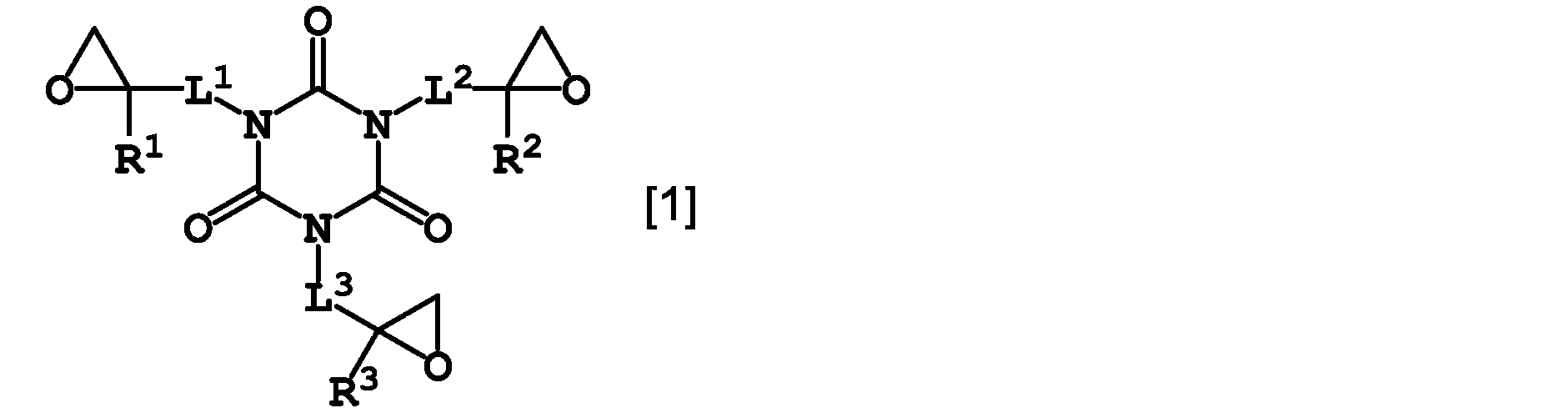
- the present invention provides, as a first aspect, a mixture comprising (a) an epoxy compound A represented by the formula [1] and a compound B optionally having an epoxy group represented by the formula [2], And (b) an epoxy resin composition for forming a printed wiring board, comprising a curing agent, (Wherein R 1 to R 3 each independently represents a hydrogen atom or a methyl group, and L 1 to L 3 each independently represents an alkylene group having 1 to 10 carbon atoms).
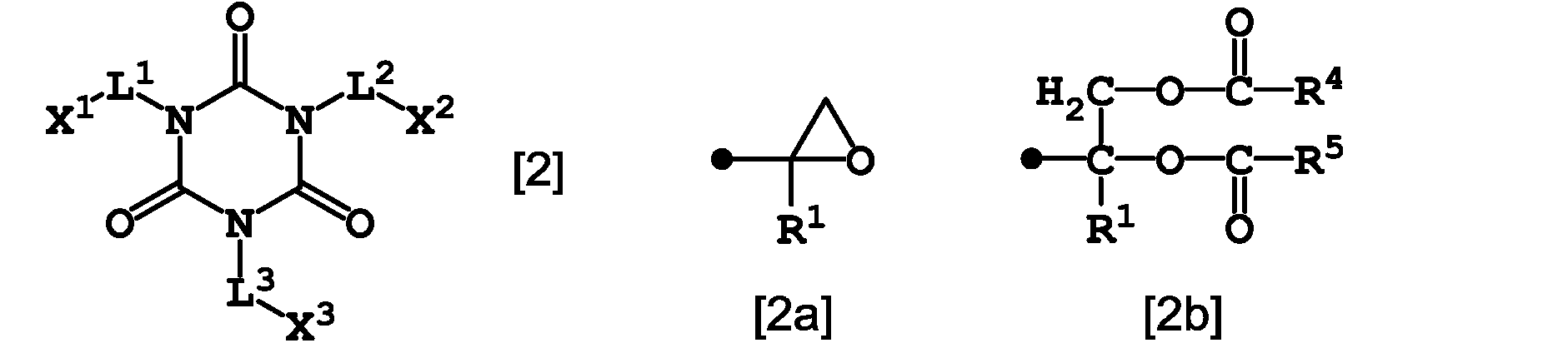
- R 4 and R 5 are each independently an optionally substituted alkyl having 1 to 20 carbon atoms.
- Group represents an optionally substituted aryl group having 6 to 10 carbon atoms, and a black dot represents a bond).
- the epoxy resin composition according to the first aspect wherein the L 1 to L 3 are an alkylene group selected from the group consisting of a methylene group, a trimethylene group, and a hexamethylene group
- the epoxy resin composition according to the first aspect or the second aspect wherein R 4 and R 5 are an optionally substituted alkyl group having 1 to 10 carbon atoms
- R 4 and R 5 are an alkyl group having 2 to 10 carbon atoms
- the epoxy resin composition according to the first aspect or the second aspect, wherein R 4 and R 5 are optionally substituted phenyl groups
- the epoxy resin composition according to any one of the first aspect to the fifth aspect including 0.2 to 20 moles of the compound B with respect to 1 mole of the epoxy compound A
- the (b) curing agent is at least one selected from the
- any one of the first aspect to the seventh aspect includes 0.5 to 1.5 equivalents of the (b) curing agent with respect to 1 equivalent of the epoxy group of the (a) epoxy resin.
- the cured product of the epoxy resin composition of the present invention has a low dielectric loss tangent and a low dielectric constant while maintaining a high glass transition temperature (Tg), and also has a low water absorption. Therefore, the epoxy resin composition of the present invention can be suitably used as an epoxy resin composition for forming a printed wiring board.
- the epoxy resin composition for forming a printed wiring board of the present invention comprises (a) an epoxy compound A represented by the formula [1] and a compound B optionally having an epoxy group represented by the formula [2]. A mixture comprising, and (b) a curing agent.
- the (a) mixture of this invention contains the epoxy compound A represented by the said Formula [1].
- R 1 to R 3 each independently represents a hydrogen atom or a methyl group
- L 1 to L 3 each independently represent an alkylene group having 1 to 10 carbon atoms.
- alkylene group having 1 to 10 carbon atoms represented by L 1 to L 3 examples include methylene group, ethylene group, trimethylene group, 1-methylethylene group, tetramethylene group, 1-methyltrimethylene group, 1,1 -Dimethylethylene group, pentamethylene group, 1-methyltetramethylene group, 2-methyltetramethylene group, 1,1-dimethyltrimethylene group, 1,2-dimethyltrimethylene group, 2,2-dimethyltrimethylene group, 1-ethyltrimethylene group, hexamethylene group, 1-methylpentamethylene group, 2-methylpentamethylene group, 3-methylpentamethylene group, 1,1-dimethyltetramethylene group, 1,2-dimethyltetramethylene group, 2,2-dimethyltetramethylene group, 1-ethyltetramethylene group, 1,1,2-trimethyltrimethyle Group, 1,2,2-trimethyltrimethylene group, 1-ethyl-1-methyltrimethylene group, 1-ethyl-2-methyltrimethylene
- the epoxy compound represented by Formula [1] can use a commercially available epoxy compound, or can use the isocyanurate ring containing epoxy compound manufactured by the well-known method.
- TEPIC registered trademark
- triglycidyl isocyanurate tris (3,4-epoxybutyl) isocyanurate
- TEIC-VL registered trademark
- Tris (4,5-epoxypentyl) isocyanurate Tris (5,6-epoxyhexyl) isocyanurate
- TEIC-FL registered trademark
- an isocyanurate ring-containing epoxy compound an epoxy resin excellent in light resistance, weather resistance, heat resistance, transparency and
- the (a) mixture of this invention contains the compound B which may have the epoxy group represented by the said Formula [2].
- L 1 to L 3 represent the same meaning as described above
- X 1 to X 3 each independently represent a group represented by the above formula [2a] or the above formula [2b].
- at least one of X 1 to X 3 represents a group represented by the formula [2b].
- R 1 represents the same meaning as described above
- the black dot represents a bond.
- R 1 and black dots are as defined above, R 4 and R 5 are alkyl groups which do having 1 to carbon atoms which may be 20 substituted, or an optionally substituted carbon atoms Represents an aryl group of formula 6 to 10;
- Examples of the optionally substituted alkyl group represented by R 4 and R 5 include a methyl group, an ethyl group, a propyl group, a butyl group, a pentyl group, a hexyl group, a heptyl group, and an octyl group.
- Linear alkyl groups such as nonyl group, decyl group, undecyl group, dodecyl group, tridecyl group, tetradecyl group, pentadecyl group, hexadecyl group, heptadecyl group, octadecyl group, nonadecyl group, icosyl group; isopropyl group, isobutyl group, sec-butyl group, tert-butyl group, isopentyl group, neopentyl group, tert-pentyl group, sec-isoamyl group, isohexyl group, texyl group, 4-methylhexyl group, 5-methylhexyl group, 2-ethylpentyl group, Heptane-3-yl group, heptane-4-yl group, 4-methylhexane 2-yl group, 3-methylhexane-3-yl group, 2,3
- alkyl groups having 1 to 10 carbon atoms, more preferably an alkyl group having 2 to 10 carbon atoms.
- alkyl groups may be substituted with a substituent such as a cyano group, an amino group, a nitro group, or a halogen atom.
- a substituent such as a cyano group, an amino group, a nitro group, or a halogen atom.
- the halogen atom include a fluoro group, a chloro group, a bromo group, and an iodo group.
- Examples of the optionally substituted aryl group having 6 to 10 carbon atoms represented by R 4 and R 5 include a phenyl group, a 1-naphthyl group, and a 2-naphthyl group. Preferably, each is a phenyl group.
- These aryl groups may be substituted with a substituent such as an alkyl group having 1 to 6 carbon atoms such as a methyl group, an ethyl group or a propyl group, a cyano group, an amino group, a nitro group or a halogen atom. .
- the compound represented by Formula [2] can use a commercially available epoxy compound, or what was manufactured by the well-known method can be used.
- a product obtained by reacting part or all of the epoxy group of the epoxy compound A represented by the formula [1] with an acid anhydride and replacing it with a group represented by the formula [2b] can be preferably used.
- the compound B has the formula [3] on the epoxy group of the epoxy compound A.
- the acid anhydride represented by the above formula [3] is an acid anhydride obtained from a so-called bimolecular monocarboxylic acid, and is different from an acid anhydride obtained from a dicarboxylic acid used as a curing agent for an epoxy resin.
- the epoxy resin does not function as a curing agent.
- compound B obtained by reacting an epoxy compound and an acid anhydride has no hydroxyl group, it has high storage stability without gelation even if unreacted acid anhydride is present.
- the acid anhydride is not particularly limited, for example, acetic anhydride, propionic anhydride, butyric anhydride, isobutyric anhydride, valeric anhydride, hexanoic anhydride, octanoic anhydride, trifluoroacetic anhydride, benzoic anhydride Etc.
- the mixture (a) of the present invention comprises epoxy compound A: acid anhydride in a molar ratio of (epoxy group of epoxy compound A) :( acid anhydride) of 1: 0.1 to 1: 1, preferably 1. : 0.4 to 1: 0.8.
- the reaction product is obtained by HPLC analysis, etc., from an unreacted epoxy compound A, a compound in which one acid anhydride represented by the formula [3] is added to the epoxy group of the epoxy compound A, a compound in which two are added, and The molar ratio of the three added compounds (compound B) can be determined.
- the solvent used for the reaction only needs to be inert to the reaction.
- these solvents include ketones such as acetone and methyl ethyl ketone; nitriles such as acetonitrile; ethers such as tetrahydrofuran and dioxane; esters such as ethyl acetate; aromatic hydrocarbons such as chlorobenzene and toluene; chloroform and dichloroethane. And halogenated hydrocarbons.
- the epoxy compound A such as triglycidyl isocyanurate is dissolved alone or as a mixed solvent.
- tertiary amines such as triethylamine, tripropylamine, 1,8-diazabicyclo [5.4.0] undecan-7-ene, ethyltriphenylphosphonium bromide, tetraphenylphosphonium bromide
- Quaternary phosphonium salts such as monoalkyltriphenylphosphonium halides, imidazole compounds such as 2-ethyl-4-methylimidazole, quaternary ammonium salts such as tetraethylammonium bromide, triphenylphosphine, etc. Phosphorus compounds and the like can be used.
- the reaction temperature is, for example, carried out at the reflux temperature of the solvent until the epoxy group content titrated with a 0.1N perchloric acid / acetic acid solution reaches a theoretical value (a value at which the added acid anhydride disappears by the reaction). Is called. After completion of the reaction, the solvent can be distilled off to obtain (a) a mixture.
- the content of the epoxy compound A represented by the formula [1] and the compound B represented by the formula [2] is not particularly limited, but for example, with respect to 1 mol of the epoxy compound A Compound B is contained in an amount of 0.2 to 20 mol, preferably 0.7 to 4 mol.
- the sum total of the epoxy groups of compound A and the epoxy groups of compound B is preferably 2 or more on average (converted to the total number of epoxy groups). If it is less than 2, the physical properties of the cured product, particularly the heat resistance, is lowered, which is not preferable.
- the mixture of the present invention is a combination of the epoxy compound A represented by the formula [1] and the compound B represented by the formula [2] and other epoxy compounds within the range not impairing the effects of the present invention. can do.
- the epoxy compound A represented by the formula [1] and the compound B represented by the formula [2] and the other epoxy compounds are in a molar ratio of epoxy groups, for example, in the range of 1: 0 to 1:20. Can be used.
- the various polyfunctional epoxy compound marketed can be used without being specifically limited.
- Examples of the epoxy compound that can be used in the present invention include 1,4-butanediol diglycidyl ether, 1,6-hexanediol diglycidyl ether, (poly) ethylene glycol diglycidyl ether, and (poly) propylene glycol diglycidyl ether.
- liquid epoxy compound examples include TEPIC (registered trademark) -UC (manufactured by Nissan Chemical Industries, Ltd.), jER (registered trademark) 828, YX8000 (both manufactured by Mitsubishi Chemical Corporation), Guatemala Resin (registered trademark) DME100 [ New Nippon Rika Co., Ltd.], Celoxide 2021P [manufactured by Daicel Corporation], and the like.
- the epoxy resin composition for forming a printed wiring board of the present invention contains (b) a curing agent.
- curing agent for example, an acid anhydride, an amine, a phenol resin, a polyamide resin, imidazoles, polymercaptan, or a mixture thereof can be used. Among these, acid anhydrides and amines are particularly preferable. Even if these hardening
- the curing agent itself is preferably liquid at normal temperature and normal pressure.
- the curing agent can be contained in a proportion of 0.5 to 1.5 equivalents, preferably 0.8 to 1.2 equivalents, relative to 1 equivalent of the epoxy group of the epoxy compound.
- the equivalent of the curing agent to the epoxy compound is represented by an equivalent ratio of the curable group of the curing agent to the epoxy group.
- the epoxy group of all these epoxy compounds The equivalent to is in the above range.
- the acid anhydride is preferably an anhydride of a compound having a plurality of carboxyl groups in one molecule.
- These acid anhydrides include, for example, phthalic anhydride, trimellitic anhydride, pyromellitic anhydride, benzophenone tetracarboxylic anhydride, ethylene glycol bistrimellitate, glycerol trislimitate, maleic anhydride, tetrahydrophthalic anhydride , Methyltetrahydrophthalic anhydride, endomethylenetetrahydrophthalic anhydride, methylendomethylenetetrahydrophthalic anhydride, methylbutenyltetrahydrophthalic anhydride, dodecenyl succinic anhydride, hexahydrophthalic anhydride, methylhexahydrophthalic anhydride, succinic anhydride Methylcyclohexene dicarboxylic acid anhydride, chlorendic acid anhydr
- methyltetrahydrophthalic anhydride methyl-5-norbornene-2,3-dicarboxylic acid anhydride (methyl nadic acid anhydride, methyl hymic anhydride), hydrogenated methyl nadic acid which is liquid at normal temperature and normal pressure
- anhydrides methylbutenyltetrahydrophthalic anhydride, dodecenyl succinic anhydride, methylhexahydrophthalic anhydride, a mixture of methylhexahydrophthalic anhydride and hexahydrophthalic anhydride.
- These liquid acid anhydrides have a viscosity of about 10 to 1,000 mPa ⁇ s as measured at 25 ° C. In an acid anhydride group, one acid anhydride group is calculated as one equivalent.
- amines examples include piperidine, N, N′-dimethylpiperazine, triethylenediamine, 2,4,6-tris (dimethylaminomethyl) phenol, benzyldimethylamine, 2- (dimethylaminomethyl) phenol, diethylenetriamine, and triethylene.
- Tetramine Tetramine, tetraethylenepentamine, diethylaminopropylamine, N-aminoethylpiperazine, di (1-methyl-2-aminocyclohexyl) methane, menthanediamine, isophoronediamine, diaminodicyclohexylmethane, 1,3-bis (aminomethyl) cyclohexane Xylenediamine, metaphenylenediamine, diaminodiphenylmethane, diaminodiphenylsulfone and the like.
- liquid diethylenetriamine triethylenetetramine, tetraethylenepentamine, diethylaminopropylamine, N-aminoethylpiperazine, bis (1-methyl-2-aminocyclohexyl) methane, menthanediamine, isophoronediamine, diaminodicyclohexylmethane Etc.
- liquid diethylenetriamine triethylenetetramine, tetraethylenepentamine, diethylaminopropylamine, N-aminoethylpiperazine, bis (1-methyl-2-aminocyclohexyl) methane, menthanediamine, isophoronediamine, diaminodicyclohexylmethane Etc.
- phenol resin examples include phenol novolac resin and cresol novolac resin.
- the polyamide resin is produced by condensation of dimer acid and polyamine, and is a polyamide amine having a primary amine and a secondary amine in the molecule.
- imidazoles examples include 2-methylimidazole, 2-ethyl-4-methylimidazole, 1-cyanoethyl-2-undecylimidazolium trimellitate, epoxy imidazole adduct, and the like.
- Polymercaptan is, for example, one having a mercaptan group at the end of a polypropylene glycol chain or one having a mercaptan group at the end of a polyethylene glycol chain, and is preferably in a liquid form.
- a hardening accelerator (it is also called a hardening adjuvant) may be used together.
- Curing accelerators include organophosphorus compounds such as triphenylphosphine and tributylphosphine; quaternary phosphonium salts such as ethyltriphenylphosphonium bromide and tetrabutylphosphonium O, O-diethylphosphorodithioate; 1,8-diazabicyclo [ 5.4.0] Undec-7-ene, 1,8-diazabicyclo [5.4.0] undec-7-ene and octyl acid, quaternary ammonium such as zinc octylate, tetrabutylammonium bromide Examples include salt.
- organophosphorus compounds such as triphenylphosphine and tributylphosphine
- quaternary phosphonium salts such as ethyltriphenylphosphonium bromide and tetrabutylphosphonium O, O-diethylphosphorodithioate
- imidazoles such as 2-methylimidazole and 2-ethyl-4-methylimidazole mentioned above as curing agents
- amines such as 2,4,6-tris (dimethylaminomethyl) phenol and benzyldimethylamine are also included. It can be used as a curing accelerator for these types of curing agents.
- These curing accelerators can be used at a ratio of 0.001 to 0.1 parts by mass with respect to 1 part by mass of the curing agent.
- Epoxy resin composition for forming printed wiring board >>
- the epoxy compound A represented by the formula [1] and the compound B represented by the formula [2], the curing agent, and a curing accelerator, if desired, are mixed to form a printed wiring board.
- An epoxy resin composition is obtained. It is preferable to stir and mix these mixtures under reduced pressure to degas them.
- the cured product obtained from the epoxy resin composition is pre-cured at a temperature of, for example, 100 to 120 ° C. by applying the epoxy resin composition to a base plate or pouring it onto a casting plate coated with a release agent, and 120 It can be obtained by main curing (post-curing) at a temperature of ⁇ 200 ° C.
- cured material obtained from the epoxy resin composition of this invention can be used suitably for a printed wiring board.
- the heating time can be appropriately adjusted depending on the size and thickness of the epoxy resin.
- both the pre-curing and the main curing are each 1 to 12 hours, for example, about 2 to 5 hours.
- Examples of the method for applying the epoxy resin composition of the present invention on a substrate include a flow coating method, a spin coating method, a spray coating method, a screen printing method, a flexographic printing method, an ink jet printing method, a casting method, and a bar coating method. , Curtain coating method, roll coating method, gravure coating method, dipping method, slit method and the like.
- a curing catalyst such as (c1) an acid generator and / or (c2) a base generator can be used. Thereby, even if the epoxy compound of the present invention and the curing catalyst are mixed, curing does not occur immediately, so that the storage stability is excellent and sufficient working time is obtained.
- (C1) Acid generator As the acid generator, a photoacid generator or a thermal acid generator can be used.
- the photo acid generator or thermal acid generator is not particularly limited as long as it generates an acid (Lewis acid or Bronsted acid) directly or indirectly by light irradiation or heating.
- the epoxy resin composition containing the thermal acid generator can be cured in a short time by heating. Moreover, since the epoxy resin composition which mix
- photoacid generators include onium salts such as iodonium salts, sulfonium salts, phosphonium salts, selenium salts, metallocene complex compounds, iron arene complex compounds, disulfone compounds, sulfonic acid derivative compounds, triazine compounds, acetophenone derivatives. Compounds, diazomethane compounds, and the like.
- iodonium salt examples include diphenyliodonium, 4,4′-dichlorodiphenyliodonium, 4,4′-dimethoxydiphenyliodonium, 4,4′-di-tert-butyldiphenyliodonium, 4-methylphenyl (4- ( 2-methylpropyl) phenyl) iodonium, 3,3′-dinitrophenyliodonium, 4- (1-ethoxycarbonylethoxy) phenyl (2,4,6-trimethylphenyl) iodonium, 4-methoxyphenyl (phenyl) iodonium, etc.
- Iodonium chloride, bromide, mesylate, tosylate, trifluoromethanesulfonate, tetrafluoroborate, tetrakis (pentafluorophenyl) borate, hexafluorophosphate, hexafluoroarsene DOO, diaryliodonium salts such as hexafluoroantimonate, and the like.
- sulfonium salt examples include triphenylsulfonium, diphenyl (4-tert-butylphenyl) sulfonium, tris (4-tert-butylphenyl) sulfonium, diphenyl (4-methoxyphenyl) sulfonium, tris (4-methylphenyl) Sulfonium chloride, bromide, sulfonium such as sulfonium, tris (4-methoxyphenyl) sulfonium, tris (4-ethoxyphenyl) sulfonium, diphenyl (4- (phenylthio) phenyl) sulfonium, tris (4- (phenylthio) phenyl) sulfonium, Triarylsulfonium such as trifluoromethanesulfonate, tetrafluoroborate, hexafluorophosphate, hexafluoroarsen
- Examples of the phosphonium salt include chloride, bromide, tetrafluoro of phosphonium such as tetraphenylphosphonium, ethyltriphenylphosphonium, tetra (p-methoxyphenyl) phosphonium, ethyltri (p-methoxyphenyl) phosphonium, benzyltriphenylphosphonium.
- Examples thereof include arylphosphonium salts such as borate, hexafluorophosphate, and hexafluoroantimonate.
- selenium salt examples include triaryl selenium salts such as triphenyl selenium hexafluorophosphate.
- iron arene complex compound examples include bis ( ⁇ 5 -cyclopentadienyl) ( ⁇ 6 -isopropylbenzene) iron (II) hexafluorophosphate.
- photoacid generators can be used alone or in combination of two or more.
- thermal acid generator examples include sulfonium salts and phosphonium salts, and sulfonium salts are preferably used.
- thermal acid generators examples include the compounds mentioned as examples of various onium salts in the above-mentioned photoacid generator. These thermal acid generators can be used alone or in combination of two or more.
- the acid generator (c1) a sulfonium salt compound or an iodonium salt compound is preferable.
- a compound having an anionic species such as hexafluorophosphate or hexafluoroantimonate showing strong acidity is preferable.
- the content of the acid generator (c1) in the epoxy resin composition of the present invention is preferably 0.1 to 20 parts by mass, or 0.1 to 10 parts by mass, more preferably 100 parts by mass of the epoxy compound (a). May be 0.5 to 10 parts by mass.
- content with respect to 100 mass parts of all those epoxy compounds becomes the said range.
- (C2) Base generator (C2)
- the photobase acid generator or the heat base generator is not particularly limited as long as it generates a base (Lewis base or Bronsted base) directly or indirectly by light irradiation or heating.
- An epoxy resin composition containing a thermal base generator can be cured in a short time by heating.
- blended the photobase generator hardens
- photobase generators can be used singly or in combination of two or more.
- the photobase generator is available as a commercial product.
- the photobase generator WPBG series WPBG-018, 027, 082, 140, 266, manufactured by Wako Pure Chemical Industries, Ltd. 300
- WPBG-018, 027, 082, 140, 266, manufactured by Wako Pure Chemical Industries, Ltd. 300 can be preferably used.
- thermal base generator examples include carbamates such as 1-methyl-1- (4-biphenylyl) ethyl carbamate and 2-cyano-1,1-dimethylethyl carbamate; urea, N, N-dimethyl-N′— Ureas such as methylurea; guanidines such as guanidine trichloroacetate, guanidine phenylsulfonylacetate and guanidine phenylpropiolate; dihydropyridines such as 1,4-dihydronicotinamide; N- (isopropoxycarbonyl) -2,6-dimethyl Dimethylpiperidines such as piperidine, N- (tert-butoxycarbonyl) -2,6-dimethylpiperidine, N- (benzyloxycarbonyl) -2,6-dimethylpiperidine; tetramethylammonium phenylsulfonylacetate, tetramethylphenylpropiolate Ann
- U-CAT registered trademark
- SA810 SA831, SA841, and SA851 which are salts of 1,8-diazabicyclo [5.4.0] undec-7-ene (DBU) [San Apro Corporation ) Made] and the like.
- DBU 1,8-diazabicyclo [5.4.0] undec-7-ene
- the content of the base generator (c2) in the epoxy resin composition of the present invention is preferably 0.1 to 20 parts by mass, or 0.1 to 10 parts by mass, more preferably 100 parts by mass of the (a) epoxy compound. May be 0.5 to 10 parts by mass.
- 100 mass parts of all these epoxy compounds The content with respect to is in the above range.
- an epoxy resin composition is obtained by mixing the mixture (a) and the curing catalyst.
- the operating conditions for mixing to obtain the epoxy resin composition are as described above.
- the epoxy resin composition containing the said (a) mixture and a photo-acid generator or a photobase generator can be apply
- the epoxy resin composition containing the said (a) mixture and a thermal acid generator or a thermal base generator can be apply
- the epoxy resin composition containing the mixture (a) and the thermal acid generator and the photoacid generator or the thermal base generator and the photobase generator can be applied on a substrate and cured by light irradiation after heating. .
- the thickness of the coating film formed from the epoxy resin composition of the present invention can be selected from a range of about 0.01 ⁇ m to 10 mm depending on the use of the cured product. For example, when used for a photoresist, 0.05 to 10 ⁇ m. (Especially 0.1 to 5 ⁇ m), about 10 ⁇ m to 5 mm (particularly 100 ⁇ m to 1 mm) when used for a printed wiring board, and 0.1 to 100 ⁇ m (particularly when used for an optical thin film) In particular, it can be about 0.3 to 50 ⁇ m.
- Examples of light to be irradiated or exposed in the case of using a photoacid generator or a photobase generator include gamma rays, X-rays, ultraviolet rays, and visible rays, and usually visible rays or ultraviolet rays, particularly ultraviolet rays are used. There are many cases.
- the wavelength of light is, for example, about 150 to 800 nm, preferably about 150 to 600 nm, more preferably about 200 to 400 nm, and particularly about 300 to 400 nm.
- Irradiation dose may vary depending on the thickness of the coating film, for example, 2 ⁇ 20,000mJ / cm 2, preferably to the 5 ⁇ 5,000mJ / cm 2 approximately.
- the light source can be selected according to the type of light to be exposed.
- a low-pressure mercury lamp for example, in the case of ultraviolet rays, a low-pressure mercury lamp, a high-pressure mercury lamp, an ultrahigh-pressure mercury lamp, a deuterium lamp, a halogen lamp, laser light (helium-cadmium laser, excimer) Laser, etc.), UV-LED, etc. can be used. By such light irradiation, the curing reaction of the composition proceeds.
- the coating film is heated after light irradiation using a photoacid generator or a photobase generator, for example, from room temperature (approximately 23 ° C.) to about 250 ° C. Done in The heating time can be selected from a range of 3 seconds or more (for example, about 3 seconds to 5 hours), for example, about 5 seconds to 2 hours.
- the coating film formed on the base material may be subjected to pattern exposure.
- This pattern exposure may be performed by scanning with a laser beam or by irradiating light through a photomask.
- a pattern or an image can be formed by developing (or dissolving) a non-irradiated region (unexposed portion) generated by such pattern exposure with a developer.
- an alkaline aqueous solution or an organic solvent can be used as the developer.
- the alkaline aqueous solution include aqueous solutions of alkali metal hydroxides such as potassium hydroxide, sodium hydroxide, potassium carbonate and sodium carbonate; quaternary ammonium hydroxides such as tetramethylammonium hydroxide, tetraethylammonium hydroxide and choline.
- Aqueous solution An aqueous amine solution such as ethanolamine, propylamine, and ethylenediamine can be used.
- the alkali developer is generally an aqueous solution of 10% by mass or less, and preferably an aqueous solution of 0.1 to 3% by mass is used. Further, alcohols and surfactants may be added to the developer and used, and the amount of these added is preferably 0.05 to 10 parts by mass with respect to 100 parts by mass of the developer. Specifically, a 0.1 to 2.38 mass% tetramethylammonium hydroxide aqueous solution or the like can be used.
- the organic solvent as a developing solution can use a common organic solvent, for example, aromatic hydrocarbons, such as toluene; ethyl lactate, propylene glycol monomethyl ether acetate (PGMEA), propylene glycol monoethyl Esters such as ether acetate, propylene glycol monopropyl ether acetate and propylene glycol monobutyl ether acetate; Amides such as N, N-dimethylformamide (DMF); Nitriles such as acetonitrile; Ketones such as acetone and cyclohexanone; Methanol, Ethanol, 2-propanol, propylene glycol monomethyl ether (PGME), propylene glycol monoethyl ether, propylene glycol monopropyl ether, propylene glycol And alcohols such as chromatography mono butyl ether.
- aromatic hydrocarbons such as toluene
- PMEA propylene glycol monomethyl ether a
- ethyl lactate propylene glycol monomethyl ether acetate (PGMEA), propylene glycol monomethyl ether (PGME) and the like can be preferably used.
- PGMEA propylene glycol monomethyl ether acetate
- PGME propylene glycol monomethyl ether
- the above epoxy resin composition can contain a solvent, if necessary.
- the solvent include aromatic hydrocarbons such as toluene and xylene; esters such as methyl acetate, ethyl acetate, propyl acetate, and butyl acetate; methyl hydroxyacetate, ethyl hydroxyacetate, butyl hydroxyacetate, methyl lactate, and ethyl lactate Propyl lactate, butyl lactate, methyl 3-hydroxypropionate, ethyl 3-hydroxypropionate, propyl 3-hydroxypropionate, butyl 3-hydroxypropionate, methyl 2-hydroxy-2-methylpropionate, 2-hydroxy- Hydroxy esters such as ethyl 2-methylpropionate and methyl 2-hydroxy-3-methylbutanoate; methyl methoxyacetate, ethyl methoxyacetate, propyl methoxyacetate, butyl methoxyacetate, methyl ethoxyacetate, e
- a vinyl group-containing compound, an oxetanyl group-containing compound, or the like can be used as the cationic curable monomer for the purpose of adjusting the viscosity of the epoxy resin composition or improving the curability.
- the vinyl group-containing compound is not particularly limited as long as it is a compound having a vinyl group.
- HEVE 2-hydroxyethyl vinyl ether
- DEGV diethylene glycol monovinyl ether
- HBVE 2-hydroxybutyl vinyl ether
- triethylene glycol And vinyl ether compounds such as divinyl ether.
- a vinyl compound having a substituent such as an alkyl group or an allyl group at the ⁇ -position and / or ⁇ -position can be used.
- a vinyl ether compound containing a cyclic ether group such as an epoxy group and / or an oxetanyl group can be used, and examples thereof include oxynorbornene divinyl ether and 3,3-dimethanol oxetane divinyl ether.
- a compound having a vinyl group and a (meth) acryl group can be used, and examples thereof include 2- (2-vinyloxyethoxy) ethyl (meth) acrylate.
- the oxetanyl group-containing compound is not particularly limited as long as it is a compound having an oxetanyl group, and 3-ethyl-3- (hydroxymethyl) oxetane (OXA), 3-ethyl-3- (phenoxymethyl) oxetane (POX), Bis ((3-ethyl-3-oxetanyl) methyl) ether (DOX), 1,4-bis (((3-ethyl-3-oxetanyl) methoxy) methyl) benzene (XDO), 3-ethyl-3- ( 2-ethylhexyloxymethyl) oxetane (EHOX), 3-ethyl-3-((3-triethoxysilylpropoxy) methyl) oxetane (TESOX), oxetanylsilsesquioxane (OX-SQ), phenol novolac oxetane (PNOX- 100
- a compound having an oxetanyl group and a (meth) acryl group can be used, and examples thereof include (meth) acrylic acid (3-ethyl-3-oxetanyl) methyl.
- These oxetanyl group-containing compounds can be used alone or in combination of two or more.
- the above composition may contain a conventional additive as required.
- additives include thickeners, sensitizers, antifoaming agents, leveling agents, coatability improvers, lubricants, stabilizers (antioxidants, heat stabilizers, light stabilizers, etc.), Examples include plasticizers, surfactants, dissolution accelerators, fillers, antistatic agents, and curing agents. These additives may be used alone or in combination of two or more.
- a surfactant may be added to the epoxy resin composition of the present invention for the purpose of improving coating properties.
- surfactants include fluorine-based surfactants, silicone-based surfactants, and nonionic surfactants, but are not particularly limited thereto.
- the said surfactant can be used individually or in combination of 2 or more types.
- a fluorosurfactant is preferable because of its high coating property improving effect.
- fluorosurfactant examples include, for example, EFTOP (registered trademark) EF-301, EF-303, and EF-352 [all manufactured by Mitsubishi Materials & Chemicals Co., Ltd.], MegaFuck (registered trademark) ) F-171, F-173, F-482, R-08, R-30, R-90, BL-20 [all made by DIC Corporation], Florard FC-430, FC-431 [all manufactured by 3M Japan Co., Ltd.], Asahi Guard (registered trademark) AG-710 (manufactured by Asahi Glass Co., Ltd.), Surflon S-382, SC-101, SC-102, SC-103 SC-104, SC-105, SC-106 [all manufactured by AGC Seimi Chemical Co., Ltd.], etc., but are not limited thereto.
- the addition amount of the surfactant in the epoxy resin composition of the present invention is 0.01 to 5% by mass, preferably 0.01 to 3% by mass, based on the solid content of the epoxy resin composition.
- An adhesion promoter can be added to the epoxy resin composition of the present invention for the purpose of improving the adhesion to the substrate after development.
- adhesion promoters include chlorosilanes such as chlorotrimethylsilane, trichloro (vinyl) silane, chloro (dimethyl) (vinyl) silane, chloro (methyl) (diphenyl) silane, and chloro (chloromethyl) (dimethyl) silane.
- adhesion promoters can be used alone or in combination of two or more.
- the addition amount of the adhesion promoter in the epoxy resin composition of the present invention is usually 20% by mass or less, preferably 0.01 to 10% by mass, more preferably based on the solid content of the epoxy resin composition. 0.05 to 5% by mass.
- the epoxy resin composition of the present invention may contain a sensitizer.
- sensitizers that can be used include anthracene, phenothiazene, perylene, thioxanthone, and benzophenone thioxanthone.
- sensitizing dyes thiopyrylium salt dyes, merocyanine dyes, quinoline dyes, styrylquinoline dyes, ketocoumarin dyes, thioxanthene dyes, xanthene dyes, oxonol dyes, cyanine dyes, rhodamine dyes And pyrylium salt pigments.
- anthracene-based sensitizer when used in combination with a cationic curing catalyst (radiation sensitive cationic polymerization initiator), the sensitivity is drastically improved and also has a radical polymerization initiation function.
- a cationic curing catalyst radiation sensitive cationic polymerization initiator
- the catalyst species can be simplified.
- anthracene compounds dibutoxyanthracene, dipropoxyanthraquinone and the like are effective.
- Examples of the sensitizer when using a base generator as a curing catalyst include acetophenones, benzoins, benzophenones, anthraquinones, xanthones, thioxanthones, ketals, and tertiary amines. it can.
- the addition amount of the sensitizer in the epoxy resin composition of the present invention is 0.01 to 20% by mass, preferably 0.01 to 10% by mass, based on the solid content of the epoxy resin composition. .
- the epoxy resin composition containing the (a) mixture and (b) curing agent of the present invention has light and thermosetting properties, and has a high refractive index of an adhesive and an antireflection film (such as an antireflection film for a liquid crystal display). It can be widely used in the field of electronic materials such as layers, optical thin films (reflecting plates, etc.), encapsulants for electronic parts, printed wiring boards, interlayer insulating film materials (interlayer insulating film materials for build-up printed boards, etc.). In particular, it can be widely used as an electronic material required to have a low dielectric loss tangent and a low dielectric constant, such as a printed wiring board and an interlayer insulating film material.
- GPC Gel permeation chromatography
- Sample holder 12962 type room temperature sample holder, manufactured by Toyo Corporation (6) Glass transition temperature Tg Apparatus: Dynamic viscoelasticity measuring apparatus (DMA) Q800 manufactured by TA Instrument Deformation mode: Dual cantilever Frequency: 1Hz Strain: 0.05% Sweep temperature: 30-300 ° C Temperature increase rate: 5 ° C / min (7) Flexural modulus, deflection Device: Desktop precision universal testing machine Autograph AGS-5kNX, manufactured by Shimadzu Corporation (8) Oven device: Yamato Kagaku Co., Ltd. blown low temperature thermostat DNF400
- BA Butyric anhydride [manufactured by Tokyo Chemical Industry Co., Ltd.]
- BzA Benzoic anhydride [manufactured by Tokyo Chemical Industry Co., Ltd.]
- iBA Isobutyric anhydride [manufactured by Tokyo Chemical Industry Co., Ltd.]
- OA Octanoic anhydride [manufactured by Tokyo Chemical Industry Co., Ltd.]
- PA propionic anhydride [APA made by Daicel Corporation]
- P3EPB Ethyltriphenylphosphonium bromide [made by Hokuko Chemical Co., Ltd.]
- P4PB Tetraphenylphosphonium bromide [Tokyo Chemical Industry Co., Ltd.]
- BPA bisphenol A type epoxy resin [jER (registered trademark) 828, manufactured by Mitsubishi Chemical Corporation]
- TGIC Triglycidyl isocyanurate [TEPIC (registered trademark) -S manufactured by Nissan Chemical Industries, Ltd
- the epoxy equivalent of the obtained BA-TGIC was 192 (theoretical value 193).
- TGIC non-adduct: 1 mol adduct: 2 mol adduct: 3 mol adduct (area ratio) was 33: 52: 14: 0.1.
- TGIC octanoic anhydride modified product (OA-TGIC) TGIC octanoic anhydride modified product (OA-) was prepared in the same manner as in Production Example 2 except that BA was changed to 29.1 g (108 mmol) of OA. TGIC) was obtained as a liquid. The epoxy equivalent of the obtained OA-TGIC was 234 (theoretical value 234). In HPLC analysis, TGIC (non-adduct): 1 mol adduct: 2 mol adduct: 3 mol adduct (area ratio) was 29: 43: 24: 4.
- TGIC benzoic anhydride modified product (BzA-TGIC) TGIC benzoic anhydride modified product (BzA-) was prepared in the same manner as in Production Example 2 except that BA was changed to 24.4 g (108 mmol) of BzA.
- TGIC was obtained as a liquid.
- the epoxy equivalent of the obtained BzA-TGIC was 217 (theoretical value 217).
- TGIC (non-adduct): 1 mol adduct: 2 mol adduct: 3 mol adduct (area ratio) was 15: 43: 35: 7.
- Tg Glass transition temperature
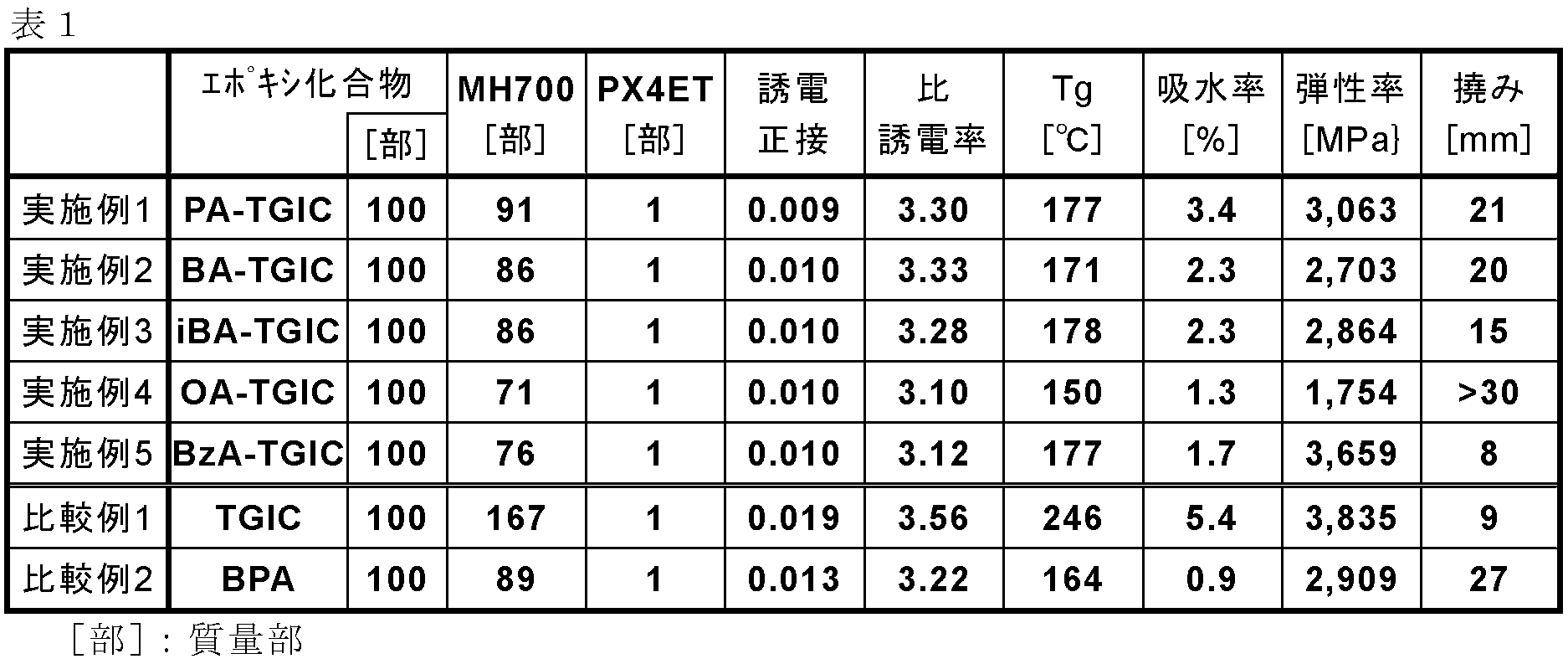
- cured products (Examples 1 to 5) obtained using the epoxy resin composition of the present invention are BPA (Comparative Example 2), which is an epoxy compound that is widely used for printed wiring board formation. Compared with, it showed a very low dielectric loss tangent.
- BPA Comparative Example 2
- an epoxy resin composition containing an epoxy compound modified with an aromatic carboxylic acid anhydride achieves a low water absorption and a low dielectric constant while maintaining a high Tg, and is used as a resin for forming a printed wiring board. It was confirmed to be suitable.
Landscapes
- Chemical & Material Sciences (AREA)
- Engineering & Computer Science (AREA)
- Microelectronics & Electronic Packaging (AREA)
- Health & Medical Sciences (AREA)
- Chemical Kinetics & Catalysis (AREA)
- Medicinal Chemistry (AREA)
- Polymers & Plastics (AREA)
- Organic Chemistry (AREA)
- Epoxy Resins (AREA)
- Compositions Of Macromolecular Compounds (AREA)
Abstract
Description
本発明は、この事情を考慮したものであって、低誘電正接かつ低誘電率であり、プリント配線板を形成するために好適な、エポキシ樹脂組成物、及びその硬化物からなるプリント配線板を提供することを目的とする。
第2観点として、前記L1乃至L3が、メチレン基、トリメチレン基、及びヘキサメチレン基からなる群から選ばれるアルキレン基である、第1観点に記載のエポキシ樹脂組成物、
第3観点として、前記R4及びR5が置換されていてもよい炭素原子数1乃至10のアルキル基である、第1観点又は第2観点に記載のエポキシ樹脂組成物、
第4観点として、前記R4及びR5が炭素原子数2乃至10のアルキル基である、第1観点乃至第3観点のうち何れか一つに記載のエポキシ樹脂組成物、
第5観点として、前記R4及びR5が置換されていてもよいフェニル基である、第1観点又は第2観点に記載のエポキシ樹脂組成物、
第6観点として、前記エポキシ化合物A1モルに対して、0.2~20モルの前記化合物Bを含む、第1観点乃至第5観点のうち何れか一つに記載のエポキシ樹脂組成物、
第7観点として、前記(b)硬化剤が、酸無水物、アミン、フェノール樹脂、ポリアミド樹脂、イミダゾール類、及びポリメルカプタンからなる群から選ばれる少なくとも一種である、第1観点乃至第6観点のうち何れか一つに記載のエポキシ樹脂組成物、
第8観点として、前記(a)エポキシ樹脂のエポキシ基1当量に対して、0.5~1.5当量の前記(b)硬化剤を含む、第1観点乃至第7観点のうち何れか一つに記載のエポキシ樹脂組成物、
第9観点として、第1観点乃至第8観点のうち何れか一つに記載のエポキシ樹脂組成物の硬化物からなる、プリント配線板
に関する。
したがって、本発明のエポキシ樹脂組成物は、プリント配線板形成用のエポキシ樹脂組成物として好適に使用することができる。
本発明の(a)混合物は、上記式[1]で表されるエポキシ化合物Aを含む。
上記式[1]中、R1乃至R3はそれぞれ独立して、水素原子又はメチル基を表し、L1乃至L3はそれぞれ独立して、炭素原子数1乃至10のアルキレン基を表す。
イソシアヌレート環含有エポキシ化合物を用いることにより、耐光性、耐侯性、耐熱性、透明性等に優れたエポキシ樹脂が得られる。
また、本発明の(a)混合物は、上記式[2]で表されるエポキシ基を有していてもよい化合物Bを含む。
上記式[2]中、L1乃至L3は前記と同じ意味を表し、X1乃至X3はそれぞれ独立して、上記式[2a]又は上記式[2b]で表される基を表すが、ただし、X1乃至X3のうち少なくとも一つは式[2b]で表される基を表す。
上記式[2a]中、R1は前記と同じ意味を表し、黒点は結合手を表す。
上記式[2b]中、R1及び黒点は前記と同じ意味を表し、R4及びR5は置換されていてもよい炭素原子数1乃至20のアルキル基、又は置換されていてもよい炭素原子数6乃至10のアリール基を表す。
これらのアルキル基は、例えば、シアノ基、アミノ基、ニトロ基、ハロゲン原子等の置換基で置換されていてもよい。
ハロゲン原子としては、例えば、フルオロ基、クロロ基、ブロモ基、ヨード基等が挙げられる。
これらのアリール基は、例えば、メチル基、エチル基、プロピル基等の炭素原子数1乃至6のアルキル基、シアノ基、アミノ基、ニトロ基、ハロゲン原子等の置換基で置換されていてもよい。

また、エポキシ化合物と酸無水物を反応させて得られる化合物Bは水酸基がないため、未反応の酸無水物が存在していてもゲル化等することなく保存安定性が高い。
酸無水物は特に限定されるものではないが、例えば、無水酢酸、無水プロピオン酸、無水酪酸、無水イソ酪酸、無水吉草酸、無水へキサン酸、無水オクタン酸、無水トリフルオロ酢酸、無水安息香酸などが挙げられる。
また、必要に応じて、触媒としてトリエチルアミン、トリプロピルアミン、1,8-ジアザビシクロ[5.4.0]ウンデカン-7-エン等の3級アミン類や、エチルトリフェニルホスホニウムブロミド、テトラフェニルホスホニウムブロミド等に代表されるハロゲン化モノアルキルトリフェニルホスホニウム等の第4級ホスホニウム塩、2-エチル-4-メチルイミダゾール等のイミダゾール系化合物、臭化テトラエチルアンモニウム等の第4級アンモニウム塩、トリフェニルホスフィン等のリン化合物等を用いることができる。
本発明の混合物において、式[1]で表されるエポキシ化合物Aと、式[2]で表される化合物Bとの含有量は、特に制限されないが、例えば、エポキシ化合物A1モルに対して、化合物Bを0.2~20モル、好ましくは0.7~4モル含む。
化合物Aのエポキシ基と化合物Bのエポキシ基の総和は、平均して、1分子に換算して(総エポキシ基数を総分子数で割る)2個以上であるのが好ましい。2個未満では硬化物の物性、特に耐熱性が低下して好ましくない。
上記式[1]で表されるエポキシ化合物A及び式[2]で表される化合物Bと、それ以外のエポキシ化合物とは、エポキシ基のモル比で、例えば1:0~1:20の範囲で用いることが可能である。
上記それ以外のエポキシ化合物としては、特に限定されることなく市販されている種々の多官能のエポキシ化合物を使用することができる。
これらのエポキシ化合物は単独で又は二種以上の混合物として使用することが出来る。
液状エポキシ化合物としては、TEPIC(登録商標)-UC[日産化学工業(株)製]、jER(登録商標)828、同YX8000[何れも三菱化学(株)製]、リカレジン(登録商標)DME100[新日本理化(株)製]、セロキサイド2021P[(株)ダイセル製]等が挙げられる。
本発明のプリント配線板形成用エポキシ樹脂組成物は、(b)硬化剤を含む。
硬化剤としては、特に限定されることはないが、例えば酸無水物、アミン、フェノール樹脂、ポリアミド樹脂、イミダゾール類、ポリメルカプタン又はこれらの混合物を用いることができる。これらの中でも、特に酸無水物及びアミンが好ましい。これら硬化剤は、固体であっても溶剤に溶解することによって使用することができる。しかし、溶剤の蒸発により硬化物の密度低下や細孔の生成により強度低下、耐水性の低下を生ずるため、硬化剤自体が常温、常圧下で液状のものが好ましい。
硬化剤は、エポキシ化合物のエポキシ基1当量に対して0.5~1.5当量、好ましくは0.8~1.2当量の割合で含有することができる。エポキシ化合物に対する硬化剤の当量は、エポキシ基に対する硬化剤の硬化性基の当量比で示される。なお、上記式[1]で表されるエポキシ化合物及び式[2]で表される化合物を含む混合物(a)と、それ以外のエポキシ化合物を併用する場合には、それら全エポキシ化合物のエポキシ基に対する当量が前記範囲となる。
これらの中でも常温、常圧で液状であるメチルテトラヒドロ無水フタル酸、メチル-5-ノルボルネン-2,3-ジカルボン酸無水物(メチルナジック酸無水物、無水メチルハイミック酸)、水素化メチルナジック酸無水物、メチルブテニルテトラヒドロ無水フタル酸、ドデセニル無水コハク酸、メチルヘキサヒドロ無水フタル酸、メチルヘキサヒドロ無水フタル酸とヘキサヒドロ無水フタル酸との混合物が好ましい。これら液状の酸無水物は粘度が25℃での測定で10~1,000mPa・s程度である。酸無水物基において、1つの酸無水物基は1当量として計算される。
また、本発明のプリント配線板形成用エポキシ樹脂組成物から硬化物を得る際、適宜、硬化剤に加えて、硬化促進剤(硬化助剤ともいう)が併用されてもよい。
硬化促進剤としては、トリフェニルホスフィン、トリブチルホスフィン等の有機リン化合物;エチルトリフェニルホスホニウムブロミド、テトラブチルホスホニウムO,O-ジエチルホスホロジチオエート等の第4級ホスホニウム塩;1,8-ジアザビシクロ[5.4.0]ウンデカ-7-エン、1,8-ジアザビシクロ[5.4.0]ウンデカ-7-エンとオクチル酸との塩、オクチル酸亜鉛、テトラブチルアンモニウムブロミド等の第4級アンモニウム塩などが挙げられる。また前述の硬化剤として挙げた2-メチルイミダゾール、2-エチル-4-メチルイミダゾール等のイミダゾール類や、2,4,6-トリス(ジメチルアミノメチル)フェノール、ベンジルジメチルアミン等のアミン類も他の種類の硬化剤に対する硬化促進剤として用いることができる。
これらの硬化促進剤は、硬化剤1質量部に対して、0.001~0.1質量部の割合で用いることができる。
本発明では、上記式[1]で表されるエポキシ化合物A及び式[2]で表される化合物Bと、上記硬化剤と、所望により硬化促進剤を混合することにより、プリント配線板形成用エポキシ樹脂組成物が得られる。これら混合物を減圧下で撹拌混合し、脱泡することが好ましい。
エポキシ樹脂組成物から得られる硬化物は、該エポキシ樹脂組成物を基材に塗布、もしくは離型剤を塗布した注型板に注ぎ込んで、例えば100~120℃の温度で予備硬化し、そして120~200℃の温度で本硬化(後硬化)することにより得られる。そして、本発明のエポキシ樹脂組成物から得られる硬化物は、プリント配線基板に好適に用いることができる。
加熱時間はエポキシ樹脂の大きさや厚みにより適宜調節できる。例えば、例えば予備硬化及び本硬化ともにそれぞれ1~12時間、例えば2~5時間程度である。
本発明では、硬化触媒、例えば(c1)酸発生剤及び/又は(c2)塩基発生剤を使用することができる。これにより、本発明のエポキシ化合物と硬化触媒とを混合しても直ちに硬化が生じないため、保存安定性に優れ、また十分な作業時間が得られる。
(c1)酸発生剤としては、光酸発生剤又は熱酸発生剤を用いることができる。光酸発生剤又は熱酸発生剤は、光照射又は加熱により直接又は間接的に酸(ルイス酸あるいはブレンステッド酸)を発生するものであれば特に限定されない。熱酸発生剤を配合したエポキシ樹脂組成物は、加熱により短時間で硬化させることができる。また、光酸発生剤を配合したエポキシ樹脂組成物は、加熱によらず、光照射で硬化するので、耐熱性の低い基板及び部位に使用することができる。
これらの例示化合物としては、上述の光酸発生剤において各種オニウム塩の例示として挙げた化合物を挙げることができる。
これらの熱酸発生剤は単独で、又は二種以上を組み合わせて用いることができる。
本発明のエポキシ樹脂組成物における(c1)酸発生剤の含有量は、(a)エポキシ化合物100質量部に対して、0.1~20質量部、又は0.1~10質量部、さらに好ましくは0.5~10質量部とすることができる。なお、上記式[1]で表されるエポキシ化合物と、それ以外のエポキシ化合物を併用する場合には、それら全エポキシ化合物100質量部に対する含有量が前記範囲となる。
(c2)塩基発生剤としては、光塩基発生剤又は熱塩基発生剤を用いることができる。光塩基酸発生剤又は熱塩基発生剤は、光照射又は加熱により直接又は間接的に塩基(ルイス塩基あるいはブレンステッド塩基)を発生するものであれば特に限定されない。熱塩基発生剤を配合したエポキシ樹脂組成物は、加熱により短時間で硬化させることができる。また、光塩基発生剤を配合したエポキシ樹脂組成物は、加熱によらず、光照射で硬化するので、耐熱性の低い基板及び部位に使用することができる。
これら光塩基発生剤は、一種を単独で、又は二種以上を組み合わせて用いることができる。
また、光塩基発生剤は市販品として入手可能であり、例えば、和光純薬工業(株)製の光塩基発生剤WPBGシリーズ(WPBG-018、同027、同082、同140、同266、同300など)等を好適に用いることができる。
これら熱塩基発生剤は、一種を単独で、又は二種以上を組み合わせて用いることができる。
また、本発明では、上記(a)混合物及び熱酸発生剤又は熱塩基発生剤を含むエポキシ樹脂組成物を基板上に塗布し加熱により硬化することができる。
さらに、上記(a)混合物及び熱酸発生剤と光酸発生剤もしくは熱塩基発生剤と光塩基発生剤を含むエポキシ樹脂組成物を基板上に塗布し、加熱後に光照射により硬化することができる。
光の波長は、例えば、150~800nm、好ましくは150~600nm、さらに好ましくは200~400nm、特に300~400nm程度である。
照射光量は、塗膜の厚みにより異なるが、例えば、2~20,000mJ/cm2、好ましくは5~5,000mJ/cm2程度とすることができる。
光源としては、露光する光線の種類に応じて選択でき、例えば、紫外線の場合は低圧水銀ランプ、高圧水銀ランプ、超高圧水銀ランプ、重水素ランプ、ハロゲンランプ、レーザー光(ヘリウム-カドミウムレーザー、エキシマレーザーなど)、UV-LEDなどを用いることができる。このような光照射により、前記組成物の硬化反応が進行する。
アルカリ水溶液としては、例えば、水酸化カリウム、水酸化ナトリウム、炭酸カリウム、炭酸ナトリウム等のアルカリ金属水酸化物の水溶液;水酸化テトラメチルアンモニウム、水酸化テトラエチルアンモニウム、コリン等の水酸化四級アンモニウムの水溶液;エタノールアミン、プロピルアミン、エチレンジアミン等のアミン水溶液などを挙げることができる。
中でも、乳酸エチル、プロピレングリコールモノメチルエーテルアセテート(PGMEA)、プロピレングリコールモノメチルエーテル(PGME)等を好ましく使用することができる。
上記のエポキシ樹脂組成物は、必要により溶剤を含むことができる。
溶剤としては、例えば、トルエン、キシレン等の芳香族炭化水素類;酢酸メチル、酢酸エチル、酢酸プロピル、酢酸ブチル等のエステル類;ヒドロキシ酢酸メチル、ヒドロキシ酢酸エチル、ヒドロキシ酢酸ブチル、乳酸メチル、乳酸エチル、乳酸プロピル、乳酸ブチル、3-ヒドロキシプロピオン酸メチル、3-ヒドロキシプロピオン酸エチル、3-ヒドロキシプロピオン酸プロピル、3-ヒドロキシプロピオン酸ブチル、2-ヒドロキシ-2-メチルプロピオン酸メチル、2-ヒドロキシ-2-メチルプロピオン酸エチル、2-ヒドロキシ-3-メチルブタン酸メチル等のヒドロキシエステル類;メトキシ酢酸メチル、メトキシ酢酸エチル、メトキシ酢酸プロピル、メトキシ酢酸ブチル、エトキシ酢酸メチル、エトキシ酢酸エチル、エトキシ酢酸プロピル、エトキシ酢酸ブチル、プロポキシ酢酸メチル、プロポキシ酢酸エチル、プロポキシ酢酸プロピル、プロポキシ酢酸ブチル、ブトキシ酢酸メチル、ブトキシ酢酸エチル、ブトキシ酢酸プロピル、ブトキシ酢酸ブチル、2-メトキシプロピオン酸メチル、2-メトキシプロピオン酸エチル、2-メトキシプロピオン酸プロピル、2-メトキシプロピオン酸ブチル、2-エトキシプロピオン酸メチル、2-エトキシプロピオン酸エチル、2-エトキシプロピオン酸プロピル、2-エトキシプロピオン酸ブチル、2-ブトキシプロピオン酸メチル、2-ブトキシプロピオン酸エチル、2-ブトキシプロピオン酸プロピル、2-ブトキシプロピオン酸ブチル、3-メトキシプロピオン酸メチル、3-メトキシプロピオン酸エチル、3-メトキシプロピオン酸プロピル、3-メトキシプロピオン酸ブチル、3-エトキシプロピオン酸メチル、3-エトキシプロピオン酸エチル、3-エトキシプロピオン酸プロピル、3-エトキシプロピオン酸ブチル、3-プロポキシプロピオン酸メチル、3-プロポキシプロピオン酸エチル、3-プロポキシプロピオン酸プロピル、3-プロポキシプロピオン酸ブチル、3-ブトキシプロピオン酸メチル、3-ブトキシプロピオン酸エチル、3-ブトキシプロピオン酸プロピル、3-ブトキシプロピオン酸ブチル、メチルセロソルブアセテート、エチルセロソルブアセテート、プロピレングリコールモノメチルエーテルアセテート(PGMEA)、プロピレングリコールモノエチルエーテルアセテート、プロピレングリコールモノプロピルエーテルアセテート、プロピレングリコールモノブチルエーテルアセテート、プロピレングリコールモノメチルエーテルプロピオネート、プロピレングリコールモノエチルエーテルプロピオネート、プロピレングリコールモノプロピルエーテルプロピオネート、プロピレングリコールモノブチルエーテルプロピオネート等のエーテルエステル類;メチルエチルケトン(MEK)、4-ヒドロキシ-4-メチル-2-ペンタノン、シクロヘキサノン等のケトン類;エチレングリコールモノメチルエーテル、エチレングリコールモノエチルエーテル、ジエチレングリコールモノメチルエーテル、ジエチレングリコールモノエチルエーテル、プロピレングリコールモノメチルエーテル(PGME)、プロピレングリコールモノエチルエーテル、プロピレングリコールモノプロピルエーテル、プロピレングリコールモノブチルエーテル等のアルコール類;テトラヒドロフラン(THF)、ジエチレングリコールジメチルエーテル、ジエチレングリコールジエチルエーテル、ジエチレングリコールエチルメチルエーテル等のエーテル類などが挙げられる。
本発明では、エポキシ樹脂組成物の粘度調整や硬化性の向上を目的として、カチオン硬化性モノマーとして、ビニル基含有化合物、オキセタニル基含有化合物等を用いることができる。
また、ビニル基と(メタ)アクリル基を有する化合物を使用することができ、例えば、(メタ)アクリル酸2-(2-ビニルオキシエトキシ)エチル等が挙げられる。
これらビニル基含有化合物は、単独で又は二種以上を組み合わせて使用することができる。
また、オキセタニル基と(メタ)アクリル基を有する化合物を使用することができ、例えば、(メタ)アクリル酸(3-エチル-3-オキセタニル)メチル等が挙げられる。
これらのオキセタニル基含有化合物は、単独で又は二種以上を組み合わせて使用することができる。
上記の組成物は、必要に応じて慣用の添加剤を含んでいてもよい。このような添加剤としては、例えば、増粘剤、増感剤、消泡剤、レベリング剤、塗布性改良剤、潤滑剤、安定剤(酸化防止剤、熱安定剤、耐光安定剤など)、可塑剤、界面活性剤、溶解促進剤、充填剤、帯電防止剤、硬化剤などが挙げられる。これらの添加剤は単独で又は二種以上組み合わせてもよい。
これらの界面活性剤の中で、塗布性改善効果の高さからフッ素系界面活性剤が好ましい。フッ素系界面活性剤の具体例としては、例えば、エフトップ(登録商標)EF-301、同EF-303、同EF-352[何れも三菱マテリアル電子化成(株)製]、メガファック(登録商標)F-171、同F-173、同F-482、同R-08、同R-30、同R-90、同BL-20[何れもDIC(株)製]、フロラードFC-430、同FC-431[何れもスリーエムジャパン(株)製]、アサヒガード(登録商標)AG-710[旭硝子(株)製]、サーフロンS-382、同SC-101、同SC-102、同SC-103、同SC-104、同SC-105、同SC-106[何れもAGCセイミケミカル(株)製]等が挙げられるが、これらに限定されるものではない。
本発明のエポキシ樹脂組成物における界面活性剤の添加量は、該エポキシ樹脂組成物の固形分の含有量に基づいて、0.01~5質量%、好ましくは0.01~3質量%、より好ましくは0.01~2質量%である。
本発明のエポキシ樹脂組成物における密着促進剤の添加量は、該エポキシ樹脂組成物の固形分の含有量に基づいて、通常20質量%以下、好ましくは0.01~10質量%、より好ましくは0.05~5質量%である。
また、硬化触媒として塩基発生剤を用いる場合の増感剤としては、例えば、アセトフェノン類、ベンゾイン類、ベンゾフェノン類、アントラキノン類、キサントン類、チオキサントン類、ケタール類、3級アミン類等を挙げることができる。
本発明のエポキシ樹脂組成物における増感剤の添加量は、該エポキシ樹脂組成物の固形分の含有量に基づいて、0.01~20質量%、好ましくは0.01~10質量%である。
なお、実施例において、試料の調製及び物性の分析に用いた装置及び条件は、以下のとおりである。
装置:(株)島津製作所製 GC-2010 Plus
検出器:FID
カラム:アジレント・テクノロジー(株)製 Agilent J&W GCカラム HP-5(長さ30m、内径0.32mm、膜厚0.25μm)
注入量:1.0μL
注入口温度:250℃
カラム温度:40℃(5分間)、20℃/分で300℃まで昇温、300℃(12分間)
(2)高速液体クロマトグラフィー(HPLC)
装置:アジレント・テクノロジー(株)製 1200 Infinity LCシステム
検出器:UV(205nm)
カラム温度:40℃
カラム:ジーエルサイエンス(株)製 Inertsil(登録商標)ODS-4(粒径5μm、内径4.6mm、長さ250mm)
注入量:10μL
移動相組成:アセトニトリル/純水(体積比)=4/96~90/10(リニアグラジエント、30分)
流量:1.5mL/分
(3)ゲル浸透クロマトグラフィー(GPC)
装置:東ソー(株)製 HLC-8220GPC
カラム:昭和電工(株)製 Shodex(登録商標)GPC KF-804L、同KF-805L
カラム温度:40℃
溶離液:テトラヒドロフラン
検出器:RI
(4)エポキシ当量
装置:京都電子工業(株)製 電位差自動滴定装置AT-510
(5)誘電正接、比誘電率
装置:キーサイト・テクノロジーズ社製 E4980A プレシジョンLCRメータ
サンプルホルダー:(株)東陽テクニカ製 12962型室温サンプルホルダー
(6)ガラス転移温度Tg
装置:TA Instrument社製 動的粘弾性測定装置(DMA)Q800
変形モード:デュアルカンチレバー
周波数:1Hz
歪:0.05%
掃引温度:30~300℃
昇温速度:5℃/分
(7)曲げ弾性率、撓み
装置:(株)島津製作所製 卓上形精密万能試験機オートグラフAGS-5kNX
(8)オーブン
装置:ヤマト科学(株)製 送風低温恒温器DNF400
BA:無水酪酸[東京化成工業(株)製]
BzA:無水安息香酸[東京化成工業(株)製]
iBA:無水イソ酪酸[東京化成工業(株)製]
OA:無水オクタン酸[東京化成工業(株)製]
PA:無水プロピオン酸[(株)ダイセル製 APA]
P3EPB:エチルトリフェニルホスホニウムブロミド[北興化学工業(株)製]
P4PB:テトラフェニルホスホニウムブロミド[東京化成工業(株)]
BPA:ビスフェノールA型エポキシ樹脂[三菱化学(株)製 jER(登録商標)828]
TGIC:トリグリシジルイソシアヌレート[日産化学工業(株)製 TEPIC(登録商標)-S]
MH700:4-メチルヘキサヒドロ無水フタル酸/ヘキサヒドロ無水フタル酸混合物(モル比70:30)[新日本理化(株)製 リカシッド(登録商標)MH-700]
PX4ET:テトラブチルホスホニウムO,O-ジエチルホスホロジチオエート[日本化学工業(株)製 ヒシコーリン(登録商標)PX-4ET]
反応フラスコに、TGIC 60.0g(202mmol)、及びトルエン54gを仕込んだ。この混合物を還流させながら、PA 21.2g(162mmol)、及びP3EPB 0.06g(0.156mmol)の混合物を滴下した。滴下終了後、さらに2時間還流させた。この反応混合物からトルエンを減圧留去することで、TGIC無水プロピオン酸変性物(PA-TGIC)を液状物として得た。得られたPA-TGICの、JIS K7236:2009に準じて測定したエポキシ当量は181であった(理論値182)。また、HPLC分析における、TGIC(非付加体):1モル付加体:2モル付加体:3モル付加体(面積比)は、33:45:19:3であった。
反応フラスコに、TGIC 40.0g(135mmol)、及びアセトニトリル14gを仕込んだ。この混合物を還流させながら、BA 17.0g(108mmol)、P4PB 0.026g(0.062mmol)、及びアセトニトリル0.4gの混合物を滴下した。滴下終了後、さらに24時間還流させた。この反応混合物からアセトニトリルを減圧留去することで、TGIC無水酪酸変性物(BA-TGIC)を液状物として得た。得られたBA-TGICのエポキシ当量は192であった(理論値193)。また、HPLC分析における、TGIC(非付加体):1モル付加体:2モル付加体:3モル付加体(面積比)は、33:52:14:0.1であった。
BAをiBAに替えた以外は製造例2と同様に操作し、TGIC無水イソ酪酸変性物(iBA-TGIC)を液状物として得た。得られたiBA-TGICのエポキシ当量は192であった(理論値193)。また、HPLC分析における、TGIC(非付加体):1モル付加体:2モル付加体:3モル付加体(面積比)は、30:52:17:1であった。
BAをOA 29.1g(108mmol)に替えた以外は製造例2と同様に操作し、TGIC無水オクタン酸変性物(OA-TGIC)を液状物として得た。得られたOA-TGICのエポキシ当量は234であった(理論値234)。また、HPLC分析における、TGIC(非付加体):1モル付加体:2モル付加体:3モル付加体(面積比)は、29:43:24:4であった。
BAをBzA 24.4g(108mmol)に替えた以外は製造例2と同様に操作し、TGIC無水安息香酸変性物(BzA-TGIC)を液状物として得た。得られたBzA-TGICのエポキシ当量は217であった(理論値217)。また、HPLC分析における、TGIC(非付加体):1モル付加体:2モル付加体:3モル付加体(面積比)は、15:43:35:7であった。
表1に記載のエポキシ化合物100質量部に、硬化剤としてMH700をエポキシ化合物のエポキシ基と等モル量、及び硬化促進剤としてPX4ET 1質量部を加えた。この混合物を、減圧下、室温(およそ23℃)で30分間撹拌することで脱泡し、エポキシ樹脂組成物を調製した。
各組成物を、厚さ3mmのコの字型のシリコーンゴム製スペーサーとともに、予めオプツール(登録商標)DSX[ダイキン工業(株)製]で離型処理したガラス基板2枚で挟み込んだ。これを、100℃のオーブンで2時間加熱(予備硬化)し、その後150℃まで昇温して5時間加熱(本硬化)した。徐冷した後、ガラス基板を取り去り、厚さ3mmの各硬化物を得た。
得られた硬化物について、誘電正接、比誘電率、ガラス転移温度、吸水率、曲げ弾性率、及び撓みを評価した。なお、各物性値は以下の手順で測定した。結果を表1に併せて示す。
ホルダーの電極間に挟み込んだ試験片に、1V、1MHzの電圧を印加した際の誘電正接を測定した。
ホルダーの電極間に挟み込んだ試験片に、1V、1MHzの電圧を印加した際の静電容量Cpを測定し、同条件で測定した空気の静電容量C0で除して算出した。
DMAにより貯蔵弾性率E’及び損失弾性率E’’を測定し、これらから求められるtanδ(損失弾性率E’’/貯蔵弾性率E’)の値が極大を示す温度をTgとした。
JIS K-6911:2006に準じて測定した。具体的には、まず、前処理として、オイルバスで50℃に保ったガラス容器中で試験片(30×30×3mm)を24時間乾燥した。この試験片をデシケーター内で20℃まで冷却し、その質量(W1[g])を量った。次に、この試験片を沸騰した蒸留水中に100時間浸漬してから取り出し、20℃の流水中で30分間冷却して水分を拭き取った後、直ちに吸水後の質量(W2[g])を量った。これらの値から、以下の式によって吸水率を算出した。
吸水率[%]=(W2-W1)÷W1×100
JIS K-6911:2006に準じて測定した。具体的には、支点間距離64mmで支えた試験片(80×10×3mm)の中央に加圧くさびで荷重を加え、荷重-撓み曲線の直線部分の勾配F/Y[N/mm]を求めた。これと、支点間距離L[mm]、試験片の幅W[mm]及び厚さh[mm]の値から、以下の式によって曲げ弾性率を算出した。
曲げ弾性率[MPa]=(L3÷4Wh3)×(F/Y)
破断点の撓み(押し込み距離)。>30は破断前に落下。
Claims (9)
- (a)式[1]で表されるエポキシ化合物Aと式[2]で表されるエポキシ基を有していてもよい化合物Bとを含む混合物、及び(b)硬化剤を含む、プリント配線板形成用エポキシ樹脂組成物。


- 前記L1乃至L3が、メチレン基、トリメチレン基、及びヘキサメチレン基からなる群から選ばれるアルキレン基である、請求項1に記載のエポキシ樹脂組成物。
- 前記R4及びR5が置換されていてもよい炭素原子数1乃至10のアルキル基である、請求項1又は請求項2に記載のエポキシ樹脂組成物。
- 前記R4及びR5が炭素原子数2乃至10のアルキル基である、請求項1乃至請求項3のうち何れか一項に記載のエポキシ樹脂組成物。
- 前記R4及びR5が置換されていてもよいフェニル基である、請求項1又は請求項2に記載のエポキシ樹脂組成物。
- 前記エポキシ化合物A1モルに対して、0.2~20モルの前記化合物Bを含む、請求項1乃至請求項5のうち何れか一項に記載のエポキシ樹脂組成物。
- 前記(b)硬化剤が、酸無水物、アミン、フェノール樹脂、ポリアミド樹脂、イミダゾール類、及びポリメルカプタンからなる群から選ばれる少なくとも一種である、請求項1乃至請求項6のうち何れか一項に記載のエポキシ樹脂組成物。
- 前記(a)エポキシ樹脂のエポキシ基1当量に対して、0.5~1.5当量の前記(b)硬化剤を含む、請求項1乃至請求項7のうち何れか一項に記載のエポキシ樹脂組成物。
- 請求項1乃至請求項8のうち何れか一項に記載のエポキシ樹脂組成物の硬化物からなる、プリント配線板。
Priority Applications (3)
| Application Number | Priority Date | Filing Date | Title |
|---|---|---|---|
| KR1020197011435A KR102398796B1 (ko) | 2016-10-18 | 2017-10-18 | 프린트배선판 형성용 에폭시수지 조성물 |
| CN201780064085.1A CN109843965B (zh) | 2016-10-18 | 2017-10-18 | 印刷配线板形成用环氧树脂组合物 |
| JP2018546382A JP7004181B2 (ja) | 2016-10-18 | 2017-10-18 | プリント配線板形成用エポキシ樹脂組成物 |
Applications Claiming Priority (2)
| Application Number | Priority Date | Filing Date | Title |
|---|---|---|---|
| JP2016204690 | 2016-10-18 | ||
| JP2016-204690 | 2016-10-18 |
Publications (1)
| Publication Number | Publication Date |
|---|---|
| WO2018074517A1 true WO2018074517A1 (ja) | 2018-04-26 |
Family
ID=62019235
Family Applications (1)
| Application Number | Title | Priority Date | Filing Date |
|---|---|---|---|
| PCT/JP2017/037708 Ceased WO2018074517A1 (ja) | 2016-10-18 | 2017-10-18 | プリント配線板形成用エポキシ樹脂組成物 |
Country Status (5)
| Country | Link |
|---|---|
| JP (1) | JP7004181B2 (ja) |
| KR (1) | KR102398796B1 (ja) |
| CN (1) | CN109843965B (ja) |
| TW (1) | TWI753959B (ja) |
| WO (1) | WO2018074517A1 (ja) |
Cited By (1)
| Publication number | Priority date | Publication date | Assignee | Title |
|---|---|---|---|---|
| EP3375804A4 (en) * | 2015-11-10 | 2019-07-31 | Nissan Chemical Corporation | EPOXY RESIN COMPOSITION WITH LONG-CHAINED ALKYLENE GROUP |
Citations (4)
| Publication number | Priority date | Publication date | Assignee | Title |
|---|---|---|---|---|
| WO2006035641A1 (ja) * | 2004-09-29 | 2006-04-06 | Nissan Chemical Industries, Ltd. | 変性エポキシ樹脂組成物 |
| WO2009008509A1 (ja) * | 2007-07-11 | 2009-01-15 | Nissan Chemical Industries, Ltd. | 無機粒子を含有した液状エポキシ樹脂形成用製剤 |
| WO2009069429A1 (ja) * | 2007-11-29 | 2009-06-04 | Nissan Chemical Industries, Ltd. | シリカ含有エポキシ硬化剤及びエポキシ樹脂硬化体 |
| WO2012124390A1 (ja) * | 2011-03-17 | 2012-09-20 | 日産化学工業株式会社 | シリカ含有エポキシ硬化剤の製造方法 |
Family Cites Families (5)
| Publication number | Priority date | Publication date | Assignee | Title |
|---|---|---|---|---|
| BR9810600A (pt) * | 1997-07-16 | 2000-07-11 | Ciba Sc Holding Ag | Compostos espiro-poliglicidila e seu uso em resinas epóxi |
| JP2004221572A (ja) | 2002-12-27 | 2004-08-05 | Tdk Corp | 電子部品及び多層基板 |
| JP5423602B2 (ja) | 2004-07-27 | 2014-02-19 | 日立化成株式会社 | 低誘電率絶縁性樹脂組成物 |
| WO2010055852A1 (ja) * | 2008-11-12 | 2010-05-20 | 日産化学工業株式会社 | レジスト下層膜形成組成物及びそれを用いたパターニング方法 |
| JPWO2014181699A1 (ja) * | 2013-05-10 | 2017-02-23 | 株式会社ダイセル | 硬化性エポキシ樹脂組成物及びその硬化物 |
-
2017
- 2017-10-18 JP JP2018546382A patent/JP7004181B2/ja active Active
- 2017-10-18 TW TW106135682A patent/TWI753959B/zh active
- 2017-10-18 WO PCT/JP2017/037708 patent/WO2018074517A1/ja not_active Ceased
- 2017-10-18 KR KR1020197011435A patent/KR102398796B1/ko active Active
- 2017-10-18 CN CN201780064085.1A patent/CN109843965B/zh active Active
Patent Citations (4)
| Publication number | Priority date | Publication date | Assignee | Title |
|---|---|---|---|---|
| WO2006035641A1 (ja) * | 2004-09-29 | 2006-04-06 | Nissan Chemical Industries, Ltd. | 変性エポキシ樹脂組成物 |
| WO2009008509A1 (ja) * | 2007-07-11 | 2009-01-15 | Nissan Chemical Industries, Ltd. | 無機粒子を含有した液状エポキシ樹脂形成用製剤 |
| WO2009069429A1 (ja) * | 2007-11-29 | 2009-06-04 | Nissan Chemical Industries, Ltd. | シリカ含有エポキシ硬化剤及びエポキシ樹脂硬化体 |
| WO2012124390A1 (ja) * | 2011-03-17 | 2012-09-20 | 日産化学工業株式会社 | シリカ含有エポキシ硬化剤の製造方法 |
Cited By (2)
| Publication number | Priority date | Publication date | Assignee | Title |
|---|---|---|---|---|
| EP3375804A4 (en) * | 2015-11-10 | 2019-07-31 | Nissan Chemical Corporation | EPOXY RESIN COMPOSITION WITH LONG-CHAINED ALKYLENE GROUP |
| US10669369B2 (en) | 2015-11-10 | 2020-06-02 | Nissan Chemical Industries, Ltd. | Long-chain alkylene group-containing epoxy resin composition |
Also Published As
| Publication number | Publication date |
|---|---|
| KR20190070328A (ko) | 2019-06-20 |
| CN109843965A (zh) | 2019-06-04 |
| TWI753959B (zh) | 2022-02-01 |
| JPWO2018074517A1 (ja) | 2019-08-08 |
| TW201821527A (zh) | 2018-06-16 |
| KR102398796B1 (ko) | 2022-05-17 |
| CN109843965B (zh) | 2021-07-27 |
| JP7004181B2 (ja) | 2022-01-21 |
Similar Documents
| Publication | Publication Date | Title |
|---|---|---|
| CN108350252B (zh) | 环氧系反应性稀释剂及含有其的环氧树脂组合物 | |
| JP6898596B2 (ja) | 多官能エポキシ化合物及びそれを含む硬化性組成物 | |
| JP6931199B2 (ja) | 長鎖アルキレン基含有エポキシ樹脂組成物 | |
| JP5867749B2 (ja) | 多官能エポキシ化合物 | |
| JP6893921B2 (ja) | エポキシ化合物、これを含む硬化性組成物および硬化性組成物を硬化させた硬化物 | |
| JP5849963B2 (ja) | 多官能エポキシ化合物 | |
| JP7004181B2 (ja) | プリント配線板形成用エポキシ樹脂組成物 |
Legal Events
| Date | Code | Title | Description |
|---|---|---|---|
| 121 | Ep: the epo has been informed by wipo that ep was designated in this application |
Ref document number: 17861467 Country of ref document: EP Kind code of ref document: A1 |
|
| ENP | Entry into the national phase |
Ref document number: 2018546382 Country of ref document: JP Kind code of ref document: A |
|
| ENP | Entry into the national phase |
Ref document number: 20197011435 Country of ref document: KR Kind code of ref document: A |
|
| NENP | Non-entry into the national phase |
Ref country code: DE |
|
| 122 | Ep: pct application non-entry in european phase |
Ref document number: 17861467 Country of ref document: EP Kind code of ref document: A1 |