WO2018052103A1 - 酸化物複合体 - Google Patents
酸化物複合体 Download PDFInfo
- Publication number
- WO2018052103A1 WO2018052103A1 PCT/JP2017/033378 JP2017033378W WO2018052103A1 WO 2018052103 A1 WO2018052103 A1 WO 2018052103A1 JP 2017033378 W JP2017033378 W JP 2017033378W WO 2018052103 A1 WO2018052103 A1 WO 2018052103A1
- Authority
- WO
- WIPO (PCT)
- Prior art keywords
- oxide
- mesoporous silica
- transition metal
- oxide composite
- metal oxide
- Prior art date
- Legal status (The legal status is an assumption and is not a legal conclusion. Google has not performed a legal analysis and makes no representation as to the accuracy of the status listed.)
- Ceased
Links
Images




Classifications
-
- B—PERFORMING OPERATIONS; TRANSPORTING
- B01—PHYSICAL OR CHEMICAL PROCESSES OR APPARATUS IN GENERAL
- B01J—CHEMICAL OR PHYSICAL PROCESSES, e.g. CATALYSIS OR COLLOID CHEMISTRY; THEIR RELEVANT APPARATUS
- B01J37/00—Processes, in general, for preparing catalysts; Processes, in general, for activation of catalysts
- B01J37/08—Heat treatment
-
- B—PERFORMING OPERATIONS; TRANSPORTING
- B01—PHYSICAL OR CHEMICAL PROCESSES OR APPARATUS IN GENERAL
- B01J—CHEMICAL OR PHYSICAL PROCESSES, e.g. CATALYSIS OR COLLOID CHEMISTRY; THEIR RELEVANT APPARATUS
- B01J29/00—Catalysts comprising molecular sieves
- B01J29/03—Catalysts comprising molecular sieves not having base-exchange properties
-
- B—PERFORMING OPERATIONS; TRANSPORTING
- B01—PHYSICAL OR CHEMICAL PROCESSES OR APPARATUS IN GENERAL
- B01J—CHEMICAL OR PHYSICAL PROCESSES, e.g. CATALYSIS OR COLLOID CHEMISTRY; THEIR RELEVANT APPARATUS
- B01J37/00—Processes, in general, for preparing catalysts; Processes, in general, for activation of catalysts
- B01J37/04—Mixing
-
- C—CHEMISTRY; METALLURGY
- C01—INORGANIC CHEMISTRY
- C01B—NON-METALLIC ELEMENTS; COMPOUNDS THEREOF; METALLOIDS OR COMPOUNDS THEREOF NOT COVERED BY SUBCLASS C01C
- C01B37/00—Compounds having molecular sieve properties but not having base-exchange properties
Definitions
- the present invention relates to an oxide composite that can be used as a solid catalyst, a catalyst support, and the like.
- the solid metal catalytic reaction in which a metal is immobilized on a carrier varies greatly depending on the structure and type of the carrier.
- a gold catalyst having a particle diameter of more than 2 nm supported on anatase type titanium oxide epoxidizes propylene, and a gold catalyst having a particle diameter of less than 2 nm supported on anatase type titanium oxide converts propylene into propane. Can be reduced.
- the gold catalyst supported on the rutile type titanium oxide oxidizes propylene to carbon dioxide at a high temperature and oxidizes propylene to acetone at a low temperature (Non-patent Document 1). Therefore, in order to bring out the new catalytic activity and selectivity of the solid metal catalyst, it is important to develop a new form of the metal oxide that can be used as the catalyst support or the catalyst itself.
- mesoporous silica has been studied as a catalyst and an adsorbing material because it has uniform and regular pores (mesopores).
- mesoporous silica has been reported (Patent Documents 1 to 3, etc.).
- transition metal oxides such as titanium oxide are usually crystallized at a temperature of 400 ° C. or lower, they exist in a crystalline state even if they are immobilized in the conventionally reported mesoporous silica pores. In the case of being immobilized in a crystalline state, even if it is immobilized in mesoporous silica, a large change in characteristics cannot be expected.
- the catalysts of Patent Documents 1 to 3 and the like perform the reaction between mesoporous silica and a metal compound in a solvent such as water or alcohol, the immobilized metal oxide is a crystal or a solid solution, and has great characteristics. There is no change. Accordingly, an object of the present invention is to provide a new form of transition metal oxide useful as a solid metal catalyst or a catalyst support.
- the present inventor has studied to support various transition metal oxides on mesoporous silica, and obtained by reacting mesoporous silica with transition metal alkoxide in a nonpolar solvent and then firing in air.
- the composite takes a special form in which a transition metal oxide in an amorphous state is present in the form of a film on the surface of mesoporous silica and the inner surface of the pores.
- the amorphous state is maintained up to about 1000 ° C.
- the present inventors have found that the catalytic activity is dramatically improved and completed the present invention.
- the present invention provides the following [1] to [8].
- An oxide composite comprising mesoporous silica and a transition metal oxide, wherein the transition metal oxide in an amorphous state is present in the form of a film on the surface of the mesoporous silica and the inner surface of the pores.
- [4] The oxide composite according to any one of [1] to [3], wherein the amount of surface hydroxyl group of the oxide composite with respect to the amount of surface hydroxyl group of the mesoporous silica is 40 mol% or more.
- [5] The oxide composite according to any one of [1] to [4], wherein the transition metal oxide is an oxide of a metal selected from Group 4 to Group 10.
- [6] The oxide composite according to any one of [1] to [5], wherein the transition metal oxide is an oxide selected from tantalum oxide, niobium oxide, titanium oxide, zirconium oxide, and cerium oxide.
- An oxide composite containing mesoporous silica and a transition metal oxide comprising a step of reacting mesoporous silica and a transition metal alkoxide in a nonpolar solvent, and a step of firing the obtained reaction product in air.
- a process for producing an oxide composite characterized in that a transition metal oxide in an amorphous state is present in the form of a film on the surface of mesoporous silica and the surface of pores.
- the oxide composite of the present invention maintains an amorphous state without crystallizing up to about 1000 ° C., although the transition metal oxide is present in the amorphous state on the surface of the mesoporous silica and the inner surface of the pores.
- the transition metal oxide exhibits excellent catalytic activity even for reactions that did not show any catalytic activity.
- the oxide composite of the present invention is also useful as a carrier for metals such as gold nanoparticles. Further, if the oxide composite of the present invention is used, a precursor of a ferroelectric material such as sodium niobate can be easily produced.
- An example of ICP emission spectroscopic analysis of the mesoporous silica -Ta 2 O 5 complex An example of the XPS analysis result of the mesoporous silica-Ta 2 O 5 composite is shown.
- An example of a UV-vis spectrum of a mesoporous silica-Ta 2 O 5 composite is shown.
- the relationship between the band gap and Ta / Si ratio of a mesoporous silica-Ta 2 O 5 composite is shown.
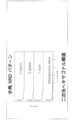
- 2 shows an XRD pattern of a mesoporous silica-Ta 2 O 5 composite.
- An XRD pattern after heating a mesoporous silica-Ta 2 O 5 composite at 800 ° C. for 5 hours is shown.
- 2 shows a small angle XRD pattern of a mesoporous silica-Nb 2 O 5 composite.
- 2 shows a nitrogen adsorption isotherm of a mesoporous silica-Nb 2 O 5 complex.
- 2 shows an XRD pattern of a mesoporous silica-Nb 2 O 5 composite.
- the TG-DTA analysis result of a mesoporous silica-Nb 2 O 5 complex is shown.
- 2 shows an XRD pattern of a mesoporous silica-TiO 2 composite.
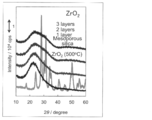
- the mesoporous silica-ZrO 2 pattern is shown.
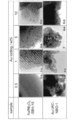
- a TEM image of Au / Nb 2 O 5 / SBA-15 is shown.
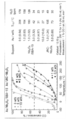
- the CO oxidation activity of Au / Nb 2 O 5 / SBA-15 is shown.
- the oxide composite of the present invention is an oxide composite containing mesoporous silica and a transition metal oxide, and the transition metal oxide in an amorphous state is present in the form of a film on the surface of the mesoporous silica and the surface in the pores. It is characterized by that.
- the mesoporous silica which is the carrier of the oxide composite of the present invention is a substance having uniform and regular pores (mesopores) generally having a diameter of 2 to 50 nm made of silicon dioxide (silica).
- mesoporous silica examples include SBA-15 (pore diameter 6 to 30 nm), SBA-16 (pore diameter 6 to 15 nm), MCM-41 (pore diameter 1.5 to 5.0 nm), and MCM-48. (Pore diameter 2 to 5 nm), FMS-16 (pore diameter 1.5 to 30 nm) and the like can be used.
- SBA-15 pore diameter 6 to 30 nm
- SBA-16 pore diameter 6 to 15 nm
- MCM-41 pore diameter 1.5 to 5.0 nm
- MCM-48 pore diameter 2 to 5 nm
- FMS-16 pore diameter 1.5 to 30 nm
- These mesoporous silicas can be produced by any method known to those skilled in the art, and generally can be produced by a sol-gel method using a surfactant as a template.
- transition metal oxide examples include oxides of metals of Group 4 to Group 12 of the periodic table, and oxides of transition metals selected from Groups 4 to 10 are preferred.
- transition metal oxides in which the transition metal alkoxide used as a raw material is dissolved in a nonpolar solvent are preferable.
- Transition metal oxides selected from the group are more preferable, titanium oxide, zirconium oxide, niobium oxide, tantalum oxide, and selenium oxide are more preferable, and Ta 2 O 5 , Nb 2 O 5 , TiO 2 , and ZrO 2 are more preferable.
- the oxide composite of the present invention is characterized in that an amorphous transition metal oxide is present in the form of a film on the surface of mesoporous silica and the surface of the pores.
- the presence of the transition metal oxide on the surface of the mesoporous silica and the pore surface means that at least one absorption peak is observed in the range of ⁇ > 200 nm in the elemental analysis measured on the surface of the oxide composite, for example. Can be confirmed. That is, the elemental analysis on the mesoporous silica surface confirmed that it was a transition metal compound, and that it was an oxide was confirmed by the presence of UV-vis absorption ( ⁇ > 200 nm) corresponding to the band gap of the transition metal oxide. it can.
- mesoporous silica does not absorb ultraviolet-visible light (UV-vis). Therefore, in elemental analysis, it can be seen that if there is at least one absorption peak in the range of ⁇ > 200 nm, a transition metal oxide exists on the surface of mesoporous silica.
- ICP, XPS, TEM or SEM EDS can be employed.
- the transition metal oxide present on the surface of mesoporous silica exists in an amorphous state.
- the transition metal oxide is present in the form of a film on the surface of the mesoporous silica and the surface of the pores.
- Existence in the form of a film means a single layer film or a form in which a plurality of the single layer films are laminated.
- the amount of the transition metal oxide precursor (transition metal alkoxide) immobilized on the silica by reaction with the surface hydroxyl group was changed.
- the transition metal oxide film formed with that amount is defined as a “single layer film”.
- the amount can be confirmed by the relative amount of the substrate to silica by various elemental analysis (JN Kondo, H. Yamazaki, A. Ishikawa, R. Osuga, S. Takeo, T.
- the surface hydroxyl group density of mesoporous silica used as the substrate is estimated by pyridine adsorption at room temperature, and is 1.0 to 2.0 site ⁇ nm ⁇ 2 .
- the surface hydroxyl group content is 40 mol% or more of mesoporous silica.
- the surface acid point of mesoporous silica is determined by, for example, a method in which pyridine is adsorbed on the surface and the Bronsted acid point (BAS) and Lewis acid point (LAS) are distinguished by IR method, temperature programmed desorption method, or the like. It can be measured.
- the surface of mesoporous silica is treated with pyridine, and pyridine weakly interacting with silica is observed by IR near room temperature. Confirming that there is a linear relationship between the decrease in the silanol peak and the increase in the pyridine peak at this time, and knowing the amount of pyridine introduced, the amount of pyridine required to cover the entire silanol Is calculated.
- the oxide composite of the present invention includes, for example, (1) a step of reacting mesoporous silica and a transition metal alkoxide in a nonpolar solvent (step (1)), and (2) calcination of the obtained reaction product in air. It can manufacture by the method including the process to perform (process (2)).
- transition metal alkoxide used in the step (1) examples include transition metal C 1 -C 6 alkoxides such as transition metal methoxide, transition metal ethoxide, and transition metal isopropoxide.
- transition metal C 1 -C 6 alkoxides such as transition metal methoxide, transition metal ethoxide, and transition metal isopropoxide.
- a transition metal inorganic acid salt such as zirconyl nitrate
- an amorphous film is not formed on the surface of mesoporous silica because a thin film is not formed on the surface of mesoporous silica.
- the reaction in step (1) is not particularly limited, but is usually performed in a nonpolar solvent.
- the reaction between the hydroxyl group on the mesoporous silica surface and the solvent is less likely to occur than in the case of using a polar solvent, particularly a polar solvent containing oxygen.
- the reaction with the metal alkoxide can sufficiently proceed, which is advantageous in forming a thin film.
- the water content in the solvent is not particularly limited, but is preferably as small as possible, and more preferably an anhydrous solvent.
- the water contained in the solvent may react with the transition metal alkoxide or hydroxyl group on the surface of mesoporous silica and may inhibit the progress of the reaction between the transition metal alkoxide and hydroxyl group on the surface of mesoporous silica.
- nonpolar solvents are preferably saturated hydrocarbons and aromatic hydrocarbons, more preferably aromatic hydrocarbons.
- aromatic hydrocarbons such as benzene, toluene and xylene are particularly preferable.
- the transition metal alkoxide used in step (1) is preferably a compound that dissolves in the nonpolar solvent.
- the solubility of the transition metal alkoxide in the nonpolar solvent to be used is not particularly limited, but is usually 1 g / L or more, preferably 5 g / L or more, 8 g / L or more is more preferable.
- Such transition metal alkoxides include Nb alkoxide, Ta alkoxide, Ti alkoxide, Zr alkoxide, V alkoxide, Y alkoxide, Ce alkoxide, Sm alkoxide, La alkoxide, Gd alkoxide, Pr alkoxide, Sn alkoxide, Bi alkoxide, Hf alkoxide. , Ge alkoxide and the like.
- Group 4 or Group 5 metal alkoxides are preferable, and Ta alkoxide, Nb alkoxide, Ti alkoxide, and Zr alkoxide are particularly preferable.
- the amount of transition metal alkoxide used is not particularly limited, but is usually 0.1 parts by mass or more, preferably 0.15 parts by mass or more, usually 1.0 parts by mass or less, preferably 1 part by mass of mesoporous silica to be used. 0.5 parts by mass or less.
- the reaction conditions in the step (1) are not particularly limited as long as the effects of the present invention are satisfied, and can be appropriately set based on known methods.
- the reaction temperature in the step (1) is usually 100 ° C. or higher and 200 ° C. or lower, preferably 150 ° C. or lower.
- Step (1) may be performed in air or in an inert gas atmosphere, but is preferably performed in an inert gas atmosphere.
- the reaction in the step (1) is performed at a temperature of 100 ° C. or more and 150 ° C. or less at a transition metal alkoxide of 0.15 parts by mass or more and 0.50 parts by mass or less with respect to 1 part by mass of mesoporous silica in a nonpolar solvent.
- the reaction may be performed for 1 hour to 5 hours in an inert gas atmosphere.
- a hydroxyl group and a transition metal alkoxide present on the surface of mesoporous silica are laminated in a film shape.
- the firing temperature in the air in the step (2) is preferably 300 ° C to 600 ° C, more preferably 400 ° C to 600 ° C.
- a transition metal oxide in an amorphous state is formed into a film on the mesoporous silica surface and the pore inner surface.
- a transition metal oxide in an amorphous state is present in the form of a film on the mesoporous silica surface and the pore inner surface, and the transition metal oxide does not crystallize near 1000 ° C. maintain.
- the reason why the crystallization temperature is increased in this way is not clear, but the network of identical transition metal oxides is not widened, and is more stable because it is strongly bonded to silica in one direction (in the form of a film). This is considered to be because mass transfer for suppressing a crystalline phase is suppressed, that is, activation energy for crystallization is increased.
- the transition metal oxide in the amorphous state is stably present in the form of a film on the mesoporous silica surface and the surface in the pores, the catalytic activity of the transition metal oxide is remarkably improved.
- the oxide composite of the present invention has, for example, N-alkylation of aniline, oxidative cyclization, Prince reaction, etc., compared with the catalytic activity of a transition metal oxide alone or mesoporous silica. Catalytic activity is dramatically improved.
- the oxide composite of the present invention can also support noble metal particles useful as a catalyst such as gold nanoparticles.
- the oxide composite of the present invention is useful as a catalyst and catalyst support for oxidation, reduction, addition or condensation reactions. Furthermore, when the oxide composite of the present invention is alkali-treated, a NaNbO 3 precursor such as Na 7 (H 3 O) Nb 6 O 19 can be easily obtained.
- transition metal acid alkali metal salts such as NaNbO 3 are useful as ferroelectric materials.
- Example 1 (1) 2.70-6.76 g of Ta (OEt) 5 was added to 2.0 g of mesoporous silica (SBA-15), and the mixture was refluxed at 125 ° C. in 200 mL of toluene. After drying at 100 ° C., it was fired at 500 ° C. for 5 hours in air.
- the ICP emission spectroscopic analysis result of the obtained oxide composite is shown in FIG. In ICP emission spectroscopic analysis, absorption at ⁇ > 100 nm was measured by ICP-vis. From the results shown in FIG. 1, it was confirmed that Ta 2 O 5 was present on the surface of the mesoporous silica and the inner surface of the pores, and the Ta / Si ratio was saturated at about 0.2. Moreover, the XPS analysis result of the obtained composite_body
- FIG. 3 The UV-vis spectrum of the obtained oxide composite is shown in FIG. 3, and FIG. 4 shows the relationship between the band gap and the Ta / Si ratio. 3 and 4, it can be seen that the raw material mesoporous silica has no absorption of UV-vis, but has an absorption peak derived from the band gap of the transition metal oxide (Ta 2 O 5 ).
- FIG. 5 shows an XRD pattern of the oxide composite.
- FIG. 5 shows that the obtained oxide composite is in an amorphous state.
- the XRD pattern after heating the obtained oxide composite for 5 hours at 800 ° C. is shown in FIG. From FIG. 6, it was found that the oxide composite of the present invention maintained an amorphous state even when heated to 800 ° C.
- Example 2 Nb (OEt) 5 , Ti (O i Pr) 4 and Zr (O i Pr) 4 are used as raw materials, and the transition metal oxide is in an amorphous state on the mesoporous silica surface and the pore inner surface in the same manner as in Example 1.
- Example 2 was produced in the form of a film.
- FIG. 7 shows a small-angle XRD pattern of the Nb 2 O 5 complex
- FIG. 8 shows a nitrogen adsorption isotherm. From FIG. 7, it can be seen that even when Nb 2 O 5 is laminated on the mesoporous silica surface, the two-dimensional hexagonal structure derived from the mesoporous silica does not collapse. From FIG.
- FIG. 9 shows the XRD pattern of the Nb 2 O 5 complex and the XRD pattern after heating to 500 ° C. to 1000 ° C. From FIG. 9, it can be seen that the Nb 2 O 5 composite contains Nb 2 O 5 in an amorphous state and maintains the amorphous state from 800 ° C. to 900 ° C.
- FIG. 10 shows a TG-DTA analysis result of the Nb 2 O 5 complex. FIG. 10 shows that the Nb 2 O 5 complex does not crystallize until around 1000 ° C.
- FIG. 11 shows the XRD pattern of the TiO 2 complex
- FIG. 12 shows the ZRD pattern of the ZrO 2 complex. It can be seen that both the TiO 2 complex and the ZrO 2 complex exist on the mesoporous silica surface in an amorphous state.
- Example 6 0.25 g of the mesoporous silica-Nb 2 O 5 complex (Nb 2 O 5 / SBA-15) obtained in Example 2 and 0.0025 to 0.025 g of Au dodecanethiol hydrophobic colloid (Au particle size 3 nm) And stirred at room temperature for 1 hour. The solvent was then evaporated and dried at 120 ° C. Next, the mixture was heated to 300 ° C. for 2 hours to obtain 0.251 to 0.275 g of Au nanoparticle-supported Nb 2 O 5 / SBA-15.
- FIG. 13 shows a TEM image of the obtained composite (Au / Nb 2 O 5 / SBA-15).
- JRC-NBO-1 mesoporous Nb 2 O 5 / amorphous niobium hydroxide (JRC-NBO-1) instead of mesoporous silica-Nb 2 O 5 composite (Nb 2 O 5 / SBA-15).
- a TEM image of a composite (Au / JRC-NBO-1) supporting Au is also shown.
- Au / JRC-NBO-1 was not uniformly dispersed and supported by gold nanoparticles, but Au / Nb 2 O 5 / SBA-15 had mesoporous silica pores.
- Gold nanoparticles are uniformly dispersed on the Nb 2 O 5 film.
- Example 7 The catalytic activity of the gold nanoparticle-supported mesoporous silica-Nb 2 O 5 composite obtained in Example 6 was measured. Air was supplied at 50 mL / min to 0.15 g of the catalyst and pretreated at 250 ° C. for 1 hour. Subsequently, 1% CO / air was supplied at 50 mL / min to attempt conversion to CO 2 .
- FIG. 14 shows the relationship between the reaction temperature and the conversion rate from CO to CO 2 . As is clear from FIG. 14, Au / Nb 2 O 5 / SBA-15 was able to convert CO to CO 2 at a lower temperature and showed excellent catalytic activity.
- Example 8 The mesoporous silica-Nb 2 O 5 complex obtained in Example 2 was stirred with an aqueous sodium hydroxide solution at pH 13 for 24 hours. As a result, the mesoporous silica was completely dissolved and a white powder was precipitated. When the obtained crystal was analyzed by XRD, the obtained crystal was Na 7 (H 3 O) Nb 6 O 19 . This compound could be easily converted to NaNbO 3 useful as a ferroelectric material by heating.
Landscapes
- Chemical & Material Sciences (AREA)
- Organic Chemistry (AREA)
- Engineering & Computer Science (AREA)
- Materials Engineering (AREA)
- Chemical Kinetics & Catalysis (AREA)
- Thermal Sciences (AREA)
- Physics & Mathematics (AREA)
- Inorganic Chemistry (AREA)
- Catalysts (AREA)
- Indole Compounds (AREA)
- Silicates, Zeolites, And Molecular Sieves (AREA)
- Organic Low-Molecular-Weight Compounds And Preparation Thereof (AREA)
- Low-Molecular Organic Synthesis Reactions Using Catalysts (AREA)
Abstract
固体金属触媒や担体として有用な新たな形態の遷移金属酸化物の提供。 メソポーラスシリカと遷移金属酸化物とを含む酸化物複合体であって、メソポーラスシリカの表面及び細孔内表面にアモルファス状態の遷移金属酸化物が膜状に存在することを特徴とする酸化物複合体。
Description
本発明は、固体触媒、触媒の担体等として利用できる酸化物複合体に関する。
金属を担体に固定化した固体金属触媒反応は、その担体の構造や種類によって大きく相違することが知られている。例えば、金触媒の場合、アナターゼ型酸化チタン上に担持された粒子径2nmを超える金触媒はプロピレンをエポキシ化し、アナターゼ型酸化チタン上に担持された粒子径2nm未満の金触媒はプロピレンをプロパンに還元することができる。またルチル型酸化チタン上に担持された金触媒は高温ではプロピレンを二酸化炭素に酸化し、低温ではプロピレンをアセトンに酸化する(非特許文献1)。従って、固体金属触媒の新たな触媒活性や選択性を引き出すには、触媒の担体やそれ自体が触媒になり得る金属酸化物の新たな形態を開発することが重要である。
一方、メソポーラスシリカは、均一で規則的な細孔(メソ孔)を有することから触媒や吸着材料として研究されている。例えば、メソポーラスシリカに金属酸化物やセリア-ジルコニア固溶体を担持した触媒が報告されている(特許文献1~3等)。
T. Hayashi et al., J. Catalysis 178(1998)566
しかしながら、酸化チタン等の遷移金属酸化物は、通常400℃以下の温度で結晶化するため、従来報告されているメソポーラスシリカ細孔内に固定化したとしても結晶状態で存在する。結晶状態で固定化されている場合には、メソポーラスシリカ内に固定化されていたとしても大きな特性変化は望めない。また、特許文献1~3等の触媒は、メソポーラスシリカと金属化合物との反応を水やアルコール等の溶媒中で行っているため、固定化された金属酸化物は結晶又は固溶体であり、大きな特性変化は認められない。
従って、本発明の課題は、固体金属触媒や触媒の担体として有用な新たな形態の遷移金属酸化物を提供することにある。
従って、本発明の課題は、固体金属触媒や触媒の担体として有用な新たな形態の遷移金属酸化物を提供することにある。
そこで本発明者は、メソポーラスシリカに種々の遷移金属酸化物を担持する検討をしてきたところ、非極性溶媒中でメソポーラスシリカに遷移金属アルコキシドを反応させた後、空気中で焼成して得られた複合体が、メソポーラスシリカの表面及び細孔内表面にアモルファス状態の遷移金属酸化物が膜状に存在するという特殊な形態をとり、全く意外にも、そのアモルファス状態が1000℃付近まで維持され、触媒活性が飛躍的に向上することを見出し、本発明を完成した。
すなわち、本発明は、次の〔1〕~〔8〕を提供するものである。
〔1〕メソポーラスシリカと遷移金属酸化物とを含む酸化物複合体であって、メソポーラスシリカの表面及び細孔内表面にアモルファス状態の遷移金属酸化物が膜状に存在することを特徴とする酸化物複合体。
〔2〕前記酸化物複合体表面で測定したX線回折測定において、2θ=20°以上50°以下の範囲に回折ピークが観測されない〔1〕記載の酸化物複合体。
〔3〕前記酸化物複合体表面で測定した元素分析において、λ>200nmの範囲に少なくとも1つ以上の吸収ピークが観測される〔1〕又は〔2〕記載の酸化物複合体。
〔4〕前記メソポーラスシリカの表面水酸基量に対する前記酸化物複合体の表面水酸基量が、40モル%以上である〔1〕~〔3〕のいずれかに記載の酸化物複合体。
〔5〕前記遷移金属酸化物が、第4族~第10族から選ばれる金属の酸化物である〔1〕~〔4〕のいずれかに記載の酸化物複合体。
〔6〕前記遷移金属酸化物が、酸化タンタル、酸化ニオブ、酸化チタン、酸化ジルコニウム及び酸化セリウムから選ばれる酸化物である〔1〕~〔5〕のいずれかに記載の酸化物複合体。
〔7〕〔1〕~〔6〕のいずれかに記載の酸化物複合体を含有する触媒。
〔8〕〔1〕~〔6〕のいずれかに記載の酸化物複合体を担体とする触媒。
〔9〕メソポーラスシリカと遷移金属アルコキシドとを非極性溶媒中で反応させる工程、及び得られた反応物を空気中で焼成する工程を含む、メソポーラスシリカと遷移金属酸化物とを含む酸化物複合体であって、メソポーラスシリカの表面及び細孔内表面にアモルファス状態の遷移金属酸化物が膜状に存在することを特徴とする酸化物複合体の製造法。
〔2〕前記酸化物複合体表面で測定したX線回折測定において、2θ=20°以上50°以下の範囲に回折ピークが観測されない〔1〕記載の酸化物複合体。
〔3〕前記酸化物複合体表面で測定した元素分析において、λ>200nmの範囲に少なくとも1つ以上の吸収ピークが観測される〔1〕又は〔2〕記載の酸化物複合体。
〔4〕前記メソポーラスシリカの表面水酸基量に対する前記酸化物複合体の表面水酸基量が、40モル%以上である〔1〕~〔3〕のいずれかに記載の酸化物複合体。
〔5〕前記遷移金属酸化物が、第4族~第10族から選ばれる金属の酸化物である〔1〕~〔4〕のいずれかに記載の酸化物複合体。
〔6〕前記遷移金属酸化物が、酸化タンタル、酸化ニオブ、酸化チタン、酸化ジルコニウム及び酸化セリウムから選ばれる酸化物である〔1〕~〔5〕のいずれかに記載の酸化物複合体。
〔7〕〔1〕~〔6〕のいずれかに記載の酸化物複合体を含有する触媒。
〔8〕〔1〕~〔6〕のいずれかに記載の酸化物複合体を担体とする触媒。
〔9〕メソポーラスシリカと遷移金属アルコキシドとを非極性溶媒中で反応させる工程、及び得られた反応物を空気中で焼成する工程を含む、メソポーラスシリカと遷移金属酸化物とを含む酸化物複合体であって、メソポーラスシリカの表面及び細孔内表面にアモルファス状態の遷移金属酸化物が膜状に存在することを特徴とする酸化物複合体の製造法。
本発明の酸化物複合体は、遷移金属酸化物がメソポーラスシリカの表面及び細孔内表面にアモルファス状態で膜状に存在するにもかかわらず、1000℃付近まで結晶化せずアモルファス状態を維持し、遷移金属酸化物では全く触媒活性を示さなかった反応に対しても優れた触媒活性を示す。また、本発明の酸化物複合体は、金ナノ粒子のような金属の担体としても有用である。また、本発明の酸化物複合体を用いればニオブ酸ナトリウムのような強誘電材料の前駆体が容易に製造できる。
本発明の酸化物複合体は、メソポーラスシリカと遷移金属酸化物とを含む酸化物複合体であって、メソポーラスシリカの表面及び細孔内表面にアモルファス状態の遷移金属酸化物が膜状に存在することを特徴とする。
本発明の酸化物複合体の担体であるメソポーラスシリカとは、二酸化ケイ素(シリカ)を材質として、一般に直径2~50nmの均一で規則的な細孔(メソ孔)を有する物質である。
メソポーラスシリカとしては、例えば、SBA-15(細孔直径6~30nm)、SBA-16(細孔直径6~15nm)、MCM-41(細孔直径1.5~5.0nm)、MCM-48(細孔直径2~5nm)、FMS-16(細孔直径1.5~30nm)等を使用することができる。これらのメソポーラスシリカは、当業者に公知の任意の方法によって製造することができ、一般的には界面活性剤を鋳型としたゾルゲル法によって製造することができる。
遷移金属酸化物としては、周期表第4族~第12族金属の酸化物が挙げられるが、第4族~第10族から選ばれる遷移金属の酸化物が好ましく、第4族及び第5族から選ばれる遷移金属の酸化物がより好ましく、酸化チタン、酸化ジルコニウム、酸化ニオブ、酸化タンタル、酸化セリウム、酸化サマリウム、酸化ランタンがさらに好ましく、Ta2O5、Nb2O5、TiO2、ZrO2がさらに好ましい。より具体的には、メソポーラスシリカの表面及び細孔内表面に薄膜を形成する観点から、原料として用いる遷移金属アルコキシドが非極性溶媒に溶解する遷移金属の酸化物が好ましく、第4族及び第5族から選ばれる遷移金属の酸化物がより好ましく、酸化チタン、酸化ジルコニウム、酸化ニオブ、酸化タンタル、酸化セレンがさらに好ましく、Ta2O5、Nb2O5、TiO2、ZrO2がさらに好ましい。
本発明の酸化物複合体は、メソポーラスシリカの表面及び細孔内表面にアモルファス状態の遷移金属酸化物が膜状に存在することに特徴がある。ここで、メソポーラスシリカの表面及び細孔表面に遷移金属酸化物が存在することは、例えば酸化物複合体表面で測定した元素分析において、λ>200nmの範囲に少なくとも1つ以上の吸収ピークが観測されることで確認できる。すなわち、メソポーラスシリカ表面の元素分析で遷移金属化合物であることが確認でき、酸化物であることは遷移金属酸化物のバンドギャップに対応するUV-visの吸収(λ>200nm)があることで確認できる。なお、メソポーラスシリカには紫外可視光(UV-vis)の吸収はない。従って、元素分析において、λ>200nmの範囲に少なくとも1つ以上の吸収ピークがあれば、メソポーラスシリカの表面に遷移金属酸化物が存在することがわかる。元素分析は、ICP、XPS、TEMやSEMのEDSを採用することができる。
本発明においてメソポーラスシリカの表面に存在する遷移金属酸化物は、アモルファス状態で存在する。遷移金属酸化物がアモルファス状態で存在することは、メソポーラスシリカ表面で測定したX線回折測定において、2θ=20°以上50°以下の範囲に回折ピークが観測されないことで確認できる。すなわち、結晶相の場合、オングストローム単位のくり返し周期性を持ち、それに由来する回折ピークが2θ=20°~50°に現れる。これらのピークがないことが「不均一性」、すなわちアモルファス状態であることを表わす。なお、メソポーラス構造に由来するナノメートル単位の周期性に対応する回折ピークは、2θ<10°に現れる。従って、X線回折において、2θ=20°~50°の範囲に回折ピークが観測されなければ、メソポーラスシリカ表面上の遷移金属酸化物はアモルファス状態であると確認できる。
また、本発明において、メソポーラスシリカの表面及び細孔表面に遷移金属酸化物が膜状に存在する。この膜状に存在するとは、単層膜か、又はその単層膜が複数積層された形態であることを意味する。
ここで、膜調製の際に、シリカ上に表面水酸基との反応により固定化する遷移金属酸化物の前駆体(遷移金属アルコキシド)の量を変化させ、一回の固定化反応で「いくら増やしてもそれ以上は固定化できない」という最大量が存在することで、その量で形成される遷移金属酸化膜を「単層膜」と定義する。量については各種元素分析にて、基板のシリカに対する相対量で確認できる(J. N. Kondo, H. Yamazaki, A. Ishikawa, R. Osuga, S. Takeo, T. Yokoi, S. Kikkawa, K. Teramura and T. Tanaka, "Nibikater tabtakyn oxide on mesoporous silica substrate", ChemstrySelect, 1, 3124-3131(2016), DOI: 10.1002/slct.201600507.)。
基板となるメソポーラスシリカの表面水酸基量密度は、室温でのピリジン吸着により見積もられ、1.0~2.0site・nm-2となっている。遷移金属酸化物薄膜を調製した際にはその表面水酸基量は、メソポーラスシリカのものの40モル%以上である。
ここで、メソポーラスシリカの表面酸点は、例えば表面にピリジンを吸着させてIR法、昇温脱離法等でブレンステッド酸点(BAS)とルイス酸点(LAS)を区別して測定する方法により測定できる。本発明においては、例えば、メソポーラスシリカの表面をピリジン処理し、シリカと弱く相互作用したピリジンを、室温付近でIRで観測する。このときのシラノールのピークの減少と、ピリジンのピークの増加が一次の関係にあることを確認し、導入しているピリジンの量が分かっているので、全シラノールを覆うのに必要なピリジンの量を算出する。
ここで、膜調製の際に、シリカ上に表面水酸基との反応により固定化する遷移金属酸化物の前駆体(遷移金属アルコキシド)の量を変化させ、一回の固定化反応で「いくら増やしてもそれ以上は固定化できない」という最大量が存在することで、その量で形成される遷移金属酸化膜を「単層膜」と定義する。量については各種元素分析にて、基板のシリカに対する相対量で確認できる(J. N. Kondo, H. Yamazaki, A. Ishikawa, R. Osuga, S. Takeo, T. Yokoi, S. Kikkawa, K. Teramura and T. Tanaka, "Nibikater tabtakyn oxide on mesoporous silica substrate", ChemstrySelect, 1, 3124-3131(2016), DOI: 10.1002/slct.201600507.)。
基板となるメソポーラスシリカの表面水酸基量密度は、室温でのピリジン吸着により見積もられ、1.0~2.0site・nm-2となっている。遷移金属酸化物薄膜を調製した際にはその表面水酸基量は、メソポーラスシリカのものの40モル%以上である。
ここで、メソポーラスシリカの表面酸点は、例えば表面にピリジンを吸着させてIR法、昇温脱離法等でブレンステッド酸点(BAS)とルイス酸点(LAS)を区別して測定する方法により測定できる。本発明においては、例えば、メソポーラスシリカの表面をピリジン処理し、シリカと弱く相互作用したピリジンを、室温付近でIRで観測する。このときのシラノールのピークの減少と、ピリジンのピークの増加が一次の関係にあることを確認し、導入しているピリジンの量が分かっているので、全シラノールを覆うのに必要なピリジンの量を算出する。
本発明の酸化物複合体は、例えば(1)メソポーラスシリカと遷移金属アルコキシドとを非極性溶媒中で反応させる工程(工程(1))、及び(2)得られた反応物を空気中で焼成する工程(工程(2))を含む方法により製造できる。
工程(1)に用いられる遷移金属アルコキシドとしては、遷移金属メトキシド、遷移金属エトキシド、遷移金属イソプロポキシド等の遷移金属C1-C6アルコキシドが挙げられる。原料として硝酸ジルコニル等の遷移金属無機酸塩を用いた場合には、メソポーラスシリカの表面に薄膜が形成されないため、メソポーラスシリカの表面にアモルファス状の膜が形成されない。
工程(1)の反応は、特に限定されないが、通常非極性溶媒中で行う。非極性溶媒を用いることで、極性溶媒、特に酸素を含有するような極性溶媒を使用した場合に比べて、メソポーラスシリカ表面の水酸基と溶媒との反応が起こりにくいため、メソポーラスシリカ表面の水酸基と遷移金属アルコキシドとの反応を十分に進行させることができ、薄膜を形成する上で有利である。
また溶媒中の含水量は、特に限定はされないが、極力少ないことが好ましく、無水溶媒を使用することがより好ましい。溶媒中に含まれる水は、遷移金属アルコキシドやメソポーラスシリカ表面の水酸基と反応し、遷移金属アルコキシドとメソポーラスシリカ表面の水酸基との反応の進行を阻害することがあるため、薄膜の形成には、含水量の少ない溶媒が好ましい。従って、工程(1)を行う上では、無水の非極性溶媒を用いることが好ましい。好ましい非極性溶媒としては、飽和炭化水素、芳香族炭化水素が好ましく、芳香族炭化水素がより好ましい。具体的には、ベンゼン、トルエン、キシレン等の芳香族炭化水素が特に好ましい。
工程(1)の反応は、特に限定されないが、通常非極性溶媒中で行う。非極性溶媒を用いることで、極性溶媒、特に酸素を含有するような極性溶媒を使用した場合に比べて、メソポーラスシリカ表面の水酸基と溶媒との反応が起こりにくいため、メソポーラスシリカ表面の水酸基と遷移金属アルコキシドとの反応を十分に進行させることができ、薄膜を形成する上で有利である。
また溶媒中の含水量は、特に限定はされないが、極力少ないことが好ましく、無水溶媒を使用することがより好ましい。溶媒中に含まれる水は、遷移金属アルコキシドやメソポーラスシリカ表面の水酸基と反応し、遷移金属アルコキシドとメソポーラスシリカ表面の水酸基との反応の進行を阻害することがあるため、薄膜の形成には、含水量の少ない溶媒が好ましい。従って、工程(1)を行う上では、無水の非極性溶媒を用いることが好ましい。好ましい非極性溶媒としては、飽和炭化水素、芳香族炭化水素が好ましく、芳香族炭化水素がより好ましい。具体的には、ベンゼン、トルエン、キシレン等の芳香族炭化水素が特に好ましい。
工程(1)に用いられる遷移金属アルコキシドとしては、前記の非極性溶媒に溶解する化合物が好ましい。具体的にはメソポーラスシリカ表面に単層膜を形成させる点から、用いる非極性溶媒に対する遷移金属アルコキシドの溶解度としては、特に限定されないが、通常1g/L以上であり、5g/L以上が好ましく、8g/L以上がより好ましい。このような遷移金属アルコキシドとしては、Nbアルコキシド、Taアルコキシド、Tiアルコキシド、Zrアルコキシド、Vアルコキシド、Yアルコキシド、Ceアルコキシド、Smアルコキシド、Laアルコキシド、Gdアルコキシド、Prアルコキシド、Snアルコキシド、Biアルコキシド、Hfアルコキシド、Geアルコキシド等が挙げられる。このうち、第4族又は第5族の金属アルコキシドが好ましく、Taアルコキシド、Nbアルコキシド、Tiアルコキシド、Zrアルコキシドが特に好ましい。
遷移金属アルコキシドの使用量は、特に限定されないが、用いるメソポーラスシリカ1質量部に対し、通常、0.1質量部以上、好ましくは0.15質量部以上、通常1.0質量部以下、好ましくは0.5質量部以下である。
工程(1)の反応条件は本発明の効果を満たす限りにおいて特に限定されず、適宜公知の方法に基づいて設定することができる。
工程(1)における反応温度は、通常、100℃以上、200℃以下、好ましくは150℃以下である。
工程(1)は、空気中でも、不活性ガス雰囲気下で行ってもよいが、不活性ガス雰囲気下で行なうことが好ましい。
工程(1)における反応温度は、通常、100℃以上、200℃以下、好ましくは150℃以下である。
工程(1)は、空気中でも、不活性ガス雰囲気下で行ってもよいが、不活性ガス雰囲気下で行なうことが好ましい。
工程(1)の反応は、具体的には非極性溶媒中、メソポーラスシリカ1質量部に対して、遷移金属アルコキシド0.15質量部以上0.50質量部以下を、温度100℃以上150℃以下で、不活性ガス雰囲気下で1時間以上5時間以下反応させればよい。工程(1)により、メソポーラスシリカ表面に存在する水酸基と遷移金属アルコキシドが膜状に積層する。
工程(2)の空気中の焼成温度は300℃~600℃が好ましく、さらに400℃~600℃がより好ましい。工程(2)により、メソポーラスシリカ表面及び細孔内表面にアモルファス状態の遷移金属酸化物が膜状に生成する。
本発明の酸化物複合体は、メソポーラスシリカ表面及び細孔内表面にアモルファス状態の遷移金属酸化物が膜状に存在し、その遷移金属酸化物は1000℃付近まで結晶化せず、アモルファス状態を維持する。このように結晶化温度が高くなる理由は、明らかではないが、同一遷移金属酸化物のネットワークが広がっておらず、さらに一方向で(膜状で)シリカと強く結合しているため、より安定な結晶相となるための物質移動が抑制されているため、すなわち結晶化するための活性化エネルギーが大きくなっているためと考えられる。
このようにメソポーラスシリカ表面及び細孔内表面に、アモルファス状態の遷移金属酸化物が膜状に安定に存在するため、遷移金属酸化物の触媒活性が格別顕著に向上する。また、触媒担体としても有用である。例えば、後記実施例に示すように、本発明の酸化物複合体は、遷移金属酸化物単体又はメソポーラスシリカの触媒活性に比べて、例えばアニリンのN-アルキル化、酸化環化、プリンス反応等の触媒活性が飛躍的に向上している。また、本発明の酸化物複合体には、金ナノ粒子のような触媒として有用な貴金属粒子を担持することもできる。
従って、本発明の酸化物複合体は、酸化、還元、付加又は縮合反応等の触媒及び触媒担体として有用である。
さらには、本発明の酸化物複合体をアルカリ処理すると、Na7(H3O)Nb6O19のようなNaNbO3前駆体が容易に得られる。ここでNaNbO3等の遷移金属酸アルカリ金属塩は、強誘電材料として有用である。
従って、本発明の酸化物複合体は、酸化、還元、付加又は縮合反応等の触媒及び触媒担体として有用である。
さらには、本発明の酸化物複合体をアルカリ処理すると、Na7(H3O)Nb6O19のようなNaNbO3前駆体が容易に得られる。ここでNaNbO3等の遷移金属酸アルカリ金属塩は、強誘電材料として有用である。
次に実施例を挙げて本発明を更に詳細に説明する。
実施例1
(1)メソポーラスシリカ(SBA-15)2.0gにTa(OEt)52.70-6.76gを添加し、125℃でトルエン200mL中で還流した。100℃で乾燥後、空気中、500℃で5時間焼成した。
(2)得られた酸化物複合体のICP発光分光分析結果を図1に示す。ICP発光分光分析は、ICP-visにより、λ>100nmの吸収を測定した。図1の結果より、メソポーラスシリカの表面及び細孔内表面にTa2O5の存在が確認され、Ta/Si比が約0.2で飽和することが判明した。また、得られた複合体のXPS分析結果を図2に示す。XPSでも、ICPと同様の結果が得られた。
(1)メソポーラスシリカ(SBA-15)2.0gにTa(OEt)52.70-6.76gを添加し、125℃でトルエン200mL中で還流した。100℃で乾燥後、空気中、500℃で5時間焼成した。
(2)得られた酸化物複合体のICP発光分光分析結果を図1に示す。ICP発光分光分析は、ICP-visにより、λ>100nmの吸収を測定した。図1の結果より、メソポーラスシリカの表面及び細孔内表面にTa2O5の存在が確認され、Ta/Si比が約0.2で飽和することが判明した。また、得られた複合体のXPS分析結果を図2に示す。XPSでも、ICPと同様の結果が得られた。
(3)得られた酸化物複合体のUV-visスペクトルを図3に、図4にバンドギャップとTa/Si比との関係を示す。
図3及び図4から、原料メソポーラスシリカにはUV-visの吸収がないのに対し遷移金属酸化物(Ta2O5)のバンドギャップに由来する吸収ピークが存在することがわかる。
図3及び図4から、原料メソポーラスシリカにはUV-visの吸収がないのに対し遷移金属酸化物(Ta2O5)のバンドギャップに由来する吸収ピークが存在することがわかる。
(4)図5に、酸化物複合体のXRDパターンを示す。図5より、得られた酸化物複合体は、アモルファス状態であることがわかる。
さらに、得られた酸化物複合体を800℃5時間加熱した後のXRDパターンを図6に示す。図6より、本発明の酸化物複合体は、800℃に加熱してもアモルファス状態を維持することが判明した。
さらに、得られた酸化物複合体を800℃5時間加熱した後のXRDパターンを図6に示す。図6より、本発明の酸化物複合体は、800℃に加熱してもアモルファス状態を維持することが判明した。
(5)(水酸基量の測定)
メソポーラスシリカの表面水酸基の定量は、室温で弱く相互作用したピリジンを赤外分光法で観測することで行った。孤立した状態のシラノールのピークの減少と、相互作用をしたピリジンのピークの増加が一次の関係にあることを確認し、全シラノールを覆うのに必要なピリジンの量で見積もった(J. N. Kondo, H. Yamazaki, A. Ishikawa, R. Osuga,S. Takeo, T. Yokoi, S. Kikkawa, K. Teramura and T. Tanaka, "Nibikater tabtakyn oxide on mesoporous silica substrate", ChemstrySelect, 1, 3124-3131(2016), DOI: 10.1002/slct.201600507.)。
その結果、メソポーラスシリカTa2O5複合体の表面水酸基量は、基材であるメソポーラスシリカの表面水酸基量の40質量%以上であることが判明した。
メソポーラスシリカの表面水酸基の定量は、室温で弱く相互作用したピリジンを赤外分光法で観測することで行った。孤立した状態のシラノールのピークの減少と、相互作用をしたピリジンのピークの増加が一次の関係にあることを確認し、全シラノールを覆うのに必要なピリジンの量で見積もった(J. N. Kondo, H. Yamazaki, A. Ishikawa, R. Osuga,S. Takeo, T. Yokoi, S. Kikkawa, K. Teramura and T. Tanaka, "Nibikater tabtakyn oxide on mesoporous silica substrate", ChemstrySelect, 1, 3124-3131(2016), DOI: 10.1002/slct.201600507.)。
その結果、メソポーラスシリカTa2O5複合体の表面水酸基量は、基材であるメソポーラスシリカの表面水酸基量の40質量%以上であることが判明した。
実施例2
原料として、Nb(OEt)5、Ti(OiPr)4及びZr(OiPr)4を用い、実施例1と同様にしてメソポーラスシリカ表面及び細孔内表面にアモルファス状態の遷移金属酸化物が膜状に存在する複合体を製造した。
図7に、Nb2O5複合体の小角XRDパターンを示し、図8に窒素吸着等温線を示す。図7から、メソポーラスシリカ表面にNb2O5が積層してもメソポーラスシリカに由来する二次元ヘキサゴナル構造の崩壊が起こっていないことがわかる。
図8より、相対圧0.6~0.8の立ち上がりに由来するメソポーラスシリカに存在する均一な大きさでシリンダー状の細孔が維持されていることが確認できる。
図9に、Nb2O5複合体のXRDパターンと、500℃~1000℃に加熱した後のXRDパターンを示す。図9よりNb2O5複合体は、Nb2O5がアモルファス状態で存在し、800℃~900℃までアモルファス状態を維持することがわかる。
図10に、Nb2O5複合体のTG-DTA分析結果を示す。図10より、Nb2O5複合体は、1000℃付近まで結晶化しないことがわかる。
図11に、TiO2複合体、図12にZrO2複合体のXRDパターンを示す。TiO2複合体及びZrO2複合体のいずれもアモルファス状態でメソポーラスシリカ表面に存在することがわかる。
原料として、Nb(OEt)5、Ti(OiPr)4及びZr(OiPr)4を用い、実施例1と同様にしてメソポーラスシリカ表面及び細孔内表面にアモルファス状態の遷移金属酸化物が膜状に存在する複合体を製造した。
図7に、Nb2O5複合体の小角XRDパターンを示し、図8に窒素吸着等温線を示す。図7から、メソポーラスシリカ表面にNb2O5が積層してもメソポーラスシリカに由来する二次元ヘキサゴナル構造の崩壊が起こっていないことがわかる。
図8より、相対圧0.6~0.8の立ち上がりに由来するメソポーラスシリカに存在する均一な大きさでシリンダー状の細孔が維持されていることが確認できる。
図9に、Nb2O5複合体のXRDパターンと、500℃~1000℃に加熱した後のXRDパターンを示す。図9よりNb2O5複合体は、Nb2O5がアモルファス状態で存在し、800℃~900℃までアモルファス状態を維持することがわかる。
図10に、Nb2O5複合体のTG-DTA分析結果を示す。図10より、Nb2O5複合体は、1000℃付近まで結晶化しないことがわかる。
図11に、TiO2複合体、図12にZrO2複合体のXRDパターンを示す。TiO2複合体及びZrO2複合体のいずれもアモルファス状態でメソポーラスシリカ表面に存在することがわかる。
実施例3

O-キシレン1.5mLに、アニリン1.0mmol、ベンジルアルコール1.2mmolを添加した。これにメソポーラスシリカ50mg、Ta2O550mg又は実施例1で得たメソポーラス-Ta2O5複合体50mgを添加し、155℃で24時間加熱還流し、N-ベンジルアニリンを得た。
実施例4
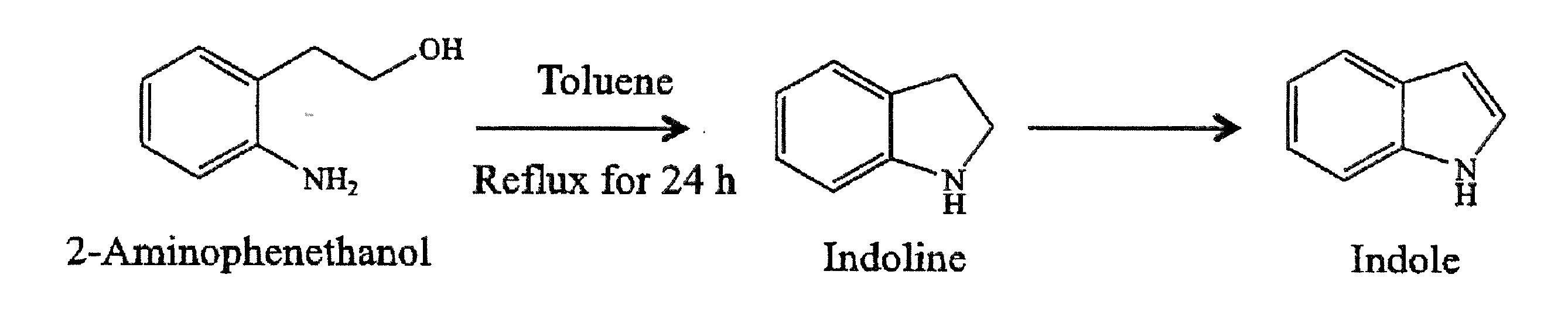
トルエン5mLに、2-アミノフェネチルアルコール1.0mmolを添加した。これにメソポーラスシリカ50mg、Ta2O550mg又は実施例1で得たメソポーラスシリカ-Ta2O5複合体50mgを添加し、24時間加熱還流し、酸化的還元反応を行い、インドールを生成させた(副生物:インドリン)。
実施例5
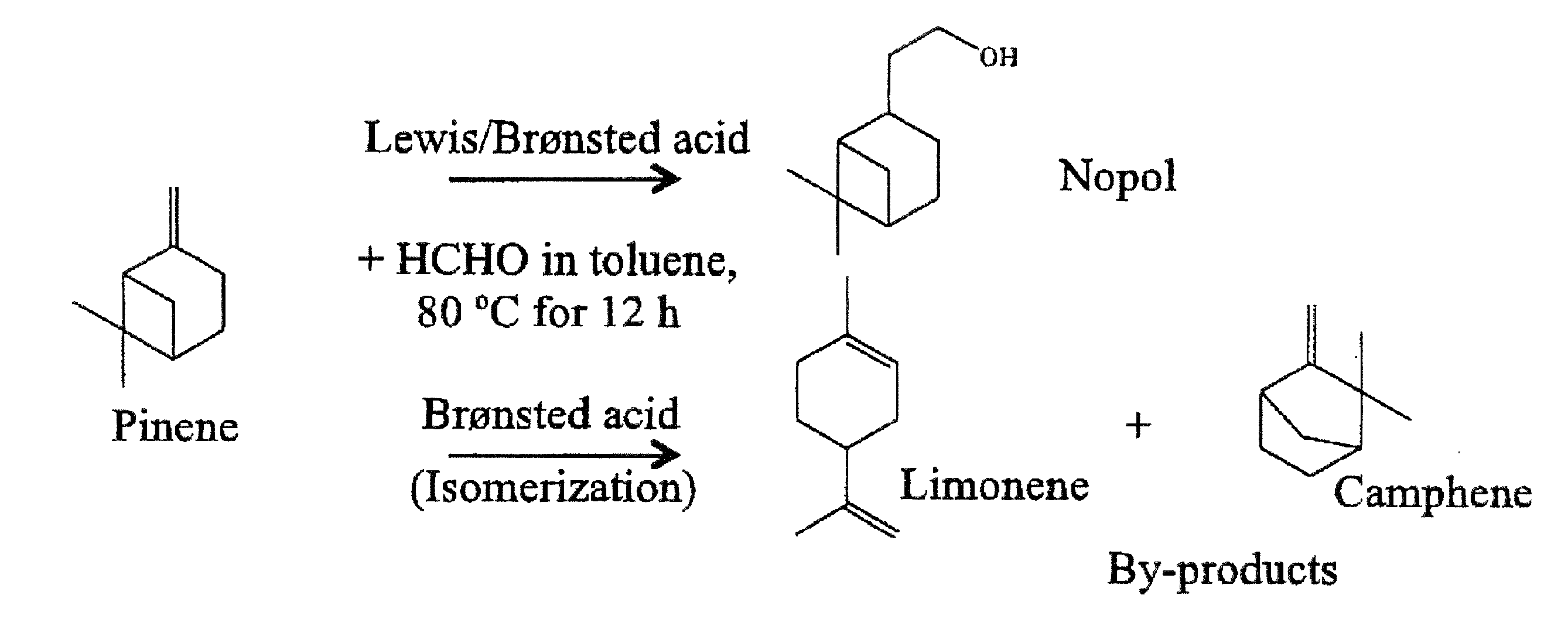
トルエン5mLに、ホルムアルデヒド2.0mmol及びピネン1.0mmolを加えた。これにメソポーラスシリカ50mg、Ta2O550mg又は実施例1で得られたメソポーラスシリカ-Ta2O5複合体50mgを添加し80℃で12時間反応させ、ノポールを生成させた(副生物:リモネン及びカンフェン)。
実施例3~5の反応結果を表1に示す。

実施例6
実施例2で得られたメソポーラスシリカ-Nb2O5複合体(Nb2O5/SBA-15)0.25gに、Auドデカンチオール疎水コロイド(Auの粒径3nm)0.0025~0.025gを加え、室温で1時間撹拌した。次いで、溶媒を蒸発させ、120℃で乾燥した。次に300℃に2時間加熱し、Auナノ粒子担持Nb2O5/SBA-15を0.251~0.275g得た。得られた複合体(Au/Nb2O5/SBA-15)のTEM像を図13に示す。図13には、メソポーラスシリカ-Nb2O5複合体(Nb2O5/SBA-15)に代えて、メソポーラスNb2O5/アモルファス水酸化ニオブ(JRC-NBO-1)を用いて同様にAuを担持させた複合体(Au/JRC-NBO-1)のTEM像も示した。
図13から明らかなように、Au/JRC-NBO-1では、金ナノ粒子が均一に分散して担持されていなかったが、Au/Nb2O5/SBA-15では、メソポーラスシリカの細孔に存在するNb2O5膜上に、金ナノ粒子が均一に分散している。
実施例2で得られたメソポーラスシリカ-Nb2O5複合体(Nb2O5/SBA-15)0.25gに、Auドデカンチオール疎水コロイド(Auの粒径3nm)0.0025~0.025gを加え、室温で1時間撹拌した。次いで、溶媒を蒸発させ、120℃で乾燥した。次に300℃に2時間加熱し、Auナノ粒子担持Nb2O5/SBA-15を0.251~0.275g得た。得られた複合体(Au/Nb2O5/SBA-15)のTEM像を図13に示す。図13には、メソポーラスシリカ-Nb2O5複合体(Nb2O5/SBA-15)に代えて、メソポーラスNb2O5/アモルファス水酸化ニオブ(JRC-NBO-1)を用いて同様にAuを担持させた複合体(Au/JRC-NBO-1)のTEM像も示した。
図13から明らかなように、Au/JRC-NBO-1では、金ナノ粒子が均一に分散して担持されていなかったが、Au/Nb2O5/SBA-15では、メソポーラスシリカの細孔に存在するNb2O5膜上に、金ナノ粒子が均一に分散している。
実施例7
実施例6で得られた金ナノ粒子担持メソポーラスシリカ-Nb2O5複合体の触媒活性を測定した。触媒0.15gに空気50mL/分供給して250℃で1時間前処理した。次いで、1%CO/空気を50mL/分供給し、CO2への変換を試みた。反応温度とCOからCO2への変換率との関係を図14に示す。
図14から明らかなように、Au/Nb2O5/SBA-15は、より低温でCOをCO2に変換でき、優れた触媒活性を示した。
実施例6で得られた金ナノ粒子担持メソポーラスシリカ-Nb2O5複合体の触媒活性を測定した。触媒0.15gに空気50mL/分供給して250℃で1時間前処理した。次いで、1%CO/空気を50mL/分供給し、CO2への変換を試みた。反応温度とCOからCO2への変換率との関係を図14に示す。
図14から明らかなように、Au/Nb2O5/SBA-15は、より低温でCOをCO2に変換でき、優れた触媒活性を示した。
実施例8
実施例2で得られたメソポーラスシリカ-Nb2O5複合体をpH13の水酸化ナトリウム水溶液で24時間撹拌した。その結果、メソポーラスシリカは完全に溶解し、白色粉末が沈殿した。
得られた結晶をXRD解析したところ、得られた結晶はNa7(H3O)Nb6O19であった。この化合物は、加熱することにより容易に強誘電材料として有用なNaNbO3に変換できた。
実施例2で得られたメソポーラスシリカ-Nb2O5複合体をpH13の水酸化ナトリウム水溶液で24時間撹拌した。その結果、メソポーラスシリカは完全に溶解し、白色粉末が沈殿した。
得られた結晶をXRD解析したところ、得られた結晶はNa7(H3O)Nb6O19であった。この化合物は、加熱することにより容易に強誘電材料として有用なNaNbO3に変換できた。
Claims (9)
- メソポーラスシリカと遷移金属酸化物とを含む酸化物複合体であって、メソポーラスシリカの表面及び細孔内表面にアモルファス状態の遷移金属酸化物が膜状に存在することを特徴とする酸化物複合体。
- 前記酸化物複合体の表面で測定したX線回折測定において、2θ=20°以上50°以下の範囲に回折ピークが観測されない請求項1記載の酸化物複合体。
- 前記酸化物複合体の表面で測定した元素分析において、λ>200nmの範囲に少なくとも1つ以上の吸収ピークが観測される請求項1又は2記載の酸化物複合体。
- 前記メソポーラスシリカの表面水酸基量に対する前記酸化物複合体の表面水酸基量が、40モル%以上である請求項1~3のいずれか1項記載の酸化物複合体。
- 前記遷移金属酸化物が、第4~第10族から選ばれる金属の酸化物である請求項1~4のいずれか1項記載の酸化物複合体。
- 前記遷移金属酸化物が、酸化タンタル、酸化ニオブ、酸化チタン、酸化ジルコニウム及び酸化セリウムから選ばれる酸化物である請求項1~5のいずれか1項記載の酸化物複合体。
- 請求項1~6のいずれか1項記載の酸化物複合体を含有する触媒。
- 請求項1~6のいずれか1項記載の酸化物複合体を担体とする触媒。
- メソポーラスシリカと遷移金属アルコキシドとを非極性溶媒中で反応させる工程、及び得られた反応物を空気中で焼成する工程を含む、メソポーラスシリカと遷移金属酸化物とを含む酸化物複合体であって、メソポーラスシリカの表面及び細孔内表面にアモルファス状態の遷移金属酸化物が膜状に存在することを特徴とする酸化物複合体の製造法。
Priority Applications (1)
| Application Number | Priority Date | Filing Date | Title |
|---|---|---|---|
| JP2018539797A JP6936461B2 (ja) | 2016-09-15 | 2017-09-15 | 酸化物複合体 |
Applications Claiming Priority (2)
| Application Number | Priority Date | Filing Date | Title |
|---|---|---|---|
| JP2016-180502 | 2016-09-15 | ||
| JP2016180502 | 2016-09-15 |
Publications (1)
| Publication Number | Publication Date |
|---|---|
| WO2018052103A1 true WO2018052103A1 (ja) | 2018-03-22 |
Family
ID=61619138
Family Applications (1)
| Application Number | Title | Priority Date | Filing Date |
|---|---|---|---|
| PCT/JP2017/033378 Ceased WO2018052103A1 (ja) | 2016-09-15 | 2017-09-15 | 酸化物複合体 |
Country Status (2)
| Country | Link |
|---|---|
| JP (1) | JP6936461B2 (ja) |
| WO (1) | WO2018052103A1 (ja) |
Cited By (1)
| Publication number | Priority date | Publication date | Assignee | Title |
|---|---|---|---|---|
| CN115197069A (zh) * | 2022-07-10 | 2022-10-18 | 华东理工大学 | 一种醇类化合物取代胺化合成仲胺的方法 |
Citations (3)
| Publication number | Priority date | Publication date | Assignee | Title |
|---|---|---|---|---|
| JP2008221203A (ja) * | 2007-02-13 | 2008-09-25 | Babcock Hitachi Kk | 窒素酸化物除去用触媒及び窒素酸化物除去方法 |
| JP2009056456A (ja) * | 2007-08-08 | 2009-03-19 | Toyota Motor Corp | 触媒担体の製造方法 |
| JP2015145355A (ja) * | 2014-02-04 | 2015-08-13 | 国立研究開発法人産業技術総合研究所 | γ−バレロラクトンの製造方法 |
-
2017
- 2017-09-15 WO PCT/JP2017/033378 patent/WO2018052103A1/ja not_active Ceased
- 2017-09-15 JP JP2018539797A patent/JP6936461B2/ja active Active
Patent Citations (3)
| Publication number | Priority date | Publication date | Assignee | Title |
|---|---|---|---|---|
| JP2008221203A (ja) * | 2007-02-13 | 2008-09-25 | Babcock Hitachi Kk | 窒素酸化物除去用触媒及び窒素酸化物除去方法 |
| JP2009056456A (ja) * | 2007-08-08 | 2009-03-19 | Toyota Motor Corp | 触媒担体の製造方法 |
| JP2015145355A (ja) * | 2014-02-04 | 2015-08-13 | 国立研究開発法人産業技術総合研究所 | γ−バレロラクトンの製造方法 |
Cited By (1)
| Publication number | Priority date | Publication date | Assignee | Title |
|---|---|---|---|---|
| CN115197069A (zh) * | 2022-07-10 | 2022-10-18 | 华东理工大学 | 一种醇类化合物取代胺化合成仲胺的方法 |
Also Published As
| Publication number | Publication date |
|---|---|
| JPWO2018052103A1 (ja) | 2019-08-15 |
| JP6936461B2 (ja) | 2021-09-15 |
Similar Documents
| Publication | Publication Date | Title |
|---|---|---|
| Abedi et al. | Ordered mesoporous metal–organic frameworks incorporated with amorphous TiO2 as photocatalyst for selective aerobic oxidation in sunlight irradiation | |
| CN102906013B (zh) | 制备孔结构受控的高多孔性稳定金属氧化物的方法 | |
| Song et al. | Temperature-regulated construction of hierarchical titanosilicate zeolites | |
| JP6200946B2 (ja) | 還元触媒 | |
| Rezaei et al. | Selective oxidation of toluene to benzaldehyde by H2O2 with mesoporous silica KIT-6 supported VOHPO4 0.5 H2O catalyst | |
| CN108430923A (zh) | 用于制备无缺陷纳米合成沸石材料的方法 | |
| Pitman et al. | Stabilization of reduced copper on ceria aerogels for CO oxidation | |
| Du et al. | Facile preparation of hierarchical titanium silicalite-1 (TS-1) with efficient oxidation of cyclic alkenes using PVA modified MWCNTs as templates | |
| Turco et al. | Active and stable ceria-zirconia supported molybdenum oxide catalysts for cyclooctene epoxidation: Effect of the preparation procedure | |
| Bulánek et al. | Efficient oxidative dehydrogenation of ethanol by VOx@ MIL-101: On par with VOx/ZrO2 and much better than MIL-47 (V) | |
| KR100979106B1 (ko) | 금속산화물이 담지된 엠에프아이 결정구조의 메조세공제올라이트 | |
| Bhuyan et al. | Preparation and characterization of WO 3 bonded imidazolium sulfonic acid chloride as a novel and green ionic liquid catalyst for the synthesis of adipic acid | |
| JP6936461B2 (ja) | 酸化物複合体 | |
| KR101451902B1 (ko) | 메조기공을 갖는 mre 구조의 제올라이트 또는 유사 mre 제올라이트 물질 및 그의 제조 방법 | |
| JP2016533263A (ja) | ゼオライトコーティング層を有するビスマスモリブデート系触媒、この製造方法、及びこれを利用した1,3−ブタジエンの製造方法 | |
| Shimoda et al. | Synthesis of tetragonal zirconia in mesoporous silica and its catalytic properties for methanol oxidative decomposition | |
| Wang et al. | Robust synthesis of green fuels from biomass-derived ethyl esters over a hierarchically core/shell-structured ZSM-5@(Co/SiO 2) catalyst | |
| US20200095126A1 (en) | Catalysts and related methods for photocatalytic production of h2o2 and thermocatalytic reactant oxidation | |
| US9751076B1 (en) | Synthesis of nano crystalline niobia/carbon composites with improved hydrothermal stability | |
| JP5017619B2 (ja) | 炭化水素の酸化による含酸素有機化合物の製造方法及びそれに用いる酸化用触媒 | |
| Hongo et al. | Thermal influence on the structure and photocatalytic activity of mesoporous titania consisting of TiO2 (B) | |
| Taghavinezhad et al. | Influence of aging temperature and Mg/Zr molar ratio on transformation of C2H6 to C2H4 over VO x catalyst supported on Mg–Zr nanocomposite: P. Taghavinezhad et al. | |
| Özyağcı et al. | Esterification of 1-Octanol on clinoptilolite-supported TiO2 catalysts | |
| CN108290148B (zh) | 含板钛矿型钛的催化剂 | |
| JP2010227925A (ja) | アルコール脱水素反応用触媒、及びこれを用いたアルデヒドの製造法 |
Legal Events
| Date | Code | Title | Description |
|---|---|---|---|
| 121 | Ep: the epo has been informed by wipo that ep was designated in this application |
Ref document number: 17851002 Country of ref document: EP Kind code of ref document: A1 |
|
| ENP | Entry into the national phase |
Ref document number: 2018539797 Country of ref document: JP Kind code of ref document: A |
|
| NENP | Non-entry into the national phase |
Ref country code: DE |
|
| 122 | Ep: pct application non-entry in european phase |
Ref document number: 17851002 Country of ref document: EP Kind code of ref document: A1 |