WO2018047951A1 - 発光材料、インク、及び発光デバイス - Google Patents
発光材料、インク、及び発光デバイス Download PDFInfo
- Publication number
- WO2018047951A1 WO2018047951A1 PCT/JP2017/032523 JP2017032523W WO2018047951A1 WO 2018047951 A1 WO2018047951 A1 WO 2018047951A1 JP 2017032523 W JP2017032523 W JP 2017032523W WO 2018047951 A1 WO2018047951 A1 WO 2018047951A1
- Authority
- WO
- WIPO (PCT)
- Prior art keywords
- rare earth
- light emitting
- atom
- luminescent material
- group
- Prior art date
- Legal status (The legal status is an assumption and is not a legal conclusion. Google has not performed a legal analysis and makes no representation as to the accuracy of the status listed.)
- Ceased
Links
Images


Classifications
-
- C—CHEMISTRY; METALLURGY
- C09—DYES; PAINTS; POLISHES; NATURAL RESINS; ADHESIVES; COMPOSITIONS NOT OTHERWISE PROVIDED FOR; APPLICATIONS OF MATERIALS NOT OTHERWISE PROVIDED FOR
- C09D—COATING COMPOSITIONS, e.g. PAINTS, VARNISHES OR LACQUERS; FILLING PASTES; CHEMICAL PAINT OR INK REMOVERS; INKS; CORRECTING FLUIDS; WOODSTAINS; PASTES OR SOLIDS FOR COLOURING OR PRINTING; USE OF MATERIALS THEREFOR
- C09D11/00—Inks
-
- C—CHEMISTRY; METALLURGY
- C09—DYES; PAINTS; POLISHES; NATURAL RESINS; ADHESIVES; COMPOSITIONS NOT OTHERWISE PROVIDED FOR; APPLICATIONS OF MATERIALS NOT OTHERWISE PROVIDED FOR
- C09K—MATERIALS FOR MISCELLANEOUS APPLICATIONS, NOT PROVIDED FOR ELSEWHERE
- C09K11/00—Luminescent materials, e.g. electroluminescent or chemiluminescent
- C09K11/06—Luminescent materials, e.g. electroluminescent or chemiluminescent containing organic luminescent materials
Definitions
- the present invention relates to a light emitting material, and an ink and a light emitting device using the light emitting material.
- Circularly polarized light emission is usually created by combining a linear polarization filter and a circular polarization filter. Instead, a luminescent material that can supply circularly polarized light without a filter has been proposed (for example, Non-Patent Document 1).
- An object according to one aspect of the present invention is to provide a light-emitting material exhibiting circularly polarized light emission characteristics with a high anisotropy factor.
- One aspect of the present invention includes a rare earth atom, a polyoxometalate containing a metal atom and an oxygen atom and coordinated to the rare earth atom, and an organic ligand coordinated to the rare earth atom.
- a light emitting material including a rare earth complex.
- the organic ligand contains an optically active compound, and the amount of one substance in the pair of enantiomers of the optically active compound in the light emitting material is larger than the amount of the other substance.
- the rare earth complex has a remarkably high anisotropy by combining polyoxometalate and an organic ligand which is an optically active compound and has a large proportion of one enantiomer.
- the circularly polarized light emission characteristics of the factor can be shown.
- the rare earth complex may emit light by excitation light having a wavelength in the range of 400 to 550 nm.
- a rare earth complex having an organic ligand exhibits absorption based on charge transfer from the organic ligand to the rare earth atom (CTS absorption), but according to the knowledge of the present inventors, the wavelength of CTS absorption that generates light emission. And anisotropy factor.
- CTS absorption that produces light emission is in the range of 400 to 550 nm
- the rare earth complex is considered to exhibit circularly polarized light emission characteristics with a high anisotropy factor.
- a light emitting material exhibiting circularly polarized light emission characteristics with a high anisotropy factor can be provided.
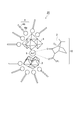
- FIG. 1 is a schematic view showing an embodiment of a light emitting material.
- the light emitting material 20 shown in FIG. 1 is composed of a rare earth complex 10 and a plurality of amphiphilic compounds 4 surrounding the rare earth complex 10.
- the rare earth complex 10 has a rare earth atom 1, a polyoxometalate 3 and an organic ligand 2 coordinated to the rare earth atom 1.
- the organic ligand 2 is an optically active compound that can constitute at least one pair of enantiomers, and the ratio of one of the at least one pair of enantiomers of the optically active compound in the entire light emitting material 20 is greater than the other.
- the amphiphilic compound 4 forms a micelle-like structure, and a plurality of molecules of the rare earth complex 10 can be contained inside each micelle.
- the light emitting material 20 may include a crystal composed of the rare earth complex 10 and the amphiphilic compound 4.
- the rare earth complex 10 in FIG. 1 has a so-called sandwich structure in which a rare earth atom 1 is sandwiched between two opposing polyoxometalates 3. Two rare earth atoms may be sandwiched between two polyoxometalates. However, the rare earth complex does not necessarily have to form a sandwich structure.
- the rare earth atom 1 is not limited to the trivalent europium (Eu) in FIG. 1, for example, Sc, Y and lanthanoids (La, Ce, Pr, Nd, Pm, Sm, Eu, Gd, Tb, Dy, Ho, Er, Er , Tm, Yb, Lu).
- the rare earth atom 1 may be a lanthanoid, or may be at least one selected from the group consisting of Eu, Tb, Sm, Nd, Yb, Tm, Ce, Er and Pr. It may be Eu.
- Rare earth atoms are usually present in the form of ions in rare earth complexes.
- the valence of the rare earth atom is not particularly limited and can be appropriately selected.
- Polyoxometalate 3 (POM) coordinated to rare earth atom 1 is generally composed of a plurality of metal atoms (M) and a plurality of oxygen atoms (O) coordinated thereto.
- the polyoxometalate can be, for example, a Lindkvist type or Keggin type polyacid.
- Polyoxometalates include, for example, MO 4 tetrahedron, MO 5 pentahedron, or MO 6 octahedron structures formed by metal atoms and oxygen atoms.
- the polyoxometalate may have an octahedral structure (MO 6 octahedron) portion including one metal atom and six oxygen atoms coordinated to the metal atom.
- the polyoxometalate may be an isopolyoxometalate composed of one kind of metal atom and oxygen atom, or a heteropolyoxometalate containing a hetero atom in addition to the isopolyoxometalate.
- the polyoxometalate may be a complex including a plurality of the polyhedral structure parts and bonded to each other.
- the metal atom contained in the polyoxometalate is not particularly limited, but may be at least one selected from the group consisting of Mo, W, V, Si, P, Ge, Al, and As, for example.
- the metal atom contained in the polyoxometalate may be a hexavalent metal atom such as Mo and W, and these can form an octahedral structure.
- the rare earth complex is not limited to the compound specifically shown in FIG. 1, and can contain any optically active compound as an organic ligand.
- one substance amount (mole number) of a pair of enantiomers of the optically active compound is larger than the other substance amount (mole number).
- the enantiomeric excess (ee) of the optically active compound exceeds 0%.
- This enantiomeric excess is 10% or more, 20% or more, 30% or more, 40% or more, 50% or more, 60% or more, 70% or more, 80% or more, 90% or more, or 95% or more. May be.
- the enantiomeric excess is high, chirality is generated in the luminescent material, and as a result, the anisotropy factor in circularly polarized light emission is considered to be larger.
- the optically active compound as the organic ligand can be an anion or a neutral ligand.
- the optically active compound may be a ligand having a photosensitizing action capable of effectively exciting a rare earth atom.
- enolates derived from diketones There are enolates derived from diketones. Specific examples of enolate which is an optically active compound include compounds represented by the following formula (I) and enantiomers thereof.
- R 1 represents an optionally substituted hydrocarbon group
- R 2 , R 3, and R 4 each independently represents an optionally substituted hydrocarbon group
- R 5 , R 6 , R 7 And R 8 each independently represents a hydrogen atom, a halogen atom or an optionally substituted hydrocarbon group.
- R 1 may be an optionally substituted alkyl group, and may have 1 to 10 carbon atoms.
- R 1 may be a fluorinated alkyl group, and examples thereof include a trifluoromethyl group (—CF 3 ) and a perfluoropentyl group (—CF 2 CF 2 CF 3 ).
- R 2 , R 3 and R 4 may be an alkyl group which may be substituted, and may have 1 to 5 carbon atoms. Specific examples of R 2 , R 3 and R 4 include a methyl group.
- R 5 , R 6 , R 7 and R 8 may each independently be an optionally substituted alkyl group, and the carbon number thereof may be 1-5.
- R 5 , R 6 , R 7 and R 8 may be a hydrogen atom.
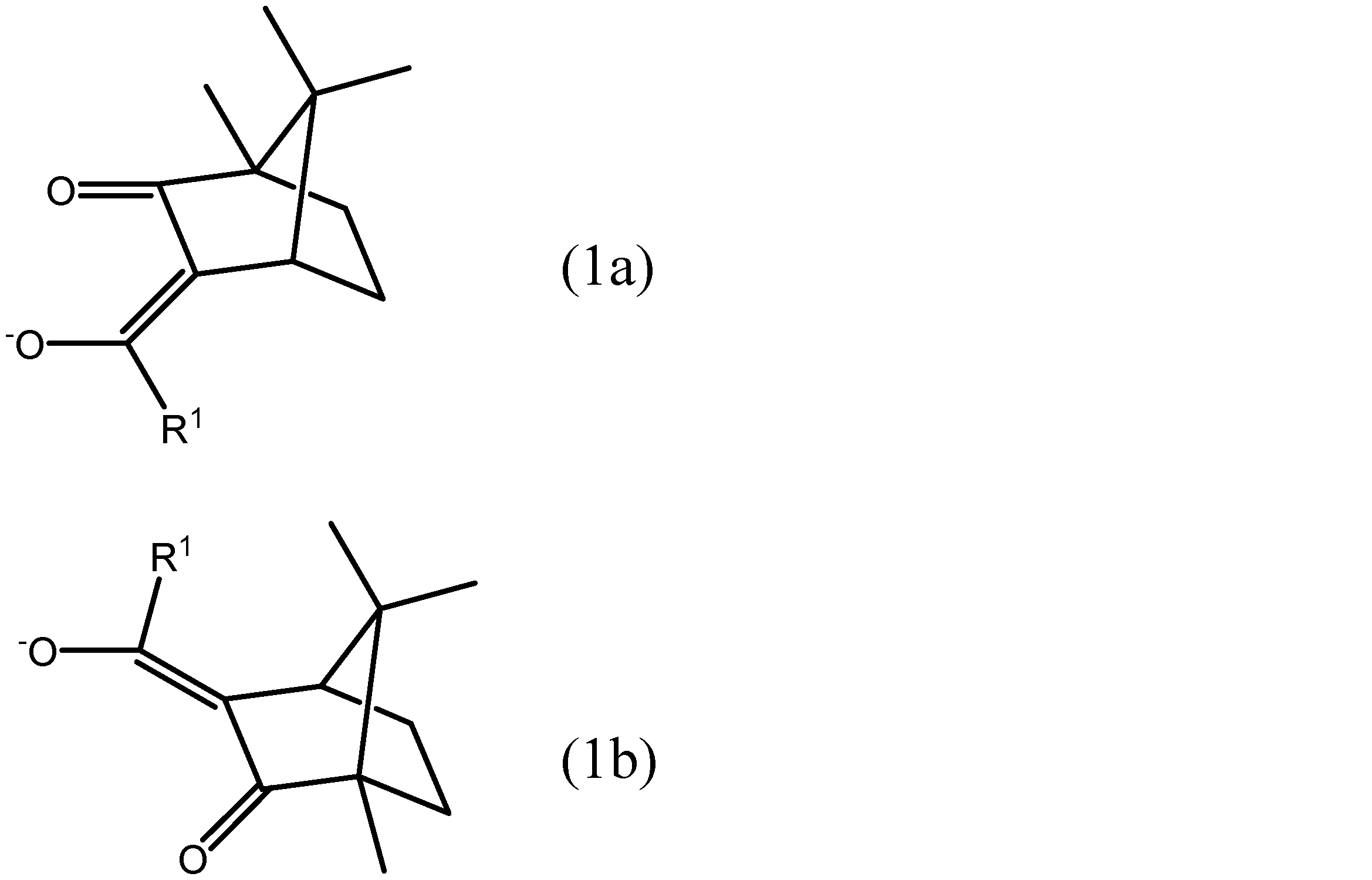
- Examples of the set of enantiomers of the optically active compound represented by the formula (I) include a combination of a compound represented by the following formula (1a) and a compound represented by the following formula (1b).
- R 1 in these formulas is as defined above, and may be a fluorinated alkyl group in particular.
- the substance amount of the compound of formula (1a) contained in the luminescent material may be larger than the substance amount of the compound of formula (1b) contained in the luminescent material, or vice versa.
- Ar 1 in the formula (II) represents an optionally substituted aryl group, and specific examples thereof include a phenyl group.
- R 11 represents an optionally substituted alkyl group or an optionally substituted aryl group
- R 12 represents a hydrogen atom, an optionally substituted alkyl group or an optionally substituted group.
- An aryl group is shown.
- R 11 and R 12 may each independently be an alkyl group having 1 to 5 carbon atoms, and specific examples thereof include a methyl group and an isopropyl group. Specific examples of the aryl group as R 11 or R 12 include a phenyl group.
- Organic ligands can also be selected based on wavelengths that produce absorption (CTS absorption) based on charge transfer from organic ligands to rare earth atoms.
- CTS absorption absorption
- the rare earth complex tends to exhibit a particularly high anisotropy factor. Therefore, the effect of increasing the anisotropy factor can be even more remarkable by using as the organic ligand an optically active compound whose rare earth complex exhibits blue belt CTS absorption.
- the rare earth complex emits light by absorption of blue-banded CTS means that in the excitation spectrum using a solution in which the rare earth complex is dissolved as a sample, fluorescence in the visible light range (380 to 750 nm) is in the range of excitation light of 400 to 550 nm. This can be confirmed by observation.
- the rare earth complex When the number of oxygen atoms coordinated to one rare earth atom (oxygen coordination number) is large, the rare earth complex tends to have blue-band CTS absorption. Specifically, the oxygen coordination number in the rare earth complex may be 7 to 11. Furthermore, if the energy levels of the organic ligands HOMO and LUMO are high, the rare earth complex tends to have blue-band CTS absorption. Therefore, pay attention to the energy levels of HOMO and LUMO. It is also possible to design a rare earth complex having a blue belt color CTS absorption.
- One or two or more optically active compounds can coordinate to one rare earth atom in the rare earth complex.
- the rare earth complex may further contain other organic ligands in addition to the optically active compound.
- the amphiphilic compound 4 is arranged around the rare earth complex 10 so that the hydrophilic group 4a is on the rare earth complex 10 side, and the hydrophilic group 4a and the rare earth complex 10 interact with each other.
- the content of the amphiphilic compound in the light emitting material may be 1 to 100 or 2 to 20 with respect to the mass of the rare earth complex.
- the amphiphilic compound 4 is a molecule that has a hydrophilic group 4a and a hydrophobic group 4b and functions as a micelle forming agent also called a surfactant.
- the rare earth complex forms a complex with the amphiphilic compound, the rare earth complex can have good solubility in a solvent.
- the hydrophilic group of the amphiphilic compound may be a cationic group.
- the hydrophilic group include an ammonium group, a pyridinium group, a carboxylate group, a sulfate group, and a sulfonate group.
- the hydrophilic group may be a cationic group selected from an ammonium group and a pyridinium group.
- the hydrophobic group include an alkyl group having 6 to 18 carbon atoms, an alkylbenzene group having 6 to 16 carbon atoms, an alkylnaphthalene group, a perfluoroalkyl group having 4 to 9 carbon atoms, polypropylene oxide, and polysiloxane.
- the alkyl group may be linear or branched alkyl.
- Amphiphilic compounds include cetyltrimethylammonium bromide (CTA), dimethyldioctadecylammonium bromide (DODA), dodecyltrimethylammonium bromide (DDTA), dodecyl-11 methacryloxyundecyldimethylammonium bromide (DMDA), and di11 hydroxyun. It may be at least one selected from the group consisting of decyldimethylammonium bromide (DODHA).
- CBDA cetyltrimethylammonium bromide
- DODA dimethyldioctadecylammonium bromide
- DDTA dodecyltrimethylammonium bromide
- DMDA dodecyl-11 methacryloxyundecyldimethylammonium bromide
- DODHA decyldimethylammonium bromide
- the light emitting material contains a rare earth complex and an amphiphilic compound as main components.
- the total content of the rare earth complex and the amphiphilic compound in the luminescent material may be 80% by mass or more, 90% by mass or more, or 95% by mass or more based on the mass of the luminescent material.
- the light-emitting material includes, for example, a step of dissolving a complex of an inorganic rare earth complex having a rare earth atom and a polyoxometalate coordinated with the rare earth atom in an organic solvent, and an optically active rare earth atom in the organic solvent. And a step of coordinating an organic ligand containing a compound, in this order.
- the optically active compound those optically resolved in advance by a usual method can be used.
- An inorganic rare earth complex containing a rare earth atom and a polyoxometalate can be prepared by an ordinary method understood by those skilled in the art. For example, methods for preparing europium-polyoxometalate complexes are described in References: Yamase et al., Chem. Rev. 1998, vol 98, p307-325.
- a complex of an inorganic rare earth complex and an amphiphilic compound can be obtained, for example, by reacting an inorganic rare earth complex and an amphiphilic compound in a solution. The produced complex may be purified by recrystallization or the like.
- the organic solvent used in this reaction may be a halogen-based organic solvent, and examples thereof include chloroform and dichloromethane.
- the generated light emitting material (a complex of a rare earth complex and an amphiphilic compound) may be purified by recrystallization or the like.
- the light emitting material has excellent circularly polarized light emission characteristics
- application to various uses such as an ink for forming a light emitting layer, a light emitting film, or a circularly polarized light emitting device is assumed.
- the ink may contain, for example, a light emitting material and a solvent that dissolves or disperses the light emitting material.
- the light emitting layer or light emitting film containing the light emitting material can contain, for example, the light emitting material and a polymer matrix in which the light emitting material is dissolved or dispersed.
- chloroform layer was recovered from the reaction solution using a separatory funnel, and magnesium sulfate was added thereto for dehydration. After removing the magnesium sulfate, chloroform was distilled off using an evaporator. Chloroform was added to the residue, and a complex of Eu-POM and CTA (CTA-Eu-POM, white solid) was obtained by recrystallization.
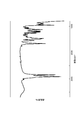
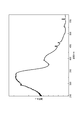
- the obtained Eu ((+)-facam) (POM) was analyzed by X-ray diffraction (XRD) and infrared spectroscopy.
- FIG. 2 shows an infrared absorption spectrum of Eu ((+)-facam) (POM)
- FIG. 3 shows an XRD pattern of Eu ((+)-facam) (POM). From the analysis results including these, it was confirmed that a complex of rare earth complex coordinated with (+)-facam and CTA was formed. It was also confirmed that Eu ((+)-facam) (POM) was dissolved in dichloromethane and chloroform to form a transparent solution.
- FIG. 4 shows the excitation spectrum of Eu ((+)-facam) (POM).
- Eu ((+)-facam) (POM) a rare earth complex
- Eu ((+)-facam) (POM) was confirmed to absorb excitation light in the blue region (400 to 550 nm) and emit fluorescence in the visible region.
- Eu ((-)-facam) (POM) Europium (Eu) was prepared in the same manner as the (+) form except that 3- (trifluoromethylhydroxymethylene)-( ⁇ )-camphorate (( ⁇ )-facam) was used instead of (+)-facam.
- a europium complex having a polyoxometalate containing tungsten (W) and 3- (trifluoromethylhydroxymethylene)-( ⁇ )-camphorate as an organic ligand, and cetyl as an amphiphilic molecule
- a luminescent material composed of trimethylammonium bromide (Eu (( ⁇ )-facam) (POM)) was synthesized.
- Eu (( ⁇ )-facam) (POM) it was confirmed by the same analysis as Eu ((+)-facam) (POM) that a complex of rare earth complex and CTA was formed. It was.
- Eu ((+)-fpcam) (POM) Eu (( ⁇ )-fpcam) (POM) Instead of (+)-facam, 3- (perfluoropropylhydroxymethylene)-(+)-camphorate ((+)-fpcam), or 3- (perfluoropropylhydroxymethylene)-( ⁇ )-camphorate (( ⁇ ) -Fpcam) in the same procedure as Eu ((+)-facam) (POM), and a polyoxometalate containing europium (Eu), tungsten (W), and an organic ligand.
- Eu europium
- W tungsten
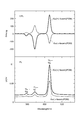
- FIG. 5 shows circularly polarized emission spectra of Eu ((+)-facam) (POM) and Eu (( ⁇ )-facam) (POM).
- FIG. 6 shows the circular polarized emission spectra of Eu ((+)-fpcam) (POM) and Eu (( ⁇ )-fpcam) (POM).
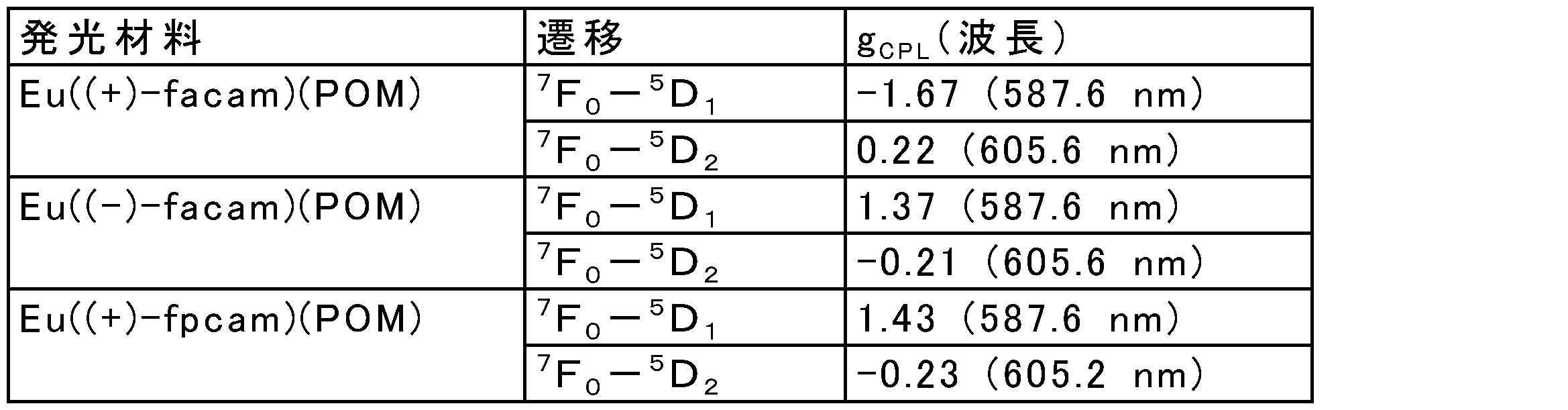
- Table 1 were obtained from these circularly polarized emission spectra, 7 F 0 - shows 5 D 2 g value corresponding to the transition (g CPL) - 5 D 1 transition or 7 F 0.
- the luminescent material exhibited a very high g value exceeding 1.0.
- SYMBOLS 1 Rare earth atom, 2 ... Organic ligand, 3 ... Polyoxometalate, 4 ... Amphiphilic compound, 4a ... Hydrophilic group, 4b ... Hydrophobic group, 10 ... Rare earth complex, 20 ... Luminescent material.
Landscapes
- Chemical & Material Sciences (AREA)
- Engineering & Computer Science (AREA)
- Materials Engineering (AREA)
- Organic Chemistry (AREA)
- Life Sciences & Earth Sciences (AREA)
- Wood Science & Technology (AREA)
- Inks, Pencil-Leads, Or Crayons (AREA)
- Led Device Packages (AREA)
Abstract
希土類原子と、金属原子及び酸素原子を含み希土類原子に配位しているポリオキソメタレートと、希土類原子に配位している有機配位子と、を有する希土類錯体を含む、発光材料が開示される。有機配位子が光学活性化合物を含み、当該発光材料中の光学活性化合物の一組の鏡像異性体のうち一方の物質量が他方の物質量よりも大きい。
Description
本発明は、発光材料、並びにこれを用いたインク及び発光デバイスに関する。
円偏光発光は、通常、直線偏光フィルタと円偏光フィルタを組み合わせることにより作り出されている。これに代えて、フィルター無しに円偏光発光を供給できる発光材料が提案されている(例えば、非特許文献1)。
J. Am. Chem. Soc.,2008,130,13814-13815
本発明の一側面に係る目的は、高い異方性因子の円偏光発光特性を示す発光材料を提供することにある。
本発明の一側面は、希土類原子と、金属原子及び酸素原子を含み前記希土類原子に配位しているポリオキソメタレートと、前記希土類原子に配位している有機配位子と、を有する希土類錯体を含む、発光材料を提供する。前記有機配位子が光学活性化合物を含み、当該発光材料中の前記光学活性化合物の一組の鏡像異性体のうち一方の物質量が他方の物質量よりも大きい。
本発明者らの知見によれば、ポリオキソメタレートと、光学活性化合物であって一方の鏡像異性体の割合が多い有機配位子とを組み合わせることにより、希土類錯体が顕著に高い異方性因子の円偏光発光特性を示すことができる。
本発明の一側面において、前記希土類錯体が、400~550nmの範囲の波長を有する励起光によって発光するものであってもよい。一般に、有機配位子を有する希土類錯体は有機配位子から希土類原子への電荷移動に基づく吸収(CTS吸収)を示すが、本発明者らの知見によれば、発光を生じるCTS吸収の波長と異方性因子とが関係している。発光を生じるCTS吸収が400~550nmの範囲にあるとき、希土類錯体が高い異方性因子の円偏光発光特性を示すと考えられる。
本発明によれば、高い異方性因子の円偏光発光特性を示す発光材料が提供され得る。
以下、本発明のいくつかの実施形態について詳細に説明する。ただし、本発明は以下の実施形態に限定されるものではない。
図1は、発光材料の一実施形態を示す模式図である。図1に示す発光材料20は、希土類錯体10と、希土類錯体10を囲む複数の両親媒性化合物4とから構成される。希土類錯体10は、希土類原子1と、希土類原子1に配位しているポリオキソメタレート3及び有機配位子2とを有する。有機配位子2が少なくとも一組の鏡像異性体を構成し得る光学活性化合物であり、発光材料20全体において光学活性化合物の少なくとも一組の鏡像異性体のうち一方の割合が他方よりも多い。両親媒性化合物4はミセルのような構造を形成しており、個々のミセルの内部に希土類錯体10の複数の分子が含まれ得る。発光材料20は、希土類錯体10及び両親媒性化合物4から構成される結晶を含んでいてもよい。図1の希土類錯体10は、対向する2個のポリオキソメタレート3の間に希土類原子1が挟まれている、いわゆるサンドイッチ構造を有している。2個のポリオキソメタレートの間に2個の希土類原子が挟まれていてもよい。ただし、希土類錯体は必ずしもサンドイッチ構造を形成していなくてもよい。
希土類原子1は、図1の三価のユーロピウム(Eu)に限られず、例えば、Sc、Y及びランタノイド(La、Ce、Pr、Nd、Pm、Sm、Eu、Gd、Tb、Dy、Ho、Er、Tm、Yb、Lu)から選択することができる。発光波長及び発光強度の観点から、希土類原子1はランタノイドであってもよく、Eu、Tb、Sm、Nd、Yb、Tm、Ce、Er及びPrからなる群より選ばれる少なくとも1種であってもよく、Euであってもよい。希土類原子は、希土類錯体中では通常イオンの形で存在する。希土類原子の原子価は、特に制限されるものではなく、適宜選択することができる。
希土類原子1に配位しているポリオキソメタレート3(POM)は、一般に、複数の金属原子(M)及びこれに配位した複数の酸素原子(O)から構成される。ポリオキソメタレートは、例えば、リンドクヴィスト型又はケギン型のポリ酸であることができる。
ポリオキソメタレートは、例えば、金属原子及び酸素原子によって形成されたMO4四面体、MO5五面体、又はMO6八面体の構造を含む。ポリオキソメタレートは、1個の金属原子と、金属原子に配位している6個の酸素原子とを含む八面体構造(MO6八面体)の部分を有していてもよい。ポリオキソメタレートは、一種類の金属原子及び酸素原子から構成されるイソポリオキソメタレート、又は、イソポリオキソメタレートに更にヘテロ原子を含むヘテロポリオキソメタレートであってもよい。ポリオキソメタレートは、複数の上記多面体構造の部分を含みそれらが互いに結合している複合体であってもよい。
ポリオキソメタレートに含まれる金属原子は、特に制限されないが、例えば、Mo、W、V、Si、P、Ge、Al、及びAsからなる群より選ばれる少なくとも1種であってもよい。ポリオキソメタレートに含まれる金属原子は、Mo及びWのような六価の金属原子であってもよく、これらは八面体構造を形成することができる。
希土類錯体は、図1に具体的に示される化合物に限られず、任意の光学活性化合物を有機配位子として含むことができる。複数の希土類錯体を含む発光材料20の全体において、光学活性化合物の一組の鏡像異性体のうち一方の物質量(モル数)が他方の物質量(モル数)よりも大きい。言い換えると、光学活性化合物の鏡像異性体過剰率(ee)が0%を超える。この鏡像異性体過剰率は、10%以上、20%以上、30%以上、40%以上、50%以上、60%以上、70%以上、80%以上、90%以上、又は95%以上であってもよい。鏡像異性体過剰率が高いと発光材料中にキラリティが生じ、その結果円偏光発光における異方性因子がより大きくなると考えられる。
有機配位子としての光学活性化合物は、アニオン又は中性の配位子であることができる。希土類錯体の発光強度向上等の観点から、光学活性化合物は、希土類原子を効果的に励起することができる光増感作用を有する配位子であってもよく、その例としては、1,3-ジケトンから誘導されるエノラートがある。光学活性化合物であるエノラートの具体例としては、下記式(I)で表される化合物及びその鏡像異性体が挙げられる。
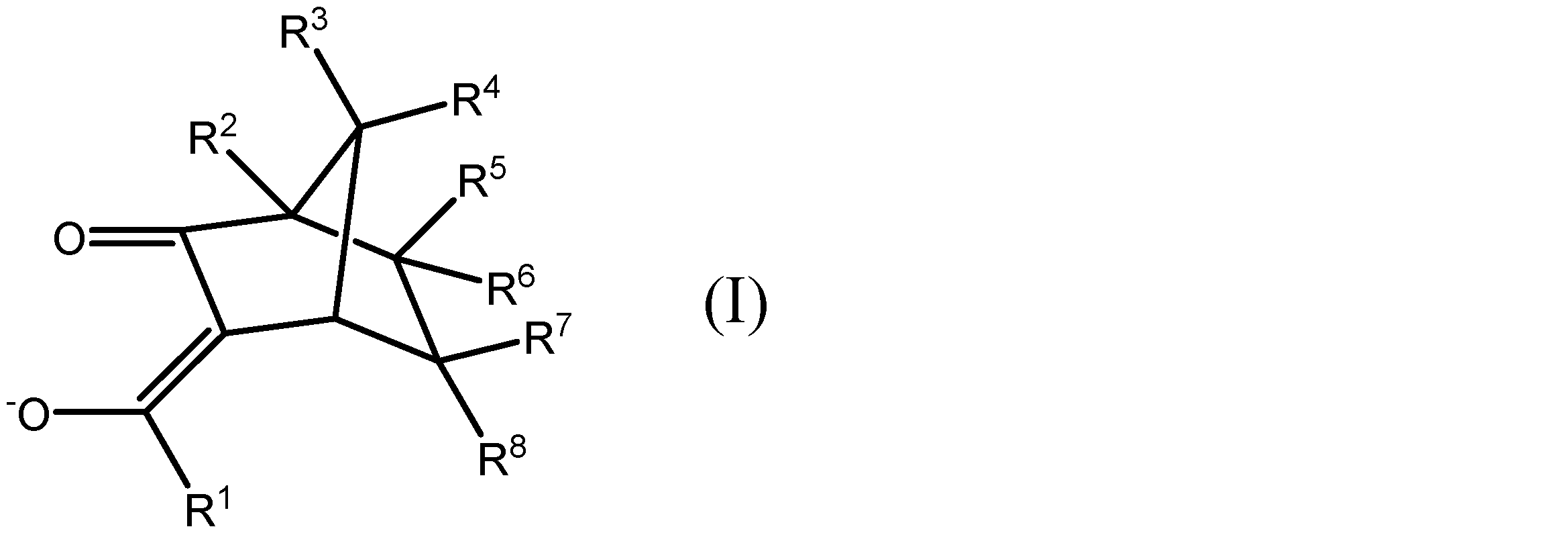
式中、R1は置換されていてもよい炭化水素基を示し、R2、R3及びR4はそれぞれ独立に置換されていてもよい炭化水素基を示し、R5、R6、R7及びR8はそれぞれ独立に水素原子、ハロゲン原子又は置換されていてもよい炭化水素基を示す。
R1は、置換されていてもよいアルキル基であってもよく、その炭素数は1~10であってもよい。R1は、フッ素化アルキル基であってもよく、その例としてはトリフルオロメチル基(-CF3)、及びパーフルオロペンチル基(-CF2CF2CF3)が挙げられる。
R2、R3及びR4は置換されていてもよいアルキル基であってもよく、その炭素数は1~5であってもよい。R2、R3及びR4の具体例としては、メチル基が挙げられる。
R5、R6、R7及びR8はそれぞれ独立に置換されていてもよいアルキル基であってもよく、その炭素数は1~5であってもよい。R5、R6、R7及びR8が水素原子であってもよい。
式(I)で表される光学活性化合物の鏡像異性体の組の例としては、下記式(1a)で表される化合物及び下記式(1b)で表される化合物の組み合わせがある。これら式中のR1は上記と同義であり、特にフッ素化アルキル基であってもよい。発光材料に含まれる式(1a)の化合物の物質量が、発光材料に含まれる式(1b)の化合物の物質量よりも大きくてもよく、その逆でもよい。
有機配位子として用いられ得る光学活性化合物の他の例としては、下記式(II)、(III)、(IV)又は(V)で表される化合物及びその鏡像異性体が挙げられる。

式(II)中のAr1は置換されていてもよいアリール基を示し、その具体例としてはフェニル基が挙げられる。式(III)中、R11は置換されていてもよいアルキル基又は置換されていてもよいアリール基を示し、R12は水素原子、置換されていてもよいアルキル基又は置換されていてもよいアリール基を示す。R11及びR12はそれぞれ独立に炭素数1~5のアルキル基であってもよく、その具体例としてはメチル基及びイソプロピル基が挙げられる。R11又はR12としてのアリール基の具体例としてはフェニル基が挙げられる。
有機配位子を、有機配位子から希土類原子への電荷移動に基づく吸収(CTS吸収)を生じる波長に基づいて、選択することもできる。可視光域の発光を生じるCTS吸収波長が青帯色(400~550nm)の範囲にあるとき、希土類錯体が特に高い異方性因子を示す傾向がある。したがって、青帯色のCTS吸収を希土類錯体が示すような光学活性化合物を有機配位子として用いることにより、異方性因子増大の効果がより一層顕著なものとなり得る。有希土類錯体が青帯色のCTS吸収によって発光することは、希土類錯体が溶解した溶液を試料として用いた励起スペクトルにおいて、励起光400~550nmの範囲に可視光域(380~750nm)の蛍光が観測されることにより、確認できる。
1個の希土類原子に配位する酸素原子の数(酸素配位数)が大きいと、希土類錯体に青帯色のCTS吸収を有し易い傾向がある。具体的には、希土類錯体における酸素配位数が7~11であってもよい。更に、有機配位子のHOMO及びLUMOのエネルギー準位が高いと希土類錯体に青帯色のCTS吸収を有し易い傾向があるため、HOMO及びLUMOのエネルギー準位に着目して有機配位子を選択することによっても、青帯色のCTS吸収を有する希土類錯体を設計することが可能である。
希土類錯体中の1個の希土類原子に対して、1個又は2個以上の光学活性化合物が配位することができる。希土類錯体は、光学活性化合物に加えて、他の有機配位子を更に含んでいてもよい。両親媒性化合物4は、その親水性基4aが希土類錯体10側となる向きで、希土類錯体10の周囲に配置されており、親水性基4aと希土類錯体10とが相互作用している。発光材料における両親媒性化合物の含有量は、希土類錯体の質量に対して、1~100、又は2~20であってもよい。
両親媒性化合物4は、親水性基4a及び疎水性基4bを有し、界面活性剤とも呼ばれるミセル形成剤として機能する分子である。希土類錯体が両親媒性化合物と複合体を形成することにより、希土類錯体が溶媒に対する良好な溶解性を有することができる。
両親媒性化合物の親水性基が、カチオン基であってもよい。親水性基としては、例えば、アンモニウム基、ピリジニウム基、カルボキシラート基、サルフェート基、及びスルホネート基が挙げられる。親水性基は、アンモニウム基、及びピリジニウム基から選ばれるカチオン基であってもよい。疎水性基としては、例えば、炭素数6~18のアルキル基、炭素数6~16のアルキルベンゼン基、アルキルナフタレン基、炭素数4~9のペルフルオロアルキル基、ポリプロピレンオキサイド、及びポリシロキサンが挙げられる。アルキル基は、直鎖又は分岐アルキルであってもよい。
両親媒性化合物は、セチルトリメチルアンモニウムブロマイド(CTA)、ジメチルジオクタデシルアンモニムブロマイド(DODA)、ドデシルトリメチルアンモニウムブロマイド(DDTA)、ドデシル11メタクリルオキシウンデシルジメチルアンモニウムブロミド(DMDA)、及びジ11ヒドロキシウンデシルジメチルアンモニウムブロミド(DODHA)からなる群より選ばれる少なくとも1種であってもよい。
発光材料は、希土類錯体及び両親媒性化合物を主成分として含有する。発光材料における希土類錯体及び両親媒性化合物の合計の含有量は、発光材料の質量を基準として、80質量%以上、90質量%以上、又は95質量%以上であってもよい。
発光材料は、例えば、希土類原子及びこれに配位したポリオキソメタレートを有する無機希土類錯体と両親媒性化合物との複合体を有機溶媒に溶解させる工程と、有機溶媒中で希土類原子に光学活性化合物を含む有機配位子を配位させる工程と、をこの順に備える方法により、得ることができる。光学活性化合物として、通常の方法により予め光学分割されたものを用いることができる。
希土類原子及びポリオキソメタレートを含む無機希土類錯体は、当業者が理解する通常の方法により調製することができる。例えば、ユーロピウム-ポリオキソメタレート錯体の調製方法が、参考文献:Yamaseら、Chem. Rev. 1998、vol 98、p307-325に記載されている。無機希土類錯体と両親媒性化合物との複合体は、例えば、溶液中で無機希土類錯体と両親媒性化合物とを反応させることにより、得ることができる。生成した複合体は、再結晶等により精製してもよい。
次いで、複合体を有機配位子と反応させる。この反応に用いる有機溶媒は、ハロゲン系の有機溶媒であってもよく、その例としては、クロロホルム、ジクロロメタンが挙げられる。生成した発光材料(希土類錯体と両親媒性化合物との複合体)は、再結晶等により精製してもよい。
発光材料は、優れた円偏光発光特性を有することから、例えば、発光層を形成するためのインク、発光性フィルム、又は、円偏光発光デバイスのような各種用途への応用が想定される。インクは、例えば、発光材料と、発光材料を溶解又は分散する溶媒とを含有することができる。発光材料を含む発光層又は発光性フィルムは、例えば、発光材料と、発光材料が溶解又は分散するポリマーマトリックスとを含有することができる。
以下、実施例を挙げて本発明についてさらに具体的に説明する。ただし、本発明はこれら実施例に限定されるものではない。
1.発光材料の合成
1-1.Eu((+)-facam)(POM)
ユーロピウム(Eu)と、タングステン(W)を含むポリオキソメタレートと、有機配位子としての3-(トリフルオロメチルヒドロキシメチレン)-(+)-カンホラートとを有するユーロピウム錯体、並びに、両親媒性分子としてのセチルトリメチルアンモニウムブロマイドから構成される発光材料(Eu((+)-facam)(POM))を以下の手順で合成した。
1-1.Eu((+)-facam)(POM)
ユーロピウム(Eu)と、タングステン(W)を含むポリオキソメタレートと、有機配位子としての3-(トリフルオロメチルヒドロキシメチレン)-(+)-カンホラートとを有するユーロピウム錯体、並びに、両親媒性分子としてのセチルトリメチルアンモニウムブロマイドから構成される発光材料(Eu((+)-facam)(POM))を以下の手順で合成した。
ガラス容器に、0.3g(0.09mmol)のNa9[EuW10O36]32H2O(Eu-POM)、及び5mLの蒸留水を入れ、攪拌した。Eu-POMが蒸留水に溶解した後、0.6g(0.9mmol)のセチルトリメチルアンモニウムブロマイド(CTA)を含むクロロホルム溶液5mLを、攪拌しながら滴下した。次いで、オイルバスを用いて、60℃で加熱還流しながら、6時間かけてEu-POMとCTAとの反応を進行させた。反応終了後、分液漏斗を用いて反応液からクロロホルム層を回収し、そこに硫酸マグネシウムを加え、脱水した。硫酸マグネシウムを除去した後、エバポレーターを用いてクロロホルムを留去した。残渣にクロロホルムを加え、再結晶により、Eu-POMとCTAとの複合体(CTA-Eu-POM、白色固体)を得た。
得られたCTA-Eu-POM200mgと、クロロホルム10mLとをガラス容器に入れ、攪拌した。CTA-Eu-POMが溶解した後、3-(トリフルオロメチルヒドロキシメチレン)-(+)-カンホラート((+)-facam)25mg(0.1mmol)をガラス容器に攪拌しながら滴下した。次いで、オイルバスを用いて、60℃で加熱還流しながら、CTA-Eu-POMと(+)-facamとの反応を一晩かけて進行させた。反応終了後、エバポレーターを用いてクロロホルムを留去した。残渣にクロロホルムを加え、再結晶により、透明な結晶である発光材料(Eu((+)-facam)(POM))を得た。
得られたEu((+)-facam)(POM)を、X線回折(XRD)、及び赤外分光法により分析した。図2はEu((+)-facam)(POM)の赤外吸収スペクトルを示し、図3はEu((+)-facam)(POM)のXRDパターンを示す。これらを含む分析結果から、(+)-facamが配位した希土類錯体とCTAとの複合体が形成されていることが確認された。また、Eu((+)-facam)(POM)は、ジクロロメタン及びクロロホルムに溶解して透明な溶液を形成することが確認された。
図4は、Eu((+)-facam)(POM)の励起スペクトルを示す。希土類錯体(Eu((+)-facam)(POM))の粉末を測定試料として用い、250~575nmの範囲の励起光に対する波長613nmの蛍光強度を測定した。Eu((+)-facam)(POM)は青色域(400~550nm)の励起光を吸収して可視光域で蛍光を発することが確認された。
1-2.Eu((-)-facam)(POM)
(+)-facamに代えて3-(トリフルオロメチルヒドロキシメチレン)-(-)-カンホラート((-)-facam)を用いたこと以外は(+)体と同様の手順で、ユーロピウム(Eu)と、タングステン(W)を含むポリオキソメタレートと、有機配位子としての3-(トリフルオロメチルヒドロキシメチレン)-(-)-カンホラートとを有するユーロピウム錯体、並びに、両親媒性分子としてのセチルトリメチルアンモニウムブロマイドから構成される発光材料(Eu((-)-facam)(POM))を合成した。得られたEu((-)-facam)(POM)についても、Eu((+)-facam)(POM)と同様の分析により、希土類錯体とCTAとの複合体が形成さていることが確認された。
(+)-facamに代えて3-(トリフルオロメチルヒドロキシメチレン)-(-)-カンホラート((-)-facam)を用いたこと以外は(+)体と同様の手順で、ユーロピウム(Eu)と、タングステン(W)を含むポリオキソメタレートと、有機配位子としての3-(トリフルオロメチルヒドロキシメチレン)-(-)-カンホラートとを有するユーロピウム錯体、並びに、両親媒性分子としてのセチルトリメチルアンモニウムブロマイドから構成される発光材料(Eu((-)-facam)(POM))を合成した。得られたEu((-)-facam)(POM)についても、Eu((+)-facam)(POM)と同様の分析により、希土類錯体とCTAとの複合体が形成さていることが確認された。
1-3.Eu((+)-fpcam)(POM)、Eu((-)-fpcam)(POM)
(+)-facamに代えて3-(パーフルオロプロピルヒドロキシメチレン)-(+)-カンホラート((+)-fpcam)、又は3-(パーフルオロプロピルヒドロキシメチレン)-(-)-カンホラート((-)-fpcam)を用いたこと以外はEu((+)-facam)(POM)と同様の手順で、ユーロピウム(Eu)と、タングステン(W)を含むポリオキソメタレートと、有機配位子としての3-(パーフルオロプロピルヒドロキシメチレン)-(+)-カンホラート又は3-(パーフルオロプロピルヒドロキシメチレン)-(-)-カンホラートとを有するユーロピウム錯体、並びに、両親媒性分子としてのセチルトリメチルアンモニウムブロマイドから構成される発光材料(Eu((+)-fpcam)(POM)及びEu((-)-fpcam)(POM))を合成した。得られた(Eu((+)-fpcam)(POM)及びEu((-)-fpcam)(POM))についても、Eu((+)-facam)(POM)と同様の分析により、希土類錯体とCTAとの複合体が形成さていることが確認された。
(+)-facamに代えて3-(パーフルオロプロピルヒドロキシメチレン)-(+)-カンホラート((+)-fpcam)、又は3-(パーフルオロプロピルヒドロキシメチレン)-(-)-カンホラート((-)-fpcam)を用いたこと以外はEu((+)-facam)(POM)と同様の手順で、ユーロピウム(Eu)と、タングステン(W)を含むポリオキソメタレートと、有機配位子としての3-(パーフルオロプロピルヒドロキシメチレン)-(+)-カンホラート又は3-(パーフルオロプロピルヒドロキシメチレン)-(-)-カンホラートとを有するユーロピウム錯体、並びに、両親媒性分子としてのセチルトリメチルアンモニウムブロマイドから構成される発光材料(Eu((+)-fpcam)(POM)及びEu((-)-fpcam)(POM))を合成した。得られた(Eu((+)-fpcam)(POM)及びEu((-)-fpcam)(POM))についても、Eu((+)-facam)(POM)と同様の分析により、希土類錯体とCTAとの複合体が形成さていることが確認された。
2.評価
得られた各発光材料に関して、円偏光発光スペクトルを測定した。発光材料20mgをクロロホルム5mLに溶解して調製した溶液を測定試料とした。測定条件は以下のとおりである。
・測定装置:日本分光製、CPL-200(製品名)
・励起スリット幅:3000μm
・発光スリット幅:50μm
・データ取り込み間隔:0.2nm
・掃引速度:20nm/分
得られた各発光材料に関して、円偏光発光スペクトルを測定した。発光材料20mgをクロロホルム5mLに溶解して調製した溶液を測定試料とした。測定条件は以下のとおりである。
・測定装置:日本分光製、CPL-200(製品名)
・励起スリット幅:3000μm
・発光スリット幅:50μm
・データ取り込み間隔:0.2nm
・掃引速度:20nm/分
図5は、Eu((+)-facam)(POM)及びEu((-)-facam)(POM)の円偏光発光スペクトルを示す。図6は、Eu((+)-fpcam)(POM)及びEu((-)-fpcam)(POM)の円偏光発光スペクトルを示す。表1は、これら円偏光発光スペクトルから得られた、7F0-5D1遷移又は7F0-5D2遷移に対応するg値(gCPL)を示す。表に示されるように、発光材料は、1.0を超える非常に高いg値を示した。
1…希土類原子、2…有機配位子、3…ポリオキソメタレート、4…両親媒性化合物、4a…親水性基、4b…疎水性基、10…希土類錯体、20…発光材料。
Claims (8)
- 希土類原子と、
金属原子及び酸素原子を含み前記希土類原子に配位しているポリオキソメタレートと、
前記希土類原子に配位している有機配位子と、
を有する希土類錯体を含む、発光材料であって、
前記有機配位子が光学活性化合物を含み、
当該発光材料中の前記光学活性化合物の一組の鏡像異性体のうち一方の物質量が他方の物質量よりも大きい、
発光材料。 - 前記希土類錯体が、400~550nmの範囲の波長を有する励起光によって発光する、請求項1に記載の発光材料。
- 前記光学活性化合物が下記式(I)で表される化合物及び/又はその鏡像異性体である、請求項1又は2に記載の発光材料。

- 前記希土類原子がランタノイドである、請求項1~3のいずれか一項に記載の発光材料。
- 前記希土類錯体が2個の前記ポリオキソメタレートを有しており、2個の前記ポリオキソメタレートの間に1個又は2個の前記希土類原子が配置されている、請求項1~4のいずれか一項に記載の発光材料。
- 親水性基及び疎水性基を有する両親媒性化合物を更に含む、請求項1~5のいずれか一項に記載の発光材料。
- 請求項1~6のいずれか一項に記載の発光材料を含む、インク。
- 請求項1~6のいずれか一項に記載の発光材料を含む発光層を備える、発光デバイス。
Priority Applications (1)
| Application Number | Priority Date | Filing Date | Title |
|---|---|---|---|
| JP2018538491A JPWO2018047951A1 (ja) | 2016-09-09 | 2017-09-08 | 発光材料、インク、及び発光デバイス |
Applications Claiming Priority (2)
| Application Number | Priority Date | Filing Date | Title |
|---|---|---|---|
| JP2016176913 | 2016-09-09 | ||
| JP2016-176913 | 2016-09-09 |
Publications (1)
| Publication Number | Publication Date |
|---|---|
| WO2018047951A1 true WO2018047951A1 (ja) | 2018-03-15 |
Family
ID=61562847
Family Applications (1)
| Application Number | Title | Priority Date | Filing Date |
|---|---|---|---|
| PCT/JP2017/032523 Ceased WO2018047951A1 (ja) | 2016-09-09 | 2017-09-08 | 発光材料、インク、及び発光デバイス |
Country Status (2)
| Country | Link |
|---|---|
| JP (1) | JPWO2018047951A1 (ja) |
| WO (1) | WO2018047951A1 (ja) |
Cited By (1)
| Publication number | Priority date | Publication date | Assignee | Title |
|---|---|---|---|---|
| JPWO2023277110A1 (ja) * | 2021-06-30 | 2023-01-05 |
Citations (11)
| Publication number | Priority date | Publication date | Assignee | Title |
|---|---|---|---|---|
| JP2003327590A (ja) * | 2002-03-08 | 2003-11-19 | Kansai Tlo Kk | ジアステレオマー構造配位子を有する錯体及びそれを用いた光学機能材料 |
| JP2005112947A (ja) * | 2003-10-06 | 2005-04-28 | Dainippon Ink & Chem Inc | 印刷インキおよび印刷物 |
| JP2005114909A (ja) * | 2003-10-06 | 2005-04-28 | Dainippon Ink & Chem Inc | 識別マーク |
| JP2005111704A (ja) * | 2003-10-03 | 2005-04-28 | Dainippon Ink & Chem Inc | 識別マーク、及び該識別マークの判別方法、及び判別システム、並びに該識別マークを形成するためのラベル、及び転写箔 |
| JP2007523890A (ja) * | 2003-12-23 | 2007-08-23 | トラスティーズ オブ タフツ カレッジ | 金属含有ナノ層複合材及びその用途 |
| WO2008111293A1 (ja) * | 2007-03-09 | 2008-09-18 | National University Corporation NARA Institute of Science and Technology | 希土類錯体およびその利用 |
| WO2011111607A1 (ja) * | 2010-03-09 | 2011-09-15 | 国立大学法人奈良先端科学技術大学院大学 | 円偏光発光性希土類錯体 |
| JP2013121921A (ja) * | 2011-12-09 | 2013-06-20 | Nara Institute Of Science & Technology | 円偏光発光性希土類錯体 |
| WO2015002295A1 (ja) * | 2013-07-05 | 2015-01-08 | 国立大学法人北海道大学 | シート集積型希土類錯体及びその用途 |
| WO2016143562A1 (ja) * | 2015-03-09 | 2016-09-15 | 国立大学法人北海道大学 | 希土類錯体、発光材料及びその製造方法、並びに発光シート及びその製造方法 |
| JP2017137415A (ja) * | 2016-02-03 | 2017-08-10 | 東ソー株式会社 | キラル型希土類錯体ポリマーおよびそれを用いた光学機能材料 |
-
2017
- 2017-09-08 WO PCT/JP2017/032523 patent/WO2018047951A1/ja not_active Ceased
- 2017-09-08 JP JP2018538491A patent/JPWO2018047951A1/ja active Pending
Patent Citations (11)
| Publication number | Priority date | Publication date | Assignee | Title |
|---|---|---|---|---|
| JP2003327590A (ja) * | 2002-03-08 | 2003-11-19 | Kansai Tlo Kk | ジアステレオマー構造配位子を有する錯体及びそれを用いた光学機能材料 |
| JP2005111704A (ja) * | 2003-10-03 | 2005-04-28 | Dainippon Ink & Chem Inc | 識別マーク、及び該識別マークの判別方法、及び判別システム、並びに該識別マークを形成するためのラベル、及び転写箔 |
| JP2005112947A (ja) * | 2003-10-06 | 2005-04-28 | Dainippon Ink & Chem Inc | 印刷インキおよび印刷物 |
| JP2005114909A (ja) * | 2003-10-06 | 2005-04-28 | Dainippon Ink & Chem Inc | 識別マーク |
| JP2007523890A (ja) * | 2003-12-23 | 2007-08-23 | トラスティーズ オブ タフツ カレッジ | 金属含有ナノ層複合材及びその用途 |
| WO2008111293A1 (ja) * | 2007-03-09 | 2008-09-18 | National University Corporation NARA Institute of Science and Technology | 希土類錯体およびその利用 |
| WO2011111607A1 (ja) * | 2010-03-09 | 2011-09-15 | 国立大学法人奈良先端科学技術大学院大学 | 円偏光発光性希土類錯体 |
| JP2013121921A (ja) * | 2011-12-09 | 2013-06-20 | Nara Institute Of Science & Technology | 円偏光発光性希土類錯体 |
| WO2015002295A1 (ja) * | 2013-07-05 | 2015-01-08 | 国立大学法人北海道大学 | シート集積型希土類錯体及びその用途 |
| WO2016143562A1 (ja) * | 2015-03-09 | 2016-09-15 | 国立大学法人北海道大学 | 希土類錯体、発光材料及びその製造方法、並びに発光シート及びその製造方法 |
| JP2017137415A (ja) * | 2016-02-03 | 2017-08-10 | 東ソー株式会社 | キラル型希土類錯体ポリマーおよびそれを用いた光学機能材料 |
Non-Patent Citations (2)
| Title |
|---|
| BOGLIO CECILE ET AL.: "Sensing the Chirality of Dawson Lanthanide Polyoxometalates [alphal- LnP2W17061]7- by Multinuclear NMR Spectroscopy", CHEMISTRY A EUROPEAN JOURNAL, vol. 14, no. 5, 2008, pages 1532 - 1540, XP055497449, ISSN: 0947-6539 * |
| YUICHI KITAGAWA ET AL.: "Kidorui Sakutai no Haiishi ni Izon shita Jiki En Henko Nishokusei Kyodo", ANNUAL MEETING ON PHOTOCHEMISTRY KOEN YOSHISHU, 8 September 2015 (2015-09-08) * |
Cited By (1)
| Publication number | Priority date | Publication date | Assignee | Title |
|---|---|---|---|---|
| JPWO2023277110A1 (ja) * | 2021-06-30 | 2023-01-05 |
Also Published As
| Publication number | Publication date |
|---|---|
| JPWO2018047951A1 (ja) | 2019-07-25 |
Similar Documents
| Publication | Publication Date | Title |
|---|---|---|
| Chauhan et al. | Preparation, characterization and luminescence behavior of some samarium complexes | |
| Marques et al. | New photo/electroluminescent europium (III) β-diketonate complex containing ap, p′-disubstituted bipyridine ligand: Synthesis, solid state characterization, theoretical and experimental spectroscopic studies | |
| Shestopalov et al. | Cluster core controlled reactions of substitution of terminal bromide ligands by triphenylphosphine in octahedral rhenium chalcobromide complexes | |
| Zhou et al. | Rapid Synthesis of Bright, Shape‐Controlled, Large Single Crystals of Cs3Cu2X5 for Phase Pure Single (X= Br, Cl) and Mixed Halides (X= Br/Cl) as the Blue and Green Components for Printable White Light‐Emitting Devices | |
| CN107954902A (zh) | 一种宽光谱的有机-无机杂化钙钛矿量子点荧光材料及其制备方法 | |
| US7683183B2 (en) | Emissive monomeric metal complexes | |
| Yan et al. | Highly efficient heteroleptic cerium (III) complexes with a substituted pyrazole ancillary ligand and their application in blue organic light-emitting diodes | |
| WO2011111607A1 (ja) | 円偏光発光性希土類錯体 | |
| JP5849255B2 (ja) | 円偏光発光性希土類錯体 | |
| CN106478697A (zh) | 一种受溶剂影响的基于5‑氨基间苯二甲酸的镉(ii)金属有机配合物及其制备方法 | |
| Yu et al. | One-Dimensional Red Light–Emissive Organic Manganese (II) Halides as X-Ray Scintillators | |
| US8545807B2 (en) | Near infrared high emission rare-earth complex | |
| Qi et al. | Crystals of Sb3+-coordination complexes exhibiting yellowish green emissions with outstanding lifetimes | |
| Vitukhnovsky et al. | Luminescent properties of complexes based on scandium (III) β-diketonates | |
| WO2018047951A1 (ja) | 発光材料、インク、及び発光デバイス | |
| Royzman et al. | Structure, luminescence, and vapochromism of bridged cationic copper (I) dimers and polymers | |
| Guo et al. | Preparation, luminescent properties of N-phenyl-2-{2′-[(phenyl-ethyl-carbamoyl)-methoxy]-biphenyl-2-yloxy}-N-ethyl-acetamide (L) lanthanide complexes and the supramolecular structures of [La (pic) 3L] and 2 [La (NO3) 3L (H2O)]· H2O· 0.5 C2H5OH | |
| Irina et al. | Monomer and metallopolymer compounds of Tb (III) as precursors for OLEDs | |
| JP6799761B2 (ja) | 希土類錯体、発光材料及びその製造方法、並びに発光シート及びその製造方法 | |
| JP7072261B2 (ja) | ホスフィンオキシド化合物、希土類錯体及び発光材料 | |
| Sun et al. | Luminescent trade-off effect arising from Y3+ ion doping in rare earth metal–organic framework solid solutions Tb1-xYx-PTC (H3PTC= pyridine-2, 4, 6-tricarboxylate) | |
| Tenorio et al. | Luminescent samarium complexes with a coumarin derived ligand and their deuterated analogues | |
| Yu et al. | Surface modification via 2-thenoyltrifluoroacetone and the photophysical studies | |
| Lee et al. | Heteroleptic orange light-emitting iridium complexes containing phenylbenzothiazolate ligands | |
| Zhao et al. | Synthesis, Crystal Structure, and Visible Light Sensitized Red Luminescence of a Novel Salen-Bridged Pentanuclear Eu-Na Complex |
Legal Events
| Date | Code | Title | Description |
|---|---|---|---|
| 121 | Ep: the epo has been informed by wipo that ep was designated in this application |
Ref document number: 17848889 Country of ref document: EP Kind code of ref document: A1 |
|
| ENP | Entry into the national phase |
Ref document number: 2018538491 Country of ref document: JP Kind code of ref document: A |
|
| NENP | Non-entry into the national phase |
Ref country code: DE |
|
| 122 | Ep: pct application non-entry in european phase |
Ref document number: 17848889 Country of ref document: EP Kind code of ref document: A1 |