WO2018043325A1 - 液晶配向剤、液晶配向膜及びそれを用いた液晶表示素子 - Google Patents
液晶配向剤、液晶配向膜及びそれを用いた液晶表示素子 Download PDFInfo
- Publication number
- WO2018043325A1 WO2018043325A1 PCT/JP2017/030518 JP2017030518W WO2018043325A1 WO 2018043325 A1 WO2018043325 A1 WO 2018043325A1 JP 2017030518 W JP2017030518 W JP 2017030518W WO 2018043325 A1 WO2018043325 A1 WO 2018043325A1
- Authority
- WO
- WIPO (PCT)
- Prior art keywords
- liquid crystal
- group
- diamine
- aligning agent
- crystal aligning
- Prior art date
- Legal status (The legal status is an assumption and is not a legal conclusion. Google has not performed a legal analysis and makes no representation as to the accuracy of the status listed.)
- Ceased
Links
Classifications
-
- C—CHEMISTRY; METALLURGY
- C09—DYES; PAINTS; POLISHES; NATURAL RESINS; ADHESIVES; COMPOSITIONS NOT OTHERWISE PROVIDED FOR; APPLICATIONS OF MATERIALS NOT OTHERWISE PROVIDED FOR
- C09K—MATERIALS FOR MISCELLANEOUS APPLICATIONS, NOT PROVIDED FOR ELSEWHERE
- C09K19/00—Liquid crystal materials
- C09K19/52—Liquid crystal materials characterised by components which are not liquid crystals, e.g. additives with special physical aspect: solvents, solid particles
- C09K19/54—Additives having no specific mesophase characterised by their chemical composition
- C09K19/56—Aligning agents
-
- G—PHYSICS
- G02—OPTICS
- G02F—OPTICAL DEVICES OR ARRANGEMENTS FOR THE CONTROL OF LIGHT BY MODIFICATION OF THE OPTICAL PROPERTIES OF THE MEDIA OF THE ELEMENTS INVOLVED THEREIN; NON-LINEAR OPTICS; FREQUENCY-CHANGING OF LIGHT; OPTICAL LOGIC ELEMENTS; OPTICAL ANALOGUE/DIGITAL CONVERTERS
- G02F1/00—Devices or arrangements for the control of the intensity, colour, phase, polarisation or direction of light arriving from an independent light source, e.g. switching, gating or modulating; Non-linear optics
- G02F1/01—Devices or arrangements for the control of the intensity, colour, phase, polarisation or direction of light arriving from an independent light source, e.g. switching, gating or modulating; Non-linear optics for the control of the intensity, phase, polarisation or colour
- G02F1/13—Devices or arrangements for the control of the intensity, colour, phase, polarisation or direction of light arriving from an independent light source, e.g. switching, gating or modulating; Non-linear optics for the control of the intensity, phase, polarisation or colour based on liquid crystals, e.g. single liquid crystal display cells
- G02F1/133—Constructional arrangements; Operation of liquid crystal cells; Circuit arrangements
- G02F1/1333—Constructional arrangements; Manufacturing methods
- G02F1/1337—Surface-induced orientation of the liquid crystal molecules, e.g. by alignment layers
- G02F1/133711—Surface-induced orientation of the liquid crystal molecules, e.g. by alignment layers by organic films, e.g. polymeric films
- G02F1/133723—Polyimide, polyamide-imide
-
- C—CHEMISTRY; METALLURGY
- C08—ORGANIC MACROMOLECULAR COMPOUNDS; THEIR PREPARATION OR CHEMICAL WORKING-UP; COMPOSITIONS BASED THEREON
- C08G—MACROMOLECULAR COMPOUNDS OBTAINED OTHERWISE THAN BY REACTIONS ONLY INVOLVING UNSATURATED CARBON-TO-CARBON BONDS
- C08G73/00—Macromolecular compounds obtained by reactions forming a linkage containing nitrogen with or without oxygen or carbon in the main chain of the macromolecule, not provided for in groups C08G12/00 - C08G71/00
- C08G73/06—Polycondensates having nitrogen-containing heterocyclic rings in the main chain of the macromolecule
- C08G73/10—Polyimides; Polyester-imides; Polyamide-imides; Polyamide acids or similar polyimide precursors
-
- C—CHEMISTRY; METALLURGY
- C08—ORGANIC MACROMOLECULAR COMPOUNDS; THEIR PREPARATION OR CHEMICAL WORKING-UP; COMPOSITIONS BASED THEREON
- C08G—MACROMOLECULAR COMPOUNDS OBTAINED OTHERWISE THAN BY REACTIONS ONLY INVOLVING UNSATURATED CARBON-TO-CARBON BONDS
- C08G73/00—Macromolecular compounds obtained by reactions forming a linkage containing nitrogen with or without oxygen or carbon in the main chain of the macromolecule, not provided for in groups C08G12/00 - C08G71/00
- C08G73/06—Polycondensates having nitrogen-containing heterocyclic rings in the main chain of the macromolecule
- C08G73/10—Polyimides; Polyester-imides; Polyamide-imides; Polyamide acids or similar polyimide precursors
- C08G73/1042—Copolyimides derived from at least two different tetracarboxylic compounds or two different diamino compounds
-
- C—CHEMISTRY; METALLURGY
- C08—ORGANIC MACROMOLECULAR COMPOUNDS; THEIR PREPARATION OR CHEMICAL WORKING-UP; COMPOSITIONS BASED THEREON
- C08G—MACROMOLECULAR COMPOUNDS OBTAINED OTHERWISE THAN BY REACTIONS ONLY INVOLVING UNSATURATED CARBON-TO-CARBON BONDS
- C08G73/00—Macromolecular compounds obtained by reactions forming a linkage containing nitrogen with or without oxygen or carbon in the main chain of the macromolecule, not provided for in groups C08G12/00 - C08G71/00
- C08G73/06—Polycondensates having nitrogen-containing heterocyclic rings in the main chain of the macromolecule
- C08G73/10—Polyimides; Polyester-imides; Polyamide-imides; Polyamide acids or similar polyimide precursors
- C08G73/1067—Wholly aromatic polyimides, i.e. having both tetracarboxylic and diamino moieties aromatically bound
- C08G73/1071—Wholly aromatic polyimides containing oxygen in the form of ether bonds in the main chain
-
- C—CHEMISTRY; METALLURGY
- C08—ORGANIC MACROMOLECULAR COMPOUNDS; THEIR PREPARATION OR CHEMICAL WORKING-UP; COMPOSITIONS BASED THEREON
- C08G—MACROMOLECULAR COMPOUNDS OBTAINED OTHERWISE THAN BY REACTIONS ONLY INVOLVING UNSATURATED CARBON-TO-CARBON BONDS
- C08G73/00—Macromolecular compounds obtained by reactions forming a linkage containing nitrogen with or without oxygen or carbon in the main chain of the macromolecule, not provided for in groups C08G12/00 - C08G71/00
- C08G73/06—Polycondensates having nitrogen-containing heterocyclic rings in the main chain of the macromolecule
- C08G73/10—Polyimides; Polyester-imides; Polyamide-imides; Polyamide acids or similar polyimide precursors
- C08G73/1075—Partially aromatic polyimides
-
- C—CHEMISTRY; METALLURGY
- C08—ORGANIC MACROMOLECULAR COMPOUNDS; THEIR PREPARATION OR CHEMICAL WORKING-UP; COMPOSITIONS BASED THEREON
- C08L—COMPOSITIONS OF MACROMOLECULAR COMPOUNDS
- C08L79/00—Compositions of macromolecular compounds obtained by reactions forming in the main chain of the macromolecule a linkage containing nitrogen with or without oxygen or carbon only, not provided for in groups C08L61/00 - C08L77/00
- C08L79/04—Polycondensates having nitrogen-containing heterocyclic rings in the main chain; Polyhydrazides; Polyamide acids or similar polyimide precursors
- C08L79/08—Polyimides; Polyester-imides; Polyamide-imides; Polyamide acids or similar polyimide precursors
-
- C—CHEMISTRY; METALLURGY
- C09—DYES; PAINTS; POLISHES; NATURAL RESINS; ADHESIVES; COMPOSITIONS NOT OTHERWISE PROVIDED FOR; APPLICATIONS OF MATERIALS NOT OTHERWISE PROVIDED FOR
- C09D—COATING COMPOSITIONS, e.g. PAINTS, VARNISHES OR LACQUERS; FILLING PASTES; CHEMICAL PAINT OR INK REMOVERS; INKS; CORRECTING FLUIDS; WOODSTAINS; PASTES OR SOLIDS FOR COLOURING OR PRINTING; USE OF MATERIALS THEREFOR
- C09D179/00—Coating compositions based on macromolecular compounds obtained by reactions forming in the main chain of the macromolecule a linkage containing nitrogen, with or without oxygen, or carbon only, not provided for in groups C09D161/00 - C09D177/00
- C09D179/04—Polycondensates having nitrogen-containing heterocyclic rings in the main chain; Polyhydrazides; Polyamide acids or similar polyimide precursors
- C09D179/08—Polyimides; Polyester-imides; Polyamide-imides; Polyamide acids or similar polyimide precursors
-
- G—PHYSICS
- G02—OPTICS
- G02F—OPTICAL DEVICES OR ARRANGEMENTS FOR THE CONTROL OF LIGHT BY MODIFICATION OF THE OPTICAL PROPERTIES OF THE MEDIA OF THE ELEMENTS INVOLVED THEREIN; NON-LINEAR OPTICS; FREQUENCY-CHANGING OF LIGHT; OPTICAL LOGIC ELEMENTS; OPTICAL ANALOGUE/DIGITAL CONVERTERS
- G02F1/00—Devices or arrangements for the control of the intensity, colour, phase, polarisation or direction of light arriving from an independent light source, e.g. switching, gating or modulating; Non-linear optics
- G02F1/01—Devices or arrangements for the control of the intensity, colour, phase, polarisation or direction of light arriving from an independent light source, e.g. switching, gating or modulating; Non-linear optics for the control of the intensity, phase, polarisation or colour
- G02F1/13—Devices or arrangements for the control of the intensity, colour, phase, polarisation or direction of light arriving from an independent light source, e.g. switching, gating or modulating; Non-linear optics for the control of the intensity, phase, polarisation or colour based on liquid crystals, e.g. single liquid crystal display cells
- G02F1/133—Constructional arrangements; Operation of liquid crystal cells; Circuit arrangements
- G02F1/1333—Constructional arrangements; Manufacturing methods
- G02F1/1337—Surface-induced orientation of the liquid crystal molecules, e.g. by alignment layers
Definitions
- the liquid crystal alignment film is a constituent member of a liquid crystal display element widely used as a display device, and plays a role of aligning liquid crystals in a certain direction.
- the main liquid crystal alignment film used industrially is formed from a liquid crystal aligning agent made of a polyimide precursor polyamic acid (also referred to as polyamic acid) or a polyimide solution. Specifically, it is obtained by applying a liquid crystal alignment agent to a substrate, heating and baking, and then performing a liquid crystal alignment treatment.
- an alignment process using a photoreaction has been proposed as an alignment process method instead of the rubbing method.
- a method of imparting liquid crystal alignment ability by forming a polymer film having a specific site causing a photoreaction such as polyvinyl cinnamate on the substrate surface and irradiating with polarized or non-polarized radiation ( The photo-alignment method) is known. According to this method, uniform liquid crystal alignment can be realized without generating static electricity or dust, and viewing angle can be improved by alignment division (see Patent Documents 1 and 2).
- the liquid crystal alignment film needs to have a function of tilting and aligning liquid crystal molecules at a predetermined angle (pretilt angle) with respect to the substrate surface.
- pretilt angle a liquid crystal alignment film using a polyamic acid or polyimide having an alkyl side chain, a side chain of a steroid skeleton, a side chain having a ring structure, or the like is known (Patent Documents 3 and 4). 5).
- the pretilt angle is usually given by irradiation with radiation whose incident direction to the substrate surface is inclined with respect to the normal direction of the substrate (see Patent Document 1).
- the main liquid crystal alignment film is formed of a liquid crystal alignment agent composed of a polyamic acid or polyimide solution which is a polyimide precursor.
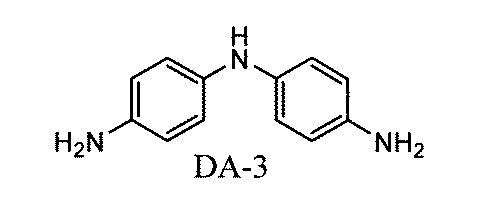
- a polyamic acid obtained by reacting a diamine represented by the following formula (DA-3) with a tetracarboxylic dianhydride component, and / or Or the liquid crystal aligning agent containing the polyimide obtained by imidating this polyamic acid is proposed.
- a liquid crystal display device provided with a liquid crystal alignment film obtained from such a liquid crystal aligning agent has excellent characteristics in terms of electrical characteristics (such as loss of accumulated charge).
- electrical characteristics such as loss of accumulated charge.
- the obtained liquid crystal aligning film is colored black brown and loses transparency, and as a result, the liquid crystal aligning element having the liquid crystal aligning film may be adversely affected. did.
- the present invention while maintaining the excellent characteristics due to the use of the diamine compound as a raw material of the polyamic acid that is a polymer contained in the liquid crystal alignment agent, while the obtained liquid crystal alignment film is colored black brown and It aims at providing the liquid crystal aligning agent which does not have a bad influence on liquid crystal aligning elements, such as loss of transparency.
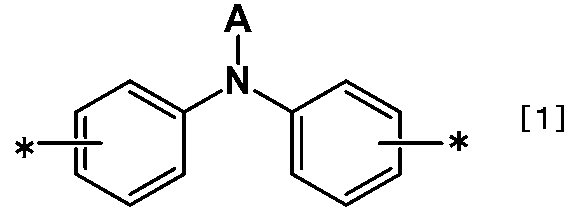
- the present invention includes a polyamic acid obtained by a reaction of a diamine component containing a diamine having a structure represented by the following formula [1] and a tetracarboxylic dianhydride component, and a polyimide obtained by imidizing the polyamic acid.
- the gist of the present invention is a liquid crystal aligning agent containing at least one polymer selected from the group consisting of: (In the formula, A represents a heat-eliminable group that is replaced with a hydrogen atom by heating at a temperature of 150 to 300 ° C.
- the hydrogen atom of the benzene ring is an alkyl group having 1 to 5 carbon atoms, or a carbon atom having 1 to 5 carbon atoms. (It may be substituted with an alkoxy group or a halogen group. * Represents a bond.)
- the liquid crystal aligning agent of this invention contains the polyamic acid which uses the diamine represented by Formula [1] (henceforth a specific diamine) as a raw material, and / or the polyimide obtained by imidating this polyamic acid.
- a polymer has a very high solubility in a polar solvent such as N-methylpyrrolidone (NMP) and has good handling during polymerization, and a liquid crystal aligning agent containing such a polymer is coated.
- NMP N-methylpyrrolidone
- the liquid crystal aligning agent of the present invention is a liquid crystal aligning film obtained as compared with a liquid crystal aligning agent containing a polyamic acid or a polyimide thereof using a diamine compound (DA-3) described later having a structure similar to a specific amine as a raw material.
- DA-3 diamine compound
- the diamine of the above formula (DA-3) having the same structure of the same diphenylamine skeleton as the specific diamine has a secondary amino group that is more reactive than the primary amino group in the structure.
- the secondary amino group reacts in a reaction process with a tetracarboxylic dianhydride component for obtaining a polyamic acid, and an undesirable three-dimensional reaction occurs.
- the obtained reaction product causes a coloring phenomenon and the characteristics as a liquid crystal aligning agent are deteriorated.
- the specific diamine of the present invention has, in its structure, a secondary amino group that is highly reactive as in the above formula (DA-3), but the secondary amino group is protected with a thermally desorbable group. Therefore, in the reaction process with the tetracarboxylic dianhydride component to obtain a polyamic acid, an undesirable three-dimensional reaction does not occur, resulting in no coloring phenomenon and characteristics as a liquid crystal aligning agent. Seems not to decline. Further, in the liquid crystal aligning agent of the present invention, the polyamic acid or polyimide which is a polymer to be contained has an amino group protected with a thermally detachable group, but is protected with this thermally detachable group.
- the heat-releasable group is deprotected and converted into an amino group by heating in the baking process. Can be made.
- the deprotected amino group regains the reactivity again, and the amino group generated by the elimination reacts in the molecule to form a heterocyclic ring and the like, thereby generating a rigid side chain. It will function as a good induction site for the pretilt angle.
- not all of the amino groups from which the heat-eliminable group is removed are used for the cyclization reaction, and some of them are also used for intermolecular reactions.
- Crosslinking with molecular components contributes to improved reliability.
- the polyamic acid or polyimide using the specific diamine of the present invention is less prone to scraping during rubbing treatment, and even when exposed to high temperature, backlight irradiation, etc. for a long period of time, the voltage holding ratio decreases and the ion density The increase of is difficult to occur.
- the diamine used as a raw material for the liquid crystal aligning agent of the present invention is a diamine having a structure represented by the following formula [1].
- A is a thermally desorbable group that is replaced with hydrogen by heating at 150 to 300 ° C., which is the firing temperature of the liquid crystal aligning agent of the present invention.
- This thermally leaving group is preferably 170 to 300 ° C., particularly preferably 180 to 250 ° C. if it can be removed. * Represents a bond.
- thermal leaving group examples include carbamate organic compounds represented by benzyloxycarbonyl group, 9-fluorenylmethyloxycarbonyl group, allyloxycarbonyl group, tertiary butoxycarbonyl group (also referred to as Boc group), and the like.
- a Boc group or a 9-fluorenylmethoxycarbonyl group is particularly preferred from the viewpoint that the elimination efficiency is high and the gas is harmless at the time of elimination at a relatively low temperature.
- the hydrogen atom of the benzene ring in the formula [1] is optionally substituted with an alkyl group or alkoxy group having 1 to 5, preferably 1 to 3 carbon atoms, or a halogen group such as chlorine, bromine or fluorine. May be.
- the amino group possessed by the specific diamine is preferably a primary amino group. Further, for example, it may be a secondary amino group substituted with an alkyl group having a relatively small molecular weight such as a methyl group, an ethyl group, a propyl group, or a butyl group.
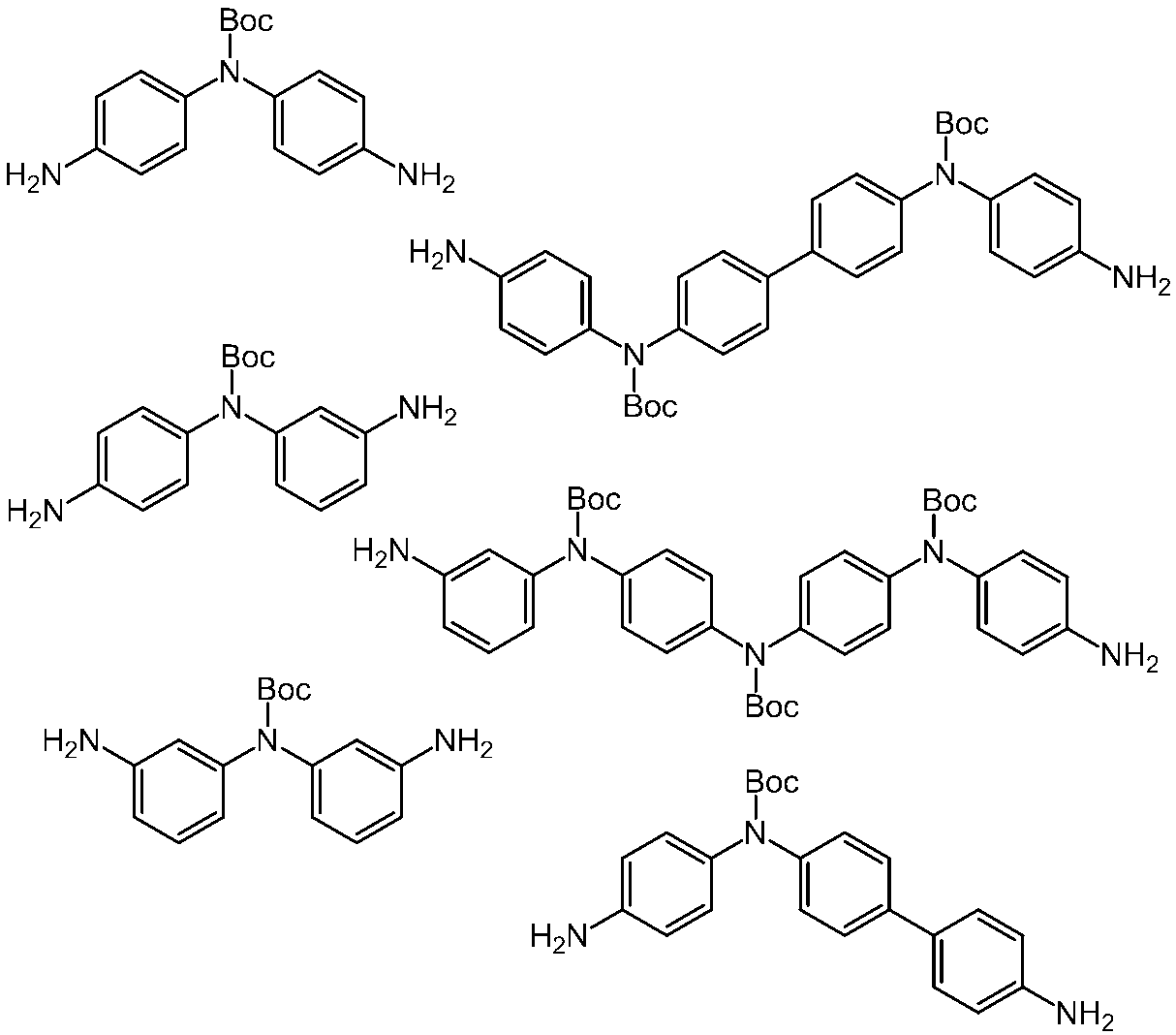
- Specific examples of the specific diamine include, but are not limited to, the following.
- Boc represents a tert-butoxycarbonyl group.
- a tetracarboxylic dianhydride (also referred to as a specific tetracarboxylic dianhydride) represented by the following formula [7] is used as a part of the tetracarboxylic dianhydride component. It is preferable to use it.
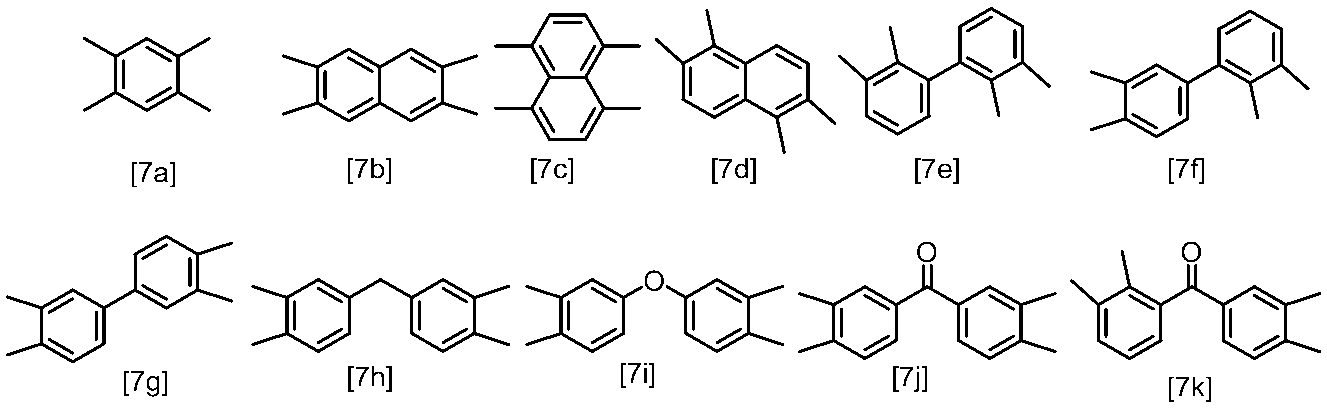
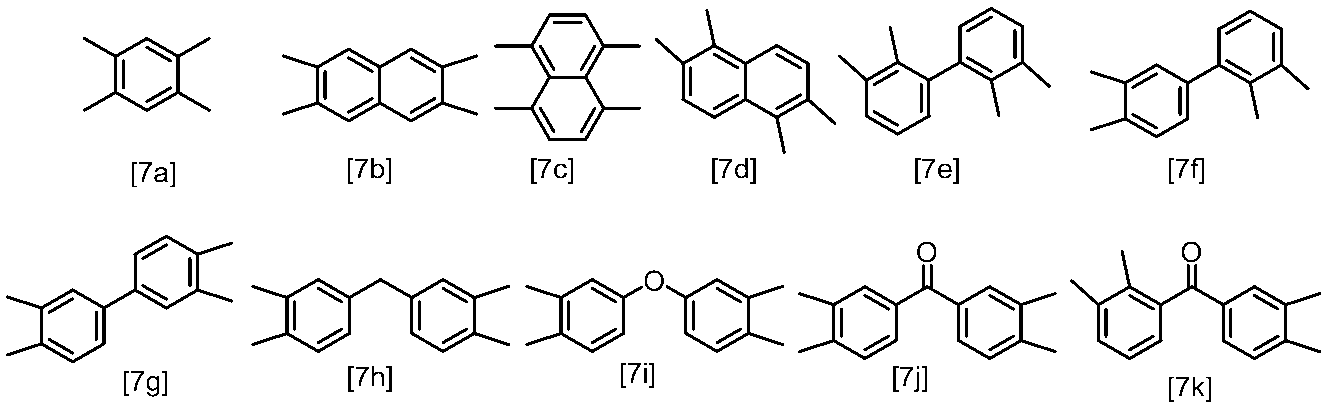
- Z 1 is a tetravalent organic group having 4 to 13 carbon atoms and has an aromatic cyclic hydrocarbon group. Specifically, a group represented by any of the following formulas [7a] to [7k] is preferable.
- a preferred group represented by Z 1 is a group represented by the formula [7a] or the formula [7g] in view of polymerization reactivity and ease of synthesis. Of these, the formula [7a] is most preferable.
- the tetracarboxylic dianhydride having the structure of the formula [7a] it is preferably 20% by mass or more of the total tetracarboxylic dianhydride component, more preferably 30% by mass or more. is there. All of the tetracarboxylic acid components used for the production of the polyimide precursor may be tetracarboxylic dianhydrides having the structure of the formula [7a].
- an aliphatic tetracarboxylic dianhydride other than the specific tetracarboxylic dianhydride and other tetracarboxylic acid components can be used.
- examples of the aliphatic tetracarboxylic dianhydride include 1,2,3,4-butanetetracarboxylic dianhydride.
- Examples of the alicyclic tetracarboxylic dianhydride include 1,2,3,4-cyclobutanetetracarboxylic dianhydride, 1,2,3,4-tetramethyl-1,2,3,4- Cyclobutanetetracarboxylic dianhydride, 1,2-dimethyl-1,2,3,4-cyclobutanetetracarboxylic dianhydride, 1,3-dimethyl-1,2,3,4-cyclobutanetetracarboxylic dianhydride 1,3-diphenyl-1,2,3,4-cyclobutanetetracarboxylic dianhydride, 1,2,3,4-cyclopentanetetracarboxylic dianhydride, 1,2,4,5-cyclohexane Tetracarboxylic dianhydride, 1,2,3,4-cycloheptanetetracarboxylic dianhydride, 2,3,4,5-tetrahydrofurantetracarboxylic dianhydride, 3,4-dicarboxy-1-cycl Hexyl
- the above-mentioned other tetracarboxylic acid components can be used alone or in combination of two or more kinds in consideration of characteristics such as liquid crystal alignment properties, voltage holding characteristics and accumulated charges of the liquid crystal alignment film to be formed.
- the polymer in the present invention means a polyamic acid and / or a polyimide obtained by imidizing the polyamic acid.
- the diamine other than the specific diamine (hereinafter also referred to as other diamine) used in combination when the specific diamine is less than 100 mol% includes an alicyclic diamine, an aromatic-aliphatic diamine, a heterocyclic ring.
- Formula diamine, aliphatic diamine, etc. are mentioned.
- alicyclic diamines examples include 1,4-diaminocyclohexane, 1,3-diaminocyclohexane, 4,4′-diaminodicyclohexylmethane, 4,4′-diamino-3,3′-dimethyldicyclohexylamine, isophorone diamine Etc.
- aromatic diamines examples include o-phenylenediamine, m-phenylenediamine, p-phenylenediamine, 2,4-diaminotoluene, 2,5-diaminotoluene, 3,5-diaminotoluene, 1,4-diamino -2-methoxybenzene, 2,5-diamino-p-xylene, 1,3-diamino-4-chlorobenzene, 3,5-diaminobenzoic acid, 1,4-diamino-2,5-dichlorobenzene, 4,4 '-Diamino-1,2-diphenylethane, 4,4'-diamino-2,2'-dimethylbibenzyl, 4,4'-diaminodiphenylmethane, 3,3'-diaminodiphenylmethane, 3,4'-diaminodiphenylmethane 4,4′-diamin
- aromatic-aliphatic diamines include 3-aminobenzylamine, 4-aminobenzylamine, 3-amino-N-methylbenzylamine, 4-amino-N-methylbenzylamine, 3-aminophenethylamine, 4-aminobenzylamine, Aminophenethylamine, 3-amino-N-methylphenethylamine, 4-amino-N-methylphenethylamine, 3- (3-aminopropyl) aniline, 4- (3-aminopropyl) aniline, 3- (3-methylaminopropyl) Aniline, 4- (3-methylaminopropyl) aniline, 3- (4-aminobutyl) aniline, 4- (4-aminobutyl) aniline, 3- (4-methylaminobutyl) aniline, 4- (4-methyl Aminobutyl) aniline, 3- (5-aminopentyl) aniline, 4- (5-aminopentyl) Aniline, 3- (5-methyl)
- heterocyclic diamines examples include 2,6-diaminopyridine, 2,4-diaminopyridine, 2,4-diamino-1,3,5-triazine, 2,7-diaminodibenzofuran, 3,6-diaminocarbazole 2,4-diamino-6-isopropyl-1,3,5-triazine, 2,5-bis (4-aminophenyl) -1,3,4-oxadiazole and the like.
- aliphatic diamines examples include 1,2-diaminoethane, 1,3-diaminopropane, 1,4-diaminobutane, 1,5-diaminopentane, 1,6-diaminohexane, 1,7-diaminoheptane, 1,8-diaminooctane, 1,9-diaminononane, 1,10-diaminodecane, 1,3-diamino-2,2-dimethylpropane, 1,6-diamino-2,5-dimethylhexane, 1,7- Diamino-2,5-dimethylheptane, 1,7-diamino-4,4-dimethylheptane, 1,7-diamino-3-methylheptane, 1,9-diamino-5-methylheptane, 1,12-diaminododecane 1,18-diaminooctadecan
- diamine compound which has an alkyl group, a fluorine-containing alkyl group, an aromatic ring, an aliphatic ring, a heterocyclic ring, or the macrocyclic substituent which consists of them in a side chain.
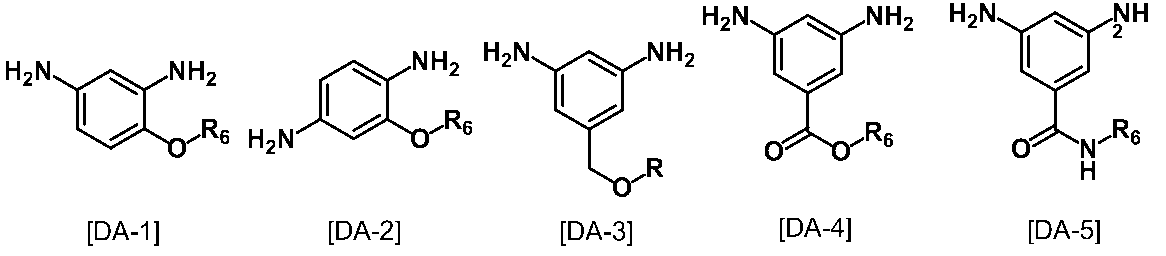
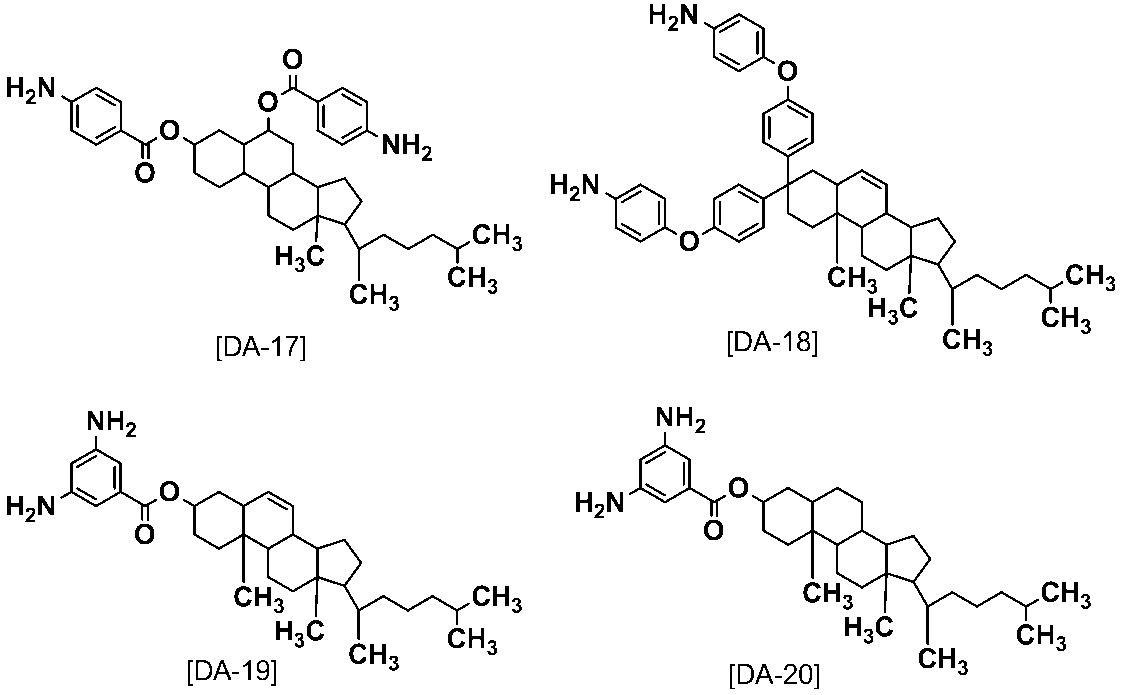
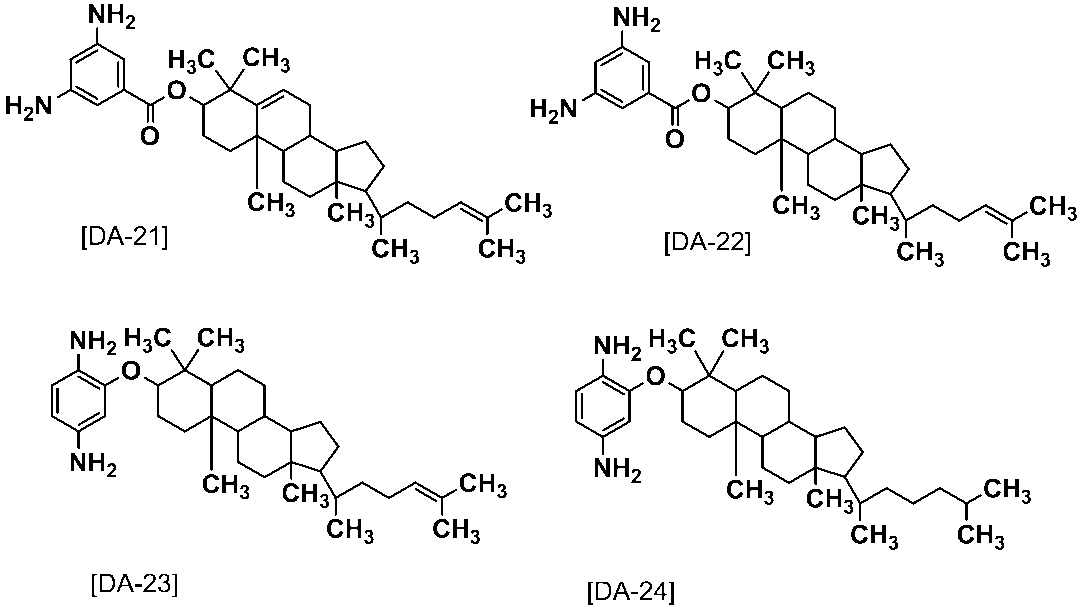
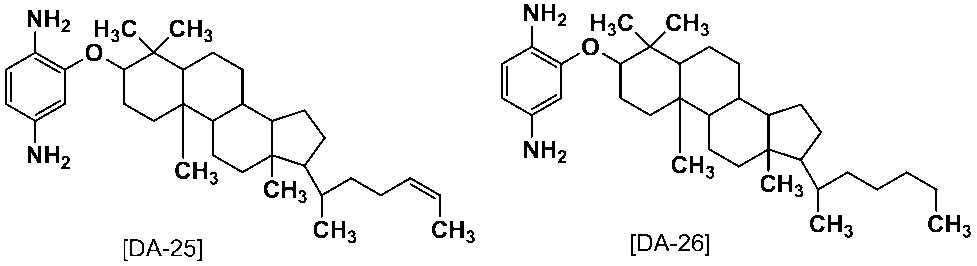
- diamines represented by the following formulas [DA1] to [DA26] are exemplified.
- R 6 is an alkyl group or a fluorine-containing alkyl group having 1 to 22 carbon atoms.
- R 6 represents 1 to 22 carbon atoms. It has an alkyl group or a fluorine-containing alkyl group.
- R 7 represents an alkyl group or alkoxy group having 1 to 22 carbon atoms.
- R 6 represents —O—, —OCH 2 —, —CH 2 O—, —COOCH 2 —, or —CH 2 OCO—
- R 7 represents an alkyl group or alkoxy group having 1 to 22 carbon atoms.
- R 8 represents an alkyl group, an alkoxy group, a fluorine-containing alkyl group or a fluorine-containing alkoxy group having 1 to 22 carbon atoms.
- R 9 represents a fluorine group, a cyano group, a trifluoromethane group, a nitro group, an azo group, a formyl group, an acetyl group, an acetoxy group, or a hydroxyl group.
- R 10 is an alkyl group having 3 to 12 carbon atoms, and the cis-trans isomerism of 1,4-cyclohexylene is a trans isomer.
- a specific diamine in combination with the diamines [DA-1] to [DA-26] because a more stable pretilt angle can be obtained.
- More preferred diamines that can be used in combination are those represented by the formulas [DA-10] to [DA-26], more preferably diamines of [DA-10] to [DA-16].
- the preferred content of these diamines is not particularly limited, but is preferably 5 to 50 mol% in the diamine component, and is preferably 5 to 30 mol% in terms of printability. Moreover, you may use the following diamine together.
- diaminosiloxanes represented by the following formula [DA-35] can also be mentioned as other diamines.
- M is an integer from 1 to 10.
- Other diamines can be used singly or in combination of two or more depending on properties such as liquid crystal alignment properties, voltage holding properties, and accumulated charges when the liquid crystal alignment film is formed.
- ⁇ Production of polyamic acid> As a method for obtaining the polyamic acid of the present invention by the reaction of the tetracarboxylic dianhydride component and the diamine component, a known method can be used. In general, the tetracarboxylic dianhydride component and the diamine component are reacted in an organic solvent. The reaction between the tetracarboxylic dianhydride component and the diamine is advantageous in that it proceeds relatively easily in an organic solvent and no by-products are generated.
Landscapes
- Chemical & Material Sciences (AREA)
- Physics & Mathematics (AREA)
- Organic Chemistry (AREA)
- Chemical Kinetics & Catalysis (AREA)
- Nonlinear Science (AREA)
- Polymers & Plastics (AREA)
- Health & Medical Sciences (AREA)
- Medicinal Chemistry (AREA)
- Crystallography & Structural Chemistry (AREA)
- Mathematical Physics (AREA)
- Spectroscopy & Molecular Physics (AREA)
- General Physics & Mathematics (AREA)
- Optics & Photonics (AREA)
- Materials Engineering (AREA)
- Engineering & Computer Science (AREA)
- Wood Science & Technology (AREA)
- Life Sciences & Earth Sciences (AREA)
- Liquid Crystal (AREA)
- Macromolecular Compounds Obtained By Forming Nitrogen-Containing Linkages In General (AREA)
Abstract
Description
本発明は下記式[1]で表される構造を有するジアミンを含有するジアミン成分とテトラカルボン酸二無水物成分との反応で得られるポリアミック酸、及び該ポリアミック酸をイミド化して得られるポリイミドからなる群より選ばれる少なくとも1つの重合体を含有することを特徴とする液晶配向剤を要旨とする。

加えて、本発明の液晶配向剤は、特定アミンと類似構造を有する後記するジアミン化合物(DA-3)を原料にするポリアミック酸やそのポリイミドを含む液晶配向剤に比べて、得られる液晶配向膜が、黒褐色に着色せずかつ透明性を有するので液晶表示素子に悪影響を与えることない液晶配向膜を形成することができる。
更に、本発明の液晶配向剤では、含有される重合体であるポリアミック酸やポリイミドが、熱脱離性基で保護されたアミノ基を有することになるが、この熱脱離性基で保護されたアミノ基は、後述するように、液晶配向剤を基板に塗布し、焼成して液晶配向膜を形成する過程における、焼成過程における加熱により、熱脱離性基が脱保護されアミノ基に変化させることができる。
かくして、本発明の特定ジアミンを用いたポリアミック酸やポリイミドは、ラビング処理時の削れ現象が起こり難くなり、長期間の高温、バックライト照射などに曝されても、電圧保持率の低下やイオン密度の増加が起こしにくいものとなる。
本発明の液晶配向剤の原料として使用されるジアミンは、下記の式[1]で表される構造を有するジアミンである。
特定ジアミンが有するアミノ基は、第一級アミノ基が好ましい。また、例えば、メチル基、エチル基、プロピル基、ブチル基などの比較的分子量の小さなアルキル基が置換された第二級アミノ基であってもよい。
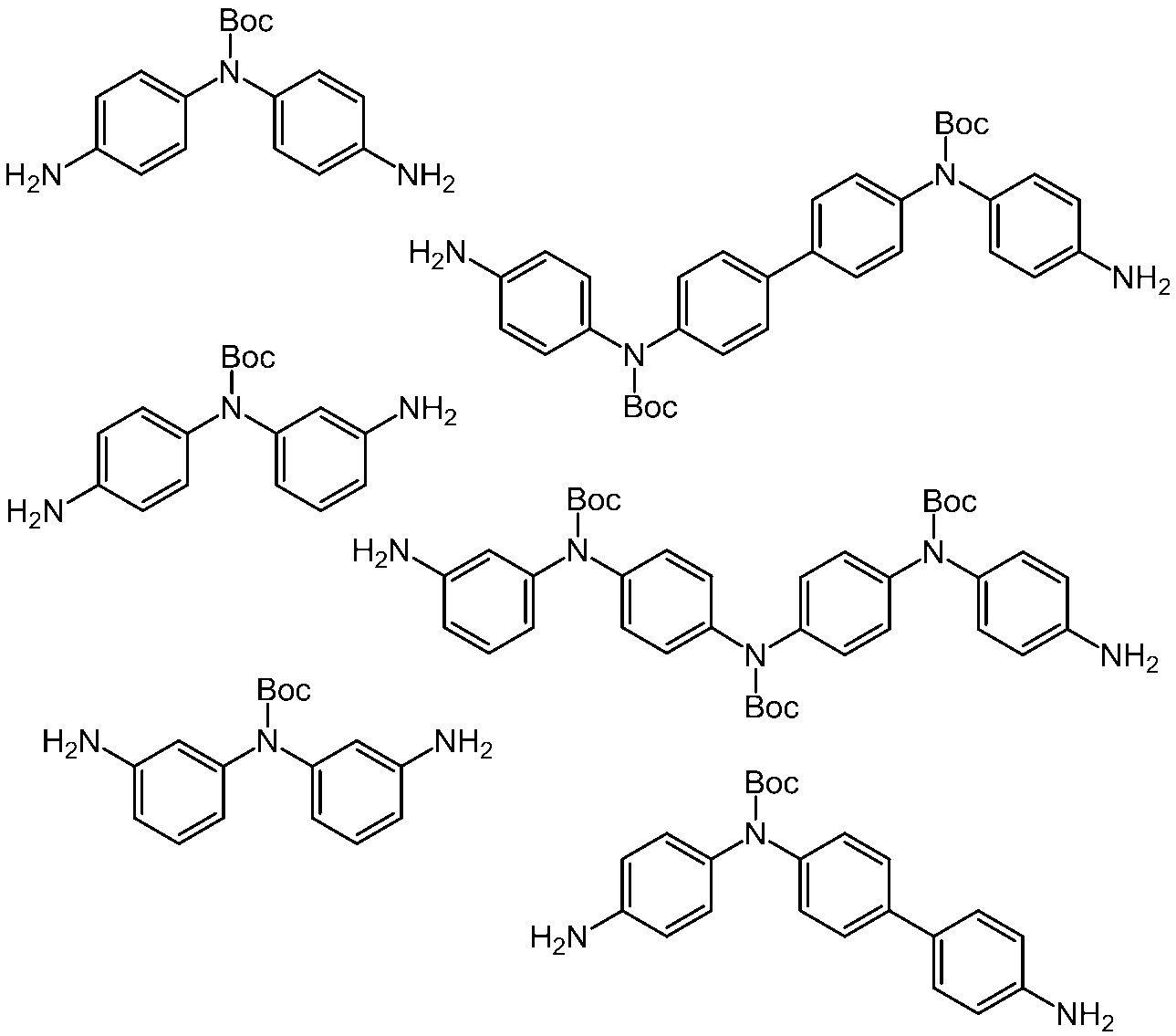
特定ジアミンの好ましい具体例としては、以下のものが挙げられるが、これらに限定されない。なお、式中のBocはtert-ブトキシカルボニル基を表す。
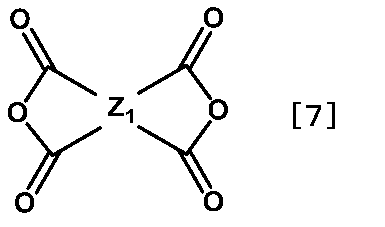
本発明のポリイミド前駆体を得るためには、下記式[7]で表されるテトラカルボン酸二無水物(特定テトラカルボン酸二無水物ともいう)をテトラカルボン酸二無水物成分の一部として用いることが好ましい。

式[7a]の構造のテトラカルボン酸二無水物を用いる場合、これを、テトラカルボン酸二無水物成分全体のうちの20質量%以上とすることが好ましく、より好ましくは、30質量%以上である。ポリイミド前駆体の製造に用いるテトラカルボン酸成分の全てを式[7a]の構造のテトラカルボン酸二無水物とすることも可能である。
脂肪族テトラカルボン酸二無水物としては、例えば、1,2,3,4-ブタンテトラカルボン酸二無水物が挙げられる。また、脂環式テトラカルボン酸二無水物としては、例えば1,2,3,4-シクロブタンテトラカルボン酸二無水物、1,2,3,4-テトラメチル-1,2,3,4-シクロブタンテトラカルボン酸二無水物、1,2-ジメチル-1,2,3,4-シクロブタンテトラカルボン酸二無水物、1,3-ジメチル-1,2,3,4-シクロブタンテトラカルボン酸二無水物、1,3-ジフェニル-1,2,3,4-シクロブタンテトラカルボン酸二無水物、1,2,3,4-シクロペンタンテトラカルボン酸二無水物、1,2,4,5-シクロヘキサンテトラカルボン酸二無水物、1,2,3,4-シクロヘプタンテトラカルボン酸二無水物、2,3,4,5-テトラヒドロフランテトラカルボン酸二無水物、3,4-ジカルボキシ-1-シクロへキシルコハク酸二無水物、2,3,5-トリカルボキシシクロペンチル酢酸二無水物、3,4-ジカルボキシ-1,2,3,4-テトラヒドロ-1-ナフタレンコハク酸二無水物、ビシクロ[3,3,0]オクタン-2,4,6,8-テトラカルボン酸二無水物、ビシクロ[4,3,0]ノナン-2,4,7,9-テトラカルボン酸二無水物、ビシクロ[4,4,0]デカン-2,4,7,9-テトラカルボン酸二無水物、ビシクロ[4,4,0]デカン-2,4,8,10-テトラカルボン酸二無水物、トリシクロ[6.3.0.0<2,6>]ウンデカン-3,5,9,11-テトラカルボン酸二無水物、4-(2,5-ジオキソテトラヒドロフラン-3-イル)-1,2,3,4-テトラヒドリナフタレン-1,2-ジカルボン酸二無水物、ビシクロ[2,2,2]オクト-7-エン-2,3,5,6-テトラカルボン酸二無水物、5-(2,5-ジオキソテトラヒドロフリル)-3-メチル-3-シクロへキサン-1,2-ジカルボン酸二無水物、テトラシクロ[6,2,1,1,0,2,7]ドデカ-4,5,9,10-テトラカルボン酸二無水物、3,5,6-トリカルボキシノルボルナン-2:3,5:6ジカルボン酸二無水物、などを挙げることができる。
その他のテトラカルボン酸成分としては、テトラカルボン酸、テトラカルボン酸ジハライド、テトラカルボン酸二無水物、テトラカルボン酸のカルボン酸基をジアルキルエステル化したエステル化物、テトラカルボン酸ジハライドのカルボン酸基をジアルキルエステル化したエステル化物等が挙げられる。
本発明における重合体とは、ポリアミック酸、及び/又は該ポリアミック酸をイミド化して得られるポリイミドを意味する。
本発明のポリアミック酸は、特定ジアミンを含有するジアミン成分とテトラカルボン酸二無水物成分との反応によって得られる。
上記テトラカルボン酸二無水物成分との反応によりポリアミック酸を得るためのジアミン成分において、特定ジアミンの含有割合に制限はない。ジアミン成分における特定ジアミンの含有量は、100%であってもよい。しかし、液晶配向膜に要求される種々の特性、例えば、液晶のプレチルト角を大きくする特性、液晶の垂直配向性を高める、などの特性を満足させるということから、種々のジアミンが併用することができる。従って、重合に用いられるジアミン成分における特定ジアミンの含有割合は、1~50mol%が好ましく、特に好ましくは5~30mol%が好ましい。
芳香族ジアミン類の例としては、o-フェニレンジアミン、m-フェニレンジアミン、p-フェニレンジアミン、2,4-ジアミノトルエン、2,5-ジアミノトルエン、3,5-ジアミノトルエン、1,4-ジアミノ-2-メトキシベンゼン、2,5-ジアミノ-p-キシレン、1,3-ジアミノ-4-クロロベンゼン、3,5-ジアミノ安息香酸、1,4-ジアミノ-2,5-ジクロロベンゼン、4,4’-ジアミノ-1,2-ジフェニルエタン、4,4’-ジアミノ-2,2’-ジメチルビベンジル、4,4’-ジアミノジフェニルメタン、3,3’-ジアミノジフェニルメタン、3,4’-ジアミノジフェニルメタン、4,4’-ジアミノ-3,3’―ジメチルジフェニルメタン、2,2’-ジアミノスチルベン、4,4’-ジアミノスチルベン、4,4’-ジアミノジフェニルエーテル、3,4’-ジアミノジフェニルエーテル、4,4’-ジアミノジフェニルスルフィド、4,4’-ジアミノジフェニルスルホン、3,3’-ジアミノジフェニルスルホン、4,4’-ジアミノベンゾフェノン、1,3-ビス(3-アミノフェノキシ)ベンゼン、1,3-ビス(4-アミノフェノキシ)ベンゼン、1,4-ビス(4-アミノフェノキシ)ベンゼン、3,5-ビス(4-アミノフェノキシ)安息香酸、4,4’-ビス(4-アミノフェノキシ)ビベンジル、2,2-ビス[(4-アミノフェノキシ)メチル]プロパン、2,2-ビス[4-(4-アミノフェノキシ)フェニル]ヘキサフロロプロパン、2,2-ビス[4-(4-アミノフェノキシ)フェニル]プロパン、ビス[4-(3-アミノフェノキシ)フェニル]スルホン、ビス[4-(4-アミノフェノキシ)フェニル]スルホン、1,1-ビス(4-アミノフェニル)シクロヘキサン、α、α’-ビス(4-アミノフェニル)-1,4-ジイソプロピルベンゼン、9,9-ビス(4-アミノフェニル)フルオレン、2,2-ビス(3-アミノフェニル)ヘキサフロロプロパン、2,2-ビス(4-アミノフェニル)ヘキサフロロプロパン、4,4’-ジアミノジフェニルアミン、2,4-ジアミノジフェニルアミン、1,8-ジアミノナフタレン、1,5-ジアミノナフタレン、1,5-ジアミノアントラキノン、1,3-ジアミノピレン、1,6-ジアミノピレン、1,8―ジアミノピレン、2,7-ジアミノフルオレン、1,3-ビス(4-アミノフェニル)テトラメチルジシロキサン、ベンジジン、2,2’-ジメチルベンジジン、1,2-ビス(4-アミノフェニル)エタン、1,3-ビス(4-アミノフェニル)プロパン、1,4-ビス(4-アミノフェニル)ブタン、1,5-ビス(4-アミノフェニル)ペンタン、1,6-ビス(4-アミノフェニル)ヘキサン、1,7-ビス(4-アミノフェニル)ヘプタン、1,8-ビス(4-アミノフェニル)オクタン、1,9-ビス(4-アミノフェニル)ノナン、1,10-ビス(4-アミノフェニル)デカン、1,3-ビス(4-アミノフェノキシ)プロパン、1,4-ビス(4-アミノフェノキシ)ブタン、1,5-ビス(4-アミノフェノキシ)ペンタン、1,6-ビス(4-アミノフェノキシ)ヘキサン、1,7-ビス(4-アミノフェノキシ)ヘプタン、1,8-ビス(4-アミノフェノキシ)オクタン、1,9-ビス(4-アミノフェノキシ)ノナン、1,10-ビス(4-アミノフェノキシ)デカン、ジ(4-アミノフェニル)プロパン-1,3-ジオエート、ジ(4-アミノフェニル)ブタン-1,4-ジオエート、ジ(4-アミノフェニル)ペンタン-1,5-ジオエート、ジ(4-アミノフェニル)ヘキサン-1,6-ジオエート、ジ(4-アミノフェニル)ヘプタン-1,7-ジオエート、ジ(4-アミノフェニル)オクタン-1,8-ジオエート、ジ(4-アミノフェニル)ノナン-1,9-ジオエート、ジ(4-アミノフェニル)デカン-1,10-ジオエート、1,3-ビス〔4-(4-アミノフェノキシ)フェノキシ〕プロパン、1,4-ビス〔4-(4-アミノフェノキシ)フェノキシ〕ブタン、1,5-ビス〔4-(4-アミノフェノキシ)フェノキシ〕ペンタン、1,6-ビス〔4-(4-アミノフェノキシ)フェノキシ〕ヘキサン、1,7-ビス〔4-(4-アミノフェノキシ)フェノキシ〕ヘプタン、1,8-ビス〔4-(4-アミノフェノキシ)フェノキシ〕オクタン、1,9-ビス〔4-(4-アミノフェノキシ)フェノキシ〕ノナン、1,10-ビス〔4-(4-アミノフェノキシ)フェノキシ〕デカンなどが挙げられる。
脂肪族ジアミンの例としては、1,2-ジアミノエタン、1,3-ジアミノプロパン、1,4-ジアミノブタン、1,5-ジアミノペンタン、1,6-ジアミノヘキサン、1,7-ジアミノヘプタン、1,8-ジアミノオクタン、1,9-ジアミノノナン、1,10-ジアミノデカン、1,3-ジアミノ-2,2-ジメチルプロパン、1,6-ジアミノ-2,5-ジメチルヘキサン、1,7-ジアミノ-2,5-ジメチルヘプタン、1,7-ジアミノ-4,4-ジメチルヘプタン、1,7-ジアミノ-3-メチルヘプタン、1,9-ジアミノ-5-メチルヘプタン、1,12-ジアミノドデカン、1,18-ジアミノオクタデカン、1,2-ビス(3-アミノプロポキシ)エタンなどが挙げられる。





また、以下のジアミンを併用させてもよい。

式[DA-27]、式[DA-28]等のジアミンを含有させることにより、液晶配向膜とした際の電圧保持特性を向上させることができ、式[DA-29]~[DA-34]のジアミンは蓄積電化の低減に効果がある。

その他のジアミンは、液晶配向膜とした際の液晶配向性、電圧保持特性、蓄積電荷などの特性に応じて、1種、又は2種以上を混合して使用することもできる。
テトラカルボン酸二無水物成分とジアミン成分との反応により、本発明のポリアミック酸を得る方法は、既知の手法を用いることができる。一般的にはテトラカルボン酸二無水物成分とジアミン成分とを有機溶媒中で反応させる方法である。テトラカルボン酸二無水物成分とジアミンとの反応は、有機溶媒中で比較的容易に進行し、かつ副生成物が発生しない点で有利である。
N,N-ジメチルホルムアミド、N,N-ジメチルアセトアミド、N-メチル-2-ピロリドン、N-エチル-2-ピロリドン、N-メチルカプロラクタム、ジメチルスルホキシド、テトラメチル尿素、ピリジン、ジメチルスルホン、ヘキサメチルスルホキシド、γ-ブチロラクトン、イソプロピルアルコール、メトキシメチルペンタノール、ジペンテン、エチルアミルケトン、メチルノニルケトン、メチルエチルケトン、メチルイソアミルケトン、メチルイソプロピルケトン、メチルセルソルブ、エチルセルソルブ、メチルセロソルブアセテート、エチルセロソルブアセテート、ブチルカルビトール、エチルカルビトール、エチレングリコール、エチレングリコールモノアセテート、エチレングリコールモノイソプロピルエーテル、エチレングリコールモノブチルエーテル、プロピレングリコール、プロピレングリコールモノアセテート、プロピレングリコールモノメチルエーテル、プロピレングリコール-tert-ブチルエーテル、ジプロピレングリコールモノメチルエーテル、ジエチレングリコール、ジエチレングリコールモノアセテート、ジエチレングリコールジメチルエーテル、ジプロピレングリコールモノアセテートモノメチルエーテル、ジプロピレングリコールモノメチルエーテル、ジプロピレングリコールモノエチルエーテル、ジプロピレングリコールモノアセテートモノエチルエーテル、ジプロピレングリコールモノプロピルエーテル、ジプロピレングリコールモノアセテートモノプロピルエーテル、3-メチル-3-メトキシブチルアセテート、トリプロピレングリコールメチルエーテル、3-メチル-3-メトキシブタノール、ジイソプロピルエーテル、エチルイソブチルエーテル、ジイソブチレン、アミルアセテート、ブチルブチレート、ブチルエーテル、ジイソブチルケトン、メチルシクロへキセン、プロピルエーテル、ジヘキシルエーテル、ジオキサン、n-へキサン、n-ペンタン、n-オクタン、ジエチルエーテル、シクロヘキサノン、エチレンカーボネート、プロピレンカーボネート、乳酸メチル、乳酸エチル、酢酸メチル、酢酸エチル、酢酸n-ブチル、酢酸プロピレングリコールモノエチルエーテル、ピルビン酸メチル、ピルビン酸エチル、3-メトキシプロピオン酸メチル、3-エトキシプロピオン酸メチルエチル、3-メトキシプロピオン酸エチル、3-エトキシプロピオン酸、3-メトキシプロピオン酸、3-メトキシプロピオン酸プロピル、3-メトキシプロピオン酸ブチル、ジグライム、4-ヒドロキシ-4-メチル-2-ペンタノン、3-メトキシ-N,N-ジメチルプロパンアミド、3-エトキシ-N,N-ジメチルプロパンアミド、3-ブトキシ-N,N-ジメチルプロパンアミドなどが挙げられる。これらは単独で使用しても、混合して使用してもよい。さらに、ポリアミック酸を溶解させない溶媒であっても、生成したポリアミック酸が析出しない範囲で上記溶媒に混合して使用してもよい。
テトラカルボン酸二無水物成分とジアミン成分とを有機溶媒中で反応させる際には、ジアミン成分を有機溶媒に分散あるいは溶解させた溶液を攪拌させ、テトラカルボン酸二無水物成分をそのまま、又は有機溶媒に分散あるいは溶解させて添加する方法、逆にテトラカルボン酸二無水物成分を有機溶媒に分散あるいは溶解させた溶液にジアミン成分を添加する方法、テトラカルボン酸二無水物成分とジアミン成分とを交互に添加する方法などが挙げられ、これらのいずれの方法を用いても良い。また、テトラカルボン酸二無水物成分又はジアミン成分が複数種の化合物からなる場合は、あらかじめ混合した状態で反応させても良く、個別に順次反応させても良く、さらに個別に反応させた低分子量体を混合反応させ高分子量体としても良い。
ポリアミック酸の重合反応においては、テトラカルボン酸二無水物成分の合計モル数と、ジアミン成分の合計モル数の比は、0.8~1.2であることが好ましく、0.9~1.1がより好ましい。通常の重縮合反応と同様に、このモル比が1.0に近いほど生成するポリアミック酸の分子量は大きくなる。
本発明のポリイミドは、前記のポリアミック酸を脱水閉環させて得られるポリイミドであり、液晶配向膜を得るための重合体として有用である。
本発明のポリイミドにおいて、アミド酸基の脱水閉環率(イミド化率)は、必ずしも100%である必要はなく、用途や目的に応じて任意に調整することができる。
ポリアミック酸をイミド化させる方法としては、ポリアミック酸の溶液をそのまま加熱する熱イミド化法、及びポリアミック酸の溶液に触媒を添加する触媒イミド化法が挙げられる。
ポリアミック酸を溶液中で熱イミド化させる場合の温度は、100~400℃、好ましくは120~250℃であり、イミド化反応により生成する水を系外に除きながら行うのが好ましい。
本発明の液晶配向剤は、液晶配向膜を形成するための塗布液であり、樹脂被膜を形成するための樹脂成分が有機溶媒に溶解した溶液である。ここで、前記の樹脂成分は、上記した本発明の重合体から選ばれる少なくとも一種の重合体を含む。樹脂成分の液晶配向剤中の含有量は、1~20質量%が好ましく、より好ましくは3~15質量%、特に好ましくは3~10質量%である。
樹脂成分は、全てが本発明の重合体であってもよく、それ以外の他の重合体が混合されていてもよい。その際、樹脂成分中における前記他の重合体の含有量は0.5~15質量%、好ましくは1~10質量%である。
かかる他の重合体は、例えば、テトラカルボン酸ニ無水物成分と反応させるジアミン成分として、特定ジアミン化合物以外のジアミン化合物を使用して得られるポリアミック酸又はポリイミドなどが挙げられる。
N,N-ジメチルホルムアミド、N,N-ジメチルアセトアミド、N-メチル-2-ピロリドン、N-メチルカプロラクタム、2-ピロリドン、N-エチルピロリドン、N-ビニルピロリドン、ジメチルスルホキシド、テトラメチル尿素、ピリジン、ジメチルスルホン、ヘキサメチルスルホキシド、γ-ブチロラクトン、3-メトキシ-N,N-ジメチルプロパンアミド、3-エトキシ-N,N-ジメチルプロパンアミド、3-ブトキシ-N,N-ジメチルプロパンアミド、1,3-ジメチル-イミダゾリジノン、エチルアミルケトン、メチルノニルケトン、メチルエチルケトン、メチルイソアミルケトン、メチルイソプロピルケトン、シクロヘキサノン、エチレンカーボネート、プロピレンカーボネート、ジグライム、4-ヒドロキシ-4-メチル-2-ペンタノンなどが挙げられる。これらは単独で使用しても、混合して使用してもよい。
膜厚の均一性や表面平滑性を向上させる溶媒(貧溶媒)の具体例としては、次のものが挙げられる。
これらの貧溶媒は1種類でも複数種類を混合して用いてもよい。上記溶媒を用いる場合は、液晶配向剤に含まれる溶媒全体の5~80質量%であることが好ましく、より好ましくは20~60質量%である。
より具体的には、例えば、エフトップEF301、EF303、EF352(トーケムプロダクツ社製)、メガファックF171、F173、R-30(大日本インキ社製)、フロラードFC430、FC431(住友スリーエム社製)、アサヒガードAG710、サーフロンS-382、SC101、SC102、SC103、SC104、SC105、SC106(旭硝子社製)などが挙げられる。これらの界面活性剤の使用割合は、液晶配向剤に含有される樹脂成分の100質量部に対して、好ましくは0.01~2質量部、より好ましくは0.01~1質量部である。
例えば、3-アミノプロピルトリメトキシシラン、3-アミノプロピルトリエトキシシラン、2-アミノプロピルトリメトキシシラン、2-アミノプロピルトリエトキシシラン、N-(2-アミノエチル)-3-アミノプロピルトリメトキシシラン、N-(2-アミノエチル)-3-アミノプロピルメチルジメトキシシラン、3-ウレイドプロピルトリメトキシシラン、3-ウレイドプロピルトリエトキシシラン、N-エトキシカルボニル-3-アミノプロピルトリメトキシシラン、N-エトキシカルボニル-3-アミノプロピルトリエトキシシラン、N-トリエトキシシリルプロピルトリエチレントリアミン、N-トリメトキシシリルプロピルトリエチレントリアミン、10-トリメトキシシリル-1,4,7-トリアザデカン、10-トリエトキシシリル-1,4,7-トリアザデカン、9-トリメトキシシリル-3,6-ジアザノニルアセテート、9-トリエトキシシリル-3,6-ジアザノニルアセテート、N-ベンジル-3-アミノプロピルトリメトキシシラン、N-ベンジル-3-アミノプロピルトリエトキシシラン、N-フェニル-3-アミノプロピルトリメトキシシラン、N-フェニル-3-アミノプロピルトリエトキシシラン、N-ビス(オキシエチレン)-3-アミノプロピルトリメトキシシラン、N-ビス(オキシエチレン)-3-アミノプロピルトリエトキシシラン、エチレングリコールジグリシジルエーテル、ポリエチレングリコールジグリシジルエーテル、プロピレングリコールジグリシジルエーテル、トリプロピレングリコールジグリシジルエーテル、ポリプロピレングリコールジグリシジルエーテル、ネオペンチルグリコールジグリシジルエーテル、1,6-ヘキサンジオールジグリシジルエーテル、グリセリンジグリシジルエーテル、2,2-ジブロモネオペンチルグリコールジグリシジルエーテル、1,3,5,6-テトラグリシジル-2,4-ヘキサンジオール、N,N,N’,N’,-テトラグリシジル-m-キシレンジアミン、1,3-ビス(N,N-ジグリシジルアミノメチル)シクロヘキサン、N,N,N’,N’,-テトラグリシジル-4,4’-ジアミノジフェニルメタン等が挙げられる。
本発明の液晶配向剤には、上記の他、本発明の効果が損なわれない範囲であれば、液晶配向膜の誘電率、導電性などの電気特性を変化させる目的で、誘電体、導電物質、さらには、液晶配向膜にした際の膜の硬度や緻密度を高める目的の架橋性化合物等を添加してもよい。
本発明の液晶配向剤は、基板上に塗布し、焼成した後、ラビング処理や光照射などで配向処理をし、又は垂直配向用途などでは配向処理無しで液晶配向膜として用いることができる。この際、用いる基板としては透明性の高い基板であれば特に限定されず、ガラス基板、アクリル基板、ポリカーボネート基板などのプラスチック基板などを用いることができる。また、液晶駆動のためのITO電極などが形成された基板を用いることがプロセスの簡素化の点から好ましい。また、反射型の液晶表示素子では片側の基板のみにならばシリコンウエハー等の不透明な物でも使用でき、この場合の電極はアルミニウム等の光を反射する材料も使用できる。
液晶配向剤の塗布方法は、特に限定されないが、工業的には、スクリーン印刷、オフセット印刷、フレキソ印刷、インクジェットなどの方法で行うが一般的である。その他の塗布方法としては、ディップ、ロールコーター、スリットコーター、スピンナーなどがあり、目的に応じてこれらを用いてもよい。
本発明の液晶表示素子は、上記した手法により本発明の液晶配向剤から液晶配向膜付き基板を得た後、公知の方法で液晶セルを作製し、液晶表示素子としたものである。
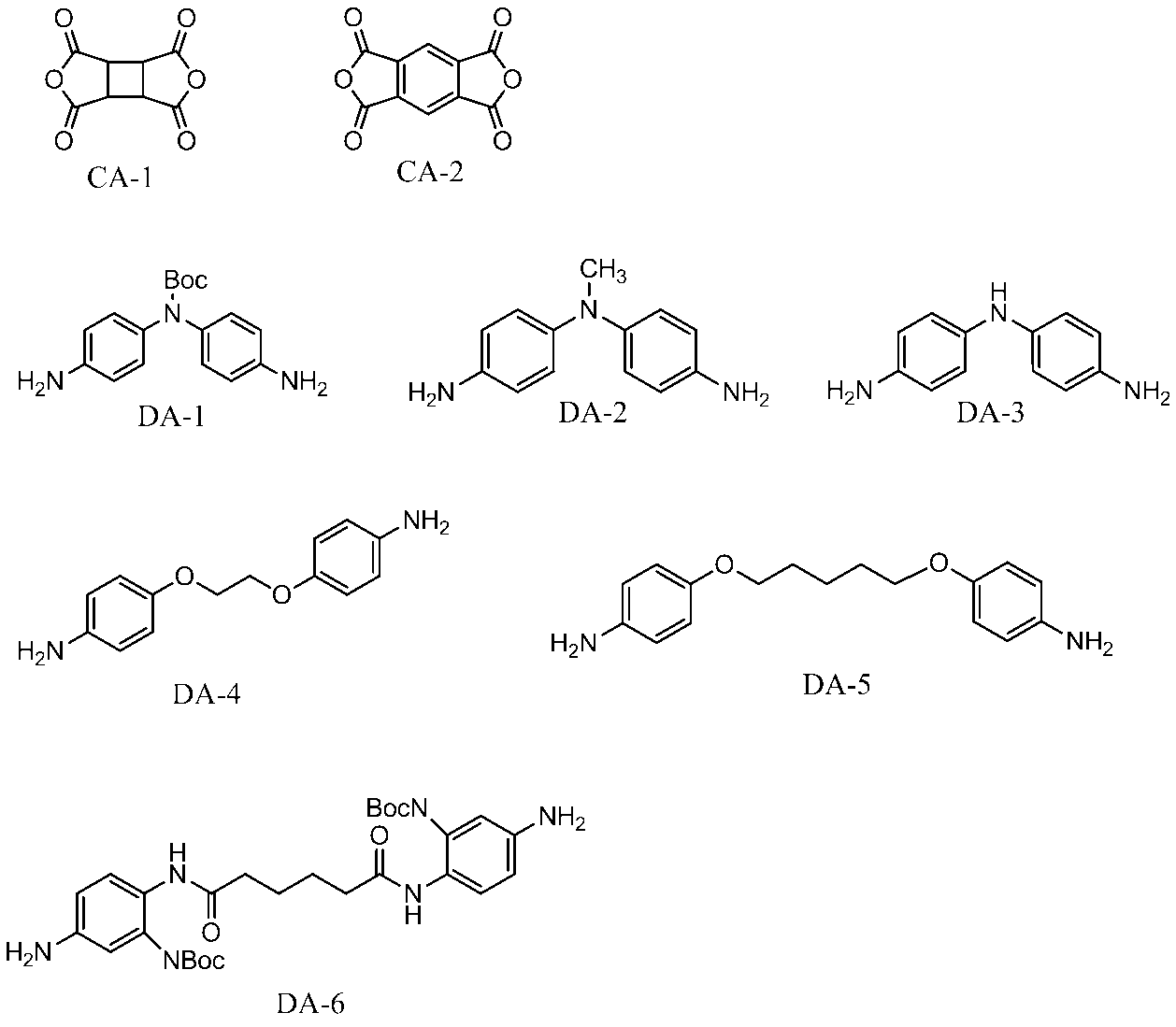
NMP:N-メチル-2-ピロリドン BCS:ブチルセロソルブ
<添加剤>
LS-4668:3-グリシドキシプロピルトリエトキシシラン
溶液の粘度は、E型粘度計TVE-22H(東機産業社製)を用い、サンプル量1.1mL、及びコーンロータTE-1(1°34’、R24)で温度25℃にて測定した。
始めに電極付きの基板を準備した。基板は、縦30mm×横35mmの長方形状で、厚さが0.7mmのガラス基板である。基板上には第1層目として対向電極を構成する、ベタ状のパターンを備えたIZO電極が形成されている。第1層目の対向電極の上には第2層目として、CVD法により成膜されたSiN(窒化珪素)膜が形成されている。第2層目のSiN膜の膜厚は500nmであり、層間絶縁膜として機能する。第2層目のSiN膜の上には、第3層目としてIZO膜をパターニングして形成された櫛歯状の画素電極が配置され、第1画素および第2画素の2つの画素を形成している。各画素のサイズは、縦10mmで横約5mmである。このとき、第1層目の対向電極と第3層目の画素電極とは、第2層目のSiN膜の作用により電気的に絶縁されている。
上記で得られた液晶セルを用い、60℃の恒温環境下、周波数30Hzで10VPPの交流電圧を168時間印加した。その後、液晶セルの画素電極と対向電極との間を短絡させた状態にし、そのまま室温に一日放置した。放置の後、液晶セルを偏光軸が直交するように配置された2枚の偏光板の間に設置し、電圧無印加の状態でバックライトを点灯させておき、透過光の輝度が最も小さくなるように液晶セルの配置角度を調整した。そして、第1画素の第2領域が最も暗くなる角度から第1領域が最も暗くなる角度まで液晶セルを回転させたときの回転角度を角度Δとして算出した。第2画素でも同様に、第2領域と第1領域とを比較し、同様の角度Δを算出した。そして、第1画素と第2画素の角度Δ値の平均値を液晶セルの角度Δとして算出した。
液晶セルの角度Δが小さいほど、液晶配向膜の液晶配向性が高いことを意味する。
得られた液晶配向剤を室温で24時間放置後、ガードナー色数を測定した。色調を表すガードナー色数は日本工業規格JIS K 0071-2に基づき測定を行った。ガードナー色数が小さいほど、得られた液晶配向剤の色が薄いことを意味する。
撹拌装置付きの50mLの四つ口フラスコを窒素雰囲気とし、DA-1を0.773g(2.58mmol)、及びDA-4を2.54g(10.4mmol)を量りとり、NMPを46.5g加え、窒素を送りながら撹拌して溶解させた。このジアミン溶液を撹拌しながら、CA-2を2.71g(12.4mmol)添加し、2時間室温で攪拌した後、50℃で24時間撹拌して、ポリアミック酸溶液(PAA-1、粘度:510.7mPa・s)を得た。
撹拌装置付きの50mLの四つ口フラスコを窒素雰囲気とし、DA-1を1.55g(5.18mmol)、及びDA-4を1.90g(7.78mmol)量りとり、NMPを54.6g加え、窒素を送りながら撹拌して溶解させた。このジアミン溶液を撹拌しながら、CA-2を2.71g(12.4mmol)添加し、2時間室温で攪拌した後、50℃で24時間撹拌して、ポリアミック酸溶液(PAA-2、粘度:505.4mPa・s)を得た。
撹拌装置付きの50mLの四つ口フラスコを窒素雰囲気とし、DA-1を0.773g(2.58mmol)、DA-4を2.22g(9.09mmol)、及びDA-6を0.724g(1.30mmol)量りとり、NMPを46.5g加え、窒素を送りながら撹拌して溶解させた。このジアミン溶液を撹拌しながら、CA-2を2.71g(12.4mmol)添加し、2時間室温で攪拌した後、50℃で24時間撹拌して、ポリアミック酸溶液(PAA-3、粘度:505.4mPa・s)を得た。
撹拌装置付きの50mLの四つ口フラスコを窒素雰囲気とし、DA-1を0.773g(2.58mmol)、及びDA-5を2.98g(10.4mmol)を量りとり、NMPを47.4g加え、窒素を送りながら撹拌して溶解させた。このジアミン溶液を撹拌しながら、CA-2を2.71g(12.4mmol)添加し、2時間室温で攪拌した後、50℃で24時間撹拌して、ポリアミック酸溶液(PAA-4、粘度:525.3mPa・s)を得た。
撹拌装置付きの50mLの四つ口フラスコを窒素雰囲気とし、DA-1を1.56g(5.21mmol)、及びDA-5を2.23g(7.79mmol)を量りとり、NMPを47.7g加え、窒素を送りながら撹拌して溶解させた。このジアミン溶液を撹拌しながらCA-2を2.71g(12.4mmol)添加し、2時間室温で攪拌した後、50℃で24時間撹拌して、ポリアミック酸溶液(PAA-5、粘度:510.4mPa・s)を得た。
撹拌装置付きの50mLの四つ口フラスコを窒素雰囲気とし、DA-1を0.778g(2.60mmol)、DA-5を2.60g(9.08mmol)、及びDA-6を0.724g(1.30mmol)量りとり、NMPを50.0g加え、窒素を送りながら撹拌して溶解させた。このジアミン溶液を撹拌しながら、CA-2を2.71g(12.4mmol)添加し、2時間室温で攪拌した後、50℃で24時間撹拌して、ポリアミック酸溶液(PAA-6、粘度:498.1mPa・s)を得た。
撹拌装置付きの50mLの四つ口フラスコを窒素雰囲気とし、DA-3を2.79g(14.0mmol)を量りとり、NMPを47.1g加え、窒素を送りながら撹拌して溶解させた。このジアミン溶液を撹拌しながら、CA-1を2.44g(12.4mmol)添加し、15℃で2時間攪拌した後、ポリアミック酸溶液(PAA-7、粘度:121.1mPa・s)を得た。
撹拌装置付きの50mLの四つ口フラスコを窒素雰囲気とし、DA-3を0.518g(2.60mmol)、及びDA-4を2.51g(10.3mmol)量りとり、NMPを42.3g加え、窒素を送りながら撹拌して溶解させた。このジアミン溶液を撹拌しながら、CA-2を2.71g(12.4mmol)添加し、2時間室温で攪拌した後、50℃で24時間撹拌して、ポリアミック酸溶液(PAA-8、粘度:531.5mPa・s)を得た。
撹拌装置付きの50mLの四つ口フラスコを窒素雰囲気とし、DA-3を1.04g(5.21mmol)、及びDA-4を1.91g(7.82mmol)量りとり、NMPを41.4g加え、窒素を送りながら撹拌して溶解させた。このジアミン溶液を撹拌しながら、CA-2を2.71g(12.4mmol)添加し、2時間室温で攪拌した後、50℃で24時間撹拌して、ポリアミック酸溶液(PAA-9、粘度:542.2mPa・s)を得た。
撹拌装置付きの50mLの四つ口フラスコを窒素雰囲気とし、DA-3を0.51g(2.56mmol)、及びDA-5を2.97g(10.4mmol)量りとり、NMPを47.2g加え、窒素を送りながら撹拌して溶解させた。このジアミン溶液を撹拌しながら、CA-2を2.71g(12.4mmol)添加し、2時間室温で攪拌した後、50℃で24時間撹拌して、ポリアミック酸溶液(PAA-10、粘度:547.1mPa・s)を得た。
撹拌装置付きの50mLの四つ口フラスコを窒素雰囲気とし、DA-3を0.51g(2.56mmol)、及びDA-5を2.97g(10.4mmol)量りとり、NMPを47.2g加え、窒素を送りながら撹拌して溶解させた。このジアミン溶液を撹拌しながら、CA-2を2.71g(12.4mmol)添加し、2時間室温で攪拌した後、50℃で24時間撹拌して、ポリアミック酸溶液(PAA-11、粘度:547.1mPa・s)を得た。
撹拌装置付きの50mL(リットル)の四つ口フラスコを窒素雰囲気とし、DA-1を3.29g(11.0mmol)を量りとり、NMPを46.1g加え、窒素を送りながら撹拌して溶解させた。このジアミン溶液を撹拌しながら、CA-1を1.91g(9.7mmol)添加し、15℃で2時間攪拌した後、ポリアミック酸溶液(PAA-12、粘度:121.1mPa・s)を得た。
撹拌装置付きの50mLの四つ口フラスコを窒素雰囲気とし、DA-2を2.77g(13.0mmol)を量りとり、NMPを46.1g加え、窒素を送りながら撹拌して溶解させた。このジアミン溶液を撹拌しながら、酸二無水物(CA-1)を2.34g(11.9mmol)添加し、15℃で2時間攪拌した後、ポリアミック酸溶液(PAA-13粘度:110.4mPa・s)を得た。
上記した合成例1~6及び比較合成例1~7において得られた10~12%のポリアミック酸溶液PAA-1~PAA13をの各々を24.0g分取し、それぞれに対して、NMPを5.6g、BCSを8.00g、及びLS-4668を1重量%含む混合溶液を2.4g攪拌しながら加え、次いで室温で2時間撹拌することにより、それぞれ、液晶配配向剤(AL-1)~(AL-13)を得た。
上記で得られた実施例1~6及び比較例1~7のそれぞれの液晶配向剤(AL-1)~(AL-13)について、上記で記載した、液晶配向性及びガードナー色数の評価を行った。結果を表1に示す。表1中、ガードナー色数が「-」は、未測定を意味する。

なお、2016年8月30日に出願された日本特許出願2016-168461号の明細書、特許請求の範囲、図面、及び要約書の全内容をここに引用し、本発明の明細書の開示として、取り入れるものである。
Claims (8)
- 下記式[1]で表される構造を有するジアミンを含有するジアミン成分とテトラカルボン酸二無水物成分との反応で得られるポリアミック酸、及び該ポリアミック酸をイミド化して得られるポリイミドからなる群より選ばれる少なくとも1つの重合体を含有することを特徴とする液晶配向剤。

- 前記熱脱離性基がtert-ブトキシカルボニル基又は9-フルオレニルメトキシカルボニル基である請求項1に記載の液晶配向剤。
- 前記式[1]で表される構造を有するジアミンが、下記のいずれかの式で表されるジアミンである請求項1又は2に記載の液晶配向剤。式中のBocはtert-ブトキシカルボニル基を表す。
- 前記ジアミン成分中の式[1]で表される構造を有するジアミンの含有量が、5~95mol%である請求項1~3のいずれか1項に記載の液晶配向剤。
- 前記テトラカルボン酸二無水物成分が、下記式[7]で表される化合物である請求項1~4のいずれか1項に記載の液晶配向剤。
- Z1が、下記式[7a]~[7k]のいずれかで表される構造のいずれかである請求項5に記載の液晶配向剤。
- 請求項1~6のいずれかに記載の液晶配向剤から得られる液晶配向膜。
- 請求項7に記載の液晶配向膜を具備する液晶表示素子。
Priority Applications (4)
| Application Number | Priority Date | Filing Date | Title |
|---|---|---|---|
| CN202510039108.XA CN119620472A (zh) | 2016-08-30 | 2017-08-25 | 液晶取向剂、液晶取向膜和使用其的液晶表示元件 |
| KR1020197008285A KR102469387B1 (ko) | 2016-08-30 | 2017-08-25 | 액정 배향제, 액정 배향막 및 그것을 사용한 액정 표시 소자 |
| CN201780066004.1A CN109863449A (zh) | 2016-08-30 | 2017-08-25 | 液晶取向剂、液晶取向膜和使用其的液晶表示元件 |
| JP2018537222A JP6996509B2 (ja) | 2016-08-30 | 2017-08-25 | 液晶配向剤、液晶配向膜及びそれを用いた液晶表示素子 |
Applications Claiming Priority (2)
| Application Number | Priority Date | Filing Date | Title |
|---|---|---|---|
| JP2016-168461 | 2016-08-30 | ||
| JP2016168461 | 2016-08-30 |
Publications (1)
| Publication Number | Publication Date |
|---|---|
| WO2018043325A1 true WO2018043325A1 (ja) | 2018-03-08 |
Family
ID=61305236
Family Applications (1)
| Application Number | Title | Priority Date | Filing Date |
|---|---|---|---|
| PCT/JP2017/030518 Ceased WO2018043325A1 (ja) | 2016-08-30 | 2017-08-25 | 液晶配向剤、液晶配向膜及びそれを用いた液晶表示素子 |
Country Status (5)
| Country | Link |
|---|---|
| JP (1) | JP6996509B2 (ja) |
| KR (1) | KR102469387B1 (ja) |
| CN (2) | CN109863449A (ja) |
| TW (1) | TWI756256B (ja) |
| WO (1) | WO2018043325A1 (ja) |
Cited By (2)
| Publication number | Priority date | Publication date | Assignee | Title |
|---|---|---|---|---|
| CN111971617A (zh) * | 2018-04-09 | 2020-11-20 | 日产化学株式会社 | 液晶取向剂、液晶取向膜和使用其的液晶表示元件 |
| CN115343886A (zh) * | 2022-10-18 | 2022-11-15 | 广州华星光电半导体显示技术有限公司 | 一种液晶配向层及其制备方法、液晶显示装置 |
Families Citing this family (1)
| Publication number | Priority date | Publication date | Assignee | Title |
|---|---|---|---|---|
| CN117866199B (zh) * | 2024-03-11 | 2024-05-28 | 烟台三月科技有限责任公司 | 一种液晶取向剂、液晶取向膜及其液晶显示元件 |
Citations (2)
| Publication number | Priority date | Publication date | Assignee | Title |
|---|---|---|---|---|
| JP2015166844A (ja) * | 2014-02-13 | 2015-09-24 | Jsr株式会社 | 液晶配向剤、液晶配向膜、液晶表示素子、位相差フィルム、位相差フィルムの製造方法、重合体及び化合物 |
| JP2016095488A (ja) * | 2014-11-05 | 2016-05-26 | Jsr株式会社 | 液晶配向剤、液晶配向膜、液晶表示素子、重合体及び化合物 |
Family Cites Families (13)
| Publication number | Priority date | Publication date | Assignee | Title |
|---|---|---|---|---|
| JP2780183B2 (ja) | 1989-02-27 | 1998-07-30 | セイコーエプソン株式会社 | 配向膜および液晶装置 |
| JP2893671B2 (ja) | 1991-03-11 | 1999-05-24 | ジェイエスアール株式会社 | 液晶配向剤 |
| JP3097702B2 (ja) | 1991-08-13 | 2000-10-10 | 日産化学工業株式会社 | 新規な液晶配向処理剤 |
| DE59408097D1 (de) | 1993-02-17 | 1999-05-20 | Rolic Ag | Orientierungsschicht für Flüssigkristalle |
| JP3893659B2 (ja) | 1996-03-05 | 2007-03-14 | 日産化学工業株式会社 | 液晶配向処理方法 |
| JP5223775B2 (ja) * | 2009-05-25 | 2013-06-26 | セントラル硝子株式会社 | 液浸レジスト用撥水性添加剤 |
| JP5884258B2 (ja) * | 2009-09-18 | 2016-03-15 | Jnc株式会社 | 液晶配向剤、液晶配向膜、液晶配向膜の製造方法および液晶表示素子 |
| TWI501998B (zh) * | 2010-03-15 | 2015-10-01 | Nissan Chemical Ind Ltd | A liquid crystal aligning agent containing a polyamic acid ester, and a liquid crystal alignment film |
| JP5737291B2 (ja) * | 2010-08-17 | 2015-06-17 | 日産化学工業株式会社 | ジアミン前駆体化合物の製造方法 |
| KR101878518B1 (ko) * | 2010-10-19 | 2018-07-13 | 닛산 가가쿠 고교 가부시키 가이샤 | 광 배향 처리법에 적합한 액정 배향제, 및 그것을 사용한 액정 배향막 |
| JP5929298B2 (ja) | 2011-03-02 | 2016-06-01 | Jnc株式会社 | ジアミン、これを用いた液晶配向剤、液晶表示素子および液晶配向膜の形成方法 |
| KR102241786B1 (ko) * | 2013-10-23 | 2021-04-16 | 닛산 가가쿠 가부시키가이샤 | 열 탈리성기를 갖는 폴리이미드 전구체 및/또는 폴리이미드를 함유하는 액정 배향제 |
| JP2016138236A (ja) * | 2014-12-26 | 2016-08-04 | Jsr株式会社 | 組成物、液晶配向剤、液晶配向膜及び液晶表示素子 |
-
2017
- 2017-08-25 KR KR1020197008285A patent/KR102469387B1/ko active Active
- 2017-08-25 WO PCT/JP2017/030518 patent/WO2018043325A1/ja not_active Ceased
- 2017-08-25 CN CN201780066004.1A patent/CN109863449A/zh active Pending
- 2017-08-25 JP JP2018537222A patent/JP6996509B2/ja active Active
- 2017-08-25 CN CN202510039108.XA patent/CN119620472A/zh active Pending
- 2017-08-30 TW TW106129429A patent/TWI756256B/zh active
Patent Citations (2)
| Publication number | Priority date | Publication date | Assignee | Title |
|---|---|---|---|---|
| JP2015166844A (ja) * | 2014-02-13 | 2015-09-24 | Jsr株式会社 | 液晶配向剤、液晶配向膜、液晶表示素子、位相差フィルム、位相差フィルムの製造方法、重合体及び化合物 |
| JP2016095488A (ja) * | 2014-11-05 | 2016-05-26 | Jsr株式会社 | 液晶配向剤、液晶配向膜、液晶表示素子、重合体及び化合物 |
Cited By (3)
| Publication number | Priority date | Publication date | Assignee | Title |
|---|---|---|---|---|
| CN111971617A (zh) * | 2018-04-09 | 2020-11-20 | 日产化学株式会社 | 液晶取向剂、液晶取向膜和使用其的液晶表示元件 |
| CN115343886A (zh) * | 2022-10-18 | 2022-11-15 | 广州华星光电半导体显示技术有限公司 | 一种液晶配向层及其制备方法、液晶显示装置 |
| CN115343886B (zh) * | 2022-10-18 | 2023-01-10 | 广州华星光电半导体显示技术有限公司 | 一种液晶配向层及其制备方法、液晶显示装置 |
Also Published As
| Publication number | Publication date |
|---|---|
| JP6996509B2 (ja) | 2022-01-17 |
| CN109863449A (zh) | 2019-06-07 |
| JPWO2018043325A1 (ja) | 2019-06-24 |
| KR102469387B1 (ko) | 2022-11-21 |
| KR20190045231A (ko) | 2019-05-02 |
| TWI756256B (zh) | 2022-03-01 |
| CN119620472A (zh) | 2025-03-14 |
| TW201825659A (zh) | 2018-07-16 |
Similar Documents
| Publication | Publication Date | Title |
|---|---|---|
| JP6070958B2 (ja) | 新規ジアミン、重合体、液晶配向剤、液晶配向膜、及びそれを用いた液晶表示素子 | |
| JP6314827B2 (ja) | 液晶配向剤、液晶配向膜及び液晶表示素子 | |
| JP6083388B2 (ja) | 液晶配向剤の製造方法 | |
| JP7027890B2 (ja) | 液晶配向剤、液晶配向膜及び液晶表示素子 | |
| JP5900328B2 (ja) | 液晶配向剤、それを用いた液晶配向膜及び液晶表示素子 | |
| WO2014104015A1 (ja) | 新規ジアミン、重合体、液晶配向剤、液晶配向膜及びそれを用いた液晶表示素子 | |
| JP7081488B2 (ja) | 液晶配向剤、液晶配向膜及び液晶表示素子 | |
| WO2020080477A1 (ja) | 液晶配向剤、液晶配向膜及びそれを用いた液晶表示素子 | |
| JP6996509B2 (ja) | 液晶配向剤、液晶配向膜及びそれを用いた液晶表示素子 | |
| WO2014189104A1 (ja) | 液晶配向剤、液晶配向膜およびそれを用いた液晶表示素子 | |
| JP6330662B2 (ja) | 液晶配向剤、液晶配向膜及び液晶表示素子 | |
| WO2014092170A1 (ja) | 液晶配向剤、液晶配向膜及び液晶表示素子 | |
| KR102597729B1 (ko) | 액정 배향제, 액정 배향막, 및 액정 표시 소자 |
Legal Events
| Date | Code | Title | Description |
|---|---|---|---|
| 121 | Ep: the epo has been informed by wipo that ep was designated in this application |
Ref document number: 17846330 Country of ref document: EP Kind code of ref document: A1 |
|
| ENP | Entry into the national phase |
Ref document number: 2018537222 Country of ref document: JP Kind code of ref document: A |
|
| NENP | Non-entry into the national phase |
Ref country code: DE |
|
| ENP | Entry into the national phase |
Ref document number: 20197008285 Country of ref document: KR Kind code of ref document: A |
|
| 122 | Ep: pct application non-entry in european phase |
Ref document number: 17846330 Country of ref document: EP Kind code of ref document: A1 |