WO2018021153A1 - 肺がんリスク状態の評価方法,肺がんリスク状態評価装置,肺がんリスク状態評価プログラム,肺がんリスク状態評価システム及び情報通信端末装置 - Google Patents
肺がんリスク状態の評価方法,肺がんリスク状態評価装置,肺がんリスク状態評価プログラム,肺がんリスク状態評価システム及び情報通信端末装置 Download PDFInfo
- Publication number
- WO2018021153A1 WO2018021153A1 PCT/JP2017/026356 JP2017026356W WO2018021153A1 WO 2018021153 A1 WO2018021153 A1 WO 2018021153A1 JP 2017026356 W JP2017026356 W JP 2017026356W WO 2018021153 A1 WO2018021153 A1 WO 2018021153A1
- Authority
- WO
- WIPO (PCT)
- Prior art keywords
- lung cancer
- evaluation
- cancer risk
- risk state
- concentration data
- Prior art date
- Legal status (The legal status is an assumption and is not a legal conclusion. Google has not performed a legal analysis and makes no representation as to the accuracy of the status listed.)
- Ceased
Links
Images




Classifications
-
- G—PHYSICS
- G16—INFORMATION AND COMMUNICATION TECHNOLOGY [ICT] SPECIALLY ADAPTED FOR SPECIFIC APPLICATION FIELDS
- G16H—HEALTHCARE INFORMATICS, i.e. INFORMATION AND COMMUNICATION TECHNOLOGY [ICT] SPECIALLY ADAPTED FOR THE HANDLING OR PROCESSING OF MEDICAL OR HEALTHCARE DATA
- G16H50/00—ICT specially adapted for medical diagnosis, medical simulation or medical data mining; ICT specially adapted for detecting, monitoring or modelling epidemics or pandemics
- G16H50/30—ICT specially adapted for medical diagnosis, medical simulation or medical data mining; ICT specially adapted for detecting, monitoring or modelling epidemics or pandemics for calculating health indices; for individual health risk assessment
-
- G—PHYSICS
- G01—MEASURING; TESTING
- G01N—INVESTIGATING OR ANALYSING MATERIALS BY DETERMINING THEIR CHEMICAL OR PHYSICAL PROPERTIES
- G01N33/00—Investigating or analysing materials by specific methods not covered by groups G01N1/00 - G01N31/00
- G01N33/48—Biological material, e.g. blood, urine; Haemocytometers
- G01N33/50—Chemical analysis of biological material, e.g. blood, urine; Testing involving biospecific ligand binding methods; Immunological testing
- G01N33/53—Immunoassay; Biospecific binding assay; Materials therefor
-
- G—PHYSICS
- G01—MEASURING; TESTING
- G01N—INVESTIGATING OR ANALYSING MATERIALS BY DETERMINING THEIR CHEMICAL OR PHYSICAL PROPERTIES
- G01N33/00—Investigating or analysing materials by specific methods not covered by groups G01N1/00 - G01N31/00
- G01N33/48—Biological material, e.g. blood, urine; Haemocytometers
- G01N33/50—Chemical analysis of biological material, e.g. blood, urine; Testing involving biospecific ligand binding methods; Immunological testing
- G01N33/53—Immunoassay; Biospecific binding assay; Materials therefor
- G01N33/575—Immunoassay; Biospecific binding assay; Materials therefor for cancer
-
- G—PHYSICS
- G06—COMPUTING OR CALCULATING; COUNTING
- G06Q—INFORMATION AND COMMUNICATION TECHNOLOGY [ICT] SPECIALLY ADAPTED FOR ADMINISTRATIVE, COMMERCIAL, FINANCIAL, MANAGERIAL OR SUPERVISORY PURPOSES; SYSTEMS OR METHODS SPECIALLY ADAPTED FOR ADMINISTRATIVE, COMMERCIAL, FINANCIAL, MANAGERIAL OR SUPERVISORY PURPOSES, NOT OTHERWISE PROVIDED FOR
- G06Q50/00—Information and communication technology [ICT] specially adapted for implementation of business processes of specific business sectors, e.g. utilities or tourism
- G06Q50/10—Services
- G06Q50/22—Social work or social welfare, e.g. community support activities or counselling services
Definitions
- the present invention relates to a lung cancer risk state evaluation method, an evaluation device, a program, an evaluation system, and an information communication terminal device used for evaluating a lung cancer risk state based on the concentration data of cytokines collected from an evaluation target.
- Non-patent Document 1 Non-patent Document 1
- Patent Documents 1 to 4 proposals have been made to use the concentration data of cytokines in body fluids for cancer diagnosis.
- cytokine network responsible for information transmission in vivo is extremely complex, and it is still difficult to determine the lung cancer risk status from cytokine concentration data.
- the present invention has been made in view of the above-described conventional situation, and an evaluation method capable of determining a lung cancer risk state with high reliability from cytokine concentration data, and an evaluation apparatus, program, evaluation system, and information communication terminal used therefor Providing a device is a problem to be solved.
- the present inventors have found that there is a high correlation between the two. Furthermore, it was found that the risk status of lung cancer can be evaluated with high reliability by using an expression including at least two variables into which the concentration values of at least two cytokines are substituted, and the present invention has been completed. It was.
- the lung cancer risk state evaluation method of the present invention is capable of evaluating a lung cancer risk state based on a data acquisition step for acquiring cytokine concentration data in a sample collected from an evaluation target, and the cytokine concentration data.
- An evaluation step of substituting the concentration data of the cytokine into a risk calculation formula to evaluate the lung cancer risk state in the evaluation target wherein the data acquisition step includes at least two types of evaluation methods Cytokine concentration data is acquired, and the risk calculation formula includes at least two variables into which at least two types of cytokine concentration values are substituted.
- the value of the formula is calculated.
- the lung cancer risk status in the evaluation target is evaluated.
- it is also possible to reduce various burdens on the users for example, mental burden, physical burden, time burden, or financial burden). Play.
- the lung cancer risk state is a degree of possibility that the lung cancer is in the lung cancer. It is possible to evaluate the possibility of having the lung cancer. Further, the lung cancer risk state may include, for example, the degree of lung cancer progression, the degree of possibility of becoming lung cancer in the future, and the like.
- a plurality of categories defined in consideration of at least the degree of possibility of being in the lung cancer risk state, and one or a plurality of threshold values are preset.
- the evaluation of the degree of possibility that the evaluation target is in the lung cancer risk state means that the evaluation target is classified into any one of the plurality of categories using the value of the risk calculation formula and the threshold value. Is to do.
- the risk calculation formula in the evaluation method of the present invention is a regression formula, multiple regression formula, fractional formula, linear discriminant formula, formula created by machine learning, formula created by Mahalanobis distance method, canonical discriminant analysis. And any one of the formulas created by the decision tree. As a result, there is an effect that it is possible to further improve the reliability of information that can be used as a reference in knowing the state of the risk of lung cancer.
- the cytokine concentration data includes IL-1 ⁇ , IL-1ra, IL-5, IL-6, IL-7, IL-8, IL-9, IL- 10, -12IL-12, G-CSF, PDGF, MIP-1 ⁇ , TNF- ⁇ , VEGF, Eotaxin, MCP-1 and MIP-1 ⁇ concentration data are included.
- IL-1 ⁇ Concentration data of IL-12, G-CSF, PDGF, MIP-1 ⁇ , TNF- ⁇ , VEGF, Eotaxin, MCP-1 and MIP-1 ⁇ are particularly relevant to lung cancer. Therefore, by evaluating the lung cancer risk status from the concentration data of at least two kinds of these cytokines, the lung cancer risk status can be evaluated with higher reliability.
- a data acquisition step for acquiring cytokine concentration data in a sample collected from an evaluation target, an evaluation step for evaluating a lung cancer risk state based on the cytokine concentration data In the data acquisition step, IL-1 ⁇ , IL-1ra, IL-5, IL-6, IL-7, IL-8, IL-9, IL-10, Concentration data of at least two kinds of cytokines such as IL-12, G-CSF, PDGF, MIP-1 ⁇ , TNF- ⁇ , VEGF, Eotaxin, MCP-1 and MIP-1 ⁇ can be obtained.
- cytokines among many types of cytokines, IL-1 ⁇ , IL-1ra, IL-5, IL-6, IL-7, IL-8, IL-9, IL- 10, ⁇ ⁇ ⁇ IL-12, G-CSF, PDGF, MIP-1 ⁇ , TNF- ⁇ , VEGF, Eotaxin, MCP-1 and MIP-1 ⁇ concentration data are particularly relevant to lung cancer. Therefore, by evaluating the lung cancer risk status from the concentration data of at least two kinds of these cytokines, the lung cancer risk status can be evaluated with higher reliability.
- the lung cancer risk state evaluation apparatus is an apparatus for evaluating a lung cancer risk state in an evaluation target, and includes a control unit and a storage unit, and the control unit includes concentration data and cytokines of the cytokine to be evaluated By calculating the value of the risk calculation formula using a risk calculation formula that can be used to evaluate a lung cancer risk state, which is stored in advance in the storage unit, including a variable to which the concentration value of the value is substituted.
- the lung cancer risk state evaluation method of the present invention is an evaluation method for a lung cancer risk state in an evaluation target, which is executed in an information processing apparatus including a control unit and a storage unit, and is executed in the control unit.
- a risk calculation formula for evaluating the lung cancer risk state stored in the storage unit in advance including the cytokine concentration data of the evaluation target acquired in advance regarding the concentration value of the cytokine and a variable into which the concentration value of the cytokine is substituted
- An evaluation step for evaluating the lung cancer risk state in the evaluation target by calculating the value of the risk calculation formula using the cytokine concentration data, and the cytokine concentration data includes concentration values of at least two types of cytokines , At least two types of cytokine concentration values are substituted into the risk calculation formula. Wherein the Kutomo two variables are included.
- a lung cancer risk state evaluation program is a lung cancer risk state evaluation program for evaluating a state of lung cancer risk in an evaluation target to be executed by an information processing apparatus including a control unit and a storage unit, wherein the control Evaluation of the lung cancer risk state stored in advance in the storage unit, including the cytokine concentration data of the evaluation target acquired in advance relating to the concentration value of the cytokine and a variable into which the concentration value of the cytokine is substituted.
- the lung cancer risk state evaluation system of the present invention includes a control unit and a storage unit, includes a lung cancer risk state evaluation device that evaluates a lung cancer risk state in the evaluation target, and a control unit, and the evaluation target related to the concentration value of cytokines
- An information communication terminal device that provides the cytokine concentration data of the lung cancer risk state evaluation system that is communicably connected via a network, wherein the control unit of the information communication terminal device is configured to evaluate the cytokine to be evaluated
- the control unit of the lung cancer risk state evaluation apparatus communicates the information.
- Cytokine concentration data receiving means for receiving the cytokine concentration data of the evaluation object transmitted from the terminal device, and the cytokine concentration data of the evaluation object and the concentration value of the cytokine received by the cytokine concentration data receiving means are substituted.
- the cytokine concentration data includes at least two types of cytokine concentration data
- the risk calculation formula includes at least two variables into which at least two types of cytokine concentration values are substituted. It is characterized by being.
- the information communication terminal device of the present invention includes a lung cancer risk state evaluation device that evaluates a lung cancer risk state in an evaluation target and a control unit that is communicably connected via a network, and the evaluation target related to a cytokine concentration value
- An information communication terminal device for providing the cytokine concentration data of the device, wherein the control unit transmits the cytokine concentration data to be evaluated to the lung cancer risk state evaluation device, and the lung cancer risk state evaluation Evaluation result receiving means for receiving an evaluation result related to the state of the lung cancer risk in the evaluation target transmitted from a device, wherein the evaluation result is transmitted from the information communication terminal device by the lung cancer risk state evaluation device.
- the cytokine concentration data includes at least two variables into which the concentration values of at least two cytokines are substituted.
- the lung cancer risk state evaluation apparatus of the present invention includes an information communication terminal device that provides cytokine concentration data to be evaluated with respect to a cytokine concentration value, and a control unit and a storage unit that are communicably connected via a network.
- a lung cancer risk state evaluation apparatus for evaluating a lung cancer risk state in the evaluation object wherein the control unit receives the cytokine concentration data of the evaluation object transmitted from the information communication terminal device.
- the cytokine concentration data includes at least two types of cytokine concentration data
- the risk calculation formula includes at least two variables into which at least two types of cytokine concentration values are substituted. It is characterized by that.
- FIG. 1 is a diagram illustrating a basic principle of Embodiment 1.
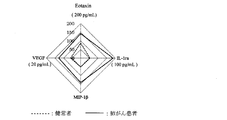
- FIG. FIG. 4 is a diagram showing a time schedule for sample collection in the first embodiment. It is a graph which shows the density
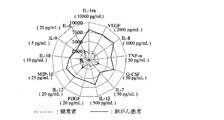
- FIG. It is a graph which shows the density
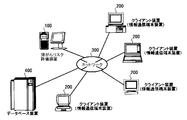
- FIG. 3 is a flowchart illustrating an example of a method for evaluating a lung cancer risk state according to the first embodiment. It is a figure which shows an example of the whole structure of this system. It is a block diagram which shows an example of a structure of the lung cancer risk evaluation apparatus 100 of this system.
- FIG. 1 is a principle configuration diagram showing the basic principle of the first embodiment.
- cytokine concentrations of a sample eg, blood, saliva, buccal mucosa, plasma, serum, sweat, urine, etc.
- an evaluation object e.g., a sample obtained from a sample.
- cytokine concentrations of a sample eg, blood, saliva, buccal mucosa, plasma, serum, sweat, urine, etc.
- cytokine concentration data measured by a company or the like that measures the concentration of cytokine may be acquired, or a measurement sample is collected from blood, saliva, or buccal mucosa collected from an evaluation target and measured. May be.
- the unit of the cytokine concentration data is not particularly limited, and for example, it may be obtained by adding / subtracting / dividing an arbitrary constant to the molar concentration, the weight concentration, or these concentrations.
- the lung cancer risk state in the evaluation target is evaluated using the two or more types of cytokine concentration data acquired in step S11 as an evaluation value for evaluating the lung cancer risk state (step S12).
- the evaluation method of the first embodiment by using a plurality of cytokine concentration data, it provides highly reliable information that can be used as a reference for knowing the lung cancer risk status as compared to the case of using a single cytokine concentration data. can do. In addition to improving the reliability of this information, it is also possible to reduce various burdens on the users (for example, mental burden, physical burden, time burden, or financial burden). Play.
- a risk calculation formula including two or more types of cytokine concentration data as a variable can be used.
- cytokine concentration data it is preferable to select a cytokine having a high correlation with lung cancer based on the results obtained by examining the correlation between various cytokines and lung cancer patients in advance.
- a risk calculation formula for example, a formula of (concentration of cytokine A) + (concentration of cytokine B) can be mentioned. In this way, the assessment of lung cancer risk status can be quantified as a specific numerical value.
- weighting may be performed for each type of cytokine based on the results obtained by examining the correlation between various cytokines and lung cancer patients in advance.
- the value was added using (the value of the concentration data of each cytokine) / (the average value of the concentration data of each cytokine of a person who does not have lung cancer) (or with a certain weight on the value). You may evaluate by a value.
- the cytokine concentration value may be corrected according to age, sex, race, presence / absence of oncogene expression, lifestyle, and the like. The degree of these corrections and the presence or absence of correction may be changed depending on the type of cytokine.
- the evaluation value obtained as described above may be compared with a general person (for example, the average value of Japanese), and the lung cancer risk state may be indicated by the magnification (see Table 1).
- step S12 when a plurality of categories defined in consideration of at least the degree of possibility of being in a lung cancer risk state and one or a plurality of threshold values are set in advance, in step S12, at least one of the plurality of cytokines. If the concentration value of two cytokines or the concentration value is converted, the evaluation target may be classified into one of a plurality of categories using the converted value and the threshold value, and the formula When the value of or the value of the expression is converted, the evaluation target may be classified into any one of a plurality of categories using the converted value and the threshold value. This makes it possible to provide highly reliable information that can be used as a reference for knowing the degree of possibility of being in a lung cancer risk state in an easily understandable form.
- a boundary value when the specificity becomes a predetermined value may be set as the threshold value.
- a boundary value when the specificity becomes a predetermined value is set as a threshold value. Also good.
- evaluation formulas are logistic regression formula, fractional formula, linear discriminant formula, multiple regression formula, formula created by support vector machine, formula created by Mahalanobis distance method, formula created by canonical discriminant analysis, decision It can be any one of the expressions created with trees. As a result, it is possible to further improve the reliability of information that can be used as a reference for knowing the state of lung cancer.
- the expression adopted as the evaluation expression means the form of the expression generally used in multivariate analysis.
- Examples of the expression adopted as the evaluation expression include a fractional expression, multiple regression expression, multiple logistic regression expression, Examples include linear discriminant functions, Mahalanobis distances, canonical discriminant functions, support vector machines, decision trees, and expressions that are expressed as sums of expressions in different forms.
- a coefficient and a constant term are added to each variable.
- the coefficient and the constant term may be real numbers, and more preferably , Any value that belongs to the range of the 99% confidence interval of the coefficient and constant term obtained for performing the various classifications from the data, and more preferably, the value obtained for performing the various classifications from the data. Any value belonging to the range of 95% confidence interval of the coefficient and constant term may be used.
- the value of each coefficient and its confidence interval may be a real number multiple thereof, and the value of the constant term and its confidence interval may be obtained by adding / subtracting / dividing any real constant to it.
- the cytokine concentration data includes IL-1 ⁇ , IL-1ra, IL-5, IL-6, IL- 7, IL-8, IL-9, IL-10, IL-12, G-CSF, PDGF, MIP-1 ⁇ , TNF- ⁇ , VEGF, Eotaxin, MCP-1 and MIP-1 ⁇
- Concentration data is included, and the risk calculation formula includes IL-1 ⁇ , IL-1ra, IL-5, IL-6, IL-7, IL-8, IL-9, IL-10, IL-12.
- cytokines IL-1 ⁇ , IL-1ra, IL-5, IL-6, IL-7, IL-8, IL-9, IL- 10, IL-12, G-CSF, PDGF, MIP-1 ⁇ , TNF- ⁇ , VEGF, Eotaxin, MCP-1 and MIP-1 ⁇ concentration data are particularly relevant to lung cancer. Therefore, by evaluating the lung cancer risk status from the concentration data of at least two kinds of these cytokines, the lung cancer risk status can be evaluated with higher reliability.
- Example 1 Blood, saliva, and buccal mucosa extracts from 23 healthy men and women and 8 men and women with lung cancer were collected and analyzed for cytokines (27 species). Samples were collected in the morning (7am to 9am), noon (11am to 13pm) and evening (15am to 5pm). In addition, a saliva occult blood test was conducted as a preliminary test before specimen collection (see FIG. 2 and Table 2).
- biomarker analyzer Bio-Plex® (Bio-Rad Laboratories) and cytokine analysis kit: Bio-Plex® Pro-Human® Cytokine® 27-Plex® (Bio-Rad Laboratories) was used to measure the concentrations of 27 types of cytokines.
- cytokine analysis kit Bio-Plex® Pro-Human® Cytokine® 27-Plex® (Bio-Rad Laboratories) was used to measure the concentrations of 27 types of cytokines.
- IBM SPSS Statistics IBM Japan, Ltd.
- results for blood samples, saliva samples, and buccal mucosa samples were as follows. (About blood samples) The results are shown in Table 4 and FIG. From these charts, the levels of IL-1ra, Eotaxin, MIP-1 ⁇ , and VEGF in the blood are higher in lung cancer patients than in healthy individuals, and by measuring the blood levels of these cytokines, It can be seen that lung cancer risk status can be determined. However, these cytokines may also be correlated with cancer risk status other than lung cancer, and in such cases, the reliability of assessment of lung cancer risk status may be reduced. On the other hand, if two or more of these cytokines are measured and evaluated in consideration of the respective results, the risk status of lung cancer can be evaluated with high reliability.
- the value of the equation is calculated using an equation set in advance as an evaluation equation based on the cytokine concentration data. And evaluate.
- FIG. 6 is a principle configuration diagram showing the basic principle of the second embodiment.
- the control unit includes IL-1 ⁇ , IL-1ra, IL-5, IL-6, IL-7, IL-8, IL-, which are included in the cytokine concentration data of the evaluation target acquired in advance regarding the concentration value of cytokine.
- IL-10, IL-12, G-CSF, PDGF, MIP-1 ⁇ , TNF- ⁇ , VEGF, Eotaxin, MCP-1 and MIP-1 ⁇ Formula for evaluating lung cancer risk state, which is stored in advance in the storage unit including variables to be substituted (contains at least two variables into which the concentration values of at least two of the 27 cytokines are substituted) To evaluate the lung cancer risk status in the evaluation target by calculating the value of the expression.
- the lung cancer risk state in the evaluation target is evaluated by calculating the value of the evaluation formula using the cytokine concentration data to be evaluated and the formula stored in the storage unit as the evaluation formula.
- the lung cancer risk state may be the degree of possibility of having lung cancer.
- the calculated expression value reflects the lung cancer risk state in the evaluation target, and the expression value is converted by, for example, the following method, and the converted value is evaluated. It may be determined that it reflects the lung cancer risk status in the subject. In other words, the value of the expression or the converted value itself may be handled as the evaluation result regarding the lung cancer risk state in the evaluation target. As a result, it is possible to provide highly reliable information that can be helpful in knowing the risk of lung cancer. For example, an arbitrary value is added / subtracted / divided / divided from / to the value of the evaluation expression so that the possible range of the value of the evaluation expression falls within a predetermined range, or the value of the evaluation expression is converted into a predetermined conversion method (for example, exponential conversion).
- a predetermined conversion method for example, exponential conversion
- the value of the evaluation expression is converted. May be.
- the value of the exponential function with the value of the evaluation formula as the index and the Napier number as the base specifically, the natural logarithm ln (p / (1-p)) when defining the probability p of having lung cancer (P / (1 ⁇ p) value in the case where is equal to the value of the evaluation formula), or a value obtained by dividing the calculated exponential function value by the sum of 1 and the value ( Specifically, the value of probability p) may be further calculated.
- the value of the evaluation expression may be converted so that the value after conversion under a specific condition becomes a specific value.
- the value of the evaluation formula may be converted so that the converted value when the specificity is 80% is 5.0 and the converted value when the specificity is 95% is 8.0. .
- the value of the formula or the value of the formula is converted.
- the evaluation target may be classified into any one of a plurality of categories using the converted value and the threshold value.
- the present system includes a lung cancer risk evaluation apparatus 100 that evaluates a lung cancer risk state in an individual to be evaluated, and a client apparatus 200 that provides the individual's cytokine concentration data related to the concentration value of the cytokine (of the present invention). And an information communication terminal device) are communicably connected via the network 300. Furthermore, in addition to the lung cancer risk evaluation apparatus 100 and the client apparatus 200, the present system uses the lung cancer risk state information used when creating an evaluation formula in the lung cancer risk evaluation apparatus 100, and an evaluation used for evaluating the lung cancer risk state.
- a database apparatus 400 storing equations and the like is configured to be communicably connected via a network 300. Thereby, it becomes reference in knowing the lung cancer risk state from the lung cancer risk evaluation apparatus 100 to the client apparatus 200 or the database apparatus 400 or from the client apparatus 200 or the database apparatus 400 to the lung cancer risk evaluation apparatus 100 via the network 300.
- Information is provided.
- the information that is useful for knowing the lung cancer risk state is information about values measured for specific items related to the lung cancer risk state of organisms including humans.
- information that is useful for knowing the lung cancer risk state is generated by the lung cancer risk evaluation apparatus 100, the client apparatus 200, and other apparatuses (for example, various measurement apparatuses) and is mainly stored in the database apparatus 400.
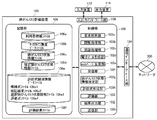
- FIG. 8 is a block diagram showing an example of the configuration of the lung cancer risk evaluation apparatus 100 of the present system, and conceptually shows only the portion related to the present invention in the configuration.
- the lung cancer risk evaluation apparatus 100 is connected to the network 300 via a control unit 102 such as a CPU that centrally controls the lung cancer risk evaluation apparatus, a communication apparatus such as a router, and a communication line such as a dedicated line.
- the communication interface unit 104 is connected to be communicable, the storage unit 106 stores various databases, tables, files, and the like, and the input / output interface unit 108 connects to the input device 112 and the output device 114. These units are communicably connected via an arbitrary communication path.
- the lung cancer risk evaluation apparatus 100 may be configured in the same housing as various analysis apparatuses.
- the storage unit 106 is a storage unit, and stores a computer program for giving instructions to the CPU and performing various processes in cooperation with an OS (Operating System).
- the storage unit 106 includes a user information file 106a, a cytokine concentration data file 106b, a lung cancer risk state information file 106c, a designated lung cancer risk state information file 106d, an evaluation formula related information database 106e, an evaluation result file 106f, Is stored.
- the user information file 106a stores user information related to users.
- the cytokine concentration data file 106b stores cytokine concentration data relating to the cytokine concentration value.
- the lung cancer risk state information file 106c stores lung cancer risk state information used when creating an evaluation formula.
- the designated lung cancer risk state information file 106d stores the lung cancer risk state information specified by the lung cancer risk state information specifying unit 102g described later.
- the evaluation formula related information database 106e includes a candidate formula file 106e1 for storing a candidate formula created by a candidate formula creation unit 102h1 described later, a verification result file 106e2 for storing a verification result of a candidate formula verification unit 102h2 described later,
- the selected lung cancer risk state information file 106e3 that stores lung cancer risk state information including the combination of cytokine concentration data selected by the variable selection unit 102h3 to be evaluated, and the evaluation formula file 106e4 that stores the evaluation formula created by the evaluation formula creation unit 102h described later And.
- the candidate formula file 106e1 stores the candidate formula created by the candidate formula creation unit 102h1 described later.
- the verification result file 106e2 stores the verification result in the candidate formula verification unit 102h2 described later.
- the information stored in the verification result file 106e2 is configured by associating ranks, candidate formulas, and verification results of each candidate formula (for example, evaluation values of each candidate formula) with each other.
- the selected lung cancer risk state information file 106e3 stores lung cancer risk state information including a combination of cytokine concentration data corresponding to variables selected by the variable selection unit 102h3 described later.
- Information stored in the selected lung cancer risk state information file 106e3 includes an individual number, lung cancer risk state index data specified by a lung cancer risk state information specifying unit 102g described later, cytokine concentration data selected by a variable selecting unit 102h3 described later, and , Are related to each other.
- the evaluation formula file 106e4 stores the evaluation formula created by the later-described evaluation formula creation unit 102h.
- the evaluation result file 106f stores the evaluation result obtained by the evaluation unit 102i described later.
- the storage unit 106 stores various types of Web data for providing the Web site to the client device 200, CGI programs, and the like as other information.
- the communication interface unit 104 mediates communication between the lung cancer risk evaluation apparatus 100 and the network 300 (or a communication apparatus such as a router). That is, the communication interface unit 104 has a function of communicating data with other terminals via a communication line.
- the input / output interface unit 108 is connected to the input device 112 and the output device 114 (hereinafter, the output device 114 may be described as the monitor 114).
- the control unit 102 has an internal memory for storing a control program such as an OS (Operating System), a program that defines various processing procedures, and necessary data, and performs various information processing based on these programs. Execute.
- OS Operating System
- the request interpreting unit 102a interprets the request content from the client device 200 and the database device 400, and passes the processing to each unit of the control unit 102 according to the interpretation result.
- the browsing processing unit 102b Upon receiving browsing requests for various screens from the client device 200, the browsing processing unit 102b generates and transmits Web data for these screens.
- the authentication processing unit 102c makes an authentication determination.
- the e-mail generation unit 102d generates an e-mail including various types of information.
- the Web page generation unit 102e generates a Web page that the user browses with the client device 200.
- the receiving unit 102 f receives information (specifically, cytokine concentration data, lung cancer risk state information, evaluation formulas, etc.) transmitted from the client device 200 or the database device 400 via the network 300.
- the lung cancer risk state information specifying unit 102g specifies target lung cancer risk state index data and cytokine concentration data when creating the evaluation formula.
- the evaluation formula creating unit 102h creates an evaluation formula based on the lung cancer risk status information received by the receiving unit 102f and the lung cancer risk status information specified by the lung cancer risk status information specifying unit 102g. Specifically, the evaluation formula creation unit 102h uses a plurality of candidate formula creation units 102h1, a candidate formula verification unit 102h2, and a variable selection unit 102h3 from the lung cancer risk state information based on the verification results accumulated. An evaluation expression is created by selecting candidate expressions to be adopted as evaluation expressions from the candidate expressions.
- the evaluation unit 102i uses an expression obtained in advance (for example, an evaluation expression created by the evaluation expression creating unit 102h or an evaluation expression received by the receiving unit 102f) and the cytokine concentration data of the individual received by the receiving unit 102f. Use to evaluate lung cancer risk status in an individual by calculating the value of the evaluation formula.
- the result output unit 102 i outputs a processing result (including an evaluation result obtained by the evaluation unit 102 i) in each processing unit of the control unit 102 to the output device 114.
- the transmission unit 102k transmits the evaluation result to the client device 200 that is the transmission source of the cytokine concentration data to be evaluated, or transmits the evaluation formula and the evaluation result created by the lung cancer risk evaluation device 100 to the database device 400. To do.
- the client device 200 includes a control unit, a ROM, an HD, a RAM, an input device, an output device, an input / output, and a communication IF. These units are communicably connected via an arbitrary communication path. .
- the control unit includes a Web browser, an electronic mailer, a reception unit, and a transmission unit.
- the web browser performs browse processing for interpreting the web data and displaying the interpreted web data on the monitor.
- the electronic mailer transmits and receives electronic mail according to a predetermined communication protocol.
- the receiving unit receives various information such as an evaluation result transmitted from the lung cancer risk evaluation apparatus 100 via communication.
- the transmission unit transmits various information such as individual cytokine concentration data to the lung cancer risk evaluation apparatus 100 via the communication IF.
- the communication IF connects the client device 200 and the network 300 (or a communication device such as a router) so that they can communicate with each other.
- the client device 200 is connected to the network 300 via a communication device such as a modem, TA, or router and a telephone line, or via a dedicated line.
- the client apparatus 200 can access the lung cancer risk evaluation apparatus 100 according to a predetermined communication protocol.
- the network 300 has a function of connecting the lung cancer risk evaluation apparatus 100, the client apparatus 200, and the database apparatus 400 so that they can communicate with each other, such as the Internet, an intranet, or a LAN (including both wired and wireless).
- the network 300 includes a VAN, a personal computer communication network, a public telephone network (including both analog and digital), a dedicated line network (including both analog and digital), a CATV network, and a mobile line switching network.
- mobile packet switching network including IMT2000, GSM (registered trademark) or PDC / PDC-P
- wireless paging network including local wireless network such as Bluetooth (registered trademark), PHS network, satellite A communication network (including CS, BS, or ISDB) may be used.
- local wireless network such as Bluetooth (registered trademark)
- PHS network including CS, BS, or ISDB
- satellite A communication network including CS, BS, or ISDB
- This database apparatus 400 is a lung cancer risk evaluation apparatus 100 or an evaluation expression created by the lung cancer risk evaluation apparatus 100, an evaluation expression created by the lung cancer risk evaluation apparatus 100, and an evaluation performed by the lung cancer risk evaluation apparatus 100. It has a function for storing results and the like.
- the database device 400 can communicate the database device 400 with a network via a control unit such as a CPU that controls the database device 400 in an integrated manner, a communication device such as a router, and a wired or wireless communication circuit such as a dedicated line.
- a communication interface unit connected to the PC, a storage unit for storing various databases, tables, files, and the like, and an input / output interface unit connected to the input device and output device. It is connected so that it can communicate via.
- the storage unit is a storage means, and for example, a memory device such as a RAM / ROM, a fixed disk device such as a hard disk, a flexible disk, an optical disk, or the like can be used.
- the storage unit stores various programs used for various processes.
- the communication interface unit mediates communication between the database device 400 and the network. That is, the communication interface unit has a function of communicating data with other terminals via a communication line.
- the input / output interface unit is connected to an input device and an output device.
- the control unit has an internal memory for storing control programs such as OS (Operating System), programs that define various processing procedures, and required data, and executes various information processing based on these programs. To do.
- the control unit is roughly divided into a request interpretation unit, a browsing processing unit, an authentication processing unit, an e-mail generation unit, a Web page generation unit, and a transmission unit.
- the request interpretation unit interprets the request content from the lung cancer risk evaluation apparatus 100 and passes the processing to each unit of the control unit according to the interpretation result.
- the browsing processing unit Upon receiving browsing requests for various screens from the lung cancer risk evaluation apparatus 100, the browsing processing unit generates and transmits Web data for these screens.
- the authentication processing unit receives the authentication request from the lung cancer risk evaluation apparatus 100 and makes an authentication determination.
- the e-mail generator generates an e-mail including various information.
- the Web page generation unit generates a Web page that the user browses with the client device 200.
- the transmission unit transmits various information such as lung cancer risk state information and evaluation formulas to the lung cancer risk evaluation apparatus 100.
- the evaluation formula creation process may be performed by a database device that manages lung cancer risk state information.
- the lung cancer risk evaluation apparatus 100 stores the lung cancer risk state information acquired in advance from the database apparatus 400 in a predetermined storage area of the lung cancer risk state information file 106c.
- the lung cancer risk evaluation apparatus 100 also stores lung cancer risk state information including lung cancer risk state index data and cytokine concentration data specified in advance by the lung cancer risk state information specifying unit 102g in a predetermined storage area of the specified lung cancer risk state information file 106d. Is stored.
- the evaluation formula creation unit 102h creates a candidate formula based on a predetermined formula creation method from the lung cancer risk status information stored in a predetermined storage area of the designated lung cancer risk status information file 106d in the candidate formula creation unit 102h1. Then, the created candidate formula is stored in a predetermined storage area of the candidate formula file 106e1. Next, the evaluation formula creation unit 102h executes various calculations (for example, average and variance) corresponding to the selected formula selection method based on the pancreatic cancer risk state information in the candidate formula creation unit 102h1. Next, the evaluation formula creation unit 102h determines the calculation result and the parameters of the determined candidate formula in the candidate formula creation unit 102h1. Thereby, a candidate formula is created based on the selected formula creation method.
- the above processing may be executed in parallel for each selected formula creation method.
- the lung cancer risk status information is converted using candidate formulas created by performing principal component analysis, and the converted lung cancer Candidate expressions may be created by performing discriminant analysis on the risk state information.
- the evaluation formula creation unit 102h verifies (mutual verification) the candidate formula created by the candidate formula verification unit 102h2 based on a predetermined verification method, and stores the verification result in a predetermined storage area of the verification result file 106e2. . Specifically, the evaluation formula creation unit 102h uses the candidate formula verification unit 102h2 to verify the candidate formula based on the lung cancer risk status information stored in a predetermined storage area of the designated lung cancer risk status information file 106d. The verification data to be used is created, and the candidate expression is verified based on the created verification data.
- the evaluation formula creation unit 102h is included in the lung cancer risk state information used when creating the candidate formula by selecting the variable of the candidate formula based on a predetermined variable selection method by the variable selection unit 102h3.
- a combination of cytokine concentration data is selected, and lung cancer risk state information including the selected combination of cytokine concentration data is stored in a predetermined storage area of the selected lung cancer risk state information file 106e3.
- the evaluation formula creation unit 102h determines whether or not all combinations of cytokine concentration data included in the lung cancer risk state information stored in the predetermined storage area of the designated lung cancer risk state information file 106d have been completed. If the determination result is “end”, the process proceeds to the next step. If the determination result is not “end”, the process returns to the original step. The evaluation formula creation unit 102h determines whether or not the preset number of times has ended. If the determination result is “end”, the process proceeds to the next step, and the determination result is not “end”. In some cases, you may return to the original step.
- the evaluation formula creation unit 102h determines an evaluation formula by selecting a candidate formula to be adopted as an evaluation formula from a plurality of candidate formulas based on the verification result, and determines the selected evaluation formula (selected candidate formula ) Is stored in a predetermined storage area of the evaluation formula file 106e4.
- S11 Data acquisition step
- S12 Evaluation step, DESCRIPTION OF SYMBOLS 100 ...
- Lung cancer risk evaluation apparatus 102 Control part (102a ... Request interpretation part, 102b ... Browsing process part, 102c ... Authentication process part, 102d ... E-mail production
Landscapes
- Health & Medical Sciences (AREA)
- Engineering & Computer Science (AREA)
- Life Sciences & Earth Sciences (AREA)
- Immunology (AREA)
- Biomedical Technology (AREA)
- Urology & Nephrology (AREA)
- General Health & Medical Sciences (AREA)
- Hematology (AREA)
- Chemical & Material Sciences (AREA)
- Molecular Biology (AREA)
- General Physics & Mathematics (AREA)
- Physics & Mathematics (AREA)
- Business, Economics & Management (AREA)
- Pathology (AREA)
- Public Health (AREA)
- Primary Health Care (AREA)
- Biochemistry (AREA)
- Cell Biology (AREA)
- Biotechnology (AREA)
- Medicinal Chemistry (AREA)
- Analytical Chemistry (AREA)
- Tourism & Hospitality (AREA)
- Medical Informatics (AREA)
- Microbiology (AREA)
- Food Science & Technology (AREA)
- Data Mining & Analysis (AREA)
- Child & Adolescent Psychology (AREA)
- Epidemiology (AREA)
- Databases & Information Systems (AREA)
- Economics (AREA)
- Human Resources & Organizations (AREA)
- Marketing (AREA)
- Strategic Management (AREA)
- General Business, Economics & Management (AREA)
- Theoretical Computer Science (AREA)
- Medical Treatment And Welfare Office Work (AREA)
- Investigating Or Analysing Biological Materials (AREA)
Abstract
【課題】サイトカインの濃度データから肺がんリスク状態を高い信頼性で判断できる評価方法,並びに,それに用いる評価装置,プログラム,評価システム及び情報通信端末装置を提供することを目的とする。 【解決手段】本発明の肺がんリスク状態の評価方法は,評価対象から採取したサンプル中のサイトカインの濃度データを取得するデータ取得ステップと,該サイトカイン濃度データに基づいて肺がんリスク状態を評価することが可能なリスク算出式に該サイトカインの濃度データを代入して該評価対象における該肺がんリスク状態を評価する評価ステップと,を有する肺がんリスク状態の評価方法であって,前記データ取得ステップでは,少なくとも2種類のサイトカインの濃度データを取得し,前記リスク算出式には少なくとも2種類のサイトカイン濃度値が代入される少なくとも2つの変数が含まれていることを特徴とする。
Description
本発明は,評価対象から採取されたサイトカインの濃度データに基づいて肺がんリスク状態の評価を行う,肺がんリスク状態の評価方法及びそれに用いる評価装置,プログラム,評価システム及び情報通信端末装置に関する。
がん患者の死因の9割はがんの転移によるものであり,がんの転移を制圧するものはがんを制圧するといわれている。しかし,現在臨床で使用されているCTやMRIなどの形態情報に基づく診断機器や,PETなどの機能情報に基づく診断機器では,直径 1 cm 以下のリンパ節転移を正確に検出できるまでの精度を有していない。
がん転移はランダムに起こるわけではなく,乳がんは肺へ,大腸がんは肝臓へ等,ある程度の指向性がある。この臓器選択性を制御しているのがケモカインと呼ばれるサイトカインの一群である。ケモカインは細胞遊走を主要な作用としており,どの細胞 (リンパ球) がどの臓器に移行するかは,ケモカインとその受容体により厳密に制御されている(非特許文献1)。また,Scopusなどの文献検索エンジンで調査すると,1977年以降,がんとサイトカインに関する21万編に及ぶ英文学術論文が発表されており,がんの発症とサイトカインの種類や濃度との間には,何らかの関連があるのではないかと考えられている。そしてさらには,体液中のサイトカインの濃度データをがん診断等利用する提案もなされている(例えば,特許文献1~4)。
なお,サイトカインによるがんの評価ではないが,体液中における2種類以上のアミノ酸の濃度データを用いて膵臓がんを評価する提案がなされており,本件発明における評価の解析手法として関連しているため,参照した(特許文献5)。
小泉 望,長島 幸広,生化学 第85巻 第12号 2013年12月1099-1101.
しかし,生体内での情報伝達を担うサイトカインのネットワークは極めて複雑であり,サイトカインの濃度データから,肺がんリスク状態を判断することは未だ困難な状況にある。
本発明は,上記従来の実情に鑑みてなされたものであり,サイトカインの濃度データから肺がんリスク状態を高い信頼性で判断できる評価方法,並びに,それに用いる評価装置,プログラム,評価システム及び情報通信端末装置を提供することを解決すべき課題としている。
本発明者らは,肺がんと体液中のサイトカインの濃度について調べた結果,両者の間には,高い相関関係があることが分かった。そして,さらには,少なくとも2つのサイトカインの濃度値が代入される,少なくとも2つの変数を含む式を利用すれば,肺がんのリスク状態を高い信頼性で評価できることを見出し,本発明を完成するに至った。
すなわち,本発明の肺がんリスク状態の評価方法は,評価対象から採取したサンプル中のサイトカインの濃度データを取得するデータ取得ステップと,該サイトカイン濃度データに基づいて肺がんリスク状態を評価することが可能なリスク算出式に該サイトカインの濃度データを代入して該評価対象における該肺がんリスク状態を評価する評価ステップと,を有する肺がんリスク状態の評価方法であって,前記データ取得ステップでは,少なくとも2種類のサイトカインの濃度データを取得し,前記リスク算出式には少なくとも2種類のサイトカイン濃度値が代入される少なくとも2つの変数が含まれていることを特徴とする。
本発明によれば,評価対象から採取したサンプル中のから取得したサイトカインの濃度データ及び該サイトカイン濃度データに基づいて肺がんリスク状態を評価することが可能なリスク算出式を用いて,式の値を算出することで,評価対象における肺がんリスク状態を評価する。これにより,肺がんリスク状態を知る上で参考となり得る信頼性の高い情報を提供することができる。また,この情報の信頼性向上とともに,利用者に掛かる様々な負担(例えば,精神的負担,身体的負担,時間的負担,又は金銭的負担など)の軽減も実現することができる,という効果を奏する。
また,本発明の肺がんリスク状態の評価方法では,前記肺がんリスク状態とは,前記肺がんにある可能性の程度のことであり,前記評価対象における前記肺がんリスク状態を評価するとは,前記評価対象が前記肺がんにある可能性の程度を評価することである,とすることができる。さらには,肺がんリスク状態として,肺がんにある可能性の程度の他に,例えば,肺がんの進行度や将来肺がんになる可能性の程度等を含めてもよい。
また,本発明の肺がんリスク状態の評価方法では,前記肺がんリスク状態にある可能性の程度を少なくとも考慮して定義された複数の区分と,1つ又は複数の閾値と,が予め設定されており,前記評価対象が前記肺がんリスク状態にある可能性の程度を評価するとは,該リスク算出式の値及び該閾値を用いて,該評価対象を複数の前記区分のうちのどれか1つに分類することである,とすることができる。これにより,肺がんリスク状態にある可能性の程度を知る上で参考となり得る信頼性の高い情報を理解し易い形で提供することができる,という効果を奏する
本発明の評価方法におけるリスク算出式としては,回帰式,重回帰式,分数式,線形判別式,機械学習で作成された式,マハラノビス距離法で作成された式,正準判別分析で作成された式及び決定木で作成された式のいずれか1つであること,とすることができる。これにより,肺がんリスクの状態を知る上で参考となり得る情報の更なる信頼性向上を実現することができる,という効果を奏する。
また,本発明の肺がんリスク状態の評価方法では,前記サイトカイン濃度データには,IL-1β, IL-1ra, IL-5, IL-6, IL-7, IL-8, IL-9, IL-10, IL-12, G-CSF, PDGF, MIP-1β, TNF-α, VEGF, Eotaxin, MCP-1 及びMIP-1βの少なくとも2種サイトカインの濃度データが含まれており,前記リスク算出式には,IL-1β, IL-1ra, IL-5, IL-6, IL-7, IL-8, IL-9, IL-10, IL-12, G-CSF, PDGF, MIP-1β, TNF-α, VEGF, Eotaxin, MCP-1 及びMIP-1βの少なくとも2種のサイトカインの濃度データが代入される少なくとも2つの変数が含まれていることが好ましい。こうであれば,さらに高い信頼性で肺がんリスク状態を評価することができる。本発明者らの試験結果によれば,多くの種類があるサイトカインの中でもIL-1β, IL-1ra, IL-5, IL-6, IL-7, IL-8, IL-9, IL-10, IL-12, G-CSF, PDGF, MIP-1β, TNF-α, VEGF, Eotaxin, MCP-1 及びMIP-1βの濃度データが特に肺がんとの関連性が深い。このため,これらのサイトカインの少なくとも2種の濃度データから肺がんリスク状態を評価することにより,肺がんのリスク状態をさらに高い信頼性で評価することができる。
また,本発明の肺がんリスク状態の評価方法では,評価対象から採取したサンプル中のサイトカインの濃度データを取得するデータ取得ステップと,該サイトカイン濃度データに基づいて肺がんリスク状態を評価する評価ステップと,を有する肺がんリスク状態の評価方法であって,前記データ取得ステップでは,IL-1β, IL-1ra, IL-5, IL-6, IL-7, IL-8, IL-9, IL-10, IL-12, G-CSF, PDGF, MIP-1β, TNF-α, VEGF, Eotaxin, MCP-1 及びMIP-1βの少なくとも2種類のサイトカインの濃度データを取得することができる。本発明者らの試験結果によれば,多くの種類があるサイトカインの中でも,IL-1β, IL-1ra, IL-5, IL-6, IL-7, IL-8, IL-9, IL-10, IL-12, G-CSF, PDGF, MIP-1β, TNF-α, VEGF, Eotaxin, MCP-1 及びMIP-1βの濃度データが特に肺がんとの関連性が深い。このため,これらのサイトカインの少なくとも2種の濃度データから肺がんリスク状態を評価することにより,肺がんのリスク状態をさらに高い信頼性で評価することができる。
また,本発明の肺がんリスク状態評価装置は,評価対象における肺がんリスク状態を評価する装置であって,制御部と記憶部とを備え,前記制御部は,前記評価対象のサイトカインの濃度データ及びサイトカインの濃度値が代入される変数を含むあらかじめ前記記憶部に記憶された,肺がんリスク状態を評価することが可能なリスク算出式を用いて,該リスク算出式の値を算出することで,前記評価対象における前記肺がんリスク状態を評価する評価手段を備え,前記サイトカインの濃度データには,少なくとも2種類のサイトカインの濃度データが含まれており,前記リスク算出式には少なくとも2種類のサイトカイン濃度値が代入される少なくとも2つの変数が含まれていることを特徴とする。
また,本発明の肺がんリスク状態の評価方法は,制御部と記憶部とを備えた情報処理装置において実行される,評価対象における肺がんリスク状態の評価方法であって,前記制御部において実行される,サイトカインの濃度値に関するあらかじめ取得された前記評価対象のサイトカイン濃度データ及びサイトカインの濃度値が代入される変数を含むあらかじめ前記記憶部に記憶された前記肺がんリスク状態を評価するためのリスク算出式を用いて前記リスク算出式の値を算出することで,前記評価対象における前記肺がんリスク状態を評価する評価ステップを含み,前記サイトカイン濃度データには,少なくとも2種類のサイトカインの濃度値が含まれており,前記リスク算出式には少なくとも2種類のサイトカイン濃度値が代入される少なくとも2つの変数が含まれていることを特徴とする。
また,本発明の肺がんリスク状態評価プログラムは,制御部と記憶部とを備えた情報処理装置において実行させるための評価対象における肺がんリスクの状態を評価する肺がんリスク状態評価プログラムであって,前記制御部において実行させるための,サイトカインの濃度値に関する予め取得された前記評価対象のサイトカイン濃度データ及びサイトカインの濃度値が代入される変数を含む予め前記記憶部に記憶された前記肺がんリスク状態を評価するためのリスク算出式を用いて前記リスク算出式の値を算出することで,前記評価対象にいける前記肺がんリスク状態を評価する評価ステップを含み,前記サイトカイン濃度データには,少なくとも2種類のサイトカインの濃度値が含まれており,前記リスク算出式には少なくとも2種類のサイトカイン濃度値が代入される少なくとも2つの変数が含まれていることを特徴とすることを特徴とする。
また,本発明の肺がんリスク状態評価システムは,制御部と記憶部とを備え,評価対象における肺がんリスク状態を評価する肺がんリスク状態評価装置と,制御部を備え,サイトカインの濃度値に関する前記評価対象のサイトカイン濃度データを提供する情報通信端末装置と,がネットワークを介して通信可能に接続された肺がんリスク状態評価システムであって,前記情報通信端末装置の前記制御部は,前記評価対象の前記サイトカイン濃度データを前記肺がんリスク状態評価装置へ送信するサイトカイン濃度データ送信手段と,前記肺がんリスク状態評価装置から送信された評価対象における前記肺がんリスク状態に関する評価結果を受信する評価結果受信手段と,を備え,前記肺がんリスク状態評価装置の前記制御部は,前記情報通信端末装置から送信された前記評価対象の前記サイトカイン濃度データを受信するサイトカイン濃度データ受信手段と,前記サイトカイン濃度データ受信手段で受信した前記評価対象の前記サイトカイン濃度データ及びサイトカインの濃度値が代入される変数を含む予め前記記憶部に記憶された,前記評価対象における前記肺がんリスク状態を評価する評価手段と,前記評価手段で得られた前記評価結果を前記情報通信端末装置へ送信する評価結果送信手段と,を備え,前記サイトカインの濃度データには,少なくとも2種類のサイトカインの濃度データが含まれており,前記リスク算出式には少なくとも2種類のサイトカイン濃度値が代入される少なくとも2つの変数が含まれていることを特徴とする。
また,本発明の情報通信端末装置は,評価対象における肺がんリスク状態を評価する肺がんリスク状態評価装置とネットワークを介して通信可能に接続された制御部とを備え,サイトカインの濃度値に関する前記評価対象のサイトカイン濃度データを提供する情報通信端末装置であって,前記制御部は,前記評価対象の前記サイトカイン濃度データを前記肺がんリスク状態評価装置へ送信するサイトカイン濃度データ送信手段と,前記肺がんリスク状態評価装置から送信された前記評価対象における前記肺がんリスクの状態に関する評価結果を受信する評価結果受信手段とを備え,前記評価結果は,前記肺がんリスク状態評価装置が,前記情報通信端末装置から送信された前記表記評価対象の前記サイトカイン濃度データを受信し,受信した前記評価対象の前記サイトカイン濃度データ及びサイトカインの濃度値が代入される変数を含む予め前記肺がん評価装置に記憶された前記肺がんリスク状態を評価するためのリスク算出式を用いて前記リスク算出式の値を算出することで,前記評価対象における前記肺がんリスク状態を評価した結果であり,前記サイトカイン濃度データには,少なくとも2つのサイトカインの濃度値が代入される少なくとも2つの変数が含まれていることを特徴とする。
また,本発明の肺がんリスク状態評価装置は,サイトカインの濃度値に関する評価対象のサイトカイン濃度データを提供する情報通信端末装置とネットワークを介して通信可能に接続された制御部と記憶部とを備え,前記評価対象における肺がんリスクの状態を評価する肺がんリスク状態評価装置であって,前記制御部は,前記情報通信端末装置から送信された前記評価対象の前記サイトカイン濃度データを受信するサイトカイン濃度データ受信手段と,前記サイトカイン濃度データ受信手段で受信した前記評価対象の前記サイトカイン濃度データ及びサイトカイン濃度値が代入される変数を含む予め前記記憶部に記憶された,前記肺がんリスクの状態を評価するためのリスク算出式を用いて前記リスク算出式の値を算出することで,前記評価対象における前記肺がんリスクの状態を評価する評価手段と,前記評価手段で得られた,前記評価対象における前記肺がんリスクの状態に関する評価結果を前記情報通信端末装置へ送信する評価結果手段と,を備え,前記サイトカインの濃度データには,少なくとも2種類のサイトカインの濃度データが含まれており,前記リスク算出式には少なくとも2種類のサイトカイン濃度値が代入される少なくとも2つの変数が含まれていることを特徴とする。
以下,本発明を具体化した実施形態について説明する。ただし,この発明はこの実施形態及び以下に示す実施例の説明に何ら限定されるものではない。特許請求の範囲を逸脱せず,当業者が容易に想到できる範囲で種々の変形態様もこの発明に含まれる。
<実施形態1>
実施形態1の基本原理について,図1を参照して説明する。図1は実施形態1の基本原理を示す原理構成図である。
実施形態1の基本原理について,図1を参照して説明する。図1は実施形態1の基本原理を示す原理構成図である。
まず,評価対象(動物やヒト)から採取したサンプル(例えば血液,唾液,頬粘膜,血漿,血清,汗,尿等)のサイトカインの濃度を2種以上の測定する(ステップS11)。
なお,ステップS11では,例えば,サイトカインの濃度測定を行う企業等が測定したサイトカイン濃度データを取得してもよく,また,評価対象から採取した血液や唾液や頬粘膜から測定サンプルを採取し,測定してもよい。サイトカイン濃度データの単位については特に限定はなく,例えばモル濃度や重量濃度,これらの濃度に任意の定数を加減乗除することで得られるものでもよい。
次に,ステップS11で取得した2種以上のサイトカイン濃度データを,肺がんリスク状態を評価するための評価値として用いて,評価対象における肺がんリスク状態を評価する(ステップS12)。
実施形態1の評価方法によれば,複数のサイトカイン濃度データを用いることにより,単一のサイトカイン濃度データを用いる場合に比べて,肺がんリスク状態を知る上で参考となり得る信頼性の高い情報を提供することができる。また,この情報の信頼性向上とともに,利用者に掛かる様々な負担(例えば,精神的負担,身体的負担,時間的負担,又は金銭的負担など)の軽減も実現することができる,という効果を奏する。
ここで,評価方法としては,サイトカイン濃度データを変数として2種以上含むリスク算出式を用いることができる。どのサイトカインを選択するかについては,前もって,様々なサイトカインと肺がん患者との相関を調べて得られた結果に基づき,肺がんとの相関性が高いものを選ぶことが好ましい。また,リスク算出式としては,例えば,(サイトカインAの濃度)+(サイトカインBの濃度)という式が挙げられる。こうであれば,肺がんリスク状態の評価を具体的な数値として定量化することができる。また,前もって,様々なサイトカインと肺がん患者との相関を調べて得られた結果に基づき,サイトカインの種類ごとに重みづけを行ってもよい。さらには,(各サイトカインの濃度データの値)/(肺がんに罹患していない人の各サイトカインの濃度データの平均値)を用いて(あるいは,その値に一定の重みづけをして)加算した値によって評価を行ってもよい。また,年齢,性別,人種,がん遺伝子の発現の有無,生活習慣などによって,サイトカイン濃度の値を補正してもよい。これらの補正の程度や補正の有無は,サイトカインの種類によって変更してもよい。
以上のようにして得られた評価の値を一般的な人(例えば日本人の平均値)との比較をして,その倍率によって肺がんリスク状態を示してもよい(表1参照)。
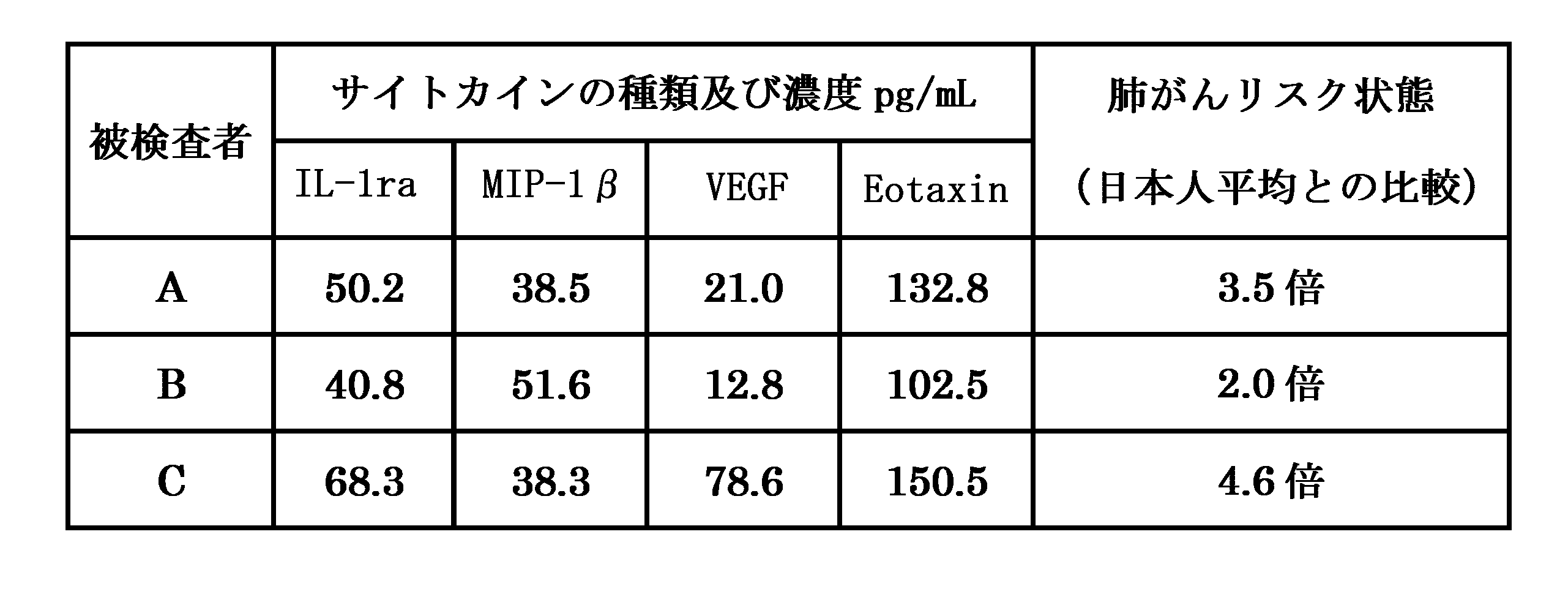
以上のようにして得られた評価の値を一般的な人(例えば日本人の平均値)との比較をして,その倍率によって肺がんリスク状態を示してもよい(表1参照)。
また,肺がんリスク状態にある可能性の程度を少なくとも考慮して定義された複数の区分と,1つ又は複数の閾値を予め設定しておいた場合,ステップS12では,複数のサイトカインのうちの少なくとも2つのサイトカインの濃度値又は当該濃度値を変換した場合にはその変換後の値及び閾値を用いて,評価対象を複数の区分のうちのどれか1つに分類してもよく,また,式の値又は当該式の値を変換した場合にはその変換後の値及び閾値を用いて,評価対象を複数の区分のうちのどれか1つに分類してもよい。これにより,肺がんリスク状態にある可能性の程度を知る上で参考となり得る信頼性の高い情報を,理解し易い形で提供することができる。
ここで,肺がんリスク状態にないこと(例えば,健常であること等)が判明している複数のテスト対象のサイトカインの濃度データに含まれている2種類以上のサイトカインの少なくとも2つのサイトカインの濃度値からなる集合において,特異度が所定値となるときの境界値を,閾値として設定してもよい。また,このサイトカインの濃度データ及び評価式を用いて各々のテスト対象ごとに算出した評価式の複数の値からなる集合において,特異度が所定値となるときの境界値を,閾値として設定してもよい。
また,評価式は,ロジスティック回帰式,分数式,線形判別式,重回帰式,サポートベクターマシンで作成された式,マハラノビス距離法で作成された式,正準判別分析で作成された式,決定木で作成された式のいずれか1つでもよい。これにより,肺がんの状態を知る上で参考となり得る情報の更なる信頼性向上を実現することができる。
また,評価式として採用する式とは,一般に多変量解析で用いられる式の形式を意味するものであり,評価式として採用する式としては,例えば分数式,重回帰式,多重ロジスティック回帰式,線形判別関数,マハラノビス距離,正準判別関数,サポートベクターマシン,決定木,異なる形式の式の和で示されるような式,などが挙げられる。ここで,重回帰式,多重ロジスティック回帰式,正準判別関数においては各変数に係数および定数項が付加されるが,この係数および定数項は,好ましくは実数であれば構わず,より好ましくは,データから前記の各種分類を行うために得られた係数および定数項の99%信頼区
間の範囲に属する値であれば構わず,さらに好ましくは,データから前記の各種分類を行うために得られた係数および定数項の95%信頼区間の範囲に属する値であれば構わない。また,各係数の値及びその信頼区間は,それを実数倍したものでもよく,定数項の値及びその信頼区間は,それに任意の実定数を加減乗除したものでもよい。ロジスティック回帰,線形判別,重回帰分析などの表示式を評価式として用いる場合,表示式の線形変換(定数の加算,定数倍)及び単調増加(減少)の変換(例えばlogit変換など)は評価性能を変えるものではなく変換前と同等であるので,この表示式には,これらの変換
が行われた後のものも含まれる。
間の範囲に属する値であれば構わず,さらに好ましくは,データから前記の各種分類を行うために得られた係数および定数項の95%信頼区間の範囲に属する値であれば構わない。また,各係数の値及びその信頼区間は,それを実数倍したものでもよく,定数項の値及びその信頼区間は,それに任意の実定数を加減乗除したものでもよい。ロジスティック回帰,線形判別,重回帰分析などの表示式を評価式として用いる場合,表示式の線形変換(定数の加算,定数倍)及び単調増加(減少)の変換(例えばlogit変換など)は評価性能を変えるものではなく変換前と同等であるので,この表示式には,これらの変換
が行われた後のものも含まれる。
実施形態1では,肺がんリスク状態を評価する際,濃度データを測定する2種類以上のサイトカインとして,前記サイトカイン濃度データには,IL-1β, IL-1ra, IL-5, IL-6, IL-7, IL-8, IL-9, IL-10, IL-12, G-CSF, PDGF, MIP-1β, TNF-α, VEGF, Eotaxin, MCP-1 及びMIP-1βの少なくとも2種のサイトカインの濃度データが含まれており,前記リスク算出式には,IL-1β, IL-1ra, IL-5, IL-6, IL-7, IL-8, IL-9, IL-10, IL-12, G-CSF, PDGF, MIP-1β, TNF-α, VEGF, Eotaxin, MCP-1 及びMIP-1βの少なくとも2種サイトカインの濃度データが代入される少なくとも2つの変数が含まれていることが好ましい。
本発明者らの試験結果によれば,多くの種類があるサイトカインの中でも,IL-1β, IL-1ra, IL-5, IL-6, IL-7, IL-8, IL-9, IL-10, IL-12, G-CSF, PDGF, MIP-1β, TNF-α, VEGF, Eotaxin, MCP-1 及びMIP-1βの濃度データが特に肺がんとの関連性が深い。このため,これらのサイトカインの少なくとも2種の濃度データから肺がんリスク状態を評価することにより,肺がんのリスク状態をさらに高い信頼性で評価することができる。
本発明者らの試験結果によれば,多くの種類があるサイトカインの中でも,IL-1β, IL-1ra, IL-5, IL-6, IL-7, IL-8, IL-9, IL-10, IL-12, G-CSF, PDGF, MIP-1β, TNF-α, VEGF, Eotaxin, MCP-1 及びMIP-1βの濃度データが特に肺がんとの関連性が深い。このため,これらのサイトカインの少なくとも2種の濃度データから肺がんリスク状態を評価することにより,肺がんのリスク状態をさらに高い信頼性で評価することができる。
(実施例1)
健常者男女23名及び肺がん患者男女8名の血液,唾液及び頬粘膜抽出液を採取し,そこに含まれるサイトカイン(27種)の分析を行った。検体の採取は,朝(7時~9時),昼(11時~13時)及び夕(15時~17時)に時間を分けて行った。また,検体採取前の予備検査として唾液潜血試験を実施した(図2及び表2参照)。

健常者男女23名及び肺がん患者男女8名の血液,唾液及び頬粘膜抽出液を採取し,そこに含まれるサイトカイン(27種)の分析を行った。検体の採取は,朝(7時~9時),昼(11時~13時)及び夕(15時~17時)に時間を分けて行った。また,検体採取前の予備検査として唾液潜血試験を実施した(図2及び表2参照)。
検体収集機関,分析装置,サイトカイン分析キット,分析を行ったサイトカインの種類及び検査方法の詳細を以下に示す。
・検体収集機関:信州大学医学部附属病院
・分析装置:Bio-Plex (バイオ・ラッドラボラトリーズ(株))
・サイトカイン分析キット:Bio-Plex Pro Human Cytokine 27-Plex
(バイオ・ラッドラボラトリーズ(株)),
・検査項目:IL-1β,IL-1ra,IL-2,IL-4,IL-5,IL-6,IL-7,IL-8,IL-9,IL-10,IL-12P70,IL-13,IL-15,IL-17A,FGF-2,Eotaxin,G-CSF,GM-CSF,IFN-γ,IP-10,MCP-1,MIP-1α,PDGF-BB,MIP-1β,RANTES,TNF-α,VEGF
・分析手順
(1)血液からの測定サンプルの採取方法
1)3.2%クエン酸ナトリウムの入った採血管に規定量の血液を採取する。
2)遠心分離を行い,上清を分離する。
3)分離された上清をマイクロチューブに200 μLずつ分注し,3つに小分けにする。
4)小分けしたマイクロチューブにID等を記入し,-80℃で凍結保存する。
(2)唾液からの測定サンプルの採取方法
1)採取カップ (日本メディカル:型番MS-50) を2つ用意し,IDを記入する(2つの採取カップのIDは同一とする)。
2)採取カップに採取量 150 μL のラインを入れる。
3)2つのカップに必要量(およそ150 μL)の唾液を入れ,採取後2時間以内に-80℃で凍結保存する。
(3)頬粘膜からの測定サンプルの採取方法
1)頬粘膜抽出液採取キット (Intercept, Oral fluid drug test, OraSure Technologies, Inc) から採取パッドを取り出す(この際,採取パッド部分には触れず,柄の部分を持つ)。
2)採取パッドを下の歯肉と頬粘膜の間に置き,パッドが湿るまで歯肉に沿って慎重に前後に動かす。
3)採取パッドが湿ったら,歯肉と頬粘膜の間に置いたまま5分間待つ。
4)5分後,青い液体の入った容器の蓋を慎重に開け,液体の中に採取パッドを入れる。
5)容器から飛び出ている柄の部分を切れ目のところで折り,蓋を閉める。
6)検体を回収後,保存のため採取された抽出液をマイクロチューブ (BIO-BIK:型番LT-0200) に移し変え,採取パッドに浸透している抽出液も管壁に押しつけて搾り出し,残りの抽出液も全てマイクロチューブに移す。
7)予備検体用にマイクロチューブをもう1つ用意し,半量を小分けにする。
8)マイクロチューブにID等を記入し,2時間以内に-80℃で凍結保存する。
・検体収集機関:信州大学医学部附属病院
・分析装置:Bio-Plex (バイオ・ラッドラボラトリーズ(株))
・サイトカイン分析キット:Bio-Plex Pro Human Cytokine 27-Plex
(バイオ・ラッドラボラトリーズ(株)),
・検査項目:IL-1β,IL-1ra,IL-2,IL-4,IL-5,IL-6,IL-7,IL-8,IL-9,IL-10,IL-12P70,IL-13,IL-15,IL-17A,FGF-2,Eotaxin,G-CSF,GM-CSF,IFN-γ,IP-10,MCP-1,MIP-1α,PDGF-BB,MIP-1β,RANTES,TNF-α,VEGF
・分析手順
(1)血液からの測定サンプルの採取方法
1)3.2%クエン酸ナトリウムの入った採血管に規定量の血液を採取する。
2)遠心分離を行い,上清を分離する。
3)分離された上清をマイクロチューブに200 μLずつ分注し,3つに小分けにする。
4)小分けしたマイクロチューブにID等を記入し,-80℃で凍結保存する。
(2)唾液からの測定サンプルの採取方法
1)採取カップ (日本メディカル:型番MS-50) を2つ用意し,IDを記入する(2つの採取カップのIDは同一とする)。
2)採取カップに採取量 150 μL のラインを入れる。
3)2つのカップに必要量(およそ150 μL)の唾液を入れ,採取後2時間以内に-80℃で凍結保存する。
(3)頬粘膜からの測定サンプルの採取方法
1)頬粘膜抽出液採取キット (Intercept, Oral fluid drug test, OraSure Technologies, Inc) から採取パッドを取り出す(この際,採取パッド部分には触れず,柄の部分を持つ)。
2)採取パッドを下の歯肉と頬粘膜の間に置き,パッドが湿るまで歯肉に沿って慎重に前後に動かす。
3)採取パッドが湿ったら,歯肉と頬粘膜の間に置いたまま5分間待つ。
4)5分後,青い液体の入った容器の蓋を慎重に開け,液体の中に採取パッドを入れる。
5)容器から飛び出ている柄の部分を切れ目のところで折り,蓋を閉める。
6)検体を回収後,保存のため採取された抽出液をマイクロチューブ (BIO-BIK:型番LT-0200) に移し変え,採取パッドに浸透している抽出液も管壁に押しつけて搾り出し,残りの抽出液も全てマイクロチューブに移す。
7)予備検体用にマイクロチューブをもう1つ用意し,半量を小分けにする。
8)マイクロチューブにID等を記入し,2時間以内に-80℃で凍結保存する。
以上のようにして採取したサンプルについて,バイオマーカー分析装置:Bio-Plex (バイオ・ラッドラボラトリーズ(株))及びサイトカイン分析キット:Bio-Plex Pro Human Cytokine 27-Plex (バイオ・ラッドラボラトリーズ(株))を用いて27種類のサイトカインの濃度を測定した。さらに,こうして得られた分析結果について,統計分析ソフト (IBM SPSS Statistics,日本アイ・ビー・エム(株)) を使用して 健常者と肺がん患者の2群で Mann-Whitney test を行った。
<結 果>
以上のようにして,血液,唾液及び頬粘膜から採取した検体について27種類のサイトカインを分析した結果,表3に示すサイトカインにおいてp < 0.05の有意差が認められた。
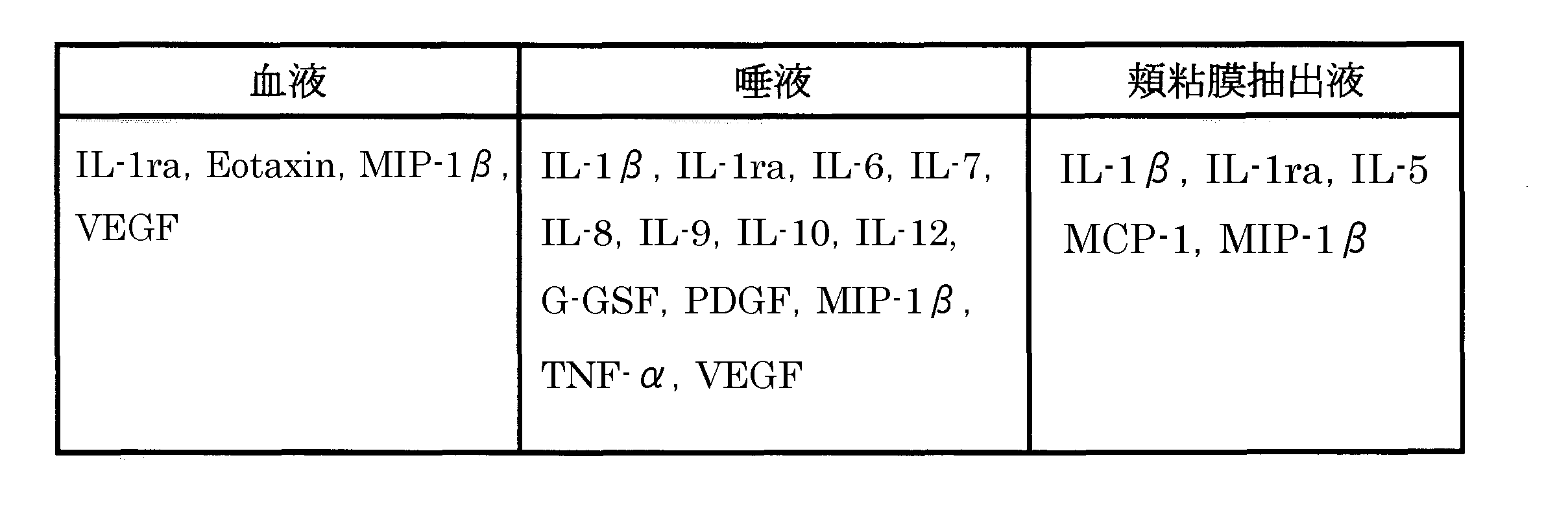
以上のようにして,血液,唾液及び頬粘膜から採取した検体について27種類のサイトカインを分析した結果,表3に示すサイトカインにおいてp < 0.05の有意差が認められた。
また,血液サンプル,唾液サンプル及び頬粘膜サンプルについての各結果は以下の通りとなった。
(血液サンプルについて)
結果を表4及び図3に示す。これらの図表から,血液中のIL-1ra,Eotaxin,MIP-1β,及びVEGFの濃度については,健常者に比べて肺がん患者の方が高く,これらのサイトカインの血中濃度を測定することにより,肺がんリスク状態を判定できる可能性があることが分かる。ただし,これらのサイトカインは,肺がん以外のがんリスク状態にも相関性がある可能性もあり,そのような場合には肺がんリスク状態の評価の信頼性が低下することも考えられる。これに対して,これらのサイトカインの内の2種類以上を測定し,それぞれの結果を勘案して評価を行えば,肺がんのリスク状態を高い信頼性で評価できる。
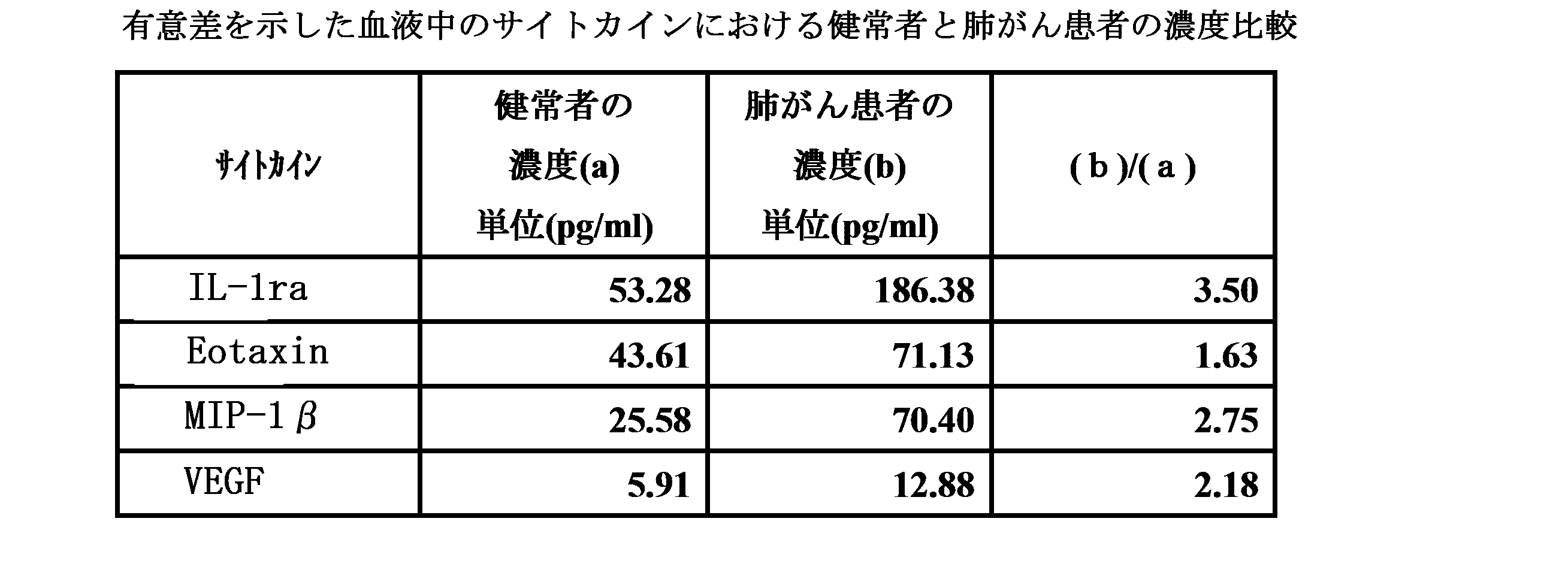
(血液サンプルについて)
結果を表4及び図3に示す。これらの図表から,血液中のIL-1ra,Eotaxin,MIP-1β,及びVEGFの濃度については,健常者に比べて肺がん患者の方が高く,これらのサイトカインの血中濃度を測定することにより,肺がんリスク状態を判定できる可能性があることが分かる。ただし,これらのサイトカインは,肺がん以外のがんリスク状態にも相関性がある可能性もあり,そのような場合には肺がんリスク状態の評価の信頼性が低下することも考えられる。これに対して,これらのサイトカインの内の2種類以上を測定し,それぞれの結果を勘案して評価を行えば,肺がんのリスク状態を高い信頼性で評価できる。
(唾液サンプルについて)
結果を表5及び図4に示す。これらの図表から,唾液中のIL-1ra,VEGF,IL-8,IL-1β,G-CSF,TNF-α,IL-7,MIP-1β,IL-12,PDGF,IL-6,IL-10及びIL-9の濃度については,健常者に比べて肺がん患者の方が高く,これらのサイトカインの血中濃度を測定することにより,肺がんリスク状態を判定できる可能性があることが分かる。ただし,これらのサイトカインは,肺がん以外のがんリスク状態にも相関性がある可能性もあり,そのような場合には肺がんリスク状態の評価の信頼性が低下することも考えられる。これに対して,これらのサイトカインの内の2種類以上を測定し,それぞれの結果を勘案して評価を行えば,肺がんのリスク状態を高い信頼性で評価できる。

結果を表5及び図4に示す。これらの図表から,唾液中のIL-1ra,VEGF,IL-8,IL-1β,G-CSF,TNF-α,IL-7,MIP-1β,IL-12,PDGF,IL-6,IL-10及びIL-9の濃度については,健常者に比べて肺がん患者の方が高く,これらのサイトカインの血中濃度を測定することにより,肺がんリスク状態を判定できる可能性があることが分かる。ただし,これらのサイトカインは,肺がん以外のがんリスク状態にも相関性がある可能性もあり,そのような場合には肺がんリスク状態の評価の信頼性が低下することも考えられる。これに対して,これらのサイトカインの内の2種類以上を測定し,それぞれの結果を勘案して評価を行えば,肺がんのリスク状態を高い信頼性で評価できる。
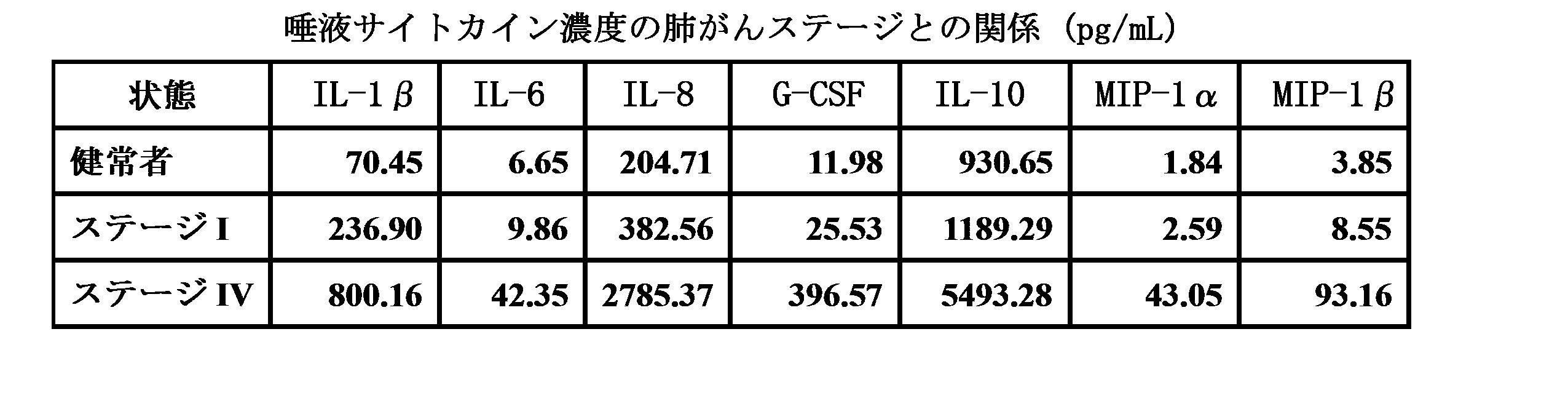
また,唾液検体では表6に示すように,がんのステージが進行するにつれてIL-1β,IL-6,IL-8,G-CSF,IP-10,MIP-1α 及びMIP-1βの濃度が上昇することも分かった。このため,肺がんリスク状態について,ステージの進行度合いが測定できる可能性も示唆された。
(頬粘膜サンプルについて)
結果を表7及び図5に示す。これらの図表から,唾液中のIL-1ra,IL-1β,MCP-1,MIP-1β 及びIL-5の濃度については,健常者に比べて肺がん患者の方が高く,これらのサイトカインの血中濃度を測定することにより,肺がんリスク状態を判定できる可能性があることが分かる。ただし,これらのサイトカインは,肺がん以外のがんリスク状態にも相関性がある可能性もあり,そのような場合には肺がんリスク状態の評価の信頼性が低下することも考えられる。これに対して,これらのサイトカインの内の2種類以上を測定し,それぞれの結果を勘案して評価を行えば,肺がんのリスク状態を高い信頼性で評価できる。

結果を表7及び図5に示す。これらの図表から,唾液中のIL-1ra,IL-1β,MCP-1,MIP-1β 及びIL-5の濃度については,健常者に比べて肺がん患者の方が高く,これらのサイトカインの血中濃度を測定することにより,肺がんリスク状態を判定できる可能性があることが分かる。ただし,これらのサイトカインは,肺がん以外のがんリスク状態にも相関性がある可能性もあり,そのような場合には肺がんリスク状態の評価の信頼性が低下することも考えられる。これに対して,これらのサイトカインの内の2種類以上を測定し,それぞれの結果を勘案して評価を行えば,肺がんのリスク状態を高い信頼性で評価できる。
(肺がんリスク状態の評価方法)
肺がんリスク状態の評価方法について,図1のフローチャートを参照しながら説明する。まず,検査を希望するヒトから採取した血液,唾液及び頬粘膜中の前述した27種類のサイトカインの濃度データを取得する(ステップS11)。
肺がんリスク状態の評価方法について,図1のフローチャートを参照しながら説明する。まず,検査を希望するヒトから採取した血液,唾液及び頬粘膜中の前述した27種類のサイトカインの濃度データを取得する(ステップS11)。
つぎに,ステップS11で取得したサイトカインの濃度データから欠損値や外れ値などのデータを除去した後,サイトカインの濃度データに基づき,評価式として予め設定された式を用いて,式の値を算出し,評価を行う。
<実施形態2>
実施形態2の概要について,図6を参照して説明する。図6は実施形態2の基本原理を示す原理構成図である。
制御部は,サイトカインの濃度値に関する予め取得した評価対象のサイトカイン濃度データに含まれている,IL-1β, IL-1ra, IL-5, IL-6, IL-7, IL-8, IL-9, IL-10, IL-12, G-CSF, PDGF, MIP-1β, TNF-α, VEGF, Eotaxin, MCP-1 及びMIP-1βの少なくとも2種類のサイトカインの濃度値及びサイトカインの濃度値が代入される変数を含む予め記憶部に記憶された,肺がんリスク状態を評価するための式(前記27種のサイトカインのうちの少なくとも2つのサイトカインの濃度値が代入される少なくとも2つの変数が含まれているもの)を用いて,式の値を算出することで,評価対象における肺がんリスク状態を評価する。
実施形態2の概要について,図6を参照して説明する。図6は実施形態2の基本原理を示す原理構成図である。
制御部は,サイトカインの濃度値に関する予め取得した評価対象のサイトカイン濃度データに含まれている,IL-1β, IL-1ra, IL-5, IL-6, IL-7, IL-8, IL-9, IL-10, IL-12, G-CSF, PDGF, MIP-1β, TNF-α, VEGF, Eotaxin, MCP-1 及びMIP-1βの少なくとも2種類のサイトカインの濃度値及びサイトカインの濃度値が代入される変数を含む予め記憶部に記憶された,肺がんリスク状態を評価するための式(前記27種のサイトカインのうちの少なくとも2つのサイトカインの濃度値が代入される少なくとも2つの変数が含まれているもの)を用いて,式の値を算出することで,評価対象における肺がんリスク状態を評価する。
以上,実施形態2によれば,評価対象のサイトカイン濃度データ及び評価式として記憶部に記憶された式を用いて,評価式の値を算出することで,評価対象における肺がんリスク状態を評価する。これにより,肺がんリスク状態を知る上で参考となり得る信頼性の高い情報を提供することができる。
ここで,肺がんリスク状態とは,肺がんに罹患している可能性の程度のことであってもよい。これにより,肺がんに罹患している可能性の程度を知る上で参考となり得る信頼性の高い情報を提供することができる。
また,算出した式の値が評価対象における肺がんリスク状態を反映したものであると決定してもよく,さらに,式の値を例えば以下に挙げた手法などで変換し,変換後の値が評価対象における肺がんリスク状態を反映したものであると決定してもよい。換言すると,式の値又は変換後の値そのものを,評価対象における肺がんリスク状態に関する評価結果として扱ってもよい。これにより,肺がんリスク状態を知る上で参考となり得る信頼性の高い情報を提供することができる。
評価式の値の取り得る範囲が所定範囲に収まるように,例えば,評価式の値に対して任意の値を加減乗除したり,また,評価式の値を所定の変換手法(例えば,指数変換,対数変換,角変換,平方根変換,プロビット変換,又は逆数変換など)で変換したり,また,評価式の値に対してこれらの計算を組み合わせて行ったりすることで,評価式の値を変換してもよい。例えば,評価式の値を指数としネイピア数を底とする指数関数の値(具体的には,肺がんに罹患
している確率pを定義したときの自然対数ln(p/(1-p))が評価式の値と等しいとした場合におけるp/(1-p)の値)をさらに算出してもよく,また,算出した指数関数の値を1と当該値との和で割った値(具体的には,確率pの値)をさらに算出してもよい。
また,特定の条件のときの変換後の値が特定の値となるように,評価式の値を変換してもよい。例えば,特異度が80%のときの変換後の値が5.0となり且つ特異度が95%のときの変換後の値が8.0となるように評価式の値を変換してもよい。
評価式の値の取り得る範囲が所定範囲に収まるように,例えば,評価式の値に対して任意の値を加減乗除したり,また,評価式の値を所定の変換手法(例えば,指数変換,対数変換,角変換,平方根変換,プロビット変換,又は逆数変換など)で変換したり,また,評価式の値に対してこれらの計算を組み合わせて行ったりすることで,評価式の値を変換してもよい。例えば,評価式の値を指数としネイピア数を底とする指数関数の値(具体的には,肺がんに罹患
している確率pを定義したときの自然対数ln(p/(1-p))が評価式の値と等しいとした場合におけるp/(1-p)の値)をさらに算出してもよく,また,算出した指数関数の値を1と当該値との和で割った値(具体的には,確率pの値)をさらに算出してもよい。
また,特定の条件のときの変換後の値が特定の値となるように,評価式の値を変換してもよい。例えば,特異度が80%のときの変換後の値が5.0となり且つ特異度が95%のときの変換後の値が8.0となるように評価式の値を変換してもよい。
また,肺がんに罹患している可能性の程度を少なくとも考慮して定義された複数の区分と,1つ又は複数の閾値を予め設定しておいた場合,式の値又は当該式の値を変換した場合にはその変換後の値及び閾値を用いて,評価対象を複数の区分のうちのどれか1つに分類してもよい。これにより,肺がんに罹患している可能性の程度を知る上で参考となり得る信頼性の高い情報を,理解し易い形で提供することができる。
次に,実施形態2にかかる肺がんリスク評価システムの構成について説明する。まず,本システムの全体構成について図7を参照して説明する。本システムは,図7に示すように,評価対象である個体における肺がんリスク状態を評価する肺がんリスク評価装置100と,サイトカインの濃度値に関する個体のサイトカイン濃度データを提供するクライアント装置200(本発明の情報通信端末装置に相当)とを,ネットワーク300を介して通信可能に接続して構成されている。さらに,本システムは,肺がんリスク評価装置100やクライアント装置200の他に,肺がんリスク評価装置100で評価式を作成する際に用いる肺がんリスク状態情報や,肺がんリスク状態の評価を行うために用いる評価式などを格納したデータベース装置400を,ネットワーク300を介して通信可能に接続して構成されている。これにより,ネットワーク300を介して,肺がんリスク評価装置100からクライアント装置200やデータベース装置400へ,あるいはクライアント装置200やデータベース装置400から肺がんリスク評価装置100へ,肺がんリスク状態を知る上で参考となる情報などが提供される。ここで,肺がんリスク状態を知る上で参考となる情報とは,ヒトを含む生物の肺がんリスク状態に関する特定の項目について測定した値に関する情報である。また,肺がんリスク状態を知る上で参考となる情報は,肺がんリスク評価装置100やクライアント装置200や他の装置(例えば各種の計測装置等)で生成され,主にデータベース装置400に蓄積される。
つぎに,本システムの肺がんリスク評価装置100の構成について説明する。図8は,本システムの肺がんリスク評価装置100の構成の一例を示すブロック図であり,該構成のうち本発明に関係する部分のみを概念的に示している。
肺がんリスク評価装置100は,当該肺がんリスク評価装置を統括的に制御するCPU等の制御部102と,ルータ等の通信装置および専用線等の通信回線を介して当該肺がんリスク評価装置をネットワーク300に通信可能に接続する通信インターフェース部104と,各種のデータベースやテーブルやファイルなどを格納する記憶部106と,入力装置112や出力装置114に接続する入出力インターフェース部108と,で構成されており,これら各部は任意の通信路を介して通信可能に接続されている。ここで,肺がんリスク評価装置100は,各種の分析装置と同一筐体で構成されてもよい。
記憶部106は,ストレージ手段であり,OS(Operating System)と協働してCPUに命令を与え各種処理を行うためのコンピュータプログラムが記録されている。記憶部106は,利用者情報ファイル106aと,サイトカイン濃度データファイル106bと,肺がんリスク状態情報ファイル106cと,指定肺がんリスク状態情報ファイル106dと,評価式関連情報データベース106eと,評価結果ファイル106fと,を格納する。
利用者情報ファイル106aは,利用者に関する利用者情報を格納する。
サイトカイン濃度データファイル106bは,サイトカインの濃度値に関するサイトカイン濃度データを格納する。
肺がんリスク状態情報ファイル106cは,評価式を作成する際に用いる肺がんリスク状態情報を格納する。
サイトカイン濃度データファイル106bは,サイトカインの濃度値に関するサイトカイン濃度データを格納する。
肺がんリスク状態情報ファイル106cは,評価式を作成する際に用いる肺がんリスク状態情報を格納する。
指定肺がんリスク状態情報ファイル106dは,後述する肺がんリスク状態情報指定部102gで指定した肺がんリスク状態情報を格納する。
評価式関連情報データベース106eは,後述する候補式作成部102h1で作成した候補式を格納する候補式ファイル106e1と,後述する候補式検証部102h2での検証結果を格納する検証結果ファイル106e2と,後述する変数選択部102h3で選択したサイトカイン濃度データの組み合わせを含む肺がんリスク状態情報を格納する選択肺がんリスク状態情報ファイル106e3と,後述する評価式作成部102hで作成した評価式を格納する評価式ファイル106e4と,で構成される。
評価式関連情報データベース106eは,後述する候補式作成部102h1で作成した候補式を格納する候補式ファイル106e1と,後述する候補式検証部102h2での検証結果を格納する検証結果ファイル106e2と,後述する変数選択部102h3で選択したサイトカイン濃度データの組み合わせを含む肺がんリスク状態情報を格納する選択肺がんリスク状態情報ファイル106e3と,後述する評価式作成部102hで作成した評価式を格納する評価式ファイル106e4と,で構成される。
候補式ファイル106e1は,後述する候補式作成部102h1で作成した候補式を格納する。検証結果ファイル106e2は,後述する候補式検証部102h2での検証結果を格納する。検証結果ファイル106e2に格納される情報は,ランクと,候補式と,各候補式の検証結果(例えば各候補式の評価値)と,を相互に関連付けて構成されている。
選択肺がんリスク状態情報ファイル106e3は,後述する変数選択部102h3で選択した変数に対応するサイトカイン濃度データの組み合わせを含む肺がんリスク状態情報を格納する。選択肺がんリスク状態情報ファイル106e3に格納される情報は,個体番号と,後述する肺がんリスク状態情報指定部102gで指定した肺がんリスク状態指標データと,後述する変数選択部102h3で選択したサイトカイン濃度データと,を相互に関連付けて構成されている。
評価式ファイル106e4は,後述する評価式作成部102hで作成した評価式を格納する。評価結果ファイル106fは,後述する評価部102iで得られた評価結果を格納する。
記憶部106には,上述した情報以外にその他情報として,Webサイトをクライアント装置200に提供するための各種のWebデータや,CGIプログラム等が記録されている。
通信インターフェース部104は,肺がんリスク評価装置100とネットワーク300(またはルータ等の通信装置)との間における通信を媒介する。すなわち,通信インターフェース部104は,他の端末と通信回線を介してデータを通信する機能を有する。
入出力インターフェース部108は,入力装置112や出力装置114に接続する(なお,以下では,出力装置114をモニタ114として記載する場合がある。)。
制御部102は,OS(Operating System)等の制御プログラム・各種の処理手順等を規定したプログラム・所要データなどを格納するための内部メモリを有し,これらのプログラムに基づいて種々の情報処理を実行する。
要求解釈部102aは,クライアント装置200やデータベース装置400からの要求内容を解釈し,その解釈結果に応じて制御部102の各部に処理を受け渡す。閲覧処理部102bは,クライアント装置200からの各種画面の閲覧要求を受けて,これら画面のWebデータの生成や送信を行なう。認証処理部102cは,クライアント装置200やデータベース装置400からの認証要求を受けて,認証判断を行う。電子メール生成部102dは,各種の情報を含んだ電子メールを生成する。Webページ生成部102eは,利用者がクライアント装置200で閲覧するWebページを生成する。
受信部102fは,クライアント装置200やデータベース装置400から送信された情報(具体的には,サイトカイン濃度データや肺がんリスク状態情報,評価式など)を,ネットワーク300を介して受信する。肺がんリスク状態情報指定部102gは,評価式を作成するにあたり,対象とする肺がんリスク状態指標データおよびサイトカイン濃度データを指定する。
評価式作成部102hは,受信部102fで受信した肺がんリスク状態情報や肺がんリスク状態情報指定部102gで指定した肺がんリスク状態情報に基づいて評価式を作成する。具体的には,評価式作成部102hは,肺がんリスク状態情報から,候補式作成部102h1,候補式検証部102h2および変数選択部102h3を繰り返し実行させることにより蓄積された検証結果に基づいて,複数の候補式の中から評価式として採用する候補式を選出することで,評価式を作成する。
評価部102iは,事前に得られた式(例えば,評価式作成部102hで作成した評価式,又は,受信部102fで受信した評価式など)及び受信部102fで受信した個体のサイトカイン濃度データを用いて,評価式の値を算出することで,個体における肺がんリスク状態を評価する。
結果出力部102iは,制御部102の各処理部での処理結果(評価部102iで得られた評価結果を含む)等を出力装置114に出力する。
送信部102kは,評価対象のサイトカイン濃度データの送信元のクライアント装置200に対して評価結果を送信したり,データベース装置400に対して,肺がんリスク評価装置100で作成した評価式や評価結果を送信したりする。
つぎに,本システムのクライアント装置200の構成について説明する。
このクライアント装置200は,制御部とROMとHDとRAMと入力装置と出力装置と入出力と通信IFとで構成されており,これら各部は任意の通信路を介して通信可能に接続されている。
このクライアント装置200は,制御部とROMとHDとRAMと入力装置と出力装置と入出力と通信IFとで構成されており,これら各部は任意の通信路を介して通信可能に接続されている。
制御部は,Webブラウザ,電子メーラ,受信部,送信部を備えている。Webブラウザは,Webデータを解釈し,解釈したWebデータをモニタに表示するブラウズ処理を行う。電子メーラは,所定の通信規約に従って電子メールの送受信を行う。受信部は,通信を介して,肺がんリスク評価装置100から送信された評価結果などの各種情報を受信する。送信部は,通信IFを介して,個体のサイトカイン濃度データなどの各種情報を肺がんリスク評価装置100へ送信する。
通信IFは,クライアント装置200とネットワーク300(またはルータ等の通信装置)とを通信可能に接続する。換言すると,クライアント装置200は,モデムやTAやルータなどの通信装置および電話回線を介して,または専用線を介してネットワーク300に接続される。これにより,クライアント装置200は,所定の通信規約に従って肺がんリスク評価装置100にアクセスすることができる。
つぎに,本システムのネットワーク300について図7を参照して説明する。ネットワーク300は,肺がんリスク評価装置100とクライアント装置200とデータベース装置400とを相互に通信可能に接続する機能を有し,例えばインターネットやイントラネットやLAN(有線/無線の双方を含む)等である。なお,ネットワーク300は,VANや,パソコン通信網や,公衆電話網(アナログ/デジタルの双方を含む)や,専用回線網(アナログ/デジタルの双方を含む)や,CATV網や,携帯回線交換網または携帯パケット交換網(IMT2000方式,GSM(登録商標)方式またはPDC/PDC-P方式等を含む)や,無線呼出網や,Bluetooth(登録商標)等の局所無線網や,PHS網や,衛星通信網(CS,BSまたはISDB等を含む)等でもよい。
つぎに,本システムのデータベース装置400の構成について説明する。
このデータベース装置400は,肺がんリスク評価装置100または当該データベース装置400で評価式を作成する際に用いる肺がんリスク状態情報や,肺がんリスク評価装置100で作成した評価式,肺がんリスク評価装置100での評価結果などを格納する機能を有する。データベース装置400は,当該データベース装置400を統括的に制御するCPU等の制御部と,ルータ等の通信装置および専用線等の有線または無線の通信回路を介して当該データベース装置400をネットワークに通信可能に接続する通信インターフェース部と,各種のデータベースやテーブルやファイルなどを格納する記憶部と,入力装置や出力装置に接続する入出力インターフェース部と,で構成されており,これら各部は任意の通信路を介して通信可能に接続されている。
このデータベース装置400は,肺がんリスク評価装置100または当該データベース装置400で評価式を作成する際に用いる肺がんリスク状態情報や,肺がんリスク評価装置100で作成した評価式,肺がんリスク評価装置100での評価結果などを格納する機能を有する。データベース装置400は,当該データベース装置400を統括的に制御するCPU等の制御部と,ルータ等の通信装置および専用線等の有線または無線の通信回路を介して当該データベース装置400をネットワークに通信可能に接続する通信インターフェース部と,各種のデータベースやテーブルやファイルなどを格納する記憶部と,入力装置や出力装置に接続する入出力インターフェース部と,で構成されており,これら各部は任意の通信路を介して通信可能に接続されている。
記憶部は,ストレージ手段であり,例えば,RAM・ROM等のメモリ装置や,ハードディスクのような固定ディスク装置や,フレキシブルディスクや,光ディスク等を用いることができる。記憶部には,各種処理に用いる各種プログラム等を格納する。通信インターフェース部は,データベース装置400とネットワークとの間における通信を媒介する。すなわち,通信インターフェース部は,他の端末と通信回線を介してデータを通信する機能を有する。入出力インターフェース部は,入力装置や出力装置に接続する。
制御部は,OS(Operating System)等の制御プログラム・各種の処理手順等を規定したプログラム・所要データなどを格納するための内部メモリを有し,これらのプログラムに基づいて種々の情報処理を実行する。制御部は,大別して,要求解釈部と閲覧処理部と認証処理部と電子メール生成部とWebページ生成部と送信部とを備えている。
要求解釈部は,肺がんリスク評価装置100からの要求内容を解釈し,その解釈結果に応じて制御部の各部に処理を受け渡す。閲覧処理部は,肺がんリスク評価装置100からの各種画面の閲覧要求を受けて,これら画面のWebデータの生成や送信を行う。認証処理部は,肺がんリスク評価装置100からの認証要求を受けて,認証判断を行う。電子メール生成部は,各種の情報を含んだ電子メールを生成する。Webページ生成部は,利用者がクライアント装置200で閲覧するWebページを生成する。送信部は,肺がんリスク状態情報や評価式などの各種情報を,肺がんリスク評価装置100へ送信する。
最後に,肺がんリスク評価装置100で行う評価式作成処理の一例について説明する。なお,当該評価式作成処理は,肺がんリスク状態情報を管理するデータベース装置で行ってもよい。
なお,本説明では,肺がんリスク評価装置100は,データベース装置400から事前に取得した肺がんリスク状態情報を,肺がんリスク状態情報ファイル106cの所定の記憶領域に格納しているものとする。また,肺がんリスク評価装置100は,肺がんリスク状態情報指定部102gで事前に指定した肺がんリスク状態指標データおよびサイトカイン濃度データを含む肺がんリスク状態情報を,指定肺がんリスク状態情報ファイル106dの所定の記憶領域に格納しているものとする。
まず,評価式作成部102hは,候補式作成部102h1で,指定肺がんリスク状態情報ファイル106dの所定の記憶領域に格納されている肺がんリスク状態情報から所定の式作成手法に基づいて候補式を作成し,作成した候補式を候補式ファイル106e1の所定の記憶領域に格納する。つぎに,評価式作成部102hは,候補式作成部102h1で,膵臓癌リスク状態情報に基づいて,選択した式選択手法に対応する種々(例えば平均や分散など)の計算を実行する。つぎに,評価式作成部102hは,候補式作成部102h1で,計算結果および決定した候補式のパラメータを決定する。これにより,選択した式作成手法に基づいて候補式が作成される。なお,複数の異なる式作成手法を併用して候補式を同時並行(並列)的に作成する場合は,選択した式作成手法ごとに上記の処理を並行して実行すればよい。また,複数の異なる式作成手法を併用して候補式を直列的に作成する場合は,例えば,主成分分析を行って作成した候補式を利用して肺がんリスク状態情報を変換し,変換した肺がんリスク状態情報に対して判別分析を行うことで候補式を作成してもよい。
つぎに,評価式作成部102hは,候補式検証部102h2で作成した候補式を所定の検証手法に基づいて検証(相互検証)し,検証結果を検証結果ファイル106e2の所定の記憶領域に格納する。具体的には,評価式作成部102hは,候補式検証部102h2で,指定肺がんリスク状態情報ファイル106dの所定の記憶領域に格納されている肺がんリスク状態情報に基づいて候補式を検証する際に用いる検証用データを作成し,作成した検証用データに基づいて候補式を検証する。
つぎに,評価式作成部102hは,変数選択部102h3で,所定の変数選択手法に基づいて,候補式の変数を選択することで,候補式を作成する際に用いる肺がんリスク状態情報に含まれるサイトカイン濃度データの組み合わせを選択し,選択したサイトカイン濃度データの組み合わせを含む肺がんリスク状態情報を選択肺がんリスク状態情報ファイル106e3の所定の記憶領域に格納する。
つぎに,評価式作成部102hは,指定肺がんリスク状態情報ファイル106dの所定の記憶領域に格納されている肺がんリスク状態情報に含まれるサイトカイン濃度データの全ての組み合わせが終了したか否かを判定し,判定結果が「終了」であった場合には次のステップへ進み,判定結果が「終了」でなかった場合にはもとのステップへ戻る。なお,評価式作成部102hは,予め設定した回数が終了したか否かを判定し,判定結果が「終了」であった場合には次のステップへ進み,判定結果が「終了」でなかった場合にはもとのステップへ戻ってもよい。
つぎに,評価式作成部102hは,検証結果に基づいて,複数の候補式の中から評価式として採用する候補式を選出することで評価式を決定し,決定した評価式(選出した候補式)を評価式ファイル106e4の所定の記憶領域に格納する。
この発明は上記発明の実施の態様及び実施例の説明に何ら限定されるものではない。特許請求の範囲を逸脱せず、当業者が容易に想到できる範囲で種々の変形態様もこの発明に含まれる。
S11…データ取得ステップ,S12…評価ステップ,
100…肺がんリスク評価装置
102…制御部(102a…要求解釈部,102b…閲覧処理部,102c…認証処理部,102d…電子メール生成部,102e…Webページ生成部,102f…受信部,102g…肺がんリスク状態情報指定部,102h…評価式作成部,102h1…候補式作成部,102h2…候補式検証部,102h3…変数選択部,102i…評価部,102i1…算出部,102i2…変換部,102i3…生成部,102i4…分類部,102j…結果出力部,102k…送信部)
104…通信インターフェース部
106…記憶部(106a…利用者情報ファイル,106b…サイトカイン濃度データファイル,106c…肺がんリスク状態情報ファイル,106d…指定肺がんリスク状態情報ファイル,106e…評価式関連情報データベース,106e1…候補式ファイル,106e2…検証結果ファイル,106e3…選択肺がんリスク状態情報ファイル,106e4…評価式ファイル,106f…評価結果ファイル)
108…入出力インターフェース部、112…入力装置、114…出力装置
200…クライアント装置(情報通信端末装置)、300…ネットワーク
400…データベース装置
100…肺がんリスク評価装置
102…制御部(102a…要求解釈部,102b…閲覧処理部,102c…認証処理部,102d…電子メール生成部,102e…Webページ生成部,102f…受信部,102g…肺がんリスク状態情報指定部,102h…評価式作成部,102h1…候補式作成部,102h2…候補式検証部,102h3…変数選択部,102i…評価部,102i1…算出部,102i2…変換部,102i3…生成部,102i4…分類部,102j…結果出力部,102k…送信部)
104…通信インターフェース部
106…記憶部(106a…利用者情報ファイル,106b…サイトカイン濃度データファイル,106c…肺がんリスク状態情報ファイル,106d…指定肺がんリスク状態情報ファイル,106e…評価式関連情報データベース,106e1…候補式ファイル,106e2…検証結果ファイル,106e3…選択肺がんリスク状態情報ファイル,106e4…評価式ファイル,106f…評価結果ファイル)
108…入出力インターフェース部、112…入力装置、114…出力装置
200…クライアント装置(情報通信端末装置)、300…ネットワーク
400…データベース装置
Claims (11)
- 評価対象から採取したサンプル中のサイトカインの濃度データを取得するデータ取得ステップと,
該サイトカイン濃度データに基づいて肺がんリスク状態を評価することが可能なリスク算出式に該サイトカインの濃度データを代入して該評価対象における該肺がんリスク状態を評価する評価ステップと,を有する肺がんリスク状態の評価方法であって,
前記データ取得ステップでは,少なくとも2種類のサイトカインの濃度データを取得し,
前記リスク算出式には少なくとも2種類のサイトカイン濃度値が代入される少なくとも2つの変数が含まれていることを特徴とする,肺がんリスク状態の評価方法。 - 前記肺がんリスク状態とは,前記肺がんにある可能性の程度のことであり,
前記評価対象における前記肺がんリスク状態を評価するとは,前記評価対象が前記肺がんにある可能性の程度を評価することであることを特徴とする請求項1に記載の肺がんリスク状態の評価方法。 - 前記肺がんリスク状態にある可能性の程度を少なくとも考慮して定義された複数の区分と,1つ又は複数の閾値と,が予め設定されており,
前記評価対象が前記肺がんリスク状態にある可能性の程度を評価するとは,該リスク算出式の値及び該閾値を用いて,該評価対象を複数の前記区分のうちのどれか1つに分類することであることを特徴とする請求項2に記載の肺がんリスク状態の評価方法。 - 前記サイトカイン濃度データには,IL-1β, IL-1ra, IL-5, IL-6, IL-7, IL-8, IL-9, IL-10, IL-12, G-CSF, PDGF, MIP-1β, TNF-α, VEGF, Eotaxin, MCP-1 及びMIP-1βの少なくとも2種のサイトカインの濃度データが含まれており,
前記リスク算出式には,IL-1β, IL-1ra, IL-5, IL-6, IL-7, IL-8, IL-9, IL-10, IL-12, G-CSF, PDGF, MIP-1β, TNF-α, VEGF, Eotaxin, MCP-1 及びMIP-1βの少なくとも2種サイトカインの濃度データが代入される少なくとも2つの変数が含まれていることを特徴とする請求項1乃至3のいずれか1項に記載の肺がんリスク状態の評価方法。 - 評価対象から採取したサンプル中のサイトカインの濃度データを取得するデータ取得ステップと,
該サイトカイン濃度データに基づいて肺がんリスク状態を評価する評価ステップと,を有する肺がんリスク状態の評価方法であって,
前記データ取得ステップでは,IL-1β, IL-1ra, IL-5, IL-6, IL-7, IL-8, IL-9, IL-10, IL-12, G-CSF, PDGF,MIP-1β, TNF-α, VEGF , Eotaxin, MCP-1 及びMIP-1βの少なくとも2種類のサイトカインの濃度データを取得することを特徴とする肺がんリスク状態の評価方法。 - 評価対象における肺がんリスク状態を評価する装置であって,
制御部と記憶部とを備え,
前記制御部は,前記評価対象のサイトカインの濃度データ及びサイトカインの濃度値が代入される変数を含むあらかじめ前記記憶部に記憶された,肺がんリスク状態を評価することが可能なリスク算出式を用いて,該リスク算出式の値を算出することで,前記評価対象における前記肺がんリスク状態を評価する評価手段を備え,
前記サイトカインの濃度データには,少なくとも2種類のサイトカインの濃度データが含まれており,
前記リスク算出式には少なくとも2種類のサイトカイン濃度値が代入される少なくとも2つの変数が含まれていることを特徴とする肺がんリスク状態評価装置。 - 制御部と記憶部とを備えた情報処理装置において実行される,評価対象における肺がんリスク状態の評価方法であって,
前記制御部において実行される,サイトカインの濃度値に関するあらかじめ取得された前記評価対象のサイトカイン濃度データ及びサイトカインの濃度値が代入される変数を含むあらかじめ前記記憶部に記憶された前記肺がんリスク状態を評価するためのリスク算出式を用いて前記リスク算出式の値を算出することで,前記評価対象における前記肺がんリスク状態を評価する評価ステップを含み,
前記サイトカイン濃度データには,少なくとも2種類のサイトカインの濃度値が含まれており,
前記リスク算出式には少なくとも2種類のサイトカイン濃度値が代入される少なくとも2つの変数が含まれていることを特徴とする肺がんリスク状態の評価方法。 - 制御部と記憶部とを備えた情報処理装置において実行させるための評価対象における肺がんリスクの状態を評価する肺がんリスク状態評価プログラムであって,
前記制御部において実行させるための,サイトカインの濃度値に関する予め取得された前記評価対象のサイトカイン濃度データ及びサイトカインの濃度値が代入される変数を含む予め前記記憶部に記憶された前記肺がんリスク状態を評価するためのリスク算出式を用いて前記リスク算出式の値を算出することで,前記評価対象にいける前記肺がんリスク状態を評価する評価ステップを含み,
前記サイトカイン濃度データには,少なくとも2種類のサイトカインの濃度値が含まれており,
前記リスク算出式には少なくとも2種類のサイトカイン濃度値が代入される少なくとも2つの変数が含まれていることを特徴とすることを特徴とする肺がんリスク状態評価プログラム。 - 制御部と記憶部とを備え,評価対象における肺がんリスク状態を評価する肺がんリスク状態評価装置と,
制御部を備え,サイトカインの濃度値に関する前記評価対象のサイトカイン濃度データを提供する情報通信端末装置と,がネットワークを介して通信可能に接続された肺がんリスク状態評価システムであって,
前記情報通信端末装置の前記制御部は,
前記評価対象の前記サイトカイン濃度データを前記肺がんリスク状態評価装置へ送信するサイトカイン濃度データ送信手段と,前記肺がんリスク状態評価装置から送信された評価対象における前記肺がんリスク状態に関する評価結果を受信する評価結果受信手段と,を備え,
前記肺がんリスク状態評価装置の前記制御部は,前記情報通信端末装置から送信された前記評価対象の前記サイトカイン濃度データを受信するサイトカイン濃度データ受信手段と,前記サイトカイン濃度データ受信手段で受信した前記評価対象の前記サイトカイン濃度データ,及び,サイトカインの濃度値が代入される変数を含む予め前記記憶部に記憶された,前記評価対象における前記肺がんリスク状態を評価する評価手段と,前記評価手段で得られた前記評価結果を前記情報通信端末装置へ送信する評価結果送信手段と,を備え,
前記サイトカインの濃度データには,少なくとも2種類のサイトカインの濃度データが含まれており,
前記リスク算出式には少なくとも2種類のサイトカイン濃度値が代入される少なくとも2つの変数が含まれていることを特徴とする肺がんリスク状態評価システム。 - 評価対象における肺がんリスク状態を評価する肺がんリスク状態評価装置とネットワークを介して通信可能に接続された制御部とを備え,サイトカインの濃度値に関する前記評価対象のサイトカイン濃度データを提供する情報通信端末装置であって,
前記制御部は,前記評価対象の前記サイトカイン濃度データを前記肺がんリスク状態評価装置へ送信するサイトカイン濃度データ送信手段と,
前記肺がんリスク状態評価装置から送信された前記評価対象における前記肺がんリスクの状態に関する評価結果を受信する評価結果受信手段とを備え,
前記評価結果は,前記肺がんリスク状態評価装置が,前記情報通信端末装置から送信された前記表記評価対象の前記サイトカイン濃度データを受信し,受信した前記評価対象の前記サイトカイン濃度データ及びサイトカインの濃度値が代入される変数を含む予め前記肺がん評価装置に記憶された前記肺がんリスク状態を評価するためのリスク算出式を用いて前記リスク算出式の値を算出することで,前記評価対象における前記肺がんリスク状態を評価した結果であり,
前記サイトカイン濃度データには,少なくとも2つのサイトカインの濃度値が代入される少なくとも2つの変数が含まれていることを特徴とする情報通信端末装置。 - サイトカインの濃度値に関する評価対象のサイトカイン濃度データを提供する情報通信端末装置とネットワークを介して通信可能に接続された制御部と記憶部とを備え,前記評価対象における肺がんリスクの状態を評価する肺がんリスク状態評価装置であって,
前記制御部は,
前記情報通信端末装置から送信された前記評価対象の前記サイトカイン濃度データを受信するサイトカイン濃度データ受信手段と,
前記サイトカイン濃度データ受信手段で受信した前記評価対象の前記サイトカイン濃度データ及びサイトカイン濃度値が代入される変数を含む予め前記記憶部に記憶された,前記肺がんリスク状態を評価するためのリスク算出式を用いて前記リスク算出式の値を算出することで,前記評価対象における前記肺がんリスクの状態を評価する評価手段と,
前記評価手段で得られた,前記評価対象における前記肺がんリスクの状態に関する評価結果を前記情報通信端末装置へ送信する評価結果手段と,を備え,
前記サイトカインの濃度データには,少なくとも2種類のサイトカインの濃度データが含まれており,
前記リスク算出式には少なくとも2種類のサイトカイン濃度値が代入される少なくとも2つの変数が含まれていることを特徴とする肺がんリスク状態評価装置。
Applications Claiming Priority (2)
| Application Number | Priority Date | Filing Date | Title |
|---|---|---|---|
| JP2016145095A JP2018017503A (ja) | 2016-07-25 | 2016-07-25 | 肺がんリスク状態の評価方法,肺がんリスク状態評価装置,肺がんリスク状態評価プログラム,肺がんリスク状態評価システム及び情報通信端末装置 |
| JP2016-145095 | 2016-07-25 |
Publications (1)
| Publication Number | Publication Date |
|---|---|
| WO2018021153A1 true WO2018021153A1 (ja) | 2018-02-01 |
Family
ID=61016075
Family Applications (1)
| Application Number | Title | Priority Date | Filing Date |
|---|---|---|---|
| PCT/JP2017/026356 Ceased WO2018021153A1 (ja) | 2016-07-25 | 2017-07-20 | 肺がんリスク状態の評価方法,肺がんリスク状態評価装置,肺がんリスク状態評価プログラム,肺がんリスク状態評価システム及び情報通信端末装置 |
Country Status (2)
| Country | Link |
|---|---|
| JP (1) | JP2018017503A (ja) |
| WO (1) | WO2018021153A1 (ja) |
Cited By (3)
| Publication number | Priority date | Publication date | Assignee | Title |
|---|---|---|---|---|
| WO2019187040A1 (ja) * | 2018-03-30 | 2019-10-03 | 株式会社Eyes, JAPAN | 生体情報管理システム |
| CN111351942A (zh) * | 2020-02-25 | 2020-06-30 | 北京尚医康华健康管理有限公司 | 肺癌肿瘤标志物筛选系统及肺癌风险分析系统 |
| CN111933287A (zh) * | 2020-06-24 | 2020-11-13 | 四川省肿瘤医院 | 整合血液和富含血小板血浆中的血小板特征建立肺癌模型 |
Families Citing this family (1)
| Publication number | Priority date | Publication date | Assignee | Title |
|---|---|---|---|---|
| CN111598327B (zh) * | 2020-05-12 | 2023-06-13 | 华东师范大学 | 一种航空风险评价方法、装置及计算机设备 |
Citations (5)
| Publication number | Priority date | Publication date | Assignee | Title |
|---|---|---|---|---|
| WO2008016111A1 (fr) * | 2006-08-04 | 2008-02-07 | Ajinomoto Co., Inc. | Procédé permettant d'évaluer un cancer du poumon, dispositif d'évaluation d'un cancer du poumon, procédé d'évaluation d'un cancer du poumon, système d'évaluation d'un cancer du poumon, programme d'évaluation d' |
| WO2009085237A2 (en) * | 2007-12-21 | 2009-07-09 | Cell Genesys, Inc. | Methods and compositions for identifying lung cancer or a humoral immune response against lung cancer |
| JP2010500047A (ja) * | 2006-08-15 | 2010-01-07 | エージェンシー フォー サイエンス,テクノロジー アンド リサーチ | 間葉系幹細胞馴化培地 |
| JP2010506588A (ja) * | 2006-10-17 | 2010-03-04 | シナージェンズ バイオサイエンス リミティド | 肺の機能と障害の評価のための方法と組成物 |
| JP2015533477A (ja) * | 2012-08-20 | 2015-11-26 | ザ ユナイテッド ステイツ オブ アメリカ, アズ リプレゼンテッド バイ ザ セクレタリー, デパートメント オブ ヘルス アンド ヒューマン サービシーズ | 初期段階の肺がんにおける予後指標としてのタンパク質コーディング遺伝子及び非コーディング遺伝子の発現 |
-
2016
- 2016-07-25 JP JP2016145095A patent/JP2018017503A/ja active Pending
-
2017
- 2017-07-20 WO PCT/JP2017/026356 patent/WO2018021153A1/ja not_active Ceased
Patent Citations (5)
| Publication number | Priority date | Publication date | Assignee | Title |
|---|---|---|---|---|
| WO2008016111A1 (fr) * | 2006-08-04 | 2008-02-07 | Ajinomoto Co., Inc. | Procédé permettant d'évaluer un cancer du poumon, dispositif d'évaluation d'un cancer du poumon, procédé d'évaluation d'un cancer du poumon, système d'évaluation d'un cancer du poumon, programme d'évaluation d' |
| JP2010500047A (ja) * | 2006-08-15 | 2010-01-07 | エージェンシー フォー サイエンス,テクノロジー アンド リサーチ | 間葉系幹細胞馴化培地 |
| JP2010506588A (ja) * | 2006-10-17 | 2010-03-04 | シナージェンズ バイオサイエンス リミティド | 肺の機能と障害の評価のための方法と組成物 |
| WO2009085237A2 (en) * | 2007-12-21 | 2009-07-09 | Cell Genesys, Inc. | Methods and compositions for identifying lung cancer or a humoral immune response against lung cancer |
| JP2015533477A (ja) * | 2012-08-20 | 2015-11-26 | ザ ユナイテッド ステイツ オブ アメリカ, アズ リプレゼンテッド バイ ザ セクレタリー, デパートメント オブ ヘルス アンド ヒューマン サービシーズ | 初期段階の肺がんにおける予後指標としてのタンパク質コーディング遺伝子及び非コーディング遺伝子の発現 |
Non-Patent Citations (6)
Cited By (4)
| Publication number | Priority date | Publication date | Assignee | Title |
|---|---|---|---|---|
| WO2019187040A1 (ja) * | 2018-03-30 | 2019-10-03 | 株式会社Eyes, JAPAN | 生体情報管理システム |
| CN111351942A (zh) * | 2020-02-25 | 2020-06-30 | 北京尚医康华健康管理有限公司 | 肺癌肿瘤标志物筛选系统及肺癌风险分析系统 |
| CN111351942B (zh) * | 2020-02-25 | 2024-03-26 | 北京尚医康华健康管理有限公司 | 肺癌肿瘤标志物筛选系统及肺癌风险分析系统 |
| CN111933287A (zh) * | 2020-06-24 | 2020-11-13 | 四川省肿瘤医院 | 整合血液和富含血小板血浆中的血小板特征建立肺癌模型 |
Also Published As
| Publication number | Publication date |
|---|---|
| JP2018017503A (ja) | 2018-02-01 |
Similar Documents
| Publication | Publication Date | Title |
|---|---|---|
| Anothaisintawee et al. | Risk prediction models of breast cancer: a systematic review of model performances | |
| JP5470848B2 (ja) | 肺癌の評価方法、肺癌評価装置、肺癌評価方法、肺癌評価システム、肺癌評価プログラム、記録媒体、および、情報通信端末装置 | |
| KR101361601B1 (ko) | 암종의 평가 방법 | |
| JP6269578B2 (ja) | 取得方法、前立腺疾患評価装置、前立腺疾患評価プログラム及び前立腺疾患評価システム | |
| Jang et al. | Comparisons of predictive values of sarcopenia with different muscle mass indices in Korean rural older adults: a longitudinal analysis of the Aging Study of PyeongChang Rural Area | |
| JP5746811B2 (ja) | 大腸癌の評価方法、ならびに大腸癌評価装置、大腸癌評価方法、大腸癌評価システム、大腸癌評価プログラムおよび記録媒体 | |
| JP6586980B2 (ja) | 取得方法、算出方法、女性生殖器癌評価装置、算出装置、女性生殖器癌評価プログラム、算出プログラム及び女性生殖器癌評価システム | |
| JP7291605B2 (ja) | 取得方法、算出方法、糖尿病評価装置、算出装置、糖尿病評価プログラム、算出プログラム、糖尿病評価システム、および端末装置 | |
| JP5856364B2 (ja) | 抑うつ病の評価方法、抑うつ病評価装置、抑うつ病評価方法、抑うつ病評価システム、抑うつ病評価プログラム、記録媒体および端末装置 | |
| JP5746810B2 (ja) | 乳癌の評価方法、ならびに乳癌評価装置、乳癌評価方法、乳癌評価システム、乳癌評価プログラムおよび記録媒体 | |
| WO2008075664A1 (ja) | 癌の評価方法、ならびに癌評価装置、癌評価方法、癌評価システム、癌評価プログラムおよび記録媒体 | |
| WO2018021153A1 (ja) | 肺がんリスク状態の評価方法,肺がんリスク状態評価装置,肺がんリスク状態評価プログラム,肺がんリスク状態評価システム及び情報通信端末装置 | |
| Barreto de Lima et al. | Diagnostic performance of SARC-F and SARC-CalF in screening for sarcopenia in older adults in Northern Brazil | |
| JP2022066387A (ja) | 取得方法、算出方法、評価装置、算出装置、評価プログラム、算出プログラム、評価システム | |
| Jaeschke et al. | Association of body surface scanner-based abdominal volume with parameters of the Metabolic Syndrome and comparison with manually measured waist circumference | |
| JPWO2009054350A1 (ja) | 耐糖能異常の評価方法、耐糖能異常評価装置、耐糖能異常評価方法、耐糖能異常評価システム、耐糖能異常評価プログラムおよび記録媒体、ならびに耐糖能異常の予防・改善物質の探索方法 | |
| JP6403170B2 (ja) | 肺がん進行度合いの評価方法,肺がん進行度合い評価装置,肺がん進行度合い評価プログラム,肺がん進行度合い評価システム及び情報通信端末装置 | |
| CN118016288A (zh) | 老年原发性结直肠淋巴瘤预后动态风险预测方法和系统 | |
| JP7452922B2 (ja) | 癌の判別装置の作動方法、判別装置およびプログラム | |
| JP2013253780A (ja) | うつ病の診断のためのデータの提供方法 | |
| JP6886241B2 (ja) | 骨格筋面積の評価方法 | |
| WO2016148155A1 (ja) | 評価方法、評価装置、評価プログラム、評価システム、及び端末装置 | |
| Nicholson | Weight loss as a feature of cancer in primary care | |
| KR20190111051A (ko) | 당뇨병 환자에서의 췌장암의 평가 방법, 산출 방법, 평가 장치, 산출 장치, 평가 프로그램, 산출 프로그램, 평가 시스템 및 단말 장치 |
Legal Events
| Date | Code | Title | Description |
|---|---|---|---|
| 121 | Ep: the epo has been informed by wipo that ep was designated in this application |
Ref document number: 17834161 Country of ref document: EP Kind code of ref document: A1 |
|
| NENP | Non-entry into the national phase |
Ref country code: DE |
|
| 122 | Ep: pct application non-entry in european phase |
Ref document number: 17834161 Country of ref document: EP Kind code of ref document: A1 |