WO2018016147A1 - 旅行時間の補完装置、補完方法、コンピュータプログラム及び記録媒体 - Google Patents
旅行時間の補完装置、補完方法、コンピュータプログラム及び記録媒体 Download PDFInfo
- Publication number
- WO2018016147A1 WO2018016147A1 PCT/JP2017/016003 JP2017016003W WO2018016147A1 WO 2018016147 A1 WO2018016147 A1 WO 2018016147A1 JP 2017016003 W JP2017016003 W JP 2017016003W WO 2018016147 A1 WO2018016147 A1 WO 2018016147A1
- Authority
- WO
- WIPO (PCT)
- Prior art keywords
- travel time
- time
- travel
- missing
- transition pattern
- Prior art date
- Legal status (The legal status is an assumption and is not a legal conclusion. Google has not performed a legal analysis and makes no representation as to the accuracy of the status listed.)
- Ceased
Links
Images




Classifications
-
- G—PHYSICS
- G01—MEASURING; TESTING
- G01C—MEASURING DISTANCES, LEVELS OR BEARINGS; SURVEYING; NAVIGATION; GYROSCOPIC INSTRUMENTS; PHOTOGRAMMETRY OR VIDEOGRAMMETRY
- G01C21/00—Navigation; Navigational instruments not provided for in groups G01C1/00 - G01C19/00
- G01C21/26—Navigation; Navigational instruments not provided for in groups G01C1/00 - G01C19/00 specially adapted for navigation in a road network
-
- G—PHYSICS
- G08—SIGNALLING
- G08G—TRAFFIC CONTROL SYSTEMS
- G08G1/00—Traffic control systems for road vehicles
-
- G—PHYSICS
- G08—SIGNALLING
- G08G—TRAFFIC CONTROL SYSTEMS
- G08G1/00—Traffic control systems for road vehicles
- G08G1/01—Detecting movement of traffic to be counted or controlled
-
- G—PHYSICS
- G08—SIGNALLING
- G08G—TRAFFIC CONTROL SYSTEMS
- G08G1/00—Traffic control systems for road vehicles
- G08G1/123—Traffic control systems for road vehicles indicating the position of vehicles, e.g. scheduled vehicles; Managing passenger vehicles circulating according to a fixed timetable, e.g. buses, trains, trams
- G08G1/127—Traffic control systems for road vehicles indicating the position of vehicles, e.g. scheduled vehicles; Managing passenger vehicles circulating according to a fixed timetable, e.g. buses, trains, trams to a central station ; Indicators in a central station
- G08G1/13—Traffic control systems for road vehicles indicating the position of vehicles, e.g. scheduled vehicles; Managing passenger vehicles circulating according to a fixed timetable, e.g. buses, trains, trams to a central station ; Indicators in a central station the indicator being in the form of a map
Definitions
- the present invention relates to a travel time complementing device, a complementing method, a computer program, and a recording medium.
- a past transition pattern similar to the current travel time transition pattern is searched from the accumulated past travel time performance data, and the travel time is calculated using the searched past transition pattern.
- a prediction method is known (see Patent Documents 1 and 2). This prediction method uses a predetermined evaluation function (similarity) to extract a past transition pattern similar to the latest travel time transition pattern from the travel time database, and next time of the extracted past transition pattern. This is a method in which the travel time is used as a predicted value.
- a computer program is a computer program for causing a computer to function as a travel time complementing device, and the computer program advances the computer for each control period in a road section.
- Past trips that are similar to the supplementary transition pattern that includes travel time before and after the missing time when the accumulated travel time is missing and the accumulated processing that accumulates the travel time at each time in the travel time database
- a time transition pattern is extracted, and a supplementary process is performed in which the travel time at the time between the extracted past transition patterns is used as the travel time at the missing time.
- a storage medium is a non-transitory computer-readable recording medium in which a computer program for causing a computer to function as a travel time complementing device is recorded. Is a storage process for storing the travel time of each time traveling for each control cycle in the road section in the travel time database, and when the accumulated travel time is missing, before and after the missing time.
- the supplementing method includes a step of accumulating travel time at each time that progresses for each control cycle in a road section in the travel time database, and a case in which the accumulated travel time is missing
- the past travel time transition pattern similar to the supplementary target transition pattern including the travel time before and after the missing time is extracted, and the travel time at the time between the extracted past transition patterns is A time step.
- the complement device includes a travel time database in which travel times at each time proceeding for each control period in a road section are accumulated, and when the accumulated travel time is missing. Extract the past travel time transition pattern similar to the supplementary target transition pattern including the travel time before and after the missing time, and set the travel time between the extracted past transition patterns as the missing time travel time. And a data processing unit that executes a complementary process.
- One aspect of the present disclosure can be realized not only as a complementing apparatus including such a characteristic data processing unit, but also as a program for causing a computer to execute the steps of such characteristic processing. Further, one embodiment of the present disclosure can be realized as a semiconductor integrated circuit that realizes part or all of the complementing device, or can be realized as a system including a relay device.
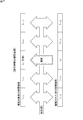
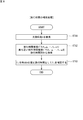
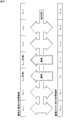
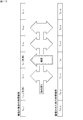
- FIG. 1 is a schematic configuration diagram of a traffic information processing system according to an embodiment of the present invention. It is a block diagram which shows schematic structure of a center apparatus. It is a data table which shows an example of travel time data. It is explanatory drawing of the prediction process of travel time. It is a flowchart of the prediction process of travel time. It is explanatory drawing which shows the problem of the prediction process of travel time. It is explanatory drawing of the complementation process of travel time. It is a flowchart of a travel time complementing process. It is explanatory drawing of a complementation process in case two missing measurement time continues. It is explanatory drawing of a complementation process when a complementation object transition pattern does not continue because of missing measurement. It is explanatory drawing of another complementation process in case a complementation object transition pattern is not continuous because of missing measurement. It is explanatory drawing which shows the numerical example of the complementation process of travel time.
- the present disclosure has a first object of appropriately supplementing the travel time related to the missing measurement when there is a missing measurement in a part of the past travel time.
- the conventional travel time prediction method does not assume a prediction method when there is a missing measurement in the past travel time.
- the missing part of the past travel time performance data is not used for prediction, the amount of data necessary for prediction cannot be secured and sufficient prediction accuracy may not be obtained. Therefore, a method for predicting travel time with higher accuracy than before is desired.
- This disclosure has a second object in view of such a conventional problem, and is capable of ensuring the prediction accuracy of travel time even if a part of past travel time is missing.
- a computer program according to the present embodiment is a computer program for causing a computer to function as a travel time complementing device.
- the computer program uses the computer to calculate travel time at each time for each control cycle in a road section.
- the past travel time transition pattern similar to the complement target transition pattern including the travel time before and after the missing time is extracted, It is made to function as a data processing part which performs the complement process which makes the travel time of the time pinched
- the process of extracting “similar” transition patterns includes the process of extracting one transition pattern having the highest “similarity” defined by a predetermined calculation formula.
- the process of extracting the “similar” transition pattern is a transition pattern composed of an average value of a plurality of travel times from a plurality of transition patterns (for example, five patterns) having a high similarity defined by a predetermined calculation formula. It may be a process for obtaining.
- the data processing unit when there is a missing measurement in the accumulated travel time, the data processing unit has a past travel time similar to the complement target transition pattern including the travel time before and after the missing time.
- a transition pattern is extracted, and a supplementary process is executed in which the travel time at the time between the extracted past transition patterns is used as the travel time at the missing time. For this reason, even if a part of the past travel time is missing, the travel time related to the missing measurement can be appropriately supplemented. Therefore, the first object described above is achieved.
- the number of statistically significant data can be secured, and statistical average data can be calculated appropriately.
- the graph can be displayed continuously by using the travel time in the time zone where the missing measurement occurred as supplementary data, and the graph of time transition is interrupted Can be prevented in advance.
- the data processing unit executes the complementing process using a calculation formula that reduces the contribution to the similarity as the travel time of the time having a large deviation from the missing time It is preferable to do.
- the reason is that the greater the deviation from the missing time, the more the temporal continuity of the travel time transition is impaired and the less the relationship with the travel time to be supplemented.
- the data processing unit contributes to the similarity as the travel time of the time when the number of probe vehicles used for calculating the travel time is large. It is preferable to execute the complementing process using a calculation formula to be enlarged. The reason is that it is estimated that the more accurate travel time is measured at the time (time zone) when the number of probe vehicles is large.
- the data processing unit uses a calculation formula that reduces the contribution to the similarity as the travel time has a larger variation in the difference from the travel time constituting the complement target transition pattern. It is preferable to execute the complementing process. The reason is that it is considered that the greater the variation in the difference, the less the similarity with the complement target transition pattern.
- the data processing unit compares the supplementary data that is the travel time calculated by the supplement processing with respect to the measurement data that is the travel time calculated without performing the supplement processing. It is preferable to execute the complementing process using a calculation formula that reduces the contribution to the similarity. The reason for this is that the supplementary data is less accurate in travel time than the measurement data, so that when the supplementary data is used for further supplementary processing, the contribution to the similarity should be small.
- the data processing unit uses the supplement data that is the travel time calculated by the complement processing and the measurement data that is the travel time calculated without performing the supplement processing. It is preferable to further execute a prediction process for predicting a travel time at a predicted time next to the current time.
- the travel time prediction accuracy can be improved as compared with the case where the travel time prediction process is performed using only usable measurement data.
- the prediction process extracts, for example, a past travel time transition pattern similar to a prediction target transition pattern including a plurality of travel times before the current time, It is preferable that the travel time at the next time of the transition pattern is a process for setting the travel time at the predicted time.
- the similarity calculation formula used in the complementing process and the similarity calculation formula used in the prediction process can be shared, there is an advantage that the prior design of the computer program can be simplified.
- a recording medium according to the present embodiment is a non-transitory computer-readable recording medium on which the computer programs (1) to (7) described above are recorded. Therefore, the recording medium of the present embodiment has the same effects as the computer programs (1) to (7) described above.
- the complementing method of the present embodiment is a complementing method that is achieved by the data processing unit executing the computer programs (1) to (7) described above. Therefore, the complementing method of the present embodiment has the same effects as the computer programs (1) to (7) described above.
- the complement device of the present embodiment is a complement device that includes the travel time database described above and a data processing unit that executes the computer programs described in (1) to (7) above. Therefore, the complementing apparatus of the present embodiment has the same operational effects as the computer programs (1) to (7) described above.
- Vehicle means all vehicles traveling on the road.
- vehicle includes a vehicle according to the Japanese road traffic law. Vehicles under the law include automobiles, motorbikes, light vehicles and trolley buses.
- vehicle includes both a probe vehicle having an in-vehicle device capable of transmitting probe information and a normal vehicle having no in-vehicle device.
- Vehicle sensor A roadside sensor that detects the presence of vehicles traveling on the road one by one at a fixed position. For example, an ultrasonic vehicle sensor that detects a vehicle passing underneath with an ultrasonic wave, a temperature type vehicle sensor that detects the passage of a vehicle from a temperature change when the vehicle passes, and a vehicle that detects an inductance change A loop coil embedded in a road corresponds to this.
- Detection signal A pulse signal output when a vehicle detector installed at a predetermined position on a road detects one vehicle. Therefore, when a plurality of vehicles pass through the vehicle detector, sensing signals corresponding to each vehicle are output in time series.
- Probe information Various types of information related to a vehicle obtained from an in-vehicle device of a probe vehicle that actually travels on a road. Sometimes referred to as probe data or floating car data. This includes data such as vehicle ID, vehicle position, vehicle speed, vehicle orientation, and the time of occurrence thereof. Since the vehicle speed can be calculated if the vehicle position and time are known, it is sufficient if the probe information includes the vehicle position and time measured every predetermined time (for example, 1 second). But the vehicle speed for every time may be contained in the probe information.
- Signal lamp color switching timing (such as the start time and display time of each lamp color) at the intersection is included.
- the signal lamp color switching timing includes time information (start time and display time or start time and end time) that can specify the start and end of the blue time zone.
- “Road section” A section from an arbitrary point on the road to another arbitrary point. “Route”: A road section including a plurality of system sections described later. A boundary link where no system control is performed is included between adjacent system sections. “System section”: A road section that performs system control described later. The system section includes approximately 3 to 5 links.
- Link A road section having an upward or downward direction that connects nodes such as intersections.
- a link in a direction flowing into the intersection as viewed from a certain intersection is referred to as an inflow link, and a link in a direction flowing out from the intersection as viewed from a certain intersection is referred to as an outflow link.
- Sub-area means an area divided so as to include one or a plurality of intersections where traffic signals that are signal-controlled with a common cycle length are installed.
- System control By adjusting the traffic signal offset between the intersections included in a series of system sections set in the sub-area, it is easier to pass a specific direction of the system section with a green light (priority offset), and vice versa The control that makes it easy to stop with a red light.
- Link travel time Travel time when the road section of the travel time calculation unit is “link”, that is, travel time required for the vehicle to travel from the start to the end of one link.
- Sensor travel time Travel time when the road section for which travel time is calculated is “system section”, that is, travel time required for a vehicle to travel from the start to the end of one system section Say.
- “Route travel time” Travel time when the road section of the travel time calculation unit is “route”, that is, travel time required for the vehicle to travel from the beginning to the end of one route. Say.
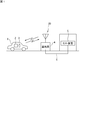
- FIG. 1 is a schematic configuration diagram of a traffic information processing system 20 according to an embodiment of the present invention.
- the traffic information processing system 20 of the present embodiment collects probe information including at least a vehicle position and passing time data of the position from a number of probe vehicles 1 by the center device 5 and performs data processing on the collected probe information.
- This is a system that provides a service that provides traffic information such as travel time, traffic conditions, and optimal routes.
- the traffic information processing system 20 includes an in-vehicle device 2 and a communication device 3 mounted on a probe vehicle 1, a base station 4, and a center device 5.
- Wireless communication is possible between the in-vehicle device 2 and the base station 4.
- Wired communication is possible between the base station 4 and the center apparatus 5 via a predetermined communication line 6.
- the communication between the base station 4 and the center device 5 may also be wireless communication.
- the in-vehicle device 2 includes a vehicle speed sensor, a direction sensor, a GPS receiver, a memory, a timer, and the like.
- the in-vehicle device 2 collects the probe information of the probe vehicle 1 every predetermined time (for example, 1 second) or every predetermined distance, and stores it in the memory.
- the in-vehicle device 2 is connected to a communication device 3 composed of a mobile phone, a smart phone or the like.
- the probe information stored in the memory is wirelessly transmitted by the communication device 3 to the outside.
- the probe information transmitted from the probe vehicle 1 is received by the base station 4 and relayed to the center device 5.
- the timing at which the probe vehicle 1 transmits probe information is arbitrary. But in this embodiment, when a passenger requests
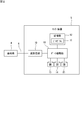
- FIG. 2 is a block diagram illustrating a schematic configuration of the center device 5.
- the center device 5 includes a transmission / reception unit 10, a data processing unit 11, a storage unit 12, and various databases 13 to 15.
- the transmission / reception unit 10 transmits / receives various data such as probe information, traffic congestion status, link travel time, and optimum route to / from the base station 4 and the data processing unit 11.
- the data processing unit 11 includes a server computer that generates and distributes traffic information.
- the storage unit 12 includes a recording medium such as a hard disk or a semiconductor memory, and stores a computer program 16 that causes the data processing unit 11 to function as a traffic information generation device.
- the data processing unit 11 uses the computer program 16 to perform an accumulation process for accumulating the travel time at each time calculated for each control cycle in the road section in the travel time database 15, and a travel time prediction process and a complement process described later. You can also
- the computer program 16 can be transferred while being recorded on a known recording medium such as a CD-ROM or DVD-ROM, or can be transferred by information transmission (downloading) from a computer device such as a server computer.
- Probe information received from the probe vehicle 1 is stored in the probe database 13.
- the probe information includes a vehicle ID, a data generation time, a vehicle position and a vehicle speed at the time, and the like.
- the map database 14 stores map data.
- the map data includes data such as position information and identification numbers of road links and nodes belonging to the jurisdiction area of the center device 5.
- the travel time database 15 stores the travel time of each time that progresses for each control cycle in the road section, which is calculated from the probe information and the map data by the data processing unit 11.
- the data processing unit 11 associates the travel locus of the probe vehicle 1 including the vehicle position and the passage time for each vehicle ID with the road section of the map data, and calculates the difference by the difference between the start point passage time and the end point passage time of the road section. Calculate travel time for road segments.
- the data processing unit 11 stores the calculated travel time in the travel time database 15.
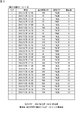
- FIG. 3 is a data table showing an example of travel time data stored in the travel time database 15.
- the data table shown in FIG. 3 is a data table when the road section is a link, that is, a data table related to “link travel time” for each control cycle (15 minutes in the example).
- the data types of this data table include “link” (road section), “time”, “travel time (seconds)”, “complement flag”, and “number of vehicles” in order from the left side.
- “Link” a link identification number (“1” in the example of FIG. 3) is written.
- “Time” is an observation time (time zone) that progresses every predetermined control period. In the example of FIG. 3, the time from 13:00 to 19; 45 on April 25, 2016 is described. For example, “April 25, 2016, 13:00” represents the time zone from 13:00 to 13:15 (not including 13:15) on that day, and “April 25, 2016, 13:15”. Represents a time zone of 13:15 to 13:30 (not including 13:30) of the day.
- travel time (seconds)
- a statistical value of the link travel time of one or a plurality of probe vehicles 1 that has flowed into the corresponding link at the corresponding time (time zone) is described.
- the statistical value is composed of, for example, an average value, but may be other statistical values such as a median value.
- an identification flag of “TRUE” or “FALSE” is written.
- TRUE means that the travel time value is a complement value calculated by a complement process described later.
- FALSE means that the travel time value is not a complementary value but a regular calculated value.
- the “travel time (seconds)” at this time is a statistical value (for example, an average value) of the link travel times of the three probe vehicles 1 that have passed the link at this time (time zone).
- the data table stored in the travel time database 15 is not limited to the link travel time data table shown in FIG. 3 but may be a “section travel time” or “route travel time” data table.
- the section travel time data table includes travel time calculated for each “system section” instead of “link” in FIG. 3, and the “section travel time” data table includes “link” in FIG. Instead of, travel time calculated for each “route” is included.
- the center device 5 may also have a traffic control function for controlling traffic signals at intersections.
- the data processing unit 11 of the center device 5 having a traffic control function executes system control and other traffic sensitivity control based on a vehicle sensor detection signal received by the transmission / reception unit 10.
- the data processing unit 11 transmits the signal control parameters of each intersection generated as a result of the traffic sensitivity control to the traffic signal controller through the transmission / reception unit 10.
- the data processing unit 11 determines that the virtual travel time has a large influence on the average value of the link travel times of all vehicles passing through the stop line at the terminal intersection in the blue time zone (blue time + yellow time).
- the estimated travel time may be calculated from the actual travel time of the probe vehicle 1 and the virtual travel time (Japanese Patent Laid-Open No. 2015-169974).
- FIG. 4 is an explanatory diagram of travel time prediction processing executed by the data processing unit 11 of the center apparatus 5 and FIG. 5 is a flowchart of the prediction processing.
- the travel time data used for the prediction process on the day for a predetermined road section is defined as follows.
- T n Travel time (latest measured value) at the current time on the predicted day.
- T n ⁇ 1 Travel time one time before the current time on the predicted day.
- T n ⁇ 2 Travel time two times before the current time on the predicted day.
- T n-3 Travel time three times before the current time on the predicted day.
- a series of travel times composed of “t n ”, “t n ⁇ 1 ”, “t n ⁇ 2 ”, and “t n ⁇ 3 ” is a transition pattern of the latest travel time used for prediction. (Hereinafter also referred to as “prediction target transition pattern”).
- a series of travel times consisting of “t n ′ ”, “t n′-1 ”, “t n′-2 ”, and “t n′-3 ” is most similar to the prediction target transition pattern (ie, the predetermined travel time) It is a transition pattern of past travel time (similar to the value of similarity S defined by the evaluation function).
- a travel time transition pattern t n′ ⁇ M ... T n ′ with the highest similarity S defined by the above calculation formula is used as the past of the road section included in the travel time database 15. Extract from travel time. When performing such extraction processing, select a day that satisfies the same numerical day, day of the week, weather, special events, etc. as the current day, and set the travel time for each selected time zone (15 minutes in this embodiment). It is preferable to extract.
- the search range of the past transition pattern t n′ ⁇ M ... T n ′ may be limited to the travel time for several tens of days (for example, 30 days) from the predicted date.
- step ST3 the data processing section 11, the following time n '+ 1 of the travel time t n' + 1 'of the latest travel time t n in the' historical trends pattern t n'-M whil t n, in the prediction target
- the travel time t n + 1 at a certain predicted time n + 1 is adopted (step ST3).
- FIG. 6 is an explanatory diagram illustrating problems in the travel time prediction process.
- missing means that the travel time at the time cannot be calculated from probe information or the like.
- “missing measurement” occurs when the number of probe vehicles 1 at that time is zero. For example, in the travel time data of FIG. 3, since the number of vehicles at the time of “April 25, 2016, 13:45” is zero, the value of the travel time of the time zone before executing the later-described complementary processing Is “missing (NULL)”.
- the similarity S is calculated for the transition patterns t n′-3 to t n ′ including the travel time t n′-2. It becomes impossible, and the transition pattern of past travel time that can be used for prediction is reduced. For this reason, depending on the number of missing data, the amount of data necessary for the prediction of the travel time t n + 1 cannot be secured, and sufficient prediction accuracy may not be obtained.
- the travel time t n'-2 is missing, when statistical average data of travel time by time zone is created, the statistically significant number of data cannot be obtained, and statistical average data May not be able to ensure the accuracy.
- the travel time t n′ ⁇ 2 is missing, there is also a problem that the time transition graph is interrupted when the time transition of the travel time is displayed in a graph. Therefore, in the present embodiment, for example, the travel time t n′ ⁇ 2 of the missing time n′ ⁇ 2 is complemented using the similarity S similar to that in the prediction process as an evaluation function.
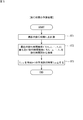
- FIG. 7 is an explanatory diagram of travel time complementing processing executed by the data processing unit 11 of the center device 5 and FIG. 8 is a flowchart of the complementing processing. 7 and 8, the travel time data used for the complementary process for a predetermined road section is defined as follows.
- T n Travel time (missing target) at the missing time n.
- T n ⁇ 1 Travel time at time n ⁇ 1 one time before the missing time n.
- T n ⁇ 2 Travel time at time n ⁇ 2 that is two times before the missing time n.
- T n + 1 Travel time at time n + 1, one time after missing time n.
- T n + 2 Travel time at time n + 2 two times after missing time n.
- a series of travel times consisting of “t n ⁇ 2 ”, “t n ⁇ 1 ”, “t n + 1 ”, and “t n + 2 ” is a travel time transition pattern (hereinafter “ It is also referred to as “complementation target transition pattern”).
- a series of travel times consisting of “t n′ ⁇ 2 ”, “t n′ ⁇ 1 ”, “t n ′ + 1 ”, and “t n ′ + 2 ” is most similar to the complement target transition pattern (that is, a predetermined It is a transition pattern of past travel time (similar to the value of similarity S defined by the evaluation function).
- Similarity S is an index representing the degree of approximation of the travel time transition pattern, and is defined by “reciprocal of Euclidean distance” or “reciprocal of Manhattan distance” as in the case of the prediction process.
- the similarity S is an index defined by the above-described mathematical formula.
- the travel time transition pattern t n′ ⁇ N ... T n ′ + N in which the similarity S defined by the above-described calculation formula is the largest is the past of the road section included in the travel time database 15. Extract from travel time.
- the search range of the past transition pattern t n′ ⁇ N ... T n ′ + N is limited to the travel time for several tens of days (for example, 30 days) from the day including the missing time n. May be.
- Step ST13 the data processing unit 11, the travel time t n '' time n between + 1 'time n'-1 and the time n, is employed as the travel time t n of the missing time n is the complement target ( Step ST13).
- N 2 in the example of FIG. 7
- supplementary target transition patterns t n ⁇ N ... T n + N is a past travel time transition pattern t.
- FIG. 9 is an explanatory diagram of a complementing process when two missing measurement times n and n + 1 are consecutive.
- two missing times n and n + 1 are consecutive, that is, when the number of vehicles at two times n and n + 1 is zero, the earlier missing time n to N times earlier
- the complementation object transition pattern which consists of travel time tn -2 , tn -1 and travel time tn + 2 , tn + 3 from the later missing time n + 1 to N ahead.
- the travel time transition pattern t n′ ⁇ 2 ... T n ′ + 3 is extracted from the past travel times of the road section included in the travel time database 15. Then, the travel times t n ′ and t n ′ + 1 of the past two times n ′ and n ′ + 1 may be adopted as the travel times t n and t n + 1 of the missing measurement times n and n + 1 that are the complements.
- a day that satisfies the same numerical day, day of the week, weather, presence / absence of events, etc. is selected, and the travel time for each selected time zone (15 minutes in this embodiment) is selected. It is preferable to extract. Further, the search range of the past transition pattern t n′ ⁇ N ... T n ′ + 1 + N is limited to travel time data for the last several tens of days (for example, 30 days) from the day including the missing time n, n + 1. You may decide to do it.
- FIG. 10 is an explanatory diagram of the complementing process when the complementing target transition pattern is not continuous due to missing measurement. As shown in FIG. 10, for example, since the time n-2 two times before the missing time n that is the complement target is missing, the complement target transition pattern before the missing time n may not be continuous. Conceivable.
- missing two times n + 1 after time n measurement, n + travel time for 2 t n-1, t n + 1, t n + 2 Metropolitan may be defined to be complemented transition pattern composed.
- the complementation target transition pattern t n ⁇ 1 ... T n + 2 at one time n ⁇ 1 before the missing time (time zone) n and the next two times n + 1 and n + 2 is the most similar.
- a past travel time transition pattern t n′ ⁇ 1 ... T n ′ + 2 approximated by S is extracted from the past travel times of the road section included in the travel time database 15. Then, the 'travel time t n of' past time n, may be adopted as the travel time t n of missing time n is a complementary target.
- a day that satisfies the same numerical day, day of the week, weather, presence / absence of events, etc. is selected, and the travel time for each selected time zone (15 minutes in this embodiment) is selected. It is preferable to extract.
- the search range of the past transition pattern t n′-1 ... T n ′ + 2 is limited to the travel time for the last several tens of days (for example, 30 days) from the day including the missing time n. May be.
- FIG. 11 is an explanatory diagram of another complement processing when the complement target transition pattern is not continuous due to missing measurement.
- the complementing process of FIG. 11 in addition to the travel time t n ⁇ 1 at the time n ⁇ 1 immediately before the missing time n to be complemented, the time n ⁇ 3 immediately before the missing time n ⁇ 2. Travel time t n-3 is included in the complementation target transition pattern.
- time n-3, n-1, n + 1, n + 2 of the complement target transfer pattern t n-3 ?? t n + 2 and the most similarity past of travel time S is approximate transition pattern t n'-3 ...
- T n ′ + 2 is extracted from the past travel times of the road section included in the travel time database 15. Then, the 'travel time t n of' past time n, may be adopted as the travel time t n of missing time n is a complementary target.
- a day that satisfies the same numerical day, day of the week, weather, presence / absence of events, etc. is selected, and the travel time for each selected time zone (15 minutes in this embodiment) is selected. It is preferable to extract.
- the search range of the past transition pattern t n′-3 ... T n ′ + 2 is limited to the travel time for several tens of days (for example, 30 days) from the day including the missing time n. May be.
- the data processing unit 11 stores the travel time calculated by the complementing process in an entry whose travel time is missing (NULL) in the travel time database 15. .
- the data processing unit 11 directly calculates travel time (hereinafter referred to as “measurement data” or “measurement value”) from the probe information without performing the supplement processing, and travel time calculated by the supplement processing (hereinafter “ Travel time prediction processing (FIGS. 4 and 5) is executed using “complementary data” or “complementary value”).
- the prediction target transition pattern t n ⁇ M ... T n from the latest travel time t n to the Mth time is the most.
- the latest in the near past of travel time transition pattern t n'-M whil t n ' ( may be any of the complement data and measurement data.) search for, historical trends pattern t n'-M whil t n'
- the travel time t n ′ + 1 at the time n ′ + 1 next to the travel time t n ′ is adopted as the travel time t n + 1 at the prediction time n + 1 that is the prediction target.
- a plurality of travel times t determined from a plurality of upper travel time transition patterns (for example, five patterns) having a higher similarity S
- a weighted average value corresponding to the similarity S j of a plurality of travel times t n + 1, j may be adopted as the travel time t n + 1 of the predicted time n + 1. .
- the past travel time transition pattern t n similar to the complement target transition pattern t n ⁇ 2 to t n + 2 including the travel time before and after the missing time n. '-2 to t n' + 2 is extracted, and the travel time t n ' at time n' sandwiched between the extracted past transition patterns t n'-2 to t n '+ 2 is set as travel time t at missing time n Complement processing with n is executed. Therefore, when there is a missing measurement in a part of the past travel time, the travel time t n ′ related to the missing measurement can be appropriately supplemented.
- the number of statistically significant data can be secured, and statistical average data can be calculated appropriately.
- the graph can be displayed continuously by using the travel time in the time zone where the missing measurement occurred as supplementary data, and the time transition graph is not interrupted. Can be prevented.
- the number of data of the past travel time transition pattern that can be used for the travel time prediction process (FIGS. 4 and 5).
- the data processing unit 11 of the present embodiment executes the travel time prediction process (FIGS. 4 and 5) using the measurement data and the complementary data, the travel time prediction is performed using only usable measurement data. The accuracy of prediction can be improved compared to the case where processing is performed. Furthermore, according to the data processing unit 11 of the present embodiment, since the similarity S calculation formula used in the complementing process and the similarity S calculation formula used in the prediction process are shared, the prior design of the computer program 16 is simplified. There is also an advantage that can be made.
- the travel time data table (FIG. 3) includes flag information (complementation flag) for identifying the measurement data and the complementary data.
- the data processing unit 11 sets the supplement flag to “TRUE” and is the measurement data calculated without the travel time being subjected to the supplement processing.
- the complement flag is set to “FALSE” (see FIG. 3).
- FIG. 12 is an explanatory diagram illustrating a numerical example of travel time supplement processing.
- the travel time t n ⁇ 2 is “complementary data” out of the complement target transition patterns t n ⁇ 2 to t n + 2 across the travel time t n of the complement target (missing),
- the travel time t n′ + 1 is “complementary data”.
- Modification 1 of the similarity calculation method it is preferable to employ a calculation formula that makes the contribution to the similarity S smaller as the travel time has a larger deviation from the missing time n.
- the travel time at a time with a small deviation from the missing time n increases the contribution to the similarity S.
- the reason is that the larger the deviation between the missing time n, impaired temporal continuity of the travel time changes, because relevance of the complement target travel time t n is considered to be thin.
- the calculation formula in this case can be defined by the following calculation formula, for example.
- becomes smaller and the contribution to the similarity S becomes smaller as the distance from the complemented time n increases. Therefore, the accuracy of the similarity S can be improved as compared to the case of using the similarity calculation formula not including a
- the value of the similarity S is as follows.
- Modification 3 of similarity calculation method it is preferable to employ a calculation formula that reduces the contribution to the similarity S as the travel time has a larger variation (e.g., standard deviation) in the difference from the travel time constituting the complement target transition pattern. That is, the contribution to the similarity S is increased as the travel time has a smaller difference. The reason is that it is considered that the greater the variation in the difference, the less the similarity with the complement target transition pattern.
- the calculation formula in this case can be defined by the following calculation formula, for example.
- Modification 4 of the similarity calculation method it is preferable to employ a calculation formula that reduces the contribution to the similarity S for the complementary data. That is, for the measurement data, the contribution to the similarity S is increased. The reason for this is that the supplementary data is less accurate in travel time than the measured data, and therefore when the supplementary data is used for further supplementary processing, the contribution to the similarity S should be small.
- the calculation formula in this case can be defined by the following calculation formula, for example.
- Modification 5 of the similarity calculation method A calculation formula obtained by combining the parameters included in the calculation formula of the similarity S used in the above-described modification examples 1 to 4 may be adopted. For example, if a calculation formula including the setting constant a in [Equation 4] and the second term in the denominator for the number of vehicles in [Equation 6] is adopted, it depends on the influence of the deviation from the missing time n and the number of probe vehicles 1 in the vehicle. It is possible to calculate the similarity S considering both influences.
- the travel time is calculated based on the probe information.
- the travel time may be the travel time obtained from the sensing signal of the vehicle sensor. The reason is that the travel time may be lost due to a failure of the vehicle sensor or the like.
Landscapes
- Engineering & Computer Science (AREA)
- Radar, Positioning & Navigation (AREA)
- Remote Sensing (AREA)
- Physics & Mathematics (AREA)
- General Physics & Mathematics (AREA)
- Automation & Control Theory (AREA)
- Traffic Control Systems (AREA)
Abstract
本発明の一態様に係るコンピュータプログラムは、旅行時間の補完装置としてコンピュータを機能させるためのコンピュータプログラムであって、前記コンピュータを、道路区間における制御周期ごとに進行する各時刻の旅行時間を、旅行時間データベースに蓄積する蓄積処理と、蓄積された旅行時間に欠測がある場合に、欠測時刻の前後の旅行時間を含む補完対象推移パターンと類似する過去の旅行時間の推移パターンを抽出し、抽出した過去の推移パターンに挟まれる時刻の旅行時間を、欠測時刻の旅行時間とする補完処理と、を実行する、データ処理部として機能させる。
Description
本発明は、旅行時間の補完装置、補完方法、コンピュータプログラム及び記録媒体に関する。
本出願は、2016年7月22日出願の日本出願第2016-144547号に基づく優先権を主張し、前記日本出願に記載された全ての記載内容を援用するものである。
本出願は、2016年7月22日出願の日本出願第2016-144547号に基づく優先権を主張し、前記日本出願に記載された全ての記載内容を援用するものである。
道路区間の旅行時間の予測方法として、蓄積した過去の旅行時間実績データから、現在の旅行時間推移パターンと類似する過去の推移パターンを検索し、検索した過去の推移パターンを用いて、旅行時間を予測する方法が知られている(特許文献1及び2参照)。
この予測方法は、所定の評価関数(類似度)を用いて、最新の旅行時間推移パターンに類似する過去の推移パターンを旅行時間データベースの中から抽出し、抽出した過去の推移パターンの次の時刻の旅行時間を予測値とする方法である。
この予測方法は、所定の評価関数(類似度)を用いて、最新の旅行時間推移パターンに類似する過去の推移パターンを旅行時間データベースの中から抽出し、抽出した過去の推移パターンの次の時刻の旅行時間を予測値とする方法である。
(1) 本開示の一態様に係るコンピュータプログラムは、旅行時間の補完装置としてコンピュータを機能させるためのコンピュータプログラムであって、前記コンピュータプログラムは、前記コンピュータを、道路区間における制御周期ごとに進行する各時刻の旅行時間を、旅行時間データベースに蓄積する蓄積処理と、蓄積された旅行時間に欠測がある場合に、欠測時刻の前後の旅行時間を含む補完対象推移パターンと類似する過去の旅行時間の推移パターンを抽出し、抽出した過去の推移パターンに挟まれる時刻の旅行時間を、欠測時刻の旅行時間とする補完処理と、を実行する、データ処理部として機能させる。
(8) 本開示の一態様に係る記憶媒体は、旅行時間の補完装置としてコンピュータを機能させるためのコンピュータプログラムが記録された、非一時的なコンピュータ読み取り可能な記録媒体であって、前記コンピュータプログラムは、前記コンピュータを、道路区間における制御周期ごとに進行する各時刻の旅行時間を、旅行時間データベースに蓄積する蓄積処理と、蓄積された旅行時間に欠測がある場合に、欠測時刻の前後の旅行時間を含む補完対象推移パターンと類似する過去の旅行時間の推移パターンを抽出し、抽出した過去の推移パターンに挟まれる時刻の旅行時間を、欠測時刻の旅行時間とする補完処理と、を実行する、データ処理部として機能させる。
(9) 本開示の一態様に係る補完方法は、道路区間における制御周期ごとに進行する各時刻の旅行時間を、旅行時間データベースに蓄積するステップと、蓄積された旅行時間に欠測がある場合に、欠測時刻の前後の旅行時間を含む補完対象推移パターンと類似する過去の旅行時間の推移パターンを抽出し、抽出した過去の推移パターンに挟まれる時刻の旅行時間を、欠測時刻の旅行時間とするステップと、を含む。
(10) 本開示の一態様に係る補完装置は、道路区間における制御周期ごとに進行する各時刻の旅行時間が蓄積された旅行時間データベースと、蓄積された旅行時間に欠測がある場合に、欠測時刻の前後の旅行時間を含む補完対象推移パターンと類似する過去の旅行時間の推移パターンを抽出し、抽出した過去の推移パターンに挟まれる時刻の旅行時間を、欠測時刻の旅行時間とする補完処理を実行するデータ処理部と、を備える。
本開示の一態様は、このような特徴的なデータ処理部を備える補完装置として実現できるだけでなく、かかる特徴的な処理のステップをコンピュータに実行させるためのプログラムとして実現することができる。
また、本開示の一態様は、補完装置の一部又は全部を実現する半導体集積回路として実現したり、中継装置を含むシステムとして実現したりすることができる。
また、本開示の一態様は、補完装置の一部又は全部を実現する半導体集積回路として実現したり、中継装置を含むシステムとして実現したりすることができる。
<本開示が解決しようとする課題>
例えば、道路区間の旅行時間をプローブ情報から算出する場合、当該道路区間をプローブ車両が通過しない時間帯は欠測となってしまう。
このため、時間帯別の旅行時間の統計平均データが作成される場合に、統計的に有意性のあるデータ数が得られず、統計平均データの精度を確保できない可能性がある。また、旅行時間の時間推移をグラフで表示する場合に、一部の時間帯に欠測があると、時間推移のグラフが途切れてしまうという問題もある。
例えば、道路区間の旅行時間をプローブ情報から算出する場合、当該道路区間をプローブ車両が通過しない時間帯は欠測となってしまう。
このため、時間帯別の旅行時間の統計平均データが作成される場合に、統計的に有意性のあるデータ数が得られず、統計平均データの精度を確保できない可能性がある。また、旅行時間の時間推移をグラフで表示する場合に、一部の時間帯に欠測があると、時間推移のグラフが途切れてしまうという問題もある。
本開示は、かかる従来の問題点に鑑み、過去の旅行時間の一部に欠測がある場合に、欠測に係る旅行時間を適切に補完することを第1の目的とする。
一方、従来の旅行時間の予測方法では、過去の旅行時間に欠測がある場合における予測方法については想定されていない。
この場合、過去の旅行時間実績データのうち、欠側のある部分を予測に利用しないとすると、予測に必要なデータ量を確保できず、十分な予測精度が得られない可能性がある。従って、従来よりも高精度な旅行時間の予測方法が望まれる。
この場合、過去の旅行時間実績データのうち、欠側のある部分を予測に利用しないとすると、予測に必要なデータ量を確保できず、十分な予測精度が得られない可能性がある。従って、従来よりも高精度な旅行時間の予測方法が望まれる。
本開示は、かかる従来の問題点に鑑み、過去の旅行時間の一部が欠測していても、旅行時間の予測精度を確保できるようにすることを第2の目的とする。
<本開示の効果>
本開示によれば、過去の旅行時間の一部が欠測していても、旅行時間の予測精度を確保することができる。
<本発明の実施形態の概要>
以下、本発明の実施形態の概要を列記して説明する。
(1) 本実施形態のコンピュータプログラムは、旅行時間の補完装置としてコンピュータを機能させるためのコンピュータプログラムであって、前記コンピュータを、道路区間における制御周期ごとに進行する各時刻の旅行時間を、旅行時間データベースに蓄積する蓄積処理と、蓄積された旅行時間に欠測がある場合に、欠測時刻の前後の旅行時間を含む補完対象推移パターンと類似する過去の旅行時間の推移パターンを抽出し、抽出した過去の推移パターンに挟まれる時刻の旅行時間を、欠測時刻の旅行時間とする補完処理と、を実行する、データ処理部として機能させる。
本開示によれば、過去の旅行時間の一部が欠測していても、旅行時間の予測精度を確保することができる。
<本発明の実施形態の概要>
以下、本発明の実施形態の概要を列記して説明する。
(1) 本実施形態のコンピュータプログラムは、旅行時間の補完装置としてコンピュータを機能させるためのコンピュータプログラムであって、前記コンピュータを、道路区間における制御周期ごとに進行する各時刻の旅行時間を、旅行時間データベースに蓄積する蓄積処理と、蓄積された旅行時間に欠測がある場合に、欠測時刻の前後の旅行時間を含む補完対象推移パターンと類似する過去の旅行時間の推移パターンを抽出し、抽出した過去の推移パターンに挟まれる時刻の旅行時間を、欠測時刻の旅行時間とする補完処理と、を実行する、データ処理部として機能させる。
本実施形態において、「類似する」推移パターンを抽出する処理には、所定の算出式で定義される「類似度」が最も高い1つの推移パターンを抽出する処理が含まれる。
また、「類似する」推移パターンを抽出する処理は、所定の算出式で定義される類似度が大きい上位複数の推移パターン(例えば、5パターン)から、複数の旅行時間の平均値よりなる推移パターンを求める処理であってもよい。
また、「類似する」推移パターンを抽出する処理は、所定の算出式で定義される類似度が大きい上位複数の推移パターン(例えば、5パターン)から、複数の旅行時間の平均値よりなる推移パターンを求める処理であってもよい。
本実施形態のコンピュータプログラムによれば、データ処理部が、蓄積された旅行時間に欠測がある場合に、欠測時刻の前後の旅行時間を含む補完対象推移パターンと類似する過去の旅行時間の推移パターンを抽出し、抽出した過去の推移パターンに挟まれる時刻の旅行時間を、欠測時刻の旅行時間とする補完処理を実行する。
このため、過去の旅行時間の一部が欠測していても、欠測に係る旅行時間を適切に補完することができる。従って、上述の第1の目的が達成される。
このため、過去の旅行時間の一部が欠測していても、欠測に係る旅行時間を適切に補完することができる。従って、上述の第1の目的が達成される。
このため、例えば、時間帯別の旅行時間の統計平均データが作成される場合に、統計的に有意性のあるデータ数を確保でき、統計平均データを適切に算出できるようになる。
また、例えば、旅行時間の時間推移をグラフで表示する場合に、欠測が生じた時間帯の旅行時間を補完データとすることにより当該グラフを連続的に表示でき、時間推移のグラフが途切れるのを未然に防止することができる。
また、例えば、旅行時間の時間推移をグラフで表示する場合に、欠測が生じた時間帯の旅行時間を補完データとすることにより当該グラフを連続的に表示でき、時間推移のグラフが途切れるのを未然に防止することができる。
(2) 本実施形態のコンピュータプログラムにおいて、前記データ処理部は、欠測時刻との乖離が大きい時刻の旅行時間ほど、類似度への寄与を小さくする算出式を用いて、前記補完処理を実行することが好ましい。
その理由は、欠測時刻との乖離が大きくなるほど、旅行時間推移の時間的な連続性が損なわれ、補完対象の旅行時間との関連性が薄くなると考えられるからである。
その理由は、欠測時刻との乖離が大きくなるほど、旅行時間推移の時間的な連続性が損なわれ、補完対象の旅行時間との関連性が薄くなると考えられるからである。
(3) 本実施形態のコンピュータプログラムにおいて、前記データ処理部は、前記データ処理部は、前記旅行時間の算出に用いたプローブ車両の車両台数が多い時刻の旅行時間ほど、類似度への寄与を大きくする算出式を用いて、前記補完処理を実行することが好ましい。
その理由は、プローブ車両の車両台数が多い時刻(時間帯)ほど、正確な旅行時間が計測されていると推定されるからである。
その理由は、プローブ車両の車両台数が多い時刻(時間帯)ほど、正確な旅行時間が計測されていると推定されるからである。
(4) 本実施形態のコンピュータプログラムにおいて、前記データ処理部は、補完対象推移パターンを構成する旅行時間との差分のばらつきが大きい旅行時間ほど、類似度への寄与を小さくする算出式を用いて、前記補完処理を実行することが好ましい。
その理由は、上記差分のばらつきが大きいほど、補完対象推移パターンとの類似性が薄くなると考えられるからである。
その理由は、上記差分のばらつきが大きいほど、補完対象推移パターンとの類似性が薄くなると考えられるからである。
(5) 本実施形態のコンピュータプログラムにおいて、前記データ処理部は、前記補完処理により算出した旅行時間である補完データについては、前記補完処理を行わずに算出した旅行時間である計測データに比べて、類似度への寄与を小さくする算出式を用いて、前記補完処理を実行することが好ましい。
その理由は、補完データは計測データよりも旅行時間の精度が劣るので、補完データを用いて更に補完処理を行う場合には、類似度への寄与を小さくすべきだからである。
その理由は、補完データは計測データよりも旅行時間の精度が劣るので、補完データを用いて更に補完処理を行う場合には、類似度への寄与を小さくすべきだからである。
(6) 本実施形態のコンピュータプログラムにおいて、前記データ処理部は、前記補完処理により算出した旅行時間である補完データと、前記補完処理を行わずに算出した旅行時間である計測データとを用いて、現在時刻の次の予測時刻の旅行時間を予測する予測処理を、更に実行することが好ましい。
本実施形態のコンピュータプログラムによれば、上記の予測処理を実行するので、過去の旅行時間の一部が欠測していても、旅行時間の予測処理に利用可能な過去の旅行時間の推移パターンのデータ数を確保でき、旅行時間の予測精度を確保することができる。従って、上述の第2の目的が達成される。
すなわち、使用可能な計測データのみを用いて旅行時間の予測処理を行う場合に比べて、旅行時間の予測精度を向上することができる。
すなわち、使用可能な計測データのみを用いて旅行時間の予測処理を行う場合に比べて、旅行時間の予測精度を向上することができる。
(7) 本実施形態のコンピュータプログラムにおいて、前記予測処理は、例えば、現在時刻以前の複数の旅行時間を含む予測対象推移パターンと類似する過去の旅行時間の推移パターンを抽出し、抽出した過去の推移パターンの次の時刻の旅行時間を、予測時刻の旅行時間とする処理であることが好ましい。
この場合、補完処理で用いる類似度の算出式と予測処理で用いる類似度の算出式を共用できるので、コンピュータプログラムの事前設計を簡素化できる利点がある。
この場合、補完処理で用いる類似度の算出式と予測処理で用いる類似度の算出式を共用できるので、コンピュータプログラムの事前設計を簡素化できる利点がある。
(8) 本実施形態の記録媒体は、上述の(1)~(7)のコンピュータプログラムが記録された、非一時的なコンピュータ読み取り可能な記録媒体である。
従って、本実施形態の記録媒体は、上述の(1)~(7)のコンピュータプログラムと同様の作用効果を奏する。
従って、本実施形態の記録媒体は、上述の(1)~(7)のコンピュータプログラムと同様の作用効果を奏する。
(9) 本実施形態の補完方法は、上述の(1)~(7)のコンピュータプログラムをデータ処理部が実行することにより達成される補完方法である。
従って、本実施形態の補完方法は、上述の(1)~(7)のコンピュータプログラムと同様の作用効果を奏する。
従って、本実施形態の補完方法は、上述の(1)~(7)のコンピュータプログラムと同様の作用効果を奏する。
(10) 本実施形態の補完装置は、上述の旅行時間データベースと、上述の(1)~(7)のコンピュータプログラムを実行するデータ処理部とを備える補完装置である。
従って、本実施形態の補完装置は、上述の(1)~(7)のコンピュータプログラムと同様の作用効果を奏する。
従って、本実施形態の補完装置は、上述の(1)~(7)のコンピュータプログラムと同様の作用効果を奏する。
<本発明の実施形態の詳細>
以下、図面を参照して、本発明の実施形態の詳細を説明する。なお、以下に記載する実施形態の少なくとも一部を任意に組み合わせてもよい。
以下、図面を参照して、本発明の実施形態の詳細を説明する。なお、以下に記載する実施形態の少なくとも一部を任意に組み合わせてもよい。
〔用語の定義〕
本実施形態の詳細を説明するに当たり、まず、本明細書で用いる用語の定義を行う。
「車両」:道路を通行する車両全般のことをいう。例えば、車両には、日本の道路交通法上の車両が含まれる。同法上の車両には、自動車、原動機付自転車、軽車両及びトロリーバスが含まれる。本実施形態では、単に「車両」というときは、プローブ情報を送信可能な車載機を有するプローブ車両と、その車載機を有しない通常の車両の双方を含む。
本実施形態の詳細を説明するに当たり、まず、本明細書で用いる用語の定義を行う。
「車両」:道路を通行する車両全般のことをいう。例えば、車両には、日本の道路交通法上の車両が含まれる。同法上の車両には、自動車、原動機付自転車、軽車両及びトロリーバスが含まれる。本実施形態では、単に「車両」というときは、プローブ情報を送信可能な車載機を有するプローブ車両と、その車載機を有しない通常の車両の双方を含む。
「車両感知器」:道路を走行する車両の存在を定位置で1台ずつ検出する路側センサのことをいう。例えば、直下を通行する車両を超音波で感知する超音波式の車両感知器、車両通過時の温度変化から車両の通過を感知する温度式の車両感知器、及び、インダクタンス変化で車両を感知する道路に埋め込まれたループコイル等がこれに該当する。
「感知信号」:道路の所定位置に設置された車両感知器が、1台の車両を検出した時に出力するパルス信号のことをいう。従って、複数台の車両が車両感知器を通過した場合には、各車両に対応する感知信号が時系列に出力される。
「感知信号」:道路の所定位置に設置された車両感知器が、1台の車両を検出した時に出力するパルス信号のことをいう。従って、複数台の車両が車両感知器を通過した場合には、各車両に対応する感知信号が時系列に出力される。
「プローブ情報」:実際に道路を走行するプローブ車両の車載機から得られる車両に関する各種情報のことをいう。プローブデータ或いはフローティングカーデータと称されることもある。車両ID、車両位置、車両速度、車両方位及びこれらの発生時刻などのデータがこれに含まれる。
車両位置と時刻が分かれば車両速度を算出できるので、プローブ情報には、所定時間(例えば1秒)ごとに計測された車両位置と時刻が含まれておれば足りる。もっとも、時刻ごとの車両速度がプローブ情報に含まれていてもよい。
車両位置と時刻が分かれば車両速度を算出できるので、プローブ情報には、所定時間(例えば1秒)ごとに計測された車両位置と時刻が含まれておれば足りる。もっとも、時刻ごとの車両速度がプローブ情報に含まれていてもよい。
「信号制御パラメータ」:一般には、サイクル長、スプリット及びオフセットのことをいうが、本実施形態では、交差点の信号灯色の切り替えタイミング(各灯色の開始時刻及び表示時間など)が含まれる。
信号灯色の切り替えタイミングには、青時間帯の開始と終了を特定できる時間情報(開始時刻と表示時間又は開始時刻と終了時刻)が含まれる。
信号灯色の切り替えタイミングには、青時間帯の開始と終了を特定できる時間情報(開始時刻と表示時間又は開始時刻と終了時刻)が含まれる。
「道路区間」:道路上の任意の地点から別の任意の地点までの区間のことをいう。
「路線」:後述の複数の系統区間を含む道路区間のことをいう。隣接する系統区間の間には、系統制御が行われない境界リンクが含まれる。
「系統区間」:後述する系統制御を行う道路区間のことをいう。系統区間には、概ね3~5つ程度のリンクが含まれる。
「路線」:後述の複数の系統区間を含む道路区間のことをいう。隣接する系統区間の間には、系統制御が行われない境界リンクが含まれる。
「系統区間」:後述する系統制御を行う道路区間のことをいう。系統区間には、概ね3~5つ程度のリンクが含まれる。
「リンク」:交差点などのノード間を繋ぐ、上り又は下りの方向を有する道路区間のことをいう。ある交差点から見て、当該交差点に向かって流入する方向のリンクのことを流入リンクといい、ある交差点から見て、当該交差点から流出する方向のリンクのことを流出リンクという。
「サブエリア」:共通のサイクル長で信号制御される交通信号機が設置された1又は複数の交差点が含むように区分けされたエリアのことをいう。
「系統制御」:サブエリア内に設定した一連の系統区間に含まれる交差点間の交通信号機のオフセットを調節することにより、系統区間の特定方向を青信号で通過し易くしたり(優先オフセット)、逆に赤信号で停止し易くしたりする制御のことをいう。
「系統制御」:サブエリア内に設定した一連の系統区間に含まれる交差点間の交通信号機のオフセットを調節することにより、系統区間の特定方向を青信号で通過し易くしたり(優先オフセット)、逆に赤信号で停止し易くしたりする制御のことをいう。
「リンク旅行時間」:旅行時間の算出単位の道路区間が「リンク」である場合の旅行時間、すなわち、車両が1つのリンクの始端から終端までを通行するのに必要な旅行時間のことをいう。
「区間旅行時間」:旅行時間の算出対象の道路区間が「系統区間」である場合の旅行時間、すなわち、車両が1つ系統区間の始端から終端までを通行するのに必要な旅行時間のことをいう。
「区間旅行時間」:旅行時間の算出対象の道路区間が「系統区間」である場合の旅行時間、すなわち、車両が1つ系統区間の始端から終端までを通行するのに必要な旅行時間のことをいう。
「路線旅行時間」:旅行時間の算出単位の道路区間が「路線」である場合の旅行時間、すなわち、すなわち、車両が1つの路線の始端から終端までを通行するのに必要な旅行時間のことをいう。
〔交通情報処理システム〕
図1は、本発明の実施形態に係る交通情報処理システム20の概略構成図である。
本実施形態の交通情報処理システム20は、少なくとも車両位置とその位置の通過時刻のデータを含むプローブ情報を、多数のプローブ車両1からセンター装置5が収集し、収集したプローブ情報にデータ処理を施すことにより、旅行時間、渋滞状況及び最適経路などの交通情報を提供するサービスを行うシステムである。
図1は、本発明の実施形態に係る交通情報処理システム20の概略構成図である。
本実施形態の交通情報処理システム20は、少なくとも車両位置とその位置の通過時刻のデータを含むプローブ情報を、多数のプローブ車両1からセンター装置5が収集し、収集したプローブ情報にデータ処理を施すことにより、旅行時間、渋滞状況及び最適経路などの交通情報を提供するサービスを行うシステムである。
図1に示すように、交通情報処理システム20は、プローブ車両1に搭載された車載機2及び通信装置3と、基地局4と、センター装置5とを備える。
車載機2と基地局4の間では、無線通信が可能である。基地局4とセンター装置5との間では、所定の通信回線6を介した有線通信が可能である。ただし、基地局4とセンター装置5との間の通信も無線通信であってもよい。
車載機2と基地局4の間では、無線通信が可能である。基地局4とセンター装置5との間では、所定の通信回線6を介した有線通信が可能である。ただし、基地局4とセンター装置5との間の通信も無線通信であってもよい。
車載機2は、車速センサ、方位センサ、GPS受信機、メモリ、及びタイマなどを有する。車載機2は、プローブ車両1のプローブ情報を所定時間(例えば1秒)ごと又は所定距離ごとに収集し、メモリに蓄積する。
車載機2には、携帯電話やスマートフォン等よりなる通信装置3が接続されている。メモリに蓄積されたプローブ情報は、通信装置3が外部に無線送信する。プローブ車両1から送信されたプローブ情報は、基地局4が受信してセンター装置5に中継する。
車載機2には、携帯電話やスマートフォン等よりなる通信装置3が接続されている。メモリに蓄積されたプローブ情報は、通信装置3が外部に無線送信する。プローブ車両1から送信されたプローブ情報は、基地局4が受信してセンター装置5に中継する。
プローブ車両1がプローブ情報を送信するタイミングは任意である。もっとも、本実施形態では、搭乗者がセンター装置5に交通情報の送信を要求する際に、通信装置3が車載機2のメモリに蓄積されたプローブ情報を送信する。
すなわち、交通情報の提供を希望する搭乗者は、通信装置3を操作してサービスの要求信号をセンター装置5に送信する。この際、通信装置3は、要求信号の送信時点でメモリに蓄積されているプローブ情報を、要求信号と併せてセンター装置5に送信する。
すなわち、交通情報の提供を希望する搭乗者は、通信装置3を操作してサービスの要求信号をセンター装置5に送信する。この際、通信装置3は、要求信号の送信時点でメモリに蓄積されているプローブ情報を、要求信号と併せてセンター装置5に送信する。
〔センター装置の構成〕
図2は、センター装置5の概略構成を示すブロック図である。
図2に示すように、センター装置5は、送受信部10、データ処理部11、記憶部12及び各種のデータベース13~15を備える。
送受信部10は、基地局4及びデータ処理部11と、プローブ情報、渋滞状況、リンク旅行時間及び最適経路などの各種のデータを送受信する。
図2は、センター装置5の概略構成を示すブロック図である。
図2に示すように、センター装置5は、送受信部10、データ処理部11、記憶部12及び各種のデータベース13~15を備える。
送受信部10は、基地局4及びデータ処理部11と、プローブ情報、渋滞状況、リンク旅行時間及び最適経路などの各種のデータを送受信する。
データ処理部11は、交通情報を生成して配信するサーバコンピュータよりなる。記憶部12は、ハードディスク又は半導体メモリなどの記録媒体よりなり、データ処理部11を交通情報生成装置として機能させるコンピュータプログラム16を記憶している。
データ処理部11は、コンピュータプログラム16により、道路区間における制御周期ごとに算出される各時刻の旅行時間を旅行時間データベース15に蓄積する蓄積処理と、後述する旅行時間の予測処理及び補完処理を実行することもできる。
データ処理部11は、コンピュータプログラム16により、道路区間における制御周期ごとに算出される各時刻の旅行時間を旅行時間データベース15に蓄積する蓄積処理と、後述する旅行時間の予測処理及び補完処理を実行することもできる。
コンピュータプログラム16は、CD-ROMやDVD-ROMなどの周知の記録媒体に記録した状態で譲渡することもできるし、サーバコンピュータなどのコンピュータ装置からの情報伝送(ダウンロード)によって譲渡することもできる。
プローブデータベース13には、プローブ車両1から受信したプローブ情報が格納される。プローブ情報には、車両ID、データ生成時刻、当該時刻における車両位置及び車両速度などが含まれる。
地図データベース14には、地図データが格納されている。地図データには、センター装置5の管轄エリアに属する道路リンク及びノードの位置情報やそれらの識別番号などのデータが含まれる。
地図データベース14には、地図データが格納されている。地図データには、センター装置5の管轄エリアに属する道路リンク及びノードの位置情報やそれらの識別番号などのデータが含まれる。
旅行時間データベース15には、データ処理部11がプローブ情報及び地図データから算出した、道路区間における制御周期ごとに進行する各時刻の旅行時間が格納される。
データ処理部11は、車両IDごとの車両位置及び通過時刻を含むプローブ車両1の走行軌跡を、地図データの道路区間と対応づけ、その道路区間の始点通過時刻と終点通過時刻との差分により当該道路区間の旅行時間を算出する。データ処理部11は、算出した旅行時間を旅行時間データベース15に蓄積する。
データ処理部11は、車両IDごとの車両位置及び通過時刻を含むプローブ車両1の走行軌跡を、地図データの道路区間と対応づけ、その道路区間の始点通過時刻と終点通過時刻との差分により当該道路区間の旅行時間を算出する。データ処理部11は、算出した旅行時間を旅行時間データベース15に蓄積する。
図3は、旅行時間データベース15に格納される旅行時間データの一例を示すデータテーブルである。
図3に示すデータテーブルは、道路区間がリンクである場合のデータテーブル、すなわち、制御周期(図例では15分)ごとの「リンク旅行時間」に関するデータテーブルである。このデータテーブルのデータ種別には、左側から順に、「リンク」(道路区間)、「時刻」、「旅行時間(秒)」、「補完フラグ」及び「車両台数」が含まれる。
図3に示すデータテーブルは、道路区間がリンクである場合のデータテーブル、すなわち、制御周期(図例では15分)ごとの「リンク旅行時間」に関するデータテーブルである。このデータテーブルのデータ種別には、左側から順に、「リンク」(道路区間)、「時刻」、「旅行時間(秒)」、「補完フラグ」及び「車両台数」が含まれる。
「リンク」には、リンクの識別番号(図3の例では「1」)が記される。「時刻」は、所定の制御周期ごとに進行する観測時刻(時間帯)である。図3の例では、2016年4月25日の13:00から19;45までの時刻が記されている。
例えば、「2016年4月25日13:00」は、その日の13:00~13:15(13:15を含まず。)の時間帯を表し、「2016年4月25日13:15」は、その日の13:15~13:30(13:30を含まず。)の時間帯を表す。
例えば、「2016年4月25日13:00」は、その日の13:00~13:15(13:15を含まず。)の時間帯を表し、「2016年4月25日13:15」は、その日の13:15~13:30(13:30を含まず。)の時間帯を表す。
「旅行時間(秒)」には、該当するリンクに対して該当する時刻(時間帯)に流入した、1又は複数のプローブ車両1のリンク旅行時間の統計値が記される。統計値は、例えば平均値よりなるが、中央値などのその他の統計値であってもよい。
「補完フラグ」には、「TRUE」又は「FALSE」の識別フラグが記される。「TRUE」は、旅行時間値が、後述の補完処理により算出された補完値でことを意味する。「FALSE」は、旅行時間値が補完値ではなく正規の計算値であることを意味する。
「補完フラグ」には、「TRUE」又は「FALSE」の識別フラグが記される。「TRUE」は、旅行時間値が、後述の補完処理により算出された補完値でことを意味する。「FALSE」は、旅行時間値が補完値ではなく正規の計算値であることを意味する。
「車両数」には、該当するリンクに対して該当する時刻(時間帯)に流入した、プローブ車両1の車両台数が記される。
例えば、「2016年4月25日13:00」の車両数は「3」である。従って、この時刻の「旅行時間(秒)」は、この時刻(時間帯)に当該リンクを通過した、3台のプローブ車両1のリンク旅行時間の統計値(例えば平均値)である。
例えば、「2016年4月25日13:00」の車両数は「3」である。従って、この時刻の「旅行時間(秒)」は、この時刻(時間帯)に当該リンクを通過した、3台のプローブ車両1のリンク旅行時間の統計値(例えば平均値)である。
旅行時間データベース15に格納されるデータテーブルは、図3に示すリンク旅行時間のデータテーブルだけでなく、「区間旅行時間」或いは「路線旅行時間」のデータテーブルであってもよい。
区間旅行時間のデータテーブルには、図3の「リンク」の代わりに「系統区間」ごとに算出された旅行時間が含まれ、「区間旅行時間」のデータテーブルには、図3の「リンク」の代わりに「路線」ごとに算出された旅行時間が含まれる。
区間旅行時間のデータテーブルには、図3の「リンク」の代わりに「系統区間」ごとに算出された旅行時間が含まれ、「区間旅行時間」のデータテーブルには、図3の「リンク」の代わりに「路線」ごとに算出された旅行時間が含まれる。
センター装置5は、交差点の交通信号機を制御する交通管制機能も有していてもよい。 交通管制機能を有するセンター装置5のデータ処理部11は、送受信部10が受信した車両感知器の感知信号などに基づいて、系統制御その他の交通感応制御を実行する。
データ処理部11は、交通感応制御の結果生成した各交差点の信号制御パラメータを、送受信部10を通じて交通信号制御機に送信する。
データ処理部11は、交通感応制御の結果生成した各交差点の信号制御パラメータを、送受信部10を通じて交通信号制御機に送信する。
この場合、データ処理部11は、青時間帯(青時間+黄時間)に終端交差点の停止線を通過する全車両のリンク旅行時間の平均値に与える影響が大きい、仮想旅行時間をプローブ車両1のリンク旅行時間(実旅行時間)から算出し、プローブ車両1の実旅行時間と仮想旅行時間とから、推定旅行時間を算出することにしてもよい(特開2015-169974号公報)。
上記の推定旅行時間を採用すれば、全車両のリンク旅行時間の平均値により近い推定旅行時間を生成することができる。
従って、プローブ情報ごとに得られる実旅行時間の平均値をリンク旅行時間の推定値とする場合に比べて、プローブ情報のデータ数(プローブ車両1の通過台数)が少ない場合でも、より正確にリンク旅行時間の推定値を算出することができる。このため、リンク旅行時間の精度を向上することができる。
従って、プローブ情報ごとに得られる実旅行時間の平均値をリンク旅行時間の推定値とする場合に比べて、プローブ情報のデータ数(プローブ車両1の通過台数)が少ない場合でも、より正確にリンク旅行時間の推定値を算出することができる。このため、リンク旅行時間の精度を向上することができる。
〔旅行時間の予測処理〕
図4は、センター装置5のデータ処理部11が実行する、旅行時間の予測処理の説明図であり、図5は、当該予測処理のフローチャートである。
図4及び図5において、所定の道路区間についての当日の予測処理に用いる旅行時間のデータを、次の通り定義する。
図4は、センター装置5のデータ処理部11が実行する、旅行時間の予測処理の説明図であり、図5は、当該予測処理のフローチャートである。
図4及び図5において、所定の道路区間についての当日の予測処理に用いる旅行時間のデータを、次の通り定義する。
「tn」:予測当日の現在時刻の旅行時間(最新計測値)である。
「tn-1」:予測当日の現在時刻より1つ前の時刻の旅行時間である。
「tn-2」:予測当日の現在時刻より2つ前の時刻の旅行時間である。
「tn-3」:予測当日の現在時刻より3つ前の時刻の旅行時間である。
「M」:予測当日の現在時刻から遡る時刻の個数(図4の例ではM=3)である。
「tn-1」:予測当日の現在時刻より1つ前の時刻の旅行時間である。
「tn-2」:予測当日の現在時刻より2つ前の時刻の旅行時間である。
「tn-3」:予測当日の現在時刻より3つ前の時刻の旅行時間である。
「M」:予測当日の現在時刻から遡る時刻の個数(図4の例ではM=3)である。
図4及び図5において、「tn」、「tn-1」、「tn-2」及び「tn-3」よりなる一連の旅行時間は、予測に用いる最新の旅行時間の推移パターン(以下、「予測対象推移パターン」ともいう。)である。
「tn’」、「tn’-1」、「tn’-2」及び「tn’-3」よりなる一連の旅行時間は、予測対象推移パターンと最も類似する(すなわち、所定の評価関数で定義される類似度Sの値が最も近い)過去の旅行時間の推移パターンである。
「tn’」、「tn’-1」、「tn’-2」及び「tn’-3」よりなる一連の旅行時間は、予測対象推移パターンと最も類似する(すなわち、所定の評価関数で定義される類似度Sの値が最も近い)過去の旅行時間の推移パターンである。
類似度Sは、旅行時間の推移パターンの近似度合いを表す指標であり、例えば、「ユークリッド距離の逆数」又は「マンハッタン距離の逆数」で定義される。具体的には、類似度Sは、次のいずれかの算出式により定義される指標を採用することができる。もっとも、類似度Sの算出式は下記の2つの算出式に限定されない。
なお、図4の例では、類似度Sの算出式における「Σi」の時間変数iは、i=-3~0の範囲である。
なお、図4の例では、類似度Sの算出式における「Σi」の時間変数iは、i=-3~0の範囲である。
・ユークリッド距離の逆数

・マンハッタン距離の逆数

図5に示すように、データ処理部11は、まず、当日の予測したい所定の道路区間について、最新の旅行時間tnを算出する(ステップST1)。
次に、データ処理部11は、旅行時間データベース15に含まれる当該道路区間の過去の旅行時間の中から、最新の旅行時間tnからM個(図4ではM=3)前までの予測対象推移パターンtn-M……tnに最も近い過去の旅行時間の推移パターンtn’-M……tn’ を検索する(ステップST2)。
次に、データ処理部11は、旅行時間データベース15に含まれる当該道路区間の過去の旅行時間の中から、最新の旅行時間tnからM個(図4ではM=3)前までの予測対象推移パターンtn-M……tnに最も近い過去の旅行時間の推移パターンtn’-M……tn’ を検索する(ステップST2)。
具体的には、上記の算出式で定義される類似度Sが最も大きくなる旅行時間の推移パターンtn’-M……tn’ を、旅行時間データベース15に含まれる当該道路区間の過去の旅行時間の中から抽出する。
かかる抽出処理を行う場合には、当日と同じ数値の日、曜日、天候、催事の有無などを満たす日を選定し、選定した日の時間帯(本実施形態では15分)ごとの旅行時間を抽出することが好ましい。
かかる抽出処理を行う場合には、当日と同じ数値の日、曜日、天候、催事の有無などを満たす日を選定し、選定した日の時間帯(本実施形態では15分)ごとの旅行時間を抽出することが好ましい。
その理由は、同じ数値の日、曜日、天候、催事の有無など、旅行時間の分布に影響を与える交通条件が同じ日の旅行時間を抽出すれば、その日に突発的な事象(事故、道路工事、異常気象など)が起こらない限り、旅行時間の分布が似ていると推定され、類似度Sが高い旅行時間推移パターンを検索し易くなるからである。
また、過去の推移パターンtn’-M……tn’の検索範囲を、予測日から直近の数十日分(例えば30日分)の旅行時間に限定することにしてもよい。
また、過去の推移パターンtn’-M……tn’の検索範囲を、予測日から直近の数十日分(例えば30日分)の旅行時間に限定することにしてもよい。
次に、データ処理部11は、過去の推移パターンtn’-M……tn’における最新の旅行時間tn’の次の時刻n’+1の旅行時間tn’+1を、予測対象である予測時刻n+1の旅行時間tn+1として採用する(ステップST3)。
その理由は、旅行時間は概ね連続的に推移するので、当日のM+1個(図4の例ではM=3)の予測対象推移パターンtn-M……tnが過去の旅行時間の推移パターンtn’-M……tn’ と最も類似する場合には、予測対象である予測時刻n+1の旅行時間tn+1は、過去の旅行時間tn’+1とほぼ同程度になると考えられるからである。
その理由は、旅行時間は概ね連続的に推移するので、当日のM+1個(図4の例ではM=3)の予測対象推移パターンtn-M……tnが過去の旅行時間の推移パターンtn’-M……tn’ と最も類似する場合には、予測対象である予測時刻n+1の旅行時間tn+1は、過去の旅行時間tn’+1とほぼ同程度になると考えられるからである。
〔旅行時間の予測処理の問題点〕
図6は、旅行時間の予測処理の問題点を示す説明図である。
上述の旅行時間の予測処理(図4及び図5)において、例えば図6に示すように、過去の旅行時間の推移パターンtn’-3~tn’ のうち、時刻n’-2の旅行時間tn’-2が「欠測」である場合を想定する。
図6は、旅行時間の予測処理の問題点を示す説明図である。
上述の旅行時間の予測処理(図4及び図5)において、例えば図6に示すように、過去の旅行時間の推移パターンtn’-3~tn’ のうち、時刻n’-2の旅行時間tn’-2が「欠測」である場合を想定する。
ここで、「欠測」とは、当該時刻の旅行時間をプローブ情報などから算出できないことを意味する。本実施形態のように、道路区間の各時刻の旅行時間をプローブ情報から算出する場合には、当該時刻のプローブ車両1の車両数がゼロの場合に「欠測」となる。
例えば、図3の旅行時間データにおいて、「2016年4月25日の13:45」の時刻の車両数はゼロであるから、後述の補完処理を実行する前の当該時間帯の旅行時間の値は、「欠測(NULL)」となる。
例えば、図3の旅行時間データにおいて、「2016年4月25日の13:45」の時刻の車両数はゼロであるから、後述の補完処理を実行する前の当該時間帯の旅行時間の値は、「欠測(NULL)」となる。
このように、過去の旅行時間tn’-2が欠測である場合には、当該旅行時間tn’-2を含む推移パターンtn’-3~tn’に対する類似度Sの計算が不可能となり、予測に利用できる過去の旅行時間の推移パターンが減少する。
このため、欠測数によっては、旅行時間tn+1の予測に必要なデータ量を確保できず、十分な予測精度が得られない可能性がある。
このため、欠測数によっては、旅行時間tn+1の予測に必要なデータ量を確保できず、十分な予測精度が得られない可能性がある。
また、旅行時間tn’-2が欠測であると、時間帯別の旅行時間の統計平均データが作成される場合に、統計的に有意性のあるデータ数が得られず、統計平均データの精度を確保できない可能性がある。更に、旅行時間tn’-2が欠測であると、旅行時間の時間推移をグラフで表示する場合に、時間推移のグラフが途切れてしまうという問題もある。
そこで、本実施形態では、例えば予測処理の場合と同様の類似度Sを評価関数として、欠測時刻n’-2の旅行時間tn’-2を補完する。
そこで、本実施形態では、例えば予測処理の場合と同様の類似度Sを評価関数として、欠測時刻n’-2の旅行時間tn’-2を補完する。
〔旅行時間の補完処理〕
図7は、センター装置5のデータ処理部11が実行する、旅行時間の補完処理の説明図であり、図8は、当該補完処理のフローチャートである。
図7及び図8において、所定の道路区間についての補完処理に用いる旅行時間のデータを、次の通り定義する。
図7は、センター装置5のデータ処理部11が実行する、旅行時間の補完処理の説明図であり、図8は、当該補完処理のフローチャートである。
図7及び図8において、所定の道路区間についての補完処理に用いる旅行時間のデータを、次の通り定義する。
「tn」:欠測時刻nにおける旅行時間(補完対象)である。
「tn-1」:欠現時刻nより1つ前の時刻n-1の旅行時間である。
「tn-2」:欠測時刻nより2つ前の時刻n-2の旅行時間である。
「tn+1」:欠測時刻nより1つ後の時刻n+1の旅行時間である。
「tn+2」:欠測時刻nより2つ後の時刻n+2の旅行時間である。
「N」:欠測時刻nから前後に進む時刻の個数(図7の例ではN=2)である。
「tn-1」:欠現時刻nより1つ前の時刻n-1の旅行時間である。
「tn-2」:欠測時刻nより2つ前の時刻n-2の旅行時間である。
「tn+1」:欠測時刻nより1つ後の時刻n+1の旅行時間である。
「tn+2」:欠測時刻nより2つ後の時刻n+2の旅行時間である。
「N」:欠測時刻nから前後に進む時刻の個数(図7の例ではN=2)である。
図7及び図8において、「tn-2」、「tn-1」、「tn+1」及び「tn+2」よりなる一連の旅行時間は、補完に用いる旅行時間の推移パターン(以下、「補完対象推移パターン」ともいう。)である。
「tn’-2」、「tn’-1」、「tn’+1」及び「tn’+2」よりなる一連の旅行時間は、補完対象推移パターンと最も類似する(すなわち、所定の評価関数で定義される類似度Sの値が最も近い)過去の旅行時間の推移パターンである。
「tn’-2」、「tn’-1」、「tn’+1」及び「tn’+2」よりなる一連の旅行時間は、補完対象推移パターンと最も類似する(すなわち、所定の評価関数で定義される類似度Sの値が最も近い)過去の旅行時間の推移パターンである。
類似度Sは、旅行時間の推移パターンの近似度合いを表す指標であり、予測処理の場合と同様に、「ユークリッド距離の逆数」又は「マンハッタン距離の逆数」で定義される。具体的には、類似度Sは、前述の数式により定義される指標である。
なお、図7の例では、類似度Sの算出式における「Σi」の時間変数iは、i=-2~2の範囲である。
なお、図7の例では、類似度Sの算出式における「Σi」の時間変数iは、i=-2~2の範囲である。
図8に示すように、データ処理部11は、まず、旅行時間データベース15に含まれる所定の道路区間の旅行時間の中から、旅行時間が欠測(NULL)である欠測時刻nを検索する(ステップST11)。
次に、データ処理部11は、旅行時間データベース15に含まれる当該道路期間の過去の旅行時間の中から、欠側時刻(時間帯)nの前後の所定数N(図7ではN=2)の旅行時間を含む補完対象推移パターンtn-N……tn+Nに最も近い旅行時間推移パターンtn’-N……tn’+N を検索する(ステップST12)。
次に、データ処理部11は、旅行時間データベース15に含まれる当該道路期間の過去の旅行時間の中から、欠側時刻(時間帯)nの前後の所定数N(図7ではN=2)の旅行時間を含む補完対象推移パターンtn-N……tn+Nに最も近い旅行時間推移パターンtn’-N……tn’+N を検索する(ステップST12)。
具体的には、前述の算出式で定義される類似度Sが最も大きくなる旅行時間の推移パターンtn’-N……tn’+N を、旅行時間データベース15に含まれる当該道路区間の過去の旅行時間の中から抽出する。
かかる抽出処理を行う場合には、当日と同じ数値の日、曜日、天候、催事の有無などを満たす日を選定し、選定した日の時間帯(本実施形態では15分)ごとの旅行時間を抽出することが好ましい。その理由は、予測処理の場合と同様である。
また、過去の推移パターンtn’-N……tn’+Nの検索範囲を、欠測時刻nを含む日から直近の数十日分(例えば30日分)の旅行時間に限定することにしてもよい。
また、過去の推移パターンtn’-N……tn’+Nの検索範囲を、欠測時刻nを含む日から直近の数十日分(例えば30日分)の旅行時間に限定することにしてもよい。
次に、データ処理部11は、時刻n’-1と時刻n’+1の間の時刻n’の旅行時間tn’を、補完対象である欠測時刻nの旅行時間tnとして採用する(ステップST13)。
その理由は、旅行時間は概ね連続的に推移するので、前後N個(図7の例ではN=2)の補完対象推移パターンtn-N……tn+Nが過去の旅行時間の推移パターンtn’-N……tn’+Nと最も類似する場合には、補完対象である欠測時刻nの旅行時間tnは、過去の旅行時間tn’とほぼ同程度になると考えられるからである。
その理由は、旅行時間は概ね連続的に推移するので、前後N個(図7の例ではN=2)の補完対象推移パターンtn-N……tn+Nが過去の旅行時間の推移パターンtn’-N……tn’+Nと最も類似する場合には、補完対象である欠測時刻nの旅行時間tnは、過去の旅行時間tn’とほぼ同程度になると考えられるからである。
本実施形態において、類似度Sが最も高い1つの旅行時間推移パターンを抽出するのではなく、類似度Sが大きい上位複数の旅行時間推移パターン(例えば、5パターン)から求めた複数の旅行時間tnj(j=1~5)の平均値を、欠測時刻nの旅行時間tnとして採用することにしてもよい。
また、下式により算出される、複数の旅行時間tnjの類似度Sjに応じた重み付き平均値を、欠測時刻nの旅行時間tnとして採用することにしてもよい。
また、下式により算出される、複数の旅行時間tnjの類似度Sjに応じた重み付き平均値を、欠測時刻nの旅行時間tnとして採用することにしてもよい。

〔欠測時刻が連続する場合の補完処理〕
図9は、2つの欠測時刻n,n+1が連続する場合の補完処理の説明図である。
図9に示すように、2つの欠測時刻n,n+1が連続する場合、すなわち、2つの時刻n,n+1の車両数がゼロである場合には早い方の欠測時刻nからN個前までの旅行時間tn-2,tn-1と、遅い方の欠測時刻n+1からN個先までの旅行時間tn+2,tn+3とから構成される補完対象推移パターンを定義すればよい。
図9は、2つの欠測時刻n,n+1が連続する場合の補完処理の説明図である。
図9に示すように、2つの欠測時刻n,n+1が連続する場合、すなわち、2つの時刻n,n+1の車両数がゼロである場合には早い方の欠測時刻nからN個前までの旅行時間tn-2,tn-1と、遅い方の欠測時刻n+1からN個先までの旅行時間tn+2,tn+3とから構成される補完対象推移パターンを定義すればよい。
具体的には、欠側時刻(時間帯)n,n+1の前後N個(図9ではN=2)の補完対象推移パターンtn-2……tn+3と最も類似度Sが近似する過去の旅行時間の推移パターンtn’-2……tn’+3 を、旅行時間データベース15に含まれる当該道路区間の過去の旅行時間の中から抽出する。
そして、過去の2つの時刻n’,n’+1の旅行時間tn’ ,tn’+1を、補完対象である欠測時刻n,n+1の旅行時間tn,tn+1として採用すればよい。
そして、過去の2つの時刻n’,n’+1の旅行時間tn’ ,tn’+1を、補完対象である欠測時刻n,n+1の旅行時間tn,tn+1として採用すればよい。
かかる抽出処理を行う場合にも、当日と同じ数値の日、曜日、天候、催事の有無などを満たす日を選定し、選定した日の時間帯(本実施形態では15分)ごとの旅行時間を抽出することが好ましい。
また、過去の推移パターンtn’-N……tn’+1+Nの検索範囲を、欠測時刻n,n+1を含む日から直近の数十日分(例えば30日分)の旅行時間データに限定することにしてもよい。
また、過去の推移パターンtn’-N……tn’+1+Nの検索範囲を、欠測時刻n,n+1を含む日から直近の数十日分(例えば30日分)の旅行時間データに限定することにしてもよい。
〔補完対象推移パターンが連続しない場合の補完処理〕
図10は、欠測のために補完対象推移パターンが連続しない場合の補完処理の説明図である。
図10に示すように、例えば、補完対象である欠測時刻nの2つ前の時刻n-2が欠測しているため、欠測時刻nの前の補完対象推移パターンが連続しない場合が考えられる。
図10は、欠測のために補完対象推移パターンが連続しない場合の補完処理の説明図である。
図10に示すように、例えば、補完対象である欠測時刻nの2つ前の時刻n-2が欠測しているため、欠測時刻nの前の補完対象推移パターンが連続しない場合が考えられる。
この場合には、時刻n-2の旅行時間tn-2が存在しないので、補完対象である欠測時刻nよりも前の1つの時刻n-1についての旅行時間tn-1と、欠測時刻nよりも後の2つの時刻n+1,n+2についての旅行時間tn-1,tn+1,tn+2とから構成される補完対象推移パターンを定義すればよい。
具体的には、欠側時刻(時間帯)nの前の1個の時刻n-1と後の2個の時刻n+1,n+2の補完対象推移パターンtn-1……tn+2と最も類似度Sが近似する過去の旅行時間の推移パターンtn’-1……tn’+2 を、旅行時間データベース15に含まれる当該道路区間の過去の旅行時間の中から抽出する。
そして、過去の時刻n’の旅行時間tn’を、補完対象である欠測時刻nの旅行時間tnとして採用すればよい。
そして、過去の時刻n’の旅行時間tn’を、補完対象である欠測時刻nの旅行時間tnとして採用すればよい。
かかる抽出処理を行う場合にも、当日と同じ数値の日、曜日、天候、催事の有無などを満たす日を選定し、選定した日の時間帯(本実施形態では15分)ごとの旅行時間を抽出することが好ましい。
また、過去の推移パターンtn’-1……tn’+2の検索範囲を、欠測時刻nを含む日から直近の数十日分(例えば30日分)の旅行時間に限定することにしてもよい。
また、過去の推移パターンtn’-1……tn’+2の検索範囲を、欠測時刻nを含む日から直近の数十日分(例えば30日分)の旅行時間に限定することにしてもよい。
図11は、欠測のために補完対象推移パターンが連続しない場合の別の補完処理の説明図である。
図11の補完処理では、補完対象である欠測時刻nの1つ前の時刻n-1の旅行時間tn-1に加えて、欠測時刻n-2の1つ前の時刻n-3の旅行時間tn-3を、補完対象推移パターンに含める。
図11の補完処理では、補完対象である欠測時刻nの1つ前の時刻n-1の旅行時間tn-1に加えて、欠測時刻n-2の1つ前の時刻n-3の旅行時間tn-3を、補完対象推移パターンに含める。
具体的には、時刻n-3,n-1,n+1,n+2の補完対象移パターンtn-3……tn+2と最も類似度Sが近似する過去の旅行時間の推移パターンtn’-3……tn’+2 を、旅行時間データベース15に含まれる当該道路区間の過去の旅行時間の中から抽出する。
そして、過去の時刻n’の旅行時間tn’を、補完対象である欠測時刻nの旅行時間tnとして採用すればよい。
そして、過去の時刻n’の旅行時間tn’を、補完対象である欠測時刻nの旅行時間tnとして採用すればよい。
かかる抽出処理を行う場合にも、当日と同じ数値の日、曜日、天候、催事の有無などを満たす日を選定し、選定した日の時間帯(本実施形態では15分)ごとの旅行時間を抽出することが好ましい。
また、過去の推移パターンtn’-3……tn’+2の検索範囲を、欠測時刻nを含む日から直近の数十日分(例えば30日分)の旅行時間に限定することにしてもよい。
また、過去の推移パターンtn’-3……tn’+2の検索範囲を、欠測時刻nを含む日から直近の数十日分(例えば30日分)の旅行時間に限定することにしてもよい。
〔補完処理後の予測処理〕
以上の補完処理(図7~図11)を実行すると、データ処理部11は、旅行時間データベース15において旅行時間が欠測(NULL)であったエントリに、補完処理によって算出した旅行時間を格納する。
以上の補完処理(図7~図11)を実行すると、データ処理部11は、旅行時間データベース15において旅行時間が欠測(NULL)であったエントリに、補完処理によって算出した旅行時間を格納する。
その後、データ処理部11は、補完処理を行わずにプローブ情報から直接算出した旅行時間(以下、「計測データ」又は「計測値」という。)と、補完処理によって算出した旅行時間(以下、「補完データ」又は「補完値」という。)を用いて、旅行時間の予測処理(図4及び図5)を実行する。
具体的には、補完処理の場合と同じ算出式で定義される類似度Sを用いて、最新の旅行時間tnからM個前までの予測対象推移パターンtn-M……tnに最も近い過去の旅行時間の推移パターンtn’-M……tn’(補完データ及び計測データのいずれでもよい。)を検索し、過去の推移パターンtn’-M……tn’における最新の旅行時間tn’の次の時刻n’+1の旅行時間tn’+1を、予測対象である予測時刻n+1の旅行時間tn+1として採用する。
本実施形態において、類似度Sが最も高い1つの旅行時間推移パターンを抽出するのではなく、類似度Sが大きい上位複数の旅行時間推移パターン(例えば、5パターン)から求めた複数の旅行時間tn+1,j(j=1~5)の平均値を、予測時刻n+1の旅行時間tn+1として採用することにしてもよい。
また、前述の〔数3〕と同様に、複数の旅行時間tn+1,jの類似度Sjに応じた重み付き平均値を、予測時刻n+1の旅行時間tn+1として採用することにしてもよい。
また、前述の〔数3〕と同様に、複数の旅行時間tn+1,jの類似度Sjに応じた重み付き平均値を、予測時刻n+1の旅行時間tn+1として採用することにしてもよい。
〔本実施形態の効果〕
以上の通り、本実施形態のデータ処理部11によれば、欠測時刻nの前後の旅行時間を含む補完対象推移パターンtn-2~tn+2と類似する過去の旅行時間の推移パターンtn’-2~tn’+2を抽出し、抽出した過去の推移パターンtn’-2~tn’+2に挟まれる時刻n‘の旅行時間tn’を、欠測時刻nの旅行時間tnとする補完処理を実行する。
従って、過去の旅行時間の一部に欠測がある場合に、欠測に係る旅行時間tn’を適切に補完することができる。
以上の通り、本実施形態のデータ処理部11によれば、欠測時刻nの前後の旅行時間を含む補完対象推移パターンtn-2~tn+2と類似する過去の旅行時間の推移パターンtn’-2~tn’+2を抽出し、抽出した過去の推移パターンtn’-2~tn’+2に挟まれる時刻n‘の旅行時間tn’を、欠測時刻nの旅行時間tnとする補完処理を実行する。
従って、過去の旅行時間の一部に欠測がある場合に、欠測に係る旅行時間tn’を適切に補完することができる。
このため、時間帯別の旅行時間の統計平均データが作成される場合に、統計的に有意性のあるデータ数を確保でき、統計平均データを適切に算出できるようになる。また、旅行時間の時間推移をグラフで表示する場合に、欠測が生じた時間帯の旅行時間を補完データとすることにより当該グラフを連続的に表示でき、時間推移のグラフが途切れるのを未然に防止することができる。
更に、過去の旅行時間の一部が欠測していても、旅行時間の予測処理(図4及び図5)に利用可能な過去の旅行時間の推移パターンのデータ数を確保できる。
更に、過去の旅行時間の一部が欠測していても、旅行時間の予測処理(図4及び図5)に利用可能な過去の旅行時間の推移パターンのデータ数を確保できる。
また、本実施形態のデータ処理部11は、計測データと補完データを用いて旅行時間の予測処理(図4及び図5)を実行するので、使用可能な計測データのみを用いて旅行時間の予測処理を行う場合に比べて、予測の精度を向上することができる。
更に、本実施形態のデータ処理部11によれば、補完処理で用いる類似度Sの算出式と予測処理で用いる類似度Sの算出式を共用しているので、コンピュータプログラム16の事前設計を簡素化できるという利点もある。
更に、本実施形態のデータ処理部11によれば、補完処理で用いる類似度Sの算出式と予測処理で用いる類似度Sの算出式を共用しているので、コンピュータプログラム16の事前設計を簡素化できるという利点もある。
もっとも、補完データは計測データよりも信頼性に劣ると考えられるので、旅行時間のデータテーブル(図3)には、計測データと補完データを識別するためのフラグ情報(補完フラグ)が含まれる。
そして、データ処理部11は、旅行時間が補完処理により算出された補完データである場合は、補完フラグを「TRUE」に設定し、旅行時間が補完処理を経ずに算出された計測データである場合は、補完フラグを「FALSE」に設定する(図3参照)。
そして、データ処理部11は、旅行時間が補完処理により算出された補完データである場合は、補完フラグを「TRUE」に設定し、旅行時間が補完処理を経ずに算出された計測データである場合は、補完フラグを「FALSE」に設定する(図3参照)。
〔類似度の算出方法の変形例〕
図12は、旅行時間の補完処理の数値例を示す説明図である。
図12の数値例では、補完対象(欠測)の旅行時間tnを挟む補完対象推移パターンtn-2~tn+2のうち、旅行時間tn-2が「補完データ」であり、過去の旅行時間の推移パターンtn’-2~tn’+2のうち、旅行時間tn’+1が「補完データ」である。以下、図12の数値例を参照しつつ、類似度Sの算出方法の変形例を説明する。
図12は、旅行時間の補完処理の数値例を示す説明図である。
図12の数値例では、補完対象(欠測)の旅行時間tnを挟む補完対象推移パターンtn-2~tn+2のうち、旅行時間tn-2が「補完データ」であり、過去の旅行時間の推移パターンtn’-2~tn’+2のうち、旅行時間tn’+1が「補完データ」である。以下、図12の数値例を参照しつつ、類似度Sの算出方法の変形例を説明する。
(類似度の算出方法の変形例1)
上述の実施形態において、欠測時刻nとの乖離が大きい時刻の旅行時間ほど、類似度Sへの寄与を小さくする算出式を採用することが好ましい。すなわち、欠測時刻nとの乖離が小さい時刻の旅行時間ほど、類似度Sへの寄与を大きくする。
その理由は、欠測時刻nとの乖離が大きくなるほど、旅行時間推移の時間的な連続性が損なわれ、補完対象の旅行時間tnとの関連性が薄くなると考えられるからである。この場合の算出式は、例えば、下記の算出式により定義することができる。
上述の実施形態において、欠測時刻nとの乖離が大きい時刻の旅行時間ほど、類似度Sへの寄与を小さくする算出式を採用することが好ましい。すなわち、欠測時刻nとの乖離が小さい時刻の旅行時間ほど、類似度Sへの寄与を大きくする。
その理由は、欠測時刻nとの乖離が大きくなるほど、旅行時間推移の時間的な連続性が損なわれ、補完対象の旅行時間tnとの関連性が薄くなると考えられるからである。この場合の算出式は、例えば、下記の算出式により定義することができる。

上記の算出式で定義される類似度Sを採用すれば、補完対象の時刻nから離れるほど、a|i|の値が小さくなって類似度Sに対する寄与が小さくなる。従って、a|i|を含まない類似度の算出式を採用する場合に比べて、類似度Sの精度を向上することができる。
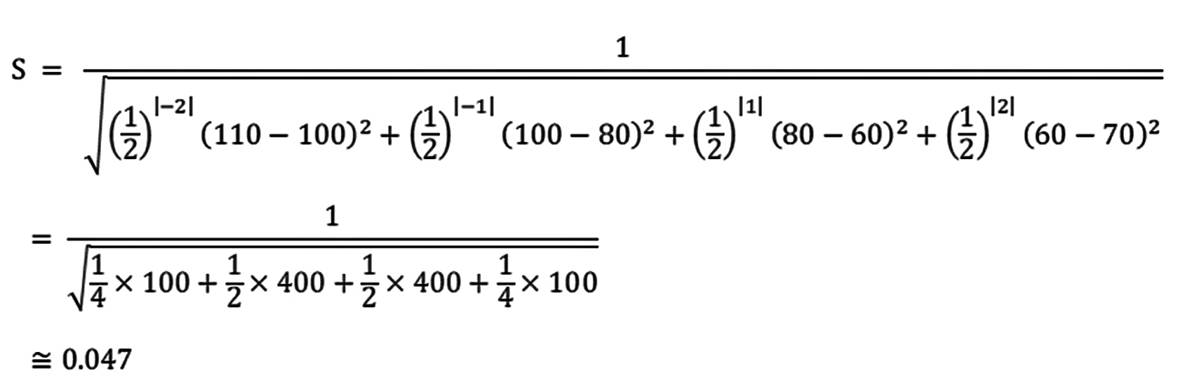
例えば、a=1/2として、図12の数値例に上記の算出式を適用すると、類似度Sの値は次のようになる。
例えば、a=1/2として、図12の数値例に上記の算出式を適用すると、類似度Sの値は次のようになる。
(類似度の算出方法の変形例2)
上述の実施形態において、旅行時間の算出に用いたプローブ車両1の車両台数が多い時刻の旅行時間ほど、類似度Sへの寄与を大きくする算出式を採用することが好ましい。すなわち、その車両台数が少ない時刻の旅行時間ほど、類似度Sへの寄与を小さくする。
その理由は、プローブ車両1の車両台数が多い時刻(時間帯)ほど、正確な旅行時間が計測されていると推定されるからである。この場合の算出式は、例えば、下記の算出式により定義することができる。
上述の実施形態において、旅行時間の算出に用いたプローブ車両1の車両台数が多い時刻の旅行時間ほど、類似度Sへの寄与を大きくする算出式を採用することが好ましい。すなわち、その車両台数が少ない時刻の旅行時間ほど、類似度Sへの寄与を小さくする。
その理由は、プローブ車両1の車両台数が多い時刻(時間帯)ほど、正確な旅行時間が計測されていると推定されるからである。この場合の算出式は、例えば、下記の算出式により定義することができる。
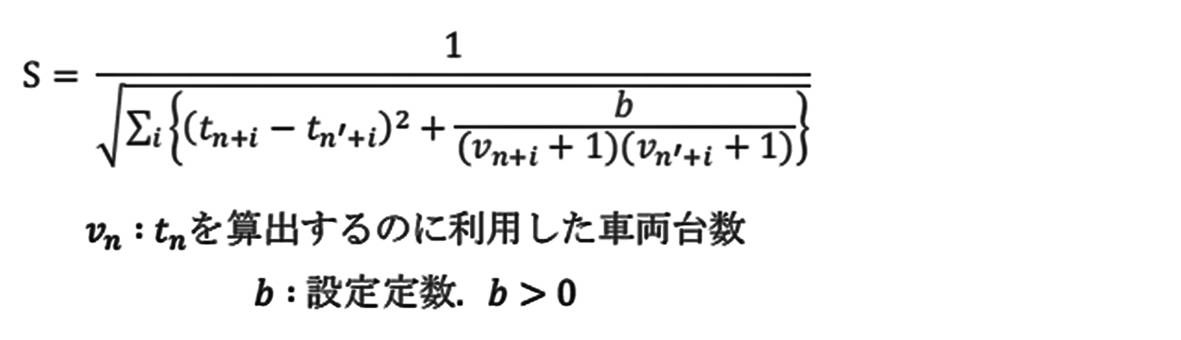
上記の算出式で定義される類似度Sにおいて、分母の第2項が、車両台数が少ない時刻の旅行時間ほど、類似度Sへの寄与を小さくするペナルティを与える。このため、当該第2項を含まない類似度の算出式を採用する場合に比べて、類似度Sの精度を向上することができる。
例えば、b=1000として、図12の数値例に上記の算出式を適用すると、類似度Sの値は次のようになる。
例えば、b=1000として、図12の数値例に上記の算出式を適用すると、類似度Sの値は次のようになる。

(類似度の算出方法の変形例3)
上述の実施形態において、補完対象推移パターンを構成する旅行時間との差分のばらつき(例えば標準偏差)が大きい旅行時間ほど、類似度Sへの寄与を小さくする算出式を採用することが好ましい。すなわち、上記差分のばらつきが小さい旅行時間ほど、類似度Sへの寄与を大きくする。
その理由は、上記差分のばらつきが大きいほど、補完対象推移パターンとの類似性が薄くなると考えられるからである。この場合の算出式は、例えば、下記の算出式により定義することができる。
上述の実施形態において、補完対象推移パターンを構成する旅行時間との差分のばらつき(例えば標準偏差)が大きい旅行時間ほど、類似度Sへの寄与を小さくする算出式を採用することが好ましい。すなわち、上記差分のばらつきが小さい旅行時間ほど、類似度Sへの寄与を大きくする。
その理由は、上記差分のばらつきが大きいほど、補完対象推移パターンとの類似性が薄くなると考えられるからである。この場合の算出式は、例えば、下記の算出式により定義することができる。
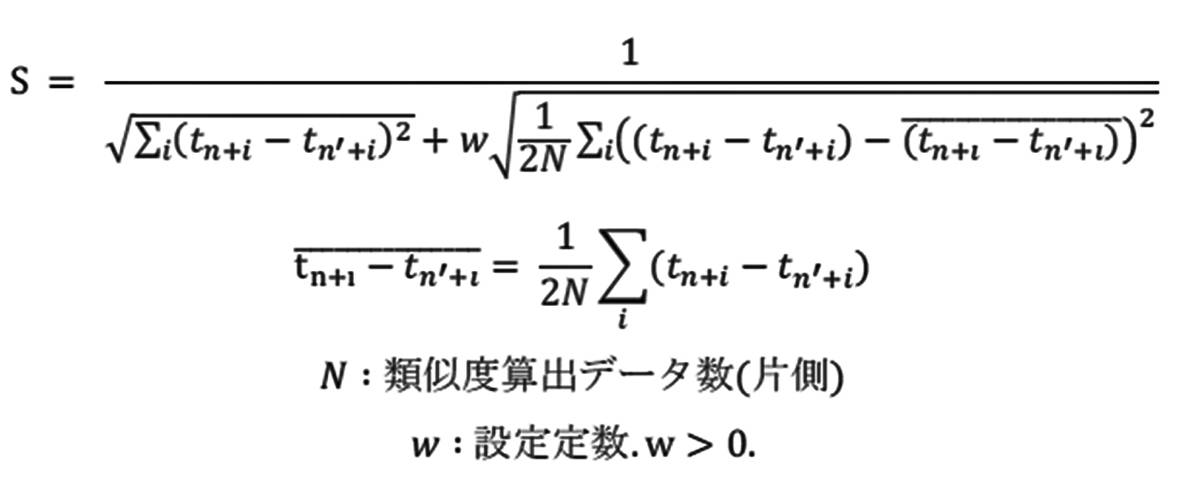
上記の算出式で定義される類似度Sにおいて、分母の第2項の標準偏差が類似度Sへの寄与を小さくするペナルティを与える。このため、当該第2項を含まない類似度の算出式を採用する場合に比べて、類似度Sの精度を向上することができる。
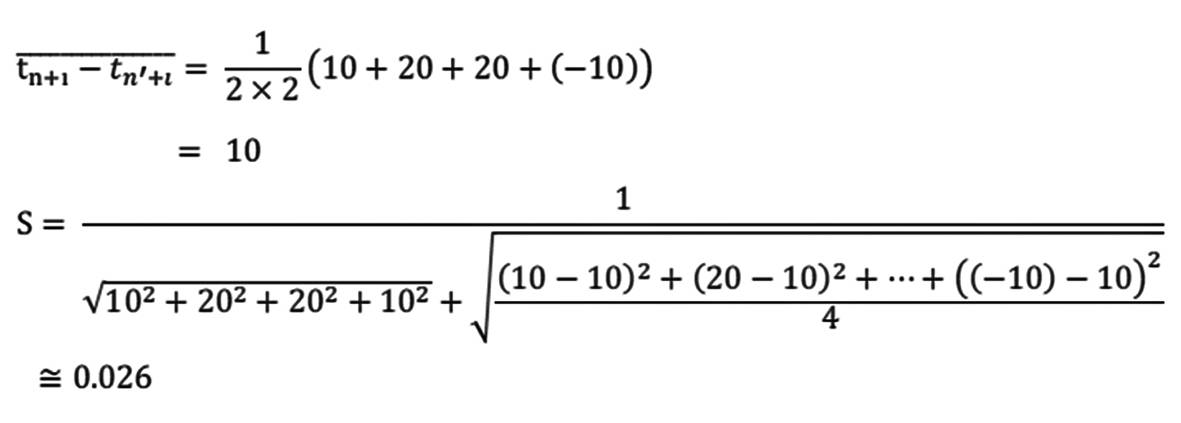
例えば、w=1、N=2として、図12の数値例に上記の算出式を適用すると、類似度Sの値は次のようになる。
例えば、w=1、N=2として、図12の数値例に上記の算出式を適用すると、類似度Sの値は次のようになる。
(類似度の算出方法の変形例4)
上述の実施形態において、補完データについては、類似度Sへの寄与を小さくする算出式を採用することが好ましい。すなわち、計測データについては、類似度Sへの寄与を大きくする。
その理由は、補完データは計測データよりも旅行時間の精度が劣るので、補完データを用いて更に補完処理を行う場合には、類似度Sへの寄与を小さくすべきだからである。この場合の算出式は、例えば、下記の算出式により定義することができる。
上述の実施形態において、補完データについては、類似度Sへの寄与を小さくする算出式を採用することが好ましい。すなわち、計測データについては、類似度Sへの寄与を大きくする。
その理由は、補完データは計測データよりも旅行時間の精度が劣るので、補完データを用いて更に補完処理を行う場合には、類似度Sへの寄与を小さくすべきだからである。この場合の算出式は、例えば、下記の算出式により定義することができる。
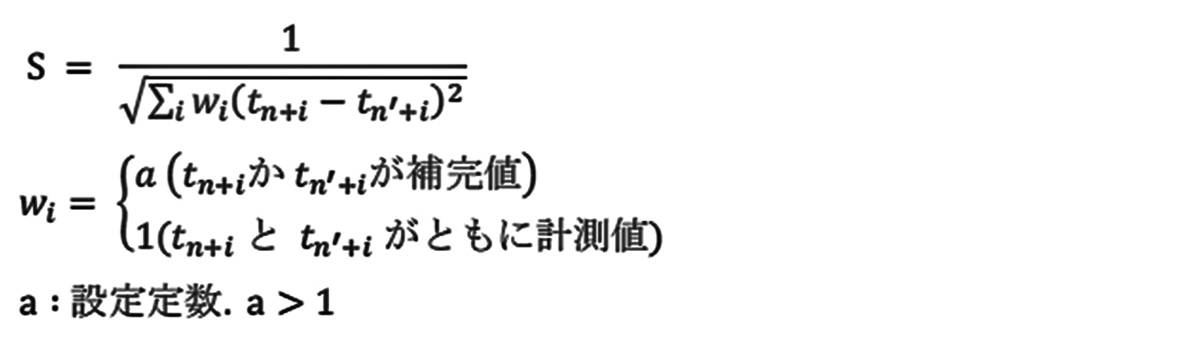
上記の算出式で定義される類似度Sでは、二値変数である係数wiが、補完値(補完データ)の場合にのみ1より大きくなる設定定数aとなり、類似度Sへの寄与を小さくするペナルティを与える。このため、係数wiを含まない類似度の算出式を作用する場合に比べて、類似度Sの精度を向上することができる。
例えば、a=2として、図12の数値例に上記の算出式を適用すると、類似度Sの値は次のようになる。
例えば、a=2として、図12の数値例に上記の算出式を適用すると、類似度Sの値は次のようになる。

(類似度の算出方法の変形例5)
上述の変形例1~4に用いる類似度Sの算出式に含まれる各パラメータを、組み合わせて適用した算出式を採用してもよい。
例えば、〔数4〕の設定定数aと〔数6〕の車両台数に関する分母第2項とを含む算出式を採用すれば、欠測時刻nからの乖離の影響とプローブ車両1の車両台数による影響の双方を考慮した類似度Sを算出することができる。
上述の変形例1~4に用いる類似度Sの算出式に含まれる各パラメータを、組み合わせて適用した算出式を採用してもよい。
例えば、〔数4〕の設定定数aと〔数6〕の車両台数に関する分母第2項とを含む算出式を採用すれば、欠測時刻nからの乖離の影響とプローブ車両1の車両台数による影響の双方を考慮した類似度Sを算出することができる。
〔その他の変形例〕
今回開示した実施形態はすべての点で例示であって制限的なものではない。本発明の権利範囲は、上述の実施形態に限定されるものではなく、請求の範囲に記載された構成と均等の範囲内でのすべての変更が含まれる。
今回開示した実施形態はすべての点で例示であって制限的なものではない。本発明の権利範囲は、上述の実施形態に限定されるものではなく、請求の範囲に記載された構成と均等の範囲内でのすべての変更が含まれる。
上述の実施形態では、プローブ情報に基づいて旅行時間を算出する場合を想定したが、旅行時間は車両感知器の感知信号から求めた旅行時間であってもよい。その理由は、車両感知器の故障などにより旅行時間の欠損が生じる場合があり得るからである。
1 プローブ車両
2 車載機
3 通信装置
4 基地局
5 センター装置(補完装置)
6 通信回線
10 送受信部
11 データ処理部
12 記憶部
13 プローブデータベース
14 地図データベース
15 旅行時間データベース
16 コンピュータプログラム
20 交通情報処理システム
2 車載機
3 通信装置
4 基地局
5 センター装置(補完装置)
6 通信回線
10 送受信部
11 データ処理部
12 記憶部
13 プローブデータベース
14 地図データベース
15 旅行時間データベース
16 コンピュータプログラム
20 交通情報処理システム
Claims (11)
- 旅行時間の補完装置としてコンピュータを機能させるためのコンピュータプログラムであって、前記コンピュータを、
道路区間における制御周期ごとに進行する各時刻の旅行時間を、旅行時間データベースに蓄積する蓄積処理と、
蓄積された旅行時間に欠測がある場合に、欠測時刻の前後の旅行時間を含む補完対象推移パターンと類似する過去の旅行時間の推移パターンを抽出し、抽出した過去の推移パターンに挟まれる時刻の旅行時間を、欠測時刻の旅行時間とする補完処理と、を実行する、データ処理部として機能させるコンピュータプログラム。 - 前記データ処理部は、欠測時刻との乖離が大きい時刻の旅行時間ほど、類似度への寄与を小さくする算出式を用いて、前記補完処理を実行する請求項1に記載のコンピュータプログラム。
- 前記データ処理部は、旅行時間の算出に用いたプローブ車両の車両台数が多い時刻の旅行時間ほど、類似度への寄与を大きくする算出式を用いて、前記補完処理を実行する請求項1又は請求項2に記載のコンピュータプログラム。
- 前記データ処理部は、補完対象推移パターンを構成する旅行時間との差分のばらつきが大きい旅行時間ほど、類似度への寄与を小さくする算出式を用いて、前記補完処理を実行する請求項1~請求項3のいずれか1項に記載のコンピュータプログラム。
- 前記データ処理部は、前記補完処理により算出した旅行時間である補完データについては、前記補完処理を行わずに算出した旅行時間である計測データに比べて、類似度への寄与を小さくする算出式を用いて、前記補完処理を実行する請求項1~請求項4のいずれか1項に記載のコンピュータプログラム。
- 前記データ処理部は、前記補完処理により算出した旅行時間である補完データと、前記補完処理を行わずに算出した旅行時間である計測データとを用いて、現在時刻の次の予測時刻の旅行時間を予測する予測処理を、更に実行する請求項1~請求項5のいずれか1項に記載のコンピュータプログラム。
- 前記予測処理は、現在時刻以前の複数の旅行時間を含む予測対象推移パターンと類似する過去の旅行時間の推移パターンを抽出し、抽出した過去の推移パターンの次の時刻の旅行時間を、予測時刻の旅行時間とする処理である請求項6に記載のコンピュータプログラム。
- 旅行時間の補完装置としてコンピュータを機能させるためのコンピュータプログラムであって、前記コンピュータを、
道路区間における制御周期ごとに進行する各時刻の旅行時間を、旅行時間データベースに蓄積する蓄積処理と、
蓄積された旅行時間に欠測がある場合に、欠測時刻の前後の旅行時間を含む補完対象推移パターンと類似する過去の旅行時間の推移パターンを抽出し、抽出した過去の推移パターンに挟まれる時刻の旅行時間を、欠測時刻の旅行時間とする補完処理と、を実行する、データ処理部として機能させ、
前記データ処理部は、下記の算出式1~4のうちの少なくとも1つ、少なくとも2つ、少なくとも3つ、又はすべての算出式を用いて、前記補完処理を実行するコンピュータプログラム。
算出式1:欠測時刻との乖離が大きい時刻の旅行時間ほど、類似度への寄与を小さくする算出式
算出式2:旅行時間の算出に用いたプローブ車両の車両台数が多い時刻の旅行時間ほど、類似度への寄与を大きくする算出式
算出式3:補完対象推移パターンを構成する旅行時間との差分のばらつきが大きい旅行時間ほど、類似度への寄与を小さくする算出式
算出式4:前記補完処理により算出した旅行時間である補完データについては、前記補完処理を行わずに算出した旅行時間である計測データに比べて、類似度への寄与を小さくする算出式 - 旅行時間の補完装置としてコンピュータを機能させるためのコンピュータプログラムが記録された、非一時的なコンピュータ読み取り可能な記録媒体であって、前記コンピュータプログラムは、前記コンピュータを、
道路区間における制御周期ごとに進行する各時刻の旅行時間を、旅行時間データベースに蓄積する蓄積処理と、
蓄積された旅行時間に欠測がある場合に、欠測時刻の前後の旅行時間を含む補完対象推移パターンと類似する過去の旅行時間の推移パターンを抽出し、抽出した過去の推移パターンに挟まれる時刻の旅行時間を、欠測時刻の旅行時間とする補完処理と、を実行する、データ処理部として機能させる記録媒体。 - 道路区間における制御周期ごとに進行する各時刻の旅行時間を、旅行時間データベースに蓄積するステップと、
蓄積された旅行時間に欠測がある場合に、欠測時刻の前後の旅行時間を含む補完対象推移パターンと類似する過去の旅行時間の推移パターンを抽出し、抽出した過去の推移パターンに挟まれる時刻の旅行時間を、欠測時刻の旅行時間とするステップと、を含む旅行時間の補完方法。 - 道路区間における制御周期ごとに進行する各時刻の旅行時間が蓄積された旅行時間データベースと、
蓄積された旅行時間に欠測がある場合に、欠測時刻の前後の旅行時間を含む補完対象推移パターンと類似する過去の旅行時間の推移パターンを抽出し、抽出した過去の推移パターンに挟まれる時刻の旅行時間を、欠測時刻の旅行時間とする補完処理を実行するデータ処理部と、を備える旅行時間の補完装置。
Applications Claiming Priority (2)
| Application Number | Priority Date | Filing Date | Title |
|---|---|---|---|
| JP2016144547A JP2018014043A (ja) | 2016-07-22 | 2016-07-22 | 旅行時間の補完装置、補完方法、コンピュータプログラム及び記録媒体 |
| JP2016-144547 | 2016-07-22 |
Publications (1)
| Publication Number | Publication Date |
|---|---|
| WO2018016147A1 true WO2018016147A1 (ja) | 2018-01-25 |
Family
ID=60992004
Family Applications (1)
| Application Number | Title | Priority Date | Filing Date |
|---|---|---|---|
| PCT/JP2017/016003 Ceased WO2018016147A1 (ja) | 2016-07-22 | 2017-04-21 | 旅行時間の補完装置、補完方法、コンピュータプログラム及び記録媒体 |
Country Status (2)
| Country | Link |
|---|---|
| JP (1) | JP2018014043A (ja) |
| WO (1) | WO2018016147A1 (ja) |
Families Citing this family (2)
| Publication number | Priority date | Publication date | Assignee | Title |
|---|---|---|---|---|
| JP7291066B2 (ja) * | 2019-11-21 | 2023-06-14 | 株式会社トヨタマップマスター | 情報処理装置、情報処理方法及び情報処理プログラム |
| WO2024247829A1 (ja) * | 2023-05-31 | 2024-12-05 | 住友電気工業株式会社 | 管理装置、分布更新方法、及びコンピュータプログラム |
Citations (3)
| Publication number | Priority date | Publication date | Assignee | Title |
|---|---|---|---|---|
| JP2000304557A (ja) * | 1999-04-20 | 2000-11-02 | Sumitomo Electric Ind Ltd | 車両用ナビゲーション装置 |
| JP2005274144A (ja) * | 2004-03-22 | 2005-10-06 | Aisin Aw Co Ltd | ナビゲーションシステム |
| JP2005308581A (ja) * | 2004-04-22 | 2005-11-04 | Aisin Aw Co Ltd | 交通情報データの補間装置及び補間方法 |
-
2016
- 2016-07-22 JP JP2016144547A patent/JP2018014043A/ja active Pending
-
2017
- 2017-04-21 WO PCT/JP2017/016003 patent/WO2018016147A1/ja not_active Ceased
Patent Citations (3)
| Publication number | Priority date | Publication date | Assignee | Title |
|---|---|---|---|---|
| JP2000304557A (ja) * | 1999-04-20 | 2000-11-02 | Sumitomo Electric Ind Ltd | 車両用ナビゲーション装置 |
| JP2005274144A (ja) * | 2004-03-22 | 2005-10-06 | Aisin Aw Co Ltd | ナビゲーションシステム |
| JP2005308581A (ja) * | 2004-04-22 | 2005-11-04 | Aisin Aw Co Ltd | 交通情報データの補間装置及び補間方法 |
Also Published As
| Publication number | Publication date |
|---|---|
| JP2018014043A (ja) | 2018-01-25 |
Similar Documents
| Publication | Publication Date | Title |
|---|---|---|
| US11807231B2 (en) | Electronic device for vehicle and operating method thereof | |
| CN110395258B (zh) | 路面状态推断装置以及路面状态推断方法 | |
| KR102131842B1 (ko) | 지능형 운전자 보조 시스템(adas)에서 사용하기 위한 호라이즌을 생성하는 방법 및 시스템 | |
| EP2727098B1 (en) | Method and system for collecting traffic data | |
| US9076333B2 (en) | Driving support device, driving support method, and driving support program | |
| US8903636B1 (en) | Accident detection system and method for accident detection | |
| JP6468261B2 (ja) | 自動運転システム | |
| WO2017187882A1 (ja) | 安全運転支援システム、サーバ、車両およびプログラム | |
| US9412212B2 (en) | Unexpectedness prediction sensitivity determination apparatus | |
| JP4233364B2 (ja) | 交通情報送信方法、交通情報送信システム及び装置 | |
| WO2018168035A1 (ja) | コンピュータプログラム、車両速度の推定装置及び推定方法、並びに、渋滞傾向の推定装置及び推定方法 | |
| JP2016133942A (ja) | 交通指標算出装置、交通指標算出方法及びコンピュータプログラム | |
| JP2018014043A (ja) | 旅行時間の補完装置、補完方法、コンピュータプログラム及び記録媒体 | |
| JP5846014B2 (ja) | プローブ情報統計システム、プローブ情報統計方法およびプローブ情報統計プログラム | |
| JP2026063066A (ja) | 渋滞情報判定装置 | |
| US11183054B1 (en) | Information processing device, information processing system, information processing method, and storage medium | |
| JP5857389B2 (ja) | 交通指標推定装置及びコンピュータプログラム | |
| JP2016162197A (ja) | 遭遇車両判定装置 | |
| CN118736853B (zh) | 基于深度学习的实时交通流量预测方法及系统 | |
| JP7838585B2 (ja) | 情報処理装置、情報処理方法、及びコンピュータプログラム | |
| WO2023188666A1 (ja) | 情報処理装置、制御端末、情報処理方法、及びコンピュータプログラム | |
| JP5741191B2 (ja) | 旅行時間提供装置、コンピュータプログラム及び旅行時間提供方法 | |
| JP2018073322A (ja) | 旅行時間予測プログラム、旅行時間予測装置および旅行時間予測方法 | |
| JP2022003454A (ja) | 情報処理装置、情報処理システム、情報処理方法およびプログラム | |
| JP5994375B2 (ja) | 旅行時間算出装置及び方法、コンピュータプログラム |
Legal Events
| Date | Code | Title | Description |
|---|---|---|---|
| 121 | Ep: the epo has been informed by wipo that ep was designated in this application |
Ref document number: 17830667 Country of ref document: EP Kind code of ref document: A1 |
|
| NENP | Non-entry into the national phase |
Ref country code: DE |
|
| 122 | Ep: pct application non-entry in european phase |
Ref document number: 17830667 Country of ref document: EP Kind code of ref document: A1 |