WO2017204178A1 - 剥離層形成用組成物及び剥離層 - Google Patents
剥離層形成用組成物及び剥離層 Download PDFInfo
- Publication number
- WO2017204178A1 WO2017204178A1 PCT/JP2017/019100 JP2017019100W WO2017204178A1 WO 2017204178 A1 WO2017204178 A1 WO 2017204178A1 JP 2017019100 W JP2017019100 W JP 2017019100W WO 2017204178 A1 WO2017204178 A1 WO 2017204178A1
- Authority
- WO
- WIPO (PCT)
- Prior art keywords
- formula
- release layer
- represented
- aromatic group
- group
- Prior art date
- Legal status (The legal status is an assumption and is not a legal conclusion. Google has not performed a legal analysis and makes no representation as to the accuracy of the status listed.)
- Ceased
Links
- 0 Cc(cc1)cc(*(O2)=O)c1C2=O Chemical compound Cc(cc1)cc(*(O2)=O)c1C2=O 0.000 description 2
- HPJKYUKLSHMIJC-UHFFFAOYSA-N CC(C(c(c(C(O)=O)c1)cc(C(O)=O)c1C(O)=O)=O)Nc(cc1)ccc1NC(c(c(C(O)=O)c1)cc(C(C(C)(C)Nc(cc2)ccc2NC(c(c(C(O)=O)c2)cc(C(O)=O)c2C(O)=O)=O)=O)c1C(O)=O)=O Chemical compound CC(C(c(c(C(O)=O)c1)cc(C(O)=O)c1C(O)=O)=O)Nc(cc1)ccc1NC(c(c(C(O)=O)c1)cc(C(C(C)(C)Nc(cc2)ccc2NC(c(c(C(O)=O)c2)cc(C(O)=O)c2C(O)=O)=O)=O)c1C(O)=O)=O HPJKYUKLSHMIJC-UHFFFAOYSA-N 0.000 description 1
- IGXDROWKJMSBHW-UHFFFAOYSA-N CC(C(c1cc(-c(cc2)cc(C(O)=O)c2C(O)=O)ccc1C(O)=O)=O)Nc(cc1)ccc1NC(c1cc(-c(cc2)cc(C(C(C)(C)Nc(cc3)ccc3NC(c(cc(cc3)-c(cc4)cc(C(O)=O)c4C(O)=O)c3C(O)=O)=O)=O)c2C(O)=O)ccc1C(O)=O)=O Chemical compound CC(C(c1cc(-c(cc2)cc(C(O)=O)c2C(O)=O)ccc1C(O)=O)=O)Nc(cc1)ccc1NC(c1cc(-c(cc2)cc(C(C(C)(C)Nc(cc3)ccc3NC(c(cc(cc3)-c(cc4)cc(C(O)=O)c4C(O)=O)c3C(O)=O)=O)=O)c2C(O)=O)ccc1C(O)=O)=O IGXDROWKJMSBHW-UHFFFAOYSA-N 0.000 description 1
- HAYIPGIFANTODX-UHFFFAOYSA-N Cc(c(C(O)=O)c1)cc(C)c1C(O)=O Chemical compound Cc(c(C(O)=O)c1)cc(C)c1C(O)=O HAYIPGIFANTODX-UHFFFAOYSA-N 0.000 description 1
- ZJLYMUKYUUJCLV-UHFFFAOYSA-N Cc(c(C(O)=O)c1)ccc1-c(cc1)cc(C)c1C(O)=O Chemical compound Cc(c(C(O)=O)c1)ccc1-c(cc1)cc(C)c1C(O)=O ZJLYMUKYUUJCLV-UHFFFAOYSA-N 0.000 description 1
- FKUJGZJNDUGCFU-UHFFFAOYSA-N Cc(cc(C(O)=O)c(C)c1)c1C(O)=O Chemical compound Cc(cc(C(O)=O)c(C)c1)c1C(O)=O FKUJGZJNDUGCFU-UHFFFAOYSA-N 0.000 description 1
- KWJNTOJAUQZMJO-UHFFFAOYSA-N Cc(cc(cc1)-c(cc2)cc(C)c2C(O)=O)c1C(O)=O Chemical compound Cc(cc(cc1)-c(cc2)cc(C)c2C(O)=O)c1C(O)=O KWJNTOJAUQZMJO-UHFFFAOYSA-N 0.000 description 1
- ZWLPBLYKEWSWPD-UHFFFAOYSA-N Cc1ccccc1C(O)=O Chemical compound Cc1ccccc1C(O)=O ZWLPBLYKEWSWPD-UHFFFAOYSA-N 0.000 description 1
- XNGIFLGASWRNHJ-UHFFFAOYSA-N OC(c1ccccc1C(O)=O)=O Chemical compound OC(c1ccccc1C(O)=O)=O XNGIFLGASWRNHJ-UHFFFAOYSA-N 0.000 description 1
Classifications
-
- C—CHEMISTRY; METALLURGY
- C08—ORGANIC MACROMOLECULAR COMPOUNDS; THEIR PREPARATION OR CHEMICAL WORKING-UP; COMPOSITIONS BASED THEREON
- C08G—MACROMOLECULAR COMPOUNDS OBTAINED OTHERWISE THAN BY REACTIONS ONLY INVOLVING UNSATURATED CARBON-TO-CARBON BONDS
- C08G73/00—Macromolecular compounds obtained by reactions forming a linkage containing nitrogen with or without oxygen or carbon in the main chain of the macromolecule, not provided for in groups C08G12/00 - C08G71/00
- C08G73/06—Polycondensates having nitrogen-containing heterocyclic rings in the main chain of the macromolecule
- C08G73/10—Polyimides; Polyester-imides; Polyamide-imides; Polyamide acids or similar polyimide precursors
-
- C—CHEMISTRY; METALLURGY
- C08—ORGANIC MACROMOLECULAR COMPOUNDS; THEIR PREPARATION OR CHEMICAL WORKING-UP; COMPOSITIONS BASED THEREON
- C08G—MACROMOLECULAR COMPOUNDS OBTAINED OTHERWISE THAN BY REACTIONS ONLY INVOLVING UNSATURATED CARBON-TO-CARBON BONDS
- C08G73/00—Macromolecular compounds obtained by reactions forming a linkage containing nitrogen with or without oxygen or carbon in the main chain of the macromolecule, not provided for in groups C08G12/00 - C08G71/00
- C08G73/06—Polycondensates having nitrogen-containing heterocyclic rings in the main chain of the macromolecule
- C08G73/10—Polyimides; Polyester-imides; Polyamide-imides; Polyamide acids or similar polyimide precursors
- C08G73/1067—Wholly aromatic polyimides, i.e. having both tetracarboxylic and diamino moieties aromatically bound
-
- C—CHEMISTRY; METALLURGY
- C08—ORGANIC MACROMOLECULAR COMPOUNDS; THEIR PREPARATION OR CHEMICAL WORKING-UP; COMPOSITIONS BASED THEREON
- C08G—MACROMOLECULAR COMPOUNDS OBTAINED OTHERWISE THAN BY REACTIONS ONLY INVOLVING UNSATURATED CARBON-TO-CARBON BONDS
- C08G73/00—Macromolecular compounds obtained by reactions forming a linkage containing nitrogen with or without oxygen or carbon in the main chain of the macromolecule, not provided for in groups C08G12/00 - C08G71/00
- C08G73/06—Polycondensates having nitrogen-containing heterocyclic rings in the main chain of the macromolecule
- C08G73/10—Polyimides; Polyester-imides; Polyamide-imides; Polyamide acids or similar polyimide precursors
- C08G73/1003—Preparatory processes
- C08G73/1007—Preparatory processes from tetracarboxylic acids or derivatives and diamines
- C08G73/1028—Preparatory processes from tetracarboxylic acids or derivatives and diamines characterised by the process itself, e.g. steps, continuous
- C08G73/1032—Preparatory processes from tetracarboxylic acids or derivatives and diamines characterised by the process itself, e.g. steps, continuous characterised by the solvent(s) used
-
- C—CHEMISTRY; METALLURGY
- C08—ORGANIC MACROMOLECULAR COMPOUNDS; THEIR PREPARATION OR CHEMICAL WORKING-UP; COMPOSITIONS BASED THEREON
- C08K—Use of inorganic or non-macromolecular organic substances as compounding ingredients
- C08K5/00—Use of organic ingredients
- C08K5/16—Nitrogen-containing compounds
- C08K5/34—Heterocyclic compounds having nitrogen in the ring
- C08K5/3412—Heterocyclic compounds having nitrogen in the ring having one nitrogen atom in the ring
- C08K5/3415—Five-membered rings
-
- C—CHEMISTRY; METALLURGY
- C08—ORGANIC MACROMOLECULAR COMPOUNDS; THEIR PREPARATION OR CHEMICAL WORKING-UP; COMPOSITIONS BASED THEREON
- C08L—COMPOSITIONS OF MACROMOLECULAR COMPOUNDS
- C08L79/00—Compositions of macromolecular compounds obtained by reactions forming in the main chain of the macromolecule a linkage containing nitrogen with or without oxygen or carbon only, not provided for in groups C08L61/00 - C08L77/00
- C08L79/04—Polycondensates having nitrogen-containing heterocyclic rings in the main chain; Polyhydrazides; Polyamide acids or similar polyimide precursors
- C08L79/08—Polyimides; Polyester-imides; Polyamide-imides; Polyamide acids or similar polyimide precursors
-
- C—CHEMISTRY; METALLURGY
- C09—DYES; PAINTS; POLISHES; NATURAL RESINS; ADHESIVES; COMPOSITIONS NOT OTHERWISE PROVIDED FOR; APPLICATIONS OF MATERIALS NOT OTHERWISE PROVIDED FOR
- C09D—COATING COMPOSITIONS, e.g. PAINTS, VARNISHES OR LACQUERS; FILLING PASTES; CHEMICAL PAINT OR INK REMOVERS; INKS; CORRECTING FLUIDS; WOODSTAINS; PASTES OR SOLIDS FOR COLOURING OR PRINTING; USE OF MATERIALS THEREFOR
- C09D179/00—Coating compositions based on macromolecular compounds obtained by reactions forming in the main chain of the macromolecule a linkage containing nitrogen, with or without oxygen, or carbon only, not provided for in groups C09D161/00 - C09D177/00
- C09D179/04—Polycondensates having nitrogen-containing heterocyclic rings in the main chain; Polyhydrazides; Polyamide acids or similar polyimide precursors
- C09D179/08—Polyimides; Polyester-imides; Polyamide-imides; Polyamide acids or similar polyimide precursors
-
- C—CHEMISTRY; METALLURGY
- C09—DYES; PAINTS; POLISHES; NATURAL RESINS; ADHESIVES; COMPOSITIONS NOT OTHERWISE PROVIDED FOR; APPLICATIONS OF MATERIALS NOT OTHERWISE PROVIDED FOR
- C09D—COATING COMPOSITIONS, e.g. PAINTS, VARNISHES OR LACQUERS; FILLING PASTES; CHEMICAL PAINT OR INK REMOVERS; INKS; CORRECTING FLUIDS; WOODSTAINS; PASTES OR SOLIDS FOR COLOURING OR PRINTING; USE OF MATERIALS THEREFOR
- C09D7/00—Features of coating compositions, not provided for in group C09D5/00; Processes for incorporating ingredients in coating compositions
- C09D7/40—Additives
-
- C—CHEMISTRY; METALLURGY
- C08—ORGANIC MACROMOLECULAR COMPOUNDS; THEIR PREPARATION OR CHEMICAL WORKING-UP; COMPOSITIONS BASED THEREON
- C08L—COMPOSITIONS OF MACROMOLECULAR COMPOUNDS
- C08L2203/00—Applications
- C08L2203/20—Applications use in electrical or conductive gadgets
Definitions
- the present invention relates to a release layer forming composition and a release layer.
- Patent Documents 1, 2, and 3 an amorphous silicon thin film layer is formed on a glass substrate, a plastic substrate is formed on the thin film layer, and then laser irradiation is performed from the glass substrate side to crystallize amorphous silicon.
- a method of peeling a plastic substrate from a glass substrate with hydrogen gas generated along with crystallization is disclosed.
- Patent Document 4 a layer to be peeled (described as “transfer target layer” in Patent Document 4) is attached to a plastic film by using the techniques disclosed in Patent Documents 1 to 3, and a liquid crystal display device is formed. A method of completion is disclosed.
- Patent Document 5 a current glass substrate is used as a substrate (hereinafter referred to as a glass substrate), and a release layer is formed on the glass substrate using a polymer such as a cyclic olefin copolymer. Then, after forming a heat-resistant resin film such as a polyimide film on the release layer, forming and sealing the ITO transparent electrode, TFT, etc. on the film by a vacuum process, finally peeling and removing the glass substrate Is adopted.
- a heat-resistant resin film such as a polyimide film
- TFT a low-temperature polysilicon TFT having a mobility twice as fast as that of an amorphous silicon TFT is currently used.
- This low-temperature polysilicon TFT needs to be subjected to dehydrogenation annealing at 400 ° C. or higher after amorphous silicon deposition, and irradiated with a pulse laser to crystallize silicon (hereinafter referred to as TFT process).
- the temperature of the annealing process is equal to or higher than the glass transition (hereinafter Tg) of the existing polymer.
- the existing polymer has improved adhesion when heated to a temperature equal to or higher than Tg (see, for example, Patent Document 6), and the adhesion between the release layer and the resin substrate is increased after the heat treatment. In some cases, it is difficult to peel the resin substrate from the substrate.
- JP 10-125929 A Japanese Patent Laid-Open No. 10-125931 International Publication No. 2005/050754 JP-A-10-125930 JP 2010-1111853 A JP 2008-188792 A
- the present invention has been made in view of the above circumstances, and can be peeled without damaging the resin substrate of the flexible electronic device formed thereon, and can be heated at a relatively high temperature such as the TFT process described above. It aims at providing the composition for peeling layer formation which gives the peeling layer which the peelability does not change after a process.
- a composition containing a polyamic acid having a specific aromatic group at both ends of a molecular chain and an organic solvent has a substrate such as a glass substrate.
- the appropriate adhesion and appropriate release properties of the release layer are the TFT process. The present invention was completed by finding that it was maintained well without any change even after the heat treatment.
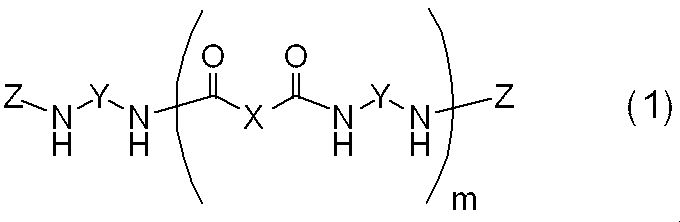
- a release layer forming composition comprising a polyamic acid represented by the following formula (1) and an organic solvent.
- X represents an aromatic group represented by the following formula (2) or (3)
- Y represents a divalent aromatic group
- Z represents the following formula (2).
- X represents an aromatic group represented by the following formula (3).
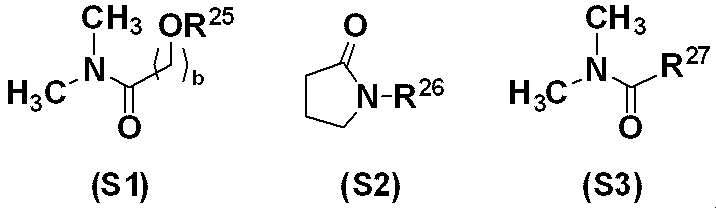
- the organic solvent includes at least one selected from amides represented by formula (S1), amides represented by formula (S2), and amides represented by formula (S3) [1] ]
- R 25 and R 26 each independently represent an alkyl group having 1 to 10 carbon atoms
- R 27 represents a hydrogen atom or an alkyl group having 1 to 10 carbon atoms
- b represents a natural number.
- a method for producing a flexible electronic device comprising a resin substrate, wherein the release layer according to [8] is used.
- the resin substrate is a substrate made of polyimide.
- the release layer forming composition of the present invention By using the release layer forming composition of the present invention, it is possible to obtain a release layer having excellent adhesion to the substrate, moderate adhesion to the resin substrate, and moderate release with good reproducibility.
- the resin substrate formed on the substrate and further provided thereon It is possible to separate the resin substrate from the base body together with the circuit and the like without damaging the circuit and the like. Therefore, the composition for forming a release layer of the present invention can contribute to simplification of the production process of a flexible electronic device including a resin substrate, improvement of its yield, and the like.
- composition for forming a release layer of the present invention includes a polyamic acid represented by the following formula (1) and an organic solvent.
- X represents an aromatic group represented by the following formula (2) or formula (3)
- Y represents a divalent aromatic group
- Z represents the following formula
- X represents an aromatic group represented by the following formula (3)
- m represents a natural number.
- the release layer is a layer provided immediately above a substrate (such as a glass substrate) on which a resin substrate is formed.
- a substrate such as a glass substrate
- the release layer is provided immediately above a substrate (such as a glass substrate) on which a resin substrate is formed.
- the polyamic acid represented by the above formula (1) is obtained by reacting a predetermined tetracarboxylic dianhydride component with a diamine component.
- a tetracarboxylic dianhydride component benzenetetracarboxylic dianhydride and biphenyltetracarboxylic dianhydride can be used.
- the diamine component may be an alicyclic chain, an alicyclic ring, an aromatic group, or an aromatic alicyclic group.
- the tetracarboxylic dianhydride is used from the viewpoint of improving the function of the resulting film as a release layer.
- a polyamic acid obtained by reacting a product with a diamine component containing an aromatic diamine is preferred, and a wholly aromatic polyamic acid obtained by reacting the tetracarboxylic dianhydride with an aromatic diamine is more preferred.
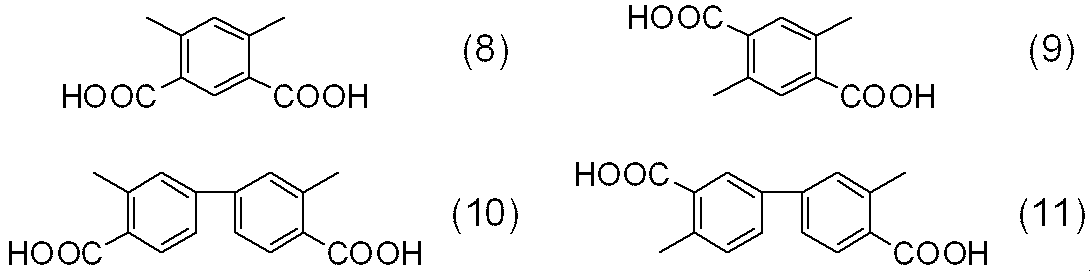
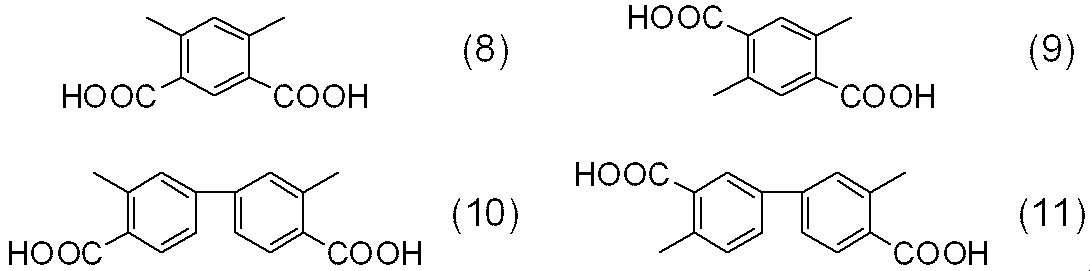
- X is preferably an aromatic group represented by the following formulas (8) to (11).
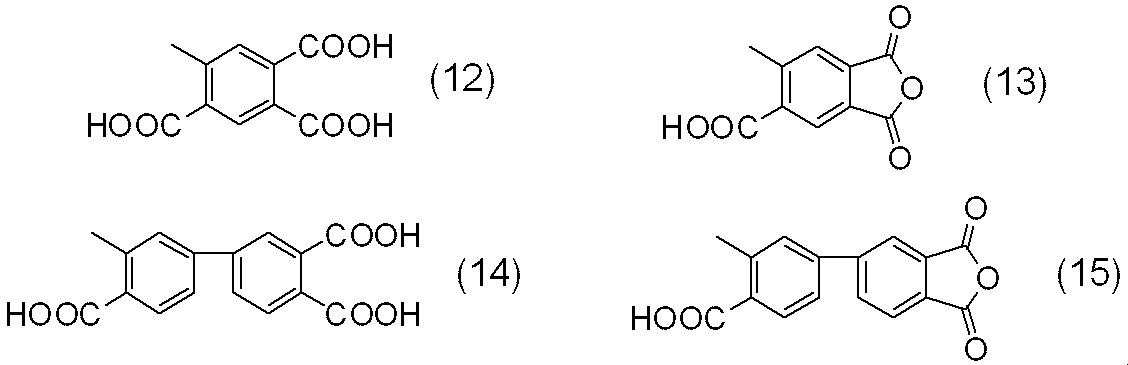
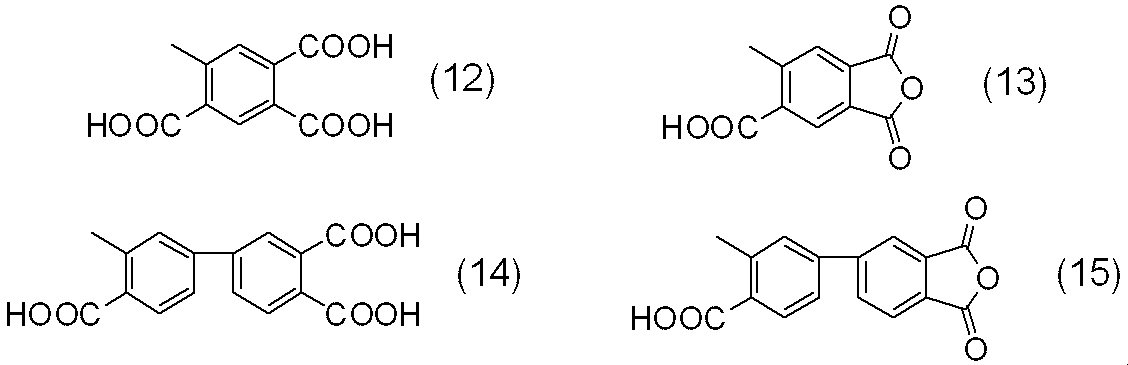
- Z is an aromatic represented by the following formula (12) or formula (13) independently of each other when X is an aromatic group represented by the formula (8) or formula (9). Group is preferred, and when X is an aromatic group represented by the above formula (10) or formula (11), the aromatic group represented by the following formula (14) or formula (15) is preferable
- Y is preferably an aromatic group containing 1 to 5 benzene rings, more preferably an aromatic group represented by at least one selected from the following formulas (16) to (18).
- R 1 to R 24 are each independently a carbon atom which may be substituted with a hydrogen atom, a hydroxyl group, a halogen atom, a nitro group, a cyano group, or a halogen atom.
- An alkyl group having 1 to 20 carbon atoms, an alkenyl group having 2 to 20 carbon atoms, an alkynyl group having 2 to 20 carbon atoms, an aryl group having 6 to 20 carbon atoms, or a heteroaryl group having 2 to 20 carbon atoms is represented.
- halogen atom examples include a fluorine atom, a chlorine atom, a bromine atom, and an iodine atom.
- alkyl group having 1 to 20 carbon atoms may be linear, branched or cyclic, and include methyl, ethyl, n-propyl, isopropyl, cyclopropyl, n-butyl, isobutyl, s-butyl, t-butyl, n-pentyl, 1-methyl-n-butyl, 2-methyl-n-butyl, 3-methyl-n-butyl, 1,1-dimethyl-n-propyl, 1,2-dimethyl-n- Propyl, 2,2-dimethyl-n-propyl, 1-ethyl-n-propyl, cyclopentyl, n-hexyl, 1-methyl-n-pentyl, 2-methyl-n-pentyl, 3-methyl-n-pentyl,
- alkenyl group having 2 to 20 carbon atoms include ethenyl, n-1-propenyl, n-2-propenyl, 1-methylethenyl, n-1-butenyl, n-2-butenyl, n-3-butenyl, 2-methyl-1-propenyl, 2-methyl-2-propenyl, 1-ethylethenyl, 1-methyl-1-propenyl, 1-methyl-2-propenyl, n-1-pentenyl, n-1-decenyl, n- Examples include 1-eicosenyl group.
- alkynyl group having 2 to 20 carbon atoms examples include ethynyl, n-1-propynyl, n-2-propynyl, n-1-butynyl, n-2-butynyl, n-3-butynyl, 1-methyl- 2-propynyl, n-1-pentynyl, n-2-pentynyl, n-3-pentynyl, n-4-pentynyl, 1-methyl-n-butynyl, 2-methyl-n-butynyl, 3-methyl-n- Examples include butynyl, 1,1-dimethyl-n-propynyl, n-1-hexynyl, n-1-decynyl, n-1-pentadecynyl, n-1-eicosinyl group and the like.
- aryl group having 6 to 20 carbon atoms include phenyl, 1-naphthyl, 2-naphthyl, 1-anthryl, 2-anthryl, 9-anthryl, 1-phenanthryl, 2-phenanthryl, 3-phenanthryl, 4- Examples include phenanthryl and 9-phenanthryl group.
- heteroaryl group having 2 to 20 carbon atoms examples include 2-thienyl, 3-thienyl, 2-furanyl, 3-furanyl, 2-oxazolyl, 4-oxazolyl, 5-oxazolyl, 3-isoxazolyl, and 4-isoxazolyl.
- Oxygen-containing heteroaryl groups such as 5-isoxazolyl; sulfur-containing heteroaryl groups such as 2-thiazolyl, 4-thiazolyl, 5-thiazolyl, 3-isothiazolyl, 4-isothiazolyl, 5-isothiazolyl group; 2-imidazolyl, 4- Imidazolyl, 2-pyridyl, 3-pyridyl, 4-pyridyl, 2-pyrazyl, 3-pyrazyl, 5-pyrazyl, 6-pyrazyl, 2-pyrimidyl, 4-pyrimidyl, 5-pyrimidyl, 6-pyrimidyl, 3-pyridyl, 4-Pyridazyl, 5-Pyridazyl, 6-Pyridazyl, 1,2,3-Tri Gin-4-yl, 1,2,3-triazin-5-yl, 1,2,4-triazin-3-yl, 1,2,4-triazin-5-yl, 1,2,4-triazine- 6-yl, 1,3,5-tri
- R 1 to R 24 are a hydrogen atom, a fluorine atom, a cyano group, an alkyl group having 1 to 20 carbon atoms that may be substituted with a halogen atom, or a carbon number that may be substituted with a halogen atom.
- An aryl group of ⁇ 20 and a heteroaryl group of 2 to 20 carbon atoms which may be substituted with a halogen atom are preferred, and a carbon number of 1 to 10 which may be substituted with a hydrogen atom, a fluorine atom, a cyano group or a halogen atom
- a phenyl group which may be substituted with an alkyl group or a halogen atom is more preferred
- a hydrogen atom, a fluorine atom, a methyl group or a trifluoromethyl group is even more preferred, and a hydrogen atom is most preferred.
- M may be a natural number, but is preferably a natural number of 100 or less, more preferably a natural number of 2 to 100.
- benzenetetracarboxylic dianhydride and biphenyltetracarboxylic dianhydride can be used.
- pyromellitic dianhydride benzene-1,2,3,4-tetracarboxylic dianhydride
- biphenyl-2,2 ′ 3,3′-tetracarboxylic dianhydride
- biphenyl -2,3,3 ′, 4′-tetracarboxylic dianhydride biphenyl-3,3 ′, 4,4′-tetracarboxylic dianhydride, and the like.
- pyromellitic dianhydride and biphenyl-3,3 ′, 4,4′-tetracarboxylic dianhydride are preferably used from the viewpoint of improving the function of the resulting film as a release layer. be able to.
- the aromatic diamine is not particularly limited as long as it has two amino groups directly bonded to the aromatic ring in the molecule, but an aromatic diamine containing 1 to 5 benzene rings is preferable. .
- aromatic diamine having the above structure examples include 1,4-diaminobenzene (p-phenylenediamine), 1,3-diaminobenzene (m-phenylenediamine), 1,2-diaminobenzene (o-phenylene).
- an aromatic diamine having no substituent such as a methyl group on the aromatic ring or the aromatic ring and the heterocyclic ring condensed thereto is preferable.
- p-phenylenediamine, m-phenylenediamine, 2- (3-aminophenyl) -5-aminobenzimidazole, 2- (4-aminophenyl) -5-aminobenzooxol, 4,4 ′ '-Diamino-p-terphenyl and the like are preferred.
- the diamine component of the present invention may contain a diamine other than an aromatic diamine, and a preferred example thereof is represented by the formula (S). Diamines.
- each L independently represents an alkanediyl group having 1 to 20 carbon atoms, an alkenediyl group having 2 to 20 carbon atoms, or an alkynediyl group having 2 to 20 carbon atoms
- each R ′ represents Independent of each other, it represents an alkyl group having 1 to 20 carbon atoms, an alkenyl group having 2 to 20 carbon atoms, or an alkynyl group having 2 to 20 carbon atoms.
- the carbon number of such alkanediyl group, alkenediyl group and alkynediyl group is preferably 10 or less, more preferably 5 or less.
- R ′ is preferably an alkyl group having 1 to 20 carbon atoms, and more preferably a methyl or ethyl group in consideration of the balance between the solubility of the obtained polyamic acid in an organic solvent and the heat resistance of the obtained film.
- 1,3-bis (3-aminopropyl) tetramethyldisiloxane is optimal as the diamine represented by the formula (S).
- the diamine represented by Formula (S) can be obtained as a commercial item, and can also be synthesize
- diamines may be used in combination with the aromatic diamine as long as the resultant release layer is not adversely affected.
- specific examples of other diamines include 1,4-diaminocyclohexane, 1,4-cyclohexanebis (methylamine), 4,4′-diaminodicyclohexylmethane, bis (4-amino-3-methylcyclohexyl) methane, 3 (4), 8 (9) -bis (aminomethyl) tricyclo [5.2.1.0 2,6 ] decane, 2,5 (6) -bis (aminomethyl) bicyclo [2.2.1] heptane 1,3-diaminoadamantane, 3,3′-diamino-1,1′-biadamantyl, 1,6-diaminodiamantane (1,6-aminopentacyclo [7.3.1.1 4,12 , 0 2,7 .0 6,11 ] tetradecane) and the like; and aliphatic
- the amount of aromatic diamine in the total diamine component is preferably 70 mol% or more, more preferably 80 mol% or more, still more preferably 90 mol% or more, and still more preferably 95 mol% or more.
- the amount of the aromatic diamine in the total amount of the aromatic diamine and the diamine represented by the formula (S) is preferably 80 mol. % Or more, more preferably 90 mol% or more, still more preferably 95 mol% or more, still more preferably 97 mol% or more.
- the charging ratio of the diamine component and the tetracarboxylic dianhydride component is appropriately determined in consideration of the target molecular weight and molecular weight distribution, the kind of the diamine and tetracarboxylic dianhydride, etc.
- the molar ratio of the tetracarboxylic dianhydride component is preferably 1.05 to 2.5 mol, more preferably 1.07 to 1.5 mol, relative to 1 mol of the diamine component, and 1.1 to 1.5 mol. 1.3 mol is even more preferred.
- the polyamic acid of the above formula (1) contained in the composition for forming a release layer of the present invention can be obtained.
- the organic solvent used in the synthesis of the polyamic acid is not particularly limited as long as it does not adversely affect the reaction.
- Specific examples thereof include m-cresol, 2-pyrrolidone, N-methyl-2-pyrrolidone, N— Ethyl-2-pyrrolidone, N-vinyl-2-pyrrolidone, N, N-dimethylacetamide, N, N-dimethylformamide, 3-methoxy-N, N-dimethylpropylamide, 3-ethoxy-N, N-dimethylpropyl Amides, 3-propoxy-N, N-dimethylpropylamide, 3-isopropoxy-N, N-dimethylpropylamide, 3-butoxy-N, N-dimethylpropylamide, 3-sec-butoxy-N, N-dimethyl Propylamide, 3-tert-butoxy-N, N-dimethylpropylamide, ⁇ -butyrolacto Etc.
- the reaction temperature during the synthesis of the polyamic acid may be appropriately set in the range from the melting point to the boiling point of the solvent to be used, and is usually about 0 to 100 ° C. However, it prevents imidization of the resulting polyamic acid in the solution. From the viewpoint of maintaining a high content of polyamic acid units, the temperature can be preferably about 0 to 70 ° C, more preferably about 0 to 60 ° C, and still more preferably about 0 to 50 ° C.
- the reaction time depends on the reaction temperature and the reactivity of the raw material, it cannot be defined unconditionally, but is usually about 1 to 100 hours.
- the weight average molecular weight of the polyamic acid of the above formula (1) thus obtained is usually about 5,000 to 500,000, preferably from the viewpoint of improving the function of the resulting film as a release layer. It is about 10,000 to 200,000, more preferably about 30,000 to 150,000.
- a weight average molecular weight is a polystyrene conversion value by a gel permeation chromatography (GPC) measurement.
- the release layer forming composition of the present invention contains an organic solvent.
- this organic solvent those similar to the specific examples of the reaction solvent of the above reaction can be used, but since the polyamic acid of the above formula (1) is well dissolved, it is easy to prepare a highly uniform composition.
- R 25 and R 26 each independently represents an alkyl group having 1 to 10 carbon atoms.
- R 27 represents a hydrogen atom or an alkyl group having 1 to 10 carbon atoms.
- b represents a natural number, preferably a natural number of 1 to 5, more preferably a natural number of 1 to 3. Specific examples of the alkyl group having 1 to 10 carbon atoms include the same ones as described above.
- organic solvent represented by the above formulas (S1) to (S3) include 3-methoxy-N, N-dimethylpropionamide, N, N-dimethylformamide, N, N-dimethylacetamide, N, N -Dimethylpropionamide, N, N-dimethylbutanamide, N-methyl-2-pyrrolidone, N-ethyl-2-pyrrolidone and the like can be mentioned, among which N-methyl-2-pyrrolidone is preferable.
- organic solvents may be used alone or in combination of two or more.
- ethyl cellosolve, butyl cellosolve, ethyl carbitol, butyl carbitol, ethyl carbitol acetate ethylene glycol, 1-methoxy-2-propanol, 1-ethoxy-2-propanol, 1-butoxy-2-propanol, 1-phenoxy -2-propanol, propylene glycol monoacetate, propylene glycol diacetate, propylene glycol-1-monomethyl ether-2-acetate, propylene glycol-1-monoethyl ether-2-acetate, dipropylene glycol, 2- (2-ethoxy Propoxy) propanol, methyl lactate, ethyl lactate, n-propyl lactate, n-butyl lactate, isoamyl lactate and other solvents
- the composition for forming a release layer of the present invention can be prepared by a usual method.
- the preparation method the reaction solution containing the target polyamic acid obtained by the method described above is filtered, and the concentration of the obtained filtrate is adjusted to a predetermined concentration using the organic solvent described above. Good.
- the concentration of the polyamic acid of the above formula (1) in the composition for forming a release layer of the present invention is appropriately set in consideration of the thickness of the release layer to be produced, the viscosity of the composition, etc., but usually 1 to 30 About 1% by mass, preferably about 1 to 20% by mass. By setting such a concentration, a release layer having a thickness of about 0.05 to 5 ⁇ m can be obtained with good reproducibility.
- the concentration of the polyamic acid of the above formula (1) adjusts the amount of the diamine component and the tetracarboxylic dianhydride component that are raw materials of the polyamic acid, and dissolves the isolated polyamic acid of the above formula (1) in the solvent The amount can be adjusted by adjusting the amount.
- the viscosity of the composition for forming a release layer of the present invention is appropriately set in consideration of the thickness of the release layer to be produced, etc., but a film having a thickness of about 0.05 to 5 ⁇ m is particularly reproducible. When it is intended to obtain, it is usually about 10 to 10,000 mPa ⁇ s, preferably about 20 to 5,000 mPa ⁇ s at 25 ° C.
- the viscosity can be measured using a commercially available liquid viscosity measurement viscometer, for example, with reference to the procedure described in JIS K7117-2 at a temperature of the composition of 25 ° C. .
- a conical plate type (cone plate type) rotational viscometer is used as the viscometer, and preferably the composition temperature is 25 ° C. using 1 ° 34 ′ ⁇ R24 as a standard cone rotor. It can be measured under the condition of ° C.
- An example of such a rotational viscometer is TVE-25L manufactured by Toki Sangyo Co., Ltd.
- the release layer forming composition of the present invention may contain a crosslinking agent or the like in order to improve the film strength, for example, in addition to the polyamic acid of the above formula (1) and the organic solvent.
- the adhesive layer-forming composition of the present invention described above is applied to a substrate, and the resulting coating film is heated to thermally imidize the polyamic acid of the above formula (1), thereby providing excellent adhesion to the substrate.
- a release layer made of a polyimide film having appropriate adhesion to the resin substrate and appropriate release properties can be obtained.
- the release layer When such a release layer of the present invention is formed on a substrate, the release layer may be formed on a part of the substrate surface or on the entire surface.
- a mode of forming a release layer on a part of the substrate surface a mode in which the release layer is formed only in a predetermined range on the substrate surface, a release layer in a pattern such as a dot pattern or a line and space pattern on the entire substrate surface.
- substrate means what is used for manufacture of a flexible electronic device etc. by which the composition for peeling layer formation of this invention is applied to the surface.
- the substrate examples include glass, plastic (polycarbonate, polymethacrylate, polystyrene, polyester, polyolefin, epoxy, melamine, triacetyl cellulose, ABS, AS, norbornene resin, etc.), metal (silicon wafer, etc.), Examples include wood, paper, and slate.
- plastic polycarbonate, polymethacrylate, polystyrene, polyester, polyolefin, epoxy, melamine, triacetyl cellulose, ABS, AS, norbornene resin, etc.
- metal silicon wafer, etc.
- Examples include wood, paper, and slate.
- substrate surface may be comprised with the single material and may be comprised with two or more materials.
- the substrate surface is composed of two or more materials
- a material in a pattern such as a dot pattern or a line and space pattern is present in other materials.
- the method for applying the release layer-forming composition of the present invention to the substrate is not particularly limited, and examples thereof include cast coating, spin coating, blade coating, dip coating, roll coating, and bar coating.
- Method, die coating method, ink jet method, printing method eg, relief printing, intaglio printing, planographic printing, screen printing, etc.
- the heating temperature for imidization is usually appropriately determined within the range of 50 to 550 ° C., but is preferably more than 150 ° C. to 510 ° C. By setting the heating temperature in this way, it is possible to sufficiently advance the imidization reaction while preventing the obtained film from being weakened.
- the heating time varies depending on the heating temperature, and cannot be generally defined, but is usually 5 minutes to 5 hours.
- the imidization rate may be in the range of 50 to 100%.
- the heating temperature is gradually increased as it is, and finally from 150 ° C. to 510 ° C. for 30 minutes to 4 hours.
- the method of heating is mentioned. In particular, it is preferable that heating is performed at 50 to 150 ° C. for 5 minutes to 2 hours, followed by heating at 150 to 350 ° C. for 5 minutes to 2 hours, and finally heating at 350 to 450 ° C. for 30 minutes to 4 hours.
- Examples of the appliance used for heating include a hot plate and an oven.
- the heating atmosphere may be under air or under an inert gas, and may be under normal pressure or under reduced pressure.
- the thickness of the release layer is usually about 0.01 to 50 ⁇ m, and preferably about 0.05 to 20 ⁇ m from the viewpoint of productivity.
- desired thickness is implement
- the above-described release layer has excellent adhesion to a substrate, particularly a glass substrate, moderate adhesion to a resin substrate, and moderate peelability.
- the performance is stable without any change in the characteristics. Therefore, the release layer of the present invention peels the resin substrate from the substrate together with the circuit formed on the resin substrate without damaging the resin substrate of the device in the manufacturing process of the flexible electronic device. Therefore, it can be suitably used.
- a release layer is formed on a glass substrate by the method described above.
- a resin solution for forming a resin substrate is applied on the release layer, and this coating film is heated to form a resin substrate fixed to the glass substrate via the release layer of the present invention.
- the substrate is formed with a larger area than the area of the release layer so as to cover the entire release layer.
- the resin substrate include a resin substrate made of polyimide, which is a typical resin substrate for flexible electronic devices, and examples of the resin solution for forming the resin substrate include a polyimide solution and a polyamic acid solution.
- the method for forming the resin substrate may follow a conventional method.
- a desired circuit is formed on the resin substrate fixed to the base via the release layer of the present invention, and then the resin substrate is cut along the release layer, for example. It peels from a peeling layer, and a resin substrate and a base
- the LLO method is characterized in that light having a specific wavelength, for example, light having a wavelength of 308 nm, is irradiated from the surface opposite to the surface on which a circuit or the like is formed from the glass substrate side.
- the irradiated light passes through the glass substrate, and only the polymer (polyimide) in the vicinity of the glass substrate absorbs this light and evaporates (sublimates).
- the polymer polyimide
- the composition for forming a release layer according to the present invention has a feature of sufficiently absorbing light having a specific wavelength (for example, 308 nm) that enables application of the LLO method, and can therefore be used as a sacrificial layer for the LLO method. Therefore, when a desired circuit is formed on a resin substrate fixed to a glass substrate through a release layer formed by using the composition according to the present invention, and then an LLO method is performed to irradiate a light beam of 308 nm. Only the release layer absorbs this light and evaporates (sublimates). Thereby, the release layer is sacrificed (acts as a sacrifice layer), and the resin substrate can be selectively peeled from the glass substrate.
- a specific wavelength for example, 308 nm
- Mw weight average molecular weight
- Mw molecular weight distribution of a polymer
- GPC apparatus manufactured by JASCO Corporation (column: KD801 and KD805 manufactured by Shodex; eluent: Dimethylformamide / LiBr.H 2 O (29.6 mM) / H 3 PO 4 (29.6 mM) / THF (0.1 wt%); flow rate: 1.0 mL / min; column temperature: 40 ° C .; Mw: standard polystyrene (Converted value).
- composition for forming release layer [Example 1-1] BCS and NMP were added to the reaction solution obtained in Synthesis Example L1, and diluted such that the polymer concentration was 5% by mass and BCS was 20% by mass to obtain a release layer forming composition.
- Examples 1-2 to 1-3 A composition for forming a release layer was obtained in the same manner as in Example 1-1 except that the reaction solutions obtained in Synthesis Examples L2 to L3 were used in place of the reaction solution obtained in Synthesis Example L1, respectively. It was.
- Example 2-1 Production of release layer and resin substrate [Example 2-1] Using a spin coater (conditions: about 3,000 rpm for about 30 seconds), the release layer forming composition obtained in Example 1-1 was placed on a 100 mm ⁇ 100 mm glass substrate (hereinafter the same) as a glass substrate. It was applied to. The obtained coating film was heated at 80 ° C. for 10 minutes using a hot plate, and then heated at 300 ° C. for 30 minutes using an oven, and the heating temperature was raised to 400 ° C. (10 ° C./min. And then heated at 400 ° C. for 30 minutes to form a release layer having a thickness of about 0.1 ⁇ m on the glass substrate, thereby obtaining a glass substrate with a release layer. During the temperature increase, the film-coated substrate was not removed from the oven but heated in the oven.
- a spin coater condition: about 3,000 rpm for about 30 seconds
- the composition for resin substrate formation was apply
- the obtained coating film was heated at 80 ° C. for 30 minutes using a hot plate, and then heated at 140 ° C. for 30 minutes using an oven, and the heating temperature was raised to 210 ° C. (2 ° C./min.
- a polyimide substrate having a thickness of about 20 ⁇ m was formed to obtain a resin substrate and a glass substrate with a release layer. During the temperature increase, the film-coated substrate was not removed from the oven but heated in the oven.
- Example 2-1 was used except that the release layer forming composition obtained in Examples 1-2 to 1-3 was used in place of the release layer forming composition obtained in Example 1-1.
- a release layer and a polyimide substrate were prepared, and a glass substrate with a release layer and a glass substrate with a resin substrate / release layer were obtained.
- Comparative Example 2-1 In the same manner as in Example 2-1, except that the composition for forming a release layer obtained in Comparative Example 1-1 was used instead of the composition for forming a release layer obtained in Example 1-1. Then, a release layer and a polyimide substrate were prepared, and a glass substrate with a release layer and a glass substrate with a resin substrate / release layer were obtained.
- the peeling layers of the examples have no change in the peeling force even after the high temperature treatment.
- the release layer of Comparative Example 2-1 is excellent in adhesion to the glass substrate and excellent in peelability from the resin substrate, but it can be seen that the peel strength deteriorates after high temperature treatment.
Landscapes
- Chemical & Material Sciences (AREA)
- Organic Chemistry (AREA)
- Chemical Kinetics & Catalysis (AREA)
- Health & Medical Sciences (AREA)
- Medicinal Chemistry (AREA)
- Polymers & Plastics (AREA)
- Life Sciences & Earth Sciences (AREA)
- Engineering & Computer Science (AREA)
- Materials Engineering (AREA)
- Wood Science & Technology (AREA)
- Macromolecular Compounds Obtained By Forming Nitrogen-Containing Linkages In General (AREA)
- Laminated Bodies (AREA)
- Compositions Of Macromolecular Compounds (AREA)
- Paints Or Removers (AREA)
- Medicinal Preparation (AREA)
Abstract
Description
特に、新世代ディスプレイでは、軽量なフレキシブルプラスチック基板(以下、樹脂基板と表記する)を用いたアクティブマトリクス型フルカラーTFTディスプレイパネルの開発が求められている。
しかも、被剥離層が大面積である場合には、レーザー処理に長時間を要するため、デバイス作製の生産性を上げることが難しい。
しかしながら、既存のポリマーは、Tg以上の温度に加熱された場合、密着性が高まることが知られており(例えば、特許文献6参照)、加熱処理後に剥離層と樹脂基板との密着性が高まり、樹脂基板を基体から剥離することが困難となることがあった。
[1]下記式(1)で表されるポリアミック酸と、有機溶媒とを含むことを特徴とする剥離層形成用組成物。


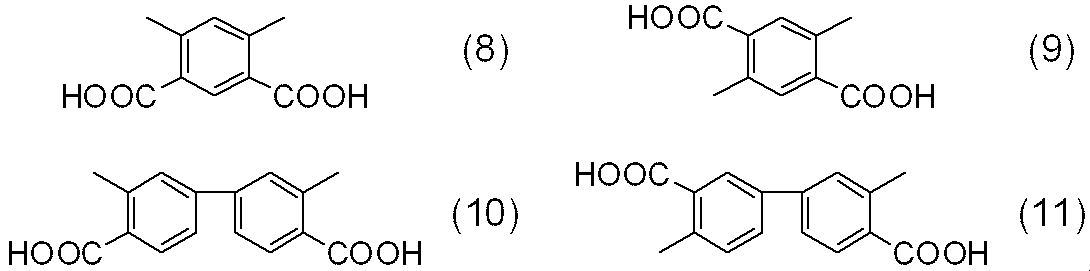
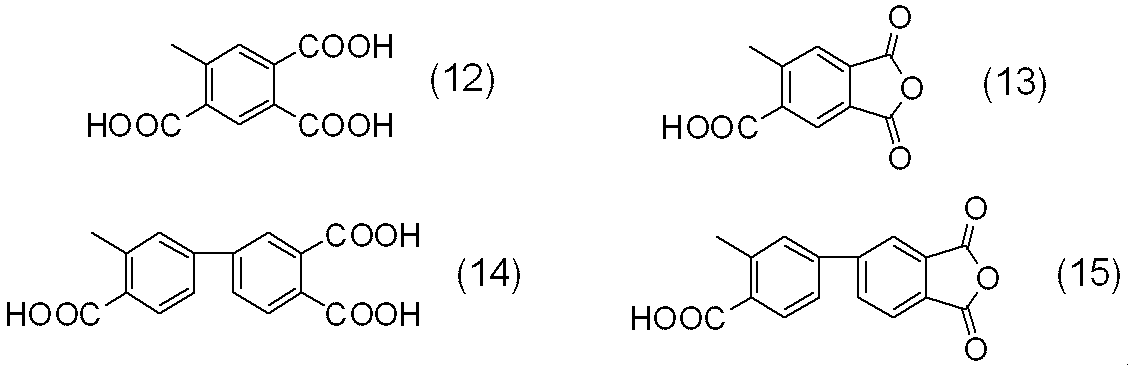
[4]上記Yが、下記式(16)~(18)から選ばれる少なくとも1種である[3]記載の剥離層形成用組成物。

[5]上記R1~R24が、水素である[4]記載の剥離層形成用組成物。
[6]上記mが、100以下の自然数である[1]~[5]のいずれかに記載の剥離層形成用組成物。
[7]上記有機溶媒が、式(S1)で表されるアミド類、式(S2)で表されるアミド類及び式(S3)で表されるアミド類から選ばれる少なくとも1種を含む[1]~[6]のいずれかに記載の剥離層形成用組成物。
[8][1]~[7]のいずれかに記載の剥離層形成用組成物により形成される剥離層。
[9][8]記載の剥離層を用いることを特徴とする、樹脂基板を備えるフレキシブル電子デバイスの製造方法。
[10]上記樹脂基板が、ポリイミドからなる基板である[9]記載の製造方法。
本発明の剥離層形成用組成物は、下記式(1)で表されるポリアミック酸と、有機溶媒とを含むものである。
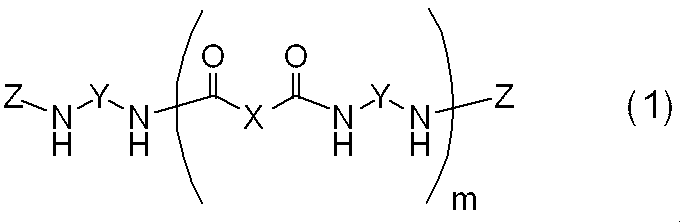

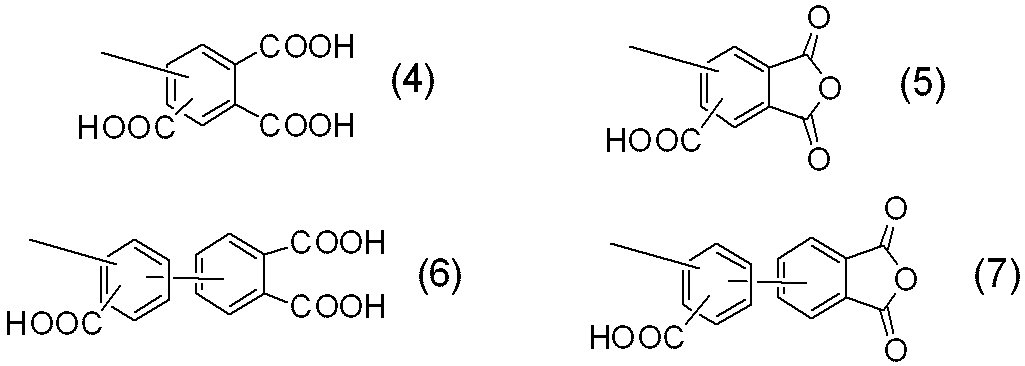
上記テトラカルボン酸二無水物成分としては、ベンゼンテトラカルボン酸二無水物及びビフェニルテトラカルボン酸二無水物を使用することができる。上記ジアミン成分としては、脂鎖、脂環、芳香族、芳香脂環族のいずれでもよいが、本発明では、得られる膜の剥離層としての機能を向上させる観点から、上記テトラカルボン酸二無水物と、芳香族ジアミンを含むジアミン成分とを反応させて得られるポリアミック酸が好ましく、上記テトラカルボン酸二無水物と芳香族ジアミンとを反応させて得られる全芳香族ポリアミック酸がより好ましい。

炭素数1~20のアルキル基の具体例としては、直鎖状、分岐状、環状のいずれでもよく、メチル、エチル、n-プロピル、イソプロピル、シクロプロピル、n-ブチル、イソブチル、s-ブチル、t-ブチル、n-ペンチル、1-メチル-n-ブチル、2-メチル-n-ブチル、3-メチル-n-ブチル、1,1-ジメチル-n-プロピル、1,2-ジメチル-n-プロピル、2,2-ジメチル-n-プロピル、1-エチル-n-プロピル、シクロペンチル、n-ヘキシル、1-メチル-n-ペンチル、2-メチル-n-ペンチル、3-メチル-n-ペンチル、4-メチル-n-ペンチル、1,1-ジメチル-n-ブチル、1,2-ジメチル-n-ブチル、1,3-ジメチル-n-ブチル、2,2-ジメチル-n-ブチル、2,3-ジメチル-n-ブチル、3,3-ジメチル-n-ブチル、1-エチル-n-ブチル、2-エチル-n-ブチル、1,1,2-トリメチル-n-プロピル、1,2,2-トリメチル-n-プロピル、1-エチル-1-メチル-n-プロピル、1-エチル-2-メチル-n-プロピル、シクロヘキシル、n-ヘプチル、n-オクチル、n-ノニル、n-デシル基、n-ウンデシル、n-ドデシル、n-トリデシル、n-テトラデシル、n-ペンタデシル、n-ヘキサデシル、n-ヘプタデシル、n-オクタデシル、n-ノナデシル、n-エイコサニル基等が挙げられる。

中でも、R’としては、得られるポリアミック酸の有機溶媒への溶解性と得られる膜の耐熱性のバランスを考慮すると、炭素数1~20のアルキル基が好ましく、メチル、エチル基がより好ましい。
その他のジアミンの具体例としては、1,4-ジアミノシクロヘキサン、1,4-シクロヘキサンビス(メチルアミン)、4,4’-ジアミノジシクロヘキシルメタン、ビス(4-アミノ-3-メチルシクロヘキシル)メタン、3(4),8(9)-ビス(アミノメチル)トリシクロ[5.2.1.02,6]デカン、2,5(6)-ビス(アミノメチル)ビシクロ[2.2.1]ヘプタン、1,3-ジアミノアダマンタン、3,3’-ジアミノ-1,1’-ビアダマンチル、1,6-ジアミノジアマンタン(1,6-アミノペンタシクロ[7.3.1.14,12,02,7.06,11]テトラデカン)等の脂環式ジアミン;テトラメチレンジアミン、ヘキサメチレンジアミン等の脂肪族ジアミン等が挙げられる。


炭素数1~10のアルキル基の具体例としては、上記と同様のものが挙げられる。
本発明の剥離層形成用組成物を用いて、上述の方法によって、ガラス基体上に剥離層を形成する。この剥離層の上に、樹脂基板を形成するための樹脂溶液を塗布し、この塗膜を加熱することで、本発明の剥離層を介して、ガラス基体に固定された樹脂基板を形成する。この際、剥離層を全て覆うようにして、剥離層の面積と比較して大きい面積で、基板を形成する。樹脂基板としては、フレキシブル電子デバイスの樹脂基板として代表的なポリイミドからなる樹脂基板が挙げられ、それを形成するための樹脂溶液としては、ポリイミド溶液やポリアミック酸溶液が挙げられる。当該樹脂基板の形成方法は、常法に従えばよい。
[1]化合物の略語
p-PDA:p-フェニレンジアミン
BPDA:3,3’,4,4’-ビフェニルテトラカルボン酸二無水物
PMDA:ピロメリット酸二無水物
NMP:N-メチル-2-ピロリドン
BCS:ブチルセロソルブ
ポリマーの重量平均分子量(以下Mwと略す)及び分子量分布の測定は、日本分光(株)製GPC装置(カラム:Shodex製 KD801及びKD805;溶離液:ジメチルホルムアミド/LiBr・H2O(29.6mM)/H3PO4(29.6mM)/THF(0.1wt%);流量:1.0mL/分;カラム温度:40℃;Mw:標準ポリスチレン換算値)を用いて行った。
以下の方法によって、ポリアミック酸を合成した。
なお、得られたポリマー含有反応液からポリマーを単離せず、後述の通りに、反応液を希釈することで、樹脂基板形成用組成物又は剥離層形成用組成物を調製した。
p-PDA3.218g(30mmol)をNMP88.2gに溶解させた。得られた溶液にBPDA8.581g(29mmol)を加え、窒素雰囲気下、23℃で24時間反応させた。得られたポリマーのMwは107,300、分子量分布は4.6であった。
p-PDA4.47g(41.4mmol)をNMP132gに溶解させた。得られた溶液に、BPDA13.53g(46.0mmol)を加え、窒素雰囲気下、23℃で24時間反応させた。得られたポリマーのMwは75,400、分子量分布3.3であった。
p-PDA5.55g(51.4mmol)をNMP132gに溶解させた。得られた溶液に、PMDA12.45g(57.1mmol)を加え、窒素雰囲気下、23℃で24時間反応させた。得られたポリマーのMwは76,400、分子量分布2.2であった。
p-PDA2.73g(25.2mmol)をNMP88gに溶解させた。得られた溶液に、BPDA9.27g(31.5mmol)を加え、窒素雰囲気下、23℃で24時間反応させた。得られたポリマーのMwは45,000、分子量分布3.9であった。
p-PDA20.8g(192mmol)をNMP425gに溶解させた。得られた溶液に、BPDA54.2g(184mmol)を加え、窒素雰囲気下、23℃で24時間反応させた。得られたポリマーのMwは69,200、分子量分布2.2であった。
[調製例1]
合成例S1で得られた反応液をそのまま樹脂基板形成用組成物として用いた。
[実施例1-1]
合成例L1で得られた反応液に、BCSとNMPを加え、ポリマー濃度が5質量%、BCSが20質量%となるように希釈し、剥離層形成用組成物を得た。
合成例L1で得られた反応液の代わりに、それぞれ合成例L2~L3で得られた反応液を用いた以外は、実施例1-1と同様の方法で、剥離層形成用組成物を得た。
合成例L1で得られた反応液の代わりに、比較合成例B1で得られた反応液を用いた以外は、実施例1-1と同様の方法で、剥離層形成用組成物を得た。
[実施例2-1]
スピンコータ(条件:回転数3,000rpmで約30秒)を用いて、実施例1-1で得られた剥離層形成用組成物を、ガラス基体としての100mm×100mmガラス基板(以下同様)の上に塗布した。
そして、得られた塗膜を、ホットプレートを用いて80℃で10分間加熱し、その後、オーブンを用いて、300℃で30分間加熱し、加熱温度を400℃まで昇温(10℃/分)し、更に400℃で30分間加熱し、ガラス基板上に厚さ約0.1μmの剥離層を形成し、剥離層付きガラス基板を得た。なお、昇温の間、膜付き基板をオーブンから取り出すことはせず、オーブン内で加熱した。
実施例1-1で得られた剥離層形成用組成物の代わりに、それぞれ実施例1-2~1-3で得られた剥離層形成用組成物を用いた以外は、実施例2-1と同様の方法で、剥離層及びポリイミド基板を作製し、剥離層付きガラス基板及び樹脂基板・剥離層付きガラス基板を得た。
実施例1-1で得られた剥離層形成用組成物の代わりに、比較例1-1で得られた剥離層形成用組成物を用いた以外は、実施例2-1と同様の方法で、剥離層及びポリイミド基板を作製し、剥離層付きガラス基板及び樹脂基板・剥離層付きガラス基板を得た。
上記実施例2-1~2-3及び比較例2-1で得られた剥離層付きガラス基板について、剥離層とガラス基板との剥離性を、下記手法にて確認した。なお、下記の試験は、同一のガラス基板で行った。
<樹脂薄膜のクロスカット試験剥離性評価>
実施例2-1~2-3及び比較例2-1で得られた剥離層付きガラス基板上の剥離層をクロスカット(縦横1mm間隔、以下同様)し、100マスカットを行った。すなわち、このクロスカットにより、1mm四方のマス目を100個形成した。
そして、この100マスカット部分に粘着テープを張り付けて、そのテープを剥がし、以下の基準(5B~0B,B,A,AA)に基づき、剥離の程度を評価した。結果を表1に示す。
<判定基準>
5B:0%剥離(剥離なし)
4B:5%未満の剥離
3B:5~15%の剥離
2B:15~35%未満の剥離
1B:35~65%未満の剥離
0B:65%~80%未満の剥離
B:80%~95%未満の剥離
A:95%~100%未満の剥離
AA:100%剥離(すべて剥離)
実施例2-1~2-3及び比較例2-1で得られた樹脂基板・剥離層付きガラス基板の樹脂基板を、カッターを用いて25mm幅の短冊状にカットした。そして、カットした樹脂基板の先端にセロハンテープを貼り付け、これを試験片とした。この試験片を、(株)アトニック製プッシュプルテスターを用いて剥離角度が90°となるように剥離試験を行い、下記の基準に基づいて剥離力を評価した。結果を表1に示す。
<判定基準>
4b:剥離しない
3b:1.00(N/25mm)以上の剥離力
2b:0.80~1.00(N/25mm)未満の剥離力
1b:0.60~0.80(N/25mm)未満の剥離力
0b:0.40~0.60(N/25mm)未満の剥離力
b:0.30~0.40(N/25mm)未満の剥離力
a:0.20~0.30(N/25mm)未満の剥離力
aa:0.20(N/25mm)未満の剥離力
初期剥離力を評価した実施例2-1~2-3及び比較例2-1の樹脂基板・剥離層付きガラス基板の樹脂基板を、オーブンを用いて、400℃で6時間加熱し、TFT工程と同様の高温処理を行った。そして、初期剥離力評価と同様に、樹脂基板の90°剥離試験を行った。得られた剥離力を、初期剥離力と同様の基準に基づいて評価した。
<剥離力変化量の評価>
高温処理前の剥離力と、高温処理後の剥離力との変化量を、以下の式より算出した。そして、下記の基準に基づいて、剥離力変化量の程度を評価した。結果を表1に記載した。
変化量(%)={(高温処理後の剥離力)-(高温処理前の剥離力)}/(高温処理前の剥離力)×100
○:40%未満の剥離力変化量(良好に剥離)
△:40~70%未満の剥離力変化量
×:70~100%未満の剥離力変化量
××:100%以上の剥離力変化量(剥離力の悪化)
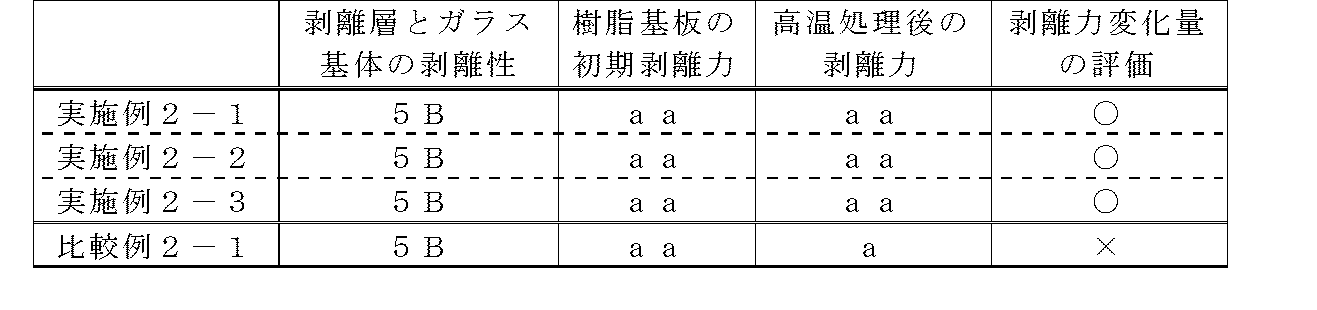
一方、比較例2-1の剥離層は、ガラス基板との密着性に優れ、かつ、樹脂基板との剥離性に優れているが、高温処理後に剥離力が悪化していることがわかる。
Claims (10)
- 下記式(1)で表されるポリアミック酸と、有機溶媒とを含むことを特徴とする剥離層形成用組成物。



- 上記Xが、下記式(8)~(11)で表される芳香族基であり、上記Zが、Xが下記式(8)又は式(9)で表される芳香族基の時は、互いに独立して、下記式(12)又は式(13)で表される芳香族基であり、Xが下記式(10)又は式(11)で表される芳香族基の時は、互いに独立して、下記式(14)又は式(15)で表される芳香族基である請求項1記載の剥離層形成用組成物。
- 上記Yが、ベンゼン環を1~5個含む2価の芳香族基である請求項1又は2記載の剥離層形成用組成物。
- 上記Yが、下記式(16)~(18)から選ばれる少なくとも1種である請求項3記載の剥離層形成用組成物。

- 上記R1~R24が、水素である請求項4記載の剥離層形成用組成物。
- 上記mが、100以下の自然数である請求項1~5のいずれか1項記載の剥離層形成用組成物。
- 上記有機溶媒が、式(S1)で表されるアミド類、式(S2)で表されるアミド類及び式(S3)で表されるアミド類から選ばれる少なくとも1種を含む請求項1~6のいずれか1項記載の剥離層形成用組成物。

- 請求項1~7のいずれか1項記載の剥離層形成用組成物により形成される剥離層。
- 請求項8記載の剥離層を用いることを特徴とする、樹脂基板を備えるフレキシブル電子デバイスの製造方法。
- 上記樹脂基板が、ポリイミドからなる基板である請求項9記載の製造方法。
Priority Applications (3)
| Application Number | Priority Date | Filing Date | Title |
|---|---|---|---|
| KR1020187035868A KR102386514B1 (ko) | 2016-05-23 | 2017-05-23 | 박리층 형성용 조성물 및 박리층 |
| CN201780031564.3A CN109153851B (zh) | 2016-05-23 | 2017-05-23 | 剥离层形成用组合物和剥离层 |
| JP2018519541A JP6927204B2 (ja) | 2016-05-23 | 2017-05-23 | 剥離層形成用組成物及び剥離層 |
Applications Claiming Priority (2)
| Application Number | Priority Date | Filing Date | Title |
|---|---|---|---|
| JP2016-102445 | 2016-05-23 | ||
| JP2016102445 | 2016-05-23 |
Publications (1)
| Publication Number | Publication Date |
|---|---|
| WO2017204178A1 true WO2017204178A1 (ja) | 2017-11-30 |
Family
ID=60411788
Family Applications (1)
| Application Number | Title | Priority Date | Filing Date |
|---|---|---|---|
| PCT/JP2017/019100 Ceased WO2017204178A1 (ja) | 2016-05-23 | 2017-05-23 | 剥離層形成用組成物及び剥離層 |
Country Status (5)
| Country | Link |
|---|---|
| JP (1) | JP6927204B2 (ja) |
| KR (1) | KR102386514B1 (ja) |
| CN (1) | CN109153851B (ja) |
| TW (2) | TWI723166B (ja) |
| WO (1) | WO2017204178A1 (ja) |
Citations (3)
| Publication number | Priority date | Publication date | Assignee | Title |
|---|---|---|---|---|
| JP2012040836A (ja) * | 2010-08-23 | 2012-03-01 | Kaneka Corp | 積層体、及びその利用 |
| JP2014218056A (ja) * | 2013-05-10 | 2014-11-20 | ユニチカ株式会社 | フレキシブルデバイス用積層体 |
| WO2015122032A1 (ja) * | 2014-02-14 | 2015-08-20 | 旭化成イーマテリアルズ株式会社 | ポリイミド前駆体及びそれを含有する樹脂組成物 |
Family Cites Families (11)
| Publication number | Priority date | Publication date | Assignee | Title |
|---|---|---|---|---|
| JP3809681B2 (ja) | 1996-08-27 | 2006-08-16 | セイコーエプソン株式会社 | 剥離方法 |
| JP4619461B2 (ja) | 1996-08-27 | 2011-01-26 | セイコーエプソン株式会社 | 薄膜デバイスの転写方法、及びデバイスの製造方法 |
| JP4619462B2 (ja) | 1996-08-27 | 2011-01-26 | セイコーエプソン株式会社 | 薄膜素子の転写方法 |
| JP3981188B2 (ja) * | 1997-06-27 | 2007-09-26 | ユニチカ株式会社 | ポリアミド酸溶液 |
| GB0327093D0 (en) | 2003-11-21 | 2003-12-24 | Koninkl Philips Electronics Nv | Active matrix displays and other electronic devices having plastic substrates |
| JP5119401B2 (ja) | 2007-02-01 | 2013-01-16 | 倉敷紡績株式会社 | 熱可塑性ポリイミド層を有するフレキシブル積層板及びその製造方法 |
| WO2008123583A1 (ja) * | 2007-04-04 | 2008-10-16 | Asahi Kasei Emd Corporation | 感光性ポリアミド酸エステル組成物 |
| TWI354854B (en) | 2008-09-15 | 2011-12-21 | Ind Tech Res Inst | Substrate structures applied in flexible electrica |
| CN104769012B (zh) * | 2012-09-10 | 2017-10-03 | 宇部兴产株式会社 | 聚酰亚胺前体、聚酰亚胺、清漆、聚酰亚胺膜和基板 |
| KR101773651B1 (ko) * | 2013-04-09 | 2017-08-31 | 주식회사 엘지화학 | 적층체 및 이를 이용하여 제조된 기판을 포함하는 소자 |
| TWI690545B (zh) * | 2014-03-31 | 2020-04-11 | 日商日產化學工業股份有限公司 | 剝離層形成用組成物 |
-
2017
- 2017-05-23 KR KR1020187035868A patent/KR102386514B1/ko active Active
- 2017-05-23 TW TW106117043A patent/TWI723166B/zh active
- 2017-05-23 WO PCT/JP2017/019100 patent/WO2017204178A1/ja not_active Ceased
- 2017-05-23 TW TW110106788A patent/TWI813952B/zh active
- 2017-05-23 JP JP2018519541A patent/JP6927204B2/ja active Active
- 2017-05-23 CN CN201780031564.3A patent/CN109153851B/zh active Active
Patent Citations (3)
| Publication number | Priority date | Publication date | Assignee | Title |
|---|---|---|---|---|
| JP2012040836A (ja) * | 2010-08-23 | 2012-03-01 | Kaneka Corp | 積層体、及びその利用 |
| JP2014218056A (ja) * | 2013-05-10 | 2014-11-20 | ユニチカ株式会社 | フレキシブルデバイス用積層体 |
| WO2015122032A1 (ja) * | 2014-02-14 | 2015-08-20 | 旭化成イーマテリアルズ株式会社 | ポリイミド前駆体及びそれを含有する樹脂組成物 |
Also Published As
| Publication number | Publication date |
|---|---|
| JPWO2017204178A1 (ja) | 2019-04-25 |
| KR102386514B1 (ko) | 2022-04-14 |
| TW202126750A (zh) | 2021-07-16 |
| CN109153851B (zh) | 2025-04-15 |
| TWI813952B (zh) | 2023-09-01 |
| TWI723166B (zh) | 2021-04-01 |
| KR20190011747A (ko) | 2019-02-07 |
| JP6927204B2 (ja) | 2021-08-25 |
| TW201811923A (zh) | 2018-04-01 |
| CN109153851A (zh) | 2019-01-04 |
Similar Documents
| Publication | Publication Date | Title |
|---|---|---|
| JP7243762B2 (ja) | 剥離層形成用組成物及び剥離層 | |
| WO2016158990A1 (ja) | 剥離層形成用組成物及び剥離層 | |
| JP7740023B2 (ja) | 積層体 | |
| JP7063266B2 (ja) | 剥離層形成用組成物及び剥離層 | |
| TWI758244B (zh) | 可撓性電子裝置之製造方法 | |
| WO2018025957A1 (ja) | 剥離層形成用組成物 | |
| JP6927204B2 (ja) | 剥離層形成用組成物及び剥離層 | |
| JP6933209B2 (ja) | 剥離層形成用組成物及び剥離層 | |
| JPWO2018124006A1 (ja) | 基板保護層形成用組成物 | |
| JPWO2018105674A1 (ja) | 剥離層の製造方法 |
Legal Events
| Date | Code | Title | Description |
|---|---|---|---|
| ENP | Entry into the national phase |
Ref document number: 2018519541 Country of ref document: JP Kind code of ref document: A |
|
| NENP | Non-entry into the national phase |
Ref country code: DE |
|
| 121 | Ep: the epo has been informed by wipo that ep was designated in this application |
Ref document number: 17802764 Country of ref document: EP Kind code of ref document: A1 |
|
| ENP | Entry into the national phase |
Ref document number: 20187035868 Country of ref document: KR Kind code of ref document: A |
|
| 122 | Ep: pct application non-entry in european phase |
Ref document number: 17802764 Country of ref document: EP Kind code of ref document: A1 |
|
| WWG | Wipo information: grant in national office |
Ref document number: 201780031564.3 Country of ref document: CN |