WO2017195641A1 - アフィニティ分離マトリックスの製造方法およびアフィニティ分離マトリックス - Google Patents
アフィニティ分離マトリックスの製造方法およびアフィニティ分離マトリックス Download PDFInfo
- Publication number
- WO2017195641A1 WO2017195641A1 PCT/JP2017/016819 JP2017016819W WO2017195641A1 WO 2017195641 A1 WO2017195641 A1 WO 2017195641A1 JP 2017016819 W JP2017016819 W JP 2017016819W WO 2017195641 A1 WO2017195641 A1 WO 2017195641A1
- Authority
- WO
- WIPO (PCT)
- Prior art keywords
- ala
- glu
- separation matrix
- lys
- thr
- Prior art date
- Legal status (The legal status is an assumption and is not a legal conclusion. Google has not performed a legal analysis and makes no representation as to the accuracy of the status listed.)
- Ceased
Links
Images

Classifications
-
- B—PERFORMING OPERATIONS; TRANSPORTING
- B01—PHYSICAL OR CHEMICAL PROCESSES OR APPARATUS IN GENERAL
- B01J—CHEMICAL OR PHYSICAL PROCESSES, e.g. CATALYSIS OR COLLOID CHEMISTRY; THEIR RELEVANT APPARATUS
- B01J20/00—Solid sorbent compositions or filter aid compositions; Sorbents for chromatography; Processes for preparing, regenerating or reactivating thereof
- B01J20/30—Processes for preparing, regenerating, or reactivating
- B01J20/32—Impregnating or coating ; Solid sorbent compositions obtained from processes involving impregnating or coating
- B01J20/3231—Impregnating or coating ; Solid sorbent compositions obtained from processes involving impregnating or coating characterised by the coating or impregnating layer
- B01J20/3242—Layers with a functional group, e.g. an affinity material, a ligand, a reactant or a complexing group
- B01J20/3268—Macromolecular compounds
- B01J20/3272—Polymers obtained by reactions otherwise than involving only carbon to carbon unsaturated bonds
- B01J20/3274—Proteins, nucleic acids, polysaccharides, antibodies or antigens
-
- B—PERFORMING OPERATIONS; TRANSPORTING
- B01—PHYSICAL OR CHEMICAL PROCESSES OR APPARATUS IN GENERAL
- B01J—CHEMICAL OR PHYSICAL PROCESSES, e.g. CATALYSIS OR COLLOID CHEMISTRY; THEIR RELEVANT APPARATUS
- B01J20/00—Solid sorbent compositions or filter aid compositions; Sorbents for chromatography; Processes for preparing, regenerating or reactivating thereof
- B01J20/22—Solid sorbent compositions or filter aid compositions; Sorbents for chromatography; Processes for preparing, regenerating or reactivating thereof comprising organic material
- B01J20/24—Naturally occurring macromolecular compounds, e.g. humic acids or their derivatives
-
- B—PERFORMING OPERATIONS; TRANSPORTING
- B01—PHYSICAL OR CHEMICAL PROCESSES OR APPARATUS IN GENERAL
- B01J—CHEMICAL OR PHYSICAL PROCESSES, e.g. CATALYSIS OR COLLOID CHEMISTRY; THEIR RELEVANT APPARATUS
- B01J20/00—Solid sorbent compositions or filter aid compositions; Sorbents for chromatography; Processes for preparing, regenerating or reactivating thereof
- B01J20/281—Sorbents specially adapted for preparative, analytical or investigative chromatography
- B01J20/282—Porous sorbents
-
- B—PERFORMING OPERATIONS; TRANSPORTING
- B01—PHYSICAL OR CHEMICAL PROCESSES OR APPARATUS IN GENERAL
- B01J—CHEMICAL OR PHYSICAL PROCESSES, e.g. CATALYSIS OR COLLOID CHEMISTRY; THEIR RELEVANT APPARATUS
- B01J20/00—Solid sorbent compositions or filter aid compositions; Sorbents for chromatography; Processes for preparing, regenerating or reactivating thereof
- B01J20/281—Sorbents specially adapted for preparative, analytical or investigative chromatography
- B01J20/286—Phases chemically bonded to a substrate, e.g. to silica or to polymers
- B01J20/289—Phases chemically bonded to a substrate, e.g. to silica or to polymers bonded via a spacer
-
- B—PERFORMING OPERATIONS; TRANSPORTING
- B01—PHYSICAL OR CHEMICAL PROCESSES OR APPARATUS IN GENERAL
- B01J—CHEMICAL OR PHYSICAL PROCESSES, e.g. CATALYSIS OR COLLOID CHEMISTRY; THEIR RELEVANT APPARATUS
- B01J20/00—Solid sorbent compositions or filter aid compositions; Sorbents for chromatography; Processes for preparing, regenerating or reactivating thereof
- B01J20/30—Processes for preparing, regenerating, or reactivating
- B01J20/32—Impregnating or coating ; Solid sorbent compositions obtained from processes involving impregnating or coating
- B01J20/3202—Impregnating or coating ; Solid sorbent compositions obtained from processes involving impregnating or coating characterised by the carrier, support or substrate used for impregnation or coating
- B01J20/3206—Organic carriers, supports or substrates
- B01J20/3208—Polymeric carriers, supports or substrates
- B01J20/3212—Polymeric carriers, supports or substrates consisting of a polymer obtained by reactions otherwise than involving only carbon to carbon unsaturated bonds
-
- B—PERFORMING OPERATIONS; TRANSPORTING
- B01—PHYSICAL OR CHEMICAL PROCESSES OR APPARATUS IN GENERAL
- B01J—CHEMICAL OR PHYSICAL PROCESSES, e.g. CATALYSIS OR COLLOID CHEMISTRY; THEIR RELEVANT APPARATUS
- B01J20/00—Solid sorbent compositions or filter aid compositions; Sorbents for chromatography; Processes for preparing, regenerating or reactivating thereof
- B01J20/30—Processes for preparing, regenerating, or reactivating
- B01J20/32—Impregnating or coating ; Solid sorbent compositions obtained from processes involving impregnating or coating
- B01J20/3214—Impregnating or coating ; Solid sorbent compositions obtained from processes involving impregnating or coating characterised by the method for obtaining this coating or impregnating
- B01J20/3217—Resulting in a chemical bond between the coating or impregnating layer and the carrier, support or substrate, e.g. a covalent bond
- B01J20/3219—Resulting in a chemical bond between the coating or impregnating layer and the carrier, support or substrate, e.g. a covalent bond involving a particular spacer or linking group, e.g. for attaching an active group
-
- C—CHEMISTRY; METALLURGY
- C07—ORGANIC CHEMISTRY
- C07K—PEPTIDES
- C07K16/00—Immunoglobulins [IG], e.g. monoclonal or polyclonal antibodies
-
- C—CHEMISTRY; METALLURGY
- C07—ORGANIC CHEMISTRY
- C07K—PEPTIDES
- C07K16/00—Immunoglobulins [IG], e.g. monoclonal or polyclonal antibodies
- C07K16/06—Immunoglobulins [IG], e.g. monoclonal or polyclonal antibodies from serum
- C07K16/065—Purification, fragmentation
-
- C—CHEMISTRY; METALLURGY
- C07—ORGANIC CHEMISTRY
- C07K—PEPTIDES
- C07K16/00—Immunoglobulins [IG], e.g. monoclonal or polyclonal antibodies
- C07K16/42—Immunoglobulins [IG], e.g. monoclonal or polyclonal antibodies against immunoglobulins
- C07K16/4283—Immunoglobulins [IG], e.g. monoclonal or polyclonal antibodies against immunoglobulins against an allotypic or isotypic determinant on Ig
- C07K16/4291—Immunoglobulins [IG], e.g. monoclonal or polyclonal antibodies against immunoglobulins against an allotypic or isotypic determinant on Ig against IgE
-
- C—CHEMISTRY; METALLURGY
- C07—ORGANIC CHEMISTRY
- C07K—PEPTIDES
- C07K17/00—Carrier-bound or immobilised peptides; Preparation thereof
- C07K17/02—Peptides being immobilised on, or in, an organic carrier
-
- B—PERFORMING OPERATIONS; TRANSPORTING
- B01—PHYSICAL OR CHEMICAL PROCESSES OR APPARATUS IN GENERAL
- B01J—CHEMICAL OR PHYSICAL PROCESSES, e.g. CATALYSIS OR COLLOID CHEMISTRY; THEIR RELEVANT APPARATUS
- B01J2220/00—Aspects relating to sorbent materials
- B01J2220/50—Aspects relating to the use of sorbent or filter aid materials
- B01J2220/52—Sorbents specially adapted for preparative chromatography
-
- B—PERFORMING OPERATIONS; TRANSPORTING
- B01—PHYSICAL OR CHEMICAL PROCESSES OR APPARATUS IN GENERAL
- B01J—CHEMICAL OR PHYSICAL PROCESSES, e.g. CATALYSIS OR COLLOID CHEMISTRY; THEIR RELEVANT APPARATUS
- B01J2220/00—Aspects relating to sorbent materials
- B01J2220/80—Aspects related to sorbents specially adapted for preparative, analytical or investigative chromatography
-
- C—CHEMISTRY; METALLURGY
- C07—ORGANIC CHEMISTRY
- C07K—PEPTIDES
- C07K1/00—General methods for the preparation of peptides, i.e. processes for the organic chemical preparation of peptides or proteins of any length
- C07K1/14—Extraction; Separation; Purification
- C07K1/16—Extraction; Separation; Purification by chromatography
- C07K1/22—Affinity chromatography or related techniques based upon selective absorption processes
-
- C—CHEMISTRY; METALLURGY
- C07—ORGANIC CHEMISTRY
- C07K—PEPTIDES
- C07K2317/00—Immunoglobulins specific features
- C07K2317/50—Immunoglobulins specific features characterized by immunoglobulin fragments
- C07K2317/515—Complete light chain, i.e. VL + CL
-
- C—CHEMISTRY; METALLURGY
- C07—ORGANIC CHEMISTRY
- C07K—PEPTIDES
- C07K2317/00—Immunoglobulins specific features
- C07K2317/50—Immunoglobulins specific features characterized by immunoglobulin fragments
- C07K2317/55—Fab or Fab'
Definitions
- the present invention relates to an affinity separation matrix showing extremely excellent binding ability to a peptide containing a kappa chain variable region, a method for producing the affinity separation matrix, and production of a peptide containing a kappa chain variable region using the affinity separation matrix It is about the method.
- Protein A affinity separation matrix (hereinafter referred to as “SpA”) is used to capture and purify antibody drugs from animal cell cultures at a high purity at a time.
- Monoclonal antibodies are basically developed as antibody drugs and are produced in large quantities using recombinant cultured cell technology.
- “Monoclonal antibody” refers to an antibody obtained from a clone derived from a single antibody-producing cell.
- Most antibody drugs currently on the market are immunoglobulin G (IgG) subclass in terms of molecular structure.
- antibody drugs comprising antibody derivatives (fragment antibodies) having a molecular structure obtained by fragmenting immunoglobulin have been actively developed, and various fragment antibody drugs have been clinically developed (Non-patent Document 3).
- SpA affinity separation matrix is used for the initial purification step in the antibody drug manufacturing process.
- SpA is basically a protein that specifically binds to the Fc region of IgG. Therefore, a fragment antibody that does not contain an Fc region cannot be captured using the SpA affinity separation matrix. Therefore, from the viewpoint of developing a platform for antibody drug purification process, there is a great industrial need for an affinity separation matrix capable of capturing a fragment antibody that does not contain the Fc region of IgG.
- Non-Patent Document 4 A plurality of peptides that bind to regions other than the Fc region of IgG are already known (Non-Patent Document 4). Among them, a peptide that can bind to a variable region that is an antigen-binding domain is most preferred from the viewpoint of the variety of fragment antibody formats that can be bound and the ability to bind to IgM and IgA.
- protein L may be abbreviated as “PpL” in some cases).
- PpL is a protein containing a plurality of ⁇ chain variable region binding domains (hereinafter, the ⁇ chain variable region may be abbreviated as “VL- ⁇ ”). The amino acid sequence of each VL- ⁇ binding domain is Different.
- the number of VL- ⁇ binding domains and individual amino acid sequences differ depending on the type of strain. For example, the number of VL- ⁇ binding domains contained in PpL of the Peptostreptococcus magnus 312 strain is 5, and the VL- ⁇ binding domains contained in the PpL of the Peptostreptococcus magnus strain 3316 are five. Is 4 (Non-patent Documents 5 to 7, Patent Documents 1 and 2). Among these nine VL- ⁇ binding domains, there are no domains having the same amino acid sequence.
- SpA affinity separation matrices for adsorbing and purifying antibodies have been put into practical use, and products having high antibody binding capacity have been developed due to advances in genetic engineering and protein engineering techniques.
- the fragment antibody that does not contain the Fc region which has been actively researched and developed in recent years, cannot be purified by the SpA affinity separation matrix, the affinity separation matrix in which a ligand having affinity for the fragment antibody is immobilized.
- the binding capacity of the affinity separation matrix for purifying fragment antibodies containing the kappa chain variable region currently on the market is lower than that of the SpA affinity separation matrix, and further performance improvement is required.
- the present invention provides an affinity separation matrix that has extremely excellent binding capacity and binding efficiency for a ⁇ chain variable region-containing peptide, a method for producing the affinity separation matrix, and a ⁇ chain variable region-containing peptide using the affinity separation matrix.
- An object is to provide a manufacturing method.
- a method for producing an affinity separation matrix comprising: The affinity separation matrix comprises a ligand having affinity for the kappa chain variable region and a water-insoluble carrier; A method comprising immobilizing a ⁇ chain variable region binding peptide having a cysteine residue at least one of the N-terminus and C-terminus as a ligand to a water-insoluble carrier via the terminal cysteine residue. .
- amino acid sequence of the ⁇ chain variable region-binding peptide includes the amino acid sequence of the following formula (I).
- the amino acid sequence of the ⁇ chain variable region binding peptide includes an amino acid sequence having 85% or more sequence identity to any one of SEQ ID NOs: 12 to 20, and the N-terminal side or C
- the above [1] or [1] which may optionally contain a peptide residue having 1 to 15 amino acid residues on at least one of the terminal sides and has a cysteine residue at least one of the N-terminal and C-terminal 2].
- a water-insoluble carrier and a ⁇ chain variable region-binding peptide as a ligand The kappa chain variable region-binding peptide has a cysteine residue at least at one of the N-terminus and C-terminus thereof;
- An affinity separation matrix wherein the ⁇ chain variable region binding peptide is immobilized on a water-insoluble carrier via the terminal cysteine residue.
- the amino acid sequence of the ⁇ chain variable region binding peptide includes an amino acid sequence having 85% or more sequence identity to any of the amino acid sequences of SEQ ID NOS: 12 to 20, and the N-terminal side or C [6] or [6] above may optionally contain a peptide residue having 1 to 15 amino acid residues in at least one of the terminal sides, and has a cysteine residue in at least one of the N-terminal and C-terminal. 7] The affinity separation matrix described in [7].
- [11] A method for producing a peptide comprising a kappa chain variable region, Contacting the affinity separation matrix according to any one of [6] to [10] above with a liquid sample containing a peptide containing a ⁇ chain variable region; and Separating the peptide comprising the kappa chain variable region bound to the affinity separation matrix from the affinity separation matrix.
- the affinity separation matrix according to the present invention is produced by solidifying a ⁇ chain variable region-binding peptide having a cysteine residue at the terminal in a water-insoluble carrier. Since a general peptide has many reactive side chain functional groups such as a hydroxyl group and an amino group in addition to a thiol group, it is immobilized randomly on a water-insoluble carrier. On the other hand, the kappa chain variable region-binding peptide used in the present invention has a cysteine residue at its end, and this terminal cysteine residue is particularly reactive because it is inherently highly reactive and hardly susceptible to steric hindrance. High and preferentially reacts with reactive groups on water-insoluble carriers.
- the affinity separation matrix according to the present invention is very useful for purifying ⁇ chain variable region-containing peptides.
- the affinity separation matrix for ⁇ chain variable region-containing peptides exhibits a high binding capacity for immunoglobulin ⁇ chain variable region-containing peptides, so it has not only an ordinary antibody but also an Fc region and a ⁇ chain variable region. It also shows a high binding capacity to the antibody fragments such as Fab and scFv.
- the use of the affinity separation matrix according to the present invention enables efficient purification of the fragment antibody drug.
- fragment antibody drugs have been actively developed because they can be produced at low cost, and the present invention is very useful industrially as being able to contribute to the practical use of fragment antibody drugs.
- FIG. 1 is a photograph of an electrophoresis gel showing the result of purifying Fab from a solution containing impurities and Fab using the affinity separation matrix according to the present invention.
- the method for producing an affinity separation matrix according to the present invention comprises a kappa chain variable region binding peptide having a cysteine residue at least one of the N-terminus and C-terminus, and the terminal cysteine residue. And immobilizing the ligand as a ligand on a water-insoluble carrier.
- the “ ⁇ chain variable region” may be abbreviated as “VL- ⁇ ”.
- the term “ligand” refers to a substance that selectively binds and collects a target molecule from a set of molecules based on specific affinity between molecules represented by binding of an antigen and an antibody. It is a term referring to a functional group, and in the present invention, it refers to a peptide that specifically binds to immunoglobulin VL- ⁇ .
- the expression “ligand” is also synonymous with “affinity ligand”. Affinity and binding ability, affinity and binding power are also agreed.
- VL- ⁇ binding peptide used in the present invention is not particularly limited as long as it has a cysteine residue at least one of the N-terminus and C-terminus and has binding properties to VL- ⁇ .
- protein L that shows binding to VL- ⁇ and a part thereof such as a domain thereof can be preferably used.
- peptide includes all molecules having a polypeptide structure, and includes not only so-called proteins, but also fragments and those in which other peptides are linked by peptide bonds.
- a “domain” is a unit of protein conformation, consisting of a sequence of tens to hundreds of amino acid residues, sufficient to express some physicochemical or biochemical function.
- a “variant” of a protein or peptide refers to a protein or peptide in which at least one substitution, addition or deletion is introduced at the amino acid level with respect to the sequence of a wild-type protein or peptide. The number of such mutations is preferably 20 or less, 15 or less, more preferably 10 or less or 8 or less, and even more preferably 5 or less or 3 or less.
- Protein L is a protein derived from the cell wall of anaerobic gram-positive cocci belonging to the genus Peptostreptococcus.
- PpL derived from Peptostreptococcus magnus is preferable, and two types of PpL derived from Peptostreptococcus magnus 312 and Peptostreptococcus magnus 3316 are preferable, but are not limited thereto. (Non-Patent Documents 4 to 6).
- PpL of the Peptostreptococcus magnus 312 strain may be abbreviated as “PpL312”
- PpL derived from the Peptostreptococcus magnus 3316 strain may be abbreviated as “PpL3316”.
- the amino acid sequence of PpL312 is shown in SEQ ID NO: 1
- the amino acid sequence of PpL3316 is shown in SEQ ID NO: 2.
- the amino acid sequences of SEQ ID NOs: 1 and 2 also include a signal sequence. As SEQ ID NOs: 1 and 2 show, PpL originally has no cysteine in its sequence.
- PpL contains a plurality of VL- ⁇ binding domains consisting of 70 to 80 residues in a protein.
- the number of VL- ⁇ binding domains contained in PpL312 is five, and the number of VL- ⁇ binding domains contained in PpL3316 is four.
- the VL- ⁇ binding domains of PpL312 are, in order from the N terminus, B1 domain (SEQ ID NO: 3), B2 domain (SEQ ID NO: 4), B3 domain (SEQ ID NO: 5), B4 domain (SEQ ID NO: 6), B5 domain (
- the VL- ⁇ binding domain of PpL3316 is C1 domain (SEQ ID NO: 8), C2 domain (SEQ ID NO: 9), C3 domain (SEQ ID NO: 10), C4 domain (sequence) No. 11) (Non-Patent Documents 5 to 6).
- the sequence of the VL- ⁇ binding peptide of the present invention is preferably based on SEQ ID NOs: 3 to 11.
- Non-patent Document 7 Studies have shown that about 20 residues at the N-terminus of the VL- ⁇ -binding domain of PpL do not have a specific secondary structure. Even when the N-terminus is deleted, VL- ⁇ binding It retains a three-dimensional structure as a sex domain and exhibits VL- ⁇ binding.
- amino acid sequence of SEQ ID NO: 12 for the B1 domain the amino acid sequence of SEQ ID NO: 13 for the B2 domain, the amino acid sequence of SEQ ID NO: 14 for the B3 domain, the amino acid sequence of SEQ ID NO: 15 for the B4 domain, and the B5 domain
- amino acid sequence of SEQ ID NO: 16 the amino acid sequence of SEQ ID NO: 17 for the C1 domain
- amino acid sequence of SEQ ID NO: 18 for the C2 domain the amino acid sequence of SEQ ID NO: 19 for the C3 domain
- amino acid sequence of SEQ ID NO: 20 for the C4 domain The peptide represented by also functions as a VL- ⁇ binding domain.
- a sequence based on SEQ ID NOs: 12 to 20 is also desirable.
- peptides lacking several residues at the N-terminal and / or C-terminal of the amino acid sequences of SEQ ID NOs: 1 and 2 are also considered to exhibit VL- ⁇ binding.
- the number of residues to be deleted is preferably 1 or more and 5 or less, more preferably 1 or more and 4 or less, even more preferably 1 or more and 3 or less, even more preferably 1 or 2, More preferably 1.
- the VL- ⁇ binding peptide according to the present invention also includes, as one embodiment, two or more, preferably three or more, more preferably 4 VL- ⁇ binding peptides that are monomers or single domains. It may be a multimer of multiple domains linked by one or more, more preferably five or more. The upper limit of the number of domains to be linked includes 10 or less, preferably 8 or less, more preferably 6 or less. These multimers may be homodimers such as homodimers and homotrimers that are linked to a single VL- ⁇ -binding peptide, or are linked to multiple types of VL- ⁇ -binding peptides. Heteromultimers such as heterodimers and heterotrimers may be used. However, as described above, at least one of the N-terminal and C-terminal is a cysteine residue.
- a method of linking the monomeric VL- ⁇ binding peptide includes a method of linking with one or a plurality of amino acid residues, but is not limited to this method.
- the number of amino acid residues to be linked is not particularly limited, but is preferably 20 residues or less, and more preferably 15 residues or less.
- a VL- ⁇ -binding peptide or a multimer in which two or more of the peptides are linked has a functional component as one component.
- a fusion peptide characterized by being fused with another different peptide is also included.
- Examples of fusion peptides include, but are not limited to, peptides fused with albumin or GST (glutathione S-transferase).
- a nucleic acid such as a DNA aptamer, a drug such as an antibiotic, and a polymer such as PEG (polyethylene glycol) are fused
- the present invention can be used if the affinity separation matrix obtained in the present invention is useful. Included in the invention.
- any terminal of the VL- ⁇ binding peptide may be a cysteine residue
- the above-mentioned PpL or a part of the terminal amino acid residues thereof is replaced with cysteine, or a new cysteine residue is newly added.
- Groups may be added to the ends.
- a peptide that does not participate in VL- ⁇ binding and whose terminal residue is cysteine may be newly added to PpL or a part of its terminal.
- the length of the peptide containing cysteine to be added is not particularly limited, but is, for example, 2 to 20 residues, preferably 2 to 15 residues, more preferably 2 to 10 residues. Or less, even more preferably 2 residues or more and 5 residues or less, and even more preferably 2 residues.
- the VL- ⁇ binding peptide used as a ligand in the present invention has a cysteine residue at least one of the N-terminus and C-terminus.
- Either the N-terminal or C-terminal may be a cysteine residue, or both the N-terminal and C-terminal may be cysteine residues, but in order to further enhance the orientation on the water-insoluble carrier.
- VL- ⁇ binding peptide used in the present invention examples include a peptide represented by the formula (I) and an amino acid having a sequence identity of 85% or more with respect to any of the amino acid sequences of SEQ ID NOs: 12 to 20.
- the peptide represented by the formula (I) may be referred to as “peptide (I)”.
- the amino acid sequence of the peptide (I) is an amino acid sequence having a cysteine residue at least one of the N-terminal and C-terminal of the amino acid sequence of SEQ ID NO: 21, or the N-terminal side and / or the C-terminal side of SEQ ID NO: 21 It may have a peptide residue having 1 to 15 amino acid residues, and corresponds to an amino acid sequence having a cysteine residue in at least one of the N-terminal and C-terminal.
- the number of peptide residues is preferably 12 or less, 10 or less, more preferably 8 or less or 5 or less, and even more preferably 1 or 2.
- sequence identity is preferably 86% or more, 88% or more or 90% or more, more preferably 92% or more, 94% or more or 95% or more, and 96% or more, 98% or more or 99% or more. More preferably, it is 99.5% or more or 99.8% or more.
- sequence homology refers to the degree of amino acid identity between two or more amino acid sequences. Therefore, the higher the identity of two amino acid sequences, the higher the identity or similarity of those sequences. Whether or not two kinds of amino acid sequences have a specific homology can be analyzed by direct comparison of the sequences. Specifically, Clustal (http: // www.clustal.org/omega/) and commercially available sequence analysis software.
- the binding strength of the VL- ⁇ binding peptide according to the present invention to the VL- ⁇ -containing peptide is 0.01 times or more and 100 times based on the binding constant of the peptide having the amino acid sequence of SEQ ID NO: 16 as a comparison target.
- the following range is preferable, a range of 0.02 to 50 times is more preferable, and a range of 0.1 to 10 times is preferable.
- the VL- ⁇ binding peptide used in the present invention can be prepared by a conventional method. That is, a DNA encoding the amino acid sequence of a desired VL- ⁇ binding peptide or a fragment thereof is chemically synthesized, and the DNA encoding the VL- ⁇ binding peptide is amplified by PCR and incorporated into a vector such as a plasmid. The obtained vector is cultured after infecting Escherichia coli or the like, and a desired VL- ⁇ binding peptide may be purified from the cultured cells or culture solution by chromatography or the like. Alternatively, cysteine may be chemically bound to at least one of the N-terminus or C-terminus of a VL- ⁇ binding peptide whose terminal residue is not cysteine.
- the “insoluble carrier” used in the present invention refers to a peptide that is insoluble in an aqueous solvent that is a solvent for a liquid sample containing a VL- ⁇ -containing peptide and that specifically binds to the ligand by carrying the ligand. It can be used for purification.
- water-insoluble carrier used in the present invention examples include inorganic carriers such as glass beads and silica gel; synthetic polymers such as crosslinked polyvinyl alcohol, crosslinked polyacrylate, crosslinked polyacrylamide, and crosslinked polystyrene; crystalline cellulose, crosslinked cellulose, crosslinked agarose, Examples thereof include organic carriers composed of polysaccharides such as cross-linked dextran; and organic-organic and organic-inorganic composite carriers obtained by a combination thereof.
- GCL2000 a porous cellulose gel
- Sephacryl S-1000 in which allyl dextran and methylene bisacrylamide are covalently crosslinked
- Toyopearl an acrylate carrier
- Sepharose CL4B an agarose crosslinking carrier
- Cellufine which is a cellulosic crosslinking carrier.
- the water-insoluble carrier in the present invention is not limited to these exemplified carriers.
- the water-insoluble carrier used in the present invention desirably has a large surface area in view of the purpose and method of use of the affinity separation matrix, and is preferably a porous material having a large number of pores of an appropriate size.
- the form of the carrier can be any of beads, monoliths, fibers, membranes (including hollow fibers), and any form can be selected.
- a conventional method may be used as a method of immobilizing the ligand VL- ⁇ binding peptide to the water-insoluble carrier. At least, the VL- ⁇ binding peptide is bound to the water-insoluble carrier via the terminal cysteine residue. Immobilize to.
- a linker group having a reactive group may be introduced.
- epichlorohydrin, diglycidyl ether, 1,4-bis (2,3-epoxypropoxy) butane is used to introduce an epoxy group on the surface of a water-insoluble carrier, iodoacetyl group, bromoacetyl group, etc. Is introduced, the coupling reaction easily proceeds with the reactive group of the VL- ⁇ binding peptide.
- the VL- ⁇ binding peptide used in the present invention has a cysteine residue having a highly reactive thiol group at the terminal, and the thiol group is less susceptible to steric hindrance. It is considered that is bound to a water-insoluble carrier mainly through the thiol group and immobilized on the water-insoluble carrier with high orientation.
- a water-insoluble carrier having a maleimide group on the surface and immobilize the VL- ⁇ binding peptide via the maleimide group. Since the maleimide group selectively reacts with the thiol group, by using a water-insoluble carrier having a maleimide group on the surface, it is possible to immobilize the VL- ⁇ binding peptide with even higher orientation. , The ability to bind to a VL- ⁇ -containing peptide is further enhanced.
- the linker group is not particularly limited.
- An ester group (—C ( ⁇ O) —O— or —O—C ( ⁇ O) —), an amide group (—C ( ⁇ O) —NH— or —NH—C ( ⁇ O) —), Sulfoxide group (—S ( ⁇ O) —), sulfonyl group (—S ( ⁇ O) 2 —), sulfonylamide group (—NH—S ( ⁇ O) 2 — and —S ( ⁇ O) 2 —NH— ), And a group in which
- a spacer molecule composed of a plurality of atoms may be introduced between the ligand and the carrier, or the ligand may be directly immobilized on the carrier. Therefore, the VL- ⁇ binding peptide according to the present invention may be chemically modified for immobilization.
- the affinity separation matrix according to the present invention produced by the above production method is a water-insoluble VL- ⁇ binding peptide having high orientation and high ligand density via its terminal cysteine residue. Immobilized on a carrier. Therefore, the affinity separation matrix according to the present invention is extremely high for VL- ⁇ -containing peptides and is very useful for purification of VL- ⁇ -containing peptides.
- the essence of the present invention is a peptide in which the VL- ⁇ -binding peptide of the affinity separation matrix has a cysteine having a thiol group used for the immobilization reaction at the N-terminus or C-terminus. It is to be immobilized on a water-insoluble carrier around the side chain thiol group.
- the sequence of this VL- ⁇ -binding peptide contains lysine having an amino group as a side chain that can serve as an immobilization reactive group and threonine having a hydroxyl group as a side chain.
- VL- ⁇ -binding peptide is immobilized in a state in which the orientation is controlled by immobilization centered on the ligand, and the ligand can efficiently bind to the VL- ⁇ -containing peptide. .
- the affinity separation matrix of the present invention acquires a higher binding capacity for the VL- ⁇ binding peptide compared to the carrier on which PpL originally lacking cysteine is immobilized.
- VL- ⁇ -binding peptide having a cysteine residue at the terminal is immobilized on a water-insoluble carrier in a controlled orientation
- a part of the VL- ⁇ -binding peptide other than a thiol group, such as a lysine side chain amino group Even if it is immobilized on a carrier through a threonine side chain hydroxyl group, the binding capacity for a VL- ⁇ -binding peptide may be improved as compared with a water-insoluble carrier on which PpL having no cysteine is immobilized.
- VL- ⁇ -binding peptides immobilized on a water-insoluble carrier there is a possibility that the N-terminal amino group may be used for immobilization.
- the binding capacity for the VL- ⁇ -binding peptide only needs to be improved as compared with the affinity separation matrix in which PpL not having P is immobilized.
- Immunoglobulin (Ig) is a glycoprotein produced by B cells of lymphocytes and has a function of recognizing and binding molecules such as specific proteins.
- An immunoglobulin has a function of specifically binding to a specific molecule called an antigen and a function of detoxifying and removing a factor having the antigen in cooperation with other biomolecules and cells.
- Immunoglobulin is generally called “antibody”, which is a name that focuses on such a function.
- All immunoglobulins basically have the same molecular structure, and have a “Y” -shaped four-chain structure as a basic structure.
- the four-chain structure is composed of two polypeptide chains each called a light chain and a heavy chain.
- Immunoglobulin G is a monomeric immunoglobulin and is composed of two ⁇ chains and two light chains, and has two antigen-binding sites.
- the place corresponding to the vertical bar of the lower half of the “Y” of immunoglobulin is called the Fc region, and the “V” of the upper half is called the Fab region.
- the Fc region has an effector function that induces a reaction after the antibody binds to the antigen, and the Fab region has a function of binding to the antigen.
- the heavy chain Fab region and the Fc region are connected by a hinge part, and the proteolytic enzyme papain contained in papaya decomposes this hinge part and cleaves it into two Fab regions and one Fc region.
- the portion near the tip of the “Y” in the Fab region is called a variable region (V region) because various changes in the amino acid sequence are seen so that it can bind to various antigens.
- the variable region of the light chain is called the VL region, and the variable region of the heavy chain is called the VH region.
- the Fab region and the Fc region other than the V region are regions with relatively little change, and are called constant regions (C regions).
- the constant region of the light chain is referred to as the CL region, and the constant region of the heavy chain is referred to as the CH region.
- the CH region is further divided into three, CH1 to CH3.
- the heavy chain Fab region consists of a VH region and CH1, and the heavy chain Fc region consists of CH2 and CH3.
- the hinge part is located between CH1 and CH2.
- PpL binds to a variable region (VL- ⁇ ) in which the light chain is a ⁇ chain (Non-Patent Documents 5 to 7).
- the VL- ⁇ binding peptide used as a ligand of the affinity separation matrix according to the present invention is based on the protein L (PpL) sequence and binds to the immunoglobulin ⁇ chain variable region (VL- ⁇ ).
- the VL- ⁇ -containing peptide to be bound by the affinity separation matrix according to the present invention is not limited as long as it contains VL- ⁇ , and may be IgG containing a Fab region and an Fc region without deficiency, or IgM, IgD And other Igs such as IgA, or may be derivatives of immunoglobulin molecules that have been modified by protein engineering.
- the immunoglobulin molecule derivative to which the VL- ⁇ binding affinity separation matrix according to the present invention binds is not particularly limited as long as it is a derivative having VL- ⁇ .
- Fab fragments fragmented only in the Fab region of immunoglobulin G, scFv and diabody consisting of only the variable region of immunoglobulin G, and partial domains of human immunoglobulin G as immunoglobulin G domains of other species examples thereof include chimeric immunoglobulin G fused by replacement, immunoglobulin G obtained by molecular modification of the sugar chain of the Fc region, and scFv fragment covalently bound to a drug.
- the ligand density of the affinity separation matrix is a value obtained by dividing the amount of ligand immobilized on the affinity separation matrix by the volume of the affinity separation matrix.
- the volume of the affinity separation matrix that serves as a reference for calculating the ligand density refers to the volume of the matrix in a gel state in which the ligand is immobilized and the VL- ⁇ -containing peptide can be bound and retained.
- the volume is determined by suspending the affinity separation matrix according to the present invention in water or a neutral phosphate buffer solution and transferring it to a measuring instrument such as a graduated cylinder until the apparent volume does not decrease any more. It can be measured after standing still. Depending on the material of the matrix, it may take time to stand still.
- the measuring container can be tapped lightly until the apparent volume does not decrease, and then left to stand to measure the volume.
- a predetermined volume of the matrix is packed in the column, so that the volume is the volume of the matrix.
- the mass of the ligand immobilized on the affinity separation matrix can be determined from the difference between the mass of the ligand that has acted on the water-insoluble carrier and the mass of the ligand that has been recovered without being immobilized after the immobilization reaction. .
- the mass of these ligands may be directly weighed or indirectly determined by absorbance measurement or the like.
- the mass of the ligand immobilized on the affinity separation matrix is calculated by measuring the amount of ligand in the ligand solution that acts on the water-insoluble carrier by absorbance measurement, and after immobilization reaction, it is not determined by measuring the absorbance of the unreacted ligand solution.
- the reaction ligand amount is calculated, and the ligand immobilization amount can be determined from the difference.
- the mass of the ligand can be evaluated by using the extinction coefficient calculated from the amino acid sequence. When the ligand can be directly weighed, the mass is evaluated using the extinction coefficient obtained by preparing the solution. You can also.
- the mass of the ligand immobilized on the affinity separation matrix can also be measured by a protein quantification method using a bicinchoninic acid (BCA) reagent.
- BCA bicinchoninic acid
- the affinity separation matrix suspended in water is put into a measuring instrument such as a graduated cylinder, and is allowed to stand until the apparent volume does not decrease any more, then the volume is measured, and the BCA reagent is further mixed.
- the amount of immobilized ligand per volume of affinity separation matrix can be evaluated by measuring the absorbance at 562 nm.
- the mass of the ligand at this time can be evaluated by measuring in advance the value of absorbance at 562 nm, which is dependent on the ligand mass.
- the example has been given as described above as a method for evaluating the ligand density, the method is not limited thereto.
- the affinity of the VL- ⁇ -binding peptide, which is a ligand of the affinity separation matrix according to the present invention, for the VL- ⁇ -containing peptide is, for example, Biacore system (GE Healthcare) using the surface plasmon resonance principle or biolayer interferometry. It is possible to test using a biosensor such as an Octet system (Paul) using, but is not limited thereto.
- a binding parameter for evaluating the affinity for a VL- ⁇ -containing peptide for example, a binding constant (K A ) or a dissociation constant (K D ) can be used (Nagata et al., “Real-time analysis of biological substance interaction” Experimental Method "Springer Fairlark Tokyo, 1998, page 41).
- the binding capacity of the affinity separation matrix according to the present invention to the VL- ⁇ -containing peptide can be represented by, for example, a static binding capacity.
- the static binding capacity is the maximum binding capacity of the affinity separation matrix itself and is a value that is not affected by the flow rate or the like.
- 55% DBC dynamic binding capacity
- Fab is selected as a VL- ⁇ -containing peptide, and the binding capacity to Fab is compared.
- a fixed amount of affinity separation matrix is packed in a column, equilibrated, and then a solution of a VL- ⁇ -containing peptide is passed through at a constant flow rate.
- the total amount of the VL- ⁇ -containing peptide in the solution passed through until the absorbance of the leaked solution of the VL- ⁇ -containing peptide exceeded 55% of the absorbance of the passed VL- ⁇ -containing peptide solution was determined, and affinity separation was performed.
- affinity separation was performed.
- the 55% DBC is preferably 20 mg / mL-gel or more, more preferably 25 mg / mL-gel or more, or 30 mg / mL-gel or more, and even more preferably 50 mg / mL-gel or more.
- the volume of the affinity separation matrix used as a reference is “1 mL-gel”.
- the volume of the affinity separation matrix in the gel state in which the suspended affinity separation matrix is tapped or allowed to stand until the volume does not decrease is 1 mL. Say something.
- the affinity separation matrix according to the present invention has a very high affinity for a VL- ⁇ -containing peptide. Therefore, the VL- ⁇ -containing peptide can be purified using the affinity separation matrix according to the present invention.
- the method for producing a VL- ⁇ -containing peptide according to the present invention will be described step by step.
- Step 1 Adsorption step of VL- ⁇ -containing peptide
- the affinity separation matrix according to the present invention is contacted with a liquid sample containing the VL- ⁇ -containing peptide to adsorb the VL- ⁇ -containing peptide to an insoluble carrier.
- the liquid sample is not particularly limited as long as it contains the VL- ⁇ -containing peptide to be purified, but it is preferable that the VL- ⁇ -containing peptide is dissolved in an aqueous solvent.
- the liquid sample include a serum sample containing a VL- ⁇ -containing peptide, a cell culture medium or a homogenate supernatant containing a VL- ⁇ -containing peptide, a homogenate of a monoclonal antibody-producing hybridoma, and the like.
- the pH of the liquid sample is preferably in the vicinity of neutrality of about 6 or more and 8 or less.
- the solvent of the body sample may be water alone, or may contain a water-miscible organic solvent such as C 1-4 alcohol as long as water is the main component, and the pH is 6 or more.
- the buffer solution may be 8 or less.
- the affinity separation matrix according to the present invention is packed into an affinity column, a liquid sample is passed through the affinity column, and a VL- ⁇ -containing peptide is selectively used as a VL- ⁇ binding peptide. Adsorb to.
- Step 2 Washing step of affinity separation matrix
- the affinity separation matrix on which the VL- ⁇ -containing peptide is adsorbed and held in Step 1 is washed to remove impurities other than the VL- ⁇ -containing peptide.
- the VL- ⁇ -containing protein is adsorbed on the affinity separation matrix of the present invention in the column. Since the affinity separation matrix of the present invention has a high affinity for VL- ⁇ -containing peptides, it has excellent performance for adsorbing and holding VL- ⁇ -containing peptides from addition of a liquid sample to washing of the matrix.
- washing solution used for washing the affinity separation matrix in this step 2 a washing solution that does not interfere with the interaction between the VL- ⁇ -containing peptide and the VL- ⁇ -binding peptide is used.
- a buffer solution having a pH of 5 or more and 8 or less can be used as the washing solution, but the type and additives are not particularly limited as long as the VL- ⁇ -containing peptide does not leak from the matrix.
- Step 3 Separation of VL- ⁇ -containing peptide
- the VL- ⁇ -containing peptide is separated from the affinity separation matrix adsorbed with the VL- ⁇ -containing peptide using an acidic buffer.
- a purified VL- ⁇ -containing peptide is obtained.
- the pH of the acidic buffer used for separating the VL- ⁇ -containing peptide from the affinity separation matrix may be adjusted as appropriate, and may be, for example, about 2.0 or more and 4.0 or less.
- a substance that promotes dissociation from the matrix may be added to the acidic buffer used for eluting the VL- ⁇ -containing peptide.
- Step 4 Step of Regenerating Affinity Separation Matrix
- the affinity separation matrix is regenerated by washing the affinity separation matrix from which the VL- ⁇ -containing peptide has been separated in Step 3 with an alkaline aqueous solution.
- this step 4 is not necessarily performed after the above step 3, and is performed once every 3 times, once every 5 times, or once every 10 times. It doesn't matter. That is, this step is not necessarily performed in a state where the performance of the affinity separation matrix such as the binding capacity is maintained, and the frequency and conditions of execution vary depending on the liquid sample containing the VL- ⁇ -containing peptide.
- the “alkaline aqueous solution” used for regeneration of the affinity separation matrix is an aqueous solution exhibiting alkalinity that can achieve the purpose such as washing and sterilization, for example, 0.01 M or more and 1.0 M or less, or 0.01 N or more and 1
- a sodium hydroxide aqueous solution of 0.0N or less can be used.
- the pH of the alkaline aqueous solution is preferably about 12 or more and 14 or less.
- the time for treating the affinity separation matrix that has undergone Step 3 with an alkaline aqueous solution is not particularly limited and may be adjusted as appropriate because the damage to the peptide varies depending on the concentration of the alkaline aqueous solution and the temperature during the treatment.
- the concentration of sodium hydroxide is 0.05M and the temperature at the time of immersion is room temperature
- the lower limit of the time for immersion in the alkaline aqueous solution is preferably 1 hour, more preferably 2 hours, more preferably 4 hours.
- the time is more preferable, and 20 hours is more preferable, but there is no particular limitation as long as the affinity separation matrix can be regenerated.
- the affinity separation matrix according to the present invention is extremely excellent in affinity for VL- ⁇ -containing peptides. Therefore, by using the affinity separation matrix according to the present invention, it is possible to efficiently purify the VL- ⁇ -containing peptide from the liquid sample containing the VL- ⁇ -containing peptide, and thus efficiently produce the VL- ⁇ -containing peptide. It becomes possible to do.
- the kappa chain variable region-binding peptide used in the following Examples is expressed in the form of “peptide name + SEQ ID NO ⁇ C-terminal amino acid residue”.
- a kappa chain variable region binding peptide in which a cysteine is added to the C terminus of the amino acid sequence of SEQ ID NO: 22 is expressed as “PpL22-C”
- a ⁇ chain variable in which lysine is added to the C terminus of the amino acid sequence of SEQ ID NO: 22 The region-binding peptide is represented as “PpL22-K”.
- ⁇ chain variable region is abbreviated as “VL- ⁇ ”.
- Example 1 Preparation of VL- ⁇ -binding peptide-immobilized carrier using epoxy-activated carrier (1) Preparation of various VL- ⁇ -binding peptide expression plasmids Peptostreptococcus magnus 312 having the amino acid sequence of SEQ ID NO: 1 Four VL- ⁇ binding domains having the amino acid sequence of SEQ ID NO: 23 were linked using the amino acid sequence that binds between VL- ⁇ binding domains contained in protein L derived from the strain (SEQ ID NO: 22), A peptide of SEQ ID NO: 24 (“PpL22-C”) in which cysteine was added to the C-terminus was designed.
- the expression plasmid after this subcloning was digested with restriction enzymes PstI and XbaI (Takara Bio Inc.), and the obtained DNA fragment was ligated to a Brevibacillus expression vector pNCMO2 (Takara Bio Inc.) digested with the same restriction enzyme, and PpL22
- An expression plasmid was prepared by inserting DNA encoding the amino acid sequence of -C into the Brevibacillus expression vector pNCMO2.
- the ligation reaction was performed using Ligation high (TOYOBO) according to the protocol attached to the product, and Escherichia coli JM109 strain (Takara Bio) was used for plasmid preparation.
- each expression plasmid DNA base sequence was confirmed using a DNA sequencer 3130xl Genetic Analyzer (Applied Biosystems). BigDye Terminator v. 1.1 Using a Cycling Sequencing Kit (Applied Biosystems) according to the attached protocol, each plasmid DNA was subjected to a sequencing PCR reaction, and the sequencing product was converted into a plasmid purification kit (Applied Biosystems, “BigDye XT Terminator Kit”). )) According to the attached protocol and used for sequence analysis.
- VL- ⁇ binding peptide Brevibacillus choshinensis SP3 strain (Takara Bio Inc.) was transformed with the obtained plasmid, and a gene recombinant that secreted and produced PpL22-C was bred.
- the mixture was subjected to shaking culture at 30 ° C. for 3 days in manganese 0.001% and zinc chloride 0.0001%. After the culture, the cells were separated by centrifuging the culture solution at 15,000 rpm and 25 ° C. for 5 minutes.
- PpL22 ⁇ was obtained by cation exchange chromatography packed in a column (“Tricorn 10/200” manufactured by GE Healthcare Biosciences) with a cation exchange carrier (“UnoSphere S” manufactured by BioRad). C was purified.
- cation exchange buffer A 50 mM CH 3 COOH—CH 3 COONa, pH 4 0.0
- cation exchange buffer B 50 mM CH 3 COOH—CH 3 COONa, PpL22-C eluted in the middle was fractionated with a salt concentration gradient using 1M NaCl, pH 4.0).
- PpL22-C was purified by anion exchange chromatography packed in a column (“Tricorn 10/200” manufactured by GE Healthcare Bioscience) with an anion exchange carrier (“Nuvia Q” manufactured by BioRad). .
- anion exchange buffer A 50 mM Tris-HCl, pH 8.0
- anion exchange buffer B 50 mM Tris-HCl, 1.0M NaCl, pH 8.0
- the separated PpL22-C was dialyzed against ultrapure water, and an aqueous solution containing only PpL22-C was used as the final purified sample.
- protein purification by chromatography using the above-mentioned column was performed using the AKTA york 25 system (GE Healthcare Bioscience).
- the carrier was transferred to a glass filter and washed 3 times with 5 mL of an immobilization buffer to recover unreacted PpL22-C.
- the carrier was washed 3 times with 5 mL of ultrapure water, and then washed 3 times with 5 mL of a thioglycerol-containing inactivation buffer (200 mM NaHCO 3 , 100 mM NaCl, 1 mM EDTA, pH 8.0).
- the carrier was suspended in thioglycerol-containing inactivation buffer and collected, then transferred to a centrifuge tube and allowed to react overnight at 25 ° C.
- the carrier was transferred to a glass filter, washed with 5 mL of ultrapure water and a washing buffer solution (100 mM Tris-HCl, 150 mM NaCl, pH 8.0) three times, transferred to a centrifuge tube, and stirred at 25 ° C. for 20 minutes.
- the carrier was transferred to a glass filter and washed 3 times with 5 mL of ultrapure water. Further, the carrier was washed with 10 mL of ultrapure water and 10 mL of 20% ethanol, and then recovered by suspending the carrier in 20% ethanol.
- the absorbance of the recovered unreacted PpL22-C at 280 nm was measured with a spectrometer, the amount of unreacted VL- ⁇ binding peptide was evaluated from the extinction coefficient calculated from the amino acid sequence, and the ligand density was determined by both weight and number of moles. Calculated.
- the ligand density of PpL22-C of the prepared affinity separation matrix is shown in Table 1.
- Example 2 Preparation of VL- ⁇ binding peptide-immobilized carrier using epoxy-activated carrier VL having an amino acid sequence in which cysteine is added to the C-terminal of the mutant peptide of SEQ ID NO: 27 in the same manner as in Example 1 above.
- An affinity separation matrix on which a - ⁇ binding peptide (PpL27-C) was immobilized was prepared.
- the ligand density of PpL27-C in the prepared affinity separation matrix is shown in Table 1.
- Example 3 Production of VL- ⁇ binding peptide-immobilized carrier using maleimide activated carrier (1)
- Maleimide activated carrier As a water-insoluble carrier as a raw material, a commercially available NHS activated carrier (GE Healthcare) Bioscience's “NHS Activated Sepharose 4 Fast Flow”) was used. 1.5 mL of a gel-like carrier in a wet state was transferred to a glass filter, and isopropanol as a storage solution was removed by suction, followed by washing with ice-cooled 1 mM hydrochloric acid (5 mL).
- the carrier is transferred to a glass filter, and the carrier is washed in the order of 10 mL of washing buffer A (0.5 M ethanolamine, 0.5 M sodium chloride, pH 7.2), 10 mL of coupling buffer, and 10 mL of washing buffer A. And left at 25 ° C. for 15 minutes. Further, the carrier was washed with a coupling buffer (10 mL).
- washing buffer A 0.5 M ethanolamine, 0.5 M sodium chloride, pH 7.2
- PpL22-C was immobilized on the maleimide activated carrier. Prior to use for immobilization, PpL22-C is reduced with 100 mM DTT, and a desalting column (“HiTrap Desalting” manufactured by GE Healthcare) is used to remove DTT and buffer the liquid portion for coupling. A pretreatment of exchanging the solution was performed.
- a desalting column (“HiTrap Desalting” manufactured by GE Healthcare) is used to remove DTT and buffer the liquid portion for coupling. A pretreatment of exchanging the solution was performed.
- the maleimide activated carrier was transferred to a centrifuge tube, a PpL22-C solution was further added, and the carrier was reacted at 25 ° C. for 2 hours. Thereafter, the reacted carrier was transferred to a glass filter and washed with 7 mL of coupling buffer to recover unreacted PpL22-C. Then, 10 ml of washing buffer B (50 mM L-cysteine, 100 mM NaH 2 PO 4 -Na 2 HPO 4 , 0.5 M sodium chloride, pH 7.2), 10 ml of coupling buffer, and 10 ml of washing buffer B were added in this order. The carrier was washed with, and allowed to stand at 25 ° C. for 15 minutes.
- washing buffer B 50 mM L-cysteine, 100 mM NaH 2 PO 4 -Na 2 HPO 4 , 0.5 M sodium chloride, pH 7.2
- the carrier is suspended and recovered with 20% ethanol to obtain an affinity separation matrix on which PpL22-C is immobilized. Obtained.
- the absorbance at 280 nm of the collected unreacted PpL22-C was measured with a spectrometer, and the amount of unreacted PpL22-C was calculated from the extinction coefficient calculated from the amino acid sequence.
- the amount of immobilized PpL22-C was calculated from the difference between the amount of PpL22-C charged and the amount of unreacted PpL22-C quantified, and the ligand density was calculated from the volume of the carrier.
- the ligand density of PpL22-C of the prepared affinity separation matrix is shown in Table 1.
- Example 4 Preparation of VL- ⁇ binding peptide-immobilized carrier using maleimide-activated carrier
- an affinity separation matrix having PpL27-C immobilized as a VL- ⁇ binding peptide was prepared. did.
- the ligand density of PpL27-C in the prepared affinity separation matrix is shown in Table 1.
- Comparative Example 1 PpL22-K having an amino acid sequence in which lysine was added to the C-terminus of SEQ ID NO: 22 was prepared in the same manner as in Examples 1 (1) and (2) above. Transfer 1.2 mL of the epoxy activated carrier obtained in Example 1 (3) to a glass filter, and add 1.5 mL of ultrapure water and a coupling buffer (150 mM NaH 2 PO 4 , 1 mM EDTA, pH 8.5). Washed 3 times. Thereafter, the epoxidized carrier was transferred to a centrifuge tube, PpL22-K was added, and the mixture was reacted at 37 ° C. for 30 minutes. After the reaction, sodium sulfate powder was added so that the final concentration was 1.0M.
- a coupling buffer 150 mM NaH 2 PO 4 , 1 mM EDTA, pH 8.5
- the carrier was transferred to a glass filter and washed 3 times with 5 mL of an immobilization buffer to recover unreacted PpL22-K.
- the carrier was washed 3 times with 5 mL of ultrapure water, and then washed 3 times with 5 mL of a thioglycerol-containing inactivation buffer (200 mM NaHCO 3 , 100 mM NaCl, 1 mM EDTA, pH 8.0).
- the carrier was suspended in thioglycerol-containing inactivation buffer and collected, then transferred to a centrifuge tube and allowed to react overnight at 25 ° C.
- the carrier was transferred to a glass filter, washed with 5 mL of ultrapure water and a washing buffer solution (100 mM Tris-HCl, 150 mM NaCl, pH 8.0) three times, transferred to a centrifuge tube, and stirred at 25 ° C. for 20 minutes.
- the carrier was transferred to a glass filter and washed 3 times with 5 mL of ultrapure water. Further, the carrier was washed with 10 mL of ultrapure water and 10 mL of 20% ethanol, and then recovered by suspending the carrier in 20% ethanol.
- the absorbance at 280 nm of the collected unreacted PpL22-K was measured with a spectrometer, the amount of unreacted PpL22-K was evaluated from the extinction coefficient calculated from the amino acid sequence, and the ligand density was calculated.
- the ligand density of PpL22-K of the prepared affinity separation matrix is shown in Table 1.
- Test Example 1 Evaluation of affinity for VL- ⁇ -containing peptides (1) Preparation of IgG-derived Fab fragment (IgG-Fab) Fab fragments were selected as VL- ⁇ -containing peptides. A humanized monoclonal IgG preparation having VL- ⁇ was used as a raw material, and this was fragmented into a Fab fragment and an Fc fragment with papain, and only the Fab fragment was separated and purified.
- a preparation method of Fab derived from an anti-IgE monoclonal antibody (generic name “omalizumab”) is shown, but basically other monoclonal Fabs can be prepared by the same method.
- a humanized monoclonal IgG preparation (in the case of an anti-IgE monoclonal antibody, “Zolea” manufactured by Novartis Pharma) was added to a papain digestion buffer (0.1 M AcOH-AcONa, 2 mM EDTA, 1 mM cysteine, The solution was dissolved in pH 5.5), papain-immobilized agarose (“Papain Agarose from papalatex” manufactured by SIGMA) was added, and the mixture was incubated at 37 ° C. for about 8 hours while mixing with a rotator.
- a papain digestion buffer 0.1 M AcOH-AcONa, 2 mM EDTA, 1 mM cysteine
- papain-immobilized agarose (“Papain Agarose from papalatex” manufactured by SIGMA) was added, and the mixture was incubated at 37 ° C. for about 8 hours while mixing with a rotator.
- Immobilization of the VL- ⁇ binding peptide on the sensor chip CM5 was carried out using an amine using N-hydroxysuccinimide (NHS) and N-ethyl-N ′-(3-dimethylaminopropyl) carbodiimide hydrochloride (EDC). The coupling method was used, and ethanolamine was used for blocking (the sensor chip and the immobilization reagent were all manufactured by GE Healthcare Bioscience).
- the VL- ⁇ binding peptide solution was diluted about 10 times using an immobilization buffer (10 mM CH 3 COOH—CH 3 COONa, pH 4.5), and fixed to the sensor chip according to the protocol attached to Biacore 3000. .
- a reference cell serving as a negative control was prepared by performing a process of immobilizing ethanolamine after activation with EDC / NHS for another flow cell on the chip.
- Fab is appropriately prepared in the range of 1 to 10000 nM using a running buffer (20 mM NaH 2 PO 4 -Na 2 HPO 4 , 150 mM NaCl, 0.005% P-20, pH 7.4), and each peptide solution was added to the sensor chip for 60 seconds at a flow rate of 40 ⁇ L / min.
- a binding reaction curve at the time of addition (binding phase, 60 seconds) and after completion of the addition (dissociation phase, 60 seconds) was observed in order.
- the sensor chip was regenerated by adding 25 mM NaOH (30 seconds) for the purpose of removing the added Fab remaining on the sensor chip.
- both PpL22-C and PpL27-C had K A (M ⁇ 1 ) on the order of 10 6, and it was confirmed that both had comparable affinity for the Fab used for evaluation.
- PpL22-K differs from PpL22-C by only one amino acid at the C-terminal, and is considered to exhibit the same level of K A.
- Test Example 2 Evaluation of Binding Capacity for Fab of VL- ⁇ Binding Peptide Immobilized Carrier
- the affinity separation matrix prepared in Examples 1 to 4 and Comparative Example 1 contains VL- ⁇ prepared in Test Example 1 (1).
- the binding capacity for Fab was evaluated. Further, for comparison with the level of a commercially available product, a commercially available protein L carrier (GE Healthcare, HiTrap Protein L, 1 mL-gel) was also evaluated in the same manner as Comparative Example 2.
- the Fab prepared in Test Example 1 (1) was used by adjusting the concentration to 1 mg / mL with an equilibration buffer (20 mM NaH 2 PO 4 -Na 2 HPO 4 , 150 mM sodium chloride, pH 7.4).
- a Tricorn 5/50 column (GE Healthcare) packed with 1 mL-gel affinity separation matrix was connected to the chromatographic system AKTAavant 25, and equilibration buffer (20 mM NaH 2 PO 4 -Na was flowed at a flow rate of 0.25 mL / min. 2 HPO 4 , 150 mM sodium chloride, pH 7.4) was allowed to equilibrate by flowing 3 CV.
- the Fab solution was then flowed at a flow rate of 0.25 mL / min and continued until the monitoring absorbance exceeded 55% of 100% Abs 280 .
- Table 3 shows a comparison between the ligand density expressed in moles and 55% DBC, and 55% DBC per ligand density. Since the molecular weight of the ligand of Comparative Example 2 was not disclosed, it was excluded from the targets in Table 3. From the results of Table 3, the affinity separation matrices of Examples 1 to 4 using VL- ⁇ binding peptides having cysteine on the C-terminal side as ligands are VL- ⁇ binding peptides having no cysteine on the C-terminal side. It was confirmed that 55% DBC per ligand density was significantly higher as compared with Comparative Example 1 using as a ligand.
- the active group is an epoxy group, in addition to the terminal thiol group in the peptide, side chain thiol group, side chain hydroxyl group, side chain amino group and the like reacted, whereas the water-insoluble used in Examples 3 and 4 Since the active group of the carrier is a maleimide group, only the thiol group at the end of the ligand is mainly immobilized at a single point in a water-insoluble manner, the orientation of the ligand is remarkably controlled, and the binding efficiency of the ligand to VL- ⁇ is remarkably increased. It is thought to have improved.
- Example 3 Purification of Fab contained in E. coli culture supernatant Using the carrier prepared in Example 2, it was confirmed whether Fab in a solution containing contaminants could be purified.
- An E. coli cell disruption solution was used as a solution containing impurities. Specifically, Escherichia coli (“HB101” Takara Bio Inc.) was transformed with a pUC-type plasmid, and the transformant was cultured overnight at 37 ° C. in 2YT medium, and then the cells were collected and collected. The cells were disrupted with a sonicator, and the supernatant obtained by centrifugation was used as a contaminant-containing solution. Fab was added to the obtained contaminant-containing solution to a final concentration of 0.25 mg / mL, and used for the subsequent measurements.
- An empty column (“Tricorn 5/50 column” manufactured by GE Healthcare) is packed with the carrier prepared in Example 2 above, connected to the chromatographic system AKTAavant 25, and equilibrated buffer (20 mM Na 2 HPO 4 —Na 2). HPO 4 , 150 mM sodium chloride, pH 7.4) was allowed to equilibrate by flowing 5 CV. Next, 40 mL of the contaminant-containing solution containing Fab described above was flowed. Thereafter, the carrier was washed by flowing 10 CV of equilibration buffer, and then Fab was eluted by flowing 10 CV of elution buffer (50 mM citric acid, pH 3.0).
Landscapes
- Chemical & Material Sciences (AREA)
- Organic Chemistry (AREA)
- Health & Medical Sciences (AREA)
- Analytical Chemistry (AREA)
- Chemical Kinetics & Catalysis (AREA)
- General Health & Medical Sciences (AREA)
- Molecular Biology (AREA)
- Biochemistry (AREA)
- Life Sciences & Earth Sciences (AREA)
- Immunology (AREA)
- Genetics & Genomics (AREA)
- Medicinal Chemistry (AREA)
- Proteomics, Peptides & Aminoacids (AREA)
- Biophysics (AREA)
- Peptides Or Proteins (AREA)
- Preparation Of Compounds By Using Micro-Organisms (AREA)
Abstract
本発明は、κ鎖可変領域含有ペプチドに対する結合容量および結合効率が極めて優れているアフィニティ分離マトリックス、当該アフィニティ分離マトリックスの製造方法、および、当該アフィニティ分離マトリックスを用いたκ鎖可変領域含有ペプチドの製造方法を提供することを目的とする。本発明に係るアフィニティ分離マトリックスの製造方法は、N末端またはC末端の少なくとも一方にシステイン残基を有するκ鎖可変領域結合性ペプチドを、当該末端システイン残基を介して、リガンドとして水不溶性担体に固定化する工程を含むことを特徴とする。
Description
本発明は、κ鎖可変領域を含むペプチドに対して極めて優れた結合能を示すアフィニティ分離マトリックス、当該アフィニティ分離マトリックスの製造方法、および、当該アフィニティ分離マトリックスを用いたκ鎖可変領域含有ペプチドの製造方法に関するものである。
タンパク質の重要な機能の一つとして、特定の分子に特異的に結合する機能が挙げられる。この機能は、生体内における免疫反応やシグナル伝達に重要な役割を果たす。この機能を有用物質の分離精製に利用する技術開発も盛んになされている。実際に産業的に利用されている一例として、抗体医薬を動物細胞培養物から一度に高い純度でキャプチャリングして精製するために利用されるプロテインAアフィニティ分離マトリックス(以下、プロテインAを「SpA」と略記する場合がある)が挙げられる(非特許文献1,2)。
抗体医薬として開発されているのは基本的にモノクローナル抗体であり、組換え培養細胞技術などを用いて大量に生産されている。「モノクローナル抗体」とは、単一の抗体産生細胞に由来するクローンから得られた抗体を指す。現在上市されている抗体医薬のほとんどは、分子構造的には免疫グロブリンG(IgG)サブクラスである。また、免疫グロブリンを断片化した分子構造を有する抗体誘導体(断片抗体)からなる抗体医薬も盛んに臨床開発されており、様々な断片抗体医薬の臨床開発が進んでいる(非特許文献3)。
抗体医薬製造工程における初期精製工程には、先述のSpAアフィニティ分離マトリックスが利用されている。しかし、SpAは基本的にIgGのFc領域に特異的に結合するタンパク質である。よって、Fc領域を含まない断片抗体は、SpAアフィニティ分離マトリックスを利用したキャプチャリングができない。従って、抗体医薬精製プロセスのプラットフォーム開発の観点から、IgGのFc領域を含まない断片抗体をキャプチャリング可能なアフィニティ分離マトリックスに対する産業的なニーズは高い。
IgGのFc領域以外に結合するペプチドはすでに複数知られている(非特許文献4)。それらの中でも、結合できる断片抗体フォーマットの種類の多さ、および、IgMやIgAなどにも結合可能という観点からは、抗原結合性ドメインである可変領域に結合できるペプチドが最も好ましく、例えば、プロテインL(以下、プロテインLを「PpL」と略記する場合がある)がよく知られている。PpLは、複数のκ鎖可変領域結合性ドメイン(以下、κ鎖可変領域を「VL-κ」と略記する場合がある)を含むタンパク質であり、個々のVL-κ結合性ドメインのアミノ酸配列は異なる。また、菌株の種類によっても、VL-κ結合性ドメインの数、および個々のアミノ酸配列は異なる。例えば、ペプトストレプトコッカス・マグヌス(Peptostreptococcus magnus)312株のPpLに含まれるVL-κ結合性ドメインの数は5個であり、ペプトストレプトコッカス・マグヌス株3316のPpLに含まれるVL-κ結合性ドメインの数は4個である(非特許文献5~7,特許文献1~2)。そして、それら計9個のVL-κ結合性ドメインの中に、互いに同じアミノ酸配列であるドメインは無い。
PpLをリガンドとするアフィニティ分離マトリックスもすでに市販されている。IgGのFc領域への結合を主とするSpAをリガンドとするアフィニティ分離マトリックスの場合には、SpAへの変異導入により担体への固定化を制御する技術が開発され、担体の抗体結合容量を向上させる技術が進展している(特許文献3,4)。一方で、VL-κへ結合するPpLをリガンドとするアフィニティ分離マトリックスの場合には、PpLへの変異導入により担体への固定化を制御する試みは限られており、PpLをリガンドとしたアフィニティ分離マトリックスの対象に対する結合容量については改良の余地が残っている。
Hober S.ら,J.Chromatogr.B,2007,848巻,40-47頁
Shukla A.A.ら,Trends Biotechnol.,2010,28巻,253-261頁
Nelson A.N.ら,Nat.Biotechnol.,2009,27巻,331-337頁
Bouvet P.J.,Int.J.Immunopharmac.,1994,16巻,419-424頁
Kastern W.ら,J.Biol.Chem.,1992,267巻,12820-12825頁
Murphy J.P.ら,Mol.Microbiol.,1994,12巻,911-920頁
Housden N.G.ら,Biochemical Society Transactions,2003,31巻,716-718頁
上述したように、従来、抗体を吸着して精製するためのSpAアフィニティ分離マトリックスが実用化され、遺伝子工学的・タンパク質工学的な技術の進展により高い抗体結合容量を有する製品も開発されている。一方で、近年盛んに研究開発が進んでいるFc領域を含まない断片抗体は、SpAアフィニティ分離マトリックスによる精製が不可能であるため、断片抗体に親和性を有するリガンドが固定化されたアフィニティ分離マトリックスのニーズがある。現在市販されているκ鎖可変領域を含む断片抗体を精製するためのアフィニティ分離マトリックスの結合容量は、SpAアフィニティ分離マトリックスの水準と比べると低く、さらなる性能向上が求められている。
そこで本発明は、κ鎖可変領域含有ペプチドに対する結合容量および結合効率が極めて優れているアフィニティ分離マトリックス、当該アフィニティ分離マトリックスの製造方法、および、当該アフィニティ分離マトリックスを用いたκ鎖可変領域含有ペプチドの製造方法を提供することを目的とする。
本発明者らは、上記課題を解決するために、鋭意研究を進めた。その結果、κ鎖可変領域結合性ペプチドの末端にシステインを導入し、これをリガンドとして水不溶性担体に固定化したアフィニティ分離マトリックスは、κ鎖可変領域含有ペプチドに対する結合容量および結合効率に極めて優れることを見出して、本発明を完成した。
以下、本発明を示す。
以下、本発明を示す。
[1] アフィニティ分離マトリックスを製造するための方法であって、
アフィニティ分離マトリックスが、κ鎖可変領域に親和性を有するリガンドと水不溶性担体を含むものであり、
N末端またはC末端の少なくとも一方にシステイン残基を有するκ鎖可変領域結合性ペプチドを、当該末端システイン残基を介して、リガンドとして水不溶性担体に固定化する工程を含むことを特徴とする方法。
アフィニティ分離マトリックスが、κ鎖可変領域に親和性を有するリガンドと水不溶性担体を含むものであり、
N末端またはC末端の少なくとも一方にシステイン残基を有するκ鎖可変領域結合性ペプチドを、当該末端システイン残基を介して、リガンドとして水不溶性担体に固定化する工程を含むことを特徴とする方法。
[2] 上記κ鎖可変領域結合性ペプチドのアミノ酸配列が、下記式(I)のアミノ酸配列を含む上記[1]に記載の方法。
(X1)m-(Y1)p-Glu-X2-Val-Thr-Ile-Lys-X3-Asn-X4-X5-X6-X7-X8-Gly-X9-X10-Gln-X11-Ala-X12-Phe-Lys-Gly-Thr-Phe-X13-X14-Ala-X15-X16-X17-Ala-Tyr-X18-Tyr-Ala-X19-X20-Leu-X21-Lys-X22-X23-Gly-X24-Tyr-Thr-X25-Asp-X26-X27-Asp-X28-Gly-X29-Thr-X30-Asn-Ile-X31-Phe-Ala-Gly-(Y2)q-(X32)n ・・・ (I)
[式中、X1はCysを示し、X2はGlnまたはGluを示し、X3はGlu、AlaまたはValを示し、X4はIleまたはLeuを示し、X5はTyrまたはIleを示し、X6はPheまたはTyrを示し、X7はAlaまたはGluを示し、X8はAspまたはAsnを示し、X9はThr、SerまたはLysを示し、X10はVal、IleまたはThrを示し、X11はHis、ThrまたはAsnを示し、X12はThrまたはGluを示し、X13はAlaまたはGluを示し、X14はGluまたはLysを示し、X15はThrまたはValを示し、X16はAlaまたはSerを示し、X17はGlu、AspまたはLysを示し、X18はArgまたはAlaを示し、X19はAspまたはAsnを示し、X20はLeu、ThrまたはAlaを示し、X21はSer、LysまたはAlaを示し、X22はGlu、AspまたはValを示し、X23はHisまたはAsnを示し、X24はLysまたはGluを示し、X25はAlaまたはValを示し、X26はLeuまたはValを示し、X27はGluまたはAlaを示し、X28はGlyまたはLysを示し、X29はTyr、LeuまたはAsnを示し、X30はIleまたはLeuを示し、X31はArgまたはLysを示し、X32はCysを示し、Y1およびY2は独立してアミノ酸残基数が1以上15以下のペプチド残基を示し、m、n、pおよびqは独立して0または1を示す(ただし、m+n=1または2である)]
(X1)m-(Y1)p-Glu-X2-Val-Thr-Ile-Lys-X3-Asn-X4-X5-X6-X7-X8-Gly-X9-X10-Gln-X11-Ala-X12-Phe-Lys-Gly-Thr-Phe-X13-X14-Ala-X15-X16-X17-Ala-Tyr-X18-Tyr-Ala-X19-X20-Leu-X21-Lys-X22-X23-Gly-X24-Tyr-Thr-X25-Asp-X26-X27-Asp-X28-Gly-X29-Thr-X30-Asn-Ile-X31-Phe-Ala-Gly-(Y2)q-(X32)n ・・・ (I)
[式中、X1はCysを示し、X2はGlnまたはGluを示し、X3はGlu、AlaまたはValを示し、X4はIleまたはLeuを示し、X5はTyrまたはIleを示し、X6はPheまたはTyrを示し、X7はAlaまたはGluを示し、X8はAspまたはAsnを示し、X9はThr、SerまたはLysを示し、X10はVal、IleまたはThrを示し、X11はHis、ThrまたはAsnを示し、X12はThrまたはGluを示し、X13はAlaまたはGluを示し、X14はGluまたはLysを示し、X15はThrまたはValを示し、X16はAlaまたはSerを示し、X17はGlu、AspまたはLysを示し、X18はArgまたはAlaを示し、X19はAspまたはAsnを示し、X20はLeu、ThrまたはAlaを示し、X21はSer、LysまたはAlaを示し、X22はGlu、AspまたはValを示し、X23はHisまたはAsnを示し、X24はLysまたはGluを示し、X25はAlaまたはValを示し、X26はLeuまたはValを示し、X27はGluまたはAlaを示し、X28はGlyまたはLysを示し、X29はTyr、LeuまたはAsnを示し、X30はIleまたはLeuを示し、X31はArgまたはLysを示し、X32はCysを示し、Y1およびY2は独立してアミノ酸残基数が1以上15以下のペプチド残基を示し、m、n、pおよびqは独立して0または1を示す(ただし、m+n=1または2である)]
[3] 上記κ鎖可変領域結合性ペプチドのアミノ酸配列が、配列番号12~20のいずれかのアミノ酸配列に対して85%以上の配列同一性を有するアミノ酸配列を含み、そのN末端側またはC末端側の少なくとも一方にアミノ酸残基数が1以上15以下のペプチド残基を任意に含んでいてもよく、且つ、N末端またはC末端の少なくとも一方にシステイン残基を有する上記[1]または[2]に記載の方法。
[4] 上記κ鎖可変領域結合性ペプチドの上記末端システイン残基以外が、κ鎖可変領域結合性ドメインの多量体である上記[1]に記載の方法。
[5] 上記水不溶性担体として表面にマレイミド基を有するものを用い、当該マレイミド基を介して上記リガンドを固定化する上記[1]~[4]のいずれかに記載の方法。
[6] 水不溶性担体と、リガンドとしてκ鎖可変領域結合性ペプチドを含み、
上記κ鎖可変領域結合性ペプチドが、そのN末端またはC末端の少なくとも一方にシステイン残基を有するものであり、
上記κ鎖可変領域結合性ペプチドが、上記末端システイン残基を介して水不溶性担体に固定化されていることを特徴とするアフィニティ分離マトリックス。
上記κ鎖可変領域結合性ペプチドが、そのN末端またはC末端の少なくとも一方にシステイン残基を有するものであり、
上記κ鎖可変領域結合性ペプチドが、上記末端システイン残基を介して水不溶性担体に固定化されていることを特徴とするアフィニティ分離マトリックス。
[7] 上記κ鎖可変領域結合性ペプチドのアミノ酸配列が、下記式(I)のアミノ酸配列を含むものである上記[6]に記載のアフィニティ分離マトリックス。
(X1)m-(Y1)p-Glu-X2-Val-Thr-Ile-Lys-X3-Asn-X4-X5-X6-X7-X8-Gly-X9-X10-Gln-X11-Ala-X12-Phe-Lys-Gly-Thr-Phe-X13-X14-Ala-X15-X16-X17-Ala-Tyr-X18-Tyr-Ala-X19-X20-Leu-X21-Lys-X22-X23-Gly-X24-Tyr-Thr-X25-Asp-X26-X27-Asp-X28-Gly-X29-Thr-X30-Asn-Ile-X31-Phe-Ala-Gly-(Y2)q-(X32)n ・・・ (I)
[式中、X1はCysを示し、X2はGlnまたはGluを示し、X3はGlu、AlaまたはValを示し、X4はIleまたはLeuを示し、X5はTyrまたはIleを示し、X6はPheまたはTyrを示し、X7はAlaまたはGluを示し、X8はAspまたはAsnを示し、X9はThr、SerまたはLysを示し、X10はVal、IleまたはThrを示し、X11はHis、ThrまたはAsnを示し、X12はThrまたはGluを示し、X13はAlaまたはGluを示し、X14はGluまたはLysを示し、X15はThrまたはValを示し、X16はAlaまたはSerを示し、X17はGlu、AspまたはLysを示し、X18はArgまたはAlaを示し、X19はAspまたはAsnを示し、X20はLeu、ThrまたはAlaを示し、X21はSer、LysまたはAlaを示し、X22はGlu、AspまたはValを示し、X23はHisまたはAsnを示し、X24はLysまたはGluを示し、X25はAlaまたはValを示し、X26はLeuまたはValを示し、X27はGluまたはAlaを示し、X28はGlyまたはLysを示し、X29はTyr、LeuまたはAsnを示し、X30はIleまたはLeuを示し、X31はArgまたはLysを示し、X32はCysを示し、Y1およびY2は独立してアミノ酸残基数が1以上15以下のペプチド残基を示し、m、n、pおよびqは独立して0または1を示す(ただし、m+n=1または2である)]
(X1)m-(Y1)p-Glu-X2-Val-Thr-Ile-Lys-X3-Asn-X4-X5-X6-X7-X8-Gly-X9-X10-Gln-X11-Ala-X12-Phe-Lys-Gly-Thr-Phe-X13-X14-Ala-X15-X16-X17-Ala-Tyr-X18-Tyr-Ala-X19-X20-Leu-X21-Lys-X22-X23-Gly-X24-Tyr-Thr-X25-Asp-X26-X27-Asp-X28-Gly-X29-Thr-X30-Asn-Ile-X31-Phe-Ala-Gly-(Y2)q-(X32)n ・・・ (I)
[式中、X1はCysを示し、X2はGlnまたはGluを示し、X3はGlu、AlaまたはValを示し、X4はIleまたはLeuを示し、X5はTyrまたはIleを示し、X6はPheまたはTyrを示し、X7はAlaまたはGluを示し、X8はAspまたはAsnを示し、X9はThr、SerまたはLysを示し、X10はVal、IleまたはThrを示し、X11はHis、ThrまたはAsnを示し、X12はThrまたはGluを示し、X13はAlaまたはGluを示し、X14はGluまたはLysを示し、X15はThrまたはValを示し、X16はAlaまたはSerを示し、X17はGlu、AspまたはLysを示し、X18はArgまたはAlaを示し、X19はAspまたはAsnを示し、X20はLeu、ThrまたはAlaを示し、X21はSer、LysまたはAlaを示し、X22はGlu、AspまたはValを示し、X23はHisまたはAsnを示し、X24はLysまたはGluを示し、X25はAlaまたはValを示し、X26はLeuまたはValを示し、X27はGluまたはAlaを示し、X28はGlyまたはLysを示し、X29はTyr、LeuまたはAsnを示し、X30はIleまたはLeuを示し、X31はArgまたはLysを示し、X32はCysを示し、Y1およびY2は独立してアミノ酸残基数が1以上15以下のペプチド残基を示し、m、n、pおよびqは独立して0または1を示す(ただし、m+n=1または2である)]
[8] 上記κ鎖可変領域結合性ペプチドのアミノ酸配列が、配列番号12~20のいずれかのアミノ酸配列に対して85%以上の配列同一性を有するアミノ酸配列を含み、そのN末端側またはC末端側の少なくとも一方にアミノ酸残基数が1以上15以下のペプチド残基を任意に含んでいてもよく、且つ、N末端またはC末端の少なくとも一方にシステイン残基を有する上記[6]または[7]に記載のアフィニティ分離マトリックス。
[9] 上記κ鎖可変領域結合性ペプチドの上記末端システイン残基以外が、κ鎖可変領域結合性ドメインの多量体である上記[6]に記載のアフィニティ分離マトリックス。
[10] 上記水不溶性担体がその表面にマレイミド基を有し、当該マレイミド基に上記末端システイン残基が結合している上記[6]~[9]のいずれかに記載のアフィニティ分離マトリックス。
[11] κ鎖可変領域を含むペプチドを製造する方法であって、
上記[6]~[10]のいずれかに記載のアフィニティ分離マトリックスと、κ鎖可変領域を含むペプチドを含む液体試料とを接触させる工程、および、
アフィニティ分離マトリックスに結合したκ鎖可変領域を含むペプチドを、アフィニティ分離マトリックスから分離する工程を含むことを特徴とする方法。
上記[6]~[10]のいずれかに記載のアフィニティ分離マトリックスと、κ鎖可変領域を含むペプチドを含む液体試料とを接触させる工程、および、
アフィニティ分離マトリックスに結合したκ鎖可変領域を含むペプチドを、アフィニティ分離マトリックスから分離する工程を含むことを特徴とする方法。
本発明に係るアフィニティ分離マトリックスは、末端にシステイン残基を有するκ鎖可変領域結合性ペプチドを水不溶性担体に固体化することにより製造される。一般的なペプチドは、チオール基の他、水酸基やアミノ基などの反応性側鎖官能基を多数有するため、水不溶性担体には無秩序に固定化される。一方、本発明で用いるκ鎖可変領域結合性ペプチドはその末端にシステイン残基を有し、かかる末端システイン残基は本来反応性が高い上に立体的な障害を受け難いことから特に反応性が高く、水不溶性担体上の反応性基と優先的に反応する。その結果、本発明で用いるκ鎖可変領域結合性ペプチドは、配向しつつ水不溶性担体に固定化されると考えられる。よって、本発明に係るアフィニティ分離マトリックスにおいては、リガンド密度が明らかに向上し、さらにリガンド密度あたりのκ鎖可変領域含有ペプチドの結合容量も向上した。このように、本発明に係るアフィニティ分離マトリックスは、κ鎖可変領域含有ペプチドを精製するために非常に有用である。
κ鎖可変領域含有ペプチド用アフィニティ分離マトリックスは、免疫グロブリンのκ鎖可変領域含有ペプチドに対して高い結合容量を示すので、通常の抗体のみならず、Fc領域を有さず且つκ鎖可変領域を含むFabやscFv等の断片抗体にも高い結合容量を示す。そこで、本発明に係るアフィニティ分離マトリックスを用いれば、断片抗体医薬の効率的な精製も可能になる。近年、低コストで製造できるなどの理由から断片抗体医薬の開発が盛んであり、本発明は、断片抗体医薬の実用化に寄与し得るものとして、産業上非常に有用である。
以下、先ず、本発明に係るアフィニティ分離マトリックスの製造方法を説明する。
1.本発明に係るアフィニティ分離マトリックスの製造方法
本発明に係るアフィニティ分離マトリックスの製造方法は、N末端またはC末端の少なくとも一方にシステイン残基を有するκ鎖可変領域結合性ペプチドを、当該末端システイン残基を介して、リガンドとして水不溶性担体に固定化する工程を含む。以下では、「κ鎖可変領域」を「VL-κ」と略記する場合がある。
1.本発明に係るアフィニティ分離マトリックスの製造方法
本発明に係るアフィニティ分離マトリックスの製造方法は、N末端またはC末端の少なくとも一方にシステイン残基を有するκ鎖可変領域結合性ペプチドを、当該末端システイン残基を介して、リガンドとして水不溶性担体に固定化する工程を含む。以下では、「κ鎖可変領域」を「VL-κ」と略記する場合がある。
本発明において「リガンド」とは、抗原と抗体の結合に代表される、特異的な分子間の親和力に基づいて、ある分子の集合から目的の分子を選択的に結合して捕集する物質や官能基を指す用語であり、本発明においては、免疫グロブリンのVL-κに対して特異的に結合するペプチドを指す。本発明においては、単に「リガンド」と表記した場合も、「アフィニティリガンド」と同意である。また親和性と結合性、親和力と結合力も同意である。
本発明で用いるVL-κ結合性ペプチドは、N末端またはC末端の少なくとも一方にシステイン残基を有するものであり、且つVL-κに対する結合性を有するものである限り、特に制限されない。例えば、VL-κに結合性を示すプロテインLや、そのドメインなどその一部を好適に用いることができる。
本発明において「ペプチド」とは、ポリペプチド構造を有するあらゆる分子を含むものであって、いわゆるタンパク質のみならず、断片化されたものや、ペプチド結合によって他のペプチドが連結されたものも包含されるものとする。「ドメイン」とは、タンパク質の高次構造上の単位であり、数十から数百のアミノ酸残基配列から構成され、なんらかの物理化学的または生物化学的な機能を発現するに十分なタンパク質の単位をいう。タンパク質やペプチドの「変異体」は、野生型のタンパク質やペプチドの配列に対し、アミノ酸レベルで、少なくとも1つ以上の置換、付加または欠失が導入されたタンパク質またはペプチドをいう。かかる変異の数としては、20以下または15以下が好ましく、10以下または8以下がより好ましく、5以下または3以下がよりさらに好ましい。
「プロテインL」(以下、「PpL」と略記する場合がある)は、ペプトストレプトコッカス属(Peptostreptococcus)に属する嫌気性グラム陽性球菌の細胞壁に由来するタンパク質である。好ましくは、ペプトストレプトコッカス・マグヌス(Peptostreptococcus magnus)に由来するPpLであり、ペプトストレプトコッカス・マグヌス312株、および、ペプトストレプトコッカス・マグヌス3316株に由来する2種類のPpLが好ましいが、これらに限定されない(非特許文献4~6)。なお、本明細書では、ペプトストレプトコッカス・マグヌス312株のPpLを「PpL312」、ペプトストレプトコッカス・マグヌス3316株由来のPpLを「PpL3316」と省略することがある。PpL312のアミノ酸配列を配列番号1に、PpL3316のアミノ酸配列を配列番号2に示す。ただし、配列番号1,2のアミノ酸配列には、シグナル配列も含まれている。配列番号1,2が示すように、PpLは元来その配列中にシステインを有していない。
PpLは、タンパク質中に70~80残基からなる複数のVL-κ結合性ドメインを含有する。PpL312に含まれるVL-κ結合性ドメインの数は5個であり、PpL3316に含まれるVL-κ結合性ドメインの数は4個である。PpL312のVL-κ結合性ドメインは、N末端から順に、B1ドメイン(配列番号3)、B2ドメイン(配列番号4)、B3ドメイン(配列番号5)、B4ドメイン(配列番号6)、B5ドメイン(配列番号7)と呼び、PpL3316のVL-κ結合性ドメインは、N末端から順に、C1ドメイン(配列番号8)、C2ドメイン(配列番号9)、C3ドメイン(配列番号10)、C4ドメイン(配列番号11)と呼ぶ(非特許文献5~6)。本発明のVL-κ結合性ペプチドの配列としては、配列番号3~11をベースにしたものが望ましい。
また、PpLのVL-κ結合性ドメインのN末端の約20残基は特定の二次構造を取らないことが研究によって分かっており、N末端を欠失させた場合にも、VL-κ結合性ドメインとして三次元構造を保持し、VL-κ結合性を示す(非特許文献7)。例えば、B1ドメインに関しては配列番号12のアミノ酸配列、B2ドメインに関しては配列番号13のアミノ酸配列、B3ドメインに関しては配列番号14のアミノ酸配列、B4ドメインに関しては配列番号15のアミノ酸配列、B5ドメインに関しては配列番号16のアミノ酸配列、C1ドメインに関しては配列番号17のアミノ酸配列、C2ドメインに関しては配列番号18のアミノ酸配列、C3ドメインに関しては配列番号19のアミノ酸配列、C4ドメインに関しては配列番号20のアミノ酸配列で示されるペプチドも、VL-κ結合性ドメインとして機能する。本発明のVL-κ結合性ペプチドの配列としては、配列番号12~20をベースにしたものも望ましい。
また、配列番号1,2のアミノ酸配列のN末端および/またはC末端の数残基を欠失させたペプチドも、VL-κ結合性を示すと考えられる。欠失させる残基数は、好ましくは、1以上5以下であり、より好ましくは1以上4以下であり、さらにより好ましくは1以上3以下であり、さらにより好ましくは1または2であり、さらにより好ましくは1である。
PpLは、上述した通り、VL-κ結合性ドメインが4個または5個タンデムに並んだ形で含まれるタンパク質である。従って、本発明に係るVL-κ結合性ペプチドも、実施形態の1つとして、単量体または単ドメインであるVL-κ結合性ペプチドが2個以上、好ましくは3個以上、より好ましくは4個以上、より好ましくは5個以上連結された複数ドメインの多量体であってもよい。連結されるドメイン数の上限としては、10個以下が挙げられ、好ましくは8個以下、より好ましくは6個以下である。これらの多量体は、単一のVL-κ結合性ペプチドの連結体であるホモダイマー、ホモトリマー等のホモ多量体であってもよいし、複数種類のVL-κ結合性ペプチドの連結体であるヘテロダイマー、ヘテロトリマー等のヘテロ多量体であってもよい。ただし、上記の通り、そのN末端またはC末端の少なくとも一方はシステイン残基である。
上記多量体において、単量体VL-κ結合性ペプチドの連結のされ方としては、1または複数のアミノ酸残基で連結する方法が挙げられるが、この方法に限定されるものではない。連結するアミノ酸残基数に特に制限は無いが、好ましくは20残基以下であり、より好ましくは15残基以下である。好ましくは、野生型PpLのB1とB2の間、B2とB3の間、B3とB4の間、B4とB5の間、または、C1とC2の間、C2とC3の間、C3とC4の間を連結している配列を利用するのがよい。また、別の観点からは、単量体VL-κ結合性ペプチドの3次元立体構造を不安定化しないものが好ましい。
また、実施形態の1つとして、本発明のアフィニティ分離マトリックスのリガンドとしては、VL-κ結合性ペプチド、または、当該ペプチドが2個以上連結された多量体が、1つの構成成分として、機能の異なる他のペプチドと融合されていることを特徴とする融合ペプチドも挙げられる。融合ペプチドの例としては、アルブミンやGST(グルタチオンS-トランスフェラーゼ)が融合したペプチドを例として挙げることができるが、これに限定されるものではない。また、DNAアプタマーなどの核酸、抗生物質などの薬物、PEG(ポリエチレングリコール)などの高分子が融合されている場合も、本発明で得られたアフィニティ分離マトリックスに対して有用性があれば、本発明に包含される。
本発明では、VL-κ結合性ペプチドのいずれかの末端がシステイン残基であればよいので、上記のPpLまたはその一部の末端アミノ酸残基をシステインに置換するか、もしくは、新たにシステイン残基を末端へ付加してもよい。また、VL-κ結合性に関与しないペプチドであってその末端残基がシステインであるものを、PpLまたはその一部の末端へ新たに付加してもよい。付加すべきシステインを含むペプチドの長さは特に制限されないが、例えば2残基以上20残基以下であり、好ましくは2残基以上15残基以下であり、より好ましくは2残基以上10残基以下であり、さらにより好ましくは2残基以上5残基以下であり、さらにより好ましくは2残基である。
本発明でリガンドとして用いるVL-κ結合性ペプチドは、N末端またはC末端の少なくとも一方にシステイン残基を有する。N末端またはC末端のいずれかがシステイン残基であってもよいし、N末端およびC末端の両方がシステイン残基であってもよいが、水不溶性担体上での配向性をより一層高めるために、N末端またはC末端のいずれかのみがシステイン残基であることが好ましく、C末端のみがシステイン残基であることがより好ましい。
本発明で用いるVL-κ結合性ペプチドとしては、例えば、式(I)で表されるペプチドや、配列番号12~20のいずれかのアミノ酸配列に対して85%以上の配列同一性を有するアミノ酸配列を含み、そのN末端側またはC末端側の少なくとも一方にアミノ酸残基数が1以上15以下のペプチド残基を任意に含んでいてもよく、且つ、N末端またはC末端の少なくとも一方にシステイン残基を有するペプチドを挙げることができる。以下、式(I)で表されるペプチドを「ペプチド(I)」という場合がある。上記ペプチド(I)のアミノ酸配列は、配列番号21のアミノ酸配列のN末端またはC末端の少なくとも一方にシステイン残基を有するアミノ酸配列、或いは、配列番号21のN末端側および/またはC末端側に、アミノ酸残基数が1以上15以下であるペプチド残基を有してもよく、且つ、N末端またはC末端の少なくとも一方にシステイン残基を有するアミノ酸配列に相当する。当該ペプチド残基の数としては、12以下または10以下が好ましく、8以下または5以下がより好ましく、1または2がよりさらに好ましい。また、上記配列同一性としては、86%以上、88%以上または90%以上が好ましく、92%以上、94%以上または95%以上がより好ましく、96%以上、98%以上または99%以上がさらに好ましく、99.5%以上または99.8%以上が特に好ましい。本発明において「配列の相同性」という語は、2以上のアミノ酸配列の互いに対するアミノ酸の同一性の程度を指す。従って、ある二つのアミノ酸配列の同一性が高い程、それらの配列の同一性ないし類似性は高い。2種類のアミノ酸配列が特定の相同性を有するか否かは、配列の直接の比較によって解析することが可能であり、具体的には、アミノ酸配列多重アラインメント用プログラムであるClustal(http://www.clustal.org/omega/)や市販の配列解析ソフトウェア等を用いて解析することができる。
また、本発明に係るVL-κ結合性ペプチドのVL-κ含有ペプチドへの結合力は、比較対象である配列番号16のアミノ酸配列を有するペプチドの結合定数を基準として0.01倍以上100倍以下の範囲が好ましく、0.02倍以上50倍以下の範囲がより好ましく、0.1倍以上10倍以下の範囲が好ましい。
本発明で用いるVL-κ結合性ペプチドは、常法により調製することが可能である。すなわち、所望のVL-κ結合性ペプチドのアミノ酸配列またはその断片をコードするDNAを化学的に合成し、VL-κ結合性ペプチドをコードするDNAをPCRにより増幅し、プラスミドなどのベクターに組み込む。得られたベクターを大腸菌などに感染させた上で培養し、培養された菌体または培養液から所望のVL-κ結合性ペプチドをクロマトグラフィなどで精製すればよい。或いは、末端残基がシステインではないVL-κ結合性ペプチドのN末端またはC末端の少なくとも一方に、システインを化学的に結合させてもよい。
本発明に用いる「不溶性担体」とは、VL-κ含有ペプチドを含む液体試料の溶媒である水系溶媒に対して不溶性を示し、且つリガンドを担持することにより、リガンドへ特異的に結合するペプチドの精製に用いることができるものをいう。本発明で用いる水不溶性担体としては、ガラスビーズ、シリカゲルなどの無機担体;架橋ポリビニルアルコール、架橋ポリアクリレート、架橋ポリアクリルアミド、架橋ポリスチレンなどの合成高分子や;結晶性セルロース、架橋セルロース、架橋アガロース、架橋デキストランなどの多糖類からなる有機担体;さらにはこれらの組み合わせによって得られる有機-有機、有機-無機などの複合担体などが挙げられる。市販品としては、多孔質セルロースゲルであるGCL2000、アリルデキストランとメチレンビスアクリルアミドを共有結合で架橋したSephacryl S-1000、アクリレート系の担体であるToyopearl、アガロース系の架橋担体であるSepharose CL4B、および、セルロース系の架橋担体であるCellufineなどを例示することができる。但し、本発明における水不溶性担体は、例示したこれらの担体のみに限定されるものではない。
また、本発明に用いる水不溶性担体は、アフィニティ分離マトリックスの使用目的および方法からみて、表面積が大きいことが望ましく、適当な大きさの細孔を多数有する多孔質であることが好ましい。担体の形態としては、ビーズ状、モノリス状、繊維状、膜状(中空糸を含む)などいずれも可能であり、任意の形態を選ぶことができる。
本発明においてリガンドであるVL-κ結合性ペプチドを水不溶性担体に固定化する方法としては常法を用いればよいが、少なくとも、末端システイン残基を介してVL-κ結合性ペプチドを水不溶性担体に固定化する。
具体的には、一般的な水不溶性担体の表面には、アミノ基、水酸基、カルボキシ基などの反応性基が存在し、これらを活性化したり、別の反応性基に置換したり、これらに反応性基を有するリンカー基を導入してもよい。例えば、エピクロロヒドリン、ジグリシジルエーテル、1,4-ビス(2,3-エポキシプロポキシ)ブタンなどを用いて水不溶性担体の表面にエポキシ基を導入したり、ヨードアセチル基やブロモアセチル基などを導入すれば、VL-κ結合性ペプチドの反応性基との間でカップリング反応が容易に進行する。また、本発明で用いるVL-κ結合性ペプチドは、反応性の高いチオール基を有するシステイン残基が末端に存在し、当該チオール基は立体的な障害を受け難いので、VL-κ結合性ペプチドは主に当該チオール基を介して水不溶性担体に結合し、水不溶性担体に高い配向性で固定化されると考えられる。
特に本発明では、水不溶性担体として表面にマレイミド基を有するものを用い、当該マレイミド基を介してVL-κ結合性ペプチドを固定化することが好ましい。マレイミド基はチオール基と選択的に反応するため、マレイミド基を表面に有する水不溶性担体を用いることにより、より一層高い配向性をもってVL-κ結合性ペプチドを固定化でき、その結果、リガンド密度や、VL-κ含有ペプチドへの結合能がより一層高まる。
水不溶性担体へのリガンドの固定化にリンカー基を用いる場合、当該リンカー基は特に制限されるものではないが、例えば、C1-6アルキレン基、アミノ基(-NH-)、イミノ基(>C=N-または-N=C<)、エーテル基(-O-)、チオエーテル基(-S-)、カルボニル基(-C(=O)-)、チオニル基(-C(=S)-)、エステル基(-C(=O)-O-または-O-C(=O)-)、アミド基(-C(=O)-NH-または-NH-C(=O)-)、スルホキシド基(-S(=O)-)、スルホニル基(-S(=O)2-)、スルホニルアミド基(-NH-S(=O)2-および-S(=O)2-NH-)、並びにこれら2以上が結合した基を挙げることができる。2以上のこれら基が結合して上記リンカー基が構成されている場合、当該結合数としては、10以下または5以下が好ましく、3以下がより好ましい。
また、リガンドと担体の間に複数の原子からなるスペーサー分子を導入してもよいし、担体にリガンドを直接固定化してもよい。従って、固定化のために、本発明に係るVL-κ結合性ペプチドを化学修飾してもよい。
2.本発明に係るアフィニティ分離マトリックス
上記の製造方法で製造された本発明に係るアフィニティ分離マトリックスは、VL-κ結合性ペプチドがその末端システイン残基を介して、高い配向性と高いリガンド密度をもって水不溶性担体に固定化されている。よって、本発明に係るアフィニティ分離マトリックスは、VL-κ含有ペプチドに対して極めて高く、VL-κ含有ペプチドの精製に非常に有用である。
上記の製造方法で製造された本発明に係るアフィニティ分離マトリックスは、VL-κ結合性ペプチドがその末端システイン残基を介して、高い配向性と高いリガンド密度をもって水不溶性担体に固定化されている。よって、本発明に係るアフィニティ分離マトリックスは、VL-κ含有ペプチドに対して極めて高く、VL-κ含有ペプチドの精製に非常に有用である。
詳しくは、本発明の本質は、アフィニティ分離マトリックスのVL-κ結合性ペプチドが、固定化反応に使用するチオール基をN末端もしくはC末端に有するシステインを有しているペプチドであり、この末端システインの側鎖チオール基を中心に水不溶性担体に固定化されることである。このVL-κ結合性ペプチドの配列中には固定化の反応基となり得るアミノ基を側鎖とするリジンや、水酸基を側鎖とするトレオニンが含まれるものの、末端のシステインの側鎖のチオール基を中心とした固定化により、配向が制御された状態でVL-κ結合性ペプチドが固定化されることとなり、VL-κ含有ペプチドに対して、リガンドが効率的に結合することが可能となる。その結果として、元来システインが存在しないPpLを固定化した担体と比較して、本発明のアフィニティ分離マトリックスはVL-κ結合性ペプチドに対する高い結合容量を獲得する。
ただし、末端にシステイン残基を有するVL-κ結合性ペプチドが、配向が制御された状態で水不溶性担体に固定化されている限り、その一部がチオール基以外、例えばリジン側鎖アミノ基やトレオニン側鎖水酸基を介して担体に固定化されていても、システインを有さないPpLを固定化した水不溶性担体よりVL-κ結合性ペプチドに対する結合容量が向上していればよい。また、水不溶性担体に固定化されたVL-κ結合性ペプチドの中で、N末端のアミノ基が固定化に使用される可能性も考えられるが、調製されたアフィニティ分離マトリックスの性能として、システインを有さないPpLを固定化したアフィニティ分離マトリックスよりもVL-κ結合性ペプチドに対する結合容量が向上していればよい。
「免疫グロブリン(Ig)」は、リンパ球のB細胞が産生する糖タンパク質であり、特定のタンパク質などの分子を認識して結合する働きを持つ。免疫グロブリンは、抗原と呼ばれるかかる特定分子に特異的に結合する機能と、他の生体分子や細胞と協同して抗原を有する因子を無毒化・除去する機能を有する。免疫グロブリンは、一般的に「抗体」と呼ばれるが、それはこのような機能に着目した名称である。
全ての免疫グロブリンは、基本的には同じ分子構造からなり、“Y”字型の4本鎖構造を基本構造としている。当該4本鎖構造は、軽鎖および重鎖と呼ばれるポリペプチド鎖それぞれ2本ずつから構成される。軽鎖(L鎖)にはλ鎖とκ鎖の2種類があり、すべての免疫グロブリンはこのどちらかを持つ。重鎖(H鎖)には、γ鎖、μ鎖、α鎖、δ鎖、ε鎖という構造の異なる5種類があり、この重鎖の違いによって免疫グロブリンの種類(アイソタイプ)が変わる。免疫グロブリンG(IgG)は、単量体型の免疫グロブリンで、2本のγ鎖と2本の軽鎖から構成され、2箇所の抗原結合部位を持っている。
免疫グロブリンの“Y”字の下半分の縦棒部分にあたる場所をFc領域と呼び、上半分の“V”字の部分をFab領域と呼ぶ。Fc領域は抗体が抗原に結合した後の反応を惹起するエフェクター機能を有し、Fab領域は抗原と結合する機能を有する。重鎖のFab領域とFc領域はヒンジ部でつながっており、パパイヤに含まれるタンパク分解酵素パパインは、このヒンジ部を分解して2つのFab領域と1つのFc領域に切断する。Fab領域のうち“Y”字の先端に近い部分は、多様な抗原に結合できるように、アミノ酸配列に多彩な変化が見られるため、可変領域(V領域)と呼ばれている。軽鎖の可変領域をVL領域、重鎖の可変領域をVH領域と呼ぶ。V領域以外のFab領域とFc領域は、比較的変化の少ない領域であり、定常領域(C領域)と呼ばれる。軽鎖の定常領域をCL領域と呼び、重鎖の定常領域をCH領域と呼ぶが、CH領域はさらにCH1~CH3の3つに分けられる。重鎖のFab領域はVH領域とCH1からなり、重鎖のFc領域はCH2とCH3からなる。ヒンジ部はCH1とCH2の間に位置する。PpLは、軽鎖がκ鎖である可変領域(VL-κ)に結合する(非特許文献5~7)。
本発明に係るアフィニティ分離マトリックスのリガンドとして使用するVL-κ結合性ペプチドはプロテインL(PpL)の配列をベースとしており、免疫グロブリンのκ鎖可変領域(VL-κ)に結合する。本発明に係るアフィニティ分離マトリックスが結合すべきVL-κ含有ペプチドは、VL-κを含むものであればよく、Fab領域とFc領域を不足なく含有するIgGであってもよいし、IgM、IgDおよびIgAなどの他のIg類であってもよいし、それらをタンパク質工学的に改変した免疫グロブリン分子の誘導体であってもよい。本発明に係るVL-κ結合性アフィニティ分離マトリックスが結合する免疫グロブリン分子誘導体は、VL-κを有する誘導体であれば特に制限されない。例えば、免疫グロブリンGのFab領域のみに断片化されたFabフラグメント、免疫グロブリンGの可変領域のみからなるscFvやdaiabody、ヒト免疫グロブリンGの一部のドメインを他生物種の免疫グロブリンGのドメインに置き換えて融合させたキメラ型免疫グロブリンG、Fc領域の糖鎖に分子改変を加えた免疫グロブリンG、薬剤を共有結合したscFv断片などを挙げることができる。
アフィニティ分離マトリックスのリガンド密度は、アフィニティ分離マトリックスに固定化されているリガンド量をアフィニティ分離マトリックスの体積で除した値である。リガンド密度を算出する基準となるアフィニティ分離マトリックスの体積は、リガンドが固定化されており且つVL-κ含有ペプチドを結合保持可能なゲル状態でのマトリックスの体積をいうものとする。例えば当該体積は、本発明に係るアフィニティ分離マトリックスを水や中性のリン酸系緩衝液などに懸濁し、メスシリンダーなどの計量器に移した後、見かけ上の体積がそれ以上減少しなくなるまで十分に静置した後に測定することができる。
マトリックスの材質によっては、静置に時間がかかることもある。そのような場合は、見かけ上の体積が減少しなくなるまで計量容器を軽くタッピングした後、静置して体積を測定することもできる。市販のプレパック担体は、定められた体積のマトリックスがカラム内に充填されているため、その体積をマトリックスの体積とする。
マトリックスの材質によっては、静置に時間がかかることもある。そのような場合は、見かけ上の体積が減少しなくなるまで計量容器を軽くタッピングした後、静置して体積を測定することもできる。市販のプレパック担体は、定められた体積のマトリックスがカラム内に充填されているため、その体積をマトリックスの体積とする。
アフィニティ分離マトリックスに固定化されているリガンドの質量は、水不溶性担体に作用させたリガンドの質量と、固定化反応後、固定化されずに回収されたリガンドの質量との差から求めることができる。これらリガンドの質量は、直接秤量してもよいし、吸光度測定などにより間接的に求めてもよい。例えば、アフィニティ分離マトリックスに固定化されているリガンドの質量は、水不溶性担体に作用させるリガンド溶液のリガンド量を吸光度測定により算出しておき、固定化反応後、未反応リガンド溶液の吸光度測定により未反応リガンド量を算出し、その差によりリガンド固定化量を求めることができる。リガンドの質量は、アミノ酸配列から算出された吸光係数を使用することで評価することもできるし、リガンドを直接秤量できる場合は、その溶液を調製して得られた吸光係数を使用して評価することもできる。
またアフィニティ分離マトリックスに固定化されているリガンドの質量は、ビシンコニン酸(BCA)試薬を用いたタンパク質定量法で測定することもできる。例えば、水に懸濁させたアフィニティ分離マトリックスをメスシリンダーなどの計量器に入れ、見かけ上の体積がそれ以上減少しなくなるまで十分に静置した後に体積を測定し、さらにBCA試薬を混合し、一定時間反応させた後、562nmの吸光度を測定することで、計量したアフィニティ離マトリックス体積当たりのリガンド固定化量を評価することができる。この際のリガンドの質量は、リガンド質量依存的な562nmの吸光度の値を予め測定しておくことで評価することができる。ただし、リガンド密度を評価する方法として前述のように例を挙げたが、方法はその限りではない。
本発明に係るアフィニティ分離マトリックスのリガンドであるVL-κ結合性ペプチドのVL-κ含有ペプチドに対する親和性は、例えば、表面プラズモン共鳴原理を用いたBiacoreシステム(GEヘルスケア社)やバイオレイヤー干渉法を用いたOctetシステム(ポール社)などのバイオセンサーによって試験することができるが、これに限定されるものではない。
VL-κ含有ペプチドに対する親和性を評価するための結合パラメータとしては、例えば、結合定数(KA)や解離定数(KD)を用いることができる(永田ら著「生体物質相互作用のリアルタイム解析実験法」シュプリンガー・フェアラーク東京,1998年,41頁)。
本発明に係るアフィニティ分離マトリックスのVL-κ含有ペプチドに対する結合容量とは、例えば静的結合容量で表すことができる。静的結合容量は、アフィニティ分離マトリックス自体の最大結合容量であり、流速などに影響されない値である。本発明においては、例えば、55%DBC(動的結合容量)を疑似静的結合容量として、VL-κ含有ペプチドとしてFabを選択し、Fabに対する結合容量を比較している。
上記55%DBCの評価方法としては、例えば、一定量のアフィニティ分離マトリックスをカラムに充填し、平衡化した後、一定の流速でVL-κ含有ペプチドの溶液を通液する。VL-κ含有ペプチドの漏出液の吸光度が、通液したVL-κ含有ペプチド溶液の吸光度の55%を超えたときまでに通液した溶液中のVL-κ含有ペプチドの総量を求め、アフィニティ分離マトリックスの量で除することにより、55%DBCを求めることができる。
55%DBCの値が高い程、VL-κ含有ペプチドに対する結合容量が高いといえる。なお、55%DBCとしては、20mg/mL-gel以上が好ましく、25mg/mL-gel以上または30mg/mL-gel以上がより好ましく、50mg/mL-gel以上がよりさらに好ましい。なお、基準となるアフィニティ分離マトリックスの体積である「1mL-gel」とは、懸濁状態のアフィニティ分離マトリックスを体積が減少しなくなるまでタッピングまたは静置したゲル状態のアフィニティ分離マトリックスの体積が1mLであることをいう。
3.VL-κ含有ペプチドの製造方法
上述したように、本発明に係るアフィニティ分離マトリックスは、VL-κ含有ペプチドに対する親和性が非常に高い。よって、本発明に係るアフィニティ分離マトリックスを用いて、VL-κ含有ペプチドを精製することができる。以下、本発明に係るVL-κ含有ペプチドの製造方法を工程毎に説明する。
上述したように、本発明に係るアフィニティ分離マトリックスは、VL-κ含有ペプチドに対する親和性が非常に高い。よって、本発明に係るアフィニティ分離マトリックスを用いて、VL-κ含有ペプチドを精製することができる。以下、本発明に係るVL-κ含有ペプチドの製造方法を工程毎に説明する。
工程1: VL-κ含有ペプチドの吸着工程
本工程では、本発明に係るアフィニティ分離マトリックスと、VL-κ含有ペプチドを含む液体試料とを接触させることにより、VL-κ含有ペプチドを不溶性担体に吸着させる。
本工程では、本発明に係るアフィニティ分離マトリックスと、VL-κ含有ペプチドを含む液体試料とを接触させることにより、VL-κ含有ペプチドを不溶性担体に吸着させる。
上記液体試料は、精製すべきVL-κ含有ペプチドを含むものであれば特に制限されないが、VL-κ含有ペプチドが水系溶媒に溶解されているものであることが好ましい。液体試料としては、例えば、VL-κ含有ペプチドを含む血清試料や、VL-κ含有ペプチドを含む菌体の培養液またはホモジェネートの上清、モノクローナル抗体産生ハイブリドーマのホモジェネートなどを挙げることができる。また、当該液体試料のpHは6以上8以下程度の中性付近であることが好ましい。当該体試料の溶媒は水のみでもよいし、また、水を主成分とするものであればC1-4アルコールなどの水混和性有機溶媒を含むものであってもよいし、pHが6以上8以下の緩衝液であってもよい。
本工程1においては、例えば、本発明に係るアフィニティ分離マトリックスをカラムに充填してアフィニティカラムとし、当該アフィニティカラムに液体試料を通過させ、VL-κ結合性ペプチドにVL-κ含有ペプチドを選択的に吸着させる。
工程2: アフィニティ分離マトリックスの洗浄工程
本工程では、上記工程1によりVL-κ含有ペプチドが吸着保持されたアフィニティ分離マトリックスを洗浄し、VL-κ含有ペプチド以外の不純物を除去する。なお、この時点では、VL-κ含有タンパク質はカラム内の本発明のアフィニティ分離マトリックスに吸着されている。そして、本発明のアフィニティ分離マトリックスは、VL-κ含有ペプチドに対する親和性が高いことから、液体試料の添加からマトリックスの洗浄にわたり、VL-κ含有ペプチドを吸着保持する性能に優れる。
本工程では、上記工程1によりVL-κ含有ペプチドが吸着保持されたアフィニティ分離マトリックスを洗浄し、VL-κ含有ペプチド以外の不純物を除去する。なお、この時点では、VL-κ含有タンパク質はカラム内の本発明のアフィニティ分離マトリックスに吸着されている。そして、本発明のアフィニティ分離マトリックスは、VL-κ含有ペプチドに対する親和性が高いことから、液体試料の添加からマトリックスの洗浄にわたり、VL-κ含有ペプチドを吸着保持する性能に優れる。
本工程2においてアフィニティ分離マトリックスの洗浄に用いられる洗浄液としては、VL-κ含有ペプチドとVL-κ結合性ペプチドとの相互作用を妨げないものを使用する。例えば、pHが5以上8以下の緩衝液を洗浄液として用いることができるが、VL-κ含有ペプチドがマトリックスから漏出しない洗浄液であれば、その種類や添加剤は特に制限されない。
工程3: VL-κ含有ペプチドの分離工程
本工程では、酸性緩衝液を使って、VL-κ含有ペプチドが吸着されたアフィニティ分離マトリックスからVL-κ含有ペプチドを分離する。本工程3によって、精製されたVL-κ含有ペプチドが得られる。
本工程では、酸性緩衝液を使って、VL-κ含有ペプチドが吸着されたアフィニティ分離マトリックスからVL-κ含有ペプチドを分離する。本工程3によって、精製されたVL-κ含有ペプチドが得られる。
本工程3においてVL-κ含有ペプチドをアフィニティ分離マトリックスから分離するために用いられる酸性緩衝液のpHは適宜調整すればよいが、例えば、2.0以上4.0以下程度とすることができる。また、VL-κ含有ペプチドを溶出するために用いられる酸性緩衝液には、マトリックスからの解離を促進する物質を添加してもよい。
工程4: アフィニティ分離マトリックスの再生工程
本工程では、上記工程3においてVL-κ含有ペプチドを分離したアフィニティ分離マトリックスをアルカリ性水溶液で洗浄することによって、アフィニティ分離マトリックスを再生する。但し、本工程4は、上記工程3の後に必須的に実施する必要はなく、上記工程1~工程3の繰り返しの3回に1回、5回に1回、または10回に1回の実施でも構わない。すなわち、結合容量などアフィニティ分離マトリックスの性能が維持されている状態では本工程は必ずしも実施する必要はなく、VL-κ含有ペプチドを含む液体試料によっても、その実施頻度や条件が異なる。
本工程では、上記工程3においてVL-κ含有ペプチドを分離したアフィニティ分離マトリックスをアルカリ性水溶液で洗浄することによって、アフィニティ分離マトリックスを再生する。但し、本工程4は、上記工程3の後に必須的に実施する必要はなく、上記工程1~工程3の繰り返しの3回に1回、5回に1回、または10回に1回の実施でも構わない。すなわち、結合容量などアフィニティ分離マトリックスの性能が維持されている状態では本工程は必ずしも実施する必要はなく、VL-κ含有ペプチドを含む液体試料によっても、その実施頻度や条件が異なる。
アフィニティ分離マトリックスの再生に用いる「アルカリ性水溶液」は、洗浄や殺菌などの目的を達成し得る程度のアルカリ性を示す水溶液であり、例えば、0.01M以上1.0M以下、または、0.01N以上1.0N以下の水酸化ナトリウム水溶液などを用いることができる。アルカリ性水溶液のpHとしては、12以上14以下程度が好ましい。
上記工程3を経たアフィニティ分離マトリックスをアルカリ性水溶液により処理する時間は、アルカリ性水溶液の濃度や処理時の温度によってペプチドの受けるダメージは異なるので、特に限定はされず、適宜調整すればよい。例えば、水酸化ナトリウムの濃度が0.05Mで、浸漬時の温度が室温の場合、アルカリ性水溶液に浸漬する時間の下限は、1時間が好ましく、2時間がより好ましく、4時間がより好ましく、10時間がより好ましく、20時間がより好ましいが、アフィニティ分離マトリックスの再生が可能な条件であれば特に限定はされない。
本発明に係るアフィニティ分離マトリックスは、VL-κ含有ペプチドに対する親和性に極めて優れる。よって、本発明に係るアフィニティ分離マトリックスを用いることにより、VL-κ含有ペプチドを含む液体試料からVL-κ含有ペプチドを効率的に精製することができ、ひいてはVL-κ含有ペプチドを効率的に製造することが可能になる。
本願は、2016年5月11日に出願された日本国特許出願第2016-95264号に基づく優先権の利益を主張するものである。2016年5月11日に出願された日本国特許出願第2016-95264号の明細書の全内容が、本願に参考のため援用される。
以下、実施例に基づいて本発明をより詳細に説明するが、本発明はこれらの実施例に限定されるものではない。
以下の実施例で用いたκ鎖可変領域結合性ペプチドは、「ペプチド名+配列番号-C末端のアミノ酸残基」の形で表記する。例えば、配列番号22のアミノ酸配列のC末端にシステインを付加したκ鎖可変領域結合性ペプチドは「PpL22-C」と表記し、配列番号22のアミノ酸配列のC末端にリジンを付加したκ鎖可変領域結合性ペプチドは「PpL22-K」と表記する。以下、「κ鎖可変領域」は「VL-κ」と略記する。
実施例1: エポキシ活性化担体を用いたVL-κ結合性ペプチド固定化担体の作製
(1) 各種VL-κ結合性ペプチド発現プラスミドの調製
配列番号1のアミノ酸配列を有するペプトストレプトコッカス・マグヌス312株由来のプロテインLに含まれるVL-κ結合性ドメイン間を結合するアミノ酸配列を利用して、配列番号23のアミノ酸配列を有するVL-κ結合性ドメインを4個連結し(配列番号22)、且つC末端にシステインを付加した配列番号24のペプチド(「PpL22-C」)を設計した。配列番号24のアミノ酸配列から逆翻訳を行い、当該ペプチドをコードする塩基配列(配列番号25)を設計した。配列番号25のDNAの5’末端にPstI認識サイト、3’末端にXbaI認識サイトを付与したDNA(配列番号26)の人工合成遺伝子を、ユーロフィンジェノミクス社への外注によって全合成した。このサブクローニング後の発現プラスミドを、制限酵素PstIおよびXbaI(タカラバイオ社)で消化し、取得したDNA断片を、同じ制限酵素で消化したブレビバチルス発現用ベクターpNCMO2(タカラバイオ社)へライゲーションし、PpL22-Cのアミノ酸配列をコードするDNAがブレビバチルス発現用ベクターpNCMO2に挿入された発現プラスミドを調製した。なおライゲーション反応は、Ligation high(TOYOBO社)を用いて、製品に添付のプロトコルに準ずる形で実施し、プラスミドの調製にはエシェリヒア・コリJM109株(タカラバイオ社)を用いた。各々の発現プラスミドDNA塩基配列の確認は、DNAシークエンサー3130xl Genetic Analyzer(Applied Biosystems社)を用いて行った。BigDye Terminator v.1.1 Cycle Sequencing Kit(Applied Biosystems社)を用いて、付属のプロトコルに従い、各々のプラスミドDNAのシークエンシングPCR反応を行い、そのシークエンシング産物をプラスミド精製キット(Applied Biosystems社,「BigDye XTerminator Purification Kit」)を用いて添付のプロトコルに従い精製し、配列解析に用いた。
(1) 各種VL-κ結合性ペプチド発現プラスミドの調製
配列番号1のアミノ酸配列を有するペプトストレプトコッカス・マグヌス312株由来のプロテインLに含まれるVL-κ結合性ドメイン間を結合するアミノ酸配列を利用して、配列番号23のアミノ酸配列を有するVL-κ結合性ドメインを4個連結し(配列番号22)、且つC末端にシステインを付加した配列番号24のペプチド(「PpL22-C」)を設計した。配列番号24のアミノ酸配列から逆翻訳を行い、当該ペプチドをコードする塩基配列(配列番号25)を設計した。配列番号25のDNAの5’末端にPstI認識サイト、3’末端にXbaI認識サイトを付与したDNA(配列番号26)の人工合成遺伝子を、ユーロフィンジェノミクス社への外注によって全合成した。このサブクローニング後の発現プラスミドを、制限酵素PstIおよびXbaI(タカラバイオ社)で消化し、取得したDNA断片を、同じ制限酵素で消化したブレビバチルス発現用ベクターpNCMO2(タカラバイオ社)へライゲーションし、PpL22-Cのアミノ酸配列をコードするDNAがブレビバチルス発現用ベクターpNCMO2に挿入された発現プラスミドを調製した。なおライゲーション反応は、Ligation high(TOYOBO社)を用いて、製品に添付のプロトコルに準ずる形で実施し、プラスミドの調製にはエシェリヒア・コリJM109株(タカラバイオ社)を用いた。各々の発現プラスミドDNA塩基配列の確認は、DNAシークエンサー3130xl Genetic Analyzer(Applied Biosystems社)を用いて行った。BigDye Terminator v.1.1 Cycle Sequencing Kit(Applied Biosystems社)を用いて、付属のプロトコルに従い、各々のプラスミドDNAのシークエンシングPCR反応を行い、そのシークエンシング産物をプラスミド精製キット(Applied Biosystems社,「BigDye XTerminator Purification Kit」)を用いて添付のプロトコルに従い精製し、配列解析に用いた。
(2) VL-κ結合性ペプチドの調製
ブレビバチルス・チョウシネンシスSP3株(タカラバイオ社)を得られたプラスミドで形質転換し、PpL22-Cを分泌生産する遺伝子組換え体を育種した。この遺伝子組換え体を60μg/mLのネオマイシンを含む30mLのA培地(ポリペプトン3.0%,酵母エキス0.5%,グルコース3%,硫酸マグネシウム0.01%,硫酸鉄0.001%,塩化マンガン0.001%,塩化亜鉛0.0001%)にて、30℃で3日間の振盪培養を行った。培養後、培養液を15,000rpm、25℃で5分間遠心分離することにより菌体を分離した。
ブレビバチルス・チョウシネンシスSP3株(タカラバイオ社)を得られたプラスミドで形質転換し、PpL22-Cを分泌生産する遺伝子組換え体を育種した。この遺伝子組換え体を60μg/mLのネオマイシンを含む30mLのA培地(ポリペプトン3.0%,酵母エキス0.5%,グルコース3%,硫酸マグネシウム0.01%,硫酸鉄0.001%,塩化マンガン0.001%,塩化亜鉛0.0001%)にて、30℃で3日間の振盪培養を行った。培養後、培養液を15,000rpm、25℃で5分間遠心分離することにより菌体を分離した。
得られた培養上清から、陽イオン交換担体(バイオラッド社製「UnoSphere S」)をカラム(GEヘルスケアバイオサイエンス社製「Tricorn 10/200」)に充填した陽イオン交換クロマトグラフィにてPpL22-Cを精製した。具体的には、酢酸ナトリウムを終濃度50mMになるように添加し、さらに酢酸でpH4.0に調整した培養上清を、陽イオン交換用緩衝液A(50mM CH3COOH-CH3COONa,pH4.0)にて平衡化した陽イオン交換カラムに添加し、陽イオン交換用緩衝液Aで洗浄後、陽イオン交換緩衝液Aと陽イオン交換緩衝液B(50mM CH3COOH-CH3COONa,1M NaCl,pH4.0)を利用した塩濃度勾配にて、途中に溶出されるPpL22-Cを分取した。次に、陰イオン交換担体(バイオラッド社製「Nuvia Q」)をカラム(GEヘルスケアバイオサイエンス社製「Tricorn 10/200」)に充填した陰イオン交換クロマトグラフィにて、PpL22-Cを精製した。具体的には、分取したPpL22-C溶液を、陰イオン交換用緩衝液A(50mM Tris-HCl,pH8.0)に透析し、陰イオン交換用緩衝液Aにて平衡化した陰イオン交換カラムに添加し、陰イオン交換用緩衝液Aで洗浄後、陰イオン交換緩衝液Aと陰イオン交換緩衝液B(50mM Tris-HCl,1.0M NaCl,pH8.0)を利用した塩濃度勾配にて、途中に溶出されるPpL22-Cを分取した。分取したPpL22-Cを超純水に透析し、PpL22-Cのみを含む水溶液を最終精製サンプルとした。なお、上記のカラムを用いたクロマトグラフィによるタンパク質精製は、AKTAavant 25システム(GEヘルスケアバイオサイエンス社)を利用して実施した。
(3)エポキシ活性化担体の作製
原料である水不溶性セルロース担体としては、結晶性高架橋セルロース(JNC社製,特開2009-242770号公報またはUS20090062118Aに記載に方法により得られるゲル)を使用した。
原料である水不溶性セルロース担体としては、結晶性高架橋セルロース(JNC社製,特開2009-242770号公報またはUS20090062118Aに記載に方法により得られるゲル)を使用した。
湿潤状態にあるゲル状の担体2mLをガラスフィルターに移し、超純水10mLで3回洗浄した。洗浄した担体を遠沈管に移し、所定量の1,4-ビス(2,3-エポキシプロポキシ)ブタンを加え、37℃で30分間攪拌した。次いで、最終濃度が1Mとなるように9.2M水酸化ナトリウム水溶液を加え、37℃で2時間攪拌し、担体をガラスフィルターに移した。減圧により反応溶液を取り除き、ガラスフィルター上の担体を30mLの超純水で洗浄し、エポキシ化した担体を得た。
(4)エポキシ活性化担体へのVL-κ結合性ペプチドの固定化
上記実施例1(2)で調製したC末端にシステインを有するPpL22-Cを100mM DTTで還元し、さらに脱塩カラム(GEヘルスケア社製「HiTrap Desalting」)を使って、DTTの除去と、液体部分をカップリング用緩衝液へ交換するという前処理を行った。
上記実施例1(2)で調製したC末端にシステインを有するPpL22-Cを100mM DTTで還元し、さらに脱塩カラム(GEヘルスケア社製「HiTrap Desalting」)を使って、DTTの除去と、液体部分をカップリング用緩衝液へ交換するという前処理を行った。
上記実施例1(3)で得たエポキシ活性化担体1.2mLをガラスフィルターに移し、超純水およびカップリング用緩衝液(150mM NaH2PO4,1mM EDTA,pH9.5)1.5mLで3回洗浄した。その後、エポキシ活性化担体を遠沈管に移し、還元処理したPpL22-Cを添加し、37℃で30分間反応させた。反応後、終濃度が0.8Mになるように硫酸ナトリウム粉末を添加した。硫酸ナトリウム添加後、37℃で2時間反応させた。反応後、担体をガラスフィルターに移し、固定化緩衝液5mLで3回洗浄し、未反応PpL22-Cを回収した。次に、担体を5mLの超純水で3回洗浄した後、チオグリセロール含有不活性化緩衝液(200mM NaHCO3,100mM NaCl,1mM EDTA,pH8.0)5mLで3回洗浄した。担体をチオグリセロール含有不活性化緩衝液に懸濁させ回収した後、遠沈管に移して25℃で一晩反応させた。その後、担体をガラスフィルターに移し、超純水および洗浄用緩衝液(100mM Tris-HCl,150mM NaCl,pH8.0)5mLで3回洗浄後、遠沈管に移し、25℃で20分間攪拌した。担体をガラスフィルターに移し、超純水5mLで3回洗浄した。さらに担体を超純水10mLと20%エタノール10mLで洗浄した後、20%エタノールに担体を懸濁させて回収した。
回収した未反応PpL22-Cの280nmの吸光度を分光計で測定し、アミノ酸配列から算出した吸光係数から未反応VL-κ結合性ペプチドの量を評価し、重量とモル数の両方でリガンド密度を算出した。作製したアフィニティ分離マトリックスのPpL22-Cのリガンド密度を表1に示す。
実施例2: エポキシ活性化担体を用いたVL-κ結合性ペプチド固定化担体の作製
上記実施例1と同様にして、配列番号27の変異ペプチドのC末端にシステインを付加したアミノ酸配列を有するVL-κ結合性ペプチド(PpL27-C)を固定化したアフィニティ分離マトリックスを作製した。作製したアフィニティ分離マトリックスのPpL27-Cのリガンド密度を表1に示す。
上記実施例1と同様にして、配列番号27の変異ペプチドのC末端にシステインを付加したアミノ酸配列を有するVL-κ結合性ペプチド(PpL27-C)を固定化したアフィニティ分離マトリックスを作製した。作製したアフィニティ分離マトリックスのPpL27-Cのリガンド密度を表1に示す。
実施例3: マレイミド活性化担体を用いたVL-κ結合性ペプチド固定化担体の作製
(1)マレイミド活性化担体の作製
原料である水不溶性担体としては、市販のNHS活性化担体(GEヘルスケアバイオサイエンス社製「NHS Activated Sepharose 4 Fast Flow」)を使用した。湿潤状態にあるゲル状の担体1.5mLをガラスフィルターに移し、保存溶液であるイソプロパノールを吸引除去した後、氷冷した1mM塩酸(5mL)で洗浄した。続いて、カップリング用緩衝液(20mM NaH2PO4-Na2HPO4,150mM塩化ナトリウム,pH7.2)5mLで担体を洗浄した後、カップリング用緩衝液に懸濁させながら担体を回収し遠沈管に移した。カップリング用緩衝液で溶解し、10mMの濃度に調整したN-[ε-マレイミドカプロン酸]ヒドラジン・TFA(EMCH,サーモフィッシャーサイエンフィティック社)の溶液を担体の入った遠沈管に加え、25℃で1時間反応させた。その後、担体をガラスフィルターに移し、洗浄用緩衝液A(0.5Mエタノールアミン,0.5M塩化ナトリウム,pH7.2)10mL、カップリング用緩衝液10mL、洗浄緩衝液A10mLの順で担体を洗浄し、25℃で15分間静置した。さらにカップリング用緩衝液(10mL)で担体を洗浄した。ここまでの操作で担体にマレイミド基を付与した。
(1)マレイミド活性化担体の作製
原料である水不溶性担体としては、市販のNHS活性化担体(GEヘルスケアバイオサイエンス社製「NHS Activated Sepharose 4 Fast Flow」)を使用した。湿潤状態にあるゲル状の担体1.5mLをガラスフィルターに移し、保存溶液であるイソプロパノールを吸引除去した後、氷冷した1mM塩酸(5mL)で洗浄した。続いて、カップリング用緩衝液(20mM NaH2PO4-Na2HPO4,150mM塩化ナトリウム,pH7.2)5mLで担体を洗浄した後、カップリング用緩衝液に懸濁させながら担体を回収し遠沈管に移した。カップリング用緩衝液で溶解し、10mMの濃度に調整したN-[ε-マレイミドカプロン酸]ヒドラジン・TFA(EMCH,サーモフィッシャーサイエンフィティック社)の溶液を担体の入った遠沈管に加え、25℃で1時間反応させた。その後、担体をガラスフィルターに移し、洗浄用緩衝液A(0.5Mエタノールアミン,0.5M塩化ナトリウム,pH7.2)10mL、カップリング用緩衝液10mL、洗浄緩衝液A10mLの順で担体を洗浄し、25℃で15分間静置した。さらにカップリング用緩衝液(10mL)で担体を洗浄した。ここまでの操作で担体にマレイミド基を付与した。
(2)マレイミド活性化担体へのVL-κ結合性ペプチドの固定化
次に、マレイミド活性化担体にPpL22-Cを固定化した。固定化に使用する前に、PpL22-Cを、100mM DTTで還元し、さらに脱塩カラム(GEヘルスケア社製「HiTrap Desalting」)を使って、DTTの除去と、液体部分をカップリング用緩衝液へ交換するという前処理を行った。
次に、マレイミド活性化担体にPpL22-Cを固定化した。固定化に使用する前に、PpL22-Cを、100mM DTTで還元し、さらに脱塩カラム(GEヘルスケア社製「HiTrap Desalting」)を使って、DTTの除去と、液体部分をカップリング用緩衝液へ交換するという前処理を行った。
マレイミド活性化担体を遠沈管に移し、さらにPpL22-C溶液を加えて担体を25℃で2時間反応させた。その後、反応させた担体をガラスフィルターに移し、7mLのカップリング用緩衝液で洗浄することで未反応PpL22-Cを回収した。その後、洗浄用緩衝液B(50mM L-システイン,100mM NaH2PO4-Na2HPO4,0.5M塩化ナトリウム,pH7.2)10mL、カップリング用緩衝液10mL、洗浄用緩衝液B10mLの順で担体を洗浄した後、25℃で15分間静置した。さらに、カップリング用緩衝液10mL、超純水10mL、20%エタノール10mLで担体を洗浄した後、20%エタノールで担体を懸濁、回収することにより、PpL22-Cを固定化したアフィニティ分離マトリックスを得た。
回収した未反応PpL22-Cの280nmの吸光度を分光計で測定し、アミノ酸配列から算出した吸光係数から未反応PpL22-Cの量を算出した。PpL22-Cの仕込み量と定量した未反応PpL22-Cの量の差から、PpL22-Cの固定化量を算出し、さらに担体の体積からリガンド密度を算出した。作製したアフィニティ分離マトリックスのPpL22-Cのリガンド密度を表1に示す。
実施例4: マレイミド活性化担体を用いたVL-κ結合性ペプチド固定化担体の作製
上記実施例3と同様にして、VL-κ結合性ペプチドとしてPpL27-Cを固定化したアフィニティ分離マトリックスを作製した。作製したアフィニティ分離マトリックスのPpL27-Cのリガンド密度を表1に示す。
上記実施例3と同様にして、VL-κ結合性ペプチドとしてPpL27-Cを固定化したアフィニティ分離マトリックスを作製した。作製したアフィニティ分離マトリックスのPpL27-Cのリガンド密度を表1に示す。
比較例1
上記実施例1(1),(2)と同様にして、配列番号22のC末端にリジンを付加したアミノ酸配列を有するPpL22-Kを調製した。上記実施例1(3)で得たエポキシ活性化担体1.2mLをガラスフィルターに移し、超純水およびカップリング用緩衝液(150mM NaH2PO4,1mM EDTA,pH8.5)1.5mLで3回洗浄した。その後、エポキシ化した担体を遠沈管に移し、PpL22-Kを添加し、37℃で30分間反応させた。反応後、終濃度が1.0Mになるように硫酸ナトリウム粉末を添加した。硫酸ナトリウム添加後、37℃で5時間反応させた。反応後、担体をガラスフィルターに移し、固定化緩衝液5mLで3回洗浄し、未反応PpL22-Kを回収した。次に、担体を5mLの超純水で3回洗浄した後、チオグリセロール含有不活性化緩衝液(200mM NaHCO3,100mM NaCl,1mM EDTA,pH8.0)5mLで3回洗浄した。担体をチオグリセロール含有不活性化緩衝液に懸濁させ回収した後、遠沈管に移して25℃で一晩反応させた。その後、担体をガラスフィルターに移し、超純水および洗浄用緩衝液(100mM Tris-HCl,150mM NaCl,pH8.0)5mLで3回洗浄後、遠沈管に移し、25℃で20分間攪拌した。担体をガラスフィルターに移し、超純水5mLで3回洗浄した。さらに担体を超純水10mLと20%エタノール10mLで洗浄した後、20%エタノールに担体を懸濁させて回収した。
上記実施例1(1),(2)と同様にして、配列番号22のC末端にリジンを付加したアミノ酸配列を有するPpL22-Kを調製した。上記実施例1(3)で得たエポキシ活性化担体1.2mLをガラスフィルターに移し、超純水およびカップリング用緩衝液(150mM NaH2PO4,1mM EDTA,pH8.5)1.5mLで3回洗浄した。その後、エポキシ化した担体を遠沈管に移し、PpL22-Kを添加し、37℃で30分間反応させた。反応後、終濃度が1.0Mになるように硫酸ナトリウム粉末を添加した。硫酸ナトリウム添加後、37℃で5時間反応させた。反応後、担体をガラスフィルターに移し、固定化緩衝液5mLで3回洗浄し、未反応PpL22-Kを回収した。次に、担体を5mLの超純水で3回洗浄した後、チオグリセロール含有不活性化緩衝液(200mM NaHCO3,100mM NaCl,1mM EDTA,pH8.0)5mLで3回洗浄した。担体をチオグリセロール含有不活性化緩衝液に懸濁させ回収した後、遠沈管に移して25℃で一晩反応させた。その後、担体をガラスフィルターに移し、超純水および洗浄用緩衝液(100mM Tris-HCl,150mM NaCl,pH8.0)5mLで3回洗浄後、遠沈管に移し、25℃で20分間攪拌した。担体をガラスフィルターに移し、超純水5mLで3回洗浄した。さらに担体を超純水10mLと20%エタノール10mLで洗浄した後、20%エタノールに担体を懸濁させて回収した。
回収した未反応PpL22-Kの280nmの吸光度を分光計で測定し、アミノ酸配列から算出した吸光係数から未反応PpL22-Kの量を評価し、リガンド密度を算出した。作製したアフィニティ分離マトリックスのPpL22-Kのリガンド密度を表1に示す。

試験例1: VL-κ含有ペプチドに対する親和性評価
(1) IgG由来Fabフラグメント(IgG-Fab)の調製
VL-κ含有ペプチドとしてFabフラグメントを選択した。VL-κを有するヒト化モノクローナルIgG製剤を原料として、これをパパインによって、FabフラグメントとFcフラグメントに断片化し、Fabフラグメントのみを分離精製することで調製した。ここでは、抗IgEモノクローナル抗体(一般名「オマリズマブ」)由来のFabの調製方法を示すが、基本的には他のモノクローナルFabも同様の方法で調製が可能である。
(1) IgG由来Fabフラグメント(IgG-Fab)の調製
VL-κ含有ペプチドとしてFabフラグメントを選択した。VL-κを有するヒト化モノクローナルIgG製剤を原料として、これをパパインによって、FabフラグメントとFcフラグメントに断片化し、Fabフラグメントのみを分離精製することで調製した。ここでは、抗IgEモノクローナル抗体(一般名「オマリズマブ」)由来のFabの調製方法を示すが、基本的には他のモノクローナルFabも同様の方法で調製が可能である。
具体的には、ヒト化モノクローナルIgG製剤(抗IgEモノクローナル抗体の場合には、ノバルティスファーマ社製の「ゾレア」)を、パパイン消化用緩衝液(0.1M AcOH-AcONa,2mM EDTA,1mMシステイン,pH5.5)に溶解し、パパイン固定化アガロース(SIGMA社製「Papain Agarose from papaya latex」)を添加し、ローテーターで混和させながら、37℃で約8時間インキュベートした。パパイン固定化アガロースから分離した反応溶液(FabフラグメントとFcフラグメントが混在)から、KANEKA KanCapATMカラム(カネカ社)を利用したアフィニティクロマトグラフィにより、素通り画分としてFab溶液を回収することで分離精製した。分取したFab溶液を、Superdex 75 10/300 GLカラム(平衡化および分離には標準緩衝液を使用)を用いたゲルろ過クロマトグラフィにて精製し、Fab溶液を得た。クロマトグラフィによるタンパク質精製は、AKTAavant 25システムを利用して実施した。
(2) 各VL-κ結合性ペプチドのFabに対する親和性の解析
表面プラズモン共鳴を利用したバイオセンサーBiacore3000(GEヘルスケア・バイオサイエンス社)を用いて、実施例1(2)で取得したVL-κ結合性ペプチドPpL22-Cおよび実施例2で得たPpL27-CのFabに対する親和性を解析した。本試験例では、VL-κ結合性ペプチドをセンサーチップに固定化し、試験例1(1)で取得したVL-κを含むFabをチップ上に流して、両者の相互作用を検出した。VL-κ結合性ペプチドのセンサーチップCM5への固定化は、N-ヒドロキシスクシンイミド(NHS)、および、N-エチル-N’-(3-ジメチルアミノプロピル)カルボジイミド塩酸塩(EDC)を用いたアミンカップリング法にて行い、ブロッキングにはエタノールアミンを用いた(センサーチップや固定化用試薬は、全てGEヘルスケアバイオサイエンス社製)。VL-κ結合性ペプチド溶液は、固定化用緩衝液(10mM CH3COOH-CH3COONa,pH4.5)を用いて10倍程度に希釈し、Biacore 3000付属のプロトコルに従い、センサーチップへ固定した。また、チップ上の別のフローセルに対して、EDC/NHSにより活性化した後にエタノールアミンを固定化する処理を行うことで、ネガティブ・コントロールとなるリファレンスセルも用意した。Fabは、ランニング緩衝液(20mM NaH2PO4-Na2HPO4,150mM NaCl,0.005% P-20,pH7.4)を用いて、1~10000nMの範囲で適宜調製し、各ペプチド溶液を、流速40μL/minで60秒間センサーチップに添加した。測定温度25℃にて、添加時(結合相,60秒間)、および、添加終了後(解離相,60秒間)の結合反応曲線を順次観測した。各々の観測終了後に、センサーチップ上に残った添加Fabの除去を目的として25mM NaOH(30秒間)を添加してセンサーチップを再生した。得られた結合反応曲線(リファレンスセルの結合反応曲線を差し引いた結合反応曲線)に対して、システム付属ソフトBIA evaluationを用いた1:1の結合モデルによるフィッティング解析を行い、ヒトIgGに対する結合定数(KA=kon/koff)を算出した。その結果、PpL22-C、PpL27-CのどちらもKA(M-1)が10の6乗オーダーとなり、どちらも評価に使用したFabに対して同程度の親和性を有することを確認した。なお、PpL22-KについてはPpL22-CとC末端のアミノ酸が一つのみ異なるので、同程度のKAを示すと考えられる。
表面プラズモン共鳴を利用したバイオセンサーBiacore3000(GEヘルスケア・バイオサイエンス社)を用いて、実施例1(2)で取得したVL-κ結合性ペプチドPpL22-Cおよび実施例2で得たPpL27-CのFabに対する親和性を解析した。本試験例では、VL-κ結合性ペプチドをセンサーチップに固定化し、試験例1(1)で取得したVL-κを含むFabをチップ上に流して、両者の相互作用を検出した。VL-κ結合性ペプチドのセンサーチップCM5への固定化は、N-ヒドロキシスクシンイミド(NHS)、および、N-エチル-N’-(3-ジメチルアミノプロピル)カルボジイミド塩酸塩(EDC)を用いたアミンカップリング法にて行い、ブロッキングにはエタノールアミンを用いた(センサーチップや固定化用試薬は、全てGEヘルスケアバイオサイエンス社製)。VL-κ結合性ペプチド溶液は、固定化用緩衝液(10mM CH3COOH-CH3COONa,pH4.5)を用いて10倍程度に希釈し、Biacore 3000付属のプロトコルに従い、センサーチップへ固定した。また、チップ上の別のフローセルに対して、EDC/NHSにより活性化した後にエタノールアミンを固定化する処理を行うことで、ネガティブ・コントロールとなるリファレンスセルも用意した。Fabは、ランニング緩衝液(20mM NaH2PO4-Na2HPO4,150mM NaCl,0.005% P-20,pH7.4)を用いて、1~10000nMの範囲で適宜調製し、各ペプチド溶液を、流速40μL/minで60秒間センサーチップに添加した。測定温度25℃にて、添加時(結合相,60秒間)、および、添加終了後(解離相,60秒間)の結合反応曲線を順次観測した。各々の観測終了後に、センサーチップ上に残った添加Fabの除去を目的として25mM NaOH(30秒間)を添加してセンサーチップを再生した。得られた結合反応曲線(リファレンスセルの結合反応曲線を差し引いた結合反応曲線)に対して、システム付属ソフトBIA evaluationを用いた1:1の結合モデルによるフィッティング解析を行い、ヒトIgGに対する結合定数(KA=kon/koff)を算出した。その結果、PpL22-C、PpL27-CのどちらもKA(M-1)が10の6乗オーダーとなり、どちらも評価に使用したFabに対して同程度の親和性を有することを確認した。なお、PpL22-KについてはPpL22-CとC末端のアミノ酸が一つのみ異なるので、同程度のKAを示すと考えられる。
試験例2: VL-κ結合性ペプチド固定化担体のFabに対する結合容量評価
実施例1~4および比較例1で作製したアフィニティ分離マトリックスについて、試験例1(1)で調製したVL-κを含むFabに対する結合容量の評価を行った。また市販されている製品の水準と比較するために、市販プロテインL担体(GEヘルスケア社:HiTrap Protein L,1mL-gel)についても、比較例2として同様に評価を行った。試験例1(1)で調製したFabは平衡化緩衝液(20mM NaH2PO4-Na2HPO4,150mM 塩化ナトリウム,pH7.4)で1mg/mLの濃度に調整して用いた。
実施例1~4および比較例1で作製したアフィニティ分離マトリックスについて、試験例1(1)で調製したVL-κを含むFabに対する結合容量の評価を行った。また市販されている製品の水準と比較するために、市販プロテインL担体(GEヘルスケア社:HiTrap Protein L,1mL-gel)についても、比較例2として同様に評価を行った。試験例1(1)で調製したFabは平衡化緩衝液(20mM NaH2PO4-Na2HPO4,150mM 塩化ナトリウム,pH7.4)で1mg/mLの濃度に調整して用いた。
クロマトシステムAKTAavant 25に1mL-gelのアフィニティ分離マトリックスを充填したTricorn 5/50 column(GEヘルスケア社製)を接続し、流速0.25mL/minで平衡化緩衝液(20mM NaH2PO4-Na2HPO4,150mM塩化ナトリウム,pH7.4)を3CV流して平衡化した。次に、流速0.25mL/minでFab溶液を流し、モニタリング吸光度が100%Abs280の55%を超えるまで続けた。その後、流速0.25mL/minで平衡化緩衝液を10CV流し、続いて、溶出緩衝液(50mMクエン酸,pH2.5)を3CV流し、Fabを溶出した。モニタリング吸光度が100%Abs280の55%を超えたときまでに流したFabの総量を、Fabに対する55%DBC(擬似的静的結合容量)とした。なお、比較例2の市販プロテインL担体は予めカラムに充填されている製品であるため、そのままクロマトシステムに接続して、同様に評価を行った。測定結果を表2に示す。表2中、比較例2のリガンド密度は、製品の取扱説明書に記載のものを記載した。
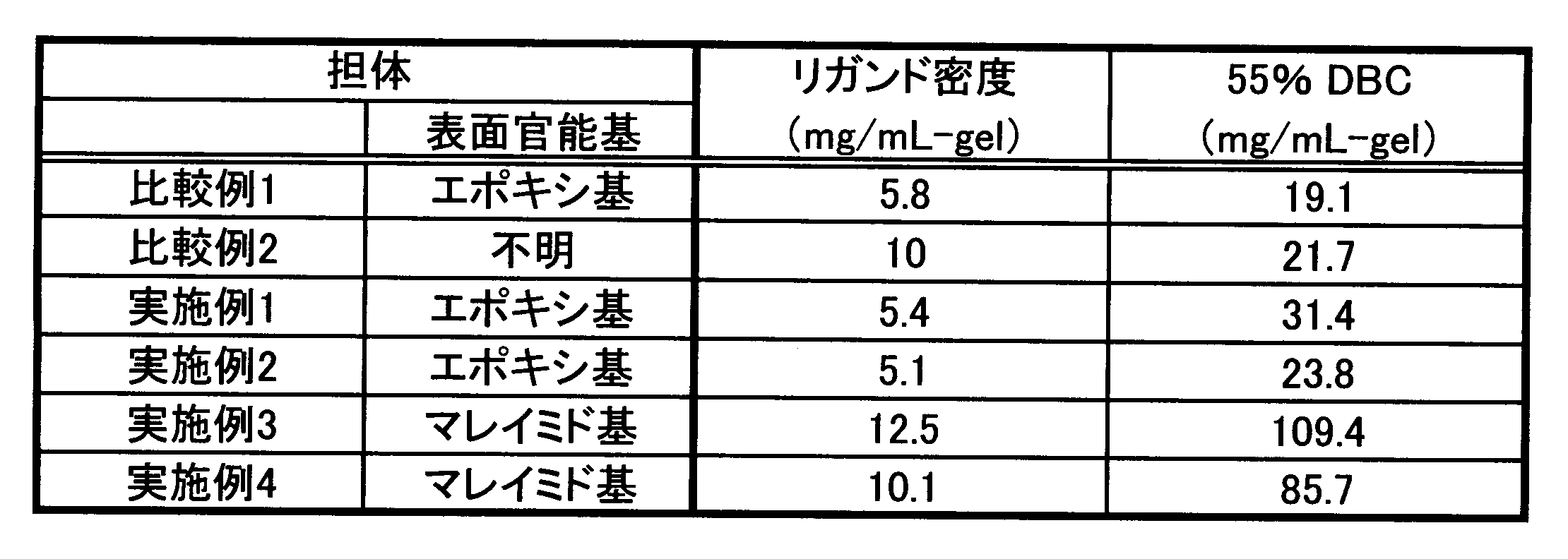

表2が示すように、Fabに対する55%DBCについて、実施例1,2のアフィニティ分離マトリックスは、比較例1と比較して高いという結果が得られた。また、実施例1,2は比較例2と比較してリガンド密度が50%程度低いにもかかわらず同程度以上の55%DBCを示し、さらに、実施例3,4は、比較例1,2と比較して、さらに高い55%DBCを示した。これらの結果から、本発明によって作製されるアフィニティ分離マトリックスが優れた性能を有することを示している。
また、表3に、モル数で表したリガンド密度と55%DBC、および、リガンド密度あたりの55%DBCの比較を示した。比較例2のリガンドの分子量は非公開であったので、表3の対象からは除外した。表3の結果から、C末端側にシステインを有するVL-κ結合性ペプチドをリガンドとした実施例1~4のアフィニティ分離マトリックスは、C末端側にシステインを有していないVL-κ結合性ペプチドをリガンドとした比較例1と比較して、有意にリガンド密度あたりの55%DBCが高いということを確認した。これは、リガンドのC末端側にシステインが存在することで、リガンドがシステインを中心に配向が制御された状態で水不溶性担体に固定化され、リガンドが効率的にFabと結合されることに起因すると考えられる。実施例1,2と比較して、実施例3,4の方がリガンド密度あたりの55%DBCがより一層高い結果となったが、これは、実施例1,2で用いた水不溶性担体の活性基がエポキシ基であるため、ペプチド中の末端チオール基以外に、側鎖チオール基、側鎖水酸基、側鎖アミノ基なども反応したのに対して、実施例3,4で用いた水不溶性担体の活性基がマレイミド基であるため、主にリガンド末端のチオール基のみが単点で水不溶性に固定化され、リガンドの配向が顕著に制御され、VL-κに対するリガンドの結合効率が顕著に向上したものと考えられる。
実施例3: 大腸菌培養上清に含まれるFabの精製
実施例2で調製した担体を用いて、夾雑物を含む溶液中のFabを精製可能か確認した。夾雑物を含む溶液として、大腸菌の細胞破砕液を使用した。具体的には、pUC系のプラスミドを用いて大腸菌(「HB101」タカラバイオ社)を形質転換し、形質転換体を2YT培地で37℃にて終夜培養した後、菌体を回収し、回収した菌体をソニケーターで破砕、さらに遠心分離により得た上清を夾雑物含有溶液とした。得られた夾雑物含有溶液に最終濃度0.25 mg/mLとなるようにFabを添加し、以降の測定に用いた。
実施例2で調製した担体を用いて、夾雑物を含む溶液中のFabを精製可能か確認した。夾雑物を含む溶液として、大腸菌の細胞破砕液を使用した。具体的には、pUC系のプラスミドを用いて大腸菌(「HB101」タカラバイオ社)を形質転換し、形質転換体を2YT培地で37℃にて終夜培養した後、菌体を回収し、回収した菌体をソニケーターで破砕、さらに遠心分離により得た上清を夾雑物含有溶液とした。得られた夾雑物含有溶液に最終濃度0.25 mg/mLとなるようにFabを添加し、以降の測定に用いた。
空カラム(「Tricorn 5/50 column」GEヘルスケア社製)に上記実施例2で調製した担体を充填し、クロマトシステムAKTAavant 25に接続し、平衡化緩衝液(20mM Na2HPO4-Na2HPO4,150mM塩化ナトリウム,pH7.4)を5CV流して平衡化した。次に、先述したFabを含む夾雑物含有溶液を40mL流した。その後、平衡化緩衝液を10CV流して担体を洗浄し、続いて溶出緩衝液(50mMクエン酸,pH3.0)を10CV流してFabを溶出した。さらに平衡化緩衝液を3CV流した後、強洗浄溶液(50mMクエン酸,pH2.5)を5CV流した。最後に平衡化緩衝液5CVを流して精製を終了した。流速は全ての工程で0.25mL/minとした。また、サンプル負荷画分、洗浄画分、溶出画分の溶液はそれぞれ回収し、SDS-PAGE解析に用いた。但し、溶出工程の溶液はNaOH溶液で中和して用いた。
先述した回収溶液について、電源搭載型ミニスラブ電気泳動槽(「パジェラン」アトー社製)と15%ポリアクリルアミド・プレキャストゲル(「e・PAGEL」アトー社製)を用いて、非還元条件で、付属のマニュアルに従いSDS-PAGEを行った。染色・脱色処理後の電気泳動ゲルの画像を図1に示す。
図1からわかるように、Fabを含む夾雑物含有溶液を担体に負荷している時の画分、および洗浄の画分ではFabの成分が存在せず、Fabの漏出がないことを確認した。また溶出の画分で純度の高いFabを回収できていることを確認した。この結果より、本発明方法によって製造したアフィニティ分離マトリックスを用いた精製により、ワンステップで簡便に純度の高いFabを取得可能であることが示された。さらに、VL-κ領域を含む抗体断片の分離や精製においても、実用的に使用可能であることを期待できる。
Claims (11)
- アフィニティ分離マトリックスを製造するための方法であって、
アフィニティ分離マトリックスが、κ鎖可変領域に親和性を有するリガンドと水不溶性担体を含むものであり、
N末端またはC末端の少なくとも一方にシステイン残基を有するκ鎖可変領域結合性ペプチドを、当該末端システイン残基を介して、リガンドとして水不溶性担体に固定化する工程を含むことを特徴とする方法。 - 上記κ鎖可変領域結合性ペプチドのアミノ酸配列が、下記式(I)のアミノ酸配列を含む請求項1に記載の方法。
(X1)m-(Y1)p-Glu-X2-Val-Thr-Ile-Lys-X3-Asn-X4-X5-X6-X7-X8-Gly-X9-X10-Gln-X11-Ala-X12-Phe-Lys-Gly-Thr-Phe-X13-X14-Ala-X15-X16-X17-Ala-Tyr-X18-Tyr-Ala-X19-X20-Leu-X21-Lys-X22-X23-Gly-X24-Tyr-Thr-X25-Asp-X26-X27-Asp-X28-Gly-X29-Thr-X30-Asn-Ile-X31-Phe-Ala-Gly-(Y2)q-(X32)n ・・・ (I)
[式中、X1はCysを示し、X2はGlnまたはGluを示し、X3はGlu、AlaまたはValを示し、X4はIleまたはLeuを示し、X5はTyrまたはIleを示し、X6はPheまたはTyrを示し、X7はAlaまたはGluを示し、X8はAspまたはAsnを示し、X9はThr、SerまたはLysを示し、X10はVal、IleまたはThrを示し、X11はHis、ThrまたはAsnを示し、X12はThrまたはGluを示し、X13はAlaまたはGluを示し、X14はGluまたはLysを示し、X15はThrまたはValを示し、X16はAlaまたはSerを示し、X17はGlu、AspまたはLysを示し、X18はArgまたはAlaを示し、X19はAspまたはAsnを示し、X20はLeu、ThrまたはAlaを示し、X21はSer、LysまたはAlaを示し、X22はGlu、AspまたはValを示し、X23はHisまたはAsnを示し、X24はLysまたはGluを示し、X25はAlaまたはValを示し、X26はLeuまたはValを示し、X27はGluまたはAlaを示し、X28はGlyまたはLysを示し、X29はTyr、LeuまたはAsnを示し、X30はIleまたはLeuを示し、X31はArgまたはLysを示し、X32はCysを示し、Y1およびY2は独立してアミノ酸残基数が1以上15以下のペプチド残基を示し、m、n、pおよびqは独立して0または1を示す(ただし、m+n=1または2である)] - 上記κ鎖可変領域結合性ペプチドのアミノ酸配列が、配列番号12~20のいずれかのアミノ酸配列に対して85%以上の配列同一性を有するアミノ酸配列を含み、そのN末端側またはC末端側の少なくとも一方にアミノ酸残基数が1以上15以下のペプチド残基を任意に含んでいてもよく、且つ、N末端またはC末端の少なくとも一方にシステイン残基を有する請求項1または2に記載の方法。
- 上記κ鎖可変領域結合性ペプチドの上記末端システイン残基以外が、κ鎖可変領域結合性ドメインの多量体である請求項1に記載の方法。
- 上記水不溶性担体として表面にマレイミド基を有するものを用い、当該マレイミド基を介して上記リガンドを固定化する請求項1~4のいずれかに記載の方法。
- 水不溶性担体と、リガンドとしてκ鎖可変領域結合性ペプチドを含み、
上記κ鎖可変領域結合性ペプチドが、そのN末端またはC末端の少なくとも一方にシステイン残基を有するものであり、
上記κ鎖可変領域結合性ペプチドが、上記末端システイン残基を介して水不溶性担体に固定化されていることを特徴とするアフィニティ分離マトリックス。 - 上記κ鎖可変領域結合性ペプチドのアミノ酸配列が、下記式(I)のアミノ酸配列を含むものである請求項6に記載のアフィニティ分離マトリックス。
(X1)m-(Y1)p-Glu-X2-Val-Thr-Ile-Lys-X3-Asn-X4-X5-X6-X7-X8-Gly-X9-X10-Gln-X11-Ala-X12-Phe-Lys-Gly-Thr-Phe-X13-X14-Ala-X15-X16-X17-Ala-Tyr-X18-Tyr-Ala-X19-X20-Leu-X21-Lys-X22-X23-Gly-X24-Tyr-Thr-X25-Asp-X26-X27-Asp-X28-Gly-X29-Thr-X30-Asn-Ile-X31-Phe-Ala-Gly-(Y2)q-(X32)n ・・・ (I)
[式中、X1はCysを示し、X2はGlnまたはGluを示し、X3はGlu、AlaまたはValを示し、X4はIleまたはLeuを示し、X5はTyrまたはIleを示し、X6はPheまたはTyrを示し、X7はAlaまたはGluを示し、X8はAspまたはAsnを示し、X9はThr、SerまたはLysを示し、X10はVal、IleまたはThrを示し、X11はHis、ThrまたはAsnを示し、X12はThrまたはGluを示し、X13はAlaまたはGluを示し、X14はGluまたはLysを示し、X15はThrまたはValを示し、X16はAlaまたはSerを示し、X17はGlu、AspまたはLysを示し、X18はArgまたはAlaを示し、X19はAspまたはAsnを示し、X20はLeu、ThrまたはAlaを示し、X21はSer、LysまたはAlaを示し、X22はGlu、AspまたはValを示し、X23はHisまたはAsnを示し、X24はLysまたはGluを示し、X25はAlaまたはValを示し、X26はLeuまたはValを示し、X27はGluまたはAlaを示し、X28はGlyまたはLysを示し、X29はTyr、LeuまたはAsnを示し、X30はIleまたはLeuを示し、X31はArgまたはLysを示し、X32はCysを示し、Y1およびY2は独立してアミノ酸残基数が1以上15以下のペプチド残基を示し、m、n、pおよびqは独立して0または1を示す(ただし、m+n=1または2である)] - 上記κ鎖可変領域結合性ペプチドのアミノ酸配列が、配列番号12~20のいずれかのアミノ酸配列に対して85%以上の配列同一性を有するアミノ酸配列を含み、そのN末端側またはC末端側の少なくとも一方にアミノ酸残基数が1以上15以下のペプチド残基を任意に含んでいてもよく、且つ、N末端またはC末端の少なくとも一方にシステイン残基を有する請求項6または7に記載のアフィニティ分離マトリックス。
- 上記κ鎖可変領域結合性ペプチドの上記末端システイン残基以外が、κ鎖可変領域結合性ドメインの多量体である請求項6に記載のアフィニティ分離マトリックス。
- 上記水不溶性担体がその表面にマレイミド基を有し、当該マレイミド基に上記末端システイン残基が結合している請求項6~9のいずれかに記載のアフィニティ分離マトリックス。
- κ鎖可変領域を含むペプチドを製造する方法であって、
請求項6~10のいずれかに記載のアフィニティ分離マトリックスと、κ鎖可変領域を含むペプチドを含む液体試料とを接触させる工程、および、
アフィニティ分離マトリックスに結合したκ鎖可変領域を含むペプチドを、アフィニティ分離マトリックスから分離する工程を含むことを特徴とする方法。
Priority Applications (2)
| Application Number | Priority Date | Filing Date | Title |
|---|---|---|---|
| JP2018516951A JPWO2017195641A1 (ja) | 2016-05-11 | 2017-04-27 | アフィニティ分離マトリックスの製造方法およびアフィニティ分離マトリックス |
| US16/183,878 US20190134606A1 (en) | 2016-05-11 | 2018-11-08 | Method for producing affinity separation matrix, and affinity separation matrix |
Applications Claiming Priority (2)
| Application Number | Priority Date | Filing Date | Title |
|---|---|---|---|
| JP2016-095264 | 2016-05-11 | ||
| JP2016095264 | 2016-05-11 |
Related Child Applications (1)
| Application Number | Title | Priority Date | Filing Date |
|---|---|---|---|
| US16/183,878 Continuation US20190134606A1 (en) | 2016-05-11 | 2018-11-08 | Method for producing affinity separation matrix, and affinity separation matrix |
Publications (1)
| Publication Number | Publication Date |
|---|---|
| WO2017195641A1 true WO2017195641A1 (ja) | 2017-11-16 |
Family
ID=60267724
Family Applications (1)
| Application Number | Title | Priority Date | Filing Date |
|---|---|---|---|
| PCT/JP2017/016819 Ceased WO2017195641A1 (ja) | 2016-05-11 | 2017-04-27 | アフィニティ分離マトリックスの製造方法およびアフィニティ分離マトリックス |
Country Status (3)
| Country | Link |
|---|---|
| US (1) | US20190134606A1 (ja) |
| JP (1) | JPWO2017195641A1 (ja) |
| WO (1) | WO2017195641A1 (ja) |
Cited By (1)
| Publication number | Priority date | Publication date | Assignee | Title |
|---|---|---|---|---|
| WO2020066270A1 (ja) * | 2018-09-28 | 2020-04-02 | 株式会社カネカ | κ鎖可変領域を含む抗体および/または抗体断片の製造方法 |
Families Citing this family (4)
| Publication number | Priority date | Publication date | Assignee | Title |
|---|---|---|---|---|
| GB202112386D0 (en) * | 2021-08-31 | 2021-10-13 | Cytiva Bioprocess R & D Ab | Modified kappa light chain-binding polypeptides |
| WO2023102465A1 (en) * | 2021-12-02 | 2023-06-08 | Ddp Specialty Electronic Materials Us, Llc | Process for preparation of functionalized fiber |
| GB202203640D0 (en) * | 2022-03-16 | 2022-04-27 | Cytiva Bioprocess R & D Ab | Alkali-stabilized kappa light chain-binding separation matrix |
| KR20250028362A (ko) * | 2022-06-22 | 2025-02-28 | 씨티바 바이오프로세스 알&디 에이비 | 카파 경쇄-결합 대류 매트릭스 |
Citations (3)
| Publication number | Priority date | Publication date | Assignee | Title |
|---|---|---|---|---|
| WO2008044692A1 (fr) * | 2006-10-10 | 2008-04-17 | National Institute Of Advanced Industrial Science And Technology | Protéine adaptée pour une commande d'orientation/immobilisation de protéine et support d'immobilisation destiné à la protéine |
| JP2008523140A (ja) * | 2004-12-14 | 2008-07-03 | ジーイー・ヘルスケア・バイオサイエンス・アクチボラグ | 免疫グロブリンの精製方法 |
| WO2016031902A1 (ja) * | 2014-08-28 | 2016-03-03 | 株式会社カネカ | Fab領域含有ペプチド用アフィニティー分離マトリックス |
Family Cites Families (2)
| Publication number | Priority date | Publication date | Assignee | Title |
|---|---|---|---|---|
| AU2003903317A0 (en) * | 2003-06-27 | 2003-07-10 | Proteome Systems Intellectual Property Pty Ltd | Method of isolating a protein |
| WO2016096644A1 (en) * | 2014-12-17 | 2016-06-23 | Ge Healthcare Bioprocess R&D Ab | Modified kappa light chain-binding polypeptides |
-
2017
- 2017-04-27 WO PCT/JP2017/016819 patent/WO2017195641A1/ja not_active Ceased
- 2017-04-27 JP JP2018516951A patent/JPWO2017195641A1/ja active Pending
-
2018
- 2018-11-08 US US16/183,878 patent/US20190134606A1/en not_active Abandoned
Patent Citations (3)
| Publication number | Priority date | Publication date | Assignee | Title |
|---|---|---|---|---|
| JP2008523140A (ja) * | 2004-12-14 | 2008-07-03 | ジーイー・ヘルスケア・バイオサイエンス・アクチボラグ | 免疫グロブリンの精製方法 |
| WO2008044692A1 (fr) * | 2006-10-10 | 2008-04-17 | National Institute Of Advanced Industrial Science And Technology | Protéine adaptée pour une commande d'orientation/immobilisation de protéine et support d'immobilisation destiné à la protéine |
| WO2016031902A1 (ja) * | 2014-08-28 | 2016-03-03 | 株式会社カネカ | Fab領域含有ペプチド用アフィニティー分離マトリックス |
Non-Patent Citations (1)
| Title |
|---|
| GRAILLE MARC ET AL.: "Complex between peptostreptococcus magnus Protein L and a Human antibody reveals structural convergence in the interaction modes of Fab binding proteins", STRUCTURE, vol. 9, no. 8, 2001, pages 679 - 687, XP055259618 * |
Cited By (2)
| Publication number | Priority date | Publication date | Assignee | Title |
|---|---|---|---|---|
| WO2020066270A1 (ja) * | 2018-09-28 | 2020-04-02 | 株式会社カネカ | κ鎖可変領域を含む抗体および/または抗体断片の製造方法 |
| JPWO2020066270A1 (ja) * | 2018-09-28 | 2021-08-30 | 株式会社カネカ | κ鎖可変領域を含む抗体および/または抗体断片の製造方法 |
Also Published As
| Publication number | Publication date |
|---|---|
| JPWO2017195641A1 (ja) | 2019-03-07 |
| US20190134606A1 (en) | 2019-05-09 |
Similar Documents
| Publication | Publication Date | Title |
|---|---|---|
| CN105377880B (zh) | 突变的免疫球蛋白结合多肽 | |
| CN102895960B (zh) | 包括基于金黄色葡萄球菌a蛋白的新配体的层析基质 | |
| CN105111289B (zh) | 腐蚀稳定性色谱分析用配体 | |
| JP2024100775A (ja) | 改変κ軽鎖結合ポリペプチド | |
| JP2014502272A (ja) | アフィニティークロマトグラフィーマトリックス | |
| JP6663360B2 (ja) | 変異型免疫グロブリンκ鎖可変領域結合性ペプチド | |
| US20190134606A1 (en) | Method for producing affinity separation matrix, and affinity separation matrix | |
| JP6596005B2 (ja) | Fab領域含有ペプチド用アフィニティー分離マトリックス | |
| CN115812075A (zh) | 用于亲和纯化的免疫球蛋白结合蛋白 | |
| WO2016121701A1 (ja) | 免疫グロブリンκ鎖可変領域含有タンパク質精製用アフィニティー分離マトリックス | |
| US10844112B2 (en) | Method for purifying antibody or antibody fragment containing κ-chain variable region | |
| WO2020221781A1 (en) | Method for separation of antibodies or antibody fragments being devoid of an fc region capable of binding to protein a | |
| JPWO2018021012A1 (ja) | 抗体断片の製造方法 | |
| JP7118949B2 (ja) | 安定性改良型免疫グロブリン結合性ペプチド | |
| US20190119362A1 (en) | METHOD FOR PRODUCING PROTEIN INCLUDING k CHAIN VARIABLE REGION | |
| WO2020066270A1 (ja) | κ鎖可変領域を含む抗体および/または抗体断片の製造方法 | |
| CN122074078A (zh) | Aav9结合多肽 | |
| JP2023550778A (ja) | 分離基材 | |
| WO2026057420A1 (en) | Affinity ligand for purification of antibodies of isotype iga | |
| JP2024141217A (ja) | 抗体結合性タンパク質固定化担体を用いた抗体精製方法 |
Legal Events
| Date | Code | Title | Description |
|---|---|---|---|
| WWE | Wipo information: entry into national phase |
Ref document number: 2018516951 Country of ref document: JP |
|
| NENP | Non-entry into the national phase |
Ref country code: DE |
|
| 121 | Ep: the epo has been informed by wipo that ep was designated in this application |
Ref document number: 17796002 Country of ref document: EP Kind code of ref document: A1 |
|
| 122 | Ep: pct application non-entry in european phase |
Ref document number: 17796002 Country of ref document: EP Kind code of ref document: A1 |