WO2017164407A1 - 免疫チェックポイント阻害作用を有するインドールアルカロイド型化合物 - Google Patents
免疫チェックポイント阻害作用を有するインドールアルカロイド型化合物 Download PDFInfo
- Publication number
- WO2017164407A1 WO2017164407A1 PCT/JP2017/012157 JP2017012157W WO2017164407A1 WO 2017164407 A1 WO2017164407 A1 WO 2017164407A1 JP 2017012157 W JP2017012157 W JP 2017012157W WO 2017164407 A1 WO2017164407 A1 WO 2017164407A1
- Authority
- WO
- WIPO (PCT)
- Prior art keywords
- cancer
- alkyl
- compound
- pharmaceutically acceptable
- amino
- Prior art date
- Legal status (The legal status is an assumption and is not a legal conclusion. Google has not performed a legal analysis and makes no representation as to the accuracy of the status listed.)
- Ceased
Links
- 0 CC(C)(CCC1C(C(*)=O)=CI(CCC2)[C@@]3c4c2c(C=*(*)C=CC2)c2[n]4)[C@]13N Chemical compound CC(C)(CCC1C(C(*)=O)=CI(CCC2)[C@@]3c4c2c(C=*(*)C=CC2)c2[n]4)[C@]13N 0.000 description 1
Images
Classifications
-
- C—CHEMISTRY; METALLURGY
- C07—ORGANIC CHEMISTRY
- C07D—HETEROCYCLIC COMPOUNDS
- C07D471/00—Heterocyclic compounds containing nitrogen atoms as the only ring hetero atoms in the condensed system, at least one ring being a six-membered ring with one nitrogen atom, not provided for by groups C07D451/00 - C07D463/00
- C07D471/12—Heterocyclic compounds containing nitrogen atoms as the only ring hetero atoms in the condensed system, at least one ring being a six-membered ring with one nitrogen atom, not provided for by groups C07D451/00 - C07D463/00 in which the condensed system contains three hetero rings
- C07D471/14—Ortho-condensed systems
-
- A—HUMAN NECESSITIES
- A61—MEDICAL OR VETERINARY SCIENCE; HYGIENE
- A61K—PREPARATIONS FOR MEDICAL, DENTAL OR TOILETRY PURPOSES
- A61K39/00—Medicinal preparations containing antigens or antibodies
- A61K39/39—Medicinal preparations containing antigens or antibodies characterised by the immunostimulating additives, e.g. chemical adjuvants
-
- A—HUMAN NECESSITIES
- A61—MEDICAL OR VETERINARY SCIENCE; HYGIENE
- A61P—SPECIFIC THERAPEUTIC ACTIVITY OF CHEMICAL COMPOUNDS OR MEDICINAL PREPARATIONS
- A61P37/00—Drugs for immunological or allergic disorders
- A61P37/02—Immunomodulators
- A61P37/06—Immunosuppressants, e.g. drugs for graft rejection
-
- C—CHEMISTRY; METALLURGY
- C07—ORGANIC CHEMISTRY
- C07D—HETEROCYCLIC COMPOUNDS
- C07D401/00—Heterocyclic compounds containing two or more hetero rings, having nitrogen atoms as the only ring hetero atoms, at least one ring being a six-membered ring with only one nitrogen atom
- C07D401/02—Heterocyclic compounds containing two or more hetero rings, having nitrogen atoms as the only ring hetero atoms, at least one ring being a six-membered ring with only one nitrogen atom containing two hetero rings
- C07D401/06—Heterocyclic compounds containing two or more hetero rings, having nitrogen atoms as the only ring hetero atoms, at least one ring being a six-membered ring with only one nitrogen atom containing two hetero rings linked by a carbon chain containing only aliphatic carbon atoms
-
- C—CHEMISTRY; METALLURGY
- C07—ORGANIC CHEMISTRY
- C07D—HETEROCYCLIC COMPOUNDS
- C07D491/00—Heterocyclic compounds containing in the condensed ring system both one or more rings having oxygen atoms as the only ring hetero atoms and one or more rings having nitrogen atoms as the only ring hetero atoms, not provided for by groups C07D451/00 - C07D459/00, C07D463/00, C07D477/00 or C07D489/00
- C07D491/02—Heterocyclic compounds containing in the condensed ring system both one or more rings having oxygen atoms as the only ring hetero atoms and one or more rings having nitrogen atoms as the only ring hetero atoms, not provided for by groups C07D451/00 - C07D459/00, C07D463/00, C07D477/00 or C07D489/00 in which the condensed system contains two hetero rings
- C07D491/04—Ortho-condensed systems
- C07D491/044—Ortho-condensed systems with only one oxygen atom as ring hetero atom in the oxygen-containing ring
- C07D491/052—Ortho-condensed systems with only one oxygen atom as ring hetero atom in the oxygen-containing ring the oxygen-containing ring being six-membered
-
- A—HUMAN NECESSITIES
- A61—MEDICAL OR VETERINARY SCIENCE; HYGIENE
- A61K—PREPARATIONS FOR MEDICAL, DENTAL OR TOILETRY PURPOSES
- A61K39/00—Medicinal preparations containing antigens or antibodies
- A61K2039/555—Medicinal preparations containing antigens or antibodies characterised by a specific combination antigen/adjuvant
- A61K2039/55511—Organic adjuvants
Definitions
- the present invention relates to a novel indole alkaloid type compound, particularly an indole alkaloid type compound having an immune checkpoint inhibitory action.
- the present invention can also be useful for the prevention and / or treatment of diseases caused by immune checkpoints, including cancer.
- CTLA-4 is one of the immunoglobulin superfamily members that are expressed on the surface of regulatory T cells, and is a negative feedback regulator when T cells receive antigen presentation from dendritic cells and macrophages. It is a molecule that acts in a suppressive manner and controls this (Non-patent Document 1).
- Non-Patent Documents 2 and 3 A molecule that suppresses immunity like CTLA-4 is called an “immune checkpoint”, and CTLA-4 has become a new target for cancer therapy as one of the immune checkpoints.
- IL-10 produced from various immunocompetent cells also acts to suppress the immune system, and cancer cells themselves are known to produce IL-10.
- Non-Patent Documents 4 and 5 Non-Patent Documents 4 and 5).
- Treatment of cancer is expected by suppressing CTLA-4 expression and / or immunosuppressive cytokine IL-10 production of regulatory T cells (Treg), a compound having such an action is It is attracting attention as a new treatment.
- anti-CTLA-4 antibodies ipilimumab
- anti-PD-1 antibodies nivolumab, pembrolizumab
- anti-targeting CTLA-4 and PD-1 or PD-L1 as immune checkpoint inhibitors
- PD-L1 antibodies MPDL3280A, MEDI4736
- the present invention examines low molecular weight compounds having an activity of suppressing CTLA-4 expression and / or IL-10 production, and is useful for the treatment and / or prevention of diseases caused by immune checkpoints, including cancer. It aims at providing the adjuvant (adjuvant) of an agent and a vaccine.
- an indole alkaloid type compound represented by the following formula (I) or a pharmaceutically acceptable salt thereof (hereinafter sometimes referred to as “the compound of the present invention”), and immune checkpoint inhibition thereof:
- Ring A is a C 3-6 cycloalkyl ring, a C 3-6 cycloalkenyl ring or a 5-membered or 6-membered monocyclic heterocycle, wherein the cycloalkyl ring, cycloalkene ring and monocyclic heterocycle
- the ring is a substitutable position at halogen, hydroxy, oxo, amino, nitro, mono- or di-C 1-6 alkyl-amino, C 1-4 acyl, C 1-6 alkyl, C 1-6 haloalkyl, Optionally substituted by one or more of the same or different groups selected from the group consisting of C 1-6 hydroxyalkyl, C 1-6 alkoxy, and C 1-6 haloalkoxy;
- R 1 , R 1 ′ , R 2 , R 2 ′ and R 3 are each independently
- R 4 is hydrogen, hydroxy, amino, mono- or di-C 1-6 alkyl-amino, C 1-6 alkyl, C 1-6 haloalkyl, C 1-6 hydroxyalkyl, C 1-6 alkoxy Or a compound of any one of [1] to [4], which is C 1-6 haloalkoxy, or a pharmaceutically acceptable salt thereof.
- R 8 is each independently hydrogen, halogen, hydroxy, amino, mono- or di-C 1-6 alkyl-amino, C 1-6 alkyl, C 1-6 haloalkyl, C 1-6 hydroxy
- the compound or a pharmaceutically acceptable salt thereof according to any one of [1] to [5], which is alkyl, C 1-6 alkoxy, benzyloxy or C 1-6 haloalkoxy.
- Ring A is a C 5-6 cycloalkyl ring, a C 5-6 cycloalkenyl ring, or a 5-membered or 6-membered monocyclic saturated heterocycle, wherein the cycloalkyl ring, cycloalkene ring and Monocyclic saturated heterocycles are hydroxy, oxo, C 1-6 alkyl, C 1-6 haloalkyl, C 1-6 hydroxyalkyl, C 1-6 alkoxy, and C 1-6 haloalkoxy at substitutable positions.
- Ring A is the following: A group selected from the group consisting of wherein each group is, at a substitutable position, a group consisting of hydroxy, oxo, C 1-3 alkyl, C 1-3 hydroxyalkyl, and C 1-3 alkoxy.
- R 3 is C 1-6 alkyl, C 1-6 haloalkyl, C 1-6 hydroxyalkyl, C 1-6 alkoxy or C 1-6 haloalkoxy Or a pharmaceutically acceptable salt thereof.
- the compound is Any one of [1] to [11] or a pharmaceutically acceptable salt thereof.
- a pharmaceutical composition comprising the compound according to any one of [1] to [12] or a pharmaceutically acceptable salt thereof, and a pharmaceutically acceptable carrier.
- a therapeutic agent for cancer comprising the compound according to any one of [1] to [12] or a pharmaceutically acceptable salt thereof as an active ingredient.
- Cancer is malignant melanoma, glioblastoma, lung cancer, stomach cancer, colon cancer, liver cancer, pancreatic cancer, kidney cancer, adrenal cancer, biliary tract cancer, esophageal cancer, pharyngeal cancer, laryngeal cancer, oral cancer, Bladder cancer, tongue cancer, thyroid cancer, skin cancer, breast cancer, prostate cancer, testicular cancer, uterine cancer, cervical cancer, ovarian cancer, osteosarcoma, chondrosarcoma, rhabdomyosarcoma, leiomyosarcoma, adult T-cell leukemia
- the therapeutic agent according to [14] which is leukemia, malignant lymphoma or multiple myeloma.
- An immune checkpoint inhibitor comprising the compound according to any one of [1] to [12] or a pharmaceutically acceptable salt thereof as an active ingredient.
- a vaccine adjuvant comprising the compound according to any one of [1] to [12] or a pharmaceutically acceptable salt thereof as an active ingredient.
- Treatment of cancer comprising administering to a patient in need of treatment a therapeutically effective amount of a compound of any one of [1] to [12] or a pharmaceutically acceptable salt thereof Method.
- An immune checkpoint characterized by administering a therapeutically effective amount of a compound of any one of [1] to [12] or a pharmaceutically acceptable salt thereof to a patient in need of treatment. Inhibition method.
- the compound of the present invention has a CTLA-4 expression inhibitory action and an IL-10 production inhibitory action, and is caused by an immune checkpoint, particularly cancer (eg, malignant melanoma, glioblastoma, lung cancer) , Stomach cancer, colon cancer, liver cancer, pancreatic cancer, kidney cancer, adrenal cancer, biliary tract cancer, esophageal cancer, pharyngeal cancer, laryngeal cancer, oral cancer, bladder cancer, tongue cancer, thyroid cancer, skin cancer, breast cancer, prostate cancer, Novel therapeutic agents for testicular cancer, uterine cancer, cervical cancer, ovarian cancer, osteosarcoma, chondrosarcoma, rhabdomyosarcoma, leiomyosarcoma, leukemia including adult T-cell leukemia, malignant lymphoma, multiple myeloma) and It is useful as a preventive agent.
- an adjuvant adjuvant
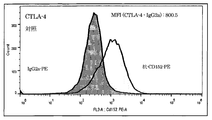
- the results of FCM analysis (histogram) of MT2 cells stained with anti-CTLA4 (CD152) -PE antibody or IgG1-PE antibody of isotype control as a control are shown.
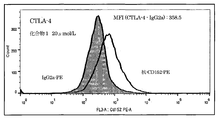
- the FCM analysis results (histogram) of MT2 cells stained with anti-CTLA4 (CD152) -PE antibody or isotype control IgG1-PE antibody in Compound 1 (concentration: 20 ⁇ mol / L) are shown.
- C 1-6 alkyl means a straight or branched chain saturated hydrocarbon having from 1 to 6 carbon atoms, which may optionally contain one or more It may be substituted with a group. “C 1-6 alkyl” may preferably have 1 to 5, 1 to 4, or 1 to 3 carbon atoms. Specific examples thereof include methyl, ethyl, propyl, isopropyl, butyl, isobutyl, sec-butyl, tert-butyl, pentyl, isopentyl, neopentyl, hexyl and the like.
- C 2-6 alkenyl means a straight or branched aliphatic hydrocarbon having from 2 to 6 carbon atoms and containing one or more carbon-carbon double bonds. These may optionally be substituted with one or more groups included in the present invention. “C 2-6 alkenyl” may preferably have 2 to 5, 2 to 4, or 2 to 3 carbon atoms. Specific examples thereof include ethenyl, propenyl, butenyl, pentenyl, hexenyl and the like.
- C 2-6 alkynyl means a straight or branched aliphatic hydrocarbon having 2 to 6 carbon atoms and having one or more carbon-carbon triple bonds, These may be optionally substituted with one or more groups included in the present invention.
- C 2-6 alkynyl may preferably have 2 to 5, 2 to 4, or 2 to 3 carbon atoms. Specific examples thereof include ethynyl, propynyl, butynyl, pentynyl, hexynyl and the like.
- C 3-6 cycloalkyl or “C 3-6 cycloalkyl ring” means a monocyclic saturated hydrocarbon having from 3 to 6 carbon atoms, which are optionally present in the present invention. It may be substituted with one or more groups included. Specific examples thereof include cyclopropyl, cyclobutyl, cyclopentyl, cyclohexyl and the like.
- C 3-6 cycloalkenyl ring means a monocyclic hydrocarbon having from 3 to 6 carbon atoms and containing one or more carbon-carbon double bonds, which are as desired May be substituted with one or more groups included in the present invention. Specific examples thereof include cyclopropene, cyclobutene, cyclopentene, cyclohexene and the like.
- 3- to 6-membered heterocycloalkyl refers to a 3- to 6-membered monocyclic saturated heterocycle containing at least one heteroatom independently selected from the group consisting of nitrogen, oxygen and sulfur. Which means a ring, optionally substituted by one or more groups included in the invention.
- Nitrogen and sulfur atoms may be oxidized if desired, and nitrogen atoms may be quaternized if desired. Specific examples thereof include azetidinyl, pyrrolidinyl, piperidinyl, piperazinyl, morpholinyl, tetrahydrofuranyl, tetrahydropyranyl and the like.
- 5- or 6-membered monocyclic heterocycle means a 5- or 6-membered monocyclic containing at least one heteroatom independently selected from the group consisting of nitrogen, oxygen and sulfur. Heterocycles are meant, which are optionally substituted with one or more groups included in the present invention.
- the ring may be saturated, partially saturated or unsaturated, and the nitrogen and sulfur atoms may be optionally oxidized, and the nitrogen atoms may be quaternized if desired.
- pyrrolidinyl piperidinyl, piperazinyl, morpholinyl, pyridyl, pyrrolyl, pyrazinyl, pyrimidinyl, pyridazinyl, imidazolyl, thiazolyl, pyrazolyl, oxazolyl, thienyl, furyl and the like.
- C 6-10 aryl means a mono- or bicyclic aromatic hydrocarbon having 6-10 carbon atoms, excluding one hydrogen atom bonded to the aromatic ring; These may be optionally substituted with one or more groups included in the present invention. Specific examples thereof include phenyl, 1-naphthyl, 2-naphthyl, anthracenyl and the like.
- 6- to 10-membered heteroaryl refers to a 6- to 10-membered monocyclic or bicyclic ring containing at least one heteroatom independently selected from the group consisting of nitrogen, oxygen and sulfur. Means aromatic heterocycles, which may optionally be substituted with one or more groups included in the present invention.
- pyridyl pyridazinyl, isothiazolyl, pyrrolyl, furyl, thienyl, thiazolyl, imidazolyl, pyrimidinyl, thiadiazolyl, pyrazolyl, oxazolyl, isoxazolyl, pyrazinyl, triazinyl, triazolyl, imidazolidinyl, oxadiazolyl, triazolyl, indolyl, indolyl, indolyl, indolyl Quinolyl, isoquinolyl, benzofuranyl, benzothienyl, benzoxazolyl, benzothiazolyl, benzisoxazolyl, benzisothiazolyl, benzotriazolyl, benzimidazolyl and the like.
- halogen means fluorine, chlorine, bromine or iodine. Among them, preferred is fluorine, chlorine or bromine.
- di- or di-C 1-6 alkylamino means an amino group in which one or two hydrogen atoms have been replaced by an alkyl group as described above having 1 to 6 carbon atoms. .
- two alkyl groups may be substituted with the same or different alkyl groups. Specific examples thereof include methylamino, ethylamino, dimethylamino, diethylamino and the like.
- C 1-4 acyl means a carbonyl group (—C ( ⁇ O)) to which a hydrogen atom or the above alkyl group having 1 to 3 carbon atoms is bonded. Specific examples thereof include formyl, acetyl, propionyl and the like.
- C 1-6 haloalkyl refers to an alkyl group as described above having 1 to 6 carbon atoms in which one or more hydrogen atoms are replaced by halogen atom (s).
- the number of hydrogen atoms replaced can range from one up to the total number of hydrogen atoms that may otherwise be present in the parent alkyl group.
- halogen atoms they may be substituted with the same or different halogen atoms. Specific examples thereof include chloromethyl, trifluoromethyl, 2,2,2-trifluoroethyl and the like.
- C 1-6 hydroxyalkyl means an alkyl group as described above having 1 to 6 carbon atoms in which one or more hydrogen atoms are replaced by hydroxy group (s).
- the number of hydrogen atoms replaced can range from one up to the total number of hydrogen atoms that may otherwise be present in the parent alkyl group. Specific examples thereof include hydroxymethyl, 2-hydroxyethyl, 2-hydroxypropyl, 3-hydroxypropyl, 4-hydroxybutyl and the like.
- C 1-6 alkoxy means a group in which the above alkyl group having 1 to 6 carbon atoms is bonded through an oxygen atom. Specific examples thereof include, but are not limited to, methoxy, ethoxy, propoxy, isopropoxy, butyloxy, pentyloxy, isopentyloxy, neopentyloxy, hexyloxy and the like.
- C 1-6 haloalkoxy means an alkoxy group as described above having 1 to 6 carbon atoms, wherein one or more hydrogen atoms are replaced by halogen atom (s).
- the number of hydrogen atoms replaced can range from one up to the total number of hydrogen atoms that may otherwise be present in the parent alkyl group.
- halogen atoms they may be substituted with the same or different halogen atoms. Specific examples thereof include chloromethoxy, trifluoromethoxy, 2,2,2-trifluoroethoxy and the like.
- C 1-6 hydroxyalkoxy means an alkoxy group as defined above having 1 to 6 carbon atoms in which one or more hydrogen atoms are replaced by hydroxy (s).
- the number of hydrogen atoms replaced can range from one up to the total number of hydrogen atoms that may otherwise be present in the parent alkyl group. Specific examples thereof include hydroxymethoxy, 2-hydroxyethoxy, 2-hydroxypropoxy, 3-hydroxypropoxy, 4-hydroxybutoxy and the like.
- immune checkpoint inhibitor refers to inhibiting the function of one or more immune checkpoint molecules (eg, CTLA-4 and PD-1), activating by releasing T cell suppression, and antitumor effects Means a drug that exerts An immune checkpoint is a protein that inhibits the activation of killer T cells and suppresses the immunity of cancer cells.
- Disease caused by immune checkpoint refers to cancer (eg, malignant melanoma, glioblastoma, lung cancer, stomach cancer, colon cancer, liver cancer, pancreatic cancer, kidney cancer, adrenal cancer, biliary tract cancer, esophageal cancer) Pharyngeal cancer, laryngeal cancer, oral cancer, bladder cancer, tongue cancer, thyroid cancer, skin cancer, breast cancer, prostate cancer, testicular cancer, uterine cancer, cervical cancer, ovarian cancer, osteosarcoma, chondrosarcoma, rhabdomyosarcoma Leiomyosarcoma, leukemia including adult T-cell leukemia, malignant lymphoma or multiple myeloma). As the disease in the present invention, malignant melanoma is particularly preferable.
- cancer eg, malignant melanoma, glioblastoma, lung cancer, stomach cancer, colon cancer, liver cancer, pancreatic cancer, kidney cancer, adrenal cancer, biliary tract cancer
- “Pharmaceutically acceptable salt” means a salt formed by a compound of the present invention represented by formula (I) and a pharmaceutically acceptable acid or base.
- a pharmaceutically acceptable acid or base When the compound of the present invention represented by the formula (I) has a basic functional group such as an amino group, it can form salts with various acids.
- acid addition salts include hydrochloride, hydrobromide, hydroiodide, sulfate, perchlorate, phosphate and other inorganic acid salts, oxalate, malonate, maleate Acid, fumarate, lactate, malate, citrate, tartrate, benzoate, trifluoroacetate, acetate, methanesulfonate, p-toluenesulfonate, trifluoromethanesulfonate Or an amino acid salt such as glutamate or aspartate.
- the compound of the present invention has an acidic functional group, it can form salts with various bases.
- the base addition salt include alkali metal salts such as sodium salts and potassium salts, alkaline earth metal salts such as calcium salts, and ammonium salts. These salts can be obtained by a conventional method such as recrystallization after mixing the compound of the present invention with an acid or a base. Since the compounds of the present invention may exist in the form of hydrates and / or solvates, these hydrates and / or solvates are also encompassed in the compounds of the present invention. Examples of solvates include ethanol solvates.
- Treatment means the healing and / or amelioration of diseases and / or disorders in mammals, particularly humans. For example, (a) preventing disease and / or disorder; and (b) alleviating and / or alleviating disease and / or disease are included.
- Patient means humans and animals such as dogs, cats, horses and the like. Among these, human is preferable.
- a “therapeutically effective amount” is an amount that provides an improvement, cure, prevention, and / or alleviation of a disease, disorder, and / or side effects, or a delay in the progression of a disease and / or disorder, as compared to an untreated subject. Means the amount to bring. The term also includes within its scope an amount effective to promote normal physiological function. For use in therapy, it is possible to administer a therapeutically effective amount of a compound of the invention as the active ingredient. Although not particularly limited, a range of 0.001 to 1000 mg / kg (body weight) per day is generally effective as the compound of the present invention. Such effective amounts include the amount of a compound of the present invention alone, the amount of a combination of compounds of the present invention, and / or the amount of a compound of the present invention in combination with other active ingredients useful in cancer treatment.
- R 1 , R 1 ′ , R 2 , R 2 ′ , R 3 to R 8 and ring A among the compounds of the present invention represented by the formula (I), preferred ones are as follows:
- the technical scope of the present invention is not limited to the scope of the compounds listed below.
- a to c Represents a single bond or a double bond
- d Represents an absence or a single bond
- a represents a double bond
- b represents a single bond
- b represents a double bond
- a represents a single bond
- R 5 is absent
- c represents a double bond
- R 6 is absent
- c represents a double bond and d represents a single bond
- R 6 and R 7 are absent.
- a is preferably a single bond
- b is a double bond
- c is a single bond or a double bond
- d is absent or a single bond
- C is a double bond
- d is absent.
- hydrogen is present at the 2-position of the indole ring.
- R 1 , R 1 ′ , R 2 and R 2 ′ are hydrogen, halogen, hydroxy, amino, nitro, mono- or di-C 1-6 alkyl-amino, C 1-6 alkyl, C 1-6 haloalkyl , C 1-6 hydroxyalkyl, C 1-6 alkoxy or C 1-6 haloalkoxy.
- preferred is hydrogen, fluorine, chlorine, hydroxy, amino, methylamino, dimethylamino, methyl, trifluoromethyl, methoxy or trifluoromethoxy, and more preferred is hydrogen.
- R 3 includes hydrogen, halogen, hydroxy, amino, nitro, mono- or di-C 1-6 alkyl-amino, C 1-6 alkyl, C 1-6 haloalkyl, C 1-6 hydroxyalkyl, C 1- 6 alkoxy or C 1-6 haloalkoxy.
- preferred is hydrogen, C 1-6 alkyl, C 1-6 haloalkyl, C 1-6 hydroxyalkyl, C 1-6 alkoxy or C 1-6 haloalkoxy, and more preferred is hydrogen or C 1-6
- An alkyl is mentioned, More preferably, a hydrogen or methyl is mentioned.
- R 4 includes hydrogen, halogen, hydroxy, amino, mono- or di-C 1-6 alkyl-amino, C 1-6 alkyl, C 2-6 alkenyl, C 2-6 alkynyl, C 1-6 alkoxy, C 3-6 cycloalkyl, 3 to 6 membered heterocycloalkyl, C 6-10 aryl or 6 to 10 membered heteroaryl, such as alkyl, alkenyl, alkynyl, alkoxy, cycloalkyl, heterocycloalkyl , Aryl and heteroaryl are each independently at a substitutable position halogen, hydroxy, amino, nitro, mono- or di-C 1-6 alkylamino, C 1-4 acyl, C 1-6 alkyl, C 1-6 haloalkyl, C 1-6 hydroxyalkyl, C 1-6 alkoxy, and C 1-6 Haroa
- hydrogen, hydroxy, amino, mono- or di-C 1-6 alkyl-amino, C 1-6 alkyl, C 1-6 haloalkyl, C 1-6 hydroxyalkyl, C 1-6 alkoxy or C 1 are preferred.
- -6 haloalkoxy is mentioned, More preferably, hydrogen, methyl, trifluoromethyl, methoxy, trifluoromethoxy is mentioned, More preferably, hydrogen or methoxy is mentioned.
- R 5 , R 6 and R 7 include hydrogen, halogen, hydroxy, C 1-3 alkyl, C 1-3 haloalkyl, C 1-3 hydroxyalkyl, C 1-3 alkoxy or C 1-3 haloalkoxy. It is done. Among them, preferred is hydrogen, hydroxy or C 1-3 alkyl, and more preferred is hydrogen, hydroxy or methyl.
- R 5 is absent when b represents a double bond
- R 6 is absent when c is a double bond
- R 7 is further represented by c as a double bond
- When d represents a single bond it is absent, c represents a single bond, when d represents absence, it is methyl, and when c and d represent a single bond, it is hydrogen.
- R 8 includes hydrogen, halogen, hydroxy, amino, nitro, mono- or di-C 1-6 alkyl-amino, C 1-6 alkyl, C 2-6 alkenyl, C 2-6 alkynyl, C 1-6 And alkoxy, benzyloxy, C 3-6 cycloalkyl, 3 to 6 membered heterocycloalkyl, C 6-10 aryl or 6 to 10 membered heteroaryl, such as alkyl, alkenyl, alkynyl, alkoxy, cyclo Alkyl, heterocycloalkyl, aryl or heteroaryl is, at a substitutable position, halogen, hydroxy, amino, nitro, mono- or di-C 1-6 alkyl-amino, C 1-4 acyl, C 1-6 alkyl , C 1-6 haloalkyl, C 1-6 hydroxyalkyl, C 1-6 alkoxy, and C In one or the same or different two or more groups selected from the group consisting -6 hal
- n 4
- Ring A includes a C 3-6 cycloalkyl ring, a C 3-6 cycloalkenyl ring or a 5-membered or 6-membered monocyclic heterocycle, and the cycloalkyl ring, cycloalkene ring and monocyclic heterocycle Is a substitutable position at halogen, hydroxy, oxo, amino, nitro, mono- or di-C 1-6 alkyl-amino, C 1-4 acyl, C 1-6 alkyl, C 1-6 haloalkyl, C 1-6 hydroxyalkyl, C 1-6 alkoxy, and C 1-6 haloalkoxy may be substituted with one or two or more groups that are the same or different, and preferably C 5-6 cycloalkyl ring, C 5-6 monocyclic saturated heterocyclic cycloalkenyl ring or a 5- or 6-membered, and the like, the cycloalkyl ring, a cycloalkyl Down ring and mono
- the compounds of the present invention may have one or more asymmetric carbon atoms and may cause geometric isomerism and axial chirality, and therefore exist as several optical or stereoisomers. There is. In the present invention, these stereoisomers, mixtures thereof and racemates are included in the present invention. Also, deuterium converter which converts any one or more of the 1 H to 2 H (D) of the compounds of this invention are also encompassed by the present invention.
- a crystalline polymorph may exist in the compound of the present invention obtained as a crystal and a pharmaceutically acceptable salt thereof, and the crystalline polymorph is also included in the present invention.
- Representative compounds of the present invention represented by formula (I) include the following: As shown in Fig. 4, it can be prepared from a plant extract (diversity-enhanced extracts) subjected to chemical conversion (Org. Lett. 2014, 16, 1916-1919). Alternatively, compounds 8 to 17 can be prepared by replacing tryptamine in step 3 with a substituted tryptamine such as 6-methoxytryptamine.
- step 1 plants such as sanshuyu fruit, gardenia fruits, and whole plant plants are extracted with methanol, and the extract is subjected to column chromatography using activated carbon as a carrier to provide glycosides such as iridoid compounds.
- step 1 plants such as sanshuyu fruit, gardenia fruits, and whole plant plants are extracted with methanol, and the extract is subjected to column chromatography using activated carbon as a carrier to provide glycosides such as iridoid compounds.
- step 2 plants such as sanshuyu fruit, gardenia fruits, and whole plant plants are extracted with methanol, and the extract is subjected to column chromatography using activated carbon as a carrier to provide glycosides such as iridoid compounds.
- Step 2 is a process of hydrolyzing the compound contained in the crude fraction by allowing ⁇ -glucosidase to act on the crude fraction obtained in Step 1.
- Step 3 is a step of obtaining a diversified expanded extract containing a compound such as an indole alkaloid type compound by allowing tryptamine to act in the presence of a Lewis acid such as a metal salt of trifluoromethanesulfonic acid.
- a substituted tryptamine such as 6-methoxytryptamine is used instead of tryptamine.
- Step 4 is a step of obtaining the compound of the present invention by fractionating and purifying the obtained diversity expanded extract by various column chromatography.
- Preferred compounds of the formula (I) as an active ingredient of the therapeutic agent or immune checkpoint agent of the present invention are: And more preferably And even more preferably It is.
- the therapeutic agent or immune checkpoint inhibitor of the present invention only needs to contain the compound of the present invention as an active ingredient, and further contains other components as long as the action of inhibiting immune checkpoint is not hindered. Also good. Therefore, the ratio of the compound of the present invention in the therapeutic agent or immune checkpoint inhibitor of the present invention is not particularly limited.
- the therapeutic agent of the present invention may contain 0.1% by weight or more, or 0.5% by weight or more, or 1.0% by weight or more of the compound of the present invention. % Is preferred.
- the therapeutic agent or immune checkpoint inhibitor of the present invention may consist only of the compound of the present invention.
- the compound of the present invention can be administered orally or parenterally (for example, intravenous, topical, nasal, transpulmonary, rectal, etc.).
- the dosage form of the present invention can be appropriately selected and prepared according to the physical condition, health condition, etc. of the subject. For example, tablets, capsules, granules, powders, liquids, syrups, etc., or injections, dialysis agents, inhalants, suppositories, eye drops, eye ointments, ear drops, nasal drops
- it can be prepared by conventional methods into dosage forms for parenteral administration such as external preparations, sprays, ointments, creams, gels and patches.
- the therapeutic agent or immune checkpoint agent of the present invention contains excipients (for example, lactose, sucrose, D-mannitol and microcrystalline cellulose), disintegrating agents (for example, carmellose, carmellose sodium and low-substituted hydroxy) as necessary.
- excipients for example, lactose, sucrose, D-mannitol and microcrystalline cellulose
- disintegrating agents for example, carmellose, carmellose sodium and low-substituted hydroxy
- Propylcellulose binders (eg hydroxypropylcellulose, hydroxypropylmethylcellulose, povidone and crystalline cellulose), lubricants (eg magnesium stearate, calcium stearate and talc), solvents (eg water, ethanol and propylene glycol) Buffering agents (eg trisodium phosphate, sodium hydrogen phosphate and sodium dihydrogen phosphate), suspending agents (eg gum arabic, tragacanth and sodium carboxymethylcellulose), emulsifiers (example If, it may contain one or more pharmaceutically acceptable carriers such as glycerin fatty acid esters and sorbitan fatty acid esters).
- binders eg hydroxypropylcellulose, hydroxypropylmethylcellulose, povidone and crystalline cellulose
- lubricants eg magnesium stearate, calcium stearate and talc
- solvents eg water, ethanol and propylene glycol
- Buffering agents eg trisodium
- the dose of the compound of the present invention is appropriately selected depending on the administration method, the age of the subject, the degree of disease, symptoms, dosage form, etc. For example, 0.01 mg-0.1 mg, 0.1 mg- Oral at doses of 1 mg, 1 mg to 5 mg, 5 mg to 10 mg, 10 mg to 50 mg, 50 mg to 100 mg, 100 mg to 500 mg, 500 mg to 1 g, 1 g to 1.5 g, 1.5 g to 2 g, 2 g to 5 g, 5 g to 10 g Can be administered.
- the amount of the compound of the present invention per day may be administered once to several times.
- s is a single line
- d is a double line
- dd is a double double line
- ddd is a double double line
- dt is a double triple line
- t is Triplet
- td is triplet
- q quadruple
- m is multiplet
- br is broad
- brs is broad singlet
- J is the coupling constant
- Example 1 Preparation of compounds 1-3 Process 1 : Methanol (0.5L) was added to the false fruit (42g) (purchased from Kinokuniya Han Pharmacy Co., Ltd.) of Sanshuyu, and it left still for 2 days and extracted. The obtained extract was concentrated under reduced pressure to obtain a methanol extract (21 g). The methanol extract was suspended in ethyl acetate (50 mL) and extracted three times with water (50 mL) to obtain a water-soluble part. By adding the water-soluble part to activated carbon (15 g), eluting sequentially with water (0.2 L), 5% aqueous ethanol (0.2 L), and methanol (0.2 L), and concentrating the methanol-eluted part under reduced pressure.
- activated carbon 15 g
- Step 2 The obtained crude fraction was suspended in 0.05 M citrate buffer (pH 6.0) (50 mL), ⁇ -glucosidase (derived from sweet almond, Toyobo) (36 mg) was added, and the mixture was added at 45 ° C. for 2 Stir for days. The reaction solution was extracted three times with ethyl acetate (50 mL), and all the extracted ethyl acetate layers were combined, washed with water (100 mL), dried over anhydrous sodium sulfate, and the solvent was distilled off under reduced pressure to hydrolyze. Product (203 mg) was obtained.
- citrate buffer pH 6.0
- ⁇ -glucosidase derived from sweet almond, Toyobo
- Step 3 The obtained hydrolyzate was dissolved in dichloromethane (13.5 mL), tryptamine (131 mg, 0.82 mmol) and bismuth (III) trifluoromethanesulfonate (54 mg, 0.082 mmol) were added, and 24 hours at room temperature. Stir for hours. Saturated aqueous sodium hydrogen carbonate (30 mL) was added to the reaction mixture, and the mixture was extracted 3 times with ethyl acetate (50 mL).
- Step 4 The obtained diversity expanded extract was subjected to silica gel column chromatography and eluted with hexane-ethyl acetate (4: 1) to fraction A (10.4 mg), hexane-ethyl acetate (2: 1).
- Fraction D was again subjected to silica gel column chromatography, and compound 2 (8.4 mg) was obtained from the fraction eluted with hexane-ethyl acetate (1: 1).
- Fraction D was eluted with hexane-ethyl acetate (1: 2) to obtain fraction D-1 (7.8 mg), and the obtained fraction D-1 was further subjected to silica gel column chromatography, followed by chloroform.
- -Compound 3 (2.5 mg) was obtained from the fraction eluted with methanol (99: 1).
- Example 2 Preparation of compounds 4-6 Methanol (0.5 L) was added to Sanshishi fruit (30 g) (purchased from Kinokuniya Pharmaceutical Co., Ltd.), and the mixture was left to stand for 2 days for extraction. The obtained extract was concentrated under reduced pressure to obtain a methanol extract (7.5 g). Using the obtained methanol extract, a diversified expanded extract (478 mg) containing a compound such as an indole alkaloid type compound was obtained according to the same steps as steps 1 to 3 in Example 1.
- the obtained diversity expanded extract was subjected to silica gel column chromatography, eluted with hexane-ethyl acetate (3: 1), and eluted with fraction A (4.3 mg) and hexane-ethyl acetate (1: 1). Elution with fraction B (17.5 mg), hexane-ethyl acetate (1: 3), fraction C (34.0 mg), elution with hexane-ethyl acetate (1: 9), fraction D ( Elution with ethyl acetate to obtain fractions E (285.2 mg).
- Fraction B was subjected to column chromatography using octadecylsilylated silica gel as a carrier, and compound 4 (2.2 mg) was obtained from the fraction eluted with water-acetonitrile (3: 2). Further, the fraction D was subjected to column chromatography using octadecylsilylated silica gel as a carrier, and from the fraction eluted with water-acetonitrile (1: 1), compound 5 (3.0 mg) was dissolved in water-acetonitrile (2: Compound 6 (4.4 mg) was obtained from the fraction eluted in 3).
- Example 3 Preparation of compound 7 Methanol (0.8 L) was added to whole plant grass (73 g) (purchased from Kinokuniya Han Pharmacy Co., Ltd.) and left to stand for 2 days for extraction. The obtained extract was concentrated under reduced pressure to obtain a methanol extract (21.6 g). Using the obtained methanol extract, a diversified expanded extract (737 mg) containing a compound such as an indole alkaloid type compound was obtained according to the same steps as steps 1 to 3 in Example 1. The obtained diversity expanded extract was subjected to silica gel column chromatography, eluted with chloroform-methanol (99: 1), and eluted with fraction A (243.1 mg) and chloroform-methanol (197: 3).
- Example 4 Preparation of compound 8 Diversified expanded extract containing an indole alkaloid-type compound according to the same steps as steps 1 to 3 in Example 1, except that 6-methoxytryptamine (126 mg, 0.66 mmol) is used instead of tryptamine in step 3. (213 mg) was obtained. The obtained diversity expanded extract was subjected to silica gel column chromatography and eluted with chloroform-methanol (49: 1) to obtain fraction A (102 mg).
- Fraction A was subjected to recycle high performance liquid chromatography (column: YMC-GPC T-2000, elution solvent: ethyl acetate, flow rate 8 mL / min), and fractions having an elution time of 12 to 13 minutes were repeated 5 times.
- Compound 8 (65 mg) was obtained by separation on a column.
- Example 5 Preparation of compound 9 According to a method similar to that of Example 4 except that 6-chlorotryptamine (110 mg, 0.57 mmol) was used instead of 6-methoxytryptamine (126 mg, 0.66 mmol) in Step 3, compound 9 (4.3 mg )
- Example 6 Preparation of compound 10 According to a method similar to that of Example 4 except that 5-methoxytryptamine (26 mg, 0.14 mmol) was used instead of 6-methoxytryptamine (126 mg, 0.66 mmol) in Step 3, compound 10 (9.5 mg )
- Example 7 Preparation of compound 11 According to a method similar to that of Example 4 except that 7-methyltryptamine (71 mg, 0.40 mmol) was used instead of 6-methoxytryptamine (126 mg, 0.66 mmol) in Step 3, compound 11 (10.1 mg )
- Example 8 Preparation of compound 12 According to a method similar to that of Example 4 except that 5-chlorotryptamine (114 mg, 0.59 mmol) was used instead of 6-methoxytryptamine (126 mg, 0.66 mmol) in Step 3, compound 12 (2.0 mg )
- Example 9 Preparation of compound 13 According to a method similar to that of Example 4 except that 5-bromotryptamine (133 mg, 0.56 mmol) was used instead of 6-methoxytryptamine (126 mg, 0.66 mmol) in Step 3, compound 13 (1.4 mg )
- Example 10 Preparation of compound 14 According to a method similar to that of Example 4 except that 5-methyltryptamine (96 mg, 0.55 mmol) was used instead of 6-methoxytryptamine (126 mg, 0.66 mmol) in Step 3, compound 14 (9.3 mg )
- Example 11 Preparation of compound 15 According to a method similar to that of Example 4 except that 5-benzyloxytryptamine (102 mg, 0.38 mmol) was used instead of 6-methoxytryptamine (126 mg, 0.66 mmol) in Step 3, compound 15 (10. 3 mg) was obtained.
- Example 12 Preparation of compound 16 Compound 15 (4.0 mg, 8.72 ⁇ mol) was dissolved in methanol (0.5 mL), 20% palladium hydroxide-carbon (1.0 mg) was added, and the mixture was stirred at room temperature for 15 hours under a hydrogen atmosphere (1 atm). . The reaction solution was filtered, and the filtrate was distilled off under reduced pressure. The residue was subjected to octadecyl silica gel column chromatography, and compound 16 (2.9 mg, 7.88 ⁇ mol) was obtained from the fraction eluted with acetonitrile-water (7: 3).
- Example 13 Preparation of compound 17 Compound 17 (12.3 mg) was prepared in the same manner as in Example 4 except that 6-fluorotryptamine (101 mg, 0.57 mmol) was used instead of 6-methoxytryptamine (126 mg, 0.66 mmol) in Step 3. )
- Test Example 1 Measurement of human IL-10 amount in culture supernatant by ELISA kit
- IL-10 production was measured.
- MT2 cells are suspended in RPMI 1640 medium (medium) supplemented with 10% fetal calf serum (FCS) and 1% penicillin / streptomycin (P / S) to 3 ⁇ 10 5 cells / mL, and a 24-well plate 1 mL of each well was dispensed and seeded.
- FCS fetal calf serum
- P / S penicillin / streptomycin
- the kit includes anti-IL-10 antibody-treated wells (8 wells / strip), Standard / Sample diluent, freeze-dried vials containing IL-10 Standard (1280 pg / vial), ELISA diluent, 20 x Washi Buffer, Detection antibody, Enzyme Concentrate, TMB One Step Substrate Reagent, Stop Solution, and cover sheet are included.
- 2.3 mL Standard / Sample diluent was added to a vial containing IL-10 Standard and dissolved after standing at room temperature for 15 minutes (standard sample stock solution IL-10 concentration: 500 pg / mL).
- a standard sample of each concentration for the calibration curve was prepared as follows.
- 300 ⁇ L of the standard sample stock solution was added to 300 ⁇ L of the medium, and mixed with a vortex mixer (250 pg / mL).
- 300 ⁇ L of a standard sample of 250 pg / mL was added to 300 ⁇ L of the medium, and mixed with a vortex mixer (125 pg / mL).
- the same operation was sequentially repeated to prepare standard samples having concentrations of 62.5, 31.25, 15.625, and 7.8125 pg / mL.
- Medium was used at 0 pg / mL.
- Enzyme Concentreat (4 ⁇ L per 8 wells) was added to Detection antibody (1 mL per 8 wells), and then mixed with a vortex mixer to prepare the required amount of Working Detector.
- 100 ⁇ L of Working Detector was added to each well, covered, and left at room temperature for 1 hour.
- the solution in the well was aspirated and washed 7 times with 300 ⁇ L of 1 ⁇ Wash Buffer.
- 100 ⁇ L of TMB One Step Substrate Reagent was added and left in the dark for 30 minutes.
- Example compounds of the present invention were evaluated by the pharmacological tests described above, it was found that the compounds of the present invention exhibited an IL-10 production inhibitory effect.
- Table 1 shows the IL-10 production inhibitory activity of the control and each compound and the percent inhibition relative to the control.
- Test Example 2 Intracellular staining with a fluorescent antibody-labeled anti-CTLA-4 antibody and measurement using a flow cytometer Among the above compounds showing IL-10 inhibitory activity in Test Example 1, compounds 1, 2 and 2 having particularly excellent inhibitory activity For 4 and 8-17, the expression level of CTLA-4 was measured according to the following procedure, and immune checkpoint inhibitory activity was evaluated.
- (1) MT2 cells are suspended at 3 ⁇ 10 5 cells / mL in RPMI 1640 medium (hereinafter referred to as medium) supplemented with 10% fetal calf serum (FCS) and 1% penicillin / streptomycin (P / S). 3 mL of each well was dispensed and seeded.
- medium RPMI 1640 medium
- FCS fetal calf serum
- P / S penicillin / streptomycin
- test compound (compounds 1, 2 and 4) solution 0.75 ⁇ L or 1.5 ⁇ L of the test compound (compound 9) solution, and the test compound (compounds 8 and 10 to 17) 1.5 ⁇ L of the solution was added and cultured in a carbon dioxide incubator (37 ° C., 5% CO 2 condition) for 48 ⁇ 2 hours.
- a carbon dioxide incubator 37 ° C., 5% CO 2 condition
- 1.2 ⁇ L of DMSO alone was added.
- As a control for compounds 8 to 17, 1.5 ⁇ L of DMSO alone was added.
- a part of the cell culture solution was collected, and the cells were counted with a cell counter (BIO RAD TC-20).
- the cell culture was centrifuged at 300 xg for 5 minutes and the supernatant was removed.
- the cells were suspended in a calcium / magnesium-free phosphate buffered physiological saline (1% BSA / PBS) supplemented with 1% bovine serum albumin (BSA) so that the cell concentration was 5 to 10 ⁇ 10 6 cells / mL.
- BSA bovine serum albumin
- TNB-1020-L050 (solution A) was converted to Foxp3 / Transcription Factor Fix / Perm Diluted with Diluent (1X) (Cat. No. TNB-1022-L160) (A dilution solution) to prepare 1 ⁇ A solution.
- Diluent (1X) Cat. No. TNB-1022-L160
- a dilution solution 1 ⁇ A solution.
- 1 mL of 1 ⁇ A solution was added to each tube, and lightly pipetted and stirred. Subsequently, the mixture was left at room temperature for 30 minutes, centrifuged at 300 ⁇ g for 5 minutes, and the supernatant was discarded.
- Flow Cytometry Perm Buffer (10X) (Cat. No. TNB-1213-L150) (solution B) included in the kit was diluted 10 times with water to prepare 1 ⁇ B solution.
- the compound of the present invention has CTLA-4 inhibitory activity, ie, immune checkpoint inhibitory activity.
- the compound of the present invention has a CTLA-4 expression inhibitory action and an IL-10 production inhibitory action, and is useful for the prevention and / or treatment of diseases caused by immune checkpoints, particularly cancer. Moreover, it is useful as an adjuvant (adjuvant) of a vaccine.
Landscapes
- Chemical & Material Sciences (AREA)
- Organic Chemistry (AREA)
- Health & Medical Sciences (AREA)
- Immunology (AREA)
- Life Sciences & Earth Sciences (AREA)
- Engineering & Computer Science (AREA)
- Bioinformatics & Cheminformatics (AREA)
- Chemical Kinetics & Catalysis (AREA)
- Public Health (AREA)
- Veterinary Medicine (AREA)
- General Chemical & Material Sciences (AREA)
- Pharmacology & Pharmacy (AREA)
- Medicinal Chemistry (AREA)
- Animal Behavior & Ethology (AREA)
- General Health & Medical Sciences (AREA)
- Transplantation (AREA)
- Nuclear Medicine, Radiotherapy & Molecular Imaging (AREA)
- Microbiology (AREA)
- Mycology (AREA)
- Epidemiology (AREA)
- Pharmaceuticals Containing Other Organic And Inorganic Compounds (AREA)
- Nitrogen Condensed Heterocyclic Rings (AREA)
- Medicines Containing Antibodies Or Antigens For Use As Internal Diagnostic Agents (AREA)
- Medicines Containing Plant Substances (AREA)
- Plural Heterocyclic Compounds (AREA)
Abstract
本発明は、式(I): [式中、a~d、環A、R1、R1'、R2、R2'、R3~R8およびnは、本明細書に定義されている通りである] で表される化合物またはその医薬的に許容される塩を含む、がんの治療および/または予防に有用な治療剤、ワクチンの補助剤(アジュバント)および免疫チェックポイント阻害剤を提供する。
Description
本発明は、新規インドールアルカロイド型化合物、特に免疫チェックポイント阻害作用を有するインドールアルカロイド型化合物に関する。また、本発明は、がんを含む、免疫チェックポイントに起因する疾患の予防および/または治療に有用であり得る。
生体は、自身の体で生じたがん細胞から体を守るための免疫機構を備えているが、がんが進行するとその免疫機能は低下し、がん細胞に対して免疫が働かなくなることが多い。近年、がん細胞は、生体の免疫機構を回避する機能を有していることが明らかになってきた。その仕組みの一つとして、がん細胞自身がIL-10、TGF-βなどのサイトカインを産生し、その産生されたサイトカインによりナイーブT細胞が誘導型制御性T細胞(iTreg)へ誘導されることが挙げられる。がんに対してはキラーT細胞を中心とする細胞性免疫が重要であるが、免疫抑制に作用するiTregが増大すると、細胞膜上に発現されるCTLA-4(cytotoxic T-lymphocyte-associated protein 4)が作用し、キラーT細胞が減少して、がん細胞を殺すことができなくなる。CTLA-4分子とは本来、制御性T細胞の細胞表面に発現するイムノグロブリンスーパーファミリーメンバーの一つであり、負のフィードバック制御因子として、樹状細胞やマクロファージからT細胞が抗原提示を受ける際に抑制的に作用し、これを制御する分子である(非特許文献1)。
がんに対しては外科的治療、化学療法、放射線療法が主な治療法として行われているが、十分な効果が得られる治療法はいまだ確立されておらず、新たな治療法の確立が求められている。CTLA-4のように免疫に抑制的に作用する分子のことを「免疫チェックポイント」といい、CTLA-4は、免疫チェックポイントの一つとしてがん治療法の新たな標的となっている(非特許文献2および3)。さらに、種々の免疫担当細胞から産生されるIL-10もまた、免疫系に対して抑制的に作用するものであり、また、がん細胞自身はIL-10を産生することが知られている(非特許文献4および5)。つまり、制御性T細胞(Treg)のCTLA-4発現および/または免疫抑制サイトカインIL-10産生を抑制することによってがんの治療が期待されるため、そのような作用を有する化合物が、がんの新たな治療として注目されている。
これまでに、免疫チェックポイント阻害剤として、CTLA-4およびPD-1(もしくはPD-L1)を標的とする、抗CTLA-4抗体(イピリムマブ)、抗PD-1抗体(ニボルマブ、ペンブロリズマブ)および抗PD-L1抗体(MPDL3280A、MEDI4736)が既に創薬されているが、これらの薬剤は抗体医薬品であり、低分子化合物の免疫チェックポイント阻害剤は知られていない。
Grosso JF & Kunkel NJ,Cancer Immunity 13:p.5 (2013)
Pardoll D.M Nature Reviews Cancer 12: 252-264 (2012)
Adams J et al., Nature Review 14: 603-621 (2015)
Sky Ng TH et al., Frontiers in Immunology 4: 1-13 (2013)
Itakura E et al., Modern Pathol 24: 801-809 (2011)
本発明は、CTLA-4発現および/またはIL-10産生の抑制活性を有する低分子化合物を検討すると共に、がんを含む、免疫チェックポイントに起因する疾患の治療および/または予防に有用な治療剤およびワクチンの補助剤(アジュバント)を提供することを目的とする。
本発明者らは、上記課題を解決すべく鋭意検討した結果、サンシュユの偽果、クチナシの果実、センブリの全草などの植物から抽出・精製された下記式(I)で表される化合物群が、CTLA-4発現抑制作用およびIL-10産生抑制作用を有することを見出し、本発明を完成させた。本発明によれば、下記式(I)で表されるインドールアルカロイド型化合物またはその医薬的に許容される塩(以下、「本発明の化合物」と称することもある)、およびその免疫チェックポイント阻害作用による医薬用途発明が提供される。
すなわち、本発明は、以下の態様の発明を提供するものである。
[1] 式(I):

[式中:
a~c:

は、単結合または二重結合を表し、d:

は、不存在または単結合を表すが、ただし、aが二重結合を表す場合、bは単結合を表し、bが二重結合を表す場合、aは単結合を表し、R5は不存在であり、cが二重結合を表す場合、R6は不存在であり、ならびに、cが二重結合を表し、dが単結合を表す場合、R6およびR7は不存在であり;
環Aは、C3-6シクロアルキル環、C3-6シクロアルケニル環または5員もしくは6員の単環式ヘテロ環であり、ここで、該シクロアルキル環、シクロアルケン環および単環式ヘテロ環は、置換可能な位置で、ハロゲン、ヒドロキシ、オキソ、アミノ、ニトロ、モノ-もしくはジ-C1-6アルキル-アミノ、C1-4アシル、C1-6アルキル、C1-6ハロアルキル、C1-6ヒドロキシアルキル、C1-6アルコキシ、およびC1-6ハロアルコキシからなる群から選択される1つまたは同一もしくは異なる2つ以上の基で置換されていてもよく;
R1、R1’、R2、R2’およびR3は、各々独立して、水素、ハロゲン、ヒドロキシ、アミノ、ニトロ、モノ-もしくはジ-C1-6アルキル-アミノ、C1-6アルキル、C1-6ハロアルキル、C1-6ヒドロキシアルキル、C1-6アルコキシまたはC1-6ハロアルコキシであり;
R4は、水素、ハロゲン、ヒドロキシ、アミノ、モノ-もしくはジ-C1-6アルキル-アミノ、C1-6アルキル、C2-6アルケニル、C2-6アルキニル、C1-6アルコキシ、C3-6シクロアルキル、3員ないし6員のヘテロシクロアルキル、C6-10アリールまたは6員ないし10員のヘテロアリールであり、ここで、該アルキル、アルケニル、アルキニル、アルコキシ、シクロアルキル、ヘテロシクロアルキル、アリールおよびヘテロアリールは、各々独立して、置換可能な位置で、ハロゲン、ヒドロキシ、アミノ、ニトロ、モノ-もしくはジ-C1-6アルキルアミノ、C1-4アシル、C1-6アルキル、C1-6ハロアルキル、C1-6ヒドロキシアルキル、C1-6アルコキシ、およびC1-6ハロアルコキシからなる群から選択される1つまたは同一もしくは異なる2つ以上の基で置換されていてもよく;
R5、R6およびR7は、各々独立して、水素、ハロゲン、ヒドロキシ、C1-3アルキル、C1-3ハロアルキル、C1-3ヒドロキシアルキル、C1-3アルコキシまたはC1-3ハロアルコキシであり;
R8は、各々独立して、水素、ハロゲン、ヒドロキシ、アミノ、ニトロ、モノ-もしくはジ-C1-6アルキル-アミノ、C1-6アルキル、C2-6アルケニル、C2-6アルキニル、C1-6アルコキシ、ベンジルオキシ、C3-6シクロアルキル、3員ないし6員のヘテロシクロアルキル、C6-10アリールまたは6員ないし10員のヘテロアリールであり、ここで、該アルキル、アルケニル、アルキニル、アルコキシ、シクロアルキル、ヘテロシクロアルキル、アリールまたはヘテロアリールは、置換可能な位置で、ハロゲン、ヒドロキシ、アミノ、モノ-もしくはジ-C1-6アルキル-アミノ、C1-4アシル、C1-6アルキル、C1-6ハロアルキル、C1-6ヒドロキシアルキル、C1-6アルコキシ、およびC1-6ハロアルコキシからなる群から選択される1つまたは同一もしくは異なる2つ以上の基で置換されていてもよく;および
nは、1~4である]
で示される化合物またはその医薬的に許容される塩。
[1] 式(I):
a~c:
環Aは、C3-6シクロアルキル環、C3-6シクロアルケニル環または5員もしくは6員の単環式ヘテロ環であり、ここで、該シクロアルキル環、シクロアルケン環および単環式ヘテロ環は、置換可能な位置で、ハロゲン、ヒドロキシ、オキソ、アミノ、ニトロ、モノ-もしくはジ-C1-6アルキル-アミノ、C1-4アシル、C1-6アルキル、C1-6ハロアルキル、C1-6ヒドロキシアルキル、C1-6アルコキシ、およびC1-6ハロアルコキシからなる群から選択される1つまたは同一もしくは異なる2つ以上の基で置換されていてもよく;
R1、R1’、R2、R2’およびR3は、各々独立して、水素、ハロゲン、ヒドロキシ、アミノ、ニトロ、モノ-もしくはジ-C1-6アルキル-アミノ、C1-6アルキル、C1-6ハロアルキル、C1-6ヒドロキシアルキル、C1-6アルコキシまたはC1-6ハロアルコキシであり;
R4は、水素、ハロゲン、ヒドロキシ、アミノ、モノ-もしくはジ-C1-6アルキル-アミノ、C1-6アルキル、C2-6アルケニル、C2-6アルキニル、C1-6アルコキシ、C3-6シクロアルキル、3員ないし6員のヘテロシクロアルキル、C6-10アリールまたは6員ないし10員のヘテロアリールであり、ここで、該アルキル、アルケニル、アルキニル、アルコキシ、シクロアルキル、ヘテロシクロアルキル、アリールおよびヘテロアリールは、各々独立して、置換可能な位置で、ハロゲン、ヒドロキシ、アミノ、ニトロ、モノ-もしくはジ-C1-6アルキルアミノ、C1-4アシル、C1-6アルキル、C1-6ハロアルキル、C1-6ヒドロキシアルキル、C1-6アルコキシ、およびC1-6ハロアルコキシからなる群から選択される1つまたは同一もしくは異なる2つ以上の基で置換されていてもよく;
R5、R6およびR7は、各々独立して、水素、ハロゲン、ヒドロキシ、C1-3アルキル、C1-3ハロアルキル、C1-3ヒドロキシアルキル、C1-3アルコキシまたはC1-3ハロアルコキシであり;
R8は、各々独立して、水素、ハロゲン、ヒドロキシ、アミノ、ニトロ、モノ-もしくはジ-C1-6アルキル-アミノ、C1-6アルキル、C2-6アルケニル、C2-6アルキニル、C1-6アルコキシ、ベンジルオキシ、C3-6シクロアルキル、3員ないし6員のヘテロシクロアルキル、C6-10アリールまたは6員ないし10員のヘテロアリールであり、ここで、該アルキル、アルケニル、アルキニル、アルコキシ、シクロアルキル、ヘテロシクロアルキル、アリールまたはヘテロアリールは、置換可能な位置で、ハロゲン、ヒドロキシ、アミノ、モノ-もしくはジ-C1-6アルキル-アミノ、C1-4アシル、C1-6アルキル、C1-6ハロアルキル、C1-6ヒドロキシアルキル、C1-6アルコキシ、およびC1-6ハロアルコキシからなる群から選択される1つまたは同一もしくは異なる2つ以上の基で置換されていてもよく;および
nは、1~4である]
で示される化合物またはその医薬的に許容される塩。
[2] [1]の化合物またはその医薬的に許容される塩、ただし、点線aが二重結合を表し、R8が水素である化合物は除く。
[3] [1]の化合物またはその医薬的に許容される塩、ただし、点線aが二重結合を表す化合物は除く。
[4] [1]の化合物またはその医薬的に許容される塩、ただし、下記の化合物は除く。

[5] R4が、水素、ヒドロキシ、アミノ、モノ-もしくはジ-C1-6アルキル-アミノ、C1-6アルキル、C1-6ハロアルキル、C1-6ヒドロキシアルキル、C1-6アルコキシまたはC1-6ハロアルコキシである、[1]~[4]のいずれかの化合物またはその医薬的に許容される塩。
[6] R8が、各々独立して、水素、ハロゲン、ヒドロキシ、アミノ、モノ-もしくはジ-C1-6アルキル-アミノ、C1-6アルキル、C1-6ハロアルキル、C1-6ヒドロキシアルキル、C1-6アルコキシ、ベンジルオキシまたはC1-6ハロアルコキシである、[1]~[5]のいずれかの化合物またはその医薬的に許容される塩。
[7] 環Aが、C5-6シクロアルキル環、C5-6シクロアルケニル環または5員もしくは6員の単環式飽和ヘテロ環であり、ここで、該シクロアルキル環、シクロアルケン環および単環式飽和ヘテロ環は、置換可能な位置で、ヒドロキシ、オキソ、C1-6アルキル、C1-6ハロアルキル、C1-6ヒドロキシアルキル、C1-6アルコキシ、およびC1-6ハロアルコキシからなる群から選択される1つまたは同一もしくは異なる2つ以上の基で置換されていてもよい、[1]~[6]のいずれかの化合物またはその医薬的に許容される塩。
[8] 環Aが、以下:

からなる群から選択される基であり、ここで、各基は、置換可能な位置で、ヒドロキシ、オキソ、C1-3アルキル、C1-3ヒドロキシアルキル、およびC1-3アルコキシからなる群から選択される1つまたは同一もしくは異なる2つ以上の基で置換されていてもよい、[1]~[7]のいずれかの化合物またはその医薬的に許容される塩。
[9] R5、R6およびR7が、各々独立して、水素またはヒドロキシである、[1]~[8]のいずれかの化合物またはその医薬的に許容される塩。
[10] R1、R1’、R2、R2’およびR8が、水素である、[1]~[9]のいずれかの化合物またはその医薬的に許容される塩。
[11] R3が、C1-6アルキル、C1-6ハロアルキル、C1-6ヒドロキシアルキル、C1-6アルコキシまたはC1-6ハロアルコキシである、[1]~[10]のいずれかの化合物またはその医薬的に許容される塩。
[12] 化合物が、
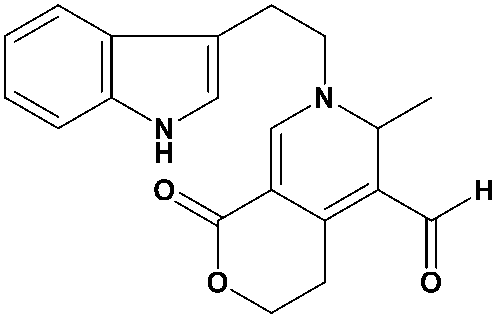
である、[1]~[11]のいずれかの化合物またはその医薬的に許容される塩。
[13] [1]~[12]のいずれかの化合物またはその医薬的に許容される塩、および医薬的に許容される担体を含む、医薬組成物。
[14] [1]~[12]のいずれかの化合物またはその医薬的に許容される塩を有効成分とする、がんの治療剤。
[15] がんが、悪性黒色腫、神経膠芽腫、肺癌、胃癌、大腸癌、肝臓癌、膵臓癌、腎臓癌、副腎癌、胆道癌、食道癌、咽頭癌、喉頭癌、口腔癌、膀胱癌、舌癌、甲状腺癌、皮膚癌、乳癌、前立腺癌、精巣癌、子宮癌、子宮頸癌、卵巣癌、骨肉腫、軟骨肉腫、横紋筋肉腫、平滑筋肉腫、成人T細胞白血病を含む白血病、悪性リンパ腫または多発性骨髄腫である、[14]の治療剤。
[16] [1]~[12]のいずれかの化合物またはその医薬的に許容される塩を有効成分として含む、免疫チェックポイント阻害剤。
[17] 免疫チェックポイントが、CTLA-4である、[16]の阻害剤。
[18] [1]~[12]のいずれかの化合物またはその医薬的に許容される塩を有効成分として含む、ワクチンの補助剤(アジュバント)。
[19] 治療が必要な患者に、治療上の有効量の[1]~[12]のいずれかの化合物またはその医薬的に許容される塩を投与することを特徴とする、がんの治療方法。
[20] がんの治療に使用する、[1]~[12]のいずれかの化合物またはその医薬的に許容される塩。
[21] がんの治療剤を製造するための、[1]~[12]のいずれかの化合物またはその医薬的に許容される塩の使用。
[22] 治療が必要な患者に、治療上の有効量の[1]~[12]のいずれかの化合物またはその医薬的に許容される塩を投与することを特徴とする、免疫チェックポイントの阻害方法。
本発明の化合物は、CTLA-4発現抑制作用およびIL-10産生抑制作用を有しており、免疫チェックポイントに起因する疾患、特に、がん(例えば、悪性黒色腫、神経膠芽腫、肺癌、胃癌、大腸癌、肝臓癌、膵臓癌、腎臓癌、副腎癌、胆道癌、食道癌、咽頭癌、喉頭癌、口腔癌、膀胱癌、舌癌、甲状腺癌、皮膚癌、乳癌、前立腺癌、精巣癌、子宮癌、子宮頸癌、卵巣癌、骨肉腫、軟骨肉腫、横紋筋肉腫、平滑筋肉腫、成人T細胞白血病を含む白血病、悪性リンパ腫、多発性骨髄腫)の新規な治療剤および/または予防剤として有用である。また、免疫チェックポイントを抑制することから、ワクチンの補助剤(アジュバント)としても有用である。
本明細書における用語について、以下に説明する。
用語「C1-6アルキル」とは、1~6個の炭素原子を有する、直鎖状または分枝鎖状の飽和炭化水素を意味し、これらは、所望により本発明に含まれる1以上の基で置換されていてもよい。「C1-6アルキル」は、好ましくは炭素数が1~5、1~4、または1~3であってもよい。かかる具体例として、メチル、エチル、プロピル、イソプロピル、ブチル、イソブチル、sec-ブチル、tert-ブチル、ぺンチル、イソペンチル、ネオペンチル、ヘキシル等が挙げられる。
用語「C1-6アルキル」とは、1~6個の炭素原子を有する、直鎖状または分枝鎖状の飽和炭化水素を意味し、これらは、所望により本発明に含まれる1以上の基で置換されていてもよい。「C1-6アルキル」は、好ましくは炭素数が1~5、1~4、または1~3であってもよい。かかる具体例として、メチル、エチル、プロピル、イソプロピル、ブチル、イソブチル、sec-ブチル、tert-ブチル、ぺンチル、イソペンチル、ネオペンチル、ヘキシル等が挙げられる。
用語「C2-6アルケニル」とは、2~6個の炭素原子を有し、1以上の炭素-炭素二重結合を含有する、直鎖または分枝鎖状の脂肪族炭化水素を意味し、これらは、所望により本発明に含まれる1以上の基で置換されていてもよい。「C2-6アルケニル」は、好ましくは炭素数が2~5、2~4、または2~3であってもよい。かかる具体例として、エテニル、プロペニル、ブテニル、ペンテニル、ヘキセニル等が挙げられる。
用語「C2-6アルキニル」とは、2~6個の炭素原子を有し、1以上の炭素-炭素三重結合を有する、直鎖状または分枝鎖状の脂肪族炭化水素を意味し、これらは、所望により本発明に含まれる1以上の基で置換されていてもよい。「C2-6アルキニル」は、好ましくは炭素数が2~5、2~4、または2~3であってもよい。かかる具体例として、エチニル、プロピニル、ブチニル、ペンチニル、ヘキシニル等が挙げられる。
用語「C3-6シクロアルキル」または「C3-6シクロアルキル環」とは、3~6個の炭素原子を有する、単環式飽和炭化水素を意味し、これらは、所望により本発明に含まれる1以上の基で置換されていてもよい。かかる具体例として、シクロプロピル、シクロブチル、シクロペンチル、シクロへキシル等が挙げられる。
用語「C3-6シクロアルケニル環」とは、3~6個の炭素原子を有し、1以上の炭素-炭素二重結合を含有する、単環式炭化水素を意味し、これらは、所望により本発明に含まれる1以上の基で置換されていてもよい。かかる具体例として、シクロプロペン、シクロブテン、シクロペンテン、シクロヘキセン等が挙げられる。
用語「3員ないし6員のヘテロシクロアルキル」とは、窒素、酸素および硫黄からなる群から独立して選択される少なくとも1個のヘテロ原子を含む、3員ないし6員の単環式飽和複素環を意味し、これらは、所望により本発明に含まれる1以上の基で置換されていてもよい。窒素および硫黄原子は、所望により酸化されてもよく、窒素原子は、所望により四級化されてもよい。かかる具体例として、アゼチジニル、ピロリジニル、ピペリジニル、ピペラジニル、モルホリニル、テトラヒドロフラニル、テトラヒドロピラニル等が挙げられる。
用語「5員もしくは6員の単環式ヘテロ環」とは、窒素、酸素および硫黄からなる群から独立して選択される少なくとも1個のヘテロ原子を含む、5員または6員の単環式複素環を意味し、これらは、所望により本発明に含まれる1以上の基で置換されていてもよい。該環は、飽和、部分的飽和または不飽和であってもよく、また、窒素および硫黄原子は、所望により酸化されてもよく、窒素原子は、所望により四級化されてもよい。かかる具体例として、ピロリジニル、ピペリジニル、ピペラジニル、モルホリニル、ピリジル、ピロリル、ピラジニル、ピリミジニル、ピリダジニル、イミダゾリル、チアゾリル、ピラゾリル、オキサゾリル、チエニル、フリル等が挙げられる。
用語「C6-10アリール」とは、芳香族環に結合する1個の水素原子が除外された、6~10個の炭素原子を有する単環または二環の芳香族炭化水素を意味し、これらは、所望により本発明に含まれる1以上の基で置換されていてもよい。かかる具体例として、フェニル、1-ナフチル、2-ナフチル、アントラセニル等が挙げられる。
用語「6員ないし10員のヘテロアリール」とは、窒素、酸素および硫黄からなる群から独立して選択される少なくとも1個のヘテロ原子を含む、6員ないし10員の単環式または二環式芳香族複素環を意味し、これらは、所望により本発明に含まれる1以上の基で置換されていてもよい。かかる具体例として、ピリジル、ピリダジニル、イソチアゾリル、ピロリル、フリル、チエニル、チアゾリル、イミダゾリル、ピリミジニル、チアジアゾリル、ピラゾリル、オキサゾリル、イソオキサゾリル、ピラジニル、トリアジニル、トリアゾリル、イミダゾリジニル、オキサジアゾリル、トリアゾリル、テトラゾリル、インドリル、インダゾリル、クロメニル、キノリル、イソキノリル、ベンゾフラニル、ベンゾチエニル、ベンゾオキサゾリル、ベンゾチアゾリル、ベンズイソオキサゾリル、ベンズイソチアゾリル、ベンゾトリアゾリル、ベンズイミダゾリル等が挙げられる。
用語「ハロゲン」とは、フッ素、塩素、臭素またはヨウ素を意味する。中でも好ましくは、フッ素、塩素または臭素である。
用語「モノ-もしくはジ-C1-6アルキルアミノ」とは、1個または2個の水素原子が1~6個の炭素原子を有する上記のアルキル基によって置き換えられている、アミノ基を意味する。アルキル基によって2個置換される場合は、同一または異なるアルキル基で置換されていてもよい。かかる具体例として、メチルアミノ、エチルアミノ、ジメチルアミノ、ジエチルアミノ等が挙げられる。
用語「C1-4アシル」とは、水素原子、または1~3個の炭素原子を有する上記のアルキル基が結合している、カルボニル基(-C(=O))を意味する。かかる具体例として、ホルミル、アセチル、プロピオニル等が挙げられる。
用語「C1-6ハロアルキル」とは、1個以上の水素原子がハロゲン原子(複数可)によって置き換えられている、1~6個の炭素原子を有する上記のアルキル基を意味する。置き換えられている水素原子の数は、1個から、最大で親アルキル基に他に存在しうる水素原子の総数の範囲まで及びうる。ハロゲン原子を複数有する場合は、同一または異なるハロゲン原子で置換されていてもよい。かかる具体例として、クロロメチル、トリフルオロメチル、2,2,2-トリフルオロエチル等が挙げられる。
用語「C1-6ヒドロキシアルキル」とは、1個以上の水素原子がヒドロキシ基(複数可)によって置き換えられている、1~6個の炭素原子を有する上記のアルキル基を意味する。置き換えられている水素原子の数は、1個から、最大で親アルキル基に他に存在しうる水素原子の総数の範囲まで及びうる。かかる具体例として、ヒドロキシメチル、2-ヒドロキシエチル、2-ヒドロキシプロピル、3-ヒドロキシプロピル、4-ヒドロキシブチル等が挙げられる。
用語「C1-6アルコキシ」とは、1~6個の炭素原子を有する上記のアルキル基が酸素原子を介して結合している基を意味する。かかる具体例として、限定されるものではないが、メトキシ、エトキシ、プロポキシ、イソプロポキシ、ブチルオキシ、ペンチルオキシ、イソペンチルオキシ、ネオペンチルオキシ、ヘキシルオキシ等が挙げられる。
用語「C1-6ハロアルコキシ」とは、1個以上の水素原子がハロゲン原子(複数可)によって置き換えられている、1~6個の炭素原子を有する上記のアルコキシ基を意味する。置き換えられている水素原子の数は、1個から、最大で親アルキル基に他に存在しうる水素原子の総数の範囲まで及びうる。ハロゲン原子を複数有する場合は、同一または異なるハロゲン原子で置換されていてもよい。かかる具体例として、クロロメトキシ、トリフルオロメトキシ、2,2,2-トリフルオロエトキシ等が挙げられる。
用語「C1-6ヒドロキシアルコキシ」とは、1個以上の水素原子がヒドロキシ(複数可)によって置き換えられている、1~6個の炭素原子を有する上記のアルコキシ基を意味する。置き換えられている水素原子の数は、1個から、最大で親アルキル基に他に存在しうる水素原子の総数の範囲まで及びうる。かかる具体例として、ヒドロキシメトキシ、2-ヒドロキシエトキシ、2-ヒドロキシプロポキシ、3-ヒドロキシプロポキシ、4-ヒドロキシブトキシ等が挙げられる。
用語「免疫チェックポイント阻害剤」とは、1つ以上の免疫チェックポイント分子(例えば、CTLA-4およびPD-1)の機能を阻害し、T細胞の抑制を解除して活性化し、抗腫瘍効果を発揮する薬剤を意味する。免疫チェックポイントは、キラーT細胞の活性化を阻害し、がん細胞の免疫に対して抑制的に作用するタンパク質である。
「免疫チェックポイントに起因する疾患」とは、がん(例えば、悪性黒色腫、神経膠芽腫、肺癌、胃癌、大腸癌、肝臓癌、膵臓癌、腎臓癌、副腎癌、胆道癌、食道癌、咽頭癌、喉頭癌、口腔癌、膀胱癌、舌癌、甲状腺癌、皮膚癌、乳癌、前立腺癌、精巣癌、子宮癌、子宮頸癌、卵巣癌、骨肉腫、軟骨肉腫、横紋筋肉腫、平滑筋肉腫、成人T細胞白血病を含む白血病、悪性リンパ腫または多発性骨髄腫)が挙げられる。本発明における疾患としては、特に悪性黒色腫が好ましい。
「医薬的に許容される塩」とは、式(I)で表される本発明の化合物と医薬的に許容される酸または塩基により形成される塩を意味する。式(I)で表される本発明の化合物がアミノ基等の塩基性官能基を有する場合、各種の酸と塩を形成しうる。酸付加塩の具体例としては、塩酸塩、臭化水素酸塩、ヨウ化水素酸塩、硫酸塩、過塩素酸塩、リン酸塩等の無機酸塩、シュウ酸塩、マロン酸塩、マレイン酸塩、フマル酸塩、乳酸塩、リンゴ酸塩、クエン酸塩、酒石酸塩、安息香酸塩、トリフルオロ酢酸塩、酢酸塩、メタンスルホン酸塩、p-トルエンスルホン酸塩、トリフルオロメタンスルホン酸塩等の有機酸塩、またはグルタミン酸塩、アスパラギン酸塩等のアミノ酸塩が挙げられる。
本発明の化合物が酸性官能基を有する場合、各種の塩基と塩を形成しうる。塩基付加塩の具体例としては、ナトリウム塩、カリウム塩等のアルカリ金属塩、カルシウム塩等のアルカリ土類金属塩、またはアンモニウム塩等が挙げられる。
これらの塩は、本発明の化合物を酸または塩基と混合した後、再結晶等の常法により得ることができる。
本発明の化合物は、水和物および/または溶媒和物の形で存在することもあるので、これらの水和物および/または溶媒和物もまた本発明の化合物に包含される。溶媒和物としてはエタノール溶媒和物等が挙げられる。
本発明の化合物が酸性官能基を有する場合、各種の塩基と塩を形成しうる。塩基付加塩の具体例としては、ナトリウム塩、カリウム塩等のアルカリ金属塩、カルシウム塩等のアルカリ土類金属塩、またはアンモニウム塩等が挙げられる。
これらの塩は、本発明の化合物を酸または塩基と混合した後、再結晶等の常法により得ることができる。
本発明の化合物は、水和物および/または溶媒和物の形で存在することもあるので、これらの水和物および/または溶媒和物もまた本発明の化合物に包含される。溶媒和物としてはエタノール溶媒和物等が挙げられる。
「治療」とは、哺乳動物、特にヒトにおける疾患および/または障害の治癒および/または改善を意味する。例えば、(a)疾患および/または障害を予防すること;および(b)疾患および/または疾患を緩和および/または軽減すること等も含まれる。
「患者」とは、ヒトおよび動物、例えば、イヌ、ネコ、ウマ等を意味する。その中でも、ヒトが好ましい。
「治療上の有効量」とは、未治療対象と比べて、疾患、障害および/または副作用の改善、治癒、予防および/または軽減をもたらす量、あるいは疾患および/または障害の進行速度の遅延をもたらす量を意味する。該用語は、その範囲内に、正常な生理的機能を促進するのに有効な量も含む。療法における使用では、本発明の化合物の治療上の有効量を、化合物原体として投与することが可能である。特に限定するものではないが、通常、本発明の化合物として、1日当たり0.001~1000mg/kg(体重)の範囲が有効である。
かかる有効量として、本発明の化合物単独の量、本発明の化合物の組み合わせの量および/またはがん治療に有用な他の活性成分と組み合わせた本発明の化合物の量が挙げられる。
かかる有効量として、本発明の化合物単独の量、本発明の化合物の組み合わせの量および/またはがん治療に有用な他の活性成分と組み合わせた本発明の化合物の量が挙げられる。
式(I)で表される本発明の化合物の中のa~d、R1、R1’、R2、R2’、R3~R8および環Aに関して、好ましいものは以下のとおりであるが、本発明の技術的範囲は下記に挙げられた化合物の範囲に限定されるものではない。
a~c:

は、単結合または二重結合を表し、d:

は、不存在または単結合を表す。ただし、aが二重結合を表す場合、bは単結合を表し、bが二重結合を表す場合、aは単結合を表し、R5は不存在であり、cが二重結合を表す場合、R6は不存在であり、ならびに、cが二重結合を表し、dが単結合を表す場合、R6およびR7は不存在である。中でも好ましくは、aが単結合、bが二重結合、cが単結合または二重結合、そして、dが不存在または単結合であり、より好ましくは、aが単結合、bが二重結合、cが二重結合、そして、dが不存在である。また、dが不存在である場合、インドール環の2位には水素が存在する。
R1、R1’、R2およびR2’としては、水素、ハロゲン、ヒドロキシ、アミノ、ニトロ、モノ-もしくはジ-C1-6アルキル-アミノ、C1-6アルキル、C1-6ハロアルキル、C1-6ヒドロキシアルキル、C1-6アルコキシまたはC1-6ハロアルコキシが挙げられる。中でも好ましくは、水素、フッ素、塩素、ヒドロキシ、アミノ、メチルアミノ、ジメチルアミノ、メチル、トリフルオロメチル、メトキシまたはトリフルオロメトキシが挙げられ、より好ましくは水素が挙げられる。
R3としては、水素、ハロゲン、ヒドロキシ、アミノ、ニトロ、モノ-もしくはジ-C1-6アルキル-アミノ、C1-6アルキル、C1-6ハロアルキル、C1-6ヒドロキシアルキル、C1-6アルコキシまたはC1-6ハロアルコキシが挙げられる。中でも好ましくは、水素、C1-6アルキル、C1-6ハロアルキル、C1-6ヒドロキシアルキル、C1-6アルコキシまたはC1-6ハロアルコキシが挙げられ、より好ましくは水素またはC1-6アルキルが挙げられ、さらに好ましくは水素またはメチルが挙げられる。
R4としては、水素、ハロゲン、ヒドロキシ、アミノ、モノ-もしくはジ-C1-6アルキル-アミノ、C1-6アルキル、C2-6アルケニル、C2-6アルキニル、C1-6アルコキシ、C3-6シクロアルキル、3員ないし6員のヘテロシクロアルキル、C6-10アリールまたは6員ないし10員のヘテロアリールが挙げられ、該アルキル、アルケニル、アルキニル、アルコキシ、シクロアルキル、ヘテロシクロアルキル、アリールおよびヘテロアリールは、各々独立して、置換可能な位置で、ハロゲン、ヒドロキシ、アミノ、ニトロ、モノ-もしくはジ-C1-6アルキルアミノ、C1-4アシル、C1-6アルキル、C1-6ハロアルキル、C1-6ヒドロキシアルキル、C1-6アルコキシ、およびC1-6ハロアルコキシからなる群から選択される1つまたは同一もしくは異なる2つ以上の基で置換されていてもよい。中でも好ましくは、水素、ヒドロキシ、アミノ、モノ-もしくはジ-C1-6アルキル-アミノ、C1-6アルキル、C1-6ハロアルキル、C1-6ヒドロキシアルキル、C1-6アルコキシまたはC1-6ハロアルコキシが挙げられ、より好ましくは水素、メチル、トリフルオロメチル、メトキシ、トリフルオロメトキシが挙げられ、さらに好ましくは水素またはメトキシが挙げられる。
R5、R6およびR7としては、水素、ハロゲン、ヒドロキシ、C1-3アルキル、C1-3ハロアルキル、C1-3ヒドロキシアルキル、C1-3アルコキシまたはC1-3ハロアルコキシが挙げられる。中でも好ましくは、水素、ヒドロキシまたはC1-3アルキルが挙げられ、より好ましくは水素、ヒドロキシまたはメチルが挙げられる。また、R5は、bが二重結合を表す場合、不存在となり、R6は、cが二重結合である場合、不存在となり、さらに、R7は、cが二重結合を表し、dが単結合を表す場合、不存在となり、cが単結合を表し、dが不存在を表す場合、メチルとなり、そして、cおよびdが単結合を表す場合、水素となる。
R8としては、水素、ハロゲン、ヒドロキシ、アミノ、ニトロ、モノ-もしくはジ-C1-6アルキル-アミノ、C1-6アルキル、C2-6アルケニル、C2-6アルキニル、C1-6アルコキシ、ベンジルオキシ、C3-6シクロアルキル、3員ないし6員のヘテロシクロアルキル、C6-10アリールまたは6員ないし10員のヘテロアリールが挙げられ、該アルキル、アルケニル、アルキニル、アルコキシ、シクロアルキル、ヘテロシクロアルキル、アリールまたはヘテロアリールは、置換可能な位置で、ハロゲン、ヒドロキシ、アミノ、ニトロ、モノ-もしくはジ-C1-6アルキル-アミノ、C1-4アシル、C1-6アルキル、C1-6ハロアルキル、C1-6ヒドロキシアルキル、C1-6アルコキシ、およびC1-6ハロアルコキシからなる群から選択される1つまたは同一もしくは異なる2つ以上の基で置換されていてもよい。中でも好ましくは、水素、フッ素、塩素、臭素、ヒドロキシ、アミノ、メチルアミノ、ジメチルアミノ、メチル、トリフルオロメチル、メトキシ、トリフルオロメトキシまたはベンジルオキシが挙げられ、より好ましくは水素、フッ素、塩素、臭素、ヒドロキシ、メチル、メトキシまたはベンジルオキシが挙げられる。また、R8が水素である場合、nは4を表す。
環Aとしては、C3-6シクロアルキル環、C3-6シクロアルケニル環または5員もしくは6員の単環式ヘテロ環が挙げられ、該シクロアルキル環、シクロアルケン環および単環式ヘテロ環は、置換可能な位置で、ハロゲン、ヒドロキシ、オキソ、アミノ、ニトロ、モノ-もしくはジ-C1-6アルキル-アミノ、C1-4アシル、C1-6アルキル、C1-6ハロアルキル、C1-6ヒドロキシアルキル、C1-6アルコキシ、およびC1-6ハロアルコキシからなる群から選択される1つまたは同一もしくは異なる2つ以上の基で置換されていてもよい、中でも好ましくは、C5-6シクロアルキル環、C5-6シクロアルケニル環または5員もしくは6員の単環式飽和ヘテロ環が挙げられ、該シクロアルキル環、シクロアルケン環および単環式飽和ヘテロ環は、置換可能な位置で、ヒドロキシ、オキソ、C1-6アルキル、C1-6ハロアルキル、C1-6ヒドロキシアルキル、C1-6アルコキシ、およびC1-6ハロアルコキシからなる群から選択される1つまたは同一もしくは異なる2つ以上の基で置換されていてもよく、より好ましくは、以下:
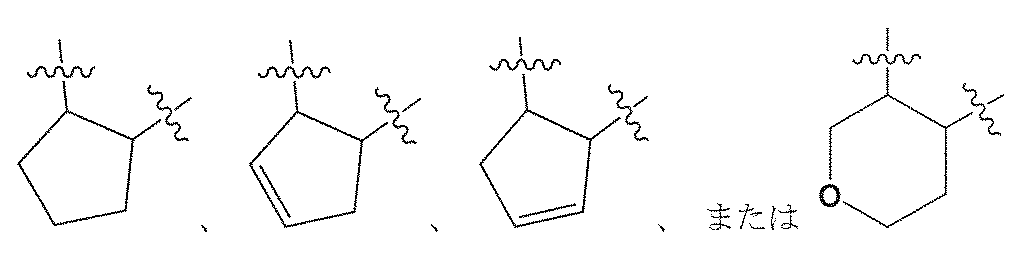
が挙げられ、各基は、置換可能な位置で、ヒドロキシ、オキソ、C1-3アルキル、C1-3ヒドロキシアルキル、およびC1-3アルコキシからなる群から選択される1つまたは同一もしくは異なる2つ以上の基で置換されていてもよく、さらにより好ましくは、以下:
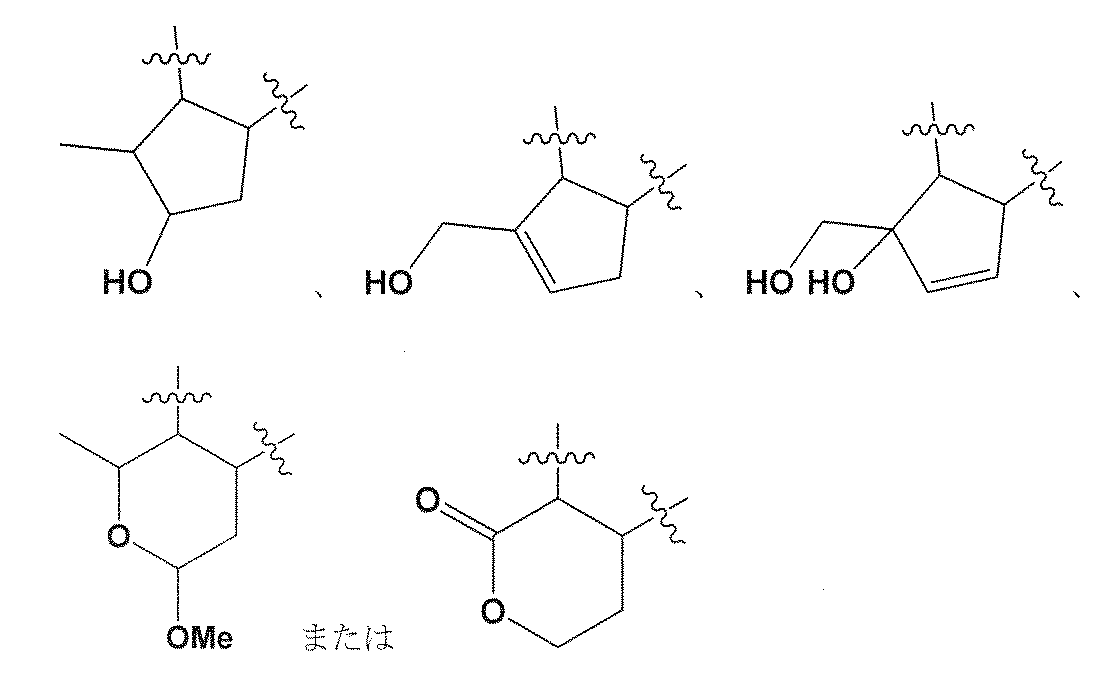
が挙げられる。
本発明の化合物は、1個または場合によりそれ以上の不斉炭素原子を有する場合があり、また幾何異性や軸性キラリティを生じることがあるので、数種の光学または立体異性体として存在することがある。本発明においては、これらの立体異性体、それらの混合物およびラセミ体は本発明に包含される。
また、本発明の化合物のいずれか1つまたは2つ以上の1Hを2H(D)に変換した重水素変換体も本発明に包含される。
結晶として得られる本発明の化合物およびその医薬上許容される塩には、結晶多形が存在する場合があり、その結晶多形も本発明に包含される。
また、本発明の化合物のいずれか1つまたは2つ以上の1Hを2H(D)に変換した重水素変換体も本発明に包含される。
結晶として得られる本発明の化合物およびその医薬上許容される塩には、結晶多形が存在する場合があり、その結晶多形も本発明に包含される。
以下、本発明の化合物の製造方法について、例を挙げて説明するが、本発明はもとよりこれに限定されるものではない。式(I)で表される本発明の代表的な化合物は、以下:
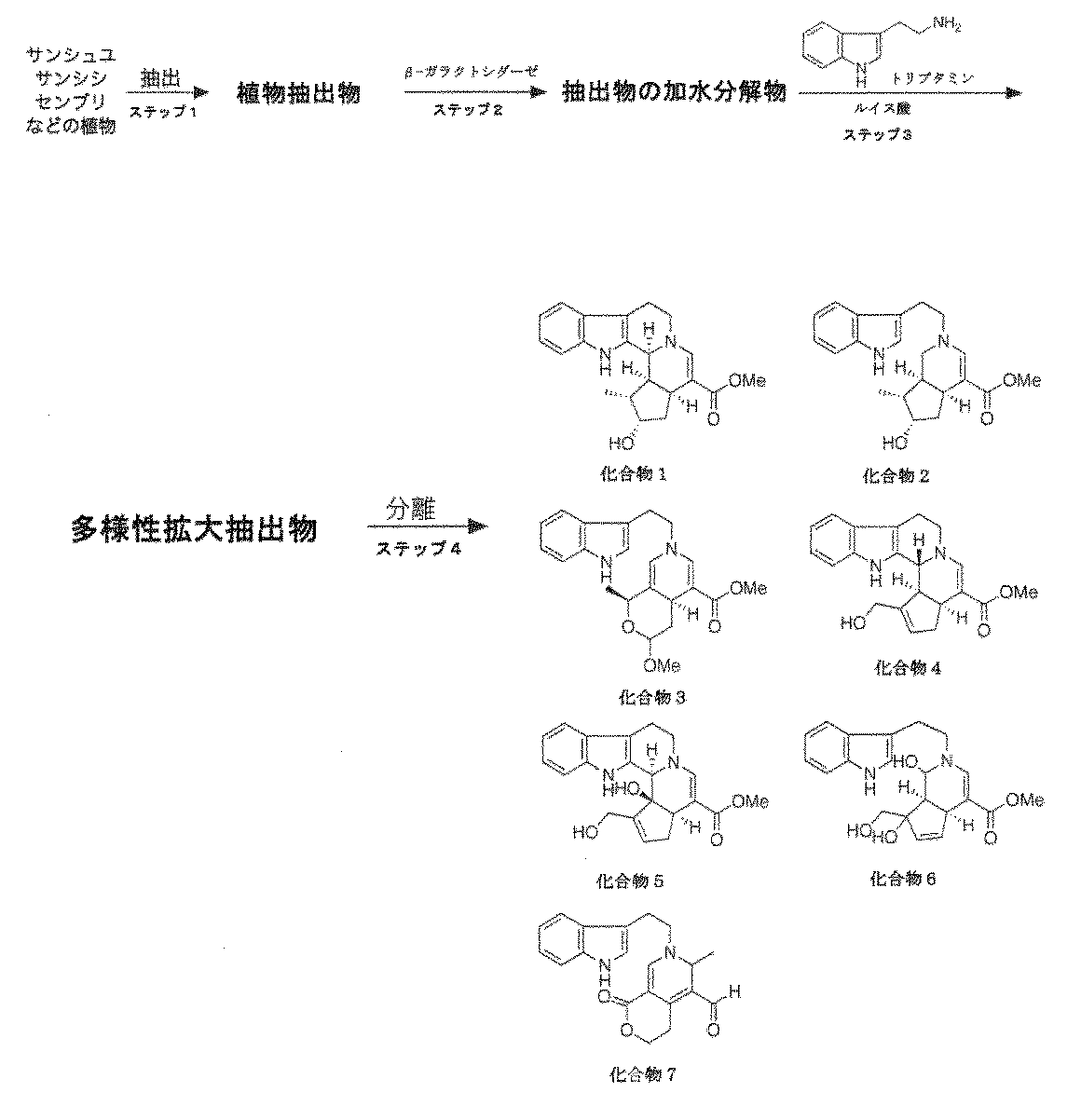
で示されるように、化学変換を行った植物抽出物(多様性拡大抽出物:diversity-enhanced extracts)から調製することができる(Org. Lett. 2014, 16, 1916-1919)。また、ステップ3のトリプタミンを6-メトキシトリプタミン等の置換トリプタミンに置き換えることによって、化合物8~17を調製することができる。
ステップ1は、サンシュユの偽果、クチナシの果実、センブリの全草などの植物をメタノールで抽出し、その抽出物を、活性炭を担体とするカラムクロマトグラフィーに付し、イリドイド型化合物等の配糖体を多く含む粗画分を得る工程である。
ステップ2は、ステップ1で得られた粗画分にβ-グルコシダーゼを作用させることで、粗画分に含まれる化合物の加水分解を行う工程である。
ステップ3は、トリフルオロメタンスルホン酸金属塩などのルイス酸存在下でトリプタミンを作用させることでインドールアルカロイド型化合物等の化合物を含む多様性拡大抽出物を得る工程である。化合物8~17においては、トリプタミンの代わりに6-メトキシトリプタミン等の置換トリプタミンが用いられる。
ステップ4は、得られた多様性拡大抽出物を各種カラムクロマトグラフィーにより分画・精製して、本発明の化合物を得る工程である。
本発明の治療剤または免疫チェックポイント剤の有効成分として好ましい式(I)の化合物は、

であり、より好ましくは、
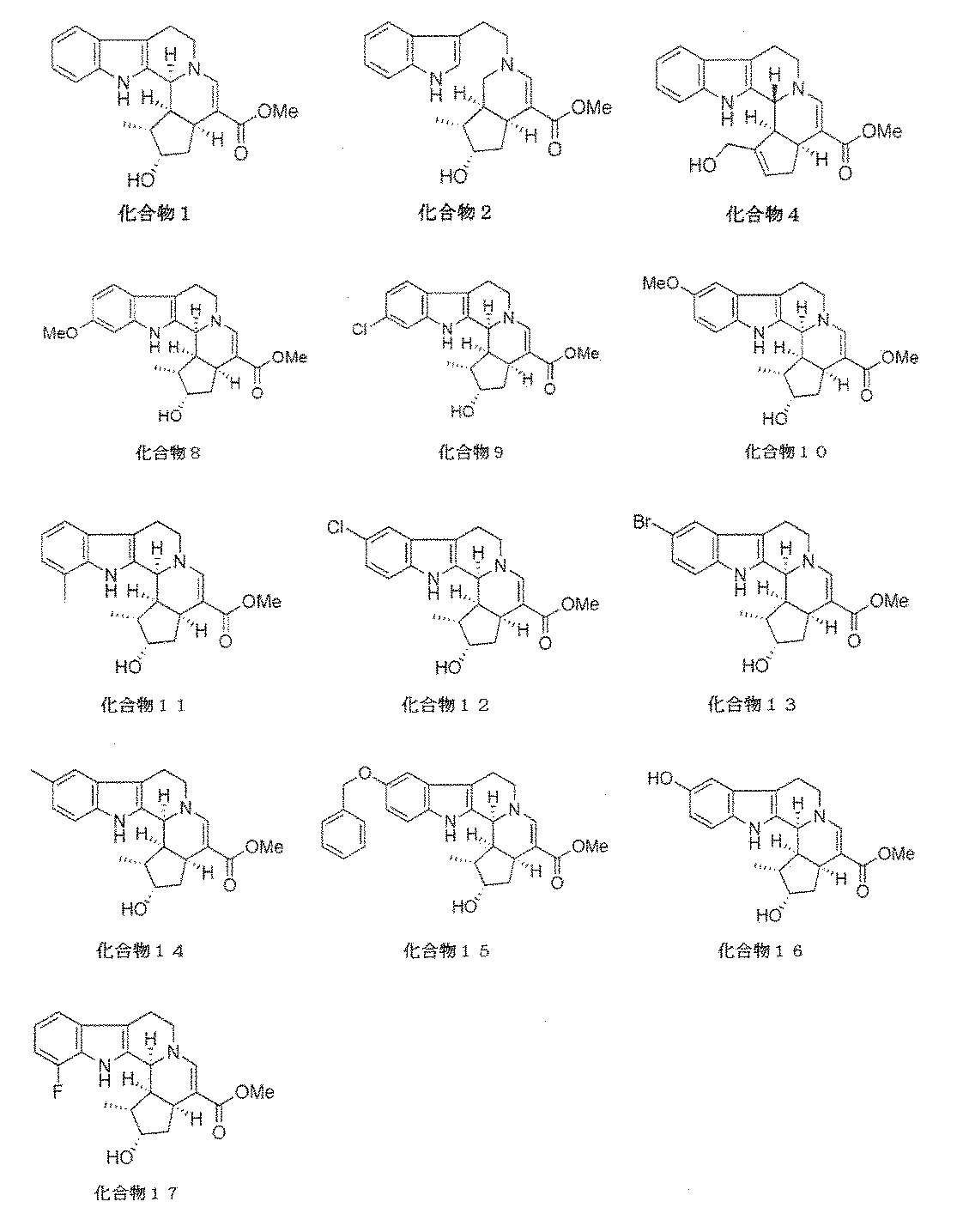
であり、さらにより好ましくは、

である。
本発明の治療剤または免疫チェックポイント阻害剤は、本発明の化合物を有効成分として含むものであればよく、免疫チェックポイントを阻害する作用を妨げない限り、他の成分をさらに含むものであってもよい。したがって、本発明の治療剤または免疫チェックポイント阻害剤中の本発明の化合物の割合は特に限定されるものではない。例えば、本発明の治療剤は、本発明の化合物を0.1重量%以上、または0.5重量%以上、または1.0重量%以上含むものであってもよく、0.1~70重量%が好ましい。あるいは、本発明の治療剤または免疫チェックポイント阻害剤は、本発明の化合物のみからなるものであってもよい。
本発明の化合物は、経口または非経口(例えば、静脈、局所、経鼻、経肺、直腸等)投与することができる。本発明の剤形は、対象の身体状況、健康状態などに応じて適宜選択することができ、調製することができる。例えば、錠剤、カプセル剤、顆粒剤、散剤、液剤、シロップ剤などの経口投与剤、または注射剤、透析用剤、吸入剤、坐剤、点眼剤、眼軟膏剤、点耳剤、点鼻剤、外用剤、スプレー剤、軟膏剤、クリーム剤、ゲル剤、貼付剤などの非経口投与剤の剤形に、常法により調製されうる。
本発明の治療剤または免疫チェックポイント剤は、必要に応じ、賦形剤(例えば、乳糖、白糖、D-マンニトールおよび微結晶セルロース)、崩壊剤(例えば、カルメロース、カルメロースナトリウムおよび低置換度ヒドロキシプロピルセルロース)、結合剤(例えば、ヒドロキシプロピルセルロース、ヒドロキシプロピルメチルセルロース、ポビドンおよび結晶セルロース)、滑沢剤(例えば、ステアリン酸マグネシウム、ステアリン酸カルシウムおよびタルク)、溶剤(例えば、水、エタノールおよびプロピレングリコール)、緩衝剤(例えば、リン酸三ナトリウム、リン酸水素ナトリウムおよびリン酸二水素ナトリウム)、懸濁化剤(例えば、アラビアゴム、トラガントおよびカルボキシメチルセルロースナトリウム)、乳化剤(例えば、グリセリン脂肪酸エステルおよびソルビタン脂肪酸エステル)など1種以上の医薬的に許容される担体を含むものであってもよい。
本発明の化合物の投与量は、投与方法、対象の年齢、疾患の程度、症状、剤形等により適宜選択されるが、例えば、一日あたり、0.01mg~0.1mg、0.1mg~1mg、1mg~5mg、5mg~10mg、10mg~50mg、50mg~100mg、100mg~500mg、500mg~1g、1g~1.5g、1.5g~2g、2g~5g、5g~10gの用量で、経口投与されうる。1日あたりの本発明の化合物の量を、1回~数回に分けて投与してもよい。
以下に実施例および試験例を挙げて本発明をさらに具体的に説明するが、これらは本発明を限定するものではない。なお、化合物の同定は、NMRスペクトル法、質量分析法等により行った。
明細書の記載を簡略化するために実施例において以下に示すような略号を用いることもある。NMRに用いられる記号としては、sは一重線、dは二重線、ddは二重の二重線、dddは二重の二重の二重線、dtは二重の三重線、tは三重線、tdは三重の二重線、qは四重線、mは多重線、brは幅広い、brsは幅広い一重線およびJは結合定数を意味する。
実施例1:化合物1~3の調製

工程1:サンシュユの偽果(42g)(株式会社紀伊國屋漢薬局より購入)にメタノール(0.5L)を加え、2日間静置し抽出した。得られた抽出液を減圧濃縮し、メタノール抽出物(21g)を得た。メタノール抽出物を酢酸エチル(50mL)に懸濁させ、水(50mL)で3回抽出し、水可溶部を得た。水可溶部を活性炭素(15g)に加え、水(0.2L)、5%エタノール水溶液(0.2L)、メタノール(0.2L)で順次溶出し、メタノール溶出部を減圧濃縮することで、イリドイド型化合物等の配糖体を多く含む粗画分(1.55g)を得た。
工程2:得られた粗画分を、0.05Mクエン酸バッファー(pH6.0)(50mL)に懸濁させ、β-グルコシダーゼ(スイートアーモンド由来,東洋紡)(36mg)を加え、45℃で2日間攪拌した。反応液を酢酸エチル(50mL)で3回抽出し、抽出した酢酸エチル層を全て合わせて、水(100mL)で洗浄後、無水硫酸ナトリウムで乾燥して溶媒を減圧留去することで、加水分解物(203mg)を得た。
工程3:得られた加水分解物を、ジクロロメタン(13.5mL)に溶かし、トリプタミン(131mg、0.82mmol)およびトリフルオロメタンスルホン酸ビスマス(III)(54mg、0.082mmol)を加え、室温で24時間攪拌した。反応液に飽和重曹水(30mL)を加え、酢酸エチル(50mL)で3回抽出を行った。抽出した酢酸エチル層を全て合わせて、飽和食塩水(100mL)で洗浄後、無水硫酸ナトリウムで乾燥して減圧濃縮することでインドールアルカロイド型化合物等の化合物を含む多様性拡大抽出物(197mg)を得た。
工程4:得られた多様性拡大抽出物を、シリカゲルカラムクロマトグラフィに付し、ヘキサン-酢酸エチル(4:1)で溶出して画分A(10.4mg)、ヘキサン-酢酸エチル(2:1)で溶出して画分B(16.7mg)、ヘキサン-酢酸エチル(1:1)で溶出して画分C(30.5mg)、ヘキサン-酢酸エチル(1:2)で溶出して画分D(30.9mg)、酢酸エチルで溶出して画分E(57.5mg)をそれぞれ得た。
工程5:画分Bを再度シリカゲルカラムクロマトグラフィに付し、ヘキサン-酢酸エチル(2:1)で溶出した画分より化合物1(2.5mg)を得た。画分Dを再度シリカゲルカラムクロマトグラフィに付し、ヘキサン-酢酸エチル(1:1)で溶出した画分より化合物2(8.4mg)を得た。また、画分Dをヘキサン-酢酸エチル(1:2)で溶出して画分D-1(7.8mg)を得、得られた画分D-1をさらにシリカゲルカラムクロマトグラフィに付し、クロロホルム-メタノール(99:1)で溶出した画分より化合物3(2.5mg)を得た。
化合物1~3は、EIMS(電子衝撃質量スペクトル)法による質量分析およびNMRによって解析した。EIMSおよびNMRの結果を以下に示す。
化合物1:
1H-NMR (600 MHz, CDCl3) δ 8.05 (1H, br.s), 7.56 (1H, dd, J = 7.9, 1.0 Hz), 7.36 (1H, dd, J = 8.2, 1.0 Hz), 7.35 (1H, s), 7.19 (1H, ddd, J = 8.2, 7.6, 1.0 Hz), 7.12 (1H, ddd, J = 8.2, 7.6, 1.0 Hz), 6.96 (1H, d, J = 2.5 Hz), 4.09-4.12 (1H, m), 3.63 (3H, s), 3.42 (2H, t, J = 7.4 Hz), 3.12 (1H, dd, J = 12.2, 4.7 Hz), 3.04 (1H, td, J = 8.2, 7.4 Hz), 2.98 (2H, dt, J = 7.4, 2.5 Hz), 2.75 (1H, dd, J = 12.2, 6.7 Hz), 2.20 (1H, ddd, J = 14.2, 7.4, 1.5 Hz), 1.87-1.92 (1H, m), 1.66-1.70 (1H, m), 1.56 (1H, ddd, J = 14.2, 8.1, 5.6 Hz), 1.00 (3H, d, J = 7.0 Hz).
13C-NMR (150 MHz, CDCl3) δ 169.3, 145.9, 136.3, 127.1, 122.2, 122.0, 119.5, 118.5, 112.5, 111.3, 99.9, 74.5, 56.2, 50.5, 47.3, 43.1, 42.0, 41.6, 32.4, 25.1, 13.0.
EIMS m/z (rel. int) 354 [M]+ (40), 224 (100), 192 (36).
HREIMS m/z 354.1934 (C21H26O3N2の計算値354.1943).
化合物2:
1H-NMR (600 MHz, CDCl3) δ 8.31 (1H, br.s), 7.45 (1H, d, J = 7.6 Hz), 7.36 (1H, s), 7.32 (1H, d, J = 7.6 Hz), 7.15 (1H, t, J = 7.6 Hz), 7.10 (1H, t, J = 7.6 Hz), 4.39 (1H, brs), 4.24 (1H, t, J = 5.4 Hz), 3.73 (1H, dd, J = 15.8, 5.4 Hz), 3.62 (3H, s), 3.46 (1H, dd, J = 15.8, 5.8 Hz), 2.98 (1H, ddd, J = 9.8, 8.0, 6.7 Hz), 2.90-2.95 (1H, m), 2.77 (1H, dd, J = 15.1, 5.4 Hz), 2.41 (1H, ddd, J = 10.1, 9.8, 2.5 Hz), 2.24 (1H, dd, J = 14.7, 8.0 Hz), 2.05-2.11 (1H, m), 1.80 (1H, ddd, J = 14.7, 6.7, 5.3), 1.20 (3H, d, J = 6.9 Hz).
13C-NMR (150 MHz, CDCl3) δ 168.6, 144.7, 135.8, 133.4, 127.1, 121.9, 119.6, 118.0, 111.0, 108.6, 104.3, 74.5, 52.8, 51.5, 50.6, 44.9, 42.5, 41.5, 30.9, 22.2, 12.8.
EIMS m/z (rel. int) 352 [M]+ (100), 293 (57), 279 (32), 255 (22), 224 (12), 170 (17).
HREIMS m/z 352.1806 (C21H24O3N2の計算値352.1787).
化合物3:
1H-NMR (600 MHz, CDCl3) δ 8.08 (1H, br.s), 7.55 (1H, dd, J = 8.0, 1.0 Hz), 7.35 (1H, dd, J = 8.0, 0.9 Hz), 7.19 (1H, td, J = 8.0, 1.0 Hz), 7.13 (1H, td, J = 8.0, 0.9 Hz), 7.00 (1H, d, J = 2.6 Hz), 6.93 (1H, d, J = 2.6 Hz), 5.42 (1H, br.s), 4.75 (1H, d, J = 2.8 Hz), 4.21 (1H, q, J = 6.5 Hz), 3.92 (1H, dd, J = 12.1, 3.9 Hz), 3.62 (3H, s), 3.38 (2H, t, J = 7.1 Hz), 3.35 (3H, s), 2.98 (2H, t, J = 7.1 Hz), 2.23 (1H, dd, J = 12.7, 3.9 Hz), 1.78 (1H, ddd, J = 12.7, 12.1, 2.8 Hz), 1.05 (3H, d, J = 6.5 Hz).
13C-NMR (150 MHz, CDCl3) δ 168.5, 141.3, 136.3, 127.0, 122.5, 122.2, 121.1, 120.2, 119.6, 118.4, 111.9, 111.3, 99.8, 99.5, 64.6, 54.6, 54.4, 50.7, 39.0, 29.3, 26.2, 16.5.
EIMS m/z (rel. int) 382 [M]+ (23), 351 (13), 323 (32), 144 (100).
HREIMS m/z 382.0962 (C22H26O4N2の計算値382.1893).
実施例2:化合物4~6の調製

サンシシの果実(30g)(株式会社紀伊國屋漢薬局より購入)にメタノール(0.5L)を加え、2日間静置し抽出した。得られた抽出液を減圧濃縮し、メタノール抽出物(7.5g)を得た。得られたメタノール抽出物を用いて、実施例1の工程1~3と同様の工程にしたがって、インドールアルカロイド型化合物等の化合物を含む多様性拡大抽出物(478mg)を得た。
得られた多様性拡大抽出物を、シリカゲルカラムクロマトグラフィに付し、ヘキサン-酢酸エチル(3:1)で溶出して画分A(4.3mg)、ヘキサン-酢酸エチル(1:1)で溶出して画分B(17.5mg)、ヘキサン-酢酸エチル(1:3)で溶出して画分C(34.0mg)、ヘキサン-酢酸エチル(1:9)で溶出して画分D(74.3mg)、酢酸エチルで溶出して画分E(285.2mg)をそれぞれ得た。
画分Bをオクタデシルシリル化シリカゲルを担体とするカラムクロマトグラフィーに付し、水-アセトニトリル(3:2)で溶出した画分より化合物4(2.2mg)を得た。また、画分Dをオクタデシルシリル化シリカゲルを担体とするカラムクロマトグラフィーに付し、水-アセトニトリル(1:1)で溶出した画分より化合物5(3.0mg)を、水-アセトニトリル(2:3)で溶出した画分より化合物6(4.4mg)をそれぞれ得た。
化合物4~6は、EIMS(電子衝撃質量スペクトル)法による質量分析及びNMRによって解析した。EIMSおよびNMRの結果を以下に示す。
化合物4:
1H-NMR (600 MHz, CDCl3) δ 9.99 (1H, br.s), 7.55 (1H, s), 7.45 (1H, d, J = 7.7 Hz), 7.33 (1H, d, J = 8.0 Hz), 7.14 (1H, t, J = 8.0 Hz), 7.08 (1H, dd, J = 8.0, 7.7 Hz), 6.01 (1H, br.s), 4.44 (1H, d, J = 13.0 Hz), 4.34 (1H, d, J = 7.6 Hz), 4.32 (1H, d, J = 13.0 Hz), 3.72 (1H, dd, J = 15.6, 4.2 Hz), 3.67 (3H, s), 3.56 (1H, td, J = 12.3, 4.1 Hz), 3.25 (1H, q, J = 8.0 Hz), 2.91-2.95 (1H, m), 2.88-2.91 (1H, m), 2.87 (1H, dd, J = 8.0, 7.6 Hz), 2.75-2.78 (1H, m), 2.56 (1H, br.s), 2.10 (1H, ddd, J = 16.7, 8.0, 2.1 Hz).
13C-NMR (150 MHz, CDCl3) δ 168.9, 145.3, 144.4, 136.2, 133.4, 133.1, 126.6, 121.8, 119.4, 117.9, 111.3, 108.8, 99.0, 60.9, 54.1, 52.1, 50.6, 47.0, 39.6, 36.8, 22.1.
EIMS m/z (rel. int) 350 [M]+ (100), 319 (26), 291 (26), 279 (50), 170 (39).
HREIMS m/z 350.1619 (C21H22O3N2の計算値350.1630).
化合物5:
1H-NMR (600 MHz, CDCl3) δ 9.58 (1H, br.s), 7.49 (1H, s), 7.46 (1H, d, J = 8.0 Hz), 7.31 (1H, d, J = 8.0 Hz), 7.15 (1H, t, J = 8.0 Hz), 7.08 (1H, t, J = 8.0 Hz), 6.15 (1H, br.s), 4.65 (1H, br.s), 4.37 (1H, d, J = 12.2 Hz), 4.23 (1H, d, J = 12.2 Hz), 3.72 (1H, dd, J = 12.6, 4.7 Hz), 3.63 (3H, s), 3.48 (1H, td, J = 12.6, 4.4 Hz), 2.93-2.99 (3H, m), 2.82 (1H, dd, J = 15.3, 4.4 Hz), 2.15-2.18 (1H, m).
13C-NMR (150 MHz, CDCl3) δ 168.2, 145.9, 144.8, 135.9, 135.7, 130.1, 126.5, 122.0, 119.4, 117.9, 111.2, 110.2, 103.6, 83.3, 58.5, 56.5, 51.4, 50.8, 45.1, 37.7, 21.9.
EIMS m/z (rel. int) 366 [M]+ (100), 335 (21), 305 (20), 255 (86), 169 (36), 144 (44).
HREIMS m/z 366.1586 (C21H22O4N2の計算値366.1580).
化合物6:
1H-NMR (600 MHz, CDCl3) δ 8.04 (1H, br.s), 7.56 (1H, dd, J = 8.1, 0.9 Hz), 7.35 (1H, dd, J = 8.1, 0.8 Hz), 7.30 (1H, s), 7.19 (1H, td, J = 8.1, 0.9 Hz), 7.11 (1H, td, J = 8.1, 0.8 Hz), 6.97 (1H, d, J = 2.2 Hz), 6.10 (1H, dd, J = 5.4, 2.1 Hz), 5.61 (1H, dd, J = 5.4, 2.7 Hz), 4.90 (1H, d, J = 6.9 Hz), 3.82 (1H, d, J = 9.4 Hz), 3.81-3.83 (1H, m), 3.67 (3H, s), 3.60-3.65 (1H, m), 3.59 (1H, d, J = 9.4 Hz), 3.50-3.56 (1H,m), 3.02-3.11 (2H, m), 2.43 (1H, dd, J = 9.1, 6.9 Hz).
13C-NMR (150 MHz, CDCl3) δ 168.5, 142.2, 139.3, 136.3, 131.1, 127.2, 122.2, 122.1, 119.5, 118.6, 112.5, 111.2, 97.4, 94.5, 87.4, 72.3, 54.7, 50.8, 47.4, 39.3, 25.9.
EIMS m/z (rel. int) 366 [M-H2O]+ (50), 236 (100), 206 (240).
HREIMS m/z 366.1596 (C21H24O5N2の計算値366.1580).
実施例3:化合物7の調製
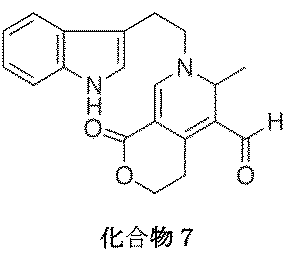
センブリの全草(73g)(株式会社紀伊國屋漢薬局より購入)にメタノール(0.8L)を加え、2日間静置し抽出した。得られた抽出液を減圧濃縮し、メタノール抽出物(21.6g)を得た。得られたメタノール抽出物を用いて、実施例1の工程1~3と同様の工程にしたがって、インドールアルカロイド型化合物等の化合物を含む多様性拡大抽出物(737mg)を得た。
得られた多様性拡大抽出物をシリカゲルカラムクロマトグラフィに付し、クロロホルム-メタノール(99:1)で溶出して画分A(243.1mg)、クロロホルム-メタノール(197:3)で溶出して画分B(59.5mg)、クロロホルム-メタノール(49:1)で溶出して画分C(91.7mg)、クロロホルム-メタノール(19:1)で溶出して画分D(59.8mg)、メタノールで溶出して画分E(196.2mg)をそれぞれ得た。
得られた画分Bをオクタデシルシリル化シリカゲルを担体とするカラムクロマトグラフィーに付し、水-アセトニトリル(3:2)で溶出した画分より化合物7(3.5mg)を得た。
得られた多様性拡大抽出物をシリカゲルカラムクロマトグラフィに付し、クロロホルム-メタノール(99:1)で溶出して画分A(243.1mg)、クロロホルム-メタノール(197:3)で溶出して画分B(59.5mg)、クロロホルム-メタノール(49:1)で溶出して画分C(91.7mg)、クロロホルム-メタノール(19:1)で溶出して画分D(59.8mg)、メタノールで溶出して画分E(196.2mg)をそれぞれ得た。
得られた画分Bをオクタデシルシリル化シリカゲルを担体とするカラムクロマトグラフィーに付し、水-アセトニトリル(3:2)で溶出した画分より化合物7(3.5mg)を得た。
化合物7は、EIMS(電子衝撃質量スペクトル)法による質量分析及びNMRによって解析した。EIMSおよびNMRの結果を以下に示す。
1H-NMR (600 MHz, CDCl3) δ 9.61 (1H, s), 8.10 (1H, br.s), 7.55 (1H, s), 7.45 (1H, dd, J = 7.9, 0.9 Hz), 7.34 (1H, dd, J = 8.2, 0.8 Hz), 7.18 (1H, ddd, J = 8.2, 8.0, 0.9 Hz), 7.07 (1H, td, J = 8.0, 0.8 Hz), 6.96 (1H, d, J = 2.0 Hz), 4.79 (1H, q, J = 6.4 Hz), 4.20-4.28 (2H, m), 3.75-3.82 (1H, m), 3.56-3.63 (1H, m), 3.10-3.16 (2H, m), 2.94 (1H, dt, J = 16.4, 4.6 Hz), 2.85 (1H, ddd, J = 16.4, 8.8, 5.4 Hz), 1.13 (3H, d, J = 6.4 Hz).
13C-NMR (150 MHz, CDCl3) δ 184.4, 165.2, 151.9, 147.7, 136.2, 126.9, 122.5, 122.2, 119.7, 118.1, 115.1, 111.4, 110.9, 95.2, 64.8, 56.2, 51.3, 25.0, 23.1, 18.5.
EIMS m/z (rel. int) 336 [M]+ (18), 321 (26), 144 (100), 130 (39).
HREIMS m/z 336.1454 (C20H20O3N2の計算値336.1474).
実施例4:化合物8の調製
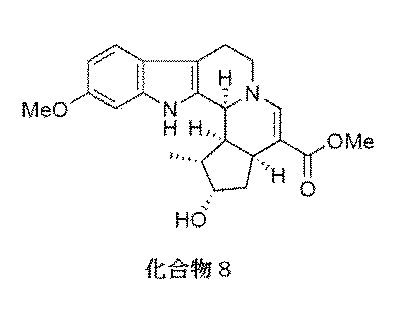
工程3のトリプタミンの代わりに6-メトキシトリプタミン(126mg、0.66mmol)を用いること以外は、実施例1の工程1~3と同様の工程にしたがって、インドールアルカロイド型化合物を含む多様性拡大抽出物(213mg)を得た。得られた多様性拡大抽出物をシリカゲルカラムクロマトグラフィに付し,クロロホルム-メタノール(49:1)で溶出して画分A(102mg)を得た。画分Aをリサイクル高速液体クロマトグラフィ(カラム:YMC-GPC T-2000、溶出溶媒:酢酸エチル、流速8mL/分)に付し,溶出時間12分~13分の画分を,5回繰り返し同一のカラムで分離することによって、化合物8(65mg)を得た。
化合物8は、EIMS(電子衝撃質量スペクトル)法による質量分析及びNMRによって解析した。EIMSおよびNMRの結果を以下に示す。
1H-NMR (600 MHz, CDCl3) δ 8.61 (1H, br.s), 7.34 (1H, s), 7.29 (1H, d, J = 8.5 Hz), 6.81 (1H, d, J = 2.2 Hz), 6.75 (1H, dd, J = 8.5, 2.2 Hz), 4.32 (1H, br.s), 4.20 (1H, t, J = 4.8 Hz), 3.79 (3H, s), 3.66 (1H, dd, J = 13.1, 5.9 Hz), 3.60 (3H, s), 3.40 (1H, ddd, J = 13.1, 12.0, 4.4 Hz), 2.91-2.97 (1H, m), 2.83-2.90 (1H, m), 2.68 (1H, dd, J = 15.2, 4.4 Hz), 2.39 (1H, ddd, J = 9.7, 8.2, 4.0 Hz), 2.23 (1H, ddd, J = 14.7, 7.9, 0.9 Hz), 1.99-2.05 (1H, m), 1.77 (1H, dt, J = 14.7, 5.9 Hz), 1.15 (3H, d, J = 7.0 Hz).
13C-NMR (150 MHz, CDCl3) δ 168.8, 156.2, 144.9, 136.6, 132.2, 121.5, 118.4, 109.0, 108.1, 104.0, 95.2, 74.3, 55.7, 52.8, 51.5, 50.6, 44.7, 42.3, 41.4, 30.8, 22.2, 12.8.
EIMS m/z (rel. int) 382 [M]+ (100), 365 (24), 323 (77), 311 (30), 200 (22).
HREIMS m/z 382.1851 (C22H26O4N2の計算値382.1893).
実施例5:化合物9の調製
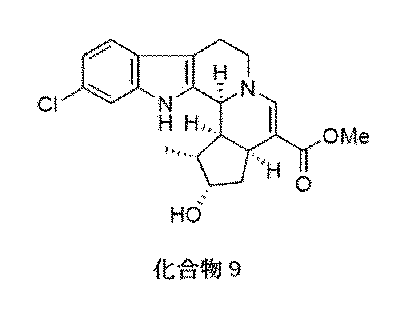
工程3の6-メトキシトリプタミン(126mg、0.66mmol)の代わりに6-クロロトリプタミン(110mg、0.57mmol)を用いること以外は、実施例4と同様の方法にしたがって、化合物9(4.3mg)を得た。
化合物9は、EIMS(電子衝撃質量スペクトル)法による質量分析及びNMRによって解析した。EIMSおよびNMRの結果を以下に示す。
1H-NMR (600 MHz, CDCl3) δ 8.20 (1H, br.s), 7.32 (1H, d, J = 1.3 Hz), 7.30 (1H, d, J = 8.4 Hz), 7.28 (1H, d, J = 1.8 Hz), 7.04 (1H, dd, J = 8.4, 1.8 Hz), 4.35 (1H, br.s), 4.22 (1H, t, J = 4.6 Hz), 3.71 (1H, dd, J = 13.3, 5.5 Hz), 3.61 (3H, s), 3.43 (1H, ddd, J = 13.3, 11.8, 4.8 Hz), 2.92-2.97 (1H, m), 2.85-2.91 (1H, m), 2.70 (1H, dd, J = 15.3, 4.8 Hz), 2.38 (1H, ddd, J = 9.8, 8.2, 4.0 Hz), 2.22 (1H, ddd, J = 14.8, 7.8, 1.1 Hz), 2.02-2.08 (1H, m), 1.79 (1H, dt, J = 14.8, 5.7 Hz), 1.17 (3H, d, J = 7.1 Hz).
13C-NMR (150 MHz, CDCl3) δ 168.5, 144.4, 136.1, 134.1, 127.7., 125.8, 120.4, 118.8, 111.0, 108.8, 104.8, 74.5, 52.7, 51.3, 50.7, 44.8, 42.5, 41.4, 30.9, 22.0, 12.7.
EIMS m/z (rel. int) 388 [M+2]+ (33), 386 [M]+ (100), 327 (72), 313 (48), 289 (39), 204 (30).
HREIMS m/z 386.1431 (C21H23O3N2 35Clの計算値386.1397).
実施例6:化合物10の調製
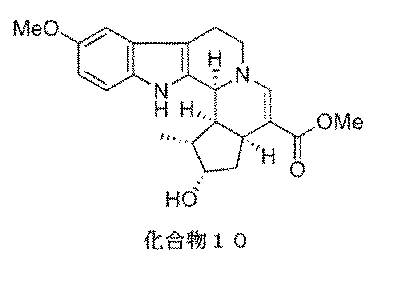
工程3の6-メトキシトリプタミン(126mg、0.66mmol)の代わりに5-メトキシトリプタミン(26mg、0.14mmol)を用いること以外は、実施例4と同様の方法にしたがって、化合物10(9.5mg)を得た。
化合物10は、EIMS(電子衝撃質量スペクトル)法による質量分析及びNMRによって解析した。EIMSおよびNMRの結果を以下に示す。
1H-NMR (600 MHz, CDCl3) δ 8.20 (1H, br.s), 7.33 (1H, s), 7.19 (1H, d, J = 8.8 Hz), 6.87 (1H, d, J = 2.4 Hz), 6.79 (1H, dd, J = 8.8, 2.4 Hz), 4.35 (1H, br.s), 4.20 (1H, t, J = 5.5 Hz), 3.82 (3H, s), 3.70 (1H, dd, J = 13.1, 5.7 Hz), 3.59 (3H, s), 3.43 (1H, ddd, J = 13.1, 12.0, 4.7 Hz), 2.91-2.96 (1H, m), 2.85-2.91 (1H, m), 2.70 (1H, dd, J = 15.1, 4.7 Hz), 2.36 (1H, ddd, J = 9.7, 8.1, 3.8 Hz), 2.18 (1H, ddd, J = 14.7, 8.1, 1.2 Hz), 2.00-2.07 (1H, m), 1.77 (1H, dt, J = 14.7, 5.9 Hz), 1.16 (3H, d, J = 7.0 Hz).
13C-NMR (150 MHz, CDCl3) δ 168.6, 154.2, 144.6, 134.2, 130.9, 127.5, 111.74, 111.73, 108.4, 104.4, 100.2, 74.5, 56.0, 52.9, 51.5, 50.6, 44.8, 42.5, 41.4, 30.9, 22.2, 12.8.
EIMS m/z (rel. int) 382 [M]+ (100), 364 (90), 323 (66), 200 (52), 129 (81).
HREIMS m/z 382.1896 (C22H26O4N2の計算値382.1893).
実施例7:化合物11の調製
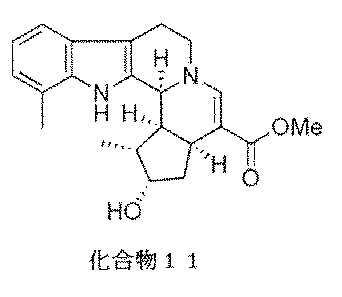
工程3の6-メトキシトリプタミン(126mg、0.66mmol)の代わりに7-メチルトリプタミン(71mg、0.40mmol)を用いること以外は、実施例4と同様の方法にしたがって、化合物11(10.1mg)を得た。
化合物11は、EIMS(電子衝撃質量スペクトル)法による質量分析及びNMRによって解析した。EIMSおよびNMRの結果を以下に示す。
1H-NMR (600 MHz, CDCl3) δ 8.10 (1H, br.s), 7.34 (1H, s), 7.29 (1H, d, J = 7.8 Hz), 7.01 (1H, t, J = 7.8 Hz), 6.95 (1H, t, J = 7.8 Hz), 4.39 (1H, br.s), 4.22 (1H, t, J = 5.4 Hz), 3.70 (1H, dd, J = 13.1, 6.0 Hz), 3.60 (3H, s), 3.44 (1H, ddd, J = 13.1, 12.0, 4.5 Hz), 2.95-3.00 (1H, m), 2.88-2.95 (1H, m), 2.74 (1H, dd, J = 14.5, 5.6 Hz), 2.47 (3H, s), 2.40-2.44 (1H, m), 2.23 (1H, ddd, J = 14.8, 8.2, 0.9 Hz), 2.02-2.10 (1H, m), 1.78 (1H, dt, J = 14.8, 5.4 Hz), 1.20 (3H, d, J = 7.0 Hz).
13C-NMR (150 MHz, CDCl3) δ 168.6, 144.7, 135.3, 133.0, 126.6, 122.6, 120.3, 119.9, 115.6, 109.1, 104.3, 74.5, 52.9, 51.5, 50.6, 44.7, 42.5, 41.6, 31.0, 22.3, 16.8, 12.7.
EIMS m/z (rel. int) 366 [M]+ (100), 348 (41), 305 (80), 293 (91).
HREIMS m/z 366.1968 (C22H26O3N2の計算値366.1943).
実施例8:化合物12の調製
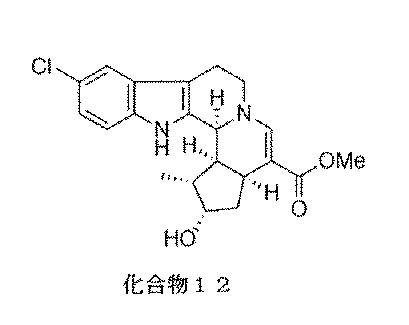
工程3の6-メトキシトリプタミン(126mg、0.66mmol)の代わりに5-クロロトリプタミン(114mg、0.59mmol)を用いること以外は、実施例4と同様の方法にしたがって、化合物12(2.0mg)を得た。
化合物12は、EIMS(電子衝撃質量スペクトル)法による質量分析及びNMRによって解析した。EIMSおよびNMRの結果を以下に示す。
1H-NMR (600 MHz, CDCl3) δ 8.09 (1H, br.s), 7.38 (1H, d, J = 1.9 Hz), 7.31 (1H, d, J = 1.0 Hz), 7.20 (1H, d, J = 8.6 Hz), 7.08 (1H, dd, J = 8.6, 1.9 Hz), 4.37 (1H, br.s), 4.22 (1H, t, J = 5.2 Hz), 3.71 (1H, dd, J = 13.3, 6.7 Hz), 3.60 (3H, s), 3.42 (1H, ddd, J = 13.3, 11.9, 4.6 Hz), 2.92-2.97 (1H, m), 2.84-2.90 (1H, m), 2.74 (1H, dd, J = 15.4, 4.6 Hz), 2.36 (1H, ddd, J = 9.7, 8.1, 3.7 Hz), 2.23 (1H, ddd, J = 14.8, 8.0, 1.2 Hz), 2.01-2.08 (1H, m), 1.79 (1H, dt, J = 14.8, 5.2 Hz), 1.17 (3H, d, J = 7.0 Hz).
13C-NMR (150 MHz, CDCl3) δ 168.4, 144.3, 134.9, 134.1, 128.3, 125.5, 122.2, 117.7, 111.9, 108.5, 104.9, 74.5, 52.7, 51.3, 50.7, 44.8, 42.5, 41.4, 30.8, 22.0, 12.7.
EIMS m/z (rel. int) 388 [M+2]+ (22), 386 [M]+ (99), 368 (69), 327 (71), 313 (100), 289 (68), 204 (71).
HREIMS m/z 386.1369 (C21H23O3N2 35Clの計算値386.1397).
実施例9:化合物13の調製
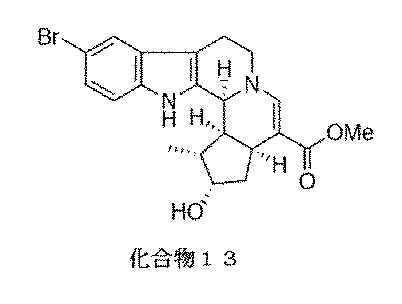
工程3の6-メトキシトリプタミン(126mg、0.66mmol)の代わりに5-ブロモトリプタミン(133mg、0.56mmol)を用いること以外は、実施例4と同様の方法にしたがって、化合物13(1.4mg)を得た。
化合物13は、EIMS(電子衝撃質量スペクトル)法による質量分析及びNMRによって解析した。EIMSおよびNMRの結果を以下に示す。
1H-NMR (600 MHz, CDCl3) δ 8.05 (1H, br.s), 7.55 (1H, d, J = 1.8 Hz), 7.31 (1H, s), 7.22 (1H, dd, J = 8.5, 1.8 Hz), 7.17 (1H, d, J = 8.5 Hz), 4.37 (1H, br.s), 4.22 (1H, t, J = 5.1 Hz), 3.71 (1H, dd, J = 13.3, 5.8 Hz), 3.60 (3H, s), 3.42 (1H, ddd, J = 13.3, 12.0, 4.6 Hz), 2.92-2.98 (1H, m), 2.84-2.90 (1H, m), 2.74 (1H, dd, J = 15.4, 4.6 Hz), 2.36 (1H, ddd, J = 9.9, 8.3, 3.7 Hz), 2.21 (1H, ddd, J = 14.8, 8.1, 0.9 Hz), 2.02-2.09 (1H, m), 1.79 (1H, dt, J = 14.8, 5.1 Hz), 1.17 (3H, d, J = 7.0 Hz).
13C-NMR (150 MHz, CDCl3) δ 168.4, 144.3, 134.8, 134.4, 129.0, 124.7, 120.8, 113.0, 112.4, 108.5, 104.9, 74.4, 52.7, 51.3, 50.7, 44.8, 42.5, 41.4, 30.8, 22.0, 12.7.
EIMS m/z (rel. int) 432 [M+2]+ (72), 430 [M]+ (100), 371 (90), 359 (95), 333 (56), 248 (50).
HREIMS m/z 430.0885 (C21H23O3N2 79Brの計算値430.0892).
実施例10:化合物14の調製
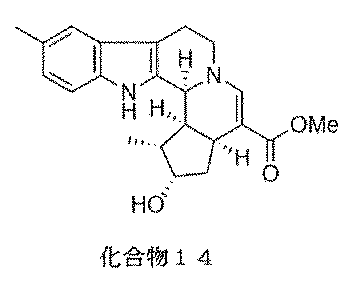
工程3の6-メトキシトリプタミン(126mg、0.66mmol)の代わりに5-メチルトリプタミン(96mg、0.55mmol)を用いること以外は、実施例4と同様の方法にしたがって、化合物14(9.3mg)を得た。
化合物14は、EIMS(電子衝撃質量スペクトル)法による質量分析及びNMRによって解析した。EIMSおよびNMRの結果を以下に示す。
1H-NMR (600 MHz, CDCl3) δ 8.15 (1H, br.d), 7.33 (1H, d, J = 0.9 Hz), 7.22 (1H, d, J = 1.1 Hz), 7.19 (1H, d, J = 8.3 Hz), 6.95 (1H, dd, J = 8.3, 1.1 Hz), 4.35 (1H, br.s), 4.21 (1H, t, J = 4.7 Hz), 3.69 (1H, dd, J = 12.9, 5.9 Hz), 3.59 (3H, s), 3.43 (1H, ddd, J = 12.9, 11.9, 4.7 Hz), 2.92-2.97 (1H, m), 2.85-2.92 (1H, m), 2.71 (1H, dd, J = 15.2, 4.7 Hz), 2.41 (3H, s), 2.31-2.37 (1H, m), 2.20 (1H, ddd, J = 14.7, 7.8, 1.1 Hz), 2.01-2.09 (1H, m), 1.76 (1H, dt, J = 14.7, 5.6 Hz), 1.17 (3H, d, J = 7.0 Hz).
13C-NMR (150 MHz, CDCl3) δ 168.6, 144.7, 134.1, 133.5, 128.9, 127.3, 123.4, 117.7, 110.7, 108.1, 104.2, 74.4, 52.9, 51.5, 50.6, 44.9, 42.5, 41.5, 31.0, 22.2, 21.4, 14.2, 12.8.
EIMS m/z (rel. int) 366 [M]+ (100), 307 (55), 295 (35), 269 (21), 184 (15).
HREIMS m/z 366.1956 (C22H26O3N2の計算値366.1943).
実施例11:化合物15の調製
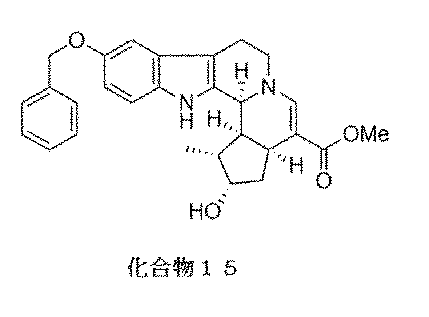
工程3の6-メトキシトリプタミン(126mg、0.66mmol)の代わりに5-ベンジルオキシトリプタミン(102mg、0.38mmol)を用いること以外は、実施例4と同様の方法にしたがって、化合物15(10.3mg)を得た。
化合物15は、EIMS(電子衝撃質量スペクトル)法による質量分析及びNMRによって解析した。EIMSおよびNMRの結果を以下に示す。
1H-NMR (600 MHz, CDCl3) δ 8.20 (1H, br.s), 7.45 (2H, dd, J = 7.3, 1.1 Hz), 7.36 (2H, t, J = 7.3 Hz), 7.33 (1H, d, J = 1.0 Hz), 7.29 (1H, t, J = 7.3 Hz), 7.20 (1H, d, J = 8.7 Hz), 6.97 (1H, d, J = 2.3 Hz), 6.87 (1H, dd, J = 8.7, 2.3 Hz), 5.07 (2H, s), 4.35 (1H, br.s), 4.20 (1H, t, J = 5.0 Hz), 3.69 (1H, dd, J = 12.9, 5.8 Hz), 3.60 (3H, s), 3.43 (1H, td, J = 12.9, 4.5 Hz), 2.92-2.97 (1H, m), 2.83-2.90 (1H, m), 2.71 (1H, dd, J = 15.3, 4.5 Hz), 2.33-2.38 (1H, m), 2.19 (1H, ddd, J = 14.7, 9.0, 1.2 Hz), 2.00-2.08 (1H, m), 1.78 (1H, dt, J = 14.7, 5.8 Hz), 1.16 (3H, d, J = 6.9 Hz).
13C-NMR (150 MHz, CDCl3) δ 168.6, 153.4, 144.6, 137.6, 134.3, 131.1, 128.5 (2C), 127.7, 127.5 (3C), 112.4, 111.7, 108.4, 104.3, 101.9, 74.4, 71.0, 52.9, 51.5, 50.6, 44.8, 42.5, 41.5, 30.9, 22.2, 12.8.
EIMS m/z (rel. int) 458 [M]+ (100), 440 (54), 399 (52), 367 (79).
HREIMS m/z 458.2194 (C28H30O4N2の計算値458.2206).
実施例12:化合物16の調製
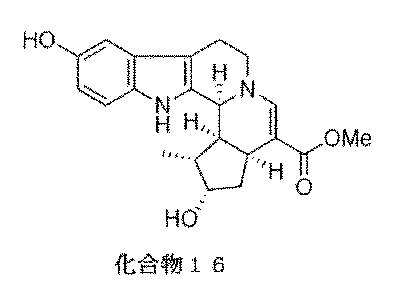
化合物15(4.0mg、8.72μmol)をメタノール(0.5mL)に溶かし、20%水酸化パラジウム-炭素(1.0mg)を加えて,水素雰囲気(1気圧)下室温で15時間撹拌した。反応液を濾過し、その濾液を減圧留去した。残渣をオクタデシルシリカゲルカラムクロマトグラフィに付し、アセトニトリル-水(7:3)で溶出した画分より化合物16(2.9mg、7.88μmol)を得た。
化合物16は、EIMS(電子衝撃質量スペクトル)法による質量分析及びNMRによって解析した。EIMSおよびNMRの結果を以下に示す。
1H-NMR (600 MHz, CD3OD) δ 7.45 (1H, d, J = 0.6 Hz), 7.15 (1H, d, J = 8.7 Hz), 6.76 (1H, d, J = 2.1 Hz), 6.62 (1H, dd, J = 8.7, 2.1 Hz), 4.42 (1H, br.s), 4.15 (1H, td, J = 5.5, 2.2 Hz), 3.77 (1H, dd, J = 12.8, 6.0 Hz), 3.60 (3H, s), 3.47 (1H, td, J = 12.8, 4.2 Hz), 2.87-2.91 (1H, m), 2.77-2.85 (1H, m), 2.66 (1H, dd, J = 15.0, 4.2 Hz), 2.36 (1H, ddd, J = 9.5, 8.0, 4.1 Hz), 2.14 (1H, ddd, J = 14.3, 7.7, 2.2 Hz), 2.06-2.11 (1H, m), 1.80 (1H, dt, J = 14.3, 5.8 Hz), 1.14 (3H, d, J = 7.0 Hz).
13C-NMR (150 MHz, CD3OD) δ 171.0, 151.4, 147.1, 135.8, 132.8, 129.1, 112.5, 112.0, 108.1, 104.4, 103.0, 74.7, 54.7, 52.7, 51.1, 46.8, 43.1, 42.4, 32.3, 23.5, 13.4.
EIMS m/z (rel. int) 368 [M]+ (100), 351 (15), 309 (48), 297 (27), 271 (18), 186 (11).
HREIMS m/z 368.1753 (C21H24O4N2の計算値368.1736).
実施例13:化合物17の調製
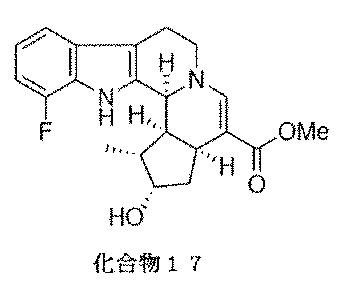
工程3の6-メトキシトリプタミン(126mg、0.66mmol)の代わりに6-フルオロトリプタミン(101mg、0.57mmol)を用いること以外は、実施例4と同様の方法にしたがって、化合物17(12.3mg)を得た。
化合物17は、EIMS(電子衝撃質量スペクトル)法による質量分析及びNMRによって解析した。EIMSおよびNMRの結果を以下に示す。
1H-NMR (600 MHz, CDCl3) δ 8.50 (1H, br.d), 7.32 (1H, s), 7.31 (1H, dd, J = 8.6, 5.1 Hz), 6.99 (1H, dd, J = 7.6, 2.1 Hz), 6.82 (1H, ddd, J = 8.6, 7.3, 2.1 Hz), 4.35 (1H, br.s), 4.21 (1H, t, J = 4.9 Hz), 3.70 (1H, dd, J = 12.9, 5.9 Hz), 3.59 (3H, s), 3.43 (1H, td, J = 12.9, 4.5 Hz), 2.91-2.96 (1H, m), 2.84-2.91 (1H, m), 2.70 (1H, dd, J = 15.3, 4.5 Hz), 2.40 (1H, td, J = 9.5, 3.5 Hz), 2.20 (1H, ddd, J = 14.7, 8.0 Hz), 1.99-2.05 (1H, m), 1.77 (1H, dt, J = 14.7, 5.7 Hz), 1.15 (3H, d, J = 6.8 Hz).
13C-NMR (150 MHz, CDCl3) δ 168.6, 159.8 (d, J = 237.3 Hz), 144.6, 135.8 (d, J = 12.2 Hz), 133.6 (d, J = 2.9 Hz), 123.7, 118.5 (d, J = 10.0 Hz), 108.5, 108.1 (d, J = 24.4 Hz), 104.6, 97.5 (d, J = 25.8 Hz), 74.5, 52.7, 51.4, 50.7, 44.7, 42.4, 41.4, 30.8, 22.1, 12.7.
EIMS m/z (rel. int) 370 [M]+ (100), 311 (76), 297 (53), 273 (35), 188 (40).
HREIMS m/z 370.1685 (C21H23O3N2Fの計算値370.1693).
薬理試験
以下に、本発明の実施例化合物についての薬理試験方法およびその結果を示す。
[実験材料]
(1)細胞
ヒト成人T細胞白血病由来MT2細胞を使用した。ヒト成人T細胞白血病(ATL)の白血病細胞はCD4分子およびCD25分子を細胞表面に発現しており、Treg由来であると考えられている(Chen S. et al., International Immunology 18:269-277 (2005))。MT2細胞はATL由来の細胞で、CD4陽性、CD25陽性、FOXP3陽性細胞であることからTregのモデルとして実験に使用した。
(2)被験試料
本発明の実施例化合物(化合物1~17)をジメチルスルホキシド(DMSO)によって50mmol/L溶液とし、-80℃で保存した。
試験例1:ELISAキットによる培養上清中のヒトIL-10量の測定
本発明の実施例化合物のIL-10産生抑制効果を評価するために、以下の手順に従って、対照および実施例化合物におけるIL-10産生量を測定した。
(1)MT2細胞を10%ウシ胎児血清(FCS)および1%ペニシリン・ストレプトマイシン(P/S)を添加したRPMI1640培地(培地)に3×105細胞/mLとなるよう懸濁し、24ウェルプレートの各ウェルに1mLずつ分注、播種した。これに、被験試料(化合物1~7)を培地で50倍希釈した希釈液20μLまたは10μL加えて、炭酸ガス培養器(37℃、5%CO2条件下)で48±2時間培養した。また、被験試料(化合物8~17)を培地で50倍希釈した希釈液25.0μLまたは12.5μL加えて、炭酸ガス培養器(37℃、5%CO2条件下)で48±2時間培養した。化合物1~7の対照として、DMSOを培地で50倍希釈したものを20μL加えた。また、化合物8~17の対照として、DMSOを培地で50倍希釈したものを25.0μL加えた。
(2)細胞培養液の一部を採取し、セルカウンター(BIO RAD TC-20)で細胞を計数した。細胞培養液を300×gで5分間遠心分離し、上清をIL-10測定用試料として採取した。当日測定しない場合には-80℃のフリーザーで保存した。
(3)測定には、Human IL-10 ELISA kit II (BD OptEIA)を使用した。キットには抗IL-10抗体処理済ウェル(8ウェル/ストリップ)、Standard/Sample diluent、凍結乾燥のIL-10 Standard含有バイアル(1280pg/バイアル)、ELISA diluent、20 x Washi Buffer、Detection antibody、Enzyme Concentrate、TMB One Step Substrate Reagent、Stop Solution、カバーシートが含まれている。
(4)IL-10 Standard含有バイアルに、2.3mL Standard/Sample diluentを加え、15分間室温放置後に溶解した(標準試料原液IL-10濃度:500pg/mL)。
(5)検量線用の各濃度の標準試料を以下のように調製した。最初に300μLの培地に標準試料原液を300μL加え、ボルテックスミキサー(voltex mixer)で混合した(250pg/mL)。次に250pg/mLの標準試料300μLを300μLの培地に加え、ボルテックスミキサーで混合した(125pg/mL)。同様の操作を順次繰り返し、62.5、31.25、15.625、7.8125pg/mLの濃度の標準試料を調製した。0pg/mLには培地を使用した。
(6)キットの抗IL-10抗体処理ウェル(8ウェルが1ストリップ)を室温に戻し、各ウェルにキットに含まれるELISA diluentを50μLずつ加えた。
(7)ELISA diluentの入った各ウェルに、各濃度の標準試料および被験試料(培地で50-100倍希釈)を100μLずつウェルに添加した。
(8)ウェルにカバーシールを貼り、軽くタッピング後に2時間室温放置した。
(9)20 x Wash Bufferを水で20倍希釈し、1 x Wash Bufferを調製した。
(10)2時間の反応後、ウェルの中の溶液をアスピレーションし、300μLの1 x Wash Bufferで5回洗浄した。
(11)Enzyme Concentreat(8ウェル当たり4μL)をDetection antibody(8ウェル当たり1mL)に加えた後、ボルテックスミキサーで混合し、必要量のWorking Detectorを調製した。
(12)Working Detectorを各ウェルに100μLずつ加え、カバーシートをし、1時間室温放置した。
(13)1時間の反応後、ウェルの中の溶液をアスピレーションし、300μLの1 x Wash Bufferで7回洗浄した。
(14)100μLのTMB One Step Substrate Reagentを加え、暗所に30分間放置した。
(15)50μLのStop solutionを加え、30分以内に570nmにおける吸光度をバックグランドとして差し引いた470nmにおける吸光度をマイクロプレートリーダー(Thermo Scientific;Varioskan Flash)で測定した。
(16)吸光値より、Microsoft Excel 2013を使用し、各濃度の標準試料の吸光値から回帰直線を求め(検量線)、検量線から対照及び各化合物処置検体の値を求めた。実験はn=3で行ったので、各群の値は平均値と標準偏差値を示した。
本発明の実施例化合物を上述の薬理試験で評価したところ、本発明の化合物がIL-10産生抑制効果を示すことを見出した。対照および各化合物のIL-10産生抑制活性ならびに対照に対する抑制率(%)を、下表1に示す。
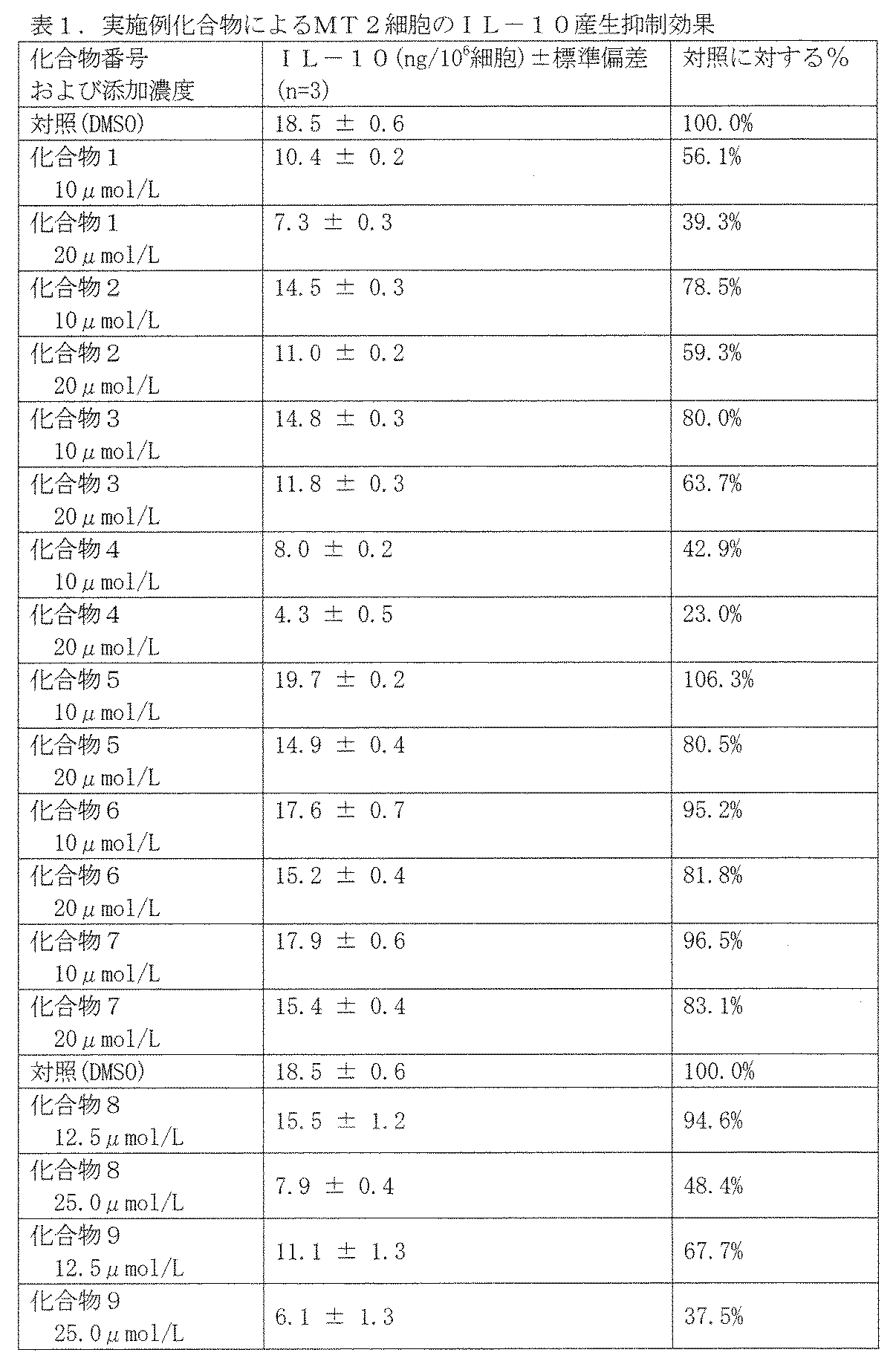
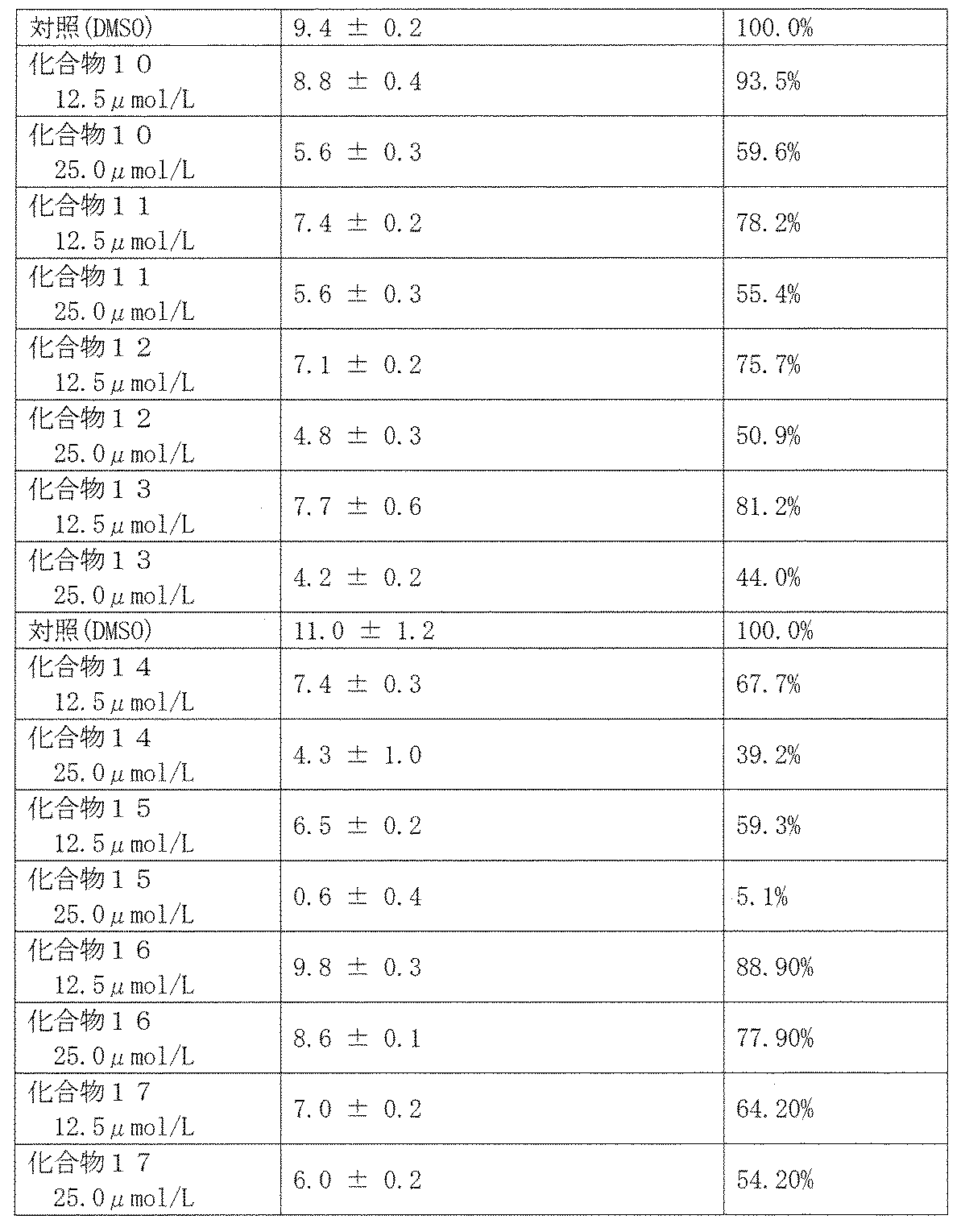
試験例2:蛍光抗体標識抗CTLA-4抗体による細胞内染色とフローサイトメーターによる測定
試験例1においてIL-10阻害活性を示す上記化合物のうち、特に優れた阻害活性を有する化合物1、2、4および8~17について、以下の手順にしたがって、CTLA-4の発現量を測定し、免疫チェックポイント阻害活性を評価した。
(1)MT2細胞を10%ウシ胎児血清(FCS)および1%ペニシリン・ストレプトマイシン(P/S)を添加したRPMI1640培地(以下、培地)に3x105細胞/mLとなるよう懸濁し、6ウェルプレートの各ウェルに3mLずつ分注、播種した。これに試験化合物(化合物1、2および4)溶液を0.6μLまたは1.2μL、試験化合物(化合物9)溶液を0.75μLまたは1.5μL、そして、試験化合物(化合物8および10~17)溶液を1.5μL加えて、炭酸ガス培養器(37℃、5%CO2条件下)で48±2時間培養した。化合物1、2および4の対照として、DMSOのみを1.2μL加えた。また、化合物8~17の対照として、DMSOのみを1.5μL加えた。
(2)細胞培養液の一部を採取し、セルカウンター(BIO RAD TC-20)で細胞を計数した。細胞培養液を300xgで5分間遠心分離し、上清を除去した。細胞濃度が5~10x106細胞/mLとなるように1%ウシ血清アルブミン(BSA)添加カルシウム・マグネシウム不含リン酸緩衝生理的食塩液(1%BSA/PBS)で懸濁した。
(3)5mLチューブに、細胞懸濁液を各50μL加えた。
(4)FOXP3/Transcription Factor Staining kit (TONBO biosciences)に含まれるFoxp3/Transcription Factor Fix/Perm Concentrate(4X)(Cat. No. TNB-1020-L050)(A液)をFoxp3/Transcription Factor Fix/Perm Diluent (1X)(Cat. No. TNB-1022-L160)(A希釈用液)で希釈し、1×A液を調製した。
(5)1×A液を各チューブに1mLずつ加え、軽くピペッティングして撹拌した。続いて、室温で30分間放置し、300xgで5分間遠心分離し、上清を捨てた。
(6)キットに含まれるFlow Cytometry Perm Buffer (10X)(Cat. No. TNB-1213-L150)(B液)を水で10倍希釈し、1×B液を調製した。
(7)1×B液を2mL加え、300xgで5分間遠心分離した。上清を捨て、2%正常マウス血清/PBSを2μL加え、軽くピペッティングした。続いて、室温で15分間静置した。
(8)CTLA-4測定では、抗CTLA-4抗体(BECKMAN COULTER, CD152-PE clone BN13I M2282)または対照としてマウスIgG2a(BECKMAN COULTER, IgG2a(Mouse)-PE A09142)を20μL加え、軽く撹拌した。続いて、室温・暗所で30分間放置し、1×B液を2mL加え、300xgで5分間遠心分離し、上清を捨てた。再度、1×B液を2mL加え、300xgで5分間遠心分離し、上清を捨てた。
(9)該溶液を0.5mLの1%BSA/PBSに懸濁させ、フローサイトメーター(ソニー:Cell Sorter SH800)を用いて、励起波長488nmで575nmの蛍光を2時間以内に測定した。結果は、ソフトウエアのFlowJo(Tree Star Inc.)で解析した。測定した蛍光の強度と細胞数のヒストグラムからCTLA-4のピーク中間蛍光値(MFI)とアイソタイプコントロールのIgG2aのピーク中間蛍光値を求め、CTLA-4の中間蛍光値からIgG2aの中間蛍光値を際し引いた。実験はn=3で行い、平均値を示した。
本発明の化合物1、2および4(10μmol/Lおよび20μmol/L)、化合物9(12.5μmol/Lおよび25.0μmol/L)ならびに化合物8および10~17(25.0μmol/L)を上述の薬理試験で評価したところ、本発明の化合物1、4および8~17、特に化合物1、15および17がCTLA-4発現抑制効果を示すことを見出した。対照および各化合物のCTLA-4発現抑制活性ならびに対照に対する抑制率(%)を、下表2に示す。
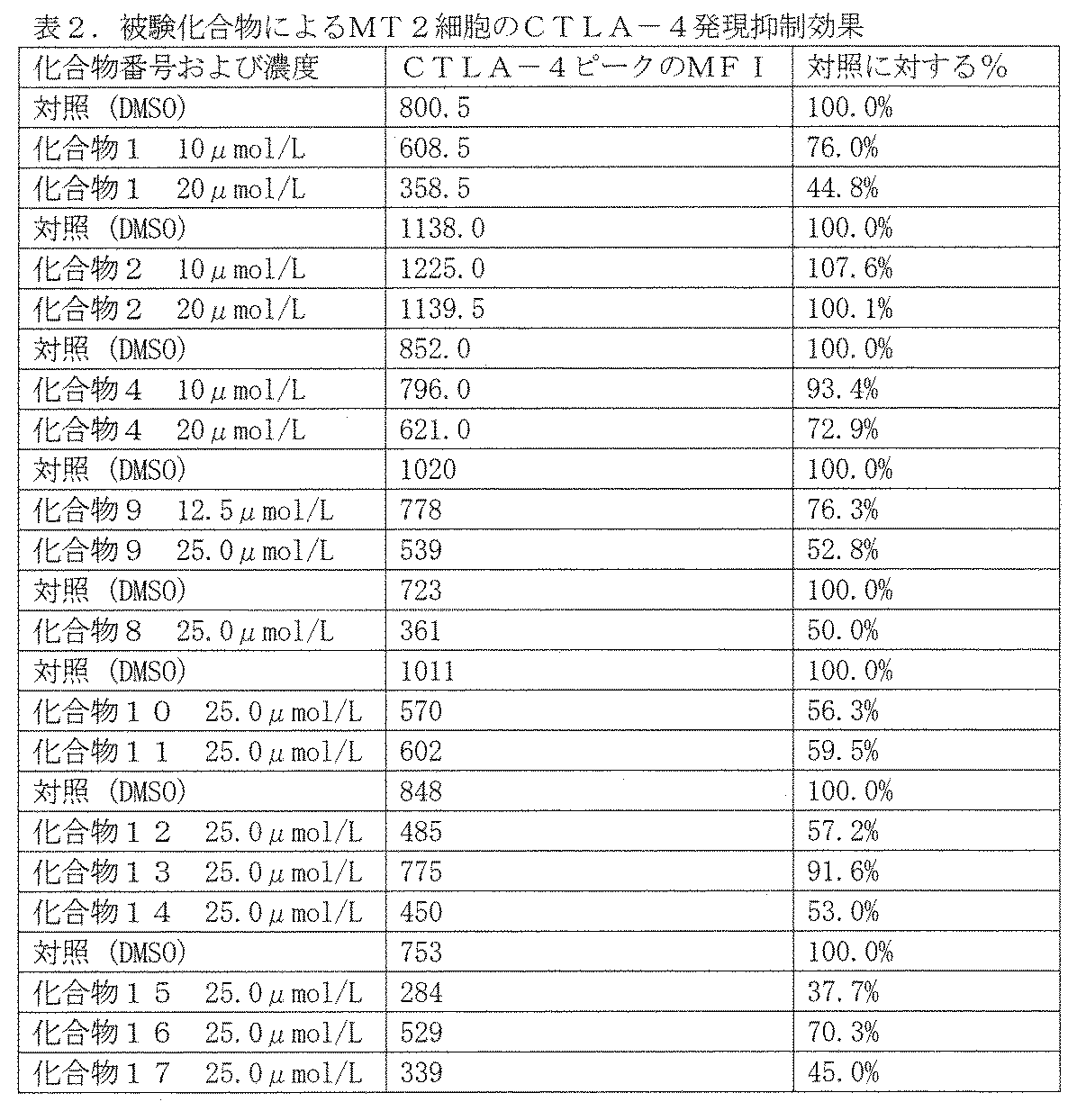
上記結果より、本発明の化合物は、CTLA-4阻害活性、すなわち、免疫チェックポイント阻害活性を有することが確認された。
本発明の化合物は、CTLA-4発現抑制作用およびIL-10産生抑制作用を有しており、免疫チェックポイントに起因する疾患、特に、がんの予防および/または治療に有用である。また、ワクチンの補助剤(アジュバント)として有用である。
Claims (18)
- 式(I):
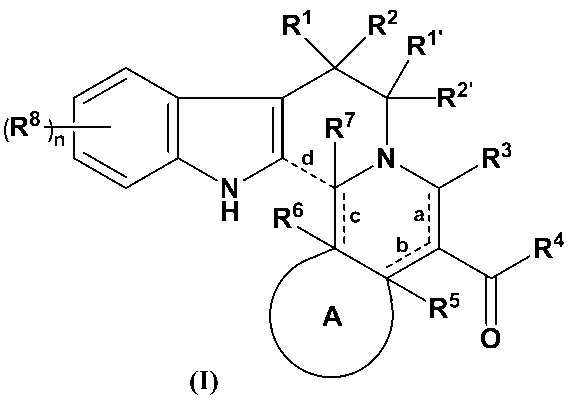
a~c:


環Aは、C3-6シクロアルキル環、C3-6シクロアルケニル環または5員もしくは6員の単環式ヘテロ環であり、ここで、該シクロアルキル環、シクロアルケン環および単環式ヘテロ環は、置換可能な位置で、ハロゲン、ヒドロキシ、オキソ、アミノ、ニトロ、モノ-もしくはジ-C1-6アルキル-アミノ、C1-4アシル、C1-6アルキル、C1-6ハロアルキル、C1-6ヒドロキシアルキル、C1-6アルコキシ、およびC1-6ハロアルコキシからなる群から選択される1つまたは同一もしくは異なる2つ以上の基で置換されていてもよく;
R1、R1’、R2、R2’およびR3は、各々独立して、水素、ハロゲン、ヒドロキシ、アミノ、ニトロ、モノ-もしくはジ-C1-6アルキル-アミノ、C1-6アルキル、C1-6ハロアルキル、C1-6ヒドロキシアルキル、C1-6アルコキシまたはC1-6ハロアルコキシであり;
R4は、水素、ハロゲン、ヒドロキシ、アミノ、モノ-もしくはジ-C1-6アルキル-アミノ、C1-6アルキル、C2-6アルケニル、C2-6アルキニル、C1-6アルコキシ、C3-6シクロアルキル、3員ないし6員のヘテロシクロアルキル、C6-10アリールまたは6員ないし10員のヘテロアリールであり、ここで、該アルキル、アルケニル、アルキニル、アルコキシ、シクロアルキル、ヘテロシクロアルキル、アリールおよびヘテロアリールは、各々独立して、置換可能な位置で、ハロゲン、ヒドロキシ、アミノ、ニトロ、モノ-もしくはジ-C1-6アルキルアミノ、C1-4アシル、C1-6アルキル、C1-6ハロアルキル、C1-6ヒドロキシアルキル、C1-6アルコキシ、およびC1-6ハロアルコキシからなる群から選択される1つまたは同一もしくは異なる2つ以上の基で置換されていてもよく;
R5、R6およびR7は、各々独立して、水素、ハロゲン、ヒドロキシ、C1-3アルキル、C1-3ハロアルキル、C1-3ヒドロキシアルキル、C1-3アルコキシまたはC1-3ハロアルコキシであり;
R8は、各々独立して、水素、ハロゲン、ヒドロキシ、アミノ、ニトロ、モノ-もしくはジ-C1-6アルキル-アミノ、C1-6アルキル、C2-6アルケニル、C2-6アルキニル、C1-6アルコキシ、ベンジルオキシ、C3-6シクロアルキル、3員ないし6員のヘテロシクロアルキル、C6-10アリールまたは6員ないし10員のヘテロアリールであり、ここで、該アルキル、アルケニル、アルキニル、アルコキシ、シクロアルキル、ヘテロシクロアルキル、アリールまたはヘテロアリールは、置換可能な位置で、ハロゲン、ヒドロキシ、アミノ、ニトロ、モノ-もしくはジ-C1-6アルキル-アミノ、C1-4アシル、C1-6アルキル、C1-6ハロアルキル、C1-6ヒドロキシアルキル、C1-6アルコキシ、およびC1-6ハロアルコキシからなる群から選択される1つまたは同一もしくは異なる2つ以上の基で置換されていてもよく;および
nは、1~4である]
で示される化合物またはその医薬的に許容される塩。 - 請求項1記載の化合物またはその医薬的に許容される塩、ただし、点線aが二重結合を表し、R8が水素である化合物は除く。
- 請求項1記載の化合物またはその医薬的に許容される塩、ただし、点線aが二重結合を表す化合物は除く。
- 請求項1記載の化合物またはその医薬的に許容される塩、ただし、下記の化合物は除く。
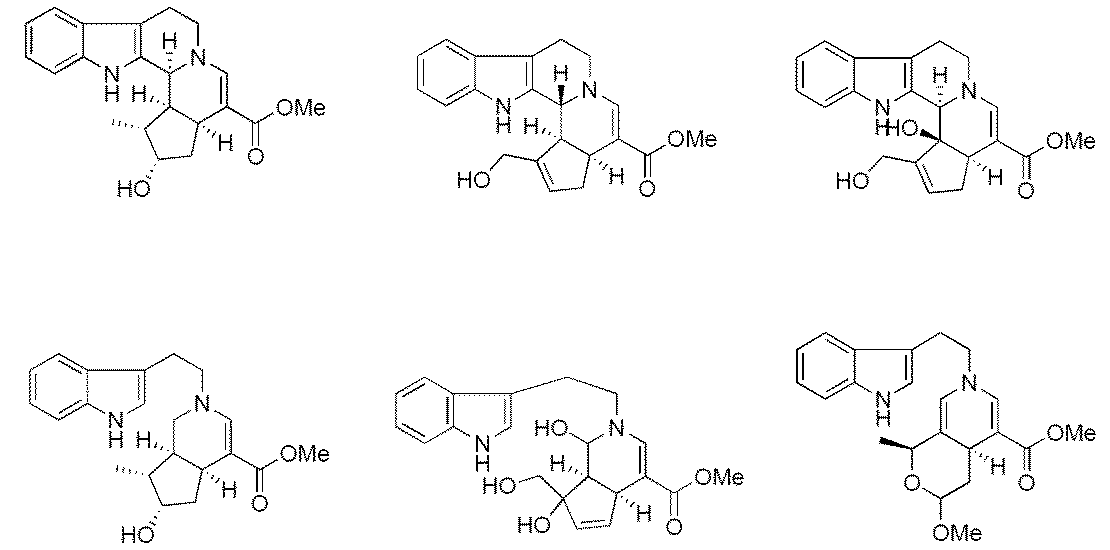
- R4が、水素、ヒドロキシ、アミノ、モノ-もしくはジ-C1-6アルキル-アミノ、C1-6アルキル、C1-6ハロアルキル、C1-6ヒドロキシアルキル、C1-6アルコキシまたはC1-6ハロアルコキシである、請求項1~4のいずれか一項に記載の化合物またはその医薬的に許容される塩。
- R8が、各々独立して、水素、ハロゲン、ヒドロキシ、アミノ、モノ-もしくはジ-C1-6アルキル-アミノ、C1-6アルキル、C1-6ハロアルキル、C1-6ヒドロキシアルキル、C1-6アルコキシ、ベンジルオキシまたはC1-6ハロアルコキシである、請求項1~5のいずれか一項に記載の化合物またはその医薬的に許容される塩。
- 環Aが、C5-6シクロアルキル環、C5-6シクロアルケニル環または5員もしくは6員の単環式飽和ヘテロ環であり、ここで、該シクロアルキル環、シクロアルケン環および単環式飽和ヘテロ環は、置換可能な位置で、ヒドロキシ、オキソ、C1-6アルキル、C1-6ハロアルキル、C1-6ヒドロキシアルキル、C1-6アルコキシ、およびC1-6ハロアルコキシからなる群から選択される1つまたは同一もしくは異なる2つ以上の基で置換されていてもよい、請求項1~6のいずれか一項に記載の化合物またはその医薬的に許容される塩。
- 環Aが、以下:

- R5、R6およびR7が、各々独立して、水素またはヒドロキシである、請求項1~8のいずれか一項に記載の化合物またはその医薬的に許容される塩。
- R1、R1’、R2、R2’およびR8が、水素である、請求項1~9のいずれか一項に記載の化合物またはその医薬的に許容される塩。
- R3が、C1-6アルキル、C1-6ハロアルキル、C1-6ヒドロキシアルキル、C1-6アルコキシまたはC1-6ハロアルコキシである、請求項1~10のいずれか一項に記載の化合物またはその医薬的に許容される塩。
- 化合物が、
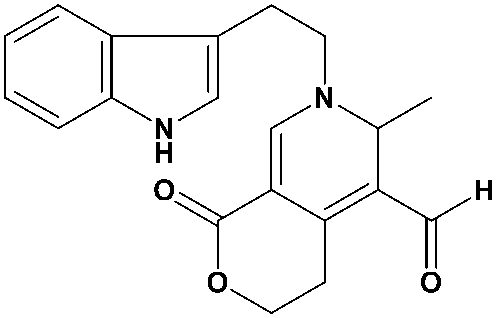
- 請求項1~12のいずれか一項に記載の化合物またはその医薬的に許容される塩、および医薬的に許容される担体を含む、医薬組成物。
- 請求項1~12のいずれか一項に記載の化合物またはその医薬的に許容される塩を有効成分とする、がんの治療剤。
- がんが、悪性黒色腫、神経膠芽腫、肺癌、胃癌、大腸癌、肝臓癌、膵臓癌、腎臓癌、副腎癌、胆道癌、食道癌、咽頭癌、喉頭癌、口腔癌、膀胱癌、舌癌、甲状腺癌、皮膚癌、乳癌、前立腺癌、精巣癌、子宮癌、子宮頸癌、卵巣癌、骨肉腫、軟骨肉腫、横紋筋肉腫、平滑筋肉腫、成人T細胞白血病を含む白血病、悪性リンパ腫または多発性骨髄腫である、請求項14記載の治療剤。
- 請求項1~12のいずれか一項に記載の化合物またはその医薬的に許容される塩を有効成分として含む、免疫チェックポイント阻害剤。
- 免疫チェックポイントが、CTLA-4である、請求項16記載の阻害剤。
- 請求項1~12のいずれか一項に記載の化合物またはその医薬的に許容される塩を有効成分とする、ワクチンの補助剤(アジュバント)。
Priority Applications (2)
| Application Number | Priority Date | Filing Date | Title |
|---|---|---|---|
| JP2018507460A JP6845531B2 (ja) | 2016-03-25 | 2017-03-24 | 免疫チェックポイント阻害作用を有するインドールアルカロイド型化合物 |
| US16/087,947 US10550120B2 (en) | 2016-03-25 | 2017-03-24 | Indole alkaloid compound having immune checkpoint inhibitory action |
Applications Claiming Priority (2)
| Application Number | Priority Date | Filing Date | Title |
|---|---|---|---|
| JP2016062267 | 2016-03-25 | ||
| JP2016-062267 | 2016-03-25 |
Publications (1)
| Publication Number | Publication Date |
|---|---|
| WO2017164407A1 true WO2017164407A1 (ja) | 2017-09-28 |
Family
ID=59900434
Family Applications (1)
| Application Number | Title | Priority Date | Filing Date |
|---|---|---|---|
| PCT/JP2017/012157 Ceased WO2017164407A1 (ja) | 2016-03-25 | 2017-03-24 | 免疫チェックポイント阻害作用を有するインドールアルカロイド型化合物 |
Country Status (3)
| Country | Link |
|---|---|
| US (1) | US10550120B2 (ja) |
| JP (1) | JP6845531B2 (ja) |
| WO (1) | WO2017164407A1 (ja) |
Cited By (1)
| Publication number | Priority date | Publication date | Assignee | Title |
|---|---|---|---|---|
| JPWO2020209277A1 (ja) * | 2019-04-09 | 2020-10-15 |
Families Citing this family (3)
| Publication number | Priority date | Publication date | Assignee | Title |
|---|---|---|---|---|
| CN115651045B (zh) * | 2022-10-20 | 2025-01-24 | 大理大学 | 马钱苷衍生物及其制备方法和在制备预防或治疗糖尿病及糖尿病并发症药物中的应用 |
| CN115650981B (zh) * | 2022-10-20 | 2024-01-26 | 大理大学 | 基于马钱苷的类单萜吲哚生物碱及其合成方法和应用、防治糖尿病或糖尿病肾病的药物 |
| CN117800980B (zh) * | 2023-12-18 | 2026-03-27 | 海南大学 | 一种半日花烷型二萜生物碱类化合物及其制备方法与应用 |
Citations (3)
| Publication number | Priority date | Publication date | Assignee | Title |
|---|---|---|---|---|
| JP2009503045A (ja) * | 2005-08-05 | 2009-01-29 | ケンブリッジ、ラボラトリーズ、(アイルランド)、リミテッド | 増殖性疾患または炎症に用いられる3,11b−シス−ジヒドロテトラベナジン |
| WO2009029206A1 (en) * | 2007-08-24 | 2009-03-05 | Wake Forest University Health Sciences | Chemotherapeutic for inducing an msh2-dependent apoptotic pathway |
| CN101406701A (zh) * | 2008-11-28 | 2009-04-15 | 中国人民解放军第三军医大学第三附属医院 | 一种可提高树突状细胞疫苗效能的佐剂 |
-
2017
- 2017-03-24 US US16/087,947 patent/US10550120B2/en active Active
- 2017-03-24 WO PCT/JP2017/012157 patent/WO2017164407A1/ja not_active Ceased
- 2017-03-24 JP JP2018507460A patent/JP6845531B2/ja active Active
Patent Citations (3)
| Publication number | Priority date | Publication date | Assignee | Title |
|---|---|---|---|---|
| JP2009503045A (ja) * | 2005-08-05 | 2009-01-29 | ケンブリッジ、ラボラトリーズ、(アイルランド)、リミテッド | 増殖性疾患または炎症に用いられる3,11b−シス−ジヒドロテトラベナジン |
| WO2009029206A1 (en) * | 2007-08-24 | 2009-03-05 | Wake Forest University Health Sciences | Chemotherapeutic for inducing an msh2-dependent apoptotic pathway |
| CN101406701A (zh) * | 2008-11-28 | 2009-04-15 | 中国人民解放军第三军医大学第三附属医院 | 一种可提高树突状细胞疫苗效能的佐剂 |
Non-Patent Citations (8)
| Title |
|---|
| BAXTER, ELLEN W. ET AL.: "Formal total synthesis of deserpidine demonstrating a versatile amino- Claisen rearrangement/Wenkert cyclization strategy for the preparation of functionalized yohimbane ring systems", JOURNAL OF THE AMERICAN CHEMICAL SOCIETY, vol. 112, no. 21, 1990, pages 7682 - 7692, XP055220267, ISSN: 0002-7863, Retrieved from the Internet <URL:doi:10.1021/ja00177a032> * |
| DATABASE DATABASE [o] American Chemical Society; 8 October 2015 (2015-10-08), retrieved from STN Database accession no. 1809495-50- 8 * |
| DATABASE DATABASE 8 October 2015 (2015-10-08), retrieved from STN Database accession no. 1809476-35-4 * |
| DATABASE DATABASE Database accession no. 1809490-11-6 * |
| KIKUCHI, HARUHISA ET AL.: "Monoterpene Indole Alkaloid-Like Compounds Based on Diversity- Enhanced Extracts of Iridoid-Containing Plants and Their Immune Checkpoint Inhibitory Activity", ORGANIC LETTERS, vol. 18, no. 22, 10 November 2016 (2016-11-10), pages 5948 - 5951, ISSN: 1523-7052 * |
| KOCSIS, AKOS ET AL.: "Synthetic modification of iridoids to non- natural indole alkaloids , Biodiversity: Biomolecular Aspects of Biodiversity and Innovative Utilization", PROCEEDINGS OF THE IUPAC INTERNATIONAL CONFERENCE ON BIODIVERSITY, 3 November 2001 (2001-11-03), Antalya , Turkey, pages 375 - 377 * |
| TIXIDRE, ARLETTE ET AL.: "Condensation of iridoid monoterpenes with tryptamine", COMPTES RENDUS DES SEANCES DE L'ACADEMIE DES SCIENCES, SERIE C: SCIENCES CHIMIQUES, vol. 288, no. 1, 1979, pages 57 - 60, ISSN: 0567-6541 * |
| WENKERT, ERNEST ET AL.: "General methods of synthesis of indole alkaloids. V. Syntheses of d,l-corynantheidol and d,l-epialloyohimbane", JOURNAL OF THE AMERICAN CHEMICAL SOCIETY, vol. 87, no. 23, 1965, pages 5461 - 5467, ISSN: 0002-7863 * |
Cited By (2)
| Publication number | Priority date | Publication date | Assignee | Title |
|---|---|---|---|---|
| JPWO2020209277A1 (ja) * | 2019-04-09 | 2020-10-15 | ||
| JP7101359B2 (ja) | 2019-04-09 | 2022-07-15 | 国立大学法人東北大学 | Pd-l1発現抑制作用を有する新規化合物 |
Also Published As
| Publication number | Publication date |
|---|---|
| JP6845531B2 (ja) | 2021-03-17 |
| US20190092774A1 (en) | 2019-03-28 |
| US10550120B2 (en) | 2020-02-04 |
| JPWO2017164407A1 (ja) | 2019-03-07 |
Similar Documents
| Publication | Publication Date | Title |
|---|---|---|
| CN113993519B (zh) | 细胞周期蛋白依赖性激酶12(cdk12)的降解剂及其用途 | |
| AU2016276963B2 (en) | Combination therapy of transcription inhibitors and kinase inhibitors | |
| Gomez-Cadena et al. | Immune-system-dependent anti-tumor activity of a plant-derived polyphenol rich fraction in a melanoma mouse model | |
| JP7675070B2 (ja) | 治療、特にmyd88変異疾患における使用のためのhck阻害剤としてのピラゾロピリミジン誘導体 | |
| US10711036B2 (en) | MALT1 inhibitors and uses thereof | |
| US20250255839A1 (en) | Combination of a selective histone deacetylase 3 (hdac3) inhibitor and an immunotherapy agent for the treatment of cancer | |
| CN112672744B (zh) | 抑制二氢乳清酸脱氢酶的方法和组合物 | |
| CA3103385A1 (en) | 3-(5-hydroxy-1-oxoisoindolin-2-yl)piperidine-2,6-dione derivatives and their use in the treatment of ikaros family zinc finger 2 (ikzf2)-dependent diseases | |
| JP7246309B2 (ja) | 免疫応答を調節するためのオキサビシクロヘプタン | |
| CN111936136B (zh) | 新咪唑并嘧啶化合物及其用途 | |
| JP7389749B2 (ja) | プロテアソーム関連ユビキチン受容体rpn13機能を阻止する低分子およびその使用法 | |
| CN106103452A (zh) | 皮质抑素类似物及其合成和用途 | |
| CN102844023A (zh) | Cdc7激酶抑制剂以及其用途 | |
| JP7821573B2 (ja) | Dot1lディグレーダーおよびその使用 | |
| JP6845531B2 (ja) | 免疫チェックポイント阻害作用を有するインドールアルカロイド型化合物 | |
| AU2019293163B2 (en) | Natural killer cells | |
| CN114401719A (zh) | 细胞周期蛋白依赖性激酶7的抑制剂及其用途 | |
| EP4112054A1 (en) | Use of csf-1r kinase inhibitor | |
| JP2022525216A (ja) | 癌の治療のための免疫調節組成物および方法 | |
| US20230058545A1 (en) | Hck as a therapeutic target in myd88 mutated diseases | |
| US20220226281A1 (en) | Compounds for use in anti-cancer immunotherapy | |
| JP2020506186A (ja) | 自己免疫疾患の予防または治療用薬学的組成物およびその製造方法 | |
| JP2023500834A (ja) | 免疫調整剤 | |
| CN113710660B (zh) | Dot1l降解剂及其用途 | |
| JP7101359B2 (ja) | Pd-l1発現抑制作用を有する新規化合物 |
Legal Events
| Date | Code | Title | Description |
|---|---|---|---|
| WWE | Wipo information: entry into national phase |
Ref document number: 2018507460 Country of ref document: JP |
|
| NENP | Non-entry into the national phase |
Ref country code: DE |
|
| 121 | Ep: the epo has been informed by wipo that ep was designated in this application |
Ref document number: 17770447 Country of ref document: EP Kind code of ref document: A1 |
|
| 122 | Ep: pct application non-entry in european phase |
Ref document number: 17770447 Country of ref document: EP Kind code of ref document: A1 |