WO2017150393A1 - 水性塗布組成物、反射防止膜、積層体及び積層体の製造方法、並びに太陽電池モジュール - Google Patents
水性塗布組成物、反射防止膜、積層体及び積層体の製造方法、並びに太陽電池モジュール Download PDFInfo
- Publication number
- WO2017150393A1 WO2017150393A1 PCT/JP2017/007220 JP2017007220W WO2017150393A1 WO 2017150393 A1 WO2017150393 A1 WO 2017150393A1 JP 2017007220 W JP2017007220 W JP 2017007220W WO 2017150393 A1 WO2017150393 A1 WO 2017150393A1
- Authority
- WO
- WIPO (PCT)
- Prior art keywords
- alkali metal
- silica particles
- aqueous coating
- coating composition
- film
- Prior art date
- Legal status (The legal status is an assumption and is not a legal conclusion. Google has not performed a legal analysis and makes no representation as to the accuracy of the status listed.)
- Ceased
Links
Images


Classifications
-
- B—PERFORMING OPERATIONS; TRANSPORTING
- B32—LAYERED PRODUCTS
- B32B—LAYERED PRODUCTS, i.e. PRODUCTS BUILT-UP OF STRATA OF FLAT OR NON-FLAT, e.g. CELLULAR OR HONEYCOMB, FORM
- B32B9/00—Layered products comprising a layer of a particular substance not covered by groups B32B11/00 - B32B29/00
-
- C—CHEMISTRY; METALLURGY
- C03—GLASS; MINERAL OR SLAG WOOL
- C03C—CHEMICAL COMPOSITION OF GLASSES, GLAZES OR VITREOUS ENAMELS; SURFACE TREATMENT OF GLASS; SURFACE TREATMENT OF FIBRES OR FILAMENTS MADE FROM GLASS, MINERALS OR SLAGS; JOINING GLASS TO GLASS OR OTHER MATERIALS
- C03C17/00—Surface treatment of glass, not in the form of fibres or filaments, by coating
- C03C17/22—Surface treatment of glass, not in the form of fibres or filaments, by coating with other inorganic material
- C03C17/23—Oxides
- C03C17/25—Oxides by deposition from the liquid phase
-
- C—CHEMISTRY; METALLURGY
- C09—DYES; PAINTS; POLISHES; NATURAL RESINS; ADHESIVES; COMPOSITIONS NOT OTHERWISE PROVIDED FOR; APPLICATIONS OF MATERIALS NOT OTHERWISE PROVIDED FOR
- C09D—COATING COMPOSITIONS, e.g. PAINTS, VARNISHES OR LACQUERS; FILLING PASTES; CHEMICAL PAINT OR INK REMOVERS; INKS; CORRECTING FLUIDS; WOODSTAINS; PASTES OR SOLIDS FOR COLOURING OR PRINTING; USE OF MATERIALS THEREFOR
- C09D1/00—Coating compositions, e.g. paints, varnishes or lacquers, based on inorganic substances
- C09D1/02—Coating compositions, e.g. paints, varnishes or lacquers, based on inorganic substances alkali metal silicates
-
- C—CHEMISTRY; METALLURGY
- C09—DYES; PAINTS; POLISHES; NATURAL RESINS; ADHESIVES; COMPOSITIONS NOT OTHERWISE PROVIDED FOR; APPLICATIONS OF MATERIALS NOT OTHERWISE PROVIDED FOR
- C09D—COATING COMPOSITIONS, e.g. PAINTS, VARNISHES OR LACQUERS; FILLING PASTES; CHEMICAL PAINT OR INK REMOVERS; INKS; CORRECTING FLUIDS; WOODSTAINS; PASTES OR SOLIDS FOR COLOURING OR PRINTING; USE OF MATERIALS THEREFOR
- C09D1/00—Coating compositions, e.g. paints, varnishes or lacquers, based on inorganic substances
- C09D1/02—Coating compositions, e.g. paints, varnishes or lacquers, based on inorganic substances alkali metal silicates
- C09D1/04—Coating compositions, e.g. paints, varnishes or lacquers, based on inorganic substances alkali metal silicates with organic additives
-
- C—CHEMISTRY; METALLURGY
- C09—DYES; PAINTS; POLISHES; NATURAL RESINS; ADHESIVES; COMPOSITIONS NOT OTHERWISE PROVIDED FOR; APPLICATIONS OF MATERIALS NOT OTHERWISE PROVIDED FOR
- C09D—COATING COMPOSITIONS, e.g. PAINTS, VARNISHES OR LACQUERS; FILLING PASTES; CHEMICAL PAINT OR INK REMOVERS; INKS; CORRECTING FLUIDS; WOODSTAINS; PASTES OR SOLIDS FOR COLOURING OR PRINTING; USE OF MATERIALS THEREFOR
- C09D7/00—Features of coating compositions, not provided for in group C09D5/00; Processes for incorporating ingredients in coating compositions
- C09D7/40—Additives
-
- G—PHYSICS
- G02—OPTICS
- G02B—OPTICAL ELEMENTS, SYSTEMS OR APPARATUS
- G02B1/00—Optical elements characterised by the material of which they are made; Optical coatings for optical elements
- G02B1/10—Optical coatings produced by application to, or surface treatment of, optical elements
- G02B1/11—Anti-reflection coatings
- G02B1/113—Anti-reflection coatings using inorganic layer materials only
Definitions
- the present disclosure relates to an aqueous coating composition, an antireflection film, a laminate, a method for producing the laminate, and a solar cell module.
- the aqueous coating liquid uses a solvent containing water, and is used for various applications because the formed film has low surface energy and excellent transparency.
- Specific applications include, for example, antireflection films, optical lenses, optical filters, flattening films for thin film transistors (TFTs) for various displays, anti-condensation films, antifouling films, surface protective films, and the like.
- TFTs thin film transistors
- the antireflection film is useful because it can be applied to protective films for solar cell modules, monitoring cameras, lighting equipment, signs, and the like.
- aqueous coating liquids that can be used for applications such as antireflection films.
- aqueous coating liquids that can be used for applications such as antireflection films.
- Various prevention coating agents have been proposed.
- the windshield of the solar cell module is disposed on the outermost surface of the module, not only antireflection properties but also scratch resistance is required.
- JP-A-2014-152180 discloses a coating liquid for forming an antireflection film in which colloidal silica and titania-silica are dispersed in a solvent, and has a light transmittance. Is improved, and high surface hardness is obtained.
- JP2013-527879A discloses a coating sample that imparts antireflection properties and the like by dispersing and using silica nanoparticles.
- the present invention includes the following aspects.
- / 1 is an aqueous coating composition.
- M represents an alkali metal
- n represents a molar ratio.
- M 2 O ⁇ nSiO 2 Formula 1 ⁇ 2> The aqueous coating composition according to ⁇ 1>, wherein the content ratio of the silica particles to the alkali metal silicate is 50/1 to 4/1 by mass ratio.
- ⁇ 3> The aqueous coating composition according to ⁇ 1> or ⁇ 2>, wherein the alkali metal represented by M in Formula 1 is lithium or potassium.
- ⁇ 4> The aqueous coating composition according to any one of ⁇ 1> to ⁇ 3>, wherein the average primary particle diameter of the silica particles is 10 nm or less.
- ⁇ 5> The aqueous coating composition according to any one of ⁇ 1> to ⁇ 4>, further comprising an organic solvent having a boiling point of 140 ° C. to 220 ° C.
- the ratio (mass ratio) of the organic solvent to the entire volatile components in the aqueous coating composition is 0.2% by mass to 1.5% by mass.
- ⁇ 9> Silica particles having an average primary particle diameter of 15 nm or less and an alkali metal silicate represented by the following formula 1, wherein the content ratio of the silica particles to the alkali metal silicate is 200/1 to 3 in mass ratio. / 1, an antireflection film.
- M represents an alkali metal
- n represents a molar ratio.
- M 2 O ⁇ nSiO 2 Formula 1 ⁇ 10> An antireflection film formed from the aqueous coating composition according to any one of ⁇ 1> to ⁇ 8>.
- ⁇ 11> The antireflection film according to ⁇ 9> or ⁇ 10>, wherein the average film thickness is 80 nm to 200 nm.
- ⁇ 12> A laminate having a base material and the antireflection film according to any one of ⁇ 9> to ⁇ 11>.
- a solar cell module comprising the laminate according to ⁇ 12> or ⁇ 13>.
- the average primary particle diameter includes silica particles having a particle size of 15 nm or less and an alkali metal silicate represented by the following formula 1, and the content ratio of the silica particles to the alkali metal silicate is a mass ratio.
- a laminate comprising: a step of applying a 200/1 to 3/1 aqueous coating composition to form a coating film; and a step of drying the coating film formed by coating to form an antireflection film. It is a manufacturing method.
- M represents an alkali metal
- n represents a molar ratio.
- M 2 O ⁇ nSiO 2 Formula 1 Also, a step of applying the aqueous coating composition according to any one of ⁇ 1> to ⁇ 8> to form a coating film, and drying the coating film formed by coating to form an antireflection film And a process for producing a laminate having the steps.
- an aqueous coating composition capable of obtaining a film having both antireflection properties and scratch resistance.
- an antireflection film, a laminate, and a method for producing the laminate that are compatible with antireflection and scratch resistance are provided.
- a solar cell module excellent in power generation efficiency is provided.
- FIG. 1 is a conceptual diagram for explaining a void state of a film including secondary particles formed from primary particles having an average primary particle diameter of 15 nm or less.
- FIG. 2 is a conceptual diagram for explaining a void state of a film containing primary particles having an average primary particle diameter of more than 15 nm.
- aqueous coating composition the antireflection film, the laminate, the production method of the laminate, and the solar cell module of the present disclosure will be described in detail.
- a numerical range indicated using “to” means a range including the numerical values described before and after “to” as the minimum value and the maximum value, respectively.
- the amount of each component in the composition is the sum of the plurality of substances present in the composition unless there is a specific indication when there are a plurality of substances corresponding to each component in the composition. Means quantity.
- process is not limited to an independent process, and even if it cannot be clearly distinguished from other processes, the term “process” is used as long as the intended purpose of the process is achieved. included.
- “Aqueous” in the aqueous coating composition means that the coating composition contains water as a solvent, and the ratio of water to the total solvent in the coating composition is the largest, preferably all the solvent in the coating composition This is a case where the ratio of water to 50% by mass or more.
- the aqueous coating composition of the present disclosure includes silica particles having an average primary particle size of 15 nm or less and an alkali metal silicate represented by the following formula 1, and the content ratio of the silica particles to the alkali metal silicate is as follows: The mass ratio is in the range of 200/1 to 3/1.
- M represents an alkali metal and n represents a molar ratio.
- the present disclosure uses alkali metal silicate for immobilization of silica particles in order to achieve both scratch resistance and antireflection properties, and the size of primary particles of silica particles, silica particles and alkali metal silicates.
- the silica particles are appropriately cross-linked by the siloxane bond, and it is possible to achieve a balance between the fixation of the silica particles by the cross-linking and the voids between the silica particles. Thereby, an antireflection film having excellent antireflection properties and scratch resistance can be obtained.
- the average primary particle diameter of the silica particles is in the range of 15 nm or less.
- the average primary particle diameter of the silica particles 4 on the substrate 6 is a large particle exceeding 15 nm, Since formation is difficult to expect, when the film is formed, the film is easily formed with primary particles, and the porosity of the film is reduced. As a result, the refractive index of the film increases and the antireflection function of the film decreases.
- FIG. 1 when the average primary particle diameter of the silica particles 2 is 15 nm or less, the silica particles 2 aggregate to form secondary particles, and the secondary particles aggregate. A film 10 is formed on the substrate 6. Since the secondary particles are collected in the film, the porosity of the film increases. Thereby, the refractive index of a film
- the content ratio of the silica particles to the alkali metal silicate (ratio of silica particles / alkali metal silicate) is set to a range of 200/1 to 3/1 by mass ratio.
- ratio of silica particles / alkali metal silicate is in the range of 200/1 to 3/1, both scratch resistance and antireflection properties can be achieved.
- the ratio of silica particles / alkali metal silicate is 200/1 or less and the content of silica particles is within a range that does not increase too much with respect to the alkali metal silicate, the proportion of alkali metal silicate is relatively small with respect to the silica particles. Since it does not become too much, a silica particle is fixed and it is easy to maintain favorable scratch resistance.
- the ratio of silica particles / alkali metal silicate is set to 3/1 or more and the content of silica particles is within a range that does not decrease too much with respect to the alkali metal silicate, the ratio of the alkali metal silicate is relative to the silica particles. Therefore, an excessive amount of alkali metal silicate more than the amount necessary for immobilization of particles between silica particles does not exist. Therefore, a decrease in interparticle voids due to the presence of excess alkali metal silicate can be suppressed. Thereby, the porosity in a film
- Alkali metal silicate refers to an alkali metal salt of silicic acid.
- Alkali metal silicate refers to an alkali metal salt of silicic acid.
- M represents an alkali metal.
- alkali metal include lithium (Li), sodium (Na), potassium (K), cesium (Cs), and the like.
- the alkali metal represented by M Li or K is preferable.
- the scratch resistance is further improved as compared with Na.
- the water resistance of alkali metal silicates is known to be excellent in the order of Li>K> Na.
- the higher the water resistance the greater the water resistance between silica particles in the film.
- the cross-linking ability of cross-linking tends to increase. This is presumably because when the alkali metal silicate itself has high water resistance, the alkali metal silicate hardly aggregates and exists stably.
- the alkali metal silicate represented by the above formula 1 is preferably a compound in which the alkali metal represented by M is Li and n is 5.0 or less.
- n 5.0 or less.
- M Li
- n is preferably 3.0 or more.
- an alkali metal silicate in which the alkali metal represented by M is K and n is 2.5 or less is also preferable.
- M K
- the alkali metal silicate is easily cross-linked with the silica particles, and the scratch resistance is further improved.
- n is preferably 2.0 or more.
- N in Formula 1 represents a molar ratio, and specifically represents the number of moles of SiO 2 per mole of M 2 O.
- N in Formula 1 can be selected from the range of 2.0 to 8.0.
- the alkali metal silicate commercially available products may be used.
- LSS series for example, LSS-35 (Li 2 O.3.5SiO 2 ), LSS-45, manufactured by Nissan Chemical Industries, Ltd., LSS-75, etc.
- Fuji chemical Co for example, Li 2 O ⁇ 3.5SiO 2, Li 2 O ⁇ 4.5SiO 2, Li 2 O ⁇ 7.5SiO 2, K 2 O ⁇ 2SiO 2, K 2 O ⁇ 3.6SiO 2, Na 2 O ⁇ 3.2SiO 2, Na 2 O ⁇ 3.7SiO 2, and the like.
- LSS series for example, L
- 1K potassium silicate K 2 O ⁇ 2SiO 2
- 2K potassium silicate K 2 O ⁇ 3.6SiO 2
- 3 sodium silicate No. Na 2 O ⁇ 3.2SiO 2
- 5 sodium silicate Na 2 O ⁇ 3.7SiO 2
- Examples include sodium silicate No. 3, sodium silicate No. 4, A potassium silicate, B potassium silicate, C potassium silicate, and the like.
- the content of the alkali metal silicate in the aqueous coating composition is preferably 0.05% by mass to 3.0% by mass, and preferably 0.2% by mass to 2.5% by mass with respect to the total mass of the aqueous coating composition. % Is more preferable.
- the content of the alkali metal silicate is 0.05% by mass or more, a crosslinked structure with silica particles is easily formed.
- the content of the alkali metal silicate is 3.0% by mass or less, the amount that enters between the silica particles and contributes to crosslinking does not increase excessively, and the effect of improving not only scratch resistance but also antireflection properties is high.
- the aqueous coating composition contains at least one kind of silica particles. By containing silica particles, the aqueous coating composition can impart antireflection ability by utilizing cohesiveness, and can improve the hardness and scratch resistance of the film.
- the kind of silica particle contained in the aqueous coating composition is not particularly limited.
- the silica particles include hollow silica particles, porous silica particles, and nonporous silica particles.
- the shape of the silica particles is not particularly limited, and may be any shape such as a spherical shape, an elliptical shape, or a chain shape.
- the silica particles may be silica particles whose surfaces are treated with an aluminum compound or the like.
- nonporous silica particles mean silica particles having no voids inside the particles, and are distinguished from silica particles having voids inside the particles such as hollow silica particles and porous silica particles.
- the “non-porous silica particles” have a core such as a polymer inside the particles, and the outer shell (shell) of the core is silica or a precursor of silica (for example, a material that changes to silica by firing).
- the core-shell structured silica particles are not included.
- the state of the particles present in the coating film changes before and after the firing step.
- a state in which the respective nonporous silica particles are aggregated into a single particle is defined as a single particle.
- the coating film after firing at least a part of the plurality of nonporous silica particles is present as a linked particle body connected to each other.
- the silica particles contained in the aqueous coating composition are non-porous silica particles, a plurality of non-porous silica particles are connected to form a particle-linked body by firing the coating film, so that the hardness of the film is This increases the scratch resistance.
- the average primary particle size of the particles connected by firing is obtained by arithmetically averaging the diameters when only one of the connected particles is assumed to be a sphere without considering the connecting portion (for example, the neck portion). Adopted values.
- the average primary particle diameter of the particles connected by firing can be calculated by the same method as the average primary particle diameter of the silica particles described above.
- the aqueous coating composition may contain a plurality of types of silica particles having different primary particle sizes.
- the aqueous coating composition may contain nonporous silica particles and one or more types of silica particles other than nonporous silica particles.
- NALCO registered trademark
- NALCO registered trademark
- 1130 Aqueous dispersion of nonporous silica particles, average primary particle size: 8 nm, solid content: 30% by mass, manufactured by NALCO
- NALCO registered trademark
- 1030 aqueous dispersion of nonporous silica particles, average primary particle size) : 13 nm, solid content: 30% by mass, manufactured by NALCO
- NALCO registered trademark
- 1050 aqueous dispersion of nonporous silica particles, average primary particle size: 20 nm, solid content: 50% by mass, manufactured by NALCO
- NALCO registered trademark
- the average primary particle diameter of the silica particles is in the range of 15 nm or less.
- the average primary particle diameter of the silica particles is preferably 10 nm or less, more preferably 8 nm or less, still more preferably 6 nm or less, and particularly preferably 4 nm or less for the same reason as described above.
- the average primary particle diameter of the silica particles is preferably 2 nm or more.
- the average primary particle diameter of the silica particles can be obtained from an image of a photograph taken by observing the dispersed silica particles with a transmission electron microscope. Specifically, from the image of the photograph, the projected area of the silica particles is measured, the equivalent circle diameter is obtained from the measured projected area, and the value obtained by arithmetically averaging the obtained equivalent circle diameter value is the silica particle.
- the average primary particle size of In the present specification, the average primary particle diameter of the silica particles is obtained by measuring the projected areas of 300 silica particles, obtaining the equivalent circle diameters from the measured projected areas, and arithmetically averaging the obtained equivalent circle diameter values. Is the value obtained by
- the content of silica particles in the aqueous coating composition is preferably 8% by mass to 12% by mass and more preferably 8% by mass to 10% by mass with respect to the total mass of the aqueous coating composition.
- the content of the silica particles is 8% by mass or more, excellent film quality is easily obtained due to scratch resistance.
- the content of the silica particles is 12% by mass or less, it is advantageous for forming a good planar film.
- the content ratio of silica particles to the alkali metal silicate is in the range of 200/1 to 3/1 by mass ratio. Within the above range, both scratch resistance and antireflection properties can be achieved.
- the ratio of silica particles / alkali metal silicate is preferably in the range of 50/1 to 4/1, more preferably in the range of 6/1 to 4/1, for the same reason as above.
- the aqueous coating composition may contain an organic solvent.
- an organic solvent having a boiling point of 100 ° C. to 300 ° C. can be contained, and preferably, an organic solvent having a boiling point of 120 ° C. to 250 ° C. can be contained.
- the aqueous coating composition preferably contains an organic solvent having a boiling point of 140 ° C. to 220 ° C. (hereinafter also referred to as a high boiling point solvent).
- the boiling point of the high boiling point solvent is preferably 160 ° C. to 200 ° C., more preferably 170 ° C. to 190 ° C. for the same reason as described above.
- organic solvents having a boiling point of 140 ° C. to 220 ° C. include propylene glycol (boiling point 188 ° C.), ethylene glycol monobutyl ether (boiling point 171 ° C.), diethylene glycol monomethyl ether (boiling point 194 ° C.), propylene Glycol monobutyl ether (boiling point 170 ° C.), ethylene glycol diacetate (boiling point 196 ° C.), ethylene glycol monomethyl ether acetate (boiling point 145 ° C.), triethylene glycol dimethyl ether (boiling point 216 ° C.), diethylene glycol ethyl methyl ether (boiling point 176 ° C.), Examples include cyclohexanone (boiling point 156 ° C.) and ethyl lactate (boiling point 155 ° C.).
- the ratio (mass ratio) of the high boiling point solvent to the entire volatile components in the aqueous coating composition can be in the range of 0.1% by mass to 1.8% by mass. % To 1.5% by mass is preferred.
- the ratio (mass ratio) of the high boiling point solvent to the entire volatile components is more preferably 0.5% by mass to 1.0% by mass.
- Volatile components are all components except the solid component remaining after heating the aqueous coating composition at 105 ° C. for 60 minutes. Specifically, the organic solvent contained in the aqueous coating composition and Point to water. The amount of the entire volatile component can be obtained by subtracting the mass of the residual component after baking from the total mass of the aqueous coating composition. In addition, the amount of the high boiling point solvent is obtained by subtracting the mass of the component evaporated and collected when the aqueous coating composition is heated at a temperature lower than the boiling point of the contained high boiling point solvent from the total mass of the volatile component. Is required.
- the content of the organic solvent in the aqueous coating composition is preferably 0.1% by mass to 1.6% by mass, and preferably 0.2% by mass to 1.0% by mass with respect to the total mass of the aqueous coating composition. Is more preferable.
- content of the organic solvent is 0.1% by mass or more, it is advantageous in terms of suppressing drying shrinkage due to rapid drying.
- content of an organic solvent is 1.6 mass% or less, it is advantageous at the point of drying load suppression.
- the aqueous coating composition is adjusted to be aqueous by containing water.
- water as the solvent component of the aqueous coating composition, the burden on the environment is greatly reduced as compared with a coating solution using a large amount of an organic solvent.
- the water used in the aqueous coating composition is preferably deionized water that does not contain impurities or has a reduced impurity content.
- the water content in the aqueous coating composition is 95% by mass or more, preferably 98% by mass or more, and more preferably 99% by mass or more with respect to the total amount of the solvent.
- the water content in the aqueous coating composition is preferably 85% by mass to 95% by mass with respect to the total mass of the aqueous coating composition.
- the aqueous coating composition may contain other components other than silica particles, alkali metal silicate, and water as necessary, as long as the effects of the present disclosure are not impaired.
- other components include a surfactant, a silane coupling agent, a thickener, a water-soluble polymer, and a water-dispersed latex.
- the aqueous coating composition can contain a surfactant as long as the effects of the present disclosure are not impaired. Containing a surfactant is effective in improving the wettability to the substrate.
- the surfactant include acetylene-based nonionic surfactants and polyol-based nonionic surfactants.
- commercially available products may be used.
- Olfin series for example, Olphine EXP.4200, Olphine EXP.4123, etc.
- TRITON BG-10 manufactured by Kao Corporation or Mydoll series manufactured by Kao Corporation (for example, Mydoll 10, Mydoll 12, etc.) can be used.
- silane coupling agent examples include silicon compounds having in the molecule functional groups having reactivity with organic substances such as vinyl polymerizable groups, epoxy groups, amino groups, methacryl groups, mercapto groups, and isocyanate groups.
- organic substances such as vinyl polymerizable groups, epoxy groups, amino groups, methacryl groups, mercapto groups, and isocyanate groups.
- the silane coupling agent is preferably a silane coupling agent having a vinyl polymerizable group or a thiol group.
- the silane coupling agent include alkoxysilane. Examples of the alkoxysilane include tetramethoxysilane, tetraethoxysilane and the like. For example, compounds described in paragraphs [0041] to [0044] of JP-A-2015-108061 can be used.
- the aqueous coating composition can contain a thickener as long as the effects of the present disclosure are not impaired. Viscosity can be adjusted by including a thickener.
- the thickener include polyether, urethane-modified polyether, polyacrylic acid, polyacryl sulfonate, polyvinyl alcohol, and polysaccharides. Among these, as the thickener, polyether, modified polyacrylic sulfonate, and polyvinyl alcohol are preferable.
- Commercially available products that are marketed as thickeners may be used. Examples of commercially available products include SN thickener 601 (polyether), SN thickener 615 (modified polyacrylic sulfonate), and Wako Jun.
- Examples thereof include polyvinyl alcohol (degree of polymerization: about 1000 to 2000) manufactured by Yakuhin Kogyo Co., Ltd.
- the content of the thickener is preferably about 0.01% by mass to 5.0% by mass with respect to the total mass of the aqueous coating composition.
- the solid content in the aqueous coating composition is preferably 1% by mass to 30% by mass, more preferably 5% by mass to 20% by mass, and more preferably 10% by mass with respect to the total mass of the aqueous coating composition. More preferably, the content is from 15% to 15% by mass.
- the solid content in the aqueous coating composition can be adjusted by the content of the solvent, particularly water.
- the pH of the aqueous coating composition is preferably 8 to 12, and more preferably 9 to 11.
- the pH of the aqueous coating composition is 8 or more, remarkable aggregation of silica particles in the aqueous coating composition is suppressed, so that a film excellent in antireflection property, scratch resistance and antifouling property can be obtained. In addition, a good planar film is formed.
- the pH of the aqueous coating composition is 12 or less, the dissolution of the silica particles in the aqueous coating composition is suppressed, so that the long-term stability of the aqueous coating composition is further improved and the reflection is improved. It also has better prevention and antifouling properties.
- the pH of the aqueous coating composition is a value measured at 25 ° C. using a pH meter (model number: HM-31, manufactured by Toa DKK).
- the antireflection film of the present disclosure is an antireflection film formed of the aqueous coating composition of the present disclosure described above. Since the aqueous coating composition described above is used, the antireflection film is excellent in antireflection properties and scratch resistance.
- the antireflection film includes silica particles having an average primary particle diameter of 15 nm or less and an alkali metal silicate represented by the following formula 1, and the content ratio of the silica particles to the alkali metal silicate is expressed by mass. The ratio is 200/1 to 3/1.
- M represents an alkali metal
- n represents a molar ratio.
- M 2 O ⁇ nSiO 2 Formula 1 Details of components such as silica particles and alkali metal silicate, and details such as the content ratio of silica particles to alkali metal silicate are as described above, and preferred embodiments are also the same.
- the average film thickness of the antireflection film can be in the range of 50 nm to 250 nm from the viewpoint of antireflection properties. Among these, from the viewpoint of antireflection properties, the average film thickness of the antireflection film is preferably 80 nm to 200 nm.
- the average film thickness is obtained by cutting a glass substrate having at least a dried film (antireflection film) parallel to the direction perpendicular to the substrate surface, and observing the cut surface at 10 locations with a scanning electron microscope (SEM). It is obtained by measuring the film thickness of each observation location from 10 SEM images and averaging the 10 measured values (film thickness) obtained.
- the antireflection property of the antireflection film is indicated by the following change in average reflectance ( ⁇ R). Specifically, the reflectivity (%) of light having a wavelength of 400 nm to 1100 nm of a laminate in which an antireflection film is formed on a substrate using an ultraviolet-visible infrared spectrophotometer (model number: UV3100PC, manufactured by Shimadzu Corporation). ) Using an integrating sphere. When measuring the reflectance, a black tape is attached to the surface of the base material to be the back surface in order to suppress reflection of the back surface of the laminate (the surface on the side where the antireflection film of the base material is not formed).
- ⁇ R average reflectance
- the average reflectance (R AV ; unit%) of the laminate is calculated from the measured reflectance of each wavelength at wavelengths of 400 nm to 1100 nm.
- the reflectance (%) of light having a wavelength of 400 nm to 1100 nm of a base material on which no antireflection film is formed is measured.
- the average reflectance (R 0 AV ; unit%) of the base material is calculated from the measured reflectance at each wavelength in the wavelength range of 400 nm to 1100 nm.
- the average reflectance change ( ⁇ R; unit:%) relative to the base material on which the antireflection film is not formed is calculated from the average reflectances R AV and R 0 AV according to the following formula (a).
- ⁇ R
- Formula (a) The notation “
- the reflectance can be measured by using a spectrophotometer with an integrating sphere.
- an ultraviolet-visible-infrared spectrophotometer (model number: UV3100PC, manufactured by Shimadzu Corporation) is used as a measuring device, and the reflectance in light having a wavelength of 400 nm to 1100 nm is measured using an integrating sphere.
- the value obtained by arithmetically averaging the reflectance values in is used as the average reflectance.
- At least ⁇ R of the dried film (antireflection film) is preferably 2.2% or more, more preferably 2.5% or more, and further preferably 2.7% or more from the viewpoint of antireflection properties.
- the laminate of the present invention has a base material and the above-described antireflection film of the present invention. Since the laminate has the above-described antireflection film, the laminate has excellent antireflection properties and excellent scratch resistance.
- the substrate examples include substrates such as glass, resin, metal, ceramic, or a composite material in which at least one selected from glass, resin, metal, and ceramic is combined.
- a glass substrate is preferable as the substrate.
- condensation of hydroxyl groups occurs not only between the hydroxyl groups of the silica particles but also between the hydroxyl groups of the silica particles and the hydroxyl groups of the glass surface.
- a coating film having excellent adhesion can be formed.
- the method for producing a laminate according to the present disclosure includes a silica particle having an average primary particle diameter of 15 nm or less on a base material and the alkali metal silicate represented by the above-described formula 1, and the silica particles for the alkali metal silicate
- a coating film is formed by applying an aqueous coating composition having a mass ratio of 200/1 to 3/1 by mass ratio (hereinafter also referred to as “film forming process”), and coating. And a step of drying the coating film to form an antireflection film (hereinafter also referred to as “drying step”).
- the manufacturing method of the laminated body of this indication may have a baking process as needed, and may also have other processes, such as a washing process, a surface treatment process, and a cooling process.
- the film forming step includes a silica particle having an average primary particle diameter of 15 nm or less on the substrate and an alkali metal silicate represented by Formula 1, wherein the content ratio of the silica particles to the alkali metal silicate is a mass ratio.
- An aqueous coating composition of 200/1 to 3/1 is applied to form a coating film.
- the silica particles and the alkali metal silicate are included in a specific “silica particle / alkali metal silicate ratio” so that the silica particles are appropriately crosslinked with the alkali metal silicate. Since the coating composition is used, the laminate (or antireflection film) formed through at least a drying treatment is excellent in both antireflection properties and scratch resistance.
- the coating amount of the aqueous coating composition is not particularly limited, and can be appropriately set in consideration of operability and the like according to the solid content concentration in the aqueous coating composition, the desired film thickness, and the like. .
- the coating amount of the aqueous coating composition is preferably 0.01 mL / m 2 to 10 mL / m 2 , more preferably 0.1 mL / m 2 to 5 mL / m 2 , and 0.5 mL / m 2. More preferably, it is ⁇ 2 mL / m 2 .
- the method for applying the aqueous coating composition on the substrate is not particularly limited.
- a coating method a known coating method such as spray coating, brush coating, roller coating, bar coating, dip coating, or the like can be appropriately selected.
- the coating film formed by coating in the film forming step is dried to form an antireflection film.
- the antireflection film is formed on the substrate by drying the coating film formed by applying the aqueous coating composition.
- silica particles in the film are partially adhered to each other to form a film.
- voids are generated between the silica particles, so that at least a dried film (antireflection film) is considered to have excellent antireflection properties.
- the water in the aqueous coating composition is removed, so that the silica particles are densely arranged and a dense film is formed. It is considered that excellent scratch resistance can be obtained when the film becomes dense and the hardness increases. Moreover, since the film becomes dense and the film surface becomes smooth, it is considered that dirt is difficult to adhere and the antifouling property is excellent.
- the coating film may be dried at room temperature (25 ° C.) or using a heating device.
- the heating device is not particularly limited as long as it can be heated to a target temperature, and any known heating device can be used.
- As the heating device an oven, an electric furnace, or the like, or a heating device uniquely manufactured according to the production line can be used.
- the coating film may be dried by, for example, heating the coating film at an ambient temperature of 40 ° C. to 200 ° C. using the above heating device.
- the heating time can be about 1 to 30 minutes.
- the drying conditions for the coating film are preferably drying conditions in which the coating film is heated at an atmospheric temperature of 40 ° C. to 200 ° C. for 1 minute to 10 minutes, and drying is performed at an atmospheric temperature of 100 ° C. to 180 ° C. for 1 minute to 5 minutes. Conditions are more preferred.
- the average film thickness of the coating film after drying can be in the range of 50 nm or more, and preferably in the range of 80 nm to 200 nm.
- the average film thickness is 50 nm or more, the film has excellent antireflection properties, and when it is 80 to 200 nm, the antireflection properties are excellent.
- the method for measuring the average film thickness is as described above.
- the manufacturing method of the laminated body of this indication has the process (henceforth a baking process) which bakes the coating film (antireflection film) after drying further after the above-mentioned drying process.
- a baking process which bakes the coating film (antireflection film) after drying further after the above-mentioned drying process.
- firing is preferably performed at an ambient temperature of 400 ° C. to 800 ° C.
- the hardness of the dense film formed in the drying process is further increased, and the scratch resistance is further improved.
- the organic component disappears by firing, a minute gap is partially formed, and the antireflection property can be effectively improved.
- the coating film can be baked using a heating device.
- the heating device is not particularly limited as long as it can be heated to a target temperature, and any known heating device can be used.
- As the heating device in addition to an electric furnace or the like, it is possible to use a firing device uniquely produced in accordance with a production line.
- the firing temperature (atmosphere temperature) of the coating film is more preferably 450 ° C. or higher and 800 ° C. or lower, further preferably 500 ° C. or higher and 800 ° C. or lower, and particularly preferably 600 ° C. or higher and 800 ° C. or lower.
- the firing time is preferably from 1 minute to 10 minutes, and more preferably from 1 minute to 5 minutes.
- the average film thickness of the coating film after baking can be in the range of 50 nm or more, and preferably in the range of 80 nm to 200 nm.
- the average film thickness is 50 nm or more, the film has excellent antireflection properties, and when it is 80 to 200 nm, the antireflection properties are excellent.
- the manufacturing method of the laminated body of this indication may include other processes other than each above-mentioned process as needed in the range which does not impair the effect of this indication.
- Examples of other processes include a cleaning process, a surface treatment process, and a cooling process.
- the solar cell module of the present disclosure includes the laminated body of the present disclosure described above. Since the solar cell module of the present disclosure includes the laminate having the above-described antireflection film, the solar cell module has excellent antireflection properties and lowers light transmittance due to scratches on the film surface when used for a long period of time. Is suppressed and has excellent scratch resistance.
- the solar cell module is a laminate of the present disclosure in which a solar cell element that converts light energy of sunlight into electric energy is disposed on a side on which sunlight is incident, and a back sheet for a solar cell represented by a polyester film It may be arranged between and.
- the laminate of the present disclosure and the back sheet for solar cells such as a polyester film are sealed with a sealing material typified by a resin such as an ethylene-vinyl acetate copolymer.
- the members other than the laminate and the back sheet in the solar cell module are described in detail in, for example, “Solar power generation system constituent material” (supervised by Eiichi Sugimoto, Kogyo Kenkyukai, 2008).
- the solar cell module preferably has the above-described laminate on the side on which sunlight is incident, and there is no limitation on the configuration other than the laminate of the present disclosure.
- the base material arranged on the solar light incident side of the solar cell module is preferably in the form of the base material of the above-described laminate, and as the base material, for example, glass, resin, metal, ceramic, or Examples thereof include a base material such as a composite material in which at least one selected from glass, resin, metal, and ceramic is combined.
- a preferred substrate is a glass substrate.
- Solar cell modules include silicon-based solar cell elements such as single crystal silicon, polycrystalline silicon, and amorphous silicon, copper-indium-gallium-selenium, copper-indium-selenium, cadmium-tellurium, gallium-arsenic III-V Any of various known solar cell elements such as Group II or Group II-VI compound semiconductor solar cell elements can be applied.
- silica particles trade name: NALCO (registered trademark) 8699, nonporous silica particles, average primary particle size of silica particles: 3 nm, solid content: 15% by mass, manufactured by NALCO
- LSS-35 Lithium silicate
- solid content 23% by mass, manufactured by Nissan Chemical Industries, Ltd .
- aqueous coating composition (aqueous coating composition). ) was prepared.
- the amount of water mixed was such that the total amount of the aqueous coating solution was 100 parts by mass.
- the mass ratio of silica particles to lithium silicate in the aqueous coating solution is 200/1.
- the pH (25 ° C.) of the aqueous coating solution was measured using a pH meter (model number: HM-31, manufactured by Toa DKK Co., Ltd.) and found to be 10.5.
- the prepared aqueous coating solution was coated on a glass substrate using a bar coater (coating amount: 0.2 mL / m 2 to 3 mL / m 2 ) to form a coating film.
- the formed coating film was heated at an atmospheric temperature of 150 ° C. for 1 minute using an oven and dried.
- the dried coating film was baked for 3 minutes at 700 ° C. using an electric furnace to prepare a film sample (antireflection film).
- a film sample antireflection film
- membrane sample was produced so that the final average film thickness of the coating film formed on a glass base material might be 130 nm.
- the average film thickness is obtained by cutting a laminated body having an antireflection film after firing on a glass substrate in parallel to a direction perpendicular to the substrate surface, and observing the cut surface at 10 points with a scanning electron microscope (SEM). It confirmed by measuring the film thickness of each observation location from ten SEM images, and averaging the ten measured values (film thickness) obtained.
- SEM scanning electron microscope
- Example 1 (Examples 2 to 16, Comparative Examples 1 to 10)
- Example 1 the type and content of the aqueous dispersion of silica particles and alkali metal silicate were changed as shown in Table 1 below, and the silica particles were adjusted so that the total mass of the aqueous coating solution was 100 parts by mass.
- An aqueous coating solution was prepared in the same manner as in Example 1 except that the content of water was changed in accordance with the change in the content of the water dispersion and alkali metal silicate.
- the mass ratio of the silica particles to the alkali metal silicate in each prepared aqueous coating solution is as shown in Table 1 below.
- the pH (25 ° C.) of each aqueous coating solution measured in the same manner as in Example 1 was 10.5 as in Example 1.
- Example 3 (Examples 17 to 18, Comparative Examples 11 to 12)
- Example 3 the type and content of the aqueous dispersion of silica particles were changed as shown in Table 2 below, and the aqueous dispersion of silica particles was adjusted so that the total mass of the aqueous coating liquid was 100 parts by mass.
- An aqueous coating solution was prepared in the same manner as in Example 3 except that the content of water was changed in accordance with the change in the content of, and a film sample and a laminate were produced.
- the mass ratio of the silica particles to the lithium silicate in each prepared aqueous coating solution is as shown in Table 2 below.
- the pH (25 ° C.) of each aqueous coating solution measured in the same manner as in Example 1 was 10.5 as in Example 1.
- Example 3 in addition to the aqueous dispersion of silica particles, alkali metal silicate, and water, an organic solvent was mixed in the ratio shown in Table 3, and the same as in Example 3 Then, an aqueous coating solution was prepared, and a film sample and a laminate were produced.
- the mass ratio of the silica particles to the lithium silicate in each prepared aqueous coating solution is as shown in Table 3 below.
- the pH (25 ° C.) of each aqueous coating solution measured in the same manner as in Example 1 was 10.5 as in Example 1.
- Example 3 (Examples 28 to 30) In Example 3, as shown in Table 3 below, the type and content of the alkali metal silicate were changed, and in addition to the aqueous dispersion of silica particles, alkali metal silicate and water, the organic solvent is shown in Table 3.
- An aqueous coating solution was prepared in the same manner as in Example 3 except that the ratio was mixed, and a film sample and a laminate were produced.
- the mass ratio of the silica particles to the alkali metal silicate in each prepared aqueous coating solution is as shown in Table 3 below.
- the pH (25 ° C.) of each aqueous coating solution measured in the same manner as in Example 1 was 10.5 as in Example 1.
- Example 3 In Example 3, as shown in Table 3 below, in addition to the aqueous dispersion of silica particles, alkali metal silicate and water, an organic solvent was further mixed at the ratio shown in Table 3, and the average film thickness was shown in Table 3.
- An aqueous coating solution was prepared in the same manner as in Example 3 except that the value was changed to the value shown in FIG.
- the mass ratio of the silica particles to the lithium silicate in each prepared aqueous coating solution is as shown in Table 3 below.
- the pH (25 ° C.) of each aqueous coating solution measured in the same manner as in Example 1 was 10.5 as in Example 1.
- Example 8 in addition to the aqueous dispersion of silica particles, alkali metal silicate and water, an organic solvent was further mixed in the ratio shown in Table 3, and the average film thickness was shown in Table 3.
- An aqueous coating solution was prepared in the same manner as in Example 8 except that the value was changed to the value shown in FIG.
- the mass ratio of silica particles to potassium silicate in each prepared aqueous coating solution is as shown in Table 3 below.
- the pH (25 ° C.) of each aqueous coating solution measured in the same manner as in Example 1 was 10.5 as in Example 1.
- Antireflection (AR) property A wavelength of 400 nm of a laminate in which a film sample (antireflection film) is formed on a glass substrate by an ultraviolet visible infrared spectrophotometer (model number: UV3100PC, manufactured by Shimadzu Corporation). The reflectance (%) in light of ⁇ 1100 nm was measured using an integrating sphere. The reflectance was measured by attaching a black tape to the surface of the glass substrate serving as the back surface in order to suppress reflection of the back surface of the laminate (the surface on which the film sample of the glass substrate was not formed). . Then, the average reflectance (R AV ; unit%) of the laminate was calculated from the measured reflectance of each wavelength at a wavelength of 400 nm to 1100 nm.
- the reflectance (%) of light having a wavelength of 400 nm to 1100 nm was measured for a glass substrate on which no film sample was formed. Then, the average reflectance (R 0 AV ; unit%) of the glass substrate was calculated from the reflectance of each wavelength at the measured wavelengths of 400 nm to 1100 nm. From the above average reflectances R AV and R 0 AV , the change in average reflectance ( ⁇ R; unit:%) relative to the glass substrate on which no film sample was formed was calculated according to the following formula (a). In the formula (a), the notation “
- ” represents an absolute value, and ⁇ R indicates that the higher the numerical value, the better the antireflection (AR) property. ⁇ R
- NALCO® 8699 Aqueous dispersion of silica particles (nonporous silica particles, average primary particle diameter of silica particles: 3 nm, solid content: 15% by mass)
- NALCO NALCO (registered trademark) 1130 Aqueous dispersion of silica particles (nonporous silica particles, average primary particle diameter of silica particles: 8 nm, solid content: 30% by mass)
- Examples will be described in detail with reference to Tables 1 to 3.
- the alkali metal of the alkali metal silicate was not greatly different between lithium and potassium, but as shown in Examples 11 to 16, lithium silicate or potassium silicate in which the alkali metal is lithium or potassium. Compared with sodium silicate whose alkali metal is sodium, it was superior in scratch resistance.
- the silica particle / alkali metal silicate ratio is preferably in the range of 50/1 to 4/1, more preferably in the range of 6/1 to 4/1, from the viewpoint of improving scratch resistance. .
- Comparative Example 1 containing no alkali metal silicate the scratch resistance was remarkably lowered.
- Comparative Examples 2 to 10 where the silica particle / alkali metal silicate ratio does not satisfy the range of 200/1 to 3/1 it was impossible to achieve both antireflection properties and scratch resistance. Specifically, when the silica particle / alkali metal silicate ratio exceeded 200/1, the scratch resistance was significantly reduced.
- the silica particle / alkali metal silicate ratio is less than 3/1, the antireflection property is remarkably lowered, and when the ratio is 2/1 or less, the ratio of the alkali metal silicate to the silica particles is excessively gelled and coated. I wouldn't.
- Table 3 shows an example when an organic solvent is used.
- Examples 20 to 22 by containing an organic solvent having a predetermined boiling point, compared to the case of containing an organic solvent whose boiling point deviates from 140 ° C. to 220 ° C. (Examples 19 and 23), scratch resistance is improved. Dramatically improved.
- the ratio of the organic solvent to the volatile matter in the aqueous coating solution is in the range of 0.2% by mass to 1.5% by mass. In some cases, the scratch resistance has improved dramatically.
- Examples 31 to 38 show results when the average thickness of the antireflection film is changed.
- the average film thickness was in the range of 80 nm to 200 nm, more excellent scratch resistance was exhibited.
- the average film thickness is less than 80 nm, the antireflection property tends to decrease as in Examples 31 and 35.
- Examples 34 and 38 where the average film thickness was thicker than 200 nm, the antireflection property tended to decrease in the same manner.
- the aqueous coating composition of the present disclosure is suitable for a technical field that is required to have a high transmittance with respect to incident light and is exposed to an environment susceptible to external force, such as an optical lens, an optical filter, and a surveillance camera.
- Signs, or light incident side members front glass, lenses, etc.
- light incident side members front glass, lenses, etc.
- protective films or antireflection films provided on light irradiation side members of lighting equipment
- thin layers of various displays It is suitably used for a planarizing film for a film transistor (TFT).
- TFT film transistor
Landscapes
- Chemical & Material Sciences (AREA)
- Life Sciences & Earth Sciences (AREA)
- Engineering & Computer Science (AREA)
- Materials Engineering (AREA)
- Organic Chemistry (AREA)
- Inorganic Chemistry (AREA)
- Wood Science & Technology (AREA)
- Physics & Mathematics (AREA)
- General Physics & Mathematics (AREA)
- Optics & Photonics (AREA)
- Chemical Kinetics & Catalysis (AREA)
- General Chemical & Material Sciences (AREA)
- Geochemistry & Mineralogy (AREA)
- Paints Or Removers (AREA)
- Photovoltaic Devices (AREA)
- Laminated Bodies (AREA)
- Surface Treatment Of Optical Elements (AREA)
Abstract
平均一次粒子径が15nm以下であるシリカ粒子と、M2O・nSiO2で表されるアルカリ金属シリケートと、を含み、アルカリ金属シリケートに対するシリカ粒子の含有比が、質量比で200/1~3/1である水性塗布組成物、反射防止膜、積層体及び積層体の製造方法、並びに太陽電池モジュールである。式1において、Mはアルカリ金属を表し、nはモル比を表す。
Description
本開示は、水性塗布組成物、反射防止膜、積層体及び積層体の製造方法、並びに太陽電池モジュールに関する。
水性の塗布液は、水を含む溶媒を用いており、形成された膜の表面エネルギーが低く、透明性に優れることから、種々の用途に使用されている。具体的な用途としては、例えば、反射防止膜、光学レンズ、光学フィルタ、各種ディスプレイの薄層フィルムトランジスタ(TFT)用平坦化膜、結露防止膜、防汚膜、表面保護膜等が挙げられる。
中でも、反射防止膜は、例えば、太陽電池モジュール、監視カメラ、照明機器、標識等の保護膜に適用することができるため有用である。
中でも、反射防止膜は、例えば、太陽電池モジュール、監視カメラ、照明機器、標識等の保護膜に適用することができるため有用である。
反射防止膜等の用途に使用可能な水性の塗布液としては、近年、シリカ粒子を含有する塗布液が種々提案されている。例えば、太陽電池モジュールでは、太陽光が入射する側の最表層に配置されたガラス(いわゆるフロントガラス)における反射特性が発電効率に大きく影響するため、発電効率を向上させる観点から、ガラス用の反射防止コート剤が種々提案されている。また、太陽電池モジュールのフロントガラスは、モジュールの最表面に配置されているため、反射防止性のみならず、耐傷性も求められる。
水性の塗布液の例としては、例えば、特開2014-152180号公報には、コロイダルシリカとチタニア-シリカが溶媒に分散された反射防止膜形成用のコーティング液が開示されており、光透過率が向上し、高い表面硬度が得られるとされている。
また、例えば、特開2013-527879号公報には、シリカナノ粒子を分散させて用いることで、反射防止性等を付与するコーティング試料が開示されている。
また、例えば、特開2013-527879号公報には、シリカナノ粒子を分散させて用いることで、反射防止性等を付与するコーティング試料が開示されている。
しかしながら、上記した特開2014-152180号公報及び特開2013-527879号公報に記載の技術では、ある程度の反射防止性は期待されるものの、形成された反射防止膜そのものの耐傷性までは確保されるに至っていないのが実情である。
本発明の一実施形態は、上記に鑑みなされたものであり、反射防止性及び耐傷性が両立された膜が得られる水性塗布組成物、反射防止性及び耐傷性が両立された反射防止膜、積層体及び積層体の製造方法、並びに発電効率に優れた太陽電池モジュールを提供する。
本発明には、以下の態様が含まれる。
<1> 平均一次粒子径が15nm以下であるシリカ粒子と、下記式1で表されるアルカリ金属シリケートと、を含み、アルカリ金属シリケートに対するシリカ粒子の含有比が、質量比で200/1~3/1である、水性塗布組成物である。下記式1において、Mはアルカリ金属を表し、nはモル比を表す。
M2O・nSiO2 ・・・式1
<2> アルカリ金属シリケートに対するシリカ粒子の含有比が、質量比で50/1~4/1である<1>に記載の水性塗布組成物である。
<3> 式1において、Mで表されるアルカリ金属がリチウム又はカリウムである<1>又は<2>に記載の水性塗布組成物である。
<4> シリカ粒子の平均一次粒子径が、10nm以下である<1>~<3>のいずれか1つに記載の水性塗布組成物である。
<5> 更に、沸点が140℃~220℃の有機溶媒を含む<1>~<4>のいずれか1つに記載の水性塗布組成物である。
<6> 有機溶媒の、水性塗布組成物中の揮発成分全体(すなわち有機溶媒及び水の合計)に対する比率(質量比率)が、0.2質量%~1.5質量%である<5>に記載の水性塗布組成物である。
<7> 式1において、Mで表されるアルカリ金属がリチウムであり、かつ、nが5.0以下である<1>~<6>のいずれか1つに記載の水性塗布組成物である。
<8> 式1において、Mで表されるアルカリ金属がカリウムであり、かつ、nが2.5以下である<1>~<6>のいずれか1つに記載の水性塗布組成物である。
<1> 平均一次粒子径が15nm以下であるシリカ粒子と、下記式1で表されるアルカリ金属シリケートと、を含み、アルカリ金属シリケートに対するシリカ粒子の含有比が、質量比で200/1~3/1である、水性塗布組成物である。下記式1において、Mはアルカリ金属を表し、nはモル比を表す。
M2O・nSiO2 ・・・式1
<2> アルカリ金属シリケートに対するシリカ粒子の含有比が、質量比で50/1~4/1である<1>に記載の水性塗布組成物である。
<3> 式1において、Mで表されるアルカリ金属がリチウム又はカリウムである<1>又は<2>に記載の水性塗布組成物である。
<4> シリカ粒子の平均一次粒子径が、10nm以下である<1>~<3>のいずれか1つに記載の水性塗布組成物である。
<5> 更に、沸点が140℃~220℃の有機溶媒を含む<1>~<4>のいずれか1つに記載の水性塗布組成物である。
<6> 有機溶媒の、水性塗布組成物中の揮発成分全体(すなわち有機溶媒及び水の合計)に対する比率(質量比率)が、0.2質量%~1.5質量%である<5>に記載の水性塗布組成物である。
<7> 式1において、Mで表されるアルカリ金属がリチウムであり、かつ、nが5.0以下である<1>~<6>のいずれか1つに記載の水性塗布組成物である。
<8> 式1において、Mで表されるアルカリ金属がカリウムであり、かつ、nが2.5以下である<1>~<6>のいずれか1つに記載の水性塗布組成物である。
<9> 平均一次粒子径が15nm以下であるシリカ粒子と、下記式1で表されるアルカリ金属シリケートと、を含み、アルカリ金属シリケートに対するシリカ粒子の含有比が、質量比で200/1~3/1である、反射防止膜である。下記式1において、Mはアルカリ金属を表し、nはモル比を表す。
M2O・nSiO2 ・・・式1
<10> <1>~<8>のいずれか1つに記載の水性塗布組成物により形成された反射防止膜である。
<11> 平均膜厚が80nm~200nmである<9>又は<10>に記載の反射防止膜である。
<12> 基材と、<9>~<11>のいずれか1つに記載の反射防止膜と、を有する積層体である。
M2O・nSiO2 ・・・式1
<10> <1>~<8>のいずれか1つに記載の水性塗布組成物により形成された反射防止膜である。
<11> 平均膜厚が80nm~200nmである<9>又は<10>に記載の反射防止膜である。
<12> 基材と、<9>~<11>のいずれか1つに記載の反射防止膜と、を有する積層体である。
<13> 基材が、ガラスである<12>に記載の積層体である。
<14> <12>又は<13>に記載の積層体を備えた太陽電池モジュールである。
<15> 基材上に、平均一次粒子径が15nm以下であるシリカ粒子と、下記式1で表されるアルカリ金属シリケートと、を含み、アルカリ金属シリケートに対するシリカ粒子の含有比が、質量比で200/1~3/1である水性塗布組成物を塗布して塗布膜を形成する工程と、塗布により形成された塗布膜を乾燥して反射防止膜を形成する工程と、を有する、積層体の製造方法である。
下記式1において、Mはアルカリ金属を表し、nはモル比を表す。
M2O・nSiO2 ・・・式1
また、<1>~<8>のいずれか1つに記載の水性塗布組成物を塗布して塗布膜を形成する工程と、塗布により形成された塗布膜を乾燥して反射防止膜を形成する工程と、を有する積層体の製造方法は好適である。
<14> <12>又は<13>に記載の積層体を備えた太陽電池モジュールである。
<15> 基材上に、平均一次粒子径が15nm以下であるシリカ粒子と、下記式1で表されるアルカリ金属シリケートと、を含み、アルカリ金属シリケートに対するシリカ粒子の含有比が、質量比で200/1~3/1である水性塗布組成物を塗布して塗布膜を形成する工程と、塗布により形成された塗布膜を乾燥して反射防止膜を形成する工程と、を有する、積層体の製造方法である。
下記式1において、Mはアルカリ金属を表し、nはモル比を表す。
M2O・nSiO2 ・・・式1
また、<1>~<8>のいずれか1つに記載の水性塗布組成物を塗布して塗布膜を形成する工程と、塗布により形成された塗布膜を乾燥して反射防止膜を形成する工程と、を有する積層体の製造方法は好適である。
本発明の一実施形態によれば、反射防止性及び耐傷性が両立された膜が得られる水性塗布組成物が提供される。
本発明の一実施形態によれば、反射防止性及び耐傷性が両立された反射防止膜並びに積層体及び積層体の製造方法が提供される。
本発明の一実施形態によれば、発電効率に優れた太陽電池モジュールが提供される。
本発明の一実施形態によれば、反射防止性及び耐傷性が両立された反射防止膜並びに積層体及び積層体の製造方法が提供される。
本発明の一実施形態によれば、発電効率に優れた太陽電池モジュールが提供される。
以下、本開示の水性塗布組成物、反射防止膜、積層体及び積層体の製造方法、並びに太陽電池モジュールについて、詳細に説明する。
本明細書において、「~」を用いて示された数値範囲は、「~」の前後に記載される数値をそれぞれ最小値及び最大値として含む範囲を意味する。
また、本明細書において、組成物中の各成分の量は、組成物中に各成分に相当する物質が複数存在する場合は、特に断らない限り、組成物中に存在する複数の物質の合計量を意味する。
また、本明細書において、組成物中の各成分の量は、組成物中に各成分に相当する物質が複数存在する場合は、特に断らない限り、組成物中に存在する複数の物質の合計量を意味する。
本明細書において、「工程」との用語は、独立した工程だけではなく、他の工程と明確に区別できない場合であっても、その工程の所期の目的が達成されれば、本用語に含まれる。
水性塗布組成物における「水性」とは、塗布組成物が溶媒として水を含み、塗布組成物中の全溶媒に占める水の割合が最も多いことをいい、好ましくは、塗布組成物中における全溶媒に対する水の比率が50質量%以上である場合である。
<水性塗布組成物>
本開示の水性塗布組成物は、平均一次粒子径が15nm以下であるシリカ粒子と、以下に示す式1で表されるアルカリ金属シリケートと、を含み、アルカリ金属シリケートに対するシリカ粒子の含有比を、質量比で200/1~3/1の範囲としたものである。
本開示の水性塗布組成物は、平均一次粒子径が15nm以下であるシリカ粒子と、以下に示す式1で表されるアルカリ金属シリケートと、を含み、アルカリ金属シリケートに対するシリカ粒子の含有比を、質量比で200/1~3/1の範囲としたものである。
M2O・nSiO2 ・・・式1
式1において、Mはアルカリ金属を表し、nはモル比を表す。
式1において、Mはアルカリ金属を表し、nはモル比を表す。
従来から、シリカ粒子を含有する水性の塗布液を用いて反射防止膜を形成する技術は知られているが、反射防止性を良好に維持しながら、硬度が高く耐傷性に優れた膜とする技術は確立されるに至っていない。
本開示は、上記に鑑みて耐傷性と反射防止性とを両立するため、シリカ粒子の固定化にアルカリ金属シリケートを用い、かつ、シリカ粒子の一次粒子の大きさと、シリカ粒子及びアルカリ金属シリケートの比率と、を所定の範囲とすることで、シリカ粒子間がシロキサン結合により適度に架橋され、架橋によるシリカ粒子の固定化と、シリカ粒子間の空隙と、のバランスを図ることができる。これにより、反射防止性及び耐傷性に優れた反射防止膜が得られる。
本開示は、上記に鑑みて耐傷性と反射防止性とを両立するため、シリカ粒子の固定化にアルカリ金属シリケートを用い、かつ、シリカ粒子の一次粒子の大きさと、シリカ粒子及びアルカリ金属シリケートの比率と、を所定の範囲とすることで、シリカ粒子間がシロキサン結合により適度に架橋され、架橋によるシリカ粒子の固定化と、シリカ粒子間の空隙と、のバランスを図ることができる。これにより、反射防止性及び耐傷性に優れた反射防止膜が得られる。
具体的には、シリカ粒子の平均一次粒子径は、15nm以下の範囲とする。
基材上にシリカ粒子を含む膜を形成する場合、図2に示すように、基材6上のシリカ粒子4の平均一次粒子径が15nmを超える大粒子であると、凝集による二次粒子の形成を期待しにくいため、成膜した際、膜は一次粒子で形成されやすく、膜の空隙率は小さくなる。結果、膜の屈折率は大きくなり、膜の反射防止機能は低下する。
上記とは逆に、図1に示すように、シリカ粒子2の平均一次粒子径が15nm以下であると、シリカ粒子2が凝集して二次粒子を形成し、二次粒子が集合してなる膜10が基材6上に形成される。膜中に二次粒子が集まって成膜されていることで、膜の空隙率は大きくなる。これにより、膜の屈折率は小さくなり、膜の反射防止性が向上する。
基材上にシリカ粒子を含む膜を形成する場合、図2に示すように、基材6上のシリカ粒子4の平均一次粒子径が15nmを超える大粒子であると、凝集による二次粒子の形成を期待しにくいため、成膜した際、膜は一次粒子で形成されやすく、膜の空隙率は小さくなる。結果、膜の屈折率は大きくなり、膜の反射防止機能は低下する。
上記とは逆に、図1に示すように、シリカ粒子2の平均一次粒子径が15nm以下であると、シリカ粒子2が凝集して二次粒子を形成し、二次粒子が集合してなる膜10が基材6上に形成される。膜中に二次粒子が集まって成膜されていることで、膜の空隙率は大きくなる。これにより、膜の屈折率は小さくなり、膜の反射防止性が向上する。
また、アルカリ金属シリケートに対するシリカ粒子の含有比(シリカ粒子/アルカリ金属シリケートの比)を、質量比で200/1~3/1の範囲とする。シリカ粒子/アルカリ金属シリケートの比が200/1~3/1の範囲内であると、耐傷性及び反射防止性を両立できる。
シリカ粒子/アルカリ金属シリケートの比を200/1以下とし、シリカ粒子の含有量がアルカリ金属シリケートに対して多くなり過ぎない範囲にすると、アルカリ金属シリケートの割合がシリカ粒子に対して相対的に少なくなり過ぎることがないので、シリカ粒子が固定化され、良好な耐傷性を保ちやすい。また、シリカ粒子/アルカリ金属シリケートの比を3/1以上とし、シリカ粒子の含有量がアルカリ金属シリケートに対して少なくなり過ぎない範囲にすると、アルカリ金属シリケートの割合がシリカ粒子に対して相対的に多くなり過ぎることがないので、シリカ粒子間に粒子同士の固定化に必要な量以上の過剰なアルカリ金属シリケートが存在することがない。
したがって、過剰なアルカリ金属シリケートの存在による粒子間空隙の低下が抑えられる。これにより、膜中の空隙率が保たれ、反射防止性能を良好に維持しやすい。
シリカ粒子/アルカリ金属シリケートの比を200/1以下とし、シリカ粒子の含有量がアルカリ金属シリケートに対して多くなり過ぎない範囲にすると、アルカリ金属シリケートの割合がシリカ粒子に対して相対的に少なくなり過ぎることがないので、シリカ粒子が固定化され、良好な耐傷性を保ちやすい。また、シリカ粒子/アルカリ金属シリケートの比を3/1以上とし、シリカ粒子の含有量がアルカリ金属シリケートに対して少なくなり過ぎない範囲にすると、アルカリ金属シリケートの割合がシリカ粒子に対して相対的に多くなり過ぎることがないので、シリカ粒子間に粒子同士の固定化に必要な量以上の過剰なアルカリ金属シリケートが存在することがない。
したがって、過剰なアルカリ金属シリケートの存在による粒子間空隙の低下が抑えられる。これにより、膜中の空隙率が保たれ、反射防止性能を良好に維持しやすい。
以下、水性塗布組成物に含まれる各成分について詳細に説明する。
(アルカリ金属シリケート)
水性塗布組成物は、式1で表されるアルカリ金属シリケートの少なくとも一種を含有する。アルカリ金属シリケートとは、珪酸のアルカリ金属塩を指す。
アルカリ金属シリケートを上記のように所定の比率で含有することで、シリカ粒子間を適度に固定化する一方、固定化に必要な量を超える過剰なアルカリ金属シリケートが存在することによる粒子間空隙の低下を抑え、反射防止性と耐傷性との双方を向上させる。
M2O・nSiO2 ・・・式1
水性塗布組成物は、式1で表されるアルカリ金属シリケートの少なくとも一種を含有する。アルカリ金属シリケートとは、珪酸のアルカリ金属塩を指す。
アルカリ金属シリケートを上記のように所定の比率で含有することで、シリカ粒子間を適度に固定化する一方、固定化に必要な量を超える過剰なアルカリ金属シリケートが存在することによる粒子間空隙の低下を抑え、反射防止性と耐傷性との双方を向上させる。
M2O・nSiO2 ・・・式1
式1において、Mは、アルカリ金属を表す。
アルカリ金属としては、リチウム(Li)、ナトリウム(Na)、カリウム(K)、セシウム(Cs)等が挙げられる。
アルカリ金属としては、リチウム(Li)、ナトリウム(Na)、カリウム(K)、セシウム(Cs)等が挙げられる。
Mで表されるアルカリ金属としては、Li又はKが好ましい。
アルカリ金属としてLi又はKを選択することで、Naに比べて、さらに耐傷性が向上する。
アルカリ金属シリケートの耐水性は、Li>K>Naの順に優れていることが知られているが、水性の塗布組成物においては、高い耐水性が得られる程、膜中でシリカ粒子との間で架橋する架橋能も高くなる傾向がある。これは、アルカリ金属シリケート自体の耐水性が高いと、アルカリ金属シリケートが凝集等し難く、安定に存在するためと推定される。
アルカリ金属としてLi又はKを選択することで、Naに比べて、さらに耐傷性が向上する。
アルカリ金属シリケートの耐水性は、Li>K>Naの順に優れていることが知られているが、水性の塗布組成物においては、高い耐水性が得られる程、膜中でシリカ粒子との間で架橋する架橋能も高くなる傾向がある。これは、アルカリ金属シリケート自体の耐水性が高いと、アルカリ金属シリケートが凝集等し難く、安定に存在するためと推定される。
上記の式1で表されるアルカリ金属シリケートは、Mで表されるアルカリ金属がLiであり、かつ、nが5.0以下である化合物が好ましい。
式1で表されるアルカリ金属シリケートのモル比nが適切な値であると、架橋しやすくなると考えられる。そのため、M=Liの場合、n≦5.0を満たす化合物を選択することにより、アルカリ金属シリケートがシリカ粒子と架橋しやすく、耐傷性がさらに向上する。Mで表されるアルカリ金属がLiである場合、nは3.0以上が好ましい。
式1で表されるアルカリ金属シリケートのモル比nが適切な値であると、架橋しやすくなると考えられる。そのため、M=Liの場合、n≦5.0を満たす化合物を選択することにより、アルカリ金属シリケートがシリカ粒子と架橋しやすく、耐傷性がさらに向上する。Mで表されるアルカリ金属がLiである場合、nは3.0以上が好ましい。
また、式1において、Mで表されるアルカリ金属がKであり、かつ、nが2.5以下であるアルカリ金属シリケートも好ましい。
M=Kの場合、n≦2.5を満たす化合物を選択することにより、アルカリ金属シリケートはシリカ粒子と架橋しやすくなり、耐傷性がさらに向上する。Mで表されるアルカリ金属がKである場合、nは2.0以上が好ましい。
M=Kの場合、n≦2.5を満たす化合物を選択することにより、アルカリ金属シリケートはシリカ粒子と架橋しやすくなり、耐傷性がさらに向上する。Mで表されるアルカリ金属がKである場合、nは2.0以上が好ましい。
式1中のnは、モル比を表し、具体的には、M2O1モル当たりのSiO2のモル数を表す。
式1中のnは、2.0~8.0の範囲から選択することができる。
例えば、カリウムシリケート(M=K)の場合、モル比は、「(SiO2の質量/K2Oの質量の比)×1.568」〔=(SiO2の質量/K2Oの質量の比)×(K2Oの式量/SiO2の式量)〕で表される。また、ナトリウムシリケート(M=Na)の場合、モル比は、「(SiO2の質量/Na2Oの質量の比)×1.032」〔=(SiO2の質量/Na2Oの質量の比)×(Na2Oの式量/SiO2の式量)〕で表される。
式1中のnは、2.0~8.0の範囲から選択することができる。
例えば、カリウムシリケート(M=K)の場合、モル比は、「(SiO2の質量/K2Oの質量の比)×1.568」〔=(SiO2の質量/K2Oの質量の比)×(K2Oの式量/SiO2の式量)〕で表される。また、ナトリウムシリケート(M=Na)の場合、モル比は、「(SiO2の質量/Na2Oの質量の比)×1.032」〔=(SiO2の質量/Na2Oの質量の比)×(Na2Oの式量/SiO2の式量)〕で表される。
式1で表されるアルカリ金属シリケートとしては、例えば、Li2O・3.5SiO2、Li2O・4.5SiO2、Li2O・7.5SiO2、K2O・2SiO2、K2O・3.6SiO2、Na2O・3.2SiO2、Na2O・3.7SiO2、等が挙げられる。
また、アルカリ金属シリケートは、上市されている市販品を用いてもよく、例えば、日産化学工業社製のLSSシリーズ(例えば、LSS-35(Li2O・3.5SiO2)、LSS-45、LSS-75等)、富士化学社製の1K珪酸カリ(K2O・2SiO2)、2K珪酸カリ(K2O・3.6SiO2)、3号珪酸ソーダ(Na2O・3.2SiO2)、5号珪酸ソーダ(Na2O・3.7SiO2)等、日本化学工業社製の珪酸リチウム35、珪酸リチウム40、珪酸リチウム45、珪酸リチウム75、珪酸ソーダ1号、珪酸ソーダ2号、珪酸ソーダ3号、珪酸ソーダ4号、A珪酸カリ、B珪酸カリ、C珪酸カリ等、などが挙げられる。
また、アルカリ金属シリケートは、上市されている市販品を用いてもよく、例えば、日産化学工業社製のLSSシリーズ(例えば、LSS-35(Li2O・3.5SiO2)、LSS-45、LSS-75等)、富士化学社製の1K珪酸カリ(K2O・2SiO2)、2K珪酸カリ(K2O・3.6SiO2)、3号珪酸ソーダ(Na2O・3.2SiO2)、5号珪酸ソーダ(Na2O・3.7SiO2)等、日本化学工業社製の珪酸リチウム35、珪酸リチウム40、珪酸リチウム45、珪酸リチウム75、珪酸ソーダ1号、珪酸ソーダ2号、珪酸ソーダ3号、珪酸ソーダ4号、A珪酸カリ、B珪酸カリ、C珪酸カリ等、などが挙げられる。
アルカリ金属シリケートの水性塗布組成物中における含有量としては、水性塗布組成物の全質量に対して、0.05質量%~3.0質量%が好ましく、0.2質量%~2.5質量%がより好ましい。
アルカリ金属シリケートの含有量0.05質量%以上であると、シリカ粒子との架橋構造を形成しやすい。また、アルカリ金属シリケートの含有量3.0質量%以下であると、シリカ粒子間に入り込んで架橋に寄与する量が多くなり過ぎず、耐傷性のみならず、反射防止性に対する向上効果が高い。
アルカリ金属シリケートの含有量0.05質量%以上であると、シリカ粒子との架橋構造を形成しやすい。また、アルカリ金属シリケートの含有量3.0質量%以下であると、シリカ粒子間に入り込んで架橋に寄与する量が多くなり過ぎず、耐傷性のみならず、反射防止性に対する向上効果が高い。
(シリカ粒子)
水性塗布組成物は、シリカ粒子の少なくとも一種を含有する。水性塗布組成物は、シリカ粒子を含有することで、凝集性を利用して反射防止能を付与し、かつ、膜の硬度及び耐傷性を向上させることができる。
水性塗布組成物は、シリカ粒子の少なくとも一種を含有する。水性塗布組成物は、シリカ粒子を含有することで、凝集性を利用して反射防止能を付与し、かつ、膜の硬度及び耐傷性を向上させることができる。
水性塗布組成物中に含まれるシリカ粒子の種類は、特に限定されるものではない。シリカ粒子としては、例えば、中空シリカ粒子、多孔質シリカ粒子、無孔質シリカ粒子等が挙げられる。
シリカ粒子の形状は、特に限定されるものではなく、例えば、球状、楕円状、鎖状等のいずれの形状であってもよい。
また、シリカ粒子は、表面がアルミ化合物等で処理されたシリカ粒子であってもよい。
シリカ粒子の形状は、特に限定されるものではなく、例えば、球状、楕円状、鎖状等のいずれの形状であってもよい。
また、シリカ粒子は、表面がアルミ化合物等で処理されたシリカ粒子であってもよい。
水性塗布組成物中に含まれるシリカ粒子としては、上記の中でも、無孔質シリカ粒子が好ましい。
「無孔質シリカ粒子」とは、粒子の内部に空隙を有さないシリカ粒子を意味し、中空シリカ粒子、多孔質シリカ粒子等の粒子の内部に空隙を有するシリカ粒子とは区別される。なお、「無孔質シリカ粒子」には、粒子の内部にポリマー等のコアを有し、コアの外殻(シェル)がシリカ、又はシリカの前駆体(例えば、焼成によってシリカに変化する素材)で構成されるコア-シェル構造のシリカ粒子は含まれない。
「無孔質シリカ粒子」とは、粒子の内部に空隙を有さないシリカ粒子を意味し、中空シリカ粒子、多孔質シリカ粒子等の粒子の内部に空隙を有するシリカ粒子とは区別される。なお、「無孔質シリカ粒子」には、粒子の内部にポリマー等のコアを有し、コアの外殻(シェル)がシリカ、又はシリカの前駆体(例えば、焼成によってシリカに変化する素材)で構成されるコア-シェル構造のシリカ粒子は含まれない。
無孔質シリカ粒子は、焼成工程を設ける場合には、焼成工程の前後で塗布膜中に存在する粒子の状態が変化する。具体的には、焼成前の塗布膜中では、それぞれの無孔質シリカ粒子が単一粒子(ファンデル・ワールス力により凝集した状態等の集合している状態をここでは単一粒子とする。)として存在し、焼成後の塗布膜中では、複数の無孔質シリカ粒子のうち少なくとも一部が、互いに連結された粒子連結体として存在する。
水性塗布組成物中に含まれるシリカ粒子が無孔質シリカ粒子であると、塗布膜の焼成により、複数の無孔質シリカ粒子が連結されて粒子連結体が形成されるため、膜の硬度が高まり、耐傷性がより向上する。
水性塗布組成物中に含まれるシリカ粒子が無孔質シリカ粒子であると、塗布膜の焼成により、複数の無孔質シリカ粒子が連結されて粒子連結体が形成されるため、膜の硬度が高まり、耐傷性がより向上する。
焼成により連結された粒子の平均一次粒子径は、連結部(例えば、ネック部分)を考慮せず、連結されたうちの1つのみを球と仮定した場合の直径を算術平均することにより得られた値を採用する。焼成により連結された粒子の平均一次粒子径は、既述のシリカ粒子の平均一次粒子径と同様の方法により算出することができる。
水性塗布組成物は、一次粒子径が異なるシリカ粒子を複数種含んでいてもよい。また、水性塗布組成物は、無孔質シリカ粒子と無孔質シリカ粒子以外の1種以上のシリカ粒子とを含んでいてもよい。
シリカ粒子は、市販品を用いてもよい。市販品の例としては、NALCO(登録商標)8699(無孔質シリカ粒子の水分散物、平均一次粒子径:3nm、固形分:15質量%、NALCO社製)、NALCO(登録商標)1130(無孔質シリカ粒子の水分散物、平均一次粒子径:8nm、固形分:30質量%、NALCO社製)、NALCO(登録商標)1030(無孔質シリカ粒子の水分散物、平均一次粒子径:13nm、固形分:30質量%、NALCO社製)、NALCO(登録商標)1050(無孔質シリカ粒子の水分散物、平均一次粒子径:20nm、固形分:50質量%、NALCO社製)、NALCO(登録商標)1060(無孔質シリカ粒子の水分散物、平均一次粒子径:60nm、固形分:50質量%、NALCO社製)、スノーテックス(登録商標)XS(無孔質シリカ粒子の水分散物、平均一次粒子径:5nm、固形分:20質量%、日産化学工業社製)等が挙げられる。
シリカ粒子の平均一次粒子径は、15nm以下の範囲である。シリカ粒子の粒子サイズが小さいと、膜の空隙率が大きくなり、反射防止性が向上する。そのため、シリカ粒子の平均一次粒子径を15nm以下の範囲にすることで、シリカ粒子は凝集して二次粒子を形成し、空隙率は大きくなる。これにより、膜の屈折率が小さくなり、反射防止性を向上させることができる。
シリカ粒子の平均一次粒子径としては、上記と同様の理由から、10nm以下が好ましく、8nm以下がより好ましく、6nm以下が更に好ましく、4nm以下が特に好ましい。また、シリカ粒子の平均一次粒子径は、2nm以上が好ましい。
シリカ粒子の平均一次粒子径としては、上記と同様の理由から、10nm以下が好ましく、8nm以下がより好ましく、6nm以下が更に好ましく、4nm以下が特に好ましい。また、シリカ粒子の平均一次粒子径は、2nm以上が好ましい。
シリカ粒子の平均一次粒子径は、分散したシリカ粒子を透過型電子顕微鏡により観察し、撮影した写真の画像から求めることができる。具体的には、写真の画像から、シリカ粒子の投影面積を測定し、測定した投影面積から円相当径を求め、求めた円相当径の値を算術平均することにより得られた値をシリカ粒子の平均一次粒子径とする。本明細書におけるシリカ粒子の平均一次粒子径は、300個のシリカ粒子の投影面積をそれぞれ測定し、測定した投影面積からそれぞれ円相当径を求め、求めた円相当径の値を算術平均することにより得られた値である。
シリカ粒子の水性塗布組成物中における含有量は、水性塗布組成物の全質量に対して、8質量%~12質量%が好ましく、8質量%~10質量%がより好ましい。シリカ粒子の含有量が8質量%以上であると、耐傷性により優れた膜質が得られやすい。シリカ粒子の含有量が12質量%以下であると、面状の良好な膜の形成に有利である。
また、水性塗布組成物において、アルカリ金属シリケートに対するシリカ粒子の含有比(シリカ粒子/アルカリ金属シリケートの比)は、質量比で、200/1~3/1の範囲である。上記の範囲内であると、耐傷性及び反射防止性を両立できる。
シリカ粒子/アルカリ金属シリケートの比としては、上記と同様の理由から、質量比で、50/1~4/1の範囲が好ましく、6/1~4/1の範囲がより好ましい。
シリカ粒子/アルカリ金属シリケートの比としては、上記と同様の理由から、質量比で、50/1~4/1の範囲が好ましく、6/1~4/1の範囲がより好ましい。
(有機溶媒)
水性塗布組成物は、有機溶媒を含有してもよい。有機溶媒としては、例えば、沸点が100℃~300℃の有機溶媒を含有することができ、好ましくは、沸点120℃~250℃の有機溶媒を含有することができる。中でも、水性塗布組成物は、沸点が140℃~220℃の有機溶媒(以下、高沸点溶媒ともいう。)を含有することがより好ましい。
水性塗布組成物が高沸点溶媒を含有していることで、塗布後の乾燥過程において、急乾による塗布膜の乾燥収縮が抑制され、膜の耐傷性をより向上させることができる。膜が急乾された場合でも、膜に欠陥が生じ難く、均一性に優れた膜が得られやすい。結果、膜は、耐傷性に優れたものとなる。
水性塗布組成物は、有機溶媒を含有してもよい。有機溶媒としては、例えば、沸点が100℃~300℃の有機溶媒を含有することができ、好ましくは、沸点120℃~250℃の有機溶媒を含有することができる。中でも、水性塗布組成物は、沸点が140℃~220℃の有機溶媒(以下、高沸点溶媒ともいう。)を含有することがより好ましい。
水性塗布組成物が高沸点溶媒を含有していることで、塗布後の乾燥過程において、急乾による塗布膜の乾燥収縮が抑制され、膜の耐傷性をより向上させることができる。膜が急乾された場合でも、膜に欠陥が生じ難く、均一性に優れた膜が得られやすい。結果、膜は、耐傷性に優れたものとなる。
高沸点溶媒の沸点が140℃以上であると、乾燥不良を防いで耐傷性に優れた膜が得られやすい。高沸点溶媒の沸点が220℃以下であると、乾燥過程での収縮抑制効果が大きく、均一性のある膜となりやすく、耐傷性に優れたものとなる。
高沸点溶媒の沸点としては、上記と同様の理由から、160℃~200℃が好ましく、170℃~190℃がより好ましい。
高沸点溶媒の沸点としては、上記と同様の理由から、160℃~200℃が好ましく、170℃~190℃がより好ましい。
沸点が140℃~220℃の有機溶媒(高沸点溶媒)としては、例えば、プロピレングリコール(沸点188℃)、エチレングリコールモノブチルエーテル(沸点171℃)、ジエチレングルコールモノメチルエーテル(沸点194℃)、プロピレングリコールモノブチルエーテル(沸点170℃)、エチレングリコールジアセテート(沸点196℃)、エチレングリコールモノメチルエーテルアセテート(沸点145℃)、トリエチレングリコールジメチルエーテル(沸点216℃)、ジエチレングリコールエチルメチルエーテル(沸点176℃)、シクロヘキサノン(沸点156℃)、乳酸エチル(沸点155℃)等が挙げられる。
また、高沸点溶媒の、水性塗布組成物中の揮発成分全体に対する比率(質量比率)としては、0.1質量%~1.8質量%の範囲とすることができ、中でも、0.2質量%~1.5質量%が好ましい。高沸点溶媒を含有することで、乾燥過程での急乾による乾燥収縮が効果的に抑制され、耐傷性のさらなる向上を図ることができる。
高沸点溶媒の揮発成分全体に対する比率(質量比)としては、0.5質量%~1.0質量%がより好ましい。
高沸点溶媒の揮発成分全体に対する比率(質量比)としては、0.5質量%~1.0質量%がより好ましい。
なお、「揮発成分」とは、水性塗布組成物を105℃で60分間加熱した後に残存する固形成分を除く全ての成分であり、具体的には、水性塗布組成物中に含まれる有機溶媒及び水を指す。
揮発成分全体の量は、水性塗布組成物の全質量から上記の焼成後の残存成分の質量を減算して求めることができる。
また、高沸点溶媒の量は、含有される高沸点溶媒の沸点未満の温度で水性塗布組成物を加熱した際に気化、捕集した成分の質量を、上記の揮発成分全体の質量から減算して求められる。
揮発成分全体の量は、水性塗布組成物の全質量から上記の焼成後の残存成分の質量を減算して求めることができる。
また、高沸点溶媒の量は、含有される高沸点溶媒の沸点未満の温度で水性塗布組成物を加熱した際に気化、捕集した成分の質量を、上記の揮発成分全体の質量から減算して求められる。
有機溶媒の水性塗布組成物中における含有量としては、水性塗布組成物の全質量に対して、0.1質量%~1.6質量%が好ましく、0.2質量%~1.0質量%がより好ましい。
有機溶媒の含有量が0.1質量%以上であると、急乾による乾燥収縮抑制の点で有利である。また、有機溶媒の含有量が1.6質量%以下であると、乾燥負荷抑制の点で有利である。
有機溶媒の含有量が0.1質量%以上であると、急乾による乾燥収縮抑制の点で有利である。また、有機溶媒の含有量が1.6質量%以下であると、乾燥負荷抑制の点で有利である。
(水)
水性塗布組成物は、水を含むことで水性に調整されている。水性塗布組成物の溶媒成分として水を含有することで、有機溶媒を大量に用いた塗布液に比して、環境への負荷が大幅に軽減される。
水性塗布組成物に用いられる水としては、不純物を含まないか、あるいは不純物の含有量が低減された脱イオン水が好ましい。
水性塗布組成物は、水を含むことで水性に調整されている。水性塗布組成物の溶媒成分として水を含有することで、有機溶媒を大量に用いた塗布液に比して、環境への負荷が大幅に軽減される。
水性塗布組成物に用いられる水としては、不純物を含まないか、あるいは不純物の含有量が低減された脱イオン水が好ましい。
水性塗布組成物中における水の含有量は、全ての溶媒量に対して、95質量%以上であり、98質量%以上が好ましく、99質量%以上がより好ましい。
また、水性塗布組成物中における水の含有量は、水性塗布組成物の全質量に対して、85質量%~95質量%が好ましい。
また、水性塗布組成物中における水の含有量は、水性塗布組成物の全質量に対して、85質量%~95質量%が好ましい。
(他の成分)
水性塗布組成物は、本開示の効果を損なわない範囲において、必要に応じて、シリカ粒子、アルカリ金属シリケート、及び水以外の他の成分を含んでもよい。
他の成分としては、界面活性剤、シランカップリング剤、増粘剤、水溶性高分子、水分散ラテックス等が挙げられる。
水性塗布組成物は、本開示の効果を損なわない範囲において、必要に応じて、シリカ粒子、アルカリ金属シリケート、及び水以外の他の成分を含んでもよい。
他の成分としては、界面活性剤、シランカップリング剤、増粘剤、水溶性高分子、水分散ラテックス等が挙げられる。
水性塗布組成物は、本開示の効果を損なわない範囲で、界面活性剤を含有することができる。界面活性剤を含有すると、基材への濡れ性の改善に有効である。
界面活性剤としては、例えば、アセチレン系ノニオン性界面活性剤、ポリオール系ノニオン性界面活性剤等を挙げることができる。また、界面活性剤は、上市されている市販品を用いてもよく、例えば、日信化学工業社製のオルフィンシリーズ(例えば、オルフィンEXP.4200、オルフィンEXP.4123等)、ダウ・ケミカル社製のTRITON BG-10、花王社製のマイドールシリーズ(例えば、マイドール10、マイドール12等)などを用いることができる。
界面活性剤としては、例えば、アセチレン系ノニオン性界面活性剤、ポリオール系ノニオン性界面活性剤等を挙げることができる。また、界面活性剤は、上市されている市販品を用いてもよく、例えば、日信化学工業社製のオルフィンシリーズ(例えば、オルフィンEXP.4200、オルフィンEXP.4123等)、ダウ・ケミカル社製のTRITON BG-10、花王社製のマイドールシリーズ(例えば、マイドール10、マイドール12等)などを用いることができる。
シランカップリング剤としては、例えば、ビニル重合性基、エポキシ基、アミノ基、メタクリル基、メルカプト基、イソシアネート基等の有機物と反応性を有する官能基を分子内に有する珪素化合物が挙げられる。シランカップリング剤を含むことで、反射防止膜の耐候性を高めることができる。同様の理由から、シランカップリング剤としては、ビニル重合性基又はチオール基を有するシランカップリング剤が好ましい。
シランカップリング剤の例として、アルコキシシランが挙げられる。アルコキシシランの例としては、テトラメトキシシラン、テトラエトキシシラン等が挙げられ、例えば特開2015-108061号公報の段落[0041]~[0044]に記載の化合物を用いることができる。
シランカップリング剤の例として、アルコキシシランが挙げられる。アルコキシシランの例としては、テトラメトキシシラン、テトラエトキシシラン等が挙げられ、例えば特開2015-108061号公報の段落[0041]~[0044]に記載の化合物を用いることができる。
水性塗布組成物は、本開示の効果を損なわない範囲で増粘剤を含有することができる。増粘剤を含むことで、粘度を調整することができる。
増粘剤としては、例えば、ポリエーテル、ウレタン変性ポリエーテル、ポリアクリル酸、ポリアクリルスルホン酸塩、ポリビニルアルコール、多糖類等が挙げられる。中でも、増粘剤としては、ポリエーテル、変性ポリアクリル系スルホン酸塩、ポリビニルアルコールが好ましい。増粘剤として上市されている市販品を用いてもよく、市販品としては、例えば、サンノプコ社製のSNシックナー601(ポリエーテル)、SNシックナー615(変性ポリアクリル系スルホン酸塩)、和光純薬工業社製のポリビニルアルコール(重合度:約1000~2000)等が挙げられる。
増粘剤の含有量は、水性塗布組成物の全質量に対して0.01質量%~5.0質量%程度が好ましい。
増粘剤としては、例えば、ポリエーテル、ウレタン変性ポリエーテル、ポリアクリル酸、ポリアクリルスルホン酸塩、ポリビニルアルコール、多糖類等が挙げられる。中でも、増粘剤としては、ポリエーテル、変性ポリアクリル系スルホン酸塩、ポリビニルアルコールが好ましい。増粘剤として上市されている市販品を用いてもよく、市販品としては、例えば、サンノプコ社製のSNシックナー601(ポリエーテル)、SNシックナー615(変性ポリアクリル系スルホン酸塩)、和光純薬工業社製のポリビニルアルコール(重合度:約1000~2000)等が挙げられる。
増粘剤の含有量は、水性塗布組成物の全質量に対して0.01質量%~5.0質量%程度が好ましい。
水性塗布組成物中の固形分量は、水性塗布組成物の全質量に対して、1質量%~30質量%であることが好ましく、5質量%~20質量%であることがより好ましく、10質量%~15質量%であることが更に好ましい。水性塗布組成物中の固形分量は、溶媒、特に水の含有量により調整することができる。
(pH)
水性塗布組成物のpHは、8~12が好ましく、9~11がより好ましい。水性塗布組成物のpHが8以上であると、水性塗布組成物中でのシリカ粒子の著しい凝集が抑制されるため、反射防止性、耐傷性、及び防汚性に優れた膜が得られる。また、良好な面状の膜が形成される。また、水性塗布組成物のpHが12以下であると、水性塗布組成物中でのシリカ粒子の溶解が抑制されるので、水性塗布組成物の長期安定性がより優れたものとなり、かつ、反射防止性及び防汚性にもより優れる。
水性塗布組成物のpHは、8~12が好ましく、9~11がより好ましい。水性塗布組成物のpHが8以上であると、水性塗布組成物中でのシリカ粒子の著しい凝集が抑制されるため、反射防止性、耐傷性、及び防汚性に優れた膜が得られる。また、良好な面状の膜が形成される。また、水性塗布組成物のpHが12以下であると、水性塗布組成物中でのシリカ粒子の溶解が抑制されるので、水性塗布組成物の長期安定性がより優れたものとなり、かつ、反射防止性及び防汚性にもより優れる。
水性塗布組成物のpHは、pHメーター(型番:HM-31、東亜DKK社製)を用いて25℃で測定される値である。
<反射防止膜>
本開示の反射防止膜は、既述の本開示の水性塗布組成物により形成された反射防止膜である。既述の水性塗布組成物が用いられるので、反射防止膜は、反射防止性に優れ、かつ、耐傷性にも優れたものである。
本開示の反射防止膜は、既述の本開示の水性塗布組成物により形成された反射防止膜である。既述の水性塗布組成物が用いられるので、反射防止膜は、反射防止性に優れ、かつ、耐傷性にも優れたものである。
具体的には、反射防止膜は、平均一次粒子径が15nm以下であるシリカ粒子と、下記式1で表されるアルカリ金属シリケートと、を含み、アルカリ金属シリケートに対するシリカ粒子の含有比を、質量比で200/1~3/1とされている。下記式1において、Mはアルカリ金属を表し、nはモル比を表す。
M2O・nSiO2 ・・・式1
シリカ粒子及びアルカリ金属シリケート等の成分の詳細、並びにアルカリ金属シリケートに対するシリカ粒子の含有比等の詳細については、既述の通りであり、好ましい態様も同様である。
M2O・nSiO2 ・・・式1
シリカ粒子及びアルカリ金属シリケート等の成分の詳細、並びにアルカリ金属シリケートに対するシリカ粒子の含有比等の詳細については、既述の通りであり、好ましい態様も同様である。
反射防止膜の平均膜厚としては、反射防止性の観点から、50nm~250nmの範囲とすることができる。中でも、反射防止性の点で、反射防止膜の平均膜厚としては、80nm~200nmが好ましい。
平均膜厚は、少なくとも乾燥処理後の膜(反射防止膜)を有するガラス基板を、基板面と直交する方向に平行に切断し、切断面を走査型電子顕微鏡(SEM)で10箇所観察し、10枚のSEM像から各々の観察箇所の膜厚を計測し、得られた10個の計測値(膜厚)を平均することにより求められる。
平均膜厚は、少なくとも乾燥処理後の膜(反射防止膜)を有するガラス基板を、基板面と直交する方向に平行に切断し、切断面を走査型電子顕微鏡(SEM)で10箇所観察し、10枚のSEM像から各々の観察箇所の膜厚を計測し、得られた10個の計測値(膜厚)を平均することにより求められる。
反射防止膜の反射防止性は、以下の平均反射率の変化(ΔR)により示される。
具体的には、紫外可視赤外分光光度計(型番:UV3100PC、島津製作所社製)により、基材上に反射防止膜が形成された積層体の、波長400nm~1100nmの光における反射率(%)を積分球を用いて測定する。反射率を測定する際、積層体の裏面(基材の反射防止膜が形成されていない側の面)の反射を抑えるため、裏面となる基材の表面に黒色のテープを貼り付ける。そして、測定された波長400nm~1100nmにおける各波長の反射率から、積層体の平均反射率(RAV;単位%)を算出する。同様に、反射防止膜が形成されていない基材の、波長400nm~1100nmの光における反射率(%)を測定する。そして、測定された波長400nm~1100nmにおける各波長の反射率から、基材の平均反射率(R0 AV;単位%)を算出する。
次いで、平均反射率RAV、R0 AVから、反射防止膜が形成されていない基材に対する平均反射率の変化(ΔR;単位:%)を下記式(a)にしたがって算出する。
ΔR = |RAV - R0 AV| 式(a)
式(a)における「||」の表記は、絶対値を表す。ΔRは、数値が高いほど反射防止(AR)性に優れることを示す。
具体的には、紫外可視赤外分光光度計(型番:UV3100PC、島津製作所社製)により、基材上に反射防止膜が形成された積層体の、波長400nm~1100nmの光における反射率(%)を積分球を用いて測定する。反射率を測定する際、積層体の裏面(基材の反射防止膜が形成されていない側の面)の反射を抑えるため、裏面となる基材の表面に黒色のテープを貼り付ける。そして、測定された波長400nm~1100nmにおける各波長の反射率から、積層体の平均反射率(RAV;単位%)を算出する。同様に、反射防止膜が形成されていない基材の、波長400nm~1100nmの光における反射率(%)を測定する。そして、測定された波長400nm~1100nmにおける各波長の反射率から、基材の平均反射率(R0 AV;単位%)を算出する。
次いで、平均反射率RAV、R0 AVから、反射防止膜が形成されていない基材に対する平均反射率の変化(ΔR;単位:%)を下記式(a)にしたがって算出する。
ΔR = |RAV - R0 AV| 式(a)
式(a)における「||」の表記は、絶対値を表す。ΔRは、数値が高いほど反射防止(AR)性に優れることを示す。
反射率は、積分球付の分光光度計を用いることにより測定することができる。本発明においては、測定装置として紫外可視赤外分光光度計(型番:UV3100PC、島津製作所社製)を用い、波長400nm~1100nmの光における反射率を、積分球を用いて測定し、それぞれの波長における反射率の値を算術平均することにより得られた値を平均反射率として採用している。
少なくとも乾燥処理が施された膜(反射防止膜)のΔRは、反射防止性の観点から、2.2%以上が好ましく、2.5%以上がより好ましく、2.7%以上が更に好ましい。
<積層体>
本発明の積層体は、基材と、既述の本発明の反射防止膜と、を有している。積層体は、既述の反射防止膜を有していることで、反射防止性に優れ、かつ、耐傷性にも優れたものである。
本発明の積層体は、基材と、既述の本発明の反射防止膜と、を有している。積層体は、既述の反射防止膜を有していることで、反射防止性に優れ、かつ、耐傷性にも優れたものである。
基材としては、ガラス、樹脂、金属、セラミック、又は、ガラス、樹脂、金属及びセラミックから選ばれる少なくとも一つを複合化した複合材料等の基材が挙げられる。中でも、基材としては、ガラス基材が好ましい。基材としてガラス基材を用いると、ヒドロキシル基の縮合が、シリカ粒子が有するヒドロキシル基同士だけでなく、シリカ粒子が有するヒドロキシル基とガラス表面のヒドロキシル基との間でも発生するため、基材との密着性に優れた塗布膜を形成することができる。
<積層体の製造方法>
本開示の積層体の製造方法は、基材上に、平均一次粒子径が15nm以下であるシリカ粒子と、上記した式1で表されるアルカリ金属シリケートと、を含み、アルカリ金属シリケートに対するシリカ粒子の含有比が、質量比で200/1~3/1である水性塗布組成物を塗布して塗布膜を形成する工程(以下、「膜形成工程」ともいう。)と、塗布により形成された塗布膜を乾燥して反射防止膜を形成する工程(以下、「乾燥工程」ともいう。)と、を有している。
積層体の製造に際して、既述の本開示の水性塗布組成物が用いられるので、反射防止性及び耐傷性に優れた積層体が得られる。
本開示の積層体の製造方法は、必要に応じて、焼成工程を有してもよく、更に、洗浄工程、表面処理工程、冷却工程等の他の工程を有していてもよい。
本開示の積層体の製造方法は、基材上に、平均一次粒子径が15nm以下であるシリカ粒子と、上記した式1で表されるアルカリ金属シリケートと、を含み、アルカリ金属シリケートに対するシリカ粒子の含有比が、質量比で200/1~3/1である水性塗布組成物を塗布して塗布膜を形成する工程(以下、「膜形成工程」ともいう。)と、塗布により形成された塗布膜を乾燥して反射防止膜を形成する工程(以下、「乾燥工程」ともいう。)と、を有している。
積層体の製造に際して、既述の本開示の水性塗布組成物が用いられるので、反射防止性及び耐傷性に優れた積層体が得られる。
本開示の積層体の製造方法は、必要に応じて、焼成工程を有してもよく、更に、洗浄工程、表面処理工程、冷却工程等の他の工程を有していてもよい。
〔膜形成工程〕
膜形成工程は、基材上に、平均一次粒子径が15nm以下であるシリカ粒子と、式1で表されるアルカリ金属シリケートと、を含み、アルカリ金属シリケートに対するシリカ粒子の含有比が、質量比で200/1~3/1である水性塗布組成物を塗布して塗布膜を形成する。
膜形成工程では、既述のように、シリカ粒子間が適度にアルカリ金属シリケートで架橋されるように、シリカ粒子及びアルカリ金属シリケートを、特定の「シリカ粒子/アルカリ金属シリケートの比」で含む水性塗布組成物が用いられるため、少なくとも乾燥処理を経て形成された積層体(又は反射防止膜)は、反射防止性と耐傷性との双方に優れたものとなる。
膜形成工程は、基材上に、平均一次粒子径が15nm以下であるシリカ粒子と、式1で表されるアルカリ金属シリケートと、を含み、アルカリ金属シリケートに対するシリカ粒子の含有比が、質量比で200/1~3/1である水性塗布組成物を塗布して塗布膜を形成する。
膜形成工程では、既述のように、シリカ粒子間が適度にアルカリ金属シリケートで架橋されるように、シリカ粒子及びアルカリ金属シリケートを、特定の「シリカ粒子/アルカリ金属シリケートの比」で含む水性塗布組成物が用いられるため、少なくとも乾燥処理を経て形成された積層体(又は反射防止膜)は、反射防止性と耐傷性との双方に優れたものとなる。
水性塗布組成物の塗布量は、特に限定されるものではなく、水性塗布組成物中の固形分の濃度、所望の膜厚等に応じて、操作性等を考慮し、適宜設定することができる。水性塗布組成物の塗布量は、0.01mL/m2~10mL/m2であることが好ましく、0.1mL/m2~5mL/m2であることがより好ましく、0.5mL/m2~2mL/m2であることが更に好ましい。水性塗布組成物の塗布量が、上記の範囲内であると、塗布精度が良好となり、反射防止性により優れた膜を形成することができる。
基材上に水性塗布組成物を塗布する方法は、特に限定されるものではない。塗布方法としては、スプレー塗布、刷毛塗布、ローラー塗布、バー塗布、ディップ塗布等の公知の塗布方法を適宜選択することができる。
〔乾燥工程〕
乾燥工程は、膜形成工程で塗布により形成された塗布膜を乾燥して反射防止膜を形成する。
乾燥工程では、水性塗布組成物を塗布して形成された塗布膜を乾燥することにより、基材上に反射防止膜が形成される。反射防止膜では、膜中のシリカ粒子同士が部分的にくっついて膜を形成している。シリカ粒子同士が部分的にくっついていると、シリカ粒子間に空隙が生じるため、少なくとも乾燥が施された膜(反射防止膜)は、反射防止性に優れると考えられる。
乾燥工程では、水性塗布組成物中の水分が除去されることで、シリカ粒子が密に配置され、緻密な膜が形成される。膜が緻密になり、硬度が高くなることで、優れた耐傷性が得られると考えられる。また、膜が緻密になり、膜面が平滑となることで、汚れが付着し難くなり、防汚性にも優れるものと考えられる。
乾燥工程は、膜形成工程で塗布により形成された塗布膜を乾燥して反射防止膜を形成する。
乾燥工程では、水性塗布組成物を塗布して形成された塗布膜を乾燥することにより、基材上に反射防止膜が形成される。反射防止膜では、膜中のシリカ粒子同士が部分的にくっついて膜を形成している。シリカ粒子同士が部分的にくっついていると、シリカ粒子間に空隙が生じるため、少なくとも乾燥が施された膜(反射防止膜)は、反射防止性に優れると考えられる。
乾燥工程では、水性塗布組成物中の水分が除去されることで、シリカ粒子が密に配置され、緻密な膜が形成される。膜が緻密になり、硬度が高くなることで、優れた耐傷性が得られると考えられる。また、膜が緻密になり、膜面が平滑となることで、汚れが付着し難くなり、防汚性にも優れるものと考えられる。
塗布膜の乾燥は、室温(25℃)で行ってもよいし、加熱装置を用いて行ってもよい。
加熱装置としては、目的の温度に加熱することができれば、特に限定されることなく、公知の加熱装置をいずれも用いることができる。加熱装置としては、オーブン、電気炉等の他、製造ラインに合わせて独自に作製した加熱装置を用いることができる。
加熱装置としては、目的の温度に加熱することができれば、特に限定されることなく、公知の加熱装置をいずれも用いることができる。加熱装置としては、オーブン、電気炉等の他、製造ラインに合わせて独自に作製した加熱装置を用いることができる。
塗布膜の乾燥は、例えば、上記の加熱装置を用いて、雰囲気温度40℃~200℃にて塗布膜を加熱することにより行ってもよい。加熱により塗布膜を乾燥する場合には、例えば、加熱時間を1分間~30分間程度とすることができる。
塗布膜の乾燥条件としては、塗布膜を、雰囲気温度40℃~200℃にて1分間~10分間加熱する乾燥条件が好ましく、雰囲気温度100℃~180℃にて1分間~5分間加熱する乾燥条件がより好ましい。
塗布膜の乾燥条件としては、塗布膜を、雰囲気温度40℃~200℃にて1分間~10分間加熱する乾燥条件が好ましく、雰囲気温度100℃~180℃にて1分間~5分間加熱する乾燥条件がより好ましい。
乾燥後の塗布膜の平均膜厚は、50nm以上の範囲とすることができ、80nm~200nmの範囲が好ましい。平均膜厚が50nm以上であると、膜の反射防止性が優れたものとなり、80nm~200nmであると反射防止性により優れる。平均膜厚の測定方法については、既述の通りである。
〔焼成工程〕
本開示の積層体の製造方法は、既述の乾燥工程の後、更に、乾燥後の塗布膜(反射防止膜)を焼成する工程(以下、焼成工程ともいう。)を有することが好ましい。焼成により、乾燥を経て形成された緻密な膜の硬度がより高まり、耐傷性がより向上する。
本開示の積層体の製造方法は、既述の乾燥工程の後、更に、乾燥後の塗布膜(反射防止膜)を焼成する工程(以下、焼成工程ともいう。)を有することが好ましい。焼成により、乾燥を経て形成された緻密な膜の硬度がより高まり、耐傷性がより向上する。
焼成工程では、400℃~800℃の雰囲気温度で焼成することが好ましい。乾燥後の塗布膜を400℃~800℃の雰囲気温度で焼成することで、乾燥工程で形成された緻密な膜の硬度が更に高まり、耐傷性が更に向上する。さらに、焼成によって有機成分が消失するので、部分的に微小な空隙が形成され、反射防止性を効果的に向上させることができる。
塗布膜の焼成は、加熱装置を用いて行うことができる。加熱装置としては、目的の温度に加熱することができれば、特に限定されることなく、公知の加熱装置をいずれも用いることができる。加熱装置としては、電気炉等の他、製造ラインに合わせて独自に作製した焼成装置を用いることができる。
塗布膜の焼成温度(雰囲気温度)は、450℃以上800℃以下であることがより好ましく、500℃以上800℃以下であることが更に好ましく、600℃以上800℃以下であることが特に好ましい。焼成時間は、1分間~10分間であることが好ましく、1分間~5分間であることがより好ましい。
塗布膜の焼成温度(雰囲気温度)は、450℃以上800℃以下であることがより好ましく、500℃以上800℃以下であることが更に好ましく、600℃以上800℃以下であることが特に好ましい。焼成時間は、1分間~10分間であることが好ましく、1分間~5分間であることがより好ましい。
焼成後の塗布膜の平均膜厚は、50nm以上の範囲とすることができ、80nm~200nmの範囲が好ましい。平均膜厚が50nm以上であると、膜の反射防止性が優れたものとなり、80nm~200nmであると反射防止性により優れる。
〔他の工程〕
本開示の積層体の製造方法は、本開示の効果を損なわない範囲において、必要に応じて、上記した各工程以外の他の工程を含んでもよい。
他の工程としては、洗浄工程、表面処理工程、冷却工程等が挙げられる。
本開示の積層体の製造方法は、本開示の効果を損なわない範囲において、必要に応じて、上記した各工程以外の他の工程を含んでもよい。
他の工程としては、洗浄工程、表面処理工程、冷却工程等が挙げられる。
<太陽電池モジュール>
本開示の太陽電池モジュールは、既述の本開示の積層体を備えている。本開示の太陽電池モジュールは、既述の反射防止膜を有する積層体を備えるので、反射防止性に優れ、かつ、長期間使用した際に膜表面に傷が発生することによる光透過性の低下が抑制され、耐傷性に優れる。
本開示の太陽電池モジュールは、既述の本開示の積層体を備えている。本開示の太陽電池モジュールは、既述の反射防止膜を有する積層体を備えるので、反射防止性に優れ、かつ、長期間使用した際に膜表面に傷が発生することによる光透過性の低下が抑制され、耐傷性に優れる。
太陽電池モジュールは、太陽光の光エネルギーを電気エネルギーに変換する太陽電池素子を、太陽光が入射する側に配置される本開示の積層体と、ポリエステルフィルムに代表される太陽電池用バックシートと、の間に配置して構成されたものでもよい。本開示の積層体とポリエステルフィルム等の太陽電池用バックシートとの間は、例えば、エチレン-酢酸ビニル共重合体等の樹脂に代表される封止材によって封止される。
太陽電池モジュールにおける積層体及びバックシート以外の部材については、例えば、「太陽光発電システム構成材料」(杉本栄一監修、(株)工業調査会、2008年発行)に詳細に記載されている。太陽電池モジュールは、太陽光が入射する側に既述の積層体を備えている形態が好ましく、本開示の積層体以外の構成に制限はない。
太陽電池モジュールの、太陽光が入射する側に配置される基材は、既述の積層体の基材である形態が好ましく、基材としては、例えば、ガラス、樹脂、金属、セラミック、又は、ガラス、樹脂、金属及びセラミックから選ばれる少なくとも一つを複合化した複合材料等の基材が挙げられる。好ましい基材は、ガラス基材である。
太陽電池モジュールに使用される太陽電池素子としては、特に制限はない。太陽電池モジュールには、単結晶シリコン、多結晶シリコン、アモルファスシリコン等のシリコン系太陽電池素子、銅-インジウム-ガリウム-セレン、銅-インジウム-セレン、カドミウム-テルル、ガリウム-砒素等のIII-V族又はII-VI族化合物半導体系太陽電池素子など、各種公知の太陽電池素子をいずれも適用することができる。
以下、本開示を実施例により更に具体的に説明するが、本開示はその主旨を越えない限り、以下の実施例に限定されるものではない。なお、特に断りのない限り、「部」は質量基準である。
(実施例1)
〔水性塗布液の調製〕
シリカ粒子の水分散物(商品名:NALCO(登録商標)8699、無孔質シリカ粒子、シリカ粒子の平均一次粒子径:3nm、固形分:15質量%、NALCO社製)76.2質量部と、リチウムシリケート(LSS-35(組成:Li2O・3.5SiO2)、固形分:23質量%、日産化学工業社製;M2O・nSiO2(式1;n=3.5)で表されるアルカリ金属シリケート)0.25質量部と、オルフィンEXP.4123(有効成分量=10質量%、日信化学工業社製、ノニオン性界面活性剤)2.1質量部と、水と、を混合し、撹拌することにより、水性塗布液(水性塗布組成物)を調製した。水の混合量は、水性塗布液の全量が100質量部になる量とした。
水性塗布液中の、リチウムシリケートに対するシリカ粒子の質量比率は、200/1である。
また、水性塗布液のpH(25℃)を、pHメーター(型番:HM-31、東亜DKK(株)製)を用いて測定したところ、10.5であった。
〔水性塗布液の調製〕
シリカ粒子の水分散物(商品名:NALCO(登録商標)8699、無孔質シリカ粒子、シリカ粒子の平均一次粒子径:3nm、固形分:15質量%、NALCO社製)76.2質量部と、リチウムシリケート(LSS-35(組成:Li2O・3.5SiO2)、固形分:23質量%、日産化学工業社製;M2O・nSiO2(式1;n=3.5)で表されるアルカリ金属シリケート)0.25質量部と、オルフィンEXP.4123(有効成分量=10質量%、日信化学工業社製、ノニオン性界面活性剤)2.1質量部と、水と、を混合し、撹拌することにより、水性塗布液(水性塗布組成物)を調製した。水の混合量は、水性塗布液の全量が100質量部になる量とした。
水性塗布液中の、リチウムシリケートに対するシリカ粒子の質量比率は、200/1である。
また、水性塗布液のpH(25℃)を、pHメーター(型番:HM-31、東亜DKK(株)製)を用いて測定したところ、10.5であった。
〔膜サンプルの作製〕
調製した水性塗布液を、ガラス基材上にバーコーターを用いて塗布(塗布量:0.2mL/m2~3mL/m2)し、塗布膜を形成した。形成した塗布膜を、オーブンを用いて雰囲気温度150℃で1分間加熱し、乾燥させた。次いで、乾燥後の塗布膜を、電気炉を用い、雰囲気温度700℃で3分間焼成することにより、膜サンプル(反射防止膜)を作製した。このようにして、ガラス基板上に反射防止膜であるサンプル膜を有する積層体を得た。
なお、膜サンプルは、ガラス基材上に形成される塗布膜の最終的な平均膜厚が130nmになるように作製した。
調製した水性塗布液を、ガラス基材上にバーコーターを用いて塗布(塗布量:0.2mL/m2~3mL/m2)し、塗布膜を形成した。形成した塗布膜を、オーブンを用いて雰囲気温度150℃で1分間加熱し、乾燥させた。次いで、乾燥後の塗布膜を、電気炉を用い、雰囲気温度700℃で3分間焼成することにより、膜サンプル(反射防止膜)を作製した。このようにして、ガラス基板上に反射防止膜であるサンプル膜を有する積層体を得た。
なお、膜サンプルは、ガラス基材上に形成される塗布膜の最終的な平均膜厚が130nmになるように作製した。
なお、平均膜厚は、ガラス基板上に焼成後の反射防止膜を有する積層体を、基板面と直交する方向に平行に切断し、切断面を走査型電子顕微鏡(SEM)で10箇所観察し、10枚のSEM像から各々の観察箇所の膜厚を計測し、得られた10個の計測値(膜厚)を平均することで確認した。
(実施例2~16、比較例1~10)
実施例1において、シリカ粒子の水分散物及びアルカリ金属シリケートの種類及び含有量を下記表1に示すように変更し、かつ、水性塗布液の全質量が100質量部となるように、シリカ粒子の水分散物及びアルカリ金属シリケートの含有量の変更に合わせて水の含有量を変更したこと以外は、実施例1と同様にして、水性塗布液を調製した。
調製した各水性塗布液中の、アルカリ金属シリケートに対するシリカ粒子の質量比率は、下記表1に示す通りである。
また、各水性塗布液の、実施例1と同様にして測定したpH(25℃)は、実施例1と同様に10.5とした。
実施例1において、シリカ粒子の水分散物及びアルカリ金属シリケートの種類及び含有量を下記表1に示すように変更し、かつ、水性塗布液の全質量が100質量部となるように、シリカ粒子の水分散物及びアルカリ金属シリケートの含有量の変更に合わせて水の含有量を変更したこと以外は、実施例1と同様にして、水性塗布液を調製した。
調製した各水性塗布液中の、アルカリ金属シリケートに対するシリカ粒子の質量比率は、下記表1に示す通りである。
また、各水性塗布液の、実施例1と同様にして測定したpH(25℃)は、実施例1と同様に10.5とした。
(実施例17~18、比較例11~12)
実施例3において、シリカ粒子の水分散物の種類及び含有量を下記表2に示すように変更し、かつ、水性塗布液の全質量が100質量部となるように、シリカ粒子の水分散物の含有量の変更に合わせて水の含有量を変更したこと以外は、実施例3と同様にして、水性塗布液を調製し、膜サンプル及び積層体を作製した。
調製した各水性塗布液中の、リチウムシリケートに対するシリカ粒子の質量比率は、下記表2に示す通りである。
また、各水性塗布液の、実施例1と同様にして測定したpH(25℃)は、実施例1と同様に10.5とした。
実施例3において、シリカ粒子の水分散物の種類及び含有量を下記表2に示すように変更し、かつ、水性塗布液の全質量が100質量部となるように、シリカ粒子の水分散物の含有量の変更に合わせて水の含有量を変更したこと以外は、実施例3と同様にして、水性塗布液を調製し、膜サンプル及び積層体を作製した。
調製した各水性塗布液中の、リチウムシリケートに対するシリカ粒子の質量比率は、下記表2に示す通りである。
また、各水性塗布液の、実施例1と同様にして測定したpH(25℃)は、実施例1と同様に10.5とした。
(実施例19~27)
実施例3において、下記表3に示すように、シリカ粒子の水分散物、アルカリ金属シリケート及び水に加え、さらに有機溶媒を、表3に示す比率で混合したこと以外は、実施例3と同様にして、水性塗布液を調製し、膜サンプル及び積層体を作製した。
調製した各水性塗布液中の、リチウムシリケートに対するシリカ粒子の質量比率は、下記表3に示す通りである。
また、各水性塗布液の、実施例1と同様にして測定したpH(25℃)は、実施例1と同様に10.5とした。
実施例3において、下記表3に示すように、シリカ粒子の水分散物、アルカリ金属シリケート及び水に加え、さらに有機溶媒を、表3に示す比率で混合したこと以外は、実施例3と同様にして、水性塗布液を調製し、膜サンプル及び積層体を作製した。
調製した各水性塗布液中の、リチウムシリケートに対するシリカ粒子の質量比率は、下記表3に示す通りである。
また、各水性塗布液の、実施例1と同様にして測定したpH(25℃)は、実施例1と同様に10.5とした。
(実施例28~30)
実施例3において、下記表3に示すように、アルカリ金属シリケートの種類及び含有量を変更し、かつ、シリカ粒子の水分散物、アルカリ金属シリケート及び水に加え、さらに有機溶媒を表3に示す比率で混合したこと以外は、実施例3と同様にして、水性塗布液を調製し、膜サンプル及び積層体を作製した。
調製した各水性塗布液中の、アルカリ金属シリケートに対するシリカ粒子の質量比率は、下記表3に示す通りである。
また、各水性塗布液の、実施例1と同様にして測定したpH(25℃)は、実施例1と同様に10.5とした。
実施例3において、下記表3に示すように、アルカリ金属シリケートの種類及び含有量を変更し、かつ、シリカ粒子の水分散物、アルカリ金属シリケート及び水に加え、さらに有機溶媒を表3に示す比率で混合したこと以外は、実施例3と同様にして、水性塗布液を調製し、膜サンプル及び積層体を作製した。
調製した各水性塗布液中の、アルカリ金属シリケートに対するシリカ粒子の質量比率は、下記表3に示す通りである。
また、各水性塗布液の、実施例1と同様にして測定したpH(25℃)は、実施例1と同様に10.5とした。
(実施例31~34)
実施例3において、下記表3に示すように、シリカ粒子の水分散物、アルカリ金属シリケート及び水に加え、さらに有機溶媒を、表3に示す比率で混合し、かつ、平均膜厚を表3に示す値に変更したこと以外は、実施例3と同様にして、水性塗布液を調製し、膜サンプル及び積層体を作製した。
調製した各水性塗布液中の、リチウムシリケートに対するシリカ粒子の質量比率は、下記表3に示す通りである。
また、各水性塗布液の、実施例1と同様にして測定したpH(25℃)は、実施例1と同様に10.5とした。
実施例3において、下記表3に示すように、シリカ粒子の水分散物、アルカリ金属シリケート及び水に加え、さらに有機溶媒を、表3に示す比率で混合し、かつ、平均膜厚を表3に示す値に変更したこと以外は、実施例3と同様にして、水性塗布液を調製し、膜サンプル及び積層体を作製した。
調製した各水性塗布液中の、リチウムシリケートに対するシリカ粒子の質量比率は、下記表3に示す通りである。
また、各水性塗布液の、実施例1と同様にして測定したpH(25℃)は、実施例1と同様に10.5とした。
(実施例35~38)
実施例8において、下記表3に示すように、シリカ粒子の水分散物、アルカリ金属シリケート及び水に加え、さらに有機溶媒を、表3に示す比率で混合し、かつ、平均膜厚を表3に示す値に変更したこと以外は、実施例8と同様にして、水性塗布液を調製し、膜サンプル及び積層体を作製した。
調製した各水性塗布液中の、カリウムシリケートに対するシリカ粒子の質量比率は、下記表3に示す通りである。
また、各水性塗布液の、実施例1と同様にして測定したpH(25℃)は、実施例1と同様に10.5とした。
実施例8において、下記表3に示すように、シリカ粒子の水分散物、アルカリ金属シリケート及び水に加え、さらに有機溶媒を、表3に示す比率で混合し、かつ、平均膜厚を表3に示す値に変更したこと以外は、実施例8と同様にして、水性塗布液を調製し、膜サンプル及び積層体を作製した。
調製した各水性塗布液中の、カリウムシリケートに対するシリカ粒子の質量比率は、下記表3に示す通りである。
また、各水性塗布液の、実施例1と同様にして測定したpH(25℃)は、実施例1と同様に10.5とした。
(評価)
上記した実施例及び比較例で得た水性塗布液、膜サンプル及び積層体を用い、以下の評価を行った。評価結果を表1~表3に示す。
なお、表1~表3中の「-」の表記は、その成分を含んでいないことを示す。
上記した実施例及び比較例で得た水性塗布液、膜サンプル及び積層体を用い、以下の評価を行った。評価結果を表1~表3に示す。
なお、表1~表3中の「-」の表記は、その成分を含んでいないことを示す。
(1)反射防止(AR)性
紫外可視赤外分光光度計(型番:UV3100PC、島津製作所社製)により、ガラス基材上に膜サンプル(反射防止膜)が形成された積層体の、波長400nm~1100nmの光における反射率(%)を積分球を用いて測定した。反射率の測定は、積層体の裏面(ガラス基材の膜サンプルが形成されていない側の面)の反射を抑えるため、裏面となるガラス基材の表面に黒色のテープを貼り付けて行った。そして、測定された波長400nm~1100nmにおける各波長の反射率から、積層体の平均反射率(RAV;単位%)を算出した。
上記と同様にして、膜サンプルが形成されていないガラス基材の、波長400nm~1100nmの光における反射率(%)を測定した。そして、測定された波長400nm~1100nmにおける各波長の反射率から、ガラス基材の平均反射率(R0 AV;単位%)を算出した。
上記の平均反射率RAV、R0 AVから、膜サンプルが形成されていないガラス基材に対する平均反射率の変化(ΔR;単位:%)を下記式(a)にしたがって算出した。なお、式(a)において、「||」の表記は絶対値を表し、ΔRは、数値が高いほど反射防止(AR)性に優れることを示す。
ΔR = |RAV - R0 AV| 式(a)
紫外可視赤外分光光度計(型番:UV3100PC、島津製作所社製)により、ガラス基材上に膜サンプル(反射防止膜)が形成された積層体の、波長400nm~1100nmの光における反射率(%)を積分球を用いて測定した。反射率の測定は、積層体の裏面(ガラス基材の膜サンプルが形成されていない側の面)の反射を抑えるため、裏面となるガラス基材の表面に黒色のテープを貼り付けて行った。そして、測定された波長400nm~1100nmにおける各波長の反射率から、積層体の平均反射率(RAV;単位%)を算出した。
上記と同様にして、膜サンプルが形成されていないガラス基材の、波長400nm~1100nmの光における反射率(%)を測定した。そして、測定された波長400nm~1100nmにおける各波長の反射率から、ガラス基材の平均反射率(R0 AV;単位%)を算出した。
上記の平均反射率RAV、R0 AVから、膜サンプルが形成されていないガラス基材に対する平均反射率の変化(ΔR;単位:%)を下記式(a)にしたがって算出した。なお、式(a)において、「||」の表記は絶対値を表し、ΔRは、数値が高いほど反射防止(AR)性に優れることを示す。
ΔR = |RAV - R0 AV| 式(a)
(2)耐傷性(鉛筆硬度)
鉛筆として三菱鉛筆(株)製のUNI(登録商標)を用い、膜サンプルの膜面(反射防止層の表面)の鉛筆硬度をJIS K-5600-5-4(1999年)に記載の方法に従って測定した。鉛筆硬度の許容範囲は、B以上であり、HB以上であることが好ましい。
鉛筆として三菱鉛筆(株)製のUNI(登録商標)を用い、膜サンプルの膜面(反射防止層の表面)の鉛筆硬度をJIS K-5600-5-4(1999年)に記載の方法に従って測定した。鉛筆硬度の許容範囲は、B以上であり、HB以上であることが好ましい。


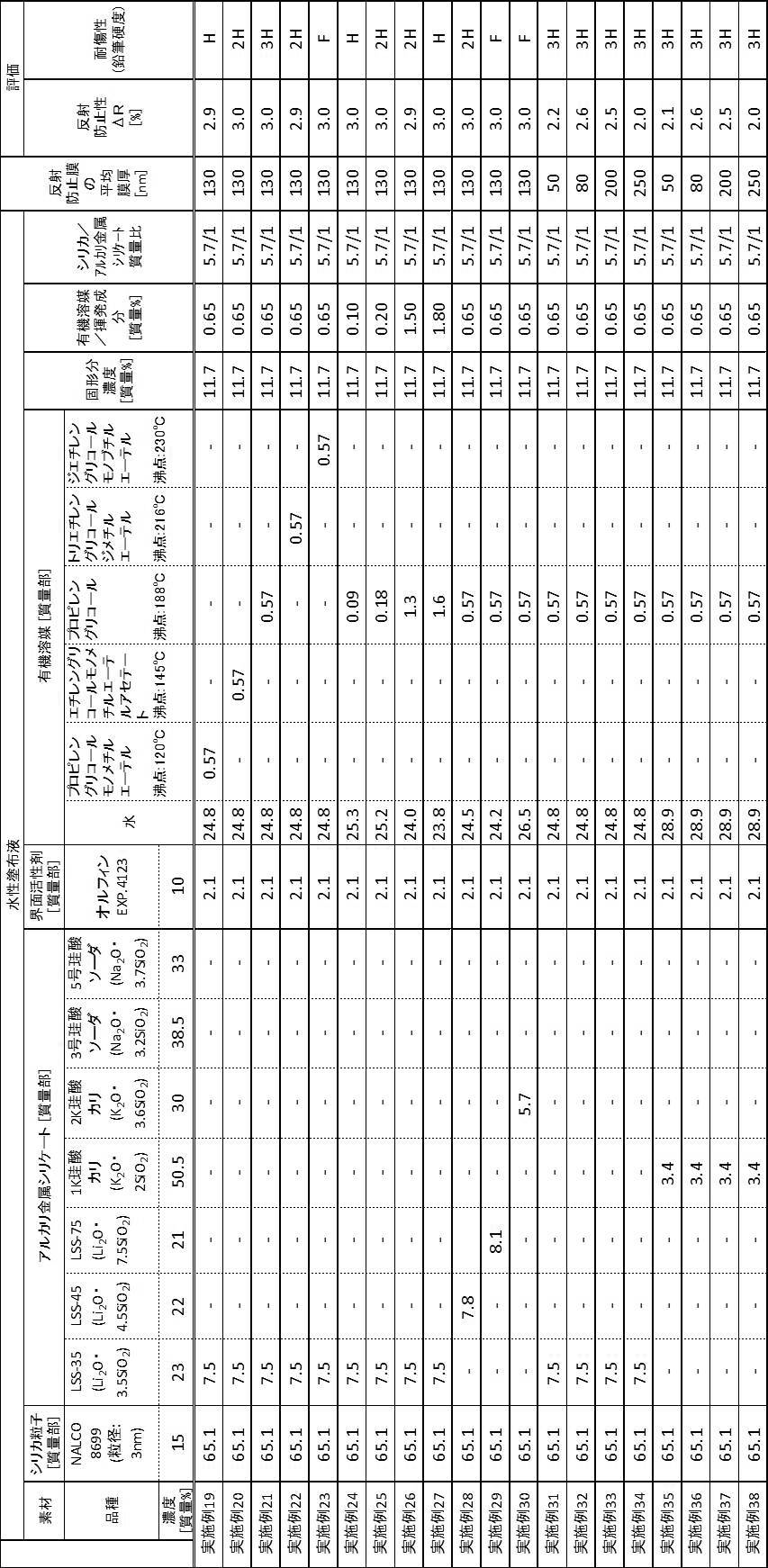
表1~表3に示す成分の詳細を以下に示す。
・NALCO(登録商標)8699:
シリカ粒子の水分散物(無孔質シリカ粒子、シリカ粒子の平均一次粒子径:3nm、固形分:15質量%)、NALCO社製
・NALCO(登録商標)1130:
シリカ粒子の水分散物(無孔質シリカ粒子、シリカ粒子の平均一次粒子径:8nm、固形分:30質量%)、NALCO社製
・NALCO(登録商標)1030:
シリカ粒子の水分散物(無孔質シリカ粒子、シリカ粒子の平均一次粒子径:13nm、固形分:30質量%)、NALCO社製
・NALCO(登録商標)1050:
シリカ粒子の水分散物(無孔質シリカ粒子、シリカ粒子の平均一次粒子径:20nm、固形分:50質量%)、NALCO社製
・NALCO(登録商標)1060:
シリカ粒子の水分散物(無孔質シリカ粒子、シリカ粒子の平均一次粒子径:60nm、固形分:50質量%)、NALCO社製
・LSS-35(Li2O・3.5SiO2):
リチウムシリケート(固形分:23質量%;M2O・nSiO2(式1;n=3.5)で表されるアルカリ金属シリケート)、日産化学工業社製
・LSS-45(Li2O・4.5SiO2):
リチウムシリケート(固形分:22質量%;M2O・nSiO2(式1;n=4.5)で表されるアルカリ金属シリケート)、日産化学工業社製
・LSS-75(Li2O・7.5SiO2):
リチウムシリケート(固形分:21質量%;M2O・nSiO2(式1;n=7.5)で表されるアルカリ金属シリケート)、日産化学工業社製
・1K珪酸カリ(K2O・2SiO2):
富士化学社製(固形分:50.5質量%、M2O・nSiO2(式1)で表されるアルカリ金属シリケート)
・2K珪酸カリ(K2O・3.6SiO2):
富士化学社製(固形分:30質量%、M2O・nSiO2(式1)で表されるアルカリ金属シリケート)
・3号珪酸ソーダ(Na2O・3.2SiO2):
富士化学社製(固形分:38.5質量%、M2O・nSiO2(式1)で表されるアルカリ金属シリケート)
・5号珪酸ソーダ(Na2O・3.7SiO2):
富士化学社製(固形分:33質量%、M2O・nSiO2(式1)で表されるアルカリ金属シリケート)
・オルフィンEXP.4123:固形分:40質量%(実施例では、水で希釈して固形分10質量%に調製して使用)、日信化学工業社製のノニオン性界面活性剤
・NALCO(登録商標)8699:
シリカ粒子の水分散物(無孔質シリカ粒子、シリカ粒子の平均一次粒子径:3nm、固形分:15質量%)、NALCO社製
・NALCO(登録商標)1130:
シリカ粒子の水分散物(無孔質シリカ粒子、シリカ粒子の平均一次粒子径:8nm、固形分:30質量%)、NALCO社製
・NALCO(登録商標)1030:
シリカ粒子の水分散物(無孔質シリカ粒子、シリカ粒子の平均一次粒子径:13nm、固形分:30質量%)、NALCO社製
・NALCO(登録商標)1050:
シリカ粒子の水分散物(無孔質シリカ粒子、シリカ粒子の平均一次粒子径:20nm、固形分:50質量%)、NALCO社製
・NALCO(登録商標)1060:
シリカ粒子の水分散物(無孔質シリカ粒子、シリカ粒子の平均一次粒子径:60nm、固形分:50質量%)、NALCO社製
・LSS-35(Li2O・3.5SiO2):
リチウムシリケート(固形分:23質量%;M2O・nSiO2(式1;n=3.5)で表されるアルカリ金属シリケート)、日産化学工業社製
・LSS-45(Li2O・4.5SiO2):
リチウムシリケート(固形分:22質量%;M2O・nSiO2(式1;n=4.5)で表されるアルカリ金属シリケート)、日産化学工業社製
・LSS-75(Li2O・7.5SiO2):
リチウムシリケート(固形分:21質量%;M2O・nSiO2(式1;n=7.5)で表されるアルカリ金属シリケート)、日産化学工業社製
・1K珪酸カリ(K2O・2SiO2):
富士化学社製(固形分:50.5質量%、M2O・nSiO2(式1)で表されるアルカリ金属シリケート)
・2K珪酸カリ(K2O・3.6SiO2):
富士化学社製(固形分:30質量%、M2O・nSiO2(式1)で表されるアルカリ金属シリケート)
・3号珪酸ソーダ(Na2O・3.2SiO2):
富士化学社製(固形分:38.5質量%、M2O・nSiO2(式1)で表されるアルカリ金属シリケート)
・5号珪酸ソーダ(Na2O・3.7SiO2):
富士化学社製(固形分:33質量%、M2O・nSiO2(式1)で表されるアルカリ金属シリケート)
・オルフィンEXP.4123:固形分:40質量%(実施例では、水で希釈して固形分10質量%に調製して使用)、日信化学工業社製のノニオン性界面活性剤
表1~表3を参照して、実施例について詳述する。
実施例1~10では、表1に示すように、シリカ粒子及びアルカリ金属シリケートを特定比率(シリカ粒子/アルカリ金属シリケート比=200/1~3/1)の範囲で含有することで、反射防止性と耐傷性とに優れた水性塗布液が得られた。この場合、アルカリ金属シリケートのアルカリ金属としては、リチウムとカリウムとで大きな差異はみられなかったが、実施例11~16に示されるように、アルカリ金属がリチウム又はカリウムであるリチウムシリケート又はカリウムシリケートは、アルカリ金属がナトリウムであるナトリウムシリケートに比べ、耐傷性により優れていた。
また、シリカ粒子/アルカリ金属シリケート比としては、耐傷性の向上効果の観点から、50/1~4/1の範囲が好適であり、6/1~4/1の範囲がより好適であった。
一方、アルカリ金属シリケートを含有しない比較例1では、耐傷性が著しく低下した。また、シリカ粒子/アルカリ金属シリケート比が200/1~3/1の範囲を満足しない比較例2~10では、反射防止性と耐傷性とを両立できなかった。具体的には、シリカ粒子/アルカリ金属シリケート比が200/1を上回ると、耐傷性が著しく低下した。シリカ粒子/アルカリ金属シリケート比が3/1を下回ると、反射防止性が著しく低下し、さらに2/1以下の範囲では、シリカ粒子に対するアルカリ金属シリケートの割合が多くなり過ぎてゲル化し、塗布することができなかった。
実施例1~10では、表1に示すように、シリカ粒子及びアルカリ金属シリケートを特定比率(シリカ粒子/アルカリ金属シリケート比=200/1~3/1)の範囲で含有することで、反射防止性と耐傷性とに優れた水性塗布液が得られた。この場合、アルカリ金属シリケートのアルカリ金属としては、リチウムとカリウムとで大きな差異はみられなかったが、実施例11~16に示されるように、アルカリ金属がリチウム又はカリウムであるリチウムシリケート又はカリウムシリケートは、アルカリ金属がナトリウムであるナトリウムシリケートに比べ、耐傷性により優れていた。
また、シリカ粒子/アルカリ金属シリケート比としては、耐傷性の向上効果の観点から、50/1~4/1の範囲が好適であり、6/1~4/1の範囲がより好適であった。
一方、アルカリ金属シリケートを含有しない比較例1では、耐傷性が著しく低下した。また、シリカ粒子/アルカリ金属シリケート比が200/1~3/1の範囲を満足しない比較例2~10では、反射防止性と耐傷性とを両立できなかった。具体的には、シリカ粒子/アルカリ金属シリケート比が200/1を上回ると、耐傷性が著しく低下した。シリカ粒子/アルカリ金属シリケート比が3/1を下回ると、反射防止性が著しく低下し、さらに2/1以下の範囲では、シリカ粒子に対するアルカリ金属シリケートの割合が多くなり過ぎてゲル化し、塗布することができなかった。
次に、表2に示すように、シリカ粒子の平均一次粒子径が15nm以下である実施例17~18では、反射防止性及び耐傷性を両立できたのに対し、シリカ粒子の平均一次粒子径が15nmを超える比較例11~12では、所望とする反射防止性を実現することができなかった。
表3には、有機溶媒を用いた場合の例を示す。
実施例20~22のように、所定の沸点を有する有機溶媒を含有することで、沸点が140℃~220℃から外れる有機溶媒を含有する場合(実施例19、23)に比べ、耐傷性が飛躍的に向上した。また、有機溶媒を含有する場合には、実施例24~27に示すように、水性塗布液中の揮発分に対する有機溶媒の割合が0.2質量%~1.5質量%の範囲内である場合に、飛躍的に耐傷性が向上した。
実施例20~22のように、所定の沸点を有する有機溶媒を含有することで、沸点が140℃~220℃から外れる有機溶媒を含有する場合(実施例19、23)に比べ、耐傷性が飛躍的に向上した。また、有機溶媒を含有する場合には、実施例24~27に示すように、水性塗布液中の揮発分に対する有機溶媒の割合が0.2質量%~1.5質量%の範囲内である場合に、飛躍的に耐傷性が向上した。
M2O・nSiO2(式1)で表されるアルカリ金属シリケートにおけるモル比nとしては、例えばアルカリ金属がリチウムの場合、モル比n=7.5(>5.0)の実施例29に比べ、モル比n=4.5(≦5.0)の実施例28において耐傷性の向上効果がみられた。また、アルカリ金属がカリウムの場合も同様の傾向がみられ、モル比n=3.6(>2.5)の実施例30では、実施例29と同等程度の結果であった。
実施例31~38には、反射防止膜の平均膜厚を変化させた場合の結果を示す。
平均膜厚は、80nm~200nmの範囲である場合により優れた耐傷性を示した。平均膜厚が80nmを下回ると、実施例31、35のように、反射防止性が低下する傾向がある。また、平均膜厚が200nmを超えて厚い実施例34、38でも、同様に反射防止性が低下する傾向がみられた。
平均膜厚は、80nm~200nmの範囲である場合により優れた耐傷性を示した。平均膜厚が80nmを下回ると、実施例31、35のように、反射防止性が低下する傾向がある。また、平均膜厚が200nmを超えて厚い実施例34、38でも、同様に反射防止性が低下する傾向がみられた。
本開示の水性塗布組成物は、入射光に対して高い透過率が求められ、かつ、外力を受けやすい環境下に曝される技術分野に好適であり、例えば、光学レンズ、光学フィルタ、監視カメラ、標識、又は太陽電池モジュール等の光入射側の部材(フロントガラス、レンズ等)、照明機器の光照射側の部材(拡散ガラス等)に設けられる保護膜もしくは反射防止膜、各種ディスプレイの薄層フィルムトランジスタ(TFT)用平坦化膜などに好適に用いられる。
2016年2月29日に出願された日本国特許出願2016-038286号の開示はその全体が参照により本明細書に取り込まれる。
本明細書に記載された全ての文献、特許出願、及び技術規格は、個々の文献、特許出願、及び技術規格が参照により取り込まれることが具体的かつ個々に記された場合と同程度に、本明細書に参照により取り込まれる。
本明細書に記載された全ての文献、特許出願、及び技術規格は、個々の文献、特許出願、及び技術規格が参照により取り込まれることが具体的かつ個々に記された場合と同程度に、本明細書に参照により取り込まれる。
Claims (15)
- 平均一次粒子径が15nm以下であるシリカ粒子と、下記式1で表されるアルカリ金属シリケートと、を含み、前記アルカリ金属シリケートに対する前記シリカ粒子の含有比が、質量比で200/1~3/1である、水性塗布組成物。
M2O・nSiO2 ・・・式1
式1中、Mはアルカリ金属を表し、nはモル比を表す。 - 前記アルカリ金属シリケートに対する前記シリカ粒子の含有比が、質量比で50/1~4/1である請求項1に記載の水性塗布組成物。
- 前記式1において、Mで表されるアルカリ金属がリチウム又はカリウムである請求項1又は請求項2に記載の水性塗布組成物。
- 前記シリカ粒子の平均一次粒子径が、10nm以下である請求項1~請求項3のいずれか1項に記載の水性塗布組成物。
- 更に、沸点が140℃~220℃の有機溶媒を含む請求項1~請求項4のいずれか1項に記載の水性塗布組成物。
- 前記有機溶媒の、水性塗布組成物中の揮発成分全体に対する比率が、0.2質量%~1.5質量%である請求項5に記載の水性塗布組成物。
- 前記式1において、Mで表されるアルカリ金属がリチウムであり、かつ、nが5.0以下である請求項1~請求項6のいずれか1項に記載の水性塗布組成物。
- 前記式1において、Mで表されるアルカリ金属がカリウムであり、かつ、nが2.5以下である請求項1~請求項6のいずれか1項に記載の水性塗布組成物。
- 平均一次粒子径が15nm以下であるシリカ粒子と、下記式1で表されるアルカリ金属シリケートと、を含み、前記アルカリ金属シリケートに対する前記シリカ粒子の含有比が、質量比で200/1~3/1である、反射防止膜。
M2O・nSiO2 ・・・式1
式1中、Mはアルカリ金属を表し、nはモル比を表す。 - 請求項1~請求項8のいずれか1項に記載の水性塗布組成物により形成された反射防止膜。
- 平均膜厚が、80nm~200nmである請求項9又は請求項10に記載の反射防止膜。
- 基材と、請求項9~請求項11のいずれか1項に記載の反射防止膜と、を有する積層体。
- 前記基材が、ガラスである請求項12に記載の積層体。
- 請求項12又は請求項13に記載の積層体を備えた太陽電池モジュール。
- 基材上に、平均一次粒子径が15nm以下であるシリカ粒子と、下記式1で表されるアルカリ金属シリケートと、を含み、前記アルカリ金属シリケートに対する前記シリカ粒子の含有比が、質量比で200/1~3/1である水性塗布組成物を塗布して塗布膜を形成する工程と、
塗布により形成された塗布膜を乾燥して反射防止膜を形成する工程と、
を有する、積層体の製造方法。
M2O・nSiO2 ・・・式1
式1中、Mはアルカリ金属を表し、nはモル比を表す。
Priority Applications (1)
| Application Number | Priority Date | Filing Date | Title |
|---|---|---|---|
| JP2018503115A JPWO2017150393A1 (ja) | 2016-02-29 | 2017-02-24 | 水性塗布組成物、反射防止膜、積層体及び積層体の製造方法、並びに太陽電池モジュール |
Applications Claiming Priority (2)
| Application Number | Priority Date | Filing Date | Title |
|---|---|---|---|
| JP2016038286 | 2016-02-29 | ||
| JP2016-038286 | 2016-02-29 |
Publications (1)
| Publication Number | Publication Date |
|---|---|
| WO2017150393A1 true WO2017150393A1 (ja) | 2017-09-08 |
Family
ID=59742896
Family Applications (1)
| Application Number | Title | Priority Date | Filing Date |
|---|---|---|---|
| PCT/JP2017/007220 Ceased WO2017150393A1 (ja) | 2016-02-29 | 2017-02-24 | 水性塗布組成物、反射防止膜、積層体及び積層体の製造方法、並びに太陽電池モジュール |
Country Status (2)
| Country | Link |
|---|---|
| JP (1) | JPWO2017150393A1 (ja) |
| WO (1) | WO2017150393A1 (ja) |
Cited By (3)
| Publication number | Priority date | Publication date | Assignee | Title |
|---|---|---|---|---|
| CN107902918A (zh) * | 2017-12-08 | 2018-04-13 | 福耀玻璃工业集团股份有限公司 | 一种增透减反射膜层的制备方法 |
| JP2019110219A (ja) * | 2017-12-19 | 2019-07-04 | 株式会社 シリコンプラス | 太陽電池パネル用コーティング材 |
| WO2025211352A1 (ja) * | 2024-04-04 | 2025-10-09 | 大日本印刷株式会社 | 光学積層体、並びに、前記光学積層体を用いた偏光板、表面板、パネル及び画像表示装置、並びに、光学積層体の選定方法 |
Citations (6)
| Publication number | Priority date | Publication date | Assignee | Title |
|---|---|---|---|---|
| JP2006128474A (ja) * | 2004-10-29 | 2006-05-18 | Ceramission Kk | 太陽電池モジュール |
| JP2006152221A (ja) * | 2004-12-01 | 2006-06-15 | Inax Corp | 無機皮膜付き製品並びにそのための無機塗料及びその製造方法 |
| JP2011009468A (ja) * | 2009-06-25 | 2011-01-13 | Central Glass Co Ltd | 低反射膜で被覆した太陽電池パネル用カバーガラス及びその製法 |
| JP2012046707A (ja) * | 2010-08-25 | 2012-03-08 | Tamaki Mitsunori | 不燃塗料 |
| JP2012173428A (ja) * | 2011-02-18 | 2012-09-10 | Asahi Kasei E-Materials Corp | 反射防止コーティング組成物 |
| JP2015174972A (ja) * | 2014-03-17 | 2015-10-05 | 富士フイルム株式会社 | 水性コート剤、膜、膜の製造方法、積層体、及び太陽電池モジュール |
Family Cites Families (5)
| Publication number | Priority date | Publication date | Assignee | Title |
|---|---|---|---|---|
| JPH0726166A (ja) * | 1993-07-14 | 1995-01-27 | Akira Mabe | 水性耐熱塗料および耐熱被覆層 |
| JP2000109722A (ja) * | 1998-10-05 | 2000-04-18 | Nippon Paint Co Ltd | 無機質水性塗料組成物およびそれを用いた無機塗膜形成方法 |
| EP2650336A4 (en) * | 2010-12-08 | 2014-07-16 | Atotis Kk | METHOD FOR PRODUCING A WATERGLASS COATING COMPOSITION |
| JP5804996B2 (ja) * | 2012-03-27 | 2015-11-04 | 中央自動車工業株式会社 | 有機基材用防曇防汚剤及び当該防曇防汚剤で有機基材を被覆する方法 |
| KR101523819B1 (ko) * | 2012-09-04 | 2015-05-28 | (주)엘지하우시스 | 실록산 화합물을 포함하는 반사 방지 코팅 조성물, 이를 이용한 반사 방지 필름 |
-
2017
- 2017-02-24 JP JP2018503115A patent/JPWO2017150393A1/ja not_active Ceased
- 2017-02-24 WO PCT/JP2017/007220 patent/WO2017150393A1/ja not_active Ceased
Patent Citations (6)
| Publication number | Priority date | Publication date | Assignee | Title |
|---|---|---|---|---|
| JP2006128474A (ja) * | 2004-10-29 | 2006-05-18 | Ceramission Kk | 太陽電池モジュール |
| JP2006152221A (ja) * | 2004-12-01 | 2006-06-15 | Inax Corp | 無機皮膜付き製品並びにそのための無機塗料及びその製造方法 |
| JP2011009468A (ja) * | 2009-06-25 | 2011-01-13 | Central Glass Co Ltd | 低反射膜で被覆した太陽電池パネル用カバーガラス及びその製法 |
| JP2012046707A (ja) * | 2010-08-25 | 2012-03-08 | Tamaki Mitsunori | 不燃塗料 |
| JP2012173428A (ja) * | 2011-02-18 | 2012-09-10 | Asahi Kasei E-Materials Corp | 反射防止コーティング組成物 |
| JP2015174972A (ja) * | 2014-03-17 | 2015-10-05 | 富士フイルム株式会社 | 水性コート剤、膜、膜の製造方法、積層体、及び太陽電池モジュール |
Cited By (5)
| Publication number | Priority date | Publication date | Assignee | Title |
|---|---|---|---|---|
| CN107902918A (zh) * | 2017-12-08 | 2018-04-13 | 福耀玻璃工业集团股份有限公司 | 一种增透减反射膜层的制备方法 |
| JP2019110219A (ja) * | 2017-12-19 | 2019-07-04 | 株式会社 シリコンプラス | 太陽電池パネル用コーティング材 |
| JP2022106797A (ja) * | 2017-12-19 | 2022-07-20 | 株式会社 シリコンプラス | 太陽電池パネル用コーティング材 |
| JP7465001B2 (ja) | 2017-12-19 | 2024-04-10 | 株式会社 シリコンプラス | 太陽電池パネル用コーティング材 |
| WO2025211352A1 (ja) * | 2024-04-04 | 2025-10-09 | 大日本印刷株式会社 | 光学積層体、並びに、前記光学積層体を用いた偏光板、表面板、パネル及び画像表示装置、並びに、光学積層体の選定方法 |
Also Published As
| Publication number | Publication date |
|---|---|
| JPWO2017150393A1 (ja) | 2018-08-09 |
Similar Documents
| Publication | Publication Date | Title |
|---|---|---|
| CN105765015B (zh) | 水性涂布剂、膜、膜的制造方法、层叠体、及太阳能电池模块 | |
| US20100167046A1 (en) | Process for coating a glass plate | |
| CN110225949B (zh) | 涂布组合物、防反射膜及其制造方法、层叠体以及太阳能电池模块 | |
| EP2625227A1 (en) | Coating composition and method of making and using the same | |
| WO2017150132A1 (ja) | 積層体の製造方法、反射防止膜付ガラス及び太陽電池モジュール | |
| WO2017150393A1 (ja) | 水性塗布組成物、反射防止膜、積層体及び積層体の製造方法、並びに太陽電池モジュール | |
| CN107207907B (zh) | 低折射率膜形成用液体组合物 | |
| JP6348276B2 (ja) | 反射防止膜形成用塗布液および反射防止膜付基材とその製造方法ならびにその用途 | |
| WO2016002223A1 (ja) | 低反射コーティング付きガラス板 | |
| JP2018058914A (ja) | 多孔質膜形成用組成物、多孔質膜形成用組成物の製造方法、多孔質膜の製造方法、積層体、及び太陽電池モジュール | |
| JP6847243B2 (ja) | 塗布組成物、積層体及び太陽電池モジュール、並びに積層体の製造方法 | |
| US12517286B2 (en) | Method of producing single layer omnidirectional broadband antireflective and super hydrophilic (antifogging) coatings for solar and other applications | |
| CN102714232A (zh) | 用于制造光电池的带金属膜衬底 | |
| WO2016072509A1 (ja) | 水性塗布液、膜及びその製造方法、積層体、並びに太陽電池モジュール | |
| WO2023169539A1 (zh) | 车辆用憎水减反玻璃及其制造方法与夹层玻璃 | |
| WO2017022433A1 (ja) | 水性塗布液、膜及びその製造方法、積層体、並びに太陽電池モジュール | |
| CN106999982A (zh) | 水性涂布液、膜及其制造方法、层叠体以及太阳能电池模块 | |
| WO2018101277A1 (ja) | 塗布組成物、反射防止膜、積層体及び積層体の製造方法、並びに、太陽電池モジュール | |
| JP5370241B2 (ja) | シリカ多孔質体の製造方法 | |
| WO2018221739A1 (ja) | 塗布組成物及び積層体の製造方法 | |
| JP6733235B2 (ja) | 低屈折率膜形成用液組成物 |
Legal Events
| Date | Code | Title | Description |
|---|---|---|---|
| ENP | Entry into the national phase |
Ref document number: 2018503115 Country of ref document: JP Kind code of ref document: A |
|
| NENP | Non-entry into the national phase |
Ref country code: DE |
|
| 121 | Ep: the epo has been informed by wipo that ep was designated in this application |
Ref document number: 17759859 Country of ref document: EP Kind code of ref document: A1 |
|
| 122 | Ep: pct application non-entry in european phase |
Ref document number: 17759859 Country of ref document: EP Kind code of ref document: A1 |