WO2017130838A1 - 絆創膏 - Google Patents
絆創膏 Download PDFInfo
- Publication number
- WO2017130838A1 WO2017130838A1 PCT/JP2017/001792 JP2017001792W WO2017130838A1 WO 2017130838 A1 WO2017130838 A1 WO 2017130838A1 JP 2017001792 W JP2017001792 W JP 2017001792W WO 2017130838 A1 WO2017130838 A1 WO 2017130838A1
- Authority
- WO
- WIPO (PCT)
- Prior art keywords
- bandage
- adhesive bandage
- adhesive
- material layer
- end portion
- Prior art date
- Legal status (The legal status is an assumption and is not a legal conclusion. Google has not performed a legal analysis and makes no representation as to the accuracy of the status listed.)
- Ceased
Links
Images





Classifications
-
- A—HUMAN NECESSITIES
- A61—MEDICAL OR VETERINARY SCIENCE; HYGIENE
- A61F—FILTERS IMPLANTABLE INTO BLOOD VESSELS; PROSTHESES; DEVICES PROVIDING PATENCY TO, OR PREVENTING COLLAPSING OF, TUBULAR STRUCTURES OF THE BODY, e.g. STENTS; ORTHOPAEDIC, NURSING OR CONTRACEPTIVE DEVICES; FOMENTATION; TREATMENT OR PROTECTION OF EYES OR EARS; BANDAGES, DRESSINGS OR ABSORBENT PADS; FIRST-AID KITS
- A61F13/00—Bandages or dressings; Absorbent pads
- A61F13/02—Adhesive bandages or dressings
-
- A—HUMAN NECESSITIES
- A61—MEDICAL OR VETERINARY SCIENCE; HYGIENE
- A61F—FILTERS IMPLANTABLE INTO BLOOD VESSELS; PROSTHESES; DEVICES PROVIDING PATENCY TO, OR PREVENTING COLLAPSING OF, TUBULAR STRUCTURES OF THE BODY, e.g. STENTS; ORTHOPAEDIC, NURSING OR CONTRACEPTIVE DEVICES; FOMENTATION; TREATMENT OR PROTECTION OF EYES OR EARS; BANDAGES, DRESSINGS OR ABSORBENT PADS; FIRST-AID KITS
- A61F13/00—Bandages or dressings; Absorbent pads
- A61F13/02—Adhesive bandages or dressings
- A61F13/0246—Adhesive bandages or dressings characterised by the skin-adhering layer
- A61F13/0256—Adhesive bandages or dressings characterised by the skin-adhering layer characterized by the parametric properties of the adhesive
-
- A—HUMAN NECESSITIES
- A61—MEDICAL OR VETERINARY SCIENCE; HYGIENE
- A61F—FILTERS IMPLANTABLE INTO BLOOD VESSELS; PROSTHESES; DEVICES PROVIDING PATENCY TO, OR PREVENTING COLLAPSING OF, TUBULAR STRUCTURES OF THE BODY, e.g. STENTS; ORTHOPAEDIC, NURSING OR CONTRACEPTIVE DEVICES; FOMENTATION; TREATMENT OR PROTECTION OF EYES OR EARS; BANDAGES, DRESSINGS OR ABSORBENT PADS; FIRST-AID KITS
- A61F13/00—Bandages or dressings; Absorbent pads
- A61F13/02—Adhesive bandages or dressings
- A61F13/0259—Adhesive bandages or dressings characterised by the release liner covering the skin adhering layer
-
- A—HUMAN NECESSITIES
- A61—MEDICAL OR VETERINARY SCIENCE; HYGIENE
- A61F—FILTERS IMPLANTABLE INTO BLOOD VESSELS; PROSTHESES; DEVICES PROVIDING PATENCY TO, OR PREVENTING COLLAPSING OF, TUBULAR STRUCTURES OF THE BODY, e.g. STENTS; ORTHOPAEDIC, NURSING OR CONTRACEPTIVE DEVICES; FOMENTATION; TREATMENT OR PROTECTION OF EYES OR EARS; BANDAGES, DRESSINGS OR ABSORBENT PADS; FIRST-AID KITS
- A61F13/00—Bandages or dressings; Absorbent pads
- A61F13/06—Bandages or dressings; Absorbent pads specially adapted for feet or legs; Corn-pads; Corn-rings
-
- A—HUMAN NECESSITIES
- A61—MEDICAL OR VETERINARY SCIENCE; HYGIENE
- A61F—FILTERS IMPLANTABLE INTO BLOOD VESSELS; PROSTHESES; DEVICES PROVIDING PATENCY TO, OR PREVENTING COLLAPSING OF, TUBULAR STRUCTURES OF THE BODY, e.g. STENTS; ORTHOPAEDIC, NURSING OR CONTRACEPTIVE DEVICES; FOMENTATION; TREATMENT OR PROTECTION OF EYES OR EARS; BANDAGES, DRESSINGS OR ABSORBENT PADS; FIRST-AID KITS
- A61F13/00—Bandages or dressings; Absorbent pads
- A61F13/10—Bandages or dressings; Absorbent pads specially adapted for fingers, hands or arms; Finger-stalls; Nail-protectors
-
- A—HUMAN NECESSITIES
- A61—MEDICAL OR VETERINARY SCIENCE; HYGIENE
- A61F—FILTERS IMPLANTABLE INTO BLOOD VESSELS; PROSTHESES; DEVICES PROVIDING PATENCY TO, OR PREVENTING COLLAPSING OF, TUBULAR STRUCTURES OF THE BODY, e.g. STENTS; ORTHOPAEDIC, NURSING OR CONTRACEPTIVE DEVICES; FOMENTATION; TREATMENT OR PROTECTION OF EYES OR EARS; BANDAGES, DRESSINGS OR ABSORBENT PADS; FIRST-AID KITS
- A61F15/00—Auxiliary appliances for wound dressings; Dispensing containers for dressings or bandages
- A61F15/001—Packages or dispensers for bandages, cotton balls, drapes, dressings, gauze, gowns, sheets, sponges, swabsticks or towels
Definitions
- Non-Patent Document 1 Non-Patent Document 1
- users such as doctors, nurses, patients themselves, etc. must select taping materials from various types of commercial products and cut them into appropriate sizes each time. Met. For this reason, especially in outpatients, taping at home or the like cannot be continued, which has become a cause of severe peritonitis.
- An object of the present invention is to provide a bandage that can easily and effectively prevent and / or treat inflammation around the nail.
- a bandage having a specific shape is useful for the prevention and / or treatment of inflammation around the nail, and have completed the present invention.
- the present invention is as follows.
- Item 1 A bandage having a base material layer, a pressure-sensitive adhesive layer, and a release material layer, wherein two ends extending in the longitudinal direction of the bandage have a parallel portion, and the length of one of the two ends is Longer than the other, and both ends of the two end portions are connected to both ends of the other two end portions, the longer end portion of the two end portions extending in the longitudinal direction, and another end portion A bandage in which the two corners formed by each of the two ends are acute.
- Item 2. Item 2.
- Item 3. Item 3.
- the adhesive bandage according to Item 1 or 2 which is symmetrical with respect to a central axis perpendicular to the longitudinal direction of the adhesive bandage.
- Item 4. A term in which the release material layer consists of three parts separated by two slits that are parallel to the central axis and equidistant from the central axis, or consists of two parts separated by one slit on the central axis
- the adhesive bandage according to any one of Items 1 to 4 which is an adhesive bandage for preventing and / or treating inflammation around the nail.
- Item 6. A kit for treating peritonitis comprising the adhesive bandage according to any one of Items 1 to 5 and a check sheet for recording the state of the affected area.
- Item 7 The kit according to Item 6, further comprising a humectant, a cotton swab, and a protective material.
- Item 8. Item 8. The adhesive bandage according to any one of Items 1 to 7, wherein the entire length of the other two end portions or the entire portion excluding both ends is substantially linear.
- Item 9. The adhesive bandage according to any one of Items 1 to 8, wherein the length of the other two end portions is 0.8 to 3 cm.
- FIG. 1 The top view of the adhesive bandage of 1st Embodiment of this invention
- FIG. 1 The schematic which shows the use condition of the adhesive bandage of FIG. 1A
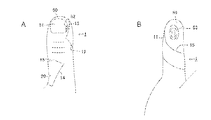
- FIG. 2 The schematic which looked at FIG. 2 (A) from the belly side of the finger
- prevention and / or treatment refers to prevention, treatment, or both prevention and treatment.
- FIG. 1A is a plan view of the adhesive bandage 1 according to the first embodiment of the present invention
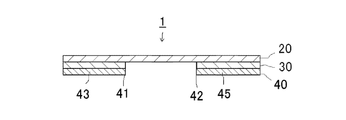
- FIG. 1B is a cross-sectional view of the adhesive bandage of FIG. 1A taken along line 1B-1B.
- the adhesive bandage 1 of the first embodiment has a base material layer 20, an adhesive layer 30, and a release material layer 40, specifically, one of the base materials 20.
- This is a tape that is configured such that a release material layer 40 is detachably laminated on the surface via an adhesive layer 30.
- the adhesive bandage 1 of 1st Embodiment is the upper end part 11 and the lower end part 12 which are extended in the longitudinal direction of the adhesive bandage 1 which is a 1st group, and the left end part 13 which is a 2nd group.
- the right end portion 14, the upper end portion 11 and the lower end portion 12 have substantially straight portions 11a and 12a, respectively, and the both ends of the upper end portion 11 and the lower end portion 12 are substantially straight left end portions. 13 and both ends of the right end portion 14 are connected.
- the length of the upper end portion 11 is longer than the length of the lower end portion 12, the upper end portion 11 is connected to the left end portion 13 and the right end portion 14 at an angle ⁇ , and the left end portion 13 and the right end portion 14 are connected to the upper end portion 11.
- the lower end 12 is connected to the end opposite to the end.
- the adhesive bandage 1 has a symmetrical shape with respect to the central axis Ax perpendicular to the longitudinal direction. That is, the adhesive bandage 1 has a symmetrical shape with respect to the center plane in the longitudinal direction of the adhesive bandage 1.
- ⁇ is an acute angle, usually 30 ° or more and less than 90 °.
- the upper end portion 11 is provided with a concave portion 15 that curves inward toward the adhesive bandage.
- the concave portion 15 functions to improve the wearability of the adhesive bandage 1 on the patient's finger.
- the length L of the adhesive bandage 1 is not particularly limited, but is preferably 4 to 8 cm.
- the width W of the adhesive bandage 1 is not particularly limited, but is preferably 0.5 to 2.5 cm.
- the ratio of length L to width W is not particularly limited, but is preferably 10: 1 to 2: 1.
- the length of the upper end 11 is preferably 2 to 8 cm, the length of the lower end 12 is preferably 1.5 to 7.5 cm, and the length of the left end 13 and the right end 14 is preferably 0.8-3 cm.
- the base material layer 20 is preferably stretchable because it has less discomfort when applied to the skin. Moreover, the direction which has elasticity tends to follow skin, and the adhesive bandage 1 is hard to peel off. Moreover, in order to prevent the affected part of the onychotis and the surrounding adhesive bandage 1 from being stuffy, it is preferable that the base material layer 20 is excellent in moisture permeability.
- Examples of the material constituting the base material layer 20 include stretchable base materials such as films, nonwoven fabrics, cotton fabrics, knitted fabrics, and laminate composites of nonwoven fabrics and films.
- Examples of the material of these base materials include polyethylene, polypropylene, polyethylene terephthalate, polybutylene terephthalate, polyethylene naphthalate, polystyrene, polyamide, polyolefin, nylon, cotton, pulp, acetate rayon, rayon, rayon / polyethylene terephthalate composite, Polyacrylonitrile, polyvinyl alcohol, acrylic polyurethane, ester polyurethane, ether polyurethane, styrene-isoprene-styrene copolymer, styrene-butadiene-styrene copolymer, styrene-ethylene-propylene-styrene copolymer, ethylene-acetic acid Ingredients such as vinyl copolymers can be mentioned.
- the base material layer 20 may contain various strength control agents widely used in the technical field, extenders such as inorganic powders, dyes, pigments, and the like. Moreover, the base material layer 20 may be manufactured by any method of uniaxial stretching, biaxial stretching, and non-stretching. Moreover, the base material layer 20 may be not only a single layer but also a multilayer structure in which a plurality of different or similar layers are stacked.
- the thickness of the base material layer 20 is not particularly limited, it is preferably 1000 ⁇ m or less, more preferably 500 ⁇ m or less, and even more preferably 300 ⁇ m or less because stretchability and moisture permeability are easily obtained. On the other hand, since the strength is easily obtained, the thickness of the base material layer 20 is preferably 15 ⁇ m or more, more preferably 20 ⁇ m or more, and further preferably 30 ⁇ m or more.
- the pressure-sensitive adhesive layer 30 of the adhesive bandage 1 of the present embodiment is composed of a pressure-sensitive adhesive for sticking the base material layer 20 to an affected part to be an adherend.
- adhesives examples include rubber adhesives, acrylic adhesives, silicon adhesives, hydrocolloids and the like.
- an isocyanate-based crosslinking agent, a metal chelate-based crosslinking agent, a tackifier, or the like may be appropriately added to the adhesive. It is preferable to set the molecular weight of the pressure-sensitive adhesive component high to suppress the penetration of the pressure-sensitive adhesive into the skin.
- the thickness of the pressure-sensitive adhesive layer 30 using the pressure-sensitive adhesive is not particularly limited. In order to obtain moisture permeability, 100 ⁇ m or less is preferable, and 70 ⁇ m or less is more preferable. On the other hand, in order to obtain a required adhesive strength, the thickness of the pressure-sensitive adhesive layer 30 is preferably 10 ⁇ m or more, and more preferably 20 ⁇ m or more.
- the pressure-sensitive adhesive layer 30 may be formed by applying foaming paste, and the coating method may be formed in a regular or random pattern such as a dot shape or a stripe shape.
- release material layer 40 a known release material used for adhesive bandages can be used.
- examples of the release material include paper and plastic film.
- the release material layer 40 may also be referred to as release paper.
- the release material layer 40 may have a slit so that the release material layer 40 can be easily peeled off during use.
- the release material layer 40 includes three portions 43, 44, 45 separated by two slits 41, 42 that are parallel to the central axis Ax of the adhesive bandage 1 and are equidistant from the central axis Ax. For this reason, from the position of the slits 41 and 42, it becomes the structure which can peel the three parts 43, 44, and 45 so that the adhesive layer 30 may be exposed separately at the timing according to the sticking of the peeling material layer 40 to skin. ing. Moreover, it can prevent that the adhesive force falls by touching the adhesive layer 30 in the case of sticking by having the slits 41 and 42.
- FIG. 2 (A) when there is an affected area 52 of nailitis on the skin part adjacent to the nail 51 of the left thumb 50 of the patient, first, the part 43 of the release material layer 40 of the adhesive bandage 1 is peeled off. Then, the corresponding part of the pressure-sensitive adhesive layer 30 is exposed (the state in which the release material layer 40 is on the lower side in plan view in FIG. 1A). At this time, if the portion 43 of the release material layer 40 is peeled off from the position of the slit 41, it is easy to peel off.
- the left end portion 13 of the adhesive bandage 1 in which the adhesive layer 30 is exposed in the portion 43 of the release material layer 40 is disposed on the side of the skin of the affected area 52, and the portion 44 of the release material layer 40 is peeled off. While exposing the corresponding adhesive layer 30 and pulling the adhesive bandage 1 so as to relieve the pressure between the nail 51 and the affected part 52, the adhesive layer 30 spirals (slant downward) so as to contact the skin. The adhesive bandage 1 is affixed to the skin, and finally the part 45 of the release material layer 40 is exfoliated and affixed to the skin.
- the adhesive bandage 1 terminates at the right end 14 between the first joint and the second joint (on the proximal phalanx) on the back side of the thumb 50.
- the length of the upper end portion 11 is longer than the length of the lower end portion 12, and the upper end portion 11 makes an angle ⁇ with respect to the left end portion 13 and the right end portion 14.
- the bandage 1 can be easily applied in an obliquely downward direction, and the pressure on the side skin of the nail 51 by the tape is prevented. Can do.
- ⁇ between the upper end portion 11 and the left end portion 13 is 60 ° to 80 °
- the right end portion is located behind the thumb 50 between the first joint and the second joint (above the proximal phalanx). Therefore, it is difficult to limit the range of motion of the finger, and the skin part on the side of the affected area 52 can be pulled with an appropriate strength.
- the adhesive bandage 1 has a symmetrical shape with respect to the central axis Ax, if the affected area 52 is on the left side of the nail 51, the right end 14 of the adhesive bandage 1 is disposed on the skin portion on the side of the affected area 52. Then, the adhesive bandage 1 can be applied so as to relieve the pressure between the nail 51 and the affected part 52 by applying the adhesive bandage 1 to the skin in a spiral shape (diagonally downward).
- the bandage of the second embodiment of the present invention will be described with reference to FIG.
- the same components as those of the adhesive bandage 1 of the first embodiment are denoted by the same reference numerals as those in FIG.
- the adhesive bandages 2 to 7 are shown in a state in which the release material layer 40 is on the upper side (front side of the paper surface) in a plan view.
- the bandage 2 of the second embodiment is different from the bandage 1 of the first embodiment in that the upper end portion 11 does not have the recess 15 and the entire upper end portion 11 is substantially linear.
- the adhesive bandage 2 of the second embodiment the upper end portion 11 and the lower end portion 12 facing each other extending in the longitudinal direction of the adhesive bandage 2 are parallel, the adhesive bandage 2 is an isosceles trapezoid, and the upper end portion 11 is a substantially straight left end portion 13.
- the left end 13 and the right end 14 are connected to the lower end 12 at the end opposite to the end connected to the upper end 11.
- the left end portion 13 or the right end portion 14 of the adhesive bandage 2 is placed on the side of the patient's affected area 52 and the adhesive bandage 1 is applied to the skin in a spiral shape (downward).
- the bandage 1 can be applied so as to relieve the pressure between the affected areas 52.
- the bandage 3 of the third embodiment is different from the bandage 1 of the first embodiment in that the four corners 16 of the bandage 3 are rounded.
- the upper end portion 11 is rounded into a substantially curved shape at both ends, and is provided with a substantially linear parallel portion 11a, a concave portion 15, and a substantially linear parallel portion 11a between both ends.
- the lower end portion 12 includes a substantially straight parallel portion 12a except for both ends of a rounded substantially curved shape.
- Each of the left end portion 13 and the right end portion 14 includes substantially linear portions 13a and 14a except for both ends of a rounded substantially curved shape.
- the length of each substantially linear parallel portion 11a is not particularly limited, but is usually 0.5 to 2.5 cm.
- the length of the substantially straight parallel portion 12a is not particularly limited, but is usually 3.0 to 7.3 cm.
- the lengths of the substantially linear portions 13a and 14a are not particularly limited, but are usually 0.4 to 2.8 cm.
- the release material layer 40 has a slit 46 at the center of the concave portion 15 of the upper end portion 11, that is, on the central axis Ax perpendicular to the longitudinal direction of the adhesive bandage 1. Is different from the adhesive bandage 1 of the first embodiment in that it consists of two parts 47 and 48 separated by a slit 46. Even in this configuration, the release material layer 40 can be peeled off from the portion 47 at the position of the slit 46 or peeled off from the portion 48, so that the affected part 52 can be operated without distinction regardless of whether it is present on the left or right of the nail 51. Can do.
- 4th Embodiment has the recessed part 15 shallower than 1st Embodiment and the whole dimension is small, such an embodiment is also contained in the scope of the present invention.
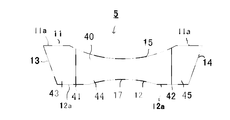
- the bandage 5 of the fifth embodiment extends in the longitudinal direction of the adhesive bandage 5 as well as the concave portion 15 of the upper end 11 which is the longer end of the two ends 11, 12 extending in the longitudinal direction of the bandage 5.
- the lower end 12, which is the shorter end of the two ends 11, 12, also has a concave portion 17 that curves toward the inside of the adhesive bandage 5. Since the adhesive bandage 5 has the recess 17 on the lower end part 12 side, the contact area between the adhesive bandage 5 and the patient's skin can be reduced. Even in this configuration, the adhesive plaster 1 can be applied so as to relieve the pressure around the nail 51, as in the first to fourth embodiments.
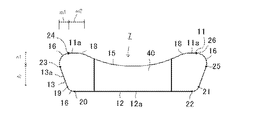
- the adhesive bandage 6 of 6th Embodiment is a modification of the adhesive bandage 3 of 3rd Embodiment of FIG.
- the same components as those of the adhesive bandage 3 of the third embodiment are denoted by the same reference numerals as those in FIG.
- connection portion 18 between the upper end portion 11 and the recess portion 15 is further rounded so as to form a continuous curve.
- a curve connecting the end point 19 at the lower end of the substantially linear portion 13a of the left end portion 13 and the end point 20 of the substantially linear parallel portion 12a of the lower end portion 12 can be arbitrarily set.
- a curve connecting the end point 26 of the parallel portion 11a can be arbitrarily set.
- the curvature radius of each curve can be set to 1 to 10 mm.
- the length of the two straight ends and the size of the rounded corner 16 between them can be arbitrarily changed, for example, the bandage of the rounded corner 16 between the end point 23 and the end point 24
- the ratio of the m1: m2 length may be about 1: 1 to 1:20.
- the length of the rounded corner portion 16 in the width direction of the adhesive bandage 6 is n1
- the ratio of the length of n1: n2 may be about 1: 1 to 1:20.
- the bandage 7 of the seventh embodiment is also a modification of the bandage 3 of the third embodiment of FIG.
- the same components as those of the adhesive bandage 3 of the third embodiment are denoted by the same reference numerals as those in FIG.
- connection portion 18 between the upper end portion 11 and the recess portion 15 is rounded so as to be a continuous curve.
- the length of the curve between the end point 19 at the lower end of the substantially linear portion 13a of the left end portion 13 and the end point 20 of the substantially linear parallel portion 12a of the lower end portion 12 is the sixth embodiment of FIG.
- the length of the curve between the end point 23 of the upper end of the substantially linear portion 13a of the left end portion 13 and the end point 24 of the substantially straight parallel portion 11a of the upper end portion 11 is larger than the length of the curve in the form.
- it is larger than the length of the curve in the sixth embodiment of FIG.
- the ranges of the length ratio of m1: m2 and the length ratio of n1: n2 are as described for the bandage of the sixth embodiment in FIG.
- the recess 15 may be formed so as to draw another curve such as a parabola or a hyperbola in a plan view instead of an arc in a plan view.
- the base material 20, the pressure-sensitive adhesive layer 30, and the release material layer 40 are shown to have the same size, but the release material layer 40 is the base material 20, the pressure-sensitive adhesive layer 30. May be larger.
- the configuration of the rounded corner 16 of the bandage 3 of the third embodiment, the bandage 6 of the sixth embodiment, and the bandage 7 of the seventh embodiment is the bandage 1, of the first, second, fourth, and fifth embodiments. It may be applied to 2, 4 and 5, or may be applied to any bandage included within the scope of the present invention. All four corners 16 may not be rounded, and one, two, or three corners 16 may be rounded.
- all the connecting portions of one end and the adjacent end are continuous. It may be substantially curved. The curvature of the curved surface of the connecting portion between a certain end portion and the adjacent portion can be arbitrarily changed.
- An additional layer may be provided on the base material 20, between the base material 20 and the adhesive layer 30, and between the adhesive layer 30 and the release material layer 40.
- the skin can be more easily pulled by the base material 20 when the adhesive plaster 1 is applied to the skin.
- the release material layer 40 may be provided with slits similar to the slits 41, 42, 46, or the slits 41, 42, 46 may be omitted.
- the three release material layer portions 43, 44, 45 or the two release material layer portions 47, 48 may be laminated on the pressure-sensitive adhesive layer 30 so that the end portions overlap each other.
- the slit of the release material layer 40 may not be completely divided. For example, even if it is a dotted line, the form which left one place or multiple places may be sufficient.
- the treatment or care of peritonitis has been described. However, it can be used for the purpose of preventing and / or treating inflammation around the nail, and particularly the severity of inflammation around the nail. It can be used as a bandage for prevention and / or pain relief. Further, in addition to the nailitis, it may be used for the purpose of preventing / treating symptoms around the nail 51 such as a wound nail care.
- the bandages of the present invention including the bandages 1 to 7 of the first to seventh embodiments and the bandages of the modified examples are not limited to the treatment of inflammation but may be used for the purpose of keeping the skin away from the nail. For example, you may use when apply
- 2 (A) and 2 (B) show the thumb, the bandage of the present invention may be applied to the index finger, middle finger, ring finger, and / or little finger of the hand, or to at least one of the five fingers of the foot May be applied.
- the present invention relates to a bandage of the present invention including the bandages 1 to 7 of the first to seventh embodiments and the bandages of the modified examples, instructions for appropriately implementing prevention and / or treatment of peritonitis, and affected area Including a kit for treating nailitis comprising at least one of a check sheet for confirming the state of
- the contents of the instructions are the same as those shown for the method of using the adhesive bandage 1 of the first embodiment in FIG.
- the instructions provide instructions for peeling the release agent layer 40 of the bandage of the present invention, placing the bandage on the side of the skin on the affected area, and applying the bandage to the finger in a spiral shape.
- the check sheet that records the state of the affected part is a check sheet that records the state of the affected part every day and allows the patient, family, and the like to easily check the state of the affected part.
- the kit for treating onychomyelitis includes a bandage of the present invention, instructions for appropriately performing prevention and / or treatment of onychomyelitis, and a check for recording the state of the affected area.
- At least one of the sheets, a container containing a humectant, a cotton swab, and a protective material such as a bandage for fingers and a finger sack are provided.
- another adhesive bandage such as hydrocolloid or another tape material may be included in the kit.
- Another bandage may be affixed partially when there is a wound on the affected area, or may be affixed so as to cover the whole after application of the bandage of the present invention.
- humectant a known humectant can be used, and examples thereof include Hirudoid (registered trademark) lotion and white petrolatum.
- a protective material such as a bandage for fingers and a waterproof finger sack is used to protect the periphery of the finger portion including the affected area after the adhesive bandage is applied to the skin.
- the amount of protective material such as bandage, moisturizer, cotton swab and bandage, waterproof finger sack in the kit is, for example, 30 bandages for 30 days, moisturizer for 30 days, 30 cotton swabs, and
- the protective material for 30 days can be set according to the period used by the user.
- FIG. 10 shows an example of a check sheet for recording the state of the affected part.
- the check sheet 100 includes a field 101 for entering a date, an item 102 regarding the observation result of the affected area, and an item 103 regarding self-care.
- the column 101 for entering the date shows one week from Monday to Sunday in one line, but the format is not particularly limited.
- the date in which the state of the affected part is recorded is entered in the blank.
- a format in which the first date to the last date in January are arranged in a vertical column may be used.
- Examples of the item 102 related to the observation result of the affected area include the presence or absence of pain around the nail, the presence or absence of swelling around the nail, cracks in the skin, itching of the skin, and other findings relating to the skin.
- the item relating to the observation result of the affected part may be a description of the state of the affected part, a description according to the degree of the state of the affected part, a description by numerical values when the state of the affected part is classified by stages, and the like.
- Examples of the item 103 relating to self-care include the presence or absence of washing of the affected area, the presence or absence of moisture retention, taping with the adhesive bandage of the present invention, and other self-care.
- the presence or absence of washing is determined, for example, by whether or not the affected part has been washed a predetermined number of times or more (for example, once or more) a day with a weakly acidic detergent or a mildly irritating detergent.
- the type of cleaning agent and the number of cleanings can be changed.
- the presence or absence of moisturizing is determined by whether or not the affected area has been moisturized with a moisturizing agent a predetermined number of times or more (for example, 5 times or more) per day.
- the moisturizing agent is preferably a moisturizing agent attached to the kit, but may be another moisturizing agent suitable for prevention and / or treatment of the affected area.
- the type of moisturizer and the number of moisturizers can be changed.
- the presence or absence of taping with the adhesive bandage of the present invention is determined by whether or not the taping has been replaced a predetermined number of times (for example, once a day) in a predetermined period.
- Peritonitis is a case that medical staff can not confirm the state of the affected area every day, and becomes serious at the time of outpatient consultation.
- the kit of the present invention allows the patient and family to easily check the instructions and daily state of the affected area for the patient and family to properly carry out prevention and / or treatment of fistula at home. By providing the sheet, it is possible to prevent the affected part from becoming serious, or to report the state of the affected part to the medical staff early and smoothly when the affected part deteriorates.
Landscapes
- Health & Medical Sciences (AREA)
- Life Sciences & Earth Sciences (AREA)
- Engineering & Computer Science (AREA)
- Biomedical Technology (AREA)
- Heart & Thoracic Surgery (AREA)
- Vascular Medicine (AREA)
- Animal Behavior & Ethology (AREA)
- General Health & Medical Sciences (AREA)
- Public Health (AREA)
- Veterinary Medicine (AREA)
- Dermatology (AREA)
- Materials For Medical Uses (AREA)
- Adhesive Tapes (AREA)
- Medicinal Preparation (AREA)
Abstract
本発明の絆創膏(1)は、基材(20)と、粘着剤層(30)と、剥離材層(40)とを有し、絆創膏の長手方向(L)に延びる2つの端部(11,12)が平行な部分(11a,12a)を有し、2つの端部(11,12)の一方の長さが他方よりも長く、かつ2つの端部(11,12)の両端が別の2つの端部(13,14)の両端と接続されており、長手方向(L)に延びる2つの端部のうちの長い方の端部(11)と、別の2つの端部(13,14)の各々とがなす2つの角(α)が鋭角である。
Description
(関連出願の相互参照)
本願は、2016年1月29日に出願した特願2016-015954号明細書の優先権の利益を主張するものであり、当該明細書はその全体が参照により本明細書中に援用される。
(技術分野)
本発明は、絆創膏に関する。
本願は、2016年1月29日に出願した特願2016-015954号明細書の優先権の利益を主張するものであり、当該明細書はその全体が参照により本明細書中に援用される。
(技術分野)
本発明は、絆創膏に関する。
抗がん剤の副作用である爪囲炎(爪周囲炎とも言う)の患者が増加している。爪囲炎は、手足の爪の周囲の皮膚に起きる炎症であり、爪の周囲の皮膚に発赤又は腫れが生じ、しばしば痛みを伴う。従来は、爪等の周囲組織への圧迫を緩和し、炎症の重症化を予防及び疼痛を緩和するために、市販のテーピング材を爪の周囲に巻き付けて使用していたが(非特許文献1)、この場合、医師、看護師、患者本人等の使用者が様々な種類の市販品の中からテーピング材を選定し、さらにその都度適切な大きさにカットして使用しなければならず煩雑であった。そのため、特に外来通院の患者では、自宅等でのテーピングが継続できず、爪囲炎が重症化する原因となっていた。
医学のあゆみ vol.241 No.8 p.588-592(2012)
本発明の目的は、爪周囲の炎症の予防及び/又は処置を簡便かつ効果的に行える絆創膏を提供することである。
本発明者らは、上記の目的を達成すべく、特定の形状を有する絆創膏が、爪周囲の炎症の予防及び/又は処置に有用であることを見出し、本発明を完成するに至った。
すなわち、本発明は以下の通りである。
項1.基材層と、粘着剤層と、剥離材層とを有する絆創膏であって、絆創膏の長手方向に延びる2つの端部が平行な部分を有し、前記2つの端部の一方の長さが他方よりも長く、かつ前記2つの端部の両端が、別の2つの端部の両端と接続されており、前記長手方向に延びる2つの端部のうちの長い方の端部と、別の2つの端部の各々とがなす2つの角が鋭角である絆創膏。
項2.長手方向に延びる2つの端部のうちの長い方の端部が、絆創膏の内方に向かう凹部を有する項1に記載の絆創膏。
項3.絆創膏の長手方向に垂直な中心軸に関して対称な形である項1又は2に記載の絆創膏。
項4.剥離材層が前記中心軸と平行かつ中心軸と等距離隔てた2つのスリットで分離された3つの部分からなるか、もしくは前記中心軸上の1つのスリットで分離された2つの部分からなる項3に記載の絆創膏。
項5.爪周囲の炎症の予防及び/又は処置用の絆創膏である項1~4のいずれか一項に記載の絆創膏。
項6.項1~5のいずれか一項に記載の絆創膏と、患部の様子を記録するチェックシートとを備えた爪囲炎を手当てするためのキット。
項7.保湿剤と、綿棒と、保護材とをさらに備える項6に記載のキット。
項8.前記別の2つ端部の全長又は両端を除く部分全体が略直線状である項1~7のいずれか一項に記載の絆創膏。
項9.前記別の2つ端部の長さが0.8~3cmである項1~8のいずれか一項に記載の絆創膏。
項10.長手方向に延びる2つの端部のうちの短い方の端部の全長又は両端を除く部分全体が略直線状である項1~9のいずれか一項に記載の絆創膏。
項1.基材層と、粘着剤層と、剥離材層とを有する絆創膏であって、絆創膏の長手方向に延びる2つの端部が平行な部分を有し、前記2つの端部の一方の長さが他方よりも長く、かつ前記2つの端部の両端が、別の2つの端部の両端と接続されており、前記長手方向に延びる2つの端部のうちの長い方の端部と、別の2つの端部の各々とがなす2つの角が鋭角である絆創膏。
項2.長手方向に延びる2つの端部のうちの長い方の端部が、絆創膏の内方に向かう凹部を有する項1に記載の絆創膏。
項3.絆創膏の長手方向に垂直な中心軸に関して対称な形である項1又は2に記載の絆創膏。
項4.剥離材層が前記中心軸と平行かつ中心軸と等距離隔てた2つのスリットで分離された3つの部分からなるか、もしくは前記中心軸上の1つのスリットで分離された2つの部分からなる項3に記載の絆創膏。
項5.爪周囲の炎症の予防及び/又は処置用の絆創膏である項1~4のいずれか一項に記載の絆創膏。
項6.項1~5のいずれか一項に記載の絆創膏と、患部の様子を記録するチェックシートとを備えた爪囲炎を手当てするためのキット。
項7.保湿剤と、綿棒と、保護材とをさらに備える項6に記載のキット。
項8.前記別の2つ端部の全長又は両端を除く部分全体が略直線状である項1~7のいずれか一項に記載の絆創膏。
項9.前記別の2つ端部の長さが0.8~3cmである項1~8のいずれか一項に記載の絆創膏。
項10.長手方向に延びる2つの端部のうちの短い方の端部の全長又は両端を除く部分全体が略直線状である項1~9のいずれか一項に記載の絆創膏。
本発明によれば、患部、特に爪周囲の患部の炎症の予防及び/又は処置を簡便かつ効果的に行うことが可能となる。
本明細書において、「予防及び/又は処置」は、予防、処置、又は予防及び処置の両方を指すものとする。
本発明の第1実施形態の絆創膏を図1(A),(B)及び図2(A),(B)を参照しながら説明する。
図1(A)は本発明の第1実施形態の絆創膏1の平面図であり、図1(B)は図1(A)の絆創膏の1B-1B線における断面図である。
図1(B)に示すように、第1実施形態の絆創膏1は、基材層20と、粘着剤層30と、剥離材層40とを有し、具体的には基材20の一方の面に粘着剤層30を介して剥離材層40が剥離可能に積層されて構成されたテープである。
図1(A)に示すように、第1実施形態の絆創膏1は、第1の組である絆創膏1の長手方向に延びる上端部11及び下端部12と、第2の組である左端部13及び右端部14とを有し、上端部11及び下端部12がそれぞれ、略直線状の互いに平行な部分11a,12aを有し、上端部11及び下端部12の両端が略直線状の左端部13及び右端部14の両端とそれぞれ接続されている。
上端部11の長さは下端部12の長さよりも長く、上端部11は左端部13及び右端部14と角度αをなして接続し、左端部13及び右端部14は上端部11と接続する端部とは反対側の端部で下端部12と接続している。
絆創膏1は、長手方向に垂直な中心軸Axに関して左右対称な形をしている。つまり、絆創膏1は、絆創膏1の長手方向の中心面に対して左右に対称な形をしている。αは鋭角であり、通常30°以上、90°未満である。また上端部11には絆創膏の内方に向かう湾曲する凹部15が設けられている。本実施形態では、凹部15は平面視で円弧を描くよう形成されており、好ましくはR=35~137mm、θ=25~90°である。凹部15は後述するように、絆創膏1の患者の指への装着性を高めるように機能する。
絆創膏1の長さLは特に限定されないが、好ましくは4~8cmである。絆創膏1の幅Wは特に限定されないが、好ましくは0.5~2.5cmである。長さL対幅Wの比は特に限定されないが、好ましくは10:1~2:1である。上端部11の長さは、好ましくは2~8cmであり、下端部12の長さは、好ましくは1.5~7.5cmであり、左端部13及び右端部14の長さは、好ましくは0.8~3cmである。
基材層20は、皮膚貼付時に違和感が少ないことから伸縮性を有することが好ましい。また、伸縮性を有するほうが皮膚に追従しやすく絆創膏1が剥がれにくい。また、爪囲炎の患部およびその周辺の絆創膏1による蒸れを予防するため、基材層20は透湿性に優れていることが好ましい。
基材層20を構成する材料としては、フィルム、不織布、綿布、編布、不織布とフィルムのラミネート複合体等の伸縮性を有する基材が挙げられる。これらの基材の材質としては、例えば、ポリエチレン、ポリプロピレン、ポリエチレンテレフタレート、ポリブチレンテレフタレート、ポリエチレンナフタレート、ポリスチレン、ポリアミド、ポリオレフィン、ナイロン、コットン、パルプ、アセテートレーヨン、レーヨン、レーヨン/ポリエチレンテレフタレート複合体、ポリアクリロニトリル、ポリビニルアルコール、アクリル系ポリウレタン、エステル系ポリウレタン、エーテル系ポリウレタン、スチレン-イソプレン-スチレン共重合体、スチレン-ブタジエン-スチレン共重合体、スチレン-エチレン-プロピレン-スチレン共重合体、エチレン-酢酸ビニル共重合体等の成分が挙げられる。
基材層20には、当該技術分野で広く用いられている各種強度コントロール剤、無機粉体等の増量剤、染料、顔料等が配合されていてもよい。また、基材層20は、一軸延伸、二軸延伸、無延伸の何れの方法で製造されたものでもよい。また、基材層20は、一層だけでなく、異種又は同種の層を複数重ねた多層構造でもよい。
基材層20の厚みは特に限定されないが、伸縮性及び透湿性を得やすいことから、1000μm以下が好ましく、500μm以下がより好ましく、300μm以下がさらに好ましい。一方、強度が得やすいことから、基材層20の厚みは15μm以上が好ましく、20μm以上がより好ましく、30μm以上がさらに好ましい。
本実施形態の絆創膏1の粘着剤層30は、基材層20を被着体となる患部に貼着するための粘着剤で構成する。
粘着剤としては、ゴム系粘着剤、アクリル系粘着剤、シリコン系粘着剤、ハイドロコロイド等が挙げられる。基材層20および被着体と粘着剤との密着性、粘着力を考慮して、粘着剤にイソシアネート系架橋剤、金属キレート系架橋剤、タッキファイヤー等を適宜添加してもよい。粘着剤成分の分子量を高く設定し、粘着剤の皮膚への浸透を抑制することが好ましい。
粘着剤を用いた粘着剤層30の厚みは特に限定されない。透湿性を得るためには、100μm以下が好ましく、70μm以下がより好ましい。一方、必要な接着力を得るために、粘着剤層30の厚みは10μm以上が好ましく、20μm以上がより好ましい。また、上記粘着剤層30は、発泡糊を塗工して形成してもよく、塗工方法は、例えば点状、ストライプ状等の規則的なあるいはランダムなパターンに形成されていてもよい。
剥離材層40には、絆創膏に使用されている公知の剥離材を使用できる。剥離材としては、紙、プラスチックフィルム等が挙げられる。剥離材層40は剥離紙とも称される場合がある。
剥離材層40は、使用時に剥離材層40の剥離が容易となるように、スリットを有していてもよい。本実施形態では剥離材層40は、絆創膏1の中心軸Axと平行かつ中心軸Axと等距離隔てた2つのスリット41,42で分離された3つの部分43,44,45からなる。このため、スリット41,42の位置から、皮膚への剥離材層40の貼付に合わせたタイミングで、別々に粘着剤層30を露出させるよう3つの部分43,44,45を剥離できる構成となっている。また、スリット41,42を有することで、貼付の際、粘着剤層30に触れて粘着力が低下することを防ぐことができる。
次に、絆創膏1の使用方法について説明する。図2(A)に示すように、患者の左手の親指50の爪51に隣接する皮膚の部位に爪囲炎の患部52がある場合、まず、絆創膏1の剥離材層40の部分43を剥離して対応する粘着剤層30の部分を露出させる(図1(A)で剥離材層40は平面視で下側にある状態)。このとき、スリット41の位置から剥離材層40の部分43を剥離すると剥離しやすい。次に、剥離材層40の部分43において粘着剤層30を露出させた絆創膏1の左端部13を患部52の側方の皮膚の部位に配置し、剥離材層40の部分44を剥離して対応する粘着剤層30の部分を露出させ、爪51と患部52の間の圧迫を緩和するように絆創膏1を引っ張りながら、粘着剤層30が皮膚に接触するようらせん状(斜め下方向)に絆創膏1を皮膚に貼付し、最後に剥離材層40の部分45を剥離して皮膚に貼付する。
図面では絆創膏1は親指50の背側で第一関節と第二関節の間(基節骨の上)で、右端部14にて終端している。上端部11の長さは下端部12の長さよりも長く、上端部11が左端部13および右端部14に対して角度αをなすことにより、上端部11の長さと下端部12の長さが同じもしくは、上端部11の長さが下端部12の長さよりも短い場合と比較し、斜め下方向に絆創膏1が貼付しやすくなり、テープによる爪51の側方の皮膚の圧迫を防止することができる。また、例えば、上端部11と左端部13の間のαが60°~80°の場合、親指50の背側で、第一関節と第二関節の間(基節骨の上)に右端部14がくるため、指の可動域を制限しにくく、さらに患部52の側方の皮膚の部位を適切な強さで引っ張ることができる。
図2(B)に示すように、親指50を腹側から見た場合、絆創膏1の上端部11が凹部15を有するため、絆創膏1の上端部11が略直線状である場合と比較して、親指50の第一関節の上の指先の腹の部分53の露出面積が広くなる。このため、作業量が多い指先の腹の感覚が損なわれ難く、仕事、家事、スマートフォン等の電子機器の操作等の作業性を良好に維持することができる。
また、絆創膏1は中心軸Axに対して対称な形をしているため、仮に患部52が爪51の左側にある場合、絆創膏1の右端部14を患部52の側方の皮膚の部位に配置し、らせん状(斜め下方向)に絆創膏1を皮膚に貼付することで、爪51と患部52の間の圧迫を緩和するよう絆創膏1を貼付することができる。
次に、図3を参照しながら、本発明の第2実施形態の絆創膏について説明する。第1実施形態の絆創膏1と同一の構成要素については図1と同じ符号を付して、説明を省略する。また、以下、図3~8の第2~7実施形態では絆創膏2~7を剥離材層40が平面視で上側(紙面の手前側)にある状態で示している。
第2実施形態の絆創膏2は、上端部11が凹部15を有さず、上端部11の全体が略直線状である点が第1実施形態の絆創膏1と異なっている。第2実施形態の絆創膏2では、絆創膏2の長手方向に延びる対向する上端部11と下端部12が平行であり、絆創膏2は等脚台形であり、上端部11は略直線状の左端部13および右端部14と角度αをなして接続し、左端部13および右端部14は上端部11と接続する端部とは反対側の端部で下端部12と接続している。この構成でも、絆創膏2の左端部13又は右端部14を患者の患部52の側方の皮膚の部位に配置し、らせん状(下方向)に絆創膏1を皮膚に貼付することで、爪51と患部52の間の圧迫を緩和するよう絆創膏1を貼付することができる。
次に、図4を参照しながら、本発明の第3実施形態の絆創膏について説明する。第1実施形態の絆創膏1と同一の構成要素については図1と同じ符号を付して、説明を省略する。
第3実施形態の絆創膏3は、絆創膏3の4つの角部16が丸められている点が第1実施形態の絆創膏1と異なっている。上端部11は、両端で略曲線状に丸められ、両端の間に、略直線状の平行な部分11a、凹部15、略直線状の平行な部分11aを連続して備えている。下端部12は、丸められた略曲線状の両端を除き、略直線状の平行な部分12aからなる。左端部13及び右端部14の各々は、丸められた略曲線状の両端を除き、略直線状の部分13a,14aからなる。各略直線状の平行な部分11aの長さは特に限定されないが、通常0.5~2.5cmである。略直線状の平行な部分12aの長さは特に限定されないが、通常3.0~7.3cmである。略直線状の部分13a,14aの長さは特に限定されないが、通常0.4~2.8cmである。角部が丸められている場合、絆創膏3の皮膚への装着性および適合性が高まり、絆創膏3が皮膚からはがれ難くなる。この構成でも、第1実施形態および第2実施形態と同様に、爪51の周囲の圧迫を緩和するよう絆創膏1を貼付することができる。
次に、図5を参照しながら、本発明の第4実施形態の絆創膏について説明する。第1実施形態の絆創膏1と同一の構成要素については図1と同じ符号を付して、説明を省略する。
第4実施形態の絆創膏4は、上端部11の凹部15の中央、つまり絆創膏1の長手方向に垂直な中心軸Ax上の位置で、剥離材層40がスリット46を有し、剥離材層40がスリット46で分離された2つの部分47,48からなる点が第1実施形態の絆創膏1と異なっている。この構成でも、剥離材層40はスリット46の位置で部分47から剥離することも部分48から剥離することもできるので、患部52が爪51の左右のいずれに存在しても区別なく操作することができる。なお、第4の実施形態は、第1実施形態に比べて凹部15が浅く、全体の寸法が小さいが、このような実施形態でも本発明の範囲に含まれる。
次に、図6を参照しながら、本発明の第5実施形態の絆創膏について説明する。第1実施形態の絆創膏1と同一の構成要素については図1と同じ符号を付して、説明を省略する。
第5実施形態の絆創膏5は、絆創膏5の長手方向に延びる2つの端部11,12のうちの長い方の端部である上端部11の凹部15のみならず、絆創膏5の長手方向に延びる2つの端部11,12のうちの短い方の端部である下端部12も、絆創膏5の内方に向かう湾曲する凹部17を有する。絆創膏5が下端部12の側にも凹部17を有することで、絆創膏5と患者の皮膚の接触面積を減らすことができる。この構成でも、上記第1~4実施形態と同様に、爪51の周囲の圧迫を緩和するよう絆創膏1を貼付することができる。
次に、図7を参照しながら、本発明の第6実施形態の絆創膏について説明する。第6実施形態の絆創膏6は図4の第3実施形態の絆創膏3の変形例である。第3実施形態の絆創膏3と同一の構成要素については図4と同じ符号を付して、説明を省略する。
第6実施形態の絆創膏6では、上端部11と凹部15との接続部18が連続する略曲線になるように、さらに丸められている。
左端部13の略直線状の部分13aの下端の終点19と、下端部12の略直線状の平行な部分12aの終点20とを結ぶ曲線は任意に設定することができる。同様に、右端部14の略直線状の部分14aの下端の終点21と、下端部12の略直線状の平行な部分12aの終点22とを結ぶ曲線、左端部13の略直線状の部分13aの上端の終点23と、上端部11の略直線状の平行な部分11aの終点24とを結ぶ曲線、右端部14の略直線状の部分14aの上端の終点25と、上端部11の略直線状の平行な部分11aの終点26とを結ぶ曲線も任意に設定することができる。例えば、それぞれの曲線の曲率半径を1~10mmとすることができる。
直線状の2つの端部の長さと、その間の丸められた角部16の大きさとは任意に変更することができ、例えば、終点23と終点24の間の丸められた角部16の、絆創膏6の長手方向の長さをm1、平行な部分11aの長さをm2とすると、m1:m2の長さの比を1:1~1:20程度としてもよい。また、丸められた角部16の、絆創膏6の幅方向の長さをn1、左端部13の略直線状の部分13a(右端部14の略直線状の部分14a)の絆創膏6の幅方向における長さをn2とすると、n1:n2の長さの比は、1:1~1:20程度としてもよい。
次に、図8を参照しながら、本発明の第7実施形態の絆創膏について説明する。第7実施形態の絆創膏7も図4の第3実施形態の絆創膏3の変形例である。第3実施形態の絆創膏3と同一の構成要素については図4と同じ符号を付して、説明を省略する。
第7実施形態の絆創膏7では、上端部11と凹部15との接続部18が連続する略曲線になるように丸められている。また、左端部13の略直線状の部分13aの下端の終点19と、下端部12の略直線状の平行な部分12aの終点20との間の曲線の長さが、図7の第6実施形態における当該曲線の長さよりもより大きく、左端部13の略直線状の部分13aの上端の終点23と、上端部11の略直線状の平行な部分11aの終点24との間の曲線の長さも、図7の第6実施形態における当該曲線の長さよりもより大きい。m1:m2の長さの比及びn1:n2の長さの比の範囲は、図7の第6実施形態の絆創膏に関して説明した通りである。
ここまで、本発明を第1~7実施形態を例にとって説明してきたが、本発明はこれに限られず、以下のような種々の変形が可能である。
・凹部15は、平面視で円弧の代わりに、平面視で放物線、双曲線等の別の曲線を描くように形成されてもよい。
・上記の第1~7実施形態では、基材20、粘着剤層30、および剥離材層40が同一の大きさで示されているが、剥離材層40が基材20、粘着剤層30よりも大きくてもよい。特に、剥離材層40が端部13および14の外側に大きい場合、粘着剤層30から剥離材層40を剥がしやすく、また、貼付する際に剥離材層40が邪魔になることもないため好ましい。
・第3実施形態の絆創膏3、第6実施形態の絆創膏6、及び第7実施形態の絆創膏7の丸められた角部16の構成は、第1,2,4,5実施形態の絆創膏1,2,4,5に適用されてもよいし、本願発明の範囲に包含される任意の絆創膏に適用されてもよい。また、4つのすべての角部16が丸められていなくてもよく、1つ、2つ、又は3つの角部16が丸められていてもよい。
・上記の第1~5実施形態の絆創膏でも、第6実施形態の絆創膏6及び第7の実施形態の絆創膏7と同様に、ある端部とそれに隣り合う端部との接続部がすべて連続する略曲面状であってもよい。ある端部とそれに隣り合う部との接続部の曲面の曲率は任意に変更することができる。
・凹部15は、平面視で円弧の代わりに、平面視で放物線、双曲線等の別の曲線を描くように形成されてもよい。
・上記の第1~7実施形態では、基材20、粘着剤層30、および剥離材層40が同一の大きさで示されているが、剥離材層40が基材20、粘着剤層30よりも大きくてもよい。特に、剥離材層40が端部13および14の外側に大きい場合、粘着剤層30から剥離材層40を剥がしやすく、また、貼付する際に剥離材層40が邪魔になることもないため好ましい。
・第3実施形態の絆創膏3、第6実施形態の絆創膏6、及び第7実施形態の絆創膏7の丸められた角部16の構成は、第1,2,4,5実施形態の絆創膏1,2,4,5に適用されてもよいし、本願発明の範囲に包含される任意の絆創膏に適用されてもよい。また、4つのすべての角部16が丸められていなくてもよく、1つ、2つ、又は3つの角部16が丸められていてもよい。
・上記の第1~5実施形態の絆創膏でも、第6実施形態の絆創膏6及び第7の実施形態の絆創膏7と同様に、ある端部とそれに隣り合う端部との接続部がすべて連続する略曲面状であってもよい。ある端部とそれに隣り合う部との接続部の曲面の曲率は任意に変更することができる。
・基材20の上、基材20と粘着層30の間、ならびに粘着層30と剥離材層40の間には追加の層が設けられていてもよい。
・図9に示すように、粘着層30を絆創膏1の長手方向の中央部分に設けないようにしてもよい。この構成によれば、絆創膏1を皮膚に貼り付けるときに基材20により皮膚をより引っ張り易くすることができる。
・剥離材層40にスリット41,42,46と類似のスリットが設けられてもよいし、スリット41,42,46を省略してもよい。
・3枚の剥離材層の部分43,44,45又は2枚の剥離材層の部分47,48が、端部同士が重なり合うようにして粘着剤層30に積層された構成としてもよい。
・剥離材層40のスリットは完全に分断されていなくても良い。例えば、点線であっても、1箇所あるいは複数個所を残してある形態でもよい。
・上記第1~7実施形態では爪囲炎の手当てすなわちケアに関して説明したが、爪周囲の炎症を予防及び/又は処置するための目的で使用することができ、特には爪周囲の炎症の重症化予防及び/又は疼痛緩和用の絆創膏として使用することができる。また、爪囲炎以外に、例えば巻き爪の手当等、爪51の周囲の症状を予防/処置するための目的で使用されてもよい。
・第1~7実施形態の絆創膏1~7および変形例の絆創膏を含む本発明の絆創膏は、炎症の手当てに限らず、爪から皮膚を遠ざける目的で使用されても良い。例えば、爪溝近辺に薬剤を塗布する際に使用しても良い。
・図2(A)(B)では親指を示したが、本発明の絆創膏は、手の人差し指、中指、薬指、および/又は小指に適用されてもよいし、足の五指の少なくともいずれかに適用されてもよい。
・図9に示すように、粘着層30を絆創膏1の長手方向の中央部分に設けないようにしてもよい。この構成によれば、絆創膏1を皮膚に貼り付けるときに基材20により皮膚をより引っ張り易くすることができる。
・剥離材層40にスリット41,42,46と類似のスリットが設けられてもよいし、スリット41,42,46を省略してもよい。
・3枚の剥離材層の部分43,44,45又は2枚の剥離材層の部分47,48が、端部同士が重なり合うようにして粘着剤層30に積層された構成としてもよい。
・剥離材層40のスリットは完全に分断されていなくても良い。例えば、点線であっても、1箇所あるいは複数個所を残してある形態でもよい。
・上記第1~7実施形態では爪囲炎の手当てすなわちケアに関して説明したが、爪周囲の炎症を予防及び/又は処置するための目的で使用することができ、特には爪周囲の炎症の重症化予防及び/又は疼痛緩和用の絆創膏として使用することができる。また、爪囲炎以外に、例えば巻き爪の手当等、爪51の周囲の症状を予防/処置するための目的で使用されてもよい。
・第1~7実施形態の絆創膏1~7および変形例の絆創膏を含む本発明の絆創膏は、炎症の手当てに限らず、爪から皮膚を遠ざける目的で使用されても良い。例えば、爪溝近辺に薬剤を塗布する際に使用しても良い。
・図2(A)(B)では親指を示したが、本発明の絆創膏は、手の人差し指、中指、薬指、および/又は小指に適用されてもよいし、足の五指の少なくともいずれかに適用されてもよい。
本発明は、上記の第1~7実施形態の絆創膏1~7および変形例の絆創膏を含む本発明の絆創膏と、爪囲炎の予防及び/又は処置を適切に実施するための説明書および患部の様子を確認するチェックシートとの少なくとも一方を備えた爪囲炎を手当てするためのキットを含む。説明書の内容は、図1の第1実施形態の絆創膏1の使用方法に関して示したものと同様の内容である。例えば説明書は、本発明の絆創膏の剥離剤層40を剥離すること、該絆創膏を患部の側方の皮膚の部位に配置すること、および該絆創膏を指にらせん状に貼付することの指示を含む。患部の様子を記録するチェックシートとは、患部の様子を日々記録し、患部の様子を患者や家族等が簡単に確認できるチェックシートである。
一つの実施形態では、上記爪囲炎を手当てするためのキットは、本発明の絆創膏と、爪囲炎の予防及び/又は処置を適切に実施するための説明書および患部の様子を記録するチェックシートの少なくとも一方と、保湿剤を入れた容器と、綿棒と、指用の包帯、指サック等の保護材とを備えている。また、ハイドロコロイド等の別の絆創膏又は別のテープ材をキットに含めても良い。別の絆創膏は、患部に傷がある場合に部分的に貼付、あるいは、本発明の絆創膏の貼付後に全体を覆う形で貼付してもよい。
保湿剤は公知の保湿剤を使用することができ、例えばヒルドイド(登録商標)ローション、白色ワセリン等が挙げられる。指用の包帯、防水指サック等の保護材は、絆創膏を皮膚に貼付した後に患部を含む指の部分の周囲を保護するために用いられるものである。キット中の絆創膏、保湿剤、綿棒、及び包帯、防水指サック等の保護材の分量は、例えば30日分であれば30個の絆創膏、30日分の量の保湿剤、綿棒30本、及び30日分の保護材というように、使用者が用いる期間に合わせて設定することができる。
図10に患部の様子を記録するチェックシートの例を示す。チェックシート100には、日付を記入する欄101と、患部の観察結果に関する項目102と、セルフケアに関する項目103とが含まれる。日付を記入する欄101は、この例では月曜日から日曜日までの一週間が一行に示されているが、形式は特に限定されず、例えば患部の様子を記録した日付を空欄に記入する形式であってもよいし、一月の最初の日付から最後の日付までが縦の列に並んだ形式であってもよい。
患部の観察結果に関する項目102としては、爪周囲の痛みの有無、爪周囲の腫れの有無、皮膚のひび割れ、皮膚の痒み、その他の皮膚に関する所見等が挙げられる。患部の観察結果に関する項目は、患部の状態の記述、患部の状態の程度による記述、患部の状態を段階別にした場合の数値による記述等であってよい。
セルフケアに関する項目103としては、患部の洗浄の有無、保湿の有無、本発明の絆創膏によるテーピング、その他のセルフケア等が挙げられる。洗浄の有無は、例えば弱酸性の洗浄剤又は低刺激性の洗浄剤で1日に所定回数以上(例えば1回以上)患部を洗浄したか否かで判断する。洗浄剤の種類及び洗浄の回数は変更可能である。保湿の有無は、保湿剤で1日に所定回数以上(例えば5回以上)患部を保湿したか否かで判断する。保湿剤はキットに付属の保湿剤であることが好ましいが、患部の予防及び/又は処置に適した他の保湿剤であってもよい場合もある。保湿剤の種類や、保湿の回数は変更可能である。本発明の絆創膏によるテーピングの有無は、テーピングを所定期間に所定回数以上(例えば1日1回)交換したか否かで判断する。
爪周囲炎は、医療従事者が日々患部の様子を確認できず、外来受診時には重症化しているケースがある。本発明のキットには、患者や家族等が自宅等で爪囲炎の予防及び/又は処置を適切に実施するための説明書や日々の患部の様子を患者や家族等が簡単に確認できるチェックシートが備わっていることにより、患部の重症化を予防したり、患部が悪化した場合には、医療従事者に早期にかつスムーズに患部の様子を報告することができる。
Claims (10)
- 基材層と、粘着剤層と、剥離材層とを有する絆創膏であって、絆創膏の長手方向に延びる2つの端部が平行な部分を有し、前記2つの端部の一方の長さが他方よりも長く、かつ前記2つの端部の両端が、別の2つの端部の両端と接続されており、前記長手方向に延びる2つの端部のうちの長い方の端部と、別の2つの端部の各々とがなす2つの角が鋭角である絆創膏。
- 長手方向に延びる2つの端部のうちの長い方の端部が、絆創膏の内方に向かう凹部を有する請求項1に記載の絆創膏。
- 絆創膏の長手方向に垂直な中心軸に関して対称な形である請求項1又は2に記載の絆創膏。
- 剥離材層が前記中心軸と平行かつ中心軸と等距離隔てた2つのスリットで分離された3つの部分からなるか、もしくは前記中心軸上の1つのスリットで分離された2つの部分からなる請求項3に記載の絆創膏。
- 爪周囲の炎症の予防及び/又は処置用の絆創膏である請求項1~4のいずれか一項に記載の絆創膏。
- 請求項1~5のいずれか一項に記載の絆創膏と、患部の様子を記録するチェックシートとを備えた爪囲炎を手当てするためのキット。
- 保湿剤と、綿棒と、保護材とをさらに備える請求項6に記載のキット。
- 前記別の2つ端部の全長又は両端を除く部分全体が略直線状である請求項1~7のいずれか一項に記載の絆創膏。
- 前記別の2つ端部の長さが0.8~3cmである請求項1~8のいずれか一項に記載の絆創膏。
- 長手方向に延びる2つの端部のうちの短い方の端部の全長又は両端を除く部分全体が略直線状である請求項1~9のいずれか一項に記載の絆創膏。
Priority Applications (3)
| Application Number | Priority Date | Filing Date | Title |
|---|---|---|---|
| JP2017564204A JP6747457B2 (ja) | 2016-01-29 | 2017-01-19 | 絆創膏 |
| CN201780008102.XA CN108601678A (zh) | 2016-01-29 | 2017-01-19 | 创可贴 |
| US15/781,593 US11266539B2 (en) | 2016-01-29 | 2017-01-19 | Adhesive tape |
Applications Claiming Priority (2)
| Application Number | Priority Date | Filing Date | Title |
|---|---|---|---|
| JP2016015954 | 2016-01-29 | ||
| JP2016-015954 | 2016-01-29 |
Publications (1)
| Publication Number | Publication Date |
|---|---|
| WO2017130838A1 true WO2017130838A1 (ja) | 2017-08-03 |
Family
ID=59398242
Family Applications (1)
| Application Number | Title | Priority Date | Filing Date |
|---|---|---|---|
| PCT/JP2017/001792 Ceased WO2017130838A1 (ja) | 2016-01-29 | 2017-01-19 | 絆創膏 |
Country Status (4)
| Country | Link |
|---|---|
| US (1) | US11266539B2 (ja) |
| JP (1) | JP6747457B2 (ja) |
| CN (1) | CN108601678A (ja) |
| WO (1) | WO2017130838A1 (ja) |
Cited By (3)
| Publication number | Priority date | Publication date | Assignee | Title |
|---|---|---|---|---|
| JP2022094116A (ja) * | 2020-12-14 | 2022-06-24 | 照子 坂口 | 鼻腔拡張具 |
| JP2022107227A (ja) * | 2021-01-08 | 2022-07-21 | 王子ホールディングス株式会社 | 絆創膏 |
| JP2023028250A (ja) * | 2021-08-19 | 2023-03-03 | 王子ホールディングス株式会社 | 絆創膏 |
Families Citing this family (1)
| Publication number | Priority date | Publication date | Assignee | Title |
|---|---|---|---|---|
| US20220225688A1 (en) * | 2021-01-16 | 2022-07-21 | Brittany Lammon | Anti-chafing thigh guard |
Citations (8)
| Publication number | Priority date | Publication date | Assignee | Title |
|---|---|---|---|---|
| JPS5523568A (en) * | 1978-08-08 | 1980-02-20 | Nippon Telegr & Teleph Corp <Ntt> | Film reader |
| DE3823889A1 (de) * | 1987-08-04 | 1990-01-04 | Gerhard Lampe | Pediplast-strip |
| US4930500A (en) * | 1988-07-11 | 1990-06-05 | Morgan Burton D | Self-adhesive bandage |
| JP2001517539A (ja) * | 1997-09-30 | 2001-10-09 | コロプラスト アクティーゼルスカブ | 包 帯 |
| JP2002543921A (ja) * | 1999-05-12 | 2002-12-24 | ジョンソン・アンド・ジョンソン・インダストリア・エ・コマーシオ・エルティーディーエー | 皮膚接着テープ |
| JP2005095477A (ja) * | 2003-09-26 | 2005-04-14 | Nichiban Co Ltd | 指先あかぎれ用絆創膏 |
| WO2006120804A1 (ja) * | 2005-05-10 | 2006-11-16 | Piac Co., Ltd. | 粘着保護部材 |
| JP2008264170A (ja) * | 2007-04-19 | 2008-11-06 | Nitto Denko Corp | フィルムドレッシング |
Family Cites Families (12)
| Publication number | Priority date | Publication date | Assignee | Title |
|---|---|---|---|---|
| JPS56127723U (ja) | 1980-02-27 | 1981-09-29 | ||
| USD330255S (en) * | 1989-08-07 | 1992-10-13 | Nelson Jr Charles | Bandage |
| CA2411950A1 (en) * | 2000-06-13 | 2002-12-09 | Hisamitsu Pharmaceutical Co., Inc. | Patch |
| US20060042990A1 (en) * | 2004-08-24 | 2006-03-02 | Galuten Jerry H | Medication kit |
| US20080283426A1 (en) * | 2007-05-17 | 2008-11-20 | Primer Jonathan S | Medical treatment package for medical care products |
| USD574085S1 (en) * | 2007-07-27 | 2008-07-29 | Blufarm Group S.P.A. | Sticking plaster for medical purposes |
| US20100282269A1 (en) * | 2007-09-28 | 2010-11-11 | Kazuko Uchida | Makeup-Assisting Patch and Makeup Method Using the Patch |
| USD683035S1 (en) * | 2011-02-08 | 2013-05-21 | 3M Innovative Properties Company | Bandage |
| CN202313937U (zh) | 2011-10-13 | 2012-07-11 | 三峡大学第一临床医学院 | 用于特殊部位的伤口敷料 |
| WO2015102981A1 (en) * | 2013-12-31 | 2015-07-09 | 3M Innovative Properties Company | Conformable drape cover dressing |
| CN204158557U (zh) | 2014-09-16 | 2015-02-18 | 上海市皮肤病医院 | 用于撑开趾缝的敷料 |
| EP3240580B1 (en) * | 2014-12-30 | 2020-04-15 | 3M Innovative Properties Company | Negative pressure wound dressing with absorbent adhesive sealant layer |
-
2017
- 2017-01-19 JP JP2017564204A patent/JP6747457B2/ja active Active
- 2017-01-19 CN CN201780008102.XA patent/CN108601678A/zh active Pending
- 2017-01-19 US US15/781,593 patent/US11266539B2/en active Active
- 2017-01-19 WO PCT/JP2017/001792 patent/WO2017130838A1/ja not_active Ceased
Patent Citations (8)
| Publication number | Priority date | Publication date | Assignee | Title |
|---|---|---|---|---|
| JPS5523568A (en) * | 1978-08-08 | 1980-02-20 | Nippon Telegr & Teleph Corp <Ntt> | Film reader |
| DE3823889A1 (de) * | 1987-08-04 | 1990-01-04 | Gerhard Lampe | Pediplast-strip |
| US4930500A (en) * | 1988-07-11 | 1990-06-05 | Morgan Burton D | Self-adhesive bandage |
| JP2001517539A (ja) * | 1997-09-30 | 2001-10-09 | コロプラスト アクティーゼルスカブ | 包 帯 |
| JP2002543921A (ja) * | 1999-05-12 | 2002-12-24 | ジョンソン・アンド・ジョンソン・インダストリア・エ・コマーシオ・エルティーディーエー | 皮膚接着テープ |
| JP2005095477A (ja) * | 2003-09-26 | 2005-04-14 | Nichiban Co Ltd | 指先あかぎれ用絆創膏 |
| WO2006120804A1 (ja) * | 2005-05-10 | 2006-11-16 | Piac Co., Ltd. | 粘着保護部材 |
| JP2008264170A (ja) * | 2007-04-19 | 2008-11-06 | Nitto Denko Corp | フィルムドレッシング |
Cited By (6)
| Publication number | Priority date | Publication date | Assignee | Title |
|---|---|---|---|---|
| JP2022094116A (ja) * | 2020-12-14 | 2022-06-24 | 照子 坂口 | 鼻腔拡張具 |
| US12220340B2 (en) | 2020-12-14 | 2025-02-11 | Teruko Sakaguchi | Nasal dilator |
| JP2022107227A (ja) * | 2021-01-08 | 2022-07-21 | 王子ホールディングス株式会社 | 絆創膏 |
| JP7778479B2 (ja) | 2021-01-08 | 2025-12-02 | 王子ホールディングス株式会社 | 絆創膏 |
| JP2023028250A (ja) * | 2021-08-19 | 2023-03-03 | 王子ホールディングス株式会社 | 絆創膏 |
| JP7838934B2 (ja) | 2021-08-19 | 2026-04-01 | 王子ホールディングス株式会社 | 絆創膏 |
Also Published As
| Publication number | Publication date |
|---|---|
| US11266539B2 (en) | 2022-03-08 |
| US20200261277A1 (en) | 2020-08-20 |
| JP6747457B2 (ja) | 2020-08-26 |
| JPWO2017130838A1 (ja) | 2018-11-22 |
| CN108601678A (zh) | 2018-09-28 |
Similar Documents
| Publication | Publication Date | Title |
|---|---|---|
| WO2012029127A1 (ja) | 貼付体シート、及び、その使用、並びに、貼付体シートの貼付方法 | |
| AU2013299935B2 (en) | Adhesive dressing integrated packaging | |
| JP6747457B2 (ja) | 絆創膏 | |
| JP5010829B2 (ja) | 貼付剤 | |
| JP2013255856A (ja) | 貼付体シート | |
| JP2025015757A (ja) | 絆創膏 | |
| JP5966884B2 (ja) | ドレッシング材 | |
| US11992391B2 (en) | Adhesive bandage | |
| US20130267915A1 (en) | Medical grade cleansing and numbing agent combination pad | |
| JP5384730B2 (ja) | 貼付体シート | |
| CN206102900U (zh) | 一种便携式护理包 | |
| CN219290428U (zh) | 一种敷药贴 | |
| CN219846794U (zh) | 一种医用的一次性多功能手套 | |
| US12109092B2 (en) | Restoring force preserving portion-bonded medical tape and method for manufacturing the same | |
| CN213131300U (zh) | 一种多功能的便剥取输液贴 | |
| JP4139307B2 (ja) | 貼付材 | |
| JP2000256185A (ja) | 水虫用貼付剤 | |
| TWM565013U (zh) | Easy tearing patch structure | |
| KR101773341B1 (ko) | 다목적 의료 밴드 | |
| US20070185427A1 (en) | Adhesive bandage with reduced pain during removal | |
| CN203873966U (zh) | 一种便于并联使用的创可贴 | |
| JP5861620B2 (ja) | ドレッシング材 | |
| JP2005334547A (ja) | 軟膏薬を備える絆創膏 | |
| HK1184671A (en) | Adhesive sheet, use thereof, and method of adhering the adhesive sheet | |
| JP3025500U (ja) | 救急絆創膏 |
Legal Events
| Date | Code | Title | Description |
|---|---|---|---|
| 121 | Ep: the epo has been informed by wipo that ep was designated in this application |
Ref document number: 17744068 Country of ref document: EP Kind code of ref document: A1 |
|
| ENP | Entry into the national phase |
Ref document number: 2017564204 Country of ref document: JP Kind code of ref document: A |
|
| NENP | Non-entry into the national phase |
Ref country code: DE |
|
| 122 | Ep: pct application non-entry in european phase |
Ref document number: 17744068 Country of ref document: EP Kind code of ref document: A1 |